L’activisme et les effets sur la diversité des CA


Comment se font les nominations d’administrateurs lorsqu’un fond activiste du type « hedge funds » intervient lors des élections aux assemblées générales annuelles ?

La recherche menée par David A. Katz* et Laura A. McIntosh*, de la firme Wachtell, Lipton, Rosen & Katz, montrent clairement que les fonds activistes agressifs (hedge funds) proposent des candidats qui ne contribuent pas à la diversité du CA (en genre et en race) si l’on compare à la moyenne des entreprises du S&P 500.

Ainsi, durant la période 2011-2015, les femmes ne représentaient que 5 % des candidats nommés à des conseils par les hedge funds, comparativement à la nomination de 26 % de femmes aux CA des entreprises du S&P 500.

De plus, si l’on considère les entreprises ciblées par les hedge funds durant la même période, on constate que les CA 100 % masculins ont augmenté significativement, passant de 13 % à 17 %. Pour les autres entreprises du S&P 500, la proportion de CA 100 % masculin a considérablement diminué.

An August 2017 study investigated the reasons that hedge fund activists seemingly ignore the evidence for gender-diverse boards in their choices for director nominees and disproportionately target female chief executive officers. The authors suggest that hedge funds may be subconsciously biased against women leaders due to perceptions, cultural attitudes, and beliefs about the attributes of leaders in our society. Activists may tend to view female CEOs as weaker and may be more willing to second-guess and criticize the corporate strategic plans put forth by women leaders. Indeed, one academic study found that the persistent mention of a female CEO in media coverage leads to a 96 percent probability that her company will be targeted by activists.

L’article montre également que, contrairement aux fonds activistes agressifs, les investisseurs institutionnels et les gestionnaires d’actifs font une promotion sans précédent de la diversité des membres de CA. Plusieurs fonds de gestion d’actifs, tels que BlackRock, State Street Global Advisors et Vanguard, font un engagement public envers la promotion de la diversité sur les CA.

Les auteurs concluent à l’efficacité des actions de promotion de la diversité des CA dans la gouvernance des entreprises. Voici un résumé des conclusions en ce sens :

The concerted efforts of some of the largest and most influential investors and asset managers toward increasing board diversity are likely to be effective. Their support for shareholder proposals, their ongoing engagement with companies, and their consistent public advocacy for independent and diverse boards are powerful factors that will change the corporate governance landscape. Meanwhile, the advantages of diverse boards are becoming more widely understood and have been demonstrated through convincing evidence, making the business case for board diversity stronger than ever.

Enfin, il n’est pas superflu de rappeler la plus-value de la diversité comme le font les auteurs de l’entreprise Directorpoint dans leur billet The Benefits of Diversity in the Boardroom :

  1. A diverse boardroom provides a diversity of thought;
  2. A diverse boardroom helps address complex, corporate issues;
  3. A diverse boardroom is more representative of shareholders;
  4. A diverse boardroom increases revenues.

Bonne lecture ! Vos commentaires sont les bienvenus.


Activism and Board Diversity



Activism at public companies can reduce board diversity, or it can increase it, depending on the circumstances. In recent years, activist hedge funds have installed dissident nominees who collectively have trailed the S&P 1500 index significantly in terms of gender and racial diversity. In contrast, institutional shareholders and asset managers are promoting board diversity to an unprecedented extent, with concerted public efforts already producing results. Several institutional investor initiatives, announced earlier this year, and the New York Comptroller’s Boardroom Accountability Project 2.0, announced earlier this month, may be game-changing initiatives on the path to greater board diversity.


Hedge Fund Activism


Since the early 2000s, a number of studies have demonstrated that companies with women on their boards consistently experience a wide range of benefits, including higher average returns on equity, higher net income growth, lower stock volatility, and higher returns on invested capital. Whether because of improved group dynamics, a shift in risk management, increased ability to consider alternatives to current strategies, or a focus on governance generally, board gender diversity produces stronger boards. While the argument for gender diversity may have begun from notions of equality, experience has shown a compelling financial rationale.

With the evidence for board diversity very much in the public domain, the behavior of hedge fund activists seeking board representation has been somewhat puzzling. Hedge fund activism has been notably counterproductive in terms of gender diversity on public boards. A 2016 Bloomberg analysis of the years 2011 through 2015 found that women represented only five percent of the candidates successfully placed on boards by activist funds, a significant finding during a period in which women represented about 19 percent of S&P 500 directors and in which female candidates were nominated to fill 26 percent of open seats at S&P 500 companies. At companies targeted by hedge funds during the same years, the proportion of all-male boards increased from 13 percent to 17 percent, while in the S&P 1500 that proportion significantly declined.

An August 2017 study investigated the reasons that hedge fund activists seemingly ignore the evidence for gender-diverse boards in their choices for director nominees and disproportionately target female chief executive officers. The authors suggest that hedge funds may be subconsciously biased against women leaders due to perceptions, cultural attitudes, and beliefs about the attributes of leaders in our society. Activists may tend to view female CEOs as weaker and may be more willing to second-guess and criticize the corporate strategic plans put forth by women leaders. Indeed, one academic study found that the persistent mention of a female CEO in media coverage leads to a 96 percent probability that her company will be targeted by activists.


Boardroom Accountability 2.0


In marked contrast to hedge fund activists, significant institutional investors and asset managers are engaging in deliberate, proactive, and effective campaigns for increased diversity on public company boards. BlackRock, State Street Global Advisors, and Vanguard all have taken public steps this year to promote and advocate for greater board diversity. For example, State Street Global Advisors’ “preferred approach is to drive greater board diversity through an active dialogue and engagement with company and board leadership.” Using the carrot and stick approach, State Street notes that “[i]n the event that companies fail to take action to increase the number of women on their boards, despite our best efforts to actively engage with them, [State Street] will use [its] proxy voting power to effect change—voting against the Chair of the board’s nominating and/or governance committee if necessary.” BlackRock has noted that “over the coming year, we will engage companies to better understand their progress on improving gender balance in the boardroom.” Vanguard, in an open letter, noted that one of the four pillars it will use to evaluate a public company’s corporate governance is whether there is “[a] high-functioning, well-composed, independent, diverse, and experienced board with effective ongoing evaluation practices.”

Earlier this month, the New York City Comptroller and the New York City Pension Funds announced the “Boardroom Accountability Project 2.0,” a three-pronged initiative focusing on board diversity, director independence, and climate expertise. With regard to board diversity, the project calls for the boards of 151 U.S. companies to release “board matrix” disclosure indicating the race, gender, and skill sets of their board members, on the theory that standardized disclosure will increase transparency, accountability, and incentives for diversification. The project aims to combat a “persistent lack of diversity” on public company boards by encouraging boards to seek director candidates more broadly. The New York City Comptroller recently sent letters to the targeted companies asking them to provide the requested information.

The new project could well be successful as the NYC Comptroller’s original Boardroom Accountability Project. The goal of the original project was to make proxy access a standard feature of corporate governance. Since the 2014 launch of the initial project, proxy access has indeed become widespread, with over 400 U.S. companies (and over 60 percent of the S&P 500) having adopted some form of proxy access. Boardroom Accountability 2.0 is the sequel, in that nearly all of the targeted companies recently adopted proxy access, and the current project aims to empower shareholders to use this tool more effectively with the information contained in the proposed standardized matrix disclosure.

Even if companies choose not to directly respond to the information requested by the NYC Comptroller, the combination of the Boardroom Accountability Project 2.0 and institutional investors’ focus on the issue of diversity is likely to push public companies to reassess their approaches to board diversity generally and gender diversity specifically. We are already seeing changes in the way boards of directors are approaching director succession in response to these pressures. Public companies should consider using the opportunity presented by the Boardroom Accountability Project 2.0 to communicate their approaches to board diversity generally, and gender diversity specifically, to their larger institutional investors and engage in a dialogue that will present their approach in the best possible light.

The concerted efforts of some of the largest and most influential investors and asset managers toward increasing board diversity are likely to be effective. Their support for shareholder proposals, their ongoing engagement with companies, and their consistent public advocacy for independent and diverse boards are powerful factors that will change the corporate governance landscape. Meanwhile, the advantages of diverse boards are becoming more widely understood and have been demonstrated through convincing evidence, making the business case for board diversity stronger than ever.


*David A. Katz is partner and Laura A. McIntosh is consulting attorney at Wachtell, Lipton, Rosen & Katz. This post is based on a Wachtell Lipton publication by Mr. Katz and Ms. McIntosh which originally appeared in the New York Law Journal.

Compte rendu hebdomadaire de la Harvard Law School Forum on Corporate Governance | 21 septembre 2017


Voici le compte rendu hebdomadaire du forum de la Harvard Law School sur la gouvernance corporative au 21 septembre 2017.

Cette semaine, j’ai relevé les dix principaux billets.

Bonne lecture !


Résultats de recherche d'images pour « harvard law school forum on corporate governance »


Résultats de recherche d'images pour « harvard law school forum on corporate governance »


  1. Equifax Data Breach: Preliminary Lessons for the Adoption and Implementation of Insider Trading Policies
  2. Better Directors or Distracted Directors? An International Analysis of Busy Boards
  3. Making Sure Your “Choice-of-Law” Clause Chooses All of the Laws of the Chosen Jurisdiction
  4. Investment Stewardship 2017 Annual Report
  5. Is There Hope for Change? The Evolution of Conceptions of “Good” Corporate Governance
  6. NYC Pension Funds Boardroom Accountability Project Version 2.0
  7. Reforms to UK Corporate Governance
  8. Sharing the Lead: Examining the Causes and Consequences of Lead Independent Director Appointment
  9. Vanguard’s Investor Stewardship
  10. Delaware Blockchain Initiative: Revitalizing European Companies’ Funding Efforts

Compte rendu hebdomadaire de la Harvard Law School Forum on Corporate Governance | 14 septembre 2017


Voici le compte rendu hebdomadaire du forum de la Harvard Law School sur la gouvernance corporative au 14 septembre 2017.

Cette semaine, j’ai relevé les cinq principaux billets.

Bonne lecture !


Résultats de recherche d'images pour « harvard law school forum on corporate governance »


Résultats de recherche d'images pour « harvard law school forum on corporate governance »


  1. Another Road Leading to Business Judgment Review—Martha Stewart Living Omnimedia
  2. The Effects of Hedge Fund Interventions on Strategic Firm Behavior
  3. UK Announces Corporate Governance Reforms
  4. How Should We Regulate Fintech?
  5. OCC Stakes Out a Lead Role in Establishing New Deregulatory Agenda


Compte rendu hebdomadaire de la Harvard Law School Forum on Corporate Governance | 7 septembre 2017


Voici le compte rendu hebdomadaire du forum de la Harvard Law School sur la gouvernance corporative au 7 septembre 2017.

J’ai relevé les principaux billets, tout en me limitant au Top 10.

Bonne lecture !


Résultats de recherche d'images pour « harvard law school forum on corporate governance »


Résultats de recherche d'images pour « harvard law school forum on corporate governance »


  1. Political Uncertainty and Firm Disclosure
  2. Corporate Governance—the New Paradigm
  3. NYDFS Cybersecurity Regulations Take Effect
  4. CFOs on Boards: Higher Pay, Lower Performance
  5. CSX Attracts New CEO and Stock Price Rises Sharply
  6. The Evolution and Current State of Director Compensation Plans
  7. Companies Should Maximize Shareholder Welfare Not Market Value
  8. Executive Compensation: A Survey of Theory and Evidence
  9. Divided Second Circuit Panel Overrules Prior Newman Insider Trading Decision
  10. Out of Sight Out of Mind: The Case for Improving Director Independence Disclosure

Compte rendu hebdomadaire de la Harvard Law School Forum on Corporate Governance | 31 août 2017


Voici le compte rendu hebdomadaire du forum de la Harvard Law School sur la gouvernance corporative au 31 août 2017.

J’ai relevé les principaux billets, tout en me limitant au Top 10.

Bonne lecture !


Résultats de recherche d'images pour « harvard law school forum on corporate governance »


Résultats de recherche d'images pour « harvard law school forum on corporate governance »


  1. SEC Staff Examines Impact of Regulation on Capital Formation and Market Liquidity
  2. ISS and the Removal of CEOs: A Call for an Enhanced Standard
  3. Far Beyond the Quarterly Call
  4. Federal Reserve Board Proposes Guidance Addressing Supervisory Expectations on Boards of Directors
  5. Proxy Access: Best Practices 2017
  6. 2017 Mid-Year Activism Update
  7. Controlling-Shareholder Related-Party Transactions Under Delaware Law
  8. NAIC Adopts Model Cybersecurity Law
  9. SEC Announces Results of Cybersecurity Examination Initiative
  10. Make-Whole Premiums and the Agency Costs of Debt

Deux événements récents qui auront un effet important sur la gouvernance


Corporate Governance—the New Paradigm

Compte rendu hebdomadaire de la Harvard Law School Forum on Corporate Governance | 24 août 2017


Voici le compte rendu hebdomadaire du forum de la Harvard Law School sur la gouvernance corporative au 24 août 2017.

J’ai relevé les principaux billets, tout en me limitant au Top 10.

Bonne lecture !


Résultats de recherche d'images pour « harvard law school forum on corporate governance »


Résultats de recherche d'images pour « harvard law school forum on corporate governance »


  1. Regulating Motivation: A New Perspective on the Volcker Rule
  2. Information Asymmetries Conceal Fraud and Systemic Risks in the U.S. Banking Industry
  3. Private Equity and Financial Fragility During the Crisis
  4. Activist Investors’ Approaches to Targeting Boards
  5. 2017 Securities and M&A Litigation Mid-Year Review
  6. Governance through Shame and Aspiration: Index Creation and Corporate Behavior in Japan
  7. ISS Releases Surveys for 2018 Policy Updates
  8. The Era of Private Ordering for Corporate Governance
  9. Delaware Court of Chancery Extends Business Judgment Rule
  10. Board Oversight of Long-Term Value Creation and Preservation

Comment votre entreprise se prépare-t-elle pour éviter d’être la cible d’investisseurs activistes ?


Vous trouverez, ci-dessous, un article de Jack « Rusty » O’Kelley III, directeur de la firme Russell Reynolds Associates, qui explique les diverses stratégies que les conseils d’administration peuvent mettre en place pour minimiser les attaques des actionnaires « activistes », lorsqu’ils ont choisi leur société comme cible de changement. L’article a été publié sur le site de Harvard Law School Forum on Corporate Governance.

Bien sûr, les entreprises doivent anticiper les gestes des activistes afin de se préparer à l’éventualité d’une demande de changement au CA.

L’auteur expose les approches couramment utilisées par les investisseurs activistes pour accroître le nombre d’administrateurs au conseil, ou pour demander le changement d’un ou deux administrateurs.

Quelles situations sont les plus favorables pour exiger des changements dans la composition du conseil d’administration ?

Les clients de la firme Russell Reynolds se posent deux questions à ce sujet :

– How do you know if an activist is going to seek to expand the board or target specific directors for replacement (and potentially escalate the situation to a proxy contest)?

– If an activist chooses a board member replacement strategy, how can you predict which directors an activist may target?

C’est certainement un article très utile pour les grandes entreprises cotées en bourse.

Mais, le jour viendra peut-être où votre entreprise sera la cible d’activistes !

Bonne lecture !


Activist Investors’ Approaches to Targeting Boards


Image associée
Les actionnaires activistes à l’assaut de l’Europe | L’Echo


Clients who are anticipating or early in the process of an activist situation, and a potential proxy contest, often ask us two questions:

  1. How do you know if an activist is going to seek to expand the board or target specific directors for replacement (and potentially escalate the situation to a proxy contest)?
  2. If an activist chooses a board member replacement strategy, how can you predict which directors an activist may target?

Based on our experience working with corporate boards defending against activists (as well as our broader board search and effectiveness expertise), we have gathered insights regarding how activists analyze and target boards of directors. In response to client requests, we have developed this guide to help our clients proactively think through defensive measures regarding board composition and governance issues.

Activists generally will utilize against individual directors all current and historical negative press, statistics, and data that is publicly available, whether or not it is accurate, comprehensive, or fair. Boards should be ready for this tactic and be ready to take back control of the narrative about the board.

Russell Reynolds only works on behalf of corporations and their existing board and management teams. We urge our clients to take a proactive, “clear-eyed” activist view of their board to understand how an activist may attack their board. We have prepared this overview based on our experience and on the insights of several activist defense lawyers, investment bankers, and proxy advisors with whom we have worked. Additionally, we have talked with activist investors who were willing to share their approaches.

Expansion vs. Replacement

Anticipating an activist’s approach to targeting board seats

Activists target a board to influence decision-making and increase value creation. While activists may take different approaches and specific tactics vary by activist and situation, key indicators can help identify their potential path.

Two of the most common activist approaches to maximizing influence on a board are either pressuring the company’s board to expand the number of board members or targeting specific incumbent directors to be replaced. Both may be done by way of a proxy contest or by using the threat of such a contest to pressure the target board into a settlement that places activist-backed directors on the board. There is no strict methodology for predicting which tactic an activist will pursue, and activists’ decisions are frequently determined by how companies react to the activists’ ideas.

We have identified some key indicators that determine if activists are likely to look to expand a board or target specific board members.

Expansion

Activists often seek to expand a board in less contentious activist situations

We have observed that the earlier a company is in the process of engaging with an activist, the more likely it is that the activist will encourage the board to expand its size by adding activist-backed directors. The longer and more public the process, the more likely it is that the activist will target specific incumbent directors and consider conducting a proxy fight.

Board expansion usually occurs in several situations based on several factors, which include:

The board has accepted the activist’s investment thesis and acknowledges the validity of its recommendations

The activist wants to monitor a situation or progress

There is specific insight or expertise the activist and board feel is missing based on business strategy

The board has classified terms (to get around limitations of a replacement strategy with staggered terms)

The first procedural step is for the board to look at its size in relation to its bylaws and peer benchmarks. As a general rule, relatively large boards make expansion less desirable. If the board is already at the maximum membership allowed by its bylaws, expansion is less attractive as the board may not want to change the bylaws to increase the number of directors. Board expansion will dilute the magnitude of activist influence (compared to replacement), but may face less resistance from the target board in a settlement.

For example, if an activist seeks to add 2 directors to a 10-member board, a board agreeing to expand the membership will net the activist 16% representation (2 of 12), as opposed to the 20% representation by replacing 2 sitting directors (2 of 10).

Board Expansion May Not Be the End of Activist Opposition

An activist and the board may agree to expand the board, but the activist may subsequently use their influence from their new board seats to later call for certain incumbent directors to step down in the following board election. Often, activists will look to break up groups of power on a board. They prefer to have at least two directors on a board to increase the number of voices and leadership for change. It is easier to dismiss one voice rather than two voices on an issue. Should the activist-backed directors seek to replace other directors likely targets could include:

Directors with the poorest history of value creation

The longest-tenured directors who approved the strategy to which the activist objected

The chairman or the director(s) who led the campaign against the activist

Activists usually do not target the CEO unless they create a “CEO referendum” evidenced by strong, public complaints about value creation (e.g., Arconic). Once an activist joins the board, the average CEO tenure is 15 months

Replacement

Activists often seek to replace board members in more contentious and drawn-out situations

Activists will spend the time and effort needed to win these contests to drive adoption of their perspective around major strategic/value creation issues when the financial returns will reward it. The director replacement strategy has the benefit (for the activist) of increasing the magnitude of the activist’s influence on a board (compared to expanding the board).

Under U.S. securities law, activists may and usually identify, by name, the incumbent directors that they are targeting for replacement when submitting a proxy filing. Replacing directors sends the clearest message of an activist’s desire to drive change in strategic direction to enhance value creation.

Activists usually go down this path the greater the disagreement between a company and an activist on strategies for value creation, and the less willing management is to implement the activist’s ideas. We see a greater chance that an activist will seek to replace directors to demonstrate the need for dramatic change when:

There are visible public disagreements about strategic or operational issues and value creation

Increasingly public and “tougher” the language

Situations where the board is too large and cannot be expanded

Activists often are looking for directors who can provide specific insight or expertise about an industry and can act as change agents.

Identifying Incumbent Directors Activists May Target

Anticipating an activist’s approach to targeting board seats

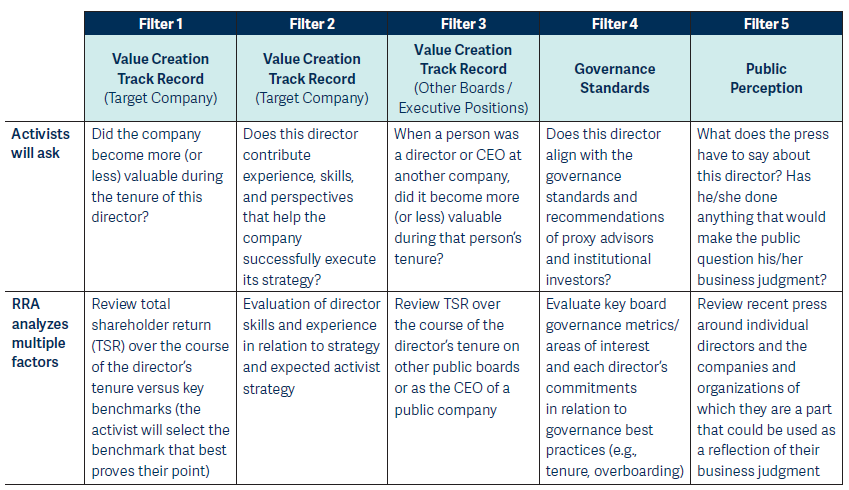
Activists have become very sophisticated in how they determine which directors to target in connection with a proxy contest. Activists will try to create the narrative around the full board and/or each director to advance the story that suits their goals. Activists will use time frames and benchmarks around total shareholder return and share price appreciation that paints management and board members in the worst possible light. While boards and directors may claim this is unfair or misleading (not taking into account the full facts or context), activists have the advantage of being on the offensive and using “facts” in a manner that benefits them. Activists look at a series of “filters” for each director. The record of value creation and relevance of each director’s skill set are critical. Unfortunately, a director with a great track record of value creation and with highly relevant skills can be targeted if there are publicly available stories that raise questions about that director’s judgment or integrity.

Russell Reynolds recommends that boards conduct a proactive board and director activism defense review. To help prepare and defend against an activist targeting a board and individual directors, RRA uses five filters to analyze each incumbent director and identify those most likely to be targeted by an activist investor.

Our proactive board composition and performance audit review includes:


Summary

Scrutiny of public company boards from activists, institutional investors, and the media shows no signs of abating. Publically and, what was once privately available information, continues to increase. New databases from ISS, Glass Lewis, Bloomberg, S&P and other information service providers increase the ability of activists and others to analyze multiple aspects of a board and individual directors’ performance, background, and governance standards. Boards need to prepare and be “clear-eyed” and objective in foreseeing the risks they may face should an activist or institutional investor initiate a review of the board.

Compte rendu hebdomadaire de la Harvard Law School Forum on Corporate Governance | 10 août 2017


Voici le compte rendu hebdomadaire du forum de la Harvard Law School sur la gouvernance corporative au 10 août 2017.

J’ai relevé les principaux billets, tout en me limitant au Top 10.

Bonne lecture !


Résultats de recherche d'images pour « harvard law school forum on corporate governance »


Résultats de recherche d'images pour « harvard law school forum on corporate governance »


  1. Say-on-Pay: Is Anybody Listening?
  2. Sunrise, Sunset: An Empirical and Theoretical Assessment of Dual-Class Stock Structures
  3. S&P and FTSE Russell on Exclusion of Companies with Multi-Class Shares
  4. You Want Mandatory Arbitration in your Charter? Hey, Just Ask!
  5. Equity Issuances and Agency Costs: The Telling Story of Shareholder Approval Around the World
  6. Federal Class Action Securities Fraud Filings Hit Record Pace in H1 2017
  7. Recent Cases Demonstrate Need for Blockchain
  8. How “Shareholder Value” is Killing Innovation
  9. Report Finds Shareholder Activism Evolving from Niche Strategy to Acceptance Across Investors
  10. 2017 Mid-Year Securities Enforcement Update

Compte rendu hebdomadaire de la Harvard Law School Forum on Corporate Governance | 2 août 2017


Voici le compte rendu hebdomadaire du forum de la Harvard Law School sur la gouvernance corporative au  2 août 2017.

J’ai relevé les principaux billets, tout en me limitant au Top 1o.

Bonne lecture !


Résultats de recherche d'images pour « harvard law school forum on corporate governance »


Résultats de recherche d'images pour « harvard law school forum on corporate governance »


  1. Balancing Board Experience and Expertise
  2. Common-Sense Capitalism
  3. SEHK Invites Market Feedback on Establishment of New Listing Board
  4. Issuers’ CEO/Chairman Structure Not Correlated with Firm Performance
  5. CEO Succession Practices: 2017 Edition
  6. Board Pay—Not Just a Public Company Concern
  7. Deals Mid-Year Review and Outlook
  8. Delaware Update
  9. Delaware Court of Chancery Holds Controller Transaction Satisfies Entire Fairness and Issues Appraisal Award Below Deal Price
  10. The New Market Manipulation


Compte rendu hebdomadaire de la Harvard Law School Forum on Corporate Governance | 20 juillet 2017


Voici le compte rendu hebdomadaire du forum de la Harvard Law School sur la gouvernance corporative au  20 juillet 2017.

J’ai relevé les principaux billets, tout en me limitant au Top 1o.

Bonne lecture !


Résultats de recherche d'images pour « harvard law school forum on corporate governance »


Résultats de recherche d'images pour « harvard law school forum on corporate governance »


  1. Lighting Our Capital Markets
  2. Balancing the Governance of Financial Institutions
  3. The Search for a Long-Term Premium
  4. Board to Death: How Busy Directors Could Cause the Next Financial Crisis
  5. Communications Challenges for the Post-Activist Proxy Contest World
  6. Director Attention and Firm Value
  7. CalPERS v. IAC: Clear Win for Investors Protecting Shareholder Voting Rights
  8. Hedge Fund Activism and the Revision of the Shareholder Rights Directive
  9. The Delightful Dozen: Top Governance Advances in 2017
  10. How Important are Risk-Taking Incentives in Executive Compensation

Compte rendu hebdomadaire de la Harvard Law School Forum on Corporate Governance | 13 juillet 2017


Voici le compte rendu hebdomadaire du forum de la Harvard Law School sur la gouvernance corporative au  13 juillet 2017.

J’ai relevé les principaux billets, tout en me limitant au Top 1o.

Bonne lecture !


Résultats de recherche d'images pour « harvard law school forum on corporate governance »


Résultats de recherche d'images pour « harvard law school forum on corporate governance »


  1. The Law & Brexit XII
  2. How Your Board Can Be Ready for Crisis
  3. 2017 Proxy Season Review Appraisal Practice Points Post-SWS
  4. Lawyer CEOs
  5. The Value of the Shareholder Proposal Process
  6. What Do Measures of Real-Time Corporate Sales Tell Us About Earnings Surprises and Post-Announcement Returns?
  7. Have SEC ALJs Been Operating Contrary to the U.S. Constitution?
  8. Shareholder Proposal Developments During the 2017 Proxy Season
  9. Inelastic Labor Markets and Directors’ Reputational Incentives
  10. The Long Arm of the MAC

Compte rendu hebdomadaire de la Harvard Law School Forum on Corporate Governance | 6 juillet 2017


Voici le compte rendu hebdomadaire du forum de la Harvard Law School sur la gouvernance corporative au  6 juillet 2017.

J’ai relevé les principaux billets, tout en me limitant au Top 1o.

Bonne lecture !


Résultats de recherche d'images pour « harvard law school forum on corporate governance »


Résultats de recherche d'images pour « harvard law school forum on corporate governance »


  1. What are Boards For? Evidence from Closely Held Firms
  2. After the Annual General Meeting: How Boards Can Prepare for Next Year
  3. Proxy Access: Highlights of the 2017 Proxy Season
  4. A Closer Look at the Findings of Our 2017 Proxy Analysis: A New Normal Meets a New Reality
  5. Investor Support Heating Up for Climate Change Proposals
  6. Red Light for New Activist Strategy
  7. Board Reforms and Firm Value: Worldwide Evidence The “Responsible Corporate Officer Doctrine”
  8. Survives to Perplex Corporate Boards
  9. Index Eligibility as Governance Battlefield: Why the System is Not Broken and We Can Live With Dual Class Issuers
  10. Internal Investigations Special Committees Resource

Compte rendu hebdomadaire de la Harvard Law School Forum on Corporate Governance | 29 juin 2017


Voici le compte rendu hebdomadaire du forum de la Harvard Law School sur la gouvernance corporative au  29 juin 2017.

J’ai relevé les principaux billets, tout en me limitant au Top 10

Bonne lecture !


Résultats de recherche d'images pour « harvard law school forum on corporate governance »


Résultats de recherche d'images pour « harvard law school forum on corporate governance »


  1. What Is the Business of Business?
  2. Treasury Department Issues Recommendations on Reforming the U.S. Financial System
  3. A Modest Proposal? Treasury’s Report on Bank Regulation
  4. Déjà Vu: Model Risks in the Financial Choice Act
  5. Is Board Compensation Excessive?
  6. Ten Questions Every Board Should Ask in Overseeing Cyber Risks
  7. Federal Bill Attempts to Silence Investors
  8. The Financial CHOICE Act and the Debate Over Shareholder Proposals
  9. “Captured Boards”: The Rise of “Super Directors” and the Case for a Board Suite
  10. The Increasing Evidence that Horizontal Shareholding Is Distorting Our Economy

Compte rendu hebdomadaire de la Harvard Law School Forum on Corporate Governance | 22 juin 2017


Voici le compte rendu hebdomadaire du forum de la Harvard Law School sur la gouvernance corporative au  22 juin 2017.

J’ai relevé les principaux billets, tout en me limitant au Top 1o.

Bonne lecture !


Résultats de recherche d'images pour « harvard law school forum on corporate governance »


Résultats de recherche d'images pour « harvard law school forum on corporate governance »


  1. What Determines Participation in Corporate Voting?
  2. The Voice: The Minority Shareholder’s Perspective
  3. PCAOB Approves Expanded Auditor’s Report
  4. Shareholder Proposals: Evidence of Private Ordering Supplanting Public Policy?
  5. Changing Attitudes: The Stark Results Of Thirty Years Of Evolution In Delaware M&A Litigation
  6. Corporate Liquidity, Acquisitions, and Macroeconomic Conditions
  7. Letter to Paul Ryan: The Financial CHOICE Act of 2017
  8. Are Shareholder Proposals on Climate Change Becoming a Thing?
  9. Balancing the Tension: Current Topics in Executive Compensation
  10. House Approves Financial CHOICE Act


Compte rendu hebdomadaire de la Harvard Law School Forum on Corporate Governance | 15 juin 2017


Voici le compte rendu hebdomadaire du forum de la Harvard Law School sur la gouvernance corporative au  15 juin 2017.

J’ai relevé les principaux billets, tout en me limitant au Top 1o.

Bonne lecture !


Résultats de recherche d'images pour « harvard law school forum on corporate governance »


Résultats de recherche d'images pour « harvard law school forum on corporate governance »


  1. Breaking the Ice: Investors Warm to Climate Change
  2. Perk Disclosures: Reminders for Executives and Directors
  3. Compensation Goals and Firm Performance
  4. The Global Rise of Corporate Saving
  5. The 200 Highest-Paid CEOs in 2016
  6. The CEO Pay Ratio Beyond Dodd Frank: Live and Local
  7. M&A Activism: A Special Report
  8. Distracted Directors
  9. The Dangerous “Promise of Market Reform”: No Shareholder Proposals
  10. Financial CHOICE Act of 2017 2017 M&A Report

Compte rendu hebdomadaire de la Harvard Law School Forum on Corporate Governance | 8 juin 2017


Voici le compte rendu hebdomadaire du forum de la Harvard Law School sur la gouvernance corporative au 8 juin 2017.

J’ai relevé les principaux billets, tout en me limitant au Top 1o.

Bonne lecture !


Résultats de recherche d'images pour « harvard law school forum on corporate governance »


Résultats de recherche d'images pour « harvard law school forum on corporate governance »


  1. Decreasing Patience for IPOs with Poor Shareholder Rights
  2. Appraisal Decision Sole Reliance on Merger Price: PetSmart
  3. The Role of Social Capital in Corporations: A Review
  4. On Long-Tenured Independent Directors
  5. Why Your Board Should Refocus on Key Risks
  6. The Limits of Gatekeeper Liability
  7. The Long Game: Incentive Pay Aims at Generating Lasting Return
  8. The Corporate Demand for External Connectivity: Pricing Boardroom Social Capital
  9. Criticism of Governance Provisions in Proxy Contest Leads to Reincorporation
  10. Retired or Fired: How Can Investors Tell If the CEO Left Voluntarily?


Compte rendu hebdomadaire de la Harvard Law School Forum on Corporate Governance | 1er juin 2017


Voici le compte rendu hebdomadaire du forum de la Harvard Law School sur la gouvernance corporative au 1er juin 2017.

J’ai relevé les principaux billets, tout en me limitant au Top 1o.

Bonne lecture !


Résultats de recherche d'images pour « harvard law school forum on corporate governance »


Résultats de recherche d'images pour « harvard law school forum on corporate governance »

  1. Bank Governance and Systemic Stability: The “Golden Share” Approach
  2. Snap and the Rise of No-Vote Common Shares
  3. Potential Regulatory Relief—Financial CHOICE Act 2.0
  4. The Origins of Corporate Social Responsibility
  5. M&A Deal Terms in 2017: What Can Deal Teams Expect?
  6. Cybersecurity Must Be High on the Board Agenda
  7. Dancing with Activists
  8. U.S. Proxy Season Half-Time Update
  9. What’s (Still) Wrong with Credit Ratings
  10. 2017 M&A Report

Nouvelle étude sur les retombées des comportements activistes | Bebchuk


Les administrateurs de sociétés doivent être beaucoup plus informés des conséquences que les fonds activistes peuvent avoir sur la conduite des entreprises publiques (cotées).

Il plane un air de mystère, et un certain mutisme, sur la nature des opérations et sur les objectifs poursuivis par les investisseurs activistes.

Pourtant, même si le phénomène est de plus en plus répandu, on constate un manque flagrant de formation des administrateurs de sociétés sur les types d’arrangements recherchés par les activistes.

Les pionniers de la recherche dans ce domaine, Lucian Bebchuk* et ses collègues, viennent de publier un billet sur le site de Harvard Law School Forum on Corporate Governance, qui fait la lumière sur le comportement des investisseurs activistes.

Que recherchent les activistes ? Ils veulent convaincre les directions et les conseils d’administration que leurs préconisations conduiront à une meilleure valorisation de l’entreprise.

Ils souhaitent tirer parti des faiblesses de certaines organisations dans le but premier de faire profiter leurs investissements, tout en améliorant la rentabilité des entreprises qui ont des problèmes de gouvernance, de leadership et de vision stratégique.

Quels sont les résultats de la recherche des auteurs eu égard aux motivations, à la nature des arrangements ainsi qu’à leurs conséquences ?

L’étude montre que les négociations sur les modifications organisationnelles souhaitées, reliées au renouvellement du leadership et à la remise en question des opérations, sont difficiles à convenir.

Les fonds activistes préfèrent de loin arriver à des ententes sur la composition du conseil d’administration susceptible de favoriser les changements escomptés.


Résultats de recherche d'images pour « actionnaires activistes »
Les fonds activistes à l’assaut des grands groupes | Le Monde


L’étude indique que les modifications à la constitution du CA mènent souvent :

  1. au remplacement du PDG (CEO) ;
  2. à des paiements accrus aux actionnaires ;
  3. à une plus forte probabilité de vente ou de privatisation de l’entreprise.


Finalement, l’étude montre que les avantages obtenus par les actionnaires activistes ne se font pas au détriment des autres investisseurs. Également, le prix des actions est généralement à la hausse à la suite des négociations sur les arrangements.

Les auteurs dévoilent aussi les moyens utilisés par les fonds activistes pour arriver à leurs fins (« a look into the black box »).

Je suis personnellement convaincu que certaines conséquences non anticipées se produisent et que cette étude doit être mise en relation avec d’autres recherches, notamment celles du professeur Yvan Allaire**.


Afin de mettre en valeur de bonnes pratiques mises en places par des conseils d’administration des sociétés québécoises, le journal Les Affaires, en collaboration avec l’Institut des administrateurs de sociétés (IAS), le Collège des administrateurs de sociétés et l’Institut sur la gouvernance  (IGOPP), a tenu le 1er avril dernier une Grande soirée de la gouvernance. Durant cette soirée, le professeur Yvan Allaire, président exécutif du conseil d’administration de l’IGOPP a dévoilé en primeur une étude sur l’enjeu des investisseurs activistes et leurs conséquences pour les conseils d’administration.


Conclusions préliminaires de cette étude :

(1) Les fonds de couverture activistes ne sont pas des « super‐cracks » de la finance, ni de la stratégie, ni des opérations, comme certains semblent le croire (et eux s’évertuent à le faire croire) ;

(2) Leurs recettes sont connues, convenues et prévisibles et ne comportent jamais (ou presque) de perspectives de croissance ;

(3) Leur succès provient surtout de la vente des entreprises ciblées (ou de « spin‐offs ») ;

(4) L’appui important qu’ils reçoivent des fonds institutionnels est surprenant et malencontreux ;

(5) La gouvernance fiduciaire pratiquée depuis Sarbanes‐Oxley et la perte de confiance dans les conseils qui en a résulté leur ouvre toute grande la porte des entreprises.


Bonne lecture. Vos commentaires sont les bienvenus.


Dancing with Activists


We recently released a study, entitled Dancing with Activists, that focuses on “settlement” agreements between activist hedge funds and target companies. Using a comprehensive hand-collected data set, we provide the first systematic analysis of the drivers, nature, and consequences of such settlement agreements.

Our study identifies the determinants of settlements, showing that settlements are more likely when the activist has a credible threat to win board seats in a proxy fight. We argue that, due to incomplete contracting, settlements can be expected to contract not directly on the operational or leadership changes that activists seek but rather on board composition changes that can facilitate operational and leadership changes down the road. Consistent with the incomplete contracting hypothesis, we document that settlements focus on boardroom changes and that such changes are subsequently followed by increases in CEO turnover, increased payout to shareholders, and higher likelihood of a sale or a going-private transaction.

We find no evidence to support concerns that settlements enable activists to extract significant rents at the expense of other investors by introducing directors not supported by other investors or by facilitating “greenmail.” Finally, we document that stock price reactions to settlement agreements are positive and that the positive reaction is higher for “high-impact” settlements. Our analysis provides a look into the “black box” of activist engagements and contributes to understanding how activism brings about changes in its targets.

Below is a more detailed account of the analysis and findings of our study.

In August 2013, Third Point, the hedge fund led by Daniel Loeb, disclosed a significant stake in the auction house Sotheby’s, criticized the company for its poor governance and its failure to take advantage of a booming market for luxury goods, and called for the ouster of the company’s CEO. Third Point launched a proxy fight for board representation and both sides prepared for a contested election at the company’s upcoming annual meeting. However, the day before the scheduled annual shareholder meeting, the company’s board of directors and the activist fund entered into a settlement agreement in which Sotheby’s agreed to appoint three of the Third Point director candidates and Third Point agreed to discontinue the proxy fight. The settlement terms did not require the company to make any of the operational and executive changes that Third Point was seeking. However, ten months later, Sotheby’s announced the hiring of a new CEO, the appointment of a new board chairman, and a plan to return capital to its investors.

While such settlements used to be rare, they now occur with significant frequency, and they have been attracting a great deal of media and practitioner attention. Understanding settlement agreements is important for obtaining a complete picture of the corporate governance landscape and the role of activism within it. Using a comprehensive, hand-collected dataset of settlement agreements, we provide in this study the first systematic empirical investigation of activist settlements. We study the drivers of settlements, their growth over time, their impact on board composition, their consequences for the operational and personnel choices that targets make, and the stock market reaction accompanying them. We further study the aftermath of settlements in terms of CEO turnover, payouts to shareholders, M&A activity, and operating performance.

With the growing recognition of the importance of hedge fund activism, a large empirical literature on the subject has emerged (see Brav et al. (2015b) for a recent survey). This literature has studied the initiation of activist interventions—the time at which activists announce their presence, usually by filing Schedule 13(d) with the SEC after passing the 5% ownership threshold, and the stock market reactions accompanying such announcements. This literature has also studied extensively the changes in the value, performance and behavior of firms that take place during the years following activist interventions; among other things, researchers have studied the changes in Tobin’s Q, return on assets (ROA), payouts to shareholders, capital structure, likelihood of an acquisition, and accounting practices that ultimately follow activist interventions. But there has been limited empirical work on the “black box” in between—the channels through which activists’ influence is transmitted and gets reflected in targets’ economic outcomes. In particular, the determinants, nature and role of settlement agreements—and the cooperation between activists and targets that they introduce—have not been subject to a systematic empirical examination. We attempt to help fill this gap.

We begin by investigating the factors that determine the likelihood that an activist will be able to obtain a settlement agreement. Building on insights from the economics of settlements, we hypothesize that an activist will need to have a credible threat to win seats in a proxy fight to be able to extract a settlement agreement. Consistent with this hypothesis, we find that the likelihood of a settlement agreement in general, and a “high-impact” settlement agreement involving a substantial change in company leadership, covaries with several factors that are associated with improved odds for the activist in winning board seats in a proxy fight.

We quantify the upward trend in activist settlements. In particular, we show that the unconditional likelihood of a settlement increased threefold from the time period 2000-2002 (3%) to the period 2003-2005 (9%), increased by another 56% during 2006-2008 (14%) and by 29% during 2009-2011 (18%). These results hold when controlling for target and activist characteristics. Consistent with the view that settlements require activists having a credible threat to win board seats in a proxy fight, we argue that the increase in the settlement rate was driven by the growing willingness of institutional investors and proxy advisors to support activists, which in turns strengthened the credibility of the activist’s threat to win seats in a contest.

Turning to the terms of settlements, we explain the cost and difficulty of entering into contractual agreements that specify ultimate outcomes—the types of changes in operations, strategy, payouts or executive personnel that activists often seek. We document that settlements indeed rarely stipulate directly such outcomes. Rather, activists commonly settle on changes in board composition. We demonstrate that settlements are a key channel through which activists bring about board changes and we investigate the nature of these changes, showing that they bring about an increase in the number of activist-affiliated and activist-desired directors, well-connected directors and decrease the number of old and long-tenured directors.

Why do activists settle on changes in board composition if their ultimate goal is in bringing about operational or personnel changes? We argue that introducing individuals into the boardroom who are sympathetic, or at least open to the changes sought by the activist, is an intermediary step that can facilitate and bring about such changes. Consistent with this view, we show that, while settlements generally do not specify an ouster of the CEO, settlements are followed by a considerable increase in CEO turnover and in the performance-sensitivity of CEO turnover in the years following the settlement. Thus, settlements often plant the seeds for a subsequent CEO removal that is more face-saving to the CEO and the incumbent directors than an immediate ouster would be. Similarly, while settlement agreements generally do not specify operational changes, we document that such changes do follow in subsequent years. Settlements are followed by increased payouts to shareholders, a higher likelihood of target firms being acquired, and improvements in ROA.

We also investigate concerns raised by practitioners and the media that settlements between activists and targets enable activists to extract rents at the expense of other shareholders who are not “at the table” when the settlement is negotiated. We examine two suggested channels for such rent extraction and find little evidence that settlements provide activists with significant rents at other shareholders’ expense. First, we find no evidence that settlements enable activists to put directors on the board who are not supported by other shareholders. Directors who enter the board through settlements do not receive less voting support at the following annual general meeting than incumbent directors or those activist directors who get on the board without a settlement. Second, we find little evidence that settlements produce a significant incidence of “greenmail” by getting the target to purchase shares from the activist at a premium to the market price; buybacks of activist shares occur in a very small fraction of settlement agreements and, when they do occur, they are typically executed at the market price.

Finally, we analyze the stock market reactions accompanying the announcement of a settlement agreement. Settlements are accompanied by positive abnormal stock returns. Furthermore, we find that the positive abnormal returns are especially large when the settlement is “high impact” in terms of introducing two or more new directors or providing for an immediate CEO turnover. This pattern is consistent with the view that the market welcomes the boardroom and leadership changes that activist settlements produce and inconsistent with the view that such changes can be expected to be disruptive and detrimental to other shareholders.

Our study is available for download here.


*Lucian Bebchuk is Professor of Law, Economics, and Finance, and Director of the Program on Corporate Governance, at Harvard Law School; Alon Brav is Professor of Finance at Duke University; Wei Jiang is Professor of Finance at Columbia Business School; and Thomas Keusch is Assistant Professor at the Erasmus University School of Economics. This post is based on their study, Dancing with Activists, available here. This study is part of the research undertaken by the Project on Hedge Fund Activism of the Program on Corporate Governance. Related Program research includes The Long-Term Effects of Hedge Fund Activism by Bebchuk, Brav and Jiang (discussed on the Forum here); and The Law and Economics of Blockholder Disclosure by Lucian Bebchuk and Robert J. Jackson Jr. (discussed on the Forum here).

**Yvan Allaire, Voir la publication « L’IGOPP dévoile une étude sur l’enjeu des investisseurs activistes et leurs conséquences pour les conseils », site de l’IGOPP.


Compte rendu hebdomadaire de la Harvard Law School Forum on Corporate Governance | 25 mai 2017


Voici le compte rendu hebdomadaire du forum de la Harvard Law School sur la gouvernance corporative au 25 mai 2017.

J’ai relevé les principaux billets.

Bonne lecture !


Résultats de recherche d'images pour « harvard law school forum on corporate governance »


Résultats de recherche d'images pour « harvard law school forum on corporate governance »

  1. Do Exogenous Changes in Passive Institutional Ownership Affect Corporate Governance and Firm Value?
  2. It Pays to Write Well
  3. Mutual Fund Companies Have Significant Power to Increase Corporate Transparency
  4. Just How Preferred is Your Preferred?
  5. Private Investor Meetings in Public Firms: The Case for Increasing Transparency
  6. Court of Chancery’s Guidance on “Credible Basis” Standard for Obtaining Books
  7. Recent Board Declassifications: A Response to Cremers and Sepe
  8. SEC Enforcement Actions Against Public Companies and Subsidiaries Keep Pace
  9. Dual-Class Stock and Private Ordering: A System That Works
  10. 2017 IPO Report