Top 10 de Harvard Law School Forum on Corporate Governance au 29 août 2019


Voici le compte rendu hebdomadaire du forum de la Harvard Law School sur la gouvernance corporative au 29 août 2019.

Comme à l’habitude, j’ai relevé les dix principaux billets.

Bonne lecture !


Résultats de recherche d'images pour « top ten »


  1. Stakeholder Governance and the Fiduciary Duties of Directors
  2. Board Diversity Study
  3. Relative Performance and Incentive Metrics
  4. CEO Incentives Shown to Yield Positive Societal Benefits
  5. Shareholder Governance and CEO Compensation: The Peer Effects of Say on Pay
  6. Compensation Committees & Human Capital Management
  7. Economic Value Added Makes a Come Back
  8. Rights and Obligations of Board Observers
  9. A New Understanding of the History of Limited Liability: An Invitation for Theoretical Reframing
  10. M&A at a Glance

Top 10 de Harvard Law School Forum on Corporate Governance au 8 août 2019


Voici le compte rendu hebdomadaire du forum de la Harvard Law School sur la gouvernance corporative au 8 août 2019.

Comme à l’habitude, j’ai relevé les dix principaux billets.

Bonne lecture !


Résultats de recherche d'images pour « top ten »


  1. Building a Climate Change Voting Policy
  2. Director Overboarding: Global Trends, Definitions, and Impact
  3. The Case for Quarterly and Environmental, Social, and Governance Reporting
  4. A Roadmap for President Trump’s Crypto-Crackdown
  5. The Bond Villains of Green Investment
  6. France’s First Binding “Non” on Say-On-Pay
  7. Diversified Portfolios Do Not Reduce Competition
  8. Spotlight on Boards
  9. Employer Losses and Deferred Compensation
  10. Five Takeaways From the 2019 Proxy Season

Top 10 de Harvard Law School Forum on Corporate Governance au 1er août 2019


Voici le compte rendu hebdomadaire du forum de la Harvard Law School sur la gouvernance corporative au 1er août 2019.

Comme à l’habitude, j’ai relevé les dix principaux billets.

Bonne lecture !


Résultats de recherche d'images pour « top ten »


  1. 2019 Proxy Season Takeaways
  2. Building a Sustainable and Competitive Economy: An Examination of Proposals to Improve Environmental, Social, and Governance Disclosures
  3. Why Compliance (Still) Matters
  4. Global Securities Litigation Trends
  5. Compensation Consultants and the Level, Composition and Complexity of CEO Pay
  6. The Facebook Settlement
  7. Avoiding a Toxic Culture: 10 Changes to Address #MeToo
  8. Corporate Control and the Limits of Judicial Review
  9. Executive Compensation: The Role of Public Company Shareholders
  10. Oversight and Compliance Reminder

Top 10 de Harvard Law School Forum on Corporate Governance au 25 juillet 2019


Voici le compte rendu hebdomadaire du forum de la Harvard Law School sur la gouvernance corporative au 25 juillet 2019.

Comme à l’habitude, j’ai relevé les dix principaux billets.

Bonne lecture !


Résultats de recherche d'images pour « top ten »


  1. Comment Letter Regarding Earnings Releases and Quarterly Reports
  2. Statement on Short-Term/Long-Term Management & Periodic Reporting System
  3. Individual Director Assessments
  4. CEO Pay Ratio: Leading Indicators of Broader Human Resource Matters?
  5. A Banner Proxy Season for Political Disclosure and Accountability
  6. How Much Do Directors Influence Firm Value?
  7. Under Pressure: Directors in an Era of Shareholder Primacy
  8. The Importance of Climate Risks for Institutional Investors
  9. Proxy Voting Outcomes: By the Numbers
  10. The Future of Shareholder Activism


Deux développements significatifs en gouvernance des sociétés


Aujourd’hui, je veux porter à l’attention de mes lecteurs un article de Assaf Hamdani* et Sharon Hannes* qui aborde deux développements majeurs qui ont pour effet de bouleverser les marchés des capitaux.

D’une part, les auteurs constatent le rôle de plus en plus fondamental que les investisseurs institutionnels jouent sur le marché des capitaux aux É. U., mais aussi au Canada.

En effet, ceux-ci contrôlent environ les trois quarts du marché, et cette situation continue de progresser. Les auteurs notent qu’un petit nombre de fonds détiennent une partie significative du capital de chaque entreprise.

Les investisseurs individuels sont de moins en moins présents sur l’échiquier de l’actionnariat et leur influence est donc à peu près nulle.

Dans quelle mesure les investisseurs institutionnels exercent-ils leur influence sur la gouvernance des entreprises ? Quels sont les changements qui s’opèrent à cet égard ?

Comment leurs actions sont-elles coordonnées avec les actionnaires activistes (hedge funds) ?

La seconde tendance, qui se dessine depuis plus de 10 ans, concerne l’augmentation considérable de l’influence des actionnaires activistes (hedge funds) qui utilisent des moyens de pression de plus en plus grands pour imposer des changements à la gouvernance des organisations, notamment par la nomination d’administrateurs désignés aux CA des entreprises ciblées.

Quelles sont les nouvelles perspectives pour les activistes et comment les autorités réglementaires doivent-elles réagir face à la croissance des pressions pour modifier les conseils d’administration ?

Je vous invite à lire ce court article pour avoir un aperçu des changements à venir eu égard à la gouvernance des sociétés.

Bonne lecture !


The Future of Shareholder Activism


Résultats de recherche d'images pour « The Future of Shareholder Activism »


Two major developments are shaping modern capital markets. The first development is the dramatic increase in the size and influence of institutional investors, mostly mutual funds. Institutional investors today collectively own 70-80% of the entire U.S. capital market, and a small number of fund managers hold significant stakes at each public company. The second development is the rising influence of activist hedge funds, which use proxy fights and other tools to pressure public companies into making business and governance changes.

Our new article, The Future of Shareholder Activism, prepared for Boston University Law Review’s Symposium on Institutional Investor Activism in the 21st Century, focuses on the interaction of these two developments and its implications for the future of shareholder activism. We show that the rise of activist hedge funds and their dramatic impact question the claim that institutional investors have conflicts of interest that are sufficiently pervasive to have a substantial market-wide effect. We further argue that the rise of money managers’ power has already changed and will continue to change the nature of shareholder activism. Specifically, large money managers’ clout means that they can influence companies’ management without resorting to the aggressive tactics used by activist hedge funds. Finally, we argue that some activist interventions—those that require the appointment of activist directors to implement complex business changes—cannot be pursued by money managers without dramatic changes to their respective business models and regulatory landscapes.

We first address the overlooked implications of the rise of activist hedge funds for the debate on institutional investors’ stewardship incentives. The success of activist hedge funds, this Article argues, cannot be reconciled with the claim that institutional investors have conflicts of interest that are sufficiently pervasive to have a substantial market-wide effect. Activist hedge funds do not hold a sufficiently large number of shares to win proxy battles, and their success to drive corporate change therefore relies on the willingness of large fund managers to support their cause. Thus, one cannot celebrate—or express concern over—the achievements of activist hedge funds and at the same time argue that institutional investors systemically desire to appease managers.

But if money managers are the real power brokers, why do institutional investors not play a more proactive role in policing management? One set of answers to this question focuses on the shortcomings of fund managers—their suboptimal incentives to oversee companies in their portfolio and conflicts of interest. Another answer focuses on the regulatory regime that governs institutional investors and the impediments that it creates for shareholder activism.

We offer a more nuanced account of the interaction of activists and institutional investors. We argue that the rising influence of fund managers is shaping and is likely to shape the relationships among corporate insiders, institutional investors, and activist hedge funds. Institutional investors’ increasing clout allows them to influence companies without resorting to the aggressive tactics that are typical of activist hedge funds. With institutional investors holding the key to their continued service at the company, corporate insiders today are likely to be more attentive to the wishes of their institutional investors, especially the largest ones.

In fact, in today’s marketplace, management is encouraged to “think like an activist” and initiate contact with large fund managers to learn about any concerns that could trigger an activist attack. Institutional investors—especially the large ones—can thus affect corporations simply by sharing their views with management. This sheds new light on what is labeled today as “engagement.” Moreover, the line between institutional investors’ engagement and hedge fund activism could increasingly become blurred. To be sure, we do not expect institutional investors to develop deeply researched and detailed plans for companies’ operational improvement. Yet, institutional investors’ engagement is increasingly likely to focus not only on governance, but also on business and strategy issues.

The rising influence of institutional investors, however, is unlikely to displace at least some forms of activism. Specifically, we argue that institutional investors are unlikely to be effective in leading complex business interventions that require director appointments. Activists often appoint directors to target boards. Such appointments may be necessary to implement an activist campaign when the corporate change underlying the intervention does not lend itself to quick fixes, such as selling a subsidiary or buying back shares. In complex cases, activist directors are required not only in order to continuously monitor management, but also to further refine the activist business plan for the company.

This insight, however, only serves to reframe our Article’s basic question. Given the rising power of institutional investors, why can they not appoint such directors to companies’ boards? The answer lies in the need of such directors to share nonpublic information with the fund that appointed them. Sharing such information with institutional investors would create significant insider trading concerns and would critically change the role of institutional investors as relatively passive investors with a limited say over company affairs.

The complete article is available here.

________________________________________________________________

*Assaf Hamdani is Professor of Law and Sharon Hannes is Professor of Law and Dean of the Faculty at Tel Aviv University Buchmann Faculty of Law. This post is based on their recent article, forthcoming in the Boston University Law Review. Related research from the Program on Corporate Governance includes Dancing with Activists by Lucian Bebchuk, Alon Brav, Wei Jiang, and Thomas Keusch (discussed on the Forum here); The Agency Problems of Institutional Investors by Lucian Bebchuk, Alma Cohen, and Scott Hirst (discussed on the Forumhere); and Index Funds and the Future of Corporate Governance: Theory, Evidence, and Policy by Lucian Bebchuk and Scott Hirst (discussed on the forum here).

Top 10 de Harvard Law School Forum on Corporate Governance au 11 juillet 2019


Voici le compte rendu hebdomadaire du forum de la Harvard Law School sur la gouvernance corporative au 11 juillet 2019.

Comme à l’habitude, j’ai relevé les dix principaux billets.

Bonne lecture !


Résultats de recherche d'images pour « top 10 »


  1. 2019 Midyear M&A Trends
  2. Director Independence and Oversight Obligation in Marchand v. Barnhill
  3. An Overview of Vote Requirements at U.S. Meetings
  4. Do the Securities Laws Promote Short-termism?
  5. Emerging Technologies, Risk, and the Auditor’s Focus
  6. Fiduciary Violations in Sale of Company
  7. The Job Rating Game: Revolving Doors and Analyst Incentives
  8. Model Stewardship Code for Long-Term Behavior
  9. Protecting Main Street Investors: Regulation Best Interest and the Investment Adviser Fiduciary Duty
  10. Regulating Libra


Top 10 de Harvard Law School Forum on Corporate Governance au 3 juillet 2019


Voici le compte rendu hebdomadaire du forum de la Harvard Law School sur la gouvernance corporative au 3 juillet 2019.

Comme à l’habitude, j’ai relevé les dix principaux billets.

Bonne lecture !


Résultats de recherche d'images pour « top 10 »


  1. Overview of Recent Stock Exchange Proposals
  2. Dual-Class Shares: Governance Risks and Company Performance
  3. Spotlight on Boards
  4. Baby on Board: Remarks before the Society for Corporate Governance National Conference
  5. Irrelevance of Governance Structures
  6. How Boards Govern Disruptive Technology—Key Findings from a Director Survey
  7. Shareholder Protection and the Cost of Capital
  8. Task Force on Climate-Related Financial Disclosure 2019 Status Report
  9. Glass Lewis, ISS, and ESG
  10. Solving Banking’s “Too Big to Manage” Problem


Quelles sont les responsabilités dévolues à un conseil d’administration ?


En gouvernance des sociétés, il existe un certain nombre de responsabilités qui relèvent impérativement d’un conseil d’administration.

À la suite d’une décision rendue par la Cour Suprême du Delaware dans l’interprétation de la doctrine Caremark (voir ici),il est indiqué que pour satisfaire leur devoir de loyauté, les administrateurs de sociétés doivent faire des efforts raisonnables (de bonne foi) pour mettre en œuvre un système de surveillance et en faire le suivi.

Without more, the existence of management-level compliance programs is not enough for the directors to avoid Caremark exposure.

L’article de Martin Lipton *, paru sur le Forum de Harvard Law School on Corporate Governance, fait le point sur ce qui constitue les meilleures pratiques de gouvernance à ce jour.

Bonne lecture !


Spotlight on Boards


Résultats de recherche d'images pour « Spotlight on Boards »


  1. Recognize the heightened focus of investors on “purpose” and “culture” and an expanded notion of stakeholder interests that includes employees, customers, communities, the economy and society as a whole and work with management to develop metrics to enable the corporation to demonstrate their value;
  2. Be aware that ESG and sustainability have become major, mainstream governance topics that encompass a wide range of issues, such as climate change and other environmental risks, systemic financial stability, worker wages, training, retraining, healthcare and retirement, supply chain labor standards and consumer and product safety;
  3. Oversee corporate strategy (including purpose and culture) and the communication of that strategy to investors, keeping in mind that investors want to be assured not just about current risks and problems, but threats to long-term strategy from global, political, social, and technological developments;
  4. Work with management to review the corporation’s strategy, and related disclosures, in light of the annual letters to CEOs and directors, or other communications, from BlackRock, State Street, Vanguard, and other investors, describing the investors’ expectations with respect to corporate strategy and how it is communicated;
  5. Set the “tone at the top” to create a corporate culture that gives priority to ethical standards, professionalism, integrity and compliance in setting and implementing both operating and strategic goals;
  6. Oversee and understand the corporation’s risk management, and compliance plans and efforts and how risk is taken into account in the corporation’s business decision-making; monitor risk management ; respond to red flags if and when they arise;
  7. Choose the CEO, monitor the CEO’s and management’s performance and develop and keep current a succession plan;
  8. Have a lead independent director or a non-executive chair of the board who can facilitate the functioning of the board and assist management in engaging with investors;
  9. Together with the lead independent director or the non-executive chair, determine the agendas for board and committee meetings and work with management to ensure that appropriate information and sufficient time are available for full consideration of all matters;
  10. Determine the appropriate level of executive compensation and incentive structures, with awareness of the potential impact of compensation structures on business priorities and risk-taking, as well as investor and proxy advisor views on compensation;
  11. Develop a working partnership with the CEO and management and serve as a resource for management in charting the appropriate course for the corporation;
  12. Monitor and participate, as appropriate, in shareholder engagement efforts, evaluate corporate governance proposals, and work with management to anticipate possible takeover attempts and activist attacks in order to be able to address them more effectively, if they should occur;
  13. Meet at least annually with the team of company executives and outside advisors that will advise the corporation in the event of a takeover proposal or an activist attack;
  14. Be open to management inviting an activist to meet with the board to present the activist’s opinion of the strategy and management of the corporation;
  15. Evaluate the individual director’s, board’s and committees’ performance on a regular basis and consider the optimal board and committee composition and structure, including board refreshment, expertise and skill sets, independence and diversity, as well as the best way to communicate with investors regarding these issues;
  16. Review corporate governance guidelines and committee workloads and charters and tailor them to promote effective board and committee functioning;
  17. Be prepared to deal with crises; and
  18. Be prepared to take an active role in matters where the CEO may have a real or perceived conflict, including takeovers and attacks by activist hedge funds focused on the CEO.


Afin de satisfaire ces attentes, les entreprises publiques doivent :


  1. Have a sufficient number of directors to staff the requisite standing and special committees and to meet investor expectations for experience, expertise, diversity, and periodic refreshment;
  2. Compensate directors commensurate with the time and effort that they are required to devote and the responsibility that they assume;
  3. Have directors who have knowledge of, and experience with, the corporation’s businesses and with the geopolitical developments that affect it, even if this results in the board having more than one director who is not “independent”;
  4. Have directors who are able to devote sufficient time to preparing for and attending board and committee meetings and engaging with investors;
  5. Provide the directors with the data that is critical to making sound decisions on strategy, compensation and capital allocation;
  6. Provide the directors with regular tutorials by internal and external experts as part of expanded director education and to assure that in complicated, multi-industry and new-technology corporations, the directors have the information and expertise they need to respond to disruption, evaluate current strategy and strategize beyond the horizon; and
  7. Maintain a truly collegial relationship among and between the company’s senior executives and the members of the board that facilitates frank and vigorous discussion and enhances the board’s role as strategic partner, evaluator, and monitor.

_________________________________________________________

Martin Lipton* is a founding partner of Wachtell, Lipton, Rosen & Katz, specializing in mergers and acquisitions and matters affecting corporate policy and strategy. This post is based on a Wachtell Lipton memorandum by Mr. Lipton and is part of the Delaware law series; links to other posts in the series are available here.

Un document incontournable en gouvernance des entreprises cotées : « OECD Corporate Governance Factbook 2019 »


Voici un rapport de recherche exhaustif publié tous les deux ans par l’OCDE.

Vous y retrouverez une mine de renseignements susceptibles de répondre à toute question relative à la gouvernance des plus importantes autorités des marchés financiers au monde.

C’est un document essentiel qui permet de comparer et d’évaluer les progrès en gouvernance dans les 49 plus importants marchés financiers.

Vous pouvez télécharger le rapport à la fin du sommaire exécutif publié ici. Le document est illustré par une multitude de tableaux et de figures qui font image il va sans dire.

Voici l’introduction au document de recherche. Celui-ci vient d’être publié. La version française devrait suivre bientôt.

Bonne lecture !


The 2019 edition of the OECD Corporate Governance Factbook (the “Factbook”) contains comparative data and information across 49 different jurisdictions including all G20, OECD and Financial Stability Board members. The information is presented and commented in 40 tables and 51 figures covering a broad range of institutional, legal and regulatory provisions. The Factbook provides an important and unique tool for monitoring the implementation of the G20/OECD Principles of Corporate Governance. Issued every two years, it is actively used by governments, regulators and others for information about implementation practices and developments that may influence their effectiveness.

It is divided into five chapters addressing: 1) the corporate and market landscape; 2) the corporate governance framework; 3) the rights of shareholders and key ownership functions; 4) the corporate boards of directors; and 5) mechanisms for flexibility and proportionality in corporate governance.
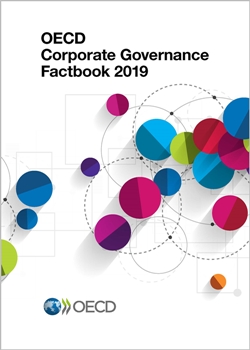
 

OECD (2019), OECD Corporate Governance Factbook 2019


Résultats de recherche d'images pour « OECD Corporate Governance Factbook 2019 »


The corporate and market landscape


Effective design and implementation of corporate governance rules requires a good empirical understanding of the ownership and business landscape to which they will be applied. The first chapter of the Factbook therefore provides an overview of ownership patterns around the world, with respect to both the categories of owners and the degree of concentration of ownership in individual listed companies. Since the G20/OECD Principles also include recommendations with respect to the functioning of stock markets, it also highlights some key structural changes with respect to stock exchanges.

The OECD Equity Market Review of Asia (OECD, 2018a) reported that stock markets have undergone profound changes during the past 20 years. Globally, one of the most important developments has been the rapid growth of Asian stock markets—both in absolute and in relative terms. In 2017, a record number of 1 074 companies listed in Asia, almost twice as many as the annual average for the previous 16 years. Of the five jurisdictions that have had the highest number of non-financial company IPOs in the last decade, three are in Asia. In 2017, Asian non-financial companies accounted for 43% of the global volume of equity raised. The proportion attributable to European and US companies has declined during the same period. In terms of stock exchanges, by total market capitalisation, four Asian exchanges were in the top ten globally (Japan Exchange Group, Shanghai Stock Exchange, Hong Kong Exchanges and Clearing Limited, and Shenzhen Stock Exchange).

With respect to ownership patterns at the company level in the world’s 50 000 listed companies, a recent OECD study (De la Cruz et al., forthcoming) reports a number of features of importance to policymaking and implementation of the G20/OECD Principles. The report, which contains unique information about ownership in companies from 54 jurisdictions that together represent 95% of global market capitalisation, shows that four main categories of investors dominate ownership of today’s publicly listed companies. These are: institutional investors, public sector owners, private corporations, and strategic individual investors. The largest category is institutional investors, holding 41% of global market capitalisation. The second largest category is the public sector, which has significant ownership stakes in 20% of the world’s listed companies and hold shares representing 13% of global market capitalisation. With respect to ownership in individual companies, in half of the world’s publicly listed companies, the three largest shareholders hold more than 50% of the capital, and in three-quarters of the world’s public listed companies, the three largest owners hold more than 30%. This is to a large extent attributable to the growth of stock markets in Asian emerging markets.

Stock exchanges have also undergone important structural changes in recent years, such as mergers and acquisitions and demutualisations. Out of 52 major stock exchanges in 49 jurisdictions, 18 now belong to one of four international groups. Thirty-three (63%) of these exchanges are either self-listed or have an ultimate parent company that is listed on one or more of its own exchanges. More than 62% of market capitalisation is concentrated in the five largest stock exchanges, while more than 95% is concentrated in the largest 25. The top 25 highest valued exchanges include 11 non-OECD jurisdictions.


The corporate governance framework


An important bedrock for implementing the Principles is the quality of the legal and regulatory framework, which is consistent with the rule of law in supporting effective supervision and enforcement.

Against this background, the Factbook monitors who serves as the lead regulatory institution for corporate governance of listed companies in each jurisdiction, as well as issues related to their independence. Securities regulators, financial regulators or a combination of the two play the key role in 82% of all jurisdictions, while the Central Bank plays the key role in 12%. The issue of the independence of regulators is commonly addressed (among 86% of regulatory institutions) through the creation of a formal governing body such as a board, council or commission, usually appointed to fixed terms ranging from two to eight years. In a majority of cases, independence from the government is also promoted by establishing a separate budget funded by fees assessed on regulated entities or a mix of fees and fines. On the other hand, 25% of the regulatory institutions surveyed are funded by the national budget.

Since 2015 when the G20/OECD Principles were issued, 84% of the 49 surveyed jurisdictions have amended either their company law or securities law, or both. Nearly all jurisdictions also have national codes or principles that complement laws, securities regulation and listing requirements. Nearly half of all jurisdictions have revised their national corporate governance codes in the past two years and 83% of them follow a “comply or explain” compliance practice. A growing percentage of jurisdictions—67%—now issue national reports on company implementation of corporate governance codes, up from 58% in 2015. In 29% of the jurisdictions it is the national authorities that serve as custodians of the national corporate governance code.


The rights and equitable treatment of shareholders and key ownership functions


The G20/OECD Principles state that the corporate governance framework shall protect and facilitate the exercise of shareholders’ rights and ensure equitable treatment of all shareholders, including minority and foreign shareholders.

Chapter 3 of the Factbook therefore provides detailed information related to rights to obtain information on shareholder meetings, to request meetings and to place items on the agenda, and voting rights. The chapter also provides detailed coverage of frameworks for review of related party transactions, triggers and mechanisms related to corporate takeover bids, and the roles and responsibilities of institutional investors.

All jurisdictions require companies to provide advance notice of general shareholder meetings. A majority establish a minimum notice period of between 15 and 21 days, while another third of the jurisdictions provide for longer notice periods. Nearly two-thirds of jurisdictions require such notices to be sent directly to shareholders, while all but four jurisdictions require multiple methods of notification, which may include use of a stock exchange or regulator’s electronic platform, publication on the company’s web site or in a newspaper.

Approximately 80% of jurisdictions establish deadlines of up to 60 days for convening special meetings at the request of shareholders, subject to specific ownership thresholds. This is an increase from 73% in 2015. Most jurisdictions (61%) set the ownership threshold for requesting a special shareholder meeting at 5%, while another 32% set the threshold at 10%. Compared to the threshold for requesting a shareholder meeting, many jurisdictions set lower thresholds for placing items on the agenda of the general meeting. With respect to the outcome of the shareholder meeting, approximately 80% of jurisdictions require the disclosure of voting decisions on each agenda item, including 59% that require such disclosure immediately or within 5 days.

The G20/OECD Principles state that the optimal capital structure of the company is best decided by the management and the board, subject to approval of the shareholders. This may include the issuing of different classes of shares with different rights attached to them. In practice, all but three of the 49 jurisdictions covered by the Factbook allow listed companies to issue shares with limited voting rights. In many cases, such shares come with a preference with respect to the receipt of the firm’s profits.

Related party transactions are typically addressed through a combination of measures, including board approval, shareholder approval, and mandatory disclosure. Provisions for board approval are common; two-thirds of jurisdictions surveyed require or recommend board approval of certain types of related party transactions. Shareholder approval requirements are applied in 55% of jurisdictions, but are often limited to large transactions and those that are not carried out on market terms. Nearly all jurisdictions require disclosure of related party transactions, with 82% requiring use of International Accounting Standards (IAS24), while an additional 8% allow flexibility to follow IAS 24 or the local standard.

The Factbook provides extensive data on frameworks for corporate takeovers. Among the 46 jurisdictions that have introduced a mandatory bid rule, 80% take an ex-post approach, where a bidder is required to initiate the bid after acquiring shares exceeding the threshold. Nine jurisdictions take an ex-ante approach, where a bidder is required to initiate a takeover bid for acquiring shares which would exceed the threshold. More than 80% of jurisdictions with mandatory takeover bid rules establish a mechanism to determine the minimum bidding price.

Considering the important role played by institutional investors as shareholders of listed companies, nearly all jurisdictions have established provisions for at least one category of institutional investors (such as pension, investment or insurance funds) to address conflicts of interest, either by prohibiting specific acts or requiring them to establish policies to manage conflicts of interest. Three-fourths of all jurisdictions have established requirements or recommendations for institutional investors to disclose their voting policies, while almost half require or recommend disclosure of actual voting records. Some jurisdictions establish regulatory requirements or may rely on voluntary stewardship codes to encourage various forms of ownership engagement, such as monitoring and constructive engagement with investee companies and maintaining the effectiveness of monitoring when outsourcing the exercise of voting rights.


The corporate board of directors


The G20/OECD Principles require that the corporate governance framework ensures the strategic guidance of the company by the board and its accountability to the company and its shareholders. The most common board format is the one-tier board system, which is favoured in twice as many jurisdictions as those that apply two-tier boards (supervisory and management boards). A growing number of jurisdictions allow both one and two-tier structures.

Almost all jurisdictions require or recommend a minimum number or ratio of independent directors. Definitions of independent directors have also been evolving during this period: 80% of jurisdictions now require directors to be independent of significant shareholders in order to be classified as independent, up from 64% in 2015. The shareholding threshold determining whether a shareholder is significant ranges from 2% to 50%, with 10% to 15% being the most common.

Recommendations or requirements for the separation of the board chair and CEO have doubled in the last four years to 70%, including 30% required. The 2015 edition of the Factbook reported a binding requirement in only 11% of the jurisdictions, with another 25% recommending it in codes.

Nearly all jurisdictions require an independent audit committee. Nomination and remuneration committees are not mandatory in most jurisdictions, although more than 80% of jurisdictions at least recommend these committees to be established and often to be comprised wholly or largely of independent directors.

Requirements or recommendations for companies to assign a risk management role to board level committees have sharply increased since 2015, from 62% to 87% of surveyed jurisdictions. Requirements or recommendations to implement internal control and risk management systems have also increased significantly, from 62% to 90%.

While recruitment and remuneration of management is a key board function, a majority of jurisdictions have a requirement or recommendation for a binding or advisory shareholder vote on remuneration policy for board members and key executives. And nearly all jurisdictions surveyed now require or recommend the disclosure of the remuneration policy and the level/amount of remuneration at least at aggregate levels. Disclosure of individual levels is required or recommended in 76% of jurisdictions.

The 2019 Factbook provides data for the first time on measures to promote gender balance on corporate boards and in senior management, most often via disclosure requirements and measures such as mandated quotas and/or voluntary targets. Nearly half of surveyed jurisdictions (49%) have established requirements to disclose gender composition of boards, compared to 22% with regards to senior management. Nine jurisdictions have mandatory quotas requiring a certain percentage of board seats to be filled by either gender. Eight rely on more flexible mechanisms such as voluntary goals or targets, while three resort to a combination of both. The proportion of senior management positions held by women is reported to be significantly higher than the proportion of board seats held by women.


Mechanisms for flexibility and proportionality in corporate governance


It has already been pointed out that effective implementation of the G20/OECD Principles requires a good empirical understanding of economic realities and adaption to changes in corporate and market developments over time. The G20/OECD Principles therefore state that policy makers have a responsibility to put in place a framework that is flexible enough to meet the needs of corporations that are operating in widely different circumstances, facilitating their development of new opportunities and the most efficient deployment of resources. The 2019 Factbook provides a special chapter that presents the main findings of a complementary OECD review of how 39 jurisdictions apply the concepts of flexibility and proportionality across seven different corporate governance regulatory areas. The chapter builds on the 2018 OECD report Flexibility and Proportionality in Corporate Governance (OECD, 2018b). The report finds that a vast majority of countries have criteria that allow for flexibility and proportionality at company level in each of the seven areas of regulation that were reviewed: 1) board composition, board committees and board qualifications; 2) remuneration; 3) related party transactions; 4), disclosure of periodic financial information and ad hoc information; 5) disclosure of major shareholdings; 6) takeovers; and 7) pre-emptive rights. The report also contains case studies of six countries, which provide a more detailed picture of how flexibility and proportionality is being used in practice.

The complete publication, including footnotes, is available here.

Top 10 de Harvard Law School Forum on Corporate Governance au 21 juin 2019


Voici le compte rendu hebdomadaire du forum de la Harvard Law School sur la gouvernance corporative au 21 juin 2019.

Comme à l’habitude, j’ai relevé les dix principaux billets.

Bonne lecture !


Image associée


  1. Defined Contribution Plans and the Challenge of Financial Illiteracy
  2. NYS Common Retirement Fund’s Climate Action Plan
  3. Calling the Cavalry: Special Purpose Directors in Times of Boardroom Stress
  4. Debt Default Activism: After Windstream, the Winds of Change
  5. Do Firms Issue More Equity When Markets Become More Liquid?
  6. U.S. Board Diversity Trends in 2019
  7. Regulation Best Interest
  8. Delaware’s New Competition
  9. Business Chemistry: A Path to a More Effective Board Composition
  10. The Modern Dilemma: Balancing Short- and Long-Term Business Pressures


Top 15 de Harvard Law School Forum on Corporate Governance au 13 juin 2019


Voici le compte rendu hebdomadaire du forum de la Harvard Law School sur la gouvernance corporative au 13 juin 2019.

Cette fois-ci,, j’ai relevé les quinze principaux billets.

Bonne lecture !


Résultats de recherche d'images pour « top 15 »


  1. Blurred Lines: Government Involvement in Corporate Internal Investigations and Implications for Individual Accountability
  2. Board Development and Director Succession Planning in the Age of Shareholder Activism, Engagement and Stewardship
  3. French Legislation on Corporate Purpose
  4. Will the Long-Term Stock Exchange Make a Difference?
  5. A New Era of Extraterritorial SEC Enforcement Actions
  6. Ten Years of Say-on-Pay Data
  7. New DOJ Compliance Program Guidance
  8. Board Diversity by Term Limits?
  9. Climate Change Risk Oversight Framework for Directors
  10. EVA, Not EBITDA: A Better Measure of Investment Value
  11. CFO Gender and Financial Statement Irregularities
  12. Help! I Settled With an Activist!
  13. What’s New on the SEC’s new RegFlex Agenda?
  14. Corporate Governance by Index Exclusion
  15. Precluding Pre-Merger Communications in Post-Merger Dispute

Top 10 de Harvard Law School Forum on Corporate Governance au 6 juin 2019


Voici le compte rendu hebdomadaire du forum de la Harvard Law School sur la gouvernance corporative au 6 juin 2019.

Comme à l’habitude, j’ai relevé les dix principaux billets.

Bonne lecture !


Résultats de recherche d'images pour « top dix »


  1. The Never-Ending Quest for Shareholder Rights: Special Meetings and Written Consent
  2. Rulemaking Petition on Non-GAAP Financials in Proxy Statements
  3. Legal Tools for the Active or Activist Shareholders
  4. Strategic Trading as a Response to Short Sellers
  5. Designing Pay Plans in the New 162(m) World
  6. The Business Case for ESG
  7. The New DOJ Compliance Guidelines and the Board’s Caremark Duties
  8. Institutional Trading around M&A Announcements
  9. Sustainability Accounting Standards and SEC Filings
  10. Statement on Final Rules Governing Investment Advice

Top 10 de Harvard Law School Forum on Corporate Governance au 30 mai 2019


Voici le compte rendu hebdomadaire du forum de la Harvard Law School sur la gouvernance corporative au 30 mai 2019.

Comme à l’habitude, j’ai relevé les dix principaux billets.

Bonne lecture !


Résultats de recherche d'images pour « top ten »


  1. UK Shareholder Activism and Battles for Corporate Control
  2. The Corporate Form for Social Good
  3. President Trump’s Executive Order and Shareholder Engagement on Climate Change
  4. Management Duty to Set the Right “Tone at the Top”
  5. Compliance, Compensation and Corporate Wrongdoing
  6. A Fresh Look at Exclusive Forum Provisions
  7. Corporate Law and the Myth of Efficient Market Control
  8. Corporate Purpose: Stakeholders and Long-Term Growth
  9. SEC Roundtable on Short-Termism and Periodic Reporting System
  10. A Quarter Century of Exchange-Traded Fun!

Top 10 de Harvard Law School Forum on Corporate Governance au 23 mai 2019


Voici le compte rendu hebdomadaire du forum de la Harvard Law School sur la gouvernance corporative au 23 mai 2019.

Comme à l’habitude, j’ai relevé les dix principaux billets.

Bonne lecture !


Résultats de recherche d'images pour « top 10 »


  1. Educating Investors Through Leading Questions
  2. Reasons for “Male and Pale” Boards
  3. Are Share Buybacks a Symptom of Managerial Short-Termism?
  4. Evaluating Corporate Compliance—DOJ Guidelines for Prosecutors
  5. Unleashing the Power of Diversity Through Inclusive Leadership
  6. Global Divestment Study
  7. Share Buybacks Under Fire
  8. SEC Guidance on Auditor Independence
  9. SEC Staff Roundtable on Short-Term/Long-Term Management of Public Companies, Our Periodic Reporting System and Regulatory Requirements
  10. Seven Venial Sins of Executive Compensation

Top 10 de Harvard Law School Forum on Corporate Governance au 25 avril 2019


Voici le compte rendu hebdomadaire du forum de la Harvard Law School sur la gouvernance corporative au 25 avril 2019.

Comme à l’habitude, j’ai relevé les dix principaux billets.

Bonne lecture !


Résultats de recherche d'images pour « top ten »


  1. The Long-term Habits of a Highly Effective Corporate Board
  2. Nuveen 2019 Proxy Season Preview
  3. On Proxy Advisors and Important Issues for Investors in 2019
  4. Lazard’s 1Q 2019 Activism Review
  5. Three Dilemmas for Creating a Long-Term Board
  6. Disclosure Simplification Round Two: a Deep Dive into SEC’s New Amendments
  7. Governing Law and Forum Selection Clauses
  8. Five Ways to Enhance Board Oversight of Culture
  9. Claims Based on Warranty and Indemnity Liability (W&I) Policies
  10. Providing Retail Investors a Voice in the Proxy Process

Top 10 de Harvard Law School Forum on Corporate Governance au 18 avril 2019


Voici le compte rendu hebdomadaire du forum de la Harvard Law School sur la gouvernance corporative au 18 avril 2019.

Comme à l’habitude, j’ai relevé les dix principaux billets.

Bonne lecture !


Résultats de recherche d'images pour « top ten »


Résultats de recherche d'images pour « Top 10 en gouvernance Harvard Law School »


  1. Noteworthy Developments in 2018 Affecting Executive Pay
  2. 2018 Year-End Activism Update
  3. The Life Cycle of Corporate Venture Capital
  4. 2019 Proxy Season Preview
  5. The Purposive Transformation of Company Law
  6. 2019 U.S. Executive Compensation Trends
  7. Recent Developments in Human Capital Management Disclosure
  8. What’s the Problem with Dual Class Stock? A Brief Response to Professors Bebchuk and Kastiel
  9. Communicating Culture Consistently: Evidence from Banks
  10. 2019 Say on Pay & Proxy Results


Top 10 de Harvard Law School Forum on Corporate Governance au 21 mars 2019


Voici le compte rendu hebdomadaire du forum de la Harvard Law School sur la gouvernance corporative au 21 mars 2019.

Comme à l’habitude, j’ai relevé les dix principaux billets.

Bonne lecture !


Résultats de recherche d'images pour « top ten »


Résultats de recherche d'images pour « Top 10 en gouvernance Harvard Law School »


  1. Do Firms Respond to Gender Pay Gap Transparency?
  2. A Reminder About Corporate Crisis Communications
  3. Is it Time for Corporate Political Spending Disclosure?
  4. Where’s the Greenium?
  5. The Short-Termism Thesis: Dogma vs. Reality
  6. S&P 1500 Pay-for-Performance Update: Strong Financials, Negative Shareholder Returns
  7. The Unicorn IPO Report
  8. 2018 Year-End Securities Litigation Update
  9. Incentive Pay and Systemic Risk
  10. ESG Rating and Momentum

Top 10 de Harvard Law School Forum on Corporate Governance au 15 mars 2019


Voici le compte rendu hebdomadaire du forum de la Harvard Law School sur la gouvernance corporative au 15 mars 2019.

Comme à l’habitude, j’ai relevé les dix principaux billets.

Bonne lecture !


Résultats de recherche d'images pour « Dix premiers »


Résultats de recherche d'images pour « Top 10 en gouvernance Harvard Law School »


  1. As California Goes, So Goes the Nation? The Impact of Board Gender Quotas on Firm Performance and the Director Labor Market
  2. The Labor Market for Directors and Externalities in Corporate Governance: Evidence from the International Labor Market
  3. Equity Market Structure 2019: Looking Back & Moving Forward
  4. The Strategies of Anticompetitive Common Ownership
  5. Technology and the Boardroom: A CIO’s Guide to Engaging the Board
  6. Everything Old is New Again—Reconsidering the Social Purpose of the Corporation
  7. Behavioral Foundations of Corporate Culture
  8. Rule 14a-8 Exceptions and Executive Compensation
  9. SEC Enforcement Against Self-Reporting Token Issuer
  10. 2019 Lobbying Disclosure Resolutions

L’âge des administrateurs de sociétés représente-t-il un facteur déterminant dans leur efficacité comme membres indépendants de conseils d’administration ? En reprise


Voici une question que beaucoup de personnes expertes avec les notions de bonne gouvernance se posent : « L’âge des administrateurs de sociétés représente-t-il un facteur déterminant dans leur efficacité comme membres indépendants de conseils d’administration ? »

En d’autres termes, les administrateurs indépendants (AI) de 65 ans et plus sont-ils plus avisés, ou sont-ils carrément trop âgés ?

L’étude menée par Ronald Masulis* de l’Université de New South Wales Australian School of Business et de ses collègues est très originale dans sa conception et elle montre que malgré toutes les réformes réglementaires des dernières années, l’âge des administrateurs indépendants est plus élevé au lieu d’être plus bas, comme on le souhaitait.

L’étude montre que pendant la période allant de 1998 à 2014, l’âge médian des administrateurs indépendants (AI) des grandes entreprises américaines est passé de 60 à 64 ans. De plus, le pourcentage de firmes ayant une majorité de AI de plus de 65 ans est passé de 26 % à 50 % !

L’étude montre que le choix d’administrateurs indépendants de plus de 65 ans se fait au détriment d’une nouvelle classe de jeunes administrateurs dynamiques et compétents. Cela a pour effet de réduire le bassin des nouveaux administrateurs requis pour des postes d’administrateurs de la relève, ainsi que pour les besoins criants d’une plus grande diversité.

In our new study Directors: Older and Wiser, or Too Old to Govern?, we investigate this boardroom aging phenomenon and examine how it affects board effectiveness in terms of firm decision making and shareholder value creation. On the one hand, older independent directors can be valuable resources to firms given their wealth of business experience and professional connections accumulated over the course of their long careers. Moreover, since they are most likely to have retired from their full-time jobs, they should have more time available to devote to their board responsibilities. On the other hand, older independent directors can face declining energy, physical strength, and mental acumen, which can undermine their monitoring and advisory functions. They can also have less incentive to build and maintain their reputation in the director labor market, given their dwindling future directorship opportunities and shorter expected board tenure as they approach normal retirement age.

Dans la foulée des mouvements activistes, plusieurs entreprises semblent faire le choix d’AI plus âgés. Cependant, l’analyse coût/bénéfice de l’efficacité des AI plus âgés montre que leurs rendements est possiblement surfait et que la tendance à éliminer ou à retarder l’âge limite de retraite doit faire l’objet d’une bonne réflexion !

Si le sujet vous intéresse, je vous invite à lire l’article original. Vos commentaires sont les bienvenus.

Bonne lecture !


Directors: Older and Wiser, or Too Old to Govern?


Résultats de recherche d'images pour « age of board member »


The past two decades have witnessed dramatic changes to the boards of directors of U.S. public corporations. Several recent governance reforms (the 2002 Sarbanes-Oxley Act, the revised 2003 NYSE/Nasdaq listing rules, and the 2010 Dodd-Frank Act) combined with a rise in shareholder activism have enhanced director qualifications and independence and made boards more accountable. These regulatory changes have significantly increased the responsibilities and liabilities of outside directors. Many firms have also placed limits on how many boards a director can sit on. This changing environment has reduced the ability and incentives of active senior corporate executives to serve on outside boards. Faced with this reduced supply of qualified independent directors and the increased demand for them, firms are increasingly relying on older director candidates. As a result, in recent years the boards of U.S. public corporations have become notably older in age. For example, over the period of 1998 to 2014, the median age of independent directors at large U.S. firms rose from 60 to 64, and the percentage of firms with a majority of independent directors age 65 or above nearly doubled from 26% to 50%.

In our new study Directors: Older and Wiser, or Too Old to Govern?, we investigate this boardroom aging phenomenon and examine how it affects board effectiveness in terms of firm decision making and shareholder value creation. On the one hand, older independent directors can be valuable resources to firms given their wealth of business experience and professional connections accumulated over the course of their long careers. Moreover, since they are most likely to have retired from their full-time jobs, they should have more time available to devote to their board responsibilities. On the other hand, older independent directors can face declining energy, physical strength, and mental acumen, which can undermine their monitoring and advisory functions. They can also have less incentive to build and maintain their reputation in the director labor market, given their dwindling future directorship opportunities and shorter expected board tenure as they approach normal retirement age.

We analyze a sample of S&P 1500 firms over the 1998-2014 period and define an independent director as an “older independent director” (OID) if he or she is at least 65 years old. We begin by evaluating individual director performance by comparing board meeting attendance records and major board committee responsibilities of older versus younger directors. Controlling for a battery of director and firm characteristics as well as director, year, and industry fixed effects, we find that OIDs exhibit poorer board attendance records and are less likely to serve as the chair or a member of an important board committee. These results suggest that OIDs either are less able or have weaker incentives to fulfill their board duties.

We next examine major corporate policies and find a large body of evidence consistently pointing to monitoring deficiencies of OIDs. To measure the extent of boardroom aging, we construct a variable, OID %, as the fraction of all independent directors who are categorized as OIDs. As the percentage of OIDs on corporate boards rises, excess CEO compensation increases. This relationship is mainly driven by the cash component of CEO compensation. A greater OID presence on corporate boards is also associated with firms having lower financial reporting quality, poorer acquisition profitability measured by announcement returns, less generous payout polices, and lower CEO turnover-to-performance sensitivity. Moreover, we find that firm performance, measured either by a firm’s return on assets or its Tobin’s Q, is significantly lower when firms have a greater fraction of OIDs on their boards. These results collectively support the conclusion that OIDs suffer from monitoring deficiencies that impair the board’s effectiveness in providing management oversight.

We employ a number of approaches to address the endogeneity issue. First, we include firm-fixed effects wherever applicable to control for unobservable time-invariant firm-specific factors that may correlate with both the presence of OIDs and the firm outcome variables that we study. Second, we employ an instrumental variable regression approach where we instrument for the presence of OIDs on a firm’s board with a measure capturing the local supply of older director candidates in the firm’s headquarters state. We find that all of our firm-level results continue to hold under a two-stage IV regression framework. Third, we exploit a regulatory shock to firms’ board composition. The NYSE and Nasdaq issued new listing standards in 2003 following the passage of the Sarbanes-Oxley Act (SOX), which required listed firms to have a majority of independent directors on the board. We show that firms non-compliant with the new rule experienced a significantly larger increase in the percentage of OIDs over the 2000-2005 period compared to compliant firms. A major reason for this difference is that noncompliant firms needed to hire more OIDs to comply with the new listing standards. Using a firm’s noncompliance status as an instrument for the change in the board’s OID percentage, we find that firm performance deteriorates as noncompliant firms increase OIDs on their boards. We also conduct two event studies, one on OID appointment announcements and the other on the announcements of firm policy changes that increase the mandatory retirement age of outside directors. We find that shareholders react negatively to both announcements.

In our final set of analysis, we explore cross-sectional variations in the relation between OIDs and firm performance and policies. We find that the negative relation between OIDs and firm performance is more pronounced when OIDs hold multiple outside board seats. This evidence suggests that “busyness” exacerbates the monitoring deficiency of OIDs. We also find that for firms with high advisory needs, the relation between OIDs and firm performance is no longer significantly negative and in some cases, becomes positive. These results are consistent with OIDs using their experience and resources to provide valuable counsel to senior managers in need of board advice. Also consistent with OIDs performing a valuable advisory function, our analysis of acquirer returns shows that the negative relation between OIDs and acquirer returns is limited to OIDs who have neither prior acquisition experience, nor experience in the target industry. For OIDs with either type of experience, their marginal effect on acquirer returns is non-negative, and sometimes significantly positive.

Our research is the first investigation of the pervasive and growing phenomenon of boardroom aging at large U.S. corporations and its impact on board effectiveness and firm performance. As the debate over director age limits continues in the news media and among activist shareholders and regulators, our findings on the costs and benefits associated with OIDs can provide important and timely policy guidance. For companies considering lifting or waiving mandatory director retirement age requirements, so as to lower the burden of recruiting and retaining experienced independent directors, our evidence should give them pause. Similarly, while recent corporate governance reforms and the rise in shareholder activism have made boards, and especially independent directors, more accountable for managerial decisions and firm performance, they may also have created the unintended consequence of shrinking the supply of potential independent directors who are younger active executives. This result has led firms to tap deeper into the pool of older director candidates, which our analysis shows can undermine the very objectives that corporate governance reforms seek to accomplish.

The complete paper is available for download here.

___________________________________________________________________________________

*Ronald Masulis is Scientia Professor of Finance at University of New South Wales Australian School of Business; Cong Wang is Professor of Finance at The Chinese University of Hong Kong, Shenzhen and the associate director of Shenzhen Finance Institute; Fei Xie is Associate Professor of Finance at the University of Delaware; and Shuran Zhang is Associate Professor of Finance at Jinan University. This post is based on their recent paper.

Top 10 de Harvard Law School Forum on Corporate Governance au 7 mars 2019


Voici le compte rendu hebdomadaire du forum de la Harvard Law School sur la gouvernance corporative au 7 mars 2019.

Comme à l’habitude, j’ai relevé les dix principaux billets.

Bonne lecture !


Résultats de recherche d'images pour « top ten »


Résultats de recherche d'images pour « Top 10 en gouvernance Harvard Law School »


  1. The Director-Shareholder Engagement Guidebook
  2. Reconsidering Stockholder Primacy in an Era of Corporate Purpose
  3. Peer Group Choice and Chief Executive Officer Compensation
  4. An Early Look at 2019 US Shareholder Proposals
  5. Driving the Conversation: Long-Term Roadmaps for Long-Term Success
  6. The End of “Corporate” Governance: Hello “Platform” Governance
  7. Remarks Before the Council of Institutional Investors
  8. SEC Enforcement for Internal Control Failures
  9. Long-Term Bias
  10. Top 10 Sustainability Developments in 2018