Top 10 de Harvard Law School Forum on Corporate Governance au 30 juillet 2020


Top 10 de Harvard Law School Forum on Corporate Governance au 23 juillet 2020


Top 10 de Harvard Law School Forum on Corporate Governance au 16 juillet 2020


Top 10 de Harvard Law School Forum on Corporate Governance au 9 juillet 2020


Top 10 de Harvard Law School Forum on Corporate Governance au 25 juin 2020


Top 10 de Harvard Law School Forum on Corporate Governance au 4 juin 2020


Top 10 de Harvard Law School Forum on Corporate Governance au 28 mai 2020


Top 10 de Harvard Law School Forum on Corporate Governance au 21 mai 2020


Voici le compte rendu hebdomadaire du forum de la Harvard Law School sur la gouvernance corporative au 21 mai 2020.

Cette semaine, j’ai relevé les dix principaux billets.

Bonne lecture !


Top 10 de Harvard Law School Forum on Corporate Governance au 7 mai 2020


Voici le compte rendu hebdomadaire du forum de la Harvard Law School sur la gouvernance corporative au 7 mai 2020.

Cette semaine, j’ai relevé les dix principaux billets.

Bonne lecture !


Top 10 de Harvard Law School Forum on Corporate Governance au 16 avril 2020


Voici le compte rendu hebdomadaire du forum de la Harvard Law School sur la gouvernance corporative au 16 avril 2020.

Cette semaine, j’ai relevé les dix principaux billets.

Bonne lecture !


Guide des administrateurs 2020 | Deloitte


Le document suivant, publié par Deloitte, est une lecture fortement recommandée pour tous les administrateurs, plus particulièrement pour ceux et celles qui sont des responsabilités liées à l’évaluation de la  performance financière de l’entreprise.

Pour chacun des sujets abordés dans le document, les auteurs présentent un ensemble de questions que les administrateurs pourraient poser :

« Pour que les administrateurs puissent remplir leurs obligations en matière de présentation de l’information financière, ils doivent compter sur l’appui de la direction et poser les bonnes questions.

Dans cette publication, nous proposons des questions que les administrateurs pourraient poser à la direction concernant leurs documents financiers annuels, afin que ceux-ci fassent l’objet d’une remise en question appropriée ».

Je vous invite à prendre connaissance de cette publication en téléchargeant le guide ci-dessous.

Guide des administrateurs 2020

Résultat de recherche d'images pour "guide des administrateurs 2020 Deloitte"


Top 10 de Harvard Law School Forum on Corporate Governance au 27 février 2020


Voici le compte rendu hebdomadaire du forum de la Harvard Law School sur la gouvernance corporative au 27 février 2020.

Cette semaine, j’ai relevé les dix principaux billets.

Bonne lecture !

Résultat de recherche d'images pour "top 10"

Top 10 de Harvard Law School Forum on Corporate Governance au 13 février 2020


Voici le compte rendu hebdomadaire du forum de la Harvard Law School sur la gouvernance corporative au 13 février 2020.

Cette semaine, j’ai choisi dix billets d’intérêt. Il y a plusieurs rapports sur la gouvernance qui sont publiés en début d’année.

J’ai relevé les dix principaux billets.

Bonne lecture !

Top 10 predictions for Thailand 2020 | The Thaiger
  1. 2020 Governance Outlook
  2. Private Equity—Year in Review and 2020 Outlook
  3. Strengthening the Board’s Effectiveness in 2020: A Framework for Board Evaluations
  4. Leading Boards Rethinking Strategy and Enabling Innovation
  5. Year in Review: Delaware Corporate Law and Litigation
  6. Accelerating ESG Disclosure—World Economic Forum Task Force
  7. S&P 500 CEO Compensation Increase Trends
  8. Core Principles of Exculpation and Director Independence
  9. Let’s Get Concrete About Stakeholder Capitalism
  10. Technology and Life Science 2019 IPO Report

Top 15 de Harvard Law School Forum on Corporate Governance au 6 février 2020


Voici le compte rendu hebdomadaire du forum de la Harvard Law School sur la gouvernance corporative au 6 février 2020.

Cette semaine, j’ai choisi plusieurs billets d’intérêt. C’est normal, car c’est le début de l’année 2020 et il y a plusieurs rapports sur la gouvernance qui sont publiés à la fin du premier mois.

J’ai relevé les quinze principaux billets.

Bonne lecture !

Résultat de recherche d'images pour "top 15"


  1. Navigating the ESG Landscape
  2. 2019 Year-End Securities Enforcement Update
  3. IAC Recommendation Concerning SEC Guidance and Rule Proposals on Proxy Advisors and Shareholder Proposals
  4. SEC’s Office of Compliance Inspection: Examination Priorities for 2020
  5. 2020 Compensation Committee Handbook
  6. Supreme Court Is Asked to Weaken the SEC’s Ability to “Make Things Right”: Amici Curiae Brief
  7. CEO Letter to Board Members Concerning 2020 Proxy Voting Agenda
  8. White-Collar and Regulatory Enforcement: What Mattered in 2019 and What to Expect in 2020
  9. Governance of Corporate Insider Equity Trades
  10. Confidential Treatment Applications and SEC Disclosure Guidance
  11. Advance Notice Bylaw and Activists Board Nominees
  12. The Economics of Shareholder Proposal Rules
  13. ISS Comment Letter on Amendments to Exemptions from the Proxy Rules for Proxy Voting Advice
  14. Glass Lewis Comment Letter to the SEC About Proposed Proxy Rules for Proxy Voting Advice
  15. The Economics of Regulating Proxy Advisors


Top 15 de Harvard Law School Forum on Corporate Governance au 30 janvier 2020


Voici le compte rendu hebdomadaire du forum de la Harvard Law School sur la gouvernance corporative au 30  janvier 2020.

Cette semaine, j’ai choisi plusieurs billets d’intérêt. C’est normal, car c’est le début de l’année 2020 et il y a plusieurs rapports sur la gouvernance qui sont publiés à la fin du premier mois.

J’ai relevé les quinze principaux billets.

Bonne lecture !

Image associée


  1. NACD Public Company Board Governance Survey
  2. Shareholder Activism in 2020: New Risks and Opportunities for Boards
  3. Making Corporate Social Responsibility Pay
  4. SEC Year-End Guidance
  5. Companies’ Anti-Fraternization Policies: Key Considerations
  6. S&P 1500 2019 Bonus Expectations and a Look to 2020
  7. Female Directors in California-Headquartered Public Companies
  8. Sustainability in the Spotlight
  9. ESG Performance and Disclosure: A Cross-Country Analysis
  10. Board Composition and Shareholder Proposals
  11. Challenging Times: The Hardening D&O Insurance Market
  12. Foundational Principles in an Evolving Governance Environment
  13. 2019 Sustainability Report
  14. Audit Committee Perspectives on Audit Quality and Assessment: A PCAOB Report
  15. 2019 Review of Shareholder Activism


Compte rendu des activités des actionnaires activistes en 2019


Aujourd’hui, je porte à votre attention une excellente publication de Jim Rossman*, directeur du conseil aux actionnaires, Kathryn Hembree Night, directrice, et Quinn Pitcher, analyste de la firme Lazard, qui présente une revue complète des actionnaires activistes.

Cette étude fait état de l’évolution des activistes en 2019, elle dégage les principales observations des auteurs :

    1. L’activité militante reprend sa tendance pluriannuelle après un record en 2018 ;
    2.  La progression constante de l’activisme en dehors des États-Unis ;
    3. Le nombre record de campagnes liées aux fusions et acquisitions ;
    4. L’influence des activistes sur les conseils d’administration se poursuit,
    5. Les pressions sur les gestionnaires actifs s’intensifient.
    6. Autres observations importantes, dont les suivantes :
    • L’accent ESG continue de croître : au cours des deux dernières années, l’actif géré représenté par les signataires des Principes pour l’investissement responsable des Nations Unies a augmenté de 26 % à 86 milliards de dollars, et le nombre d’actifs dans les FNB liés à l’ESG a augmenté de 300 %.
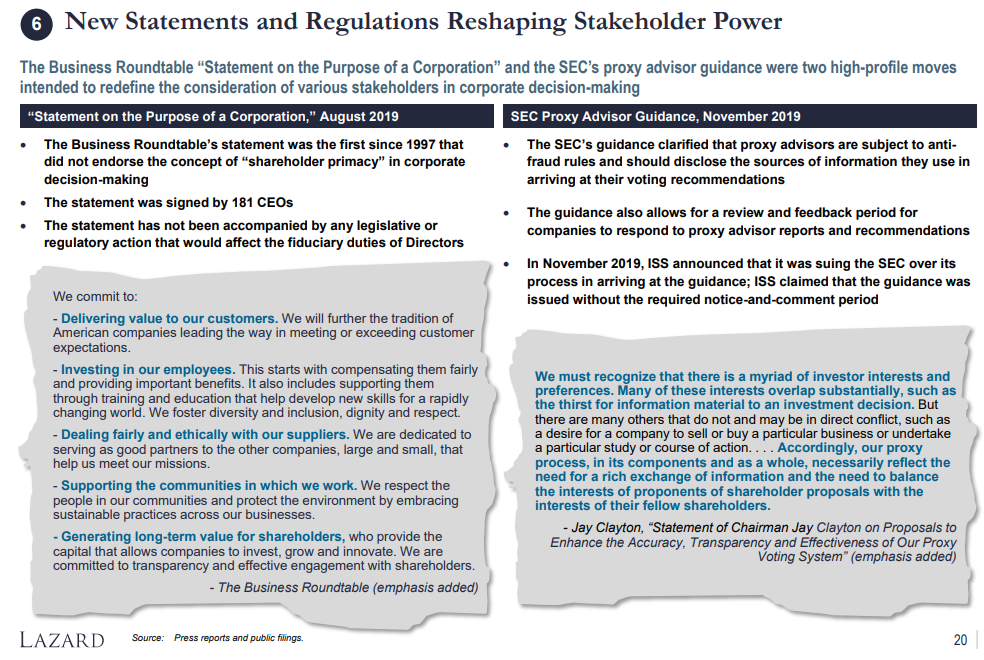
    • La « Déclaration sur l’objet de la société » de la table ronde des entreprises a souligné l’importance pour les entreprises d’intégrer les intérêts de toutes les parties prenantes, et pas seulement des actionnaires, dans leurs processus décisionnels.
    • Les directives de la SEC sur les conseillers en vote ont cherché à accroître les normes de responsabilité et de surveillance dans les évaluations de leur entreprise.

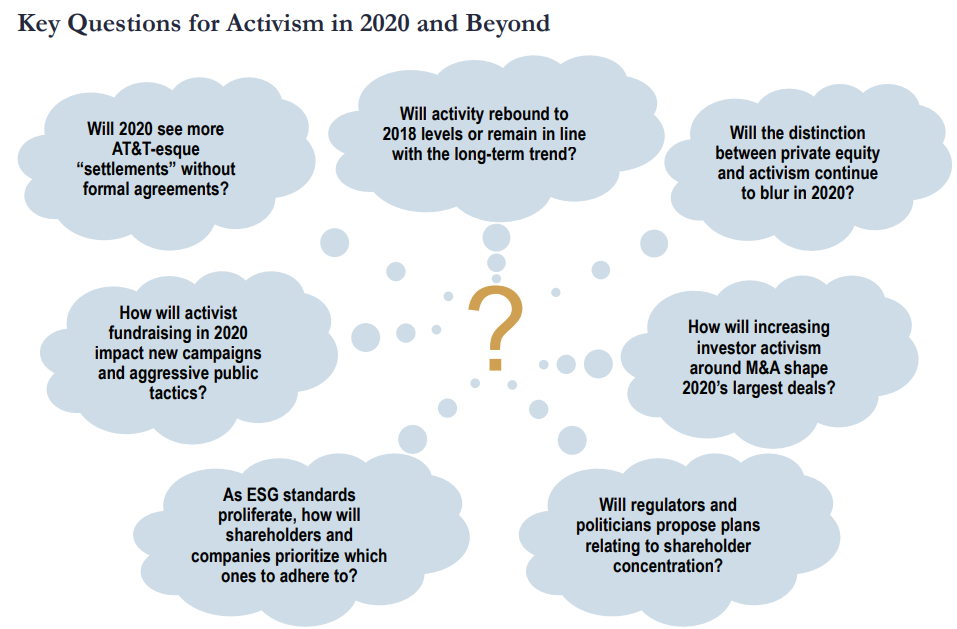
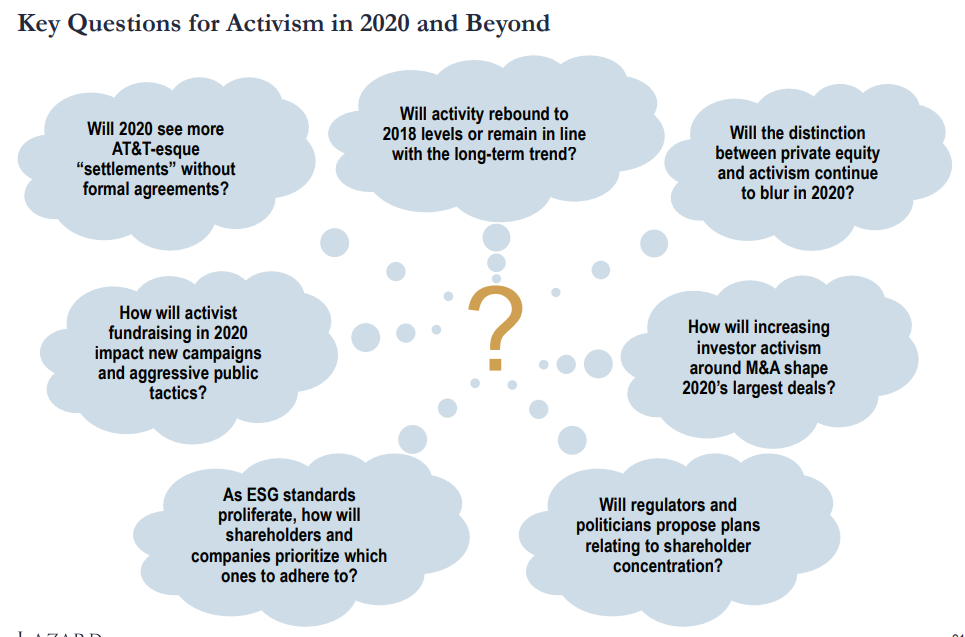
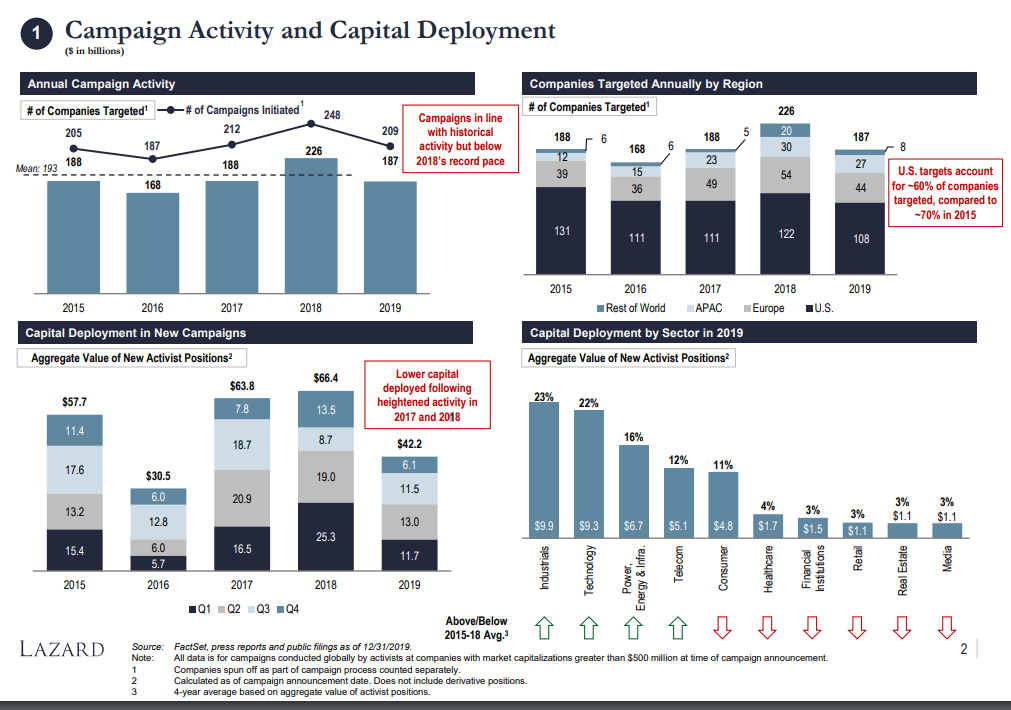
La publication utilise une infographie très efficace pour illustrer les effets de l’activisme aux États-Unis, mais aussi à l’échelle internationale.

Bonne lecture !

2019 Review of Shareholder Activism


Résultats de recherche d'images pour « activités des actionnaires activistes en 2019 »

Key Observations on the Activist Environment in 2019

1.  Activist Activity Returns to Multi-Year Trend After Record 2018

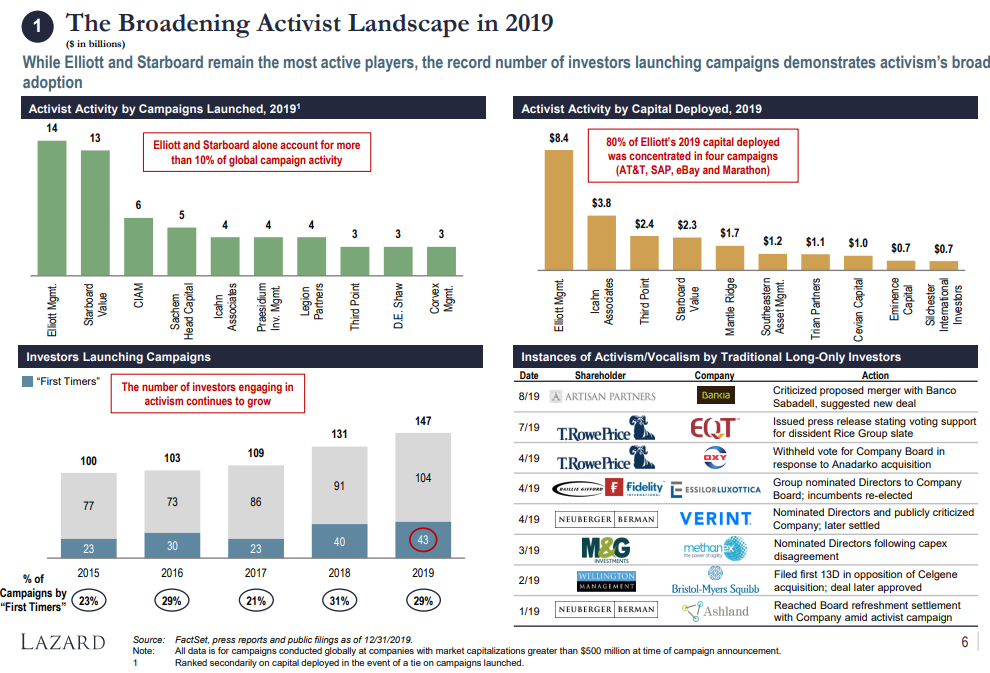
187 companies targeted by activists, down 17% from 2018’s record but in line with multi-year average levels

Aggregate capital deployed by activists (~$42bn) reflected a similar dip relative to the ~$60bn+ level of 2017/2018

A record 147 investors launched new campaigns in 2019, including 43 “first timers” with no prior activism history

Elliott and Starboard remained the leading activists, accounting for more than 10% of global campaign activity

 2. Activism’s Continued Influence Outside the U.S.

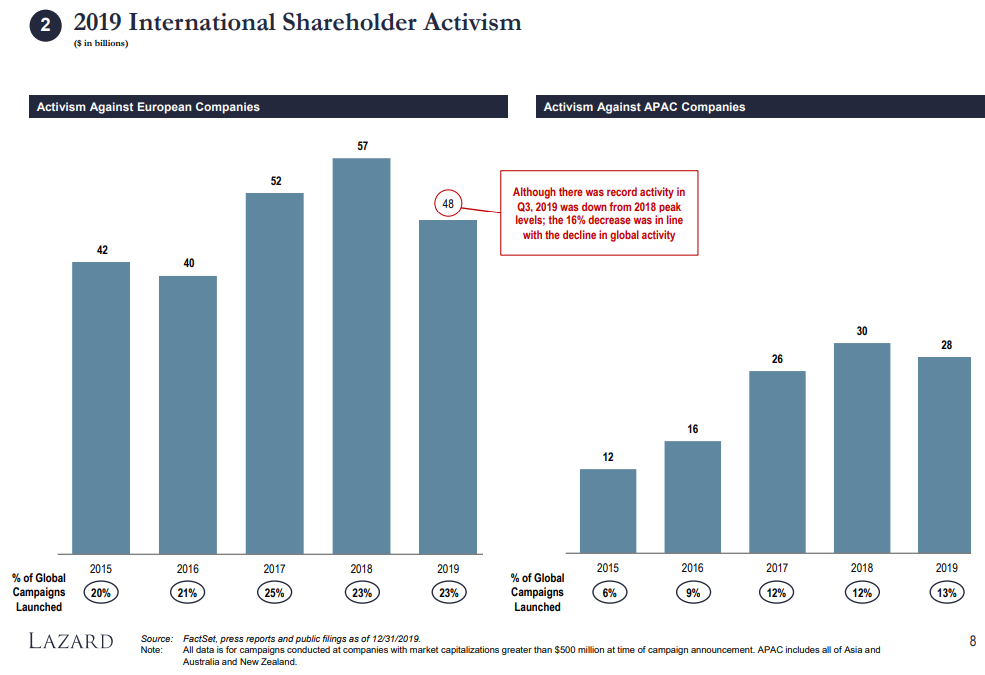
Activism against non-U.S. targets accounted for ~40% of 2019 activity, up from ~30% in 2015

Multi-year shift driven both by a decline in S. targets and an uptick in activity in Japan and Europe

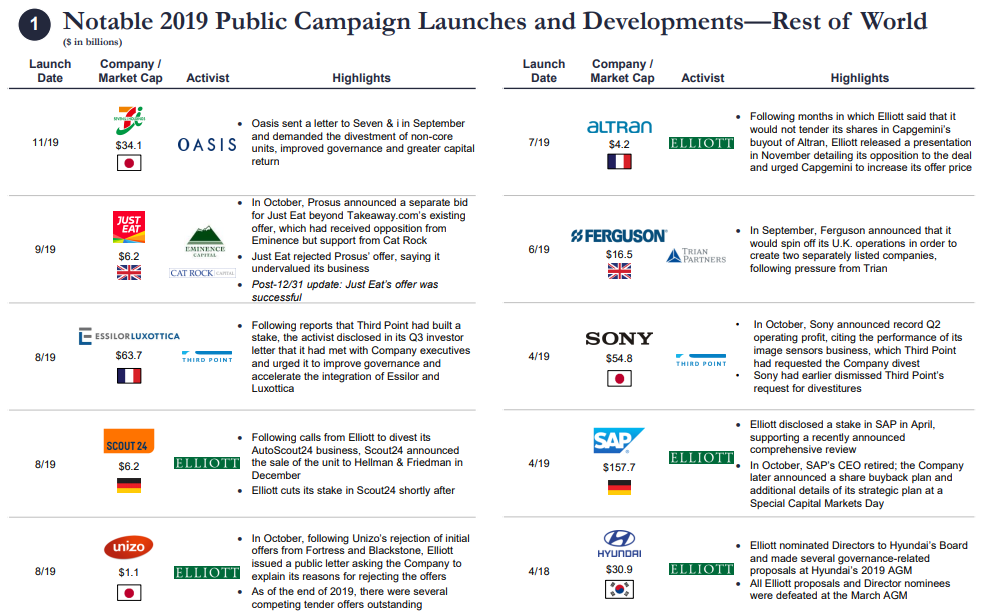
For the first time, Japan was the most-targeted non-U.S. jurisdiction, with 19 campaigns and $4.5bn in capital deployed in 2019 (both local records)

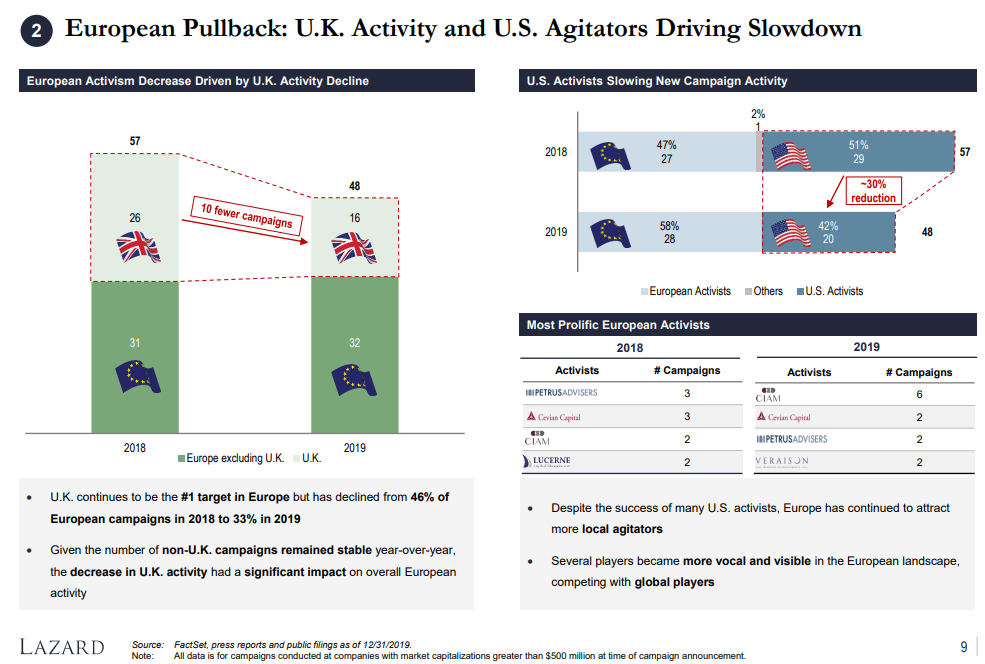
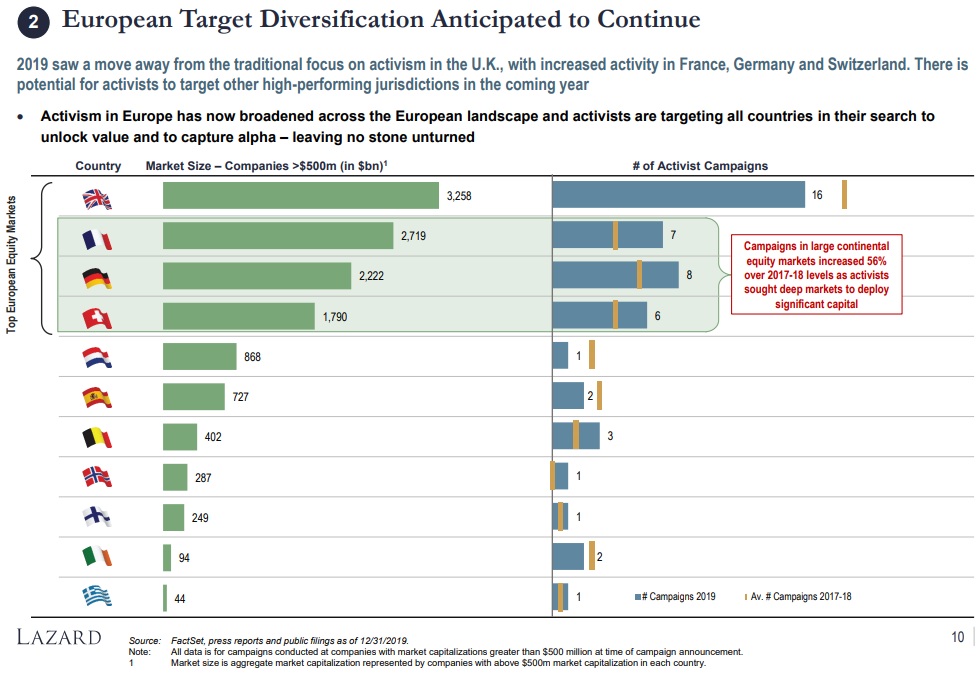
Overall European activity decreased in 2019 (48 campaigns, down from a record 57 in 2018), driven primarily by 10 fewer campaigns in the K.

Expanded activity in continental Europe—particularly France, Germany and Switzerland—partially offset this decline

3. Record Number of M&A-Related Campaigns

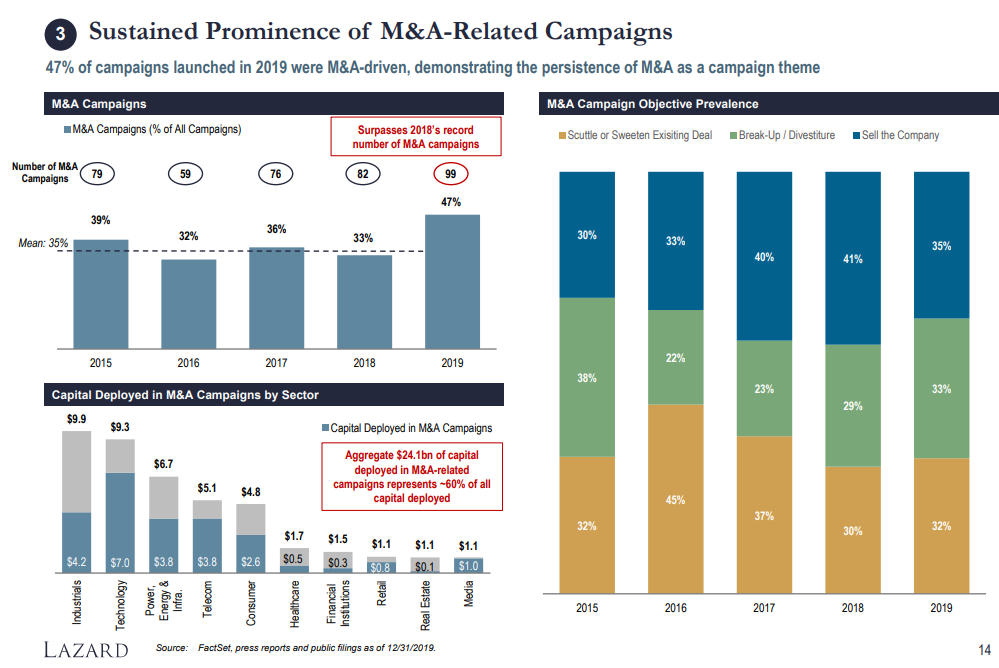
A record 99 campaigns with an M&A-related thesis (accounting for ~47% of all 2019 activity, up from ~35% in prior years) were launched in 2019

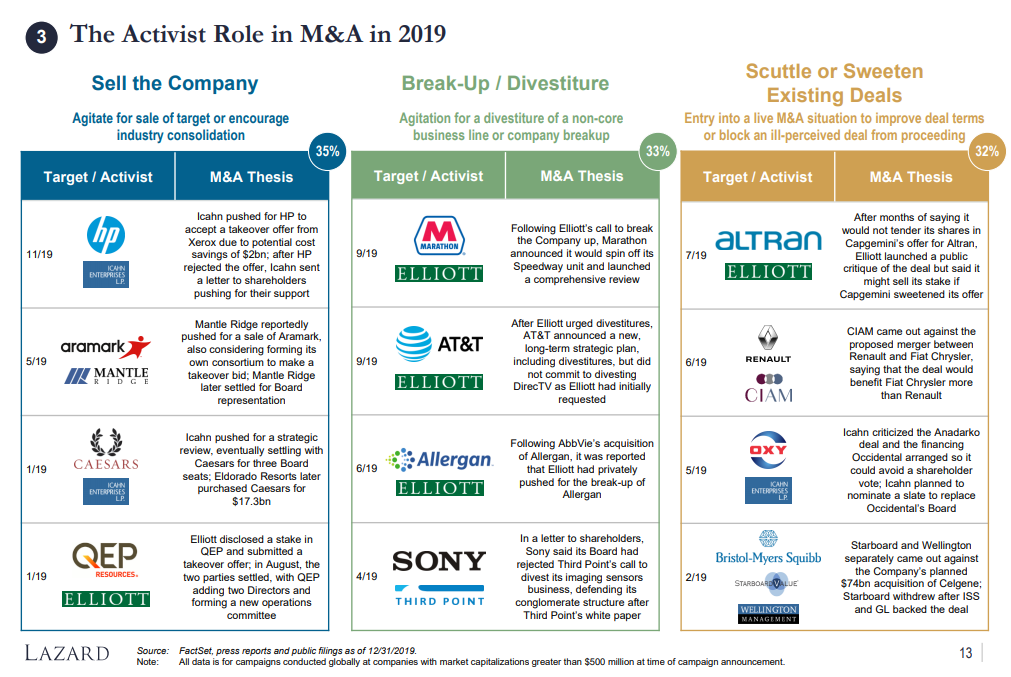
As in prior years, there were numerous prominent examples of activists pushing a sale (HP, Caesars) or break-up (Marathon, Sony) or opposing an announced transaction (Occidental, Bristol-Myers Squibb)

The $24.1bn of capital deployed in M&A-related campaigns in 2019 represented ~60% of total capital deployed

The technology sector alone saw $7.0bn put to use in M&A related campaigns

4. Activist Influence on Boards Continues

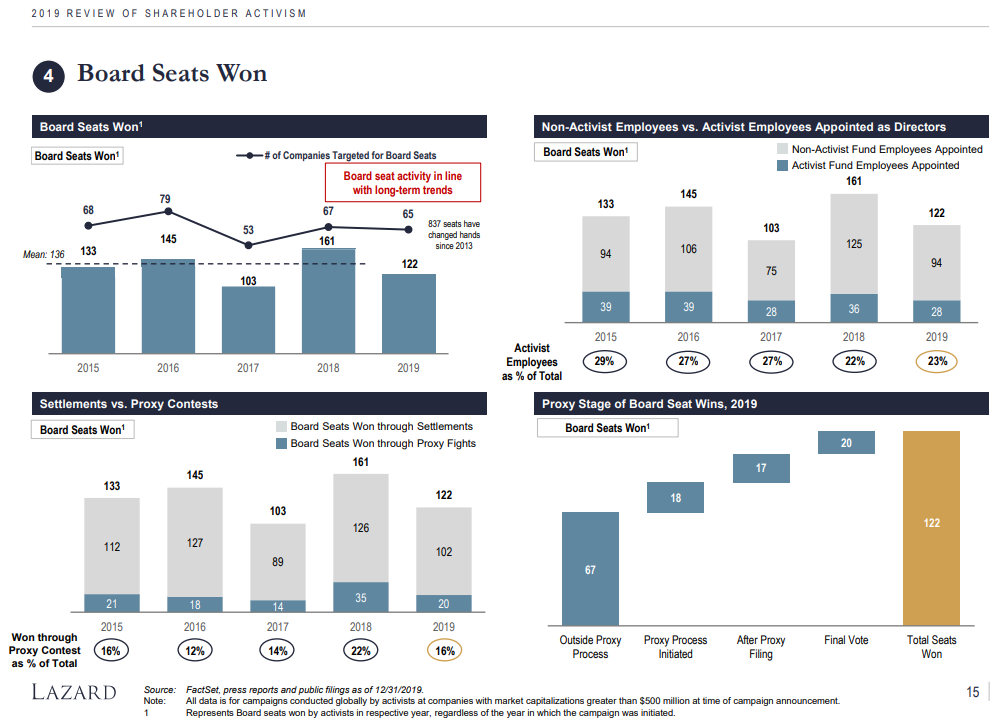
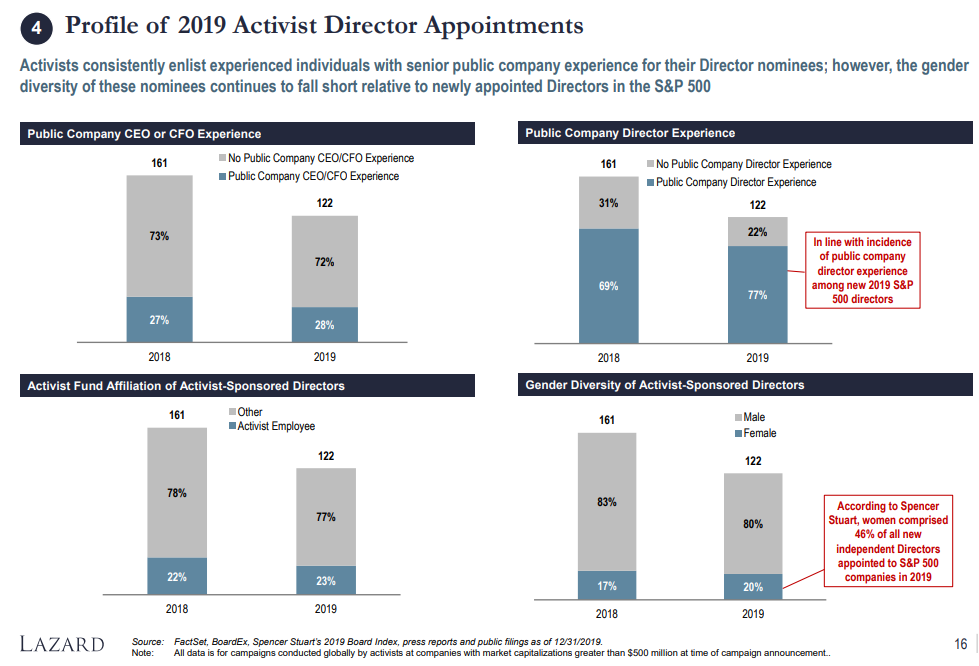
122 Board seats were won by activists in 2019, in line with the multi-year average [1]

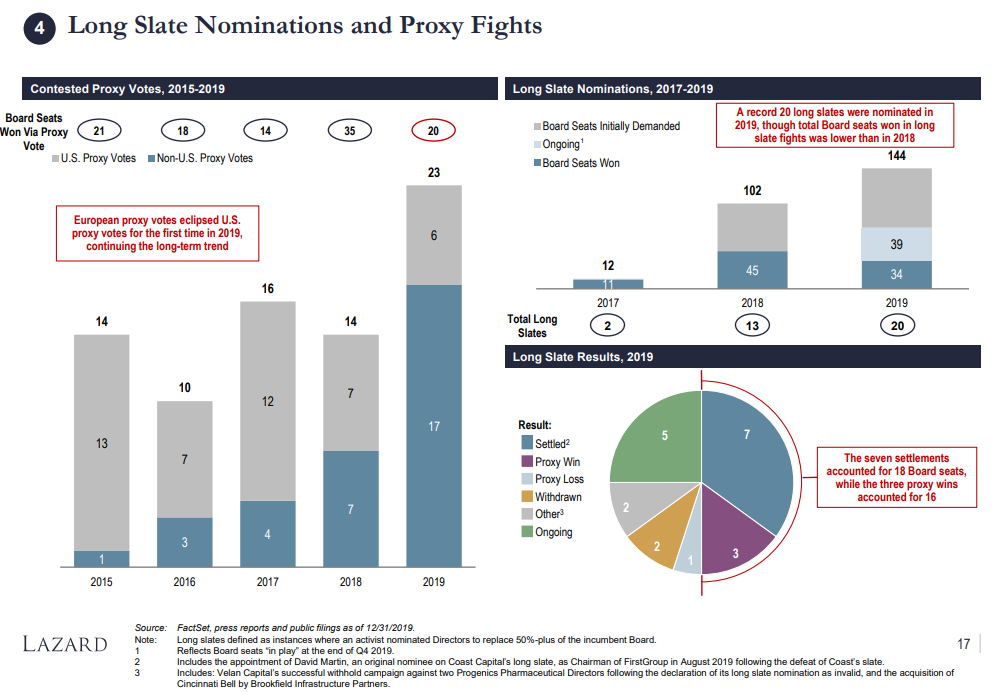
Consistent with recent trends, the majority of Board seats were secured via negotiated settlements (~85% of Board seats)

20% of activist Board seats went to female directors, compared to a rate of 46% for all new S&P 500 director appointees [2]

Activists nominated a record 20 “long slates” seeking to replace a majority of directors in 2019, securing seats in two-thirds (67%) of the situations that have been resolved

5. Outflow Pressure on  Active Managers Intensifies

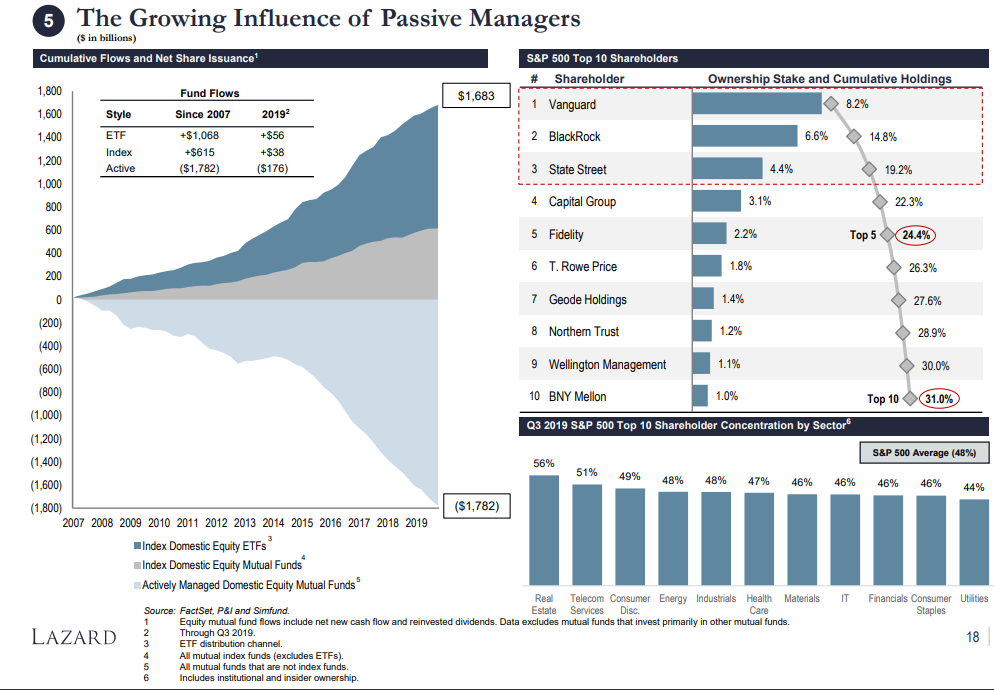
Actively managed funds saw ~$176bn in net outflows through Q3 2019, compared to ~$105bn in 2018 over the same period

The “Big 3” index funds (BlackRock, Vanguard and State Street) continue to be the primary beneficiaries of passive inflows, collectively owning ~19% of the S&P 500—up from ~16% in 2014

6. Other Noteworthy Observations

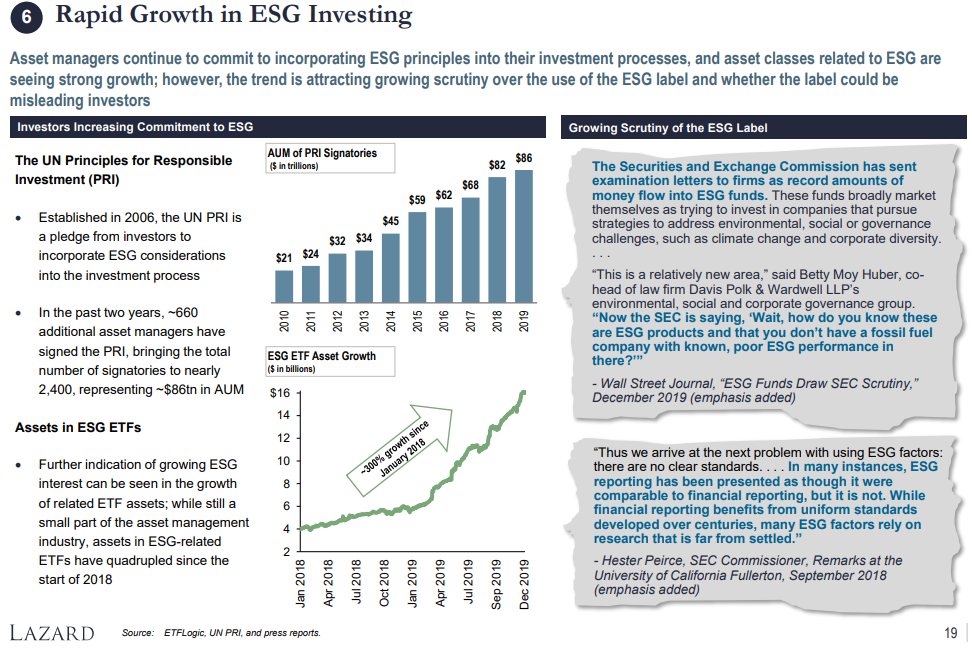
ESG focus continues to grow: over the past two years, the AUM represented by signatories to the UN’s Principles for Responsible Investment increased ~26% to ~$86tn, and the number of assets in ESG-related ETFs increased ~300%

The Business Roundtable’s “Statement on the Purpose of the Corporation” emphasized the importance of companies incorporating the interests of all stakeholders, not just shareholders, into their decision-making processes

The SEC’s guidance on proxy advisors sought to increase accountability and oversight standards in their company evaluations

Source:    FactSet, ETFLogic, UN PRI, Simfund, press reports and public filings as of 12/31/2019.
Note: All data is for campaigns conducted globally by activists at companies with market capitalizations greater than $500 million at time of campaign announcement.
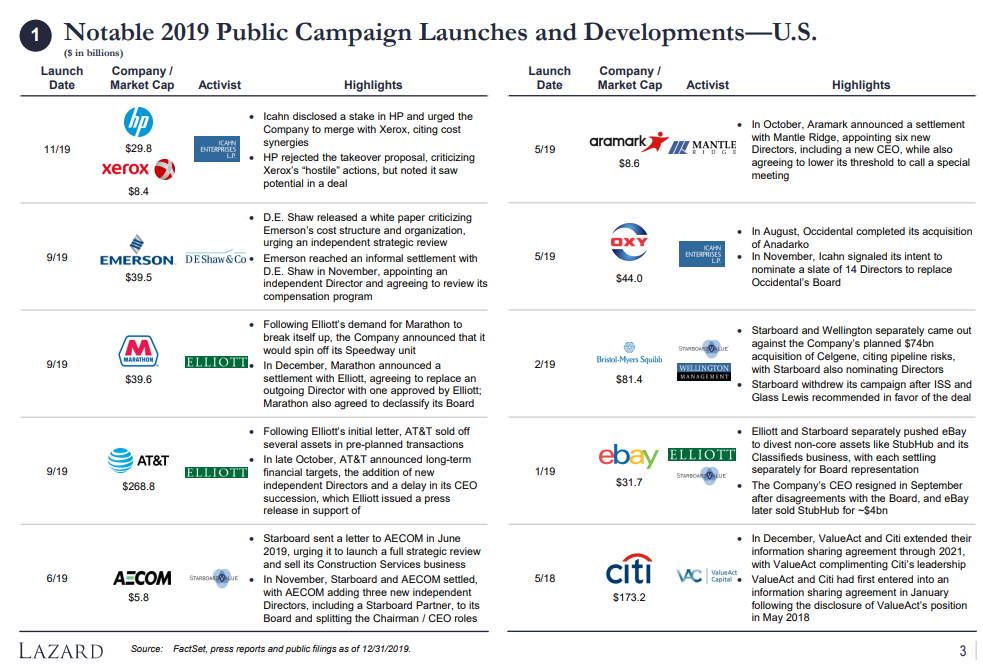
               

The complete publication, including Appendix, is available here.

Endnotes

1Represents Board seats won by activists in the respective year, regardless of the year in which the campaign was initiated. (go back)

2According to Spencer Stuart’s 2019 Board Index.(go back)


Jim Rossman* est directeur du conseil aux actionnaires, Kathryn Hembree Night est directrice et Quinn Pitcher est analyste chez Lazard. Cet article est basé sur une publication Lazard. La recherche connexe du programme sur la gouvernance d’entreprise comprend les effets à long terme de l’activisme des fonds spéculatifs  par Lucian Bebchuk, Alon Brav et Wei Jiang (discuté sur le forum  ici ); Danse avec des militants  par Lucian Bebchuk, Alon Brav, Wei Jiang et Thomas Keusch (discuté sur le forum  ici ); et  qui saigne quand les loups mordent? A Flesh-and-Blood Perspective on Hedge Fund Activism and Our Strange Corporate Governance System  par Leo E. Strine, Jr.

La montée de l’activisme des stakeholders : Défis et opportunités pour les administrateurs de sociétés


Voici un excellent article de James E. Langston*, associé de la firme Cleary Gottlieb Steen & Hamilton, sur les nouvelles perspectives offertes par les activités activistes de tout ordre. Cet article a paru sur le site de Harvard Law School on Corporate Governance.

Les points saillants exposés par l’auteur dans cet article sont les suivants :

    • Les activités activistes sont moins orientées vers le profit à court terme ; les investisseurs sont toujours préoccupés par les résultats à court terme, mais ils adoptent également une vision de plus en plus à long terme ;
    • On observe la montée d’une nouvelle forme d’activisme : l’activisme des parties prenantes (stakeholders), ou activisme social, qui emprunte aux méthodes de l’activisme traditionnel pour avancer leurs causes. On parle ici des fonds de pension, des gestionnaires d’actifs et des organisations à but charitables ;
    • Également, on note l’accroissement des activités d’activisme uniquement à long terme. Ces parties prenantes exercent de plus en plus de pression activiste auprès des administrateurs des CA ;
    • Dans le cas des très grandes entreprises, les conseils d’administration et les directions générales sont plus ouverts à des arrangements de gré à gré pour effectuer les changements réclamés par les activistes. Cependant, cette pause dans les relations entre ces deux entités n’est pas une garantie qu’elle ne sera pas suivie de nouvelles demandes toujours plus contraignantes pour les sociétés ;
    • Enfin, le développement de l’activisme continue de prendre de l’ampleur dans les marchés internationaux, en adoptant le modèle et les manières de faire des activistes américains ;

Les auteurs incitent les conseils d’administration à être très vigilants dans l’évaluation des nouveaux risques de gouvernance ainsi que dans la prise en compte des nouvelles occasions qui se présentent.

En tant qu’administrateur, je vous invite à lire cet article pour vous sensibiliser à la nouvelle donne.

Bonne lecture !

Shareholder Activism in 2020: New Risks and Opportunities for Boards


Résultats de recherche d'images pour « stakeholders activistes »


The era of stakeholder governance and corporations with a purpose beyond profits is taking hold, with corporate directors expected to answer to more constituencies and shoulder a greater burden than ever before. At the same time, investors—both in the US and abroad—continue to expect corporations to deliver superior financial performance over both the short and long term.

This convergence of purpose and performance will not only shape discussions in the boardroom, but also the complexion of shareholder activism. As the nature of the activist threat has evolved it has created additional obstacles for directors to navigate. But at the same time, this environment has created additional opportunities for boards to level the activist playing field and lead investors and other stakeholders into this new era.

Environmental, Social and Corporate Activism

Today, shareholder activists and governance gadflies are not the only constituencies using the corporate machinery to advocate for change. Social activists and institutional investors are increasingly joining forces and borrowing tactics from the shareholder activist playbook, particularly as they push for ESG reforms. For example, in 2019, prominent pension funds, asset managers and other charitable organizations sent a joint letter to all Fortune 500 companies calling for greater disclosure of mid-level worker pay practices. In addition, the Interfaith Center for Corporate Responsibility—on behalf of over 100 investors—spearheaded the submission of more than 10 shareholder proposals focusing on environmental and labor issues for the annual meeting of a single corporation.

We expect this type of stakeholder activism—or the convergence of shareholder activism and social activism—to continue and eventually move beyond the ESG realm. Although this marks yet another trend that boards must be prepared to face, it also offers directors an opportunity to embrace stakeholder interests other than EPS accretion or margin expansion to support the company’s governance profile and long-term strategic plan. To be sure, financial performance of the corporation over the long term, which benefits all stakeholders, will remain paramount, but focusing on the merits of the strategic plan for all stakeholders should help the board ensure management has sufficient runway to implement that plan and garner the support of more, rather than fewer, corporate constituencies along the way.

Long-Only Activism

At the same time, activism by traditional long-only investors also has increased. For example, Neuberger Berman pushed for board refreshment at Ashland Global as part of a Cruiser Capital-led campaign and launched a short-slate proxy contest at Verint Systems that settled when the company agreed to refresh its board and enhance its investor disclosures. Wellington Management also joined the fray, publicly backing—and by some accounts initiating—Starboard’s efforts to scuttle the Bristol Myers/Celgene merger. And T. Rowe Price doubled down on its activism efforts by publicly backing the Rice Brothers’ successful campaign to take control of the EQT board.

The takeaway for directors from this sort of activism is clear – no longer will institutional investors be content to sit on the sidelines or express their views privately. Directors should expect that increased long-only activism will create a challenging environment for active managers (including continued pressure on management fees) and will likely lead more of them to embrace activism, and to do so more publicly, as a way to differentiate their investment strategy.

The question for boards in this new environment is not just whether institutional investors will be a source of ideas for an activist or side with the board or the activist in the event of a campaign, but also whether its institutional investors are likely to themselves “go activist.” Shareholder engagement efforts will continue to be crucial in building support for a strategic plan and counteracting activist tendencies among long-only investors. But in the course of such efforts, directors must be mindful of the fact that not all institutional investors will have the same objectives and be careful to structure their interactions with investors accordingly. Well-advised boards will look for ways to find common ground with long-only investors while articulating the company’s long-term strategy in a manner that emphasizes its corporate purpose and is more likely to resonate with all stakeholders.

Large-Cap Activism and Settlement Agreements

Another trend boards must be aware of in 2020 is the success of certain brand-name activists in “settling” large-cap campaigns without committing to a settlement agreement with a standstill undertaking. Typically, a standstill, preventing the activist from exerting pressure on the company for a certain period of time, is the price the activist pays for the company committing to take certain of the steps proposed by the activist. The standstill is intended to ensure that the company has the breathing room necessary to implement the agreed-upon changes and make its case to investors.

However, several recent large-cap activist situations followed a different script. The companies engaged with the activists and announced a series of changes designed to appease the activist, ranging from purported governance and operational enhancements to full-blown strategic reviews. The activist then issued a separate, choreographed press release, often taking much of the credit for the changes and promising to work with the company to bring about the proposed changes. But that was it—there was no settlement agreement or other commitment by the activist to cease its efforts to influence the board.

Not surprisingly, in at least one of these situations, the company “settled” with an activist without a standstill only to face additional demands from the same activist several months later (and which required additional concessions). As always, the terms of peace with an activist will be shaped by the situational dynamics, but as 2020 dawns, directors should continue to be mindful of the benefits of a standstill.

Activism Abroad

Shareholder activism also continues to expand globally. Boards in Europe and Asia are increasingly finding themselves under pressure from activists. In these situations, boards have faced not only home-grown activists, but also US activists looking to expand their influence and investor base abroad.

We expect this trend to accelerate in 2020 for several reasons:

    • The number of easy activist targets in the US has dwindled.
    • US-based index funds continue to consolidate their ownership of public companies across the globe.
    • Foreign investors are becoming more prone to expect US-style capital allocation policies and shareholder return metrics from non-US companies.

The message to non-US boards is clear: If you aren’t thinking about activism, you should be. This doesn’t mean foreign issuers should reflexively adopt US practices; they shouldn’t. But it does mean that non-US boards should ensure they are prepared to deal with an activist event and consider a strategy that not only takes into account local conditions but also is informed by the relevant lessons from the US experience with shareholder activism.


*James E. Langston is partner at Cleary Gottlieb Steen & Hamilton LLP. This post is based on his Cleary memorandum. Related research from the Program on Corporate Governance includes The Long-Term Effects of Hedge Fund Activism by Lucian Bebchuk, Alon Brav, and Wei Jiang (discussed on the Forum here); Who Bleeds When the Wolves Bite? A Flesh-and-Blood Perspective on Hedge Fund Activism and Our Strange Corporate Governance System by Leo E. Strine, Jr. (discussed on the Forum here); Dancing with Activists by Lucian Bebchuk, Alon Brav, Wei Jiang, and Thomas Keusch (discussed on the Forum here); and Social Responsibility Resolutions by Scott Hirst (discussed on the Forum here).

Top 10 de Harvard Law School Forum on Corporate Governance au 16 janvier 2020


Voici le compte rendu hebdomadaire du forum de la Harvard Law School sur la gouvernance corporative au 16  janvier 2020.

Comme à l’habitude, j’ai relevé les dix principaux billets.

Bonne lecture !

Résultats de recherche d'images pour « governance 2020 »


  1. CalSTRS Green Initiative Task Force Annual Report
  2. Bernie Ebbers and Board Oversight of the Office of Legal Affairs
  3. Delaware Appraisal Decisions
  4. Corporate Culture: Evidence from the Field
  5. Into the Mainstream: ESG at the Tipping Point
  6. Eight Priorities for Boards in 2020
  7. Startup Governance
  8. ESG Matters
  9. Corporate Law for Good People
  10. Embracing the New Paradigm
  11. A Fundamental Reshaping of Finance


Une étude empirique sur la culture organisationnelle


La recherche empirique* présentée ci-dessous utilise une méthodologie particulière d’entrevue/survey auprès d’un échantillon de 1 348 dirigeants nord-américains afin de trouver réponse aux questions suivantes :

(1) Qu’est-ce que la culture et comment la mesurez-vous ?

(2) La culture est-elle une variable importante ?

(3) Peut-on attribuer une valeur à la culture organisationnelle ?

(4) Quels sont les résultats associés à une culture déficiente ?

(5) Comment établir une culture plus efficace à l’échelle de l’organisation ?

L’article publié sur le site de Harvard Law School Forum on Corporate Governance, révèle plusieurs résultats convaincants :

92 % des hauts dirigeants croient que l’amélioration de la culture influence positivement la valeur de l’entreprise ;

84 % des hauts dirigeants croient qu’ils doivent améliorer la culture de leurs organisations ;

85 % croient qu’une culture déficiente peut amener les employés à agir de manière non éthique, ou illégalement ;

Les hauts dirigeants croient quasi unanimement que la culture est une variable très importante, et que le prérequis pour son amélioration est de déterminer comment et pourquoi celle-ci est si importante.

Les auteurs concluent que les études empiriques sur le rôle crucial de la culture organisationnelle sont encore trop rares, malgré le fait que ce facteur est probablement le plus déterminant dans l’établissement de la valeur des firmes.

Bonne lecture ! Vos commentaires sont les bienvenus.


Résultats de recherche d'images pour « culture organisationnelle »


Corporate Culture: Evidence from the Field


While there is a lot of talk about corporate culture, there is very little empirical work—because culture is very difficult to measure. In our paper, Corporate Culture: Evidence from the Field, we use a novel interview/survey method that is ideally suited to explore the questions: ‘what is culture and how do you measure it?’, ‘does culture matter?’, ‘can we attach a value to culture?’, ‘what are the implications of an ineffective culture?’, and ‘how can a more effective culture be established within the firm?’ Our paper is based on a very large sample of 1,348 executives from North American firms in the survey part and 20% of the U.S. market capitalization in the interviews. Essentially, our study creates the first large scale database of corporate culture.

The results are striking. 92% believe that improving culture will lead to increased value at their firm. Yet 84% of CEO/CFOs believe they need to improve their firm’s culture. A notable 85% believe that a poorly implemented culture increases the chances that an employee would act unethically or even illegally. While executives share a near-unanimous belief that corporate culture matters, a prerequisite to improving culture is to determine how and why culture matters.

We show the potential importance of separating cultural values and norms for understanding the connection between culture and performance. Cultural values are the ideals employees strive to fulfill, while cultural norms reflect whether employees “walk the talk” by actually living out these values. While leaders are often puzzled when employees act contrary to a company’s stated values, our research suggests warning indicators are usually there in the form of employees’ day-to-day actions or norms. Our analyses of the survey data suggests leaders should start paying attention to these norms to understand the influence corporate culture has on firm performance. In fact, we do not find a strong relation between tracking stated cultural values and business outcomes. Instead, we find that for stated cultural values to have full impact on business outcomes, they must be complemented by norms that dictate actual behavior.

We also highlight what executives think works for and against an effective corporate culture as well as what does not matter. We find that formal institutions such as governance and compensation can either reinforce or work against the corporate culture. Some of the factors that executives say do not affect culture, such as the board of directors, are surprising; ultimately, these non-factors may be the items that need to change for culture to have its greatest potential impact on performance. Finally, given that an effective culture is positively associated with value creation and economic efficiency, we ask executives what is preventing their firm’s culture from being effective in practice: 69% blame their firms’ underinvestment in culture.

Some additional highlights from our study reveal how business executives strongly believe that an effective corporate culture enhances firm value. For example, it might be surprising that culture matters so much that 54% of executives would walk away from an M&A target that is culturally misaligned, while another one-third would discount the target by between 10%-30% of the purchase price. Executives also link culture to a wide range of decisions including ethical choices (compliance, short-termism), innovation (creativity, risk taking) and value creation (productivity, investment). For example, 77% percent of executives indicate that culture plays a moderate or important role in compliance decisions, and 69% indicate the same about the importance of culture to financial reporting quality.

The executives’ responses also point to the role of culture in decisions by firms to potentially take myopic actions that boost short-term stock price at the expense of long-term value. A majority believe that an effective culture would reduce the tendency of companies to engage in value-destroying end-of-quarter practices such as delaying valuable projects to hit consensus earnings. Similarly, using a hypothetical question that asks respondents to choose between two otherwise identical projects with five year durations, we find that 41% would choose the NPV-inferior project that favors short-term profitability. Among executives that choose projects that enhance long-term value (over projects that enhance short-term objectives), 80% indicate their firm culture influences their choices. Finally, many executives believe that their firms take on too little risk because of a dysfunctional culture.

In conclusion, we believe corporate culture deserves substantial attention going forward and we hope our paper helps build a bridge to enable this future. Our paper contains a host of descriptive information, which we interpret within the context of the related theory, offering suggestions on how firms can implement effective culture and what considerations future theory should focus on. In addition, we have an accompanying paper, Corporate Culture: The Interview Evidence, in which we highlight some of the schemes that executives shared with us and that either reinforce the culture by rewarding employees for living the cultural values or lead employees to ignore those values.

The complete paper is available for download here.


*Jillian Grennan is Assistant Professor of Finance at the Duke University Fuqua School of Business. This post is based on a recent paper by Professor Grennan; John R. Graham, D. Richard Mead, Jr. Family Professor at the Fuqua School of Business at Duke University; Campbell R. Harvey is Professor of Finance at the Fuqua School of Business at Duke University; and Shiva Rajgopal is the Kester and Byrnes Professor of Accounting and Auditing at Columbia Business School.

Top 10 de Harvard Law School Forum on Corporate Governance au 3 janvier 2020


Voici le compte rendu hebdomadaire du forum de la Harvard Law School sur la gouvernance corporative au 3 janvier 2020.

Je profite de l’occasion pour vous souhaiter une formidable année 2020 et la mise en place de pratiques exemplaires de gouvernance.

Comme à l’habitude, j’ai relevé les dix principaux billets.

Bonne lecture !

Résultats de recherche d'images pour « 2020 »


  1. Institutional Trading around Corporate News: Evidence from Textual Analysis
  2. Managerial Control Benefits and Takeover Market Efficiency
  3. Public Company vs. JV Governance
  4. New Considerations for Special Litigation Committees
  5. Worker Representation on U.S. Corporate Boards
  6. Board-Shareholder Engagement Practices
  7. The Plight of Women in Positions of Corporate Leadership in the United States, the European Union, and Japan: Differing Laws and Cultures, Similar Issues
  8. Institutional Investment Mandates: Anchors for Long-term Performance
  9. NYSE Proposal for Primary Direct Listings
  10. A New Dataset of Historical States of Incorporation of U.S. Stocks 1994-2019