Top 10 de Harvard Law School Forum on Corporate Governance au 23 août 2018


Voici le compte rendu hebdomadaire du forum de la Harvard Law School sur la gouvernance corporative au 23 août 2018.

Comme à l’habitude, j’ai relevé les dix principaux billets.

Bonne lecture !


Résultats de recherche d'images pour « top 10 governance »


Résultats de recherche d'images pour « Top 10 en gouvernance Harvard Law School »


  1. Corporate Governance; Stakeholder Primacy; Federal Incorporation
  2. Microcap Board Governance
  3. Taking Stock: Share Buybacks and Shareholder Value
  4. Shareholder Vote on Golden Parachutes: Determinants and Consequences
  5. Corporate Governance—The New Paradigm: A Better Way Than Federalization
  6. Board Diversity Developments
  7. Corporate Governance in Emerging Markets
  8. Dual-Class Index Exclusion
  9. Board Diversity, Firm Risk, and Corporate Policies
  10. Shareholder Activism: Evolving Tactics

Top 10 de Harvard Law School Forum on Corporate Governance au 16 août 2018


Voici le compte rendu hebdomadaire du forum de la Harvard Law School sur la gouvernance corporative au 16 août 2018.

Comme à l’habitude, j’ai relevé les dix principaux billets.

Bonne lecture !


Résultats de recherche d'images pour « top ten »


Résultats de recherche d'images pour « Top 10 en gouvernance Harvard Law School »


  1. SEC Concept Release on Compensatory Offerings
  2. Shedding the Status of Bank Holding Company
  3. Proposed Amendments to SEC’s Whistleblower Program
  4. Women in the C-Suite: The Next Frontier in Gender Diversity
  5. Director Skill Sets
  6. FCPA Successor Liability
  7. Urban Vibrancy and Firm Value Creation
  8. Self-Dealing Without a Controller
  9. The Misplaced Focus of the ISS Policy on NOL Poison Pills
  10. New Amendments to Delaware General Corporation Law

Top 10 de Harvard Law School Forum on Corporate Governance au 9 août 2018


Voici le compte rendu hebdomadaire du forum de la Harvard Law School sur la gouvernance corporative au 9 août 2018.

Comme à l’habitude, j’ai relevé les dix principaux billets.

Bonne lecture !


Résultats de recherche d'images pour « top 10 »


Résultats de recherche d'images pour « Top 10 en gouvernance Harvard Law School »


Top 10 de Harvard Law School Forum on Corporate Governance au 2 août 2018


Voici le compte rendu hebdomadaire du forum de la Harvard Law School sur la gouvernance corporative au 2 août 2018.

Comme à l’habitude, j’ai relevé les dix principaux billets.

Bonne lecture !


Résultats de recherche d'images pour « Top 10 en gouvernance Harvard Law School »


Résultats de recherche d'images pour « Top 10 en gouvernance Harvard Law School »


Top 10 de Harvard Law School Forum on Corporate Governance au 26 juillet 2018


Voici le compte rendu hebdomadaire du forum de la Harvard Law School sur la gouvernance corporative au 266 juillet 2018.

Comme à l’habitude, j’ai relevé les dix principaux billets.

Bonne lecture !


Résultats de recherche d'images pour « top ten »

Le futur code de gouvernance du Royaume-Uni


Je vous invite à prendre connaissance du futur code de gouvernance du Royaume-Uni (R.-U.).

À cet effet, voici un billet de Martin Lipton*, paru sur le site de Harvard Law School Forum on Corporate Governance, qui présente un aperçu des points saillants.

Bonne lecture !


The Financial Reporting Council today [July 16, 2018] issued a revised corporate governance code and announced that a revised investor stewardship code will be issued before year-end. The code and related materials are available at www.frc.org.uk.

The revised code contains two provisions that will be of great interest. They will undoubtedly be relied upon in efforts to update the various U.S. corporate governance codes. They will also be used to further the efforts to expand the sustainability and stakeholder concerns of U.S. boards.

First, the introduction to the code makes note that shareholder primacy needs to be moderated and that the concept of the “purpose” of the corporation, as long put forth in the U.K. by Colin Mayer and recently popularized in the U.S. by Larry Fink in his 2018 letter to CEO’s, is the guiding principle for the revised code:

Companies do not exist in isolation. Successful and sustainable businesses underpin our economy and society by providing employment and creating prosperity. To succeed in the long-term, directors and the companies they lead need to build and maintain successful relationships with a wide range of stakeholders. These relationships will be successful and enduring if they are based on respect, trust and mutual benefit. Accordingly, a company’s culture should promote integrity and openness, value diversity and be responsive to the views of shareholders and wider stakeholders.

Second, the code provides that the board is responsible for policies and practices which reinforce a healthy culture and that the board should engage:

with the workforce through one, or a combination, of a director appointed from the workforce, a formal workforce advisory panel and a designated non-executive director, or other arrangements which meet the circumstances of the company and the workforce.

It will be interesting to see how this provision will be implemented and whether it gains any traction in the U.S.


The UK Corporate Governance Code


Résultats de recherche d'images pour « UK Corporate Governance Code 2018 »


Martin Lipton* is a founding partner of Wachtell, Lipton, Rosen & Katz, specializing in mergers and acquisitions and matters affecting corporate policy and strategy. This post is based on a Wachtell Lipton memorandum by Mr. Lipton.

Top 10 de Harvard Law School Forum on Corporate Governance au 19 juillet 2018


Voici le compte rendu hebdomadaire du forum de la Harvard Law School sur la gouvernance corporative au 19 juillet 2018.

Comme à l’habitude, j’ai relevé les dix principaux billets.

Bonne lecture !


Résultats de recherche d'images pour « top 10 »


  1. Further Thoughts on Elon Musk’s Compensation

  2. An Empirical Comparison of Insider Trading Enforcement in Canada and the US

  3. Are Institutional Investors with Multiple Blockholdings Effective Monitors?

  4. Supreme Court Ruling on SEC-Appointed Judges

  5. 2018 Investor Corporate Governance Report

  6. Do Foreign Investors Improve Market Efficiency?

  7. The UK Corporate Governance Code

  8. The Effect of Institutional Ownership Types On Innovation and Competition

  9. M&A Litigation Developments: Where Do We Go From Here?

  10. The Preclusive Effect of Demand Futility

Top 10 de Harvard Law School Forum on Corporate Governance au 12 juillet 2018


Voici le compte rendu hebdomadaire du forum de la Harvard Law School sur la gouvernance corporative au 12 juillet 2018.

Comme à l’habitude, j’ai relevé les dix principaux billets.

Bonne lecture !


Résultats de recherche d'images pour « top 10 »

Top 10 de Harvard Law School Forum on Corporate Governance au 5 juillet 2018


Voici le compte rendu hebdomadaire du forum de la Harvard Law School sur la gouvernance corporative au 5 juillet 2018.

Comme à l’habitude, j’ai relevé les dix principaux billets.

Bonne lecture !


Résultats de recherche d'images pour « top 10 »


  1. ESG and Sustainability: The Board’s Role
  2. Fiduciary Duties of Buy-Side Directors: Recent Lessons Learned
  3. Passive Mutual Funds and ETFs: Performance and Comparison
  4. The Directors’ E&S Guidebook
  5. Creditor Control Rights and Board Independence
  6. When Political Spending and Core Values Conflict
  7. Enterprise Liability and the Organization of Production Across Countries
  8. Impact of SEC Guidance on Shareholder Proposals in the 2018 Proxy Season
  9. Passive Investors
  10. Spotify Case Study: Structuring and Executing a Direct Listing

Top 10 de Harvard Law School Forum on Corporate Governance au 28 juin 2018


Voici le compte rendu hebdomadaire du forum de la Harvard Law School sur la gouvernance corporative au 28 juin 2018.

Comme à l’habitude, j’ai relevé les dix principaux billets.

Bonne lecture !


Résultats de recherche d'images pour « top 10 »

  1. Gender Quotas on California Boards
    _______________________________________________________________

  2. Chairman Clayton Testimony on the Oversight of the SEC
    ________________________________________________________________

  3. The General Counsel as Key Corporate Social Responsibility Advisor
    ____________________________________________________________________________

  4. Web-Delivery of Shareholder Reports
    _________________________________________________________________________

  5. The Highest-Paid CEO by U.S. State
    ________________________________________________________________________

  6. Political and Social Issues in the Boardroom: Examples from the Gun Industry
    _______________________________________________________________________________________

  7. The Missing Profits of Nations
    _________________________________________________________________

  8. Trade Secrets Protection and Antitakeover Provisions
    _________________________________________________________________________

  9. Surprises from the 2018 Proxy Season
    ________________________________________________________________________

  10. The SEC Draft Strategic Plan for 2018-2022
    _________________________________________________________________________

Top 10 de Harvard Law School Forum on Corporate Governance au 21 juin 2018


Voici le compte rendu hebdomadaire du forum de la Harvard Law School sur la gouvernance corporative au 21 juin 2018.

Comme à l’habitude, j’ai relevé les dix principaux billets.

Bonne lecture !

Résultats de recherche d'images pour « top 10 »

Top 10 de Harvard Law School Forum on Corporate Governance au 14 juin 2018


Voici le compte rendu hebdomadaire du forum de la Harvard Law School sur la gouvernance corporative au 14 juin 2018.

Comme à l’habitude, j’ai relevé les dix principaux billets.

Bonne lecture !


Résultats de recherche d'images pour « top 10 »


Top 10 de Harvard Law School Forum on Corporate Governance au 7 juin 2018


Voici le compte rendu hebdomadaire du forum de la Harvard Law School sur la gouvernance corporative au 7 juin 2018.

Comme à l’habitude, j’ai relevé les dix principaux billets.

Bonne lecture !


Résultats de recherche d'images pour « top dix »


  1. Global Governance: Board Independence Standards and Practices
  2. Caremark and Reputational Risk Through #MeToo Glasses
  3. Nomination Committees and Corporate Governance: Lessons from Sweden and the UK
  4. How To Avoid Bungling Off-Cycle Engagements with Stockholders
  5. The Importance of Inferior Voting Rights in Dual-Class Firms
  6. Anticipating and Planning for Geopolitical & Regulatory Changes
  7. The Hypocrisy of Hedge Fund Activists
  8. Board Lessons: Succeeding with Investors in a Crisis
  9. Measuring the Impact of Median Employee Pay on the CEO Pay Ratio
  10. Statement at Open Meeting on Inter-Agency Proposal for Amendments to the Volcker Rule

Top 10 de Harvard Law School Forum on Corporate Governance au 31 mai 2018


Voici le compte rendu hebdomadaire du forum de la Harvard Law School sur la gouvernance corporative au 31 mai 2018.

Comme à l’habitude, j’ai relevé les dix principaux billets.

Bonne lecture !


Résultats de recherche d'images pour « top 10 »


  1. Proposed Amendments to Delaware’s LLC and LP Acts
  2. Taxes and Mergers: Evidence from Banks During the Financial Crisis
  3. Labor Representation in Governance as an Insurance Mechanism
  4. Directors’ Notes: A Trap for the Unwary?
  5. Do Founders Control Start-Up Firms that Go Public?
  6. US Contentious Situations Update
  7. CEO Pay Ratio: A Deep Data Dive
  8. Principles and Best Practices for Virtual Annual Shareowner Meetings
  9. Stock Market Short-Termism’s Impact
  10. Spotlight on Boards 2018

Top 10 de Harvard Law School Forum on Corporate Governance au 24 mai 2018


Voici le compte rendu hebdomadaire du forum de la Harvard Law School sur la gouvernance corporative au 24 mai 2018.

Comme à l’habitude, j’ai relevé les dix principaux billets.

Bonne lecture !


Résultats de recherche d'images pour « top 10 »


  1. Board Performance Evaluations that Add Value
  2. Cryptocurrency Compensation: A Primer on Token-Based Awards
  3. Does it Pay to Pay Attention?
  4. Non-Delaware Decisions on Director Nominations
  5. The Conflicted Role of Proxy Advisors
  6. How Valuable are Independent Directors? Evidence from External Distractions
  7. Elon Musk’s Compensation
  8. Why Shareholder Wealth Maximization Despite Other Objectives
  9. Congress Increases Pressure on Proxy Advisory Firms
  10. The DOJ’s New “Piling On” Policy

Top 10 de Harvard Law School Forum on Corporate Governance au 17 mai 2018


Voici le compte rendu hebdomadaire du forum de la Harvard Law School sur la gouvernance corporative au 17 mail 2018.

Comme à l’habitude, j’ai relevé les dix principaux billets.

Bonne lecture !


Résultats de recherche d'images pour « top 10 »


Top 10 de Harvard Law School Forum on Corporate Governance au 10 mai 2018


Voici le compte rendu hebdomadaire du forum de la Harvard Law School sur la gouvernance corporative au 10 mai 2018.

Comme à l’habitude, j’ai relevé les dix principaux billets.

Bonne lecture !


Résultats de recherche d'images pour « top dix en gouvernance »


  1. Corporate Purpose: ESG, CSR, PRI and Sustainable Long-Term Investment
  2. Do Women CEOs Earn More and Have More Diverse Boards?
  3. The Business Case for Clawbacks
  4. Integrated Alpha: The Future of ESG Investing
  5. CEO Attributes, Compensation, and Firm Value: Evidence from a Structural Estimation
  6. The Future of Merger Litigation in Federal Courts?
  7. The Impact of DOL Guidance on ESG-Focused Plans
  8. The Uncertain Role of IPOs in Future Securities Class Actions
  9. An Investor Consensus on U.S. Corporate Governance & Stewardship Practices
  10. Netflix Approach to Governance: Genuine Transparency with the Board


Les six principes qui gouvernent la conduite des investisseurs — ISG


Aujourd’hui, je vous présente le point de vue de l’association Investor Stewardship Group (the “ISG”) Governance Principles, eu égard aux principes de gouvernance que celle-ci entend promouvoir.

Je reproduis ici les principaux éléments de l’article publié par Anne Meyer* et paru sur le forum du Harvard Law School, notamment les six principes qui gouvernent leur conduite.

1 — Les CA sont redevables envers les actionnaires ;

2 — Les actionnaires doivent avoir des droits de vote qui sont proportionnels à leurs intérêts économiques ;

3 — Les CA doivent être à l’écoute des actionnaires et être proactifs dans la compréhension de leurs perspectives ;

4 — Les CA doivent avoir une solide structure de leadership indépendante ;

5 — Les CA doivent adopter des structures de gouvernance qui mènent à des pratiques efficaces ;

6 — Les CA doivent adopter des structures de rémunération des dirigeants qui sont alignées sur la stratégie à long terme de l’entreprise.

Bonne lecture ! Vos commentaires sont les bienvenus.


The Investor Stewardship Group’s Governance Principles


Résultats de recherche d'images pour « Investor Stewardship Group Governance Principles »


In this post, we provide an overview of the Investor Stewardship Group (the “ISG”) Governance Principles and steps for public companies to consider when evaluating how the principles may be incorporated into their own disclosure and engagement priorities. The ISG’s website, including a link to the ISG Governance Principles, is available here. In January 2017, the Investor Stewardship Group (the “ISG”), a collective of large U.S.-based and international institutional investors and asset managers, announced the launch of its Framework for U.S. Stewardship and Governance (the “Framework”). The measure is an unprecedented attempt to establish a set of elementary corporate governance principles for U.S. listed companies (the “ISG Governance Principles”) as well as parallel stewardship principles for U.S. institutional investors. The Framework’s effective date was January 1, 2018, in order to provide U.S. listed companies with time to adjust to the corporate governance principles prior to the 2018 proxy season.

As the 2018 proxy season gets into full swing, there is evidence that ISG members will be utilizing the Framework as a tool for evaluating the governance regimes at their portfolio companies, informing their engagement priorities, and potentially factoring compliance with the ISG Governance Principles into selected voting policies and decisions. In December, the ISG issued a press release “encouraging companies to articulate how their governance structures and practices align with the ISG’s Corporate Governance Principles and where and why they differ in approach”, leaving it to companies to determine how and where to disclose such alignment. And at least one large investor, State Street Global Advisors, has specifically highlighted that it will screen portfolio companies for compliance with the principles.

As a result, companies and their boards should continue to benchmark and understand how their specific governance practices relate to ISG Governance Principles and remain cognizant of this new regime as they prepare for engagement with investors and draft public disclosures.


Background


The ISG’s global reach and financial influence is significant; currently consisting of 50 investors representing over $22 trillion invested in the U.S. equity markets. The ISG’s signatories includes some of the largest and most influential institutional investors, including BlackRock, CalSTRS, State Street Global Advisors, TIAA Investments, T. Rowe Price, ValueAct Capital and Vanguard, among others. The Framework’s stewardship principles emphasize that these institutional investors have a vested interest and responsibility for the long-term economic success of their portfolio companies.

The ISG’s roll-out of the Framework characterized it as a “sustained initiative” and emphasized an evolutionary view of the ability of U.S. companies and investors to work together under the Framework.

Corporate governance practices at U.S. listed companies have historically been informed by multiple regulatory and rules-based regimes. Rules and regulations of the Securities and Exchange Commission, stock exchange listing requirements, state corporate codes, case law and federal legislation adopted in the wake of past financial market crises, have been the primary dictating standards. More recently, shareholders and other stakeholders have played a larger role in influencing corporate governance norms at U.S. listed companies through engagement and various forms of shareholder activism. In contrast, the ISG Governance Principles are based substantially on U.K., Continental European and other non-U.S. frameworks that establish principles-based corporate governance standards and tend to rely on “comply-or-explain” accountability. [1] Advocates for this type of principles-based approach stress the flexibility that it gives for companies to adopt a tailored response to important tenets such as boardroom transparency, as opposed to responding more narrowly to prescriptive rules. As institutional investors continue to focus more attention on environmental and social matters, including related governance concerns, the Framework’s principles-based approach will be a tool, for both institutions and companies, to promote mutually agreeable objectives, particularly given the lack of rulemaking or legislation mandating more specific disclosure on trending topics such as board diversity and environmental concerns.


The ISG Governance Principles


The six ISG Governance Principles are broad principles that will not look new to those who have been following key issues in corporate governance over the past several years. Indeed, they were designed to reflect the common corporate governance principles that are already embedded in member institutions’ proxy voting and engagement guidelines. The principles emphasize the importance of boardroom effectiveness and oversight, alignment of executive compensation with long-term financial results, and board accountability demonstrated in part through the adoption of governance best practices, including a one-share one-vote capital structure and independent board leadership.

Principle 1: Boards are accountable to shareholders

This principle encompasses the annual election of directors, majority voting, proxy access and more robust disclosure surrounding board practices and corporate governance. Companies are also asked to explain how any anti-takeover measures are in the best long-term interest of the company.

Interestingly, BlackRock’s CEO Larry Fink recently published a letter to the CEOs at the world’s largest public companies in which he argued explicitly that boards are accountable to other stakeholders, such as employees and customers, in addition to shareholders.

Principle 2: Shareholders should be entitled to voting rights in proportion to their economic interest

This principle sets a base line of one-share one-vote and encourages companies with existing multi-class share structures to review and consider phasing out control shares.

In 2017, this issue became national news when Snap Inc. filed for an IPO of non-voting shares. Many large investors were vehemently opposed and at the urging of the Council for Institutional Investors and other investor advocates, the stock index provider FTSE Russell refused to include these shares in its indices.

Principle 3: Boards should be responsive to shareholders and be proactive in order to understand their perspectives

Under this principle, companies are expected to implement shareholder proposals that receive “significant” support or explain why they have not done so. Independent directors are encouraged to participate in engagement on matters that are meaningful to investors, and directors may be held accountable with “against” votes in instances where investors do not feel that their concerns have been adequately addressed.

Principle 4: Boards should have a strong, independent leadership structure

There are two common independent leadership structures at U.S. companies—an independent chairperson and an independent lead director (where the role of Chairman and CEO are combined)—and the principles acknowledge that signatory investors have differing opinions on whether they provide adequate independent oversight.

The overarching position under the principles is that the role of the independent board leader should be “clearly defined and sufficiently robust to ensure effective and constructive leadership.”

Principle 5: Boards should adopt structures and practices that enhance their effectiveness

This principle encompasses an array of board structure and effectiveness issues, including: strong board composition and board diversity; board and committee responsibilities; director attentiveness, preparedness and time commitments; and board refreshment.

Board diversity, in particular gender diversity, has emerged as a high priority for most of the largest institutional investors. There has also been a focus on screening for long-tenured directors and directors that are over-boarded or have poor attendance records as a proxy for identifying directors that may not be adequately engaged or independent.

Principle 6: Boards should develop management incentive structures that are aligned with the long-term strategy of the company

This principle emphasizes that the board, in particular the compensation committee, is responsible for ensuring that drivers and performance goals that underpin the company’s long-term strategy are adequately reflected in a company’s management incentive structure.

Steps to Consider

As noted, the ISG Governance Principles are intended to provide a framework of broad, high-level principles. The individual investors that comprise the ISG have their own voting guidelines and engagement priorities that are tailored to their own investment philosophy and strategy. Even on current hot button issues, such as board diversity, investors have differing views and companies should consider the practices they adopt depending upon their specific facts and circumstances. There are, however, general steps that we recommend companies take to address the growing influence of the Framework.

These include:

Understand how the company’s corporate governance structure and practices relate to the six ISG Governance Principles.

Review the company’s public disclosure regarding corporate governance structure and practices; consider enhancements to be responsive to the ISG’s request that companies disclose how their governance aligns or differs from the ISG Governance Principles.

As with other corporate governance benchmarking exercises, companies should be particularly cognizant of how and why their practices may differ from the ISG Governance Principles and whether these differences are adequately explained in public disclosures. As investors screen their portfolio companies’ governance practices, they will often consider valid explanations, but in the absence of effective disclosure the company may be unnecessarily penalized.

Management and the board should be informed and prepared to respond to questions about the company’s alignment with the ISG Governance Principles during shareholder engagements. Companies can also consider proactively addressing the issue in written materials or prepared remarks during investor presentations.

In preparing for shareholder engagements with ISG signatories, understand how and if they are explicitly incorporating the ISG Governance Principles into engagement and voting priorities and continue to screen their individual voting and engagement policies.

Companies should determine whether, and how, they wish to address and incorporate the ISG Governance Principles based upon their own specific governance profile, disclosure regime and approach to shareholder engagement.


Endnotes

See in particular the UK Investor Stewardship Code, on which the US ISG Principles are largely based. The UK Code “sets out a number of areas of good practice to which … institutional investors should aspire.” Available here.


*Anne Meyer is Senior Managing Director, Don Cassidy is Executive Vice President, and Rajeev Kumar is Senior Managing Director at Georgeson LLC. This post is based their recent Georgeson publication. Related research from the Program on Corporate Governance includes The Agency Problems of Institutional Investors by Lucian Bebchuk, Alma Cohen, and Scott Hirst.

Les femmes CEO des grandes entreprises ont-elles une rémunération plus élevée que leurs homologues masculins ? Leurs CA comptent-ils plus de femmes ?


Les femmes PDG (CEO) des grandes entreprises ont-elles une rémunération plus élevée ? Leurs conseils d’administration sont-ils plus diversifiés, et comptent-ils plus de femmes ?

Ce billet publié par Dan Marcec, directeur d’Equilar, paru sur le forum de la Harvard Law School, tente d’apporter une réponse à ces questions.

On peut retenir que les femmes CEO, en général, comptent légèrement plus de femmes sur leurs conseils.

Le nombre de femmes sur les CA varie selon la taille des entreprises. Plus l’entreprise est grande, plus le CA est susceptible de compter un nombre plus important de femmes :

Equilar 100 Gender Diversity Index,  24 %

Fortune 500,  22,5 %

Fortune 501-1000,  19,2 %

Entreprises plus petites,  14,1 %

Également, la rémunération des femmes CEO des 100 plus grandes entreprises (8 femmes) est de 21,4 M $ comparativement à la moyenne des 92 hommes CEO qui est de 16,4 M $, une différence significative, mais sur un petit échantillon de femmes CEO !

Je vous invite à prendre connaissance de l’article ci-dessous afin de mieux saisir toutes les nuances de cette étude.

Bonne lecture !


Do Women CEOs Earn More and Have More Diverse Boards?


Résultats de recherche d'images pour « Les femmes CEO des grandes entreprises ont-elles une rémunération plus élevée que leurs homologues masculins ? Leurs CA comptent-ils plus de femmes ? »


As gender equity and diversity in corporate leadership continue to be critical discussions, research is regularly published showing links between these factors and company performance. Based on an analysis of Equilar 100 companies—the largest U.S.-listed firms to file proxy statements to the SEC before March 31—women CEOs had a higher representation of women on their boards on average than companies led by male counterparts. They also were awarded higher compensation on average in 2017.

Overall, Equilar 100 companies with women CEOs had an average of 24.0% representation of women on their boards, vs. 23.5% for the companies with male CEOs. Furthermore, the women in the CEO position at Equilar 100 companies were well paid in 2017 with an average pay package of $21.4 million. By comparison, the men who were on the list received an average pay package of $16.4 million. The following two questions examined this data just below the surface, finding that the complete picture is more complicated than it appears.


Do Women CEOs Bring More Females Into the Boardroom?


The Equilar 100 study analyzed recently reported data for fiscal year 2017, including eight women CEOs, a drop from nine the previous year. While Meg Whitman has since left her position at Hewlett Packard Enterprise, she was still in the CEO position during the periods studied, so HPE is included in the analysis.

The answer to the question above—based on an analysis of Equilar 100 data—is yes, companies with women CEOs do have slightly more women in the boardroom. The list of Equilar 100 companies that had women CEOs in 2017 is below, inclusive of their current board composition as of March 31.


Company % Female Board Members Average Board Age Average Board Tenure
Hewlett Packard Enterprise Co 38.5% 62.0 2.4
General Dynamics Corp 27.3% 64.0 5.9
Progressive Corp 27.3% 62.0 9.8
Oracle Corp 25.0% 70.5 14.4
Pepsico Inc 23.1% 63.0 5.5
IBM 20.0% 64.0 6.3
Lockheed Martin Corp 16.7% 66.0 6.6
Duke Energy Corp 14.3% 66.0 4.9
Women CEO Average 24.0% 64.7 7.0
Men CEO Average 
23.5% 63.0 7.2


There are two important factors to consider that give pause in definitively being able to say “women CEOs at Equilar 100 companies lead in gender diversity on boards.” While the numbers are clear—and they are—large-cap companies are much more likely to have women on their boards overall.

According to the recent Equilar Gender Diversity Index, Fortune 500 companies included in the Russell 3000 had an average of 22.5% women on their boards, as compared to 19.2% for Fortune 501-1000 companies and a much lower 14.1% for R3K firms outside the Fortune 1000. The Equilar 100 overall outpaced each of these groups.

It’s also worth noting that most CEOs are also on their own boards. Therefore, if CEOs were removed from the overall numbers, it’s likely the data would show Equilar 100 boards being more inclusive of independent women directors when a male CEO is in place.


The facts are the facts—boards at Equilar 100 companies led by women have a higher percentage of female directors than their counterparts. However, the small sample size—pointing to the lack of women in leadership overall—and these other mitigating factors make a definitive statement difficult to prove.


Do Women CEOs Make More Than Men?


While the women on the Equilar 100 list make more on average than the men, the caveat, of course, is that these numbers reflect a small sample size of women. To get to the eight highest-paid women on the list, you have to go all the way to number 87, whereas you don’t have to leave the top 10 to find the eight highest-paid men. The list of women on the Equilar 100 list (as well as their compensation rank) is below.


Company CEO 2017 Total Compensation ($MM) Equilar 100 RANK
Oracle Corp Safra A. Catz $40.7 4
Pepsico Indra K. Nooyi $25.9 7
General Dynamics Corp Phebe N. Novakovic $21.2 14
Duke Energy Corp Lynn J. Good $21.1 15
Lockheed Martin Corp Marillyn A. Hewson $20.2 16
IBM Virginia M. Rometty $18.0 30
Hewlett Packard Enterprise Margaret C. Whitman $14.8 60
Progressive Corp Susan P. Griffith $9.2 87
Women Ceo Average (N=8) $21.4
Men CEO Average 
(n=92) $16.4


Furthermore, similar to the findings on board composition, the larger the company, the higher the pay. Given the context of the Equilar 100 study more generally—that the largest companies by revenue tend to pay their CEOs more—this small sample size is not sufficient to make a claim that women CEOs earn more than men.

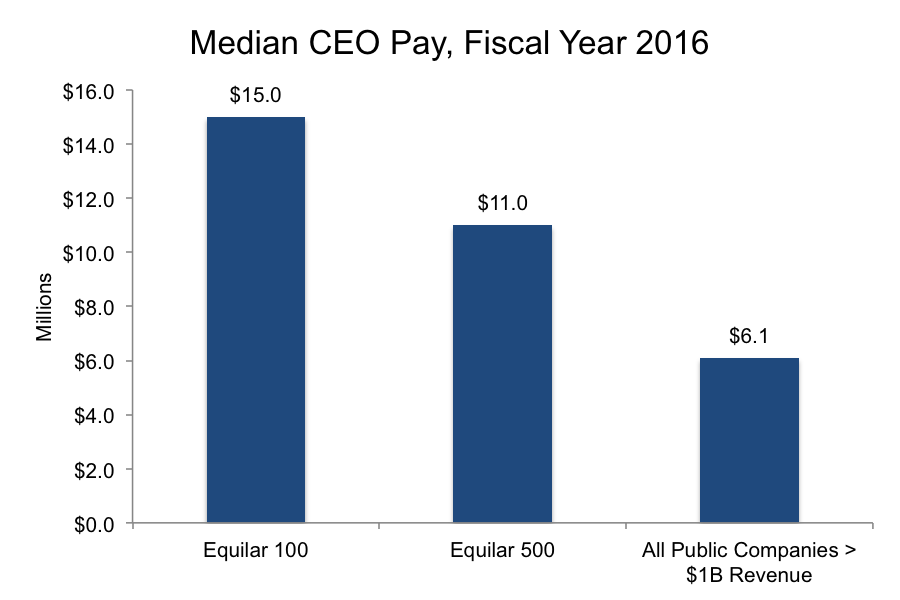
For example, using fiscal year 2016 data, it’s clear that the Equilar 100 stands out over all other public companies. (Since the Equilar 100 is an “early look” at proxy season, comprehensive data is not yet available for these other company groups in 2017.) In 2016, Equilar 100 CEOs were awarded $15.0 million at the median, in comparison to $11.0 million for Equilar 500 companies, and just $6.1 million for all public companies with more than $1 billion in revenue.


In other words, as with board composition, the numbers do indicate that women CEOs earn more than men at face value, but there is more than meets the eye. Ultimately, proof of greater equity in executive compensation and board diversity when women are CEOs is inconclusive from this analysis, highlighting the importance of questioning numbers at face value. Indeed, an academic study was released recently that found there is no meaningful difference in pay between men and women at the CEO level. Each company’s compensation and board refreshment strategy is unique to their circumstances, and monolithic assumptions are not always fair. The gravity of these decisions pored over by each board of directors and their executive teams spotlights the rise of shareholder scrutiny and direct engagement on these matters.

Top 10 de Harvard Law School Forum on Corporate Governance au 3 mai 2018


Voici le compte rendu hebdomadaire du forum de la Harvard Law School sur la gouvernance corporative au 3 mai 2018.

Comme à l’habitude, j’ai relevé les dix principaux billets.

Bonne lecture !


Résultats de recherche d'images pour « top 10 »


  1. The Middle-Market IPO Tax
  2. Which Antitakover Provisions Matter?
  3. Indications of Corporate Control
  4. Removing Directors in Private Companies by Written Consent?
  5. Cybersecurity Risk Management Oversight
  6. The Life-Cycle of Dual Class Firms
  7. Missing Pieces Report: The 2016 Board Diversity Census of Women and Minorities on Fortune 500 Boards
  8. Busy Directors and Firm Performance: Evidence from Mergers
  9. SEC’s Proposed Standard of Conduct for Investment Advisors
  10. Open Letter Regarding Consultation on the Treatment of Unequal Voting Structures in the MSCI Equity Indexes