Compte rendu hebdomadaire de la Harvard Law School Forum on Corporate Governance | 25 mai 2017


Voici le compte rendu hebdomadaire du forum de la Harvard Law School sur la gouvernance corporative au 25 mai 2017.

J’ai relevé les principaux billets.

Bonne lecture !


Résultats de recherche d'images pour « harvard law school forum on corporate governance »


Résultats de recherche d'images pour « harvard law school forum on corporate governance »

  1. Do Exogenous Changes in Passive Institutional Ownership Affect Corporate Governance and Firm Value?
  2. It Pays to Write Well
  3. Mutual Fund Companies Have Significant Power to Increase Corporate Transparency
  4. Just How Preferred is Your Preferred?
  5. Private Investor Meetings in Public Firms: The Case for Increasing Transparency
  6. Court of Chancery’s Guidance on “Credible Basis” Standard for Obtaining Books
  7. Recent Board Declassifications: A Response to Cremers and Sepe
  8. SEC Enforcement Actions Against Public Companies and Subsidiaries Keep Pace
  9. Dual-Class Stock and Private Ordering: A System That Works
  10. 2017 IPO Report


L’émission d’action à droit de vote multiple | Un processus d’offre qui fonctionne bien !


Aujourd’hui, je vous présente le point de vue très tranché de David J. Berger* sur l’émission d’action à droit de vote multiple.

L’auteur démontre que les offres d’actions de ce type sont en pleine croissance et que les bourses Nasdaq et NYSE sont favorables à l’émission de telles actions. Aux É.U., environ 10 % des entreprises cotées en bourse utilisent  une telle structure de capital.

Il avance que les organismes de régulation tels que la SEC (ou l’AMF au Québec) ne doivent pas s’immiscer dans le processus d’offre parce que le système fonctionne bien et que différents arrangements d’émission d’action doivent être envisagés pour tenir compte des besoins particuliers des entreprises publiques.

Cette prise de position est radicalement différente de celle de Bebchuk et Kastiel qui, comme présentée dans mon billet du 17 mai (La gouvernance des entreprises à droit de vote multiple), souhaite que la SEC réglemente sur le caractère permanent de la structure d’action à vote multiple.

Je crois que vous trouverez cette publication intéressante en ce sens qu’elle présente l’autre face de la médaille.

Bonne lecture ! Vos commentaires sont appréciés.


Dual-Class Stock and Private Ordering: A System That Works


Résultats de recherche d'images pour « Dual-Class Stock »


Dual-class stock has become the target of heightened attention, particularly in light of Snap’s recent IPO. While the structure remains popular for companies trying to respond to the short-term outlook of public markets—including companies in the technology and media sectors, as well as companies in more traditional industries ranging from shipping and transportation to oil and gas, and everything in between—dual-class stock continues to be the subject of considerable attack by various investor groups and some academics. Further, while a majority of dual-class companies are not technology companies, young technology companies continue to be the primary focus of governance activists. [1]

Despite the controversy over dual-class stock, we believe that the present system of private ordering with respect to dual-class stock will—and should—continue. Private ordering allows boards, investors, and other corporate stakeholders to determine the most appropriate capital structure for a particular company, given its specific needs. So long as the company makes appropriate disclosure of its capital structure, including the implications of this structure to its investors, we believe there is no need for further regulation on this issue.

The benefits of a system of private ordering have become increasingly apparent in the U.S. and across the globe. For example, both Nasdaq and the NYSE continue to actively solicit and list companies with multi-classes of stock. According to a recent Council of Institutional Investors (CII) study, about 10 percent of publicly listed companies have multi-class structures. This includes not just newly public and/or prominent technology companies such as Alphabet (formerly Google), Facebook, and Snap, or even numerous media companies such as CBS, Liberty Media, Sinclair Broadcast Group, Scripps, and Viacom, but also companies in every industry ranging from financial services (Berkshire Hathaway, Evercore, Houlihan Lokey, etc.) to consumer products (Constellation Brands, Coca-Cola Bottling Co., Nike, Panera Bread, etc.) to transportation and industrial companies (Swift Transportation, TerraForm, Quaker Chemical, Nacco Industries, etc.).

As the companies identified above demonstrate, many of the dual- or multi-class companies listed by the NYSE and Nasdaq continue to be among the most successful in the world—both financially and from a governance perspective. The success and prominence of these companies make it unlikely that there will be a broad effort among the exchanges to require them to change their governance structure.

The success of many dual-class companies has also led both Nasdaq and the NYSE to continue to support dual-class listings. For example, Nasdaq recently released a report (discussed on the Forum here) that included an endorsement of dual-class stock, including laying out the arguments why companies with dual-class stock should continue to be listed. [2] Among the reasons cited by Nasdaq was the recognition that encouraging entrepreneurship and innovation in the U.S. economy is best done by “establishing multiple paths entrepreneurs can take to public markets.” Because of this, each “publicly traded company should have flexibility to determine a class structure that is most appropriate and beneficial for them, so long as this structure is transparent and disclosed up front so that investors have complete visibility into the company. Dual-class structures allow investors to invest side-by-side with innovators and high-growth companies, enjoying the financial benefits of these companies’ success.” [3] While the NYSE has not recently issued any public statements on multi-class stock, it continues to actively seek to list companies with multi-class stock, including Alibaba, which chose to list on the NYSE after the Hong Kong stock exchange raised significant questions about its governance structure.

The trend towards private ordering on dual-class shares can also be seen globally. For example, less than two years ago, Hong Kong’s stock exchange rejected a proposal to allow companies with dual-class stock to list on its exchange. However, the Hong Kong Securities and Futures Commission (SFC) recently announced a new study to determine whether to permit dual-class listings (including possibly creating a separate exchange for companies listing dual-class stock). While the SFC’s decision includes consideration of a new trading exchange in Hong Kong for companies with multi-class structures, its actions have been widely interpreted as essentially reversing its prior decision. Additionally, the SFC’s chairman recently announced that the SFC “supports the consultation to allow the public to share their views on the dual-shareholding structure,” and he made it clear that the SFC was “open minded” about the possibility of listing dual-class companies.

Singapore appears to be going through a similar transition. Singapore also historically did not allow listings of dual-class companies, but in February 2017, the country released a paper titled “Possible Listing Framework for Dual-Class Share Structures.” The proposal has been the subject of considerable debate, with many large institutional investors (including those based in the U.S.) opposed to allowing any type of dual-class listing. At the same time, the head of Singapore’s Investors Association, which represents more than 70,000 retail investors and is the largest organized investor group in Asia, has become an outspoken advocate of dual-class stock, arguing that “retail investors are not idiots” and that any “capital market that is aspiring to be leading” should offer this alternative.

The trend can also be seen in Europe. In 2007, the EU considered imposing a one-share/one-vote requirement on publicly traded companies, but abandoned the idea at the time of the 2008 financial crisis. Now many EU countries are adopting some form of “time-based voting” shares, to encourage long-term investors by giving more votes to shareholders who own their shares for longer periods. [4] For example, France has adopted the “Florange Act,” which generally provides that shareholders who own their shares for two years will receive two votes per share. Italy has also considered loyalty shares, while in many of the Nordic countries companies with shares with multiple voting rights are common. [5]

At the same time, critics of dual-class stock in the U.S., especially within the institutional investor community, remain quite vocal. For example, the Securities and Exchange Commission’s (SEC’s) Investor Advisory Committee recently held a hearing on dual-class stock, where its use was sharply criticized by Commissioner Stein (whose term ends in June), as well as a representative from CII. [6] During the meeting, representatives from CII and other institutional investors urged the SEC to use its regulatory authority over the exchanges to limit the ability of companies to have dual-class structures, while also calling upon the companies that create the benchmark indexes to exclude companies with non-voting stock from these indexes (ironically, many of the same companies that create these indexes are CII members and among the world’s largest institutional investors).

More recently, two of the country’s leading academics, Harvard Law School professors Lucian Bebchuk and Kobi Kastiel, published an article (discussed on the Forum here) calling for a mandatory sunset provision on all dual-class stock for public companies. [7] The Bebchuk and Kastiel piece argues that “public officials and investors cannot rely on private ordering to eliminate dual-class structures that become inefficient with time,” and for that reason “[p]ublic officials and institutional investors should consider precluding or discouraging IPOs that set a perpetual dual-class structure.” Bebchuk and Kastiel conclude that “[p]erpetual dual-class stock, without any time limitation, should not be part of the menu of options” for public companies.

We disagree with Bebchuk and Kastiel on the need for additional regulation in this area and, further, do not believe that the SEC will adopt the Bebchuk and Kastiel proposal. While the SEC has not recently taken a formal position on dual-class stock, its new leadership is certainly familiar with the issue. For example, while Chairman Clayton was a partner at Sullivan & Cromwell, he represented many companies with dual-class share structures, and William Hinman, the SEC’s new Director of Corporate Finance, represented Alibaba in its IPO. Mr. Hinman, who was based in Silicon Valley before taking his new position at the SEC, was also involved in a number of other IPOs where companies have dual-class stock. While it is impossible to predict the future positions of the SEC, Chairman Clayton has emphasized that one of his top priorities is to reverse the decline in U.S. public companies that has occurred over the last 20 years. As Nasdaq recognized, one way to foster increased numbers of IPOs (as well as companies staying public rather than going private) is by allowing companies (and entrepreneurs) the option of dual-class shares and other alternative capital structures.

We agree with Nasdaq and believe that dual-class stock is an issue that is best left to private ordering. For some companies, dual-class stock is both necessary and appropriate to respond to the corporate governance misalignment that exists in our capital markets today. In particular, many of the rules governing our capital markets have the practical impact of favoring short-term investors. When responding to this governance misalignment it is understandable that some companies may choose dual-class (or multi-class) stock. While multiple classes of stock are obviously not the right model for all companies (and it must be noted that there are many different types of capital structures even within the multi-class framework), there is no single capital structure that is right for all companies. Given the dynamics of our capital markets and the ever-changing needs of entrepreneurs and companies, a company’s capital structure is best left to a company’s investors and a system of private ordering based upon full disclosure.

Endnotes

1The Council of Institutional Investors recently published a list of dual-class companies in the Russell 3000. The list can be found here: http://www.cii.org/files/3_17_17_List_of_DC_for_Website(1).pdf.(go back)

2A copy of Nasdaq’s Blueprint for Market Reform can be found here: http://business.nasdaq.com/media/Nasdaq%20Blueprint%20to%20Revitalize%20Capital%20Markets_tcm5044-43175.pdf, discussed on the Forum here.(go back)

3Id. at 16.(go back)

4For a lengthier discussion on time-based voting and its possibilities in the U.S., see David J. Berger, Steven Davidoff Solomon, and Aaron Jedidiah Benjamin, “Tenure Voting and the U.S. Public Company,” 72 Business Lawyer 295 (2017).(go back)

5According to ISS, 64 percent of Swedish companies have two share classes with unequal votes, while 54 percent of French companies have shares entitled to double-voting rights. See“ISS Analysis: Differentiated Voting Rights in Europe” (2017), available at https://www.issgovernance.com/analysis-differentiated-voting-rights-in-europe/.(go back)

6WSGR partner David J. Berger was also a panelist at this forum, and explained why companies and investors may support dual-class shares (or at least allow for private ordering on this issue). A copy of Mr. Berger’s remarks can be found here: https://www.sec.gov/spotlight/investor-advisory-committee-2012/berger-remarks-iac-030917.pdf.(go back)

7See Lucian Bebchuk and Kobi Kastiel, “The Untenable Case for Perpetual Dual-Class Stock,” available at https://papers.ssrn.com/sol3/papers.cfm?abstract_id=2954630 (discussed on the Forum here).(go back)

_________________________________________

*David J. Berger is Partner at Wilson Sonsini Goodrich & Rosati. This post is based on a Wilson Sonsini publication by Mr. Berger, Steven E. Bochner, and Larry Sonsini.

Compte rendu hebdomadaire de la Harvard Law School Forum on Corporate Governance | 18 mai 2017


Voici le compte rendu hebdomadaire du forum de la Harvard Law School sur la gouvernance corporative au 18 mai 2017.

J’ai relevé les principaux billets.

Bonne lecture !


Résultats de recherche d'images pour « harvard law school forum on corporate governance »


Résultats de recherche d'images pour « harvard law school forum on corporate governance »

  1. What Drives Differences in Management?
  2. Insider Trading: When Hackers Target Corporate Shares
  3. Five Investor Trends Driving Say on Pay in 2017
  4. Texas Bill Targets Activist Investors, Advisors
  5. The Consequences of Managerial Indiscretions
  6. Reviving the U.S. IPO Market
  7. The Fiduciary Dilemma in Large-Scale Organizations: A Comparative Analysis
  8. Dual-Class: The Consequences of Depriving Institutional Investors of Corporate Voting Rights
  9. Looking Behind the Declining Number of Public Companies
  10. The Promise of Market Reform: Reigniting America’s Economic Engine

La gouvernance des entreprises à droit de vote multiple


Voici un excellent article de Blair A. Nicholas*, publié aujourd’hui, sur le site de Harvard Law School Forum on Corporate Governance, qui aborde un sujet bien d’actualité, et très controversé : le futur de la gouvernance dans le contexte d’émission d’actions à droit de vote multiple.

L’auteur présente l’historique de ce mouvement, montre les failles attribuables à ce genre de structure de capital, et suggère certains moyens pour contrer les lacunes observées dans le domaine de la gouvernance.

Plusieurs investisseurs institutionnels se déclarent défavorables à l’émission d’actions à droit de vote multiple, mais on assiste quand même à un accroissement sensible de ce type de structure actionnariale. Par exemple, le nombre d’entreprises américaines qui ont opté pour cette formule a quadruplé en dix ans, passant de 6 à 27. La plupart des entreprises en question sont dans le domaine des technologies : Google, Alibaba, Facebook, LinkedIn, Square, Zynga, Snap inc. Certaines entreprises ont commencé à émettre des actions sans droit de vote en guise de dividende…

Également, ce type d’arrangement est l’apanage de plusieurs entreprises québécoises qui cherchent à maintenir le pouvoir entre les mains des familles entrepreneuriales : Bombardier, Groupe Jean Coutu, Alimentation Couche-Tard, Power Corporation, etc. Est-ce dans « l’intérêt supérieur » de la société québécoise ?

Selon Blair, les études montrent que les entreprises à droit de vote multiple ont des performances inférieures, et que leur structure de gouvernance est plus faible.

Academic studies also reveal that dual-class structures underperform the market and have weaker corporate governance structures. For instance, a 2012 study funded by the Investor Responsibility Research Center Institute, and conducted by Institutional Shareholder Services Inc., found that controlled firms with multi-class capital structures not only underperform financially, but also have more material weaknesses in accounting controls and are riskier in terms of volatility.

The study concluded that multi-class firms underperformed even other controlled companies, noting that the average 10-year shareholder return for controlled companies with multi-class structures was 7.52%, compared to 9.76% for non-controlled companies, and 14.26% for controlled companies with a single share class. A follow-up 2016 study reaffirmed these findings, noting that multi-class companies have weaker corporate governance and higher CEO pay.

Je vous invite également à lire l’article de Richard Dufour dans La Presse : Actions à droit de vote multiple : Bombardier critiqué

Résultats de recherche d'images pour « droit de vote multiple »

On pourrait dire que « quand ça va mal dans ce genre d’entreprise, on dirait que rien ne va bien ! » L’exemple de Hollinger est éloquent à cet égard.

Par contre, « quand ça va bien, on dirait qu’il n’y a rien qui va mal ! » Ici, l’exemple de Couche-Tard est approprié.

Bonne lecture !

Quelle est votre opinion sur ce sujet ?

Dual-Class: The Consequences of Depriving Institutional Investors of Corporate Voting Rights

Recent developments and uncertainties in the securities markets are drawing institutional investors’ attention back to core principles of corporate governance. As investors strive for yield in this post-Great Recession, low interest rate environment, large technology companies’ valuations climb amid the promises of rapid growth. But at the same time, some of these successful companies are asking investors to give up what most regard as a fundamental right of ownership: the right to vote. Companies in the technology sector and elsewhere are increasingly issuing two classes or even three classes of stock with disparate voting rights in order to give certain executives and founders outsized voting power. By issuing stock with 1/10th the voting power of the executives’ or founders’ stock, or with no voting power at all, these companies create a bulwark for managerial entrenchment. Amid ample evidence that such skewed voting structures lead to reduced returns long run, many public pension funds and other institutional investors are standing up against this trend. But in the current environment of permissive exchange rules allowing for such dual-class or multi-class stock, there is still more that investors can do to protect their fundamental voting rights.

The problem of dual-class stock is not new. In the 1920s, many companies went public with dual-class share structures that limited “common” shareholders’ voting rights. But after the Great Depression, the NYSE—the dominant exchange at the time—adopted a “one share, one vote” rule that guided our national securities markets for decades. It was only in the corporate takeover era of the 1980s that dual-class stock mounted a comeback, with executives receiving stock that gave them voting power far in excess of their actual ownership stake. Defense-minded corporate executives left, or threatened to leave, the NYSE for the NASDAQ’s or the American Exchange’s rules, which permitted dual-class stock. In a race to the bottom, the NYSE suspended enforcement of its one share, one vote rule in 1984. While numerous companies have since adopted or retained dual-class structures, they remain definitively in the minority. Prominent among such outliers are large media companies that perpetuate the managerial oversight of a particular family or a dynastic editorial position, such as The New YorkTimes, CBS, Clear Channel, Viacom, and News Corp.

Now, corporate distributions of non-voting shares are on the rise, particularly among emerging technology companies. They have also been met with strong resistance from influential institutional investors. In 2012, Google—which already protected its founders through Class B shares that had ten times the voting power of Class A shares—moved to dilute further the voting rights of Class A shareholders by issuing to them third-tier Class C shares with no voting rights as “dividends.” Shareholders, led by a Massachusetts pension fund, filed suit, alleging that executives had breached their fiduciary duty by sticking investors with less valuable non-voting shares. On the eve of trial, the parties agreed to settle the case by letting the market decide the value of lost voting rights. When the non-voting shares ended up trading at a material discount to the original Class A shares, Google was forced to pay over $560 million to the plaintiff investors for their lost voting rights.

Facebook followed suit in early 2016 with a similar post-IPO plan to distribute non-voting shares and solidify founder and CEO Mark Zuckerberg’s control. Amid renewed investor outcry, the pension fund Sjunde AP-Fonden and numerous index funds filed a suit alleging breach of fiduciary duty. Also in 2016, Barry Diller and IAC/InterActive Corp. tried a similar gambit, creating a new, non-voting class of stock in order to cement the control of Diller and his family over the business despite the fact that they owned less than 8% of the company’s stock. The California Public Employees Retirement System (CalPERS), which manages the largest public pension fund in the United States, filed suit in late 2016. [1] Both suits are currently pending.

To forego the ownership gymnastics of diluting existing shareholders’ voting rights by issuing non-voting shares as dividends, the more recent trend is to set up multi-class structures with non-voting shares from the IPO stage. Alibaba was so intent on going public with a dual-class structure that it crossed the Pacific Ocean to do so. The company first applied for an IPO on the Hong Kong stock exchange, but when that exchange refused to bend its one share, one vote rule, the company went public on the NYSE. LinkedIn, Square, and Zynga also each implemented dual-class structures before going public. Overall, the number of IPOs with multi-class structures is increasing. There were only 6 such IPOs in 2006, but that number more than quadrupled to 27 in 2015. The latest example is Snap Inc., which earlier this year concluded the largest tech IPO since Alibaba’s, and took the unprecedented step of offering IPO purchasers no voting rights at all. This is a stark break from tradition, as prior dual-class firms had given new investors at least some—albeit proportionally weak—voting rights. As Anne Sheehan, Director of Corporate Governance for the California State Teachers’ Retirement System (“CalSTRS”), has concluded, Snap’s recent IPO “raise[s] the discussion to a new level.”

Institutional investors such as CalSTRS are increasingly voicing opposition to IPOs promoting outsized executive and founder control. In 2016, the Council for Institutional Investors (“CII”) called for an end to dual-class IPOs. The Investor Stewardship Group, a collective of some of the largest U.S.-based institutional investors and global asset managers, including BlackRock, CalSTRS, the Vanguard Group, T. Rowe Price, and State Street Global Advisors, launched a stewardship code for the U.S. market in January, 2017. The code (discussed on the Forum here), called the Framework for Promoting Long-Term Value Creation for U.S. Companies, focuses explicitly on long-term value creation and states as core Corporate Governance Principle 2 that “shareholders should be entitled to voting rights in proportion to their economic interest.” Proxy advisory firm, Institutional Shareholder Services Inc., has also voiced strong opposition to dual-class structures.

The Snap IPO in particular has elicited investors’ rebuke. After Snap announced its intended issuance of non-voting stock, CII sent a letter to Snap’s executives, co-signed by 18 institutional investors, urging them to abandon their plan to “deny[] outside shareholders any voice in the company.” The letter noted that a single-class voting structure “is associated with stronger long-term performance, and mechanisms for accountability to owners,” and that when CII was formed over thirty years ago, “the very first policy adopted was the principle of one share, one vote.” Anne Simpson, Investment Director at CalPERS, has strongly criticized Snap’s non-voting share model, stating: “Ceding power without accountability is very troubling. I think you have to relabel this junk equity. Buyer beware.” Investors have also called for stock index providers to bar Snap’s shares from becoming part of major indices due to its non-voting shares. By keeping index fund investors’ cash out of such companies’ stock, such efforts could help provide concrete penalties for companies seeking to go to market with non-voting shares.

There are many compelling reasons why institutional investors strongly oppose dual-class stock structures that separate voting rights from cash-flow rights. In addition to the immediate deprivation of investors’ voting rights, there is ample evidence that giving select shareholders control, that is far out of line with their ownership stakes, reduces company value. Such structures reduce oversight by, and accountability to, the actual majority owners of the company. They hamper the ability of boards of directors to execute their fiduciary duties to shareholders. And they can incentivize managers to act in their own interests, instead of acting in the interest of the company’s owners. Hollinger International, a large international newspaper publisher now known as Sun-Times Media Group, is a striking example. Although former CEO, Conrad Black, owned just 30% of the firm’s equity, he controlled all of the company’s Class B shares, giving him an overwhelming 73% of the voting power. He filled the board with friends, then used the company for personal ends, siphoning off company funds through a variety of fees and dividends. Restrained by the dual-class stock structure, Hollinger stockholders at-large were essentially powerless to rein in such actions. Ultimately, the public also paid the price for the mismanagement, footing the bill to incarcerate Black for over three years after he was convicted of fraud. This is a classic example of dual-class shares leading to misalignment between management’s actions and most owners’ interests.

The typical retort from proponents of dual-class structures is that depriving most investors of equal voting rights allows managers the leeway to make forward-thinking decisions that cause short-term pain for overall long-term gain. This assertion, however, ignores that many investors—and in particular public pension funds and other long-term institutional investors—are themselves focused on long-term gains. If managers have good ideas for long-term investments, such prominent investors will likely support them.

Academic studies also reveal that dual-class structures underperform the market and have weaker corporate governance structures. For instance, a 2012 study funded by the Investor Responsibility Research Center Institute, and conducted by Institutional Shareholder Services Inc., found that controlled firms with multi-class capital structures not only underperform financially, but also have more material weaknesses in accounting controls and are riskier in terms of volatility. The study concluded that multi-class firms underperformed even other controlled companies, noting that the average 10-year shareholder return for controlled companies with multi-class structures was 7.52%, compared to 9.76% for non-controlled companies, and 14.26% for controlled companies with a single share class. A follow-up 2016 study reaffirmed these findings, noting that multi-class companies have weaker corporate governance and higher CEO pay. As IRCC Institute Executive Director Jon Lukomnik summarized, multi-class companies are “built for comfort, not performance.”

Proponents of dual-class structures also argue that investors who prize voting power can simply take the “Wall Street Walk,” selling shares of companies that resemble dictatorships while retaining shares of companies with a more democratic voting structure. That is often easier said than done. For instance, passively managed funds may not be able to simply sell individual companies’ stock at will. Structural safeguards such as equal voting rights should ensure investors’ ability to guide and correct management productively as events unfold. If the only solution is for investors to abandon certain investments after dual-class systems have done their damage, owners lose out financially and discussions in corporate boardrooms and C-suites across the country will suffer from a lack of diversity, perspective, and accountability.

Ultimately, arguments regarding investor choice also ignore that failures in corporate governance can impose costs not only on corporate shareholders, but also on society at large. When dual-class stock structures prevent boards and individual shareholders from effectively monitoring corporate executives, that monitoring function can be exported to third parties, including the courts and government regulators. Regulators may need to step up disclosure provisions to ensure transparency of such controlled companies, and courts may be called upon to remedy the behavior of unchecked executives. In the monitoring and in the clean-up, the externalities placed upon outsiders make corporate voting rights an issue of public policy.

As the trend of issuing dual-class or multi-class stock continues, institutional investors should remain vigilant to protect shareholders’ voting rights. Pre-IPO investors can oppose the issuance of non-voting shares during IPOs. Investors in publicly traded companies can speak out against proposed changes to share structures or resort to litigation when necessary, such as in the Google, Facebook, and IAC cases. Institutional investors may also lobby Congress, regulators, and the national exchanges to revive the traditional ban on non-voting shares or make it harder to issue no-vote shares. For instance, in the wake of the Snap IPO, CII Executive Director Ken Bertsch and other investors met with the SEC Investor Advisory Committee. They encouraged the SEC to work with U.S.-based exchanges to (1) bar future no-vote share classes; (2) require sunset provisions for differential common stock voting rights; and (3) consider enhanced board requirements for dual-class companies in order to discourage rubber-stamp boards. Whether by working with regulators, securities exchanges, index providers, or corporate boards, institutional investors that continue to fight for shareholder voting rights will be working to promote open and responsive capital markets, and the long-term value creation that comes with them.

Endnotes

1Our firm, Bernstein Litowitz Berger & Grossmann, represents CalPERS in this litigation.(go back)

_______________________________________

*Blair A. Nicholas is a partner and Brandon Marsh is senior counsel at Bernstein Litowitz Berger & Grossmann LLP. This post is based on a Bernstein Litowitz publication by Mr. Nicholas and Mr. Marsh.

Related research from the Program on Corporate Governance includes The Untenable Case for Perpetual Dual-Class Stock by Lucian Bebchuk and Kobi Kastiel (discussed on the Forum here).

Compte rendu hebdomadaire de la Harvard Law School Forum on Corporate Governance | 11 mai 2017


Voici le compte rendu hebdomadaire du forum de la Harvard Law School sur la gouvernance corporative au 11 mai 2017.

J’ai relevé les principaux billets.

Bonne lecture !


Résultats de recherche d'images pour « harvard law school forum on corporate governance »


Résultats de recherche d'images pour « harvard law school forum on corporate governance »

  1. Corporate Governance in the Trump Era: A Note of Caution
  2. The Regulation of Trading Markets: A Survey and Evaluation
  3. Board Changes and the Director Labor Market: The Case of Mergers
  4. SEC Enforcement Activity—Strong Through First Half of FY 2017
  5. What You Are Likely to Hear in the Board Room
  6. Past, Present and Future Compensation Research: Economist Perspectives
  7. Saving Investors from Themselves: How Stockholder Primacy Harms Everyone
  8. Guarding Against Challenges to Director Equity Compensation
  9. Financial Markets and the Political Center of Gravity
  10. An Activist View of CEO Compensation

Le rôle du secrétaire général d’une société


Plusieurs personnes se questionnent sur le rôle d’un secrétaire général (corporatif) dans la gouvernance des entreprises.

Simon Osborne, directeur général de l’ICSA (Institute of Chartered Secretaries and Administrators), explique en quoi les tâches des secrétaires corporatifs sont importantes pour tous les types d’organisations, même quand celles-ci sont de petites tailles. Le secrétaire a essentiellement un rôle-conseil auprès des administrateurs et du président du conseil.

Même si les PME n’ont pas l’obligation d’avoir un secrétaire à leur service, Osborne souligne les nombreux avantages pour celles-ci d’embaucher une personne qui fera le lien entre la gouvernance du conseil et la direction de l’entreprise.

Quelles sont les qualifications des personnes qui occupent de telles fonctions ? L’extrait ci-dessous résume assez bien leurs profils.

There is a qualification standard in the 2006 Companies Act and that includes barristers, solicitors, someone from a regulated accountancy body or, if you’re from Scotland, an advocate. Ideally, the individual will be a chartered secretary. A business should appoint someone with emotional intelligence and the ability to form good working relationships – the person needs to be able to negotiate, listen and influence. It’s not a role for prima donnas. They need resilience and fortitude because the pressures under which they will work are significant. Choose someone with the ability to give wise advice without upsetting people.

L’article présente également une petite vidéo sur le rôle du secrétaire d’entreprise.

Que pensez-vous de l’importance de cette fonction trop souvent mal comprise, ou carrément négligée ?

Bonne lecture !

The company secretary


Private businesses don’t have a legal duty to appoint a company secretary, yet many astute firms still fill the position. Simon Osborne, chief executive of qualifying body ICSA, explains why the job is crucial to companies of all sizes

Following the Companies Act 2006, private businesses are no longer legally required to employ a company secretary, but with British firms facing ongoing regulatory change and corporate governance pressures, many still fill the role.

This, says Simon Osborne, chief executive of the Institute of Chartered Secretaries and Administrators (ICSA), is because the burden of duties that was previously undertaken by a company secretary has not eased: “Private companies that have abolished the role have suffered the loss of an independent thinker – someone with a sharp focus on the way the company does business,” he says.

Osborne has spent more than two decades as a company secretary for public and private businesses. He took over the helm of ICSA, which has 33,000 members across 72 countries, in 2011. Here, he explains what the role of company secretary entails – and why it can be vital to small businesses…


Résultats de recherche d'images pour « secrétaire administratif »


Director What does the role of the company secretary involve?

The company secretary is an adviser to the chair and the board on a company’s values, purpose, and governance framework. It involves strategic thinking around why and how the company is doing business and the compliance procedures needed to ensure it operates in accordance with its values. Duties include maintaining company registers, ensuring filings are made promptly and on time with Companies House, keeping the minutes of board and committee meetings, and ensuring director service contracts are up to date. But a company secretary can also be involved with HR, pensions, risk management and insurance.

Why do some private companies still employ a company secretary even though there is no longer a legal requirement? And who does the burden fall on if a firm doesn’t have one?

The burden falls on the directors. Despite the requirement being abolished for private businesses [it still exists for public companies], the work hasn’t gone away and there are liabilities that directors face if particular work isn’t undertaken. Companies House is vigilant in chasing up directors if, for example, accounts aren’t filed on time. There is a much more serious risk of fixed penalties being levied these days, so it doesn’t pay to cut corners. It’s important that SMEs understand that as they grow they will have to move away from ‘kitchen table governance’ to a more mature form of governance, and that means having access to someone who can be a wise friend to members of the board.

What about small businesses that can’t afford to employ a full-time company secretary?

It’s very important that small companies have access to someone who can assist them with the duties that a company secretary in a bigger business would undertake. SMEs don’t necessarily have to employ someone full time – they could, for instance, have an arrangement with a freelance chartered secretary or hire on a part-time basis. There is evidence that shows good governance and better financial performance go hand-in-hand, and a company secretary can help with that.

What are the biggest benefits of employing a company secretary?

Having access to a governance, risk and compliance professional – someone with a grounding in finance, risk, strategy and law, and an understanding of the law of meetings. It’s easy to think of some meetings as a doddle, but sometimes they go wrong or unexpected things happen. Agenda-setting can be viewed as a bureaucratic function but it actually needs some thought, and so do meeting minutes – it’s important to remember that one day those minutes may be read by a judge in a court of law.

What qualifications does a company secretary need and what should business leaders look for when appointing?

There is a qualification standard in the 2006 Companies Act and that includes barristers, solicitors, someone from a regulated accountancy body or, if you’re from Scotland, an advocate. Ideally, the individual will be a chartered secretary. A business should appoint someone with emotional intelligence and the ability to form good working relationships – the person needs to be able to negotiate, listen and influence. It’s not a role for prima donnas. They need resilience and fortitude because the pressures under which they will work are significant. Choose someone with the ability to give wise advice without upsetting people.

What advice would you give to business leaders who might not have a great understanding of the importance of the role, particularly new or young directors?

Good chief executives recognise the value of a company secretary, but ICSA did some research with Henley Business School [The Company Secretary: Building trust through corporate governance report] and discovered that there is still a need to educate some non-executive directors and head-hunting firms. Increasingly, search firms are being used for recruitment purposes and I’m not sure they understand what the role involves. Younger directors have more humility on the matter. Most new directors would be able to see the value of having a wise adviser. The role of a director is becoming increasingly professionalised – you wouldn’t go to a doctor, dentist or accountant who doesn’t keep up to date so it shouldn’t be any different with boards. A company secretary is a valuable employee so should be cherished.

_________________________________________

Simon Osborne, Chief executive of the Institute of Chartered Secretaries and Administrators (ICSA)

Pour télécharger le rapport de l’ICSA et de la Henley Business School, visitez le site icsa.org.uk

Compte rendu hebdomadaire de la Harvard Law School Forum on Corporate Governance | 4 mai 2017


Voici le compte rendu hebdomadaire du forum de la Harvard Law School sur la gouvernance corporative au 4 mai 2017.

J’ai relevé les principaux billets.

Bonne lecture !


Résultats de recherche d'images pour « harvard law school forum on corporate governance »


Résultats de recherche d'images pour « harvard law school forum on corporate governance »


  1. Cybersecurity Trends for Boards of Directors
  2. Global Climate Change and Sustainability Financial Reporting: An Unstoppable Force with or without Trump
  3. The Departing Remarks of Federal Reserve Governor Daniel K. Tarullo
  4. The Emerging Need for Cybersecurity Diligence in M&A
  5. Blockholder Voting
  6. Proxy Voting Conflicts—Asset Manager Conflicts of Interest in the Energy and Utility Industries
  7. President Trump’s Dangerous CHOICE
  8. Independent Directors and Controlling Shareholders
  9. Independent Directors: New Class of 2016
  10. Contested Visions: The Value of Systems Theory for Corporate Law

Le démantèlement de la réglementation « Dodd-Frank Act » est-il souhaitable du point de vue de la bonne gouvernance ?


Plusieurs experts de la gouvernance des sociétés cotées se demandent ce qu’il adviendra de la législation Dodd-Frank Act, sachant que Donald Trump a promis d’effectuer un démantèlement presque total de cette réglementation qui a été mise en place à la suite de la crise financière de 2007-2008.

L’article de Gregg Gelzinis* du Center for American Progress publié sur le site de Harvard Law School Forum on Corporate Governance, tente de faire la lumière sur une proposition gouvernementale appelée Financial CHOICE Act ou FCA.

L’auteur montre que les raisons invoquées pour modifier la réforme Dodd-Frank Act ne tiennent pas la route. Voici un extrait de la conclusion.

The question remains: What is the problem President Trump and his allies in Congress are trying to solve? Lending is up. Bank profits are up. Consumer credit costs are down. The economy is steadily improving.

Yes, much more needs to be done to make the economy work for hard-working Americans, but financial deregulation is not the path to that end. [16]

In fact, it is a path toward exactly the opposite: booms and busts that leave taxpayers holding the bag for Wall Street’s excesses, greater concentration of economic power and less accountability for wrongdoing that harms ordinary consumers and investors, and major changes to financial regulation and monetary policy that would damage the real economy. Now that is a problem.

L’avenir nous dira ce que nous réservent les « nouvelles » règles de gouvernance prônées par la nouvelle administration américaine.

Évidemment, la réglementation canadienne, toujours très liée à celle de la SEC, devra s’ajuster, sans trop de heurts !

Bonne lecture ! Vos commentaires sont appréciés des lecteurs.


President Trump’s Dangerous CHOICE


Résultats de recherche d'images pour « dodd frank law »


During his campaign, Donald Trump promised a near-dismantling of the Dodd-Frank Act, the core piece of financial reform legislation enacted following the 2007-2008 financial crisis. [1] He doubled down on that promise once in office, vowing to both “do a big number” on and give “a very major haircut” to Dodd-Frank. [2] In early February, he took the first step in fulfilling this dangerous promise by signing an executive order directing U.S. Secretary of the Treasury Steve Mnuchin to conduct a review of Dodd-Frank. [3] Per the executive order, Secretary Mnuchin will present the findings in early June. [4] While the country waits for President Trump’s plan, it is useful to analyze one prominent way Trump and Congress might choose to gut financial reform—through the Financial CHOICE Act, or FCA. [5]

Introduced in the last Congress by U.S. House of Representatives Financial Services Committee Chairman Jeb Hensarling (R-TX) and expected to be reintroduced in the coming weeks, the Financial CHOICE Act offers a blueprint for how Trump might view these issues. During the presidential campaign, Rep. Hensarling briefed Trump on his ideas regarding financial deregulation and was reportedly on Trump’s short list for treasury secretary. [6] The FCA would deregulate the financial industry and put the U.S. economy in the same perilous position it was in right before the 2007–2008 financial crisis. The precrisis regime of weak regulation and little oversight created an environment of unchecked financial sector risk and widespread predatory consumer practices, which precipitated the Great Recession and brought the U.S. economy to the brink of collapse. And the argument repeated by President Trump and other advocates of financial deregulatory proposals—that bank lending has been crushed under the weight of financial regulations over the past six years—has been thoroughly debunked by bank lending data. [7]

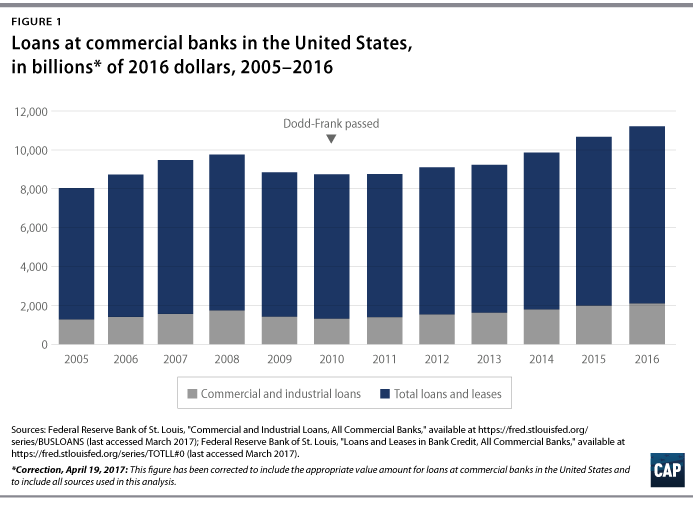
Before delving into the specifics of the Financial CHOICE Act, it is helpful to put Rep. Hensarling’s deregulatory efforts in context. To justify dismantling financial reform, President Trump and his congressional allies know that they must outline a problem. President Trump argues that the main problem with financial reform is bank lending. He believes that banks are not making enough loans due to the burdens of Dodd-Frank. What is his evidence? Nothing more than anecdotal remarks that his friends cannot get loans. [8] As Figure 1 demonstrates, a lack of loans is simply not the case. Overall lending and business lending in particular, has increased significantly since the financial crisis and the passage of Dodd-Frank. Moreover, credit card lending, auto lending, and mortgage lending have increased since 2010, when Dodd-Frank was passed. [9] Bank profits are also higher than ever. [10]


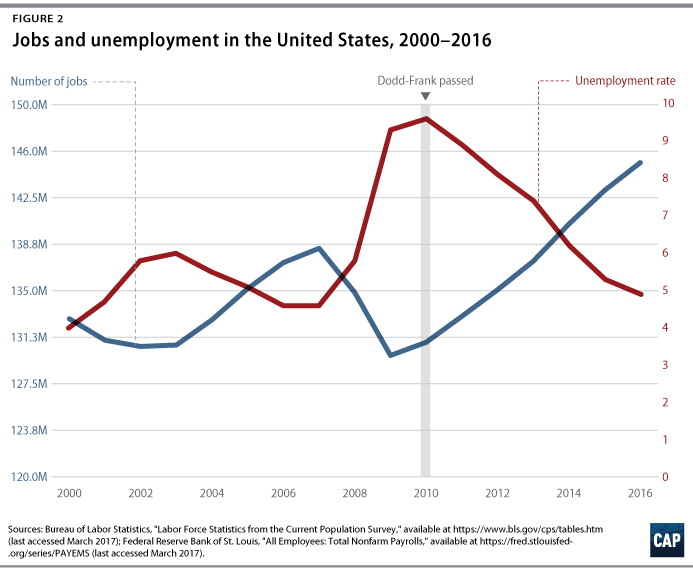
Chairman Hensarling makes similar arguments about the perceived unavailability of credit, adding that financial reform has not encouraged economic growth and has hurt community banks. [11] Again, the data contradict these charges. Figure 2 highlights the steady economic growth the country experienced under President Barack Obama. And while the scars of the devastating Great Recession remain, the financial reforms put in place to prevent the recurrence of exactly that kind of economic catastrophe have not damaged growth. Indeed, since the end of the financial crisis and the passage of Dodd-Frank, community bank lending and profitability are both up. [12] It is fair to say that the number of community banks has declined over time. This trend, however, started in the 1980s and is caused by economies of scale, technology, and long-running trends toward banking deregulation, as well as other factors—not the 2010 passage of the Dodd-Frank Act. [13]


Hensarling presents his approach as a moderate adjustment to Dodd-Frank, but in reality it is a thorough demolition of financial reform. The complete publication (available here) analyzes how Hensarling’s approach erodes the financial stability safeguards that the real economy needs to thrive, from mitigation of systemic risk to financial sector accountability and consumer protection. It also explains how the bill further concentrates—and makes even more unaccountable—economic power in the hands of those that will serve their own interests at the expense of the real economy. Finally, the report details how the FCA eliminates the consumer and investor protections that guard against the predatory financial practices that wreaked havoc on consumers and investors prior to the financial crisis.

It is necessary to note that just about every provision in the report could fit under the rubric of financial stability safeguards. For example, consumer financial protection protects ordinary consumers from abuses and the broader financial system from the proliferation of dangerous consumer loans that can bring down entire firms and markets. Similarly, the Volcker Rule is a key bulwark against the high-risk bets that brought down major firms in 2008, and yet it also aims to reorient large bank trading toward real economy-serving purposes. The report discusses certain provisions under one section rather than another should not be taken as a substantive comment on the merit or usefulness of the provision to financial stability. The report’s different sections reflect an effort to highlight how the Dodd-Frank Act and financial reform yield a broad array of public benefits. Similarthe report highlights examples of broader themes in the FCA rather than focusing on minute details: Failure to discuss any particular provision should not be read as a substantive judgment regarding its relative merits.

The report is based on the version of the Financial CHOICE Act released in September 2016, as well as a memo outlining this year’s planned changes to that version. [14] A new version, which may have some further modifications, is expected to be released in the coming weeks.

Financial reform enacted through the Dodd-Frank Act has made a lot of necessary progress since the crisis. U.S. banks have more substantial loss-absorbing capital cushions, increasingly rely on stable sources of funding, undergo rigorous stress testing, and plan for their orderly failure. President Trump’s intent to dismantle these reforms only helps Wall Street’s bottom line—ignoring the memory of every family who lost their home, every worker who lost his or her job, and every consumer who was peddled a toxic financial product. [15]

The question remains: What is the problem President Trump and his allies in Congress are trying to solve? Lending is up. Bank profits are up. Consumer credit costs are down. The economy is steadily improving. Yes, much more needs to be done to make the economy work for hard-working Americans, but financial deregulation is not the path to that end. [16] In fact, it is a path toward exactly the opposite: booms and busts that leave taxpayers holding the bag for Wall Street’s excesses, greater concentration of economic power and less accountability for wrongdoing that harms ordinary consumers and investors, and major changes to financial regulation and monetary policy that would damage the real economy. Now that is a problem.

The complete publication, including footnotes, is available here.

Endnotes

1Billy House and Kevin Cirilli, “Trump’s Dodd-Frank Plan Will Be Early Test of Republican Unity,” Bloomberg, May 19, 2016, available at https://www.bloomberg.com/politics/articles/2016-05-19/trump-s-dodd-frank-plan-will-be-early-test-of-republican-unity. (go back)

2Glenn Thrush, “Trump Vows to Dismantle Dodd-Frank ‘Disaster,’” The New York Times, January 30, 2017, available at https://www.nytimes.com/2017/01/30/us/politics/trump-dodd-frank-regulations.html?_r=0; Jessica Dye, “Trump vows ‘major haircut’ for Dodd-Frank,” Financial Times, April 4, 2017, available at https://www.ft.com/content/fb08a355-f7fc-3021-8c92-d94af9a2f35b. (go back)

3Executive Order no. 13,772, Code of Federal Regulations (2017), available at https://www.whitehouse.gov/the-press-office/2017/02/03/presidential-executive-order-core-principles-regulating-united-states. (go back)

4Ibid. (go back)

5Financial CHOICE Act of 2016, H. Rept. 5983, 114 Cong. 2 sess. (Government Printing Office, 2016), available at https://www.congress.gov/114/bills/hr5983/BILLS-114hr5983rh.pdf. (go back)

6Donna Borak, “Donald Trump, Jeb Hensarling Meet on Dodd-Frank Alternative,” The Wall Street Journal, June 7, 2016, available at https://www.wsj.com/articles/donald-trump-jeb-hensarling-meet-on-dodd-frank-alternative-1465335535; Damien Palette, Ryan Tracy, and Michael C. Bender, “Trump Team Considering Rep. Jeb Hensarling as Treasury Secretary,” The Wall Street Journal, November 10, 2016, available at https://www.wsj.com/articles/donald-trump-considering-rep-jeb-hensarling-as-treasury-secretary-1478812583. (go back)

7Jim Puzzanghera, “Trump says businesses can’t borrow because of Dodd-Frank. The numbers tell another story,” Los Angeles Times, February 26, 2017, available at http://www.latimes.com/business/la-fi-trump-bank-loans-20170226-story.html; Matt Egan, “Banks are lending a ton, despite Trump’s claims,” CNN Money, February 13, 2017, available at http://money.cnn.com/2017/02/13/investing/bank-business-lending-dodd-frank-trump/. (go back)

8Zeke Faux, Yalman Onaran, and Jennifer Surane, “Trump Cites Friends to Say Banks Aren’t Making Loans. They Are.,” Bloomberg, February 4, 2017, available at https://www.bloomberg.com/news/articles/2017-02-04/trump-cites-friends-to-say-banks-aren-t-making-loans-they-are. (go back)

9Kate Berry, “Four myths in the battle over Dodd-Frank,” American Banker, March 10, 2017, available at https://www.americanbanker.com/news/four-myths-in-the-battle-over-dodd-frank. (go back)

10Matt Egan, “American bank profits are higher than ever,” CNN Money, March 3, 2017, available at http://money.cnn.com/2017/03/03/investing/bank-profits-record-high-dodd-frank/. (go back)

11Jeb Hensarling, “After Five Years, Dodd-Frank Is a Failure,” The Wall Street Journal, July 19, 2015, available at https://www.wsj.com/articles/after-five-years-dodd-frank-is-a-failure-1437342607. (go back)

12Gregg Gelzinis and others, “The Importance of Dodd-Frank, in 6 Charts,” Center for American Progress, March 27, 2017, available at https://www.americanprogress.org/issues/economy/news/2017/03/27/429256/importance-dodd-frank-6-charts/. (go back)

13Ibid. (go back)

14Ylan Mui, “Memo from a key congressman outlines plan to gut Dodd-Frank bank rules,” CNBC, February 9, 2017, available at http://www.cnbc.com/2017/02/09/dodd-frank-hensarling-memo-reveals-plan-to-scrap-bank-regulations.html. (go back)

15Wall Street is not monolithic, and firms may have differing views on the provisions of the Financial CHOICE Act, but on the whole, this agenda is clearly aligned with the interests of financial institutions and not the American public.

_______________________________________

*Gregg Gelzinis is a Special Assistant for the Economic Policy team at the Center for American Progress. This post is based on a Center for American Progress publication by Mr. Gelzinis, Ethan GurwitzSarah Edelman, and Joe Valenti. Additional posts addressing legal and financial implications of the Trump administration are available here.

Deux théories de la gouvernance des sociétés


Résultats de recherche d'images pour « corporate governance model »

The activists’ claim of value creation is further clouded by indications that some of the value purportedly created for shareholders is actually value transferred from other parties or from the general public. Large-sample research on this question is limited, but one study suggests that the positive abnormal returns associated with the announcement of a hedge fund intervention are, in part, a transfer of wealth from workers to shareholders. The study found that workers’ hours decreased and their wages stagnated in the three years after an intervention. Other studies have found that some of the gains for shareholders come at the expense of bondholders. Still other academic work links aggressive pay-for-stock-performance arrangements to various misdeeds involving harm to consumers, damage to the environment, and irregularities in accounting and financial reporting.

We are not aware of any studies that examine the total impact of hedge fund interventions on all stakeholders or society at large. Still, it appears self-evident that shareholders’ gains are sometimes simply transfers from the public purse, such as when management improves earnings by shifting a company’s tax domicile to a lower-tax jurisdiction—a move often favored by activists, and one of Valeant’s proposals for Allergan. Similarly, budget cuts that eliminate exploratory research aimed at addressing some of society’s most vexing challenges may enhance current earnings but at a cost to society as well as to the company’s prospects for the future.

Hedge fund activism points to some of the risks inherent in giving too much power to unaccountable “owners.” As our analysis of agency theory’s premises suggests, the problem of moral hazard is real—and the consequences are serious. Yet practitioners continue to embrace the theory’s doctrines; regulators continue to embed them in policy; boards and managers are under increasing pressure to deliver short-term returns; and legal experts forecast that the trend toward greater shareholder empowerment will persist. To us, the prospect that public companies will be run even more strictly according to the agency-based model is alarming. Rigid adherence to the model by companies uniformly across the economy could easily result in even more pressure for current earnings, less investment in R&D and in people, fewer transformational strategies and innovative business models, and further wealth flowing to sophisticated investors at the expense of ordinary investors and everyone else.

To counter short-termism and activism, Bower and Paine embrace the corporation-centric/constituency theory of governance. They argue that the corporation and its board of directors have a fiduciary duty not just to its shareholders, but to its employees, customers, suppliers and to the community. This is the theory I argued in Takeover Bids in the Target’s Boardroom (1979) and regularly since in a long series of articles and memoranda. While Bower and Paine say:

The new model has yet to be fully developed, but its conceptual foundations can be outlined …[T]he company-centered model we envision tracks basic corporate law in holding that a corporation is an independent entity, that management’s authority comes from the corporation’s governing body and ultimately from the law, and that managers are fiduciaries (rather than agents) and are thus obliged to act in the best interests of the corporation and its shareholders (which is not the same as carrying out the wishes of even a majority of shareholders). This model recognizes the diversity of shareholders’ goals and the varied roles played by corporations in society. We believe that it aligns better than the agency-based model does with the realities of managing a corporation for success over time and is thus more consistent with corporations’ original purpose and unique potential as vehicles for projects involving large-scale, long-term investment.

In fact the corporation-centric theory—that the directors have a fiduciary duty to the corporation and all of its stakeholders—is reflected in a number of state corporation laws. Perhaps the most cogent example is the Pennsylvania Business Corporation Law which provides:

A director of a business corporation shall stand in a fiduciary relation to the corporation and shall perform his duties as a director, including his duties as a member of any committee of the board upon which he may serve, in good faith, in a manner he reasonably believes to be in the best interests of the corporation and with such care, including reasonable inquiry, skill and diligence, as a person of ordinary prudence would use under similar circumstances.

In discharging the duties of their respective positions, the board of directors, committees of the board and individual directors of a business corporation may, in considering the best interests of the corporation, consider to the extent they deem appropriate:

  1. The effects of any action upon any or all groups affected by such action, including shareholders, employees, suppliers, customers and creditors of the corporation, and upon communities in which offices or other establishments of the corporation are located.
  2. The short-term and long-term interests of the corporation, including benefits that may accrue to the corporation from its long-term plans and the possibility that these interests may be best served by the continued independence of the corporation.
  3. The resources, intent and conduct (past, stated and potential) of any person seeking to acquire control of the corporation.
  4. All other pertinent factors.

While wider adoption and strengthening of laws like the Pennsylvania statute would provide some more ability to boards of directors to temper short-termism and resist attacks by activist hedge funds, voting control of corporations will remain in the hands of the major institutional investors and asset managers. To achieve a truly meaningful change and effectively promote long-term investment, corporations and institutional investors and asset managers will need to endorse and adhere to The New Paradigm: A Roadmap for an Implicit Corporate Governance Partnership Between Corporations and Investors to Achieve Sustainable Long-Term Investment and Growth (2016) (discussed on the Forum here) promulgated by the World Economic Forum or A Synthesized Paradigm for Corporate Governance, Investor Stewardship, and Engagement (2017) (discussed on the Forum here) based on it and on The Principles of the Investor Stewardship Group (2017). The alternative would be legislation, something that both corporations and investors should assiduously avoid.

_________________________________

*Martin Lipton is a founding partner of Wachtell, Lipton, Rosen & Katz, specializing in mergers and acquisitions and matters affecting corporate policy and strategy. This post is based on a Wachtell Lipton publication by Mr. Lipton. Additional posts by Martin Lipton on short-termism and corporate governance are available here.

Compte rendu hebdomadaire de la Harvard Law School Forum on Corporate Governance | 20 avril 2017


Voici le compte rendu hebdomadaire du forum de la Harvard Law School sur la gouvernance corporative au 20 avril 2017.

J’ai relevé les principaux billets.

Bonne lecture !


Résultats de recherche d'images pour « harvard law school forum on corporate governance »


Résultats de recherche d'images pour « harvard law school forum on corporate governance »


  1. The Law and Brexit XI
  2. Lowering the Bar on Bad Faith Claims in MLP Transactions? Brinckerhoff v. Enbridge Energy
  3. Do Independent Directors Curb Financial Fraud? The Evidence and Proposals for Further Reform
  4. From Boardroom to C-Suite: Why Would a Company Pick a Current Director as CEO?
  5. A Synthesized Paradigm for Corporate Governance, Investor Stewardship, and Engagement
  6. Securities Class Action Settlements: 2016 Review and Analysis
  7. Sustainability Matters: Focusing on your Future Today
  8. In Defense of Fairness Opinions: An Empirical Review of Ten Years of Data
  9. Behavioral Implications of the CEO-Employee Pay Ratio
  10. Do Staggered Boards Affect Firm Value?

Étude sur les pratiques des CA américains | ISS


La firme-conseil ISS, (Institutional Shareholder Services) publie chaque année une étude de l’évolution des pratiques de gouvernance aux É.U. (Board Practices Study).

Rob Yates, vice-président d’ISS, est l’auteur de cet article paru sur le site de Harvard Law School Forum on Corporate Governance. Il y aborde cinq tendances majeures.

Les investisseurs continuent d’exercer des pressions sur les administrateurs du conseil, entre autres en continuant de demander d’inclure de nouvelles candidatures dans la circulaire de procuration.

On constate que les pratiques généralement reconnues de bonne gouvernance sont adoptées dans presque toutes les grandes sociétés ; elles sont de plus en plus acceptées dans les plus petites entreprises. On fait ici référence aux élections annuelles, au vote majoritaire et à l’élimination des pilules empoisonnées.

La question du choix d’un président du conseil totalement indépendant et différent du CEO semble être moins problématique si la société fait appel à président désigné (lead director) indépendant et fort.

La rémunération des administrateurs de sociétés a continué de croître significativement. Les CA évaluent différentes approches à la compensation des administrateurs. Ainsi, on élimine de plus en plus les jetons de présence pour les réunions et les conférences téléphoniques. La rémunération des administrateurs s’est accrue de 17 % de 2012 à 2016 tandis que celle des PDG a augmenté de 10 % pendant la même période.

ISS a produit plusieurs études sur les tendances en matière de limite des mandats (tenure), du renouvellement des administrateurs du CA et de l’importance de la diversité. Si le sujet vous intéresse, l’auteur vous réfère à plusieurs études américaines et mondiales.

Bonne lecture !

U.S. Board Practices


This year’s Board Practices Study focuses not only on longstanding issues traditionally covered, but on those which have driven increased shareholder interest in the boardroom over the past several years. Governance continues to evolve, but investor focus in recent years has been particularly pointed as new concerns have emerged, and the ways in which companies address those concerns adapts to meet market demands. Particular focus has been placed on the role of the board as a representative of shareholders at a company, and how the board’s structure and practices promulgate this responsibility. As always, this study provides a snapshot of these facets of public company boards in the S&P 1500 for investors and issuers to compare and contrast.


Investors are continuing to push for board accountability


The pyroclastic spread of proxy access over the past two years has arguably been the most prominent governance story in the United States. In two short years, the S&P went from having only a handful of companies with proxy access, to having over half its constituents offering shareholders the right. Proxy access is also starting to show up in shareholder proposals at smaller firms; as of March 14, ISS is tracking a dozen such proposals at S&P 400 companies.


Image associée
Advisory Board Best Practices: Roles and Advice


Proxy access is the most recent chapter in the much longer story of shareholders seeking board accountability. The next chapters are underway, with investors focusing on board self-regulation practices and measures, such as director tenure and board refreshment, board diversity, board evaluations, mandatory retirement ages, and more. Some of these are showing promise—such as board refreshment and continuing progress on gender diversity—while others are lagging, such as non-gender measures of board diversity.

Central to these concerns is shareholders’ desire that boards develop the skills, expertise, awareness, and experience to accurately assess and effectively manage emerging risks, such as cyber and environmental risks, and ensure that boards are constantly searching for weaknesses (and, when and where appropriate, soliciting external help to identify blind spots).


Traditional concerns still exist, but companies are making progress


More traditional approaches to increasing accountability, such as majority vote standards and annual elections in the director election process—features that are near-ubiquitous in the largest companies—have been adopted in greater frequency by smaller companies. Many problematic governance practices, such as poison pills, are also increasingly rare.


Investors are more accepting of alternative independent board leadership structures


Demonstrating that governance is both a give and take endeavor, investors are more accepting of alternative forms of independent board leadership. Whereas investors have historically favored independent chairs, many are increasingly comfortable with an alternative structure whereby a strong and empowered lead independent director counterbalances a combined chair/CEO.


Director compensation increased sharply


A new feature in this year’s study is an evaluation of director pay covering the preceding five years. While compensation disclosure for non-employee directors is not new itself, the rules and guidelines governing director pay disclosure have only recently standardized. Beginning in December 2006, SEC rules required the disclosure of director pay in a standardized table format. This disclosure increased transparency and comparability between companies. Additionally, both the NYSE and NASDAQ require that boards consider director pay when determining director independence for purposes of meeting listing requirements.

Director compensation has received increased scrutiny in recent years, particularly given rising pay levels and high-profile shareholder lawsuits alleging excessive pay. Amid this atmosphere, many companies have taken a proactive approach to director compensation programs, mainly through altering equity plans or, in a few rare instances, introducing ballot items.

As companies weigh the potential benefits of changing director pay structures, median pay continues to rise. In fact, non-employee director compensation grew 17 percent between 2012 and 2016, while median CEO pay in the S&P 500 (reported in ISS’ 2016 US Compensation Postseason Report) rose by less than 10 percent. One positive development is the streamlining observed among director compensation programs. For example, the elimination of meeting and telephonic meeting fees in many compensation structures.


Increased scrutiny of certain board practices has necessitated a more detailed review


Previous versions of the board study included an in-depth snapshot of new-director demographics and trends, such as tenure, refreshment, and diversity. As these components of board composition have become a significant part of the governance conversation, ISS has produced in-depth studies on each of these issues.

For a vast and comprehensive look at board refreshment trends in the U.S., please see the joint ISS/IRRC study, Board Refreshment Trends at S&P 1500 Firms.

For a look at gender parity advancement on boards in the U.S. and around the world, please see the April 2016 joint study carried out by ISS and European Women on Boards, Gender Diversity on European Boards—Realizing Europe’s Potential: Progress and Challenges, and ISS’ December 2016 study, Gender Diversity on Boards—A Review of Global Trends.

The complete publication is available here.

_____________________________________

*Rob Yates is Vice President at Institutional Shareholder Services, Inc. This post is based on an ISS publication by Mr. Yates, Rachel Hedrick, and Andrew Borek.

L’histoire récente des courants de pensée en gouvernance aux É.U.


Aujourd’hui, je ne peux passer sous silence la petite histoire de l’évolution de la pensée en gouvernance publiée par , professeur à la George Washington University Law School.

Ce court article a été publié sur le site du HLS Forum. Il décrit les grands courants de pensée et met l’accent sur les publications des bonzes universitaires américains.

Je suis assuré que cette brève chronologie des événements, à compter de 1976, vous donnera une vue d’ensemble utile de l’évolution de la discipline.

Bonne lecture !

The Ivory Tower on Corporate Governance


In 1976, [Directors & Boards]’s founding year, two influential academic works in corporate governance appeared: Berkeley law professor Melvin Eisenberg urged transforming the board from an advisory role to a monitoring model and mandating significant internal control systems, while University of Rochester economists Michael Jensen and William Meckling portrayed the firm as a nexus of contracts whose optimal design is for participants to choose.


These contrasting visions—obligatory uniformity versus free tailoring—have defined the field since, setting the boundaries of debate and helping participants think through positions. Into the early 1980s, the Eisenberg view dominated, with Columbia University law professor William Cary urging preemptive federal oversight of the field, traditionally handled by state law, and a generally pro-regulatory atmosphere imposing fiduciary mandates on independent directors and board committees.

But the nexus of contracts school soon ascended to greater influence, through the 1990s, after law professors such as Frank Easterbrook (now a judge) and Daniel Fischel, both of the University of Chicago, explored how the separation of ownership from control is a problem of agency costs, best addressed by contractual devices geared to maximizing shareholder value. Rather than federal mandates, states should experiment to offer a menu of tools for different corporations to tailor. Yale University law professor (also now judge) Ralph Winter theorized that competition among states for corporate charters constrained managers to promote shareholder interests.

While normative corporate governance scholarship has divided between the pro- and anti-regulatory camps of the 1970s and 1980s, the best academics learned from their intellectual opponents to refine stances and often forge consensus. For example, though assessments of the deal decade’s disruptive takeovers and comparative studies of non-U.S. practice found a place for non-shareholder constituents in corporate governance, a shareholder primacy norm nevertheless took root.

Even as both schools of thought contributed to the discourse, each had their heyday when current events cut in their favor. So the 1990s boom was a time of great enthusiasm for the economic approach, adding a productive trend of increasingly sophisticated empirical research, including on the value of state competition in corporate law. After the burst, however, and as widespread accounting fraud was revealed, scholars cited Eisenberg to diagnose failures to monitor and control—and prescribed cures found in the Sarbanes-Oxley Act (SOX). An industry-specific version of the dynamic transpired after the financial crisis, culminating in the Dodd-Frank Act.

In each case, scholarship was diverse, as pragmatic centrist resolution of pending challenges, exemplified by Columbia’s John Coffee, contended with cries on both normative sides of either too little or too much regulation (Yale’s Roberta Romano called SOX “quack governance”). Such episodes updated the Cary-Winter debate: full-scale federal preemption is probably dead but, as Harvard University law professor Mark Roe explained, less due to state competition than the threat to states of incremental federal incursion, a la SOX and Dodd-Frank.

Since 1976, scholars have helped shift power from managers to owners, especially institutional investors. Today, scholars such as Harvard Law professor Lucian Bebchuk urge continued expansion of shareholder power, while others, like UCLA law professor Stephen Bainbridge, observe and support a propensity toward director primacy instead. In the balance is the fate of shareholder activism, which though novel in some ways, at bottom raises issues debated for 40 years, particularly agency cost mitigation. Plus ça change, plus c’est la même chose.

Compte rendu hebdomadaire de la Harvard Law School Forum on Corporate Governance | 13 avril 2017


Voici le compte rendu hebdomadaire du forum de la Harvard Law School sur la gouvernance corporative au 13 avril 2017.

J’ai relevé les principaux billets.

Bonne lecture !


harvard_forum_corpgovernance_small


  1. Director Appointments—Is It “Who You Know”?
  2. Voluntary Corporate Governance, Proportionate Regulation, and Small Firms: Evidence from Venture Issuers
  3. Should Executive Pay Be More “Long-Term”?
  4. Dealmakers Expect a “Trump Bump” on M&A
  5. A Legal Theory of Shareholder Primacy
  6. Earnouts: Devil in the Details
  7. On Regulatory Reform, Better Process Means Better Progress
  8. Tread Lightly When Tweaking Sarbanes-Oxley
  9. Corporations and Human Life
  10. Is Executive Pay Broken?

Colloque sur la gouvernance et la performance | Une perspective internationale


C’est avec plaisir que je partage l’information et l’invitation à un important colloque intitulé « Gouvernance et performance : une perspective internationale » qui aura lieu à l’Université McGill les 11 et 12 mai 2017.

C’est mon collègue, le professeur Félix ZOGNING NGUIMEYA, Ph.D., Adm.A., qui est le responsable de l’organisation de ce colloque en gouvernance à l’échelle internationale.

À la lecture du programme, vous constaterez que les organisateurs n’ont ménagé aucun effort pour apporter un éclairage très large de ce phénomène.

Ce colloque traite des récents développements et des sujets émergents en matière de gouvernance. La gouvernance, comme thématique transversale, est abordée dans tous ses aspects : gouvernance d’entreprise, gouvernance économique, gouvernance publique, en lien avec la création de valeur ou la performance des organisations, des politiques ou des programmes concernés. Dans chacun des contextes, les travaux souligneront l’effet des mécanismes de gouvernance sur la performance des organisations, institutions ou collectivités.

La perspective internationale du colloque a pour but d’examiner les modèles et structures de gouvernance présents dans différents pays et dans les différentes organisations, selon que ces modèles dépendent fortement du système juridique, du modèle économique et social, ainsi que le poids relatif des différentes parties prenantes. Les contributions sont donc attendues des chercheurs et professionnels de plusieurs champs disciplinaires, notamment les sciences économiques, les sciences juridiques, les sciences politiques, la comptabilité, la finance, l’administration et la stratégie.

Je vous invite à consulter le site web du colloque : https://gouvernance.splashthat.com/

Vous trouverez le programme détaillé du colloque à l’adresse suivante : http://www.acfas.ca/evenements/congres/programme/85/400/449/c

Le plus gros fonds souverain au monde veut plafonner la paie des patrons | Journal de Montréal


Selon un communiqué de l’Agence France Presse, publié le 7 avril 2017 dans le Journal de Montréal, « le fonds souverain de la Norvège, le plus gros au monde, a peaufiné vendredi son image d’investisseur responsable en réclamant un plafonnement de la rémunération des patrons et la transparence fiscale des entreprises ».

Bonne lecture !

Le fonds souverain de la Norvège, le plus gros au monde, a peaufiné vendredi son image d’investisseur responsable en réclamant un plafonnement de la rémunération des patrons et la transparence fiscale des entreprises


Dans chaque entreprise, le « conseil d’administration devrait (…) dévoiler un plafond pour la rémunération totale » du directeur général « pour l’année à venir », estime la banque centrale norvégienne, chargée de gérer le fonds, dans un nouveau « document de position ».

À une époque où les très gros salaires décollent, cette prise de position est d’autant plus importante que le fonds est présent au capital de quelque 9 000 entreprises à travers le monde, représentant 1,3 % de la capitalisation globale.

Par son poids et par sa gestion généralement jugée exemplaire en matière de transparence et d’éthique, le mastodonte scandinave donne souvent le « pas » pour d’autres investisseurs.

Résultats de recherche d'images pour « fonds souverain norvégien »

« C’est une très bonne nouvelle », s’est réjouie Manon Aubry, porte-parole d’Oxfam France. « Il s’agit d’un levier qui peut avoir un impact important sur le comportement des entreprises », a-t-elle expliqué à l’AFP, soulignant que le fonds norvégien n’était pas le seul à avoir pris ce genre de décision.

La contestation a un effet, parfois. Le directeur général du géant pétrolier britannique BP, Bob Dudley, a ainsi vu sa rémunération diminuer de 40 % en 2016, un an après un vote des actionnaires contre une hausse de son salaire, uniquement consultatif, mais offrant un désaveu cinglant.

Sous la pression de la classe politique et des syndicats, six hauts dirigeants de Bombardier ont accepté dimanche au Canada de réduire de moitié l’augmentation de 50 % initialement promise. Volkswagen a aussi décidé le mois dernier de plafonner les salaires pour les membres de son conseil d’administration, une question souvent débattue en Allemagne.

«Say on pay»

Le principe du « say on pay » vient par ailleurs d’entrer pour la première fois dans le droit français. Le vote des actionnaires en assemblée générale sur la rémunération des dirigeants est désormais contraignant grâce à la loi « Sapin 2 », dont le décret d’application a été publié en mars.

En 2016, la rémunération des dirigeants de trois entreprises, dont Carlos Ghosn chez Renault et Patrick Kron chez Alstom, avait été rejetée par les actionnaires. Mais ces avis, alors purement consultatifs, n’avaient pas été pris en compte par les conseils d’administration.

Longtemps peu regardant en la matière, le fonds norvégien s’implique de plus en plus dans la gouvernance des entreprises dont il est actionnaire. Il a par exemple voté l’an dernier contre la politique de rémunération des dirigeants d’Alphabet (Google), Goldman Sachs, JPMorgan ou encore Sanofi, selon le Financial Times.

« Nous ne sommes plus en position, en tant qu’investisseur, de dire que c’est une question sur laquelle on n’a pas d’avis », a déclaré au FT le patron du fonds, Yngve Slyngstad, en notant que le « say on pay » se répandait dans toujours plus de pays.

Jugeant que cela contribuerait à aligner les intérêts du patron sur ceux des actionnaires, le nouveau document prône aussi pour qu’« une part significative de la rémunération totale annuelle (soit) fournie en actions bloquées pour au moins cinq ans, et de préférence dix ans, indépendamment d’une démission ou d’un départ en retraite » et sans condition de performances.

Non à l’optimisation fiscale 

Dans un autre document publié vendredi, la Banque de Norvège a aussi exigé la transparence fiscale de la part des entreprises.

« Les impôts devraient être payés là où la valeur économique est générée », souligne-t-elle notamment, visiblement hostile à l’optimisation fiscale, technique légale qui consiste à déplacer les bénéfices là où l’imposition est moindre.

Sur le Vieux Continent, des géants comme Apple, Starbucks ou Fiat ont eu ces dernières années maille à partir avec la Commission européenne pour avoir tiré parti d’avantages fiscaux indus.

Le fonds norvégien conforte ainsi son image d’investisseur responsable.

Conformément à un vote du Parlement en 2015, le fonds — alimenté, paradoxalement, par les revenus pétroliers de l’État — se refuse à investir dans les entreprises, compagnies minières ou énergéticiens, où le charbon, néfaste pour le climat, représente plus de 30 % de l’activité.

Il n’est pas non plus autorisé à investir dans les entreprises coupables de violations graves des droits de l’Homme, dans celles qui fabriquent des armes nucléaires ou « particulièrement inhumaines » ou encore dans les producteurs de tabac.

Compte rendu hebdomadaire de la Harvard Law School Forum on Corporate Governance | 30 mars 2017


Voici le compte rendu hebdomadaire du forum de la Harvard Law School sur la gouvernance corporative au 30 mars 2017.

J’ai relevé les principaux billets.

Bonne lecture !


harvard_forum_corpgovernance_small

  1. Is the American Public Corporation in Trouble?
  2. Corporate Governance Update: Preparing for and Responding to Shareholder Activism in 2017
  3. New York Cybersecurity Regulations for Financial Institutions Enter Into Effect
  4. Does the Market Value Professional Directors?
  5. Did Say-on-Pay Reduce or “Compress” CEO Pay?
  6. The Americas – 2017 Proxy Season Preview
  7. Controlling Systemic Risk Through Corporate Governance
  8. 2017 Institutional Investor Survey
  9. 2017 Compensation Committee Guide
  10. Corporate Employee-Engagement and Merger Outcomes
  11. The Investor Stewardship Group: An Inflection Point in U.S. Corporate Governance?

Compte rendu hebdomadaire de la Harvard Law School Forum on Corporate Governance | 16 mars 2017


Voici le compte rendu hebdomadaire du forum de la Harvard Law School sur la gouvernance corporative au 16 mars 2017.

J’ai relevé les principaux billets.

Bonne lecture !


harvard_forum_corpgovernance_small


  1. The Modern Slavery Act 2015: Next Steps for Businesses
  2. Stock Rising
  3. The Delaware Trap: An Empirical Study of Incorporation Decisions
  4. Acting SEC Chair’s Steps to Centralize the Process of Issuing Formal Orders—Are Commentators Drawing the Right Lessons?
  5. Defusing the Antitrust Threat to Institutional Investor Involvement in Corporate Governance
  6. Board of Directors Compensation: Past, Present and Future
  7. The Dealmaking State
  8. SEC Enforcement: 2016 in Review and Looking Ahead to 2017
  9. Super Hedge Fund
  10. Diversity Investing

Compte rendu hebdomadaire de la Harvard Law School Forum on Corporate Governance | 9 mars 2017


Voici le compte rendu hebdomadaire du forum de la Harvard Law School sur la gouvernance corporative au 9 mars 2017.

J’ai relevé les principaux billets.

Bonne lecture !


harvard_forum_corpgovernance_small


  1. Uncapping Executive Pay
  2. The Trajectory of American Corporate Governance: Shareholder Empowerment and Private Ordering Combat
  3. Focus on Annual Incentives: Metrics, Goals, and More
  4. A Look at Board Composition: How Does Your Industry Stack Up?
  5. Teaming Up and Quiet Intervention: The Impact of Institutional Investors on Executive Compensation Policies
  6. The Regulatory and Enforcement Outlook for Financial Institutions in 2017
  7. The Materiality Gap Between Investors, the C-Suite and Board
  8. Pilot CEOs and Corporate Innovation
  9. Shareholder Engagement: An Evolving Landscape
  10. State Street Global Advisors Announces New Gender Diversity Guidance

Compte rendu hebdomadaire de la Harvard Law School Forum on Corporate Governance | 2 mars 2017


Voici le compte rendu hebdomadaire du forum de la Harvard Law School sur la gouvernance corporative au 2 mars 2017.

J’ai relevé les principaux billets.

Bonne lecture !


harvard_forum_corpgovernance_small


  1. Corporate Officers as Agents
  2. 2015 Short- and Long-Term Incentive Design Criteria Among Top 200 S&P 500 Companies
  3. Private Funds Year in Review and 2017 Outlook
  4. Should Mutual Funds Invest in Startups?
  5. Shareholder Proposals Regarding Lead Director Tenure: A Harbinger of Things to Come?
  6. Hot-Button Issues for the 2017 Proxy Season
  7. 2017 Investor Corporate Governance Report
  8. 2017: Where Things Stand—Appraisal, Business Judgment Rule and Disclosure Section 16(B)—If at First You Don’t Succeed…
  9. Considerations for U.S. Public Companies Acquiring Non-U.S. Companies
  10. The 100 Most Overpaid CEOs

Compte rendu hebdomadaire de la Harvard Law School Forum on Corporate Governance | 23 février 2017


Voici le compte rendu hebdomadaire du forum de la Harvard Law School sur la gouvernance corporative au 23 février 2017.

J’ai relevé les principaux billets.

Bonne lecture !


harvard_forum_corpgovernance_small

  1. A Trump Appointed AG May Not Translate to Less Aggressive Enforcement
  2. It’s Time for the Pendulum to Swing Back
  3. SEC Enforcement in Financial Reporting and Disclosure—2016 Year in Review
  4. Tactical Approaches to Proxy Season 2017
  5. The Activist Investing Annual Review 2017
  6. Company Stock Reactions to the 2016 Election Shock: Trump, Taxes and Trade
  7. Directors Must Navigate Challenges of Shareholder-Centric Paradigm
  8. A Broader Perspective on Corporate Governance in Litigation