Top 10 de Harvard Law School Forum on Corporate Governance au 15 novembre 2018


Voici le compte rendu hebdomadaire du forum de la Harvard Law School sur la gouvernance corporative au 15 novembre 2018.

Comme à l’habitude, j’ai relevé les dix principaux billets.

Bonne lecture !


Résultats de recherche d'images pour « top ten »


Résultats de recherche d'images pour « Top 10 en gouvernance Harvard Law School »


Top 10 de Harvard Law School Forum on Corporate Governance au 8 novembre 2018


Voici le compte rendu hebdomadaire du forum de la Harvard Law School sur la gouvernance corporative au 8 novembre 2018.

Comme à l’habitude, j’ai relevé les dix principaux billets.

Bonne lecture !


Résultats de recherche d'images pour « top ten »


Résultats de recherche d'images pour « Top 10 en gouvernance Harvard Law School »


Quelles sont les tendances eu égard à l’évaluation des conseils d’administration à l’échelle internationale ?


Voici un article très intéressant sur les tendances en évaluation des CA à l’échelle internationale.

Les auteurs, Mark Fenwick* et Erik P. M. Vermeulen, ont étudié l’état de la situation de l’évaluation des conseils dans 20 juridictions différentes qu’ils ont classifiées en 5 groupes, allant d’absence de législation, à des réglementations détaillées et explicites.

Dans l’ensemble, l’étude montre que les juridictions qui sont explicites eu égard aux meilleures pratiques en matière d’évaluation des conseils sont plus susceptibles d’adopter des processus d’évaluation efficaces. La législation et la réglementation ont un grand pouvoir d’influence sur les pratiques exemplaires.

Les auteurs retiennent un certain nombre de constats sur les meilleures pratiques en évaluation des CA :


(1) Although there is “no one-size-fits-all” solution, and the design of the evaluation should be tailored to meet the needs of the individual company and the particular circumstances of that company, board evaluation needs to be a continuous and on-going process rather than a periodic event.

(2) Evaluation should include not only compliance and risk-management competencies, but also skills and experience in business-related and organization-related areas, such as strategy, innovation, marketing, globalization, and growth.

(3) Regulator-issued “best practice” principles and guidelines should provide enough detail to offer genuine help to companies in implementing and evaluation processes, but also leave enough flexibility for companies to tailor the process to their specific needs. Additional guidelines need to provide more information about the criteria, methods, and form of the evaluation process (without compelling companies to make use of them).

(4) The board member or committee responsible for driving the evaluation process should actively involve external experts if, and when, necessary. In addition, “Legal Tech”, specifically board evaluation software and application, can help facilitate the assessment process.

(5) Boards should engage in a more open and detailed form of communication and disclosure about the evaluation process and its outcomes.


Bonne lecture !


Board Evaluation: International Practice


Résultats de recherche d'images pour « Board Evaluation: International Practice »
Corporate Governance Practice Framework


Although there is a broad consensus that we need “better corporate governance,” there is often less agreement as to what this actually means or how we might achieve it. Such uncertainties are hardly surprising. Contemporary corporate governance frameworks were significantly re-worked in the 2000s in response to a series of high-profile scandals. But these reforms appear to have had little effect on the performance of listed companies during the 2008 Financial Crisis. Moreover, the number, scale, and damage of corporate scandals and economic failures do not appear to be diminishing.

One possible reason for the poor performance of corporate governance measures has been an over-emphasis on the regulatory design of “checks-and-balances” in listed companies, rather than on the equally important question of how governance structures can add value to a firm. Our new paper, Evaluating the Board of Directors: International Practice, explores this latter issue, with particular reference to the role of boards and board evaluation.

In the conventional “checks and balances” model of corporate governance, authority and empowerment flow “downwards” from the shareholders (the legal and moral owners of a company) through the board of directors/supervisory board to the management and, eventually, employees. Corporate governance mechanisms are intended to curtail agency problems, notably those that arise between (potentially) self-interested management and investor-owners.

Since management is responsible to the board of directors or supervisory board that, in turn, owes a responsibility to the shareholders or owners of the firm, board members have also been heavily affected by the regulations that have been implemented over the last two decades. In particular, policymakers have emphasized the monitoring and oversight role of “independent” or “outside” directors as crucial in protecting shareholder interests and preventing self-interested transactions. In countries with controlling shareholders, which is common in Europe and Asia, board members are also expected to protect the interests of “minority investors” and other stakeholders in the company. This is deemed necessary because controlling block shareholders may engage in activities that are detrimental to the interests of minority shareholders or other stakeholders in the company.

As such, the dominant view of policymakers has been to treat the board as supervisor/monitors of the senior managers. In consequence, the board of directors has tended to focus on the control of management behavior and the monitoring of company past-performance and sustainability.

An alternative way of framing the issue, however, would be to move beyond a control perspective and recognize that a well-balanced board can be a competitive advantage for a company looking to create value and build its capacity for delivering innovation. Such a broader view can be found in the G20/OECD Principles of Corporate Governance, for instance, or, more recently, The New Paradigm, A Roadmap for an Implicit Corporate Governance Partnership Between Corporations and Investors to Achieve Sustainable Long-Term Investment and Growth, issued on 2 September 2016 by the World Economic Forum.

Moreover, companies themselves, as well as their investors, now recognize that the “monitoring” role is no longer sufficient and that the model of board supervision and independence constitutes a missed opportunity. Instead, more innovative firms have integrated a diverse range of individuals onto their boards in the expectation that they will work in collaboration with the firm’s CEO and other senior managers in developing new business strategies. These directors can help a firm stay relevant via the inclusion of diverse perspectives that are directly relevant to a company’s core business operation. A more collaborative model of the relationship between the board and senior management (and the companies’ investors) ensures that these different perspectives are properly integrated into the decision-making processes in a way that can add genuine value to a firm’s business performance.

It is in this context that policymakers, regulators and companies seek to understand better the factors that impact the effectiveness of board performance. As a consequence, board evaluation and evaluation processes have become a key point of interest. In particular, many boards have recognized that it is vital for them to evaluate and assess the effectiveness of their performance on a regular basis. This has resulted in more attention to board evaluations in many jurisdictions. Again, this trend can be seen in the G20/OECD Corporate Governance Principles which recommend including regular board evaluations in a country’s corporate governance framework

As is often the case, however, the risk of regulatory initiatives aimed at forcing or “nudging” changes in corporate behavior is that it merely encourages “box-ticking” in which managing the appearance of compliance becomes the overriding objective. Resources devoted to managing an image of compliance and not substantive compliance are wasted, and the potential gains from meaningful compliance—in this case, effective board evaluation—are never realized.

Our paper, therefore, aims to evaluate regulatory measures aimed at promoting meaningful board evaluation. An empirical study of twenty different jurisdictions was conducted employing multiple criteria. The jurisdictions were classified into five groups ranging from no legal provision for board evaluation to jurisdictions with detailed rules and procedures.

The evidence presented in our paper seems to indicate that companies that are listed in countries with more specific principles and rules, as well as substantive guidance on “best practice” do tend to adopt more meaningful and open forms of board evaluation practice than their counterparts in jurisdictions with no or less detailed requirements, i.e., there seems to be evidence that “law matters” in this context.

As to what constitutes “best practice” in board evaluation the paper makes a number of findings and suggestions. Crucial amongst them are the suggestions that (1) Although there is “no one-size-fits-all” solution, and the design of the evaluation should be tailored to meet the needs of the individual company and the particular circumstances of that company, board evaluation needs to be a continuous and on-going process rather than a periodic event. (2) Evaluation should include not only compliance and risk-management competencies, but also skills and experience in business-related and organization-related areas, such as strategy, innovation, marketing, globalization, and growth. (3) Regulator-issued “best practice” principles and guidelines should provide enough detail to offer genuine help to companies in implementing and evaluation processes, but also leave enough flexibility for companies to tailor the process to their specific needs. Additional guidelines need to provide more information about the criteria, methods, and form of the evaluation process (without compelling companies to make use of them). (4) The board member or committee responsible for driving the evaluation process should actively involve external experts if—and when—necessary. In addition, “Legal Tech”—specifically board evaluation software and applications—can help facilitate the assessment process. (5) Boards should engage in a more open and detailed form of communication and disclosure about the evaluation process and its outcomes.

“Done right”, board evaluation has the potential to enhance a board’s supervisory functions but—just as importantly—it can allow a firm to identify (and fill) expertise gaps on the board and leverage the expertise of board members to improve firm performance by building strategic partnerships with executives and senior management.

The complete paper is available for download here.


*Mark Fenwick is a Professor at Kyushu University Graduate School of Law and Erik P. M. Vermeulen is Professor of Business & Financial Law at Tilburg University. This post is based on a recent paper by Professor Fenwick and Professor Vermeulen.

Top 10 de Harvard Law School Forum on Corporate Governance au 1er novembre 2018


Voici le compte rendu hebdomadaire du forum de la Harvard Law School sur la gouvernance corporative au 1er novembre 2018.

Comme à l’habitude, j’ai relevé les dix principaux billets.

Bonne lecture !


Résultats de recherche d'images pour « top ten »


Résultats de recherche d'images pour « Top 10 en gouvernance Harvard Law School »


Quand les opinions d’un président de compagnie deviennent-elles un sujet de préoccupation pour le CA ? | Un cas pratique


Voici un cas publié, sur le site de Julie Garland McLellan, qui met l’accent sur une problématique particulière pouvant ébranler la réputation d’une entreprise.

Quand une déclaration d’un président sur les médias sociaux (notamment Facebook) constitue-t-elle une entorse à la saine gestion d’une entreprise ? Comment un président peut-il faire connaître son point de vue sur une politique gouvernementale sans affecter la réputation de l’entreprise ?

Qui est responsable de proposer une stratégie pour réparer les pots cassés. Dans ce cas, à mon avis, le président du conseil est appelé à intervenir pour éviter les débordements sur la place publique et résorber une crise potentielle de réputation, le président sortant Finneas a également un rôle important à jouer.

Le cas est bref, mais présente la situation de manière assez explicite ; puis, trois experts se prononcent sur le dilemme que vit le président du conseil.

Bonne lecture ! Vos commentaires sont toujours les bienvenus.


Risques associés aux communications publiques des CEO sur les réseaux sociaux | un cas pratique


Résultats de recherche d'images pour « communications publique »


Finneas chairs a medium-sized listed company board. He has been with the company through a very successful CEO transition and is enjoying the challenge of helping the new CEO to hone his leadership of the company.

The CEO has proved a good choice and the staff are settled and productive. Recently the government announced a new policy that will most likely increase the cost of doing business and decrease export competitiveness.

The CEO is rightly concerned. He has already made some personal statements opposing the policy – calling it ‘Stupid and short-sighted industrial vandalism’ – on his Facebook page. Fortunately, the CEO keeps his Facebook account mainly for friends and family so Finneas felt the comments hadn’t attracted much attention.

At his most recent meeting with the CEO, Finneas heard that a journalist had seen the comments and called the CEO asking if he would be prepared to participate in an interview. The CEO is excited at the opportunity to stimulate public debate about the issue. Finneas is more concerned that the CEO will cause people to think poorly of himself, as a harsh critic, and of the company. There are a couple of days before the scheduled interview.

How should Finneas proceed?

Voir les réponses de trois experts de la gouvernance | http://www.mclellan.com.au/archive/dilemma_201811.html

Top 5 de Harvard Law School Forum on Corporate Governance au 25 octobre 2018


Voici le compte rendu hebdomadaire du forum de la Harvard Law School sur la gouvernance corporative au 25 octobre 2018.

Résultats de recherche d'images pour « top 5 »

Cette fois-ci, j’ai relevé les cinq principaux billets.

Bonne lecture !


Résultats de recherche d'images pour « Top 10 en gouvernance Harvard Law School »


Quels sont les efforts à faire pour obtenir un poste d’administrateur de société de nos jours ? | Un rappel utile


Plusieurs personnes très qualifiées me demandent comment procéder pour décrocher un poste d’administrateur de sociétés… rapidement.

Dans une période où les conseils d’administration ont des tailles de plus en plus restreintes ainsi que des exigences de plus en plus élevées, comment faire pour obtenir un poste, surtout si l’on a peu ou pas d’expérience comme CEO d’une entreprise ?

Je leur réponds qu’ils doivent :

(1) viser un secteur d’activité dans lequel ils ont une solide expertise

(2) bien comprendre ce qui les démarque (en revisitant leur CV)

(3) se demander comment leurs avantages comparatifs peuvent ajouter de la valeur à l’organisation

(4) explorer comment ils peuvent faire appel à leurs réseaux de contacts

(5) s’assurer de bien comprendre l’industrie et le modèle d’affaires de l’entreprise

(6) bien faire connaître leurs champs d’intérêt et leurs compétences en gouvernance, notamment en communiquant avec le président du comité de gouvernance de l’entreprise convoitée, et

(7) surtout… d’être patients !

Si vous n’avez pas suivi une formation en gouvernance, je vous encourage fortement à consulter les programmes du Collège des administrateurs de sociétés (CAS).

L’article qui suit présente une démarche de recherche d’un mandat d’administrateur en six étapes. L’article a été rédigé par Alexandra Reed Lajoux, directrice de la veille en gouvernance à la National Association of Corporate Directors (NACD).

Vous trouverez, ci-dessous, une brève introduction de l’article paru sur le blogue de Executive Career Insider, ainsi qu’une énumération des 6 éléments à considérer.

Je vous conseille de lire ce court article en vous rappelant qu’il est surtout destiné à un auditoire américain. Vous serez étonné de constater les similitudes avec la situation canadienne.


6 Steps to Becoming a Corporate Director This Year


Of all the career paths winding through the business world, few can match the prestige and fascination of corporate board service. The honor of being selected to guide the future of an enterprise, combined with the intellectual challenge of helping that enterprise succeed despite the odds, make directorship a strong magnet for ambition and a worthy goal for accomplishment.

Furthermore, the pay can be decent, judging from the NACD and Pearl Meyer & Partners director compensation studies. While directors do risk getting underpaid for the accordion-like hours they can be called upon to devote (typical pay is a flat retainer plus stock, but hours are as needed with no upper limit), it’s typically equivalent to CEO pay, if considered hour for hour. For example, a director can expect to work a good 250 hours for the CEO’s 2,500 and to receive nearly 10 percent of the CEO’s pay. In a public company that can provide marketable equity (typically half of pay), the sums can be significant—low six figures for the largest global companies.

Granted, directorship cannot be a first career. As explained in my previous post, boards offer only part time engagements and they typically seek candidates with track records. Yet directorship can be a fulfilling mid-career sideline, and a culminating vocation later in life—for those who retire from day to day work, but still have much to offer.

So, at any age or stage, how can you get on a board? Here are 6 steps, representing common wisdom and some of my own insights based on what I have heard from directors who have searched for – or who are seeking – that first board seat.


1. Recast your resume – and retune your mindset – for board service. Before you begin your journey, remember that the most important readers of your resume will be board members in search of a colleague. As such, although they will be duly impressed by your skills and accomplishments as an executive, as they read your resume or talk to you in an interview they will be looking and listening for clues that you will be an effective director. Clearly, any board positions you have had – including nonprofit board service, work on special committees or task forces and the like should be prominent on your resume and in your mind.

2. Integrate the right keywords. Language can be tuned accordingly to “directorspeak.” Any language that suggests you singlehandedly brought about results should be avoided. Instead, use language about “working with peers,” “dialogue,” and “stewardship” or “fiduciary group decisions, » « building consensus, » and so forth. While terms such as “risk oversight,” “assurance,” “systems of reporting and compliance,” and the like should not be overdone (boards are not politbureaus) they can add an aura of governance to an otherwise ordinary resume. This is not to suggest that you have two resumes – one for executive work and one for boards. Your use of boardspeak can enhance an existing executive resume. So consider updating the resume you have on Bluesteps and uploading that same resume to NACD’s Directors Registry.

3. Suit up and show up—or as my colleague Rochelle Campbell, NACD senior member engagement manager, often says, “network, network, network.” In a letter to military leaders seeking to make a transition From Battlefield to Boardroom (BtoB)through a training program NACD offers for military flag officers, Rochelle elaborates: “Make sure you attend your local chapter events—and while you are there don’t just shake hands, get to know people, talk to the speakers, and create opportunities for people to learn about you and your capabilities, not just your biography.” Rochelle, who has helped military leaders convey the value of their military leadership experience to boards, adds: “Ensure when you are networking, that you are doing so with a purpose. Include in your conversations that you are ready, qualified, and looking for a board seat.” Rochelle also points out the value of joining one’s local Chamber of Commerce and other business groups in relevant industries.

4. Cast a wide net. It is unrealistic for most candidates to aim for their first service to be on a major public company board. Your first board seat will likely be an unpaid position on a nonprofit board, or an equity-only spot on a start-up private board, or a small-cap company in the U.S. or perhaps oversees. Consider joining a director association outside the U.S. Through the Global Network of Director Institutes‘ website you can familiarize yourself with the world’s leading director associations. Some of them (for example, the Institute of Directors in New Zealand) send out regular announcements of open board seats, soliciting applications. BlueSteps members also have access to board opportunities, including one currently listed for in England seeking a non-executive director.

5. Join NACD. As long as you serve as a director on a board (including even a local nonprofit) you can join NACD as an individual where you will be assigned your own personal concierge and receive an arrange of benefits far too numerous to list here. (Please visit NACDonline.org to see them.)  If you seek additional board seats beyond the one you have, you will be particularly interested in our Directors Registry, where NACD members can upload their resumes and fill out a profile so seeking boards can find them. Another aspect will be your ability to attend local NACD chapter events, many of which are closed to nonmembers. You can also join NACD as a Boardroom Executive Affiliate no matter what your current professional status.

6. Pace yourself. If you are seeking a public company board seat, bear in mind that a typical search time will be more than two years, according to a relevant survey from executive search firm Heidrick & Struggles and the affinity group WomenCorporateDirectors. That’s how long on average that both female and male directors responding to the survey said it took for them to get on a board once they started an active campaign. (An earlier H&S/WCD survey had indicated that it took more time for women than for men, but that discrepancy seems to have evened out now – good news considering studies by Credit Suisse and others showing a connection between gender diversity and corporate performance.)  Remember that the two years is how long it took successful candidates to land a seat (people looking back from a boardroom seat on how long it took to get them there). If you average in the years spent by those who never get a board seat and gave up, the time would be longer. This can happen.


An Uphill Battle

Jim Kristie, longtime editor of Directors & Boards, once shared a poignant letter from one of his readers, whose all too valid complaint he called “protypical”:
When I turned 50, I felt like I had enough experience to add value to a public board of directors. I had served on private boards. I joined the National Association of Corporate Directors, and began soliciting smaller public companies to serve on their boards. I even solicited pink sheet companies. I solicited private equity firms to serve on the boards of portfolio companies. I signed up with headhunters, and Nasdaq Board Recruiting. In the last several years, I have sent my CV to hundreds of people, and made hundreds of telephone calls. I have been in the running, but so far no board positions.

Jim responded that the individual had done “all the right things” (thanks for the endorsement!) and steered him to additional relevant resources.

Similarly, a highly respected military flag officer, an Army general who spent two solid years looking for a board seat with help from NACD, called his search an “uphill battle.”  While four-star generals tend to attract invitations for board service, flag officers and others do not always get the attention they merit from recruiters and nominating committees. In correspondence to our CEO, he praised the BtoB program, but had some words of realism:
My experience over the past two years has convinced me that until sitting board room members see the value and diversity of thought that a B2B member brings, we will never see an appreciable rise in board room membership beyond the defense industry and even then, they only really value flag membership for the access they bring. The ‘requirements’  listed for new board members coming from industry will rarely match with a B2B resume and until such time that boards understand the value that comes with having a B2B member as part of their leadership team, they probably never will.

We’ve heard similar words from other kinds of leaders—from human resources directors to chief internal auditors, to university presidents. With so few board seats opening up every year, and with a strong leaning toward for-profit CEOs, it’s a real challenge to get through the boardroom door.

One of NACD’s long-term goals is to educate existing boards on the importance of welcoming these important forms of leadership, dispelling the notion that only a for-profit CEO can serve. For example, I happen to believe that a tested military leader can offer boards as much as or more than a civilian leader in the current high-risk environment. But no matter what your theatre of action, you must prepare for a long campaign. It’s worth the battle!

Top 10 de Harvard Law School Forum on Corporate Governance au 18 octobre 2018


Une autre semaine prolifique sur le site de HLS !Résultats de recherche d'images pour « Top 10 en gouvernance Harvard Law School »

Voici le compte rendu hebdomadaire du forum de la Harvard Law School sur la gouvernance corporative au 18 octobre 2018.

Cette semaine, j’ai choisi les dix billets suivants.

Bonne lecture !


Résultats de recherche d'images pour « top dix »


  1. SEC Sanctions Investment Firm for Inadequate Cybersecurity and Identity Theft Prevention Policies
  2. The CEO Pay Ratio: Data and Perspectives from the 2018 Proxy Season
  3. Shareholder Activism: 1H 2018 Developments and Practice Points
  4. How Common is a Female CEO-CFO Duo?
  5. Shedding Light on Diversity-Based Shareholder Proposals
  6. The California Board Diversity Requirement
  7. Disclosure of the CEO Pay Ratio: Potential Impact on Stakeholders
  8. Managing Reputation: Evidence from Biographies of Corporate Directors
  9. Mandated Gender Diversity for California Boards
  10. Making Sense of the Current ESG Landscape

L’état de la situation en matière d’activisme des actionnaires


Il est important pour les administrateurs de sociétés d’être bien informés de l’état de la situation eu égard au phénomène de l’activisme.

Qu’y a-t-il de nouveau à l’aube de 2019 ?

Martin Lipton* associé fondateur de la firme Wachtell, Lipton, Rosen & Katz, spécialisée dans les questions de fusions et acquisitions ainsi que dans les activités relatives à la gouvernance des entreprises cotées, nous offre une mise à jour des principales tendances dans le monde de l’activisme et des investissements à long terme.

L’article, publié par HLS Forum on Corporate Governance, peut être traduit en français instantanément en utilisant l’outil de traduction du navigateur Chrome. Même si le résultat est imparfait, cela permet de mieux comprendre certaines parties de l’article.

Voici donc les principaux facteurs à prendre en compte en 2019.

Bonne lecture !


Activism: The State of Play


Résultats de recherche d'images pour « activist martin lipton »
Conférencier d’honneur lors de la célébration du 10e anniversaire de l’IGOPP


  1. The threat of activism remains high, and has become increasingly global.
  2. Activist assets under management remain at elevated levels, encouraging continued attacks on many large successful companies in the U.S. and abroad.
  3. In the current robust M&A environment, deal-related activism is prevalent, with activists instigating deal activity, challenging announced transactions (e.g., the “bumpitrage” strategy of pressing for a price increase) and/or pressuring the target into a merger or a private equity deal with the activist itself.
  4. “Short” activists, who seek to profit from a decline in the target’s market value, are increasingly aggressive in both the equity and corporate debt markets.
  5. Activists continue to garner extensive coverage in both the business and broader press, including a lengthy profile of Paul Singer and Elliott Management in an August New Yorker article, “Paul Singer, Doomsday Investor”. “Singer has excelled in this field in part because of a canny ability to discern his opponents’ weaknesses and a seeming imperviousness to public disapproval.”
  6. Momentum for enhanced ESG disclosures is growing. The Coalition for Inclusive Capitalism continues to study ways to measure long-term sustainable value creation that will demonstrate the value companies create beyond financial results. Embankment Project for Inclusive Capitalism. And earlier this month, two prominent business law professors, supported by investors and other entities with over $5 trillion in assets under management, filed a petition for rulemaking calling for the SEC to “develop a comprehensive framework requiring issuers to disclose identified environmental, social, and governance (ESG) aspects of each public-reporting company’s operations.”
  7. In turn, activists have sought to enhance their profile among governance professionals, passive institutional investors and ESG-oriented investors, e.g., JANA Partners’ “impact investing” fund which has partnered with CalSTRS to request that Apple address overuse of its devices among youth, and Elliott Management’s “Head of Investment Stewardship” position, highlighted in an October 8, 2018 Wall Street Journal article.
  8. An important new study by Ed deHaan, David Larcker and Charles McClure, Long-Term Economic Consequences of Hedge Fund Activist Interventions, has found that on a value weighted basis, long-term returns are “insignificantly different from zero.”
  9. Gender diversity has become an increasingly prominent focus in the corporate governance conversation, with California recently becoming the first state to enact legislation instituting gender quotas for boards of directors of public companies headquartered in the state. In the current climate, it is prudent for public companies to work toward developing policies to promote equality in the workplace and ensure appropriate disclosure and shareholder engagement in that regard.

As we recently noted, with the (1) embrace of corporate purpose, ESG, and long-term investment strategy by BlackRock, State Street and Vanguard, (2) adoption and promotion by the World Economic Forum of The New Paradigm: A Roadmap for an Implicit Corporate Governance Partnership Between Corporations and Investors to Achieve Sustainable Long-Term Investment and Growth, (3) enactment of a benefit corporation law by Delaware and some 30 states, (4) introduction of legislation by Senator Warren to achieve stakeholder corporate governance by way of mandatory federal incorporation, and (5) the activities of Focusing Capital on the Long Term, Coalition for Inclusive Capitalism and Investors Stewardship Group, it is clear that we are reaching a new inflection point in corporate governance.

However, it is unlikely that today’s elevated level of activism will be curbed by legislation, regulation or market forces in the near term. Companies will have to follow closely activist developments and the opinions of their major investors. Companies should perfect and maintain their engagement activities. Companies should regularly review and adjust their plans designed to avoid an activist attack and to successfully deal with an activist attack if one should occur.

________________________________________________________

Martin Lipton* is a founding partner of Wachtell, Lipton, Rosen & Katz, specializing in mergers and acquisitions and matters affecting corporate policy and strategy. This post is based on a Wachtell Lipton memorandum authored by Mr. Lipton and Zachary S. Podolsky . Related research from the Program on Corporate Governance includes The Long-Term Effects of Hedge Fund Activism by Lucian Bebchuk, Alon Brav, and Wei Jiang (discussed on the Forum here); Dancing with Activists by Lucian Bebchuk, Alon Brav, Wei Jiang, and Thomas Keusch (discussed on the Forum here); and Who Bleeds When the Wolves Bite? A Flesh-and-Blood Perspective on Hedge Fund Activism and Our Strange Corporate Governance System by Leo E. Strine, Jr. (discussed on the Forum here).

Top 10 de Harvard Law School Forum on Corporate Governance au 11 octobre 2018


Résultats de recherche d'images pour « 10 top »


Voici le compte rendu hebdomadaire du forum de la Harvard Law School sur la gouvernance corporative au 11 octobre 2018.

Comme à l’habitude, j’ai relevé les dix principaux billets.

Bonne lecture !


Résultats de recherche d'images pour « Top 10 en gouvernance Harvard Law School »


Étude sur le mix des compétences dans la composition des conseils d’administration


Aujourd’hui, je vous recommande la lecture d’un article publié par Anthony Garcia, vice-président de la firme ISS, paru sur le forum de Harvard Law School, qui aborde le sujet des compétences (skills) requises pour siéger à un conseil d’administration.

Plus précisément, l’auteur explore la nature des compétences exigées des administrateurs ; comment celles-ci opèrent-elles pour améliorer les pratiques de gouvernance des entreprises ?

D’abord, il faut noter que la recherche de la diversité des compétences au sein des conseils d’administration est considérée comme un atout important ; cependant, les entreprises mettent encore l’accent sur les compétences et les expertises traditionnelles : le leadership, les connaissances financières, une expérience de CEO, une connaissance des marchés de l’entreprise et une familiarité avec la fonction audit.

L’étude montre aussi que les administrateurs récemment nommés ont des compétences plus diversifiées, notamment eu égard aux connaissances des marchés internationaux, aux compétences reliées aux ventes et à l’expertise dans le domaine des technologies de l’information (TI).

Également, l’étude montre que les femmes administratrices sont plus qualifiées que les hommes dans plusieurs types de compétences.

Résultats de recherche d'images pour « compétences des administrateurs »

Enfin, les entreprises qui ont une plus grande diversité de compétences sont plus susceptibles de divulguer leurs politiques de risques concernant la gouvernance, les aspects sociaux et les considérations environnementales (ESG).

L’auteur résume les caractéristiques d’une matrice des compétences jugée efficace. L’article comporte également plusieurs illustrations assez explicites.


A matrix that does more than “check the box”: The NYC Fund’s Boardroom Accountability Project 2.0 has focused on having companies disclose a “matrix” of skills, as well as race and gender, of the directors. The Project has a “compendium of best practices” that provides examples of the formats and details that are considered within the scope disclosure best-practices. With regard to race and gender, some of the examples disclosed gender and racial information in aggregate format while others listed the race and gender for each board member. With regard to skills, some companies simply listed the skills of each nominee; some provided a brief description of the underlying qualifications for the skill; some also broke out the director’s biography categorically based on the identified skills; the best examples also highlighted the relevance of the particular skill in the context of the company’s business.

Standardized skill disclosure: There is guidance for what constitutes a financial expert for Sarbanes-Oxley compliance. While being a former or current CEO is straightforward answer for whether a director has that skill, something like technology is much less clear. Would working at a company in the information technology sector suffice? Does the director need to be a Chief Technology officer? Setting market standards would reduce the uncertainty and expense for each company to take on the responsibility individually and would also increase investor confidence in analyzing a board based on skills.

Skills mapped to specific responsibilities: The analysis shows that having a particular skill on the board will reduce ESG risks. However, a more in-depth assessment would also consider the skills that exist on the board’s committees and map those skills to the responsibilities of key committees. For example, if the board gives the audit committee oversight of cybersecurity, has the board included any audit committee members that have technology or risk management experience?

Bonne lecture !


Director Skills: Diversity of Thought and Experience in the Boardroom


Top 15 de Harvard Law School Forum on Corporate Governance au 4 octobre 2018


Semaine prolifique sur le site de HLS !Résultats de recherche d'images pour « Top 10 en gouvernance Harvard Law School »

Voici le compte rendu hebdomadaire du forum de la Harvard Law School sur la gouvernance corporative au 4 octobre 2018.

Cette semaine, j’ai relevé les quinze principaux billets.

Bonne lecture !

Résultats de recherche d'images pour « Top 15 »

  1. How Blockchain will Disrupt Corporate Organizations
  2. Corporate Governance Update: Shareholder Activism Is the Next Phase of #MeToo
  3. On Elon Musk, Donald Trump, and Corporate Governance
  4. Testimony on “Oversight of the SEC’s Division of Investment Management”
  5. Cyber Lessons from the SEC?
  6. Public Short Selling by Activist Hedge Funds
  7. A Tale of Two Earnouts
  8. The Rise of the Working Class Shareholder
  9. 2018 Q2 Gender Diversity Index
  10. 2019 Proxy and Annual Reporting Season: Let the Preparations Begin
  11. Are Active Mutual Funds More Active Owners than Index Funds?
  12. UN Sustainable Development Goals—The Leading ESG Framework for Large Companies
  13. Micro(structure) before Macro?
  14. 2018 Relative TSR Prevalence and Design of S&P 500 Companies
  15. No Long-Term Value From Activist Attacks

Top 10 de Harvard Law School Forum on Corporate Governance au 27 septembre 2018


Voici le compte rendu hebdomadaire du forum de la Harvard Law School sur la gouvernance corporative au 27 septembre 2018.

Comme à l’habitude, j’ai relevé les dix principaux billets.

Bonne lecture !


Résultats de recherche d'images pour « top 10 »


Résultats de recherche d'images pour « Top 10 en gouvernance Harvard Law School »


Les enjeux de la diffusion des informations stratégiques sur les réseaux sociaux


Ce matin un article de Alissa Amico*, paru sur le forum de Harvard Law School, a attiré mon attention parce que c’est sur un sujet qui fait couler beaucoup d’encre dans le domaine la gouvernance des entreprises publiques (cotées en bourse).

En effet, quels sont les moyens appropriés de diffusion et de divulgation des informations à l’ère des médias sociaux ? L’auteure fait le tour de la question en rappelant qu’il existe encore beaucoup d’ambiguïté dans l’acceptation des nouveaux outils de communication.

On le sait, la SEC a réagi promptement aux annonces de Elon Musk, PDG et Chairman de Telsa, faites par le biais de Twitter qui ont été jugées trompeuses et qui ne respectaient pas le principe d’une diffusion de l’information à la portée de tous les actionnaires.

L’auteure rappelle que l’Autorité des Marchés Financiers français a pris une position ferme à ce propos en exigeant que les entreprises divulguent leurs réseaux sociaux privilégiés de communication sur leur site Internet.

La conclusion de l’article est révélatrice de grands changements à l’égard de la diffusion d’information stratégique.

The ultimate twist of irony is of course that the SEC, investigating Tesla and its CEO, is part of the same government whose President’s tweeting activity has been far from uncontroversial. Both Mr. Musk’s and Mr. Trump’s use of Twitter highlight that—whether we like it or not—social media may soon be the most consulted sort of media. Its impact, in both corporate or political circles, needs hence to be considered by policymakers seriously. It is clear that every boat—whether corporate or political—needs a captain responsible for setting the course and communicating it to the lighthouse to avoid collisions and confusion at sea. Yet, captains are not pirates, and in the era of social media, regulators need to devise new rules of the game to avoid investor collusion and collision.

Qu’en pensez-vous ?

Bonne lecture !


On Elon Musk, Donald Trump, and Corporate Governance


Résultats de recherche d'images pour « Elon Musk SEC »
SEC sues Tesla CEO Elon Musk for ‘misleading’ tweet »- ABC News


There was something Trumpian in Elon Musk’s tweet about taking Tesla private. “Am considering taking Tesla private at $420. Funding secured”, he boldly and succinctly announced on August 7, claiming that the necessary capital has been confirmed from the Public Investment Fund (PIF), the Saudi sovereign fund that is seeking to become the region’s largest according to the ambitions of its government, including through the much-debated public offering of Saudi Aramco.

Like in a Mexican soap opera, news about the PIF raising fresh capital through the transfer of its 70% stake in SABIC, the Saudi $100 billion petrochemicals giant and the largest listed company in the Kingdom to Saudi Aramco, as well its talks with Tesla’s rival Lucid followed shortly, immediately highlighting the perils of instant communication. As it turns out, tweeting 280-character messages is straightforward, explaining them takes a little more character and significantly more characters.

The Securities and Exchange Commission (SEC) has reacted promptly, issuing a subpoena to Tesla to probe into the accuracy of its communication to investors. Elon Musk is unfortunately not the first CEO to pay for taking to Twitter. Nestle’s attempt at humor on Twitter, which likened a massacre of Mexican students to its candy bar, resulted in calls for boycott, ultimately forcing the company to erase the message and apologize. Even the CEO of Twitter itself, Jack Dorsey, has had to apologize for one of his personal tweets, which unlike Tesla and Nestle cases, had nothing to do with his company.

Indeed, the emergence of new communication channels has occurred at a faster pace than regulation on how these should be employed by companies has emerged, whilst over-excited executives have taken to social media in attempt to build hype around their companies. In the world where the number of Instagram, Twitter and Facebook followers counts more than the number of public investors, social media has the potential of becoming the main channel for communication in the corporate world.

Although this phenomenon has gone largely unnoticed, its implications need to be considered in a wider context that is beyond this immediate Bermuda Triangle involving Mr. Musk, the PIF and Tesla. In fact, this episode raises two important and distinct questions: first, who should be able to speak on behalf of public shareholding companies in order to ensure the accuracy of communication, and second, how should this communication be made such that it reaches its ultimate target, the investor community.

In developed markets such as the United States, where Tesla is incorporated, disclosure by public companies is subject to a myriad of regulations including Rule 10b-5—first issued 70 years ago—which prohibits the release or omission of material information, resulting in fraud or deceit. It is also subject to a more recent Fair Disclosure Regulation which essentially forbids companies from releasing non-public material information to third parties, effectively stamping out the practice of selective disclosure by companies to specific investors.

These regulations provide the colorful context behind the SEC’s investigation into Mr. Musk’s unfortunate tweet, allowing the regulator to question whether he had misled investors: that is, whether funding for taking Tesla private has indeed been “secured”. Another issue—and one not raised in the media—is whether Twitter can effectively be considered as an appropriate means of communication to the investor community. In the United States, where 70% of public share ownership today is in the hands of institutional investors, this is a moot point.

Indeed, the SEC has officially allowed listed companies to use social media in 2013, prompted by an investigation into a Facebook post by the Netflix CEO Reed Hastings about the company passing a billion hours watched for the first time. The SEC did not penalize him and decided that henceforth social media could be used for communicating corporate announcements as long as investors are warned that this would be the case.

In the context of emerging markets however, this position would be potentially quite dangerous. In Saudi Arabia for example, home to the PIF—Tesla’s alleged buyer—trading in the stock market is 90% retail, whereas its underlying ownership is largely institutional. Communicating company news via social media presupposes that all investors have equal access to it, which may not necessarily be the case in retail marketplaces. Regulators in emerging markets, where guidelines on the use of social media for corporate announcements are generally lacking, would do well to address this before executives take to Twitter and Facebook.

They would need to keep in mind however, that habits of emerging market investors may not have shifted fast enough to be comfortable in the world of Twitter. In Egypt for example, the officially recognised channel for publishing financial results remains the country’s newspapers. Expecting investors to run from conventional—not to say outdated—means of communication, to judiciously tracking social media announcements appears overly ambitious.

Using social media as a means of communicating material corporate news raises another non-semantic point which is equally important to address in both emerging and developed markets. It is not only tweets of CEOs like Elon Musk that have the potential to affect share prices and investor perceptions. If CFOs, CROs, CIOs, COOs and other C-suite members take to Twitter, Facebook, Instagram or other platforms to offer their interpretation of company developments, the potential impact on investors could be quite disheartening.

Just like the CEO’s or the CFO’s ability to write a cheque is circumscribed by internal controls and board oversight of material transactions related to mergers and acquisitions for instance, their ability to speak on behalf of their companies should be addressed by policies including specific approval processes. This would effectively limit the possibility of senior executives or board members using their iPhone as a Megaphone, instead requiring rigorous processes to be introduced such that social media announcements are coherent with other disclosure channels and indeed with corporate strategy.

From a governance perspective, further thought should be given to centralizing the communication function within companies in the hands of the Head of Investor Relations or equivalent. Indeed, given the value of information in our era of fast-paced communication powered by social media and fast-paced stock exchanges powered by algorithmic and high-frequency trading, the role of a Chief Communication Officer may be justified in large publicly listed companies, just as the role of a Chief Risk Officer reporting to the board has been introduced in many large organisations following the financial crisis.

While forcing companies in a straightjacket of yet more corporate governance rules on how they should handle their corporate communications may be unwise, some thought about legal distinctions and limits between what is considered personal and corporate announcements appears warranted. Investors may need to be told that unless corporate announcements come from official company channels—which personal Twitter accounts are not—their interpretation of tweets by excited executives are to be made at their own peril, not subject to usual investor protections.

Likewise, publicly-traded companies need to inform the investor community of what constitutes their official communication channels and ensure that financial and non-financial information announced through these is pre-approved, synchronized and not in conflict with existing regulations. Some regulators such as the French securities regulator, Authorité des Marches Financiers, has done so almost 5 years ago, recommending that companies specify their social media accounts on their website as well as establish a charter addressing how executives and staff are to use their personal social media accounts.

The ultimate twist of irony is of course that the SEC, investigating Tesla and its CEO, is part of the same government whose President’s tweeting activity has been far from uncontroversial. Both Mr. Musk’s and Mr. Trump’s use of Twitter highlight that—whether we like it or not—social media may soon be the most consulted sort of media. Its impact, in both corporate or political circles, needs hence to be considered by policymakers seriously. It is clear that every boat—whether corporate or political—needs a captain responsible for setting the course and communicating it to the lighthouse to avoid collisions and confusion at sea. Yet, captains are not pirates, and in the era of social media, regulators need to devise new rules of the game to avoid investor collusion and collision.


*Alissa Amico is the Managing Director of GOVERN. This post is based on a GOVERN memorandum by Ms. Amico.

Top 10 de Harvard Law School Forum on Corporate Governance au 20 septembre 2018


Voici le compte rendu hebdomadaire du forum de la Harvard Law School sur la gouvernance corporative au 20 septembre 2018.

Comme à l’habitude, j’ai relevé les dix principaux billets.

Bonne lecture !


Résultats de recherche d'images pour « top 10 »


Résultats de recherche d'images pour « Top 10 en gouvernance Harvard Law School »


  1. Would a Shift to Semiannual Reporting Really Affect Short-Termism?
  2. Statement on Shareholder Voting
  3. Corporate Law Should Embrace Putting Workers On Boards: The Evidence Is Behind Them
  4. Corporate Governance Oversight and Proxy Advisory Firms
  5. Study of the German Corporate Governance Code Compliance
  6. The Universal Proxy Gains Traction: Lessons from the 2018 Proxy Season
  7. Growth in CEO Pay Since 1990
  8. Glass Lewis Response To SEC Statement Regarding Staff Proxy Advisory Letters
  9. The Law and Economics of Environmental, Social, and Governance Investing by a Fiduciary
  10. Unfair Exchange: The State of America’s Stock Markets

Le comportement d’Elon Musk est-il un signe de faible gouvernance chez Tesla ?


Depuis quelques années, on ne cesse de relater les faits d’armes de Elon Musk lequel gère ses entreprises de manières plutôt controversées, ou à tout le moins contraires aux principes de saine gouvernance.Dans cet article de Kevin Reed, publié sur le site de Board Agenda le 17 septembre 2018, on porte un jugement assez sévère sur le comportement autoritaire de Musk qui continue de bafouer les règles les plus élémentaires de gouvernance.

Les investisseurs qui croient dans le génie de cet entrepreneur sont en droit de s’attendre à ce que le fondateur mette en place des systèmes de gouvernance qui respectent les parties prenantes, dont les investisseurs.

Ces comportements de dominance sont tributaires du conseil d’administration où le fondateur joue le rôle de « Chairman, Product architect and CEO », comme s’il était le propriétaire de tout le capital de l’entreprise.

On peut comprendre la confiance que les investisseurs mettent en Musk, mais jusqu’à quel point doivent-ils ignorer certaines règles fondamentales de gouvernance d’entreprise ?

On connaît plusieurs entreprises qui sont dominées complètement par leur fondateur-entrepreneur. Ces comportements « dysfonctionnels » ne sont pas toujours signe de mauvaise performance à court terme. Mais, à long terme, sans de solides principes de gouvernance, ces entreprises rencontrent généralement des problèmes de croissance.

Selon l’auteur Kevin Reed,

Elon Musk, Tesla’s “chairman, product architect and CEO”, has recently the displayed classic traits of a dominant, idiosyncratic and controversial boss which, according to one commentator, is a sure sign of weak governance.

Voici un aperçu de l’argumentaire présenté dans l’article.

Bonne lecture !


Tale of Tesla’s Elon Musk is a ‘sadly familiar story’ of weak governance


Résultats de recherche d'images pour « elon musk »

There has been a long history of dominant, sometimes idiosyncratic and often irascible CEOs.

They will court controversy—which can be directly related to the business’s strategy and operations, or linked to “non-corporate” behaviour or actions.

Names such as Mike Ashley, Lord Sugar and even “shareholder-return-friendly” Sir Martin Sorrell have shown how outspoken and autocratic leaders will find their approach strongly questioned or criticised.

Names such as Mike Ashley, Lord Sugar and even “shareholder-return-friendly” Sir Martin Sorrell have shown how outspoken and autocratic leaders will find their approach strongly questioned or criticised—usually during tough times, despite previous spells of success.

However, recent proclamations on social and traditional media by Tesla’s Elon Musk could well be viewed as beyond the pale.

Whether offering a mini-submarine to rescue children stuck in a Thai cave, to making lewd accusations about another rescuer, through to proclaiming on Twitter that he is considering taking Tesla private, it puts into question whether such behaviour damages shareholder value.

“The tale of Elon Musk is a sadly familiar story of a founder who through vision, drive, ambition and talent grows a company to fantastic levels, but who then seems unable to accept challenge and healthy criticism and feels unable to operate in an appropriate governance environment,” explains Iain Wright, director of corporate and regional engagement at the Institute of Chartered Accountants in England and Wales (ICAEW).

Crashing companies onto rocks

Wright believes that we have seen “time and time again” dominant founders and chiefs “crash those companies onto the rocks” through “weak corporate governance”.

An important part of reining in such dominance is through the board and, namely, the chairman. They need to be able to support someone  with the vision and entrepreneurial spirit of someone like Musk, but also challenge them on behalf of the company and its stakeholders to “curb some of his erratic behaviour”.

“The board is subservient to the founder and chief executive rather than the other way round.”

He adds: “Good corporate governance would put in place a board who would challenge this, led by a chair who has the authority, experience and gravitas to stand up to Musk and tell him to have a holiday and get some sleep.”

And so, what of Tesla’s chairman? Well, that’s Elon Musk, whose full title is “chairman, product architect and CEO”. Attempts to separate the roles and appoint a chairman have been rebuffed by the board in the past, stating that it has a lead independent director in place.

This director is Antonio Gracias, a private equity investor who has reportedly shared many years associated with Musk.

“The board is subservient to the founder and chief executive rather than the other way round,” suggests Wright. “Musk is both chairman and CEO of Tesla, a situation relatively common in the States but quite properly frowned upon as inappropriate corporate governance in the UK.”

Separating the role is for the “long-term benefit of the company”, adds Wright. “This proposal should come back on the table soon.”

Top 10 de Harvard Law School Forum on Corporate Governance au 6 septembre 2018


Voici le compte rendu hebdomadaire du forum de la Harvard Law School sur la gouvernance corporative au 6 septembre 2018.

Comme à l’habitude, j’ai relevé les dix principaux billets.

Bonne lecture !


Résultats de recherche d'images pour « top 10 »


Résultats de recherche d'images pour « Top 10 en gouvernance Harvard Law School »


Top 10 de Harvard Law School Forum on Corporate Governance au 30 août 2018


Voici le compte rendu hebdomadaire du forum de la Harvard Law School sur la gouvernance corporative au 30 août 2018.

Comme à l’habitude, j’ai relevé les dix principaux billets.

Bonne lecture !


Résultats de recherche d'images pour « top 10 »


Résultats de recherche d'images pour « Top 10 en gouvernance Harvard Law School »


  1. High-Quality Sales Processes and Appraisal Proceedings
  2. Awakening Governance: ACGA China Corporate Governance Report 2018
  3. The CFIUS Reform Bill
  4. Does Transparency Increase Takeover Vulnerability?
  5. Performance Awards and Say on Pay
  6. Fintech as a Systemic Phenomenon
  7. Securing Financial Stability: Systematic Regulation of Systemic Risk
  8. Gender Quotas in California Boardrooms
  9. The Race to the Bottom in Global Securities Regulation
  10. Supreme Court Nominee and the Derivative Suit

L’émergence de la Chine dans le monde de la gouvernance moderne


Aujourd’hui, je vous propose la lecture d’un article sur l’évolution de la gouvernance chinoise.

Les auteurs, Jamie Allen*et Li Rui, de la Asian Corporate Governance Association (ACGA), ont produit un excellent rapport sur les changements que vivent les entreprises chinoises eu égard à la gouvernance.

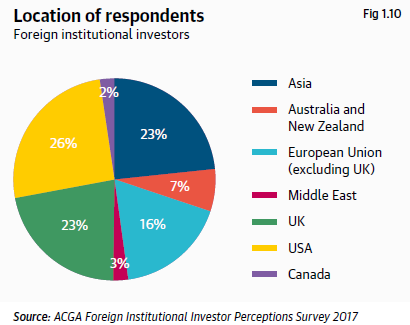
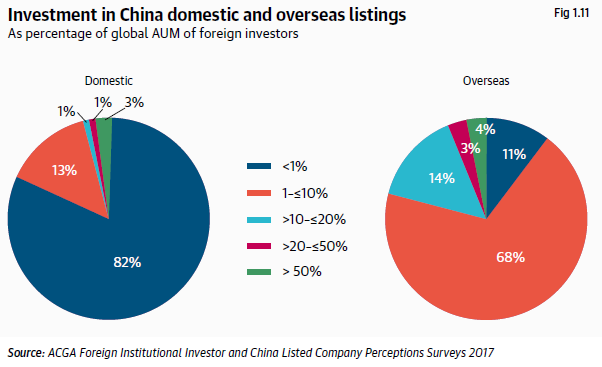
L’étude se base sur une enquête auprès d’entreprises chinoises et auprès d’investisseurs étrangers. Également, les auteurs présentent une mine d’information sur la situation de la gouvernance.J’ai reproduit, ci-après, un résumé de l’enquête.

Bonne lecture !


With its securities market continuing to internationalise and grow in complexity, China appears at a turning point in its application of CG and ESG principles.

The time is right to strengthen communication and understanding between domestic and foreign market participants.


Awakening Governance: ACGA China Corporate Governance Report 2018


Résultats de recherche d'images pour « gouvernance chinoise »

Introduction: Bridging the gap


The story of modern corporate governance in China is closely connected to the rapid evolution of its capital markets following the opening to the outside world in 1978. The 1980s brought the first issuance of shares by state-owned enterprises (SOEs) and a lively over-the-counter market. National stock markets were relaunched in Shanghai and Shenzhen in 1990 to 1991, while new guidance on the corporatisation and listing of SOEs was issued in 1992. The first overseas listing of a state enterprise came in October 1992 in New York, followed by the first SOE listing in Hong Kong in 1993. Corporate governance reform gained momentum in the late 1990s, but it was less a byproduct of the Asian Financial Crisis than a need to strengthen the governance of SOEs listing abroad. The early 2000s then brought a series of major reforms on independent directors, quarterly reporting and board governance aimed squarely at domestically listed firms.

A great deal has changed in China since then, with periods of intense policy focus on corporate governance followed by consolidation. In recent years, China’s equity market has undergone a renewed burst of internationalisation through Shanghai and Shenzhen Stock Connect, relaxed rules for Qualified Foreign Institutional Investors, and the landmark inclusion of 234 leading A shares in the MSCI Emerging Markets Index in June 2018. While capital controls and other restrictions on foreign investment remain, there seems little reason to doubt that foreign portfolio investment will play an increasing role in China’s public and private securities markets in the foreseeable future.

Running parallel to market internationalisation, and facilitated by it, is a broadening of the scope of corporate governance to include a focus on environmental and social factors (“ESG”), and a deepening concern about climate change and environmental sustainability. Pension funds and investment managers in China are now encouraged by the government to look closely at ESG risks and opportunities in their investment process. And green finance has become big business in China, with green bond issuance growing steadily. Indeed, these themes are also part of the newly revised Code of Corporate Governance for Listed Companies (2018) from the China Securities Regulatory Commission (CSRC); this is the first revision of the Code since 2002.


Turning point


China thus appears at a new turning point in its market development and application of corporate governance principles. While it is difficult to predict how this process will unfurl, we believe three broad developments would be beneficial:

-That unlisted and listed companies in China see corporate governance and ESG not merely as a compliance requirement, but as tools for enhancing organisational effectiveness and corporate performance over the longer term. This applies as much to entrepreneurial privately owned enterprises (POEs) as established SOEs. The view that good governance is not relevant or possible in young, innovative firms is misguided.

-That domestic institutional investors in China see corporate governance and ESG not only as tools for mitigating investment risk, but as a platform for enhancing the value of existing investments through active dialogue with investee companies. The process of engagement can also help investors differentiate between companies that take governance seriously and those which do not.

-That foreign institutional investors view corporate governance in China as something more nuanced than a division between “shareholder unfriendly” SOEs and “exciting but risky” POEs. We recommend foreign asset owners and managers spend more time on the ground in China and invest in studying China’s corporate governance system, if they are not already doing so.

Of course, there are many exceptions to these broad characterisations. It is possible to find companies which view governance as a learning journey—and they are not necessarily listed. Certain mainland asset managers have begun investigating how to integrate governance and ESG factors into their investment process. And there are a growing number of foreign investors, both boutique and mainstream, that have developed a deep understanding of the diversity among SOEs and POEs and which have achieved excellent investment returns from SOEs as well.

Not surprisingly, however, our research has found that significant gaps in communication and understanding do exist between foreign institutional investors and China listed companies. According to an original survey undertaken by ACGA for this report, a majority of foreign investor respondents (59%) admitted that they did not understand corporate governance in China. Only 10% answered in the affirmative, while another 31% felt they “somewhat” understood the system. Conversely, it appears that most China listed companies do not appreciate the challenges that foreign institutional investors face in navigating “corporate governance with Chinese characteristics”.

This report is written for both a domestic and international audience. Our aim is to describe in as fair and factual a manner as possible the system of corporate governance in China, highlighting what is unique, what looks the same but is different, and areas of genuine similarity with other major securities markets. The main part of the report focuses on “Chinese characteristics” and looks at the role of Party organisations/committees, the board of directors, supervisory boards, independent directors, SOEs vs POEs, and audit committees/auditing. Each chapter explains the current legal and regulatory basis for the governance institution described, the particular challenges that companies and investors face, and concludes with suggestions for next steps. Our intention has been to craft recommendations that are practical and anchored firmly in the current CG system in China—in other words, that are implementable by companies and institutional investors. We hope the suggestions, and indeed this report, will be viewed as a constructive contribution to the development of China’s capital market.

The remainder of this Introduction provides an overview of key macro results from our two surveys. We start with the good news—that a large proportion of foreign institutional investors and local companies are optimistic about China—then highlight the challenges both sides face in addressing governance issues. The following chapters draw upon additional material from the two surveys.

ACGA survey—The big picture

Are you optimistic?


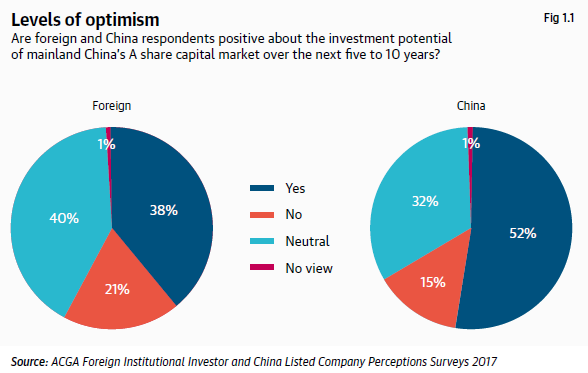
The good news from our survey is that a sizeable proportion of both foreign investors (38% of respondents) and China listed companies (52%) are optimistic about the investment potential of the A share market over the next five to 10 years, as Figure 1.1 below shows. Only 21% of foreign investors are negative, while the remainder are neutral. Not surprisingly, only 15% of China respondents were negative, while almost one-third were neutral.
 

Do you agree with MSCI?


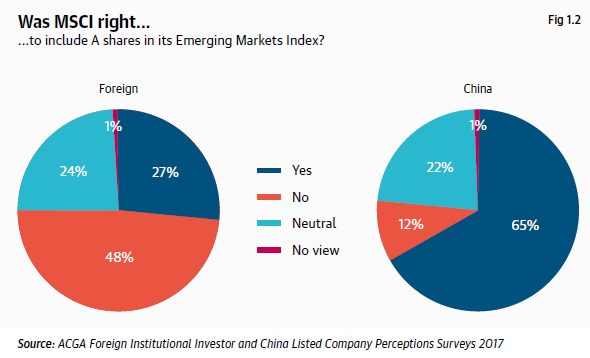
The picture diverges on the issue of whether MSCI was right to include A shares in its Emerging Markets Index in 2018: only 27% of foreign respondents agreed compared to 65% of Chinese respondents, as Figure 1.2, below, shows. Almost half the foreign respondents did not agree compared to a mere 12% for Chinese respondents. A similar proportion was neutral in both surveys.
 

Challenges—Foreign institutional investors

The investment process


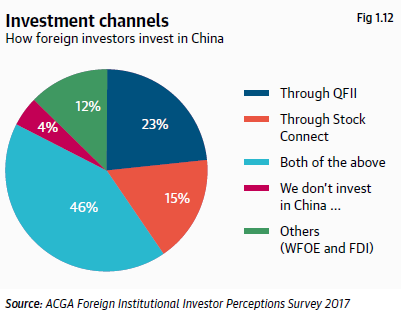
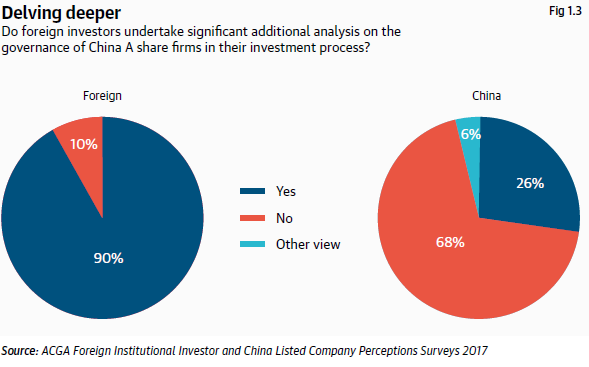
Foreign investors face a range of challenges investing in China, the first of which is understanding the companies in which they invest. As Figure 1.3 below indicates, foreign investors do not rely solely on information provided by companies when making investment decisions, but utilise a range of additional sources. It appears that listed companies are not aware of this issue.
 

Company engagement


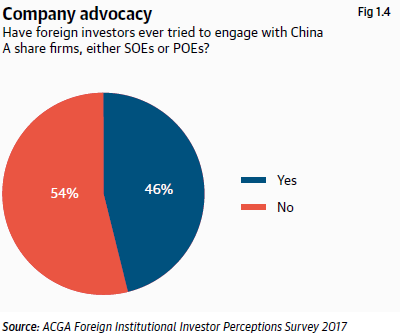
Globally, institutional investors seek to enter into dialogue with their investee companies. It is no different in China, as shown in Figure 1.4.


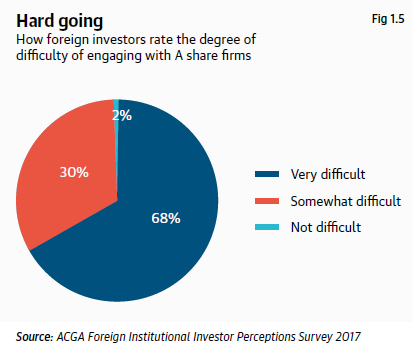
But the process is not easy.


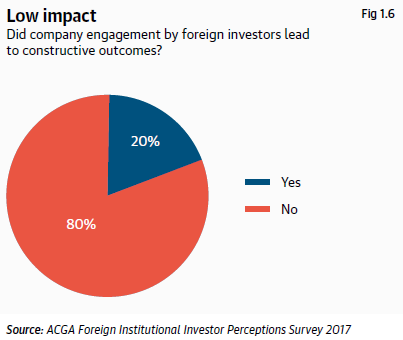
And successful outcomes are fairly thin on the ground to date.
 

Common threads


Respondents gave a range of answers as to why the process of engagement was difficult and successful outcomes limited, but some common threads were discernible:

Language and communication: In addition to straightforward linguistic difficulties (ie, companies not speaking English, investors not speaking Chinese), the communication problem is sometimes cultural. As one person said, “Even though I am from China, it is hard to interpret hidden messages.”

Access: Getting access to companies can be difficult. Getting to meet the right senior-level person, such as a director or executive, can be even more challenging.

Investor relations (IR): While some IR teams are professional, many are not. As one respondent commented: “IR (managers) are not very well trained and some of them lack basic understanding or knowledge of corporate governance or even financial information.”

CG as compliance: A common complaint is that companies view CG as merely a compliance exercise. Some refuse to give “detailed answers beyond the party line”.

Non-alignment: There is a recurring feeling that the interests of controlling shareholders in SOEs are not aligned with minority shareholders. One investor commented on the “lack of responsiveness” to outside shareholder suggestions, adding that SOEs “wait for government to give the direction, not investors”.

Lack of understanding: There can be a significant gap in the awareness of CG and ESG principles.


Empathy for companies


Conversely, a few respondents expressed empathy for the position of companies. As one wrote: “There also appears to be an under appreciation by international investors of the differences in culture, political context, and the path and stage of economic development between China and the rest of the world. Any attempt at influencing changes without a reasonable understanding of these differences is likely to be ineffective and (may) at times lead to unintended consequences.”

Another explained some of the regulatory challenges facing listed companies: “With a few exceptions, both SOEs and POEs have to deal with stringent and ever-changing industry regulations and government policies.”

A third said that some engagement had been positive: “Generally, where I have had access to the right people, engagement has been constructive. I suspect this is a result of the companies already appreciating the value of good governance in attracting non-domestic investors.”

And perhaps the most positive comment of all: “A number of the Chinese companies we speak to, especially the industry leaders, already address ESG risks in their businesses. Most of them publish ESG reports annually, which help to set the benchmark for their industry and also to garner positive feedback from society and hence, end-customers. Some of such companies end up enjoying a pricing premium on their products once this positive brand equity has been established. This creates a virtuous cycle, where ESG becomes part of their corporate culture. They understand that for the long-term sustainability of their business, and for the benefits of all their stakeholders, such investment can only enhance their competitiveness.”


Brave new world of stewardship


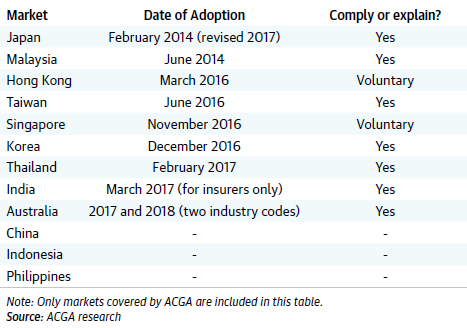
Yet most investors still find engaging with companies a challenge. A further reason may be that China is one of only three major markets in Asia-Pacific that has not yet issued an “investor stewardship code”. Such codes push institutional investors to take CG and ESG more seriously, incorporate these concepts into their investment process, and help to encourage greater dialogue between listed companies and their shareholders (see Table 1.1, below). In recent years, the bar has been quickly raised on this issue in Asia and expectations have risen commensurately.

Without an explicit policy driving investor stewardship, it is unlikely that the average listed company will give proper weight to a dialogue with shareholders. As one foreign investor said: “Generally speaking, it is relatively easier to engage with bigger listed companies. SOEs and larger companies tend to be more responsive. SOEs have more incentive to do so following government guidelines and trends.”

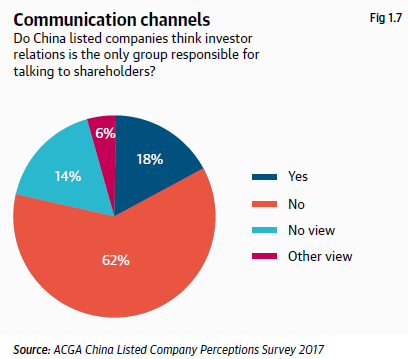
A key question to ask is who within a company should be responsible for engaging with shareholders? The short answer is the board, as a group representing and accountable to shareholders. Indeed, on a positive note, our survey found that most Chinese listed companies do admit that the responsibility for talking to shareholders should not be placed solely on the investor relations (IR) team (see Figure 1.7 below). But given that delegating this task to IR remains a common practice, it would appear that there is an inconsistency between words and actions here.


Challenges—China listed companies


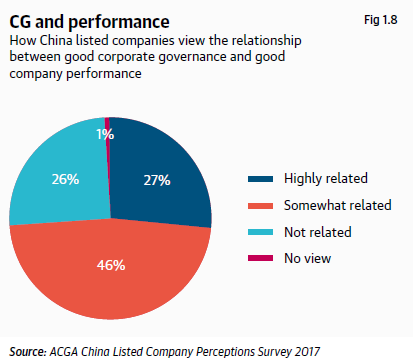
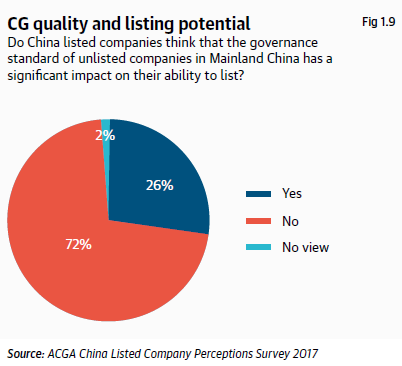
Some additional factors clearly play on the willingness of companies to take CG and ESG seriously, as Figures 1.8 and 1.9 below show.

Does the market reward good CG?


Only 27% of the respondents to our China listed company survey believe there is a close correlation between good corporate governance and company performance. Another 46% think they are “somewhat related”, while a quarter see no relationship. These results broadly align with the view common in most markets, including China, that only a minority of companies (usually the large caps) feel incentivised to improve their governance practices and that they will be rewarded by investors if they do so.


Even more concerning is the largely negative view on whether better governance helps a company to list.


As an aside, this might also help to explain why listed POEs in China are generally not seen as being a better investment proposition or as having better governance than SOEs—an issue we explore in Chapter 3.5.

Only 23% of foreign respondents said they preferred investing in POEs over SOEs, while two-thirds said they did not. Meanwhile, only 10% of China listed companies thought POEs were better governed than SOEs. Around one-third thought they were about the same, while 54% thought POEs were worse.

Even so, in a fast-growing market such as China, there is a risk in taking a static or one-dimensional view.

‘Companies will have to become more ESG aware’


We conclude this section with a wide-ranging comment from a China-based institutional investor on the need to see governance and ESG as a process:

Chinese companies are generally financial weaker than their more established peers in developed markets. This is a symptom of markets being at different stages of development. For Chinese companies, survival is the top priority. Once they have gained enough market share and accumulated a certain level of capital reserves, they will start to consider ESG issues. This will help them cement their market position and grow more healthily in the long term.

At the moment, we recognise that the cost of not practicing ESG is not high in China. But things are changing, especially on the environmental front. We can see that the government is very serious about closing down small players who are not compliant with emission standards. The quality of air, earth and water concerns the livelihood of every citizen, and we believe that there will be heightened enforcement of pollution laws.

Corporate governance is also improving as public shareholders get more actively involved in major corporate actions. Having said that, shareholder structures remain highly concentrated, especially for SOEs in China, and external forces may not be strong enough to ensure a proper division of power.

We see increasing numbers of entrepreneurs and companies more willing to give back to society and the challenge here is simply that philanthropy is quite new in China.

As society becomes more civilised and consumers become more aware of issues such as child labour and environmental pollution, Chinese companies will have to become more ESG aware and responsible.


Interview: ‘Character and quality of management is critical’


David Smith CFA, Head of Corporate Governance, Aberdeen Standard Investments Asia, Singapore


What is your view on investing in A shares?


We have an A share fund, so naturally, we have spent substantial time and effort getting comfortable with both the market and the companies. There are well-documented risks surrounding investing in China, but the market has obvious attractions China is leading the world in some of the sectors, like e-commerce, for example. As investors, we always have to balance return with macroeconomic risk, political risk, regulatory risk, and so on, and this is certainly the case for China.


What is your view on stock suspensions in China?


The situation is getting better but companies too often still choose to suspend given a pending “restructuring”, which protects potential investors at the expense of existing investors, something that can be incredibly frustrating given how long we can be locked up for. There is a general misunderstanding in China as to what suspension means: companies should only suspend when there is information asymmetry, not when there is uncertainty. We are paid to analyse and deal with uncertainty, and the market will find a price for it. If companies have to suspend whenever there is uncertainty, we won’t have a stock market in place.

In general, there are too many suspensions in China. If a company has a restructuring plan or a regulatory investigation is going on, it should just disclose this through an announcement; as long as everyone in the market knows the same information, the stock should keep trading.

The issue of price-sensitive information has already been taken care of by regulations around continuous disclosure, so a suspension is often not protecting anyone, it just removes liquidity for existing investors. This issue is exacerbated by the bizarre and unusual situation of dual-listed A/H share companies suspending on one exchange and not the other.

In developed markets, in contrast, suspensions of issuers lasting more than a month for whatever reason are very rare. Part of the issue is also that promoter shares might sometimes have been pledged, so promoters want to avoid a share price fall triggering a margin call.


What are the top CG issues you have observed in Chinese companies?


Entrepreneur risk (people risk) is the most obvious one, including related-party transaction risks, along with operational and execution risks. For Aberdeen, we never invest if we feel uncomfortable with the founder or management. Both the character and quality of the people inside the company is something we value a lot in our investment decision-making process.

Regulatory risk is another issue. Changes in regulations can affect not just SOEs but also POEs to different extents. For example, the recent regulatory change on the reinforcement of Party committees inside Chinese companies is not what foreign investors expected to see as the direction of corporate governance development in China.

Another issue is that given more and more onus put on independent directors, maybe we need to think about another way to elect them. The current situation involves voting for independent directors on their independence, rather than competence. However, “independence” can be easily gamed in Asia. Many independent directors are structurally independent but rely on the company for their living (pension), so investors are increasingly asking if/how they add value to board discussions.


What is your view on voting trends among China listed firms? Does voting lead to engagement


Not much has changed. Any voting against has tended to focus on resolutions like related-party transactions, or other corporate actions, rather than issues across the board.

Engagement is getting a little bit better in China. We have seen more and more companies listening to us, and dialogue is getting much better. Companies increasingly understand that we are not in China for the short-term and that our interests are aligned. That certainly helps.


Methodology

A tale of two surveys


The two surveys in this report, the “ACGA Foreign Institutional Investor Perceptions Survey 2017” and the “ACGA China Listed Company Perceptions Survey 2017”, were developed internally in the first half of 2017 and carried out over 21 July to 1 September of that year. They were distributed through ACGA’s global network of members and contacts, and by a number of supporting organisations both inside and outside China (see the Acknowledgements page for details).

Purpose

We decided to conduct a survey at the preliminary stage of this project for two main reasons. The first was to add a broader range of perspectives to the report and to complement the extensive research carried out by ACGA and our contributing authors.

The second was to develop new data on corporate governance in China. When we began researching this report, we found that much of the information on board structures and governance practices in China was out of date, incomplete or non-existent. We developed the survey to partially fill this gap. To complement this information, we turned to data providers such as Wind and Valueonline to provide raw data on which we could do original analysis—and we carried out our own reviews of specific governance practices among large listed companies.

Foreign Institutional Investor Perceptions Survey

The Foreign Institutional Investor Perceptions Survey contained 22 questions and focused on areas that we believe are relevant to China’s investment potential and governance. They can be divided into the following categories:

Macro questions, such as capital market development, MSCI inclusion, SOEs vs POEs, and mainland-listed vs overseas-listed firms.

Shareholder rights, including investor protection in China vs overseas.

Company governance, including corporate reporting, role of chairman, independent directors, supervisory boards.

Role of government, including appointment of chairmen, intervention in SOEs and POEs, the role of the Party organisation/committee.

Investor engagement with companies.

Several of the questions provided options for respondents to give detailed answers and, where relevant, these comments are incorporated into our text.

The survey was developed by ACGA in Q2 2017 and first tested with a select group of ACGA global investor members in June of that year. It was refined based on feedback received before being sent out electronically in July. The recipients were primarily drawn from among ACGA’s list of institutional investor members based in Asia and around the world. This was complemented by recipients from our supporting organisation membership networks.

In total, we received 155 complete and comparable responses. Partial responses were not counted. Based on information gathered about respondents’ titles, they fell into three broad groups: CEOs, directors, managing directors or partners; portfolio managers and analysts; and managers or specialists in CG, ESG or stewardship. A large proportion held senior roles in their organisations.

The total assets under management (AUM) of all respondents amounted to around US$40 trillion, with the range from US$20m to US$6 trillion. In other words, a mix of both boutique investment managers and large mainstream institutions.

China Listed Company Perceptions Survey

The China Listed Company Perceptions Survey contained 12 questions and likewise focused on areas that we believe are relevant to such companies, their directors and managers. While there were fewer questions in this survey, they covered similar categories as in our foreign survey, namely macro issues, company governance, role of government, and investor engagement.

We designed some questions to be identical to the Foreign Institutional Investor Survey, in order to allow direct comparisons between corporate and investor perspectives on the same issue.

We also asked some unique questions of companies, such as whether or not they see a close correlation between corporate governance and performance, and whether better governance helps a firm list its shares.

The survey recipients were drawn from among ACGA’s corporate membership base, as well as clients and contacts of supporting organisations.

In total, we received 182 complete responses from which we extracted the survey results. Most respondents held senior positions in their companies such as directors, executives, board secretaries and senior managers. Most of the companies represented have been listed in China for more than five years and have a market cap of more than Rmb5 billion (US$800m approx). Further demographic data on the two groups of respondents follows:


Foreign respondents

The foreign institutional investors who responded are mostly from the US, UK, Asia and the European Union, as shown in Figure 1.10 below. The response is consistent with the distribution of ACGA members by region. Investors from Australia, New Zealand, the Middle East and Canada also responded to the survey.


In terms of their global AUM, the vast majority of respondents have less than 1% invested in China A shares, while a significant minority have between 1% and 10%. Very few have more than 10% of their funds invested in China domestic listings, although interestingly a few have more than 50%. The latter would be smaller investment managers with a dedicated China focus, as shown in Figure 1.11.

The picture changes markedly when overseas-listed Chinese firms are taken into account: the majority of foreign respondents allocate between 1% to 10% of their global AUM to such companies and a sizeable proportion, about one-fifth, invest more than 10%.


How do foreign investors invest in China? As Figure 1.12 below shows, around a quarter go only through the Qualified Foreign Institutional Investor (QFII) scheme, 15% only through Stock Connect, and almost half through both channels. Interestingly, a significant minority invest directly through wholly owned foreign enterprises (WFOEs) or other foreign direct investment (FDI) channels.


China respondents

Most respondents to our China Listed Company Perceptions Survey work for a company that has been listed for more than five years. Around 40% of the companies have been listed for more than 10 years, which is a relatively long period given that the Chinese stock market is still less than 30 years old (see Figure 1.13).

The market cap of 54% of respondents’ companies was more than Rmb5 billion, as highlighted in Figure 1.14, and 19% have a market cap of more than Rmb10 billion. Generally, the larger firms are likely to be SOEs.


In terms of ownership, the distribution of respondents falls evenly between SOEs and POEs, with 13% being of a “mixed-ownership” type (see Figure 1.15, above). This gives us confidence that the survey results incorporate a range of views from different participants in the Chinese market.

As for where respondents’ companies are listed, Figures 1.16 and 1.17, below, highlight that almost 60% are listed in a single jurisdiction. Mainland China comes first, not surprisingly, followed by a reasonable number in Hong Kong. Only a few respondents work for Chinese companies listed in Singapore, the US and the UK. Regarding the remaining companies listed in more than one jurisdiction, again the most popular venue is a dual-listing in China and Hong Kong, followed by a listing in China and the US. Some companies have a listing in China, Hong Kong and the US.


The complete report, in both English and Chinese, is available here.

___________________________________________________________

*Jamie Allen is Secretary General and Li Rui (Nana Li) is Senior Research Analyst at the Asian Corporate Governance Association (ACGA). This post is based on the introduction to their ACGA report.

Top 10 de Harvard Law School Forum on Corporate Governance au 23 août 2018


Voici le compte rendu hebdomadaire du forum de la Harvard Law School sur la gouvernance corporative au 23 août 2018.

Comme à l’habitude, j’ai relevé les dix principaux billets.

Bonne lecture !


Résultats de recherche d'images pour « top 10 governance »


Résultats de recherche d'images pour « Top 10 en gouvernance Harvard Law School »


  1. Corporate Governance; Stakeholder Primacy; Federal Incorporation
  2. Microcap Board Governance
  3. Taking Stock: Share Buybacks and Shareholder Value
  4. Shareholder Vote on Golden Parachutes: Determinants and Consequences
  5. Corporate Governance—The New Paradigm: A Better Way Than Federalization
  6. Board Diversity Developments
  7. Corporate Governance in Emerging Markets
  8. Dual-Class Index Exclusion
  9. Board Diversity, Firm Risk, and Corporate Policies
  10. Shareholder Activism: Evolving Tactics