Top 10 de Harvard Law School Forum on Corporate Governance au 19 avril 2018


Voici le compte rendu hebdomadaire du forum de la Harvard Law School sur la gouvernance corporative au 19 avril 2018.

Comme à l’habitude, j’ai relevé les dix principaux billets.

Bonne lecture !


Résultats de recherche d'images pour « top 10 »


Les actions multivotantes sont-elles préjudiciables pour les actionnaires ?


Nous avons souvent publié des billets qui abordent diverses conséquences liées à l’émission d’actions à votes multiples. L’article intitulé, « ACTIONS MULTIVOTANTES : LE MODÈLE DE BOMBARDIER SOULÈVE DES VAGUES », publié dans La Presse le 21 juillet 2015 avait d’ailleurs fait couler beaucoup d’encre.

Ces émissions d’actions sont-elles fondées, justifiées, légitimes et équitables dans le contexte de la gouvernance des sociétés cotées en bourse ? Voici ce que pense Yvan Allaire, président de l’Institut sur la gouvernance d’organisations privées et publiques, dans un article paru dans Les Affaires le 9 mai 2016Pourquoi le Canada a besoin des actions multivotantes ?

Vous trouverez, ci-dessous, un article publié par David J. Berger de la firme Wilson Sonsini Goodrich & Rosati, et par Laurie Simon Hodrick de la Stanford Law School, paru sur le site du Harvard Law School Forum on Corporate Governance, qui fait le point sur cette épineuse question.

Les études montrent que ces types d’arrangements ne sont pas immanquablement dommageables pour les actionnaires, comme nous laissent croire plusieurs groupes d’intérêt tels que le Conseil des investisseurs institutionnels et la firme de conseil Institutional Shareholder Services (« ISS »). Plusieurs militent en faveur d’une durée limitée pour de telles émissions d’actions.

Les récentes émissions d’actions à classes multiples des entreprises de haute technologie ne nous permettent pas, à ce stade-ci, de statuer sur les avantages à long terme pour les actionnaires.

Les auteurs concluent qu’il est trop hâtif pour se prononcer définitivement sur la question, et pour réglementer cette structure de capital.

Bonne lecture !


Résultats de recherche d'images pour « actions multivotantes »


Clarion calls for regulating dual-class stock have become a common occurrence. For example, the Council of Institutional Investors (“CII”) has called upon the NYSE and Nasdaq to adopt a rule requiring all companies going public with dual-class shares to include a so-called “sunset provision” in their charter, which would convert the company to a single class of stock after a set period of years. CII has also urged index providers to discourage the inclusion of firms with dual-class structures (and both the S&P Dow Jones and FTSE Russell indices have already done so). Many individual CII members, along with some of the world’s largest mutual funds and other investors, have joined together in the “Framework for U.S. Stewardship and Governance” to take a strong stance against dual class structures.

Proxy advisory services have also announced their opposition to dual-class companies. For example, Institutional Shareholder Services (“ISS”) has announced a plan to recommend against directors at companies with differential voting rights if there are no “reasonable sunset” provisions. Even the SEC’s Investor Advisory Committee has raised its own concerns about dual-class stock companies, calling on the SEC to “devote more resources” to “identify risks” arising out of governance disputes from dual-class structures. [1]

Yet what is the empirical evidence supporting these calls for regulation of dual-class companies? Dual-class companies have existed for nearly a century, going back to the Dodge Brothers’ IPO in 1925 and Ford’s IPO in 1956. Historically, technology companies did not adopt a dual-class capital structure. Rather, until Google’s (now Alphabet) 2004 IPO, most dual-class companies were family businesses, media companies seeking to ensure their publications could maintain journalistic editorial independence, or other companies led by a strong group of insiders. These companies often adopted their dual-class structures to avoid the pressures of having to focus primarily on short-term variations in stock price.

Many of these older dual-class companies were the focus of a seminal 2010 paper that found that dual class firms tend to be more levered and to underperform their single class counterparts, with increased insider cash flow rights increasing firm value and increased insider voting rights reducing firm value. [2]

Since 2010, there have been an increasing number of technology companies going public with dual-class (or multi-class) share structures. Anecdotal evidence is mixed, but the early empirical evidence on the performance of these newer dual-class companies as a group is quite interesting. In particular, though many of these companies have not been public for very long, the limited available data suggests that these newer dual-class companies might even be out-performing single-class structured companies.

For example, MSCI, one of the largest global index providers, recently released a study showing that companies with “unequal voting stocks in aggregate outperformed the market over the period from November 2007 to August 2017.” [3] The study further concluded that excluding these companies “from market indexes would have reduced the indexes’ total returns by approximately 30 basis points per year over [the] sample period.” The differential was even greater in North America, where stocks with unequal voting rights outperformed stocks with the more traditional one-share/one-vote structure by 4.5% annually.

Recent academic research corroborates the outperformance of the newly public companies with dual-class stock. For example, one study concludes that dual-class companies, avoiding short-term market pressures, have more growth opportunities and obtain higher market valuations than matched single-class firms [4] Even with respect to perpetual dual-class stock companies, research shows that these companies, when controlled by a founding family, “significantly and economically” outperform nonfamily firms. [5] Another study maintains that it might be more efficient to give more voting power to shareholders who are better informed, thereby allowing them more influence, and correspondingly less voting power to those who are less informed, including passive index funds. Passive investors would pay a discounted price in exchange for waiving their voting rights. [6]

We have begun our own preliminary research on these issues, with considerations including corporate control, liquidity, capital allocation, “next generation” issues, and using stock as currency for acquisitions and to reward employees. While still in its initial stage, our analysis also raises fundamental questions about how much value shareholders perceive in having voting stock versus non-voting stock in these relatively new to market technology companies. For example, consider Classes A and C of Alphabet, issued through a stock dividend four years ago, which are different only in specific ways, most notably that A has one vote per share and C has none. [7] Atypically, for each of the last three trading days in February, Alphabet’s non-voting class C share, GOOG, had a higher closing market price than its voting class A share, GOOGL. [8] More broadly, since GOOG was introduced on April 3, 2014, the correlation between the two classes’ stock prices is 99.9%, and they have similar stock price standard deviations, betas, trading volume, and short interest. [9]

We believe that it is too early to make a definitive determination from an economic standpoint as to whether having dual-class stock is better or worse for investors in the current market environment, especially for younger companies. Any consideration to limit dual-class stock, including adoption of mandatory sunset provisions, must be based on analysis not anecdotes. It should also recognize the changing nature of public markets, including the following:

  1. The dominance of shareholder primacy has led boards of single-class companies to feel short-term pressure from shareholders. As no less an authority than Delaware Chief Justice Strine has frequently recognized, boards respond to those who elect them. In today’s world, for most public companies that is a handful of institutional investors, as by 2016 institutional investors owned 70% of all public shares, while just three money managers held the largest stock position in 88% of the companies in the S&P 500. [10] While many of these institutions emphasize that they are long-term holders, directors of companies with high institutional investor ownership continue to feel the pressure to take actions to achieve short-term stock increases. For example, a recent survey of over 1000 directors and C-level executives by McKinsey and the Canadian Pension Plan Investment Board (“CPPIB”) found that nearly 80% of these executives felt “especially pressured” to demonstrate strong financial results in two years or less. [11]
  2. The changing nature of the public and private capital markets. The increased use by technology companies of dual-class capital structures when entering the public markets must be viewed within the changing nature of both the public and private markets for technology companies. According to the Wall Street Journal, more money was raised in private markets than in public markets in 2017, while the number of public companies continues to decline—the number of public companies has fallen by about half since 1996. [12] SEC Commissioner Clayton (among others) has spoken repeatedly about the problems arising out of the decline in the number of public companies. Limiting the ability of public companies to have different capital structures will certainly impact the decision by some companies about whether or not to go public.
  3. Dual-class stock and alternative capital structures across the world. Regulators considering how to respond to the growth of dual-class stock should consider the growing acceptance of dual-class stock in markets globally. For example, in recent months both Hong Kong and Singapore have opened their markets to dual-class listings. Many European markets already have rules allowing for dual-class companies or other similar structures that allow companies to focus on longer-term principles as well as non-shareholder constituencies. Even in the U.S., newer markets, such as the Long-Term Stock Exchange, are working to list companies with alternative capital structures, so that companies can focus on building a business, in apparent recognition that surrendering to the current dominance of shareholder primacy may not be the best governance structure for all companies.

For these reasons, we believe that the current effort to mandate some form of one-share one-vote for all public companies in the U.S. is premature. The limited empirical evidence on the technology and emerging growth companies that are the target of these regulations is insufficient to support the adoption of new regulations, as the evidence that is available indicates that the most recent group of dual-class companies may have performed as well, if not better, than those with a single class of stock.

______________________________________

Notes

See “Recommendation of the Investor As Owner Subcommittee: Dual-Class and Other Entrenching Governance Structures in Public Companies,” February 27, 2018, available at https://www.sec.gov/spotlight/investor-advisory-committee-2012/iac030818-investor-as-owner-subcommittee-recommendation.pdf.(go back)

Paul Gompers, Joy Ishii, and Andrew Metrick, “Extreme Governance: An Analysis of Dual-Class Shares in the United States,” Review of Financial Studies 23, 1051-1087 (2010). See also Ronald Masulis, Cong Wang, and Fei Xie, “Agency Problems at Dual-Class Companies” Journal of Finance64, 1697-1727 (2009).(go back)

Dmitris Melas, “Putting the Spotlight on Spotify: Why have Stocks with Unequal Voting Right Outperformed?” MSCI Research, April 3, 2018. The study’s findings are robust to controlling for common factors including country, sector, and style factor exposures.(go back)

Bradford Jordan, Soohyung Kim, Nad Mark Liu, “Growth Opportunities, Short-Term Market Pressure, and Dual-Class Share Structure,” Journal of Corporate Finance 41, 304-328 (2016).(go back)

See Ronald Anderson, Ezgi Ottolenghi, and David Reeb, “The Dual Class Premium: A Family Affair,” August 2017.(go back)

Dorothy Shapiro Lund, “Nonvoting Shares and Efficient Corporate Governance,” Stanford Law Review 71 (forthcoming 2019).(go back)

There are also class B shares with 10 votes per share, 92.7% of which are owned by executives Eric Schmidt, Sergey Brin, and Larry Page as of December 31, 2017, representing 56.7% of the total voting power (source: Alphabet 10K).(go back)

GOOG also closed higher than GOOGL on March 14, March 16, and March 20, 2018. This is not the first such finding: In 1994, Comcast’s nonvoting shares often sold for more than its voting shares. See Paul Schultz and Sophie Shive, “Mispricing of Dual-Class Shares: Profit Opportunities, Arbitrage, and Trading,” Journal of Financial Economics 98, 524-549 (2010).(go back)

For the past four years, GOOG and GOOGL have standard deviations (betas) of 176.6 (1.24) and 177.8 (1.23), respectively.  GOOGL is slightly more liquid than GOOG, as GOOGL daily share volume averages 2.3 million shares, while GOOG averages 1.97 million shares.  GOOGL and GOOG have short interest of 3.4 million and 3.6 million shares, respectively.(go back)

10 See The Hon. Kara M. Stein, Commissioner, Securities and Exchange Commission, The Markets in 2017: What’s at Stake, February 24, 2017.(go back)

11 See Dominic Barton and Mark Wiseman, Investing for the Long-Term, Harvard Business Review, 2014.(go back)

12 Jean Eaglesham and Coulter Jones, “The Fuel Powering Corporate America: $2.4 Trillion in Private Fundraising,” Wall Street Journal, April 3, 2018.(go back)

______________________________

*David J. Berger is a partner at Wilson Sonsini Goodrich & Rosati; and Laurie Simon Hodrick is Visiting Professor of Law and Rock Center for Corporate Governance Fellow at Stanford Law School, Visiting Fellow at the Hoover Institution, and A. Barton Hepburn Professor Emerita of Economics in the Faculty of Business at Columbia Business School. Related research from the Program on Corporate Governance includes The Untenable Case for Perpetual Dual-Class Stock (discussed on the Forum here) and The Perils of Small-Minority Controllers (discussed on the Forum here), both by Lucian Bebchuk and Kobi Kastiel.

Top 10 de Harvard Law School Forum on Corporate Governance au 12 avril 2018


Voici le compte rendu hebdomadaire du forum de la Harvard Law School sur la gouvernance corporative au 12 avril 2018.

Comme à l’habitude, j’ai relevé les dix principaux billets.

Bonne lecture !


Résultats de recherche d'images pour « top ten »


  1. Activist Arbitrage in M&A Acquirers
  2. In the Spirit of Full Cybersecurity Disclosure
  3. Unequal Voting and the Business Judgment Rule
  4. Agency Conflicts Around the World
  5. Real Talk on Executive Compensation
  6. The Cost of Political Connections
  7. Review and Analysis of 2017 U.S. Shareholder Activism
  8. 10 Tips for Upcoming Annual Shareholder Meetings
  9. The Information Value of Corporate Social Responsibility
  10. The Purpose of the Corporation

Top 10 de Harvard Law School Forum on Corporate Governance au 5 avril 2018


Voici le compte rendu hebdomadaire du forum de la Harvard Law School sur la gouvernance corporative au 5 avril 2018.

Comme à l’habitude, j’ai relevé les dix principaux billets.

Bonne lecture !


Résultats de recherche d'images pour « top 10 »


Top 10 de Harvard Law School Forum on Corporate Governance au 29 mars 2018


Voici le compte rendu hebdomadaire du forum de la Harvard Law School sur la gouvernance corporative au 29 mars 2018.

Comme à l’habitude, j’ai relevé les dix principaux billets.

Joyeuses Pâques à tous mes abonnés.

Bonne lecture !


Résultats de recherche d'images pour « top 10 »


  1. Traceable Shares and Corporate Law

  2. Corporations and the Culture Wars

  3. Toward a Horizontal Fiduciary Duty in Corporate Law

  4. The SEC and Virtual Currency Markets

  5. Senate Rollback of Dodd-Frank

  6. The First Wave of Pay Ratio Disclosures

  7. Blockchain Technology for Corporate Governance and Shareholder Activism

  8. BlackRock Investment Stewardship’s Approach to Engagement on Human Capital Management

  9. Preparing for the Year of the “S”

  10. Emerging Trends in S&P 500 Pay Ratio Disclosures

Top 10 de Harvard Law School Forum on Corporate Governance au 22 mars 2018


Voici le compte rendu hebdomadaire du forum de la Harvard Law School sur la gouvernance corporative au 22 mars 2018.

Comme à l’habitude, j’ai relevé les dix principaux billets.

Bonne lecture !


Résultats de recherche d'images pour « top 10 »


Top 10 de Harvard Law School Forum on Corporate Governance au 15 mars 2018


Voici le compte rendu hebdomadaire du forum de la Harvard Law School sur la gouvernance corporative au 15 mars 2018.

Comme à l’habitude, j’ai relevé les dix principaux billets.

Bonne lecture !


Résultats de recherche d'images pour « top 10 »


  1. The Rise of Blockchains and Regulatory Scrutiny
  2. The Narrowing Scope of Whistleblower Anti-Retaliation Protections
  3. Taxation and Executive Compensation: Evidence from Stock Options
  4. An Identity Theory of the Short- and Long-Term Investor Debate
  5. What a Difference a (Birth) Month Makes: The Relative Age Effect and Fund Manager Performance
  6. The Hidden Power of Compliance
  7. SEC Guidance on Public Company Cybersecurity Disclosures
  8. Investor Ideology
  9. Remarks to the SEC Investor Advisory Committee
  10. Overview of Proposed Revisions to the UK Corporate Governance Code

Enjeux clés concernant les membres des comités d’audit | KPMG


Le récent rapport de KPMG sur les grandes tendances en audit présente sept défis que les membres des CA, notamment les membres des comités d’audit, doivent considérer afin de bien s’acquitter de leurs responsabilités dans la gouvernance des sociétés.

Le rapport a été rédigé par des professionnels en audit de la firme KPMG ainsi que par le Conference Board du Canada.

Les sept défis abordés dans le rapport sont les suivants :

– talent et capital humain ;

– technologie et cybersécurité ;

– perturbation des modèles d’affaires ;

– paysage réglementaire en évolution ;

– incertitude politique et économique ;

– évolution des attentes en matière de présentation de l’information ;

– environnement et changements climatiques.

Je vous invite à consulter le rapport complet ci-dessous pour de plus amples informations sur chaque enjeu.

Bonne lecture !


Tendances en audit


Résultats de recherche d'images pour « tendances en audit »


Alors que l’innovation technologique et la cybersécurité continuent d’avoir un impact croissant sur le monde des finances et des affaires à l’échelle mondiale, tant les comités d’audit que les chefs des finances reconnaissent le besoin de compter sur des talents de haut calibre pour contribuer à affronter ces défis et à en tirer parti.

Le rôle du comité d’audit est de s’assurer que l’organisation dispose des bonnes personnes possédant l’expérience et les connaissances requises, tant au niveau de la gestion et des opérations qu’au sein même de sa constitution. Il ne s’agit que de l’un des nombreux défis à avoir fait surface dans le cadre de ce troisième numéro du rapport Tendances en audit.

Les comités d’audit d’aujourd’hui ont la responsabilité d’aider les organisations à s’orienter parmi les nombreux enjeux et défis plus complexes que jamais auxquels ils font face, tout en remplissant leur mandat traditionnel de conformité et de présentation de l’information. Alors que les comités d’audit sont pleinement conscients de cette nécessité, notre rapport indique que les comités d’audit et les chefs des finances se demandent dans quelle mesure leur organisation est bien positionnée pour faire face à la gamme complète des tendances actuelles et émergentes.

Pour mettre en lumière cette préoccupation et d’autres enjeux clés, le rapport Tendances en audit se penche sur les sept défis qui suivent :

  1. talent et capital humain;
  2. technologie et cybersécurité;
  3. perturbation des modèles d’affaires;
  4. paysage réglementaire en évolution;
  5. incertitude politique et économique;
  6. évolution des attentes en matière de présentation de l’information;
  7. environnement et changements climatiques.

Au fil de l’évolution des mandats et des responsabilités, ce rapport se révélera être une ressource précieuse pour l’ensemble des parties prenantes en audit.

Top 10 de Harvard Law School Forum on Corporate Governance au 9 mars 2018


Voici le compte rendu hebdomadaire du forum de la Harvard Law School sur la gouvernance corporative au 9 mars 2018.

Comme à l’habitude, j’ai relevé les dix principaux billets.

Bonne lecture !


Résultats de recherche d'images pour « Top 10 »


  1. Limited Liability and the Known Unknown
  2. UN Investor Summit Highlights
  3. Key Governance Issues—Ways for the Future
  4. Rethinking Corporate Law During a Financial Crisis
  5. Firm Level Decisions in Response to the Crisis: Shareholders vs. Other Stakeholders
  6. Sexual Harassment in Today’s Workplace
  7. The Cost of Turning a Blind Eye
  8. Tax Cuts and Shareholder Activism
  9. So Long, Stockholder
  10. Investor Letter to CEOs: The Strategic Investor Initiative


Top 12 articles de Harvard Law School Forum on Corporate Governance au 1 mars 2018


Voici le compte rendu hebdomadaire du forum de la Harvard Law School sur la gouvernance corporative au 1 mars 2018.

Cette semaine, j’ai retenu les douze principaux billets.

Bonne lecture !


Résultats de recherche d'images pour « top 12 »


  1. Public Company Cybersecurity Disclosures
  2. Key Trends in Corporate Incidents
  3. Stockholder Agreements
  4. SEC Enforcement Priorities in the Trump Era
  5. Banks and Labor as Stakeholders: Impact on Economic Performance
  6. The Perils of Small-Minority Controllers
  7. Turning Words into Action
  8. Keeping Shareholders on the Beat: A Call for a Considered Conversation About Mandatory Arbitration
  9. An Overview of U.S. Shareholder Proposal Filings
  10. Looking Beyond Sustainability Disclosure
  11. The Governance of Foundation-Owned Firms
  12. Boardroom Accountability

Top 10 de Harvard Law School Forum on Corporate Governance au 23 février 2018


Voici le compte rendu hebdomadaire du forum de la Harvard Law School sur la gouvernance corporative au 23 février 2018.

Comme à l’habitude, j’ai relevé les dix principaux billets.

Bonne lecture !


Résultats de recherche d'images pour « Top 10 »


  1. Effective Sexual Misconduct Risk Management
  2. Perpetual Dual-Class Stock: The Case Against Corporate Royalty
  3. How are Shareholder Votes and Trades Related?
  4. 2018 Institutional Investor Survey
  5. Overseeing Cyber Risk
  6. ISS QualityScore: Environmental and Social Metrics
  7. Activism and Takeovers
  8. SEC Year-in-Review and a Look Ahead
  9. Why Dual-Class Stock: A Brief Response to Commissioners Jackson and Stein
  10. Statement on Cybersecurity Interpretive Guidance

Top 10 de Harvard Law School Forum on Corporate Governance au 15 février 2018


Voici le compte rendu hebdomadaire du forum de la Harvard Law School sur la gouvernance corporative au 15 février 2018.

Cette semaine, j’ai relevé les dix principaux billets.

Bonne lecture !


Résultats de recherche d'images pour « Top 10 »


  1. Updated BlackRock Proxy Voting Guidelines
  2. FCPA Enforcement and Anti-Corruption Year in Review
  3. 2017 Delaware Corporate Law Year in Review
  4. CEO Tenure Rates
  5. Picking Friends Before Picking (Proxy) Fights: How Mutual Fund Voting Shapes Proxy Contests
  6. 2018 Proxy Season Review
  7. New Evidence, Proofs, and Legal Theories on Horizontal Shareholding
  8. Time Is Money: The Link Between Over-Boarded Directors and Portfolio Value
  9. Field Visits by Directors
  10. Mutualism: Reimagining the Role of Shareholders in Modern Corporate Governance

Quelles sont les priorités des investisseurs en matière de gouvernance des sociétés ?


Les investisseurs institutionnels (II) cherchent constamment à améliorer leur portefeuille d’entreprises dans une perspective à long terme.

Ainsi, les II sont à la recherche de moyens pour communiquer efficacement avec les sociétés dans lesquelles elles investissent.

L’étude menée par Steve W. Klemash, leader du EY Center for Board Matters, auprès de 60 grands investisseurs institutionnels américains tous azimuts, a tenté de déterminer les cinq plus importantes priorités à accorder aux choix des entreprises sous gestion.

Voici donc les cinq grands thèmes qui intéressent les investisseurs institutionnels dans la sélection des entreprises :

(1) La composition du conseil d’administration, avec un œil sur l’amélioration de la diversité ;

(2) Un niveau d’expertise des administrateurs qui est en lien avec les objectifs d’affaires de l’entreprise ;

(3) Une attention accrue accordée aux risques de nature climatique ou environnemental ;

(4) Une attention marquée accordée à la gestion des talents

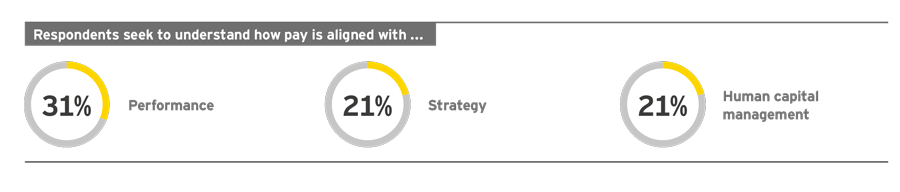
(5) Une rémunération qui est très bien alignée sur la performance et la stratégie.

Je vous propose un résumé des principaux résultats de travaux de recherche de EY. Pour plus de détails, je vous invite à consulter l’article ci-dessous.

Bonne lecture !


2018 Proxy Season Review


Résultats de recherche d'images pour « investisseurs institutionnels »

Les cinq grandes priorités des investisseurs institutionnels en 2018


1. La composition du conseil d’administration, avec un œil sur l’amélioration de la diversité


2. Un niveau d’expertise des administrateurs qui est en lien avec les objectifs d’affaires de l’entreprise


3. Une attention accrue accordée aux risques de nature climatique ou environnemental


4. Une attention marquée accordée à la gestion des talents


5. Une rémunération qui est très bien alignée sur la performance et la stratégie


Investor priorities as seen through the shareholder proposal lens


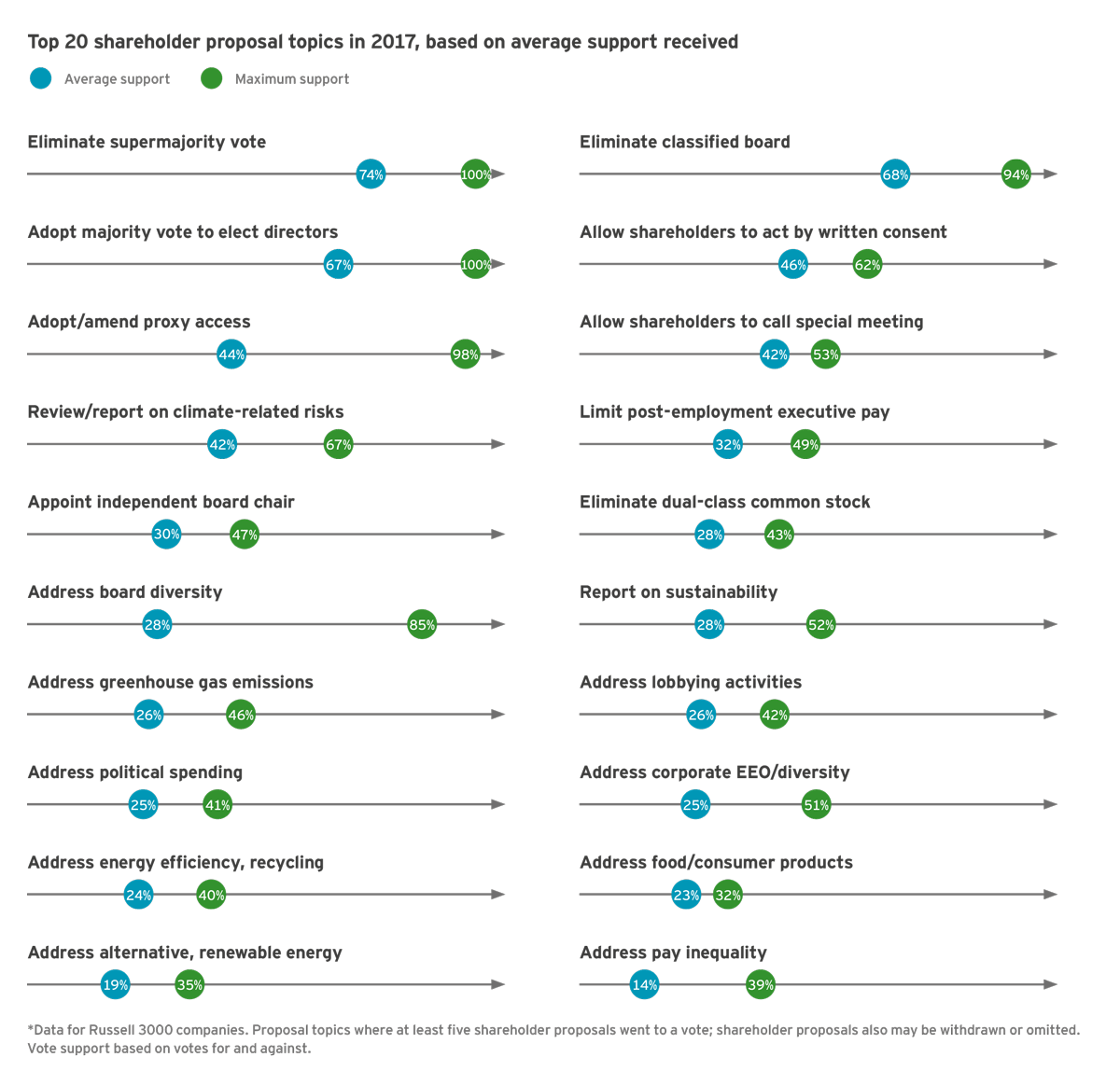
For a broader perspective of investor priorities, a review of the top shareholder proposal topics of 2017, based on average support, shows that around half focus on environment and social topics. While the average support for many of these proposal topics appear low, this understates impact. Environmental and social proposals typically see withdrawal rates of around one-third, primarily due to company-investor successes in reaching agreement. Depending on the company situation and specific proposal being voted, some proposals may receive strong support of votes cast by a company’s broader base of investors.

Conclusion


Institutional investors are increasingly asking companies about how they are navigating changing business environments, technological disruption and environmental challenges to achieve long-term, sustained growth. By addressing these same topics in their interactions with and disclosures to investors, boards and executives have an opportunity to highlight to investors how the company is positioned to navigate business transformations over the short- and long-term. This opportunity, in turn, enables companies to attract the kind of investors that support the approach taken by the board and management. Like strong board composition, enhanced disclosure and investor engagement efforts can serve as competitive advantages.


Questions for the board to consider


– Are there opportunities to strengthen disclosures around the board’s composition and director qualifications and how these support company strategy?

– Do the board and its committees have appropriate access to deep, timely expertise and open communication channels with management as needed for effective oversight?

– Do the board and management understand how key investors generally view the company’s disclosures and strategic initiatives regarding environmental and social matters?

– How does the board define and articulate its oversight responsibilities with regard to talent? And does the board believe that the company has an adequate plan for talent management considering recent employee and employment-related developments and the company’s competitive position?

– To what extent have the board and management offered to dialogue with the governance specialists at their key investor organizations, whether active or passive, and including the largest and smallest, vocal shareholder proponents?

 ____________________________________________
*Steve W. Klemash* is EY Americas Leader at the EY Center for Board Matters. This post is based on an EY publication by Mr. Klemash.

Top 10 de Harvard Law School Forum on Corporate Governance au 8 février 2018


Voici le compte rendu hebdomadaire du forum de la Harvard Law School sur la gouvernance corporative au 8 février 2018.

Cette semaine, j’ai relevé les dix principaux billets.

Bonne lecture !


Résultats de recherche d'images pour « top ten »


  1. Compensation in the 2018 Proxy Season
  2. 2017 Financial Stability Report
  3. Valuable Board Assessments
  4. Dinner Table Human Capital and Entrepreneurship
  5. BlackRock’s Call for Companies to Deliver Financial & Social Value
  6. HLS Forum Sets New Records in 2017
  7. Institutional Investor Engagement: How to Create a “Stewardship Culture”
  8. Top Universities for Corporate Directors
  9. Cryptocurrency 2018
  10. Will Tenure Voting Give Corporate Managers Lifetime Tenure?


Compte rendu hebdomadaire de la Harvard Law School Forum on Corporate Governance | 1er février 2018


Voici le compte rendu hebdomadaire du forum de la Harvard Law School sur la gouvernance corporative au 1er février 2018.

Cette semaine, j’ai relevé les quinze principaux billets.

Bonne lecture !


  1. Corporate Governance Update: Boards, Sexual Harassment, and Gender Diversity
  2. Informed Trading and Cybersecurity Breaches
  3. The Corporate Governance World in 2018: A Global Review
  4. The Effects of Investment Bank Rankings: Evidence from M&A League Tables
  5. Activism in 2018
  6. Mergers and Acquisitions: 2018 With a Brief Look Back
  7. Preparing a Successful IPO in 2018
  8. From Talking the Talk to Voting the Votes
  9. A Long/Short Incentive Scheme for Proxy Advisory FirmsRésultats de recherche d'images pour « harvard law school »
  10. Destructive Collectivism: Dodd-Frank Coordination and Clearinghouses
  11. 2017 Year in Review: Corporate Governance Litigation & Regulation
  12. Activists and Socially Responsible Investing
  13. The Highest-Paid Boards
  14. Disasters and Disclosures
  15. The Changing Face of Shareholder Activism

Billets récents publiés sur mon blogue en gouvernance en janvier 2018


Voici les quinze billets publiés sur mon blogue en gouvernance des sociétés en janvier 2018.

Bonne lecture ! Vos commentaires sont toujours les bienvenus.


Résultats de recherche d'images pour « blogue en gouvernance »


  1. Que pensez-vous des classes d’actions à droit de vote multiples ?
  2. Compte rendu hebdomadaire de la Harvard Law School Forum on Corporate Governance | 25 janvier 2018
  3. Aspects fondamentaux à considérer par les administrateurs dans la gouvernance des organisations
  4. Comment se préparer à la divulgation du ratio qui révèle la rémunération du CEO comparée à la moyenne des salaires des employés
  5. Compte rendu hebdomadaire de la Harvard Law School Forum on Corporate Governance | 18 janvier 2018
  6. BlackRock soutient le modèle de gouvernance basé sur la primauté accordée aux parties prenantes
  7. Adapter le modèle de gouvernance à la réalité des OBNL de petite taille
  8. Les administrateurs de sociétés qui cumulent plusieurs postes deviennent-ils trop accaparés ?
  9. Compte rendu hebdomadaire de la Harvard Law School Forum on Corporate Governance | 12 janvier 2018
  10. Quelle est l’influence des femmes CEO sur la structure de gouvernance des entreprises ?
  11. La souveraineté des conseils d’administration
  12. Compte rendu hebdomadaire de la Harvard Law School Forum on Corporate Governance | 4 janvier 2018
  13. Enquête de Deloitte sur la diversité des conseils d’administration
  14. Dix thèmes prioritaires à mettre à l’ordre du jour des Boards en 2018
  15. La gouvernance relative aux sociétés en 2017 | Un « Survey » des entreprises du SV 150 et de la S&P 100

Compte rendu hebdomadaire de la Harvard Law School Forum on Corporate Governance | 25 janvier 2018


Voici le compte rendu hebdomadaire du forum de la Harvard Law School sur la gouvernance corporative au 25 janvier 2018.

Cette semaine, j’ai relevé les dix principaux billets.

Bonne lecture !


Résultats de recherche d'images pour « Harvard Law School forum on corporate governance »


  1. Résultats de recherche d'images pour « harvard law school »Governance Gone Wild: Misbehavior at Uber Technologies
  2. Remarks on Shareholder Engagement
  3. The Option to Quit: The Effect of Employee Stock Options on Turnover
  4. Future Issues After the Publication of the CEO Pay Ratio
  5. Activist-Driven Dealmaking Falls Flat
  6. The Appraisal Landscape: Key Points, Open Issues, and Practice Points
  7. Engagement—Succeeding in the New Paradigm for Corporate Governance
  8. Say on Pay: Is It Needed? Does it Work?
  9. U.S. Tax Reform: Changes to 162(m) and Implications for Investors
  10. Evolution or Revolution for Companies with Multi-Class Share Structures


Compte rendu hebdomadaire de la Harvard Law School Forum on Corporate Governance | 18 janvier 2018


Voici le compte rendu hebdomadaire du forum de la Harvard Law School sur la gouvernance corporative au 18 janvier 2018.

Cette semaine, j’ai relevé les dix principaux billets.

Bonne lecture !


Résultats de recherche d'images pour « Harvard Law School forum on corporate governance »


Résultats de recherche d'images pour « harvard law school »

  1. Busy Directors and Shareholder Satisfaction
  2. Paying for Performance in Private Equity: Evidence from VC Partnerships
  3. What Do Investors Ask Managers Privately?
  4. How Transparent are Firms about their Corporate Venture Capital Investments?
  5. 2017 Year in Review: Securities Litigation and Regulation
  6. Changes in ISS 2018 Compensation FAQs
  7. Network Effects in Corporate Governance
  8. A Sense of Purpose
  9. The New Digital Wild West: Regulating the Explosion of Initial Coin Offerings
  10. BlackRock Supports Stakeholder Governance

Compte rendu hebdomadaire de la Harvard Law School Forum on Corporate Governance | 12 janvier 2018


Voici le compte rendu hebdomadaire du forum de la Harvard Law School sur la gouvernance corporative au 12 janvier 2018.

Cette semaine, j’ai relevé les dix principaux billets.

Bonne lecture !


Résultats de recherche d'images pour « Harvard Law School forum on corporate governance »

Résultats de recherche d'images pour « Harvard Law School forum on corporate governance »


  1. Tax Reform Implications for U.S. Businesses and Foreign Investments
  2. Ineffective Stockholder Approval for Director Equity Awards
  3. Does Size Matter? Bailouts with Large and Small Banks
  4. Raising the Stakes on Board Gender Diversity
  5. Managing the Family Firm: Evidence from CEOs at Work
  6. Compensation Season 2018
  7. Pay-for-Performance Mechanics
  8. CEO Gender and Corporate Board Structures
  9. Activist Investing in Europe—2017 Edition
  10. Political Uncertainty and Cross-Border Acquisition

Compte rendu hebdomadaire de la Harvard Law School Forum on Corporate Governance | 4 janvier 2018


Voici le compte rendu hebdomadaire du forum de la Harvard Law School sur la gouvernance corporative au 4 janvier 2018.

Cette semaine, j’ai relevé les dix principaux billets.

Bonne lecture !


Résultats de recherche d'images pour « Harvard Law School forum on corporate governance »


  1. Venture Capital Investments and Merger and Acquisition Activity around the World
  2. Global and Regional Trends in Corporate Governance for 2018
  3. Why Do Some Companies Leave? Evidence on the Factors that Drive InversionsRésultats de recherche d'images pour « Harvard Law School forum on corporate governance »
  4. Globalization and Executive Compensation
  5. Analysis of Fund Voting at Utilities Companies
  6. Corporate Governance Survey—2017 Proxy Season
  7. Opportunity Makes a Thief: Corporate Opportunities as Legal Transplant and Convergence in Corporate Law
  8. Top 10 Topics for Directors in 2018
  9. How Director Age Influences Corporate Performance
  10. The Changing Landscape of Auditor Litigation and Its Implication for Audit Quality