Top 10 de Harvard Law School Forum on Corporate Governance au 24 mai 2018


Voici le compte rendu hebdomadaire du forum de la Harvard Law School sur la gouvernance corporative au 24 mai 2018.

Comme à l’habitude, j’ai relevé les dix principaux billets.

Bonne lecture !


Résultats de recherche d'images pour « top 10 »


  1. Board Performance Evaluations that Add Value
  2. Cryptocurrency Compensation: A Primer on Token-Based Awards
  3. Does it Pay to Pay Attention?
  4. Non-Delaware Decisions on Director Nominations
  5. The Conflicted Role of Proxy Advisors
  6. How Valuable are Independent Directors? Evidence from External Distractions
  7. Elon Musk’s Compensation
  8. Why Shareholder Wealth Maximization Despite Other Objectives
  9. Congress Increases Pressure on Proxy Advisory Firms
  10. The DOJ’s New “Piling On” Policy

Top 10 de Harvard Law School Forum on Corporate Governance au 17 mai 2018


Voici le compte rendu hebdomadaire du forum de la Harvard Law School sur la gouvernance corporative au 17 mail 2018.

Comme à l’habitude, j’ai relevé les dix principaux billets.

Bonne lecture !


Résultats de recherche d'images pour « top 10 »


L’évolution du statut d’administrateur indépendant en 2017 | EY


Comment a évolué la situation du statut d’indépendance des administrateurs en 2017 ?

La publication d’EY est très intéressante à cet égard ; elle tente de répondre à cette question et elle brosse un tableau de la composition des conseils d’administration en 2017.

L’étude effectuée par l’équipe de Steve W. Klemash* auprès des entreprises du Fortune 100 montre clairement l’importance accrue accordée au critère d’administrateur indépendant au fil des ans.

Ainsi, au cours des deux dernières années, 80 % des administrateurs nommés par les actionnaires avaient la qualité d’administrateurs indépendants.

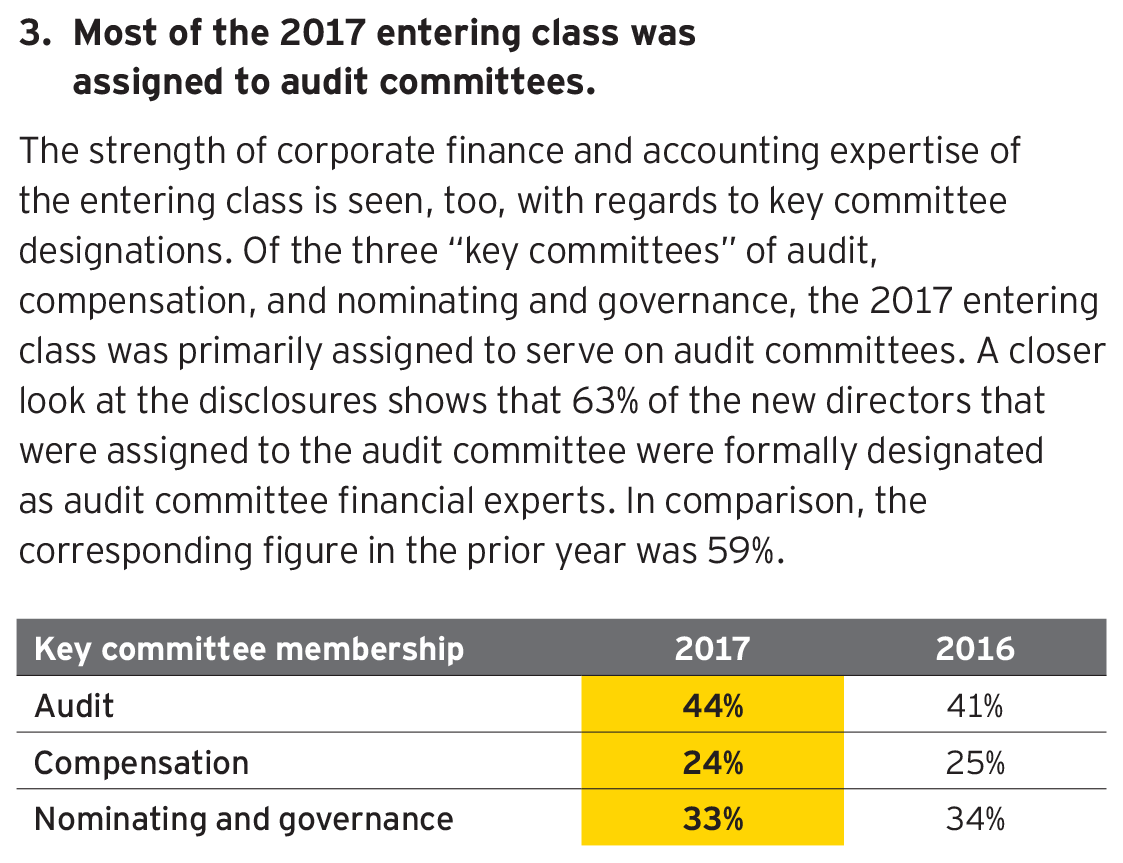
La plupart des nouveaux administrateurs avaient une expertise en finance et comptabilité et 44 % de ceux-ci ont été nommés sur le comité d’audit.

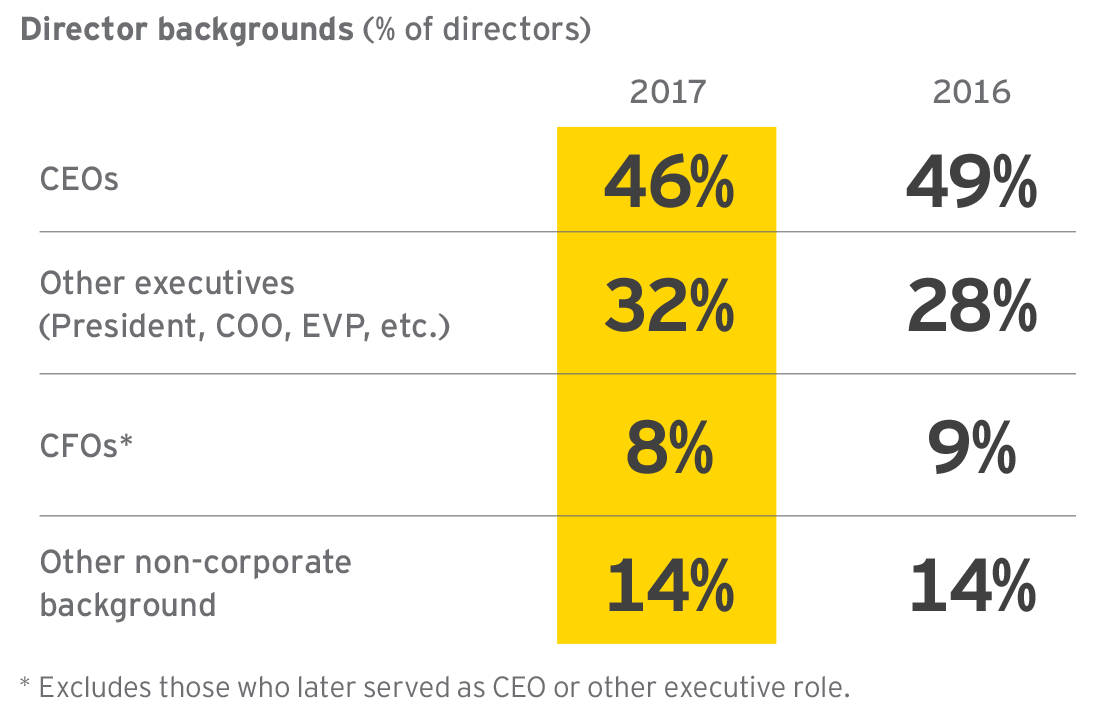
Cette année, 54 % des nouveaux arrivants étaient des personnes qui n’étaient pas CEO, comparativement à 51 % l’année précédente.

On compte 40 % de femmes parmi les nouveaux administrateurs en 2017.

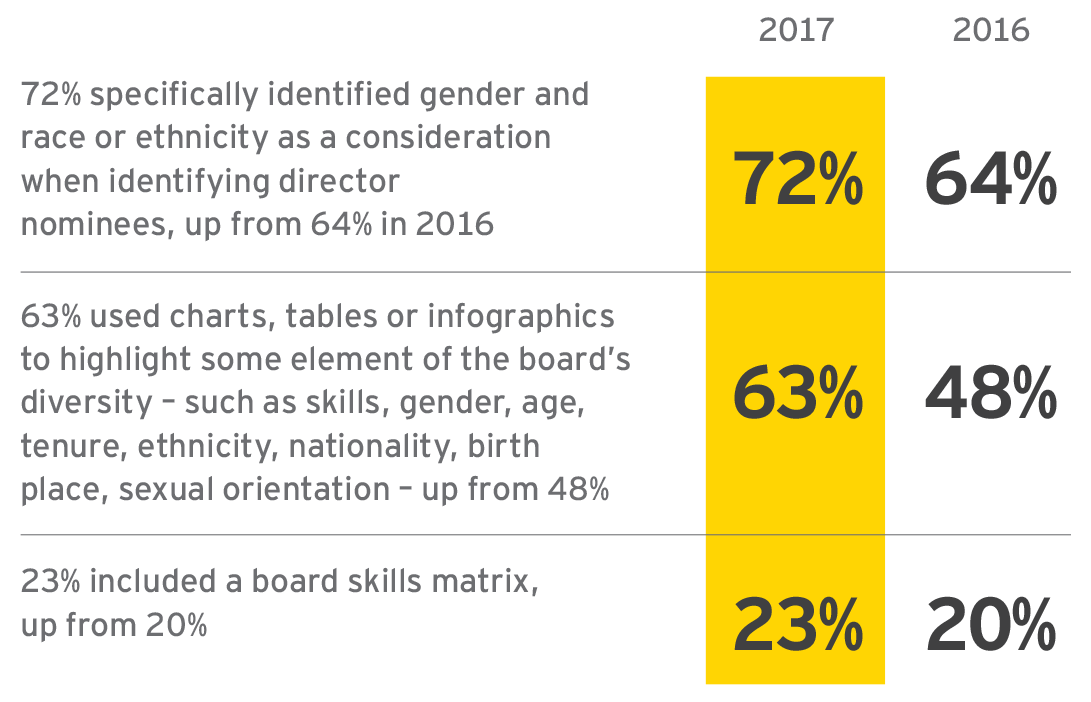
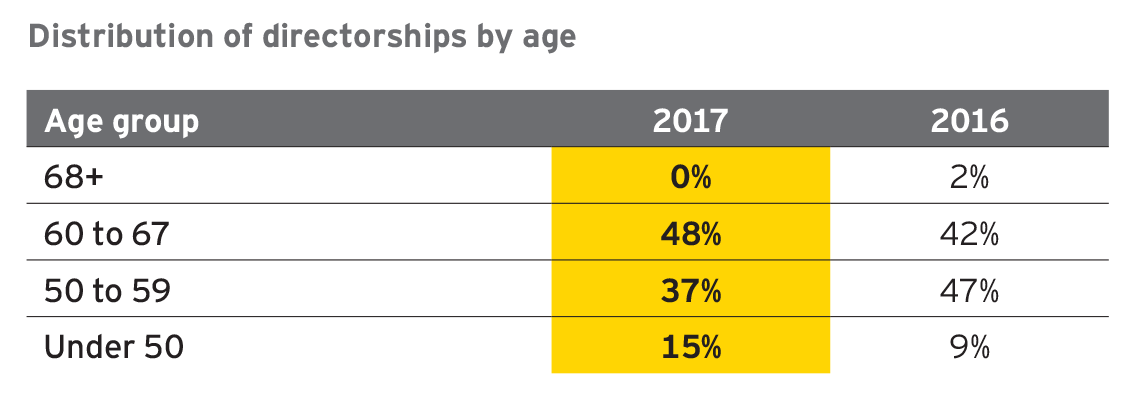
Également, les nouveaux administrateurs sont plus jeunes : 15 % ont moins de 50 ans comparativement à 9 % l’année précédente. De plus, 85 % des nouveaux administrateurs avaient entre 50 ans et 67 ans.

Les entreprises recherchent une plus grande diversité de profils d’origine, d’expertises, d’habiletés et d’expériences.

J’ai tenté de résumer les principales conclusions de cette étude. Je vous renvoie à l’étude originale afin d’en connaître les détails.

Bonne lecture ! Vos commentaires sont les bienvenus.


Independent Directors: New Class of 2017


Résultats de recherche d'images pour « independant director »


Companies are continuing to bring fresh and diverse perspectives into the boardroom and to enhance alignment of board composition with their forward-looking strategies.

In our second annual report, we share the results of our analysis of independent directors who were elected by shareholders to the board of a Fortune 100 company for the first time in 2017—what we refer to as the “new class of 2017.”

We looked at corporate disclosures to see what qualifications and characteristics were specifically highlighted, showcasing what this new class of directors brings to the boardroom. Our research was based on a review of proxy statements filed by companies on the 2017 Fortune 100 list. We also reviewed the same 83 companies’ class of 2016 directors to provide consistency in year-on-year comparisons.


Our perspective


What we’re hearing in the market is that boards are seeking slates of candidates who bring a diverse perspective and a range of functional expertise, including on complex, evolving areas such as digital transformation, e-commerce, public policy, regulation and talent management. As a result, boards are increasingly considering highly qualified, nontraditional candidates, such as non-CEOs, as well as individuals from a wider range of backgrounds. These developments are expanding the short lists of potential director candidates.

At the same time, companies are expanding voluntary disclosures around board composition. Our review of Fortune 100 disclosures around board composition found that:

While diverse director candidates are in high demand and related shifts in board composition are underway, these developments may be slow to manifest. For example, consider that the average Fortune 100 board has 10 seats. In this context, the addition of a single new director is unlikely to dramatically shift averages in terms of gender diversity, age, tenure or other considerations.

That said, whether a board’s pace of change is sufficient depends on a company’s specific circumstances and evolving board oversight needs. Boards should challenge their approach to refreshment, asking whether they are meeting the company’s diversity, strategy and risk oversight needs. Waiting for an open seat to nominate a diverse candidate may mean waiting for the value that diversity could bring.

In 2018, we anticipate that companies will continue to offer more voluntary disclosure on board composition, showing how their directors represent the best mix of individuals for the company—across multiple dimensions, including a diversity of backgrounds, expertise, skill sets and experiences.


Key findings

1. Most Fortune 100 companies welcomed a new independent director in 2017


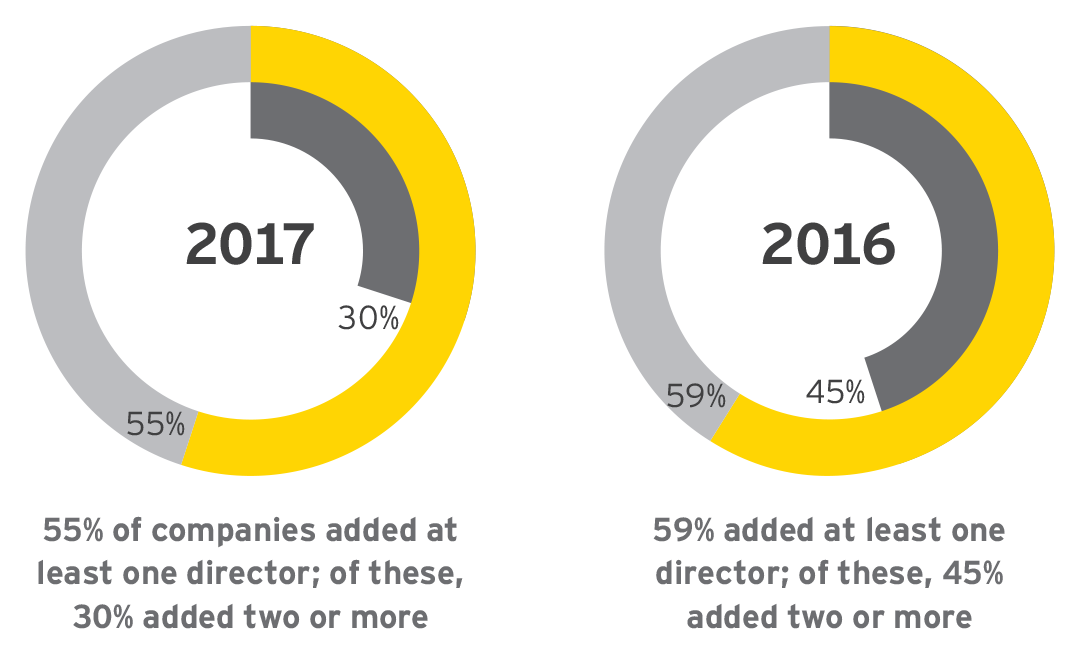
This past year, over half of the Fortune 100 companies we reviewed added at least one independent director. This figure is a little lower than the prior year; but overall, during the two-year period from 2016 to 2017, over 80% of the companies added at least one independent director. Taking into account director exits—whether due to retirement, corporate restructuring, pursuit of new opportunities or other reasons—we found that nearly all of the companies experienced some type of change in board composition during this period.

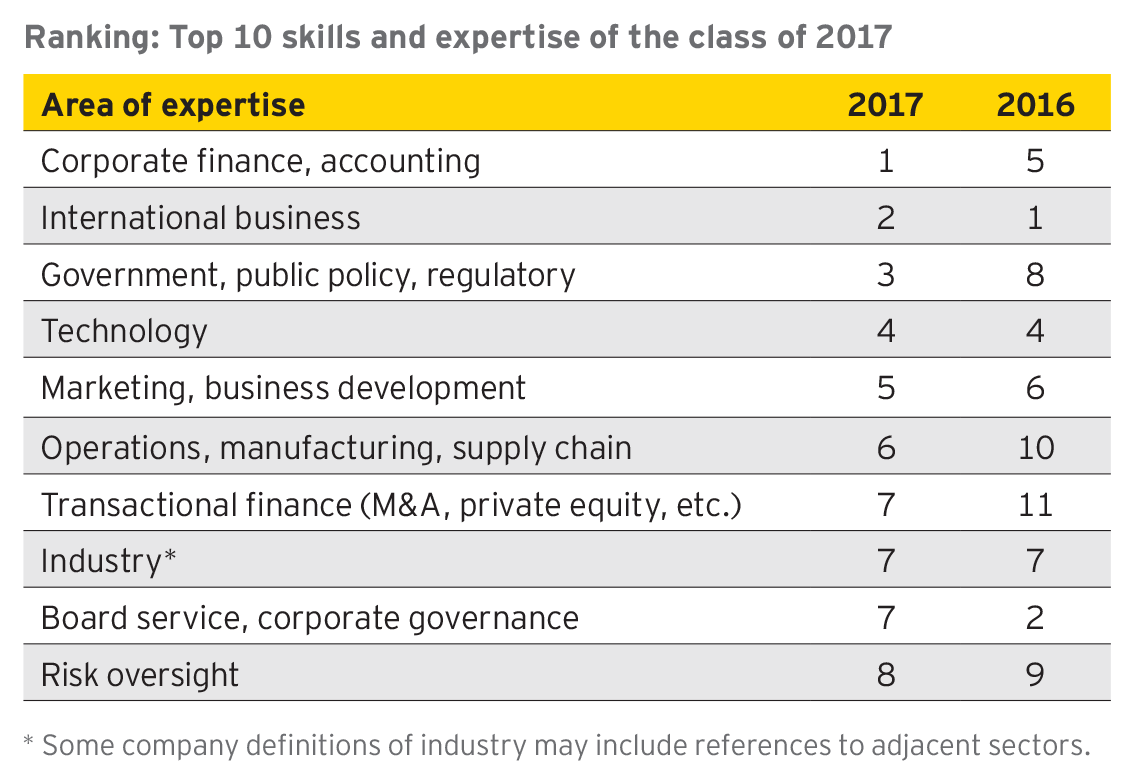
2. The class of 2017 brings greater finance and accounting, public policy and regulatory, and operational skills to the table.


Corporate finance and accounting were the most common director qualifications cited by companies in 2017, up from fifth in 2016. A couple areas saw notable increases: government and public policy, operations and manufacturing, and transactional finance. This year, some areas tied in ranking, and in a twist, corporate references to expertise in strategy fell from third in 2016 to below the top 10 categories of expertise. Companies also made fewer references to board service or governance expertise compared to the prior year.

3. Most of the 2017 entering class was assigned to audit committees.


The strength of corporate finance and accounting expertise of the entering class is seen, too, with regards to key committee designations. Of the three “key committees” of audit, compensation, and nominating and governance, the 2017 entering class was primarily assigned to serve on audit committees. A closer look at the disclosures shows that 63% of the new directors that were assigned to the audit committee were formally designated as audit committee financial experts. In comparison, the corresponding figure in the prior year was 59%.


4. The Fortune 100 class of 2017 includes more non-CEOs.


While experience as a CEO is often cited as a traditional first cut for search firms, 54% of the entering class served in other roles, with non-CEO backgrounds including other executive roles or non-corporate backgrounds (academia, scientific organizations, nonprofits, government, military, etc.). This represents a slight increase from 2016 with most of the shift stemming from individuals holding or having held other senior executive positions. Approximately 30% appear to be joining a Fortune 100 public company board, having never previously served on a public company board—similar to 2016.

5. The class of 2017 is 40% female


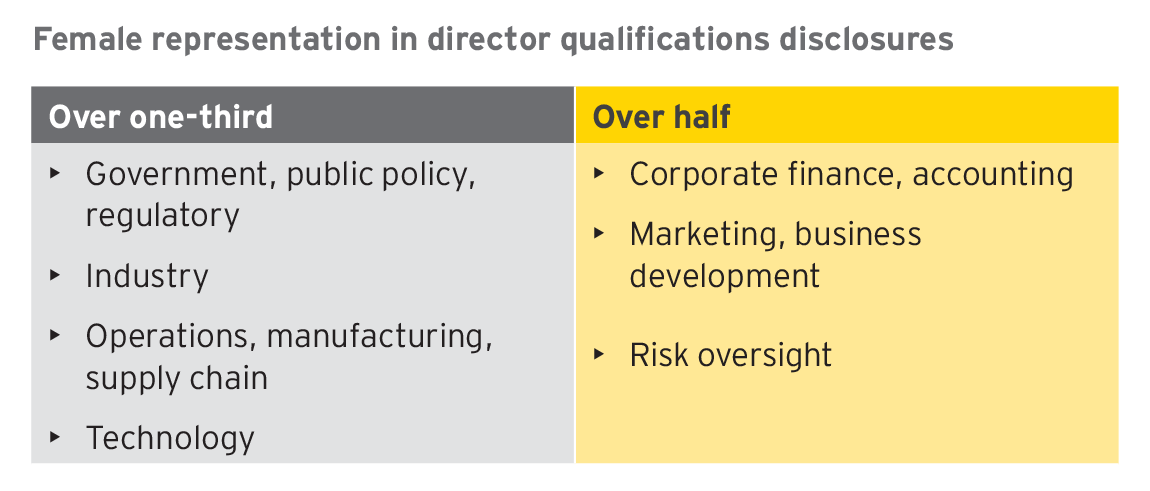
As in the prior year, 40% of the entering class were women, but overall percentages were largely unchanged, with women directors averaging 28% board representation compared to 27% in 2016. Also, there was minimal age difference, with the women directors averaging 57 compared to 58 for male counterparts. Among the directors bringing the top categories of expertise, women directors accounted for over one-third of the disclosed director qualifications. In some cases, they represented over half of the disclosed category of expertise.

6. The class of 2017 tends to be younger


There appears to be an ongoing shift toward younger directors. For the class of 2017 entering directors, the average age of these individuals was 57, compared to 63 for incumbents and 68 for exiting directors. Of the entering class, 15% were under 50, an increase from 9% in the prior year. And, for the second consecutive year, we observe that over half of the entering class was under the age of 60. Exiting directors largely continue to be age 68 or older.

Questions for the board to consider


– How is the company aligning the skills of its directors—and that of the full board—to the company’s long-term strategy through board refreshment and succession planning efforts? How is the company providing voluntary disclosures around its approach in these areas?

– Does the company’s pool of director candidates challenge traditional search norms such as title, age, industry and geography?

– How is the company addressing growing investor and stakeholder attention to board diversity, and is the company providing disclosure around the diversity of the board—defined as including considerations such as age, gender, race, ethnicity, nationality—in addition to skills and expertise?

______________________________________________________________________________________

*Steve W. Klemash is Americas Leader, Kellie C. Huennekens is Associate Director, and Jamie Smith is Associate Director, at the EY Center for Board Matters. This post is based on their EY publication.

Top 10 de Harvard Law School Forum on Corporate Governance au 10 mai 2018


Voici le compte rendu hebdomadaire du forum de la Harvard Law School sur la gouvernance corporative au 10 mai 2018.

Comme à l’habitude, j’ai relevé les dix principaux billets.

Bonne lecture !


Résultats de recherche d'images pour « top dix en gouvernance »


  1. Corporate Purpose: ESG, CSR, PRI and Sustainable Long-Term Investment
  2. Do Women CEOs Earn More and Have More Diverse Boards?
  3. The Business Case for Clawbacks
  4. Integrated Alpha: The Future of ESG Investing
  5. CEO Attributes, Compensation, and Firm Value: Evidence from a Structural Estimation
  6. The Future of Merger Litigation in Federal Courts?
  7. The Impact of DOL Guidance on ESG-Focused Plans
  8. The Uncertain Role of IPOs in Future Securities Class Actions
  9. An Investor Consensus on U.S. Corporate Governance & Stewardship Practices
  10. Netflix Approach to Governance: Genuine Transparency with the Board


Les femmes CEO des grandes entreprises ont-elles une rémunération plus élevée que leurs homologues masculins ? Leurs CA comptent-ils plus de femmes ?


Les femmes PDG (CEO) des grandes entreprises ont-elles une rémunération plus élevée ? Leurs conseils d’administration sont-ils plus diversifiés, et comptent-ils plus de femmes ?

Ce billet publié par Dan Marcec, directeur d’Equilar, paru sur le forum de la Harvard Law School, tente d’apporter une réponse à ces questions.

On peut retenir que les femmes CEO, en général, comptent légèrement plus de femmes sur leurs conseils.

Le nombre de femmes sur les CA varie selon la taille des entreprises. Plus l’entreprise est grande, plus le CA est susceptible de compter un nombre plus important de femmes :

Equilar 100 Gender Diversity Index,  24 %

Fortune 500,  22,5 %

Fortune 501-1000,  19,2 %

Entreprises plus petites,  14,1 %

Également, la rémunération des femmes CEO des 100 plus grandes entreprises (8 femmes) est de 21,4 M $ comparativement à la moyenne des 92 hommes CEO qui est de 16,4 M $, une différence significative, mais sur un petit échantillon de femmes CEO !

Je vous invite à prendre connaissance de l’article ci-dessous afin de mieux saisir toutes les nuances de cette étude.

Bonne lecture !


Do Women CEOs Earn More and Have More Diverse Boards?


Résultats de recherche d'images pour « Les femmes CEO des grandes entreprises ont-elles une rémunération plus élevée que leurs homologues masculins ? Leurs CA comptent-ils plus de femmes ? »


As gender equity and diversity in corporate leadership continue to be critical discussions, research is regularly published showing links between these factors and company performance. Based on an analysis of Equilar 100 companies—the largest U.S.-listed firms to file proxy statements to the SEC before March 31—women CEOs had a higher representation of women on their boards on average than companies led by male counterparts. They also were awarded higher compensation on average in 2017.

Overall, Equilar 100 companies with women CEOs had an average of 24.0% representation of women on their boards, vs. 23.5% for the companies with male CEOs. Furthermore, the women in the CEO position at Equilar 100 companies were well paid in 2017 with an average pay package of $21.4 million. By comparison, the men who were on the list received an average pay package of $16.4 million. The following two questions examined this data just below the surface, finding that the complete picture is more complicated than it appears.


Do Women CEOs Bring More Females Into the Boardroom?


The Equilar 100 study analyzed recently reported data for fiscal year 2017, including eight women CEOs, a drop from nine the previous year. While Meg Whitman has since left her position at Hewlett Packard Enterprise, she was still in the CEO position during the periods studied, so HPE is included in the analysis.

The answer to the question above—based on an analysis of Equilar 100 data—is yes, companies with women CEOs do have slightly more women in the boardroom. The list of Equilar 100 companies that had women CEOs in 2017 is below, inclusive of their current board composition as of March 31.


Company % Female Board Members Average Board Age Average Board Tenure
Hewlett Packard Enterprise Co 38.5% 62.0 2.4
General Dynamics Corp 27.3% 64.0 5.9
Progressive Corp 27.3% 62.0 9.8
Oracle Corp 25.0% 70.5 14.4
Pepsico Inc 23.1% 63.0 5.5
IBM 20.0% 64.0 6.3
Lockheed Martin Corp 16.7% 66.0 6.6
Duke Energy Corp 14.3% 66.0 4.9
Women CEO Average 24.0% 64.7 7.0
Men CEO Average 
23.5% 63.0 7.2


There are two important factors to consider that give pause in definitively being able to say “women CEOs at Equilar 100 companies lead in gender diversity on boards.” While the numbers are clear—and they are—large-cap companies are much more likely to have women on their boards overall.

According to the recent Equilar Gender Diversity Index, Fortune 500 companies included in the Russell 3000 had an average of 22.5% women on their boards, as compared to 19.2% for Fortune 501-1000 companies and a much lower 14.1% for R3K firms outside the Fortune 1000. The Equilar 100 overall outpaced each of these groups.

It’s also worth noting that most CEOs are also on their own boards. Therefore, if CEOs were removed from the overall numbers, it’s likely the data would show Equilar 100 boards being more inclusive of independent women directors when a male CEO is in place.


The facts are the facts—boards at Equilar 100 companies led by women have a higher percentage of female directors than their counterparts. However, the small sample size—pointing to the lack of women in leadership overall—and these other mitigating factors make a definitive statement difficult to prove.


Do Women CEOs Make More Than Men?


While the women on the Equilar 100 list make more on average than the men, the caveat, of course, is that these numbers reflect a small sample size of women. To get to the eight highest-paid women on the list, you have to go all the way to number 87, whereas you don’t have to leave the top 10 to find the eight highest-paid men. The list of women on the Equilar 100 list (as well as their compensation rank) is below.


Company CEO 2017 Total Compensation ($MM) Equilar 100 RANK
Oracle Corp Safra A. Catz $40.7 4
Pepsico Indra K. Nooyi $25.9 7
General Dynamics Corp Phebe N. Novakovic $21.2 14
Duke Energy Corp Lynn J. Good $21.1 15
Lockheed Martin Corp Marillyn A. Hewson $20.2 16
IBM Virginia M. Rometty $18.0 30
Hewlett Packard Enterprise Margaret C. Whitman $14.8 60
Progressive Corp Susan P. Griffith $9.2 87
Women Ceo Average (N=8) $21.4
Men CEO Average 
(n=92) $16.4


Furthermore, similar to the findings on board composition, the larger the company, the higher the pay. Given the context of the Equilar 100 study more generally—that the largest companies by revenue tend to pay their CEOs more—this small sample size is not sufficient to make a claim that women CEOs earn more than men.

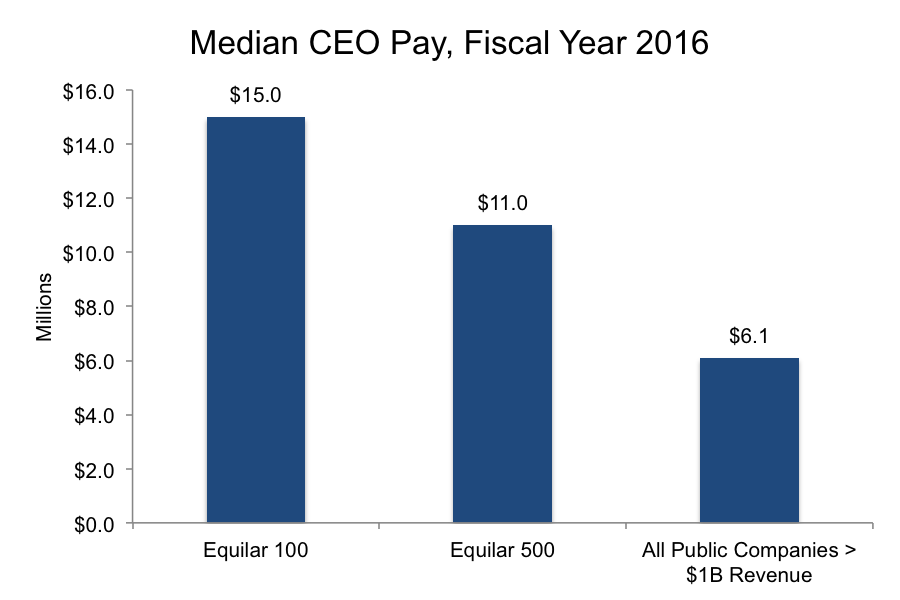
For example, using fiscal year 2016 data, it’s clear that the Equilar 100 stands out over all other public companies. (Since the Equilar 100 is an “early look” at proxy season, comprehensive data is not yet available for these other company groups in 2017.) In 2016, Equilar 100 CEOs were awarded $15.0 million at the median, in comparison to $11.0 million for Equilar 500 companies, and just $6.1 million for all public companies with more than $1 billion in revenue.


In other words, as with board composition, the numbers do indicate that women CEOs earn more than men at face value, but there is more than meets the eye. Ultimately, proof of greater equity in executive compensation and board diversity when women are CEOs is inconclusive from this analysis, highlighting the importance of questioning numbers at face value. Indeed, an academic study was released recently that found there is no meaningful difference in pay between men and women at the CEO level. Each company’s compensation and board refreshment strategy is unique to their circumstances, and monolithic assumptions are not always fair. The gravity of these decisions pored over by each board of directors and their executive teams spotlights the rise of shareholder scrutiny and direct engagement on these matters.

Top 10 de Harvard Law School Forum on Corporate Governance au 3 mai 2018


Voici le compte rendu hebdomadaire du forum de la Harvard Law School sur la gouvernance corporative au 3 mai 2018.

Comme à l’habitude, j’ai relevé les dix principaux billets.

Bonne lecture !


Résultats de recherche d'images pour « top 10 »


  1. The Middle-Market IPO Tax
  2. Which Antitakover Provisions Matter?
  3. Indications of Corporate Control
  4. Removing Directors in Private Companies by Written Consent?
  5. Cybersecurity Risk Management Oversight
  6. The Life-Cycle of Dual Class Firms
  7. Missing Pieces Report: The 2016 Board Diversity Census of Women and Minorities on Fortune 500 Boards
  8. Busy Directors and Firm Performance: Evidence from Mergers
  9. SEC’s Proposed Standard of Conduct for Investment Advisors
  10. Open Letter Regarding Consultation on the Treatment of Unequal Voting Structures in the MSCI Equity Indexes


Top 10 de Harvard Law School Forum on Corporate Governance au 26 avril 2018


Voici le compte rendu hebdomadaire du forum de la Harvard Law School sur la gouvernance corporative au 26 avril 2018.

Comme à l’habitude, j’ai relevé les dix principaux billets.

Bonne lecture !


Résultats de recherche d'images pour « top 10 »


Top 10 de Harvard Law School Forum on Corporate Governance au 19 avril 2018


Voici le compte rendu hebdomadaire du forum de la Harvard Law School sur la gouvernance corporative au 19 avril 2018.

Comme à l’habitude, j’ai relevé les dix principaux billets.

Bonne lecture !


Résultats de recherche d'images pour « top 10 »


Top 10 de Harvard Law School Forum on Corporate Governance au 12 avril 2018


Voici le compte rendu hebdomadaire du forum de la Harvard Law School sur la gouvernance corporative au 12 avril 2018.

Comme à l’habitude, j’ai relevé les dix principaux billets.

Bonne lecture !


Résultats de recherche d'images pour « top ten »


  1. Activist Arbitrage in M&A Acquirers
  2. In the Spirit of Full Cybersecurity Disclosure
  3. Unequal Voting and the Business Judgment Rule
  4. Agency Conflicts Around the World
  5. Real Talk on Executive Compensation
  6. The Cost of Political Connections
  7. Review and Analysis of 2017 U.S. Shareholder Activism
  8. 10 Tips for Upcoming Annual Shareholder Meetings
  9. The Information Value of Corporate Social Responsibility
  10. The Purpose of the Corporation

Quelle est la raison d’être d’une entreprise ?


Quelle est la raison d’être d’une entreprise sur le plan juridique ? À qui doit-elle rendre des comptes ?

Une entreprise est-elle au service exclusif de ses actionnaires ou doit-elle obligatoirement considérer les intérêts de ses parties prenantes (stakeholders) avant de prendre des décisions de nature stratégiques ?

On conviendra que ces questions ont fréquemment été abordées dans ces pages. Cependant, la réalité de la conduite des organisations semble toujours refléter le modèle de la primauté des actionnaires, mieux connu maintenant sous l’appellation « démocratie de l’actionnariat ».

L’article de Martin Lipton* fait le point sur l’évolution de la reconnaissance des parties prenantes au cours des quelque dix dernières années.

Je crois que les personnes intéressées par les questions de gouvernance (notamment les administrateurs de sociétés) doivent être informées des enjeux qui concernent leurs responsabilités fiduciaires.

Bonne lecture. ! Vos commentaires sont les bienvenus.


The Purpose of the Corporation


Résultats de recherche d'images pour « actionnaires définition »


Whether the purpose of the corporation is to generate profits for its shareholders or to operate in the interests of all of its stakeholders has been actively debated since 1932, when it was the subject of dueling law review articles by Columbia law professor Adolf Berle (shareholders) and Harvard law professor Merrick Dodd (stakeholders).

Following “Chicago School” economics professor Milton Friedman’s famous (some might say infamous) 1970 New York Times article announcing ex cathedra that the social responsibility of a corporation is to increase its profits, shareholder primacy was widely viewed as the purpose and basis for the governance of a corporation. My 1979 article, Takeover Bids in the Target’s Boardroom, arguing that the board of directors of a corporation that was the target of a takeover bid had the right, if not the duty, to consider the interests of all stakeholders in deciding whether to accept or reject the bid, was widely derided and rejected by the Chicago School economists and law professors who embraced Chicago School economics. Despite the 1985 decision of the Supreme Court of Delaware citing my article in holding that a board of directors could take into account stakeholder interests, and over 30 states enacting constituency (stakeholder) statutes, shareholder primacy continued to dominate academic, economic, financial and legal thinking—often disguised as “shareholder democracy.”

While the debate continued and stakeholder governance gained adherents in the new millennium, shareholder primacy continued to dominate. Only since the 2008 financial crisis and resulting recession has there been significant recognition that shareholder primacy has been a major driver of short-termism, encourages activist attacks on corporations, reduces R&D expenditures, depresses wages and reduces long-term sustainable investments—indeed, it promotes inequality and strikes at the very heart of our society. In the past five years, the necessity for changes has been recognized by significant academic, business, financial and investor reports and opinions. An example is the 2017 paper I and a Wachtell Lipton team prepared for the World Economic Forum, The New Paradigm: A Roadmap for an Implicit Corporate Governance Partnership Between Corporations and Investors to Achieve Sustainable Long-Term Investment and Growth, which quotes or cites many of the others.

This year we are seeing important new support for counterbalancing shareholder primacy and promoting long-term sustainable investment. Among the many prominent examples is the January 2018 annual letter from Larry Fink, Chairman of BlackRock, to CEOs:

Without a sense of purpose, no company, either public or private, can achieve its full potential. It will ultimately lose the license to operate from key stakeholders. It will succumb to short-term pressures to distribute earnings, and, in the process, sacrifice investments in employee development, innovation, and capital expenditures that are necessary for long-term growth. It will remain exposed to activist campaigns that articulate a clearer goal, even if that goal serves only the shortest and narrowest of objectives. And ultimately, that company will provide subpar returns to the investors who depend on it to finance their retirement, home purchases, or higher education.

This was followed in March by the report of a commission appointed by the French Government recommending amendment to the French Civil Code to add, “The company shall be managed in its own interest, considering the social and environmental consequences of its activity,” following the existing, “All companies shall have a lawful purpose and be incorporated in the common interest of the shareholders.” The draft amendment is intended to establish the principle that each company should pursue its own interest—namely, the continuity of its operation, sustainability through investment, collective creation and innovation. The report notes that this amendment integrates corporate and social responsibility considerations into corporate governance and goes on to state that each company has a purpose not reducible to profit and needs to be aware of its purpose. The report recommends an amendment to the French Commercial Code for the purpose of entrusting the boards of directors to define a company’s purpose in order to guide the company’s strategy, taking into account its social and environmental consequences.

Also in March, the European Commission in its Action Plan: Financing Sustainable Growthproposed both corporate governance and investor stewardship requirements:

Subject to the outcome of its impact assessment, the Commission will table a legislative proposal to clarify institutional investors’ and asset managers’ duties in relation to sustainability considerations by Q2 2018. The proposal will aim to (i) explicitly require institutional investors and asset managers to integrate sustainability considerations in the investment decision-making process and (ii) increase transparency, towards end-investors on how they integrate such sustainability factors in their investment decisions in particular as concerns their exposure to sustainability risks.

Further, the Commission proposes a number of other laws or regulations designed to promote ESG, CSR and sustainable long-term investment.

In addition to these examples, there are similar policy statements by major investors and similar efforts at legislation to modulate or eliminate shareholder primacy in Great Britain and the United States. While it is not certain that any legislation will soon be enacted, it is clear that the problems have been identified, support is growing to find a way to address them and if implicit stakeholder governance does not take hold, legislation will ensue to assure it.

_____________________________________

*Martin Lipton is a founding partner of Wachtell, Lipton, Rosen & Katz, specializing in mergers and acquisitions and matters affecting corporate policy and strategy. This post is based on a Wachtell Lipton publication by Mr. Lipton.

Top 10 de Harvard Law School Forum on Corporate Governance au 5 avril 2018


Voici le compte rendu hebdomadaire du forum de la Harvard Law School sur la gouvernance corporative au 5 avril 2018.

Comme à l’habitude, j’ai relevé les dix principaux billets.

Bonne lecture !


Résultats de recherche d'images pour « top 10 »


Top 10 de Harvard Law School Forum on Corporate Governance au 29 mars 2018


Voici le compte rendu hebdomadaire du forum de la Harvard Law School sur la gouvernance corporative au 29 mars 2018.

Comme à l’habitude, j’ai relevé les dix principaux billets.

Joyeuses Pâques à tous mes abonnés.

Bonne lecture !


Résultats de recherche d'images pour « top 10 »


  1. Traceable Shares and Corporate Law

  2. Corporations and the Culture Wars

  3. Toward a Horizontal Fiduciary Duty in Corporate Law

  4. The SEC and Virtual Currency Markets

  5. Senate Rollback of Dodd-Frank

  6. The First Wave of Pay Ratio Disclosures

  7. Blockchain Technology for Corporate Governance and Shareholder Activism

  8. BlackRock Investment Stewardship’s Approach to Engagement on Human Capital Management

  9. Preparing for the Year of the “S”

  10. Emerging Trends in S&P 500 Pay Ratio Disclosures

Top 10 de Harvard Law School Forum on Corporate Governance au 22 mars 2018


Voici le compte rendu hebdomadaire du forum de la Harvard Law School sur la gouvernance corporative au 22 mars 2018.

Comme à l’habitude, j’ai relevé les dix principaux billets.

Bonne lecture !


Résultats de recherche d'images pour « top 10 »


Douze questions qu’un administrateur doit se poser afin de cerner l’efficacité de son CA


J’ai trouvé très intéressantes les questions qu’un nouvel administrateur pourrait se poser afin de mieux cerner les principaux facteurs liés à la bonne gouvernance d’un conseil d’administration.

Bien sûr, ce petit questionnaire peut également être utilisé par un membre de CA qui veut évaluer la qualité de la gouvernance de son propre conseil d’administration.

Les administrateurs peuvent interroger le président du conseil, les autres membres du conseil et le secrétaire corporatif.

Les douze questions énumérées ci-dessous ont fait l’objet d’une discussion lors d’une table ronde organisée par INSEAD Directors Forum du campus asiatique de Singapore.

Cet article a été publié par Noelle Ahlberg Kleiterp* sur le site de la Harvard Law School Forum on Corporate Governance.

Chaque question est accompagnée de quelques réflexions utiles pour permettre le passage à l’acte.

Bonne lecture ! Vos commentaires sont les bienvenus.


Twelve questions to determine board effectiveness


In many countries, boards of directors (particularly those of large organisations) have functioned too long as black boxes. Directors’ focus has often—and understandably so—been monopolised by a laundry list of issues to be discussed and typically approved at quarterly meetings.

The board’s own performance, effectiveness, processes and habits receive scant reflection. Many directors are happy to leave the corporate secretary with the task of keeping sight of governance best practices; certainly they do not regard it as their own responsibility.

It occurred to me later that these questions could be of broader use to directors as a framework for beginning a reassessment of their board role.

Résultats de recherche d'images pour « questions de gouvernance »

However, increased regulatory pressures are now pushing boards toward greater responsibility, transparency and self-awareness. In some countries, annual board reviews have become compulsory. In addition, mounting concerns about board diversity provide greater scope for questioning the status quo.

Achieving a more heterogeneous mix of specialisations, cultures and professional experiences entails a willingness to revise some unwritten rules that, in many instances, have governed board functions. And that is not without risk.

At the same time, the “diversity recruits” wooed for board positions may not know the explicit, let alone the implicit, rules. Some doubtless never anticipated they would be asked to join a board. Such invitations often come out of the blue, with little motivation or clarity about what is expected from the new recruit. No universal guidelines are available to aid candidates as they decide whether to accept their invitation.

Long-standing directors and outliers alike could benefit from a crash course in the fundamentals of well-run boards. This was the subject of a roundtable discussion held in February 2017 as part of the INSEAD Directors Forum on the Asia campus.

As discussion leader, I gave the participants, most of whom were recent recipients of INSEAD’s Certificate in Corporate Governance, a basic quiz designed to prompt reflection about how their board applies basic governance principles. It occurred to me later that these questions could be of broader use to directors as a framework for beginning a reassessment of their board role.


Questions and reflections


Q1) True/False: My board maintains a proper ratio of governing vs. executing.

Reflection: Recall basic principles of governance. If you are executing, who is maintaining oversight over you? Why aren’t the executive team executing and the board governing?


Q2) True/False: My board possesses the required competencies to fulfil its duties.

Reflection: Competencies can be industry-specific or universal (such as being an effective director). Many boards are reluctant to replace members, yet the needs of the organisation shift and demand new competencies, particularly in the digital age. Does your board have a director trained in corporate governance who could take the lead? Or does it adopt the outdated view of governance as a matter for the corporate secretary, perhaps in consultation with owners?


Q3) True/False: The frequency and duration of my board meetings are sufficient.

Reflection: Do you cover what you must cover and have ample time for strategy discussions? Are discussions taking place at the table that should be conducted prior to meetings?


Q4) How frequently does your chairperson meet with management: weekly, fortnightly, monthly, or otherwise?

Reflection: Meetings can be face-to-face or virtual. An alternative question is: Consider email traffic between the chair/board and management—is correspondence at set times (e.g. prior to scheduled meetings/calls) or random in terms of topic and frequency?


Q5) Is this frequency excessive, adequate or insufficient?

Reflection: Consider what is driving the frequency of the meetings (or email traffic). Is there a pressing topic that justifies more frequent interactions? Is there a lack of trust or lack of interest driving the frequency?


Q6) True/False: My board possesses the ideal mix of competencies to handle the most pressing issue on the agenda.

Reflection: If one issue continually appears on the agenda (e.g. marketing-related), there could be reason to review the board’s effectiveness with regards to this issue, and probably the mix of skills within the current board. If the necessary expertise were present at the table, could the board have resolved the issue?


Q7) True/False: The executive team is competent/capable. If “false”, is your board acting on this?

Reflection: At this point in the quiz, you should be considering whether incompetency is the issue. If so, is it being addressed? How comfortable are you, for example, that your executive team is capable of addressing digitisation?


Q8) True/False: My chairperson is effective.

Reflection: Perhaps incompetency rests with the chairperson or with a few board members. Are elements within control of the chairperson well managed? Does your board function professionally? If not, does the chair intervene and improve matters? Are you alone in your views regarding board effectiveness? A “false” answer here should lead you to take an activist role at the table to guide the chair and the board to effectiveness.


Q9) Yes/No: Does your board effectively make use of committees? If “yes”, how many and for which topics? If “no”, why not?

Reflection: Well-defined committees (e.g. audit, nomination, risk) improve the efficiency of board meetings and are a vital component of governance. In the non-profit arena, use of board committees is less common. However, non-profit boards can equally benefit from this basic guiding principle of good governance.


Q10) True/False: Recruitment/nomination of new board members adheres to a robust process.

Reflection: When are openings posted? Who reviews/targets potential candidates? How are candidate criteria determined?  And is there a clear “on-boarding” process that is regularly revisited?


Q11) True/False: My board performs a board review annually.

Reflection: A board review will touch on many elements mentioned in previous questions. Obtaining buy-in for the first review might prove painful. Thereafter knowledge of an annual review will undoubtedly lead to more conscious governance and opportunities to introduce improvements (including replacement of board members). Procedurally, the review of the board as a whole should precede the review of individuals.


Q12) Think of a tough decision your board has made. Recall how the decision was reached and results were monitored. Was “fair process leadership” (FPL) at play?

Reflection: Put yourself in the shoes of a fellow board member, perhaps the one most dissatisfied with the outcome of a particular decision. Would that person agree that fair process was adhered to, despite his or her own feelings? Boards that apply fair process move on—as a team—from what is perceived to be a negative outcome for an individual board member. If decisions are made rashly and lack follow-up, FPL is not applied. Energies will quickly leave the room.


From reflection to action


Roundtable participants agreed that these questions should be applied in light of the longevity of the organisation concerned. Compared with most mature organisations, a start-up will need many more board meetings and more interactions between the board and the management team. The “exit” phase of an organisation (or a sub-part of the organisation) is another time in the lifecycle that requires intensified board involvement.

Particularly in the non-profit sector, where directors commonly work pro bono, passion for the organisational mission should be a prerequisite for all prospective board members. However, passion—in the form of a determination to see the organisation’s strategy succeed—should be a consideration for all board members and nominees, regardless of the sector.

Directors who apply the above framework and are dissatisfied with what they discover could seek solutions in their professional networks, corporate governance textbooks or a course such as INSEAD’s International Directors Programme.

If you are considering a board role, you could use the 12 questions, tweak them for your needs and evaluate your answers. Speak not only with the chair, but also with as many board members and relevant executive team members as you can. Understand your comfort level with how the board operates and applies governance principles before accepting a mandate.



Noelle Ahlberg Kleiterp, MBA, IDP-C, has worked for 25 years across three continents with companies including GE, KPMG, Andersen Consulting and Atradius. Noelle owns a sole proprietorship in Singapore and serves as a board member on a non-profit organisation in Singapore.

Top 10 de Harvard Law School Forum on Corporate Governance au 15 mars 2018


Voici le compte rendu hebdomadaire du forum de la Harvard Law School sur la gouvernance corporative au 15 mars 2018.

Comme à l’habitude, j’ai relevé les dix principaux billets.

Bonne lecture !


Résultats de recherche d'images pour « top 10 »


  1. The Rise of Blockchains and Regulatory Scrutiny
  2. The Narrowing Scope of Whistleblower Anti-Retaliation Protections
  3. Taxation and Executive Compensation: Evidence from Stock Options
  4. An Identity Theory of the Short- and Long-Term Investor Debate
  5. What a Difference a (Birth) Month Makes: The Relative Age Effect and Fund Manager Performance
  6. The Hidden Power of Compliance
  7. SEC Guidance on Public Company Cybersecurity Disclosures
  8. Investor Ideology
  9. Remarks to the SEC Investor Advisory Committee
  10. Overview of Proposed Revisions to the UK Corporate Governance Code

Top 10 de Harvard Law School Forum on Corporate Governance au 9 mars 2018


Voici le compte rendu hebdomadaire du forum de la Harvard Law School sur la gouvernance corporative au 9 mars 2018.

Comme à l’habitude, j’ai relevé les dix principaux billets.

Bonne lecture !


Résultats de recherche d'images pour « Top 10 »


  1. Limited Liability and the Known Unknown
  2. UN Investor Summit Highlights
  3. Key Governance Issues—Ways for the Future
  4. Rethinking Corporate Law During a Financial Crisis
  5. Firm Level Decisions in Response to the Crisis: Shareholders vs. Other Stakeholders
  6. Sexual Harassment in Today’s Workplace
  7. The Cost of Turning a Blind Eye
  8. Tax Cuts and Shareholder Activism
  9. So Long, Stockholder
  10. Investor Letter to CEOs: The Strategic Investor Initiative


Top 12 articles de Harvard Law School Forum on Corporate Governance au 1 mars 2018


Voici le compte rendu hebdomadaire du forum de la Harvard Law School sur la gouvernance corporative au 1 mars 2018.

Cette semaine, j’ai retenu les douze principaux billets.

Bonne lecture !


Résultats de recherche d'images pour « top 12 »


  1. Public Company Cybersecurity Disclosures
  2. Key Trends in Corporate Incidents
  3. Stockholder Agreements
  4. SEC Enforcement Priorities in the Trump Era
  5. Banks and Labor as Stakeholders: Impact on Economic Performance
  6. The Perils of Small-Minority Controllers
  7. Turning Words into Action
  8. Keeping Shareholders on the Beat: A Call for a Considered Conversation About Mandatory Arbitration
  9. An Overview of U.S. Shareholder Proposal Filings
  10. Looking Beyond Sustainability Disclosure
  11. The Governance of Foundation-Owned Firms
  12. Boardroom Accountability

Top 10 de Harvard Law School Forum on Corporate Governance au 23 février 2018


Voici le compte rendu hebdomadaire du forum de la Harvard Law School sur la gouvernance corporative au 23 février 2018.

Comme à l’habitude, j’ai relevé les dix principaux billets.

Bonne lecture !


Résultats de recherche d'images pour « Top 10 »


  1. Effective Sexual Misconduct Risk Management
  2. Perpetual Dual-Class Stock: The Case Against Corporate Royalty
  3. How are Shareholder Votes and Trades Related?
  4. 2018 Institutional Investor Survey
  5. Overseeing Cyber Risk
  6. ISS QualityScore: Environmental and Social Metrics
  7. Activism and Takeovers
  8. SEC Year-in-Review and a Look Ahead
  9. Why Dual-Class Stock: A Brief Response to Commissioners Jackson and Stein
  10. Statement on Cybersecurity Interpretive Guidance

Principes simples et universels de saine gouvernance | En reprise


Quels sont les principes fondamentaux de la bonne gouvernance ? Voilà un sujet bien d’actualité, une question fréquemment posée, qui appelle, trop souvent, des réponses complexes et peu utiles pour ceux qui siègent à des conseils d’administration.

Je partage avec vous un billet qui a été publié il y a plusieurs années et qui, en 2018, est encore consulté par des milliers de lecteurs de mon blogue.

L’article de Jo Iwasaki, paru sur le site du NewStateman, a l’avantage de résumer très succinctement les cinq (5) grands principes qui doivent animer et inspirer les administrateurs de sociétés.

Bonne lecture !

quota-de-femmes

Les principes évoqués dans l’article sont simples et directs ; ils peuvent même paraître simplistes, mais, à mon avis, ils devraient servir de puissants guides de référence à tous les administrateurs de sociétés.

Les cinq principes retenus dans l’article sont les suivants :

Un solide engagement du conseil (leadership) ;

Une grande capacité d’action liée au mix de compétences, expertises et savoir-être ;

Une reddition de compte efficace envers les parties prenantes ;

Un objectif de création de valeur et une distribution équitable entre les principaux artisans de la réussite ;

De solides valeurs d’intégrité et de transparence susceptibles de faire l’objet d’un examen minutieux de la part des parties prenantes.

« What board members need to remind themselves is that they are collectively responsible for the long-term success of their company. This may sound obvious but it is not always recognised ».


What are the fundamental principles of corporate governance ?

« Our suggestion is to get back to the fundamental principles of good governance which board members should bear in mind in carrying out their responsibilities. If there are just a few, simple and short principles, board members can easily refer to them when making decisions without losing focus. Such a process should be open and dynamic.

In ICAEW’s  recent paper (The Institute of Chartered Accountants in England and Wales) What are the overarching principles of corporate governance?, we proposed five such principles of corporate governance.

Leadership

An effective board should head each company. The Board should steer the company to meet its business purpose in both the short and long term.

Capability

The Board should have an appropriate mix of skills, experience and independence to enable its members to discharge their duties and responsibilities effectively.

Accountability

The Board should communicate to the company’s shareholders and other stakeholders, at regular intervals, a fair, balanced and understandable assessment of how the company is achieving its business purpose and meeting its other responsibilities.

Sustainability

The Board should guide the business to create value and allocate it fairly and sustainably to reinvestment and distributions to stakeholders, including shareholders, directors, employees and customers.

Integrity

The Board should lead the company to conduct its business in a fair and transparent manner that can withstand scrutiny by stakeholders.

We kept them short, with purpose, but we also kept them aspirational. None of them should be a surprise – they might be just like you have on your board. Well, why not share and exchange our ideas – the more we debate, the better we remember the principles which guide our own behaviour ».


De son côté, l’Ordre des administrateurs agréés du Québec (OAAQ a retenu six (6) valeurs fondamentales qui devraient guider les membres dans l’accomplissement de leurs tâches de professionnels. Il est utile de les rappeler dans ce billet :


La transparence 


La transparence laisse paraître la réalité tout entière, sans qu’elle soit altérée ou biaisée. Il n’existe d’autre principe plus vertueux que la transparence de l’acte administratif par l’administrateur qui exerce un pouvoir au nom de son détenteur ; celui qui est investi d’un pouvoir doit rendre compte de ses actes à son auteur.

Essentiellement, l’administrateur doit rendre compte de sa gestion au mandant ou autre personne ou groupe désigné, par exemple, à un conseil d’administration, à un comité de surveillance ou à un vérificateur. L’administrateur doit également agir de façon transparente envers les tiers ou les préposés pouvant être affectés par ses actes dans la mesure où le mandant le permet et qu’il n’en subit aucun préjudice.


La continuité


La continuité est ce qui permet à l’administration de poursuivre ses activités sans interruption. Elle implique l’obligation du mandataire de passer les pouvoirs aux personnes et aux intervenants désignés pour qu’ils puissent remplir leurs obligations adéquatement.

La continuité englobe aussi une perspective temporelle. L’administrateur doit choisir des avenues et des solutions qui favorisent la survie ou la croissance à long terme de la société qu’il gère. En ce qui concerne la saine gestion, l’atteinte des objectifs à court terme ne doit pas menacer la viabilité d’une organisation à plus long terme.


L’efficience


L’efficience allie efficacité, c’est-à-dire, l’atteinte de résultats et l’optimisation des ressources dans la pose d’actes administratifs. L’administrateur efficient vise le rendement optimal de la société dont il a la charge et maximise l’utilisation des ressources à sa disposition, dans le respect de l’environnement et de la qualité de vie.

Conscient de l’accès limité aux ressources, l’administrateur met tout en œuvre pour les utiliser avec diligence, parcimonie et doigté dans le but d’atteindre les résultats anticipés. L’absence d’une utilisation judicieuse des ressources constitue une négligence, une faute qui porte préjudice aux commettants.


L’équilibre


L’équilibre découle de la juste proportion entre force et idées opposées, d’où résulte l’harmonie contributrice de la saine gestion des sociétés. L’équilibre se traduit chez l’administrateur par l’utilisation dynamique de moyens, de contraintes et de limites imposées par l’environnement en constante évolution.

Pour atteindre l’équilibre, l’administrateur dirigeant doit mettre en place des mécanismes permettant de répartir et balancer l’exercice du pouvoir. Cette pratique ne vise pas la dilution du pouvoir, mais bien une répartition adéquate entre des fonctions nécessitant des compétences et des habiletés différentes.


L’équité


L’équité réfère à ce qui est foncièrement juste. Plusieurs applications relatives à l’équité sont enchâssées dans la Charte canadienne des droits et libertés de la Loi canadienne sur les droits de la personne et dans la Charte québécoise des droits et libertés de la personne. L’administrateur doit faire en sorte de gérer en respect des lois afin de prévenir l’exercice abusif ou arbitraire du pouvoir.


L’abnégation


L’abnégation fait référence à une personne qui renonce à tout avantage ou intérêt personnel autres que ceux qui lui sont accordés par contrat ou établis dans le cadre de ses fonctions d’administrateur.


Articles reliés au sujet :

Effective Governance | Top Ten Steps to Improving Corporate Governance | Effective Governance (jacquesgrisegouvernance.com)

Vous vous préparez à occuper un poste d’administrateur d’une entreprise ? (jacquesgrisegouvernance.com)

Corporate Governance Quick Read – The role of the board is to govern (togovern.wordpress.com)

Fact and Fiction in Corporate Law and Governance (blogs.law.harvard.edu)

Top 10 de Harvard Law School Forum on Corporate Governance au 15 février 2018


Voici le compte rendu hebdomadaire du forum de la Harvard Law School sur la gouvernance corporative au 15 février 2018.

Cette semaine, j’ai relevé les dix principaux billets.

Bonne lecture !


Résultats de recherche d'images pour « Top 10 »


  1. Updated BlackRock Proxy Voting Guidelines
  2. FCPA Enforcement and Anti-Corruption Year in Review
  3. 2017 Delaware Corporate Law Year in Review
  4. CEO Tenure Rates
  5. Picking Friends Before Picking (Proxy) Fights: How Mutual Fund Voting Shapes Proxy Contests
  6. 2018 Proxy Season Review
  7. New Evidence, Proofs, and Legal Theories on Horizontal Shareholding
  8. Time Is Money: The Link Between Over-Boarded Directors and Portfolio Value
  9. Field Visits by Directors
  10. Mutualism: Reimagining the Role of Shareholders in Modern Corporate Governance