Top 10 de Harvard Law School Forum on Corporate Governance au 26 avril 2018


Voici le compte rendu hebdomadaire du forum de la Harvard Law School sur la gouvernance corporative au 26 avril 2018.

Comme à l’habitude, j’ai relevé les dix principaux billets.

Bonne lecture !


Résultats de recherche d'images pour « top 10 »


Top 10 de Harvard Law School Forum on Corporate Governance au 19 avril 2018


Voici le compte rendu hebdomadaire du forum de la Harvard Law School sur la gouvernance corporative au 19 avril 2018.

Comme à l’habitude, j’ai relevé les dix principaux billets.

Bonne lecture !


Résultats de recherche d'images pour « top 10 »


Top 10 de Harvard Law School Forum on Corporate Governance au 12 avril 2018


Voici le compte rendu hebdomadaire du forum de la Harvard Law School sur la gouvernance corporative au 12 avril 2018.

Comme à l’habitude, j’ai relevé les dix principaux billets.

Bonne lecture !


Résultats de recherche d'images pour « top ten »


  1. Activist Arbitrage in M&A Acquirers
  2. In the Spirit of Full Cybersecurity Disclosure
  3. Unequal Voting and the Business Judgment Rule
  4. Agency Conflicts Around the World
  5. Real Talk on Executive Compensation
  6. The Cost of Political Connections
  7. Review and Analysis of 2017 U.S. Shareholder Activism
  8. 10 Tips for Upcoming Annual Shareholder Meetings
  9. The Information Value of Corporate Social Responsibility
  10. The Purpose of the Corporation

Top 10 de Harvard Law School Forum on Corporate Governance au 5 avril 2018


Voici le compte rendu hebdomadaire du forum de la Harvard Law School sur la gouvernance corporative au 5 avril 2018.

Comme à l’habitude, j’ai relevé les dix principaux billets.

Bonne lecture !


Résultats de recherche d'images pour « top 10 »


Top 10 de Harvard Law School Forum on Corporate Governance au 29 mars 2018


Voici le compte rendu hebdomadaire du forum de la Harvard Law School sur la gouvernance corporative au 29 mars 2018.

Comme à l’habitude, j’ai relevé les dix principaux billets.

Joyeuses Pâques à tous mes abonnés.

Bonne lecture !


Résultats de recherche d'images pour « top 10 »


  1. Traceable Shares and Corporate Law

  2. Corporations and the Culture Wars

  3. Toward a Horizontal Fiduciary Duty in Corporate Law

  4. The SEC and Virtual Currency Markets

  5. Senate Rollback of Dodd-Frank

  6. The First Wave of Pay Ratio Disclosures

  7. Blockchain Technology for Corporate Governance and Shareholder Activism

  8. BlackRock Investment Stewardship’s Approach to Engagement on Human Capital Management

  9. Preparing for the Year of the “S”

  10. Emerging Trends in S&P 500 Pay Ratio Disclosures

Top 10 de Harvard Law School Forum on Corporate Governance au 22 mars 2018


Voici le compte rendu hebdomadaire du forum de la Harvard Law School sur la gouvernance corporative au 22 mars 2018.

Comme à l’habitude, j’ai relevé les dix principaux billets.

Bonne lecture !


Résultats de recherche d'images pour « top 10 »


Top 10 de Harvard Law School Forum on Corporate Governance au 15 mars 2018


Voici le compte rendu hebdomadaire du forum de la Harvard Law School sur la gouvernance corporative au 15 mars 2018.

Comme à l’habitude, j’ai relevé les dix principaux billets.

Bonne lecture !


Résultats de recherche d'images pour « top 10 »


  1. The Rise of Blockchains and Regulatory Scrutiny
  2. The Narrowing Scope of Whistleblower Anti-Retaliation Protections
  3. Taxation and Executive Compensation: Evidence from Stock Options
  4. An Identity Theory of the Short- and Long-Term Investor Debate
  5. What a Difference a (Birth) Month Makes: The Relative Age Effect and Fund Manager Performance
  6. The Hidden Power of Compliance
  7. SEC Guidance on Public Company Cybersecurity Disclosures
  8. Investor Ideology
  9. Remarks to the SEC Investor Advisory Committee
  10. Overview of Proposed Revisions to the UK Corporate Governance Code

Top 10 de Harvard Law School Forum on Corporate Governance au 9 mars 2018


Voici le compte rendu hebdomadaire du forum de la Harvard Law School sur la gouvernance corporative au 9 mars 2018.

Comme à l’habitude, j’ai relevé les dix principaux billets.

Bonne lecture !


Résultats de recherche d'images pour « Top 10 »


  1. Limited Liability and the Known Unknown
  2. UN Investor Summit Highlights
  3. Key Governance Issues—Ways for the Future
  4. Rethinking Corporate Law During a Financial Crisis
  5. Firm Level Decisions in Response to the Crisis: Shareholders vs. Other Stakeholders
  6. Sexual Harassment in Today’s Workplace
  7. The Cost of Turning a Blind Eye
  8. Tax Cuts and Shareholder Activism
  9. So Long, Stockholder
  10. Investor Letter to CEOs: The Strategic Investor Initiative


Top 12 articles de Harvard Law School Forum on Corporate Governance au 1 mars 2018


Voici le compte rendu hebdomadaire du forum de la Harvard Law School sur la gouvernance corporative au 1 mars 2018.

Cette semaine, j’ai retenu les douze principaux billets.

Bonne lecture !


Résultats de recherche d'images pour « top 12 »


  1. Public Company Cybersecurity Disclosures
  2. Key Trends in Corporate Incidents
  3. Stockholder Agreements
  4. SEC Enforcement Priorities in the Trump Era
  5. Banks and Labor as Stakeholders: Impact on Economic Performance
  6. The Perils of Small-Minority Controllers
  7. Turning Words into Action
  8. Keeping Shareholders on the Beat: A Call for a Considered Conversation About Mandatory Arbitration
  9. An Overview of U.S. Shareholder Proposal Filings
  10. Looking Beyond Sustainability Disclosure
  11. The Governance of Foundation-Owned Firms
  12. Boardroom Accountability

Top 10 de Harvard Law School Forum on Corporate Governance au 23 février 2018


Voici le compte rendu hebdomadaire du forum de la Harvard Law School sur la gouvernance corporative au 23 février 2018.

Comme à l’habitude, j’ai relevé les dix principaux billets.

Bonne lecture !


Résultats de recherche d'images pour « Top 10 »


  1. Effective Sexual Misconduct Risk Management
  2. Perpetual Dual-Class Stock: The Case Against Corporate Royalty
  3. How are Shareholder Votes and Trades Related?
  4. 2018 Institutional Investor Survey
  5. Overseeing Cyber Risk
  6. ISS QualityScore: Environmental and Social Metrics
  7. Activism and Takeovers
  8. SEC Year-in-Review and a Look Ahead
  9. Why Dual-Class Stock: A Brief Response to Commissioners Jackson and Stein
  10. Statement on Cybersecurity Interpretive Guidance

Top 10 de Harvard Law School Forum on Corporate Governance au 15 février 2018


Voici le compte rendu hebdomadaire du forum de la Harvard Law School sur la gouvernance corporative au 15 février 2018.

Cette semaine, j’ai relevé les dix principaux billets.

Bonne lecture !


Résultats de recherche d'images pour « Top 10 »


  1. Updated BlackRock Proxy Voting Guidelines
  2. FCPA Enforcement and Anti-Corruption Year in Review
  3. 2017 Delaware Corporate Law Year in Review
  4. CEO Tenure Rates
  5. Picking Friends Before Picking (Proxy) Fights: How Mutual Fund Voting Shapes Proxy Contests
  6. 2018 Proxy Season Review
  7. New Evidence, Proofs, and Legal Theories on Horizontal Shareholding
  8. Time Is Money: The Link Between Over-Boarded Directors and Portfolio Value
  9. Field Visits by Directors
  10. Mutualism: Reimagining the Role of Shareholders in Modern Corporate Governance

Quelles sont les priorités des investisseurs en matière de gouvernance des sociétés ?


Les investisseurs institutionnels (II) cherchent constamment à améliorer leur portefeuille d’entreprises dans une perspective à long terme.

Ainsi, les II sont à la recherche de moyens pour communiquer efficacement avec les sociétés dans lesquelles elles investissent.

L’étude menée par Steve W. Klemash, leader du EY Center for Board Matters, auprès de 60 grands investisseurs institutionnels américains tous azimuts, a tenté de déterminer les cinq plus importantes priorités à accorder aux choix des entreprises sous gestion.

Voici donc les cinq grands thèmes qui intéressent les investisseurs institutionnels dans la sélection des entreprises :

(1) La composition du conseil d’administration, avec un œil sur l’amélioration de la diversité ;

(2) Un niveau d’expertise des administrateurs qui est en lien avec les objectifs d’affaires de l’entreprise ;

(3) Une attention accrue accordée aux risques de nature climatique ou environnemental ;

(4) Une attention marquée accordée à la gestion des talents

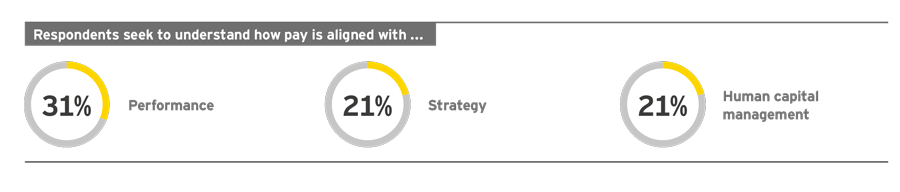
(5) Une rémunération qui est très bien alignée sur la performance et la stratégie.

Je vous propose un résumé des principaux résultats de travaux de recherche de EY. Pour plus de détails, je vous invite à consulter l’article ci-dessous.

Bonne lecture !


2018 Proxy Season Review


Résultats de recherche d'images pour « investisseurs institutionnels »

Les cinq grandes priorités des investisseurs institutionnels en 2018


1. La composition du conseil d’administration, avec un œil sur l’amélioration de la diversité


2. Un niveau d’expertise des administrateurs qui est en lien avec les objectifs d’affaires de l’entreprise


3. Une attention accrue accordée aux risques de nature climatique ou environnemental


4. Une attention marquée accordée à la gestion des talents


5. Une rémunération qui est très bien alignée sur la performance et la stratégie


Investor priorities as seen through the shareholder proposal lens


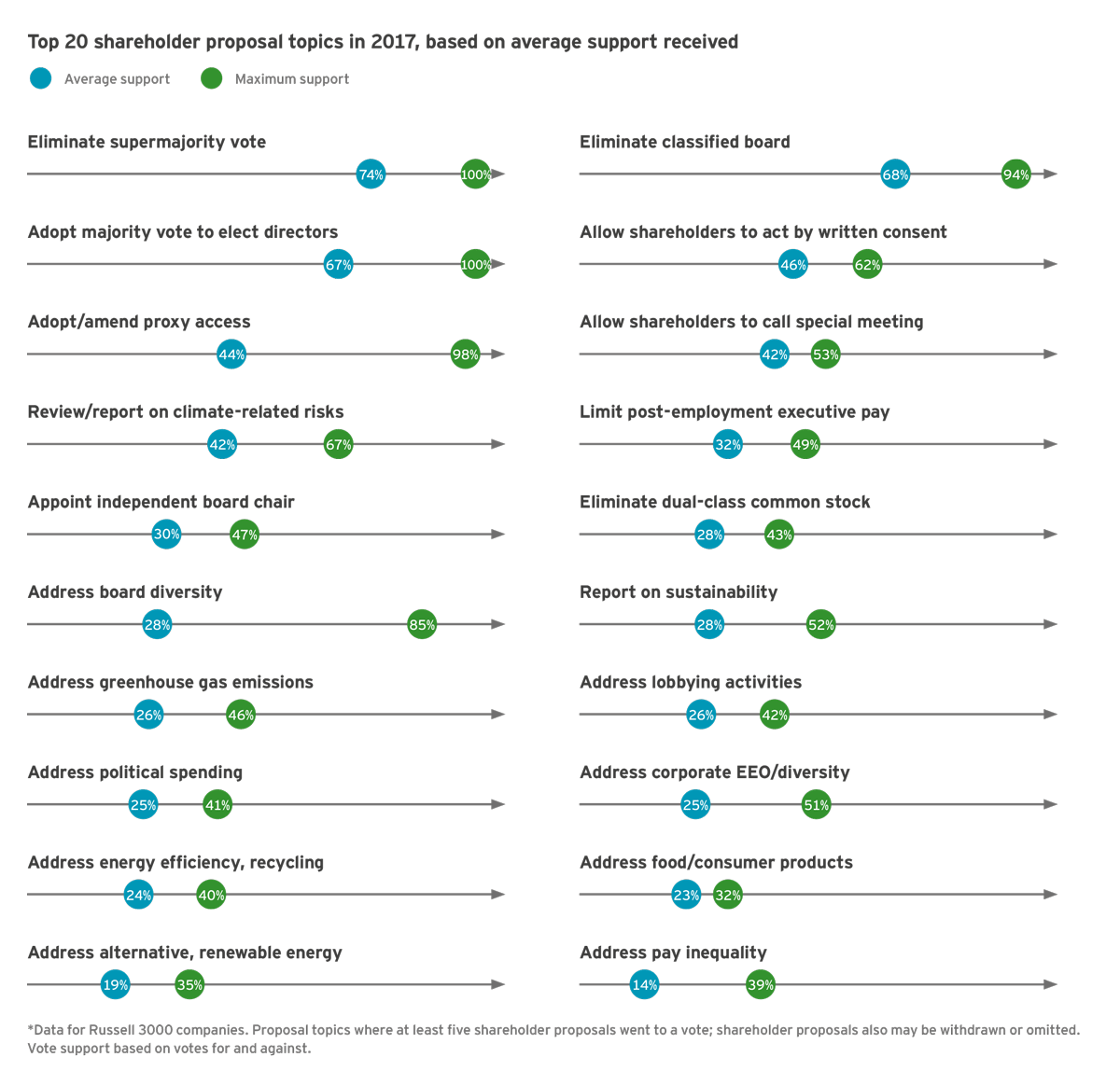
For a broader perspective of investor priorities, a review of the top shareholder proposal topics of 2017, based on average support, shows that around half focus on environment and social topics. While the average support for many of these proposal topics appear low, this understates impact. Environmental and social proposals typically see withdrawal rates of around one-third, primarily due to company-investor successes in reaching agreement. Depending on the company situation and specific proposal being voted, some proposals may receive strong support of votes cast by a company’s broader base of investors.

Conclusion


Institutional investors are increasingly asking companies about how they are navigating changing business environments, technological disruption and environmental challenges to achieve long-term, sustained growth. By addressing these same topics in their interactions with and disclosures to investors, boards and executives have an opportunity to highlight to investors how the company is positioned to navigate business transformations over the short- and long-term. This opportunity, in turn, enables companies to attract the kind of investors that support the approach taken by the board and management. Like strong board composition, enhanced disclosure and investor engagement efforts can serve as competitive advantages.


Questions for the board to consider


– Are there opportunities to strengthen disclosures around the board’s composition and director qualifications and how these support company strategy?

– Do the board and its committees have appropriate access to deep, timely expertise and open communication channels with management as needed for effective oversight?

– Do the board and management understand how key investors generally view the company’s disclosures and strategic initiatives regarding environmental and social matters?

– How does the board define and articulate its oversight responsibilities with regard to talent? And does the board believe that the company has an adequate plan for talent management considering recent employee and employment-related developments and the company’s competitive position?

– To what extent have the board and management offered to dialogue with the governance specialists at their key investor organizations, whether active or passive, and including the largest and smallest, vocal shareholder proponents?

 ____________________________________________
*Steve W. Klemash* is EY Americas Leader at the EY Center for Board Matters. This post is based on an EY publication by Mr. Klemash.

Top 10 de Harvard Law School Forum on Corporate Governance au 8 février 2018


Voici le compte rendu hebdomadaire du forum de la Harvard Law School sur la gouvernance corporative au 8 février 2018.

Cette semaine, j’ai relevé les dix principaux billets.

Bonne lecture !


Résultats de recherche d'images pour « top ten »


  1. Compensation in the 2018 Proxy Season
  2. 2017 Financial Stability Report
  3. Valuable Board Assessments
  4. Dinner Table Human Capital and Entrepreneurship
  5. BlackRock’s Call for Companies to Deliver Financial & Social Value
  6. HLS Forum Sets New Records in 2017
  7. Institutional Investor Engagement: How to Create a “Stewardship Culture”
  8. Top Universities for Corporate Directors
  9. Cryptocurrency 2018
  10. Will Tenure Voting Give Corporate Managers Lifetime Tenure?


Les firmes européennes doivent se préparer à la mise en place du « Shareholder Rights Directive (SRD) »


Ma veille en gouvernance m’amène à vous proposer la lecture d’un article publié par Demi Derem* et Elizabeth Maiellano sur les défis posés par un ensemble de directives récemment approuvées par le Parlement européen et qui traitent du droit des actionnaires : « Shareholder Rights Directive (SRD) ».
La Commission Européenne (CE) veut que les entreprises cotées aient une meilleure connaissance de leurs investisseurs et qu’elles soient en mesure d’interagir d’une manière claire et transparente avec eux. Voici un extrait qui montre l’ampleur des nouvelles directives.

The SRD also grants shareholders the right to vote on companies’ remuneration policies, which may increase the policy analysis and assessment required by the buy-side. Similarly, the SRD requires that any material transaction (as defined by national regulators) between a listed company and a related third party must be announced and approved by the shareholders and the board.

Depending on national requirements, the announcement may also need to be accompanied by a report about the impact of the transaction from an independent third party, the board or a committee of independent directors.

La lecture de cet article montre que les entreprises ont peu de temps pour se conformer aux directives. Les auteurs explorent les impacts de l’adoption de ces règles sur les principaux intéressés, notamment sur les investisseurs institutionnels et les firmes d’intermédiation.

Pour en savoir davantage sur la préparation requise aux règles du SRD, vous pouvez consulter le rapport de la firme Broadridge, Shareholder Rights Directive : Advancing to a State of Readiness.

Bonne lecture !


Advancing to a state of readiness: the new Shareholder Rights Directive


Shareholder Rights Directive


All parties in the shareholder communication chain need to prepare for the enhanced requirements of the new Shareholder Rights Directive—and try to influence its local implementation to encourage a harmonised approach.

The new Shareholder Rights Directive (SRD), adopted by the European Council and approved by the European Parliament this spring, is a laudable initiative intended to encourage shareholder engagement in listed companies in Europe and improve the transparency of related processes— including proxy voting. The European Commission (EC) wants to see proof that companies understand their investors and communicate with them in a clear and transparent manner.

The new SRD updates its 2007 predecessor and introduces some new requirements related to remunerating directors, identifying shareholders, facilitating the exercise of shareholder rights, transmitting information and providing transparency for institutional investors, asset managers and proxy advisors. The majority of the SRD is required to be translated into national law by European member states by June 2019 (although some elements will not come into force until September 2020).

Given the complexities introduced by the new SRD, firms across the shareholder communication chain need to begin preparing now if they are to meet its requirements by 2019. These are expected to entail significant and potentially costly changes relating to process reforms and transparency requirements, impacting issuers, asset managers, custodians, central securities depositories (CSDs), and a range of other intermediaries and service providers.

The two-year member-state transposition process will involve adaptation of the SRD’s requirements to reflect domestic market structures and local legal processes. We encourage all affected firms to engage with the EC and national regulators, and share their views on how the SRD should be implemented. This is vital for achieving outcomes that are equitable and commensurate with the corporate governance benefits of the SRD. If national regulators opt for significantly different interpretations of the SRD, this would be challenging for industry participants.

For example, one global custodian has expressed concern about the risk of national divergence requiring compliance efforts to be tailored to each regulator’s interpretation, thereby increasing the complexity and cost of SRD implementation for firms operating in more than one market.

Another securities services firm believes that discrepancies in implementation dates in different jurisdictions will be problematic for global firms.

Institutional investor impact

Institutional investors and asset managers are likely to be affected by the SRD in a number of ways. For example, both will have to be more transparent about their engagement with investee companies and how they integrate shareholder engagement into their investment strategy. Under the SRD this information must be reported annually and made available on buy-side firms’ websites. These firms must also disclose annually their voting behaviour and explain significant votes and their use of proxy advisor services. The SRD introduces these requirements on a comply-or-explain basis.

The SRD also grants shareholders the right to vote on companies’ remuneration policies, which may increase the policy analysis and assessment required by the buy-side. Similarly, the SRD requires that any material transaction (as defined by national regulators) between a listed company and a related third party must be announced and approved by the shareholders and the board. Depending on national requirements, the announcement may also need to be accompanied by a report about the impact of the transaction from an independent third party, the board or a committee of independent directors.

These new requirements will result in the production of more data and more reporting before a vote, potentially creating a significant burden on asset managers and investors as they try to manage this information flow. This burden is likely to be particularly noticeable with related party transactions.

Intermediary implications

Intermediary firms will need to keep a close watch on national requirements for the adoption of specific identification standards and data items for shareholder transparency requirements. For instance, markets could set different minimum levels of holdings that must be disclosed.

In addition, the SRD refers to providing data in a standardised format but does not specify the standards, so these may be provided by the EC. However, if the disclosure of certain data items would breach some countries’ data privacy laws, national regulators would have to alter the local requirements.

Another change introduced by the SRD is that intermediaries will have to store shareholder information for at least 12 months after they become aware that someone has ceased to be a shareholder. Data storage and retention requirements are therefore likely to increase.

A particular concern for intermediaries is that the SRD requires them to transmit general meeting agenda and voting information “without delay”. National regulators could interpret this as a requirement for real-time or near-real-time reporting. If this means that vote information has to be transmitted immediately, intermediaries will need to introduce intraday processing support. Meanwhile, the need to use a standardised format could result in amendments to current SWIFT message formats, with associated costs. It is also likely that the volume of voting instructions and amendments will increase after implementation of the SRD.

One custodian has expressed concern about the lack of regulatory clarity on whether post-meeting announcements will also have to be transmitted immediately. The EC and national regulators will need to confirm the level of information that must be passed on to shareholders. Some intermediaries may face operational headaches if their current processes can support the transmission of voting information but not of other data items in the same standardised and immediate manner.

Intermediaries could face the brunt of the costs of SRD implementation, particularly because European member states can prohibit intermediaries from charging fees for the cost of changes related to disclosure. If regulators decide to mandate this, intermediaries will have to absorb all compliance costs rather than passing a percentage on to clients.

If regulators are more lenient, intermediaries may be able to pass on certain costs, but the SRD specifies that these must be proven to be proportionate to the cost of offering the service. Intermediaries could therefore have to pay for the full cost of transparency requirements in some jurisdictions, while providing an audit trail of operational costs (and facing questions about any inefficiencies) in others.

The bundling of proxy costs into custody fees may also need re-evaluating, because intermediaries will need to disclose their fees in relation to proxy services. The SRD stresses the need for “non-discriminatory and proportionate” fees and jurisdictions will also have the power to prohibit fees for proxy services. If some do prohibit fees, firms’ business models will need to be revised.

Widespread impact

Issuers and registrars will also be affected by the SRD in relation to the standardisation of meeting announcements and the provision of vote confirmation. And proxy service providers will be impacted, although global firms that already comply with some jurisdictions’ voluntary requirements in transparency and reporting will feel less short-term impact. They could face both opportunities and challenges—with the potential to deliver new services to help intermediaries to support requirements such as vote confirmation, but needing to invest to do so.

The SRD’s transposition period presents market participants with an opportunity to review the impact on their operations, engage with regulators and assess their readiness. It is something that the industry should embrace and collaborate on to get right.

___________________________________________

*Demi Derem is general manager for Investor Communication Solutions, International, at Broadridge, and Elizabeth Maiellano is vice president for product management, Investor Communication Solutions, International, at Broadridge. This article has been prepared in collaboration with Broadridge, a supporter of Board Agenda.

Compte rendu hebdomadaire de la Harvard Law School Forum on Corporate Governance | 1er février 2018


Voici le compte rendu hebdomadaire du forum de la Harvard Law School sur la gouvernance corporative au 1er février 2018.

Cette semaine, j’ai relevé les quinze principaux billets.

Bonne lecture !


  1. Corporate Governance Update: Boards, Sexual Harassment, and Gender Diversity
  2. Informed Trading and Cybersecurity Breaches
  3. The Corporate Governance World in 2018: A Global Review
  4. The Effects of Investment Bank Rankings: Evidence from M&A League Tables
  5. Activism in 2018
  6. Mergers and Acquisitions: 2018 With a Brief Look Back
  7. Preparing a Successful IPO in 2018
  8. From Talking the Talk to Voting the Votes
  9. A Long/Short Incentive Scheme for Proxy Advisory FirmsRésultats de recherche d'images pour « harvard law school »
  10. Destructive Collectivism: Dodd-Frank Coordination and Clearinghouses
  11. 2017 Year in Review: Corporate Governance Litigation & Regulation
  12. Activists and Socially Responsible Investing
  13. The Highest-Paid Boards
  14. Disasters and Disclosures
  15. The Changing Face of Shareholder Activism

Billets récents publiés sur mon blogue en gouvernance en janvier 2018


Voici les quinze billets publiés sur mon blogue en gouvernance des sociétés en janvier 2018.

Bonne lecture ! Vos commentaires sont toujours les bienvenus.


Résultats de recherche d'images pour « blogue en gouvernance »


  1. Que pensez-vous des classes d’actions à droit de vote multiples ?
  2. Compte rendu hebdomadaire de la Harvard Law School Forum on Corporate Governance | 25 janvier 2018
  3. Aspects fondamentaux à considérer par les administrateurs dans la gouvernance des organisations
  4. Comment se préparer à la divulgation du ratio qui révèle la rémunération du CEO comparée à la moyenne des salaires des employés
  5. Compte rendu hebdomadaire de la Harvard Law School Forum on Corporate Governance | 18 janvier 2018
  6. BlackRock soutient le modèle de gouvernance basé sur la primauté accordée aux parties prenantes
  7. Adapter le modèle de gouvernance à la réalité des OBNL de petite taille
  8. Les administrateurs de sociétés qui cumulent plusieurs postes deviennent-ils trop accaparés ?
  9. Compte rendu hebdomadaire de la Harvard Law School Forum on Corporate Governance | 12 janvier 2018
  10. Quelle est l’influence des femmes CEO sur la structure de gouvernance des entreprises ?
  11. La souveraineté des conseils d’administration
  12. Compte rendu hebdomadaire de la Harvard Law School Forum on Corporate Governance | 4 janvier 2018
  13. Enquête de Deloitte sur la diversité des conseils d’administration
  14. Dix thèmes prioritaires à mettre à l’ordre du jour des Boards en 2018
  15. La gouvernance relative aux sociétés en 2017 | Un « Survey » des entreprises du SV 150 et de la S&P 100

Compte rendu hebdomadaire de la Harvard Law School Forum on Corporate Governance | 25 janvier 2018


Voici le compte rendu hebdomadaire du forum de la Harvard Law School sur la gouvernance corporative au 25 janvier 2018.

Cette semaine, j’ai relevé les dix principaux billets.

Bonne lecture !


Résultats de recherche d'images pour « Harvard Law School forum on corporate governance »


  1. Résultats de recherche d'images pour « harvard law school »Governance Gone Wild: Misbehavior at Uber Technologies
  2. Remarks on Shareholder Engagement
  3. The Option to Quit: The Effect of Employee Stock Options on Turnover
  4. Future Issues After the Publication of the CEO Pay Ratio
  5. Activist-Driven Dealmaking Falls Flat
  6. The Appraisal Landscape: Key Points, Open Issues, and Practice Points
  7. Engagement—Succeeding in the New Paradigm for Corporate Governance
  8. Say on Pay: Is It Needed? Does it Work?
  9. U.S. Tax Reform: Changes to 162(m) and Implications for Investors
  10. Evolution or Revolution for Companies with Multi-Class Share Structures


Comment se préparer à la divulgation du ratio qui révèle la rémunération du CEO comparée à la moyenne des salaires des employés


Nous savons que le Dodd-Frank Act aux États-Unis oblige les entreprises publiques à publier le ratio indiquant la rémunération du CEO en comparaison avec la moyenne des salaires des employés.

L’obligation de publier ces ratios dans les rapports aux actionnaires commence cette année, et les entreprises doivent se préparer aux répercussions de cette divulgation.

L’article ci-dessous, publié par Joe Mallin, associé de la firme Pay Governance, paru sur le site du HLS Forum, met l’accent sur les impacts envisagés auprès des parties prenantes.

Quelles seront les retombées de la publication de ces statistiques tant redoutées ? C’est ce dont il est question dans ce court article.

Le graphique qui suit est assez révélateur d’un problème qui concerne les sociétés américaines et canadiennes !


Résultats de recherche d'images pour « CEO pay ratio au Canada »


Comment l’AMF réagira-t-elle à cette nouvelle donne ?

Bonne lecture !


Future Issues After the Publication of the CEO Pay Ratio


Résultats de recherche d'images pour « CEO pay ratio au Canada »
CEO = 184 x average worker pay – Canada CEO Pay – BayStreetEx

Key Takeaways


The CEO Pay Ratio will be published in 2018 proxy season.

As companies begin calculating their Ratios, it is also time to begin thinking about the timeframe immediately following the proxy statement publication and the possible reactions of key interested parties.

We suggest that companies determine how they want to respond to inquiries about the published CEO Pay Ratio and evaluate whether alternative Ratios should be calculated to provide appropriate context.

Companies will need to decide whether to be proactive or reactive to potential inquiries. 


Interested Parties


A. The Media


We envision several likely outcomes as the media begins reporting on the CEO Pay Ratio. These include:

The local publication of tables comparing the CEO Pay Ratios of companies in specific geographies, such as large cities

Similar tables comparing companies across industries, likely by the national media

General conclusions between companies with higher versus lower Ratios (e.g., “high” = “bad”and “low” = “not as bad”)

We believe the tables published by both local and national media will include CEO pay, median employee pay, and the Ratio itself. Such tables will illustrate the fact that the CEO Pay Ratio consists of three parts, and the relationship among these components is key to understanding how employees may perceive its publication. This cross-company media comparison will be problematic: the SEC has stated it does not expect CEO Pay Ratios to be comparable across companies because of the variety of methodologies allowed for computing median employee pay. [1] This distinction is unlikely to make its way into media reports.

B. Employees


With the publication of the CEO Pay Ratio, employees will get a first glimpse into how their colleagues are paid, specifically the median pay of their colleagues. This will be a glimpse of just one number, but it will be a number they did not have access to before. As such, employees will be interested in two aspects of the CEO Pay Ratio:

Internal Comparisons to Median Pay—Employees will compare their own pay to the median employee’s pay. The obvious issue is that, by definition, half will be paid below the median; this could create a morale issue for those employees. Likewise, employees paid above the median could feel the same way if their pay is closer to the median than they had expected. Finally, the methodology used to calculate this median could complicate personal comparisons or cause other issues if the value of benefits are combined with direct compensation.

External Comparisons to Median Pay—Cross-company comparisons of median employee pay will be made. This will be especially prevalent among employees in the same geographic area and industry. Such comparisons could give the impression that a competitor pays more than one’s own company, and this could prompt employees to seek out a higher-paying competitor. This could become a key issue for companies in similar industries and regions, such as Silicon Valley. Will there be a competition to see who has the highest median employee pay? What would the recruiting implications be?

Overall, employees will likely pay more attention to the CEO Pay Ratio’s median employee pay aspect than to the CEO pay itself: CEO pay has been published for many years and should not be a surprise to employees. In addition, company employees may perceive the Ratio as a rather abstract number and have only mild interest in cross-company comparisons.

C. Investors


Early assumptions had been that investors were relatively uninterested in CEO Pay Ratio outcomes. This is due to the assumption the Ratio does not reveal information about the operations and future investment potential of a given company. However, a recent Institutional Shareholder Services (ISS) policy survey [2] indicates:

Only 16% of investors polled (primarily institutional investors) indicated they would not evaluate the CEO Pay Ratio as part of their investment evaluations.

The remaining investors indicated they would either:

Compare Ratios across companies and industries, or

Assess year-over-year changes in the Ratio for individual companies.

The key conclusion is that investors will look for Ratio differences across both companies and time, but any Ratio differences/changes in and of themselves will not likely be enough to change investment decisions. Such information will likely be considered in conjunction with other available information. At the same time, investors may inquire about what they perceive to be “high” Ratios and companies should be prepared for such inquiries.


Addressing Potential Issues


Most companies should be prepared to respond to questions related to the CEO Pay Ratio’s publication. Companies with what are perceived to be “low” ratios will get fewer inquiries, but should be prepared in any case. Responses to investor and media questions could be covered together, as we think they will be similar in nature.

Employee questions will be somewhat different, as they will be more focused on the median employee pay rather than the CEO Pay Ratio itself.

For example, companies may consider publishing multiple “supplemental” CEO Pay Ratios intended to provide context for media, investor and employee perceptions. For example, a significant number of relatively lower-paid, international, part-time, and/or seasonal employees would lower the median employee pay. Ratios will also likely vary significantly by industry: professional services firms with “high” median employee pay will generally have lower Ratios, and those with “low” median employee pay will have higher Ratios.

The supplemental calculations could take the form of Ratios based on:

  1. Domestic employees only—for companies with significant employment in international locations
  2. Salaried employees only—for companies with many lower-paid, non-salaried employees
  3. Full-time employees only—for companies who employ many part-time employees

We believe these additional calculations may provide beneficial insight into the CEO Pay Ratio for employees, investors, and the media. In each case, the supplemental calculations will result in a lower Ratio along with insight into the initial Ratio’s calculation.

Investor/media relation functions should develop talking points to respond to inquiries, especially if their company’s initial CEO Pay Ratio may be perceived as “high”. The likelihood of media inquiries and the need for talking points is less likely among those companies whose CEO Pay Ratio may be perceived as “low”. This is particularly true concerning the media, whose sole focus will be on “high” CEO Pay Ratios. Prepared talking points can also form the basis for responding to employee issues; there should be a sense of cohesion across all responses to the various interested parties.

A key issue will be whether a company should be proactive or reactive to employee questions. Again, the initial CEO Pay Ratio may hold the answer: it may be appropriate to be proactive for a Ratio which may be perceived as “high” and reactive for one that may be perceived as “low”. However, individual Company facts and circumstances should influence this decision.


Conclusions


In general, the publication of CEO Pay Ratios for the first time will be prominently noted by the business media. It remains to be seen whether it will have its “fifteen minutes of fame,” or if it will face lingering scrutiny. However, the CEO Pay Ratio will likely become another aspect of the ongoing societal debate around income inequality and wealth concentration, which is not easily resolved either in this country or around the world.

In any case, we believe companies should begin developing appropriate responses to likely CEO Pay Ratio questions from their employees, investors and the media. Companies are currently in a period when the Ratios are being calculated, and now is the time to begin planning for publication and its after-effects. Be like the Boy Scouts: Be Prepared!

______________________________________

Endnotes

1“Division of Corporation Finance Guidance on Calculation of Pay Ratio Disclosure.” The U.S. Securities and Exchange Commission. September 21, 2017.(go back)

2“Contextualizing CEO Pay Ratio Disclosure.” ISS Corporate Solutions Governance Insights. October 6, 2017.(go back)

Compte rendu hebdomadaire de la Harvard Law School Forum on Corporate Governance | 18 janvier 2018


Voici le compte rendu hebdomadaire du forum de la Harvard Law School sur la gouvernance corporative au 18 janvier 2018.

Cette semaine, j’ai relevé les dix principaux billets.

Bonne lecture !


Résultats de recherche d'images pour « Harvard Law School forum on corporate governance »


Résultats de recherche d'images pour « harvard law school »

  1. Busy Directors and Shareholder Satisfaction
  2. Paying for Performance in Private Equity: Evidence from VC Partnerships
  3. What Do Investors Ask Managers Privately?
  4. How Transparent are Firms about their Corporate Venture Capital Investments?
  5. 2017 Year in Review: Securities Litigation and Regulation
  6. Changes in ISS 2018 Compensation FAQs
  7. Network Effects in Corporate Governance
  8. A Sense of Purpose
  9. The New Digital Wild West: Regulating the Explosion of Initial Coin Offerings
  10. BlackRock Supports Stakeholder Governance

Compte rendu hebdomadaire de la Harvard Law School Forum on Corporate Governance | 12 janvier 2018


Voici le compte rendu hebdomadaire du forum de la Harvard Law School sur la gouvernance corporative au 12 janvier 2018.

Cette semaine, j’ai relevé les dix principaux billets.

Bonne lecture !


Résultats de recherche d'images pour « Harvard Law School forum on corporate governance »

Résultats de recherche d'images pour « Harvard Law School forum on corporate governance »


  1. Tax Reform Implications for U.S. Businesses and Foreign Investments
  2. Ineffective Stockholder Approval for Director Equity Awards
  3. Does Size Matter? Bailouts with Large and Small Banks
  4. Raising the Stakes on Board Gender Diversity
  5. Managing the Family Firm: Evidence from CEOs at Work
  6. Compensation Season 2018
  7. Pay-for-Performance Mechanics
  8. CEO Gender and Corporate Board Structures
  9. Activist Investing in Europe—2017 Edition
  10. Political Uncertainty and Cross-Border Acquisition