Quelles sont les qualités d’un président de conseil d’administration (PCA) exceptionnel ?*


Voici un rapport de recherche publié par la firme Alvarez & Marsal, sur les qualités d’un bon président de conseil d’administration (PCA). L’étude présente les résultats des entrevues menées auprès de 22 PCA des plus grandes sociétés publiques britanniques qui ont oeuvrées avec plus de 120 PCA dans leurs carrières. Cette lecture, vraiment fascinante, montre clairement les qualités des PCA qui sont considérées comme exceptionnelles par leurs pairs. Ci-dessous, un bref extrait du rapport.

What makes an exceptional Chairman ?

« Our research has identified the key attributes displayed by exceptional chairmen in challenging times. Although most difficult to maintain during periods of duress, these characteristics are displayed throughout a chairman’s tenure and across all aspects of their management of the business. We have also compared these attributes with the guidance for chairmen provided by the Higgs Report and the more recent guidance note published by the Financial Reporting Council. This emphasises that ‘good boards are created by good chairmen’ and the importance of the chairman demonstrating ‘ethical leadership.’ In its detail, the guidance provides lists detailing the chairman’s role, rather than the qualities which come out of our research.

Alan Greenspan, Chairman of the Board of Gover...
Alan Greenspan, Chairman of the Board of Governors of the Federal Reserve, 1987-2006 (Photo credit: Wikipedia)

Firstly, and most importantly, an exceptional chairman understands the business, its culture, people and processes. This understanding encompasses recognising and embodying the values of the business as much as having knowledge of the business operations and the marketplace. An exceptional chairman also understands the wider industry and prepares the company for all eventualities, from further market disruption to opportunities to improve competitiveness. This is based on their deep knowledge of the company and sector. Extensive knowledge of a sector or type of sector (e.g. heavy manufacturing) is as important as the chairman’s ability to apply his or her accumulated experiences into effecting transformational change and preparing the business for future challenges.

Secondly, exceptional chairmen never consider themselves a one-person success. They create strong teams that have real influence on the company’s direction by building an effective board of non-execs and establishing a complementary working relationship with the CEO and their team. They implement change through the CEO, but are ready and able to step in at the right time to provide air cover to alleviate pressure. In short, they provide strong active leadership of the board.

Not afraid to take tough decisions in adversity, this type of chairman has an infectious enthusiasm and commitment to change which has a ripple effect, creating a ‘can-do’ attitude throughout the company. With internal stakeholders on board, the chairman uses strong communication skills to engage shareholders and other external stakeholders with change ».

L’article présente 8 aspects qui caractérisent les présidents de conseil qui ont du succès. Lisez la suite dans cet excellent rapport.

______________________________________________

*Je suis en congé jusqu’à la fin septembre. Durant cette période, j’ai décidé de rééditer les billets considérés comme étant les plus pertinents par les lecteurs de mon blogue (depuis le début des activités le 19 juillet 2011).

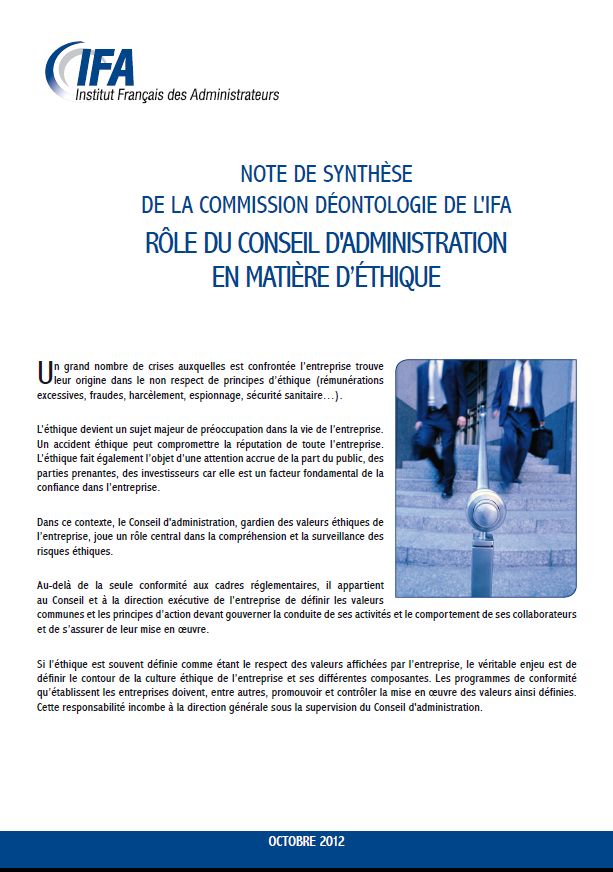
Rôle du conseil d’administration en matière d’éthique*


L’IFA, dans le cadre des travaux de sa Commission Déontologie, s’est penché sur les questions d’éthique et sur le rôle du C.A. en matière d’éthique. Vous trouverez, ci-dessous, les faits saillants des conclusions de cette étude.

« Un accident éthique et c’est toute la réputation d’une entreprise qui peut être compromise ! Rémunérations excessives, fraudes, harcèlement, espionnage, sécurité sanitaire…

Aujourd’hui, un grand nombre de crises auxquelles sont confrontées les entreprises trouvent leur origine dans le non-respect de principes éthiques. Un enjeu de taille qui a poussé la Commission Déontologie de l’Institut Français des Administrateurs (IFA), présidée par Alain Grosmann, à se pencher sur la question.

Après une année de travaux, la commission a présenté, hier, à l’occasion de la Journée annuelle des administrateurs, son rapport sur le « rôle du Conseil d’Administration en matière d’éthique ».


Rôle du Conseil d’Administration en matière d’éthique | Rapport de l’IFA

ifa_ethique


Si l’éthique est souvent définie comme étant le respect des valeurs affichées par l’entreprise, le véritable enjeu est de déterminer le contour de la culture éthique et ses différentes composantes. Une mission qui incombe à la direction générale sous la supervision du Conseil d’administration, gardien des valeurs de l’entreprise.

Plus précisément, son rôle s’articule autour de trois axes indissociables et interdépendants :

Engagement et exemplarité.

Ils se définissent par le temps et les ressources que le Conseil consacre à l’éthique pour la mise en place d’un code et d’un comité éthique, l’inscription des questions éthiques à l’agenda, la sélection des administrateurs, ou encore la prise en compte de critères éthiques dans les décisions stratégiques, etc.

Supervision et contrôle de la démarche éthique.

Le Conseil doit s’assurer de la mise en œuvre de la charte éthique dans l’entreprise, être régulièrement informé et poser des questions pertinentes pour organiser le débat au sein du Conseil et pour prévenir et détecter les comportements non-éthiques et les risques liés.

Réaction et influence sur la culture éthique de l’entreprise.

Le Conseil doit démontrer son intérêt pour une culture d’entreprise forte basée sur des valeurs communes pour inciter le management et les salariés à s’y conformer. Le Conseil doit donner le ton «(« set the tone at the top »).

Dans son rapport, l’IFA dresse 10 recommandations favorisant la prise en compte de l’éthique par les Conseils d’administration :

1. Le Conseil (ou son comité de nomination) doit inclure des critères éthiques dans la sélection de nouveaux administrateurs.
2. Le Conseil doit organiser une ou plusieurs occasions de débat approfondi et collégial sur :

La politique éthique de l’entreprise (de préférence avant l’adoption du rapport du Président)
La cartographie des risques éthiques établie par le management (en liaison éventuelle avec le comité d’audit).
L’évaluation des ressources et du soutien attribué par le management au directeur de l’éthique.

3. Le Conseil doit examiner le code d’éthique de l’entreprise pour s’assurer qu’il correspond bien à ses valeurs et à ses spécificités. Le Conseil doit formaliser son approbation.
4. Le Conseil (ou son comité d’audit) doit s’assurer qu’il y a un volet éthique en conformité dans les missions d’audit demandées à l’audit interne.
5. En l’absence de comité d’éthique ou de tout rôle équivalent dévolu à un autre comité du Conseil, ce dernier doit identifier un administrateur plus particulièrement responsable des questions éthiques, sans pour autant que les autres administrateurs se considèrent déchargés de cette responsabilité.
6. Le directeur de l’éthique doit rendre compte, chaque année, de son action et des résultats de la démarche éthique de l’entreprise non seulement auprès de la direction (ou du Comex) mais également du Conseil d’administration (ou de son comité d’éthique).
7. Les administrateurs doivent s’assurer de la bonne diffusion au sein de l’entreprise de la culture éthique et des principes déontologiques applicables à ses dirigeants ainsi qu’à l’ensemble de ses collaborateurs.
8. Le Conseil doit s’assurer que ses membres ont reçu une formation adéquate en matière d’éthique de l’entreprise.
9. Les administrateurs doivent veiller à ce que les comportements réels de l’équipe de direction correspondent aux pratiques préconisées dans le code d’éthique de l’entreprise. Il est souhaitable que la présentation en Conseil de cette évaluation se fasse hors la présence de la direction. Le Conseil (ou son comité de rémunération) doit prendre en compte l’engagement éthique des dirigeants dans leur évaluation annuelle et dans la détermination de la part variable de leur rémunération.
10.  Le Conseil doit veiller à ce que les aspects éthiques des décisions soumises à sa délibération soient bien pris en compte. Il doit notamment s’assurer que les valeurs éthiques de l’entreprise soient bien prises en compte dans les décisions stratégiques.

Ce rapport « Rôle du Conseil d’Administration en matière d’éthique » est disponible dans l’espace documentaire pour les adhérents ou  commandé en ligne « 

______________________________________________

* En rappel !

Quels sont les devoirs et les responsabilités d’un C.A. ?


Voici un guide de référence publié par l’ÉNAP, en collaboration avec le Collège des administrateurs de sociétés (CAS), qui présente, clairement et en détail, les rôles et les responsabilités des membres de conseils de sociétés d’État.

Ce document a été conçu pour servir de guide à un conseil d’administration désireux de satisfaire aux exigences d’une bonne gouvernance attendue d’un conseil.

Chaque conseil d’administration est donc invité à utiliser ce guide afin de l’aider à bien circonscrire ses rôles et ses responsabilités ainsi que ceux des acteurs qui en font partie, d’établir son propre profil de compétence et d’expérience, et de procéder à l’évaluation de son fonctionnement, du rendement et de la performance des acteurs impliqués dans la vie du conseil.

Voici les éléments abordés dans ce document:

Devoirs et responsabilités d'un conseil d'administration

(1) Les rôles et les responsabilités

Les rôles et les responsabilités du conseil d’administration

Les responsabilités du président du conseil d’administration

Les responsabilités des membres du conseil d’administration

Les responsabilités des comités dits statutaires

Les responsabilités du comité de gouvernance et d’éthique

Les responsabilités du comité de vérification

Les responsabilités du comité des ressources humaines

Les responsabilités du président de comité

Les règles de fonctionnement du conseil d’administration

(2) Le profil de compétence et d’expérience

Les considérations préalables

Le profil de compétence et d’expérience des membres du conseil d’administration

Les attentes à l’endroit du président du conseil d’administration

Profils types de membres

(3) L’évaluation

L’évaluation de la performance du conseil

Questionnaire d’évaluation du rendement et de la performance du conseil

Questionnaire d’évaluation du fonctionnement du conseil

Questionnaire d’évaluation du président du conseil

Questionnaire d’évaluation d’un membre de conseil

Questionnaire d’évaluation du rendement et de la performance du comité de gouvernance et d’éthique

Questionnaire d’évaluation du rendement et de la performance du comité de vérification

Questionnaire d’évaluation du rendement et de la performance du comité des ressources humaines

Questionnaire d’évaluation du fonctionnement d’un comité

Questionnaire d’évaluation d’un membre de comité

Questionnaire d’évaluation du président de comité

______________________________________________

Quelles sont les questions à poser avant de joindre un CA ?*


Voici, en rappel,  un ensemble de questions très pertinentes que vous devriez poser avant d’accepter un poste sur un conseil d’administration. Cet article, rédigé par Ellen B. Richstone*, a récemment été publié dans NACD Directorship; il présente un « check list » qui vous sera sûrement d’une grande utilité au moment de considérer une offre de participation à un C.A.

Je sais; on ne se préoccupe généralement pas de faire un examen (« due diligence ») aussi serré que ce qui est proposé ici mais, si vous avez la chance d’avoir une offre, pourquoi ne pas considérer sérieusement les questions ci-dessous.

C’est un prélude au genre de travail que vous aurez à faire lorsque vous siégerez à un conseil : poser des questions !

L’article nous invite à se questionner sur les aspects suivants (la liste n’est pas exhaustive) :

(1) La mission, la vision, les stratégies, le plan d’action

(2) La dynamique du marché et la part de marché

(3) Les produits

(4) Les compétiteurs

(5) Les clients

(6) Les aspects financiers

(7) Les aspects légaux et l’assurance-responsabilité des administrateurs

(8) Les relations entre le C.A. et la direction

(9) La structure du conseil et la nature des relations entre les administrateurs

(10) Les relations avec les actionnaires

(11) La qualité des produits et services

(12) La qualité des ressources humaines et les relations de travail

(13) Vos valeurs personnelles

(14) Le risque de réputation

(15) Le modèle de gouvernance

Après avoir obtenu des réponses à ces questions, vous devez voir si la culture organisationnelle vous sied et, surtout, si votre contribution peut apporter une valeur ajoutée à ce conseil.

What to Ask Before Joining a Board

You are considering joining a company’s board. You reviewed the publicly available financial, legal, and business information; spoke with management, internal and external legal counsel, and auditors; and evaluated the D&O policy.
Question 2
Question 2 (Photo credit: Blue Square Thing)

You are all set, right? In fact, this is the beginning of your due diligence process: the hardest questions are the least measurable, but equally and sometimes more important than the measurable ones.

With many questions, a company might not want to share the details until you have actually joined the board. In those cases, focus on whether the board and management have a process in place that supports a thoughtful discussion. In particular, think about these questions against the backdrop of your board value and effectiveness.

______________________________________

*Ellen B. Richstone has extensive board and operating experience, both as a CEO and a CFO, and as a director in companies ranging in size from venture capital-backed to S&P 500, public, and private. She currently serves on the board of the NACD New England Chapter, along with several other boards.

Taking Board members onboard (cbglobalassociates.wordpress.com)

Board Composition (professorbainbridge.com)

Risk in the Boardroom (blogs.law.harvard.edu)

______________________________________________

*Je suis en congé jusqu’à la fin septembre. Durant cette période, j’ai décidé de rééditer les billets considérés comme étant les plus pertinents par les lecteurs de mon blogue (depuis le début des activités le 19 juillet 2011).

Dix leçons tirées d’une multitude d’entrevues avec des PCD de PME


Quelles leçons peut-on tirer des entrevues avec les PCD (CEO) d’entreprises de petites capitalisations. C’est ce que nous présente Adam J. Epstein*, un spécialiste de « hedge fund » qui investit des centaines de millions de dollars dans les petites entreprises. L’article a été publié dans mc2MicroCap par Ian Cassel.

J’ai trouvé les conseils très pertinents pour les personnes intéressées à connaître la réalité des évaluations d’entreprises par des investisseurs privés. Qu’en pensez-vous ?

10 Lessons Learned from Interviewing Hundreds of MicroCap CEOs

1)    Preparation – there is no reason to waste your time and someone else’s by sitting down with a CEO to discuss their company without preparing – really preparing.  To me, “really preparing” doesn’t mean looking at Yahoo Finance for a few minutes in the taxi on the way to the meeting, or flipping through the company’s PowerPoint on your phone.  That kind of preparation is akin to walking up a few flights of stairs with some grocery bags to get ready for climbing Mt. Rainier.  To be really prepared for a first meeting means reading/skimming the most recent 10K, the most recent 10Q, the most recent proxy filing, the management presentation, any previous management presentations (more on this later), a recent sell-side company or industry report, and an Internet search of the management team’s backgrounds (with particular emphasis on any prior SEC, NASD, or other state/federal legal problems).  It’s hard to overemphasize how many would-be micro-cap investing disasters can be headed off at the pass by reading what’s said, and not said, and then having the opportunity to ask the CEO directly about what you’ve found.

Stream Near Mt Rainier

2)    Non-Starters – for better or worse, the micro-cap world is home to some “colorful” management teams.  After all of the time served in this regard, absolutely nothing surprises me anymore.  I have found CEOs who were simultaneously running 3 companies, CEOs who were banned from running a public company by the SEC, management presentations that were largely plagiarized, CEOs who shouted profanities in response to basic questions about their “skin in the game,” and CEOs who not only didn’t understand Reg. FD, but clearly didn’t even know it existed.  When in doubt, it’s much better not to invest at all than to make a bad investment; fortunately there are always thousands of other companies to consider.

3)    Company .PPT – these presentations speak volumes about what kind of company you are dealing with if you’re paying attention: a) my colleagues and I came up with a golden rule during my institutional investing tenure, namely that the length of a .ppt presentation is, more often than not, inversely proportional to the quality of the micro-cap company being presented (i.e., any micro-cap company that can’t be adequately presented in less than 20 slides is a problem, and 15 is even better); b) if the slides are too complex to understand on a standalone basis then either the company has a problem or you’re about to invest in something you don’t sufficiently understand – neither is good; c) NEO bios, market information, service/product/IP, strategy, financials, and use of proceeds should all receive equal billing (when buying a house, would you go and visit a house with an online profile that only features pictures of the front yard and the garage?); d) .ppt formatting and spelling/syntax problems are akin to showing up at an important job interview with giant pieces of spinach in your teeth; e) when reviewing use of proceeds (for a prospective financing) or milestones, look up prior investor presentations to see how well they did with prior promises – history often repeats itself; f) treat forward looking projections for what they typically are – fanciful at best, and violations of Reg. FD at worst; and g) micro-cap companies that flaunt celebrities as directors, partners, or investors should be approached cautiously.

4)    NEO Bios – as Ian Cassel often points out quite rightly in my opinion, micro-cap investing is an exercise in wagering on jockeys more than horses.  One of the principal ways prospective investors have to assess jockeys is the manner in which professional backgrounds are set forth; i.e., management bios.  Like a company .ppt, bios of named executive officers speak volumes about the people being described. Here are some things to look out for: a) bios that don’t contain specific company names (at least for a 10 year historic period) typically don’t for a reason, and it’s unlikely to be positive (e.g., “Mr. Smith has held senior management roles with several large technology companies”); b) it’s a good idea to compare SEC bios with bios you might find for the same people on other websites (remember the “three company CEO” referred to earlier?); c) bios that don’t contain any educational references or only highlight executive programs at Harvard, Wharton, Stanford, etc.; d) company websites that don’t have any management/director bios (surprising how many there are); and e) CEOs and CFOs who have never held those jobs before in a public company (to be clear, lots of micro-cap NEOs are “first-timers,” but it’s something you should at least factor into the risk profile of the investment).

5)    Management Conduct – just as management bios speak volumes, so does their conduct at in person one-on-one meetings.  More specifically: a) organized, professional corporate leaders rarely look disheveled or have bad hygiene; b) service providers chosen by companies also represent the company, so the previous observation applies to bankers/lawyers as well; c) CEOs who are overly chatty about non-business issues might not be keen to talk about their companies; d) if a CEO seems glued to their .ppt presentation (i.e., essentially just reading you the slides), tell them to close their laptops and just talk about the company with no visual aids – you will learn an awful lot about them in the ensuing 5 minutes; e) be on the lookout for NEOs or service providers cutting each other off, disagreeing with each other, or talking over one another;  f) when asking questions of the CEO or CFO watch their body language – moving around in their seats, running hands through their hair, perspiration, and less eye contact are nonverbal signs of duress (it’s one of the reasons why in-person meetings with management are always preferable to phone calls); g) if there are more than one NEOs in attendance, are they listening to each other (it’s rarely a great sign when other execs are looking at their phones during meetings); h) is the CEO providing careful, thoughtful answers or are they shooting from the hip – loose lips virtually always sink ships; i) did the CEO answer any questions with “I don’t know” – even great CEOs can’t possibly know the answer to every question about their companies; and j) something partially tongue-in-cheek just to think about – we know from everyday life that when someone starts a sentence with “with all due respect” what inevitably  follows is, well, something disrespectful, and when a CEO repeatedly says “to be honest” what inevitably follows is….

6)    Service Providers – micro-cap service providers (bankers, lawyers, auditors, IR firms, etc.) can run the gamut from highly professional to so bad that they can actually jeopardize companies with their advice.  While it certainly can take a while to learn “the good, the bad, and the ugly” in the micro-cap ecosystem, you can learn a lot about the CEO by asking him/her to take a few minutes to explain why the company’s service providers are the best choices for the shareholders.  It perhaps goes without saying that if a CEO can’t speak artfully, and convincingly in this regard, then buyer beware.

7)    Corporate Governance – spans the full continuum in micro-cap companies from top-notch to nothing more than a mirage.  One way to quickly ferret out which flavor of governance you’re dealing with is to ask a CEO to succinctly set forth the company’s strategy (i.e., goals, risks, opportunities, customers, etc.), and subsequently ask the CEO to describe how each seated director assists with the fundamental elements of achieving that strategy.  Though oversimplified, material disconnects in this regard are very likely to illustrate some governance challenges.  Also, ask the CEO how each of the directors came to the company; if all of the directors were brought to the company by the CEO, it’s fair to ask the CEO how confident an investor should be that the board is suitably independent to monitor the CEOs performance (one of the principal roles of all boards).

8)    Public Company IQ – easily one of the biggest problems with investing in the micro-cap arena is the conspicuous lack of (relevant, successful) capital markets and corporate finance experience in boardrooms and C-suites.  As alluded to earlier, it’s a fact of life that a large percentage of micro-cap officers and directors lack appreciable tenures in shepherding small public companies (to be clear, this doesn’t mean they aren’t smart, successful, and sophisticated, it just means they haven’t had lots of experience in small public companies).  Unlike larger public companies, small public companies can execute relatively well, and still toil in obscurity creating little or no value for shareholders.   It’s a good idea to evaluate the same when meeting with management, because companies with low “public company IQs” are more likely to underperform all else being equal.  Be on the lookout for CEOs who: a) can’t articulate a sensible strategy for maintaining or increasing trading volume; b) seem to regularly undertake financings that are more dilutive than similarly situated peer companies; c) frequently authorize the issuance of press releases that don’t appear to contain material information; d) blame some or all of their capital markets challenges on short-seller/market-making conspiracy theories; and e) can’t name the company’s largest 5 shareholders, their approximate holdings, and the last time he/she spoke to each.

9)    Follow-Up – CEOs who promise to follow-up after meetings with clarified answers, customer references, or more information but don’t are tacitly underscoring for you that they are either disorganized, disingenuous, don’t care about investors or all three.  The opposite is also not good; for example, if the company’s internal or external IR professionals subsequently convey information that seems inappropriate (from a Reg. FD standpoint) – it probably is.

10) Cautionary Note – Bernard Madoff undoubtedly would have passed these tests and a lot more with flying colors.  Sometimes the “bad guys” are really smart and charming and you’re going to either lose most of your money or get defrauded, or both. It’s happened to me, and it’s maddening and humbling at the same time.  Hence, the apt phrase: high risk, high return.

It’s easy, in my experience anyway, to get so skeptical about micro-cap companies that it can be paralyzing.  But, just when you’re about to throw in the towel, along comes a compelling growth prospect run by management with as much integrity and skill as the day is long, and it serves as a poignant reminder of everything that’s great about investing in small public companies.

Like most “best-of” lists, this isn’t intended to be exhaustive by any stretch of the imagination.  In addition to making money and promoting US jobs/innovation, one of the best parts of investing in small public companies in my opinion is continuing to hone the craft, and learn from other investors and their experiences.  Accordingly, add/subtract per your own experiences, and happy hunting.

_________________________________________

*Adam J. Epstein advises small-cap boards through his firm, Third Creek Advisors, LLC, is a National Association of Corporate Directors Board Leadership Fellow, and the author of The Perfect Corporate Board: A Handbook for Mastering the Unique Challenges of Small-Cap Companies, (McGraw Hill, 2012).  He was co-founder and principal of Enable Capital Management, LLC.

Even micro-cap companies not immune to proxy battles (business.financialpost.com)

Enhanced by Zemanta

Quelles sont les questions à poser avant de joindre un CA ?


Voici, en rappel,  un ensemble de questions très pertinentes que vous devriez poser avant d’accepter un poste sur un conseil d’administration. Cet article, rédigé par Ellen B. Richstone*, a récemment été publié dans NACD Directorship; il présente un « check list » qui vous sera sûrement d’une grande utilité au moment de considérer une offre de participation à un C.A.

Je sais; on ne se préoccupe généralement pas de faire un examen (« due diligence ») aussi serré que ce qui est proposé ici mais, si vous avez la chance d’avoir une offre, pourquoi ne pas considérer sérieusement les questions ci-dessous.

C’est un prélude au genre de travail que vous aurez à faire lorsque vous siégerez à un conseil : poser des questions !

L’article nous invite à se questionner sur les aspects suivants (la liste n’est pas exhaustive) :

(1) La mission, la vision, les stratégies, le plan d’action

(2) La dynamique du marché et la part de marché

(3) Les produits

(4) Les compétiteurs

(5) Les clients

(6) Les aspects financiers

(7) Les aspects légaux et l’assurance-responsabilité des administrateurs

(8) Les relations entre le C.A. et la direction

(9) La structure du conseil et la nature des relations entre les administrateurs

(10) Les relations avec les actionnaires

(11) La qualité des produits et services

(12) La qualité des ressources humaines et les relations de travail

(13) Vos valeurs personnelles

(14) Le risque de réputation

(15) Le modèle de gouvernance

Après avoir obtenu des réponses à ces questions, vous devez voir si la culture organisationnelle vous sied et, surtout, si votre contribution peut apporter une valeur ajoutée à ce conseil.

What to Ask Before Joining a Board

You are considering joining a company’s board. You reviewed the publicly available financial, legal, and business information; spoke with management, internal and external legal counsel, and auditors; and evaluated the D&O policy.
Question 2
Question 2 (Photo credit: Blue Square Thing)

You are all set, right? In fact, this is the beginning of your due diligence process: the hardest questions are the least measurable, but equally and sometimes more important than the measurable ones.

With many questions, a company might not want to share the details until you have actually joined the board. In those cases, focus on whether the board and management have a process in place that supports a thoughtful discussion. In particular, think about these questions against the backdrop of your board value and effectiveness.

______________________________________

*Ellen B. Richstone has extensive board and operating experience, both as a CEO and a CFO, and as a director in companies ranging in size from venture capital-backed to S&P 500, public, and private. She currently serves on the board of the NACD New England Chapter, along with several other boards.

Taking Board members onboard (cbglobalassociates.wordpress.com)

Board Composition (professorbainbridge.com)

Risk in the Boardroom (blogs.law.harvard.edu)

Une méthodologie de l’évaluation de la gouvernance des sociétés | ASEAN Corporate Governance Scorecard


Voici un article intéressant publié dans  le 11 juin 2013 et qui présente un système d’évaluation de la qualité de la gouvernance dans un certain nombre de pays asiatiques, basé sur cinq (5) principes-clés. Cette façon de juger de la valeur de la gouvernance par secteur d’activité m’a intéressée.

La méthodologie utilisée n’est pas suffisamment décrite mais la pondération accordée aux cinq dimensions a attiré mon attention, particulièrement le fait que l’on accorde 40 % des points à la « responsabilité du conseil d’administration ».

Vous trouverez ci-dessous les objectifs poursuivis ainsi que la pondération retenue, suivi de l’exemple indonésien. Je vous invite donc à lire cet article et à partager vos impressions d’une telle démarche d’évaluation de la gouvernance. Le lien suivant vous mènera à la version complète du rapport : ASEAN Corporate Governance Scorecard – rapport complet.


The ASEAN Capital Markets Forum (ACMF) and the Asian Development Bank recently established a joint initiative called the ASEAN Corporate Governance Scorecard. Corporate governance refers to the system of governance which controls and directs corporations, and monitors their actions and policies.

The stated objective of the ASEAN Corporate Governance Scorecard is to:

(1) Raise the corporate governance standards and practices of ASEAN publicly listed companies (PLCs);

(2) Give greater international visibility to well-governed ASEAN PLCs and showcase them as investable companies; and

(3) Complement other ACMF initiatives and promote ASEAN as an asset class.

English: The flags of ASEAN nations raised in ...
English: The flags of ASEAN nations raised in MH Thamrin Avenue, Jakarta, during 18th ASEAN Summit, Jakarta, 8 May 2011. (Photo credit: Wikipedia)

The Scorecard judges five key principles of corporate governance in each nation:

  1. Rights of shareholders (10 percent);
  2. Role of stakeholders (10 percent);
  3. Equitable treatment of shareholders (15 percent);
  4. Disclosure and transparency (25 percent); and
  5. Responsibilities of the board (40 percent)

The percentages indicate the allocated weight of each principle in determining the Scorecard of each country.

The ASEAN countries that participated in the initiative include Indonesia, Malaysia, the Philippines, Singapore, Thailand and Vietnam. Please find below a summary of how the ASEAN countries fared.

The complete report can be found here.

Indonesia

Average corporate governance score: 43.4 percent

Maximum score: 75.4 percent

Minimum score: 20.8 percent

Average corporate governance score by sector:

State-owned enterprises (SOEs): 62.2 percent;

Banks: 58.9 percent;

Non-banks: 40.4 percent; and

Private Companies: 39.9 percent

The higher scores listed for banks and SOEs are a result of those sectors being held under closer scrutiny by the Indonesian Central Bank and Ministry of SOEs, which significantly enhances the corporate governance practices of these companies.

The report found that a majority of PLCs in Indonesia still do not practice corporate governance at an international standard. Many of the corporate governance practices included in the Scorecard are voluntary practices, but the report details that Indonesian PLCs often only implement the mandatory practices, or the bare minimum necessary.

Furthermore, Indonesia’s corporate governance code does not have a “comply or explain” requirement, which has resulted in many PLCs not referring to the code at all. Therefore, they are potentially unaware of the other corporate governance practices that can be voluntarily implemented.

Corporate Governance in Developing countries. (surenrajdotcom.wordpress.com)

Corporate governance in multicultural organization (leadershipbyvirtue.blogspot.com)

ASEAN Economic Community is Coming, What Does it Mean for Asian Tech Startups? (techinasia.com)

Les critères d’évaluation du rôle d’administrateur de sociétés


Voici un excellent article publié par Jeffrey Gandz, Mary Crossan, Gerard Seijts et Mark Reno* dans la revue Ivey Business Journal. Les auteurs insistent sur trois critères d’évaluation du rôle d’administrateur de sociétés : (1) compétences, (2) engagement et (3) caractère. Bien que ces trois critères soient déterminants dans l’exercice du rôle d’administrateur, la dimension la plus difficile à appréhender est le leadership qui se manifeste par le « caractère » d’un administrateur.

Les auteurs décrivent 11 caractéristiques-clés dont il faut tenir compte dans le recrutement, la sélection, l’évaluation et la rotation des administrateurs.

Je vous invite donc à lire cet article. En voici un extrait. Qu’en pensez-vous ?

« When it comes to selecting and assessing CEOs, other C-suite level executives or board members, the most important criteria for boards to consider are competencies, commitment and character. This article focuses on the most difficult of these criteria to assess – leadership character – and suggests the eleven key dimensions of character that directors should consider in their governance roles ».

Leadership character and corporate governance

Competencies, commitment and character

Competencies matter. They define what a person is capable of doing; in our assessments of leaders we look for intellect as well as organizational, business, people and strategic competencies. Commitment is critical. It reflects the extent to which individuals aspire to the hard work of leadership, how engaged they are in the role, and how prepared they are to make the sacrifices necessary to succeed. But above all, character counts. It determines how leaders perceive and analyze the contexts in which they operate. Character determines how they use the competencies they have. It shapes the decisions they make, and how these decisions are implemented and evaluated.

Seasonal Reflection on Ivey Business building
Seasonal Reflection on Ivey Business building (Photo credit: Marc Foster)

Focus on character

Our research has focused on leadership character because it’s the least understood of these three criteria and the most difficult to talk about. Character is foundational for effective decision-making. It influences what information executives seek out and consider, how they interpret it, how they report the information, how they implement board directives, and many other facets of governance.

Within a board, directors require open, robust, and critical but respectful discussions with other directors who have integrity, as well as a willingness to collaborate and the courage to dissent. They must also take the long view while focusing on the shorter-range results, and exercise excellent judgment. All of these behaviors hinge on character.

Our research team at Ivey was made very conscious of the role of character in business leadership and governance when we conducted exploratory and qualitative research on the causes of the 2008 financial meltdown and the subsequent recession. In focus groups and conference-based discussions, where we met with over 300 business leaders on three continents, participants identified character weaknesses or defects as being at the epicenter of the build-up in financial-system leverage over the preceding decade, and the ensuing meltdown. Additionally, the participants identified leadership character strengths as key factors that distinguished the companies that survived or even prospered during the meltdown from those that failed or were badly damaged.

Participants in this research project identified issues with character in both leadership and governance. Among them were:

Overconfidence bordering on arrogance that led to reckless or excessive risk-taking behaviors

Lack of transparency and in some cases lack of integrity

Sheer inattention to critical issues

Lack of accountability for the huge risks associated with astronomical individual rewards

Intemperate and injudicious decision-making

A lack of respect for individuals that actually got in the way of effective team functioning

Hyper-competitiveness among leaders of major financial institutions

Irresponsibility toward shareholders and the societies within which these organizations operated.

These character elements and many others were identified as root or contributory causes of the excessive buildup of leverage in financial markets and the subsequent meltdown. But the comments from the business leaders in our research also raise important questions about leadership character. Among them:

What is character? It’s a term that we use quite often: “He’s a bad character”; “A person of good character”; “A character reference.” But what do we really mean by leadership “character”?

Why is it so difficult to talk about someone’s character? Why do we find it difficult to assess someone’s character with the same degree of comfort we seem to have in assessing their competencies and commitment?

Can character be learned, developed, shaped and molded, or is it something that must be present from birth – or at least from childhood or adolescence? Can it change? What, if anything, can leaders do to help develop good character among their followers and a culture of good character in their organizations?

___________________________

Strategic Leaders-Challenges, Organizational Abilities & Individual Characteristics (workplacepsychology.net)

How to Succeed As a Leader! (ejims05.wordpress.com)

Character & Leadership (colleensharen.wordpress.com)

Entrevue avec Robert Monks, actionnaire activiste


Je vous invite à visionner la vidéo de ReutersVideo dans laquelle Lucy Marcus discute ouvertement et candidement avec Robert Monks, actionnaire activiste avéré et conseiller en gouvernance de sociétés, à propos des réformes entreprises au Royaume-Uni, en comparaison avec les É.U.

boardroom
boardroom (Photo credit: The_Warfield)

M. Monks donne son avis sur les comportements des administrateurs de demain et montre comment ceux-ci peuvent se préparer et surmonter une  situation de crise.

Vous serez probablement aussi intéressés à plusieurs autres vidéos de la série In the Boardroom présentée sur YouTube. Bon visionnement !

Article d’intérêt :

Men seen as impediments to shaking up boardrooms (business.financialpost.com)

Sept étapes à considérer dans l’évaluation des conseils d’administration et des administrateurs


Cet article rédigé par Geoffrey KIEL, James BECK et Jacques GRISÉ (1) et paru dans les Documents de travail de la Faculté des sciences de l’administration en 2008 est toujours d’actualité.

Il présente un guide pratique des questions clés que les conseils d’administration doivent prendre en considération lorsqu’ils planifient une évaluation.

On met l’accent sur l’utilité d’avoir des évaluations bien menées ainsi que sur les sept étapes à suivre pour des évaluations efficaces d’un conseil d’administration et des administrateurs. Bonne lecture.

SEPT ÉTAPES À SUIVRE POUR DES ÉVALUATIONS EFFICACES D’UN CONSEIL D’ADMINISTRATION ET DES ADMINISTRATEURS


Lorsqu’une crise se produit au sein d’une société, comme celles qu’ont connues Nortel et Hollinger International, les intervenants, les médias, les organismes de réglementation et la collectivité se tournent vers le conseil d’administration pour trouver des réponses. Étant donné que ce dernier est le chef décisionnel ultime de la société, il est responsable des actions et du rendement de la société.Main entrance of the Price Building, in the ol...

Le défi actuel que doivent relever les conseils d’administration consiste à accroître la valeur des organisations qu’ils gouvernent. Grâce à l’évaluation du rendement, les conseils d’administration peuvent s’assurer qu’ils ont les connaissances, les compétences et la capacité de relever ce défi.

Plusieurs guides et normes de pratiques exemplaires reconnaissent cette notion. Ainsi, la Commission des valeurs mobilières de l’Ontario indique dans les lignes directrices sur la gouvernance des sociétés (NP 58-201) que « le conseil d’administration, ses comités et chacun de ses administrateurs devraient faire l’objet régulièrement d’une évaluation à l’égard de leur efficacité et de leur contribution ».

L’évaluation du conseil d’administration est trop souvent perçue comme un mal nécessaire – un processus mécanique consistant à cocher des points sur une liste qui, en bout de ligne, a peu de valeur réelle pour le conseil d’administration si ce n’est pour satisfaire aux exigences en matière de conformité. Toutefois… un processus efficace d’évaluation du conseil d’administration peut donner lieu à une transformation.

Une publication du Collège des administrateurs de sociétés (CAS), sous forme de questions et réponses sur la gouvernance, a été conçue à l’intention des administrateurs nommés par le gouvernement du Québec comme membre d’un conseil d’administration d’une société d’État ou d’un organisme gouvernemental. Celle-ci vise à répondre aux questions les plus courantes qu’un administrateur nouvellement nommé peut légitimement se poser en matière de gouvernance. On y indique qu’ « une évaluation faite à intervalles périodiques est essentielle pour assurer le maintien d’une gouvernance efficace » (2).

Cet article offrira une approche pratique en matière d’évaluations efficaces des conseils d’administration et des administrateurs en appliquant un cadre comportant sept étapes qui pose les questions clés que tous les conseils d’administration devraient prendre en considération lorsqu’ils planifient une évaluation. Même les conseils d’administration efficaces peuvent tirer profit d’une évaluation bien menée.

Comme nous l’avons résumé dans le tableau 1, une évaluation menée adéquatement peut contribuer considérablement à des améliorations du rendement à trois niveaux : organisation, conseil d’administration et administrateur. Selon Lawler et Finegold « les conseils qui évaluent leurs membres et qui s’évaluent ont tendance à être plus efficaces que ceux qui ne le font pas ». Toutefois, il faut souligner que ces avantages ne sont possibles qu’au moyen d’une évaluation du conseil d’administration menée de manière appropriée; si l’évaluation n’est pas faite correctement, cela peut causer de la méfiance parmi les membres du conseil d’administration et entre le conseil lui-même et la direction.

Une publication de l’École d’administration publique du Québec (ENAP), produite en collaboration avec le Collège des administrateurs de sociétés (CAS), présente une section traitant de l’évaluation de la performance du conseil d’administration (3).

Selon les auteurs, « L’évaluation est une composante essentielle d’une saine gouvernance d’entreprise. Elle permet de jeter un regard sur la façon dont les décisions ont été prises et sur la manière d’exercer la gestion des activités de l’organisation et ce, dans une perspective d’amélioration continue… Il incombe au président du conseil d’instaurer une culture d’évaluation du rendement et de la performance. Pour ce faire, il doit veiller à la mise en place d’un processus d’évaluation clair, à l’élaboration de règles et d’outils pertinents, à la définition des responsabilités de chaque intervenant dans le processus d’évaluation, à la diffusion de l’information et à la mise en place des correctifs nécessaires ». Dans cette publication, on présente dix outils détaillés d’évaluations (questionnaires) qui concernent les groupes cibles suivants :

1. l’évaluation du conseil

2. l’évaluation du fonctionnement du conseil

3. l’évaluation du président du conseil

4. l’évaluation d’un membre de conseil

5. l’évaluation du comité de gouvernance et d’éthique

6. l’évaluation du comité de vérification

7. l’évaluation du comité des ressources humaines

8. l’évaluation du fonctionnement d’un comité

9. l’évaluation d’un membre de comité

10. l’évaluation du président d’un comité

_______________________________________

(1) Geoffrey Kiel, Ph.D., premier vice-chancelier délégué et doyen de l’École d’administration, University of Notre Dame, Australie, et président de la société Effective Governance Pty Ltd, James Beck, directeur général, Effective Governance Pty Ltd, Jacques Grisé, Ph.D., F.Adm.A., collaborateur spécial du Collège des administrateurs de sociétés (CAS), Faculté des sciences de l’administration, Université Laval, Québec.

(2) Collège des administrateurs de sociétés, Être un administrateur de sociétés d’état : 16 questions et réponses sur la gouvernance, Faculté des sciences de l’administration, Université Laval, 2007.

(3) ENAP, Les devoirs et responsabilités d’un conseil d’administration, Guide de référence, Bibliothèque et Archives nationales du Québec, 2007.


Enhanced by Zemanta

On vous offre de siéger sur un C.A. | Posez les bonnes questions avant d’accepter !


Voici un ensemble de questions très pertinentes que vous pourriez (devriez) poser avant de vous joindre à un conseil d’administration. Cet article, rédigé par Ellen B. Richstone*, a été publié aujourd’hui dans NACD Directorship; il présente un genre de « check list » qui vous sera sûrement d’une grande utilité au moment de considérer une offre de participation à un C.A.

Je sais; on ne se préoccupe généralement pas de faire un examen (« due diligence ») aussi serré que ce qui est proposé ici mais, si vous avez la chance d’avoir une offre, pourquoi ne pas considérer sérieusement les questions ci-dessous. C’est un prélude au genre de travail que vous aurez à faire quand vous siégerez à ce conseil : poser des questions !

L’article nous invite à se questionner sur les aspects suivants :

(1) La mission, la vision, les stratégies, le plan d’action

(2) La dynamique du marché et la part de marché

(3) Les produits

(4) Les compétiteurs

(5) Les clients

(6) Les aspects financiers

(7) Les aspects légaux et l’assurance-responsabilité des administrateurs

(8) Les relations entre le C.A. et la direction

(9) La structure du conseil et la nature des relations entre les administrateurs

(10) Les relations avec les actionnaires

(11) La qualité des produits et services

(12) La qualité des ressources humaines et les relations de travail

(13) Vos valeurs personnelles

(14) Le risque de réputation

(15) Le modèle de gouvernance

Après avoir obtenu des réponses à ces questions, vous devez voir si la culture organisationnelle vous sied et, surtout, si votre contribution peut constituer une valeur ajoutée à ce conseil.

What to Ask Before Joining a Board

You are considering joining a company’s board. You reviewed the publicly available financial, legal, and business information; spoke with management, internal and external legal counsel, and auditors; and evaluated the D&O policy.
Question 2
Question 2 (Photo credit: Blue Square Thing)

You are all set, right? In fact, this is the beginning of your due diligence process: the hardest questions are the least measurable, but equally and sometimes more important than the measurable ones.

With many questions, a company might not want to share the details until you have actually joined the board. In those cases, focus on whether the board and management have a process in place that supports a thoughtful discussion. In particular, think about these questions against the backdrop of your board value and effectiveness.

______________________________________

*Ellen B. Richstone has extensive board and operating experience, both as a CEO and a CFO, and as a director in companies ranging in size from venture capital-backed to S&P 500, public, and private. She currently serves on the board of the NACD New England Chapter, along with several other boards.

Taking Board members onboard (cbglobalassociates.wordpress.com)

Board Composition (professorbainbridge.com)

Risk in the Boardroom (blogs.law.harvard.edu)

Évaluation de la performance du PCD (CEO) | Survey 2013 de Stanford


Une étude conduite par le Center for Leadership Development and Research de la Stanford Graduate School of Business, Stanford University’s Rock Center for Corporate Governance, et The Miles Group montre que les administrateurs évaluent piètrement la performance de leur PCD (CEO) sur les dimensions de la gestion des talents et de leur capacité (ou leur volonté) à créer les conditions favorables à l’engagement de leur conseil.

L’on s’en doute, les priorités sont toujours accordées aux performances financières. Ce n’est pas surprenant !  Seulement 5 % de la note finale est attribuée aux activités relatives au développement des talents et à la planification de la relève… Si l’on croit vraiment que ce sont deux activités stratégiques clés, il faut leur accorder une part plus substantielle de l’évaluation. Sinon, on lance le message que ce que l’on mesure est ce qui importe !

Voici un sommaire des points saillants de l’étude. Pour obtenir plus de détails sur les résultats de l’étude, je vous invite à consulter le site de Stanford. Bonne lecture.

2013 CEO Performance Evaluation Survey

Boards rate CEOs high in decision-making, low in talent development
 
More than 160 CEOs and directors of North American public and private companies were polled in the 2013 Survey on CEO Performance Evaluations, which studied how CEOs themselves and directors rate both chief executive performance as well as the performance evaluation process. When directors were asked to rank the top weaknesses of their CEO, “mentoring skills” and “board engagement” tied for the #1 spot. “This signals that directors are clearly concerned about their CEO’s ability to mentor top talent,” says Stephen Miles, founder and chief executive of The Miles Group. “Focusing on drivers such as developing the next generation of leadership is essential to planning beyond the next quarter and avoiding the short-term thinking that inhibits growth.”

2013 CEO Performance Evaluation Survey

Little weight given to customer service, workplace safety, and innovation in CEO evaluations.

While accounting, operating, and stock price metrics are assigned high value by boards, other factors generally hold little worth when boards rate their CEOs. “Seeming important things such as product service and quality, customer service, workplace safety, and even innovation are used in less than 5% of evaluations,” says Professor Larcker.

CEOs and boards believe the evaluation process is balanced.

Eighty-three percent (83%) of directors and 64% of CEOs believe that the CEO evaluation process is a balanced approach between financial performance and nonfinancial metrics, such as strategy development and employee and customer satisfaction. “Unfortunately, the truth of the matter is that the CEO evaluation process is not that balanced,” says Professor Larcker. “Amid growing calls for integrating reporting and corporate social responsibility, companies are still behind the times when it comes to developing reliable and valid measures of nonfinancial performance metrics.”

CEOs failing to engage boards.

Board relationships and engagement” tied with “mentoring and development skills” as the #1 weakness in CEOs. “This serious disconnect between management and the boardroom has multiple negative ramifications,” says Mr. Miles. “Board engagement is absolutely vital to the function of the CEO – and to the health of a company. How can the board understand what’s going on in the company if the CEO is not engaging?”

Directors lukewarm when comparing their CEOs against peer group.

Forty-one percent (41%) of directors believe that their CEO is in the top 20% of his or her peers, while 17% believe that their CEO is below the 60th percentile. “For almost half of directors to say that their CEO is just ‘in the top 20 percent’ is not exactly a ringing endorsement,” says Mr. Miles. “The board hires the CEO – they should believe that they have the individual in that job who is absolutely the best, or can quickly become the best. The fact that nearly 20% of directors feel that their CEO ranks below the top 40% means that a lot of CEOs should be preparing their resumes.”

Disconnect in how CEOs and directors regard the evaluation process.

Sixty-three percent (63%) of CEOs versus 83% of directors believe that the CEO performance process is effective in their companies. “Nearly a third of CEOs don’t think that their evaluation is effective,” says Professor Larcker. “The success of an organization is dependent on open and honest dialogue between the CEO and the board. It is difficult to see how that can happen without a rigorous evaluation process.”

10% of companies say they have never evaluated their CEO.

“Given their fiduciary duties, it’s strange that any company would not evaluate its CEO,” says Professor Larcker. “The CEO performance evaluation should feed all sorts of board decisions, including goal setting, corporate performance measurement, compensation structure, and succession planning. Without an evaluation of the CEO, how can the board claim to be monitoring a corporation?”

CEOs highly likely to agree with the results of their performance evaluation.

Only 12% of CEOs believe that they are rated too high or too low overall, and almost half (49%) do not disagree with any area of their performance evaluation. “Shareholders have to wonder at the objectivity of the evaluation process,” says Professor Larcker. “It’s hard to believe that boards are pushing CEOs on their evaluations if they pretty much agree with their evaluation.”

Only two-thirds of CEOs believe that their own performance evaluation is a meaningful exercise.

“Even though a high percentage of directors and CEOs think that the CEO evaluation process is meaningful, this number really should be 100%,” says Mr. Miles. “Every board has the power to meaningfully evaluate the CEO – whether doing it themselves, or bringing in someone to do it, or some combination thereof.”

Directors unlenient on violations of ethics but more forgiving of CEOs with legal or regulatory violations that occur on their watch.

“A significant minority of directors – 27 percent – say that unexpected litigation against the company would have no impact on their CEO’s performance evaluation,” says Professor Larcker, while « approximately a quarter of directors (24%) say that unexpected regulatory problems would also have no impact. » By contrast, all directors (100%) say that their CEO’s performance evaluation would be negatively impacted by ethical violations or a lack of transparency with the board.

Mise à jour des compétences des membres du C.A.


Voici un plaidoyer en faveur de l’établissement d’un comité de gouvernance et de nomination par Alan. S. Gutterman. L’article est intéressant en ce qu’il procure d’excellentes justifications pour l’amélioration continue des membres du conseil. De plus, l’auteur présente une description des principaux devoirs et responsabilités des administrateurs qui sera utile à tout nouveau membre du conseil.

J’ajouterais que les programmes de formation en gouvernance telles que ceux du Collège des administrateurs de sociétés (CAS) sont de plus en plus nécessaires de nos jours. Voici un aperçu du billet de M. Gutterman.

« The centerpiece of any such initiative is creating a permanent committee committed to working year-round on board development. This includes not only the traditional recruiting and selection but also mapping out a long-term strategy for the board’s composition and ensuring that active members are informed about “best practices” for being knowledgeable and effective (e.g., orientation, training and assessment) ».

Turn your board of directors into a key strategic asset

« One simple but often neglected step in board development is creating a description of the duties and responsibilities of directors. It’s like a job description and should be written in a manner that informs candidates about the types of behaviors that will be expected of them. Consider the following list as an example:

Intel Board of Directors
Intel Board of Directors (Photo credit: IntelFreePress)

Attend regular meetings of the company’s board of directors, which are held at least four times per year and which generally extend for about four to five hours.

Be accessible for personal contact with other board members and company officers between board meetings.

Participate on, and provide leadership to, at least one of the committees of the board. Prepare for active participation in board meetings and board decision making, including thorough review of materials distributed in advance.

Participate in orientation and training activities for new and continuing directors and proactively seek out other self-education opportunities on issues and problems that are being considered by the board.

Responsibly review and act upon recommendations of board committees brought to the entire board of directors for discussion and action.

Participate in the annual self-review process required of all board members.

Participate in the annual development and planning retreat for the entire board, which is usually held in January of each year.

Understand and comply with the terms and conditions of all policies, procedures and agreement applicable to board members in general and to you specifically, including fiduciary obligations imposed on board members under applicable laws.

In general, use your personal and professional skills, relationships, experiences and knowledge to advance the interests and prospects of the company.

A description of director duties and responsibilities is obviously important during the recruitment, interviewing and selection process; however, it also can be used as a guide in the development of orientation and training programs and creating of an assessment framework to evaluate how well directors are fulfilling their obligations ».

Taking Board members onboard (cbglobalassociates.wordpress.com)

3 Ways to Find Your Perfect Board of Advisors (entrepreneur.com)

Comment bâtir un C.A. d’OBNL performant ?


Voici une présentation de diapos très efficace préparée et partagée par Misha Charles, experte dans le domaine de la gouvernance organisationnelle. Sliseshares est une excellente façon de livrer votre message à vos réseaux. En voici un exemple.

Comment bâtir un C.A. d’OBNL performant ?

L’effet de l’ancienneté – comme PCD ou comme membre de C.A. – sur la performance !


Que penser de cette recherche publiée dans The Magazine de HBR par Xueming Luo, Vamsi K. Kanuri et Michelle Andrews ? Les résultats de cette recherche vous font-ils réfléchir sur les implications (positives ou négatives) liées au grand nombre d’années passées en tant que premier dirigeant (PCD-CEO), ou sur le nombre de mandats maximum des membres de conseils d’administration ? Comme vous le savez, on voit de plus en plus apparaître des politiques concernant le nombre de mandats que les membres de conseils devraient obtenir… Quel est votre point de vue à cet égard ?

The longer a CEO serves, the more the firm-employee dynamic improves. But an extended term strengthens customer ties only for a time, after which the relationship weakens and the company’s performance diminishes, no matter how united and committed the workforce is.

Long CEO Tenure Can Hurt Performance

It’s a familiar cycle: A CEO takes office, begins gaining knowledge and experience, and is soon launching initiatives that boost the bottom line. Fast-forward a decade, and the same executive is risk-averse and slow to adapt to change—and the company’s performance is on the decline. The pattern is so common that many refer to the “seasons” of a CEO’s tenure, analogous to the seasons of the year.

Tenure
Tenure (Photo credit: Toban B.)

New research examines the causes of this cycle and shows that it’s more nuanced than that. We found that CEO tenure affects performance through its impact on two groups of stakeholders—employees and customers—and has different effects on each. The longer a CEO serves, the more the firm-employee dynamic improves. But an extended term strengthens customer ties only for a time, after which the relationship weakens and the company’s performance diminishes, no matter how united and committed the workforce is.

We studied 356 U.S. companies from 2000 to 2010. We measured CEO tenure and calculated the strength of the firm-employee relationship each year (by assessing such things as retirement benefits and layoffs) and the strength of the firm-customer relationship (by assessing such things as product quality and safety). We then measured the magnitude and volatility of stock returns. All this allowed us to arrive at an optimal tenure length: 4.8 years.

The underlying reasons for the pattern, we believe, have to do with how CEOs learn. Previous research has shown that different learning styles prevail at different stages of the CEO life cycle. Early on, when new executives are getting up to speed, they seek information in diverse ways, turning to both external and internal company sources. This deepens their relationships with customers and employees alike.

But as CEOs accumulate knowledge and become entrenched, they rely more on their internal networks for information, growing less attuned to market conditions. And, because they have more invested in the firm, they favor avoiding losses over pursuing gains. Their attachment to the status quo makes them less responsive to vacillating consumer preferences.

« These findings have several implications for organizations. Boards should be watchful for changes in the firm-customer relationship. They should be aware that long-tenured CEOs may be skilled at employee relations but less adept at responding to the marketplace; these leaders may be great motivators but weak strategists, unifying workers around a failing course of action, for example. Finally, boards should structure incentive plans to draw heavily on consumer and market metrics in the late stages of their top executives’ terms. This will motivate CEOs to maintain strong customer relationships and to continue gathering vital market information firsthand ».

Que pensent vraiment les PCD de leur C.A. ?


Que pensent vraiment les PCD de leur C.A. ?  Les auteurs Jeffrey Sonnenfeld*, Melanie Kusin* et  Elise Walton* ont procédé à des entrevues en profondeur avec une douzaine de PCD (CEO) expérimentés et ils ont publiés la synthèse de leurs résultats dans Harvard Business Review (HBR). Essentiellement, les chercheurs voulaient savoir comment les C.A. peuvent avoir une influence positive et devenir un atout stratégique. Ils ont résumé leur enquête en faisant ressortir 5 conseils à l’intention des conseils d’administration. Voici un extrait de cet article très intéressant. Vos commentaires sont les bienvenus !

What CEOs Really Think of Their Boards

Over the past several years, in the wake of corporate missteps that have taken a toll on shareholders and communities alike, we’ve heard plenty about how boards of directors should have been more responsible stewards. Corporate watchdogs, investors and analysts, members of the media, regulators, and pundits have proposed guidelines and new practices. But one voice has been notably missing from this chorus—and it belongs to the constituency that knows boards and their failings best. It’s the voice of the CEO.

Harkness Tower, situated in the Memorial Quadr...
Harkness Tower, situated in the Memorial Quadrangle at Yale (Photo credit: Wikipedia)

There are reasons for this silence from the chief executive camp. Few CEOs volunteer their views publicly; they know they’d risk looking presumptuous and becoming a target. They realize it would be foolhardy to draw attention to their own governance dysfunctions or seem to reveal boardroom confidences. Meanwhile, people who do make it their business to speak out on governance haven’t made much effort to elicit CEOs’ views. Extreme cases of CEO misconduct have created skepticism about whether CEOs can help fix faulty governance—a dangerous overreaction. Many observers, having seen grandiose, greedy, and corrupt CEOs protected by inattentive or complicit directors, consider excessive CEO influence on boards to be part of the problem. Others may lack the access to CEOs and the level of trust needed for frank conversations. Whatever the reasons, the omission is unfortunate. Not only do CEOs have enormous experience to draw on, but their views are the ones boards are most likely to heed.

We recently tapped our networks to bring CEOs’ opinions to light. We talked to dozens of well-regarded veteran chief executives, focusing on people with no particular reason to resent boards—we didn’t want bitterness or self-justification to color the findings. We wanted to know: What keeps a board from being as effective as it could be? Is it really the cartoon millstone around the CEO’s neck, or does it have a positive influence on the enterprise? What can a board do to become a true strategic asset?

We were surprised by the candor of the responses—even given our comfortable relationships with the CEOs and our assurances that quotes would not be attributed without express permission. Clearly, CEOs believe it is important to address problems and opportunities they’re uniquely positioned to observe. They know that their strategic visions and personal legacies can be undone by bad governance, and they have plenty to say on the subject. We’ve distilled their comments into five overarching pieces of advice for boards.

      1. Don’t Shun Risk or See It in Personal Terms
      2. Do the Homework, and Stay Consistently Plugged In
      3. Bring Character and Credentials, Not Celebrity, to the Table
      4. Constructively Challenge Strategy
      5. Make Succession Transitions Less Awkward, Not More So

« Every board is different. If you serve on one, some of these comments may strike close to home; others may not. As we listened to CEOs and reviewed our transcripts looking for patterns, we identified three important takeaways.

First, contrary to what some critics believe, CEOs do not want to keep their boards in the dark or to chip away at directors’ power. They recognize that they and their shareholders will get more value if the partnership at the top is strong. Great CEOs know that if governance isn’t working, it’s everyone’s job to figure out why and to fix it.

Second, most boards aren’t working as well as they should—and it’s not clear that any of the systemic reforms that have been proposed will remedy matters. Although governed by bylaws and legal responsibilities, interactions between CEOs and directors are still personal, and improving them often requires the sorts of honest, direct, and sometimes awkward conversations that serve to ease tensions in any personal relationship. When strong relationships are in place, it becomes easier for CEOs to speak candidly about problems—for example, if the board isn’t adding enough value to decision making, or if individual directors are unconstructive or overly skeptical. For their part, directors should be clear about what they want—whether it’s less protocol and fewer dog and pony shows or more transparency, communication, and receptivity to constructive criticism.

Third, the best leadership partnerships are forged where there is mutual respect, energetic commitment to the future success of the enterprise, and strong bonds of trust. A great board does not adopt an adversarial, “show me” posture toward management and its plans. Nor does it see its power as consisting mainly of checks and balances on the CEO’s agenda. Great boards support smart entrepreneurial risk taking with prudent oversight, wise counsel, and encouragement ».

____________________________________

Jeffrey Sonnenfeld*, is the senior associate dean for executive programs and the Lester Crown Professor at Yale University’s School of Management, is the founding CEO of Yale’s Chief Executive Leadership Institute. Melanie Kusin* is the vice chairman of Korn/Ferry International’s CEO practice. Elise Walton*, is a former Yale–Korn/Ferry senior research fellow, consults on corporate governance and executive leadership.

CEO & Board of Directors: Forging An Effective Relationship (rickdacri.wordpress.com)

Boards should be concerned about their CEOs (normanmarks.wordpress.com)

Rémunérations des administrateurs et pratiques de gouvernance | Survey du Conference Board 2013 (jacquesgrisegouvernance.com)

L’attention est de plus en plus mise sur l’efficience des C.A. | Les déficiences observées


Stephen Miles, fondateur et PCD de The Miles Group, une entreprise qui se spécialise dans le conseil en gestion des talents, met l’accent sur un véritable problème de plusieurs C.A. : leurs relatives faiblesses en gouvernance ! Après avoir fait ressortir les exigences accrues des investisseurs institutionnels pour une plus grande performance des membres de C.A., l’auteur présente cinq lacunes majeures de plusieurs conseils d’administration : (1) connaissances déficientes, (2) manque d’auto-évaluation, (3) sentiment de supériorité, (4) manque d’expérience de plusieurs membres dans certains comités et processus de recrutement déficient, (5) problème de leadership.

À mon avis, les membres de conseils d’administration devraient examiner leur efficacité à la lumière des constats évoqués par l’auteur. On voit que la composition d’un C.A. performant repose beaucoup sur le recrutement des membres, sur le leadership du président du conseil et sur le renforcement du comité de gouvernance, parent pauvre des comités statutaires selon Stephen Miles.

L’article est-il biaisé en faveur de la gestion des talents ? Vos commentaires sont les bienvenus. Bonne lecture.

Why Are Boards Coming Up Short In Performance ?

No board member sets out to be mediocre. And yet as institutional shareholders and activists are “grading” board performance on a steeper curve than ever before, their view is that many boards are coming up short.

RDECOM Board of Directors holds meeting
RDECOM Board of Directors holds meeting (Photo credit: RDECOM)

ISS, government regulators, the press, and others are exercising much greater scrutiny over whether boards are executing their fiduciary responsibilities and really acting in the best interests of shareholders. While activist shareholders traditionally were able to hold sway and demand board seats in smaller companies outside the Fortune 500, today we are seeing this happen with venerable names such as Procter & Gamble, Yahoo!, BMC Software, and JC Penney.

In this climate of stakeholders’ taking a much tougher stance on what they deem to be “underperforming directors,” it’s worth it to examine the causes of mediocre performance on boards today. Why are many boards missing the mark?

CEO & Board of Directors: Forging An Effective Relationship (rickdacri.wordpress.com)Que font les « bons » administrateurs pour faciliter le succès des organisations ? (jacquesgrisegouvernance.com)

Comment: Keeping boards accountable means making them formally report on their activities & goals (business.financialpost.com)

Six raisons qui militent en faveur du choix d’administrateurs externes au C.A. (jacquesgrisegouvernance.com)

Stephen Griggs: Do independent directors provide independent advice? (business.financialpost.com)

Pratiques exemplaires en matière de divulgation d’information concernant les administrateurs | CCGG


“The Coalition has focussed on the importance of transparency and exemplary disclosure because this is the only window shareholders have into the boardroom. Shareholders have no choice but to assess the calibre of directors, the board and its governance regime based on the quality and clarity of its disclosure.”

Michael Wilson, Ex ambassadeur aux É.U et ex PCA de CCGG

L’objectif poursuivi par la publication de cet excellent document de la Canadian Coalition for Good Governance (CCGG) est de présenter des moyens et des exemples pour assurer une meilleure divulgation de l’information à propos des administrateurs, ceux-ci étant considérés comme le plus important maillon de la gouvernance.

Best Practices in Disclosure of Director Related Information | CCGG

« The single most important corporate governance requirement is the quality of directors. By quality we mean directors with the integrity, competencies, capabilities and motivation to carry out their fiduciary duties in the long term best interests of the corporation and all of its shareholders. The purpose of this document is to improve disclosure about directors. The Coalition believes that the most effective disclosure is: (1) easy to find, (2) easy to understand, (3) accurate and complete, (4) given in context so that the information has meaning ».

Network of Disclosure
Network of Disclosure (Photo credit: Wikipedia)

Ce document est divisé en cinq parties; voici un résumé de chacune d’elles :

« Section A – Shareholder voting includes the method of voting for directors preferred by the Coalition, as well as a discussion about majority voting along with a listing of those issuers who have adopted a majority voting policy for their director elections. In addition, there is a discussion on the results from our annual study on voting methods (how shareholders cast their ballots – slate voting or individual voting?) and the disclosure of the voting results.

Section B – Director information offers guidance to companies that want to adopt exemplary disclosure practices in their annual proxy circular. The “best practices” provided are examples of how some companies have chosen to communicate information to their shareholders. Companies are encouraged to either adopt or adapt these disclosure practices. In addition, disclosure practices judged to be innovative have been incorporated into their relevant disclosure sections.

Section C – Proxy circular layout provides examples of efforts made by issuers to enhance the readability of the proxy circular.

Section D – Innovations shows what some companies have done to improve their disclosure practices over and above what was communicated in last year’s document.

Section E – A guide to providing “best practice” disclosure is a checklist issuers can use to compare their current disclosure practices against the Coalition’s “best practices” when crafting their 2010 proxy ».

Hapless BlackBerry board let Jim Balsillie get away easy (business.financialpost.com)

Say What? Smaller Reporting Companies Subject to Say-on-Pay in 2013. (securitiesnewswatch.com)

À propos des administrateurs dysfonctionnels !


Avez-vous déjà siégé sur des conseils d’administration avec des membres qui ne s’engagent pas vraiment et qui ne contribuent en rien à la valeur du groupe ? Si oui, vous n’êtes pas les seuls ! Cependant, en tant que membres de C.A., je crois que vous devez vous inquiéter si vous constatez certains comportements déficients tels ceux identifiés dans le billet de Jack and Suzy Welch, publié dans Bloomberg | BusinessWeek. Ces administrateurs sont souvent élus, années après années !Réfléchissons un peu; que pouvons-nous faire ?

L’article des Welch vous permettra d’identifier les cas problèmes afin de mieux évaluer la situation. Les auteurs nous rappellent que les C.A sont responsables de gérer leur efficacité ! « But imagine how much better it would be if nominating committees, usually just focused on vetting potential members, dealt with the hard cases right in front of them. After all, nothing can keep a board on its best behavior but itself ».

Voici quelques comportements dysfonctionnels d’administrateurs tels qu’identifiés par les auteurs :

          1. Ceux qui ne font rien de rien  (The Do-Nothing)
          2. Ceux qui manquent de courage (The White Flag)
          3. Ceux qui agissent à l’extérieur du C.A. en tentant de faire valoir leurs points de vue (The Cabalists)
          4. Ceux qui font du micro-management (The Meddlers)
          5. Ceux qui pontifient (The Pontificators)

Je vous invite à lire l’article pour plus de détails. Qu’en pensez-vous ? Que pouvez-vous faire ?

Directors Who Don’t Deliver

Cover of BusinessWeek
Cover of BusinessWeek (Photo credit: Wikipedia)

« I sit on a board with two members who, for the past year, have said and done little. Both were just reelected unanimously with the support of the nominating committee. What’s your take? — Anonymous, New York. So, two seat-warmers on your board were just reelected unanimously, you say? Doesn’t that mean you voted for them too? If so, don’t worry. You’re not the only director in history to endure an ineffective or otherwise dysfunctional peer. Not to slam boards; on the whole, they add real value. But boards frequently tolerate troublesome performance from one or two of their own. It’s simply too time-consuming or impolitic to eradicate. And that is why too many boards, in both the public and private sectors, don’t make the contribution they should. To be clear, we’re not talking about board behavior that is criminal. With a few famous exceptions, boards will remove anyone who breaks the law. No, we’re referring to boardroom behaviors that are perfectly legal but perfectly destructive as well ».

Articles reliés :

Que font les « bons » administrateurs pour faciliter le succès des organisations ? (jacquesgrisegouvernance.com)

5 huge mistakes startups make when choosing board members (venturebeat.com)

Comment: Self-appointed boards can’t serve the public well (timescolonist.com)

Que font les « bons » administrateurs pour faciliter le succès des organisations ?


Excellente vidéo* de Richard Leblanc et Robert Kueppers qui discutent des comportements efficaces des administrateurs pour assurer le succès des organisations. Très pertinent.

What Good Board Members Do to Help Organizations Succeed

« Since Dodd Frank and Sarbanes- Oxley, board members play a critical role in the success of their organizations. Yet, what constitutes a “good” board member? Dr. Leblanc, an award winning teacher and researcher says, he or she is one who oversees management and the interest of shareholders; oversees financial statements and risk, sets the strategy for the organization and assures compensation is appropriate. Bob Kueppers, cited by Directorship Magazine, as one of the top 100 most influential professionals in corporate governance, believes there are three activities that should take up most of a director’s time, energy and talent. The activities include: the strategy of the organization and where it is headed, making sure the right person is in charge, and how risk relates to strategy and how the organization can see what’s coming. He emphasizes that oversight is different from managing the business ».

De gauche à doite : Richard Leblanc et Robert J. Kueppers

« Too often strategy is underemphasized at the expense of risk and compliance. They advise growth, innovation and competiveness, a true creation of shareholder value- with a #1 value that of strategy and succession planning. Today, 39% of US companies do not have an immediate successor for their CEO! Another area that must be looked at is diversity. Too few boards represent their constituents and culture, with a challenge in the US and not Canada of too few women represented.

Good board members have skill sets and behaviors that include being a good communicator, listening, leadership and integrity. The softer skills- working as a team- are important. And- surprise, company CEO’s do not necessarily make the best directors, as they often have a dominant style and are overstretched! What is important and critical is good governance, meetings called with plenty of notice, preparation, agendas and information so the best decisions can be made. Good board members are chosen and cultivated. Yet, while behaviors can really change board dynamics, there is no one right way or magic bullet ».

______________________________________

*Joining host, Dennis McCuistion, are:

Richard Leblanc, PhD: Co-author of Inside the Boardroom and an Associate Professor at York University in Toronto, Canada

Robert J. Kueppers: Deputy CEO of Regulation & Public Policy,Vice Chairman, Deloitte, LLC