Compte rendu hebdomadaire de la Harvard Law School Forum on Corporate Governance | 28 décembre 2017


Voici le compte rendu hebdomadaire du forum de la Harvard Law School sur la gouvernance corporative au 28 décembre 2017.

Cette semaine, j’ai relevé les dix principaux billets.

Bonne lecture !


Résultats de recherche d'images pour « harvard law school forum on corporate governance »


Résultats de recherche d'images pour « harvard law school forum on corporate governance »


  1. Top 5 Things Shareholder Activists Need to Know
  2. Analysis of Final Tax Reform Legislation
  3. Analysis of ISS’ Proxy Voting Guidelines
  4. The Information Content of Dividends: Safer Profits, Not Higher Profits
  5. Advising Shareholders in Takeovers
  6. SEC Cyber Unit and Allegedly Fraudulent ICO
  7. Board Composition: A Slow Evolution
  8. Do Activists Turn Bad Bidders into Good Acquirers?
  9. Appraisal Litigation Update
  10. The Legal Validity of Oral Agreements with Activist Investors

Compte rendu hebdomadaire de la Harvard Law School Forum on Corporate Governance | 21 décembre 2017


Voici le compte rendu hebdomadaire du forum de la Harvard Law School sur la gouvernance corporative au 21 décembre 2017.

Cette semaine, j’ai relevé les dix principaux billets.

Bonne lecture !


Résultats de recherche d'images pour « harvard law school forum on corporate governance »


Résultats de recherche d'images pour « harvard law school forum on corporate governance »


  1. Revised FCPA Corporate Enforcement Policy
  2. Analysis of 2018 Revenue Recognition Rules
  3. Analysis of Two-Step Merger With Uninformed Stockholder Consent
  4. Matters to Consider for the 2018 Annual Meeting
  5. 2017 Board Diversity Survey
  6. Proposed Revisions to the UK’s Corporate Governance Regime
  7. Meaningful Limits on Director Pay
  8. Passive Fund Providers and Investment Stewardship
  9. The Limits of Shareholder Ratification for Discretionary Director Compensation
  10. Finding the Right Balance in Appraisal Litigation: Deal Price, Deal Process, and Synergies


Évolution dans la composition des conseils d’administration aux É.U.


Les changements apportés à la gouvernance des entreprises passent souvent par un renouvellement du membership du conseil d’administration.

Le document publié par Spencer Stuart intitulé 2017 Spencer Stuart Board Index montre que les pressions sont de plus en plus grandes, notamment de la part des investisseurs institutionnels, pour moduler la composition du CA.

Ainsi, tel que le rapporte Julie Daum, Laurel McCarthy et Ann Yerger, dans une publication de Spencer Stuart, les changements sont assez importants, bien que jugés encore trop lents.

Vous trouverez, ci-dessous un résumé de cette publication ainsi que dix (10) suggestions à considérer afin de poursuivre dans la voie du renouvellement de la composition des conseils d’administration.

En cette période des fêtes de Noël et de la nouvelle année, je vous souhaite une lecture agréable et profitable.

Jacques Grisé, Ph. D., F.Adm.A.

Éditeur de ce blogue en gouvernance


Board Composition: A Slow Evolution


Résultats de recherche d'images pour « composition du conseil d'administration spencer stuart »
Conseils d’administration : mesdames, il y a des places à prendre !


Interest in the composition of U.S. boards has never been greater. Pressure for change is coming from many fronts, particularly from institutional and activist investors. We have been tracking board composition issues for more than 30 years, and as the data from our 2017 Spencer Stuart Board Index show, U.S. boards are evolving, slowly.

– The number of new independent directors elected to S&P 500 boards during the 2017 proxy year rose to 397, the most since 2004 and an increase of 15% from 2016.

– For the first time in the history of our survey, just over half (50.1%) of incoming independent directors on S&P 500 boards are women or minorities.

– A record-breaking 45% of the new S&P 500 independent directors are serving on their first public company board.

– Boards are seeking talent beyond C-suite chairs, CEOs, presidents or COOs. Slightly more than a third of new independent directors are active or retired C-suite executives, down from 47% 10 years ago.

– Fewer active CEOs serve on boards. Today only 37% of S&P 500 CEOs serve on one or more outside public company boards, down from 52% 10 years ago.

Calls for greater boardroom diversity—encompassing considerations such as gender, race, age, skills, qualifications and backgrounds—are on the rise. And boards are responding.

Director skills and experiences are changing. Nearly 20% of new independent S&P 500 directors have experience in the technology or telecommunications industries. Directors with backgrounds in banking, finance, investment or accounting are in high demand, representing 29% of new directors in 2017, up from 19% in 2007. Of this group, directors with investing and investment management experience are of particular interest. Thirteen percent (13%) of new directors come from the investment field, up from 5% a decade ago; less than 20% of these directors were appointed under publicized settlements with activist investors.

S&P 500 boards are opening their doors to directors without prior public board experience. These first-time independent directors are more likely than other new directors to be actively employed (64% versus 42%). They are less likely to be C-suite executives and more likely to have other executive experiences, such as division or subsidiary leadership. They are younger, with an average age of 55.2, compared to 57.3 for other incoming independent directors. They are also more likely to be diverse; more than half (55%) of this year’s incoming first-time directors are women or minorities, a significant jump from 37% a year ago.

Female representation among all new independent S&P 500 directors rose to 36% in 2017—the highest percentage we’ve ever tracked—while 20% of incoming independent directors are minorities, defined as African-American, Hispanic/Latino or Asian. (Six percent of the new directors are women and minorities.) Women are increasingly assuming leadership roles on S&P 500 boards, chairing 20% of audit committees, 17% of compensation committees and 22% of nominating committees, up from 15%, 11% and 20%, respectively, in 2016.

Despite these steps forward, the overall pace of change in boardroom diversity remains slow. With 48% of S&P 500 boards adding no directors, board turnover continues to be low and hinders change to the overall composition of U.S. boardrooms.

– Today 22% of all S&P 500 directors are women, up incrementally from 21% in 2016 and 17% in 2012.

– Minority representation at the top 200 S&P 500 companies is low. Seventeen percent (17%) of directors of the top 200 companies are male or female minorities, and representation of African-Americans and Hispanics/Latinos in the top 200 boardrooms has not significantly changed over the past five to 10 years.

Boardroom refreshment faces other headwinds. About three-quarters (73%) of S&P 500 boards report having a mandatory retirement age for directors, unchanged over the past five years, and boards continue to raise retirement ages. Today 42% of S&P 500 companies with retirement policies set their retirement age at 75 or older, compared with 22% in 2012 and just 11% in 2007. Meanwhile, the percentage of S&P 500 companies disclosing some form of individual director assessments is low (37%) and largely unchanged. The data suggest that rather than using evaluations to evaluate director fit in the boardroom, boards are relying on mandatory retirement ages as a primary mechanism for board refreshment.

10 ways boards can continue to evolve

Purposeful leadership by directors is required to continue the evolution in the boardroom. In our experience working with boards, the most effective strategies for building a board composed of the diverse portfolio of skills, qualifications, perspectives and backgrounds matched to the company’s current and future strategic objectives and risks include these 10 elements:

  1. Continuously review the board’s skill sets and performance relative to the company’s strategy and direction. The annual board self-evaluation is a natural platform for the board to review its composition and future needs so that it is in the best position to oversee management as new challenges and market opportunities emerge.

  2. Expand the use of peer and self-evaluations, which can be invaluable tools for providing feedback to and enhancing the performance of new and tenured directors, and for identifying gaps in boardroom skills and experiences.

  3. Take a hard look at formal policies—such as mandatory retirement policies—intended to promote turnover and evaluate whether the policies may be impeding refreshment.

  4. Understand that boardroom diversity, defined broadly but with an emphasis on gender and racial diversity, is of growing interest not just to investors, but also to other key company stakeholders, including employees, suppliers and customers. A tangible commitment to boardroom diversity will be increasingly important, and a “one and done” mentality will be challenged more often in the future, particularly as boards plan for anticipated board vacancies. One approach is to strive to interview several qualified candidates for every open board seat.

  5. Carefully define the expertise that is important for the board—for example, industry or functional knowledge, digital expertise or international experience. Be clear about the perspectives or expertise that the board is looking to gain.

  6. Foster an open mind about what a director candidate should look like and the different ways a director can contribute. Consider senior business unit or functional leaders, including younger executives who may be experts in specific areas such as e-commerce, digital marketing and cybersecurity.

  7. Avoid creating an overly long list of director qualifications, which can limit the talent pool. Be realistic about desired director qualifications; sitting CEOs today are serving on fewer (if any) outside boards. The selection process should cast a wide net and look for the best candidate—not just the one known to board members.

  8. Consider candidates without prior board experience. When assessing first-time candidates, look at their underlying capabilities and mindset—including what we call “board intrinsics,” attributes such as intellectual approach, independent-mindedness, integrity, interpersonal skills and inclination to engage—to understand how likely they are to be able to contribute as well-rounded directors. Spencer Stuart’s Board Intrinsics™ assessment approach focuses on these critical underlying talents and competencies. Candidates who score well in all five areas are most likely to be capable of contributing as “all-round” directors, in addition to the specific knowledge, skill or set of experiences that makes them of interest to boards.

  9. Establish a robust new director orientation program. All new directors—male and female, first-time and experienced—benefit from an orientation program that helps them quickly get up to speed on the business and the company’s approach to governance.

  10. Commit to transparency about board governance practices. With investor attention to board performance on the rise, boards are enhancing their disclosure about key areas of investor interest, including board composition and leadership, director tenure and turnover, board evaluation and performance, and shareholder engagement.

Comment se comporter lors de campagnes menées par des actionnaires activistes | Cinq conseils utiles


Vous trouverez, ci-dessous, une publication des auteurs Steve Wolosky*, Andrew Freedman, et Ron Berenblat, associés de la firme Olshan Frome Wolosky, qui présente, de façon intelligible, ce que les actionnaires activistes doivent prévoir lorsqu’ils décident de faire inscrire de nouveaux administrateurs sur la liste des candidats aux élections annuelles.

Au cours des dernières années, le phénomène de l’activisme a connu une progression assez substantielle. La gouvernance des entreprises passe souvent par une solide compréhension de ce que les actionnaires activistes cherchent à accomplir.

Les entreprises qui ont des lacunes dans la gouvernance (au conseil) et dans l’efficacité des hauts dirigeants (notamment du CEO) sont beaucoup plus susceptibles d’être la cible des campagnes activistes. Les conseils offerts par la firme Olshan Frome Wolosky sont très utiles, autant pour les actionnaires activistes, que pour les dirigeants des entreprises visés. Leurs recommandations à l’intention des activistes portent sur les cinq points ci-dessous.


– Il est temps de présenter des candidatures qui démontrent un souci marqué pour la diversité dans la composition du conseil d’administration. C’est l’un des plus importants critères des firmes de conseils en votation (ISS et Glass Lewis) et des investisseurs institutionnels.

– Lorsque les actionnaires activistes ciblent le CEO d’une organisation, ceux-ci sont invités à la prudence dans la présentation des arguments à l’actionnariat, car il est toujours délicat et difficile de s’attaquer à la tête dirigeante de l’entreprise.

– Les experts de la gouvernance et les groupes d’activistes ont essentiellement mis l’accent sur les opérations américaines. Cependant, au cours des dernières années, on assiste à un activisme de plus en plus international. Les auteurs incitent donc les actionnaires activistes à s’intéresser aux entreprises mondiales, en soulignant que le terrain est souvent plus propice à leurs activités dans certains pays, tels que la Corée du Sud, le Canada, etc. Certains mécanismes de défense légaux qui existent aux États-Unis sont absents des réglementations de plusieurs pays.

– Les auteurs mettent en garde les actionnaires activistes contre des propositions de candidatures considérées comme « illégitimes ». Il arrive que, dans la préparation de dossiers de candidatures de haut calibre, les activistes aient tendance à oublier la règle du maximum de cinq conseils pour un administrateur indépendant et de deux pour un CEO siégeant à d’autres conseils.

– Enfin, les auteurs soulignent le fait que les entreprises utilisent toutes sortes de moyens de défense pour éliminer les candidatures provenant des activistes. Pour eux, qui prêchent pour leurs paroisses, il est crucial de bien connaître les règlements intérieurs de l’entreprise ciblée ainsi que les mécanismes de nomination.


Bien entendu, la firme Olshan Frome Wolosky propose leurs services juridiques afin de maximiser les efforts des activistes !

J’espère que ce bref tour d’horizon du monde de l’actionnariat activiste vous sera utile dans la bonne gouvernance des entreprises dans lesquelles vous êtes impliqués.

Je vous souhaite donc une bonne lecture et j’attends vos commentaires.

Top 5 Things Shareholder Activists Need to Know


Résultats de recherche d'images pour « actionnaires activistes »


Nomination deadlines for the 2018 proxy season are fast approaching. Based on feedback from our shareholder activist clients and colleagues in the activism community, we are preparing for a very busy nomination season, which will begin to pick up steam in the next few weeks and continue into the new year. Drawing from our experience as the leading law firm to shareholder activists—including our involvement in delivering over 55 nomination letters during the past 12 months alone—and our views on current hot-button topics such as board diversity, global activism and the targeting of CEOs, Olshan’s Activist & Equity Investment Group presents you with its list of top 5 things activists should consider before nominating directors for the upcoming proxy season.


1. It’s Time to Diversify


We are beginning to advise our clients to include diversity as a key criterion in selecting their slates of nominees and, in the case of short-slate contests, identifying the incumbent directors they will seek to replace. Board diversity is currently one of the hottest corporate governance topics and will be highly relevant during the upcoming proxy season. In addition to highlighting the inequality engendered by the lack of diversity of current public company boards, there is abundant research showing a correlation between diverse boards and improved financial performance, corporate governance and accountability to shareholders.

As a result, numerous institutional investors have prioritized their efforts to foster greater diversity, particularly gender diversity, in the boardroom. Earlier this year, BlackRock stated that it will reach out to portfolio companies “to better understand their progress on improving gender balance in the boardroom.” Vanguard recently sent an open letter to public companies stating that over the coming years it will focus on gender diversity in the boardroom and that it “expect[s] boards to focus on it as well, and their demonstration of meaningful progress over time will inform our engagement and voting going forward.” State Street voted against the election of directors at 400 portfolio companies that it determined had failed to take adequate measures to address the absence of women in the boardroom. There is a high probability that one or more of these or other like-minded institutional investors will account for a meaningful percentage of the shareholder base in any domestic election contest initiated by an activist.

An activist’s likelihood of success in an election contest is inextricably tied to the qualifications and expertise of the activist’s director slate. Based on the unebbing wave of board diversity awareness and volume of research extolling the strengths of diverse boards, highly-qualified dissident nominees with diverse backgrounds not only improve the quality of the overall dissident slate—and are therefore more likely to be viewed favorably by shareholders—but are also more likely to be better positioned to advance the activist’s platform once elected to the board. For the same reasons, diversity should also be taken into consideration when evaluating which incumbent directors an activist may seek to replace in a short-slate election contest.


2. Beware of CEO “Bloodlust”


Departing from the early days of shareholder activism, there was a noticeable spike during the past year in the number of activist campaigns that sought the removal of members of their targets’ upper management, particularly CEOs. Elliott Management’s election contest against Arconic, which sought to hold CEO Klaus Kleinfeld directly accountable to shareholders, led to Kleinfeld’s departure during the late stages of the campaign. Pressure from Mantle Ridge resulted in the appointment of Hunter Harrison as the new CEO of CSX. After Marcato Capital ran a slate of directors at Buffalo Wild Wings and called upon the company to replace its CEO Sally Smith, Smith announced on the day of the annual meeting her intention to resign as CEO. Just six months later, Buffalo Wild Wings agreed to be acquired by Arby’s Restaurant Group for a hefty premium.

In a recently settled activist situation, Jeereddi Partners and Purple Mountain Capital initially nominated two director candidates for election at Tuesday Morning’s annual meeting, one of which was recruited specifically for the purpose of becoming the next CEO. Interestingly, in a communication to Tuesday Morning’s employees apprising them of the activist incursion, the existing CEO stated that the investor group’s tactic of seeking to replace him reflected a “new norm” of activism:

These activists also seek to have one of their candidates join the management team as CEO. This tactic used by activist investors is common in today’s market environment.

A Wall Street Journal article by David Benoit succinctly identified this trend in its headline—“Activist Investors Have a New Bloodlust: CEOs.”

Despite the growing number of activist campaigns targeting CEOs, activists should think long and hard before going for the jugular. While every situation is different, seeking to replace a director who is also the CEO (even in a short-slate contest) or calling for the ouster of a CEO as part of the activist’s platform in an election contest is still an aggressive strategy. Attempting to remove the principal executive officer of a company may not sit well with other institutional investors or the proxy advisory firms, depending on the facts and circumstances.

This topic was recently addressed by proxy advisory firm Institutional Shareholder Services (“ISS”) after one of the defense law firms publicly expressed its view that ISS should alter its analytical framework for reviewing proxy contests to take into account whether the dissident is seeking to replace a CEO/director. In commentary issued by ISS dismissing the need to change its analytical framework in this manner, ISS stated:

… the notion that ISS does not already view the targeting of a CEO as an unusual and significant factor—and thus worthy of careful consideration in a short-slate fight—would be a misrepresentation of our framework.

The removal of a CEO from a board represents a vote of no-confidence that carries further-reaching consequences than the removal of most other directors. However, in instances of demonstrably poor execution, operational issues, or undue management influence over the board, such targeting may be appropriate—provided that the consequent risks have been properly assessed.

ISS’ perspective on this topic is highly instructive and, in our view, should be applied broadly by an activist when evaluating whether to target a CEO. Activists should understand that the standard will be higher for obtaining shareholder support and ISS’ recommendation to remove the CEO from the board in an election contest. As ISS points out above, the facts and circumstances of a particular situation could make the targeting of a CEO appropriate, and hence a winning strategy for an activist. Nevertheless, activists should proceed with caution before going down this path.


3. Let’s Go Global


As the activism space gets more and more crowded in the U.S. as a result of an increasing number of activists and bloated war chests activist managers are tasked to deploy, opportunities abound in Europe, Asia and Australia. The corporate governance regimes of certain of these jurisdictions are actually more favorable to shareholders than in the U.S. and the breadth of legal and structural defenses that are commonly utilized by targets in the U.S. are not present in many of these countries. We would even characterize certain countries as “wide open” for shareholder activism. In South Korea, President Moon Jae-in and other government officials are actually inviting foreign shareholders to invest in South Korean companies and play activist roles in overseeing their investments as the administration attempts to promote a culture of accountability to foreign and minority shareholders that South Korea historically lacked.

Offshore campaigns recently commenced by U.S. activist titans are capturing headlines. Third Point is putting pressure on Swiss conglomerate Nestlé to improve productivity, divest non-priority assets and return capital to shareholders. Corvex Management successfully blocked Swiss chemical giant Clariant’s proposed merger with Huntsman. Elliott Management has multiple active situations in Europe, Asia and Australia.

These high-profile campaigns are not isolated incidents. Shareholder activists of all sizes and vintages are taking companies to task all over the globe. In fact, over 290 non-U.S. companies were publicly subjected to activist demands during 2017 (through October 31) according to Activist Insight Online. The action is not only in the U.S.

Activists who are willing to cast a wider net in evaluating potential situations may find prime opportunities abroad. Olshan has experience advising activists in Canada, Europe and Asia and has relationships with law firms, solicitors and consultants all over the globe who can advise on local securities laws, proxy mechanics and cultural considerations that are unique to each jurisdiction.


4. Don’t Go Overboard


Activists should make sure each of their director nominees complies with the “overboarding” guidelines of the two leading proxy advisory firms—ISS and Glass Lewis. Under the current ISS proxy voting guidelines, ISS will generally recommend a vote against or withhold from an individual director nominee who (i) serves on more than five public company boards, or (ii) is CEO of a public company who serves on the boards of more than two public companies (besides his or her own); provided that the negative vote recommendation will only apply to the CEO’s outside boards. ISS may give a positive recommendation for an overboarded nominee after he or she undertakes to gain compliance with the guideline by resigning from an existing directorship if elected at the meeting in question.

Under the Glass Lewis guidelines, Glass Lewis will generally recommend a vote against an individual director nominee who (i) serves on more than five public company boards, or (ii) is an executive officer of a public company while serving on a total of more than two public company boards. Glass Lewis may refrain from making a negative vote recommendation on overboarded nominees if provided with “sufficient rationale” for their board service.

Given the importance of obtaining ISS and Glass Lewis support in most election contests, it is critical that activists take measures to ensure that their nominees are not overboarded. This can be done by requiring prospective nominees to provide updated bios or resumes, including all current directorships and executive officer positions. This is typically covered by Olshan’s form of nominee questionnaire we recommend all our activist clients obtain from their prospective nominees prior to nominating. Nominees should also be made aware of the overboarding requirements and reminded to consult with the activist before accepting additional directorships or executive officer positions prior to the meeting date.


5. Sweat the Mechanics


Failure to pay close attention to the mechanics involved in the nomination process could allow the target company to gain the upper hand or even derail the activist’s campaign in its entirety. Activists who are in the process of evaluating a potential campaign should contact us early in the process so we can begin to identify and work through all the mechanics, which could be complex and involve more than just putting shares in record name in order to validly nominate.

Understanding the company’s advance notice procedures for nominating directors typically contained in the bylaws is critical from both a timing and strategic standpoint. Activists should not necessarily rely on any nomination deadline set forth in the prior year’s proxy statement as these deadlines are often erroneously calculated by the company under the advance notice procedures contained in the bylaws or confused with the Rule 14a-8 deadline due to sloppy drafting. Allowing us sufficient time to review the nomination procedures in the bylaws will ensure that everyone is working with the correct nomination deadline and monitoring the company’s public filings and press releases for the meeting date. This is critical as under most nomination procedures, companies have the ability to accelerate the nomination deadline by announcing a meeting date that is a certain number of days (typically more than 30 or 60 days) before the anniversary of the previous year’s meeting.

Companies are artfully expanding their nomination procedures in order to flush out activists earlier in the process and to make it more expensive for them to nominate. For example, there is a good chance the nomination procedures will contain a requirement that the dissident nominees complete and sign the target company’s director questionnaires for inclusion in the activist’s nomination package. If this is the case, we will need to reach out to company counsel in order to obtain the form of questionnaire prior to the nomination deadline. Getting us involved early can allow us to ensure that the company does not use the nominee questionnaire requirement as a defensive tactic. We are aware of companies whose nomination procedures give them up to 10 days to provide the form of questionnaire after one has been requested by a shareholder. For such companies, we would need to request the form of questionnaire more than 10 days prior to the nomination deadline in order to be in a position to receive the form of questionnaire and submit a complete nomination package prior to the deadline. Otherwise, the company would be permitted to wait until after the nomination deadline before providing a form of questionnaire, thereby preventing the activist from being in technical compliance with the advance nomination procedures.

_____________________________________________________________

*Steve Wolosky, Andrew Freedman, and Ron Berenblat are partners at Olshan Frome Wolosky LLP. This post is based on an Olshan publication by Mr. Wolosky, Mr. Freedman, and Mr. Berenblat. Related research from the Program on Corporate Governance includes Dancing With Activists by Lucian Bebchuk, Alon Brav, Wei Jang, and Thomas Keusch (discussed on the Forum here).

Compte rendu hebdomadaire de la Harvard Law School Forum on Corporate Governance | 14 décembre 2017


Voici le compte rendu hebdomadaire du forum de la Harvard Law School sur la gouvernance corporative au 14 décembre 2017.

Cette semaine, j’ai relevé les dix principaux billets.

Bonne lecture !


Résultats de recherche d'images pour « harvard law school forum on corporate governance »


Résultats de recherche d'images pour « harvard law school forum on corporate governance »


  1. Excluding Shareholder Proposals Based on New SLB 141
  2. Audit Committee Disclosure Trends in Proxy Statements
  3. Leverage, CEO Risk-Taking Incentives, and Bank Failure During the 2007-2010 Financial Crisis
  4. Executives in Politics
  5. Governing Through Disruption: A Boardroom Guide to 2018
  6. Critical Update Needed: Cybersecurity Expertise in the Boardroom
  7. Statement on Cryptocurrencies and Initial Coin Offerings
  8. Reexamining Staggered Boards and Shareholder Value
  9. Shaped by Their Daughters: Executives, Female Socialization, and Corporate Social Responsibility
  10. Court of Chancery Dismisses Challenge to Stock Reclassification

Compte rendu hebdomadaire de la Harvard Law School Forum on Corporate Governance | 7 décembre 2017


Voici le compte rendu hebdomadaire du forum de la Harvard Law School sur la gouvernance corporative au 7 décembre 2017.

Cette semaine, j’ai relevé les dix principaux billets.

Bonne lecture !


Résultats de recherche d'images pour « harvard law school forum on corporate governance »


Résultats de recherche d'images pour « harvard law school forum on corporate governance »


  1. Managerial Liability and Corporate Innovation: Evidence from a Legal Shock
  2. Analysis of Updated ISS Voting Policies
  3. Firm Age, Corporate Governance, and Capital Structure
  4. 10 Consensuses on CEO Pay Ratio Planning
  5. Institutional Investor Attention and Demand for Inconsequential Disclosures
  6. Shareholder Proposals in an Era of Reform
  7. SEC Chairman’s Remarks on Small Business Capital Formation
  8. Analysis of SEC Enforcement Division Annual Report
  9. Anatomy of Political Risk in the United States
  10. Activists at the Gate

Nouvelles perspectives pour la gouvernance en 2018


Aujourd’hui, je vous propose la lecture d’un excellent article de Martin Lipton* sur les nouvelles perspectives de la gouvernance en 2018. Cet article est publié sur le site du Harvard Law School Forum on Corporate Governance.

Après une brève introduction portant sur les meilleures pratiques observées dans les entreprises cotées, l’auteur se penche sur les paramètres les plus significatifs de la nouvelle gouvernance.

Les thèmes suivants sont abordés dans un contexte de renouvellement de la gouvernance pour le futur :

  1. La notion de l’actionnariat élargie pour tenir compte des parties prenantes ;
  2. L’importance de considérer le développement durable et la responsabilité sociale des entreprises ;
  3. L’adoption de stratégies favorisant l’engagement à long terme ;
  4. La nécessité de se préoccuper de la composition des membres du CA ;
  5. L’approche à adopter eu égard aux comportements d’actionnaires/investisseurs activistes ;
  6. Les attentes eu égard aux rôles et responsabilités des administrateurs.

À l’approche de la nouvelle année 2018, cette lecture devrait compter parmi les plus utiles pour les administrateurs et les dirigeants d’entreprises ainsi que pour toute personne intéressée par l’évolution des pratiques de gouvernance.

Bonne lecture ! Vos commentaires sont appréciés.


Some Thoughts for Boards of Directors in 2018


Introduction


As 2017 draws to a conclusion and we reflect on the evolution of corporate governance since the turn of the millennium, a recurring question percolating in boardrooms and among shareholders and other stakeholders, academics and politicians is: what’s next on the horizon for corporate governance? In many respects, we seem to have reached a point of relative stasis. The governance and takeover defense profiles of U.S. public companies have been transformed by the widespread adoption of virtually all of the “best practices” advocated to enhance the rights of shareholders and weaken takeover defenses.

While the future issues of corporate governance remain murky, there are some emerging themes that portend a potentially profound shift in the way that boards will need to think about their roles and priorities in guiding the corporate enterprise. While these themes are hardly new, they have been gaining momentum in prompting a rethinking of some of the most basic assumptions about corporations, corporate governance and the path forward.

First, while corporate governance continues to be focused on the relationship between boards and shareholders, there has been a shift toward a more expansive view that is prompting questions about the broader role and purpose of corporations. Most of the governance reforms of the past few decades targeted the ways in which boards are structured and held accountable to the interests of shareholders, with debates often boiling down to trade-offs between a board-centric versus a more shareholder-centric framework and what will best create shareholder value. Recently, efforts to invigorate a more long-term perspective among both corporations and their investors have been laying the groundwork for a shift from these process-oriented debates to elemental questions about the basic purpose of corporations and how their success should be measured and defined.

In particular, sustainability has become a major, mainstream governance topic that encompasses a wide range of issues such as climate change and other environmental risks, systemic financial stability, labor standards, and consumer and product safety. Relatedly, an expanded notion of stakeholder interests that includes employees, customers, communities, and the economy and society as a whole has been a developing theme in policymaking and academic spheres as well as with investors. As summarized in a 2017 report issued by State Street Global Advisor,

“Today’s investors are looking for ways to put their capital to work in a more sustainable way, one focused on long-term value creation that enables them to address their financial goals and responsible investing needs. So, for a growing number of institutional investors, the environmental, social and governance (ESG) characteristics of their portfolio are key to their investment strategy.”

While both sustainability and expanded constituency considerations have been emphasized most frequently in terms of their impact on long-term shareholder value, they have also been prompting fresh dialogue about the societal role and purpose of corporations.

Another common theme that underscores many of the corporate governance issues facing boards today is that corporate governance is inherently complex and nuanced, and less amenable to the benchmarking and quantification that was a significant driver in the widespread adoption of corporate governance “best practices.” Prevailing views about what constitutes effective governance have morphed from a relatively binary, check-the-box mentality—such as whether a board is declassified, whether shareholders can act by written consent and whether companies have adopted majority voting standards—to tackling questions such as how to craft a well-rounded board with the skills and experiences that are most relevant to a particular corporation, how to effectively oversee the company’s management of risk, and how to forge relationships with shareholders that meaningfully enhance the company’s credibility. Companies and investors alike have sought to formulate these “next generation” governance issues in a way that facilitates comparability, objective assessment and accountability. For example, many companies have been including skills matrices in their proxy statements to show, in a visual snapshot, that their board composition encompasses appropriate skills and experiences. Yet, to the extent that complicated governance issues cannot be reduced to simple, user-friendly metrics, it remains to be seen whether this will prompt new ways of defining “good” corporate governance that require a deeper understanding of companies and their businesses, and the impact that could have on the expectations and practices of stakeholders.

Against this backdrop, a few of the more significant issues that boards of directors will face in the coming year, as well as an overview of some key roles and responsibilities, are highlighted below. Parts II through VI contain brief summaries of some of the leading proposals and thinking for corporate governance of the future. In Part VII, we turn to the issues boards of directors will face in 2018 and suggestions as to how to prepare to deal with them.


Expanded Stakeholders


The primacy of shareholder value as the exclusive objective of corporations, as articulated by Milton Friedman and then thoroughly embraced by Wall Street, has come under scrutiny by regulators, academics, politicians and even investors. While the corporate governance initiatives of the past year cannot be categorized as an abandonment of the shareholder primacy agenda, there are signs that academic commentators, legislators and some investors are looking at more nuanced and tempered approaches to creating shareholder value.

In his 2013 book, Firm Commitment: Why the Corporation is Failing Us and How to Restore Trust in It, and a series of brilliant articles and lectures, Colin Mayer of the University of Oxford has convincingly rejected shareholder value primacy and put forth proposals to reconceive the business corporation so that it is committed to all its stakeholders, including the community and the general economy. His new book, Prosperity: Better Business Makes the Greater Good, to be published by Oxford University Press in 2018, continues the theme of his earlier publications and will be required reading.

Similarly, an influential working paper by Oliver Hart and Luigi Zingales argues that the appropriate objective of the corporation is shareholder welfare rather than shareholder wealth. Hart and Zingales advocate that corporations and asset managers should pursue policies consistent with the preferences of their investors, specifically because corporations may be able to accomplish objectives that shareholders acting individually cannot. In such a setting, the implicit separability assumption underlying Milton Friedman’s theory of the purpose of the firm fails to produce the best outcome for shareholders. Indeed, even though Hart and Zingales propose a revision that remains shareholder-centered, by recognizing the unique capability of corporations to engage in certain kinds of activities, their theory invites a careful consideration of other goals such as sustainability, board diversity and employee welfare, and even such social concerns, as, for example, reducing mass violence or promoting environmental stewardship. Such a model of corporate decision-making emphasizes the importance of boards establishing a relationship with significant shareholders to understand shareholder goals, beyond simply assuming that an elementary wealth maximization framework is the optimal path.

Perhaps closer to a wholesale rejection of the shareholder primacy agenda, an article by Joseph L. Bower and Lynn S. Paine, featured in the May-June 2017 issue of the Harvard Business Review, attacks the fallacies of the economic theories that have been used since 1970 to justify shareholder-centric corporate governance, short-termism and activist attacks on corporations. In questioning the benefits of hedge fund activism, Bower and Paine argue that some of the value purportedly created for shareholders by activists is not actually value created, but rather value transferred from other parties or from the public purse, such as shifting a company’s tax domicile to a lower-tax jurisdiction or eliminating exploratory research and development. The article supports the common sense notion that boards have a fiduciary duty not just to shareholders, but also to employees, customers and the community—a constituency theory of governance penned into law in a number of states’ business corporation laws.

Moreover, this theme has been metastasizing from a theoretical debate into specific reform initiatives that, if implemented, could have a direct impact on boards. For example, Delaware and 32 other states and the District of Columbia have passed legislation approving a new corporate form—the benefit corporation —a for-profit corporate entity with expanded fiduciary obligations of boards to consider other stakeholders in addition to shareholders. Benefit corporations are mandated by law to consider their overall positive impact on society, their workers, the communities in which they operate and the environment, in addition to the goal of maximizing shareholder profit.

This broader sense of corporate purpose has been gaining traction among shareholders. For example, the endorsement form for the Principles published by the Investor Stewardship Group in 2017 includes:

“[I]t is the fiduciary responsibility of all asset managers to conduct themselves in accordance with the preconditions for responsible engagement in a manner that accrues to the best interests of stakeholders and society in general, and that in so doing they’ll help to build a framework for promoting long-term value creation on behalf of U.S. companies and the broader U.S. economy.”

Notions of expanded stakeholder interests have often been incorporated into the concept of long-termism, and advocating a long-term approach has also entailed the promotion of a broader range of stakeholder interests without explicitly eroding the primacy of shareholder value. Recently, however, the interests of other stakeholders have increasingly been articulated in their own right rather than as an adjunct to the shareholder-centric model of corporate governance. Ideas about the broader social purpose of corporations have the potential to drive corporate governance reforms into uncharted territory requiring navigation of new questions about how to measure and compare corporate performance, how to hold companies accountable and how to incentivize managers.


Sustainability


The meaning of sustainability is no longer limited to describing environmental practices, but rather more broadly encompasses the sustainability of a corporation’s business model in today’s fast-changing world. The focus on sustainability encompasses the systemic sustainability of public markets and pressures boards to think about corporate strategy and how governance should be structured to respond to and compete in this environment.

Recently, the investing world has seen a rise of ESG-oriented funds—previously a small, niche segment of the investment community. Even beyond these specialized funds, ESG has also become a focus of a broad range of traditional investment funds and institutional investors. For instance, BlackRock and State Street both offer their investors products that specifically focus on ESG-oriented topics like climate change and impact investing—investing with an intention of generating a specific social or environmental outcome alongside financial returns.

At the beginning of 2017, State Street’s CEO Ronald P. O’Hanley wrote a letter advising the boards of the companies in which State Street invests that State Street defines sustainability “as encompassing a broad range of environmental, social and governance issues that include, for example, effective independent board leadership and board composition, diversity and talent development, safety issues, and climate change.” The letter was a reminder that broader issues that impact all of a company’s stakeholders may have a material effect on a company’s ability to generate returns. Chairman and CEO of BlackRock, Laurence D. Fink remarked similarly in his January 2017 letter that

“[e]nvironmental, social and governance factors relevant to a company’s business can provide essential insights into management effectiveness and thus a company’s long-term prospects. We look to see that a company is attuned to the key factors that contribute to long-term growth: sustainability of the business model and its operations, attention to external and environmental factors that could impact the company, and recognition of the company’s role as a member of the communities in which it operates.”

Similarly, the UN Principles for Responsible Investment remind corporations that ESG factors should be incorporated into all investment decisions to better manage risk and generate sustainable, long-term returns.

Shareholders’ engagement with ESG issues has also increased. Previously, ESG was somewhat of a fringe issue with ESG-related shareholder proxy proposals rarely receiving significant shareholder support. This is no longer the case. In the 2017 proxy season, the two most common shareholder proposal topics related to social (201 proposals) and environmental (144 proposals, including 69 on climate change) issues, as opposed to 2016’s top two topics of proxy access (201) and social issues (160). Similar to cybersecurity and other risk management issues, sustainability practices involve the nuts and bolts of operations—e.g., life-cycle assessments of a product and management of key performance indicators (KPIs) using management information systems that facilitate internal and public reporting—and provide another example of an operational issue that has become a board/governance issue.

The expansion of sustainability requires all boards—not just boards of companies with environmentally sensitive businesses—to be aware of and be ready to respond to ESG-related concerns. The salient question is whether “best” sustainability practices will involve simply the “right” messaging and disclosures, or whether investors and companies will converge on a method to measure sustainability practices that affords real impact on capital allocation, risk-taking and proactive—as opposed to reactive—strategy.

Indeed, measurement and accountability are perhaps the elephants in the room when it comes to sustainability. Many investors appear to factor sustainability into their investing decisions. Other ways to measure sustainability practices include the presence of a Chief Sustainability Officer or Corporate Responsibility Committee. However, while there are numerous disclosure frameworks relating to sustainability and ESG practices, there is no centralized ESG rating system. Further, rating methodologies and assessments of materiality vary widely across ESG data providers and disclosure requirements vary across jurisdictions.

Pending the development of clear and agreed standards to benchmark performance on ESG issues, boards of directors should focus on understanding how their significant investors value and measure ESG issues, including through continued outreach and engagement with investors focusing on these issues, and should seek tangible agreed-upon methodologies to address these areas, while also promoting the development of improved metrics and disclosure.

Promoting a Long-Term Perspective


As the past year’s corporate governance conversation has explored considerations outside the goal of maximizing shareholder value, the conversation within the shareholder value maximization framework has also continued to shift toward an emphasis on long-term value rather than short term. A February 2017 discussion paper from the McKinsey Global Institute in cooperation with Focusing Capital on the Long Term found that long-term focused companies, as measured by a number of factors including investment, earnings quality and margin growth, generally outperformed shorter-term focused companies in both financial and other performance measures. Long-term focused companies had greater, and less volatile, revenue growth, more spending on research and development, greater total returns to shareholders and more employment than other firms.

This empirical evidence that corporations focused on stakeholders and long-term investment contribute to greater economic growth and higher GDP is consistent with innovative corporate governance initiatives. A new startup, comprised of veterans of the NYSE and U.S. Treasury Department, is working on creating the “Long-Term Stock Exchange”—a proposal to build and operate an entirely new stock exchange where listed companies would have to satisfy not only all of the normal SEC requirements to allow shares to trade on other regulated U.S. stock markets but, in addition, other requirements such as tenured shareholder voting power (permitting shareholder voting to be proportionately weighted by the length of time the shares have been held), mandated ties between executive pay and long-term business performance and disclosure requirements informing companies who their long-term shareholders are and informing investors of what companies’ long-term investments are.

In addition to innovative alternatives, numerous institutional investors and corporate governance thought leaders are rethinking the mainstream relationship between all boards of directors and institutional investors to promote a healthier focus on long-term investment. While legislative reform has taken a stronger hold in the U.K. and Europe, leading American companies and institutional investors are pushing for a private sector solution to increase long-term economic growth. Commonsense Corporate Governance Principles and The New Paradigm: A Roadmap for an Implicit Corporate Governance Partnership Between Corporations and Investors to Achieve Sustainable Long-Term Investment and Growth were published in hopes of recalibrating the relationship between boards and institutional investors to protect the economy against the short-term myopic approach to management and investing that promises to impede long-term economic prosperity. Under a similar aim, the Investor Stewardship Group published its Stewardship Principles and Corporate Governance Principles, set to become effective in January 2018, to establish a framework with six principles for investor stewardship and six principles for corporate governance to promote long-term value creation in American business. A Synthesized Paradigm for Corporate Governance, Investor Stewardship, and Engagement provides a synthesis of these and others in the hope that companies and investors would agree on a common approach. In fact, over 100 companies to date have signed The Compact for Responsive and Responsible Leadership: A Roadmap for Sustainable Long-Term Growth and Opportunity, sponsored by the World Economic Forum, which includes the key features of The New Paradigm.

Similarly, the BlackRock Investment Stewardship team has proactively outlined five focus areas for its engagement efforts: Governance, Corporate Strategy for the Long-Term, Executive Compensation that Promotes Long-Termism, Disclosure of Climate Risks, and Human Capital Management. BlackRock’s outline reflects a number of key trends, including heightened transparency by institutional investors, more engagement by “passive” investors, and continued disintermediation of proxy advisory firms. In the United Kingdom, The Investor Forum was founded to provide an intermediary to represent the views of its investor members to investee companies in the hope of reducing activism, and appears to have achieved a successful start.

Similarly, in June 2017, the Coalition for Inclusive Capitalism and Ernst & Young jointly announced the launch of a project on long-term value creation. Noting among other elements that trust and social cohesion are necessary ingredients for the long-term success of capitalism, the project will emphasize reporting mechanisms and credible measurements supporting long-term value, developing and testing a framework to better reflect the full value companies create beyond simply financial value. There is widespread agreement that focusing on long-term investment will promote long-term economic growth. The next step is a consensus between companies and investors on a common path of action that will lead to restored trust and cohesion around long-term goals.


Board Composition


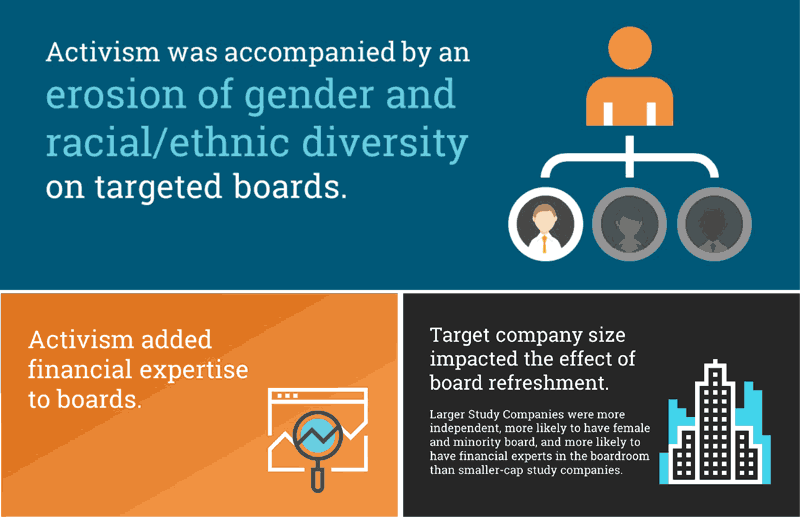
The corporate governance conversation has become increasingly focused on board composition, including board diversity. Recent academic studies have confirmed and expanded upon existing empirical evidence that hedge fund activism has been notably counterproductive in increasing gender diversity—yet another negative externality of this type of activism. Statistical evidence supports the hypothesis that the rate of shareholder activism is higher toward female CEOs holding all else equal, including industries, company sizes and levels of performance. A study forthcoming in the Journal of Applied Psychology investigated the reasons that hedge fund activists seemingly ignore the evidence for gender-diverse boards in their choices for director nominees and disproportionately target female CEOs. The authors suggest these reasons may include subconscious biases of hedge funds against women leaders due to perceptions and cultural attitudes.

In the United Kingdom, the focus on board diversity has spread into policy. The House of Commons Business, Energy, and Industrial Strategy Committee report on Corporate Governance, issued in 2017, included recommendations for improving ethnic, gender and social diversity of boards, noting that “[to] be an effective board, individual directors need different skills, experience, personal attributes and approaches.” The U.K. government’s response to this report issued in September 2017 notes its agreement on various diversity-related issues, stating that the “Government agrees with the Committee that it makes business sense to recruit directors from as broad a base as possible across the demographic of the UK” and further, tying into themes of stakeholder capitalism, that the “Government believes that greater diversity within the boardroom can help companies connect with their workforces, supply chains, customers and shareholders.”

In the United States, institutional investors are focused on a range of board composition issues, including term limits, board refreshment, diversity, skills matrices and board evaluation processes, as well as disclosures regarding these issues. In a recent letter, Vanguard explained that it considers the board to be “one of a company’s most critical strategic assets” and looks for a “high-functioning, well-composed, independent, diverse, and experienced board with effective ongoing evaluation practices,” stating that “Good governance starts with a great Board.” The New York Comptroller’s Boardroom Accountability Project 2.0 is focused on increasing diversity of boards in order to strengthen their independence and competency. In connection with launching this campaign, the NYC Pension Funds asked the boards of 151 U.S. companies to disclose the race and gender of their directors alongside board members’ skills in a standardized matrix format. And yet, similar to the difficulty of measuring and comparing sustainability efforts of companies, investors and companies alike continue to struggle with how to measure and judge a board’s diversity, and board composition generally, as the conversation becomes more nuanced. Board composition and diversity aimed at increasing board independence and competency is not a topic that lends itself to a “check-the-box” type measurement.

In light of the heightened emphasis on board composition, boards should consider increasing their communications with their major shareholders about their director selection and nomination processes to show the board understands the importance of its composition. Boards should consider disclosing how new director candidates are identified and evaluated, how committee chairs and the lead director are determined, and how the operations of the board as a whole and the performance of each director are assessed. Boards may also focus on increasing tutorials, facility visits, strategic retreats and other opportunities to increase the directors’ understanding of the company’s business—and communicate such efforts to key shareholders and constituents.


Activism


Despite the developments and initiatives striving to protect and promote long-term investment, the most dangerous threat to long-term economic prosperity has continued to surge in the past year. There has been a significant increase in activism activity in countries around the world and no slowdown in the United States. The headlines of 2017 were filled with activists who do not fit the description of good stewards of the long-term interests of the corporation. A must-read Bloombergarticle described Paul Singer, founder of Elliott Management Corp., which manages $34 billion of assets, as “aggressive, tenacious and litigious to a fault” and perhaps “the most feared activist investor in the world.” Numerous recent activist attacks underscore that the CEO remains a favored activist target. Several major funds have become more nuanced and taken a merchant banker approach of requesting board representation to assist a company to improve operations and strategy for long-term success. No company is too big for an activist attack. Substantial new capital has been raised by activist hedge funds and several activists have created special purpose funds for investment in a single target. As long as activism remains a serious threat, the economy will continue to experience the negative externalities of this approach to investing—companies attempting to avoid an activist attack are increasingly managed for the short term, cutting important spending on research and development and focusing on short-term profits by effecting share buybacks and paying dividends at the expense of investing in a strategy for long-term growth.

To minimize the impact of activist attacks, boards must focus on building relationships with major institutional investors. The measure of corporate governance success has shifted from checking the right boxes to building the right relationships. Major institutional investors have reiterated their commitment to bringing a long-term perspective to public companies, including, for example, Vanguard, which sent an open letter to directors of public companies world-wide explaining that a long-term perspective informed every aspect of its investment approach. Only by forging relationships of trust and credibility with long-term shareholders can a company expect to gain support for its long-term strategy when it needs it. In many instances, when an activist does approach, a previously established relationship provides a foundation for management and the board to persuade key shareholders that short-term activism is not in their best interest—an effort that is already showing some promise. General Motors’ resounding defeat of Greenlight Capital’s attempt to gain shareholder approval to convert its common stock into two classes shows a large successful company’s ability to garner the

support of its institutional investors against financial engineering. Trian’s recent proxy fight against Procter & Gamble shows the importance of proactively establishing relationships with long-term shareholders. Given Trian’s proven track record of success in urging changes in long-term strategy, Nelson Peltz was able to gain support for a seat on P&G’s board from proxy advisors and major institutional investors. We called attention to importantlessons from this proxy fight (discussed on the Forum here and here).


Spotlight on Boards


The ever-evolving challenges facing corporate boards prompts an updated snapshot of what is expected from the board of directors of a major public company—not just the legal rules, but also the aspirational “best practices” that have come to have equivalent influence on board and company behavior. In the coming year, boards will be expected to:

Oversee corporate strategy and the communication of that strategy to investors;

Set the tone at the top to create a corporate culture that gives priority to ethical standards, professionalism, integrity and compliance in setting and implementing strategic goals;

Choose the CEO, monitor the CEO’s and management’s performance and develop a succession plan;

Determine the agendas for board and committee meetings and work with management to assure appropriate information and sufficient time are available for full consideration of all matters;

Determine the appropriate level of executive compensation and incentive structures, with awareness of the potential impact of compensation structures on business priorities and risk-taking, as well as investor and proxy advisor views on compensation;

Develop a working partnership with the CEO and management and serve as a resource for management in charting the appropriate course for the corporation;

Oversee and understand the corporation’s risk management and compliance efforts, and how risk is taken into account in the corporation’s business decision-making; respond to red flags when and if they arise (see Risk Management and the Board of Directors, discussed on the Forum here);

Monitor and participate, as appropriate, in shareholder engagement efforts, evaluate potential corporate governance proposals and anticipate possible activist attacks in order to be able to address them more effectively;

Evaluate the board’s performance on a regular basis and consider the optimal board and committee composition and structure, including board refreshment, expertise and skill sets, independence and diversity, as well as the best way to communicate with investors regarding these issues;

Review corporate governance guidelines and committee charters and tailor them to promote effective board functioning;

Be prepared to deal with crises; and

Be prepared to take an active role in matters where the CEO may have a real or perceived conflict, including takeovers and attacks by activist hedge funds focused on the CEO.

To meet these expectations, major public companies should seek to:

Have a sufficient number of directors to staff the requisite standing and special committees and to meet expectations for diversity;

Have directors who have knowledge of, and experience with, the company’s businesses, even if this results in the board having more than one director who is not “independent”;

Have directors who are able to devote sufficient time to preparing for and attending board and committee meetings;

Meet investor expectations for director age, diversity and periodic refreshment;

Provide the directors with the data that is critical to making sound decisions on strategy, compensation and capital allocation;

Provide the directors with regular tutorials by internal and external experts as part of expanded director education; and

Maintain a truly collegial relationship among and between the company’s senior executives and the members of the board that enhances the board’s role both as strategic partner and as monitor.

______________________________________

*Martin Lipton is a founding partner of Wachtell, Lipton, Rosen & Katz, specializing in mergers and acquisitions and matters affecting corporate policy and strategy. This post is based on a Wachtell Lipton publication by Mr. Lipton, Steven A. Rosenblum, Karessa L. Cain, Sabastian V. Niles, Vishal Chanani, and Kathleen C. Iannone.

Compte rendu hebdomadaire de la Harvard Law School Forum on Corporate Governance | 30 novembre 2017


Voici le compte rendu hebdomadaire du forum de la Harvard Law School sur la gouvernance corporative au 30 novembre 2017.

Cette semaine, j’ai relevé les dix principaux billets.

Bonne lecture !


Résultats de recherche d'images pour « harvard law school forum on corporate governance »


Résultats de recherche d'images pour « harvard law school forum on corporate governance »


  1. Peer Information and Empowered Voters: Evidence from Voting on Shareholder Proposals
  2. Analysis of SEC Shareholder Proposal Guidance
  3. Five Ways to Improve Your Compensation Disclosure
  4. Gender Diversity Index
  5. Short Activism: The Rise in Anonymous Online Short Attacks
  6. Cybersecurity Risks in M&A Transactions
  7. Analysis of ISS’ QualityScore Updates
  8. Governance Improvements in 2017
  9. Virtual-Only Shareholder Meetings: Streamlining Costs or Cutting Shareholders Out?
  10. Nonvoting Common Stock: A Legal Overview

Amélioration de la gouvernance dans les pays anglophones | Une étude de ISS


Voici une étude de l’évolution de la gouvernance publiée par Subodh Mishra, directeur exécutif de l’Institutional Shareholder Services (ISS).

Cette étude porte sur la performance de quatre pays avec lesquels nous avons beaucoup en commun : États-Unis, Canada, Australie et Royaume-Uni.

Le sommaire exécutif ci-dessous vous donnera une idée très juste de l’état de la gouvernance dans les pays anglophones.

Bonne lecture !


Governance Improvements in 2017


Image associée


[On Thursday, November 23], the United States celebrates Thanksgiving, a holiday that has roots across many cultures in celebrating a bountiful harvest. And so we thought it fitting to take this week to appreciate the year’s harvest of advances in corporate governance that companies around the world have made since the beginning of the year. While issuers and investors no doubt have their plates full (pun intended) with more complex and numerous governance topics to consider, they have plenty of reasons to cherish the positive changes resulting from their labors throughout the past year.

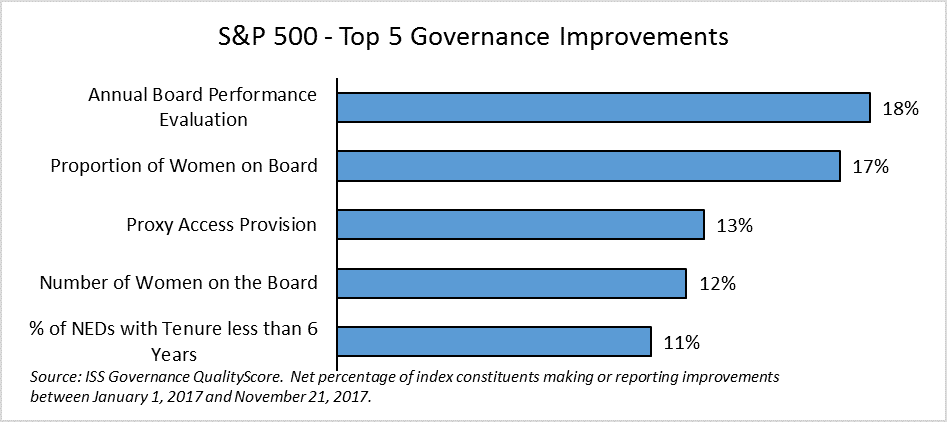
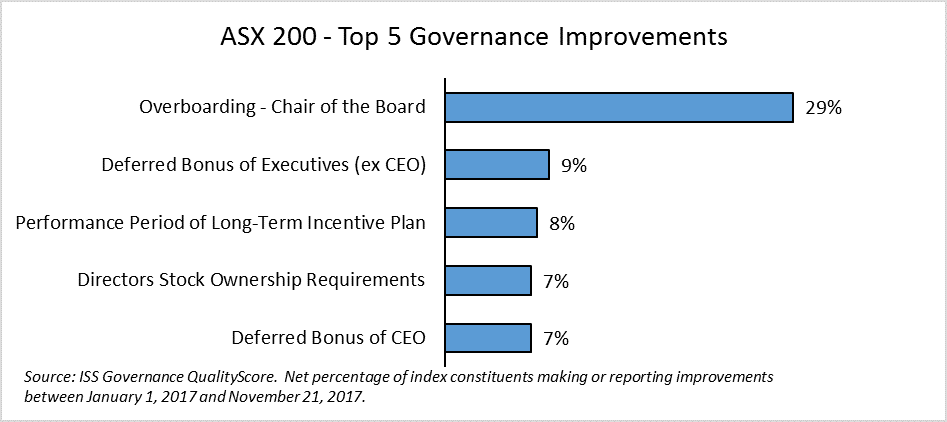
In our effort to identify reasons to give thanks in the corporate governance world, we reviewed ISS’ Governance QualityScore factors for four select markets (the United States, Canada, United Kingdom and Australia). In this assessment, we look at net improvement in each governance factor by counting the number of companies where practices improved and subtracting the number of companies whose practice deteriorated for a given factor. For example, in the S&P 500, 104 companies increased their proportion of non-executive directors with tenure of less than 6 years, while 51 companies saw the percentage of such board members decline. As such, the S&P 500 universe experienced a net improvement in board refreshment of 53 companies since the beginning of the year.


Gender Diversity Takes the Cake


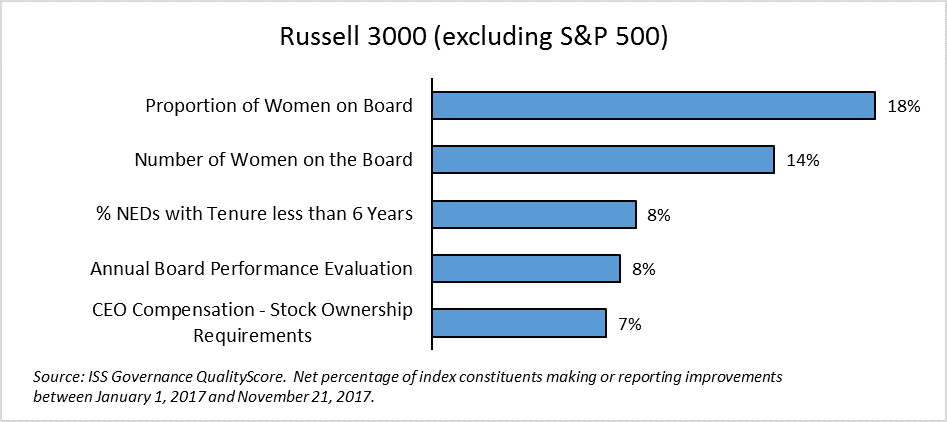
In the U.S., Canada and the United Kingdom, gender diversity ranks consistently among the top factors that showed improvement since the beginning of the year. In the U.S., a net of 18 percent of Russell 3000 companies showed an increase in the proportion of women on the board. The trend can largely be attributed to an increasing number of asset managers and asset owners publicly declaring board diversity as a priority issue in their stewardship campaigns. In particular, 2017 marks the first year when all of the three largest U.S. asset managers put board gender diversity on top of their engagement agendas. SSGA adopted a voting policy in March, while Vanguard recently joined the U.S. Chapter of the 30% Club, and BlackRock identified gender diversity as one of its engagement priorities for 2017-2018. The trend will likely continue as more investors embrace gender diversity initiatives.

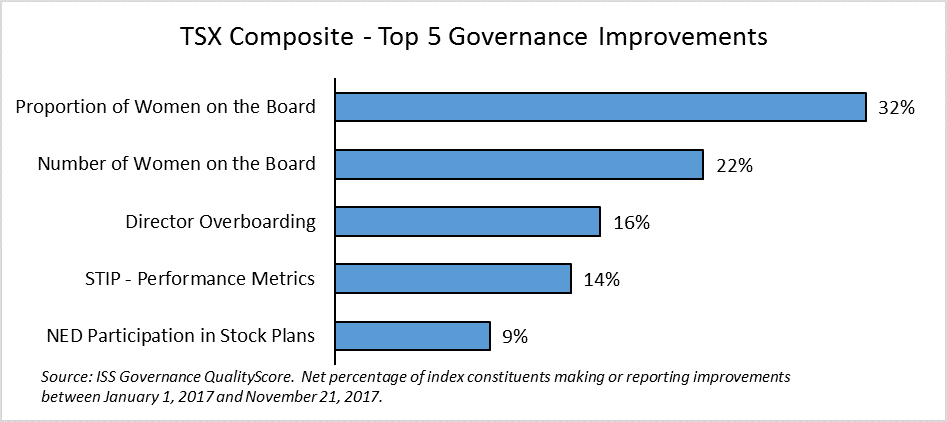
In Canada, the rate of change is even faster with a net improvement of 32 percent of TSX Composite companies showing an increase in the proportion of women on boards. The trend is driven in part by regulation and in part by investor initiatives, per the recent amendments to National Instrument 58-101 to include a Diversity Disclosure Requirement for TSX-listed companies. At the same time, the Canadian Coalition of Good Governance and several large individual asset owners and asset managers have adopted policies to promote gender diversity on boards.

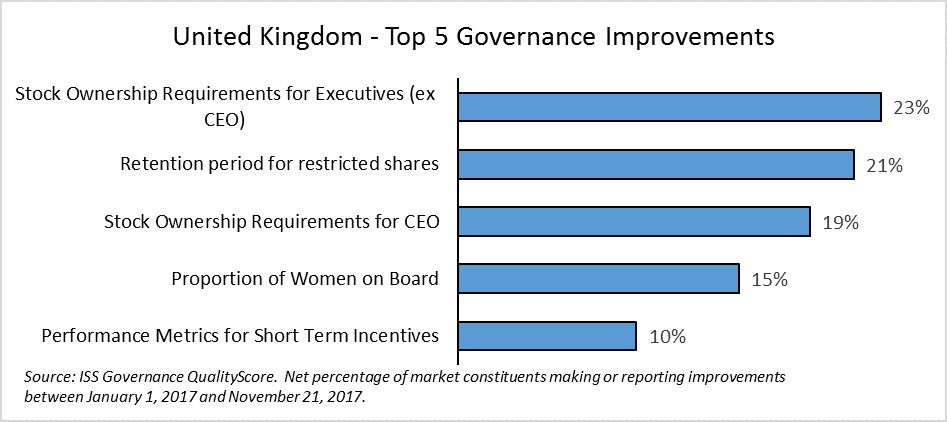
In the United Kingdom, gender diversity ranked as the fourth most-improved factor this year. Gender diversity became a focus item in 2011, when the first target of 25% gender diverse boards for the FTSE 100 was set by the government-backed Lord Davies Women on Boards report. Since then, the objectives have evolved, with the most recent target set at women comprising one-third of FTSE 350 boards by 2020. As such, the trend in the UK market shows that board gender diversity is a long-term issue that will continue to develop as companies reevaluate their board composition priorities (often in response to investor initiatives and regulatory changes).


S&P 500 – Board Evaluations, Refreshment and Proxy Access


The highest-ranking improvement factor among S&P 500 companies is the disclosure of enhanced practices for annual board evaluation with a net 18% of companies disclosing an improvement. It is not clear whether companies are actively improving the board evaluation process or if this is merely an improvement in disclosure; either way, this is a welcome change, which will likely lead to more transparency and accountability on board structure. Gender diversity appears at both the second and fourth places on the list, with S&P 500 companies leading the way in the U.S. with bringing more women into the boardroom. As of today, 22.7% of all S&P 500 directorships are held by women. Not surprisingly, proxy access is third on the list due to continuing shareholder campaigns to introduce access rights. As of now, approximately 60 percent of S&P 500 companies have adopted proxy access. And finally, in line with the greater emphasis placed on board composition and board renewal in recent years, the proportion of non-executive directors with a tenure of less than six years is the fourth most improved governance factor.


Russell 3000 (ex S&P 500) – Following the Lead of Larger Companies

Governance improvements among smaller U.S. firms were similar to the trends observed in the S&P 500 index. Gender diversity, board refreshment and annual board performance evaluation are on the top four spots, confirming the proposition that best practices established by larger firms tend to trickle down to smaller firms. In addition, stock ownership requirements for CEOs made the top-five list in this segment of the market. Compensation improvements are widely dispersed but fairly common among top improvement factors below the top five for both large and small companies. Such practices include the adoption clawback provisions, vesting periods for stock options, anti-pledging policies and prohibitions of option cash buyouts.


Canada – Advancing on Multiple Governance Fronts

Gender diversity takes top honors in Canada, with strong increases in both the proportion and number of women serving on Canadian boards. Canadian investors have paid significant attention to overboarded directors in recent years, especially given the pervasiveness of a small network of interconnected boards in certain sectors. Greater engagement on the issue appears to lead to positive change, as fewer companies appear to have directors with overboarding concerns. Improved disclosure on performance metrics for short-term incentive plans corresponds with the recent trend of voluntary adoption of say-on-pay votes, which has driven better disclosure on compensation issues. Finally, fewer companies allow for the discretionary participation of non-employee directors in equity-based plans. This trend corresponds to investor expectations to limit such practices and to align director compensation with the long-term interests of shareholders.


United Kingdom – Compensation Leads the Way

In the United Kingdom, improvements to compensation practices dominate the landscape. This trend matches investors’ experience relative to meeting agendas, whereby much of the discussion focuses on the non-binding approval of the remuneration report and the binding proposal on remuneration policy. The most common compensation-related improvements suggest a strengthening of the link between executive compensation and the long-term interests of shareholders. Stock ownership requirements for executives and retention periods for restricted stock awards are meant to improve accountability and protect against short-termism in executive’s decision making. At the same time, better disclosure on performance metrics for short-term incentives aligns with the overall principle of pay-for-performance.


Australia – Fewer Overboarded Directors and Improved Incentive Structures

In Australia, the board-related practice of overboarding stands out as the most improved governance practice of the year. This trend is in line with investor expectations (also reflected in ISS’ most recent policy update) to limit the number of board positions held by directors, especially those in senior leadership such as the Chair of the Board or the CEO. The remaining factors are primarily compensation-related. An increase in the deferral of bonuses coincides with newly proposed rules for increased regulatory oversight of executive remuneration in the banking sector in light of a series of recent scandals. As such, bonus deferral policies may become the norm in future years.


Global Trends – A World of Change

The improvements discussed above are indicative of only some of the major trends observed globally. Overall, improved disclosure requirements and revised codes of best practice drive a sea-change in governance practices in both developed and emerging markets in Europe, Asia and Latin America. In addition, company disclosures on environmental and social issues improve, as corporations, investors and regulators explore better ways to assess the potential risks related to ESG factors. We will monitor changes in governance practices in the future, as policy priorities are bound to evolve further.

Dix thèmes majeurs pour les administrateurs de sociétés en 2017


Aujourd’hui, je partage avec vous la liste des dix thèmes majeurs en gouvernance que les auteurs Kerry E. Berchem* et Rick L. Burdick* ont identifiés pour l’année 2017.

Vous êtes assurément au fait de la plupart de ces dimensions, mais il faut noter l’importance accrue à porter aux questions stratégiques, aux changements politiques, aux relations avec les actionnaires, à la cybersécurité, aux nouvelles réglementations de la SEC, à la composition du CA, à l’établissement de la rémunération et aux répercussions possibles des changements climatiques.

sans-titre-gump

Afin de mieux connaître l’ampleur de ces priorités de gouvernance pour les administrateurs de sociétés, je vous invite à lire l’ensemble du rapport publié par Akin Gump.

Bonne lecture !

Dix thèmes majeurs pour les administrateurs de sociétés en 2017


top-10


1. Corporate strategy: Oversee the development of the corporate strategy in an increasingly uncertain and volatile world economy with new and more complex risks

Directors will need to continue to focus on strategic planning, especially in light of significant anticipated changes in U.S. government policies, continued international upheaval, the need for productive shareholder relations, potential changes in interest rates, uncertainty in commodity prices and cybersecurity risks, among other factors.

2. Political changes: Monitor the impact of major political changes, including the U.S. presidential and congressional elections and Brexit

Many uncertainties remain about how the incoming Trump administration will govern, but President-elect Trump has stated that he will pursue vast changes in diverse regulatory sectors, including international trade, health care, energy and the environment. These changes are likely to reshape the legal landscape in which companies conduct their business, both in the United States and abroad.

With respect to Brexit, although it is clear that the United Kingdom will, very probably, leave the European Union, there is no certainty as to when exactly this will happen or what the U.K.’s future relationship, if any, with the EU will be. Once the negotiations begin, boards will need to be quick to assess the likely shape of any deal between the U.K. and the EU and to consider how to adjust their business model to mitigate the threats and take advantage of the opportunities that may present themselves.

3. Shareholder relations: Foster shareholder relations and assess company vulnerabilities to prepare for activist involvement

The current environment demands that directors of public companies remain mindful of shareholder relations and company vulnerabilities by proactively engaging with shareholders, addressing shareholder concerns and performing a self-diagnostic analysis. Directors need to understand their company’s vulnerabilities, such as a de-staggered board or the lack of access to a poison pill, and be mindful of them in any engagement or negotiation process.

4. Cybersecurity: Understand and oversee cybersecurity risks to prepare for increasingly sophisticated and frequent attacks

As cybercriminals raise the stakes with escalating ransomware attacks and hacking of the Internet of Things, companies will need to be even more diligent in their defenses and employee training. In addition, cybersecurity regulation will likely increase in 2017. The New York State Department of Financial Services has enacted a robust cybersecurity regulation, with heightened encryption, log retention and certification requirements, and other regulators have issued significant guidance. Multinational companies will continue implementation of the EU General Data Protection Regulation requirements, which will be effective in May 2018. EU-U.S. Privacy Shield will face a significant legal challenge, particularly in light of concerns regarding President-elect Trump’s protection of privacy. Trump has stated that the government needs to be “very, very tough on cyber and cyberwarfare” and has indicated that he will form a “cyber review team” to evaluate cyber defenses and vulnerabilities.

5. SEC scrutiny: Monitor the SEC’s increased scrutiny and more frequent enforcement actions, including whistleblower developments, guidance on non-GAAP measures and tougher positions on insider trading

2016 saw the Securities and Exchange Commission (SEC) award tens of millions of dollars to whistleblowers and bring first-of-a-kind cases applying new rules flowing from the protections now afforded to whistleblowers of potential violations of the federal securities laws. The SEC was also active in its review of internal accounting controls and their ability to combat cyber intrusions and other modern-day threats to corporate infrastructure. The SEC similarly continued its comprehensive effort to police insider trading schemes and other market abuses, and increased its scrutiny of non-GAAP (generally accepted accounting principles) financial measure disclosures. 2017 is expected to bring the appointment of three new commissioners, including a new chairperson to replace outgoing chair Mary Jo White, which will retilt the scales at the commissioner level to a 3-2 majority of Republican appointees. 2017 may also bring significant changes to rules promulgated previously under Dodd-Frank.

6. CFIUS: Account for CFIUS risks in transactions involving non-U.S. investments in businesses with a U.S. presence

Over the past year, the interagency Committee on Foreign Investment in the United States (CFIUS) has been particularly active in reviewing—and, at times, intervening in—non-U.S. investments in U.S. businesses to address national security concerns. CFIUS has the authority to impose mitigation measures on a transaction before it can proceed, and may also recommend that the President block a pending transaction or order divestiture of a U.S. business in a completed transaction. Companies that have not sufficiently accounted for CFIUS risks may face significant hurdles in successfully closing a deal. With the incoming Trump administration, there is also the potential for an expanded role for CFIUS, particularly in light of campaign statements opposing certain foreign investments.

7. Board composition: Evaluate and refresh board composition to help achieve the company’s goals, increase diversity and manage turnover

In order to promote fresh, dynamic and engaged perspectives in the boardroom and help the company achieve its goals, a board should undertake focused reassessments of its underlying composition and skills, including a review and analysis of board tenure, continuity and diversity in terms of upbringing, educational background, career expertise, gender, age, race and political affiliation.

8. Executive compensation: Determine appropriate executive compensation against the background of an increased focus on CEO pay ratios

Executive compensation will continue to be a hot topic for directors in 2017, especially given that public companies will soon have to start complying with the CEO pay ratio disclosure rules. Recent developments suggest that such disclosure might not be as burdensome or harmful to relations with employees and the public as was initially feared.
The SEC’s final rules allow for greater flexibility and ease in making this calculation, and a survey of companies that have already estimated their ratios indicates that the ratio might not be as high, on average, as previously reported.

9. Antitrust scrutiny: Monitor the increased scrutiny of the antitrust authorities and the implications on various proposed combinations

Despite the promise of synergies and the potential to transform a company’s future, antitrust regulators have become increasingly hostile toward strategic transactions, with the Department of Justice and Federal Trade Commission suing to block 12 transactions since 2015. Although directors should brace for a longer antitrust review, to help navigate the regulatory climate, work upfront can dramatically improve prospects for success. Company directors should develop appropriate deal rationales and, with the benefit of upfront work, allocate antitrust risk in the merger agreement. Merger and acquisition activity may also benefit from the Trump administration, taking, at least for certain industries, a less-aggressive antitrust enforcement stance.

10. Environmental disasters and contagious diseases: Monitor the impact of increasingly volatile weather events and contagious disease outbreaks on risk management processes, employee needs and logistics planning

While the causes of climate change remain a political sticking point, it cannot be debated that volatile weather events, environmental damage and a rise in the diseases that tend to follow, are having increasingly adverse impacts on businesses and markets. Businesses will need to account for, or transfer the risk of, the increasing likelihood of these impacts. The SEC recently announced investigations into climate-risk disclosures within the oil and gas sector to ensure that they adequately allow investors to account for these effects on the bottom line. The growing number of shareholder resolutions and suits addressing climate change confirm that investors want this information, regardless of the position of the next administration.

The complete publication is available here.


*Kerry E. Berchem is partner and head of the corporate practice, and Rick L. Burdick is partner and chair of the Global Energy & Transactions group, at Akin Gump Strauss Hauer & Feld LLP.

Sommaire de l’enquête de PwC sur la gouvernance des entreprises auprès des administrateurs


La gouvernance des entreprises a beaucoup évolué au cours des vingt dernières années. Aujourd’hui, les investisseurs institutionnels détiennent 70 % des actions des corporations publiques.

L’auteure indique que l’un des seuls moyens pour les actionnaires investisseurs d’améliorer la performance des entreprises est d’agir sur la gouvernance des entreprises, en exerçant différentes pressions auprès du management et des administrateurs (« direct engagement ») et en faisant connaître leur avis via le vote par procuration.

Un sommaire de l’étude publié par Paula Loop*, directrice du Centre de la gouvernance de PricewaterhouseCoopers, nous donne un bon aperçu des principaux changements observés lors de l’enquête auprès de 886 administrateurs de grandes corporations américaines.

Voici les points saillants de l’étude :

  1. Director discontent with peers hits a high-water mark
  2. Boards are taking more action on performance assessments
  3. Independent chairs are more likely to have the difficult conversations
  4. Key issues are not being prioritized in many boardrooms
  5. Male and female directors see strategy very differently
  6. Executive pay plans are effective—except where they’re not
  7. Seeing returns on shareholder engagement
  8. The gender divide is real on questions of board diversity
  9. Challenging management is a challenge


Voir le résumé de l’enquête ci-dessous.

Bonne lecture ! Vos commentaires sont appréciés.


Insights from PwC’s 2017 Annual Corporate Directors Survey


« Against the backdrop of a new administration in Washington and growing social divisiveness, US public company directors are faced with great expectations from investors and the public. Perhaps now more than ever, public companies are being asked to take the lead in addressing some of society’s most difficult problems. From seeking action on climate change to advancing diversity, stakeholder expectations are increasing and many companies are responding.

In part, this responsiveness is driven by changes in who owns public companies today. Institutional investors now own 70% of US public company stock, much of which is held in index funds. [1] Many of these passive investors believe that seeking improvements in corporate governance is one of the only levers they have to improve company performance. And these shareholders are exerting their influence with management teams and the board through their governance policies, direct engagement and proxy voting.

But boards and shareholders don’t always agree, and the corporate governance environment itself is not immune to divisiveness. In fact, our research shows that directors are clearly out of step with investor priorities in some critical areas.

One of these areas is environmental issues. During the 2017 proxy season, a handful of shareholder proposals on environmental issues, like climate change, gained majority shareholder support. This is the first time we have seen these types of proposals pass, and they did so with the help of some of the largest institutional investors like BlackRock, Vanguard and Fidelity. For their part, some of the largest US companies declared their continuing commitment to take action fighting climate change, even as the US announced its withdrawal from the Paris climate accord.

About the survey


For over a decade, PwC’s Annual Corporate Directors Survey has gauged the views of public company directors from across the United States on a variety of corporate governance matters. In the summer of 2017, 886 directors participated in our survey. The respondents represent a cross-section of companies from over a dozen industries,

75% of which have annual revenues of more than $1 billion. Eighty-four percent of the respondents were men, and 16% were women. Their board tenure varied, but 60% have served on their board for five or more years.


But despite increased shareholder interest in environmental risk, there appears to be a disconnect when it comes to the views in many boardrooms. A majority of directors tell us that their boards don’t need sustainability expertise. A surprising number also say their company’s strategy isn’t being influenced by climate change or resource scarcity, and that they don’t think environmental concerns will impact their current strategy. Companies and investors may be driving the agenda, but rather than leading the way in this area, many directors are being carried along.

Gender diversity on boards has also become a clear priority for institutional investors in 2017. Shareholders like State Street Global Advisors and BlackRock recently adopted new diversity policies or guidance on board diversity. Indeed, State Street even voted against directors at hundreds of companies that it believed had not made sufficient strides in diversifying their boards. Yet despite the increased focus from institutional investors, fewer of the new board seats in 2016 went to women than in the prior year. [2] And gender parity is still a long way off, with only 25% of boards in the S&P 500 having more than two female directors. [3] Even so, about half of female directors tell us that their board is already sufficiently diverse. Which leads to the question—are female directors sufficiently championing the cause of gender diversity?

Investors are also putting the spotlight on social issues like income inequality and employee retirement security, asking companies to help develop shared economic security. But again, directors tell us that income inequality considerations should not play a part in company strategy.

PwC’s 2017 Annual Corporate Directors Survey examines the areas where directors and investors are aligned and moving forward together, as well as the ways in which they are out of sync.

While boards have made real improvements in some areas, there is clearly more work to be done. Among our key observations:


Director discontent with peers hits a high-water mark


With greater expectations of boards, directors are upping their game and are seeking to add value. More than ever, directors—particularly those who are less tenured—are also noticing that not all of their fellow directors are doing the same. Almost half of directors (46%) believe that one or more of their fellow board members should be replaced. One-fifth of directors say that two or more directors on their board should be replaced.


Boards are taking more action on performance assessments


Investors have been pushing boards to not just conduct board performance assessments, but to do something with the results. This year, more than twothirds (68%) say that their board has taken some action in response to their last board assessment—an increase of 19 percentage points over last year.


Independent chairs are more likely to have the difficult conversations


Directors on boards with non-executive chairs are more than twice as likely to say that their board decided not to re-nominate a director, or provided counsel to a director, as a result of the board’s assessment process.


Key issues are not being prioritized in many boardrooms


While investors are talking about the impact of environmental and social issues on the bottom line, the conversations are not necessarily filtering up to the boardroom. A significant percentage of directors say that income inequality (51%), immigration (49%) and climate change (40%) should not be taken into account—at all—in company strategy.


Male and female directors see strategy very differently


Female directors are more likely to think that social issues should play a part in company strategy formation. And they are much more likely to think that issues like environmental concerns and social instability will force the company to change its strategy in the next three years.


Executive pay plans are effective—except where they’re not


Directors are confident that incentive plans promote long-term shareholder value. But 70% at least somewhat agree that executives in general are overpaid, and 66% say that executive compensation exacerbates income inequality. Meanwhile, executive pay continues to go up, not down. [4]


Seeing returns on shareholder engagement


In just the past year, directors have come around to a much more positive view of shareholder engagement. They are much more likely now to think that direct engagement impacts proxy voting (77% as compared to 59% in 2016). And the vast majority now say that the right representatives are present (85%) and investors are well prepared for meetings (84%)—12 and 21 percentage point increases over last year, respectively.


The gender divide is real on questions of board diversity


Male and female directors have a significant difference of opinion about the impact of board diversity on company performance. Nearly five out of six female directors (82%) believe that diversity enhances company performance, while only just over half of men agree (54%).


Challenging management is a challenge


Strategy oversight is one of the board’s core responsibilities. Investors want to know that directors are heavily involved in evaluating, challenging and monitoring the company’s strategy, and calling for a change of course when needed. Yet only 60% of directors say their board strongly challenges management assumptions on strategy as part of their oversight role.

As we analyzed the results of this year’s survey, we also looked behind the numbers at how demographic differences such as gender and length of tenure on the board affected directors’ views. Read on for our full analysis of the survey results and areas where those differences were notable. And for the results of every question in the survey, please refer to the Appendix of the complete publication.

The complete publication is available here.

Endnotes

1Institutional investors owned an average of 70% of the outstanding shares of US public companies as of June 30, 2017. PwC + Broadridge, ProxyPulse 2017 Proxy Season Review, September 2017. Forty-two percent of all US stock fund assets as of June 30, 2017 were held through index funds. Investment Company Institute.(go back)

2 The percentage of women in new board appointments at Fortune 500 companies declined two percentage points to 27.3% in 2016. Fortune, “The Share of Women Appointed to Fortune 500 Declined Last Year,” June 19, 2017.(go back)

3Spencer Stuart, 2016 Spencer Stuart Board Index, November 2016.(go back)

4See Willis Towers Watson Executive Pay Bulletin, May 9, 2017.(go back) »

_____________________________________

*Paula Loop is Leader of the Governance Insights Center at PricewaterhouseCoopers LLP. This post is based on a publication from the PwC Governance Insights Center.

Compte rendu hebdomadaire de la Harvard Law School Forum on Corporate Governance | 26 octobre 2017


Voici le compte rendu hebdomadaire du forum de la Harvard Law School sur la gouvernance corporative au 26 octobre 2017.

Cette semaine, j’ai relevé les dix principaux billets.

Bonne lecture !


Résultats de recherche d'images pour « harvard law school forum on corporate governance »


Résultats de recherche d'images pour « harvard law school forum on corporate governance »


  1. Securities Cases to Watch this Term at the Supreme Cour
  2. Director Networks, Turnover, and Appointments
  3. Protecting Shareholder Ownership and Governance Rights
  4. 2017 Relative TSR Prevalence and Design of S&P 500 Companies
  5. Busy Directors: Strategic Interaction and Monitoring Synergies
  6. Where’s the Board? Questions for Equifax
  7. Building a Better Board Book
  8. The Rise of Investor-Centric Activism Defense Strategy
  9. Environmental and Social Proposals in the 2017 Proxy Season
  10. Activism’s New Paradigm

La gouvernance française suit-elle la tendance mondiale ?


Afin de donner suite à mon billet du 20 octobre, intitulé « Quelles tendances en gouvernance, identifiées en 2014, se sont avérées », dans lequel Marianne Hugoo, rédactrice au sein de l’Hebdo des AG, un média numérique qui se consacre au traitement des sujets touchant à la gouvernance des entreprises françaises, m’avait demandé si les 12 grandes tendances que j’avais identifiées en 2014 s’étaient effectivement avérées en 2017, au regard de la situation française.

J’avais alors préparé quelques réflexions en référence aux douze tendances identifiées dans l’article du Journal Les Affaires de 2014.

Aujourd’hui, je vous fais part des résultats de l’enquête, parus dans la revue l’Hebdo des AG (no 151 | 23 octobre 2017), qui présentent la situation de la gouvernance en France.

Il m’est toujours apparu important d’avoir une vue globale des facteurs qui affectent la gouvernance dans les entreprises étrangères, notamment les entreprises françaises.

Bonne lecture ! Vos commentaires sont les bienvenus.


La gouvernance française suit-elle la tendance mondiale ?


Résultats de recherche d'images pour « La gouvernance française suit-elle la tendance mondiale ? »


Suivant 10 axes de comparaison, l’Hebdo des AG a confronté les données factuelles sur les Conseils français après les AG 2017 avec les travaux de Jacques Grisé, Président de l’Ordre des administrateurs agréés du Québec (sic, président sortant) et Directeur des programmes de formation en gouvernance (sic, ex-directeur) au Collège des administrateurs de sociétés (CAS). Il identifiait en 2014 les tendances de gouvernance à mettre sous surveillance et a réagi sur les observations de notre Enquête.

La gouvernance française suit la tendance mondiale sur les grands enjeux : la prise en compte de la montée de l’activisme actionnarial, l’épée de Damoclès du Say-on-Pay comme juge de paix.

Il reste des « exceptions françaises » : l’une est la féminisation des Conseils, oui la France est en avance ! Les autres relèvent de la structure des travaux du Conseil et peut-être au poids prépondérant du dirigeant en France : les Conseils sont moins indépendants et moins ouverts à l’évaluation extérieure.

Les 4 thèmes qui inscrivent la gouvernance des entreprises françaises dans la tendance mondiale :

  1. En France comme ailleurs, l’administrateur a 59 ans en moyenne : c’est une personne à la fois expérimentée et en âge d’exercer une activité professionnelle
  2. Les administrateurs sont de plus en plus formés
  3. Le Say-on-Pay joue le rôle de juge de paix sur la satisfaction des actionnaires
  4. L’enjeu aujourd’hui : le rôle des investisseurs activistes

Les 6 « exceptions françaises »,

  1. La dissociation des pouvoirs n’est toujours pas d’actualité en France — mais pas non plus aux États-Unis
  2. Les Conseils d’administration se sont féminisés, en France plus qu’ailleurs due à l’effet de la loi Copé-Zimmerman
  3. Cette féminisation est souvent allée de pair avec l’internationalisation des Conseils français, sujet qui n’est pas identifié comme tendance mondiale.
  4. La taille des Conseils en France est stable à 12-13 administrateurs, elle se réduit dans les autres pays
  5. Les Conseils français sont moins indépendants — un sujet de débat sur la définition même de l’indépendance
  6. Les Conseils ont partout mis en place des procédures d’évaluation — mais il s’agit encore souvent, en France, d’auto-évaluation


L’ENQUÊTE


  1. En France, comme ailleurs, l’administrateur a 59 ans en moyenne : c’est une personne à la fois expérimentée et en âge d’exercer une activité professionnelle


Il y a 10 ans, 28 % des Conseils américains avaient une moyenne d’âge de 59 ans ou moins contre 15 % aujourd’hui. La moyenne d’âge des administrateurs américains est de 63 ans.

L’âge moyen des administrateurs français ne bouge pas : il était de 59 ans pour le SBF 120 en 2014 et l’est toujours en 2017. Le reste des Conseils européens se situent dans la même moyenne.

Ce chiffre indique que la plupart des administrateurs français ne sont pas « retraités », mais en activité. Il exclut également, de fait, la notion d’« administrateur indépendant professionnel », vivant uniquement de ses mandats.


  1. Les administrateurs sont de plus en plus formés


Selon Jacques Grisé, ce sont les « compétences et les expériences reliées au secteur d’activité de l’entreprise qui sont très recherchées ».

En France, l’IFA a mis en place en 2010, en partenariat avec l’IEP (« Sciences Po »), une formation d’administrateur certifié. Depuis 2014, le nombre de certificats délivrés a crû de 5,56 % en passant de 108 certificats délivrés en 2014 à 114 certificats en 2016.

Déjà en 2013, le Code de Gouvernance insistait sur la formation des administrateurs : « chaque administrateur bénéficie, s’il le juge nécessaire, d’une formation complémentaire sur les spécificités de l’entreprise, ses métiers et son secteur d’activité. »

Par ailleurs, toutes les sociétés pour lesquelles s’applique le Code de gouvernance doivent mentionner les domaines de compétences de leurs administrateurs dans leur communication annuelle avec les actionnaires à travers leur document de référence.

Certaines sociétés vont encore plus loin en institutionnalisant au sein des Conseils des équipes dédiées à la recherche d’expertises clés. En effet, comme le mentionne par exemple le document de référence 2016 d’ENGIE, il a été décidé de mettre en place « le recensement des expertises clés des administrateurs ».


  1. Le Say-on-Pay joue le rôle de juge de paix sur la satisfaction des actionnaires


Jacques Grisé souligne le caractère « toujours potentiellement conflictuel » de la situation entre « les intérêts des actionnaires et la responsabilité des administrateurs envers toutes les parties prenantes ».

La contestation se cristallise sur le Say-on-Pay

En France depuis la loi Sapin II, les actionnaires votent sur la rémunération des dirigeants — consultatif jusqu’ici, décisif à partir de 2018.

Pour mémoire, ils ont rejeté, en 2016, la rémunération de Carlos Ghosn, PDG de Renault, et celle de Patrick Kron, PDG d’Alstom ; en 2017, celle de Jean-Pierre Rémy, PDG de Solocal Group, et celle de Philippe Salle, PDG d’Elior. Dans chacun de ces cas, les Conseils ont révisé leur proposition.

Des scores d’élection d’administrateurs toujours très hauts : les actionnaires, quand ils sont mécontents, ne mettent pas en cause les administrateurs.

De manière générale, les actionnaires votent moins facilement les nominations de nouveaux administrateurs par rapport aux taux d’approbation de 2014. Cependant, les scores restent très hauts et il n’y a donc pas de quoi penser que les actionnaires se servent de cette tribune pour faire valoir leurs droits.


  1. L’enjeu aujourd’hui : le rôle des investisseurs activistes


Dans tous les pays, l’activisme progresse. Un point commun est le fondement de leur argumentaire : il s’agit, souvent, d’une question de transparence ou de gouvernance. La question est de savoir si les interventions de ces investisseurs activistes sont, à long terme, négatives ou positives pour la gouvernance, dans la mesure où les investisseurs obtiennent souvent une accélération de la transformation de l’entreprise, mais n’y restent pas. Une préoccupation commune à toutes les entreprises cette année.

Jacques Grisé identifie l’aiguillon des investisseurs activistes comme important, car ils « minent l’autorité du Conseil d’administration en s’adressant directement aux actionnaires ». Quatre ans plus tard, « force est de constater que l’activisme est en pleine croissance partout dans le monde et que les effets souvent décriés des activistes sont de plus en plus acceptés comme bénéfiques ».


  1. La dissociation des pouvoirs n’est toujours pas d’actualité en France — mais pas non plus aux États-Unis


En 2014, Jacques Grisé s’attendait à une « valorisation du rôle du Président du Conseil », faisant contrepoids au DG — dans un contexte où les PDG étaient déjà très majoritaires en France.

Au Canada, le rôle du Chairman est mis en avant. Les États-Unis, souligne Jacques Grisé, sont « plus lents à adopter la séparation des fonctions entre Chairmen et CEO ».

La France suit sur ce point la tendance des États-Unis : le CAC 40 compte 65 % de PDG et le NEXT 80 en compte 50 %.


  1. Les Conseils d’administration se sont féminisés, en France, plus qu’ailleurs — l’effet de la loi Copé-Zimmerman


En 2014, Jacques Grisé prévoyait que « la diversité au sein du Conseil deviendrait un sujet de gouvernance incontournable ».

Jacques Grisé, en 2017, souligne que la tendance américaine « de diminution (sic, de la taille) des Conseils ralentit quelque peu l’accession des femmes aux postes d’administratrices », ce qui n’est pas le cas en France. La loi Copé-Zimmerman a imposé le quota de 40 % de femmes administrateurs.


  1. Cette féminisation est souvent allée de pair avec l’internationalisation des Conseils français, sujet qui n’est pas identifié comme tendance mondiale


Les Conseils français se sont rapidement dotés de nombreux administrateurs étrangers afin de remplir les critères de diversité recommandés par le Code de Gouvernance (Afep MEDEF).

Même si certaines sociétés, comme AMUNDI, n’ont aucun administrateur étranger au sein du Conseil, elles intègrent une représentation étrangère dans d’autres instances. Amundi a par exemple mis en place un « comité consultatif composé de grands experts économiques et politiques de renommée internationale ».  Le taux moyen d’internationalisation des Conseils du SBF 120 est passé de 16 % en 2013 à 24 % 3 n 2017.


  1. La taille des Conseils en France est stable à 12-13 administrateurs, elle est plus faible dans d’autres pays


Outre-Atlantique, la réduction de la taille des Conseils prédite par Jacques Grisé s’est confirmée au Canada. Cependant, aux États-Unis, le nombre moyen de membres par Conseil a augmenté : depuis 10 ans, la moyenne se situe autour de 10 membres pour les entreprises du S&P 500.

En France, le nombre d’administrateurs moyen par Conseil est resté stable autour de 12 ou 13, ce qui reste supérieur à la moyenne américaine.


  1. Les Conseils français sont moins indépendants qu’ailleurs et une bonne définition de l’indépendance persiste


Jacques Grisé prévoyait une plus grande indépendance des Conseils.

Pour les besoins de cette Enquête, nous retiendrons comme définition de l’indépendance celle donnée par chaque société, ce qui est la méthode retenue par l’AMF : est indépendant un administrateur qualifié par la société comme indépendant, même si des associations comme l’AFG ou des proxy advisors comme ISS ou Proxinvest ont un comptage différent.

L’indépendance des Conseils, quant à elle, augmente progressivement. En effet, elle a grimpé de 3 points entre 2014 et 2016.  Le taux moyen d’internationalisation des Conseils du SBF 120 est passé de 42 % en 2014 à 47 % en 2016.


  1. Les Conseils ont partout mis en place des procédures d’évaluation — mais il s’agit encore souvent, en France, d’auto-évaluation

Notre spécialiste affirme que « l’évaluation de la performance des Conseils d’administration est devenue une pratique quasi universelle ». En France comme aux États-Unis ou au Canada, les Conseils des sociétés cotées ont mis en place des procédures d’évaluations de leurs travaux.

Cependant, si dès 2014, Jacques Grisé notait qu’aux États-Unis « les sociétés font déjà appel à des firmes extérieures pour mener cette évaluation », il n’en est pas de même en France où la forme la plus habituelle est celle de l’auto-évaluation.

__________________________________

Enquête réalisée par Marianne Hugoo

Compte rendu hebdomadaire de la Harvard Law School Forum on Corporate Governance | 19 octobre 2017


Voici le compte rendu hebdomadaire du forum de la Harvard Law School sur la gouvernance corporative au 19 octobre 2017.

Cette semaine, j’ai relevé les dix principaux billets.

Bonne lecture !


Résultats de recherche d'images pour « harvard law school forum on corporate governance »


Résultats de recherche d'images pour « harvard law school forum on corporate governance »


  1. Do Clawback Adoptions Influence Capital Investments?
  2. Cross-Border Reincorporations in the European Union: The Case for Comprehensive Harmonisation
  3. Proxy Season Legal Update
  4. Capable Boards and Value Creation
  5. Pay Ratio: The Time Has Come
  6. Proposed Overhaul of Disclosure and Shareholder Proposal Rules
  7. Novel Defensive Tactics Against Activist Shareholders
  8. Rejection of the Universal Proxy Card
  9. The Impact of Shareholder Activism on Board Refreshment Trends at S&P 1500 Firms
  10. Fiduciary Principles and Delaware Corporation Law

Quelles tendances en gouvernance, identifiées en 2014, se sont avérées


J’ai réalisé une entrevue avec le Journal des Affaires le 17 mars 2014. Une rédactrice au sein de l’Hebdo des AG, un média numérique qui se consacre au traitement des sujets touchant à la gouvernance des entreprises françaises, m’a contacté afin de connaître mon opinion sur quelles « prédictions » se sont effectivement avérées, et lesquelles restent encore à améliorer.

J’ai préparé quelques réflexions en référence aux douze tendances que j’avais identifiées le 17 mars 2014 (voir le texte ci-dessous en rouge).

J’espère que ces commentaires vous seront utiles même si mon intervention est colorée par la situation canadienne et américaine.

Bonne lecture. Vos commentaires sont les bienvenus.


Gouvernance : 12 tendances à surveiller


« Si la gouvernance des entreprises a fait beaucoup de chemin depuis quelques années, son évolution se poursuit. Afin d’imaginer la direction qu’elle prendra au cours des prochaines années, nous avons consulté l’expert Jacques Grisé, ancien directeur des programmes du Collège des administrateurs de sociétés, de l’Université Laval.

Toujours affilié au Collège, M. Grisé publie depuis plusieurs années le blogue www.jacquesgrisegouvernance.com, un site incontournable pour rester à l’affût des bonnes pratiques et tendances en gouvernance. Voici les 12 tendances dont il faut suivre l’évolution, selon Jacques Grisé : »


1. Les conseils d’administration réaffirmeront leur autorité. « Auparavant, la gouvernance était une affaire qui concernait davantage le management », explique M. Grisé. La professionnalisation de la fonction d’administrateur amène une modification et un élargissement du rôle et des responsabilités des conseils. Les CA sont de plus en plus sollicités et questionnés au sujet de leurs décisions et de l’entreprise.

Cette affirmation est de plus en plus vraie. La formation certifiée en gouvernance est de plus en plus prisée. Les CA, et notamment les présidents de CA, sont de plus en plus sollicités pour expliquer leurs décisions, leurs erreurs et les problèmes de gestion de crise.

2. La formation des administrateurs prendra de l’importance. À l’avenir, on exigera toujours plus des administrateurs. C’est pourquoi la formation est essentielle et devient même une exigence pour certains organismes. De plus, la formation continue se généralise ; elle devient plus formelle.

Il va de soi que la formation en gouvernance prendra plus d’importance, mais les compétences et les expériences reliées au secteur d’activité de l’entreprise seront toujours très recherchées.

3. L’affirmation du droit des actionnaires et celle du rôle du conseil s’imposeront. Le débat autour du droit des actionnaires par rapport à celui des conseils d’administration devra mener à une compréhension de ces droits conflictuels. Aujourd’hui, les conseils doivent tenir compte des parties prenantes en tout temps.

Il existe toujours une situation potentiellement conflictuelle entre les intérêts des actionnaires et la responsabilité des administrateurs envers toutes les parties prenantes.

4. La montée des investisseurs activistes se poursuivra. L’arrivée de l’activisme apporte une nouvelle dimension au travail des administrateurs. Les investisseurs activistes s’adressent directement aux actionnaires, ce qui mine l’autorité des conseils d’administration. Est-ce bon ou mauvais ? La vision à court terme des activistes peut être néfaste, mais toutes leurs actions ne sont pas négatives, notamment parce qu’ils s’intéressent souvent à des entreprises qui ont besoin d’un redressement sous une forme ou une autre. Pour bien des gens, les fonds activistes sont une façon d’améliorer la gouvernance. Le débat demeure ouvert.

Le débat est toujours ouvert, mais force est de constater que l’actionnariat activiste est en pleine croissance partout dans le monde. Les effets souvent décriés des activistes sont de plus en plus acceptés comme bénéfiques dans plusieurs situations de gestion déficiente.

5. La recherche de compétences clés deviendra la norme. De plus en plus, les organisations chercheront à augmenter la qualité de leur conseil en recrutant des administrateurs aux expertises précises, qui sont des atouts dans certains domaines ou secteurs névralgiques.

Cette tendance est très nette. Les CA cherchent à recruter des membres aux expertises complémentaires.

6. Les règles de bonne gouvernance vont s’étendre à plus d’entreprises. Les grands principes de la gouvernance sont les mêmes, peu importe le type d’organisation, de la PME à la société ouverte (ou cotée), en passant par les sociétés d’État, les organismes à but non lucratif et les entreprises familiales.

Ici également, l’application des grands principes de gouvernance se généralise et s’applique à tous les types d’organisation, en les adaptant au contexte.

7. Le rôle du président du conseil sera davantage valorisé. La tendance veut que deux personnes distinctes occupent les postes de président du conseil et de PDG, au lieu qu’une seule personne cumule les deux, comme c’est encore trop souvent le cas. Un bon conseil a besoin d’un solide leader, indépendant du PDG.

Le rôle du Chairman est de plus en plus mis en évidence, car c’est lui qui représente le conseil auprès des différents publics. Il est de plus en plus indépendant de la direction. Les É.-U. sont plus lents à adopter la séparation des fonctions entre Chairman et CEO.

8. La diversité deviendra incontournable. Même s’il y a un plus grand nombre de femmes au sein des conseils, le déficit est encore énorme. Pourtant, certaines études montrent que les entreprises qui font une place aux femmes au sein de leur conseil sont plus rentables. Et la diversité doit s’étendre à d’autres origines culturelles, à des gens de tous âges et d’horizons divers.

La diversité dans la composition des conseils d’administration est de plus en plus la norme. On a fait des progrès remarquables à ce chapitre, mais la tendance à la diminution de la taille des CA ralentit quelque peu l’accession des femmes aux postes d’administratrices.

9. Le rôle stratégique du conseil dans l’entreprise s’imposera. Le temps où les CA ne faisaient qu’approuver les orientations stratégiques définies par la direction est révolu. Désormais, l’élaboration du plan stratégique de l’entreprise doit se faire en collaboration avec le conseil, en profitant de son expertise.

Certes, l’un des rôles les plus importants des administrateurs est de voir à l’orientation de l’entreprise, en apportant une valeur ajoutée aux stratégies élaborées par la direction. Les CA sont toujours sollicités, sous une forme ou une autre, dans la conception de la stratégie.

10. La réglementation continuera de se raffermir. Le resserrement des règles qui encadrent la gouvernance ne fait que commencer. Selon Jacques Grisé, il faut s’attendre à ce que les autorités réglementaires exercent une surveillance accrue partout dans le monde, y compris au Québec, avec l’Autorité des marchés financiers. En conséquence, les conseils doivent se plier aux règles, notamment en ce qui concerne la rémunération et la divulgation. Les responsabilités des comités au sein du conseil prendront de l’importance. Les conseils doivent mettre en place des politiques claires en ce qui concerne la gouvernance.

Les conseils d’administration accordent une attention accrue à la gouvernance par l’intermédiaire de leur comité de Gouvernance, mais aussi par leurs comités de RH et d’Audit. Les autorités réglementaires mondiales sont de plus en plus vigilantes eu égard à l’application des principes de saine gouvernance. La SEC, qui donnait souvent le ton dans ce domaine, est en mode révision de la réglementation parce que le gouvernement de Trump la juge trop contraignante pour les entreprises. À suivre !

11. La composition des conseils d’administration s’adaptera aux nouvelles exigences et se transformera. Les CA seront plus petits, ce qui réduira le rôle prépondérant du comité exécutif, en donnant plus de pouvoir à tous les administrateurs. Ceux-ci seront mieux choisis et formés, plus indépendants, mieux rémunérés et plus redevables de leur gestion aux diverses parties prenantes. Les administrateurs auront davantage de responsabilités et seront plus engagés dans les comités aux fonctions plus stratégiques. Leur responsabilité légale s’élargira en même temps que leurs tâches gagnent en importance. Il faudra donc des membres plus engagés, un conseil plus diversifié, dirigé par un leader plus fort.

C’est la voie que les CA ont empruntée. La taille des CA est de plus en plus réduite ; les conseils exécutifs sont en voie de disparition pour faire plus de place aux trois comités statutaires : Gouvernance, RH et Audit. Les administrateurs sont de plus en plus engagés et ils doivent investir plus de temps dans leurs fonctions.

12. L’évaluation de la performance des conseils d’administration deviendra la norme. La tendance est déjà bien ancrée aux États-Unis, où les entreprises engagent souvent des firmes externes pour mener cette évaluation. Certaines choisissent l’auto-évaluation. Dans tous les cas, le processus est ouvert et si les résultats restent confidentiels, ils contribuent à l’amélioration de l’efficacité des conseils d’administration.

Effectivement, l’évaluation de la performance des conseils d’administration est devenue une pratique quasi universelle dans les entreprises cotées. Celles-ci doivent d’ailleurs divulguer le processus dans le rapport aux actionnaires. On assiste à un énorme changement depuis les dix dernières années.

L’influence de l’activisme sur le renouvellement des CA


Quelle est l’influence de l’activisme actionnarial sur le renouvellement des conseils d’administration?

C’est précisément le sujet de l’excellente publication de Subodh Mishra*, directeur exécutif de Institutional Shareholder Services (ISS), parue sur le forum en gouvernance de la Harvard Law School.

Les résultats de l’étude, réalisée auprès des entreprises du S&P 1500, sont présentés d’une manière illustrative vraiment très claire.

Je vous invite à lire le sommaire de l’étude ci-dessous.

Vos commentaires sont les bienvenus.


The Impact of Shareholder Activism on Board Refreshment Trends at S&P 1500 Firms


Résultats de recherche d'images pour « actionnaires activistes »


Few business-related topics provoke more passionate discussions than shareholder activism at specific companies. Supporters view activists as agents of change who push complacent corporate directors and entrenched managers to unlock stranded shareholder value. Detractors charge that these aggressive investors force their way into boardrooms, bully incumbent directors into adopting short-term strategies at the expense of long-term shareholders, and then exit with big profits in hand.

Lost in this heated long- versus short-term debate is the significant, real-time impact that such activism has on corporate board membership and demographics. ISS identified a recent surge in its evaluation of refreshment trends at S&P 1500 firms between 2008 and 2016 (see Board Refreshment Trends at S&P 1500 Firms, published by IRRCi in January 2017). This accelerated boardroom turnover coincided with an increase in activists’ success in securing board representation, particularly via negotiated settlements. A recent study of shareholder activism by Activist Insights pegged activists’ annual U.S. boardroom gains at more than 200 seats in 2015 and 2016. While a significant portion of this activism was aimed at micro-cap firms, threats of fights have become commonplace even at S&P 500 companies in recent years.

Despite activists’ recent boardroom gains, little attention has been paid to the influence of activism on broader board refreshment trends. Anecdotal media coverage, often fanned by anti-activist communications strategies, still tends to myopically focus on two long-standing dissident nominee stereotypes: the still-wet-behind-the-ears, 20- or 30-something-year-old hedge fund analyst, and the older, male, over-boarded crony of the fund manager.

These long-standing stereotypes appear to be outdated as activism has entered an era in which most dissident nominees have attenuated ties to their hedge fund patrons. The experience, qualifications, attributes, and skills of dissident nominees can appear indistinguishable from those of the incumbent directors whom they seek to supplant. Nominees’ backgrounds and experiences can become even more interchangeable with those of incumbent directors when the latter transfuse their own ranks with new blood during, or in anticipation of, an activist campaign. This heightened competition can leave shareholders with a bounty of fresh-faced, highly-qualified, independent candidates on both nominee slates. Highlighting this narrowing divide, dissidents’ “hand-picked” nominees have been known to reject their sponsors’ wishes and strategic plans (witness Elliott Management’s first tranche of candidates at Arconic, who were seated via a settlement, opposing the hedge fund’s second attempt to gain board seats). Similarly, nominees selected by incumbent directors to face off against dissident candidates sometimes end up endorsing the very shifts in strategic direction that they were recruited to fend off (witness the DuPont board’s “victory” over Nelson Peltz’s Trian Partners, followed by board-recruited director-turned CEO Ed Breen’s advocacy of a Peltzian-style breakup of the company).

To close this board refreshment information gap, IRRCi asked ISS to explore the broader impact of activism by focusing on nominees—regardless of the entity that backed them—and the impact of dissident campaigns on boards.


Methodology


The complete publication (available here) examines the impact of public shareholder activism on board refreshment at S&P 1500 companies targeted by activists from 2011 to 2015. Public shareholder activism refers to any shareholder activism that (1) occurred between Jan. 1, 2011 and Dec. 31, 2015, and (2) was publicly disclosed. The study period concludes in 2015 so that data for a full calendar year following activist campaigns could be analyzed. Data was captured as of the shareholder meeting dates.

Part I examines individual dissident nominees on ballots (whether they ultimately joined the board or not) in proxy contests, directors appointed via settlements with activist shareholders, and directors appointed unilaterally by boards in connection with shareholder activism.

Part II examines changes to board profiles made in connection with public shareholder activism.

Data was captured for all S&P 1500 directors with less than one year of tenure at meetings scheduled to be held between Jan. 1, 2011 and Dec. 31, 2015. The directors were then assigned to one of four classifications:

  1. All dissident nominees on ballots in proxy contests;
  2. Directors appointed or nominated by incumbent boards through publicly-disclosed settlements with activist shareholders;
  3. Directors appointed or nominated unilaterally by incumbent boards in connection with public shareholder activism; and
  4. Directors appointed or nominated prior to and not in connection with public shareholder activism.

If a definitive proxy contest was settled, directors added to the board as a result of the settlement were assigned to classification two.

Data for directors assigned to classification four was excluded, as it did not relate to the impact of public shareholder activism on board refreshment during the study period.

In Part II, board profile changes were assessed through a comparison of target boards in the year prior to shareholder activism and target boards in the year following shareholder activism. For example, there was shareholder activism at J. C. Penney in connection with the company’s 2011 annual meeting. The measure of change was therefore based on a comparison of the board profiles at the company’s 2010 and 2012 annual meetings. In cases where there were two or more consecutive years of shareholder activism, board profile changes were assessed through a comparison of target boards in the year prior to the first year of shareholder activism and target boards in the year following the final consecutive year of shareholder activism. For example, there was shareholder activism at Juniper Networks in both 2014 and 2015. The measure of change was therefore based on a comparison of the board profiles at the company’s 2013 and 2016 annual meetings.

Part II examines year-over-year trends. In these cases, study companies with two or more consecutive years of shareholder activism were excluded. Study companies were grouped by market-cap segments, i.e. S&P 500 (large-cap), S&P 400 (mid-cap), and S&P 600 (small-cap). Study companies that changed indexes over the course of the study were excluded from segment-level comparisons.

In Part II, references to changes in average director age and average director tenure at study companies (excluding those discussed in isolation) refer to averages of average company-level data. Company-level data provided average age and tenure for each specific company. For references to average age and tenure at study companies, these data points were calculated by averaging the company-level (rather than director-level) data points.

Key Findings

Part I: Individual Director Demographics


Snapshot: Public shareholder activism generally leads to younger, more independent, but less diverse, board candidates who had previous boardroom experience and relevant professional pedigrees. Typically activists favor nominees with financial experience and incumbent boards favor nominees with executive experience.  


FINAL-Activism-and-Board-Refreshment-Trends-Report-Aug-2017-8.png


Activism drives down director ages

Dissident nominees and directors appointed via settlements (hereinafter Dissident Directors) were younger, on average, than directors appointed unilaterally by boards (hereinafter Board Appointees) in connection with shareholder activism. Study Directors (the combination of Dissident Directors and Board Appointees), regardless of who recruited them, were generally younger than their counterparts across the broader S&P 1500 index. While Dissident Directors generally reflected a wider range of ages, insurgent investors and incumbent boards both favored individuals in their fifties when picking candidates. This preference for nominees in their fifties aligns with practices in the broader S&P 1500 index over the same period.

Activism does not promote gender diversity

Less than ten percent of Study Directors were women. While the rate at which females were selected as dissident nominees or Board Appointees in contested situations increased over the course of the study, it trailed the rising tide of female board representation in the broader S&P 1500 universe*.* There were zero female Dissident Directors in 2011, two in 2012, and three in 2013. Similarly, there were two female Board Appointees in 2011, but zero in both 2012 and 2013.

Activism does not promote racial/ethnic diversity

Less than five percent of Study Directors were ethnically or racially diverse. While minority representation across the entire S&P 1500 board universe slowly increased over the course of the study, from 9.3 percent in 2011 to 10.1 percent in 2015, the rate at which individuals with diverse ethnic and racial backgrounds were selected as Dissident Directors and Board Appointees was relatively uniform and trailed that of the broader index by more than five percentage points.

Activism boosts boardroom independence

Study Directors were generally more independent than their counterparts across the broader S&P 1500. Not surprisingly, dissident nominees and directors appointed to boards via settlements were more likely to be “independent” than directors appointed unilaterally by boards in connection with shareholder activism. It is worth pointing out that the measure of “independence” focused on a nominee’s degree of separation from management rather than from the dissident. Indeed, as the examination of prior boardroom experience suggests, there may be questions of independence from activist sponsors for a subset of Study Directors.

Prior boardroom experience is not required. Boardroom experience does not appear to be a prerequisite for contest candidates. More than half of Study Directors held outside board seats. While most of these directors sat on either one or two outside boards, a sizable minority pushed the over-boarded envelope. Six Study Directors served on four outside boards, four on five outside boards, and one on six outside boards. Many of these “busy” directors appear to be “go-to” nominees for individual activists. The serial nomination of favorite candidates raises questions about the “independence” of these individuals from their activist sponsors.

Investment professionals and sitting executives dominate the candidate pool for contested elections

Occupational data for the Study Directors demonstrates experience, qualifications, attributes, and skills (EQAS) preferences for nominees in contested situations. “Corporate executives” and “financial services professionals” were in a dead heat at the front of the pack. These favored occupations were not evenly distributed, as activists tended to select investors and incumbents tended to select executives. In fact, Dissident Directors were nearly three times more likely to be “financial services professionals” than Board Appointees, while Board Appointees were nearly twice as likely to be “executives” than Dissident Directors.


Part II: Board Profile


FINAL-Activism-and-Board-Refreshment-Trends-Report-Aug-2017-10.png


Snapshot: Public shareholder activism generally resulted in boards that are younger, shorter-tenured, slightly-larger, more independent, and more financially literate, but less diverse, than their pre-activism versions.


FINAL-Activism-and-Board-Refreshment-Trends-Report-Aug-2017-11.png


Activism-related turnover led to decreases in average director age and tenure at targeted boards

Dissident Directors averaged 53 years of age and Board Appointees averaged 56.3 years of age. Average director age decreased by 2.6 years to 59.6 years on Study Boards targeted by shareholder activists, while average director tenure decreased by 3.4 years to 6.1 years. For the broader S&P 1500 in 2015, average director age was 62.5 years and average tenure was 8.9 years.

Board size remained relatively steady despite membership changes

Although average board size at Study Companies increased from nine to 9.4 seats, less than half (41.9 percent) of the Study Companies experienced a post-activism boost in board size. 18.3 percent of Study Companies experienced a decline in board size following shareholder activism, while board size was unchanged at 39.8 percent of Study Companies.

Board independence levels increased in connection with activism campaigns

Average board independence at Study Companies increased from 79.5 percent to 83 percent. More than 60 percent of study companies experienced an increase in independence, 21.5 percent experienced a decrease, and 18.3 percent experienced no change. Average board independence in the S&P 1500 was 80.6 percent in 2015.

Other boardroom service was generally unchanged by activism-fueled refreshment

The average number of outside boards on which Study Company directors served remained virtually flat, increasing from 0.8 to 0.9. Of the 89 Study Companies, the number without a director who sat on more than one outside board decreased from four to two. There was a correlation between company size and outside board service, as directors at S&P 500 and S&P 400 study companies sat on a higher average number of outside boards than their counterparts at S&P 600 study companies.

Activism was accompanied by an erosion of gender and racial/ethnic diversity on targeted boards

Study Company boards were less likely to have at least one female director following an activism campaign than they were preceding one, decreasing from 87.1 percent to 82.8 percent. Similarly, Study Company boards were less likely to have at least one minority director following an activism campaign than they were preceding one, decreasing from 55.9 percent to 51.6 percent. According to Board Refreshment Trends at S&P 1500 Firms, the proportion of S&P 1500 companies with at least one female director increased from 72 percent in 2011 to 82.7 percent in 2015 and the portion of S&P 1500 companies with at least one minority board member increased through the course of the study period to 56.8 percent.

Activism added financial expertise to boards

The proportion of board seats at Study Companies occupied by “financial experts” increased from 22.6 percent (189 of 835) to 24.5 percent (214 of 874). The number of Study Companies with at least one, two, or three “financial experts” also increased. (At U.S. companies, ISS considers a director to be a “financial expert” if the board discloses that the individual qualifies as an “Audit Committee Financial Expert” as defined by the Securities and Exchange Commission under Items 401(h)(2) and 401(h)(3) of Regulation S-K. Under the SEC’s rules, a person must have acquired their financial expertise through (1) education and experience as a principal financial officer (PFO), principal accounting officer (PAO), controller, public accountant or auditor or experience in one or more positions that involve the performance of similar functions, (2) experience actively supervising a PFO, a PAO, controller, public accountant, auditor or person performing similar functions; (3) experience overseeing or assessing the performance of companies or public accountants with respect to the preparation, auditing or evaluation of financial statements or (4) other relevant experience.)

Target company size impacted the effect of board refreshment

Larger Study Companies were more independent, more likely to have female and minority board members (both pre- and post- activism), and more likely to have financial experts in the boardroom than smaller-cap study companies. Relative to their larger peers, smaller Study Companies generally experienced more pronounced declines in average director age and tenure, but experienced more significant increases in average board size.

The complete publication is available here.

________________________________________________

Subodh Mishra* is Executive Director at Institutional Shareholder Services, Inc. This post is based on a co-publication by ISS and the Investor Responsibility Research Center Institute. Related research from the Program on Corporate Governance includes The Long-Term Effects of Hedge Fund Activism by Lucian Bebchuk, Alon Brav, and Wei Jiang (discussed on the Forum here).

L’internationalisation des codes de gouvernance contribue à la clarification des rôles des activistes


Voici un article de sensibilisation à l’internationalisation des règles de bonne gouvernance et des rôles respectifs que les actionnaires-investisseurs et les conseils d’administration sont appelés à prendre en compte.

On assiste à une plus grande volonté des actionnaires, réunis en groupes d’investisseurs institutionnels, en société de prise de position importante (hedge funds ou actionnaires activistes), de s’engager dans la gouvernance des entreprises. En fait, on peut parler d’un actionnariat de plus en plus actif à l’échelle internationale.

Cet article, publié par Jennifer G. Hill, professeure de droit corporatif à l’université de Sydney, atteste clairement, à l’instar du UK Stewardship Code, de l’importance mondiale des guides de gouvernance qui réclament un rééquilibrage des pouvoirs entre les CA (fiduciaires des actionnaires) et les regroupements d’actionnaires.

Ces codes de gouvernance émanent de différentes sources, mais tous mettent l’accent sur la gestion à long terme des affaires des sociétés. L’auteure mentionne que les codes de conduite peuvent être introduits (1) par les organismes réglementaires des pays (2) par certains regroupements industriels ou (3) par les actionnaires-investisseurs eux-mêmes.

L’article conclut que l’adoption de ces nouveaux codes de Stewardship peut aider à définir de nouvelles règles de conduite qui permettront de départager les « bons activistes des mauvais activistes » !

Les conseils d’administration doivent donc être de plus en plus conscients que le phénomène de l’engagement et de l’activisme des actionnaires est un mouvement mondial, et qu’ils devront faire preuve d’ouverture dans leur rôle de fiduciaire.

Bonne lecture ! Vos commentaires sont appréciés.


Good Activist/Bad Activist: The Rise of International Stewardship Codes


Résultat de recherche d'images pour "UK Stewardship Code"


Conflicting attitudes toward shareholder engagement and activism have colored the ongoing debate about the effect of shareholder influence on corporate governance. In the US, a distinctly negative view of investor engagement underpins much recent discussion on this topic—from the shareholder empowerment debate to current concerns about investor activism and private ordering through shareholder-initiated bylaws.

Outside the United States, however, a powerful alternative narrative about the benefits of increased shareholder engagement in corporate governance has gained traction in many major jurisdictions. This positive narrative treats investors as having an important participatory role in corporate governance, which is integral to accountability. It supports a radically different regulatory response to its negative counterpart, suggesting that shareholders should be granted stronger rights and/or encouraged to make greater use of their existing powers to engage with the companies in which they invest.

In my recent article, Good Activist/Bad Activist: The Rise of International Stewardship Codes, I examine a particularly important recent manifestation of this positive view of shareholder engagement—stewardship codes. My article, which will appear in 41 Seattle U. L. Rev. (special issue on Investor Time Horizons, forthcoming December 2017), charts the rise of international Stewardship Codes and discusses the implications of this development for the balance of power between shareholders and boards in public corporations.

International Stewardship Codes, which originated in the United Kingdom following the global financial crisis, are now proliferating throughout the world, especially in Asia. These codes indicate that in some jurisdictions, the debate today is less about controlling shareholder power than about constraining board power, by encouraging shareholders to exercise their legal rights and increase their level of engagement in corporate governance. The codes represent a generalized regulatory response to a common complaint following the 2007-2008 global financial crisis—namely, “where were the shareholders?”.

Stewardship Codes seek to ensure that shareholders, particularly institutional investors, are active players in corporate governance. Proponents of these codes have made large claims about their benefits. The UK Stewardship Code has stated, for example, that “the goal of stewardship is to promote the long term success of companies” and that “[e]ffective stewardship benefits companies, investors and the economy as a whole.”

Many countries have now jumped on the Stewardship Code bandwagon. The various Stewardship Codes around the world emanate, however, from different issuing bodies, and this can influence a code’s effectiveness. There are at least three distinct categories of Stewardship Code:

  1. those issued by regulators or quasi-regulators on behalf of the government;
  2. those initiated by certain industry participants; and
  3. codes adopted by investors themselves.

The United States joined this third category in January 2017, when the Investor Stewardship Group (ISG) released its Framework for US Stewardship and Governance (discussed on the Forum here). Although the ISG framework is voluntary, it has the backing of some of the world’s largest asset managers, including founding members, such as BlackRock, State Street Global Advisors and Vanguard.

Many of the Stewardship Codes that now operate around the world are based on the UK Stewardship Code or Japanese Stewardship Code. My article examines similarities and differences in these international Stewardship Codes. As the article shows, the recent adoption of the ISG Stewardship Principles in the US has not occurred in a vacuum. Rather, it is part of a sustained international push for greater investor involvement in corporate governance and exemplifies the increasing globalization of corporate governance.

These developments and competing narratives concerning the role of shareholders in corporate governance have significant regulatory implications. In particular, they pose future challenges to regulators in seeking to differentiate between “good activists” and “bad activists”.

The complete article is available here.

Compte rendu hebdomadaire de la Harvard Law School Forum on Corporate Governance | 12 octobre 2017


Voici le compte rendu hebdomadaire du forum de la Harvard Law School sur la gouvernance corporative au 12 octobre 2017.

Cette semaine, j’ai relevé les dix principaux billets.

Bonne lecture !


Résultats de recherche d'images pour « harvard law school forum on corporate governance »


Résultats de recherche d'images pour « harvard law school forum on corporate governance »


  1. 2017 Proxy Season Review: Compensation
  2. P&G Proxy Fight: Trian Pushes to Reevaluate Executives’ Incentive Compensation Goals
  3. S&P 500 CEO Compensation Increase Trends
  4. Ambiguity and the Corporation: Group Disagreement and Underinvestment
  5. The Yates Memo: Looking for “Individual Accountability” in All the Wrong Places
  6. Preventing the Next Data Breach
  7. 2017-2018 ISS Global Policy Survey
  8. Good Activist/Bad Activist: The Rise of International Stewardship Codes
  9. So You Want to Buy a Stake in a Private Equity Manager?
  10. Fiduciary Principles and Delaware Corporation Law

Compte rendu hebdomadaire de la Harvard Law School Forum on Corporate Governance | 5 octobre 2017


Voici le compte rendu hebdomadaire du forum de la Harvard Law School sur la gouvernance corporative au 5 octobre 2017.

Cette semaine, j’ai relevé les dix principaux billets.

Bonne lecture !


Résultats de recherche d'images pour « harvard law school forum on corporate governance »


Résultats de recherche d'images pour « harvard law school forum on corporate governance »


  1. Long-Term Pay-For-Performance Alignment
  2. Activism and Board Diversity
  3. SEC (Limited) Guidance on Pay-Ratio Disclosure
  4. Corporate Governance: Stakeholders
  5. Finding Common Ground on Shareholder Proposals
  6. Improving SEC Regulations with Investor Ordering
  7. The Long-Term Consequences of Short-Term Incentives
  8. CEO and Executive Compensation Practices: 2017 Edition
  9. Lessons from the ISS Report on the Trian/P&G Proxy Contest
  10. The Inner Workings of the Board: Evidence from Emerging Markets

Compte rendu hebdomadaire de la Harvard Law School Forum on Corporate Governance | 28 septembre 2017


Voici le compte rendu hebdomadaire du forum de la Harvard Law School sur la gouvernance corporative au 28 septembre 2017.

Cette semaine, j’ai relevé les dix principaux billets.

Bonne lecture !


Résultats de recherche d'images pour « harvard law school forum on corporate governance »


Résultats de recherche d'images pour « harvard law school forum on corporate governance »


  1. Forging Ahead with “Entire Fairness,” or Playing it Safer (Procedurally Speaking)
  2. Activism: The State of Play
  3. New Disclosure Requirements in Form ADV
  4. Merger Negotiations in the Shadow of Judicial Appraisal
  5. SEC’s Latest Guidance on Pay Ratio Rule
  6. Enjoying the Quiet Life: Corporate Decision-Making by Entrenched Managers
  7. Oversight of the U.S. Securities and Exchange Commission
  8. CEOs and ISS’ Proxy Contest Framework
  9. The Evolution of the Private Equity Market and the Decline in IPOs
  10. Activism’s New Paradigm