Compte rendu hebdomadaire de la Harvard Law School Forum on Corporate Governance | 25 mai 2017


Voici le compte rendu hebdomadaire du forum de la Harvard Law School sur la gouvernance corporative au 25 mai 2017.

J’ai relevé les principaux billets.

Bonne lecture !


Résultats de recherche d'images pour « harvard law school forum on corporate governance »


Résultats de recherche d'images pour « harvard law school forum on corporate governance »

  1. Do Exogenous Changes in Passive Institutional Ownership Affect Corporate Governance and Firm Value?
  2. It Pays to Write Well
  3. Mutual Fund Companies Have Significant Power to Increase Corporate Transparency
  4. Just How Preferred is Your Preferred?
  5. Private Investor Meetings in Public Firms: The Case for Increasing Transparency
  6. Court of Chancery’s Guidance on “Credible Basis” Standard for Obtaining Books
  7. Recent Board Declassifications: A Response to Cremers and Sepe
  8. SEC Enforcement Actions Against Public Companies and Subsidiaries Keep Pace
  9. Dual-Class Stock and Private Ordering: A System That Works
  10. 2017 IPO Report


Compte rendu hebdomadaire de la Harvard Law School Forum on Corporate Governance | 18 mai 2017


Voici le compte rendu hebdomadaire du forum de la Harvard Law School sur la gouvernance corporative au 18 mai 2017.

J’ai relevé les principaux billets.

Bonne lecture !


Résultats de recherche d'images pour « harvard law school forum on corporate governance »


Résultats de recherche d'images pour « harvard law school forum on corporate governance »

  1. What Drives Differences in Management?
  2. Insider Trading: When Hackers Target Corporate Shares
  3. Five Investor Trends Driving Say on Pay in 2017
  4. Texas Bill Targets Activist Investors, Advisors
  5. The Consequences of Managerial Indiscretions
  6. Reviving the U.S. IPO Market
  7. The Fiduciary Dilemma in Large-Scale Organizations: A Comparative Analysis
  8. Dual-Class: The Consequences of Depriving Institutional Investors of Corporate Voting Rights
  9. Looking Behind the Declining Number of Public Companies
  10. The Promise of Market Reform: Reigniting America’s Economic Engine

Compte rendu hebdomadaire de la Harvard Law School Forum on Corporate Governance | 11 mai 2017


Voici le compte rendu hebdomadaire du forum de la Harvard Law School sur la gouvernance corporative au 11 mai 2017.

J’ai relevé les principaux billets.

Bonne lecture !


Résultats de recherche d'images pour « harvard law school forum on corporate governance »


Résultats de recherche d'images pour « harvard law school forum on corporate governance »

  1. Corporate Governance in the Trump Era: A Note of Caution
  2. The Regulation of Trading Markets: A Survey and Evaluation
  3. Board Changes and the Director Labor Market: The Case of Mergers
  4. SEC Enforcement Activity—Strong Through First Half of FY 2017
  5. What You Are Likely to Hear in the Board Room
  6. Past, Present and Future Compensation Research: Economist Perspectives
  7. Saving Investors from Themselves: How Stockholder Primacy Harms Everyone
  8. Guarding Against Challenges to Director Equity Compensation
  9. Financial Markets and the Political Center of Gravity
  10. An Activist View of CEO Compensation

Compte rendu hebdomadaire de la Harvard Law School Forum on Corporate Governance | 4 mai 2017


Voici le compte rendu hebdomadaire du forum de la Harvard Law School sur la gouvernance corporative au 4 mai 2017.

J’ai relevé les principaux billets.

Bonne lecture !


Résultats de recherche d'images pour « harvard law school forum on corporate governance »


Résultats de recherche d'images pour « harvard law school forum on corporate governance »


  1. Cybersecurity Trends for Boards of Directors
  2. Global Climate Change and Sustainability Financial Reporting: An Unstoppable Force with or without Trump
  3. The Departing Remarks of Federal Reserve Governor Daniel K. Tarullo
  4. The Emerging Need for Cybersecurity Diligence in M&A
  5. Blockholder Voting
  6. Proxy Voting Conflicts—Asset Manager Conflicts of Interest in the Energy and Utility Industries
  7. President Trump’s Dangerous CHOICE
  8. Independent Directors and Controlling Shareholders
  9. Independent Directors: New Class of 2016
  10. Contested Visions: The Value of Systems Theory for Corporate Law

Caractéristiques de la nouvelle cuvée des administrateurs indépendants aux É.U.


Voici un excellent résumé des caractéristiques de la nouvelle cuvée d’administrateurs indépendants en 2016.

Cet article, publié sur le site de Harvard Law School Forum, est basé sur une publication du EY Center for Board Matters.

La recherche porte sur les nouveaux administrateurs recensés dans le Fortune 100.

L’article présente les 10 expertises les plus recherchées, les caractéristiques de la diversité, l’expérience antérieure des nouveaux administrateurs, la distribution des âges et l’appartenance à l’un ou l’autre des trois principaux comités du CA.

J’aimerais connaître vos réactions en réponse à cette recherche d’Ernst Young (EY).

Croyez-vous que cette étude américaine peut se transposer à la situation des conseils d’administration au Canada ?

Bonne lecture !

Independent Directors: New Class of 2016


Résultats de recherche d'images pour « administrateurs de sociétés »

Today’s boards are navigating disruptive changes, a dynamic geopolitical and regulatory environment, shifting consumer and workforce demographics, and shareholder activist activity amid a push by leading investors for a more long-term strategic focus. These demands highlight the critical role boards play in helping companies manage risk and seize strategic opportunities.

To see how boards are keeping current and strategically aligning board composition to company needs, we reviewed the qualifications and characteristics of independent directors who were elected to Fortune 100 boards for the first time in 2016 (Fortune 100 Class of 2016). We also looked at some of the same data for the Russell 3000, and we highlight those findings at the end of this post.

This post highlights five key findings about the Fortune 100 Class of 2016; but first it’s worth noting that nearly 60% of Fortune 100 companies added at least one independent director following the company’s 2015 annual meeting. These boards added an average of 1.8 directors—and close to one-fifth of these boards added three or more directors.


The Fortune 100 Class of 2016 brings a wide range of strengths into the boardroom


Based on the qualifications highlighted in corporate disclosures, expertise in corporate finance or accounting was most frequently cited. More than half of directors assigned to the audit committee were recognized as financial experts. Companies also highlighted leadership positions in multinational corporations, managing global operations or detailed knowledge of certain markets of particular interest to company strategy. Board experience (public or private) or corporate governance expertise also was commonly cited.


Top 10 skills and expertise of Fortune 100 Class of 2016

The Fortune 100 Class of 2016 enhances gender diversity


Nearly 40% of the Fortune 100 Class of 2016 are women, compared to less than a quarter of incumbents and less than one-fifth of the exiting directors. Newly appointed women directors also are slightly younger than male counterparts (57 compared to 59).


Distribution of Fortune 100 female directorships

Only about half of the Fortune 100 Class of 2016 are current or former CEOs


While experience as a CEO is often cited as a historical first cut for search firms, about half of the Fortune 100 class of 2016 have non-CEO backgrounds as corporate executives or have non-corporate backgrounds (e.g., scientists, academics and former government officials). Ten percent worked at an institutional investor, an experience which was highlighted to communicate the company’s interest in shareholder perspectives. Another 9% were described as bringing experience in innovation or having the capability to drive innovation. It’s also notable that 17% of the entering class appear to be joining a public company board for the first time.


Fortune 100 Class of 2016 director backgrounds (% of directors)

The Fortune 100 Class of 2016 tends to be younger than their director counterparts


The average age of entering directors was 58, compared to 64 for incumbents and 68 for the exiting group. Although most directors are between 50 and 67, nearly 10% of the entering class was under 50 compared to 1% of incumbent directors. Over half of exiting directors were age 68 or older.


Distribution of Fortune 100 directorships by age

Members of the Fortune 100 Class of 2016 are mainly being added to audit committees


Entering directors are more likely to join the audit committee during their first year on the board. While the committee service of incumbent directors appears to be fairly evenly distributed, the exiting group was most likely to hold positions on the nominating and governance committees.


Distribution of Fortune 100 key committee membership

How does the Russell 3000 Class of 2016 compare?


Significantly fewer Russell 3000 companies added at least one independent director following the company’s 2015 annual meeting, and those that did added fewer independent directors. The Russell 3000 Class of 2016 independent directors tend to be slightly younger than the Fortune 100 Class of 2016, and when it comes to key committee membership, they’re also most likely to join the audit committee in their first year on the board. Just around a quarter is female, however, showing that smaller company boards have a steeper climb ahead to achieve gender parity.


Questions for the nominating and governance committee to consider


How current and relevant are the skills of incumbent directors to the company’s long-term strategy?

Given increasing attention to director qualifications, including by shareholder activists, do existing company disclosures effectively communicate the strengths of incumbent directors?

How diverse is the board—defined as including considerations such as age, gender, race, ethnicity, nationality—in addition to skills and expertise?

How can the board’s existing succession planning efforts and approach to considering director candidates be enhanced?

Compte rendu hebdomadaire de la Harvard Law School Forum on Corporate Governance | 20 avril 2017


Voici le compte rendu hebdomadaire du forum de la Harvard Law School sur la gouvernance corporative au 20 avril 2017.

J’ai relevé les principaux billets.

Bonne lecture !


Résultats de recherche d'images pour « harvard law school forum on corporate governance »


Résultats de recherche d'images pour « harvard law school forum on corporate governance »


  1. The Law and Brexit XI
  2. Lowering the Bar on Bad Faith Claims in MLP Transactions? Brinckerhoff v. Enbridge Energy
  3. Do Independent Directors Curb Financial Fraud? The Evidence and Proposals for Further Reform
  4. From Boardroom to C-Suite: Why Would a Company Pick a Current Director as CEO?
  5. A Synthesized Paradigm for Corporate Governance, Investor Stewardship, and Engagement
  6. Securities Class Action Settlements: 2016 Review and Analysis
  7. Sustainability Matters: Focusing on your Future Today
  8. In Defense of Fairness Opinions: An Empirical Review of Ten Years of Data
  9. Behavioral Implications of the CEO-Employee Pay Ratio
  10. Do Staggered Boards Affect Firm Value?

Étude sur les pratiques des CA américains | ISS


La firme-conseil ISS, (Institutional Shareholder Services) publie chaque année une étude de l’évolution des pratiques de gouvernance aux É.U. (Board Practices Study).

Rob Yates, vice-président d’ISS, est l’auteur de cet article paru sur le site de Harvard Law School Forum on Corporate Governance. Il y aborde cinq tendances majeures.

Les investisseurs continuent d’exercer des pressions sur les administrateurs du conseil, entre autres en continuant de demander d’inclure de nouvelles candidatures dans la circulaire de procuration.

On constate que les pratiques généralement reconnues de bonne gouvernance sont adoptées dans presque toutes les grandes sociétés ; elles sont de plus en plus acceptées dans les plus petites entreprises. On fait ici référence aux élections annuelles, au vote majoritaire et à l’élimination des pilules empoisonnées.

La question du choix d’un président du conseil totalement indépendant et différent du CEO semble être moins problématique si la société fait appel à président désigné (lead director) indépendant et fort.

La rémunération des administrateurs de sociétés a continué de croître significativement. Les CA évaluent différentes approches à la compensation des administrateurs. Ainsi, on élimine de plus en plus les jetons de présence pour les réunions et les conférences téléphoniques. La rémunération des administrateurs s’est accrue de 17 % de 2012 à 2016 tandis que celle des PDG a augmenté de 10 % pendant la même période.

ISS a produit plusieurs études sur les tendances en matière de limite des mandats (tenure), du renouvellement des administrateurs du CA et de l’importance de la diversité. Si le sujet vous intéresse, l’auteur vous réfère à plusieurs études américaines et mondiales.

Bonne lecture !

U.S. Board Practices


This year’s Board Practices Study focuses not only on longstanding issues traditionally covered, but on those which have driven increased shareholder interest in the boardroom over the past several years. Governance continues to evolve, but investor focus in recent years has been particularly pointed as new concerns have emerged, and the ways in which companies address those concerns adapts to meet market demands. Particular focus has been placed on the role of the board as a representative of shareholders at a company, and how the board’s structure and practices promulgate this responsibility. As always, this study provides a snapshot of these facets of public company boards in the S&P 1500 for investors and issuers to compare and contrast.


Investors are continuing to push for board accountability


The pyroclastic spread of proxy access over the past two years has arguably been the most prominent governance story in the United States. In two short years, the S&P went from having only a handful of companies with proxy access, to having over half its constituents offering shareholders the right. Proxy access is also starting to show up in shareholder proposals at smaller firms; as of March 14, ISS is tracking a dozen such proposals at S&P 400 companies.


Image associée
Advisory Board Best Practices: Roles and Advice


Proxy access is the most recent chapter in the much longer story of shareholders seeking board accountability. The next chapters are underway, with investors focusing on board self-regulation practices and measures, such as director tenure and board refreshment, board diversity, board evaluations, mandatory retirement ages, and more. Some of these are showing promise—such as board refreshment and continuing progress on gender diversity—while others are lagging, such as non-gender measures of board diversity.

Central to these concerns is shareholders’ desire that boards develop the skills, expertise, awareness, and experience to accurately assess and effectively manage emerging risks, such as cyber and environmental risks, and ensure that boards are constantly searching for weaknesses (and, when and where appropriate, soliciting external help to identify blind spots).


Traditional concerns still exist, but companies are making progress


More traditional approaches to increasing accountability, such as majority vote standards and annual elections in the director election process—features that are near-ubiquitous in the largest companies—have been adopted in greater frequency by smaller companies. Many problematic governance practices, such as poison pills, are also increasingly rare.


Investors are more accepting of alternative independent board leadership structures


Demonstrating that governance is both a give and take endeavor, investors are more accepting of alternative forms of independent board leadership. Whereas investors have historically favored independent chairs, many are increasingly comfortable with an alternative structure whereby a strong and empowered lead independent director counterbalances a combined chair/CEO.


Director compensation increased sharply


A new feature in this year’s study is an evaluation of director pay covering the preceding five years. While compensation disclosure for non-employee directors is not new itself, the rules and guidelines governing director pay disclosure have only recently standardized. Beginning in December 2006, SEC rules required the disclosure of director pay in a standardized table format. This disclosure increased transparency and comparability between companies. Additionally, both the NYSE and NASDAQ require that boards consider director pay when determining director independence for purposes of meeting listing requirements.

Director compensation has received increased scrutiny in recent years, particularly given rising pay levels and high-profile shareholder lawsuits alleging excessive pay. Amid this atmosphere, many companies have taken a proactive approach to director compensation programs, mainly through altering equity plans or, in a few rare instances, introducing ballot items.

As companies weigh the potential benefits of changing director pay structures, median pay continues to rise. In fact, non-employee director compensation grew 17 percent between 2012 and 2016, while median CEO pay in the S&P 500 (reported in ISS’ 2016 US Compensation Postseason Report) rose by less than 10 percent. One positive development is the streamlining observed among director compensation programs. For example, the elimination of meeting and telephonic meeting fees in many compensation structures.


Increased scrutiny of certain board practices has necessitated a more detailed review


Previous versions of the board study included an in-depth snapshot of new-director demographics and trends, such as tenure, refreshment, and diversity. As these components of board composition have become a significant part of the governance conversation, ISS has produced in-depth studies on each of these issues.

For a vast and comprehensive look at board refreshment trends in the U.S., please see the joint ISS/IRRC study, Board Refreshment Trends at S&P 1500 Firms.

For a look at gender parity advancement on boards in the U.S. and around the world, please see the April 2016 joint study carried out by ISS and European Women on Boards, Gender Diversity on European Boards—Realizing Europe’s Potential: Progress and Challenges, and ISS’ December 2016 study, Gender Diversity on Boards—A Review of Global Trends.

The complete publication is available here.

_____________________________________

*Rob Yates is Vice President at Institutional Shareholder Services, Inc. This post is based on an ISS publication by Mr. Yates, Rachel Hedrick, and Andrew Borek.

Compte rendu hebdomadaire de la Harvard Law School Forum on Corporate Governance | 13 avril 2017


Voici le compte rendu hebdomadaire du forum de la Harvard Law School sur la gouvernance corporative au 13 avril 2017.

J’ai relevé les principaux billets.

Bonne lecture !


harvard_forum_corpgovernance_small


  1. Director Appointments—Is It “Who You Know”?
  2. Voluntary Corporate Governance, Proportionate Regulation, and Small Firms: Evidence from Venture Issuers
  3. Should Executive Pay Be More “Long-Term”?
  4. Dealmakers Expect a “Trump Bump” on M&A
  5. A Legal Theory of Shareholder Primacy
  6. Earnouts: Devil in the Details
  7. On Regulatory Reform, Better Process Means Better Progress
  8. Tread Lightly When Tweaking Sarbanes-Oxley
  9. Corporations and Human Life
  10. Is Executive Pay Broken?

Colloque sur la gouvernance et la performance | Une perspective internationale


C’est avec plaisir que je partage l’information et l’invitation à un important colloque intitulé « Gouvernance et performance : une perspective internationale » qui aura lieu à l’Université McGill les 11 et 12 mai 2017.

C’est mon collègue, le professeur Félix ZOGNING NGUIMEYA, Ph.D., Adm.A., qui est le responsable de l’organisation de ce colloque en gouvernance à l’échelle internationale.

À la lecture du programme, vous constaterez que les organisateurs n’ont ménagé aucun effort pour apporter un éclairage très large de ce phénomène.

Ce colloque traite des récents développements et des sujets émergents en matière de gouvernance. La gouvernance, comme thématique transversale, est abordée dans tous ses aspects : gouvernance d’entreprise, gouvernance économique, gouvernance publique, en lien avec la création de valeur ou la performance des organisations, des politiques ou des programmes concernés. Dans chacun des contextes, les travaux souligneront l’effet des mécanismes de gouvernance sur la performance des organisations, institutions ou collectivités.

La perspective internationale du colloque a pour but d’examiner les modèles et structures de gouvernance présents dans différents pays et dans les différentes organisations, selon que ces modèles dépendent fortement du système juridique, du modèle économique et social, ainsi que le poids relatif des différentes parties prenantes. Les contributions sont donc attendues des chercheurs et professionnels de plusieurs champs disciplinaires, notamment les sciences économiques, les sciences juridiques, les sciences politiques, la comptabilité, la finance, l’administration et la stratégie.

Je vous invite à consulter le site web du colloque : https://gouvernance.splashthat.com/

Vous trouverez le programme détaillé du colloque à l’adresse suivante : http://www.acfas.ca/evenements/congres/programme/85/400/449/c

Compte rendu hebdomadaire de la Harvard Law School Forum on Corporate Governance | 30 mars 2017


Voici le compte rendu hebdomadaire du forum de la Harvard Law School sur la gouvernance corporative au 30 mars 2017.

J’ai relevé les principaux billets.

Bonne lecture !


harvard_forum_corpgovernance_small

  1. Is the American Public Corporation in Trouble?
  2. Corporate Governance Update: Preparing for and Responding to Shareholder Activism in 2017
  3. New York Cybersecurity Regulations for Financial Institutions Enter Into Effect
  4. Does the Market Value Professional Directors?
  5. Did Say-on-Pay Reduce or “Compress” CEO Pay?
  6. The Americas – 2017 Proxy Season Preview
  7. Controlling Systemic Risk Through Corporate Governance
  8. 2017 Institutional Investor Survey
  9. 2017 Compensation Committee Guide
  10. Corporate Employee-Engagement and Merger Outcomes
  11. The Investor Stewardship Group: An Inflection Point in U.S. Corporate Governance?

Compte rendu hebdomadaire de la Harvard Law School Forum on Corporate Governance | 16 mars 2017


Voici le compte rendu hebdomadaire du forum de la Harvard Law School sur la gouvernance corporative au 16 mars 2017.

J’ai relevé les principaux billets.

Bonne lecture !


harvard_forum_corpgovernance_small


  1. The Modern Slavery Act 2015: Next Steps for Businesses
  2. Stock Rising
  3. The Delaware Trap: An Empirical Study of Incorporation Decisions
  4. Acting SEC Chair’s Steps to Centralize the Process of Issuing Formal Orders—Are Commentators Drawing the Right Lessons?
  5. Defusing the Antitrust Threat to Institutional Investor Involvement in Corporate Governance
  6. Board of Directors Compensation: Past, Present and Future
  7. The Dealmaking State
  8. SEC Enforcement: 2016 in Review and Looking Ahead to 2017
  9. Super Hedge Fund
  10. Diversity Investing

Compte rendu hebdomadaire de la Harvard Law School Forum on Corporate Governance | 9 mars 2017


Voici le compte rendu hebdomadaire du forum de la Harvard Law School sur la gouvernance corporative au 9 mars 2017.

J’ai relevé les principaux billets.

Bonne lecture !


harvard_forum_corpgovernance_small


  1. Uncapping Executive Pay
  2. The Trajectory of American Corporate Governance: Shareholder Empowerment and Private Ordering Combat
  3. Focus on Annual Incentives: Metrics, Goals, and More
  4. A Look at Board Composition: How Does Your Industry Stack Up?
  5. Teaming Up and Quiet Intervention: The Impact of Institutional Investors on Executive Compensation Policies
  6. The Regulatory and Enforcement Outlook for Financial Institutions in 2017
  7. The Materiality Gap Between Investors, the C-Suite and Board
  8. Pilot CEOs and Corporate Innovation
  9. Shareholder Engagement: An Evolving Landscape
  10. State Street Global Advisors Announces New Gender Diversity Guidance

La composition de votre CA est-elle adéquate pour faire face au futur ? | Résultats d’une étude américaine de PwC


Au fil des ans, j’ai publié plusieurs billets sur la composition des conseils d’administration. Celle-ci devient un enjeu de plus en plus critique pour les investisseurs et les actionnaires en 2017. Voici les billets publiés qui traitent de la composition des conseils d’administration :

La composition du conseil d’administration | Élément clé d’une saine gouvernance

Conseils d’administration d’OBNL : Problèmes de croissance et composition du conseil

Approche stratégique à la composition d’un conseil d’administration (1re partie de 2)

Approche stratégique à la composition d’un conseil d’administration (2e partie de 2)

L’évolution de la composition des conseils d’administration du CAC 40 ?

Priorité à la diversité sur les conseils d’administration | Les entreprises à un tournant !

Bâtir un conseil d’administration à « valeur ajoutée »

Assurer une efficacité supérieure du conseil d’administration 

Enquête mondiale sur les conseils d’administration et la gouvernance 

Le rapport 2016 de la firme ISS sur les pratiques relatives aux conseils d’administration 

L’article publié par Paula Loop, directrice du Centre de la gouvernance de PricewaterhouseCoopers (PwC), est très pertinent pour tous les CA de ce monde. Il a été publié sur le forum du Harvard Law School on Corporate Governance.

Même si l’étude de PwC concerne les entreprises américaines cotées en bourse (S&P 500), les conclusions s’appliquent aussi aux entreprises canadiennes.

Le sujet à l’ordre du jour des Boards est le renouvellement (refreshment) du conseil afin d’être mieux préparé à affronter les changements futurs. Le CA a-t-il la composition optimale pour s’adapter aux nouvelles circonstances d’affaires ?

La recherche de PwC a porté sur les résultats de l’évolution des CA dans neuf (9) secteurs industriels. Dans l’ensemble, 91 % des administrateurs croient que la diversité contribue à l’efficacité du conseil. De plus, 84 % des administrateurs lient la variable de la diversité à l’accroissement de la performance organisationnelle.

L’auteure avance qu’il existe trois moyens utiles aux fins du renouvellement des CA :

  1. Une plus grande diversité ;
  2. La fixation d’un âge limite et d’un nombre de mandats maximum ;
  3. L’évaluation de la séparation des rôles entre la présidence du conseil (Chairperson) et la présidence de l’entreprise (CEO).

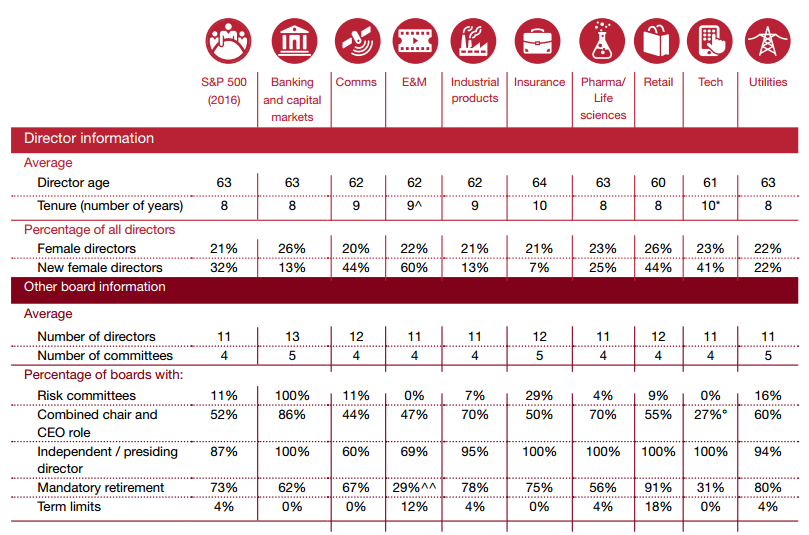
L’article est très intéressant en raison des efforts consentis à la présentation des résultats par l’illustration infographique. Le tableau présenté en annexe est particulièrement pertinent, car on y trouve une synthèse des principales variables liées au renouvellement des CA selon les neuf secteurs industriels ainsi que l’indice du S&P 500.

Au Canada, les recherches montrent que les entreprises sont beaucoup plus proactives eu égard aux facteurs de renouvellement des conseils d’administration.

Bonne lecture !

Does your board have the right makeup for the future?


Résultats de recherche d'images pour « composition du conseil d'administration »


Board composition is “the” issue for investors in 2017. Some industries are taking more steps to refresh their board than others—how does yours stack up? As the economic environment changes and lines between industries start to blur, companies are looking for directors with different, less traditional and even broader skills. Technology skills will be key across sectors.

Who’s sitting in your boardroom? Do your directors bring the right mix of skills, experiences and expertise to best oversee your company? Are they a diverse group, or a group with common backgrounds and outlooks? Can they help see into the future and how your industry is likely to take shape? And are some of your directors serving on your board as well as those in other industries?

These questions should be top of mind for executives and board members alike. Why? Because the volume of challenges companies are facing and the pace of change has intensified in recent years. From emerging technologies and cybersecurity threats to new competitors and changing regulatory requirements, companies–and their boards–have to keep up. Some boards have realized that having board members with multiple industry perspectives can prove helpful when navigating the vast amount of change businesses are faced with today.

If your board isn’t thinking about its composition and refreshment, you are opening up the door to scrutiny. Board composition is “the” issue for investors in 2017. Investors want to know who is sitting in the boardroom and whether they are the best people for the job. If they don’t think you have the right people on the board, you will likely hear about it. This is no longer something that is “nice” to think about, it’s becoming something boards “must” think about. And think about regularly.

How can you refresh your board?


In 2016, we analyzed the board demographics of select companies in nine industries to see how they compared to each other and to the S&P 500. Where does your industry fall when it comes to board refreshment? Does your board have the right makeup for the future?
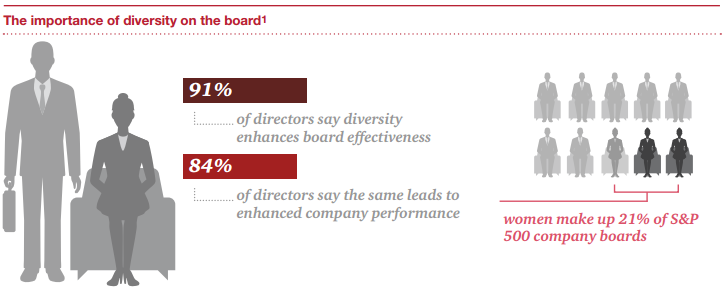
 

There are a number of ways to refresh your board. One way is to think about diversity. Many have taken on the gender imbalance on their boards and are adding more women directors. But diversity isn’t only about women. It’s about race, ethnicity, skills, experience, expertise, age and even geography. It’s about diversity of thought and perspective. And it’s not just a talking point anymore. Regulators started drafting disclosure rules around board diversity in mid-2016. Whether the rules become final remains to be seen, but either way, board diversity is in the spotlight. Add to that the common criticism that the US is far behind its developed country peers. Norway, France and the Netherlands have been using quotas for a while, and Germany in 2015 passed a law mandating 30% women on the boards of its biggest companies. While it’s unlikely quotas would be enacted in the US, some believe they’re a needed catalyst.
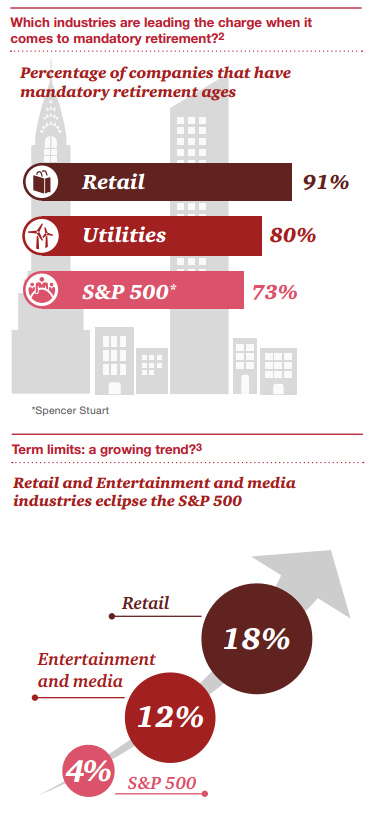


While we only looked at gender diversity on boards, we believe this is a good indicator of the efforts some boards are making to become more diverse overall. Secondly, mandatory retirement ages and term limits are two tools that boards can use to refresh itself. Our analysis showed that some industries seemed to be adopting these provisions more so than others. Some directors question their effectiveness.

Some of the industries in our PwC peer group analysis don’t have term limits at all

Banking and capital markets

Insurance

Communications

Technology

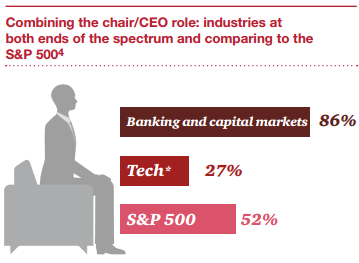
A third move that some companies have taken often, under investor pressure—is to evaluate their leadership structure and split the chair and CEO role. While the issue is still one that investors care about, certain industries have kept the combined role. And some companies don’t plan on making the change any time soon. Most often, boards with a combined chair/CEO role have an independent lead or presiding director. This may ease concerns that institutional investors and proxy firms may have about independence in the leadership role.
 

Who would have thought? Some interesting findings


While our analysis shows that most industries didn’t veer too far from the S&P 500 averages for most benchmarking categories, a few stand out. Retail in particular seems to be leading the charge when it comes to board refreshment.
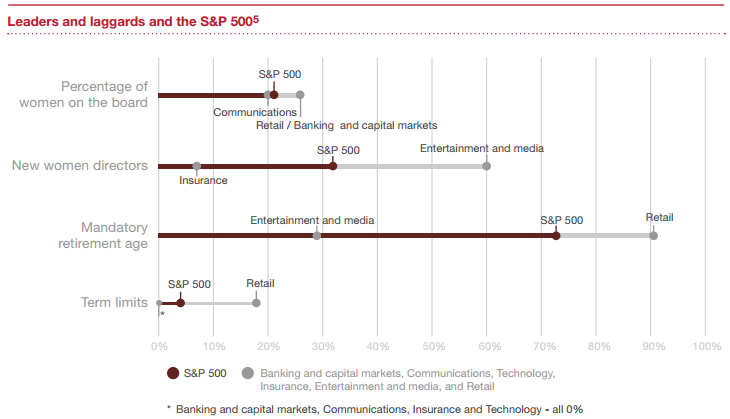


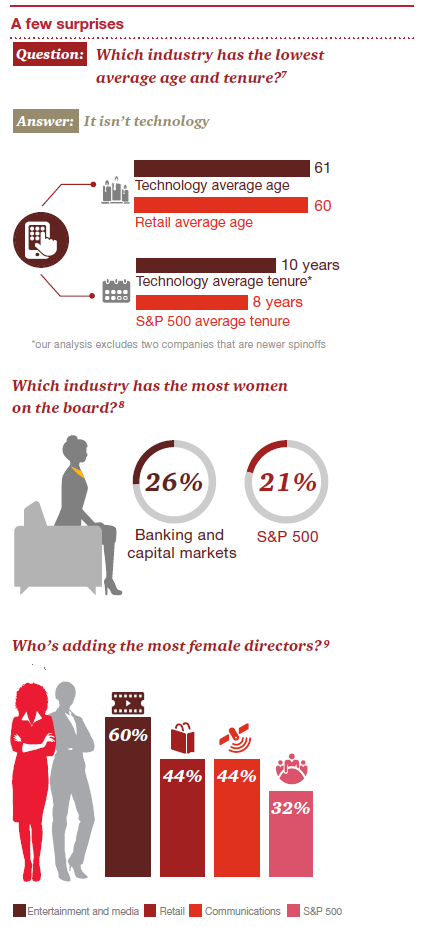
Other industries aren’t moving along quite so quickly. And there were some surprises. Which industry had the lowest average age? Perhaps surprisingly, it’s not technology. Retail claimed that one, too. And, also unexpected, was that technology had one of the highest average tenures. [6] Another surprising finding came from our analysis of the banking and capital markets industry—an industry that’s often considered to be male-dominated. BCM boards had the highest percentage of women, at 26%. That compares to just 21% for the S&P 500. Both the entertainment and media and the communications industries were also ahead of the curve when it comes to women in the boardroom, with the highest and second-highest percentages of new female directors. Retail tied with communications for second-highest, as well.
 

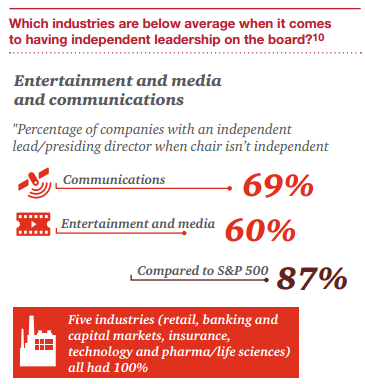
On a less progressive note, both the entertainment and media and communications industries were below the S&P 500 average when it came to having an independent lead or presiding director when the board chair is not independent. And they ranked lowest of the industries we analyzed on this topic—by far.

Blurred lines across industries


Skills, experience and diversity of thought will likely become even more important in the coming years. In the past five years alone, once bright industry lines have started to blur. Take the retail industry, for example. Brick and mortar stores, shopping malls and strip malls were what used to come to mind when thinking about that industry. Now it’s mobile devices and drones. Across many industries, business models are changing, competitors from different industries are appearing and new skills are needed. The picture of what your industry looks like today may not be the same in just a few years.

Technology is the key to much of this change. Just a few years ago, many boards were not enthusiastic about the idea of adding a director solely with technology or digital skills. But times are changing. Technology is increasingly becoming a critical skill to have on the board. We consulted our experts in the nine industries we analyzed, and all of them put technology high on the “must-have” list for new directors. Interestingly, financial, operational and industry experience—the top three from our 2016 Annual Corporate Directors Survey, were not among the most commonly listed.

Taking a fresh look


If your company is shifting gears and changing the way it does business, it may be important to take a fresh look at your board composition at more frequent intervals. Some boards use a skills matrix to see what they might be lacking in their board composition. Others may be forced by a shareholder activist to add new skills to the board.


So how do you fill the holes in the backgrounds or skills you want from your directors? One way is to look to other industries. As our analysis shows, board composition and refreshment approaches vary by industry. As industry lines blur, other industry perspectives could compliment your company—it might be helpful to consider filling any holes with board members from other industries.

No matter which approach you take, it’s very important to think about your board’s composition proactively. Use your board evaluations to understand which directors have the necessary skills and expertise—and which might be lacking what the board needs. Think about your board holistically as you think about your company’s future. Your board composition is critical to ensuring your board is effective—and keeping up with the world outside the boardroom.


Appendix


How do our industry peer groups stack up to the S&P 500? Making this evaluation can be a good way to begin determining whether your board has the right balance in terms of board composition.


Analysis excludes two companies that are newer spinoffs.
Analysis excludes one company that does not combine or separate the roles.
Excludes the tenure of one newly-formed company.
Four of the five companies that have a mandatory retirement age have waived or state that the board can choose to waive it.

Sources: Spencer Stuart, U.S. Board Index 2016, November, 2016; PwC analysis of US SEC registrants: 27 of the largest industrial products companies by market capitalization and revenue, May 2016; 11 of the largest retail companies by revenue, May 2016; 21 of the largest banking and capital markets companies by revenue, September 2016; 24 of the largest insurance companies by market capitalization, May 2016; 17 of the largest entertainment and media companies by revenue, May 2016; nine of the largest communications companies by revenue, May 2016; 25 of the largest power and utilities companies by revenue, October 2016; 16 of the largest technology companies by revenue, May 2016; 23 of the largest pharma/life sciences companies by revenue, May 2016.


Endnotes:

1Sources: PwC, 2016 Annual Corporate Directors Survey, October 2016; Spencer Stuart, 2016 US Board Index, November 2016.(go back)

2Sources: PwC analysis of 11 of the largest retail companies by revenue that are also US SEC registrants, May 2016; PwC analysis of 25 of the largest power and utilities companies by revenue that are also US SEC registrants, October 2016; Spencer Stuart, U.S. Board Index 2016, November 2016.(go back)

3Sources: PwC analysis of 11 of the largest retail companies by revenue that are also US SEC registrants, May 2016; PwC analysis of 17 of the largest entertainment and media companies by revenue that are also US SEC registrants, May 2016; Spencer Stuart, S. Board Index 2016, November 2016.(go back)

4Sources: PwC analysis of 21 of the largest banking and capital markets companies by revenue that are also US SEC registrants, September 2016; PwC analysis of 16 of the largest technology companies by revenue that are also US SEC registrants, May 2016; Spencer Stuart, S. Board Index 2016, November 2016.(go back)

5Sources: PwC analysis of US SEC registrants: nine of the largest communications companies by revenue, May 2016; 11 of the largest retail companies by revenue, May 2016; 21 of the largest banking and capital markets companies by revenue, September 2016; 24 of the largest insurance companies by market capitalization, May 2016; 16 of the largest technology companies by revenue, May 2016; 17 of the largest entertainment and media companies by revenue, May 2016; Spencer Stuart, U.S. Board Index 2016, November 2016.(go back)

6Analysis excludes two companies that are newer spinoffs.(go back)

7Sources: PwC analysis of 16 of the largest technology companies by revenue that are also US SEC registrants, May 2016; Spencer Stuart, U.S. Board Index 2016, November 2016.(go back)

8Sources: PwC analysis of 11 of the largest retail companies by revenue that are also US SEC registrants, May 2016; PwC analysis of 21 of the largest banking and capital markets companies by revenue that are also US SEC registrants, September 2016; Spencer Stuart, U.S. Board Index 2016, November, 2016(go back)

9Sources: PwC analysis of 17 of the largest entertainment and media companies by revenue that are also US SEC registrants, May 2016; PwC analysis of nine of the largest communications companies by revenue that are also US SEC registrants, May 2016; PwC analysis of 11 of the largest retail companies by revenue that are also US SEC registrants, May 2016; Spencer Stuart, S. Board Index 2016, November 2016.(go back)

10Sources: PwC analysis of 17 of the largest entertainment and media companies by revenue that are also US SEC registrants, May 2016; PwC analysis of nine of the largest communications companies by revenue that are also US SEC registrants, May 2016; Spencer Stuart, S. Board Index 2016, November 2016; PwC analysis of 11 of the largest retail companies by revenue that are also US SEC registrants, May 2016; PwC analysis of 21 of the largest banking and capital markets companies by revenue that are also US SEC registrants, September 2016; PwC analysis of 24 of the largest insurance companies by market capitalization that are also US SEC registrants, May 2016; PwC analysis of 16 of the largest technology companies by revenue that are also US SEC registrants, May 2016; PwC analysis of 23 of the largest pharma/life sciences companies by revenue that are also US SEC registrants, May 2016.

Compte rendu hebdomadaire de la Harvard Law School Forum on Corporate Governance | 2 mars 2017


Voici le compte rendu hebdomadaire du forum de la Harvard Law School sur la gouvernance corporative au 2 mars 2017.

J’ai relevé les principaux billets.

Bonne lecture !


harvard_forum_corpgovernance_small


  1. Corporate Officers as Agents
  2. 2015 Short- and Long-Term Incentive Design Criteria Among Top 200 S&P 500 Companies
  3. Private Funds Year in Review and 2017 Outlook
  4. Should Mutual Funds Invest in Startups?
  5. Shareholder Proposals Regarding Lead Director Tenure: A Harbinger of Things to Come?
  6. Hot-Button Issues for the 2017 Proxy Season
  7. 2017 Investor Corporate Governance Report
  8. 2017: Where Things Stand—Appraisal, Business Judgment Rule and Disclosure Section 16(B)—If at First You Don’t Succeed…
  9. Considerations for U.S. Public Companies Acquiring Non-U.S. Companies
  10. The 100 Most Overpaid CEOs

Compte rendu hebdomadaire de la Harvard Law School Forum on Corporate Governance | 23 février 2017


Voici le compte rendu hebdomadaire du forum de la Harvard Law School sur la gouvernance corporative au 23 février 2017.

J’ai relevé les principaux billets.

Bonne lecture !


harvard_forum_corpgovernance_small

  1. A Trump Appointed AG May Not Translate to Less Aggressive Enforcement
  2. It’s Time for the Pendulum to Swing Back
  3. SEC Enforcement in Financial Reporting and Disclosure—2016 Year in Review
  4. Tactical Approaches to Proxy Season 2017
  5. The Activist Investing Annual Review 2017
  6. Company Stock Reactions to the 2016 Election Shock: Trump, Taxes and Trade
  7. Directors Must Navigate Challenges of Shareholder-Centric Paradigm
  8. A Broader Perspective on Corporate Governance in Litigation


Les administrateurs doivent susciter le débat sur l’avenir de l’entreprise


Je vous recommande la lecture de l’article de Stuart Jackson publié dans la Harvard Business Review de janvier 2017.

L’auteur suggère, qu’en général, les conseils d’administration ne font pas suffisamment preuve de combativité et qu’ils ne jouent pas leur rôle principal, soit d’offrir une vision à long terme et de se concentrer sur la création de valeur.

Les administrateurs doivent offrir diverses perspectives de changement et proposer des stratégies propres à pérenniser l’organisation.

Les administrateurs doivent faire preuve de courage et apprendre à formuler des critiques positives envers le PDG. Le conseil d’administration est essentiellement un lieu de débat sur le futur de l’entreprise.

Les membres du conseil doivent être capables de réfléchir à l’évolution du modèle d’affaires et prévoir un plan d’action opérationnel pour un changement à long terme.

L’auteur propose une limitation de la durée des mandats des administrateurs afin d’éviter la complaisance susceptible de se manifester avec le temps. Également, on doit viser le choix d’administrateurs indépendants, capables de questionner et de contester les actions de la direction.

À cet égard, il me semble que les administrateurs devraient suivre une solide formation en gouvernance, notamment une formation telle que celle offerte par le Collège des administrateurs de sociétés (CAS) qui propose une simulation des débats autour de la table du conseil.

On constate que le rôle d’un administrateur est très exigeant et que celui-ci doit penser en termes de compétitivité de l’entreprise.

Bonne lecture ! Vos commentaires sont les bienvenus.


Boards Must Be More Combative


 homepic1


Boards of directors play two roles. They must protect value by helping companies avoid unnecessary risks, and they must build value by ensuring that companies change quickly enough to address emerging competitive threats, evolving customer preferences, and disruptive technologies.

With technology and business model cycles becoming shorter and companies facing unrelenting pressure to innovate or suffer the consequences, more and more boards need to focus on the second of these roles. To do so, they must be willing to challenge executive teams and stress-test their strategies to ensure they go far enough and fast enough. For boards used to preserving the status quo, this shift can be uncomfortable. Here are four ways boards can become better challengers and champions of change.

Confront Unwelcome News and Trends

Changing strategy is extremely difficult, especially for successful businesses. In the early 1990s Blockbuster commissioned a study on the future of video-on-demand technologies and how they would impact traditional video rentals. The report concluded that expanded cable offerings and broadband internet would begin to impact video rentals around 2000, and would grow rapidly thereafter. The good news was that Blockbuster had a good 10 years to prepare for the new environment. But the shift never happened: Management ignored the study’s findings and continued with the same strategy, supported by the board. In September 2010 Blockbuster filed for bankruptcy protection. In this case, value protection was not enough. The company had clear advance notice that seismic change was coming.

The board’s role was to acknowledge the warning signs and challenge management’s lack of action — even if it meant contention and dispute in the boardroom.

Make Sure You Have Challengers in Your Midst

Boards will be far more effective in their challenger role if they offer seats to individuals with professional experiences and viewpoints that are very different from those of the executive team. Directors can learn to be more direct with management, but it’s hard to fake contrarianism when everyone is of the same mind. When a board resembles the CEO in mindset and outlook, it’s a recipe for a gatekeeper board, not a challenger board. But when boards mix it up by bringing in members with different perspectives, they can effect powerful strategic changes, something I have seen many times in my work with corporate boards.

Often, these “challengers” will be tech-savvy young executives from digitally disruptive companies who can press their fellow directors and senior management about potential blind spots related to digital disruption. But disruption is not always about technology. For example, one highly successful, privately-held producer of canned foods actively sought a board member who could challenge management to think differently but who would still fit with the company’s family-oriented governance culture. The successful candidate was the CEO of a well-known, family-owned California wine business that catered to consumers who would not dream of buying canned food. The board member helped the company “think outside the can” to identify new product forms that would broaden their customer base and appeal to health-conscious consumers.

In another instance, a leading chain of retail pharmacies appointed as vice chair someone with a background in health care manufacturing and pharmacy benefit management. The new board member helped management better understand the efficiency advantages of mail-order pharmacies, which rely on automation. As a result, the company added low-cost automated pharmacy services to its existing retail outlets, giving it a competitive advantage over traditional retail pharmacies.

Stay Fresh with Term Limits and Checks and Balances

Beyond accessing the right expertise, boards can maintain a challenger perspective by ensuring they don’t become complacent and drift toward an approver role. One of the most effective ways to do this is to establish mandatory term limits as a part of the board’s bylaws. Term limits can help boards maintain a level of independence between the outside directors and executive leadership.

Moreover, if the CEO and chair roles are separated, the chair can take more active responsibility for ensuring that alternative views and perspectives are brought before the board. Separating the roles is a common practice in Europe, and it’s becoming more so in the United States. Another option is to appoint an independent lead director, a less drastic change that can have a similar effect. In fact, the New York Stock Exchange essentially requires listed companies with nonindependent chairs to appoint one of their independent directors as lead director. The lead position, among other duties, is responsible for scheduling and helming board meetings that take place without management. Today the majority of S&P companies with combined CEO and chair roles have chosen to counterbalance this arrangement by appointing an independent lead director.

Turn Courage and Candor into Core Competencies

Having directors with valuable insights is worthless if they do not feel comfortable sharing their perspectives and debating issues with management. A recent study by Women Corporate Directors and Bright Enterprises found that more than three-quarters (77%) of director respondents believed that their boards would make better decisions if they were more open to debate, and 94% said that criticism can help bring about change when it is used properly.

Nevertheless, board members are often hesitant to offer criticism, especially to CEOs. The same survey found that only about half (53%) of respondents felt that the CEOs of their companies take criticism well. This is not surprising. As a board member it is much easier to empathize with a CEO under pressure than with an abstract group of shareholders. One way to address this issue is to offer board members training in giving and receiving constructive criticism. Board members need to understand that failing to confront difficult issues will not help the CEO. If a CEO’s first indication that the board is dissatisfied is hearing they are searching for his or her replacement, then the board is not fulfilling its responsibilities.

Challenger boards are those with the strength to put the hard questions to management and to poke holes in suboptimal strategies. They bring a diversity of perspective that can help management understand the company’s vulnerabilities and how to overcome them. For companies struggling to exist in a world where disruption is rapidly becoming a business constant, challenger boards may well be one of their most important survival tools.

Priorité à la diversité sur les conseils d’administration | Les entreprises à un tournant !


Selon David A. Katz et Laura A. McIntosh, associés de la firme Wachtell, Lipton, Rosen & Katz, les entreprises américaines ont franchi un point de non-retour eu égard à l’acceptation de la contribution de la diversité à la profitabilité des sociétés.

En effet, il est de plus en plus acquis que l’accroissement de la diversité a des effets positifs sur les deux rôles majeurs du conseil d’administration : (1) la surveillance (oversight) et (2) la création de valeur des entreprises.

Ce court article, publié sur le site du Harvard Law School Forum, décrit les progrès réalisés dans la mise en œuvre de la diversité sur les CA et montre que les entreprises en sont à un tournant dans ce domaine.

Bonne lecture ! Vos commentaires sont appréciés.


Corporate Governance Update: Prioritizing Board Diversity


In what has been called a “breakout year” for gender diversity on U.S. public company boards, corporate America showed increasing enthusiasm for diversity-promoting measures during 2016. Recent studies have demonstrated the greater profitability of companies whose boards are meaningfully diverse. In many cases, companies have collaborated with investors to increase the number of women on their boards, and a number of prominent corporate leaders have publicly encouraged companies to prioritize diversity. The Business Roundtable, a highly influential group of corporate executives, recently released a statement that explicitly links board diversity with board performance in the two key areas of oversight and value creation. Likewise, a group of corporate leaders—including Warren Buffett, Jamie Dimon, Jeff Immelt, and Larry Fink, among others—published their own “Commonsense Principles of Corporate Governance,” (discussed on the Forum here) an open letter highlighting diversity as a key element of board composition.

board-diversity_forbes

Momentum toward gender parity on boards is building, particularly in the top tier of public corporations. Pension funds from several states have taken strong stances intended to encourage meaningful board diversity at the 25 percent to 30 percent level. Last year, then-SEC Chair Mary Jo White cited the correlation of board diversity with improved company performance and identified board diversity as an important issue for the Commission, signaling that it may be a priority for regulators going forward. Boards should take note of the evolving best practices in board composition and look for ways to improve, from a diversity standpoint, their candidate search, director nomination, and board refreshment practices. We recommend that boards include this issue as part of an annual discussion on director succession, similar to the annual discussion regarding CEO succession.

Diversity and Performance

A board of directors has two primary roles: oversight and long-term value creation. This year, the Business Roundtable released updated governance guidelines (discussed on the Forum here) that link a commitment to diversity to the successful accomplishment of both goals. Its 2016 guidelines include a statement on diversity that reads, in part, “Diverse backgrounds and experiences on corporate boards … strengthen board performance and promote the creation of long-term shareholder value.” In a statement accompanying the guidelines, Business Roundtable leader John Hayes noted that a “diversity of thought and perspective … adds to good decision-making” and enables “Americans, as well as American corporations, to prosper.” Board success and competence thus is recast to include diversity as an essential element rather than as an afterthought or as a concession to special interests.

Similarly, the “Commonsense Principles of Corporate Governance” (discussed on the Forum here) outlined over the summer by a group of corporate leaders highlights diversity on boards—multi-dimensional diversity—and correlates that diversity with improved performance. The signers of the principles, including an activist investor, a pension plan, and various chief executives, stated unequivocally in their accompanying letter that “diverse boards make better decisions.” A consensus seems to be emerging among corporate leaders that, as stated by the Business Roundtable, boards should include “a diversity of thought, backgrounds, experiences, and expertise and a range of tenures that are appropriate given the company’s current and anticipated circumstances and that, collectively, enable the board to perform its oversight function effectively.” With regard to oversight, a recent study by Spencer Stuart and WomenCorporateDirectors Foundation (discussed on the Forum here) found that female directors generally are more concerned about risks, and are more willing to address them, than are their male colleagues. Boards should, where possible, develop a pipeline of candidates whose career paths are enabling them to acquire the relevant professional expertise to be valuable public company directors in their industry.

In order to promote diversity in board composition, boards should become familiar with director search approaches to identify qualified candidates that would not otherwise come to the attention of the nominating committee. Executive search firms, public databases, and inquiries to organizations such as 2020 Women on Boards are a few of the ways that boards can find candidates that may be beyond their typical field of view. Organizations exist to help companies in their recruitment efforts. Crain’s Detroit Business, for example, has compiled a database of qualified female director candidates in Michigan, who are invited to apply and are vetted for inclusion. Boards may wish to commit to including individuals with diverse backgrounds in the pool of qualified candidates for each vacancy to be filled.

The Future of Diversity

In 2016, shareholder proposals on board diversity met with increased success. The numbers are still small: Nine proposals made it onto the ballot last year, nearly double the total in 2015 and triple the total in 2014. Nonetheless, support reached unprecedented levels in certain cases: A diversity proposal—which was not opposed by management—at FleetCor Technologies received over 70 percent shareholder support. Another diversity proposal—which was opposed by management—at Joy Global received support from 52percent of the voting shares (though the proposal did not pass due to abstentions). Diversity proposals are generally supported by the proxy advisory firms, including Institutional Shareholder Services and Glass Lewis.

Perhaps more significantly, shareholder proposals in several cases resulted in increased board diversity without ever coming to a vote. The pension fund Wespath submitted proposals this year seeking to increase diversity at three major corporations, and in each case withdrew the proposals when the subject companies agreed to add women to their boards. A spokesperson for Wespath stated that the fund had privately communicated their desire for increased diversity and had filed proposals as a “last resort” to spur change.

In a similar effort, CalSTRS recently submitted 125 letters to boards at California corporations whose boards had no women directors; in response, 35 of the companies appointed female board members. CalSTRS has indicated that if its private approaches are unsuccessful, it will proceed with shareholder proposals. The Wespath and CalSTRS examples are valuable for boards. Listening to investors, being responsive, and staying out in front of issues to forestall shareholder proposals is far better than reacting to frustrated investors who feel compelled to resort to extreme measures to get corporate attention. It is also greatly preferable to a situation in which activist investors press for legislative actions such as quotas or other mandatory board composition requirements, as we have seen in other countries.

2017 is likely to be a year in which progress toward greater board diversity significantly accelerates. Indeed, it is becoming clear that gender diversity—if not gender parity—one day will be a standard aspect of board composition. While the process of realizing that future should not be artificially or counterproductively hastened, it should be welcomed as a state of affairs that will be beneficial to all corporate constituents and, beyond, to the greater good of U.S. business and American culture.


Compte rendu hebdomadaire de la Harvard Law School Forum on Corporate Governance | 27 janvier 2017


Voici le compte rendu hebdomadaire du forum de la Harvard Law School sur la gouvernance corporative au 27 janvier 2017.

J’ai relevé les principaux billets.

Bonne lecture !


harvard_forum_corpgovernance_small


  1. Why Do Managers Fight Shareholder Proposals? Evidence from No-Action Letter Décisions
  2. Bridging the Data Gap through Shareholder Engagement
  3. Top 10 Topics for Directors in 2017
  4. Mutual Funds As Venture Capitalists? Evidence from Unicorns
  5. Broadening the Boardroom
  6. 2016 Year in Review: Securities Litigation and Regulation
  7. Bebchuk Leads SSRN’s 2016 Citation Rankings
  8. Do Director Elections Matter?
  9. White Collar and Regulatory Enforcement: What to Expect in 2017
  10. Financial Regulatory Reform in the Trump Administration
  11. Dealing with Activist Hedge Funds and Other Activist Investors


Compte rendu hebdomadaire de la Harvard Law School Forum on Corporate Governance | 19 janvier 2017


Voici le compte rendu hebdomadaire du forum de la Harvard Law School sur la gouvernance corporative au 19 janvier 2017.

J’ai relevé les principaux billets.

Bonne lecture !


harvard_forum_corpgovernance_small


  1. Playing It Safe? Managerial Preferences, Risk, and Agency Conflicts
  2. Shareholder Challenges Pay Practice at Apple, Inc.
  3. Corporate Donations and Shareholder Value
  4. Delaware Supreme Court Rules on Director Independence
  5. Proxy Access Reaches the Tipping Point
  6. Acquisition Financing: the Year Behind and the Year Ahead
  7. Say on Pay Laws, Executive Compensation, CEO Pay Slice, and Firm Value around the World
  8. The Importance of the Business Judgment Rule
  9. 2016 Year-End FCPA Update
  10. Delaware Court of Chancery Dismissal of Complaint Based on Post-Closing Disclosure Claims

Compte rendu hebdomadaire de la Harvard Law School Forum on Corporate Governance | 12 janvier 2017


Voici le compte rendu hebdomadaire du forum de la Harvard Law School sur la gouvernance corporative au 12 janvier 2017.

J’ai relevé les principaux billets.

Bonne lecture !


harvard_forum_corpgovernance_small


  1. Global and Regional Trends in Corporate Governance for 2017
  2. Compensation Season 2017
  3. Sustainability Practices: 2016 Edition
  4. The Ivory Tower on Corporate Governance
  5. Constitutionality of SEC’s Administrative Law Judges Headed to Supreme Court?
  6. Moving Beyond Shareholder Primacy: Can Mammoth Corporations Like ExxonMobil Benefit Everyone?
  7. Mergers and Acquisitions—A Brief Look Back and a View Forward
  8. Top 250 Report on Long-Term Incentive Grant Practices for Executives
  9. Corporate Governance: The New Paradigm
  10. A Strategic Cyber-Roadmap for the Board
  11. 2016 Year-End Activism Update
  12. Short-Termism and Shareholder Payouts: Getting Corporate Capital Flows Right