Compte rendu hebdomadaire de la Harvard Law School Forum on Corporate Governance | 2 août 2017


Voici le compte rendu hebdomadaire du forum de la Harvard Law School sur la gouvernance corporative au  2 août 2017.

J’ai relevé les principaux billets, tout en me limitant au Top 1o.

Bonne lecture !


Résultats de recherche d'images pour « harvard law school forum on corporate governance »


Résultats de recherche d'images pour « harvard law school forum on corporate governance »


  1. Balancing Board Experience and Expertise
  2. Common-Sense Capitalism
  3. SEHK Invites Market Feedback on Establishment of New Listing Board
  4. Issuers’ CEO/Chairman Structure Not Correlated with Firm Performance
  5. CEO Succession Practices: 2017 Edition
  6. Board Pay—Not Just a Public Company Concern
  7. Deals Mid-Year Review and Outlook
  8. Delaware Update
  9. Delaware Court of Chancery Holds Controller Transaction Satisfies Entire Fairness and Issues Appraisal Award Below Deal Price
  10. The New Market Manipulation


Combien rémunérer les administrateurs de sociétés privées ?


Cet article présente les comparaisons des programmes de rémunération des administrateurs de sociétés en fonctions des types d’organisations suivants :


  1. Grandes sociétés cotées
  2. Entreprises à propriété privée
  3. Entreprises sous contrôle familial
  4. Fonds privés de placement (Private equity)


L’article a été publié par James F. Reda directeur de la firme Arthur J. Gallagher & Co et est paru sur le forum du HLS.

Les conseils d’administration de sociétés privées se posent souvent des questions eu égard à la rémunération de leurs administrateurs. Il y a beaucoup d’information sur les rémunérations des administrateurs des sociétés publiques, mais, en ce qui concerne les entreprises privées, il y a assez peu de divulgation, donc peu de possibilités de comparaison.

À ma connaissance, l’étude de Reda est la plus complète sur le sujet.

Vous pouvez également consulter un de mes récents billets : Guide pratique à la détermination de la rémunération des administrateurs de sociétés | ICGN

Bonne lecture !


Résultats de recherche d'images pour « rémunération administrateurs »


Board Pay—Not Just a Public Company Concern


The pay levels and mechanisms for directors at public companies are well studied and benchmarked. Private and family-owned companies? Not so much. Indeed, board compensation norms for these non-public firms (which make up a huge segment of our economy) have long been very obscure. New research sheds light on the topic.

Private companies continue to struggle with how much to pay their outside board members given the shortage of available benchmarks and data. Unlike publicly traded companies, where detailed information about director compensation can be collected from an annual proxy statement and multiple survey sources, understanding pay at private boards requires further research and analysis.

Even among private companies, the variety of company ownership structures must be considered. For example, how does director compensation at a family-owned company compare to a company that is private equity-owned?

After significant growth in the early 2000s, increases in public company board pay levels have now stabilized. Heightened scrutiny from shareholders and a series of high-profile lawsuits have resulted in a standardization of pay levels between companies of similar size and industry. Companies are reviewing their plans more frequently than ever before and, subsequently, are making smaller changes.

This post compares and contrasts director pay programs at public firms that are owned by large institutional and private investors with programs at various types of private companies, as follows:

1. General

Owned by one person or a small group with a goal of increasing long-term shareholder value.

2. Family-owned

Owned by family members who have an interest in building long-term shareholder value to pass onto the next generation.

3. Private equity-owned

Owned or sponsored by private equity (PE) firms.

Private companies tend to organize their boards along the lines of public corporations. Many private companies are contemplating public status, and are working to attract investors who are more comfortable with a well-developed corporate governance structure. To staff the board with its numerous committees and leadership roles, competitive pay is required to attract and retain qualified directors.

Public and private companies compete for the same outside board talent. Private companies assume most of the leading practices of public firms with regard to board pay.

For organizations of all kinds, good governance starts with the board of directors. Despite the differences in director pay practices, boards have similar overall objectives. While the role of a board will evolve as a company grows and matures, the underlying principles remain consistent. The oversight duty, the decision-making authority, and the fiduciary responsibilities of a board are comparable, regardless of ownership, industry, size, complexity, or location within the U.S.

Public and private companies compete for the same outside board talent. The confluence of director service has made pay practices of private companies more competitive with public ones. Private companies continue to assume most of the leading practices of public firms with regard to board pay.

Despite the implementation of cash-based outside director pay plans that mirror public companies, private companies do not generally award equity, but sometimes partially make up this value in higher cash compensation. Since equity makes up a large portion of total pay for public company directors (generally over 50 percent), total director pay at private companies is significantly lower than at public companies.

Cash compensation paid to outside directors of public and private companies is fairly similar in terms of both value and structure. Cash retainer values are consistent among both public and private companies, and increase with company size.

Like public companies, many private ones pay additional cash retainers to committee chairs and members, and provide some type of incremental cash award to the lead director or non-executive chair. Private companies are also following the public company trend of eliminating board and committee meeting fees, and making up for this with a corresponding increase in board and/or committee member retainers.

Additional compensation is almost always paid for serving as a committee chair, lead director, or non-executive chair.

Public companies

For publicly held companies, many of the board’s responsibilities are defined by regulatory bodies. These are more rigorous and complex than for privately held firms where there is a substantial amount of discretion as to the role a board will play.

It has always been desirable to have a healthy complement of outside directors on the board. Corporate governance rules adopted by the New York Stock Exchange (NYSE) and the NASDAQ Stock Market (NASDAQ) in 2003 require that a majority of a listed company’s board consist of independent directors, and with limited exceptions, that the board appoints independent compensation, audit and nominating/corporate governance committees. With the need for independent directors comes a price.

Among the 1,813 companies in our firm’s study of director pay programs among Russell 3000 companies, median 2015 total director compensation was $191,043. The median revenue of these companies was $1.2 billion. Total compensation increased with company size.

Most public company directors receive a combination of cash and equity compensation, with equity making up at least half of total pay regardless of company size or industry. The median pay mix of companies studied was 58 percent equity and 42 percent cash.

The median annual board cash retainer was $55,000. Cash retainers are correlated with company size, increasing from a median of $40,000 to $100,000 by ascending revenue size.

Additional compensation is almost always paid for serving as a committee chair, lead director, or non-executive chair. Increasingly, these leadership premiums are the only additional amounts beyond the board and committee retainers and equity awards paid in these more streamlined director pay programs.

Almost all companies (94 percent) provided committee chair retainers, consistent with the general industry practice of providing premium pay to the directors with the most responsibility. Just under half of all companies (47 percent) pay committee member retainers.

Of all companies in our study, 41 percent reported a non-executive chair (NEC). Most of these (91 percent) provided additional pay, with the median added fee for this leadership position being $65,000. Fifty-three percent of all companies reported a lead director. Of these, 79 percent provided additional compensation, a median of $25,000 (almost entirely paid in cash). Unlike the NEC role, the added pay for this role did not vary significantly by company size or industry.

For annual equity awards, which typically make up at least half of total pay, the market trend over the last decade has been away from stock options and toward full value shares (restricted stock, deferred stock or outright stock). The prevalence of options continues to decline, and when companies do grant them, they often grant options along with full value shares.

The median total equity award for the entire study sample was $112,000. Nearly all companies studied provided equity (97 percent). Seventy-seven percent granted full value shares only, compared to just eight percent granting stock options only. Twelve percent of companies granted a mix of full value shares and stock options, and the remaining three percent of companies granted no equity awards at all.


Private companies

No longer able to afford the informal corporate governance practices of the past, private companies are under increasing pressure to implement or improve board oversight. These companies are embracing public-company governance, including formation of boards that include outside directors and standard committees. This movement has also affected family businesses, particularly as shareholders of family-run companies have become less concentrated with each passing generation.

The bar has thus been rising for private company governance, despite the fact that requirements imposed by various governing bodies apply only to public companies. In today’s business environment, the talent pool is becoming more homogeneous as executives and directors move freely between organizations that are small and large, and public and private.

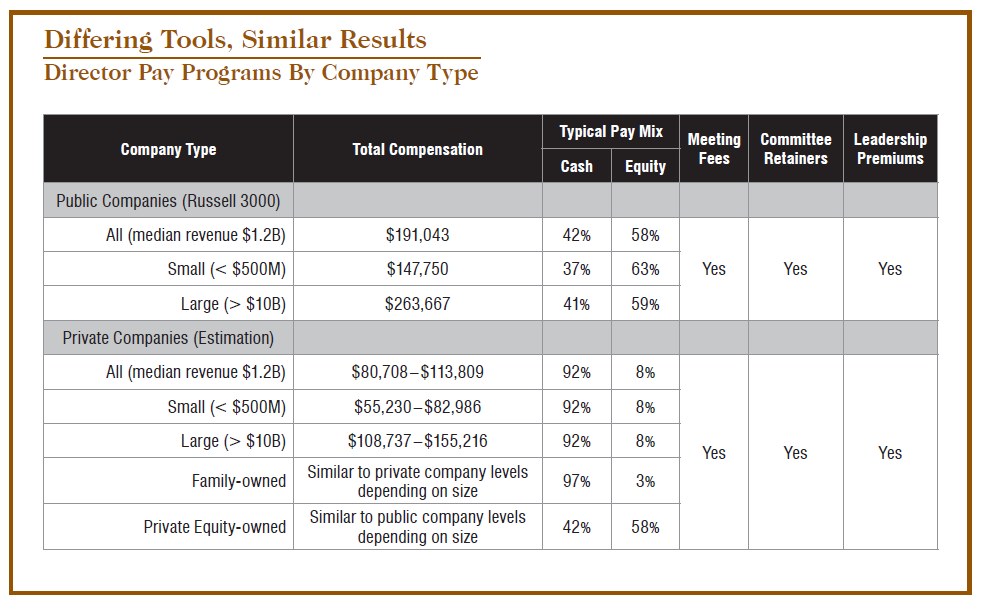
We have estimated total director pay levels for private companies of various sizes, based on our consulting experience as well as our Russell 3000 study of director pay programs at public companies. Among all revenue categories, more than 50 percent of total pay was made up of equity. Using this data as a guide, we have estimated the total pay range for similarly sized private companies, as follows:

The low end of private company total pay range represents the cash portion of public company total pay for the applicable revenue category.

The high end of private company pay range represents the cash portion of public company total pay, plus 30 percent of the equity portion for the applicable revenue category.

For example, the enclosed table shows that, among all Russell 3000 companies, total pay is $191,043, made up of 42 percent cash and 58 percent equity. Among similarly sized private companies, total compensation will range from $80,708 (the 42 percent cash portion of $191,043) to $113,809 (the 42 percent cash portion of $191,043 plus 30 percent of the remaining equity).

Thus, the resulting private company pay range equals 42 percent to 60 percent of public company pay for similarly sized companies. We have followed the same methodology to estimate total pay levels among private companies within each revenue category.

Private companies pay directors cash to the same extent as public companies of similar size, and in some cases more to make up for the lack of equity.

Based on our experience working with private companies, we believe that these ranges are a sound benchmark for how private companies of various sizes pay directors. In general, these companies pay cash to the same extent as public companies of similar size, and in some cases pay more cash to make up for the lack of equity awards (though still at a reduced rate, resulting in lower total pay).

Most public companies have some kind of executive equity program in place, and equity typically represents 50 percent to 75 percent of total pay for their senior executives. While more private companies are adopting long-term cash incentive plans, real equity awards (stock options or restricted stock) are used by a minority of private companies.

Overall, we estimate that less than 10 percent of private companies provide director equity awards, compared to 97 percent of public companies as mentioned previously. An exception to this is PE-owned companies.

Family-owned companies

Most family businesses benefit from a board that includes not only family members but also well-informed, seasoned, outside directors. These independents bring outside knowledge, leadership development skills and accountability. Leadership development is particularly important as there must be a management succession plan that includes family and non-family members, if necessary.

In 2016, Gallagher’s research team set out to understand exactly how much outside directors of family-owned companies are paid by conducting phone and electronic mail inquiries to a number of large family-held business. The outreach was successful, with nineteen companies responding. These companies spanned various industries, including retail, food processing, consumer products and general manufacturing. The median revenue of these nineteen companies was $6.9 billion.

Outside directors of family-owned companies are paid similarly to directors of other private companies, with a focus on cash and little to no equity

Twelve of the nineteen companies (63 percent) had family members that were also senior members of the management team serving on the board. In line with common practices for all types of companies, these family members received no compensation for board service.

We found that outside directors of family-owned companies are paid similarly to directors of other private companies, with a focus on cash and little to no equity awards. Some major findings:

1. The median annual cash retainer was $75,000. Median annual total compensation was $100,250. Only 11 percent of companies used equity as part of their director pay package.

2. Forty-two percent of companies paid a lead director premium.

3. Forty-seven percent paid their committee chairs a leadership premium.

4. Forty-two percent paid board meeting fees, with a range of $1,958 to $2,650 per meeting.

5. Thirty-two percent paid committee meeting fees with a range of $1,531 to $2,294 per committee meeting.

Like non-family-owned private companies, cash levels are similar to what we would expect to see among public companies. In fact, our Russell 3000 study found that public companies with revenues ranging from $3 to $9.9 billion also had a median cash retainer of $75,000.

Consistent with expectations, the lack of equity awards (present at only 11 percent of our family-owned company sample) creates a large disparity in total pay compared to the same group of Russell 3000 companies ($3 to $9.9 billion in revenue). The median compensation among public companies was $227,005 (consisting of 57 percent equity and 43 percent cash). This is 126 percent higher than the $100,250 seen among the family-owned sample.

This difference is due to the equity award. If we were to extricate only the 43 percent cash portion of $227,005, the resulting $98,000 (inclusive of cash retainer and committee member fees) is right in line with the total of $100,250 at family-owned companies. As discussed previously, this is one way that private companies, family-owned or not, set director pay—by stripping out the equity portion of comparable public company pay.

Private equity owned or sponsored companies

PE-owned companies invest in strong board governance early on in pursuit of significant growth. A top-down agenda set by the private equity fund generally drives the board’s focus, with an overall goal of progress toward a liquidity event, such as an initial public offering or M&A event.

The directors of PE-owned companies are mainly focused on strategies to increase investor value, with a much shorter time horizon than directors of private or public companies. Accordingly, these PE-owned boards are more deeply entrenched with company management, and in most cases meet more frequently than other company boards.

Beyond employee directors, there are two types of directors that will typically serve on these boards: outside directors, and employees of the private equity firm, which we refer to as “PE principals.”

Outside directors

Outsiders are often introduced to the board by the private equity firm that owns the portfolio company. Bringing in a director with no affiliation to the company or PE firm is most often made with the goal of gaining the benefit of that person’s specific qualifications and expertise.

These outside directors are generally paid by the PE fund owner, and pay is similar to publicly traded company directors. Unlike other private companies, where the focus is on cash, these outside directors generally receive a mix of both cash and equity compensation. In many cases, the focus is on equity.

PE principals.

Private equity firms exercise control over portfolio companies through their representation on the companies’ boards. These PE principal directors have a strong sense of personal ownership that is ensured by the compensation arrangements (particularly in the form of “carried interest”) of their firms.

PE principals are either paid nothing, or the same as the outside directors. In the latter arrangement, they are getting paid by both the portfolio company to be a director and by the private equity firm as an employee, which can result in excessive payment levels. For this reason, these “double pay” arrangements have sometimes caused controversy.

In summary, there are real differences in director pay between public and private companies, with the exception of private-equity controlled companies that tend to pay the same as public company counterparts.

Similar to executive pay, director pay trends continue to “trickle down” from public companies to private companies. With evolving standards and further integration of the director talent pool, we expect that private companies will continue adopting the cash-based pay practices of public companies. For all companies, governance improvements are focused on strengthening the role and responsibilities of the board of directors, and an appropriate director pay plan is a key factor to consider.

Évolution des pratiques dans le processus de succession du premier dirigeant


Le Conference Board (CB) a effectué une étude sur les pratiques entourant la succession des premiers dirigeants (CEO) des grandes entreprises américaines. Le rapport met en lumière plusieurs changements significatifs dans le taux de rotation des CEO attribuable en grande partie aux entreprises sous-performantes.

L’étude montre également que les organisations se préoccupent beaucoup plus du processus de succession à la tête de la direction. Les entreprises mettent de plus en plus l’accent sur le rôle joué par le conseil d’administration dans la préparation à la succession. La divulgation des activités reliées à la relève des PDG montre également que la transition s’effectue sur une plus longue période.

Plusieurs conclusions intéressantes ressortent également de cette étude. Voici celles que l’auteur a retenues :

– The stability seen in the succession rate of better-performing companies may indicate that increased scrutiny over executive pay and performance has started to produce results. 

– High rates of CEO turnover are also seen among consumer products companies, another signal that the sector is bracing for new strategic and market changes. 

– Much-talked about, gender diversity continues to be elusive at the helm of the largest US public companies, as only six of the 63 CEO positions that became available in the S&P 500 in 2016 were filled by a woman..

– After years of sharp rise, the succession rate of older CEOs has started to normalize at levels seen before the financial crisis, confirming the completion of a generational shift in business leadership. 

– Departing CEO tenure in 2016 was nine years, but five percent of S&P 500 companies are led by CEOs with tenures of 20 years or longer. 

– One out of 10 CEO successions in 2016 were navigated by an interim CEO, a role once used only in situations of emergencies and unplanned transitions. 

– The immediate appointment of the incoming CEO as board chairman has become a rare exception, as proxy advisors and the investment community increasingly demand independent board leadership 

Je vous invite à lire le bref compte rendu de cette étude publiée par Matteo Tonello sur le site du Harvard Law School Forum.

Bonne lecture. Vos commentaires sont appréciés.


CEO Succession Practices: 2017 Edition


According to a new report by The Conference Board, in 2016 CEO exits from underperforming companies have risen to a level unseen in 15 years amid record-high dismissals in the retail sector. In particular, last year the CEO of poorly performing companies had a 40 percent higher probability of being replaced than in 2015 and a 60 percent higher probability of being replaced than the CEOs of better-performing companies. The report, CEO Succession Practices: 2017 Edition, annually documents and analyzes succession events of chief executives of S&P 500 companies. In 2016, there were 63 cases of S&P companies that underwent a CEO turnover.

In 2016, The Conference Board found that poorly performing companies (i.e. those with an industry-adjusted two-year total shareholder return (TSR) in the bottom quartile of the S&P 500 sample) had a record-high CEO succession rate of 17.1 percent, up sharply from the 12.2 percent of 2015. It is the highest rate of turnover seen for this group of companies since 2002 and higher than the 2001-2016 average of 13.9 percent. The major driver of this surge in 2016 is the exceptional number of CEO dismissals in the wholesale and retail trade sector, which—battled by a stronger dollar, weak emerging markets, and the rise to dominance of online one-stop-shop competitors such as Amazon—was widely reported as among the biggest job cutters in recent years. In this business industry, CEO dismissals were 50 percent of the total succession tally for 2016, compared to 14.3 percent in the prior year. Oil and gas extraction companies also experienced a spike in dismissals, with 75 percent of CEO succession cases in 2016 classified by The Conference Board as disciplinary, compared to 25 percent in the prior year.

Another notable finding from the report is that companies are becoming more communicative about their CEO succession plans so as to avoid surprising market participants. Communication practices more commonly include providing earlier notice of the CEO succession event, including the description of the role performed by the board of directors in the CEO succession process, and offering more details on the reasons for the transition. In particular, compared with a year earlier, in 2016 boards were 30 percent less likely to announce that the transition was effective immediately.

Guide pratique à la détermination de la rémunération des administrateurs de sociétés | ICGN


Aujourd’hui, je vous suggère la lecture d’un excellent guide publié par International Corporate Governance Network (ICGN). Ce document présente succinctement les grands principes qui devraient gouverner l’établissement de la rémunération des administrateurs indépendants (« non-executive »).

Il va de soi que la rémunération des administrateurs ne représente qu’une part infime du budget d’une entreprise, et celle-ci est relativement très inférieure aux rémunérations consenties aux dirigeants ! Cependant, il est vital d’apporter une attention particulière à la rémunération des administrateurs, car ceux-ci sont les fiduciaires des actionnaires, ceux qui doivent les représenter, en veillant à la saine gestion de la société.

Il est important que le comité de gouvernance se penche annuellement sur la question de la rémunération des administrateurs indépendants, et que ce comité propose une politique de rémunération qui tient compte du rôle déterminant de ces derniers. Plusieurs variables doivent être prises en ligne de compte notamment, la comparaison avec d’autres entreprises similaires, les responsabilités des administrateurs dans les différents rôles qui leur sont attribués au sein du conseil, la nature de l’entreprise (taille, cycle de développement, type de mission, circonstances particulières, etc.).

Personnellement, je suis d’avis que tous les administrateurs de sociétés obtiennent une compensation pour leurs efforts, même si, dans certains cas, les sommes affectées s’avèrent peu élevées. Les organisations ont avantage à offrir de justes rémunérations à leurs administrateurs afin (1) d’attirer de nouvelles recrues hautement qualifiées (2) de s’assurer que les intérêts des administrateurs sont en adéquation avec les intérêts des parties prenantes, et (3) d’être en mesure de s’attendre à une solide performance de leur part et de divulguer les rémunérations globales.

Le document du ICNG propose une réflexion dans trois domaines : (1) la structure de rémunération (2) la reddition de comptes, et (3) les principes de transparence.

On me demande souvent qui doit statuer sur la politique de rémunération des administrateurs, puisqu’il semble que ceux-ci déterminent leurs propres compensations !

Ultimement, ce sont les actionnaires qui doivent approuver les rémunérations des administrateurs telles que présentées dans la circulaire de procuration. Cependant, le travail en aval se fait, annuellement, par le comité de gouvernance lequel recommande au conseil une structure de rémunération des administrateurs non exécutifs. Notons que les comités de gouvernance ont souvent recours à des firmes spécialisées en rémunération pour les aider dans leurs décisions.

C’est cette recommandation qui devrait être amenée à l’assemblée générale annuelle pour approbation, même si dans plusieurs pays, la juridiction ne le requiert pas.

En tant qu’administrateur, si vous souhaitez connaître le point de vue du plus grand réseau de gouvernance à l’échelle internationale, je vous invite à lire ce document synthétique.

Bonne lecture. Vos commentaires sur le sujet sont sollicités.


ICGN Guidance on Non-executive Director Remuneration – 2016


Compte rendu hebdomadaire de la Harvard Law School Forum on Corporate Governance | 20 juillet 2017


Voici le compte rendu hebdomadaire du forum de la Harvard Law School sur la gouvernance corporative au  20 juillet 2017.

J’ai relevé les principaux billets, tout en me limitant au Top 1o.

Bonne lecture !


Résultats de recherche d'images pour « harvard law school forum on corporate governance »


Résultats de recherche d'images pour « harvard law school forum on corporate governance »


  1. Lighting Our Capital Markets
  2. Balancing the Governance of Financial Institutions
  3. The Search for a Long-Term Premium
  4. Board to Death: How Busy Directors Could Cause the Next Financial Crisis
  5. Communications Challenges for the Post-Activist Proxy Contest World
  6. Director Attention and Firm Value
  7. CalPERS v. IAC: Clear Win for Investors Protecting Shareholder Voting Rights
  8. Hedge Fund Activism and the Revision of the Shareholder Rights Directive
  9. The Delightful Dozen: Top Governance Advances in 2017
  10. How Important are Risk-Taking Incentives in Executive Compensation

Compte rendu hebdomadaire de la Harvard Law School Forum on Corporate Governance | 13 juillet 2017


Voici le compte rendu hebdomadaire du forum de la Harvard Law School sur la gouvernance corporative au  13 juillet 2017.

J’ai relevé les principaux billets, tout en me limitant au Top 1o.

Bonne lecture !


Résultats de recherche d'images pour « harvard law school forum on corporate governance »


Résultats de recherche d'images pour « harvard law school forum on corporate governance »


  1. The Law & Brexit XII
  2. How Your Board Can Be Ready for Crisis
  3. 2017 Proxy Season Review Appraisal Practice Points Post-SWS
  4. Lawyer CEOs
  5. The Value of the Shareholder Proposal Process
  6. What Do Measures of Real-Time Corporate Sales Tell Us About Earnings Surprises and Post-Announcement Returns?
  7. Have SEC ALJs Been Operating Contrary to the U.S. Constitution?
  8. Shareholder Proposal Developments During the 2017 Proxy Season
  9. Inelastic Labor Markets and Directors’ Reputational Incentives
  10. The Long Arm of the MAC

Compte rendu hebdomadaire de la Harvard Law School Forum on Corporate Governance | 6 juillet 2017


Voici le compte rendu hebdomadaire du forum de la Harvard Law School sur la gouvernance corporative au  6 juillet 2017.

J’ai relevé les principaux billets, tout en me limitant au Top 1o.

Bonne lecture !


Résultats de recherche d'images pour « harvard law school forum on corporate governance »


Résultats de recherche d'images pour « harvard law school forum on corporate governance »


  1. What are Boards For? Evidence from Closely Held Firms
  2. After the Annual General Meeting: How Boards Can Prepare for Next Year
  3. Proxy Access: Highlights of the 2017 Proxy Season
  4. A Closer Look at the Findings of Our 2017 Proxy Analysis: A New Normal Meets a New Reality
  5. Investor Support Heating Up for Climate Change Proposals
  6. Red Light for New Activist Strategy
  7. Board Reforms and Firm Value: Worldwide Evidence The “Responsible Corporate Officer Doctrine”
  8. Survives to Perplex Corporate Boards
  9. Index Eligibility as Governance Battlefield: Why the System is Not Broken and We Can Live With Dual Class Issuers
  10. Internal Investigations Special Committees Resource

Compte rendu hebdomadaire de la Harvard Law School Forum on Corporate Governance | 29 juin 2017


Voici le compte rendu hebdomadaire du forum de la Harvard Law School sur la gouvernance corporative au  29 juin 2017.

J’ai relevé les principaux billets, tout en me limitant au Top 10

Bonne lecture !


Résultats de recherche d'images pour « harvard law school forum on corporate governance »


Résultats de recherche d'images pour « harvard law school forum on corporate governance »


  1. What Is the Business of Business?
  2. Treasury Department Issues Recommendations on Reforming the U.S. Financial System
  3. A Modest Proposal? Treasury’s Report on Bank Regulation
  4. Déjà Vu: Model Risks in the Financial Choice Act
  5. Is Board Compensation Excessive?
  6. Ten Questions Every Board Should Ask in Overseeing Cyber Risks
  7. Federal Bill Attempts to Silence Investors
  8. The Financial CHOICE Act and the Debate Over Shareholder Proposals
  9. “Captured Boards”: The Rise of “Super Directors” and the Case for a Board Suite
  10. The Increasing Evidence that Horizontal Shareholding Is Distorting Our Economy

Compte rendu hebdomadaire de la Harvard Law School Forum on Corporate Governance | 22 juin 2017


Voici le compte rendu hebdomadaire du forum de la Harvard Law School sur la gouvernance corporative au  22 juin 2017.

J’ai relevé les principaux billets, tout en me limitant au Top 1o.

Bonne lecture !


Résultats de recherche d'images pour « harvard law school forum on corporate governance »


Résultats de recherche d'images pour « harvard law school forum on corporate governance »


  1. What Determines Participation in Corporate Voting?
  2. The Voice: The Minority Shareholder’s Perspective
  3. PCAOB Approves Expanded Auditor’s Report
  4. Shareholder Proposals: Evidence of Private Ordering Supplanting Public Policy?
  5. Changing Attitudes: The Stark Results Of Thirty Years Of Evolution In Delaware M&A Litigation
  6. Corporate Liquidity, Acquisitions, and Macroeconomic Conditions
  7. Letter to Paul Ryan: The Financial CHOICE Act of 2017
  8. Are Shareholder Proposals on Climate Change Becoming a Thing?
  9. Balancing the Tension: Current Topics in Executive Compensation
  10. House Approves Financial CHOICE Act


Un document complet sur les bonnes pratiques de gouvernance et de gestion d’un CA | The Directors Toolkit 2017 de KPMG


Voici la version 4.0 du document « The Directors’Toolkit 2017 » de KPMG, très bien conçu, qui répond clairement aux questions que tous les administrateurs de sociétés se posent en cours de mandat.

Même si la publication est dédiée à l’auditoire australien de KPMG, je crois que la réalité réglementaire nord-américaine est trop semblable pour se priver d’un bon « kit » d’outils qui peut aider à constituer un Board efficace.

C’est un formidable document électronique interactif. Voyez la table des matières ci-dessous.

J’ai demandé à KPMG de me procurer une version française du même document, mais il ne semble pas en exister.

Bonne lecture !

The Directors’ Toolkit 2017 | KPMG


Now in its fourth edition, this comprehensive guide is in a user friendly electronic format. It is designed to assist directors to more effectively discharge their duties and improve board performance and decision-making.

Key topics

  1. Duties and responsibilities of a director
  2. Oversight of strategy and governance
  3. Managing shareholder and stakeholder expectations
  4. Structuring an effective board and sub-committees
  5. Enabling key executive appointments
  6. Managing productive meetings
  7. Better practice terms of reference, charters and agendas
  8. Establishing new boards.

What’s new in 2017

In this latest version, we have included newly updated sections on:

  1. managing cybersecurity risks
  2. human rights in the supply chain.

Register

Register here for your free copy of the Directors’ Toolkit.

Compte rendu hebdomadaire de la Harvard Law School Forum on Corporate Governance | 15 juin 2017


Voici le compte rendu hebdomadaire du forum de la Harvard Law School sur la gouvernance corporative au  15 juin 2017.

J’ai relevé les principaux billets, tout en me limitant au Top 1o.

Bonne lecture !


Résultats de recherche d'images pour « harvard law school forum on corporate governance »


Résultats de recherche d'images pour « harvard law school forum on corporate governance »


  1. Breaking the Ice: Investors Warm to Climate Change
  2. Perk Disclosures: Reminders for Executives and Directors
  3. Compensation Goals and Firm Performance
  4. The Global Rise of Corporate Saving
  5. The 200 Highest-Paid CEOs in 2016
  6. The CEO Pay Ratio Beyond Dodd Frank: Live and Local
  7. M&A Activism: A Special Report
  8. Distracted Directors
  9. The Dangerous “Promise of Market Reform”: No Shareholder Proposals
  10. Financial CHOICE Act of 2017 2017 M&A Report

Doit-on limiter le nombre d’années qu’un administrateur siège à un conseil afin de préserver son indépendance ?


On voit de plus en plus apparaître des mesures restrictives eu égard au nombre d’années de présence des administrateurs indépendants sur les CA des grandes entreprises.

Les autorités réglementaires de quelques pays (dont la France et le Royaume-Uni) émettent des directives sur le nombre maximal de mandats des administrateurs indépendants. En général, on parle d’une durée n’excédant pas une limite de 9 à 12 ans. Notons qu’au Canada, l’OSC et l’AMF n’émettent pas de directives relatives aux nombres d’années passées sur un conseil d’administration. Il en est de même aux É.U. où 24 % des administrateurs indépendants siègent au même conseil depuis plus de 15 ans !

Les autorités réglementaires devraient-elles imposer un nombre d’années maximal aux mandats des administrateurs, en se basant sur le « fait » qu’un trop grand nombre d’années peut nuire à leur indépendance vis-à-vis de la direction ? C’est l’objet de l’étude du professeur Stefano Bonini de la Stevens Institute of Technology, publiée sur le site de la Harvard Law School Forum.

Dans l’ensemble, l’étude montre qu’il faudrait tenir compte des caractéristiques individuelles des administrateurs de longue durée, plutôt que d’utiliser la mesure de la moyenne dans l’évaluation du phénomène de longue durée.

L’auteur pose deux questions :

(1) Comment le nombre d’années que les administrateurs passent sur des CA influence-t-il la performance de l’organisation ?

(2) Qu’est-ce qui détermine une présence de longue durée sur un CA ?

Voici les conclusions de l’étude :

First, consistent with Katz and McIntosh (2014), we posit that board-wide term limits may be detrimental to the board itself, the company, and the shareholders, in particular if such limits force valuable directors off the board. This is in line with ISS (2017) that states: “term and age limits, as they have been typically applied, may not be the solutions, because they force the arbitrary retirement of valuable directors.”

Second, our results show that Long Tenured (LT) directors are disproportionately more likely to be nominated as Lead Independent Directors (LID), a role that has become increasingly relevant in listed companies, following a set of regulation changes in the U.S. stock market. Since firms recognize the value of LT directors and leverage on it by appointing LT directors as LID, an unconditional tenure limit would negatively affect the effectiveness of the LID function and ultimately weaken the governance of companies.

Je vous invite à lire un résumé de l’article en question et j’attends vos commentaires.


On Long-Tenured Independent Directors


A growing number of countries, such as UK and France, have adopted tenure-related guidelines or tenure restrictions for independent directors. Most countries adopt a comply-or-explain approach to regulating tenure recommending a maximum tenure for a corporate director between nine and twelve years. In the United States however, where explicit limits are absent, a recent survey by GMI Ratings, the leading independent provider of global corporate governance and research, shows that 24% of independent directors in Russel 3,000 firms have continuously served in the same firm for fifteen years or more.

Résultats de recherche d'images pour « Long-Tenured Directors »We argue that long-tenured directors are superiorly skilled individuals who provide tangible value added to their firms. An extension of tenure length allows directors to accumulate information about past events in the firm and about responses to exogenous market shocks that help firms weather crises and discontinuities. In support of the view that the effectiveness of one independent director is also the result of a long build-up process, William George, a Harvard Business School professor and independent director, stated: “When directors are truly independent of the companies they serve, they generally lack the […] knowledge about the industry or business […]. [O]f the nine boards I served on as an independent director I had industry-specific knowledge in exactly none of them.”

Research on independent directors usually adopts as the main dependent variable the average tenure across independent board members (e.g., Vafeas 2003; Huang 2013). Given that multiple regulation changes have increased the fraction of independent board members that now represent 70% to 80% of the board, average board tenure measures significantly confound the effect of a single long tenure that is diluted by the majority of board members who experience shorter tenures. This view is aligned with best practice recommendations compiled by Institutional lnvestor Services (ISS, a shareholder activist group) (2017): “While investors in the past have focused on average board tenure, they are beginning to pay attention to individual director tenure as well, particularly for directors serving in board leadership roles like lead director or key committee chairs.” Our research focuses on the puzzling phenomenon of extremely long tenures that do not occur board-wide, but are specific to a single director. Switching the focus to individual, abnormal tenures allows us to isolate the strongly beneficial effects on firm performance that increase in the single director tenure and level off after a surprisingly long period. Differently, the average tenure of independent board members does not increase firm value and in some specifications, appear to have a negative impact on firm performance and firm stability.

The positive effects documented in our paper raise two important questions: first, how do LT directors affect performance? Second, what determines long tenure?

The first question deals with the nature of independent directors, who protect firm stakeholders by monitoring the firm, its management, and the external environment (ICGN 2014). In this respect, the directors’ task is crucially related to the quality and amount of information the director can gather and process. Our tests confirm that long-tenured directors can gather and store valuable information that they share with other independent board members, generating a moderate-to-null sensitivity of the firm performance to the opaqueness of the outside information environment. Also, superior information translates into a significantly lower external litigation risk as documented by a set of tests on the likelihood of LT firms to be defendants in security class action lawsuits. This protection effect is robust to alternative specifications of the litigation risk variable.

Addressing the second question requires looking at observable individual factors, but, more importantly, finding proxies for unobservable characteristics. We show that not all board members are equally likely to become long-tenured directors. Personal characteristics and the market perception of traits and skills positively impact the probability of one individual becoming a long-tenured director. Directors with a high-quality education, such as graduate degrees and degrees from Ivy League colleges, are significantly more likely to evolve into LT directors, compared with other independent board members. However, unobservable skills may still explain their long association with a firm. Looking at contemporaneous board directorships at the time of the first appointment in the firm in which a director eventually becomes a LT board member, we show that ex-ante these individuals held a substantially larger number of board appointments than did other directors. This suggests that firms at large recognized these candidates’ superior qualities and competed for their services. Consistent with the market’s ability to identify skilled directors, we document superior performance of firms in which LT directors hold appointments as independent, but not long-tenured, directors.

The complete paper is available for download here.

Compte rendu hebdomadaire de la Harvard Law School Forum on Corporate Governance | 8 juin 2017


Voici le compte rendu hebdomadaire du forum de la Harvard Law School sur la gouvernance corporative au 8 juin 2017.

J’ai relevé les principaux billets, tout en me limitant au Top 1o.

Bonne lecture !


Résultats de recherche d'images pour « harvard law school forum on corporate governance »


Résultats de recherche d'images pour « harvard law school forum on corporate governance »


  1. Decreasing Patience for IPOs with Poor Shareholder Rights
  2. Appraisal Decision Sole Reliance on Merger Price: PetSmart
  3. The Role of Social Capital in Corporations: A Review
  4. On Long-Tenured Independent Directors
  5. Why Your Board Should Refocus on Key Risks
  6. The Limits of Gatekeeper Liability
  7. The Long Game: Incentive Pay Aims at Generating Lasting Return
  8. The Corporate Demand for External Connectivity: Pricing Boardroom Social Capital
  9. Criticism of Governance Provisions in Proxy Contest Leads to Reincorporation
  10. Retired or Fired: How Can Investors Tell If the CEO Left Voluntarily?


Compte rendu hebdomadaire de la Harvard Law School Forum on Corporate Governance | 1er juin 2017


Voici le compte rendu hebdomadaire du forum de la Harvard Law School sur la gouvernance corporative au 1er juin 2017.

J’ai relevé les principaux billets, tout en me limitant au Top 1o.

Bonne lecture !


Résultats de recherche d'images pour « harvard law school forum on corporate governance »


Résultats de recherche d'images pour « harvard law school forum on corporate governance »

  1. Bank Governance and Systemic Stability: The “Golden Share” Approach
  2. Snap and the Rise of No-Vote Common Shares
  3. Potential Regulatory Relief—Financial CHOICE Act 2.0
  4. The Origins of Corporate Social Responsibility
  5. M&A Deal Terms in 2017: What Can Deal Teams Expect?
  6. Cybersecurity Must Be High on the Board Agenda
  7. Dancing with Activists
  8. U.S. Proxy Season Half-Time Update
  9. What’s (Still) Wrong with Credit Ratings
  10. 2017 M&A Report

Nouvelle étude sur les retombées des comportements activistes | Bebchuk


Les administrateurs de sociétés doivent être beaucoup plus informés des conséquences que les fonds activistes peuvent avoir sur la conduite des entreprises publiques (cotées).

Il plane un air de mystère, et un certain mutisme, sur la nature des opérations et sur les objectifs poursuivis par les investisseurs activistes.

Pourtant, même si le phénomène est de plus en plus répandu, on constate un manque flagrant de formation des administrateurs de sociétés sur les types d’arrangements recherchés par les activistes.

Les pionniers de la recherche dans ce domaine, Lucian Bebchuk* et ses collègues, viennent de publier un billet sur le site de Harvard Law School Forum on Corporate Governance, qui fait la lumière sur le comportement des investisseurs activistes.

Que recherchent les activistes ? Ils veulent convaincre les directions et les conseils d’administration que leurs préconisations conduiront à une meilleure valorisation de l’entreprise.

Ils souhaitent tirer parti des faiblesses de certaines organisations dans le but premier de faire profiter leurs investissements, tout en améliorant la rentabilité des entreprises qui ont des problèmes de gouvernance, de leadership et de vision stratégique.

Quels sont les résultats de la recherche des auteurs eu égard aux motivations, à la nature des arrangements ainsi qu’à leurs conséquences ?

L’étude montre que les négociations sur les modifications organisationnelles souhaitées, reliées au renouvellement du leadership et à la remise en question des opérations, sont difficiles à convenir.

Les fonds activistes préfèrent de loin arriver à des ententes sur la composition du conseil d’administration susceptible de favoriser les changements escomptés.


Résultats de recherche d'images pour « actionnaires activistes »
Les fonds activistes à l’assaut des grands groupes | Le Monde


L’étude indique que les modifications à la constitution du CA mènent souvent :

  1. au remplacement du PDG (CEO) ;
  2. à des paiements accrus aux actionnaires ;
  3. à une plus forte probabilité de vente ou de privatisation de l’entreprise.


Finalement, l’étude montre que les avantages obtenus par les actionnaires activistes ne se font pas au détriment des autres investisseurs. Également, le prix des actions est généralement à la hausse à la suite des négociations sur les arrangements.

Les auteurs dévoilent aussi les moyens utilisés par les fonds activistes pour arriver à leurs fins (« a look into the black box »).

Je suis personnellement convaincu que certaines conséquences non anticipées se produisent et que cette étude doit être mise en relation avec d’autres recherches, notamment celles du professeur Yvan Allaire**.


Afin de mettre en valeur de bonnes pratiques mises en places par des conseils d’administration des sociétés québécoises, le journal Les Affaires, en collaboration avec l’Institut des administrateurs de sociétés (IAS), le Collège des administrateurs de sociétés et l’Institut sur la gouvernance  (IGOPP), a tenu le 1er avril dernier une Grande soirée de la gouvernance. Durant cette soirée, le professeur Yvan Allaire, président exécutif du conseil d’administration de l’IGOPP a dévoilé en primeur une étude sur l’enjeu des investisseurs activistes et leurs conséquences pour les conseils d’administration.


Conclusions préliminaires de cette étude :

(1) Les fonds de couverture activistes ne sont pas des « super‐cracks » de la finance, ni de la stratégie, ni des opérations, comme certains semblent le croire (et eux s’évertuent à le faire croire) ;

(2) Leurs recettes sont connues, convenues et prévisibles et ne comportent jamais (ou presque) de perspectives de croissance ;

(3) Leur succès provient surtout de la vente des entreprises ciblées (ou de « spin‐offs ») ;

(4) L’appui important qu’ils reçoivent des fonds institutionnels est surprenant et malencontreux ;

(5) La gouvernance fiduciaire pratiquée depuis Sarbanes‐Oxley et la perte de confiance dans les conseils qui en a résulté leur ouvre toute grande la porte des entreprises.


Bonne lecture. Vos commentaires sont les bienvenus.


Dancing with Activists


We recently released a study, entitled Dancing with Activists, that focuses on “settlement” agreements between activist hedge funds and target companies. Using a comprehensive hand-collected data set, we provide the first systematic analysis of the drivers, nature, and consequences of such settlement agreements.

Our study identifies the determinants of settlements, showing that settlements are more likely when the activist has a credible threat to win board seats in a proxy fight. We argue that, due to incomplete contracting, settlements can be expected to contract not directly on the operational or leadership changes that activists seek but rather on board composition changes that can facilitate operational and leadership changes down the road. Consistent with the incomplete contracting hypothesis, we document that settlements focus on boardroom changes and that such changes are subsequently followed by increases in CEO turnover, increased payout to shareholders, and higher likelihood of a sale or a going-private transaction.

We find no evidence to support concerns that settlements enable activists to extract significant rents at the expense of other investors by introducing directors not supported by other investors or by facilitating “greenmail.” Finally, we document that stock price reactions to settlement agreements are positive and that the positive reaction is higher for “high-impact” settlements. Our analysis provides a look into the “black box” of activist engagements and contributes to understanding how activism brings about changes in its targets.

Below is a more detailed account of the analysis and findings of our study.

In August 2013, Third Point, the hedge fund led by Daniel Loeb, disclosed a significant stake in the auction house Sotheby’s, criticized the company for its poor governance and its failure to take advantage of a booming market for luxury goods, and called for the ouster of the company’s CEO. Third Point launched a proxy fight for board representation and both sides prepared for a contested election at the company’s upcoming annual meeting. However, the day before the scheduled annual shareholder meeting, the company’s board of directors and the activist fund entered into a settlement agreement in which Sotheby’s agreed to appoint three of the Third Point director candidates and Third Point agreed to discontinue the proxy fight. The settlement terms did not require the company to make any of the operational and executive changes that Third Point was seeking. However, ten months later, Sotheby’s announced the hiring of a new CEO, the appointment of a new board chairman, and a plan to return capital to its investors.

While such settlements used to be rare, they now occur with significant frequency, and they have been attracting a great deal of media and practitioner attention. Understanding settlement agreements is important for obtaining a complete picture of the corporate governance landscape and the role of activism within it. Using a comprehensive, hand-collected dataset of settlement agreements, we provide in this study the first systematic empirical investigation of activist settlements. We study the drivers of settlements, their growth over time, their impact on board composition, their consequences for the operational and personnel choices that targets make, and the stock market reaction accompanying them. We further study the aftermath of settlements in terms of CEO turnover, payouts to shareholders, M&A activity, and operating performance.

With the growing recognition of the importance of hedge fund activism, a large empirical literature on the subject has emerged (see Brav et al. (2015b) for a recent survey). This literature has studied the initiation of activist interventions—the time at which activists announce their presence, usually by filing Schedule 13(d) with the SEC after passing the 5% ownership threshold, and the stock market reactions accompanying such announcements. This literature has also studied extensively the changes in the value, performance and behavior of firms that take place during the years following activist interventions; among other things, researchers have studied the changes in Tobin’s Q, return on assets (ROA), payouts to shareholders, capital structure, likelihood of an acquisition, and accounting practices that ultimately follow activist interventions. But there has been limited empirical work on the “black box” in between—the channels through which activists’ influence is transmitted and gets reflected in targets’ economic outcomes. In particular, the determinants, nature and role of settlement agreements—and the cooperation between activists and targets that they introduce—have not been subject to a systematic empirical examination. We attempt to help fill this gap.

We begin by investigating the factors that determine the likelihood that an activist will be able to obtain a settlement agreement. Building on insights from the economics of settlements, we hypothesize that an activist will need to have a credible threat to win seats in a proxy fight to be able to extract a settlement agreement. Consistent with this hypothesis, we find that the likelihood of a settlement agreement in general, and a “high-impact” settlement agreement involving a substantial change in company leadership, covaries with several factors that are associated with improved odds for the activist in winning board seats in a proxy fight.

We quantify the upward trend in activist settlements. In particular, we show that the unconditional likelihood of a settlement increased threefold from the time period 2000-2002 (3%) to the period 2003-2005 (9%), increased by another 56% during 2006-2008 (14%) and by 29% during 2009-2011 (18%). These results hold when controlling for target and activist characteristics. Consistent with the view that settlements require activists having a credible threat to win board seats in a proxy fight, we argue that the increase in the settlement rate was driven by the growing willingness of institutional investors and proxy advisors to support activists, which in turns strengthened the credibility of the activist’s threat to win seats in a contest.

Turning to the terms of settlements, we explain the cost and difficulty of entering into contractual agreements that specify ultimate outcomes—the types of changes in operations, strategy, payouts or executive personnel that activists often seek. We document that settlements indeed rarely stipulate directly such outcomes. Rather, activists commonly settle on changes in board composition. We demonstrate that settlements are a key channel through which activists bring about board changes and we investigate the nature of these changes, showing that they bring about an increase in the number of activist-affiliated and activist-desired directors, well-connected directors and decrease the number of old and long-tenured directors.

Why do activists settle on changes in board composition if their ultimate goal is in bringing about operational or personnel changes? We argue that introducing individuals into the boardroom who are sympathetic, or at least open to the changes sought by the activist, is an intermediary step that can facilitate and bring about such changes. Consistent with this view, we show that, while settlements generally do not specify an ouster of the CEO, settlements are followed by a considerable increase in CEO turnover and in the performance-sensitivity of CEO turnover in the years following the settlement. Thus, settlements often plant the seeds for a subsequent CEO removal that is more face-saving to the CEO and the incumbent directors than an immediate ouster would be. Similarly, while settlement agreements generally do not specify operational changes, we document that such changes do follow in subsequent years. Settlements are followed by increased payouts to shareholders, a higher likelihood of target firms being acquired, and improvements in ROA.

We also investigate concerns raised by practitioners and the media that settlements between activists and targets enable activists to extract rents at the expense of other shareholders who are not “at the table” when the settlement is negotiated. We examine two suggested channels for such rent extraction and find little evidence that settlements provide activists with significant rents at other shareholders’ expense. First, we find no evidence that settlements enable activists to put directors on the board who are not supported by other shareholders. Directors who enter the board through settlements do not receive less voting support at the following annual general meeting than incumbent directors or those activist directors who get on the board without a settlement. Second, we find little evidence that settlements produce a significant incidence of “greenmail” by getting the target to purchase shares from the activist at a premium to the market price; buybacks of activist shares occur in a very small fraction of settlement agreements and, when they do occur, they are typically executed at the market price.

Finally, we analyze the stock market reactions accompanying the announcement of a settlement agreement. Settlements are accompanied by positive abnormal stock returns. Furthermore, we find that the positive abnormal returns are especially large when the settlement is “high impact” in terms of introducing two or more new directors or providing for an immediate CEO turnover. This pattern is consistent with the view that the market welcomes the boardroom and leadership changes that activist settlements produce and inconsistent with the view that such changes can be expected to be disruptive and detrimental to other shareholders.

Our study is available for download here.


*Lucian Bebchuk is Professor of Law, Economics, and Finance, and Director of the Program on Corporate Governance, at Harvard Law School; Alon Brav is Professor of Finance at Duke University; Wei Jiang is Professor of Finance at Columbia Business School; and Thomas Keusch is Assistant Professor at the Erasmus University School of Economics. This post is based on their study, Dancing with Activists, available here. This study is part of the research undertaken by the Project on Hedge Fund Activism of the Program on Corporate Governance. Related Program research includes The Long-Term Effects of Hedge Fund Activism by Bebchuk, Brav and Jiang (discussed on the Forum here); and The Law and Economics of Blockholder Disclosure by Lucian Bebchuk and Robert J. Jackson Jr. (discussed on the Forum here).

**Yvan Allaire, Voir la publication « L’IGOPP dévoile une étude sur l’enjeu des investisseurs activistes et leurs conséquences pour les conseils », site de l’IGOPP.


Facteurs qui influencent la rémunération des dirigeants d’OBNL ?


Qu’est-ce qui influence la rémunération des dirigeants d’organisation sans but lucratif. C’est la question à laquelle Elizabeth K. Keating et Peter Frumkin ont tenté de répondre dans une recherche scientifique notoire, dont un résumé est publié dans la revue Nonprofit Quaterly.

L’établissement d’une juste rémunération dans toute organisation est un domaine assez complexe. Mais, dans les entreprises à but non lucratif, c’est souvent un défi de taille et un dilemme !

Lorsque l’on gère l’argent qui vient, en grande partie, du public, on est souvent mal à l’aise pour offrir des rémunérations comparables au secteur privé. Les comparatifs ne sont pas faciles à établir…

Cependant, il faut que l’organisation paie une rémunération convenable ; sinon, elle ne pourra pas retenir les meilleurs talents et faire croître l’entreprise.

Bien sûr, la situation a beaucoup évolué au cours des 30 dernières années. On conçoit plus facilement maintenant que les services rendus pour gérer de telles organisations doivent être rémunérés à leur juste valeur. Mais, le secteur des OBNL est encore dominé par des salaires relativement bas et par la contribution de généreux bénévoles…


Résultats de recherche d'images pour « rémunération dirigeants OBNL »
Publications de Gouvernance Expert – Gestion PME et OBNL

Contrairement à la plupart des entreprises privées, les OBNL rémunèrent leur personnel selon un salaire fixe. Cependant, les comparaisons avec le secteur privé ont amené plusieurs OBNL à offrir des rémunérations basées sur la performance (ex. : les résultats de la collecte de fonds, la compression des dépenses, les surplus dégagés).

Dans la plupart des OBNL, les augmentations de salaires des dirigeants demeurent des sujets chauds… très chauds, étant donné les moyens limités de ces organisations, la propension à faire appel au bénévolat et les contraintes liées aux missions sociales.

Les auteurs de l’étude ont développé trois hypothèses pour expliquer les comportements de rémunération dans le secteur des entreprises à but non lucratif :

  1. Les PDG qui gèrent des organisations de grandes tailles seront mieux rémunérés ;
  2. Les rémunérations des PDG d’OBNL ne seront pas basées sur la performance financière de leurs organisations ;
  3. Les rémunérations des PDG d’OBNL ne seront pas déterminées par la liquidité financière.

En résumé, les recherches montrent que les hypothèses retenues sont validées dans presque tous les secteurs étudiés. C’est vraiment la taille et la croissance de l’organisation qui sont les facteurs déterminants dans l’établissement des rémunérations des hauts dirigeants. Dans ce secteur, la bonne performance ne doit pas être liée directement à la rémunération.

La plupart des administrateurs de ces organisations ne sont pas rémunérés, souvent pour des raisons de valeurs morales. Cependant, je crois que, si l’entreprise en a les moyens, elle doit prévoir une certaine forme de rémunération pour les administrateurs qui ont les mêmes responsabilités fiduciaires que les administrateurs des entreprises privées.

Je crois personnellement qu’une certaine compensation est de mise, même si celle-ci n’est pas élevée. Les administrateurs se sentiront toujours plus redevables s’ils retirent une rémunération pour leur travail. Même si la rétribution est minimale, elle contribuera certainement à les mobiliser davantage.

Cette citation résume assez bien les conclusions de l’étude :

One final implication of our analysis bears on the enduring performance-measurement quandary that confronts so many nonprofit organizations. We believe that nonprofits may rely on organizational size to make compensation decisions, drawing on free cash flows when available, rather than addressing the challenge of defining, quantifying, and measuring the social benefits that they produce. Nonprofits typically produce services that are complex and that generate not only direct outputs but also indirect, long-term, and societal benefits. These types of services often make it difficult to both develop good outcome measures and establish causality between program activity and impact. In the absence of effective metrics of social performance and mission accomplishment, many organizations rely on other factors in setting compensation. Perhaps, once better measures of mission fulfillment are developed and actively implemented, nonprofits will be able to structure CEO compensation in ways that provide appropriate incentives to managers who successfully advance the missions of nonprofit organizations, while respecting the full legal and ethical implications of the nondistribution constraint.

Pour plus d’information concernant le détail de l’étude, je vous conseille de prendre connaissance des extraits suivants.

Bonne lecture !

What Drives Nonprofit Executive Compensation?


To test our first hypothesis, we relied on two variables: lagged total fixed assets and lagged total program expenses. We chose total fixed assets as a proxy for scale of operations and total program expenses as a measure of the annual budget.15 To test our second hypothesis, we developed two variables associated with pay-for-performance compensation: administrative efficiency and dollar growth in contributed revenue.16 To test our third hypothesis, we selected three variables that determine whether an organization is cash constrained or has free cash flows: lagged commercial revenue, liquid assets to expenses measure, and investment portfolio to total assets measure.17

Since the nonprofit industry is quite heterogeneous, we explored the compensation question in the major subsectors: arts, education, health, human services, “other,” and religion.18

Arts

The compensation of arts CEOs increases more rapidly relative to program expenses than in the other subsectors, and the remuneration of arts CEOs is negatively associated with commercial revenue share. This stands in contrast to the positive relation of this factor in the remaining subsectors.

Greater administrative efficiency, higher liquidity, and a more extensive endowment are associated with higher compensation, but generating additional contributions is not. Overall, the organizational-size variables explain a substantially greater proportion of the variation in compensation for arts CEOs than the other two factors combined.

Education

While arts executive pay is closely related to program expenses, CEOs at educational institutions receive compensation that is significantly associated with fixed assets. These organizations include primary and secondary schools, as well as colleges and universities. Unlike the arts CEOs, educational leaders are better compensated when their organizations have growth in contributions but not when they are more administratively efficient.

Health

Due to the competition in the health subsector between for-profit and nonprofit firms, one might expect that compensation would be more heavily weighted toward the pay-for-performance variables. Instead, we found that CEO compensation in this subsector is strongly related to organizational size. It is weakly tied to administrative efficiency, and is not significantly related to growth in contributions. From these results, we concluded that compensation in the health subsector is not closely tied to classic pay-for-performance measures.

With regard to free cash flows, we found that the sensitivity of CEO remuneration to increases in the commercial revenue share is highest in the health subsector. Health CEO remuneration is also quite sensitive to the relative size of the endowment. We found no significant relation between health CEO compensation and liquidity. Overall, the organization-size variables explain a greater portion of the variation in pay in the health subsector than the pay-for-performance and free cash flow variables combined.

Human Services and “Other”

CEO compensation in the human-services and “other” subsectors exhibit considerable similarities in the magnitude of the coefficients. Total program expenses are significantly related to compensation, with a $10–$11 gain in compensation for each $1,000 increase in program expenses. In neither case are total fixed assets significantly associated with remuneration. CEOs in both subsectors can expect to be financially rewarded for greater administrative efficiency and when the share of commercial revenue is higher and the relative size of the investment portfolio is larger. One striking difference is that CEOs in the other subsectors receive substantially higher compensation when contributions are increased, while CEOs of human-service providers oddly receive significantly lower compensation when liquidity is higher. In both subsectors, the organizational-size variables had more power to explain compensation than the other two variable groups combined.

Religion

Compensation for religious leaders differs substantially from the other sectors. First, “base” pay and both organizational-size variables are insignificant. In the area of pay-for-performance, the regression results indicate that compensation is not directly associated with growth in contributions. More unusually, it is negatively related to administrative efficiency. In one regard, the CEOs of religious organizations are similar to their counterparts: their compensation is significantly associated with the commercial-revenue share and the relative size of the investment portfolio. For CEOs of this subsector, the size hypothesis was most strongly supported, but it did not dominate the other two hypotheses combined.

Conclusions

We found that nonprofit CEOs are paid a base salary, and many CEOs also receive additional pay associated with larger organizational size. Our results indicate that while pay-for-performance is a factor in determining compensation, it is not prominent. In fact, in all the subsectors we studied, CEO compensation is more sensitive to organizational size and free cash flows than to performance. While our analysis suggests that nonprofits may not literally be violating the nondistribution constraint, we did find evidence that CEO compensation is significantly higher in the presence of free cash flows. In only one subsector (education), however, did we find evidence that free cash flow is a central factor.

___________________________________________

*This article is adapted from “The Price of Doing Good: Executive Compensation in Nonprofit Organizations,” an article by the authors published in the August 2010 issue (volume 29, issue 3) of Policy and Society, an Elsevier/ ScienceDirect publication. The original report can be accessed here.

Compte rendu hebdomadaire de la Harvard Law School Forum on Corporate Governance | 25 mai 2017


Voici le compte rendu hebdomadaire du forum de la Harvard Law School sur la gouvernance corporative au 25 mai 2017.

J’ai relevé les principaux billets.

Bonne lecture !


Résultats de recherche d'images pour « harvard law school forum on corporate governance »


Résultats de recherche d'images pour « harvard law school forum on corporate governance »

  1. Do Exogenous Changes in Passive Institutional Ownership Affect Corporate Governance and Firm Value?
  2. It Pays to Write Well
  3. Mutual Fund Companies Have Significant Power to Increase Corporate Transparency
  4. Just How Preferred is Your Preferred?
  5. Private Investor Meetings in Public Firms: The Case for Increasing Transparency
  6. Court of Chancery’s Guidance on “Credible Basis” Standard for Obtaining Books
  7. Recent Board Declassifications: A Response to Cremers and Sepe
  8. SEC Enforcement Actions Against Public Companies and Subsidiaries Keep Pace
  9. Dual-Class Stock and Private Ordering: A System That Works
  10. 2017 IPO Report


Compte rendu hebdomadaire de la Harvard Law School Forum on Corporate Governance | 18 mai 2017


Voici le compte rendu hebdomadaire du forum de la Harvard Law School sur la gouvernance corporative au 18 mai 2017.

J’ai relevé les principaux billets.

Bonne lecture !


Résultats de recherche d'images pour « harvard law school forum on corporate governance »


Résultats de recherche d'images pour « harvard law school forum on corporate governance »

  1. What Drives Differences in Management?
  2. Insider Trading: When Hackers Target Corporate Shares
  3. Five Investor Trends Driving Say on Pay in 2017
  4. Texas Bill Targets Activist Investors, Advisors
  5. The Consequences of Managerial Indiscretions
  6. Reviving the U.S. IPO Market
  7. The Fiduciary Dilemma in Large-Scale Organizations: A Comparative Analysis
  8. Dual-Class: The Consequences of Depriving Institutional Investors of Corporate Voting Rights
  9. Looking Behind the Declining Number of Public Companies
  10. The Promise of Market Reform: Reigniting America’s Economic Engine

Compte rendu hebdomadaire de la Harvard Law School Forum on Corporate Governance | 11 mai 2017


Voici le compte rendu hebdomadaire du forum de la Harvard Law School sur la gouvernance corporative au 11 mai 2017.

J’ai relevé les principaux billets.

Bonne lecture !


Résultats de recherche d'images pour « harvard law school forum on corporate governance »


Résultats de recherche d'images pour « harvard law school forum on corporate governance »

  1. Corporate Governance in the Trump Era: A Note of Caution
  2. The Regulation of Trading Markets: A Survey and Evaluation
  3. Board Changes and the Director Labor Market: The Case of Mergers
  4. SEC Enforcement Activity—Strong Through First Half of FY 2017
  5. What You Are Likely to Hear in the Board Room
  6. Past, Present and Future Compensation Research: Economist Perspectives
  7. Saving Investors from Themselves: How Stockholder Primacy Harms Everyone
  8. Guarding Against Challenges to Director Equity Compensation
  9. Financial Markets and the Political Center of Gravity
  10. An Activist View of CEO Compensation

Compte rendu hebdomadaire de la Harvard Law School Forum on Corporate Governance | 4 mai 2017


Voici le compte rendu hebdomadaire du forum de la Harvard Law School sur la gouvernance corporative au 4 mai 2017.

J’ai relevé les principaux billets.

Bonne lecture !


Résultats de recherche d'images pour « harvard law school forum on corporate governance »


Résultats de recherche d'images pour « harvard law school forum on corporate governance »


  1. Cybersecurity Trends for Boards of Directors
  2. Global Climate Change and Sustainability Financial Reporting: An Unstoppable Force with or without Trump
  3. The Departing Remarks of Federal Reserve Governor Daniel K. Tarullo
  4. The Emerging Need for Cybersecurity Diligence in M&A
  5. Blockholder Voting
  6. Proxy Voting Conflicts—Asset Manager Conflicts of Interest in the Energy and Utility Industries
  7. President Trump’s Dangerous CHOICE
  8. Independent Directors and Controlling Shareholders
  9. Independent Directors: New Class of 2016
  10. Contested Visions: The Value of Systems Theory for Corporate Law