La gouvernance française suit-elle la tendance mondiale ?


Afin de donner suite à mon billet du 20 octobre, intitulé « Quelles tendances en gouvernance, identifiées en 2014, se sont avérées », dans lequel Marianne Hugoo, rédactrice au sein de l’Hebdo des AG, un média numérique qui se consacre au traitement des sujets touchant à la gouvernance des entreprises françaises, m’avait demandé si les 12 grandes tendances que j’avais identifiées en 2014 s’étaient effectivement avérées en 2017, au regard de la situation française.

J’avais alors préparé quelques réflexions en référence aux douze tendances identifiées dans l’article du Journal Les Affaires de 2014.

Aujourd’hui, je vous fais part des résultats de l’enquête, parus dans la revue l’Hebdo des AG (no 151 | 23 octobre 2017), qui présentent la situation de la gouvernance en France.

Il m’est toujours apparu important d’avoir une vue globale des facteurs qui affectent la gouvernance dans les entreprises étrangères, notamment les entreprises françaises.

Bonne lecture ! Vos commentaires sont les bienvenus.


La gouvernance française suit-elle la tendance mondiale ?


Résultats de recherche d'images pour « La gouvernance française suit-elle la tendance mondiale ? »


Suivant 10 axes de comparaison, l’Hebdo des AG a confronté les données factuelles sur les Conseils français après les AG 2017 avec les travaux de Jacques Grisé, Président de l’Ordre des administrateurs agréés du Québec (sic, président sortant) et Directeur des programmes de formation en gouvernance (sic, ex-directeur) au Collège des administrateurs de sociétés (CAS). Il identifiait en 2014 les tendances de gouvernance à mettre sous surveillance et a réagi sur les observations de notre Enquête.

La gouvernance française suit la tendance mondiale sur les grands enjeux : la prise en compte de la montée de l’activisme actionnarial, l’épée de Damoclès du Say-on-Pay comme juge de paix.

Il reste des « exceptions françaises » : l’une est la féminisation des Conseils, oui la France est en avance ! Les autres relèvent de la structure des travaux du Conseil et peut-être au poids prépondérant du dirigeant en France : les Conseils sont moins indépendants et moins ouverts à l’évaluation extérieure.

Les 4 thèmes qui inscrivent la gouvernance des entreprises françaises dans la tendance mondiale :

  1. En France comme ailleurs, l’administrateur a 59 ans en moyenne : c’est une personne à la fois expérimentée et en âge d’exercer une activité professionnelle
  2. Les administrateurs sont de plus en plus formés
  3. Le Say-on-Pay joue le rôle de juge de paix sur la satisfaction des actionnaires
  4. L’enjeu aujourd’hui : le rôle des investisseurs activistes

Les 6 « exceptions françaises »,

  1. La dissociation des pouvoirs n’est toujours pas d’actualité en France — mais pas non plus aux États-Unis
  2. Les Conseils d’administration se sont féminisés, en France plus qu’ailleurs due à l’effet de la loi Copé-Zimmerman
  3. Cette féminisation est souvent allée de pair avec l’internationalisation des Conseils français, sujet qui n’est pas identifié comme tendance mondiale.
  4. La taille des Conseils en France est stable à 12-13 administrateurs, elle se réduit dans les autres pays
  5. Les Conseils français sont moins indépendants — un sujet de débat sur la définition même de l’indépendance
  6. Les Conseils ont partout mis en place des procédures d’évaluation — mais il s’agit encore souvent, en France, d’auto-évaluation


L’ENQUÊTE


  1. En France, comme ailleurs, l’administrateur a 59 ans en moyenne : c’est une personne à la fois expérimentée et en âge d’exercer une activité professionnelle


Il y a 10 ans, 28 % des Conseils américains avaient une moyenne d’âge de 59 ans ou moins contre 15 % aujourd’hui. La moyenne d’âge des administrateurs américains est de 63 ans.

L’âge moyen des administrateurs français ne bouge pas : il était de 59 ans pour le SBF 120 en 2014 et l’est toujours en 2017. Le reste des Conseils européens se situent dans la même moyenne.

Ce chiffre indique que la plupart des administrateurs français ne sont pas « retraités », mais en activité. Il exclut également, de fait, la notion d’« administrateur indépendant professionnel », vivant uniquement de ses mandats.


  1. Les administrateurs sont de plus en plus formés


Selon Jacques Grisé, ce sont les « compétences et les expériences reliées au secteur d’activité de l’entreprise qui sont très recherchées ».

En France, l’IFA a mis en place en 2010, en partenariat avec l’IEP (« Sciences Po »), une formation d’administrateur certifié. Depuis 2014, le nombre de certificats délivrés a crû de 5,56 % en passant de 108 certificats délivrés en 2014 à 114 certificats en 2016.

Déjà en 2013, le Code de Gouvernance insistait sur la formation des administrateurs : « chaque administrateur bénéficie, s’il le juge nécessaire, d’une formation complémentaire sur les spécificités de l’entreprise, ses métiers et son secteur d’activité. »

Par ailleurs, toutes les sociétés pour lesquelles s’applique le Code de gouvernance doivent mentionner les domaines de compétences de leurs administrateurs dans leur communication annuelle avec les actionnaires à travers leur document de référence.

Certaines sociétés vont encore plus loin en institutionnalisant au sein des Conseils des équipes dédiées à la recherche d’expertises clés. En effet, comme le mentionne par exemple le document de référence 2016 d’ENGIE, il a été décidé de mettre en place « le recensement des expertises clés des administrateurs ».


  1. Le Say-on-Pay joue le rôle de juge de paix sur la satisfaction des actionnaires


Jacques Grisé souligne le caractère « toujours potentiellement conflictuel » de la situation entre « les intérêts des actionnaires et la responsabilité des administrateurs envers toutes les parties prenantes ».

La contestation se cristallise sur le Say-on-Pay

En France depuis la loi Sapin II, les actionnaires votent sur la rémunération des dirigeants — consultatif jusqu’ici, décisif à partir de 2018.

Pour mémoire, ils ont rejeté, en 2016, la rémunération de Carlos Ghosn, PDG de Renault, et celle de Patrick Kron, PDG d’Alstom ; en 2017, celle de Jean-Pierre Rémy, PDG de Solocal Group, et celle de Philippe Salle, PDG d’Elior. Dans chacun de ces cas, les Conseils ont révisé leur proposition.

Des scores d’élection d’administrateurs toujours très hauts : les actionnaires, quand ils sont mécontents, ne mettent pas en cause les administrateurs.

De manière générale, les actionnaires votent moins facilement les nominations de nouveaux administrateurs par rapport aux taux d’approbation de 2014. Cependant, les scores restent très hauts et il n’y a donc pas de quoi penser que les actionnaires se servent de cette tribune pour faire valoir leurs droits.


  1. L’enjeu aujourd’hui : le rôle des investisseurs activistes


Dans tous les pays, l’activisme progresse. Un point commun est le fondement de leur argumentaire : il s’agit, souvent, d’une question de transparence ou de gouvernance. La question est de savoir si les interventions de ces investisseurs activistes sont, à long terme, négatives ou positives pour la gouvernance, dans la mesure où les investisseurs obtiennent souvent une accélération de la transformation de l’entreprise, mais n’y restent pas. Une préoccupation commune à toutes les entreprises cette année.

Jacques Grisé identifie l’aiguillon des investisseurs activistes comme important, car ils « minent l’autorité du Conseil d’administration en s’adressant directement aux actionnaires ». Quatre ans plus tard, « force est de constater que l’activisme est en pleine croissance partout dans le monde et que les effets souvent décriés des activistes sont de plus en plus acceptés comme bénéfiques ».


  1. La dissociation des pouvoirs n’est toujours pas d’actualité en France — mais pas non plus aux États-Unis


En 2014, Jacques Grisé s’attendait à une « valorisation du rôle du Président du Conseil », faisant contrepoids au DG — dans un contexte où les PDG étaient déjà très majoritaires en France.

Au Canada, le rôle du Chairman est mis en avant. Les États-Unis, souligne Jacques Grisé, sont « plus lents à adopter la séparation des fonctions entre Chairmen et CEO ».

La France suit sur ce point la tendance des États-Unis : le CAC 40 compte 65 % de PDG et le NEXT 80 en compte 50 %.


  1. Les Conseils d’administration se sont féminisés, en France, plus qu’ailleurs — l’effet de la loi Copé-Zimmerman


En 2014, Jacques Grisé prévoyait que « la diversité au sein du Conseil deviendrait un sujet de gouvernance incontournable ».

Jacques Grisé, en 2017, souligne que la tendance américaine « de diminution (sic, de la taille) des Conseils ralentit quelque peu l’accession des femmes aux postes d’administratrices », ce qui n’est pas le cas en France. La loi Copé-Zimmerman a imposé le quota de 40 % de femmes administrateurs.


  1. Cette féminisation est souvent allée de pair avec l’internationalisation des Conseils français, sujet qui n’est pas identifié comme tendance mondiale


Les Conseils français se sont rapidement dotés de nombreux administrateurs étrangers afin de remplir les critères de diversité recommandés par le Code de Gouvernance (Afep MEDEF).

Même si certaines sociétés, comme AMUNDI, n’ont aucun administrateur étranger au sein du Conseil, elles intègrent une représentation étrangère dans d’autres instances. Amundi a par exemple mis en place un « comité consultatif composé de grands experts économiques et politiques de renommée internationale ».  Le taux moyen d’internationalisation des Conseils du SBF 120 est passé de 16 % en 2013 à 24 % 3 n 2017.


  1. La taille des Conseils en France est stable à 12-13 administrateurs, elle est plus faible dans d’autres pays


Outre-Atlantique, la réduction de la taille des Conseils prédite par Jacques Grisé s’est confirmée au Canada. Cependant, aux États-Unis, le nombre moyen de membres par Conseil a augmenté : depuis 10 ans, la moyenne se situe autour de 10 membres pour les entreprises du S&P 500.

En France, le nombre d’administrateurs moyen par Conseil est resté stable autour de 12 ou 13, ce qui reste supérieur à la moyenne américaine.


  1. Les Conseils français sont moins indépendants qu’ailleurs et une bonne définition de l’indépendance persiste


Jacques Grisé prévoyait une plus grande indépendance des Conseils.

Pour les besoins de cette Enquête, nous retiendrons comme définition de l’indépendance celle donnée par chaque société, ce qui est la méthode retenue par l’AMF : est indépendant un administrateur qualifié par la société comme indépendant, même si des associations comme l’AFG ou des proxy advisors comme ISS ou Proxinvest ont un comptage différent.

L’indépendance des Conseils, quant à elle, augmente progressivement. En effet, elle a grimpé de 3 points entre 2014 et 2016.  Le taux moyen d’internationalisation des Conseils du SBF 120 est passé de 42 % en 2014 à 47 % en 2016.


  1. Les Conseils ont partout mis en place des procédures d’évaluation — mais il s’agit encore souvent, en France, d’auto-évaluation

Notre spécialiste affirme que « l’évaluation de la performance des Conseils d’administration est devenue une pratique quasi universelle ». En France comme aux États-Unis ou au Canada, les Conseils des sociétés cotées ont mis en place des procédures d’évaluations de leurs travaux.

Cependant, si dès 2014, Jacques Grisé notait qu’aux États-Unis « les sociétés font déjà appel à des firmes extérieures pour mener cette évaluation », il n’en est pas de même en France où la forme la plus habituelle est celle de l’auto-évaluation.

__________________________________

Enquête réalisée par Marianne Hugoo

Divulgation protégée d’un lanceur d’alerte dans une société d’État | Un cas épineux pour un président de conseil


Voici un cas de gouvernance, publié en octobre 2017 sur le site de Julie Garland McLellan*, qui présente une situation dans laquelle Tiffany, la présidente du conseil d’une grande société d’État, se demande quel plan d’action elle doit adopter avant la rencontre de son ministre responsable.

Le cas soumis est très délicat, car il présente une situation où un employé divulgue l’abus de pouvoir d’un haut dirigeant qui se rapporte au CEO. Les membres du conseil sont avisés des allégations, mais les administrateurs auraient voulu en savoir davantage. Cependant, ils comprennent que l’identité de l’informateur est protégée par leur propre politique !

Le CEO est très mécontent de la situation et il exige que ses employés lui fournissent toutes les informations relatives à cette divulgation.

Quelle approche Tiffany doit-elle privilégier lors de sa rencontre avec le ministre ? Doit-elle proposer le congédiement du CEO qui, dans l’ensemble, s’acquitte très bien de ses responsabilités de direction ? Quelles sont ses options ?

Le cas présente la situation succinctement, mais clairement ; puis, trois experts en gouvernance se prononcent sur le dilemme qui se présente aux personnes qui vivent des situations similaires.

Je vous invite donc à lire ces opinions en allant sur le site de Julie.

Bonne lecture ! Vos commentaires sont toujours les bienvenus.


Divulgation par un lanceur d’alerte dans une société d’État


Our case study this month looks at how a board can establish control without losing a valuable executive. I hope you will enjoy thinking through the key governance issues and developing your own judgement from this dilemma.

Tiffany chairs a large government-sector company. It is subject to intense public scrutiny as it handles multi-million-dollar investments and sensitive customer information.

A few months ago, a whistle-blower made a series of protected disclosures alleging improper use of position and information by one of the CEO’s direct reports. The Senior Compliance Officer (SCO) briefed the board, and CEO, on the allegations and their investigation. The board were unhappy with the level of detail available but accepted this as an inevitable consequence of their policy which protects the identity of whistle-blowers.

Unbeknownst to Tiffany, or her board, the CEO angrily followed up with the SCO after the board meeting and said that he was embarrassed to have been unable to provide complete answers to the board’s questions. The investigation eventually exonerated the person concerned and the SCO reported to the CEO that the case was ‘closed’. The CEO responded to the news with an emailed request that he now be told who had made the allegations. The SCO refused to divulge the identity but confirmed he had reported the outcome to the whistle-blower.

The following morning the CEO asked the SCO’s secretary to forward him a copy of all documents relating to the completed inquiry and specifically requested the closure report sent to the confidential informant. The SCO found out and referred the matter to the anti-corruption authority before reporting the matter to Tiffany.

Tiffany wants to brief the Minister before the matter becomes public. She would like a plan of action before she meets the Minister. She doesn’t want to fire the CEO as he is doing well in other respects; she knows action is essential.

What are her options?


*Julie Garland McLellan is a practising non-executive director and board consultant based in Sydney, Australia. www.mclellan.com.au/newsletter.html

Compte rendu hebdomadaire de la Harvard Law School Forum on Corporate Governance | 19 octobre 2017


Voici le compte rendu hebdomadaire du forum de la Harvard Law School sur la gouvernance corporative au 19 octobre 2017.

Cette semaine, j’ai relevé les dix principaux billets.

Bonne lecture !


Résultats de recherche d'images pour « harvard law school forum on corporate governance »


Résultats de recherche d'images pour « harvard law school forum on corporate governance »


  1. Do Clawback Adoptions Influence Capital Investments?
  2. Cross-Border Reincorporations in the European Union: The Case for Comprehensive Harmonisation
  3. Proxy Season Legal Update
  4. Capable Boards and Value Creation
  5. Pay Ratio: The Time Has Come
  6. Proposed Overhaul of Disclosure and Shareholder Proposal Rules
  7. Novel Defensive Tactics Against Activist Shareholders
  8. Rejection of the Universal Proxy Card
  9. The Impact of Shareholder Activism on Board Refreshment Trends at S&P 1500 Firms
  10. Fiduciary Principles and Delaware Corporation Law

L’influence de l’activisme sur le renouvellement des CA


Quelle est l’influence de l’activisme actionnarial sur le renouvellement des conseils d’administration?

C’est précisément le sujet de l’excellente publication de Subodh Mishra*, directeur exécutif de Institutional Shareholder Services (ISS), parue sur le forum en gouvernance de la Harvard Law School.

Les résultats de l’étude, réalisée auprès des entreprises du S&P 1500, sont présentés d’une manière illustrative vraiment très claire.

Je vous invite à lire le sommaire de l’étude ci-dessous.

Vos commentaires sont les bienvenus.


The Impact of Shareholder Activism on Board Refreshment Trends at S&P 1500 Firms


Résultats de recherche d'images pour « actionnaires activistes »


Few business-related topics provoke more passionate discussions than shareholder activism at specific companies. Supporters view activists as agents of change who push complacent corporate directors and entrenched managers to unlock stranded shareholder value. Detractors charge that these aggressive investors force their way into boardrooms, bully incumbent directors into adopting short-term strategies at the expense of long-term shareholders, and then exit with big profits in hand.

Lost in this heated long- versus short-term debate is the significant, real-time impact that such activism has on corporate board membership and demographics. ISS identified a recent surge in its evaluation of refreshment trends at S&P 1500 firms between 2008 and 2016 (see Board Refreshment Trends at S&P 1500 Firms, published by IRRCi in January 2017). This accelerated boardroom turnover coincided with an increase in activists’ success in securing board representation, particularly via negotiated settlements. A recent study of shareholder activism by Activist Insights pegged activists’ annual U.S. boardroom gains at more than 200 seats in 2015 and 2016. While a significant portion of this activism was aimed at micro-cap firms, threats of fights have become commonplace even at S&P 500 companies in recent years.

Despite activists’ recent boardroom gains, little attention has been paid to the influence of activism on broader board refreshment trends. Anecdotal media coverage, often fanned by anti-activist communications strategies, still tends to myopically focus on two long-standing dissident nominee stereotypes: the still-wet-behind-the-ears, 20- or 30-something-year-old hedge fund analyst, and the older, male, over-boarded crony of the fund manager.

These long-standing stereotypes appear to be outdated as activism has entered an era in which most dissident nominees have attenuated ties to their hedge fund patrons. The experience, qualifications, attributes, and skills of dissident nominees can appear indistinguishable from those of the incumbent directors whom they seek to supplant. Nominees’ backgrounds and experiences can become even more interchangeable with those of incumbent directors when the latter transfuse their own ranks with new blood during, or in anticipation of, an activist campaign. This heightened competition can leave shareholders with a bounty of fresh-faced, highly-qualified, independent candidates on both nominee slates. Highlighting this narrowing divide, dissidents’ “hand-picked” nominees have been known to reject their sponsors’ wishes and strategic plans (witness Elliott Management’s first tranche of candidates at Arconic, who were seated via a settlement, opposing the hedge fund’s second attempt to gain board seats). Similarly, nominees selected by incumbent directors to face off against dissident candidates sometimes end up endorsing the very shifts in strategic direction that they were recruited to fend off (witness the DuPont board’s “victory” over Nelson Peltz’s Trian Partners, followed by board-recruited director-turned CEO Ed Breen’s advocacy of a Peltzian-style breakup of the company).

To close this board refreshment information gap, IRRCi asked ISS to explore the broader impact of activism by focusing on nominees—regardless of the entity that backed them—and the impact of dissident campaigns on boards.


Methodology


The complete publication (available here) examines the impact of public shareholder activism on board refreshment at S&P 1500 companies targeted by activists from 2011 to 2015. Public shareholder activism refers to any shareholder activism that (1) occurred between Jan. 1, 2011 and Dec. 31, 2015, and (2) was publicly disclosed. The study period concludes in 2015 so that data for a full calendar year following activist campaigns could be analyzed. Data was captured as of the shareholder meeting dates.

Part I examines individual dissident nominees on ballots (whether they ultimately joined the board or not) in proxy contests, directors appointed via settlements with activist shareholders, and directors appointed unilaterally by boards in connection with shareholder activism.

Part II examines changes to board profiles made in connection with public shareholder activism.

Data was captured for all S&P 1500 directors with less than one year of tenure at meetings scheduled to be held between Jan. 1, 2011 and Dec. 31, 2015. The directors were then assigned to one of four classifications:

  1. All dissident nominees on ballots in proxy contests;
  2. Directors appointed or nominated by incumbent boards through publicly-disclosed settlements with activist shareholders;
  3. Directors appointed or nominated unilaterally by incumbent boards in connection with public shareholder activism; and
  4. Directors appointed or nominated prior to and not in connection with public shareholder activism.

If a definitive proxy contest was settled, directors added to the board as a result of the settlement were assigned to classification two.

Data for directors assigned to classification four was excluded, as it did not relate to the impact of public shareholder activism on board refreshment during the study period.

In Part II, board profile changes were assessed through a comparison of target boards in the year prior to shareholder activism and target boards in the year following shareholder activism. For example, there was shareholder activism at J. C. Penney in connection with the company’s 2011 annual meeting. The measure of change was therefore based on a comparison of the board profiles at the company’s 2010 and 2012 annual meetings. In cases where there were two or more consecutive years of shareholder activism, board profile changes were assessed through a comparison of target boards in the year prior to the first year of shareholder activism and target boards in the year following the final consecutive year of shareholder activism. For example, there was shareholder activism at Juniper Networks in both 2014 and 2015. The measure of change was therefore based on a comparison of the board profiles at the company’s 2013 and 2016 annual meetings.

Part II examines year-over-year trends. In these cases, study companies with two or more consecutive years of shareholder activism were excluded. Study companies were grouped by market-cap segments, i.e. S&P 500 (large-cap), S&P 400 (mid-cap), and S&P 600 (small-cap). Study companies that changed indexes over the course of the study were excluded from segment-level comparisons.

In Part II, references to changes in average director age and average director tenure at study companies (excluding those discussed in isolation) refer to averages of average company-level data. Company-level data provided average age and tenure for each specific company. For references to average age and tenure at study companies, these data points were calculated by averaging the company-level (rather than director-level) data points.

Key Findings

Part I: Individual Director Demographics


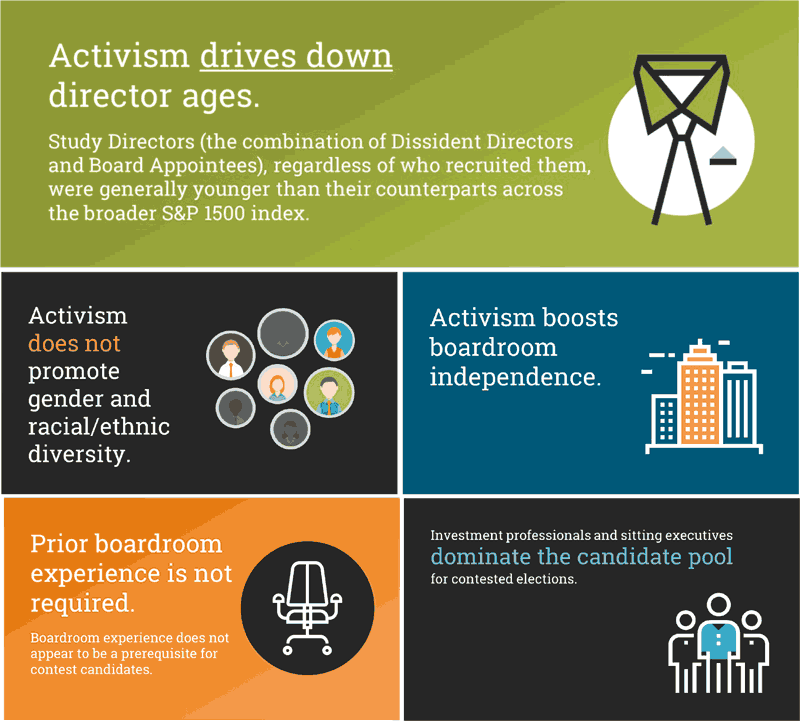
Snapshot: Public shareholder activism generally leads to younger, more independent, but less diverse, board candidates who had previous boardroom experience and relevant professional pedigrees. Typically activists favor nominees with financial experience and incumbent boards favor nominees with executive experience.  


FINAL-Activism-and-Board-Refreshment-Trends-Report-Aug-2017-8.png


Activism drives down director ages

Dissident nominees and directors appointed via settlements (hereinafter Dissident Directors) were younger, on average, than directors appointed unilaterally by boards (hereinafter Board Appointees) in connection with shareholder activism. Study Directors (the combination of Dissident Directors and Board Appointees), regardless of who recruited them, were generally younger than their counterparts across the broader S&P 1500 index. While Dissident Directors generally reflected a wider range of ages, insurgent investors and incumbent boards both favored individuals in their fifties when picking candidates. This preference for nominees in their fifties aligns with practices in the broader S&P 1500 index over the same period.

Activism does not promote gender diversity

Less than ten percent of Study Directors were women. While the rate at which females were selected as dissident nominees or Board Appointees in contested situations increased over the course of the study, it trailed the rising tide of female board representation in the broader S&P 1500 universe*.* There were zero female Dissident Directors in 2011, two in 2012, and three in 2013. Similarly, there were two female Board Appointees in 2011, but zero in both 2012 and 2013.

Activism does not promote racial/ethnic diversity

Less than five percent of Study Directors were ethnically or racially diverse. While minority representation across the entire S&P 1500 board universe slowly increased over the course of the study, from 9.3 percent in 2011 to 10.1 percent in 2015, the rate at which individuals with diverse ethnic and racial backgrounds were selected as Dissident Directors and Board Appointees was relatively uniform and trailed that of the broader index by more than five percentage points.

Activism boosts boardroom independence

Study Directors were generally more independent than their counterparts across the broader S&P 1500. Not surprisingly, dissident nominees and directors appointed to boards via settlements were more likely to be “independent” than directors appointed unilaterally by boards in connection with shareholder activism. It is worth pointing out that the measure of “independence” focused on a nominee’s degree of separation from management rather than from the dissident. Indeed, as the examination of prior boardroom experience suggests, there may be questions of independence from activist sponsors for a subset of Study Directors.

Prior boardroom experience is not required. Boardroom experience does not appear to be a prerequisite for contest candidates. More than half of Study Directors held outside board seats. While most of these directors sat on either one or two outside boards, a sizable minority pushed the over-boarded envelope. Six Study Directors served on four outside boards, four on five outside boards, and one on six outside boards. Many of these “busy” directors appear to be “go-to” nominees for individual activists. The serial nomination of favorite candidates raises questions about the “independence” of these individuals from their activist sponsors.

Investment professionals and sitting executives dominate the candidate pool for contested elections

Occupational data for the Study Directors demonstrates experience, qualifications, attributes, and skills (EQAS) preferences for nominees in contested situations. “Corporate executives” and “financial services professionals” were in a dead heat at the front of the pack. These favored occupations were not evenly distributed, as activists tended to select investors and incumbents tended to select executives. In fact, Dissident Directors were nearly three times more likely to be “financial services professionals” than Board Appointees, while Board Appointees were nearly twice as likely to be “executives” than Dissident Directors.


Part II: Board Profile


FINAL-Activism-and-Board-Refreshment-Trends-Report-Aug-2017-10.png


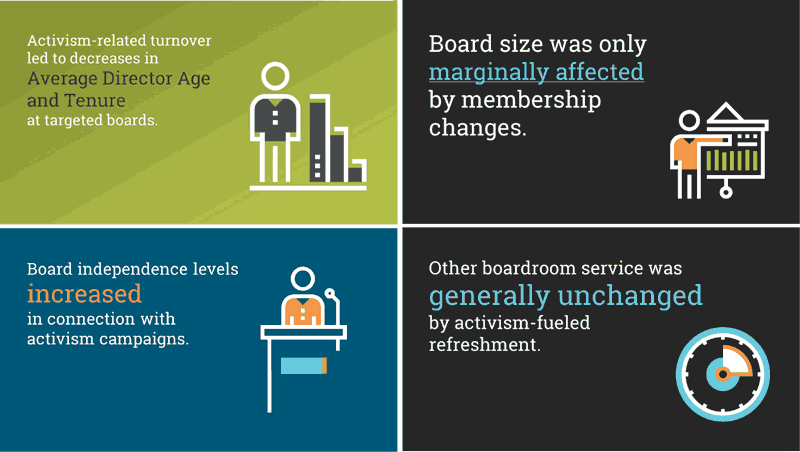
Snapshot: Public shareholder activism generally resulted in boards that are younger, shorter-tenured, slightly-larger, more independent, and more financially literate, but less diverse, than their pre-activism versions.


FINAL-Activism-and-Board-Refreshment-Trends-Report-Aug-2017-11.png


Activism-related turnover led to decreases in average director age and tenure at targeted boards

Dissident Directors averaged 53 years of age and Board Appointees averaged 56.3 years of age. Average director age decreased by 2.6 years to 59.6 years on Study Boards targeted by shareholder activists, while average director tenure decreased by 3.4 years to 6.1 years. For the broader S&P 1500 in 2015, average director age was 62.5 years and average tenure was 8.9 years.

Board size remained relatively steady despite membership changes

Although average board size at Study Companies increased from nine to 9.4 seats, less than half (41.9 percent) of the Study Companies experienced a post-activism boost in board size. 18.3 percent of Study Companies experienced a decline in board size following shareholder activism, while board size was unchanged at 39.8 percent of Study Companies.

Board independence levels increased in connection with activism campaigns

Average board independence at Study Companies increased from 79.5 percent to 83 percent. More than 60 percent of study companies experienced an increase in independence, 21.5 percent experienced a decrease, and 18.3 percent experienced no change. Average board independence in the S&P 1500 was 80.6 percent in 2015.

Other boardroom service was generally unchanged by activism-fueled refreshment

The average number of outside boards on which Study Company directors served remained virtually flat, increasing from 0.8 to 0.9. Of the 89 Study Companies, the number without a director who sat on more than one outside board decreased from four to two. There was a correlation between company size and outside board service, as directors at S&P 500 and S&P 400 study companies sat on a higher average number of outside boards than their counterparts at S&P 600 study companies.

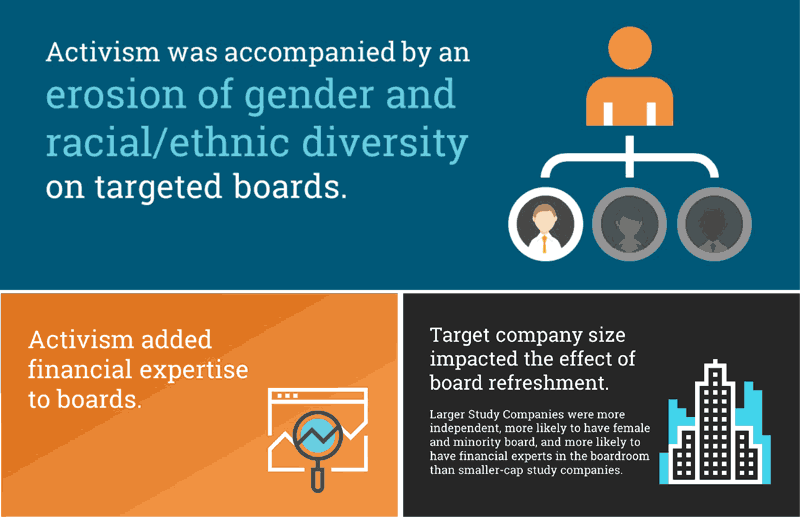
Activism was accompanied by an erosion of gender and racial/ethnic diversity on targeted boards

Study Company boards were less likely to have at least one female director following an activism campaign than they were preceding one, decreasing from 87.1 percent to 82.8 percent. Similarly, Study Company boards were less likely to have at least one minority director following an activism campaign than they were preceding one, decreasing from 55.9 percent to 51.6 percent. According to Board Refreshment Trends at S&P 1500 Firms, the proportion of S&P 1500 companies with at least one female director increased from 72 percent in 2011 to 82.7 percent in 2015 and the portion of S&P 1500 companies with at least one minority board member increased through the course of the study period to 56.8 percent.

Activism added financial expertise to boards

The proportion of board seats at Study Companies occupied by “financial experts” increased from 22.6 percent (189 of 835) to 24.5 percent (214 of 874). The number of Study Companies with at least one, two, or three “financial experts” also increased. (At U.S. companies, ISS considers a director to be a “financial expert” if the board discloses that the individual qualifies as an “Audit Committee Financial Expert” as defined by the Securities and Exchange Commission under Items 401(h)(2) and 401(h)(3) of Regulation S-K. Under the SEC’s rules, a person must have acquired their financial expertise through (1) education and experience as a principal financial officer (PFO), principal accounting officer (PAO), controller, public accountant or auditor or experience in one or more positions that involve the performance of similar functions, (2) experience actively supervising a PFO, a PAO, controller, public accountant, auditor or person performing similar functions; (3) experience overseeing or assessing the performance of companies or public accountants with respect to the preparation, auditing or evaluation of financial statements or (4) other relevant experience.)

Target company size impacted the effect of board refreshment

Larger Study Companies were more independent, more likely to have female and minority board members (both pre- and post- activism), and more likely to have financial experts in the boardroom than smaller-cap study companies. Relative to their larger peers, smaller Study Companies generally experienced more pronounced declines in average director age and tenure, but experienced more significant increases in average board size.

The complete publication is available here.

________________________________________________

Subodh Mishra* is Executive Director at Institutional Shareholder Services, Inc. This post is based on a co-publication by ISS and the Investor Responsibility Research Center Institute. Related research from the Program on Corporate Governance includes The Long-Term Effects of Hedge Fund Activism by Lucian Bebchuk, Alon Brav, and Wei Jiang (discussed on the Forum here).

L’internationalisation des codes de gouvernance contribue à la clarification des rôles des activistes


Voici un article de sensibilisation à l’internationalisation des règles de bonne gouvernance et des rôles respectifs que les actionnaires-investisseurs et les conseils d’administration sont appelés à prendre en compte.

On assiste à une plus grande volonté des actionnaires, réunis en groupes d’investisseurs institutionnels, en société de prise de position importante (hedge funds ou actionnaires activistes), de s’engager dans la gouvernance des entreprises. En fait, on peut parler d’un actionnariat de plus en plus actif à l’échelle internationale.

Cet article, publié par Jennifer G. Hill, professeure de droit corporatif à l’université de Sydney, atteste clairement, à l’instar du UK Stewardship Code, de l’importance mondiale des guides de gouvernance qui réclament un rééquilibrage des pouvoirs entre les CA (fiduciaires des actionnaires) et les regroupements d’actionnaires.

Ces codes de gouvernance émanent de différentes sources, mais tous mettent l’accent sur la gestion à long terme des affaires des sociétés. L’auteure mentionne que les codes de conduite peuvent être introduits (1) par les organismes réglementaires des pays (2) par certains regroupements industriels ou (3) par les actionnaires-investisseurs eux-mêmes.

L’article conclut que l’adoption de ces nouveaux codes de Stewardship peut aider à définir de nouvelles règles de conduite qui permettront de départager les « bons activistes des mauvais activistes » !

Les conseils d’administration doivent donc être de plus en plus conscients que le phénomène de l’engagement et de l’activisme des actionnaires est un mouvement mondial, et qu’ils devront faire preuve d’ouverture dans leur rôle de fiduciaire.

Bonne lecture ! Vos commentaires sont appréciés.


Good Activist/Bad Activist: The Rise of International Stewardship Codes


Résultat de recherche d'images pour "UK Stewardship Code"


Conflicting attitudes toward shareholder engagement and activism have colored the ongoing debate about the effect of shareholder influence on corporate governance. In the US, a distinctly negative view of investor engagement underpins much recent discussion on this topic—from the shareholder empowerment debate to current concerns about investor activism and private ordering through shareholder-initiated bylaws.

Outside the United States, however, a powerful alternative narrative about the benefits of increased shareholder engagement in corporate governance has gained traction in many major jurisdictions. This positive narrative treats investors as having an important participatory role in corporate governance, which is integral to accountability. It supports a radically different regulatory response to its negative counterpart, suggesting that shareholders should be granted stronger rights and/or encouraged to make greater use of their existing powers to engage with the companies in which they invest.

In my recent article, Good Activist/Bad Activist: The Rise of International Stewardship Codes, I examine a particularly important recent manifestation of this positive view of shareholder engagement—stewardship codes. My article, which will appear in 41 Seattle U. L. Rev. (special issue on Investor Time Horizons, forthcoming December 2017), charts the rise of international Stewardship Codes and discusses the implications of this development for the balance of power between shareholders and boards in public corporations.

International Stewardship Codes, which originated in the United Kingdom following the global financial crisis, are now proliferating throughout the world, especially in Asia. These codes indicate that in some jurisdictions, the debate today is less about controlling shareholder power than about constraining board power, by encouraging shareholders to exercise their legal rights and increase their level of engagement in corporate governance. The codes represent a generalized regulatory response to a common complaint following the 2007-2008 global financial crisis—namely, “where were the shareholders?”.

Stewardship Codes seek to ensure that shareholders, particularly institutional investors, are active players in corporate governance. Proponents of these codes have made large claims about their benefits. The UK Stewardship Code has stated, for example, that “the goal of stewardship is to promote the long term success of companies” and that “[e]ffective stewardship benefits companies, investors and the economy as a whole.”

Many countries have now jumped on the Stewardship Code bandwagon. The various Stewardship Codes around the world emanate, however, from different issuing bodies, and this can influence a code’s effectiveness. There are at least three distinct categories of Stewardship Code:

  1. those issued by regulators or quasi-regulators on behalf of the government;
  2. those initiated by certain industry participants; and
  3. codes adopted by investors themselves.

The United States joined this third category in January 2017, when the Investor Stewardship Group (ISG) released its Framework for US Stewardship and Governance (discussed on the Forum here). Although the ISG framework is voluntary, it has the backing of some of the world’s largest asset managers, including founding members, such as BlackRock, State Street Global Advisors and Vanguard.

Many of the Stewardship Codes that now operate around the world are based on the UK Stewardship Code or Japanese Stewardship Code. My article examines similarities and differences in these international Stewardship Codes. As the article shows, the recent adoption of the ISG Stewardship Principles in the US has not occurred in a vacuum. Rather, it is part of a sustained international push for greater investor involvement in corporate governance and exemplifies the increasing globalization of corporate governance.

These developments and competing narratives concerning the role of shareholders in corporate governance have significant regulatory implications. In particular, they pose future challenges to regulators in seeking to differentiate between “good activists” and “bad activists”.

The complete article is available here.

Compte rendu hebdomadaire de la Harvard Law School Forum on Corporate Governance | 12 octobre 2017


Voici le compte rendu hebdomadaire du forum de la Harvard Law School sur la gouvernance corporative au 12 octobre 2017.

Cette semaine, j’ai relevé les dix principaux billets.

Bonne lecture !


Résultats de recherche d'images pour « harvard law school forum on corporate governance »


Résultats de recherche d'images pour « harvard law school forum on corporate governance »


  1. 2017 Proxy Season Review: Compensation
  2. P&G Proxy Fight: Trian Pushes to Reevaluate Executives’ Incentive Compensation Goals
  3. S&P 500 CEO Compensation Increase Trends
  4. Ambiguity and the Corporation: Group Disagreement and Underinvestment
  5. The Yates Memo: Looking for “Individual Accountability” in All the Wrong Places
  6. Preventing the Next Data Breach
  7. 2017-2018 ISS Global Policy Survey
  8. Good Activist/Bad Activist: The Rise of International Stewardship Codes
  9. So You Want to Buy a Stake in a Private Equity Manager?
  10. Fiduciary Principles and Delaware Corporation Law

Compte rendu hebdomadaire de la Harvard Law School Forum on Corporate Governance | 5 octobre 2017


Voici le compte rendu hebdomadaire du forum de la Harvard Law School sur la gouvernance corporative au 5 octobre 2017.

Cette semaine, j’ai relevé les dix principaux billets.

Bonne lecture !


Résultats de recherche d'images pour « harvard law school forum on corporate governance »


Résultats de recherche d'images pour « harvard law school forum on corporate governance »


  1. Long-Term Pay-For-Performance Alignment
  2. Activism and Board Diversity
  3. SEC (Limited) Guidance on Pay-Ratio Disclosure
  4. Corporate Governance: Stakeholders
  5. Finding Common Ground on Shareholder Proposals
  6. Improving SEC Regulations with Investor Ordering
  7. The Long-Term Consequences of Short-Term Incentives
  8. CEO and Executive Compensation Practices: 2017 Edition
  9. Lessons from the ISS Report on the Trian/P&G Proxy Contest
  10. The Inner Workings of the Board: Evidence from Emerging Markets

Compte rendu hebdomadaire de la Harvard Law School Forum on Corporate Governance | 28 septembre 2017


Voici le compte rendu hebdomadaire du forum de la Harvard Law School sur la gouvernance corporative au 28 septembre 2017.

Cette semaine, j’ai relevé les dix principaux billets.

Bonne lecture !


Résultats de recherche d'images pour « harvard law school forum on corporate governance »


Résultats de recherche d'images pour « harvard law school forum on corporate governance »


  1. Forging Ahead with “Entire Fairness,” or Playing it Safer (Procedurally Speaking)
  2. Activism: The State of Play
  3. New Disclosure Requirements in Form ADV
  4. Merger Negotiations in the Shadow of Judicial Appraisal
  5. SEC’s Latest Guidance on Pay Ratio Rule
  6. Enjoying the Quiet Life: Corporate Decision-Making by Entrenched Managers
  7. Oversight of the U.S. Securities and Exchange Commission
  8. CEOs and ISS’ Proxy Contest Framework
  9. The Evolution of the Private Equity Market and the Decline in IPOs
  10. Activism’s New Paradigm

L’activisme et les effets sur la diversité des CA


Comment se font les nominations d’administrateurs lorsqu’un fond activiste du type « hedge funds » intervient lors des élections aux assemblées générales annuelles ?

La recherche menée par David A. Katz* et Laura A. McIntosh*, de la firme Wachtell, Lipton, Rosen & Katz, montrent clairement que les fonds activistes agressifs (hedge funds) proposent des candidats qui ne contribuent pas à la diversité du CA (en genre et en race) si l’on compare à la moyenne des entreprises du S&P 500.

Ainsi, durant la période 2011-2015, les femmes ne représentaient que 5 % des candidats nommés à des conseils par les hedge funds, comparativement à la nomination de 26 % de femmes aux CA des entreprises du S&P 500.

De plus, si l’on considère les entreprises ciblées par les hedge funds durant la même période, on constate que les CA 100 % masculins ont augmenté significativement, passant de 13 % à 17 %. Pour les autres entreprises du S&P 500, la proportion de CA 100 % masculin a considérablement diminué.

An August 2017 study investigated the reasons that hedge fund activists seemingly ignore the evidence for gender-diverse boards in their choices for director nominees and disproportionately target female chief executive officers. The authors suggest that hedge funds may be subconsciously biased against women leaders due to perceptions, cultural attitudes, and beliefs about the attributes of leaders in our society. Activists may tend to view female CEOs as weaker and may be more willing to second-guess and criticize the corporate strategic plans put forth by women leaders. Indeed, one academic study found that the persistent mention of a female CEO in media coverage leads to a 96 percent probability that her company will be targeted by activists.

L’article montre également que, contrairement aux fonds activistes agressifs, les investisseurs institutionnels et les gestionnaires d’actifs font une promotion sans précédent de la diversité des membres de CA. Plusieurs fonds de gestion d’actifs, tels que BlackRock, State Street Global Advisors et Vanguard, font un engagement public envers la promotion de la diversité sur les CA.

Les auteurs concluent à l’efficacité des actions de promotion de la diversité des CA dans la gouvernance des entreprises. Voici un résumé des conclusions en ce sens :

The concerted efforts of some of the largest and most influential investors and asset managers toward increasing board diversity are likely to be effective. Their support for shareholder proposals, their ongoing engagement with companies, and their consistent public advocacy for independent and diverse boards are powerful factors that will change the corporate governance landscape. Meanwhile, the advantages of diverse boards are becoming more widely understood and have been demonstrated through convincing evidence, making the business case for board diversity stronger than ever.

Enfin, il n’est pas superflu de rappeler la plus-value de la diversité comme le font les auteurs de l’entreprise Directorpoint dans leur billet The Benefits of Diversity in the Boardroom :

  1. A diverse boardroom provides a diversity of thought;
  2. A diverse boardroom helps address complex, corporate issues;
  3. A diverse boardroom is more representative of shareholders;
  4. A diverse boardroom increases revenues.

Bonne lecture ! Vos commentaires sont les bienvenus.


Activism and Board Diversity


Activism at public companies can reduce board diversity, or it can increase it, depending on the circumstances. In recent years, activist hedge funds have installed dissident nominees who collectively have trailed the S&P 1500 index significantly in terms of gender and racial diversity. In contrast, institutional shareholders and asset managers are promoting board diversity to an unprecedented extent, with concerted public efforts already producing results. Several institutional investor initiatives, announced earlier this year, and the New York Comptroller’s Boardroom Accountability Project 2.0, announced earlier this month, may be game-changing initiatives on the path to greater board diversity.


Hedge Fund Activism


Since the early 2000s, a number of studies have demonstrated that companies with women on their boards consistently experience a wide range of benefits, including higher average returns on equity, higher net income growth, lower stock volatility, and higher returns on invested capital. Whether because of improved group dynamics, a shift in risk management, increased ability to consider alternatives to current strategies, or a focus on governance generally, board gender diversity produces stronger boards. While the argument for gender diversity may have begun from notions of equality, experience has shown a compelling financial rationale.

With the evidence for board diversity very much in the public domain, the behavior of hedge fund activists seeking board representation has been somewhat puzzling. Hedge fund activism has been notably counterproductive in terms of gender diversity on public boards. A 2016 Bloomberg analysis of the years 2011 through 2015 found that women represented only five percent of the candidates successfully placed on boards by activist funds, a significant finding during a period in which women represented about 19 percent of S&P 500 directors and in which female candidates were nominated to fill 26 percent of open seats at S&P 500 companies. At companies targeted by hedge funds during the same years, the proportion of all-male boards increased from 13 percent to 17 percent, while in the S&P 1500 that proportion significantly declined.

An August 2017 study investigated the reasons that hedge fund activists seemingly ignore the evidence for gender-diverse boards in their choices for director nominees and disproportionately target female chief executive officers. The authors suggest that hedge funds may be subconsciously biased against women leaders due to perceptions, cultural attitudes, and beliefs about the attributes of leaders in our society. Activists may tend to view female CEOs as weaker and may be more willing to second-guess and criticize the corporate strategic plans put forth by women leaders. Indeed, one academic study found that the persistent mention of a female CEO in media coverage leads to a 96 percent probability that her company will be targeted by activists.


Boardroom Accountability 2.0


In marked contrast to hedge fund activists, significant institutional investors and asset managers are engaging in deliberate, proactive, and effective campaigns for increased diversity on public company boards. BlackRock, State Street Global Advisors, and Vanguard all have taken public steps this year to promote and advocate for greater board diversity. For example, State Street Global Advisors’ “preferred approach is to drive greater board diversity through an active dialogue and engagement with company and board leadership.” Using the carrot and stick approach, State Street notes that “[i]n the event that companies fail to take action to increase the number of women on their boards, despite our best efforts to actively engage with them, [State Street] will use [its] proxy voting power to effect change—voting against the Chair of the board’s nominating and/or governance committee if necessary.” BlackRock has noted that “over the coming year, we will engage companies to better understand their progress on improving gender balance in the boardroom.” Vanguard, in an open letter, noted that one of the four pillars it will use to evaluate a public company’s corporate governance is whether there is “[a] high-functioning, well-composed, independent, diverse, and experienced board with effective ongoing evaluation practices.”

Earlier this month, the New York City Comptroller and the New York City Pension Funds announced the “Boardroom Accountability Project 2.0,” a three-pronged initiative focusing on board diversity, director independence, and climate expertise. With regard to board diversity, the project calls for the boards of 151 U.S. companies to release “board matrix” disclosure indicating the race, gender, and skill sets of their board members, on the theory that standardized disclosure will increase transparency, accountability, and incentives for diversification. The project aims to combat a “persistent lack of diversity” on public company boards by encouraging boards to seek director candidates more broadly. The New York City Comptroller recently sent letters to the targeted companies asking them to provide the requested information.

The new project could well be successful as the NYC Comptroller’s original Boardroom Accountability Project. The goal of the original project was to make proxy access a standard feature of corporate governance. Since the 2014 launch of the initial project, proxy access has indeed become widespread, with over 400 U.S. companies (and over 60 percent of the S&P 500) having adopted some form of proxy access. Boardroom Accountability 2.0 is the sequel, in that nearly all of the targeted companies recently adopted proxy access, and the current project aims to empower shareholders to use this tool more effectively with the information contained in the proposed standardized matrix disclosure.

Even if companies choose not to directly respond to the information requested by the NYC Comptroller, the combination of the Boardroom Accountability Project 2.0 and institutional investors’ focus on the issue of diversity is likely to push public companies to reassess their approaches to board diversity generally and gender diversity specifically. We are already seeing changes in the way boards of directors are approaching director succession in response to these pressures. Public companies should consider using the opportunity presented by the Boardroom Accountability Project 2.0 to communicate their approaches to board diversity generally, and gender diversity specifically, to their larger institutional investors and engage in a dialogue that will present their approach in the best possible light.

The concerted efforts of some of the largest and most influential investors and asset managers toward increasing board diversity are likely to be effective. Their support for shareholder proposals, their ongoing engagement with companies, and their consistent public advocacy for independent and diverse boards are powerful factors that will change the corporate governance landscape. Meanwhile, the advantages of diverse boards are becoming more widely understood and have been demonstrated through convincing evidence, making the business case for board diversity stronger than ever.


*David A. Katz is partner and Laura A. McIntosh is consulting attorney at Wachtell, Lipton, Rosen & Katz. This post is based on a Wachtell Lipton publication by Mr. Katz and Ms. McIntosh which originally appeared in the New York Law Journal.

Compte rendu hebdomadaire de la Harvard Law School Forum on Corporate Governance | 21 septembre 2017


Voici le compte rendu hebdomadaire du forum de la Harvard Law School sur la gouvernance corporative au 21 septembre 2017.

Cette semaine, j’ai relevé les dix principaux billets.

Bonne lecture !


Résultats de recherche d'images pour « harvard law school forum on corporate governance »


Résultats de recherche d'images pour « harvard law school forum on corporate governance »


  1. Equifax Data Breach: Preliminary Lessons for the Adoption and Implementation of Insider Trading Policies
  2. Better Directors or Distracted Directors? An International Analysis of Busy Boards
  3. Making Sure Your “Choice-of-Law” Clause Chooses All of the Laws of the Chosen Jurisdiction
  4. Investment Stewardship 2017 Annual Report
  5. Is There Hope for Change? The Evolution of Conceptions of “Good” Corporate Governance
  6. NYC Pension Funds Boardroom Accountability Project Version 2.0
  7. Reforms to UK Corporate Governance
  8. Sharing the Lead: Examining the Causes and Consequences of Lead Independent Director Appointment
  9. Vanguard’s Investor Stewardship
  10. Delaware Blockchain Initiative: Revitalizing European Companies’ Funding Efforts

Lettre ouverte du président des Fonds Vanguard à l’ensemble des administrateurs de compagnies publiques


F. William McNabb III is Chairman and CEO of Vanguard; Glenn Booraem is the head of Investment Stewardship and a principal at Vanguard. This post is based on an excerpt from a recent Vanguard publication by Mr. Booraem, and an open letter to directors of public companies worldwide by Mr. McNabb.


Cinq questions destinées au nouveau président de Vanguard

Investment Stewardship 2017 Annual Report


An open letter to directors of public companies worldwide

Thank you for your role in overseeing the Vanguard funds’ sizable investment in your company. We depend on you to represent our funds’ ownership interests on behalf of our more than 20 million investors worldwide. Our investors depend on Vanguard to be a responsible steward of their assets, and we promote principles of corporate governance that we believe will enhance the long-term value of their investments.

At Vanguard, a long-term perspective informs every aspect of our investment approach, from the way we manage our funds to the advice we give our investors. Our index funds are structurally long-term, holding their investments almost indefinitely. And our active equity managers—who invest nearly $500 billion on our clients’ behalf—are behaviorally long-term, with most holding their positions longer than peer averages. The typical dollar invested with Vanguard stays for more than ten years.

A long-term perspective also underpins our Investment Stewardship program. We believe that well-governed companies are more likely to perform well over the long run. To this end, we consider four pillars when we evaluate corporate governance practices:

  1. The board: A high-functioning, well-composed, independent, diverse, and experienced board with effective ongoing evaluation practices.
  2. Governance structures: Provisions and structures that empower shareholders and protect their rights.
  3. Appropriate compensation: Pay that incentivizes relative outperformance over the long term.
  4. Risk oversight: Effective, integrated, and ongoing oversight of relevant industry- and company-specific risks.

These pillars guide our proxy voting and engagement activity, and we hope that by sharing this framework with you, you’ll have a better perspective on our approach to stewardship.

I’d like to highlight a few key themes that are increasingly important in our stewardship efforts:

Good governance starts with a great board.

We believe that when a company has a great board of directors, good results are more likely to follow.

We view the board as one of a company’s most critical strategic assets. When the board contributes the right mix of skill, expertise, thought, tenure, and personal characteristics, sustainable economic value becomes much easier to achieve. A thoughtfully composed, diverse board more objectively oversees how management navigates challenges and opportunities critical to shareholders’ interests. And a company’s strategic needs for the future inform effectively planned evolution of the board.

Gender diversity is one element of board composition that we will continue to focus on over the coming years. We expect boards to focus on it as well, and their demonstration of meaningful progress over time will inform our engagement and voting going forward. There is compelling evidence that boards with a critical mass of women have outperformed those that are less diverse. Diverse boards also more effectively demonstrate governance best practices that we believe lead to long-term shareholder value. Our stance on this issue is therefore an economic imperative, not an ideological choice. This is among the reasons why we recently joined the 30% Club, a global organization that advocates for greater representation of women in boardrooms and leadership roles. The club’s mission to enhance opportunities for women from “schoolroom to boardroom” is one that we think bodes well for broadening the pipeline of great directors.

Directors are shareholders’ eyes and ears on risk.

Risk and opportunity shape every business. Shareholders rely on a strong board to oversee the strategy for realizing opportunities and mitigating risks. Thorough disclosure of relevant and material risks—a key board responsibility—enables share prices to fully reflect all significant known (and reasonably foreseeable) risks and opportunities. Given our extensive indexed investments, which rely on the price-setting mechanism of the market, that market efficiency is critical to Vanguard and our clients.

Climate risk is an example of a slowly developing and highly uncertain risk—the kind that tests the strength of a board’s oversight and risk governance. Our evolving position on climate risk (much like our stance on gender diversity) is based on the economic bottom line for Vanguard investors. As significant long-term owners of many companies in industries vulnerable to climate risk, Vanguard investors have substantial value at stake.

Although there is no one-size-fits-all approach, market solutions to climate risk and other evolving disclosure practices can be valuable when they reflect the shared priorities of issuers and investors. Our participation in the Investor Advisory Group to the Sustainability Accounting Standards Board (SASB) reflects our belief that materiality-driven, sector-specific disclosures will better illuminate risks in a way that aids market efficiency and price discovery. We believe it is incumbent on all market participants—investors, boards, and management alike—to embrace the disclosure of sustainability risks that bear on a company’s long-term value creation prospects.

Engagement builds mutual understanding and a basis for progress.

Timely and substantive dialogue with companies is core to our investment stewardship approach. We see engagement as mutually beneficial: We convey Vanguard’s views and we hear companies’ perspectives, which adds context to our analysis.

Our funds’ votes on ballot measures—171,000 discrete items in the past year alone—are an outcome of this process, not the starting point. As we analyze ballot items, particularly controversial ones, we often invite direct and open-ended dialogue with the company. We seek management’s and the board’s perspectives on the issues at hand, and we evaluate them against our principles and leading practices. To understand the full picture, we often also engage with other investors, including activists and shareholder proponents. Our goal is that a fund’s ultimate voting decision does not come as a surprise. Our ability to make informed decisions depends on maintaining an ongoing exchange of ideas in a setting in which we can cover the intention and strategy behind the issues.

Yet our engagement activities are not solely focused on the ballot. Because our funds will hold most of their portfolio companies practically permanently, it’s important for us to build relationships with boards and management teams that transcend a transactional focus on any specific issue or vote. Engagement is a process, not an event, whose value only grows over time. A CEO we engaged with once said, “You can’t wait to build a relationship until you need it,” and that couldn’t be more true.

The opportunity to articulate our perspectives and understand a board’s thinking on a range of topics—anchored at the intersection of the firm’s strategy and its enabling governance practices—is a crucial part of our stewardship obligations. Although ballot items are reduced to a series of binary choices—yes or no, for or against—engagement beyond the ballot enables us to deal in nuance and in dialogue that drives meaningful progress over time.

There is a growing role for independent directors in engagement, both on issues over which they hold exclusive purview (such as CEO compensation and board composition/succession) and on deepening investors’ understanding of the alignment between a company’s strategy and governance practices. Our interest in engaging with directors is by no means intended to interfere with management’s ownership of the message on corporate strategy and performance. Rather, we believe it’s appropriate for directors to periodically hear directly from and be heard by the shareowners on whose behalf they serve.

* * *

Our focus on corporate governance and investment stewardship has been and will continue to be a deliberate manifestation of Vanguard’s core purpose: “To take a stand for all investors, to treat them fairly, and to give them the best chance for investment success.” Our four pillars and our increased focus on climate risk and gender diversity are not fleeting priorities for Vanguard. As essentially permanent owners of the companies you lead, we have a special obligation to be engaged stewards actively focused on the long term. Our Investment Stewardship team—available at InvestmentStewardship@vanguard.com—stands ready to engage with you and your leadership teams on matters of mutual importance to our respective stakeholders. Thank you for valuing our perspective and being our partner in stewardship.

Sincerely,

William McNabb III
Chairman and Chief Executive Officer
The Vanguard Group, Inc.

* * *

Investment Stewardship 2017 Annual Report

Our values and beliefs

“To take a stand for all investors, to treat them fairly, and to give them the best chance for investment success.”

—Vanguard’s core purpose

Vanguard’s core values of focus, integrity, and stewardship are reflected every day in the way that we engage with our clients, our crew (what we call our employees), and our community. We view our Investment Stewardship program as a natural extension of these values and of Vanguard’s core purpose. Our clients depend on us to be good stewards of their assets, and we depend on corporate boards to prudently oversee the companies in which our funds invest. That is why we believe we have a unique mission to advocate for a world in which the actions and values of public companies and of investors are aligned to create value for Vanguard fund shareholders over the long term.

We believe well-governed companies will perform better over the long term.

Effective corporate governance is more than the collection of a company’s formal provisions and bylaws. A board of directors serves on behalf of all shareholders and is critical in establishing trust and transparency and ensuring the health of a company—and of the capital markets—over time. This board-centric view is the foundation of Vanguard’s approach to investment stewardship. It guides our discussions with company directors and management, as well as our voting of proxies on the funds’ behalf at shareholder meetings around the globe. Great governance starts with a board of directors that is capable of selecting the right management team, holding that team accountable through appropriate incentives, and overseeing relevant risks that are material to the business. We believe that effective corporate governance is an important ingredient for the long-term success of companies and their investors. And when portfolio companies perform well, so do our clients’ investments.

We value long-term progress over short-term gain.

Because our funds typically own the stock of companies for long periods (and, in the case of index funds, are structurally permanent holders of companies), our emphasis on investment outcomes over the long term is unwavering. That’s why we deliberately focus on enduring themes and topics that drive long-term value, rather than solely short-term results. We believe that companies and boards should similarly be focused on long-term shareholder value—both through the sustainability of their strategy and operations, and by managing the risks most material to their long-term success.

Our approach

Vanguard’s Investment Stewardship team comprises an experienced group of senior leaders and analysts who are responsible for representing Vanguard shareholders’ interests through industry advocacy, company engagement, and proxy voting on behalf of the Vanguard funds. The team also houses an internal research and communications function that is active in developing Vanguard’s views, policies, and ongoing approach to investment stewardship. Our data and technology group supports every aspect of our Investment Stewardship program.

We take a thoughtful and deliberate approach to investment stewardship.

Our team supports effective corporate governance practices in three ways:

Advocating for policies that we believe will enhance the sustainable, long-term value of our clients’ investments. We promote good corporate governance and responsible investment through thoughtful participation in industry events and discussions where we can expand our advocacy and enhance our understanding of investment issues.

Engaging with portfolio company executives and directors to share our corporate governance principles and learn about portfolio companies’ corporate governance practices. We characterize our approach as “quiet diplomacy focused on results”—providing constructive input that will, in our view, better position companies to deliver sustainable value over the long term for all investors.

Voting proxies at company shareholder meetings across each of our portfolios and around the globe. Because of our ongoing advocacy and engagement efforts, companies should be aware of our governance principles and positions by the time we cast our funds’ votes.

Our process is iterative and ongoing
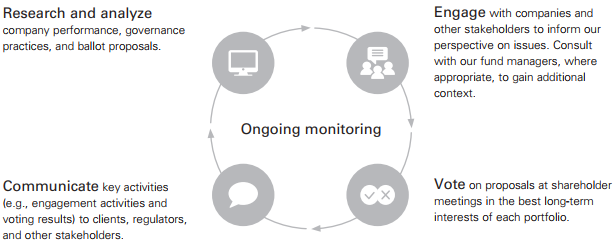
Our four pillars

Board

Good governance begins with a great board of directors. Our primary interest is to ensure that the individuals who represent the interests of all shareholders are independent (both in mindset and freedom from conflicts), capable (across the range of relevant skills for the company and industry), and appropriately experienced (so as to bring valuable perspective to their roles). We also believe that diversity of thought, background, and experience, as well as of personal characteristics (such as gender, race, and age), meaningfully contributes to the board’s ability to serve as effective, engaged stewards of shareholders’ interests. If a company has a well-composed, high-functioning board, good results are more likely to follow.

Structure

We believe in the importance of governance structures that empower shareholders and ensure accountability of the board and management. We believe that shareholders should be able to hold directors accountable as needed through certain governance and bylaw provisions. Among these preferred provisions are that directors must stand for election by shareholders annually and must secure a majority of the votes in order to join or remain on the board. In instances where the board appears resistant to shareholder input, we also support the right of shareholders to call special meetings and to place director nominees on the company’s ballot.

Compensation

We believe that performance-linked compensation policies and practices are fundamental drivers of the sustainable, long-term value for a company’s investors. The board plays a central role in determining appropriate executive pay that incentivizes performance relative to peers and competitors. Providing effective disclosure of these practices, their alignment with company performance, and their outcomes is crucial to giving shareholders confidence in the link between incentives and rewards and the creation of value over the long term.

Risk

Boards are responsible for effective oversight and governance of the risks most relevant and material to each company in the context of its industry and region. We believe that boards should take a thorough, integrated, and thoughtful approach to identifying, understanding, quantifying, overseeing, and—where appropriate—disclosing risks that have the potential to affect shareholder value over the long term. Importantly, boards should communicate their approach to risk oversight to shareholders through their normal course of business.

By the numbers: Voting and engagement

Engagement and voting trends

2015 proxy season 2016 proxy season  2017 proxy season
Company engagements 685 817 954
Companies voted 10,560 11,564 12,974
Meetings voted 12,785 16,740 18,905
Proposals voted 124,230 157,506 171,385
Countries voted in* 70 70 68

* The number of countries can vary each year. In certain markets, some companies do not hold shareholder meetings annually.
Note: The annual proxy season is from July 1 to June 30.

Our voting

Proxy voting reflects our governance pillars worldwide.

Meetings voted by region
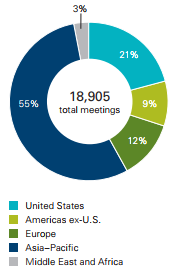
Note: Data pertains to voting activity from July 1, 2016, through June 30, 2017

Global voting activity
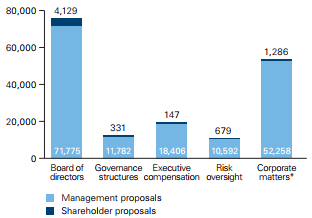
* Includes more than 26,000 proposals related to capitalization; 8,000 proposals related to mergers and acquisitions; 16,000 routine business proposals; and 1,000 other shareholder proposals.
Note: Data pertains to voting activity from July 1, 2016, through June 30, 2017.

Our engagement

We engage with companies of all sizes.

Market Capitalization % of 2017 proxy season engagements
Under $1 billion 19%
$1 billion–under $10 billion 44%
$10 billion–under $50 billion 24%
$50 billion and over 13%

Our engagement with portfolio companies has grown significantly over time.

Number of engagements and assets represented
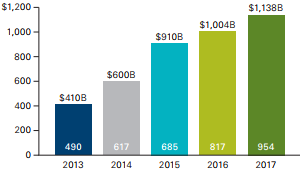
Note: Dollar figures represent the market value of Vanguard fund investments in companies with which we engaged as of June 30, 2017.

We engage on a range of topics aligned with our four pillars

Frequency of topics discussed during Vanguard engagements (%)
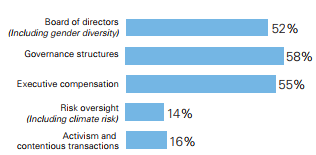
Note: Figures do not total 100%, as individual engagements often span multiple topics.

Boards in focus: Vanguard’s view on gender diversity

One of our most fundamental governance beliefs is that good governance begins with a great board of directors. We believe that diversity among directors—along dimensions such as gender, experience, race, background, age, and tenure—can strengthen a board’s range of perspectives and its capacity to make complex, fully considered decisions.

While we have long discussed board composition and diversity with portfolio companies, gender diversity has emerged as one dimension on which there is compelling support for positive effects on shareholder value. In recent years, a growing body of research has demonstrated that greater gender diversity on boards can lead to better company performance and governance.

Companies should be prepared to discuss—in both their public disclosures and their engagement with investors—their plans to incorporate appropriate diversity over time in their board composition. While we believe that board evolution is a process, not an event, the demonstration of meaningful progress over time will inform our engagement and voting going forward.

Boards in focus: Gender diversity

Engagement case studies

Gender diversity on boards was an important topic of engagement for us during the 12 months ended June 30, 2017. Below are summary examples of discussions we had on the subject.

High-impact engagement on gender diversity

Over several interactions with a U.S. industrial company, our team shared Vanguard’s perspective on board composition and evaluation. The company had undergone recent leadership transitions and was open to amending elements of its governance structure to align with best practices. We expressed particular support for meaningful gender diversity and expressed concern that the board previously had only one female director in its recent history.

Right after this year’s annual general meeting, the company announced it was adding four new directors with diverse experience, including two women. This outcome is the best-case scenario: The board welcomed shareholder input, we shared our view on best corporate governance practices, and the board ultimately incorporated our perspective into its board evolution process.

A denial of diversity’s value

A Canadian materials company that had consistently underperformed was governed by an entrenched, all-male board with seemingly nominal independence from the CEO. A 2017 shareholder resolution asked the company to adopt and publish a policy governing gender diversity on the board. Before voting, Vanguard engaged with the company to learn about its board evolution process, including its perspective on gender diversity. The engagement revealed that the company understood neither the value of gender diversity nor the importance of being responsive to shareholders’ concerns. Despite verbally endorsing gender diversity, the company resisted specifying a strategy or making a commitment to achieve it. The board, when seeking new members, relied solely on recommendations from current directors, a practice that can entrench the current board’s perspective and limit diversity. Our funds voted in support of the shareholder resolution, and we will continue to engage and hold the board accountable for meaningful progress over time.

Mixed results from an ongoing engagement

A U.S. consumer discretionary company had no women on its board, a problem magnified by its medium-term underperformance relative to peers, a classified board structure, and a lengthy average director tenure. We engaged with management twice between the 2016 and 2017 annual meetings to share our perspective on the importance of gender diversity and recommend that they make it a priority for future board evolution and director searches.

In its 2017 proxy, the company described board diversity as critical to the firm’s sustainable value and named gender as an element of diversity to be considered during the director search and nomination process. The company has since added a non-independent woman to the board. Although this move is directionally correct, it does not fully address our concerns; we will continue to encourage the company to add gender diversity to its ranks of independent directors.

Risk in focus: Vanguard’s view on climate risk

As the steward of long-term shareholder value for more than 20 million investors, Vanguard closely monitors how our portfolio companies identify, manage, and mitigate risks—including climate risk. Our approach to climate risk is evolving as the world’s and business community’s understanding of the topic matures.

This year, for the first time, our funds supported a number of climate-related shareholder resolutions opposed by company management. We are also discussing climate risk with company management and boards more than ever before. Our Investment Stewardship team is committed to engaging with a range of stakeholders to inform our perspective on these issues, and to share our thinking with the market, our portfolio companies, and our investors.

Risk in focus: Climate risk

A Q&A with Glenn Booraem, Vanguard’s Investment Stewardship Officer

Vanguard is an investment management company. Why should Vanguard fund investors be concerned about climate risk?

Mr. Booraem: Climate risk has the potential to be a significant long-term risk for companies in many industries. As stewards of our clients’ long-term investments, we must be finely attuned to this risk. We acknowledge that our clients’ views on climate risk span the ideological spectrum. But our position on climate risk is anchored in long-term economic value—not ideology. Regardless of one’s perspective on climate, there’s no doubt that changes in global regulation, energy consumption, and consumer preferences will have a significant economic impact on companies, particularly in the energy, industrial, and utilities sectors.

Why the shift in Vanguard’s assessment of climate risk, and why now?

Mr. Booraem: We’ve been discussing climate risk with portfolio companies for several years. It has been, and will remain, one of our engagement priorities for the foreseeable future. This past year, we engaged with more companies on this issue than ever before, and for the first time our funds supported two climate-related shareholder resolutions in cases where we believed that companies’ disclosure practices weren’t on par with emerging expectations in the market. As with other issues, our point of view has evolved as the topic has matured and, importantly, as its link to shareholder value has become more clear.

What is your top concern when you learn that a company in which a Vanguard portfolio invests does not have a rigorous strategy to evaluate and mitigate climate risk?

Mr. Booraem: Our concern is fundamentally that in the absence of clear disclosure and informed board oversight, the market lacks insight into the material risks of investing in that firm. It’s of paramount importance to us that the market is able to reflect risk and opportunity in stock prices, particularly for our index funds, which don’t get to select the stocks they own. When we’re not confident that companies have an appropriate level of board oversight or disclosure, we’re concerned that the market may not accurately reflect the value of the investment. Because we represent primarily long-term investors, this bias is particularly problematic when underweighting long-term risks inflates a company’s value.

Now that Vanguard has articulated a clear stance on climate risk, what can portfolio companies expect?

Mr. Booraem: First, companies should expect that we’re going to focus on their public disclosures, both about the risk itself and about their board’s and management’s oversight of that risk. Thorough disclosure is the foundation for the market’s understanding of the issue. Second, companies should expect that we’ll evaluate their disclosures in the context of both their leading peers and evolving market standards, such as those articulated by the Sustainability Accounting Standards Board (SASB). Third, they should expect that we’ll listen to their perspective on these and other matters. And finally, they should see our funds’ proxy voting as an extension of our engagement. When we consider a shareholder resolution on climate risk, we give companies a fair hearing on the merits of the proposal and consider their past commitments and the strength of their governance structure.

Engagement case studies

In the 12 months ended June 30, 2017, the topic of climate risk disclosure grew in frequency and prominence in our engagements with companies, particularly those in the energy, industrial, and utilities sectors, where climate risk was addressed in nearly every conversation we had. Below are examples of our engagements on climate risk.

Two companies’ commitments to enhanced disclosure

Our team led similar engagements with two U.S. energy companies facing shareholder resolutions on climate risk. One resolution requested that the first company publish an annual report on climate risk impacts and strategy. At the second company, a resolution requested disclosure of the company’s strategy and targets for transitioning to a low- carbon economy. In both cases, when we engaged with the companies, their management teams committed to improving their climate risk disclosure. Given the companies’ demonstrated responsiveness to shareholder feedback and commitment to improving, our funds did not support either shareholder proposal. Our team will continue to track and evaluate the companies’ progress toward their commitments as we consider our votes in future years.

A vote against a risk and governance outlier For years we engaged with a U.S. energy company that lagged its peers on climate risk disclosure and board accessibility. This year, a shareholder proposal requesting that the company produce a climate risk assessment report demonstrated a compelling link between the requested disclosures and long-term shareholder value. Because the board serves on behalf of shareholders and plays a critical role in risk oversight, we believed it was appropriate to seek a direct dialogue with independent directors about climate risk. Management resisted connecting the independent directors with shareholders, making the company a significant industry outlier in good governance practice. Without the confidence that the board understood or represented our view that climate risk poses a material risk in the energy sector, our team viewed the climate risk and governance issues as intertwined. Ultimately, our funds voted for the shareholder proposal and withheld votes on relevant independent directors for failing to engage with shareholders.

A vote for greater climate risk disclosure

A shareholder proposal at a U.S. energy company asked for an annual report with climate risk disclosure, including scenario planning. Through extensive research and engagements with the company’s management, its independent directors, and other industry stakeholders, our team identified governance shortfalls and a clear connection to long-term shareholder value. The company lagged its peers in disclosure, risk planning, and board oversight and responsiveness to shareholder concerns. Crucially, although the company’s public filings identified climate risk as a material issue, it failed to articulate plans for mitigation or adaptation. A similar proposal last year garnered significant support, but the company made no meaningful changes in response. Engagement had limited effect, so our funds voted for the shareholder proposal.

* * *

This post was excerpted from a Vanguard report; the complete publication is available here.

Compte rendu hebdomadaire de la Harvard Law School Forum on Corporate Governance | 14 septembre 2017


Voici le compte rendu hebdomadaire du forum de la Harvard Law School sur la gouvernance corporative au 14 septembre 2017.

Cette semaine, j’ai relevé les cinq principaux billets.

Bonne lecture !


Résultats de recherche d'images pour « harvard law school forum on corporate governance »


Résultats de recherche d'images pour « harvard law school forum on corporate governance »


  1. Another Road Leading to Business Judgment Review—Martha Stewart Living Omnimedia
  2. The Effects of Hedge Fund Interventions on Strategic Firm Behavior
  3. UK Announces Corporate Governance Reforms
  4. How Should We Regulate Fintech?
  5. OCC Stakes Out a Lead Role in Establishing New Deregulatory Agenda


Compte rendu hebdomadaire de la Harvard Law School Forum on Corporate Governance | 7 septembre 2017


Voici le compte rendu hebdomadaire du forum de la Harvard Law School sur la gouvernance corporative au 7 septembre 2017.

J’ai relevé les principaux billets, tout en me limitant au Top 10.

Bonne lecture !


Résultats de recherche d'images pour « harvard law school forum on corporate governance »


Résultats de recherche d'images pour « harvard law school forum on corporate governance »


  1. Political Uncertainty and Firm Disclosure
  2. Corporate Governance—the New Paradigm
  3. NYDFS Cybersecurity Regulations Take Effect
  4. CFOs on Boards: Higher Pay, Lower Performance
  5. CSX Attracts New CEO and Stock Price Rises Sharply
  6. The Evolution and Current State of Director Compensation Plans
  7. Companies Should Maximize Shareholder Welfare Not Market Value
  8. Executive Compensation: A Survey of Theory and Evidence
  9. Divided Second Circuit Panel Overrules Prior Newman Insider Trading Decision
  10. Out of Sight Out of Mind: The Case for Improving Director Independence Disclosure

Révision de la réglementation eu égard à la divulgation de l’indépendance des administrateurs


L’importance du principe d’indépendance des administrateurs ne fait plus de doute, autant pour les grandes entreprises publiques (cotées), que pour les spécialistes de la gouvernance. La coalition des 13 plus grands premiers dirigeants des grandes sociétés publiques américaines énonce clairement que l’indépendance des administrateurs est un principe incontournable de bonne gouvernance.

Truly independent corporate boards are vital to effective governance, so no board should be beholden to the CEO or management” and directors should be strong and steadfast, independent of mind and willing to challenge [management] constructively.”

Mais si le principe est largement reconnu, il ne reflète malheureusement pas la réalité de plusieurs conseils d’administration. L’article de Yaron Nili, professeur à la faculté de droit de l’Université du Wisconsin, présente la réalité à ce sujet en donnant des exemples de situation de complaisance sur les CA.

Ainsi, ce sont les administrateurs eux-mêmes qui déterminent la qualité d’indépendance de leurs pairs en déclarant, dans le rapport aux actionnaires, que les administrateurs répondent aux critères très flous des standards existants. L’article montre que l’absence d’une réglementation plus explicite à cet égard laisse les actionnaires et les investisseurs dans l’ignorance au sujet de la véritable indépendance des administrateurs.

L’auteur tire trois conclusions relatives à l’indépendance des administrateurs :

(1) La réglementation est lacunaire eu égard à la divulgation d’informations aux actionnaires et aux investisseurs. Ceux-ci sont mal informés sur le niveau d’indépendance des administrateurs ainsi que sur les biais comportementaux dont souffrent les collègues administrateurs pour évaluer ce facteur ;

(2) L’étude empirique de Yaron Nili a clairement démontré que les informations transmises aux actionnaires manquent de transparence et que les actionnaires n’ont pas accès à la « boîte noire » ;

(3) Les lacunes en matière de définition de l’indépendance des administrateurs sont issues du raisonnement qui veut que, peu importe la définition choisie, celle-ci soit toujours susceptible de souffrir d’ambiguïté et elle est de nature interprétative.

C’est donc à une réflexion en profondeur sur la gouvernance en général, et sur la qualité de l’information divulguée aux actionnaires que l’auteur nous convie.

Bonne lecture ! Vos commentaires sur ce sujet sont les bienvenus.


Out of Sight Out of Mind: The Case for Improving Director Independence Disclosure


In July 2016, a coalition of 13 CEOs and heads of major investment firms—which included names like JPMorgan Chase CEO Jamie Dimon, Berkshire Hathaway CEO Warren Buffett, General Motors CEO Mary Barra and BlackRock CEO Larry Fink—released the Commonsense Principles of Corporate Governance (discussed on the Forum here). These Principles emphasize the critical role of director independence in corporate America, stating that: “[t]ruly independent corporate boards are vital to effective governance, so no board should be beholden to the CEO or management” and that “[d]irectors should be strong and steadfast, independent of mind and willing to challenge [management] constructively.” Indeed, this recent statement echoes the importance and emphasis that academics, investors, regulators and companies alike, have placed on director independence.

Two months later, on September 7, 2016 Apple and Nike announced a new collaboration with one another on the Apple Watch. In their announcement, the companies declared their new Apple Watch Nike+ to be “the latest result of a long-standing partnership” between the world-renowned brands. Significantly, the announced initiative came on the heels of Nike appointing Mr. Tim Cook, Apple’s CEO, as Nike’s lead independent director. Despite the new collaboration, the companies did not refer to any potential conflicts of interest or to Mr. Cook’s status as lead independent director in their press release. Apple itself has similarly straddled the line regarding the independence of its “independent” directors. Bob Iger, Disney’s CEO, is one of Apple’s five independent directors. The two companies have a close and frequent business collaboration with one another, but Apple does nothing more than disclose that “in the ordinary course of its business, Apple enters into commercial dealings with Disney that it considers arms-length.” In regards to Mr. Iger’s independence, Apple has stated that it “does not believe that Mr. Iger has a material direct or indirect interest in any of such commercial dealings.”

Apple’s short statement concerning Mr. Iger’s independence is indicative of a larger practice taken by public firms. Many public companies can, and do, satisfy their stock exchange’s disclosure requirements by simply declaring that “the Board of Directors has determined that all non-employee Directors who served during [the fiscal year] are ‘independent’ under the listing standards of the [NYSE/NASDAQ].” Investors receive very little value from these unsubstantiated statements.

Indeed, in the current regulatory regime, public companies’ boards self-designate their peer directors as “independent directors” and boards are only required to disclose very specific, and very limited, information regarding their designation of a director as an “independent director”—leaving shareholders with minimal knowledge regarding the true level of independence that their elected directors actually have.

In my article, Out of Sight Out of Mind: The Case for Improving Director Independence Disclosure, which is forthcoming in the Journal of Corporation Law, I address this issue of director independence disclosures, in light of the rise of the independent board. The article makes three important contributions to the current discourse regarding director independence:

First, the article exposes a fundamental concern regarding the functional independence of “independent” directors, and highlights what it terms as the “empty” nature of the current regulatory framework. As the article details in length, the current framework can be summed up as being too much, too little, too late and too soft. It provides companies with too much discretion, as boards retain too much power to assert the independence of their peer directors and they may suffer from behavioral bias in doing so. It provides investors with too little information regarding the factual context against which a director is considered to be independent. Further, even when a director’s independence designation is scrutinized through state law, it is often too late, as these assessments are done post-hoc when it is too late to address many of the issues that director independence is meant to protect against. Finally, it is too soft, as companies’ self-designations of director independence are left uncontested and without proper vetting by the stock exchanges or the SEC, as they have shown no effort to proactively enforce their own requirements.

Second, the article is the first to provide hand-collected empirical evidence corroborating the lack of proper disclosure by companies in the context of their director independence designations. To do so, using a hand collected data set, the article analyzed the disclosure statements of one hundred public companies. To account for both large, high profile, companies as well as smaller, less visible public companies, fifty of the companies make up the Fortune 50 and the remaining 50 are Fortune 2000 small-cap companies. For each company, the company’s independence disclosure in its proxy statements in the years 2000, 2004, 2008, 2012 and 2016, were analyzed and coded. Indeed, as further analyzed in greater detail in the article, the majority of companies provide very little information about their director independence designations, potentially violating the already lax rules governing independence disclosure. Furthermore, several companies have in fact regressed over time in regards to the level of transparency they are providing to investors. In essence, much of the information that boards are expected to consider when determining whether a director is independent is contained in a “black box,” to which shareholders have no access.

Finally, the article argues that at its core, the failure of current regulatory standards to ensure an effective director independence regime stems from the fact that any independence definition is destined to suffer from ambiguity and interpretive freedom. Instead, we should recognize that the true value of director independence requirements is not only in that they strive to ensure actual independence, but rather also in that they empower investors. Each investor may have a distinctive, subjective comfort level with the myriad independence questions that may arise, balanced against the benefits that the various business and personal connections of each director may provide to the company. Information about directors’ ties and dealings gives investors a means of making informed decisions, both regarding the election of a director as well as their actual level of independence on any specific issue. As a result, effective director independence standards should facilitate an environment where companies are accountable to their investors for their choice of directors.

Therefore, responding to the SEC’s call for input on possible ways to improve the discourse regime under Regulation S-K, this article calls for a re-conceptualizing of the current approach to regulating company disclosures. This new approach will shift some of the focus from the definition and designation of a director as independent to a disclosure-based regime. Alongside the current designation regime, companies would have to disclose, for each “independent” director, the entirety of the information they considered when declaring a director as independent, including some mandatory information that is currently hard or costly to independently obtain or verify. This in turn will allow investors and regulators not only to confirm the judgment of the board on each director but also to possess a more nuanced view regarding the functional independence of each director in regards to each matter at hand.

The complete article is available for download here.

Compte rendu hebdomadaire de la Harvard Law School Forum on Corporate Governance | 31 août 2017


Voici le compte rendu hebdomadaire du forum de la Harvard Law School sur la gouvernance corporative au 31 août 2017.

J’ai relevé les principaux billets, tout en me limitant au Top 10.

Bonne lecture !


Résultats de recherche d'images pour « harvard law school forum on corporate governance »


Résultats de recherche d'images pour « harvard law school forum on corporate governance »


  1. SEC Staff Examines Impact of Regulation on Capital Formation and Market Liquidity
  2. ISS and the Removal of CEOs: A Call for an Enhanced Standard
  3. Far Beyond the Quarterly Call
  4. Federal Reserve Board Proposes Guidance Addressing Supervisory Expectations on Boards of Directors
  5. Proxy Access: Best Practices 2017
  6. 2017 Mid-Year Activism Update
  7. Controlling-Shareholder Related-Party Transactions Under Delaware Law
  8. NAIC Adopts Model Cybersecurity Law
  9. SEC Announces Results of Cybersecurity Examination Initiative
  10. Make-Whole Premiums and the Agency Costs of Debt

Deux événements récents qui auront un effet important sur la gouvernance


Corporate Governance—the New Paradigm

Compte rendu hebdomadaire de la Harvard Law School Forum on Corporate Governance | 24 août 2017


Voici le compte rendu hebdomadaire du forum de la Harvard Law School sur la gouvernance corporative au 24 août 2017.

J’ai relevé les principaux billets, tout en me limitant au Top 10.

Bonne lecture !


Résultats de recherche d'images pour « harvard law school forum on corporate governance »


Résultats de recherche d'images pour « harvard law school forum on corporate governance »


  1. Regulating Motivation: A New Perspective on the Volcker Rule
  2. Information Asymmetries Conceal Fraud and Systemic Risks in the U.S. Banking Industry
  3. Private Equity and Financial Fragility During the Crisis
  4. Activist Investors’ Approaches to Targeting Boards
  5. 2017 Securities and M&A Litigation Mid-Year Review
  6. Governance through Shame and Aspiration: Index Creation and Corporate Behavior in Japan
  7. ISS Releases Surveys for 2018 Policy Updates
  8. The Era of Private Ordering for Corporate Governance
  9. Delaware Court of Chancery Extends Business Judgment Rule
  10. Board Oversight of Long-Term Value Creation and Preservation

Comment votre entreprise se prépare-t-elle pour éviter d’être la cible d’investisseurs activistes ?


Vous trouverez, ci-dessous, un article de Jack « Rusty » O’Kelley III, directeur de la firme Russell Reynolds Associates, qui explique les diverses stratégies que les conseils d’administration peuvent mettre en place pour minimiser les attaques des actionnaires « activistes », lorsqu’ils ont choisi leur société comme cible de changement. L’article a été publié sur le site de Harvard Law School Forum on Corporate Governance.

Bien sûr, les entreprises doivent anticiper les gestes des activistes afin de se préparer à l’éventualité d’une demande de changement au CA.

L’auteur expose les approches couramment utilisées par les investisseurs activistes pour accroître le nombre d’administrateurs au conseil, ou pour demander le changement d’un ou deux administrateurs.

Quelles situations sont les plus favorables pour exiger des changements dans la composition du conseil d’administration ?

Les clients de la firme Russell Reynolds se posent deux questions à ce sujet :

– How do you know if an activist is going to seek to expand the board or target specific directors for replacement (and potentially escalate the situation to a proxy contest)?

– If an activist chooses a board member replacement strategy, how can you predict which directors an activist may target?

C’est certainement un article très utile pour les grandes entreprises cotées en bourse.

Mais, le jour viendra peut-être où votre entreprise sera la cible d’activistes !

Bonne lecture !


Activist Investors’ Approaches to Targeting Boards


Image associée
Les actionnaires activistes à l’assaut de l’Europe | L’Echo


Clients who are anticipating or early in the process of an activist situation, and a potential proxy contest, often ask us two questions:

  1. How do you know if an activist is going to seek to expand the board or target specific directors for replacement (and potentially escalate the situation to a proxy contest)?
  2. If an activist chooses a board member replacement strategy, how can you predict which directors an activist may target?

Based on our experience working with corporate boards defending against activists (as well as our broader board search and effectiveness expertise), we have gathered insights regarding how activists analyze and target boards of directors. In response to client requests, we have developed this guide to help our clients proactively think through defensive measures regarding board composition and governance issues.

Activists generally will utilize against individual directors all current and historical negative press, statistics, and data that is publicly available, whether or not it is accurate, comprehensive, or fair. Boards should be ready for this tactic and be ready to take back control of the narrative about the board.

Russell Reynolds only works on behalf of corporations and their existing board and management teams. We urge our clients to take a proactive, “clear-eyed” activist view of their board to understand how an activist may attack their board. We have prepared this overview based on our experience and on the insights of several activist defense lawyers, investment bankers, and proxy advisors with whom we have worked. Additionally, we have talked with activist investors who were willing to share their approaches.

Expansion vs. Replacement

Anticipating an activist’s approach to targeting board seats

Activists target a board to influence decision-making and increase value creation. While activists may take different approaches and specific tactics vary by activist and situation, key indicators can help identify their potential path.

Two of the most common activist approaches to maximizing influence on a board are either pressuring the company’s board to expand the number of board members or targeting specific incumbent directors to be replaced. Both may be done by way of a proxy contest or by using the threat of such a contest to pressure the target board into a settlement that places activist-backed directors on the board. There is no strict methodology for predicting which tactic an activist will pursue, and activists’ decisions are frequently determined by how companies react to the activists’ ideas.

We have identified some key indicators that determine if activists are likely to look to expand a board or target specific board members.

Expansion

Activists often seek to expand a board in less contentious activist situations

We have observed that the earlier a company is in the process of engaging with an activist, the more likely it is that the activist will encourage the board to expand its size by adding activist-backed directors. The longer and more public the process, the more likely it is that the activist will target specific incumbent directors and consider conducting a proxy fight.

Board expansion usually occurs in several situations based on several factors, which include:

The board has accepted the activist’s investment thesis and acknowledges the validity of its recommendations

The activist wants to monitor a situation or progress

There is specific insight or expertise the activist and board feel is missing based on business strategy

The board has classified terms (to get around limitations of a replacement strategy with staggered terms)

The first procedural step is for the board to look at its size in relation to its bylaws and peer benchmarks. As a general rule, relatively large boards make expansion less desirable. If the board is already at the maximum membership allowed by its bylaws, expansion is less attractive as the board may not want to change the bylaws to increase the number of directors. Board expansion will dilute the magnitude of activist influence (compared to replacement), but may face less resistance from the target board in a settlement.

For example, if an activist seeks to add 2 directors to a 10-member board, a board agreeing to expand the membership will net the activist 16% representation (2 of 12), as opposed to the 20% representation by replacing 2 sitting directors (2 of 10).

Board Expansion May Not Be the End of Activist Opposition

An activist and the board may agree to expand the board, but the activist may subsequently use their influence from their new board seats to later call for certain incumbent directors to step down in the following board election. Often, activists will look to break up groups of power on a board. They prefer to have at least two directors on a board to increase the number of voices and leadership for change. It is easier to dismiss one voice rather than two voices on an issue. Should the activist-backed directors seek to replace other directors likely targets could include:

Directors with the poorest history of value creation

The longest-tenured directors who approved the strategy to which the activist objected

The chairman or the director(s) who led the campaign against the activist

Activists usually do not target the CEO unless they create a “CEO referendum” evidenced by strong, public complaints about value creation (e.g., Arconic). Once an activist joins the board, the average CEO tenure is 15 months

Replacement

Activists often seek to replace board members in more contentious and drawn-out situations

Activists will spend the time and effort needed to win these contests to drive adoption of their perspective around major strategic/value creation issues when the financial returns will reward it. The director replacement strategy has the benefit (for the activist) of increasing the magnitude of the activist’s influence on a board (compared to expanding the board).

Under U.S. securities law, activists may and usually identify, by name, the incumbent directors that they are targeting for replacement when submitting a proxy filing. Replacing directors sends the clearest message of an activist’s desire to drive change in strategic direction to enhance value creation.

Activists usually go down this path the greater the disagreement between a company and an activist on strategies for value creation, and the less willing management is to implement the activist’s ideas. We see a greater chance that an activist will seek to replace directors to demonstrate the need for dramatic change when:

There are visible public disagreements about strategic or operational issues and value creation

Increasingly public and “tougher” the language

Situations where the board is too large and cannot be expanded

Activists often are looking for directors who can provide specific insight or expertise about an industry and can act as change agents.

Identifying Incumbent Directors Activists May Target

Anticipating an activist’s approach to targeting board seats

Activists have become very sophisticated in how they determine which directors to target in connection with a proxy contest. Activists will try to create the narrative around the full board and/or each director to advance the story that suits their goals. Activists will use time frames and benchmarks around total shareholder return and share price appreciation that paints management and board members in the worst possible light. While boards and directors may claim this is unfair or misleading (not taking into account the full facts or context), activists have the advantage of being on the offensive and using “facts” in a manner that benefits them. Activists look at a series of “filters” for each director. The record of value creation and relevance of each director’s skill set are critical. Unfortunately, a director with a great track record of value creation and with highly relevant skills can be targeted if there are publicly available stories that raise questions about that director’s judgment or integrity.

Russell Reynolds recommends that boards conduct a proactive board and director activism defense review. To help prepare and defend against an activist targeting a board and individual directors, RRA uses five filters to analyze each incumbent director and identify those most likely to be targeted by an activist investor.

Our proactive board composition and performance audit review includes:


Summary

Scrutiny of public company boards from activists, institutional investors, and the media shows no signs of abating. Publically and, what was once privately available information, continues to increase. New databases from ISS, Glass Lewis, Bloomberg, S&P and other information service providers increase the ability of activists and others to analyze multiple aspects of a board and individual directors’ performance, background, and governance standards. Boards need to prepare and be “clear-eyed” and objective in foreseeing the risks they may face should an activist or institutional investor initiate a review of the board.

Compte rendu hebdomadaire de la Harvard Law School Forum on Corporate Governance | 10 août 2017


Voici le compte rendu hebdomadaire du forum de la Harvard Law School sur la gouvernance corporative au 10 août 2017.

J’ai relevé les principaux billets, tout en me limitant au Top 10.

Bonne lecture !


Résultats de recherche d'images pour « harvard law school forum on corporate governance »


Résultats de recherche d'images pour « harvard law school forum on corporate governance »


  1. Say-on-Pay: Is Anybody Listening?
  2. Sunrise, Sunset: An Empirical and Theoretical Assessment of Dual-Class Stock Structures
  3. S&P and FTSE Russell on Exclusion of Companies with Multi-Class Shares
  4. You Want Mandatory Arbitration in your Charter? Hey, Just Ask!
  5. Equity Issuances and Agency Costs: The Telling Story of Shareholder Approval Around the World
  6. Federal Class Action Securities Fraud Filings Hit Record Pace in H1 2017
  7. Recent Cases Demonstrate Need for Blockchain
  8. How “Shareholder Value” is Killing Innovation
  9. Report Finds Shareholder Activism Evolving from Niche Strategy to Acceptance Across Investors
  10. 2017 Mid-Year Securities Enforcement Update

Compte rendu hebdomadaire de la Harvard Law School Forum on Corporate Governance | 2 août 2017


Voici le compte rendu hebdomadaire du forum de la Harvard Law School sur la gouvernance corporative au  2 août 2017.

J’ai relevé les principaux billets, tout en me limitant au Top 1o.

Bonne lecture !


Résultats de recherche d'images pour « harvard law school forum on corporate governance »


Résultats de recherche d'images pour « harvard law school forum on corporate governance »


  1. Balancing Board Experience and Expertise
  2. Common-Sense Capitalism
  3. SEHK Invites Market Feedback on Establishment of New Listing Board
  4. Issuers’ CEO/Chairman Structure Not Correlated with Firm Performance
  5. CEO Succession Practices: 2017 Edition
  6. Board Pay—Not Just a Public Company Concern
  7. Deals Mid-Year Review and Outlook
  8. Delaware Update
  9. Delaware Court of Chancery Holds Controller Transaction Satisfies Entire Fairness and Issues Appraisal Award Below Deal Price
  10. The New Market Manipulation