Compte rendu hebdomadaire de la Harvard Law School Forum on Corporate Governance | 25 mai 2017


Voici le compte rendu hebdomadaire du forum de la Harvard Law School sur la gouvernance corporative au 25 mai 2017.

J’ai relevé les principaux billets.

Bonne lecture !


Résultats de recherche d'images pour « harvard law school forum on corporate governance »


Résultats de recherche d'images pour « harvard law school forum on corporate governance »

  1. Do Exogenous Changes in Passive Institutional Ownership Affect Corporate Governance and Firm Value?
  2. It Pays to Write Well
  3. Mutual Fund Companies Have Significant Power to Increase Corporate Transparency
  4. Just How Preferred is Your Preferred?
  5. Private Investor Meetings in Public Firms: The Case for Increasing Transparency
  6. Court of Chancery’s Guidance on “Credible Basis” Standard for Obtaining Books
  7. Recent Board Declassifications: A Response to Cremers and Sepe
  8. SEC Enforcement Actions Against Public Companies and Subsidiaries Keep Pace
  9. Dual-Class Stock and Private Ordering: A System That Works
  10. 2017 IPO Report


Compte rendu hebdomadaire de la Harvard Law School Forum on Corporate Governance | 18 mai 2017


Voici le compte rendu hebdomadaire du forum de la Harvard Law School sur la gouvernance corporative au 18 mai 2017.

J’ai relevé les principaux billets.

Bonne lecture !


Résultats de recherche d'images pour « harvard law school forum on corporate governance »


Résultats de recherche d'images pour « harvard law school forum on corporate governance »

  1. What Drives Differences in Management?
  2. Insider Trading: When Hackers Target Corporate Shares
  3. Five Investor Trends Driving Say on Pay in 2017
  4. Texas Bill Targets Activist Investors, Advisors
  5. The Consequences of Managerial Indiscretions
  6. Reviving the U.S. IPO Market
  7. The Fiduciary Dilemma in Large-Scale Organizations: A Comparative Analysis
  8. Dual-Class: The Consequences of Depriving Institutional Investors of Corporate Voting Rights
  9. Looking Behind the Declining Number of Public Companies
  10. The Promise of Market Reform: Reigniting America’s Economic Engine

Compte rendu hebdomadaire de la Harvard Law School Forum on Corporate Governance | 11 mai 2017


Voici le compte rendu hebdomadaire du forum de la Harvard Law School sur la gouvernance corporative au 11 mai 2017.

J’ai relevé les principaux billets.

Bonne lecture !


Résultats de recherche d'images pour « harvard law school forum on corporate governance »


Résultats de recherche d'images pour « harvard law school forum on corporate governance »

  1. Corporate Governance in the Trump Era: A Note of Caution
  2. The Regulation of Trading Markets: A Survey and Evaluation
  3. Board Changes and the Director Labor Market: The Case of Mergers
  4. SEC Enforcement Activity—Strong Through First Half of FY 2017
  5. What You Are Likely to Hear in the Board Room
  6. Past, Present and Future Compensation Research: Economist Perspectives
  7. Saving Investors from Themselves: How Stockholder Primacy Harms Everyone
  8. Guarding Against Challenges to Director Equity Compensation
  9. Financial Markets and the Political Center of Gravity
  10. An Activist View of CEO Compensation

Compte rendu hebdomadaire de la Harvard Law School Forum on Corporate Governance | 4 mai 2017


Voici le compte rendu hebdomadaire du forum de la Harvard Law School sur la gouvernance corporative au 4 mai 2017.

J’ai relevé les principaux billets.

Bonne lecture !


Résultats de recherche d'images pour « harvard law school forum on corporate governance »


Résultats de recherche d'images pour « harvard law school forum on corporate governance »


  1. Cybersecurity Trends for Boards of Directors
  2. Global Climate Change and Sustainability Financial Reporting: An Unstoppable Force with or without Trump
  3. The Departing Remarks of Federal Reserve Governor Daniel K. Tarullo
  4. The Emerging Need for Cybersecurity Diligence in M&A
  5. Blockholder Voting
  6. Proxy Voting Conflicts—Asset Manager Conflicts of Interest in the Energy and Utility Industries
  7. President Trump’s Dangerous CHOICE
  8. Independent Directors and Controlling Shareholders
  9. Independent Directors: New Class of 2016
  10. Contested Visions: The Value of Systems Theory for Corporate Law

Compte rendu hebdomadaire de la Harvard Law School Forum on Corporate Governance | 20 avril 2017


Voici le compte rendu hebdomadaire du forum de la Harvard Law School sur la gouvernance corporative au 20 avril 2017.

J’ai relevé les principaux billets.

Bonne lecture !


Résultats de recherche d'images pour « harvard law school forum on corporate governance »


Résultats de recherche d'images pour « harvard law school forum on corporate governance »


  1. The Law and Brexit XI
  2. Lowering the Bar on Bad Faith Claims in MLP Transactions? Brinckerhoff v. Enbridge Energy
  3. Do Independent Directors Curb Financial Fraud? The Evidence and Proposals for Further Reform
  4. From Boardroom to C-Suite: Why Would a Company Pick a Current Director as CEO?
  5. A Synthesized Paradigm for Corporate Governance, Investor Stewardship, and Engagement
  6. Securities Class Action Settlements: 2016 Review and Analysis
  7. Sustainability Matters: Focusing on your Future Today
  8. In Defense of Fairness Opinions: An Empirical Review of Ten Years of Data
  9. Behavioral Implications of the CEO-Employee Pay Ratio
  10. Do Staggered Boards Affect Firm Value?

Compte rendu hebdomadaire de la Harvard Law School Forum on Corporate Governance | 13 avril 2017


Voici le compte rendu hebdomadaire du forum de la Harvard Law School sur la gouvernance corporative au 13 avril 2017.

J’ai relevé les principaux billets.

Bonne lecture !


harvard_forum_corpgovernance_small


  1. Director Appointments—Is It “Who You Know”?
  2. Voluntary Corporate Governance, Proportionate Regulation, and Small Firms: Evidence from Venture Issuers
  3. Should Executive Pay Be More “Long-Term”?
  4. Dealmakers Expect a “Trump Bump” on M&A
  5. A Legal Theory of Shareholder Primacy
  6. Earnouts: Devil in the Details
  7. On Regulatory Reform, Better Process Means Better Progress
  8. Tread Lightly When Tweaking Sarbanes-Oxley
  9. Corporations and Human Life
  10. Is Executive Pay Broken?

Compte rendu hebdomadaire de la Harvard Law School Forum on Corporate Governance | 30 mars 2017


Voici le compte rendu hebdomadaire du forum de la Harvard Law School sur la gouvernance corporative au 30 mars 2017.

J’ai relevé les principaux billets.

Bonne lecture !


harvard_forum_corpgovernance_small

  1. Is the American Public Corporation in Trouble?
  2. Corporate Governance Update: Preparing for and Responding to Shareholder Activism in 2017
  3. New York Cybersecurity Regulations for Financial Institutions Enter Into Effect
  4. Does the Market Value Professional Directors?
  5. Did Say-on-Pay Reduce or “Compress” CEO Pay?
  6. The Americas – 2017 Proxy Season Preview
  7. Controlling Systemic Risk Through Corporate Governance
  8. 2017 Institutional Investor Survey
  9. 2017 Compensation Committee Guide
  10. Corporate Employee-Engagement and Merger Outcomes
  11. The Investor Stewardship Group: An Inflection Point in U.S. Corporate Governance?

Compte rendu hebdomadaire de la Harvard Law School Forum on Corporate Governance | 16 mars 2017


Voici le compte rendu hebdomadaire du forum de la Harvard Law School sur la gouvernance corporative au 16 mars 2017.

J’ai relevé les principaux billets.

Bonne lecture !


harvard_forum_corpgovernance_small


  1. The Modern Slavery Act 2015: Next Steps for Businesses
  2. Stock Rising
  3. The Delaware Trap: An Empirical Study of Incorporation Decisions
  4. Acting SEC Chair’s Steps to Centralize the Process of Issuing Formal Orders—Are Commentators Drawing the Right Lessons?
  5. Defusing the Antitrust Threat to Institutional Investor Involvement in Corporate Governance
  6. Board of Directors Compensation: Past, Present and Future
  7. The Dealmaking State
  8. SEC Enforcement: 2016 in Review and Looking Ahead to 2017
  9. Super Hedge Fund
  10. Diversity Investing

Compte rendu hebdomadaire de la Harvard Law School Forum on Corporate Governance | 9 mars 2017


Voici le compte rendu hebdomadaire du forum de la Harvard Law School sur la gouvernance corporative au 9 mars 2017.

J’ai relevé les principaux billets.

Bonne lecture !


harvard_forum_corpgovernance_small


  1. Uncapping Executive Pay
  2. The Trajectory of American Corporate Governance: Shareholder Empowerment and Private Ordering Combat
  3. Focus on Annual Incentives: Metrics, Goals, and More
  4. A Look at Board Composition: How Does Your Industry Stack Up?
  5. Teaming Up and Quiet Intervention: The Impact of Institutional Investors on Executive Compensation Policies
  6. The Regulatory and Enforcement Outlook for Financial Institutions in 2017
  7. The Materiality Gap Between Investors, the C-Suite and Board
  8. Pilot CEOs and Corporate Innovation
  9. Shareholder Engagement: An Evolving Landscape
  10. State Street Global Advisors Announces New Gender Diversity Guidance

La composition de votre CA est-elle adéquate pour faire face au futur ? | Résultats d’une étude américaine de PwC


Au fil des ans, j’ai publié plusieurs billets sur la composition des conseils d’administration. Celle-ci devient un enjeu de plus en plus critique pour les investisseurs et les actionnaires en 2017. Voici les billets publiés qui traitent de la composition des conseils d’administration :

La composition du conseil d’administration | Élément clé d’une saine gouvernance

Conseils d’administration d’OBNL : Problèmes de croissance et composition du conseil

Approche stratégique à la composition d’un conseil d’administration (1re partie de 2)

Approche stratégique à la composition d’un conseil d’administration (2e partie de 2)

L’évolution de la composition des conseils d’administration du CAC 40 ?

Priorité à la diversité sur les conseils d’administration | Les entreprises à un tournant !

Bâtir un conseil d’administration à « valeur ajoutée »

Assurer une efficacité supérieure du conseil d’administration 

Enquête mondiale sur les conseils d’administration et la gouvernance 

Le rapport 2016 de la firme ISS sur les pratiques relatives aux conseils d’administration 

L’article publié par Paula Loop, directrice du Centre de la gouvernance de PricewaterhouseCoopers (PwC), est très pertinent pour tous les CA de ce monde. Il a été publié sur le forum du Harvard Law School on Corporate Governance.

Même si l’étude de PwC concerne les entreprises américaines cotées en bourse (S&P 500), les conclusions s’appliquent aussi aux entreprises canadiennes.

Le sujet à l’ordre du jour des Boards est le renouvellement (refreshment) du conseil afin d’être mieux préparé à affronter les changements futurs. Le CA a-t-il la composition optimale pour s’adapter aux nouvelles circonstances d’affaires ?

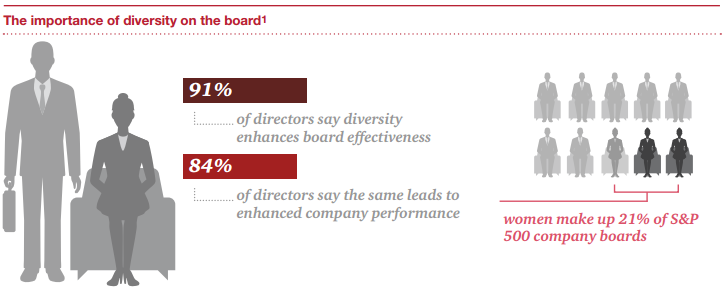
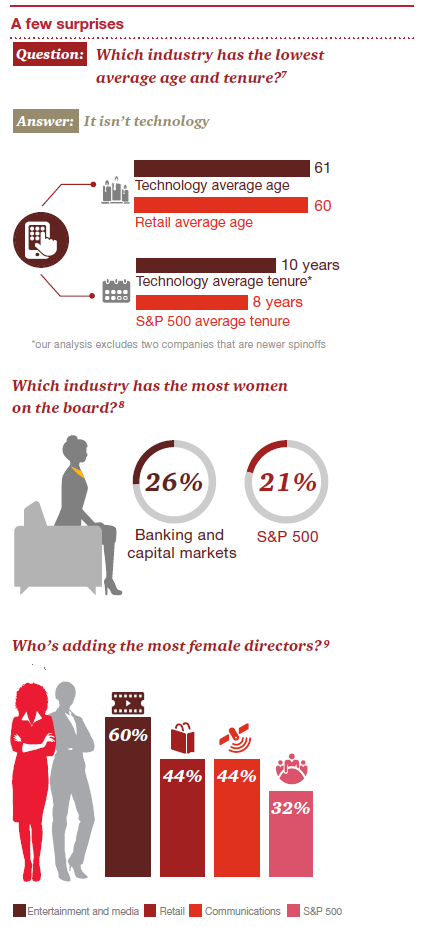
La recherche de PwC a porté sur les résultats de l’évolution des CA dans neuf (9) secteurs industriels. Dans l’ensemble, 91 % des administrateurs croient que la diversité contribue à l’efficacité du conseil. De plus, 84 % des administrateurs lient la variable de la diversité à l’accroissement de la performance organisationnelle.

L’auteure avance qu’il existe trois moyens utiles aux fins du renouvellement des CA :

  1. Une plus grande diversité ;
  2. La fixation d’un âge limite et d’un nombre de mandats maximum ;
  3. L’évaluation de la séparation des rôles entre la présidence du conseil (Chairperson) et la présidence de l’entreprise (CEO).

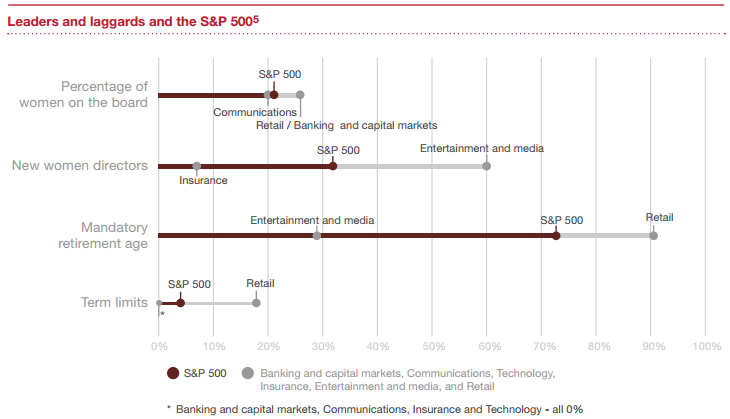
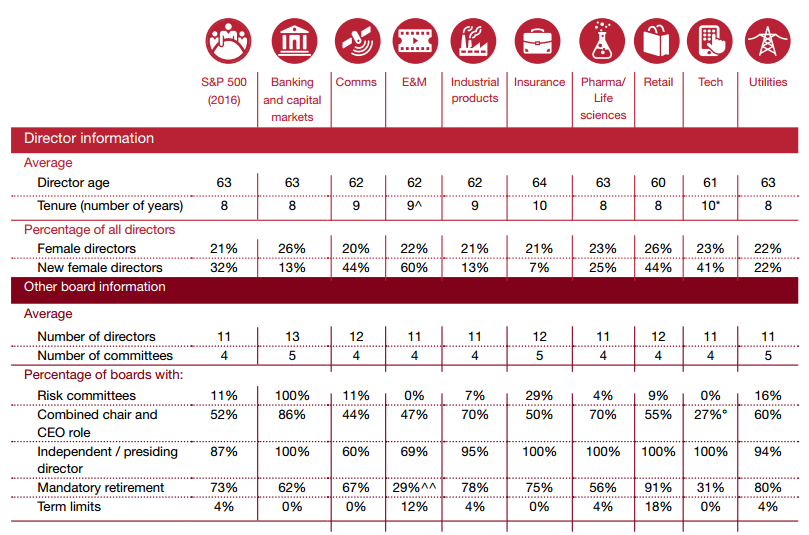
L’article est très intéressant en raison des efforts consentis à la présentation des résultats par l’illustration infographique. Le tableau présenté en annexe est particulièrement pertinent, car on y trouve une synthèse des principales variables liées au renouvellement des CA selon les neuf secteurs industriels ainsi que l’indice du S&P 500.

Au Canada, les recherches montrent que les entreprises sont beaucoup plus proactives eu égard aux facteurs de renouvellement des conseils d’administration.

Bonne lecture !

Does your board have the right makeup for the future?


Résultats de recherche d'images pour « composition du conseil d'administration »


Board composition is “the” issue for investors in 2017. Some industries are taking more steps to refresh their board than others—how does yours stack up? As the economic environment changes and lines between industries start to blur, companies are looking for directors with different, less traditional and even broader skills. Technology skills will be key across sectors.

Who’s sitting in your boardroom? Do your directors bring the right mix of skills, experiences and expertise to best oversee your company? Are they a diverse group, or a group with common backgrounds and outlooks? Can they help see into the future and how your industry is likely to take shape? And are some of your directors serving on your board as well as those in other industries?

These questions should be top of mind for executives and board members alike. Why? Because the volume of challenges companies are facing and the pace of change has intensified in recent years. From emerging technologies and cybersecurity threats to new competitors and changing regulatory requirements, companies–and their boards–have to keep up. Some boards have realized that having board members with multiple industry perspectives can prove helpful when navigating the vast amount of change businesses are faced with today.

If your board isn’t thinking about its composition and refreshment, you are opening up the door to scrutiny. Board composition is “the” issue for investors in 2017. Investors want to know who is sitting in the boardroom and whether they are the best people for the job. If they don’t think you have the right people on the board, you will likely hear about it. This is no longer something that is “nice” to think about, it’s becoming something boards “must” think about. And think about regularly.

How can you refresh your board?


In 2016, we analyzed the board demographics of select companies in nine industries to see how they compared to each other and to the S&P 500. Where does your industry fall when it comes to board refreshment? Does your board have the right makeup for the future?


There are a number of ways to refresh your board. One way is to think about diversity. Many have taken on the gender imbalance on their boards and are adding more women directors. But diversity isn’t only about women. It’s about race, ethnicity, skills, experience, expertise, age and even geography. It’s about diversity of thought and perspective. And it’s not just a talking point anymore. Regulators started drafting disclosure rules around board diversity in mid-2016. Whether the rules become final remains to be seen, but either way, board diversity is in the spotlight. Add to that the common criticism that the US is far behind its developed country peers. Norway, France and the Netherlands have been using quotas for a while, and Germany in 2015 passed a law mandating 30% women on the boards of its biggest companies. While it’s unlikely quotas would be enacted in the US, some believe they’re a needed catalyst.


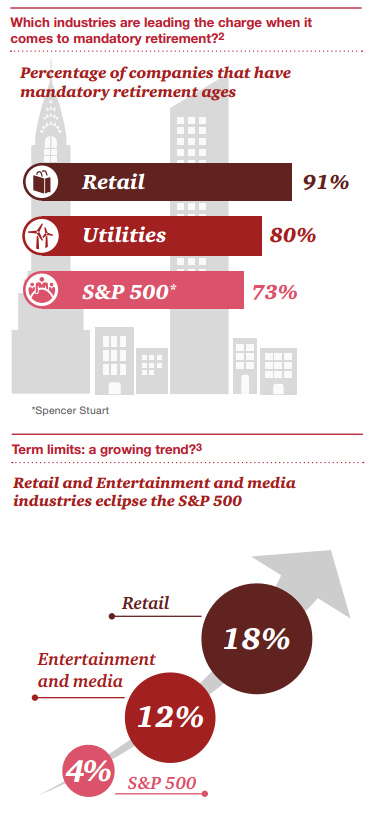
While we only looked at gender diversity on boards, we believe this is a good indicator of the efforts some boards are making to become more diverse overall. Secondly, mandatory retirement ages and term limits are two tools that boards can use to refresh itself. Our analysis showed that some industries seemed to be adopting these provisions more so than others. Some directors question their effectiveness.

Some of the industries in our PwC peer group analysis don’t have term limits at all

Banking and capital markets

Insurance

Communications

Technology

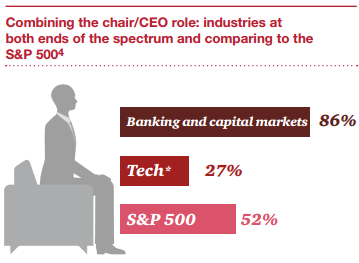
A third move that some companies have taken often, under investor pressure—is to evaluate their leadership structure and split the chair and CEO role. While the issue is still one that investors care about, certain industries have kept the combined role. And some companies don’t plan on making the change any time soon. Most often, boards with a combined chair/CEO role have an independent lead or presiding director. This may ease concerns that institutional investors and proxy firms may have about independence in the leadership role.


Who would have thought? Some interesting findings


While our analysis shows that most industries didn’t veer too far from the S&P 500 averages for most benchmarking categories, a few stand out. Retail in particular seems to be leading the charge when it comes to board refreshment.


Other industries aren’t moving along quite so quickly. And there were some surprises. Which industry had the lowest average age? Perhaps surprisingly, it’s not technology. Retail claimed that one, too. And, also unexpected, was that technology had one of the highest average tenures. [6] Another surprising finding came from our analysis of the banking and capital markets industry—an industry that’s often considered to be male-dominated. BCM boards had the highest percentage of women, at 26%. That compares to just 21% for the S&P 500. Both the entertainment and media and the communications industries were also ahead of the curve when it comes to women in the boardroom, with the highest and second-highest percentages of new female directors. Retail tied with communications for second-highest, as well.


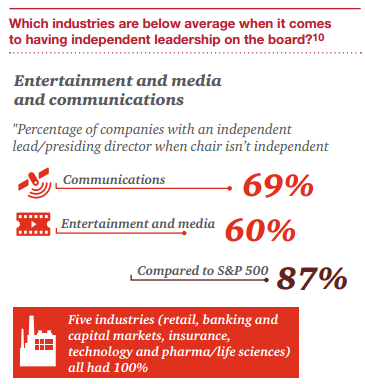
On a less progressive note, both the entertainment and media and communications industries were below the S&P 500 average when it came to having an independent lead or presiding director when the board chair is not independent. And they ranked lowest of the industries we analyzed on this topic—by far.

Blurred lines across industries


Skills, experience and diversity of thought will likely become even more important in the coming years. In the past five years alone, once bright industry lines have started to blur. Take the retail industry, for example. Brick and mortar stores, shopping malls and strip malls were what used to come to mind when thinking about that industry. Now it’s mobile devices and drones. Across many industries, business models are changing, competitors from different industries are appearing and new skills are needed. The picture of what your industry looks like today may not be the same in just a few years.

Technology is the key to much of this change. Just a few years ago, many boards were not enthusiastic about the idea of adding a director solely with technology or digital skills. But times are changing. Technology is increasingly becoming a critical skill to have on the board. We consulted our experts in the nine industries we analyzed, and all of them put technology high on the “must-have” list for new directors. Interestingly, financial, operational and industry experience—the top three from our 2016 Annual Corporate Directors Survey, were not among the most commonly listed.

Taking a fresh look


If your company is shifting gears and changing the way it does business, it may be important to take a fresh look at your board composition at more frequent intervals. Some boards use a skills matrix to see what they might be lacking in their board composition. Others may be forced by a shareholder activist to add new skills to the board.


So how do you fill the holes in the backgrounds or skills you want from your directors? One way is to look to other industries. As our analysis shows, board composition and refreshment approaches vary by industry. As industry lines blur, other industry perspectives could compliment your company—it might be helpful to consider filling any holes with board members from other industries.

No matter which approach you take, it’s very important to think about your board’s composition proactively. Use your board evaluations to understand which directors have the necessary skills and expertise—and which might be lacking what the board needs. Think about your board holistically as you think about your company’s future. Your board composition is critical to ensuring your board is effective—and keeping up with the world outside the boardroom.


Appendix


How do our industry peer groups stack up to the S&P 500? Making this evaluation can be a good way to begin determining whether your board has the right balance in terms of board composition.


Analysis excludes two companies that are newer spinoffs.
Analysis excludes one company that does not combine or separate the roles.
Excludes the tenure of one newly-formed company.
Four of the five companies that have a mandatory retirement age have waived or state that the board can choose to waive it.

Sources: Spencer Stuart, U.S. Board Index 2016, November, 2016; PwC analysis of US SEC registrants: 27 of the largest industrial products companies by market capitalization and revenue, May 2016; 11 of the largest retail companies by revenue, May 2016; 21 of the largest banking and capital markets companies by revenue, September 2016; 24 of the largest insurance companies by market capitalization, May 2016; 17 of the largest entertainment and media companies by revenue, May 2016; nine of the largest communications companies by revenue, May 2016; 25 of the largest power and utilities companies by revenue, October 2016; 16 of the largest technology companies by revenue, May 2016; 23 of the largest pharma/life sciences companies by revenue, May 2016.


Endnotes:

1Sources: PwC, 2016 Annual Corporate Directors Survey, October 2016; Spencer Stuart, 2016 US Board Index, November 2016.(go back)

2Sources: PwC analysis of 11 of the largest retail companies by revenue that are also US SEC registrants, May 2016; PwC analysis of 25 of the largest power and utilities companies by revenue that are also US SEC registrants, October 2016; Spencer Stuart, U.S. Board Index 2016, November 2016.(go back)

3Sources: PwC analysis of 11 of the largest retail companies by revenue that are also US SEC registrants, May 2016; PwC analysis of 17 of the largest entertainment and media companies by revenue that are also US SEC registrants, May 2016; Spencer Stuart, S. Board Index 2016, November 2016.(go back)

4Sources: PwC analysis of 21 of the largest banking and capital markets companies by revenue that are also US SEC registrants, September 2016; PwC analysis of 16 of the largest technology companies by revenue that are also US SEC registrants, May 2016; Spencer Stuart, S. Board Index 2016, November 2016.(go back)

5Sources: PwC analysis of US SEC registrants: nine of the largest communications companies by revenue, May 2016; 11 of the largest retail companies by revenue, May 2016; 21 of the largest banking and capital markets companies by revenue, September 2016; 24 of the largest insurance companies by market capitalization, May 2016; 16 of the largest technology companies by revenue, May 2016; 17 of the largest entertainment and media companies by revenue, May 2016; Spencer Stuart, U.S. Board Index 2016, November 2016.(go back)

6Analysis excludes two companies that are newer spinoffs.(go back)

7Sources: PwC analysis of 16 of the largest technology companies by revenue that are also US SEC registrants, May 2016; Spencer Stuart, U.S. Board Index 2016, November 2016.(go back)

8Sources: PwC analysis of 11 of the largest retail companies by revenue that are also US SEC registrants, May 2016; PwC analysis of 21 of the largest banking and capital markets companies by revenue that are also US SEC registrants, September 2016; Spencer Stuart, U.S. Board Index 2016, November, 2016(go back)

9Sources: PwC analysis of 17 of the largest entertainment and media companies by revenue that are also US SEC registrants, May 2016; PwC analysis of nine of the largest communications companies by revenue that are also US SEC registrants, May 2016; PwC analysis of 11 of the largest retail companies by revenue that are also US SEC registrants, May 2016; Spencer Stuart, S. Board Index 2016, November 2016.(go back)

10Sources: PwC analysis of 17 of the largest entertainment and media companies by revenue that are also US SEC registrants, May 2016; PwC analysis of nine of the largest communications companies by revenue that are also US SEC registrants, May 2016; Spencer Stuart, S. Board Index 2016, November 2016; PwC analysis of 11 of the largest retail companies by revenue that are also US SEC registrants, May 2016; PwC analysis of 21 of the largest banking and capital markets companies by revenue that are also US SEC registrants, September 2016; PwC analysis of 24 of the largest insurance companies by market capitalization that are also US SEC registrants, May 2016; PwC analysis of 16 of the largest technology companies by revenue that are also US SEC registrants, May 2016; PwC analysis of 23 of the largest pharma/life sciences companies by revenue that are also US SEC registrants, May 2016.

Compte rendu hebdomadaire de la Harvard Law School Forum on Corporate Governance | 2 mars 2017


Voici le compte rendu hebdomadaire du forum de la Harvard Law School sur la gouvernance corporative au 2 mars 2017.

J’ai relevé les principaux billets.

Bonne lecture !


harvard_forum_corpgovernance_small


  1. Corporate Officers as Agents
  2. 2015 Short- and Long-Term Incentive Design Criteria Among Top 200 S&P 500 Companies
  3. Private Funds Year in Review and 2017 Outlook
  4. Should Mutual Funds Invest in Startups?
  5. Shareholder Proposals Regarding Lead Director Tenure: A Harbinger of Things to Come?
  6. Hot-Button Issues for the 2017 Proxy Season
  7. 2017 Investor Corporate Governance Report
  8. 2017: Where Things Stand—Appraisal, Business Judgment Rule and Disclosure Section 16(B)—If at First You Don’t Succeed…
  9. Considerations for U.S. Public Companies Acquiring Non-U.S. Companies
  10. The 100 Most Overpaid CEOs

The Directors Toolkit 2017 | Un document complet de KPMG sur les bonnes pratiques de gouvernance et de gestion d’un CA


Voici la version 4.0 du document australien de KPMG, très bien conçu, qui répond clairement aux questions que tous les administrateurs de sociétés se posent dans le cours de leurs mandats.

Même si la publication est dédiée à l’auditoire australien de KPMG, je crois que la réalité réglementaire nord-américaine est trop semblable pour se priver d’un bon « kit » d’outils qui peut aider à constituer un Board efficace.

C’est un formidable document électronique interactif. Voyez la table des matières ci-dessous.

J’ai demandé à KPMG de me procurer une version française du même document, mais il ne semble pas en exister.

Bonne lecture !

The Directors’ Toolkit 2017 | KPMG


Now in its fourth edition, this comprehensive guide is in a user friendly electronic format. It is designed to assist directors to more effectively discharge their duties and improve board performance and decision-making.

Key topics

  1. Duties and responsibilities of a director
  2. Oversight of strategy and governance
  3. Managing shareholder and stakeholder expectations
  4. Structuring an effective board and sub-committees
  5. Enabling key executive appointments
  6. Managing productive meetings
  7. Better practice terms of reference, charters and agendas
  8. Establishing new boards.

What’s new in 2017

In this latest version, we have included newly updated sections on:

  1. managing cybersecurity risks
  2. human rights in the supply chain.

Register

Register here for your free copy of the Directors’ Toolkit.

Compte rendu hebdomadaire de la Harvard Law School Forum on Corporate Governance | 23 février 2017


Voici le compte rendu hebdomadaire du forum de la Harvard Law School sur la gouvernance corporative au 23 février 2017.

J’ai relevé les principaux billets.

Bonne lecture !


harvard_forum_corpgovernance_small

  1. A Trump Appointed AG May Not Translate to Less Aggressive Enforcement
  2. It’s Time for the Pendulum to Swing Back
  3. SEC Enforcement in Financial Reporting and Disclosure—2016 Year in Review
  4. Tactical Approaches to Proxy Season 2017
  5. The Activist Investing Annual Review 2017
  6. Company Stock Reactions to the 2016 Election Shock: Trump, Taxes and Trade
  7. Directors Must Navigate Challenges of Shareholder-Centric Paradigm
  8. A Broader Perspective on Corporate Governance in Litigation


Compte rendu hebdomadaire de la Harvard Law School Forum on Corporate Governance | 27 janvier 2017


Voici le compte rendu hebdomadaire du forum de la Harvard Law School sur la gouvernance corporative au 27 janvier 2017.

J’ai relevé les principaux billets.

Bonne lecture !


harvard_forum_corpgovernance_small


  1. Why Do Managers Fight Shareholder Proposals? Evidence from No-Action Letter Décisions
  2. Bridging the Data Gap through Shareholder Engagement
  3. Top 10 Topics for Directors in 2017
  4. Mutual Funds As Venture Capitalists? Evidence from Unicorns
  5. Broadening the Boardroom
  6. 2016 Year in Review: Securities Litigation and Regulation
  7. Bebchuk Leads SSRN’s 2016 Citation Rankings
  8. Do Director Elections Matter?
  9. White Collar and Regulatory Enforcement: What to Expect in 2017
  10. Financial Regulatory Reform in the Trump Administration
  11. Dealing with Activist Hedge Funds and Other Activist Investors


Compte rendu hebdomadaire de la Harvard Law School Forum on Corporate Governance | 19 janvier 2017


Voici le compte rendu hebdomadaire du forum de la Harvard Law School sur la gouvernance corporative au 19 janvier 2017.

J’ai relevé les principaux billets.

Bonne lecture !


harvard_forum_corpgovernance_small


  1. Playing It Safe? Managerial Preferences, Risk, and Agency Conflicts
  2. Shareholder Challenges Pay Practice at Apple, Inc.
  3. Corporate Donations and Shareholder Value
  4. Delaware Supreme Court Rules on Director Independence
  5. Proxy Access Reaches the Tipping Point
  6. Acquisition Financing: the Year Behind and the Year Ahead
  7. Say on Pay Laws, Executive Compensation, CEO Pay Slice, and Firm Value around the World
  8. The Importance of the Business Judgment Rule
  9. 2016 Year-End FCPA Update
  10. Delaware Court of Chancery Dismissal of Complaint Based on Post-Closing Disclosure Claims

Compte rendu hebdomadaire de la Harvard Law School Forum on Corporate Governance | 12 janvier 2017


Voici le compte rendu hebdomadaire du forum de la Harvard Law School sur la gouvernance corporative au 12 janvier 2017.

J’ai relevé les principaux billets.

Bonne lecture !


harvard_forum_corpgovernance_small


  1. Global and Regional Trends in Corporate Governance for 2017
  2. Compensation Season 2017
  3. Sustainability Practices: 2016 Edition
  4. The Ivory Tower on Corporate Governance
  5. Constitutionality of SEC’s Administrative Law Judges Headed to Supreme Court?
  6. Moving Beyond Shareholder Primacy: Can Mammoth Corporations Like ExxonMobil Benefit Everyone?
  7. Mergers and Acquisitions—A Brief Look Back and a View Forward
  8. Top 250 Report on Long-Term Incentive Grant Practices for Executives
  9. Corporate Governance: The New Paradigm
  10. A Strategic Cyber-Roadmap for the Board
  11. 2016 Year-End Activism Update
  12. Short-Termism and Shareholder Payouts: Getting Corporate Capital Flows Right

Compte rendu hebdomadaire de la Harvard Law School Forum on Corporate Governance | 5 janvier 2017


Voici le compte rendu hebdomadaire du forum de la Harvard Law School sur la gouvernance corporative au 5 janvier 2017.

Bonne lecture !


harvard_forum_corpgovernance_small


  1. Are Directors Really Irrelevant to Capital Structure Choice?
  2. 2017 Board Priorities Report
  3. The Life (and Death?) of Corporate Waste
  4. Progress in Understanding Proxy Access and the Shareholder Proposal Process
  5. Rethinking Compensation Philosophies: Top 5 Questions for Boards
  6. Controlling Stockholder M&A Does Not Automatically Trigger Entire Fairness Review
  7. Are Shareholder Votes Rigged?
  8. Jury Verdict in “Spread Bet” Insider Trading Case: A Reminder of U.S. Long-Arm Regulatory Risk
  9. REIT M&A, Governance and Activism—Themes for 2017
  10.  Activism, Strategic Trading, and Liquidity
  11. The Delaware General Corporation Law, Simplified
  12. Gender Parity on Boards Around the World

Compte rendu hebdomadaire de la Harvard Law School Forum on Corporate Governance


Voici le compte rendu hebdomadaire du forum de la Harvard Law School sur la gouvernance corporative au 29 décembre 2016.

Bonne lecture !


harvard_forum_corpgovernance_small

  1. A “Successful” Case of Activism at the Canadian Pacific Railway: Lessons in Corporate Governance, posted by Yvan Allaire and François Dauphin, IGOPP and UQAM, on Friday, December 23, 2016
  2. U.K. Proposed Enhancements to Corporate Governance: Will the New U.S. Administration Follow?, posted by Cydney S. Posner, Cooley LLP, on Friday, December 23, 2016
  3. Delaware Supreme Court Ruling in Zynga: Reasonable Doubt of Director Independence , posted by Thomson Reuters Practical Law, Corporate & Securities Service, on Saturday, December 24, 2016
  4. Do CEO Bonus Plans Serve a Purpose?, posted by Wayne R. Guay and John D. Kepler, University of Pennsylvania, on Monday, December 26, 2016
  5. 2016 Corporate Governance Annual Summary, posted by Michael McCauley, Florida State Board of Administration, on Monday, December 26, 2016
  6. Areas of Focus for Global Audit Regulators, posted by Steven B. Harris, Public Company Accounting Oversight Board, on Tuesday, December 27, 2016
  7. Rethinking US Financial Regulation in Light of the 2016 Election, posted by Reena Agrawal Sahni, Shearman & Sterling LLP, on Tuesday, December 27, 2016
  8. 2016 Spencer Stuart Board Index, posted by Spencer Stuart, on Wednesday, December 28, 2016
  9. Results of the 2016 Proxy Season in Silicon Valley, posted by David A. Bell, Fenwick & West LLP, on Wednesday, December 28, 2016
  10. Female Directors, Board Committees and Firm Performance, posted by Colin Green and Swarnodeep Homroy, Lancaster University, on Thursday, December 29, 2016
  11. Executive Compensation: Analysis of Recent Incentive Financial Goals, posted by John R. Sinkular and Julia Kennedy, Pay Governance LLC, on Thursday, December 29, 2016

Le Spencer Stuart Board Index | 2016


Voici le rapport annuel toujours très attendu de Spencer Stuart*.

Ce document présente un compte rendu très détaillé de l’état de la gouvernance dans les grandes sociétés publiques américaines (S&P 500).

On y découvre les résultats des changements dans le domaine de la gouvernance aux É.U. en 2016, ainsi que certaines tendances pour 2017.

Les thèmes abordés sont les suivants :

La composition des Boards

L’indépendance du président du CA

Les mandats des administrateurs et les limites aux nombres de mandats

L’âge de la retraite des administrateurs

L’évaluation des Boards

La nature des relations du Boards et de la direction avec les actionnaires

L’amélioration de la performance des Boards

Diverses informations, notamment :

Only 19% of new independent directors are active CEOs, chairs, presidents and chief operating officers, compared with 24% in 2011, 29% in 2006 and 49% in 1998, the first year we looked at this data for S&P 500 companies.

Active executives with financial backgrounds (CFOs, other financial executives, as well as investors and bankers) represent 15% of new independent directors this year, an increase from 12% last year. Another 10% of new directors are retired finance and public accounting executives.

spencer-stuart-us-board-index-2016_cover

On average, S&P 500 directors have 2.1 outside corporate board affiliations, although most directors aren’t restricted from serving on more.

The number of boards with no female directors dropped to the lowest level we have seen; six S&P 500 boards (1%) have no women, a noteworthy decline from 2006, when 52 boards (11%) included no female members. Women now constitute 21% of all S&P 500 directors.

Among the boards of the 200 largest S&P companies, the total number of minority directors has held steady at 15% since 2011. 88% of the top 200 companies have at least one minority director, the same as 10 years ago.

Only 43% of S&P 500 CEOs serve on one or more outside corporate boards in addition to their own board, the same as in 2015. In 2006, 55% of CEOs served on at least one outside board.

Boards met an average of 8.4 times for regularly scheduled and special meetings, up from 8.1 last year and 8.2 five years ago. The median number of meetings rose from 7.0 last year to 8.0.

The average annual total compensation for S&P 500 directors, excluding the chairman’s compensation, is $280,389.

Over time, the compensation mix for directors has evolved, with more stock grants and fewer stock options. Today, stock grants represent 54% of total director compensation, versus 48% five years ago, while stock options represent 6% of compensation today, down from 10% five years ago. Cash accounts for 38% of director compensation, versus 39% in 2011.

95% of the independent chairmen of S&P 500 boards receive an additional fee, averaging $165,112. Nearly two-thirds of lead and presiding directors, 65%, receive additional compensation. The average premium paid to lead and presiding directors is $33,354.

2016 Spencer Stuart Board Index


Investor attention to board performance and governance continues to escalate, and, increasingly, it’s large institutional investors—so-called “passive” investors—who are making known their expectations in areas such as board composition, disclosure and shareholder engagement. Long-term investors have shifted their posture to taking positions on good governance, and are increasingly demonstrating common ground with activists on governance topics.

Board composition is a particular area of focus, as traditional institutional investors have become more explicit in demanding that boards demonstrate that they are being thoughtful about who is sitting around the board table and that directors are contributing. They are looking more closely at disclosures related to board refreshment, board performance and assessment practices, in some cases establishing voting policies on governance.

Boards are taking notice. Directors want to ensure that their boards contribute at the highest level, aligning with shareholder interests and expectations. In response, boards are enhancing their disclosures on board composition and leadership, reviewing governance practices and establishing protocols for engaging with investors. Here are some of the trends we are seeing in the key areas of investor concern.

Board composition

The composition of the board—who the directors are, the skills and expertise they bring, and how they interact—is critical for long-term value creation, and an area of governance where investors increasingly expect greater transparency. Shareholders are looking for a well-explained rationale for why the group of people sitting around the board table are the right ones based on the strategic priorities of the business. They want to know that the board has the processes in place to review and evolve board composition in light of emerging needs, and that the board regularly evaluates the contributions and tenure of current board members and the relevance of their experience.

Acknowledging investor interest in their composition, more boards are reviewing how to best communicate their thinking about the types of expertise needed in the board—and how individual directors provide that expertise. More than one-third of the 96 corporate secretaries responding to our annual governance survey, conducted each year as part of the research for the Spencer Stuart Board Index, said their board has changed the way it reports director bios/qualifications; among those that have not yet made changes, 15% expect the board to change how they present director qualifications in the future.

What’s happening to board composition in practice after all of the talk about increasing board turnover? In 2016, we actually saw a small decline in the number of new independent directors elected to S&P 500 boards. S&P 500 boards included in our index elected 345 new independent directors during the 2016 proxy year—averaging 0.72 new directors per board. Last year, S&P 500 boards added a total of 376 new directors (0.78 new directors per board).

Nearly one-third (32%) of the new independent directors on S&P 500 boards are serving on their first outside corporate board. Women account for 32% of new directors, the highest rate of female representation since we began tracking this data for the S&P 500. This year’s class of new directors, however, includes fewer minority directors (defined as African-American, Hispanic/Latino and Asian); 15% of the 345 new independent directors are minorities, a decrease from 18% in 2015.

With the rise of shareholder activism, we’ve also seen an increase in investors and investment managers on boards. This year, 12% of new independent directors are investors, compared with 4% in 2011 and 6% in 2006.

Independent board leadership

Boards continue to feel pressure from some shareholders to separate the chair and CEO roles and name an independent chairman. And, indeed, 27% of S&P 500 boards, versus 21% in 2011, have an independent chair. An independent chair is defined as an independent director or a former executive who has met applicable NYSE or NASDAQ rules for independence over time. This actually represents a small decline from 29% last year. Meanwhile, naming a lead director remains the most common form of independent board leadership: 87% of S&P 500 boards report having a lead or presiding director, nearly all of whom (98%) are identified by name in the proxy.

In our governance survey, 12% of respondents said their board has recently separated the roles of chairman and CEO, while 33% said their board has discussed whether to split the roles within the next five years. Among boards that expect to or have recently separated the chair and CEO roles, 72% cite a CEO transition as the reason, while 20% believe the chair/CEO split represents the best governance.

In response to investor interest in board leadership structure—and sometimes demands for an independent chairman—more boards are discussing their leadership structure in their proxies, for example, explaining the rationale for maintaining a combined chair/CEO role and delineating the responsibilities of the lead director. Among the lead director responsibilities boards highlight: approving the agenda for board meetings, calling meetings and executive sessions of independent directors, presiding over executive sessions, providing board feedback to the CEO following executive sessions, leading the performance evaluation of the CEO and the board assessment, and meeting with major shareholders or other external parties, when necessary. Some proxies include a letter to shareholders from the lead independent director.

Tenure and term limits

Director tenure continues to be a hot topic for some shareholders. While some rating agencies and investors have questioned the independence of directors with “excessive” tenure, there are no specific regulations or listing standards in the U.S. that speak to director independence based on tenure. And, in fact, most companies do not have governance rules limiting tenure; only 19 S&P 500 boards (4%) set an explicit term limit for non-executive directors, a modest increase from 2015 when 13 boards (3%) had director term limits.

Just 3% of survey respondents said their boards are considering establishing director term limits, but many boards are disclosing more in their proxies about director tenure. Specifically, boards are describing their efforts to ensure a balance between short-tenured and long-tenured directors. And several companies have included a short summary of the board’s average tenure accompanied by a pie chart breaking down the tenure of directors on the board (e.g., directors with less than five years tenure, between five and 10 years, and more than 10 years tenure on the board).

Among S&P 500 boards overall, the average board tenure is 8.3 years, a slight decrease from 8.7 five years ago. The median tenure has declined as well in that time, from 8.4 to 8.0. The majority of boards, 63%, have an average tenure between six and 10 years, but 19% of boards have an average tenure of 11 or more years.

We also looked this year at the tenure of individual directors: 35% of independent directors have served on their boards for five years or less, 28% have served for six to 10 years, and 22% for 11 to 15 years. Fifteen percent of independent directors have served on their boards for 16 years or more.

Mandatory retirement

In the absence of term or tenure limits, most S&P 500 boards rely on mandatory retirement ages to promote turnover. About three-quarters (73%) of S&P 500 boards report having a mandatory retirement age for directors. Eleven percent report that they do not have a mandatory retirement age, and 16% do not discuss mandatory retirement in their proxies.

Retirement ages have crept up in recent years, as boards have raised them to allow experienced directors to serve longer. Thirty-nine percent of boards have mandatory retirement ages of 75 or older, compared with 20% in 2011 and just 9% in 2006. Four boards have a retirement age of 80. The most common mandatory retirement age is 72, set by 45% of S&P 500 boards.

As retirement ages have increased, so has the average age of independent directors. The average age of S&P 500 independent directors is 63 today, two years older than a decade ago. In that same period, the median age rose from 61 to 64. Meanwhile, the number of older boards has increased; 37% of S&P 500 boards have an average age of 64 or older, compared with 19% a decade ago, and 15 of today’s boards (3%) have an average age of 70 or greater, versus four (1%) a decade ago.

Board evaluations

Another topic on which large institutional investors have become more vocal is board performance evaluations. Shareholders are seeking greater transparency about how boards address their own performance and the suitability of individual directors—and whether they are using assessments as a catalyst for refreshing the board as new needs arise.

We have seen a growing trend in support of individual director assessments as part of the board effectiveness assessment—not to grade directors, but to provide constructive feedback that can improve performance. Yet the pace of adoption of individual director assessments has been measured. Today, roughly one-third (32%) of S&P 500 boards evaluate the full board, committees and individual directors annually, an increase from 29% in 2011.

In our survey of corporate secretaries, respondents said evaluations are most often conducted by a director, typically the chairman, lead director or a committee chair. A wide range of internal and external parties are also tapped to conduct board assessments, including in-house and external legal counsel, the corporate secretary and board consulting firms. Thirty-five percent use director self-assessments, and 15% include peer reviews. According to proxies, a small number of boards, but more than in the past, disclose that they used an outside consultant to facilitate all or a portion of the evaluation process.

Shareholder engagement

In light of investors’ growing desire for direct engagement with directors, more boards have established frameworks for shareholders to raise questions and engage in meaningful, two-way discussions with the board. In addition to improving disclosures about board composition, assessment and other key governance areas, some boards include in their proxies a summary of their shareholder outreach efforts. For example, they detail the number of investors the board met with, the issues discussed and how the company and board responded. A few boards facilitate direct access to the board by providing contact information for individual directors, including the lead director and audit committee chair.

Going further, many boards now proactively reach out to their company’s largest shareholders. In our survey, 83% of respondents said management or the board contacted the company’s large institutional investors or largest shareholders, an increase from 70% the year prior. The most common topic about which companies engaged with shareholders was proxy access (52%), an increase from 33% in 2015. Other topics included “say on pay” (51%), CEO compensation (40%), director tenure (30%), board refreshment (27%), shareholder engagement approach (27%) and chairman independence (24%). Survey respondents also wrote in more than a dozen additional topics, including majority/cumulative voting, disclosure enhancements, environmental issues and gender pay equity.

Enhancing board performance

The topic of board refreshment can be a highly charged one for boards. But having the right skills around the table is critical for the board’s ability to provide the appropriate guidance and oversight of management. Furthermore, the capabilities and perspectives that a board needs evolve over time as the business context changes. Boards can ensure that they have the right perspectives around the table and are well-equipped to address the issues that drive shareholder value—which, after all, is what investors are looking for—by doing the following:

Viewing director recruitment in terms of ongoing board succession planning, not one-off replacements. Boards should periodically review the skills and expertise on the board to identify gaps in skills or expertise based on changes in strategy or the business context.

Proactively communicating the skill sets and expertise in the boardroom—and the roadmap for future succession. Publishing the board’s skill matrix and sharing the board’s thinking about the types of expertise that are needed on the board—and how individual directors provide that expertise—signals to investors that the board is thoughtful about board succession.

Setting expectations for appropriate tenure both at the aggregate and individual levels. By setting term expectations when new directors join, boards can combat the perceived stigma attached to leaving a board before the mandatory retirement age. Ideally, boards will create an environment where directors are willing to acknowledge when the board would benefit from bringing on different expertise.

Thinking like an activist and identifying vulnerabilities in board renewal and performance. Proactive boards conduct board evaluations annually to identify weaknesses in expertise or performance. They periodically engage third parties to manage the process and are disciplined about identifying and holding themselves accountable for action items stemming from the assessment.

Establishing a framework for engaging with investors. This starts with proactive and useful disclosure, which demonstrates that the board has thought about its composition, performance and other specific issues. In addition, it is valuable to have a protocol in place enumerating responsibilities related to shareholder engagement.


*Note: The Spencer Stuart Board Index (SSBI) is based on our analysis of the most recent proxy reports from the S&P 500, plus an extensive supplemental survey. The complete publication draws on the latest proxy statements from 482 companies filed between May 15, 2015, and May 15, 2016, and responses from 96 companies to our governance survey conducted in the second quarter of 2016. Survey respondents are typically corporate secretaries, general counsel or chief governance officers. Proxy and survey data have been supplemented with information compiled in Spencer Stuart’s proprietary database.

The complete publication, including footnotes, is available here.

Bâtir un conseil d’administration à « valeur ajoutée »


La question que pose l’auteur Robyn Bew, directeur à la National Association of Corporate Directors (NACD), est directe et d’une grande importance : Les Boards sont-ils prêts pour affronter les changements des 20 dernières années ?

En effet, cela fait déjà vingt ans que le rapport du NACD (Blue Ribbon Commission on Director Professionalism) a fait ses recommandations sur les principes de saine gouvernance.

Cet article nous invite à revisiter les règles de gouvernance à la lumière des changements significatifs survenus depuis 20 ans.

Il ne s’agit pas de rafraîchir la composition du CA, mais plutôt de s’assurer que ce dernier constitue un actif stratégique durable.

L’article a été publié aujourd’hui sur le site du Harvard Law School Forum on Corporate Governance.

Bonne lecture !

Building the Strategic-Asset Board


33273_10014323_1317887626_69127-e_1000x533


In 1996, the Report of the NACD Blue Ribbon Commission on Director Professionalism made recommendations on issues including establishing mechanisms for appropriate director turnover/tenure limitations, evaluation of the full board and of individual directors, and ongoing director education. [1] It stated, “the primary goal of director selection is to nominate individuals who, as a group, offer a range of specialized knowledge, skills, and expertise that can contribute to the successful operation of the company,” and advocated that boards must “[expand] the pool of potential nominees considered to include a more diverse range of qualified candidates who meet established criteria.”[2]

Twenty years later, the world in which boards operate has been transformed in fundamental ways, including increased complexity in the business environment; rapidly changing technology; volatility in global politics as well as in international economic and trade flows; the proliferation of information; the presence of major threats such as cyberattacks; higher levels of engagement between companies, boards, and investors of all stripes, including activists; new regulatory requirements; and greater levels of scrutiny from the press and the public. The velocity of the changes directors are facing shows no signs of slowing down.

The NACD 2016 Blue Ribbon Commission began its dialogue by asking whether boards are keeping up, and concluded that there is no single answer. It is clear that advancing director ages and tenures, coupled with low boardroom turnover, are external symptoms that are of increasing concern to investors and other stakeholders. But equally—if not more—significant is the question of whether a board’s composition, director skill sets, and core board processes remain fit-for-purpose in a world where the board’s mandate is evolving in fundamental ways, including but not limited to earlier involvement in strategy-setting discussions with management and greater engagement between designated board members and major investors. This new mandate places substantially different demands on directors, and boards need to ask themselves, “Are we ready?”

Many stakeholders are focused on encouraging higher levels of director turnover—often termed “board refreshment”—through the use of tenure-limiting mechanisms. We believe that such mechanisms can help to drive needed change in the boardroom, but alone they are not sufficient to ensure that boards truly remain fit for-purpose over time. We are encouraging directors to think more holistically, and more ambitiously. Business as-usual approaches will not be sufficient.

As a starting point, directors should review the organization’s corporate governance guidelines, including the board’s mission and key operating principles. Are all board members familiar with them? How often are they reviewed and updated? How rigorously have they been implemented? Do they help to foster a culture of continuous improvement and ongoing learning?

Boards are unique entities. While (in the case of public companies) they are elected by and accountable to shareholders, they are self-constituting, self-evaluating, self-compensating, and self-perpetuating: that is, in the normal course of business, they control their own composition and succession planning. This also means that boards are equipped to take action to elevate their performance on an entirely self-directed, voluntary basis—and they should do so. Otherwise, if board leadership appears to be passive or slow to act in the face of a challenging competitive environment and greater scrutiny from all angles, directors should prepare for the possibility of “shock treatments” imposed from the outside, in the form of activist challenges, regulatory mandates, or quotas. Put another way, without sufficient and timely evolution, boards could face revolution.

Beyond “Board Refreshment”: Building a Strategic-Asset Board

Too many companies still view changes in their boardrooms as necessary primarily on an incremental basis and from the standpoint of director replacement—i.e., responding to the loss of directors due to age or other reasons for departure in a fairly reactive, one-off manner. And while (as noted above) the idea of “board refreshment” has attracted increasing attention in the corporate governance community, as well as with regulators and the press, in the words of one Commissioner, “the current definition [of board refreshment] can still be somewhat limiting—it can imply change for the sake of change.”

The Commission advocates a more ambitious approach, centered on proactive measures that help to build a strategic-asset board. Characteristics of this approach include:

A focus on continuous improvement of overall board composition, individual director skills, and boardroom processes—collectively aimed at achieving and maintaining a high-performance boardrather than a primarily reactive or event-driven approach to board change. One indicator of well-established continuous-improvement processes is that they are used in times of good performance, not just when the company is in a down cycle or facing external challenge

Using the company’s current and future needs as the starting point for determining board composition. Such an approach will certainly include considerations about maintaining an appropriate level of continuity and institutional memory in the boardroom—but in the words of Vanguard CEO Bill McNabb, “To be frank, board members cannot be more worried about their own seats than they are about the future of the company they oversee.”[3]

A set of tools and processes that works together as a system for continuous improvement—avoiding what one Commissioner called the “formulaic approach” of overreliance on automatic tenure-limiting mechanism

While outcomes will be specific to individual boards, in general, we expect to see improvements such as the following:

Boards that are composed of directors who collectively have the right skills and insights to support the formulation and execution of the organization’s strategy—in other words, boards where it is clear that the whole is greater than the sum of the parts

Boards that have the ability to adapt and retool themselves over time, so that they are able to maintain a superior level of oversight and guidance and evolve as the organization’s strategy and competitive environment evolve

Boards that are transparent in their communications with investors and other stakeholders about who they are and how they operatenacd-1

SECTION 1 of the report describes the ways in which the board’s mandate has evolved in response to external factors and strategic imperatives, and outlines the ways in which the Commission believes boards must respond: by moving beyond traditional approaches to “board refreshment” and establishing a system for continuous improvement in the boardroom.

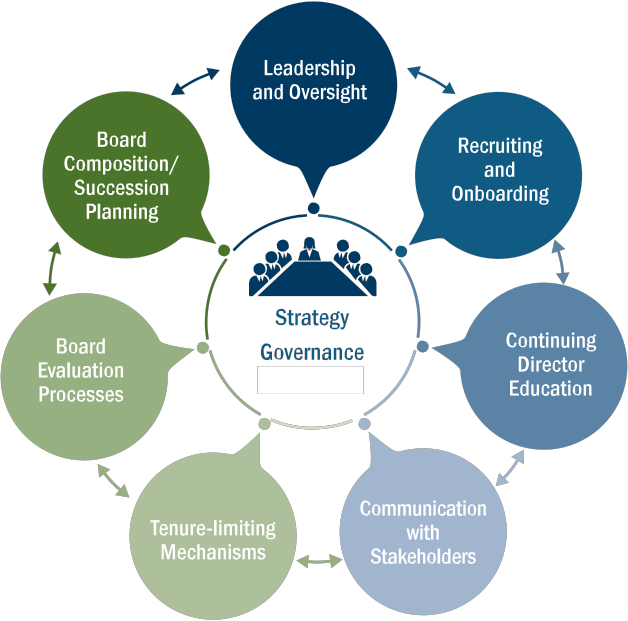
SECTION 2 explores the key dimensions of continuous improvement, focusing on seven areas in particular: board leadership and oversight responsibilities; board composition and succession planning; recruiting and onboarding new directors; processes for board evaluation; continuing education; tenure-limiting mechanisms; and communication with shareholders and stakeholders.

SECTION 3 summarizes the Commission’s recommendations, and the Appendices provide tools and related resources to help boards implement the recommendations.

NACD has characterized the mission of the board as “[becoming] a strategic asset of the company measured by the contributions we make—collectively and individually—to the long-term success of the enterprise.” [4] We believe this report will help directors in organizations of all sizes and in all sectors to do exactly that.

Recommendations of the 2016 NACD Blue Ribbon Commission

  1. Boards should review their governance principles on a regular basis (at least every other year) to ensure they are complete, up-to-date, and fully understood by current members and director candidates. Governance principles should incorporate a definition of director responsibilities, including a commitment to ongoing learning and the belief that service on the board should not be considered to be a permanent appointment.
  2. The nominating and governance committee should oversee the board’s processes for continuous improvement, working in close coordination with the nonexecutive chair or lead director and with the endorsement of the full board.
  3. Director renominations should not be a default decision, but an annual consideration based on a number of factors, including an assessment of current and future skill sets and leadership styles that are needed on the board.
  4. Nominating and governance committees should develop a “clean-sheet” assessment of the board’s needs in terms of director skill sets and experience at least every two to three years, and use it as an input in continuous-improvement efforts (including recruitment and director education).
  5. The director recruitment process should have a time horizon that matches the organization’s long-term strategy, typically three to five years or more. The process should be designed to include candidates from diverse backgrounds.
  6. Recruiting and onboarding processes should familiarize prospective and new directors with the board’s governance principles and set expectations regarding criteria for renomination, ongoing director education, and other aspects of continuous improvement as defined by the board.
  7. Conduct annual evaluations at the full-board level, and evaluations of committees and individual directors at least once every two years. Use a qualified independent third party on a periodic basis, to encourage candor and add a neutral perspective.
  8. Participation in continuing education should be a requirement for all directors, regardless of experience level or length of board tenure.
  9. Tenure is an important aspect of boardroom diversity. Nominating and governance committees should strive for a mix of tenures on the board—for example, maintaining a composition that includes at least one director with <5, 5–10, and >10 years of service.
  10. High-performance boards will not need to rely exclusively on tenure-limiting mechanisms to ensure appropriate board turnover and composition. However, boards that use such policies should consider replacing or combining retirement age with a maximum term of service.
  11. Communications with investors and other key stakeholders should include a detailed explanation of the link between the organization’s strategic needs and the board’s composition and skill sets, as well as information about the board’s continuous-improvement processes.

Tools for Directors

The report’s 12 appendices enable boards to benchmark their current practices and implement the report’s recommendations. Examples of appendix content are below.

Early Engagement: Going Beyond Traditional Board Succession Planning

A reference list of more than 25 questions to help directors evaluate the board’s ability to manage succession planning as a portfolio, instead of as a series of one-off replacements of individual directors; the strength of the board’s search capabilities, including early-engagement activities and the depth of the candidate pipeline; and the role that board and company culture play in succession planning.

Considerations for Upgrading Board Evaluation Processes

The appendix provides guidance to help boards

  1. establish effective, ongoing rhythms for evaluation processes;
  2. avoid “evaluation fatigue”;
  3. inform the use of third-party facilitators;
  4. make evaluations more holistic by incorporating input from management; and
  5. act on evaluation results.

Guidelines for Developing Board and Individual-Director Learning Agendas

The appendix includes frameworks and questions to help inform full-board and individual-director education activities:

  1. Suggested categories and topic areas for education, with sourcing strategies
  2. A personal learning and development checklist for directors
  3. Outline of a “lifecycle approach” to learning and development for the board, with components of a global director leadership profile

Tools, Templates, and Examples

Multiyear board succession planning matrix

Sample board and committee-level evaluation questions

New-director onboarding checklist

Examples of effective disclosures of director skills, board evaluations, and director education

Examples of corporate governance principles and board tenure policies

* * *

The complete publication is available exclusively to NACD members and is available for download here.

Endnotes:

1NACD, Report of the Blue Ribbon Commission on Director Professionalism, 2011 ed. (Washington, DC: NACD, 2011), pp. 12, 5, 15, 10.(go back)

2Ibid., p. 13.(go back)

3F. William McNabb III, Getting to Know You: The Case for Significant Shareholder Engagement, Harvard Law School Forum on Corporate Governance and Financial Regulation, June 24, 2015.(go back)

4NACD, Report of the Blue Ribbon Commission on Board Evaluation: Improving Director Effectiveness, 3rd ed. (Washington, DC: NACD, 2010), p. 2.(go back)