« Benchmark » global en matière de politique de gouvernance | ISS


Subodh Mishra, Directeur exécutif à Institutional Shareholder Services (ISS) a publié le résultat des études de ISS visant à établir un « benchmark » global en matière de politique de gouvernance.

Voici les cinq domaines de recherche :

  1. One-Share One-Vote Principle
  2. Gender Diversity on Boards
  3. Share Issuance and Buyback Proposals
  4. Virtual/Hybrid Meetings
  5. Pay Ratio Between Senior Executives and Employees

L’étude présente les résultats sous forme de tableaux assez explicites.


Bonne lecture !


2017-2018 ISS Global Policy Survey


Résultats de recherche d'images pour « ISS annual global benchmark policy »


A key part of ISS’ annual global benchmark policy formulation process is a survey which is open to institutional investors, corporate executives, board members and any other interested constituencies. For the 2017-2018 policy cycle, the survey was in two parts: (1) a short, high-level Governance Principles Survey covering a limited number of topical corporate governance areas and (2) a longer, more detailed supplemental survey allowing respondents to drill down into a wider set of key issues at market and regional levels. This document summarizes the findings of the Governance Principles Survey, which closed on August 31. The supplemental survey will remain open until October 6, 2017, at 5 PM (ET).

The response to the Governance Principles Survey was strong. In total, ISS received 602 responses to the survey, from a total of 571 different organizations. Responses were received from 121 institutional investors, representing 116 organizations, including 103 asset managers and 18 asset owners. An additional 10 responses were received from organizations that represent or provide services to institutional investors; these results were aggregated with the investor responses, bringing the total investor responses to 131. Two investors provided responses to ISS after the survey’s deadline, which were not aggregated in the results. For purposes of this report, survey results are based on 129 “investor” responses.

Responses were also received from 382 corporate issuers, several of whom submitted multiple responses. Additional non-investor survey responses were received from 46 consultants/advisors to companies; 28 corporate directors; and 13 organizations that represent or provide services to issuers. Responses from these corporate constituents were aggregated with the issuer responses, bringing the total “non-investor” responses to 469.

As in past years, the largest number of respondents—more than 400 in all—were from organizations based in the United States, with 51 from groups based in Canada, and 84 from groups based in Europe and/or the U.K. Responses were also received from organizations in, but not limited to, Australia, Hong Kong, Singapore, India, Brazil, Russia and Bermuda. Many respondents have a focus that goes beyond their own home country.

Primary Market of Focus Investor Non-Investor
Global (most or all of the below) 49% 19%
U.S. 28% 62%
Continental Europe 7% 4%
Asia-Pacific 5% 3%
U.K. 4% 2%
Canada 3% 6%
Developing/emerging markets generally 2% 0%
Other (includes Australia, Switzerland, or combination of two other markets) 2% 1%
Latin America 0% 1%

The breakdown of investors by the size of their assets owned or assets under management was as follows:

Asset Size % of Investor Respondents
Under $100 million 2%
$100 million–$500 million 9%
$500 million–$1 billion 4%
$1 billion–$10 billion 19%
$10 billion–$100 billion 26%
Over $100 billion 35%
Not applicable 6%

Some of the respondents answered every survey question; others skipped one or more questions. Throughout this report, response rates are calculated as percentages of the valid responses received on each particular question from investors and from non-investor respondents, excluding blank responses. Survey participants who filled out the “Respondent Information” but did not answer any of the policy questions were excluded from the analysis and are not part of the breakdown of respondents above.

Key Findings

One-Share One-Vote Principle

The global debate over shareholders’ voting rights and multi-class share schemes has exploded in recent years thanks to a series of high-profile share issuances that deviated from one-share, one-vote. The recent initial public offering of Snap Inc. in the U.S., which offered only non-voting shares to the public, raised the stakes.

ISS solicited respondents’ views on multi-class capital structures that carry unequal voting rights.

Among investors, a large minority (43 percent) indicated that they considered unequal voting rights are never appropriate for a public company in any circumstances. An equal proportion of investors (43 percent) said unequal voting rights structures may be appropriate in the limited circumstances of newly-public companies if they are subject to automatic sunset requirements or at firms more broadly if the capital structure is put up for periodic reapproval by the holders of the low-vote shares. Only five percent of investor respondents agreed with the opinion that companies should be allowed to choose whatever capital structure they see fit.

Among non-investors, 50 percent responded that companies should be allowed to choose whatever capital structure they see fit, while 27 percent responded that a multi-class structure may be appropriate at a newly public company if subject to an automatic sunset provision or more broadly if reapproved on a periodic basis by the low-vote

shareholders. Only 11 percent responded that multi-class structures with unequal voting rights are never appropriate for a public company in any circumstances.

Among investors, one respondent commented that “where the existence of multiple share classes creates a ‘controlling entity’ as a minimum the board must be able to demonstrate how it can operate independently of that entity.” Several non-investor respondents indicated that companies should be allowed to choose their own corporate structure given that shareholders can choose not to invest in the issuer’s shares if they dislike the structure.

Gender Diversity on Boards

The global focus on increasing gender diversity in corporate boardrooms has grown in recent years. ISS asked respondents if they would consider it problematic if there are zero female directors on a public company board. More than two-thirds (69 percent) of investor respondents said “yes.” The lion’s share of these respondents (43 percent) said that the absence of women directors could indicate problems in the board recruitment process, while 26 percent of investor respondents said that although a lack of female directors would be problematic, their concerns may be mitigated if there is a disclosed policy/approach that describes the considerations taken into account by the board or the nominating committee to increase gender diversity on the board. Fewer than one in ten (8 percent) of investor respondents agreed with the statement that directors are best suited to determine the board composition and that a lack of women directors is not necessarily problematic.

Slightly less than one-quarter (23 percent) of the investor respondents indicated that they may find the lack of female directors on a board to be problematic based on a case-by-case analysis. Among the factors cited by investor respondents in making such a case-by-case determination were: the appropriateness of the existing directors based on their experience and skill sets; whether the board is composed of people who are capable of representing shareholders; company size; and turn-around situations.

Of the investor respondents who indicated that the lack of female directors on a public board is or could be problematic, the highest number cited engagement with the board and/or management as the most appropriate response. The second most popular response was to consider supporting a shareholder proposal aimed at increasing diversity. The investor respondents’ third-highest favored action was supporting a shareholder-nominated candidate.

A majority (54 percent) of the non-investor respondents answered “yes” when asked if the absence of a single woman director on a board is problematic, although more than half of these respondents said their concerns might be mitigated by a company’s disclosed policy or approach. Only around one of every five (19 percent) of non-investor respondents said that a lack of diversity was not a concern given that sitting directors are best suited to determine board composition. Of those non-investor respondents who indicated that the absence of female directors on the board may be problematic based on a case-by-case determination, comments often mirrored those of the investor respondents with respect to taking directors’ experience and skill sets into consideration. Other non-investor commenters expressed concern about adopting “quotas,” or a one-size-fits-all policy applicable to all industries and all types of companies.

Like the investor respondents, non-investors’ most commonly preferred investor action in response to a lack of gender diversity was engagement with the board and management. Unlike the investor respondents, however, the non-investors favored votes against members of the nominating committee rather than support for a shareholder nominee to the board.

Share Issuance and Buyback Proposals

Cross-market companies (i.e. incorporated in one country, listed in one or more others) can create unique corporate governance challenges given differences in legal requirements, listing standards and market norms. Voting on share issuances and buybacks at cross-market companies can be particularly complex given significant market-specific differences in shareholders’ rights to approve or ratify such capital allocation issues.

ISS asked survey respondents to provide their views on share issuances and buybacks as a general matter.

Among the investor respondents, 13 percent indicated that both share issuances and buybacks are matters for the board to decide. Forty-four percent of the investor respondents said that both share issuances and buybacks should generally be voted upon by shareholders. More than one-quarter (27 percent) of the investor respondents indicated their preference for shareholder votes on share issuances, but they favored leaving share buybacks to the board’s discretion. Combining these results, more than seven out of ten of the investor respondents favored votes on share issuances while less than half of them called for votes on buybacks.

Among non-investor respondents, a significant majority (61 percent) supported the view that both share issuances and buybacks are matters for the board to decide.

As a follow-up question, respondents were asked to provide their views specifically on share issuance and buyback proposals at U.S.-listed, but non-U.S.-incorporated companies.

Investors’ responses were split. More than one-third (36 percent) of the investors agreed that since the proposals are on the ballot due to the laws of the market of incorporation, the company should follow the customary practices of that market. At the other end of the spectrum, 26 percent of the respondents indicated that as long as the company follows customary U.S. capital market practices, the proposal should be treated as routine, so as not to disadvantage a cross-market firm vis-à-vis its US-domiciled peers. One-quarter of the investors supported a hybrid approach that is less restrictive than many European markets’ best practices but that protects shareholders from excessive dilution in situations not covered by NYSE and NASDAQ listing rules.

On the other hand, a majority of the non-investor respondents (55 percent) supported the view that as long as the company follows customary U.S. capital market practices, the proposal should be treated as routine, so as not to disadvantage a cross-market firm vis-à-vis its U.S.-domiciled peers.

Virtual/Hybrid Meetings

In the U.S., UK and some other markets worldwide, companies are permitted to use electronic means of communication to facilitate the participation of shareholders at general meetings. While there are benefits to allowing shareholders to participate remotely, some investors have raised concerns that replacing physical meetings with virtual-only meetings may hinder meaningful exchanges between board members and shareholders.

Survey respondents were asked to provide their view on the use of remote means of communication for facilitating shareholder participation at general meetings, i.e., “hybrid” or “virtual-only” shareholder meetings.

About one out of every five (19 percent) of the investors said that they would generally consider the practice of holding either “virtual-only” or “hybrid” shareholder meetings to be acceptable, without reservation. At the opposite extreme, 8 percent of the investors did not support either “hybrid” or “virtual-only” meetings. More than one-third (36 percent) of the investor respondents indicated that they generally consider the practice of holding “hybrid” shareholder meetings to be acceptable, but not “virtual-only” shareholder meetings. Another 32 percent of the investor respondents indicated that the practice of holding “hybrid” shareholder meetings is acceptable, and that they would also be comfortable with “virtual-only” shareholder meetings if they provided the same shareholder rights as a physical meeting.

Among non-investor respondents, a plurality (42 percent) indicated that “virtual-only” or “hybrid” shareholder meetings are acceptable without reservation. However, among the majority of non-investor respondents who did not support that view, 22 percent indicated that, generally, the practice of holding “hybrid” meetings is acceptable, and they would also be comfortable with “virtual-only” meetings if they provided the same shareholder rights as a physical meeting, while 15 percent did not support the practice of holding either “hybrid” or “virtual” meetings.

Pay Ratio Between Senior Executives and Employees

Barring some last minute legislative roadblock, U.S. issuers will be required to disclose the ratio of CEO pay to the pay of the median company employee in their proxy statements for the 2018 season. Similar pay ratio information will also be required of UK companies from 2018. In anticipation of these new disclosures, ISS asked respondents how they intend to analyze data on pay ratios.

Somewhat surprisingly, only 16 percent indicated that they are not planning to make use of this new information. Nearly three-quarters of the investor respondents indicated that they intend to either compare the ratios across companies/industry sectors, or assess year-on-year changes in the ratio at an individual company or use both of these methodologies. Of the 12 percent of investors who selected “other” as their response, some of them indicated a wait-and-see approach while other comments indicated uncertainty or concerns regarding the usefulness of the pay ratio data.

Among non-investor respondents, a plurality (44 percent) expressed doubt about the usefulness of such pay ratio data. Many of them expressed skepticism that the data would be meaningful, with one non-investor respondent commenting: “For a company having a widespread international exposure, the pay ratio is considered irrelevant.” Other commenters cited a variety of factors that would complicate peer comparisons, including demographic and geographic disparities and the use of part-time or contract workers. Notably, however, 21 percent of the non-investor respondents indicated that they intend both to compare the ratios across companies/industry sectors and assess year-on-year changes in the ratio at an individual company.

Respondents were also asked how shareholders should use disclosed data on pay ratios. Among investor respondents, the most frequent response was to use it as one data point in determining votes on compensation-related resolutions, followed by using it as background material for engagement with the company. Among non-investor respondents, the most frequent response was that the information as disclosed will not be meaningful to shareholders.

Appendix: Detailed Survey Responses

Survey results are based on 129 investor responses (primarily asset managers and asset owners) and 469 responses from non-investors (primarily companies and their advisers), reflecting more than one response from some organizations.

For questions that allowed multiple answers, rankings are based on the number of responses for each answer choice. Percentages for other questions may not equal 100 percent due to rounding.

1. One-Share, One-Vote Principle

The “one-share, one-vote principle”—the idea that long-term shareholder value is best protected by a capital structure in which voting power corresponds to each shareholder’s ownership stake and at-risk capital commitment—is increasingly under attack as some companies have sought to access public capital markets while insulating themselves and their management teams from perceived short-term pressures through differential voting rights. The recent IPO of Snap Inc. in the U.S. pushed the envelope by offering shares to the public with no voting rights at all. A number of other companies, such as Alphabet, Facebook and Blue Apron, utilize capital structures where public shareholders may only purchase low or zero voting rights shares. As stock markets increasingly find themselves in global competition for high-profile listings (e.g. Alibaba Group Holding, Saudi Aramco), they may feel pressure to relax or eliminate long-standing rules designed to protect investors. Short-term demand for a “hot” stock can potentially make it appear as if shareholders, as a group, do not place a high priority on voting rights. Some investors who purchase shares in an IPO may not prioritize good corporate governance and shareholder rights if they do not plan to hold their shares for the long term. Meanwhile, long-term shareholders who may normally prioritize good governance may nevertheless be forced to buy shares of companies with substandard shareholder rights as soon as those firms are included in a major stock index.

Which of the following represents your organization’s view of multi-class capital structures with unequal voting rights?

Investor Non-Investor
Companies should be allowed to choose whatever capital structure they see fit. 5% 50%
They are never appropriate for a public company in any circumstances. 43% 11%
They may be appropriate for certain newly-public companies, but should be subject to an automatic sunset provision based on time elapsed since the IPO. 18% 9%
They may be appropriate for certain newly-public companies, but should be subject to an automatic sunset provision based on the market capitalization of the company. 7% 5%
They may be appropriate for certain public companies, but should be subject to periodic reapproval by the holders of the low-vote shares. 18% 13%
Other 9% 12%

2. Gender Diversity on Boards

The focus on gender diversity in corporate boardrooms has increased in numerous markets in recent years. Many of these markets have implemented enhanced disclosure requirements, best practice recommendations or regulatory quotas to drive increased female representation on public company boards. Despite this heightened attention, there have been varying levels of progress amongst companies in increasing the number of female directors on boards and some institutional investors continue to express frustration with a perceived lack of progress in boosting gender diversity in certain markets or industry sectors.

Does your organization consider it to be problematic if there are zero female directors on a public company board?

Investor Non-Investor
Yes, the absence of at least one female director may indicate problems in the board recruitment process. 43% 25%
Yes, but concerns may be mitigated if there is a disclosed policy/approach that describes the considerations taken into account by the board or the nominating committee to increase gender diversity on the board. 26% 29%
No, directors are best-suited to determining the composition of the board. 8% 19%
Maybe, but the level of concern is based on a case-by-case determination (e.g., it depends on the country; type of company; industry sector or other factors) (Please specify below) 23% 27%

If your organization answered “Yes” or “Maybe” to the preceding question, what actions do you consider may be appropriate for shareholders to take at a company that lacks any gender diversity on the board, and/or has not disclosed a policy on the issue? (Check all that apply)

Investors’ Rank Non-Investors’ Rank
Engage with the board and/or management 1 (92) 1 (312)
Consider supporting a shareholder proposal aimed at increasing diversity 2 (83) 2 (82)
Consider supporting a shareholder-nominated candidate to the board 3 (60) 5 (39)
Consider voting against all members of the nominating/governance committee 5 (45) 4 (46)
Consider voting against the chair of the nominating/governance committee 4 (53) 3 (50)
Consider voting against the chair of the board or lead director 6 (42) 6 (35)
Consider voting against the Report & Accounts (in markets where this is an option) reflecting poor disclosure of gender diversity 7 (18) 8 (4)
Other 8 (3) 7 (21)

*Rankings are based on number of responses for each answer choice.

3. Share Issuance and Buyback Proposals

Rules regarding shareholder approval of share issuances and buybacks vary by market. US listing rules do not require shareholder approval for share repurchases, and only require shareholder approval for share issuances in excess of 20 percent of issued capital where such issuances are private placements at a price below book value or market value, or where the issuances will result in a change of control or are in connection with an acquisition. Any other share issuances, up to the number of shares authorized in the charter, do not require a shareholder vote. By contrast, many European markets in principle require shareholder approval of all share issuances and share buybacks, but allow companies to seek approval for annual mandates covering share issuances during the coming year, up to a specified percentage of issued capital, or share buybacks during the coming year.

These differing approaches to shareholder approval of share issuances and buybacks create challenges at cross-market companies. US-listed companies incorporated in markets such as the UK, Ireland and the Netherlands may, for example, be required by the laws of their country of legal domicile to seek shareholder approval for share issuances or share repurchases that would not otherwise be required under the rules of their stock market listing. In such a situation, ISS currently evaluates such proposals under the policy of the country of incorporation. However, such policies are generally aligned with local listing rules or codes of best practice, which may not strictly apply to companies not listed in those markets. Also under consideration however is that companies that are incorporated in markets requiring shareholder votes on issuances and repurchases often have a relatively large number of authorized but unissued shares, compared to their US-domiciled counterparts, and therefore the potential for dilution is correspondingly greater. Moreover, regulations and best practice codes, particularly in the UK and Ireland, distinguish between share issuances with and without preemptive rights, while preemptive rights have all but disappeared from the US market.

In light of these issues, ISS is currently reviewing its policies applicable to share issuances and buybacks at such cross-market companies.

As a general matter, which of the following best matches your organization’s views?

Investor Non-Investor
Share issuances and buybacks are matters for the board of directors to decide 13% 61%
Share issuances and buybacks should generally be voted upon by shareholders 44% 8%
Share issuances should be voted upon by shareholders, but share buybacks should be left to the board’s discretion 27% 14%
It depends on the market 13% 9%
Other 4% 9%

Which of the following best describes your organization’s view of share issuance and buyback proposals at US-listed, but non-US-incorporated companies?

Investor Non-Investor
As long as the company follows customary US capital market practices, the proposal should be treated as routine, so as not to disadvantage a cross-market firm vis-à-vis its US-domiciled peers. 26% 55%
As the proposals are on the ballot due to the laws of the market of incorporation, the company should follow the customary practices of that market. 36% 18%
A hybrid approach is called for, to protect shareholders from excessive dilution in situations not covered by NYSE and NASDAQ listing rules, while being less restrictive than European best practices. 25% 11%
Other (please specify) 14% 16%

4. Virtual/Hybrid Meetings

In the US, UK and some other markets worldwide, companies are permitted to use electronic means of communication to facilitate the participation of shareholders at general meetings. In some cases, companies may employ technological means to allow such participation as a supplement to the physical meeting (these are known as “hybrid meetings”), while in other cases the “virtual shareholder meeting” entirely supplants the physical meeting. In the UK, a number of companies have sought or are seeking shareholder approval to amend their articles of association in order to be able to hold hybrid or virtual-only shareholder meetings. In the US, companies have generally made the switch to a hybrid or virtual-only meeting without a shareholder vote, following changes in state laws on the matter.

Currently, the practice of holding virtual shareholder meetings is rare in the UK: only one company held a virtual meeting in 2016 and 2017. In the US, the practice is more widespread: over 160 companies held virtual-only meetings in the first half of 2017, and an additional 16 companies held hybrid meetings. Allowing shareholders to take part remotely can increase participation, and eliminating the physical meeting can reduce costs. However, some investors have raised concerns about the trend toward abandoning physical meetings, arguing that virtual-only meetings may hinder meaningful exchanges between management and shareholders, or allow management to avoid uncomfortable questions.

Please describe your organization’s view on the use of remote means of communication for facilitating shareholder participation at general meetings, i.e., “hybrid” or “virtual-only” shareholder meetings.

Investor Non-Investor
My organization generally considers the practice of holding “virtual-only” or “hybrid” shareholder meetings to be acceptable. 19% 42%
My organization generally considers the practice of holding “hybrid” shareholder meetings to be acceptable, but not “virtual-only” shareholder meetings. 36% 22%
My organization generally considers the practice of holding “hybrid” shareholder meetings to be acceptable, and would also be comfortable with “virtual-only” shareholder meetings if they provided the same shareholder rights as a physical meeting. 32% 22%
My organization does not support the practice of holding “hybrid” or “virtual” shareholder meetings. 8% 15%
Other 5% 12%

5. Pay Ratio Between Senior Executives and Employees

Beginning in 2018 (unless the rule is repealed prior to implementation), U.S. issuers will be required to report in their proxy statement the ratio of CEO pay to the pay of the median company employee. Similar rules have been proposed in the UK, where companies are already required to compare the year-on-year percentage change in compensation between the CEO and other employees (though long-term incentives are excluded). The EU Shareholder Rights Directive, which member states will have to incorporate into their local laws by 2019, requires disclosure of the annual change in each executive’s pay over five years, along with company performance and the change in average employee pay.

How does your organization intend to analyze data on pay ratios?

Investor Non-Investor
Compare the ratios across companies/industry sectors 6% 12%
Assess year-on-year changes in the ratio at an individual company 3% 8%
Both of the above 63% 21%
My organization is not planning to use this information 16% 44%
Other 12% 16%

In your organization’s view, how should shareholders use disclosed data on pay ratios? (Check all that apply)

Investors’ Rank Non-Investors’ Rank
As one data point in determining votes on compensation-related resolutions 1 (81) 3 (86)
As one data point in determining votes on directors 3 (49) 4 (29)
As background material for engagement with the company 2 (71) 2 (97)
As a risk factor to be weighed in making investment decisions 4 (46) 5 (28)
The information as disclosed will not be meaningful to shareholders 5 (16) 1 (248)
Other 6 (11) 4 (29)

*Rankings are based on number of responses for each answer choice.


Compte rendu hebdomadaire de la Harvard Law School Forum on Corporate Governance | 5 octobre 2017


Voici le compte rendu hebdomadaire du forum de la Harvard Law School sur la gouvernance corporative au 5 octobre 2017.

Cette semaine, j’ai relevé les dix principaux billets.

Bonne lecture !


Résultats de recherche d'images pour « harvard law school forum on corporate governance »


Résultats de recherche d'images pour « harvard law school forum on corporate governance »


  1. Long-Term Pay-For-Performance Alignment
  2. Activism and Board Diversity
  3. SEC (Limited) Guidance on Pay-Ratio Disclosure
  4. Corporate Governance: Stakeholders
  5. Finding Common Ground on Shareholder Proposals
  6. Improving SEC Regulations with Investor Ordering
  7. The Long-Term Consequences of Short-Term Incentives
  8. CEO and Executive Compensation Practices: 2017 Edition
  9. Lessons from the ISS Report on the Trian/P&G Proxy Contest
  10. The Inner Workings of the Board: Evidence from Emerging Markets

Compte rendu hebdomadaire de la Harvard Law School Forum on Corporate Governance | 28 septembre 2017


Voici le compte rendu hebdomadaire du forum de la Harvard Law School sur la gouvernance corporative au 28 septembre 2017.

Cette semaine, j’ai relevé les dix principaux billets.

Bonne lecture !


Résultats de recherche d'images pour « harvard law school forum on corporate governance »


Résultats de recherche d'images pour « harvard law school forum on corporate governance »


  1. Forging Ahead with “Entire Fairness,” or Playing it Safer (Procedurally Speaking)
  2. Activism: The State of Play
  3. New Disclosure Requirements in Form ADV
  4. Merger Negotiations in the Shadow of Judicial Appraisal
  5. SEC’s Latest Guidance on Pay Ratio Rule
  6. Enjoying the Quiet Life: Corporate Decision-Making by Entrenched Managers
  7. Oversight of the U.S. Securities and Exchange Commission
  8. CEOs and ISS’ Proxy Contest Framework
  9. The Evolution of the Private Equity Market and the Decline in IPOs
  10. Activism’s New Paradigm

Compte rendu hebdomadaire de la Harvard Law School Forum on Corporate Governance | 21 septembre 2017


Voici le compte rendu hebdomadaire du forum de la Harvard Law School sur la gouvernance corporative au 21 septembre 2017.

Cette semaine, j’ai relevé les dix principaux billets.

Bonne lecture !


Résultats de recherche d'images pour « harvard law school forum on corporate governance »


Résultats de recherche d'images pour « harvard law school forum on corporate governance »


  1. Equifax Data Breach: Preliminary Lessons for the Adoption and Implementation of Insider Trading Policies
  2. Better Directors or Distracted Directors? An International Analysis of Busy Boards
  3. Making Sure Your “Choice-of-Law” Clause Chooses All of the Laws of the Chosen Jurisdiction
  4. Investment Stewardship 2017 Annual Report
  5. Is There Hope for Change? The Evolution of Conceptions of “Good” Corporate Governance
  6. NYC Pension Funds Boardroom Accountability Project Version 2.0
  7. Reforms to UK Corporate Governance
  8. Sharing the Lead: Examining the Causes and Consequences of Lead Independent Director Appointment
  9. Vanguard’s Investor Stewardship
  10. Delaware Blockchain Initiative: Revitalizing European Companies’ Funding Efforts

Lettre ouverte du président des Fonds Vanguard à l’ensemble des administrateurs de compagnies publiques


F. William McNabb III is Chairman and CEO of Vanguard; Glenn Booraem is the head of Investment Stewardship and a principal at Vanguard. This post is based on an excerpt from a recent Vanguard publication by Mr. Booraem, and an open letter to directors of public companies worldwide by Mr. McNabb.


Cinq questions destinées au nouveau président de Vanguard

Investment Stewardship 2017 Annual Report


An open letter to directors of public companies worldwide

Thank you for your role in overseeing the Vanguard funds’ sizable investment in your company. We depend on you to represent our funds’ ownership interests on behalf of our more than 20 million investors worldwide. Our investors depend on Vanguard to be a responsible steward of their assets, and we promote principles of corporate governance that we believe will enhance the long-term value of their investments.

At Vanguard, a long-term perspective informs every aspect of our investment approach, from the way we manage our funds to the advice we give our investors. Our index funds are structurally long-term, holding their investments almost indefinitely. And our active equity managers—who invest nearly $500 billion on our clients’ behalf—are behaviorally long-term, with most holding their positions longer than peer averages. The typical dollar invested with Vanguard stays for more than ten years.

A long-term perspective also underpins our Investment Stewardship program. We believe that well-governed companies are more likely to perform well over the long run. To this end, we consider four pillars when we evaluate corporate governance practices:

  1. The board: A high-functioning, well-composed, independent, diverse, and experienced board with effective ongoing evaluation practices.
  2. Governance structures: Provisions and structures that empower shareholders and protect their rights.
  3. Appropriate compensation: Pay that incentivizes relative outperformance over the long term.
  4. Risk oversight: Effective, integrated, and ongoing oversight of relevant industry- and company-specific risks.

These pillars guide our proxy voting and engagement activity, and we hope that by sharing this framework with you, you’ll have a better perspective on our approach to stewardship.

I’d like to highlight a few key themes that are increasingly important in our stewardship efforts:

Good governance starts with a great board.

We believe that when a company has a great board of directors, good results are more likely to follow.

We view the board as one of a company’s most critical strategic assets. When the board contributes the right mix of skill, expertise, thought, tenure, and personal characteristics, sustainable economic value becomes much easier to achieve. A thoughtfully composed, diverse board more objectively oversees how management navigates challenges and opportunities critical to shareholders’ interests. And a company’s strategic needs for the future inform effectively planned evolution of the board.

Gender diversity is one element of board composition that we will continue to focus on over the coming years. We expect boards to focus on it as well, and their demonstration of meaningful progress over time will inform our engagement and voting going forward. There is compelling evidence that boards with a critical mass of women have outperformed those that are less diverse. Diverse boards also more effectively demonstrate governance best practices that we believe lead to long-term shareholder value. Our stance on this issue is therefore an economic imperative, not an ideological choice. This is among the reasons why we recently joined the 30% Club, a global organization that advocates for greater representation of women in boardrooms and leadership roles. The club’s mission to enhance opportunities for women from “schoolroom to boardroom” is one that we think bodes well for broadening the pipeline of great directors.

Directors are shareholders’ eyes and ears on risk.

Risk and opportunity shape every business. Shareholders rely on a strong board to oversee the strategy for realizing opportunities and mitigating risks. Thorough disclosure of relevant and material risks—a key board responsibility—enables share prices to fully reflect all significant known (and reasonably foreseeable) risks and opportunities. Given our extensive indexed investments, which rely on the price-setting mechanism of the market, that market efficiency is critical to Vanguard and our clients.

Climate risk is an example of a slowly developing and highly uncertain risk—the kind that tests the strength of a board’s oversight and risk governance. Our evolving position on climate risk (much like our stance on gender diversity) is based on the economic bottom line for Vanguard investors. As significant long-term owners of many companies in industries vulnerable to climate risk, Vanguard investors have substantial value at stake.

Although there is no one-size-fits-all approach, market solutions to climate risk and other evolving disclosure practices can be valuable when they reflect the shared priorities of issuers and investors. Our participation in the Investor Advisory Group to the Sustainability Accounting Standards Board (SASB) reflects our belief that materiality-driven, sector-specific disclosures will better illuminate risks in a way that aids market efficiency and price discovery. We believe it is incumbent on all market participants—investors, boards, and management alike—to embrace the disclosure of sustainability risks that bear on a company’s long-term value creation prospects.

Engagement builds mutual understanding and a basis for progress.

Timely and substantive dialogue with companies is core to our investment stewardship approach. We see engagement as mutually beneficial: We convey Vanguard’s views and we hear companies’ perspectives, which adds context to our analysis.

Our funds’ votes on ballot measures—171,000 discrete items in the past year alone—are an outcome of this process, not the starting point. As we analyze ballot items, particularly controversial ones, we often invite direct and open-ended dialogue with the company. We seek management’s and the board’s perspectives on the issues at hand, and we evaluate them against our principles and leading practices. To understand the full picture, we often also engage with other investors, including activists and shareholder proponents. Our goal is that a fund’s ultimate voting decision does not come as a surprise. Our ability to make informed decisions depends on maintaining an ongoing exchange of ideas in a setting in which we can cover the intention and strategy behind the issues.

Yet our engagement activities are not solely focused on the ballot. Because our funds will hold most of their portfolio companies practically permanently, it’s important for us to build relationships with boards and management teams that transcend a transactional focus on any specific issue or vote. Engagement is a process, not an event, whose value only grows over time. A CEO we engaged with once said, “You can’t wait to build a relationship until you need it,” and that couldn’t be more true.

The opportunity to articulate our perspectives and understand a board’s thinking on a range of topics—anchored at the intersection of the firm’s strategy and its enabling governance practices—is a crucial part of our stewardship obligations. Although ballot items are reduced to a series of binary choices—yes or no, for or against—engagement beyond the ballot enables us to deal in nuance and in dialogue that drives meaningful progress over time.

There is a growing role for independent directors in engagement, both on issues over which they hold exclusive purview (such as CEO compensation and board composition/succession) and on deepening investors’ understanding of the alignment between a company’s strategy and governance practices. Our interest in engaging with directors is by no means intended to interfere with management’s ownership of the message on corporate strategy and performance. Rather, we believe it’s appropriate for directors to periodically hear directly from and be heard by the shareowners on whose behalf they serve.

* * *

Our focus on corporate governance and investment stewardship has been and will continue to be a deliberate manifestation of Vanguard’s core purpose: “To take a stand for all investors, to treat them fairly, and to give them the best chance for investment success.” Our four pillars and our increased focus on climate risk and gender diversity are not fleeting priorities for Vanguard. As essentially permanent owners of the companies you lead, we have a special obligation to be engaged stewards actively focused on the long term. Our Investment Stewardship team—available at InvestmentStewardship@vanguard.com—stands ready to engage with you and your leadership teams on matters of mutual importance to our respective stakeholders. Thank you for valuing our perspective and being our partner in stewardship.

Sincerely,

William McNabb III
Chairman and Chief Executive Officer
The Vanguard Group, Inc.

* * *

Investment Stewardship 2017 Annual Report

Our values and beliefs

“To take a stand for all investors, to treat them fairly, and to give them the best chance for investment success.”

—Vanguard’s core purpose

Vanguard’s core values of focus, integrity, and stewardship are reflected every day in the way that we engage with our clients, our crew (what we call our employees), and our community. We view our Investment Stewardship program as a natural extension of these values and of Vanguard’s core purpose. Our clients depend on us to be good stewards of their assets, and we depend on corporate boards to prudently oversee the companies in which our funds invest. That is why we believe we have a unique mission to advocate for a world in which the actions and values of public companies and of investors are aligned to create value for Vanguard fund shareholders over the long term.

We believe well-governed companies will perform better over the long term.

Effective corporate governance is more than the collection of a company’s formal provisions and bylaws. A board of directors serves on behalf of all shareholders and is critical in establishing trust and transparency and ensuring the health of a company—and of the capital markets—over time. This board-centric view is the foundation of Vanguard’s approach to investment stewardship. It guides our discussions with company directors and management, as well as our voting of proxies on the funds’ behalf at shareholder meetings around the globe. Great governance starts with a board of directors that is capable of selecting the right management team, holding that team accountable through appropriate incentives, and overseeing relevant risks that are material to the business. We believe that effective corporate governance is an important ingredient for the long-term success of companies and their investors. And when portfolio companies perform well, so do our clients’ investments.

We value long-term progress over short-term gain.

Because our funds typically own the stock of companies for long periods (and, in the case of index funds, are structurally permanent holders of companies), our emphasis on investment outcomes over the long term is unwavering. That’s why we deliberately focus on enduring themes and topics that drive long-term value, rather than solely short-term results. We believe that companies and boards should similarly be focused on long-term shareholder value—both through the sustainability of their strategy and operations, and by managing the risks most material to their long-term success.

Our approach

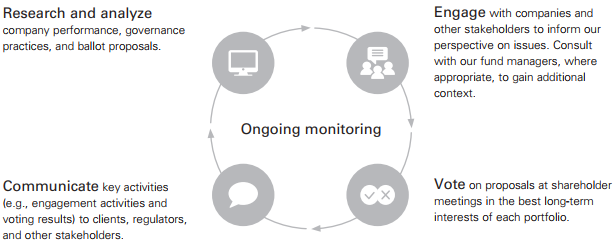
Vanguard’s Investment Stewardship team comprises an experienced group of senior leaders and analysts who are responsible for representing Vanguard shareholders’ interests through industry advocacy, company engagement, and proxy voting on behalf of the Vanguard funds. The team also houses an internal research and communications function that is active in developing Vanguard’s views, policies, and ongoing approach to investment stewardship. Our data and technology group supports every aspect of our Investment Stewardship program.

We take a thoughtful and deliberate approach to investment stewardship.

Our team supports effective corporate governance practices in three ways:

Advocating for policies that we believe will enhance the sustainable, long-term value of our clients’ investments. We promote good corporate governance and responsible investment through thoughtful participation in industry events and discussions where we can expand our advocacy and enhance our understanding of investment issues.

Engaging with portfolio company executives and directors to share our corporate governance principles and learn about portfolio companies’ corporate governance practices. We characterize our approach as “quiet diplomacy focused on results”—providing constructive input that will, in our view, better position companies to deliver sustainable value over the long term for all investors.

Voting proxies at company shareholder meetings across each of our portfolios and around the globe. Because of our ongoing advocacy and engagement efforts, companies should be aware of our governance principles and positions by the time we cast our funds’ votes.

Our process is iterative and ongoing

Our four pillars

Board

Good governance begins with a great board of directors. Our primary interest is to ensure that the individuals who represent the interests of all shareholders are independent (both in mindset and freedom from conflicts), capable (across the range of relevant skills for the company and industry), and appropriately experienced (so as to bring valuable perspective to their roles). We also believe that diversity of thought, background, and experience, as well as of personal characteristics (such as gender, race, and age), meaningfully contributes to the board’s ability to serve as effective, engaged stewards of shareholders’ interests. If a company has a well-composed, high-functioning board, good results are more likely to follow.

Structure

We believe in the importance of governance structures that empower shareholders and ensure accountability of the board and management. We believe that shareholders should be able to hold directors accountable as needed through certain governance and bylaw provisions. Among these preferred provisions are that directors must stand for election by shareholders annually and must secure a majority of the votes in order to join or remain on the board. In instances where the board appears resistant to shareholder input, we also support the right of shareholders to call special meetings and to place director nominees on the company’s ballot.

Compensation

We believe that performance-linked compensation policies and practices are fundamental drivers of the sustainable, long-term value for a company’s investors. The board plays a central role in determining appropriate executive pay that incentivizes performance relative to peers and competitors. Providing effective disclosure of these practices, their alignment with company performance, and their outcomes is crucial to giving shareholders confidence in the link between incentives and rewards and the creation of value over the long term.

Risk

Boards are responsible for effective oversight and governance of the risks most relevant and material to each company in the context of its industry and region. We believe that boards should take a thorough, integrated, and thoughtful approach to identifying, understanding, quantifying, overseeing, and—where appropriate—disclosing risks that have the potential to affect shareholder value over the long term. Importantly, boards should communicate their approach to risk oversight to shareholders through their normal course of business.

By the numbers: Voting and engagement

Engagement and voting trends

2015 proxy season 2016 proxy season  2017 proxy season
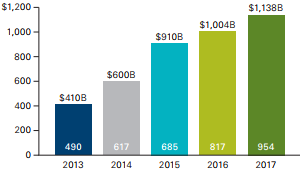
Company engagements 685 817 954
Companies voted 10,560 11,564 12,974
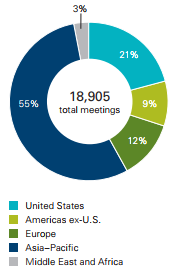
Meetings voted 12,785 16,740 18,905
Proposals voted 124,230 157,506 171,385
Countries voted in* 70 70 68

* The number of countries can vary each year. In certain markets, some companies do not hold shareholder meetings annually.
Note: The annual proxy season is from July 1 to June 30.

Our voting

Proxy voting reflects our governance pillars worldwide.

Meetings voted by region

Note: Data pertains to voting activity from July 1, 2016, through June 30, 2017

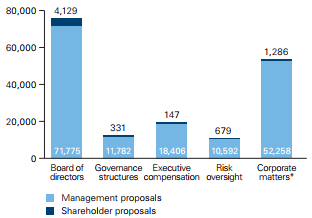
Global voting activity

* Includes more than 26,000 proposals related to capitalization; 8,000 proposals related to mergers and acquisitions; 16,000 routine business proposals; and 1,000 other shareholder proposals.
Note: Data pertains to voting activity from July 1, 2016, through June 30, 2017.

Our engagement

We engage with companies of all sizes.

Market Capitalization % of 2017 proxy season engagements
Under $1 billion 19%
$1 billion–under $10 billion 44%
$10 billion–under $50 billion 24%
$50 billion and over 13%

Our engagement with portfolio companies has grown significantly over time.

Number of engagements and assets represented

Note: Dollar figures represent the market value of Vanguard fund investments in companies with which we engaged as of June 30, 2017.

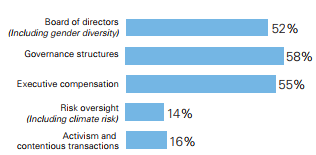
We engage on a range of topics aligned with our four pillars

Frequency of topics discussed during Vanguard engagements (%)

Note: Figures do not total 100%, as individual engagements often span multiple topics.

Boards in focus: Vanguard’s view on gender diversity

One of our most fundamental governance beliefs is that good governance begins with a great board of directors. We believe that diversity among directors—along dimensions such as gender, experience, race, background, age, and tenure—can strengthen a board’s range of perspectives and its capacity to make complex, fully considered decisions.

While we have long discussed board composition and diversity with portfolio companies, gender diversity has emerged as one dimension on which there is compelling support for positive effects on shareholder value. In recent years, a growing body of research has demonstrated that greater gender diversity on boards can lead to better company performance and governance.

Companies should be prepared to discuss—in both their public disclosures and their engagement with investors—their plans to incorporate appropriate diversity over time in their board composition. While we believe that board evolution is a process, not an event, the demonstration of meaningful progress over time will inform our engagement and voting going forward.

Boards in focus: Gender diversity

Engagement case studies

Gender diversity on boards was an important topic of engagement for us during the 12 months ended June 30, 2017. Below are summary examples of discussions we had on the subject.

High-impact engagement on gender diversity

Over several interactions with a U.S. industrial company, our team shared Vanguard’s perspective on board composition and evaluation. The company had undergone recent leadership transitions and was open to amending elements of its governance structure to align with best practices. We expressed particular support for meaningful gender diversity and expressed concern that the board previously had only one female director in its recent history.

Right after this year’s annual general meeting, the company announced it was adding four new directors with diverse experience, including two women. This outcome is the best-case scenario: The board welcomed shareholder input, we shared our view on best corporate governance practices, and the board ultimately incorporated our perspective into its board evolution process.

A denial of diversity’s value

A Canadian materials company that had consistently underperformed was governed by an entrenched, all-male board with seemingly nominal independence from the CEO. A 2017 shareholder resolution asked the company to adopt and publish a policy governing gender diversity on the board. Before voting, Vanguard engaged with the company to learn about its board evolution process, including its perspective on gender diversity. The engagement revealed that the company understood neither the value of gender diversity nor the importance of being responsive to shareholders’ concerns. Despite verbally endorsing gender diversity, the company resisted specifying a strategy or making a commitment to achieve it. The board, when seeking new members, relied solely on recommendations from current directors, a practice that can entrench the current board’s perspective and limit diversity. Our funds voted in support of the shareholder resolution, and we will continue to engage and hold the board accountable for meaningful progress over time.

Mixed results from an ongoing engagement

A U.S. consumer discretionary company had no women on its board, a problem magnified by its medium-term underperformance relative to peers, a classified board structure, and a lengthy average director tenure. We engaged with management twice between the 2016 and 2017 annual meetings to share our perspective on the importance of gender diversity and recommend that they make it a priority for future board evolution and director searches.

In its 2017 proxy, the company described board diversity as critical to the firm’s sustainable value and named gender as an element of diversity to be considered during the director search and nomination process. The company has since added a non-independent woman to the board. Although this move is directionally correct, it does not fully address our concerns; we will continue to encourage the company to add gender diversity to its ranks of independent directors.

Risk in focus: Vanguard’s view on climate risk

As the steward of long-term shareholder value for more than 20 million investors, Vanguard closely monitors how our portfolio companies identify, manage, and mitigate risks—including climate risk. Our approach to climate risk is evolving as the world’s and business community’s understanding of the topic matures.

This year, for the first time, our funds supported a number of climate-related shareholder resolutions opposed by company management. We are also discussing climate risk with company management and boards more than ever before. Our Investment Stewardship team is committed to engaging with a range of stakeholders to inform our perspective on these issues, and to share our thinking with the market, our portfolio companies, and our investors.

Risk in focus: Climate risk

A Q&A with Glenn Booraem, Vanguard’s Investment Stewardship Officer

Vanguard is an investment management company. Why should Vanguard fund investors be concerned about climate risk?

Mr. Booraem: Climate risk has the potential to be a significant long-term risk for companies in many industries. As stewards of our clients’ long-term investments, we must be finely attuned to this risk. We acknowledge that our clients’ views on climate risk span the ideological spectrum. But our position on climate risk is anchored in long-term economic value—not ideology. Regardless of one’s perspective on climate, there’s no doubt that changes in global regulation, energy consumption, and consumer preferences will have a significant economic impact on companies, particularly in the energy, industrial, and utilities sectors.

Why the shift in Vanguard’s assessment of climate risk, and why now?

Mr. Booraem: We’ve been discussing climate risk with portfolio companies for several years. It has been, and will remain, one of our engagement priorities for the foreseeable future. This past year, we engaged with more companies on this issue than ever before, and for the first time our funds supported two climate-related shareholder resolutions in cases where we believed that companies’ disclosure practices weren’t on par with emerging expectations in the market. As with other issues, our point of view has evolved as the topic has matured and, importantly, as its link to shareholder value has become more clear.

What is your top concern when you learn that a company in which a Vanguard portfolio invests does not have a rigorous strategy to evaluate and mitigate climate risk?

Mr. Booraem: Our concern is fundamentally that in the absence of clear disclosure and informed board oversight, the market lacks insight into the material risks of investing in that firm. It’s of paramount importance to us that the market is able to reflect risk and opportunity in stock prices, particularly for our index funds, which don’t get to select the stocks they own. When we’re not confident that companies have an appropriate level of board oversight or disclosure, we’re concerned that the market may not accurately reflect the value of the investment. Because we represent primarily long-term investors, this bias is particularly problematic when underweighting long-term risks inflates a company’s value.

Now that Vanguard has articulated a clear stance on climate risk, what can portfolio companies expect?

Mr. Booraem: First, companies should expect that we’re going to focus on their public disclosures, both about the risk itself and about their board’s and management’s oversight of that risk. Thorough disclosure is the foundation for the market’s understanding of the issue. Second, companies should expect that we’ll evaluate their disclosures in the context of both their leading peers and evolving market standards, such as those articulated by the Sustainability Accounting Standards Board (SASB). Third, they should expect that we’ll listen to their perspective on these and other matters. And finally, they should see our funds’ proxy voting as an extension of our engagement. When we consider a shareholder resolution on climate risk, we give companies a fair hearing on the merits of the proposal and consider their past commitments and the strength of their governance structure.

Engagement case studies

In the 12 months ended June 30, 2017, the topic of climate risk disclosure grew in frequency and prominence in our engagements with companies, particularly those in the energy, industrial, and utilities sectors, where climate risk was addressed in nearly every conversation we had. Below are examples of our engagements on climate risk.

Two companies’ commitments to enhanced disclosure

Our team led similar engagements with two U.S. energy companies facing shareholder resolutions on climate risk. One resolution requested that the first company publish an annual report on climate risk impacts and strategy. At the second company, a resolution requested disclosure of the company’s strategy and targets for transitioning to a low- carbon economy. In both cases, when we engaged with the companies, their management teams committed to improving their climate risk disclosure. Given the companies’ demonstrated responsiveness to shareholder feedback and commitment to improving, our funds did not support either shareholder proposal. Our team will continue to track and evaluate the companies’ progress toward their commitments as we consider our votes in future years.

A vote against a risk and governance outlier For years we engaged with a U.S. energy company that lagged its peers on climate risk disclosure and board accessibility. This year, a shareholder proposal requesting that the company produce a climate risk assessment report demonstrated a compelling link between the requested disclosures and long-term shareholder value. Because the board serves on behalf of shareholders and plays a critical role in risk oversight, we believed it was appropriate to seek a direct dialogue with independent directors about climate risk. Management resisted connecting the independent directors with shareholders, making the company a significant industry outlier in good governance practice. Without the confidence that the board understood or represented our view that climate risk poses a material risk in the energy sector, our team viewed the climate risk and governance issues as intertwined. Ultimately, our funds voted for the shareholder proposal and withheld votes on relevant independent directors for failing to engage with shareholders.

A vote for greater climate risk disclosure

A shareholder proposal at a U.S. energy company asked for an annual report with climate risk disclosure, including scenario planning. Through extensive research and engagements with the company’s management, its independent directors, and other industry stakeholders, our team identified governance shortfalls and a clear connection to long-term shareholder value. The company lagged its peers in disclosure, risk planning, and board oversight and responsiveness to shareholder concerns. Crucially, although the company’s public filings identified climate risk as a material issue, it failed to articulate plans for mitigation or adaptation. A similar proposal last year garnered significant support, but the company made no meaningful changes in response. Engagement had limited effect, so our funds voted for the shareholder proposal.

* * *

This post was excerpted from a Vanguard report; the complete publication is available here.

Compte rendu hebdomadaire de la Harvard Law School Forum on Corporate Governance | 14 septembre 2017


Voici le compte rendu hebdomadaire du forum de la Harvard Law School sur la gouvernance corporative au 14 septembre 2017.

Cette semaine, j’ai relevé les cinq principaux billets.

Bonne lecture !


Résultats de recherche d'images pour « harvard law school forum on corporate governance »


Résultats de recherche d'images pour « harvard law school forum on corporate governance »


  1. Another Road Leading to Business Judgment Review—Martha Stewart Living Omnimedia
  2. The Effects of Hedge Fund Interventions on Strategic Firm Behavior
  3. UK Announces Corporate Governance Reforms
  4. How Should We Regulate Fintech?
  5. OCC Stakes Out a Lead Role in Establishing New Deregulatory Agenda


Compte rendu hebdomadaire de la Harvard Law School Forum on Corporate Governance | 7 septembre 2017


Voici le compte rendu hebdomadaire du forum de la Harvard Law School sur la gouvernance corporative au 7 septembre 2017.

J’ai relevé les principaux billets, tout en me limitant au Top 10.

Bonne lecture !


Résultats de recherche d'images pour « harvard law school forum on corporate governance »


Résultats de recherche d'images pour « harvard law school forum on corporate governance »


  1. Political Uncertainty and Firm Disclosure
  2. Corporate Governance—the New Paradigm
  3. NYDFS Cybersecurity Regulations Take Effect
  4. CFOs on Boards: Higher Pay, Lower Performance
  5. CSX Attracts New CEO and Stock Price Rises Sharply
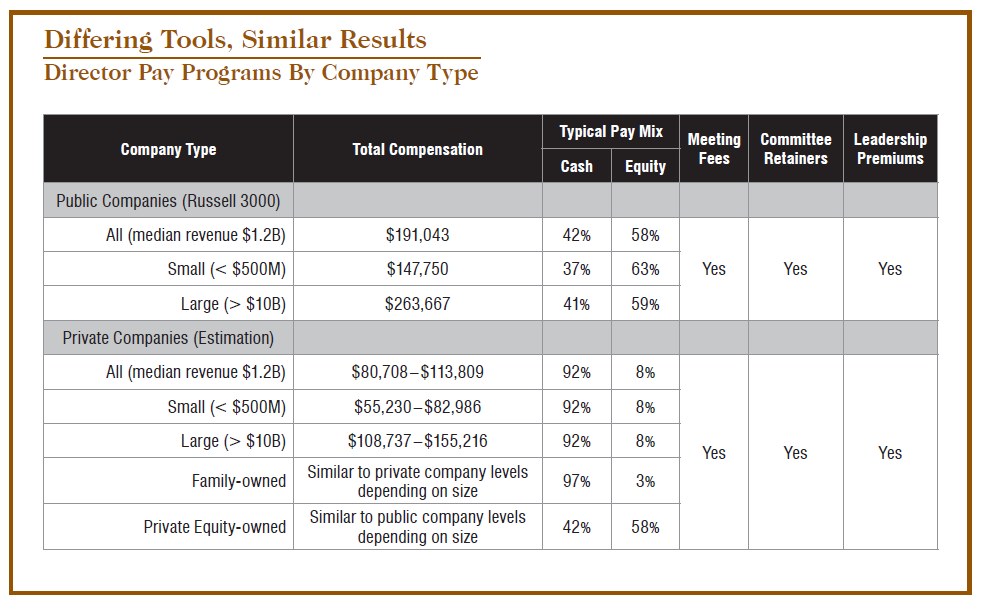
  6. The Evolution and Current State of Director Compensation Plans
  7. Companies Should Maximize Shareholder Welfare Not Market Value
  8. Executive Compensation: A Survey of Theory and Evidence
  9. Divided Second Circuit Panel Overrules Prior Newman Insider Trading Decision
  10. Out of Sight Out of Mind: The Case for Improving Director Independence Disclosure

Compte rendu hebdomadaire de la Harvard Law School Forum on Corporate Governance | 31 août 2017


Voici le compte rendu hebdomadaire du forum de la Harvard Law School sur la gouvernance corporative au 31 août 2017.

J’ai relevé les principaux billets, tout en me limitant au Top 10.

Bonne lecture !


Résultats de recherche d'images pour « harvard law school forum on corporate governance »


Résultats de recherche d'images pour « harvard law school forum on corporate governance »


  1. SEC Staff Examines Impact of Regulation on Capital Formation and Market Liquidity
  2. ISS and the Removal of CEOs: A Call for an Enhanced Standard
  3. Far Beyond the Quarterly Call
  4. Federal Reserve Board Proposes Guidance Addressing Supervisory Expectations on Boards of Directors
  5. Proxy Access: Best Practices 2017
  6. 2017 Mid-Year Activism Update
  7. Controlling-Shareholder Related-Party Transactions Under Delaware Law
  8. NAIC Adopts Model Cybersecurity Law
  9. SEC Announces Results of Cybersecurity Examination Initiative
  10. Make-Whole Premiums and the Agency Costs of Debt

Deux événements récents qui auront un effet important sur la gouvernance


Corporate Governance—the New Paradigm

Compte rendu hebdomadaire de la Harvard Law School Forum on Corporate Governance | 24 août 2017


Voici le compte rendu hebdomadaire du forum de la Harvard Law School sur la gouvernance corporative au 24 août 2017.

J’ai relevé les principaux billets, tout en me limitant au Top 10.

Bonne lecture !


Résultats de recherche d'images pour « harvard law school forum on corporate governance »


Résultats de recherche d'images pour « harvard law school forum on corporate governance »


  1. Regulating Motivation: A New Perspective on the Volcker Rule
  2. Information Asymmetries Conceal Fraud and Systemic Risks in the U.S. Banking Industry
  3. Private Equity and Financial Fragility During the Crisis
  4. Activist Investors’ Approaches to Targeting Boards
  5. 2017 Securities and M&A Litigation Mid-Year Review
  6. Governance through Shame and Aspiration: Index Creation and Corporate Behavior in Japan
  7. ISS Releases Surveys for 2018 Policy Updates
  8. The Era of Private Ordering for Corporate Governance
  9. Delaware Court of Chancery Extends Business Judgment Rule
  10. Board Oversight of Long-Term Value Creation and Preservation

Cadre de référence pour évaluer la gouvernance des sociétés | Questionnaire de 100 items


Le Bureau de la vérification interne (BVI) de l’Université de Montréal (UdeM) a récemment développé un cadre de référence novateur pour l’évaluation de la gouvernance. La méthodologie, ainsi que le questionnaire qui en résulte, contribue, à mon avis, à l’avancement des connaissances dans le domaine de l’évaluation des caractéristiques et des pratiques de la gouvernance par les auditeurs internes.

Ayant eu l’occasion de collaborer à la conception de cet instrument de mesure de la gouvernance des sociétés, j’ai obtenu du BVI la permission de publier le résultat de cet exercice.

Cette version du cadre se veut « générique » et peut être utilisée pour l’évaluation de la gouvernance d’un projet, d’une activité, d’une unité ou d’une entité.

De ce fait, les termes, les intervenants ainsi que les structures attendues doivent être adaptés au contexte de l’évaluation. Il est à noter que ce cadre de référence correspond à une application optimale recherchée en matière de gouvernance. Certaines pratiques pourraient ne pas s’appliquer ou ne pas être retenues de façon consciente et transparente par l’organisation.

Le questionnaire se décline en dix thèmes, chacun comportant dix items :


Thème 1 — Structure et fonctionnement du Conseil

Thème 2 — Travail du président du Conseil

Thème 3 — Relation entre le Conseil et le directeur général (direction)

Thème 4 — Structure et travail des comités du Conseil

Thème 5 — Performance du Conseil et de ses comités

Thème 6 — Recrutement, rémunération et évaluation du rendement du directeur général

Thème 7 — Planification stratégique

Thème 8 — Performance et reddition de comptes

Thème 9 — Gestion des risques

Thème 10 — Éthique et culture organisationnelle


On retrouvera en Annexe une représentation graphique du cadre conceptuel qui permet d’illustrer les liens entre les thèmes à évaluer dans le présent référentiel.

L’évaluation s’effectue à l’aide d’un questionnaire de type Likert (document distinct du cadre de référence). L’échelle de Likert est une échelle de jugement par laquelle la personne interrogée exprime son degré d’accord ou de désaccord eu égard à une affirmation ou une question.


  1. Tout à fait d’accord
  2. D’accord
  3. Ni en désaccord ni d’accord
  4. Pas d’accord
  5. Pas du tout d’accord
  6. Ne s’applique pas (S.O.)


Une section commentaire est également incluse dans le questionnaire afin que les participants puissent exprimer des informations spécifiques à la question. L’audit interne doit réaliser son évaluation à l’aide de questionnaires ainsi que sur la base de la documentation qui lui sera fournie.


Résultats de recherche d'images pour « gouvernance d'entreprise conseil d'administration »


Thème 1 — Structure et fonctionnement du Conseil

(Questions destinées au président du comité de gouvernance [PCG] et/ou au président du Conseil [PC])


1.       Le Conseil compte-t-il une proportion suffisante de membres indépendants pour lui permettre d’interagir de manière constructive avec la direction ?
2.       La taille du Conseil vous semble-t-elle raisonnable compte tenu des objectifs et de la charge de travail actuel ? (dans une fourchette idéale de 9 à 13 membres, avec une moyenne d’environ 10 membres)
3.       La composition du Conseil est-elle guidée par une politique sur la diversité des membres ?
4.       Le Conseil a-t-il conçu un processus rigoureux de recrutement de ses membres, basé sur une matrice des compétences complémentaires ?
5.       Le président et les membres du comité responsable du recrutement (comité de gouvernance) ont-ils clairement exprimé aux candidats potentiels les attentes de l’organisation en matière de temps, d’engagement et de contributions reliés avec leurs compétences ?
6.       Les réunions sont-elles bien organisées et structurées ? (durée, PV, taux de présence, documentation pertinente et à temps, etc.)
7.       Les échanges portent-ils sur surtout sur des questions stratégiques, sans porter sur les activités courantes (qui sont davantage du ressort de l’équipe de direction) ?
8.       Les membres sont-ils à l’aise d’émettre des propos qui vont à contre-courant des idées dominantes ?
9.       Une séance à huis clos est-elle systématiquement prévue à la fin de chacune des réunions afin de permettre aux membres indépendants de discuter des sujets sensibles ?
10.    Les membres ont-ils accès à la planification des rencontres sur une période idéale de 18 mois en y incluant certains items ou sujets récurrents qui seront abordés lors des réunions du Conseil (plan de travail) ?


Thème 2 — Travail du président du Conseil 

(Questions destinées à un administrateur indépendant, au PC [auto-évaluation] et au président du comité de gouvernance [PCG])


1.       Le président s’assure-t-il de former un solide tandem avec le directeur général et de partager avec lui une vision commune de l’organisation ?
2.       Le président promeut-il de hauts standards d’efficacité et d’intégrité afin de donner le ton à l’ensemble de l’organisation ?
3.       Le président, de concert avec le directeur général, prépare-t-il adéquatement les réunions du Conseil ?
4.       Le président préside-t-il avec compétence et doigté les réunions du Conseil ?
5.       Le président s’assure-t-il que les échanges portent surtout sur des questions stratégiques et que les réunions du Conseil ne versent pas dans la micro gestion ?
6.       Le président s’investit-il pleinement dans la sélection des présidents et des membres des comités du Conseil ?
7.       Le président s’assure-t-il de l’existence d’une formation et d’une trousse d’accueil destinées aux nouveaux membres afin qu’ils soient opérationnels dans les plus brefs délais ?
8.       Le président s’assure-t-il de l’existence d’un processus d’évaluation du rendement du Conseil et de ses membres ?
9.       Le président prend-il la peine d’aborder les membres non performants pour les aider à trouver des solutions ?
10.    Le président s’assure-t-il que les membres comprennent bien leurs devoirs de fiduciaire, c’est-à-dire qu’ils doivent veiller aux meilleurs intérêts de l’organisation et non aux intérêts de la base dont ils sont issus ?


Thème 3 — Relation entre le Conseil et le directeur général (direction)

(Questions destinées au PC et au Directeur général [DG])


1.       Le président du Conseil et le directeur général ont-ils des rencontres régulières et statutaires pour faire le point entre les réunions du Conseil ?
2.       Le président du Conseil et le directeur général maintiennent-ils une communication franche et ouverte ? (équilibre entre une saine tension et des relations harmonieuses et efficaces)
3.       Le Conseil résiste-t-il à la tentation de faire de la micro gestion lors de ses réunions et s’en tient-il à assumer les responsabilités qui lui incombent ?
4.       Le Conseil agit-il de façon respectueuse à l’endroit du directeur général lors des réunions du Conseil et cherche-t-il à l’aider à réussir ?
5.       Le Conseil procède-t-il à une évaluation annuelle du rendement du directeur général (par le comité de GRH) basée sur des critères objectifs et mutuellement acceptés ?
6.       Les membres du Conseil s’abstiennent-ils de donner des ordres ou des directives aux employés qui relèvent de l’autorité du directeur général ?
7.       Le président comprend-il que le directeur général ne relève pas de lui, mais plutôt du Conseil, et agit-il en conséquence ?
8.       Le directeur général aide-t-il adéquatement le président dans la préparation des réunions du Conseil, fournit-il aux membres l’information dont ils ont besoin et répond-il à leurs questions de manière satisfaisante ?
9.       Le directeur général s’assure-t-il de ne pas embourber les réunions du Conseil de sujets qui relèvent de sa propre compétence ?
10.    Le directeur général accepte-t-il de se rallier aux décisions prises par le Conseil, même dans les cas où il a exprimé des réserves ?


Thème 4 — Structure et travail des comités du Conseil

 (Questions destinées au PC et au président d’un des comités)


1.       Existe-t-il, au sein de votre organisation, les comités du Conseil suivants :

·         Audit ?

·         Gouvernance ?

·         Ressources humaines ?

·         Gestion des risques ?

·         Sinon, a-t-on inclus les responsabilités de ces comités dans le mandat du Conseil ou d’une autre instance indépendante ?

·         Autres comités reliés à la recherche (ex. éthique, scientifique) ?


2.       Les recommandations des comités du Conseil aident-elles le Conseil à bien s’acquitter de son rôle ?
3.       Les comités du Conseil sont-ils actifs et présentent-ils régulièrement des rapports au Conseil ?
4.       Estimez-vous que les comités créent de la valeur pour votre organisation ?
5.       Les comités du Conseil s’abstiennent-ils de s’immiscer dans la sphère de responsabilité du directeur général ?
6.       À l’heure actuelle, la séparation des rôles et responsabilités respectifs du Conseil, des comités et de la direction est-elle officiellement documentée, généralement comprise et mise en pratique ?
7.       Les membres qui siègent à un comité opérationnel comprennent-ils qu’ils travaillent sous l’autorité du directeur général ?
8.       Le directeur général est-il invité à assister aux réunions des comités du Conseil ?
9.       Chacun des comités et des groupes de travail du Conseil dispose-t-il d’un mandat clair et formulé par écrit ?
10.    S’il existe un comité exécutif dans votre organisation, son existence est-elle prévue dans le règlement de régie interne et, si oui, son rôle est-il clairement défini ?


Thème 5 — Performance du Conseil et de ses comités 

(Questions destinées au PC et au président du comité de gouvernance [PCG])


1.       Est-ce que la rémunération des membres du Conseil a été déterminée par le comité de gouvernance ou avec l’aide d’un processus indépendant ? (Jetons de présence ?)
2.       Par quels processus s’assure-t-on que le Conseil consacre suffisamment de temps et d’attention aux tendances émergentes et à la prévision des besoins futurs de la collectivité qu’il sert ?
3.       Est-ce que l’on procède à l’évaluation de la performance du Conseil, des comités et de ses membres au moins annuellement ?
4.       Est-ce que la logique et la démarche d’évaluation ont été expliquées aux membres du Conseil, et ceux-ci ont-ils pu donner leur point de vue avant de procéder à l’évaluation ?
5.       A-t-on convenu préalablement de la façon dont les données seront gérées de manière à fournir une garantie sur la confidentialité de l’information recueillie ?
6.       Est-ce que le président de Conseil croit que le directeur général et la haute direction font une évaluation positive de l’apport des membres du Conseil ?
7.       L’évaluation du Conseil et de ses comités mène-t-elle à un plan d’action réaliste pour prendre les mesures nécessaires selon leur priorité ?
8.       L’évaluation du Conseil permet-elle de relever les lacunes en matière de compétences et d’expérience qui pourraient être comblées par l’ajout de nouveaux membres ?
9.       Est-ce que les membres sont évalués en fonction des compétences et connaissances qu’ils sont censés apporter au Conseil ?
10.    Les membres sont-ils informés par le président du Conseil de leurs résultats d’évaluation dans le but d’aboutir à des mesures de perfectionnement ?


Thème 6 — Recrutement, rémunération et évaluation du rendement du DG

(Questions destinées au PC, au DG [auto-évaluation] et au président du comité des RH)


1.       Existe-t-il une description du poste de directeur général ? Cette description a-t-elle servi au moment de l’embauche du titulaire du poste ?
2.       Un comité du Conseil (comité de GRH) ou un groupe de membres indépendants est-il responsable de l’évaluation du rendement du directeur général (basé sur des critères objectifs) ?
3.       Le président du Conseil s’est-il vu confier un rôle prépondérant au sein du comité responsable de l’évaluation du rendement du directeur général afin qu’il exerce le leadership que l’on attend de lui ?
4.       Le comité responsable de l’évaluation du rendement et le directeur général ont-ils convenu d’objectifs de performance sur lesquels ce dernier sera évalué ?
5.       Le rendement du directeur général est-il évalué au moins une fois l’an en fonction de ces objectifs ?
6.       Les objectifs de rendement du directeur général sont-ils liés au plan stratégique ?
7.       Le comité responsable de l’évaluation du rendement s’est-il entretenu avec le directeur général en cours d’année pour lui donner une rétroaction préliminaire ?
8.       La rémunération du directeur général est-elle équitable par rapport à l’ensemble des employés et a-t-elle fait l’objet d’une analyse comparative avec le marché des organisations afin d’assurer un certain degré de compétitivité ?
9.       Les hausses salariales du directeur général sont-elles uniquement accordées en fonction de l’évaluation de son rendement ?
10.    Est-ce que le Conseil consacre l’attention nécessaire à la succession du directeur général et dispose-t-il d’un processus robuste d’identification d’un nouveau premier dirigeant, tant pour les transitions planifiées que non planifiées ?


Thème 7 — Planification stratégique 

(Questions destinées au PC et au DG)


1.       Votre organisation possède-t-elle un plan stratégique incluant notamment :

·         le contexte dans lequel évoluent la société et les principaux enjeux auxquels elle fait face ?

·         les objectifs et les orientations stratégiques de la société ?

·         les résultats visés au terme de la période couverte par le plan ?

·         les indicateurs de performance utilisés pour mesurer l’atteinte des résultats ?

2.       Le plan stratégique porte-t-il sur une période cohérente avec la mission et l’environnement dans lequel il œuvre ?
3.       La mission, les valeurs et l’énoncé de vision de l’organisation ont-ils été déterminés et réévalués périodiquement ?
4.       Est-ce qu’il y a eu une analyse Forces/faiblesses et opportunités/menaces ?
5.       L’ensemble des parties prenantes de l’organisation a-t-il été consulté notamment au moyen de sondages et d’entrevues, et lors d’un atelier de planification stratégique ?
6.       Les membres ont-ils été engagés dans le processus, notamment par la création d’un comité ad hoc chargé de piloter l’exercice et par des rapports périodiques aux réunions du Conseil ?
7.       Le Conseil évalue-t-il la stratégie proposée, notamment les hypothèses clés, les principaux risques, les ressources nécessaires et les résultats cibles, et s’assure-t-il qu’il traite les questions primordiales telles que l’émergence de la concurrence et l’évolution des préférences des clients ?
8.       Le président du Conseil s’assure-t-il que le plan stratégique soit débattu lors de réunions spéciales et que le Conseil dispose de suffisamment de temps pour être efficace ?
9.       Le Conseil est-il satisfait des plans de la direction pour la mise en œuvre de la stratégie approuvée ?
10.    Le Conseil surveille-t-il la viabilité permanente de la stratégie, et est-elle ajustée, si nécessaire, pour répondre aux évolutions de l’environnement ?


Thème 8 — Performance et reddition de comptes

 (Questions destinées au Président du comité d’audit ou au PC, au DG et au secrétaire corporatif)


1.       S’assure-t-on que les indicateurs de performance utilisés par la direction et présentés au Conseil sont reliés à la stratégie de l’organisation et aux objectifs à atteindre ?
2.       S’assure-t-on que les indicateurs de la performance sont équilibrés entre indicateurs financiers et non financiers, qu’ils comprennent des indicateurs prévisionnels et permettent une comparaison des activités similaires ?
3.       A-t-on une assurance raisonnable de la fiabilité des indicateurs de performance qui sont soumis au Conseil ?
4.       Utilise-t-on des informations de sources externes afin de mieux évaluer la performance de l’organisation ?
5.       Le Conseil et les comités réexaminent-ils régulièrement la pertinence de l’information qu’il reçoit ?
6.       Le Conseil examine-t-il d’un œil critique les informations à fournir aux parties prenantes ?
7.       Le Conseil est-il satisfait du processus de communication de crise de la société et est-il à même de surveiller de près son efficacité si une crise survient ?
8.       Le Conseil est-il satisfait de son implication actuelle dans la communication avec les parties prenantes externes et comprend-il les évolutions susceptibles de l’inciter à modifier son degré de participation ?
9.       Est-ce que la direction transmet suffisamment d’information opérationnelle au Conseil afin que celui-ci puisse bien s’acquitter de ses responsabilités de surveillance ?
10.    Est-ce que le Conseil s’assure que les informations sont fournies aux parties prenantes telles que les organismes réglementaires, les organismes subventionnaires et les partenaires d’affaires ?


Thème 9 — Gestion des risques

 (Questions destinées au PC et au Président du comité de Gestion des risques ou au Président du comité d’audit)


1.       L’organisation a-t-elle une politique de gestion des risques et obtient-elle l’adhésion de l’ensemble des dirigeants et des employés ?
2.       L’organisation a-t-elle identifié et évalué les principaux risques susceptibles de menacer sa réputation, son intégrité, ses programmes et sa pérennité ainsi que les principaux mécanismes d’atténuation ?
3.       L’organisation a-t-elle un plan de gestion de la continuité advenant un sinistre ?
4.       Est-ce que les risques les plus élevés font l’objet de mandats d’audit interne afin de donner un niveau d’assurance suffisant aux membres du Conseil ?
5.       L’organisation se penche-t-elle occasionnellement sur les processus de contrôle des transactions, par exemple l’autorisation des dépenses, l’achat de biens et services, la vérification et l’approbation des factures et des frais de déplacement, l’émission des paiements, etc. ?
6.       Existe-t-il une délégation d’autorité documentée et comprise par tous les intervenants ?
7.       Le Conseil a-t-il convenu avec la direction de l’appétit pour le risque ? (le niveau de risque que l’organisation est prête à assumer)
8.       Le Conseil est-il informé en temps utile lors de la matérialisation d’un risque critique et s’assure-t-il que la direction les gère convenablement ?
9.       S’assure-t-on que la direction entretient une culture qui encourage l’identification et la gestion des risques ?
10.   Le Conseil s’est-il assuré que la direction a pris les mesures nécessaires pour se prémunir des risques émergents, notamment ceux reliés à la cybersécurité et aux cyberattaques ?


Thème 10 — Éthique et culture organisationnelle

 (Questions destinées au DG et au PC)


1.       Les politiques de votre organisation visant à favoriser l’éthique sont-elles bien connues et appliquées par ses employés, partenaires et bénévoles ?
2.       Le Conseil de votre organisation aborde-t-il régulièrement la question de l’éthique, notamment en recevant des rapports sur les plaintes, les dénonciations ?
3.       Le Conseil et l’équipe de direction de votre organisation participent-ils régulièrement à des activités de formation visant à parfaire leurs connaissances et leurs compétences en matière d’éthique ?
4.       S’assure-t-on que la direction générale est exemplaire et a développé une culture fondée sur des valeurs qui se déclinent dans l’ensemble de l’organisation ?
5.       S’assure-t-on que la direction prend au sérieux les manquements à l’éthique et les gère promptement et de façon cohérente ?
6.       S’assure-t-on que la direction a élaboré un code de conduite efficace auquel elle adhère, et veille à ce que tous les membres du personnel en comprennent la teneur, la pertinence et l’importance ?
7.       S’assure-t-on de l’existence de canaux de communication efficaces (ligne d’alerte téléphonique dédiée, assistance téléphonique, etc.) pour permettre aux membres du personnel et partenaires de signaler les problèmes ?
8.       Le Conseil reconnaît-il l’impact sur la réputation de l’organisation du comportement de ses principaux fournisseurs et autres partenaires ?
9.       Est-ce que le président du Conseil donne le ton au même titre que le DG au niveau des opérations sur la culture organisationnelle au nom de ses croyances, son attitude et ses valeurs ?
10.    Est-ce que l’organisation a la capacité d’intégrer des changements à même ses processus, outils ou comportements dans un délai raisonnable ?


Annexe

Présentation du schéma conceptuel


Thème (1) — Structure et fonctionnement du Conseil

Thème (2) — Travail du président du Conseil

Thème (3) — Relation entre le Conseil et le directeur général (direction)

Thème (4) — Structure et travail des comités du Conseil

Thème (5) — Performance du Conseil et de ses comités

Thème (6) — Recrutement, rémunération et évaluation du rendement du directeur général

Thème (7) — Planification stratégique

Thème (8) — Performance et reddition de comptes

Thème (9) — Gestion des risques

Thème (10) — Éthique et culture organisationnelle


Compte rendu hebdomadaire de la Harvard Law School Forum on Corporate Governance | 10 août 2017


Voici le compte rendu hebdomadaire du forum de la Harvard Law School sur la gouvernance corporative au 10 août 2017.

J’ai relevé les principaux billets, tout en me limitant au Top 10.

Bonne lecture !


Résultats de recherche d'images pour « harvard law school forum on corporate governance »


Résultats de recherche d'images pour « harvard law school forum on corporate governance »


  1. Say-on-Pay: Is Anybody Listening?
  2. Sunrise, Sunset: An Empirical and Theoretical Assessment of Dual-Class Stock Structures
  3. S&P and FTSE Russell on Exclusion of Companies with Multi-Class Shares
  4. You Want Mandatory Arbitration in your Charter? Hey, Just Ask!
  5. Equity Issuances and Agency Costs: The Telling Story of Shareholder Approval Around the World
  6. Federal Class Action Securities Fraud Filings Hit Record Pace in H1 2017
  7. Recent Cases Demonstrate Need for Blockchain
  8. How “Shareholder Value” is Killing Innovation
  9. Report Finds Shareholder Activism Evolving from Niche Strategy to Acceptance Across Investors
  10. 2017 Mid-Year Securities Enforcement Update

Compte rendu hebdomadaire de la Harvard Law School Forum on Corporate Governance | 2 août 2017


Voici le compte rendu hebdomadaire du forum de la Harvard Law School sur la gouvernance corporative au  2 août 2017.

J’ai relevé les principaux billets, tout en me limitant au Top 1o.

Bonne lecture !


Résultats de recherche d'images pour « harvard law school forum on corporate governance »


Résultats de recherche d'images pour « harvard law school forum on corporate governance »


  1. Balancing Board Experience and Expertise
  2. Common-Sense Capitalism
  3. SEHK Invites Market Feedback on Establishment of New Listing Board
  4. Issuers’ CEO/Chairman Structure Not Correlated with Firm Performance
  5. CEO Succession Practices: 2017 Edition
  6. Board Pay—Not Just a Public Company Concern
  7. Deals Mid-Year Review and Outlook
  8. Delaware Update
  9. Delaware Court of Chancery Holds Controller Transaction Satisfies Entire Fairness and Issues Appraisal Award Below Deal Price
  10. The New Market Manipulation


Combien rémunérer les administrateurs de sociétés privées ?


Cet article présente les comparaisons des programmes de rémunération des administrateurs de sociétés en fonctions des types d’organisations suivants :


  1. Grandes sociétés cotées
  2. Entreprises à propriété privée
  3. Entreprises sous contrôle familial
  4. Fonds privés de placement (Private equity)


L’article a été publié par James F. Reda directeur de la firme Arthur J. Gallagher & Co et est paru sur le forum du HLS.

Les conseils d’administration de sociétés privées se posent souvent des questions eu égard à la rémunération de leurs administrateurs. Il y a beaucoup d’information sur les rémunérations des administrateurs des sociétés publiques, mais, en ce qui concerne les entreprises privées, il y a assez peu de divulgation, donc peu de possibilités de comparaison.

À ma connaissance, l’étude de Reda est la plus complète sur le sujet.

Vous pouvez également consulter un de mes récents billets : Guide pratique à la détermination de la rémunération des administrateurs de sociétés | ICGN

Bonne lecture !


Résultats de recherche d'images pour « rémunération administrateurs »


Board Pay—Not Just a Public Company Concern


The pay levels and mechanisms for directors at public companies are well studied and benchmarked. Private and family-owned companies? Not so much. Indeed, board compensation norms for these non-public firms (which make up a huge segment of our economy) have long been very obscure. New research sheds light on the topic.

Private companies continue to struggle with how much to pay their outside board members given the shortage of available benchmarks and data. Unlike publicly traded companies, where detailed information about director compensation can be collected from an annual proxy statement and multiple survey sources, understanding pay at private boards requires further research and analysis.

Even among private companies, the variety of company ownership structures must be considered. For example, how does director compensation at a family-owned company compare to a company that is private equity-owned?

After significant growth in the early 2000s, increases in public company board pay levels have now stabilized. Heightened scrutiny from shareholders and a series of high-profile lawsuits have resulted in a standardization of pay levels between companies of similar size and industry. Companies are reviewing their plans more frequently than ever before and, subsequently, are making smaller changes.

This post compares and contrasts director pay programs at public firms that are owned by large institutional and private investors with programs at various types of private companies, as follows:

1. General

Owned by one person or a small group with a goal of increasing long-term shareholder value.

2. Family-owned

Owned by family members who have an interest in building long-term shareholder value to pass onto the next generation.

3. Private equity-owned

Owned or sponsored by private equity (PE) firms.

Private companies tend to organize their boards along the lines of public corporations. Many private companies are contemplating public status, and are working to attract investors who are more comfortable with a well-developed corporate governance structure. To staff the board with its numerous committees and leadership roles, competitive pay is required to attract and retain qualified directors.

Public and private companies compete for the same outside board talent. Private companies assume most of the leading practices of public firms with regard to board pay.

For organizations of all kinds, good governance starts with the board of directors. Despite the differences in director pay practices, boards have similar overall objectives. While the role of a board will evolve as a company grows and matures, the underlying principles remain consistent. The oversight duty, the decision-making authority, and the fiduciary responsibilities of a board are comparable, regardless of ownership, industry, size, complexity, or location within the U.S.

Public and private companies compete for the same outside board talent. The confluence of director service has made pay practices of private companies more competitive with public ones. Private companies continue to assume most of the leading practices of public firms with regard to board pay.

Despite the implementation of cash-based outside director pay plans that mirror public companies, private companies do not generally award equity, but sometimes partially make up this value in higher cash compensation. Since equity makes up a large portion of total pay for public company directors (generally over 50 percent), total director pay at private companies is significantly lower than at public companies.

Cash compensation paid to outside directors of public and private companies is fairly similar in terms of both value and structure. Cash retainer values are consistent among both public and private companies, and increase with company size.

Like public companies, many private ones pay additional cash retainers to committee chairs and members, and provide some type of incremental cash award to the lead director or non-executive chair. Private companies are also following the public company trend of eliminating board and committee meeting fees, and making up for this with a corresponding increase in board and/or committee member retainers.

Additional compensation is almost always paid for serving as a committee chair, lead director, or non-executive chair.

Public companies

For publicly held companies, many of the board’s responsibilities are defined by regulatory bodies. These are more rigorous and complex than for privately held firms where there is a substantial amount of discretion as to the role a board will play.

It has always been desirable to have a healthy complement of outside directors on the board. Corporate governance rules adopted by the New York Stock Exchange (NYSE) and the NASDAQ Stock Market (NASDAQ) in 2003 require that a majority of a listed company’s board consist of independent directors, and with limited exceptions, that the board appoints independent compensation, audit and nominating/corporate governance committees. With the need for independent directors comes a price.

Among the 1,813 companies in our firm’s study of director pay programs among Russell 3000 companies, median 2015 total director compensation was $191,043. The median revenue of these companies was $1.2 billion. Total compensation increased with company size.

Most public company directors receive a combination of cash and equity compensation, with equity making up at least half of total pay regardless of company size or industry. The median pay mix of companies studied was 58 percent equity and 42 percent cash.

The median annual board cash retainer was $55,000. Cash retainers are correlated with company size, increasing from a median of $40,000 to $100,000 by ascending revenue size.

Additional compensation is almost always paid for serving as a committee chair, lead director, or non-executive chair. Increasingly, these leadership premiums are the only additional amounts beyond the board and committee retainers and equity awards paid in these more streamlined director pay programs.

Almost all companies (94 percent) provided committee chair retainers, consistent with the general industry practice of providing premium pay to the directors with the most responsibility. Just under half of all companies (47 percent) pay committee member retainers.

Of all companies in our study, 41 percent reported a non-executive chair (NEC). Most of these (91 percent) provided additional pay, with the median added fee for this leadership position being $65,000. Fifty-three percent of all companies reported a lead director. Of these, 79 percent provided additional compensation, a median of $25,000 (almost entirely paid in cash). Unlike the NEC role, the added pay for this role did not vary significantly by company size or industry.

For annual equity awards, which typically make up at least half of total pay, the market trend over the last decade has been away from stock options and toward full value shares (restricted stock, deferred stock or outright stock). The prevalence of options continues to decline, and when companies do grant them, they often grant options along with full value shares.

The median total equity award for the entire study sample was $112,000. Nearly all companies studied provided equity (97 percent). Seventy-seven percent granted full value shares only, compared to just eight percent granting stock options only. Twelve percent of companies granted a mix of full value shares and stock options, and the remaining three percent of companies granted no equity awards at all.


Private companies

No longer able to afford the informal corporate governance practices of the past, private companies are under increasing pressure to implement or improve board oversight. These companies are embracing public-company governance, including formation of boards that include outside directors and standard committees. This movement has also affected family businesses, particularly as shareholders of family-run companies have become less concentrated with each passing generation.

The bar has thus been rising for private company governance, despite the fact that requirements imposed by various governing bodies apply only to public companies. In today’s business environment, the talent pool is becoming more homogeneous as executives and directors move freely between organizations that are small and large, and public and private.

We have estimated total director pay levels for private companies of various sizes, based on our consulting experience as well as our Russell 3000 study of director pay programs at public companies. Among all revenue categories, more than 50 percent of total pay was made up of equity. Using this data as a guide, we have estimated the total pay range for similarly sized private companies, as follows:

The low end of private company total pay range represents the cash portion of public company total pay for the applicable revenue category.

The high end of private company pay range represents the cash portion of public company total pay, plus 30 percent of the equity portion for the applicable revenue category.

For example, the enclosed table shows that, among all Russell 3000 companies, total pay is $191,043, made up of 42 percent cash and 58 percent equity. Among similarly sized private companies, total compensation will range from $80,708 (the 42 percent cash portion of $191,043) to $113,809 (the 42 percent cash portion of $191,043 plus 30 percent of the remaining equity).

Thus, the resulting private company pay range equals 42 percent to 60 percent of public company pay for similarly sized companies. We have followed the same methodology to estimate total pay levels among private companies within each revenue category.

Private companies pay directors cash to the same extent as public companies of similar size, and in some cases more to make up for the lack of equity.

Based on our experience working with private companies, we believe that these ranges are a sound benchmark for how private companies of various sizes pay directors. In general, these companies pay cash to the same extent as public companies of similar size, and in some cases pay more cash to make up for the lack of equity awards (though still at a reduced rate, resulting in lower total pay).

Most public companies have some kind of executive equity program in place, and equity typically represents 50 percent to 75 percent of total pay for their senior executives. While more private companies are adopting long-term cash incentive plans, real equity awards (stock options or restricted stock) are used by a minority of private companies.

Overall, we estimate that less than 10 percent of private companies provide director equity awards, compared to 97 percent of public companies as mentioned previously. An exception to this is PE-owned companies.

Family-owned companies

Most family businesses benefit from a board that includes not only family members but also well-informed, seasoned, outside directors. These independents bring outside knowledge, leadership development skills and accountability. Leadership development is particularly important as there must be a management succession plan that includes family and non-family members, if necessary.

In 2016, Gallagher’s research team set out to understand exactly how much outside directors of family-owned companies are paid by conducting phone and electronic mail inquiries to a number of large family-held business. The outreach was successful, with nineteen companies responding. These companies spanned various industries, including retail, food processing, consumer products and general manufacturing. The median revenue of these nineteen companies was $6.9 billion.

Outside directors of family-owned companies are paid similarly to directors of other private companies, with a focus on cash and little to no equity

Twelve of the nineteen companies (63 percent) had family members that were also senior members of the management team serving on the board. In line with common practices for all types of companies, these family members received no compensation for board service.

We found that outside directors of family-owned companies are paid similarly to directors of other private companies, with a focus on cash and little to no equity awards. Some major findings:

1. The median annual cash retainer was $75,000. Median annual total compensation was $100,250. Only 11 percent of companies used equity as part of their director pay package.

2. Forty-two percent of companies paid a lead director premium.

3. Forty-seven percent paid their committee chairs a leadership premium.

4. Forty-two percent paid board meeting fees, with a range of $1,958 to $2,650 per meeting.

5. Thirty-two percent paid committee meeting fees with a range of $1,531 to $2,294 per committee meeting.

Like non-family-owned private companies, cash levels are similar to what we would expect to see among public companies. In fact, our Russell 3000 study found that public companies with revenues ranging from $3 to $9.9 billion also had a median cash retainer of $75,000.

Consistent with expectations, the lack of equity awards (present at only 11 percent of our family-owned company sample) creates a large disparity in total pay compared to the same group of Russell 3000 companies ($3 to $9.9 billion in revenue). The median compensation among public companies was $227,005 (consisting of 57 percent equity and 43 percent cash). This is 126 percent higher than the $100,250 seen among the family-owned sample.

This difference is due to the equity award. If we were to extricate only the 43 percent cash portion of $227,005, the resulting $98,000 (inclusive of cash retainer and committee member fees) is right in line with the total of $100,250 at family-owned companies. As discussed previously, this is one way that private companies, family-owned or not, set director pay—by stripping out the equity portion of comparable public company pay.

Private equity owned or sponsored companies

PE-owned companies invest in strong board governance early on in pursuit of significant growth. A top-down agenda set by the private equity fund generally drives the board’s focus, with an overall goal of progress toward a liquidity event, such as an initial public offering or M&A event.

The directors of PE-owned companies are mainly focused on strategies to increase investor value, with a much shorter time horizon than directors of private or public companies. Accordingly, these PE-owned boards are more deeply entrenched with company management, and in most cases meet more frequently than other company boards.

Beyond employee directors, there are two types of directors that will typically serve on these boards: outside directors, and employees of the private equity firm, which we refer to as “PE principals.”

Outside directors

Outsiders are often introduced to the board by the private equity firm that owns the portfolio company. Bringing in a director with no affiliation to the company or PE firm is most often made with the goal of gaining the benefit of that person’s specific qualifications and expertise.

These outside directors are generally paid by the PE fund owner, and pay is similar to publicly traded company directors. Unlike other private companies, where the focus is on cash, these outside directors generally receive a mix of both cash and equity compensation. In many cases, the focus is on equity.

PE principals.

Private equity firms exercise control over portfolio companies through their representation on the companies’ boards. These PE principal directors have a strong sense of personal ownership that is ensured by the compensation arrangements (particularly in the form of “carried interest”) of their firms.

PE principals are either paid nothing, or the same as the outside directors. In the latter arrangement, they are getting paid by both the portfolio company to be a director and by the private equity firm as an employee, which can result in excessive payment levels. For this reason, these “double pay” arrangements have sometimes caused controversy.

In summary, there are real differences in director pay between public and private companies, with the exception of private-equity controlled companies that tend to pay the same as public company counterparts.

Similar to executive pay, director pay trends continue to “trickle down” from public companies to private companies. With evolving standards and further integration of the director talent pool, we expect that private companies will continue adopting the cash-based pay practices of public companies. For all companies, governance improvements are focused on strengthening the role and responsibilities of the board of directors, and an appropriate director pay plan is a key factor to consider.

Guide pratique à la détermination de la rémunération des administrateurs de sociétés | ICGN


Aujourd’hui, je vous suggère la lecture d’un excellent guide publié par International Corporate Governance Network (ICGN). Ce document présente succinctement les grands principes qui devraient gouverner l’établissement de la rémunération des administrateurs indépendants (« non-executive »).

Il va de soi que la rémunération des administrateurs ne représente qu’une part infime du budget d’une entreprise, et celle-ci est relativement très inférieure aux rémunérations consenties aux dirigeants ! Cependant, il est vital d’apporter une attention particulière à la rémunération des administrateurs, car ceux-ci sont les fiduciaires des actionnaires, ceux qui doivent les représenter, en veillant à la saine gestion de la société.

Il est important que le comité de gouvernance se penche annuellement sur la question de la rémunération des administrateurs indépendants, et que ce comité propose une politique de rémunération qui tient compte du rôle déterminant de ces derniers. Plusieurs variables doivent être prises en ligne de compte notamment, la comparaison avec d’autres entreprises similaires, les responsabilités des administrateurs dans les différents rôles qui leur sont attribués au sein du conseil, la nature de l’entreprise (taille, cycle de développement, type de mission, circonstances particulières, etc.).

Personnellement, je suis d’avis que tous les administrateurs de sociétés obtiennent une compensation pour leurs efforts, même si, dans certains cas, les sommes affectées s’avèrent peu élevées. Les organisations ont avantage à offrir de justes rémunérations à leurs administrateurs afin (1) d’attirer de nouvelles recrues hautement qualifiées (2) de s’assurer que les intérêts des administrateurs sont en adéquation avec les intérêts des parties prenantes, et (3) d’être en mesure de s’attendre à une solide performance de leur part et de divulguer les rémunérations globales.

Le document du ICNG propose une réflexion dans trois domaines : (1) la structure de rémunération (2) la reddition de comptes, et (3) les principes de transparence.

On me demande souvent qui doit statuer sur la politique de rémunération des administrateurs, puisqu’il semble que ceux-ci déterminent leurs propres compensations !

Ultimement, ce sont les actionnaires qui doivent approuver les rémunérations des administrateurs telles que présentées dans la circulaire de procuration. Cependant, le travail en aval se fait, annuellement, par le comité de gouvernance lequel recommande au conseil une structure de rémunération des administrateurs non exécutifs. Notons que les comités de gouvernance ont souvent recours à des firmes spécialisées en rémunération pour les aider dans leurs décisions.

C’est cette recommandation qui devrait être amenée à l’assemblée générale annuelle pour approbation, même si dans plusieurs pays, la juridiction ne le requiert pas.

En tant qu’administrateur, si vous souhaitez connaître le point de vue du plus grand réseau de gouvernance à l’échelle internationale, je vous invite à lire ce document synthétique.

Bonne lecture. Vos commentaires sur le sujet sont sollicités.


ICGN Guidance on Non-executive Director Remuneration – 2016


Compte rendu hebdomadaire de la Harvard Law School Forum on Corporate Governance | 20 juillet 2017


Voici le compte rendu hebdomadaire du forum de la Harvard Law School sur la gouvernance corporative au  20 juillet 2017.

J’ai relevé les principaux billets, tout en me limitant au Top 1o.

Bonne lecture !


Résultats de recherche d'images pour « harvard law school forum on corporate governance »


Résultats de recherche d'images pour « harvard law school forum on corporate governance »


  1. Lighting Our Capital Markets
  2. Balancing the Governance of Financial Institutions
  3. The Search for a Long-Term Premium
  4. Board to Death: How Busy Directors Could Cause the Next Financial Crisis
  5. Communications Challenges for the Post-Activist Proxy Contest World
  6. Director Attention and Firm Value
  7. CalPERS v. IAC: Clear Win for Investors Protecting Shareholder Voting Rights
  8. Hedge Fund Activism and the Revision of the Shareholder Rights Directive
  9. The Delightful Dozen: Top Governance Advances in 2017
  10. How Important are Risk-Taking Incentives in Executive Compensation

Compte rendu hebdomadaire de la Harvard Law School Forum on Corporate Governance | 13 juillet 2017


Voici le compte rendu hebdomadaire du forum de la Harvard Law School sur la gouvernance corporative au  13 juillet 2017.

J’ai relevé les principaux billets, tout en me limitant au Top 1o.

Bonne lecture !


Résultats de recherche d'images pour « harvard law school forum on corporate governance »


Résultats de recherche d'images pour « harvard law school forum on corporate governance »


  1. The Law & Brexit XII
  2. How Your Board Can Be Ready for Crisis
  3. 2017 Proxy Season Review Appraisal Practice Points Post-SWS
  4. Lawyer CEOs
  5. The Value of the Shareholder Proposal Process
  6. What Do Measures of Real-Time Corporate Sales Tell Us About Earnings Surprises and Post-Announcement Returns?
  7. Have SEC ALJs Been Operating Contrary to the U.S. Constitution?
  8. Shareholder Proposal Developments During the 2017 Proxy Season
  9. Inelastic Labor Markets and Directors’ Reputational Incentives
  10. The Long Arm of the MAC

Compte rendu hebdomadaire de la Harvard Law School Forum on Corporate Governance | 6 juillet 2017


Voici le compte rendu hebdomadaire du forum de la Harvard Law School sur la gouvernance corporative au  6 juillet 2017.

J’ai relevé les principaux billets, tout en me limitant au Top 1o.

Bonne lecture !


Résultats de recherche d'images pour « harvard law school forum on corporate governance »


Résultats de recherche d'images pour « harvard law school forum on corporate governance »


  1. What are Boards For? Evidence from Closely Held Firms
  2. After the Annual General Meeting: How Boards Can Prepare for Next Year
  3. Proxy Access: Highlights of the 2017 Proxy Season
  4. A Closer Look at the Findings of Our 2017 Proxy Analysis: A New Normal Meets a New Reality
  5. Investor Support Heating Up for Climate Change Proposals
  6. Red Light for New Activist Strategy
  7. Board Reforms and Firm Value: Worldwide Evidence The “Responsible Corporate Officer Doctrine”
  8. Survives to Perplex Corporate Boards
  9. Index Eligibility as Governance Battlefield: Why the System is Not Broken and We Can Live With Dual Class Issuers
  10. Internal Investigations Special Committees Resource

Compte rendu hebdomadaire de la Harvard Law School Forum on Corporate Governance | 29 juin 2017


Voici le compte rendu hebdomadaire du forum de la Harvard Law School sur la gouvernance corporative au  29 juin 2017.

J’ai relevé les principaux billets, tout en me limitant au Top 10

Bonne lecture !


Résultats de recherche d'images pour « harvard law school forum on corporate governance »


Résultats de recherche d'images pour « harvard law school forum on corporate governance »


  1. What Is the Business of Business?
  2. Treasury Department Issues Recommendations on Reforming the U.S. Financial System
  3. A Modest Proposal? Treasury’s Report on Bank Regulation
  4. Déjà Vu: Model Risks in the Financial Choice Act
  5. Is Board Compensation Excessive?
  6. Ten Questions Every Board Should Ask in Overseeing Cyber Risks
  7. Federal Bill Attempts to Silence Investors
  8. The Financial CHOICE Act and the Debate Over Shareholder Proposals
  9. “Captured Boards”: The Rise of “Super Directors” and the Case for a Board Suite
  10. The Increasing Evidence that Horizontal Shareholding Is Distorting Our Economy

Compte rendu hebdomadaire de la Harvard Law School Forum on Corporate Governance | 22 juin 2017


Voici le compte rendu hebdomadaire du forum de la Harvard Law School sur la gouvernance corporative au  22 juin 2017.

J’ai relevé les principaux billets, tout en me limitant au Top 1o.

Bonne lecture !


Résultats de recherche d'images pour « harvard law school forum on corporate governance »


Résultats de recherche d'images pour « harvard law school forum on corporate governance »


  1. What Determines Participation in Corporate Voting?
  2. The Voice: The Minority Shareholder’s Perspective
  3. PCAOB Approves Expanded Auditor’s Report
  4. Shareholder Proposals: Evidence of Private Ordering Supplanting Public Policy?
  5. Changing Attitudes: The Stark Results Of Thirty Years Of Evolution In Delaware M&A Litigation
  6. Corporate Liquidity, Acquisitions, and Macroeconomic Conditions
  7. Letter to Paul Ryan: The Financial CHOICE Act of 2017
  8. Are Shareholder Proposals on Climate Change Becoming a Thing?
  9. Balancing the Tension: Current Topics in Executive Compensation
  10. House Approves Financial CHOICE Act