Faire la promotion d'une gouvernance exemplaire dans les sociétés
Auteur : Gouvernance des entreprises | Jacques Grisé
Ce blogue fait l’inventaire des documents les plus pertinents et récents en gouvernance des entreprises. La sélection des billets, « posts », est le résultat d’une veille assidue des articles de revue, des blogues et sites web dans le domaine de la gouvernance, des publications scientifiques et professionnelles, des études et autres rapports portant sur la gouvernance des sociétés, au Canada et dans d’autres pays, notamment aux États-Unis, au Royaume-Uni, en France, en Europe, et en Australie. Chaque jour, je fais un choix parmi l’ensemble des publications récentes et pertinentes et je commente brièvement la publication.
L’objectif de ce blogue est d’être la référence en matière de documentation en gouvernance dans le monde francophone, en fournissant au lecteur une mine de renseignements récents (les billets quotidiens) ainsi qu’un outil de recherche simple et facile à utiliser pour répertorier les publications en fonction des catégories les plus pertinentes.
Jacques Grisé est professeur titulaire retraité (associé) du département de management de la Faculté des sciences de l’administration de l’Université Laval. Il est détenteur d’un Ph.D. de la Ivy Business School (University of Western Ontario), d’une Licence spécialisée en administration des entreprises (Université de Louvain en Belgique) et d’un B.Sc.Comm. (HEC, Montréal). En 1993, il a effectué des études post-doctorales à l’University of South Carolina, Columbia, S.C. dans le cadre du Faculty Development in International Business Program.
Il a été directeur des programmes de formation en gouvernance du Collège des administrateurs de sociétés (CAS) de 2006 à 2012. Il est maintenant collaborateur spécial au CAS.
Il a été président de l’ordre des administrateurs agréés du Québec de 2015 à 2017.
Jacques Grisé a été activement impliqué dans diverses organisations et a été membre de plusieurs comités et conseils d'administration reliés à ses fonctions : Professeur de management de l'Université Laval (depuis 1968), Directeur du département de management (13 ans), Directeur d'ensemble des programmes de premier cycle en administration (6 ans), Maire de la Municipalité de Ste-Pétronille, I.O. (1993-2009), Préfet adjoint de la MRC l’Île d’Orléans (1996-2009).
Il est présentement impliqué dans les organismes suivants : membre de l'Ordre des administrateurs agréés du Québec (OAAQ), membre du Comité des Prix et Distinctions de l'Université Laval. Il préside les organisations suivantes : Société Musique de chambre à Ste-Pétronille Inc. (depuis 1989), Groupe Sommet Inc. (depuis 1986), Coopérative de solidarité de Services à domicile Orléans (depuis 2019)
Jacques Grisé possède également une expérience de 3 ans en gestion internationale, ayant agi comme directeur de projet en Algérie et aux Philippines de 1977-1980 (dans le cadre d'un congé sans solde de l'Université Laval). Il est le Lauréat 2007 du Prix Mérite du Conseil interprofessionnel du Québec (CIQ) et Fellow Adm.A. En 2012, il reçoit la distinction Hommage aux Bâtisseurs du CAS. En 2019, il reçoit la médaille de l’assemblée nationale.
Spécialités : Le professeur Grisé est l'auteur d’une soixantaine d’articles à caractère scientifique ou professionnel. Ses intérêts de recherche touchent principalement la gouvernance des sociétés, les comportements dans les organisations, la gestion des ressources humaines, les stratégies de changement organisationnel, le processus de consultation, le design organisationnel, la gestion de programmes de formation, notamment ceux destinés à des hauts dirigeants et à des membres de conseil d'administration.
Faire affaires avec l’état du Delaware pour incorporer une entreprise comporte sûrement de nombreux avantages puisque plus d’un million d’entreprises ont choisi cette voie.
On entend beaucoup parler des entreprises québécoises qui ont fait ce choix, mais on ne saisit pas toujours les principales raisons qui les ont amenés à agir ainsi.
Le site officiel (en français) du Delaware (Droit des Sociétés du Delaware) nous explique pourquoi 60 % des sociétés listées dans Fortune 500 sont constituées au Delaware. Il faut noter que les particularités du droit des sociétés du Delaware n’intéressent pas seulement les entreprises cotées en bourses aux États-Unis, mais aussi une multitude de grandes corporations internationales, dont plusieurs entreprises québécoises telles que Domtar, Vidéotron, Archambault, Sun Media, Cirque du Soleil, Desjardins, Jean Coutu, Gaz Métro, Bombardier, pour ne nommer que celles-ci. La liste inclue également des OBNL telles que la Croix-Rouge et Greenpeace.
Le site du State of Delaware présente cinq avantages à s’incorporer dans cet état. Dans l’ensemble, la règlementation offre des conditions « facilitantes » aux entreprises, notamment la primauté accordée aux décisions des conseils d’administration et l’application de la règle de l’appréciation commerciale (« Business judgment rule »), c’est-à-dire, la « consécration légale de l’idée que des juges avec de l’expérience juridique ne devraient pas remettre en cause les décisions de gestion que des administrateurs ont prises de bonne foi et de manière réfléchie », même si celles-ci s’avèrent avoir des conséquences financières malheureuses.
Puisque la constitution d’une entreprise au Delaware peut être considéré comme un moyen de défense pour les administrateurs de sociétés – et que le thème est d’actualité – j’ai pensé que les lecteurs seraient intéressés à connaître les raisons de cet engouement.
Voici un extrait du site de l’état du Delaware portant sur le sujet. Vos commentaires sont les bienvenus.
La question est souvent posée—pourquoi le Delaware? Pourquoi ce petit état (le second plus petit aux États-Unis) occupe-t-il une place si grande dans le monde des entreprises? La question a plusieurs réponses, mais la plupart de ces réponses ne correspondent pas à ce que les gens pensent. Par exemple, le Delaware n’est pas un paradis fiscal, le Delaware ne permet pas à des sociétés secrètes d’être exemptées de toute notoriété et d’enquête publique, et le Delaware n’est généralement pas l’option la moins onéreuse pour une constitution. Nous sommes beaucoup plus comme Bergdorf Goodman ou Tiffany que comme Dollar Store. Vous payez pour la qualité et le service.
State Seal of Delaware. (Photo credit: Wikipedia)
Le Delaware n’est ni un « ami pour les dirigeants » ni un « ami pour les actionnaires »; son but est de conférer aux dirigeants et aux investisseurs des lois optimales pour exercer des activités éthiques et rentables, en opérant un équilibre entre le besoin de flexibilité managériale et les outils forts pour responsabiliser les dirigeants et user de cette flexibilité pour avancer dans le meilleur intérêt des investisseurs. Les juges du Delaware sont impartiaux et ne sont pas influencés par des donateurs aux intérêts particuliers ni par l’évolution des courants politiques. Contrairement à de nombreux autres états, les procès en matière de droit des sociétés sont traités au Delaware exclusivement par des juges professionnels, et non par des jurys.
Le Delaware est l’état de premier plan pour la constitution d’entreprises depuis le début des années 1990. Aujourd’hui, plus d’un million d’entreprises se sont constituées au Delaware. Bien que le nombre d’entreprises constituées au Delaware soit impressionnant, encore plus important est le fait que de nombreuses grandes sociétés importantes dont les actions sont cotées sur un marché financier majeur sont constituées au Delaware. En effet, plus de 60 pourcent des sociétés listées dans Fortune 500 sont constituées au Delaware. Cependant, la constitution au Delaware est ouverte non seulement aux entités américaines—les sociétés du monde entier peuvent tirer bénéfice des avantages du Delaware. [Voir Au-delà des Frontières: les Avantages du Delaware pour les Entreprises Internationales.]
La primauté du Delaware en matière de constitution de personnes morales résulte d’un certain nombre de facteurs.
Premièrement, la loi—la Delaware General Corporation Law (« DGCL ») est la base sur laquelle repose la législation du Delaware en matière de droit des sociétés. [Voir Les Lois Habilitantes et Solides du Delaware.] La DGCL offre de la prévisibilité et de la stabilité. Elle est conçue par des experts du droit des sociétés et est protégée de l’influence de groupes aux intérêts particuliers. Le législateur du Delaware revoit annuellement la DGCL pour s’assurer de sa capacité à rencontrer les problèmes actuels.
La DGCL est également une loi habilitante. Le droit des sociétés du Delaware ne fournit pas un corps de règles détaillées, normatives comme dans d’autres états. A la place, la DGCL comporte quelques exigences impératives importantes pour protéger les investisseurs et, par ailleurs, procure de la flexibilité aux sociétés pour mener leurs affaires. Le Delaware s’est également inspiré des principes de la DGCL pour créer des lois applicables à des personnes morales autres que les sociétés. [Voir Les Alternatives du Delaware aux Sociétés.]
Deuxièmement, les cours—aussi importants que la loi elle-même car les cours l’interprètent. Le Delaware est mondialement connu pour son système juridictionnel et ses juges expérimentés et impartiaux qui tranchent les affaires en matière de droit des sociétés. [Voir La Résolution des Litiges à la Delaware Court of Chancery et la Delaware Supreme Court.] La Delaware Court of Chancery est une cour qui applique les principes d’equity qui a une compétence particulière en matière de litiges en droit des sociétés. Dépourvue de jurys, et composée de seulement cinq juristes experts sélectionnés via un processus de sélection bipartisan, basé sur le mérite, la Court of Chancery est flexible, réceptive, appliquée et efficace. Les litiges soumis à la Court of Chancery peuvent directement faire l’objet d’un appel devant la Delaware Supreme Courte, laquelle détient le dernier mot sur le droit du Delaware. La Supreme Court a cinq juges, chacun d’entre eux ayant une expérience considérable en matière de droit des affaires du Delaware. Les cours du Delaware offrent également un certain nombre d’options pour résoudre les conflits en dehors du procès. [Voir Les Options du Delaware en Matière de Modes Alternatifs de Résolution des Conflits.]
Troisièmement, la jurisprudence—la Court of Chancery et la Delaware Supreme Court ont toutes deux une tradition historique de rendre des opinions écrites réfléchies à l’appui de leurs décisions, permettant ainsi à un important corpus de jurisprudence de s’accumuler pendant des décennies. Des juges, et non des jurys, tranchent tous les litiges en matière de droit des sociétés et doivent motiver leurs décisions. La jurisprudence qui en résulte constitue un guide détaillé et substantiel pour les sociétés et leurs conseils.
L’un des principes clés mis en place par la jurisprudence du Delaware est la « business judgment rule« , qui est une consécration légale de l’idée que des juges avec de l’expérience juridique ne devraient pas remettre en cause les décisions de gestion que des administrateurs ont prises de bonne foi et de manière réfléchie—alors même qu’elles tournent mal. A côté de cette « business judgment rule », la jurisprudence prévoit des lignes directrices pour les administrateurs pour assurer le respect de leurs obligations fiduciaires de loyauté et de précaution. [Voir La Méthode du Delaware: Respect des Décisions Commerciales des Administrateurs qui Agissent avec Loyauté et Précaution.]
Quatrièmement, la tradition légale—combiné à un système judiciaire sophistiqué, le Delaware a une réserve d’avocats experts en droit des sociétés du Delaware. Les lois et la jurisprudence du Delaware fournissent une base de connaissance pour les avocats qui se spécialisent dans les questions transactionnelles au Delaware et qui pratiquent devant les cours du Delaware. Ces professionnels aident également le législateur en révisant de manière continue les lois en matière de droit des affaires et en proposant annuellement des modifications afin de maintenir à jour le droit du Delaware. [Voir Les Lois Habilitantes et Solides du Delaware.] Peu importe l’endroit où une entité du Delaware a son siège social, elle peut trouver au Delaware des avocats experts afin de l’aider à naviguer à travers les difficultés inhérentes au droit du Delaware.
Cinquièmement, le Delaware Secretary of State—la Division of Corporations du Delaware Secretary of State’s Office existe pour fournir aux sociétés et à leurs conseils un service rapide et efficace. Les constitutions de sociétés constituent la majeure parties des revenus de l’Etat, le Delaware prend donc son rôle au sérieux. Les fonctionnaires du Département des Sociétés se comportent comme les employés d’un service commercial, et la Division of Corporations remplit les standards internationaux de qualité comme en témoigne sa certification ISO 9001.
La Division of Corporations du Delaware est ouvert 15 heures par jour afin de répondre aux demandes de dépôt provenant du monde entier; il offre des services personnalisés et accélérés (en ce compris des services en une heure, deux heures, et 24 heures) pour des dossiers urgents et dont le timing est une question sensible. [Voir Constituer une Société au Delaware.] La Division of Corporations, conjointement avec des avocats experts et expérimentés venant du Delaware qui sont au soutien des entreprises tels que les intermédiaires enregistrés du Delaware, peuvent gérer presque toutes les situations.
Cette semaine, nous avons demandé à Amanda Biggs, gestionnaire web et rédactrice en gouvernance, d’agir à titre d’auteure invitée. Son billet présente le basculement dans l’ère du numérique comme incontournable pour les entreprises et leurs instances dirigeantes.
Dématérialiser et digitaliser sont des termes que l’on retrouve à l’ordre du jour de nombreux conseils d’administration depuis quelques années.
Voici donc l’article en question, reproduit ici avec la permission de l’auteur. Vos commentaires sont appréciés. Bonne lecture.
La dématérialisation du conseil d’administration, un « must »
par Amanda Biggs
De quoi parle-t-on ?
La dématérialisation concerne l’ensemble des actions menées pour remplacer au sein d’une organisation les supports matériels d’information, de communication et de gestion par des fichiers et outils informatiques. C’est un processus propulsé par la révolution des technologies et qui s’inscrit dans une politique globale de zéro papier et d’acteurs interconnectés.
Où se déroule la digitalisation ?
Des échanges par courriel aux factures électroniques, il n’y a aucun métier qui échappe aux apports des nouvelles technologies de communication. Le conseil d’administration, garant de la bonne gouvernance au quotidien de l’organisation, doit donner le ton au sommet « the tone at the top ». Les administrateurs montrent l’exemple et se doivent d’embrasser les technologies pour leurs bénéfices mais également pour comprendre leur importance dans les activités et l’économie actuelle.
Efficacité, sécurité, responsabilité et leadership.
L’ère du digital et de l’interconnexion a bouleversé les structures traditionnelles de l’information et de la communication. Elle a aussi été source de nouveaux défis pour les conseils d’administration. En effet, une récente étude par Reuters confirme une augmentation de la taille des conseils, de la quantité de mandats détenus ainsi que le nombre de membres résidant dans des pays différents. De plus, avec l’accumulation et la démultiplication d’informations apportées par les nouvelles technologies, on assiste à un accroissement de l’épaisseur des pochettes d’informations des réunions des conseils. La gestion des réunions et d’une communication sécurisée entre membres deviennent ainsi de véritables challenges, complexes et couteux si des procédures papier sont maintenues.
ipad (Photo credit: Sean MacEntee)
Pour répondre à ces nouveaux défis et accompagner la transition digitale des conseils d’administration, des spécialistes comme Leadingboards, Idside, Diligentboard ont développé des logiciels sous le nom de « board portals » qu’on appelle en français des « conseils-sans-papier ».Les administrateurs ont tout intérêt à adopter un tel outil informatique afin d’organiser et sécuriser leur information, la consulter au besoin et simultanément ainsi qu’accéder aux archives pour pratiquer une prise de décision éclairée.
Sachant que l’intelligence économique est une arme à part entière dans un contexte d’économie globalisée, les risques pesant sur les administrateurs sont démultipliés. On note que les documents papiers comportent un risque élevé de perte, d’oubli ou de vol. Pour éviter cela, de nombreux administrateurs utilisent désormais des courriels privés pour échanger, faisant naitre de nouveaux risques sous-estimés : ces comptes peuvent être piratés, les courriels interceptés ou stockés sous le « US Patriot Act ». Si les données sensibles des conseils ne sont pas hautement sécurisées, cela peut mettre en péril toute l’activité de la société ainsi que les intérêts des parties prenantes. C’est pourquoi les board portals offrent plusieurs niveaux de sécurité afin de garantir la confidentialité des échanges.
Pour terminer, on note une popularité croissante des appareils mobiles auprès des administrateurs grâce à leur mobilité bien entendu mais aussi pour les nombreuses fonctionnalités intuitives proposées. Pour rendre l’expérience digitale la plus agréable possible, certains conseils-sans-papiers disposent d’applications iPad dédiées. Ces applications permettent aux membres d’accéder aux informations de leur conseil en tout temps mais également de prendre des notes et de communiquer entre eux pour une gouvernance améliorée et exemplaire.
Il y a bel et bien des outils aux fonctionnalités avancées pour aider et faciliter le rôle des administrateurs tout en réduisant les risques. Un conseil d’administration 2.0 permet de répondre aux nouveaux enjeux économiques efficacement tout en participant aux objectifs d’un développement durable.
Voici un court billet de Tom Okarma, président fondateur de Vantage Point | For NonProfit, exposant certaines idées pour accroître l’efficacité de C.A. d’OBNL.
Ci-dessous, un extrait de son billet ainsi que quelques liens utiles pour améliorer la performance des « Boards ». Bonne lecture !
Here are a few ideas to help ministry and nonprofit leaders work more closely (and pleasurably) with their boards. Who knows, maybe everyone will actually start enjoying board meetings!
Nonprofit_Expo_01 (Photo credit: shawncalhoun)
Reconnect regularly with each director, one-to-one if possible, to tap into their wisdom, learn their perspective, and gain valuable confidential input
Invest to improve on your strengths through seminars, workshops, or conferences…like CLA 2014
Identify existing nonprofit board best practices and install the top two that you feel add the most value to your organization
When meeting with key external stakeholders, ask how they think the organization is performing
Be more available to your staff, volunteers, and key community partners
Become a director on another nonprofit or ministry board and gain valuable perspective of just what that is like
Review your calendar monthly and the organization’s budget to determine if you are allocating time and treasure in line with the year’s goals
Conduct periodic board update (they hate “training”) sessions
For a few other easy and effective ideas on how to improve board relations and effectiveness in 2014, read :
Aujourd’hui, je vous propose le visionnement d’une vidéo extraordinaire à propos de la conception que l’on se fait de l’efficacité des OBNL, en particulier des organisations caritatives. La plupart des administrateurs de sociétés sont membres d’OBNL ou sont engagés dans la gestion de ce type d’organisation. C’est pourquoi cette vidéo réalisée par Dan Pallotta* sur TED devrait vous intéresser.
L’auteur avance qu’il existe deux ensembles de règles de gestion, l’une pour les entreprises privées et l’une pour les OBNL. Compte tenu des besoins de gestion et des règles de fonctionnement de tout système organisationnel, il ne devrait pas y avoir deux poids, deux mesures dans l’évaluation des OBNL.
Les deux types d’organisations sont soumis aux mêmes impératifs de gestion et les conseils d’administration ont les mêmes responsabilités de supervision du management et d’orientation de l’organisation.
Selon Pallotta, trop d’OBNL sont valorisées lorsqu’elles dépensent peu (même si cette frugalité se fait au détriment de la croissance de l’organisation), c’est-à-dire lorsque les frais administratifs sont limités au minimum, parce que ceux-ci ne contribuent pas à la cause !
Activist and fundraiser Dan Pallotta calls out the double standard that drives our broken relationship to charities. Too many nonprofits, he says, are rewarded for how little they spend — not for what they get done. Instead of equating frugality with morality, he asks us to start rewarding charities for their big goals and big accomplishments (even if that comes with big expenses). In this bold talk, he says: Let’s change the way we think about changing the world.
Everything the donating public has been taught about giving is dysfunctional, says AIDS Ride founder Dan Pallotta. He aims to transform the way society thinks about charity and giving and change.
_____________________________________
* Dan Pallottais best known for creating the multi-day charitable event industry, and a new generation of citizen philanthropists with the AIDS Rides and Breast Cancer 3-Day events, which raised $582 million in nine years. He is president of Advertising for Humanity, which helps foundations and philanthropists transform the growth potential of their favorite grantees.
Ce matin, je tente de répondre à de nombreuses interrogations concernant le rôle et les fonctions d’un secrétaire du conseil. En premier lieu, voici une présentation faite par Richard Leblanc auprès des membres de la Canadian Society of Corporate Secretaries (CSCS) – Société canadienne des secrétaires corporatifs (SCSC) lors d’un panel à Toronto.
Je constate que le président du conseil est un acteur clé dans la conduite des activités des secrétaires. Comme le président assume la responsabilité des communications entre le conseil et la direction, son rôle se confond souvent avec celui de secrétaire.
C’est le président qui établit l’ordre du jour avec le PCD et qui, souvent, rédige ou supervise étroitement les procès-verbaux, une tâche normalement accomplie par le secrétaire. Ainsi, dans beaucoup de cas, le secrétaire joue le rôle d’adjoint au président du conseil pour la gestion administrative des affaires du conseil.
Français : Cabinet du Secrétaire Perpétuel de l’Académie nationale de Médecine, Paris, France (Photo credit: Wikipedia)
En cherchant à connaître davantage la description de tâche d’un secrétaire du conseil, j’ai trouvé, parmi les publications de notre partenaire IFA (Institut Français des Administrateurs), un document qui répond très bien à cette préoccupation et qui peut convenir à tous les types d’organisations.
Le document de l’IFA est le fruit d’une enquête menées auprès de 149 secrétaires du conseil; il traite (1) du statut, (2) de la fonction, (3) des moyens et (4) du profil du secrétaire du conseil. Vous pouvez télécharger le document au bas du communiqué de l’IFA.
Les fonctions de Secrétaire du Conseil et des comités du conseil, couvrent par ordre d’importance, les travaux suivants :
rédige les procès-verbaux des réunions du Conseil et s’assure avant leur approbation qu’ils reflètent fidèlement le déroulement des séances ;
est en relation avec les administrateurs en dehors du Conseil, répond à leurs questions, s’assure de leur présence pour le quorum, suit leurs questions matérielles et réglementaires (jetons de présence, suivi des déclarations pour les opérations sur titres etc.) ;
met au point le calendrier des réunions du Conseil, prépare les ordres du jour et convoque les administrateurs ;
prépare l’ordre du jour et organise le déroulement de la séance du Conseil avec le Président ;
prépare ou contribue à l’élaboration des différents documents mis à la disposition des actionnaires en vue de l’Assemblée Générale ;
organise matériellement les réunions, y compris hors du siège social ;
surveille les règles de déontologie et de conformité ;
organise le processus d’évaluation du fonctionnement du Conseil ;
assure le suivi des relations avec les actionnaires individuels, les institutionnels;
est le « Gardien de la gouvernance dans le Groupe » et
assure le secrétariat du Conseil de chaque filiale.
Voici les recommandations qui émanent de cette enquête :
1. La fonction de Secrétaire du Conseil doit être formalisée par le Conseil (plutôt que par des textes réglementaires). Son rôle doit être défini dans le Règlement Intérieur du Conseil et sa nomination entérinée lors d’une séance du Conseil.
2. Lorsque des comités spécialisés existent, il est recommandé que le Secrétaire du Conseil soit aussi le secrétaire de tous les comités. Dans le cas contraire, des comptes rendus des travaux de chaque comité doivent être établis et le Secrétaire du Conseil doit en être destinataire.
3. Dans les entreprises cotées, son poste doit évoluer vers un poste à plein temps et les moyens nécessaires à l’exercice de sa fonction doivent lui être donnés. Budgétairement et en comptabilité analytique, un centre de coût spécifique doit lui être attribué (frais de missions, de formation, jetons de présence …)
4. Le Secrétaire du Conseil doit être disponible et, si possible, rattaché directement au Président du Conseil (exécutif ou non) afin de favoriser une plus grande indépendance et un meilleur fonctionnement du Conseil.
5. Si son poste n’est pas à plein temps, il peut être rattaché à d’autres directions dans le cadre de ses autres fonctions.
6. Il est apparu utile qu’un lieu permanent de rencontre et d’échange (mais aussi d’information et de formation) soit mis à la disposition des Secrétaires du Conseil dans le cadre de l’IFA.
When an SME executive takes a Non-Executive Director position on another SME board, not only does it benefit the individual and the board on which he or she sits as a NED, it also benefits the board on which they are an Executive Director – a true win-win-win situation.
That is the message from Boardcircle – a company dedicated to helping small and medium sized enterprises (SMEs) to benefit from having Non-Executive Directors on their boards.
Katherine Amery, Head of Operations at Boardcircle says that:
“Boardcircle provides a unique opportunity for small and medium sized companies to effectively ‘share’ directors, as non-executives. The non-exec positions are not salaried but aim to serve the professional development needs of directors; at the same time providing an independent director to help companies develop. ‘Sharing’ directors is not a straight swap, so Boardcircle works with companies to find the best fit. Companies join to…
Voici un rapport de recherche publié par la firme Alvarez & Marsal, sur les qualités d’un bon président de conseil d’administration (PCA).
L’étude présente les résultats des entrevues menées auprès de 22 PCA des plus grandes sociétés publiques britanniques qui ont œuvrés avec plus de 120 PCA dans leurs carrières.
Cette lecture, vraiment fascinante, montre clairement les qualités des PCA qui sont considérées comme exceptionnelles par leurs pairs. Ci-dessous, un bref extrait du rapport.
« Our research has identified the key attributes displayed by exceptional chairmen in challenging times. Although most difficult to maintain during periods of duress, these characteristics are displayed throughout a chairman’s tenure and across all aspects of their management of the business. We have also compared these attributes with the guidance for chairmen provided by the Higgs Report and the more recent guidance note published by the Financial Reporting Council. This emphasises that ‘good boards are created by good chairmen’ and the importance of the chairman demonstrating ‘ethical leadership.’ In its detail, the guidance provides lists detailing the chairman’s role, rather than the qualities which come out of our research.
Alan Greenspan, Chairman of the Board of Governors of the Federal Reserve, 1987-2006 (Photo credit: Wikipedia)
Firstly, and most importantly, an exceptional chairman understands the business, its culture, people and processes. This understanding encompasses recognising and embodying the values of the business as much as having knowledge of the business operations and the marketplace. An exceptional chairman also understands the wider industry and prepares the company for all eventualities, from further market disruption to opportunities to improve competitiveness. This is based on their deep knowledge of the company and sector. Extensive knowledge of a sector or type of sector (e.g. heavy manufacturing) is as important as the chairman’s ability to apply his or her accumulated experiences into effecting transformational change and preparing the business for future challenges.
Secondly, exceptional chairmen never consider themselves a one-person success. They create strong teams that have real influence on the company’s direction by building an effective board of non-execs and establishing a complementary working relationship with the CEO and their team. They implement change through the CEO, but are ready and able to step in at the right time to provide air cover to alleviate pressure. In short, they provide strong active leadership of the board.
Not afraid to take tough decisions in adversity, this type of chairman has an infectious enthusiasm and commitment to change which has a ripple effect, creating a ‘can-do’ attitude throughout the company. With internal stakeholders on board, the chairman uses strong communication skills to engage shareholders and other external stakeholders with change ».
L’article présente 8 aspects qui caractérisent les présidents de conseil qui ont du succès. Lisez la suite dans cet excellent rapport.
Plusieurs administrateurs et formateurs me demandent de leur proposer un document de vulgarisation sur le sujet de la gouvernance. J’ai déjà diffusé sur mon blogue un guide à l’intention des journalistes spécialisés dans le domaine de la gouvernance des sociétés à travers le monde.
Il a été publié par le Global Corporate Governance Forum et International Finance Corporation (un organisme de la World Bank) en étroite coopération avec International Center for Journalists.
Je n’ai encore rien vu de plus complet et de plus pertinent sur la meilleure manière d’appréhender les multiples problématiques reliées à la gouvernance des entreprises mondiales. La direction de Global Corporate Governance Forum m’a fait parvenir le document en français le 14 février.
Ce guide est un outil pédagogique indispensable pour acquérir une solide compréhension des diverses facettes de la gouvernance des sociétés. Les auteurs ont multiplié les exemples de problèmes d’éthiques et de conflits d’intérêts liés à la conduite des entreprises mondiales. On apprend aux journalistes économiques – et à toutes les personnes préoccupées par la saine gouvernance – à raffiner les investigations et à diffuser les résultats des analyses effectuées.
Je vous recommande fortement de lire le document, mais aussi de le conserver en lieu sûr car il est fort probable que vous aurez l’occasion de vous en servir.
Vous trouverez ci-dessous quelques extraits de l’introduction à la version anglaise de l’ouvrage que j’avais publiée antérieurement.
« This Guide is designed for reporters and editors who already have some experience covering business and finance. The goal is to help journalists develop stories that examine how a company is governed, and spot events that may have serious consequences for the company’s survival, shareholders and stakeholders. Topics include the media’s role as a watchdog, how the board of directors functions, what constitutes good practice, what financial reports reveal, what role shareholders play and how to track down and use information shedding light on a company’s inner workings. Journalists will learn how to recognize “red flags,” or warning signs, that indicate whether a company may be violating laws and rules. Tips on reporting and writing guide reporters in developing clear, balanced, fair and convincing stories.
Three recurring features in the Guide help reporters apply “lessons learned” to their own “beats,” or coverage areas:
– Reporter’s Notebook: Advise from successful business journalists
– Story Toolbox: How and where to find the story ideas
– What Do You Know? Applying the Guide’s lessons
Each chapter helps journalists acquire the knowledge and skills needed to recognize potential stories in the companies they cover, dig out the essential facts, interpret their findings and write clear, compelling stories:
What corporate governance is, and how it can lead to stories. (Chapter 1, What’s good governance, and why should journalists care?)
How understanding the role that the board and its committees play can lead to stories that competitors miss. (Chapter 2, The all-important board of directors)
Shareholders are not only the ultimate stakeholders in public companies, but they often are an excellent source for story ideas. (Chapter 3, All about shareholders)
Understanding how companies are structured helps journalists figure out how the board and management interact and why family-owned and state-owned enterprises (SOEs), may not always operate in the best interests of shareholders and the public. (Chapter 4, Inside family-owned and state-owned enterprises)
Regulatory disclosures can be a rich source of exclusive stories for journalists who know where to look and how to interpret what they see. (Chapter 5, Toeing the line: regulations and disclosure)
Reading financial statements and annual reports — especially the fine print — often leads to journalistic scoops. (Chapter 6, Finding the story behind the numbers)
Developing sources is a key element for reporters covering companies. So is dealing with resistance and pressure from company executives and public relations directors. (Chapter 7, Writing and reporting tips)
Each chapter ends with a section on Sources, which lists background resources pertinent to that chapter’s topics. At the end of the Guide, a Selected Resources section provides useful websites and recommended reading on corporate governance. The Glossary defines terminology used in covering companies and corporate governance ».
Denis Lefort, CPA, expert-conseil en Gouvernance, audit et contrôle, porte à ma connaissance un document de la firme Thomson Reuters (White Paper) très intéressant sur le rôle de l’audit interne dans l’identification des risques émergents.
Reinsurance company Swiss Re defines emerging risks as “newly developing or changing risks which are difficult to quantify and which may have a major impact on the organisation.” This identifies their key elements.
Emerging risks may be entirely new, such as those posed by social media or technological innovation. Or they may come from existing risks that evolve or escalate – for example, the way counterparty credit risk or liquidity risk sky-rocketed during the 2008 financial crisis.
Newly developing risks lack precedent or history, and their precise form may not be immediately clear, which makes them difficult to measure or model. Changing risks are at least familiar in their shape and nature, although the rate of transformation and intensity can make them hard to quantify.
The final key element of emerging risks is their potential impact. New or changing risks can be as menacing as those the organisation deals with on a daily basis, and sometimes even more so. To give just one example, the way in which the music business failed to address the implications of digital downloads allowed a complete outsider, the computer company Apple, to step in and define and dominate the new market.
Emerging risks also threaten through their apparent remoteness or their obscurity. US Secretary of State Donald Rumsfeld distinguished between things we know we do not know (‘known unknowns’), and things we do not know we do not know (‘unknown unknowns’). In the first category are risks whose shape might be familiar, but where we do not necessarily understand all of their elements – causes, potential impact, probability or timing. Unknown unknowns are events that are so out of left field or seemingly farfetchedthat it takes great insight or a leap of the imagination to even articulate them. These include the ‘black swan’ events highlighted by the investor-philosopher Nassim Nicholas Taleb, where the human tendency is to dismiss them as improbable beforehand, then rationalise them after they occur. The 9/11 terrorist attack, or the financial crash of 2008, or the invention of the internet show that not only do black swan events happen, but they do so more frequently than is generally recognised, and they have an historically significant impact (and not always negative).
Many emerging risks are characterised by their global nature, their scale or their longer-term horizon – climate change is an example that displays all of these elements. In other cases, it is less the individual events themselves, some of which may be relatively moderate or manageable on their own, as the conflation of circumstances that creates a ‘perfect storm’.
“The clear message from the survey is that internal audit functions need to stop thinking about themselves as compliance specialists and start taking on a much larger, more strategic role within the organization,” Ernst & Young LLP internal audit leader Brian Schwartz said in a news release. “IA is increasingly being asked by senior management and the board to provide broader business insights and better anticipate traditional and emerging risks, even as they maintain their focus on non-negotiable compliance activities.”
New risks
As strategic opportunities emerge, internal auditors also are adjusting to new compliance duties, according to the survey. Globalization has resulted in increased revenue from emerging markets for many companies, so new regulatory, cultural, tax, and talent risks are emerging.
Internal audit will play a more prominent role in evaluating these risks, according to the survey report. Although slightly more than one-fourth (27%) of respondents are heavily involved in identifying, assessing, and monitoring emerging risks now, 54% expect to be heavily involved in the next two years.
The biggest primary risks that respondents said their organizations are tracking are:
Economic stability (54%).
Cybersecurity (52%).
Major shifts in technology (48%).
Strategic transactions in global locations (44%).
Data privacy regulations (39%).
Survey respondents said the skills most often found to be lacking in internal audit functions are:
Data analytics;
Business strategy;
Deep industry experience;
Risk management; and
Fraud prevention and detection.
“As corporate leaders demand a greater measure of strategy and insight from their internal audit functions, CAEs will need to move quickly to close competency gaps and ensure that they have the right people in the right place, at the right time.” Schwartz said. “If they fail to meet organizational expectations, they risk being left behind or consigned to more transactional compliance activities.”
Très bonnes réflexions d’Yvan Allaire sur le dogme de la séparation des rôles entre PCA et PDG. À lire sur le blogue Les Affaires .com.
Rien à rajouter à ce billet de l’expert en gouvernance qui , comme moi, cherche des réponses à plusieurs théories sur la gouvernance.
Plus de recherches dans le domaine de la gouvernance serait grandement indiquées… Le CAS et la FSA de l’Université Laval mettront sur pied un programme de recherche dont le but est de répondre à ce type de questionnement.
« Parmi les dogmes de la bonne gouvernance, la séparation des rôles du PCA et du PDG vient au deuxième rang immédiatement derrière « l’indépendance absolue et inviolable » de la majorité des administrateurs. …
Yvan Allaire – World Economic Forum Annual Meeting 2010 Davos (Photo credit: World Economic Forum)
Bien que les études empiriques aient grande difficulté à démontrer de façon irréfutable la valeur de ces deux dogmes, ceux-ci sont, semble-t-il, incontournables. Dans le cas de la séparation des rôles, le sujet a pris une certaine importance récemment chez Research in Motion ainsi que chez Air Transat. Le compromis d’un administrateur en chef (lead director) pour compenser pour le fait que le PCA et le PDG soit la même personne ne satisfait plus; le dogme demande que le président du conseil soit indépendant de la direction ».
La formation en gouvernance est de plus en plus un préalable à l’exercice du rôle d’administrateur de sociétés. L’article retenu montre que l’apprentissage sur le tas est en voie de disparition dans les conseils d’administration de grandes sociétés. La formation préparatoire peut prendre différentes formes : training sur mesure, coaching, séminaires, etc.
Cependant, il semble de plus en plus évident que les programme de formation en gouvernance (tels que IoD, C.dir., ASC, IAS) menant à une certification reconnue, constituent la voie à suivre dans le futur.
L’article de Hannah Prevett, paru dans le Sunday Times, montre que les formations organisées sont de meilleurs endroits pour un apprentissage de qualité que les tables de conseils d’administration… Bonne lecture !
Diplômés ASC du Collège des administrateurs de sociétés 2012
The received wisdom is that new directors learn on the job. If they are not equipped with the necessary skills when they accept their first board appointment, they will need to be quick on the uptake.
Not any more: the tidal wave of new governance requirements means it is not good enough to acquire expertise over time. And, as a result, many prospective boardroom stars are seeking training to help them do the job they’re paid to do from day one. When Alan Kay learnt he was to join the executive board of Costain in 2003, he immediately began considering how to prepare for his new role at the engineering and construction group.
“A lot of people haven’t really thought about how to prepare for a board role. [They think] it’s something that happens naturally: you get on the board and then you think, I’m going to learn on the job,” said Kay, who is Costain’s technical and operations director. “But once you’re appointed, becoming competent and learning as you go takes several months, which is not ideal.”
He researched training options for new board members and came across the Institute of Directors’ accredited programmes, including the certificate and diploma in company direction. The IoD fills 6,000 places on such courses annually with representatives of both large and small organisations — not all of them young guns, as Roger Barker, head of corporate governance at the IoD, explained.
“The directors of large organisations were reluctant to undertake any form of formalised director training. These were typically seasoned former executives, with extensive experience of serving on boards as chief executives or chief financial officers. It has been difficult to persuade such individuals that director training is relevant to them,” said Barker.
_________________________________
* En reprise
Articles d’intérêt reliés au thème de la formation en gouvernance
Voici un excellent article publié par Jeffrey Gandz, Mary Crossan, Gerard Seijts et Mark Reno* dans la revue Ivey Business Journal. Les auteurs insistent sur trois critères d’évaluation du rôle d’administrateur de sociétés : (1) compétences, (2) engagement et (3) caractère.
Bien que ces trois critères soient déterminants dans l’exercice du rôle d’administrateur, la dimension la plus difficile à appréhender est le leadership qui se manifeste par le « caractère » d’un administrateur.
Les auteurs décrivent 11 caractéristiques-clés dont il faut tenir compte dans le recrutement, la sélection, l’évaluation et la rotation des administrateurs.
Je vous invite donc à lire cet article. En voici un extrait. Qu’en pensez-vous ?
« When it comes to selecting and assessing CEOs, other C-suite level executives or board members, the most important criteria for boards to consider are competencies, commitment and character. This article focuses on the most difficult of these criteria to assess – leadership character – and suggests the eleven key dimensions of character that directors should consider in their governance roles ».
Competencies matter. They define what a person is capable of doing; in our assessments of leaders we look for intellect as well as organizational, business, people and strategic competencies. Commitment is critical. It reflects the extent to which individuals aspire to the hard work of leadership, how engaged they are in the role, and how prepared they are to make the sacrifices necessary to succeed. But above all, character counts. It determines how leaders perceive and analyze the contexts in which they operate. Character determines how they use the competencies they have. It shapes the decisions they make, and how these decisions are implemented and evaluated.
Seasonal Reflection on Ivey Business building (Photo credit: Marc Foster)
Focus on character
Our research has focused on leadership character because it’s the least understood of these three criteria and the most difficult to talk about. Character is foundational for effective decision-making. It influences what information executives seek out and consider, how they interpret it, how they report the information, how they implement board directives, and many other facets of governance.
Within a board, directors require open, robust, and critical but respectful discussions with other directors who have integrity, as well as a willingness to collaborate and the courage to dissent. They must also take the long view while focusing on the shorter-range results, and exercise excellent judgment. All of these behaviors hinge on character.
Our research team at Ivey was made very conscious of the role of character in business leadership and governance when we conducted exploratory and qualitative research on the causes of the 2008 financial meltdown and the subsequent recession. In focus groups and conference-based discussions, where we met with over 300 business leaders on three continents, participants identified character weaknesses or defects as being at the epicenter of the build-up in financial-system leverage over the preceding decade, and the ensuing meltdown. Additionally, the participants identified leadership character strengths as key factors that distinguished the companies that survived or even prospered during the meltdown from those that failed or were badly damaged.
Participants in this research project identified issues with character in both leadership and governance. Among them were:
Overconfidence bordering on arrogance that led to reckless or excessive risk-taking behaviors
Lack of transparency and in some cases lack of integrity
Sheer inattention to critical issues
Lack of accountability for the huge risks associated with astronomical individual rewards
Intemperate and injudicious decision-making
A lack of respect for individuals that actually got in the way of effective team functioning
Hyper-competitiveness among leaders of major financial institutions
Irresponsibility toward shareholders and the societies within which these organizations operated.
These character elements and many others were identified as root or contributory causes of the excessive buildup of leverage in financial markets and the subsequent meltdown. But the comments from the business leaders in our research also raise important questions about leadership character. Among them:
What is character? It’s a term that we use quite often: “He’s a bad character”; “A person of good character”; “A character reference.” But what do we really mean by leadership “character”?
Why is it so difficult to talk about someone’s character? Why do we find it difficult to assess someone’s character with the same degree of comfort we seem to have in assessing their competencies and commitment?
Can character be learned, developed, shaped and molded, or is it something that must be present from birth – or at least from childhood or adolescence? Can it change? What, if anything, can leaders do to help develop good character among their followers and a culture of good character in their organizations?
___________________________
*Jeffrey Gandz is a Professor of Strategic Leadership and Managing Director, Program Design, in Ivey Business School’s Executive Development division at Western University, Mary Crossan is Professor of Strategic Management and the Taylor/Mingay Chair in Business Policy at Ivey Business School, Gerard Seijts is a Professor of Organizational Behavior, holds the Ian O. Ihnatowycz Chair in Leadership, and is Executive Director of the Ian O. Ihnatowycz Institute of Leadership at the Ivey Business School, Mark Reno is a post-doctoral fellow at Ivey Business School working on several leadership-related projects.
La gestion des risques est une activité-clé qui doit être orchestrée par la direction de l’entreprise. Mais quel doit être le rôle du conseil d’administration en matière de surveillance de l’exécution de cette tâche essentielle ?
Quel est effectivement l’étendu du rôle du conseil dans les grandes sociétés publiques américaines. C’est ce que le document du Conference Board, présenté ici, décrit avec moult détails et d’une manière exceptionnellement bien illustrée.
Je vous invite donc à prendre connaissance de ce texte qui traite des aspects suivants :
Responsabilité pour l’établissement des stratégies
Fréquence des révisions des stratégies
Réunion spéciale de planification stratégique
Adoption d’une approche standardisée telle qu’ERM (Enterprise Risk Management)
Responsabilité pour la surveillance des risques
Fréquence des comptes rendus de la direction au C.A. en matière de risque
Le responsable en chef de la gestion des risques (CRO)
Le comité des risques de l’entreprise
Any business is exposed to risks that can threaten its ability to execute its strategy. For this reason, strategy and risk oversight are inherently connected. Today, more than ever, the board of directors is expected to thoroughly assess key business risks and ensure that the enterprise is equipped to mitigate them. This Directors Notes discusses the current corporate practices on risk oversight by directors of U.S. public companies. Findings detail where the board assigns these responsibilities, whether it avails itself of dedicated reporting lines from senior management on risk issues, and the degree to which it adopts a standardized framework on enterprise risk management (ERM).
Given the correlation between risk and strategy, data on the frequency and forms of strategic reviews is also presented. The findings are from the most recent edition of the Board Practices Survey, which The Conference Board conducts annually in collaboration with NASDAQ OMX and NYSE Euronext (see “The Board Practices Survey” on p. 5). The Dodd-Frank Act mandates that financial institutions strengthen their risk oversight by establishing a dedicated risk committee of the board of directors.
In addition, U.S. Securities and Exchange Commission (SEC) rules require all public companies to disclose the extent of their board’s role in overseeing the organization’s risk exposure, including how the board administers its risk oversight function and how the leadership structure accommodates such a role.
Finally, in October 2009, the SEC reversed a policy under which shareholder proposals relating to the evaluation of risk could be excluded from a company’s proxy materials as related to the company’s ordinary day-to-day business activities. Collectively, these developments are a nod in the direction of addressing the risk oversight failures that played so prominently in the 2008 financial crisis. Most important, they are expected to increase scrutiny of risk management programs and their endorsement and close supervision by senior leaders of corporations.
Vous trouverez, ci-dessous, un extrait de l’excellent billet publié par Hélène Solignac, associée de Rivoli Consulting en charge de l’activité Gouvernance d’entreprise (France). L’auteure présente les résultats d’une étude conduite par HEC, Polytechnique et le BCG auprès d’une cinquantaine de grandes entreprises françaises.
Il me semble que les constats dégagés sont tout à fait transposables aux entreprises québécoises; la gouvernance des entreprises familiales et des PME est plus complexe que l’on est porté à croire ! Le Collège des administrateurs de sociétés(CAS) de l’Université Laval a d’ailleurs mis sur pied une formation intensive de deux jours sur la Gouvernance des PME.
Les chercheurs ont cherché à « mettre en évidence les facteurs-clés transposables à des entreprises non familiales, en particulier, la priorité donnée au long terme et à la pérennité de l’entreprise, le rôle central des valeurs, conjuguées avec la capacité à innover et à explorer de nouvelles opportunités sont des caractéristiques largement partagées par les entreprises familiales. Les valeurs très fortes qui trouvent leur origine dans la famille et son histoire, sont incarnées par les dirigeants familiaux et intériorisées par tous les membres de l’entreprise. Elles fondent une vision long terme partagée, mais aussi un système d’obligations et d’attentes réciproques.
Vase art nouveau (Bourg-la-Reine) (Photo credit: dalbera)
Bien sûr, l’entreprise familiale n’est pas un modèle en soi : les exemples sont nombreux de successions et de transmissions mal gérées, d’isolement de dirigeants autoritaires ou de dissensions familiales préjudiciables à l’entreprise. Les risques liés à une gouvernance mal organisée et au non respect des actionnaires minoritaires, à des héritiers peu préparés, à une trop forte résistance au changement ne sont pas toujours bien analysés.
Néanmoins, à l’heure de la “corporate governance”, où la gestion des managers professionnels est critiquée pour sa vision court-termiste, la recherche de profits immédiats, les risques excessifs et non maîtrisés – comme les échecs d’opérations de croissance externe du fait de l’attention insuffisante portée à l’intégration – ; où l’on déplore le manque d’éthique, la perte de sens au travail, la promotion de individualisme au détriment de la recherche de coopération, ces pistes de réflexion sont les bienvenues ».
Voici un article intéressant de Matthew Scott sur le site de Corporate Secretary qui aborde un sujet qui préoccupe beaucoup de hauts dirigeants : lehuis clos lors des sessions du conseil d’administration ou de certains comités. L’auteur explique très bien la nature et la nécessité de cette activité à inscrire à l’ordre du jour du conseil.
Compte tenu de la « réticence » de plusieurs hauts dirigeants à la tenue de cette activité, il est généralement reconnu que cet item devrait toujours être présent à l’ordre du jour afin d’éliminer certaines susceptibilités.
Le huis clos est un temps privilégié que les administrateurs indépendants se donnent pour se questionner sur l’efficacité du conseil et la possibilité d’améliorer la dynamique interne; mais c’est surtout une occasion pour les membres de discuter librement, sans la présence des gestionnaires, de sujets délicats tels que la planification de la relève, la performance des dirigeants, la rémunération globale de la direction, les poursuites légales, les situations de conflits d’intérêts, les arrangements confidentiels, etc. On ne rédige généralement pas de procès-verbal à la suite de cette activité, sauf lorsque les membres croient qu’une résolution doit absolument apparaître au P.V.
La mise en place d’une période de huis clos est une pratique relativement récente, depuis que les conseils d’administration ont réaffirmé leur souveraineté sur la gouvernance des entreprises. Cette activité est maintenant considérée comme une pratique exemplaire de gouvernance et presque toutes les sociétés l’ont adoptée.
Notons que le rôle du président du conseil, en tant que premier responsable de l’établissement de l’agenda, est primordial à cet égard. C’est lui qui doit informer le PCD de la position des membres indépendants à la suite du huis clos, un exercice qui demande du tact !
Je vous invite à lire l’article ci-dessous. Vos commentaires sont les bienvenus.
More companies are encouraging candid exchange among independent directors without management present
As corporate boards face more complex and difficult decisions, they may want to consider increasing the use of in-camera meetings to get more ‘realistic’ opinions from directors before moving forward with corporate strategy.
In-camera meetings, as they are called in Canada – or executive sessions, as they are referred to in the US – are special meetings where independent directors or committees of the board convene separately from management to have candid, off-the-record discussions about matters that are important to the company.
English: SOS Meetings Logo (Photo credit: Wikipedia)
The term ‘In camera’ derives from Latin and refers to ‘in a chamber’ which is a legal term meaning ‘in private.’ During these meetings, independent board members are free to challenge each other and speak their mind freely because minutes are generally not taken. Such meetings could be held to discuss and clarify the board’s position on issues that may produce opposing views between management and the board or to deal with issues that could involve conflicts of interest with management, such as CEO compensation.
‘In-camera meetings allow directors to talk about their view of matters without management present,’ says Jo-Anne Archibald, president of DSA Corporate Services. ‘They can talk about anything related to the company and they don’t have to worry about it being written down anywhere.’
Voici un article très intéressant publié par Barney Jordaan dans les publications de Corporate Governance Forum sur l’importance de bien comprendre les enjeux de gouvernance propres aux entreprises familiales.
L’article illustre particulièrement bien le contexte managérial dans lequel les entreprises familiales évoluent. Il y a de nombreux avantages pour une PME à ne pas se soucier de procédures, de règles, de structures, … au début ! Mais un jour ou l’autre, l’entreprise devra faire face à un plus grand besoin de structure et d’organisation et à l’utilisation de mécanismes de règlements de conflits.
L’auteur explique quatre réponses susceptibles d’être envisagées lors de l’émergence de conflits; il propose un processus de médiation adapté aux entreprises familiales dans le règlement des différents.
Également, l’article présente plusieurs mesures préventives concrètes à mettre en place avant que les conflits se manifestent. Enfin, l’auteur présente un cadre conceptuel très utile pour mieux saisir les relations entre (1) la confiance et (2) la formalisation. Les personnes qui œuvrent dans des entreprises familiales comprendront aisément l’analyse de M. Jordaan !
Vous trouverez, ci-dessous, un extrait des grandes lignes de l’argumentation de l’auteur.
« Some of the same aspects of family-owned businessesthat can give them a competitive advantage are also the factors that contribute to the high levels of destructive conflict that often occur in them. For example, close family ties can contribute to strong bonds of trust and cooperation, but they also can add emotional fuel to the fire when conflicts arise. Barney Jordaan argues that the best cure for these conflicts is prevention—through establishing basic family governance structures and, failing that, dispute resolution processes that are sensitive to the distinctive dynamic and singular needs of a family-owned business.
Small Business Administration Awards Luncheon (Photo credit: MDGovpics)
Corporate governance is often, and wrongly, regarded as the exclusive domain of large corporations with shares that are traded in global stock exchanges. Perhaps this is because the data of those corporations are public and available for scrutiny by investors, journalists, and academics. However, the need for better governance is even more important for smaller, nonlisted family businesses. Listed companies are as visible as the tip of an iceberg, but below the waterline we find a much larger number of companies, mostly family-controlled. In Brazil, for example, about 400 companies are listed on BM&F Bovespa Stock Exchange, whereas 55,000 medium and large (more than 100 employees) companies are not listed. In the United States, unofficial statistics show that 5.6 million family businesses produce 57 percent of the gross domestic product and employ 63 percent of the workforce. Financially, they outperform listed companies and are a perpetual source of much-needed innovation and entrepreneurship.
Listed companies must comply with an extensive set of laws and regulations and are under permanent supervision. Nonlisted family businesses, by contrast, are less subject to external controls and are notoriously light in their use of bureaucracy, as noted in Barney Jordaan’s paper. Yet they have the same governance needs of listed companies, and a few more needs of their own. One of the biggest strategic advantages a family business can have is its bloodline. Family corporations, when run by a few tightly knit family members, can almost always move far faster than corporate bureaucracies can. In case of conflicts, relationships between family members must be preserved, and judicial solutions must be regarded as a last, not first alternative. On the other hand, the nature of family relationships adds several degrees of complexity to such issues as related-party transactions, employment of family members, private use of company assets, and dividend decisions, just to mention a few. These problems are aggravated by ownership and managerial succession issues as well as by the participation of different generations. Corporate governance conflicts in family businesses often involve corporate and family law. Corporate legal advice will often destroy family relationships, and it is practically impossible for judicial decisions to be constructive in both areas, all of which builds a positive case for nonjudicial approaches. Jordaan describes the financial and nonfinancial consequences of conflicts and typical responses. He makes a strong case for mediation as a cost-saving and relationships-repairing mechanism between family members, either by involving a trained professional mediator in the dispute or by having ongoing involvement of the mediator to facilitate family council meetings ». _____________________________________ * En reprise
Voici une série de huit articles, publiés le 31 mars 2014 par les experts du Collège des administrateurs de sociétés (CAS) dans le volet Dossier de l’édition Les Affaires.com
Découvrez comment les entreprises et les administrateurs doivent s’adapter afin de tirer profit des meilleures pratiques.
Une bonne gouvernance, c’est aussi pour les PME
Les défis de la gouvernance à l’ère du numérique
La montée de l’activisme des actionnaires en six questions
Gouvernance : 12 tendances à surveiller
Gouvernance : huit principes à respecter
Conseils d’administration : la diversité, mode d’emploi
Les administrateurs doivent-ils développer leurs compétences ?
Vous souhaitez occuper un poste sur un conseil d’administration ?
Aujourd’hui, je vous propose une très intéressante lecture publiée par David F. Larcker et Brian Tayan, de la Stanford Graduate School of Business qui porte sur la conception que se fait Charles Munger de la bonne gouvernance des sociétés.
Les auteurs nous proposent de répondre à trois questions relatives à la position de Munger, vice-président du conseil de Berkshire :
1. Le système de gouvernance basé sur la confiance avancé par Munger pourrait-il s’appliquer à différents types d’organisations ?
2. Quelles pratiques de gouvernance sont-elles nécessaires et quelles pratiques sont-elles superflues ?
3. Comment s’assurer que la culture organisationnelle survivra à un processus de succession du PCD ?
À la suite de la lecture de l’article ci-dessous, quelles seraient vos réponses à ces questions.
Voici un résumé de la pensée de Munger, suivi d’un court extrait. Bonne lecture !
Berkshire Hathaway Vice Chairman Charlie Munger is well known as the partner of CEO Warren Buffett and also for his advocacy of “multi-disciplinary thinking” — the application of fundamental concepts from across various academic disciplines to solve complex real-world problems. One problem that Munger has addressed over the years is the optimal system of corporate governance.
Munger advocates that corporate governance systems become more simple, rather than more complex, and rely on trust rather than compliance to instill ethical behavior in employees and executives. He advocates giving more power to a highly capable and ethical CEO, and taking several steps to improve the culture of the organization to reduce the risk of self-interested behavior.
How should an organization be structured to encourage ethical behavior among organizational participants and motivate decision-making in the best interest of shareholders? His solution is unconventional by the standards of governance today and somewhat at odds with regulatory guidelines. However, the insights that Munger provides represent a contrast to current “best practices” and suggest the potential for alternative solutions to improve corporate performance and executive behavior.
Trust-Based Governance
The need for a governance system is based on the premise that individuals working in a firm are selfinterested and therefore willing to take actions to further their own interest at the expense of the organization’s interests. To discourage this tendency, companies implement a series of carrots (incentives) and sticks (controls). The incentives might be monetary, such as performance-based compensation that aligns the financial interest of executives with shareholders. Or they might be or cultural, such as organizational norms that encourage certain behaviors. The controls include policies and procédures to limit malfeasance and oversight mechanisms to review executive decisions.
Je vous propose la lecture d’un essai sur les principaux courants de pensées en gouvernance des sociétés au cours des soixante dernières années. Ce document, écrit par Douglas M. Branson de l’École de Droit de l’Université de Pittsburgh et paru dans le Social Science Research Network (SSRN), représente certainement l’un des points de vue les plus articulés sur la recherche d’une explication valable à la thèse de Berle et Means concernant la séparation de la propriété de celle du contrôle des firmes.
Bien que l’essai soit rédigé dans un style assez provocateur, il est fascinant à lire, pour peu que l’on soit familier avec la langue de Shakespeare et que l’on s’accommode des accents grinçants de l’auteur.
Je recommande fortement la lecture de ce texte à tout étudiant de la gouvernance; c’est un must pour comprendre le champ d’étude ! J’ai obtenu l’autorisation de Douglas Branson pour la traduction de ce document.
Voici les points saillants de l’essai de Branson (en anglais, à ce stade-ci) :
Logo of the American Law Institute. (Photo credit: Wikipedia)
In 1932, Adolph Berle and Gardiner Means documented the widespread dispersion of corporate shareholders, and the atomization of corporate shareholdings. They noted that in the then modern corporation “ownership has become depersonalized”. The result was that a new form of property had come into being. The person who owned the property no longer controlled it, as the farmer who owned the horse had to feed it, teach it pull the plow, and bury it when it died. “In the corporate system, the ‘owner’ of industrial wealth is left with a mere symbol of ownership while the power, the responsibility and the substance which have been an integral part of ownership in the past are being transferred to a separate group in whose hands lies control.” This was the fabled “separation of ownership from control.”
In one of the best known of his books (1956), American Capitalism : The Concept of Countervailing Power, Galbraith rhetorically posed a number of solutions to the problem of unchecked corporate power, including the separation of ownership from control, although he generally did not use the Berle & Means terminology. He did not propose nationalization, as the British had done. Instead, he theorized that, indeed, corporations had grown too large, their shareholders no longer controlled them, competitive market forces no longer constrained them, and the potential for abuse was great. That potential would be checked however by the growth of countervailing power inherent in the growth of labor unions, consumer groups and government agencies. Galbraith pointed to the growth and influence of consumer cooperatives which enjoyed great growth in Scandinavia, at least in the post-War years. Essentially, those newly empowered groups would supply the controls historically owners had provided.
The Corporate Social Responsibility Movement of the Early 70s called for government intervention, as the nationalization movement had, but on discrete fronts rather than on a plenary basis. One scholar urged replacement of the one share one vote standard prevalent in U.S. corporate law with a graduated scale so that with acquisition of addition shares owners, particularly institutional owners who were perceived to be excessively mercenary would receive less and less voting power. A “power to the people” mandate would augment the power of individual owners, who generally held fewer shares but were thought to be more socially conscious. Calls for required installation of public interest directors on publicly held corporations’ boards sometimes included sub-recommendations that legislation also require that the publicly minded be equipped with offices and staffs, at corporate expense. Others proposed requirements for social auditing and for mandatory disclosure of social audit results.
Toward the second half of the 1970s, The Corporate Accountability Research Group, created and promoted by consumer advocate Ralph Nader, gathered evidence, marshaled arguments, and advocated the other, more drastic reform of the 1970s, federal chartering of large corporations. In certain of its incarnations, chartering advocates expanded the proposal’s reach, from the 500 largest enterprises to the 2000 largest U.S. corporations by revenue, to any corporation which did a significant amount of business with the federal government, and to certain categories of companies whose businesses were thought to be infected with the public interest. Whatever the universe of such corporations, these companies would have to re-register with a new federal entity, the Federal Chartering Agency. In addition, these corporations would no longer have perpetual existence as they had under state law. Instead the new federal statute corporations would have only limited life charters, good for, say, 20 or 25 years limited.
A Seismic Shift: the Swift Rise of Law and Economics Jurisprudence of the 1980s. Perhaps only once in a lifetime will one see as pronounced a jurisprudential shift as that from the corporate social responsibility and federal chartering movements to the minimalist, non-invasive take of economics on corporate law and corporate governance. Law and economics pointed to a minimalist corporate jurisprudence the core theory of which was that market forces regulated corporate and managerial behavior much better than regulation, laws, or lawsuits ever could.
An Antidote: The Good Governance Movement. The American Law Institute (ALI) Corporate Governance Project of 1994 constituted an implicit rejection of, and an antidote to, the law and economics movement. Succinctly, the ALI evinced a strong belief that, yes, corporate law does have a role to play. That belief, sometimes characterized as the constitutionalist approach, in contrast to the contractarian approach, underline and buttresses the entire ALI Project. The ALI crafted recommended rules for corporate objectives; structure, including board composition and committee structure; duty of “fair dealing” (duty of loyalty); duty of care and the business judgment rule; roles of directors and shareholders in control transactions and tender offers; and shareholders’remedies, including the derivative action and appraisal remedies.
The Early 1990s: The Emphasis on Institutional Investor Activism. Traditionally, though, institutional investors followed the “Wall Street Rule,” meaning that if they developed an aversion to a portfolio company’s performance or governance, they simply sold the stock rather than becoming embroiled in a corporate governance issue. Institutions voted with their feet. That is, they did so until portfolio positions had become so large that if an institutional investor liquidated even a sizeable portion of the portfolio’s stake in a company, the institution’s sales alone would push down the stock’s price. Thus, in the modern era, institutional investors are faced with more of a buy and hold strategy than they otherwise might prefer. So was born an opening to push for yet another proposed reform which would fill the vacuum created by the separation of ownership from control, namely, institutional activism, or “agents watching agents.” The case for institutional oversight was that because “product, capital, labor, and corporate control constraints on managerial discretion are imperfect, corporate managers need to be watched by someone, and the institutions are the only institutions available.”
The Shift to an Emphasis on “Global” Convergence in Corporate Governance. In the second half of the 90s decade, the governance prognosticators did an abrupt about face, abandoning talk about the prospect of institutional shareholder activism in favor of pontification on the prospect of global convergence. The thesis went something like this. Through the process of globalization the world had become a much smaller place. Through use of media such as email and the Internet, governance advocates in Singapore now knew, or knew how to find out, what was happening on the corporate governance front in the United Kingdom and the United States. According to U.S. academics, the global model of good governance would replicate the U.S. model of corporate governance, of course…
Shift of the Emphasis to the Gatekeepers in 2001. Whatever the U.S. system was, it had a great many defects and it did not do the job for which it had been devised. In addition, of course, no sign existed that the convergence predicted had taken place. The Sarbanes-Oxley Act of 2002 (SOX) heads off in varying directions but a careful reader can discern that one of the legislation’s dominant themes is strengthening gatekeepers as a means of enhancing watchfulness over corporations. Thus, for example, SOX requires public corporations to have audit committees composed of independent directors, one or more of whom must be financial experts. Section 307 imposes whistleblowing duties upon attorneys who uncover wrongdoing. To enhance their independence, SOX requires that accountings firms which audit public companies no longer may provide a long list of lucrative consulting services for audit clients.
Emphasis on Independent Directors and Independent Board Committees. The movement for independent directors gathered steam with the 2002 SOX legislation, which required that SEC reporting companies, that is, most publicly held corporations, have an audit committee comprised exclusively of independent directors. The New York Stock Exchange followed by amendments to its Listing Manual that listed public companies have a majority of directors who are independent, making the 1994 ALI recommendation of good practice into a hard and fast requirement. In 2010, the Dodd-Frank Act jumped on the independent director bandwagon with its requirement that exchanges refuse to list the shares of corporations who disclose they do not have a compensation committee comprised of independent directors. Observers who have written about the issue assume that the Dodd-Frank disclosure requirement is a de facto requirement that corporations have compensation committees, albeit a backhanded sort of requirement.
L’extrait que je vous présente vous donnera une bonne idée de la teneur des propos de Branson. Vous pouvez télécharger le document de 25 pages.
Vos commentaires sont grandement appréciés. Bonne lecture.
This article is a retrospective of corporate governance reforms various academics have authored over the last 60 years or so, by the author of the first U.S. legal treatise on the subject of corporate governance (Douglas M. Branson, Corporate Governance (1993)). The first finding is as to periodicity: even casual inspection reveals that the reformer group which controls the « reform » agenda has authored a new and different reform proposal every five years, with clock-like regularity. The second finding flows from the first, namely, that not one of these proposals has made so much as a dent in the problems that are perceived to exist. The third inquiry is to ask why this is so? Possible answers include the top down nature of scholarship and reform proposals in corporate governance; the closed nature of the group controlling the agenda, confined as it is to 8-10 academics at elite institutions; the lack of any attempt rethink or redefine the challenges which governance may or may not face; and the continued adhesion to the problem as the separation of ownership from control as Adolph Berle and Gardiner Means perceived it more than 80 years ago.
Une entrevue avec M. Jacques Grisé, auteur du blogue jacquesgrisegouvernance.com
Si la gouvernance des entreprises a fait beaucoup de chemin depuis quelques années, son évolution se poursuit. Afin d’imaginer la direction qu’elle prendra au cours des prochaines années, nous avons consulté l’expert Jacques Grisé, ancien directeur des programmes du Collège des administrateurs de sociétés, de l’Université Laval. Toujours affilié au Collège, M. Grisé publie depuis plusieurs années le blogue www.jacquesgrisegouvernance.com, un site incontournable pour rester à l’affût des bonnes pratiques et tendances en gouvernance.
Voici les 12 tendances dont il faut suivre l’évolution, selon Jacques Grisé :
1. Les conseils d’administration réaffirmeront leur autorité.
« Auparavant, la gouvernance était une affaire qui concernait davantage le management », explique M. Grisé. La professionnalisation de la fonction d’administrateur amène une modification et un élargissement du rôle et des responsabilités des conseils. Les CA sont de plus en plus sollicités et questionnés au sujet de leurs décisions et de l’entreprise.
2. La formation des administrateurs prendra de l’importance.
À l’avenir, on exigera toujours plus des administrateurs. C’est pourquoi la formation est essentielle et devient même une exigence pour certains organismes. De plus, la formation continue se généralise ; elle devient plus formelle.
3. L’affirmation du droit des actionnaires et celle du rôle du conseil s’imposeront.
Le débat autour du droit des actionnaires par rapport à celui des conseils d’administration devra mener à une compréhension de ces droits conflictuels. Aujourd’hui, les conseils doivent tenir compte des parties prenantes en tout temps.
4. La montée des investisseurs activistes se poursuivra.
L’arrivée de l’activisme apporte une nouvelle dimension au travail des administrateurs. Les investisseurs activistes s’adressent directement aux actionnaires, ce qui mine l’autorité des conseils d’administration. Est-ce bon ou mauvais ? La vision à court terme des activistes peut être néfaste, mais toutes leurs actions ne sont pas négatives, notamment parce qu’ils s’intéressent souvent à des entreprises qui ont besoin d’un redressement sous une forme ou une autre. Pour bien des gens, les fonds activistes sont une façon d’améliorer la gouvernance. Le débat demeure ouvert.
5. La recherche de compétences clés deviendra la norme.
De plus en plus, les organisations chercheront à augmenter la qualité de leur conseil en recrutant des administrateurs aux expertises précises, qui sont des atouts dans certains domaines ou secteurs névralgiques.
6. Les règles de bonne gouvernance vont s’étendre à plus d’entreprises.
Les grands principes de la gouvernance sont les mêmes, peu importe le type d’organisation, de la PME à la société ouverte (ou cotée), en passant par les sociétés d’État, les organismes à but non lucratif et les entreprises familiales.
7. Le rôle du président du conseil sera davantage valorisé.
La tendance veut que deux personnes distinctes occupent les postes de président du conseil et de PDG, au lieu qu’une seule personne cumule les deux, comme c’est encore trop souvent le cas. Un bon conseil a besoin d’un solide leader, indépendant du PDG.
8. La diversité deviendra incontournable.
Même s’il y a un plus grand nombre de femmes au sein des conseils, le déficit est encore énorme. Pourtant, certaines études montrent que les entreprises qui font une place aux femmes au sein de leur conseil sont plus rentables. Et la diversité doit s’étendre à d’autres origines culturelles, à des gens de tous âges et d’horizons divers.
9. Le rôle stratégique du conseil dans l’entreprise s’imposera.
Le temps où les CA ne faisaient qu’approuver les orientations stratégiques définies par la direction est révolu. Désormais, l’élaboration du plan stratégique de l’entreprise doit se faire en collaboration avec le conseil, en profitant de son expertise.
10. La réglementation continuera de se raffermir.
Le resserrement des règles qui encadrent la gouvernance ne fait que commencer. Selon Jacques Grisé, il faut s’attendre à ce que les autorités réglementaires exercent une surveillance accrue partout dans le monde, y compris au Québec, avec l’Autorité des marchés financiers. En conséquence, les conseils doivent se plier aux règles, notamment en ce qui concerne la rémunération et la divulgation. Les responsabilités des comités au sein du conseil prendront de l’importance. Les conseils doivent mettre en place des politiques claires en ce qui concerne la gouvernance.
11. La composition des conseils d’administration s’adaptera aux nouvelles exigences et se transformera.
Les CA seront plus petits, ce qui réduira le rôle prépondérant du comité exécutif, en donnant plus de pouvoir à tous les administrateurs. Ceux-ci seront mieux choisis et formés, plus indépendants, mieux rémunérés et plus redevables de leur gestion aux diverses parties prenantes. Les administrateurs auront davantage de responsabilités et seront plus engagés dans les comités aux fonctions plus stratégiques. Leur responsabilité légale s’élargira en même temps que leurs tâches gagnent en importance. Il faudra donc des membres plus engagés, un conseil plus diversifié, dirigé par un leader plus fort.
12. L’évaluation de la performance des conseils d’administration deviendra la norme.
La tendance est déjà bien ancrée aux États-Unis, où les entreprises engagent souvent des firmes externes pour mener cette évaluation. Certaines choisissent l’autoévaluation. Dans tous les cas, le processus est ouvert et si les résultats restent confidentiels, ils contribuent à l’amélioration de l’efficacité des conseils d’administration.



 Katherine Amery, Head of Operations at Boardcircle says that:


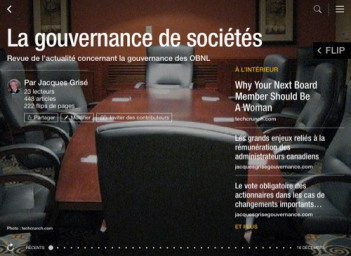


 Gouvernance | Jacques Grisé