Top 10 de Harvard Law School Forum on Corporate Governance au 3 juillet 2019


Voici le compte rendu hebdomadaire du forum de la Harvard Law School sur la gouvernance corporative au 3 juillet 2019.

Comme à l’habitude, j’ai relevé les dix principaux billets.

Bonne lecture !


Résultats de recherche d'images pour « top 10 »


  1. Overview of Recent Stock Exchange Proposals
  2. Dual-Class Shares: Governance Risks and Company Performance
  3. Spotlight on Boards
  4. Baby on Board: Remarks before the Society for Corporate Governance National Conference
  5. Irrelevance of Governance Structures
  6. How Boards Govern Disruptive Technology—Key Findings from a Director Survey
  7. Shareholder Protection and the Cost of Capital
  8. Task Force on Climate-Related Financial Disclosure 2019 Status Report
  9. Glass Lewis, ISS, and ESG
  10. Solving Banking’s “Too Big to Manage” Problem


Comment les firmes de conseil en votation évaluent-elles les efforts des entreprises eu égard à leur gestion environnementale et sociale ?


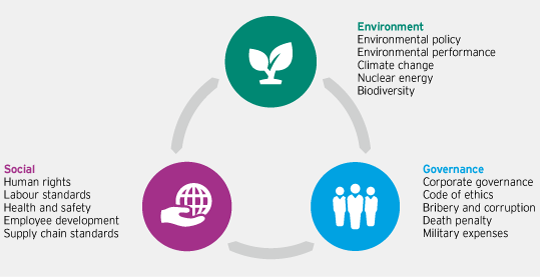
Les auteurs* de cet article expliquent en des termes très clairs le sens que les firmes de conseil en votation Glass Lewis et ISS donnent aux risques environnementaux et sociaux associés aux pratiques de gouvernance des entreprises publiques (cotées).

Il est vrai que l’on parle de ESG (en anglais) ou de RSE (en français) sans donner de définition explicite de ces concepts.

Ici, on montre comment les firmes spécialisées en conseils aux investisseurs mesurent les dimensions sous-jacentes à ces expressions.

Les administrateurs de sociétés ont tout intérêt à connaître sur quoi ces firmes se basent pour évaluer la qualité des efforts de leur entreprise en matière de gestion environnementale et de considérations sociales.

J’espère que vous apprécierez ce court extrait paru sur le Forum du Harvard Law School.

Bonne lecture !


Glass Lewis, ISS, and ESG


Résultats de recherche d'images pour « esg »


With some help from leading investor groups like Black Rock and T. Rowe Price, environmental, social, and governance (“ESG”) issues, once the sole purview of specialist investors and activist groups, are increasingly working their way into the mainstream for corporate America. For some boards, conversations about ESG are nothing new. For many directors, however, the increased emphasis on the subject creates some consternation, in part because it’s not always clear what issues properly fall under the ESG umbrella. E, S, and G can mean different things to different people—not to mention the fact that some subjects span multiple categories. How do boards know what it is that they need to know? Where should boards be directing their attention?

A natural starting place for directors is to examine the guidelines published by the leading proxy advisory firms ISS and Glass Lewis. While not to be held up as a definitive prescription for good governance practices, the stances adopted by both advisors can provide a window into how investors who look to these organizations for guidance are thinking about the subject.


Institutional Shareholder Services (ISS)


In February of 2018, ISS launched an Environmental & Social Quality Score which they describe as “a data-driven approach to measuring the quality of corporate disclosures on environmental and social issues, including sustainability governance, and to identify key disclosure omissions.”

To date, their coverage focuses on approximately 4,700 companies across 24 industries they view “as being most exposed to E&S risks, including: Energy, Materials, Capital Goods, Transportation, Automobiles & Components, and Consumer Durables & Apparel.” ISS believes that the extent to which companies disclose their practices and policies publicly, as well as the quality of a company’s disclosure on their practices, can be an indicator of ESG performance. This view is not unlike that espoused by Black Rock, who believes that a lack of ESG disclosure beyond what is legally mandated often necessitates further research.

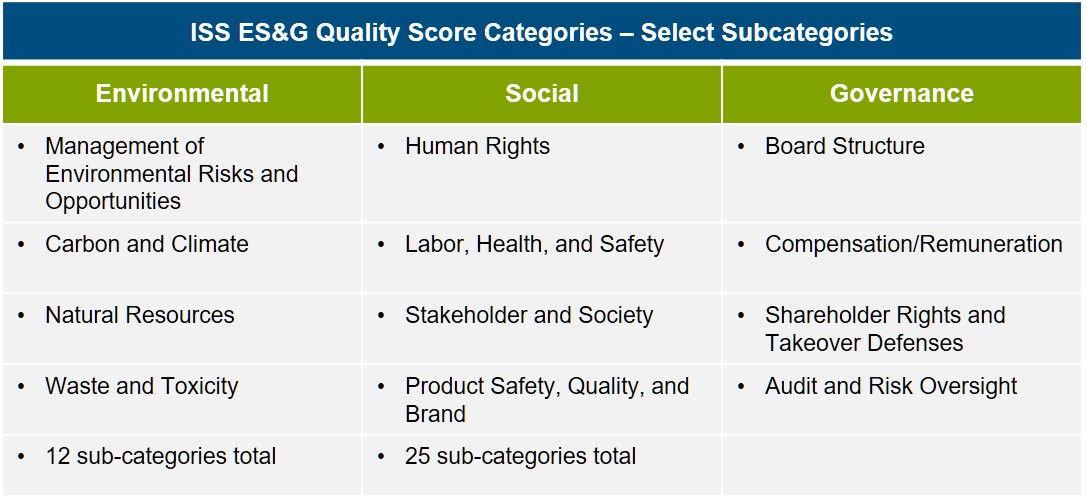
Below is a summary of how ISS breaks down E, S, & G. Clearly the governance category includes topics familiar to any public company board.


iss-esg-quality-score-table


ISS’ E&S scoring is based on answers to over 380 individual questions which ISS analysts attempt to answer for each covered company based on disclosed data. The majority of the questions in the ISS model are applied to all industry groups, and all of them are derived from third-party lists or initiatives, including the United Nations’ Sustainable Development Goals. The E&S Quality Score measures the company’s level of environmental and social disclosure risk, both overall and specific to the eight broad categories listed in the table above. ISS does not combine ES&G into a single score, but provides a separate E&S score that stands alongside the governance score.

These disclosure risk scores, similar to the governance scores companies have become accustomed to seeing each year, are scaled from 1 to 10 with lower scores indicating a lower level of risk relative to industry peers. For example, a score of 2 indicates that a company has lower risk than 80% of its industry peers.


Glass Lewis


Glass Lewis uses data and ratings from Sustainalytics, a provider of ESG research, in the ESG Profile section of their standard Proxy Paper reports for large cap companies or “in instances where [they] identify material oversight issues.” Their stated goal is to provide summary data and insights that can be used by Glass Lewis clients as part of their investment decision-making, including aligning proxy voting and engagement practices with ESG risk management considerations.

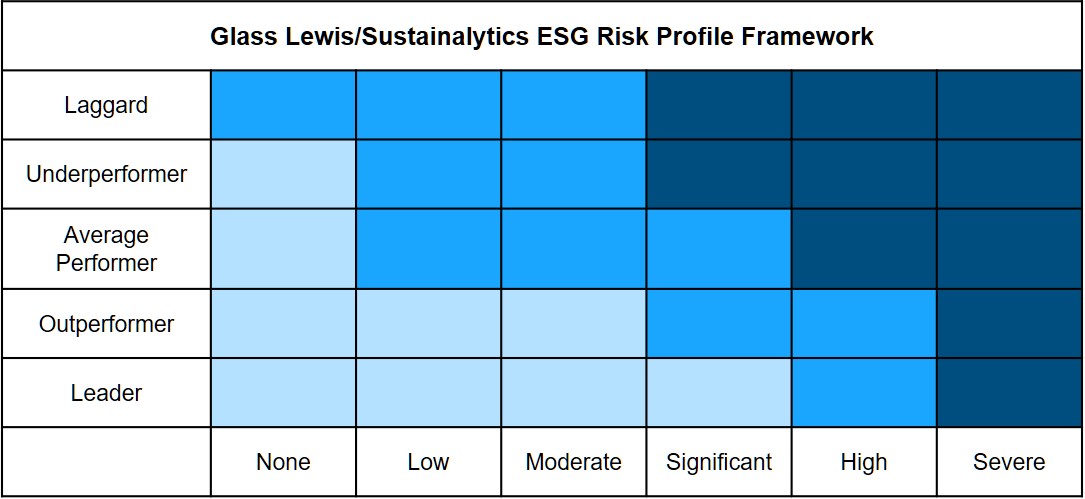
The Glass Lewis evaluation, using Sustainalytics guidelines, rates companies on a matrix which weighs overall “ESG Performance” against the highest level of “ESG Controversy.” Companies who are leaders in terms of ESG practices (or disclosure) have a higher threshold for triggering risk in this model.


glass-lewis-risk-model-chart


The evaluation model also notes that some companies involved in particular product areas are naturally deemed higher risk, including adult entertainment, alcoholic beverages, arctic drilling, controversial weapons, gambling, genetically modified plants and seeds, oil sands, pesticides, thermal coal, and tobacco.

Conclusion


ISS and Glass Lewis guidelines can help provide a basic structure for starting board conversations about ESG. For most companies, the primary focus is on transparency, in other words how clearly are companies disclosing their practices and philosophies regarding ESG issues in their financial filings and on their corporate websites? When a company has had very public environmental or social controversies—and particularly when those issues have impacted shareholder value—advisory firm evaluations of corporate transparency may also impact voting recommendations on director elections or related shareholder proposals.

Pearl Meyer does not expect the advisory firms’ ESG guidelines to have much, if any, bearing on compensation-related recommendations or scorecards in the near term. In the long term, however, we do think certain hot-button topics will make their way from the ES&G scorecard to the compensation scorecard. This shift will likely happen sooner in areas where ESG issues are more prominent, such as those specifically named by Glass Lewis.

We are recommending that organizations take the time to examine any ESG issues relevant to their business and understand how those issues may be important to stakeholders on a proactive basis, perhaps adding ESG policies to the list of sunny day shareholder outreach topics after this year’s proxy season. This does take time and effort, but better that than to find out about a nagging ESG issue through activist activity or a negative voting recommendation from ISS or Glass Lewis.


References

1. https://www.issgovernance.com/iss-announces-launch-of-environmental-social-qualityscore-corporate-profiling-solution/

2. https://www.glasslewis.com/understanding-esg-content/

_________________________________________________________

* David Bixby is managing director and Paul Hudson is principal at Pearl Meyer & Partners, LLC. This post is based on a Pearl Meyer memorandum. Related research from the Program on Corporate Governance includes Social Responsibility Resolutions by Scott Hirst (discussed on the Forum here).

Quelles sont les responsabilités dévolues à un conseil d’administration ?


En gouvernance des sociétés, il existe un certain nombre de responsabilités qui relèvent impérativement d’un conseil d’administration.

À la suite d’une décision rendue par la Cour Suprême du Delaware dans l’interprétation de la doctrine Caremark (voir ici),il est indiqué que pour satisfaire leur devoir de loyauté, les administrateurs de sociétés doivent faire des efforts raisonnables (de bonne foi) pour mettre en œuvre un système de surveillance et en faire le suivi.

Without more, the existence of management-level compliance programs is not enough for the directors to avoid Caremark exposure.

L’article de Martin Lipton *, paru sur le Forum de Harvard Law School on Corporate Governance, fait le point sur ce qui constitue les meilleures pratiques de gouvernance à ce jour.

Bonne lecture !


Spotlight on Boards


Résultats de recherche d'images pour « Spotlight on Boards »


  1. Recognize the heightened focus of investors on “purpose” and “culture” and an expanded notion of stakeholder interests that includes employees, customers, communities, the economy and society as a whole and work with management to develop metrics to enable the corporation to demonstrate their value;
  2. Be aware that ESG and sustainability have become major, mainstream governance topics that encompass a wide range of issues, such as climate change and other environmental risks, systemic financial stability, worker wages, training, retraining, healthcare and retirement, supply chain labor standards and consumer and product safety;
  3. Oversee corporate strategy (including purpose and culture) and the communication of that strategy to investors, keeping in mind that investors want to be assured not just about current risks and problems, but threats to long-term strategy from global, political, social, and technological developments;
  4. Work with management to review the corporation’s strategy, and related disclosures, in light of the annual letters to CEOs and directors, or other communications, from BlackRock, State Street, Vanguard, and other investors, describing the investors’ expectations with respect to corporate strategy and how it is communicated;
  5. Set the “tone at the top” to create a corporate culture that gives priority to ethical standards, professionalism, integrity and compliance in setting and implementing both operating and strategic goals;
  6. Oversee and understand the corporation’s risk management, and compliance plans and efforts and how risk is taken into account in the corporation’s business decision-making; monitor risk management ; respond to red flags if and when they arise;
  7. Choose the CEO, monitor the CEO’s and management’s performance and develop and keep current a succession plan;
  8. Have a lead independent director or a non-executive chair of the board who can facilitate the functioning of the board and assist management in engaging with investors;
  9. Together with the lead independent director or the non-executive chair, determine the agendas for board and committee meetings and work with management to ensure that appropriate information and sufficient time are available for full consideration of all matters;
  10. Determine the appropriate level of executive compensation and incentive structures, with awareness of the potential impact of compensation structures on business priorities and risk-taking, as well as investor and proxy advisor views on compensation;
  11. Develop a working partnership with the CEO and management and serve as a resource for management in charting the appropriate course for the corporation;
  12. Monitor and participate, as appropriate, in shareholder engagement efforts, evaluate corporate governance proposals, and work with management to anticipate possible takeover attempts and activist attacks in order to be able to address them more effectively, if they should occur;
  13. Meet at least annually with the team of company executives and outside advisors that will advise the corporation in the event of a takeover proposal or an activist attack;
  14. Be open to management inviting an activist to meet with the board to present the activist’s opinion of the strategy and management of the corporation;
  15. Evaluate the individual director’s, board’s and committees’ performance on a regular basis and consider the optimal board and committee composition and structure, including board refreshment, expertise and skill sets, independence and diversity, as well as the best way to communicate with investors regarding these issues;
  16. Review corporate governance guidelines and committee workloads and charters and tailor them to promote effective board and committee functioning;
  17. Be prepared to deal with crises; and
  18. Be prepared to take an active role in matters where the CEO may have a real or perceived conflict, including takeovers and attacks by activist hedge funds focused on the CEO.


Afin de satisfaire ces attentes, les entreprises publiques doivent :


  1. Have a sufficient number of directors to staff the requisite standing and special committees and to meet investor expectations for experience, expertise, diversity, and periodic refreshment;
  2. Compensate directors commensurate with the time and effort that they are required to devote and the responsibility that they assume;
  3. Have directors who have knowledge of, and experience with, the corporation’s businesses and with the geopolitical developments that affect it, even if this results in the board having more than one director who is not “independent”;
  4. Have directors who are able to devote sufficient time to preparing for and attending board and committee meetings and engaging with investors;
  5. Provide the directors with the data that is critical to making sound decisions on strategy, compensation and capital allocation;
  6. Provide the directors with regular tutorials by internal and external experts as part of expanded director education and to assure that in complicated, multi-industry and new-technology corporations, the directors have the information and expertise they need to respond to disruption, evaluate current strategy and strategize beyond the horizon; and
  7. Maintain a truly collegial relationship among and between the company’s senior executives and the members of the board that facilitates frank and vigorous discussion and enhances the board’s role as strategic partner, evaluator, and monitor.

_________________________________________________________

Martin Lipton* is a founding partner of Wachtell, Lipton, Rosen & Katz, specializing in mergers and acquisitions and matters affecting corporate policy and strategy. This post is based on a Wachtell Lipton memorandum by Mr. Lipton and is part of the Delaware law series; links to other posts in the series are available here.

Un document incontournable en gouvernance des entreprises cotées : « OECD Corporate Governance Factbook 2019 »


Voici un rapport de recherche exhaustif publié tous les deux ans par l’OCDE.

Vous y retrouverez une mine de renseignements susceptibles de répondre à toute question relative à la gouvernance des plus importantes autorités des marchés financiers au monde.

C’est un document essentiel qui permet de comparer et d’évaluer les progrès en gouvernance dans les 49 plus importants marchés financiers.

Vous pouvez télécharger le rapport à la fin du sommaire exécutif publié ici. Le document est illustré par une multitude de tableaux et de figures qui font image il va sans dire.

Voici l’introduction au document de recherche. Celui-ci vient d’être publié. La version française devrait suivre bientôt.

Bonne lecture !


The 2019 edition of the OECD Corporate Governance Factbook (the “Factbook”) contains comparative data and information across 49 different jurisdictions including all G20, OECD and Financial Stability Board members. The information is presented and commented in 40 tables and 51 figures covering a broad range of institutional, legal and regulatory provisions. The Factbook provides an important and unique tool for monitoring the implementation of the G20/OECD Principles of Corporate Governance. Issued every two years, it is actively used by governments, regulators and others for information about implementation practices and developments that may influence their effectiveness.

It is divided into five chapters addressing: 1) the corporate and market landscape; 2) the corporate governance framework; 3) the rights of shareholders and key ownership functions; 4) the corporate boards of directors; and 5) mechanisms for flexibility and proportionality in corporate governance.
 

OECD (2019), OECD Corporate Governance Factbook 2019


Résultats de recherche d'images pour « OECD Corporate Governance Factbook 2019 »


The corporate and market landscape


Effective design and implementation of corporate governance rules requires a good empirical understanding of the ownership and business landscape to which they will be applied. The first chapter of the Factbook therefore provides an overview of ownership patterns around the world, with respect to both the categories of owners and the degree of concentration of ownership in individual listed companies. Since the G20/OECD Principles also include recommendations with respect to the functioning of stock markets, it also highlights some key structural changes with respect to stock exchanges.

The OECD Equity Market Review of Asia (OECD, 2018a) reported that stock markets have undergone profound changes during the past 20 years. Globally, one of the most important developments has been the rapid growth of Asian stock markets—both in absolute and in relative terms. In 2017, a record number of 1 074 companies listed in Asia, almost twice as many as the annual average for the previous 16 years. Of the five jurisdictions that have had the highest number of non-financial company IPOs in the last decade, three are in Asia. In 2017, Asian non-financial companies accounted for 43% of the global volume of equity raised. The proportion attributable to European and US companies has declined during the same period. In terms of stock exchanges, by total market capitalisation, four Asian exchanges were in the top ten globally (Japan Exchange Group, Shanghai Stock Exchange, Hong Kong Exchanges and Clearing Limited, and Shenzhen Stock Exchange).

With respect to ownership patterns at the company level in the world’s 50 000 listed companies, a recent OECD study (De la Cruz et al., forthcoming) reports a number of features of importance to policymaking and implementation of the G20/OECD Principles. The report, which contains unique information about ownership in companies from 54 jurisdictions that together represent 95% of global market capitalisation, shows that four main categories of investors dominate ownership of today’s publicly listed companies. These are: institutional investors, public sector owners, private corporations, and strategic individual investors. The largest category is institutional investors, holding 41% of global market capitalisation. The second largest category is the public sector, which has significant ownership stakes in 20% of the world’s listed companies and hold shares representing 13% of global market capitalisation. With respect to ownership in individual companies, in half of the world’s publicly listed companies, the three largest shareholders hold more than 50% of the capital, and in three-quarters of the world’s public listed companies, the three largest owners hold more than 30%. This is to a large extent attributable to the growth of stock markets in Asian emerging markets.

Stock exchanges have also undergone important structural changes in recent years, such as mergers and acquisitions and demutualisations. Out of 52 major stock exchanges in 49 jurisdictions, 18 now belong to one of four international groups. Thirty-three (63%) of these exchanges are either self-listed or have an ultimate parent company that is listed on one or more of its own exchanges. More than 62% of market capitalisation is concentrated in the five largest stock exchanges, while more than 95% is concentrated in the largest 25. The top 25 highest valued exchanges include 11 non-OECD jurisdictions.


The corporate governance framework


An important bedrock for implementing the Principles is the quality of the legal and regulatory framework, which is consistent with the rule of law in supporting effective supervision and enforcement.

Against this background, the Factbook monitors who serves as the lead regulatory institution for corporate governance of listed companies in each jurisdiction, as well as issues related to their independence. Securities regulators, financial regulators or a combination of the two play the key role in 82% of all jurisdictions, while the Central Bank plays the key role in 12%. The issue of the independence of regulators is commonly addressed (among 86% of regulatory institutions) through the creation of a formal governing body such as a board, council or commission, usually appointed to fixed terms ranging from two to eight years. In a majority of cases, independence from the government is also promoted by establishing a separate budget funded by fees assessed on regulated entities or a mix of fees and fines. On the other hand, 25% of the regulatory institutions surveyed are funded by the national budget.

Since 2015 when the G20/OECD Principles were issued, 84% of the 49 surveyed jurisdictions have amended either their company law or securities law, or both. Nearly all jurisdictions also have national codes or principles that complement laws, securities regulation and listing requirements. Nearly half of all jurisdictions have revised their national corporate governance codes in the past two years and 83% of them follow a “comply or explain” compliance practice. A growing percentage of jurisdictions—67%—now issue national reports on company implementation of corporate governance codes, up from 58% in 2015. In 29% of the jurisdictions it is the national authorities that serve as custodians of the national corporate governance code.


The rights and equitable treatment of shareholders and key ownership functions


The G20/OECD Principles state that the corporate governance framework shall protect and facilitate the exercise of shareholders’ rights and ensure equitable treatment of all shareholders, including minority and foreign shareholders.

Chapter 3 of the Factbook therefore provides detailed information related to rights to obtain information on shareholder meetings, to request meetings and to place items on the agenda, and voting rights. The chapter also provides detailed coverage of frameworks for review of related party transactions, triggers and mechanisms related to corporate takeover bids, and the roles and responsibilities of institutional investors.

All jurisdictions require companies to provide advance notice of general shareholder meetings. A majority establish a minimum notice period of between 15 and 21 days, while another third of the jurisdictions provide for longer notice periods. Nearly two-thirds of jurisdictions require such notices to be sent directly to shareholders, while all but four jurisdictions require multiple methods of notification, which may include use of a stock exchange or regulator’s electronic platform, publication on the company’s web site or in a newspaper.

Approximately 80% of jurisdictions establish deadlines of up to 60 days for convening special meetings at the request of shareholders, subject to specific ownership thresholds. This is an increase from 73% in 2015. Most jurisdictions (61%) set the ownership threshold for requesting a special shareholder meeting at 5%, while another 32% set the threshold at 10%. Compared to the threshold for requesting a shareholder meeting, many jurisdictions set lower thresholds for placing items on the agenda of the general meeting. With respect to the outcome of the shareholder meeting, approximately 80% of jurisdictions require the disclosure of voting decisions on each agenda item, including 59% that require such disclosure immediately or within 5 days.

The G20/OECD Principles state that the optimal capital structure of the company is best decided by the management and the board, subject to approval of the shareholders. This may include the issuing of different classes of shares with different rights attached to them. In practice, all but three of the 49 jurisdictions covered by the Factbook allow listed companies to issue shares with limited voting rights. In many cases, such shares come with a preference with respect to the receipt of the firm’s profits.

Related party transactions are typically addressed through a combination of measures, including board approval, shareholder approval, and mandatory disclosure. Provisions for board approval are common; two-thirds of jurisdictions surveyed require or recommend board approval of certain types of related party transactions. Shareholder approval requirements are applied in 55% of jurisdictions, but are often limited to large transactions and those that are not carried out on market terms. Nearly all jurisdictions require disclosure of related party transactions, with 82% requiring use of International Accounting Standards (IAS24), while an additional 8% allow flexibility to follow IAS 24 or the local standard.

The Factbook provides extensive data on frameworks for corporate takeovers. Among the 46 jurisdictions that have introduced a mandatory bid rule, 80% take an ex-post approach, where a bidder is required to initiate the bid after acquiring shares exceeding the threshold. Nine jurisdictions take an ex-ante approach, where a bidder is required to initiate a takeover bid for acquiring shares which would exceed the threshold. More than 80% of jurisdictions with mandatory takeover bid rules establish a mechanism to determine the minimum bidding price.

Considering the important role played by institutional investors as shareholders of listed companies, nearly all jurisdictions have established provisions for at least one category of institutional investors (such as pension, investment or insurance funds) to address conflicts of interest, either by prohibiting specific acts or requiring them to establish policies to manage conflicts of interest. Three-fourths of all jurisdictions have established requirements or recommendations for institutional investors to disclose their voting policies, while almost half require or recommend disclosure of actual voting records. Some jurisdictions establish regulatory requirements or may rely on voluntary stewardship codes to encourage various forms of ownership engagement, such as monitoring and constructive engagement with investee companies and maintaining the effectiveness of monitoring when outsourcing the exercise of voting rights.


The corporate board of directors


The G20/OECD Principles require that the corporate governance framework ensures the strategic guidance of the company by the board and its accountability to the company and its shareholders. The most common board format is the one-tier board system, which is favoured in twice as many jurisdictions as those that apply two-tier boards (supervisory and management boards). A growing number of jurisdictions allow both one and two-tier structures.

Almost all jurisdictions require or recommend a minimum number or ratio of independent directors. Definitions of independent directors have also been evolving during this period: 80% of jurisdictions now require directors to be independent of significant shareholders in order to be classified as independent, up from 64% in 2015. The shareholding threshold determining whether a shareholder is significant ranges from 2% to 50%, with 10% to 15% being the most common.

Recommendations or requirements for the separation of the board chair and CEO have doubled in the last four years to 70%, including 30% required. The 2015 edition of the Factbook reported a binding requirement in only 11% of the jurisdictions, with another 25% recommending it in codes.

Nearly all jurisdictions require an independent audit committee. Nomination and remuneration committees are not mandatory in most jurisdictions, although more than 80% of jurisdictions at least recommend these committees to be established and often to be comprised wholly or largely of independent directors.

Requirements or recommendations for companies to assign a risk management role to board level committees have sharply increased since 2015, from 62% to 87% of surveyed jurisdictions. Requirements or recommendations to implement internal control and risk management systems have also increased significantly, from 62% to 90%.

While recruitment and remuneration of management is a key board function, a majority of jurisdictions have a requirement or recommendation for a binding or advisory shareholder vote on remuneration policy for board members and key executives. And nearly all jurisdictions surveyed now require or recommend the disclosure of the remuneration policy and the level/amount of remuneration at least at aggregate levels. Disclosure of individual levels is required or recommended in 76% of jurisdictions.

The 2019 Factbook provides data for the first time on measures to promote gender balance on corporate boards and in senior management, most often via disclosure requirements and measures such as mandated quotas and/or voluntary targets. Nearly half of surveyed jurisdictions (49%) have established requirements to disclose gender composition of boards, compared to 22% with regards to senior management. Nine jurisdictions have mandatory quotas requiring a certain percentage of board seats to be filled by either gender. Eight rely on more flexible mechanisms such as voluntary goals or targets, while three resort to a combination of both. The proportion of senior management positions held by women is reported to be significantly higher than the proportion of board seats held by women.


Mechanisms for flexibility and proportionality in corporate governance


It has already been pointed out that effective implementation of the G20/OECD Principles requires a good empirical understanding of economic realities and adaption to changes in corporate and market developments over time. The G20/OECD Principles therefore state that policy makers have a responsibility to put in place a framework that is flexible enough to meet the needs of corporations that are operating in widely different circumstances, facilitating their development of new opportunities and the most efficient deployment of resources. The 2019 Factbook provides a special chapter that presents the main findings of a complementary OECD review of how 39 jurisdictions apply the concepts of flexibility and proportionality across seven different corporate governance regulatory areas. The chapter builds on the 2018 OECD report Flexibility and Proportionality in Corporate Governance (OECD, 2018b). The report finds that a vast majority of countries have criteria that allow for flexibility and proportionality at company level in each of the seven areas of regulation that were reviewed: 1) board composition, board committees and board qualifications; 2) remuneration; 3) related party transactions; 4), disclosure of periodic financial information and ad hoc information; 5) disclosure of major shareholdings; 6) takeovers; and 7) pre-emptive rights. The report also contains case studies of six countries, which provide a more detailed picture of how flexibility and proportionality is being used in practice.

The complete publication, including footnotes, is available here.

Top 10 de Harvard Law School Forum on Corporate Governance au 21 juin 2019


Voici le compte rendu hebdomadaire du forum de la Harvard Law School sur la gouvernance corporative au 21 juin 2019.

Comme à l’habitude, j’ai relevé les dix principaux billets.

Bonne lecture !


Image associée


  1. Defined Contribution Plans and the Challenge of Financial Illiteracy
  2. NYS Common Retirement Fund’s Climate Action Plan
  3. Calling the Cavalry: Special Purpose Directors in Times of Boardroom Stress
  4. Debt Default Activism: After Windstream, the Winds of Change
  5. Do Firms Issue More Equity When Markets Become More Liquid?
  6. U.S. Board Diversity Trends in 2019
  7. Regulation Best Interest
  8. Delaware’s New Competition
  9. Business Chemistry: A Path to a More Effective Board Composition
  10. The Modern Dilemma: Balancing Short- and Long-Term Business Pressures


Tendances observées eu égard à la diversité des conseils d’administration américains en 2019


L’article publié par Subodh Mishra, directrice générale de Institutional Shareholder Services (ISS), paru sur le site du forum de Harvard Law School montre clairement que les tendances eu égard à la diversité des Boards américains sont remarquables.

Qu’entend-on par la diversité des conseils d’administration ?

  1. le taux de remplacement des administrateurs sur le conseil
  2. le pourcentage de femmes qui accèdent à des conseils
  3. la diversité ethnique sur les conseils
  4. le choix d’administrateurs dont les compétences ne sont pas majoritairement financières
  5. le taux de nouveaux administrateurs pouvant être considérés comme relativement jeune


L’étude indique que pour chacune de ces variables, les conseils d’administration américains font preuve d’une plus grande diversité, sauf pour l’âge des administrateurs qui continue de croître.

Je vous invite à prendre connaissance de cet article pour vous former une idée plus juste des tendances observées sur les conseils d’administration.

Je n’ai pas de données comparables au Canada, mais je crois que la tendance à l’accroissement de la diversité est similaire.

Bonne lecture !


U.S. Board Diversity Trends in 2019


Résultats de recherche d'images pour « U.S. Board Diversity Trends in 2019 »


As the U.S. annual shareholder meeting season is coming to an end, we review the characteristics of newly appointed directors to reveal trends director in nominations. As of May 30, 2019, ISS has profiled the boards of 2,175 Russell 3000 companies (including the boards of 401 members of the S&P 500) with a general meeting of shareholders during the year. These figures represent approximately 75 percent of Russell 3000 companies that are expected to have a general meeting during the year. (A small portion of index constituents may not have a general meeting during a given calendar year due to mergers and acquisitions, new listings, or other extraordinary circumstances).

Based on our review of 19,791 directorships in the Russell 3000, we observe five major trends in new director appointments for 2019, as outlined below.

1. Board renewal rates continue to increase, as board refreshment, director qualifications, and board diversity remain high-priority issues for companies and investors.

2. The percentage of women joining boards reaches a new record high, with 45 percent of new Russell 3000 board seats filled by women in 2019 (compared to only 12 percent in 2008) and 19 percent of all Russell 3000 seats held by women.

3. Ethnic diversity also reached record highs, but has grown at a much slower rate, with approximately 10 percent of Russell 3000 directors currently belonging to an ethnic minority group, while 15 percent of new directors are ethnically diverse.

4. New director appointments focus on non-financial skillsets, with an increased proportion of directors having international experience, ESG expertise, and background in human resources.

5. The average director age continues to increase, as the appointment of younger directors is less frequent than in previous years, with only 7.2 percent of new directorships filled by directors younger than 45 years, compared to 11.5 percent of new directors in 2008.

Board Refreshment


After a decline in board renewal rates in the first years after the Great Recessions, boards began to add more new directors starting in 2012 and reached record numbers of board replenishment in 2017 and 2018, as a growing number of investors focused on board refreshment and board diversity. In 2019, the trend of board renewal continued, as we observe relatively higher rates of new director appointments as a percentage of all directorships compared to the beginning of the decade. But overall renewal rates are low. As of May 2019, only 5.3 percent of profiled Russell 3000 board directors were new to their boards, down from the record-high figure of 5.7 percent in 2018.


Proposals by Category


The surge in new director appointments observed in the past few years can be attributed to a greater emphasis on board gender diversity and board refreshment by many investors and companies. The percentage of companies introducing at least one new board member increased from 34.3 percent in 2018 to 35.6 percent this year. The percentage of companies introducing at least two new directors declined from 11.2 percent in 2018 to 10.2 percent in 2019, consistently above the 10-percent threshold along with the record-setting years of 2017 and 2018.


Proposals by Category

Gender Diversity


Gender diversity on boards accelerated further this year, breaking another record in terms of the percentage of new directors who are women. In the Russell 3000, 45 percent of new directors are women, up from 34 percent in 2018. Unlike previous years, when the percentage of new female directors was higher at large-capitalization companies, the high rate of new female directors—at almost parity—is consistent across all market segments. Several asset owners and asset managers had voting policies related to gender diversity prior to 2017. However, following State Street’s policy initiative to require at least one female director at every board in 2017, many more large investors have become more vocal about improving gender diversity on boards in the past two years, and many have introduced similar voting policies. We expect this trend to continue, as more investors are beginning to require more than the bare minimum of at least one woman on the board. Proxy advisors also introduced similar policies, with ISS’ policy to make adverse recommendation at all-male boards coming into effect in 2020.

But, more importantly, the push for gender diversity is no longer driven by shareholder engagement and voting only. New regulation in California mandates that all boards of companies headquartered in the state should have at least one woman on their boards in 2019, while at least three women board members are required by 2021 for boards with six members or more. Other states may follow suit, as New Jersey recently introduced legislation modeled after the California law, and Illinois is debating a bill that will require both gender and ethnic diversity on corporate boards.

Given the California mandate (affecting close to 700 public companies) and the continued focus by investors, it is no surprise that smaller firms, where gender diversity has been considerably lower compared to large companies, are revamping their efforts to improve gender diversity.


Proposals by Category


As a result of the record-setting recruitment of women on boards, 2019 saw the biggest jump in the overall gender diversity. The S&P 500 is well on its way of reaching 30 percent directorships held by women in the next couple of years, much earlier than we had predicted in the beginning of last year using a linear regression analysis. Obviously, female director recruitments has seen exponential growth in the past two years, which has accelerated the trend.


Proposals by Category

Ethnic Diversity


In 2019, we also see record number of ethnic minorities joining boards as new board members, with more than one-in-five new directorships being filled by non-Caucasian nominees at S&P 500, while approximately 15 percent of new board seats at all Russell 3000 companies are filled by minorities (the figure stands at 13 percent when excluding the S&P 500). As the discussion of diversity moves beyond gender, we may see the trend of higher minority representation on boards continue.


Proposals by Category


While the trend of increasing ethnic diversity on boards is visible, the rate of change is considerably slower than the trend in board gender diversity. Among board members whose race was identified, non-white Russell 3000 directors crossed the 10-percent threshold for the first time in 2019, compared to approximately 8 percent in 2008. These figures stand well below the proportion of non-White, non-Hispanic population in the U.S. of approximately 40 percent, according to the U.S. census bureau.


Proposals by Category

Director Skills


But diversity among new directors goes beyond gender and ethnicity. We observe a change in the skillsets disclosed by companies for new directors compared to incumbent directors. The rate of disclosure of skills is generally higher for new directors compared to directors who have served on boards for five years or more. Relative to tenure directors, we observe an increase in the percentage of new directors with expertise in technology (10 percentage points), sales (8 percentage points), international experience (8 percentage points), and strategic planning (6 percentage points). At the same time, we see a decrease in some traditional skills, such as financial and audit expertise, and CEO experience.


Proposals by Category

The increase in non-traditional skills becomes more pronounced when we look at the percentage difference in the frequency of each skill for new directors compared to directors with tenure of five years or more. Based on this analysis, international expertise, experience in corporate social responsibility, and human resources expertise all increase by more than 50 percent at new directors compared to their counterparts with tenure on the board of at least five years. As sustainability and corporate culture become focus items for many investors and companies, we expect this trend to continue. The percentage of “other” skills, which do not fall neatly in the established categories, also increases considerably. The list of skills that rank the lowest in terms of change compared to the tenured directors is telling of the increased emphasis in non-traditional skills: CFO experience, financial expertise, CEO experience, government experience, and audit expertise.

Proposals by Category

Age Diversity


U.S. boards are getting older. During the past twelve years, the average director age in the Russell 3000 has increased from 59.7 years in 2008 to 62.1 years in 2019. This trend becomes apparent when observing the age groups of newly appointed directors. In 2008, approximately 11.5 percent of new director were younger than 45 years, and this number has dropped to an all-time low of 7.2 percent in 2019. The percentage of newly appointed directors above the age of 67 has also been decreasing in the past five years reaching 6.5 percent in 2019, compared to its peak of 10.8 in 2014.


Proposals by Category


However, as incumbent directors stay on boards with the passing of time, the overall percentage of directors above the age of 67 years continues to increase, reaching a record high of 31.6 percent of all directorships in 2019, compared to 22.1 percent in 2008. We observe the opposite trend in relation to younger directors, whereby the proportion of directors younger than 45 years has dropped by almost 40 percent from 5.1 percent of directorships in 2008 to 3.2 of directorships in 2019.


Proposals by Category

The Changing Landscape for U.S. Boards

The U.S. is experiencing a significant shift in the composition of corporate boards, as the market expects companies to address a new set of challenges and their boards to better reflect developments in society. Board refreshment continues its upward trajectory in 2019, with higher rates of new directors compared to the beginning of the decade. While traditional skillsets remain paramount, we see a greater emphasis on non-financial skills, highlighting the need to focus on corporate culture, sustainability, and technology. At the same time, investors, companies, and regulators recognize the benefits of diversity, as we see record numbers of women and minorities on boards. Experience and qualifications appear more important than ever, which may explain the decline in younger directors in the past decade. These trends will likely continue, as investors continue to focus on board quality and governance as a foremost measure for protecting their investments and managing risk for sustainable growth.

Top 15 de Harvard Law School Forum on Corporate Governance au 13 juin 2019


Voici le compte rendu hebdomadaire du forum de la Harvard Law School sur la gouvernance corporative au 13 juin 2019.

Cette fois-ci,, j’ai relevé les quinze principaux billets.

Bonne lecture !


Résultats de recherche d'images pour « top 15 »


  1. Blurred Lines: Government Involvement in Corporate Internal Investigations and Implications for Individual Accountability
  2. Board Development and Director Succession Planning in the Age of Shareholder Activism, Engagement and Stewardship
  3. French Legislation on Corporate Purpose
  4. Will the Long-Term Stock Exchange Make a Difference?
  5. A New Era of Extraterritorial SEC Enforcement Actions
  6. Ten Years of Say-on-Pay Data
  7. New DOJ Compliance Program Guidance
  8. Board Diversity by Term Limits?
  9. Climate Change Risk Oversight Framework for Directors
  10. EVA, Not EBITDA: A Better Measure of Investment Value
  11. CFO Gender and Financial Statement Irregularities
  12. Help! I Settled With an Activist!
  13. What’s New on the SEC’s new RegFlex Agenda?
  14. Corporate Governance by Index Exclusion
  15. Precluding Pre-Merger Communications in Post-Merger Dispute

Top 10 de Harvard Law School Forum on Corporate Governance au 6 juin 2019


Voici le compte rendu hebdomadaire du forum de la Harvard Law School sur la gouvernance corporative au 6 juin 2019.

Comme à l’habitude, j’ai relevé les dix principaux billets.

Bonne lecture !


Résultats de recherche d'images pour « top dix »


  1. The Never-Ending Quest for Shareholder Rights: Special Meetings and Written Consent
  2. Rulemaking Petition on Non-GAAP Financials in Proxy Statements
  3. Legal Tools for the Active or Activist Shareholders
  4. Strategic Trading as a Response to Short Sellers
  5. Designing Pay Plans in the New 162(m) World
  6. The Business Case for ESG
  7. The New DOJ Compliance Guidelines and the Board’s Caremark Duties
  8. Institutional Trading around M&A Announcements
  9. Sustainability Accounting Standards and SEC Filings
  10. Statement on Final Rules Governing Investment Advice

Top 10 de Harvard Law School Forum on Corporate Governance au 30 mai 2019


Voici le compte rendu hebdomadaire du forum de la Harvard Law School sur la gouvernance corporative au 30 mai 2019.

Comme à l’habitude, j’ai relevé les dix principaux billets.

Bonne lecture !


Résultats de recherche d'images pour « top ten »


  1. UK Shareholder Activism and Battles for Corporate Control
  2. The Corporate Form for Social Good
  3. President Trump’s Executive Order and Shareholder Engagement on Climate Change
  4. Management Duty to Set the Right “Tone at the Top”
  5. Compliance, Compensation and Corporate Wrongdoing
  6. A Fresh Look at Exclusive Forum Provisions
  7. Corporate Law and the Myth of Efficient Market Control
  8. Corporate Purpose: Stakeholders and Long-Term Growth
  9. SEC Roundtable on Short-Termism and Periodic Reporting System
  10. A Quarter Century of Exchange-Traded Fun!

Le rôle du CA dans le développement durable et la création de valeur pour les actionnaires et les parties prenantes


Aujourd’hui, je présente un article publié par Azeus Convene qui montre l’importance accrue que les entreprises doivent apporter au développement durable.
L’article insiste sur le rôle du conseil d’administration pour faire des principes du développement durable à long terme les principales conditions de succès des organisations.
Les administrateurs doivent concevoir des politiques qui génèrent une valeur ajoutée à long terme pour les actionnaires, mais ils doivent aussi contribuer à améliorer le sort des parties prenantes, telles que les clients, les communautés et la société en général.
Il n’est cependant pas facile d’adopter des politiques qui mettent de l’avant les principes du développement durable et de la gestion des risques liés à l’environnement.Dans ce document, publié sur le site de Board Agenda, on explique l’approche que les conseils d’administration doivent adopter en insistant plus particulièrement sur trois points :


  1. Un leadership capable de faire valoir les nombreux avantages stratégiques à tirer de cette approche ;
  2. Des conseils eu égard à l’implantation des changements
  3. Le processus de communication à mettre en œuvre afin de faire valoir les succès des entreprises


L’article qui suit donne plus de détails sur les fondements et l’application de l’approche du développement durable.


Bonne lecture ! Vos commentaires sont appréciés.


Le développement durable, la création de valeur et le rôle du CA


Businesses everywhere are developing sustainability policies. Implementation is never easy, but the right guidance can show the way.

When the experts sat down to write the UK’s new Corporate Governance Code earlier this year, they drafted a critical first principle. The role of the board is to “promote the long-term sustainable success of the company”. Boardroom members should generate value for shareholders, but they should also be “contributing to wider society”.

It is the values inherent in this principle that enshrines sustainability at the heart of running a company today.

Often sustainability is viewed narrowly, relating to policies affecting climate change. But it has long since ceased to be just about the environment. Sustainability has become a multifaceted concern embracing the long-term interests of shareholders, but also responsibilities to society, customers and local communities.

Publications like Harvard Business Review now publish articles such as “Inclusive growth: profitable strategies for tackling poverty and inequality”, or “Competing on social purpose”. Forbes has “How procurement will save the world” and “How companies can increase market rewards for sustainability efforts”. Sustainability is a headline issue for company leaders and here to stay.

But it’s not always easy to see how sustainability is integrated into a company’s existing strategy. So, why should your company engage with sustainability and what steps can it take to ensure it is done well?

…one of the biggest issues at the heart of the drive for sustainability is leadership. Implementing the right policies is undoubtedly a “top-down” process, not least because legal rulings have emphatically cast sustainability as a fiduciary duty.

The reasons for adopting sustainability are as diverse as the people and groups upon which companies have an impact. First, there is the clear environmental argument. Governments alone cannot tackle growing environment risk and will need corporates to play their part through their strategies and business models.

The issues driving political leaders have also filtered down to investment managers who have developed deep concerns that companies should be building strategies that factor in environmental, social and governance (ESG) risk. Companies that ignore the issue risk failing to attract capital. A 2015 study by the global benchmarking organisation PRI (Principles for Responsible Investment), conducted with Deutsche Bank Asset Management, showed that among 2,200 studies undertaken since 1970, 63% found a positive link between a company’s ESG performance and financial performance.

There’s also the risk of being left behind, or self-inflicted damage. In an age of instant digital communication news travels fast and a company that fails on sustainability could quickly see stakeholder trust undermined.

Companies that embrace the topic can also create what might be termed “sustainability contagion”: businesses supplying “sustainable” clients must be sustainable themselves, generating a virtuous cascade of sustainability behaviour throughout the supply chain. That means positive results from implemented sustainability policies at one end of the chain, and pressure to comply at the other.

Leadership

But perhaps one of the biggest issues at the heart of the drive for sustainability is leadership. Implementing the right policies is undoubtedly a “top-down” process, not least because legal rulings have emphatically cast sustainability as a fiduciary duty. That makes executive involvement and leadership an imperative. However, involvement of management at the most senior level will also help instil the kind of culture change needed to make sustainability an ingrained part of an organization, and one that goes beyond mere compliance.

Leaders may feel the need to demonstrate the value of a sustainability step-change. This is needed because a full-blooded approach to sustainability could involve rethinking corporate structures, processes and performance measurement. Experts recognise three ways to demonstrate value: risk, reward and recognition.

“Risk” looks at issues such as potential dangers associated with ignoring sustainability such as loss of trust, reputational damage (as alluded to above), legal or regulatory action and fines.

A “rewards”-centred approach casts sustainability as an opportunity to be pursued, as long as policies boost revenues or cut costs, and stakeholders benefit.

Meanwhile, the “recognition” method argues that sharing credit for spreading sustainability policies promotes long-term engagement and responsibility.

Implementation

Getting sustainability policies off the ground can be tricky, particularly because of their multifaceted nature.

recent study into European boards conducted by Board Agenda & Mazars in association with the INSEAD Corporate Governance Centre showed that while there is growing recognition by boards about the importance of sustainability, there is also evidence that they experience challenges about how to implement effective ESG strategies.

Proponents advise the use of “foundation exercises” for helping form the bedrock of sustainability policies. For example, assessing baseline environmental and social performance; analysing corporate management, accountability structures and IT systems; and an examination of material risk and opportunity.

That should provide the basis for policy development. Then comes implementation. This is not always easy, because being sustainable can never be attributed to a single policy. Future-proofing a company has to be an ongoing process underpinned by structures, measures and monitoring.
Policy delivery can be strengthened by the appointment of a chief sustainability officer (CSO) and establishing structures around the role, such as regular reporting to the chief executive and board, as well as the creation of a working committee to manage implementation of policies across the company.

Proponents advise the use of “foundation exercises” for helping form the bedrock of sustainability policies.

Sustainability values will need to be embedded at the heart of policies directing all business activities. And this can be supported through the use of an organisational chart mapping the key policies and processes to be adopted by each part of the business. The chart then becomes a critical ready reckoner for the boardroom and its assessment of progress.

But you can only manage what you measure, and sustainability policies demand the same treatment as any other business development initiative: key metrics accompanying the plan.

But what to measure? Examples include staff training, supply chain optimisation, energy efficiency, clean energy generation, reduced water waste, and community engagement, among many others.

Measuring then enables the creation of targets and these can be embedded in processes such as audits, supplier contracts and executive remuneration. If they are to have an impact, senior management must ensure the metrics have equal weight alongside more traditional measures.

All of this must be underpinned by effective reporting practices that provide a window on how sustainability practices function. And reporting is best supported by automated, straight-through processing, where possible.

Reliable reporting has the added benefit of allowing comparison and benchmarking with peers, if the data is available. The use of globally accepted standards—such as those provided by bodies like the Global Reporting Initiative—build confidence among stakeholders. And management must stay in touch, regularly consulting with the CSO and other stakeholders—customers, investors, suppliers and local communities—to ensure policies are felt in the right places.

Communication

Stakeholders should also hear about company successes, not just deliver feedback. Communicating a sustainability approach can form part of its longevity, as stakeholders hear the good news and develop an expectation of receiving more.

Companies are not expected to achieve all their sustainability goals tomorrow. Some necessarily take time. What is expected is long-term commitment and conviction, honest reporting and steady progress.

Care should be taken, however. Poor communication can be damaging, and a credible strategy will be required, one that considers how to deliver information frequently, honestly and credibly. It will need to take into account regulatory filings and disclosures, and potentially use social media as a means of reaching the right audience.

And that’s because successful sustainability policies are something to shout about. There is enormous pressure on companies to think differently, to reject a blinkered focus only on the bottom line and develop strategies that enable their companies to provide value, not only for shareholders but other stakeholders—society, customers, and suppliers—alike.

Companies are not expected to achieve all their sustainability goals tomorrow. Some necessarily take time. What is expected is long-term commitment and conviction, honest reporting and steady progress. The landscape on which businesses function is changing. They must change with it.

This article has been produced by Board Agenda in collaboration with Azeus Convene, a supporter of Board Agenda.

Top 10 de Harvard Law School Forum on Corporate Governance au 23 mai 2019


Voici le compte rendu hebdomadaire du forum de la Harvard Law School sur la gouvernance corporative au 23 mai 2019.

Comme à l’habitude, j’ai relevé les dix principaux billets.

Bonne lecture !


Résultats de recherche d'images pour « top 10 »


  1. Educating Investors Through Leading Questions
  2. Reasons for “Male and Pale” Boards
  3. Are Share Buybacks a Symptom of Managerial Short-Termism?
  4. Evaluating Corporate Compliance—DOJ Guidelines for Prosecutors
  5. Unleashing the Power of Diversity Through Inclusive Leadership
  6. Global Divestment Study
  7. Share Buybacks Under Fire
  8. SEC Guidance on Auditor Independence
  9. SEC Staff Roundtable on Short-Term/Long-Term Management of Public Companies, Our Periodic Reporting System and Regulatory Requirements
  10. Seven Venial Sins of Executive Compensation

Top 10 de Harvard Law School Forum on Corporate Governance au 25 avril 2019


Voici le compte rendu hebdomadaire du forum de la Harvard Law School sur la gouvernance corporative au 25 avril 2019.

Comme à l’habitude, j’ai relevé les dix principaux billets.

Bonne lecture !


Résultats de recherche d'images pour « top ten »


  1. The Long-term Habits of a Highly Effective Corporate Board
  2. Nuveen 2019 Proxy Season Preview
  3. On Proxy Advisors and Important Issues for Investors in 2019
  4. Lazard’s 1Q 2019 Activism Review
  5. Three Dilemmas for Creating a Long-Term Board
  6. Disclosure Simplification Round Two: a Deep Dive into SEC’s New Amendments
  7. Governing Law and Forum Selection Clauses
  8. Five Ways to Enhance Board Oversight of Culture
  9. Claims Based on Warranty and Indemnity Liability (W&I) Policies
  10. Providing Retail Investors a Voice in the Proxy Process

Top 10 de Harvard Law School Forum on Corporate Governance au 18 avril 2019


Voici le compte rendu hebdomadaire du forum de la Harvard Law School sur la gouvernance corporative au 18 avril 2019.

Comme à l’habitude, j’ai relevé les dix principaux billets.

Bonne lecture !


Résultats de recherche d'images pour « top ten »


Résultats de recherche d'images pour « Top 10 en gouvernance Harvard Law School »


  1. Noteworthy Developments in 2018 Affecting Executive Pay
  2. 2018 Year-End Activism Update
  3. The Life Cycle of Corporate Venture Capital
  4. 2019 Proxy Season Preview
  5. The Purposive Transformation of Company Law
  6. 2019 U.S. Executive Compensation Trends
  7. Recent Developments in Human Capital Management Disclosure
  8. What’s the Problem with Dual Class Stock? A Brief Response to Professors Bebchuk and Kastiel
  9. Communicating Culture Consistently: Evidence from Banks
  10. 2019 Say on Pay & Proxy Results


Top 10 de Harvard Law School Forum on Corporate Governance au 21 mars 2019


Voici le compte rendu hebdomadaire du forum de la Harvard Law School sur la gouvernance corporative au 21 mars 2019.

Comme à l’habitude, j’ai relevé les dix principaux billets.

Bonne lecture !


Résultats de recherche d'images pour « top ten »


Résultats de recherche d'images pour « Top 10 en gouvernance Harvard Law School »


  1. Do Firms Respond to Gender Pay Gap Transparency?
  2. A Reminder About Corporate Crisis Communications
  3. Is it Time for Corporate Political Spending Disclosure?
  4. Where’s the Greenium?
  5. The Short-Termism Thesis: Dogma vs. Reality
  6. S&P 1500 Pay-for-Performance Update: Strong Financials, Negative Shareholder Returns
  7. The Unicorn IPO Report
  8. 2018 Year-End Securities Litigation Update
  9. Incentive Pay and Systemic Risk
  10. ESG Rating and Momentum

Top 10 de Harvard Law School Forum on Corporate Governance au 15 mars 2019


Voici le compte rendu hebdomadaire du forum de la Harvard Law School sur la gouvernance corporative au 15 mars 2019.

Comme à l’habitude, j’ai relevé les dix principaux billets.

Bonne lecture !


Résultats de recherche d'images pour « Dix premiers »


Résultats de recherche d'images pour « Top 10 en gouvernance Harvard Law School »


  1. As California Goes, So Goes the Nation? The Impact of Board Gender Quotas on Firm Performance and the Director Labor Market
  2. The Labor Market for Directors and Externalities in Corporate Governance: Evidence from the International Labor Market
  3. Equity Market Structure 2019: Looking Back & Moving Forward
  4. The Strategies of Anticompetitive Common Ownership
  5. Technology and the Boardroom: A CIO’s Guide to Engaging the Board
  6. Everything Old is New Again—Reconsidering the Social Purpose of the Corporation
  7. Behavioral Foundations of Corporate Culture
  8. Rule 14a-8 Exceptions and Executive Compensation
  9. SEC Enforcement Against Self-Reporting Token Issuer
  10. 2019 Lobbying Disclosure Resolutions

L’âge des administrateurs de sociétés représente-t-il un facteur déterminant dans leur efficacité comme membres indépendants de conseils d’administration ? En reprise


Voici une question que beaucoup de personnes expertes avec les notions de bonne gouvernance se posent : « L’âge des administrateurs de sociétés représente-t-il un facteur déterminant dans leur efficacité comme membres indépendants de conseils d’administration ? »

En d’autres termes, les administrateurs indépendants (AI) de 65 ans et plus sont-ils plus avisés, ou sont-ils carrément trop âgés ?

L’étude menée par Ronald Masulis* de l’Université de New South Wales Australian School of Business et de ses collègues est très originale dans sa conception et elle montre que malgré toutes les réformes réglementaires des dernières années, l’âge des administrateurs indépendants est plus élevé au lieu d’être plus bas, comme on le souhaitait.

L’étude montre que pendant la période allant de 1998 à 2014, l’âge médian des administrateurs indépendants (AI) des grandes entreprises américaines est passé de 60 à 64 ans. De plus, le pourcentage de firmes ayant une majorité de AI de plus de 65 ans est passé de 26 % à 50 % !

L’étude montre que le choix d’administrateurs indépendants de plus de 65 ans se fait au détriment d’une nouvelle classe de jeunes administrateurs dynamiques et compétents. Cela a pour effet de réduire le bassin des nouveaux administrateurs requis pour des postes d’administrateurs de la relève, ainsi que pour les besoins criants d’une plus grande diversité.

In our new study Directors: Older and Wiser, or Too Old to Govern?, we investigate this boardroom aging phenomenon and examine how it affects board effectiveness in terms of firm decision making and shareholder value creation. On the one hand, older independent directors can be valuable resources to firms given their wealth of business experience and professional connections accumulated over the course of their long careers. Moreover, since they are most likely to have retired from their full-time jobs, they should have more time available to devote to their board responsibilities. On the other hand, older independent directors can face declining energy, physical strength, and mental acumen, which can undermine their monitoring and advisory functions. They can also have less incentive to build and maintain their reputation in the director labor market, given their dwindling future directorship opportunities and shorter expected board tenure as they approach normal retirement age.

Dans la foulée des mouvements activistes, plusieurs entreprises semblent faire le choix d’AI plus âgés. Cependant, l’analyse coût/bénéfice de l’efficacité des AI plus âgés montre que leurs rendements est possiblement surfait et que la tendance à éliminer ou à retarder l’âge limite de retraite doit faire l’objet d’une bonne réflexion !

Si le sujet vous intéresse, je vous invite à lire l’article original. Vos commentaires sont les bienvenus.

Bonne lecture !


Directors: Older and Wiser, or Too Old to Govern?


Résultats de recherche d'images pour « age of board member »


The past two decades have witnessed dramatic changes to the boards of directors of U.S. public corporations. Several recent governance reforms (the 2002 Sarbanes-Oxley Act, the revised 2003 NYSE/Nasdaq listing rules, and the 2010 Dodd-Frank Act) combined with a rise in shareholder activism have enhanced director qualifications and independence and made boards more accountable. These regulatory changes have significantly increased the responsibilities and liabilities of outside directors. Many firms have also placed limits on how many boards a director can sit on. This changing environment has reduced the ability and incentives of active senior corporate executives to serve on outside boards. Faced with this reduced supply of qualified independent directors and the increased demand for them, firms are increasingly relying on older director candidates. As a result, in recent years the boards of U.S. public corporations have become notably older in age. For example, over the period of 1998 to 2014, the median age of independent directors at large U.S. firms rose from 60 to 64, and the percentage of firms with a majority of independent directors age 65 or above nearly doubled from 26% to 50%.

In our new study Directors: Older and Wiser, or Too Old to Govern?, we investigate this boardroom aging phenomenon and examine how it affects board effectiveness in terms of firm decision making and shareholder value creation. On the one hand, older independent directors can be valuable resources to firms given their wealth of business experience and professional connections accumulated over the course of their long careers. Moreover, since they are most likely to have retired from their full-time jobs, they should have more time available to devote to their board responsibilities. On the other hand, older independent directors can face declining energy, physical strength, and mental acumen, which can undermine their monitoring and advisory functions. They can also have less incentive to build and maintain their reputation in the director labor market, given their dwindling future directorship opportunities and shorter expected board tenure as they approach normal retirement age.

We analyze a sample of S&P 1500 firms over the 1998-2014 period and define an independent director as an “older independent director” (OID) if he or she is at least 65 years old. We begin by evaluating individual director performance by comparing board meeting attendance records and major board committee responsibilities of older versus younger directors. Controlling for a battery of director and firm characteristics as well as director, year, and industry fixed effects, we find that OIDs exhibit poorer board attendance records and are less likely to serve as the chair or a member of an important board committee. These results suggest that OIDs either are less able or have weaker incentives to fulfill their board duties.

We next examine major corporate policies and find a large body of evidence consistently pointing to monitoring deficiencies of OIDs. To measure the extent of boardroom aging, we construct a variable, OID %, as the fraction of all independent directors who are categorized as OIDs. As the percentage of OIDs on corporate boards rises, excess CEO compensation increases. This relationship is mainly driven by the cash component of CEO compensation. A greater OID presence on corporate boards is also associated with firms having lower financial reporting quality, poorer acquisition profitability measured by announcement returns, less generous payout polices, and lower CEO turnover-to-performance sensitivity. Moreover, we find that firm performance, measured either by a firm’s return on assets or its Tobin’s Q, is significantly lower when firms have a greater fraction of OIDs on their boards. These results collectively support the conclusion that OIDs suffer from monitoring deficiencies that impair the board’s effectiveness in providing management oversight.

We employ a number of approaches to address the endogeneity issue. First, we include firm-fixed effects wherever applicable to control for unobservable time-invariant firm-specific factors that may correlate with both the presence of OIDs and the firm outcome variables that we study. Second, we employ an instrumental variable regression approach where we instrument for the presence of OIDs on a firm’s board with a measure capturing the local supply of older director candidates in the firm’s headquarters state. We find that all of our firm-level results continue to hold under a two-stage IV regression framework. Third, we exploit a regulatory shock to firms’ board composition. The NYSE and Nasdaq issued new listing standards in 2003 following the passage of the Sarbanes-Oxley Act (SOX), which required listed firms to have a majority of independent directors on the board. We show that firms non-compliant with the new rule experienced a significantly larger increase in the percentage of OIDs over the 2000-2005 period compared to compliant firms. A major reason for this difference is that noncompliant firms needed to hire more OIDs to comply with the new listing standards. Using a firm’s noncompliance status as an instrument for the change in the board’s OID percentage, we find that firm performance deteriorates as noncompliant firms increase OIDs on their boards. We also conduct two event studies, one on OID appointment announcements and the other on the announcements of firm policy changes that increase the mandatory retirement age of outside directors. We find that shareholders react negatively to both announcements.

In our final set of analysis, we explore cross-sectional variations in the relation between OIDs and firm performance and policies. We find that the negative relation between OIDs and firm performance is more pronounced when OIDs hold multiple outside board seats. This evidence suggests that “busyness” exacerbates the monitoring deficiency of OIDs. We also find that for firms with high advisory needs, the relation between OIDs and firm performance is no longer significantly negative and in some cases, becomes positive. These results are consistent with OIDs using their experience and resources to provide valuable counsel to senior managers in need of board advice. Also consistent with OIDs performing a valuable advisory function, our analysis of acquirer returns shows that the negative relation between OIDs and acquirer returns is limited to OIDs who have neither prior acquisition experience, nor experience in the target industry. For OIDs with either type of experience, their marginal effect on acquirer returns is non-negative, and sometimes significantly positive.

Our research is the first investigation of the pervasive and growing phenomenon of boardroom aging at large U.S. corporations and its impact on board effectiveness and firm performance. As the debate over director age limits continues in the news media and among activist shareholders and regulators, our findings on the costs and benefits associated with OIDs can provide important and timely policy guidance. For companies considering lifting or waiving mandatory director retirement age requirements, so as to lower the burden of recruiting and retaining experienced independent directors, our evidence should give them pause. Similarly, while recent corporate governance reforms and the rise in shareholder activism have made boards, and especially independent directors, more accountable for managerial decisions and firm performance, they may also have created the unintended consequence of shrinking the supply of potential independent directors who are younger active executives. This result has led firms to tap deeper into the pool of older director candidates, which our analysis shows can undermine the very objectives that corporate governance reforms seek to accomplish.

The complete paper is available for download here.

___________________________________________________________________________________

*Ronald Masulis is Scientia Professor of Finance at University of New South Wales Australian School of Business; Cong Wang is Professor of Finance at The Chinese University of Hong Kong, Shenzhen and the associate director of Shenzhen Finance Institute; Fei Xie is Associate Professor of Finance at the University of Delaware; and Shuran Zhang is Associate Professor of Finance at Jinan University. This post is based on their recent paper.

Top 10 de Harvard Law School Forum on Corporate Governance au 7 mars 2019


Voici le compte rendu hebdomadaire du forum de la Harvard Law School sur la gouvernance corporative au 7 mars 2019.

Comme à l’habitude, j’ai relevé les dix principaux billets.

Bonne lecture !


Résultats de recherche d'images pour « top ten »


Résultats de recherche d'images pour « Top 10 en gouvernance Harvard Law School »


  1. The Director-Shareholder Engagement Guidebook
  2. Reconsidering Stockholder Primacy in an Era of Corporate Purpose
  3. Peer Group Choice and Chief Executive Officer Compensation
  4. An Early Look at 2019 US Shareholder Proposals
  5. Driving the Conversation: Long-Term Roadmaps for Long-Term Success
  6. The End of “Corporate” Governance: Hello “Platform” Governance
  7. Remarks Before the Council of Institutional Investors
  8. SEC Enforcement for Internal Control Failures
  9. Long-Term Bias
  10. Top 10 Sustainability Developments in 2018

Les actions multivotantes sont populaires aux États-Unis. Les entreprises canadiennes devraient-elles emboîter le pas ?


Je vous recommande la lecture de cet article d’Yvan Allaire*, président exécutif du conseil d’administration de l’IGOPP, paru dans le Financial Post le 6 mars 2019.

Comme je l’indiquais dans un précédent billet, Les avantages d’une structure de capital composée d’actions multivotantes, celles-ci « n’ont pas la cote au Canada ! Bien que certains arguments en faveur de l’exclusion de ce type de structure de capital soient, de prime abord, assez convaincants, il existe plusieurs autres considérations qui doivent être prises en compte avant de les interdire et de les fustiger ».

Cependant, comme l’auteur le mentionne dans son article, cette structure de capital est de plus en plus populaire dans le cas d’entreprises entrepreneuriales américaines.

Il y a de nombreux avantages de se prévaloir de la formule d’actions multivotantes. Selon Allaire, les entreprises canadiennes, plus particulièrement les entreprises québécoises, devraient en profiter pour se joindre au mouvement.

J’ai reproduit, ci-dessous, l’article publié dans le Financial Post. Quelle est votre opinion sur ce sujet controversé ?

Bonne lecture ! Vos commentaires sont les bienvenus.


Dual-class shares are hot in the U.S. again. Canada should join in


Image associée
Some 69 dual-class companies are now listed on the Toronto Stock Exchange, down from 100 in 2005. Peter J. Thompson/National Post 

American fund managers are freaking out about the popularity of multiple voting shares among entrepreneurs going for an initial public offering (IPO). In recent years, some 20 per cent of American IPOs (and up to a third among tech entrepreneurs) have adopted a dual-class structure. Fund managers are working overtime to squelch this trend.

In Canada, this form of capital structure has been the subject of unrelenting attacks by some fund managers, proxy-advisory firms and, to a surprising degree, by academics. Some 69 dual-class companies are now listed on the Toronto Stock Exchange, down from 100 in 2005. Since 2005, only 23 Canadian companies went public with dual-class shares and 16 have since converted to a single-class.

A dual class of shares provides some measure of protection from unwanted takeovers as well as from the bullying that has become a feature of current financial markets. (The benefits of homegrown champions, controlled by citizens of the country and headquartered in that country need no elaboration. Not even the U.S. tolerates a free-for-all takeover regime, but Canada does!)

These 69 dual-class companies have provided 19 of Canada’s industrial champions as well as 12 of the 50 largest Canadian employers. The 54 companies (out of the 69 that were listed on the TSX 10 years ago) provided investors with a mean annual compounded return of 8.98 per cent (median 9.62 per cent) as compared to 5.06 per cent for the S&P/TSX Index and 6.0 per cent for the TSX 60 index (as per calculations by the Institute for Governance of Private and Public Organizations).

As for the quality of their governance, by the standards set by The Globe and Mail for its annual governance scoring of TSX-listed companies, the average governance score of companies without a dual-class of shares is 66.15 while the score of companies with multiple voting shares, once the penalty (up to 10 points) imposed on dual-class companies is removed, is 60.1, a barely significant difference.


*Cet article a été et rédigé par Yvan Allaire, Ph. D. (MIT), MSRC, président exécutif du conseil d’administration de l’IGOPP.

Top 15 de Harvard Law School Forum on Corporate Governance au 28 février 2019


Voici le compte rendu hebdomadaire du forum de la Harvard Law School sur la gouvernance corporative au 28 février 2019.

Cette fois-ci, j’ai relevé les quinze principaux billets.

Bonne lecture !


Résultats de recherche d'images pour « top 15 »

Résultats de recherche d'images pour « Top 10 en gouvernance Harvard Law School »


  1. Go-Shops Revisited
  2. A Capitalist’s Solution to the Problem of Excessive Buybacks
  3. CEO Pay Mix Changes Following Say on Pay Failures
  4. Corporate Governance in Emerging Markets
  5. D.C. Speaks Up: A Push for Board Diversity from the SEC and Congress
  6. Common Ownership in America: 1980-2017
  7. The Board and ESG
  8. Purpose, Culture and Long-Term Value—Not Just a Headline
  9. Successor CEOs
  10. 2019 Proxy Season Preview
  11. 2019 Institutional Investor Survey
  12. Non-Answers During Conference Calls
  13. Trends in Shareholder Activism
  14. Synthesizing the Messages from BlackRock, State Street, and T. Rowe Price
  15. Frequently Overlooked Disclosure Items in Annual Proxy Statements

Les administrateurs sont de plus en plus surchargés par la documentation pour les réunions du CA


L’article publié par Mazars montre bien les efforts que les conseils d’administration doivent faire afin de bien jouer leur rôle de fiduciaire.

Les activités de gouvernance deviennent si complexes, avec l’addition de comités spéciaux, qu’il devient essentiel que les administrateurs reçoivent une information de qualité, sur une période de temps raisonnable.

L’article présente la problématique liée à une surabondance d’informations qui menace de plus en plus l’efficacité des CA.

Comment s’assurer que les administrateurs reçoivent l’information stratégique pertinente à leur travail de supervision et que la direction ne prend pas l’habitude de les enterrer dans une mer de documents ?

« An increased focus on risk and compliance for financial services firms has led to a rise in committees, reporting and key performance indicators. But boards must ensure that short-term targets do not hamper long-term strategic vision ».

Bonne lecture !


How information overload can threaten board effectiveness


documents, business papers, board packs, board papers

Photo: Shutterstock


The composition of boards, their agenda and processes for decision-making are critical to ensuring boards discharge their responsibilities. But the quality of their decision-making is critically dependent on the quality of the information they receive and process.

In 2017, the US Federal Reserve acknowledged that boards of financial services companies can be “overwhelmed by the quantity and complexity of information they receive”, and published guidance on supervisory expectations for boards of directors.

The fear is that the proliferation of different committees consumes management and board time to such an extent that they are taken away from the running of the business. This situation is only likely to become more intense as the pace of technological change continues and the regulatory environment continues to evolve.

An increased focus on risk and compliance has led to a proliferation of board committees.

The regulatory burden is significant, and the creation of a global systemically important financial institution (G-SIFI) through a nexus of local and global regulations presents a particular management challenge. There is a group-level need to ensure overseas subsidiaries are effectively managed and operating within group control.

This confluence of factors threatens information overload and places great importance on the ability of management teams to optimise their time to streamline board practices and ensure effective decision-making, without diluting central control.


Practical steps


There are some practical steps that management teams and boards can take to optimise their effectiveness, such as compressing the number of days on which committees meet. It is essential to circulate materials in good time ahead of meetings to ensure effective discussion and decision-making. Digestible and clear information is essential for effective accountability.

Just as financial services firms have cut back the number of people sitting on their boards, thereby improving dialogue and decision-making, so they should be equally rigorous in cutting back on lengthy reporting.

“The information conveyed to the board needs to be focused,” says Michael Tripp, head of financial services at Mazars. “There needs to be a hierarchy of what is important. More than ever there needs to be clarity on where decisions are taken.”

An increased focus on risk and compliance has led to a proliferation of board committees. The main board should ensure a qualitative approach to governance, so there is a strong level of interaction with, and between, the various committees, says Tripp.

Boards and management teams should also be clear about what can be delegated, and boards should avoid practices that just represent box-ticking exercises that are no longer relevant to the way they operate.

They must also contend with changing accounting regimes, from GAAP to Solvency II and now IFRS 17, which is due to come into force in 2021. The implementation of IFRS 17, where relevant, will create disruption in the insurance industry and could prompt a fundamental redesign of the actuarial process.

Such is the breadth of stakeholders in today’s financial services industry that management teams risk being over-burdened with unnecessary targets and key performance indicators.

The new rules will require a step change in the way insurers disclose information to make them more comparable with other industries. This will increase the burden of information for boards and management teams, and has implications for governance processes.

“Boards need to have the right level of expertise and training to understand how IFRS 17 affects their business,” says Tripp.


Opportunities


The change will also present opportunities. Any redesign of the actuarial process could present an opportunity to introduce or increase automation, thereby increasing the capacity to focus on providing timely business insight. Boards should be aware of the technological opportunities that such changes bring.

Such is the breadth of stakeholders in today’s financial services industry that management teams risk being over-burdened with unnecessary targets and key performance indicators. Tier-one capital targets and leverage ratio targets must be met to satisfy regulators, so it is important that teams are not constrained by too many targets that stifle their ability to grow and run their businesses. Excessive targets put pressure on management teams to deliver quarter-to-quarter, and may may hamper long-term strategic vision and best practice.

“Key performance indicators are an important way to measure performance and strategic progress and inform decision-making,” says Tripp. “But it’s important to narrow the focus to a number of meaningful KPIs that enable 360-degree evaluation, holding the executive team accountable.”

The financial crisis proved that global financial institutions were too big to fail. A decade on, the industry has become safer but more complex, raising the question of whether it is too difficult to manage.

Robust governance and a breadth of board expertise which reflects strong technical expertise, as well as borrowing from the insights and experiences of other industries, will be more important than ever.

_____________________________________________________________

This article is an excerpt from the Special Report – Future-Proofing Financial Services You can read the full report here