Les enjeux de la diffusion des informations stratégiques sur les réseaux sociaux


Ce matin un article de Alissa Amico*, paru sur le forum de Harvard Law School, a attiré mon attention parce que c’est sur un sujet qui fait couler beaucoup d’encre dans le domaine la gouvernance des entreprises publiques (cotées en bourse).

En effet, quels sont les moyens appropriés de diffusion et de divulgation des informations à l’ère des médias sociaux ? L’auteure fait le tour de la question en rappelant qu’il existe encore beaucoup d’ambiguïté dans l’acceptation des nouveaux outils de communication.

On le sait, la SEC a réagi promptement aux annonces de Elon Musk, PDG et Chairman de Telsa, faites par le biais de Twitter qui ont été jugées trompeuses et qui ne respectaient pas le principe d’une diffusion de l’information à la portée de tous les actionnaires.

L’auteure rappelle que l’Autorité des Marchés Financiers français a pris une position ferme à ce propos en exigeant que les entreprises divulguent leurs réseaux sociaux privilégiés de communication sur leur site Internet.

La conclusion de l’article est révélatrice de grands changements à l’égard de la diffusion d’information stratégique.

The ultimate twist of irony is of course that the SEC, investigating Tesla and its CEO, is part of the same government whose President’s tweeting activity has been far from uncontroversial. Both Mr. Musk’s and Mr. Trump’s use of Twitter highlight that—whether we like it or not—social media may soon be the most consulted sort of media. Its impact, in both corporate or political circles, needs hence to be considered by policymakers seriously. It is clear that every boat—whether corporate or political—needs a captain responsible for setting the course and communicating it to the lighthouse to avoid collisions and confusion at sea. Yet, captains are not pirates, and in the era of social media, regulators need to devise new rules of the game to avoid investor collusion and collision.

Qu’en pensez-vous ?

Bonne lecture !


On Elon Musk, Donald Trump, and Corporate Governance



Résultats de recherche d'images pour « Elon Musk SEC »
SEC sues Tesla CEO Elon Musk for ‘misleading’ tweet »- ABC News


There was something Trumpian in Elon Musk’s tweet about taking Tesla private. “Am considering taking Tesla private at $420. Funding secured”, he boldly and succinctly announced on August 7, claiming that the necessary capital has been confirmed from the Public Investment Fund (PIF), the Saudi sovereign fund that is seeking to become the region’s largest according to the ambitions of its government, including through the much-debated public offering of Saudi Aramco.

Like in a Mexican soap opera, news about the PIF raising fresh capital through the transfer of its 70% stake in SABIC, the Saudi $100 billion petrochemicals giant and the largest listed company in the Kingdom to Saudi Aramco, as well its talks with Tesla’s rival Lucid followed shortly, immediately highlighting the perils of instant communication. As it turns out, tweeting 280-character messages is straightforward, explaining them takes a little more character and significantly more characters.

The Securities and Exchange Commission (SEC) has reacted promptly, issuing a subpoena to Tesla to probe into the accuracy of its communication to investors. Elon Musk is unfortunately not the first CEO to pay for taking to Twitter. Nestle’s attempt at humor on Twitter, which likened a massacre of Mexican students to its candy bar, resulted in calls for boycott, ultimately forcing the company to erase the message and apologize. Even the CEO of Twitter itself, Jack Dorsey, has had to apologize for one of his personal tweets, which unlike Tesla and Nestle cases, had nothing to do with his company.

Indeed, the emergence of new communication channels has occurred at a faster pace than regulation on how these should be employed by companies has emerged, whilst over-excited executives have taken to social media in attempt to build hype around their companies. In the world where the number of Instagram, Twitter and Facebook followers counts more than the number of public investors, social media has the potential of becoming the main channel for communication in the corporate world.

Although this phenomenon has gone largely unnoticed, its implications need to be considered in a wider context that is beyond this immediate Bermuda Triangle involving Mr. Musk, the PIF and Tesla. In fact, this episode raises two important and distinct questions: first, who should be able to speak on behalf of public shareholding companies in order to ensure the accuracy of communication, and second, how should this communication be made such that it reaches its ultimate target, the investor community.

In developed markets such as the United States, where Tesla is incorporated, disclosure by public companies is subject to a myriad of regulations including Rule 10b-5—first issued 70 years ago—which prohibits the release or omission of material information, resulting in fraud or deceit. It is also subject to a more recent Fair Disclosure Regulation which essentially forbids companies from releasing non-public material information to third parties, effectively stamping out the practice of selective disclosure by companies to specific investors.

These regulations provide the colorful context behind the SEC’s investigation into Mr. Musk’s unfortunate tweet, allowing the regulator to question whether he had misled investors: that is, whether funding for taking Tesla private has indeed been “secured”. Another issue—and one not raised in the media—is whether Twitter can effectively be considered as an appropriate means of communication to the investor community. In the United States, where 70% of public share ownership today is in the hands of institutional investors, this is a moot point.

Indeed, the SEC has officially allowed listed companies to use social media in 2013, prompted by an investigation into a Facebook post by the Netflix CEO Reed Hastings about the company passing a billion hours watched for the first time. The SEC did not penalize him and decided that henceforth social media could be used for communicating corporate announcements as long as investors are warned that this would be the case.

In the context of emerging markets however, this position would be potentially quite dangerous. In Saudi Arabia for example, home to the PIF—Tesla’s alleged buyer—trading in the stock market is 90% retail, whereas its underlying ownership is largely institutional. Communicating company news via social media presupposes that all investors have equal access to it, which may not necessarily be the case in retail marketplaces. Regulators in emerging markets, where guidelines on the use of social media for corporate announcements are generally lacking, would do well to address this before executives take to Twitter and Facebook.

They would need to keep in mind however, that habits of emerging market investors may not have shifted fast enough to be comfortable in the world of Twitter. In Egypt for example, the officially recognised channel for publishing financial results remains the country’s newspapers. Expecting investors to run from conventional—not to say outdated—means of communication, to judiciously tracking social media announcements appears overly ambitious.

Using social media as a means of communicating material corporate news raises another non-semantic point which is equally important to address in both emerging and developed markets. It is not only tweets of CEOs like Elon Musk that have the potential to affect share prices and investor perceptions. If CFOs, CROs, CIOs, COOs and other C-suite members take to Twitter, Facebook, Instagram or other platforms to offer their interpretation of company developments, the potential impact on investors could be quite disheartening.

Just like the CEO’s or the CFO’s ability to write a cheque is circumscribed by internal controls and board oversight of material transactions related to mergers and acquisitions for instance, their ability to speak on behalf of their companies should be addressed by policies including specific approval processes. This would effectively limit the possibility of senior executives or board members using their iPhone as a Megaphone, instead requiring rigorous processes to be introduced such that social media announcements are coherent with other disclosure channels and indeed with corporate strategy.

From a governance perspective, further thought should be given to centralizing the communication function within companies in the hands of the Head of Investor Relations or equivalent. Indeed, given the value of information in our era of fast-paced communication powered by social media and fast-paced stock exchanges powered by algorithmic and high-frequency trading, the role of a Chief Communication Officer may be justified in large publicly listed companies, just as the role of a Chief Risk Officer reporting to the board has been introduced in many large organisations following the financial crisis.

While forcing companies in a straightjacket of yet more corporate governance rules on how they should handle their corporate communications may be unwise, some thought about legal distinctions and limits between what is considered personal and corporate announcements appears warranted. Investors may need to be told that unless corporate announcements come from official company channels—which personal Twitter accounts are not—their interpretation of tweets by excited executives are to be made at their own peril, not subject to usual investor protections.

Likewise, publicly-traded companies need to inform the investor community of what constitutes their official communication channels and ensure that financial and non-financial information announced through these is pre-approved, synchronized and not in conflict with existing regulations. Some regulators such as the French securities regulator, Authorité des Marches Financiers, has done so almost 5 years ago, recommending that companies specify their social media accounts on their website as well as establish a charter addressing how executives and staff are to use their personal social media accounts.

The ultimate twist of irony is of course that the SEC, investigating Tesla and its CEO, is part of the same government whose President’s tweeting activity has been far from uncontroversial. Both Mr. Musk’s and Mr. Trump’s use of Twitter highlight that—whether we like it or not—social media may soon be the most consulted sort of media. Its impact, in both corporate or political circles, needs hence to be considered by policymakers seriously. It is clear that every boat—whether corporate or political—needs a captain responsible for setting the course and communicating it to the lighthouse to avoid collisions and confusion at sea. Yet, captains are not pirates, and in the era of social media, regulators need to devise new rules of the game to avoid investor collusion and collision.


*Alissa Amico is the Managing Director of GOVERN. This post is based on a GOVERN memorandum by Ms. Amico.

Le conseil d’administration est garant de la bonne conduite éthique de l’organisation !


La considération de l’éthique et des valeurs d’intégrité sont des sujets de grande actualité dans toutes les sphères de la vie organisationnelle*. À ce propos, le Réseau d’éthique organisationnelle du Québec (RÉOQ) tient son colloque annuel les 25 et 26 octobre 2018 à l’hôtel Marriott Courtyard Montréal Centre-Ville et il propose plusieurs conférences qui traitent de l’éthique au quotidien. Je vous invite à consulter le programme du colloque et y participer.


Ne vous méprenez pas, la saine gouvernance des entreprises repose sur l’attention assidue accordée aux questions éthiques par le président du conseil, par le comité de gouvernance et d’éthique, ainsi que par tous les membres du conseil d’administration. Ceux-ci ont un devoir inéluctable de respect de la charte éthique approuvée par le CA.

Les défaillances en ce qui a trait à l’intégrité des personnes et les manquements de nature éthique sont souvent le résultat d’un conseil d’administration qui n’exerce pas un fort leadership éthique et qui n’affiche pas de valeurs transparentes à ce propos. Ainsi, il faut affirmer haut et fort que les comportements des employés sont largement tributaires de la culture de l’entreprise, des pratiques en cours, des contrôles internes… Et que les administrateurs sont les fiduciaires de ces valeurs qui font la réputation de l’entreprise !

Cette affirmation implique que tous les membres d’un conseil d’administration doivent faire preuve de comportements éthiques exemplaires : « Tone at the Top ». Les administrateurs doivent se donner les moyens d’évaluer cette valeur au sein de leur conseil, et au sein de l’organisation.

C’est la responsabilité du conseil de veiller à ce que de solides valeurs d’intégrité soient transmises à l’échelle de toute l’organisation, que la direction et les employés connaissent bien les codes de conduites et que l’on s’assure d’un suivi adéquat à cet égard.

Mais là où les CA achoppent trop souvent dans l’établissement d’une solide conduite éthique, c’est (1) dans la formulation de politiques probantes (2) dans la mise en place de l’instrumentalisation requise (3) dans le recrutement de personnes qui adhèrent aux objectifs énoncés et (4) dans l’évaluation et le suivi du climat organisationnel.

Les administrateurs doivent poser les bonnes questions sur la situation existante et prendre le recul nécessaire pour envisager les divers points de vue des parties prenantes dans le but d’assurer la transmission efficace du code de conduite de l’entreprise.

Les préconceptions et les préjugés sont coriaces, mais ils doivent être confrontés lors des échanges de vues au CA ou lors des huis clos. Les administrateurs doivent aborder les situations avec un esprit ouvert et indépendant.

Vous aurez compris que le président du conseil a un rôle clé à cet égard. C’est lui qui doit incarner le leadership en matière d’éthique et de culture organisationnelle. L’une de ses tâches est de s’assurer qu’il consacre le temps approprié aux questionnements éthiques. Pour ce faire, le président du CA doit poser des gestes concrets (1) en plaçant les considérations éthiques à l’ordre du jour (2) en s’assurant de la formation des administrateurs (3) en renforçant le rôle du comité de gouvernance et (4) en mettant le comportement éthique au cœur de ses préoccupations.

Le choix du premier dirigeant (PDG) est l’une des plus grandes responsabilités des conseils d’administration. Lors du processus de sélection, on doit s’assurer que le PDG incarne les valeurs éthiques qui correspondent aux attentes élevées des administrateurs ainsi qu’aux pratiques en vigueur. L’évaluation annuelle des dirigeants doit tenir compte de leur engagement éthique, et le résultat doit se refléter dans la rémunération variable des dirigeants.

Quels items peut-on utiliser pour évaluer la composante éthique de la gouvernance du conseil d’administration ? Voici un instrument qui peut aider à y voir plus clair. Ce cadre de référence novateur a été conçu par le Bureau de vérification interne de l’Université de Montréal.


1.       Les politiques de votre organisation visant à favoriser l’éthique sont-elles bien connues et appliquées par ses employés, partenaires et bénévoles ?
2.       Le Conseil de votre organisation aborde-t-il régulièrement la question de l’éthique, notamment en recevant des rapports sur les plaintes, les dénonciations ?
3.       Le Conseil et l’équipe de direction de votre organisation participent-ils régulièrement à des activités de formation visant à parfaire leurs connaissances et leurs compétences en matière d’éthique ?
4.       S’assure-t-on que la direction générale est exemplaire et a développé une culture fondée sur des valeurs qui se déclinent dans l’ensemble de l’organisation ?
5.       S’assure-t-on que la direction prend au sérieux les manquements à l’éthique et les gère promptement et de façon cohérente ?
6.       S’assure-t-on que la direction a élaboré un code de conduite efficace auquel elle adhère, et veille à ce que tous les membres du personnel en comprennent la teneur, la pertinence et l’importance ?
7.       S’assure-t-on de l’existence de canaux de communication efficaces (ligne d’alerte téléphonique dédiée, assistance téléphonique, etc.) pour permettre aux membres du personnel et partenaires de signaler les problèmes ?
8.       Le Conseil reconnaît-il l’impact sur la réputation de l’organisation du comportement de ses principaux fournisseurs et autres partenaires ?
9.       Est-ce que le président du Conseil donne le ton au même titre que le DG au niveau des opérations sur la culture organisationnelle au nom de ses croyances, son attitude et ses valeurs ?

10.    Est-ce que l’organisation a la capacité d’intégrer des changements à même ses processus, outils ou comportements dans un délai raisonnable ?


*Autres lectures pertinentes :

  1. Formation en éthique 2.0 pour les conseils d’administration
  2. Rapport spécial sur l’importance de l’éthique dans l’amélioration de la gouvernance | Knowledge@Wharton
  3. Rôle du conseil d’administration en matière d’éthique*
  4. Comment le CA peut-il exercer une veille de l’éthique ?
  5. Le CA est garant de l’intégrité de l’entreprise
  6. Cadre de référence pour évaluer la gouvernance des sociétés | Questionnaire de 100 items

Top 10 de Harvard Law School Forum on Corporate Governance au 20 septembre 2018


Voici le compte rendu hebdomadaire du forum de la Harvard Law School sur la gouvernance corporative au 20 septembre 2018.

Comme à l’habitude, j’ai relevé les dix principaux billets.

Bonne lecture !


Résultats de recherche d'images pour « top 10 »


Résultats de recherche d'images pour « Top 10 en gouvernance Harvard Law School »


  1. Would a Shift to Semiannual Reporting Really Affect Short-Termism?
  2. Statement on Shareholder Voting
  3. Corporate Law Should Embrace Putting Workers On Boards: The Evidence Is Behind Them
  4. Corporate Governance Oversight and Proxy Advisory Firms
  5. Study of the German Corporate Governance Code Compliance
  6. The Universal Proxy Gains Traction: Lessons from the 2018 Proxy Season
  7. Growth in CEO Pay Since 1990
  8. Glass Lewis Response To SEC Statement Regarding Staff Proxy Advisory Letters
  9. The Law and Economics of Environmental, Social, and Governance Investing by a Fiduciary
  10. Unfair Exchange: The State of America’s Stock Markets

Le comportement d’Elon Musk est-il un signe de faible gouvernance chez Tesla ?


Depuis quelques années, on ne cesse de relater les faits d’armes de Elon Musk lequel gère ses entreprises de manières plutôt controversées, ou à tout le moins contraires aux principes de saine gouvernance.Dans cet article de Kevin Reed, publié sur le site de Board Agenda le 17 septembre 2018, on porte un jugement assez sévère sur le comportement autoritaire de Musk qui continue de bafouer les règles les plus élémentaires de gouvernance.

Les investisseurs qui croient dans le génie de cet entrepreneur sont en droit de s’attendre à ce que le fondateur mette en place des systèmes de gouvernance qui respectent les parties prenantes, dont les investisseurs.

Ces comportements de dominance sont tributaires du conseil d’administration où le fondateur joue le rôle de « Chairman, Product architect and CEO », comme s’il était le propriétaire de tout le capital de l’entreprise.

On peut comprendre la confiance que les investisseurs mettent en Musk, mais jusqu’à quel point doivent-ils ignorer certaines règles fondamentales de gouvernance d’entreprise ?

On connaît plusieurs entreprises qui sont dominées complètement par leur fondateur-entrepreneur. Ces comportements « dysfonctionnels » ne sont pas toujours signe de mauvaise performance à court terme. Mais, à long terme, sans de solides principes de gouvernance, ces entreprises rencontrent généralement des problèmes de croissance.

Selon l’auteur Kevin Reed,

Elon Musk, Tesla’s “chairman, product architect and CEO”, has recently the displayed classic traits of a dominant, idiosyncratic and controversial boss which, according to one commentator, is a sure sign of weak governance.

Voici un aperçu de l’argumentaire présenté dans l’article.

Bonne lecture !


Tale of Tesla’s Elon Musk is a ‘sadly familiar story’ of weak governance


Résultats de recherche d'images pour « elon musk »

There has been a long history of dominant, sometimes idiosyncratic and often irascible CEOs.

They will court controversy—which can be directly related to the business’s strategy and operations, or linked to “non-corporate” behaviour or actions.

Names such as Mike Ashley, Lord Sugar and even “shareholder-return-friendly” Sir Martin Sorrell have shown how outspoken and autocratic leaders will find their approach strongly questioned or criticised.

Names such as Mike Ashley, Lord Sugar and even “shareholder-return-friendly” Sir Martin Sorrell have shown how outspoken and autocratic leaders will find their approach strongly questioned or criticised—usually during tough times, despite previous spells of success.

However, recent proclamations on social and traditional media by Tesla’s Elon Musk could well be viewed as beyond the pale.

Whether offering a mini-submarine to rescue children stuck in a Thai cave, to making lewd accusations about another rescuer, through to proclaiming on Twitter that he is considering taking Tesla private, it puts into question whether such behaviour damages shareholder value.

“The tale of Elon Musk is a sadly familiar story of a founder who through vision, drive, ambition and talent grows a company to fantastic levels, but who then seems unable to accept challenge and healthy criticism and feels unable to operate in an appropriate governance environment,” explains Iain Wright, director of corporate and regional engagement at the Institute of Chartered Accountants in England and Wales (ICAEW).

Crashing companies onto rocks

Wright believes that we have seen “time and time again” dominant founders and chiefs “crash those companies onto the rocks” through “weak corporate governance”.

An important part of reining in such dominance is through the board and, namely, the chairman. They need to be able to support someone  with the vision and entrepreneurial spirit of someone like Musk, but also challenge them on behalf of the company and its stakeholders to “curb some of his erratic behaviour”.

“The board is subservient to the founder and chief executive rather than the other way round.”

He adds: “Good corporate governance would put in place a board who would challenge this, led by a chair who has the authority, experience and gravitas to stand up to Musk and tell him to have a holiday and get some sleep.”

And so, what of Tesla’s chairman? Well, that’s Elon Musk, whose full title is “chairman, product architect and CEO”. Attempts to separate the roles and appoint a chairman have been rebuffed by the board in the past, stating that it has a lead independent director in place.

This director is Antonio Gracias, a private equity investor who has reportedly shared many years associated with Musk.

“The board is subservient to the founder and chief executive rather than the other way round,” suggests Wright. “Musk is both chairman and CEO of Tesla, a situation relatively common in the States but quite properly frowned upon as inappropriate corporate governance in the UK.”

Separating the role is for the “long-term benefit of the company”, adds Wright. “This proposal should come back on the table soon.”

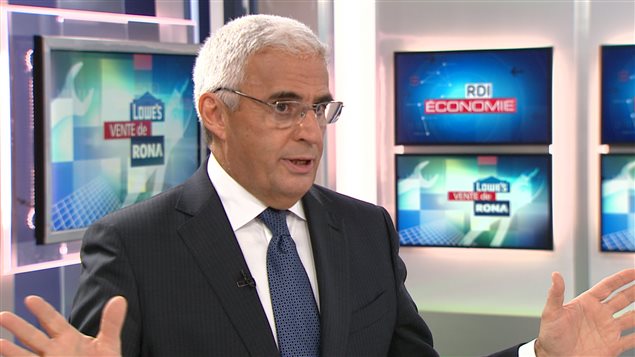
Robert Dutton donne son point de vue sur la vente de RONA !


Problèmes de gouvernance ?

Je suis certain que plusieurs seront intéressés à connaître la version de Robert Dutton, ex-PDG de RONA, parue dans un livre racontant les dessous de l’affaire. Je vous souhaite une bonne lecture de l’article publié par Michel Girard dans le Journal de Montréal aujourd’hui.
Mettez-vous à la place de Robert Dutton. Se faire mettre à la porte de «son» entreprise après 35 années de loyaux services, dont 20 à titre de président et chef de la direction, c’est à la fois blessant et révoltant.
La blessure est d’autant plus grande lorsque vous découvrez que votre départ avait en fait pour finalité de permettre aux gros actionnaires, dont la Caisse de dépôt et placement, de faire la piastre en vendant l’entreprise à une multinationale américaine.
Farouche défenseur d’un Québec inc. qui protège ses sièges sociaux, l’ancien grand patron de RONA, Robert Dutton, ne voulait rien savoir des offres d’acquisition de Lowe’s.

Inconcevable

Pour lui, il était inconcevable de voir RONA devenir une filiale d’une multinationale étrangère.
Pour les gros fonds institutionnels qui détiennent des blocs d’actions de votre entreprise, il était évident qu’un PDG comme Dutton représentait un obstacle majeur.
C’est le genre de gars capable de déplacer des montagnes pour protéger l’entreprise contre les prédateurs étrangers.

Les dessous de la vente de RONA : l’ex-PDG ne voulait rien savoir des offres de Lowe’s

Top 10 de Harvard Law School Forum on Corporate Governance au 6 septembre 2018


Voici le compte rendu hebdomadaire du forum de la Harvard Law School sur la gouvernance corporative au 6 septembre 2018.

Comme à l’habitude, j’ai relevé les dix principaux billets.

Bonne lecture !


Résultats de recherche d'images pour « top 10 »


Résultats de recherche d'images pour « Top 10 en gouvernance Harvard Law School »


Top 10 de Harvard Law School Forum on Corporate Governance au 30 août 2018


Voici le compte rendu hebdomadaire du forum de la Harvard Law School sur la gouvernance corporative au 30 août 2018.

Comme à l’habitude, j’ai relevé les dix principaux billets.

Bonne lecture !


Résultats de recherche d'images pour « top 10 »


Résultats de recherche d'images pour « Top 10 en gouvernance Harvard Law School »


  1. High-Quality Sales Processes and Appraisal Proceedings
  2. Awakening Governance: ACGA China Corporate Governance Report 2018
  3. The CFIUS Reform Bill
  4. Does Transparency Increase Takeover Vulnerability?
  5. Performance Awards and Say on Pay
  6. Fintech as a Systemic Phenomenon
  7. Securing Financial Stability: Systematic Regulation of Systemic Risk
  8. Gender Quotas in California Boardrooms
  9. The Race to the Bottom in Global Securities Regulation
  10. Supreme Court Nominee and the Derivative Suit

Top 10 de Harvard Law School Forum on Corporate Governance au 23 août 2018


Voici le compte rendu hebdomadaire du forum de la Harvard Law School sur la gouvernance corporative au 23 août 2018.

Comme à l’habitude, j’ai relevé les dix principaux billets.

Bonne lecture !


Résultats de recherche d'images pour « top 10 governance »


Résultats de recherche d'images pour « Top 10 en gouvernance Harvard Law School »


  1. Corporate Governance; Stakeholder Primacy; Federal Incorporation
  2. Microcap Board Governance
  3. Taking Stock: Share Buybacks and Shareholder Value
  4. Shareholder Vote on Golden Parachutes: Determinants and Consequences
  5. Corporate Governance—The New Paradigm: A Better Way Than Federalization
  6. Board Diversity Developments
  7. Corporate Governance in Emerging Markets
  8. Dual-Class Index Exclusion
  9. Board Diversity, Firm Risk, and Corporate Policies
  10. Shareholder Activism: Evolving Tactics

L’objectif visé par les fonds d’investissement activistes afin de profiter au maximum de leurs interventions : la vente de l’entreprise au plus offrant !


Vous trouverez, ci-dessous, un article de Roger L. Martinex-doyen de la Rotman School of Management de l’Université de Toronto, paru dans Harvard Business Review le 20 août 2018, qui remet en question la valeur des interventions des fonds activistes au cours des dernières années.

L’auteur pourfend les prétendus bénéfices des campagnes orchestrées par les fonds activistes en s’appuyant notamment sur une étude d’Allaire qui procure des données statistiques probantes sur les rendements des fonds activistes.

Ainsi, l’étude publiée par Allaire montre que les fonds d’investissement activistes réalisent des rendements moyens de 12,4 %, comparés à 13,5 % pour le S&P 500. Le rendement était de 13,9 % pour des firmes de tailles similaires dans les mêmes secteurs industriels.

Je vous invite à prendre connaissance d’une présentation PPT du professeur Allaire qui présente des résultats empiriques très convaincants : Hedge Fund Activism : Some empirical evidence.

Le résultat qui importe, et qui est très payant, pour les investisseurs activistes est la réalisation de la vente de l’entreprise ciblée afin de toucher la prime de contrôle qui est de l’ordre de 30 %.

The reason investors keep giving their money to these hedge funds is simple. There is gold for activist hedge funds if they can accomplish one thing. If they can get their target sold, the compound annual TSR jumps from a lackluster 12,4 % to a stupendous 94,3 %.  That is why they so frequently agitate for the sale of their victim.

Bonne lecture. Vos commentaires sont les bienvenus.


Activist Hedge Funds Aren’t Good for Companies or Investors, So Why Do They Exist?


Résultats de recherche d'images pour « Activist Hedge Funds Aren’t Good for Companies or Investors, So Why Do They Exist? »


Activist hedge funds have become capital market and financial media darlings. The Economist famously called them“capitalism’s unlikely heroes” in a cover story, and the FT published an article saying we “should welcome” them.

But they are utterly reviled by CEOs. And at best, their performance is ambiguous.

The most comprehensive study of activist hedge fund performance that I have read is by Yvan Allaire at the Institute for Governance of Private and Public Organizations in Montreal, which studies hedge fund campaigns against U.S. companies for an eight-year period (2005–2013).

Total shareholder return is what the activist hedge funds claim to enhance. But for the universe of U.S. activist hedge fund investments Allaire studied, the mean compound annual TSR for the activists was 12.4% while for the S&P500 it was 13.5% and for a random sample of firms of similar size in like industries, it was 13.9%. That is to say, if you decided to invest money in a random sample of activist hedge funds, you would have earned 12.4% before paying the hedge fund 2% per year plus 20% of that 12.4% upside. If instead you would have invested in a Vanguard S&P500 index fund, you would have kept all but a tiny fraction of 13.5%.

Since the returns that they produce underwhelm, why do activist hedge funds exist? Why do investors keep giving them money? It is an important question because the Allaire data shows the truly sad and unfortunate outcomes for the companies after the hedge funds ride off into the sunset, after a median holding period of only 423 unpleasant days. Over this span, employee headcount gets reduced by an average of 12%, while R&D gets cut by more than half, and returns don’t change.

The reason investors keep giving their money to these hedge funds is simple. There is gold for activist hedge funds if they can accomplish one thing. If they can get their target sold, the compound annual TSR jumps from a lackluster 12.4% to a stupendous 94.3%.  That is why they so frequently agitate for the sale of their victim.

But why is this such a lucrative avenue? It is because of the control premium. When a S&P500-sized company gets sold, the average premium over the prevailing stock price that is paid for the right to take over that company is in excess of 30%. This is ironic, of course, because studies show the majority of acquisitions don’t earn the cost of capital for the buyer. It is a case of the triumph of hope over reality – which is not unusual. It is not dissimilar to what happens in the National Football League where the trade price for a future draft pick is typically higher than the trade price for an accomplished successful player. That is because the acquiring team dreams that the player it will pick in the draft will be more awesome than that player is likely to turn out to be. But hope springs eternal!

The activist hedge funds have their eyes focused laser-like on the control premium — which for the S&P 500, which has a market capitalization of $23 trillion, is conservatively a $7 trillion pie assuming a 30% control premium. To get a piece of that scrumptious pie, all they need to do is pressure their victim to put itself up for sale and they will have “created shareholder value.” Of course, on average, they will have destroyed shareholder value for the acquiring firm, but they couldn’t care less. They are long gone by that time; off to the next victim.

And they have lots of friends to help them access the control premium pie. Investment bankers want to help them do the deal whether it is a good deal or not and that $7 trillion pie for hedge funds translates into a multibillion dollar annual slice for investment bankers. And for the M&A lawyers that need to opine on the deal. And the accounting firms that need to audit the deal. And for the proxy voting firms that collect the votes for and against the deal. And the consultants who get hired to do post-merger integration. And the financial press that gets to write stories about an exciting deal.

It is an entire ecosystem that sees the $7 trillion pie and wants a piece of it. It doesn’t matter a whit whether a hedge-fund inspired change of control is a good thing for customers, employees or the combined shareholders involved (selling plus acquiring). It is too lucrative a pie to pass up.

What will stop this lunacy? When shareholders come to their senses and realize that when an activist hedge fund has pressured a company intensively enough to put it up for sale, they are simply feeding the hedge fund beast and the vast majority of the time it will be at their own expense. When activist hedge funds’ access to the $7 trillion pie is shut off, they will have to rely on their ability to actually make their victims perform better. And their track record on that front is mediocre at best.

______________________________________________________________

Roger L. Martin is the director of the Martin Prosperity Institute and a former . He is a coauthor of Creating Great Choices: A Leader’s Guide to Integrative Thinking.

Top 10 de Harvard Law School Forum on Corporate Governance au 16 août 2018


Voici le compte rendu hebdomadaire du forum de la Harvard Law School sur la gouvernance corporative au 16 août 2018.

Comme à l’habitude, j’ai relevé les dix principaux billets.

Bonne lecture !


Résultats de recherche d'images pour « top ten »


Résultats de recherche d'images pour « Top 10 en gouvernance Harvard Law School »


  1. SEC Concept Release on Compensatory Offerings
  2. Shedding the Status of Bank Holding Company
  3. Proposed Amendments to SEC’s Whistleblower Program
  4. Women in the C-Suite: The Next Frontier in Gender Diversity
  5. Director Skill Sets
  6. FCPA Successor Liability
  7. Urban Vibrancy and Firm Value Creation
  8. Self-Dealing Without a Controller
  9. The Misplaced Focus of the ISS Policy on NOL Poison Pills
  10. New Amendments to Delaware General Corporation Law

La place des femmes sur les CA et dans la haute direction des entreprises


Voici un rapport qui fait le point sur la place des femmes dans les CA et dans des postes de haute direction des entreprises publiques (cotées) américaines et internationales.

Cet article, publié par Subodh Mishra* directeur de Institutional Shareholder Services (ISS), est paru sur le forum du Harvad Law School on Corporate Governance, le 13 août 2018.

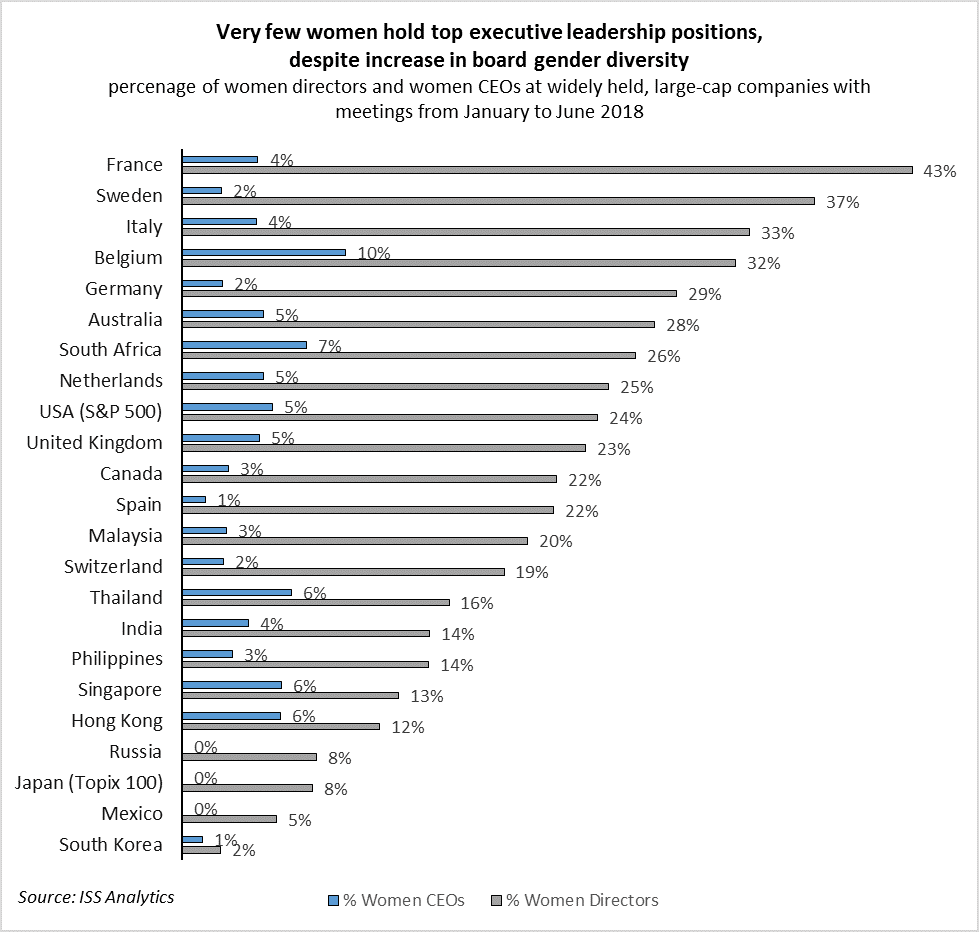
On note des progrès dans tous les domaines, mais l’évolution est encore trop lente. Eu égard à la présence des femmes sur les CA des grandes entreprises cotées, c’est la France qui remporte la palme avec 43 % de femmes sur les CA.

Les entreprises se dotent de plus en plus de politique de divulgation de la diversité sur les postes de haute direction. Le Danemark (96 %), l’Australie (91 %) et le R.U. (84 %) sont en tête de liste en ce qui concerne la présence de politique à cet égard. Les É.U. (32 %) et la Russie (22 %) ferment la marche. Le Canada est en milieu de peloton avec 63 %.

L’infographie présentée ici montre clairement les tendances dans ce domaine.

L’auteur identifie les cinq pratiques émergentes les plus significatives pour mettre en œuvre une politique de diversité exemplaire.

(1) Address subtle or unconscious bias.

Cultivating a strong culture free of subtle or unconscious bias is a fundamental step towards an inclusive work environment. A meta-analysis by the Harvard Business Review finds that subtle discrimination has as negative effects, if not more negative, than overt discrimination, as it can drain emotional and cognitive resources, it can accumulate quickly, and is difficult to address through legal recourse. The researchers suggest that structured processes and procedures around hiring, assignments, and business decisions limit the opportunity for unconscious bias to creep in. In addition, they suggest training programs and practicing techniques, such as mindfulness, to reduce bias.

(2) Establish clear diversity targets and measure progress towards goals.

Most companies with gender diversity strategies set clear, measurable targets. BP has set a goal of women representing at least 25 percent of its group leaders by 2020, while Symantecaims at having 30 percent of leadership roles occupied by women by the same year. This approach allows firms to focus on concrete performance results, while also creating a framework of accountability in the company’s gender diversity and inclusion program.

(3) Focus on key roles and redefine the path to leadership.

True meritocracy should determine the criteria for leadership roles. However, companies should recognize that there may be multiple paths to the CEO position, and should focus on their efforts on roles that lead to those paths. Women CEOs Speak, A Korn Ferry Institute study supported by the Rockefeller Foundation, identifies four different career approaches for women to prepare for the CEO role. However, the study identifies early assumption of profit-and-loss responsibilities in all four paths as a crucial experience leading to top positions.

(4) Establish mentorship and sponsorship programs.

Training and development programs within the organization can help facilitate mentorships and sponsorships, which are crucial in career development. GM’s Diversity and Inclusion Report explains how its Executive Leadership Program aims at creating a support network of female leaders, as well as training and development sessions hosted by female executives. Mentors can support employees earlier in their career with coaching and advice, while sponsors take a more active role later in one’s career to promote the individual. Gender should obviously not constitute a barrier for such mentorships and sponsorships, and organizations should take active steps to encourage such relationships across genders and remove any hesitations or biases.

(5) Provide flexibility and support towards work-life balance.

Top executive assignments often involve significant time commitments and travel that can impact an executive’s family life. In a New York Times news analysis, former McDonald’s executive Janice Fields, identified her choice not to work overseas as a handicap to becoming the CEO. Making accommodations in relation family, including both children and spouses, can remove some significant hurdles for women.


Women in the C-Suite: The Next Frontier in Gender Diversity


Résultats de recherche d'images pour « Women in the C-Suite: The Next Frontier in Gender Diversity »


Despite recent advances in female board participation globally, gender diversity among top executives remains disappointingly low across all markets, with some improvement discerned in the past few years. Moreover, there does not appear a correlation between board gender diversity and gender diversity in the C-Suite at the market level. Some of the markets that have implemented gender quotas on boards and have achieved the highest rates of female board participation, such as France, Sweden, and Germany, appear to have embarrassingly low rates of female top executives. In fact, many of the markets with progressive board diversity policies have lower gender diversity levels in executive positions compared to several emerging markets like South Africa, Singapore, and Thailand. Thus, achieving higher rates of gender diversity in the C-Suite will require deeper cultural shifts within organizations in order to overcome potential biases and hurdles to gender equality.

The number of female top executives remains low


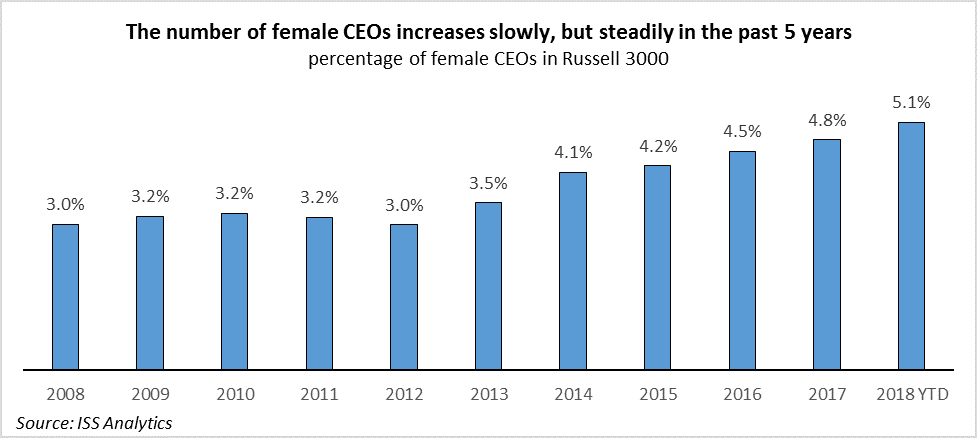
In the past decade, gender quotas, policy initiatives, and—more recently—investor pressure have led to boards improving female board participation in Europe and North America significantly. The percentage of female directors in the Russell 3000 increased from 10 percent in 2008 to 18 percent in 2018, with most of the increase taking place since 2013. Similarly, the percentage of female directors in ISS’s core universe of widely-held European firms more than tripled from 8 percent in 2008 to 27 percent in 2018. While the recent push by policymakers, investors, and advocacy groups for greater gender diversity has primarily focused on board positions, the discussion is beginning to evolve to encompass diversity in all leadership roles, including top management. In the United States, we have observed small but significant changes in the gender composition of the C-Suite over the past five years. Since 2012, the Russell 3000 has seen a 70-percent increase in the number of female CEOs. Despite the relative increase, the number of top female executives remains disappointingly low, with only 5 percent of Russell 3000 companies having a female CEO in 2018.


Companies need to develop the pipeline of female executive leaders


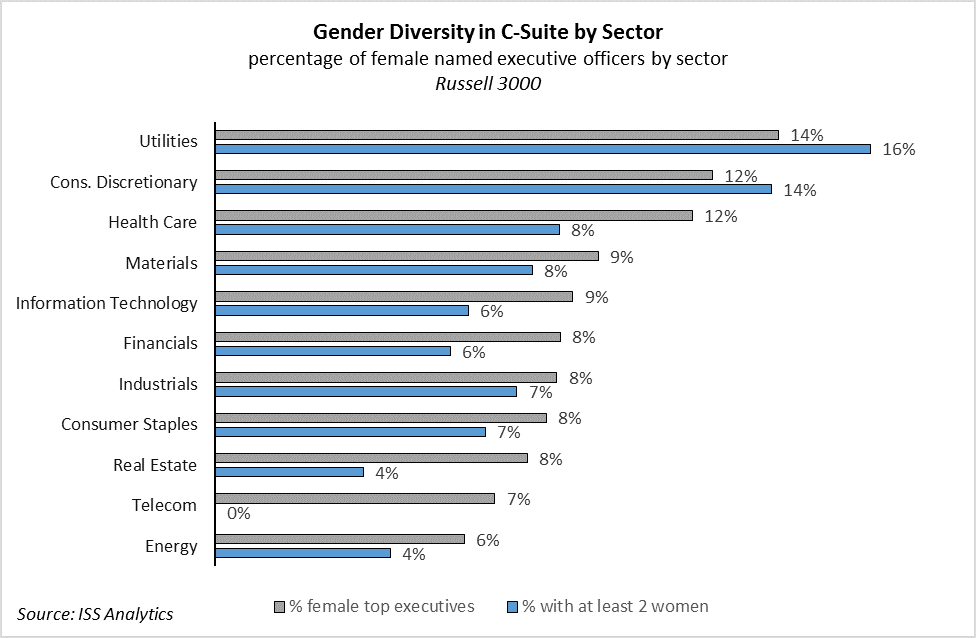
The scarcity of female CEOs does not appear surprising, especially after taking a closer look at the rest of the members of the C-Suite, who often comprise the primary candidates in line for succession for the top job. These roles include the Chief Operating Officer, the Chief Financial Officer, and the Head of Sales, among others. Only 9 percent of top executive positions in the Russell 3000 are filled by women, which means that companies have a long way to go towards building gender equity within the top ranks where the next generation of CEOs are cultivated. Certain sectors lag considerably more than others, with Real Estate, Telecommunications and Energy exhibiting the lowest rates of female named executive officers.


Within the C-Suite, gender differentiation persists in terms of executive roles


The picture seems even bleaker for the future of gender parity at the CEO level when examining the types of roles that female top executives currently occupy within their organizations. Female executives appear scarcer at roles with profit-and-loss responsibilities that often serve as stepping stones to the CEO role, such as COO, Head of Sales, or CEOs of business units and subsidiary groups. Meanwhile, women are more highly concentrated in positions that rarely see a promotion to the top job, such as Human Resources Officer, General Counsel, and Chief Administrative Officer.


Not surprisingly, and in conjunction with the disparity in functions described above, women who belong to the group of the five highest paid executive officers in their organization, are far more likely to rank fourth or fifth in pay rank compared to their male counterparts. Approximately 46 percent of women in the top five positions rank either fourth or fifth in pay, compared to 33 percent of male top five executives in these pay rankings.


Breaking down barriers to gender diversity in the C-Suite


Companies can take a number steps to foster gender diversity in their executive leadership, and to remove biases or potential obstacles to an inclusive management environment. Many companies have identified gender diversity in leadership positions as a key priority, and have established gender diversity strategies to achieve specific goals. While workforce diversity policies appear to become the standard across most markets, gender diversity policies at the senior management level are common only in some markets. According to ISS Environmental & Social QualityScore data, the majority of companies in developed European markets and Canada disclose gender diversity policies for senior managers. The practice has not been widely established United States, where 32 percent of the S&P 500 and only 4 percent of the remaining Russell 3000 disclose such policies.


Several companies and advocacy groups identify gender diversity and inclusion as a major driver for talent acquisition and performance. The recognition of the absence of women in top executive roles has sparked several initiatives that seek to promote inclusivity in the workplace. The Rockefeller Foundation’s 100×25 advocacy initiative aims at bringing more women to the C-Suite, with the explicit goal of having 100 Fortune 500 female CEOs by 2025. Meanwhile, Paradigm for Parity was formed by a coalition of business leaders (CEOs, founders, and board members), and set the goal of achieving full gender parity by 2030. The group has created a 5-point action plan to help companies accelerate their progress.

Based on the work of these initiatives and actual programs disclosed by companies, we identify five of the emerging best practices that companies adopt to address gender diversity in leadership roles.

Address subtle or unconscious bias. Cultivating a strong culture free of subtle or unconscious bias is a fundamental step towards an inclusive work environment. A meta-analysis by the Harvard Business Review finds that subtle discrimination has as negative effects, if not more negative, than overt discrimination, as it can drain emotional and cognitive resources, it can accumulate quickly, and is difficult to address through legal recourse. The researchers suggest that structured processes and procedures around hiring, assignments, and business decisions limit the opportunity for unconscious bias to creep in. In addition, they suggest training programs and practicing techniques, such as mindfulness, to reduce bias.

Establish clear diversity targets and measure progress towards goals. Most companies with gender diversity strategies set clear, measurable targets. BP has set a goal of women representing at least 25 percent of its group leaders by 2020, while Symantecaims at having 30 percent of leadership roles occupied by women by the same year. This approach allows firms to focus on concrete performance results, while also creating a framework of accountability in the company’s gender diversity and inclusion program.

Focus on key roles and redefine the path to leadership. True meritocracy should determine the criteria for leadership roles. However, companies should recognize that there may be multiple paths to the CEO position, and should focus on their efforts on roles that lead to those paths. Women CEOs Speak, A Korn Ferry Institute study supported by the Rockefeller Foundation, identifies four different career approaches for women to prepare for the CEO role. However, the study identifies early assumption of profit-and-loss responsibilities in all four paths as a crucial experience leading to top positions.

Establish mentorship and sponsorship programs. Training and development programs within the organization can help facilitate mentorships and sponsorships, which are crucial in career development. GM’s Diversity and Inclusion Report explains how its Executive Leadership Program aims at creating a support network of female leaders, as well as training and development sessions hosted by female executives. Mentors can support employees earlier in their career with coaching and advice, while sponsors take a more active role later in one’s career to promote the individual. Gender should obviously not constitute a barrier for such mentorships and sponsorships, and organizations should take active steps to encourage such relationships across genders and remove any hesitations or biases.

Provide flexibility and support towards work-life balance. Top executive assignments often involve significant time commitments and travel that can impact an executive’s family life. In a New York Times news analysis, former McDonald’s executive Janice Fields, identified her choice not to work overseas as a handicap to becoming the CEO. Making accommodations in relation family, including both children and spouses, can remove some significant hurdles for women.

_________________________________________________________________

*Subodh Mishra is Executive Director at Institutional Shareholder Services, Inc. This post is based on an ISS Analytics publication by Kosmas Papadopoulos, Managing Editor at ISS Analytics.

Top 10 de Harvard Law School Forum on Corporate Governance au 9 août 2018


Voici le compte rendu hebdomadaire du forum de la Harvard Law School sur la gouvernance corporative au 9 août 2018.

Comme à l’habitude, j’ai relevé les dix principaux billets.

Bonne lecture !


Résultats de recherche d'images pour « top 10 »


Résultats de recherche d'images pour « Top 10 en gouvernance Harvard Law School »


Top 10 de Harvard Law School Forum on Corporate Governance au 2 août 2018


Voici le compte rendu hebdomadaire du forum de la Harvard Law School sur la gouvernance corporative au 2 août 2018.

Comme à l’habitude, j’ai relevé les dix principaux billets.

Bonne lecture !


Résultats de recherche d'images pour « Top 10 en gouvernance Harvard Law School »


Résultats de recherche d'images pour « Top 10 en gouvernance Harvard Law School »


Top 10 de Harvard Law School Forum on Corporate Governance au 26 juillet 2018


Voici le compte rendu hebdomadaire du forum de la Harvard Law School sur la gouvernance corporative au 266 juillet 2018.

Comme à l’habitude, j’ai relevé les dix principaux billets.

Bonne lecture !


Résultats de recherche d'images pour « top ten »

Les fonds activistes accusés d’hypocrisie !


Il y a une pléthore d’arguments qui circulent dans la littérature sur la gouvernance et qui concernent les pour et contre des fonds activistes eu égard aux avantages pour les actionnaires.
Voici un article publié par Kai Haakon E. Liekefett*, président de Shareholder Activism Defense Team, paru dans récemment dans ethicalboardroom.
L’auteur tente de montrer l’hypocrisie des fonds activistes de type « edge fund » eu égard aux points suivants :

1. Undermining the shareholder franchise

2. Weakening board independence and diversity

– Overboarding

– Director tenure

– Mandatory retirement age

3. Inconsistency on takeover defences


The hypocrisy of hedge fund activists


In virtually every activism campaign, hedge fund activists don the mantle of the shareholders’ champion and accuse the target company’s board and management of subpar corporate governance.

This claim to having ‘best practices of corporate governance’ at heart is hollow – even hypocritical – as evidenced by at least three examples: hedge fund activists actually undermine the shareholder franchise, they weaken the independence and diversity of the board, and they waffle on their anti-takeover protection stance.


1. Undermining the shareholder franchise


Shareholders have a significant interest in maintaining their franchise: the right to elect directors, approve significant transactions such as a merger or the sale of all or a substantial part of the assets, or amend the charter of a corporation. Hedge fund activists promote themselves as ferocious proponents of this franchise and of ‘shareholder democracy’. In their campaigns, they demand shareholder votes on any matter that allegedly touches on shareholder rights, including areas where corporate law and the bylaws bestow authority on the board.

Yet, in most activism situations, activists seek to influence board decisions and obtain board seats through private settlement negotiations. The price of peace for the corporation is often accepting the addition of one or more activist representatives to the board to avoid the cost and disruption of a proxy contest. Notably, hedge fund activists will accuse directors of  ‘entrenchment’ if a board does not settle and instead opts to let the shareholders decide at the ballot box. This practice of entering into private settlements to appoint directors without a shareholder vote is, of course, directly contrary to the shareholder franchise. For this reason, major institutional investors have called publicly on companies to engage with a broader base of shareholders prior to settling with an activist.

In the same vein, activists habitually accuse directors of ‘disenfranchising shareholders’ when they refresh the board in the face of an activist campaign, arguing that a board must not appoint new directors without shareholder approval. Remarkably, all these concerns for the shareholder franchise quickly disappear once a company engages in settlement discussions with an activist. In private negotiations, activists commonly insist on an immediate appointment to the board. A board’s request to delay the appointment and allow shareholders to vote on an activist’s director designees at the annual meeting is usually met with fierce resistance.

“THERE ARE NUMEROUS EXAMPLES OF CORPORATE GOVERNANCE ‘BEST PRACTICES’ THAT ACTIVISTS TEND TO IGNORE IN CONNECTION WITH THEIR CAMPAIGNS”

Note also that in these private settlement negotiations, activists almost always seek recovery of their campaign expenses and companies typically agree to some level of payment. These demands for expense reimbursement are almost never submitted to shareholders for approval. While the proxy rules expressly require dissidents to disclose ‘whether the question of such reimbursement will be submitted to a vote of security holders’, an activist hedge fund’s interest in the shareholder franchise evaporates once the fund’s own wallet is concerned. All too often, it appears that the activists’ concern for the shareholder franchise is merely for public consumption.


2. Weakening board independence and diversity


The main target of most activist campaigns is the composition of a company’s board of directors. The business model of hedge fund activism is to identify undervalued public companies whose intrinsic value is substantially higher than the share price on the stock exchange. And if the stock market undervalues a company, then it is only fair to look to those in charge of the company: the board of directors. Consequently, activists often argue that a board needs a refresh, typically calling for ‘shareholder representatives’ and ‘industry experts’ to be appointed as directors.

Of course, activists are not interested in just any type of ‘shareholder representative’ in the boardroom. The preferred director candidate is a principal or employee of the activist hedge fund itself. The reason is that activists intend to use the influence in the boardroom to push aggressively for their own agenda. And, in most cases, that agenda is to push the company to take some strategic action that will return financial value to the hedge fund in the near-term – such as a quick sale at a premium – irrespective of the company’s long-term potential.

Often, an activist will also identify the need for more ‘industry experts’ to join the board and propose experts affiliated with the activist to be added. Activists may give lip service to the need for independent director candidates but when they have to choose between placing an independent candidate or themselves on the board, their preferred candidate is an activist principal or employee. Frequently, even if they passionately argued for ‘much-needed industry expertise’ beforehand, activists are quick to drop their independent board nominee in favour of a 30-something activist employee who lacks any significant relevant experience. This is particularly true for smaller activist hedge funds but is also evident at larger companies. Last year, ISS and the Investor Responsibility Research Center Institute (IRRC) published a study of the impact of activism on board refreshment at S&P 1500 companies targeted by activists.  The study found that activist nominees and directors appointed to boards by activists via settlements were nearly three times more likely to be ‘financial services professionals’ compared to directors appointed unilaterally by boards.

Moreover, while proxy advisory firms and key institutional investors increasingly demand more gender and ethnic diversity in boardrooms, most activist slates exclusively feature white, male director candidates. According to last year’s ISS/IRRC study, women comprised only 8.4 per cent of dissident nominees on proxy contest ballots and directors appointed via settlements with activists, and only 4.2 per cent of those candidates and directors were ethnically or racially diverse.

There are numerous other examples of corporate governance ‘best practices’ that activists tend to ignore in connection with their campaigns:

(a) Overboarding ISS, Glass Lewis and most institutional investors agree that a director should not sit on too many boards (in particular if the director is also an executive in his ‘daytime’ job). For activists, this seems to be a non-issue when it comes to themselves or their fund-nominated candidates. In addition, the practice of funds nominating the same people for various campaigns raises independence concerns. As noted in the aforementioned ISS/IRRC study: “Many of these ‘busy’ directors appear to be ‘go-to’ nominees for individual activists. The serial nomination of favourite candidates raises questions about the ‘independence’ of these individuals from their activist sponsors”.

(b) Director tenure Directors who sit on the same board for 10 years and more typically end up in the crosshairs of activist hedge funds, which argue that such directors are entrenched and cannot provide objective oversight. However, it is not uncommon for activist directors to remain on the board for many years if they cannot push the company into a sale.

(c) Mandatory retirement age Young activists frequently decry the high average age of boards and may target older directors as part of a campaign. By contrast, one rarely hears a call for age limits on the board from the more seasoned activists of the 1980s, who are pushing 70 years and beyond. In some campaigns, activists nominated director candidates who were 75 years old, 80 years old or even older.


3. Inconsistency on takeover defences


Activists love to attack companies for their takeover defences and perceived lack of ‘shareholder rights’. They crucify boards who dare to adopt a poison pill in response to a hostile bid or activist stake accumulation. They condemn bylaw amendments for ‘changing the rules of the game after the game has started’. And they deride classified boards as an outrageous entrenchment device whose sole purpose is to shield incumbent directors from the ballot box.

UNLOCKING VALUE Activist hedge funds want to deliver outsize returns within two years

Against this backdrop, it is fascinating and educational to observe what sometimes happens once activists join a board. Activists claim to hate poison pills unless, of course, they were able to acquire a large stake of 15 to 25 per cent before the pill was adopted. In these cases, an activist is sometimes perfectly fine with capping other shareholders at 10 per cent or less because it ensures that the activist remains the largest shareholder with the most influence.

It is also not usual for an activist-controlled board to maintain the very same bylaws the activist previously voraciously attacked in the campaign. Sometimes, activists will limit shareholder rights even further. The rights to act by written consent and call special meetings tend to be among the victims. If shareholders can act by written consent or call special meetings to remove the board, insurgents do not have to wait for an annual shareholder meeting to wage a proxy fight. However, once activists are in charge of a boardroom, these shareholder rights primarily constitute a threat to their own control.

The last example is the classified board (aka ‘staggered board’). In a company with a classified board, only a fraction (usually, one third) of the board members are up for re-election every year. Activists are fierce opponents of classified boards. Classification makes it harder for them to win a proxy fight. For example, it is more difficult to win an election contest for three board seats on a nine-member board if only three board seats are up for election and not all nine directorships. Activists also like the intimidation factor of threatening a proxy fight for control of a board. It makes it easier to settle for two or three seats if the activist starts by demanding seven or more seats. Everything changes, of course, once an activist is on the board. Then, many activists are perfectly comfortable with with it being a classified board. In settlement negotiations, activists often fight hard to be in the director classes that are not up for re-election in the near term. Occasionally, they even suggest a ‘reshuffling’ of the director classes to achieve this. Activists also often refuse to leave a classified board after a standstill expires, arguing that they need to be allowed to serve out their three-year term – even if they previously campaigned for annual director elections.

“ACTIVISTS HAVE BEEN ABLE TO CLOAK THEMSELVES IN THE MANTLE OF SHAREHOLDER CHAMPION WHILE PRIVATELY PUSHING TO INCREASE THEIR OWN INFLUENCE”

In other words, when it comes to takeover defences, activists’ perspectives depend on whether they have control of the boardroom or not. When activists are successful in ‘conquering the castle’, there is sometimes little reluctance on their part to pull up the drawbridge.

The true reason why activists love corporate governance


These examples make clear that most activists really do not care about corporate governance all that much. So why are activists so focussed on corporate governance in their campaigns? For the same reason why politicians kiss babies during political campaigns: it plays well with the voters. Most institutional investors and the proxy advisory firms ISS and Glass Lewis care deeply about governance issues. That is because they believe, with some justification, that good corporate governance will create shareholder value in the long-term. The long term, of course, is rarely the game of activist hedge funds. Most of these funds have capital with relatively short lock-ups, which means that their own investors will be breathing down their neck if they do not deliver outsize returns within a year or two.

Many activists will admit after a few drinks that their professed passion for governance is only a means to an end. Activists preach so-called ‘best practices of corporate governance’ in every proxy fight because it is an effective way to smear an incumbent board and rile up the voters who do care about governance issues.

Conclusion


Hedge fund activists have been able to cloak themselves in the mantle of a shareholder champion while privately pushing to increase their own influence. Institutional investors and proxy advisory firms should not look to activist hedge funds as promoters of good corporate practices. Activists are no Robin Hoods. They care about good corporate governance just as much as they care about taking from the rich and giving to the poor.


_____________________________________________________

Kai Haakon Liekefett* is a partner of Sidley Austin LLP in New York and the chair of the firm’s Shareholder Activism Defense Team. He has over 18 years of experience in corporate law in New York, London, Germany, Hong Kong and Tokyo. He dedicates 100% of his time to defending companies against shareholder activism campaigns and proxy contests. Kai holds a Ph.D. from Freiburg University; an Executive MBA from Muenster Business School; and an LL.M., James Kent Scholar, from Columbia Law School. He is admitted to practice in New York and Germany. The opinions expressed in this article are those of the author and not necessarily those of Sidley Austin LLP or its clients.

Principes simples et universels de saine gouvernance | Rappel d’un billet antérieur


Quels sont les principes fondamentaux de la bonne gouvernance ? Voilà un sujet bien d’actualité, une question fréquemment posée, qui appelle, trop souvent, des réponses complexes et peu utiles pour ceux qui siègent à des conseils d’administration.

L’article de Jo Iwasaki, paru sur le site du NewStateman, a l’avantage de résumer très succinctement les cinq (5) grands principes qui doivent animer et inspirer les administrateurs de sociétés.

Les principes évoqués dans l’article sont simples et directs ; ils peuvent même paraître simplistes, mais, à mon avis, ils devraient servir de puissants guides de référence à tous les administrateurs de sociétés.

Les cinq principes retenus dans l’article sont les suivants :


(1) Un solide engagement du conseil (leadership) ;

(2) Une grande capacité d’action liée au mix de compétences, expertises et savoir-être ;

(3) Une reddition de compte efficace envers les parties prenantes ;

(4) Un objectif de création de valeur et une distribution équitable entre les principaux artisans de la réussite ;

(5) De solides valeurs d’intégrité et de transparence susceptibles de faire l’objet d’un examen minutieux de la part des parties prenantes.


« What board members need to remind themselves is that they are collectively responsible for the long-term success of their company. This may sound obvious but it is not always recognised ».


What are the fundamental principles of corporate governance ?


Résultats de recherche d'images pour « les principes de la bonne gouvernance »


Our suggestion is to get back to the fundamental principles of good governance which board members should bear in mind in carrying out their responsibilities. If there are just a few, simple and short principles, board members can easily refer to them when making decisions without losing focus. Such a process should be open and dynamic.

In ICAEW’s  recent paper (The Institute of Chartered Accountants in England and Wales) What are the overarching principles of corporate governance?, we proposed five such principles of corporate governance.

Leadership

An effective board should head each company. The Board should steer the company to meet its business purpose in both the short and long term.

Capability

The Board should have an appropriate mix of skills, experience and independence to enable its members to discharge their duties and responsibilities effectively.

Accountability

The Board should communicate to the company’s shareholders and other stakeholders, at regular intervals, a fair, balanced and understandable assessment of how the company is achieving its business purpose and meeting its other responsibilities.

Sustainability

The Board should guide the business to create value and allocate it fairly and sustainably to reinvestment and distributions to stakeholders, including shareholders, directors, employees and customers.

Integrity

The Board should lead the company to conduct its business in a fair and transparent manner that can withstand scrutiny by stakeholders.

We kept them short, with purpose, but we also kept them aspirational. None of them should be a surprise – they might be just like you have on your board. Well, why not share and exchange our ideas – the more we debate, the better we remember the principles which guide our own behaviour.


De son côté, l’Ordre des administrateurs agréés du Québec (OAAQ) a retenu six (6) valeurs fondamentales qui devraient guider les membres dans l’accomplissement de leurs tâches de professionnels.

Il est utile de les rappeler dans ce billet :


Transparence 


La transparence laisse paraître la réalité tout entière, sans qu’elle soit altérée ou biaisée. Il n’existe d’autre principe plus vertueux que la transparence de l’acte administratif par l’administrateur qui exerce un pouvoir au nom de son détenteur ; celui qui est investi d’un pouvoir doit rendre compte de ses actes à son auteur.

Essentiellement, l’administrateur doit rendre compte de sa gestion au mandant ou autre personne ou groupe désigné, par exemple, à un conseil d’administration, à un comité de surveillance ou à un vérificateur. L’administrateur doit également agir de façon transparente envers les tiers ou les préposés pouvant être affectés par ses actes dans la mesure où le mandant le permet et qu’il n’en subit aucun préjudice.


Continuité


La continuité est ce qui permet à l’administration de poursuivre ses activités sans interruption. Elle implique l’obligation du mandataire de passer les pouvoirs aux personnes et aux intervenants désignés pour qu’ils puissent remplir leurs obligations adéquatement.

La continuité englobe aussi une perspective temporelle. L’administrateur doit choisir des avenues et des solutions qui favorisent la survie ou la croissance à long terme de la société qu’il gère. En lien avec la saine gestion, l’atteinte des objectifs à court terme ne doit pas menacer la viabilité d’une organisation à plus long terme.


Efficience


L’efficience allie efficacité, c’est-à-dire, l’atteinte de résultats et l’optimisation des ressources dans la pose d’actes administratifs. L’administrateur efficient vise le rendement optimal de la société à sa charge et maximise l’utilisation des ressources à sa disposition, dans le respect de l’environnement et de la qualité de vie.

Conscient de l’accès limité aux ressources, l’administrateur met tout en œuvre pour les utiliser avec diligence, parcimonie et doigté dans le but d’atteindre les résultats anticipés. L’absence d’une utilisation judicieuse des ressources constitue une négligence, une faute qui porte préjudice aux commettants.


Équilibre


L’équilibre découle de la juste proportion entre force et idées opposées, d’où résulte l’harmonie contributrice de la saine gestion des sociétés. L’équilibre se traduit chez l’administrateur par l’utilisation dynamique de moyens, de contraintes et de limites imposées par l’environnement en constante évolution.

Pour atteindre l’équilibre, l’administrateur dirigeant doit mettre en place des mécanismes permettant de répartir et balancer l’exercice du pouvoir. Cette pratique ne vise pas la dilution du pouvoir, mais bien une répartition adéquate entre des fonctions nécessitant des compétences et des habiletés différentes.


Équité


L’équité réfère à ce qui est foncièrement juste. Plusieurs applications en lien avec l’équité sont enchâssées dans la Charte canadienne des droits et libertés de la Loi canadienne sur les droits de la personne et dans la Charte québécoise des droits et libertés de la personne. L’administrateur doit faire en sorte de gérer en respect des lois afin de prévenir l’exercice abusif ou arbitraire du pouvoir.


Abnégation


L’abnégation fait référence à une personne qui renonce à tout avantage ou intérêt personnel autres que ceux qui lui sont accordés par contrat ou établis dans le cadre de ses fonctions d’administrateur.

Pourquoi les employés ont-ils tendance à bafouer les règles d’éthique ?


Dans le contexte du nouveau code de gouvernance du Royaume-Uni, les administrateurs doivent exercer une vigilance accrue de la culture des organisations.

Cet article de GUENDALINA DONDE*publié dans Board Agenda, nous rappelle certains enseignements concernant la nature des comportements éthiques dans les organisations.

Perhaps the first important lesson from behavioural ethics is to forget the idea that human beings are perfectly rational. In reality, people do not always make consistent decisions, based on strict logic or narrow self-interest. Human behaviour is complex and emotions and intuition have a significant role to play in individual decision-making.

Voici donc plusieurs facteurs qui peuvent avoir une incidence significative sur les comportements éthiques et sur la culture organisationnelle.

J’ai pensé que tous les administrateurs devraient se familiariser avec ces notions.

Bonne lecture ! Vos commentaires sont les bienvenus.


Business ethics: Why do good people do bad things?


The UK’s revised governance code will require boards to keep a watchful eye on their corporate cultures. To this end, understanding behavioural ethics can help instil the right values in employees.

There is no escaping the current increasing pressure for boards to have this question on their agenda, as the draft new UK Corporate Governance Code contains a provision requiring directors to monitor and assess their corporate culture to satisfy themselves that behaviour throughout the business is in line with the company’s values.

Perhaps the first important lesson from behavioural ethics is to forget the idea that human beings are perfectly rational.

What can be done to ensure that employee behaviour is in line with ethical values? Ethics programmes, which include the development of a code of ethics, training and communication campaigns can go some way, but even the best-intentioned ethics programmes will fail if they don’t take into account behavioural ethics—the biases that can blind us to unethical behaviour, whether ours or that of others.


People are likely to put aside their personal moral standards at work if they think this is what is expected of their role


“I was only following orders” is a classic indicator of this kind of ethical blindness. Expectations of a role can translate into pressure to compromise one’s ethical standards.

Many organisations make explicit in their code of ethics that all employees, and managers in particular, have the responsibility to be a role model for ethics in the organisation. It is important that this message is also reinforced through the communications strategy and through training for managers.


Ethics needs to become part of the reward, recognition and promotion system


Availability bias means that people tend to overestimate the likelihood of something happening because a similar event has either happened recently or because they feel emotional about a previous similar event. If employees remember that someone was promoted or rewarded for commercial results, which were achieved by unethical means, they will think that this is the norm—even if it was just a one-off event.

On the other hand, recognising and rewarding those who live up to the organisation’s ethical values, or communicating positive stories internally, can be a quick and effective way to send employees the message that ethics is important in the organisation.


Time pressure can negatively impact organisational culture and the ability to consider ethical implications of decisions


A group of seminary students were asked to prepare a talk on the Good Samaritan at two adjacent buildings. In between talks, the researchers told participants that they should hurry, varying the amount of urgency between students. An actor was situated in an alleyway between the two buildings, posing as a sick man.

The results showed that time pressure had a significant impact on the students’ willingness to stop and help the sick man: in low-hurry situations, 63% helped; medium hurry, 45%; and high hurry only 10%. This was even when, ironically, they were on their way to prepare a talk on the Good Samaritan.


Internal communications and the language used within an organisation can have a significant impact on ethical culture


The framing effect is a cognitive bias where individuals respond differently to the same problem depending on how it is presented. Communications manipulate perception and how a situation is interpreted or framed, making it easier for employees to rationalise their behaviour. The use of aggressive language—such as “at war with competitors”—promotes rigid framing which can, in turn, drive ethical blindness.

On the other hand, using positive language can be a driver of change—changing a whistleblowing line to a “Speak Up” line can have a significant effect on call volume.


In some circumstances, “nudging” ethics can be more effective than enforcing compliance


Nudge Theory (developed by the 2017 Nobel laureate Richard Thaler) suggests that positive reinforcement and indirect suggestions can be more effective in encouraging desired behaviour than direct instructions, legislation and enforcement.

This concept has seen many applications, especially in marketing, and it can also be used to promote an ethical culture. An approach that focuses on ethics—by communicating ethical values, explaining how and why an organisation does its business, encouraging individual judgement based on ethical values—is at least as important as having clear rules of conduct which employees must follow, and the related sanctions.


Individual responsibility for values and associated behaviours needs to be encouraged


Following the atrocities of World War II, one of the most researched behaviour patterns has been the willingness of people to put aside their own moral standards and give up responsibility for their actions if they are following the instructions of a person in a position of authority.

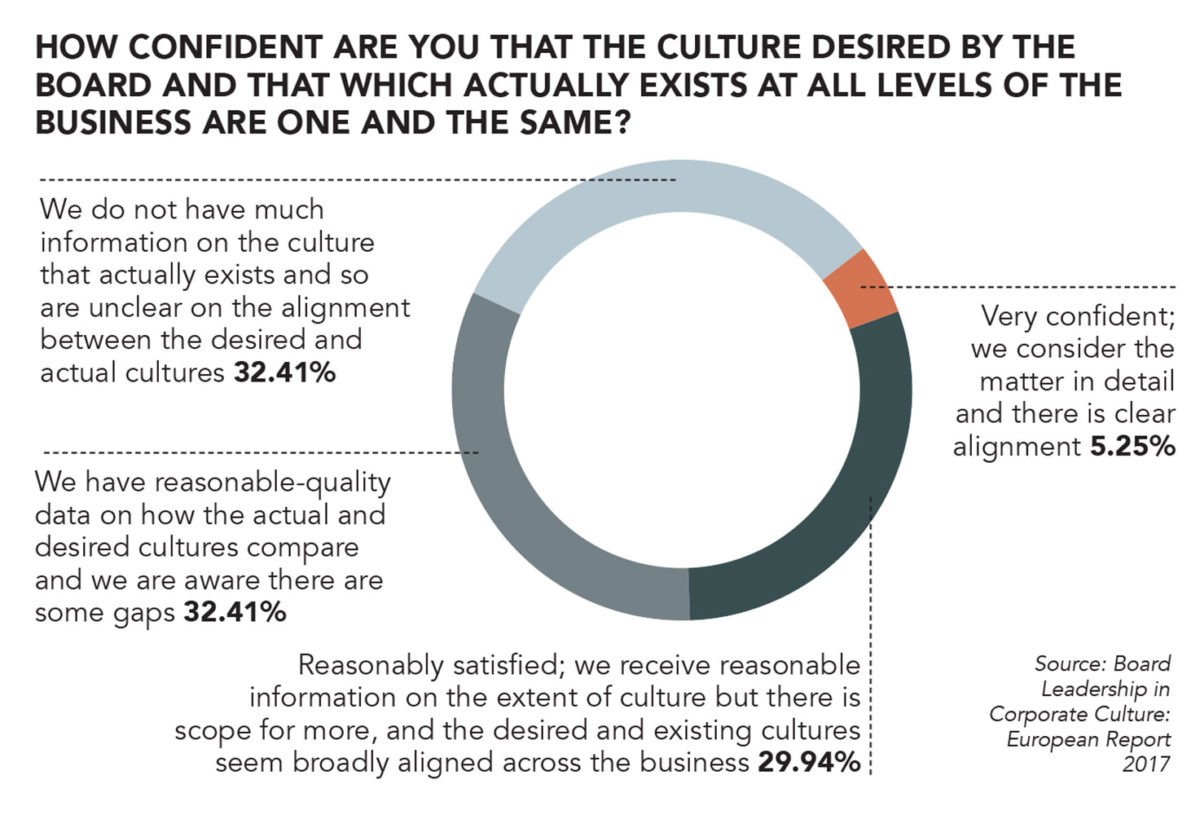
To prevent this kind of blind obedience, it is important that companies encourage employees to apply critical thinking and learn how to take initiative, rather than just follow orders.corporate culture, Board Agenda Culture Survey

Perhaps the most well known of these studies was by Stanley Milgram, whose electric-shock experiment showed that people are likely to follow orders given by authority figures (e.g. managers, teachers, police officers) even if it means inflicting harm on another human being.

To prevent this kind of blind obedience, it is important that companies encourage employees to apply critical thinking and learn how to take initiative, rather than just follow orders. Promoting an open culture where employees feel empowered to challenge decisions, even when they have been instructed by a superior, is paramount.


People determine the appropriate behaviour by looking at what others are doing


The phrase “everybody’s doing it” is a red flag which signifies that there may be an ethical problem. Social pressure from a majority group can cause a person to conform to a certain behaviour, and there is plenty of research to back this up, most recently from behavioural economists like Francesca Gino and Dan Ariely.

To avoid this ethical risk, training staff on ethical matters is important to create a shared systems of beliefs and to keep these issues prominent in people’s minds when they face a difficult decision.

Leadership engagement and the right “tone at the top” are also crucial. We naturally follow our leaders, and employees will be more likely to behave unethically if they perceive that their senior leaders and managers fail to “walk the talk”.


Doing the right thing needs to become our instinctive reaction


Daniel Kahneman, professor of psychology at Princeton University, proposes that most human decision-making is done intuitively and subconsciously (“System 1”) before the cognitive part of the brain engages (“System 2”).

In many circumstances, even when people feel they are making a rational decision, their cognitive System 2 is simply rationalising a decision that their intuitive System 1 has already made. Sometimes this results in a seemingly irrational decision that might increase ethical risk.

Embedding ethical values into everything the organisation does can help them become an automatic part of an employee’s System 1. Corporate culture—“the way things are done around here”—is a powerful influence upon our corporate subconscious.

Sometimes a company’s culture can actually be working against its ethical values. Looking at which behaviours are rewarded, considering how messages are framed, and setting an example at the top are all examples of how ethics can achieve saliency in an organisation.

So perhaps the question should be: Why do good people do good things? And how can we support and empower them to consider the ethical implications of their decisions?

________________________________________________________________________

Guendalina Dondè* is a senior researcher at the Institute of Business Ethics.

Le futur code de gouvernance du Royaume-Uni


Je vous invite à prendre connaissance du futur code de gouvernance du Royaume-Uni (R.-U.).

À cet effet, voici un billet de Martin Lipton*, paru sur le site de Harvard Law School Forum on Corporate Governance, qui présente un aperçu des points saillants.

Bonne lecture !


The Financial Reporting Council today [July 16, 2018] issued a revised corporate governance code and announced that a revised investor stewardship code will be issued before year-end. The code and related materials are available at www.frc.org.uk.

The revised code contains two provisions that will be of great interest. They will undoubtedly be relied upon in efforts to update the various U.S. corporate governance codes. They will also be used to further the efforts to expand the sustainability and stakeholder concerns of U.S. boards.

First, the introduction to the code makes note that shareholder primacy needs to be moderated and that the concept of the “purpose” of the corporation, as long put forth in the U.K. by Colin Mayer and recently popularized in the U.S. by Larry Fink in his 2018 letter to CEO’s, is the guiding principle for the revised code:

Companies do not exist in isolation. Successful and sustainable businesses underpin our economy and society by providing employment and creating prosperity. To succeed in the long-term, directors and the companies they lead need to build and maintain successful relationships with a wide range of stakeholders. These relationships will be successful and enduring if they are based on respect, trust and mutual benefit. Accordingly, a company’s culture should promote integrity and openness, value diversity and be responsive to the views of shareholders and wider stakeholders.

Second, the code provides that the board is responsible for policies and practices which reinforce a healthy culture and that the board should engage:

with the workforce through one, or a combination, of a director appointed from the workforce, a formal workforce advisory panel and a designated non-executive director, or other arrangements which meet the circumstances of the company and the workforce.

It will be interesting to see how this provision will be implemented and whether it gains any traction in the U.S.


The UK Corporate Governance Code


Résultats de recherche d'images pour « UK Corporate Governance Code 2018 »


Martin Lipton* is a founding partner of Wachtell, Lipton, Rosen & Katz, specializing in mergers and acquisitions and matters affecting corporate policy and strategy. This post is based on a Wachtell Lipton memorandum by Mr. Lipton.

Top 10 de Harvard Law School Forum on Corporate Governance au 19 juillet 2018


Voici le compte rendu hebdomadaire du forum de la Harvard Law School sur la gouvernance corporative au 19 juillet 2018.

Comme à l’habitude, j’ai relevé les dix principaux billets.

Bonne lecture !


Résultats de recherche d'images pour « top 10 »


  1. Further Thoughts on Elon Musk’s Compensation

  2. An Empirical Comparison of Insider Trading Enforcement in Canada and the US

  3. Are Institutional Investors with Multiple Blockholdings Effective Monitors?

  4. Supreme Court Ruling on SEC-Appointed Judges

  5. 2018 Investor Corporate Governance Report

  6. Do Foreign Investors Improve Market Efficiency?

  7. The UK Corporate Governance Code

  8. The Effect of Institutional Ownership Types On Innovation and Competition

  9. M&A Litigation Developments: Where Do We Go From Here?

  10. The Preclusive Effect of Demand Futility

Les sept attentes que les comités d’audit ont envers les chefs des finances


Une bonne relation entre le Président du comité d’Audit et le Vice-président Finance (CFO) est absolument essentielle pour une gestion financière éclairée, fidèle et intègre.

Les auteurs sont liés au Centre for Board Effectiveness de Deloitte. Dans cette publication, parue dans le Wall Street Journal, ils énoncent les sept attentes que les comités d’audit ont envers les chefs des finances.

Cet article sera certainement très utile aux membres de conseils, notamment aux membres des comtés d’audit ainsi qu’à la direction financière de l’entreprise.

Bonne lecture ! Vos commentaires sont les bienvenus.


The CFO and the Audit Committee: Building an Effective Relationship


Résultats de recherche d'images pour « Common Expectations Audit Committee Have of CFOs »


The evolution of the CFO’s role is effecting a shift in the audit committee’s expectations for the working relationship between the two. By considering their response to seven commonly held expectations audit committees have of CFOs, CFOs can begin to lay the groundwork for a more effective working relationship with their organization’s audit committee.

Typically, CFOs play four key roles within their organizations, but the amount of time CFOs allocate to each role is changing rapidly. “For CFOs high integrity of work, accuracy, and timely financial reporting are table stakes, but increasingly they are being expected to be Strategists and Catalysts in their organization,” says Ajit Kambil, global research director for Deloitte’s CFO Program. “In fact, our research indicates that CFOs are spending about 60% to 70% of their time in those roles, and that shift is both reflecting and driving higher expectations from the CEO as well as the board.”

As in any relationship, a degree of trust between CFOs and audit committee chairs serves as a foundation to an effective communication on critical issues. “In high-functioning relationships between CFOs and audit committee chairs, trust and dialogue are critical. Challenges can occur if a CFO comes to an audit committee meeting unprepared or presents a surprising conclusion to the audit committee without having sought the audit committee chair’s opinion, leaving the audit committee chair without the ability to influence that conclusion,” says Henry Phillips, vice chairman and national managing partner, Center for Board Effectiveness, Deloitte & Touche LLP.


Common Expectations Audit Committee Have of CFOs


Following are seven key expectations audit committees have of CFOs for both new and established CFOs to bear in mind.


(1) No Surprises: 

Audit committees do not welcome any surprises. Or, if surprises occur, the audit committee will want to be apprised of the issue very quickly. Surprises may be inevitable, but the audit committee expects CFOs to take precautions against known issues and to manage the avoidable ones and to inform them very early on when something unexpected occurs. In order to do this well, it is important for the CFO and the audit committee chair — perhaps some of the other board members — to set a regular cadence of meetings, so that they have a relationship and a context within which to work together when challenging issues arise. Don’t leave these meetings to chance. “If the audit committee chair or committee members are hearing about something of significance for the first time in a meeting, that’s problematic. Rather, the CFO should be apprising the audit committee chair as much in advance of a committee meeting as possible and talk through the issues so the audit committee chair is not surprised in the meeting,” says Phillips.


(2) Strong partnering with the CEO and other leaders: 

Audit committees want to see the CFO as an effective partner with the CEO, as well as with their peer executives. “The audit committee is carefully observing the CFO and how he or she interacts across the C-suite. At the same time, the audit committee also wants the CFO to be objective and to provide to the board independent perspectives on financial and business issues and not be a ‘yes’ person,” says Deb DeHaas, vice chair and national managing partner, Center for Board Effectiveness at Deloitte. A key for the CFO is to proactively manage CEO and peer relations — especially if there are challenging issues that may be brought up to the board. In that case, the CFO should be prepared to take a clear position on what the board needs to hear from management.

(3) Confidence in finance organization talent: 


Audit committees want visibility into the finance organization to ensure that it has the appropriate skills and experience. They also are looking to ensure that the finance organization will be stable over time, that there will be solid succession plans in place and that talent is being developed to create the strongest possible finance organization. CFOs might consider approaching these goals in several ways. One way is to provide key finance team members an opportunity to brief the audit committee on a special topic, for example, a significant accounting policy, a special analysis or another topic that’s on the board agenda. “While I encourage CFOs to give their team members an opportunity to present to the committee, it’s critical to make sure they’re well prepared and ready to address questions,” Phillips notes.

An outside-in view from audit committee members can bring significant value to the CFO — and to the organization.


(4) Command of key accounting, finance and business issues: 


Audit committees want CFOs to have a strong command of the key accounting issues that might be facing the organization, and given that many CFOs are not CPAs, such command is even more critical for the CFO to demonstrate. Toward that end, steps the CFO can take might include scheduling deep dives with management, the independent auditor, the chief accounting officer and others to receive briefings in order to better understand the organization’s critical issues from an accounting perspective, as well as to get trained up on those issues. In addition, CFOs should demonstrate a deep understanding of the business issues that the organization is confronting. There again, CFOs can leverage both internal and external resources to help them master these issues. Industry briefings are also important, particularly for CFOs who are new to an industry.


(5) Insightful forecasting and earnings guidance: 


Forecasts and earnings guidance will likely not always be precise. However, audit committees expect CFOs to not only deliver reliable forecasts, but also to articulate the underlying drivers of the company’s future performance, as well as how those drivers might impact outcomes. When CFOs lack a thorough understanding of critical assumptions and drivers, they can begin to lose support of key audit committee members. For that reason, it is important that CFOs have an experienced FP&A group to support them. In addition,audit committees and boards want to deeply understand the guidance that is being put forward, the ranges, and confidence levels. As audit committee members read earnings releases and other information in the public domain, they tend to focus on whether the information merely meets the letter of the law in terms of disclosures, or does it tell investors what they need to know to make informed decisions. This is where an outside-in view from audit committee members can bring significant value to the CFO — and to the organization. Moreover, audit committees are increasingly interested in the broader macroeconomic issues that can impact the organization, such as interest rates, oil prices, and geographic instability.


(6) Effective risk management: 


CFOs are increasingly held accountable for risk management, even when there is a chief risk officer. Further, audit committees want CFOs to provide leadership not only on traditional financial accounting and compliance risk matters, but also on some of the enterprise operational macro-risk issues — and to show how that might impact the financial statement. It is important for CFOs to set the tone at the top for compliance and ethics, oversee the control environment and ensure that from a compensation perspective, the appropriate incentives and structures are in place to mitigate risk. A key to the CFO’s effectiveness at this level is to find time to have strategic risk conversations at the highest level of management, as well as with the board.


(7) Clear and concise stakeholder communications: 


Audit committees want CFOs to be very effective on how they communicate with key stakeholders, which extend beyond the board and the audit committees. They want CFOs to be able to articulate the story behind the numbers and provide insights and future trends around the business, and to effectively communicate to the Street. CFOs can expect board members to listen to earnings calls and to observe how they interact with the CEOs, demonstrate mastery of the company’s financial and business issues, and communicate those to the Street. Moreover, a CFO who is very capable from an accounting and finance perspective should exercise the communication skills that are necessary to be effective with different stakeholders.


“Communication is the cornerstone for a strong CFO-audit committee chair relationship,” notes DeHaas. “Although the CFO might be doing other things very well, if there is not effective communication and a trusting relationship with the audit committee, the CFO will likely not be as effective.”