Comment un bon président de conseil d’administration se prépare-t-il pour sa réunion ?


C’est avec plaisir que je cède la parole à Johanne Bouchard* qui agit, de nouveau, à titre d’auteure invitée sur mon blogue en gouvernance.

Celle-ci a une solide expérience d’interventions de consultation auprès de conseils d’administration de sociétés américaines ainsi que d’accompagnements auprès de hauts dirigeants de sociétés publiques (cotées), d’organismes à but non lucratif (OBNL) et d’entreprises en démarrage.

Dans ce billet, elle met l’accent sur la manière dont le président du conseil devrait se préparer pour bien assumer ses fonctions de gouvernance et de leadership

Les conseils prodigués sont présentés sous forme d’une check-list pour la préparation d’une bonne rencontre de CA.

L’expérience de Johanne Bouchard auprès d’entreprises cotées en bourse est soutenue ; elle en tire des enseignements utiles pour tous les conseils d’administration.

Bonne lecture ! Vos commentaires sont toujours les bienvenus.


How Good Chairs Prepare for Board Meeting

par

Johanne Bouchard

How Good Chairs Prepare for Board Meetings


A couple of weeks ago, I was interviewed about basics and tactics that a good Board Chair considers in preparation for a board meeting. As I set aside few minutes to prepare for the interview, I jotted down some thoughts and soon realized that I had enough tidbits for a blog. This information is applicable for non-profit organizations, private companies and public corporations.

A Board Chair must make a serious time commitment to plan for board meetings.

– Takes the time to review and reflect on his/her own leadership effectiveness during the last meeting, shortly after it concludes.

Was s/he a strong listener, did s/he lead the meeting effectively and enable constructive opining by others?

Was the agenda fully or partially addressed, and did the board achieve what the directors should have achieved? How could the agenda have been different?

Did all or some directors appear to be prepared?

Was the CEO in the director role effective? Were the members of the executive team presenting and interacting as effectively as they should have been?

Did the committees meet their commitments? Was there enough time allocated to deliberate, to listen and to leverage the talent around the table for key issues?

Was there clear understanding at the end of the meeting of progress made, red flags, critical priorities for the quarter ahead and tabulation of priorities for management and board going forward?

Did the board make the right decisions, and did it go about the decision making process in the optimal manner? (The board can’t afford to rush decisions.)

Were the right questions asked by the Chair and the directors to uncover what needed to be uncovered?

– Should reach out in person, by phone or by remote meeting to each director (including the CEO) to get their insights about the previous meeting, what their understanding of the priorities are going forward, what should be addressed at the next board meeting and what they think needs to be prioritized on the agenda.

The Chair should ideally be a great listener—a leader open to feedback—who should ask directors what, if anything, s/he could have done differently or more effectively.

As a leader of the board, the Chair must have the capacity to immediately address any and all sticky issues with the CEO and other directors before the next meeting to optimize the effectiveness of the board and the outcome of the next meeting.

It is important to provide feedback, encourage healthy behaviors and deal with any misconduct in a constructive manner without procrastinating.

– Creates the outline of the agenda with the CEO with clear expectations for the next meeting so that the CEO and his/her management team can deliver on expectations.

The next ‘board book’ must be created taking into consideration the outcome of the prior meeting.

– Communicates with each director to prepare for the next board meeting.

While the Chair connects with each director, the CEO should also connect with each director about his/her effectiveness and hear directly the insights from the directors.

The Chair needs to be accessible and also check in with each committee chair to be absolutely current on their issues and their progress or lack thereof.

– Meets in person with the CEO a couple of weeks before the board meeting to ensure that there won’t be any surprises for him/her and directors at the board meeting, that the information to be presented will reflect expectations, to prioritize what must be addressed and where time must be absolutely allocated for deliberation, and finalizes the agenda.

This must all sync with what needs to take place at the board meeting so that the ‘board book’ can be delivered five days to a week beforehand.

– Reviews the board book as soon as s/he has it and re-reviews the agenda, determining how s/he will get through the whole thing, cognizant that the meeting can’t end loosely.

The Chair can go as far as briefly reaching out to other directors to confirm that they will be prepared for the meeting (as it is not uncommon for board directors to not be fully prepared and to not have read the board materials) and must be accessible to directors should they have questions about the board materials before the meeting.

– Reflects on how s/he can be most effective at the next meeting in the days leading up to it.

As for any meeting, a Chair should show up on time and preferably thirty minutes or more before the start of a meeting. Ideally s/he should walk in before anyone else, (preferably) with the CEO to ensure that what should be in the room is there.

Time is precious, and there should not be administrative issues corrected as the meeting is about to get started. The Chair should greet the directors ready to set the tone and start the meeting on time.


*Johanne Bouchard est consultante auprès de conseils d’administration, de chefs de la direction et de comités de direction. Johanne a développé une expertise au niveau de la dynamique et de la composition de conseils d’administration. Après l’obtention de son diplôme d’ingénieure en informatique, sa carrière l’a menée à œuvrer dans tous les domaines du secteur de la technologie, du marketing et de la stratégie à l’échelle mondiale.

Un document complet sur les principes d’éthique et les pratiques de saine gouvernance dans les organismes à buts charitables |En rappel


Plusieurs OBNL sont à la recherche d’un document présentant les principes les plus importants s’appliquant aux organismes à buts charitables.

Le site ci-dessous vous mènera à une description sommaire des principes de gouvernance qui vous servirons de guide dans la gestion et la surveillance des OBNL de ce type. J’espère que ces informations vous seront utiles.

Vous pouvez également vous procurer le livre The Complete Principles for Good Governance and Ethical Practice.

What are the principles ?

The Principles for Good Governance and Ethical Practice outlines 33 principles of sound practice for charitable organizations and foundations related to legal compliance and public disclosure, effective governance, financial oversight, and responsible fundraising. The Principles should be considered by every charitable organization as a guide for strengthening its effectiveness and accountability. The Principles were developed by the Panel on the Nonprofit Sector in 2007 and updated in 2015 to reflect new circumstances in which the charitable sector functions, and new relationships within and between the sectors.

The Principles Organizational Assessment Tool allows organizations to determine their strengths and weaknesses in the application of the Principles, based on its four key content areas (Legal Compliance and Public Disclosure, Effective Governance, Strong Financial Oversight, and Responsible Fundraising). This probing tool asks not just whether an organization has the requisite policies and practices in place, but also enables an organization to determine the efficacy of those practices. After completing the survey (by content area or in full), organizations will receive a score report for each content area and a link to suggested resources for areas of improvement.

Voici une liste des 33 principes énoncés. Bonne lecture !


Principles for Good Governance and Ethical Practice 


Legal Compliance and Public Disclosure

  1. Laws and Regulations
  2. Code of Ethics
  3. Conflicts of Interest
  4. « Whistleblower » Policy
  5. Document Retention and Destruction
  6. Protection of Assets
  7. Availability of Information to the Public

Effective Governance

  1. Board Responsibilities
  2. Board Meetings
  3. Board Size and Structure
  4. Board Diversity
  5. Board Independence
  6. CEO Evaluation and Compensation
  7. Separation of CEO, Board Chair and Board Treasurer Roles
  8. Board Education and Communication
  9. Evaluation of Board Performance
  10. Board Member Term Limits
  11. Review of Governing Documents
  12. Review of Mission and Goals
  13. Board Compensation

Strong Financial Oversight

  1. Financial Records
  2. Annual Budget, Financial
    Performance and Investments
  3. Loans to Directors, Officers,
    or Trustees
  4. Resource Allocation for Programs
    and Administration
  5. Travel and Other Expense Policies
  6. Expense Reimbursement for
    Nonbusiness Travel Companions
  7. Accuracy and Truthfulness of Fundraising Materials

Responsible Fundraising

  1. Compliance with Donor’s Intent
  2. Acknowledgment of Tax-Deductible Contributions
  3. Gift Acceptance Policies
  4. Oversight of Fundraisers
  5. Fundraiser Compensation
  6. Donor Privacy

Guide pratique pour l’amélioration de la gouvernance des OSBL | Une primeur


Ayant collaboré à la réalisation du volume « Améliorer la gouvernance de votre OSBL » des auteurs Jean-Paul Gagné et Daniel Lapointe, j’ai obtenu la primeur de la publication d’un chapitre sur mon blogue en gouvernance.

Le volume a paru en mars. Pour vous donner un aperçu de cette importante publication sur la gouvernance des organisations sans but lucratif (OSBN), j’ai eu la permission des éditeurs, Éditions Caractère et Éditions Transcontinental, de publier l’intégralité du chapitre 4 qui porte sur la composition du conseil d’administration et le recrutement d’administrateurs d’OSBL.

Je suis donc très fier de vous offrir cette primeur et j’espère que le sujet vous intéressera suffisamment pour vous inciter à vous procurer cette nouvelle publication.

Vous trouverez, ci-dessous, un court extrait de la page d’introduction du chapitre 4. Je vous invite à cliquer sur le lien suivant pour avoir accès à l’intégralité du chapitre.


La composition du conseil d’administration et le recrutement d’administrateurs


Vous pouvez également feuilleter cet ouvrage en cliquant ici

Bonne lecture ! Vos commentaires sont les bienvenus.

__________________________________


Les administrateurs d’un OSBL sont généralement élus dans le cadre d’un processus électoral tenu lors d’une assemblée générale des membres. Ils peuvent aussi faire l’objet d’une cooptation ou être désignés en vertu d’un mécanisme particulier prévu dans une loi (tel le Code des professions).

L’élection des administrateurs par l’assemblée générale emprunte l’un ou l’autre des deux scénarios suivants:

1. Les OSBL ont habituellement des membres qui sont invités à une assemblée générale annuelle et qui élisent des administrateurs aux postes à pourvoir. Le plus souvent, les personnes présentes sont aussi appelées à choisir l’auditeur qui fera la vérification des états financiers de l’organisation pour l’exercice en cours.

2. Certains OSBL n’ont pas d’autres membres que leurs administrateurs. Dans ce cas, ces derniers se transforment une fois par année en membres de l’assemblée générale, élisent des administrateurs aux postes vacants et choisissent l’auditeur qui fera la vérification des états financiers de l’organisation pour l’exercice en cours.

ameliorezlagouvernancedevotreosbl

La cooptation autorise le recrutement d’administrateurs en cours d’exercice. Les personnes ainsi choisies entrent au CA lors de la première réunion suivant celle où leur nomination a été approuvée. Ils y siègent de plein droit, en dépit du fait que celle-ci ne sera entérinée qu’à l’assemblée générale annuelle suivante. La cooptation n’est pas seulement utile pour pourvoir rapidement aux postes vacants; elle a aussi comme avantage de permettre au conseil de faciliter la nomination de candidats dont le profil correspond aux compétences recherchées.

Dans les organisations qui élisent leurs administrateurs en assemblée générale, la sélection en fonction des profils déterminés peut présenter une difficulté : en effet, il peut arriver que les membres choisissent des administrateurs selon des critères qui ont peu à voir avec les compétences recherchées, telles leur amabilité, leur popularité, etc. Le comité du conseil responsable du recrutement d’administrateurs peut présenter une liste de candidats (en mentionnant leurs qualifications pour les postes à pourvoir) dans l’espoir que l’assemblée lui fasse confiance et les élise. Certains organismes préfèrent coopter en cours d’exercice, ce qui les assure de recruter un administrateur qui a le profil désiré et qui entrera en fonction dès sa sélection.

Quant à l’élection du président du conseil et, le cas échéant, du vice-président, du secrétaire et du trésorier, elle est généralement faite par les administrateurs. Dans les ordres professionnels, le Code des professions leur permet de déterminer par règlement si le président est élu par le conseil d’administration ou au suffrage universel des membres. Comme on l’a vu, malgré son caractère démocratique, l’élection du président au suffrage universel des membres présente un certain risque, puisqu’un candidat peut réussir à se faire élire à ce poste sans expérience du fonctionnement d’un CA ou en poursuivant un objectif qui tranche avec la mission, la vision ou encore le plan stratégique de l’organisation. Cet enjeu ne doit pas être pris à la légère par le CA. Une façon de minimiser ce risque est de faire connaître aux membres votants le profil recherché pour le président, profil qui aura été préalablement établi par le conseil. On peut notamment y inclure une expérience de conseil d’administration, ce qui aide à réduire la période d’apprentissage du nouveau président et facilite une transition en douceur.

Une révision du volume de Richard Leblanc | Handbook of Board Governance


Voici un article de James McRitchie, publié dans Corporate governance, qui commente succinctement le dernier volume de Richard Leblanc.

Comme je l’ai déjà mentionné dans un autre billet, le livre de Richard Leblanc est certainement l’un des plus importants ouvrages (sinon le plus important) portant sur la gouvernance du conseil d’administration.

Je vous encourage à prendre connaissance de la revue de M. McRitchie, et à vous procurer cette bible.

Bonne lecture !


The Handbook of Board Governance


The Handbook of Board Governance


I continue my review of The Handbook of Board Governance: A Comprehensive Guide for Public, Private, and Not-for-Profit Board Member. With the current post, I provide comments on Part 2 of the book, What Makes for a Good Board? See prior introductory comments and those on Part 1. I suspect the book will soon be the most popular collection of articles of current interest in the field of corporate governance.

The Handbook of Board Governance: Director Independence, Competency, and Behavior


Dr. Richard Leblanc‘s chapter focuses on the above three elements that make an effective director. Regulations require independence but not industry expertise; both are important elements. Leblanc cites ways director independence is commonly compromised and how independence ‘of mind’ can be enhanced. He then applies most of the same principles to choosing external advisors.  Throughout the chapter he employees useful exhibits that reinforce the text with bullet points, tables, etc. for quick reference.

Director competency matrices have become relatively commonplace, although not ubiquitous. Leblanc not only provides a sample and scale, he reminds readers that being a CEO is an experience, not a competency and experience is not synonymous with competency. A sample board diversity matrix is also presented with measurable objectives for age, gender, ethnicity and geography.

Director behavior is the last topic in Leblanc’s chapter. Of course, each board needs to define how its directors are to act, subject to self- and peer-assessment but Leblanc’s ten behaviors is a good starting place:

  1. Independent Judgment
  2. Integrity
  3. Organizational Loyalty
  4. Commitment
  5. Capacity to Challenge
  6. Willingness to Act
  7. Conceptual Thinking Skills
  8. Communication Skills
  9. Teamwork Skills
  10. Influence Skills

That’s just one list of many. Leblanc’s examples and commentary on each adds color and depth. Under the UK’s Corporate Governance Code, director reviews are required to be facilitated by an independent provider every two or three years. Great advice for boards elsewhere as well. As Leblanc reminds readers:

« Proxy access and other renewal reforms are the direct result of boards steadfastly resisting director recruitment on the basis of competencies, the removal of underperforming directors; and the lack of boardroom refreshment, diversification, and renewal ».

La longueur des mandats confiés aux administrateurs compromet-elle leur indépendance ?


La littérature en gouvernance aborde de plus en plus fréquemment les sujets du renouvellement des membres du conseil d’administration, de l’âge et de la durée des mandats en les associant à l’indépendance des administrateurs.

Plusieurs investisseurs institutionnels et firmes de conseil en votation ont inclus le facteur de longévité des administrateurs parmi les éléments à considérer dans l’évaluation du rôle des administrateurs indépendants.

David A. Katz*, associé de la firme Wachtell, Lipton, Rosen & Katz, a publié un article dans le Harvard Law School Forum, qui présente clairement la problématique liée à cet enjeu ; il conclut qu’il n’y a pas de lien de causalité entre le nombre d’années de présence à un conseil et l’indépendance des administrateurs.

Le travail du comité de gouvernance, notamment les plans de relève des administrateurs et l’évaluation des performances des administrateurs sont les meilleurs gages d’une saine indépendance.

In conclusion, we believe that the focus on director tenure is generally misplaced, and that investors would be better served by directly addressing any underlying issues and concerns rather than using board tenure as a proxy. Appropriate board refreshment and director succession plans, accompanied by robust annual director evaluations, are the best means for public companies to ensure that board members are independent, engaged and productive and that they have the relevant experience and expertise to assist the company as it executes on its strategy.

Qu’en pensez-vous ?


Director Tenure Remains a Focus of Investors and Activists


Director tenure, or “board refreshment,” is a corporate governance flashpoint at the moment for institutional investors, boards of directors and proxy advisory firms. One of the top takeaways from the 2016 proxy season, according to EY, is that “board composition remains a key focus—with director tenure and board leadership coming under increased investor scrutiny.” [1] Many investors and shareholder activists view director tenure as integral to issues of board composition, succession planning, diversity, and, most of all, independence.

director tenure

Fortunately, term limits for directors is an idea that, in the United States, appears to have more appeal in theory than in practice. Term limits are in place at only three percent of S&P 500 companies—a decrease from five percent in 2010. Although the sample size is small, term limits in this group range from 10 to 20 years. [2] And, despite the seeming popularity of term limits among investors, during the 2016 proxy season, there were no shareholder proposals regarding director term limits, and during the 2015 proxy season, there were only two. [3] The small number of boards that have mandatory term limits indicates that the vast majority of directors—though they may appreciate the arguments in favor of term limits—determine, as a practical matter, that director tenure is best evaluated on a case-by-case basis, both at the company level and at the level of individual directors. The best way to achieve healthy board turnover is not term limits or retirement ages but a robust director evaluation process combined with an ongoing director succession process.

Board Tenure and Director Independence

For some investors, director term limits represent another avenue to address concerns over director independence. Firmly entrenched as an ideal, yet subject to many interpretations, “director independence” remains the linchpin of good corporate governance. Rules on independence generally aim to ensure that directors deemed “independent” have no conflicts of interest with respect to their service on the board, through financial investments, professional or personal connections, recent employment with the company, and the like. It is considered particularly important that members of the key board committees—audit, nominating/governance, and compensation—have no apparent conflicts that would cast doubt on their ability to exercise, or their likelihood of exercising, their business judgment in an objective and professional manner. Notably, having a significant investment in the company as a stockholder (other than a controlling stockholder), generally does not affect a director’s independence under the SEC or stock exchange rules, even though such directors may have different interests than other shareholders.

Shareholder groups and institutional investors have begun to incorporate director tenure considerations into their company evaluations and voting recommendations. Globally, mandatory term limits and comply-or-explain regimes are being implemented as the issue becomes increasingly high-profile worldwide. [4] Notably, a 2016 Spencer Stuart global survey of 4,000 directors in 60 different countries indicated that directors in private companies are significantly less likely to be subject to term limits. [5] It is telling that, absent the pressures faced by public companies, private boards clearly choose to maintain their latitude regarding board composition decisions.

One source of these pressures may be that in recent years, the average age of directors has increased, and mandatory director retirement ages have either been increased or eliminated at many public companies. Public companies naturally wish to retain productive, experienced directors—many of whom are staying active later in life than their predecessors in previous generations—as well as a recognition that age is not itself generally a limiting fact for a good director. Companies with robust annual director evaluation programs should not need a mandatory retirement age to weed out poorly performing directors. Similarly, younger directors need to undergo the same evaluation on an annual basis to ensure that their performance is up to par.

Long service as an independent director on a board is viewed by some as creating a conflict on the basis that extended tenure creates too close a relationship among longstanding board members and chief executives. Accordingly, a number of influential investors and proxy advisors include director tenure as a consideration in determining their proxy voting policies. CalPERS, for example, updated its proxy voting policy for 2016 to assert that “director independence can be compromised at twelve years of service,” and that after such time, companies should conduct “rigorous evaluations to either classify the director as non-independent or provide a detailed annual explanation of why the director can continue to be classified as independent.” [6]

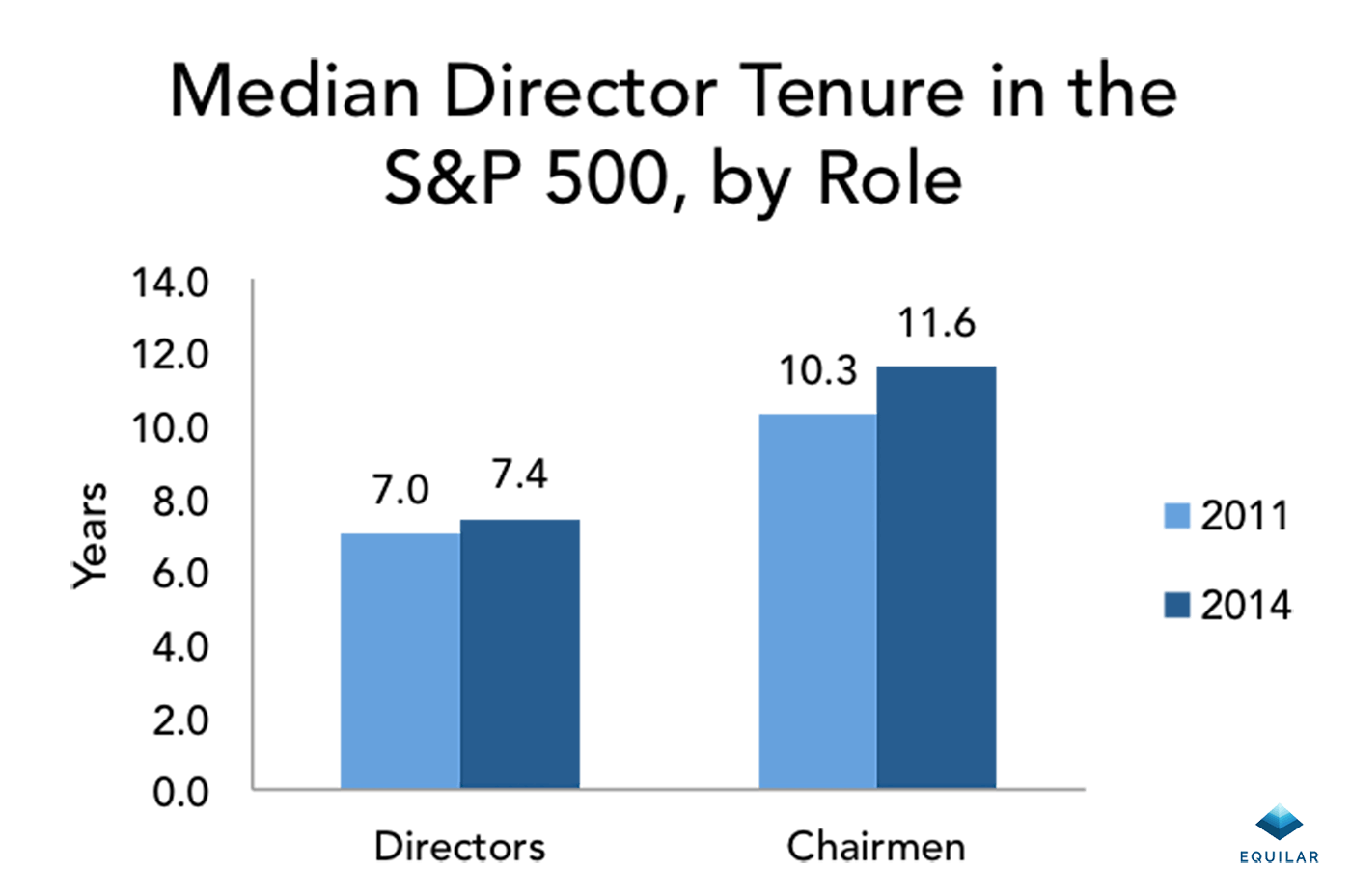
Equating long tenure with a lack of independence is problematic in several ways. As a statistical matter, the average tenure of CEOs in the S&P 500 is 7.4 years, an increase of less than one year in the last decade. [7] Average director tenure in the S&P 500, meanwhile, has remained stable in recent years at roughly 8.5 years. [8] Long coterminous service of directors and chief executives would appear to be the exception rather than the norm. Moreover, long-serving directors are often the ones that have accrued the expertise and standing to influence and effectively oversee a long-serving or otherwise powerful CEO. Institutional investors surveyed by EY last year expressed reservations about director term limits, indicating their concern that mandatory limits do not adequately account for the valuable contributions of experienced directors. Some of these investors felt that a guideline, rather than a strict requirement, as to director tenure could provide a useful starting point for a discussion of board refreshment. [9]

Some investors and academics have gone so far as to propose that, after a certain length of tenure, directors should be considered not independent for the purposes of serving on the audit and compensation committees. [10] In our view, this would be counterproductive in important ways. First, it would limit the usefulness of a board’s most experienced directors by precluding them from serving on the key committees where their expertise may be most valuable. Second, such a ban would impinge upon the board’s business judgment and discretion by micromanaging the very organizational structure of the board itself. Ultimately, if a company’s shareholders have so little confidence in their directors that they feel the need to intervene in board committee assignments, they could not possibly trust the directors to supervise the company generally. Director tenure is an issue at once too picayune—as it is well within the discretion of the board—and too significant—as it affects the board’s latitude to do its job effectively—to be determined by shareholders or outside groups rather than by directors themselves.

We believe that many investors as well as proxy advisory firms are looking at this issue the wrong way. Rather than focusing on simply the longest tenured directors, we believe that it is the average tenure of the entire board that is most relevant. This is a more meaningful metric for evaluating board refreshment and director succession.

Boards Must Maintain Flexibility

Boards should, as a general matter, annually perform a substantive self-evaluation, in which director tenure is one element to consider. The directors should review not only the contributions of current directors, but also the ongoing needs of the board. New directors will be essential as the company undergoes natural changes in strategy and management, and as the board ensures that it creates opportunities to benefit from the contributions of directors with diverse professional and personal backgrounds. A significant amount of director turnover happens as a matter of course: For instance, EY estimates that nearly 20 percent of directors in the S&P 100 are set to retire in the next five years. [11] As an indication that the board is aware of tenure concerns among some investor groups, companies may choose to set forth the average tenure of non-management directors as a separate item in their proxy statement disclosures. [12] As noted above, in our view, average tenure is a more appropriate measure.

When considering the adoption of mandatory term or age limits, boards should recognize that waiving the limits often requires disclosure and may result in negative publicity and even negative vote recommendations. Glass Lewis, for example, does not encourage the adoption of what it calls “inflexible rules” regarding director terms; indeed, its 2016 proxy guidelines endorse the position that length of tenure and age are not correlated with director performance. That said, its policy is to consider recommending a vote against directors on the nominating and/or governance committees if the board waives the company’s mandatory term limit absent explanations and special circumstances. [13]

Directors would be well advised to consider the approach of BlackRock, whose policy is aimed at the substantive issues to which director tenure is only superficially related. BlackRock focuses not on the number of years of service but instead on “board responsiveness to shareholders on board composition concerns, evidence of board entrenchment, insufficient attention to board diversity, and/or failure to promote adequate board succession planning.” [14]

BlackRock sensibly observes in its stated policy that long board tenure does not necessarily impair director independence.

As both Glass Lewis and BlackRock note in their policy statements, term limits can be a tool for boards that are having difficulty in moving long-serving members off the board. Though negotiations of this nature indeed can be fraught, boards are far better served in the long term by working their way through the issue and preserving their own discretion rather than implementing a rule that, while helpful in one instance, may prove undesirable in the future.

In conclusion, we believe that the focus on director tenure is generally misplaced, and that investors would be better served by directly addressing any underlying issues and concerns rather than using board tenure as a proxy. Appropriate board refreshment and director succession plans, accompanied by robust annual director evaluations, are the best means for public companies to ensure that board members are independent, engaged and productive and that they have the relevant experience and expertise to assist the company as it executes on its strategy.

Endnotes:

[1] EY Center for Board Matters, “Four Takeaways from Proxy Season 2016,” discussed on the Forum here.
(go back)

[2] Spencer Stuart Board Index 2015, at 14, available at https://www.spencerstuart.com/%7E/media/pdf%20files/research%20and%20insight%20pdfs/ssbi-2015_110215-web.pdf.
(go back)

[3] The first was at Barnwell Industries, Inc., and it did not come to a vote. The second was at Costco Wholesale Corporation, and it received supporting votes from less than 5 percent of the outstanding shares.
(go back)

[4] See David A. Katz & Laura A. McIntosh, “Renewed Focus on Director Tenure,” May 22, 2014, discussed on the Forum here, for a discussion of viewpoints on director tenure in the United States and abroad.
(go back)

[5] Spencer Stuart 2016 Global Board of Directors Survey, at 9, available at https://www.spencerstuart.com/research-and-insight/2016-global-board-of-directors-survey. The survey found that 39 percent of public companies have mandatory term limits, as opposed to 30 percent of private companies. In addition, 33 percent of public companies had mandatory retirement ages, as opposed to 12 percent of private companies.
(go back)

[6] CalPERS Global Governance Principles, March 2016, at 16, available at https://www.calpers.ca.gov/docs/board-agendas/201603/invest/item05a-02.pdf.
(go back)

[7] Equilar Blog, “CEO Tenure Has Increased Nearly One Full Year since 2005,” available at http://www.equilar.com/blogs/59-ceo-tenure.html.
(go back)

[8] Spencer Stuart Board Index 2015, at 5.
(go back)

[9] EY Center for Board Matters, “2015 Proxy Season Insights: Spotlight on Board Composition,” discussed on the Forum here.
(go back)

[10] See, for example, Yaron Nili, “The ‘New Insiders,’: Rethinking Independent Directors’ Tenure,” U. Wis. L. Sch. Research Paper Series, Paper No. 1390 (2016), discussed on the Forum here.
(go back)

[11] EY Center for Board Matters, “Five-year Outlook: Nearly 20% of Directors Poised for Board Exit,” discussed on the Forum here.
(go back)

[12] See, e.g., American Express Co., 2016 Proxy Statement, at 5 (available at http://ir.americanexpress.com/Cache/1500082785.PDF?O=PDF&T=&Y=&D=&FID=1500082785&iid=102700).
(go back)

[13] Glass Lewis Proxy Paper Guidelines, 2016 Proxy Season, United States, at 20-21, available at http://www.glasslewis.com/wp-content/uploads/2016/01/2016_Guidelines_United_States.pdf.
(go back)

[14] BlackRock Proxy Voting Guidelines for U.S. Securities, February 2015, at 4-5, available at http://www.blackrock.com/corporate/en-us/literature/fact-sheet/blk-responsible-investment-guidelines-us.pdf.
(go back)

_________________________________

*David A. Katz is a partner and Laura A. McIntosh is a consulting attorney at Wachtell, Lipton, Rosen & Katz. The following post is based on an article by Mr. Katz and Ms. McIntosh that first appeared in the New York Law Journal. The views expressed are the authors’ and do not necessarily represent the views of the partners of Wachtell, Lipton, Rosen & Katz or the firm as a whole. Related research from the Program on Corporate Governance includes The “New Insiders”: Rethinking Independent Directors’ Tenure by Yaron Nili (discussed on the Forum here).

Énoncés de principes de gouvernance généralement reconnus


Voici une « lettre ouverte » publiée sur le forum de la Harvard Law School on Corporate Governance par un groupe d’éminents dirigeants de sociétés publiques (cotées) qui présente les principes de la saine gouvernance : « The Commonsense Principles of Corporate Governance »*.

Les principes sont regroupés en plusieurs thèmes :

  1. La composition du CA et la gouvernance interne
    1. Composition
    2. Élection des administrateurs
    3. Nomination des administrateurs
    4. Rémunération des administrateurs et la propriété d’actions
    5. Structure et fonctionnement des comités du conseil
    6. Nombre de mandats et âge de la retraite
    7. Efficacité des administrateurs
  2. Responsabilités des administrateurs
    1. Communication des administrateurs avec de tierces parties
    2. Activités cruciales du conseil : préparer les ordres du jour
  3. Le droit des actionnaires
  4. La reddition de comptes et la divulgation des activités
  5. Le leadership du conseil
  6. La planification de la relève managériale
  7. La rémunération de la direction
  8. Le rôle du gestionnaire des actifs des clients dans la gouvernance des sociétés


Bonne lecture ! Vos commentaires sont les bienvenus.


Commonsense Principles of Corporate Governance


sociétariat_gouvernance


The following is a series of corporate governance principles for public companies, their boards of directors and their shareholders. These principles are intended to provide a basic framework for sound, long-term-oriented governance. But given the differences among our many public companies—including their size, their products and services, their history and their leadership—not every principle (or every part of every principle) will work for every company, and not every principle will be applied in the same fashion by all companies.

I. Board of Directors—Composition and Internal Governance

a. Composition

  1. Directors’ loyalty should be to the shareholders and the company. A board must not be beholden to the CEO or management. A significant majority of the board should be independent under the New York Stock Exchange rules or similar standards.
  2. All directors must have high integrity and the appropriate competence to represent the interests of all shareholders in achieving the long-term success of their company. Ideally, in order to facilitate engaged and informed oversight of the company and the performance of its management, a subset of directors will have professional experiences directly related to the company’s business. At the same time, however, it is important to recognize that some of the best ideas, insights and contributions can come from directors whose professional experiences are not directly related to the company’s business.
  3. Directors should be strong and steadfast, independent of mind and willing to challenge constructively but not be divisive or self-serving. Collaboration and collegiality also are critical for a healthy, functioning board.
  4. Directors should be business savvy, be shareholder oriented and have a genuine passion for their company.
  5. Directors should have complementary and diverse skill sets, backgrounds and experiences. Diversity along multiple dimensions is critical to a high-functioning board. Director candidates should be drawn from a rigorously diverse pool.
  6. While no one size fits all—boards need to be large enough to allow for a variety of perspectives, as well as to manage required board processes—they generally should be as small as practicable so as to promote an open dialogue among directors.
  7. Directors need to commit substantial time and energy to the role. Therefore, a board should assess the ability of its members to maintain appropriate focus and not be distracted by competing responsibilities. In so doing, the board should carefully consider a director’s service on multiple boards and other commitments.

b. Election of directors

Directors should be elected by a majority of the votes cast “for” and “against/withhold” (i.e., abstentions and non-votes should not be counted for this purpose).

c. Nominating directors

  1. Long-term shareholders should recommend potential directors if they know the individuals well and believe they would be additive to the board.
  2. A company is more likely to attract and retain strong directors if the board focuses on big-picture issues and can delegate other matters to management (see below at II.b., “Board of Directors’ Responsibilities/Critical activities of the board; setting the agenda”).

d. Director compensation and stock ownership

  1. A company’s independent directors should be fairly and equally compensated for board service, although (i) lead independent directors and committee chairs may receive additional compensation and (ii) committee service fees may vary. If directors receive any additional compensation from the company that is not related to their service as a board member, such activity should be disclosed and explained.
  2. Companies should consider paying a substantial portion (e.g., for some companies, as much as 50% or more) of director compensation in stock, performance stock units or similar equity-like instruments. Companies also should consider requiring directors to retain a significant portion of their equity compensation for the duration of their tenure to further directors’ economic alignment with the long-term performance of the company.

e. Board committee structure and service

  1. Companies should conduct a thorough and robust orientation program for their new directors, including background on the industry and the competitive landscape in which the company operates, the company’s business, its operations, and important legal and regulatory issues, etc.
  2. A board should have a well-developed committee structure with clearly understood responsibilities. Disclosures to shareholders should describe the structure and function of each board committee.
  3. Boards should consider periodic rotation of board leadership roles (i.e., committee chairs and the lead independent director), balancing the benefits of rotation against the benefits of continuity, experience and expertise.

f. Director tenure and retirement age

  1. It is essential that a company attract and retain strong, experienced and knowledgeable board members.
  2. Some boards have rules around maximum length of service and mandatory retirement age for directors; others have such rules but permit exceptions; and still others have no such rules at all. Whatever the case, companies should clearly articulate their approach on term limits and retirement age. And insofar as a board permits exceptions, the board should explain (ordinarily in the company’s proxy statement) why a particular exception was warranted in the context of the board’s assessment of its performance and composition.
  3. Board refreshment should always be considered in order to ensure that the board’s skill set and perspectives remain sufficiently current and broad in dealing with fast-changing business dynamics. But the importance of fresh thinking and new perspectives should be tempered with the understanding that age and experience often bring wisdom, judgment and knowledge.

g. Director effectiveness

Boards should have a robust process to evaluate themselves on a regular basis, led by the non-executive chair, lead independent director or appropriate committee chair. The board should have the fortitude to replace ineffective directors.

II. Board of Directors’ Responsibilities

a. Director communication with third parties

  1. Robust communication of a board’s thinking to the company’s shareholders is important. There are multiple ways of going about it. For example, companies may wish to designate certain directors—as and when appropriate and in coordination with management—to communicate directly with shareholders on governance and key shareholder issues, such as CEO compensation. Directors who communicate directly with shareholders ideally will be experienced in such matters.
  2. Directors should speak with the media about the company only if authorized by the board and in accordance with company policy.
  3. In addition, the CEO should actively engage on corporate governance and key shareholder issues (other than the CEO’s own compensation) when meeting with shareholders.

b. Critical activities of the board; setting the agenda

  1. The full board (including, where appropriate, through the non-executive chair or lead independent director) should have input into the setting of the board agenda.
  2. Over the course of the year, the agenda should include and focus on the following items, among others:
    1. A robust, forward-looking discussion of the business.
    2. The performance of the current CEO and other key members of management and succession planning for each of them. One of the board’s most important jobs is making sure the company has the right CEO. If the company does not have the appropriate CEO, the board should act promptly to address the issue.
    3. Creation of shareholder value, with a focus on the long term. This means encouraging the sort of long-term thinking owners of a private company might bring to their strategic discussions, including investments that may not pay off in the short run.
    4. Major strategic issues (including material mergers and acquisitions and major capital commitments) and long-term strategy, including thorough consideration of operational and financial plans, quantitative and qualitative key performance indicators, and assessment of organic and inorganic growth, among others.
    5. The board should receive a balanced assessment on strategic fit, risks and valuation in connection with material mergers and acquisitions. The board should consider establishing an ad hoc Transaction Committee if significant board time is otherwise required to consider a material merger or acquisition. If the company’s stock is to be used in such a transaction, the board should carefully assess the company’s valuation relative to the valuation implied in the acquisition. The objective is to properly evaluate the value of what you are giving vs. the value of what you are getting.
    6. Significant risks, including reputational risks. The board should not be reflexively risk averse; it should seek the proper calibration of risk and reward as it focuses on the long-term interests of the company’s shareholders.
    7. Standards of performance, including the maintaining and strengthening of the company’s culture and values.
    8. Material corporate responsibility matters.
    9. Shareholder proposals and key shareholder concerns.
    10. The board (or appropriate board committee) should determine the best approach to compensate management, taking into account all the factors it deems appropriate, including corporate and individual performance and other qualitative and quantitative factors (see below at VII., “Compensation of Management”).
  3. A board should be continually educated on the company and its industry. If a Board feels it would be productive, outside experts and advisors should be brought in to inform directors on issues and events affecting the company.
  4. The board should minimize the amount of time it spends on frivolous or non-essential matters—the goal is to provide perspective and make decisions to build real value for the company and its shareholders.
  5. As authorized and coordinated by the board, directors should have unfettered access to management, including those below the CEO’s direct reports.
  6. At each meeting, to ensure open and free discussion, the board should meet in executive session without the CEO or other members of management. The independent directors should ensure that they have enough time to do this properly.
  7. The board (or appropriate board committee) should discuss and approve the CEO’s compensation.
  8. In addition to its other responsibilities, the Audit Committee should focus on whether the company’s financial statements would be prepared or disclosed in a materially different manner if the external auditor itself were solely responsible for their preparation.

III. Shareholder Rights

  1. Many public companies and asset managers have recently reviewed their approach to proxy access. Others have not yet undertaken such a review or may have one under way. Among the larger market capitalization companies that have adopted proxy access provisions, generally a shareholder (or group of up to 20 shareholders) who has continuously held a minimum of 3% of the company’s outstanding shares for three years is eligible to include on the company’s proxy statement nominees for a minimum of 20% (and, in some cases, 25%) of the company’s board seats. Generally, only shares in which the shareholder has full, unhedged economic interest count toward satisfaction of the ownership/holding period requirements. A higher threshold of ownership (e.g., 5%) often has been adopted for smaller market capitalization companies (e.g., less than $2 billion).
  2. Dual-class voting is not a best practice. If a company has dual-class voting, which sometimes is intended to protect the company from short-term behavior, the company should consider having specific sunset provisions based upon time or a triggering event, which eliminate dual-class voting. In addition, all shareholders should be treated equally in any corporate transaction.
  3. Written consent and special meeting provisions can be important mechanisms for shareholder action. Where they are adopted, there should be a reasonable minimum amount of outstanding shares required in order to prevent a small minority of shareholders from being able to abuse the rights or waste corporate time and resources.

IV. Public Reporting

  1. Transparency around quarterly financial results is important.
  2. Companies should frame their required quarterly reporting in the broader context of their articulated strategy and provide an outlook, as appropriate, for trends and metrics that reflect progress (or not) on long-term goals. A company should not feel obligated to provide earnings guidance—and should determine whether providing earnings guidance for the company’s shareholders does more harm than good. If a company does provide earnings guidance, the company should be realistic and avoid inflated projections. Making short-term decisions to beat guidance (or any performance benchmark) is likely to be value destructive in the long run.
  3. As appropriate, long-term goals should be disclosed and explained in a specific and measurable way.
  4. A company should take a long-term strategic view, as though the company were private, and explain clearly to shareholders how material decisions and actions are consistent with that view.
  5. Companies should explain when and why they are undertaking material mergers or acquisitions or major capital commitments.
  6. Companies are required to report their results in accordance with Generally Accepted Accounting Principles (“GAAP”). While it is acceptable in certain instances to use non-GAAP measures to explain and clarify results for shareholders, such measures should be sensible and should not be used to obscure GAAP results. In this regard, it is important to note that all compensation, including equity compensation, is plainly a cost of doing business and should be reflected in any non-GAAP measurement of earnings in precisely the same manner it is reflected in GAAP earnings.

V. Board Leadership (Including the Lead Independent Director’s Role)

  1. The board’s independent directors should decide, based upon the circumstances at the time, whether it is appropriate for the company to have separate or combined chair and CEO roles. The board should explain clearly (ordinarily in the company’s proxy statement) to shareholders why it has separated or combined the roles.
  2. If a board decides to combine the chair and CEO roles, it is critical that the board has in place a strong designated lead independent director and governance structure.
  3. Depending on the circumstances, a lead independent director’s responsibilities may include:
    1. Serving as liaison between the chair and the independent directors
    2. Presiding over meetings of the board at which the chair is not present, including executive sessions of the independent directors
    3. Ensuring that the board has proper input into meeting agendas for, and information sent to, the board
    4. Having the authority to call meetings of the independent directors
    5. Insofar as the company’s board wishes to communicate directly with shareholders, engaging (or overseeing the board’s process for engaging) with those shareholders
    6. Guiding the annual board self-assessment
    7. Guiding the board’s consideration of CEO compensation
    8. Guiding the CEO succession planning process

VI. Management Succession Planning

  1. Senior management bench strength can be evaluated by the board and shareholders through an assessment of key company employees; direct exposure to those employees is helpful in making that assessment.
  2. Companies should inform shareholders of the process the board has for succession planning and also should have an appropriate plan if an unexpected, emergency succession is necessary.

VII. Compensation of Management

  1. To be successful, companies must attract and retain the best people—and competitive compensation of management is critical in this regard. To this end, compensation plans should be appropriately tailored to the nature of the company’s business and the industry in which it competes. Varied forms of compensation may be necessary for different types of businesses and different types of employees. While a company’s compensation plans will evolve over time, they should have continuity over multiple years and ensure alignment with long-term performance.
  2. Compensation should have both a current component and a long-term component.
  3. Benchmarks and performance measurements ordinarily should be disclosed to enable shareholders to evaluate the rigor of the company’s goals and the goal-setting process. That said, compensation should not be entirely formula based, and companies should retain discretion (appropriately disclosed) to consider qualitative factors, such as integrity, work ethic, effectiveness, openness, etc. Those matters are essential to a company’s long-term health and ordinarily should be part of how compensation is determined.
  4. Companies should consider paying a substantial portion (e.g., for some companies, as much as 50% or more) of compensation for senior management in the form of stock, performance stock units or similar equity-like instruments. The vesting or holding period for such equity compensation should be appropriate for the business to further senior management’s economic alignment with the long-term performance of the company. With properly designed performance hurdles, stock options may be one element of effective compensation plans, particularly for the CEO. All equity grants (whether stock or options) should be made at fair market value, or higher, at the time of the grant, with particular attention given to any dilutive effect of such grants on existing shareholders.
  5. Companies should clearly articulate their compensation plans to shareholders. While companies should not, in the design of their compensation plans, feel constrained by the preferences of their competitors or the models of proxy advisors, they should be prepared to articulate how their approach links compensation to performance and aligns the interests of management and shareholders over the long term. If a company has well-designed compensation plans and clearly explains its rationale for those plans, shareholders should consider giving the company latitude in connection with individual annual compensation decisions.
  6. If large special compensation awards (not normally recurring annual or biannual awards but those considered special awards or special retention awards) are given to management, they should be carefully evaluated and—in the case of the CEO and other “Named Executive Officers” whose compensation is set forth in the company’s proxy statement—clearly explained.
  7. Companies should maintain clawback policies for both cash and equity compensation.

VIII. Asset Managers’ Role in Corporate Governance

Asset managers, on behalf of their clients, are significant owners of public companies, and, therefore, often are in a position to influence the corporate governance practices of those companies. Asset managers should exercise their voting rights thoughtfully and act in what they believe to be the long-term economic interests of their clients.

  1. Asset managers should devote sufficient time and resources to evaluate matters presented for shareholder vote in the context of long-term value creation. Asset managers should actively engage, as appropriate, based on the issues, with the management and/or board of the company, both to convey the asset manager’s point of view and to understand the company’s perspective. Asset managers should give due consideration to the company’s rationale for its positions, including its perspective on certain governance issues where the company might take a novel or unconventional approach.
  2. Given their importance to long-term investment success, proxy voting and corporate governance activities should receive appropriate senior-level oversight by the asset manager.
  3. Asset managers, on behalf of their clients, should evaluate the performance of boards of directors, including thorough consideration of the following:
    1. To the extent directors are speaking directly with shareholders, the directors’ (i) knowledge of their company’s corporate governance and policies and (ii) interest in understanding the key concerns of the company’s shareholders
    2. The board’s focus on a thoughtful, long-term strategic plan and on performance against that plan
  4. An asset manager’s ultimate decision makers on proxy issues important to long-term value creation should have access to the company, its management and, in some circumstances, the company’s board. Similarly, a company, its management and board should have access to an asset manager’s ultimate decision makers on those issues.
  5. Asset managers should raise critical issues to companies (and vice versa) as early as possible in a constructive and proactive way. Building trust between the shareholders and the company is a healthy objective.
  6. Asset managers may rely on a variety of information sources to support their evaluation and decision-making processes. While data and recommendations from proxy advisors may form pieces of the information mosaic on which asset managers rely in their analysis, ultimately, their votes should be based on independent application of their own voting guidelines and policies.
  7. Asset managers should make public their proxy voting process and voting guidelines and have clear engagement protocols and procedures.
  8. Asset managers should consider sharing their issues and concerns (including, as appropriate, voting intentions and rationales therefor) with the company (especially where they oppose the board’s recommendations) in order to facilitate a robust dialogue if they believe that doing so is in the best interests of their clients.

*The Commonsense Principles of Corporate Governance were developed, and are posted on behalf of, a group of executives leading prominent public corporations and investors in the U.S.

The Open Letter and key facts about the principles are also available here and here.

Comment procéder à l’évaluation du CA, des comités et des administrateurs | En rappel !


Les conseils d’administration sont de plus en plus confrontés à l’exigence d’évaluer l’efficacité de leur fonctionnement par le biais d’une évaluation annuelle du CA, des comités et des administrateurs.

En fait, le NYSE exige depuis dix ans que les conseils procèdent à leur évaluation et que les résultats du processus soient divulgués aux actionnaires. Également, les investisseurs institutionnels et les activistes demandent de plus en plus d’informations au sujet du processus d’évaluation.

Les résultats de l’évaluation peuvent être divulgués de plusieurs façons, notamment dans les circulaires de procuration et sur le site de l’entreprise.

L’article publié par John Olson, associé fondateur de la firme Gibson, Dunn & Crutcher, professeur invité à Georgetown Law Center, et paru sur le forum du Harvard Law School, présente certaines approches fréquemment utilisées pour l’évaluation du CA, des comités et des administrateurs.

On recommande de modifier les méthodes et les paramètres de l’évaluation à chaque trois ans afin d’éviter la routine susceptible de s’installer si les administrateurs remplissent les mêmes questionnaires, gérés par le président du conseil. De plus, l’objectif de l’évaluation est sujet à changement (par exemple, depuis une décennie, on accorde une grande place à la cybersécurité).

C’est au comité de gouvernance que revient la supervision du processus d’évaluation du conseil d’administration. L’article décrit quatre méthodes fréquemment utilisées.

(1) Les questionnaires gérés par le comité de gouvernance ou une personne externe

(2) les discussions entre administrateurs sur des sujets déterminés à l’avance

(3) les entretiens individuels avec les administrateurs sur des thèmes précis par le président du conseil, le président du comité de gouvernance ou un expert externe.

(4) L’évaluation des contributions de chaque administrateur par la méthode d’auto-évaluation et par l’évaluation des pairs.

Chaque approche a ses particularités et la clé est de varier les façons de faire périodiquement. On constate également que beaucoup de sociétés cotées utilisent les services de spécialistes pour les aider dans leurs démarches.

agenda733X370-slide


La quasi-totalité des entreprises du S&P 500 divulgue le processus d’évaluation utilisé pour améliorer leur efficacité. L’article présente deux manières de diffuser les résultats du processus d’évaluation.

(1) Structuré, c’est-à-dire un format qui précise — qui évalue quoi ; la fréquence de l’évaluation ; qui supervise les résultats ; comment le CA a-t-il agi eu égard aux résultats de l’opération d’évaluation.

(2) Information axée sur les résultats — les grandes conclusions ; les facteurs positifs et les points à améliorer ; un plan d’action visant à corriger les lacunes observées.

Notons que la firme de services aux actionnaires ISS (Institutional Shareholder Services) utilise la qualité du processus d’évaluation pour évaluer la robustesse de la gouvernance des sociétés. L’article présente des recommandations très utiles pour toute personne intéressée par la mise en place d’un système d’évaluation du CA et par sa gestion.

Voici trois articles parus sur mon blogue qui abordent le sujet de l’évaluation :

L’évaluation des conseils d’administration et des administrateurs | Sept étapes à considérer

Quels sont les devoirs et les responsabilités d’un CA ?  (la section qui traite des questionnaires d’évaluation du rendement et de la performance du conseil)

Évaluation des membres de Conseils

Bonne lecture !

Getting the Most from the Evaluation Process


More than ten years have passed since the New York Stock Exchange (NYSE) began requiring annual evaluations for boards of directors and “key” committees (audit, compensation, nominating/governance), and many NASDAQ companies also conduct these evaluations annually as a matter of good governance. [1] With boards now firmly in the routine of doing annual evaluations, one challenge (as with any recurring activity) is to keep the process fresh and productive so that it continues to provide the board with valuable insights. In addition, companies are increasingly providing, and institutional shareholders are increasingly seeking, more information about the board’s evaluation process. Boards that have implemented a substantive, effective evaluation process will want information about their work in this area to be communicated to shareholders and potential investors. This can be done in a variety of ways, including in the annual proxy statement, in the governance or investor information section on the corporate website, and/or as part of shareholder engagement outreach.

To assist companies and their boards in maximizing the effectiveness of the evaluation process and related disclosures, this post provides an overview of several frequently used methods for conducting evaluations of the full board, board committees and individual directors. It is our experience that using a variety of methods, with some variation from year to year, results in more substantive and useful evaluations. This post also discusses trends and considerations relating to disclosures about board evaluations. We close with some practical tips for boards to consider as they look ahead to their next annual evaluation cycle.

Common Methods of Board Evaluation

As a threshold matter, it is important to note that there is no one “right” way to conduct board evaluations. There is room for flexibility, and the boards and committees we work with use a variety of methods. We believe it is good practice to “change up” the board evaluation process every few years by using a different format in order to keep the process fresh. Boards have increasingly found that year-after-year use of a written questionnaire, with the results compiled and summarized by a board leader or the corporate secretary for consideration by the board, becomes a routine exercise that produces few new insights as the years go by. This has been the most common practice, and it does respond to the NYSE requirement, but it may not bring as much useful information to the board as some other methods.

Doing something different from time to time can bring new perspectives and insights, enhancing the effectiveness of the process and the value it provides to the board. The evaluation process should be dynamic, changing from time to time as the board identifies practices that work well and those that it finds less effective, and as the board deals with changing expectations for how to meet its oversight duties. As an example, over the last decade there have been increasing expectations that boards will be proactive in oversight of compliance issues and risk (including cyber risk) identification and management issues.

Three of the most common methods for conducting a board or committee evaluation are: (1) written questionnaires; (2) discussions; and (3) interviews. Some of the approaches outlined below reflect a combination of these methods. A company’s nominating/governance committee typically oversees the evaluation process since it has primary responsibility for overseeing governance matters on behalf of the board.

1. Questionnaires

The most common method for conducting board evaluations has been through written responses to questionnaires that elicit information about the board’s effectiveness. The questionnaires may be prepared with the assistance of outside counsel or an outside advisor with expertise in governance matters. A well-designed questionnaire often will address a combination of substantive topics and topics relating to the board’s operations. For example, the questionnaire could touch on major subject matter areas that fall under the board’s oversight responsibility, such as views on whether the board’s oversight of critical areas like risk, compliance and crisis preparedness are effective, including whether there is appropriate and timely information flow to the board on these issues. Questionnaires typically also inquire about whether board refreshment mechanisms and board succession planning are effective, and whether the board is comfortable with the senior management succession plan. With respect to board operations, a questionnaire could inquire about matters such as the number and frequency of meetings, quality and timeliness of meeting materials, and allocation of meeting time between presentation and discussion. Some boards also consider their efforts to increase board diversity as part of the annual evaluation process.

Many boards review their questionnaires annually and update them as appropriate to address new, relevant topics or to emphasize particular areas. For example, if the board recently changed its leadership structure or reallocated responsibility for a major subject matter area among its committees, or the company acquired or started a new line of business or experienced recent issues related to operations, legal compliance or a breach of security, the questionnaire should be updated to request feedback on how the board has handled these developments. Generally, each director completes the questionnaire, the results of the questionnaires are consolidated, and a written or verbal summary of the results is then shared with the board.

Written questionnaires offer the advantage of anonymity because responses generally are summarized or reported back to the full board without attribution. As a result, directors may be more candid in their responses than they would be using another evaluation format, such as a face-to-face discussion. A potential disadvantage of written questionnaires is that they may become rote, particularly after several years of using the same or substantially similar questionnaires. Further, the final product the board receives may be a summary that does not pick up the nuances or tone of the views of individual directors.

In our experience, increasingly, at least once every few years, boards that use questionnaires are retaining a third party, such as outside counsel or another experienced facilitator, to compile the questionnaire responses, prepare a summary and moderate a discussion based on the questionnaire responses. The desirability of using an outside party for this purpose depends on a number of factors. These include the culture of the board and, specifically, whether the boardroom environment is one in which directors are comfortable expressing their views candidly. In addition, using counsel (inside or outside) may help preserve any argument that the evaluation process and related materials are privileged communications if, during the process, counsel is providing legal advice to the board.

In lieu of asking directors to complete written questionnaires, a questionnaire could be distributed to stimulate and guide discussion at an interactive full board evaluation discussion.

2. Group Discussions

Setting aside board time for a structured, in-person conversation is another common method for conducting board evaluations. The discussion can be led by one of several individuals, including: (a) the chairman of the board; (b) an independent director, such as the lead director or the chair of the nominating/governance committee; or (c) an outside facilitator, such as a lawyer or consultant with expertise in governance matters. Using a discussion format can help to “change up” the evaluation process in situations where written questionnaires are no longer providing useful, new information. It may also work well if there are particular concerns about creating a written record.

Boards that use a discussion format often circulate a list of discussion items or topics for directors to consider in advance of the meeting at which the discussion will occur. This helps to focus the conversation and make the best use of the time available. It also provides an opportunity to develop a set of topics that is tailored to the company, its business and issues it has faced and is facing. Another approach to determining discussion topics is to elicit directors’ views on what should be covered as part of the annual evaluation. For example, the nominating/governance could ask that each director select a handful of possible topics for discussion at the board evaluation session and then place the most commonly cited topics on the agenda for the evaluation.

A discussion format can be a useful tool for facilitating a candid exchange of views among directors and promoting meaningful dialogue, which can be valuable in assessing effectiveness and identifying areas for improvement. Discussions allow directors to elaborate on their views in ways that may not be feasible with a written questionnaire and to respond in real time to views expressed by their colleagues on the board. On the other hand, they do not provide an opportunity for anonymity. In our experience, this approach works best in boards with a high degree of collegiality and a tradition of candor.

3. Interviews

Another method of conducting board evaluations that is becoming more common is interviews with individual directors, done in-person or over the phone. A set of questions is often distributed in advance to help guide the discussion. Interviews can be done by: (a) an outside party such as a lawyer or consultant; (b) an independent director, such as the lead director or the chair of the nominating/governance committee; or (c) the corporate secretary or inside counsel, if directors are comfortable with that. The party conducting the interviews generally summarizes the information obtained in the interview process and may facilitate a discussion of the information obtained with the board.

In our experience, boards that have used interviews to conduct their annual evaluation process generally have found them very productive. Directors have observed that the interviews yielded rich feedback about the board’s performance and effectiveness. Relative to other types of evaluations, interviews are more labor-intensive because they can be time-consuming, particularly for larger boards. They also can be expensive, particularly if the board retains an outside party to conduct the interviews. For these reasons, the interview format generally is not one that is used every year. However, we do see a growing number of boards taking this path as a “refresher”—every three to five years—after periods of using a written questionnaire, or after a major event, such as a corporate crisis of some kind, when the board wants to do an in-depth “lessons learned” analysis as part of its self-evaluation. Interviews also offer an opportunity to develop a targeted list of questions that focuses on issues and themes that are specific to the board and company in question, which can contribute further to the value derived from the interview process.

For nominating/governance committees considering the use of an interview format, one key question is who will conduct the interviews. In our experience, the most common approach is to retain an outside party (such as a lawyer or consultant) to conduct and summarize interviews. An outside party can enhance the effectiveness of the process because directors may be more forthcoming in their responses than they would if another director or a member of management were involved.

Individual Director Evaluations

Another practice that some boards have incorporated into their evaluation process is formal evaluations of individual directors. In our experience, these are not yet widespread but are becoming more common. At companies where the nominating/governance committee has a robust process for assessing the contributions of individual directors each year in deciding whether to recommend them for renomination to the board, the committee and the board may conclude that a formal evaluation every year is unnecessary. Historically, some boards have been hesitant to conduct individual director evaluations because of concerns about the impact on board collegiality and dynamics. However, if done thoughtfully, a structured process for evaluating the performance of each director can result in valuable insights that can strengthen the performance of individual directors and the board as a whole.

As with board and committee evaluations, no single “best practice” has emerged for conducting individual director evaluations, and the methods described above can be adapted for this purpose. In addition, these evaluations may involve directors either evaluating their own performance (self-evaluations), or evaluating their fellow directors individually and as a group (peer evaluations). Directors may be more willing to evaluate their own performance than that of their colleagues, and the utility of self-evaluations can be enhanced by having an independent director, such as the chairman of the board or lead director, or the chair of the nominating/governance committee, provide feedback to each director after the director evaluates his or her own performance. On the other hand, peer evaluations can provide directors with valuable, constructive comments. Here, too, each director’s evaluation results typically would be presented only to that director by the chairman of the board or lead director, or the chair of the nominating/governance committee. Ultimately, whether and how to conduct individual director evaluations will depend on a variety of factors, including board culture.

Disclosures about Board Evaluations

Many companies discuss the board evaluation process in their corporate governance guidelines. [2] In addition, many companies now provide disclosure about the evaluation process in the proxy statement, as one element of increasingly robust proxy disclosures about their corporate governance practices. According to the 2015 Spencer Stuart Board Index, all but 2% of S&P 500 companies disclose in their proxy statements, at a minimum, that they conduct some form of annual board evaluation.

In addition, institutional shareholders increasingly are expressing an interest in knowing more about the evaluation process at companies where they invest. In particular, they want to understand whether the board’s process is a meaningful one, with actionable items emerging from the evaluation process, and not a “check the box” exercise. In the United Kingdom, companies must report annually on their processes for evaluating the performance of the board, its committees and individual directors under the UK Corporate Governance Code. As part of the code’s “comply or explain approach,” the largest companies are expected to use an external facilitator at least every three years (or explain why they have not done so) and to disclose the identity of the facilitator and whether he or she has any other connection to the company.

In September 2014, the Council of Institutional Investors issued a report entitled Best Disclosure: Board Evaluation (available here), as part of a series of reports aimed at providing investors and companies with approaches to and examples of disclosures that CII considers exemplary. The report recommended two possible approaches to enhanced disclosure about board evaluations, identified through an informal survey of CII members, and included examples of disclosures illustrating each approach. As a threshold matter, CII acknowledged in the report that shareholders generally do not expect details about evaluations of individual directors. Rather, shareholders “want to understand the process by which the board goes about regularly improving itself.” According to CII, detailed disclosure about the board evaluation process can give shareholders a “window” into the boardroom and the board’s capacity for change.

The first approach in the CII report focuses on the “nuts and bolts” of how the board conducts the evaluation process and analyzes the results. Under this approach, a company’s disclosures would address: (1) who evaluates whom; (2) how often the evaluations are done; (3) who reviews the results; and (4) how the board decides to address the results. Disclosures under this approach do not address feedback from specific evaluations, either individually or more generally, or conclusions that the board has drawn from recent self-evaluations. As a result, according to CII, this approach can take the form of “evergreen” proxy disclosure that remains similar from year to year, unless the evaluation process itself changes.

The second approach focuses more on the board’s most recent evaluation. Under this approach, in addition to addressing the evaluation process, a company’s disclosures would provide information about “big-picture, board-wide findings and any steps for tackling areas identified for improvement” during the board’s last evaluation. The disclosures would identify: (1) key takeaways from the board’s review of its own performance, including both areas where the board believes it functions effectively and where it could improve; and (2) a “plan of action” to address areas for improvement over the coming year. According to CII, this type of disclosure is more common in the United Kingdom and other non-U.S. jurisdictions.

Also reflecting a greater emphasis on disclosure about board evaluations, proxy advisory firm Institutional Shareholder Services Inc. (“ISS”) added this subject to the factors it uses in evaluating companies’ governance practices when it released an updated version of “QuickScore,” its corporate governance benchmarking tool, in Fall 2014. QuickScore views a company as having a “robust” board evaluation policy where the board discloses that it conducts an annual performance evaluation, including evaluations of individual directors, and that it uses an external evaluator at least every three years (consistent with the approach taken in the UK Corporate Governance Code). For individual director evaluations, it appears that companies can receive QuickScore “credit” in this regard where the nominating/governance committee assesses director performance in connection with the renomination process.

What Companies Should Do Now

As noted above, there is no “one size fits all” approach to board evaluations, but the process should be viewed as an opportunity to enhance board, committee and director performance. In this regard, a company’s nominating/governance committee and board should periodically assess the evaluation process itself to determine whether it is resulting in meaningful takeaways, and whether changes are appropriate. This includes considering whether the board would benefit from trying new approaches to the evaluation process every few years.

Factors to consider in deciding what evaluation format to use include any specific objectives the board seeks to achieve through the evaluation process, aspects of the current evaluation process that have worked well, the board’s culture, and any concerns directors may have about confidentiality. And, we believe that every board should carefully consider “changing up” the evaluation process used from time to time so that the exercise does not become rote. What will be the most beneficial in any given year will depend on a variety of factors specific to the board and the company. For the board, this includes considerations of board refreshment and tenure, and developments the board may be facing, such as changes in board or committee leadership.  Factors relevant to the company include where the company is in its lifecycle, whether the company is in a period of relative stability, challenge or transformation, whether there has been a significant change in the company’s business or a senior management change, whether there is activist interest in the company and whether the company has recently gone through or is going through a crisis of some kind. Specific items that nominating/governance committees could consider as part of maintaining an effective evaluation process include:

  1. Revisit the content and focus of written questionnaires. Evaluation questionnaires should be updated each time they are used in order to reflect significant new developments, both in the external environment and internal to the board.
  2. “Change it up.”  If the board has been using the same written questionnaire, or the same evaluation format, for several years, consider trying something new for an upcoming annual evaluation. This can bring renewed vigor to the process, reengage the participants, and result in more meaningful feedback.
  3. Consider whether to bring in an external facilitator. Boards that have not previously used an outside party to assist in their evaluations should consider whether this would enhance the candor and overall effectiveness of the process.
  4. Engage in a meaningful discussion of the evaluation results. Unless the board does its evaluation using a discussion format, there should be time on the board’s agenda to discuss the evaluation results so that all directors have an opportunity to hear and discuss the feedback from the evaluation.
  5. Incorporate follow-up into the process. Regardless of the evaluation method used, it is critical to follow up on issues and concerns that emerge from the evaluation process. The process should include identifying concrete takeaways and formulating action items to address any concerns or areas for improvement that emerge from the evaluation. Senior management can be a valuable partner in this endeavor, and should be briefed as appropriate on conclusions reached as a result of the evaluation and related action items. The board also should consider its progress in addressing these items.
  6. Revisit disclosures.  Working with management, the nominating/governance committee and the board should discuss whether the company’s proxy disclosures, investor and governance website information and other communications to shareholders and potential investors contain meaningful, current information about the board evaluation process.

Endnotes:

[1] See NYSE Rule 303A.09, which requires listed companies to adopt and disclose a set of corporate governance guidelines that must address an annual performance evaluation of the board. The rule goes on to state that “[t]he board should conduct a self-evaluation at least annually to determine whether it and its committees are functioning effectively.” See also NYSE Rules 303A.07(b)(ii), 303A.05(b)(ii) and 303A.04(b)(ii) (requiring annual evaluations of the audit, compensation, and nominating/governance committees, respectively).
(go back)

[2] In addition, as discussed in the previous note, NYSE companies are required to address an annual evaluation of the board in their corporate governance guidelines.
(go back)

______________________________

*John Olson is a founding partner of the Washington, D.C. office at Gibson, Dunn & Crutcher LLP and a visiting professor at the Georgetown Law Center.

Comment procéder à l’évaluation du CA, des comités et des administrateurs | Un sujet d’actualité !


Les conseils d’administration sont de plus en plus confrontés à l’exigence d’évaluer l’efficacité de leur fonctionnement par le biais d’une évaluation annuelle du CA, des comités et des administrateurs.

En fait, le NYSE exige depuis dix ans que les conseils procèdent à leur évaluation et que les résultats du processus soient divulgués aux actionnaires. Également, les investisseurs institutionnels et les activistes demandent de plus en plus d’informations au sujet du processus d’évaluation.

Les résultats de l’évaluation peuvent être divulgués de plusieurs façons, notamment dans les circulaires de procuration et sur le site de l’entreprise.

L’article publié par John Olson, associé fondateur de la firme Gibson, Dunn & Crutcher, professeur invité à Georgetown Law Center, et paru sur le forum du Harvard Law School, présente certaines approches fréquemment utilisées pour l’évaluation du CA, des comités et des administrateurs.

On recommande de modifier les méthodes et les paramètres de l’évaluation à chaque trois ans afin d’éviter la routine susceptible de s’installer si les administrateurs remplissent les mêmes questionnaires, gérés par le président du conseil. De plus, l’objectif de l’évaluation est sujet à changement (par exemple, depuis une décennie, on accorde une grande place à la cybersécurité).

C’est au comité de gouvernance que revient la supervision du processus d’évaluation du conseil d’administration. L’article décrit quatre méthodes fréquemment utilisées.

(1) Les questionnaires gérés par le comité de gouvernance ou une personne externe

(2) les discussions entre administrateurs sur des sujets déterminés à l’avance

(3) les entretiens individuels avec les administrateurs sur des thèmes précis par le président du conseil, le président du comité de gouvernance ou un expert externe.

(4) L’évaluation des contributions de chaque administrateur par la méthode d’auto-évaluation et par l’évaluation des pairs.

Chaque approche a ses particularités et la clé est de varier les façons de faire périodiquement. On constate également que beaucoup de sociétés cotées utilisent les services de spécialistes pour les aider dans leurs démarches.

Evaluer-et-faire-évoluer-©-Jingling-Water-Fotolia


La quasi-totalité des entreprises du S&P 500 divulgue le processus d’évaluation utilisé pour améliorer leur efficacité. L’article présente deux manières de diffuser les résultats du processus d’évaluation.

(1) Structuré, c’est-à-dire un format qui précise — qui évalue quoi ; la fréquence de l’évaluation ; qui supervise les résultats ; comment le CA a-t-il agi eu égard aux résultats de l’opération d’évaluation.

(2) Information axée sur les résultats — les grandes conclusions ; les facteurs positifs et les points à améliorer ; un plan d’action visant à corriger les lacunes observées.

Notons que la firme de services aux actionnaires ISS (Institutional Shareholder Services) utilise la qualité du processus d’évaluation pour évaluer la robustesse de la gouvernance des sociétés. L’article présente des recommandations très utiles pour toute personne intéressée par la mise en place d’un système d’évaluation du CA et par sa gestion.

Voici trois articles parus sur mon blogue qui abordent le sujet de l’évaluation :

L’évaluation des conseils d’administration et des administrateurs | Sept étapes à considérer

Quels sont les devoirs et les responsabilités d’un CA ?  (la section qui traite des questionnaires d’évaluation du rendement et de la performance du conseil)

Évaluation des membres de Conseils

Bonne lecture !

Getting the Most from the Evaluation Process


More than ten years have passed since the New York Stock Exchange (NYSE) began requiring annual evaluations for boards of directors and “key” committees (audit, compensation, nominating/governance), and many NASDAQ companies also conduct these evaluations annually as a matter of good governance. [1] With boards now firmly in the routine of doing annual evaluations, one challenge (as with any recurring activity) is to keep the process fresh and productive so that it continues to provide the board with valuable insights. In addition, companies are increasingly providing, and institutional shareholders are increasingly seeking, more information about the board’s evaluation process. Boards that have implemented a substantive, effective evaluation process will want information about their work in this area to be communicated to shareholders and potential investors. This can be done in a variety of ways, including in the annual proxy statement, in the governance or investor information section on the corporate website, and/or as part of shareholder engagement outreach.

To assist companies and their boards in maximizing the effectiveness of the evaluation process and related disclosures, this post provides an overview of several frequently used methods for conducting evaluations of the full board, board committees and individual directors. It is our experience that using a variety of methods, with some variation from year to year, results in more substantive and useful evaluations. This post also discusses trends and considerations relating to disclosures about board evaluations. We close with some practical tips for boards to consider as they look ahead to their next annual evaluation cycle.

Common Methods of Board Evaluation

As a threshold matter, it is important to note that there is no one “right” way to conduct board evaluations. There is room for flexibility, and the boards and committees we work with use a variety of methods. We believe it is good practice to “change up” the board evaluation process every few years by using a different format in order to keep the process fresh. Boards have increasingly found that year-after-year use of a written questionnaire, with the results compiled and summarized by a board leader or the corporate secretary for consideration by the board, becomes a routine exercise that produces few new insights as the years go by. This has been the most common practice, and it does respond to the NYSE requirement, but it may not bring as much useful information to the board as some other methods.

Doing something different from time to time can bring new perspectives and insights, enhancing the effectiveness of the process and the value it provides to the board. The evaluation process should be dynamic, changing from time to time as the board identifies practices that work well and those that it finds less effective, and as the board deals with changing expectations for how to meet its oversight duties. As an example, over the last decade there have been increasing expectations that boards will be proactive in oversight of compliance issues and risk (including cyber risk) identification and management issues.

Three of the most common methods for conducting a board or committee evaluation are: (1) written questionnaires; (2) discussions; and (3) interviews. Some of the approaches outlined below reflect a combination of these methods. A company’s nominating/governance committee typically oversees the evaluation process since it has primary responsibility for overseeing governance matters on behalf of the board.

1. Questionnaires

The most common method for conducting board evaluations has been through written responses to questionnaires that elicit information about the board’s effectiveness. The questionnaires may be prepared with the assistance of outside counsel or an outside advisor with expertise in governance matters. A well-designed questionnaire often will address a combination of substantive topics and topics relating to the board’s operations. For example, the questionnaire could touch on major subject matter areas that fall under the board’s oversight responsibility, such as views on whether the board’s oversight of critical areas like risk, compliance and crisis preparedness are effective, including whether there is appropriate and timely information flow to the board on these issues. Questionnaires typically also inquire about whether board refreshment mechanisms and board succession planning are effective, and whether the board is comfortable with the senior management succession plan. With respect to board operations, a questionnaire could inquire about matters such as the number and frequency of meetings, quality and timeliness of meeting materials, and allocation of meeting time between presentation and discussion. Some boards also consider their efforts to increase board diversity as part of the annual evaluation process.

Many boards review their questionnaires annually and update them as appropriate to address new, relevant topics or to emphasize particular areas. For example, if the board recently changed its leadership structure or reallocated responsibility for a major subject matter area among its committees, or the company acquired or started a new line of business or experienced recent issues related to operations, legal compliance or a breach of security, the questionnaire should be updated to request feedback on how the board has handled these developments. Generally, each director completes the questionnaire, the results of the questionnaires are consolidated, and a written or verbal summary of the results is then shared with the board.

Written questionnaires offer the advantage of anonymity because responses generally are summarized or reported back to the full board without attribution. As a result, directors may be more candid in their responses than they would be using another evaluation format, such as a face-to-face discussion. A potential disadvantage of written questionnaires is that they may become rote, particularly after several years of using the same or substantially similar questionnaires. Further, the final product the board receives may be a summary that does not pick up the nuances or tone of the views of individual directors.

In our experience, increasingly, at least once every few years, boards that use questionnaires are retaining a third party, such as outside counsel or another experienced facilitator, to compile the questionnaire responses, prepare a summary and moderate a discussion based on the questionnaire responses. The desirability of using an outside party for this purpose depends on a number of factors. These include the culture of the board and, specifically, whether the boardroom environment is one in which directors are comfortable expressing their views candidly. In addition, using counsel (inside or outside) may help preserve any argument that the evaluation process and related materials are privileged communications if, during the process, counsel is providing legal advice to the board.

In lieu of asking directors to complete written questionnaires, a questionnaire could be distributed to stimulate and guide discussion at an interactive full board evaluation discussion.

2. Group Discussions

Setting aside board time for a structured, in-person conversation is another common method for conducting board evaluations. The discussion can be led by one of several individuals, including: (a) the chairman of the board; (b) an independent director, such as the lead director or the chair of the nominating/governance committee; or (c) an outside facilitator, such as a lawyer or consultant with expertise in governance matters. Using a discussion format can help to “change up” the evaluation process in situations where written questionnaires are no longer providing useful, new information. It may also work well if there are particular concerns about creating a written record.

Boards that use a discussion format often circulate a list of discussion items or topics for directors to consider in advance of the meeting at which the discussion will occur. This helps to focus the conversation and make the best use of the time available. It also provides an opportunity to develop a set of topics that is tailored to the company, its business and issues it has faced and is facing. Another approach to determining discussion topics is to elicit directors’ views on what should be covered as part of the annual evaluation. For example, the nominating/governance could ask that each director select a handful of possible topics for discussion at the board evaluation session and then place the most commonly cited topics on the agenda for the evaluation.

A discussion format can be a useful tool for facilitating a candid exchange of views among directors and promoting meaningful dialogue, which can be valuable in assessing effectiveness and identifying areas for improvement. Discussions allow directors to elaborate on their views in ways that may not be feasible with a written questionnaire and to respond in real time to views expressed by their colleagues on the board. On the other hand, they do not provide an opportunity for anonymity. In our experience, this approach works best in boards with a high degree of collegiality and a tradition of candor.

3. Interviews

Another method of conducting board evaluations that is becoming more common is interviews with individual directors, done in-person or over the phone. A set of questions is often distributed in advance to help guide the discussion. Interviews can be done by: (a) an outside party such as a lawyer or consultant; (b) an independent director, such as the lead director or the chair of the nominating/governance committee; or (c) the corporate secretary or inside counsel, if directors are comfortable with that. The party conducting the interviews generally summarizes the information obtained in the interview process and may facilitate a discussion of the information obtained with the board.

In our experience, boards that have used interviews to conduct their annual evaluation process generally have found them very productive. Directors have observed that the interviews yielded rich feedback about the board’s performance and effectiveness. Relative to other types of evaluations, interviews are more labor-intensive because they can be time-consuming, particularly for larger boards. They also can be expensive, particularly if the board retains an outside party to conduct the interviews. For these reasons, the interview format generally is not one that is used every year. However, we do see a growing number of boards taking this path as a “refresher”—every three to five years—after periods of using a written questionnaire, or after a major event, such as a corporate crisis of some kind, when the board wants to do an in-depth “lessons learned” analysis as part of its self-evaluation. Interviews also offer an opportunity to develop a targeted list of questions that focuses on issues and themes that are specific to the board and company in question, which can contribute further to the value derived from the interview process.

For nominating/governance committees considering the use of an interview format, one key question is who will conduct the interviews. In our experience, the most common approach is to retain an outside party (such as a lawyer or consultant) to conduct and summarize interviews. An outside party can enhance the effectiveness of the process because directors may be more forthcoming in their responses than they would if another director or a member of management were involved.

Individual Director Evaluations

Another practice that some boards have incorporated into their evaluation process is formal evaluations of individual directors. In our experience, these are not yet widespread but are becoming more common. At companies where the nominating/governance committee has a robust process for assessing the contributions of individual directors each year in deciding whether to recommend them for renomination to the board, the committee and the board may conclude that a formal evaluation every year is unnecessary. Historically, some boards have been hesitant to conduct individual director evaluations because of concerns about the impact on board collegiality and dynamics. However, if done thoughtfully, a structured process for evaluating the performance of each director can result in valuable insights that can strengthen the performance of individual directors and the board as a whole.

As with board and committee evaluations, no single “best practice” has emerged for conducting individual director evaluations, and the methods described above can be adapted for this purpose. In addition, these evaluations may involve directors either evaluating their own performance (self-evaluations), or evaluating their fellow directors individually and as a group (peer evaluations). Directors may be more willing to evaluate their own performance than that of their colleagues, and the utility of self-evaluations can be enhanced by having an independent director, such as the chairman of the board or lead director, or the chair of the nominating/governance committee, provide feedback to each director after the director evaluates his or her own performance. On the other hand, peer evaluations can provide directors with valuable, constructive comments. Here, too, each director’s evaluation results typically would be presented only to that director by the chairman of the board or lead director, or the chair of the nominating/governance committee. Ultimately, whether and how to conduct individual director evaluations will depend on a variety of factors, including board culture.

Disclosures about Board Evaluations

Many companies discuss the board evaluation process in their corporate governance guidelines. [2] In addition, many companies now provide disclosure about the evaluation process in the proxy statement, as one element of increasingly robust proxy disclosures about their corporate governance practices. According to the 2015 Spencer Stuart Board Index, all but 2% of S&P 500 companies disclose in their proxy statements, at a minimum, that they conduct some form of annual board evaluation.

In addition, institutional shareholders increasingly are expressing an interest in knowing more about the evaluation process at companies where they invest. In particular, they want to understand whether the board’s process is a meaningful one, with actionable items emerging from the evaluation process, and not a “check the box” exercise. In the United Kingdom, companies must report annually on their processes for evaluating the performance of the board, its committees and individual directors under the UK Corporate Governance Code. As part of the code’s “comply or explain approach,” the largest companies are expected to use an external facilitator at least every three years (or explain why they have not done so) and to disclose the identity of the facilitator and whether he or she has any other connection to the company.

In September 2014, the Council of Institutional Investors issued a report entitled Best Disclosure: Board Evaluation (available here), as part of a series of reports aimed at providing investors and companies with approaches to and examples of disclosures that CII considers exemplary. The report recommended two possible approaches to enhanced disclosure about board evaluations, identified through an informal survey of CII members, and included examples of disclosures illustrating each approach. As a threshold matter, CII acknowledged in the report that shareholders generally do not expect details about evaluations of individual directors. Rather, shareholders “want to understand the process by which the board goes about regularly improving itself.” According to CII, detailed disclosure about the board evaluation process can give shareholders a “window” into the boardroom and the board’s capacity for change.

The first approach in the CII report focuses on the “nuts and bolts” of how the board conducts the evaluation process and analyzes the results. Under this approach, a company’s disclosures would address: (1) who evaluates whom; (2) how often the evaluations are done; (3) who reviews the results; and (4) how the board decides to address the results. Disclosures under this approach do not address feedback from specific evaluations, either individually or more generally, or conclusions that the board has drawn from recent self-evaluations. As a result, according to CII, this approach can take the form of “evergreen” proxy disclosure that remains similar from year to year, unless the evaluation process itself changes.

The second approach focuses more on the board’s most recent evaluation. Under this approach, in addition to addressing the evaluation process, a company’s disclosures would provide information about “big-picture, board-wide findings and any steps for tackling areas identified for improvement” during the board’s last evaluation. The disclosures would identify: (1) key takeaways from the board’s review of its own performance, including both areas where the board believes it functions effectively and where it could improve; and (2) a “plan of action” to address areas for improvement over the coming year. According to CII, this type of disclosure is more common in the United Kingdom and other non-U.S. jurisdictions.

Also reflecting a greater emphasis on disclosure about board evaluations, proxy advisory firm Institutional Shareholder Services Inc. (“ISS”) added this subject to the factors it uses in evaluating companies’ governance practices when it released an updated version of “QuickScore,” its corporate governance benchmarking tool, in Fall 2014. QuickScore views a company as having a “robust” board evaluation policy where the board discloses that it conducts an annual performance evaluation, including evaluations of individual directors, and that it uses an external evaluator at least every three years (consistent with the approach taken in the UK Corporate Governance Code). For individual director evaluations, it appears that companies can receive QuickScore “credit” in this regard where the nominating/governance committee assesses director performance in connection with the renomination process.

What Companies Should Do Now

As noted above, there is no “one size fits all” approach to board evaluations, but the process should be viewed as an opportunity to enhance board, committee and director performance. In this regard, a company’s nominating/governance committee and board should periodically assess the evaluation process itself to determine whether it is resulting in meaningful takeaways, and whether changes are appropriate. This includes considering whether the board would benefit from trying new approaches to the evaluation process every few years.

Factors to consider in deciding what evaluation format to use include any specific objectives the board seeks to achieve through the evaluation process, aspects of the current evaluation process that have worked well, the board’s culture, and any concerns directors may have about confidentiality. And, we believe that every board should carefully consider “changing up” the evaluation process used from time to time so that the exercise does not become rote. What will be the most beneficial in any given year will depend on a variety of factors specific to the board and the company. For the board, this includes considerations of board refreshment and tenure, and developments the board may be facing, such as changes in board or committee leadership.  Factors relevant to the company include where the company is in its lifecycle, whether the company is in a period of relative stability, challenge or transformation, whether there has been a significant change in the company’s business or a senior management change, whether there is activist interest in the company and whether the company has recently gone through or is going through a crisis of some kind. Specific items that nominating/governance committees could consider as part of maintaining an effective evaluation process include:

  1. Revisit the content and focus of written questionnaires. Evaluation questionnaires should be updated each time they are used in order to reflect significant new developments, both in the external environment and internal to the board.
  2. “Change it up.”  If the board has been using the same written questionnaire, or the same evaluation format, for several years, consider trying something new for an upcoming annual evaluation. This can bring renewed vigor to the process, reengage the participants, and result in more meaningful feedback.
  3. Consider whether to bring in an external facilitator. Boards that have not previously used an outside party to assist in their evaluations should consider whether this would enhance the candor and overall effectiveness of the process.
  4. Engage in a meaningful discussion of the evaluation results. Unless the board does its evaluation using a discussion format, there should be time on the board’s agenda to discuss the evaluation results so that all directors have an opportunity to hear and discuss the feedback from the evaluation.
  5. Incorporate follow-up into the process. Regardless of the evaluation method used, it is critical to follow up on issues and concerns that emerge from the evaluation process. The process should include identifying concrete takeaways and formulating action items to address any concerns or areas for improvement that emerge from the evaluation. Senior management can be a valuable partner in this endeavor, and should be briefed as appropriate on conclusions reached as a result of the evaluation and related action items. The board also should consider its progress in addressing these items.
  6. Revisit disclosures.  Working with management, the nominating/governance committee and the board should discuss whether the company’s proxy disclosures, investor and governance website information and other communications to shareholders and potential investors contain meaningful, current information about the board evaluation process.

Endnotes:

[1] See NYSE Rule 303A.09, which requires listed companies to adopt and disclose a set of corporate governance guidelines that must address an annual performance evaluation of the board. The rule goes on to state that “[t]he board should conduct a self-evaluation at least annually to determine whether it and its committees are functioning effectively.” See also NYSE Rules 303A.07(b)(ii), 303A.05(b)(ii) and 303A.04(b)(ii) (requiring annual evaluations of the audit, compensation, and nominating/governance committees, respectively).
(go back)

[2] In addition, as discussed in the previous note, NYSE companies are required to address an annual evaluation of the board in their corporate governance guidelines.
(go back)

______________________________

*John Olson is a founding partner of the Washington, D.C. office at Gibson, Dunn & Crutcher LLP and a visiting professor at the Georgetown Law Center.

Le fait de siéger à des CA externes augmente-t-il les chances de promotion d’un haut dirigeant dans son entreprise ?


Voici un article très intéressant, récemment publié dans Harvard Business Review par Steven Boivie, Scott D. Graffin, Abbie Oliver et Michael C. Withers, qui montre, de façon convaincante, que, pour un haut dirigeant, le fait de siéger à un CA externe augmente ses chances de promotion dans son entreprise.

Lorsque l’on sait que le travail des administrateurs des entreprises publiques (cotées) est de plus en plus exigeant, l’on peut se demander pourquoi un PDG (CEO) accepte de siéger à un conseil d’administration d’une autre entreprise !

Les auteurs de l’étude ont trouvé des réponses à cette question. Les hauts dirigeants des entreprises de la S&P 1500 qui siègent à d’autres CA augmentent de 44 % leurs chances d’accéder à un poste de CEO dans une entreprise de la S&P 1500, comparativement à leurs collègues qui ne siègent pas à d’autres CA. Et, même s’ils n’ont pas de promotion, la recherche montre que leur rémunération s’accroît de 13 %.

So what do these findings mean for today’s boards of directors and aspiring CEOs? The evidence shows that board appointments increase an executive’s visibility and give him/her access to unique contacts and learning opportunities. Further, these opportunities translate into tangible economic benefits, specifically promotions and raises, which help explain why a sane person would choose to sit on a board.

La recherche d’administrateurs avec un profil de CEO ou de haut dirigeant est de plus en plus fréquente et les firmes de recrutement considèrent que l’obtention de promotions est un signe de leadership notable.

Photo1-petit-poisson

L’étude conclut que, contrairement à la croyance populaire, le fait de siéger à des conseils constitue un atout pour un haut dirigeant, un moyen susceptible d’accroître ses opportunités de carrière.

Il semble bien que le haut dirigeant considère qu’il y a un avantage personnel réel à exercer la fonction d’administrateur dans une autre entreprise. Mais, le CA de l’entreprise sur lequel il siège en retire-t-il un avantage aussi appréciable ?

Ultimately board service is a key professional development tool in grooming potential CEOs that executives and boards alike are beginning to recognize and value.

Je vous invite à lire ce court article du HBR.

Bonne lecture !

Serving on Boards Helps Executives Get Promoted


More than 25 years ago, William Sahlman wrote the HBR article “Why Sane People Shouldn’t Serve on Public Boards,” in which he compared serving on a board to driving without a seatbelt, that it was just too risky—to their time, reputations, and finances—for too little reward.

Board service has always been very demanding. When Warren Buffett retired from Coca-Cola’s board in 2006, he said he no longer had the time necessary. When you consider all of the retreats, travel, reading, meeting prep time, transactions, and committee meetings involved, it is a wonder anyone serves at all.

So why would a busy executive agree to sit on a board? Why is there is a cottage industry of executive search firms focusing on “reverse board searches,” where they proactively work to place executives on outside corporate boards? What do executives gain from serving on boards?

This question was at the heart of a recent study we conducted that is forthcoming at the Academy of Management Journal. In an effort to explore executives’ motivations for serving on boards, we looked at how board service is evaluated in the executive labor market. Specifically we studied whether or not board service increased an executive’s likelihood of receiving a promotion, becoming a CEO, and/or receiving a pay increase.

We hypothesized that being a board director would help an executive in two main ways: First, sitting on a board serves as an important signal or “seal of approval,” for an executive. It means that other people think this executive has potential and value as a result of being selected to serve on a board. Second, board service is an avenue for an executive to gain access to unique knowledge, skills, and connections, so firms actively use external board appointments as a way to groom and develop executives. As Mary Cranston, former CEO and Chairman of Pillsbury, LLP said in an interview, “Being on that board really helped me develop as a CEO because I had another CEO to watch. It was an incredible leadership school for me. On a board you’re together a lot, and you’re working on problems together and you have a shared fiduciary duty, so it creates very tight bonds of friendship.” Similarly, Sempra CEO Debra L. Reed has also said that sitting on the board of another company is “better than an M.B.A.


*Steven Boivie is an associate professor in the Mays Business School at Texas A&M University, Scott D. Graffin is an associate professor at the University of Georgia’s Terry College of Business and also an International Research Fellow at Oxford University’s Centre for Corporate Reputation, Abbie G. Oliver is a doctoral candidate in strategic management at the University of Georgia’s Terry College of Business, Michael C. Withers is an assistant professor of management in the Mays Business School at Texas A&M University.

Attention au syndrome du « bon gars » dans la gouvernance des OBNL !


Il faut se méfier des problèmes de gouvernance liés au syndrome du « chic type » qui prévaut encore trop souvent dans les OBNL.

Les administrateurs des OBNL ont autant de responsabilités que ceux des autres types d’entreprises. Trop souvent, ceux-ci n’exercent pas la vigilance requise pour la bonne gestion de l’entité.

Les administrateurs n’osent pas prendre de décisions difficiles parce que les personnes impliquées sont bien connues de la communauté et, en conséquence, ils doivent faire preuve d’une tolérance accrue à leur égard…

C’est une erreur d’administrer une entreprise sur une présomption de bon gars (ou de bonne fille) du DG et des dirigeants en général. Il en va de même pour les administrateurs, et même pour le président du conseil.

L’article d’Eugene Fram* fait état des éléments importants à considérer plus particulièrement dans la gouvernance des OBNL.

Bonne lecture !

Nonprofit Boardroom Elephants and the ‘Nice Guy’ Syndrome: A Complex Problem


At coffee a friend serving on a nonprofit board reported plans to resign from the board shortly. His complaints centered on the board’s unwillingness to take critical actions necessary to help the organization grow.

In specific, the board failed to take any action to remove a director who wasn’t attending meetings, but he refused to resign. His term had another year to go, and the board had a bylaws obligation to summarily remove him from the board. However, a majority of directors decided such action would hurt the director’s feelings. They were unwittingly accepting the “nice-guy” approach in place of taking professional action.

20

In another instance the board refused to sue a local contractor who did not perform as agreed. The “elephant” was that the board didn’t think that legally challenging a local person was appropriate, an issue raised by an influential director. However, nobody informed the group that in being “nice guys,” they could become legally liable, if somebody became injured as a result of their inaction.

Over the years, I have observed many boards with elephants around that have caused significant problems to a nonprofit organization. Some include:

• Selecting a board chair on the basis of personal appearance and personality instead of managerial and organizational competence. Be certain to vet the experience and potential of candidates carefully. Beside working background (accounting, marketing, human resources, etc.), seek harder to define characteristics such as leadership, critical thinking ability, and position flexibility.

Failure to delegate sufficient managerial responsibility to the CEO because the board has enjoyed micromanagement activities for decades. To make a change, make certain new directors recognize the problem, and they eventually are willing to take action to alleviate the problem. Example: One board refused to share its latest strategic plan with it newly appointed ED.

Engaging a weak local CEO because the board wanted to avoid moving expenses. Be certain that local candidates are vetted as carefully as others and that costs of relocation are not the prime reason for their selection.

• Be certain that the board is not “rubber-stamping” proposals of a strong director or CEO. Where major failures occur, be certain that the board or outside counsel determines the causes by conducting a postmortem analysis.

Retaining an ED who is only focusing on the status quo and “minding the store.” The internal accounting systems, human resources and results are all more than adequate. But they are far below what can be done for clients if current and/or potential resources were creatively employed.

* A substantial portion of the board is not reasonably familiar with fund accounting or able to recognize financial “red flags.” Example: One CFO kept delaying the submission of an accounting accounts aging report for over a year. He was carrying as substantial number of noncollectable accounts as an asset. It required the nonprofit to hire high-priced forensic accountants to straighten out the mess. The CEO & CFO were fired, but the board that was also to be blamed for being “nice guys,” and it remained in place. If the organization has gone bankrupt, I would guess that the secretary-of-state would have summarily removed part or all of the board, a reputation loss for all. The board has an obligation to assure stakeholders that the CFO’s knowledge is up to date and to make certain the CEO takes action on obvious “red flags”.

* Inadequate vetting processes that take directors’ time, especially in relation to family and friends of current directors. Example: Accepting a single reference check, such as comments from the candidate’s spouse. This actually happened, and the nominations committee made light of the action.

What can be done about the elephant in the boardroom?

Unfortunately, there is no silver bullet to use, no pun intended! These types of circumstances seem to be in the DNA of volunteers who traditionally avoid any form of conflict, which will impinge upon their personal time or cause conflict with other directors. A cultural change is required to recruit board members who understand director responsibilities, or are willing to learn about them on the job. I have seen a wide variety of directors such, as ministers and social workers, successfully meet the challenges related to this type of the board learning. Most importantly, never underestimate the power of culture when major changes are being considered.

In the meantime, don’t be afraid to ask naive question which forces all to question assumptions, as in Why are we doing the particular thing? Have we really thought it through and considered other possibilities? http://bit.ly/1eNKgtw

Directors need to have passion for the organization’s mission. However, they also need to have the prudence to help the nonprofit board perform with professionalism.


*Eugene Fram, Professor Emeritus at Saunders College of Business, Rochester Institute of Technology

Orientation de Berkshire Hathaway eu égard à la sélection des administrateurs de sociétés


Vous trouverez, ci-dessous, l’extrait d’une lettre que Warren Buffett fait parvenir annuellement à tous les actionnaires de Berkshire Hathaway. Les énoncés de cette lettre sont issus des rapports annuels de la société.

Cette lettre réfère aux orientations de l’entreprise eu égard à la sélection des administrateurs siégeant au conseil d’administration de Berkshire Hathaway, mais aussi, je suppose, aux nombreux conseils d’administration dans lesquels la société est représentée. Quels enseignements peut-on retirer de l’approche Berkshire, et qui peut expliquer, en partie, le succès phénoménal de cette entreprise ?

Ce que le comité de sélection recherche, ce sont des administrateurs foncièrement indépendants, c’est-à-dire des personnes qui ont la volonté, l’expérience et les compétences pour poser les questions clés aux membres de la direction. Selon Buffett la vraie indépendance est très rare.

Le secret pour assurer cette indépendance est de choisir des personnes dont les intérêts sont alignés sur les intérêts supérieurs des actionnaires, et solidement ancrés dans la détention d’une partie significative de l’actionnariat (pas d’options ou d’unités d’action avec restriction ou différées).

Également, la rémunération des administrateurs de Berkshire est minimale ; selon la doctrine Buffett, aucun administrateur ne devrait compter sur une rémunération susceptible de constituer une part importante de ses revenus et ainsi de compromettre son indépendance (on parle ici de rémunérations globales de l’ordre de 250 000 $ et plus…).

La sélection des administrateurs repose donc sur quatre critères fondamentaux : (1) l’orientation propriétaire (2) l’expérience et la connaissance des affaires (3) l’intérêt pour l’entreprise et (4) l’indépendance complète vis-à-vis du management.

La lettre se termine par ce propos empreint de sagesse… et de simplicité.

At Berkshire, we are in the specialized activity of running a business well, and therefore we seek business judgment.

Je suis reconnaissant à Henry D. Wolfe, investisseur privé dans le capital de risque et dans les fonds LBO, pour avoir partagé cette lettre sur LinkedIn.

Bonne lecture !


Warren Buffett: Annual Letter Comments Regarding the Selection of Corporate Directors


Berkshire Hathaway 2003 Annual Report: Pages 9-10: (bold not italics added)


True independence – meaning the willingness to challenge a forceful CEO when something is wrong or foolish – is an enormously valuable trait in a director. It is also rare. The place to look for it is among high-grade people whose interests are in line with those of rank-and-file shareholders – and are in line in a very big way.

We’ve made that search at Berkshire. We now have eleven directors and each of them, combined with members of their families, owns more than $4 million of Berkshire stock. Moreover, all have held major stakes in Berkshire for many years. In the case of six of the eleven, family ownership amounts to at least hundreds of millions and dates back at least three decades. All eleven directors purchased their holdings in the market just as you did; we’ve never passed out options or restricted shares. Charlie and I love such honest-to-God ownership. After all, who ever washes a rental car?

2014-02-52f337563c760

In addition, director fees at Berkshire are nominal (as my son, Howard, periodically reminds me). Thus, the upside from Berkshire for all eleven is proportionately the same as the upside for any Berkshire shareholder. And it always will be…

The bottom line for our directors: You win, they win big; you lose, they lose big. Our approach might be called owner-capitalism. We know of no better way to engender true independence. (This structure does not guarantee perfect behavior, however: I’ve sat on boards of companies in which Berkshire had huge stakes and remained silent as questionable proposals were rubber-stamped.)

In addition to being independent, directors should have business savvy, a shareholder orientation and a genuine interest in the company. The rarest of these qualities is business savvy – and if it is lacking, the other two are of little help. Many people who are smart, articulate and admired have no real understanding of business. That’s no sin; they may shine elsewhere. But they don’t belong on corporate boards.


Berkshire Hathaway 2006 Annual Report: Page 18: (bold not italics added)


In selecting a new director, we were guided by our long-standing criteria, which are that board members be owner-oriented, business-savvy, interested and truly independent. I say “truly” because many directors who are now deemed independent by various authorities and observers are far from that, relying heavily as they do on directors’ fees to maintain their standard of living. These payments, which come in many forms, often range between $150,000 and $250,000 annually, compensation that may approach or even exceed all other income of the “independent” director. And – surprise, surprise – director compensation has soared in recent years, pushed up by recommendations from corporate America’s favorite consultant, Ratchet, Ratchet and Bingo. (The name may be phony, but the action it conveys is not.)

Charlie and I believe our four criteria are essential if directors are to do their job – which, by law, is to faithfully represent owners. Yet these criteria are usually ignored. Instead, consultants and CEOs seeking board candidates will often say, “We’re looking for a woman,” or “a Hispanic,” or “someone from abroad,” or what have you. It sometimes sounds as if the mission is to stock Noah’s ark. Over the years I’ve been queried many times about potential directors and have yet to hear anyone ask, “Does he think like an intelligent owner?”

The questions I instead get would sound ridiculous to someone seeking candidates for, say, a football team, or an arbitration panel or a military command. In those cases, the selectors would look for people who had the specific talents and attitudes that were required for a specialized job. At Berkshire, we are in the specialized activity of running a business well, and therefore we seek business judgment.

Matrice de recrutement d’administrateurs d’OBNL


Voici un extrait d’un billet d’Eugene Fram, professeur émérite au Saunders College of Business de l’Institut de technologie de Rochester. Celui-ci nous recommande un guide présentant les caractéristiques d’une matrice de recrutement d’administrateurs d’OBNL et il nous rappelle les principales compétences et habiletés généralement requises :

Expériences dans des fonctions de direction

Expérience dans le secteur d’activité

Qualités reconnues de leader

Compréhension du rôle de la gouvernance 

Compétences en matière de stratégie 

Expertise dans certains domaines spécialisés (comptabilité, GRH, affaires juridiques, marketing, etc.)

Autres connaissances spécifiques à l’organisation

Afin d’avoir plus d’information sur le sujet des matrices de compétences d’administrateurs, veuillez vous référer à l’article paru sur le site de eganassociates.

Vous trouverez, ci-dessous, un extrait du billet d’Eugene Fram.

Bonne lecture !


Enlarging the Nonprofit Recruitment Matrix: The art of selecting new board members


There’s never enough to say about the selection of nonprofit board members. Following my last post on board behaviors and cultures I ran across a guide fo desirable skills/abilities for “for-profit” directors. From this list, I suggest the following additions to the recruitment matrices of 21st century nonprofit board candidates to improve board productivity*.  Those included will have:

sans-titre

Executive and Non-Executive Experiences: These include planners with broad perspectives needed to have visionary outlooks, a well as persons with unusually strong dedication to the organization’s mission. It may include a senior executive from a business organization and a person who has had extensive client level experience. Examples for an association for the blind could be the human resources VP for a Fortune 500 corporation and/or a visually impaired professor at a local university.

Industry Experience or Knowledge: An active or retired executive who has or is working in the same or allied field. However, those who can be competitive with the nonprofit for fund development could then present a significant conflict of interest.

Leadership: Several directors should be selected on the bases of their leadership skills/abilities in business or other nonprofit organizations. Having too many with these qualifications may lead to internal board conflict, especially if they have strong personalities.

Governance: Every board member should have a detailed understanding of the role of governance, their overview, financial/due diligence responsibilities and the potential personal liabilities if they fail to exercise due care. In practice, nonprofits draw from such a wide range of board backgrounds, one can only expect about one-quarter of most boards to have the requisite knowledge. But there are many nonprofit boards that I have encountered that even lack one person with the optimal board/management governance knowledge. Some become so involved with mission activities that they do what the leadership tells them when governance issues are raised. Example: One nonprofit the author encountered, with responsibilities for millions of dollars of assets, operated for 17 years without D&O insurance coverage because the board leadership considered it too costly.

Strategic Thinking & Other Desirable Behavioral Competencies: Not every board member can be capable of or interested in strategic thinking. Their job experiences and educations require them to excel in operations, not envisioning the future. Consequently, every board needs several persons who have visionary experiences and high Emotional
Quotients (EQs.) Those with high EQs can be good team players because they are able to empathize with the emotion of others in the group. Finding board candidates with these abilities takes detailed interpersonal vetting because they do not appear on a resume.

Subject Matter Expertise: Nonprofit Boards have had decades of experience in selecting board candidates by professional affiliations like businessperson, marketing expert, accountant, etc.

Other Factors Relevant to the Particular Nonprofit: Examples: A nonprofit dedicated to improve the lives of children needs to seek a child psychology candidate. One focusing on seniors should seek a geriatric specialist.

* http://eganassociates.com.au/disclosing-the-board-skills-matrix/

Quinze (15) astuces d’un CA performant


Aujourd’hui, je vous présente un article de Joanne Desjardins* qui agit comme auteure invitée sur mon blogue.

Elle a produit une synthèse des caractéristiques les plus importantes pour évaluer l’efficacité des conseils d’administration.

Je crois que les quinze éléments retenus sont très utiles pour mieux comprendre les bonnes pratiques des CA.

Bonne lecture !


 Quinze (15) astuces d’un CA performant

par

Joanne Desjardins


On mesure la performance de nos employés et de notre entreprise. Qu’en est-il de celle du CA ? Évaluez-vous la performance de votre CA ? Les CA performants s’évaluent et mettre en place les mesures requises pour optimiser leur performance et celles des administrateurs. Au surplus, des études démontrent qu’un CA performant a un impact positif sur la performance de l’entreprise.

Quelles sont les caractéristiques d’un CA performant?

Nous décrivons, ci-après, les 15 caractéristiques des CA performants.

Full Spectrum Meeting

  1. Le CA doit rassembler des administrateurs aux compétences, expériences et connaissance présentant un juste équilibre, une diversité et une complémentarité avec celles de la haute direction et contribuant à alimenter la stratégie de l’organisation. Il n’y a pas de nombre idéal d’administrateurs. Cependant, un CA impair, composé de moins de 13 personnes fonctionne généralement mieux.
  2. Le CA assure l’intégration efficace des nouveaux administrateurs pour leur permettre de se familiariser avec leurs fonctions aisément (par ex. : programme d’accueil et d’intégration, coaching, mentorat, etc.).
  3. Les administrateurs sont dédiés et s’engagent à consacrer le temps, les efforts et l’énergie nécessaires pour agir efficacement dans le meilleur intérêt de l’entreprise. Ils partagent les valeurs de l’entreprise.
  4. Le CA désigne un président indépendant, mobilisateur, à l’écoute, qui a la capacité et le courage de concilier les points de vue divergents, de prendre des décisions difficiles et de régler les conflits. Le président gère efficacement les réunions du CA en favorisant un équilibre entre la spontanéité dans les échanges et le les règles de régie interne.
  5. Les rencontres sont programmées à l’avance. Les rencontres sont d’une durée raisonnable et à des intervalles réguliers. Le président du CA et le président de l’entreprise s’entendent sur l’ordre du jour de chaque réunion du CA et priorisent les sujets en fonction de la stratégie de l’entreprise et des risques.
  6. Les administrateurs démontrent une capacité d’écoute, de communication et de persuasion pour pouvoir participer activement et constructivement aux délibérations du CA. Ils ont le courage de poser des questions difficiles.
  7. Le CA ne s’ingère pas dans les opérations de l’entreprise (¨Nose in, fingers out¨).
  8. La haute direction transmet aux administrateurs, en temps opportun, des informations fiables dont l’exhaustivité, la forme et la qualité sont appropriées pour permettre aux administrateurs de remplir adéquatement leurs fonctions.
  9. Le rôle, les responsabilités et les attentes envers les administrateurs, les comités et le CA sont clairement définis. Les administrateurs comprennent les obligations de fiduciaires qui leur incombent et les implications qui en découlent.
  10. Le CA a mis en place une procédure d’évaluation rigoureuse, fiable et confidentielle. Les attentes envers les administrateurs ainsi que les critères d’évaluation sont clairs et connus de tous. En fonction des résultats de l’évaluation, des mesures sont prises pour améliorer l’efficacité du CA et des administrateurs (par ex. : formation, outils, ajustement dans les pratiques, etc.).
  11. Le CA participe activement à la sélection et à l’évaluation du rendement du président de l’entreprise.
  12. Le CA participe à l’élaboration de la stratégie de l’entreprise et approuve le plan stratégique. Une fois approuvé, le CA suit l’état d’avancement du plan stratégique et les risques inhérents.
  13. Un système robuste de gestion des risques a été mis en place et la responsabilité́ de la surveillance des risques relève d’un comité du CA. Les administrateurs connaissent les principaux risques pouvant influencer la réalisation de la stratégie et le plan de mitigation.
  14. Les administrateurs mettent à jour et actualisent leurs compétences et connaissances.
  15. On planifie la relève pour veiller au renouvellement du CA et assurer un équilibre entre les administrateurs expérimentés ayant une connaissance approfondie de l’organisation et les nouveaux, apportant une perspective différente aux problématiques.

___________________________________

Joanne Desjardins, LL.B., MBA, ASC, CRHA* est présidente-fondatrice de Keyboard, une firme spécialisée en stratégie et gouvernance. Elle est également conférencière et bloggeuse en stratégie et en gouvernance. Elle rédige actuellement un livre sur les meilleures pratiques en gouvernance.

L’évaluation des comportements et de la performance des membres du conseil d’administration


Aujourd’hui, je cède la parole à Johanne Bouchard* qui agit, de nouveau, à titre d’auteure invitée sur mon blogue en gouvernance.

Celle-ci a une solide expérience d’interventions de consultation auprès de conseils d’administration de sociétés américaines ainsi que d’accompagnements auprès de hauts dirigeants de sociétés publiques (cotées), d’organismes à but non lucratif (OBNL) et d’entreprises en démarrage.

Dans ce billet, elle aborde une activité assez délicate, mais qui devrait s’imposer pour la bonne gouvernance des entreprises : l’évaluation de la performance des membres du conseil d’administration.

Johanne nous fait part :

(1) de son expérience de consultante eu égard à cette activité

(2) de sa méthode de travail pour assurer l’adhésion des administrateurs

(3) des résultats auxquels on est en mesure de s’attendre.

L’expérience de Johanne Bouchard auprès d’entreprises cotées en bourse est soutenue ; elle en tire des enseignements utiles pour tous les types de conseils d’administration.

Bonne lecture ! Vos commentaires sont toujours les bienvenus.

Assessments for Effective and High-Performing Boards


Do you belong to a board? How healthy is it? With the kick off of a new year, I invite you to encourage your board to conduct an annual leadership effectiveness assessment (if you haven’t already). Regardless of the type of board(s) you belong to (corporate, private and/or non-profit), your board(s) will heighten its/their effectiveness by committing to this process.

I began conducting board leadership effectiveness assessments at the request of a CEO client over a decade ago. In my role as a trusted confidante to CEOs, it has been very common to exchange about the dynamics and climate of the board and how to best support his/her effectiveness as a director and leader of the organization.

Assessments for Effective and High-Performing Boards

My clients and I agree that it is extremely beneficial to work with a 3rd party. It has helped my CEO clients to engage me with the support of their Chair or Governance Chair to be a trusted partner to the board. And, Chair and directors are often my champions for engaging with this process. In meeting everyone on the board, I can share insights that sometimes are not easily addressed within the board, between the directors, with the CEO and/or with the Chair.

While an internal general counsel could conduct a process to assess their boards, this approach may not be as objective as having someone who is totally detached from the outcome and has no preconceived judgments. Besides, I personally believe that it is important that the general counsel not be the facilitator but be included in the process so that his/her observations are also taken into consideration, given his/her important role with the board. Similarly, the Chief Financial Officer (CFO) and the Chief Human Officer (CHO) need to be polled.

The Board Performance Assessment that I have developed helps my board clients to be more proactive in evaluating how they execute their fundamental role as a board, evaluate the interrelationships within the board, assure that they attend to governance priorities, and are actively involved in the development and oversight of the organization’s business strategy and goals.

Not every board’s dynamic is the same. Here’s what to consider when choosing how to approach an evaluation for yours:

Don’t conduct an assessment just to check off getting it done. If you are a Governance Chair, a Board Chair or a CEO, take a few minutes to reflect about your board and honestly take note of how healthy it really is.

Are the dynamics as healthy as they should be? Is communication within the board (including between the Chair and the CEO/Executive Director, as well as between the directors and the CEO/Executive Director/Chair) fair, good or outstanding? Are there sticky issues overdue for examination? Is the board’s composition great or just ok? Is diversity of skills, experience and talent optimal and in alignment with the strategic trajectory of the organization? Is the board clear of the boundaries with management, investors and shareholders? Is the board’s composition due for refreshment or augmentation? Etc.

Be clear that there should be a director self-assessment as well as a peer evaluation. Stay away from associating “assessment” with “criticism.” Rather, consider assessment as a powerful approach to constructively examine how each director is effective individually and collectively. No one should feel threatened. Everyone should feel eager to be part of the process and empowered as a result of it. Ensure that governance will be examined in a constructive and helpful manner. Ask your CEO for what s/he would like to know more about regarding his/her effectiveness wearing the director hat.

Refrain from filling out a questionnaire online. Rather, invite a conversation—ideally in person, but at least over the phone. It is ok to have some questions answered by email in addition to a verbal exchange while cognizant of total confidentiality and security. There is enormous value to including a 3rd party, such as myself, in this process to probe during the moment when any insights are being shared.

Ensure that the results are effectively summarized according to the priorities.

Make sure the outcome includes a list of next steps for the committees, the Chair, the CEO and individual directors.

What results should you look for?

Clear identification of what works well with the board, what needs improvement and what is missing.

Surfacing of delicate and important role and responsibility issues.

Clarity or greater clarity of Chair, CEO and committee roles and alignment on the roles and responsibilities.

Identification of any unconscious split between board members with a long history with the organization and newer board members. (Opening this up for discussion clears the air and explains some previous attitudes and opinions on issues.)

Clarification of expectations amongst all directors.

Succinct recommendations in areas of board dynamics, board composition, roles and responsibilities, succession planning and other governance issues.

Conducting a leadership effectiveness assessment ensures that no assumptions are made about the board, that elephants get out of the room and that sticky issues are addressed with an attitude of maturity. It is an opportune time to agree to what works and to applaud the people who are really taking the lead in their individual roles. It is also a time to get insights about how leadership, opining during meetings, deliberation, process adoption and priorities can be better addressed. This is a wonderful opportunity to take the board to a new level of effectiveness, collaboration, cordiality, respect, trust and openness. It is the time to have a breakthrough to welcome positive change and make progress in the needed direction.

Remember, a board need not be dysfunctional to commit to a board leadership effectiveness assessment. It is good governance to adhere to an annual process either as a stand-alone assignment or as a precursor to gathering the board for a strategic planning session to align the board on strategy.

_________________________________________

*Johanne Bouchard est consultante auprès de conseils d’administration, de chefs de la direction et de comités de direction. Johanne a développé une expertise au niveau de la dynamique et de la composition de conseils d’administration. Après l’obtention de son diplôme d’ingénieure en informatique, sa carrière l’a menée à œuvrer dans tous les domaines du secteur de la technologie, du marketing et de la stratégie à l’échelle mondiale.


Modèle d’affaires hasardeux et gouvernance désastreuse à la société canadienne Valeant


Voici un article récemment publié dans The Economist, qui met en évidence les énormes faiblesses de la gouvernance corporative de Valeant, l’un des « fleurons » de l’industrie pharmaceutique canadienne.

Selon le magazine, il s’agit du plus désastreux constat d’échec d’une firme cotée à la bourse de New York depuis la faillite de Lehman Brothers en 2008 !

À part un modèle d’affaires déficient et douteux, quelles sont les leçons à tirer pour les conseils d’administration de sociétés publiques ?

Les auteurs insistent sur les problèmes de contrôle interne, la faiblesse notoire du conseil d’administration, les interventions opportunistes des actionnaires activistes, notamment Jeffrey Ubben de ValueAct et Bill Ackman de Pershing Square, qui détiennent quatre des douze sièges du conseil d’administration. À lui seul Pershing Square détient 9 % des actions et son président Bill Ackman vient de joindre le CA.

Un article paru hier dans Canadian Business montre encore plus clairement comment l’inefficacité du conseil d’administration est à l’origine des problèmes de Valeant (Why the trouble at Valeant starts with its board of directors).

Vous trouverez, ci-dessous, le paragraphe introductif de l’article paru dans The Economist.

Until recently, America hadn’t had a spectacular corporate disaster since Lehman Brothers in 2008. But Valeant, a Canadian but New York-listed drug firm, now meets all of the tests: a bad business model, accounting problems, acquisitions, debt, an oddly low tax rate, a weak board, credulous analysts, and managers with huge pay packets and a mentality of denial. The result has been a $75 billion loss for shareholders and, possibly, a default on $31 billion of debt.

Je vous invite à lire la suite de cet article, notamment les trois leçons que nous devrions en retirer.

Bonne lecture !


He who would Valeant be | Corporate Governance


On March 21st Valeant announced that Michael Pearson, its CEO, was leaving.

Valeant’s business model was buying other drug firms, cutting costs and yanking up prices. Since 2010 it has done $35 billion of deals, mainly financed by debt. At a time when Americans face stagnant living standards, a strategy based on squeezing customers was bound to encounter political hostility—“I’m going after them,” Hillary Clinton has vowed.

Valeant added to this mix a tendency towards evasiveness. In October investigative reporters revealed its murky relationship with a drugs dispensary, Philidor, which it consolidated into its accounts yet did not control. The relationship was severed but the Securities and Exchange Commission is still investigating. Federal prosecutors are also looking into various of the company’s practices. On Christmas Eve Michael Pearson, Valeant’s CEO and architect, went into hospital with pneumonia. On February 28th Mr Pearson (total pay awarded of $55m since 2012, according to Bloomberg) returned to work, welcomed back by the chairman for his “vision and execution”.


The facts that have emerged in March suggest that Mr Pearson should have been fired. Profit targets have been cut by 24% compared with October’s. The accounts will be restated and the filing of an annual report delayed. The results released on March 15th contain neither a full cash-flow statement nor a balance-sheet, but it appears that Valeant has been generating only just enough cash to pay its $1.6 billion interest bill this year. As suppliers and customers get wary, its cashflow may fall, leading to a default.

There are three lessons. First, boards matter: the managers should have been removed in October. Second, disasters happen in plain sight. Valeant issued $1.45 billion of shares in March 2015, when 90% of Wall Street analysts covering its shares rated them a “buy”. Yet as early as 2014 a rival firm, Allergan, had made an outspoken attack on Valeant’s finances, the thrust of which has been proved correct.

The final lesson is that “activist” investors, who aim to play a hands-on role at the firms that they invest in, have no monopoly on wisdom. Jeffrey Ubben of ValueAct and Bill Ackman of Pershing Square both own chunks of Valeant and have supported it. Mr Ackman is at present trying to consolidate America’s railway system. Mr Ubben is trying to shake up Rolls-Royce, a British aerospace firm. After Valeant, why should anyone listen to what they say?

_____________________________

Pour en connaître davantage sur la société Valeant et sur le rôle des administrateurs : 

How Valeant challenged convention—for better, then for worse

Valeant CEO stepping down, company blames former CFO for misstated earnings

Four ways CEOs can win back the public’s trust

Four ways to build a better corporate board of directors

How corporate boards can set executive pay more fairly

What are corporate boards ethically obligated to know?

How to get corporate boards to think longer-term

How to make corporate boards more diverse

Composition du conseil d’administration d’OSBL et recrutement d’administrateurs


Ayant collaboré à la réalisation du volume « Améliorer la gouvernance de votre OSBL » des auteurs Jean-Paul Gagné et Daniel Lapointe, j’ai obtenu la primeur de la publication d’un chapitre sur mon blogue en gouvernance.

Pour vous donner un aperçu de cette importante publication sur la gouvernance des organisations sans but lucratif (OSBN), j’ai eu la permission des éditeurs, Éditions Caractère et Éditions Transcontinental, de publier l’intégralité du chapitre 4 qui porte sur la composition du conseil d’administration et le recrutement d’administrateurs d’OSBL.

Je suis heureux de vous offrir cette primeur et j’espère que le sujet vous intéressera suffisamment pour vous inciter à vous procurer cette nouvelle publication.

Vous trouverez, ci-dessous, un court extrait de la page d’introduction du chapitre 4. Je vous invite à cliquer sur le lien suivant pour avoir accès à l’intégralité du chapitre.


La composition du conseil d’administration et le recrutement d’administrateurs


Vous pouvez également feuilleter cet ouvrage en cliquant ici

Bonne lecture ! Vos commentaires sont les bienvenus.

__________________________________


Les administrateurs d’un OSBL sont généralement élus dans le cadre d’un processus électoral tenu lors d’une assemblée générale des membres. Ils peuvent aussi faire l’objet d’une cooptation ou être désignés en vertu d’un mécanisme particulier prévu dans une loi (tel le Code des professions).

L’élection des administrateurs par l’assemblée générale emprunte l’un ou l’autre des deux scénarios suivants:

1. Les OSBL ont habituellement des membres qui sont invités à une assemblée générale annuelle et qui élisent des administrateurs aux postes à pourvoir. Le plus souvent, les personnes présentes sont aussi appelées à choisir l’auditeur qui fera la vérification des états financiers de l’organisation pour l’exercice en cours.

2. Certains OSBL n’ont pas d’autres membres que leurs administrateurs. Dans ce cas, ces derniers se transforment une fois par année en membres de l’assemblée générale, élisent des administrateurs aux postes vacants et choisissent l’auditeur qui fera la vérification des états financiers de l’organisation pour l’exercice en cours.

ameliorezlagouvernancedevotreosbl

La cooptation autorise le recrutement d’administrateurs en cours d’exercice. Les personnes ainsi choisies entrent au CA lors de la première réunion suivant celle où leur nomination a été approuvée. Ils y siègent de plein droit, en dépit du fait que celle-ci ne sera entérinée qu’à l’assemblée générale annuelle suivante. La cooptation n’est pas seulement utile pour pourvoir rapidement aux postes vacants; elle a aussi comme avantage de permettre au conseil de faciliter la nomination de candidats dont le profil correspond aux compétences recherchées.

Dans les organisations qui élisent leurs administrateurs en assemblée générale, la sélection en fonction des profils déterminés peut présenter une difficulté : en effet, il peut arriver que les membres choisissent des administrateurs selon des critères qui ont peu à voir avec les compétences recherchées, telles leur amabilité, leur popularité, etc. Le comité du conseil responsable du recrutement d’administrateurs peut présenter une liste de candidats (en mentionnant leurs qualifications pour les postes à pourvoir) dans l’espoir que l’assemblée lui fasse confiance et les élise. Certains organismes préfèrent coopter en cours d’exercice, ce qui les assure de recruter un administrateur qui a le profil désiré et qui entrera en fonction dès sa sélection.

Quant à l’élection du président du conseil et, le cas échéant, du vice-président, du secrétaire et du trésorier, elle est généralement faite par les administrateurs. Dans les ordres professionnels, le Code des professions leur permet de déterminer par règlement si le président est élu par le conseil d’administration ou au suffrage universel des membres. Comme on l’a vu, malgré son caractère démocratique, l’élection du président au suffrage universel des membres présente un certain risque, puisqu’un candidat peut réussir à se faire élire à ce poste sans expérience du fonctionnement d’un CA ou en poursuivant un objectif qui tranche avec la mission, la vision ou encore le plan stratégique de l’organisation. Cet enjeu ne doit pas être pris à la légère par le CA. Une façon de minimiser ce risque est de faire connaître aux membres votants le profil recherché pour le président, profil qui aura été préalablement établi par le conseil. On peut notamment y inclure une expérience de conseil d’administration, ce qui aide à réduire la période d’apprentissage du nouveau président et facilite une transition en douceur.

Comment un bon président de CA se prépare-t-il pour sa réunion ?


C’est avec plaisir que je cède la parole à Johanne Bouchard* qui agit, de nouveau, à titre d’auteure invitée sur mon blogue en gouvernance.

Celle-ci a une solide expérience d’interventions de consultation auprès de conseils d’administration de sociétés américaines ainsi que d’accompagnements auprès de hauts dirigeants de sociétés publiques (cotées), d’organismes à but non lucratif (OBNL) et d’entreprises en démarrage.

Dans ce billet, elle met l’accent sur la manière dont le président du conseil devrait se préparer pour bien assumer ses fonctions de gouvernance et de leadership

Les conseils prodigués sont présentés sous forme d’une check-list pour la préparation d’une bonne rencontre de CA.

L’expérience de Johanne Bouchard auprès d’entreprises cotées en bourse est soutenue ; elle en tire des enseignements utiles pour tous les conseils d’administration.

Bonne lecture ! Vos commentaires sont toujours les bienvenus.


How Good Chairs Prepare for Board Meeting

par

Johanne Bouchard

How Good Chairs Prepare for Board Meetings


A couple of weeks ago, I was interviewed about basics and tactics that a good Board Chair considers in preparation for a board meeting. As I set aside few minutes to prepare for the interview, I jotted down some thoughts and soon realized that I had enough tidbits for a blog. This information is applicable for non-profit organizations, private companies and public corporations.

A Board Chair must make a serious time commitment to plan for board meetings.

– Takes the time to review and reflect on his/her own leadership effectiveness during the last meeting, shortly after it concludes.

Was s/he a strong listener, did s/he lead the meeting effectively and enable constructive opining by others?

Was the agenda fully or partially addressed, and did the board achieve what the directors should have achieved? How could the agenda have been different?

Did all or some directors appear to be prepared?

Was the CEO in the director role effective? Were the members of the executive team presenting and interacting as effectively as they should have been?

Did the committees meet their commitments? Was there enough time allocated to deliberate, to listen and to leverage the talent around the table for key issues?

Was there clear understanding at the end of the meeting of progress made, red flags, critical priorities for the quarter ahead and tabulation of priorities for management and board going forward?

Did the board make the right decisions, and did it go about the decision making process in the optimal manner? (The board can’t afford to rush decisions.)

Were the right questions asked by the Chair and the directors to uncover what needed to be uncovered?

– Should reach out in person, by phone or by remote meeting to each director (including the CEO) to get their insights about the previous meeting, what their understanding of the priorities are going forward, what should be addressed at the next board meeting and what they think needs to be prioritized on the agenda.

The Chair should ideally be a great listener—a leader open to feedback—who should ask directors what, if anything, s/he could have done differently or more effectively.

As a leader of the board, the Chair must have the capacity to immediately address any and all sticky issues with the CEO and other directors before the next meeting to optimize the effectiveness of the board and the outcome of the next meeting.

It is important to provide feedback, encourage healthy behaviors and deal with any misconduct in a constructive manner without procrastinating.

– Creates the outline of the agenda with the CEO with clear expectations for the next meeting so that the CEO and his/her management team can deliver on expectations.

The next ‘board book’ must be created taking into consideration the outcome of the prior meeting.

– Communicates with each director to prepare for the next board meeting.

While the Chair connects with each director, the CEO should also connect with each director about his/her effectiveness and hear directly the insights from the directors.

The Chair needs to be accessible and also check in with each committee chair to be absolutely current on their issues and their progress or lack thereof.

– Meets in person with the CEO a couple of weeks before the board meeting to ensure that there won’t be any surprises for him/her and directors at the board meeting, that the information to be presented will reflect expectations, to prioritize what must be addressed and where time must be absolutely allocated for deliberation, and finalizes the agenda.

This must all sync with what needs to take place at the board meeting so that the ‘board book’ can be delivered five days to a week beforehand.

– Reviews the board book as soon as s/he has it and re-reviews the agenda, determining how s/he will get through the whole thing, cognizant that the meeting can’t end loosely.

The Chair can go as far as briefly reaching out to other directors to confirm that they will be prepared for the meeting (as it is not uncommon for board directors to not be fully prepared and to not have read the board materials) and must be accessible to directors should they have questions about the board materials before the meeting.

– Reflects on how s/he can be most effective at the next meeting in the days leading up to it.

As for any meeting, a Chair should show up on time and preferably thirty minutes or more before the start of a meeting. Ideally s/he should walk in before anyone else, (preferably) with the CEO to ensure that what should be in the room is there.

Time is precious, and there should not be administrative issues corrected as the meeting is about to get started. The Chair should greet the directors ready to set the tone and start the meeting on time.


*Johanne Bouchard est consultante auprès de conseils d’administration, de chefs de la direction et de comités de direction. Johanne a développé une expertise au niveau de la dynamique et de la composition de conseils d’administration. Après l’obtention de son diplôme d’ingénieure en informatique, sa carrière l’a menée à œuvrer dans tous les domaines du secteur de la technologie, du marketing et de la stratégie à l’échelle mondiale.

Principes directeurs eu égard à la planification de la relève des PDG


Aujourd’hui, je cède la parole à Johanne Bouchard* qui agit, de nouveau, à titre d’auteure invitée sur mon blogue en gouvernance.

Celle-ci a une solide expérience d’interventions de consultation auprès de conseils d’administration de sociétés américaines ainsi que d’accompagnements auprès de hauts dirigeants de sociétés publiques (cotées), d’organismes à but non lucratif (OBNL) et d’entreprises en démarrage.

Dans ce billet, elle aborde un sujet trop souvent négligé par les administrateurs de sociétés et par la direction des organisations : la planification et la mise en œuvre des plans de relève des PDG (CEO)

Les principaux conseils prodigués, eu égard à la planification de la relève, sont, notamment, les suivants :

Comprenez bien qu’un plan de relève n’est pas facultatif

Faites de la planification de la relève une priorité absolue au sein du conseil, pour une saine gouvernance

Ne déléguez pas la planification de la relève du PDG au PDG

L’expérience de Johanne Bouchard auprès d’entreprises cotées en bourse est soutenue ; elle en tire des enseignements utiles pour tous les conseils d’administration.

Bonne lecture ! Vos commentaires sont toujours les bienvenus.


Planification de la relève des PDG | Principes directeurs


Résultats de recherche d'images pour « Planification de la relève des PDG | Principes directeurs »


Selon le Wall Street Journal, SurveyMonkey a annoncé, le 8 mai 2015, une semaine après la mort soudaine de son PDG David Goldberg, que Zander Lurie, un directeur de GoPro, assumerait le poste de président directeur par intérim du conseil d’administration durant une période de trois mois, pendant que la société recherche un nouveau chef de la direction, tant à l’interne qu’à l’externe. (Il n’est pas inhabituel pour un membre de conseil d’être désigné président directeur par intérim dans de telles circonstances.)

Bien que SurveyMonkey soit une société privée, son PDG hautement respecté dirigeait simultanément son conseil d’administration et une organisation d’environ 500 personnes. L’avantage d’avoir occupé ce double rôle ne peut être sous-estimé. En tant que PDG, il avait la responsabilité de s’approprier une vision et de créer la culture d’entreprise. Un leadership et une vision, ainsi nourris, sont le plus souvent les motifs qui incitent les gens à se lier à une organisation, persuadés qu’ils peuvent réussir et qu’ils réussiront. Et puisque le PDG était aussi le président du conseil, et compte tenu de l’ampleur des enjeux cherchant à retenir l’attention du conseil, le conseil (et la direction) sont au cœur d’une transition inattendue et déterminante.

Je ne connais pas personnellement les plans que l’entreprise SurveyMonkey avait mis en place, et si effectivement il y en avait un, dans l’éventualité de la perte d’un de ses dirigeants, mais je sais d’avance l’impact qu’une telle tragédie peut avoir au sein d’une entreprise qui n’a pas soigneusement établi un plan de relève.

Peu importe la personne qui hérite d’un rôle à la suite du processus de succession — un ami, un leader de la concurrence ou de l’interne, un chef de file exceptionnel —, le plan de transition d’un nouveau PDG ne peut être négligé, et son importance pour la réussite d’une entreprise ne peut être sous-estimée.

Un événement comme la mort de David Goldberg nous rappelle que tout peut changer en un clin d’œil et que nos entreprises doivent constamment se préparer à l’inattendu.


Afin de veiller à ce que l’entreprise soit prête à toute éventualité, je vous invite à considérer ces quelques principes directeurs :


Comprenez bien qu’un plan de relève n’est pas facultatif

Ne sous-estimez pas l’importance d’avoir un plan de relève parce qu’il y a de nombreux candidats possibles et des talents exceptionnels que vous croyez pouvoir attirer, ou parce que vous présumez que rien n’arrivera.

Faites de la planification de la relève une priorité absolue au sein du conseil, pour une saine gouvernance

Soyez conscient du fait que l’octroi du double rôle de PDG et de président du conseil à la même personne n’est pas la pratique actuelle d’une saine gouvernance.

Ne déléguez pas la planification de la relève du PDG au PDG

Le conseil doit se charger de la planification de la relève. Dans un scénario idéal, le conseil et son PDG sont transparents quant au processus et ils sont suffisamment unis pour assurer aux successeurs un encadrement adéquat et le respect de la confidentialité. La confiance, le respect, la maturité et une bonne communication sont essentiels. Le conseil ne peut se désengager ou céder si un PDG est inconfortable pendant le processus. Bien qu’il ne doive pas être aliénant, le conseil doit se concentrer sur le succès à long terme de l’organisation plutôt que sur le confort du PDG. La situation est fragile et personne ne doit perturber cet équilibre ni nuire au PDG.

Veillez à ce que le comité de sélection oriente et maintienne une attention continue à l’égard de la planification de la relève

La planification de la relève du PDG n’est pas un événement unique

La planification de la relève est un processus continu. Il faut toujours garder à l’esprit, chaque fois, qu’un candidat est en entrevue pour un poste de direction de haut niveau ou pour s’ajouter à l’équipe quand le conseil élargit ou renouvelle sa composition, que la planification de la relève est un processus cotinu..

Ne tenez pas pour acquis le fait que les administrateurs de conseil d’administration, le PDG, les ressources humaines et le conseil général savent comme définir et mettre en œuvre un plan de relève solide

Au sein de votre conseil d’administration, il importe que les administrateurs connaissent le caractère stratégique de l’évaluation et de la gestion des talents et que les membres du comité de ressources humaines sachent évaluer et recruter les leaders au sein du Trio pivot du leadershipMD (PLT — conseil d’administration, PDG, comité de direction). Minimalement, le conseil devrait recourir aux experts indépendants pour les guider dans le processus. Ne déléguez pas le processus à l’aveuglette. Établissez-le au sein du conseil.

Commencez tôt

Définissez un processus de relève et approuvez-le, quels que soient le nom, la fonction et la réussite de ceux qui occupent les postes de direction clés. Considérez tous les scénarios :

Si le PDG prend sa retraite, pourrait-il tout de même maintenir la présidence du conseil? (Est-ce qu’il appuiera le nouveau PDG, ou lui nuira-t-il? Qui, au sein du conseil, pourrait d’office prendre le leadership du conseil en cas de conflit entre le nouveau PDG et le président du conseil?)

Si le PDG choisit de quitter l’entreprise sans préavis.

Si le PDG est indisponible en raison d’une catastrophe naturelle ou d’un accident.

Si le PDG présente de sérieux problèmes de santé.

Si le PDG est menacé de perdre sa réputation à cause de comportements malsains, d’actions frauduleuses, de l’inefficacité du produit, d’un enjeu environnemental, etc.

Avant qu’une de ces situations ne survienne, exposez clairement le plan de relève et les étapes du processus de remplacement du PDG. Également, exposez clairement le plan de relève et les étapes du processus pour le conseil (a) si le PDG occupe le double rôle de PDG et de président du conseil, et (b) advenant le fait que le PDG soit aussi un directeur général à la table du conseil. Compte tenu du niveau d’autorité, de l’expérience et des compétences du PDG actuel, la composition générale du conseil doit être révisée et rafraîchie afin de combler le manque de leadership occasionné par le départ du PDG — même si un nouveau PDG est recruté.

Mettez tout par écrit et écrivez « confidentiel »

Soyez rigoureux :

Décrivez la méthode utilisée par la direction pour nommer, recruter et remplacer les cadres de l’entreprise selon les scénarios décrits ci-haut.

Déterminez qui est la personne chargée de diriger le processus de planification de la relève, de le préparer, de l’examiner, de l’amender, et notamment de l’entériner et de le dater comme présenté.

Documentez le rôle et l’expérience de chaque personne engagée.

Révisez le processus du plan de relève deux fois par année — particulièrement au moment de l’évaluation annuelle de l’efficacité du leadership de tous les dirigeants du PLT. Le plan devrait minimalement être révisé à la suite de l’évaluation du leadership.

Ne retardez pas l’application des changements

Approuvez les changements rapidement, puisque tout peut arriver en un instant. Soyez au courant des règlements et des processus de relève applicables.

La planification de la relève doit être prospective, fondée sur la trajectoire stratégique anticipée par l’organisation

Puisque le conseil doit s’engager dans une stratégie, que la composition du conseil doit s’aligner et se renouveler adéquatement afin de soutenir efficacement les stratégies, le conseil doit s’engager et connaître la stratégie afin d’agir dans le processus de la planification de la relève.

Pensez à la personne qui pourrait diriger l’entreprise dans les prochaines années. Qui possède l’expérience, les compétences et la connaissance requises — non fondées sur le passé de l’entreprise? Recrutez un candidat dont le dossier de réussite correspond à la trajectoire stratégique de l’entreprise. Soyez vigilant et évitez de recruter des candidats en vous basant sur les réalisations passées de l’entreprise, mais plutôt sur ce qui doit être accompli maintenant pour aller de l’avant.

Soyez préventif dans le développement de votre leadership

Le conseil, le PDG et les ressources humaines doivent trouver des candidats, au moment du recrutement, pour leurs habiletés à occuper diverses fonctions de direction dans une organisation en croissance, s’assurer qu’ils sont exposés à différents défis de leadership et d’expériences, et vérifier qu’ils ont toujours la capacité de développer des habiletés globales.

Le conseil et le PDG doivent connaître les chefs de file et ce qu’ils doivent améliorer quant à leurs interactions avec les actionnaires, et même avec le conseil. Sachez qui peut et qui ne peut pas être éligible au remplacement et qui peut changer de fonction au moment de recruter les nouveaux leaders et d’évaluer ceux qui sont en poste.

La planification de la relève du PDG est impérative — non pas un processus « qu’il est bon d’avoir ». Plus que jamais, les directeurs des entreprises sont confrontés aux pressions croissantes des réglementations et des investisseurs pour exercer plus de surveillance sur la planification de la relève.

La planification de la relève est contrôlable, il n’y a aucune excuse pour ne pas la faire. Quand vient le moment d’aborder le sujet, il est trop tard. Faites-en une priorité, car c’est un élément très important de la saine gouvernance.

Pour d’autres détails au sujet de la planification de la relève, je vous invite à lire mes autres billets sur le sujet : « Planification de la relève : Un impératif stratégique » et « Planification de la relève du PDG : L’éléphant dans la salle du conseil ».


*Johanne Bouchard est consultante auprès de conseils d’administration, de chefs de la direction et de comités de direction. Johanne a développé une expertise au niveau de la dynamique et de la composition de conseils d’administration. Après l’obtention de son diplôme d’ingénieure en informatique, sa carrière l’a menée à œuvrer dans tous les domaines du secteur de la technologie, du marketing et de la stratégie à l’échelle mondiale.

Planification de la relève | Un impératif stratégique


Je cède régulièrement la parole à Johanne Bouchard* à titre d’auteure invitée sur mon blogue en gouvernance. Celle-ci a une solide expérience d’interventions de consultation auprès de conseils d’administration de sociétés américaines ainsi que d’accompagnements auprès de hauts dirigeants de sociétés publiques (cotées), d’organismes à but non lucratif (OBNL) et d’entreprises en démarrage.

Dans ce billet, elle aborde un sujet de vie ou de mort pour toutes les organisations : la planification de la relève à tous les niveaux.

L’auteur tente de démontrer le caractère stratégique de cette activité et elle s’efforce de nous convaincre de son importance vitale pour assurer la pérennité des organisations.

Bien sûr, ces conseils s’appliquent aussi aux conseils d’administration qui doivent faire cet exercice dans le cadre des activités du comité de gouvernance.

L’expérience de Johanne Bouchard auprès d’entreprises cotées en bourse est soutenue ; elle en tire des enseignements utiles pour tous les conseils d’administration.

Bonne lecture ! Vos commentaires sont toujours accueillis favorablement.


Planification de la relève | Un impératif stratégique

par

Johanne Bouchard

kissbackup


J’ai écrit à propos de l’importance d’une approche stratégique en matière de planification de la relève afin d’assurer un rendement optimal du conseil d’administration et de veiller à ce que des leaders compétents soient assignés à chaque niveau stratégique de l’organisation afin d’optimiser la réussite. Pour déterminer à qui vous devez assigner les rôles de leadership du PLT (Pivotal Leadership Trio), vous devez connaître le niveau nécessaire de compétences, de connaissances et d’expérience, le niveau de rendement attendu et la façon dont les gens se complètent et se nourrissent mutuellement afin d’obtenir un résultat individuel et collectif optimal. Vous devez également connaître, d’une part, quels indicateurs de rendement trimestriels ou annuels sont à surveiller en vue de mieux anticiper les changements nécessaires qui s’imposeront et, d’autre part, comment un changement dans le rôle d’un des membres du conseil peut affecter la réussite organisationnelle de l’entreprise, surtout quand un poste devient soudainement et brusquement vacant.

Dans une entreprise, la planification de la relève implique  :

(1) la mise en place de dispositions relatives à la retraite du personnel de cadre supérieur

(2) la mise à jour de chaque rôle de leadership

(3) le départ hâtif des dirigeants qui n’ont pu répondre aux attentes de rendement ou qui affichent un comportement inacceptable, entraînant des conséquences dramatiques

(4) le départ prévu pour ceux les personnes qui désirent passer à autre chose

(5) le recrutement de nouveaux cadres et la capacité d’intervenir dans les situations d’urgence médicale ou de crises pouvant influencer le leadership d’un chef de la direction.

Prenez du recul, réfléchissez et observez le Trio PLT. Demandez-vous quel est votre niveau d’exposition aux risques, ainsi que les conséquences encourues, quand un poste devient inoccupé à un moment quelconque. Quelle importance cela aurait-il si un de ces postes devenait inoccupé pour une journée ou plus sans préavis ? Que faire si plusieurs postes devenaient inoccupés en même temps ? Quelles seraient les conséquences de ne pas être en mesure de régler ce vide de manière rapide et stratégique ? Quelqu’un a-t-il été nommé pour intervenir et assurer le nouveau leadership, le cas échéant ?


JB-PLT


Je tiens à souligner l’importance d’une approche stratégique à la planification de la relève pour l’ensemble du Trio PLT (et pour tous les types d’entreprises, qu’elles soient de petite ou de grande taille). Une planification stratégique qui est totalement synchronisée avec l’approche stratégique du concept du PLT, afin d’assurer, qu’à tout moment, la composition du PLT soit aussi forte qu’elle doit l’être pour atteindre un résultat financier optimal pour tous les intervenants (clients, employés, partenaires, collectivités et actionnaires).

La planification stratégique de la relève devrait assurer une transition en douceur quand le besoin de changer est nécessaire ou quand un poste de leadership devient vacant sans avertissement.

Pensez aux équipes sportives professionnelles. Il arrive que des joueurs soient blessés et soient mis hors jeu pendant une ou deux parties. Si cela se produit en début de saison ou à la dernière rencontre de l’après-saison, cela augmente inévitablement leur vulnérabilité. Cependant, ils ont prévu un minimum de joueurs au banc de remplacement et ces athlètes ont été entraînés précisément pour agir à différents points stratégiques de la partie, au moyen de tactiques de ripostes au jeu de l’adversaire.

Le résultat escompté de l’équipe sera grandement affecté si un joueur est dans l’incapacité de jouer, mais il y a toujours un plan de rechange pour surmonter les pires scénarios en recourant aux joueurs de remplacement qui ont été minutieusement sélectionnés, entraînés, évalués régulièrement et intégrés dans l’équipe afin de minimiser l’impact négatif sur les résultats recherchés. Le banc est rempli de joueurs afin de s’assurer d’avoir les meilleures chances de gagner!

Former les membres de l’équipe pour le PLT est une tâche qui nécessite la coopération et l’engagement de tous les membres : le conseil, l’équipe de direction et le directeur.

La planification stratégique de la relève à chaque niveau stratégique du PLT est critique, bien que plusieurs organisations ne s’en préoccupent guère au-delà du poste de directeur. C’est comme si une équipe sportive professionnelle avait un joueur de remplacement pour le quart-arrière, mais n’avait prévu aucun autre joueur à la deuxième ligne. Avoir un plan de relève advenant qu’un des postes clés devienne vacant et évaluer régulièrement le rendement des personnes assignées à ces fonctions est aussi important que de pourvoir ces postes, avec les bonnes personnes, dès le début. (Afin de faciliter la composition d’un conseil d’administration et une planification stratégique optimale de la relève, une évaluation du rendement du leadership de chaque dirigeant du PLT devient inévitable et obligatoire, puisqu’ils sont tous étroitement liés.)

La meilleure approche à la planification de la relève considère stratégiquement comment un changement au sein d’une fonction peut affecter toutes les dynamiques organisationnelles du PLT. Le conseil d’administration et les chefs de direction doivent se soucier de la planification de la relève des dirigeants à tous les niveaux du PLT afin d’assurer le bon fonctionnement de l’entreprise dans toutes ses activités courantes. Dans cette approche, le niveau de responsabilité de certains dirigeants clés au sein des conseils d’administration et des ressources humaines est encore plus déterminant. Le coût des infrastructures applicable aux changements prévisibles et imprévisibles à chaque niveau de leadership du PLT est bien connu et le cadre du plan de communication est clairement établi, quelles que soient les circonstances.

Le processus de recrutement, du personnel subalterne jusqu’aux directeurs, doit également être stratégiquement réfléchi, en tenant compte de la capacité des gens à croître et à intervenir si les circonstances décrites ci-dessus risquaient de déstabiliser le leadership de l’équipe dirigeante ou d’un secteur fonctionnel.

Lorsque la planification de la relève devient l’impératif stratégique d’une organisation, le recrutement des membres de conseils, des dirigeants et des responsables de la haute direction devient une démarche préventive plutôt que réactive. Si l’organisation devait être confrontée à une situation imprévue, une planification de la relève adéquate devrait minimiser la confusion pour les entreprises et les employés, en leur permettant de fonctionner dans une plus grande harmonie.


*Johanne Bouchard est consultante auprès de conseils d’administration, de chefs de la direction et de comités de direction. Johanne a développé une expertise au niveau de la dynamique et de la composition de conseils d’administration. Après l’obtention de son diplôme d’ingénieure en informatique, sa carrière l’a menée à œuvrer dans tous les domaines du secteur de la technologie, du marketing et de la stratégie à l’échelle mondiale.

Siéger à un CA de sociétés cotées | du rêve à la réalité


Les postes aux conseils d’administration des sociétés publiques sont très convoités et limités. Bien que s’avérant un atout indéniable, la formation en gouvernance ne constitue pas un passeport direct à la destination de ces CA.

L’article de Joanne Desjardins*, qui agit à titre d’auteure invitée sur mon blogue, met les pendules à l’heure sur les possibilités d’accéder à de tels postes en précisant les compétences généralement recherchées.

Je vous en souhaite bonne lecture. Vos commentaires sont appréciés.

CA des sociétés publiques : du rêve à la réalité

par

Joanne Desjardins*


tranferer-siege-social-122707
Transfert de sièges au CA !

Vous venez de suivre votre formation au Collège des administrateurs de sociétés (CAS) et, diplôme en main, gonflé à bloc par vos ambitions, vous souhaitez accéder au CA de Bombardier…

Avez-vous déjà postulé pour devenir le président ou le vice-président de Bombardier ?  Non ?  Pourquoi ? Parce que vous n’avez pas l’expérience ni l’expertise requise… Vous avez été directrice des approvisionnements pour la Ville de Montréal ou directeur des ressources humaines à l’Industrielle Alliance et vous souhaitez, du jour au lendemain, être membre du CA de Métro, de la Banque Nationale ou des pharmacies Jean Coutu… Avez-vous déjà géré 3,7 milliards de dollars d’actifs et 2 300 employés ?  Non ?  Sachez qu’il s’agit du quotidien de Sophie Brochu, présidente de Gaz Métro, et de son équipe. Vous souhaitez escalader le mont Everest alors que le plus haut sommet que vous avez gravi est le mont Sainte-Anne ?

Vous souhaitez évoluer dans la Ligue nationale de hockey alors que vous êtes un joueur de calibre Bantam AA ? Vous avez inscrit vos coordonnées dans la banque des candidats-administrateurs de l’Institut des administrateurs de sociétés (IAS) ou du Collège des administrateurs de sociétés (CAS) et vous attendez patiemment l’appel du président du CA de Couche-Tard ? Détrompez-vous. Loin de moi l’idée de broyer vos ambitions à la moulinette, mais, s’il vous plaît, soyez réalistes !

Bien qu’un diplôme en gouvernance s’avère un atout, il n’ouvre pas automatiquement la porte aux CA des grandes entreprises publiques. Ces postes sont très convoités et les possibilités sont limitées. Ils sont évidemment lucratifs — le salaire moyen en 2015 était de 153 000 $ (réf. : Canadian Board Index, Spencer Stuart, 2015). Les CA des compagnies publiques comptent en moyenne 11 membres (réf. : Canadian Board Index, Spencer Stuart, 2015).  Une proportion significative de CA n’impose pas d’âge limite et de terme à leurs membres ce qui freine le renouvellement (réf. : Canadian Board Index, Spencer Stuart, 2015). Il faut aussi considérer que les membres siègent en moyenne entre 11 et 15 ans, et ce, parfois, sur plus d’un CA.

Tenant compte de ces ouvertures de trous de souris, examinons de plus près les compétences et l’expertise recherchées par les entreprises publiques dans le recrutement des membres de leur CA. Elles recherchent principalement des candidats ayant une expertise comme dirigeant (¨CEO¨) d’une entreprise.  Selon Spencer Stuart (Canadian Board Index, 2015), 55 % des membres nommés au CA entre 2010 et 2015 avaient une expérience comme président (¨CEO¨) d’une entreprise et 23 % des membres occupaient une fonction de vice-président (niveau ¨C-Level¨). Si vous n’avez pas ce profil, vos chances s’amenuisent. Si vous êtes unilingue francophone, vos chances d’être recruté rétrécissent comme des chaussettes de laine à la sécheuse.

Néanmoins, la marmite de la composition des CA est sous pression pour évoluer. Une récente étude de PwC (Réf : Governing for the long-term: Board Composition and Diversity, PwC, 2015) indique que les compétences les plus recherchées sont :

  1. L’expertise financière ;
  2. La connaissance de l’industrie dans laquelle l’entreprise évolue ;
  3. L’expertise opérationnelle ;
  4. L’expertise en gestion des risques.

D’ailleurs, nous observons un accroissement des comités en gestion des risques sur les CA (réf. : Canadian Board Index, Spencer Stuart, 2015). En raison de la croissance et de la sophistication des cyberattaques, les CA recherchent de plus en plus une expertise en cybersécurité (Réf : Governing for the long-term: Board Composition and Diversity, PwC, 2015).

Toujours selon l’étude de PwC citée précédemment, les expertises en gestion des ressources humaines et légales sont moins recherchées. De plus, l’étude démontre que les CA des grandes entreprises sont de plus en plus conscients de l’importance de la diversité (sexe, âge, ethnie) et veulent se débarrasser de l’étiquette du : ¨Old Boys Club¨.

Comme les postes aux CA des entreprises publiques ne sont pas affichés, le réseau est crucial pour les dénicher. Si vous n’avez pas dans votre réseau, des gens siégeant sur ces CA, votre macaroni est possiblement cuit. Bien que plusieurs entreprises aient recours à des firmes de recrutement, la ¨stratégie¨ informelle de recrutement du : ¨qui connaît qui ? ¨ est encore courante. Il est donc pertinent de se faire connaître auprès des firmes de recrutement de calibre mondial (par ex. : Korn Ferry, Spencer Stuart, etc.) et des membres des CA chargés du recrutement. Cependant, encore faut-il correspondre au profil recherché et que votre proposition de valeur soit attrayante. Transmettre une avalanche de CV aux présidents de CA et aux firmes de recrutement n’est pas nécessairement une bonne idée. Il faut se faire connaître autrement (par ex. : votre leadership dans un projet, une conférence dans votre spécialité, un article mettant en valeur votre expertise, etc.).

Vous siégez à un CA d’une organisation à but non lucratif ? Est-ce que cette expérience peut servir de tremplin à un poste au sein du CA d’une société publique ? Cette expérience peut vous aider à mieux comprendre le fonctionnement d’un CA et à tester vos compétences. Elle peut aussi vous servir de référence pour étayer votre expertise comme administrateur. Vous pouvez aussi y rencontrer des gens d’influence qui pourront vous aider dans votre cheminement. Malgré cela, ne vous leurrez sur son potentiel de développement de votre carrière d’administrateur — il ne s’agit pas d’un bassin de recrutement de talents privilégié par les firmes de recrutement et les sociétés publiques.

Être recruté pour siéger à un CA d’une grande entreprise constitue un exploit et exige des efforts, même pour la personne la plus qualifiée.  Définissez vos cibles et votre proposition de valeur — qu’avez-vous d’intéressant et de différent à offrir ? Certains administrateurs affirment que les démarches effectuées peuvent prendre de 12 à 24 mois avant de donner des résultats concrets, positifs comme négatifs. Force est de constater qu’il y a beaucoup d’appelés, mais peu d’élus. Toutefois, une fois le candidat recruté, il est sous les projecteurs et donc susceptible de recevoir des offres subséquentes.

En terminant, la formation en gouvernance est indubitablement un outil pour vous transformer en administrateurs aguerris. Toutefois, elle ne constitue pas un passeport direct pour l’obtention d’un poste au sein d’une entreprise publique. Comme les postes disponibles sont limités, l’accession nécessite une expérience préalable, un réseau solide ainsi que le déploiement d’efforts pour accroître votre notoriété et établir votre crédibilité comme administrateur.


*Joanne Desjardins est administratrice de sociétés et consultante en gouvernance. Elle possède plus de 17 années d’expérience comme avocate et comme consultante en gouvernance, en stratégie et en gestion des ressources humaines. Elle est constamment à l’affût des derniers développements en gouvernance et publie des articles sur le sujet.