Composition du conseil d’administration d’OSBL et recrutement d’administrateurs | En rappel


Ayant collaboré à la réalisation du volume « Améliorer la gouvernance de votre OSBL » des auteurs Jean-Paul Gagné et Daniel Lapointe, j’ai obtenu la primeur de la publication d’un chapitre sur mon blogue en gouvernance.

Pour donner un aperçu de cette importante publication sur la gouvernance des organisations sans but lucratif (OSBN), j’ai eu la permission des éditeurs, Éditions Caractère et Éditions Transcontinental, de publier l’intégralité du chapitre 4 qui porte sur la composition du conseil d’administration et le recrutement d’administrateurs d’OSBL.

Je suis donc très fier de vous offrir cette primeur et j’espère que le sujet vous intéressera suffisamment pour vous inciter à vous procurer cette nouvelle publication.

Vous trouverez, ci-dessous, un court extrait de la page d’introduction du chapitre 4. Je vous invite à cliquer sur le lien suivant pour avoir accès à l’intégralité du chapitre.


La composition du conseil d’administration et le recrutement d’administrateurs


Résultats de recherche d'images pour « composition du CA »


Vous pouvez également feuilleter cet ouvrage en cliquant ici

Bonne lecture ! Vos commentaires sont les bienvenus.

__________________________________


Les administrateurs d’un OSBL sont généralement élus dans le cadre d’un processus électoral tenu lors d’une assemblée générale des membres. Ils peuvent aussi faire l’objet d’une cooptation ou être désignés en vertu d’un mécanisme particulier prévu dans une loi (tel le Code des professions).

L’élection des administrateurs par l’assemblée générale emprunte l’un ou l’autre des deux scénarios suivants:

1. Les OSBL ont habituellement des membres qui sont invités à une assemblée générale annuelle et qui élisent des administrateurs aux postes à pourvoir. Le plus souvent, les personnes présentes sont aussi appelées à choisir l’auditeur qui fera la vérification des états financiers de l’organisation pour l’exercice en cours.

ameliorezlagouvernancedevotreosbl

2. Certains OSBL n’ont pas d’autres membres que leurs administrateurs. Dans ce cas, ces derniers se transforment une fois par année en membres de l’assemblée générale, élisent des administrateurs aux postes vacants et choisissent l’auditeur qui fera la vérification des états financiers de l’organisation pour l’exercice en cours.


La cooptation autorise le recrutement d’administrateurs en cours d’exercice. Les personnes ainsi choisies entrent au CA lors de la première réunion suivant celle où leur nomination a été approuvée. Ils y siègent de plein droit, en dépit du fait que celle-ci ne sera entérinée qu’à l’assemblée générale annuelle suivante. La cooptation n’est pas seulement utile pour pourvoir rapidement aux postes vacants; elle a aussi comme avantage de permettre au conseil de faciliter la nomination de candidats dont le profil correspond aux compétences recherchées.

Dans les organisations qui élisent leurs administrateurs en assemblée générale, la sélection en fonction des profils déterminés peut présenter une difficulté : en effet, il peut arriver que les membres choisissent des administrateurs selon des critères qui ont peu à voir avec les compétences recherchées, telles leur amabilité, leur popularité, etc. Le comité du conseil responsable du recrutement d’administrateurs peut présenter une liste de candidats (en mentionnant leurs qualifications pour les postes à pourvoir) dans l’espoir que l’assemblée lui fasse confiance et les élise. Certains organismes préfèrent coopter en cours d’exercice, ce qui les assure de recruter un administrateur qui a le profil désiré et qui entrera en fonction dès sa sélection.

Quant à l’élection du président du conseil et, le cas échéant, du vice-président, du secrétaire et du trésorier, elle est généralement faite par les administrateurs. Dans les ordres professionnels, le Code des professions leur permet de déterminer par règlement si le président est élu par le conseil d’administration ou au suffrage universel des membres. Comme on l’a vu, malgré son caractère démocratique, l’élection du président au suffrage universel des membres présente un certain risque, puisqu’un candidat peut réussir à se faire élire à ce poste sans expérience du fonctionnement d’un CA ou en poursuivant un objectif qui tranche avec la mission, la vision ou encore le plan stratégique de l’organisation. Cet enjeu ne doit pas être pris à la légère par le CA. Une façon de minimiser ce risque est de faire connaître aux membres votants le profil recherché pour le président, profil qui aura été préalablement établi par le conseil. On peut notamment y inclure une expérience de conseil d’administration, ce qui aide à réduire la période d’apprentissage du nouveau président et facilite une transition en douceur.

Vous siégez à un conseil d’administration | comment bien se comporter ?


À chaque semaine, j’ai l’intention de donner la parole à Johanne Bouchard* qui agira à titre d’auteure invitée sur mon blogue en gouvernance.

Son troisième billet se retrouve dans le e-Book 1 publié sur son site. Sous l’entête « What I write about », blogs in French, l’on retrouve tous les articles en français.

L’auteure a une solide expérience d’interventions de consultation auprès de conseils d’administration de sociétés américaines et d’accompagnements auprès de hauts dirigeants de sociétés publiques. Dans ce billet, elle aborde ce que, selon elle, doivent être les qualités des bons administrateurs.

Quels conseils, simples et concrets, une personne qui connaît bien la nature des conseils d’administration, peut-elle prodiguer aux administrateurs eu égard aux qualités et aux comportements à adopter dans leurs rôles de fiduciaires ?

Bonne lecture ! Vos commentaires sont les bienvenus.

Siéger à un conseil d’administration : comment exceller ?

par

Johanne Bouchard

Siéger à un conseil d'administration : comment exceller?

En 2014, Bryan Stolle, un des contributeurs de la revue Forbes, également investisseur au Mohr Davidow Ventures, a examiné le sujet dans un billet de son blogue. Il a écrit : « L’excellence d’un conseil d’administration est le résultat de l’excellence de chacun de ses membres ». Il poursuit en soulignant ce qu’il considère en être les principaux attributs. Je suis d’accord avec lui mais j’aimerais ajouter ce qui, selon moi, fait la grandeur et la qualité exceptionnelle d’un membre de conseil d’administration.

Intention

D’abord et avant tout, être un excellent membre de conseil d’administration commence avec « l’intention » d’en être un, avec l’intention d’être bienveillant, et pas uniquement avec l’intention de faire partie d’un conseil d’administration. Malheureusement, trop de membres ne sont pas vraiment résolus et déterminés dans leur volonté de devenir membres d’un conseil.

La raison de se joindre à un conseil doit être authentique, avec un désir profond de bien servir l’entité. Être clair sur les raisons qui vous poussent à vous joindre au conseil est absolument essentiel, et cela aide à poser les jalons de votre réussite comme administrateur. En adhérant à un conseil d’administration, votre devoir, ainsi que celui de vos collègues administrateurs, est de créer une valeur ajoutée pour les actionnaires.

Attentes

Ensuite, vous devez comprendre ce que l’on attend de vous et du rôle que vous serez appelé à jouer au sein du conseil d’administration. Trop de membres d’un conseil ne comprennent pas leur rôle et saisissent mal les attentes liées à leur charge. Souvent, le président du conseil et le chef de la direction ne communiquent pas suffisamment clairement leurs attentes concernant leur rôle.

Ne tenez rien pour acquis concernant le temps que vous devrez consacrer à cette fonction et ce qu’on attendra de votre collaboration. Est-ce qu’on s’attend à ce que vous soyez présent à toutes les réunions, que vous siégiez à un comité ou que vous participiez aux conférences téléphoniques entre les réunions normalement prévues ? Votre réseau suffit-il, à ce stade-ci de la croissance de l’entreprise, pour répondre au recrutement de nouveaux talents et pour créer des partenariats ? Est-ce que votre expérience de l’industrie est adéquate; comment serez-vous un joueur-clé lors des discussions ? Y aura-t-il un programme d’accueil et d’intégration des nouveaux administrateurs pour faciliter votre intégration au sein du conseil. De plus, comment prévoyez-vous atteindre un niveau suffisant de connaissance des stratégies commerciales de l’entreprise? Soyez clairs en ce qui concerne les attentes.

Exécution

Vous devez honorer les engagements associés à votre responsabilité de membre du conseil d’administration. Cela signifie :

Être préparé : se présenter à une réunion du conseil d’administration sans avoir lu l’ordre du jour au préalable ainsi que les documents qui l’accompagnent est inacceptable. Cela peut paraître évident, mais vous seriez surpris du nombre de membres de conseils coupables d’un tel manque de préparation. De même, le chef de la direction, soucieux d’une gestion efficace du temps, a la responsabilité de s’assurer que le matériel soit adéquatement préparé et distribué à l’avance à tous les administrateurs.

Respecter le calendrier : soyez à l’heure et assistez à toutes les réunions du conseil d’administration.

Participation

Écoutez, questionnez et ne prenez la parole qu’au moment approprié. Ne cherchez pas à provoquer la controverse uniquement dans le but de vous faire valoir, en émettant un point de vue qui n’est ni opportun, ni pertinent. N’intervenez pas inutilement, sauf si vous avez une meilleure solution ou des choix alternatifs à proposer.

Bonnes manières

Il est important de faire preuve de tact, même lorsque vous essayez d’être directs. Évitez les manœuvres d’intimidation; le dénigrement et le harcèlement n’ont pas leur place au sein d’une entreprise, encore moins dans une salle du conseil. Soyez respectueux, en particulier pendant la présentation du comité de direction. Placez votre cellulaire en mode discrétion. La pratique de bonnes manières, notamment les comportements respectueux, vous permettront de gagner le respect des autres.

Faites valoir vos compétences

Vos compétences sont uniques. Cherchez à les présenter de manière à ce que le conseil d’administration puisse en apprécier les particularités. En mettant pleinement à profit vos compétences et en participant activement aux réunions, vous renforcerez la composition du conseil et vous participerez également à la réussite de l’entreprise en créant une valeur ajoutée pour les actionnaires.

Ne soyez pas timide

Compte tenu de la nature stratégique de cette fonction, vous devez avoir le courage de faire connaître votre point de vue. Un bon membre de conseil d’administration ne doit pas craindre d’inciter les autres membres à se tenir debout lorsque qu’il est conscient des intérêts en cause, ni d’être celui qui saura clairement faire preuve de discernement. Un bon membre de conseil d’administration doit être prêt à accomplir les tâches les plus délicates, y compris celles qui consistent à changer la direction de l’entreprise et le chef de la direction, quand c’est nécessaire, et avant qu’il ne soit trop tard.

Évitez les réclamations monétaires non justifiées

Soyez conscients des émoluments d’administrateur qu’on vous paie. N’abusez pas des privilèges. Les conséquences sont beaucoup trop grandes pour vous, pour la culture de l’entreprise et pour la réputation du conseil. Si vous voulez que je sois plus précise, je fais référence aux déclarations de certaines dépenses que vous devriez payer vous-même. Sachez que quelqu’un du service de la comptabilité examine vos comptes de dépenses, et que cela pourrait facilement ternir votre réputation si vous soumettiez des dépenses inacceptables.

Faites preuve de maturité

Vous vous joignez à un conseil qui agit au plus haut niveau des entreprises (privée, publique ou à but non lucratif), dont les actions et les interventions ont une grande incidence sur les collectivités en général. Gardez confidentiel ce qui est partagé lors des réunions du conseil, et ne soyez pas la source d’une fuite.

Maintenez une bonne conduite

Le privilège de siéger au sein d’un conseil d’administration vous expose à une grande visibilité. Soyez conscients de votre comportement lors des réunions du conseil d’administration et à l’extérieur de la salle de réunion; évitez de révéler certains de vos comportements inopportuns.

Confiance et intégrité

Faites ce que vous avez promis de faire. Engagez-vous à respecter ce que vous promettez. Tenez votre parole et soyez toujours à votre meilleur et fier d’être un membre respectable du conseil d’administration.

Valeurs

Un bon membre de conseil d’administration possède des valeurs qu’il ne craint pas de révéler. Il est confiant que ses agissements reflètent ses valeurs.

Un bon membre de conseil est un joueur actif et, comme Stolle l’a si bien noté, de bons administrateurs constituent l’assise d’un bon conseil d’administration. Ce conseil d’administration abordera sans hésiter les enjeux délicats, tels que la rémunération du chef de la direction et la planification de la relève – des éléments qui sont trop souvent négligés.

Un bon membre du conseil d’administration devrait se soucier d’être un modèle et une source d’inspiration en exerçant sa fonction, que ce soit à titre d’administrateur indépendant, de président, de vice-président, de président du conseil, d’administrateur principal, de président d’un comité – quel que soit son rôle – il devrait avoir la maturité et la sagesse nécessaires pour se retirer d’un conseil d’administration avec grâce, quand vient le temps opportun de le faire.

Enfin, prenez soin de ne pas être un membre dysfonctionnel, ralentissant les progrès du conseil d’administration. Bien qu’étant un administrateur indépendant, chacun a le même devoir qu’un joueur d’équipe.

Je vous invite à aspirer à être un bon membre de conseil d’administration et à respecter vos engagements. Siéger à un trop grand nombre de conseils ne fera pas de vous un meilleur membre.

Je conduis des évaluations du rendement des conseils d’administration, et, je vous avoue, en toute sincérité, que de nombreux administrateurs me font remarquer que certains de leurs collègues semblent se disperser et qu’ils ne sont pas les administrateurs auxquels on est en droit de s’attendre. Vous ne pouvez pas vous permettre de trop « étirer l’élastique » si vous voulez pleinement honorer vos engagements. Rappelez-vous que c’est acceptable de dire « non » à certaines demandes, d’être sélectif quant à ce que vous souhaitez faire, mais il est vital de bien accomplir votre charge dans le rôle que vous tenez.

______________________________

*Johanne Bouchard est maintenant consultante auprès de conseils d’administration, de chefs de la direction et de comités de direction. Johanne a développé une expertise au niveau de la dynamique et la de composition d’un conseil d’administration. Après l’obtention de son diplôme d’ingénieure en informatique, sa carrière l’a menée à œuvrer dans tous les domaines du secteur de la technologie, du marketing et de la stratégie à l’échelle mondiale.

Pour en connaître plus sur le site de Johanne Bouchard

Combien rémunérer les administrateurs de sociétés privées ?


Cet article présente les comparaisons des programmes de rémunération des administrateurs de sociétés en fonctions des types d’organisations suivants :


  1. Grandes sociétés cotées
  2. Entreprises à propriété privée
  3. Entreprises sous contrôle familial
  4. Fonds privés de placement (Private equity)


L’article a été publié par James F. Reda directeur de la firme Arthur J. Gallagher & Co et est paru sur le forum du HLS.

Les conseils d’administration de sociétés privées se posent souvent des questions eu égard à la rémunération de leurs administrateurs. Il y a beaucoup d’information sur les rémunérations des administrateurs des sociétés publiques, mais, en ce qui concerne les entreprises privées, il y a assez peu de divulgation, donc peu de possibilités de comparaison.

À ma connaissance, l’étude de Reda est la plus complète sur le sujet.

Vous pouvez également consulter un de mes récents billets : Guide pratique à la détermination de la rémunération des administrateurs de sociétés | ICGN

Bonne lecture !


Résultats de recherche d'images pour « rémunération administrateurs »


Board Pay—Not Just a Public Company Concern


The pay levels and mechanisms for directors at public companies are well studied and benchmarked. Private and family-owned companies? Not so much. Indeed, board compensation norms for these non-public firms (which make up a huge segment of our economy) have long been very obscure. New research sheds light on the topic.

Private companies continue to struggle with how much to pay their outside board members given the shortage of available benchmarks and data. Unlike publicly traded companies, where detailed information about director compensation can be collected from an annual proxy statement and multiple survey sources, understanding pay at private boards requires further research and analysis.

Even among private companies, the variety of company ownership structures must be considered. For example, how does director compensation at a family-owned company compare to a company that is private equity-owned?

After significant growth in the early 2000s, increases in public company board pay levels have now stabilized. Heightened scrutiny from shareholders and a series of high-profile lawsuits have resulted in a standardization of pay levels between companies of similar size and industry. Companies are reviewing their plans more frequently than ever before and, subsequently, are making smaller changes.

This post compares and contrasts director pay programs at public firms that are owned by large institutional and private investors with programs at various types of private companies, as follows:

1. General

Owned by one person or a small group with a goal of increasing long-term shareholder value.

2. Family-owned

Owned by family members who have an interest in building long-term shareholder value to pass onto the next generation.

3. Private equity-owned

Owned or sponsored by private equity (PE) firms.

Private companies tend to organize their boards along the lines of public corporations. Many private companies are contemplating public status, and are working to attract investors who are more comfortable with a well-developed corporate governance structure. To staff the board with its numerous committees and leadership roles, competitive pay is required to attract and retain qualified directors.

Public and private companies compete for the same outside board talent. Private companies assume most of the leading practices of public firms with regard to board pay.

For organizations of all kinds, good governance starts with the board of directors. Despite the differences in director pay practices, boards have similar overall objectives. While the role of a board will evolve as a company grows and matures, the underlying principles remain consistent. The oversight duty, the decision-making authority, and the fiduciary responsibilities of a board are comparable, regardless of ownership, industry, size, complexity, or location within the U.S.

Public and private companies compete for the same outside board talent. The confluence of director service has made pay practices of private companies more competitive with public ones. Private companies continue to assume most of the leading practices of public firms with regard to board pay.

Despite the implementation of cash-based outside director pay plans that mirror public companies, private companies do not generally award equity, but sometimes partially make up this value in higher cash compensation. Since equity makes up a large portion of total pay for public company directors (generally over 50 percent), total director pay at private companies is significantly lower than at public companies.

Cash compensation paid to outside directors of public and private companies is fairly similar in terms of both value and structure. Cash retainer values are consistent among both public and private companies, and increase with company size.

Like public companies, many private ones pay additional cash retainers to committee chairs and members, and provide some type of incremental cash award to the lead director or non-executive chair. Private companies are also following the public company trend of eliminating board and committee meeting fees, and making up for this with a corresponding increase in board and/or committee member retainers.

Additional compensation is almost always paid for serving as a committee chair, lead director, or non-executive chair.

Public companies

For publicly held companies, many of the board’s responsibilities are defined by regulatory bodies. These are more rigorous and complex than for privately held firms where there is a substantial amount of discretion as to the role a board will play.

It has always been desirable to have a healthy complement of outside directors on the board. Corporate governance rules adopted by the New York Stock Exchange (NYSE) and the NASDAQ Stock Market (NASDAQ) in 2003 require that a majority of a listed company’s board consist of independent directors, and with limited exceptions, that the board appoints independent compensation, audit and nominating/corporate governance committees. With the need for independent directors comes a price.

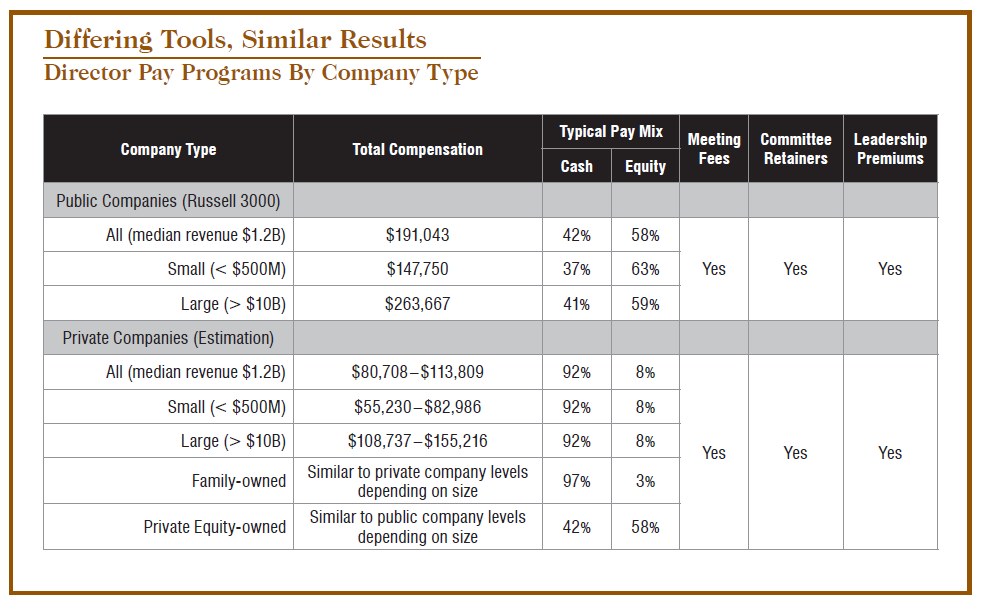
Among the 1,813 companies in our firm’s study of director pay programs among Russell 3000 companies, median 2015 total director compensation was $191,043. The median revenue of these companies was $1.2 billion. Total compensation increased with company size.

Most public company directors receive a combination of cash and equity compensation, with equity making up at least half of total pay regardless of company size or industry. The median pay mix of companies studied was 58 percent equity and 42 percent cash.

The median annual board cash retainer was $55,000. Cash retainers are correlated with company size, increasing from a median of $40,000 to $100,000 by ascending revenue size.

Additional compensation is almost always paid for serving as a committee chair, lead director, or non-executive chair. Increasingly, these leadership premiums are the only additional amounts beyond the board and committee retainers and equity awards paid in these more streamlined director pay programs.

Almost all companies (94 percent) provided committee chair retainers, consistent with the general industry practice of providing premium pay to the directors with the most responsibility. Just under half of all companies (47 percent) pay committee member retainers.

Of all companies in our study, 41 percent reported a non-executive chair (NEC). Most of these (91 percent) provided additional pay, with the median added fee for this leadership position being $65,000. Fifty-three percent of all companies reported a lead director. Of these, 79 percent provided additional compensation, a median of $25,000 (almost entirely paid in cash). Unlike the NEC role, the added pay for this role did not vary significantly by company size or industry.

For annual equity awards, which typically make up at least half of total pay, the market trend over the last decade has been away from stock options and toward full value shares (restricted stock, deferred stock or outright stock). The prevalence of options continues to decline, and when companies do grant them, they often grant options along with full value shares.

The median total equity award for the entire study sample was $112,000. Nearly all companies studied provided equity (97 percent). Seventy-seven percent granted full value shares only, compared to just eight percent granting stock options only. Twelve percent of companies granted a mix of full value shares and stock options, and the remaining three percent of companies granted no equity awards at all.


Private companies

No longer able to afford the informal corporate governance practices of the past, private companies are under increasing pressure to implement or improve board oversight. These companies are embracing public-company governance, including formation of boards that include outside directors and standard committees. This movement has also affected family businesses, particularly as shareholders of family-run companies have become less concentrated with each passing generation.

The bar has thus been rising for private company governance, despite the fact that requirements imposed by various governing bodies apply only to public companies. In today’s business environment, the talent pool is becoming more homogeneous as executives and directors move freely between organizations that are small and large, and public and private.

We have estimated total director pay levels for private companies of various sizes, based on our consulting experience as well as our Russell 3000 study of director pay programs at public companies. Among all revenue categories, more than 50 percent of total pay was made up of equity. Using this data as a guide, we have estimated the total pay range for similarly sized private companies, as follows:

The low end of private company total pay range represents the cash portion of public company total pay for the applicable revenue category.

The high end of private company pay range represents the cash portion of public company total pay, plus 30 percent of the equity portion for the applicable revenue category.

For example, the enclosed table shows that, among all Russell 3000 companies, total pay is $191,043, made up of 42 percent cash and 58 percent equity. Among similarly sized private companies, total compensation will range from $80,708 (the 42 percent cash portion of $191,043) to $113,809 (the 42 percent cash portion of $191,043 plus 30 percent of the remaining equity).

Thus, the resulting private company pay range equals 42 percent to 60 percent of public company pay for similarly sized companies. We have followed the same methodology to estimate total pay levels among private companies within each revenue category.

Private companies pay directors cash to the same extent as public companies of similar size, and in some cases more to make up for the lack of equity.

Based on our experience working with private companies, we believe that these ranges are a sound benchmark for how private companies of various sizes pay directors. In general, these companies pay cash to the same extent as public companies of similar size, and in some cases pay more cash to make up for the lack of equity awards (though still at a reduced rate, resulting in lower total pay).

Most public companies have some kind of executive equity program in place, and equity typically represents 50 percent to 75 percent of total pay for their senior executives. While more private companies are adopting long-term cash incentive plans, real equity awards (stock options or restricted stock) are used by a minority of private companies.

Overall, we estimate that less than 10 percent of private companies provide director equity awards, compared to 97 percent of public companies as mentioned previously. An exception to this is PE-owned companies.

Family-owned companies

Most family businesses benefit from a board that includes not only family members but also well-informed, seasoned, outside directors. These independents bring outside knowledge, leadership development skills and accountability. Leadership development is particularly important as there must be a management succession plan that includes family and non-family members, if necessary.

In 2016, Gallagher’s research team set out to understand exactly how much outside directors of family-owned companies are paid by conducting phone and electronic mail inquiries to a number of large family-held business. The outreach was successful, with nineteen companies responding. These companies spanned various industries, including retail, food processing, consumer products and general manufacturing. The median revenue of these nineteen companies was $6.9 billion.

Outside directors of family-owned companies are paid similarly to directors of other private companies, with a focus on cash and little to no equity

Twelve of the nineteen companies (63 percent) had family members that were also senior members of the management team serving on the board. In line with common practices for all types of companies, these family members received no compensation for board service.

We found that outside directors of family-owned companies are paid similarly to directors of other private companies, with a focus on cash and little to no equity awards. Some major findings:

1. The median annual cash retainer was $75,000. Median annual total compensation was $100,250. Only 11 percent of companies used equity as part of their director pay package.

2. Forty-two percent of companies paid a lead director premium.

3. Forty-seven percent paid their committee chairs a leadership premium.

4. Forty-two percent paid board meeting fees, with a range of $1,958 to $2,650 per meeting.

5. Thirty-two percent paid committee meeting fees with a range of $1,531 to $2,294 per committee meeting.

Like non-family-owned private companies, cash levels are similar to what we would expect to see among public companies. In fact, our Russell 3000 study found that public companies with revenues ranging from $3 to $9.9 billion also had a median cash retainer of $75,000.

Consistent with expectations, the lack of equity awards (present at only 11 percent of our family-owned company sample) creates a large disparity in total pay compared to the same group of Russell 3000 companies ($3 to $9.9 billion in revenue). The median compensation among public companies was $227,005 (consisting of 57 percent equity and 43 percent cash). This is 126 percent higher than the $100,250 seen among the family-owned sample.

This difference is due to the equity award. If we were to extricate only the 43 percent cash portion of $227,005, the resulting $98,000 (inclusive of cash retainer and committee member fees) is right in line with the total of $100,250 at family-owned companies. As discussed previously, this is one way that private companies, family-owned or not, set director pay—by stripping out the equity portion of comparable public company pay.

Private equity owned or sponsored companies

PE-owned companies invest in strong board governance early on in pursuit of significant growth. A top-down agenda set by the private equity fund generally drives the board’s focus, with an overall goal of progress toward a liquidity event, such as an initial public offering or M&A event.

The directors of PE-owned companies are mainly focused on strategies to increase investor value, with a much shorter time horizon than directors of private or public companies. Accordingly, these PE-owned boards are more deeply entrenched with company management, and in most cases meet more frequently than other company boards.

Beyond employee directors, there are two types of directors that will typically serve on these boards: outside directors, and employees of the private equity firm, which we refer to as “PE principals.”

Outside directors

Outsiders are often introduced to the board by the private equity firm that owns the portfolio company. Bringing in a director with no affiliation to the company or PE firm is most often made with the goal of gaining the benefit of that person’s specific qualifications and expertise.

These outside directors are generally paid by the PE fund owner, and pay is similar to publicly traded company directors. Unlike other private companies, where the focus is on cash, these outside directors generally receive a mix of both cash and equity compensation. In many cases, the focus is on equity.

PE principals.

Private equity firms exercise control over portfolio companies through their representation on the companies’ boards. These PE principal directors have a strong sense of personal ownership that is ensured by the compensation arrangements (particularly in the form of “carried interest”) of their firms.

PE principals are either paid nothing, or the same as the outside directors. In the latter arrangement, they are getting paid by both the portfolio company to be a director and by the private equity firm as an employee, which can result in excessive payment levels. For this reason, these “double pay” arrangements have sometimes caused controversy.

In summary, there are real differences in director pay between public and private companies, with the exception of private-equity controlled companies that tend to pay the same as public company counterparts.

Similar to executive pay, director pay trends continue to “trickle down” from public companies to private companies. With evolving standards and further integration of the director talent pool, we expect that private companies will continue adopting the cash-based pay practices of public companies. For all companies, governance improvements are focused on strengthening the role and responsibilities of the board of directors, and an appropriate director pay plan is a key factor to consider.

Guide pratique à la détermination de la rémunération des administrateurs de sociétés | ICGN


Aujourd’hui, je vous suggère la lecture d’un excellent guide publié par International Corporate Governance Network (ICGN). Ce document présente succinctement les grands principes qui devraient gouverner l’établissement de la rémunération des administrateurs indépendants (« non-executive »).

Il va de soi que la rémunération des administrateurs ne représente qu’une part infime du budget d’une entreprise, et celle-ci est relativement très inférieure aux rémunérations consenties aux dirigeants ! Cependant, il est vital d’apporter une attention particulière à la rémunération des administrateurs, car ceux-ci sont les fiduciaires des actionnaires, ceux qui doivent les représenter, en veillant à la saine gestion de la société.

Il est important que le comité de gouvernance se penche annuellement sur la question de la rémunération des administrateurs indépendants, et que ce comité propose une politique de rémunération qui tient compte du rôle déterminant de ces derniers. Plusieurs variables doivent être prises en ligne de compte notamment, la comparaison avec d’autres entreprises similaires, les responsabilités des administrateurs dans les différents rôles qui leur sont attribués au sein du conseil, la nature de l’entreprise (taille, cycle de développement, type de mission, circonstances particulières, etc.).

Personnellement, je suis d’avis que tous les administrateurs de sociétés obtiennent une compensation pour leurs efforts, même si, dans certains cas, les sommes affectées s’avèrent peu élevées. Les organisations ont avantage à offrir de justes rémunérations à leurs administrateurs afin (1) d’attirer de nouvelles recrues hautement qualifiées (2) de s’assurer que les intérêts des administrateurs sont en adéquation avec les intérêts des parties prenantes, et (3) d’être en mesure de s’attendre à une solide performance de leur part et de divulguer les rémunérations globales.

Le document du ICNG propose une réflexion dans trois domaines : (1) la structure de rémunération (2) la reddition de comptes, et (3) les principes de transparence.

On me demande souvent qui doit statuer sur la politique de rémunération des administrateurs, puisqu’il semble que ceux-ci déterminent leurs propres compensations !

Ultimement, ce sont les actionnaires qui doivent approuver les rémunérations des administrateurs telles que présentées dans la circulaire de procuration. Cependant, le travail en aval se fait, annuellement, par le comité de gouvernance lequel recommande au conseil une structure de rémunération des administrateurs non exécutifs. Notons que les comités de gouvernance ont souvent recours à des firmes spécialisées en rémunération pour les aider dans leurs décisions.

C’est cette recommandation qui devrait être amenée à l’assemblée générale annuelle pour approbation, même si dans plusieurs pays, la juridiction ne le requiert pas.

En tant qu’administrateur, si vous souhaitez connaître le point de vue du plus grand réseau de gouvernance à l’échelle internationale, je vous invite à lire ce document synthétique.

Bonne lecture. Vos commentaires sur le sujet sont sollicités.


ICGN Guidance on Non-executive Director Remuneration – 2016


Un document complet sur les bonnes pratiques de gouvernance et de gestion d’un CA | The Directors Toolkit 2017 de KPMG


Voici la version 4.0 du document « The Directors’Toolkit 2017 » de KPMG, très bien conçu, qui répond clairement aux questions que tous les administrateurs de sociétés se posent en cours de mandat.

Même si la publication est dédiée à l’auditoire australien de KPMG, je crois que la réalité réglementaire nord-américaine est trop semblable pour se priver d’un bon « kit » d’outils qui peut aider à constituer un Board efficace.

C’est un formidable document électronique interactif. Voyez la table des matières ci-dessous.

J’ai demandé à KPMG de me procurer une version française du même document, mais il ne semble pas en exister.

Bonne lecture !

The Directors’ Toolkit 2017 | KPMG


Now in its fourth edition, this comprehensive guide is in a user friendly electronic format. It is designed to assist directors to more effectively discharge their duties and improve board performance and decision-making.

Key topics

  1. Duties and responsibilities of a director
  2. Oversight of strategy and governance
  3. Managing shareholder and stakeholder expectations
  4. Structuring an effective board and sub-committees
  5. Enabling key executive appointments
  6. Managing productive meetings
  7. Better practice terms of reference, charters and agendas
  8. Establishing new boards.

What’s new in 2017

In this latest version, we have included newly updated sections on:

  1. managing cybersecurity risks
  2. human rights in the supply chain.

Register

Register here for your free copy of the Directors’ Toolkit.

Facteurs qui influencent la rémunération des dirigeants d’OBNL ?


Qu’est-ce qui influence la rémunération des dirigeants d’organisation sans but lucratif. C’est la question à laquelle Elizabeth K. Keating et Peter Frumkin ont tenté de répondre dans une recherche scientifique notoire, dont un résumé est publié dans la revue Nonprofit Quaterly.

L’établissement d’une juste rémunération dans toute organisation est un domaine assez complexe. Mais, dans les entreprises à but non lucratif, c’est souvent un défi de taille et un dilemme !

Lorsque l’on gère l’argent qui vient, en grande partie, du public, on est souvent mal à l’aise pour offrir des rémunérations comparables au secteur privé. Les comparatifs ne sont pas faciles à établir…

Cependant, il faut que l’organisation paie une rémunération convenable ; sinon, elle ne pourra pas retenir les meilleurs talents et faire croître l’entreprise.

Bien sûr, la situation a beaucoup évolué au cours des 30 dernières années. On conçoit plus facilement maintenant que les services rendus pour gérer de telles organisations doivent être rémunérés à leur juste valeur. Mais, le secteur des OBNL est encore dominé par des salaires relativement bas et par la contribution de généreux bénévoles…


Résultats de recherche d'images pour « rémunération dirigeants OBNL »
Publications de Gouvernance Expert – Gestion PME et OBNL

Contrairement à la plupart des entreprises privées, les OBNL rémunèrent leur personnel selon un salaire fixe. Cependant, les comparaisons avec le secteur privé ont amené plusieurs OBNL à offrir des rémunérations basées sur la performance (ex. : les résultats de la collecte de fonds, la compression des dépenses, les surplus dégagés).

Dans la plupart des OBNL, les augmentations de salaires des dirigeants demeurent des sujets chauds… très chauds, étant donné les moyens limités de ces organisations, la propension à faire appel au bénévolat et les contraintes liées aux missions sociales.

Les auteurs de l’étude ont développé trois hypothèses pour expliquer les comportements de rémunération dans le secteur des entreprises à but non lucratif :

  1. Les PDG qui gèrent des organisations de grandes tailles seront mieux rémunérés ;
  2. Les rémunérations des PDG d’OBNL ne seront pas basées sur la performance financière de leurs organisations ;
  3. Les rémunérations des PDG d’OBNL ne seront pas déterminées par la liquidité financière.

En résumé, les recherches montrent que les hypothèses retenues sont validées dans presque tous les secteurs étudiés. C’est vraiment la taille et la croissance de l’organisation qui sont les facteurs déterminants dans l’établissement des rémunérations des hauts dirigeants. Dans ce secteur, la bonne performance ne doit pas être liée directement à la rémunération.

La plupart des administrateurs de ces organisations ne sont pas rémunérés, souvent pour des raisons de valeurs morales. Cependant, je crois que, si l’entreprise en a les moyens, elle doit prévoir une certaine forme de rémunération pour les administrateurs qui ont les mêmes responsabilités fiduciaires que les administrateurs des entreprises privées.

Je crois personnellement qu’une certaine compensation est de mise, même si celle-ci n’est pas élevée. Les administrateurs se sentiront toujours plus redevables s’ils retirent une rémunération pour leur travail. Même si la rétribution est minimale, elle contribuera certainement à les mobiliser davantage.

Cette citation résume assez bien les conclusions de l’étude :

One final implication of our analysis bears on the enduring performance-measurement quandary that confronts so many nonprofit organizations. We believe that nonprofits may rely on organizational size to make compensation decisions, drawing on free cash flows when available, rather than addressing the challenge of defining, quantifying, and measuring the social benefits that they produce. Nonprofits typically produce services that are complex and that generate not only direct outputs but also indirect, long-term, and societal benefits. These types of services often make it difficult to both develop good outcome measures and establish causality between program activity and impact. In the absence of effective metrics of social performance and mission accomplishment, many organizations rely on other factors in setting compensation. Perhaps, once better measures of mission fulfillment are developed and actively implemented, nonprofits will be able to structure CEO compensation in ways that provide appropriate incentives to managers who successfully advance the missions of nonprofit organizations, while respecting the full legal and ethical implications of the nondistribution constraint.

Pour plus d’information concernant le détail de l’étude, je vous conseille de prendre connaissance des extraits suivants.

Bonne lecture !

What Drives Nonprofit Executive Compensation?


To test our first hypothesis, we relied on two variables: lagged total fixed assets and lagged total program expenses. We chose total fixed assets as a proxy for scale of operations and total program expenses as a measure of the annual budget.15 To test our second hypothesis, we developed two variables associated with pay-for-performance compensation: administrative efficiency and dollar growth in contributed revenue.16 To test our third hypothesis, we selected three variables that determine whether an organization is cash constrained or has free cash flows: lagged commercial revenue, liquid assets to expenses measure, and investment portfolio to total assets measure.17

Since the nonprofit industry is quite heterogeneous, we explored the compensation question in the major subsectors: arts, education, health, human services, “other,” and religion.18

Arts

The compensation of arts CEOs increases more rapidly relative to program expenses than in the other subsectors, and the remuneration of arts CEOs is negatively associated with commercial revenue share. This stands in contrast to the positive relation of this factor in the remaining subsectors.

Greater administrative efficiency, higher liquidity, and a more extensive endowment are associated with higher compensation, but generating additional contributions is not. Overall, the organizational-size variables explain a substantially greater proportion of the variation in compensation for arts CEOs than the other two factors combined.

Education

While arts executive pay is closely related to program expenses, CEOs at educational institutions receive compensation that is significantly associated with fixed assets. These organizations include primary and secondary schools, as well as colleges and universities. Unlike the arts CEOs, educational leaders are better compensated when their organizations have growth in contributions but not when they are more administratively efficient.

Health

Due to the competition in the health subsector between for-profit and nonprofit firms, one might expect that compensation would be more heavily weighted toward the pay-for-performance variables. Instead, we found that CEO compensation in this subsector is strongly related to organizational size. It is weakly tied to administrative efficiency, and is not significantly related to growth in contributions. From these results, we concluded that compensation in the health subsector is not closely tied to classic pay-for-performance measures.

With regard to free cash flows, we found that the sensitivity of CEO remuneration to increases in the commercial revenue share is highest in the health subsector. Health CEO remuneration is also quite sensitive to the relative size of the endowment. We found no significant relation between health CEO compensation and liquidity. Overall, the organization-size variables explain a greater portion of the variation in pay in the health subsector than the pay-for-performance and free cash flow variables combined.

Human Services and “Other”

CEO compensation in the human-services and “other” subsectors exhibit considerable similarities in the magnitude of the coefficients. Total program expenses are significantly related to compensation, with a $10–$11 gain in compensation for each $1,000 increase in program expenses. In neither case are total fixed assets significantly associated with remuneration. CEOs in both subsectors can expect to be financially rewarded for greater administrative efficiency and when the share of commercial revenue is higher and the relative size of the investment portfolio is larger. One striking difference is that CEOs in the other subsectors receive substantially higher compensation when contributions are increased, while CEOs of human-service providers oddly receive significantly lower compensation when liquidity is higher. In both subsectors, the organizational-size variables had more power to explain compensation than the other two variable groups combined.

Religion

Compensation for religious leaders differs substantially from the other sectors. First, “base” pay and both organizational-size variables are insignificant. In the area of pay-for-performance, the regression results indicate that compensation is not directly associated with growth in contributions. More unusually, it is negatively related to administrative efficiency. In one regard, the CEOs of religious organizations are similar to their counterparts: their compensation is significantly associated with the commercial-revenue share and the relative size of the investment portfolio. For CEOs of this subsector, the size hypothesis was most strongly supported, but it did not dominate the other two hypotheses combined.

Conclusions

We found that nonprofit CEOs are paid a base salary, and many CEOs also receive additional pay associated with larger organizational size. Our results indicate that while pay-for-performance is a factor in determining compensation, it is not prominent. In fact, in all the subsectors we studied, CEO compensation is more sensitive to organizational size and free cash flows than to performance. While our analysis suggests that nonprofits may not literally be violating the nondistribution constraint, we did find evidence that CEO compensation is significantly higher in the presence of free cash flows. In only one subsector (education), however, did we find evidence that free cash flow is a central factor.

___________________________________________

*This article is adapted from “The Price of Doing Good: Executive Compensation in Nonprofit Organizations,” an article by the authors published in the August 2010 issue (volume 29, issue 3) of Policy and Society, an Elsevier/ ScienceDirect publication. The original report can be accessed here.

Qu’est-ce qu’un président « exécutif » de conseil d’administration ? | Le cas de Bombardier 


Voici un article de Karim Benessaieh publié dans la section Actualité expliquée de La Presse+ Affaires le 13 mai 2017.

L’auteur apporte les précisions requises quant aux titres et fonctions du président du conseil de Bombardier, Pierre Beaudoin.

Pierre Beaudoin était président et chef de la direction (CEO ou PDG) de Bombardier depuis 2008. En 2015, il devient le président « exécutif » du conseil d’administration de Bombardier.

Récemment, ce dernier a renoncé à la portion « exécutive » de ses fonctions. Qu’est-ce que cela implique pour le commun des mortels ?

C’est exactement ce à quoi Karim Benessaieh a tenté de répondre dans son article, reproduit ci-dessous, auquel j’ai participé.

Bonne lecture ! Vos commentaires sont les bienvenus.


Un président exécutif, ça mange quoi en hiver ?


Qu’est-ce qu’un président exécutif ? Peut-on être PDG, président du conseil d’administration et chef de la direction en même temps ? Dans la tempête qui ébranle Bombardier depuis six semaines, il est facile de se perdre dans les étiquettes. La Presse a demandé à deux experts en gouvernance d’éclairer notre lanterne.


À quoi a renoncé exactement Pierre Beaudoin en retirant la partie « exécutive » de son mandat ?

À la base, Pierre Beaudoin, fils de Laurent Beaudoin et de Claire Bombardier et donc petit-fils de Joseph-Armand Bombardier, est le président du conseil d’administration de l’entreprise depuis 2015. Son rôle est de « gérer le conseil et [d’]établir l’ordre du jour » pour les 15 membres de cette instance, comme le précise le site de Bombardier, qui ne fait aucune référence à l’aspect « exécutif » de son travail.

Dans l’avis de convocation des actionnaires, cette semaine, on reprend la formule un peu vague selon laquelle M. Beaudoin est en outre chargé de « la définition d’une orientation stratégique et [de] la gestion des relations entretenues avec certaines parties prenantes et avec la clientèle ». Ce sont ces dernières responsabilités qu’il a perdues.

Vous ne nous éclairez pas beaucoup…

Désolé, c’était la réponse officielle. C’est que le « président exécutif » est une bête un peu curieuse souvent associée aux entreprises familiales ou dont le fondateur est encore bien présent. Aux États-Unis, peu de confusion : pour 50 % des entreprises cotées en Bourse, le PDG (ou CEO) est également président du conseil d’administration. Le président du conseil, dans ces cas, est « exécutif » de facto. Au Canada, seulement 14 % des entreprises sont dirigées par un PDG qui est en même temps président du conseil d’administration.

Par contre, dans une sorte de formule mitoyenne, certaines entreprises d’ici ont donné des responsabilités élargies à leur président du conseil en lui ajoutant l’étiquette « exécutif » : il devient dans les faits un deuxième PDG.

Au Québec, CGI, Couche-Tard et Cascades ont donné ce titre à celui qui préside leur conseil d’administration. « C’est une formule hybride, résume Michel Nadeau, directeur général de l’Institut sur la gouvernance. Ça reflète généralement une situation temporaire où le nouveau PDG apprend à gérer, avec l’entrepreneur fondateur. »

Et c’est bien d’avoir un président du conseil qui se mêle d’administration ?

Un peu de contexte ici. Depuis plus d’une décennie, au Canada et en Europe, les autorités réglementaires, les experts en gouvernance et les investisseurs institutionnels comme la Caisse de dépôt et placement du Québec suggèrent fortement de séparer les fonctions de président du conseil d’administration et de président de l’entreprise. Aucune loi n’impose cette division des tâches, cependant.

« On veut éviter les conflits d’intérêts, explique Jacques Grisé, président de l’Ordre des administrateurs agréés du Québec. Séparer les deux postes est un signe de bonne gouvernance, et on est en train de le reconnaître même aux États-Unis, où ça s’améliore graduellement. »

C’est le conseil d’administration qui embauche le PDG et fixe sa rémunération, rappelle M. Nadeau. « Le président exécutif est un peu coincé entre les deux. Quand il arrive avec une proposition de rémunération qui inclut la sienne, c’est bizarre. Quand il travaille 40 heures par semaine avec le PDG alors qu’il doit pouvoir le confronter au conseil d’administration, ça donne une situation incongrue. » C’est une « simple question de logique », estime-t-il, qu’il n’y ait pas un cumul des pouvoirs au sein d’une entreprise. « Il faut un superviseur et un supervisé, un contrepoids. »

Est-ce que les entreprises qui séparent les fonctions de président du conseil et de PDG s’en portent financièrement mieux ?

« Les études ne sont pas très claires en ce sens, mais on voit que partout dans le monde, on essaie d’implanter cette séparation », répond M. Grisé. Cette question précise fait partie d’un vaste ensemble, la bonne gouvernance, qui comprend bien d’autres exigences, rappelle M. Nadeau. « Dans le cas de Bombardier, ç’aurait été une bonne chose d’avoir un président du conseil indépendant. C’est souhaitable, mais il faut être réaliste : dans une entreprise contrôlée par une famille, c’est demander de l’héroïsme. »

_______________________________________

Karim Benessaieh est reporter économique à La Presse depuis 2000.
Ce texte provenant de La Presse+ est une copie en format web. Consultez-le gratuitement en version interactive dans l’application La Presse+.

Étude sur les pratiques des CA américains | ISS


La firme-conseil ISS, (Institutional Shareholder Services) publie chaque année une étude de l’évolution des pratiques de gouvernance aux É.U. (Board Practices Study).

Rob Yates, vice-président d’ISS, est l’auteur de cet article paru sur le site de Harvard Law School Forum on Corporate Governance. Il y aborde cinq tendances majeures.

Les investisseurs continuent d’exercer des pressions sur les administrateurs du conseil, entre autres en continuant de demander d’inclure de nouvelles candidatures dans la circulaire de procuration.

On constate que les pratiques généralement reconnues de bonne gouvernance sont adoptées dans presque toutes les grandes sociétés ; elles sont de plus en plus acceptées dans les plus petites entreprises. On fait ici référence aux élections annuelles, au vote majoritaire et à l’élimination des pilules empoisonnées.

La question du choix d’un président du conseil totalement indépendant et différent du CEO semble être moins problématique si la société fait appel à président désigné (lead director) indépendant et fort.

La rémunération des administrateurs de sociétés a continué de croître significativement. Les CA évaluent différentes approches à la compensation des administrateurs. Ainsi, on élimine de plus en plus les jetons de présence pour les réunions et les conférences téléphoniques. La rémunération des administrateurs s’est accrue de 17 % de 2012 à 2016 tandis que celle des PDG a augmenté de 10 % pendant la même période.

ISS a produit plusieurs études sur les tendances en matière de limite des mandats (tenure), du renouvellement des administrateurs du CA et de l’importance de la diversité. Si le sujet vous intéresse, l’auteur vous réfère à plusieurs études américaines et mondiales.

Bonne lecture !

U.S. Board Practices


This year’s Board Practices Study focuses not only on longstanding issues traditionally covered, but on those which have driven increased shareholder interest in the boardroom over the past several years. Governance continues to evolve, but investor focus in recent years has been particularly pointed as new concerns have emerged, and the ways in which companies address those concerns adapts to meet market demands. Particular focus has been placed on the role of the board as a representative of shareholders at a company, and how the board’s structure and practices promulgate this responsibility. As always, this study provides a snapshot of these facets of public company boards in the S&P 1500 for investors and issuers to compare and contrast.


Investors are continuing to push for board accountability


The pyroclastic spread of proxy access over the past two years has arguably been the most prominent governance story in the United States. In two short years, the S&P went from having only a handful of companies with proxy access, to having over half its constituents offering shareholders the right. Proxy access is also starting to show up in shareholder proposals at smaller firms; as of March 14, ISS is tracking a dozen such proposals at S&P 400 companies.


Image associée
Advisory Board Best Practices: Roles and Advice


Proxy access is the most recent chapter in the much longer story of shareholders seeking board accountability. The next chapters are underway, with investors focusing on board self-regulation practices and measures, such as director tenure and board refreshment, board diversity, board evaluations, mandatory retirement ages, and more. Some of these are showing promise—such as board refreshment and continuing progress on gender diversity—while others are lagging, such as non-gender measures of board diversity.

Central to these concerns is shareholders’ desire that boards develop the skills, expertise, awareness, and experience to accurately assess and effectively manage emerging risks, such as cyber and environmental risks, and ensure that boards are constantly searching for weaknesses (and, when and where appropriate, soliciting external help to identify blind spots).


Traditional concerns still exist, but companies are making progress


More traditional approaches to increasing accountability, such as majority vote standards and annual elections in the director election process—features that are near-ubiquitous in the largest companies—have been adopted in greater frequency by smaller companies. Many problematic governance practices, such as poison pills, are also increasingly rare.


Investors are more accepting of alternative independent board leadership structures


Demonstrating that governance is both a give and take endeavor, investors are more accepting of alternative forms of independent board leadership. Whereas investors have historically favored independent chairs, many are increasingly comfortable with an alternative structure whereby a strong and empowered lead independent director counterbalances a combined chair/CEO.


Director compensation increased sharply


A new feature in this year’s study is an evaluation of director pay covering the preceding five years. While compensation disclosure for non-employee directors is not new itself, the rules and guidelines governing director pay disclosure have only recently standardized. Beginning in December 2006, SEC rules required the disclosure of director pay in a standardized table format. This disclosure increased transparency and comparability between companies. Additionally, both the NYSE and NASDAQ require that boards consider director pay when determining director independence for purposes of meeting listing requirements.

Director compensation has received increased scrutiny in recent years, particularly given rising pay levels and high-profile shareholder lawsuits alleging excessive pay. Amid this atmosphere, many companies have taken a proactive approach to director compensation programs, mainly through altering equity plans or, in a few rare instances, introducing ballot items.

As companies weigh the potential benefits of changing director pay structures, median pay continues to rise. In fact, non-employee director compensation grew 17 percent between 2012 and 2016, while median CEO pay in the S&P 500 (reported in ISS’ 2016 US Compensation Postseason Report) rose by less than 10 percent. One positive development is the streamlining observed among director compensation programs. For example, the elimination of meeting and telephonic meeting fees in many compensation structures.


Increased scrutiny of certain board practices has necessitated a more detailed review


Previous versions of the board study included an in-depth snapshot of new-director demographics and trends, such as tenure, refreshment, and diversity. As these components of board composition have become a significant part of the governance conversation, ISS has produced in-depth studies on each of these issues.

For a vast and comprehensive look at board refreshment trends in the U.S., please see the joint ISS/IRRC study, Board Refreshment Trends at S&P 1500 Firms.

For a look at gender parity advancement on boards in the U.S. and around the world, please see the April 2016 joint study carried out by ISS and European Women on Boards, Gender Diversity on European Boards—Realizing Europe’s Potential: Progress and Challenges, and ISS’ December 2016 study, Gender Diversity on Boards—A Review of Global Trends.

The complete publication is available here.

_____________________________________

*Rob Yates is Vice President at Institutional Shareholder Services, Inc. This post is based on an ISS publication by Mr. Yates, Rachel Hedrick, and Andrew Borek.

The Directors Toolkit 2017 | Un document complet de KPMG sur les bonnes pratiques de gouvernance et de gestion d’un CA


Voici la version 4.0 du document australien de KPMG, très bien conçu, qui répond clairement aux questions que tous les administrateurs de sociétés se posent dans le cours de leurs mandats.

Même si la publication est dédiée à l’auditoire australien de KPMG, je crois que la réalité réglementaire nord-américaine est trop semblable pour se priver d’un bon « kit » d’outils qui peut aider à constituer un Board efficace.

C’est un formidable document électronique interactif. Voyez la table des matières ci-dessous.

J’ai demandé à KPMG de me procurer une version française du même document, mais il ne semble pas en exister.

Bonne lecture !

The Directors’ Toolkit 2017 | KPMG


Now in its fourth edition, this comprehensive guide is in a user friendly electronic format. It is designed to assist directors to more effectively discharge their duties and improve board performance and decision-making.

Key topics

  1. Duties and responsibilities of a director
  2. Oversight of strategy and governance
  3. Managing shareholder and stakeholder expectations
  4. Structuring an effective board and sub-committees
  5. Enabling key executive appointments
  6. Managing productive meetings
  7. Better practice terms of reference, charters and agendas
  8. Establishing new boards.

What’s new in 2017

In this latest version, we have included newly updated sections on:

  1. managing cybersecurity risks
  2. human rights in the supply chain.

Register

Register here for your free copy of the Directors’ Toolkit.

Le Spencer Stuart Board Index | 2016


Voici le rapport annuel toujours très attendu de Spencer Stuart*.

Ce document présente un compte rendu très détaillé de l’état de la gouvernance dans les grandes sociétés publiques américaines (S&P 500).

On y découvre les résultats des changements dans le domaine de la gouvernance aux É.U. en 2016, ainsi que certaines tendances pour 2017.

Les thèmes abordés sont les suivants :

La composition des Boards

L’indépendance du président du CA

Les mandats des administrateurs et les limites aux nombres de mandats

L’âge de la retraite des administrateurs

L’évaluation des Boards

La nature des relations du Boards et de la direction avec les actionnaires

L’amélioration de la performance des Boards

Diverses informations, notamment :

Only 19% of new independent directors are active CEOs, chairs, presidents and chief operating officers, compared with 24% in 2011, 29% in 2006 and 49% in 1998, the first year we looked at this data for S&P 500 companies.

Active executives with financial backgrounds (CFOs, other financial executives, as well as investors and bankers) represent 15% of new independent directors this year, an increase from 12% last year. Another 10% of new directors are retired finance and public accounting executives.

spencer-stuart-us-board-index-2016_cover

On average, S&P 500 directors have 2.1 outside corporate board affiliations, although most directors aren’t restricted from serving on more.

The number of boards with no female directors dropped to the lowest level we have seen; six S&P 500 boards (1%) have no women, a noteworthy decline from 2006, when 52 boards (11%) included no female members. Women now constitute 21% of all S&P 500 directors.

Among the boards of the 200 largest S&P companies, the total number of minority directors has held steady at 15% since 2011. 88% of the top 200 companies have at least one minority director, the same as 10 years ago.

Only 43% of S&P 500 CEOs serve on one or more outside corporate boards in addition to their own board, the same as in 2015. In 2006, 55% of CEOs served on at least one outside board.

Boards met an average of 8.4 times for regularly scheduled and special meetings, up from 8.1 last year and 8.2 five years ago. The median number of meetings rose from 7.0 last year to 8.0.

The average annual total compensation for S&P 500 directors, excluding the chairman’s compensation, is $280,389.

Over time, the compensation mix for directors has evolved, with more stock grants and fewer stock options. Today, stock grants represent 54% of total director compensation, versus 48% five years ago, while stock options represent 6% of compensation today, down from 10% five years ago. Cash accounts for 38% of director compensation, versus 39% in 2011.

95% of the independent chairmen of S&P 500 boards receive an additional fee, averaging $165,112. Nearly two-thirds of lead and presiding directors, 65%, receive additional compensation. The average premium paid to lead and presiding directors is $33,354.

2016 Spencer Stuart Board Index


Investor attention to board performance and governance continues to escalate, and, increasingly, it’s large institutional investors—so-called “passive” investors—who are making known their expectations in areas such as board composition, disclosure and shareholder engagement. Long-term investors have shifted their posture to taking positions on good governance, and are increasingly demonstrating common ground with activists on governance topics.

Board composition is a particular area of focus, as traditional institutional investors have become more explicit in demanding that boards demonstrate that they are being thoughtful about who is sitting around the board table and that directors are contributing. They are looking more closely at disclosures related to board refreshment, board performance and assessment practices, in some cases establishing voting policies on governance.

Boards are taking notice. Directors want to ensure that their boards contribute at the highest level, aligning with shareholder interests and expectations. In response, boards are enhancing their disclosures on board composition and leadership, reviewing governance practices and establishing protocols for engaging with investors. Here are some of the trends we are seeing in the key areas of investor concern.

Board composition

The composition of the board—who the directors are, the skills and expertise they bring, and how they interact—is critical for long-term value creation, and an area of governance where investors increasingly expect greater transparency. Shareholders are looking for a well-explained rationale for why the group of people sitting around the board table are the right ones based on the strategic priorities of the business. They want to know that the board has the processes in place to review and evolve board composition in light of emerging needs, and that the board regularly evaluates the contributions and tenure of current board members and the relevance of their experience.

Acknowledging investor interest in their composition, more boards are reviewing how to best communicate their thinking about the types of expertise needed in the board—and how individual directors provide that expertise. More than one-third of the 96 corporate secretaries responding to our annual governance survey, conducted each year as part of the research for the Spencer Stuart Board Index, said their board has changed the way it reports director bios/qualifications; among those that have not yet made changes, 15% expect the board to change how they present director qualifications in the future.

What’s happening to board composition in practice after all of the talk about increasing board turnover? In 2016, we actually saw a small decline in the number of new independent directors elected to S&P 500 boards. S&P 500 boards included in our index elected 345 new independent directors during the 2016 proxy year—averaging 0.72 new directors per board. Last year, S&P 500 boards added a total of 376 new directors (0.78 new directors per board).

Nearly one-third (32%) of the new independent directors on S&P 500 boards are serving on their first outside corporate board. Women account for 32% of new directors, the highest rate of female representation since we began tracking this data for the S&P 500. This year’s class of new directors, however, includes fewer minority directors (defined as African-American, Hispanic/Latino and Asian); 15% of the 345 new independent directors are minorities, a decrease from 18% in 2015.

With the rise of shareholder activism, we’ve also seen an increase in investors and investment managers on boards. This year, 12% of new independent directors are investors, compared with 4% in 2011 and 6% in 2006.

Independent board leadership

Boards continue to feel pressure from some shareholders to separate the chair and CEO roles and name an independent chairman. And, indeed, 27% of S&P 500 boards, versus 21% in 2011, have an independent chair. An independent chair is defined as an independent director or a former executive who has met applicable NYSE or NASDAQ rules for independence over time. This actually represents a small decline from 29% last year. Meanwhile, naming a lead director remains the most common form of independent board leadership: 87% of S&P 500 boards report having a lead or presiding director, nearly all of whom (98%) are identified by name in the proxy.

In our governance survey, 12% of respondents said their board has recently separated the roles of chairman and CEO, while 33% said their board has discussed whether to split the roles within the next five years. Among boards that expect to or have recently separated the chair and CEO roles, 72% cite a CEO transition as the reason, while 20% believe the chair/CEO split represents the best governance.

In response to investor interest in board leadership structure—and sometimes demands for an independent chairman—more boards are discussing their leadership structure in their proxies, for example, explaining the rationale for maintaining a combined chair/CEO role and delineating the responsibilities of the lead director. Among the lead director responsibilities boards highlight: approving the agenda for board meetings, calling meetings and executive sessions of independent directors, presiding over executive sessions, providing board feedback to the CEO following executive sessions, leading the performance evaluation of the CEO and the board assessment, and meeting with major shareholders or other external parties, when necessary. Some proxies include a letter to shareholders from the lead independent director.

Tenure and term limits

Director tenure continues to be a hot topic for some shareholders. While some rating agencies and investors have questioned the independence of directors with “excessive” tenure, there are no specific regulations or listing standards in the U.S. that speak to director independence based on tenure. And, in fact, most companies do not have governance rules limiting tenure; only 19 S&P 500 boards (4%) set an explicit term limit for non-executive directors, a modest increase from 2015 when 13 boards (3%) had director term limits.

Just 3% of survey respondents said their boards are considering establishing director term limits, but many boards are disclosing more in their proxies about director tenure. Specifically, boards are describing their efforts to ensure a balance between short-tenured and long-tenured directors. And several companies have included a short summary of the board’s average tenure accompanied by a pie chart breaking down the tenure of directors on the board (e.g., directors with less than five years tenure, between five and 10 years, and more than 10 years tenure on the board).

Among S&P 500 boards overall, the average board tenure is 8.3 years, a slight decrease from 8.7 five years ago. The median tenure has declined as well in that time, from 8.4 to 8.0. The majority of boards, 63%, have an average tenure between six and 10 years, but 19% of boards have an average tenure of 11 or more years.

We also looked this year at the tenure of individual directors: 35% of independent directors have served on their boards for five years or less, 28% have served for six to 10 years, and 22% for 11 to 15 years. Fifteen percent of independent directors have served on their boards for 16 years or more.

Mandatory retirement

In the absence of term or tenure limits, most S&P 500 boards rely on mandatory retirement ages to promote turnover. About three-quarters (73%) of S&P 500 boards report having a mandatory retirement age for directors. Eleven percent report that they do not have a mandatory retirement age, and 16% do not discuss mandatory retirement in their proxies.

Retirement ages have crept up in recent years, as boards have raised them to allow experienced directors to serve longer. Thirty-nine percent of boards have mandatory retirement ages of 75 or older, compared with 20% in 2011 and just 9% in 2006. Four boards have a retirement age of 80. The most common mandatory retirement age is 72, set by 45% of S&P 500 boards.

As retirement ages have increased, so has the average age of independent directors. The average age of S&P 500 independent directors is 63 today, two years older than a decade ago. In that same period, the median age rose from 61 to 64. Meanwhile, the number of older boards has increased; 37% of S&P 500 boards have an average age of 64 or older, compared with 19% a decade ago, and 15 of today’s boards (3%) have an average age of 70 or greater, versus four (1%) a decade ago.

Board evaluations

Another topic on which large institutional investors have become more vocal is board performance evaluations. Shareholders are seeking greater transparency about how boards address their own performance and the suitability of individual directors—and whether they are using assessments as a catalyst for refreshing the board as new needs arise.

We have seen a growing trend in support of individual director assessments as part of the board effectiveness assessment—not to grade directors, but to provide constructive feedback that can improve performance. Yet the pace of adoption of individual director assessments has been measured. Today, roughly one-third (32%) of S&P 500 boards evaluate the full board, committees and individual directors annually, an increase from 29% in 2011.

In our survey of corporate secretaries, respondents said evaluations are most often conducted by a director, typically the chairman, lead director or a committee chair. A wide range of internal and external parties are also tapped to conduct board assessments, including in-house and external legal counsel, the corporate secretary and board consulting firms. Thirty-five percent use director self-assessments, and 15% include peer reviews. According to proxies, a small number of boards, but more than in the past, disclose that they used an outside consultant to facilitate all or a portion of the evaluation process.

Shareholder engagement

In light of investors’ growing desire for direct engagement with directors, more boards have established frameworks for shareholders to raise questions and engage in meaningful, two-way discussions with the board. In addition to improving disclosures about board composition, assessment and other key governance areas, some boards include in their proxies a summary of their shareholder outreach efforts. For example, they detail the number of investors the board met with, the issues discussed and how the company and board responded. A few boards facilitate direct access to the board by providing contact information for individual directors, including the lead director and audit committee chair.

Going further, many boards now proactively reach out to their company’s largest shareholders. In our survey, 83% of respondents said management or the board contacted the company’s large institutional investors or largest shareholders, an increase from 70% the year prior. The most common topic about which companies engaged with shareholders was proxy access (52%), an increase from 33% in 2015. Other topics included “say on pay” (51%), CEO compensation (40%), director tenure (30%), board refreshment (27%), shareholder engagement approach (27%) and chairman independence (24%). Survey respondents also wrote in more than a dozen additional topics, including majority/cumulative voting, disclosure enhancements, environmental issues and gender pay equity.

Enhancing board performance

The topic of board refreshment can be a highly charged one for boards. But having the right skills around the table is critical for the board’s ability to provide the appropriate guidance and oversight of management. Furthermore, the capabilities and perspectives that a board needs evolve over time as the business context changes. Boards can ensure that they have the right perspectives around the table and are well-equipped to address the issues that drive shareholder value—which, after all, is what investors are looking for—by doing the following:

Viewing director recruitment in terms of ongoing board succession planning, not one-off replacements. Boards should periodically review the skills and expertise on the board to identify gaps in skills or expertise based on changes in strategy or the business context.

Proactively communicating the skill sets and expertise in the boardroom—and the roadmap for future succession. Publishing the board’s skill matrix and sharing the board’s thinking about the types of expertise that are needed on the board—and how individual directors provide that expertise—signals to investors that the board is thoughtful about board succession.

Setting expectations for appropriate tenure both at the aggregate and individual levels. By setting term expectations when new directors join, boards can combat the perceived stigma attached to leaving a board before the mandatory retirement age. Ideally, boards will create an environment where directors are willing to acknowledge when the board would benefit from bringing on different expertise.

Thinking like an activist and identifying vulnerabilities in board renewal and performance. Proactive boards conduct board evaluations annually to identify weaknesses in expertise or performance. They periodically engage third parties to manage the process and are disciplined about identifying and holding themselves accountable for action items stemming from the assessment.

Establishing a framework for engaging with investors. This starts with proactive and useful disclosure, which demonstrates that the board has thought about its composition, performance and other specific issues. In addition, it is valuable to have a protocol in place enumerating responsibilities related to shareholder engagement.


*Note: The Spencer Stuart Board Index (SSBI) is based on our analysis of the most recent proxy reports from the S&P 500, plus an extensive supplemental survey. The complete publication draws on the latest proxy statements from 482 companies filed between May 15, 2015, and May 15, 2016, and responses from 96 companies to our governance survey conducted in the second quarter of 2016. Survey respondents are typically corporate secretaries, general counsel or chief governance officers. Proxy and survey data have been supplemented with information compiled in Spencer Stuart’s proprietary database.

The complete publication, including footnotes, is available here.

Le point sur la gouvernance au Canada en 2016 | Rapport de Davies Ward Phillips Vineberg


Le rapport annuel de Davies est toujours très attendu car il brosse un tableau très complet de l’évolution de la gouvernance au Canada durant la dernière année.

Le document qui vient de sortir est en anglais mais la version française devrait suivre dans peu de temps.

Je vous invite donc à en prendre connaissance en lisant le court résumé ci-dessous et, si vous voulez en savoir plus sur les thèmes abordés, vous pouvez télécharger le document de 100 pages sur le site de l’entreprise.

Cliquez sur le lien ci-dessous. Bonne lecture !

Rapport de Davies sur la gouvernance 2016


Davies Governance Insights 2016, provides analysis of the top governance trends and issues important to Canadian boards, senior management and governance observers.

insights_governance_2016_fr_thumbnail

The 2016 edition provides readers with our take on important topics ranging from shareholder engagement and activism to leadership diversity and the rise in issues facing boards and general counsel. We also provide practical guidance for boards and senior management of public companies and their investors on these and many other corporate governance topics that we expect will remain under focus in the 2017 proxy season.


Quelle est la rémunération globale des administrateurs canadiens ?


Quelle est la rémunération globale des administrateurs canadiens ?

C’est une question que beaucoup de personnes me posent, et qui n’est pas évidente à répondre !

L’article ci-dessous, publié par Martin Mittelstaedt, chercheur et ex-rédacteur au Globe and Mail, apporte un éclairage très intéressant sur la question de la rémunération des administrateurs canadiens.

Les études sur le sujet sont rares et donnent des résultats différents compte tenu de la taille, de la nature privée ou publique des entreprises, du secteur d’activité, des différentes composantes de la rémunération globale, etc.

De manière générale, il semble que les rémunérations des administrateurs canadiens et américains soient similaires et que les postes d’administrateurs des entreprises publiques commandent une rémunération globale d’environ quatre fois la rémunération offerte par les entreprises privées.

Une étude montre que la base médiane de la rémunération des administrateurs de sociétés privées au Canada est de 25 000 $, avec un jeton de présence de 1 500 $ et quatre réunions annuelles. Le nombre d’administrateurs est de six, incluant trois administrateurs indépendants et une femme ! La somme de la rémunération globale s’établirait à environ 31 000 $ US. Mais on parle ici de grandes entreprises privées…

Le montant de la rémunération dépend aussi beaucoup des plans de distribution d’actions, des privilèges, des bonis, etc.

Évidemment, pour toute entreprise publique, il est facile de connaître la rémunération détaillée des administrateurs et des cinq hauts dirigeants puisque ces renseignements se retrouvent dans les circulaires aux actionnaires.

Je vous encourage à lire cet article. Vous en saurez plus long sur les raisons qui font que les informations sont difficiles à obtenir dans le secteur privé.

Bonne lecture !

How much is a director worth ?


8b6d334e22ce959209f0988e0a56ca9c

Determining director compensation at private companies is more of an art than a science, with a wide range of practices and no one-size-fits-all formula.

Unlike publicly traded companies, where detailed information about director remuneration is as close as the nearest proxy circular, compensation at private boards is like “a black box,” according to Steve Chan, principal at Hugessen Consulting, who says retainers, meeting fees and share-based awards “are all over the map.”

Not much is known about private director compensation “for good reason,” observes David Anderson, president of Anderson Governance Group. “There is not a lot of data out there.”

PRIVATELY UNDERPAID?

Private company directorships can be prized assignments because they don’t involve the heavy compliance and regulatory burdens that occupy increasing amounts of time at public company boards.

But what private boards should be paid is difficult to determine, when there is little research to guide individual directors or companies. Some of the available data suggest private directors are being underpaid, at least relative to their public counterparts. But this information does not include the fact that the work may be different and much of the compensation at public boards may not ultimately pay off because it is linked to share price performance.

It is difficult to benchmark best practices with so little hard data, making it unsurprising that how best to set private company directors’ compensation is the most frequently asked question made by members to the ICD.

One of the few ongoing attempts to analyze compensation indicates remuneration is far higher at public boards, about four times higher in fact, although the amounts are skewed by the heavy use of stock-linked awards at publicly traded companies.

The private company survey, by Lodestone Global, was based on a questionnaire posed to members of the Young Presidents’ Organization, an international group of corporate présidents and CEOs, including many from Canada.

The Lodestone survey looked at medium-sized family or closely held firms, companies that are more established than early-stage startups, but smaller than large global corporations.

“The survey is not casually designed. The data is pretty rigorous and it’s global,” says Bernard Tenenbaum, managing partner at Princeton, N.J.-based Lodestone.

Tenenbaum says he started investigating private company board compensation because of the paucity of data on the subject. No one seemed to know what was going on. “People kept asking me, ‘Well how much should we pay directors?’ I’d say: ‘I don’t know. How much do you pay them now?’ And I started surveying.”

The firm’s most recent survey, based on 2014 data, had responses from more than 250 private companies, including 19 from Canada. The median revenue at the Canadian companies was $100-million, with the median number of employees at 325.

According to Tenenbaum, the median Canadian retainer was $25,000, with a $1,500 meeting fee and four meetings annually. The median number of directors was six, with three independent and one woman. The total of fees and retainers came to $31,000 (all dollar figures U.S.)

Interestingly, the overall U.S. compensation figure matched the Canadian one, but with a different composition. The median U.S. retainer was lower at $21,000, but the meeting fee was higher at $2,500. Including a few other miscellaneous items, like teleconference fees, U.S. compensation was $33,000, compared to $32,250 in Canada, a closeness that Tenenbaum termed “a kissing distance.”

The Lodestone figures give an indication of director compensation, although it is worth cautioning that the sample size is small, the figures are based on the median or middle-ranked firm, and there was a wide variety in size among the companies, given that they included a few smaller tech and industrial firms.

To benchmark private company director compensation, it is worthwhile to look at what comparable publicly traded companies are paying. One useful comparator is the smaller companies embedded in the BDO 600 survey of director compensation at medium-sized public companies. It has access to highly accurate data based on shareholder proxy circulars.

BDO’s 2014 survey found that among firms with revenue between $25-million and $325-million, cash compensation through retainer and committee fees averaged $54,000, while directors typically received another $65,000 in stock awards and options for a total of $119,000.

There is a small amount of information available in Canada on private board compensation, but the amount of data isn’t large enough to make generalized statements on remuneration and involves larger companies.

For example, in its director compensation, Canadian Tire Corp. breaks out amounts paid to the company’s non-publicly traded banking subsidiary, Canadian Tire Bank. In 2014, three directors on both boards were paid about $55,000 each for retainers and meeting fees for serving at the bank. Similarly, Loblaw Companies Ltd. paid $58,000 to a director who also served on President’s Choice Bank, a privately-held subsidiary.

The amounts are relatively low for blue-chip Canadian companies, but both banks are far smaller than their parent companies, with Canadian Tire Bank at $5.6-billion in assets and PC Bank at $3.3-billion.

Hugessen’s Chan says that in his experience, the larger, family-run private companies that have global operations compensate directors at roughly the same amounts as similarly sized public firms.

“Among the larger public companies versus the private companies, they’re comparable,” Chan says.

PUBLICLY EXPOSED

Tenenbaum says that based on his research and the figures from BDO, directors are being paid about $20,000 annually for taking on the added hassle of serving on a public company. He discounted the value of the stock-based compensation because it is conditional on share-price performance.

“There is a premium that you pay a director for taking the risk” of public company exposure, Tenenbaum says.

Directors also need to take into account some of the non-monetary factors of the board experience. Given that so much time on a public board is spent on compliance with regulatory requirements, being freed of this responsibility has value.

“When you’re on a private board, you don’t need to worry about all of the compliance that you have to worry about on a public company board,” says Larry Macdonald, who has served on both types of boards in the oil and gas sector. “You can spend more time on the issues which are probably more important to the company on a private board than you can on public board.”

Macdonald currently chairs publicly-traded Vermilion Energy Inc., but has also served on several private and volunteer boards.

One consequence of the difference in focus is that private boards can often have fewer members because directors can be more focused on company business needs, rather than on compliance requirements. Decision making can also be quicker and easier.

Macdonald says a public board may need eight to 10 people to handle the volume of work, compared to only five or six on a similar private company. As an example of the efficiency of a private board, a company that has a particularly good year and wants to pay employees a bonus can easily decide to do so.

At a public company, however, making this payment wouldn’t be as straightforward. Directors would have to compile a detailed explanation of why they wanted to pay the bonus and include it in shareholder circulars.

While some companies are downgrading the importance of meeting fees, Macdonald thinks they are necessary, with a range of $1,000 to $1,500 being sufficient. “There should be a permeeting fee. You want your directors to show up in person, if at all possible, and if you’re not going to give them a permeeting fee they’re going to be phoning it in or not showing up, so you’ve got to keep everybody interested,” he says.

EQUITY COMPENSATION

He would set the retainer with an eye to any equity compensation. “If there is a pretty good option plan, I would think that $10,000 a year would be adequate, but if the option plan is weaker, you have to up the annual fee,” Macdonald says.

The amount of equity reserved for directors in private companies is a disputed topic. Tenenbaum says equity compensation at private companies, in his experience, is rare. But Chan says a figure often used is to allocate 10 percent of the equity for directors and executives.

If the director is “pounding the pavement with the CEO, a big chunk ofthe [equity] pool might go to directors,” Chan says.

The amount of equity reserved for executives and the board could be as high as 20 percent to 30 percent in the early life of a technology company, but lower than 10 percent in a capital intensive business. “It all depends on size. You’re not going to give 10 percent away of a $1-billion company,” he says.

Macdonald considers the 10 percent of stock reserved for management and directors a good ball park figure. The bulk of the stock typically goes to management, with one or two percent earmarked for directors, he says.

RICHER REWARDS

Public boards are typically egalitarian, with all directors receiving the same base compensation. Private boards, however, can and do pay differing amounts, depending on the specialized skills companies are trying to assemble among their directors. Macdonald says a private oil company looking to pick up older fields, which may have environmental issues, might award extra compensation to attract a director with recognized skills in health, safety and environment.

To be sure, compensation is only one factor in attracting directors to a board. Tenenbaum says academic research has found that the reasons directors cite to join boards are led by the quality of top management, the opportunity to learn and to be challenged. Personal prestige, compensation and stock ownership are far down the list.

These factors may explain why many people want to serve on private boards. “The qualitative experience of private company directors is quite different from public company directors,” says Anderson.

“They avoid a lot of the perceived risk of public company boards and they get the benefit of doing what, as business people, they really like doing, which is thinking about the business and applying their knowledge and experience to business problems.”


This article originally appeared in the Director Journal, a publication of the Institute of Corporate Directors (ICD). Permission has been granted by the ICD to use this article for non-commercial purposes including research, educational materials and online resources. Other uses, such as selling or licensing copies, are prohibited.


Dix thèmes majeurs pour les administrateurs en 2016 | Harvard Law School Forum on Corporate Governance


Vous trouverez, ci-dessous, les dix thèmes les plus importants pour les administrateurs de sociétés selon Kerry E. Berchem, associé du groupe de pratiques corporatives à la firme Akin Gump Strauss Hauer & Feld LLP. Cet article est paru aujourd’hui sur le blogue le Harvard Law School Forum on Corporate Governance.

Bien qu’il y ait peu de changements dans l’ensemble des priorités cette année, on peut quand même noter :

(1) l’accent crucial accordé au long terme ;

(2) Une bonne gestion des relations avec les actionnaires dans la foulée du nombre croissant d’activités menées par les activistes ;

(3) Une supervision accrue des activités liées à la cybersécurité…

Pour plus de détails sur chaque thème, je vous propose la lecture synthèse de l’article ci-dessous.

Bonne lecture !


Ten Topics for Directors in 2016 |   Harvard Law School Forum on Corporate Governance


U.S. public companies face a host of challenges as they enter 2016. Here is our annual list of hot topics for the boardroom in the coming year:

  1. Oversee the development of long-term corporate strategy in an increasingly interdependent and volatile world economy
  2. Cultivate shareholder relations and assess company vulnerabilities as activist investors target more companies with increasing success
  3. Oversee cybersecurity as the landscape becomes more developed and cyber risk tops director concerns
  4. Oversee risk management, including the identification and assessment of new and emerging risks
  5. Assess the impact of social media on the company’s business plans
  6. Stay abreast of Delaware law developments and other trends in M&A
  7. Review and refresh board composition and ensure appropriate succession
  8. Monitor developments that could impact the audit committee’s already heavy workload
  9. Set appropriate executive compensation as CEO pay ratios and income inequality continue to make headlines
  10. Prepare for and monitor developments in proxy access

Strategic Planning Considerations

Strategic planning continues to be a high priority for directors and one to which they want to devote more time. Figuring out where the company wants to—and where it should want to—go and how to get there is not getting any easier, particularly as companies find themselves buffeted by macroeconomic and geopolitical events over which they have no control.

axes

In addition to economic and geopolitical uncertainty, a few other challenges and considerations for boards to keep in mind as they strategize for 2016 and beyond include:

finding ways to drive top-line growth

focusing on long-term goals and enhancing long-term shareholder value in the face of mounting pressures to deliver short-term results

the effect of low oil and gas prices

figuring out whether and when to deploy growing cash stockpiles

assessing the opportunities and risks of climate change and resource scarcity

addressing corporate social responsibility.

Shareholder Activism

Shareholder activism and “suggestivism” continue to gain traction. With the success that activists have experienced throughout 2015, coupled with significant new money being allocated to activist funds, there is no question that activism will remain strong in 2016.

In the first half of 2015, more than 200 U.S. companies were publicly subjected to activist demands, and approximately two-thirds of these demands were successful, at least in part. [1] A much greater number of companies are actually targeted by activism, as activists report that less than a third of their campaigns actually become public knowledge. [2] Demands have continued, and will continue, to vary: from requests for board representation, the removal of officers and directors, launching a hostile bid, advocating specific business strategies and/or opining on the merit of M&A transactions. But one thing is clear: the demands are being heard. According to a recent survey of more than 350 mutual fund managers, half had been contacted by an activist in the past year, and 45 percent of those contacted decided to support the activist. [3]

With the threat of activism in the air, boards need to cultivate shareholder relations and assess company vulnerabilities. Directors—who are charged with overseeing the long-term goals of their companies—must also understand how activists may look at the company’s strategy and short-term results. They must understand what tactics and tools activists have available to them. They need to know and understand what defenses the company has in place and whether to adopt other protective measures for the benefit of the overall organization and stakeholders.

Cybersecurity

Nearly 90 percent of CEOs worry that cyber threats could adversely impact growth prospects. [4] Yet in a recent survey, nearly 80 percent of the more than 1,000 information technology leaders surveyed had not briefed their board of directors on cybersecurity in the last 12 months. [5] The cybersecurity landscape has become more developed and as such, companies and their directors will likely face stricter scrutiny of their protection against cyber risk. Cyber risk—and the ultimate fall out of a data breach—should be of paramount concern to directors.

One of the biggest concerns facing boards is how to provide effective oversight of cybersecurity. The following are questions that boards should be asking:

Governance. Has the board established a cybersecurity review > committee and determined clear lines of reporting and > responsibility for cyber issues? Does the board have directors with the necessary expertise to understand cybersecurity and related issues?

Critical asset review. Has the company identified what its highest cyber risks assets are (e.g., intellectual property, personal information and trade secrets)? Are sufficient resources allocated to protect these assets?

Threat assessment. What is the daily/weekly/monthly threat report for the company? What are the current gaps and how are they being resolved?

Incident response preparedness. Does the company have an incident response plan and has it been tested in the past six months? Has the company established contracts via outside counsel with forensic investigators in the event of a breach to facilitate quick response and privilege protection?

Employee training. What training is provided to employees to help them identify common risk areas for cyber threat?

Third-party management. What are the company’s practices with respect to third parties? What are the procedures for issuing credentials? Are access rights limited and backdoors to key data entry points restricted? Has the company conducted cyber due diligence for any acquired companies? Do the third-party contracts contain proper data breach notification, audit rights, indemnification and other provisions?

Insurance. Does the company have specific cyber insurance and does it have sufficient limits and coverage?

Risk disclosure. Has the company updated its cyber risk disclosures in SEC filings or other investor disclosures to reflect key incidents and specific risks?

The SEC and other government agencies have made clear that it is their expectation that boards actively manage cyber risk at an enterprise level. Given the complexity of the cybersecurity inquiry, boards should seriously consider conducting an annual third-party risk assessment to review current practices and risks.

Risk Management

Risk management goes hand in hand with strategic planning—it is impossible to make informed decisions about a company’s strategic direction without a comprehensive understanding of the risks involved. An increasingly interconnected world continues to spawn newer and more complex risks that challenge even the best-managed companies. How boards respond to these risks is critical, particularly with the increased scrutiny being placed on boards by regulators, shareholders and the media. In a recent survey, directors and general counsel identified IT/cybersecurity as their number one worry, and they also expressed increasing concern about corporate reputation and crisis preparedness. [6]

Given the wide spectrum of risks that most companies face, it is critical that boards evaluate the manner in which they oversee risk management. Most companies delegate primary oversight responsibility for risk management to the audit committee. Of course, audit committees are already burdened with a host of other responsibilities that have increased substantially over the years. According to Spencer Stuart’s 2015 Board Index, 12 percent of boards now have a stand-alone risk committee, up from 9 percent last year. Even if primary oversight for monitoring risk management is delegated to one or more committees, the entire board needs to remain engaged in the risk management process and be informed of material risks that can affect the company’s strategic plans. Also, if primary oversight responsibility for particular risks is assigned to different committees, collaboration among the committees is essential to ensure a complete and consistent approach to risk management oversight.

Social Media

Companies that ignore the significant influence that social media has on existing and potential customers, employees and investors, do so at their own peril. Ubiquitous connectivity has profound implications for businesses. In addition to understanding and encouraging changes in customer relationships via social media, directors need to understand and weigh the risks created by social media. According to a recent survey, 91 percent of directors and 79 percent of general counsel surveyed acknowledged that they do not have a thorough understanding of the social media risks that their companies face. [7]

As part of its oversight duties, the board of directors must ensure that management is thoughtfully addressing the strategic opportunities and challenges posed by the explosive growth of social media by probing management’s knowledge, plans and budget decisions regarding these developments. Given new technology and new social media forums that continue to arise, this is a topic that must be revisited regularly.

M&A Developments

M&A activity has been robust in 2015 and is on track for another record year. According to Thomson Reuters, global M&A activity exceeded $3.2 trillion with almost 32,000 deals during the first three quarters of 2015, representing a 32 percent increase in deal value and a 2 percent increase in deal volume compared to the same period last year. The record deal value mainly results from the increase in mega-deals over $10 billion, which represented 36 percent of the announced deal value. While there are some signs of a slowdown in certain regions based on deal volume in recent quarters, global M&A is expected to carry on its strong pace in the beginning of 2016.

Directors must prepare for possible M&A activity in the future by keeping abreast of developments in Delaware case law and other trends in M&A. The Delaware courts churned out several noteworthy decisions in 2015 regarding M&A transactions that should be of interest to directors, including decisions on the court’s standard of review of board actions, exculpation provisions, appraisal cases and disclosure-only settlements.

Board Composition and Succession Planning

Boards have to look at their composition and make an honest assessment of whether they collectively have the necessary experience and expertise to oversee the new opportunities and challenges facing their companies. Finding the right mix of people to serve on a company’s board of directors, however, is not necessarily an easy task, and not everyone will agree with what is “right.” According to Spencer Stuart’s 2015 Board Index, board composition and refreshment and director tenure were among the top issues that shareholders raised with boards. Because any perceived weakness in a director’s qualification could open the door for activist shareholders, boards should endeavor to have an optimal mix of experience, skills and diversity. In light of the importance placed on board composition, it is critical that boards have a long-term board succession plan in place. Boards that are proactive with their succession planning are able to find better candidates and respond faster and more effectively when an activist approaches or an unforeseen vacancy occurs.

Audit Committees

Averaging 8.8 meetings a year, audit continues to be the most time-consuming committee. [8] Audit committees are burdened not only with overseeing a company’s risks, but also a host of other responsibilities that have increased substantially over the years. Prioritizing an audit committee’s already heavy workload and keeping directors apprised of relevant developments, including enhanced audit committee disclosures, accounting changes and enhanced SEC scrutiny will be important as companies prepare for 2016.

Executive Compensation

Perennially in the spotlight, executive compensation will continue to be a hot topic for directors in 2016. But this year, due to the SEC’s active rulemaking in 2015, directors will have more to fret about than just say-on-pay. Roughly five years after the Dodd-Frank Wall Street Reform and Consumer Protection Act was enacted, the SEC finally adopted the much anticipated CEO pay ratio disclosure rules, which have already begun stirring the debate on income inequality and exorbitant CEO pay. The SEC also made headway on other Dodd-Frank regulations, including proposed rules on pay-for-performance, clawbacks and hedging disclosures. Directors need to start planning how they will comply with these rules as they craft executive compensation for 2016.

Proxy Access

2015 was a turning point for shareholder proposals seeking to implement proxy access, which gives certain shareholders the ability to nominate directors and include those nominees in a company’s proxy materials. During the 2015 proxy season, the number of shareholder proposals relating to proxy access, as well as the overall shareholder support for such proposals, increased significantly. Indeed, approximately 110 companies received proposals requesting the board to amend the company’s bylaws to allow for proxy access, and of those proposals that went to a vote, the average support was close to 54 percent of votes cast in favor, with 52 proposals receiving majority support. [9] New York City Comptroller Scott Springer and his 2015 Boardroom Accountability Project were a driving force, submitting 75 proxy access proposals at companies targeted for perceived excessive executive compensation, climate change issues and lack of board diversity. Shareholder campaigns for proxy access are expected to continue in 2016. Accordingly, it is paramount that boards prepare for and monitor developments in proxy access, including, understanding the provisions that are emerging as typical, as well as the role of institutional investors and proxy advisory firms.

The complete publication is available here.

Endnotes:

[1] Activist Insight, “2015: The First Half in Numbers,” Activism Monthly (July 2015).
(go back)

[2] Activist Insight, “Activist Investing—An Annual Review of Trends in Shareholder Activism,” p. 8. (2015).
(go back)

[3] David Benoit and Kirsten Grind, “Activist Investors’ Secret Ally: Big Mutual Funds,” The Wall Street Journal (August 9, 2015).
(go back)

[4] PwC’s 18th Annual Global CEO Survey 2015.
(go back)

[5] Ponemon Institute’s 2015 Global Megatrends in Cybersecurity (February 2015).
(go back)

[6] Kimberley S. Crowe, “Law in the Boardroom 2015,” Corporate Board Member Magazine (2nd Quarter 2015). See also, Protiviti, “Executive Perspectives on Top Risks for 2015.”
(go back)

[7] Kimberley S. Crowe, supra.
(go back)

[8] 2015 Spencer Stuart Board Index, at p. 26.
(go back)

[9] Georgeson, 2015 Annual Corporate Governance Review, at p. 5.
(go back)

Le point sur la gouvernance au Canada en 2016 | Rapport de Davies Ward Phillips Vineberg


Le rapport annuel de Davies est toujours très attendu car il brosse un tableau très complet de l’évolution de la gouvernance au Canada durant la dernière année.

Le document qui vient de sortir est en anglais mais la version française devrait suivre dans peu de temps.

Je vous invite donc à en prendre connaissance en lisant le court résumé ci-dessous et, si vous voulez en savoir plus sur les thèmes abordés, vous pouvez télécharger le document de 100 pages sur le site de l’entreprise.

Cliquez sur le lien ci-dessous. Bonne lecture !

Rapport de Davies sur la gouvernance 2016


Davies Governance Insights 2016, provides analysis of the top governance trends and issues important to Canadian boards, senior management and governance observers.

insights_governance_2016_fr_thumbnail

The 2016 edition provides readers with our take on important topics ranging from shareholder engagement and activism to leadership diversity and the rise in issues facing boards and general counsel. We also provide practical guidance for boards and senior management of public companies and their investors on these and many other corporate governance topics that we expect will remain under focus in the 2017 proxy season.


Quelle est la rémunération globale des administrateurs canadiens ?


Quelle est la rémunération globale des administrateurs canadiens ?

C’est une question que beaucoup de personnes me posent, et qui n’est pas évidente à répondre !

L’article ci-dessous, publié par Martin Mittelstaedt, chercheur et ex-rédacteur au Globe and Mail, apporte un éclairage très intéressant sur la question de la rémunération des administrateurs canadiens.

Les études sur le sujet sont rares et donnent des résultats différents compte tenu de la taille, de la nature privée ou publique des entreprises, du secteur d’activité, des différentes composantes de la rémunération globale, etc.

De manière générale, il semble que les rémunérations des administrateurs canadiens et américains soient similaires et que les postes d’administrateurs des entreprises publiques commandent une rémunération globale d’environ quatre fois la rémunération offerte par les entreprises privées.

Une étude montre que la base médiane de la rémunération des administrateurs de sociétés privées au Canada est de 25 000 $, avec un jeton de présence de 1 500 $ et quatre réunions annuelles. Le nombre d’administrateurs est de six, incluant trois administrateurs indépendants et une femme ! La somme de la rémunération globale s’établirait à environ 31 000 $ US. Mais on parle ici de grandes entreprises privées…

Le montant de la rémunération dépend aussi beaucoup des plans de distribution d’actions, des privilèges, des bonis, etc.

Évidemment, pour toute entreprise publique, il est facile de connaître la rémunération détaillée des administrateurs et des cinq hauts dirigeants puisque ces renseignements se retrouvent dans les circulaires aux actionnaires.

Je vous encourage à lire cet article. Vous en saurez plus long sur les raisons qui font que les informations sont difficiles à obtenir dans le secteur privé.

Bonne lecture !

How much is a director worth ?


8b6d334e22ce959209f0988e0a56ca9c

Determining director compensation at private companies is more of an art than a science, with a wide range of practices and no one-size-fits-all formula.

Unlike publicly traded companies, where detailed information about director remuneration is as close as the nearest proxy circular, compensation at private boards is like “a black box,” according to Steve Chan, principal at Hugessen Consulting, who says retainers, meeting fees and share-based awards “are all over the map.”

Not much is known about private director compensation “for good reason,” observes David Anderson, president of Anderson Governance Group. “There is not a lot of data out there.”

PRIVATELY UNDERPAID?

Private company directorships can be prized assignments because they don’t involve the heavy compliance and regulatory burdens that occupy increasing amounts of time at public company boards.

But what private boards should be paid is difficult to determine, when there is little research to guide individual directors or companies. Some of the available data suggest private directors are being underpaid, at least relative to their public counterparts. But this information does not include the fact that the work may be different and much of the compensation at public boards may not ultimately pay off because it is linked to share price performance.

It is difficult to benchmark best practices with so little hard data, making it unsurprising that how best to set private company directors’ compensation is the most frequently asked question made by members to the ICD.

One of the few ongoing attempts to analyze compensation indicates remuneration is far higher at public boards, about four times higher in fact, although the amounts are skewed by the heavy use of stock-linked awards at publicly traded companies.

The private company survey, by Lodestone Global, was based on a questionnaire posed to members of the Young Presidents’ Organization, an international group of corporate présidents and CEOs, including many from Canada.

The Lodestone survey looked at medium-sized family or closely held firms, companies that are more established than early-stage startups, but smaller than large global corporations.

“The survey is not casually designed. The data is pretty rigorous and it’s global,” says Bernard Tenenbaum, managing partner at Princeton, N.J.-based Lodestone.

Tenenbaum says he started investigating private company board compensation because of the paucity of data on the subject. No one seemed to know what was going on. “People kept asking me, ‘Well how much should we pay directors?’ I’d say: ‘I don’t know. How much do you pay them now?’ And I started surveying.”

The firm’s most recent survey, based on 2014 data, had responses from more than 250 private companies, including 19 from Canada. The median revenue at the Canadian companies was $100-million, with the median number of employees at 325.

According to Tenenbaum, the median Canadian retainer was $25,000, with a $1,500 meeting fee and four meetings annually. The median number of directors was six, with three independent and one woman. The total of fees and retainers came to $31,000 (all dollar figures U.S.)

Interestingly, the overall U.S. compensation figure matched the Canadian one, but with a different composition. The median U.S. retainer was lower at $21,000, but the meeting fee was higher at $2,500. Including a few other miscellaneous items, like teleconference fees, U.S. compensation was $33,000, compared to $32,250 in Canada, a closeness that Tenenbaum termed “a kissing distance.”

The Lodestone figures give an indication of director compensation, although it is worth cautioning that the sample size is small, the figures are based on the median or middle-ranked firm, and there was a wide variety in size among the companies, given that they included a few smaller tech and industrial firms.

To benchmark private company director compensation, it is worthwhile to look at what comparable publicly traded companies are paying. One useful comparator is the smaller companies embedded in the BDO 600 survey of director compensation at medium-sized public companies. It has access to highly accurate data based on shareholder proxy circulars.

BDO’s 2014 survey found that among firms with revenue between $25-million and $325-million, cash compensation through retainer and committee fees averaged $54,000, while directors typically received another $65,000 in stock awards and options for a total of $119,000.

There is a small amount of information available in Canada on private board compensation, but the amount of data isn’t large enough to make generalized statements on remuneration and involves larger companies.

For example, in its director compensation, Canadian Tire Corp. breaks out amounts paid to the company’s non-publicly traded banking subsidiary, Canadian Tire Bank. In 2014, three directors on both boards were paid about $55,000 each for retainers and meeting fees for serving at the bank. Similarly, Loblaw Companies Ltd. paid $58,000 to a director who also served on President’s Choice Bank, a privately-held subsidiary.

The amounts are relatively low for blue-chip Canadian companies, but both banks are far smaller than their parent companies, with Canadian Tire Bank at $5.6-billion in assets and PC Bank at $3.3-billion.

Hugessen’s Chan says that in his experience, the larger, family-run private companies that have global operations compensate directors at roughly the same amounts as similarly sized public firms.

“Among the larger public companies versus the private companies, they’re comparable,” Chan says.

PUBLICLY EXPOSED

Tenenbaum says that based on his research and the figures from BDO, directors are being paid about $20,000 annually for taking on the added hassle of serving on a public company. He discounted the value of the stock-based compensation because it is conditional on share-price performance.

“There is a premium that you pay a director for taking the risk” of public company exposure, Tenenbaum says.

Directors also need to take into account some of the non-monetary factors of the board experience. Given that so much time on a public board is spent on compliance with regulatory requirements, being freed of this responsibility has value.

“When you’re on a private board, you don’t need to worry about all of the compliance that you have to worry about on a public company board,” says Larry Macdonald, who has served on both types of boards in the oil and gas sector. “You can spend more time on the issues which are probably more important to the company on a private board than you can on public board.”

Macdonald currently chairs publicly-traded Vermilion Energy Inc., but has also served on several private and volunteer boards.

One consequence of the difference in focus is that private boards can often have fewer members because directors can be more focused on company business needs, rather than on compliance requirements. Decision making can also be quicker and easier.

Macdonald says a public board may need eight to 10 people to handle the volume of work, compared to only five or six on a similar private company. As an example of the efficiency of a private board, a company that has a particularly good year and wants to pay employees a bonus can easily decide to do so.

At a public company, however, making this payment wouldn’t be as straightforward. Directors would have to compile a detailed explanation of why they wanted to pay the bonus and include it in shareholder circulars.

While some companies are downgrading the importance of meeting fees, Macdonald thinks they are necessary, with a range of $1,000 to $1,500 being sufficient. “There should be a permeeting fee. You want your directors to show up in person, if at all possible, and if you’re not going to give them a permeeting fee they’re going to be phoning it in or not showing up, so you’ve got to keep everybody interested,” he says.

EQUITY COMPENSATION

He would set the retainer with an eye to any equity compensation. “If there is a pretty good option plan, I would think that $10,000 a year would be adequate, but if the option plan is weaker, you have to up the annual fee,” Macdonald says.

The amount of equity reserved for directors in private companies is a disputed topic. Tenenbaum says equity compensation at private companies, in his experience, is rare. But Chan says a figure often used is to allocate 10 percent of the equity for directors and executives.

If the director is “pounding the pavement with the CEO, a big chunk ofthe [equity] pool might go to directors,” Chan says.

The amount of equity reserved for executives and the board could be as high as 20 percent to 30 percent in the early life of a technology company, but lower than 10 percent in a capital intensive business. “It all depends on size. You’re not going to give 10 percent away of a $1-billion company,” he says.

Macdonald considers the 10 percent of stock reserved for management and directors a good ball park figure. The bulk of the stock typically goes to management, with one or two percent earmarked for directors, he says.

RICHER REWARDS

Public boards are typically egalitarian, with all directors receiving the same base compensation. Private boards, however, can and do pay differing amounts, depending on the specialized skills companies are trying to assemble among their directors. Macdonald says a private oil company looking to pick up older fields, which may have environmental issues, might award extra compensation to attract a director with recognized skills in health, safety and environment.

To be sure, compensation is only one factor in attracting directors to a board. Tenenbaum says academic research has found that the reasons directors cite to join boards are led by the quality of top management, the opportunity to learn and to be challenged. Personal prestige, compensation and stock ownership are far down the list.

These factors may explain why many people want to serve on private boards. “The qualitative experience of private company directors is quite different from public company directors,” says Anderson.

“They avoid a lot of the perceived risk of public company boards and they get the benefit of doing what, as business people, they really like doing, which is thinking about the business and applying their knowledge and experience to business problems.”


This article originally appeared in the Director Journal, a publication of the Institute of Corporate Directors (ICD). Permission has been granted by the ICD to use this article for non-commercial purposes including research, educational materials and online resources. Other uses, such as selling or licensing copies, are prohibited.


Dix thèmes majeurs pour les administrateurs en 2016 | Harvard Law School Forum on Corporate Governance


Vous trouverez, ci-dessous, les dix thèmes les plus importants pour les administrateurs de sociétés selon Kerry E. Berchem, associé du groupe de pratiques corporatives à la firme Akin Gump Strauss Hauer & Feld LLP. Cet article est paru aujourd’hui sur le blogue le Harvard Law School Forum on Corporate Governance.

Bien qu’il y ait peu de changements dans l’ensemble des priorités cette année, on peut quand même noter :

(1) l’accent crucial accordé au long terme ;

(2) Une bonne gestion des relations avec les actionnaires dans la foulée du nombre croissant d’activités menées par les activistes ;

(3) Une supervision accrue des activités liées à la cybersécurité…

Pour plus de détails sur chaque thème, je vous propose la lecture synthèse de l’article ci-dessous.

Bonne lecture !


Ten Topics for Directors in 2016 |   Harvard Law School Forum on Corporate Governance


U.S. public companies face a host of challenges as they enter 2016. Here is our annual list of hot topics for the boardroom in the coming year:

  1. Oversee the development of long-term corporate strategy in an increasingly interdependent and volatile world economy
  2. Cultivate shareholder relations and assess company vulnerabilities as activist investors target more companies with increasing success
  3. Oversee cybersecurity as the landscape becomes more developed and cyber risk tops director concerns
  4. Oversee risk management, including the identification and assessment of new and emerging risks
  5. Assess the impact of social media on the company’s business plans
  6. Stay abreast of Delaware law developments and other trends in M&A
  7. Review and refresh board composition and ensure appropriate succession
  8. Monitor developments that could impact the audit committee’s already heavy workload
  9. Set appropriate executive compensation as CEO pay ratios and income inequality continue to make headlines
  10. Prepare for and monitor developments in proxy access

Strategic Planning Considerations

Strategic planning continues to be a high priority for directors and one to which they want to devote more time. Figuring out where the company wants to—and where it should want to—go and how to get there is not getting any easier, particularly as companies find themselves buffeted by macroeconomic and geopolitical events over which they have no control.

axes

In addition to economic and geopolitical uncertainty, a few other challenges and considerations for boards to keep in mind as they strategize for 2016 and beyond include:

finding ways to drive top-line growth

focusing on long-term goals and enhancing long-term shareholder value in the face of mounting pressures to deliver short-term results

the effect of low oil and gas prices

figuring out whether and when to deploy growing cash stockpiles

assessing the opportunities and risks of climate change and resource scarcity

addressing corporate social responsibility.

Shareholder Activism

Shareholder activism and “suggestivism” continue to gain traction. With the success that activists have experienced throughout 2015, coupled with significant new money being allocated to activist funds, there is no question that activism will remain strong in 2016.

In the first half of 2015, more than 200 U.S. companies were publicly subjected to activist demands, and approximately two-thirds of these demands were successful, at least in part. [1] A much greater number of companies are actually targeted by activism, as activists report that less than a third of their campaigns actually become public knowledge. [2] Demands have continued, and will continue, to vary: from requests for board representation, the removal of officers and directors, launching a hostile bid, advocating specific business strategies and/or opining on the merit of M&A transactions. But one thing is clear: the demands are being heard. According to a recent survey of more than 350 mutual fund managers, half had been contacted by an activist in the past year, and 45 percent of those contacted decided to support the activist. [3]

With the threat of activism in the air, boards need to cultivate shareholder relations and assess company vulnerabilities. Directors—who are charged with overseeing the long-term goals of their companies—must also understand how activists may look at the company’s strategy and short-term results. They must understand what tactics and tools activists have available to them. They need to know and understand what defenses the company has in place and whether to adopt other protective measures for the benefit of the overall organization and stakeholders.

Cybersecurity

Nearly 90 percent of CEOs worry that cyber threats could adversely impact growth prospects. [4] Yet in a recent survey, nearly 80 percent of the more than 1,000 information technology leaders surveyed had not briefed their board of directors on cybersecurity in the last 12 months. [5] The cybersecurity landscape has become more developed and as such, companies and their directors will likely face stricter scrutiny of their protection against cyber risk. Cyber risk—and the ultimate fall out of a data breach—should be of paramount concern to directors.

One of the biggest concerns facing boards is how to provide effective oversight of cybersecurity. The following are questions that boards should be asking:

Governance. Has the board established a cybersecurity review > committee and determined clear lines of reporting and > responsibility for cyber issues? Does the board have directors with the necessary expertise to understand cybersecurity and related issues?

Critical asset review. Has the company identified what its highest cyber risks assets are (e.g., intellectual property, personal information and trade secrets)? Are sufficient resources allocated to protect these assets?

Threat assessment. What is the daily/weekly/monthly threat report for the company? What are the current gaps and how are they being resolved?

Incident response preparedness. Does the company have an incident response plan and has it been tested in the past six months? Has the company established contracts via outside counsel with forensic investigators in the event of a breach to facilitate quick response and privilege protection?

Employee training. What training is provided to employees to help them identify common risk areas for cyber threat?

Third-party management. What are the company’s practices with respect to third parties? What are the procedures for issuing credentials? Are access rights limited and backdoors to key data entry points restricted? Has the company conducted cyber due diligence for any acquired companies? Do the third-party contracts contain proper data breach notification, audit rights, indemnification and other provisions?

Insurance. Does the company have specific cyber insurance and does it have sufficient limits and coverage?

Risk disclosure. Has the company updated its cyber risk disclosures in SEC filings or other investor disclosures to reflect key incidents and specific risks?

The SEC and other government agencies have made clear that it is their expectation that boards actively manage cyber risk at an enterprise level. Given the complexity of the cybersecurity inquiry, boards should seriously consider conducting an annual third-party risk assessment to review current practices and risks.

Risk Management

Risk management goes hand in hand with strategic planning—it is impossible to make informed decisions about a company’s strategic direction without a comprehensive understanding of the risks involved. An increasingly interconnected world continues to spawn newer and more complex risks that challenge even the best-managed companies. How boards respond to these risks is critical, particularly with the increased scrutiny being placed on boards by regulators, shareholders and the media. In a recent survey, directors and general counsel identified IT/cybersecurity as their number one worry, and they also expressed increasing concern about corporate reputation and crisis preparedness. [6]

Given the wide spectrum of risks that most companies face, it is critical that boards evaluate the manner in which they oversee risk management. Most companies delegate primary oversight responsibility for risk management to the audit committee. Of course, audit committees are already burdened with a host of other responsibilities that have increased substantially over the years. According to Spencer Stuart’s 2015 Board Index, 12 percent of boards now have a stand-alone risk committee, up from 9 percent last year. Even if primary oversight for monitoring risk management is delegated to one or more committees, the entire board needs to remain engaged in the risk management process and be informed of material risks that can affect the company’s strategic plans. Also, if primary oversight responsibility for particular risks is assigned to different committees, collaboration among the committees is essential to ensure a complete and consistent approach to risk management oversight.

Social Media

Companies that ignore the significant influence that social media has on existing and potential customers, employees and investors, do so at their own peril. Ubiquitous connectivity has profound implications for businesses. In addition to understanding and encouraging changes in customer relationships via social media, directors need to understand and weigh the risks created by social media. According to a recent survey, 91 percent of directors and 79 percent of general counsel surveyed acknowledged that they do not have a thorough understanding of the social media risks that their companies face. [7]

As part of its oversight duties, the board of directors must ensure that management is thoughtfully addressing the strategic opportunities and challenges posed by the explosive growth of social media by probing management’s knowledge, plans and budget decisions regarding these developments. Given new technology and new social media forums that continue to arise, this is a topic that must be revisited regularly.

M&A Developments

M&A activity has been robust in 2015 and is on track for another record year. According to Thomson Reuters, global M&A activity exceeded $3.2 trillion with almost 32,000 deals during the first three quarters of 2015, representing a 32 percent increase in deal value and a 2 percent increase in deal volume compared to the same period last year. The record deal value mainly results from the increase in mega-deals over $10 billion, which represented 36 percent of the announced deal value. While there are some signs of a slowdown in certain regions based on deal volume in recent quarters, global M&A is expected to carry on its strong pace in the beginning of 2016.

Directors must prepare for possible M&A activity in the future by keeping abreast of developments in Delaware case law and other trends in M&A. The Delaware courts churned out several noteworthy decisions in 2015 regarding M&A transactions that should be of interest to directors, including decisions on the court’s standard of review of board actions, exculpation provisions, appraisal cases and disclosure-only settlements.

Board Composition and Succession Planning

Boards have to look at their composition and make an honest assessment of whether they collectively have the necessary experience and expertise to oversee the new opportunities and challenges facing their companies. Finding the right mix of people to serve on a company’s board of directors, however, is not necessarily an easy task, and not everyone will agree with what is “right.” According to Spencer Stuart’s 2015 Board Index, board composition and refreshment and director tenure were among the top issues that shareholders raised with boards. Because any perceived weakness in a director’s qualification could open the door for activist shareholders, boards should endeavor to have an optimal mix of experience, skills and diversity. In light of the importance placed on board composition, it is critical that boards have a long-term board succession plan in place. Boards that are proactive with their succession planning are able to find better candidates and respond faster and more effectively when an activist approaches or an unforeseen vacancy occurs.

Audit Committees

Averaging 8.8 meetings a year, audit continues to be the most time-consuming committee. [8] Audit committees are burdened not only with overseeing a company’s risks, but also a host of other responsibilities that have increased substantially over the years. Prioritizing an audit committee’s already heavy workload and keeping directors apprised of relevant developments, including enhanced audit committee disclosures, accounting changes and enhanced SEC scrutiny will be important as companies prepare for 2016.

Executive Compensation

Perennially in the spotlight, executive compensation will continue to be a hot topic for directors in 2016. But this year, due to the SEC’s active rulemaking in 2015, directors will have more to fret about than just say-on-pay. Roughly five years after the Dodd-Frank Wall Street Reform and Consumer Protection Act was enacted, the SEC finally adopted the much anticipated CEO pay ratio disclosure rules, which have already begun stirring the debate on income inequality and exorbitant CEO pay. The SEC also made headway on other Dodd-Frank regulations, including proposed rules on pay-for-performance, clawbacks and hedging disclosures. Directors need to start planning how they will comply with these rules as they craft executive compensation for 2016.

Proxy Access

2015 was a turning point for shareholder proposals seeking to implement proxy access, which gives certain shareholders the ability to nominate directors and include those nominees in a company’s proxy materials. During the 2015 proxy season, the number of shareholder proposals relating to proxy access, as well as the overall shareholder support for such proposals, increased significantly. Indeed, approximately 110 companies received proposals requesting the board to amend the company’s bylaws to allow for proxy access, and of those proposals that went to a vote, the average support was close to 54 percent of votes cast in favor, with 52 proposals receiving majority support. [9] New York City Comptroller Scott Springer and his 2015 Boardroom Accountability Project were a driving force, submitting 75 proxy access proposals at companies targeted for perceived excessive executive compensation, climate change issues and lack of board diversity. Shareholder campaigns for proxy access are expected to continue in 2016. Accordingly, it is paramount that boards prepare for and monitor developments in proxy access, including, understanding the provisions that are emerging as typical, as well as the role of institutional investors and proxy advisory firms.

The complete publication is available here.

Endnotes:

[1] Activist Insight, “2015: The First Half in Numbers,” Activism Monthly (July 2015).
(go back)

[2] Activist Insight, “Activist Investing—An Annual Review of Trends in Shareholder Activism,” p. 8. (2015).
(go back)

[3] David Benoit and Kirsten Grind, “Activist Investors’ Secret Ally: Big Mutual Funds,” The Wall Street Journal (August 9, 2015).
(go back)

[4] PwC’s 18th Annual Global CEO Survey 2015.
(go back)

[5] Ponemon Institute’s 2015 Global Megatrends in Cybersecurity (February 2015).
(go back)

[6] Kimberley S. Crowe, “Law in the Boardroom 2015,” Corporate Board Member Magazine (2nd Quarter 2015). See also, Protiviti, “Executive Perspectives on Top Risks for 2015.”
(go back)

[7] Kimberley S. Crowe, supra.
(go back)

[8] 2015 Spencer Stuart Board Index, at p. 26.
(go back)

[9] Georgeson, 2015 Annual Corporate Governance Review, at p. 5.
(go back)

The Directors Toolkit | Un document complet de KPMG sur les bonnes pratiques de gouvernance et de gestion d’un CA


Voici la troisième édition d’un document australien de KPMG, très bien conçu, qui répond clairement aux questions que tous les administrateurs de sociétés se posent dans le cours de leurs mandats.

Même si la publication est dédiée à l’auditoire australien de KPMG, je crois que la réalité réglementaire nord-américaine est trop semblable pour se priver d’un bon « kit » d’outils qui peut aider à constituer un Board efficace.

C’est un formidable document électronique interactif de 182 pages. Voyez la table des matières ci-dessous.

J’ai demandé à KPMG de me procurer une version française du même document mais il ne semble pas en exister.

Bonne lecture !

The Directors Toolkit | KPMG

 The Directors' Toolkit cover

Our business environment provides an ever-changing spectrum of risks and opportunities. The role of the director continues to be shaped by a multitude of forces including economic uncertainty, larger and more complex organisations, the increasing pace of technological innovation and digitisation along with a more rigorous regulatory environment.

At the same time there is more onus on directors to operate transparently and be more accountable for their actions and decisions.

To support directors in their challenging role, KPMG has created an interactive Directors’ Toolkit. Now in its third edition, this comprehensive guide is in a user friendly electronic format. It is designed to assist directors to more effectively discharge their duties and improve board performance and decision-making.

Key topics

Duties and responsibilities of a director

Oversight of strategy and governance

Managing shareholder and stakeholder expectations

Structuring an effective board and sub-committees

Enabling key executive appointments

Managing productive meetings

Better practice terms of reference, charters and agendas

Establishing new boards.

What’s New

In this latest version, we have included newly updated sections on:

Roles, responsibilities and expectations of directors of not-for-profit organisations

Risks and opportunities social media presents for directors and organisations

Key responsibilities of directors for overseeing investment governance, operations and processes.

Guide pratique pour l’amélioration de la gouvernance des OSBL | Une primeur


Ayant collaboré à la réalisation du volume « Améliorer la gouvernance de votre OSBL » des auteurs Jean-Paul Gagné et Daniel Lapointe, j’ai obtenu la primeur de la publication d’un chapitre sur mon blogue en gouvernance.

Le volume a paru en mars. Pour vous donner un aperçu de cette importante publication sur la gouvernance des organisations sans but lucratif (OSBN), j’ai eu la permission des éditeurs, Éditions Caractère et Éditions Transcontinental, de publier l’intégralité du chapitre 4 qui porte sur la composition du conseil d’administration et le recrutement d’administrateurs d’OSBL.

Je suis donc très fier de vous offrir cette primeur et j’espère que le sujet vous intéressera suffisamment pour vous inciter à vous procurer cette nouvelle publication.

Vous trouverez, ci-dessous, un court extrait de la page d’introduction du chapitre 4. Je vous invite à cliquer sur le lien suivant pour avoir accès à l’intégralité du chapitre.


La composition du conseil d’administration et le recrutement d’administrateurs


Vous pouvez également feuilleter cet ouvrage en cliquant ici

Bonne lecture ! Vos commentaires sont les bienvenus.

__________________________________


Les administrateurs d’un OSBL sont généralement élus dans le cadre d’un processus électoral tenu lors d’une assemblée générale des membres. Ils peuvent aussi faire l’objet d’une cooptation ou être désignés en vertu d’un mécanisme particulier prévu dans une loi (tel le Code des professions).

L’élection des administrateurs par l’assemblée générale emprunte l’un ou l’autre des deux scénarios suivants:

1. Les OSBL ont habituellement des membres qui sont invités à une assemblée générale annuelle et qui élisent des administrateurs aux postes à pourvoir. Le plus souvent, les personnes présentes sont aussi appelées à choisir l’auditeur qui fera la vérification des états financiers de l’organisation pour l’exercice en cours.

2. Certains OSBL n’ont pas d’autres membres que leurs administrateurs. Dans ce cas, ces derniers se transforment une fois par année en membres de l’assemblée générale, élisent des administrateurs aux postes vacants et choisissent l’auditeur qui fera la vérification des états financiers de l’organisation pour l’exercice en cours.

ameliorezlagouvernancedevotreosbl

La cooptation autorise le recrutement d’administrateurs en cours d’exercice. Les personnes ainsi choisies entrent au CA lors de la première réunion suivant celle où leur nomination a été approuvée. Ils y siègent de plein droit, en dépit du fait que celle-ci ne sera entérinée qu’à l’assemblée générale annuelle suivante. La cooptation n’est pas seulement utile pour pourvoir rapidement aux postes vacants; elle a aussi comme avantage de permettre au conseil de faciliter la nomination de candidats dont le profil correspond aux compétences recherchées.

Dans les organisations qui élisent leurs administrateurs en assemblée générale, la sélection en fonction des profils déterminés peut présenter une difficulté : en effet, il peut arriver que les membres choisissent des administrateurs selon des critères qui ont peu à voir avec les compétences recherchées, telles leur amabilité, leur popularité, etc. Le comité du conseil responsable du recrutement d’administrateurs peut présenter une liste de candidats (en mentionnant leurs qualifications pour les postes à pourvoir) dans l’espoir que l’assemblée lui fasse confiance et les élise. Certains organismes préfèrent coopter en cours d’exercice, ce qui les assure de recruter un administrateur qui a le profil désiré et qui entrera en fonction dès sa sélection.

Quant à l’élection du président du conseil et, le cas échéant, du vice-président, du secrétaire et du trésorier, elle est généralement faite par les administrateurs. Dans les ordres professionnels, le Code des professions leur permet de déterminer par règlement si le président est élu par le conseil d’administration ou au suffrage universel des membres. Comme on l’a vu, malgré son caractère démocratique, l’élection du président au suffrage universel des membres présente un certain risque, puisqu’un candidat peut réussir à se faire élire à ce poste sans expérience du fonctionnement d’un CA ou en poursuivant un objectif qui tranche avec la mission, la vision ou encore le plan stratégique de l’organisation. Cet enjeu ne doit pas être pris à la légère par le CA. Une façon de minimiser ce risque est de faire connaître aux membres votants le profil recherché pour le président, profil qui aura été préalablement établi par le conseil. On peut notamment y inclure une expérience de conseil d’administration, ce qui aide à réduire la période d’apprentissage du nouveau président et facilite une transition en douceur.

Comment bien se comporter lorsque l’on siège à un conseil d’administration ? | En reprise


À chaque semaine, j’ai l’intention de donner la parole à Johanne Bouchard* qui agira à titre d’auteure invitée sur mon blogue en gouvernance.

Son troisième billet se retrouve dans le e-Book 1 publié sur son site. Sous l’entête « What I write about », blogs in French, l’on retrouve tous les articles en français.

L’auteure a une solide expérience d’interventions de consultation auprès de conseils d’administration de sociétés américaines et d’accompagnements auprès de hauts dirigeants de sociétés publiques. Dans ce billet, elle aborde ce que, selon elle, doivent être les qualités des bons administrateurs.

Quels conseils, simples et concrets, une personne qui connaît bien la nature des conseils d’administration, peut-elle prodiguer aux administrateurs eu égard aux qualités et aux comportements à adopter dans leurs rôles de fiduciaires ?

Bonne lecture ! Vos commentaires sont les bienvenus.

Siéger à un conseil d’administration : comment exceller ?

par

Johanne Bouchard

Siéger à un conseil d'administration : comment exceller?

En 2014, Bryan Stolle, un des contributeurs de la revue Forbes, également investisseur au Mohr Davidow Ventures, a examiné le sujet dans un billet de son blogue. Il a écrit : « L’excellence d’un conseil d’administration est le résultat de l’excellence de chacun de ses membres ». Il poursuit en soulignant ce qu’il considère en être les principaux attributs. Je suis d’accord avec lui mais j’aimerais ajouter ce qui, selon moi, fait la grandeur et la qualité exceptionnelle d’un membre de conseil d’administration.

Intention

D’abord et avant tout, être un excellent membre de conseil d’administration commence avec « l’intention » d’en être un, avec l’intention d’être bienveillant, et pas uniquement avec l’intention de faire partie d’un conseil d’administration. Malheureusement, trop de membres ne sont pas vraiment résolus et déterminés dans leur volonté de devenir membres d’un conseil.

La raison de se joindre à un conseil doit être authentique, avec un désir profond de bien servir l’entité. Être clair sur les raisons qui vous poussent à vous joindre au conseil est absolument essentiel, et cela aide à poser les jalons de votre réussite comme administrateur. En adhérant à un conseil d’administration, votre devoir, ainsi que celui de vos collègues administrateurs, est de créer une valeur ajoutée pour les actionnaires.

Attentes

Ensuite, vous devez comprendre ce que l’on attend de vous et du rôle que vous serez appelé à jouer au sein du conseil d’administration. Trop de membres d’un conseil ne comprennent pas leur rôle et saisissent mal les attentes liées à leur charge. Souvent, le président du conseil et le chef de la direction ne communiquent pas suffisamment clairement leurs attentes concernant leur rôle.

Ne tenez rien pour acquis concernant le temps que vous devrez consacrer à cette fonction et ce qu’on attendra de votre collaboration. Est-ce qu’on s’attend à ce que vous soyez présent à toutes les réunions, que vous siégiez à un comité ou que vous participiez aux conférences téléphoniques entre les réunions normalement prévues ? Votre réseau suffit-il, à ce stade-ci de la croissance de l’entreprise, pour répondre au recrutement de nouveaux talents et pour créer des partenariats ? Est-ce que votre expérience de l’industrie est adéquate; comment serez-vous un joueur-clé lors des discussions ? Y aura-t-il un programme d’accueil et d’intégration des nouveaux administrateurs pour faciliter votre intégration au sein du conseil. De plus, comment prévoyez-vous atteindre un niveau suffisant de connaissance des stratégies commerciales de l’entreprise? Soyez clairs en ce qui concerne les attentes.

Exécution

Vous devez honorer les engagements associés à votre responsabilité de membre du conseil d’administration. Cela signifie :

Être préparé : se présenter à une réunion du conseil d’administration sans avoir lu l’ordre du jour au préalable ainsi que les documents qui l’accompagnent est inacceptable. Cela peut paraître évident, mais vous seriez surpris du nombre de membres de conseils coupables d’un tel manque de préparation. De même, le chef de la direction, soucieux d’une gestion efficace du temps, a la responsabilité de s’assurer que le matériel soit adéquatement préparé et distribué à l’avance à tous les administrateurs.

Respecter le calendrier : soyez à l’heure et assistez à toutes les réunions du conseil d’administration.

Participation

Écoutez, questionnez et ne prenez la parole qu’au moment approprié. Ne cherchez pas à provoquer la controverse uniquement dans le but de vous faire valoir, en émettant un point de vue qui n’est ni opportun, ni pertinent. N’intervenez pas inutilement, sauf si vous avez une meilleure solution ou des choix alternatifs à proposer.

Bonnes manières

Il est important de faire preuve de tact, même lorsque vous essayez d’être directs. Évitez les manœuvres d’intimidation; le dénigrement et le harcèlement n’ont pas leur place au sein d’une entreprise, encore moins dans une salle du conseil. Soyez respectueux, en particulier pendant la présentation du comité de direction. Placez votre cellulaire en mode discrétion. La pratique de bonnes manières, notamment les comportements respectueux, vous permettront de gagner le respect des autres.

Faites valoir vos compétences

Vos compétences sont uniques. Cherchez à les présenter de manière à ce que le conseil d’administration puisse en apprécier les particularités. En mettant pleinement à profit vos compétences et en participant activement aux réunions, vous renforcerez la composition du conseil et vous participerez également à la réussite de l’entreprise en créant une valeur ajoutée pour les actionnaires.

Ne soyez pas timide

Compte tenu de la nature stratégique de cette fonction, vous devez avoir le courage de faire connaître votre point de vue. Un bon membre de conseil d’administration ne doit pas craindre d’inciter les autres membres à se tenir debout lorsque qu’il est conscient des intérêts en cause, ni d’être celui qui saura clairement faire preuve de discernement. Un bon membre de conseil d’administration doit être prêt à accomplir les tâches les plus délicates, y compris celles qui consistent à changer la direction de l’entreprise et le chef de la direction, quand c’est nécessaire, et avant qu’il ne soit trop tard.

Évitez les réclamations monétaires non justifiées

Soyez conscients des émoluments d’administrateur qu’on vous paie. N’abusez pas des privilèges. Les conséquences sont beaucoup trop grandes pour vous, pour la culture de l’entreprise et pour la réputation du conseil. Si vous voulez que je sois plus précise, je fais référence aux déclarations de certaines dépenses que vous devriez payer vous-même. Sachez que quelqu’un du service de la comptabilité examine vos comptes de dépenses, et que cela pourrait facilement ternir votre réputation si vous soumettiez des dépenses inacceptables.

Faites preuve de maturité

Vous vous joignez à un conseil qui agit au plus haut niveau des entreprises (privée, publique ou à but non lucratif), dont les actions et les interventions ont une grande incidence sur les collectivités en général. Gardez confidentiel ce qui est partagé lors des réunions du conseil, et ne soyez pas la source d’une fuite.

Maintenez une bonne conduite

Le privilège de siéger au sein d’un conseil d’administration vous expose à une grande visibilité. Soyez conscients de votre comportement lors des réunions du conseil d’administration et à l’extérieur de la salle de réunion; évitez de révéler certains de vos comportements inopportuns.

Confiance et intégrité

Faites ce que vous avez promis de faire. Engagez-vous à respecter ce que vous promettez. Tenez votre parole et soyez toujours à votre meilleur et fier d’être un membre respectable du conseil d’administration.

Valeurs

Un bon membre de conseil d’administration possède des valeurs qu’il ne craint pas de révéler. Il est confiant que ses agissements reflètent ses valeurs.

Un bon membre de conseil est un joueur actif et, comme Stolle l’a si bien noté, de bons administrateurs constituent l’assise d’un bon conseil d’administration. Ce conseil d’administration abordera sans hésiter les enjeux délicats, tels que la rémunération du chef de la direction et la planification de la relève – des éléments qui sont trop souvent négligés.

Un bon membre du conseil d’administration devrait se soucier d’être un modèle et une source d’inspiration en exerçant sa fonction, que ce soit à titre d’administrateur indépendant, de président, de vice-président, de président du conseil, d’administrateur principal, de président d’un comité – quel que soit son rôle – il devrait avoir la maturité et la sagesse nécessaires pour se retirer d’un conseil d’administration avec grâce, quand vient le temps opportun de le faire.

Enfin, prenez soin de ne pas être un membre dysfonctionnel, ralentissant les progrès du conseil d’administration. Bien qu’étant un administrateur indépendant, chacun a le même devoir qu’un joueur d’équipe.

Je vous invite à aspirer à être un bon membre de conseil d’administration et à respecter vos engagements. Siéger à un trop grand nombre de conseils ne fera pas de vous un meilleur membre.

Je conduis des évaluations du rendement des conseils d’administration, et, je vous avoue, en toute sincérité, que de nombreux administrateurs me font remarquer que certains de leurs collègues semblent se disperser et qu’ils ne sont pas les administrateurs auxquels on est en droit de s’attendre. Vous ne pouvez pas vous permettre de trop « étirer l’élastique » si vous voulez pleinement honorer vos engagements. Rappelez-vous que c’est acceptable de dire « non » à certaines demandes, d’être sélectif quant à ce que vous souhaitez faire, mais il est vital de bien accomplir votre charge dans le rôle que vous tenez.

______________________________

*Johanne Bouchard est maintenant consultante auprès de conseils d’administration, de chefs de la direction et de comités de direction. Johanne a développé une expertise au niveau de la dynamique et la de composition d’un conseil d’administration. Après l’obtention de son diplôme d’ingénieure en informatique, sa carrière l’a menée à œuvrer dans tous les domaines du secteur de la technologie, du marketing et de la stratégie à l’échelle mondiale.

Pour en connaître plus sur le site de Johanne Bouchard

La gouvernance en chiffres | EY


Voici un document appréciable et remarquable qui illustre les principales données sur la gouvernance des sociétés américaines en les présentant sous forme chiffrée. Cet article est paru dans Harvard Law School forum par Ann Yerger, directrice générale du « Center for Board Matters » d’Ernst & Young.

L’auteur a compilé les données de plus de 3 000 sociétés publiques aux États-Unis, en les présentant selon les 5 indices les plus importants : S&P 500, S&P MidCap 400, S&P SmallCap 600, S&P 1500 et Russell 3000.

On se pose souvent des questions sur le profil de la gouvernance, notamment sur la composition des CA ; l’étude répond bien à ces interrogations et est facile à comprendre.

La présentation sous forme de tableaux et d’infographies est très explicite.

Bonne lecture !

Corp-Gov

Board Composition

Board composition* S&P 500 S&P MidCap 400  S&P SmallCap 600  S&P 1500 Russell 3000
Age 62 years 63 years 62 years 62 years 61 years
Gender diversity 2 (21%) 2 (16%) 1 (14%) 2 (17%) 1 (14%)
Independence 85% 82% 81% 83% 79%
Tenure 9 years 9 years 9 years 9 years 8 years
* Numbers based on all directorships in each index; gender diversity data represents average number of women directors on a board (and the percentage this represents)

Board Meetings and Size

Board meetings and size S&P 500 S&P MidCap 400  S&P SmallCap 600  S&P 1500 Russell 3000
Board meetings 8 7 8 8 8
Board size 10.8 9.3 8.3 9.4 8.8

Board Leadership Structure

Board leadership structure* S&P 500 S&P MidCap 400  S&P SmallCap 600  S&P 1500 Russell 3000
Separate chair/CEO 47% 57% 61% 55% 56%
Independent chair 28% 37% 42% 36% 36%
Independent lead director 54% 51% 41% 48% 40%
* Percentage based on portion of index; data through 31 Dec 2015

Board Elections

Board elections* S&P 500 S&P MidCap 400  S&P SmallCap 600  S&P 1500 Russell 3000
Annual elections 91% 62% 55% 69% 60%
Majority voting in director elections 88% 60% 38% 62% 44%
* Percentage based on portion of index; data through 31 Dec 2015

Board and Executive Compensation

Board and executive compensation S&P 500 S&P MidCap 400  S&P SmallCap 600  S&P 1500 Russell 3000
Independent directors $291,987 $310,238 $171,120 $248,625 $226,053
CEO 3-yr average pay $12.4 million $6.2 million $3.3 million $7.1 million $5.6 million
NEO 3-yr average pay $4.7 million $2.2 million $1.2 million $2.6 million $2.1 million
Average pay ratio: CEO / NEO 2.6 times 2.8 times 2.8 times 2.7 times 2.7 times
* Numbers based on all directorships and executive positions in each index

Russell 3000 Opposition in Votes in Director Elections

Russell 3000: Opposition votes in director elections Full year 2015 Year to date 2016
Total elections 17,808 15,529
Average opposition votes received (support) 4.0% (96.0%) 4.1% (95.9%)
Russell 3000: Opposition votes received by board nominees Full year 2015 Year to date 2016
Directors with less than 80% support (% of nominees) 4.0% 4.0%
Number of directors 709 615
Directors with less than 50% support (% of nominees) 0.3% 0.3%
Number of directors 56 46

Say-on-Pay Proposals

Russell 3000: Say-on-Pay proposals voted Full year 2015 Year to date 2016
Total proposals voted 2,194 1,850
Proposals with less than 70% support (% of proposals) 8.0% 6.7%
Number of proposals 175 124
Proposals with less than 50% support (% of proposals) 2.6% 1.5%
Number of proposals 56 27
Say-on-Pay proposals vote support Full year 2015 Year to date 2016
S&P 500 92.0% 91.5%
S&P 1500 91.6% 91.8%
Russell 3000 91.3% 91.5%

Shareholder Proposals

Shareholder proposal categories Number voted Portion of voted proposals
Environmental/social 199 39%
Board-focused 163 32%
Compensation 56 11%
Anti-takeover/strategic 86 17%
Routine/other 7 1%
All 511 100%


Top shareholder proposals by vote support* Average support
Eliminate Classified Board 74.7%
Adopt Majority Vote to Elect Directors 68.5%
Eliminate Supermajority Vote 61.0%
Adopt/Amend Proxy Access 51.8%
Allow Shareholders to Call Special Meeting 41.9%
Allow Shareholders to Act by Written Consent 39.7%
Increase/Report on Board Diversity 35.4%
Address Corporate EEO/Diversity 32.5%
Appoint Independent Board Chair 29.2%
Review/Report on Climate Related Risks 28.6%
* Based on topics where at least 5 shareholder proposals went to a vote


Top shareholder proposals by number voted* Number voted
Adopt/Amend Proxy Access 76
Appoint Independent Board Chair 47
Review/Report on Lobbying Activities 40
Review/Report on Political Spending 29
Address Human Rights 23
Adopt Majority Vote to Elect Directors 22
Limit Post-Employment Executive Pay 21
Report on Sustainability 20
Allow Shareholders to Call Special Meeting 18
Review/Report on Climate Related Risks 18
* Based on topics where at least 5 shareholder proposals went to a vote

Trends in Audit Committee Disclosures

The data below was current as of August 2015 and appears in Audit committee reporting to shareholders in 2015.


ey

Shareholder Engagement Trends

The data below was current as of June 2016 and appears in Four takeaways from proxy season 2016 (discussed on the Forum here).

S&P 500 companies disclosing engaging with investors*

ey-sandp-500-companies-disclosing-engaging-with-investors-June-2016

*Percentages for 2016 based on 436 proxy statements for S&P 500 companies available as of June 10, 2016.

__________________________________

*Ann Yerger is an executive director at the EY Center for Board Matters at Ernst & Young LLP.