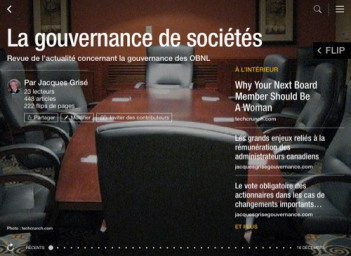
Obtenir un siège sur le C.A. d’une grande entreprise | Difficile … même pour une gestionnaire expérimentée ! *


L’article de J.T. O’Donnell est très direct et, possiblement, assez juste ! Personne ne me fera dire qu’obtenir un siège sur le C.A. d’une grande entreprise cotée en bourse est une chose facile … même pour une personne expérimentée qui possède déjà un poste de haute direction ! Non, c’est une avenue qui demande beaucoup, beaucoup de temps, de volonté et de stratégies !

Ainsi que l’auteure le mentionne, en plus de l’expérience, la bonne …, il faut beaucoup de chance car vous n’êtes pas le seul, ou la seule, à vouloir accéder aux postes de commandes (sur les C.A.). Vous devez avoir un solide réseau de contacts professionnels et faire connaître votre disponibilité, ce que plusieurs refusent de faire parce qu’ils ou elles ont peur de l’échec.

De plus, vous devez avoir les « bonnes connections », le bon profil LinkedIn, la bonne réputation sur les réseaux sociaux, le bon parcours d’emploi dans les grandes organisations, le bon mentor, le bon timing, la bonne formation académique et, de plus en plus, la bonne formation en gouvernance de sociétés.

Si vous êtes intéressés par un poste sur un C.A. prestigieux (à votre retraite, par exemple) préparez-vous en conséquence en utilisant une démarche structurée et en le laissant savoir dans votre milieu, auprès des firmes de recrutement, sur les réseaux sociaux et auprès d’administrateurs chevronnés. Même si vous êtes le fils ou la fille du propriétaire, ce ne sera pas « une marche dans le parc ».

Je vous invite à lire ce bref article qui vous expliquera quelques barrières à l’entrée… Et n’oubliez pas de lire les commentaires à la fin !

Voici un bref extrait de l’article :


Board Seats: Elusive Carrots? (4 Reasons Why)

In the last several weeks, I’ve had three separate conversations with smart, proven C-suite members – all men in their late 50s/early 60s. They’re all credentialed and have previous board experience. Each has been aggressively seeking executive board positions over the last 18 months. Not one of them has been successful. Their only solace? Colleagues trying to do the same are failing too.

LinkedIn One Percent Most Viewed Profiles Email
LinkedIn One Percent Most Viewed Profiles Email (Photo credit: DavidErickson)

As it turns out, more than a few executive Baby Boomers are looking to grab coveted roles on corporate boards. And, why not? Getting paid five-figures to attend quarterly meetings and do some business strategy work seems like a great deal. However, based on my discussions with industry professionals over the last 10 months, for even the most proven executives, it might be easier to win the lottery than to land a board seat. There’s clearly a supply and demand issue – too many senior, white, male executives for too few board positions. Plus, to add insult to injury, according to Jack Welch, some of the executives getting those board seats aren’t very effective.

If you’re an executive who had a board seat(s) in mind for the next phase of your career, here are some things to ponder…


____________________________________

* En reprise

Quels sont les grands enjeux de gouvernance ? | Six thèmes chauds ! *


En rappel, vous trouverez, ci-joint, une excellente publication de la NACD (National Association of Corporate Directors) qui présente les grands défis et les enjeux qui attendent les administrateurs de sociétés au cours des prochaines années.

Ce document est un recueil de textes publiés par les partenaires de la NACD : Heidrick & Struggles International, Inc., KPMG’s Audit Committee Institute, Marsh & McLennan Companies, NASDAQ OMX, Pearl Meyer & Partners et Weil, Gotshal & Manges LLP.

Vous y trouverez un ensemble d’articles très pertinents sur les sujets de l’heure en gouvernance. J’ai déjà publié un billet sur ce sujet le 23 juin 2013, en référence à cette publication.

Chaque année, la NACD se livre à cet exercice et publie un document très prisé !

Voici comment les firmes expertes se sont répartis les thèmes les plus « hot » en gouvernance. Bonne lecture.

Boardroom, Tremont Grand
Boardroom, Tremont Grand (Photo credit: Joel Abroad)

(1) What to Do When an Activist Investor Comes Calling par Heidrick & Struggle

(2) KPMG’s Audit Committee Priorities for 2013 par KPMG’s Audit Committee Institute

(3) Board Risk Checkup—Are You Ready for the Challenges Ahead ? par Marsh & McLennan Companies

(4) Boardroom Discussions par NASDAQ OMX

(5) Paying Executives for Driving Long-Term Success par Pearl Meyer & Partners

(6) What Boards Should Focus on in 2013 par Weil, Gotshal and Manges, LLP

NACD Insights and Analysis – Governance Challenges: 2013 and Beyond

Today, directors are operating in a new environment. Shareholders, regulators, and stakeholders have greater influence on the boardroom than ever before. In addition, risks and crisis situations are occurring with greater frequency and amplitude. Directors have a responsibility to ensure their companies are prepared for these challenges—present and future.This compendium provides insights and practical guidance from the nation’s leading boardroom experts—the National Association of Corporate Directors’ (NACD’s) strategic content partners—each recognized as a thought leader in their respective fields of corporate governance.

_______________________________________

* En reprise

Article relié :

Enhanced by Zemanta

Quelques idées à explorer en 2014 pour accroître la performance du C.A. d’une OBNL *


Voici un court billet de Tom Okarma, président fondateur de Vantage Point | For NonProfit, exposant certaines idées pour accroître l’efficacité de C.A. d’OBNL.

Ci-dessous, un extrait de son billet ainsi que quelques liens utiles pour améliorer la performance des « Boards ». Bonne lecture !


No More Nonprofit Board Problems in 2014 !


Here are a few ideas to help ministry and nonprofit leaders work more closely (and pleasurably) with their boards. Who knows, maybe everyone will actually start enjoying board meetings!

Nonprofit_Expo_01
Nonprofit_Expo_01 (Photo credit: shawncalhoun)

Reconnect regularly with each director, one-to-one if possible, to tap into their wisdom, learn their perspective, and gain valuable confidential input

Invest to improve on your strengths through seminars, workshops, or conferences…like CLA 2014 

Identify existing nonprofit board best practices and install the top two that you feel add the most value to your organization

When meeting with key external stakeholders, ask how they think the organization is performing

Be more available to your staff, volunteers, and key community partners

Become a director on another nonprofit or ministry board and gain valuable perspective of just what that is like

Review your calendar monthly and the organization’s budget to determine if you are allocating time and treasure in line with the year’s goals

Conduct periodic board update (they hate “training”) sessions

For a few other easy and effective ideas on how to improve board relations and effectiveness in 2014, read :

(du site de Vantage Point | For NonProfit)


Electrify Your Sleepy Directors

Board Presidents that Don’t Bore

Board Meetings The Don’t Bore

Maximize Your Board’s Performance in 2014

_________________________________________

* En reprise

Enhanced by Zemanta

Le secrétaire du conseil et la gouvernance de l’entreprise *


Ce matin, je tente de répondre à de nombreuses interrogations concernant le rôle et les fonctions d’un secrétaire du conseil. En premier lieu, voici une présentation faite par Richard Leblanc auprès des membres de la Canadian Society of Corporate Secretaries (CSCS) – Société canadienne des secrétaires corporatifs (SCSC) lors d’un panel à Toronto.

Le professeur Leblanc a énoncé dix recommandations très pertinentes sur les actions à entreprendre par les responsables afin de s’assurer du bon traitement réservé à la diversité. Mon billet du 24 octobre 2012, intitulé Le rôle des secrétaires corporatifs eu égard à la diversité des C.A. des sociétés canadiennes, aborde ce sujet.

Je constate que le président du conseil est un acteur clé dans la conduite des activités des secrétaires. Comme le président assume la responsabilité des communications entre le conseil et la direction, son rôle se confond souvent avec celui de secrétaire.

C’est le président qui établit l’ordre du jour avec le PCD et qui, souvent, rédige ou supervise étroitement les procès-verbaux, une tâche normalement accomplie par le secrétaire. Ainsi, dans beaucoup de cas, le secrétaire joue le rôle d’adjoint au président du conseil pour la gestion administrative des affaires du conseil.

Français : Cabinet du Secrétaire Perpétuel de ...
Français : Cabinet du Secrétaire Perpétuel de l’Académie nationale de Médecine, Paris, France (Photo credit: Wikipedia)

En cherchant à connaître davantage la description de tâche d’un secrétaire du conseil, j’ai trouvé, parmi les publications de notre partenaire IFA (Institut Français des Administrateurs), un document qui répond très bien à cette préoccupation et qui peut convenir à tous les types d’organisations.

Le document de l’IFA est le fruit d’une enquête menées auprès de 149 secrétaires du conseil; il traite (1) du statut, (2) de la fonction, (3) des moyens et (4) du profil du secrétaire du conseil. Vous pouvez télécharger le document au bas du communiqué de l’IFA.

Le Secrétaire du Conseil & la Gouvernance de l’Entreprise | IFA

Les fonctions de Secrétaire du Conseil et des comités du conseil, couvrent par ordre d’importance, les travaux suivants :

  1. rédige les procès-verbaux des réunions du Conseil et s’assure avant leur approbation qu’ils reflètent fidèlement le déroulement des séances ;
  2. est en relation avec les administrateurs en dehors du Conseil, répond à leurs questions, s’assure de leur présence pour le quorum, suit leurs questions matérielles et réglementaires (jetons de présence, suivi des déclarations pour les opérations sur titres etc.) ;
  3. met au point le calendrier des réunions du Conseil, prépare les ordres du jour et convoque les administrateurs ;
  4. prépare l’ordre du jour et organise le déroulement de la séance du Conseil avec le Président ;
  5. prépare ou contribue à l’élaboration des différents documents mis à la disposition des actionnaires en vue de l’Assemblée Générale ;
  6. organise matériellement les réunions, y compris hors du siège social ;
  7. surveille les règles de déontologie et de conformité ;
  8. organise le processus d’évaluation du fonctionnement du Conseil ;
  9. assure le suivi des relations avec les actionnaires individuels, les institutionnels;
  10. est le « Gardien de la gouvernance dans le Groupe »  et
  11. assure le secrétariat du Conseil de chaque filiale.


Voici les recommandations qui émanent de cette enquête :


1. La fonction de Secrétaire du Conseil doit être formalisée par le Conseil (plutôt que par des textes réglementaires). Son rôle doit être défini dans le Règlement Intérieur du Conseil et sa nomination entérinée lors d’une séance du Conseil.

2. Lorsque des comités spécialisés existent, il est recommandé que le Secrétaire du Conseil soit aussi le secrétaire de tous les comités. Dans le cas contraire, des comptes rendus des travaux de chaque comité doivent être établis et le Secrétaire du Conseil doit en être destinataire.

3. Dans les entreprises cotées, son poste doit évoluer vers un poste à plein temps et les moyens nécessaires à l’exercice de sa fonction doivent lui être donnés. Budgétairement et en comptabilité analytique, un centre de coût spécifique doit lui être attribué (frais de missions, de formation, jetons de présence …)

4. Le Secrétaire du Conseil doit être disponible et, si possible, rattaché directement au Président du Conseil (exécutif ou non) afin de favoriser une plus grande indépendance et un meilleur fonctionnement du Conseil.

5. Si son poste n’est pas à plein temps, il peut être rattaché à d’autres directions dans le cadre de ses autres fonctions.

6. Il est apparu utile qu’un lieu permanent de rencontre et d’échange (mais aussi d’information et de formation) soit mis à la disposition des Secrétaires du Conseil dans le cadre de l’IFA.

______________________________________________

* En reprise

Quelles sont les qualités d’un président de conseil d’administration (PCA) exceptionnel ? *


Voici un rapport de recherche publié par la firme Alvarez & Marsal, sur les qualités d’un bon président de conseil d’administration (PCA).

L’étude présente les résultats des entrevues menées auprès de 22 PCA des plus grandes sociétés publiques britanniques qui ont œuvrés avec plus de 120 PCA dans leurs carrières.

Cette lecture, vraiment fascinante, montre clairement les qualités des PCA qui sont considérées comme exceptionnelles par leurs pairs. Ci-dessous, un bref extrait du rapport.

What makes an exceptional Chairman ?

« Our research has identified the key attributes displayed by exceptional chairmen in challenging times. Although most difficult to maintain during periods of duress, these characteristics are displayed throughout a chairman’s tenure and across all aspects of their management of the business. We have also compared these attributes with the guidance for chairmen provided by the Higgs Report and the more recent guidance note published by the Financial Reporting Council. This emphasises that ‘good boards are created by good chairmen’ and the importance of the chairman demonstrating ‘ethical leadership.’ In its detail, the guidance provides lists detailing the chairman’s role, rather than the qualities which come out of our research.

Alan Greenspan, Chairman of the Board of Gover...
Alan Greenspan, Chairman of the Board of Governors of the Federal Reserve, 1987-2006 (Photo credit: Wikipedia)

Firstly, and most importantly, an exceptional chairman understands the business, its culture, people and processes. This understanding encompasses recognising and embodying the values of the business as much as having knowledge of the business operations and the marketplace. An exceptional chairman also understands the wider industry and prepares the company for all eventualities, from further market disruption to opportunities to improve competitiveness. This is based on their deep knowledge of the company and sector. Extensive knowledge of a sector or type of sector (e.g. heavy manufacturing) is as important as the chairman’s ability to apply his or her accumulated experiences into effecting transformational change and preparing the business for future challenges.

Secondly, exceptional chairmen never consider themselves a one-person success. They create strong teams that have real influence on the company’s direction by building an effective board of non-execs and establishing a complementary working relationship with the CEO and their team. They implement change through the CEO, but are ready and able to step in at the right time to provide air cover to alleviate pressure. In short, they provide strong active leadership of the board.

Not afraid to take tough decisions in adversity, this type of chairman has an infectious enthusiasm and commitment to change which has a ripple effect, creating a ‘can-do’ attitude throughout the company. With internal stakeholders on board, the chairman uses strong communication skills to engage shareholders and other external stakeholders with change ».

L’article présente 8 aspects qui caractérisent les présidents de conseil qui ont du succès. Lisez la suite dans cet excellent rapport.

_________________________________________

* En reprise

Enhanced by Zemanta

Un guide essentiel pour comprendre et enseigner la gouvernance | Version française *


Plusieurs administrateurs et formateurs me demandent de leur proposer un document de vulgarisation sur le sujet de la gouvernance. J’ai déjà diffusé sur mon blogue un guide à l’intention des journalistes spécialisés dans le domaine de la gouvernance des sociétés à travers le monde.

Il a été publié par le Global Corporate Governance Forum et International Finance Corporation (un organisme de la World Bank) en étroite coopération avec International Center for Journalists.

Je n’ai encore rien vu de plus complet et de plus pertinent sur la meilleure manière d’appréhender les multiples problématiques reliées à la gouvernance des entreprises mondiales. La direction de Global Corporate Governance Forum m’a fait parvenir le document en français le 14 février.

Qui dirige l’entreprise : Guide pratique de médiatisation du gouvernement d’entreprise – document en français


Ce guide est un outil pédagogique indispensable pour acquérir une solide compréhension des diverses facettes de la gouvernance des sociétés. Les auteurs ont multiplié les exemples de problèmes d’éthiques et de conflits d’intérêts liés à la conduite des entreprises mondiales. On apprend aux journalistes économiques – et à toutes les personnes préoccupées par la saine gouvernance – à raffiner les investigations et à diffuser les résultats des analyses effectuées.

Je vous recommande fortement de lire le document, mais aussi de le conserver en lieu sûr car il est fort probable que vous aurez l’occasion de vous en servir.

Vous trouverez ci-dessous quelques extraits de l’introduction à la version anglaise de l’ouvrage que j’avais publiée antérieurement.

Who’s Running the Company ? A Guide to Reporting on Corporate Governance


À propos du Guide

English: Paternoster Sauqre at night, 21st May...

« This Guide is designed for reporters and editors who already have some experience covering business and finance. The goal is to help journalists develop stories that examine how a company is governed, and spot events that may have serious consequences for the company’s survival, shareholders and stakeholders. Topics include the media’s role as a watchdog, how the board of directors functions, what constitutes good practice, what financial reports reveal, what role shareholders play and how to track down and use information shedding light on a company’s inner workings. Journalists will learn how to recognize “red flags,” or warning  signs, that indicate whether a company may be violating laws and rules. Tips on reporting and writing guide reporters in developing clear, balanced, fair and convincing stories.

Three recurring features in the Guide help reporters apply “lessons learned” to their own “beats,” or coverage areas:

– Reporter’s Notebook: Advise from successful business journalists

– Story Toolbox:  How and where to find the story ideas

– What Do You Know? Applying the Guide’s lessons

Each chapter helps journalists acquire the knowledge and skills needed to recognize potential stories in the companies they cover, dig out the essential facts, interpret their findings and write clear, compelling stories:

  1. What corporate governance is, and how it can lead to stories. (Chapter 1, What’s good governance, and why should journalists care?)
  2. How understanding the role that the board and its committees play can lead to stories that competitors miss. (Chapter 2, The all-important board of directors)
  3. Shareholders are not only the ultimate stakeholders in public companies, but they often are an excellent source for story ideas. (Chapter 3, All about shareholders)
  4. Understanding how companies are structured helps journalists figure out how the board and management interact and why family-owned and state-owned enterprises (SOEs), may not always operate in the best interests of shareholders and the public. (Chapter 4, Inside family-owned and state-owned enterprises)
  5. Regulatory disclosures can be a rich source of exclusive stories for journalists who know where to look and how to interpret what they see. (Chapter 5, Toeing the line: regulations and disclosure)
  6. Reading financial statements and annual reports — especially the fine print — often leads to journalistic scoops. (Chapter 6, Finding the story behind the numbers)
  7. Developing sources is a key element for reporters covering companies. So is dealing with resistance and pressure from company executives and public relations directors. (Chapter 7, Writing and reporting tips)


Each chapter ends with a section on Sources, which lists background resources pertinent to that chapter’s topics. At the end of the Guide, a Selected Resources section provides useful websites and recommended reading on corporate governance. The Glossary defines terminology used in covering companies and corporate governance ».

______________________________________________

* En reprise

Enhanced by Zemanta

Pourquoi séparer les fonctions de président du conseil (PCA) et de président et chef de la direction (PDG) ? *


Très bonnes réflexions d’Yvan Allaire sur le dogme de la séparation des rôles entre PCA et PDG. À lire sur le blogue Les Affaires .com.

Rien à rajouter à ce billet de l’expert en gouvernance qui , comme moi, cherche des réponses à plusieurs théories sur la gouvernance.

Plus de recherches dans le domaine de la gouvernance serait grandement indiquées… Le CAS et la FSA de l’Université Laval mettront sur pied un programme de recherche dont le but est de répondre à ce type de questionnement.


Pourquoi séparer les fonctions de président du conseil (PCA) et de président et chef de la direction (PDG) ?

« Parmi les dogmes de la bonne gouvernance, la séparation des rôles du PCA et du PDG vient au deuxième rang immédiatement derrière « l’indépendance absolue et inviolable » de la majorité des administrateurs. …

Yvan Allaire - World Economic Forum Annual Mee...
Yvan Allaire – World Economic Forum Annual Meeting 2010 Davos (Photo credit: World Economic Forum)

Bien que les études empiriques aient grande difficulté à démontrer de façon irréfutable la valeur de ces deux dogmes, ceux-ci sont, semble-t-il, incontournables. Dans le cas de la séparation des rôles, le sujet a pris une certaine importance récemment chez Research in Motion ainsi que chez Air Transat. Le compromis d’un administrateur en chef (lead director) pour compenser pour le fait que le PCA et le PDG soit la même personne ne satisfait plus; le dogme demande que le président du conseil soit indépendant de la direction ».

______________________________________________

* En reprise

Enhanced by Zemanta

Une formation en gouvernance pour les nouveaux administrateurs | Un prérequis ? *


La formation en gouvernance est de plus en plus un préalable à l’exercice du rôle d’administrateur de sociétés. L’article retenu montre que l’apprentissage sur le tas est en voie de disparition dans les conseils d’administration de grandes sociétés. La formation préparatoire peut prendre différentes formes : training sur mesure, coaching, séminaires, etc.

Cependant, il semble de plus en plus évident que les programme de formation en gouvernance (tels que IoD, C.dir., ASC, IAS) menant à une certification reconnue, constituent la voie à suivre dans le futur.

L’article de Hannah Prevett, paru dans le Sunday Times, montre que les formations organisées sont de meilleurs endroits pour un apprentissage de qualité que les tables de conseils d’administration… Bonne lecture !

Diplômés ASC du Collège des administrateurs de sociétés 2012

A head start for novices

The received wisdom is that new directors learn on the job. If they are not  equipped with the necessary skills when they accept their first board  appointment, they will need to be quick on the uptake.

Not any more: the tidal wave of new governance requirements means it is not  good enough to acquire expertise over time. And, as a result, many  prospective boardroom stars are seeking training to help them do the job  they’re paid to do from day one. When Alan Kay learnt he was to join the executive board of Costain in 2003, he  immediately began considering how to prepare for his new role at the  engineering and construction group.

“A lot of people haven’t really thought about how to prepare for a board role.  [They think] it’s something that happens naturally: you get on the board and  then you think, I’m going to learn on the job,” said Kay, who is Costain’s  technical and operations director. “But once you’re appointed, becoming  competent and learning as you go takes several months, which is not ideal.”

He researched training options for new board members and came across the  Institute of Directors’ accredited programmes, including the certificate and  diploma in company direction. The IoD fills 6,000 places on such courses annually with representatives of  both large and small organisations — not all of them young guns, as Roger  Barker, head of corporate governance at the IoD, explained.

“The directors of large organisations were reluctant to undertake any form of  formalised director training. These were typically seasoned former  executives, with extensive experience of serving on boards as chief  executives or chief financial officers. It has been difficult to persuade  such individuals that director training is relevant to them,” said Barker.

_________________________________

* En reprise

Enhanced by Zemanta

L’utilisation des huis clos lors des sessions de C.A. *


Voici un article intéressant de Matthew Scott sur le site de Corporate Secretary qui aborde un sujet qui préoccupe beaucoup de hauts dirigeants : le huis clos lors des sessions du conseil d’administration ou de certains comités. L’auteur explique très bien la nature et la nécessité de cette activité à inscrire à l’ordre du jour du conseil.

Compte tenu de la « réticence » de plusieurs hauts dirigeants à la tenue de cette activité, il est généralement reconnu que cet item devrait toujours être présent à l’ordre du jour afin d’éliminer certaines susceptibilités.

Le huis clos est un temps privilégié que les administrateurs indépendants se donnent pour se questionner sur l’efficacité du conseil et la possibilité d’améliorer la dynamique interne; mais c’est surtout une occasion pour les membres de discuter librement, sans la présence des gestionnaires, de sujets délicats tels que la planification de la relève, la performance des dirigeants, la rémunération globale de la direction, les poursuites légales, les situations de conflits d’intérêts, les arrangements confidentiels, etc. On ne rédige généralement pas de procès-verbal à la suite de cette activité, sauf lorsque les membres croient qu’une résolution doit absolument apparaître au P.V.

La mise en place d’une période de huis clos est une pratique relativement récente, depuis que les conseils d’administration ont réaffirmé leur souveraineté sur la gouvernance des entreprises. Cette activité est maintenant considérée comme une pratique exemplaire de gouvernance et presque toutes les sociétés l’ont adoptée.

Notons que le rôle du président du conseil, en tant que premier responsable de l’établissement de l’agenda, est primordial à cet égard. C’est lui qui doit informer le PCD de la position des membres indépendants à la suite du huis clos, un exercice qui demande du tact !

Je vous invite à lire l’article ci-dessous. Vos commentaires sont les bienvenus.

Are you using in-camera meetings ?

More companies are encouraging candid exchange among independent directors without management present

As corporate boards face more complex and difficult decisions, they may want to consider increasing the use of in-camera meetings to get more ‘realistic’ opinions from directors before moving forward with corporate strategy.

In-camera meetings, as they are called in Canada – or executive sessions, as they are referred to in the US – are special meetings where independent directors or committees of the board convene separately from management to have candid, off-the-record discussions about matters that are important to the company.

English: SOS Meetings Logo
English: SOS Meetings Logo (Photo credit: Wikipedia)

The term ‘In camera’ derives from Latin and refers to ‘in a chamber’ which is a legal term meaning ‘in private.’ During these meetings, independent board members are free to challenge each other and speak their mind freely because minutes are generally not taken. Such meetings could be held to discuss and clarify the board’s position on issues that may produce opposing views between management and the board or to deal with issues that could involve conflicts of interest with management, such as CEO compensation.

‘In-camera meetings allow directors to talk about their view of matters without management present,’ says Jo-Anne Archibald, president of DSA Corporate Services. ‘They can talk about anything related to the company and they don’t have to worry about it being written down anywhere.’

____________________________________

* En reprise

La gouvernance dans tous ses états | Huit (8) articles parus dans Lesaffaires.com


Voici une série de huit articles, publiés le 31 mars 2014 par les experts du Collège des administrateurs de sociétés (CAS) dans le volet Dossier de l’édition Les Affaires.com

Découvrez comment les entreprises et les administrateurs doivent s’adapter afin de tirer profit des meilleures pratiques.

  1. Une bonne gouvernance, c’est aussi pour les PME
  2. Les défis de la gouvernance à l’ère du numérique
  3. La montée de l’activisme des actionnaires en six questions
  4. Gouvernance : 12 tendances à surveiller
  5. Gouvernance : huit principes à respecter
  6. Conseils d’administration : la diversité, mode d’emploi
  7. Les administrateurs doivent-ils développer leurs compétences ?
  8. Vous souhaitez occuper un poste sur un conseil d’administration ?

Vos commentaires sont appréciés. Bonne lecture !

La gouvernance dans tous ses états | Huit articles parus dans Lesaffaires.com


image

Une bonne gouvernance, c’est aussi pour les PME

Une entrevue avec M. Réjean Dancause, président et directeur général du Groupe Dancause et Associés inc.

image

Les défis de la gouvernance à l’ère du numérique

Une entrevue avec M. Gilles Bernier, directeur des programmes du Collège des administrateurs de sociétés

image

La montée de l’activisme des actionnaires en six questions

Une entrevue avec M. Jean Bédard, titulaire de la Chaire de recherche en gouvernance de sociétés, Université Laval

image

Gouvernance : 12 tendances à surveiller

Une entrevue avec M. Jacques Grisé, auteur du blogue jacquesgrisegouvernance.com

image

Gouvernance : huit principes à respecter

Une entrevue avec M. Richard Drouin, avocat-conseil, McCarthy Tétrault

image

Conseils d’administration : la diversité, mode d’emploi

Une entrevue avec Mme Nicolle Forget, administratrice de sociétés

image

Les administrateurs doivent-ils développer leurs compétences?

Une entrevue avec Mme Louise Champoux-Paillé, administratrice de sociétés et présidente du …

image

Vous souhaitez occuper un poste sur un conseil d’administration ?

Une entrevue avec M. Richard Joly, président de Leaders et Cie

_____________________________________________

Enhanced by Zemanta

Grands courants de pensées en gouvernance | Propositions de réforme au cours des 60 dernières années *


Je vous propose la lecture d’un essai sur les principaux courants de pensées en gouvernance des sociétés au cours des soixante dernières années. Ce document, écrit par Douglas M. Branson de l’École de Droit de l’Université de Pittsburgh et paru dans le Social Science Research Network (SSRN), représente certainement l’un des points de vue les plus articulés sur la recherche d’une explication valable à la thèse de Berle et Means concernant la séparation de la propriété de celle du contrôle des firmes.

Bien que l’essai soit rédigé dans un style assez provocateur, il est fascinant à lire, pour peu que l’on soit familier avec la langue de Shakespeare et que l’on s’accommode des accents grinçants de l’auteur.

Je recommande fortement la lecture de ce texte à tout étudiant de la gouvernance; c’est un must pour comprendre le champ d’étude !  J’ai obtenu l’autorisation de Douglas Branson pour la traduction de ce document.

Voici les points saillants de l’essai de Branson (en anglais, à ce stade-ci) :


Logo of the American Law Institute.
Logo of the American Law Institute. (Photo credit: Wikipedia)
        1. In 1932, Adolph Berle and Gardiner Means documented the widespread dispersion of corporate shareholders, and the atomization of corporate shareholdings. They noted that in the then modern corporation “ownership has become depersonalized”. The result was that a new form of property had come into being. The person who owned the property no longer controlled it, as the farmer who owned the horse had to feed it, teach it pull the plow, and bury it when it died. “In the corporate system, the ‘owner’ of industrial wealth is left with a mere symbol of ownership while the power, the responsibility and the substance which have been an integral part of ownership in the past are being transferred to a separate group in whose hands lies control.” This was the fabled “separation of ownership from control.”
        2. In one of the best known of his books (1956), American Capitalism : The Concept of Countervailing Power, Galbraith rhetorically posed a number of solutions to the problem of unchecked corporate power, including the separation of ownership from control, although he generally did not use the Berle & Means terminology. He did not propose nationalization, as the British had done. Instead, he theorized that, indeed, corporations had grown too large, their shareholders no longer controlled them, competitive market forces no longer constrained them, and the potential for abuse was great. That potential would be checked however by the growth of countervailing power inherent in the growth of labor unions, consumer groups and government agencies. Galbraith pointed to the growth and influence of consumer cooperatives which enjoyed great growth in Scandinavia, at least in the post-War years. Essentially, those newly empowered groups would supply the controls historically owners had provided.
        3. The Corporate Social Responsibility Movement of the Early 70s called for government intervention, as the nationalization movement had, but on discrete fronts rather than on a plenary basis. One scholar urged replacement of the one share one vote standard prevalent in U.S. corporate law with a graduated scale so that with acquisition of addition shares owners, particularly institutional owners who were perceived to be excessively mercenary would receive less and less voting power. A “power to the people” mandate would augment the power of individual owners, who generally held fewer shares but were thought to be more socially conscious. Calls for required installation of public interest directors on publicly held corporations’ boards sometimes included sub-recommendations that legislation also require that the publicly minded be equipped with offices and staffs, at corporate expense. Others proposed requirements for social auditing and for mandatory disclosure of social audit results.
        4. Toward the second half of the 1970s, The Corporate Accountability Research Group, created and promoted by consumer advocate Ralph Nader, gathered evidence, marshaled arguments, and advocated the other, more drastic reform of the 1970s, federal chartering of large corporations. In certain of its incarnations, chartering advocates expanded the proposal’s reach, from the 500 largest enterprises to the 2000 largest U.S. corporations by revenue, to any corporation which did a significant amount of business with the federal government, and to certain categories of companies whose businesses were thought to be infected with the public interest. Whatever the universe of such corporations, these companies would have to re-register with a new federal entity, the Federal Chartering Agency. In addition, these corporations would no longer have perpetual existence as they had under state law. Instead the new federal statute corporations would have only limited life charters, good for, say, 20 or 25 years limited.
        5. A Seismic Shift: the Swift Rise of Law and Economics Jurisprudence of the 1980s. Perhaps only once in a lifetime will one see as pronounced a jurisprudential shift as that from the corporate social responsibility and federal chartering movements to the minimalist, non-invasive take of economics on corporate law and corporate governance. Law and economics pointed to a minimalist corporate jurisprudence the core theory of which was that market forces regulated corporate and managerial behavior much better than regulation, laws, or lawsuits ever could.
        6. An Antidote: The Good Governance Movement. The American Law Institute (ALI) Corporate Governance Project of 1994 constituted an implicit rejection of, and an antidote to, the law and economics movement. Succinctly, the ALI evinced a strong belief that, yes, corporate law does have a role to play. That belief, sometimes characterized as the constitutionalist approach, in contrast to the contractarian approach, underline and buttresses the entire ALI Project. The ALI crafted recommended rules for corporate objectives; structure, including board composition and committee structure; duty of “fair dealing” (duty of loyalty); duty of care and the business judgment rule; roles of directors and shareholders in control transactions and tender offers; and shareholders’remedies, including the derivative action and appraisal remedies.
        7. The Early 1990s: The Emphasis on Institutional Investor Activism. Traditionally, though, institutional investors followed the “Wall Street Rule,” meaning that if they developed an aversion to a portfolio company’s performance or governance, they simply sold the stock rather than becoming embroiled in a corporate governance issue. Institutions voted with their feet. That is, they did so until portfolio positions had become so large that if an institutional investor liquidated even a sizeable portion of the portfolio’s stake in a company, the institution’s sales alone would push down the stock’s price. Thus, in the modern era, institutional investors are faced with more of a buy and hold strategy than they otherwise might prefer. So was born an opening to push for yet another proposed reform which would fill the vacuum created by the separation of ownership from control, namely, institutional activism, or “agents watching agents.” The case for institutional oversight was that because “product, capital, labor, and corporate control constraints on managerial discretion are imperfect, corporate managers need to be watched by someone, and the institutions are the only institutions available.”
        8. The Shift to an Emphasis on “Global” Convergence in Corporate Governance. In the second half of the 90s decade, the governance prognosticators did an abrupt about face, abandoning talk about the prospect of institutional shareholder activism in favor of pontification on the prospect of global convergence. The thesis went something like this. Through the process of globalization the world had become a much smaller place. Through use of media such as email and the Internet, governance advocates in Singapore now knew, or knew how to find out, what was happening on the corporate governance front in the United Kingdom and the United States. According to U.S. academics, the global model of good governance would replicate the U.S. model of corporate governance, of course…
        9. Shift of the Emphasis to the Gatekeepers in 2001. Whatever the U.S. system was, it had a great many defects and it did not do the job for which it had been devised. In addition, of course, no sign existed that the convergence predicted had taken place. The Sarbanes-Oxley Act of 2002 (SOX) heads off in varying directions but a careful reader can discern that one of the legislation’s dominant themes is strengthening gatekeepers as a means of enhancing watchfulness over corporations. Thus, for example, SOX requires public corporations to have audit committees composed of independent directors, one or more of whom must be financial experts. Section 307 imposes whistleblowing duties upon attorneys who uncover wrongdoing. To enhance their independence, SOX requires that accountings firms which audit public companies no longer may provide a long list of lucrative consulting services for audit clients.
        10. Emphasis on Independent Directors and Independent Board Committees. The movement for independent directors gathered steam with the 2002 SOX legislation, which required that SEC reporting companies, that is, most publicly held corporations, have an audit committee comprised exclusively of independent directors. The New York Stock Exchange followed by amendments to its Listing Manual that listed public companies have a majority of directors who are independent, making the 1994 ALI recommendation of good practice into a hard and fast requirement. In 2010, the Dodd-Frank Act jumped on the independent director bandwagon with its requirement that exchanges refuse to list the shares of corporations who disclose they do not have a compensation committee comprised of independent directors. Observers who have written about the issue assume that the Dodd-Frank disclosure requirement is a de facto requirement that corporations have compensation committees, albeit a backhanded sort of requirement.

L’extrait que je vous présente vous donnera une bonne idée de la teneur des propos de Branson. Vous pouvez télécharger le document de 25 pages.

Vos commentaires sont grandement appréciés. Bonne lecture.

Proposals for Corporate Governance Reform: Six Decades of Ineptitude and Counting

This article is a retrospective of corporate governance reforms various academics have authored over the last 60 years or so, by the author of the first U.S. legal treatise on the subject of corporate governance (Douglas M. Branson, Corporate Governance (1993)). The first finding is as to periodicity: even casual inspection reveals that the reformer group which controls the « reform » agenda has authored a new and different reform proposal every five years, with clock-like regularity. The second finding flows from the first, namely, that not one of these proposals has made so much as a dent in the problems that are perceived to exist. The third inquiry is to ask why this is so? Possible answers include the top down nature of scholarship and reform proposals in corporate governance; the closed nature of the group controlling the agenda, confined as it is to 8-10 academics at elite institutions; the lack of any attempt rethink or redefine the challenges which governance may or may not face; and the continued adhesion to the problem as the separation of ownership from control as Adolph Berle and Gardiner Means perceived it more than 80 years ago.

______________________________________________

* En reprise


Enhanced by Zemanta

Douze (12) tendances à surveiller en gouvernance | Jacques Grisé


Vous trouverez ci-dessous un article publié dans Lesaffaires.com le 31 mars 2014.

Dans cet entrevue, le journaliste me demande de faire une synthèse des tendances les plus significatives en gouvernance de sociétés. Bonne lecture !

Gouvernance : 12 tendances à surveiller

sans-titre

Une entrevue avec M. Jacques Grisé, auteur du blogue jacquesgrisegouvernance.com

Si la gouvernance des entreprises a fait beaucoup de chemin depuis quelques années, son évolution se poursuit. Afin d’imaginer la direction qu’elle prendra au cours des prochaines années, nous avons consulté l’expert Jacques Grisé, ancien directeur des programmes du Collège des administrateurs de sociétés, de l’Université Laval. Toujours affilié au Collège, M. Grisé publie depuis plusieurs années le blogue www.jacquesgrisegouvernance.com, un site incontournable pour rester à l’affût des bonnes pratiques et tendances en gouvernance.

Voici les 12 tendances dont il faut suivre l’évolution, selon Jacques Grisé :

1. Les conseils d’administration réaffirmeront leur autorité.

« Auparavant, la gouvernance était une affaire qui concernait davantage le management », explique M. Grisé. La professionnalisation de la fonction d’administrateur amène une modification et un élargissement du rôle et des responsabilités des conseils. Les CA sont de plus en plus sollicités et questionnés au sujet de leurs décisions et de l’entreprise.

2. La formation des administrateurs prendra de l’importance.

À l’avenir, on exigera toujours plus des administrateurs. C’est pourquoi la formation est essentielle et devient même une exigence pour certains organismes. De plus, la formation continue se généralise ; elle devient plus formelle.

3. L’affirmation du droit des actionnaires et celle du rôle du conseil s’imposeront.

Le débat autour du droit des actionnaires par rapport à celui des conseils d’administration devra mener à une compréhension de ces droits conflictuels. Aujourd’hui, les conseils doivent tenir compte des parties prenantes en tout temps.

4. La montée des investisseurs activistes se poursuivra.

L’arrivée de l’activisme apporte une nouvelle dimension au travail des administrateurs. Les investisseurs activistes s’adressent directement aux actionnaires, ce qui mine l’autorité des conseils d’administration. Est-ce bon ou mauvais ? La vision à court terme des activistes peut être néfaste, mais toutes leurs actions ne sont pas négatives, notamment parce qu’ils s’intéressent souvent à des entreprises qui ont besoin d’un redressement sous une forme ou une autre. Pour bien des gens, les fonds activistes sont une façon d’améliorer la gouvernance. Le débat demeure ouvert.

5. La recherche de compétences clés deviendra la norme.

De plus en plus, les organisations chercheront à augmenter la qualité de leur conseil en recrutant des administrateurs aux expertises précises, qui sont des atouts dans certains domaines ou secteurs névralgiques.

6. Les règles de bonne gouvernance vont s’étendre à plus d’entreprises.

Les grands principes de la gouvernance sont les mêmes, peu importe le type d’organisation, de la PME à la société ouverte (ou cotée), en passant par les sociétés d’État, les organismes à but non lucratif et les entreprises familiales.

7. Le rôle du président du conseil sera davantage valorisé.

La tendance veut que deux personnes distinctes occupent les postes de président du conseil et de PDG, au lieu qu’une seule personne cumule les deux, comme c’est encore trop souvent le cas. Un bon conseil a besoin d’un solide leader, indépendant du PDG.

8. La diversité deviendra incontournable.

Même s’il y a un plus grand nombre de femmes au sein des conseils, le déficit est encore énorme. Pourtant, certaines études montrent que les entreprises qui font une place aux femmes au sein de leur conseil sont plus rentables. Et la diversité doit s’étendre à d’autres origines culturelles, à des gens de tous âges et d’horizons divers.

9. Le rôle stratégique du conseil dans l’entreprise s’imposera.

Le temps où les CA ne faisaient qu’approuver les orientations stratégiques définies par la direction est révolu. Désormais, l’élaboration du plan stratégique de l’entreprise doit se faire en collaboration avec le conseil, en profitant de son expertise.

10. La réglementation continuera de se raffermir.

Le resserrement des règles qui encadrent la gouvernance ne fait que commencer. Selon Jacques Grisé, il faut s’attendre à ce que les autorités réglementaires exercent une surveillance accrue partout dans le monde, y compris au Québec, avec l’Autorité des marchés financiers. En conséquence, les conseils doivent se plier aux règles, notamment en ce qui concerne la rémunération et la divulgation. Les responsabilités des comités au sein du conseil prendront de l’importance. Les conseils doivent mettre en place des politiques claires en ce qui concerne la gouvernance.

11. La composition des conseils d’administration s’adaptera aux nouvelles exigences et se transformera.

Les CA seront plus petits, ce qui réduira le rôle prépondérant du comité exécutif, en donnant plus de pouvoir à tous les administrateurs. Ceux-ci seront mieux choisis et formés, plus indépendants, mieux rémunérés et plus redevables de leur gestion aux diverses parties prenantes. Les administrateurs auront davantage de responsabilités et seront plus engagés dans les comités aux fonctions plus stratégiques. Leur responsabilité légale s’élargira en même temps que leurs tâches gagnent en importance. Il faudra donc des membres plus engagés, un conseil plus diversifié, dirigé par un leader plus fort.

12. L’évaluation de la performance des conseils d’administration deviendra la norme.

La tendance est déjà bien ancrée aux États-Unis, où les entreprises engagent souvent des firmes externes pour mener cette évaluation. Certaines choisissent l’autoévaluation. Dans tous les cas, le processus est ouvert et si les résultats restent confidentiels, ils contribuent à l’amélioration de l’efficacité des conseils d’administration.

Vous désirez en savoir plus sur les bonnes pratiques de gouvernance ? Visitez le site du Collège des administrateurs de sociétés et suivez le blogue de Jacques Grisé.


Enhanced by Zemanta

Définir l’intégrité au sein du conseil d’administration | Deloitte *


Quel est le rôle du conseil d’administration en matière d’intégrité ? Un récent document du Centre de la gouvernance d’entreprise de Deloitte montre comment l’intégrité constitue l’une des grandes responsabilités du C.A., comment on peut l’évaluer au niveau de l’organisation et, surtout, quel modèle les administrateurs peuvent adopter afin d’assumer leur fonction de surveillance de l’intégrité.

Ce court article sera sûrement d’une grande utilité aux membres des conseils. Vos commentaires sont toujours les bienvenus !

Définir l’intégrité au sein du conseil d’administration | Deloitte

« Un conseil d’administration efficace se soucie de l’intégrité tant au sein du conseil qu’à l’extérieur de celui-ci. Il donne l’exemple. Le conseil aide le chef de la direction à donner le ton en matière d’éthique au sein de l’organisation. De plus, il favorise et surveille le respect des lois, des règlements et des politiques propres à l’organisation. L’intégrité au sein du conseil d’administration est fondée sur des facteurs comme les valeurs organisationnelles, le besoin de respecter les responsabilités fiduciaires du conseil ainsi qu’une volonté de rendre des comptes.

English: The Deloitte Centre in Auckland City,...
English: The Deloitte Centre in Auckland City, New Zealand. (Photo credit: Wikipedia)

L’engagement envers une performance empreinte d’intégrité est largement reconnu comme étant un attribut indispensable d’une organisation. Toutefois, bon nombre de personnes et d’organisations éprouvent des difficultés à mettre cet idéal en pratique. Les structures et les pratiques de gouvernance des conseils doivent favoriser une culture d’intégrité dans l’entreprise en plus de promouvoir la responsabilité d’entreprise ainsi que les responsabilités environnementales et sociales. Le conseil d’administration doit aider à forger des relations de confiance à long terme avec les actionnaires, les clients, les autorités de réglementation et les employés.

Le rôle du conseil dans le maintien de l’intégrité consiste à travailler avec le chef de la direction pour donner le ton, comprendre les exigences en matière de conformité et fixer les attentes à l’égard de la haute direction qui sont ensuite transmises à l’ensemble de l’organisation. De plus, le conseil demande aux membres de la haute direction de rendre des comptes sur les résultats par rapport aux attentes fixées ».

* En reprise

Enhanced by Zemanta

Quel est le cadre juridique du fonctionnement d’un conseil consultatif de PME ? *


Quel est le cadre juridique du fonctionnement d’un conseil consultatif de PME ? Voici quelques éléments d’information en réponse à une question souvent posée dans le cadre de la formation en gouvernance de sociétés.

Cette question a été soumise à la considération de Me Raymonde Crête, professeure de droit à l’Université Laval et de Me Thierry Dorval, associé de Norton Rose.

Je reproduis ici la réponse de ces deux experts juridiques en gouvernance :

Palasis-Prince pavillion of the Laval Universi...
Palasis-Prince pavillion of the Laval University, Quebec, Quebec, Canada, October 2007. (Photo credit: Wikipedia)


 « Dans une PME, il est possible de créer un comité consultatif. Il n’existe pas de règles spécifiques concernant la création de ce type de comité. Les membres du comité consultatif ne sont pas, en principe, assujettis aux responsabilités qui incombent normalement aux administrateurs de sociétés, à moins qu’ils agissent, dans les faits, comme des administrateurs. Si les membres du comité consultatif agissent, dans les faits ou de facto, comme des administrateurs de sociétés, ils pourraient engager leur responsabilité, notamment en matière fiscale ou d’environnement. L’article 227.1 de la Loi de l’impôt sur le revenu impose aux administrateurs une responsabilité solidaire en cas de non-paiement de certains impôts. Pour éviter d’engager leur responsabilité, les membres du comité consultatif ne doivent donc pas exercer des fonctions analogues ou des pouvoirs similaires à ceux exercés par les membres d’un conseil d’administration, tels les pouvoirs décisionnels en matière d’émission d’actions, de déclaration de dividendes, etc ».

Concernant les responsabilités du conseil d’administration, vous pouvez consulter le document ci-dessous publié par Norton Rose.

Identification et gestion des risques que comporte le rôle d’administrateur de société

__________________________________

* En reprise

Enhanced by Zemanta

Quelle est la valeur ajoutée d’un « conseil aviseur » efficace ? *


Ce texte publié par Barry Reiter, et paru dans Ivey Business Journal, explique très bien en quoi consiste un « conseil aviseur » pour une PME en développement. En quoi les entreprises trouvent-elles avantage à se doter d’une telle structure et, surtout, quels sont les étapes concrètes de sa création ainsi que les conditions d’un bon fonctionnement.

Cet article couvre vraiment tous les angles de l’établissement d’un « comité aviseur » et il répond aux questions que les entrepreneurs et les dirigeants d’entreprises en développement se posent eu égard à la valeur ajoutée d’un tel comité.

Bonne lecture. Vos commentaires sont appréciés.

THE ROLE AND VALUE OF AN EFFECTIVE ADVISORY BOARD

An effective advisory board, properly composed and structured, can provide non-binding but informed guidance and serve as a tremendous ally in the quest for superior corporate governance. This author, a lawyer with significant experience on boards of directors, offers a helpful blueprint for establishing an effective advisory board.

PM Harper participates in a question and answe...
PM Harper participates in a question and answer session with the Ivey Business School (Photo credit: pmwebphotos)

Nobody can build a great business alone, and whether it’s a start up or an established industry leader, having access to high-quality advice can enhance an organization’s odds of success. Entities seeking advice can obtain it from a board of directors, consultants or networks of one sort or another. Increasingly, attention is being given to advisory boards. This article discusses the role of these boards, how they should be structured and organized, and their value to an enterprise.

Why have an advisory board ?

Enterprises considering setting up an advisory board must answer a key question: “Why are we establishing an advisory board and what do we want out of it?” The enterprise may be seeking assistance with anything from marketing to managing human resources to influencing the direction of regulators. Thinking carefully about an advisory board’s purpose will ensure that it will be structured to maximize its contribution to an organization’s success.

Commitment of Management/Leadership

An enterprise that wants to have an effective advisory board must spend time determining the mandate of that board, recruiting members, addressing compensation issues, organizing for and orchestrating effective meetings, paying for the services of advisory board members and dealing with the other matters noted above. The commitment must come from an appropriate point in the enterprise. If the advisory board is set up primarily to advise the CEO, the CEO’s involvement must be obvious and constant. If an advisory board is set up to assist in science or marketing, an appropriate individual, one who is willing to lend his or her name to the recruiting effort and to spend the time required to address the other issues, must be identified from that group. An advisory board that senses that there is an absence of commitment (whether by virtue of poorly organized meetings, frequently cancelled meetings, a leader who cancels his or her own attendance at the last minute, advice that is not transmitted or is ignored) will quickly become ineffective, as members will not prepare for meetings, not attend meetings or will not apply the degree of rigour required to provide their best advice.


Un autre document très intéressant est le suivant : 9 Tips for Creating an Advisory Board

_____________________________________

* En reprise

Enhanced by Zemanta

Énoncés de principes de bonne gouvernance 2012 | Business Roundtable *


Voici un document publié par l’organisation américaire Business Roundtable qui est la plus importante association de PCD (CEO) aux É.U. et qui regroupe les plus grandes sociétés avec un total de $6 trillion en revenus annuels et plus de 12 million d’employés. Ce document présente le point de vue des hauts dirigeants de ces sociétés sur les pratiques de bonne gouvernance. Le rapport est représentatif de ce que les membres pensent que devraient être les pratiques exemplaires en matière de gouvernance. C’est une lecture vraiment très pertinente.

English: Corporate Governance

Principles of Corporate Governance – 2012

« Business Roundtable supports the following guiding principles:

First, the paramount duty of the board of directors of a public corporation is to select a chief executive officer and to oversee the CEO and senior management in the competent and ethical operation of the corporation on a day-to-day basis.

Second, it is the responsibility of management, under the oversight of the board, to operate the corporation in an effective and ethical manner to produce long-term value for shareholders. The board of directors, the CEO and senior management should set a “tone at the top” that establishes a culture of legal compliance and integrity. Directors and management should never put personal interests ahead of or in conflict with the interests of the corporation.

Third, it is the responsibility of management, under the oversight of the board, to develop and implement the corporation’s strategic plans, and to identify, evaluate and manage the risks inherent in the corporation’s strategy. The board of directors should understand the corporation’s strategic plans, the associated risks, and the steps that management is taking to monitor and manage those risks. The board and senior management should agree on the appropriate risk profile for the corporation, and they should be comfortable that the strategic plans are consistent with that risk profile.

Fourth, it is the responsibility of management, under the oversight of the audit committee and the board, to produce financial statements that fairly present the financial condition and results of operations of the corporation and to make the timely disclosures investors need to assess the financial and business soundness and risks of the corporation.

Fifth, it is the responsibility of the board, through its audit committee, to engage an independent accounting firm to audit the financial statements prepared by management and issue an opinion that those statements are fairly stated in accordance with Generally Accepted Accounting Principles, as well as to oversee the corporation’s relationship with the outside auditor.

Sixth, it is the responsibility of the board, through its corporate governance committee, to play a leadership role in shaping the corporate governance of the corporation and the composition and leadership of the board. The corporate governance committee should regularly assess the backgrounds, skills and experience of the board and its members and engage in succession planning for the board.

Seventh, it is the responsibility of the board, through its compensation committee, to adopt and oversee the implementation of compensation policies, establish goals for performance-based compensation, and determine the compensation of the CEO and senior management. Compensation policies and goals should be aligned with the corporation’s long-term strategy, and they should create incentives to innovate and produce long-term value for shareholders without excessive risk. These policies and the resulting compensation should be communicated clearly to shareholders.

Eighth, it is the responsibility of the corporation to engage with longterm shareholders in a meaningful way on issues and concerns that are of widespread interest to long-term shareholders, with appropriate involvement from the board of directors and management.

Ninth, it is the responsibility of the corporation to deal with its employees, customers, suppliers and other constituencies in a fair and equitable manner and to exemplify the highest standards of corporate citizenship.

These responsibilities and others are critical to the functioning of the modern public corporation and the integrity of the public markets. No law or regulation can be a substitute for the voluntary adherence to these principles by corporate directors and management in a manner that fits the needs of their individual corporations ».

___________________________

* En reprise

Articles reliés au sujet :

Enhanced by Zemanta

Suggestions en vue de renforcer la gouvernance des OBNL *


Vous trouverez, ci-dessous, un article publié par Dr Eugene Fram sur son blogue Nonprofit Management. L’auteur énonce plusieurs propositions susceptibles d’améliorer la gouvernance des entreprises, plus particulièrement des OBNL.

Ces suggestions sont issues des 40 recommandations que Richard Leblanc a récemment publiées à propos des entreprises cotées en bourse. (Voir mon billet du 12 juillet 2013 à ce sujet : Renforcement des règles de gouvernance | Une proposition de Richard Leblanc).

Voici donc les onze suggestions retenues par Eugene Fram qui s’adressent aux OBNL. Bonne lecture.

11 Ways to a Stronger Nonprofit Board

1. Reduce the size of the board

2. Limit director over-boarding

3. Increase the directors’ knowledge of the nonprofit’s field(s) of operations

English: Carol Chyau and Marie So, co-founders...
English: Carol Chyau and Marie So, co-founders of Ventures in Development, a nonprofit organization that promotes social enterprise in Greater China. (Photo credit: Wikipedia)

4. Enable directors to have access to information and to managers reporting to the CEO

5. Select directors who can contribute directly to the organization’s mission

6. Hold management accountable

7. Control management’s influence on director selection

8. Address conflicts of interest fully

9. Match management’s compensation with contributions to achieving mission, corporate performance and risk management

10. Stay on message when communicating organizational outcomes

11. Understand the difficulty, if not the impossibility, of replacing elected directors

_______________________________

* En reprise

Evaluate your nonprofit from a funder’s perspective (fundraisinggoodtimes.com)

Non Profit Board of Directors Checklist (jasteriou.wordpress.com)

Getting the Nonprofit Board Recruiting Process « Right » (powerofoneconsulting.wordpress.com)

Nonprofits need to balance finance and mission (utsandiego.com)

Why Nonprofit Board Prospects Say No (hardysmithconsulting.wordpress.com)

What every nonprofit board needs to know (miamiherald.com)

Histoire récente de l’essor des investisseurs activistes | Conditions favorables et avenir prévisible ? *


Ce matin, je vous convie à une lecture révélatrice des facteurs qui contribuent aux changements de fond observés dans la gouvernance des grandes sociétés cotées, lesquels sont provoqués par les interventions croissantes des grands investisseurs activistes.

Cet article de quatre pages, publié par John J. Madden de la firme Shearman & Sterling, et paru sur le blogue du Harvard Law School Forum on Corporate Governance and Financial Regulation, présente les raisons de l’intensification de l’influence des investisseurs dans la stratégie et la direction des entreprises, donc de la gouvernance, un domaine du ressort du conseil d’administration, représentants des actionnaires … et des parties prenantes.

English: Study on alternative investments by i...
English: Study on alternative investments by institutional investors. (Photo credit: Wikipedia)

Après avoir expliqué l’évolution récente dans le monde de la gouvernance, l’auteur brosse un tableau plutôt convainquant des facteurs d’accélération de l’influence des activistes eu égard aux orientations stratégiques.

Les raisons qui expliquent ces changements peuvent être résumées de la manière suivante :

  1. Un changement d’attitude des grands investisseurs, représentant maintenant 66 % du capital des grandes corporations, qui conduit à des intérêts de plus en plus centrés sur l’accroissement de la valeur ajoutée pour les actionnaires;
  2. Un nombre accru de campagnes (+ de 50 %) initiées par des activistes lesquelles se traduisent par des victoires de plus en plus éclatantes;
  3. Un retour sur l’investissement élevé (13 % entre 2009 et 2012) accompagné par des méthodes analytiques plus sophistiquées et plus crédibles (livres blancs);
  4. Un accroissement du capital disponible notamment par l’apport de plus en plus grand des investisseurs institutionnels (fonds de pension, compagnies d’assurance, fonds commun de placement, caisses de retraite, etc.);
  5. Un affaiblissement dans les moyens de défense des C.A. et une meilleure communication entre les actionnaires;
  6. Un intérêt de plus en plus marqué des C.A. et de la direction par un engagement avec les investisseurs activistes.


À l’avenir, les activistes vont intensifier leurs efforts pour exiger des changements organisationnels significatifs (accroissement des dividendes, réorganisation des unités d’affaires, modification des règles de gouvernance, présence sur les conseils, séparation des rôles de PCD et PCA, alignement de la rémunération des dirigeants avec la performance, etc.).

Ci-dessous, un extrait des passages les plus significatifs. Bonne lecture !

The Evolving Direction and Increasing Influence of Shareholder Activism

One of the signal developments in 2012 was the emerging growth of the form of shareholder activism that is focused on the actual business and operations of public companies. We noted that “one of the most important trendline features of

2012 has been the increasing amount of strategic or operational activism. That is, shareholders pressuring boards not on classic governance subjects but on the actual strategic direction or management of the business of the corporation.”… Several of these reform initiatives of the past decade continue to be actively pursued. More recently, however, the most significant development in the activism sphere has been in strategically-focused or operationally-focused activism led largely by hedge funds.

The 2013 Acceleration of “Operational” Activism

Some of this operational activism in the past few years was largely short-term return focused (for example, pressing to lever up balance sheets to pay extraordinary dividends or repurchase shares), arguably at the potential risk of longer-term corporate prosperity, or simply sought to force corporate dispositions; and certainly there continues to be activism with that focus. But there has also emerged another category of activism, principally led by hedge funds, that brings a sophisticated analytical approach to critically examining corporate strategy and capital management and that has been able to attract the support of mainstream institutional investors, industry analysts and other market participants. And this growing support has now positioned these activists to make substantial investments in even the largest public companies. Notable recent examples include ValueAct’s $2.2 billion investment in Microsoft (0.8%), Third Point’s $1.4 billion investment in Sony (7%), Pershing Square’s $2 billion investment in Procter & Gamble (1%) and its $2.2 billion investment in Air Products & Chemicals (9.8%), Relational Investor’s $600 million investment in PepsiCo (under 1%), and Trian Fund Management’s investments of $1.2 billion in DuPont (2.2%) and of more than $1 billion in each of PepsiCo and Mondelez. Interestingly, these investors often embark on these initiatives to influence corporate direction and decision-making with relatively small stakes when measured against the company’s total outstanding equity—as in Microsoft, P&G, DuPont and PepsiCo, for example; as well as in Greenlight Capital’s 1.3 million share investment in Apple, Carl Icahn’s 5.4% stake in Transocean, and Elliot Management’s 4.5% stake in Hess Corp.

In many cases, these activists target companies with strong underlying businesses that they believe can be restructured or better managed to improve shareholder value. Their focus is generally on companies with underperforming share prices (often over extended periods of time) and on those where business strategies have failed to create value or where boards are seen as poor stewards of capital.

Reasons for the Current Expansion of Operational Activism

Evolving Attitudes of Institutional Investors.

… Taken together, these developments have tended to test the level of confidence institutional investors have in the ability of some boards to act in a timely and decisive fashion to adjust corporate direction, or address challenging issues, when necessary in the highly competitive, complex and global markets in which businesses operate. And they suggest a greater willingness of investors to listen to credible external sources with new ideas that are intelligently and professionally presented.

Tangible evidence of this evolution includes the setting up by several leading institutional investors such as BlackRock, CalSTRS and T. Rowe Price of their own internal teams to assess governance practices and corporate strategies to find ways to improve corporate performance. As the head of BlackRock’s Corporate Governance and Responsible Investor team recently commented, “We can have very productive and credible conversations with managements and boards about a range of issues—governance, performance and strategy.”

Increasing Activist Campaigns Generally; More Challenger Success. The increasing number of activist campaigns challenging incumbent boards—and the increasing success by challengers—creates an encouraging market environment for operational activism. According to ISS, the resurgence of contested board elections, which began in 2012, continued into the 2013 proxy season. Proxy contests to replace some or all incumbent directors went from 9 in the first half of 2009 to 19 in the first half of 2012 and 24 in the first half of 2013. And the dissident win rate has increased significantly, from 43% in 2012 to 70% in 2013.  Additionally, in July 2013, Citigroup reported that the number of $1 billion + activist campaigns was expected to reach over 90 for 2013, about 50% more than in 2012.

Attractive Investment Returns; Increasing Sophistication and Credibility. While this form of activism has certainly shown mixed results in recent periods (Pershing Square’s substantial losses in both J.C. Penney and Target have been among the most well-publicized examples of failed initiatives), the overall recent returns have been strong. Accordingly to Hedge Fund Research in Chicago, activist hedge funds were up 9.6% for the first half of 2013, and they returned an average of nearly 13% between 2009 and 2012.

In many instances, these activists develop sophisticated and detailed business and strategic analyses—which are presented in “white papers” that are provided to boards and managements and often broadly disseminated—that enhance their credibility and help secure the support, it not of management, of other institutional shareholders.

Increasing Investment Capital Available; Greater Mainstream Institutional Support. The increasing ability of activist hedge funds to raise new money not only bolsters their firepower, but also operates to further solidify the support they garner from the mainstream institutional investor community (a principal source of their investment base). According to Hedge Fund Research, total assets under management by activist hedge funds has doubled in the past four years to $84 billion today. And through August this year their 2013 inflows reached $4.7 billion, the highest inflows since 2006.  Particularly noteworthy in this regard, Pershing Square’s recent $2.2 billion investment in Air Products & Chemicals was funded in part with capital raised for a standalone fund dedicated specifically to Air Products, without disclosing the target’s name to investors.

In addition to making capital available, mainstream institutions are demonstrating greater support for these activists more generally. In a particularly interesting vote earlier this year, at the May annual meeting of Timken Co., 53% of the shareholders voting supported the non-binding shareholder proposal to split the company in two, which had been submitted jointly by Relational Investors (holding a 6.9% stake) and pension fund CalSTRS (holding 0.4%). To build shareholder support for their proposal, Relational and CalSTRS reached out to investors both in person and through the internet. Relational ran a website (unlocktimken . com) including detailed presentations and supportive analyst reports. They also secured the support of ISS and Glass Lewis. Four months after the vote, in September, Timken announced that it had decided to spin off its steel-making business.

The Timken case is but one example of the leading and influential proxy advisory firms to institutional investors increasingly supporting activists. Their activist support has been particularly noticeable in the context of activists seeking board representation in nominating a minority of directors to boards.

These changes suggest a developing blurring of the lines between activists and mainstream institutions. And it may be somewhat reminiscent of the evolution of unsolicited takeovers, which were largely shunned by the established business and financial communities in the early 1980s, although once utilized by a few blue-chip companies they soon became a widely accepted acquisition technique.

Weakened Board-Controlled Defenses; Increasing Communication Among Shareholders. The largely successful efforts over the past decade by certain pension funds and other shareholder-oriented organizations to press for declassifying boards, redeeming poison pills and adopting majority voting in director elections have diminished the defenses available to boards in resisting change of control initiatives and other activist challenges. Annual board elections and the availability of “withhold” voting in the majority voting context increases director vulnerability to investor pressure.

And shareholders, particularly institutional shareholders and their representative organizations, are better organized today for taking action in particular situations. The increasing and more sophisticated forms of communication among shareholders—including through the use of social media—is part of the broader trend towards greater dialogue between mainstream institutions and their activist counterparts. In his recent op-ed article in The Wall Street Journal, Carl Icahn said he would use social media to make more shareholders aware of their rights and how to protect them, writing that he had set up a Twitter account for that purpose (with over 80,000 followers so far) and that he was establishing a forum called the Shareholders Square Table to further these aims.

Corporate Boards and Managements More Inclined to Engage with Activists. The several developments referenced above have together contributed to the greater willingness today of boards and managements to engage in dialogue with activists who take investments in their companies, and to try to avoid actual proxy contests.

One need only look at the recent DuPont and Microsoft situations to have a sense of this evolution toward engagement and dialogue. After Trian surfaced with its investment in DuPont, the company’s spokesperson said in August 2013: “We are aware of Trian’s investment and, as always, we routinely engage with our shareholders and welcome constructive input. We will evaluate any ideas Trian may have in the context of our ongoing initiatives to build a higher value, higher growth company for our shareholders.” Also in August, Microsoft announced its agreement with ValueAct to allow the activist to meet regularly with the company’s management and selected directors and give the activist a board seat next year; thereby avoiding a potential proxy contest for board representation by ValueAct. Soon thereafter, on September 17, Microsoft announced that it would raise its quarterly dividend by 22% and renew its $40 billion share buyback program; with the company’s CFO commenting that this reflected Microsoft’s continued commitment to returning cash to its shareholders.

What to Expect Ahead

The confluence of the factors identified above has accelerated the recent expansion of operational activism, and there is no reason in the current market environment to expect that this form of activism will abate in the near term. In fact, the likelihood is that it will continue to expand… Looking ahead, we fully expect to see continuing efforts to press for the structural governance reforms that have been pursued over the past several years. Campaigns to separate the Chair and CEO roles at selected companies will likely continue to draw attention as they did most prominently this year at JPMorgan Chase. And executive compensation will remain an important subject of investor attention, and of shareholder proposals, at many companies where there is perceived to be a lack of alignment between pay and performance. We can also expect that the further development of operational activism, and seeing how boards respond to it, will be a central feature of the governance landscape in the year ahead.

___________________________________________

* En reprise

Finding Value in Shareholder Activism (clsbluesky.law.columbia.edu)

The Corporate Social Responsibility Report and Effective Stakeholder Engagement (venitism.blogspot.com)

The Evolving Direction and Increasing Influence of Shareholder Activism (blogs.law.harvard.edu)

Shareholder activism on the rise in Canada (business.financialpost.com)

Dealing With Activist Hedge Funds (blogs.law.harvard.edu)

American Activist Investors Get Ready To Invade Europe (forbes.com)

Activist Investors Help Companies, Not Workers – Bloomberg (bloomberg.com)

The Separation of Ownership from Ownership (blogs.law.harvard.edu)

Réflexions capitales pour les Boards en 2014 – The Harvard Law School (jacquesgrisegouvernance.com)

Shareholder Activism as a Corrective Mechanism in Corporate Governance by Paul Rose, Bernard S. Sharfman (togovern.wordpress.com)

Résultats de l’enquête portant sur « La gouvernance à l’ère du numérique » **


Les résultats d’une grande enquête ont été dévoilés en primeur aux 125 participants présents au Séminaire Gouvernance Express 2014 tenu le mercredi 19 mars au Sheraton Montréal sous le thème «La gouvernance de sociétés à l’ère du numérique».

Nature de l’enquête

Devant les enjeux associés à la transformation numérique des organisations, le Collège des administrateurs de sociétés (CAS) a lancé, en février dernier, une enquête afin de recueillir des données sur l’impact du numérique dans la gouvernance des sociétés et les effets sur le rôle et les responsabilités des administrateurs.

Méthodologie

Ce sondage a été administré par la firme BIP de Montréal auprès des diplômés de trois collèges de formation en gouvernance de sociétés soit le Directors College (Ontario), l’Institut Français des administrateurs (France) et le Collège des administrateurs de sociétés (Québec). Au total, 319 personnes ont participé à cette enquête, ce qui correspond à un taux de réponse de 20 %. Le questionnaire Web a été élaboré par un comité de travail dirigé par M. René Leclerc, diplômé du CAS, suite à une analyse des études récentes sur ce sujet et à une série d’entrevues effectuées par Expansion Stratégies auprès de dix leaders d’influence et administrateurs de sociétés*.

Le questionnaire regroupait des questions sur sept volets :

  1. le niveau de participation du répondant à des conseils d’administration,
  2. le profil de l’organisation dans laquelle le répondant est le plus impliqué à titre d’administrateur de sociétés,
  3. le degré d’utilisation des technologies numériques au sein du C.A. de cette organisation,
  4. le pourquoi du numérique dans cette organisation,
  5. l’implication du C.A. dans la prise de décisions en matière de numérique dans cette organisation,
  6. la perception du répondant, à titre d’administrateur, face au numérique et finalement,
  7. le profil technologique du répondant.

Sommaire des résultats de l’enquête

Plusieurs résultats très intéressants émanent de ce sondage. D’entrée de jeu, il est important de mentionner que la taille de l’organisation dans laquelle l’administrateur est le plus impliqué est une variable nettement plus significative que le genre ou le pays d’origine lorsque vient le temps de caractériser les perceptions et les comportements des répondants face au numérique.

The Price Building, in the old city of Quebec ...
The Price Building, in the old city of Quebec City. The building is the head office of the Caisse de dépôt et placement du Québec and the official residence of the Premier of Québec (Photo credit: Wikipedia)

Ainsi, il ressort que, parmi les répondants qui agissent à titre d’administrateur au sein d’un C.A. faisant usage de technologies numériques (ou qui l’ont été récemment), 46 % d’entre eux fonctionnent sans papier. Il va sans dire que le taux d’utilisation des plateformes spécialisées par les conseils d’administration a beaucoup augmenté depuis l’arrivée des tablettes.

D’autres résultats percutants : 72 % des répondants actifs au sein d’un C.A. confirment que leur conseil n’a aucun membre possédant une expertise numérique et 56 % affirment que ce conseil s’implique dans les décisions numériques au moins une fois par année. De plus, 59 % de ces répondants affirment que les technologies numériques sont très importantes afin de permettre à leur organisation d`être plus productive, tandis que seulement 27 % de ceux-ci affirment qu’elles sont très importantes pour se démarquer de la concurrence. On remarque aussi que 88 % des répondants se disent personnellement actifs sur LinkedIn tandis que seulement 8 % affirment initier des discussions sur Facebook. Enfin, seulement 49 % des répondants qui sont actifs sur un C.A. affirment que leur conseil se soucie activement de la réputation de l’organisation sur les médiaux sociaux.

Globalement, le sondage montre très clairement que les administrateurs sont devant un paradoxe des temps modernes : ils manient aisément les outils numériques, mais ne se semblent pas se sentir aussi à l’aise envers les stratégies liées au virage numérique qu’envers celles liées aux enjeux habituels de gouvernance. De ce fait, le leadership du virage numérique et bon nombre de décisions qui s’y rattachent sont pris par la direction générale des organisations. Si on veut que les conseils d’administration augmentent leur pouvoir décisionnel ou s’arriment à cette nouvelle réalité, il y aurait lieu de sensibiliser et de former les administrateurs et d’intégrer de nouveaux administrateurs experts dans le numérique, conscients des enjeux qui y sont justement rattachés.

En accord avec les études récentes, le groupe de travail suggère les pistes d’action suivantes aux membres de conseils d’administration :

Prévoir que la concurrence, pour attirer des membres avec expérience numérique, va s’intensifier rapidement;

Bâtir une équipe numérique au CA qui est diversifiée;

N’attendez pas une crise numérique pour adapter le CA;

Effectuer des revues périodiques des enjeux technologiques;

Implanter des revues du portefeuille TI en appui au modèle d’affaires de l’organisation.

________________________________________________

*Le groupe de travail du CAS était formé des personnes suivantes :

Gilles Bernier, ASC, Directeur des programmes, Collège des administrateurs de sociétés

Alain Bolduc, ASC, administrateur de sociétés

Patrick Courtemanche, Vice-Président-Opérations, BIP

Jacques Grysole, Président, Expansion Stratégies, inc.

Lucie Leclerc, Présidente Directrice Générale, BIP

René Leclerc, ASC, Administrateur de sociétés

Dominique Maheux, Conseillère BIP et propriétaire de DataSapiens

À propos du Collège des administrateurs de sociétés

Créé en 2005 grâce à un partenariat entre l’Autorité des marchés financiers, la Caisse de dépôt et placement du Québec, le ministère du Conseil exécutif du Québec et la Faculté des sciences de l’administration de l’Université Laval, le Collège des administrateurs de sociétés se positionne comme leader de la formation des administrateurs et représente le seul programme de certification universitaire en gouvernance de sociétés au Québec. Il contribue au développement et à la promotion de la bonne gouvernance de sociétés en offrant des formations reconnues et à la fine pointe des meilleures pratiques. À ce jour, le CAS a diplômé 590 ASC. Il est possible de consulter leur profil en visitant le www.BanqueAdministrateurs.com.

À propos de BIP

Le Bureau d’Intervieweurs Professionnels (BIP) figure parmi les plus importantes firmes de sondage au Québec. Fondé en 1976 et acquis en 1988 par la présidente actuelle, BIP et son équipe de 150 employés sondent près de 250 000 personnes et organisations au Québec, au Canada et ailleurs dans le monde. L’entreprise offre un service sur mesure ou complet de collecte (téléphonique, en ligne, via son panel, etc.), de traitement de données et d’analyse de recherche, tant pour la clientèle du secteur public que privé. Reconnu pour son savoir-faire dans les mandats complexes et variés, BIP offre une expertise unique et personnalisée. Sa réputation d’excellence depuis plus de 25 ans est fondée sur le respect, la rigueur et le résultat.

À propos d’Expansion Stratégies

Expansion Stratégies inc. est un bureau-conseil fondé en 1997 par Jacques Grysole, MBA. Sa mission est d’aider au développement à court et long terme de ses clients. Une analyse rigoureuse et précise, des plans stratégiques minutieusement préparés, des indicateurs réalistes de performance et un suivi méthodique sont au cœur de cette approche innovante. Expansion Stratégies inc. contribue au succès d’entreprises privées et publiques au Québec et œuvre dans plus de trente pays auprès d’organismes de développement économique et de grandes organisations de développement international. http://www.expansionstrategies.ca

______________________

** En reprise

Enhanced by Zemanta

Les dirigeants d’entreprises privées font-ils de bons administrateurs d’OBNL ?


Est-ce que les hauts dirigeants, reconnus pour leurs habiletés de gestionnaires, font de bons administrateurs d’organisations à buts non lucratifs (OBNL) ?

La thèse de William G. Bowen* (1994) est à l’effet que beaucoup de représentants du monde des affaires, siégeant sur des conseils d’administration d’OBNL, le font pour une multitude de raisons n’ayant pas toujours de relations avec les intérêts de l’organisation, mais servent plutôt à faire avancer leurs intérêts personnels !

Eugene H. Fram**, expert en gouvernance des OBNL et auteur du billet publié sur le blogue Nonprofit Management, croit qu’il faut peindre un portrait plus nuancé en 2014. Selon lui, les comités de gouvernance et de mise en nomination ne devraient cependant jamais prendre pour acquis que l’efficacité d’un gestionnaire dans une entreprise privée sera garante d’une valeur ajoutée pour l’OBNL.

Les perceptions de ceux-ci sont trop souvent à l’effet que les OBNL sont plus permissives, moins exigeantes, moins sérieuses …  La réalité est tout autre et les dirigeants devraient y penser à deux fois avant de s’engager sur un C.A. d’OBNL ! Plusieurs témoigneront que les réunions de ces conseils sont très souvent complexes, sensitives, moins structurées et, souvent, éprouvantes pour des « gestionnaires chevronnés »…

On a ici un beau sujet d’étude (de recherche) car le modèle d’affaires des OBNL suppose toujours une contribution remarquable des gens d’affaires !

Pensez-vous que la situation a beaucoup évoluée depuis l’affirmation de Bowen, il y a 20 ans ? La gouvernance des OBNL a-t-elle changée au point de modifier les perceptions des gens d’affaires ?

Vos commentaires sont les bienvenus. Bonne lecture !


Do Today’s Business Leaders Make Effective Nonprofit Directors?

The names of the new board nominees have been announced. They include several outstanding recruits from the business community. Will these new formidable directors perform well in the nonprofit environment? William G. Bowen, a veteran director in both the for-profit and nonprofit environments, raised the following questions about such beginnings in a 1994 article:* Is it true that well-regarded representatives of the business world are often surprisingly ineffective as members of nonprofit boards? Do they seem to have checked their analytical skills and their “toughness” at the door? If this is true in some considerable number of cases, what is the explanation?

An example of the U.S. Nonprofit Organization ...
An example of the U.S. Nonprofit Organization postage meter marking made with a Pitney Bowes mailstream system. Letter. 2007. Русский: Пример штампа франкировальной машины системы Pitney Bowes, имеющего тариф « Nonprofit Organization » (США, 2007). Письмо. (Photo credit: Wikipedia)

Are Bowen’s observations about directors’ questionable motivations for accepting director positions still applicable in the 21st century? He noted that some nonprofit directors accept board positions because they are dedicated to the organization’s mission, vision and values. But he also hypothesized that business leaders are sometimes motivated to join nonprofit boards for a variety of other reasons. They may regard board membership as a “vacation from the bottom line … or the enjoyment of a membership in a new ‘club’.” Also they perhaps join nonprofit boards to “soften” community perceptions that, as tough bottom-line executives, they also may care as much about human issues as they care about shareholder returns. (It would probably be costly or impossible to obtain objective data of this observation.) Press reports through the years, since 1994, have indicated that such attitudes still hold leadership sway in nonprofit organizations. (See: Nonprofit Board Crisis.com)

In today’s nonprofit environment, there may remain senior business leaders or groups who are less serious about the responsibilities incumbent upon board members, as noted by Bowen. If this is the situation, a high level of board permissiveness, allowed by business-oriented directors and others, is still causing a level of board dysfunction business leaders would never allow on their own boards.

____________________________________

21st Century Reflections on Bowen’s Observations

Since Bowen’s 1994 observations, there have been some improvements. The Sarbanes-Oxley Act has driven some of the changes in audit committee’s procedures, overviews of internal controls, whistle-blower requirement, CEO’s & CFOs signatures attesting to financial statement accuracy, etc. Although not required by law, some larger nonprofits have adhered to all the provisions of the Act. I also feel business leaders now think more deeply about joining a nonprofit board, especially after the Penn State scandal and the reputation embarrassment the board encountered.

But do these changes indicate substantial change reducing the permissiveness in the nonprofit environment Bowen described? Anecdotally, here is a typical comment that I continue to hear, this one from the board chair large nonprofit with 300 employees. “We don’t expect the same standards of management performance that the business organization has.”

However, I am optimistic about the future. As nonprofit boards select more professional type CEO’s to lead their organizations, whether they are hired internally or externally, more change will take place. Hopefully, if boards want to retain these people, this movement should place some subtle pressures on board nomination committees to seek more candidates whose motivation is to focus on mission, vision and values, along with balanced budgets. A new breed should readily understand that this focus has the same meaning to nonprofit stakeholders, as a profit focus does to business stakeholders.

_____________________________________________

* William G. Bowen (1994), “When a Business Leader Joins a Nonprofit Board,” Harvard Business Review, September-October. Bowen currently is president emeritus of the Andrew W. Mellon Foundation and former president of Princeton University in Princeton. He has served as an outside director for a wide variety of for-profit and nonprofit organizations.

**Eugene H. Fram PRACTITIONER AND PROFESSOR OF MARKETING AND MANAGEMENT, AUTHOR & CONSULTANT. ALSO SIGNIFICANT EXPERTISE WITH BUSINESS & NONPROFIT BOARDS OF DIRECTORS.

Enhanced by Zemanta