Quelles sont les tendances eu égard à l’évaluation des conseils d’administration à l’échelle internationale ?


Voici un article très intéressant sur les tendances en évaluation des CA à l’échelle internationale.

Les auteurs, Mark Fenwick* et Erik P. M. Vermeulen, ont étudié l’état de la situation de l’évaluation des conseils dans 20 juridictions différentes qu’ils ont classifiées en 5 groupes, allant d’absence de législation, à des réglementations détaillées et explicites.

Dans l’ensemble, l’étude montre que les juridictions qui sont explicites eu égard aux meilleures pratiques en matière d’évaluation des conseils sont plus susceptibles d’adopter des processus d’évaluation efficaces. La législation et la réglementation ont un grand pouvoir d’influence sur les pratiques exemplaires.

Les auteurs retiennent un certain nombre de constats sur les meilleures pratiques en évaluation des CA :


(1) Although there is “no one-size-fits-all” solution, and the design of the evaluation should be tailored to meet the needs of the individual company and the particular circumstances of that company, board evaluation needs to be a continuous and on-going process rather than a periodic event.

(2) Evaluation should include not only compliance and risk-management competencies, but also skills and experience in business-related and organization-related areas, such as strategy, innovation, marketing, globalization, and growth.

(3) Regulator-issued “best practice” principles and guidelines should provide enough detail to offer genuine help to companies in implementing and evaluation processes, but also leave enough flexibility for companies to tailor the process to their specific needs. Additional guidelines need to provide more information about the criteria, methods, and form of the evaluation process (without compelling companies to make use of them).

(4) The board member or committee responsible for driving the evaluation process should actively involve external experts if, and when, necessary. In addition, “Legal Tech”, specifically board evaluation software and application, can help facilitate the assessment process.

(5) Boards should engage in a more open and detailed form of communication and disclosure about the evaluation process and its outcomes.


Bonne lecture !


Board Evaluation: International Practice


Résultats de recherche d'images pour « Board Evaluation: International Practice »
Corporate Governance Practice Framework


Although there is a broad consensus that we need “better corporate governance,” there is often less agreement as to what this actually means or how we might achieve it. Such uncertainties are hardly surprising. Contemporary corporate governance frameworks were significantly re-worked in the 2000s in response to a series of high-profile scandals. But these reforms appear to have had little effect on the performance of listed companies during the 2008 Financial Crisis. Moreover, the number, scale, and damage of corporate scandals and economic failures do not appear to be diminishing.

One possible reason for the poor performance of corporate governance measures has been an over-emphasis on the regulatory design of “checks-and-balances” in listed companies, rather than on the equally important question of how governance structures can add value to a firm. Our new paper, Evaluating the Board of Directors: International Practice, explores this latter issue, with particular reference to the role of boards and board evaluation.

In the conventional “checks and balances” model of corporate governance, authority and empowerment flow “downwards” from the shareholders (the legal and moral owners of a company) through the board of directors/supervisory board to the management and, eventually, employees. Corporate governance mechanisms are intended to curtail agency problems, notably those that arise between (potentially) self-interested management and investor-owners.

Since management is responsible to the board of directors or supervisory board that, in turn, owes a responsibility to the shareholders or owners of the firm, board members have also been heavily affected by the regulations that have been implemented over the last two decades. In particular, policymakers have emphasized the monitoring and oversight role of “independent” or “outside” directors as crucial in protecting shareholder interests and preventing self-interested transactions. In countries with controlling shareholders, which is common in Europe and Asia, board members are also expected to protect the interests of “minority investors” and other stakeholders in the company. This is deemed necessary because controlling block shareholders may engage in activities that are detrimental to the interests of minority shareholders or other stakeholders in the company.

As such, the dominant view of policymakers has been to treat the board as supervisor/monitors of the senior managers. In consequence, the board of directors has tended to focus on the control of management behavior and the monitoring of company past-performance and sustainability.

An alternative way of framing the issue, however, would be to move beyond a control perspective and recognize that a well-balanced board can be a competitive advantage for a company looking to create value and build its capacity for delivering innovation. Such a broader view can be found in the G20/OECD Principles of Corporate Governance, for instance, or, more recently, The New Paradigm, A Roadmap for an Implicit Corporate Governance Partnership Between Corporations and Investors to Achieve Sustainable Long-Term Investment and Growth, issued on 2 September 2016 by the World Economic Forum.

Moreover, companies themselves, as well as their investors, now recognize that the “monitoring” role is no longer sufficient and that the model of board supervision and independence constitutes a missed opportunity. Instead, more innovative firms have integrated a diverse range of individuals onto their boards in the expectation that they will work in collaboration with the firm’s CEO and other senior managers in developing new business strategies. These directors can help a firm stay relevant via the inclusion of diverse perspectives that are directly relevant to a company’s core business operation. A more collaborative model of the relationship between the board and senior management (and the companies’ investors) ensures that these different perspectives are properly integrated into the decision-making processes in a way that can add genuine value to a firm’s business performance.

It is in this context that policymakers, regulators and companies seek to understand better the factors that impact the effectiveness of board performance. As a consequence, board evaluation and evaluation processes have become a key point of interest. In particular, many boards have recognized that it is vital for them to evaluate and assess the effectiveness of their performance on a regular basis. This has resulted in more attention to board evaluations in many jurisdictions. Again, this trend can be seen in the G20/OECD Corporate Governance Principles which recommend including regular board evaluations in a country’s corporate governance framework

As is often the case, however, the risk of regulatory initiatives aimed at forcing or “nudging” changes in corporate behavior is that it merely encourages “box-ticking” in which managing the appearance of compliance becomes the overriding objective. Resources devoted to managing an image of compliance and not substantive compliance are wasted, and the potential gains from meaningful compliance—in this case, effective board evaluation—are never realized.

Our paper, therefore, aims to evaluate regulatory measures aimed at promoting meaningful board evaluation. An empirical study of twenty different jurisdictions was conducted employing multiple criteria. The jurisdictions were classified into five groups ranging from no legal provision for board evaluation to jurisdictions with detailed rules and procedures.

The evidence presented in our paper seems to indicate that companies that are listed in countries with more specific principles and rules, as well as substantive guidance on “best practice” do tend to adopt more meaningful and open forms of board evaluation practice than their counterparts in jurisdictions with no or less detailed requirements, i.e., there seems to be evidence that “law matters” in this context.

As to what constitutes “best practice” in board evaluation the paper makes a number of findings and suggestions. Crucial amongst them are the suggestions that (1) Although there is “no one-size-fits-all” solution, and the design of the evaluation should be tailored to meet the needs of the individual company and the particular circumstances of that company, board evaluation needs to be a continuous and on-going process rather than a periodic event. (2) Evaluation should include not only compliance and risk-management competencies, but also skills and experience in business-related and organization-related areas, such as strategy, innovation, marketing, globalization, and growth. (3) Regulator-issued “best practice” principles and guidelines should provide enough detail to offer genuine help to companies in implementing and evaluation processes, but also leave enough flexibility for companies to tailor the process to their specific needs. Additional guidelines need to provide more information about the criteria, methods, and form of the evaluation process (without compelling companies to make use of them). (4) The board member or committee responsible for driving the evaluation process should actively involve external experts if—and when—necessary. In addition, “Legal Tech”—specifically board evaluation software and applications—can help facilitate the assessment process. (5) Boards should engage in a more open and detailed form of communication and disclosure about the evaluation process and its outcomes.

“Done right”, board evaluation has the potential to enhance a board’s supervisory functions but—just as importantly—it can allow a firm to identify (and fill) expertise gaps on the board and leverage the expertise of board members to improve firm performance by building strategic partnerships with executives and senior management.

The complete paper is available for download here.


*Mark Fenwick is a Professor at Kyushu University Graduate School of Law and Erik P. M. Vermeulen is Professor of Business & Financial Law at Tilburg University. This post is based on a recent paper by Professor Fenwick and Professor Vermeulen.

Top 10 de Harvard Law School Forum on Corporate Governance au 1er novembre 2018


Voici le compte rendu hebdomadaire du forum de la Harvard Law School sur la gouvernance corporative au 1er novembre 2018.

Comme à l’habitude, j’ai relevé les dix principaux billets.

Bonne lecture !


Résultats de recherche d'images pour « top ten »


Résultats de recherche d'images pour « Top 10 en gouvernance Harvard Law School »


L’activisme actionnarial sans frontières et sans limites


L’activisme actionnarial est de plus en plus en vogue dans les grandes entreprises publiques, partout à l’échelle de la planète.

Selon François Dauphin, ce phénomène mondial est dommageable à plusieurs titres. Son article soulève plusieurs exemples d’organisations qui ont été la cible d’attaques de la part de fonds de couverture (hedge funds).

Les effets négatifs de ce mouvement sont encore trop méconnus des Québécois et plusieurs grandes entreprises ne sont pas suffisamment vigilantes à cet égard. L’auteur mentionne les cas d’entreprises de chez nous qui ont été ciblées.

Les recherches qu’il a menées avec Yvan Allaire de l’IGOPP ont démontré « que les rendements obtenus par les activistes n’étaient pas supérieurs à ceux d’un groupe d’entreprises comparables, sauf lorsque les entreprises ciblées étaient vendues. Lorsque des améliorations opérationnelles étaient constatées, celles-ci provenaient essentiellement de la vente d’actifs, d’une réduction des investissements en capital ou en recherche et développement, de rachat d’actions ou d’une réduction du nombre d’employés. Bref, les avantages sur le plan du rendement financier s’expliquaient par des manœuvres à courte vue ».

François a accepté d’agir en tant qu’auteur invité dans mon blogue en gouvernance. Voici donc son article ; vos commentaires sont les bienvenus.

Bonne lecture !


Résultats de recherche d'images pour « activisme actionnarial »
Qu’est-ce que l’activisme actionnarial ? Définition d’une pratique aux multiples visages


L’activisme actionnarial sans frontières et sans limites

par François Dauphin*

Chargé de cours ESG-UQAM


Dans le cadre d’une conférence donnée à New York le 9 octobre dernier, Bill Ackman a dévoilé, dans son style habituel, que le fonds de couverture qu’il dirige, Pershing Square, a fait l’acquisition de 15,2 millions d’actions de Starbucks (une valeur de près de 900 millions de dollars). Après l’annonce, l’action a grimpé de 5 %, avant de clôturer la séance en hausse de 1,5 %, et le prix est demeuré relativement stable depuis, malgré la correction subie par les marchés durant la même période.

Les coups d’éclat se multiplient chaque année. Aux États-Unis, l’emblématique Campbell Soup est actuellement aux prises avec l’activiste Dan Loeb, de Third Point, qui menace de renverser le conseil d’administration au complet afin de prendre le contrôle de la compagnie. Le conseil en place se défend, accusant l’activiste de souhaiter faire vendre la compagnie en totalité ou en pièces détachées. L’ultime jury, composé des actionnaires de la compagnie, tranchera le 29 novembre prochain au moment de l’élection des 12 membres du conseil lors de l’assemblée annuelle.

Le phénomène de l’activisme actionnarial demeure relativement méconnu au Québec. Pourtant, des sociétés canadiennes ont fait l’objet d’attaques, parfois répétées, de ces actionnaires aux objectifs résolument à court terme. Seulement au cours de la dernière année, des sociétés comme HBC, Power Corp, Open Text et Aimia ont été ciblées. Elles s’ajoutent aux Canadien Pacifique, Tim Hortons et autres sociétés qui ont été profondément transformées par le passage d’un investisseur activiste au sein de leur actionnariat.

Le phénomène ne s’essouffle pas, bien au contraire. Selon les données compilées par la firme américaine Lazard, 62 milliards de dollars ont été déployés par 108 activistes dans le cadre de 193 campagnes activistes en 2017 (dans des entreprises ciblées ayant des capitalisations boursières de 500 millions de dollars ou plus [1]). Après 6 mois en 2018, 145 campagnes ciblant 136 entreprises ont déjà été enregistrées, un nouveau record.

Et ces campagnes portent fruit… Au cours de l’année 2017, les activistes ont ainsi gagné 100 sièges aux conseils d’administration d’entreprises ciblées, et un total de 551 administrateurs auront été déboulonnés au cours des cinq dernières années en conséquence d’attaques activistes. Voilà une statistique qui devrait faire réfléchir tout administrateur qui se croit en position immuable, incluant nos administrateurs québécois qui pourraient se croire à l’abri de telles agitations.

L’activisme actionnarial n’est plus limité à l’Amérique du Nord. Après diverses incursions au Japon au cours des dernières années, on voit maintenant de plus en plus de sociétés européennes ciblées par ces campagnes, incluant des entreprises que l’on croyait à l’épreuve de telles manœuvres. En effet, Nestlé (vives critiques sur la stratégie, avec une demande de recentrer les activités) et Crédit Suisse (demande de scission de la banque en trois entités), par exemple, ont été au cœur de campagnes virulentes. 33 campagnes activistes européennes ont déjà été entamées au cours du premier semestre de 2018.

Les rendements justifient-ils cette recrudescence de cas ?

Dans une étude menée par l’IGOPP [2], il avait été démontré que les rendements obtenus par les activistes n’étaient pas supérieurs à ceux d’un groupe d’entreprises comparables, sauf lorsque les entreprises ciblées étaient vendues. Lorsque des améliorations opérationnelles étaient constatées, celles-ci provenaient essentiellement de la vente d’actifs, d’une réduction des investissements en capital ou en recherche et développement, de rachat d’actions ou d’une réduction du nombre d’employés. Bref, les avantages sur le plan du rendement financier s’expliquaient par des manœuvres à courte vue. Ces constats ont été maintes fois observés dans des études subséquentes, mais une divergence idéologique demeure profondément ancrée dans certains milieux académiques (et financiers) soutenant sans réserve les bienfaits de l’activisme actionnarial.

Les rendements réels des fonds activistes font également réfléchir sur le bien-fondé de cette excitation qui perturbe grandement les activités des entreprises ciblées. Pershing Square, le fonds dirigé par Ackman, est une société inscrite à la bourse et publie donc des résultats annuellement. Les rendements nets du fonds : -20,5 %, -13,5 % et -4,0 % en 2015, 2016 et 2017 respectivement. Ces rendements sont comparés à ceux du S&P 500 qui ont été de 1,4 %, 11,9 % et 21,8 % pour les trois mêmes années. Peu impressionnant.

Les 16 hauts dirigeants du fonds Pershing Square se sont néanmoins partagé la modique somme de 81,6 millions de dollars en rémunération en 2017, soit une moyenne de 5,1 millions par individu. Il est vrai qu’il s’agissait là d’une importante réduction comparativement aux dernières années, dont 2015, alors que les 18 membres de la haute direction s’étaient partagé 515,4 millions de dollars (une moyenne de 28,6 millions par individu).

Si les bienfaits pour les entreprises ciblées demeurent à prouver, le bénéfice pour les activistes eux-mêmes n’est assurément plus à démontrer. Pourtant, de nombreux administrateurs de régimes de retraite se laissent tenter à investir dans ces fonds de couverture activistes sous le mirage de rendements alléchants, alors que, ironiquement, les conséquences des campagnes activistes affectent généralement en premier lieu les travailleurs pour lesquels ils administrent cet argent, un fait souvent décrié par Leo E. Strine Jr., juge en chef de la Cour Suprême du Delaware. Ces travailleurs, paradoxalement, fourbissent donc eux-mêmes l’arme de leur bourreau en épargnant dans des régimes collectifs. Les administrateurs de tels régimes qui appuient les activistes devraient réviser leur stratégie de placement à la lumière d’un nécessaire examen de conscience.

[1] Selon Activist Insight, l’année 2017 a été marquée par 805 campagnes activistes en faisant abstraction du critère de la taille des entreprises ciblées.

[2] Allaire Y, et F. Dauphin, « The game of activist hedge funds: Cui bono ? », International Journal of Disclosure and Governance, Vol. 13, no 4, novembre 2016, pp.279-308.


*François Dauphin, MBA, CPA, CMA

François est actuellement vice-président directeur pour Ellix Gestion Condo, une firme spécialisée dans la gestion de syndicats de copropriété de grande envergure au centre-ville de Montréal. Auparavant, François était Directeur de la recherche de l’Institut sur la gouvernance d’organisations privées et publiques (IGOPP) où il était notamment responsable des activités de recherche et de publication sur des sujets reliés la gouvernance corporative et à la réglementation financière. Avant de se joindre à l’IGOPP, François a travaillé pour l’Ordre des comptables professionnels agréés du Québec (CPA) dans le cadre du programme de formation continue en management et en comptabilité de management; il demeure impliqué auprès de l’Ordre à titre de membre du Groupe de travail en gouvernance et planification stratégique. François cumule une expérience professionnelle de plus d’une vingtaine d’années en entreprise, dont plusieurs à des fonctions de haute direction. Il a toujours maintenu un lien avec l’enseignement en parallèle à ses activités professionnelles; il est chargé de cours à l’UQAM où il enseigne la stratégie des affaires depuis 2008. Membre de l’Ordre des comptables professionnels agréés du Québec, François détient un MBA de l’Université du Québec à Montréal.

Top 5 de Harvard Law School Forum on Corporate Governance au 25 octobre 2018


Voici le compte rendu hebdomadaire du forum de la Harvard Law School sur la gouvernance corporative au 25 octobre 2018.

Résultats de recherche d'images pour « top 5 »

Cette fois-ci, j’ai relevé les cinq principaux billets.

Bonne lecture !


Résultats de recherche d'images pour « Top 10 en gouvernance Harvard Law School »


Quelles tendances en gouvernance, identifiées en 2014, se sont avérées au 20 octobre 2018


Dans un premier temps, j’ai tenté de répondre à cette question en renvoyant le lecteur à deux publications que j’ai faites sur le sujet. C’est du genre check-list !

Puis, dans un deuxième temps, je vous invite à consulter les documents suivants qui me semblent très pertinents pour répondre à la question. Il s’agit en quelque sorte d’une revue de la littérature sur le sujet.

  1. La gouvernance relative aux sociétés en 2017 | Un « Survey » des entreprises du SV 150 et de la S&P 100
  2. Principales tendances en gouvernance à l’échelle internationale en 2017
  3. Séparation des fonctions de PDG et de président du conseil d’administration | Signe de saine gouvernance !
  4. Six mesures pour améliorer la gouvernance des organismes publics au Québec | Yvan Allaire
  5. Cadre de référence pour évaluer la gouvernance des sociétés | Questionnaire de 100 items
  6. La gouvernance française suit-elle la tendance mondiale ?
  7. Enquête mondiale sur les conseils d’administration et la gouvernance


J’espère que ces commentaires vous seront utiles, même si mon intervention est colorée par la situation canadienne et américaine !

Bonne lecture !


Résultats de recherche d'images pour « tendances en gouvernance »


Gouvernance : 12 tendances à surveiller


J’ai réalisé une entrevue avec le Journal des Affaires le 17 mars 2014. Une rédactrice au sein de l’Hebdo des AG, un média numérique qui se consacre au traitement des sujets touchant à la gouvernance des entreprises françaises, m’a contacté afin de connaître mon opinion sur quelles « prédictions » se sont effectivement avérées, et lesquelles restent encore à améliorer.

J’ai préparé quelques réflexions en référence aux douze tendances que j’avais identifiées le 17 mars 2014. J’ai donc revisité les tendances afin de vérifier comment la situation avait évolué en quatre ans. J’ai indiqué en rouge mon point de vue eu égard à ces tendances.

 « Si la gouvernance des entreprises a fait beaucoup de chemin depuis quelques années, son évolution se poursuit. Afin d’imaginer la direction qu’elle prendra au cours des prochaines années, nous avons consulté l’expert en gouvernance Jacques Grisé, ex- directeur des programmes du Collège des administrateurs de sociétés, de l’Université Laval. Toujours affilié au Collège, M. Grisé publie depuis plusieurs années le blogue www.jacquesgrisegouvernance.com, un site incontournable pour rester à l’affût des bonnes pratiques et tendances en gouvernance. Voici les 12 tendances dont il faut suivre l’évolution, selon Jacques Grisé »


  1. Les conseils d’administration réaffirmeront leur autorité. « Auparavant, la gouvernance était une affaire qui concernait davantage le management », explique M. Grisé. La professionnalisation de la fonction d’administrateur amène une modification et un élargissement du rôle et des responsabilités des conseils. Les CA sont de plus en plus sollicités et questionnés au sujet de leurs décisions et de l’entreprise. Cette affirmation est de plus en plus vraie. La formation certifiée en gouvernance est de plus en plus prisée. Les CA, et notamment les présidents de CA, sont de plus en plus sollicités pour expliquer leurs décisions, leurs erreurs et les problèmes de gestion de crise.
  2. La formation des administrateurs prendra de l’importance. À l’avenir, on exigera toujours plus des administrateurs. C’est pourquoi la formation est essentielle et devient même une exigence pour certains organismes. De plus, la formation continue se généralise ; elle devient plus formelle. Il va de soi que la formation en gouvernance prendra plus d’importance, mais les compétences et les expériences reliées au secteur d’activité de l’entreprise seront toujours très recherchées.
  3. L’affirmation du droit des actionnaires et celle du rôle du conseil s’imposeront. Le débat autour du droit des actionnaires par rapport à celui des conseils d’administration devra mener à une compréhension de ces droits conflictuels. Aujourd’hui, les conseils doivent tenir compte des parties prenantes en tout temps. Il existe toujours une situation potentiellement conflictuelle entre les intérêts des actionnaires et la responsabilité des administrateurs envers toutes les parties prenantes.
  4. La montée des investisseurs activistes se poursuivra. L’arrivée de l’activisme apporte une nouvelle dimension au travail des administrateurs. Les investisseurs activistes s’adressent directement aux actionnaires, ce qui mine l’autorité des conseils d’administration. Est-ce bon ou mauvais ? La vision à court terme des activistes peut être néfaste, mais toutes leurs actions ne sont pas négatives, notamment parce qu’ils s’intéressent souvent à des entreprises qui ont besoin d’un redressement sous une forme ou une autre. Pour bien des gens, les fonds activistes sont une façon d’améliorer la gouvernance. Le débat demeure ouvert. Le débat est toujours ouvert, mais force est de constater que l’actionnariat activiste est en pleine croissance partout dans le monde. Les effets souvent décriés des activistes sont de plus en plus acceptés comme bénéfiques dans plusieurs situations de gestion déficiente.
  5. La recherche de compétences clés deviendra la norme. De plus en plus, les organisations chercheront à augmenter la qualité de leur conseil en recrutant des administrateurs aux expertises précises, qui sont des atouts dans certains domaines ou secteurs névralgiques. Cette tendance est très nette. Les CA cherchent à recruter des membres aux expertises complémentaires.
  6. Les règles de bonne gouvernance vont s’étendre à plus d’entreprises. Les grands principes de la gouvernance sont les mêmes, peu importe le type d’organisation, de la PME à la société ouverte (ou cotée), en passant par les sociétés d’État, les organismes à but non lucratif et les entreprises familiales. Ici également, l’application des grands principes de gouvernance se généralise et s’applique à tous les types d’organisation, en les adaptant au contexte.
  7. Le rôle du président du conseil sera davantage valorisé. La tendance veut que deux personnes distinctes occupent les postes de président du conseil et de PDG, au lieu qu’une seule personne cumule les deux, comme c’est encore trop souvent le cas. Un bon conseil a besoin d’un solide leader, indépendant du PDG. Le rôle du Chairman est de plus en plus mis en évidence, car c’est lui qui représente le conseil auprès des différents publics. Il est de plus en plus indépendant de la direction. Les É.U. sont plus lents à adopter la séparation des fonctions entre Chairman et CEO.
  8. La diversité deviendra incontournable. Même s’il y a un plus grand nombre de femmes au sein des conseils, le déficit est encore énorme. Pourtant, certaines études montrent que les entreprises qui font une place aux femmes au sein de leur conseil sont plus rentables. Et la diversité doit s’étendre à d’autres origines culturelles, à des gens de tous âges et d’horizons divers. La diversité dans la composition des conseils d’administration est de plus en plus la norme. On a fait des progrès remarquables à ce chapitre, mais la tendance à la diminution de la taille des CA ralentit quelque peu l’accession des femmes aux postes d’administratrices.
  9. Le rôle stratégique du conseil dans l’entreprise s’imposera. Le temps où les CA ne faisaient qu’approuver les orientations stratégiques définies par la direction est révolu. Désormais, l’élaboration du plan stratégique de l’entreprise doit se faire en collaboration avec le conseil, en profitant de son expertise. Certes, l’un des rôles les plus importants des administrateurs est de voir à l’orientation de l’entreprise, en apportant une valeur ajoutée aux stratégies élaborées par la direction. Les CA sont toujours sollicités, sous une forme ou une autre, dans la conception de la stratégie.
  10. La réglementation continuera de se raffermir. Le resserrement des règles qui encadrent la gouvernance ne fait que commencer. Selon Jacques Grisé, il faut s’attendre à ce que les autorités réglementaires exercent une surveillance accrue partout dans le monde, y compris au Québec, avec l’Autorité des marchés financiers. En conséquence, les conseils doivent se plier aux règles, notamment en ce qui concerne la rémunération et la divulgation. Les responsabilités des comités au sein du conseil prendront de l’importance. Les conseils doivent mettre en place des politiques claires en ce qui concerne la gouvernance. Les conseils d’administration accordent une attention accrue à la gouvernance par l’intermédiaire de leur comité de gouvernance, mais aussi par leurs comités de RH et d’Audit. Les autorités réglementaires mondiales sont de plus en plus vigilantes eu égard à l’application des principes de saine gouvernance. La SEC, qui donnait souvent le ton dans ce domaine, est en mode révision de la réglementation parce que le gouvernement de Trump la juge trop contraignante pour les entreprises. À suivre !
  11. La composition des conseils d’administration s’adaptera aux nouvelles exigences et se transformera. Les CA seront plus petits, ce qui réduira le rôle prépondérant du comité exécutif, en donnant plus de pouvoir à tous les administrateurs. Ceux-ci seront mieux choisis et formés, plus indépendants, mieux rémunérés et plus redevables de leur gestion aux diverses parties prenantes. Les administrateurs auront davantage de responsabilités et seront plus engagés dans les comités aux fonctions plus stratégiques. Leur responsabilité légale s’élargira en même temps que leurs tâches gagnent en importance. Il faudra donc des membres plus engagés, un conseil plus diversifié, dirigé par un leader plus fort. C’est la voie que les CA ont empruntée. La taille des CA est de plus en plus réduite ; les conseils exécutifs sont en voie de disparition pour faire plus de place aux trois comités statutaires : Gouvernance, Ressources Humaines et Audit. Les administrateurs sont de plus en plus engagés et ils doivent investir plus de temps dans leurs fonctions.
  12. L’évaluation de la performance des conseils d’administration deviendra la norme. La tendance est déjà bien ancrée aux États-Unis, où les entreprises engagent souvent des firmes externes pour mener cette évaluation. Certaines choisissent l’auto-évaluation. Dans tous les cas, le processus est ouvert et si les résultats restent confidentiels, ils contribuent à l’amélioration de l’efficacité des conseils d’administration. Effectivement, l’évaluation de la performance des conseils d’administration est devenue une pratique quasi universelle dans les entreprises cotées. Celles-ci doivent d’ailleurs divulguer le processus dans le rapport aux actionnaires. On assiste à un énorme changement depuis les dix dernières années.


À ces 12 tendances, il faudrait en ajouter deux autres qui se sont révélées cruciales pour les conseils d’administration depuis quelques années :

(1) la mise en œuvre d’une politique de gestion des risques, l’identification des risques, l’évaluation des facteurs de risque eu égard à leur probabilité d’occurrence et d’impact sur l’organisation, le suivi effectué par le comité d’audit et par l’auditeur interne.

(2) le renforcement des ressources du conseil par l’ajout de compétences liées à la cybersécurité. La sécurité des données est l’un des plus grands risques des entreprises.


Aspects fondamentaux à considérer par les administrateurs dans la gouvernance des organisations


Récemment, je suis intervenu auprès du conseil d’administration d’une OBNL et j’ai animé une discussion tournant autour des thèmes suivants en affirmant certains principes de gouvernance que je pense être incontournables.

Vous serez certainement intéressé par les propositions suivantes :

(1) Le conseil d’administration est souverain — il est l’ultime organe décisionnel.

(2) Le rôle des administrateurs est d’assurer la saine gestion de l’organisation en fonction d’objectifs établis. L’administrateur a un rôle de fiduciaire, non seulement envers les membres qui les ont élus, mais aussi envers les parties prenantes de toute l’organisation. Son rôle comporte des devoirs et des responsabilités envers celle-ci.

(3) Les administrateurs ont un devoir de surveillance et de diligence ; ils doivent cependant s’assurer de ne pas s’immiscer dans la gestion de l’organisation (« nose in, fingers out »).

(4) Les administrateurs élus par l’assemblée générale ne sont pas porteurs des intérêts propres à leur groupe ; ce sont les intérêts supérieurs de l’organisation qui priment.

(5) Le président du conseil est le chef d’orchestre du groupe d’administrateurs ; il doit être en étroite relation avec le premier dirigeant et bien comprendre les coulisses du pouvoir.

(6) Les membres du conseil doivent entretenir des relations de collaboration et de respect entre eux ; ils doivent viser les consensus et exprimer leur solidarité, notamment par la confidentialité des échanges.

(7) Les administrateurs doivent être bien préparés pour les réunions du conseil et ils doivent poser les bonnes questions afin de bien comprendre les enjeux et de décider en toute indépendance d’esprit. Pour ce faire, ils peuvent tirer profit de l’avis d’experts indépendants.

(8) La composition du conseil devrait refléter la diversité de l’organisation. On doit privilégier l’expertise, la connaissance de l’industrie et la complémentarité.

(9) Le conseil d’administration doit accorder toute son attention aux orientations stratégiques de l’organisation et passer le plus clair de son temps dans un rôle de conseil stratégique.

(10) Chaque réunion devrait se conclure par un huis clos, systématiquement inscrit à l’ordre du jour de toutes les rencontres.

(11) Le président du CA doit procéder à l’évaluation du fonctionnement et de la dynamique du conseil.

(12) Les administrateurs doivent prévoir des activités de formation en gouvernance et en éthique.


Voici enfin une documentation utile pour bien appréhender les grandes tendances qui se dégagent dans le monde de la gouvernance aux É.U., au Canada et en France.


  1. La gouvernance relative aux sociétés en 2017 | Un « Survey » des entreprises du SV 150 et de la S&P 100
  2. Principales tendances en gouvernance à l’échelle internationale en 2017
  3. Séparation des fonctions de PDG et de président du conseil d’administration | Signe de saine gouvernance !
  4. Six mesures pour améliorer la gouvernance des organismes publics au Québec | Yvan Allaire
  5. Cadre de référence pour évaluer la gouvernance des sociétés | Questionnaire de 100 items
  6. La gouvernance française suit-elle la tendance mondiale ?
  7. Enquête mondiale sur les conseils d’administration et la gouvernance


Quels sont les efforts à faire pour obtenir un poste d’administrateur de société de nos jours ? | Un rappel utile


Plusieurs personnes très qualifiées me demandent comment procéder pour décrocher un poste d’administrateur de sociétés… rapidement.

Dans une période où les conseils d’administration ont des tailles de plus en plus restreintes ainsi que des exigences de plus en plus élevées, comment faire pour obtenir un poste, surtout si l’on a peu ou pas d’expérience comme CEO d’une entreprise ?

Je leur réponds qu’ils doivent :

(1) viser un secteur d’activité dans lequel ils ont une solide expertise

(2) bien comprendre ce qui les démarque (en revisitant leur CV)

(3) se demander comment leurs avantages comparatifs peuvent ajouter de la valeur à l’organisation

(4) explorer comment ils peuvent faire appel à leurs réseaux de contacts

(5) s’assurer de bien comprendre l’industrie et le modèle d’affaires de l’entreprise

(6) bien faire connaître leurs champs d’intérêt et leurs compétences en gouvernance, notamment en communiquant avec le président du comité de gouvernance de l’entreprise convoitée, et

(7) surtout… d’être patients !

Si vous n’avez pas suivi une formation en gouvernance, je vous encourage fortement à consulter les programmes du Collège des administrateurs de sociétés (CAS).

L’article qui suit présente une démarche de recherche d’un mandat d’administrateur en six étapes. L’article a été rédigé par Alexandra Reed Lajoux, directrice de la veille en gouvernance à la National Association of Corporate Directors (NACD).

Vous trouverez, ci-dessous, une brève introduction de l’article paru sur le blogue de Executive Career Insider, ainsi qu’une énumération des 6 éléments à considérer.

Je vous conseille de lire ce court article en vous rappelant qu’il est surtout destiné à un auditoire américain. Vous serez étonné de constater les similitudes avec la situation canadienne.


6 Steps to Becoming a Corporate Director This Year


Of all the career paths winding through the business world, few can match the prestige and fascination of corporate board service. The honor of being selected to guide the future of an enterprise, combined with the intellectual challenge of helping that enterprise succeed despite the odds, make directorship a strong magnet for ambition and a worthy goal for accomplishment.

Furthermore, the pay can be decent, judging from the NACD and Pearl Meyer & Partners director compensation studies. While directors do risk getting underpaid for the accordion-like hours they can be called upon to devote (typical pay is a flat retainer plus stock, but hours are as needed with no upper limit), it’s typically equivalent to CEO pay, if considered hour for hour. For example, a director can expect to work a good 250 hours for the CEO’s 2,500 and to receive nearly 10 percent of the CEO’s pay. In a public company that can provide marketable equity (typically half of pay), the sums can be significant—low six figures for the largest global companies.

Granted, directorship cannot be a first career. As explained in my previous post, boards offer only part time engagements and they typically seek candidates with track records. Yet directorship can be a fulfilling mid-career sideline, and a culminating vocation later in life—for those who retire from day to day work, but still have much to offer.

So, at any age or stage, how can you get on a board? Here are 6 steps, representing common wisdom and some of my own insights based on what I have heard from directors who have searched for – or who are seeking – that first board seat.


1. Recast your resume – and retune your mindset – for board service. Before you begin your journey, remember that the most important readers of your resume will be board members in search of a colleague. As such, although they will be duly impressed by your skills and accomplishments as an executive, as they read your resume or talk to you in an interview they will be looking and listening for clues that you will be an effective director. Clearly, any board positions you have had – including nonprofit board service, work on special committees or task forces and the like should be prominent on your resume and in your mind.

2. Integrate the right keywords. Language can be tuned accordingly to “directorspeak.” Any language that suggests you singlehandedly brought about results should be avoided. Instead, use language about “working with peers,” “dialogue,” and “stewardship” or “fiduciary group decisions, » « building consensus, » and so forth. While terms such as “risk oversight,” “assurance,” “systems of reporting and compliance,” and the like should not be overdone (boards are not politbureaus) they can add an aura of governance to an otherwise ordinary resume. This is not to suggest that you have two resumes – one for executive work and one for boards. Your use of boardspeak can enhance an existing executive resume. So consider updating the resume you have on Bluesteps and uploading that same resume to NACD’s Directors Registry.

3. Suit up and show up—or as my colleague Rochelle Campbell, NACD senior member engagement manager, often says, “network, network, network.” In a letter to military leaders seeking to make a transition From Battlefield to Boardroom (BtoB)through a training program NACD offers for military flag officers, Rochelle elaborates: “Make sure you attend your local chapter events—and while you are there don’t just shake hands, get to know people, talk to the speakers, and create opportunities for people to learn about you and your capabilities, not just your biography.” Rochelle, who has helped military leaders convey the value of their military leadership experience to boards, adds: “Ensure when you are networking, that you are doing so with a purpose. Include in your conversations that you are ready, qualified, and looking for a board seat.” Rochelle also points out the value of joining one’s local Chamber of Commerce and other business groups in relevant industries.

4. Cast a wide net. It is unrealistic for most candidates to aim for their first service to be on a major public company board. Your first board seat will likely be an unpaid position on a nonprofit board, or an equity-only spot on a start-up private board, or a small-cap company in the U.S. or perhaps oversees. Consider joining a director association outside the U.S. Through the Global Network of Director Institutes‘ website you can familiarize yourself with the world’s leading director associations. Some of them (for example, the Institute of Directors in New Zealand) send out regular announcements of open board seats, soliciting applications. BlueSteps members also have access to board opportunities, including one currently listed for in England seeking a non-executive director.

5. Join NACD. As long as you serve as a director on a board (including even a local nonprofit) you can join NACD as an individual where you will be assigned your own personal concierge and receive an arrange of benefits far too numerous to list here. (Please visit NACDonline.org to see them.)  If you seek additional board seats beyond the one you have, you will be particularly interested in our Directors Registry, where NACD members can upload their resumes and fill out a profile so seeking boards can find them. Another aspect will be your ability to attend local NACD chapter events, many of which are closed to nonmembers. You can also join NACD as a Boardroom Executive Affiliate no matter what your current professional status.

6. Pace yourself. If you are seeking a public company board seat, bear in mind that a typical search time will be more than two years, according to a relevant survey from executive search firm Heidrick & Struggles and the affinity group WomenCorporateDirectors. That’s how long on average that both female and male directors responding to the survey said it took for them to get on a board once they started an active campaign. (An earlier H&S/WCD survey had indicated that it took more time for women than for men, but that discrepancy seems to have evened out now – good news considering studies by Credit Suisse and others showing a connection between gender diversity and corporate performance.)  Remember that the two years is how long it took successful candidates to land a seat (people looking back from a boardroom seat on how long it took to get them there). If you average in the years spent by those who never get a board seat and gave up, the time would be longer. This can happen.


An Uphill Battle

Jim Kristie, longtime editor of Directors & Boards, once shared a poignant letter from one of his readers, whose all too valid complaint he called “protypical”:
When I turned 50, I felt like I had enough experience to add value to a public board of directors. I had served on private boards. I joined the National Association of Corporate Directors, and began soliciting smaller public companies to serve on their boards. I even solicited pink sheet companies. I solicited private equity firms to serve on the boards of portfolio companies. I signed up with headhunters, and Nasdaq Board Recruiting. In the last several years, I have sent my CV to hundreds of people, and made hundreds of telephone calls. I have been in the running, but so far no board positions.

Jim responded that the individual had done “all the right things” (thanks for the endorsement!) and steered him to additional relevant resources.

Similarly, a highly respected military flag officer, an Army general who spent two solid years looking for a board seat with help from NACD, called his search an “uphill battle.”  While four-star generals tend to attract invitations for board service, flag officers and others do not always get the attention they merit from recruiters and nominating committees. In correspondence to our CEO, he praised the BtoB program, but had some words of realism:
My experience over the past two years has convinced me that until sitting board room members see the value and diversity of thought that a B2B member brings, we will never see an appreciable rise in board room membership beyond the defense industry and even then, they only really value flag membership for the access they bring. The ‘requirements’  listed for new board members coming from industry will rarely match with a B2B resume and until such time that boards understand the value that comes with having a B2B member as part of their leadership team, they probably never will.

We’ve heard similar words from other kinds of leaders—from human resources directors to chief internal auditors, to university presidents. With so few board seats opening up every year, and with a strong leaning toward for-profit CEOs, it’s a real challenge to get through the boardroom door.

One of NACD’s long-term goals is to educate existing boards on the importance of welcoming these important forms of leadership, dispelling the notion that only a for-profit CEO can serve. For example, I happen to believe that a tested military leader can offer boards as much as or more than a civilian leader in the current high-risk environment. But no matter what your theatre of action, you must prepare for a long campaign. It’s worth the battle!

Top 10 de Harvard Law School Forum on Corporate Governance au 18 octobre 2018


Une autre semaine prolifique sur le site de HLS !Résultats de recherche d'images pour « Top 10 en gouvernance Harvard Law School »

Voici le compte rendu hebdomadaire du forum de la Harvard Law School sur la gouvernance corporative au 18 octobre 2018.

Cette semaine, j’ai choisi les dix billets suivants.

Bonne lecture !


Résultats de recherche d'images pour « top dix »


  1. SEC Sanctions Investment Firm for Inadequate Cybersecurity and Identity Theft Prevention Policies
  2. The CEO Pay Ratio: Data and Perspectives from the 2018 Proxy Season
  3. Shareholder Activism: 1H 2018 Developments and Practice Points
  4. How Common is a Female CEO-CFO Duo?
  5. Shedding Light on Diversity-Based Shareholder Proposals
  6. The California Board Diversity Requirement
  7. Disclosure of the CEO Pay Ratio: Potential Impact on Stakeholders
  8. Managing Reputation: Evidence from Biographies of Corporate Directors
  9. Mandated Gender Diversity for California Boards
  10. Making Sense of the Current ESG Landscape

Manuel de saine gouvernance au Canada


Voici un excellent rapport produit par L’Alliance canadienne pour la mixité et la bonne gouvernance que je vous invite vivement à consulter.

L’Alliance « est un regroupement inédit d’organisations sans but lucratif de premier plan, axé sur la recherche, la promotion et l’information dans les domaines de la gouvernance et de la mixité ».

Les membres de l’Alliance sont les suivants :

Les initiatives de l’Alliance consistent en la publication de deux documents qui constituent en quelque sorte des jalons et des consensus sur les principes de saine gouvernance au Canada.
La première partie du rapport porte sur la mixité dans les conseils d’administration.
Tout porte à croire que les organisations dotées de conseils d’administration et d’équipe de haute direction où les deux sexes sont représentés de façon équilibrée sont plus susceptibles que les autres d’obtenir de solides résultats financiers à long terme et de bénéficier d’une culture organisationnelle plus positive et inspirante. Elles donnent l’exemple et signalent clairement que la diversité de pensée et d’expérience leur tient à cœur.
Cette première partie brosse un portrait de la situation de la mixité au Canada. On y traite des points suivants :
– Le contexte et les obstacles courants
– L’analyse de rentabilité
– Les conditions essentielles de la mixité dans les conseils d’administration
Dans la deuxième partie, les auteurs ont constitué une trousse pour les conseils d’administration.
On y aborde les sujets suivants, en présentant de nombreux outils pratiques utiles à tous les CA :
1. Processus d’évaluation officiel des conseils d’administration
2. Limites liées aux mandats et à l’âge
3. Matrice de compétences des conseils d’administration
4. Politique sur la diversité des genres
5. Recrutement des membres du conseil
Résultats de recherche d'images pour « Alliance canadienne pour la mixité et la bonne gouvernance »
L’Alliance canadienne pour la mixité et la bonne gouvernance


Les auteurs espèrent que ce « manuel stimulera la réflexion et apportera des outils pratiques pour la prise de mesures qui se traduiront par un meilleur équilibre hommes-femmes dans les conseils d’administration ».

Bonne lecture !

L’état de la situation en matière d’activisme des actionnaires


Il est important pour les administrateurs de sociétés d’être bien informés de l’état de la situation eu égard au phénomène de l’activisme.

Qu’y a-t-il de nouveau à l’aube de 2019 ?

Martin Lipton* associé fondateur de la firme Wachtell, Lipton, Rosen & Katz, spécialisée dans les questions de fusions et acquisitions ainsi que dans les activités relatives à la gouvernance des entreprises cotées, nous offre une mise à jour des principales tendances dans le monde de l’activisme et des investissements à long terme.

L’article, publié par HLS Forum on Corporate Governance, peut être traduit en français instantanément en utilisant l’outil de traduction du navigateur Chrome. Même si le résultat est imparfait, cela permet de mieux comprendre certaines parties de l’article.

Voici donc les principaux facteurs à prendre en compte en 2019.

Bonne lecture !


Activism: The State of Play


Résultats de recherche d'images pour « activist martin lipton »
Conférencier d’honneur lors de la célébration du 10e anniversaire de l’IGOPP


  1. The threat of activism remains high, and has become increasingly global.
  2. Activist assets under management remain at elevated levels, encouraging continued attacks on many large successful companies in the U.S. and abroad.
  3. In the current robust M&A environment, deal-related activism is prevalent, with activists instigating deal activity, challenging announced transactions (e.g., the “bumpitrage” strategy of pressing for a price increase) and/or pressuring the target into a merger or a private equity deal with the activist itself.
  4. “Short” activists, who seek to profit from a decline in the target’s market value, are increasingly aggressive in both the equity and corporate debt markets.
  5. Activists continue to garner extensive coverage in both the business and broader press, including a lengthy profile of Paul Singer and Elliott Management in an August New Yorker article, “Paul Singer, Doomsday Investor”. “Singer has excelled in this field in part because of a canny ability to discern his opponents’ weaknesses and a seeming imperviousness to public disapproval.”
  6. Momentum for enhanced ESG disclosures is growing. The Coalition for Inclusive Capitalism continues to study ways to measure long-term sustainable value creation that will demonstrate the value companies create beyond financial results. Embankment Project for Inclusive Capitalism. And earlier this month, two prominent business law professors, supported by investors and other entities with over $5 trillion in assets under management, filed a petition for rulemaking calling for the SEC to “develop a comprehensive framework requiring issuers to disclose identified environmental, social, and governance (ESG) aspects of each public-reporting company’s operations.”
  7. In turn, activists have sought to enhance their profile among governance professionals, passive institutional investors and ESG-oriented investors, e.g., JANA Partners’ “impact investing” fund which has partnered with CalSTRS to request that Apple address overuse of its devices among youth, and Elliott Management’s “Head of Investment Stewardship” position, highlighted in an October 8, 2018 Wall Street Journal article.
  8. An important new study by Ed deHaan, David Larcker and Charles McClure, Long-Term Economic Consequences of Hedge Fund Activist Interventions, has found that on a value weighted basis, long-term returns are “insignificantly different from zero.”
  9. Gender diversity has become an increasingly prominent focus in the corporate governance conversation, with California recently becoming the first state to enact legislation instituting gender quotas for boards of directors of public companies headquartered in the state. In the current climate, it is prudent for public companies to work toward developing policies to promote equality in the workplace and ensure appropriate disclosure and shareholder engagement in that regard.

As we recently noted, with the (1) embrace of corporate purpose, ESG, and long-term investment strategy by BlackRock, State Street and Vanguard, (2) adoption and promotion by the World Economic Forum of The New Paradigm: A Roadmap for an Implicit Corporate Governance Partnership Between Corporations and Investors to Achieve Sustainable Long-Term Investment and Growth, (3) enactment of a benefit corporation law by Delaware and some 30 states, (4) introduction of legislation by Senator Warren to achieve stakeholder corporate governance by way of mandatory federal incorporation, and (5) the activities of Focusing Capital on the Long Term, Coalition for Inclusive Capitalism and Investors Stewardship Group, it is clear that we are reaching a new inflection point in corporate governance.

However, it is unlikely that today’s elevated level of activism will be curbed by legislation, regulation or market forces in the near term. Companies will have to follow closely activist developments and the opinions of their major investors. Companies should perfect and maintain their engagement activities. Companies should regularly review and adjust their plans designed to avoid an activist attack and to successfully deal with an activist attack if one should occur.

________________________________________________________

Martin Lipton* is a founding partner of Wachtell, Lipton, Rosen & Katz, specializing in mergers and acquisitions and matters affecting corporate policy and strategy. This post is based on a Wachtell Lipton memorandum authored by Mr. Lipton and Zachary S. Podolsky . Related research from the Program on Corporate Governance includes The Long-Term Effects of Hedge Fund Activism by Lucian Bebchuk, Alon Brav, and Wei Jiang (discussed on the Forum here); Dancing with Activists by Lucian Bebchuk, Alon Brav, Wei Jiang, and Thomas Keusch (discussed on the Forum here); and Who Bleeds When the Wolves Bite? A Flesh-and-Blood Perspective on Hedge Fund Activism and Our Strange Corporate Governance System by Leo E. Strine, Jr. (discussed on the Forum here).

Top 10 de Harvard Law School Forum on Corporate Governance au 11 octobre 2018


Résultats de recherche d'images pour « 10 top »


Voici le compte rendu hebdomadaire du forum de la Harvard Law School sur la gouvernance corporative au 11 octobre 2018.

Comme à l’habitude, j’ai relevé les dix principaux billets.

Bonne lecture !


Résultats de recherche d'images pour « Top 10 en gouvernance Harvard Law School »


Étude sur le mix des compétences dans la composition des conseils d’administration


Aujourd’hui, je vous recommande la lecture d’un article publié par Anthony Garcia, vice-président de la firme ISS, paru sur le forum de Harvard Law School, qui aborde le sujet des compétences (skills) requises pour siéger à un conseil d’administration.

Plus précisément, l’auteur explore la nature des compétences exigées des administrateurs ; comment celles-ci opèrent-elles pour améliorer les pratiques de gouvernance des entreprises ?

D’abord, il faut noter que la recherche de la diversité des compétences au sein des conseils d’administration est considérée comme un atout important ; cependant, les entreprises mettent encore l’accent sur les compétences et les expertises traditionnelles : le leadership, les connaissances financières, une expérience de CEO, une connaissance des marchés de l’entreprise et une familiarité avec la fonction audit.

L’étude montre aussi que les administrateurs récemment nommés ont des compétences plus diversifiées, notamment eu égard aux connaissances des marchés internationaux, aux compétences reliées aux ventes et à l’expertise dans le domaine des technologies de l’information (TI).

Également, l’étude montre que les femmes administratrices sont plus qualifiées que les hommes dans plusieurs types de compétences.

Résultats de recherche d'images pour « compétences des administrateurs »

Enfin, les entreprises qui ont une plus grande diversité de compétences sont plus susceptibles de divulguer leurs politiques de risques concernant la gouvernance, les aspects sociaux et les considérations environnementales (ESG).

L’auteur résume les caractéristiques d’une matrice des compétences jugée efficace. L’article comporte également plusieurs illustrations assez explicites.


A matrix that does more than “check the box”: The NYC Fund’s Boardroom Accountability Project 2.0 has focused on having companies disclose a “matrix” of skills, as well as race and gender, of the directors. The Project has a “compendium of best practices” that provides examples of the formats and details that are considered within the scope disclosure best-practices. With regard to race and gender, some of the examples disclosed gender and racial information in aggregate format while others listed the race and gender for each board member. With regard to skills, some companies simply listed the skills of each nominee; some provided a brief description of the underlying qualifications for the skill; some also broke out the director’s biography categorically based on the identified skills; the best examples also highlighted the relevance of the particular skill in the context of the company’s business.

Standardized skill disclosure: There is guidance for what constitutes a financial expert for Sarbanes-Oxley compliance. While being a former or current CEO is straightforward answer for whether a director has that skill, something like technology is much less clear. Would working at a company in the information technology sector suffice? Does the director need to be a Chief Technology officer? Setting market standards would reduce the uncertainty and expense for each company to take on the responsibility individually and would also increase investor confidence in analyzing a board based on skills.

Skills mapped to specific responsibilities: The analysis shows that having a particular skill on the board will reduce ESG risks. However, a more in-depth assessment would also consider the skills that exist on the board’s committees and map those skills to the responsibilities of key committees. For example, if the board gives the audit committee oversight of cybersecurity, has the board included any audit committee members that have technology or risk management experience?

Bonne lecture !


Director Skills: Diversity of Thought and Experience in the Boardroom


Top 15 de Harvard Law School Forum on Corporate Governance au 4 octobre 2018


Semaine prolifique sur le site de HLS !Résultats de recherche d'images pour « Top 10 en gouvernance Harvard Law School »

Voici le compte rendu hebdomadaire du forum de la Harvard Law School sur la gouvernance corporative au 4 octobre 2018.

Cette semaine, j’ai relevé les quinze principaux billets.

Bonne lecture !

Résultats de recherche d'images pour « Top 15 »

  1. How Blockchain will Disrupt Corporate Organizations
  2. Corporate Governance Update: Shareholder Activism Is the Next Phase of #MeToo
  3. On Elon Musk, Donald Trump, and Corporate Governance
  4. Testimony on “Oversight of the SEC’s Division of Investment Management”
  5. Cyber Lessons from the SEC?
  6. Public Short Selling by Activist Hedge Funds
  7. A Tale of Two Earnouts
  8. The Rise of the Working Class Shareholder
  9. 2018 Q2 Gender Diversity Index
  10. 2019 Proxy and Annual Reporting Season: Let the Preparations Begin
  11. Are Active Mutual Funds More Active Owners than Index Funds?
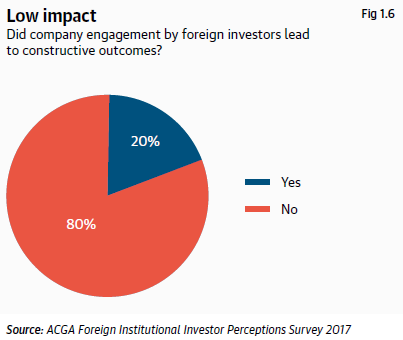
  12. UN Sustainable Development Goals—The Leading ESG Framework for Large Companies
  13. Micro(structure) before Macro?
  14. 2018 Relative TSR Prevalence and Design of S&P 500 Companies
  15. No Long-Term Value From Activist Attacks

Indice de diversité de genre | Equilar


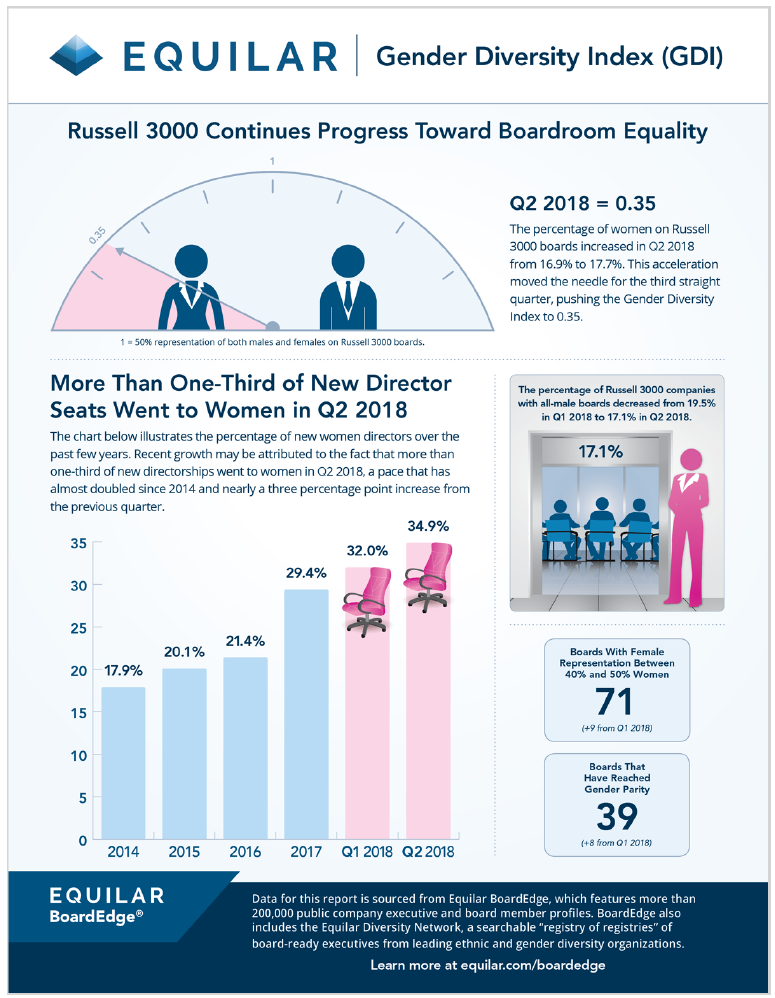
Voici le dernier rapport de l’indice de diversité de genre (GDI) publié par Amit Batish, de la firme-conseil Equilar Inc.

Le texte est très explicite et abondamment illustré.

Dans l’ensemble, le pourcentage de femmes siégeant à des conseils d’administration du Russell 3000 est passé de 16,9 % à 17,7 % entre le 31 mars et le 30 juin 2018.

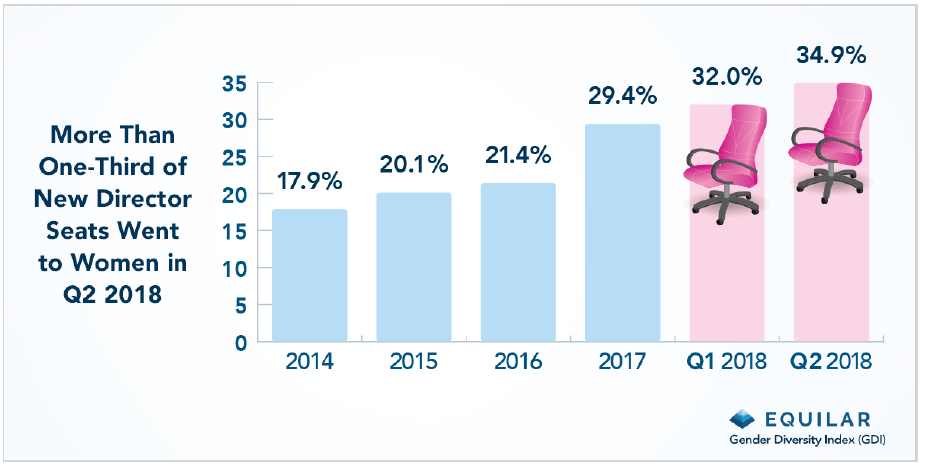
Durant la même période, plus du tiers des postes d’administrateurs ont été pourvus par des femmes.
Bonne lecture !


For a third consecutive quarter, the Equilar Gender Diversity Index (GDI) increased. The percentage of women on Russell 3000 boards increased from 16.9% to 17.7% between March 31 and June 30, 2018. This acceleration moved the needle, pushing the GDI to 0.35, where 1.0 represents parity among men and women on corporate boards.

One of the primary drivers of this steady GDI increase is the number of new directorships that have gone to women over the last few quarters. The chart below illustrates a consistent pace of growth of female directorships. In Q2 2018, more than one-third of new directorships went to women—this is a near three percentage point increase from the previous quarter and a pace that has almost doubled since 2014.


“In the first half of 2018 over 30% of newly-elected directors were women, which we believe indicates that companies are changing their approach to diversity,” said Brigid Rosati, Director of Business Development at Georgeson.

“It seems that companies are beginning to better understand the benefits that a more diverse board can bring, but are also in some cases responding to signs of increased interest from investors, including in the way they vote in director elections.”


In Q1 2018 the percentage of all male Russell 3000 boards fell to 19.5%, the first time ever that this figure sat below 20%. That figure continued to dip in Q2 2018, falling to 17.1%—a 2.4 percentage point drop. This data is certainly a promising sign that boards are making a concerted effort to promote diversity in the boardroom and that male-dominant boardrooms are becoming less prevalent. However, this is still a relatively sizable figure that indicates possible hurdles do indeed remain.

“Progress on diversity continues to be slow but it is continuing to move for the most part,” said Susan Angele, Senior Advisor of Board Governance at KPMG’s Board Leadership Center.

“Depending on the board’s own network, it may take a larger investment of time and effort to find the right person to add diversity as well as skill set, and having a diversity champion on the board driving the search may make a difference.”


Pressure Begins to Mount From Investors and Lawmakers


One of the many reasons that boards have lagged progress on the topic of diversity is that historically, there has been little pressure from investors or other key stakeholders to regularly advocate for such initiatives.

However, over the last year or so, gender diversity has become an area of focus across corporate America. There have been numerous efforts from various sources including institutional investors, regulators and lawmakers. In the Q1 2018 GDI report, Equilar cited 2017 as being banner year for shareholder engagement around gender diversity on boards, beginning with State Street’s “Fearless Girl” statue of a young woman facing o with the Wall Street Bull to bring awareness to gender diversity.

The gesture won a major advertising award, but State Street also voted against hundreds of directors on boards that did not have women. Subsequently, BlackRock voted in favor of several shareholder proposals that requested more disclosure around diversity in 2017, and earlier in 2018, sent letters to all Russell 1000 companies that had fewer than two women on their boards.

“In addition to investor focus, I see a confluence of events that should play out over time,” said Angele.

“The changes in the business environment and expectations on boards—including technological disruption, competition coming from outside the industry, changing demographics, culture and risk—all of these forces are making it more important for the boardroom to include directors with a mix of backgrounds and experience.”

Additionally, lawmakers have begun to get more involved with issues regarding gender diversity. For instance, by August 31, 2018, California could become the first state in the nation to mandate publicly held companies that base their operations in the state to have women on their boards. The legislation—SB 826—will require public companies headquartered in California to have a minimum of one female on its board of directors by December 31, 2019. That minimum will be raised to at least two female board members for companies with five directors or at least three female board members for companies with six or more directors by December 31, 2021. Violators of this legislation will be subject to financial consequences.

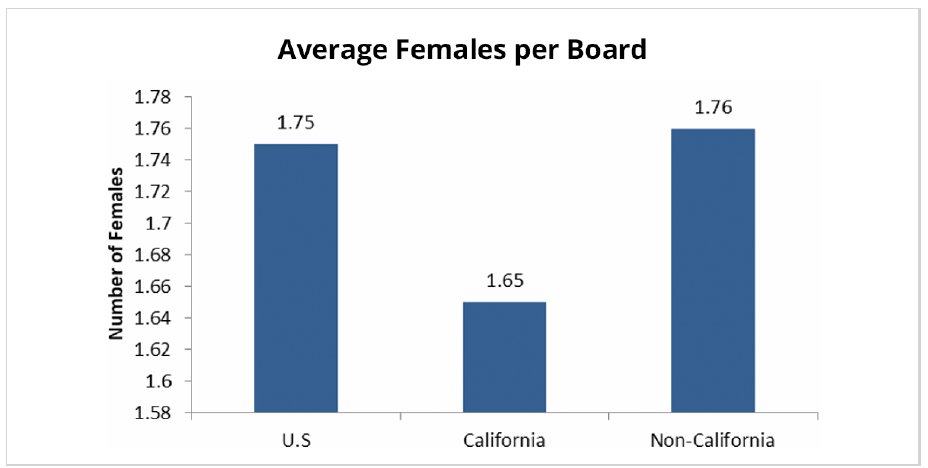
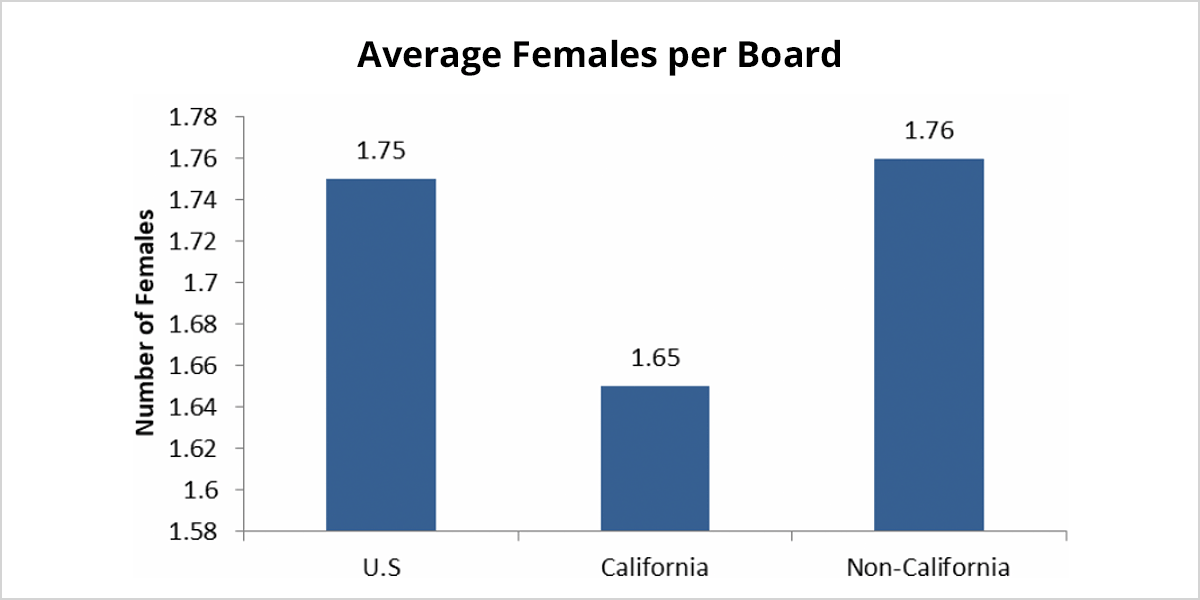
A new Equilar study examined how California fared against the United States as a whole with respect to women on boards. According to the study, California is slightly below other states and the national average in terms of average women on a board. California, on average, has 1.65 female members per board, whereas other states and the United States as a whole average 1.76 and 1.75 female members, respectively.


As legislators become more involved in matters of diversity, one might expect that progress toward greater female board representation will continue. The last few quarters alone have shown signs of progress, and this is before any significant quotas had been put in place. It would come as no surprise that the number of boards achieving parity continues to increase year-over-year following implementation of gender quotas across the nation.

Boards That Have Reached Parity Are Becoming More Prevalent


In combination of numerous factors, some previously mentioned in this article, since the inception of the GDI study, the number of Russell 3000 boards that achieved gender parity has steadily increased in most quarters. The Q2 2018 GDI revealed the largest quarter-over-quarter increase in the number of boards that have achieved parity to date, reaching 39—an increase of eight from the previous quarter and a spike of 18 from the end of 2016. The list of boards at parity is at the bottom of this article.

The number of boards that have between 40% and 50% is rising regularly as well. Collectively, 71 boards now have at least 40% women, up from 62 in the previous quarter.

“Several large institutional investors updated their proxy voting policies in 2018, which we think could continue to drive change beyond the significant progress we saw in the first half of 2018,” said Rosati. “Beyond this, we believe that continued media coverage and scrutiny means that we will see continued pressure from investors towards companies with zero women on their boards.”

___________________________________________________________________________

About Equilar Gender Diversity Index

The Equilar GDI reflects changes on Russell 3000 boards on a quarterly basis as cited in 8-K lings to the SEC. Most indices that track information about board diversity do so annually or even less frequently, and typically with a smaller sample size, sometimes looking back more than a full year by the time the information is published. While this data is reliable and accurate, the Equilar GDI aims to capture the influence of the increasing calls for diversity from investors and other stakeholders in real time.

Top 10 de Harvard Law School Forum on Corporate Governance au 27 septembre 2018


Voici le compte rendu hebdomadaire du forum de la Harvard Law School sur la gouvernance corporative au 27 septembre 2018.

Comme à l’habitude, j’ai relevé les dix principaux billets.

Bonne lecture !


Résultats de recherche d'images pour « top 10 »


Résultats de recherche d'images pour « Top 10 en gouvernance Harvard Law School »


Top 10 de Harvard Law School Forum on Corporate Governance au 20 septembre 2018


Voici le compte rendu hebdomadaire du forum de la Harvard Law School sur la gouvernance corporative au 20 septembre 2018.

Comme à l’habitude, j’ai relevé les dix principaux billets.

Bonne lecture !


Résultats de recherche d'images pour « top 10 »


Résultats de recherche d'images pour « Top 10 en gouvernance Harvard Law School »


  1. Would a Shift to Semiannual Reporting Really Affect Short-Termism?
  2. Statement on Shareholder Voting
  3. Corporate Law Should Embrace Putting Workers On Boards: The Evidence Is Behind Them
  4. Corporate Governance Oversight and Proxy Advisory Firms
  5. Study of the German Corporate Governance Code Compliance
  6. The Universal Proxy Gains Traction: Lessons from the 2018 Proxy Season
  7. Growth in CEO Pay Since 1990
  8. Glass Lewis Response To SEC Statement Regarding Staff Proxy Advisory Letters
  9. The Law and Economics of Environmental, Social, and Governance Investing by a Fiduciary
  10. Unfair Exchange: The State of America’s Stock Markets

Top 10 de Harvard Law School Forum on Corporate Governance au 6 septembre 2018


Voici le compte rendu hebdomadaire du forum de la Harvard Law School sur la gouvernance corporative au 6 septembre 2018.

Comme à l’habitude, j’ai relevé les dix principaux billets.

Bonne lecture !


Résultats de recherche d'images pour « top 10 »


Résultats de recherche d'images pour « Top 10 en gouvernance Harvard Law School »


L’âge des nouveaux administrateurs est une variable de diversité trop souvent négligée dans la composition des CA !


Lorsque l’on parle de diversité au sein des conseils d’administration, on se réfère, la plupart du temps, à la composition du CA sur la base des genres et des origines ethniques.

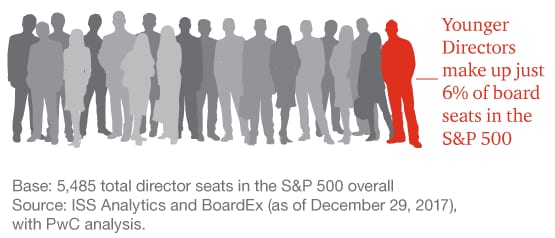
L’âge des nouveaux administrateurs est une variable de diversité trop souvent négligée de la composition des CA. Dans cette enquête complète de PwC, les auteurs mettent l’accent sur les caractéristiques des administrateurs qui ont moins de 50 ans et qui servent sur les CA du S&P 500.

Cette étude de PwC est basée sur des données statistiques objectives provenant de diverses sources de divulgation des grandes entreprises américaines.

En consultant la table des matières du rapport, on constate que l’étude vise à répondre aux questions suivantes :


(1) Quelle est la population des jeunes administrateurs sur les CA du S&P 500 ?

Ils sont peu nombreux, et ils ne sont pas trop jeunes !

Ils ont été nommés récemment

Les femmes font une entrée remarquable, mais pas dans tous les groupes…


(2) Qu’y a-t-il de particulier à propos des « jeunes administrateurs » ?

96 % occupent des emplois comme hauts dirigeants, 31 % des jeunes administrateurs indépendants sont CEO provenant d’autres entreprises,

Plus de la moitié proviennent des secteurs financiers et des technologies de l’information

Ils sont capables de concilier les exigences de leurs emplois avec celles de leurs rôles d’administrateurs

Ils sont recherchés pour leurs connaissances en finance/investissement ou pour leurs expertises en technologie

90 % des jeunes administrateurs siègent à un comité du CA et 50 % siègent à deux comités

La plupart évitent de siéger à d’autres conseils d’administration


(3) Quelles entreprises sont les plus susceptibles de nommer de jeunes administrateurs ?

Les jeunes CEO représentent une plus grande probabilité d’agir comme administrateurs indépendants

Plus de 50 % des jeunes administrateurs indépendants proviennent des secteurs des technologies de l’information, et des produits aux consommateurs

Les secteurs les moins pourvus de jeunes administrateurs sont les suivants : télécommunications, utilités, finances et immobiliers

Les plus jeunes administrateurs expérimentent des relations mutuellement bénéfiques.


La conclusion de l’étude c’est qu’il est fondamental de repenser la composition des CA en fonction de l’âge. Les conseils prodigués relatifs à l’âge sont les suivants :


Have you analyzed the age diversity on your board, or the average age of your directors?

Does your board have an updated succession plan? Does age diversity play into considerations for new board members?

Are there key areas where your board lacks current expertise—such as technology or consumer habits? Could a new—and possibly younger—board member bring this knowledge?

Does your board have post-Boomers represented?

Does your board have a range of diversity of thought—not just one or two people in the room who you look to continually for the “diversity angle”?

Could younger directors bring some needed change to the boardroom?


Notons que cette étude a été faite auprès des grandes entreprises américaines. Dans l’ensemble de la population des entreprises québécoises, la situation est assez différente, car il y a beaucoup plus de jeunes sur les conseils d’administration.

Mais, à mon avis, il y a encore de nombreux efforts à faire afin de rajeunir et renouveler nos CA.

Bonne lecture !


Board composition: Consider the value of younger directors on your board


Résultats de recherche d'images pour « Board composition: Consider the value of younger directors on your board »

Résumé des principaux résultats


There are 315 Younger Directors in the S&P 500. Together, they hold 348 board seats of companies in the index. Of these 348 Younger Director seats, 260 are filled by independent Younger Directors.

Fewer than half of S&P 500 companies have a Younger Director. Only 43% of the S&P 500 (217 companies) have at least one Younger Director on the board. At 50 of those companies, one of the Younger Directors is the company’s CEO.

S&P 500 companies with younger CEOs are much more likely to have independent Younger Directors on the board. Sixty percent (60%) of the 527 companies with a CEO aged 50 or under have at least one independent Younger
Director on the board—as compared to just 42% of companies that have a CEO over the age of 50.

Almost one-third of Younger Directors are women. Women comprise a much larger percentage (31%) of Younger Directors than in the S&P 500 overall (22%). This is in spite of the fact that over 90% of Younger Directors nominated under
shareholder agreements—such as those with an activist, private equity investor or family shareholder—are men.

Information technology and consumer products companies are more likely to have Younger Directors. The three companies in the telecommunications sector have no Younger Directors.

Close to half of the independent Younger Directors have finance/investing backgrounds. Just under one-third are cited for their technology expertise, executive experience or industry knowledge.

Younger Directors fit in board service while pursuing their careers. According to their companies’ SEC filings, 96% of Younger Directors cite active jobs or positions in addition to their board service.

Younger Directors serve on fewer boards. The average independent S&P 500 director sits on 2.1 public company boards. In contrast, independent Younger Directors sit on an average of 1.7 boards. More than half serve on only one public board.

More than half of the independent Younger Directors have held their board seat for two years or less. Only 18% have been on the board for more than five yearsé

Top 10 de Harvard Law School Forum on Corporate Governance au 30 août 2018


Voici le compte rendu hebdomadaire du forum de la Harvard Law School sur la gouvernance corporative au 30 août 2018.

Comme à l’habitude, j’ai relevé les dix principaux billets.

Bonne lecture !


Résultats de recherche d'images pour « top 10 »


Résultats de recherche d'images pour « Top 10 en gouvernance Harvard Law School »


  1. High-Quality Sales Processes and Appraisal Proceedings
  2. Awakening Governance: ACGA China Corporate Governance Report 2018
  3. The CFIUS Reform Bill
  4. Does Transparency Increase Takeover Vulnerability?
  5. Performance Awards and Say on Pay
  6. Fintech as a Systemic Phenomenon
  7. Securing Financial Stability: Systematic Regulation of Systemic Risk
  8. Gender Quotas in California Boardrooms
  9. The Race to the Bottom in Global Securities Regulation
  10. Supreme Court Nominee and the Derivative Suit

Le point sur la future loi californienne eu égard aux quotas de femmes sur les CA


Voici un article de Tomas Pereira, analyste de recherche à Equilar Inc, publié sur le site du Harvard Law School Forum qui fait le point sur la future loi californienne eu égard aux quotas de femmes sur les CA.

L’étude présente des statistiques intéressantes sur la situation des femmes sur les CA en Californie et fait état de projections concernant l’effet des mesures. Rappelons que l’état de la Californie est le premier état qui s’aventure dans l’établissement de quotas pour favoriser la diversité sur les conseils d’administration.

La législation propose qu’une entreprise ait au moins une femme sur le CA au 31 décembre 2019,

That minimum will be raised to at least two female board members for companies with five directors or at least three female board members for companies with six or more directors by December 31, 2021.

Ainsi en 2021, les conseils d’administration devront compter au moins trois femmes sur les CA, si le nombre d’administrateurs est de six ou plus.

Bonne lecture !


Gender Quotas in California Boardrooms


Résultats de recherche d'images pour « Gender Quotas in California Boardrooms »


By August 31, 2018, California could become the first state in the nation to mandate publicly held companies that base their operations in the state to have women on their boards. The legislation—SB 826—will require public companies headquartered in California to have a minimum of one female on its board of directors by December 31, 2019. That minimum will be raised to at least two female board members for companies with five directors or at least three female board members for companies with six or more directors by December 31, 2021.

If SB 826 is passed in the Assembly and signed by Governor Jerry Brown, corporations not compliant with the new rules will be subjected to financial consequences. Strike one will be accompanied with a fine equal to the average annual cash compensation of directors. Any subsequent violation would amount to a fine equal to three times the average annual cash compensation for directors. Hence, the consequences are very real for companies that choose not to comply with the new rules.

A new study by Equilar looks at where public companies headquartered in California currently lie in relation to the proposed legislation. The study includes public companies in California that have annual revenues of $5 million or more—amounting to a total of 211 companies with an aggregate of 349 female and 1,466 male board members.


Looking broadly, California is slightly below other states and the national average in terms of average women on a board. California, on average, has 1.65 female members per board, whereas other states and the United States as a whole average 1.76 and 1.75 female members, respectively. This type of statistic is a likely factor in spurring state legislators in Sacramento to make significant changes to the status quo and place California in a leading role for board diversity in the United States.


By 2019, most companies in California would be safe from any financial penalties for having an insufficient number of female board members. As it stands now, 82% of public companies in California who have annual revenues of over $5 million will meet the initial criteria, whereas 18% will not. Consequently, 37 public companies would be faced with a fine equal to the average annual director compensation for failing to comply.

In the following table, Equilar examined the 82% success rate a bit further and broke it down by sector in order to examine which industries are driving the rates of success and failure. By 2019, the basic materials and utilities sectors in California would both have a 100% success rate. Thus, every company within these two sectors has at least one female director present on their board. The next sector with the highest rate of success is services, with 92% having at least one female member. Both the healthcare and technology sectors are tied for lowest compliance at 83% pass.


When looking at the companies that would meet the secondary December 31, 2021 criteria, the picture is much bleaker at present for public companies in California. According to the proposed legislation, the required minimum would increase to two female board members for companies with five total directors or to three female board members for companies with at least six total directors.


Taking that future criteria and applying it to today, 79% of public companies would fail, while only 21% would pass. The following table sees basic materials—one of the sectors with 100% company success rate with the previous 2019 criteria—fall down to a 50-50 ratio of pass to fail. The sector with the highest success rate is utilities, while the industrial goods sector has the lowest success rate at 75% and 14%, respectively.


While the path for the proposed legislation is still a bit rocky, the broader trend towards diversifying boardrooms across the country is growing. Companies should anticipate new legislation—not just SB 826—sprouting throughout more state legislatures and get ahead of this rolling tide. States like Maine, Illinois and Ohio have already begun promoting resolutions to encourage companies to diversify their boards. In addition, BlackRock and other institutional investors have publicly stated that they will expect at least two female members per board. The push towards gender diversification is well warranted. Studies by management consulting firms, such as Boston Consulting Group and McKinsey & Co., have shown that diverse boards perform better financially. Signs do point to a gradual progression towards gender parity in the boardroom, as noted by the Q1 2018 Equilar Gender Diversity Index. However, without proactive encouragement or legislation, it would take decades before a true gender balance is realized.

L’émergence de la Chine dans le monde de la gouvernance moderne


Aujourd’hui, je vous propose la lecture d’un article sur l’évolution de la gouvernance chinoise.

Les auteurs, Jamie Allen*et Li Rui, de la Asian Corporate Governance Association (ACGA), ont produit un excellent rapport sur les changements que vivent les entreprises chinoises eu égard à la gouvernance.

L’étude se base sur une enquête auprès d’entreprises chinoises et auprès d’investisseurs étrangers. Également, les auteurs présentent une mine d’information sur la situation de la gouvernance.J’ai reproduit, ci-après, un résumé de l’enquête.

Bonne lecture !


With its securities market continuing to internationalise and grow in complexity, China appears at a turning point in its application of CG and ESG principles.

The time is right to strengthen communication and understanding between domestic and foreign market participants.


Awakening Governance: ACGA China Corporate Governance Report 2018


Résultats de recherche d'images pour « gouvernance chinoise »

Introduction: Bridging the gap


The story of modern corporate governance in China is closely connected to the rapid evolution of its capital markets following the opening to the outside world in 1978. The 1980s brought the first issuance of shares by state-owned enterprises (SOEs) and a lively over-the-counter market. National stock markets were relaunched in Shanghai and Shenzhen in 1990 to 1991, while new guidance on the corporatisation and listing of SOEs was issued in 1992. The first overseas listing of a state enterprise came in October 1992 in New York, followed by the first SOE listing in Hong Kong in 1993. Corporate governance reform gained momentum in the late 1990s, but it was less a byproduct of the Asian Financial Crisis than a need to strengthen the governance of SOEs listing abroad. The early 2000s then brought a series of major reforms on independent directors, quarterly reporting and board governance aimed squarely at domestically listed firms.

A great deal has changed in China since then, with periods of intense policy focus on corporate governance followed by consolidation. In recent years, China’s equity market has undergone a renewed burst of internationalisation through Shanghai and Shenzhen Stock Connect, relaxed rules for Qualified Foreign Institutional Investors, and the landmark inclusion of 234 leading A shares in the MSCI Emerging Markets Index in June 2018. While capital controls and other restrictions on foreign investment remain, there seems little reason to doubt that foreign portfolio investment will play an increasing role in China’s public and private securities markets in the foreseeable future.

Running parallel to market internationalisation, and facilitated by it, is a broadening of the scope of corporate governance to include a focus on environmental and social factors (“ESG”), and a deepening concern about climate change and environmental sustainability. Pension funds and investment managers in China are now encouraged by the government to look closely at ESG risks and opportunities in their investment process. And green finance has become big business in China, with green bond issuance growing steadily. Indeed, these themes are also part of the newly revised Code of Corporate Governance for Listed Companies (2018) from the China Securities Regulatory Commission (CSRC); this is the first revision of the Code since 2002.


Turning point


China thus appears at a new turning point in its market development and application of corporate governance principles. While it is difficult to predict how this process will unfurl, we believe three broad developments would be beneficial:

-That unlisted and listed companies in China see corporate governance and ESG not merely as a compliance requirement, but as tools for enhancing organisational effectiveness and corporate performance over the longer term. This applies as much to entrepreneurial privately owned enterprises (POEs) as established SOEs. The view that good governance is not relevant or possible in young, innovative firms is misguided.

-That domestic institutional investors in China see corporate governance and ESG not only as tools for mitigating investment risk, but as a platform for enhancing the value of existing investments through active dialogue with investee companies. The process of engagement can also help investors differentiate between companies that take governance seriously and those which do not.

-That foreign institutional investors view corporate governance in China as something more nuanced than a division between “shareholder unfriendly” SOEs and “exciting but risky” POEs. We recommend foreign asset owners and managers spend more time on the ground in China and invest in studying China’s corporate governance system, if they are not already doing so.

Of course, there are many exceptions to these broad characterisations. It is possible to find companies which view governance as a learning journey—and they are not necessarily listed. Certain mainland asset managers have begun investigating how to integrate governance and ESG factors into their investment process. And there are a growing number of foreign investors, both boutique and mainstream, that have developed a deep understanding of the diversity among SOEs and POEs and which have achieved excellent investment returns from SOEs as well.

Not surprisingly, however, our research has found that significant gaps in communication and understanding do exist between foreign institutional investors and China listed companies. According to an original survey undertaken by ACGA for this report, a majority of foreign investor respondents (59%) admitted that they did not understand corporate governance in China. Only 10% answered in the affirmative, while another 31% felt they “somewhat” understood the system. Conversely, it appears that most China listed companies do not appreciate the challenges that foreign institutional investors face in navigating “corporate governance with Chinese characteristics”.

This report is written for both a domestic and international audience. Our aim is to describe in as fair and factual a manner as possible the system of corporate governance in China, highlighting what is unique, what looks the same but is different, and areas of genuine similarity with other major securities markets. The main part of the report focuses on “Chinese characteristics” and looks at the role of Party organisations/committees, the board of directors, supervisory boards, independent directors, SOEs vs POEs, and audit committees/auditing. Each chapter explains the current legal and regulatory basis for the governance institution described, the particular challenges that companies and investors face, and concludes with suggestions for next steps. Our intention has been to craft recommendations that are practical and anchored firmly in the current CG system in China—in other words, that are implementable by companies and institutional investors. We hope the suggestions, and indeed this report, will be viewed as a constructive contribution to the development of China’s capital market.

The remainder of this Introduction provides an overview of key macro results from our two surveys. We start with the good news—that a large proportion of foreign institutional investors and local companies are optimistic about China—then highlight the challenges both sides face in addressing governance issues. The following chapters draw upon additional material from the two surveys.

ACGA survey—The big picture

Are you optimistic?


The good news from our survey is that a sizeable proportion of both foreign investors (38% of respondents) and China listed companies (52%) are optimistic about the investment potential of the A share market over the next five to 10 years, as Figure 1.1 below shows. Only 21% of foreign investors are negative, while the remainder are neutral. Not surprisingly, only 15% of China respondents were negative, while almost one-third were neutral.


Do you agree with MSCI?


The picture diverges on the issue of whether MSCI was right to include A shares in its Emerging Markets Index in 2018: only 27% of foreign respondents agreed compared to 65% of Chinese respondents, as Figure 1.2, below, shows. Almost half the foreign respondents did not agree compared to a mere 12% for Chinese respondents. A similar proportion was neutral in both surveys.


Challenges—Foreign institutional investors

The investment process


Foreign investors face a range of challenges investing in China, the first of which is understanding the companies in which they invest. As Figure 1.3 below indicates, foreign investors do not rely solely on information provided by companies when making investment decisions, but utilise a range of additional sources. It appears that listed companies are not aware of this issue.


Company engagement


Globally, institutional investors seek to enter into dialogue with their investee companies. It is no different in China, as shown in Figure 1.4.


But the process is not easy.


And successful outcomes are fairly thin on the ground to date.


Common threads


Respondents gave a range of answers as to why the process of engagement was difficult and successful outcomes limited, but some common threads were discernible:

Language and communication: In addition to straightforward linguistic difficulties (ie, companies not speaking English, investors not speaking Chinese), the communication problem is sometimes cultural. As one person said, “Even though I am from China, it is hard to interpret hidden messages.”

Access: Getting access to companies can be difficult. Getting to meet the right senior-level person, such as a director or executive, can be even more challenging.

Investor relations (IR): While some IR teams are professional, many are not. As one respondent commented: “IR (managers) are not very well trained and some of them lack basic understanding or knowledge of corporate governance or even financial information.”

CG as compliance: A common complaint is that companies view CG as merely a compliance exercise. Some refuse to give “detailed answers beyond the party line”.

Non-alignment: There is a recurring feeling that the interests of controlling shareholders in SOEs are not aligned with minority shareholders. One investor commented on the “lack of responsiveness” to outside shareholder suggestions, adding that SOEs “wait for government to give the direction, not investors”.

Lack of understanding: There can be a significant gap in the awareness of CG and ESG principles.


Empathy for companies


Conversely, a few respondents expressed empathy for the position of companies. As one wrote: “There also appears to be an under appreciation by international investors of the differences in culture, political context, and the path and stage of economic development between China and the rest of the world. Any attempt at influencing changes without a reasonable understanding of these differences is likely to be ineffective and (may) at times lead to unintended consequences.”

Another explained some of the regulatory challenges facing listed companies: “With a few exceptions, both SOEs and POEs have to deal with stringent and ever-changing industry regulations and government policies.”

A third said that some engagement had been positive: “Generally, where I have had access to the right people, engagement has been constructive. I suspect this is a result of the companies already appreciating the value of good governance in attracting non-domestic investors.”

And perhaps the most positive comment of all: “A number of the Chinese companies we speak to, especially the industry leaders, already address ESG risks in their businesses. Most of them publish ESG reports annually, which help to set the benchmark for their industry and also to garner positive feedback from society and hence, end-customers. Some of such companies end up enjoying a pricing premium on their products once this positive brand equity has been established. This creates a virtuous cycle, where ESG becomes part of their corporate culture. They understand that for the long-term sustainability of their business, and for the benefits of all their stakeholders, such investment can only enhance their competitiveness.”


Brave new world of stewardship


Yet most investors still find engaging with companies a challenge. A further reason may be that China is one of only three major markets in Asia-Pacific that has not yet issued an “investor stewardship code”. Such codes push institutional investors to take CG and ESG more seriously, incorporate these concepts into their investment process, and help to encourage greater dialogue between listed companies and their shareholders (see Table 1.1, below). In recent years, the bar has been quickly raised on this issue in Asia and expectations have risen commensurately.

Without an explicit policy driving investor stewardship, it is unlikely that the average listed company will give proper weight to a dialogue with shareholders. As one foreign investor said: “Generally speaking, it is relatively easier to engage with bigger listed companies. SOEs and larger companies tend to be more responsive. SOEs have more incentive to do so following government guidelines and trends.”

A key question to ask is who within a company should be responsible for engaging with shareholders? The short answer is the board, as a group representing and accountable to shareholders. Indeed, on a positive note, our survey found that most Chinese listed companies do admit that the responsibility for talking to shareholders should not be placed solely on the investor relations (IR) team (see Figure 1.7 below). But given that delegating this task to IR remains a common practice, it would appear that there is an inconsistency between words and actions here.


Challenges—China listed companies


Some additional factors clearly play on the willingness of companies to take CG and ESG seriously, as Figures 1.8 and 1.9 below show.

Does the market reward good CG?


Only 27% of the respondents to our China listed company survey believe there is a close correlation between good corporate governance and company performance. Another 46% think they are “somewhat related”, while a quarter see no relationship. These results broadly align with the view common in most markets, including China, that only a minority of companies (usually the large caps) feel incentivised to improve their governance practices and that they will be rewarded by investors if they do so.


Even more concerning is the largely negative view on whether better governance helps a company to list.


As an aside, this might also help to explain why listed POEs in China are generally not seen as being a better investment proposition or as having better governance than SOEs—an issue we explore in Chapter 3.5.

Only 23% of foreign respondents said they preferred investing in POEs over SOEs, while two-thirds said they did not. Meanwhile, only 10% of China listed companies thought POEs were better governed than SOEs. Around one-third thought they were about the same, while 54% thought POEs were worse.

Even so, in a fast-growing market such as China, there is a risk in taking a static or one-dimensional view.

‘Companies will have to become more ESG aware’


We conclude this section with a wide-ranging comment from a China-based institutional investor on the need to see governance and ESG as a process:

Chinese companies are generally financial weaker than their more established peers in developed markets. This is a symptom of markets being at different stages of development. For Chinese companies, survival is the top priority. Once they have gained enough market share and accumulated a certain level of capital reserves, they will start to consider ESG issues. This will help them cement their market position and grow more healthily in the long term.

At the moment, we recognise that the cost of not practicing ESG is not high in China. But things are changing, especially on the environmental front. We can see that the government is very serious about closing down small players who are not compliant with emission standards. The quality of air, earth and water concerns the livelihood of every citizen, and we believe that there will be heightened enforcement of pollution laws.

Corporate governance is also improving as public shareholders get more actively involved in major corporate actions. Having said that, shareholder structures remain highly concentrated, especially for SOEs in China, and external forces may not be strong enough to ensure a proper division of power.

We see increasing numbers of entrepreneurs and companies more willing to give back to society and the challenge here is simply that philanthropy is quite new in China.

As society becomes more civilised and consumers become more aware of issues such as child labour and environmental pollution, Chinese companies will have to become more ESG aware and responsible.


Interview: ‘Character and quality of management is critical’


David Smith CFA, Head of Corporate Governance, Aberdeen Standard Investments Asia, Singapore


What is your view on investing in A shares?


We have an A share fund, so naturally, we have spent substantial time and effort getting comfortable with both the market and the companies. There are well-documented risks surrounding investing in China, but the market has obvious attractions China is leading the world in some of the sectors, like e-commerce, for example. As investors, we always have to balance return with macroeconomic risk, political risk, regulatory risk, and so on, and this is certainly the case for China.


What is your view on stock suspensions in China?


The situation is getting better but companies too often still choose to suspend given a pending “restructuring”, which protects potential investors at the expense of existing investors, something that can be incredibly frustrating given how long we can be locked up for. There is a general misunderstanding in China as to what suspension means: companies should only suspend when there is information asymmetry, not when there is uncertainty. We are paid to analyse and deal with uncertainty, and the market will find a price for it. If companies have to suspend whenever there is uncertainty, we won’t have a stock market in place.

In general, there are too many suspensions in China. If a company has a restructuring plan or a regulatory investigation is going on, it should just disclose this through an announcement; as long as everyone in the market knows the same information, the stock should keep trading.

The issue of price-sensitive information has already been taken care of by regulations around continuous disclosure, so a suspension is often not protecting anyone, it just removes liquidity for existing investors. This issue is exacerbated by the bizarre and unusual situation of dual-listed A/H share companies suspending on one exchange and not the other.

In developed markets, in contrast, suspensions of issuers lasting more than a month for whatever reason are very rare. Part of the issue is also that promoter shares might sometimes have been pledged, so promoters want to avoid a share price fall triggering a margin call.


What are the top CG issues you have observed in Chinese companies?


Entrepreneur risk (people risk) is the most obvious one, including related-party transaction risks, along with operational and execution risks. For Aberdeen, we never invest if we feel uncomfortable with the founder or management. Both the character and quality of the people inside the company is something we value a lot in our investment decision-making process.

Regulatory risk is another issue. Changes in regulations can affect not just SOEs but also POEs to different extents. For example, the recent regulatory change on the reinforcement of Party committees inside Chinese companies is not what foreign investors expected to see as the direction of corporate governance development in China.

Another issue is that given more and more onus put on independent directors, maybe we need to think about another way to elect them. The current situation involves voting for independent directors on their independence, rather than competence. However, “independence” can be easily gamed in Asia. Many independent directors are structurally independent but rely on the company for their living (pension), so investors are increasingly asking if/how they add value to board discussions.


What is your view on voting trends among China listed firms? Does voting lead to engagement


Not much has changed. Any voting against has tended to focus on resolutions like related-party transactions, or other corporate actions, rather than issues across the board.

Engagement is getting a little bit better in China. We have seen more and more companies listening to us, and dialogue is getting much better. Companies increasingly understand that we are not in China for the short-term and that our interests are aligned. That certainly helps.


Methodology

A tale of two surveys


The two surveys in this report, the “ACGA Foreign Institutional Investor Perceptions Survey 2017” and the “ACGA China Listed Company Perceptions Survey 2017”, were developed internally in the first half of 2017 and carried out over 21 July to 1 September of that year. They were distributed through ACGA’s global network of members and contacts, and by a number of supporting organisations both inside and outside China (see the Acknowledgements page for details).

Purpose

We decided to conduct a survey at the preliminary stage of this project for two main reasons. The first was to add a broader range of perspectives to the report and to complement the extensive research carried out by ACGA and our contributing authors.

The second was to develop new data on corporate governance in China. When we began researching this report, we found that much of the information on board structures and governance practices in China was out of date, incomplete or non-existent. We developed the survey to partially fill this gap. To complement this information, we turned to data providers such as Wind and Valueonline to provide raw data on which we could do original analysis—and we carried out our own reviews of specific governance practices among large listed companies.

Foreign Institutional Investor Perceptions Survey

The Foreign Institutional Investor Perceptions Survey contained 22 questions and focused on areas that we believe are relevant to China’s investment potential and governance. They can be divided into the following categories:

Macro questions, such as capital market development, MSCI inclusion, SOEs vs POEs, and mainland-listed vs overseas-listed firms.

Shareholder rights, including investor protection in China vs overseas.

Company governance, including corporate reporting, role of chairman, independent directors, supervisory boards.

Role of government, including appointment of chairmen, intervention in SOEs and POEs, the role of the Party organisation/committee.

Investor engagement with companies.

Several of the questions provided options for respondents to give detailed answers and, where relevant, these comments are incorporated into our text.

The survey was developed by ACGA in Q2 2017 and first tested with a select group of ACGA global investor members in June of that year. It was refined based on feedback received before being sent out electronically in July. The recipients were primarily drawn from among ACGA’s list of institutional investor members based in Asia and around the world. This was complemented by recipients from our supporting organisation membership networks.

In total, we received 155 complete and comparable responses. Partial responses were not counted. Based on information gathered about respondents’ titles, they fell into three broad groups: CEOs, directors, managing directors or partners; portfolio managers and analysts; and managers or specialists in CG, ESG or stewardship. A large proportion held senior roles in their organisations.

The total assets under management (AUM) of all respondents amounted to around US$40 trillion, with the range from US$20m to US$6 trillion. In other words, a mix of both boutique investment managers and large mainstream institutions.

China Listed Company Perceptions Survey

The China Listed Company Perceptions Survey contained 12 questions and likewise focused on areas that we believe are relevant to such companies, their directors and managers. While there were fewer questions in this survey, they covered similar categories as in our foreign survey, namely macro issues, company governance, role of government, and investor engagement.

We designed some questions to be identical to the Foreign Institutional Investor Survey, in order to allow direct comparisons between corporate and investor perspectives on the same issue.

We also asked some unique questions of companies, such as whether or not they see a close correlation between corporate governance and performance, and whether better governance helps a firm list its shares.

The survey recipients were drawn from among ACGA’s corporate membership base, as well as clients and contacts of supporting organisations.

In total, we received 182 complete responses from which we extracted the survey results. Most respondents held senior positions in their companies such as directors, executives, board secretaries and senior managers. Most of the companies represented have been listed in China for more than five years and have a market cap of more than Rmb5 billion (US$800m approx). Further demographic data on the two groups of respondents follows:


Foreign respondents

The foreign institutional investors who responded are mostly from the US, UK, Asia and the European Union, as shown in Figure 1.10 below. The response is consistent with the distribution of ACGA members by region. Investors from Australia, New Zealand, the Middle East and Canada also responded to the survey.


In terms of their global AUM, the vast majority of respondents have less than 1% invested in China A shares, while a significant minority have between 1% and 10%. Very few have more than 10% of their funds invested in China domestic listings, although interestingly a few have more than 50%. The latter would be smaller investment managers with a dedicated China focus, as shown in Figure 1.11.

The picture changes markedly when overseas-listed Chinese firms are taken into account: the majority of foreign respondents allocate between 1% to 10% of their global AUM to such companies and a sizeable proportion, about one-fifth, invest more than 10%.


How do foreign investors invest in China? As Figure 1.12 below shows, around a quarter go only through the Qualified Foreign Institutional Investor (QFII) scheme, 15% only through Stock Connect, and almost half through both channels. Interestingly, a significant minority invest directly through wholly owned foreign enterprises (WFOEs) or other foreign direct investment (FDI) channels.


China respondents

Most respondents to our China Listed Company Perceptions Survey work for a company that has been listed for more than five years. Around 40% of the companies have been listed for more than 10 years, which is a relatively long period given that the Chinese stock market is still less than 30 years old (see Figure 1.13).

The market cap of 54% of respondents’ companies was more than Rmb5 billion, as highlighted in Figure 1.14, and 19% have a market cap of more than Rmb10 billion. Generally, the larger firms are likely to be SOEs.


In terms of ownership, the distribution of respondents falls evenly between SOEs and POEs, with 13% being of a “mixed-ownership” type (see Figure 1.15, above). This gives us confidence that the survey results incorporate a range of views from different participants in the Chinese market.

As for where respondents’ companies are listed, Figures 1.16 and 1.17, below, highlight that almost 60% are listed in a single jurisdiction. Mainland China comes first, not surprisingly, followed by a reasonable number in Hong Kong. Only a few respondents work for Chinese companies listed in Singapore, the US and the UK. Regarding the remaining companies listed in more than one jurisdiction, again the most popular venue is a dual-listing in China and Hong Kong, followed by a listing in China and the US. Some companies have a listing in China, Hong Kong and the US.


The complete report, in both English and Chinese, is available here.

___________________________________________________________

*Jamie Allen is Secretary General and Li Rui (Nana Li) is Senior Research Analyst at the Asian Corporate Governance Association (ACGA). This post is based on the introduction to their ACGA report.