Les administrateurs de sociétés qui cumulent plusieurs postes deviennent-ils trop accaparés ?


Qu’est-ce qu’un administrateur très occupé en termes d’appartenance à plusieurs CA ? Quand un administrateur est-il trop occupé ?

À ce sujet, les études montrent que les avis des actionnaires sont partagés entre (1) un administrateur possédant une solide expérience sur la base de l’appartenance à plusieurs CA et (2) un administrateur trop accaparé par le fardeau qu’exige la contribution à plusieurs conseils.

Les administrateurs de sociétés publiques consacrent, en moyenne, 248 heures par année à leur travail, comparativement à 191 heures en 2005. Il s’agit d’une augmentation de 30 %. C’est 5 heures par semaine !

L’article de Wayne R. Guay, professeur de comptabilité à l’Université Wharton, explore la problématique sous tous ses angles.

« These results suggest that effective advising, as compared to effective monitoring, may rely more on director ability, whereby the latter may suffer more from director time constraints ».

Bonne lecture !


Busy Directors and Shareholder Satisfaction


The job of a corporate director has become increasingly time consuming. The Wall Street Journal recently reported that the director of a public firm spends an average of 248 hours a year on each board, up from 191 hours in 2005. In light of this growing time demand, corporate directors face increasing investor scrutiny regarding the number of boards on which a given director sits. Prior research has examined the firm-level performance implications of corporate boards that have a large proportion of “busy” directors. However, there are several difficulties in these studies. In particular, firm-level analysis masks important heterogeneity in the time constraints and the expertise benefits of busy directors. For example, sitting on three boards might be excessive for a director with a full-time job, but it might be reasonable, or even optimal, for an individual who is retired. Also, certain firms (e.g., less experienced firms) may benefit more from the expertise and advising of a busy director. Furthermore, there may be omitted firm-level characteristics that are driving both director busyness and firm performance, which suggests that an observed positive (negative) association between director busyness and good (poor) firm performance does not necessarily imply that busy directors are beneficial (detrimental) to shareholders.

In our paper, Busy Directors and Shareholder Satisfaction, we move away from firm-level tests of the performance of busy boards, and instead examine the relations between individual busy directors, their heterogeneous characteristics, and shareholder satisfaction. To measure shareholder satisfaction, we use shareholder voting outcomes in annual director elections. Our approach has several distinctive features that allow us to overcome the difficulties of prior studies. First, shareholder voting is measured at the director-level which allows us to incorporate individual director characteristics into our analysis. Second, we use “within-firm-year” and “within-director-year” research designs. The within-firm-year design uses variation in shareholder voting for directors at a given firm within a given year. This allows us to fully account for the confounding effects of firm characteristics that may be present in prior analyses. The within-director-year design uses variation in firm characteristics among the boards on which a director sits in a given year. This approach allows us to identify differences in shareholder satisfaction across different types of firms for the same director in a given year, and thus can help isolate the heterogeneity in the effect of busyness as a function of firm characteristics.

On average, shareholders perceive that the costs of busy directors exceed their benefits. The percentage of “For” votes that a busy director receives is, on average, about one percentage point lower than that of a non-busy director. This is 28% of the standard deviation of within-board shareholder voting across firms. Importantly, this drop in shareholder satisfaction for busy directors holds when controlling for various observable director characteristics, such as age, tenure, gender, retirement status and committee membership, and all observable and unobservable firm characteristics through the within-firm-year design. This distinguishes our finding from firm-level analysis of busy boards which do not fully control for individual director characteristics and unobservable firm characteristics. The result also holds when controlling for the influence of proxy advisory firm recommendations, indicating that shareholders appear to penalize busyness over and beyond ISS policy recommendations. Moreover, the effect of director busyness on shareholder satisfaction is stronger in the second half of our sample period, which is consistent with common perceptions that time demands for directors have increased in recent years.

We next examine the heterogeneity among individual busy directors and whether “busyness” is more or less acceptable to shareholders for certain types of directors. Clearly, one of the primary concerns with a busy director is the time constraints that multiple directorships can impose on the individual’s ability to diligently monitor and advise management. Across an array of proxies for director time constraints, we find strong evidence that busy directors with greater (lesser) external time demands receive lower (higher) shareholder satisfaction. Specifically, we find that busy directors who are retired from full-time employment receive greater shareholder satisfaction, while busy directors who are executives at another firm receive lower satisfaction. Busy directors also receive lower shareholder satisfaction when a greater proportion of their boards have the same fiscal-year-end (FYE) month. Boards with the same FYE month are likely to be busy at similar times during the year, which increases the time constraints of directors serving on those boards. Finally, directors receive lower satisfaction when they serve on a greater number of external board committees (e.g., audit, compensation, nominating).

Our final set of tests, using the within-director-year design, examines how the expertise benefit of busy directors varies as a function of a firm’s advising and monitoring needs. Adams et al. (2010) suggest that busy directors are of a “higher quality” than non-busy directors, which presumably comes from some combination of their greater skill, experience or wider network of contacts. These traits can improve the ability of a director to provide useful advice and/or monitor executive behavior (Coles et al., 2012). At the same time, busy directors may be “spread too thin” to effectively provide executives with detailed guidance or to engage in the due diligence necessary to effectively monitor management (Fich and Shivdasani, 2006). Consequently, the advising and monitoring effectiveness of busy directors is an empirical question, which may vary across firms depending on the demands for these roles from directors.

Using the within-director-year design, we are able to examine whether certain firms (e.g., less experienced firms) may benefit more from the expertise and advising of the same busy director. This design allows us to isolate the differences in shareholder satisfaction for busy directors that arise from firm advising and monitoring needs, rather than director characteristics. We find that shareholders are more supportive of busy directors at younger firms and firms with greater growth opportunities (firms predicted to demand more advising), and are less supportive at firms where CEOs hold less equity (firms predicted to demand more monitoring). These results suggest that effective advising, as compared to effective monitoring, may rely more on director ability, whereby the latter may suffer more from director time constraints.

Collectively, our results provide insight on the longstanding debate about busy directors’ performance and the tradeoffs between their potentially higher ability and tighter time constraints. Our results also suggest that shareholder voting is more nuanced than documented in prior studies (e.g., Cai et al., 2009). In particular, we find that shareholders are quite sophisticated with their director voting in that they appear to respond to director-specific variation in time constraints (e.g., number of additional boards, employment characteristics, overlapping fiscal-year ends for board responsibilities, committee responsibilities). Shareholders also seem to recognize that busy directors may be more beneficial when the firm has relatively high advising needs.

The complete paper is available for download here

Compte rendu hebdomadaire de la Harvard Law School Forum on Corporate Governance | 12 janvier 2018


Voici le compte rendu hebdomadaire du forum de la Harvard Law School sur la gouvernance corporative au 12 janvier 2018.

Cette semaine, j’ai relevé les dix principaux billets.

Bonne lecture !


Résultats de recherche d'images pour « Harvard Law School forum on corporate governance »

Résultats de recherche d'images pour « Harvard Law School forum on corporate governance »


  1. Tax Reform Implications for U.S. Businesses and Foreign Investments
  2. Ineffective Stockholder Approval for Director Equity Awards
  3. Does Size Matter? Bailouts with Large and Small Banks
  4. Raising the Stakes on Board Gender Diversity
  5. Managing the Family Firm: Evidence from CEOs at Work
  6. Compensation Season 2018
  7. Pay-for-Performance Mechanics
  8. CEO Gender and Corporate Board Structures
  9. Activist Investing in Europe—2017 Edition
  10. Political Uncertainty and Cross-Border Acquisition

La souveraineté des conseils d’administration


Je partage avec vous une excellente prise de position d’Yvan Allaire et de Michel Nadeau, respectivement président et directeur général de l’Institut de la gouvernance (IGOPP), que j’appuie totalement. Cet article a été publié dans Le Devoir du 6 janvier 2018.

Il est impératif que le conseil d’administration, qui est le fiduciaire des parties intéressées, conserve son rôle de gardien de la bonne gouvernance des organisations. Les règles de gouvernance sont fondées sur le fait que le conseil d’administration est l’instance souveraine.

Comme le disent clairement les auteurs : « La gouvernance des sociétés repose sur une pierre angulaire : le conseil d’administration, qui tire sa légitimité et sa crédibilité de son élection par les membres, les actionnaires ou les sociétaires de l’organisation. Il est l’ultime organe décisionnel, l’instance responsable de l’imputabilité et de la reddition de comptes. Tous les comités du conseil créés à des fins spécifiques sont consultatifs pour le conseil ».

Cet article est court et précis ; il met l’accent sur certaines caractéristiques du projet de loi 141 qui mine la légitimité du conseil d’administration et qui sont potentiellement dommageable pour la cohésion et la responsabilisation des membres du conseil.

Je vous en souhaite bonne lecture ; n’hésitez pas à nous faire connaître votre opinion.


Projet de loi 141: les conseils d’administration doivent demeurer responsables


Résultats de recherche d'images pour « projet de loi 141 »
Projet de loi 141


Dans son projet de loi visant principalement à améliorer l’encadrement du secteur financier, le ministre des Finances du Québec a mis la barre haute en proposant quelque 2000 modifications législatives touchant l’ensemble des institutions d’assurance, de dépôts et de fiducie relevant de l’État québécois.

Le texte de 488 pages soulèvera de nombreuses questions, notamment chez les intermédiaires financiers lors de la commission parlementaire des 16 et 17 janvier prochains. En tant qu’experts en gouvernance, nous sommes très préoccupés par certains articles du projet de loi qui enlèvent aux conseils d’administration des institutions des pouvoirs qui leur sont reconnus par la loi québécoise et canadienne sur les sociétés par actions. De plus, certaines propositions du projet de loi risquent de semer la confusion quant au devoir de loyauté des membres du conseil envers l’organisation.

La gouvernance des sociétés repose sur une pierre angulaire : le conseil d’administration, qui tire sa légitimité et sa crédibilité de son élection par les membres, les actionnaires ou les sociétaires de l’organisation. Il est l’ultime organe décisionnel, l’instance responsable de l’imputabilité et de la reddition de comptes. Tous les comités du conseil créés à des fins spécifiques sont consultatifs pour le conseil.

Arrangements insoutenables

De façon sans précédent, le projet de loi 141 impose aux conseils d’administration l’obligation de « confier à certains administrateurs qu’il désigne ou à un comité de ceux-ci les responsabilités de veiller au respect des saines pratiques commerciales et des pratiques de gestion saine et prudente et à la détection des situations qui leur sont contraires ».

À quelles informations ce « comité » aurait-il accès, lesquelles ne seraient pas connues d’un comité d’audit normal ? En quoi cette responsabilité dévolue à un nouveau comité est-elle différente de la responsabilité qui devrait incomber au comité d’audit ?

Le projet de loi stipule que dès que le comité prévu prend connaissance d’une situation qui entraîne une détérioration de la situation financière (un fait qui aurait échappé au comité d’audit ?), qui est contraire aux pratiques de gestion saine et prudente ou qui est contraire aux saines pratiques commerciales, il doit en aviser le conseil d’administration par écrit. Le conseil d’administration doit alors voir à remédier promptement à la situation. Si la situation mentionnée à cet avis n’a pas été corrigée selon le jugement de l’administrateur ou du comité, celui-ci doit transmettre à l’Autorité une copie de cet avis.

Le conseil d’administration pourrait, soudainement et sans avoir été prévenu, apprendre que l’AMF frappe à la porte de l’institution parce que certains de leurs membres sont d’avis que le conseil dans son ensemble n’a pas corrigé à leur satisfaction certaines situations jugées inquiétantes.

Ces nouveaux arrangements de gouvernance sont insoutenables. Ils créent une classe d’administrateurs devant agir comme chiens de garde du conseil et comme délateurs des autres membres du conseil. Une telle gouvernance rendrait impossibles la nécessaire collégialité et l’égalité entre les membres d’un même conseil.

Cette forme de gouvernance, inédite et sans précédent, soulève la question fondamentale de la confiance dont doit jouir un conseil quant à sa capacité et à sa volonté de corriger d’éventuelles situations préoccupantes.

Comité d’éthique

Le projet de loi 141 semble présumer qu’un comportement éthique requiert la création d’un comité d’éthique. Ce comité devra veiller à l’adoption de règles de comportement et de déontologie, lesquelles seront transmises à l’AMF. Le comité avise, par écrit et sans délai, le conseil d’administration de tout manquement à celles-ci.

Le projet de loi 141 obligera le comité d’éthique à transmettre annuellement à l’Autorité des marchés un rapport de ses activités, incluant la liste des situations de conflit d’intérêts, les mesures prises pour veiller à l’application des règles et les manquements observés. Le texte de ce projet de loi devrait plutôt se lire ainsi : « Le Comité d’éthique soumet son rapport annuel au conseil d’administration, qui en fait parvenir copie à l’AMF dans les deux mois suivant la clôture de l’exercice. »

Encore une fois, c’est vraiment mal comprendre le travail des comités que d’imputer à ceux-ci des responsabilités « décisionnelles » qui ne devraient relever que du conseil dans son ensemble.

L’ensemble des textes législatifs sur la gouvernance des organisations ne laisse place à aucune ambiguïté : la loyauté d’un membre du conseil est d’abord envers son organisme. Or, le projet de loi instaure un mécanisme de dénonciation auprès de l’AMF. Insatisfait d’une décision de ses collègues ou de leur réaction à une situation donnée, un administrateur devrait ainsi renoncer à son devoir de loyauté et de confidentialité pour choisir la route de la dénonciation en solo.

L’administrateur ne devrait pas se prévaloir de ce régime de dénonciation, mais livrer bataille dans le cadre prévu à cette fin : le conseil. Agir autrement est ouvrir la porte à des manœuvres douteuses qui mineront la cohésion et la solidarité nécessaire au sein de l’équipe du CA. Si la majorité des administrateurs ne partagent pas l’avis de ce valeureux membre, celui-ci pourra démissionner du conseil en informant l’Autorité des motifs de sa démission, comme l’exige le projet de loi 141.

Le projet de loi 141 doit être amendé pour conserver aux conseils d’administration l’entière responsabilité du fonctionnement de la bonne gouvernance des organismes visés par le projet de loi.

Compte rendu hebdomadaire de la Harvard Law School Forum on Corporate Governance | 4 janvier 2018


Voici le compte rendu hebdomadaire du forum de la Harvard Law School sur la gouvernance corporative au 4 janvier 2018.

Cette semaine, j’ai relevé les dix principaux billets.

Bonne lecture !


Résultats de recherche d'images pour « Harvard Law School forum on corporate governance »


  1. Venture Capital Investments and Merger and Acquisition Activity around the World
  2. Global and Regional Trends in Corporate Governance for 2018
  3. Why Do Some Companies Leave? Evidence on the Factors that Drive InversionsRésultats de recherche d'images pour « Harvard Law School forum on corporate governance »
  4. Globalization and Executive Compensation
  5. Analysis of Fund Voting at Utilities Companies
  6. Corporate Governance Survey—2017 Proxy Season
  7. Opportunity Makes a Thief: Corporate Opportunities as Legal Transplant and Convergence in Corporate Law
  8. Top 10 Topics for Directors in 2018
  9. How Director Age Influences Corporate Performance
  10. The Changing Landscape of Auditor Litigation and Its Implication for Audit Quality

Compte rendu hebdomadaire de la Harvard Law School Forum on Corporate Governance | 28 décembre 2017


Voici le compte rendu hebdomadaire du forum de la Harvard Law School sur la gouvernance corporative au 28 décembre 2017.

Cette semaine, j’ai relevé les dix principaux billets.

Bonne lecture !


Résultats de recherche d'images pour « harvard law school forum on corporate governance »


Résultats de recherche d'images pour « harvard law school forum on corporate governance »


  1. Top 5 Things Shareholder Activists Need to Know
  2. Analysis of Final Tax Reform Legislation
  3. Analysis of ISS’ Proxy Voting Guidelines
  4. The Information Content of Dividends: Safer Profits, Not Higher Profits
  5. Advising Shareholders in Takeovers
  6. SEC Cyber Unit and Allegedly Fraudulent ICO
  7. Board Composition: A Slow Evolution
  8. Do Activists Turn Bad Bidders into Good Acquirers?
  9. Appraisal Litigation Update
  10. The Legal Validity of Oral Agreements with Activist Investors

Compte rendu hebdomadaire de la Harvard Law School Forum on Corporate Governance | 21 décembre 2017


Voici le compte rendu hebdomadaire du forum de la Harvard Law School sur la gouvernance corporative au 21 décembre 2017.

Cette semaine, j’ai relevé les dix principaux billets.

Bonne lecture !


Résultats de recherche d'images pour « harvard law school forum on corporate governance »


Résultats de recherche d'images pour « harvard law school forum on corporate governance »


  1. Revised FCPA Corporate Enforcement Policy
  2. Analysis of 2018 Revenue Recognition Rules
  3. Analysis of Two-Step Merger With Uninformed Stockholder Consent
  4. Matters to Consider for the 2018 Annual Meeting
  5. 2017 Board Diversity Survey
  6. Proposed Revisions to the UK’s Corporate Governance Regime
  7. Meaningful Limits on Director Pay
  8. Passive Fund Providers and Investment Stewardship
  9. The Limits of Shareholder Ratification for Discretionary Director Compensation
  10. Finding the Right Balance in Appraisal Litigation: Deal Price, Deal Process, and Synergies


Comment se comporter lors de campagnes menées par des actionnaires activistes | Cinq conseils utiles


Vous trouverez, ci-dessous, une publication des auteurs Steve Wolosky*, Andrew Freedman, et Ron Berenblat, associés de la firme Olshan Frome Wolosky, qui présente, de façon intelligible, ce que les actionnaires activistes doivent prévoir lorsqu’ils décident de faire inscrire de nouveaux administrateurs sur la liste des candidats aux élections annuelles.

Au cours des dernières années, le phénomène de l’activisme a connu une progression assez substantielle. La gouvernance des entreprises passe souvent par une solide compréhension de ce que les actionnaires activistes cherchent à accomplir.

Les entreprises qui ont des lacunes dans la gouvernance (au conseil) et dans l’efficacité des hauts dirigeants (notamment du CEO) sont beaucoup plus susceptibles d’être la cible des campagnes activistes. Les conseils offerts par la firme Olshan Frome Wolosky sont très utiles, autant pour les actionnaires activistes, que pour les dirigeants des entreprises visés. Leurs recommandations à l’intention des activistes portent sur les cinq points ci-dessous.


– Il est temps de présenter des candidatures qui démontrent un souci marqué pour la diversité dans la composition du conseil d’administration. C’est l’un des plus importants critères des firmes de conseils en votation (ISS et Glass Lewis) et des investisseurs institutionnels.

– Lorsque les actionnaires activistes ciblent le CEO d’une organisation, ceux-ci sont invités à la prudence dans la présentation des arguments à l’actionnariat, car il est toujours délicat et difficile de s’attaquer à la tête dirigeante de l’entreprise.

– Les experts de la gouvernance et les groupes d’activistes ont essentiellement mis l’accent sur les opérations américaines. Cependant, au cours des dernières années, on assiste à un activisme de plus en plus international. Les auteurs incitent donc les actionnaires activistes à s’intéresser aux entreprises mondiales, en soulignant que le terrain est souvent plus propice à leurs activités dans certains pays, tels que la Corée du Sud, le Canada, etc. Certains mécanismes de défense légaux qui existent aux États-Unis sont absents des réglementations de plusieurs pays.

– Les auteurs mettent en garde les actionnaires activistes contre des propositions de candidatures considérées comme « illégitimes ». Il arrive que, dans la préparation de dossiers de candidatures de haut calibre, les activistes aient tendance à oublier la règle du maximum de cinq conseils pour un administrateur indépendant et de deux pour un CEO siégeant à d’autres conseils.

– Enfin, les auteurs soulignent le fait que les entreprises utilisent toutes sortes de moyens de défense pour éliminer les candidatures provenant des activistes. Pour eux, qui prêchent pour leurs paroisses, il est crucial de bien connaître les règlements intérieurs de l’entreprise ciblée ainsi que les mécanismes de nomination.


Bien entendu, la firme Olshan Frome Wolosky propose leurs services juridiques afin de maximiser les efforts des activistes !

J’espère que ce bref tour d’horizon du monde de l’actionnariat activiste vous sera utile dans la bonne gouvernance des entreprises dans lesquelles vous êtes impliqués.

Je vous souhaite donc une bonne lecture et j’attends vos commentaires.

Top 5 Things Shareholder Activists Need to Know


Résultats de recherche d'images pour « actionnaires activistes »


Nomination deadlines for the 2018 proxy season are fast approaching. Based on feedback from our shareholder activist clients and colleagues in the activism community, we are preparing for a very busy nomination season, which will begin to pick up steam in the next few weeks and continue into the new year. Drawing from our experience as the leading law firm to shareholder activists—including our involvement in delivering over 55 nomination letters during the past 12 months alone—and our views on current hot-button topics such as board diversity, global activism and the targeting of CEOs, Olshan’s Activist & Equity Investment Group presents you with its list of top 5 things activists should consider before nominating directors for the upcoming proxy season.


1. It’s Time to Diversify


We are beginning to advise our clients to include diversity as a key criterion in selecting their slates of nominees and, in the case of short-slate contests, identifying the incumbent directors they will seek to replace. Board diversity is currently one of the hottest corporate governance topics and will be highly relevant during the upcoming proxy season. In addition to highlighting the inequality engendered by the lack of diversity of current public company boards, there is abundant research showing a correlation between diverse boards and improved financial performance, corporate governance and accountability to shareholders.

As a result, numerous institutional investors have prioritized their efforts to foster greater diversity, particularly gender diversity, in the boardroom. Earlier this year, BlackRock stated that it will reach out to portfolio companies “to better understand their progress on improving gender balance in the boardroom.” Vanguard recently sent an open letter to public companies stating that over the coming years it will focus on gender diversity in the boardroom and that it “expect[s] boards to focus on it as well, and their demonstration of meaningful progress over time will inform our engagement and voting going forward.” State Street voted against the election of directors at 400 portfolio companies that it determined had failed to take adequate measures to address the absence of women in the boardroom. There is a high probability that one or more of these or other like-minded institutional investors will account for a meaningful percentage of the shareholder base in any domestic election contest initiated by an activist.

An activist’s likelihood of success in an election contest is inextricably tied to the qualifications and expertise of the activist’s director slate. Based on the unebbing wave of board diversity awareness and volume of research extolling the strengths of diverse boards, highly-qualified dissident nominees with diverse backgrounds not only improve the quality of the overall dissident slate—and are therefore more likely to be viewed favorably by shareholders—but are also more likely to be better positioned to advance the activist’s platform once elected to the board. For the same reasons, diversity should also be taken into consideration when evaluating which incumbent directors an activist may seek to replace in a short-slate election contest.


2. Beware of CEO “Bloodlust”


Departing from the early days of shareholder activism, there was a noticeable spike during the past year in the number of activist campaigns that sought the removal of members of their targets’ upper management, particularly CEOs. Elliott Management’s election contest against Arconic, which sought to hold CEO Klaus Kleinfeld directly accountable to shareholders, led to Kleinfeld’s departure during the late stages of the campaign. Pressure from Mantle Ridge resulted in the appointment of Hunter Harrison as the new CEO of CSX. After Marcato Capital ran a slate of directors at Buffalo Wild Wings and called upon the company to replace its CEO Sally Smith, Smith announced on the day of the annual meeting her intention to resign as CEO. Just six months later, Buffalo Wild Wings agreed to be acquired by Arby’s Restaurant Group for a hefty premium.

In a recently settled activist situation, Jeereddi Partners and Purple Mountain Capital initially nominated two director candidates for election at Tuesday Morning’s annual meeting, one of which was recruited specifically for the purpose of becoming the next CEO. Interestingly, in a communication to Tuesday Morning’s employees apprising them of the activist incursion, the existing CEO stated that the investor group’s tactic of seeking to replace him reflected a “new norm” of activism:

These activists also seek to have one of their candidates join the management team as CEO. This tactic used by activist investors is common in today’s market environment.

A Wall Street Journal article by David Benoit succinctly identified this trend in its headline—“Activist Investors Have a New Bloodlust: CEOs.”

Despite the growing number of activist campaigns targeting CEOs, activists should think long and hard before going for the jugular. While every situation is different, seeking to replace a director who is also the CEO (even in a short-slate contest) or calling for the ouster of a CEO as part of the activist’s platform in an election contest is still an aggressive strategy. Attempting to remove the principal executive officer of a company may not sit well with other institutional investors or the proxy advisory firms, depending on the facts and circumstances.

This topic was recently addressed by proxy advisory firm Institutional Shareholder Services (“ISS”) after one of the defense law firms publicly expressed its view that ISS should alter its analytical framework for reviewing proxy contests to take into account whether the dissident is seeking to replace a CEO/director. In commentary issued by ISS dismissing the need to change its analytical framework in this manner, ISS stated:

… the notion that ISS does not already view the targeting of a CEO as an unusual and significant factor—and thus worthy of careful consideration in a short-slate fight—would be a misrepresentation of our framework.

The removal of a CEO from a board represents a vote of no-confidence that carries further-reaching consequences than the removal of most other directors. However, in instances of demonstrably poor execution, operational issues, or undue management influence over the board, such targeting may be appropriate—provided that the consequent risks have been properly assessed.

ISS’ perspective on this topic is highly instructive and, in our view, should be applied broadly by an activist when evaluating whether to target a CEO. Activists should understand that the standard will be higher for obtaining shareholder support and ISS’ recommendation to remove the CEO from the board in an election contest. As ISS points out above, the facts and circumstances of a particular situation could make the targeting of a CEO appropriate, and hence a winning strategy for an activist. Nevertheless, activists should proceed with caution before going down this path.


3. Let’s Go Global


As the activism space gets more and more crowded in the U.S. as a result of an increasing number of activists and bloated war chests activist managers are tasked to deploy, opportunities abound in Europe, Asia and Australia. The corporate governance regimes of certain of these jurisdictions are actually more favorable to shareholders than in the U.S. and the breadth of legal and structural defenses that are commonly utilized by targets in the U.S. are not present in many of these countries. We would even characterize certain countries as “wide open” for shareholder activism. In South Korea, President Moon Jae-in and other government officials are actually inviting foreign shareholders to invest in South Korean companies and play activist roles in overseeing their investments as the administration attempts to promote a culture of accountability to foreign and minority shareholders that South Korea historically lacked.

Offshore campaigns recently commenced by U.S. activist titans are capturing headlines. Third Point is putting pressure on Swiss conglomerate Nestlé to improve productivity, divest non-priority assets and return capital to shareholders. Corvex Management successfully blocked Swiss chemical giant Clariant’s proposed merger with Huntsman. Elliott Management has multiple active situations in Europe, Asia and Australia.

These high-profile campaigns are not isolated incidents. Shareholder activists of all sizes and vintages are taking companies to task all over the globe. In fact, over 290 non-U.S. companies were publicly subjected to activist demands during 2017 (through October 31) according to Activist Insight Online. The action is not only in the U.S.

Activists who are willing to cast a wider net in evaluating potential situations may find prime opportunities abroad. Olshan has experience advising activists in Canada, Europe and Asia and has relationships with law firms, solicitors and consultants all over the globe who can advise on local securities laws, proxy mechanics and cultural considerations that are unique to each jurisdiction.


4. Don’t Go Overboard


Activists should make sure each of their director nominees complies with the “overboarding” guidelines of the two leading proxy advisory firms—ISS and Glass Lewis. Under the current ISS proxy voting guidelines, ISS will generally recommend a vote against or withhold from an individual director nominee who (i) serves on more than five public company boards, or (ii) is CEO of a public company who serves on the boards of more than two public companies (besides his or her own); provided that the negative vote recommendation will only apply to the CEO’s outside boards. ISS may give a positive recommendation for an overboarded nominee after he or she undertakes to gain compliance with the guideline by resigning from an existing directorship if elected at the meeting in question.

Under the Glass Lewis guidelines, Glass Lewis will generally recommend a vote against an individual director nominee who (i) serves on more than five public company boards, or (ii) is an executive officer of a public company while serving on a total of more than two public company boards. Glass Lewis may refrain from making a negative vote recommendation on overboarded nominees if provided with “sufficient rationale” for their board service.

Given the importance of obtaining ISS and Glass Lewis support in most election contests, it is critical that activists take measures to ensure that their nominees are not overboarded. This can be done by requiring prospective nominees to provide updated bios or resumes, including all current directorships and executive officer positions. This is typically covered by Olshan’s form of nominee questionnaire we recommend all our activist clients obtain from their prospective nominees prior to nominating. Nominees should also be made aware of the overboarding requirements and reminded to consult with the activist before accepting additional directorships or executive officer positions prior to the meeting date.


5. Sweat the Mechanics


Failure to pay close attention to the mechanics involved in the nomination process could allow the target company to gain the upper hand or even derail the activist’s campaign in its entirety. Activists who are in the process of evaluating a potential campaign should contact us early in the process so we can begin to identify and work through all the mechanics, which could be complex and involve more than just putting shares in record name in order to validly nominate.

Understanding the company’s advance notice procedures for nominating directors typically contained in the bylaws is critical from both a timing and strategic standpoint. Activists should not necessarily rely on any nomination deadline set forth in the prior year’s proxy statement as these deadlines are often erroneously calculated by the company under the advance notice procedures contained in the bylaws or confused with the Rule 14a-8 deadline due to sloppy drafting. Allowing us sufficient time to review the nomination procedures in the bylaws will ensure that everyone is working with the correct nomination deadline and monitoring the company’s public filings and press releases for the meeting date. This is critical as under most nomination procedures, companies have the ability to accelerate the nomination deadline by announcing a meeting date that is a certain number of days (typically more than 30 or 60 days) before the anniversary of the previous year’s meeting.

Companies are artfully expanding their nomination procedures in order to flush out activists earlier in the process and to make it more expensive for them to nominate. For example, there is a good chance the nomination procedures will contain a requirement that the dissident nominees complete and sign the target company’s director questionnaires for inclusion in the activist’s nomination package. If this is the case, we will need to reach out to company counsel in order to obtain the form of questionnaire prior to the nomination deadline. Getting us involved early can allow us to ensure that the company does not use the nominee questionnaire requirement as a defensive tactic. We are aware of companies whose nomination procedures give them up to 10 days to provide the form of questionnaire after one has been requested by a shareholder. For such companies, we would need to request the form of questionnaire more than 10 days prior to the nomination deadline in order to be in a position to receive the form of questionnaire and submit a complete nomination package prior to the deadline. Otherwise, the company would be permitted to wait until after the nomination deadline before providing a form of questionnaire, thereby preventing the activist from being in technical compliance with the advance nomination procedures.

_____________________________________________________________

*Steve Wolosky, Andrew Freedman, and Ron Berenblat are partners at Olshan Frome Wolosky LLP. This post is based on an Olshan publication by Mr. Wolosky, Mr. Freedman, and Mr. Berenblat. Related research from the Program on Corporate Governance includes Dancing With Activists by Lucian Bebchuk, Alon Brav, Wei Jang, and Thomas Keusch (discussed on the Forum here).

Compte rendu hebdomadaire de la Harvard Law School Forum on Corporate Governance | 14 décembre 2017


Voici le compte rendu hebdomadaire du forum de la Harvard Law School sur la gouvernance corporative au 14 décembre 2017.

Cette semaine, j’ai relevé les dix principaux billets.

Bonne lecture !


Résultats de recherche d'images pour « harvard law school forum on corporate governance »


Résultats de recherche d'images pour « harvard law school forum on corporate governance »


  1. Excluding Shareholder Proposals Based on New SLB 141
  2. Audit Committee Disclosure Trends in Proxy Statements
  3. Leverage, CEO Risk-Taking Incentives, and Bank Failure During the 2007-2010 Financial Crisis
  4. Executives in Politics
  5. Governing Through Disruption: A Boardroom Guide to 2018
  6. Critical Update Needed: Cybersecurity Expertise in the Boardroom
  7. Statement on Cryptocurrencies and Initial Coin Offerings
  8. Reexamining Staggered Boards and Shareholder Value
  9. Shaped by Their Daughters: Executives, Female Socialization, and Corporate Social Responsibility
  10. Court of Chancery Dismisses Challenge to Stock Reclassification

Compte rendu hebdomadaire de la Harvard Law School Forum on Corporate Governance | 7 décembre 2017


Voici le compte rendu hebdomadaire du forum de la Harvard Law School sur la gouvernance corporative au 7 décembre 2017.

Cette semaine, j’ai relevé les dix principaux billets.

Bonne lecture !


Résultats de recherche d'images pour « harvard law school forum on corporate governance »


Résultats de recherche d'images pour « harvard law school forum on corporate governance »


  1. Managerial Liability and Corporate Innovation: Evidence from a Legal Shock
  2. Analysis of Updated ISS Voting Policies
  3. Firm Age, Corporate Governance, and Capital Structure
  4. 10 Consensuses on CEO Pay Ratio Planning
  5. Institutional Investor Attention and Demand for Inconsequential Disclosures
  6. Shareholder Proposals in an Era of Reform
  7. SEC Chairman’s Remarks on Small Business Capital Formation
  8. Analysis of SEC Enforcement Division Annual Report
  9. Anatomy of Political Risk in the United States
  10. Activists at the Gate

Nouvelles perspectives pour la gouvernance en 2018


Aujourd’hui, je vous propose la lecture d’un excellent article de Martin Lipton* sur les nouvelles perspectives de la gouvernance en 2018. Cet article est publié sur le site du Harvard Law School Forum on Corporate Governance.

Après une brève introduction portant sur les meilleures pratiques observées dans les entreprises cotées, l’auteur se penche sur les paramètres les plus significatifs de la nouvelle gouvernance.

Les thèmes suivants sont abordés dans un contexte de renouvellement de la gouvernance pour le futur :

  1. La notion de l’actionnariat élargie pour tenir compte des parties prenantes ;
  2. L’importance de considérer le développement durable et la responsabilité sociale des entreprises ;
  3. L’adoption de stratégies favorisant l’engagement à long terme ;
  4. La nécessité de se préoccuper de la composition des membres du CA ;
  5. L’approche à adopter eu égard aux comportements d’actionnaires/investisseurs activistes ;
  6. Les attentes eu égard aux rôles et responsabilités des administrateurs.

À l’approche de la nouvelle année 2018, cette lecture devrait compter parmi les plus utiles pour les administrateurs et les dirigeants d’entreprises ainsi que pour toute personne intéressée par l’évolution des pratiques de gouvernance.

Bonne lecture ! Vos commentaires sont appréciés.


Some Thoughts for Boards of Directors in 2018


Introduction


As 2017 draws to a conclusion and we reflect on the evolution of corporate governance since the turn of the millennium, a recurring question percolating in boardrooms and among shareholders and other stakeholders, academics and politicians is: what’s next on the horizon for corporate governance? In many respects, we seem to have reached a point of relative stasis. The governance and takeover defense profiles of U.S. public companies have been transformed by the widespread adoption of virtually all of the “best practices” advocated to enhance the rights of shareholders and weaken takeover defenses.

While the future issues of corporate governance remain murky, there are some emerging themes that portend a potentially profound shift in the way that boards will need to think about their roles and priorities in guiding the corporate enterprise. While these themes are hardly new, they have been gaining momentum in prompting a rethinking of some of the most basic assumptions about corporations, corporate governance and the path forward.

First, while corporate governance continues to be focused on the relationship between boards and shareholders, there has been a shift toward a more expansive view that is prompting questions about the broader role and purpose of corporations. Most of the governance reforms of the past few decades targeted the ways in which boards are structured and held accountable to the interests of shareholders, with debates often boiling down to trade-offs between a board-centric versus a more shareholder-centric framework and what will best create shareholder value. Recently, efforts to invigorate a more long-term perspective among both corporations and their investors have been laying the groundwork for a shift from these process-oriented debates to elemental questions about the basic purpose of corporations and how their success should be measured and defined.

In particular, sustainability has become a major, mainstream governance topic that encompasses a wide range of issues such as climate change and other environmental risks, systemic financial stability, labor standards, and consumer and product safety. Relatedly, an expanded notion of stakeholder interests that includes employees, customers, communities, and the economy and society as a whole has been a developing theme in policymaking and academic spheres as well as with investors. As summarized in a 2017 report issued by State Street Global Advisor,

“Today’s investors are looking for ways to put their capital to work in a more sustainable way, one focused on long-term value creation that enables them to address their financial goals and responsible investing needs. So, for a growing number of institutional investors, the environmental, social and governance (ESG) characteristics of their portfolio are key to their investment strategy.”

While both sustainability and expanded constituency considerations have been emphasized most frequently in terms of their impact on long-term shareholder value, they have also been prompting fresh dialogue about the societal role and purpose of corporations.

Another common theme that underscores many of the corporate governance issues facing boards today is that corporate governance is inherently complex and nuanced, and less amenable to the benchmarking and quantification that was a significant driver in the widespread adoption of corporate governance “best practices.” Prevailing views about what constitutes effective governance have morphed from a relatively binary, check-the-box mentality—such as whether a board is declassified, whether shareholders can act by written consent and whether companies have adopted majority voting standards—to tackling questions such as how to craft a well-rounded board with the skills and experiences that are most relevant to a particular corporation, how to effectively oversee the company’s management of risk, and how to forge relationships with shareholders that meaningfully enhance the company’s credibility. Companies and investors alike have sought to formulate these “next generation” governance issues in a way that facilitates comparability, objective assessment and accountability. For example, many companies have been including skills matrices in their proxy statements to show, in a visual snapshot, that their board composition encompasses appropriate skills and experiences. Yet, to the extent that complicated governance issues cannot be reduced to simple, user-friendly metrics, it remains to be seen whether this will prompt new ways of defining “good” corporate governance that require a deeper understanding of companies and their businesses, and the impact that could have on the expectations and practices of stakeholders.

Against this backdrop, a few of the more significant issues that boards of directors will face in the coming year, as well as an overview of some key roles and responsibilities, are highlighted below. Parts II through VI contain brief summaries of some of the leading proposals and thinking for corporate governance of the future. In Part VII, we turn to the issues boards of directors will face in 2018 and suggestions as to how to prepare to deal with them.


Expanded Stakeholders


The primacy of shareholder value as the exclusive objective of corporations, as articulated by Milton Friedman and then thoroughly embraced by Wall Street, has come under scrutiny by regulators, academics, politicians and even investors. While the corporate governance initiatives of the past year cannot be categorized as an abandonment of the shareholder primacy agenda, there are signs that academic commentators, legislators and some investors are looking at more nuanced and tempered approaches to creating shareholder value.

In his 2013 book, Firm Commitment: Why the Corporation is Failing Us and How to Restore Trust in It, and a series of brilliant articles and lectures, Colin Mayer of the University of Oxford has convincingly rejected shareholder value primacy and put forth proposals to reconceive the business corporation so that it is committed to all its stakeholders, including the community and the general economy. His new book, Prosperity: Better Business Makes the Greater Good, to be published by Oxford University Press in 2018, continues the theme of his earlier publications and will be required reading.

Similarly, an influential working paper by Oliver Hart and Luigi Zingales argues that the appropriate objective of the corporation is shareholder welfare rather than shareholder wealth. Hart and Zingales advocate that corporations and asset managers should pursue policies consistent with the preferences of their investors, specifically because corporations may be able to accomplish objectives that shareholders acting individually cannot. In such a setting, the implicit separability assumption underlying Milton Friedman’s theory of the purpose of the firm fails to produce the best outcome for shareholders. Indeed, even though Hart and Zingales propose a revision that remains shareholder-centered, by recognizing the unique capability of corporations to engage in certain kinds of activities, their theory invites a careful consideration of other goals such as sustainability, board diversity and employee welfare, and even such social concerns, as, for example, reducing mass violence or promoting environmental stewardship. Such a model of corporate decision-making emphasizes the importance of boards establishing a relationship with significant shareholders to understand shareholder goals, beyond simply assuming that an elementary wealth maximization framework is the optimal path.

Perhaps closer to a wholesale rejection of the shareholder primacy agenda, an article by Joseph L. Bower and Lynn S. Paine, featured in the May-June 2017 issue of the Harvard Business Review, attacks the fallacies of the economic theories that have been used since 1970 to justify shareholder-centric corporate governance, short-termism and activist attacks on corporations. In questioning the benefits of hedge fund activism, Bower and Paine argue that some of the value purportedly created for shareholders by activists is not actually value created, but rather value transferred from other parties or from the public purse, such as shifting a company’s tax domicile to a lower-tax jurisdiction or eliminating exploratory research and development. The article supports the common sense notion that boards have a fiduciary duty not just to shareholders, but also to employees, customers and the community—a constituency theory of governance penned into law in a number of states’ business corporation laws.

Moreover, this theme has been metastasizing from a theoretical debate into specific reform initiatives that, if implemented, could have a direct impact on boards. For example, Delaware and 32 other states and the District of Columbia have passed legislation approving a new corporate form—the benefit corporation —a for-profit corporate entity with expanded fiduciary obligations of boards to consider other stakeholders in addition to shareholders. Benefit corporations are mandated by law to consider their overall positive impact on society, their workers, the communities in which they operate and the environment, in addition to the goal of maximizing shareholder profit.

This broader sense of corporate purpose has been gaining traction among shareholders. For example, the endorsement form for the Principles published by the Investor Stewardship Group in 2017 includes:

“[I]t is the fiduciary responsibility of all asset managers to conduct themselves in accordance with the preconditions for responsible engagement in a manner that accrues to the best interests of stakeholders and society in general, and that in so doing they’ll help to build a framework for promoting long-term value creation on behalf of U.S. companies and the broader U.S. economy.”

Notions of expanded stakeholder interests have often been incorporated into the concept of long-termism, and advocating a long-term approach has also entailed the promotion of a broader range of stakeholder interests without explicitly eroding the primacy of shareholder value. Recently, however, the interests of other stakeholders have increasingly been articulated in their own right rather than as an adjunct to the shareholder-centric model of corporate governance. Ideas about the broader social purpose of corporations have the potential to drive corporate governance reforms into uncharted territory requiring navigation of new questions about how to measure and compare corporate performance, how to hold companies accountable and how to incentivize managers.


Sustainability


The meaning of sustainability is no longer limited to describing environmental practices, but rather more broadly encompasses the sustainability of a corporation’s business model in today’s fast-changing world. The focus on sustainability encompasses the systemic sustainability of public markets and pressures boards to think about corporate strategy and how governance should be structured to respond to and compete in this environment.

Recently, the investing world has seen a rise of ESG-oriented funds—previously a small, niche segment of the investment community. Even beyond these specialized funds, ESG has also become a focus of a broad range of traditional investment funds and institutional investors. For instance, BlackRock and State Street both offer their investors products that specifically focus on ESG-oriented topics like climate change and impact investing—investing with an intention of generating a specific social or environmental outcome alongside financial returns.

At the beginning of 2017, State Street’s CEO Ronald P. O’Hanley wrote a letter advising the boards of the companies in which State Street invests that State Street defines sustainability “as encompassing a broad range of environmental, social and governance issues that include, for example, effective independent board leadership and board composition, diversity and talent development, safety issues, and climate change.” The letter was a reminder that broader issues that impact all of a company’s stakeholders may have a material effect on a company’s ability to generate returns. Chairman and CEO of BlackRock, Laurence D. Fink remarked similarly in his January 2017 letter that

“[e]nvironmental, social and governance factors relevant to a company’s business can provide essential insights into management effectiveness and thus a company’s long-term prospects. We look to see that a company is attuned to the key factors that contribute to long-term growth: sustainability of the business model and its operations, attention to external and environmental factors that could impact the company, and recognition of the company’s role as a member of the communities in which it operates.”

Similarly, the UN Principles for Responsible Investment remind corporations that ESG factors should be incorporated into all investment decisions to better manage risk and generate sustainable, long-term returns.

Shareholders’ engagement with ESG issues has also increased. Previously, ESG was somewhat of a fringe issue with ESG-related shareholder proxy proposals rarely receiving significant shareholder support. This is no longer the case. In the 2017 proxy season, the two most common shareholder proposal topics related to social (201 proposals) and environmental (144 proposals, including 69 on climate change) issues, as opposed to 2016’s top two topics of proxy access (201) and social issues (160). Similar to cybersecurity and other risk management issues, sustainability practices involve the nuts and bolts of operations—e.g., life-cycle assessments of a product and management of key performance indicators (KPIs) using management information systems that facilitate internal and public reporting—and provide another example of an operational issue that has become a board/governance issue.

The expansion of sustainability requires all boards—not just boards of companies with environmentally sensitive businesses—to be aware of and be ready to respond to ESG-related concerns. The salient question is whether “best” sustainability practices will involve simply the “right” messaging and disclosures, or whether investors and companies will converge on a method to measure sustainability practices that affords real impact on capital allocation, risk-taking and proactive—as opposed to reactive—strategy.

Indeed, measurement and accountability are perhaps the elephants in the room when it comes to sustainability. Many investors appear to factor sustainability into their investing decisions. Other ways to measure sustainability practices include the presence of a Chief Sustainability Officer or Corporate Responsibility Committee. However, while there are numerous disclosure frameworks relating to sustainability and ESG practices, there is no centralized ESG rating system. Further, rating methodologies and assessments of materiality vary widely across ESG data providers and disclosure requirements vary across jurisdictions.

Pending the development of clear and agreed standards to benchmark performance on ESG issues, boards of directors should focus on understanding how their significant investors value and measure ESG issues, including through continued outreach and engagement with investors focusing on these issues, and should seek tangible agreed-upon methodologies to address these areas, while also promoting the development of improved metrics and disclosure.

Promoting a Long-Term Perspective


As the past year’s corporate governance conversation has explored considerations outside the goal of maximizing shareholder value, the conversation within the shareholder value maximization framework has also continued to shift toward an emphasis on long-term value rather than short term. A February 2017 discussion paper from the McKinsey Global Institute in cooperation with Focusing Capital on the Long Term found that long-term focused companies, as measured by a number of factors including investment, earnings quality and margin growth, generally outperformed shorter-term focused companies in both financial and other performance measures. Long-term focused companies had greater, and less volatile, revenue growth, more spending on research and development, greater total returns to shareholders and more employment than other firms.

This empirical evidence that corporations focused on stakeholders and long-term investment contribute to greater economic growth and higher GDP is consistent with innovative corporate governance initiatives. A new startup, comprised of veterans of the NYSE and U.S. Treasury Department, is working on creating the “Long-Term Stock Exchange”—a proposal to build and operate an entirely new stock exchange where listed companies would have to satisfy not only all of the normal SEC requirements to allow shares to trade on other regulated U.S. stock markets but, in addition, other requirements such as tenured shareholder voting power (permitting shareholder voting to be proportionately weighted by the length of time the shares have been held), mandated ties between executive pay and long-term business performance and disclosure requirements informing companies who their long-term shareholders are and informing investors of what companies’ long-term investments are.

In addition to innovative alternatives, numerous institutional investors and corporate governance thought leaders are rethinking the mainstream relationship between all boards of directors and institutional investors to promote a healthier focus on long-term investment. While legislative reform has taken a stronger hold in the U.K. and Europe, leading American companies and institutional investors are pushing for a private sector solution to increase long-term economic growth. Commonsense Corporate Governance Principles and The New Paradigm: A Roadmap for an Implicit Corporate Governance Partnership Between Corporations and Investors to Achieve Sustainable Long-Term Investment and Growth were published in hopes of recalibrating the relationship between boards and institutional investors to protect the economy against the short-term myopic approach to management and investing that promises to impede long-term economic prosperity. Under a similar aim, the Investor Stewardship Group published its Stewardship Principles and Corporate Governance Principles, set to become effective in January 2018, to establish a framework with six principles for investor stewardship and six principles for corporate governance to promote long-term value creation in American business. A Synthesized Paradigm for Corporate Governance, Investor Stewardship, and Engagement provides a synthesis of these and others in the hope that companies and investors would agree on a common approach. In fact, over 100 companies to date have signed The Compact for Responsive and Responsible Leadership: A Roadmap for Sustainable Long-Term Growth and Opportunity, sponsored by the World Economic Forum, which includes the key features of The New Paradigm.

Similarly, the BlackRock Investment Stewardship team has proactively outlined five focus areas for its engagement efforts: Governance, Corporate Strategy for the Long-Term, Executive Compensation that Promotes Long-Termism, Disclosure of Climate Risks, and Human Capital Management. BlackRock’s outline reflects a number of key trends, including heightened transparency by institutional investors, more engagement by “passive” investors, and continued disintermediation of proxy advisory firms. In the United Kingdom, The Investor Forum was founded to provide an intermediary to represent the views of its investor members to investee companies in the hope of reducing activism, and appears to have achieved a successful start.

Similarly, in June 2017, the Coalition for Inclusive Capitalism and Ernst & Young jointly announced the launch of a project on long-term value creation. Noting among other elements that trust and social cohesion are necessary ingredients for the long-term success of capitalism, the project will emphasize reporting mechanisms and credible measurements supporting long-term value, developing and testing a framework to better reflect the full value companies create beyond simply financial value. There is widespread agreement that focusing on long-term investment will promote long-term economic growth. The next step is a consensus between companies and investors on a common path of action that will lead to restored trust and cohesion around long-term goals.


Board Composition


The corporate governance conversation has become increasingly focused on board composition, including board diversity. Recent academic studies have confirmed and expanded upon existing empirical evidence that hedge fund activism has been notably counterproductive in increasing gender diversity—yet another negative externality of this type of activism. Statistical evidence supports the hypothesis that the rate of shareholder activism is higher toward female CEOs holding all else equal, including industries, company sizes and levels of performance. A study forthcoming in the Journal of Applied Psychology investigated the reasons that hedge fund activists seemingly ignore the evidence for gender-diverse boards in their choices for director nominees and disproportionately target female CEOs. The authors suggest these reasons may include subconscious biases of hedge funds against women leaders due to perceptions and cultural attitudes.

In the United Kingdom, the focus on board diversity has spread into policy. The House of Commons Business, Energy, and Industrial Strategy Committee report on Corporate Governance, issued in 2017, included recommendations for improving ethnic, gender and social diversity of boards, noting that “[to] be an effective board, individual directors need different skills, experience, personal attributes and approaches.” The U.K. government’s response to this report issued in September 2017 notes its agreement on various diversity-related issues, stating that the “Government agrees with the Committee that it makes business sense to recruit directors from as broad a base as possible across the demographic of the UK” and further, tying into themes of stakeholder capitalism, that the “Government believes that greater diversity within the boardroom can help companies connect with their workforces, supply chains, customers and shareholders.”

In the United States, institutional investors are focused on a range of board composition issues, including term limits, board refreshment, diversity, skills matrices and board evaluation processes, as well as disclosures regarding these issues. In a recent letter, Vanguard explained that it considers the board to be “one of a company’s most critical strategic assets” and looks for a “high-functioning, well-composed, independent, diverse, and experienced board with effective ongoing evaluation practices,” stating that “Good governance starts with a great Board.” The New York Comptroller’s Boardroom Accountability Project 2.0 is focused on increasing diversity of boards in order to strengthen their independence and competency. In connection with launching this campaign, the NYC Pension Funds asked the boards of 151 U.S. companies to disclose the race and gender of their directors alongside board members’ skills in a standardized matrix format. And yet, similar to the difficulty of measuring and comparing sustainability efforts of companies, investors and companies alike continue to struggle with how to measure and judge a board’s diversity, and board composition generally, as the conversation becomes more nuanced. Board composition and diversity aimed at increasing board independence and competency is not a topic that lends itself to a “check-the-box” type measurement.

In light of the heightened emphasis on board composition, boards should consider increasing their communications with their major shareholders about their director selection and nomination processes to show the board understands the importance of its composition. Boards should consider disclosing how new director candidates are identified and evaluated, how committee chairs and the lead director are determined, and how the operations of the board as a whole and the performance of each director are assessed. Boards may also focus on increasing tutorials, facility visits, strategic retreats and other opportunities to increase the directors’ understanding of the company’s business—and communicate such efforts to key shareholders and constituents.


Activism


Despite the developments and initiatives striving to protect and promote long-term investment, the most dangerous threat to long-term economic prosperity has continued to surge in the past year. There has been a significant increase in activism activity in countries around the world and no slowdown in the United States. The headlines of 2017 were filled with activists who do not fit the description of good stewards of the long-term interests of the corporation. A must-read Bloombergarticle described Paul Singer, founder of Elliott Management Corp., which manages $34 billion of assets, as “aggressive, tenacious and litigious to a fault” and perhaps “the most feared activist investor in the world.” Numerous recent activist attacks underscore that the CEO remains a favored activist target. Several major funds have become more nuanced and taken a merchant banker approach of requesting board representation to assist a company to improve operations and strategy for long-term success. No company is too big for an activist attack. Substantial new capital has been raised by activist hedge funds and several activists have created special purpose funds for investment in a single target. As long as activism remains a serious threat, the economy will continue to experience the negative externalities of this approach to investing—companies attempting to avoid an activist attack are increasingly managed for the short term, cutting important spending on research and development and focusing on short-term profits by effecting share buybacks and paying dividends at the expense of investing in a strategy for long-term growth.

To minimize the impact of activist attacks, boards must focus on building relationships with major institutional investors. The measure of corporate governance success has shifted from checking the right boxes to building the right relationships. Major institutional investors have reiterated their commitment to bringing a long-term perspective to public companies, including, for example, Vanguard, which sent an open letter to directors of public companies world-wide explaining that a long-term perspective informed every aspect of its investment approach. Only by forging relationships of trust and credibility with long-term shareholders can a company expect to gain support for its long-term strategy when it needs it. In many instances, when an activist does approach, a previously established relationship provides a foundation for management and the board to persuade key shareholders that short-term activism is not in their best interest—an effort that is already showing some promise. General Motors’ resounding defeat of Greenlight Capital’s attempt to gain shareholder approval to convert its common stock into two classes shows a large successful company’s ability to garner the

support of its institutional investors against financial engineering. Trian’s recent proxy fight against Procter & Gamble shows the importance of proactively establishing relationships with long-term shareholders. Given Trian’s proven track record of success in urging changes in long-term strategy, Nelson Peltz was able to gain support for a seat on P&G’s board from proxy advisors and major institutional investors. We called attention to importantlessons from this proxy fight (discussed on the Forum here and here).


Spotlight on Boards


The ever-evolving challenges facing corporate boards prompts an updated snapshot of what is expected from the board of directors of a major public company—not just the legal rules, but also the aspirational “best practices” that have come to have equivalent influence on board and company behavior. In the coming year, boards will be expected to:

Oversee corporate strategy and the communication of that strategy to investors;

Set the tone at the top to create a corporate culture that gives priority to ethical standards, professionalism, integrity and compliance in setting and implementing strategic goals;

Choose the CEO, monitor the CEO’s and management’s performance and develop a succession plan;

Determine the agendas for board and committee meetings and work with management to assure appropriate information and sufficient time are available for full consideration of all matters;

Determine the appropriate level of executive compensation and incentive structures, with awareness of the potential impact of compensation structures on business priorities and risk-taking, as well as investor and proxy advisor views on compensation;

Develop a working partnership with the CEO and management and serve as a resource for management in charting the appropriate course for the corporation;

Oversee and understand the corporation’s risk management and compliance efforts, and how risk is taken into account in the corporation’s business decision-making; respond to red flags when and if they arise (see Risk Management and the Board of Directors, discussed on the Forum here);

Monitor and participate, as appropriate, in shareholder engagement efforts, evaluate potential corporate governance proposals and anticipate possible activist attacks in order to be able to address them more effectively;

Evaluate the board’s performance on a regular basis and consider the optimal board and committee composition and structure, including board refreshment, expertise and skill sets, independence and diversity, as well as the best way to communicate with investors regarding these issues;

Review corporate governance guidelines and committee charters and tailor them to promote effective board functioning;

Be prepared to deal with crises; and

Be prepared to take an active role in matters where the CEO may have a real or perceived conflict, including takeovers and attacks by activist hedge funds focused on the CEO.

To meet these expectations, major public companies should seek to:

Have a sufficient number of directors to staff the requisite standing and special committees and to meet expectations for diversity;

Have directors who have knowledge of, and experience with, the company’s businesses, even if this results in the board having more than one director who is not “independent”;

Have directors who are able to devote sufficient time to preparing for and attending board and committee meetings;

Meet investor expectations for director age, diversity and periodic refreshment;

Provide the directors with the data that is critical to making sound decisions on strategy, compensation and capital allocation;

Provide the directors with regular tutorials by internal and external experts as part of expanded director education; and

Maintain a truly collegial relationship among and between the company’s senior executives and the members of the board that enhances the board’s role both as strategic partner and as monitor.

______________________________________

*Martin Lipton is a founding partner of Wachtell, Lipton, Rosen & Katz, specializing in mergers and acquisitions and matters affecting corporate policy and strategy. This post is based on a Wachtell Lipton publication by Mr. Lipton, Steven A. Rosenblum, Karessa L. Cain, Sabastian V. Niles, Vishal Chanani, and Kathleen C. Iannone.

Compte rendu hebdomadaire de la Harvard Law School Forum on Corporate Governance | 30 novembre 2017


Voici le compte rendu hebdomadaire du forum de la Harvard Law School sur la gouvernance corporative au 30 novembre 2017.

Cette semaine, j’ai relevé les dix principaux billets.

Bonne lecture !


Résultats de recherche d'images pour « harvard law school forum on corporate governance »


Résultats de recherche d'images pour « harvard law school forum on corporate governance »


  1. Peer Information and Empowered Voters: Evidence from Voting on Shareholder Proposals
  2. Analysis of SEC Shareholder Proposal Guidance
  3. Five Ways to Improve Your Compensation Disclosure
  4. Gender Diversity Index
  5. Short Activism: The Rise in Anonymous Online Short Attacks
  6. Cybersecurity Risks in M&A Transactions
  7. Analysis of ISS’ QualityScore Updates
  8. Governance Improvements in 2017
  9. Virtual-Only Shareholder Meetings: Streamlining Costs or Cutting Shareholders Out?
  10. Nonvoting Common Stock: A Legal Overview

Amélioration de la gouvernance dans les pays anglophones | Une étude de ISS


Voici une étude de l’évolution de la gouvernance publiée par Subodh Mishra, directeur exécutif de l’Institutional Shareholder Services (ISS).

Cette étude porte sur la performance de quatre pays avec lesquels nous avons beaucoup en commun : États-Unis, Canada, Australie et Royaume-Uni.

Le sommaire exécutif ci-dessous vous donnera une idée très juste de l’état de la gouvernance dans les pays anglophones.

Bonne lecture !


Governance Improvements in 2017


Image associée


[On Thursday, November 23], the United States celebrates Thanksgiving, a holiday that has roots across many cultures in celebrating a bountiful harvest. And so we thought it fitting to take this week to appreciate the year’s harvest of advances in corporate governance that companies around the world have made since the beginning of the year. While issuers and investors no doubt have their plates full (pun intended) with more complex and numerous governance topics to consider, they have plenty of reasons to cherish the positive changes resulting from their labors throughout the past year.

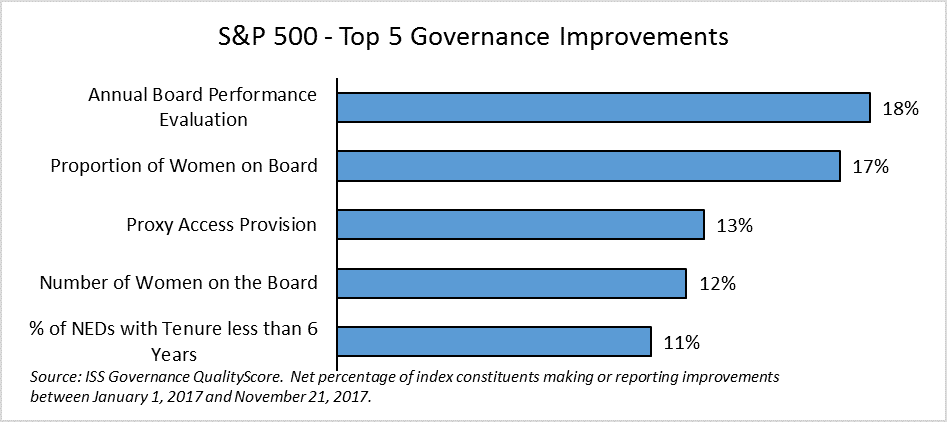
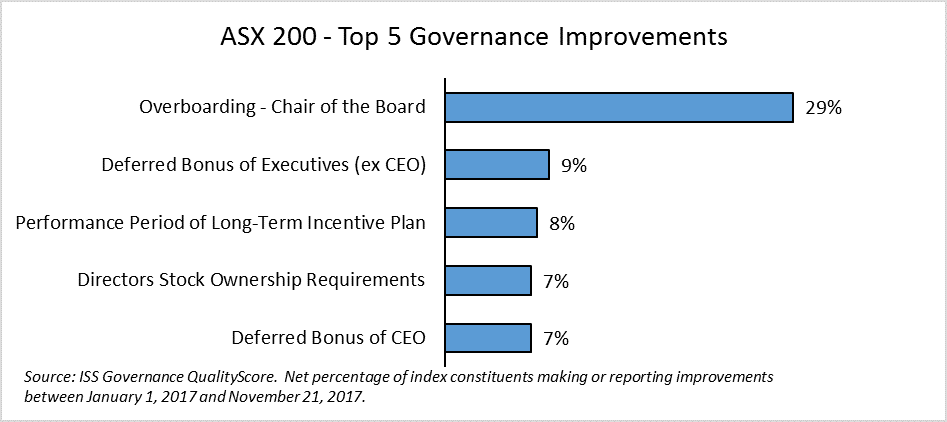
In our effort to identify reasons to give thanks in the corporate governance world, we reviewed ISS’ Governance QualityScore factors for four select markets (the United States, Canada, United Kingdom and Australia). In this assessment, we look at net improvement in each governance factor by counting the number of companies where practices improved and subtracting the number of companies whose practice deteriorated for a given factor. For example, in the S&P 500, 104 companies increased their proportion of non-executive directors with tenure of less than 6 years, while 51 companies saw the percentage of such board members decline. As such, the S&P 500 universe experienced a net improvement in board refreshment of 53 companies since the beginning of the year.


Gender Diversity Takes the Cake


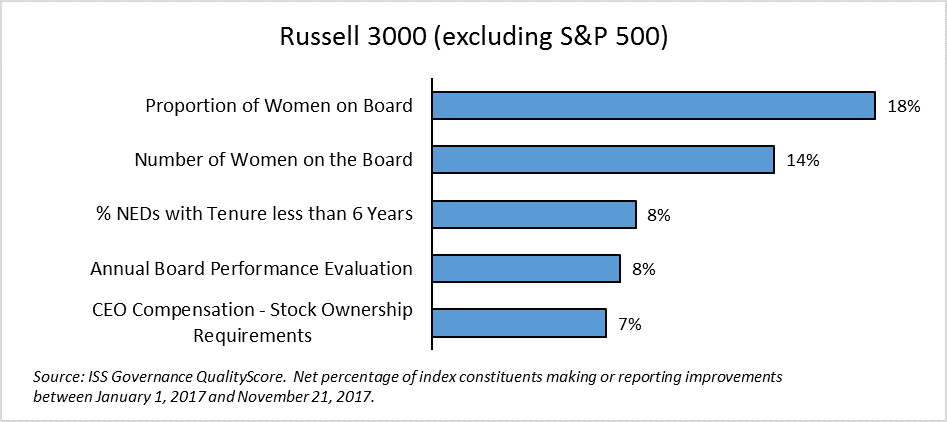
In the U.S., Canada and the United Kingdom, gender diversity ranks consistently among the top factors that showed improvement since the beginning of the year. In the U.S., a net of 18 percent of Russell 3000 companies showed an increase in the proportion of women on the board. The trend can largely be attributed to an increasing number of asset managers and asset owners publicly declaring board diversity as a priority issue in their stewardship campaigns. In particular, 2017 marks the first year when all of the three largest U.S. asset managers put board gender diversity on top of their engagement agendas. SSGA adopted a voting policy in March, while Vanguard recently joined the U.S. Chapter of the 30% Club, and BlackRock identified gender diversity as one of its engagement priorities for 2017-2018. The trend will likely continue as more investors embrace gender diversity initiatives.

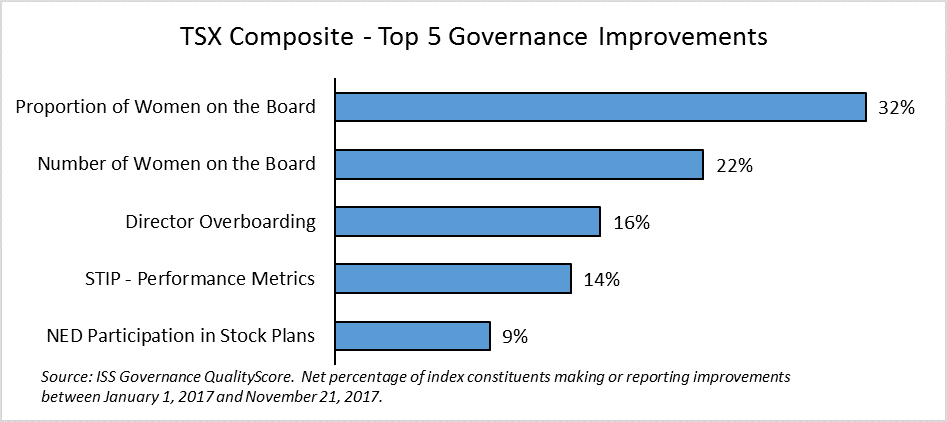
In Canada, the rate of change is even faster with a net improvement of 32 percent of TSX Composite companies showing an increase in the proportion of women on boards. The trend is driven in part by regulation and in part by investor initiatives, per the recent amendments to National Instrument 58-101 to include a Diversity Disclosure Requirement for TSX-listed companies. At the same time, the Canadian Coalition of Good Governance and several large individual asset owners and asset managers have adopted policies to promote gender diversity on boards.

In the United Kingdom, gender diversity ranked as the fourth most-improved factor this year. Gender diversity became a focus item in 2011, when the first target of 25% gender diverse boards for the FTSE 100 was set by the government-backed Lord Davies Women on Boards report. Since then, the objectives have evolved, with the most recent target set at women comprising one-third of FTSE 350 boards by 2020. As such, the trend in the UK market shows that board gender diversity is a long-term issue that will continue to develop as companies reevaluate their board composition priorities (often in response to investor initiatives and regulatory changes).


S&P 500 – Board Evaluations, Refreshment and Proxy Access


The highest-ranking improvement factor among S&P 500 companies is the disclosure of enhanced practices for annual board evaluation with a net 18% of companies disclosing an improvement. It is not clear whether companies are actively improving the board evaluation process or if this is merely an improvement in disclosure; either way, this is a welcome change, which will likely lead to more transparency and accountability on board structure. Gender diversity appears at both the second and fourth places on the list, with S&P 500 companies leading the way in the U.S. with bringing more women into the boardroom. As of today, 22.7% of all S&P 500 directorships are held by women. Not surprisingly, proxy access is third on the list due to continuing shareholder campaigns to introduce access rights. As of now, approximately 60 percent of S&P 500 companies have adopted proxy access. And finally, in line with the greater emphasis placed on board composition and board renewal in recent years, the proportion of non-executive directors with a tenure of less than six years is the fourth most improved governance factor.


Russell 3000 (ex S&P 500) – Following the Lead of Larger Companies

Governance improvements among smaller U.S. firms were similar to the trends observed in the S&P 500 index. Gender diversity, board refreshment and annual board performance evaluation are on the top four spots, confirming the proposition that best practices established by larger firms tend to trickle down to smaller firms. In addition, stock ownership requirements for CEOs made the top-five list in this segment of the market. Compensation improvements are widely dispersed but fairly common among top improvement factors below the top five for both large and small companies. Such practices include the adoption clawback provisions, vesting periods for stock options, anti-pledging policies and prohibitions of option cash buyouts.


Canada – Advancing on Multiple Governance Fronts

Gender diversity takes top honors in Canada, with strong increases in both the proportion and number of women serving on Canadian boards. Canadian investors have paid significant attention to overboarded directors in recent years, especially given the pervasiveness of a small network of interconnected boards in certain sectors. Greater engagement on the issue appears to lead to positive change, as fewer companies appear to have directors with overboarding concerns. Improved disclosure on performance metrics for short-term incentive plans corresponds with the recent trend of voluntary adoption of say-on-pay votes, which has driven better disclosure on compensation issues. Finally, fewer companies allow for the discretionary participation of non-employee directors in equity-based plans. This trend corresponds to investor expectations to limit such practices and to align director compensation with the long-term interests of shareholders.


United Kingdom – Compensation Leads the Way

In the United Kingdom, improvements to compensation practices dominate the landscape. This trend matches investors’ experience relative to meeting agendas, whereby much of the discussion focuses on the non-binding approval of the remuneration report and the binding proposal on remuneration policy. The most common compensation-related improvements suggest a strengthening of the link between executive compensation and the long-term interests of shareholders. Stock ownership requirements for executives and retention periods for restricted stock awards are meant to improve accountability and protect against short-termism in executive’s decision making. At the same time, better disclosure on performance metrics for short-term incentives aligns with the overall principle of pay-for-performance.


Australia – Fewer Overboarded Directors and Improved Incentive Structures

In Australia, the board-related practice of overboarding stands out as the most improved governance practice of the year. This trend is in line with investor expectations (also reflected in ISS’ most recent policy update) to limit the number of board positions held by directors, especially those in senior leadership such as the Chair of the Board or the CEO. The remaining factors are primarily compensation-related. An increase in the deferral of bonuses coincides with newly proposed rules for increased regulatory oversight of executive remuneration in the banking sector in light of a series of recent scandals. As such, bonus deferral policies may become the norm in future years.


Global Trends – A World of Change

The improvements discussed above are indicative of only some of the major trends observed globally. Overall, improved disclosure requirements and revised codes of best practice drive a sea-change in governance practices in both developed and emerging markets in Europe, Asia and Latin America. In addition, company disclosures on environmental and social issues improve, as corporations, investors and regulators explore better ways to assess the potential risks related to ESG factors. We will monitor changes in governance practices in the future, as policy priorities are bound to evolve further.

Valeur actionnariale versus valeur partenariale


Le séminaire à la maîtrise de Gouvernance de l’entreprise (DRT-7022) dispensé  par Ivan Tchotourian*, professeur en droit des affaires de la Faculté de droit de l’Université Laval, entend apporter aux étudiants une réflexion originale sur les liens entre la sphère économico-juridique, la gouvernance des entreprises et les enjeux sociétaux actuels**.

Ce billet veut contribuer au partage des connaissances en gouvernance à une large échelle. Le présent billet est une fiche de lecture réalisée par Mme Bénédicte Allard-Dupuis.

Mme Bénédicte Allard-Dupuis a travaillé sur un article de référence du spécialiste et auteur de nombreux écrits en gouvernance d’entreprise Andrew Keay intitulé : « Shareholder Primacy in Corporate Law : Can it survive? Should it Survive? ».

Dans le cadre de ce billet, l’auteure revient sur le texte pour le mettre en perspective et y apporter une vision comparative.

Bonne lecture ! Vos commentaires sont appréciés.

Valeur actionnariale versus valeur partenariale 

Retour sur Shareholder Primacy in Corporate Law : Can it survive? Should it Survive? d’Andrew Keay

par

Bénédicte Allard-Dupuis


Dans son article « Shareholder Primacy in Corporate Law : Can it survive? Should it Survive? » (European Company and Financial Law Review. 2010, Vol. 7, no 3, p. 369-413), le professeur de l’Université de Leeds Andrew Keay se questionne sur la place qu’occupe, dans la gestion des entreprises, les théories actionnariales et les parties prenantes. Son analyse de la législation britannique démontre que la théorie des parties prenantes est celle qui domine à l’heure actuelle. Pour ce qui est des États-Unis, l’auteur indique qu’un changement s’opère dans la même direction que celle qui a cours actuellement en Grande-Bretagne. En effet, les écrits doctrinaux sur la théorie des parties prenantes se font de plus en plus nombreux.

41dVv5QpErL__SX331_BO1,204,203,200_L’auteur se demande alors si la théorie actionnariale – jusque-là prédominante dans la gouvernance des sociétés dans les juridictions anglo-saxonnes – peut maintenir sa position de tête ? Est-il d’ailleurs légitime que cette théorie conserve une place prédominante ? Le professeur Andrew Keay fait d’abord un rappel des points historiques de l’évolution de la théorie actionnariale. Cette théorie prend naissance dans les années 1800 et a des assises scientifiques très solides. Plusieurs grands penseurs en économie et en droit, dont un prix Nobel (Milton Friedman), appuient sans réserve ce mode de gouvernance et sa place prédominante comme mode de gestion dans les plus grandes économies du monde. Avec l’évolution des marchés, la théorie actionnariale a occupé finalement une place centrale jusque récemment.

L’auteur défini la théorie actionnariale à travers des exemples jurisprudentiels et doctrinaux qui ont façonné le droit à travers le temps. Nous pouvons constater que celle-ci s’est raffinée au fil des temps afin de s’adapter à l’évolution des marchés de capitaux à travers le monde. La primauté des intérêts des actionnaires est au cœur des préoccupations des administrateurs : le but premier est alors de faire fructifier le portefeuille des actionnaires tout en respectant la loi.

Arguments au soutien de la théorie actionnariale

Plusieurs arguments militent en la faveur de la théorie actionnariale. L’auteur en expose quelques-uns avec le point commun suivant : cette théorie serait basée sur un principe très fort d’efficacité et d’efficience.

Premièrement, comme les actionnaires investissent dans la société, ils auraient un intérêt prioritaire par rapport aux autres parties prenantes lorsque cette dernière fait des profits. Deuxièmement, la théorie de l’agence prévoit que les gestionnaires travailleraient en réalité pour le compte des actionnaires dans le but de faire fructifier leurs parts dans la société. Troisièmement, le fait que les gestionnaire aient pour but de faire fructifier l’argent des actionnaires amène la société à faire plus de profits, ce qui profite aux autres parties prenantes. Quatrièmement, l’auteur avance que cette théorie serait certaine et prévisible. En effet, les attentes des actionnaires sont claires ! Cinquièmement, l’auteur mentionne que la théorie actionnariale permettrait d’augmenter la santé de la société en général, c’est-à-dire qu’elle n’entrerait pas en conflit avec les intérêts à long-terme de la société. Sixièmement, l’auteur voit les actionnaires comme les copropriétaires de la société. Ils auraient donc un pouvoir de contrôle sur celle-ci. Septièmement, l’auteur ajoute que lorsque les gestionnaires acceptent de gérer la société, ils accepteraient par le fait même de prendre des décisions qui favorisent et maximisent les profits des actionnaires. Huitièmement, les actionnaires peuvent être considérés comme vulnérables par rapport aux autres parties prenantes : les parties prenantes sont protégées par les termes du contrat, ce qui n’est pas le cas des actionnaires. Neuvièmement, la théorie actionnariale servirait à combler un certain flou dans l’ensemble des contrats corporatifs. En effet, les actionnaires seraient les seules parties prenantes à ne pas avoir de contrat avec la société pour garantir leur investissement, puisque cela occasionnerait trop de problèmes (notamment en termes de coûts) dans la prise de décisions. In fine, les actionnaires seraient les mieux placés pour contrôler le travail des gestionnaires.

Critiques évoquées par l’auteur

L’auteur poursuit avec une série de critiques faites à l’égard de la théorie actionnariale.

La première critique est que cette théorie n’aurait qu’une perspective de court-terme de la croissance de l’entreprise. Dans un deuxième temps, la théorie ne prendrait pas en compte les intérêts divergents des actionnaires. Troisièmement, la vision des actionnaires tendrait à être très étroite et trop simpliste pour que les gestionnaires puissent objectivement prendre les bonnes décisions. Quatrièmement, la raison d’être de cette théorie serait peu morale, puisqu’étant essentiellement basée sur la rentabilité. Cinquièmement, certains problèmes éthiques seraient soulevés, comme la rémunération importante des gestionnaires pour les motiver à prendre des décisions avantageuses pour les actionnaires. Sixièmement, cette théorie encouragerait la prise de risques irréfléchie, en prenant des décisions dans le seul but de maximiser les profits. Septièmement, Il appert que cette théorie serait plus ou moins appropriée aux grandes entreprises, dans la mesure où elle a été introduite initialement dans le but de résoudre les problèmes entre actionnaires dans les petites entreprises. Huitièmement, la théorie actionnariale serait difficilement applicable en pratique, puisque les gestionnaires devraient s’assurer que l’intérêt des autres parties prenantes est pris en compte pour maximiser les intérêts des actionnaires.

Conclusion

À la lumière d’une analyse détaillée, l’auteur conclu que la théorie actionnariale, malgré les critiques dont elle fait l’objet, pourrait survivre et, même, qu’elle devrait survivre… Le débat est donc loin d’être clos; disons même que le professeur Andrew Keay l’ouvre à nouveau !


*Ivan Tchotourian, professeur en droit des affaires, codirecteur du Centre d’Études en Droit Économique (CÉDÉ), membre du Groupe de recherche en droit des services financiers (www.grdsf.ulaval.ca), Faculté de droit, Université Laval.

**Le séminaire s’interroge sur le contenu des normes de gouvernance et leur pertinence dans un contexte de profonds questionnements des modèles économique et financier. Dans le cadre de ce séminaire, il est proposé aux étudiants depuis l’hiver 2014 d’avoir une expérience originale de publication de leurs travaux de recherche qui ont porté sur des sujets d’actualité de gouvernance d’entreprise.

Guide pratique à la détermination de la rémunération des administrateurs de sociétés | ICGN


Aujourd’hui, je vous suggère la lecture d’un excellent guide publié par International Corporate Governance Network (ICGN). Ce document présente succinctement les grands principes qui devraient gouverner l’établissement de la rémunération des administrateurs indépendants (« non-executive »).

Il va de soi que la rémunération des administrateurs ne représente qu’une part infime du budget d’une entreprise, et celle-ci est relativement très inférieure aux rémunérations consenties aux dirigeants ! Cependant, il est vital d’apporter une attention particulière à la rémunération des administrateurs, car ceux-ci sont les fiduciaires des actionnaires, ceux qui doivent les représenter, en veillant à la saine gestion de la société.

Il est important que le comité de gouvernance se penche annuellement sur la question de la rémunération des administrateurs indépendants, et que ce comité propose une politique de rémunération qui tient compte du rôle déterminant de ces derniers. Plusieurs variables doivent être prises en ligne de compte notamment, la comparaison avec d’autres entreprises similaires, les responsabilités des administrateurs dans les différents rôles qui leur sont attribués au sein du conseil, la nature de l’entreprise (taille, cycle de développement, type de mission, circonstances particulières, etc.).

Personnellement, je suis d’avis que tous les administrateurs de sociétés obtiennent une compensation pour leurs efforts, même si, dans certains cas, les sommes affectées s’avèrent peu élevées. Les organisations ont avantage à offrir de justes rémunérations à leurs administrateurs afin (1) d’attirer de nouvelles recrues hautement qualifiées (2) de s’assurer que les intérêts des administrateurs sont en adéquation avec les intérêts des parties prenantes, et (3) d’être en mesure de s’attendre à une solide performance de leur part et de divulguer les rémunérations globales.

Le document du ICNG propose une réflexion dans trois domaines : (1) la structure de rémunération (2) la reddition de comptes, et (3) les principes de transparence.

On me demande souvent qui doit statuer sur la politique de rémunération des administrateurs, puisqu’il semble que ceux-ci déterminent leurs propres compensations !

Ultimement, ce sont les actionnaires qui doivent approuver les rémunérations des administrateurs telles que présentées dans la circulaire de procuration. Cependant, le travail en aval se fait, annuellement, par le comité de gouvernance lequel recommande au conseil une structure de rémunération des administrateurs non exécutifs. Notons que les comités de gouvernance ont souvent recours à des firmes spécialisées en rémunération pour les aider dans leurs décisions.

C’est cette recommandation qui devrait être amenée à l’assemblée générale annuelle pour approbation, même si dans plusieurs pays, la juridiction ne le requiert pas.

En tant qu’administrateur, si vous souhaitez connaître le point de vue du plus grand réseau de gouvernance à l’échelle internationale, je vous invite à lire ce document synthétique.

Bonne lecture. Vos commentaires sur le sujet sont sollicités.


ICGN Guidance on Non-executive Director Remuneration – 2016


Dix thèmes majeurs pour les administrateurs de sociétés en 2017


Aujourd’hui, je partage avec vous la liste des dix thèmes majeurs en gouvernance que les auteurs Kerry E. Berchem* et Rick L. Burdick* ont identifiés pour l’année 2017.

Vous êtes assurément au fait de la plupart de ces dimensions, mais il faut noter l’importance accrue à porter aux questions stratégiques, aux changements politiques, aux relations avec les actionnaires, à la cybersécurité, aux nouvelles réglementations de la SEC, à la composition du CA, à l’établissement de la rémunération et aux répercussions possibles des changements climatiques.

sans-titre-gump

Afin de mieux connaître l’ampleur de ces priorités de gouvernance pour les administrateurs de sociétés, je vous invite à lire l’ensemble du rapport publié par Akin Gump.

Bonne lecture !

Dix thèmes majeurs pour les administrateurs de sociétés en 2017


top-10


1. Corporate strategy: Oversee the development of the corporate strategy in an increasingly uncertain and volatile world economy with new and more complex risks

Directors will need to continue to focus on strategic planning, especially in light of significant anticipated changes in U.S. government policies, continued international upheaval, the need for productive shareholder relations, potential changes in interest rates, uncertainty in commodity prices and cybersecurity risks, among other factors.

2. Political changes: Monitor the impact of major political changes, including the U.S. presidential and congressional elections and Brexit

Many uncertainties remain about how the incoming Trump administration will govern, but President-elect Trump has stated that he will pursue vast changes in diverse regulatory sectors, including international trade, health care, energy and the environment. These changes are likely to reshape the legal landscape in which companies conduct their business, both in the United States and abroad.

With respect to Brexit, although it is clear that the United Kingdom will, very probably, leave the European Union, there is no certainty as to when exactly this will happen or what the U.K.’s future relationship, if any, with the EU will be. Once the negotiations begin, boards will need to be quick to assess the likely shape of any deal between the U.K. and the EU and to consider how to adjust their business model to mitigate the threats and take advantage of the opportunities that may present themselves.

3. Shareholder relations: Foster shareholder relations and assess company vulnerabilities to prepare for activist involvement

The current environment demands that directors of public companies remain mindful of shareholder relations and company vulnerabilities by proactively engaging with shareholders, addressing shareholder concerns and performing a self-diagnostic analysis. Directors need to understand their company’s vulnerabilities, such as a de-staggered board or the lack of access to a poison pill, and be mindful of them in any engagement or negotiation process.

4. Cybersecurity: Understand and oversee cybersecurity risks to prepare for increasingly sophisticated and frequent attacks

As cybercriminals raise the stakes with escalating ransomware attacks and hacking of the Internet of Things, companies will need to be even more diligent in their defenses and employee training. In addition, cybersecurity regulation will likely increase in 2017. The New York State Department of Financial Services has enacted a robust cybersecurity regulation, with heightened encryption, log retention and certification requirements, and other regulators have issued significant guidance. Multinational companies will continue implementation of the EU General Data Protection Regulation requirements, which will be effective in May 2018. EU-U.S. Privacy Shield will face a significant legal challenge, particularly in light of concerns regarding President-elect Trump’s protection of privacy. Trump has stated that the government needs to be “very, very tough on cyber and cyberwarfare” and has indicated that he will form a “cyber review team” to evaluate cyber defenses and vulnerabilities.

5. SEC scrutiny: Monitor the SEC’s increased scrutiny and more frequent enforcement actions, including whistleblower developments, guidance on non-GAAP measures and tougher positions on insider trading

2016 saw the Securities and Exchange Commission (SEC) award tens of millions of dollars to whistleblowers and bring first-of-a-kind cases applying new rules flowing from the protections now afforded to whistleblowers of potential violations of the federal securities laws. The SEC was also active in its review of internal accounting controls and their ability to combat cyber intrusions and other modern-day threats to corporate infrastructure. The SEC similarly continued its comprehensive effort to police insider trading schemes and other market abuses, and increased its scrutiny of non-GAAP (generally accepted accounting principles) financial measure disclosures. 2017 is expected to bring the appointment of three new commissioners, including a new chairperson to replace outgoing chair Mary Jo White, which will retilt the scales at the commissioner level to a 3-2 majority of Republican appointees. 2017 may also bring significant changes to rules promulgated previously under Dodd-Frank.

6. CFIUS: Account for CFIUS risks in transactions involving non-U.S. investments in businesses with a U.S. presence

Over the past year, the interagency Committee on Foreign Investment in the United States (CFIUS) has been particularly active in reviewing—and, at times, intervening in—non-U.S. investments in U.S. businesses to address national security concerns. CFIUS has the authority to impose mitigation measures on a transaction before it can proceed, and may also recommend that the President block a pending transaction or order divestiture of a U.S. business in a completed transaction. Companies that have not sufficiently accounted for CFIUS risks may face significant hurdles in successfully closing a deal. With the incoming Trump administration, there is also the potential for an expanded role for CFIUS, particularly in light of campaign statements opposing certain foreign investments.

7. Board composition: Evaluate and refresh board composition to help achieve the company’s goals, increase diversity and manage turnover

In order to promote fresh, dynamic and engaged perspectives in the boardroom and help the company achieve its goals, a board should undertake focused reassessments of its underlying composition and skills, including a review and analysis of board tenure, continuity and diversity in terms of upbringing, educational background, career expertise, gender, age, race and political affiliation.

8. Executive compensation: Determine appropriate executive compensation against the background of an increased focus on CEO pay ratios

Executive compensation will continue to be a hot topic for directors in 2017, especially given that public companies will soon have to start complying with the CEO pay ratio disclosure rules. Recent developments suggest that such disclosure might not be as burdensome or harmful to relations with employees and the public as was initially feared.
The SEC’s final rules allow for greater flexibility and ease in making this calculation, and a survey of companies that have already estimated their ratios indicates that the ratio might not be as high, on average, as previously reported.

9. Antitrust scrutiny: Monitor the increased scrutiny of the antitrust authorities and the implications on various proposed combinations

Despite the promise of synergies and the potential to transform a company’s future, antitrust regulators have become increasingly hostile toward strategic transactions, with the Department of Justice and Federal Trade Commission suing to block 12 transactions since 2015. Although directors should brace for a longer antitrust review, to help navigate the regulatory climate, work upfront can dramatically improve prospects for success. Company directors should develop appropriate deal rationales and, with the benefit of upfront work, allocate antitrust risk in the merger agreement. Merger and acquisition activity may also benefit from the Trump administration, taking, at least for certain industries, a less-aggressive antitrust enforcement stance.

10. Environmental disasters and contagious diseases: Monitor the impact of increasingly volatile weather events and contagious disease outbreaks on risk management processes, employee needs and logistics planning

While the causes of climate change remain a political sticking point, it cannot be debated that volatile weather events, environmental damage and a rise in the diseases that tend to follow, are having increasingly adverse impacts on businesses and markets. Businesses will need to account for, or transfer the risk of, the increasing likelihood of these impacts. The SEC recently announced investigations into climate-risk disclosures within the oil and gas sector to ensure that they adequately allow investors to account for these effects on the bottom line. The growing number of shareholder resolutions and suits addressing climate change confirm that investors want this information, regardless of the position of the next administration.

The complete publication is available here.


*Kerry E. Berchem is partner and head of the corporate practice, and Rick L. Burdick is partner and chair of the Global Energy & Transactions group, at Akin Gump Strauss Hauer & Feld LLP.

Gouvernance des sociétés d’État | une étude montre des problèmes dans la moitié d’entre elles


Yvan Allaire, président exécutif du conseil de l’Institut sur la gouvernance (IGOPP) vient de publier, en collaboration avec François Dauphin, un nouveau document de recherche intitulé « Nos sociétés d’État sont-elles bien gouvernées ? » lequel a fait l’objet d’une analyse succincte par le journaliste Gérald Fillion de la Société Radio-Canada.

Selon l’IGOPP, « les contribuables s’attendent à ce que ces sociétés fassent bon usage des fonds publics qui leur sont confiés, que leur gestion soit efficace, efficiente et transparente, que leur mandat soit clair et pertinent. Leur conseil d’administration, s’appuyant sur des règles et principes de saine gouvernance, devrait jouer un rôle essentiel à cet égard ».

Je crois que ce rapport de recherche saura intéresser les spécialistes de la gouvernance qui œuvrent dans les sociétés d’État et dans les autres organisations parapubliques. Personnellement, je crois que les auteurs ont élaboré une méthodologie de recherche tout à fait pertinente pour évaluer la bonne gouvernance, non seulement des sociétés d’État, mais également de tous les types d’organisation.


Vous trouverez ci-dessous une analyse de Gérald Filion, suivie de la référence au document de recherche de l’IGOPP.


Sur 46 sociétés d’État au Québec seulement 23 obtiennent la note de passage en matière de gouvernance, selon une étude préparée par les chercheurs Yvan Allaire et François Dauphin.

Si les grandes sociétés se démarquent, notamment la Caisse de dépôt, la SAQ et Loto-Québec, d’autres affichent de faibles résultats qui pourraient amener le gouvernement à devoir repenser leur modèle de gouvernance. Parmi les derniers de classe, on compte l’École nationale de police, le Musée national des beaux-arts de Québec et l’Institut de tourisme et d’hôtellerie du Québec.

Ce rapport, publié jeudi par l’Institut sur la gouvernance d’entreprises publiques et privées, s’intéresse à 47 instruments de mesure de la gouvernance des sociétés pour établir un pointage sur 100. La note de passage est établie à 60. Ont été exclues de l’étude 13 sociétés jugées inactives dans les faits ou trop petites. Les 46 sociétés d’État retenues encaissent annuellement des revenus de 63 milliards de dollars et comptent 65 000 employés.

L’Institut sur la gouvernance évalue les sociétés sur les compétences des administrateurs, la transparence, la reddition de compte, la structure du conseil et le déroulement des séances du conseil. Et les résultats sont très inégaux.

L’École nationale de police échoue sur tous les plans, tout particulièrement sur les questions de compétence et de nomination. À l’autre bout du spectre, la Société d’habitation du Québec se démarque à tous les niveaux, avec une note parfaite dans la composition et la structure de son conseil, qui touche surtout à la question de l’indépendance.

L’Institut recommande au gouvernement de revoir certaines lois jugées « désuètes » pour encadrer les sociétés, de rendre publics les profils d’expertise et d’expérience des administrateurs et une foule d’informations pertinentes à leur propos.

Il propose aussi que le gouvernement cesse de rendre le dépôt du rapport annuel des sociétés d’État obligatoire à l’Assemblée nationale avant de le rendre public. Les rapports doivent être disponibles dans des délais plus rapides selon l’Institut sur la gouvernance. Actuellement, il faut attendre 6 mois en moyenne après la fin de l’exercice pour avoir accès au rapport annuel.

Les conseils d’administration des sociétés d’État, écrivent les chercheurs, doivent adopter des principes qui dépassent les exigences de la loi, surtout au chapitre de la « divulgation des profils de compétence, divulgation non obligatoire, mais non prohibée. »

Les conseils doivent s’assurer également que l’information, sur les sites internet des sociétés d’État, est facilement accessible, notamment les résultats de la société, ses stratégies ainsi que les indicateurs de performance. De plus, « une divulgation exhaustive des éléments de rémunération des hauts dirigeants est incontournable. »

Le gouvernement se mêle de tout

L’Institut illustre, chiffres à l’appui, combien le gouvernement s’assure de garder le contrôle sur les nominations des administrateurs.

« Ainsi, écrivent Yvan Allaire et François Dauphin, dans seulement cinq cas avons-nous trouvé une participation claire de la part du conseil dans le processus de sélection des candidats et candidates au poste d’administrateur. Bien sûr, le manque de transparence fausse peut-être en partie les données pour cet élément. Néanmoins, la participation du conseil dans le processus de sélection est extrêmement importante pour assurer non seulement la présence de compétences et d’expériences complémentaires au groupe, mais aussi pour faciliter l’obtention (ou le maintien) d’une dynamique de groupe fonctionnelle. »

Sur les 46 sociétés d’État, seulement trois établissent publiquement sur leur site un lien entre la biographie des administrateurs et les compétences recherchées au conseil.

L’Institut sur la gouvernance est d’avis également qu’une personne ne devrait pas siéger à plus de cinq conseils d’administration en même temps. Or, « au moins quinze (32,6 %) des sociétés comptaient au minimum un membre du conseil siégeant sur plus de cinq conseils d’administration, incluant quelques présidents de conseil. »

Aussi, « 19 sociétés (41,3 %) ne fournissent pas l’information sur l’assiduité des membres aux réunions du conseil. »

Les auteurs constatent également qu’il y a « une différence importante entre les organisations assujetties à la Loi québécoise sur la gouvernance des sociétés d’État promulguée en 2006 et celles qui ne le sont pas. En effet, les sociétés assujetties doivent divulguer davantage d’information, ne serait-ce que pour s’y conformer. Aussi, elles ont en moyenne une note de 70,7, comparativement à 45,2 pour les sociétés qui ne se conforment qu’aux exigences de leurs lois respectives. »

Manque de transparence

C’est pas moins de dix sociétés sur les 46 qui n’ont pas d’indicateur de performance ou de cible pour les évaluer, ou qui ne publient pas leur plan stratégique. Ce manque de transparence touche notamment la Commission de la capitale nationale, Héma-Québec et la Société de la Place des Arts de Montréal.

Yvan Allaire et François Daupin affirment également que « la transparence quant à la rémunération des hauts dirigeants des sociétés d’État peut et devrait être grandement améliorée, ne serait-ce que pour se rapprocher des exigences imposées aux sociétés pourtant dites “privées”.»

Enfin, les auteurs invitent les sociétés d’État à rendre publics la teneur des formations offertes aux administrateurs et les processus d’évaluation des membres du conseil. Cela dit, près du quart des sociétés d’État ne font pas d’évaluation et ne dévoilent pas cette information.


Je vous invite à lire l’ensemble du document sur le site de l’IGOPP, notamment pour connaître les 47 critères de mesure de la gouvernance.

Bonne lecture ! Vos commentaires sont les bienvenus.


Nos sociétés d’État sont-elles bien gouvernées? |  L’IGOPP leur attribue des notes de gouvernance


Qu’est-ce qu’un président « exécutif » de conseil d’administration ? | Le cas de Bombardier 


Voici un article de Karim Benessaieh publié dans la section Actualité expliquée de La Presse+ Affaires le 13 mai 2017.

L’auteur apporte les précisions requises quant aux titres et fonctions du président du conseil de Bombardier, Pierre Beaudoin.

Pierre Beaudoin était président et chef de la direction (CEO ou PDG) de Bombardier depuis 2008. En 2015, il devient le président « exécutif » du conseil d’administration de Bombardier.

Récemment, ce dernier a renoncé à la portion « exécutive » de ses fonctions. Qu’est-ce que cela implique pour le commun des mortels ?

C’est exactement ce à quoi Karim Benessaieh a tenté de répondre dans son article, reproduit ci-dessous, auquel j’ai participé.

Bonne lecture ! Vos commentaires sont les bienvenus.


Un président exécutif, ça mange quoi en hiver ?


Qu’est-ce qu’un président exécutif ? Peut-on être PDG, président du conseil d’administration et chef de la direction en même temps ? Dans la tempête qui ébranle Bombardier depuis six semaines, il est facile de se perdre dans les étiquettes. La Presse a demandé à deux experts en gouvernance d’éclairer notre lanterne.


À quoi a renoncé exactement Pierre Beaudoin en retirant la partie « exécutive » de son mandat ?

À la base, Pierre Beaudoin, fils de Laurent Beaudoin et de Claire Bombardier et donc petit-fils de Joseph-Armand Bombardier, est le président du conseil d’administration de l’entreprise depuis 2015. Son rôle est de « gérer le conseil et [d’]établir l’ordre du jour » pour les 15 membres de cette instance, comme le précise le site de Bombardier, qui ne fait aucune référence à l’aspect « exécutif » de son travail.

Dans l’avis de convocation des actionnaires, cette semaine, on reprend la formule un peu vague selon laquelle M. Beaudoin est en outre chargé de « la définition d’une orientation stratégique et [de] la gestion des relations entretenues avec certaines parties prenantes et avec la clientèle ». Ce sont ces dernières responsabilités qu’il a perdues.

Vous ne nous éclairez pas beaucoup…

Désolé, c’était la réponse officielle. C’est que le « président exécutif » est une bête un peu curieuse souvent associée aux entreprises familiales ou dont le fondateur est encore bien présent. Aux États-Unis, peu de confusion : pour 50 % des entreprises cotées en Bourse, le PDG (ou CEO) est également président du conseil d’administration. Le président du conseil, dans ces cas, est « exécutif » de facto. Au Canada, seulement 14 % des entreprises sont dirigées par un PDG qui est en même temps président du conseil d’administration.

Par contre, dans une sorte de formule mitoyenne, certaines entreprises d’ici ont donné des responsabilités élargies à leur président du conseil en lui ajoutant l’étiquette « exécutif » : il devient dans les faits un deuxième PDG.

Au Québec, CGI, Couche-Tard et Cascades ont donné ce titre à celui qui préside leur conseil d’administration. « C’est une formule hybride, résume Michel Nadeau, directeur général de l’Institut sur la gouvernance. Ça reflète généralement une situation temporaire où le nouveau PDG apprend à gérer, avec l’entrepreneur fondateur. »

Et c’est bien d’avoir un président du conseil qui se mêle d’administration ?

Un peu de contexte ici. Depuis plus d’une décennie, au Canada et en Europe, les autorités réglementaires, les experts en gouvernance et les investisseurs institutionnels comme la Caisse de dépôt et placement du Québec suggèrent fortement de séparer les fonctions de président du conseil d’administration et de président de l’entreprise. Aucune loi n’impose cette division des tâches, cependant.

« On veut éviter les conflits d’intérêts, explique Jacques Grisé, président de l’Ordre des administrateurs agréés du Québec. Séparer les deux postes est un signe de bonne gouvernance, et on est en train de le reconnaître même aux États-Unis, où ça s’améliore graduellement. »

C’est le conseil d’administration qui embauche le PDG et fixe sa rémunération, rappelle M. Nadeau. « Le président exécutif est un peu coincé entre les deux. Quand il arrive avec une proposition de rémunération qui inclut la sienne, c’est bizarre. Quand il travaille 40 heures par semaine avec le PDG alors qu’il doit pouvoir le confronter au conseil d’administration, ça donne une situation incongrue. » C’est une « simple question de logique », estime-t-il, qu’il n’y ait pas un cumul des pouvoirs au sein d’une entreprise. « Il faut un superviseur et un supervisé, un contrepoids. »

Est-ce que les entreprises qui séparent les fonctions de président du conseil et de PDG s’en portent financièrement mieux ?

« Les études ne sont pas très claires en ce sens, mais on voit que partout dans le monde, on essaie d’implanter cette séparation », répond M. Grisé. Cette question précise fait partie d’un vaste ensemble, la bonne gouvernance, qui comprend bien d’autres exigences, rappelle M. Nadeau. « Dans le cas de Bombardier, ç’aurait été une bonne chose d’avoir un président du conseil indépendant. C’est souhaitable, mais il faut être réaliste : dans une entreprise contrôlée par une famille, c’est demander de l’héroïsme. »

_______________________________________

Karim Benessaieh est reporter économique à La Presse depuis 2000.
Ce texte provenant de La Presse+ est une copie en format web. Consultez-le gratuitement en version interactive dans l’application La Presse+.

Le choix entre le couple expérience-réputation et le couple fougue-expertise | Ça dépend !


Aujourd’hui, je vous présente un cas fascinant qui illustre les difficultés de choisir un nouvel administrateur d’une jeune entreprise technologique.

Ce cas de gouvernance, publié en novembre 2017 sur le site de Julie Garland McLellan*, décrit la situation d’une entreprise qui est sur le point de s’inscrire en bourse ; choisit-elle, comme nouvel administrateur, une jeune personne fougueuse avec une solide expertise technique, ou choisit-elle une personne d’expérience possédant une grande réputation de bonne gouvernance ?

Le courtier qui conseille l’entreprise sur les conditions de son entrée en bourse lui suggère impérativement le choix d’une personne de grande réputation dans le domaine des affaires.

Le cas soumis est réel et il incite trois experts à présenter des points de vue assez différents sur les avantages et les inconvénients liés à chacun des choix.

Afin de vous former une idée mieux étayée du dilemme qui met en contraste les experts en gouvernance dans ce cas, je vous invite à lire leurs opinions en allant sur le site de Julie.

Et vous, qu’en pensez-vous ? Faites-vous une idée claire avant de consulter les réponses des experts.

Bonne lecture ! Vos commentaires sont toujours les bienvenus.

Le choix entre le couple expérience-réputation et le couple fougue-expertise | Ça dépend !


This month our case study considers the dilemma of choosing between experience and potential when building a board for an IPO. I hope you will enjoy thinking through the key governance issues and developing your own judgement from this dilemma.

Umberto founded his company ten years ago and built a successful technology company with a product that is tested in the market and capable of further development. Potential exists to take the product global; Umberto needs to move fast to retain the advantage of IP and know-how that can’t be easily replicated. An IPO is planned within twelve months and Umberto is confident his business will make a smooth transition from private to public company status.

Umberto has an advisory board with a range of skilled directors, each of whom adds considerable expertise in a relevant topic. He has benefitted greatly from their insights, and plans to convert this group of people into a governing board as he goes through the listing process. He is keen to add a new person to his board and has spoken with an ambitious bright young executive who has recently returned after five years in Asia selling a technology similar to Umberto’s product.

The broker advising on the IPO told Umberto that his board are a -bunch of unknowns” and unlikely to inspire the confidence of private equity investors and small funds that are the target market for his equity raising. The broker suggests appointing a ‘household name’ director from a large listed company. He admits that this person would not add much to the strategic competence of the board but claims they would help to bring in investors.

Umberto is in a quandary; he feels it would be disloyal to back out after his discussions with the young potential director, can’t justify bringing in two new directors, and doesn’t want to lose any of his existing team. He understands the merit of the broker’s suggestion. Should he choose experience and reputation or energy and ability?


*Julie Garland McLellan is a practising non-executive director and board consultant based in Sydney, Australia. www.mclellan.com.au/newsletter.html

Sommaire de l’enquête de PwC sur la gouvernance des entreprises auprès des administrateurs


La gouvernance des entreprises a beaucoup évolué au cours des vingt dernières années. Aujourd’hui, les investisseurs institutionnels détiennent 70 % des actions des corporations publiques.

L’auteure indique que l’un des seuls moyens pour les actionnaires investisseurs d’améliorer la performance des entreprises est d’agir sur la gouvernance des entreprises, en exerçant différentes pressions auprès du management et des administrateurs (« direct engagement ») et en faisant connaître leur avis via le vote par procuration.

Un sommaire de l’étude publié par Paula Loop*, directrice du Centre de la gouvernance de PricewaterhouseCoopers, nous donne un bon aperçu des principaux changements observés lors de l’enquête auprès de 886 administrateurs de grandes corporations américaines.

Voici les points saillants de l’étude :

  1. Director discontent with peers hits a high-water mark
  2. Boards are taking more action on performance assessments
  3. Independent chairs are more likely to have the difficult conversations
  4. Key issues are not being prioritized in many boardrooms
  5. Male and female directors see strategy very differently
  6. Executive pay plans are effective—except where they’re not
  7. Seeing returns on shareholder engagement
  8. The gender divide is real on questions of board diversity
  9. Challenging management is a challenge


Voir le résumé de l’enquête ci-dessous.

Bonne lecture ! Vos commentaires sont appréciés.


Insights from PwC’s 2017 Annual Corporate Directors Survey


« Against the backdrop of a new administration in Washington and growing social divisiveness, US public company directors are faced with great expectations from investors and the public. Perhaps now more than ever, public companies are being asked to take the lead in addressing some of society’s most difficult problems. From seeking action on climate change to advancing diversity, stakeholder expectations are increasing and many companies are responding.

In part, this responsiveness is driven by changes in who owns public companies today. Institutional investors now own 70% of US public company stock, much of which is held in index funds. [1] Many of these passive investors believe that seeking improvements in corporate governance is one of the only levers they have to improve company performance. And these shareholders are exerting their influence with management teams and the board through their governance policies, direct engagement and proxy voting.

But boards and shareholders don’t always agree, and the corporate governance environment itself is not immune to divisiveness. In fact, our research shows that directors are clearly out of step with investor priorities in some critical areas.

One of these areas is environmental issues. During the 2017 proxy season, a handful of shareholder proposals on environmental issues, like climate change, gained majority shareholder support. This is the first time we have seen these types of proposals pass, and they did so with the help of some of the largest institutional investors like BlackRock, Vanguard and Fidelity. For their part, some of the largest US companies declared their continuing commitment to take action fighting climate change, even as the US announced its withdrawal from the Paris climate accord.

About the survey


For over a decade, PwC’s Annual Corporate Directors Survey has gauged the views of public company directors from across the United States on a variety of corporate governance matters. In the summer of 2017, 886 directors participated in our survey. The respondents represent a cross-section of companies from over a dozen industries,

75% of which have annual revenues of more than $1 billion. Eighty-four percent of the respondents were men, and 16% were women. Their board tenure varied, but 60% have served on their board for five or more years.


But despite increased shareholder interest in environmental risk, there appears to be a disconnect when it comes to the views in many boardrooms. A majority of directors tell us that their boards don’t need sustainability expertise. A surprising number also say their company’s strategy isn’t being influenced by climate change or resource scarcity, and that they don’t think environmental concerns will impact their current strategy. Companies and investors may be driving the agenda, but rather than leading the way in this area, many directors are being carried along.

Gender diversity on boards has also become a clear priority for institutional investors in 2017. Shareholders like State Street Global Advisors and BlackRock recently adopted new diversity policies or guidance on board diversity. Indeed, State Street even voted against directors at hundreds of companies that it believed had not made sufficient strides in diversifying their boards. Yet despite the increased focus from institutional investors, fewer of the new board seats in 2016 went to women than in the prior year. [2] And gender parity is still a long way off, with only 25% of boards in the S&P 500 having more than two female directors. [3] Even so, about half of female directors tell us that their board is already sufficiently diverse. Which leads to the question—are female directors sufficiently championing the cause of gender diversity?

Investors are also putting the spotlight on social issues like income inequality and employee retirement security, asking companies to help develop shared economic security. But again, directors tell us that income inequality considerations should not play a part in company strategy.

PwC’s 2017 Annual Corporate Directors Survey examines the areas where directors and investors are aligned and moving forward together, as well as the ways in which they are out of sync.

While boards have made real improvements in some areas, there is clearly more work to be done. Among our key observations:


Director discontent with peers hits a high-water mark


With greater expectations of boards, directors are upping their game and are seeking to add value. More than ever, directors—particularly those who are less tenured—are also noticing that not all of their fellow directors are doing the same. Almost half of directors (46%) believe that one or more of their fellow board members should be replaced. One-fifth of directors say that two or more directors on their board should be replaced.


Boards are taking more action on performance assessments


Investors have been pushing boards to not just conduct board performance assessments, but to do something with the results. This year, more than twothirds (68%) say that their board has taken some action in response to their last board assessment—an increase of 19 percentage points over last year.


Independent chairs are more likely to have the difficult conversations


Directors on boards with non-executive chairs are more than twice as likely to say that their board decided not to re-nominate a director, or provided counsel to a director, as a result of the board’s assessment process.


Key issues are not being prioritized in many boardrooms


While investors are talking about the impact of environmental and social issues on the bottom line, the conversations are not necessarily filtering up to the boardroom. A significant percentage of directors say that income inequality (51%), immigration (49%) and climate change (40%) should not be taken into account—at all—in company strategy.


Male and female directors see strategy very differently


Female directors are more likely to think that social issues should play a part in company strategy formation. And they are much more likely to think that issues like environmental concerns and social instability will force the company to change its strategy in the next three years.


Executive pay plans are effective—except where they’re not


Directors are confident that incentive plans promote long-term shareholder value. But 70% at least somewhat agree that executives in general are overpaid, and 66% say that executive compensation exacerbates income inequality. Meanwhile, executive pay continues to go up, not down. [4]


Seeing returns on shareholder engagement


In just the past year, directors have come around to a much more positive view of shareholder engagement. They are much more likely now to think that direct engagement impacts proxy voting (77% as compared to 59% in 2016). And the vast majority now say that the right representatives are present (85%) and investors are well prepared for meetings (84%)—12 and 21 percentage point increases over last year, respectively.


The gender divide is real on questions of board diversity


Male and female directors have a significant difference of opinion about the impact of board diversity on company performance. Nearly five out of six female directors (82%) believe that diversity enhances company performance, while only just over half of men agree (54%).


Challenging management is a challenge


Strategy oversight is one of the board’s core responsibilities. Investors want to know that directors are heavily involved in evaluating, challenging and monitoring the company’s strategy, and calling for a change of course when needed. Yet only 60% of directors say their board strongly challenges management assumptions on strategy as part of their oversight role.

As we analyzed the results of this year’s survey, we also looked behind the numbers at how demographic differences such as gender and length of tenure on the board affected directors’ views. Read on for our full analysis of the survey results and areas where those differences were notable. And for the results of every question in the survey, please refer to the Appendix of the complete publication.

The complete publication is available here.

Endnotes

1Institutional investors owned an average of 70% of the outstanding shares of US public companies as of June 30, 2017. PwC + Broadridge, ProxyPulse 2017 Proxy Season Review, September 2017. Forty-two percent of all US stock fund assets as of June 30, 2017 were held through index funds. Investment Company Institute.(go back)

2 The percentage of women in new board appointments at Fortune 500 companies declined two percentage points to 27.3% in 2016. Fortune, “The Share of Women Appointed to Fortune 500 Declined Last Year,” June 19, 2017.(go back)

3Spencer Stuart, 2016 Spencer Stuart Board Index, November 2016.(go back)

4See Willis Towers Watson Executive Pay Bulletin, May 9, 2017.(go back) »

_____________________________________

*Paula Loop is Leader of the Governance Insights Center at PricewaterhouseCoopers LLP. This post is based on a publication from the PwC Governance Insights Center.

Compte rendu hebdomadaire de la Harvard Law School Forum on Corporate Governance | 26 octobre 2017


Voici le compte rendu hebdomadaire du forum de la Harvard Law School sur la gouvernance corporative au 26 octobre 2017.

Cette semaine, j’ai relevé les dix principaux billets.

Bonne lecture !


Résultats de recherche d'images pour « harvard law school forum on corporate governance »


Résultats de recherche d'images pour « harvard law school forum on corporate governance »


  1. Securities Cases to Watch this Term at the Supreme Cour
  2. Director Networks, Turnover, and Appointments
  3. Protecting Shareholder Ownership and Governance Rights
  4. 2017 Relative TSR Prevalence and Design of S&P 500 Companies
  5. Busy Directors: Strategic Interaction and Monitoring Synergies
  6. Where’s the Board? Questions for Equifax
  7. Building a Better Board Book
  8. The Rise of Investor-Centric Activism Defense Strategy
  9. Environmental and Social Proposals in the 2017 Proxy Season
  10. Activism’s New Paradigm