Compte rendu hebdomadaire de la Harvard Law School Forum on Corporate Governance | 20 juillet 2017


Voici le compte rendu hebdomadaire du forum de la Harvard Law School sur la gouvernance corporative au  20 juillet 2017.

J’ai relevé les principaux billets, tout en me limitant au Top 1o.

Bonne lecture !


Résultats de recherche d'images pour « harvard law school forum on corporate governance »


Résultats de recherche d'images pour « harvard law school forum on corporate governance »


  1. Lighting Our Capital Markets
  2. Balancing the Governance of Financial Institutions
  3. The Search for a Long-Term Premium
  4. Board to Death: How Busy Directors Could Cause the Next Financial Crisis
  5. Communications Challenges for the Post-Activist Proxy Contest World
  6. Director Attention and Firm Value
  7. CalPERS v. IAC: Clear Win for Investors Protecting Shareholder Voting Rights
  8. Hedge Fund Activism and the Revision of the Shareholder Rights Directive
  9. The Delightful Dozen: Top Governance Advances in 2017
  10. How Important are Risk-Taking Incentives in Executive Compensation

Compte rendu hebdomadaire de la Harvard Law School Forum on Corporate Governance | 13 juillet 2017


Voici le compte rendu hebdomadaire du forum de la Harvard Law School sur la gouvernance corporative au  13 juillet 2017.

J’ai relevé les principaux billets, tout en me limitant au Top 1o.

Bonne lecture !


Résultats de recherche d'images pour « harvard law school forum on corporate governance »


Résultats de recherche d'images pour « harvard law school forum on corporate governance »


  1. The Law & Brexit XII
  2. How Your Board Can Be Ready for Crisis
  3. 2017 Proxy Season Review Appraisal Practice Points Post-SWS
  4. Lawyer CEOs
  5. The Value of the Shareholder Proposal Process
  6. What Do Measures of Real-Time Corporate Sales Tell Us About Earnings Surprises and Post-Announcement Returns?
  7. Have SEC ALJs Been Operating Contrary to the U.S. Constitution?
  8. Shareholder Proposal Developments During the 2017 Proxy Season
  9. Inelastic Labor Markets and Directors’ Reputational Incentives
  10. The Long Arm of the MAC

Compte rendu hebdomadaire de la Harvard Law School Forum on Corporate Governance | 6 juillet 2017


Voici le compte rendu hebdomadaire du forum de la Harvard Law School sur la gouvernance corporative au  6 juillet 2017.

J’ai relevé les principaux billets, tout en me limitant au Top 1o.

Bonne lecture !


Résultats de recherche d'images pour « harvard law school forum on corporate governance »


Résultats de recherche d'images pour « harvard law school forum on corporate governance »


  1. What are Boards For? Evidence from Closely Held Firms
  2. After the Annual General Meeting: How Boards Can Prepare for Next Year
  3. Proxy Access: Highlights of the 2017 Proxy Season
  4. A Closer Look at the Findings of Our 2017 Proxy Analysis: A New Normal Meets a New Reality
  5. Investor Support Heating Up for Climate Change Proposals
  6. Red Light for New Activist Strategy
  7. Board Reforms and Firm Value: Worldwide Evidence The “Responsible Corporate Officer Doctrine”
  8. Survives to Perplex Corporate Boards
  9. Index Eligibility as Governance Battlefield: Why the System is Not Broken and We Can Live With Dual Class Issuers
  10. Internal Investigations Special Committees Resource

Compte rendu hebdomadaire de la Harvard Law School Forum on Corporate Governance | 29 juin 2017


Voici le compte rendu hebdomadaire du forum de la Harvard Law School sur la gouvernance corporative au  29 juin 2017.

J’ai relevé les principaux billets, tout en me limitant au Top 10

Bonne lecture !


Résultats de recherche d'images pour « harvard law school forum on corporate governance »


Résultats de recherche d'images pour « harvard law school forum on corporate governance »


  1. What Is the Business of Business?
  2. Treasury Department Issues Recommendations on Reforming the U.S. Financial System
  3. A Modest Proposal? Treasury’s Report on Bank Regulation
  4. Déjà Vu: Model Risks in the Financial Choice Act
  5. Is Board Compensation Excessive?
  6. Ten Questions Every Board Should Ask in Overseeing Cyber Risks
  7. Federal Bill Attempts to Silence Investors
  8. The Financial CHOICE Act and the Debate Over Shareholder Proposals
  9. “Captured Boards”: The Rise of “Super Directors” and the Case for a Board Suite
  10. The Increasing Evidence that Horizontal Shareholding Is Distorting Our Economy

Compte rendu hebdomadaire de la Harvard Law School Forum on Corporate Governance | 22 juin 2017


Voici le compte rendu hebdomadaire du forum de la Harvard Law School sur la gouvernance corporative au  22 juin 2017.

J’ai relevé les principaux billets, tout en me limitant au Top 1o.

Bonne lecture !


Résultats de recherche d'images pour « harvard law school forum on corporate governance »


Résultats de recherche d'images pour « harvard law school forum on corporate governance »


  1. What Determines Participation in Corporate Voting?
  2. The Voice: The Minority Shareholder’s Perspective
  3. PCAOB Approves Expanded Auditor’s Report
  4. Shareholder Proposals: Evidence of Private Ordering Supplanting Public Policy?
  5. Changing Attitudes: The Stark Results Of Thirty Years Of Evolution In Delaware M&A Litigation
  6. Corporate Liquidity, Acquisitions, and Macroeconomic Conditions
  7. Letter to Paul Ryan: The Financial CHOICE Act of 2017
  8. Are Shareholder Proposals on Climate Change Becoming a Thing?
  9. Balancing the Tension: Current Topics in Executive Compensation
  10. House Approves Financial CHOICE Act


Compte rendu hebdomadaire de la Harvard Law School Forum on Corporate Governance | 15 juin 2017


Voici le compte rendu hebdomadaire du forum de la Harvard Law School sur la gouvernance corporative au  15 juin 2017.

J’ai relevé les principaux billets, tout en me limitant au Top 1o.

Bonne lecture !


Résultats de recherche d'images pour « harvard law school forum on corporate governance »


Résultats de recherche d'images pour « harvard law school forum on corporate governance »


  1. Breaking the Ice: Investors Warm to Climate Change
  2. Perk Disclosures: Reminders for Executives and Directors
  3. Compensation Goals and Firm Performance
  4. The Global Rise of Corporate Saving
  5. The 200 Highest-Paid CEOs in 2016
  6. The CEO Pay Ratio Beyond Dodd Frank: Live and Local
  7. M&A Activism: A Special Report
  8. Distracted Directors
  9. The Dangerous “Promise of Market Reform”: No Shareholder Proposals
  10. Financial CHOICE Act of 2017 2017 M&A Report

Compte rendu hebdomadaire de la Harvard Law School Forum on Corporate Governance | 8 juin 2017


Voici le compte rendu hebdomadaire du forum de la Harvard Law School sur la gouvernance corporative au 8 juin 2017.

J’ai relevé les principaux billets, tout en me limitant au Top 1o.

Bonne lecture !


Résultats de recherche d'images pour « harvard law school forum on corporate governance »


Résultats de recherche d'images pour « harvard law school forum on corporate governance »


  1. Decreasing Patience for IPOs with Poor Shareholder Rights
  2. Appraisal Decision Sole Reliance on Merger Price: PetSmart
  3. The Role of Social Capital in Corporations: A Review
  4. On Long-Tenured Independent Directors
  5. Why Your Board Should Refocus on Key Risks
  6. The Limits of Gatekeeper Liability
  7. The Long Game: Incentive Pay Aims at Generating Lasting Return
  8. The Corporate Demand for External Connectivity: Pricing Boardroom Social Capital
  9. Criticism of Governance Provisions in Proxy Contest Leads to Reincorporation
  10. Retired or Fired: How Can Investors Tell If the CEO Left Voluntarily?


Gouvernance des sociétés d’État | une étude montre des problèmes dans la moitié d’entre elles


Yvan Allaire, président exécutif du conseil de l’Institut sur la gouvernance (IGOPP) vient de publier, en collaboration avec François Dauphin, un nouveau document de recherche intitulé « Nos sociétés d’État sont-elles bien gouvernées ? » lequel a fait l’objet d’une analyse succincte par le journaliste Gérald Fillion de la Société Radio-Canada.

Selon l’IGOPP, « les contribuables s’attendent à ce que ces sociétés fassent bon usage des fonds publics qui leur sont confiés, que leur gestion soit efficace, efficiente et transparente, que leur mandat soit clair et pertinent. Leur conseil d’administration, s’appuyant sur des règles et principes de saine gouvernance, devrait jouer un rôle essentiel à cet égard ».

Je crois que ce rapport de recherche saura intéresser les spécialistes de la gouvernance qui œuvrent dans les sociétés d’État et dans les autres organisations parapubliques. Personnellement, je crois que les auteurs ont élaboré une méthodologie de recherche tout à fait pertinente pour évaluer la bonne gouvernance, non seulement des sociétés d’État, mais également de tous les types d’organisation.


Vous trouverez ci-dessous une analyse de Gérald Filion, suivie de la référence au document de recherche de l’IGOPP.


Sur 46 sociétés d’État au Québec seulement 23 obtiennent la note de passage en matière de gouvernance, selon une étude préparée par les chercheurs Yvan Allaire et François Dauphin.

Si les grandes sociétés se démarquent, notamment la Caisse de dépôt, la SAQ et Loto-Québec, d’autres affichent de faibles résultats qui pourraient amener le gouvernement à devoir repenser leur modèle de gouvernance. Parmi les derniers de classe, on compte l’École nationale de police, le Musée national des beaux-arts de Québec et l’Institut de tourisme et d’hôtellerie du Québec.

Ce rapport, publié jeudi par l’Institut sur la gouvernance d’entreprises publiques et privées, s’intéresse à 47 instruments de mesure de la gouvernance des sociétés pour établir un pointage sur 100. La note de passage est établie à 60. Ont été exclues de l’étude 13 sociétés jugées inactives dans les faits ou trop petites. Les 46 sociétés d’État retenues encaissent annuellement des revenus de 63 milliards de dollars et comptent 65 000 employés.

L’Institut sur la gouvernance évalue les sociétés sur les compétences des administrateurs, la transparence, la reddition de compte, la structure du conseil et le déroulement des séances du conseil. Et les résultats sont très inégaux.

L’École nationale de police échoue sur tous les plans, tout particulièrement sur les questions de compétence et de nomination. À l’autre bout du spectre, la Société d’habitation du Québec se démarque à tous les niveaux, avec une note parfaite dans la composition et la structure de son conseil, qui touche surtout à la question de l’indépendance.

L’Institut recommande au gouvernement de revoir certaines lois jugées « désuètes » pour encadrer les sociétés, de rendre publics les profils d’expertise et d’expérience des administrateurs et une foule d’informations pertinentes à leur propos.

Il propose aussi que le gouvernement cesse de rendre le dépôt du rapport annuel des sociétés d’État obligatoire à l’Assemblée nationale avant de le rendre public. Les rapports doivent être disponibles dans des délais plus rapides selon l’Institut sur la gouvernance. Actuellement, il faut attendre 6 mois en moyenne après la fin de l’exercice pour avoir accès au rapport annuel.

Les conseils d’administration des sociétés d’État, écrivent les chercheurs, doivent adopter des principes qui dépassent les exigences de la loi, surtout au chapitre de la « divulgation des profils de compétence, divulgation non obligatoire, mais non prohibée. »

Les conseils doivent s’assurer également que l’information, sur les sites internet des sociétés d’État, est facilement accessible, notamment les résultats de la société, ses stratégies ainsi que les indicateurs de performance. De plus, « une divulgation exhaustive des éléments de rémunération des hauts dirigeants est incontournable. »

Le gouvernement se mêle de tout

L’Institut illustre, chiffres à l’appui, combien le gouvernement s’assure de garder le contrôle sur les nominations des administrateurs.

« Ainsi, écrivent Yvan Allaire et François Dauphin, dans seulement cinq cas avons-nous trouvé une participation claire de la part du conseil dans le processus de sélection des candidats et candidates au poste d’administrateur. Bien sûr, le manque de transparence fausse peut-être en partie les données pour cet élément. Néanmoins, la participation du conseil dans le processus de sélection est extrêmement importante pour assurer non seulement la présence de compétences et d’expériences complémentaires au groupe, mais aussi pour faciliter l’obtention (ou le maintien) d’une dynamique de groupe fonctionnelle. »

Sur les 46 sociétés d’État, seulement trois établissent publiquement sur leur site un lien entre la biographie des administrateurs et les compétences recherchées au conseil.

L’Institut sur la gouvernance est d’avis également qu’une personne ne devrait pas siéger à plus de cinq conseils d’administration en même temps. Or, « au moins quinze (32,6 %) des sociétés comptaient au minimum un membre du conseil siégeant sur plus de cinq conseils d’administration, incluant quelques présidents de conseil. »

Aussi, « 19 sociétés (41,3 %) ne fournissent pas l’information sur l’assiduité des membres aux réunions du conseil. »

Les auteurs constatent également qu’il y a « une différence importante entre les organisations assujetties à la Loi québécoise sur la gouvernance des sociétés d’État promulguée en 2006 et celles qui ne le sont pas. En effet, les sociétés assujetties doivent divulguer davantage d’information, ne serait-ce que pour s’y conformer. Aussi, elles ont en moyenne une note de 70,7, comparativement à 45,2 pour les sociétés qui ne se conforment qu’aux exigences de leurs lois respectives. »

Manque de transparence

C’est pas moins de dix sociétés sur les 46 qui n’ont pas d’indicateur de performance ou de cible pour les évaluer, ou qui ne publient pas leur plan stratégique. Ce manque de transparence touche notamment la Commission de la capitale nationale, Héma-Québec et la Société de la Place des Arts de Montréal.

Yvan Allaire et François Daupin affirment également que « la transparence quant à la rémunération des hauts dirigeants des sociétés d’État peut et devrait être grandement améliorée, ne serait-ce que pour se rapprocher des exigences imposées aux sociétés pourtant dites “privées”.»

Enfin, les auteurs invitent les sociétés d’État à rendre publics la teneur des formations offertes aux administrateurs et les processus d’évaluation des membres du conseil. Cela dit, près du quart des sociétés d’État ne font pas d’évaluation et ne dévoilent pas cette information.


Je vous invite à lire l’ensemble du document sur le site de l’IGOPP, notamment pour connaître les 47 critères de mesure de la gouvernance.

Bonne lecture ! Vos commentaires sont les bienvenus.


Nos sociétés d’État sont-elles bien gouvernées? |  L’IGOPP leur attribue des notes de gouvernance


Compte rendu hebdomadaire de la Harvard Law School Forum on Corporate Governance | 1er juin 2017


Voici le compte rendu hebdomadaire du forum de la Harvard Law School sur la gouvernance corporative au 1er juin 2017.

J’ai relevé les principaux billets, tout en me limitant au Top 1o.

Bonne lecture !


Résultats de recherche d'images pour « harvard law school forum on corporate governance »


Résultats de recherche d'images pour « harvard law school forum on corporate governance »

  1. Bank Governance and Systemic Stability: The “Golden Share” Approach
  2. Snap and the Rise of No-Vote Common Shares
  3. Potential Regulatory Relief—Financial CHOICE Act 2.0
  4. The Origins of Corporate Social Responsibility
  5. M&A Deal Terms in 2017: What Can Deal Teams Expect?
  6. Cybersecurity Must Be High on the Board Agenda
  7. Dancing with Activists
  8. U.S. Proxy Season Half-Time Update
  9. What’s (Still) Wrong with Credit Ratings
  10. 2017 M&A Report

Compte rendu hebdomadaire de la Harvard Law School Forum on Corporate Governance | 25 mai 2017


Voici le compte rendu hebdomadaire du forum de la Harvard Law School sur la gouvernance corporative au 25 mai 2017.

J’ai relevé les principaux billets.

Bonne lecture !


Résultats de recherche d'images pour « harvard law school forum on corporate governance »


Résultats de recherche d'images pour « harvard law school forum on corporate governance »

  1. Do Exogenous Changes in Passive Institutional Ownership Affect Corporate Governance and Firm Value?
  2. It Pays to Write Well
  3. Mutual Fund Companies Have Significant Power to Increase Corporate Transparency
  4. Just How Preferred is Your Preferred?
  5. Private Investor Meetings in Public Firms: The Case for Increasing Transparency
  6. Court of Chancery’s Guidance on “Credible Basis” Standard for Obtaining Books
  7. Recent Board Declassifications: A Response to Cremers and Sepe
  8. SEC Enforcement Actions Against Public Companies and Subsidiaries Keep Pace
  9. Dual-Class Stock and Private Ordering: A System That Works
  10. 2017 IPO Report


Compte rendu hebdomadaire de la Harvard Law School Forum on Corporate Governance | 18 mai 2017


Voici le compte rendu hebdomadaire du forum de la Harvard Law School sur la gouvernance corporative au 18 mai 2017.

J’ai relevé les principaux billets.

Bonne lecture !


Résultats de recherche d'images pour « harvard law school forum on corporate governance »


Résultats de recherche d'images pour « harvard law school forum on corporate governance »

  1. What Drives Differences in Management?
  2. Insider Trading: When Hackers Target Corporate Shares
  3. Five Investor Trends Driving Say on Pay in 2017
  4. Texas Bill Targets Activist Investors, Advisors
  5. The Consequences of Managerial Indiscretions
  6. Reviving the U.S. IPO Market
  7. The Fiduciary Dilemma in Large-Scale Organizations: A Comparative Analysis
  8. Dual-Class: The Consequences of Depriving Institutional Investors of Corporate Voting Rights
  9. Looking Behind the Declining Number of Public Companies
  10. The Promise of Market Reform: Reigniting America’s Economic Engine

Compte rendu hebdomadaire de la Harvard Law School Forum on Corporate Governance | 11 mai 2017


Voici le compte rendu hebdomadaire du forum de la Harvard Law School sur la gouvernance corporative au 11 mai 2017.

J’ai relevé les principaux billets.

Bonne lecture !


Résultats de recherche d'images pour « harvard law school forum on corporate governance »


Résultats de recherche d'images pour « harvard law school forum on corporate governance »

  1. Corporate Governance in the Trump Era: A Note of Caution
  2. The Regulation of Trading Markets: A Survey and Evaluation
  3. Board Changes and the Director Labor Market: The Case of Mergers
  4. SEC Enforcement Activity—Strong Through First Half of FY 2017
  5. What You Are Likely to Hear in the Board Room
  6. Past, Present and Future Compensation Research: Economist Perspectives
  7. Saving Investors from Themselves: How Stockholder Primacy Harms Everyone
  8. Guarding Against Challenges to Director Equity Compensation
  9. Financial Markets and the Political Center of Gravity
  10. An Activist View of CEO Compensation

Compte rendu hebdomadaire de la Harvard Law School Forum on Corporate Governance | 4 mai 2017


Voici le compte rendu hebdomadaire du forum de la Harvard Law School sur la gouvernance corporative au 4 mai 2017.

J’ai relevé les principaux billets.

Bonne lecture !


Résultats de recherche d'images pour « harvard law school forum on corporate governance »


Résultats de recherche d'images pour « harvard law school forum on corporate governance »


  1. Cybersecurity Trends for Boards of Directors
  2. Global Climate Change and Sustainability Financial Reporting: An Unstoppable Force with or without Trump
  3. The Departing Remarks of Federal Reserve Governor Daniel K. Tarullo
  4. The Emerging Need for Cybersecurity Diligence in M&A
  5. Blockholder Voting
  6. Proxy Voting Conflicts—Asset Manager Conflicts of Interest in the Energy and Utility Industries
  7. President Trump’s Dangerous CHOICE
  8. Independent Directors and Controlling Shareholders
  9. Independent Directors: New Class of 2016
  10. Contested Visions: The Value of Systems Theory for Corporate Law

Compte rendu hebdomadaire de la Harvard Law School Forum on Corporate Governance | 20 avril 2017


Voici le compte rendu hebdomadaire du forum de la Harvard Law School sur la gouvernance corporative au 20 avril 2017.

J’ai relevé les principaux billets.

Bonne lecture !


Résultats de recherche d'images pour « harvard law school forum on corporate governance »


Résultats de recherche d'images pour « harvard law school forum on corporate governance »


  1. The Law and Brexit XI
  2. Lowering the Bar on Bad Faith Claims in MLP Transactions? Brinckerhoff v. Enbridge Energy
  3. Do Independent Directors Curb Financial Fraud? The Evidence and Proposals for Further Reform
  4. From Boardroom to C-Suite: Why Would a Company Pick a Current Director as CEO?
  5. A Synthesized Paradigm for Corporate Governance, Investor Stewardship, and Engagement
  6. Securities Class Action Settlements: 2016 Review and Analysis
  7. Sustainability Matters: Focusing on your Future Today
  8. In Defense of Fairness Opinions: An Empirical Review of Ten Years of Data
  9. Behavioral Implications of the CEO-Employee Pay Ratio
  10. Do Staggered Boards Affect Firm Value?

Compte rendu hebdomadaire de la Harvard Law School Forum on Corporate Governance | 13 avril 2017


Voici le compte rendu hebdomadaire du forum de la Harvard Law School sur la gouvernance corporative au 13 avril 2017.

J’ai relevé les principaux billets.

Bonne lecture !


harvard_forum_corpgovernance_small


  1. Director Appointments—Is It “Who You Know”?
  2. Voluntary Corporate Governance, Proportionate Regulation, and Small Firms: Evidence from Venture Issuers
  3. Should Executive Pay Be More “Long-Term”?
  4. Dealmakers Expect a “Trump Bump” on M&A
  5. A Legal Theory of Shareholder Primacy
  6. Earnouts: Devil in the Details
  7. On Regulatory Reform, Better Process Means Better Progress
  8. Tread Lightly When Tweaking Sarbanes-Oxley
  9. Corporations and Human Life
  10. Is Executive Pay Broken?

Colloque sur la gouvernance et la performance | Une perspective internationale


C’est avec plaisir que je partage l’information et l’invitation à un important colloque intitulé « Gouvernance et performance : une perspective internationale » qui aura lieu à l’Université McGill les 11 et 12 mai 2017.

C’est mon collègue, le professeur Félix ZOGNING NGUIMEYA, Ph.D., Adm.A., qui est le responsable de l’organisation de ce colloque en gouvernance à l’échelle internationale.

À la lecture du programme, vous constaterez que les organisateurs n’ont ménagé aucun effort pour apporter un éclairage très large de ce phénomène.

Ce colloque traite des récents développements et des sujets émergents en matière de gouvernance. La gouvernance, comme thématique transversale, est abordée dans tous ses aspects : gouvernance d’entreprise, gouvernance économique, gouvernance publique, en lien avec la création de valeur ou la performance des organisations, des politiques ou des programmes concernés. Dans chacun des contextes, les travaux souligneront l’effet des mécanismes de gouvernance sur la performance des organisations, institutions ou collectivités.

La perspective internationale du colloque a pour but d’examiner les modèles et structures de gouvernance présents dans différents pays et dans les différentes organisations, selon que ces modèles dépendent fortement du système juridique, du modèle économique et social, ainsi que le poids relatif des différentes parties prenantes. Les contributions sont donc attendues des chercheurs et professionnels de plusieurs champs disciplinaires, notamment les sciences économiques, les sciences juridiques, les sciences politiques, la comptabilité, la finance, l’administration et la stratégie.

Je vous invite à consulter le site web du colloque : https://gouvernance.splashthat.com/

Vous trouverez le programme détaillé du colloque à l’adresse suivante : http://www.acfas.ca/evenements/congres/programme/85/400/449/c

Compte rendu hebdomadaire de la Harvard Law School Forum on Corporate Governance | 30 mars 2017


Voici le compte rendu hebdomadaire du forum de la Harvard Law School sur la gouvernance corporative au 30 mars 2017.

J’ai relevé les principaux billets.

Bonne lecture !


harvard_forum_corpgovernance_small

  1. Is the American Public Corporation in Trouble?
  2. Corporate Governance Update: Preparing for and Responding to Shareholder Activism in 2017
  3. New York Cybersecurity Regulations for Financial Institutions Enter Into Effect
  4. Does the Market Value Professional Directors?
  5. Did Say-on-Pay Reduce or “Compress” CEO Pay?
  6. The Americas – 2017 Proxy Season Preview
  7. Controlling Systemic Risk Through Corporate Governance
  8. 2017 Institutional Investor Survey
  9. 2017 Compensation Committee Guide
  10. Corporate Employee-Engagement and Merger Outcomes
  11. The Investor Stewardship Group: An Inflection Point in U.S. Corporate Governance?

Compte rendu hebdomadaire de la Harvard Law School Forum on Corporate Governance | 16 mars 2017


Voici le compte rendu hebdomadaire du forum de la Harvard Law School sur la gouvernance corporative au 16 mars 2017.

J’ai relevé les principaux billets.

Bonne lecture !


harvard_forum_corpgovernance_small


  1. The Modern Slavery Act 2015: Next Steps for Businesses
  2. Stock Rising
  3. The Delaware Trap: An Empirical Study of Incorporation Decisions
  4. Acting SEC Chair’s Steps to Centralize the Process of Issuing Formal Orders—Are Commentators Drawing the Right Lessons?
  5. Defusing the Antitrust Threat to Institutional Investor Involvement in Corporate Governance
  6. Board of Directors Compensation: Past, Present and Future
  7. The Dealmaking State
  8. SEC Enforcement: 2016 in Review and Looking Ahead to 2017
  9. Super Hedge Fund
  10. Diversity Investing

Compte rendu hebdomadaire de la Harvard Law School Forum on Corporate Governance | 9 mars 2017


Voici le compte rendu hebdomadaire du forum de la Harvard Law School sur la gouvernance corporative au 9 mars 2017.

J’ai relevé les principaux billets.

Bonne lecture !


harvard_forum_corpgovernance_small


  1. Uncapping Executive Pay
  2. The Trajectory of American Corporate Governance: Shareholder Empowerment and Private Ordering Combat
  3. Focus on Annual Incentives: Metrics, Goals, and More
  4. A Look at Board Composition: How Does Your Industry Stack Up?
  5. Teaming Up and Quiet Intervention: The Impact of Institutional Investors on Executive Compensation Policies
  6. The Regulatory and Enforcement Outlook for Financial Institutions in 2017
  7. The Materiality Gap Between Investors, the C-Suite and Board
  8. Pilot CEOs and Corporate Innovation
  9. Shareholder Engagement: An Evolving Landscape
  10. State Street Global Advisors Announces New Gender Diversity Guidance

La composition de votre CA est-elle adéquate pour faire face au futur ? | Résultats d’une étude américaine de PwC


Au fil des ans, j’ai publié plusieurs billets sur la composition des conseils d’administration. Celle-ci devient un enjeu de plus en plus critique pour les investisseurs et les actionnaires en 2017. Voici les billets publiés qui traitent de la composition des conseils d’administration :

La composition du conseil d’administration | Élément clé d’une saine gouvernance

Conseils d’administration d’OBNL : Problèmes de croissance et composition du conseil

Approche stratégique à la composition d’un conseil d’administration (1re partie de 2)

Approche stratégique à la composition d’un conseil d’administration (2e partie de 2)

L’évolution de la composition des conseils d’administration du CAC 40 ?

Priorité à la diversité sur les conseils d’administration | Les entreprises à un tournant !

Bâtir un conseil d’administration à « valeur ajoutée »

Assurer une efficacité supérieure du conseil d’administration 

Enquête mondiale sur les conseils d’administration et la gouvernance 

Le rapport 2016 de la firme ISS sur les pratiques relatives aux conseils d’administration 

L’article publié par Paula Loop, directrice du Centre de la gouvernance de PricewaterhouseCoopers (PwC), est très pertinent pour tous les CA de ce monde. Il a été publié sur le forum du Harvard Law School on Corporate Governance.

Même si l’étude de PwC concerne les entreprises américaines cotées en bourse (S&P 500), les conclusions s’appliquent aussi aux entreprises canadiennes.

Le sujet à l’ordre du jour des Boards est le renouvellement (refreshment) du conseil afin d’être mieux préparé à affronter les changements futurs. Le CA a-t-il la composition optimale pour s’adapter aux nouvelles circonstances d’affaires ?

La recherche de PwC a porté sur les résultats de l’évolution des CA dans neuf (9) secteurs industriels. Dans l’ensemble, 91 % des administrateurs croient que la diversité contribue à l’efficacité du conseil. De plus, 84 % des administrateurs lient la variable de la diversité à l’accroissement de la performance organisationnelle.

L’auteure avance qu’il existe trois moyens utiles aux fins du renouvellement des CA :

  1. Une plus grande diversité ;
  2. La fixation d’un âge limite et d’un nombre de mandats maximum ;
  3. L’évaluation de la séparation des rôles entre la présidence du conseil (Chairperson) et la présidence de l’entreprise (CEO).

L’article est très intéressant en raison des efforts consentis à la présentation des résultats par l’illustration infographique. Le tableau présenté en annexe est particulièrement pertinent, car on y trouve une synthèse des principales variables liées au renouvellement des CA selon les neuf secteurs industriels ainsi que l’indice du S&P 500.

Au Canada, les recherches montrent que les entreprises sont beaucoup plus proactives eu égard aux facteurs de renouvellement des conseils d’administration.

Bonne lecture !

Does your board have the right makeup for the future?


Résultats de recherche d'images pour « composition du conseil d'administration »


Board composition is “the” issue for investors in 2017. Some industries are taking more steps to refresh their board than others—how does yours stack up? As the economic environment changes and lines between industries start to blur, companies are looking for directors with different, less traditional and even broader skills. Technology skills will be key across sectors.

Who’s sitting in your boardroom? Do your directors bring the right mix of skills, experiences and expertise to best oversee your company? Are they a diverse group, or a group with common backgrounds and outlooks? Can they help see into the future and how your industry is likely to take shape? And are some of your directors serving on your board as well as those in other industries?

These questions should be top of mind for executives and board members alike. Why? Because the volume of challenges companies are facing and the pace of change has intensified in recent years. From emerging technologies and cybersecurity threats to new competitors and changing regulatory requirements, companies–and their boards–have to keep up. Some boards have realized that having board members with multiple industry perspectives can prove helpful when navigating the vast amount of change businesses are faced with today.

If your board isn’t thinking about its composition and refreshment, you are opening up the door to scrutiny. Board composition is “the” issue for investors in 2017. Investors want to know who is sitting in the boardroom and whether they are the best people for the job. If they don’t think you have the right people on the board, you will likely hear about it. This is no longer something that is “nice” to think about, it’s becoming something boards “must” think about. And think about regularly.

How can you refresh your board?


In 2016, we analyzed the board demographics of select companies in nine industries to see how they compared to each other and to the S&P 500. Where does your industry fall when it comes to board refreshment? Does your board have the right makeup for the future?
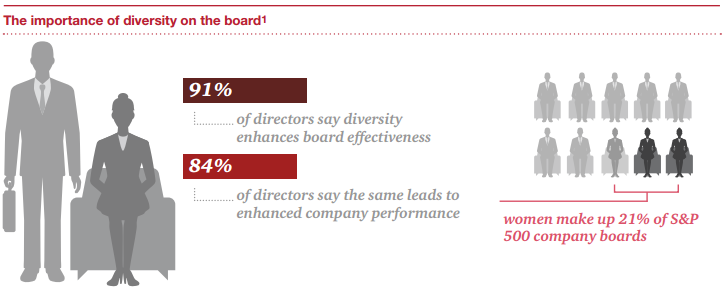
 

There are a number of ways to refresh your board. One way is to think about diversity. Many have taken on the gender imbalance on their boards and are adding more women directors. But diversity isn’t only about women. It’s about race, ethnicity, skills, experience, expertise, age and even geography. It’s about diversity of thought and perspective. And it’s not just a talking point anymore. Regulators started drafting disclosure rules around board diversity in mid-2016. Whether the rules become final remains to be seen, but either way, board diversity is in the spotlight. Add to that the common criticism that the US is far behind its developed country peers. Norway, France and the Netherlands have been using quotas for a while, and Germany in 2015 passed a law mandating 30% women on the boards of its biggest companies. While it’s unlikely quotas would be enacted in the US, some believe they’re a needed catalyst.
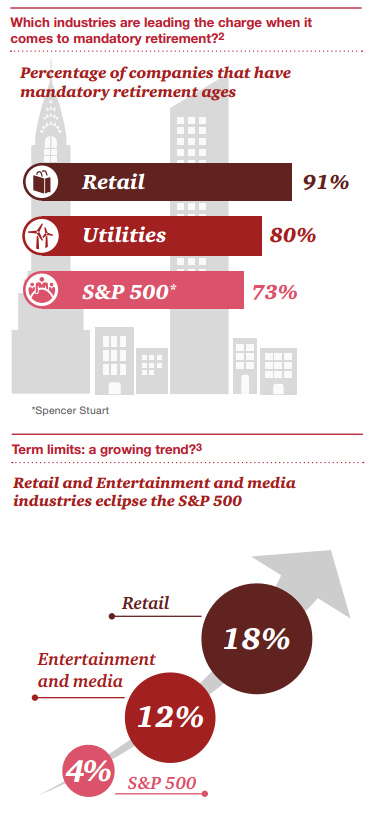


While we only looked at gender diversity on boards, we believe this is a good indicator of the efforts some boards are making to become more diverse overall. Secondly, mandatory retirement ages and term limits are two tools that boards can use to refresh itself. Our analysis showed that some industries seemed to be adopting these provisions more so than others. Some directors question their effectiveness.

Some of the industries in our PwC peer group analysis don’t have term limits at all

Banking and capital markets

Insurance

Communications

Technology

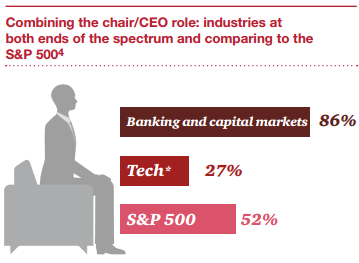
A third move that some companies have taken often, under investor pressure—is to evaluate their leadership structure and split the chair and CEO role. While the issue is still one that investors care about, certain industries have kept the combined role. And some companies don’t plan on making the change any time soon. Most often, boards with a combined chair/CEO role have an independent lead or presiding director. This may ease concerns that institutional investors and proxy firms may have about independence in the leadership role.
 

Who would have thought? Some interesting findings


While our analysis shows that most industries didn’t veer too far from the S&P 500 averages for most benchmarking categories, a few stand out. Retail in particular seems to be leading the charge when it comes to board refreshment.
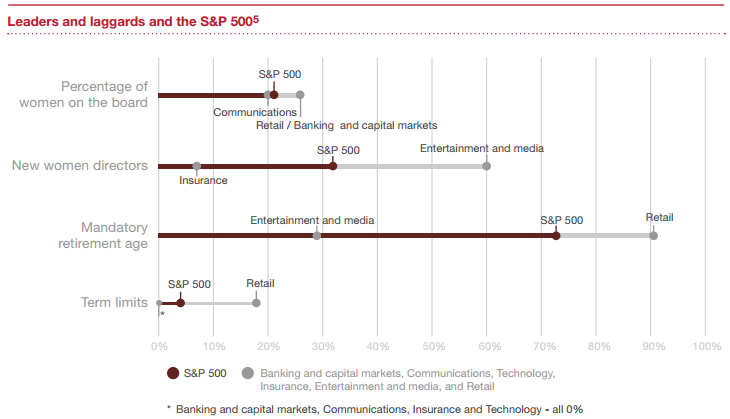


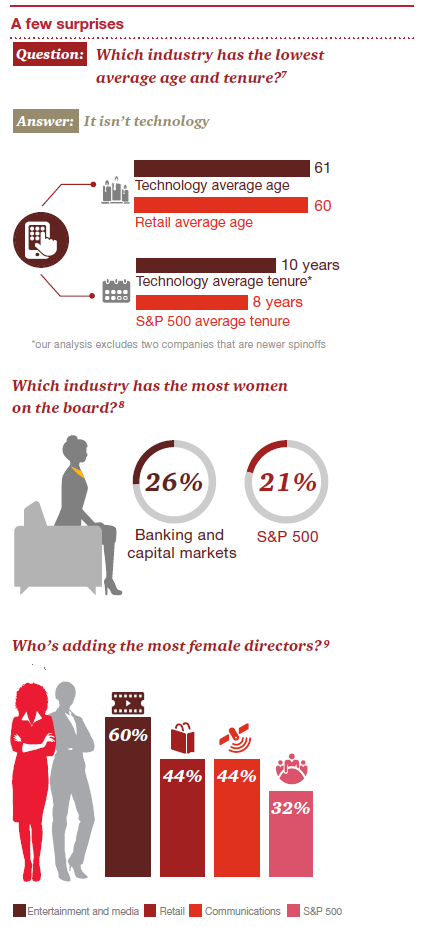
Other industries aren’t moving along quite so quickly. And there were some surprises. Which industry had the lowest average age? Perhaps surprisingly, it’s not technology. Retail claimed that one, too. And, also unexpected, was that technology had one of the highest average tenures. [6] Another surprising finding came from our analysis of the banking and capital markets industry—an industry that’s often considered to be male-dominated. BCM boards had the highest percentage of women, at 26%. That compares to just 21% for the S&P 500. Both the entertainment and media and the communications industries were also ahead of the curve when it comes to women in the boardroom, with the highest and second-highest percentages of new female directors. Retail tied with communications for second-highest, as well.
 

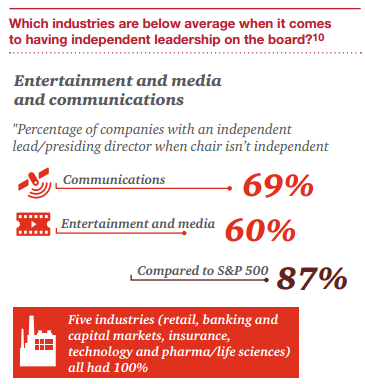
On a less progressive note, both the entertainment and media and communications industries were below the S&P 500 average when it came to having an independent lead or presiding director when the board chair is not independent. And they ranked lowest of the industries we analyzed on this topic—by far.

Blurred lines across industries


Skills, experience and diversity of thought will likely become even more important in the coming years. In the past five years alone, once bright industry lines have started to blur. Take the retail industry, for example. Brick and mortar stores, shopping malls and strip malls were what used to come to mind when thinking about that industry. Now it’s mobile devices and drones. Across many industries, business models are changing, competitors from different industries are appearing and new skills are needed. The picture of what your industry looks like today may not be the same in just a few years.

Technology is the key to much of this change. Just a few years ago, many boards were not enthusiastic about the idea of adding a director solely with technology or digital skills. But times are changing. Technology is increasingly becoming a critical skill to have on the board. We consulted our experts in the nine industries we analyzed, and all of them put technology high on the “must-have” list for new directors. Interestingly, financial, operational and industry experience—the top three from our 2016 Annual Corporate Directors Survey, were not among the most commonly listed.

Taking a fresh look


If your company is shifting gears and changing the way it does business, it may be important to take a fresh look at your board composition at more frequent intervals. Some boards use a skills matrix to see what they might be lacking in their board composition. Others may be forced by a shareholder activist to add new skills to the board.


So how do you fill the holes in the backgrounds or skills you want from your directors? One way is to look to other industries. As our analysis shows, board composition and refreshment approaches vary by industry. As industry lines blur, other industry perspectives could compliment your company—it might be helpful to consider filling any holes with board members from other industries.

No matter which approach you take, it’s very important to think about your board’s composition proactively. Use your board evaluations to understand which directors have the necessary skills and expertise—and which might be lacking what the board needs. Think about your board holistically as you think about your company’s future. Your board composition is critical to ensuring your board is effective—and keeping up with the world outside the boardroom.


Appendix


How do our industry peer groups stack up to the S&P 500? Making this evaluation can be a good way to begin determining whether your board has the right balance in terms of board composition.
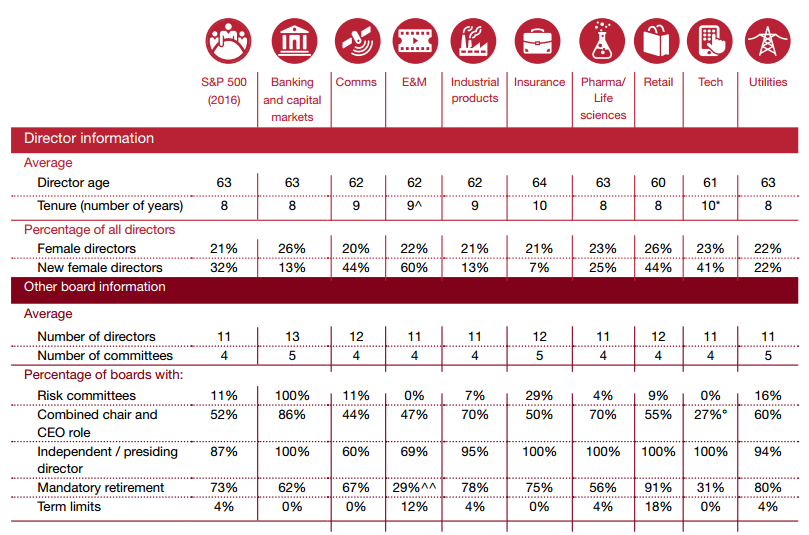


Analysis excludes two companies that are newer spinoffs.
Analysis excludes one company that does not combine or separate the roles.
Excludes the tenure of one newly-formed company.
Four of the five companies that have a mandatory retirement age have waived or state that the board can choose to waive it.

Sources: Spencer Stuart, U.S. Board Index 2016, November, 2016; PwC analysis of US SEC registrants: 27 of the largest industrial products companies by market capitalization and revenue, May 2016; 11 of the largest retail companies by revenue, May 2016; 21 of the largest banking and capital markets companies by revenue, September 2016; 24 of the largest insurance companies by market capitalization, May 2016; 17 of the largest entertainment and media companies by revenue, May 2016; nine of the largest communications companies by revenue, May 2016; 25 of the largest power and utilities companies by revenue, October 2016; 16 of the largest technology companies by revenue, May 2016; 23 of the largest pharma/life sciences companies by revenue, May 2016.


Endnotes:

1Sources: PwC, 2016 Annual Corporate Directors Survey, October 2016; Spencer Stuart, 2016 US Board Index, November 2016.(go back)

2Sources: PwC analysis of 11 of the largest retail companies by revenue that are also US SEC registrants, May 2016; PwC analysis of 25 of the largest power and utilities companies by revenue that are also US SEC registrants, October 2016; Spencer Stuart, U.S. Board Index 2016, November 2016.(go back)

3Sources: PwC analysis of 11 of the largest retail companies by revenue that are also US SEC registrants, May 2016; PwC analysis of 17 of the largest entertainment and media companies by revenue that are also US SEC registrants, May 2016; Spencer Stuart, S. Board Index 2016, November 2016.(go back)

4Sources: PwC analysis of 21 of the largest banking and capital markets companies by revenue that are also US SEC registrants, September 2016; PwC analysis of 16 of the largest technology companies by revenue that are also US SEC registrants, May 2016; Spencer Stuart, S. Board Index 2016, November 2016.(go back)

5Sources: PwC analysis of US SEC registrants: nine of the largest communications companies by revenue, May 2016; 11 of the largest retail companies by revenue, May 2016; 21 of the largest banking and capital markets companies by revenue, September 2016; 24 of the largest insurance companies by market capitalization, May 2016; 16 of the largest technology companies by revenue, May 2016; 17 of the largest entertainment and media companies by revenue, May 2016; Spencer Stuart, U.S. Board Index 2016, November 2016.(go back)

6Analysis excludes two companies that are newer spinoffs.(go back)

7Sources: PwC analysis of 16 of the largest technology companies by revenue that are also US SEC registrants, May 2016; Spencer Stuart, U.S. Board Index 2016, November 2016.(go back)

8Sources: PwC analysis of 11 of the largest retail companies by revenue that are also US SEC registrants, May 2016; PwC analysis of 21 of the largest banking and capital markets companies by revenue that are also US SEC registrants, September 2016; Spencer Stuart, U.S. Board Index 2016, November, 2016(go back)

9Sources: PwC analysis of 17 of the largest entertainment and media companies by revenue that are also US SEC registrants, May 2016; PwC analysis of nine of the largest communications companies by revenue that are also US SEC registrants, May 2016; PwC analysis of 11 of the largest retail companies by revenue that are also US SEC registrants, May 2016; Spencer Stuart, S. Board Index 2016, November 2016.(go back)

10Sources: PwC analysis of 17 of the largest entertainment and media companies by revenue that are also US SEC registrants, May 2016; PwC analysis of nine of the largest communications companies by revenue that are also US SEC registrants, May 2016; Spencer Stuart, S. Board Index 2016, November 2016; PwC analysis of 11 of the largest retail companies by revenue that are also US SEC registrants, May 2016; PwC analysis of 21 of the largest banking and capital markets companies by revenue that are also US SEC registrants, September 2016; PwC analysis of 24 of the largest insurance companies by market capitalization that are also US SEC registrants, May 2016; PwC analysis of 16 of the largest technology companies by revenue that are also US SEC registrants, May 2016; PwC analysis of 23 of the largest pharma/life sciences companies by revenue that are also US SEC registrants, May 2016.