Le leadership des présidents de conseils à l’échelle internationale


Voici un document présentant, de manière complète, les pratiques et les outils utilisés par les présidents de conseils d’administration, à l’échelle internationale.

Le rapport de cent pages, intitulé Commonalities, Différences, and Future Trend, publié sous l’égide de INSEAD Corporate Governance Initiative et de Ward Howell Talent Equity Institute Survey, par Stanislav Shekshnia et Veronika Zaviega, tente de cerner les exigences du rôle de « Chairman » ainsi que les conditions liées à l’efficacité des présidents de conseils dans un contexte mondial.

Through interviews with professional chairs in different parts of the world, the report identifies and compares specific practices and instruments used in different countries giving insights into pertinent issues surrounding the work of the chair and development of future trends over the next decade.

Bonne lecture !


Board Chairs’ Practices across Countries


Résultats de recherche d'images pour « Chaiman of the board insead »


Relatively little is known about board chairs as most of their work is done behind closed doors. They deal with highly sensitive matters but rarely appear in public. They have no executive power but preside over the most powerful body in the organisation – the board of directors. Their performance is critically important for every company but they still need help to improve it. Yet they have no boss, no peers, no one to turn to for an advice. They learn mostly by trial and error.

To respond to this paradox, INSEAD launched “Leading from the Chair”, a specialised program held twice a year for individuals from all over the world who are keen to understand what makes a good chair. We discovered how chairs from different countries face similar challenges and that they all seek practical ways to deal with them. Our goal is to help them to identify and adopt effective practices to perform what is a very demanding job.

To provide hard data we launched a Global Chair Research Project, inviting more than 600 chairpersons to participate in a survey with a structured questionnaire. From the 132 responses received from 30 countries, we compiled the INSEAD Global Chair Survey 2015. Our research provided valuable insights into their demographics, motivation, background, remuneration and the challenges they encounter.

As a next step we wanted to identify and compare specific practices and instruments used in different countries. A team of experts were assembled to conduct interviews with professional chairs in different parts of the world – Belgium, Denmark, Italy, the United Kingdom, Russia, Singapore, Switzerland, Denmark, and the Netherlands. This report presents our preliminary findings. As the research continues, we expect to publish results for 16 countries by the end of 2017.

This publication can be read either as a whole or in chapters. Each country account can be read as a stand-alone without prior knowledge of what is said elsewhere. The introduction describes our methodology, some conceptual models which facilitate understanding of the work of a chair, as well as a summary of our major findings. The “Future Trends” section offers the research team’s view on how the chair’s role and function will evolve in the next decade.

Vous pouvez télécharger le rapport en cliquant sur le lien suivant : Board Chairs’ Practices across Countries.

Deux théories de la gouvernance des sociétés


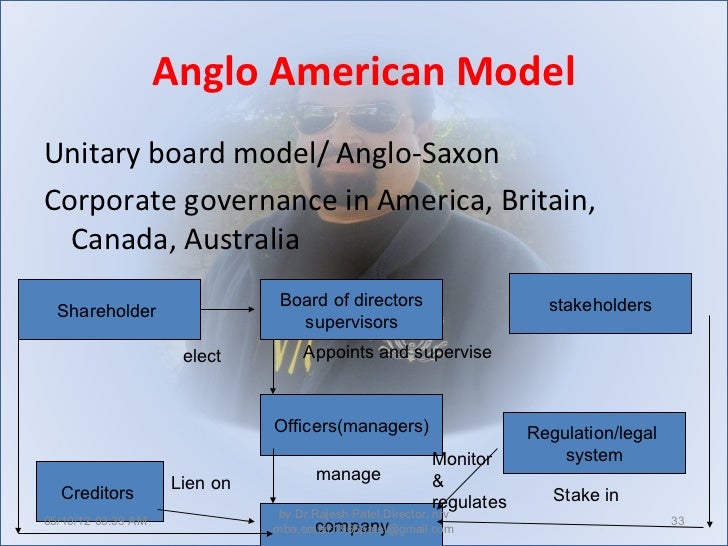
Résultats de recherche d'images pour « corporate governance model »

The activists’ claim of value creation is further clouded by indications that some of the value purportedly created for shareholders is actually value transferred from other parties or from the general public. Large-sample research on this question is limited, but one study suggests that the positive abnormal returns associated with the announcement of a hedge fund intervention are, in part, a transfer of wealth from workers to shareholders. The study found that workers’ hours decreased and their wages stagnated in the three years after an intervention. Other studies have found that some of the gains for shareholders come at the expense of bondholders. Still other academic work links aggressive pay-for-stock-performance arrangements to various misdeeds involving harm to consumers, damage to the environment, and irregularities in accounting and financial reporting.

We are not aware of any studies that examine the total impact of hedge fund interventions on all stakeholders or society at large. Still, it appears self-evident that shareholders’ gains are sometimes simply transfers from the public purse, such as when management improves earnings by shifting a company’s tax domicile to a lower-tax jurisdiction—a move often favored by activists, and one of Valeant’s proposals for Allergan. Similarly, budget cuts that eliminate exploratory research aimed at addressing some of society’s most vexing challenges may enhance current earnings but at a cost to society as well as to the company’s prospects for the future.

Hedge fund activism points to some of the risks inherent in giving too much power to unaccountable “owners.” As our analysis of agency theory’s premises suggests, the problem of moral hazard is real—and the consequences are serious. Yet practitioners continue to embrace the theory’s doctrines; regulators continue to embed them in policy; boards and managers are under increasing pressure to deliver short-term returns; and legal experts forecast that the trend toward greater shareholder empowerment will persist. To us, the prospect that public companies will be run even more strictly according to the agency-based model is alarming. Rigid adherence to the model by companies uniformly across the economy could easily result in even more pressure for current earnings, less investment in R&D and in people, fewer transformational strategies and innovative business models, and further wealth flowing to sophisticated investors at the expense of ordinary investors and everyone else.

To counter short-termism and activism, Bower and Paine embrace the corporation-centric/constituency theory of governance. They argue that the corporation and its board of directors have a fiduciary duty not just to its shareholders, but to its employees, customers, suppliers and to the community. This is the theory I argued in Takeover Bids in the Target’s Boardroom (1979) and regularly since in a long series of articles and memoranda. While Bower and Paine say:

The new model has yet to be fully developed, but its conceptual foundations can be outlined …[T]he company-centered model we envision tracks basic corporate law in holding that a corporation is an independent entity, that management’s authority comes from the corporation’s governing body and ultimately from the law, and that managers are fiduciaries (rather than agents) and are thus obliged to act in the best interests of the corporation and its shareholders (which is not the same as carrying out the wishes of even a majority of shareholders). This model recognizes the diversity of shareholders’ goals and the varied roles played by corporations in society. We believe that it aligns better than the agency-based model does with the realities of managing a corporation for success over time and is thus more consistent with corporations’ original purpose and unique potential as vehicles for projects involving large-scale, long-term investment.

In fact the corporation-centric theory—that the directors have a fiduciary duty to the corporation and all of its stakeholders—is reflected in a number of state corporation laws. Perhaps the most cogent example is the Pennsylvania Business Corporation Law which provides:

A director of a business corporation shall stand in a fiduciary relation to the corporation and shall perform his duties as a director, including his duties as a member of any committee of the board upon which he may serve, in good faith, in a manner he reasonably believes to be in the best interests of the corporation and with such care, including reasonable inquiry, skill and diligence, as a person of ordinary prudence would use under similar circumstances.

In discharging the duties of their respective positions, the board of directors, committees of the board and individual directors of a business corporation may, in considering the best interests of the corporation, consider to the extent they deem appropriate:

  1. The effects of any action upon any or all groups affected by such action, including shareholders, employees, suppliers, customers and creditors of the corporation, and upon communities in which offices or other establishments of the corporation are located.
  2. The short-term and long-term interests of the corporation, including benefits that may accrue to the corporation from its long-term plans and the possibility that these interests may be best served by the continued independence of the corporation.
  3. The resources, intent and conduct (past, stated and potential) of any person seeking to acquire control of the corporation.
  4. All other pertinent factors.

While wider adoption and strengthening of laws like the Pennsylvania statute would provide some more ability to boards of directors to temper short-termism and resist attacks by activist hedge funds, voting control of corporations will remain in the hands of the major institutional investors and asset managers. To achieve a truly meaningful change and effectively promote long-term investment, corporations and institutional investors and asset managers will need to endorse and adhere to The New Paradigm: A Roadmap for an Implicit Corporate Governance Partnership Between Corporations and Investors to Achieve Sustainable Long-Term Investment and Growth (2016) (discussed on the Forum here) promulgated by the World Economic Forum or A Synthesized Paradigm for Corporate Governance, Investor Stewardship, and Engagement (2017) (discussed on the Forum here) based on it and on The Principles of the Investor Stewardship Group (2017). The alternative would be legislation, something that both corporations and investors should assiduously avoid.

_________________________________

*Martin Lipton is a founding partner of Wachtell, Lipton, Rosen & Katz, specializing in mergers and acquisitions and matters affecting corporate policy and strategy. This post is based on a Wachtell Lipton publication by Mr. Lipton. Additional posts by Martin Lipton on short-termism and corporate governance are available here.

Pourquoi une société choisirait-elle de remplacer son PDG par un membre du CA ?


Lorsqu’un PDG d’une grande entreprise démissionne ou se retire, l’organisation se retrouve souvent en mode de gestion de crise. C’est alors que certains CA optent pour la nomination d’un de leurs membres comme premier dirigeant, pour une période plus ou moins longue ! C’est l’objet de l’étude du professeur Larker.

Le nouveau PDG connaît déjà très bien l’organisation et, puisqu’il n’est pas membre du cercle fermé des hauts dirigeants, il est bien placé pour orchestrer les changements nécessaires ou pour poursuivre une stratégie qui s’était avérée efficace.

L’étude effectuée montre que sur les entreprises du Fortune 1000, 58 étaient dirigées par un ex-administrateur. Les deux tiers des cas étaient liés à une démission soudaine du PDG. Seulement, un tiers des nouveaux PDG avait fait l’objet d’une succession planifiée.

Résultats de recherche d'images pour « CEO and board »

Également, l’étude révèle que 64 % des administrateurs nommés comme PDG l’étaient à la suite d’un problème de performance.

Il appert que les nominations se font très rapidement, souvent le même jour de la démission du PDG. Les nominations se font par intérim dans 45 % des cas, et permanente dans 55 % des cas, ce qui est un peu surprenant étant donné que l’engagement se fait sans les formalités de recrutement habituelles.

Enfin, il ressort de cela que les administrateurs nommés restent en fonction seulement 3,3 ans, comparativement à 8 ans pour les PDG des grandes sociétés du Fortune 1000.

Enfin, les deux tiers des administrateurs nommés avaient une expérience de PDG dans une autre entreprise auparavant. La performance de ces nouveaux administrateurs nommés n’est pas jugée supérieure.

Je vous invite à lire cet article si vous souhaitez avoir plus de détails.

Bonne lecture !


From Boardroom to C-Suite: Why Would a Company Pick a Current Director as CEO?


We recently published a paper on SSRN (From Boardroom to C-Suite: Why Would a Company Pick a Current Director as Its CEO?) that explores situations in which companies appoint a non-executive director from the board as CEO.

Many observers consider the most important responsibility of the board of directors its responsibility to hire and fire the CEO. To this end, an interesting situation arises when a CEO resigns and the board chooses neither an internal nor external candidate, but a current board member as successor.

Résultats de recherche d'images pour « CEO and board »

Why would a company make such a decision? The benefit of appointing a current director to the CEO position is that the director can act as a hybrid “inside-outside” CEO. He or she is likely well versed in all aspects of the company, including strategy, business model, and risk-management practices. A current director likely also has personal relationships with the executive team and fellow board members, making it easier to determine cultural fit prior to hiring. At the same time, this individual is not a member of the current senior management team, and therefore has greater freedom to make organizational changes if needed. On the other hand, appointing a current director as CEO has potential drawbacks. The most obvious of these is that it signals a lack of preparedness on the company’s part to groom internal talent.

To understand the circumstances in which a company appoints a current board member as CEO, we conducted a search of CEO successions among Fortune 1000 companies between 2005 and 2016 and identified 58 instances where a non-executive (outside) director became CEO. Some companies made this decision more than once during the measurement period, and so our final sample includes 58 directors-turned-CEO at 50 companies.

Most director-turned-CEO appointments occur following a sudden resignation of the outgoing CEO. Over two-thirds (69 percent) follow a sudden resignation; whereas only one-third (31 percent) appear to be part of planned succession. Furthermore, director-turned-CEO appointments have an above average likelihood of following termination of a CEO for performance. Half (52 percent) of the outgoing CEOs in our sample resigned due to poor performance and an additional 12 percent resigned as part of a corporate-governance crisis, such as accounting restatement or ethical violation. That is, 64 percent of director-turned-CEO appointments followed a performance-driven turnover event compared to an estimated general market average of less than 40 percent.

Shareholders do not appear to be active drivers of these successions. In over three-quarter (78 percent) of the incidents in our sample, we failed to detect any significant press coverage of shareholder pressure for the outgoing CEO to resign. (This does not rule out the possibility that shareholders privately pressed the board of directors for change.) In 13 of 58 incidents (23 percent), a hedge fund, activist investor, or other major blockholder played a part in instigating the transition.

In most cases, companies name the director-turned-CEO as successor on the same day that the outgoing CEO resigns. In 91 percent of the incidents in our sample, the director was hired on the same day that the outgoing CEO stepped down; in only 9 percent of the incidents was there a gap between these announcements. When a gap did occur, the average number of days between the announcement of the resignation and the announcement of the successor was approximately four months (129 days). These situations included a mix of orderly successions and performance- or crisis-driven turnover.

The stock market reaction to the announcement of a director-turned-CEO is modest and not significantly different from zero. Because the outgoing CEO resignation tends to occur on the same day that the successor is named it is not clear how the market weighs the hiring decision of the director-turned-CEO relative to the news of the outgoing CEO resignation. In the small number of cases where the outgoing CEO resigned on a different date than the successor was appointed, we observe positive abnormal returns both to the resignation (2.4 percent) and to the succession (3.2 percent), suggesting that in these cases the market viewed these decisions favorably.

A large minority of director-turned-CEO appointments appear to be “emergency” appointments. In 45 percent of cases, directors were appointed CEO on an interim basis, although in a quarter of these the director was subsequently named permanent CEO. In the remaining 55 percent of cases, the director was named permanent CEO at the initial announcement date.

In terms of background, most directors-turned-CEO have significant experience with the company, with the industry, or as CEO of another company. Fifty-seven percent of directors-turned-CEO in our sample were recruited to the board during their predecessor’s tenure and served for an average of 6.9 years before being named CEO. Two-thirds (67 percent) had prior CEO experience at another company, and almost three-quarters (72 percent) had direct industry experience. Of note, only 9 percent had neither industry nor CEO experience.

Of note, directors-turned-CEO do not remain in the position very long, regardless of whether they are named permanently to the position or on an interim basis. We found that the directors-turned-CEO who served on an interim basis remained CEO for 174 days (just shy of 6 months) on average; directors permanently named to the CEO position remained CEO for only 3.3 years on average, compared to an average tenure of 8 years among all public company CEOs. It might be that their shorter tenure was driven by more challenging operating conditions at the time of their appointment, as indicated by the higher likelihood of performance-driven turnover preceding their tenure.

Finally, we do not find evidence that directors-turned-CEO exhibit above-average performance. Across our entire sample, we find slightly negative cumulative abnormal stock price returns (-2.3 percent) for companies who hire a director as CEO, relative to the S&P 500 Index. The results are similar when interim and permanent CEOs are evaluated separately. This suggests that the nature of the succession, rather than the choice of director as successor, is likely the more significant determinant of performance among these companies.

The complete paper is available for download here.

______________________________________

David Larcker is Professor of Accounting at Stanford Graduate School of Business. This post is based on a paper authored by Professor Larcker and Brian Tayan, Researcher with the Corporate Governance Research Initiative at Stanford Graduate School of Business.

Étude sur les pratiques des CA américains | ISS


La firme-conseil ISS, (Institutional Shareholder Services) publie chaque année une étude de l’évolution des pratiques de gouvernance aux É.U. (Board Practices Study).

Rob Yates, vice-président d’ISS, est l’auteur de cet article paru sur le site de Harvard Law School Forum on Corporate Governance. Il y aborde cinq tendances majeures.

Les investisseurs continuent d’exercer des pressions sur les administrateurs du conseil, entre autres en continuant de demander d’inclure de nouvelles candidatures dans la circulaire de procuration.

On constate que les pratiques généralement reconnues de bonne gouvernance sont adoptées dans presque toutes les grandes sociétés ; elles sont de plus en plus acceptées dans les plus petites entreprises. On fait ici référence aux élections annuelles, au vote majoritaire et à l’élimination des pilules empoisonnées.

La question du choix d’un président du conseil totalement indépendant et différent du CEO semble être moins problématique si la société fait appel à président désigné (lead director) indépendant et fort.

La rémunération des administrateurs de sociétés a continué de croître significativement. Les CA évaluent différentes approches à la compensation des administrateurs. Ainsi, on élimine de plus en plus les jetons de présence pour les réunions et les conférences téléphoniques. La rémunération des administrateurs s’est accrue de 17 % de 2012 à 2016 tandis que celle des PDG a augmenté de 10 % pendant la même période.

ISS a produit plusieurs études sur les tendances en matière de limite des mandats (tenure), du renouvellement des administrateurs du CA et de l’importance de la diversité. Si le sujet vous intéresse, l’auteur vous réfère à plusieurs études américaines et mondiales.

Bonne lecture !

U.S. Board Practices


This year’s Board Practices Study focuses not only on longstanding issues traditionally covered, but on those which have driven increased shareholder interest in the boardroom over the past several years. Governance continues to evolve, but investor focus in recent years has been particularly pointed as new concerns have emerged, and the ways in which companies address those concerns adapts to meet market demands. Particular focus has been placed on the role of the board as a representative of shareholders at a company, and how the board’s structure and practices promulgate this responsibility. As always, this study provides a snapshot of these facets of public company boards in the S&P 1500 for investors and issuers to compare and contrast.


Investors are continuing to push for board accountability


The pyroclastic spread of proxy access over the past two years has arguably been the most prominent governance story in the United States. In two short years, the S&P went from having only a handful of companies with proxy access, to having over half its constituents offering shareholders the right. Proxy access is also starting to show up in shareholder proposals at smaller firms; as of March 14, ISS is tracking a dozen such proposals at S&P 400 companies.


Image associée
Advisory Board Best Practices: Roles and Advice


Proxy access is the most recent chapter in the much longer story of shareholders seeking board accountability. The next chapters are underway, with investors focusing on board self-regulation practices and measures, such as director tenure and board refreshment, board diversity, board evaluations, mandatory retirement ages, and more. Some of these are showing promise—such as board refreshment and continuing progress on gender diversity—while others are lagging, such as non-gender measures of board diversity.

Central to these concerns is shareholders’ desire that boards develop the skills, expertise, awareness, and experience to accurately assess and effectively manage emerging risks, such as cyber and environmental risks, and ensure that boards are constantly searching for weaknesses (and, when and where appropriate, soliciting external help to identify blind spots).


Traditional concerns still exist, but companies are making progress


More traditional approaches to increasing accountability, such as majority vote standards and annual elections in the director election process—features that are near-ubiquitous in the largest companies—have been adopted in greater frequency by smaller companies. Many problematic governance practices, such as poison pills, are also increasingly rare.


Investors are more accepting of alternative independent board leadership structures


Demonstrating that governance is both a give and take endeavor, investors are more accepting of alternative forms of independent board leadership. Whereas investors have historically favored independent chairs, many are increasingly comfortable with an alternative structure whereby a strong and empowered lead independent director counterbalances a combined chair/CEO.


Director compensation increased sharply


A new feature in this year’s study is an evaluation of director pay covering the preceding five years. While compensation disclosure for non-employee directors is not new itself, the rules and guidelines governing director pay disclosure have only recently standardized. Beginning in December 2006, SEC rules required the disclosure of director pay in a standardized table format. This disclosure increased transparency and comparability between companies. Additionally, both the NYSE and NASDAQ require that boards consider director pay when determining director independence for purposes of meeting listing requirements.

Director compensation has received increased scrutiny in recent years, particularly given rising pay levels and high-profile shareholder lawsuits alleging excessive pay. Amid this atmosphere, many companies have taken a proactive approach to director compensation programs, mainly through altering equity plans or, in a few rare instances, introducing ballot items.

As companies weigh the potential benefits of changing director pay structures, median pay continues to rise. In fact, non-employee director compensation grew 17 percent between 2012 and 2016, while median CEO pay in the S&P 500 (reported in ISS’ 2016 US Compensation Postseason Report) rose by less than 10 percent. One positive development is the streamlining observed among director compensation programs. For example, the elimination of meeting and telephonic meeting fees in many compensation structures.


Increased scrutiny of certain board practices has necessitated a more detailed review


Previous versions of the board study included an in-depth snapshot of new-director demographics and trends, such as tenure, refreshment, and diversity. As these components of board composition have become a significant part of the governance conversation, ISS has produced in-depth studies on each of these issues.

For a vast and comprehensive look at board refreshment trends in the U.S., please see the joint ISS/IRRC study, Board Refreshment Trends at S&P 1500 Firms.

For a look at gender parity advancement on boards in the U.S. and around the world, please see the April 2016 joint study carried out by ISS and European Women on Boards, Gender Diversity on European Boards—Realizing Europe’s Potential: Progress and Challenges, and ISS’ December 2016 study, Gender Diversity on Boards—A Review of Global Trends.

The complete publication is available here.

_____________________________________

*Rob Yates is Vice President at Institutional Shareholder Services, Inc. This post is based on an ISS publication by Mr. Yates, Rachel Hedrick, and Andrew Borek.

L’histoire récente des courants de pensée en gouvernance aux É.U.


Aujourd’hui, je ne peux passer sous silence la petite histoire de l’évolution de la pensée en gouvernance publiée par , professeur à la George Washington University Law School.

Ce court article a été publié sur le site du HLS Forum. Il décrit les grands courants de pensée et met l’accent sur les publications des bonzes universitaires américains.

Je suis assuré que cette brève chronologie des événements, à compter de 1976, vous donnera une vue d’ensemble utile de l’évolution de la discipline.

Bonne lecture !

The Ivory Tower on Corporate Governance


In 1976, [Directors & Boards]’s founding year, two influential academic works in corporate governance appeared: Berkeley law professor Melvin Eisenberg urged transforming the board from an advisory role to a monitoring model and mandating significant internal control systems, while University of Rochester economists Michael Jensen and William Meckling portrayed the firm as a nexus of contracts whose optimal design is for participants to choose.


These contrasting visions—obligatory uniformity versus free tailoring—have defined the field since, setting the boundaries of debate and helping participants think through positions. Into the early 1980s, the Eisenberg view dominated, with Columbia University law professor William Cary urging preemptive federal oversight of the field, traditionally handled by state law, and a generally pro-regulatory atmosphere imposing fiduciary mandates on independent directors and board committees.

But the nexus of contracts school soon ascended to greater influence, through the 1990s, after law professors such as Frank Easterbrook (now a judge) and Daniel Fischel, both of the University of Chicago, explored how the separation of ownership from control is a problem of agency costs, best addressed by contractual devices geared to maximizing shareholder value. Rather than federal mandates, states should experiment to offer a menu of tools for different corporations to tailor. Yale University law professor (also now judge) Ralph Winter theorized that competition among states for corporate charters constrained managers to promote shareholder interests.

While normative corporate governance scholarship has divided between the pro- and anti-regulatory camps of the 1970s and 1980s, the best academics learned from their intellectual opponents to refine stances and often forge consensus. For example, though assessments of the deal decade’s disruptive takeovers and comparative studies of non-U.S. practice found a place for non-shareholder constituents in corporate governance, a shareholder primacy norm nevertheless took root.

Even as both schools of thought contributed to the discourse, each had their heyday when current events cut in their favor. So the 1990s boom was a time of great enthusiasm for the economic approach, adding a productive trend of increasingly sophisticated empirical research, including on the value of state competition in corporate law. After the burst, however, and as widespread accounting fraud was revealed, scholars cited Eisenberg to diagnose failures to monitor and control—and prescribed cures found in the Sarbanes-Oxley Act (SOX). An industry-specific version of the dynamic transpired after the financial crisis, culminating in the Dodd-Frank Act.

In each case, scholarship was diverse, as pragmatic centrist resolution of pending challenges, exemplified by Columbia’s John Coffee, contended with cries on both normative sides of either too little or too much regulation (Yale’s Roberta Romano called SOX “quack governance”). Such episodes updated the Cary-Winter debate: full-scale federal preemption is probably dead but, as Harvard University law professor Mark Roe explained, less due to state competition than the threat to states of incremental federal incursion, a la SOX and Dodd-Frank.

Since 1976, scholars have helped shift power from managers to owners, especially institutional investors. Today, scholars such as Harvard Law professor Lucian Bebchuk urge continued expansion of shareholder power, while others, like UCLA law professor Stephen Bainbridge, observe and support a propensity toward director primacy instead. In the balance is the fate of shareholder activism, which though novel in some ways, at bottom raises issues debated for 40 years, particularly agency cost mitigation. Plus ça change, plus c’est la même chose.

Une saine tension entre le CA et la direction : Gage d’une bonne gouvernance | Billet revisité


Dans son édition d’avril 2016, le magazine Financier Worldwide présente une excellente analyse de la dynamique d’un conseil d’administration efficace. Pour l’auteur, il est important que le président du conseil soit habileté à exercer un niveau de saine tension entre les administrateurs et la direction de l’entreprise.

Il n’y a pas de place pour la complaisance au conseil. Les membres doivent comprendre que leur rôle est de veiller aux « intérêts supérieurs » de l’entreprise, notamment des propriétaires-actionnaires, mais aussi d’autres parties prenantes.

Le PDG de l’entreprise est recruté par le CA pour faire croître l’entreprise et exécuter une stratégie liée à son modèle d’affaires. Lui aussi doit travailler en fonction des intérêts des actionnaires… mais c’est la responsabilité fiduciaire du CA de s’en assurer en mettant en place les mécanismes de surveillance appropriés.

La théorie de l’agence stipule que le CA représente l’autorité souveraine de l’entreprise (puisqu’il possède la légitimité que lui confèrent les actionnaires). Le CA confie à un PDG (et à son équipe de gestion) le soin de réaliser les objectifs stratégiques retenus. Les deux parties — le Board et le Management — doivent bien comprendre leurs rôles respectifs, et trouver les bons moyens pour gérer la tension inhérente à l’exercice de la gouvernance et de la gestion.

Les administrateurs doivent s’efforcer d’apporter une valeur ajoutée à la gestion en conseillant la direction sur les meilleures orientations à adopter, et en instaurant un climat d’ouverture, de soutien et de transparence propice à la réalisation de performances élevées.

Il est important de noter que les actionnaires s’attendent à la loyauté des administrateurs ainsi qu’à leur indépendance d’esprit face à la direction. Les administrateurs sont élus par les actionnaires et sont donc imputables envers eux. C’est la raison pour laquelle le conseil d’administration doit absolument mettre en place un processus d’évaluation de ces membres et divulguer sa méthodologie.

Également, comme mentionné dans un billet daté du 5 juillet 2016 (la séparation des fonctions de président du conseil et de président de l’entreprise [CEO] est-elle généralement bénéfique ?), les autorités réglementaires, les firmes spécialisées en votation et les experts en gouvernance suggèrent que les rôles et les fonctions de président du conseil d’administration soient distincts des attributions des PDG (CEO).

En fait, on suppose que la séparation des fonctions, entre la présidence du conseil et la présidence de l’entreprise (CEO), est généralement bénéfique à l’exercice de la responsabilité de fiduciaire des administrateurs, c’est-à-dire que des pouvoirs distincts permettent d’éviter les conflits d’intérêts, tout en rassurant les actionnaires.

Cependant, cette pratique cède trop souvent sa place à la volonté bien arrêtée de plusieurs PDG d’exercer le pouvoir absolu, comme c’est encore le cas pour plusieurs entreprises américaines. Pour plus d’information sur ce sujet, je vous invite à consulter l’article suivant : Séparation des fonctions de PDG et de président du conseil d’administration | Signe de saine gouvernance !

Le Collège des administrateurs de sociétés (CAS) offre une formation spécialisée de deux jours sur le leadership à la présidence.


Banque des ASC
Gouvernance et leadership à la présidence | 4 et 5 mai 2017, à Montréal | 7 et 8 novembre 2017, à Québec


Vous trouverez, ci-dessous, l’article du Financier Worldwide qui illustre assez clairement les tensions existantes entre le CA et la direction, ainsi que les moyens proposés pour assurer la collaboration entre les deux parties.

J’ai souligné en gras les passages clés.

Bonne lecture ! Vos commentaires sont appréciés.


In this age of heightened risk, the need for effective governance has caused a dynamic shift in the role of the board of directors. Cyber security, rapid technological growth and a number of corporate scandals resulting from the financial crisis of 2008, all underscore the necessity of boards working constructively with management to ensure efficient oversight, rather than simply providing strategic direction. This is, perhaps, no more critical than in the middle market, where many companies often don’t have the resources larger organisations have to attract board members, but yet their size requires more structure and governance than smaller companies might need.

Following the best practices of high-performing boards can help lead to healthy tension between management and directors for improved results and better risk management. We all know conflict in the boardroom might sometimes be unavoidable, as the interests of directors and management don’t necessarily always align. Add various personalities and management styles to the mix, and discussions can sometimes get heated. It’s important to deal with situations when they occur in order to constructively manage potential differences of opinion to create a healthy tension that makes the entire organisation stronger.

Various conflict management styles can be employed to ensure that any potential boardroom tension within your organisation is healthy. If an issue seems minor to one person but vital to the rest of the group, accommodation can be an effective way to handle tension. If minor issues arise, it might be best to simply avoid those issues, whereas collaboration should be used with important matters. Arguably, this is the best solution for most situations and it allows the board to effectively address varying opinions. If consensus can’t be reached, however, it might become necessary for the chairman or the lead director to use authoritarian style to manage tension and make decisions. Compromise might be the best approach when the board is pressed for time and needs to take immediate action.

April 2016 Issue

The board chairperson can be integral to the resolution process, helping monitor and manage boardroom conflict. With this in mind, boards should elect chairs with the proven ability to manage all personality types. The chairperson might also be the one to initiate difficult conversations on topics requiring deeper scrutiny. That said, the chairperson cannot be the only enforcer; directors need to assist in conflict resolution to maintain a proper level of trust throughout the group. And the CEO should be proactive in raising difficult issues as well, and boards are typically most effective when the CEO is confident, takes the initiative in learning board best practices and works collaboratively.

Gone are the days of the charismatic, autocratic CEO. Many organisations have separated the role of CEO and chairperson, and have introduced vice chairs and lead directors to achieve a better balance of power. Another way to ensure a proper distribution of authority is for the board to pay attention to any red flags that might be raised by the CEO’s behaviour. For example, if a CEO feels they have all the answers, doesn’t respect the oversight of the board, or attempts to manage or marginalise the board, the chairperson and board members will likely need to be assertive, rather than simply following the CEO’s lead. Initially this might seem counterintuitive, however, in the long-run, this approach will likely create a healthier tension than if they simply ‘followed the leader’.

Everyone in the boardroom needs to understand their basic functions for an effective relationship -executives should manage, while the board oversees. In overseeing, the board’s major responsibilities include approving strategic plans and goals, selecting a CEO, determining a mission or purpose, identifying key risks, and providing oversight of the compliance of corporate policies and regulations. Clearly understanding the line between operations and strategy is also important.

Organisations with the highest performing boards are clear on the appropriate level of engagement for the companies they represent – and that varies from one organisation to the next. Determining how involved the board will be and what type of model the board will follow is key to effective governance and a good relationship with management. For example, an entity that is struggling financially might require a more engaged board to help put it back on track.

Many elements, such as tension, trust, diversity of thought, gender, culture and expertise can impact the delicate relationship between the board and management. Good communication is vital to healthy tension. Following best practices for interaction before, during and after board meetings can enhance conflict resolution and board success.

Before each board meeting, management should prepare themselves and board members by distributing materials and the board package in a timely manner. These materials should be reviewed by each member, with errors or concerns forwarded to the appropriate member of management, and areas of discussion highlighted for the chair. An agenda focused on strategic issues and prioritised by importance of matters can also increase productivity.

During the meeting, board members should treat one another with courtesy and respect, holding questions held until after presentations (or as the presenter directs). Board-level matters should be discussed and debated if necessary, and a consensus reached. Time spent on less strategic or pressing topics should be limited to ensure effective meetings. If appropriate, non-board-level matters might be handed to management for follow-up.

Open communication should also continue after board meetings. Sometimes topics discussed during board meetings take time to digest. When this happens, board members should connect with appropriate management team members to further discuss or clarify. There are also various board committee meetings that need to occur between board meetings. Board committees should be doing the ‘heavy lifting’ for the full board, making the larger group more efficient and effective. Other more informal interactions can further strengthen the relationship between directors and management.

Throughout the year, the board’s engagement with management can be broadened to include discussions with more key players. Gaining multiple perspectives by interacting with other areas of the organisation, such as general counsels, external and internal auditors, public relations and human resources, can help the board identify and address key risks. By participating in internal and external company events, board members get to know management and the company’s customers on a first-hand basis.

Of course, a strategy is necessary for the board as well, as regulatory requirements have increased, leading to greater pressure for high-quality performance. Effective boards maintain a plan for development and succession. They also implement CEO and board evaluation processes to ensure goals are being met and board members are performing optimally. In addition to the evaluation process, however, board members must hold themselves totally accountable for instilling trust in the boardroom.

Competition in today’s increasingly global and complex business environment is fierce, and calls for new approaches for success. Today’s boards need to build on established best practices and create good relationships with management to outperform competitors. The highest performing boards are clear on their functions, and understand the level of engagement appropriate for the companies they support. They are accountable and set the right tone, while being able to discern true goals and aspirations from trendiness. They are capable of understanding and dealing with the ‘big issues’ and are strategic in their planning and implementation of approaches that work for the companies they serve. With the ever-changing risk universe, the ability to work with the right amount of healthy tension is essential to effective governance.

_______________________________________

Hussain T. Hasan is on the Consulting Leadership team as well as a board member at RSM US LLP.

Compte rendu hebdomadaire de la Harvard Law School Forum on Corporate Governance | 9 mars 2017


Voici le compte rendu hebdomadaire du forum de la Harvard Law School sur la gouvernance corporative au 9 mars 2017.

J’ai relevé les principaux billets.

Bonne lecture !


harvard_forum_corpgovernance_small


  1. Uncapping Executive Pay
  2. The Trajectory of American Corporate Governance: Shareholder Empowerment and Private Ordering Combat
  3. Focus on Annual Incentives: Metrics, Goals, and More
  4. A Look at Board Composition: How Does Your Industry Stack Up?
  5. Teaming Up and Quiet Intervention: The Impact of Institutional Investors on Executive Compensation Policies
  6. The Regulatory and Enforcement Outlook for Financial Institutions in 2017
  7. The Materiality Gap Between Investors, the C-Suite and Board
  8. Pilot CEOs and Corporate Innovation
  9. Shareholder Engagement: An Evolving Landscape
  10. State Street Global Advisors Announces New Gender Diversity Guidance

La composition de votre CA est-elle adéquate pour faire face au futur ? | Résultats d’une étude américaine de PwC


Au fil des ans, j’ai publié plusieurs billets sur la composition des conseils d’administration. Celle-ci devient un enjeu de plus en plus critique pour les investisseurs et les actionnaires en 2017. Voici les billets publiés qui traitent de la composition des conseils d’administration :

La composition du conseil d’administration | Élément clé d’une saine gouvernance

Conseils d’administration d’OBNL : Problèmes de croissance et composition du conseil

Approche stratégique à la composition d’un conseil d’administration (1re partie de 2)

Approche stratégique à la composition d’un conseil d’administration (2e partie de 2)

L’évolution de la composition des conseils d’administration du CAC 40 ?

Priorité à la diversité sur les conseils d’administration | Les entreprises à un tournant !

Bâtir un conseil d’administration à « valeur ajoutée »

Assurer une efficacité supérieure du conseil d’administration 

Enquête mondiale sur les conseils d’administration et la gouvernance 

Le rapport 2016 de la firme ISS sur les pratiques relatives aux conseils d’administration 

L’article publié par Paula Loop, directrice du Centre de la gouvernance de PricewaterhouseCoopers (PwC), est très pertinent pour tous les CA de ce monde. Il a été publié sur le forum du Harvard Law School on Corporate Governance.

Même si l’étude de PwC concerne les entreprises américaines cotées en bourse (S&P 500), les conclusions s’appliquent aussi aux entreprises canadiennes.

Le sujet à l’ordre du jour des Boards est le renouvellement (refreshment) du conseil afin d’être mieux préparé à affronter les changements futurs. Le CA a-t-il la composition optimale pour s’adapter aux nouvelles circonstances d’affaires ?

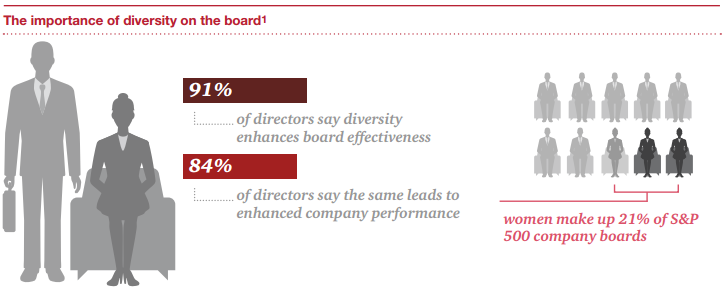
La recherche de PwC a porté sur les résultats de l’évolution des CA dans neuf (9) secteurs industriels. Dans l’ensemble, 91 % des administrateurs croient que la diversité contribue à l’efficacité du conseil. De plus, 84 % des administrateurs lient la variable de la diversité à l’accroissement de la performance organisationnelle.

L’auteure avance qu’il existe trois moyens utiles aux fins du renouvellement des CA :

  1. Une plus grande diversité ;
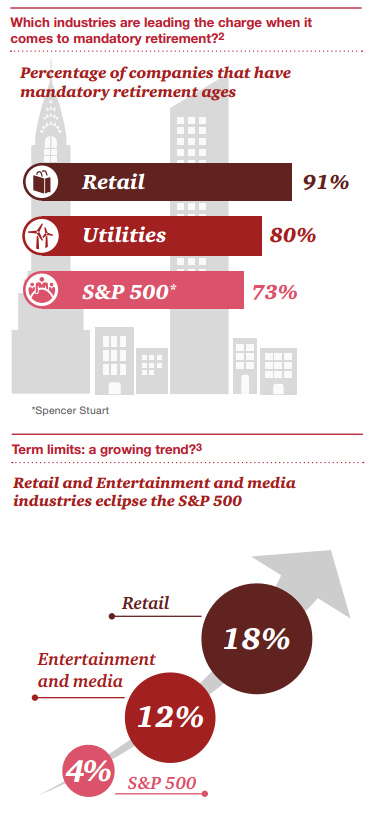
  2. La fixation d’un âge limite et d’un nombre de mandats maximum ;
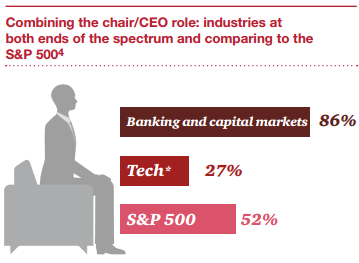
  3. L’évaluation de la séparation des rôles entre la présidence du conseil (Chairperson) et la présidence de l’entreprise (CEO).

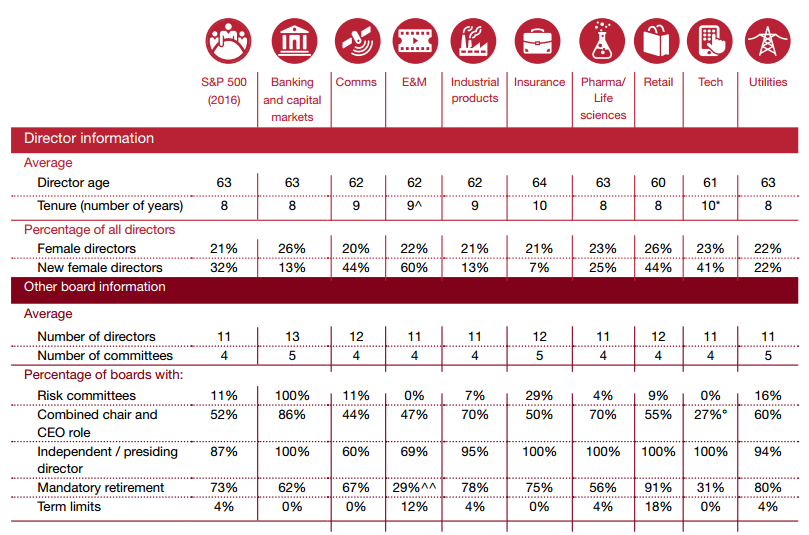
L’article est très intéressant en raison des efforts consentis à la présentation des résultats par l’illustration infographique. Le tableau présenté en annexe est particulièrement pertinent, car on y trouve une synthèse des principales variables liées au renouvellement des CA selon les neuf secteurs industriels ainsi que l’indice du S&P 500.

Au Canada, les recherches montrent que les entreprises sont beaucoup plus proactives eu égard aux facteurs de renouvellement des conseils d’administration.

Bonne lecture !

Does your board have the right makeup for the future?


Résultats de recherche d'images pour « composition du conseil d'administration »


Board composition is “the” issue for investors in 2017. Some industries are taking more steps to refresh their board than others—how does yours stack up? As the economic environment changes and lines between industries start to blur, companies are looking for directors with different, less traditional and even broader skills. Technology skills will be key across sectors.

Who’s sitting in your boardroom? Do your directors bring the right mix of skills, experiences and expertise to best oversee your company? Are they a diverse group, or a group with common backgrounds and outlooks? Can they help see into the future and how your industry is likely to take shape? And are some of your directors serving on your board as well as those in other industries?

These questions should be top of mind for executives and board members alike. Why? Because the volume of challenges companies are facing and the pace of change has intensified in recent years. From emerging technologies and cybersecurity threats to new competitors and changing regulatory requirements, companies–and their boards–have to keep up. Some boards have realized that having board members with multiple industry perspectives can prove helpful when navigating the vast amount of change businesses are faced with today.

If your board isn’t thinking about its composition and refreshment, you are opening up the door to scrutiny. Board composition is “the” issue for investors in 2017. Investors want to know who is sitting in the boardroom and whether they are the best people for the job. If they don’t think you have the right people on the board, you will likely hear about it. This is no longer something that is “nice” to think about, it’s becoming something boards “must” think about. And think about regularly.

How can you refresh your board?


In 2016, we analyzed the board demographics of select companies in nine industries to see how they compared to each other and to the S&P 500. Where does your industry fall when it comes to board refreshment? Does your board have the right makeup for the future?


There are a number of ways to refresh your board. One way is to think about diversity. Many have taken on the gender imbalance on their boards and are adding more women directors. But diversity isn’t only about women. It’s about race, ethnicity, skills, experience, expertise, age and even geography. It’s about diversity of thought and perspective. And it’s not just a talking point anymore. Regulators started drafting disclosure rules around board diversity in mid-2016. Whether the rules become final remains to be seen, but either way, board diversity is in the spotlight. Add to that the common criticism that the US is far behind its developed country peers. Norway, France and the Netherlands have been using quotas for a while, and Germany in 2015 passed a law mandating 30% women on the boards of its biggest companies. While it’s unlikely quotas would be enacted in the US, some believe they’re a needed catalyst.


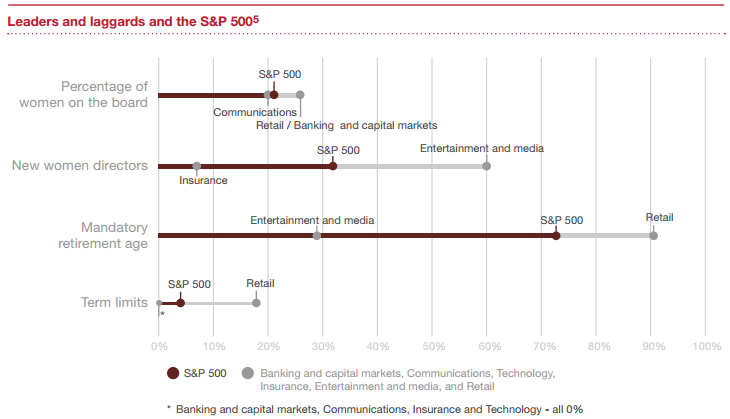
While we only looked at gender diversity on boards, we believe this is a good indicator of the efforts some boards are making to become more diverse overall. Secondly, mandatory retirement ages and term limits are two tools that boards can use to refresh itself. Our analysis showed that some industries seemed to be adopting these provisions more so than others. Some directors question their effectiveness.

Some of the industries in our PwC peer group analysis don’t have term limits at all

Banking and capital markets

Insurance

Communications

Technology

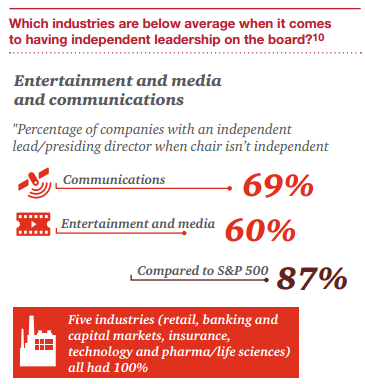
A third move that some companies have taken often, under investor pressure—is to evaluate their leadership structure and split the chair and CEO role. While the issue is still one that investors care about, certain industries have kept the combined role. And some companies don’t plan on making the change any time soon. Most often, boards with a combined chair/CEO role have an independent lead or presiding director. This may ease concerns that institutional investors and proxy firms may have about independence in the leadership role.


Who would have thought? Some interesting findings


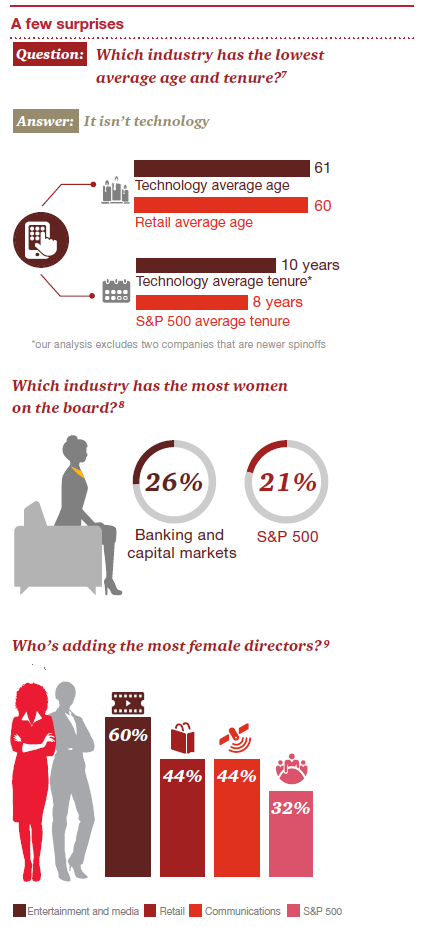
While our analysis shows that most industries didn’t veer too far from the S&P 500 averages for most benchmarking categories, a few stand out. Retail in particular seems to be leading the charge when it comes to board refreshment.


Other industries aren’t moving along quite so quickly. And there were some surprises. Which industry had the lowest average age? Perhaps surprisingly, it’s not technology. Retail claimed that one, too. And, also unexpected, was that technology had one of the highest average tenures. [6] Another surprising finding came from our analysis of the banking and capital markets industry—an industry that’s often considered to be male-dominated. BCM boards had the highest percentage of women, at 26%. That compares to just 21% for the S&P 500. Both the entertainment and media and the communications industries were also ahead of the curve when it comes to women in the boardroom, with the highest and second-highest percentages of new female directors. Retail tied with communications for second-highest, as well.


On a less progressive note, both the entertainment and media and communications industries were below the S&P 500 average when it came to having an independent lead or presiding director when the board chair is not independent. And they ranked lowest of the industries we analyzed on this topic—by far.

Blurred lines across industries


Skills, experience and diversity of thought will likely become even more important in the coming years. In the past five years alone, once bright industry lines have started to blur. Take the retail industry, for example. Brick and mortar stores, shopping malls and strip malls were what used to come to mind when thinking about that industry. Now it’s mobile devices and drones. Across many industries, business models are changing, competitors from different industries are appearing and new skills are needed. The picture of what your industry looks like today may not be the same in just a few years.

Technology is the key to much of this change. Just a few years ago, many boards were not enthusiastic about the idea of adding a director solely with technology or digital skills. But times are changing. Technology is increasingly becoming a critical skill to have on the board. We consulted our experts in the nine industries we analyzed, and all of them put technology high on the “must-have” list for new directors. Interestingly, financial, operational and industry experience—the top three from our 2016 Annual Corporate Directors Survey, were not among the most commonly listed.

Taking a fresh look


If your company is shifting gears and changing the way it does business, it may be important to take a fresh look at your board composition at more frequent intervals. Some boards use a skills matrix to see what they might be lacking in their board composition. Others may be forced by a shareholder activist to add new skills to the board.


So how do you fill the holes in the backgrounds or skills you want from your directors? One way is to look to other industries. As our analysis shows, board composition and refreshment approaches vary by industry. As industry lines blur, other industry perspectives could compliment your company—it might be helpful to consider filling any holes with board members from other industries.

No matter which approach you take, it’s very important to think about your board’s composition proactively. Use your board evaluations to understand which directors have the necessary skills and expertise—and which might be lacking what the board needs. Think about your board holistically as you think about your company’s future. Your board composition is critical to ensuring your board is effective—and keeping up with the world outside the boardroom.


Appendix


How do our industry peer groups stack up to the S&P 500? Making this evaluation can be a good way to begin determining whether your board has the right balance in terms of board composition.


Analysis excludes two companies that are newer spinoffs.
Analysis excludes one company that does not combine or separate the roles.
Excludes the tenure of one newly-formed company.
Four of the five companies that have a mandatory retirement age have waived or state that the board can choose to waive it.

Sources: Spencer Stuart, U.S. Board Index 2016, November, 2016; PwC analysis of US SEC registrants: 27 of the largest industrial products companies by market capitalization and revenue, May 2016; 11 of the largest retail companies by revenue, May 2016; 21 of the largest banking and capital markets companies by revenue, September 2016; 24 of the largest insurance companies by market capitalization, May 2016; 17 of the largest entertainment and media companies by revenue, May 2016; nine of the largest communications companies by revenue, May 2016; 25 of the largest power and utilities companies by revenue, October 2016; 16 of the largest technology companies by revenue, May 2016; 23 of the largest pharma/life sciences companies by revenue, May 2016.


Endnotes:

1Sources: PwC, 2016 Annual Corporate Directors Survey, October 2016; Spencer Stuart, 2016 US Board Index, November 2016.(go back)

2Sources: PwC analysis of 11 of the largest retail companies by revenue that are also US SEC registrants, May 2016; PwC analysis of 25 of the largest power and utilities companies by revenue that are also US SEC registrants, October 2016; Spencer Stuart, U.S. Board Index 2016, November 2016.(go back)

3Sources: PwC analysis of 11 of the largest retail companies by revenue that are also US SEC registrants, May 2016; PwC analysis of 17 of the largest entertainment and media companies by revenue that are also US SEC registrants, May 2016; Spencer Stuart, S. Board Index 2016, November 2016.(go back)

4Sources: PwC analysis of 21 of the largest banking and capital markets companies by revenue that are also US SEC registrants, September 2016; PwC analysis of 16 of the largest technology companies by revenue that are also US SEC registrants, May 2016; Spencer Stuart, S. Board Index 2016, November 2016.(go back)

5Sources: PwC analysis of US SEC registrants: nine of the largest communications companies by revenue, May 2016; 11 of the largest retail companies by revenue, May 2016; 21 of the largest banking and capital markets companies by revenue, September 2016; 24 of the largest insurance companies by market capitalization, May 2016; 16 of the largest technology companies by revenue, May 2016; 17 of the largest entertainment and media companies by revenue, May 2016; Spencer Stuart, U.S. Board Index 2016, November 2016.(go back)

6Analysis excludes two companies that are newer spinoffs.(go back)

7Sources: PwC analysis of 16 of the largest technology companies by revenue that are also US SEC registrants, May 2016; Spencer Stuart, U.S. Board Index 2016, November 2016.(go back)

8Sources: PwC analysis of 11 of the largest retail companies by revenue that are also US SEC registrants, May 2016; PwC analysis of 21 of the largest banking and capital markets companies by revenue that are also US SEC registrants, September 2016; Spencer Stuart, U.S. Board Index 2016, November, 2016(go back)

9Sources: PwC analysis of 17 of the largest entertainment and media companies by revenue that are also US SEC registrants, May 2016; PwC analysis of nine of the largest communications companies by revenue that are also US SEC registrants, May 2016; PwC analysis of 11 of the largest retail companies by revenue that are also US SEC registrants, May 2016; Spencer Stuart, S. Board Index 2016, November 2016.(go back)

10Sources: PwC analysis of 17 of the largest entertainment and media companies by revenue that are also US SEC registrants, May 2016; PwC analysis of nine of the largest communications companies by revenue that are also US SEC registrants, May 2016; Spencer Stuart, S. Board Index 2016, November 2016; PwC analysis of 11 of the largest retail companies by revenue that are also US SEC registrants, May 2016; PwC analysis of 21 of the largest banking and capital markets companies by revenue that are also US SEC registrants, September 2016; PwC analysis of 24 of the largest insurance companies by market capitalization that are also US SEC registrants, May 2016; PwC analysis of 16 of the largest technology companies by revenue that are also US SEC registrants, May 2016; PwC analysis of 23 of the largest pharma/life sciences companies by revenue that are also US SEC registrants, May 2016.

The Directors Toolkit 2017 | Un document complet de KPMG sur les bonnes pratiques de gouvernance et de gestion d’un CA


Voici la version 4.0 du document australien de KPMG, très bien conçu, qui répond clairement aux questions que tous les administrateurs de sociétés se posent dans le cours de leurs mandats.

Même si la publication est dédiée à l’auditoire australien de KPMG, je crois que la réalité réglementaire nord-américaine est trop semblable pour se priver d’un bon « kit » d’outils qui peut aider à constituer un Board efficace.

C’est un formidable document électronique interactif. Voyez la table des matières ci-dessous.

J’ai demandé à KPMG de me procurer une version française du même document, mais il ne semble pas en exister.

Bonne lecture !

The Directors’ Toolkit 2017 | KPMG


Now in its fourth edition, this comprehensive guide is in a user friendly electronic format. It is designed to assist directors to more effectively discharge their duties and improve board performance and decision-making.

Key topics

  1. Duties and responsibilities of a director
  2. Oversight of strategy and governance
  3. Managing shareholder and stakeholder expectations
  4. Structuring an effective board and sub-committees
  5. Enabling key executive appointments
  6. Managing productive meetings
  7. Better practice terms of reference, charters and agendas
  8. Establishing new boards.

What’s new in 2017

In this latest version, we have included newly updated sections on:

  1. managing cybersecurity risks
  2. human rights in the supply chain.

Register

Register here for your free copy of the Directors’ Toolkit.

Se poser les bonnes questions en cette période incertaine | Deloitte


Deloitte a récemment publié un document très important intitulé Courage under fire : Embracing disruption (en anglais seulement) dans lequel trois administrateurs chevronnés échangent leurs points de vue sur les grandes perturbations que les organisations mondiales sont appelées à connaître en 2017.

Les questions posées sont les suivantes :

Étant donné les attentes croissantes envers les conseils d’administration, quelles devraient être les priorités des administrateurs ?

Les appels à une meilleure communication de l’information ne cessent de se faire entendre. Comment les conseils réagissent-ils ?

Les organisations sont nombreuses à subir des perturbations numériques. Est-ce un risque incontrôlable de plus à gérer ?

Les perturbations numériques créent beaucoup d’incertitude. Les conseils d’administration réussissent-ils à bien s’adapter à cette réalité ?

Vous pouvez télécharger le document ci-dessous.

Bonne lecture !

Courage under fire : Embracing disruption |  Deloitte


Séparation des fonctions de PDG et de président du conseil d’administration | Signe de saine gouvernance !


Selon le modèle de gouvernance des entreprises privées canadiennes et américaines, le PDG (CEO) relève du conseil d’administration (CA) de l’entreprise. En effet, ce sont les actionnaires qui, lors de l’assemblée générale annuelle (AGA), votent pour des administrateurs dont la responsabilité fiduciaire est de les représenter sur le conseil d’administration de l’entreprise.

Ainsi, lors des AGA des entreprises publiques (cotées en bourse), les actionnaires sont appelés à voter sur une recommandation du CA développée par le comité de gouvernance. Il existe également des règles qui permettent aux actionnaires de faire inscrire des candidats sur la liste présentée par le CA.


Résultats de recherche d'images pour « michael sabia et »
Michael Sabia, PDG de la Caisse de dépôt et placement et Robert Tessier, président du conseil d’administration


Le CA a la responsabilité de veiller aux intérêts supérieurs des actionnaires tout en considérant les intérêts des diverses parties prenantes.

Les actionnaires ne votent pas pour un PDG (CEO) ; ils votent pour des représentants en qui ils ont confiance dans la supervision de leurs affaires, notamment dans le choix du premier dirigeant (PDG – CEO).

Il est clair pour tous que c’est le CA qui a la responsabilité d’embaucher le PDG (CEO), de l’orienter, de le rémunérer, de l’évaluer et de mettre en place un processus de relève et de transition.

Personnellement, je ne crois pas approprié que le PDG soit aussi un administrateur au sein du CA, bien qu’il doive y assister à titre de premier dirigeant, mais sans droit de vote.

Cette prise de position implique, a fortiori, que le PDG ne soit pas désigné comme président (Chairman of the Board) du CA.

Bien que notre mode de gouvernance semble exclure le cumul des fonctions de président du conseil et de PDG, il n’existe aucune obligation juridique à le faire.

Ainsi, comme mentionné dans un billet daté du 5 juillet 2016 (la séparation des fonctions de président du conseil et de président de l’entreprise [CEO] est-elle généralement bénéfique ?), les autorités réglementaires, les firmes spécialisées en votation et les experts en gouvernance suggèrent que les rôles et les fonctions de président du conseil d’administration soient distincts des attributions des PDG (CEO).

En fait, on suppose que la séparation des fonctions, entre la présidence du conseil et la présidence de l’entreprise (CEO), est généralement bénéfique à l’exercice de la responsabilité de fiduciaire des administrateurs, c’est-à-dire que des pouvoirs distincts permettent d’éviter les conflits d’intérêts, tout en rassurant les actionnaires.

Cependant, cette pratique cède trop souvent sa place à la volonté bien arrêtée de plusieurs PDG d’exercer le pouvoir absolu, comme c’est encore le cas pour plusieurs entreprises américaines.

Dans un autre billet daté du 17 novembre (Séparation des fonctions de président du conseil [PCA] et de chef de la direction [PCD] : un retour sur un grand classique !), on note que les études contemporaines démontrent une nette tendance pour la séparation des deux rôles.

Le Canadian Spencer Stuart Board Index estime qu’une majorité de 85 % des 100 plus grandes entreprises canadiennes cotées en bourse a opté pour la dissociation entre les deux fonctions.

Aux États-Unis, en 2013, 45 % des entreprises de l’indice S&P500 dissociaient les rôles de PDG et de président du conseil. Plus de 50 % de ces entreprises combinent les deux fonctions !

L’article d’Yvan Allaire, publié dans le journal Les Affaires du 21 novembre 2016, mentionne « deux arguments invoqués pour appuyer la séparation des rôles » :

1- Le PDG relève du conseil qui doit en évaluer la performance, établir sa rémunération, le remplacer si cette performance est inadéquate, proposer de nouveaux membres pour le conseil ; comment peut-on, comme PDG, présider également le conseil, lequel doit prendre ces décisions critiques pour le PDG ;

Environ 50 % des grandes sociétés américaines sont présidées par un administrateur indépendant, comparativement à 23 % il y a 15 ans.

Toute la question du bien-fondé de la dualité des rôles PDG/Chairman est encore ambiguë, même si les experts de la gouvernance et les actionnaires activistes sont généralement d’accord avec la séparation des fonctions.

2-  En notre époque alors que la gouvernance est plus exigeante, plus prenante de temps et d’énergie pour la société ouverte cotée en Bourse, comment une même personne peut-elle s’acquitter de ces deux rôles sans que l’un soit négligé au profit de l’autre ? Dans le nouveau contexte de gouvernance, postérieur à Sarbanes-Oxley, les exigences pour le PCA sont telles qu’il n’est pas souhaitable qu’une même personne assume ces deux fonctions (PCA et PDG).

En conséquence, 85 % des 100 plus grandes entreprises canadiennes cotées en Bourse se sont donné un président du conseil distinct du PDG, mais dans 38 % des cas ce président du conseil ne se qualifiait pas comme indépendant. (Spencer Stuart, février 2012).

La situation n’est certainement pas limpide, mais la tendance est évidente. L’indépendance du président du conseil ainsi que la séparation du pouvoir entre Chairperson du CA et CEO devrait, selon moi, trouver son application dans tous les types d’organisations : OBNL, sociétés d’État, petites et moyennes entreprises, et coopératives.

Évidemment, chaque organisation a ses particularités, lesquelles sont ancrées dans des pratiques de gouvernance assez diverses. La séparation des rôles n’est pas une panacée; c’est une meilleure assurance d’une saine gouvernance.

Vos commentaires sont les bienvenus

L’éthique attendue et l’éthique réfléchie | Un billet de René Villemure


Aujourd’hui, je poursuis notre habitude de collaboration avec des experts avisés en matière de gouvernance et d’éthique.

Ainsi, je partage avec vous un excellent billet de René Villemure* publié le 6 février 2017.

L’article nous invite à ne pas repousser notre réflexion sur l’éthique à demain. Il convient donc de se doter d’objectifs en matière d’éthique pour 2017.

Voici donc la réflexion que nous propose René. Vous pouvez visiter son site à www.ethique.net pour mieux connaître ses intérêts.

Vos commentaires sont appréciés. Bonne lecture.

L’éthique attendue et l’éthique réfléchie

Conférence de René Villemure au Club Premier de Bell Helicopter Conférence de René Villemure au Club Premier de Bell Helicopter

Le temps est une fraction de la durée, un moment entre deux autres moments.

La chenille ne peut se transformer en papillon plus rapidement parce qu’on lui crie de le faire plus vite.  La Nature a son propre rythme;  elle prend quelques semaines pour faire un papillon, toute une vie pour faire un adulte, et encore, disait Malraux….

Malheureusement, depuis quelques années, on tente d’aller toujours plus vite, on tente de réduire à presque rien ce moment entre deux moments ; avec la vitesse, nous  sommes passés du temps réel à l’instantané, cette imitation du temps, croyant ne rien perdre ce faisant.

Pourtant, réagissant dans l’instant plutôt qu’agir dans le temps, on oublie qu’il faut du temps pour se faire une tête, qu’il faut plus de temps pour lire un livre que pour consulter un résumé sur Internet, qu’il faut également du temps pour se cultiver, pour se faire une opinion, pour être en mesure de penser par soi-même ou pour créer. Rien de valable ou de durable ne se fait dans l’instant.

En conséquence, ayant décidé par avance que nous n’avions plus le temps, on évacue la réflexion et on tente de créer du nouveau en copiant du vieux, croyant ainsi faire illusion.

Choisissant trop souvent de ne pas prendre le temps nécessaire à la réflexion, face à un problème éthique on cherche une norme ou une règle sur un site web, on va voir ce que d’autres ont fait, on va voir ce que nos compétiteurs ont comme valeurs en termes d’éthique, on copie et on colle. Voilà ! Travail terminé. Réflexion, zéro. Niveau éthique de la décision ? On ne sait pas, on espère…

C’est ce que l’on appelle l’éthique prétendue, celle qui est constituée de généralités souvent pensées par un grand cabinet de consulting spécialisé en tout, pour une autre entreprise que la vôtre, dans un contexte qui n’est pas le vôtre. L’éthique prétendue n’est qu’une recette.

En 2017, sur le plan de l’éthique, au lieu de réfléchir et de créer on est encore à copier ou à emprunter sur le web des éléments d’éthique. L’expérience nous a enseigné que peu d’organisations choisissent de faire une réflexion critique ou éclairée sur l’éthique, sur les valeurs ou sur les outils éthiques dont elles ont réellement besoin et qui sont adaptés à leur culture et leur contexte d’affaires. Quelle en est la raison ? Simple : les décideurs ne réalisent pas le potentiel que recèle l’éthique. Ils ne voient celle-ci que comme une contrainte.

Il faut arrêter de prétendre que l’on a réfléchi en empruntant du contenu éthique sur le web ou en appliquant une recette toute faite ; ces actions ne sont que poudre aux yeux.

L’éthique réfléchie est celle qui permet à l’entreprise de naviguer à travers les mers déchaînées des conflits d’intérêts ou des traditionnelles fautes éthiques, générant à terme un capital de confiance qui consolide sa réputation. À l’heure actuelle, les dirigeants visionnaires s’appuient sur l’éthique réfléchie en tant qu’élément central à la stratégie de leur entreprise, un élément qui permettra à leur entreprise de durer, de dépasser ses compétiteurs en évitant les pièges de la non-éthique.

Les dirigeants visionnaires misent sur l’éthique réfléchie, qui est adaptée à la culture et au contexte de leur entreprise ils en font un avantage stratégique et distinctif. Au même moment, l’éthique prétendue fait croire à une gestion éthique et tente de panser les blessures prévisibles encourues par le manque de réflexion éthique.

L’éthique prétendue est celle de la vitrine alors que l’éthique réfléchie est celle de l’éthique dans les circonstances.

La distinction entre les deux est immense : c’est la différence  entre la conformité de façade et la justesse, entre avoir l’air d’être éthique et l’être.

Si vous n’êtes pas certain de tout comprendre, rappelez-vous Volkswagen, qui avait pourtant paraphé toutes les ententes de conformité attendues tout en évitant la sincérité éthique.

Reporter la réflexion sur l’éthique à demain, c’est encourir sa perte à petit feu dès aujourd’hui. IL convient de réfléchir avant d’agir.

Quels seront vos objectifs en éthique pour 2017?


*RENÉ VILLEMURE EST ÉTHICIEN ET CHASSEUR DE TENDANCES. IL A FONDÉ L’INSTITUT QUÉBÉCOIS D’ÉTHIQUE APPLIQUÉE EN 1998, ETHIKOS EN 2003 ET L’ÉTHIQUE POUR LE CONSEIL EN 2014.

Les administrateurs doivent susciter le débat sur l’avenir de l’entreprise


Je vous recommande la lecture de l’article de Stuart Jackson publié dans la Harvard Business Review de janvier 2017.

L’auteur suggère, qu’en général, les conseils d’administration ne font pas suffisamment preuve de combativité et qu’ils ne jouent pas leur rôle principal, soit d’offrir une vision à long terme et de se concentrer sur la création de valeur.

Les administrateurs doivent offrir diverses perspectives de changement et proposer des stratégies propres à pérenniser l’organisation.

Les administrateurs doivent faire preuve de courage et apprendre à formuler des critiques positives envers le PDG. Le conseil d’administration est essentiellement un lieu de débat sur le futur de l’entreprise.

Les membres du conseil doivent être capables de réfléchir à l’évolution du modèle d’affaires et prévoir un plan d’action opérationnel pour un changement à long terme.

L’auteur propose une limitation de la durée des mandats des administrateurs afin d’éviter la complaisance susceptible de se manifester avec le temps. Également, on doit viser le choix d’administrateurs indépendants, capables de questionner et de contester les actions de la direction.

À cet égard, il me semble que les administrateurs devraient suivre une solide formation en gouvernance, notamment une formation telle que celle offerte par le Collège des administrateurs de sociétés (CAS) qui propose une simulation des débats autour de la table du conseil.

On constate que le rôle d’un administrateur est très exigeant et que celui-ci doit penser en termes de compétitivité de l’entreprise.

Bonne lecture ! Vos commentaires sont les bienvenus.


Boards Must Be More Combative


 homepic1


Boards of directors play two roles. They must protect value by helping companies avoid unnecessary risks, and they must build value by ensuring that companies change quickly enough to address emerging competitive threats, evolving customer preferences, and disruptive technologies.

With technology and business model cycles becoming shorter and companies facing unrelenting pressure to innovate or suffer the consequences, more and more boards need to focus on the second of these roles. To do so, they must be willing to challenge executive teams and stress-test their strategies to ensure they go far enough and fast enough. For boards used to preserving the status quo, this shift can be uncomfortable. Here are four ways boards can become better challengers and champions of change.

Confront Unwelcome News and Trends

Changing strategy is extremely difficult, especially for successful businesses. In the early 1990s Blockbuster commissioned a study on the future of video-on-demand technologies and how they would impact traditional video rentals. The report concluded that expanded cable offerings and broadband internet would begin to impact video rentals around 2000, and would grow rapidly thereafter. The good news was that Blockbuster had a good 10 years to prepare for the new environment. But the shift never happened: Management ignored the study’s findings and continued with the same strategy, supported by the board. In September 2010 Blockbuster filed for bankruptcy protection. In this case, value protection was not enough. The company had clear advance notice that seismic change was coming.

The board’s role was to acknowledge the warning signs and challenge management’s lack of action — even if it meant contention and dispute in the boardroom.

Make Sure You Have Challengers in Your Midst

Boards will be far more effective in their challenger role if they offer seats to individuals with professional experiences and viewpoints that are very different from those of the executive team. Directors can learn to be more direct with management, but it’s hard to fake contrarianism when everyone is of the same mind. When a board resembles the CEO in mindset and outlook, it’s a recipe for a gatekeeper board, not a challenger board. But when boards mix it up by bringing in members with different perspectives, they can effect powerful strategic changes, something I have seen many times in my work with corporate boards.

Often, these “challengers” will be tech-savvy young executives from digitally disruptive companies who can press their fellow directors and senior management about potential blind spots related to digital disruption. But disruption is not always about technology. For example, one highly successful, privately-held producer of canned foods actively sought a board member who could challenge management to think differently but who would still fit with the company’s family-oriented governance culture. The successful candidate was the CEO of a well-known, family-owned California wine business that catered to consumers who would not dream of buying canned food. The board member helped the company “think outside the can” to identify new product forms that would broaden their customer base and appeal to health-conscious consumers.

In another instance, a leading chain of retail pharmacies appointed as vice chair someone with a background in health care manufacturing and pharmacy benefit management. The new board member helped management better understand the efficiency advantages of mail-order pharmacies, which rely on automation. As a result, the company added low-cost automated pharmacy services to its existing retail outlets, giving it a competitive advantage over traditional retail pharmacies.

Stay Fresh with Term Limits and Checks and Balances

Beyond accessing the right expertise, boards can maintain a challenger perspective by ensuring they don’t become complacent and drift toward an approver role. One of the most effective ways to do this is to establish mandatory term limits as a part of the board’s bylaws. Term limits can help boards maintain a level of independence between the outside directors and executive leadership.

Moreover, if the CEO and chair roles are separated, the chair can take more active responsibility for ensuring that alternative views and perspectives are brought before the board. Separating the roles is a common practice in Europe, and it’s becoming more so in the United States. Another option is to appoint an independent lead director, a less drastic change that can have a similar effect. In fact, the New York Stock Exchange essentially requires listed companies with nonindependent chairs to appoint one of their independent directors as lead director. The lead position, among other duties, is responsible for scheduling and helming board meetings that take place without management. Today the majority of S&P companies with combined CEO and chair roles have chosen to counterbalance this arrangement by appointing an independent lead director.

Turn Courage and Candor into Core Competencies

Having directors with valuable insights is worthless if they do not feel comfortable sharing their perspectives and debating issues with management. A recent study by Women Corporate Directors and Bright Enterprises found that more than three-quarters (77%) of director respondents believed that their boards would make better decisions if they were more open to debate, and 94% said that criticism can help bring about change when it is used properly.

Nevertheless, board members are often hesitant to offer criticism, especially to CEOs. The same survey found that only about half (53%) of respondents felt that the CEOs of their companies take criticism well. This is not surprising. As a board member it is much easier to empathize with a CEO under pressure than with an abstract group of shareholders. One way to address this issue is to offer board members training in giving and receiving constructive criticism. Board members need to understand that failing to confront difficult issues will not help the CEO. If a CEO’s first indication that the board is dissatisfied is hearing they are searching for his or her replacement, then the board is not fulfilling its responsibilities.

Challenger boards are those with the strength to put the hard questions to management and to poke holes in suboptimal strategies. They bring a diversity of perspective that can help management understand the company’s vulnerabilities and how to overcome them. For companies struggling to exist in a world where disruption is rapidly becoming a business constant, challenger boards may well be one of their most important survival tools.

Priorité à la diversité sur les conseils d’administration | Les entreprises à un tournant !


Selon David A. Katz et Laura A. McIntosh, associés de la firme Wachtell, Lipton, Rosen & Katz, les entreprises américaines ont franchi un point de non-retour eu égard à l’acceptation de la contribution de la diversité à la profitabilité des sociétés.

En effet, il est de plus en plus acquis que l’accroissement de la diversité a des effets positifs sur les deux rôles majeurs du conseil d’administration : (1) la surveillance (oversight) et (2) la création de valeur des entreprises.

Ce court article, publié sur le site du Harvard Law School Forum, décrit les progrès réalisés dans la mise en œuvre de la diversité sur les CA et montre que les entreprises en sont à un tournant dans ce domaine.

Bonne lecture ! Vos commentaires sont appréciés.


Corporate Governance Update: Prioritizing Board Diversity


In what has been called a “breakout year” for gender diversity on U.S. public company boards, corporate America showed increasing enthusiasm for diversity-promoting measures during 2016. Recent studies have demonstrated the greater profitability of companies whose boards are meaningfully diverse. In many cases, companies have collaborated with investors to increase the number of women on their boards, and a number of prominent corporate leaders have publicly encouraged companies to prioritize diversity. The Business Roundtable, a highly influential group of corporate executives, recently released a statement that explicitly links board diversity with board performance in the two key areas of oversight and value creation. Likewise, a group of corporate leaders—including Warren Buffett, Jamie Dimon, Jeff Immelt, and Larry Fink, among others—published their own “Commonsense Principles of Corporate Governance,” (discussed on the Forum here) an open letter highlighting diversity as a key element of board composition.

board-diversity_forbes

Momentum toward gender parity on boards is building, particularly in the top tier of public corporations. Pension funds from several states have taken strong stances intended to encourage meaningful board diversity at the 25 percent to 30 percent level. Last year, then-SEC Chair Mary Jo White cited the correlation of board diversity with improved company performance and identified board diversity as an important issue for the Commission, signaling that it may be a priority for regulators going forward. Boards should take note of the evolving best practices in board composition and look for ways to improve, from a diversity standpoint, their candidate search, director nomination, and board refreshment practices. We recommend that boards include this issue as part of an annual discussion on director succession, similar to the annual discussion regarding CEO succession.

Diversity and Performance

A board of directors has two primary roles: oversight and long-term value creation. This year, the Business Roundtable released updated governance guidelines (discussed on the Forum here) that link a commitment to diversity to the successful accomplishment of both goals. Its 2016 guidelines include a statement on diversity that reads, in part, “Diverse backgrounds and experiences on corporate boards … strengthen board performance and promote the creation of long-term shareholder value.” In a statement accompanying the guidelines, Business Roundtable leader John Hayes noted that a “diversity of thought and perspective … adds to good decision-making” and enables “Americans, as well as American corporations, to prosper.” Board success and competence thus is recast to include diversity as an essential element rather than as an afterthought or as a concession to special interests.

Similarly, the “Commonsense Principles of Corporate Governance” (discussed on the Forum here) outlined over the summer by a group of corporate leaders highlights diversity on boards—multi-dimensional diversity—and correlates that diversity with improved performance. The signers of the principles, including an activist investor, a pension plan, and various chief executives, stated unequivocally in their accompanying letter that “diverse boards make better decisions.” A consensus seems to be emerging among corporate leaders that, as stated by the Business Roundtable, boards should include “a diversity of thought, backgrounds, experiences, and expertise and a range of tenures that are appropriate given the company’s current and anticipated circumstances and that, collectively, enable the board to perform its oversight function effectively.” With regard to oversight, a recent study by Spencer Stuart and WomenCorporateDirectors Foundation (discussed on the Forum here) found that female directors generally are more concerned about risks, and are more willing to address them, than are their male colleagues. Boards should, where possible, develop a pipeline of candidates whose career paths are enabling them to acquire the relevant professional expertise to be valuable public company directors in their industry.

In order to promote diversity in board composition, boards should become familiar with director search approaches to identify qualified candidates that would not otherwise come to the attention of the nominating committee. Executive search firms, public databases, and inquiries to organizations such as 2020 Women on Boards are a few of the ways that boards can find candidates that may be beyond their typical field of view. Organizations exist to help companies in their recruitment efforts. Crain’s Detroit Business, for example, has compiled a database of qualified female director candidates in Michigan, who are invited to apply and are vetted for inclusion. Boards may wish to commit to including individuals with diverse backgrounds in the pool of qualified candidates for each vacancy to be filled.

The Future of Diversity

In 2016, shareholder proposals on board diversity met with increased success. The numbers are still small: Nine proposals made it onto the ballot last year, nearly double the total in 2015 and triple the total in 2014. Nonetheless, support reached unprecedented levels in certain cases: A diversity proposal—which was not opposed by management—at FleetCor Technologies received over 70 percent shareholder support. Another diversity proposal—which was opposed by management—at Joy Global received support from 52percent of the voting shares (though the proposal did not pass due to abstentions). Diversity proposals are generally supported by the proxy advisory firms, including Institutional Shareholder Services and Glass Lewis.

Perhaps more significantly, shareholder proposals in several cases resulted in increased board diversity without ever coming to a vote. The pension fund Wespath submitted proposals this year seeking to increase diversity at three major corporations, and in each case withdrew the proposals when the subject companies agreed to add women to their boards. A spokesperson for Wespath stated that the fund had privately communicated their desire for increased diversity and had filed proposals as a “last resort” to spur change.

In a similar effort, CalSTRS recently submitted 125 letters to boards at California corporations whose boards had no women directors; in response, 35 of the companies appointed female board members. CalSTRS has indicated that if its private approaches are unsuccessful, it will proceed with shareholder proposals. The Wespath and CalSTRS examples are valuable for boards. Listening to investors, being responsive, and staying out in front of issues to forestall shareholder proposals is far better than reacting to frustrated investors who feel compelled to resort to extreme measures to get corporate attention. It is also greatly preferable to a situation in which activist investors press for legislative actions such as quotas or other mandatory board composition requirements, as we have seen in other countries.

2017 is likely to be a year in which progress toward greater board diversity significantly accelerates. Indeed, it is becoming clear that gender diversity—if not gender parity—one day will be a standard aspect of board composition. While the process of realizing that future should not be artificially or counterproductively hastened, it should be welcomed as a state of affairs that will be beneficial to all corporate constituents and, beyond, to the greater good of U.S. business and American culture.


Attentes réciproques | C.A. et direction


Vous trouverez ci-dessous les grandes lignes d’un article publié par Richard Leblanc* dans la revue mensuelle de Governance Centre of excellence à propos de ce que le conseil d’administration attend de la direction, et vice-versa.

Ce sont des questions qui me sont fréquemment posées.

L’auteur a su présenter les réponses à ces questions en des termes clairs. Je vous invite à télécharger ce court article.

Bonne lecture !

What Management Expects from the Board

Management, in turn, has expectations of the board. They are:

  1. Candor
  2. Integrity and Independence
  3. Direction
  4. React in a Measured Way
  5. Trust and Confidence
  6. Knowledge of the Business
  7. Meeting Preparation
  8. Asking Good Questions

Dix thèmes majeurs pour les administrateurs de sociétés en 2017


Aujourd’hui, je partage avec vous la liste des dix thèmes majeurs en gouvernance que les auteurs Kerry E. Berchem* et Rick L. Burdick* ont identifiés pour l’année 2017.

Vous êtes assurément au fait de la plupart de ces dimensions, mais il faut noter l’importance accrue à porter aux questions stratégiques, aux changements politiques, aux relations avec les actionnaires, à la cybersécurité, aux nouvelles réglementations de la SEC, à la composition du CA, à l’établissement de la rémunération et aux répercussions possibles des changements climatiques.

sans-titre-gump

Afin de mieux connaître l’ampleur de ces priorités de gouvernance pour les administrateurs de sociétés, je vous invite à lire l’ensemble du rapport publié par Akin Gump.

Bonne lecture !

Dix thèmes majeurs pour les administrateurs de sociétés en 2017


top-10


1. Corporate strategy: Oversee the development of the corporate strategy in an increasingly uncertain and volatile world economy with new and more complex risks

Directors will need to continue to focus on strategic planning, especially in light of significant anticipated changes in U.S. government policies, continued international upheaval, the need for productive shareholder relations, potential changes in interest rates, uncertainty in commodity prices and cybersecurity risks, among other factors.

2. Political changes: Monitor the impact of major political changes, including the U.S. presidential and congressional elections and Brexit

Many uncertainties remain about how the incoming Trump administration will govern, but President-elect Trump has stated that he will pursue vast changes in diverse regulatory sectors, including international trade, health care, energy and the environment. These changes are likely to reshape the legal landscape in which companies conduct their business, both in the United States and abroad.

With respect to Brexit, although it is clear that the United Kingdom will, very probably, leave the European Union, there is no certainty as to when exactly this will happen or what the U.K.’s future relationship, if any, with the EU will be. Once the negotiations begin, boards will need to be quick to assess the likely shape of any deal between the U.K. and the EU and to consider how to adjust their business model to mitigate the threats and take advantage of the opportunities that may present themselves.

3. Shareholder relations: Foster shareholder relations and assess company vulnerabilities to prepare for activist involvement

The current environment demands that directors of public companies remain mindful of shareholder relations and company vulnerabilities by proactively engaging with shareholders, addressing shareholder concerns and performing a self-diagnostic analysis. Directors need to understand their company’s vulnerabilities, such as a de-staggered board or the lack of access to a poison pill, and be mindful of them in any engagement or negotiation process.

4. Cybersecurity: Understand and oversee cybersecurity risks to prepare for increasingly sophisticated and frequent attacks

As cybercriminals raise the stakes with escalating ransomware attacks and hacking of the Internet of Things, companies will need to be even more diligent in their defenses and employee training. In addition, cybersecurity regulation will likely increase in 2017. The New York State Department of Financial Services has enacted a robust cybersecurity regulation, with heightened encryption, log retention and certification requirements, and other regulators have issued significant guidance. Multinational companies will continue implementation of the EU General Data Protection Regulation requirements, which will be effective in May 2018. EU-U.S. Privacy Shield will face a significant legal challenge, particularly in light of concerns regarding President-elect Trump’s protection of privacy. Trump has stated that the government needs to be “very, very tough on cyber and cyberwarfare” and has indicated that he will form a “cyber review team” to evaluate cyber defenses and vulnerabilities.

5. SEC scrutiny: Monitor the SEC’s increased scrutiny and more frequent enforcement actions, including whistleblower developments, guidance on non-GAAP measures and tougher positions on insider trading

2016 saw the Securities and Exchange Commission (SEC) award tens of millions of dollars to whistleblowers and bring first-of-a-kind cases applying new rules flowing from the protections now afforded to whistleblowers of potential violations of the federal securities laws. The SEC was also active in its review of internal accounting controls and their ability to combat cyber intrusions and other modern-day threats to corporate infrastructure. The SEC similarly continued its comprehensive effort to police insider trading schemes and other market abuses, and increased its scrutiny of non-GAAP (generally accepted accounting principles) financial measure disclosures. 2017 is expected to bring the appointment of three new commissioners, including a new chairperson to replace outgoing chair Mary Jo White, which will retilt the scales at the commissioner level to a 3-2 majority of Republican appointees. 2017 may also bring significant changes to rules promulgated previously under Dodd-Frank.

6. CFIUS: Account for CFIUS risks in transactions involving non-U.S. investments in businesses with a U.S. presence

Over the past year, the interagency Committee on Foreign Investment in the United States (CFIUS) has been particularly active in reviewing—and, at times, intervening in—non-U.S. investments in U.S. businesses to address national security concerns. CFIUS has the authority to impose mitigation measures on a transaction before it can proceed, and may also recommend that the President block a pending transaction or order divestiture of a U.S. business in a completed transaction. Companies that have not sufficiently accounted for CFIUS risks may face significant hurdles in successfully closing a deal. With the incoming Trump administration, there is also the potential for an expanded role for CFIUS, particularly in light of campaign statements opposing certain foreign investments.

7. Board composition: Evaluate and refresh board composition to help achieve the company’s goals, increase diversity and manage turnover

In order to promote fresh, dynamic and engaged perspectives in the boardroom and help the company achieve its goals, a board should undertake focused reassessments of its underlying composition and skills, including a review and analysis of board tenure, continuity and diversity in terms of upbringing, educational background, career expertise, gender, age, race and political affiliation.

8. Executive compensation: Determine appropriate executive compensation against the background of an increased focus on CEO pay ratios

Executive compensation will continue to be a hot topic for directors in 2017, especially given that public companies will soon have to start complying with the CEO pay ratio disclosure rules. Recent developments suggest that such disclosure might not be as burdensome or harmful to relations with employees and the public as was initially feared.
The SEC’s final rules allow for greater flexibility and ease in making this calculation, and a survey of companies that have already estimated their ratios indicates that the ratio might not be as high, on average, as previously reported.

9. Antitrust scrutiny: Monitor the increased scrutiny of the antitrust authorities and the implications on various proposed combinations

Despite the promise of synergies and the potential to transform a company’s future, antitrust regulators have become increasingly hostile toward strategic transactions, with the Department of Justice and Federal Trade Commission suing to block 12 transactions since 2015. Although directors should brace for a longer antitrust review, to help navigate the regulatory climate, work upfront can dramatically improve prospects for success. Company directors should develop appropriate deal rationales and, with the benefit of upfront work, allocate antitrust risk in the merger agreement. Merger and acquisition activity may also benefit from the Trump administration, taking, at least for certain industries, a less-aggressive antitrust enforcement stance.

10. Environmental disasters and contagious diseases: Monitor the impact of increasingly volatile weather events and contagious disease outbreaks on risk management processes, employee needs and logistics planning

While the causes of climate change remain a political sticking point, it cannot be debated that volatile weather events, environmental damage and a rise in the diseases that tend to follow, are having increasingly adverse impacts on businesses and markets. Businesses will need to account for, or transfer the risk of, the increasing likelihood of these impacts. The SEC recently announced investigations into climate-risk disclosures within the oil and gas sector to ensure that they adequately allow investors to account for these effects on the bottom line. The growing number of shareholder resolutions and suits addressing climate change confirm that investors want this information, regardless of the position of the next administration.

The complete publication is available here.


*Kerry E. Berchem is partner and head of the corporate practice, and Rick L. Burdick is partner and chair of the Global Energy & Transactions group, at Akin Gump Strauss Hauer & Feld LLP.

Principales tendances en gouvernance à l’échelle internationale en 2017


Voici un excellent résumé des principales tendances en gouvernance à l’échelle internationale. L’article paru sur le site de la Harvard Law School Forum est le fruit des recherches effectuées par Rusty O’Kelley, membre de CEO and Board Services Practice, et Anthony Goodman, membre de Board Effectiveness Practice de Russell Reynolds Associates.

Les auteurs ont interviewé plusieurs investisseurs activistes et institutionnels ainsi que des administrateurs de sociétés publiques et des experts de la gouvernance afin d’appréhender les tendances qui se dessinent pour les entreprises cotées en 2017.

Parmi les conclusions de l’étude, notons :

  1. Le besoin de se coller plus étroitement à des normes de gouvernance universellement acceptées ;
  2. La nécessité de bien se préparer aux nouveaux risques et aux nouvelles opportunités amenées par la montée des gouvernements populistes de droite ;
  3. Une responsabilité accrue des administrateurs de sociétés pour la création de valeur à long terme ;
  4. L’importance d’une solide compréhension des changements globaux eu égard à l’exercice d’une bonne gouvernance, notamment dans les états suivants :

–  États-Unis

–  Union européenne

–  Japon

–  Inde

–  Brésil

Cette lecture nous donne une perspective globale des défis qui attendent les administrateurs et les CA de grandes sociétés publiques en 2017.

Bonne lecture !


Global and Regional Trends in Corporate Governance for 2017


Russell Reynolds Associates recently interviewed numerous institutional and activist investors, pension fund managers, public company directors and other governance professionals about the trends and challenges that public company boards will face in 2017. Our conversations yielded a wide array of perspectives about the forces that are driving change in the corporate governance landscape.


accesaumarche


The changing pressures and dynamics that boards will face in the coming year are diverse and significant in their impact. Institutional investors will continue their push for more uniform standards of corporate governance globally, while also increasing their expectations of the role that boards should play in responsibly representing shareholders. Political uncertainty and the surprise results of the US Presidential and “Brexit” votes may require that boards take a more active role in scenario planning and helping management to navigate increasingly costly risks. The movement for companies and investors to adopt a more long-term orientation has gained momentum, with several large institutional investors now pressuring boards to demonstrate that they are actively involved in guiding a company’s strategy for long-term value creation.

Higher Expectations and Greater Alignment Around Corporate Governance Norms

Continuing the trend from last year, large institutional investors and pension funds are pushing for more aligned approaches to corporate governance across borders to support long-term value creation. Regulators are responding, particularly in emerging economies and those with nascent corporate governance regimes. Recent reforms in Japan, India and Brazil have borrowed heavily from the US or UK models. Where regulators have not yet caught up to or agreed with investor expectations, institutional investors are engaging companies directly to advocate for the governance reforms they want to see. These investors also expect more from their boards than ever before and are increasingly willing to intervene when they do not feel they are being responsibly represented in the boardroom.

Corporate Governance in an Era of Political Uncertainty

Populist political movements have gained broad support in several countries around the world, contributing to uncertainty about the future regulatory and political environments of two of the world’s five largest economies. In the UK, the Conservative government has signaled potential support for shareholder influence over executive pay and disclosure of the CEO-employee pay ratio. In the US, President-elect Trump has demonstrated a willingness to “name and shame” specific companies that he perceives to have benefited unfairly from trade deals or moved jobs overseas. Boards must be prepared to navigate these new reputational risks and intense media scrutiny, and review management’s assumptions about the political implications of certain decisions.

Increasing Board Accountability for Long-Term Value Creation

Efforts to encourage a more long-term market orientation have intensified in recent years, with several prominent business leaders and investors, most notably Larry Fink, Chairman and CEO of BlackRock, urging companies to focus on sustained value creation rather than maximizing short-term earnings. In his 2016 letter to chief executives of S&P 500 companies and large European corporations, Mr. Fink specifically called for increased board oversight of a company’s strategy for long-term value creation, noting that BlackRock’s corporate governance team would be looking for assurances of this oversight when engaging with companies.

Global and Regional Trends in Corporate Governance in 2017

Based on our global experience as a firm and our interviews with experts around the world, we believe that public companies will likely face the following trends in 2017:

  1. Increasing expectations around the oversight role of the board, to include greater oversight of strategy and scenario planning, investor engagement, and executive succession planning.
  2. Continued focus on board refreshment and composition, with particular attention being paid to directors’ skill profiles, the currency of directors’ knowledge, director overboarding, diversity, and robust mechanisms for board refreshment that go beyond box-ticking exercises.
  3. Greater scrutiny of company plans for sustained value creation, as concerns increase that activist settlements and other market forces are causing short-term priorities to compromise long-term interests.
  4. Greater focus on Environmental, Social and Governance (ESG) issues, and in particular those related to climate change and sustainability, as industries beyond the extractive sector begin to feel investor pressure in this area.

We explore these trends and their implications for five key regions and markets: the United States, the European Union, India, Japan and Brazil.

United States

The surprise election of Donald Trump has increased regulatory and legislative uncertainty. Certain industries, such as financial services, natural resources and healthcare, may face less pressure and government scrutiny. We expect nominees to the Securities and Exchange Commission (SEC) to be less supportive of the increased disclosure requirements around executive pay and diversity. However, public pension funds and institutional investors will continue to push governance issues through increased specific engagement with individual companies.

  1. Investors continue to push boards to demonstrate that they are taking a strategic and proactive approach to board refreshment. In particular, they are looking for indicators that boards are adding directors with the skill sets necessary to complement the company’s strategic direction, and ensuring a diversity of backgrounds and perspectives to guide that strategy. Some investors see tenure and age limits as too blunt an instrument, preferring internal or external board evaluations to ensure that every director is contributing effectively. Several large institutional investors will continue to push boards to conduct external board evaluations by third parties to increase the quality of feedback and improve governance.
  2. Ongoing fallout from the Wells Fargo scandal will increase pressure on boards to split the CEO/Chair role, particularly in the financial services sector. Given investor pressure, particularly from pension funds, we also anticipate increased demand for clawbacks, a trend that is likely to go beyond the banking sector.
  3. We expect that 2017 will be a significant year for ESG issues, and in particular those related to climate change and sustainability. Industries beyond the extractive sector will begin to feel investor pressure in this area. While this pressure is being exerted by a number of stakeholder groups, the degree to which the baton has been picked up by mainstream institutional investors is notable.
  4. Increased attention on climate risk is also changing the way many companies and investors think about materiality and disclosure, which will have significant implications for audit committees. Michael Bloomberg is currently leading the Financial Stability Board’s Task Force on Climate-related Financial Disclosures, which will seek to develop consistent, voluntary standards for companies to provide information about climate-related financial risk. The Task Force’s recommendations are expected in mid-2017.
  5. Boards will increasingly be expected to ensure sufficient succession planning not just at the CEO level but in other key C-suite roles as well, as investors want to know that boards are actively monitoring the pipeline of talent. Additionally, there is a relatively new trend of some boards conducting crisis management exercises as a supplement to the activism risk assessment we have seen over the past couple of years.
  6. In the event that all or parts of the Dodd-Frank regulations are repealed, investors will likely turn to private ordering—seeking to persuade companies to change their by-laws—to keep the elements that are most important to them (e.g. “say on pay”). Current SEC rules require that companies begin disclosing their CEO-employee pay ratio in 2018, but we believe this to be a likely target for repeal.

European Union

Across many countries in Europe, the push for board and management diversity will continue apace in 2017. Executive pay continues to be the focus of government, investor and media attention with various proposals for reining in compensation. Work being done in the UK on board oversight of corporate culture has the potential to spill across European borders and travel farther afield over the next few years.

  1. Many countries in Europe continue to push ahead with encouraging gender diversity at the board level, as national laws regulating the number of female directors proliferate. In the UK, the Hampton-Alexander Review recommended that the Corporate Governance Code be amended to require FTSE 350 companies to disclose the gender balance of their executive committees in their annual report.
  2. After ebbing slightly in 2014, activism has made a comeback in Europe: whereas 51 companies were targeted in 2014, 64 were targeted in the first half of 2016 alone. We anticipate that European activists will continue to apply less aggressive and more collaborative tactics than those seen in the US. Additionally, we expect to see US and European institutional investors to be supportive of European activist investors, particularly those who are self-described “constructive activists”, who take a less aggressive approach than their US counterparts.
  3. The EU is expected to amend its Shareholder Rights Directive in 2017 to include an EU-wide “say on pay” framework that would give shareholders the right to regular votes on prospective and retrospective remuneration. While these votes are not expected to be binding, the directive does require that pay be based on a shareholder-approved policy and that issuers must address failed votes. Germany saw a sharp increase in dissents on “say on pay” proposals this year, jumping from 8% to over 20%. In France, the government is currently debating whether to make “say on pay” votes binding, spurred by the public outcry about the Renault board’s decision to confirm the CEO’s 2015 compensation, despite a rejection by a majority of shareholders.
  4. The UK government is expected to continue its push for compensation practice reform in 2017, having recently published a series of proposed policies, including mandatory disclosure of the CEO pay ratio, employee representation in executive compensation decisions, and making shareholder votes on executive compensation binding. We also expect continued strong media coverage and related public opposition to large public company pay packages, which could put UK boards in the spotlight.
  5. In Germany, the ongoing fallout from the Volkswagen scandal is the likely impetus for proposed amendments to the corporate governance code that would underscore boards’ obligations to adhere to ethical business practices. The proposed amendments also acknowledge the increasingly common practice of investor engagement with the supervisory board, and recommend that the supervisory board chair be prepared to discuss relevant topics with investors.
  6. In the UK, boards will be focused on implementing the recommendations of the recent Financial Reporting Council (FRC) report on corporate culture and the role of boards, which makes the case that long-term value creation is directly linked to company culture and the role of business in society.

India

Indian boards continue to struggle with the implementation of many of the major changes to corporate governance practices required by the 2013 Companies Act, but reform is progressing. While the complete fallout from the recent Tata leadership imbroglio is not yet clear, it will almost certainly reverberate through the Indian corporate governance landscape for years to come.

  1. Recent regulatory changes have increased the scope of responsibilities for the Nomination and Remuneration Committee, requiring boards to ensure that directors have the right set of skills to deliver on these new responsibilities. Increased emphasis on CEO succession planning and board evaluations have necessitated that Committee members become more fluent in these governance processes and methodologies, particularly as the requirement to report on them annually has increased the spotlight on the board’s role in these processes.
  2. The introduction in 2013 of a mandatory minimum of at least one female director for most listed companies has increased India’s gender diversity at the board level to one of the highest rates in Asia, with 14% of all directorships currently held by women. However, concerns persist about the potential for “tokenism”, as a sizeable portion of the women appointed come from the controlling families of the company.
  3. India has also attempted to integrate ESG and Corporate Social Responsibility (CSR) issues at the board level, having mandated that every board establish a CSR committee and that the company spend 2% of net profits on CSR activities. However, companies will need to ensure that their approach to CSR amounts to more than a box-ticking exercise if they want to attract the support of the growing cadre of ESG-focused investors.
  4. Boards are increasingly expected to take a more active role in risk management, particularly cybersecurity risks. Boards should also ensure that their companies are adequately anticipating and responding to cybersecurity threats.
  5. Changes to the 2013 Companies Act have considerably enhanced the duties and liabilities of directors, along with strict penalties for any breach of these duties and the potential for class action lawsuits against individual directors. While potentially helpful in increasing director accountability, these changes also significantly increase the personal risk that a director assumes when joining a board.

Japan

Japan’s Corporate Governance Code was reformulated in 2015, as part of the “Abenomics” push for structural reforms. Japanese companies continue to implement the corporate governance principles resulting from the new regulations, with many hoping that the adoption of more Western norms will help prompt the return of foreign investors.

  1. The overhaul of Japan’s corporate governance model in 2015 has begun to yield significant results, as 96% of Japanese boards now have at least one outside director and 78% have at least two. However, Japan’s famously deferential corporate culture may make it difficult for boards to unlock the value of these independent perspectives, as seniority and family ownership often still take precedence.
  2. Increasing investor interest in the Japanese market is likely to increase pressure on boards to adopt more Western norms of corporate governance. CalPERS, the California public pension fund, recently began an explicit program of engagement in Japan, their second-largest equity market, in order to encourage the adoption of more Western norms, including increased board independence and diversity, defining narrower standards of independence, and increasing the disclosure of director qualifications.
  3. Gender diversity remains a challenge for Japanese boards, with only 3% of directorships held by women. However, women account for 22% of outside directors, suggesting that gender diversity on boards will likely continue to increase as the appointment of independent directors becomes more common. A new law, introduced in April 2016, now requires companies with more than 300 employees to publish data on the number of women they employ and how many hold management positions. We anticipate this increased scrutiny at all levels of the company to have a knock-on effect for boards.
  4. While other elements of the new Corporate Governance Code have seen near unanimous compliance, only 55% of listed companies have complied with the stipulation to conduct formal board evaluations. Moreover, the quality and format of the evaluations that are occurring vary significantly, with many adopting a self-evaluation process that amounts to little more than a box-ticking exercise.
  5. The common Japanese practice of former executives and chairs remaining in “advisor” roles beyond the end of their formal tenure is now coming under increasing scrutiny. ISS will now generally vote against amendments to create new advisory positions, unless the advisors will serve on the board and therefore be held accountable to shareholders.

Brazil

Brazil’s corporate governance regime has evolved significantly in the last decade, as various regulatory entities have sought to apply greater protections for minority shareholders and better align standards with other Western models to attract greater foreign investment.

  1. As Brazil continues to navigate the fallout of the Petrobras scandal, many are questioning how the mechanisms for encouraging and enforcing investor stewardship and corporate governance can be strengthened.
  2. AMEC, Brazil’s association of institutional investors, recently released the country’s first Investor Stewardship Code, calling on investors to adhere to seven principles, including implementing mechanisms to manage conflicts of interest, taking ESG issues into account, and being active and diligent in the exercise of voting rights.
  3. In an effort to address the high levels of absenteeism among institutional investors at general meetings, Brazil’s Security and Exchange Commission (CVM) will, beginning in 2017, require that listed companies allow shareholders to vote by mail or email, rather than requiring that they (or their proxy) be physically present to cast their vote. Brazilian companies, and their boards, should be prepared for the increased requests for investor engagement that are likely to result from the more active participation of institutional investors in the voting process.
  4. New regulations for the country’s Novo Mercado segment of listed companies will be announced in 2017. Highlights of the proposed changes include the required establishment of audit, compensation and appointment committees, a minimum of two independent directors, and more stringent disclosure of directors’ relationships to related companies and other parties.

L’activisme de Bill Ackman a du succès dans le cas de CP Rail | Quelles leçons en retirer ?


Yvan Allaire*, président exécutif de l’Institut de la gouvernance des organisations privées et publiques (IGOPP), vient de me transmettre une synthèse de l’analyse de la saga CP-Ackman-Pershing Square, portant sur les leçons à tirer de cet épisode d’agression par un fonds « activiste ».

Cet article a été publié sur le site du Harvard Law School Forum on Corporate Governance and Financial Regulation le 23 décembre 2016.

Comme le disent les auteurs, l’une des leçons à retirer de cette saga est que les conseils d’administration de l’avenir doivent agir comme des activistes, en ce sens qu’ils doivent être continuellement à la recherche d’informations susceptibles de questionner leurs stratégies et leur modèle d’affaires. Sinon, certains fonds activistes seront bien tentés par l’aventure…

Le texte complet du cas est accessible en cliquant sur « here » en fin de texte.

Pershing Square Capital Management, an activist hedge fund owned and managed by Bill Ackman, began hostile maneuvers against the board of CP Rail in September 2011 and ended its association with CP in August 2016, having netted a profit of $2.6 billion for his fund. This Canadian saga, in many ways, an archetype of what hedge fund activism is all about, illustrates the dynamics of these campaigns and the reasons why this particular intervention turned out to be a spectacular success… thus far.

Et vous, quelles leçons en retirez-vous ?

Bonne lecture !


A “Successful” Case of Activism at the Canadian Pacific Railway: Lessons in Corporate Governance

In 2009, the Chairman of the board of the Canadian Pacific Railway (CP) asserted that the company had put in place the best practices of corporate governance; that year, CP was awarded the Governance Gavel Award for Director Disclosure by the Canadian Coalition for Good Governance. Then, in 2011, CP ranked 4th out of some 250 Canadian companies in the Globe & Mail Corporate Governance Ranking. [1] Yet, this stellar corporate governance was no insurance policy against shareholder discontent.

Pershing Square began purchasing shares of CP on September 23, 2011. They filed a 13D form on October 28th showing a stock holding of 12.2%; by December 12, 2011, their holding had reached 14.2% of CP voting shares, thus making Pershing Square the largest shareholder of the company.

screen-shot-2013-06-04-at-12_22_02-am

On February 6, 2012, Ackman, with Hunter S. Harrison (retired CEO of CN—direct competitor of CP and leader in efficiency among Class 1 North American railways—and his candidate for CEO of CP) by his side, made a fact-based presentation about the shortcomings and failings of the CP board and management. Harrison and Ackman stated that their goal for CP was to achieve an operating ratio of 65 for 2015 (down from 81.3 in 2011—the lower the ratio, the better the performance).

The Board qualified Harrison’s (and Ackman’s) targets of “shot in the dark”, showing a lack of research and a profound misunderstanding of CP’s reality. Relying on an independent consultant report (Oliver Wyman Group), Green mentioned that Harrison’s target for CP’s operating ratio was not achievable since CP’s network was characterized by steeper grades and greater curvature thus adding close to 6.7% to the operating ratio compared to its competitors. [2]

On April 4th 2012, Bill Ackman came out swinging in a scathing letter to CP shareholders disparaging CP’s Board of directors in general, and its CEO, Fred Green, in particular. According to Mr. Ackman, “under the direction of the Board and Mr. Green, CP’s total return to shareholders from the inception of Mr. Green’s CEO tenure to the day prior to Pershing Square’s investment was negative 18% while the other Class I North American railways delivered strong positive total returns to shareholders of 22% to 93%.” [3] Thus, according to him, “Fred Green’s and the Board’s poor decisions, ineffective leadership and inadequate stewardship have destroyed shareholder value.” [4]

A few hours before the annual meeting, CP issued a press release in which it stated that Fred Green had resigned as CEO, and that five other directors, including the Chairman of the Board, John Cleghorn, would not stand for re-election at the company’s shareholder meeting.

Pershing Square had won the proxy fight; all the nominees proposed by Ackman were elected.

Almost exactly five years after first buying shares of CP, Ackman confirmed in August 2016 that Pershing Square would sell its remaining shares of CP, thus formally exiting the “target.” Over those five years, CP has generated a compounded annualized total shareholder return of 45.39% (between September 23, 2011 and August 31, 2016), a performance well above the CN and the S&P/TSX 60 index (CP is a constituent of that index). Pershing Square pocketed an estimated $2.6 billion in profits for its venture into CP.

With massive reductions in the workforce, a transformation of the operations and a radical change of the CP’s organizational culture, CP is undoubtedly a different company from what it was before the proxy fight. In early September 2016, Bill Ackman resigned from CP’s Board, officially concluding this episode.

Lessons in corporate governance

In this day and age, the CP case teaches us that no matter its size or the nature of its business, a company is always at risk of being challenged by dissident shareholders, and most particularly by those funds which make a business of these sorts of operations, the activist hedge funds. Of course, a number of critical features of this saga can be singled out to explain the particular success of this intervention, but this is not the focal point of this post. [5] After all, a widely held company with weak financial results and a stagnating stock price will inevitably attract the attention of these funds.

But the puzzling question and it is an unresolved dilemma of corporate governance remains: how come the board did not know earlier what became apparent very quickly after the Ackman/Harrison takeover? Why would the board not call on independent experts to assess management’s claim that structural differences made it impossible for CP to achieve a performance similar to that of other railroads? The gap in operating ratio between CP and CN had not always been as wide. In fact, as shown in Figure 1, CP had a lower operating ratio than CN during a period of time in the 1990s (Of course, CN was a Crown corporation at that time). The gap eventually widened, reaching unprecedented levels during Fred Green’s tenure (the last full year of operating ratios attributable to Green was in 2011).

capture

Figure 1. Evolution of the operating ratio (%—left scale) for the CP and CN (1994-2015)

How could the board have known that performances far superior to those targeted by the CEO could be swiftly achieved?

Lurking behind these questions is the fundamental flaw of corporate governance: the asymmetry of information, of knowledge and time invested between the governors and the governed, between the board of directors and management. In CP’s case, the directors, as per the norms of “good” fiduciary governance, relied on the information provided by management, believed the plans submitted by management to be adequate and challenging, and based the executives’ lavish compensation on the achievement of these plans. The Chairman, on behalf of the Board, did “extend our appreciation to Fred Green and his management team for aggressively and successfully implementing our Multi-Year plan and creating superior value for our shareholders and customers.” [6] That form of governance is being challenged by activist investors of all stripes.

Their claim, a demonstrable one in the case of CP, is that with the massive amount of information now accessible about a publicly listed company and its competitors, it is possible for dedicated shareholders to spot poor strategies and call for drastic changes. If push comes to shove, these funds will make their case directly to other shareholders via a proxy contest for board membership.

Corporate boards of the future will have to act as “activists” in their quest for information and their ability to question strategies and performances.

The full paper is available for download here.

Endnotes

1The Board Games, The Globe & Mail’s annual review of corporate governance practices in Canada.(go back)

2Deveau, S. “CP Chief Fred Green Defends his Track Record.” Financial Post, March 27, 2012.(go back)

3Letter addressed by William Ackman to Canadian Pacific Railway shareholders, Proxy Circular from April 4th, 2012.(go back)

4Ibid.(go back)

5The case analysis identified four factors that are rarely present in other cases of activism, a fact which explains why few of these interventions achieve the level of success of the CP case.(go back)

6Cleghorn, John. Chairman’s letter to shareholders, CP’s Annual Information Form 2011.(go back)

__________________________________

*Yvan Allaire is Emeritus professor of strategy at Université du Québec à Montréal (UQAM) and Executive Chair of the Institute for Governance of Private and Public Organizations (IGOPP); François Dauphin is Director of Research of IGOPP and a lecturer at UQAM. This post is based on their recent paper.

Le Spencer Stuart Board Index | 2016


Voici le rapport annuel toujours très attendu de Spencer Stuart*.

Ce document présente un compte rendu très détaillé de l’état de la gouvernance dans les grandes sociétés publiques américaines (S&P 500).

On y découvre les résultats des changements dans le domaine de la gouvernance aux É.U. en 2016, ainsi que certaines tendances pour 2017.

Les thèmes abordés sont les suivants :

La composition des Boards

L’indépendance du président du CA

Les mandats des administrateurs et les limites aux nombres de mandats

L’âge de la retraite des administrateurs

L’évaluation des Boards

La nature des relations du Boards et de la direction avec les actionnaires

L’amélioration de la performance des Boards

Diverses informations, notamment :

Only 19% of new independent directors are active CEOs, chairs, presidents and chief operating officers, compared with 24% in 2011, 29% in 2006 and 49% in 1998, the first year we looked at this data for S&P 500 companies.

Active executives with financial backgrounds (CFOs, other financial executives, as well as investors and bankers) represent 15% of new independent directors this year, an increase from 12% last year. Another 10% of new directors are retired finance and public accounting executives.

spencer-stuart-us-board-index-2016_cover

On average, S&P 500 directors have 2.1 outside corporate board affiliations, although most directors aren’t restricted from serving on more.

The number of boards with no female directors dropped to the lowest level we have seen; six S&P 500 boards (1%) have no women, a noteworthy decline from 2006, when 52 boards (11%) included no female members. Women now constitute 21% of all S&P 500 directors.

Among the boards of the 200 largest S&P companies, the total number of minority directors has held steady at 15% since 2011. 88% of the top 200 companies have at least one minority director, the same as 10 years ago.

Only 43% of S&P 500 CEOs serve on one or more outside corporate boards in addition to their own board, the same as in 2015. In 2006, 55% of CEOs served on at least one outside board.

Boards met an average of 8.4 times for regularly scheduled and special meetings, up from 8.1 last year and 8.2 five years ago. The median number of meetings rose from 7.0 last year to 8.0.

The average annual total compensation for S&P 500 directors, excluding the chairman’s compensation, is $280,389.

Over time, the compensation mix for directors has evolved, with more stock grants and fewer stock options. Today, stock grants represent 54% of total director compensation, versus 48% five years ago, while stock options represent 6% of compensation today, down from 10% five years ago. Cash accounts for 38% of director compensation, versus 39% in 2011.

95% of the independent chairmen of S&P 500 boards receive an additional fee, averaging $165,112. Nearly two-thirds of lead and presiding directors, 65%, receive additional compensation. The average premium paid to lead and presiding directors is $33,354.

2016 Spencer Stuart Board Index


Investor attention to board performance and governance continues to escalate, and, increasingly, it’s large institutional investors—so-called “passive” investors—who are making known their expectations in areas such as board composition, disclosure and shareholder engagement. Long-term investors have shifted their posture to taking positions on good governance, and are increasingly demonstrating common ground with activists on governance topics.

Board composition is a particular area of focus, as traditional institutional investors have become more explicit in demanding that boards demonstrate that they are being thoughtful about who is sitting around the board table and that directors are contributing. They are looking more closely at disclosures related to board refreshment, board performance and assessment practices, in some cases establishing voting policies on governance.

Boards are taking notice. Directors want to ensure that their boards contribute at the highest level, aligning with shareholder interests and expectations. In response, boards are enhancing their disclosures on board composition and leadership, reviewing governance practices and establishing protocols for engaging with investors. Here are some of the trends we are seeing in the key areas of investor concern.

Board composition

The composition of the board—who the directors are, the skills and expertise they bring, and how they interact—is critical for long-term value creation, and an area of governance where investors increasingly expect greater transparency. Shareholders are looking for a well-explained rationale for why the group of people sitting around the board table are the right ones based on the strategic priorities of the business. They want to know that the board has the processes in place to review and evolve board composition in light of emerging needs, and that the board regularly evaluates the contributions and tenure of current board members and the relevance of their experience.

Acknowledging investor interest in their composition, more boards are reviewing how to best communicate their thinking about the types of expertise needed in the board—and how individual directors provide that expertise. More than one-third of the 96 corporate secretaries responding to our annual governance survey, conducted each year as part of the research for the Spencer Stuart Board Index, said their board has changed the way it reports director bios/qualifications; among those that have not yet made changes, 15% expect the board to change how they present director qualifications in the future.

What’s happening to board composition in practice after all of the talk about increasing board turnover? In 2016, we actually saw a small decline in the number of new independent directors elected to S&P 500 boards. S&P 500 boards included in our index elected 345 new independent directors during the 2016 proxy year—averaging 0.72 new directors per board. Last year, S&P 500 boards added a total of 376 new directors (0.78 new directors per board).

Nearly one-third (32%) of the new independent directors on S&P 500 boards are serving on their first outside corporate board. Women account for 32% of new directors, the highest rate of female representation since we began tracking this data for the S&P 500. This year’s class of new directors, however, includes fewer minority directors (defined as African-American, Hispanic/Latino and Asian); 15% of the 345 new independent directors are minorities, a decrease from 18% in 2015.

With the rise of shareholder activism, we’ve also seen an increase in investors and investment managers on boards. This year, 12% of new independent directors are investors, compared with 4% in 2011 and 6% in 2006.

Independent board leadership

Boards continue to feel pressure from some shareholders to separate the chair and CEO roles and name an independent chairman. And, indeed, 27% of S&P 500 boards, versus 21% in 2011, have an independent chair. An independent chair is defined as an independent director or a former executive who has met applicable NYSE or NASDAQ rules for independence over time. This actually represents a small decline from 29% last year. Meanwhile, naming a lead director remains the most common form of independent board leadership: 87% of S&P 500 boards report having a lead or presiding director, nearly all of whom (98%) are identified by name in the proxy.

In our governance survey, 12% of respondents said their board has recently separated the roles of chairman and CEO, while 33% said their board has discussed whether to split the roles within the next five years. Among boards that expect to or have recently separated the chair and CEO roles, 72% cite a CEO transition as the reason, while 20% believe the chair/CEO split represents the best governance.

In response to investor interest in board leadership structure—and sometimes demands for an independent chairman—more boards are discussing their leadership structure in their proxies, for example, explaining the rationale for maintaining a combined chair/CEO role and delineating the responsibilities of the lead director. Among the lead director responsibilities boards highlight: approving the agenda for board meetings, calling meetings and executive sessions of independent directors, presiding over executive sessions, providing board feedback to the CEO following executive sessions, leading the performance evaluation of the CEO and the board assessment, and meeting with major shareholders or other external parties, when necessary. Some proxies include a letter to shareholders from the lead independent director.

Tenure and term limits

Director tenure continues to be a hot topic for some shareholders. While some rating agencies and investors have questioned the independence of directors with “excessive” tenure, there are no specific regulations or listing standards in the U.S. that speak to director independence based on tenure. And, in fact, most companies do not have governance rules limiting tenure; only 19 S&P 500 boards (4%) set an explicit term limit for non-executive directors, a modest increase from 2015 when 13 boards (3%) had director term limits.

Just 3% of survey respondents said their boards are considering establishing director term limits, but many boards are disclosing more in their proxies about director tenure. Specifically, boards are describing their efforts to ensure a balance between short-tenured and long-tenured directors. And several companies have included a short summary of the board’s average tenure accompanied by a pie chart breaking down the tenure of directors on the board (e.g., directors with less than five years tenure, between five and 10 years, and more than 10 years tenure on the board).

Among S&P 500 boards overall, the average board tenure is 8.3 years, a slight decrease from 8.7 five years ago. The median tenure has declined as well in that time, from 8.4 to 8.0. The majority of boards, 63%, have an average tenure between six and 10 years, but 19% of boards have an average tenure of 11 or more years.

We also looked this year at the tenure of individual directors: 35% of independent directors have served on their boards for five years or less, 28% have served for six to 10 years, and 22% for 11 to 15 years. Fifteen percent of independent directors have served on their boards for 16 years or more.

Mandatory retirement

In the absence of term or tenure limits, most S&P 500 boards rely on mandatory retirement ages to promote turnover. About three-quarters (73%) of S&P 500 boards report having a mandatory retirement age for directors. Eleven percent report that they do not have a mandatory retirement age, and 16% do not discuss mandatory retirement in their proxies.

Retirement ages have crept up in recent years, as boards have raised them to allow experienced directors to serve longer. Thirty-nine percent of boards have mandatory retirement ages of 75 or older, compared with 20% in 2011 and just 9% in 2006. Four boards have a retirement age of 80. The most common mandatory retirement age is 72, set by 45% of S&P 500 boards.

As retirement ages have increased, so has the average age of independent directors. The average age of S&P 500 independent directors is 63 today, two years older than a decade ago. In that same period, the median age rose from 61 to 64. Meanwhile, the number of older boards has increased; 37% of S&P 500 boards have an average age of 64 or older, compared with 19% a decade ago, and 15 of today’s boards (3%) have an average age of 70 or greater, versus four (1%) a decade ago.

Board evaluations

Another topic on which large institutional investors have become more vocal is board performance evaluations. Shareholders are seeking greater transparency about how boards address their own performance and the suitability of individual directors—and whether they are using assessments as a catalyst for refreshing the board as new needs arise.

We have seen a growing trend in support of individual director assessments as part of the board effectiveness assessment—not to grade directors, but to provide constructive feedback that can improve performance. Yet the pace of adoption of individual director assessments has been measured. Today, roughly one-third (32%) of S&P 500 boards evaluate the full board, committees and individual directors annually, an increase from 29% in 2011.

In our survey of corporate secretaries, respondents said evaluations are most often conducted by a director, typically the chairman, lead director or a committee chair. A wide range of internal and external parties are also tapped to conduct board assessments, including in-house and external legal counsel, the corporate secretary and board consulting firms. Thirty-five percent use director self-assessments, and 15% include peer reviews. According to proxies, a small number of boards, but more than in the past, disclose that they used an outside consultant to facilitate all or a portion of the evaluation process.

Shareholder engagement

In light of investors’ growing desire for direct engagement with directors, more boards have established frameworks for shareholders to raise questions and engage in meaningful, two-way discussions with the board. In addition to improving disclosures about board composition, assessment and other key governance areas, some boards include in their proxies a summary of their shareholder outreach efforts. For example, they detail the number of investors the board met with, the issues discussed and how the company and board responded. A few boards facilitate direct access to the board by providing contact information for individual directors, including the lead director and audit committee chair.

Going further, many boards now proactively reach out to their company’s largest shareholders. In our survey, 83% of respondents said management or the board contacted the company’s large institutional investors or largest shareholders, an increase from 70% the year prior. The most common topic about which companies engaged with shareholders was proxy access (52%), an increase from 33% in 2015. Other topics included “say on pay” (51%), CEO compensation (40%), director tenure (30%), board refreshment (27%), shareholder engagement approach (27%) and chairman independence (24%). Survey respondents also wrote in more than a dozen additional topics, including majority/cumulative voting, disclosure enhancements, environmental issues and gender pay equity.

Enhancing board performance

The topic of board refreshment can be a highly charged one for boards. But having the right skills around the table is critical for the board’s ability to provide the appropriate guidance and oversight of management. Furthermore, the capabilities and perspectives that a board needs evolve over time as the business context changes. Boards can ensure that they have the right perspectives around the table and are well-equipped to address the issues that drive shareholder value—which, after all, is what investors are looking for—by doing the following:

Viewing director recruitment in terms of ongoing board succession planning, not one-off replacements. Boards should periodically review the skills and expertise on the board to identify gaps in skills or expertise based on changes in strategy or the business context.

Proactively communicating the skill sets and expertise in the boardroom—and the roadmap for future succession. Publishing the board’s skill matrix and sharing the board’s thinking about the types of expertise that are needed on the board—and how individual directors provide that expertise—signals to investors that the board is thoughtful about board succession.

Setting expectations for appropriate tenure both at the aggregate and individual levels. By setting term expectations when new directors join, boards can combat the perceived stigma attached to leaving a board before the mandatory retirement age. Ideally, boards will create an environment where directors are willing to acknowledge when the board would benefit from bringing on different expertise.

Thinking like an activist and identifying vulnerabilities in board renewal and performance. Proactive boards conduct board evaluations annually to identify weaknesses in expertise or performance. They periodically engage third parties to manage the process and are disciplined about identifying and holding themselves accountable for action items stemming from the assessment.

Establishing a framework for engaging with investors. This starts with proactive and useful disclosure, which demonstrates that the board has thought about its composition, performance and other specific issues. In addition, it is valuable to have a protocol in place enumerating responsibilities related to shareholder engagement.


*Note: The Spencer Stuart Board Index (SSBI) is based on our analysis of the most recent proxy reports from the S&P 500, plus an extensive supplemental survey. The complete publication draws on the latest proxy statements from 482 companies filed between May 15, 2015, and May 15, 2016, and responses from 96 companies to our governance survey conducted in the second quarter of 2016. Survey respondents are typically corporate secretaries, general counsel or chief governance officers. Proxy and survey data have been supplemented with information compiled in Spencer Stuart’s proprietary database.

The complete publication, including footnotes, is available here.

Dix stratégies pour se préparer à l’activisme accru des actionnaires


La scène de l’activisme actionnarial a drastiquement évolué au cours des vingt dernières années. Ainsi, la perception négative de l’implication des « hedge funds » dans la gouvernance des organisations a pris une tout autre couleur au fil des ans.

Les fonds institutionnels détiennent maintenant 63 % des actions des corporations publiques. Dans les années 1980, ceux-ci ne détenaient qu’environ 50 % du marché des actions.

L’engagement actif des fonds institutionnels avec d’autres groupes d’actionnaires activistes est maintenant un phénomène courant. Les entreprises doivent continuer à perfectionner leur préparation en vue d’un assaut éventuel des actionnaires activistes.

L’article de Merritt Moran* publié sur le site du Harvard Law School Forum on Corporate Governance, est d’un grand intérêt pour mieux comprendre les changements amenés par les actionnaires activistes, c’est-à-dire ceux qui s’opposent à certaines orientations stratégiques des conseils d’administration, ainsi qu’à la toute-puissance des équipes de direction des entreprises.

L’auteure présente dix activités que les entreprises doivent accomplir afin de décourager les activistes, les incitant ainsi à aller voir ailleurs !

Voici la liste des étapes à réaliser afin d’être mieux préparé à faire face à l’adversité :

  1. Préparez un plan d’action concret ;
  2. Établissez de bonnes relations avec les investisseurs institutionnels et avec les actionnaires ;
  3. La direction doit entretenir une constante communication avec le CA ;
  4. Mettez en place de solides pratiques de divulgations ;
  5. Informez et éduquez les parties prenantes ;
  6. Faites vos devoirs et analysez les menaces et les vulnérabilités susceptibles d’inviter les actionnaires activistes ;
  7. Communiquez avec les actionnaires activistes et tentez de comprendre les raisons de leurs intérêts pour le changement ;
  8. Comprenez bien tous les aspects juridiques relatifs à une cause ;
  9. Explorez les différentes options qui s’offrent à l’entreprise ciblée ;
  10. Apprenez à connaître le rôle des autorités réglementaires.


J’espère vous avoir sensibilisé à l’importance de la préparation stratégique face à d’éventuels actionnaires activistes.

Bonne lecture !


Ten Strategic Building Blocks for Shareholder Activism Preparedness


Shareholder activism is a powerful term. It conjures the image of a white knight, which is ironic because these investors were called “corporate raiders” in the 1980s. A corporate raider conjures a much different image. As much as that change in terminology may seem like semantics, it is critical to understanding how to deal with proxy fights or hostile takeovers. The way someone is described and the language used are crucial to how that person is perceived. The perception of these so-called shareholder activists has changed so dramatically that, even though most companies’ goals are still the same, the playbook for dealing with activists is different than the playbook for corporate raiders. As such, a corresponding increase in the number of activist encounters has made that playbook required reading for all public company officers and directors. In fact, there have been more than 200 campaigns at U.S. public companies with market capitalizations greater than $1 billion in the last 10 quarters alone. [1]

4858275_3_f7e0_ces-derniers-mois-le-fonds-d-investissement_eccbb6dc5ed4db8b354a34dc3b14c30fIt’s not just the terminology concerning activists that has changed, though. Technologies, trading markets and the relationships activists have with other players in public markets have changed as well. Yet, some things have not changed.

The 1980s had arbitrageurs that would often jump onto any opportunity to buy the stock of a potential target company and support the plans and proposals raiders had to “maximize shareholder value.” Inside information was a critical component of how arbs made money. Ivan Boesky is a classic example of this kind of trading activity—so much so that he spent two years in prison for insider trading, and is permanently barred from the securities business. Arbs have now been replaced by hedge funds, some of which comprise the 10,000 or so funds that are currently trying to generate alpha for their investors. While arbitrageurs typically worked inside investment banks, which were highly regulated institutions, hedge funds now are capable of operating independently and are often willing allies of the 60 to 80 full time “sophisticated” activist funds. [2] Information is just as critical today as it was in the 1980s.

Institutions now occupy a far greater percentage of total share ownership today, with institutions holding about 63% of shares outstanding of the U.S. corporate equity market. In the 1980s, institutional ownership never crossed 50% of shares outstanding. [3] Not only has this resulted in an associated increase of voting power for institutions by the same amount, but also a change in their behavior and posture toward the companies in which they invest, at least in some cases. Thirty years ago, the idea that a large institutional investor would publicly side with an activist (formerly known as a “corporate raider”) would be a rare event. Today, major institutions have frequently sided with shareholder activists, and in some cases privately issued a “Request for Activism”, or “RFA” for a portfolio company, as it has become known in the industry.

It seldom, if ever, becomes clear as to whether institutions are seeking change at a company or whether an activist fund identifies a target and then seeks institutional support for its agenda. What is clear is that in today’s form of shareholder activism, the activist no longer needs to have a large stake in the target in order to provoke and drive major changes.

For example, in 2013, ValueAct Capital held less than 1% of Microsoft’s outstanding shares. Yet, ValueAct President, G. Mason Morfit forced his way onto the board of one of the world’s largest corporations and purportedly helped force out longtime CEO Steve Ballmer. How could a relatively low-profile activist—at the time at least—affect such dramatic change? ValueAct had powerful allies, which held many more shares of Microsoft than the fund itself who were willing to flex their voting muscle, if necessary.

The challenge of shareholder activism is similar to, yet different from, that which companies faced in the 1980s. Although public markets have changed tremendously since the 1980s, market participants are still subject to the same kinds of incentives today as they were 30 years ago.

It has been said that even well performing companies, complete with a strong balance sheet, excellent management, a disciplined capital allocation record and operating performance above its peers are not immune. In our experience, this is true. When the amount of capital required to drive change, perhaps unhealthy change, is much less costly than it is to acquire a material equity position for an activist, management teams and boards of directors must navigate carefully.

Below are 10 building blocks that we believe will help position a company to better equip itself to handle the stresses and pressures from the universe of activist investors and hostile acquirers, which may encourage the activists to instead knock at the house next door.

Building Block 1: Be Prepared

Develop a written plan before the activist shows up. By the time a Schedule 13-D is filed, an activist already has the benefit of sufficient time to study a target company, develop a view of its weaknesses and build a narrative that can be used to put a management team and board of directors on the defensive. Therefore, a company’s plan must have balance and must contemplate areas that require attention and improvement. While some activists are akin to 1980s-style corporate raiders with irrational ideas designed only to bump up the stock over a very short period, there are also very sophisticated activists who are savvy and have developed constructive, helpful ideas. A company’s plan and response protocol need to be well thought through and in place before an activist appears. In some cases, the activist response plan can be built into a company’s strategic plan.

The plan needs inclusion and buy-in from the board of directors and senior management. Some subset of this group needs to be involved in developing the plan, not only substantively, but also in the tactical aspects of implementing the plan and communicating with shareholders, including activists, if and when an activist appears.

This preparatory building block extends beyond simply having a process in place to react to shareholder activism. It should complement the company’s business plan and include the charter and bylaws and consideration of traditional takeover defense strategies. It should provide for an advisory team, including lawyers, bankers, a public relations firm and a forensic accounting firm. We believe that the plan should go to a level of detail that includes which members of management and the board are authorized by the board to communicate with the activist and how those communications should occur.

Building Block 2: Promote Good Shareholder Relations with Institutions and Individual Shareholders

If the lesson of the first block was “put your own house in order,” then the second lesson is, “know your tenants, what they want, and how they prefer to live in your building.” This goes well beyond the typical investor relations function. This is where in-depth shareholder research comes into play. We recommend conducting a detailed perception study that can give boards and management teams a clear picture of what the current shareholder base wants, as well as how former and prospective shareholders’ perceptions of the company might differ from the way management and the board see the company itself.

In a takeover battle or proxy contest, facts are ammunition. Suppositions and assumptions of what management thinks shareholders want are dangerous. It is critical to understand how shareholders feel about the dividend policy and the capital allocation plans, for example. Understand how they view the executive compensation or the independence of the board. Do not assume. Ask candidly and revise periodically.

Building Block 3: Inform, Teach and Consult with the Board

Good governance is not something that can be achieved in a reactive sort of manner or when it becomes known that an activist is building a position. Without shareholder-friendly corporate governance practices, the odds of securing good shareholder relations in a contest for control drops significantly and creates the wrong optics.

There are governance issues that can cause institutional shareholders to act, or at least think, akin to activists. Recently, there have been various shareholder rebellions against excessive executive compensation packages—or say-on-pay votes. In fact, Norges, the world’s largest sovereign wealth fund, has launched a public campaign targeting what it views as excessive executive compensation. The fund’s chief executive told the Financial Times that, “We are looking at how to approach this issue in the public space.” He is speaking for an $870 billion dollar fund. The way those votes are cast can mean the difference between victory and defeat in a proxy contest.

Building Block 4: Maintain Transparent Disclosure Practices

While this building block relates to maintaining good shareholder relations, it also recognizes that activists are smart, well informed, motivated and relentless. If a company makes a mistake, and no company is perfect, the activist will likely find it. Companies have write-downs, impairments, restatements, restructurings, events of change or challenges that affect operating performance. While any one of these events may invite activist attention, once a contest for control begins, an activist will find and use every mistake the company ever made and highlight the material ones to the marketplace.

A company cannot afford surprises. One “whoops” event can be all it takes to turn the tide of a proxy vote or a hostile takeover. That is why it is critical to disclose the good and the bad news before the contest begins rather than during the takeover attempt. It may be painful at the time, but with a history of transparency, the marketplace will trust a company that tells them the activist is in it for its own personal benefit and that the proposal the activist is making will not maximize shareholder value, but will only increase the activist’s short-term profit for its investors. Developing that kind of trust and integrity over time can be a critical factor in any contest for corporate control, especially when research shows that the activist has not been transparent in its prior transactions or has misled investors prior to or after achieving its intended result.

When a company has established good corporate governance policies, has been open and transparent, has financial statements consistent with GAAP and effective internal control over financial reporting and knows its shareholder base cold, what is the next step in preparing for the challenge of an activist shareholder?

Building Block 5: Educate Third Parties

Prominent sell-side analysts and financial journalists can, and do, move markets. In a contest for corporate control, or even in a short slate proxy contest, they can be invaluable allies or intractable adversaries. As with the company’s shareholder base, one must know the key players, have established relationships and trust long before a dispute, and have the confidence that the facts are on the company’s side. But winning them over takes time and research, and is another area where an independent forensic accounting firm can be of assistance.

For example, when our client, Allergan, was fighting off a hostile bid from Valeant and Pershing Square, we identified that Valeant’s “double-digit” sales growth came from excluding discontinued products and those with declining sales from its calculation. This piece of information served as key fodder for journalists, who almost unanimously sided against Valeant for this and other reasons. Presentations, investor letters and analyst days can make the difference in creating a negative perception of the adversary and spreading a company’s message.

Building Block 6: Do Your Homework

Before an activist appears, a company needs to understand what vulnerabilities might attract an activist in the first place. This is where independent third parties can be crucial. Retained by a law firm to establish the privilege, they can do a vulnerability assessment of the company compared to its peers.

This is a different sort of assessment than what building block two entails, essentially asking shareholders to identify perceived weaknesses. Here, a company needs to look for the types of vulnerabilities that institutional shareholders might not see—but that an activist surely will. When these vulnerabilities such as accounting practices or obscure governance structures are not addressed, an activist will use them on the offensive. Even worse are the vulnerabilities that are not immediately apparent. In any activist engagement, it is best to minimize surprises as much as possible.

Building Block 7: Communicate With the Activist

Before deciding whether to communicate, know the other players.

This includes a deep dive into the activist’s history—what level of success has the activist had in the past? Have they targeted similar companies? What strategies have they used? How do they negotiate? How have other companies reacted and what successes or failures have they experienced?

If the activist commences a proxy contest or a consent solicitation, turn that intelligence apparatus on the slate of board nominees the activist is proposing. Find out about their vulnerabilities and paint the full picture of their business record. Do they know the industry? Are they responsible fiduciaries? What is their personal track record? These are important questions that investigators can help answer.

Armed with information about the activist and having consulted with management, the board has to decide whether to communicate with the activist, and if so, what the rules of the road are for doing so. What are the objectives and goals and what are the pros and cons of even starting that communication process? If a decision is made to start communications with the activist, make sure to pick the time to do so and not just respond to what the media hype might be promoting. Poison pills can provide breathing room to make these determinations.

Always keep in mind that communications can lead to discussions, which in turn can lead to negotiations, which may result in a deal.

Before reaching a settlement deal, a company must be sure to have completed the preceding due diligence. More companies seem to be choosing to appease activists by signing voting agreements and/or granting board seats. Although this will likely buy more time to deal with the activist in private, it may simply delay an undesirable outcome rather than circumvent the issue. Whether or not the company signs a voting agreement with the activist, management and the board of directors should know the activist’s track record and current activities with other companies in great detail as the initial step in considering whether to reach any accommodation with the activist.

Building Block 8: Understand the Role of Litigation

Most of the building blocks thus far have involved making a business case to the marketplace and supporting that case with candid communications. But in many activist campaigns—especially the really adversarial ones—there will come a time when the company needs to make its case to a court or a regulator or both.

As with other building blocks, litigation goes to one of the most valuable commodities in a contest for corporate control: TIME. In most situations, the more time the target has to maintain the campaign, the better. The company’s legal team needs to work with the forensic accountants to understand and identify issues that relate to the activist’s prior transactions and business activities, while ensuring that the company is not living in a glass house when it throws stones. Armed with the facts, lawyers will do the legal analysis to determine whether the activist has complied with or broken state, federal or international law or regulation. If there are causes of action, then one way to resolve them is to litigate.

Building Block 9: Factor in Contingencies and Options

Contingencies can include additional activists, M&A and small issues that can become big issues. This building block is about understanding the environment in which the company is operating.

For example, are there hedge funds targeting the same company in a “wolfpack”, as the industry has coldly nicknamed them? If two or more hedge funds are acting in concert to acquire, hold, vote or dispose of a company’s securities, they can be treated as a group triggering the requirement to file a Schedule 13-D as such. Under certain circumstances, the remedy the SEC has secured for violating Section 13(d) of the Williams Act is to sterilize the vote of the shares held by the group’s members. So, if there is evidence indicating that funds are working together which have not jointly filed a Schedule 13-D, the SEC may be able to help. Or better yet, think about building block eight and litigate.

In the case of a hostile acquisition, consider whether there is an activist already on the board of the potential acquirer? Has the activist been a board member in prior transactions? If so, what kind of fiduciary has that activist shown himself to be?

Another contingency is exploring “strategic alternatives.”

Building Block 10: Understand the Role of Regulators

Despite the passage of the Dodd-Frank Act, regulators today may be less inclined to intervene in these kinds of issues than they were 30 years ago.

When an activist is engaging in questionable or illegal practices, contacting regulators should be considered. But this requires being proactive.

The best way to approach the regulators is to present a complete package of evidence that is verified by independent third parties. Determine the facts, apply legal analysis to those facts and have conclusions that show violations of the law. Do not just show one side of the case; show both sides, the pros and the cons of a possible violation. Why? Because if the package is complete and has all the work that the regulator would want to do under the circumstances, two things will happen. First, the regulator will understand that there is an issue, a potential harm to shareholders and the public interest which the regulator is sworn to protect. Second, the regulator will save time when it presents the case for approval to act.

Using forensic accountants before and when an activist appears is one of the major factors that can assist companies today and also help the lawyers who are advising the target company. If other advisors are conflicted, the company needs a reputable, independent third party who can help the company ascertain facts on a timely basis to make informed decisions, and if the determination is made to oppose the activist, make the case to shareholders, to analysts, to media, to regulators and to the courts.

Each of these buildings blocks is important. While they have remained mostly the same since the 1980s, tactics, strategies and the marketplace have changed. Even though activists may appear to act the same way, each is different and each activist approach has its own differences from all the others.

Endnotes

1FactSet, SharkRepellent.(go back)

2FactSet, SharkRepellent.(go back)

3The Wall Street Journal, Federal Reserve and Goldman Sachs Global Investment Research.(go back)

_____________________________________________

*Merritt Moran is a Business Analyst at FTI Consulting. This post is based on an FTI publication by Ms. Moran, Jason Frankl, John Huber, and Steven Balet.