Quelles tendances en gouvernance, identifiées en 2014, se sont avérées


J’ai réalisé une entrevue avec le Journal des Affaires le 17 mars 2014. Une rédactrice au sein de l’Hebdo des AG, un média numérique qui se consacre au traitement des sujets touchant à la gouvernance des entreprises françaises, m’a contacté afin de connaître mon opinion sur quelles « prédictions » se sont effectivement avérées, et lesquelles restent encore à améliorer.

J’ai préparé quelques réflexions en référence aux douze tendances que j’avais identifiées le 17 mars 2014 (voir le texte ci-dessous en rouge).

J’espère que ces commentaires vous seront utiles même si mon intervention est colorée par la situation canadienne et américaine.

Bonne lecture. Vos commentaires sont les bienvenus.


Gouvernance : 12 tendances à surveiller


« Si la gouvernance des entreprises a fait beaucoup de chemin depuis quelques années, son évolution se poursuit. Afin d’imaginer la direction qu’elle prendra au cours des prochaines années, nous avons consulté l’expert Jacques Grisé, ancien directeur des programmes du Collège des administrateurs de sociétés, de l’Université Laval.

Toujours affilié au Collège, M. Grisé publie depuis plusieurs années le blogue www.jacquesgrisegouvernance.com, un site incontournable pour rester à l’affût des bonnes pratiques et tendances en gouvernance. Voici les 12 tendances dont il faut suivre l’évolution, selon Jacques Grisé : »


1. Les conseils d’administration réaffirmeront leur autorité. « Auparavant, la gouvernance était une affaire qui concernait davantage le management », explique M. Grisé. La professionnalisation de la fonction d’administrateur amène une modification et un élargissement du rôle et des responsabilités des conseils. Les CA sont de plus en plus sollicités et questionnés au sujet de leurs décisions et de l’entreprise.

Cette affirmation est de plus en plus vraie. La formation certifiée en gouvernance est de plus en plus prisée. Les CA, et notamment les présidents de CA, sont de plus en plus sollicités pour expliquer leurs décisions, leurs erreurs et les problèmes de gestion de crise.

2. La formation des administrateurs prendra de l’importance. À l’avenir, on exigera toujours plus des administrateurs. C’est pourquoi la formation est essentielle et devient même une exigence pour certains organismes. De plus, la formation continue se généralise ; elle devient plus formelle.

Il va de soi que la formation en gouvernance prendra plus d’importance, mais les compétences et les expériences reliées au secteur d’activité de l’entreprise seront toujours très recherchées.

3. L’affirmation du droit des actionnaires et celle du rôle du conseil s’imposeront. Le débat autour du droit des actionnaires par rapport à celui des conseils d’administration devra mener à une compréhension de ces droits conflictuels. Aujourd’hui, les conseils doivent tenir compte des parties prenantes en tout temps.

Il existe toujours une situation potentiellement conflictuelle entre les intérêts des actionnaires et la responsabilité des administrateurs envers toutes les parties prenantes.

4. La montée des investisseurs activistes se poursuivra. L’arrivée de l’activisme apporte une nouvelle dimension au travail des administrateurs. Les investisseurs activistes s’adressent directement aux actionnaires, ce qui mine l’autorité des conseils d’administration. Est-ce bon ou mauvais ? La vision à court terme des activistes peut être néfaste, mais toutes leurs actions ne sont pas négatives, notamment parce qu’ils s’intéressent souvent à des entreprises qui ont besoin d’un redressement sous une forme ou une autre. Pour bien des gens, les fonds activistes sont une façon d’améliorer la gouvernance. Le débat demeure ouvert.

Le débat est toujours ouvert, mais force est de constater que l’actionnariat activiste est en pleine croissance partout dans le monde. Les effets souvent décriés des activistes sont de plus en plus acceptés comme bénéfiques dans plusieurs situations de gestion déficiente.

5. La recherche de compétences clés deviendra la norme. De plus en plus, les organisations chercheront à augmenter la qualité de leur conseil en recrutant des administrateurs aux expertises précises, qui sont des atouts dans certains domaines ou secteurs névralgiques.

Cette tendance est très nette. Les CA cherchent à recruter des membres aux expertises complémentaires.

6. Les règles de bonne gouvernance vont s’étendre à plus d’entreprises. Les grands principes de la gouvernance sont les mêmes, peu importe le type d’organisation, de la PME à la société ouverte (ou cotée), en passant par les sociétés d’État, les organismes à but non lucratif et les entreprises familiales.

Ici également, l’application des grands principes de gouvernance se généralise et s’applique à tous les types d’organisation, en les adaptant au contexte.

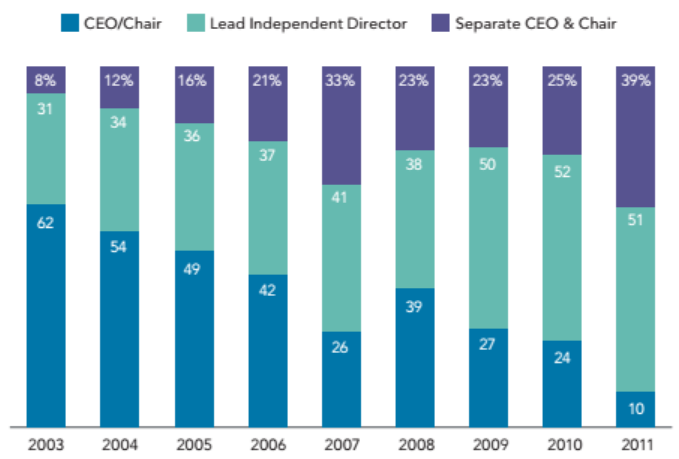
7. Le rôle du président du conseil sera davantage valorisé. La tendance veut que deux personnes distinctes occupent les postes de président du conseil et de PDG, au lieu qu’une seule personne cumule les deux, comme c’est encore trop souvent le cas. Un bon conseil a besoin d’un solide leader, indépendant du PDG.

Le rôle du Chairman est de plus en plus mis en évidence, car c’est lui qui représente le conseil auprès des différents publics. Il est de plus en plus indépendant de la direction. Les É.-U. sont plus lents à adopter la séparation des fonctions entre Chairman et CEO.

8. La diversité deviendra incontournable. Même s’il y a un plus grand nombre de femmes au sein des conseils, le déficit est encore énorme. Pourtant, certaines études montrent que les entreprises qui font une place aux femmes au sein de leur conseil sont plus rentables. Et la diversité doit s’étendre à d’autres origines culturelles, à des gens de tous âges et d’horizons divers.

La diversité dans la composition des conseils d’administration est de plus en plus la norme. On a fait des progrès remarquables à ce chapitre, mais la tendance à la diminution de la taille des CA ralentit quelque peu l’accession des femmes aux postes d’administratrices.

9. Le rôle stratégique du conseil dans l’entreprise s’imposera. Le temps où les CA ne faisaient qu’approuver les orientations stratégiques définies par la direction est révolu. Désormais, l’élaboration du plan stratégique de l’entreprise doit se faire en collaboration avec le conseil, en profitant de son expertise.

Certes, l’un des rôles les plus importants des administrateurs est de voir à l’orientation de l’entreprise, en apportant une valeur ajoutée aux stratégies élaborées par la direction. Les CA sont toujours sollicités, sous une forme ou une autre, dans la conception de la stratégie.

10. La réglementation continuera de se raffermir. Le resserrement des règles qui encadrent la gouvernance ne fait que commencer. Selon Jacques Grisé, il faut s’attendre à ce que les autorités réglementaires exercent une surveillance accrue partout dans le monde, y compris au Québec, avec l’Autorité des marchés financiers. En conséquence, les conseils doivent se plier aux règles, notamment en ce qui concerne la rémunération et la divulgation. Les responsabilités des comités au sein du conseil prendront de l’importance. Les conseils doivent mettre en place des politiques claires en ce qui concerne la gouvernance.

Les conseils d’administration accordent une attention accrue à la gouvernance par l’intermédiaire de leur comité de Gouvernance, mais aussi par leurs comités de RH et d’Audit. Les autorités réglementaires mondiales sont de plus en plus vigilantes eu égard à l’application des principes de saine gouvernance. La SEC, qui donnait souvent le ton dans ce domaine, est en mode révision de la réglementation parce que le gouvernement de Trump la juge trop contraignante pour les entreprises. À suivre !

11. La composition des conseils d’administration s’adaptera aux nouvelles exigences et se transformera. Les CA seront plus petits, ce qui réduira le rôle prépondérant du comité exécutif, en donnant plus de pouvoir à tous les administrateurs. Ceux-ci seront mieux choisis et formés, plus indépendants, mieux rémunérés et plus redevables de leur gestion aux diverses parties prenantes. Les administrateurs auront davantage de responsabilités et seront plus engagés dans les comités aux fonctions plus stratégiques. Leur responsabilité légale s’élargira en même temps que leurs tâches gagnent en importance. Il faudra donc des membres plus engagés, un conseil plus diversifié, dirigé par un leader plus fort.

C’est la voie que les CA ont empruntée. La taille des CA est de plus en plus réduite ; les conseils exécutifs sont en voie de disparition pour faire plus de place aux trois comités statutaires : Gouvernance, RH et Audit. Les administrateurs sont de plus en plus engagés et ils doivent investir plus de temps dans leurs fonctions.

12. L’évaluation de la performance des conseils d’administration deviendra la norme. La tendance est déjà bien ancrée aux États-Unis, où les entreprises engagent souvent des firmes externes pour mener cette évaluation. Certaines choisissent l’auto-évaluation. Dans tous les cas, le processus est ouvert et si les résultats restent confidentiels, ils contribuent à l’amélioration de l’efficacité des conseils d’administration.

Effectivement, l’évaluation de la performance des conseils d’administration est devenue une pratique quasi universelle dans les entreprises cotées. Celles-ci doivent d’ailleurs divulguer le processus dans le rapport aux actionnaires. On assiste à un énorme changement depuis les dix dernières années.

L’influence de l’activisme sur le renouvellement des CA


Quelle est l’influence de l’activisme actionnarial sur le renouvellement des conseils d’administration?

C’est précisément le sujet de l’excellente publication de Subodh Mishra*, directeur exécutif de Institutional Shareholder Services (ISS), parue sur le forum en gouvernance de la Harvard Law School.

Les résultats de l’étude, réalisée auprès des entreprises du S&P 1500, sont présentés d’une manière illustrative vraiment très claire.

Je vous invite à lire le sommaire de l’étude ci-dessous.

Vos commentaires sont les bienvenus.


The Impact of Shareholder Activism on Board Refreshment Trends at S&P 1500 Firms


Résultats de recherche d'images pour « actionnaires activistes »


Few business-related topics provoke more passionate discussions than shareholder activism at specific companies. Supporters view activists as agents of change who push complacent corporate directors and entrenched managers to unlock stranded shareholder value. Detractors charge that these aggressive investors force their way into boardrooms, bully incumbent directors into adopting short-term strategies at the expense of long-term shareholders, and then exit with big profits in hand.

Lost in this heated long- versus short-term debate is the significant, real-time impact that such activism has on corporate board membership and demographics. ISS identified a recent surge in its evaluation of refreshment trends at S&P 1500 firms between 2008 and 2016 (see Board Refreshment Trends at S&P 1500 Firms, published by IRRCi in January 2017). This accelerated boardroom turnover coincided with an increase in activists’ success in securing board representation, particularly via negotiated settlements. A recent study of shareholder activism by Activist Insights pegged activists’ annual U.S. boardroom gains at more than 200 seats in 2015 and 2016. While a significant portion of this activism was aimed at micro-cap firms, threats of fights have become commonplace even at S&P 500 companies in recent years.

Despite activists’ recent boardroom gains, little attention has been paid to the influence of activism on broader board refreshment trends. Anecdotal media coverage, often fanned by anti-activist communications strategies, still tends to myopically focus on two long-standing dissident nominee stereotypes: the still-wet-behind-the-ears, 20- or 30-something-year-old hedge fund analyst, and the older, male, over-boarded crony of the fund manager.

These long-standing stereotypes appear to be outdated as activism has entered an era in which most dissident nominees have attenuated ties to their hedge fund patrons. The experience, qualifications, attributes, and skills of dissident nominees can appear indistinguishable from those of the incumbent directors whom they seek to supplant. Nominees’ backgrounds and experiences can become even more interchangeable with those of incumbent directors when the latter transfuse their own ranks with new blood during, or in anticipation of, an activist campaign. This heightened competition can leave shareholders with a bounty of fresh-faced, highly-qualified, independent candidates on both nominee slates. Highlighting this narrowing divide, dissidents’ “hand-picked” nominees have been known to reject their sponsors’ wishes and strategic plans (witness Elliott Management’s first tranche of candidates at Arconic, who were seated via a settlement, opposing the hedge fund’s second attempt to gain board seats). Similarly, nominees selected by incumbent directors to face off against dissident candidates sometimes end up endorsing the very shifts in strategic direction that they were recruited to fend off (witness the DuPont board’s “victory” over Nelson Peltz’s Trian Partners, followed by board-recruited director-turned CEO Ed Breen’s advocacy of a Peltzian-style breakup of the company).

To close this board refreshment information gap, IRRCi asked ISS to explore the broader impact of activism by focusing on nominees—regardless of the entity that backed them—and the impact of dissident campaigns on boards.


Methodology


The complete publication (available here) examines the impact of public shareholder activism on board refreshment at S&P 1500 companies targeted by activists from 2011 to 2015. Public shareholder activism refers to any shareholder activism that (1) occurred between Jan. 1, 2011 and Dec. 31, 2015, and (2) was publicly disclosed. The study period concludes in 2015 so that data for a full calendar year following activist campaigns could be analyzed. Data was captured as of the shareholder meeting dates.

Part I examines individual dissident nominees on ballots (whether they ultimately joined the board or not) in proxy contests, directors appointed via settlements with activist shareholders, and directors appointed unilaterally by boards in connection with shareholder activism.

Part II examines changes to board profiles made in connection with public shareholder activism.

Data was captured for all S&P 1500 directors with less than one year of tenure at meetings scheduled to be held between Jan. 1, 2011 and Dec. 31, 2015. The directors were then assigned to one of four classifications:

  1. All dissident nominees on ballots in proxy contests;
  2. Directors appointed or nominated by incumbent boards through publicly-disclosed settlements with activist shareholders;
  3. Directors appointed or nominated unilaterally by incumbent boards in connection with public shareholder activism; and
  4. Directors appointed or nominated prior to and not in connection with public shareholder activism.

If a definitive proxy contest was settled, directors added to the board as a result of the settlement were assigned to classification two.

Data for directors assigned to classification four was excluded, as it did not relate to the impact of public shareholder activism on board refreshment during the study period.

In Part II, board profile changes were assessed through a comparison of target boards in the year prior to shareholder activism and target boards in the year following shareholder activism. For example, there was shareholder activism at J. C. Penney in connection with the company’s 2011 annual meeting. The measure of change was therefore based on a comparison of the board profiles at the company’s 2010 and 2012 annual meetings. In cases where there were two or more consecutive years of shareholder activism, board profile changes were assessed through a comparison of target boards in the year prior to the first year of shareholder activism and target boards in the year following the final consecutive year of shareholder activism. For example, there was shareholder activism at Juniper Networks in both 2014 and 2015. The measure of change was therefore based on a comparison of the board profiles at the company’s 2013 and 2016 annual meetings.

Part II examines year-over-year trends. In these cases, study companies with two or more consecutive years of shareholder activism were excluded. Study companies were grouped by market-cap segments, i.e. S&P 500 (large-cap), S&P 400 (mid-cap), and S&P 600 (small-cap). Study companies that changed indexes over the course of the study were excluded from segment-level comparisons.

In Part II, references to changes in average director age and average director tenure at study companies (excluding those discussed in isolation) refer to averages of average company-level data. Company-level data provided average age and tenure for each specific company. For references to average age and tenure at study companies, these data points were calculated by averaging the company-level (rather than director-level) data points.

Key Findings

Part I: Individual Director Demographics


Snapshot: Public shareholder activism generally leads to younger, more independent, but less diverse, board candidates who had previous boardroom experience and relevant professional pedigrees. Typically activists favor nominees with financial experience and incumbent boards favor nominees with executive experience.  


FINAL-Activism-and-Board-Refreshment-Trends-Report-Aug-2017-8.png


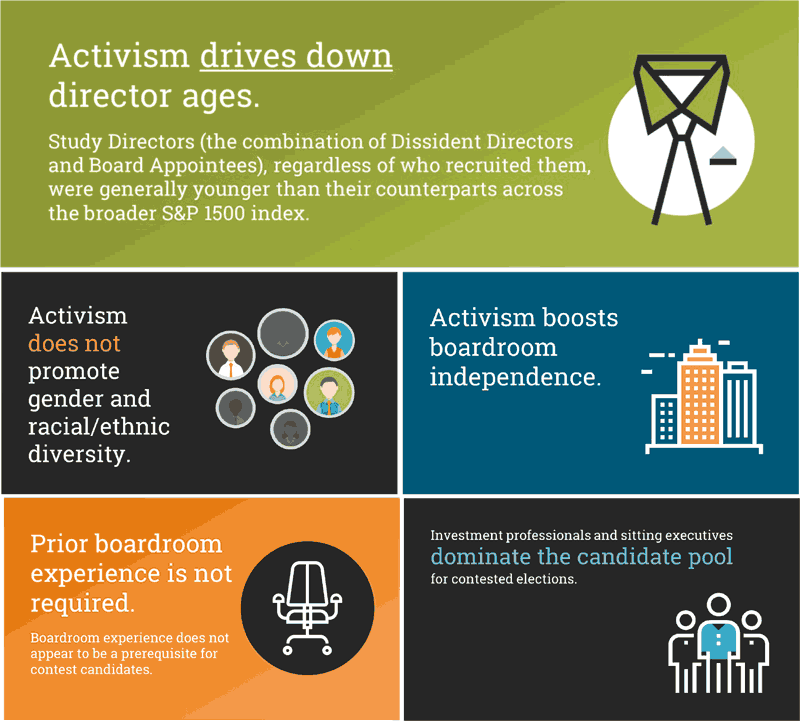
Activism drives down director ages

Dissident nominees and directors appointed via settlements (hereinafter Dissident Directors) were younger, on average, than directors appointed unilaterally by boards (hereinafter Board Appointees) in connection with shareholder activism. Study Directors (the combination of Dissident Directors and Board Appointees), regardless of who recruited them, were generally younger than their counterparts across the broader S&P 1500 index. While Dissident Directors generally reflected a wider range of ages, insurgent investors and incumbent boards both favored individuals in their fifties when picking candidates. This preference for nominees in their fifties aligns with practices in the broader S&P 1500 index over the same period.

Activism does not promote gender diversity

Less than ten percent of Study Directors were women. While the rate at which females were selected as dissident nominees or Board Appointees in contested situations increased over the course of the study, it trailed the rising tide of female board representation in the broader S&P 1500 universe*.* There were zero female Dissident Directors in 2011, two in 2012, and three in 2013. Similarly, there were two female Board Appointees in 2011, but zero in both 2012 and 2013.

Activism does not promote racial/ethnic diversity

Less than five percent of Study Directors were ethnically or racially diverse. While minority representation across the entire S&P 1500 board universe slowly increased over the course of the study, from 9.3 percent in 2011 to 10.1 percent in 2015, the rate at which individuals with diverse ethnic and racial backgrounds were selected as Dissident Directors and Board Appointees was relatively uniform and trailed that of the broader index by more than five percentage points.

Activism boosts boardroom independence

Study Directors were generally more independent than their counterparts across the broader S&P 1500. Not surprisingly, dissident nominees and directors appointed to boards via settlements were more likely to be “independent” than directors appointed unilaterally by boards in connection with shareholder activism. It is worth pointing out that the measure of “independence” focused on a nominee’s degree of separation from management rather than from the dissident. Indeed, as the examination of prior boardroom experience suggests, there may be questions of independence from activist sponsors for a subset of Study Directors.

Prior boardroom experience is not required. Boardroom experience does not appear to be a prerequisite for contest candidates. More than half of Study Directors held outside board seats. While most of these directors sat on either one or two outside boards, a sizable minority pushed the over-boarded envelope. Six Study Directors served on four outside boards, four on five outside boards, and one on six outside boards. Many of these “busy” directors appear to be “go-to” nominees for individual activists. The serial nomination of favorite candidates raises questions about the “independence” of these individuals from their activist sponsors.

Investment professionals and sitting executives dominate the candidate pool for contested elections

Occupational data for the Study Directors demonstrates experience, qualifications, attributes, and skills (EQAS) preferences for nominees in contested situations. “Corporate executives” and “financial services professionals” were in a dead heat at the front of the pack. These favored occupations were not evenly distributed, as activists tended to select investors and incumbents tended to select executives. In fact, Dissident Directors were nearly three times more likely to be “financial services professionals” than Board Appointees, while Board Appointees were nearly twice as likely to be “executives” than Dissident Directors.


Part II: Board Profile


FINAL-Activism-and-Board-Refreshment-Trends-Report-Aug-2017-10.png


Snapshot: Public shareholder activism generally resulted in boards that are younger, shorter-tenured, slightly-larger, more independent, and more financially literate, but less diverse, than their pre-activism versions.


FINAL-Activism-and-Board-Refreshment-Trends-Report-Aug-2017-11.png


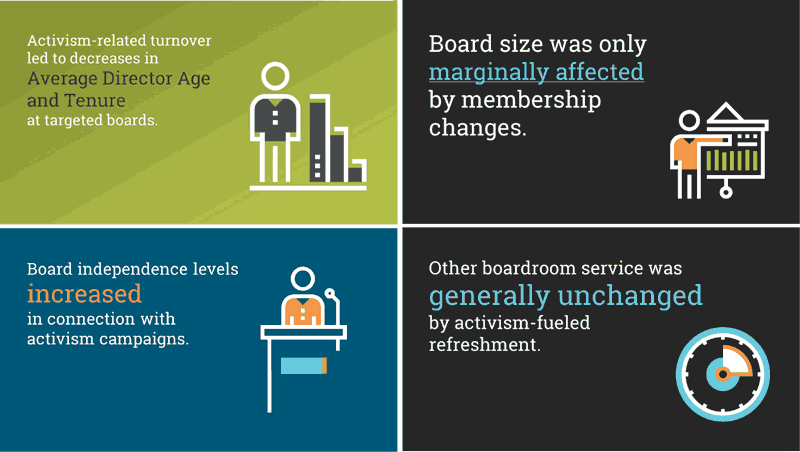
Activism-related turnover led to decreases in average director age and tenure at targeted boards

Dissident Directors averaged 53 years of age and Board Appointees averaged 56.3 years of age. Average director age decreased by 2.6 years to 59.6 years on Study Boards targeted by shareholder activists, while average director tenure decreased by 3.4 years to 6.1 years. For the broader S&P 1500 in 2015, average director age was 62.5 years and average tenure was 8.9 years.

Board size remained relatively steady despite membership changes

Although average board size at Study Companies increased from nine to 9.4 seats, less than half (41.9 percent) of the Study Companies experienced a post-activism boost in board size. 18.3 percent of Study Companies experienced a decline in board size following shareholder activism, while board size was unchanged at 39.8 percent of Study Companies.

Board independence levels increased in connection with activism campaigns

Average board independence at Study Companies increased from 79.5 percent to 83 percent. More than 60 percent of study companies experienced an increase in independence, 21.5 percent experienced a decrease, and 18.3 percent experienced no change. Average board independence in the S&P 1500 was 80.6 percent in 2015.

Other boardroom service was generally unchanged by activism-fueled refreshment

The average number of outside boards on which Study Company directors served remained virtually flat, increasing from 0.8 to 0.9. Of the 89 Study Companies, the number without a director who sat on more than one outside board decreased from four to two. There was a correlation between company size and outside board service, as directors at S&P 500 and S&P 400 study companies sat on a higher average number of outside boards than their counterparts at S&P 600 study companies.

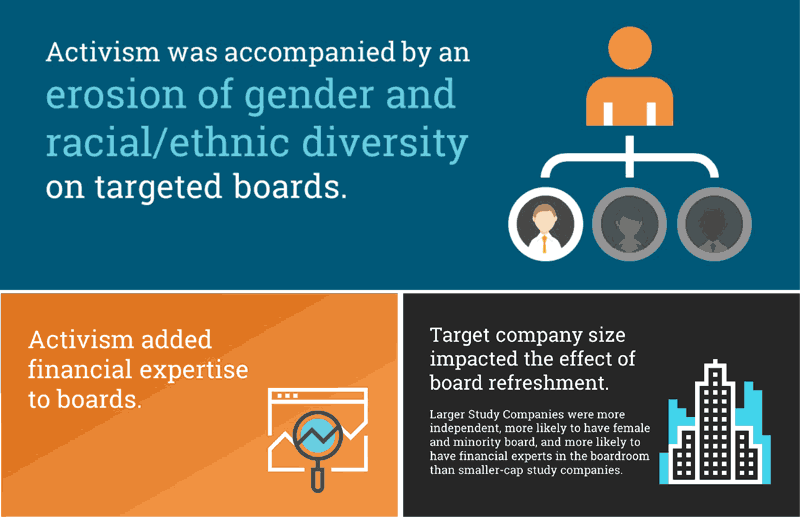
Activism was accompanied by an erosion of gender and racial/ethnic diversity on targeted boards

Study Company boards were less likely to have at least one female director following an activism campaign than they were preceding one, decreasing from 87.1 percent to 82.8 percent. Similarly, Study Company boards were less likely to have at least one minority director following an activism campaign than they were preceding one, decreasing from 55.9 percent to 51.6 percent. According to Board Refreshment Trends at S&P 1500 Firms, the proportion of S&P 1500 companies with at least one female director increased from 72 percent in 2011 to 82.7 percent in 2015 and the portion of S&P 1500 companies with at least one minority board member increased through the course of the study period to 56.8 percent.

Activism added financial expertise to boards

The proportion of board seats at Study Companies occupied by “financial experts” increased from 22.6 percent (189 of 835) to 24.5 percent (214 of 874). The number of Study Companies with at least one, two, or three “financial experts” also increased. (At U.S. companies, ISS considers a director to be a “financial expert” if the board discloses that the individual qualifies as an “Audit Committee Financial Expert” as defined by the Securities and Exchange Commission under Items 401(h)(2) and 401(h)(3) of Regulation S-K. Under the SEC’s rules, a person must have acquired their financial expertise through (1) education and experience as a principal financial officer (PFO), principal accounting officer (PAO), controller, public accountant or auditor or experience in one or more positions that involve the performance of similar functions, (2) experience actively supervising a PFO, a PAO, controller, public accountant, auditor or person performing similar functions; (3) experience overseeing or assessing the performance of companies or public accountants with respect to the preparation, auditing or evaluation of financial statements or (4) other relevant experience.)

Target company size impacted the effect of board refreshment

Larger Study Companies were more independent, more likely to have female and minority board members (both pre- and post- activism), and more likely to have financial experts in the boardroom than smaller-cap study companies. Relative to their larger peers, smaller Study Companies generally experienced more pronounced declines in average director age and tenure, but experienced more significant increases in average board size.

The complete publication is available here.

________________________________________________

Subodh Mishra* is Executive Director at Institutional Shareholder Services, Inc. This post is based on a co-publication by ISS and the Investor Responsibility Research Center Institute. Related research from the Program on Corporate Governance includes The Long-Term Effects of Hedge Fund Activism by Lucian Bebchuk, Alon Brav, and Wei Jiang (discussed on the Forum here).

L’internationalisation des codes de gouvernance contribue à la clarification des rôles des activistes


Voici un article de sensibilisation à l’internationalisation des règles de bonne gouvernance et des rôles respectifs que les actionnaires-investisseurs et les conseils d’administration sont appelés à prendre en compte.

On assiste à une plus grande volonté des actionnaires, réunis en groupes d’investisseurs institutionnels, en société de prise de position importante (hedge funds ou actionnaires activistes), de s’engager dans la gouvernance des entreprises. En fait, on peut parler d’un actionnariat de plus en plus actif à l’échelle internationale.

Cet article, publié par Jennifer G. Hill, professeure de droit corporatif à l’université de Sydney, atteste clairement, à l’instar du UK Stewardship Code, de l’importance mondiale des guides de gouvernance qui réclament un rééquilibrage des pouvoirs entre les CA (fiduciaires des actionnaires) et les regroupements d’actionnaires.

Ces codes de gouvernance émanent de différentes sources, mais tous mettent l’accent sur la gestion à long terme des affaires des sociétés. L’auteure mentionne que les codes de conduite peuvent être introduits (1) par les organismes réglementaires des pays (2) par certains regroupements industriels ou (3) par les actionnaires-investisseurs eux-mêmes.

L’article conclut que l’adoption de ces nouveaux codes de Stewardship peut aider à définir de nouvelles règles de conduite qui permettront de départager les « bons activistes des mauvais activistes » !

Les conseils d’administration doivent donc être de plus en plus conscients que le phénomène de l’engagement et de l’activisme des actionnaires est un mouvement mondial, et qu’ils devront faire preuve d’ouverture dans leur rôle de fiduciaire.

Bonne lecture ! Vos commentaires sont appréciés.


Good Activist/Bad Activist: The Rise of International Stewardship Codes


Résultat de recherche d'images pour "UK Stewardship Code"


Conflicting attitudes toward shareholder engagement and activism have colored the ongoing debate about the effect of shareholder influence on corporate governance. In the US, a distinctly negative view of investor engagement underpins much recent discussion on this topic—from the shareholder empowerment debate to current concerns about investor activism and private ordering through shareholder-initiated bylaws.

Outside the United States, however, a powerful alternative narrative about the benefits of increased shareholder engagement in corporate governance has gained traction in many major jurisdictions. This positive narrative treats investors as having an important participatory role in corporate governance, which is integral to accountability. It supports a radically different regulatory response to its negative counterpart, suggesting that shareholders should be granted stronger rights and/or encouraged to make greater use of their existing powers to engage with the companies in which they invest.

In my recent article, Good Activist/Bad Activist: The Rise of International Stewardship Codes, I examine a particularly important recent manifestation of this positive view of shareholder engagement—stewardship codes. My article, which will appear in 41 Seattle U. L. Rev. (special issue on Investor Time Horizons, forthcoming December 2017), charts the rise of international Stewardship Codes and discusses the implications of this development for the balance of power between shareholders and boards in public corporations.

International Stewardship Codes, which originated in the United Kingdom following the global financial crisis, are now proliferating throughout the world, especially in Asia. These codes indicate that in some jurisdictions, the debate today is less about controlling shareholder power than about constraining board power, by encouraging shareholders to exercise their legal rights and increase their level of engagement in corporate governance. The codes represent a generalized regulatory response to a common complaint following the 2007-2008 global financial crisis—namely, “where were the shareholders?”.

Stewardship Codes seek to ensure that shareholders, particularly institutional investors, are active players in corporate governance. Proponents of these codes have made large claims about their benefits. The UK Stewardship Code has stated, for example, that “the goal of stewardship is to promote the long term success of companies” and that “[e]ffective stewardship benefits companies, investors and the economy as a whole.”

Many countries have now jumped on the Stewardship Code bandwagon. The various Stewardship Codes around the world emanate, however, from different issuing bodies, and this can influence a code’s effectiveness. There are at least three distinct categories of Stewardship Code:

  1. those issued by regulators or quasi-regulators on behalf of the government;
  2. those initiated by certain industry participants; and
  3. codes adopted by investors themselves.

The United States joined this third category in January 2017, when the Investor Stewardship Group (ISG) released its Framework for US Stewardship and Governance (discussed on the Forum here). Although the ISG framework is voluntary, it has the backing of some of the world’s largest asset managers, including founding members, such as BlackRock, State Street Global Advisors and Vanguard.

Many of the Stewardship Codes that now operate around the world are based on the UK Stewardship Code or Japanese Stewardship Code. My article examines similarities and differences in these international Stewardship Codes. As the article shows, the recent adoption of the ISG Stewardship Principles in the US has not occurred in a vacuum. Rather, it is part of a sustained international push for greater investor involvement in corporate governance and exemplifies the increasing globalization of corporate governance.

These developments and competing narratives concerning the role of shareholders in corporate governance have significant regulatory implications. In particular, they pose future challenges to regulators in seeking to differentiate between “good activists” and “bad activists”.

The complete article is available here.

Compte rendu hebdomadaire de la Harvard Law School Forum on Corporate Governance | 12 octobre 2017


Voici le compte rendu hebdomadaire du forum de la Harvard Law School sur la gouvernance corporative au 12 octobre 2017.

Cette semaine, j’ai relevé les dix principaux billets.

Bonne lecture !


Résultats de recherche d'images pour « harvard law school forum on corporate governance »


Résultats de recherche d'images pour « harvard law school forum on corporate governance »


  1. 2017 Proxy Season Review: Compensation
  2. P&G Proxy Fight: Trian Pushes to Reevaluate Executives’ Incentive Compensation Goals
  3. S&P 500 CEO Compensation Increase Trends
  4. Ambiguity and the Corporation: Group Disagreement and Underinvestment
  5. The Yates Memo: Looking for “Individual Accountability” in All the Wrong Places
  6. Preventing the Next Data Breach
  7. 2017-2018 ISS Global Policy Survey
  8. Good Activist/Bad Activist: The Rise of International Stewardship Codes
  9. So You Want to Buy a Stake in a Private Equity Manager?
  10. Fiduciary Principles and Delaware Corporation Law

« Benchmark » global en matière de politique de gouvernance | ISS


Subodh Mishra, Directeur exécutif à Institutional Shareholder Services (ISS) a publié le résultat des études de ISS visant à établir un « benchmark » global en matière de politique de gouvernance.

Voici les cinq domaines de recherche :

  1. One-Share One-Vote Principle
  2. Gender Diversity on Boards
  3. Share Issuance and Buyback Proposals
  4. Virtual/Hybrid Meetings
  5. Pay Ratio Between Senior Executives and Employees

L’étude présente les résultats sous forme de tableaux assez explicites.


Bonne lecture !


2017-2018 ISS Global Policy Survey


Résultats de recherche d'images pour « ISS annual global benchmark policy »


A key part of ISS’ annual global benchmark policy formulation process is a survey which is open to institutional investors, corporate executives, board members and any other interested constituencies. For the 2017-2018 policy cycle, the survey was in two parts: (1) a short, high-level Governance Principles Survey covering a limited number of topical corporate governance areas and (2) a longer, more detailed supplemental survey allowing respondents to drill down into a wider set of key issues at market and regional levels. This document summarizes the findings of the Governance Principles Survey, which closed on August 31. The supplemental survey will remain open until October 6, 2017, at 5 PM (ET).

The response to the Governance Principles Survey was strong. In total, ISS received 602 responses to the survey, from a total of 571 different organizations. Responses were received from 121 institutional investors, representing 116 organizations, including 103 asset managers and 18 asset owners. An additional 10 responses were received from organizations that represent or provide services to institutional investors; these results were aggregated with the investor responses, bringing the total investor responses to 131. Two investors provided responses to ISS after the survey’s deadline, which were not aggregated in the results. For purposes of this report, survey results are based on 129 “investor” responses.

Responses were also received from 382 corporate issuers, several of whom submitted multiple responses. Additional non-investor survey responses were received from 46 consultants/advisors to companies; 28 corporate directors; and 13 organizations that represent or provide services to issuers. Responses from these corporate constituents were aggregated with the issuer responses, bringing the total “non-investor” responses to 469.

As in past years, the largest number of respondents—more than 400 in all—were from organizations based in the United States, with 51 from groups based in Canada, and 84 from groups based in Europe and/or the U.K. Responses were also received from organizations in, but not limited to, Australia, Hong Kong, Singapore, India, Brazil, Russia and Bermuda. Many respondents have a focus that goes beyond their own home country.

Primary Market of Focus Investor Non-Investor
Global (most or all of the below) 49% 19%
U.S. 28% 62%
Continental Europe 7% 4%
Asia-Pacific 5% 3%
U.K. 4% 2%
Canada 3% 6%
Developing/emerging markets generally 2% 0%
Other (includes Australia, Switzerland, or combination of two other markets) 2% 1%
Latin America 0% 1%

The breakdown of investors by the size of their assets owned or assets under management was as follows:

Asset Size % of Investor Respondents
Under $100 million 2%
$100 million–$500 million 9%
$500 million–$1 billion 4%
$1 billion–$10 billion 19%
$10 billion–$100 billion 26%
Over $100 billion 35%
Not applicable 6%

Some of the respondents answered every survey question; others skipped one or more questions. Throughout this report, response rates are calculated as percentages of the valid responses received on each particular question from investors and from non-investor respondents, excluding blank responses. Survey participants who filled out the “Respondent Information” but did not answer any of the policy questions were excluded from the analysis and are not part of the breakdown of respondents above.

Key Findings

One-Share One-Vote Principle

The global debate over shareholders’ voting rights and multi-class share schemes has exploded in recent years thanks to a series of high-profile share issuances that deviated from one-share, one-vote. The recent initial public offering of Snap Inc. in the U.S., which offered only non-voting shares to the public, raised the stakes.

ISS solicited respondents’ views on multi-class capital structures that carry unequal voting rights.

Among investors, a large minority (43 percent) indicated that they considered unequal voting rights are never appropriate for a public company in any circumstances. An equal proportion of investors (43 percent) said unequal voting rights structures may be appropriate in the limited circumstances of newly-public companies if they are subject to automatic sunset requirements or at firms more broadly if the capital structure is put up for periodic reapproval by the holders of the low-vote shares. Only five percent of investor respondents agreed with the opinion that companies should be allowed to choose whatever capital structure they see fit.

Among non-investors, 50 percent responded that companies should be allowed to choose whatever capital structure they see fit, while 27 percent responded that a multi-class structure may be appropriate at a newly public company if subject to an automatic sunset provision or more broadly if reapproved on a periodic basis by the low-vote

shareholders. Only 11 percent responded that multi-class structures with unequal voting rights are never appropriate for a public company in any circumstances.

Among investors, one respondent commented that “where the existence of multiple share classes creates a ‘controlling entity’ as a minimum the board must be able to demonstrate how it can operate independently of that entity.” Several non-investor respondents indicated that companies should be allowed to choose their own corporate structure given that shareholders can choose not to invest in the issuer’s shares if they dislike the structure.

Gender Diversity on Boards

The global focus on increasing gender diversity in corporate boardrooms has grown in recent years. ISS asked respondents if they would consider it problematic if there are zero female directors on a public company board. More than two-thirds (69 percent) of investor respondents said “yes.” The lion’s share of these respondents (43 percent) said that the absence of women directors could indicate problems in the board recruitment process, while 26 percent of investor respondents said that although a lack of female directors would be problematic, their concerns may be mitigated if there is a disclosed policy/approach that describes the considerations taken into account by the board or the nominating committee to increase gender diversity on the board. Fewer than one in ten (8 percent) of investor respondents agreed with the statement that directors are best suited to determine the board composition and that a lack of women directors is not necessarily problematic.

Slightly less than one-quarter (23 percent) of the investor respondents indicated that they may find the lack of female directors on a board to be problematic based on a case-by-case analysis. Among the factors cited by investor respondents in making such a case-by-case determination were: the appropriateness of the existing directors based on their experience and skill sets; whether the board is composed of people who are capable of representing shareholders; company size; and turn-around situations.

Of the investor respondents who indicated that the lack of female directors on a public board is or could be problematic, the highest number cited engagement with the board and/or management as the most appropriate response. The second most popular response was to consider supporting a shareholder proposal aimed at increasing diversity. The investor respondents’ third-highest favored action was supporting a shareholder-nominated candidate.

A majority (54 percent) of the non-investor respondents answered “yes” when asked if the absence of a single woman director on a board is problematic, although more than half of these respondents said their concerns might be mitigated by a company’s disclosed policy or approach. Only around one of every five (19 percent) of non-investor respondents said that a lack of diversity was not a concern given that sitting directors are best suited to determine board composition. Of those non-investor respondents who indicated that the absence of female directors on the board may be problematic based on a case-by-case determination, comments often mirrored those of the investor respondents with respect to taking directors’ experience and skill sets into consideration. Other non-investor commenters expressed concern about adopting “quotas,” or a one-size-fits-all policy applicable to all industries and all types of companies.

Like the investor respondents, non-investors’ most commonly preferred investor action in response to a lack of gender diversity was engagement with the board and management. Unlike the investor respondents, however, the non-investors favored votes against members of the nominating committee rather than support for a shareholder nominee to the board.

Share Issuance and Buyback Proposals

Cross-market companies (i.e. incorporated in one country, listed in one or more others) can create unique corporate governance challenges given differences in legal requirements, listing standards and market norms. Voting on share issuances and buybacks at cross-market companies can be particularly complex given significant market-specific differences in shareholders’ rights to approve or ratify such capital allocation issues.

ISS asked survey respondents to provide their views on share issuances and buybacks as a general matter.

Among the investor respondents, 13 percent indicated that both share issuances and buybacks are matters for the board to decide. Forty-four percent of the investor respondents said that both share issuances and buybacks should generally be voted upon by shareholders. More than one-quarter (27 percent) of the investor respondents indicated their preference for shareholder votes on share issuances, but they favored leaving share buybacks to the board’s discretion. Combining these results, more than seven out of ten of the investor respondents favored votes on share issuances while less than half of them called for votes on buybacks.

Among non-investor respondents, a significant majority (61 percent) supported the view that both share issuances and buybacks are matters for the board to decide.

As a follow-up question, respondents were asked to provide their views specifically on share issuance and buyback proposals at U.S.-listed, but non-U.S.-incorporated companies.

Investors’ responses were split. More than one-third (36 percent) of the investors agreed that since the proposals are on the ballot due to the laws of the market of incorporation, the company should follow the customary practices of that market. At the other end of the spectrum, 26 percent of the respondents indicated that as long as the company follows customary U.S. capital market practices, the proposal should be treated as routine, so as not to disadvantage a cross-market firm vis-à-vis its US-domiciled peers. One-quarter of the investors supported a hybrid approach that is less restrictive than many European markets’ best practices but that protects shareholders from excessive dilution in situations not covered by NYSE and NASDAQ listing rules.

On the other hand, a majority of the non-investor respondents (55 percent) supported the view that as long as the company follows customary U.S. capital market practices, the proposal should be treated as routine, so as not to disadvantage a cross-market firm vis-à-vis its U.S.-domiciled peers.

Virtual/Hybrid Meetings

In the U.S., UK and some other markets worldwide, companies are permitted to use electronic means of communication to facilitate the participation of shareholders at general meetings. While there are benefits to allowing shareholders to participate remotely, some investors have raised concerns that replacing physical meetings with virtual-only meetings may hinder meaningful exchanges between board members and shareholders.

Survey respondents were asked to provide their view on the use of remote means of communication for facilitating shareholder participation at general meetings, i.e., “hybrid” or “virtual-only” shareholder meetings.

About one out of every five (19 percent) of the investors said that they would generally consider the practice of holding either “virtual-only” or “hybrid” shareholder meetings to be acceptable, without reservation. At the opposite extreme, 8 percent of the investors did not support either “hybrid” or “virtual-only” meetings. More than one-third (36 percent) of the investor respondents indicated that they generally consider the practice of holding “hybrid” shareholder meetings to be acceptable, but not “virtual-only” shareholder meetings. Another 32 percent of the investor respondents indicated that the practice of holding “hybrid” shareholder meetings is acceptable, and that they would also be comfortable with “virtual-only” shareholder meetings if they provided the same shareholder rights as a physical meeting.

Among non-investor respondents, a plurality (42 percent) indicated that “virtual-only” or “hybrid” shareholder meetings are acceptable without reservation. However, among the majority of non-investor respondents who did not support that view, 22 percent indicated that, generally, the practice of holding “hybrid” meetings is acceptable, and they would also be comfortable with “virtual-only” meetings if they provided the same shareholder rights as a physical meeting, while 15 percent did not support the practice of holding either “hybrid” or “virtual” meetings.

Pay Ratio Between Senior Executives and Employees

Barring some last minute legislative roadblock, U.S. issuers will be required to disclose the ratio of CEO pay to the pay of the median company employee in their proxy statements for the 2018 season. Similar pay ratio information will also be required of UK companies from 2018. In anticipation of these new disclosures, ISS asked respondents how they intend to analyze data on pay ratios.

Somewhat surprisingly, only 16 percent indicated that they are not planning to make use of this new information. Nearly three-quarters of the investor respondents indicated that they intend to either compare the ratios across companies/industry sectors, or assess year-on-year changes in the ratio at an individual company or use both of these methodologies. Of the 12 percent of investors who selected “other” as their response, some of them indicated a wait-and-see approach while other comments indicated uncertainty or concerns regarding the usefulness of the pay ratio data.

Among non-investor respondents, a plurality (44 percent) expressed doubt about the usefulness of such pay ratio data. Many of them expressed skepticism that the data would be meaningful, with one non-investor respondent commenting: “For a company having a widespread international exposure, the pay ratio is considered irrelevant.” Other commenters cited a variety of factors that would complicate peer comparisons, including demographic and geographic disparities and the use of part-time or contract workers. Notably, however, 21 percent of the non-investor respondents indicated that they intend both to compare the ratios across companies/industry sectors and assess year-on-year changes in the ratio at an individual company.

Respondents were also asked how shareholders should use disclosed data on pay ratios. Among investor respondents, the most frequent response was to use it as one data point in determining votes on compensation-related resolutions, followed by using it as background material for engagement with the company. Among non-investor respondents, the most frequent response was that the information as disclosed will not be meaningful to shareholders.

Appendix: Detailed Survey Responses

Survey results are based on 129 investor responses (primarily asset managers and asset owners) and 469 responses from non-investors (primarily companies and their advisers), reflecting more than one response from some organizations.

For questions that allowed multiple answers, rankings are based on the number of responses for each answer choice. Percentages for other questions may not equal 100 percent due to rounding.

1. One-Share, One-Vote Principle

The “one-share, one-vote principle”—the idea that long-term shareholder value is best protected by a capital structure in which voting power corresponds to each shareholder’s ownership stake and at-risk capital commitment—is increasingly under attack as some companies have sought to access public capital markets while insulating themselves and their management teams from perceived short-term pressures through differential voting rights. The recent IPO of Snap Inc. in the U.S. pushed the envelope by offering shares to the public with no voting rights at all. A number of other companies, such as Alphabet, Facebook and Blue Apron, utilize capital structures where public shareholders may only purchase low or zero voting rights shares. As stock markets increasingly find themselves in global competition for high-profile listings (e.g. Alibaba Group Holding, Saudi Aramco), they may feel pressure to relax or eliminate long-standing rules designed to protect investors. Short-term demand for a “hot” stock can potentially make it appear as if shareholders, as a group, do not place a high priority on voting rights. Some investors who purchase shares in an IPO may not prioritize good corporate governance and shareholder rights if they do not plan to hold their shares for the long term. Meanwhile, long-term shareholders who may normally prioritize good governance may nevertheless be forced to buy shares of companies with substandard shareholder rights as soon as those firms are included in a major stock index.

Which of the following represents your organization’s view of multi-class capital structures with unequal voting rights?

Investor Non-Investor
Companies should be allowed to choose whatever capital structure they see fit. 5% 50%
They are never appropriate for a public company in any circumstances. 43% 11%
They may be appropriate for certain newly-public companies, but should be subject to an automatic sunset provision based on time elapsed since the IPO. 18% 9%
They may be appropriate for certain newly-public companies, but should be subject to an automatic sunset provision based on the market capitalization of the company. 7% 5%
They may be appropriate for certain public companies, but should be subject to periodic reapproval by the holders of the low-vote shares. 18% 13%
Other 9% 12%

2. Gender Diversity on Boards

The focus on gender diversity in corporate boardrooms has increased in numerous markets in recent years. Many of these markets have implemented enhanced disclosure requirements, best practice recommendations or regulatory quotas to drive increased female representation on public company boards. Despite this heightened attention, there have been varying levels of progress amongst companies in increasing the number of female directors on boards and some institutional investors continue to express frustration with a perceived lack of progress in boosting gender diversity in certain markets or industry sectors.

Does your organization consider it to be problematic if there are zero female directors on a public company board?

Investor Non-Investor
Yes, the absence of at least one female director may indicate problems in the board recruitment process. 43% 25%
Yes, but concerns may be mitigated if there is a disclosed policy/approach that describes the considerations taken into account by the board or the nominating committee to increase gender diversity on the board. 26% 29%
No, directors are best-suited to determining the composition of the board. 8% 19%
Maybe, but the level of concern is based on a case-by-case determination (e.g., it depends on the country; type of company; industry sector or other factors) (Please specify below) 23% 27%

If your organization answered “Yes” or “Maybe” to the preceding question, what actions do you consider may be appropriate for shareholders to take at a company that lacks any gender diversity on the board, and/or has not disclosed a policy on the issue? (Check all that apply)

Investors’ Rank Non-Investors’ Rank
Engage with the board and/or management 1 (92) 1 (312)
Consider supporting a shareholder proposal aimed at increasing diversity 2 (83) 2 (82)
Consider supporting a shareholder-nominated candidate to the board 3 (60) 5 (39)
Consider voting against all members of the nominating/governance committee 5 (45) 4 (46)
Consider voting against the chair of the nominating/governance committee 4 (53) 3 (50)
Consider voting against the chair of the board or lead director 6 (42) 6 (35)
Consider voting against the Report & Accounts (in markets where this is an option) reflecting poor disclosure of gender diversity 7 (18) 8 (4)
Other 8 (3) 7 (21)

*Rankings are based on number of responses for each answer choice.

3. Share Issuance and Buyback Proposals

Rules regarding shareholder approval of share issuances and buybacks vary by market. US listing rules do not require shareholder approval for share repurchases, and only require shareholder approval for share issuances in excess of 20 percent of issued capital where such issuances are private placements at a price below book value or market value, or where the issuances will result in a change of control or are in connection with an acquisition. Any other share issuances, up to the number of shares authorized in the charter, do not require a shareholder vote. By contrast, many European markets in principle require shareholder approval of all share issuances and share buybacks, but allow companies to seek approval for annual mandates covering share issuances during the coming year, up to a specified percentage of issued capital, or share buybacks during the coming year.

These differing approaches to shareholder approval of share issuances and buybacks create challenges at cross-market companies. US-listed companies incorporated in markets such as the UK, Ireland and the Netherlands may, for example, be required by the laws of their country of legal domicile to seek shareholder approval for share issuances or share repurchases that would not otherwise be required under the rules of their stock market listing. In such a situation, ISS currently evaluates such proposals under the policy of the country of incorporation. However, such policies are generally aligned with local listing rules or codes of best practice, which may not strictly apply to companies not listed in those markets. Also under consideration however is that companies that are incorporated in markets requiring shareholder votes on issuances and repurchases often have a relatively large number of authorized but unissued shares, compared to their US-domiciled counterparts, and therefore the potential for dilution is correspondingly greater. Moreover, regulations and best practice codes, particularly in the UK and Ireland, distinguish between share issuances with and without preemptive rights, while preemptive rights have all but disappeared from the US market.

In light of these issues, ISS is currently reviewing its policies applicable to share issuances and buybacks at such cross-market companies.

As a general matter, which of the following best matches your organization’s views?

Investor Non-Investor
Share issuances and buybacks are matters for the board of directors to decide 13% 61%
Share issuances and buybacks should generally be voted upon by shareholders 44% 8%
Share issuances should be voted upon by shareholders, but share buybacks should be left to the board’s discretion 27% 14%
It depends on the market 13% 9%
Other 4% 9%

Which of the following best describes your organization’s view of share issuance and buyback proposals at US-listed, but non-US-incorporated companies?

Investor Non-Investor
As long as the company follows customary US capital market practices, the proposal should be treated as routine, so as not to disadvantage a cross-market firm vis-à-vis its US-domiciled peers. 26% 55%
As the proposals are on the ballot due to the laws of the market of incorporation, the company should follow the customary practices of that market. 36% 18%
A hybrid approach is called for, to protect shareholders from excessive dilution in situations not covered by NYSE and NASDAQ listing rules, while being less restrictive than European best practices. 25% 11%
Other (please specify) 14% 16%

4. Virtual/Hybrid Meetings

In the US, UK and some other markets worldwide, companies are permitted to use electronic means of communication to facilitate the participation of shareholders at general meetings. In some cases, companies may employ technological means to allow such participation as a supplement to the physical meeting (these are known as “hybrid meetings”), while in other cases the “virtual shareholder meeting” entirely supplants the physical meeting. In the UK, a number of companies have sought or are seeking shareholder approval to amend their articles of association in order to be able to hold hybrid or virtual-only shareholder meetings. In the US, companies have generally made the switch to a hybrid or virtual-only meeting without a shareholder vote, following changes in state laws on the matter.

Currently, the practice of holding virtual shareholder meetings is rare in the UK: only one company held a virtual meeting in 2016 and 2017. In the US, the practice is more widespread: over 160 companies held virtual-only meetings in the first half of 2017, and an additional 16 companies held hybrid meetings. Allowing shareholders to take part remotely can increase participation, and eliminating the physical meeting can reduce costs. However, some investors have raised concerns about the trend toward abandoning physical meetings, arguing that virtual-only meetings may hinder meaningful exchanges between management and shareholders, or allow management to avoid uncomfortable questions.

Please describe your organization’s view on the use of remote means of communication for facilitating shareholder participation at general meetings, i.e., “hybrid” or “virtual-only” shareholder meetings.

Investor Non-Investor
My organization generally considers the practice of holding “virtual-only” or “hybrid” shareholder meetings to be acceptable. 19% 42%
My organization generally considers the practice of holding “hybrid” shareholder meetings to be acceptable, but not “virtual-only” shareholder meetings. 36% 22%
My organization generally considers the practice of holding “hybrid” shareholder meetings to be acceptable, and would also be comfortable with “virtual-only” shareholder meetings if they provided the same shareholder rights as a physical meeting. 32% 22%
My organization does not support the practice of holding “hybrid” or “virtual” shareholder meetings. 8% 15%
Other 5% 12%

5. Pay Ratio Between Senior Executives and Employees

Beginning in 2018 (unless the rule is repealed prior to implementation), U.S. issuers will be required to report in their proxy statement the ratio of CEO pay to the pay of the median company employee. Similar rules have been proposed in the UK, where companies are already required to compare the year-on-year percentage change in compensation between the CEO and other employees (though long-term incentives are excluded). The EU Shareholder Rights Directive, which member states will have to incorporate into their local laws by 2019, requires disclosure of the annual change in each executive’s pay over five years, along with company performance and the change in average employee pay.

How does your organization intend to analyze data on pay ratios?

Investor Non-Investor
Compare the ratios across companies/industry sectors 6% 12%
Assess year-on-year changes in the ratio at an individual company 3% 8%
Both of the above 63% 21%
My organization is not planning to use this information 16% 44%
Other 12% 16%

In your organization’s view, how should shareholders use disclosed data on pay ratios? (Check all that apply)

Investors’ Rank Non-Investors’ Rank
As one data point in determining votes on compensation-related resolutions 1 (81) 3 (86)
As one data point in determining votes on directors 3 (49) 4 (29)
As background material for engagement with the company 2 (71) 2 (97)
As a risk factor to be weighed in making investment decisions 4 (46) 5 (28)
The information as disclosed will not be meaningful to shareholders 5 (16) 1 (248)
Other 6 (11) 4 (29)

*Rankings are based on number of responses for each answer choice.


Compte rendu hebdomadaire de la Harvard Law School Forum on Corporate Governance | 5 octobre 2017


Voici le compte rendu hebdomadaire du forum de la Harvard Law School sur la gouvernance corporative au 5 octobre 2017.

Cette semaine, j’ai relevé les dix principaux billets.

Bonne lecture !


Résultats de recherche d'images pour « harvard law school forum on corporate governance »


Résultats de recherche d'images pour « harvard law school forum on corporate governance »


  1. Long-Term Pay-For-Performance Alignment
  2. Activism and Board Diversity
  3. SEC (Limited) Guidance on Pay-Ratio Disclosure
  4. Corporate Governance: Stakeholders
  5. Finding Common Ground on Shareholder Proposals
  6. Improving SEC Regulations with Investor Ordering
  7. The Long-Term Consequences of Short-Term Incentives
  8. CEO and Executive Compensation Practices: 2017 Edition
  9. Lessons from the ISS Report on the Trian/P&G Proxy Contest
  10. The Inner Workings of the Board: Evidence from Emerging Markets

Compte rendu hebdomadaire de la Harvard Law School Forum on Corporate Governance | 28 septembre 2017


Voici le compte rendu hebdomadaire du forum de la Harvard Law School sur la gouvernance corporative au 28 septembre 2017.

Cette semaine, j’ai relevé les dix principaux billets.

Bonne lecture !


Résultats de recherche d'images pour « harvard law school forum on corporate governance »


Résultats de recherche d'images pour « harvard law school forum on corporate governance »


  1. Forging Ahead with “Entire Fairness,” or Playing it Safer (Procedurally Speaking)
  2. Activism: The State of Play
  3. New Disclosure Requirements in Form ADV
  4. Merger Negotiations in the Shadow of Judicial Appraisal
  5. SEC’s Latest Guidance on Pay Ratio Rule
  6. Enjoying the Quiet Life: Corporate Decision-Making by Entrenched Managers
  7. Oversight of the U.S. Securities and Exchange Commission
  8. CEOs and ISS’ Proxy Contest Framework
  9. The Evolution of the Private Equity Market and the Decline in IPOs
  10. Activism’s New Paradigm

L’activisme et les effets sur la diversité des CA


Comment se font les nominations d’administrateurs lorsqu’un fond activiste du type « hedge funds » intervient lors des élections aux assemblées générales annuelles ?

La recherche menée par David A. Katz* et Laura A. McIntosh*, de la firme Wachtell, Lipton, Rosen & Katz, montrent clairement que les fonds activistes agressifs (hedge funds) proposent des candidats qui ne contribuent pas à la diversité du CA (en genre et en race) si l’on compare à la moyenne des entreprises du S&P 500.

Ainsi, durant la période 2011-2015, les femmes ne représentaient que 5 % des candidats nommés à des conseils par les hedge funds, comparativement à la nomination de 26 % de femmes aux CA des entreprises du S&P 500.

De plus, si l’on considère les entreprises ciblées par les hedge funds durant la même période, on constate que les CA 100 % masculins ont augmenté significativement, passant de 13 % à 17 %. Pour les autres entreprises du S&P 500, la proportion de CA 100 % masculin a considérablement diminué.

An August 2017 study investigated the reasons that hedge fund activists seemingly ignore the evidence for gender-diverse boards in their choices for director nominees and disproportionately target female chief executive officers. The authors suggest that hedge funds may be subconsciously biased against women leaders due to perceptions, cultural attitudes, and beliefs about the attributes of leaders in our society. Activists may tend to view female CEOs as weaker and may be more willing to second-guess and criticize the corporate strategic plans put forth by women leaders. Indeed, one academic study found that the persistent mention of a female CEO in media coverage leads to a 96 percent probability that her company will be targeted by activists.

L’article montre également que, contrairement aux fonds activistes agressifs, les investisseurs institutionnels et les gestionnaires d’actifs font une promotion sans précédent de la diversité des membres de CA. Plusieurs fonds de gestion d’actifs, tels que BlackRock, State Street Global Advisors et Vanguard, font un engagement public envers la promotion de la diversité sur les CA.

Les auteurs concluent à l’efficacité des actions de promotion de la diversité des CA dans la gouvernance des entreprises. Voici un résumé des conclusions en ce sens :

The concerted efforts of some of the largest and most influential investors and asset managers toward increasing board diversity are likely to be effective. Their support for shareholder proposals, their ongoing engagement with companies, and their consistent public advocacy for independent and diverse boards are powerful factors that will change the corporate governance landscape. Meanwhile, the advantages of diverse boards are becoming more widely understood and have been demonstrated through convincing evidence, making the business case for board diversity stronger than ever.

Enfin, il n’est pas superflu de rappeler la plus-value de la diversité comme le font les auteurs de l’entreprise Directorpoint dans leur billet The Benefits of Diversity in the Boardroom :

  1. A diverse boardroom provides a diversity of thought;
  2. A diverse boardroom helps address complex, corporate issues;
  3. A diverse boardroom is more representative of shareholders;
  4. A diverse boardroom increases revenues.

Bonne lecture ! Vos commentaires sont les bienvenus.


Activism and Board Diversity


Activism at public companies can reduce board diversity, or it can increase it, depending on the circumstances. In recent years, activist hedge funds have installed dissident nominees who collectively have trailed the S&P 1500 index significantly in terms of gender and racial diversity. In contrast, institutional shareholders and asset managers are promoting board diversity to an unprecedented extent, with concerted public efforts already producing results. Several institutional investor initiatives, announced earlier this year, and the New York Comptroller’s Boardroom Accountability Project 2.0, announced earlier this month, may be game-changing initiatives on the path to greater board diversity.


Hedge Fund Activism


Since the early 2000s, a number of studies have demonstrated that companies with women on their boards consistently experience a wide range of benefits, including higher average returns on equity, higher net income growth, lower stock volatility, and higher returns on invested capital. Whether because of improved group dynamics, a shift in risk management, increased ability to consider alternatives to current strategies, or a focus on governance generally, board gender diversity produces stronger boards. While the argument for gender diversity may have begun from notions of equality, experience has shown a compelling financial rationale.

With the evidence for board diversity very much in the public domain, the behavior of hedge fund activists seeking board representation has been somewhat puzzling. Hedge fund activism has been notably counterproductive in terms of gender diversity on public boards. A 2016 Bloomberg analysis of the years 2011 through 2015 found that women represented only five percent of the candidates successfully placed on boards by activist funds, a significant finding during a period in which women represented about 19 percent of S&P 500 directors and in which female candidates were nominated to fill 26 percent of open seats at S&P 500 companies. At companies targeted by hedge funds during the same years, the proportion of all-male boards increased from 13 percent to 17 percent, while in the S&P 1500 that proportion significantly declined.

An August 2017 study investigated the reasons that hedge fund activists seemingly ignore the evidence for gender-diverse boards in their choices for director nominees and disproportionately target female chief executive officers. The authors suggest that hedge funds may be subconsciously biased against women leaders due to perceptions, cultural attitudes, and beliefs about the attributes of leaders in our society. Activists may tend to view female CEOs as weaker and may be more willing to second-guess and criticize the corporate strategic plans put forth by women leaders. Indeed, one academic study found that the persistent mention of a female CEO in media coverage leads to a 96 percent probability that her company will be targeted by activists.


Boardroom Accountability 2.0


In marked contrast to hedge fund activists, significant institutional investors and asset managers are engaging in deliberate, proactive, and effective campaigns for increased diversity on public company boards. BlackRock, State Street Global Advisors, and Vanguard all have taken public steps this year to promote and advocate for greater board diversity. For example, State Street Global Advisors’ “preferred approach is to drive greater board diversity through an active dialogue and engagement with company and board leadership.” Using the carrot and stick approach, State Street notes that “[i]n the event that companies fail to take action to increase the number of women on their boards, despite our best efforts to actively engage with them, [State Street] will use [its] proxy voting power to effect change—voting against the Chair of the board’s nominating and/or governance committee if necessary.” BlackRock has noted that “over the coming year, we will engage companies to better understand their progress on improving gender balance in the boardroom.” Vanguard, in an open letter, noted that one of the four pillars it will use to evaluate a public company’s corporate governance is whether there is “[a] high-functioning, well-composed, independent, diverse, and experienced board with effective ongoing evaluation practices.”

Earlier this month, the New York City Comptroller and the New York City Pension Funds announced the “Boardroom Accountability Project 2.0,” a three-pronged initiative focusing on board diversity, director independence, and climate expertise. With regard to board diversity, the project calls for the boards of 151 U.S. companies to release “board matrix” disclosure indicating the race, gender, and skill sets of their board members, on the theory that standardized disclosure will increase transparency, accountability, and incentives for diversification. The project aims to combat a “persistent lack of diversity” on public company boards by encouraging boards to seek director candidates more broadly. The New York City Comptroller recently sent letters to the targeted companies asking them to provide the requested information.

The new project could well be successful as the NYC Comptroller’s original Boardroom Accountability Project. The goal of the original project was to make proxy access a standard feature of corporate governance. Since the 2014 launch of the initial project, proxy access has indeed become widespread, with over 400 U.S. companies (and over 60 percent of the S&P 500) having adopted some form of proxy access. Boardroom Accountability 2.0 is the sequel, in that nearly all of the targeted companies recently adopted proxy access, and the current project aims to empower shareholders to use this tool more effectively with the information contained in the proposed standardized matrix disclosure.

Even if companies choose not to directly respond to the information requested by the NYC Comptroller, the combination of the Boardroom Accountability Project 2.0 and institutional investors’ focus on the issue of diversity is likely to push public companies to reassess their approaches to board diversity generally and gender diversity specifically. We are already seeing changes in the way boards of directors are approaching director succession in response to these pressures. Public companies should consider using the opportunity presented by the Boardroom Accountability Project 2.0 to communicate their approaches to board diversity generally, and gender diversity specifically, to their larger institutional investors and engage in a dialogue that will present their approach in the best possible light.

The concerted efforts of some of the largest and most influential investors and asset managers toward increasing board diversity are likely to be effective. Their support for shareholder proposals, their ongoing engagement with companies, and their consistent public advocacy for independent and diverse boards are powerful factors that will change the corporate governance landscape. Meanwhile, the advantages of diverse boards are becoming more widely understood and have been demonstrated through convincing evidence, making the business case for board diversity stronger than ever.


*David A. Katz is partner and Laura A. McIntosh is consulting attorney at Wachtell, Lipton, Rosen & Katz. This post is based on a Wachtell Lipton publication by Mr. Katz and Ms. McIntosh which originally appeared in the New York Law Journal.

Compte rendu hebdomadaire de la Harvard Law School Forum on Corporate Governance | 21 septembre 2017


Voici le compte rendu hebdomadaire du forum de la Harvard Law School sur la gouvernance corporative au 21 septembre 2017.

Cette semaine, j’ai relevé les dix principaux billets.

Bonne lecture !


Résultats de recherche d'images pour « harvard law school forum on corporate governance »


Résultats de recherche d'images pour « harvard law school forum on corporate governance »


  1. Equifax Data Breach: Preliminary Lessons for the Adoption and Implementation of Insider Trading Policies
  2. Better Directors or Distracted Directors? An International Analysis of Busy Boards
  3. Making Sure Your “Choice-of-Law” Clause Chooses All of the Laws of the Chosen Jurisdiction
  4. Investment Stewardship 2017 Annual Report
  5. Is There Hope for Change? The Evolution of Conceptions of “Good” Corporate Governance
  6. NYC Pension Funds Boardroom Accountability Project Version 2.0
  7. Reforms to UK Corporate Governance
  8. Sharing the Lead: Examining the Causes and Consequences of Lead Independent Director Appointment
  9. Vanguard’s Investor Stewardship
  10. Delaware Blockchain Initiative: Revitalizing European Companies’ Funding Efforts

La nomination d’un « administrateur principal indépendant » | Le compromis de la gouvernance à l’américaine


Vous avez sans doute une bonne idée de la notion d’administrateur principal (Lead director) dans le cadre de la direction du conseil d’administration. Les administrateurs de sociétés canadiennes sont cependant moins au fait de cette démarche de gouvernance, laquelle se révèle propre à la majorité des entreprises américaines.

En 1990, environ 80 % des entreprises américaines avaient une structure de gouvernance, plutôt déficiente, qui reposait sur le leadership d’une seule personne cumulant les fonctions de président du conseil (chairman) et de président directeur général de l’entreprise (PDG – CEO). Depuis les scandales des années 2000, et plus particulièrement de la crise financière de 2008, les autorités réglementaires et les bourses américaines ont exigé l’instauration d’une structure duale : un président du CA et un PDG.

La solution de compromis, qui fit largement consensus, était de nommer un administrateur principal indépendant comme président du conseil en conservant le poste de Chairman et de PDG (CEO) à une seule personne (afin de préserver l’unité de direction !). Il faut cependant savoir que la plupart des CEO des grandes corporations américaines convoitent le pouvoir absolu de l’entreprise et qu’ils n’acceptent pas facilement de le partager avec un autre Chairman (contrairement à 80 % des entreprises canadiennes qui séparent les deux fonctions).

On connaît peu les tenants et aboutissants de cette forme de gouvernance qui semble défier les principes de la saine gouvernance, notamment l’importance de préserver l’indépendance des administrateurs.

L’étude de Ryan Krause et al* tente de faire la lumière sur plusieurs questions relatives à l’exercice de l’administrateur indépendant :

(1) Qu’est-ce qui a conduit à l’adoption de cette structure de gouvernance ?

(2) Quels sont les rôles et fonctions d’un administrateur indépendant ?

(3) Comment les administrateurs principaux sont-ils choisis par leurs pairs ?

(4) La nomination d’un administrateur principal indépendant a-t-elle une incidence sur la performance de l’entreprise ?

(5) Cette structure de gouvernance est-elle une mesure de transition vers l’établissement d’une véritable séparation des rôles de Chairman et de CEO ?

À la lecture de cet article, vous constaterez certainement que les auteurs adoptent une perspective de compromis eu égard à la gouvernance. Une des limites de l’étude est que le rôle de l’administrateur indépendant n’est pas clair, notamment en ce qui concerne « l’établissement du plan stratégique, de la gestion des risques et de la gestion de crises ».

Cet article paru sur le site de la Harvard Law School of Corporate Governance vous offrira tout de même une bien meilleure compréhension de cette structure de gouvernance « à l’américaine ».

Bonne lecture ! Vos commentaires sont les bienvenus.


Sharing the Lead: Examining the Causes and Consequences of Lead Independent Director Appointment


Résultats de recherche d'images pour « lead director »


Many companies now use lead independent directors, yet little is known about when they are elected, who is selected, what impact their selection has on performance and if their selection prevents the future separation of the CEO and chair positions. We explore these four questions using a power perspective and largely find lead independent directors represent a power-sharing compromise between the CEO/chair and the board.

* * *

A critical issue of board governance is the tradeoff of joining or separating the CEO and board chair roles. Joining the roles provides the organization the unity of command, with a single individual leading the firm. This is very important in dynamic environments where strong leadership is required and the CEO/chair must communicate clearly to multiple audiences. Also, it can provide the board greater insight into the day-to-day operations of the firm since the leader of the board is also managing the firm. But joining the roles puts at risk the oversight role of the board since its leader is one of those it is evaluating. This has been colloquially referred to as “CEOs grading [their] own homework”. [1] To prevent this, many have argued that the CEO and chair positions must be separated to prevent the conflict of interest inherent to the CEO leading the board.


Highlights


– Power balance between the CEO and the board is a key determinant to lead independent director appointment and to who is selected.

– Lead independent director (LID) selection can affect firm performance and the likelihood of CEO/chair separation

– The managerial implication is that power-sharing can allow the CEO to remain board chair while preserving effective corporate governance

– An important open issue is the duties of the lead independent director remain vague and idiosyncratic to the individual and firm

For many years these mutually exclusive options were the only ones available, requiring boards to accept the tradeoffs inherent to each option. In 1992, Lipton and Lorsch [2] proposed a third option: retaining the CEO as board chair and the appointment of a lead independent director. This compromise solution joined together the advantages of having a single leader with the advantages of having more independent board leadership. In the early 1990s, nearly 80 percent of large, U.S.-based firms had board chairs who were also the firm’s CEO, but the scandals of the early 2000s led to greater scrutiny of joining the CEO and board chair positions, leading many firms to consider appointing a lead independent director. This was furthered by a 2008 New York Stock Exchange (NYSE) policy change requiring that listed firms with CEO/chairs appoint a presiding director to lead executive sessions. [3]

The belief that a lead independent director appointment presents a compromise solution is supported by the 2013 Director Compensation and Board Practices report from The Conference Board in collaboration with Nasdaq OMX and NYSE Euronext. For companies selecting the lead independent director structure, almost 70 percent felt that board independence is achieved through a lead independent director, with financial services firms reaching almost 80 percent. In fact, this rationale was the most highly cited reason for having a lead independent director. The study also found that as the size of the firm increases (as measured in annual revenue), the belief that lead independent director appointment provides the necessary level of independence also increases.

But what is the role of the lead independent director? In 2012, Wall Street Journal reporter Joann Lublin wrote,

Lead directors could be defined by what they aren’tindependent board chairmen who share the helm with powerful CEOs. Increasingly, however, the corporate governance community is seeing them as an effective counterweight anyway. The role is a compromise that developed in the wake of the 2002 Sarbanes-Oxley Act. Lawmakers…didn’t want to force companies to split the chairman and CEO jobs. What evolved was the appointment of a director to represent fellow board members, someone who didn’t have ties to the company.“ [4]

This perspective was echoed by a member of the Lead Director Network (LDN),

Once you’re in the role, the conditions may change and therefore the definition of your job may change. The role will have to change on a dime if the conditions change, so we shouldn’t define the role too narrowly. The definition must be fluid enough to adapt to the situation.“ [5]

The LDN [6] identified three major ways in which lead independent directors add value to board operations:

  1. They can help develop a high-performing board by keeping it focused, coordinating across committees, and ensuring board members have the information they need.
  2. They can build a productive relationship between the board and the CEO/chair by ensuring effective communication and providing feedback to the CEO/chair from the board.
  3. They can support effective shareholder communication by being the contact person for shareholders.

While many anecdotal insights into the use and responsibilities of LID exist, there is almost no empirical investigation of them. To address this, we build on the notion that the appointment of a LID is a compromise between the two attractive, but mutually exclusive options of combining or separating the CEO and board chair roles. Since much of the concern around CEOs holding the chair role centers on the CEO’s power relative to the board, we adopt the perspective that the CEO’s power relative to the board will be a determining factor in the selection of board leadership. Using this perspective, our research sought to answer four questions:

  1. What leads to LID appointment?
  2. When a LID structure is selected, who is selected as LID?
  3. What effect on performance does appointing a LID have on various performance outcomes (specifically, holding period returns, ROI, and analyst recommendations)?
  4. What effect does LID appointment have on the likelihood of CEO/Chair separation?

When is a LID selected?


Our first question is under what power conditions is a LID selected. Power is generally conceptualized in relative rather than absolute terms. For example, a sports team may be the most powerful in its conference but when compared with all teams it is in the middle of the pack. Accordingly, power in corporate governance is most often conceptualized as the CEO’s power relative to the power of the board. To date most theory and research has focused on powerful CEOs or powerful boards (i.e., when one is able to control the other). This research has suggested that when the CEO is powerful relative to the board, he or she will retain the chair role. Conversely, when the board is powerful relative to the CEO the positions are most often separated. But what happens when the power is balanced? To answer this, we used a composite measure of CEO power relative to the board power. Confirming prior studies, we found that when CEO power relative to board power was high that the CEO retained the board chair role, and that when the board’s power was high relative to the CEO that the positions were separated. But consistent with the notion that LID appointment is a compromise, we found that a LID was most likely to be appointed when CEO power relative to the board was balanced. In other words, when neither the CEO nor the board was powerful relative to the other, a LID was appointed to reflect this sharing of power.

This finding presents strong evidence that as CEOs or boards move away from dominance and towards more balanced power, they will gravitate toward compromise solutions such as the lead independent director. In addition, the results revealed that while lead independent director appointment is most likely to occur when CEO power is moderate, the drop-off in CEO power between lead independent director appointment and CEO-board chair separation is larger than the drop-off between no change and lead independent director appointment. This suggests that CEOs who see their power as somewhat tenuous may opt for the compromise solution as a way to placate advocates of more structural change and stave off any further reduction in power.


Our Methodologya


To analyze LID appointment, we used a sample of S&P 1500 firms from 2002 to 2012 who had a combined CEO/Chair structure, resulting in 966 firms. We collected board and director level data from BoardEx database, from the Institutional Shareholder Services (formerly RiskMetrics) database, and from company proxy statements. Firm-level financial and market data were collected from Compustat and from CRSP. Analyst recommendations were collected from the Institutional Brokers Estimates System (IBES). Finally, ownership data were collected from the Thomson Reuters Institutional Holdings database. Due to missing data, our final sample was 522 firms.

We used several dependent variables in our analysis. Our first dependent variable assessed if the firm appointed a LID, separated the CEO and chair positions, or made no change (i.e., retained the CEO/chair structure). Our second dependent variable is binary set to 1 if a LID appointment occurs and 0 otherwise. Our next set of dependent variables centered on performance. First, to measure market performance we selected stock returns to buying and holding the stock for a calendar year. Second, to measure accounting performance, we selected return on investment (ROI), which is net income divided by total invested capital. Finally, for a stakeholder performance we measured median analyst rating, which can take on five ordinal values, from 1 (strong buy) to 5 (strong sell).b Our final dependent variable is binary, set to 1 if the firm separates the CEO/chair positions after appointing a LID and 0 if they do not.

Our analysis used several independent variables as well. First, we used a composite measure for CEO power that consists of CEO tenure relative to average board tenure, the number of outside boards on which the CEO serves relative to the average number of outside boards on which each director serves, the number of outside directors who are also current CEOs, board independence, and firm performance. We standardized each of these measures and summed them to produce a standardized index of CEO power. Second, to measure individual director power we use five indicators: director tenure, number of current board seats, whether the director is a business expert, elite educational background, and financial expertise. Similar to our measure of CEO power, each of these individual variables was standardized and summed for each director-year observation to produce an index of director power. Finally, we use LID appointment as a binary variable measured as 1 if the CEO and board chair positions remained combined but an independent board member was appointed to the lead director position in a given year, and 0 otherwise.

Our analysis also contained numerous control variables such as firm size, CEO turnover, firm ownership, litigation, board interlocks, CEO equity pay, and environmental dynamism, complexity and munificence.

To analyze the data we used several forms of multiple variable regression (generalized linear latent and mixed models, fixed-effects logit, fixed-effects regression, and Cox proportional hazard) depending on the analysis being conducted.

Please see the article in Academy of Management Journal for a comprehensive explanation of data, measures, and empirical analyses.

We reverse coded this variable to aid in interpretation.

Who is selected as LID?


Intrigued by this finding, we examined who is selected as the LID when the firm chooses to appoint one. If power is indeed being shared between the CEO and the board, then the individual selected should embody this power-sharing. This implies that the person selected as the LID will be neither the most powerful independent board member nor the weakest. This is because if the most powerful independent director were selected, the individual might be seen as a challenger to the CEO, but if the weakest independent director were selected, he or she may be perceived as a leader in name only with no real power to control or influence the CEO/chair. To measure this, we examined the power levels of each of the independent board members relative to the other independent board members. We found that the most likely independent director selected is one with a moderate level of power. This supports the notion that the person selected as LID is as important as the decision to appoint a LID.

Taken together, these findings provide compelling evidence that CEOs and boards are compromising in both the decision to appoint a lead independent director and in who is designated as the lead independent director. This is significant as it demonstrates that the designation o

f a lead independent director is more than a symbolic gesture to appease the arbiters of good corporate governance; rather it indicates that the board is conscientious about who it selects for the role.

What effect does LID appointment have on performance?


Appointment of a LID impacts corporate governance outcomes, but we wanted to know if it influenced performance. In other words, if the firm has adopted a power-sharing arrangement between the CEO/chair and the board, does that affect firm outcomes? Because firm performance can be measured in many different ways, we selected market, accounting, and stakeholder performance measures, specifically:

Annual stock returns

Return on Investment (ROI)

Median analyst recommendation

Our results further support the importance of the power perspective to LID appointment. For the market and accounting measures we found no main effect of LID appointment on performance. [7] In other words, simply appointing a LID director does not affect either market or accounting performance. To explore the influence of power on this, we then examined the effect of LID appointment when the CEO/chair holds a moderate to low level of power. We reasoned that, in keeping with the power-sharing inherent to LID appointment, having a strong CEO/chair would limit the impact of the LID appointment. We found that when a LID is appointed and the CEO has a low to moderate level of power, there is a positive effect on market and accounting performance, underscoring the importance of relative power to the usefulness of having a LID. Turning to our stake-holder performance measure, we found a positive main effect of LID appointment on median analyst recommendation, and this performance effect is stronger when the CEO holds a moderate to low level of power. This suggests that analysts view LID appointment favorably and that this favorable view is stronger when the power is balanced between the board and the CEO/chair.


Chart 1: Performance Effect Difference between No LID & LID

Source: “Compromise on the Board: Investigating the Antecedents and Consequences of Lead Independent Director,” the Academy of Management Journal (forthcoming)


In addition, the positive main effect for analyst ratings but not for the other performance measures suggests that analysts respond to the symbolism of the appointment in a manner that objective metrics such as stock and accounting performance do not.

Given its outward appearance of conformity to firm oversight, it is not surprising that lead independent director appointment garners a positive overall reaction from analysts. Prior research has shown that analysts’ view increases in a board’s structural independence as positive, even when such structural changes do not produce meaningful improvements in firm governance. [8]

In contrast to the main effect, which only manifested for analyst ratings, the interaction of CEO power and lead independent director appointment was significant across all three performance measures. This suggests that appointing a lead independent director amounts to little more than window dressing when CEO power is high, but can have positive performance effects when CEO power is low. (We look at the relationship one standard deviation below and above the mean CEO power level using the CEO power measure described earlier.) Together, these results provide evidence that when the CEO is not totally dominant, the lead independent director can strike a balance between having a single leader and having proper oversight. In addition, when the CEO is dominant, the lead independent director still serves a symbolic role in placating external observers like securities analysts.


What effect does LID appointment have on separation?


Finally, we were curious about how the appointment of a LID affected the likelihood that the firm would decide to separate the CEO and chair roles in the future. If the power-sharing compromise is functioning well, then the firm may feel that separation is not necessary and the likelihood of separation will fall. To measure this we examined the likelihood of separation after the appointment of a LID and found that it decreases the likelihood of separation by almost 60 percent. Importantly, we controlled for the effect of CEO power on the likelihood of separation, given that past research has shown that CEO power by itself decreases the likelihood of separation. The effect of CEO power on separation was found to be around 33 percent. [9] We then statistically compared these two effects and found that LID appointment had a statistically higher negative effect on the likelihood of separation than CEO power. Finally, we felt that perhaps the lowest likelihood of separation would occur when a LID is appointed and the CEO has high power, but testing this we found that there was no interactive effect. This means that increasing CEO power does nothing to decrease the likelihood of separation beyond the decreased likelihood from LID appointment. In other words, appointing a LID has a stronger negative effect on separating the CEO and chair positions than CEO power, and increasing CEO power doesn’t further enhance that negative effect. The implication is that lead independent director appointment provides significant protection to the CEO/chair, independent of the CEO’s power.


Chart 2: Sample Governance Structure (by year)

Source: “Compromise on the Board: Investigating the Antecedents and Consequences of Lead Independent Director,” the Academy of Management Journal (forthcoming)

Managerial Implications


The findings of our research have several implications for corporate governance practitioners. First, balancing power between the board and the CEO does not necessarily lead to a governance impasse. We find that at parity, both the board and the CEO are willing to make important concessions to the other to fashion a functioning governance arrangement for the firm. This leads to a second implication, which is that the sharing of governance between the board and CEO is legitimate in nature. In other words, the agreement of the CEO to permit the appointment of a lead independent director of moderate power coupled with the willingness of the board to accept a lead independent director rather than calling for the separation of the CEO and board chair positions suggests a meaningful compromise. If, for example, the CEO would only accept a lead independent director with weak power, or if the board required that the lead independent director be very powerful, governance would be much more problematic and the benefits of the lead independent director would be tenuous. We see this outcome emerge in our analyses of performance outcomes; lead independent director appointment can improve firm performance, but only if the CEO is not very powerful. Finally, despite the calls from corporate governance regulators and consultants for all CEOs to relinquish the chair role, [10] our research suggests that boards and CEOs can reach a compromise that preserves the unity of command provided by CEO duality while not sacrificing robust corporate governance, as evidenced by both the performance consequences and the staying power of the lead independent director position.


Open Questions


While we provide insight into the effect of power on LID appointment, several important open questions remain.

First and foremost, while the position of LID has become more legitimate, the role the LID plays on the board remains very fluid with many unknowns. For example, it is clear that the LID is a conduit between the board and the CEO/ chair. Reflecting this, a LDN member stated, “It’s my job to make sure that every director’s perspective is aired and addressed during board meetings, especially if there are differences of opinion.” [11] But what is the LID’s role in setting corporate strategy, in risk management and in crisis management, such as when the firm’s management is under investigation?

Second, how does either CEO/chair or LID succession change the corporate governance? If the LID appointment reflects a power sharing between the CEO/ chair and the board, changing either the CEO/chair or the LID could shift the balance of power and make the structure untenable.

Finally, as LIDs are increasingly used by boards, will experience as a LID emerge as a characteristic that makes a director more attractive?

Until recently, corporate governance has conceptualized board leadership as a tradeoff between unity of command and independent monitoring. The lead independent director position directly challenges this conceptualization, however, as it constitutes a compromise between the competing theoretical prescriptions. In our research, we examined this compromise board leadership structure and explore its antecedents and consequences. We find that it reflects balanced power on the board, and that it can be beneficial when the circumstances are right. It is our hope that these insights will help to guide corporate governance, particularly in the area of board leadership.


* * *


The complete article is available for download here.

____________________________________________

Endnotes:

1 James A. Brickley, Jeffrey L. Coles, and Gregg A. Jarrell, “Leadership Structure: Separating the CEO and Chairman of the Board,” Journal of Corporate Finance, 1997 pp. 189-220.(go back)

2 The NYSE requires that non-management directors meet at regularly scheduled executive sessions, that there are mechanisms for selecting a non-management director to preside at such sessions, and that companies provide a way to communicate with the presiding director (or the non-management directors as a group). See NYSE Euronext, Listed Company Manual, section 303A.03, “Executive Sessions”.(go back)

3 Martin Lipton and Jay W. Lorsch, “A Modest Proposal for Improved Corporate Governance,” Business Lawyer, 1992 48 (1): 59-77.(go back)

4 Joann S. Lublin, “Lead Directors Gain Clout as Counterweight to CEO,” Wall Street Journal, March 27, 2012.(go back)

5 Lead Director Network ViewPoints, Tapestry Network, Issue 1, July 30, 2008, page 3.(go back)

6 Ibid.(go back)

7 By main effect, we mean the direct effect of the independent variable on the dependent variable.(go back)

8 See Westphal, James D. & Graebner, Michelle E. 2010. “A matter of appearances: How corporate leaders manage the impressions of financial analysts about the conduct of their boards.” Academy of Management Journal, 53(1): 15-44.(go back)

9 In other words, for every standard deviation increase in CEO power, the likelihood of separation decreased by around 33 percent.(go back)

10 For examples of this, see MacAvoy, P. W. & Millstein, I. M. 2004. “The recurrent crisis in corporate governance,” Stanford, Calif.: Stanford Business Books. and Monks, R. A. G. & Minow, N. 2008. Corporate governance (4th ed.) Chichester, England ; Hoboken, NJ: John Wiley & Sons.(go back)

11 Lead Director Network ViewPoints, Tapestry Network, Issue 10, March 24, 2011, page 6.


*Ryan Krause is Associate Professor of Strategy in the Neeley School of Business at Texas Christian University; Mike Withers is Assistant Professor of Management in the Mays Business School at Texas A&M University; and Matthew Semadeni is Professor of Strategy at Arizona State University W.P. Carey School of Business. This post is based on a recent article, forthcoming in the Academy of Management Journal, and originally published in The Conference Board’s Director Notes series.

Lettre ouverte du président des Fonds Vanguard à l’ensemble des administrateurs de compagnies publiques


F. William McNabb III is Chairman and CEO of Vanguard; Glenn Booraem is the head of Investment Stewardship and a principal at Vanguard. This post is based on an excerpt from a recent Vanguard publication by Mr. Booraem, and an open letter to directors of public companies worldwide by Mr. McNabb.


Cinq questions destinées au nouveau président de Vanguard

Investment Stewardship 2017 Annual Report


An open letter to directors of public companies worldwide

Thank you for your role in overseeing the Vanguard funds’ sizable investment in your company. We depend on you to represent our funds’ ownership interests on behalf of our more than 20 million investors worldwide. Our investors depend on Vanguard to be a responsible steward of their assets, and we promote principles of corporate governance that we believe will enhance the long-term value of their investments.

At Vanguard, a long-term perspective informs every aspect of our investment approach, from the way we manage our funds to the advice we give our investors. Our index funds are structurally long-term, holding their investments almost indefinitely. And our active equity managers—who invest nearly $500 billion on our clients’ behalf—are behaviorally long-term, with most holding their positions longer than peer averages. The typical dollar invested with Vanguard stays for more than ten years.

A long-term perspective also underpins our Investment Stewardship program. We believe that well-governed companies are more likely to perform well over the long run. To this end, we consider four pillars when we evaluate corporate governance practices:

  1. The board: A high-functioning, well-composed, independent, diverse, and experienced board with effective ongoing evaluation practices.
  2. Governance structures: Provisions and structures that empower shareholders and protect their rights.
  3. Appropriate compensation: Pay that incentivizes relative outperformance over the long term.
  4. Risk oversight: Effective, integrated, and ongoing oversight of relevant industry- and company-specific risks.

These pillars guide our proxy voting and engagement activity, and we hope that by sharing this framework with you, you’ll have a better perspective on our approach to stewardship.

I’d like to highlight a few key themes that are increasingly important in our stewardship efforts:

Good governance starts with a great board.

We believe that when a company has a great board of directors, good results are more likely to follow.

We view the board as one of a company’s most critical strategic assets. When the board contributes the right mix of skill, expertise, thought, tenure, and personal characteristics, sustainable economic value becomes much easier to achieve. A thoughtfully composed, diverse board more objectively oversees how management navigates challenges and opportunities critical to shareholders’ interests. And a company’s strategic needs for the future inform effectively planned evolution of the board.

Gender diversity is one element of board composition that we will continue to focus on over the coming years. We expect boards to focus on it as well, and their demonstration of meaningful progress over time will inform our engagement and voting going forward. There is compelling evidence that boards with a critical mass of women have outperformed those that are less diverse. Diverse boards also more effectively demonstrate governance best practices that we believe lead to long-term shareholder value. Our stance on this issue is therefore an economic imperative, not an ideological choice. This is among the reasons why we recently joined the 30% Club, a global organization that advocates for greater representation of women in boardrooms and leadership roles. The club’s mission to enhance opportunities for women from “schoolroom to boardroom” is one that we think bodes well for broadening the pipeline of great directors.

Directors are shareholders’ eyes and ears on risk.

Risk and opportunity shape every business. Shareholders rely on a strong board to oversee the strategy for realizing opportunities and mitigating risks. Thorough disclosure of relevant and material risks—a key board responsibility—enables share prices to fully reflect all significant known (and reasonably foreseeable) risks and opportunities. Given our extensive indexed investments, which rely on the price-setting mechanism of the market, that market efficiency is critical to Vanguard and our clients.

Climate risk is an example of a slowly developing and highly uncertain risk—the kind that tests the strength of a board’s oversight and risk governance. Our evolving position on climate risk (much like our stance on gender diversity) is based on the economic bottom line for Vanguard investors. As significant long-term owners of many companies in industries vulnerable to climate risk, Vanguard investors have substantial value at stake.

Although there is no one-size-fits-all approach, market solutions to climate risk and other evolving disclosure practices can be valuable when they reflect the shared priorities of issuers and investors. Our participation in the Investor Advisory Group to the Sustainability Accounting Standards Board (SASB) reflects our belief that materiality-driven, sector-specific disclosures will better illuminate risks in a way that aids market efficiency and price discovery. We believe it is incumbent on all market participants—investors, boards, and management alike—to embrace the disclosure of sustainability risks that bear on a company’s long-term value creation prospects.

Engagement builds mutual understanding and a basis for progress.

Timely and substantive dialogue with companies is core to our investment stewardship approach. We see engagement as mutually beneficial: We convey Vanguard’s views and we hear companies’ perspectives, which adds context to our analysis.

Our funds’ votes on ballot measures—171,000 discrete items in the past year alone—are an outcome of this process, not the starting point. As we analyze ballot items, particularly controversial ones, we often invite direct and open-ended dialogue with the company. We seek management’s and the board’s perspectives on the issues at hand, and we evaluate them against our principles and leading practices. To understand the full picture, we often also engage with other investors, including activists and shareholder proponents. Our goal is that a fund’s ultimate voting decision does not come as a surprise. Our ability to make informed decisions depends on maintaining an ongoing exchange of ideas in a setting in which we can cover the intention and strategy behind the issues.

Yet our engagement activities are not solely focused on the ballot. Because our funds will hold most of their portfolio companies practically permanently, it’s important for us to build relationships with boards and management teams that transcend a transactional focus on any specific issue or vote. Engagement is a process, not an event, whose value only grows over time. A CEO we engaged with once said, “You can’t wait to build a relationship until you need it,” and that couldn’t be more true.

The opportunity to articulate our perspectives and understand a board’s thinking on a range of topics—anchored at the intersection of the firm’s strategy and its enabling governance practices—is a crucial part of our stewardship obligations. Although ballot items are reduced to a series of binary choices—yes or no, for or against—engagement beyond the ballot enables us to deal in nuance and in dialogue that drives meaningful progress over time.

There is a growing role for independent directors in engagement, both on issues over which they hold exclusive purview (such as CEO compensation and board composition/succession) and on deepening investors’ understanding of the alignment between a company’s strategy and governance practices. Our interest in engaging with directors is by no means intended to interfere with management’s ownership of the message on corporate strategy and performance. Rather, we believe it’s appropriate for directors to periodically hear directly from and be heard by the shareowners on whose behalf they serve.

* * *

Our focus on corporate governance and investment stewardship has been and will continue to be a deliberate manifestation of Vanguard’s core purpose: “To take a stand for all investors, to treat them fairly, and to give them the best chance for investment success.” Our four pillars and our increased focus on climate risk and gender diversity are not fleeting priorities for Vanguard. As essentially permanent owners of the companies you lead, we have a special obligation to be engaged stewards actively focused on the long term. Our Investment Stewardship team—available at InvestmentStewardship@vanguard.com—stands ready to engage with you and your leadership teams on matters of mutual importance to our respective stakeholders. Thank you for valuing our perspective and being our partner in stewardship.

Sincerely,

William McNabb III
Chairman and Chief Executive Officer
The Vanguard Group, Inc.

* * *

Investment Stewardship 2017 Annual Report

Our values and beliefs

“To take a stand for all investors, to treat them fairly, and to give them the best chance for investment success.”

—Vanguard’s core purpose

Vanguard’s core values of focus, integrity, and stewardship are reflected every day in the way that we engage with our clients, our crew (what we call our employees), and our community. We view our Investment Stewardship program as a natural extension of these values and of Vanguard’s core purpose. Our clients depend on us to be good stewards of their assets, and we depend on corporate boards to prudently oversee the companies in which our funds invest. That is why we believe we have a unique mission to advocate for a world in which the actions and values of public companies and of investors are aligned to create value for Vanguard fund shareholders over the long term.

We believe well-governed companies will perform better over the long term.

Effective corporate governance is more than the collection of a company’s formal provisions and bylaws. A board of directors serves on behalf of all shareholders and is critical in establishing trust and transparency and ensuring the health of a company—and of the capital markets—over time. This board-centric view is the foundation of Vanguard’s approach to investment stewardship. It guides our discussions with company directors and management, as well as our voting of proxies on the funds’ behalf at shareholder meetings around the globe. Great governance starts with a board of directors that is capable of selecting the right management team, holding that team accountable through appropriate incentives, and overseeing relevant risks that are material to the business. We believe that effective corporate governance is an important ingredient for the long-term success of companies and their investors. And when portfolio companies perform well, so do our clients’ investments.

We value long-term progress over short-term gain.

Because our funds typically own the stock of companies for long periods (and, in the case of index funds, are structurally permanent holders of companies), our emphasis on investment outcomes over the long term is unwavering. That’s why we deliberately focus on enduring themes and topics that drive long-term value, rather than solely short-term results. We believe that companies and boards should similarly be focused on long-term shareholder value—both through the sustainability of their strategy and operations, and by managing the risks most material to their long-term success.

Our approach

Vanguard’s Investment Stewardship team comprises an experienced group of senior leaders and analysts who are responsible for representing Vanguard shareholders’ interests through industry advocacy, company engagement, and proxy voting on behalf of the Vanguard funds. The team also houses an internal research and communications function that is active in developing Vanguard’s views, policies, and ongoing approach to investment stewardship. Our data and technology group supports every aspect of our Investment Stewardship program.

We take a thoughtful and deliberate approach to investment stewardship.

Our team supports effective corporate governance practices in three ways:

Advocating for policies that we believe will enhance the sustainable, long-term value of our clients’ investments. We promote good corporate governance and responsible investment through thoughtful participation in industry events and discussions where we can expand our advocacy and enhance our understanding of investment issues.

Engaging with portfolio company executives and directors to share our corporate governance principles and learn about portfolio companies’ corporate governance practices. We characterize our approach as “quiet diplomacy focused on results”—providing constructive input that will, in our view, better position companies to deliver sustainable value over the long term for all investors.

Voting proxies at company shareholder meetings across each of our portfolios and around the globe. Because of our ongoing advocacy and engagement efforts, companies should be aware of our governance principles and positions by the time we cast our funds’ votes.

Our process is iterative and ongoing
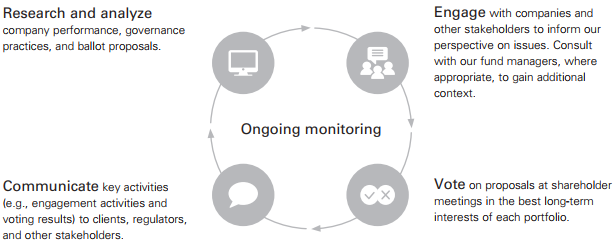
Our four pillars

Board

Good governance begins with a great board of directors. Our primary interest is to ensure that the individuals who represent the interests of all shareholders are independent (both in mindset and freedom from conflicts), capable (across the range of relevant skills for the company and industry), and appropriately experienced (so as to bring valuable perspective to their roles). We also believe that diversity of thought, background, and experience, as well as of personal characteristics (such as gender, race, and age), meaningfully contributes to the board’s ability to serve as effective, engaged stewards of shareholders’ interests. If a company has a well-composed, high-functioning board, good results are more likely to follow.

Structure

We believe in the importance of governance structures that empower shareholders and ensure accountability of the board and management. We believe that shareholders should be able to hold directors accountable as needed through certain governance and bylaw provisions. Among these preferred provisions are that directors must stand for election by shareholders annually and must secure a majority of the votes in order to join or remain on the board. In instances where the board appears resistant to shareholder input, we also support the right of shareholders to call special meetings and to place director nominees on the company’s ballot.

Compensation

We believe that performance-linked compensation policies and practices are fundamental drivers of the sustainable, long-term value for a company’s investors. The board plays a central role in determining appropriate executive pay that incentivizes performance relative to peers and competitors. Providing effective disclosure of these practices, their alignment with company performance, and their outcomes is crucial to giving shareholders confidence in the link between incentives and rewards and the creation of value over the long term.

Risk

Boards are responsible for effective oversight and governance of the risks most relevant and material to each company in the context of its industry and region. We believe that boards should take a thorough, integrated, and thoughtful approach to identifying, understanding, quantifying, overseeing, and—where appropriate—disclosing risks that have the potential to affect shareholder value over the long term. Importantly, boards should communicate their approach to risk oversight to shareholders through their normal course of business.

By the numbers: Voting and engagement

Engagement and voting trends

2015 proxy season 2016 proxy season  2017 proxy season
Company engagements 685 817 954
Companies voted 10,560 11,564 12,974
Meetings voted 12,785 16,740 18,905
Proposals voted 124,230 157,506 171,385
Countries voted in* 70 70 68

* The number of countries can vary each year. In certain markets, some companies do not hold shareholder meetings annually.
Note: The annual proxy season is from July 1 to June 30.

Our voting

Proxy voting reflects our governance pillars worldwide.

Meetings voted by region
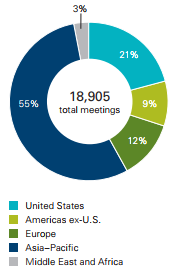
Note: Data pertains to voting activity from July 1, 2016, through June 30, 2017

Global voting activity
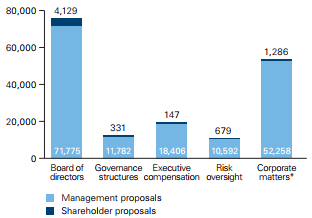
* Includes more than 26,000 proposals related to capitalization; 8,000 proposals related to mergers and acquisitions; 16,000 routine business proposals; and 1,000 other shareholder proposals.
Note: Data pertains to voting activity from July 1, 2016, through June 30, 2017.

Our engagement

We engage with companies of all sizes.

Market Capitalization % of 2017 proxy season engagements
Under $1 billion 19%
$1 billion–under $10 billion 44%
$10 billion–under $50 billion 24%
$50 billion and over 13%

Our engagement with portfolio companies has grown significantly over time.

Number of engagements and assets represented
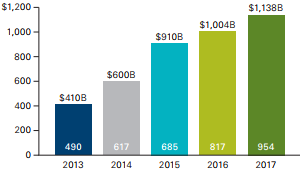
Note: Dollar figures represent the market value of Vanguard fund investments in companies with which we engaged as of June 30, 2017.

We engage on a range of topics aligned with our four pillars

Frequency of topics discussed during Vanguard engagements (%)
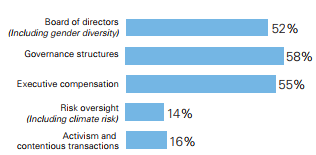
Note: Figures do not total 100%, as individual engagements often span multiple topics.

Boards in focus: Vanguard’s view on gender diversity

One of our most fundamental governance beliefs is that good governance begins with a great board of directors. We believe that diversity among directors—along dimensions such as gender, experience, race, background, age, and tenure—can strengthen a board’s range of perspectives and its capacity to make complex, fully considered decisions.

While we have long discussed board composition and diversity with portfolio companies, gender diversity has emerged as one dimension on which there is compelling support for positive effects on shareholder value. In recent years, a growing body of research has demonstrated that greater gender diversity on boards can lead to better company performance and governance.

Companies should be prepared to discuss—in both their public disclosures and their engagement with investors—their plans to incorporate appropriate diversity over time in their board composition. While we believe that board evolution is a process, not an event, the demonstration of meaningful progress over time will inform our engagement and voting going forward.

Boards in focus: Gender diversity

Engagement case studies

Gender diversity on boards was an important topic of engagement for us during the 12 months ended June 30, 2017. Below are summary examples of discussions we had on the subject.

High-impact engagement on gender diversity

Over several interactions with a U.S. industrial company, our team shared Vanguard’s perspective on board composition and evaluation. The company had undergone recent leadership transitions and was open to amending elements of its governance structure to align with best practices. We expressed particular support for meaningful gender diversity and expressed concern that the board previously had only one female director in its recent history.

Right after this year’s annual general meeting, the company announced it was adding four new directors with diverse experience, including two women. This outcome is the best-case scenario: The board welcomed shareholder input, we shared our view on best corporate governance practices, and the board ultimately incorporated our perspective into its board evolution process.

A denial of diversity’s value

A Canadian materials company that had consistently underperformed was governed by an entrenched, all-male board with seemingly nominal independence from the CEO. A 2017 shareholder resolution asked the company to adopt and publish a policy governing gender diversity on the board. Before voting, Vanguard engaged with the company to learn about its board evolution process, including its perspective on gender diversity. The engagement revealed that the company understood neither the value of gender diversity nor the importance of being responsive to shareholders’ concerns. Despite verbally endorsing gender diversity, the company resisted specifying a strategy or making a commitment to achieve it. The board, when seeking new members, relied solely on recommendations from current directors, a practice that can entrench the current board’s perspective and limit diversity. Our funds voted in support of the shareholder resolution, and we will continue to engage and hold the board accountable for meaningful progress over time.

Mixed results from an ongoing engagement

A U.S. consumer discretionary company had no women on its board, a problem magnified by its medium-term underperformance relative to peers, a classified board structure, and a lengthy average director tenure. We engaged with management twice between the 2016 and 2017 annual meetings to share our perspective on the importance of gender diversity and recommend that they make it a priority for future board evolution and director searches.

In its 2017 proxy, the company described board diversity as critical to the firm’s sustainable value and named gender as an element of diversity to be considered during the director search and nomination process. The company has since added a non-independent woman to the board. Although this move is directionally correct, it does not fully address our concerns; we will continue to encourage the company to add gender diversity to its ranks of independent directors.

Risk in focus: Vanguard’s view on climate risk

As the steward of long-term shareholder value for more than 20 million investors, Vanguard closely monitors how our portfolio companies identify, manage, and mitigate risks—including climate risk. Our approach to climate risk is evolving as the world’s and business community’s understanding of the topic matures.

This year, for the first time, our funds supported a number of climate-related shareholder resolutions opposed by company management. We are also discussing climate risk with company management and boards more than ever before. Our Investment Stewardship team is committed to engaging with a range of stakeholders to inform our perspective on these issues, and to share our thinking with the market, our portfolio companies, and our investors.

Risk in focus: Climate risk

A Q&A with Glenn Booraem, Vanguard’s Investment Stewardship Officer

Vanguard is an investment management company. Why should Vanguard fund investors be concerned about climate risk?

Mr. Booraem: Climate risk has the potential to be a significant long-term risk for companies in many industries. As stewards of our clients’ long-term investments, we must be finely attuned to this risk. We acknowledge that our clients’ views on climate risk span the ideological spectrum. But our position on climate risk is anchored in long-term economic value—not ideology. Regardless of one’s perspective on climate, there’s no doubt that changes in global regulation, energy consumption, and consumer preferences will have a significant economic impact on companies, particularly in the energy, industrial, and utilities sectors.

Why the shift in Vanguard’s assessment of climate risk, and why now?

Mr. Booraem: We’ve been discussing climate risk with portfolio companies for several years. It has been, and will remain, one of our engagement priorities for the foreseeable future. This past year, we engaged with more companies on this issue than ever before, and for the first time our funds supported two climate-related shareholder resolutions in cases where we believed that companies’ disclosure practices weren’t on par with emerging expectations in the market. As with other issues, our point of view has evolved as the topic has matured and, importantly, as its link to shareholder value has become more clear.

What is your top concern when you learn that a company in which a Vanguard portfolio invests does not have a rigorous strategy to evaluate and mitigate climate risk?

Mr. Booraem: Our concern is fundamentally that in the absence of clear disclosure and informed board oversight, the market lacks insight into the material risks of investing in that firm. It’s of paramount importance to us that the market is able to reflect risk and opportunity in stock prices, particularly for our index funds, which don’t get to select the stocks they own. When we’re not confident that companies have an appropriate level of board oversight or disclosure, we’re concerned that the market may not accurately reflect the value of the investment. Because we represent primarily long-term investors, this bias is particularly problematic when underweighting long-term risks inflates a company’s value.

Now that Vanguard has articulated a clear stance on climate risk, what can portfolio companies expect?

Mr. Booraem: First, companies should expect that we’re going to focus on their public disclosures, both about the risk itself and about their board’s and management’s oversight of that risk. Thorough disclosure is the foundation for the market’s understanding of the issue. Second, companies should expect that we’ll evaluate their disclosures in the context of both their leading peers and evolving market standards, such as those articulated by the Sustainability Accounting Standards Board (SASB). Third, they should expect that we’ll listen to their perspective on these and other matters. And finally, they should see our funds’ proxy voting as an extension of our engagement. When we consider a shareholder resolution on climate risk, we give companies a fair hearing on the merits of the proposal and consider their past commitments and the strength of their governance structure.

Engagement case studies

In the 12 months ended June 30, 2017, the topic of climate risk disclosure grew in frequency and prominence in our engagements with companies, particularly those in the energy, industrial, and utilities sectors, where climate risk was addressed in nearly every conversation we had. Below are examples of our engagements on climate risk.

Two companies’ commitments to enhanced disclosure

Our team led similar engagements with two U.S. energy companies facing shareholder resolutions on climate risk. One resolution requested that the first company publish an annual report on climate risk impacts and strategy. At the second company, a resolution requested disclosure of the company’s strategy and targets for transitioning to a low- carbon economy. In both cases, when we engaged with the companies, their management teams committed to improving their climate risk disclosure. Given the companies’ demonstrated responsiveness to shareholder feedback and commitment to improving, our funds did not support either shareholder proposal. Our team will continue to track and evaluate the companies’ progress toward their commitments as we consider our votes in future years.

A vote against a risk and governance outlier For years we engaged with a U.S. energy company that lagged its peers on climate risk disclosure and board accessibility. This year, a shareholder proposal requesting that the company produce a climate risk assessment report demonstrated a compelling link between the requested disclosures and long-term shareholder value. Because the board serves on behalf of shareholders and plays a critical role in risk oversight, we believed it was appropriate to seek a direct dialogue with independent directors about climate risk. Management resisted connecting the independent directors with shareholders, making the company a significant industry outlier in good governance practice. Without the confidence that the board understood or represented our view that climate risk poses a material risk in the energy sector, our team viewed the climate risk and governance issues as intertwined. Ultimately, our funds voted for the shareholder proposal and withheld votes on relevant independent directors for failing to engage with shareholders.

A vote for greater climate risk disclosure

A shareholder proposal at a U.S. energy company asked for an annual report with climate risk disclosure, including scenario planning. Through extensive research and engagements with the company’s management, its independent directors, and other industry stakeholders, our team identified governance shortfalls and a clear connection to long-term shareholder value. The company lagged its peers in disclosure, risk planning, and board oversight and responsiveness to shareholder concerns. Crucially, although the company’s public filings identified climate risk as a material issue, it failed to articulate plans for mitigation or adaptation. A similar proposal last year garnered significant support, but the company made no meaningful changes in response. Engagement had limited effect, so our funds voted for the shareholder proposal.

* * *

This post was excerpted from a Vanguard report; the complete publication is available here.

Compte rendu hebdomadaire de la Harvard Law School Forum on Corporate Governance | 14 septembre 2017


Voici le compte rendu hebdomadaire du forum de la Harvard Law School sur la gouvernance corporative au 14 septembre 2017.

Cette semaine, j’ai relevé les cinq principaux billets.

Bonne lecture !


Résultats de recherche d'images pour « harvard law school forum on corporate governance »


Résultats de recherche d'images pour « harvard law school forum on corporate governance »


  1. Another Road Leading to Business Judgment Review—Martha Stewart Living Omnimedia
  2. The Effects of Hedge Fund Interventions on Strategic Firm Behavior
  3. UK Announces Corporate Governance Reforms
  4. How Should We Regulate Fintech?
  5. OCC Stakes Out a Lead Role in Establishing New Deregulatory Agenda


Compte rendu hebdomadaire de la Harvard Law School Forum on Corporate Governance | 7 septembre 2017


Voici le compte rendu hebdomadaire du forum de la Harvard Law School sur la gouvernance corporative au 7 septembre 2017.

J’ai relevé les principaux billets, tout en me limitant au Top 10.

Bonne lecture !


Résultats de recherche d'images pour « harvard law school forum on corporate governance »


Résultats de recherche d'images pour « harvard law school forum on corporate governance »


  1. Political Uncertainty and Firm Disclosure
  2. Corporate Governance—the New Paradigm
  3. NYDFS Cybersecurity Regulations Take Effect
  4. CFOs on Boards: Higher Pay, Lower Performance
  5. CSX Attracts New CEO and Stock Price Rises Sharply
  6. The Evolution and Current State of Director Compensation Plans
  7. Companies Should Maximize Shareholder Welfare Not Market Value
  8. Executive Compensation: A Survey of Theory and Evidence
  9. Divided Second Circuit Panel Overrules Prior Newman Insider Trading Decision
  10. Out of Sight Out of Mind: The Case for Improving Director Independence Disclosure

La gouvernance à l’anglaise | Commentaires d’Yvan Allaire


Yvan Allaire*, président exécutif du conseil de l’Institut sur la gouvernance (IGOPP) vient de me faire parvenir un nouvel article intitulé « La gouvernance à l’anglaise ».

Cet article intéressera certainement tous les administrateurs siégeant à des conseils d’administration qui sont à l’affût des nouveautés dans le domaine de la gouvernance.

Le document discute de deux mesures particulièrement novatrices et audacieuses, même si le principe « Conformité ou explication » prévaut toujours : (1) la rémunération des dirigeants et (2) la prise en compte de toutes les parties prenantes de l’entreprise par le conseil d’administration

Je vous invite à lire le compte rendu sur le site de l’IGOPP.

Bonne lecture !


Résultats de recherche d'images pour « UK governance code »


La gouvernance à l’anglaise | Yvan Allaire


Avec la publication récente de ses intentions en suite à une vaste consultation, le gouvernement du Royaume-Uni propose une réforme de la gouvernance des sociétés à la fois prudente et audacieuse, comportant un certain nombre de mesures (controversées) sur deux enjeux précis :

  1. La rémunération des dirigeants;
  2. La prise en compte de toutes les parties prenantes de l’entreprise par le conseil d’administration


1. La rémunération des dirigeants


Le programme annoncé contient des propositions sur des questions longuement débattues.

– Ainsi, le gouvernement, par voie d’amendements législatifs, veut exiger la publication du rapport entre la rémunération du PDG et la rémunération médiane des employés de la société au Royaume-Uni; la société devra expliquer les variations de ce ratio d’une année à l’autre.

– Le gouvernement veut susciter des changements au code de gouvernance des entreprises pour que celles-ci doivent tenir compte d’une expression significative d’insatisfaction exprimée lors d’un vote consultatif sur la rémunération. Une expression significative reste à définir, mais le seuil pourrait s’établir à 20% ou plus de votes négatifs; le gouvernement promet d’agir par voie législative si l’approche incitative ne donne pas les résultats souhaités.

– Le gouvernement s’engage à présenter des amendements juridiques pour exiger que les sociétés inscrites en Bourse fournissent des explications plus claires de leurs politiques de rémunération ainsi que l’éventail de rémunérations pouvant résulter d’incitatifs complexes en actions et options sur le titre. Le gouvernement tiendra également des consultations sur la proposition d’augmenter de trois à cinq ans la période minimale requise avant qu’un dirigeant puisse encaisser les options ou les actions reçues comme rémunération incitative.

– Le gouvernement s’engage également à commanditer un examen d’un sujet d’une grande actualité : comment s’assurer que les rachats d’actions ne servent pas comme artifice pour atteindre des cibles de performance financière et ainsi gonfler la rémunération des dirigeants. Cet examen évaluera également si de tels rachats d’actions peuvent mener à un sous-investissement en actifs productifs.


2. La prise en compte de toutes les parties prenantes de l’entreprise par le conseil d’administration


La loi anglaise sur les sociétés par actions, tout comme la loi canadienne, enjoint que la responsabilité du conseil est envers la société et ses parties prenantes. L’article 172 de la loi anglaise de 2006 est plus explicite que la loi canadienne :

Text of Section 172 of the Companies Act 20069 | Duty to promote the success of the company

(1) A director of a company must act in the way he considers, in good faith, would be most likely to promote the success of the company for the benefit of its members as a whole, and in doing so have regard (amongst other matters) to —

(a) the likely consequences of any decision in the long term,

(b) the interests of the company’s employees,

(c) the need to foster the company’s business relationships with suppliers, customers and others,

(d) the impact of the company’s operations on the community and the environment,

(e) the desirability of the company maintaining a reputation for high standards of business conduct, and

(f) the need to act fairly as between members of the company.

Toutefois, deux jugements de la Cour suprême du Canada donnent une interprétation assez similaire de la responsabilité du conseil d’administration envers les parties prenantes de la société (voir à cet effet le texte d’Allaire et Rousseau, Gouvernance et parties prenantes, IGOPP, juillet 2014).

– Au Royaume-Uni (comme au Canada), les conseils d’administration sont rarement explicites sur leur façon de se conformer à cette responsabilité envers les parties prenantes autres que les actionnaires. Le gouvernement compte donc présenter des amendements législatifs pour obliger toutes les sociétés (privées et publiques) à expliquer comment le conseil se conforme aux exigences de la loi en ce qui concerne les intérêts des employés ainsi que ses relations avec les fournisseurs, les clients et autres parties.

– Le gouvernement entend susciter des avis sur des changements au Code de gouvernance pour exiger que les sociétés inscrites en Bourse adoptent, sur une base Se conformer ou Expliquer, l’un ou l’autre des trois mécanismes suivants pour représenter au conseil les intérêts des employés :

(1) Désigner un administrateur indépendant pour que la voix des employés soit entendue au conseil d’administration;

(2) Créer un conseil consultatif des employés;

(3) Nommer un membre du conseil choisi parmi les employés.

– Le gouvernement a choisi à ce stade de ne pas élargir cette représentation aux autres parties prenantes. Il entend inviter le groupe GC100 (les cent plus grandes sociétés ouvertes) à fournir avis et lignes directrices pour une interprétation pratique des devoirs des administrateurs en vertu de l’article 172 de la loi sur les sociétés.


Autres sujets


Le gouvernement déposera des amendements législatifs pour que route les entreprises privées comptant plus de 2000 employés doivent rendre compte publiquement de leurs arrangements de gouvernance.

Bien que la diversité au conseil ne faisant pas l’objet de cette consultation, le gouvernement rappelle son engagement envers les objectifs établis par le Davies Review, soit qu’en 2020, 33% des membres des conseils des entreprises du FTSE ainsi que 33% des membres de leurs comités de direction soient des femmes; cet objectif ne pourra être atteint que si 40% des nominations jusqu’à terme seront des femmes.

Ce projet de réforme de la gouvernance ne va pas aussi loin que l’auraient souhaité bon nombre d’observateurs, mais aussi loin que le pragmatisme britannique et la puissante contre-réforme ne le permettaient. Mélange de consultations, de déférence envers des intermédiaires et d’activisme législatif mesuré, cette réforme a le mérite de mettre la table pour une discussion d’enjeux importants, mais souvent occultés.


*Yvan Allaire, Ph. D. (MIT), MSRC, Président exécutif du conseil, yallaire@igopp.org

Compte rendu hebdomadaire de la Harvard Law School Forum on Corporate Governance | 31 août 2017


Voici le compte rendu hebdomadaire du forum de la Harvard Law School sur la gouvernance corporative au 31 août 2017.

J’ai relevé les principaux billets, tout en me limitant au Top 10.

Bonne lecture !


Résultats de recherche d'images pour « harvard law school forum on corporate governance »


Résultats de recherche d'images pour « harvard law school forum on corporate governance »


  1. SEC Staff Examines Impact of Regulation on Capital Formation and Market Liquidity
  2. ISS and the Removal of CEOs: A Call for an Enhanced Standard
  3. Far Beyond the Quarterly Call
  4. Federal Reserve Board Proposes Guidance Addressing Supervisory Expectations on Boards of Directors
  5. Proxy Access: Best Practices 2017
  6. 2017 Mid-Year Activism Update
  7. Controlling-Shareholder Related-Party Transactions Under Delaware Law
  8. NAIC Adopts Model Cybersecurity Law
  9. SEC Announces Results of Cybersecurity Examination Initiative
  10. Make-Whole Premiums and the Agency Costs of Debt

Deux événements récents qui auront un effet important sur la gouvernance


Corporate Governance—the New Paradigm

Compte rendu hebdomadaire de la Harvard Law School Forum on Corporate Governance | 24 août 2017


Voici le compte rendu hebdomadaire du forum de la Harvard Law School sur la gouvernance corporative au 24 août 2017.

J’ai relevé les principaux billets, tout en me limitant au Top 10.

Bonne lecture !


Résultats de recherche d'images pour « harvard law school forum on corporate governance »


Résultats de recherche d'images pour « harvard law school forum on corporate governance »


  1. Regulating Motivation: A New Perspective on the Volcker Rule
  2. Information Asymmetries Conceal Fraud and Systemic Risks in the U.S. Banking Industry
  3. Private Equity and Financial Fragility During the Crisis
  4. Activist Investors’ Approaches to Targeting Boards
  5. 2017 Securities and M&A Litigation Mid-Year Review
  6. Governance through Shame and Aspiration: Index Creation and Corporate Behavior in Japan
  7. ISS Releases Surveys for 2018 Policy Updates
  8. The Era of Private Ordering for Corporate Governance
  9. Delaware Court of Chancery Extends Business Judgment Rule
  10. Board Oversight of Long-Term Value Creation and Preservation

Cadre de référence pour évaluer la gouvernance des sociétés | Questionnaire de 100 items


Le Bureau de la vérification interne (BVI) de l’Université de Montréal (UdeM) a récemment développé un cadre de référence novateur pour l’évaluation de la gouvernance. La méthodologie, ainsi que le questionnaire qui en résulte, contribue, à mon avis, à l’avancement des connaissances dans le domaine de l’évaluation des caractéristiques et des pratiques de la gouvernance par les auditeurs internes.

Ayant eu l’occasion de collaborer à la conception de cet instrument de mesure de la gouvernance des sociétés, j’ai obtenu du BVI la permission de publier le résultat de cet exercice.

Cette version du cadre se veut « générique » et peut être utilisée pour l’évaluation de la gouvernance d’un projet, d’une activité, d’une unité ou d’une entité.

De ce fait, les termes, les intervenants ainsi que les structures attendues doivent être adaptés au contexte de l’évaluation. Il est à noter que ce cadre de référence correspond à une application optimale recherchée en matière de gouvernance. Certaines pratiques pourraient ne pas s’appliquer ou ne pas être retenues de façon consciente et transparente par l’organisation.

Le questionnaire se décline en dix thèmes, chacun comportant dix items :


Thème 1 — Structure et fonctionnement du Conseil

Thème 2 — Travail du président du Conseil

Thème 3 — Relation entre le Conseil et le directeur général (direction)

Thème 4 — Structure et travail des comités du Conseil

Thème 5 — Performance du Conseil et de ses comités

Thème 6 — Recrutement, rémunération et évaluation du rendement du directeur général

Thème 7 — Planification stratégique

Thème 8 — Performance et reddition de comptes

Thème 9 — Gestion des risques

Thème 10 — Éthique et culture organisationnelle


On retrouvera en Annexe une représentation graphique du cadre conceptuel qui permet d’illustrer les liens entre les thèmes à évaluer dans le présent référentiel.

L’évaluation s’effectue à l’aide d’un questionnaire de type Likert (document distinct du cadre de référence). L’échelle de Likert est une échelle de jugement par laquelle la personne interrogée exprime son degré d’accord ou de désaccord eu égard à une affirmation ou une question.


  1. Tout à fait d’accord
  2. D’accord
  3. Ni en désaccord ni d’accord
  4. Pas d’accord
  5. Pas du tout d’accord
  6. Ne s’applique pas (S.O.)


Une section commentaire est également incluse dans le questionnaire afin que les participants puissent exprimer des informations spécifiques à la question. L’audit interne doit réaliser son évaluation à l’aide de questionnaires ainsi que sur la base de la documentation qui lui sera fournie.


Résultats de recherche d'images pour « gouvernance d'entreprise conseil d'administration »


Thème 1 — Structure et fonctionnement du Conseil

(Questions destinées au président du comité de gouvernance [PCG] et/ou au président du Conseil [PC])


1.       Le Conseil compte-t-il une proportion suffisante de membres indépendants pour lui permettre d’interagir de manière constructive avec la direction ?
2.       La taille du Conseil vous semble-t-elle raisonnable compte tenu des objectifs et de la charge de travail actuel ? (dans une fourchette idéale de 9 à 13 membres, avec une moyenne d’environ 10 membres)
3.       La composition du Conseil est-elle guidée par une politique sur la diversité des membres ?
4.       Le Conseil a-t-il conçu un processus rigoureux de recrutement de ses membres, basé sur une matrice des compétences complémentaires ?
5.       Le président et les membres du comité responsable du recrutement (comité de gouvernance) ont-ils clairement exprimé aux candidats potentiels les attentes de l’organisation en matière de temps, d’engagement et de contributions reliés avec leurs compétences ?
6.       Les réunions sont-elles bien organisées et structurées ? (durée, PV, taux de présence, documentation pertinente et à temps, etc.)
7.       Les échanges portent-ils sur surtout sur des questions stratégiques, sans porter sur les activités courantes (qui sont davantage du ressort de l’équipe de direction) ?
8.       Les membres sont-ils à l’aise d’émettre des propos qui vont à contre-courant des idées dominantes ?
9.       Une séance à huis clos est-elle systématiquement prévue à la fin de chacune des réunions afin de permettre aux membres indépendants de discuter des sujets sensibles ?
10.    Les membres ont-ils accès à la planification des rencontres sur une période idéale de 18 mois en y incluant certains items ou sujets récurrents qui seront abordés lors des réunions du Conseil (plan de travail) ?


Thème 2 — Travail du président du Conseil 

(Questions destinées à un administrateur indépendant, au PC [auto-évaluation] et au président du comité de gouvernance [PCG])


1.       Le président s’assure-t-il de former un solide tandem avec le directeur général et de partager avec lui une vision commune de l’organisation ?
2.       Le président promeut-il de hauts standards d’efficacité et d’intégrité afin de donner le ton à l’ensemble de l’organisation ?
3.       Le président, de concert avec le directeur général, prépare-t-il adéquatement les réunions du Conseil ?
4.       Le président préside-t-il avec compétence et doigté les réunions du Conseil ?
5.       Le président s’assure-t-il que les échanges portent surtout sur des questions stratégiques et que les réunions du Conseil ne versent pas dans la micro gestion ?
6.       Le président s’investit-il pleinement dans la sélection des présidents et des membres des comités du Conseil ?
7.       Le président s’assure-t-il de l’existence d’une formation et d’une trousse d’accueil destinées aux nouveaux membres afin qu’ils soient opérationnels dans les plus brefs délais ?
8.       Le président s’assure-t-il de l’existence d’un processus d’évaluation du rendement du Conseil et de ses membres ?
9.       Le président prend-il la peine d’aborder les membres non performants pour les aider à trouver des solutions ?
10.    Le président s’assure-t-il que les membres comprennent bien leurs devoirs de fiduciaire, c’est-à-dire qu’ils doivent veiller aux meilleurs intérêts de l’organisation et non aux intérêts de la base dont ils sont issus ?


Thème 3 — Relation entre le Conseil et le directeur général (direction)

(Questions destinées au PC et au Directeur général [DG])


1.       Le président du Conseil et le directeur général ont-ils des rencontres régulières et statutaires pour faire le point entre les réunions du Conseil ?
2.       Le président du Conseil et le directeur général maintiennent-ils une communication franche et ouverte ? (équilibre entre une saine tension et des relations harmonieuses et efficaces)
3.       Le Conseil résiste-t-il à la tentation de faire de la micro gestion lors de ses réunions et s’en tient-il à assumer les responsabilités qui lui incombent ?
4.       Le Conseil agit-il de façon respectueuse à l’endroit du directeur général lors des réunions du Conseil et cherche-t-il à l’aider à réussir ?
5.       Le Conseil procède-t-il à une évaluation annuelle du rendement du directeur général (par le comité de GRH) basée sur des critères objectifs et mutuellement acceptés ?
6.       Les membres du Conseil s’abstiennent-ils de donner des ordres ou des directives aux employés qui relèvent de l’autorité du directeur général ?
7.       Le président comprend-il que le directeur général ne relève pas de lui, mais plutôt du Conseil, et agit-il en conséquence ?
8.       Le directeur général aide-t-il adéquatement le président dans la préparation des réunions du Conseil, fournit-il aux membres l’information dont ils ont besoin et répond-il à leurs questions de manière satisfaisante ?
9.       Le directeur général s’assure-t-il de ne pas embourber les réunions du Conseil de sujets qui relèvent de sa propre compétence ?
10.    Le directeur général accepte-t-il de se rallier aux décisions prises par le Conseil, même dans les cas où il a exprimé des réserves ?


Thème 4 — Structure et travail des comités du Conseil

 (Questions destinées au PC et au président d’un des comités)


1.       Existe-t-il, au sein de votre organisation, les comités du Conseil suivants :

·         Audit ?

·         Gouvernance ?

·         Ressources humaines ?

·         Gestion des risques ?

·         Sinon, a-t-on inclus les responsabilités de ces comités dans le mandat du Conseil ou d’une autre instance indépendante ?

·         Autres comités reliés à la recherche (ex. éthique, scientifique) ?


2.       Les recommandations des comités du Conseil aident-elles le Conseil à bien s’acquitter de son rôle ?
3.       Les comités du Conseil sont-ils actifs et présentent-ils régulièrement des rapports au Conseil ?
4.       Estimez-vous que les comités créent de la valeur pour votre organisation ?
5.       Les comités du Conseil s’abstiennent-ils de s’immiscer dans la sphère de responsabilité du directeur général ?
6.       À l’heure actuelle, la séparation des rôles et responsabilités respectifs du Conseil, des comités et de la direction est-elle officiellement documentée, généralement comprise et mise en pratique ?
7.       Les membres qui siègent à un comité opérationnel comprennent-ils qu’ils travaillent sous l’autorité du directeur général ?
8.       Le directeur général est-il invité à assister aux réunions des comités du Conseil ?
9.       Chacun des comités et des groupes de travail du Conseil dispose-t-il d’un mandat clair et formulé par écrit ?
10.    S’il existe un comité exécutif dans votre organisation, son existence est-elle prévue dans le règlement de régie interne et, si oui, son rôle est-il clairement défini ?


Thème 5 — Performance du Conseil et de ses comités 

(Questions destinées au PC et au président du comité de gouvernance [PCG])


1.       Est-ce que la rémunération des membres du Conseil a été déterminée par le comité de gouvernance ou avec l’aide d’un processus indépendant ? (Jetons de présence ?)
2.       Par quels processus s’assure-t-on que le Conseil consacre suffisamment de temps et d’attention aux tendances émergentes et à la prévision des besoins futurs de la collectivité qu’il sert ?
3.       Est-ce que l’on procède à l’évaluation de la performance du Conseil, des comités et de ses membres au moins annuellement ?
4.       Est-ce que la logique et la démarche d’évaluation ont été expliquées aux membres du Conseil, et ceux-ci ont-ils pu donner leur point de vue avant de procéder à l’évaluation ?
5.       A-t-on convenu préalablement de la façon dont les données seront gérées de manière à fournir une garantie sur la confidentialité de l’information recueillie ?
6.       Est-ce que le président de Conseil croit que le directeur général et la haute direction font une évaluation positive de l’apport des membres du Conseil ?
7.       L’évaluation du Conseil et de ses comités mène-t-elle à un plan d’action réaliste pour prendre les mesures nécessaires selon leur priorité ?
8.       L’évaluation du Conseil permet-elle de relever les lacunes en matière de compétences et d’expérience qui pourraient être comblées par l’ajout de nouveaux membres ?
9.       Est-ce que les membres sont évalués en fonction des compétences et connaissances qu’ils sont censés apporter au Conseil ?
10.    Les membres sont-ils informés par le président du Conseil de leurs résultats d’évaluation dans le but d’aboutir à des mesures de perfectionnement ?


Thème 6 — Recrutement, rémunération et évaluation du rendement du DG

(Questions destinées au PC, au DG [auto-évaluation] et au président du comité des RH)


1.       Existe-t-il une description du poste de directeur général ? Cette description a-t-elle servi au moment de l’embauche du titulaire du poste ?
2.       Un comité du Conseil (comité de GRH) ou un groupe de membres indépendants est-il responsable de l’évaluation du rendement du directeur général (basé sur des critères objectifs) ?
3.       Le président du Conseil s’est-il vu confier un rôle prépondérant au sein du comité responsable de l’évaluation du rendement du directeur général afin qu’il exerce le leadership que l’on attend de lui ?
4.       Le comité responsable de l’évaluation du rendement et le directeur général ont-ils convenu d’objectifs de performance sur lesquels ce dernier sera évalué ?
5.       Le rendement du directeur général est-il évalué au moins une fois l’an en fonction de ces objectifs ?
6.       Les objectifs de rendement du directeur général sont-ils liés au plan stratégique ?
7.       Le comité responsable de l’évaluation du rendement s’est-il entretenu avec le directeur général en cours d’année pour lui donner une rétroaction préliminaire ?
8.       La rémunération du directeur général est-elle équitable par rapport à l’ensemble des employés et a-t-elle fait l’objet d’une analyse comparative avec le marché des organisations afin d’assurer un certain degré de compétitivité ?
9.       Les hausses salariales du directeur général sont-elles uniquement accordées en fonction de l’évaluation de son rendement ?
10.    Est-ce que le Conseil consacre l’attention nécessaire à la succession du directeur général et dispose-t-il d’un processus robuste d’identification d’un nouveau premier dirigeant, tant pour les transitions planifiées que non planifiées ?


Thème 7 — Planification stratégique 

(Questions destinées au PC et au DG)


1.       Votre organisation possède-t-elle un plan stratégique incluant notamment :

·         le contexte dans lequel évoluent la société et les principaux enjeux auxquels elle fait face ?

·         les objectifs et les orientations stratégiques de la société ?

·         les résultats visés au terme de la période couverte par le plan ?

·         les indicateurs de performance utilisés pour mesurer l’atteinte des résultats ?

2.       Le plan stratégique porte-t-il sur une période cohérente avec la mission et l’environnement dans lequel il œuvre ?
3.       La mission, les valeurs et l’énoncé de vision de l’organisation ont-ils été déterminés et réévalués périodiquement ?
4.       Est-ce qu’il y a eu une analyse Forces/faiblesses et opportunités/menaces ?
5.       L’ensemble des parties prenantes de l’organisation a-t-il été consulté notamment au moyen de sondages et d’entrevues, et lors d’un atelier de planification stratégique ?
6.       Les membres ont-ils été engagés dans le processus, notamment par la création d’un comité ad hoc chargé de piloter l’exercice et par des rapports périodiques aux réunions du Conseil ?
7.       Le Conseil évalue-t-il la stratégie proposée, notamment les hypothèses clés, les principaux risques, les ressources nécessaires et les résultats cibles, et s’assure-t-il qu’il traite les questions primordiales telles que l’émergence de la concurrence et l’évolution des préférences des clients ?
8.       Le président du Conseil s’assure-t-il que le plan stratégique soit débattu lors de réunions spéciales et que le Conseil dispose de suffisamment de temps pour être efficace ?
9.       Le Conseil est-il satisfait des plans de la direction pour la mise en œuvre de la stratégie approuvée ?
10.    Le Conseil surveille-t-il la viabilité permanente de la stratégie, et est-elle ajustée, si nécessaire, pour répondre aux évolutions de l’environnement ?


Thème 8 — Performance et reddition de comptes

 (Questions destinées au Président du comité d’audit ou au PC, au DG et au secrétaire corporatif)


1.       S’assure-t-on que les indicateurs de performance utilisés par la direction et présentés au Conseil sont reliés à la stratégie de l’organisation et aux objectifs à atteindre ?
2.       S’assure-t-on que les indicateurs de la performance sont équilibrés entre indicateurs financiers et non financiers, qu’ils comprennent des indicateurs prévisionnels et permettent une comparaison des activités similaires ?
3.       A-t-on une assurance raisonnable de la fiabilité des indicateurs de performance qui sont soumis au Conseil ?
4.       Utilise-t-on des informations de sources externes afin de mieux évaluer la performance de l’organisation ?
5.       Le Conseil et les comités réexaminent-ils régulièrement la pertinence de l’information qu’il reçoit ?
6.       Le Conseil examine-t-il d’un œil critique les informations à fournir aux parties prenantes ?
7.       Le Conseil est-il satisfait du processus de communication de crise de la société et est-il à même de surveiller de près son efficacité si une crise survient ?
8.       Le Conseil est-il satisfait de son implication actuelle dans la communication avec les parties prenantes externes et comprend-il les évolutions susceptibles de l’inciter à modifier son degré de participation ?
9.       Est-ce que la direction transmet suffisamment d’information opérationnelle au Conseil afin que celui-ci puisse bien s’acquitter de ses responsabilités de surveillance ?
10.    Est-ce que le Conseil s’assure que les informations sont fournies aux parties prenantes telles que les organismes réglementaires, les organismes subventionnaires et les partenaires d’affaires ?


Thème 9 — Gestion des risques

 (Questions destinées au PC et au Président du comité de Gestion des risques ou au Président du comité d’audit)


1.       L’organisation a-t-elle une politique de gestion des risques et obtient-elle l’adhésion de l’ensemble des dirigeants et des employés ?
2.       L’organisation a-t-elle identifié et évalué les principaux risques susceptibles de menacer sa réputation, son intégrité, ses programmes et sa pérennité ainsi que les principaux mécanismes d’atténuation ?
3.       L’organisation a-t-elle un plan de gestion de la continuité advenant un sinistre ?
4.       Est-ce que les risques les plus élevés font l’objet de mandats d’audit interne afin de donner un niveau d’assurance suffisant aux membres du Conseil ?
5.       L’organisation se penche-t-elle occasionnellement sur les processus de contrôle des transactions, par exemple l’autorisation des dépenses, l’achat de biens et services, la vérification et l’approbation des factures et des frais de déplacement, l’émission des paiements, etc. ?
6.       Existe-t-il une délégation d’autorité documentée et comprise par tous les intervenants ?
7.       Le Conseil a-t-il convenu avec la direction de l’appétit pour le risque ? (le niveau de risque que l’organisation est prête à assumer)
8.       Le Conseil est-il informé en temps utile lors de la matérialisation d’un risque critique et s’assure-t-il que la direction les gère convenablement ?
9.       S’assure-t-on que la direction entretient une culture qui encourage l’identification et la gestion des risques ?
10.   Le Conseil s’est-il assuré que la direction a pris les mesures nécessaires pour se prémunir des risques émergents, notamment ceux reliés à la cybersécurité et aux cyberattaques ?


Thème 10 — Éthique et culture organisationnelle

 (Questions destinées au DG et au PC)


1.       Les politiques de votre organisation visant à favoriser l’éthique sont-elles bien connues et appliquées par ses employés, partenaires et bénévoles ?
2.       Le Conseil de votre organisation aborde-t-il régulièrement la question de l’éthique, notamment en recevant des rapports sur les plaintes, les dénonciations ?
3.       Le Conseil et l’équipe de direction de votre organisation participent-ils régulièrement à des activités de formation visant à parfaire leurs connaissances et leurs compétences en matière d’éthique ?
4.       S’assure-t-on que la direction générale est exemplaire et a développé une culture fondée sur des valeurs qui se déclinent dans l’ensemble de l’organisation ?
5.       S’assure-t-on que la direction prend au sérieux les manquements à l’éthique et les gère promptement et de façon cohérente ?
6.       S’assure-t-on que la direction a élaboré un code de conduite efficace auquel elle adhère, et veille à ce que tous les membres du personnel en comprennent la teneur, la pertinence et l’importance ?
7.       S’assure-t-on de l’existence de canaux de communication efficaces (ligne d’alerte téléphonique dédiée, assistance téléphonique, etc.) pour permettre aux membres du personnel et partenaires de signaler les problèmes ?
8.       Le Conseil reconnaît-il l’impact sur la réputation de l’organisation du comportement de ses principaux fournisseurs et autres partenaires ?
9.       Est-ce que le président du Conseil donne le ton au même titre que le DG au niveau des opérations sur la culture organisationnelle au nom de ses croyances, son attitude et ses valeurs ?
10.    Est-ce que l’organisation a la capacité d’intégrer des changements à même ses processus, outils ou comportements dans un délai raisonnable ?


Annexe

Présentation du schéma conceptuel


Thème (1) — Structure et fonctionnement du Conseil

Thème (2) — Travail du président du Conseil

Thème (3) — Relation entre le Conseil et le directeur général (direction)

Thème (4) — Structure et travail des comités du Conseil

Thème (5) — Performance du Conseil et de ses comités

Thème (6) — Recrutement, rémunération et évaluation du rendement du directeur général

Thème (7) — Planification stratégique

Thème (8) — Performance et reddition de comptes

Thème (9) — Gestion des risques

Thème (10) — Éthique et culture organisationnelle


Le processus de gestion des réunions d’un conseil d’administration | Deuxième partie


Plusieurs personnes me demandent de l’information sur le processus de gestion des réunions d’un conseil d’administration.

Souvent, les personnes intéressées souhaitent obtenir des documents pragmatiques et concrets.

Afin d’explorer plus à fond cette problématique, j’ai effectué une recherche documentaire assez exhaustive sur les bonnes pratiques eu égard aux réunions de conseils d’administration.

Cette recherche m’a amené à considérer quatre étapes incontournables dans la mise en place d’un processus efficace de gouvernance :

  1. la préparation de l’information et de la documentation pertinente ;
  2. la conduite de la réunion du conseil ;
  3. l’évaluation de la réunion ;
  4. les suivis apportés à la réunion.

Chacune de ces activités représente un niveau d’importance égal à mes yeux.

Mon premier billet, Le processus de gestion des réunions d’un conseil d’administration | Première partie, portait sur les étapes 1 et 2. J’ai rassemblé les informations les plus pertinentes sur le sujet.

Dans ce billet, j’aborderai les activités se rapportant aux deux autres thèmes : l’évaluation de la réunion et les suivis apportés à la réunion.


(3) L’évaluation de la réunion et de l’efficacité du conseil


L’évaluation de chaque réunion du conseil est à recommander. Il s’agit d’une activité menée par le président du conseil et elle peut se faire lors du huis clos. Cependant, il est essentiel que cette activité se fasse annuellement.

Tel que je l’ai publié sur mon blogue en gouvernance le 16 novembre 2016 (Comment procéder à l’évaluation du CA, des comités et des administrateurs | Un sujet d’actualité!), les conseils d’administration sont de plus en plus confrontés à l’exigence d’évaluer l’efficacité de leur fonctionnement par le biais d’une évaluation annuelle du CA, des comités et des administrateurs.

En fait, le NYSE exige depuis dix ans que les conseils procèdent à leur évaluation et que les résultats du processus soient divulgués aux actionnaires. Également, les investisseurs institutionnels et les activistes demandent de plus en plus d’informations au sujet du processus d’évaluation.

Les résultats de l’évaluation peuvent être divulgués de plusieurs façons, notamment dans les circulaires de procuration et sur le site de l’entreprise.

L’article publié par John Olson, associé fondateur de la firme Gibson, Dunn & Crutcher, professeur invité à Georgetown Law Center, et paru sur le forum du Harvard Law School, présente certaines approches fréquemment utilisées pour l’évaluation du CA, des comités et des administrateurs.

On recommande de modifier les méthodes et les paramètres de l’évaluation à chaque trois ans afin d’éviter la routine susceptible de s’installer si les administrateurs remplissent les mêmes questionnaires, gérés par le président du conseil. De plus, l’objectif de l’évaluation est sujet à changement (par exemple, depuis une décennie, on accorde une grande place à la cybersécurité).

C’est au comité de gouvernance que revient la supervision du processus d’évaluation du conseil d’administration. L’article décrit quatre méthodes fréquemment utilisées.

(1) Les questionnaires gérés par le comité de gouvernance ou une personne externe

(2) les discussions entre administrateurs sur des sujets déterminés à l’avance

(3) les entretiens individuels avec les administrateurs sur des thèmes précis par le président du conseil, le président du comité de gouvernance ou un expert externe.

(4) L’évaluation des contributions de chaque administrateur par la méthode d’auto-évaluation et par l’évaluation des pairs.

Chaque approche a ses particularités et la clé est de varier les façons de faire périodiquement. On constate également que beaucoup de sociétés cotées utilisent les services de spécialistes pour les aider dans leurs démarches.

La quasi-totalité des entreprises du S&P 500 divulgue le processus d’évaluation utilisé pour améliorer leur efficacité. L’article présente deux manières de diffuser les résultats du processus d’évaluation.

(1) Structuré, c’est-à-dire un format qui précise — qui évalue quoi ; la fréquence de l’évaluation ; qui supervise les résultats ; comment le CA a-t-il agi eu égard aux résultats de l’opération d’évaluation ?

(2) Information axée sur les résultats — les grandes conclusions ; les facteurs positifs et les points à améliorer ; un plan d’action visant à corriger les lacunes observées.

Notons que la firme de services aux actionnaires ISS (Institutional Shareholder Services) utilise la qualité du processus d’évaluation pour évaluer la robustesse de la gouvernance des sociétés. L’article présente des recommandations très utiles pour toute personne intéressée par la mise en place d’un système d’évaluation du CA et par sa gestion.

Voici trois articles parus sur mon blogue qui abordent le sujet de l’évaluation :

L’évaluation des conseils d’administration et des administrateurs | Sept étapes à considérer

Quels sont les devoirs et les responsabilités d’un CA ?  (la section qui traite des questionnaires d’évaluation du rendement et de la performance du conseil)

Évaluation des membres de Conseils

Le texte de l’IGOPP, Performance et dynamique des conseils d’administration, est assez explicite sur le sujet de l’évaluation. On indique que celle-ci comporte plusieurs volets :

Une évaluation, sous forme de questionnaire, du fonctionnement du conseil et de ses comités; cette démarche est quasi-universelle;

Une évaluation nominative des membres du conseil par les pairs; cette forme d’évaluation gagne en fréquence, mais ne fait pas lunanimité chez nos participants; elle est même carrément rejetée par plusieurs parce que, selon eux, elle est susceptible de semer la zizanie au conseil;

Une auto-évaluation par les membres du conseil, laquelle est communiquée au président du conseil (PCA) et sert de base de discussion individuelle avec le PCA;

Une évaluation d’ensemble (anonyme et non nominative) des membres du conseil suivi d’une rencontre individuelle avec le ou la président(e) du conseil; cette démarche reçoit plus dappui;

De l’avis de nos informateurs, quelle que soit la démarche adoptée, la rencontre du PCA avec chaque membre individuellement est une démarche incontournable pour relever la qualité du conseil; le PCA doit être franc et ferme durant cette rencontre à propos de la contribution et de la préparation de chacun ainsi qu’à propos des aspects à améliorer, s’il y a lieu; cest le moment privilégié pour susciter des départs et ainsi renouveler et renforcer le conseil;

Une pratique, qui a du mérite, fut mentionnée : la direction (le PDG et ses subalternes immédiats) est invitée à évaluer le conseil dans son ensemble ainsi qu’à suggérer des enjeux qui devraient être considérés par le conseil au cours de la prochaine année;

L’évaluation doit aussi porter sur la façon dont le PCA s’acquitte de ses responsabilités; cette évaluation menée par le président du comité de gouvernance s’appuie habituellement sur les réponses des membres du conseil à un questionnaire préparé à cette fin.


 (4) Suivis apportés à la réunion


La direction doit être incitée à effectuer tous les suivis requis par le conseil d’administration et le CA doit l’accompagner dans la conception et la préparation de tableaux de suivis et de tableaux de bord.

Ces instruments sont essentiels au travail de supervision des administrateurs. On y retrouve généralement la date ou la résolution, la nature du suivi à effectuer, le ou les responsables de ces activités, l’échéance, les notes pertinentes au dossier.

Également, un tableau de bord doit être produit à chaque rencontre. On y retrouve des indicateurs liés à la performance de l’organisation ainsi que les principaux risques à mitiger.

Encore ici, c’est le président du conseil qui doit s’assurer que ces outils de suivis sont mis en place et utilisés à bon escient. Sans un suivi soutenu entre les rencontres du CA ou des comités, les administrateurs sont dans le brouillard.

Je vous invite également à prendre connaissance des deux documents synthèses suivants :

Assurer une efficacité supérieure du conseil d’administration

Règles et pratiques relatives aux réunions du conseil d’administration — UdeS

En terminant, il faut insister sur l’importance pour l’organisation de protéger la confidentialité et la sécurité des données par l’utilisation d’une plateforme permettant d’avoir accès aux contenus des réunions. Les firmes les plus connues pour offrir ces services sont idside et LeadingBoards.

Je suis assuré que les informations soumises dans ce rapport vous aideront à dégager une grille d’analyse pertinente pour l’évaluation de l’efficacité des conseils d’administration.

Comment votre entreprise se prépare-t-elle pour éviter d’être la cible d’investisseurs activistes ?


Vous trouverez, ci-dessous, un article de Jack « Rusty » O’Kelley III, directeur de la firme Russell Reynolds Associates, qui explique les diverses stratégies que les conseils d’administration peuvent mettre en place pour minimiser les attaques des actionnaires « activistes », lorsqu’ils ont choisi leur société comme cible de changement. L’article a été publié sur le site de Harvard Law School Forum on Corporate Governance.

Bien sûr, les entreprises doivent anticiper les gestes des activistes afin de se préparer à l’éventualité d’une demande de changement au CA.

L’auteur expose les approches couramment utilisées par les investisseurs activistes pour accroître le nombre d’administrateurs au conseil, ou pour demander le changement d’un ou deux administrateurs.

Quelles situations sont les plus favorables pour exiger des changements dans la composition du conseil d’administration ?

Les clients de la firme Russell Reynolds se posent deux questions à ce sujet :

– How do you know if an activist is going to seek to expand the board or target specific directors for replacement (and potentially escalate the situation to a proxy contest)?

– If an activist chooses a board member replacement strategy, how can you predict which directors an activist may target?

C’est certainement un article très utile pour les grandes entreprises cotées en bourse.

Mais, le jour viendra peut-être où votre entreprise sera la cible d’activistes !

Bonne lecture !


Activist Investors’ Approaches to Targeting Boards


Image associée
Les actionnaires activistes à l’assaut de l’Europe | L’Echo


Clients who are anticipating or early in the process of an activist situation, and a potential proxy contest, often ask us two questions:

  1. How do you know if an activist is going to seek to expand the board or target specific directors for replacement (and potentially escalate the situation to a proxy contest)?
  2. If an activist chooses a board member replacement strategy, how can you predict which directors an activist may target?

Based on our experience working with corporate boards defending against activists (as well as our broader board search and effectiveness expertise), we have gathered insights regarding how activists analyze and target boards of directors. In response to client requests, we have developed this guide to help our clients proactively think through defensive measures regarding board composition and governance issues.

Activists generally will utilize against individual directors all current and historical negative press, statistics, and data that is publicly available, whether or not it is accurate, comprehensive, or fair. Boards should be ready for this tactic and be ready to take back control of the narrative about the board.

Russell Reynolds only works on behalf of corporations and their existing board and management teams. We urge our clients to take a proactive, “clear-eyed” activist view of their board to understand how an activist may attack their board. We have prepared this overview based on our experience and on the insights of several activist defense lawyers, investment bankers, and proxy advisors with whom we have worked. Additionally, we have talked with activist investors who were willing to share their approaches.

Expansion vs. Replacement

Anticipating an activist’s approach to targeting board seats

Activists target a board to influence decision-making and increase value creation. While activists may take different approaches and specific tactics vary by activist and situation, key indicators can help identify their potential path.

Two of the most common activist approaches to maximizing influence on a board are either pressuring the company’s board to expand the number of board members or targeting specific incumbent directors to be replaced. Both may be done by way of a proxy contest or by using the threat of such a contest to pressure the target board into a settlement that places activist-backed directors on the board. There is no strict methodology for predicting which tactic an activist will pursue, and activists’ decisions are frequently determined by how companies react to the activists’ ideas.

We have identified some key indicators that determine if activists are likely to look to expand a board or target specific board members.

Expansion

Activists often seek to expand a board in less contentious activist situations

We have observed that the earlier a company is in the process of engaging with an activist, the more likely it is that the activist will encourage the board to expand its size by adding activist-backed directors. The longer and more public the process, the more likely it is that the activist will target specific incumbent directors and consider conducting a proxy fight.

Board expansion usually occurs in several situations based on several factors, which include:

The board has accepted the activist’s investment thesis and acknowledges the validity of its recommendations

The activist wants to monitor a situation or progress

There is specific insight or expertise the activist and board feel is missing based on business strategy

The board has classified terms (to get around limitations of a replacement strategy with staggered terms)

The first procedural step is for the board to look at its size in relation to its bylaws and peer benchmarks. As a general rule, relatively large boards make expansion less desirable. If the board is already at the maximum membership allowed by its bylaws, expansion is less attractive as the board may not want to change the bylaws to increase the number of directors. Board expansion will dilute the magnitude of activist influence (compared to replacement), but may face less resistance from the target board in a settlement.

For example, if an activist seeks to add 2 directors to a 10-member board, a board agreeing to expand the membership will net the activist 16% representation (2 of 12), as opposed to the 20% representation by replacing 2 sitting directors (2 of 10).

Board Expansion May Not Be the End of Activist Opposition

An activist and the board may agree to expand the board, but the activist may subsequently use their influence from their new board seats to later call for certain incumbent directors to step down in the following board election. Often, activists will look to break up groups of power on a board. They prefer to have at least two directors on a board to increase the number of voices and leadership for change. It is easier to dismiss one voice rather than two voices on an issue. Should the activist-backed directors seek to replace other directors likely targets could include:

Directors with the poorest history of value creation

The longest-tenured directors who approved the strategy to which the activist objected

The chairman or the director(s) who led the campaign against the activist

Activists usually do not target the CEO unless they create a “CEO referendum” evidenced by strong, public complaints about value creation (e.g., Arconic). Once an activist joins the board, the average CEO tenure is 15 months

Replacement

Activists often seek to replace board members in more contentious and drawn-out situations

Activists will spend the time and effort needed to win these contests to drive adoption of their perspective around major strategic/value creation issues when the financial returns will reward it. The director replacement strategy has the benefit (for the activist) of increasing the magnitude of the activist’s influence on a board (compared to expanding the board).

Under U.S. securities law, activists may and usually identify, by name, the incumbent directors that they are targeting for replacement when submitting a proxy filing. Replacing directors sends the clearest message of an activist’s desire to drive change in strategic direction to enhance value creation.

Activists usually go down this path the greater the disagreement between a company and an activist on strategies for value creation, and the less willing management is to implement the activist’s ideas. We see a greater chance that an activist will seek to replace directors to demonstrate the need for dramatic change when:

There are visible public disagreements about strategic or operational issues and value creation

Increasingly public and “tougher” the language

Situations where the board is too large and cannot be expanded

Activists often are looking for directors who can provide specific insight or expertise about an industry and can act as change agents.

Identifying Incumbent Directors Activists May Target

Anticipating an activist’s approach to targeting board seats

Activists have become very sophisticated in how they determine which directors to target in connection with a proxy contest. Activists will try to create the narrative around the full board and/or each director to advance the story that suits their goals. Activists will use time frames and benchmarks around total shareholder return and share price appreciation that paints management and board members in the worst possible light. While boards and directors may claim this is unfair or misleading (not taking into account the full facts or context), activists have the advantage of being on the offensive and using “facts” in a manner that benefits them. Activists look at a series of “filters” for each director. The record of value creation and relevance of each director’s skill set are critical. Unfortunately, a director with a great track record of value creation and with highly relevant skills can be targeted if there are publicly available stories that raise questions about that director’s judgment or integrity.

Russell Reynolds recommends that boards conduct a proactive board and director activism defense review. To help prepare and defend against an activist targeting a board and individual directors, RRA uses five filters to analyze each incumbent director and identify those most likely to be targeted by an activist investor.

Our proactive board composition and performance audit review includes:


Summary

Scrutiny of public company boards from activists, institutional investors, and the media shows no signs of abating. Publically and, what was once privately available information, continues to increase. New databases from ISS, Glass Lewis, Bloomberg, S&P and other information service providers increase the ability of activists and others to analyze multiple aspects of a board and individual directors’ performance, background, and governance standards. Boards need to prepare and be “clear-eyed” and objective in foreseeing the risks they may face should an activist or institutional investor initiate a review of the board.