Les avantages d’une structure de capital composée d’actions multivotantes


C’est avec ravissement que je vous recommande la lecture de cette onzième prise de position d’Yvan Allaire* au nom de l’IGOPP.

Au Canada, mais aussi dans plusieurs pays, les actions multivotantes n’ont pas la cote ! Bien que certains arguments en faveur de l’exclusion de ce type de structure de capital soient de prime abord assez convaincantes, il existe plusieurs autres considérations qui doivent être prises en compte avant de les interdire et de les fustiger.

Comme l’auteur le mentionne dans ses recommandations, l’analyse attentive de ce type d’action montre les nombreux avantages à se doter de cet instrument.

J’ai reproduit, ci-dessous, le sommaire exécutif du document ainsi que les recommandations. Pour plus de détails, je vous invite à lire le texte au complet.

Bonne lecture ! Vos commentaires sont les bienvenus. Ils orienteront les nouvelles exigences en matière de gouvernance.


Prise de position en faveur des actions multivotantes


Résultats de recherche d'images pour « action multivotantes »


Sommaire exécutif


En 2018, 69 sociétés ayant des actions à droit de vote supérieur (ADVS) étaient inscrites à la bourse de Toronto alors qu’elles étaient 100 en 2005. De 2005 à 2018, 38 n’avaient plus d’ADVS suite à des fusions, acquisitions, faillites et autres, 16 sociétés avaient converti leurs ADVS en actions à droit de vote unique et 23 nouvelles sociétés ayant des ADVS s’étaient inscrites à la bourse de Toronto
en émettant des ADVS.

Les arguments pour ou contre ce type de structure de capital-actions sont nombreux et, à certains égards, persuasifs. D’une part, certains fonds « proactifs » (notamment les fonds de couverture « activistes ») insistent auprès de conseils et des directions de sociétés publiques ciblées pour que soient prises des mesures et des décisions, qui selon eux feraient accroître le prix de l’action, quand ce n’est pas carrément de chercher à imposer la vente prématurée de l’entreprise au plus offrant. Évidemment, ce phénomène a renforcé la détermination des entrepreneurs à se protéger contre de telles pressions en adoptant lors de leur premier appel public à l’épargne des actions ayant différents droits de vote (davantage aux USA qu’au Canada).

D’autre part, les fonds indiciels et les fonds négociés en bourse (FNB ou ETF en anglais), désormais des investisseurs importants et en croissance, mais obligés de refléter soigneusement dans leurs placements la composition et la valeur des titres des indices boursiers, ne peuvent donc pas simplement manifester leurs insatisfactions en vendant leurs actions. Ils doivent exercer leur influence sur la direction d’une société par l’exercice de leur droit de vote (lequel est restreint dans les sociétés ayant des ADVS) et en exprimant haut et fort leur frustration et leurs désaccords. C’est sans surprise que ces fonds sont farouchement opposés aux actions à droit de vote supérieur, exhortant avec succès les fournisseurs d’indices (ex. : Dow-Jones, et autres) à exclure toutes nouvelles sociétés ayant des actions à droit de vote supérieur.

Ils font aussi campagne, avec moins de succès à ce jour, auprès de la Securities and Exchange Commission des États-Unis (SEC) afin qu’elle interdise cette structure de capital-actions. Leur dernier stratagème en date, promu par le Council of Institutional Investors (CII), serait d’imposer une clause crépusculaire temporelle obligatoire rentrant en vigueur 7 ans après un PAPE3. Bien entendu, ce terme pourrait être renouvelé par un vote majoritaire de  l’ensemble des actionnaires (quels que soient leurs droits de vote).

La question des « clauses crépusculaires » est ainsi devenue un enjeu névralgique. Certains investisseurs institutionnels, les agences de conseils en vote et autres gendarmes de la gouvernance ainsi qu’un certain nombre de chercheurs académiques proposent de restreindre, de contrôler et d’imposer un temps limite à la liberté relative que procurent aux entrepreneurs et aux entreprises familiales les actions à droits de vote supérieurs.

Au cours des dernières années, un vif débat s’est engagé, particulièrement aux États-Unis, entre les apôtres du dogme « une action, un vote » et les hérétiques qui estiment bénéfiques les actions ayant des droits de vote inégaux.


Recommandations


Les sociétés ayant des ADVS et les entreprises familiales comportent de grands avantages à la condition que soient bien protégés les porteurs d’actions ayant des droits de vote inférieurs.

La clause d’égalité de traitement (« coattail ») imposée depuis 1987 par la Bourse de Toronto, une caractéristique uniquement canadienne, doit être conservée pour les sociétés qui ont émis ou voudraient émettre des actions ayant différents droits de vote.

Comme l’IGOPP l’a fait en 2006, il recommande à nouveau en 2018 que le ratio des droits de vote des ADVS soit plafonné à 4:1, ce qui signifie qu’il est nécessaire de détenir 20 % de la valeur des capitaux propres de la société pour en détenir le contrôle absolu (50 % des votes et plus).

La bourse TSX de Toronto devrait plafonner le ratio des droits de vote des ADVS à 10:1.

Les actions sans droit de vote devraient être interdites ; en effet, il est impossible d’accorder le droit d’élire un tiers des membres du conseil à des actionnaires qui n’ont aucun droit de vote ; ou encore d’assurer un décompte distinct des votes sur les propositions des actionnaires et pour l’élection des membres du conseil à une classe d’actionnaires sans droit de vote !

Nous recommandons fortement un décompte distinct des voix pour chaque classe d’actions et de rendre les résultats publics, tant pour l’élection des membres du conseil d’administration que pour toute autre proposition soumise au vote des actionnaires.

Les actionnaires disposant de droits de vote inférieurs devraient avoir le droit d’élire un tiers des membres du conseil d’administration, dont les candidatures seraient proposées par le conseil. Jumelée au décompte distinct des voix pour chaque classe d’actions, cette mesure inciterait le conseil et les gestionnaires à sélectionner des candidats susceptibles de s’attirer les faveurs des actionnaires « minoritaires ». Évidemment, tous les membres du conseil d’administration ne doivent agir que dans l’intérêt de la société.

Pour les raisons citées précédemment et expliquées par la suite dans la position, l’IGOPP s’oppose résolument à l’imposition de clauses crépusculaires temporelles pour les sociétés ayant des ADVS. Nous sommes aussi contre les clauses crépusculaires déclenchées par un événement précis ainsi que par celles déclenchées en fonction de l’âge du fondateur, de l’entrepreneur ou de l’actionnaire de contrôle.

Toutefois, l’IGOPP recommande qu’à l’avenir une clause crépusculaire basée sur un seuil de propriété (dilution sunset) soit incluse lors du PAPE d’une société faisant usage d’ADVS.

Dans la suite logique de notre démonstration de la valeur économique et sociale des entreprises familiales, l’IGOPP est favorable à une grande latitude de transférabilité du contrôle aux membres de la famille du fondateur.

Également dans la suite de notre appui aux ADVS comme rempart contre les visées à court terme et l’influence indue de certains types de spéculateurs, nous recommandons que le contrôle de ces sociétés puisse aussi être transmis à une fiducie dirigée par une majorité de fiduciaires indépendants au bénéfice des héritiers du fondateur.

Lorsqu’un parent ou un descendant de l’actionnaire de contrôle est candidat pour le poste de PDG, les administrateurs indépendants, conseillés adéquatement, devraient discuter des mérites des divers candidats avec l’actionnaire de contrôle et faire rapport de la démarche adoptée par le conseil pour arrêter son choix à l’assemblée annuelle des actionnaires suivant l’entrée en fonction d’un nouveau chef de la direction.

L’IGOPP est favorable à l’adoption d’une forme d’ADVS comportant des droits de vote supérieurs que pour l’élection de la majorité (ou la totalité) des membres du conseil.

« L’examen approfondi des arguments et des controverses à propos d’actions multivotantes nous mène à la conclusion que les avantages de cette structure l’emportent haut la main sur ses inconvénients.

Non seulement de plus en plus d’études confortent leur performance économique, mais le fait de combiner la propriété familiale et les actions à droit de vote supérieur résulte en une plus grande longévité de l’entreprise, en une meilleure intégration dans les collectivités hôtes, à moins de vulnérabilité aux pressions des actionnaires de court terme et à moins de susceptibilité aux « modes » stratégiques et financières.

Cette précieuse forme de propriété doit être assortie de mesures assurant le respect et la protection des droits des actionnaires minoritaires. Nous avons formulé un certain nombre de recommandations à cette fin. Nous encourageons les sociétés ayant présentement des ADVS et les entrepreneurs qui souhaiteront demain inscrire une société en bourse et émettre des ADVS à adopter nos recommandations ».


*Ce document a été préparé et rédigé par Yvan Allaire, Ph. D. (MIT), MSRC, président exécutif du conseil d’administration de l’IGOPP.

Dissension au conseil d’administration et violation de confidentialité


Voici un cas publié sur le site de Julie Garland McLellan qui expose un sérieux problème de gouvernance auquel plusieurs conseils d’administration sont confrontés, surtout dans les OBNL.

Certains administrateurs ont beaucoup de difficulté à soutenir les prises de position du conseil lorsqu’ils sont en profond désaccord avec les décisions du CA.

Comment un président de CA doit-il agir afin de s’assurer que les décisions prises au conseil sont confidentielles et que les administrateurs sont tenus d’y adhérer, même s’ils ne sont pas de l’avis du CA ?

Et comment le président du CA doit-il se comporter lorsque la situation dégénère lourdement comme dans le cas exposé ci-dessous ?

À tout le moins, le membre dissident ne devrait pas défendre son point de vue dissident sur la place publique !

Le cas présente une situation bien réelle et plus fréquente que l’on pense ; puis, trois experts se prononcent de façon relativement unanime sur le dilemme que vit Henry, le président du CA. Il s’agit de :

Jane Davel is a non-executive director and consultant. She is based in Auckland, New Zealand

Julie Garland McLellan is a non-executive director and board consultant based in Sydney, Australia

Lauren Smith is President of the Florida Chapter of NACD and a director on five boards. She is based in Miami, Florida, USA

Je vous invite donc à prendre connaissance de ces avis, en cliquant sur le lien ci-dessous, et me faire part de vos commentaires, si vous le souhaitez.

Bonne lecture !


Dissension au conseil d’administration et violation de confidentialité


Henry chairs a not-for-profit company and usually finds it a gratifying experience. Recently the company has been through hard times as the government ceased funding some activities although the community still needs them.

Henry and his board worked hard to develop new income streams to support continuing the company’s work. They achieved some success, but not enough to avoid having to discontinue some work and reduce headcount. All directors regretted having to make long-serving and loyal staff redundant. However, they had to find a balance of activity and income that would be sustainable; this was a necessary part of the strategy for success.

One director was vehemently opposed to the changes, preferring to run at a loss, eat into reserves, and hope for a change of heart from the government. When it was clear that this director would never agree, Henry took the matter to a vote and the cuts were approved with only one dissenter. Henry reminded the board that board decisions were ‘board decisions’ and all agreed that they would publicly support the approved course of action.

Since then the CEO has complained to Henry that the dissenting director has spoken to staff suggesting they ‘lawyer up’ to protect themselves from redundancies, oppose the closure of the unsustainable activities, and start a Facebook campaign to ‘shame the government into resuming funding’. Henry has also heard from friends that his dissenter is complaining publicly about the decision even though board policy is that the CEO or Chair are the two authorised spokesmen.

How can Henry handle this dissident director?

On constate une évolution progressive dans la composition des conseils d’administration


Les plus jeunes administrateurs sont appelés à devenir de nouvelles voix influentes dans les conseils ;


New Voices in the Boardroom: The Gradual Evolution of Board Composition


Résultats de recherche d'images pour « evolution composition CA »


The stakes for having the right people around the boardroom table have never been higher. Directors need to have the skills and experiences that not only align with their company’s long-term strategic direction but also enable their boards to effectively advise management amid unprecedented change and business disruption. Board succession has emerged as a key priority for shareholders, who increasingly expect boards to have a rigorous process in place for assessing board composition and refreshment. Of particular concern are whether there is enough diversity in the boardroom, whether the board has the right combination of skills, and how the board views director tenure.

Notably, directors with diverse profiles are increasingly joining US boardrooms. However, a chronically low rate of director turnover is bringing about only gradual shifts in the overall makeup of US boards. The modest pace of change is likely to persist, meaning that corporate boards are likely to evolve only incrementally.

Directors with diverse profiles are increasingly joining US boardrooms.

Looking to the year ahead, the following represent the board trends Spencer Stuart believes will continue or accelerate in 2019, and how they are likely to shape board composition in 2019 and beyond.


Turnover will continue to be driven by director departures and mandatory retirement in the near term.


In 2018, S&P 500 companies added the highest number of new directors since 2004 — roughly 0.88 new independent directors per board. That said, overall turnover in US boardrooms is modest, and is likely to remain so for the foreseeable future, impeding meaningful year-over-year change in the overall composition of S&P 500 boards. During the 2018 proxy season, a little more than half of S&P 500 boards (57%) added one or more new directors.

Barring changes in boardroom refreshment practices, this trend is likely to continue. Limits on director tenure are rare today. Only 25 S&P 500 boards (5%) set explicit term limits for nonexecutive directors, with terms ranging from 9 to 20 years. Additionally, it does not appear that individual and/or peer assessments are regularly used by boards to promote refreshment. Only 38 percent of S&P 500 companies report some form of individual director evaluations, a percentage largely unchanged over the past five years.

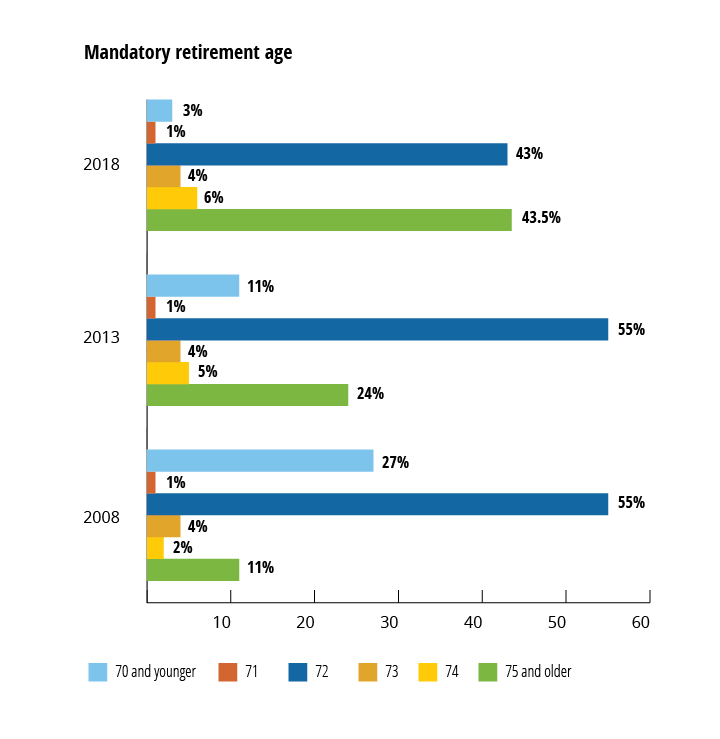
Instead, S&P 500 boards are likely to continue relying on mandatory retirement policies to stimulate board turnover. Today, 71 percent of S&P 500 boards disclose a mandatory retirement age for directors, consistent with the past five years. Retirement ages also continue to climb. In 2008, a meager 11 percent of S&P 500 companies with mandatory retirement policies set the age limit at 75 or older, compared to 43.5 percent today. More than half of these companies mandate a retirement age of at least 73 or older. Three boards have a retirement age of 80.


Three-quarters of the independent directors who left S&P 500 boards in the 2018 proxy season served on boards with mandatory retirement ages. The age limits appeared to have influenced many of these departures — 37 percent of retirees had reached or exceeded the age limit at retirement, and another 16 percent left within three years of the retirement age. Currently, only 16 percent of the independent directors on S&P 500 boards with age caps are within three years of mandatory retirement.

Experience as a CEO, board chair, or similar position is no longer viewed as the only qualifying credential for director candidates.

The boardroom will gradually be reshaped by new perspectives and expertise.


While modest turnover will continue, evidence suggests that boards will use openings from director departures to inject fresh perspectives and expertise into emerging areas of need.

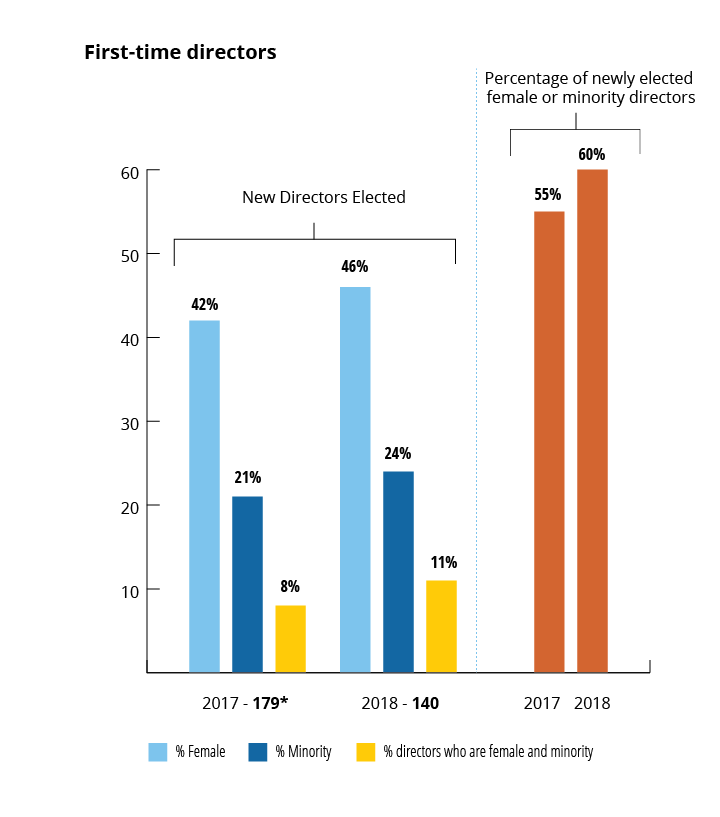
For one thing, experience as a CEO, board chair, or similar position is no longer viewed as the only qualifying credential for director candidates. Of the 428 new independent directors added to S&P 500 boards in the 2018 proxy year, only 35.5 percent were active or retired CEOs, board chairs, or similar, down from 47 percent a decade ago. Nor is a background in a public company boardroom a requirement. First-time public company directors constituted 33 percent of the 2018 class of new S&P 500 directors. These first-timers are younger than their peers and more likely to be actively employed (64% versus 53%). They are less likely to be CEOs or chief operating officers, and more likely to have other managerial experiences such as line or functional backgrounds or to hold roles in division/subsidiary leadership. They are also more likely to be minorities: 24 percent of first-time directors in 2018 are minorities, versus 19 percent of all new S&P 500 directors.

Of the 428 new independent directors added to S&P 500 boards in the 2018 proxy year, only 35.5 percent were active or retired CEOs, board chairs, or similar, down from 47 percent a decade ago.

*Includes directors who had served or were serving as an executive director on a public company board.


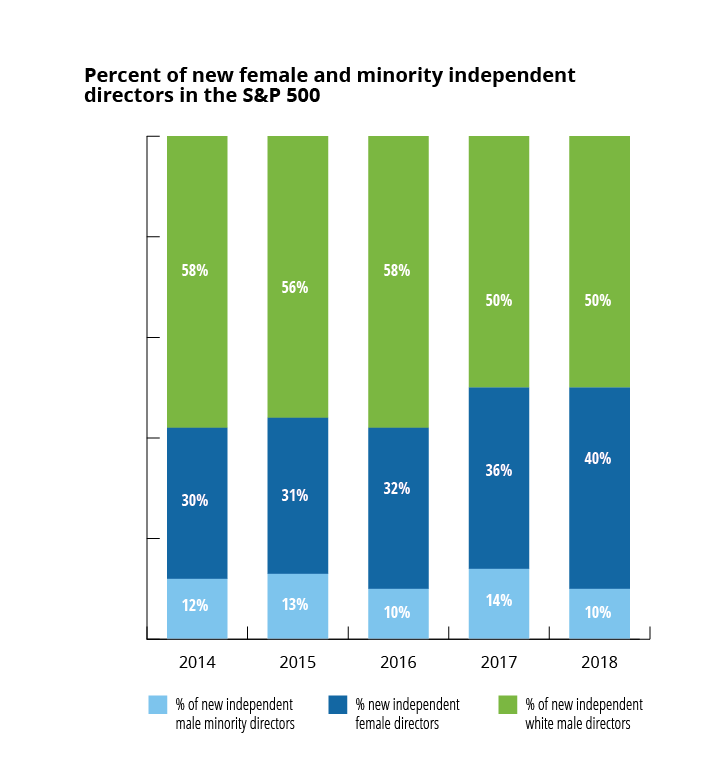
Recognizing the strategic imperative for new perspectives and experience in the boardroom, boards are increasingly adding directors with backgrounds in technology, digital transformation and technologies, consumer marketing, and other areas of emerging importance. Financial talent remains prized, especially the experiences of chief financial officers, finance executives, and/or investment professionals. That said, as investors have continued to press for more gender diversity, S&P 500 boards have increased the number of women directors, reaching a new high: 40 percent of new directors in the 2018 proxy year are women, an increase from 36 percent in 2017.

Financial talent remains prized, especially the experiences of chief financial officers, finance executives, and/or investment professionals.


Boards are also likely to enhance disclosures about composition. As interest in boardroom composition among investors has increased, a growing number of companies are voluntarily enhancing their disclosures to highlight the diversity of their boards and to showcase how director skills and qualifications align with company strategy. In fact, nearly a third (30%) of S&P 500 companies have published a board matrix spotlighting the skills and qualifications of each director on their governance web page.

Younger directors may become a potent new voice in the boardroom.


As boards prioritize new areas of expertise — such as industry and functional experience in technology and digital transformation, and certain areas of marketing and finance — many are tapping “next-generation” directors whose qualifications align with the needs of their organizations. One out of six directors (17%) in the 2018 class of new directors is age 50 or younger.

Given that their backgrounds and profiles differ from more traditional board members, these directors are likely to bring varied perspectives to boardroom discussions. Nearly two-thirds of these “next-gen” corporate directors have expertise in three sectors: technology/telecommunications (34%), consumer goods (16%), and private equity/investments (14%). A majority (almost two-thirds) are serving on their first public company board. More than half (53%) are women.

Interestingly, these directors may also be less likely to have lengthy tenures, due to factors such as the demands of their careers, a desire to move on, or dissatisfaction with their board experience. Twenty-eight (7%) of the 417 directors who left an S&P 500 board seat in the 2018 proxy season were 55 years old or younger, with an average tenure of five years. Other directors who departed their boards over the same period had a much longer tenure on average (12.7 years) and were 68.4 years old on average.

Business demands and investor pressure are likely to change how boards think about composition and refreshment strategies.

The implications for your board


Business demands and investor pressure are likely to change how boards think about composition and refreshment strategies. Increasingly, directors are recognizing that board composition should support and reflect the strategic needs of the organization. Boards can use the following recommendations to enhance short- and long-term approaches to their composition:

Have an ongoing refreshment strategy.

The composition of the board should be viewed as a strategic asset. Boards will be better prepared to plan for and take advantage of openings if there is a formal approach to refreshment. This includes regularly reviewing and aligning the board’s makeup to the company’s strategic direction, identifying desired competencies for future directors, and regularly infusing the board with perspectives relevant to the organization’s future needs.

Increasingly, investors consider meaningful full-board and individual assessments as “best practice” not only for evaluating and enhancing board and director performance but also for promoting boardroom refreshment. While annual evaluations have become the norm for boards, far fewer — 38 percent of S&P 500 boards — report some form of individual director evaluations. Proactive boards assess skills and attributes, incorporating results from board self-assessments. They also take a multiyear view of departures, including upcoming board leadership changes, and set clear expectations around director tenure.

Key Questions for Directors to Consider:


  1. Does the board as currently constituted give the company its best shot at success in supporting the strategy?
  2. What additional, and potentially underrepresented, skills or expertise would significantly enhance the board’s ability to do its job?
  3. What are our refreshment mechanisms and strategy, and how are they communicated to stakeholders, including investors?
  4. Are we using board evaluations to help identify gaps in expertise and skills the board may require in the coming years?
  5. Is our onboarding program robust and tailored to individual director needs and backgrounds?
Position new directors for success.

The nominating and governance committee chair and other board leaders should ensure that the board has a robust new-director orientation program in place. Incoming directors, particularly younger and first-time board members, benefit from an orientation and continuing education that familiarize them with the company’s needs and the board’s approach to governance. At a minimum, a director onboarding program should provide insights about public disclosures and nonpublic materials (such as board meeting minutes, forecasts, budgets, strategic plans, etc.) and socialize the new director(s) with key executives and members of senior management. Additionally, the board should recognize that new directors may find it helpful to partner with a mentor — formally or informally — who they can turn to for questions and feedback.

With greater focus on diversity, board culture becomes critical.

Boards are adding new perspectives to enhance board deliberations and improve outcomes. But greater diversity also increases the likelihood of misunderstanding and tension among directors with different points of view and backgrounds. In the past, boards tended to be more homogeneous and, as a result, there was typically more implicit agreement about director interaction and behavior. Today, with higher levels of diversity in the boardroom — whether in terms of experiences, skills, gender, race, ethnicity, nationality, and/or age — it’s critical to create a boardroom culture that facilitates constructive interactions between board members. All boards can benefit from cultures that value inquisitiveness and flexibility, and where directors are comfortable challenging one another’s — and management’s — assumptions and ideas.

_____________________________________________________________

Note: This article was originally published in the NACD 2019 Governance Outlook.

*Julie Hembrock Daum leads the North American Board Practice and was a long standing board member of Spencer Stuart. She consults with corporate boards, working with companies of all sizes from the Fortune 10 to pre-IPO companies. She has conducted more than 1,000 board director assignments, recently recruiting outside directors for Johnson & Johnson, Whole Foods, Amazon, Saudi Aramco, Nike, numerous IPOs and spin off boards.

Nouvelles perspectives pour la gouvernance en 2018


Aujourd’hui, je vous propose la lecture d’un excellent article de Martin Lipton* sur les nouvelles perspectives de la gouvernance en 2018. Cet article est publié sur le site du Harvard Law School Forum on Corporate Governance.

Après une brève introduction portant sur les meilleures pratiques observées dans les entreprises cotées, l’auteur se penche sur les paramètres les plus significatifs de la nouvelle gouvernance.

Les thèmes suivants sont abordés dans un contexte de renouvellement de la gouvernance pour le futur :

  1. La notion de l’actionnariat élargie pour tenir compte des parties prenantes ;
  2. L’importance de considérer le développement durable et la responsabilité sociale des entreprises ;
  3. L’adoption de stratégies favorisant l’engagement à long terme ;
  4. La nécessité de se préoccuper de la composition des membres du CA ;
  5. L’approche à adopter eu égard aux comportements d’actionnaires/investisseurs activistes ;
  6. Les attentes eu égard aux rôles et responsabilités des administrateurs.

À l’approche de la nouvelle année 2018, cette lecture devrait compter parmi les plus utiles pour les administrateurs et les dirigeants d’entreprises ainsi que pour toute personne intéressée par l’évolution des pratiques de gouvernance.

Bonne lecture ! Vos commentaires sont appréciés.


Some Thoughts for Boards of Directors in 2018


Introduction


As 2017 draws to a conclusion and we reflect on the evolution of corporate governance since the turn of the millennium, a recurring question percolating in boardrooms and among shareholders and other stakeholders, academics and politicians is: what’s next on the horizon for corporate governance? In many respects, we seem to have reached a point of relative stasis. The governance and takeover defense profiles of U.S. public companies have been transformed by the widespread adoption of virtually all of the “best practices” advocated to enhance the rights of shareholders and weaken takeover defenses.

While the future issues of corporate governance remain murky, there are some emerging themes that portend a potentially profound shift in the way that boards will need to think about their roles and priorities in guiding the corporate enterprise. While these themes are hardly new, they have been gaining momentum in prompting a rethinking of some of the most basic assumptions about corporations, corporate governance and the path forward.

First, while corporate governance continues to be focused on the relationship between boards and shareholders, there has been a shift toward a more expansive view that is prompting questions about the broader role and purpose of corporations. Most of the governance reforms of the past few decades targeted the ways in which boards are structured and held accountable to the interests of shareholders, with debates often boiling down to trade-offs between a board-centric versus a more shareholder-centric framework and what will best create shareholder value. Recently, efforts to invigorate a more long-term perspective among both corporations and their investors have been laying the groundwork for a shift from these process-oriented debates to elemental questions about the basic purpose of corporations and how their success should be measured and defined.

In particular, sustainability has become a major, mainstream governance topic that encompasses a wide range of issues such as climate change and other environmental risks, systemic financial stability, labor standards, and consumer and product safety. Relatedly, an expanded notion of stakeholder interests that includes employees, customers, communities, and the economy and society as a whole has been a developing theme in policymaking and academic spheres as well as with investors. As summarized in a 2017 report issued by State Street Global Advisor,

“Today’s investors are looking for ways to put their capital to work in a more sustainable way, one focused on long-term value creation that enables them to address their financial goals and responsible investing needs. So, for a growing number of institutional investors, the environmental, social and governance (ESG) characteristics of their portfolio are key to their investment strategy.”

While both sustainability and expanded constituency considerations have been emphasized most frequently in terms of their impact on long-term shareholder value, they have also been prompting fresh dialogue about the societal role and purpose of corporations.

Another common theme that underscores many of the corporate governance issues facing boards today is that corporate governance is inherently complex and nuanced, and less amenable to the benchmarking and quantification that was a significant driver in the widespread adoption of corporate governance “best practices.” Prevailing views about what constitutes effective governance have morphed from a relatively binary, check-the-box mentality—such as whether a board is declassified, whether shareholders can act by written consent and whether companies have adopted majority voting standards—to tackling questions such as how to craft a well-rounded board with the skills and experiences that are most relevant to a particular corporation, how to effectively oversee the company’s management of risk, and how to forge relationships with shareholders that meaningfully enhance the company’s credibility. Companies and investors alike have sought to formulate these “next generation” governance issues in a way that facilitates comparability, objective assessment and accountability. For example, many companies have been including skills matrices in their proxy statements to show, in a visual snapshot, that their board composition encompasses appropriate skills and experiences. Yet, to the extent that complicated governance issues cannot be reduced to simple, user-friendly metrics, it remains to be seen whether this will prompt new ways of defining “good” corporate governance that require a deeper understanding of companies and their businesses, and the impact that could have on the expectations and practices of stakeholders.

Against this backdrop, a few of the more significant issues that boards of directors will face in the coming year, as well as an overview of some key roles and responsibilities, are highlighted below. Parts II through VI contain brief summaries of some of the leading proposals and thinking for corporate governance of the future. In Part VII, we turn to the issues boards of directors will face in 2018 and suggestions as to how to prepare to deal with them.


Expanded Stakeholders


The primacy of shareholder value as the exclusive objective of corporations, as articulated by Milton Friedman and then thoroughly embraced by Wall Street, has come under scrutiny by regulators, academics, politicians and even investors. While the corporate governance initiatives of the past year cannot be categorized as an abandonment of the shareholder primacy agenda, there are signs that academic commentators, legislators and some investors are looking at more nuanced and tempered approaches to creating shareholder value.

In his 2013 book, Firm Commitment: Why the Corporation is Failing Us and How to Restore Trust in It, and a series of brilliant articles and lectures, Colin Mayer of the University of Oxford has convincingly rejected shareholder value primacy and put forth proposals to reconceive the business corporation so that it is committed to all its stakeholders, including the community and the general economy. His new book, Prosperity: Better Business Makes the Greater Good, to be published by Oxford University Press in 2018, continues the theme of his earlier publications and will be required reading.

Similarly, an influential working paper by Oliver Hart and Luigi Zingales argues that the appropriate objective of the corporation is shareholder welfare rather than shareholder wealth. Hart and Zingales advocate that corporations and asset managers should pursue policies consistent with the preferences of their investors, specifically because corporations may be able to accomplish objectives that shareholders acting individually cannot. In such a setting, the implicit separability assumption underlying Milton Friedman’s theory of the purpose of the firm fails to produce the best outcome for shareholders. Indeed, even though Hart and Zingales propose a revision that remains shareholder-centered, by recognizing the unique capability of corporations to engage in certain kinds of activities, their theory invites a careful consideration of other goals such as sustainability, board diversity and employee welfare, and even such social concerns, as, for example, reducing mass violence or promoting environmental stewardship. Such a model of corporate decision-making emphasizes the importance of boards establishing a relationship with significant shareholders to understand shareholder goals, beyond simply assuming that an elementary wealth maximization framework is the optimal path.

Perhaps closer to a wholesale rejection of the shareholder primacy agenda, an article by Joseph L. Bower and Lynn S. Paine, featured in the May-June 2017 issue of the Harvard Business Review, attacks the fallacies of the economic theories that have been used since 1970 to justify shareholder-centric corporate governance, short-termism and activist attacks on corporations. In questioning the benefits of hedge fund activism, Bower and Paine argue that some of the value purportedly created for shareholders by activists is not actually value created, but rather value transferred from other parties or from the public purse, such as shifting a company’s tax domicile to a lower-tax jurisdiction or eliminating exploratory research and development. The article supports the common sense notion that boards have a fiduciary duty not just to shareholders, but also to employees, customers and the community—a constituency theory of governance penned into law in a number of states’ business corporation laws.

Moreover, this theme has been metastasizing from a theoretical debate into specific reform initiatives that, if implemented, could have a direct impact on boards. For example, Delaware and 32 other states and the District of Columbia have passed legislation approving a new corporate form—the benefit corporation —a for-profit corporate entity with expanded fiduciary obligations of boards to consider other stakeholders in addition to shareholders. Benefit corporations are mandated by law to consider their overall positive impact on society, their workers, the communities in which they operate and the environment, in addition to the goal of maximizing shareholder profit.

This broader sense of corporate purpose has been gaining traction among shareholders. For example, the endorsement form for the Principles published by the Investor Stewardship Group in 2017 includes:

“[I]t is the fiduciary responsibility of all asset managers to conduct themselves in accordance with the preconditions for responsible engagement in a manner that accrues to the best interests of stakeholders and society in general, and that in so doing they’ll help to build a framework for promoting long-term value creation on behalf of U.S. companies and the broader U.S. economy.”

Notions of expanded stakeholder interests have often been incorporated into the concept of long-termism, and advocating a long-term approach has also entailed the promotion of a broader range of stakeholder interests without explicitly eroding the primacy of shareholder value. Recently, however, the interests of other stakeholders have increasingly been articulated in their own right rather than as an adjunct to the shareholder-centric model of corporate governance. Ideas about the broader social purpose of corporations have the potential to drive corporate governance reforms into uncharted territory requiring navigation of new questions about how to measure and compare corporate performance, how to hold companies accountable and how to incentivize managers.


Sustainability


The meaning of sustainability is no longer limited to describing environmental practices, but rather more broadly encompasses the sustainability of a corporation’s business model in today’s fast-changing world. The focus on sustainability encompasses the systemic sustainability of public markets and pressures boards to think about corporate strategy and how governance should be structured to respond to and compete in this environment.

Recently, the investing world has seen a rise of ESG-oriented funds—previously a small, niche segment of the investment community. Even beyond these specialized funds, ESG has also become a focus of a broad range of traditional investment funds and institutional investors. For instance, BlackRock and State Street both offer their investors products that specifically focus on ESG-oriented topics like climate change and impact investing—investing with an intention of generating a specific social or environmental outcome alongside financial returns.

At the beginning of 2017, State Street’s CEO Ronald P. O’Hanley wrote a letter advising the boards of the companies in which State Street invests that State Street defines sustainability “as encompassing a broad range of environmental, social and governance issues that include, for example, effective independent board leadership and board composition, diversity and talent development, safety issues, and climate change.” The letter was a reminder that broader issues that impact all of a company’s stakeholders may have a material effect on a company’s ability to generate returns. Chairman and CEO of BlackRock, Laurence D. Fink remarked similarly in his January 2017 letter that

“[e]nvironmental, social and governance factors relevant to a company’s business can provide essential insights into management effectiveness and thus a company’s long-term prospects. We look to see that a company is attuned to the key factors that contribute to long-term growth: sustainability of the business model and its operations, attention to external and environmental factors that could impact the company, and recognition of the company’s role as a member of the communities in which it operates.”

Similarly, the UN Principles for Responsible Investment remind corporations that ESG factors should be incorporated into all investment decisions to better manage risk and generate sustainable, long-term returns.

Shareholders’ engagement with ESG issues has also increased. Previously, ESG was somewhat of a fringe issue with ESG-related shareholder proxy proposals rarely receiving significant shareholder support. This is no longer the case. In the 2017 proxy season, the two most common shareholder proposal topics related to social (201 proposals) and environmental (144 proposals, including 69 on climate change) issues, as opposed to 2016’s top two topics of proxy access (201) and social issues (160). Similar to cybersecurity and other risk management issues, sustainability practices involve the nuts and bolts of operations—e.g., life-cycle assessments of a product and management of key performance indicators (KPIs) using management information systems that facilitate internal and public reporting—and provide another example of an operational issue that has become a board/governance issue.

The expansion of sustainability requires all boards—not just boards of companies with environmentally sensitive businesses—to be aware of and be ready to respond to ESG-related concerns. The salient question is whether “best” sustainability practices will involve simply the “right” messaging and disclosures, or whether investors and companies will converge on a method to measure sustainability practices that affords real impact on capital allocation, risk-taking and proactive—as opposed to reactive—strategy.

Indeed, measurement and accountability are perhaps the elephants in the room when it comes to sustainability. Many investors appear to factor sustainability into their investing decisions. Other ways to measure sustainability practices include the presence of a Chief Sustainability Officer or Corporate Responsibility Committee. However, while there are numerous disclosure frameworks relating to sustainability and ESG practices, there is no centralized ESG rating system. Further, rating methodologies and assessments of materiality vary widely across ESG data providers and disclosure requirements vary across jurisdictions.

Pending the development of clear and agreed standards to benchmark performance on ESG issues, boards of directors should focus on understanding how their significant investors value and measure ESG issues, including through continued outreach and engagement with investors focusing on these issues, and should seek tangible agreed-upon methodologies to address these areas, while also promoting the development of improved metrics and disclosure.

Promoting a Long-Term Perspective


As the past year’s corporate governance conversation has explored considerations outside the goal of maximizing shareholder value, the conversation within the shareholder value maximization framework has also continued to shift toward an emphasis on long-term value rather than short term. A February 2017 discussion paper from the McKinsey Global Institute in cooperation with Focusing Capital on the Long Term found that long-term focused companies, as measured by a number of factors including investment, earnings quality and margin growth, generally outperformed shorter-term focused companies in both financial and other performance measures. Long-term focused companies had greater, and less volatile, revenue growth, more spending on research and development, greater total returns to shareholders and more employment than other firms.

This empirical evidence that corporations focused on stakeholders and long-term investment contribute to greater economic growth and higher GDP is consistent with innovative corporate governance initiatives. A new startup, comprised of veterans of the NYSE and U.S. Treasury Department, is working on creating the “Long-Term Stock Exchange”—a proposal to build and operate an entirely new stock exchange where listed companies would have to satisfy not only all of the normal SEC requirements to allow shares to trade on other regulated U.S. stock markets but, in addition, other requirements such as tenured shareholder voting power (permitting shareholder voting to be proportionately weighted by the length of time the shares have been held), mandated ties between executive pay and long-term business performance and disclosure requirements informing companies who their long-term shareholders are and informing investors of what companies’ long-term investments are.

In addition to innovative alternatives, numerous institutional investors and corporate governance thought leaders are rethinking the mainstream relationship between all boards of directors and institutional investors to promote a healthier focus on long-term investment. While legislative reform has taken a stronger hold in the U.K. and Europe, leading American companies and institutional investors are pushing for a private sector solution to increase long-term economic growth. Commonsense Corporate Governance Principles and The New Paradigm: A Roadmap for an Implicit Corporate Governance Partnership Between Corporations and Investors to Achieve Sustainable Long-Term Investment and Growth were published in hopes of recalibrating the relationship between boards and institutional investors to protect the economy against the short-term myopic approach to management and investing that promises to impede long-term economic prosperity. Under a similar aim, the Investor Stewardship Group published its Stewardship Principles and Corporate Governance Principles, set to become effective in January 2018, to establish a framework with six principles for investor stewardship and six principles for corporate governance to promote long-term value creation in American business. A Synthesized Paradigm for Corporate Governance, Investor Stewardship, and Engagement provides a synthesis of these and others in the hope that companies and investors would agree on a common approach. In fact, over 100 companies to date have signed The Compact for Responsive and Responsible Leadership: A Roadmap for Sustainable Long-Term Growth and Opportunity, sponsored by the World Economic Forum, which includes the key features of The New Paradigm.

Similarly, the BlackRock Investment Stewardship team has proactively outlined five focus areas for its engagement efforts: Governance, Corporate Strategy for the Long-Term, Executive Compensation that Promotes Long-Termism, Disclosure of Climate Risks, and Human Capital Management. BlackRock’s outline reflects a number of key trends, including heightened transparency by institutional investors, more engagement by “passive” investors, and continued disintermediation of proxy advisory firms. In the United Kingdom, The Investor Forum was founded to provide an intermediary to represent the views of its investor members to investee companies in the hope of reducing activism, and appears to have achieved a successful start.

Similarly, in June 2017, the Coalition for Inclusive Capitalism and Ernst & Young jointly announced the launch of a project on long-term value creation. Noting among other elements that trust and social cohesion are necessary ingredients for the long-term success of capitalism, the project will emphasize reporting mechanisms and credible measurements supporting long-term value, developing and testing a framework to better reflect the full value companies create beyond simply financial value. There is widespread agreement that focusing on long-term investment will promote long-term economic growth. The next step is a consensus between companies and investors on a common path of action that will lead to restored trust and cohesion around long-term goals.


Board Composition


The corporate governance conversation has become increasingly focused on board composition, including board diversity. Recent academic studies have confirmed and expanded upon existing empirical evidence that hedge fund activism has been notably counterproductive in increasing gender diversity—yet another negative externality of this type of activism. Statistical evidence supports the hypothesis that the rate of shareholder activism is higher toward female CEOs holding all else equal, including industries, company sizes and levels of performance. A study forthcoming in the Journal of Applied Psychology investigated the reasons that hedge fund activists seemingly ignore the evidence for gender-diverse boards in their choices for director nominees and disproportionately target female CEOs. The authors suggest these reasons may include subconscious biases of hedge funds against women leaders due to perceptions and cultural attitudes.

In the United Kingdom, the focus on board diversity has spread into policy. The House of Commons Business, Energy, and Industrial Strategy Committee report on Corporate Governance, issued in 2017, included recommendations for improving ethnic, gender and social diversity of boards, noting that “[to] be an effective board, individual directors need different skills, experience, personal attributes and approaches.” The U.K. government’s response to this report issued in September 2017 notes its agreement on various diversity-related issues, stating that the “Government agrees with the Committee that it makes business sense to recruit directors from as broad a base as possible across the demographic of the UK” and further, tying into themes of stakeholder capitalism, that the “Government believes that greater diversity within the boardroom can help companies connect with their workforces, supply chains, customers and shareholders.”

In the United States, institutional investors are focused on a range of board composition issues, including term limits, board refreshment, diversity, skills matrices and board evaluation processes, as well as disclosures regarding these issues. In a recent letter, Vanguard explained that it considers the board to be “one of a company’s most critical strategic assets” and looks for a “high-functioning, well-composed, independent, diverse, and experienced board with effective ongoing evaluation practices,” stating that “Good governance starts with a great Board.” The New York Comptroller’s Boardroom Accountability Project 2.0 is focused on increasing diversity of boards in order to strengthen their independence and competency. In connection with launching this campaign, the NYC Pension Funds asked the boards of 151 U.S. companies to disclose the race and gender of their directors alongside board members’ skills in a standardized matrix format. And yet, similar to the difficulty of measuring and comparing sustainability efforts of companies, investors and companies alike continue to struggle with how to measure and judge a board’s diversity, and board composition generally, as the conversation becomes more nuanced. Board composition and diversity aimed at increasing board independence and competency is not a topic that lends itself to a “check-the-box” type measurement.

In light of the heightened emphasis on board composition, boards should consider increasing their communications with their major shareholders about their director selection and nomination processes to show the board understands the importance of its composition. Boards should consider disclosing how new director candidates are identified and evaluated, how committee chairs and the lead director are determined, and how the operations of the board as a whole and the performance of each director are assessed. Boards may also focus on increasing tutorials, facility visits, strategic retreats and other opportunities to increase the directors’ understanding of the company’s business—and communicate such efforts to key shareholders and constituents.


Activism


Despite the developments and initiatives striving to protect and promote long-term investment, the most dangerous threat to long-term economic prosperity has continued to surge in the past year. There has been a significant increase in activism activity in countries around the world and no slowdown in the United States. The headlines of 2017 were filled with activists who do not fit the description of good stewards of the long-term interests of the corporation. A must-read Bloombergarticle described Paul Singer, founder of Elliott Management Corp., which manages $34 billion of assets, as “aggressive, tenacious and litigious to a fault” and perhaps “the most feared activist investor in the world.” Numerous recent activist attacks underscore that the CEO remains a favored activist target. Several major funds have become more nuanced and taken a merchant banker approach of requesting board representation to assist a company to improve operations and strategy for long-term success. No company is too big for an activist attack. Substantial new capital has been raised by activist hedge funds and several activists have created special purpose funds for investment in a single target. As long as activism remains a serious threat, the economy will continue to experience the negative externalities of this approach to investing—companies attempting to avoid an activist attack are increasingly managed for the short term, cutting important spending on research and development and focusing on short-term profits by effecting share buybacks and paying dividends at the expense of investing in a strategy for long-term growth.

To minimize the impact of activist attacks, boards must focus on building relationships with major institutional investors. The measure of corporate governance success has shifted from checking the right boxes to building the right relationships. Major institutional investors have reiterated their commitment to bringing a long-term perspective to public companies, including, for example, Vanguard, which sent an open letter to directors of public companies world-wide explaining that a long-term perspective informed every aspect of its investment approach. Only by forging relationships of trust and credibility with long-term shareholders can a company expect to gain support for its long-term strategy when it needs it. In many instances, when an activist does approach, a previously established relationship provides a foundation for management and the board to persuade key shareholders that short-term activism is not in their best interest—an effort that is already showing some promise. General Motors’ resounding defeat of Greenlight Capital’s attempt to gain shareholder approval to convert its common stock into two classes shows a large successful company’s ability to garner the

support of its institutional investors against financial engineering. Trian’s recent proxy fight against Procter & Gamble shows the importance of proactively establishing relationships with long-term shareholders. Given Trian’s proven track record of success in urging changes in long-term strategy, Nelson Peltz was able to gain support for a seat on P&G’s board from proxy advisors and major institutional investors. We called attention to importantlessons from this proxy fight (discussed on the Forum here and here).


Spotlight on Boards


The ever-evolving challenges facing corporate boards prompts an updated snapshot of what is expected from the board of directors of a major public company—not just the legal rules, but also the aspirational “best practices” that have come to have equivalent influence on board and company behavior. In the coming year, boards will be expected to:

Oversee corporate strategy and the communication of that strategy to investors;

Set the tone at the top to create a corporate culture that gives priority to ethical standards, professionalism, integrity and compliance in setting and implementing strategic goals;

Choose the CEO, monitor the CEO’s and management’s performance and develop a succession plan;

Determine the agendas for board and committee meetings and work with management to assure appropriate information and sufficient time are available for full consideration of all matters;

Determine the appropriate level of executive compensation and incentive structures, with awareness of the potential impact of compensation structures on business priorities and risk-taking, as well as investor and proxy advisor views on compensation;

Develop a working partnership with the CEO and management and serve as a resource for management in charting the appropriate course for the corporation;

Oversee and understand the corporation’s risk management and compliance efforts, and how risk is taken into account in the corporation’s business decision-making; respond to red flags when and if they arise (see Risk Management and the Board of Directors, discussed on the Forum here);

Monitor and participate, as appropriate, in shareholder engagement efforts, evaluate potential corporate governance proposals and anticipate possible activist attacks in order to be able to address them more effectively;

Evaluate the board’s performance on a regular basis and consider the optimal board and committee composition and structure, including board refreshment, expertise and skill sets, independence and diversity, as well as the best way to communicate with investors regarding these issues;

Review corporate governance guidelines and committee charters and tailor them to promote effective board functioning;

Be prepared to deal with crises; and

Be prepared to take an active role in matters where the CEO may have a real or perceived conflict, including takeovers and attacks by activist hedge funds focused on the CEO.

To meet these expectations, major public companies should seek to:

Have a sufficient number of directors to staff the requisite standing and special committees and to meet expectations for diversity;

Have directors who have knowledge of, and experience with, the company’s businesses, even if this results in the board having more than one director who is not “independent”;

Have directors who are able to devote sufficient time to preparing for and attending board and committee meetings;

Meet investor expectations for director age, diversity and periodic refreshment;

Provide the directors with the data that is critical to making sound decisions on strategy, compensation and capital allocation;

Provide the directors with regular tutorials by internal and external experts as part of expanded director education; and

Maintain a truly collegial relationship among and between the company’s senior executives and the members of the board that enhances the board’s role both as strategic partner and as monitor.

______________________________________

*Martin Lipton is a founding partner of Wachtell, Lipton, Rosen & Katz, specializing in mergers and acquisitions and matters affecting corporate policy and strategy. This post is based on a Wachtell Lipton publication by Mr. Lipton, Steven A. Rosenblum, Karessa L. Cain, Sabastian V. Niles, Vishal Chanani, and Kathleen C. Iannone.

Une saine tension entre le CA et la direction : Gage d’une bonne gouvernance | Billet revisité


Dans son édition d’avril 2016, le magazine Financier Worldwide présente une excellente analyse de la dynamique d’un conseil d’administration efficace.

Pour l’auteur, il est important que le président du conseil soit habileté à exercer un niveau de saine tension entre les administrateurs et la direction de l’entreprise.

Il n’y a pas de place pour la complaisance au conseil. Les membres doivent comprendre que leur rôle est de veiller aux « intérêts supérieurs » de l’entreprise, notamment des propriétaires-actionnaires, mais aussi d’autres parties prenantes.

Le PDG de l’entreprise est recruté par le CA pour faire croître l’entreprise et exécuter une stratégie liée à son modèle d’affaires. Lui aussi doit travailler en fonction des intérêts des actionnaires… mais c’est la responsabilité fiduciaire du CA de s’en assurer en mettant en place les mécanismes de surveillance appropriés.

La théorie de l’agence stipule que le CA représente l’autorité souveraine de l’entreprise (puisqu’il possède la légitimité que lui confèrent les actionnaires). Le CA confie à un PDG (et à son équipe de gestion) le soin de réaliser les objectifs stratégiques retenus. Les deux parties — le Board et le Management — doivent bien comprendre leurs rôles respectifs, et trouver les bons moyens pour gérer la tension inhérente à l’exercice de la gouvernance et de la gestion.

Les administrateurs doivent s’efforcer d’apporter une valeur ajoutée à la gestion en conseillant la direction sur les meilleures orientations à adopter, et en instaurant un climat d’ouverture, de soutien et de transparence propice à la réalisation de performances élevées.

Il est important de noter que les actionnaires s’attendent à la loyauté des administrateurs ainsi qu’à leur indépendance d’esprit face à la direction. Les administrateurs sont élus par les actionnaires et sont donc imputables envers eux. C’est la raison pour laquelle le conseil d’administration doit absolument mettre en place un processus d’évaluation de ces membres et divulguer sa méthodologie.

Également, comme mentionné dans un billet daté du 5 juillet 2016 (la séparation des fonctions de président du conseil et de président de l’entreprise [CEO] est-elle généralement bénéfique ?), les autorités réglementaires, les firmes spécialisées en votation et les experts en gouvernance suggèrent que les rôles et les fonctions de président du conseil d’administration soient distincts des attributions des PDG (CEO).

En fait, on suppose que la séparation des fonctions, entre la présidence du conseil et la présidence de l’entreprise (CEO), est généralement bénéfique à l’exercice de la responsabilité de fiduciaire des administrateurs, c’est-à-dire que des pouvoirs distincts permettent d’éviter les conflits d’intérêts, tout en rassurant les actionnaires.

Cependant, cette pratique cède trop souvent sa place à la volonté bien arrêtée de plusieurs PDG d’exercer le pouvoir absolu, comme c’est encore le cas pour plusieurs entreprises américaines. Pour plus d’information sur ce sujet, je vous invite à consulter l’article suivant : Séparation des fonctions de PDG et de président du conseil d’administration | Signe de saine gouvernance !

Le Collège des administrateurs de sociétés (CAS) offre une formation spécialisée de deux jours sur le leadership à la présidence.


Banque des ASC
Gouvernance et leadership à la présidence


Vous trouverez, ci-dessous, l’article du Financier Worldwide qui illustre assez clairement les tensions existantes entre le CA et la direction, ainsi que les moyens proposés pour assurer la collaboration entre les deux parties.

J’ai souligné en gras les passages clés.

Bonne lecture ! Vos commentaires sont appréciés.


In this age of heightened risk, the need for effective governance has caused a dynamic shift in the role of the board of directors. Cyber security, rapid technological growth and a number of corporate scandals resulting from the financial crisis of 2008, all underscore the necessity of boards working constructively with management to ensure efficient oversight, rather than simply providing strategic direction. This is, perhaps, no more critical than in the middle market, where many companies often don’t have the resources larger organisations have to attract board members, but yet their size requires more structure and governance than smaller companies might need.

Following the best practices of high-performing boards can help lead to healthy tension between management and directors for improved results and better risk management. We all know conflict in the boardroom might sometimes be unavoidable, as the interests of directors and management don’t necessarily always align. Add various personalities and management styles to the mix, and discussions can sometimes get heated. It’s important to deal with situations when they occur in order to constructively manage potential differences of opinion to create a healthy tension that makes the entire organisation stronger.

Various conflict management styles can be employed to ensure that any potential boardroom tension within your organisation is healthy. If an issue seems minor to one person but vital to the rest of the group, accommodation can be an effective way to handle tension. If minor issues arise, it might be best to simply avoid those issues, whereas collaboration should be used with important matters. Arguably, this is the best solution for most situations and it allows the board to effectively address varying opinions. If consensus can’t be reached, however, it might become necessary for the chairman or the lead director to use authoritarian style to manage tension and make decisions. Compromise might be the best approach when the board is pressed for time and needs to take immediate action.

Résultats de recherche d'images pour « saine tension entre le CA et la direction »

The board chairperson can be integral to the resolution process, helping monitor and manage boardroom conflict. With this in mind, boards should elect chairs with the proven ability to manage all personality types. The chairperson might also be the one to initiate difficult conversations on topics requiring deeper scrutiny. That said, the chairperson cannot be the only enforcer; directors need to assist in conflict resolution to maintain a proper level of trust throughout the group. And the CEO should be proactive in raising difficult issues as well, and boards are typically most effective when the CEO is confident, takes the initiative in learning board best practices and works collaboratively.

Gone are the days of the charismatic, autocratic CEO. Many organisations have separated the role of CEO and chairperson, and have introduced vice chairs and lead directors to achieve a better balance of power. Another way to ensure a proper distribution of authority is for the board to pay attention to any red flags that might be raised by the CEO’s behaviour. For example, if a CEO feels they have all the answers, doesn’t respect the oversight of the board, or attempts to manage or marginalise the board, the chairperson and board members will likely need to be assertive, rather than simply following the CEO’s lead. Initially this might seem counterintuitive, however, in the long-run, this approach will likely create a healthier tension than if they simply ‘followed the leader’.

Everyone in the boardroom needs to understand their basic functions for an effective relationship -executives should manage, while the board oversees. In overseeing, the board’s major responsibilities include approving strategic plans and goals, selecting a CEO, determining a mission or purpose, identifying key risks, and providing oversight of the compliance of corporate policies and regulations. Clearly understanding the line between operations and strategy is also important.

Organisations with the highest performing boards are clear on the appropriate level of engagement for the companies they represent – and that varies from one organisation to the next. Determining how involved the board will be and what type of model the board will follow is key to effective governance and a good relationship with management. For example, an entity that is struggling financially might require a more engaged board to help put it back on track.

Many elements, such as tension, trust, diversity of thought, gender, culture and expertise can impact the delicate relationship between the board and management. Good communication is vital to healthy tension. Following best practices for interaction before, during and after board meetings can enhance conflict resolution and board success.

Before each board meeting, management should prepare themselves and board members by distributing materials and the board package in a timely manner. These materials should be reviewed by each member, with errors or concerns forwarded to the appropriate member of management, and areas of discussion highlighted for the chair. An agenda focused on strategic issues and prioritised by importance of matters can also increase productivity.

During the meeting, board members should treat one another with courtesy and respect, holding questions held until after presentations (or as the presenter directs). Board-level matters should be discussed and debated if necessary, and a consensus reached. Time spent on less strategic or pressing topics should be limited to ensure effective meetings. If appropriate, non-board-level matters might be handed to management for follow-up.

Open communication should also continue after board meetings. Sometimes topics discussed during board meetings take time to digest. When this happens, board members should connect with appropriate management team members to further discuss or clarify. There are also various board committee meetings that need to occur between board meetings. Board committees should be doing the ‘heavy lifting’ for the full board, making the larger group more efficient and effective. Other more informal interactions can further strengthen the relationship between directors and management.

Throughout the year, the board’s engagement with management can be broadened to include discussions with more key players. Gaining multiple perspectives by interacting with other areas of the organisation, such as general counsels, external and internal auditors, public relations and human resources, can help the board identify and address key risks. By participating in internal and external company events, board members get to know management and the company’s customers on a first-hand basis.

Of course, a strategy is necessary for the board as well, as regulatory requirements have increased, leading to greater pressure for high-quality performance. Effective boards maintain a plan for development and succession. They also implement CEO and board evaluation processes to ensure goals are being met and board members are performing optimally. In addition to the evaluation process, however, board members must hold themselves totally accountable for instilling trust in the boardroom.

Competition in today’s increasingly global and complex business environment is fierce, and calls for new approaches for success. Today’s boards need to build on established best practices and create good relationships with management to outperform competitors. The highest performing boards are clear on their functions, and understand the level of engagement appropriate for the companies they support. They are accountable and set the right tone, while being able to discern true goals and aspirations from trendiness. They are capable of understanding and dealing with the ‘big issues’ and are strategic in their planning and implementation of approaches that work for the companies they serve. With the ever-changing risk universe, the ability to work with the right amount of healthy tension is essential to effective governance.

_______________________________________

Hussain T. Hasan is on the Consulting Leadership team as well as a board member at RSM US LLP.

Guide des pratiques exemplaires en matière de gestion des risques | Les responsabilités des administrateurs


Les administrateurs de sociétés doivent apporter une attention spéciale à la gestion des risques telle qu’elle est mise en œuvre par les dirigeants des entreprises.

Les préoccupations des fiduciaires pour la gestion des risques, quoique fondamentales, sont relativement récentes, et les administrateurs ne savent souvent pas comment aborder cette question.

L’article présenté, ci-dessous, est le fruit d’une recherche de Martin Lipton, fondateur de la firme Wachtell, Lipton, Rosen & Katz, spécialisée dans les fusions et acquisitions ainsi que dans les affaires de gouvernance.

L’auteur et ses collaborateurs ont produit un guide des pratiques exemplaires en matière de gestion des risques. Cet article de fond s’adresse aux administrateurs et touche aux éléments-clés de la gestion des risques :

(1) la distinction entre la supervision des risques et la gestion des risques ;

(2) les leçons que l’on doit tirer de la supervision des risques à Wells Fargo ;

(3) l’importance accordée par les investisseurs institutionnels aux questions des risques ;

(4) « tone at the top » et culture organisationnelle ;

(5) les devoirs fiduciaires, les contraintes réglementaires et les meilleures pratiques ;

(6) quelques recommandations spécifiques pour améliorer la supervision des risques ;

(7) les programmes de conformité juridiques ;

(8) les considérations touchant les questions de cybersécurité ;

(9) quelques facettes se rapportant aux risques environnementaux, sociaux et de gouvernance ;

(10) l’anticipation des risques futurs.


Voici donc l’introduction de l’article. Je vous invite à prendre connaissance de l’article au complet.

Bonne lecture !


Risk Management and the Board of Directors


Résultats de recherche d'images pour « Gestion des risques et administrateurs de sociétés »


Overview

The past year has seen continued evolution in the political, legal and economic arenas as technological change accelerates. Innovation, new business models, dealmaking and rapidly evolving technologies are transforming competitive and industry landscapes and impacting companies’ strategic plans and prospects for sustainable, long-term value creation. Tax reform has created new opportunities and challenges for companies too. Meanwhile, the severe consequences that can flow from misconduct within an organization serve as a reminder that corporate operations are fraught with risk. Social and environmental issues, including heightened focus on income inequality and economic disparities, scrutiny of sexual misconduct issues and evolving views on climate change and natural disasters, have taken on a new salience in the public sphere, requiring companies to exercise utmost care to address legitimate issues and avoid public relations crises and liability.

Corporate risk taking and the monitoring of corporate risk remain prominently top of mind for boards of directors, investors, legislators and the media. Major institutional shareholders and proxy advisory firms increasingly evaluate risk oversight matters when considering withhold votes in uncontested director elections and routinely engage companies on risk-related topics. This focus on risk management has also led to increased scrutiny of compensation arrangements throughout the organization that have the potential for incentivizing excessive risk taking. Risk management is no longer simply a business and operational responsibility of management. It has also become a governance issue that is squarely within the oversight responsibility of the board. This post highlights a number of issues that have remained critical over the years and provides an update to reflect emerging and recent developments. Key topics addressed in this post include:

the distinction between risk oversight and risk management;

a lesson from Wells Fargo on risk oversight;

the strong institutional investor focus on risk matters;

tone at the top and corporate culture;

fiduciary duties, legal and regulatory frameworks and third-party guidance on best practices;

specific recommendations for improving risk oversight;

legal compliance programs;

special considerations regarding cybersecurity matters;

special considerations pertaining to environmental, social and governance (ESG) risks; and

anticipating future risks.

Enjeux clés concernant les membres des comités d’audit | En rappel


Le récent rapport de KPMG sur les grandes tendances en audit présente sept défis que les membres des CA, notamment les membres des comités d’audit, doivent considérer afin de bien s’acquitter de leurs responsabilités dans la gouvernance des sociétés.

Le rapport a été rédigé par des professionnels en audit de la firme KPMG ainsi que par le Conference Board du Canada.

Les sept défis abordés dans le rapport sont les suivants :

– talent et capital humain ;

– technologie et cybersécurité ;

– perturbation des modèles d’affaires ;

– paysage réglementaire en évolution ;

– incertitude politique et économique ;

– évolution des attentes en matière de présentation de l’information ;

– environnement et changements climatiques.

Je vous invite à consulter le rapport complet ci-dessous pour de plus amples informations sur chaque enjeu.

Bonne lecture !


Tendances en audit


Résultats de recherche d'images pour « tendances en audit »


Alors que l’innovation technologique et la cybersécurité continuent d’avoir un impact croissant sur le monde des finances et des affaires à l’échelle mondiale, tant les comités d’audit que les chefs des finances reconnaissent le besoin de compter sur des talents de haut calibre pour contribuer à affronter ces défis et à en tirer parti.

Le rôle du comité d’audit est de s’assurer que l’organisation dispose des bonnes personnes possédant l’expérience et les connaissances requises, tant au niveau de la gestion et des opérations qu’au sein même de sa constitution. Il ne s’agit que de l’un des nombreux défis à avoir fait surface dans le cadre de ce troisième numéro du rapport Tendances en audit.

Les comités d’audit d’aujourd’hui ont la responsabilité d’aider les organisations à s’orienter parmi les nombreux enjeux et défis plus complexes que jamais auxquels ils font face, tout en remplissant leur mandat traditionnel de conformité et de présentation de l’information. Alors que les comités d’audit sont pleinement conscients de cette nécessité, notre rapport indique que les comités d’audit et les chefs des finances se demandent dans quelle mesure leur organisation est bien positionnée pour faire face à la gamme complète des tendances actuelles et émergentes.

Pour mettre en lumière cette préoccupation et d’autres enjeux clés, le rapport Tendances en audit se penche sur les sept défis qui suivent :

  1. talent et capital humain;
  2. technologie et cybersécurité;
  3. perturbation des modèles d’affaires;
  4. paysage réglementaire en évolution;
  5. incertitude politique et économique;
  6. évolution des attentes en matière de présentation de l’information;
  7. environnement et changements climatiques.

Au fil de l’évolution des mandats et des responsabilités, ce rapport se révélera être une ressource précieuse pour l’ensemble des parties prenantes en audit.

Éléments clés à considérer par les administrateurs dans la gouvernance des organisations


Récemment, je suis intervenu auprès du conseil d’administration d’une OBNL et j’ai animé une discussion tournant autour des thèmes suivants en affirmant certains principes de gouvernance que je pense être incontournable.

J’ai regroupé les thèmes en 15 volets :

(1) Le conseil d’administration est souverain — il est l’ultime organe décisionnel.

(2) Le rôle des administrateurs est d’assurer la saine gestion de l’organisation en fonction d’objectifs établis. L’administrateur a un rôle de fiduciaire, non seulement envers les membres qui les ont élus, mais aussi envers les parties prenantes de toute l’organisation. Son rôle comporte des devoirs et des responsabilités envers celle-ci.

(3) Les administrateurs ont un devoir de surveillance et de diligence ; ils doivent cependant s’assurer de ne pas s’immiscer dans la gestion de l’organisation (« nose in, fingers out »).

(4) La décision la plus importante du conseil d’administration est le choix du premier dirigeant, c’est-à-dire le directeur général de l’organisation.

(5) Les administrateurs élus par l’assemblée générale ne sont pas porteurs des intérêts propres à leur groupe ; ce sont les intérêts supérieurs de l’organisation qui priment.

(6) Le président du conseil est le chef d’orchestre du groupe d’administrateurs ; il doit être en étroite relation avec le premier dirigeant et bien comprendre les coulisses du pouvoir. Il doit de plus s’assurer que chaque administrateur apporte une valeur ajoutée aux décisions du CA.

Résultats de recherche d'images pour « gouvernance des organisations »

(7) Les membres du conseil doivent entretenir des relations de collaboration et de respect entre eux ; ils doivent viser les consensus et exprimer leur solidarité, notamment par la confidentialité des échanges.

(8) Les administrateurs doivent être bien préparés pour les réunions du conseil et ils doivent poser les bonnes questions afin de bien comprendre les enjeux et de décider en toute indépendance d’esprit. Pour ce faire, ils peuvent tirer profit de l’avis d’experts indépendants.

(9) La composition du conseil devrait refléter la diversité de l’organisation. On doit privilégier l’expertise, la connaissance de l’industrie et la complémentarité.

(10) Le conseil d’administration doit accorder toute son attention aux orientations stratégiques de l’organisation et passer le plus clair de son temps dans un rôle de conseil stratégique.

(11) Le rôle des comités du conseil (Ressources humaines, audit, gouvernance) est crucial ; ceux-ci doivent alimenter la réflexion des membres du conseil et faire des recommandations.

(12) La nécessité de fonctionner avec un comité exécutif varie selon la configuration du conseil d’administration de l’organisation.

(13) Chaque réunion devrait se conclure par un huis clos, systématiquement inscrit à l’ordre du jour de toutes les rencontres.

(14) Le président du comité de gouvernance doit mettre en place une évaluation du fonctionnement et de la dynamique du conseil.

(15) Les administrateurs doivent prévoir des activités de formation en gouvernance et en éthique.


Vos commentaires sont les bienvenus.

Faut-il rémunérer les administrateurs d’OBNL ? Une étude de cas


Voici un cas publié sur le site de Julie Garland McLellan qui expose un problème très réel dans la plupart des OBNL. Comment la présidente du CA doit-elle agir afin de respecter les politiques de rémunération en vigueur dans son organisme ?

La situation décrite dans ce cas se déroule dans une organisation à but non lucratif (OBNL) qui vient de recruter un nouvel administrateur, sur recommandation du Ministère de l’Éducation, qui provient d’une communauté autochtone bénéficiaire des bourses de l’organisation.

Dans ce cas, le nouvel administrateur a accepté de siéger au conseil sans rémunération et sans remboursement de dépenses. C’est la politique de l’organisme qui s’applique à tous les autres administrateurs.

À la première réunion du CA, celui-ci insiste pour se faire rembourser ses frais de voyage et il demande une rémunération de 1 000 $ par réunion. Devant un refus, il avise le ministère de son insatisfaction.

Comment Victoria, la présidente du conseil, doit-elle agir afin de dénouer cette impasse ?

Le cas présente la situation de manière assez explicite ; puis, trois experts se prononcent sur le dilemme que vit Victoria.

Je vous invite donc à prendre connaissance de ces avis, en cliquant sur le lien ci-dessous, et me faire part de vos commentaires, si vous le souhaitez.

Bonne lecture !

Faut-il rémunérer les administrateurs d’OBNL ? | Un cas particulier


Victoria chairs the board of a not-for-profit organisation that offers scholarships at leading boarding schools for children in secondary education from disadvantaged backgrounds and living in regional, rural and remote communities. Many of the beneficiaries are from indigenous peoples and her board was delighted when the Minister for Education offered to help them source a new director. The Minister suggested a high profile and well-connected leader from a beneficiary community. It seemed just what they needed.
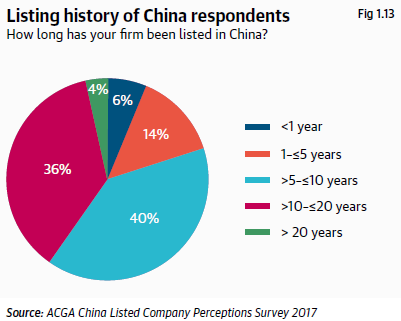
Résultats de recherche d'images pour « rémunération OBNL »

The new director met Victoria for a coffee and said that he was delighted to be joining her board as his people had great need for quality education. He had some good insights about sourcing grant funds to supplement their current bequests and donations. He then met some other directors, and all agreed that he would be a perfect addition to the board. A letter of appointment was sent and a consent form was received.

At his first board meeting the new director asked for the company to pay his travel and accommodation in attending the meeting and also for a sitting fee of one thousand dollars. He said this was a legitimate expectation and that he was paid for his service on other boards. The letter of appointment clearly stated that directors were unremunerated and attended meetings at their own cost. Now he has complained to the Minister that he hasn’t been paid and a staffer has called to ask why not.

How can Victoria resolve this difference between the expectations of the board and its new director?

Guide pratique à la détermination de la rémunération des administrateurs de sociétés | En rappel


Aujourd’hui, je vous suggère la lecture d’un excellent guide publié par International Corporate Governance Network (ICGN). Ce document présente succinctement les grands principes qui devraient gouverner l’établissement de la rémunération des administrateurs indépendants (« non-executive »).

Il va de soi que la rémunération des administrateurs ne représente qu’une part infime du budget d’une entreprise, et celle-ci est relativement très inférieure aux rémunérations consenties aux dirigeants ! Cependant, il est vital d’apporter une attention particulière à la rémunération des administrateurs, car ceux-ci sont les fiduciaires des actionnaires, ceux qui doivent les représenter, en veillant à la saine gestion de la société.

Il est important que le comité de gouvernance se penche annuellement sur la question de la rémunération des administrateurs indépendants, et que ce comité propose une politique de rémunération qui tient compte du rôle déterminant de ces derniers. Plusieurs variables doivent être prises en ligne de compte notamment, la comparaison avec d’autres entreprises similaires, les responsabilités des administrateurs dans les différents rôles qui leur sont attribués au sein du conseil, la nature de l’entreprise (taille, cycle de développement, type de mission, circonstances particulières, etc.).

Personnellement, je suis d’avis que tous les administrateurs de sociétés obtiennent une compensation pour leurs efforts, même si, dans certains cas, les sommes affectées s’avèrent peu élevées. Les organisations ont avantage à offrir de justes rémunérations à leurs administrateurs afin (1) d’attirer de nouvelles recrues hautement qualifiées (2) de s’assurer que les intérêts des administrateurs sont en adéquation avec les intérêts des parties prenantes, et (3) d’être en mesure de s’attendre à une solide performance de leur part et de divulguer les rémunérations globales.

Le document du ICNG propose une réflexion dans trois domaines : (1) la structure de rémunération (2) la reddition de comptes, et (3) les principes de transparence.

On me demande souvent qui doit statuer sur la politique de rémunération des administrateurs, puisqu’il semble que ceux-ci déterminent leurs propres compensations !

Ultimement, ce sont les actionnaires qui doivent approuver les rémunérations des administrateurs telles que présentées dans la circulaire de procuration. Cependant, le travail en aval se fait, annuellement, par le comité de gouvernance lequel recommande au conseil une structure de rémunération des administrateurs non exécutifs. Notons que les comités de gouvernance ont souvent recours à des firmes spécialisées en rémunération pour les aider dans leurs décisions.

C’est cette recommandation qui devrait être amenée à l’assemblée générale annuelle pour approbation, même si dans plusieurs pays, la juridiction ne le requiert pas.

En tant qu’administrateur, si vous souhaitez connaître le point de vue du plus grand réseau de gouvernance à l’échelle internationale, je vous invite à lire ce document synthétique.

Bonne lecture. Vos commentaires sur le sujet sont sollicités.


ICGN Guidance on Non-executive Director Remuneration – 2016


Quelles sont les tendances en gouvernance qui se sont avérées au cours des 4 dernières années ?


Dans un premier temps, j’ai tenté de répondre à cette question en renvoyant le lecteur à deux publications que j’ai faites sur le sujet. C’est du genre check-list !

Puis, dans un deuxième temps, je vous invite à consulter les documents suivants qui me semblent très pertinents pour répondre à la question. Il s’agit en quelque sorte d’une revue de la littérature sur le sujet.

  1. La gouvernance relative aux sociétés en 2017 | Un « Survey » des entreprises du SV 150 et de la S&P 100
  2. Principales tendances en gouvernance à l’échelle internationale en 2017
  3. Séparation des fonctions de PDG et de président du conseil d’administration | Signe de saine gouvernance !
  4. Six mesures pour améliorer la gouvernance des organismes publics au Québec | Yvan Allaire
  5. Cadre de référence pour évaluer la gouvernance des sociétés | Questionnaire de 100 items
  6. La gouvernance française suit-elle la tendance mondiale ?
  7. Enquête mondiale sur les conseils d’administration et la gouvernance


J’espère que ces commentaires vous seront utiles, même si mon intervention est colorée par la situation canadienne et américaine !

Bonne lecture !


Résultats de recherche d'images pour « tendances en gouvernance »


Gouvernance : 12 tendances à surveiller


J’ai réalisé une entrevue avec le Journal des Affaires le 17 mars 2014. Une rédactrice au sein de l’Hebdo des AG, un média numérique qui se consacre au traitement des sujets touchant à la gouvernance des entreprises françaises, m’a contacté afin de connaître mon opinion sur quelles « prédictions » se sont effectivement avérées, et lesquelles restent encore à améliorer.

J’ai préparé quelques réflexions en référence aux douze tendances que j’avais identifiées le 17 mars 2014. J’ai donc revisité les tendances afin de vérifier comment la situation avait évolué en quatre ans. J’ai indiqué en rouge mon point de vue eu égard à ces tendances.

 « Si la gouvernance des entreprises a fait beaucoup de chemin depuis quelques années, son évolution se poursuit. Afin d’imaginer la direction qu’elle prendra au cours des prochaines années, nous avons consulté l’expert en gouvernance Jacques Grisé, ex- directeur des programmes du Collège des administrateurs de sociétés, de l’Université Laval. Toujours affilié au Collège, M. Grisé publie depuis plusieurs années le blogue www.jacquesgrisegouvernance.com, un site incontournable pour rester à l’affût des bonnes pratiques et tendances en gouvernance. Voici les 12 tendances dont il faut suivre l’évolution, selon Jacques Grisé »


  1. Les conseils d’administration réaffirmeront leur autorité. « Auparavant, la gouvernance était une affaire qui concernait davantage le management », explique M. Grisé. La professionnalisation de la fonction d’administrateur amène une modification et un élargissement du rôle et des responsabilités des conseils. Les CA sont de plus en plus sollicités et questionnés au sujet de leurs décisions et de l’entreprise. Cette affirmation est de plus en plus vraie. La formation certifiée en gouvernance est de plus en plus prisée. Les CA, et notamment les présidents de CA, sont de plus en plus sollicités pour expliquer leurs décisions, leurs erreurs et les problèmes de gestion de crise.
  2. La formation des administrateurs prendra de l’importance. À l’avenir, on exigera toujours plus des administrateurs. C’est pourquoi la formation est essentielle et devient même une exigence pour certains organismes. De plus, la formation continue se généralise ; elle devient plus formelle. Il va de soi que la formation en gouvernance prendra plus d’importance, mais les compétences et les expériences reliées au secteur d’activité de l’entreprise seront toujours très recherchées.
  3. L’affirmation du droit des actionnaires et celle du rôle du conseil s’imposeront. Le débat autour du droit des actionnaires par rapport à celui des conseils d’administration devra mener à une compréhension de ces droits conflictuels. Aujourd’hui, les conseils doivent tenir compte des parties prenantes en tout temps. Il existe toujours une situation potentiellement conflictuelle entre les intérêts des actionnaires et la responsabilité des administrateurs envers toutes les parties prenantes.
  4. La montée des investisseurs activistes se poursuivra. L’arrivée de l’activisme apporte une nouvelle dimension au travail des administrateurs. Les investisseurs activistes s’adressent directement aux actionnaires, ce qui mine l’autorité des conseils d’administration. Est-ce bon ou mauvais ? La vision à court terme des activistes peut être néfaste, mais toutes leurs actions ne sont pas négatives, notamment parce qu’ils s’intéressent souvent à des entreprises qui ont besoin d’un redressement sous une forme ou une autre. Pour bien des gens, les fonds activistes sont une façon d’améliorer la gouvernance. Le débat demeure ouvert. Le débat est toujours ouvert, mais force est de constater que l’actionnariat activiste est en pleine croissance partout dans le monde. Les effets souvent décriés des activistes sont de plus en plus acceptés comme bénéfiques dans plusieurs situations de gestion déficiente.
  5. La recherche de compétences clés deviendra la norme. De plus en plus, les organisations chercheront à augmenter la qualité de leur conseil en recrutant des administrateurs aux expertises précises, qui sont des atouts dans certains domaines ou secteurs névralgiques. Cette tendance est très nette. Les CA cherchent à recruter des membres aux expertises complémentaires.
  6. Les règles de bonne gouvernance vont s’étendre à plus d’entreprises. Les grands principes de la gouvernance sont les mêmes, peu importe le type d’organisation, de la PME à la société ouverte (ou cotée), en passant par les sociétés d’État, les organismes à but non lucratif et les entreprises familiales. Ici également, l’application des grands principes de gouvernance se généralise et s’applique à tous les types d’organisation, en les adaptant au contexte.
  7. Le rôle du président du conseil sera davantage valorisé. La tendance veut que deux personnes distinctes occupent les postes de président du conseil et de PDG, au lieu qu’une seule personne cumule les deux, comme c’est encore trop souvent le cas. Un bon conseil a besoin d’un solide leader, indépendant du PDG. Le rôle du Chairman est de plus en plus mis en évidence, car c’est lui qui représente le conseil auprès des différents publics. Il est de plus en plus indépendant de la direction. Les É.U. sont plus lents à adopter la séparation des fonctions entre Chairman et CEO.
  8. La diversité deviendra incontournable. Même s’il y a un plus grand nombre de femmes au sein des conseils, le déficit est encore énorme. Pourtant, certaines études montrent que les entreprises qui font une place aux femmes au sein de leur conseil sont plus rentables. Et la diversité doit s’étendre à d’autres origines culturelles, à des gens de tous âges et d’horizons divers. La diversité dans la composition des conseils d’administration est de plus en plus la norme. On a fait des progrès remarquables à ce chapitre, mais la tendance à la diminution de la taille des CA ralentit quelque peu l’accession des femmes aux postes d’administratrices.
  9. Le rôle stratégique du conseil dans l’entreprise s’imposera. Le temps où les CA ne faisaient qu’approuver les orientations stratégiques définies par la direction est révolu. Désormais, l’élaboration du plan stratégique de l’entreprise doit se faire en collaboration avec le conseil, en profitant de son expertise. Certes, l’un des rôles les plus importants des administrateurs est de voir à l’orientation de l’entreprise, en apportant une valeur ajoutée aux stratégies élaborées par la direction. Les CA sont toujours sollicités, sous une forme ou une autre, dans la conception de la stratégie.
  10. La réglementation continuera de se raffermir. Le resserrement des règles qui encadrent la gouvernance ne fait que commencer. Selon Jacques Grisé, il faut s’attendre à ce que les autorités réglementaires exercent une surveillance accrue partout dans le monde, y compris au Québec, avec l’Autorité des marchés financiers. En conséquence, les conseils doivent se plier aux règles, notamment en ce qui concerne la rémunération et la divulgation. Les responsabilités des comités au sein du conseil prendront de l’importance. Les conseils doivent mettre en place des politiques claires en ce qui concerne la gouvernance. Les conseils d’administration accordent une attention accrue à la gouvernance par l’intermédiaire de leur comité de gouvernance, mais aussi par leurs comités de RH et d’Audit. Les autorités réglementaires mondiales sont de plus en plus vigilantes eu égard à l’application des principes de saine gouvernance. La SEC, qui donnait souvent le ton dans ce domaine, est en mode révision de la réglementation parce que le gouvernement de Trump la juge trop contraignante pour les entreprises. À suivre !
  11. La composition des conseils d’administration s’adaptera aux nouvelles exigences et se transformera. Les CA seront plus petits, ce qui réduira le rôle prépondérant du comité exécutif, en donnant plus de pouvoir à tous les administrateurs. Ceux-ci seront mieux choisis et formés, plus indépendants, mieux rémunérés et plus redevables de leur gestion aux diverses parties prenantes. Les administrateurs auront davantage de responsabilités et seront plus engagés dans les comités aux fonctions plus stratégiques. Leur responsabilité légale s’élargira en même temps que leurs tâches gagnent en importance. Il faudra donc des membres plus engagés, un conseil plus diversifié, dirigé par un leader plus fort. C’est la voie que les CA ont empruntée. La taille des CA est de plus en plus réduite ; les conseils exécutifs sont en voie de disparition pour faire plus de place aux trois comités statutaires : Gouvernance, Ressources Humaines et Audit. Les administrateurs sont de plus en plus engagés et ils doivent investir plus de temps dans leurs fonctions.
  12. L’évaluation de la performance des conseils d’administration deviendra la norme. La tendance est déjà bien ancrée aux États-Unis, où les entreprises engagent souvent des firmes externes pour mener cette évaluation. Certaines choisissent l’auto-évaluation. Dans tous les cas, le processus est ouvert et si les résultats restent confidentiels, ils contribuent à l’amélioration de l’efficacité des conseils d’administration. Effectivement, l’évaluation de la performance des conseils d’administration est devenue une pratique quasi universelle dans les entreprises cotées. Celles-ci doivent d’ailleurs divulguer le processus dans le rapport aux actionnaires. On assiste à un énorme changement depuis les dix dernières années.


À ces 12 tendances, il faudrait en ajouter deux autres qui se sont révélées cruciales pour les conseils d’administration depuis quelques années :

(1) la mise en œuvre d’une politique de gestion des risques, l’identification des risques, l’évaluation des facteurs de risque eu égard à leur probabilité d’occurrence et d’impact sur l’organisation, le suivi effectué par le comité d’audit et par l’auditeur interne.

(2) le renforcement des ressources du conseil par l’ajout de compétences liées à la cybersécurité. La sécurité des données est l’un des plus grands risques des entreprises.


Aspects fondamentaux à considérer par les administrateurs dans la gouvernance des organisations


Récemment, je suis intervenu auprès du conseil d’administration d’une OBNL et j’ai animé une discussion tournant autour des thèmes suivants en affirmant certains principes de gouvernance que je pense être incontournables.

Vous serez certainement intéressé par les propositions suivantes :

(1) Le conseil d’administration est souverain — il est l’ultime organe décisionnel.

(2) Le rôle des administrateurs est d’assurer la saine gestion de l’organisation en fonction d’objectifs établis. L’administrateur a un rôle de fiduciaire, non seulement envers les membres qui les ont élus, mais aussi envers les parties prenantes de toute l’organisation. Son rôle comporte des devoirs et des responsabilités envers celle-ci.

(3) Les administrateurs ont un devoir de surveillance et de diligence ; ils doivent cependant s’assurer de ne pas s’immiscer dans la gestion de l’organisation (« nose in, fingers out »).

(4) Les administrateurs élus par l’assemblée générale ne sont pas porteurs des intérêts propres à leur groupe ; ce sont les intérêts supérieurs de l’organisation qui priment.

(5) Le président du conseil est le chef d’orchestre du groupe d’administrateurs ; il doit être en étroite relation avec le premier dirigeant et bien comprendre les coulisses du pouvoir.

(6) Les membres du conseil doivent entretenir des relations de collaboration et de respect entre eux ; ils doivent viser les consensus et exprimer leur solidarité, notamment par la confidentialité des échanges.

(7) Les administrateurs doivent être bien préparés pour les réunions du conseil et ils doivent poser les bonnes questions afin de bien comprendre les enjeux et de décider en toute indépendance d’esprit. Pour ce faire, ils peuvent tirer profit de l’avis d’experts indépendants.

(8) La composition du conseil devrait refléter la diversité de l’organisation. On doit privilégier l’expertise, la connaissance de l’industrie et la complémentarité.

(9) Le conseil d’administration doit accorder toute son attention aux orientations stratégiques de l’organisation et passer le plus clair de son temps dans un rôle de conseil stratégique.

(10) Chaque réunion devrait se conclure par un huis clos, systématiquement inscrit à l’ordre du jour de toutes les rencontres.

(11) Le président du CA doit procéder à l’évaluation du fonctionnement et de la dynamique du conseil.

(12) Les administrateurs doivent prévoir des activités de formation en gouvernance et en éthique.


Voici enfin une documentation utile pour bien appréhender les grandes tendances qui se dégagent dans le monde de la gouvernance aux É.U., au Canada et en France.


  1. La gouvernance relative aux sociétés en 2017 | Un « Survey » des entreprises du SV 150 et de la S&P 100
  2. Principales tendances en gouvernance à l’échelle internationale en 2017
  3. Séparation des fonctions de PDG et de président du conseil d’administration | Signe de saine gouvernance !
  4. Six mesures pour améliorer la gouvernance des organismes publics au Québec | Yvan Allaire
  5. Cadre de référence pour évaluer la gouvernance des sociétés | Questionnaire de 100 items
  6. La gouvernance française suit-elle la tendance mondiale ?
  7. Enquête mondiale sur les conseils d’administration et la gouvernance


Conseils d’administration d’OBNL et recrutement d’administrateurs


Ayant collaboré à la réalisation du volume « Améliorer la gouvernance de votre OSBL » des auteurs Jean-Paul Gagné et Daniel Lapointe, j’ai obtenu la primeur de la publication d’un chapitre sur mon blogue en gouvernance.

Pour vous donner un aperçu de cette importante publication sur la gouvernance des organisations sans but lucratif (OSBN), j’ai eu la permission des éditeurs, Éditions Caractère et Éditions Transcontinental, de publier l’intégralité du chapitre 4 qui porte sur la composition du conseil d’administration et le recrutement d’administrateurs d’OSBL.

Je suis heureux de vous offrir cette primeur et j’espère que le sujet vous intéressera suffisamment pour vous inciter à vous procurer cette nouvelle publication.

Vous trouverez, ci-dessous, un court extrait de la page d’introduction du chapitre 4. Je vous invite à cliquer sur le lien suivant pour avoir accès à l’intégralité du chapitre.


La composition du conseil d’administration et le recrutement d’administrateurs


Vous pouvez également feuilleter cet ouvrage en cliquant ici

Bonne lecture ! Vos commentaires sont les bienvenus.

__________________________________


Les administrateurs d’un OSBL sont généralement élus dans le cadre d’un processus électoral tenu lors d’une assemblée générale des membres. Ils peuvent aussi faire l’objet d’une cooptation ou être désignés en vertu d’un mécanisme particulier prévu dans une loi (tel le Code des professions).

ameliorezlagouvernancedevotreosbl


L’élection des administrateurs par l’assemblée générale emprunte l’un ou l’autre des deux scénarios suivants:

1. Les OSBL ont habituellement des membres qui sont invités à une assemblée générale annuelle et qui élisent des administrateurs aux postes à pourvoir. Le plus souvent, les personnes présentes sont aussi appelées à choisir l’auditeur qui fera la vérification des états financiers de l’organisation pour l’exercice en cours.

2. Certains OSBL n’ont pas d’autres membres que leurs administrateurs. Dans ce cas, ces derniers se transforment une fois par année en membres de l’assemblée générale, élisent des administrateurs aux postes vacants et choisissent l’auditeur qui fera la vérification des états financiers de l’organisation pour l’exercice en cours.


La cooptation autorise le recrutement d’administrateurs en cours d’exercice. Les personnes ainsi choisies entrent au CA lors de la première réunion suivant celle où leur nomination a été approuvée. Ils y siègent de plein droit, en dépit du fait que celle-ci ne sera entérinée qu’à l’assemblée générale annuelle suivante. La cooptation n’est pas seulement utile pour pourvoir rapidement aux postes vacants; elle a aussi comme avantage de permettre au conseil de faciliter la nomination de candidats dont le profil correspond aux compétences recherchées.

Dans les organisations qui élisent leurs administrateurs en assemblée générale, la sélection en fonction des profils déterminés peut présenter une difficulté : en effet, il peut arriver que les membres choisissent des administrateurs selon des critères qui ont peu à voir avec les compétences recherchées, telles leur amabilité, leur popularité, etc. Le comité du conseil responsable du recrutement d’administrateurs peut présenter une liste de candidats (en mentionnant leurs qualifications pour les postes à pourvoir) dans l’espoir que l’assemblée lui fasse confiance et les élise. Certains organismes préfèrent coopter en cours d’exercice, ce qui les assure de recruter un administrateur qui a le profil désiré et qui entrera en fonction dès sa sélection.

Quant à l’élection du président du conseil et, le cas échéant, du vice-président, du secrétaire et du trésorier, elle est généralement faite par les administrateurs. Dans les ordres professionnels, le Code des professions leur permet de déterminer par règlement si le président est élu par le conseil d’administration ou au suffrage universel des membres. Comme on l’a vu, malgré son caractère démocratique, l’élection du président au suffrage universel des membres présente un certain risque, puisqu’un candidat peut réussir à se faire élire à ce poste sans expérience du fonctionnement d’un CA ou en poursuivant un objectif qui tranche avec la mission, la vision ou encore le plan stratégique de l’organisation. Cet enjeu ne doit pas être pris à la légère par le CA. Une façon de minimiser ce risque est de faire connaître aux membres votants le profil recherché pour le président, profil qui aura été préalablement établi par le conseil. On peut notamment y inclure une expérience de conseil d’administration, ce qui aide à réduire la période d’apprentissage du nouveau président et facilite une transition en douceur.

En reprise | Quelle est la raison d’être d’une entreprise ? Comment opère la gouvernance ?


Quelle est la raison d’être d’une entreprise sur le plan juridique ? À qui doit-elle rendre des comptes ?

Une entreprise est-elle au service exclusif de ses actionnaires ou doit-elle obligatoirement considérer les intérêts de ses parties prenantes (stakeholders) avant de prendre des décisions de nature stratégiques ?

On conviendra que ces questions ont fréquemment été abordées dans ces pages. Cependant, la réalité de la conduite des organisations semble toujours refléter le modèle de la primauté des actionnaires, mieux connu maintenant sous l’appellation « démocratie de l’actionnariat ».

L’article de Martin Lipton* fait le point sur l’évolution de la reconnaissance des parties prenantes au cours des quelque dix dernières années.

Je crois que les personnes intéressées par les questions de gouvernance (notamment les administrateurs de sociétés) doivent être informées des enjeux qui concernent leurs responsabilités fiduciaires.

Bonne lecture. ! Vos commentaires sont les bienvenus.


The Purpose of the Corporation


Résultats de recherche d'images pour « actionnaires définition »


Whether the purpose of the corporation is to generate profits for its shareholders or to operate in the interests of all of its stakeholders has been actively debated since 1932, when it was the subject of dueling law review articles by Columbia law professor Adolf Berle (shareholders) and Harvard law professor Merrick Dodd (stakeholders).

Following “Chicago School” economics professor Milton Friedman’s famous (some might say infamous) 1970 New York Times article announcing ex cathedra that the social responsibility of a corporation is to increase its profits, shareholder primacy was widely viewed as the purpose and basis for the governance of a corporation. My 1979 article, Takeover Bids in the Target’s Boardroom, arguing that the board of directors of a corporation that was the target of a takeover bid had the right, if not the duty, to consider the interests of all stakeholders in deciding whether to accept or reject the bid, was widely derided and rejected by the Chicago School economists and law professors who embraced Chicago School economics. Despite the 1985 decision of the Supreme Court of Delaware citing my article in holding that a board of directors could take into account stakeholder interests, and over 30 states enacting constituency (stakeholder) statutes, shareholder primacy continued to dominate academic, economic, financial and legal thinking—often disguised as “shareholder democracy.”

While the debate continued and stakeholder governance gained adherents in the new millennium, shareholder primacy continued to dominate. Only since the 2008 financial crisis and resulting recession has there been significant recognition that shareholder primacy has been a major driver of short-termism, encourages activist attacks on corporations, reduces R&D expenditures, depresses wages and reduces long-term sustainable investments—indeed, it promotes inequality and strikes at the very heart of our society. In the past five years, the necessity for changes has been recognized by significant academic, business, financial and investor reports and opinions. An example is the 2017 paper I and a Wachtell Lipton team prepared for the World Economic Forum, The New Paradigm: A Roadmap for an Implicit Corporate Governance Partnership Between Corporations and Investors to Achieve Sustainable Long-Term Investment and Growth, which quotes or cites many of the others.

This year we are seeing important new support for counterbalancing shareholder primacy and promoting long-term sustainable investment. Among the many prominent examples is the January 2018 annual letter from Larry Fink, Chairman of BlackRock, to CEOs:

Without a sense of purpose, no company, either public or private, can achieve its full potential. It will ultimately lose the license to operate from key stakeholders. It will succumb to short-term pressures to distribute earnings, and, in the process, sacrifice investments in employee development, innovation, and capital expenditures that are necessary for long-term growth. It will remain exposed to activist campaigns that articulate a clearer goal, even if that goal serves only the shortest and narrowest of objectives. And ultimately, that company will provide subpar returns to the investors who depend on it to finance their retirement, home purchases, or higher education.

This was followed in March by the report of a commission appointed by the French Government recommending amendment to the French Civil Code to add, “The company shall be managed in its own interest, considering the social and environmental consequences of its activity,” following the existing, “All companies shall have a lawful purpose and be incorporated in the common interest of the shareholders.” The draft amendment is intended to establish the principle that each company should pursue its own interest—namely, the continuity of its operation, sustainability through investment, collective creation and innovation. The report notes that this amendment integrates corporate and social responsibility considerations into corporate governance and goes on to state that each company has a purpose not reducible to profit and needs to be aware of its purpose. The report recommends an amendment to the French Commercial Code for the purpose of entrusting the boards of directors to define a company’s purpose in order to guide the company’s strategy, taking into account its social and environmental consequences.

Also in March, the European Commission in its Action Plan: Financing Sustainable Growthproposed both corporate governance and investor stewardship requirements:

Subject to the outcome of its impact assessment, the Commission will table a legislative proposal to clarify institutional investors’ and asset managers’ duties in relation to sustainability considerations by Q2 2018. The proposal will aim to (i) explicitly require institutional investors and asset managers to integrate sustainability considerations in the investment decision-making process and (ii) increase transparency, towards end-investors on how they integrate such sustainability factors in their investment decisions in particular as concerns their exposure to sustainability risks.

Further, the Commission proposes a number of other laws or regulations designed to promote ESG, CSR and sustainable long-term investment.

In addition to these examples, there are similar policy statements by major investors and similar efforts at legislation to modulate or eliminate shareholder primacy in Great Britain and the United States. While it is not certain that any legislation will soon be enacted, it is clear that the problems have been identified, support is growing to find a way to address them and if implicit stakeholder governance does not take hold, legislation will ensue to assure it.

_____________________________________

*Martin Lipton is a founding partner of Wachtell, Lipton, Rosen & Katz, specializing in mergers and acquisitions and matters affecting corporate policy and strategy. This post is based on a Wachtell Lipton publication by Mr. Lipton.

Quelles tendances en gouvernance, identifiées en 2014, se sont avérées au 20 octobre 2018


Dans un premier temps, j’ai tenté de répondre à cette question en renvoyant le lecteur à deux publications que j’ai faites sur le sujet. C’est du genre check-list !

Puis, dans un deuxième temps, je vous invite à consulter les documents suivants qui me semblent très pertinents pour répondre à la question. Il s’agit en quelque sorte d’une revue de la littérature sur le sujet.

  1. La gouvernance relative aux sociétés en 2017 | Un « Survey » des entreprises du SV 150 et de la S&P 100
  2. Principales tendances en gouvernance à l’échelle internationale en 2017
  3. Séparation des fonctions de PDG et de président du conseil d’administration | Signe de saine gouvernance !
  4. Six mesures pour améliorer la gouvernance des organismes publics au Québec | Yvan Allaire
  5. Cadre de référence pour évaluer la gouvernance des sociétés | Questionnaire de 100 items
  6. La gouvernance française suit-elle la tendance mondiale ?
  7. Enquête mondiale sur les conseils d’administration et la gouvernance


J’espère que ces commentaires vous seront utiles, même si mon intervention est colorée par la situation canadienne et américaine !

Bonne lecture !


Résultats de recherche d'images pour « tendances en gouvernance »


Gouvernance : 12 tendances à surveiller


J’ai réalisé une entrevue avec le Journal des Affaires le 17 mars 2014. Une rédactrice au sein de l’Hebdo des AG, un média numérique qui se consacre au traitement des sujets touchant à la gouvernance des entreprises françaises, m’a contacté afin de connaître mon opinion sur quelles « prédictions » se sont effectivement avérées, et lesquelles restent encore à améliorer.

J’ai préparé quelques réflexions en référence aux douze tendances que j’avais identifiées le 17 mars 2014. J’ai donc revisité les tendances afin de vérifier comment la situation avait évolué en quatre ans. J’ai indiqué en rouge mon point de vue eu égard à ces tendances.

 « Si la gouvernance des entreprises a fait beaucoup de chemin depuis quelques années, son évolution se poursuit. Afin d’imaginer la direction qu’elle prendra au cours des prochaines années, nous avons consulté l’expert en gouvernance Jacques Grisé, ex- directeur des programmes du Collège des administrateurs de sociétés, de l’Université Laval. Toujours affilié au Collège, M. Grisé publie depuis plusieurs années le blogue www.jacquesgrisegouvernance.com, un site incontournable pour rester à l’affût des bonnes pratiques et tendances en gouvernance. Voici les 12 tendances dont il faut suivre l’évolution, selon Jacques Grisé »


  1. Les conseils d’administration réaffirmeront leur autorité. « Auparavant, la gouvernance était une affaire qui concernait davantage le management », explique M. Grisé. La professionnalisation de la fonction d’administrateur amène une modification et un élargissement du rôle et des responsabilités des conseils. Les CA sont de plus en plus sollicités et questionnés au sujet de leurs décisions et de l’entreprise. Cette affirmation est de plus en plus vraie. La formation certifiée en gouvernance est de plus en plus prisée. Les CA, et notamment les présidents de CA, sont de plus en plus sollicités pour expliquer leurs décisions, leurs erreurs et les problèmes de gestion de crise.
  2. La formation des administrateurs prendra de l’importance. À l’avenir, on exigera toujours plus des administrateurs. C’est pourquoi la formation est essentielle et devient même une exigence pour certains organismes. De plus, la formation continue se généralise ; elle devient plus formelle. Il va de soi que la formation en gouvernance prendra plus d’importance, mais les compétences et les expériences reliées au secteur d’activité de l’entreprise seront toujours très recherchées.
  3. L’affirmation du droit des actionnaires et celle du rôle du conseil s’imposeront. Le débat autour du droit des actionnaires par rapport à celui des conseils d’administration devra mener à une compréhension de ces droits conflictuels. Aujourd’hui, les conseils doivent tenir compte des parties prenantes en tout temps. Il existe toujours une situation potentiellement conflictuelle entre les intérêts des actionnaires et la responsabilité des administrateurs envers toutes les parties prenantes.
  4. La montée des investisseurs activistes se poursuivra. L’arrivée de l’activisme apporte une nouvelle dimension au travail des administrateurs. Les investisseurs activistes s’adressent directement aux actionnaires, ce qui mine l’autorité des conseils d’administration. Est-ce bon ou mauvais ? La vision à court terme des activistes peut être néfaste, mais toutes leurs actions ne sont pas négatives, notamment parce qu’ils s’intéressent souvent à des entreprises qui ont besoin d’un redressement sous une forme ou une autre. Pour bien des gens, les fonds activistes sont une façon d’améliorer la gouvernance. Le débat demeure ouvert. Le débat est toujours ouvert, mais force est de constater que l’actionnariat activiste est en pleine croissance partout dans le monde. Les effets souvent décriés des activistes sont de plus en plus acceptés comme bénéfiques dans plusieurs situations de gestion déficiente.
  5. La recherche de compétences clés deviendra la norme. De plus en plus, les organisations chercheront à augmenter la qualité de leur conseil en recrutant des administrateurs aux expertises précises, qui sont des atouts dans certains domaines ou secteurs névralgiques. Cette tendance est très nette. Les CA cherchent à recruter des membres aux expertises complémentaires.
  6. Les règles de bonne gouvernance vont s’étendre à plus d’entreprises. Les grands principes de la gouvernance sont les mêmes, peu importe le type d’organisation, de la PME à la société ouverte (ou cotée), en passant par les sociétés d’État, les organismes à but non lucratif et les entreprises familiales. Ici également, l’application des grands principes de gouvernance se généralise et s’applique à tous les types d’organisation, en les adaptant au contexte.
  7. Le rôle du président du conseil sera davantage valorisé. La tendance veut que deux personnes distinctes occupent les postes de président du conseil et de PDG, au lieu qu’une seule personne cumule les deux, comme c’est encore trop souvent le cas. Un bon conseil a besoin d’un solide leader, indépendant du PDG. Le rôle du Chairman est de plus en plus mis en évidence, car c’est lui qui représente le conseil auprès des différents publics. Il est de plus en plus indépendant de la direction. Les É.U. sont plus lents à adopter la séparation des fonctions entre Chairman et CEO.
  8. La diversité deviendra incontournable. Même s’il y a un plus grand nombre de femmes au sein des conseils, le déficit est encore énorme. Pourtant, certaines études montrent que les entreprises qui font une place aux femmes au sein de leur conseil sont plus rentables. Et la diversité doit s’étendre à d’autres origines culturelles, à des gens de tous âges et d’horizons divers. La diversité dans la composition des conseils d’administration est de plus en plus la norme. On a fait des progrès remarquables à ce chapitre, mais la tendance à la diminution de la taille des CA ralentit quelque peu l’accession des femmes aux postes d’administratrices.
  9. Le rôle stratégique du conseil dans l’entreprise s’imposera. Le temps où les CA ne faisaient qu’approuver les orientations stratégiques définies par la direction est révolu. Désormais, l’élaboration du plan stratégique de l’entreprise doit se faire en collaboration avec le conseil, en profitant de son expertise. Certes, l’un des rôles les plus importants des administrateurs est de voir à l’orientation de l’entreprise, en apportant une valeur ajoutée aux stratégies élaborées par la direction. Les CA sont toujours sollicités, sous une forme ou une autre, dans la conception de la stratégie.
  10. La réglementation continuera de se raffermir. Le resserrement des règles qui encadrent la gouvernance ne fait que commencer. Selon Jacques Grisé, il faut s’attendre à ce que les autorités réglementaires exercent une surveillance accrue partout dans le monde, y compris au Québec, avec l’Autorité des marchés financiers. En conséquence, les conseils doivent se plier aux règles, notamment en ce qui concerne la rémunération et la divulgation. Les responsabilités des comités au sein du conseil prendront de l’importance. Les conseils doivent mettre en place des politiques claires en ce qui concerne la gouvernance. Les conseils d’administration accordent une attention accrue à la gouvernance par l’intermédiaire de leur comité de gouvernance, mais aussi par leurs comités de RH et d’Audit. Les autorités réglementaires mondiales sont de plus en plus vigilantes eu égard à l’application des principes de saine gouvernance. La SEC, qui donnait souvent le ton dans ce domaine, est en mode révision de la réglementation parce que le gouvernement de Trump la juge trop contraignante pour les entreprises. À suivre !
  11. La composition des conseils d’administration s’adaptera aux nouvelles exigences et se transformera. Les CA seront plus petits, ce qui réduira le rôle prépondérant du comité exécutif, en donnant plus de pouvoir à tous les administrateurs. Ceux-ci seront mieux choisis et formés, plus indépendants, mieux rémunérés et plus redevables de leur gestion aux diverses parties prenantes. Les administrateurs auront davantage de responsabilités et seront plus engagés dans les comités aux fonctions plus stratégiques. Leur responsabilité légale s’élargira en même temps que leurs tâches gagnent en importance. Il faudra donc des membres plus engagés, un conseil plus diversifié, dirigé par un leader plus fort. C’est la voie que les CA ont empruntée. La taille des CA est de plus en plus réduite ; les conseils exécutifs sont en voie de disparition pour faire plus de place aux trois comités statutaires : Gouvernance, Ressources Humaines et Audit. Les administrateurs sont de plus en plus engagés et ils doivent investir plus de temps dans leurs fonctions.
  12. L’évaluation de la performance des conseils d’administration deviendra la norme. La tendance est déjà bien ancrée aux États-Unis, où les entreprises engagent souvent des firmes externes pour mener cette évaluation. Certaines choisissent l’auto-évaluation. Dans tous les cas, le processus est ouvert et si les résultats restent confidentiels, ils contribuent à l’amélioration de l’efficacité des conseils d’administration. Effectivement, l’évaluation de la performance des conseils d’administration est devenue une pratique quasi universelle dans les entreprises cotées. Celles-ci doivent d’ailleurs divulguer le processus dans le rapport aux actionnaires. On assiste à un énorme changement depuis les dix dernières années.


À ces 12 tendances, il faudrait en ajouter deux autres qui se sont révélées cruciales pour les conseils d’administration depuis quelques années :

(1) la mise en œuvre d’une politique de gestion des risques, l’identification des risques, l’évaluation des facteurs de risque eu égard à leur probabilité d’occurrence et d’impact sur l’organisation, le suivi effectué par le comité d’audit et par l’auditeur interne.

(2) le renforcement des ressources du conseil par l’ajout de compétences liées à la cybersécurité. La sécurité des données est l’un des plus grands risques des entreprises.


Aspects fondamentaux à considérer par les administrateurs dans la gouvernance des organisations


Récemment, je suis intervenu auprès du conseil d’administration d’une OBNL et j’ai animé une discussion tournant autour des thèmes suivants en affirmant certains principes de gouvernance que je pense être incontournables.

Vous serez certainement intéressé par les propositions suivantes :

(1) Le conseil d’administration est souverain — il est l’ultime organe décisionnel.

(2) Le rôle des administrateurs est d’assurer la saine gestion de l’organisation en fonction d’objectifs établis. L’administrateur a un rôle de fiduciaire, non seulement envers les membres qui les ont élus, mais aussi envers les parties prenantes de toute l’organisation. Son rôle comporte des devoirs et des responsabilités envers celle-ci.

(3) Les administrateurs ont un devoir de surveillance et de diligence ; ils doivent cependant s’assurer de ne pas s’immiscer dans la gestion de l’organisation (« nose in, fingers out »).

(4) Les administrateurs élus par l’assemblée générale ne sont pas porteurs des intérêts propres à leur groupe ; ce sont les intérêts supérieurs de l’organisation qui priment.

(5) Le président du conseil est le chef d’orchestre du groupe d’administrateurs ; il doit être en étroite relation avec le premier dirigeant et bien comprendre les coulisses du pouvoir.

(6) Les membres du conseil doivent entretenir des relations de collaboration et de respect entre eux ; ils doivent viser les consensus et exprimer leur solidarité, notamment par la confidentialité des échanges.

(7) Les administrateurs doivent être bien préparés pour les réunions du conseil et ils doivent poser les bonnes questions afin de bien comprendre les enjeux et de décider en toute indépendance d’esprit. Pour ce faire, ils peuvent tirer profit de l’avis d’experts indépendants.

(8) La composition du conseil devrait refléter la diversité de l’organisation. On doit privilégier l’expertise, la connaissance de l’industrie et la complémentarité.

(9) Le conseil d’administration doit accorder toute son attention aux orientations stratégiques de l’organisation et passer le plus clair de son temps dans un rôle de conseil stratégique.

(10) Chaque réunion devrait se conclure par un huis clos, systématiquement inscrit à l’ordre du jour de toutes les rencontres.

(11) Le président du CA doit procéder à l’évaluation du fonctionnement et de la dynamique du conseil.

(12) Les administrateurs doivent prévoir des activités de formation en gouvernance et en éthique.


Voici enfin une documentation utile pour bien appréhender les grandes tendances qui se dégagent dans le monde de la gouvernance aux É.U., au Canada et en France.


  1. La gouvernance relative aux sociétés en 2017 | Un « Survey » des entreprises du SV 150 et de la S&P 100
  2. Principales tendances en gouvernance à l’échelle internationale en 2017
  3. Séparation des fonctions de PDG et de président du conseil d’administration | Signe de saine gouvernance !
  4. Six mesures pour améliorer la gouvernance des organismes publics au Québec | Yvan Allaire
  5. Cadre de référence pour évaluer la gouvernance des sociétés | Questionnaire de 100 items
  6. La gouvernance française suit-elle la tendance mondiale ?
  7. Enquête mondiale sur les conseils d’administration et la gouvernance


Le conseil d’administration est garant de la bonne conduite éthique de l’organisation | Rendez-vous à un colloque inspirant !


La considération de l’éthique et des valeurs d’intégrité sont des sujets de grande actualité dans toutes les sphères de la vie organisationnelle*. À ce propos, le Réseau d’éthique organisationnelle du Québec (RÉOQ) tient son colloque annuel les 25 et 26 octobre 2018 à l’hôtel Marriott Courtyard Montréal Centre-Ville et il propose plusieurs conférences qui traitent de l’éthique au quotidien. Je vous invite à consulter le programme du colloque et y participer.


Ne vous méprenez pas, la saine gouvernance des entreprises repose sur l’attention assidue accordée aux questions éthiques par le président du conseil, par le comité de gouvernance et d’éthique, ainsi que par tous les membres du conseil d’administration. Ceux-ci ont un devoir inéluctable de respect de la charte éthique approuvée par le CA.

Les défaillances en ce qui a trait à l’intégrité des personnes et les manquements de nature éthique sont souvent le résultat d’un conseil d’administration qui n’exerce pas un fort leadership éthique et qui n’affiche pas de valeurs transparentes à ce propos. Ainsi, il faut affirmer haut et fort que les comportements des employés sont largement tributaires de la culture de l’entreprise, des pratiques en cours, des contrôles internes… Et que les administrateurs sont les fiduciaires de ces valeurs qui font la réputation de l’entreprise !

Cette affirmation implique que tous les membres d’un conseil d’administration doivent faire preuve de comportements éthiques exemplaires : « Tone at the Top ». Les administrateurs doivent se donner les moyens d’évaluer cette valeur au sein de leur conseil, et au sein de l’organisation.

C’est la responsabilité du conseil de veiller à ce que de solides valeurs d’intégrité soient transmises à l’échelle de toute l’organisation, que la direction et les employés connaissent bien les codes de conduites et que l’on s’assure d’un suivi adéquat à cet égard.

Mais là où les CA achoppent trop souvent dans l’établissement d’une solide conduite éthique, c’est (1) dans la formulation de politiques probantes (2) dans la mise en place de l’instrumentalisation requise (3) dans le recrutement de personnes qui adhèrent aux objectifs énoncés et (4) dans l’évaluation et le suivi du climat organisationnel.

Les administrateurs doivent poser les bonnes questions sur la situation existante et prendre le recul nécessaire pour envisager les divers points de vue des parties prenantes dans le but d’assurer la transmission efficace du code de conduite de l’entreprise.

Les préconceptions et les préjugés sont coriaces, mais ils doivent être confrontés lors des échanges de vues au CA ou lors des huis clos. Les administrateurs doivent aborder les situations avec un esprit ouvert et indépendant.

Vous aurez compris que le président du conseil a un rôle clé à cet égard. C’est lui qui doit incarner le leadership en matière d’éthique et de culture organisationnelle. L’une de ses tâches est de s’assurer qu’il consacre le temps approprié aux questionnements éthiques. Pour ce faire, le président du CA doit poser des gestes concrets (1) en plaçant les considérations éthiques à l’ordre du jour (2) en s’assurant de la formation des administrateurs (3) en renforçant le rôle du comité de gouvernance et (4) en mettant le comportement éthique au cœur de ses préoccupations.

Le choix du premier dirigeant (PDG) est l’une des plus grandes responsabilités des conseils d’administration. Lors du processus de sélection, on doit s’assurer que le PDG incarne les valeurs éthiques qui correspondent aux attentes élevées des administrateurs ainsi qu’aux pratiques en vigueur. L’évaluation annuelle des dirigeants doit tenir compte de leur engagement éthique, et le résultat doit se refléter dans la rémunération variable des dirigeants.

Quels items peut-on utiliser pour évaluer la composante éthique de la gouvernance du conseil d’administration ? Voici un instrument qui peut aider à y voir plus clair. Ce cadre de référence novateur a été conçu par le Bureau de vérification interne de l’Université de Montréal.


1.       Les politiques de votre organisation visant à favoriser l’éthique sont-elles bien connues et appliquées par ses employés, partenaires et bénévoles ?
2.       Le Conseil de votre organisation aborde-t-il régulièrement la question de l’éthique, notamment en recevant des rapports sur les plaintes, les dénonciations ?
3.       Le Conseil et l’équipe de direction de votre organisation participent-ils régulièrement à des activités de formation visant à parfaire leurs connaissances et leurs compétences en matière d’éthique ?
4.       S’assure-t-on que la direction générale est exemplaire et a développé une culture fondée sur des valeurs qui se déclinent dans l’ensemble de l’organisation ?
5.       S’assure-t-on que la direction prend au sérieux les manquements à l’éthique et les gère promptement et de façon cohérente ?
6.       S’assure-t-on que la direction a élaboré un code de conduite efficace auquel elle adhère, et veille à ce que tous les membres du personnel en comprennent la teneur, la pertinence et l’importance ?
7.       S’assure-t-on de l’existence de canaux de communication efficaces (ligne d’alerte téléphonique dédiée, assistance téléphonique, etc.) pour permettre aux membres du personnel et partenaires de signaler les problèmes ?
8.       Le Conseil reconnaît-il l’impact sur la réputation de l’organisation du comportement de ses principaux fournisseurs et autres partenaires ?
9.       Est-ce que le président du Conseil donne le ton au même titre que le DG au niveau des opérations sur la culture organisationnelle au nom de ses croyances, son attitude et ses valeurs ?

10.    Est-ce que l’organisation a la capacité d’intégrer des changements à même ses processus, outils ou comportements dans un délai raisonnable ?


*Autres lectures pertinentes :

  1. Formation en éthique 2.0 pour les conseils d’administration
  2. Rapport spécial sur l’importance de l’éthique dans l’amélioration de la gouvernance | Knowledge@Wharton
  3. Rôle du conseil d’administration en matière d’éthique*
  4. Comment le CA peut-il exercer une veille de l’éthique ?
  5. Le CA est garant de l’intégrité de l’entreprise
  6. Cadre de référence pour évaluer la gouvernance des sociétés | Questionnaire de 100 items

Le conseil d’administration est garant de la bonne conduite éthique de l’organisation !


La considération de l’éthique et des valeurs d’intégrité sont des sujets de grande actualité dans toutes les sphères de la vie organisationnelle*. À ce propos, le Réseau d’éthique organisationnelle du Québec (RÉOQ) tient son colloque annuel les 25 et 26 octobre 2018 à l’hôtel Marriott Courtyard Montréal Centre-Ville et il propose plusieurs conférences qui traitent de l’éthique au quotidien. Je vous invite à consulter le programme du colloque et y participer.


Ne vous méprenez pas, la saine gouvernance des entreprises repose sur l’attention assidue accordée aux questions éthiques par le président du conseil, par le comité de gouvernance et d’éthique, ainsi que par tous les membres du conseil d’administration. Ceux-ci ont un devoir inéluctable de respect de la charte éthique approuvée par le CA.

Les défaillances en ce qui a trait à l’intégrité des personnes et les manquements de nature éthique sont souvent le résultat d’un conseil d’administration qui n’exerce pas un fort leadership éthique et qui n’affiche pas de valeurs transparentes à ce propos. Ainsi, il faut affirmer haut et fort que les comportements des employés sont largement tributaires de la culture de l’entreprise, des pratiques en cours, des contrôles internes… Et que les administrateurs sont les fiduciaires de ces valeurs qui font la réputation de l’entreprise !

Cette affirmation implique que tous les membres d’un conseil d’administration doivent faire preuve de comportements éthiques exemplaires : « Tone at the Top ». Les administrateurs doivent se donner les moyens d’évaluer cette valeur au sein de leur conseil, et au sein de l’organisation.

C’est la responsabilité du conseil de veiller à ce que de solides valeurs d’intégrité soient transmises à l’échelle de toute l’organisation, que la direction et les employés connaissent bien les codes de conduites et que l’on s’assure d’un suivi adéquat à cet égard.

Mais là où les CA achoppent trop souvent dans l’établissement d’une solide conduite éthique, c’est (1) dans la formulation de politiques probantes (2) dans la mise en place de l’instrumentalisation requise (3) dans le recrutement de personnes qui adhèrent aux objectifs énoncés et (4) dans l’évaluation et le suivi du climat organisationnel.

Les administrateurs doivent poser les bonnes questions sur la situation existante et prendre le recul nécessaire pour envisager les divers points de vue des parties prenantes dans le but d’assurer la transmission efficace du code de conduite de l’entreprise.

Les préconceptions et les préjugés sont coriaces, mais ils doivent être confrontés lors des échanges de vues au CA ou lors des huis clos. Les administrateurs doivent aborder les situations avec un esprit ouvert et indépendant.

Vous aurez compris que le président du conseil a un rôle clé à cet égard. C’est lui qui doit incarner le leadership en matière d’éthique et de culture organisationnelle. L’une de ses tâches est de s’assurer qu’il consacre le temps approprié aux questionnements éthiques. Pour ce faire, le président du CA doit poser des gestes concrets (1) en plaçant les considérations éthiques à l’ordre du jour (2) en s’assurant de la formation des administrateurs (3) en renforçant le rôle du comité de gouvernance et (4) en mettant le comportement éthique au cœur de ses préoccupations.

Le choix du premier dirigeant (PDG) est l’une des plus grandes responsabilités des conseils d’administration. Lors du processus de sélection, on doit s’assurer que le PDG incarne les valeurs éthiques qui correspondent aux attentes élevées des administrateurs ainsi qu’aux pratiques en vigueur. L’évaluation annuelle des dirigeants doit tenir compte de leur engagement éthique, et le résultat doit se refléter dans la rémunération variable des dirigeants.

Quels items peut-on utiliser pour évaluer la composante éthique de la gouvernance du conseil d’administration ? Voici un instrument qui peut aider à y voir plus clair. Ce cadre de référence novateur a été conçu par le Bureau de vérification interne de l’Université de Montréal.


1.       Les politiques de votre organisation visant à favoriser l’éthique sont-elles bien connues et appliquées par ses employés, partenaires et bénévoles ?
2.       Le Conseil de votre organisation aborde-t-il régulièrement la question de l’éthique, notamment en recevant des rapports sur les plaintes, les dénonciations ?
3.       Le Conseil et l’équipe de direction de votre organisation participent-ils régulièrement à des activités de formation visant à parfaire leurs connaissances et leurs compétences en matière d’éthique ?
4.       S’assure-t-on que la direction générale est exemplaire et a développé une culture fondée sur des valeurs qui se déclinent dans l’ensemble de l’organisation ?
5.       S’assure-t-on que la direction prend au sérieux les manquements à l’éthique et les gère promptement et de façon cohérente ?
6.       S’assure-t-on que la direction a élaboré un code de conduite efficace auquel elle adhère, et veille à ce que tous les membres du personnel en comprennent la teneur, la pertinence et l’importance ?
7.       S’assure-t-on de l’existence de canaux de communication efficaces (ligne d’alerte téléphonique dédiée, assistance téléphonique, etc.) pour permettre aux membres du personnel et partenaires de signaler les problèmes ?
8.       Le Conseil reconnaît-il l’impact sur la réputation de l’organisation du comportement de ses principaux fournisseurs et autres partenaires ?
9.       Est-ce que le président du Conseil donne le ton au même titre que le DG au niveau des opérations sur la culture organisationnelle au nom de ses croyances, son attitude et ses valeurs ?

10.    Est-ce que l’organisation a la capacité d’intégrer des changements à même ses processus, outils ou comportements dans un délai raisonnable ?


*Autres lectures pertinentes :

  1. Formation en éthique 2.0 pour les conseils d’administration
  2. Rapport spécial sur l’importance de l’éthique dans l’amélioration de la gouvernance | Knowledge@Wharton
  3. Rôle du conseil d’administration en matière d’éthique*
  4. Comment le CA peut-il exercer une veille de l’éthique ?
  5. Le CA est garant de l’intégrité de l’entreprise
  6. Cadre de référence pour évaluer la gouvernance des sociétés | Questionnaire de 100 items

Le comportement d’Elon Musk est-il un signe de faible gouvernance chez Tesla ?


Depuis quelques années, on ne cesse de relater les faits d’armes de Elon Musk lequel gère ses entreprises de manières plutôt controversées, ou à tout le moins contraires aux principes de saine gouvernance.Dans cet article de Kevin Reed, publié sur le site de Board Agenda le 17 septembre 2018, on porte un jugement assez sévère sur le comportement autoritaire de Musk qui continue de bafouer les règles les plus élémentaires de gouvernance.

Les investisseurs qui croient dans le génie de cet entrepreneur sont en droit de s’attendre à ce que le fondateur mette en place des systèmes de gouvernance qui respectent les parties prenantes, dont les investisseurs.

Ces comportements de dominance sont tributaires du conseil d’administration où le fondateur joue le rôle de « Chairman, Product architect and CEO », comme s’il était le propriétaire de tout le capital de l’entreprise.

On peut comprendre la confiance que les investisseurs mettent en Musk, mais jusqu’à quel point doivent-ils ignorer certaines règles fondamentales de gouvernance d’entreprise ?

On connaît plusieurs entreprises qui sont dominées complètement par leur fondateur-entrepreneur. Ces comportements « dysfonctionnels » ne sont pas toujours signe de mauvaise performance à court terme. Mais, à long terme, sans de solides principes de gouvernance, ces entreprises rencontrent généralement des problèmes de croissance.

Selon l’auteur Kevin Reed,

Elon Musk, Tesla’s “chairman, product architect and CEO”, has recently the displayed classic traits of a dominant, idiosyncratic and controversial boss which, according to one commentator, is a sure sign of weak governance.

Voici un aperçu de l’argumentaire présenté dans l’article.

Bonne lecture !


Tale of Tesla’s Elon Musk is a ‘sadly familiar story’ of weak governance


Résultats de recherche d'images pour « elon musk »

There has been a long history of dominant, sometimes idiosyncratic and often irascible CEOs.

They will court controversy—which can be directly related to the business’s strategy and operations, or linked to “non-corporate” behaviour or actions.

Names such as Mike Ashley, Lord Sugar and even “shareholder-return-friendly” Sir Martin Sorrell have shown how outspoken and autocratic leaders will find their approach strongly questioned or criticised.

Names such as Mike Ashley, Lord Sugar and even “shareholder-return-friendly” Sir Martin Sorrell have shown how outspoken and autocratic leaders will find their approach strongly questioned or criticised—usually during tough times, despite previous spells of success.

However, recent proclamations on social and traditional media by Tesla’s Elon Musk could well be viewed as beyond the pale.

Whether offering a mini-submarine to rescue children stuck in a Thai cave, to making lewd accusations about another rescuer, through to proclaiming on Twitter that he is considering taking Tesla private, it puts into question whether such behaviour damages shareholder value.

“The tale of Elon Musk is a sadly familiar story of a founder who through vision, drive, ambition and talent grows a company to fantastic levels, but who then seems unable to accept challenge and healthy criticism and feels unable to operate in an appropriate governance environment,” explains Iain Wright, director of corporate and regional engagement at the Institute of Chartered Accountants in England and Wales (ICAEW).

Crashing companies onto rocks

Wright believes that we have seen “time and time again” dominant founders and chiefs “crash those companies onto the rocks” through “weak corporate governance”.

An important part of reining in such dominance is through the board and, namely, the chairman. They need to be able to support someone  with the vision and entrepreneurial spirit of someone like Musk, but also challenge them on behalf of the company and its stakeholders to “curb some of his erratic behaviour”.

“The board is subservient to the founder and chief executive rather than the other way round.”

He adds: “Good corporate governance would put in place a board who would challenge this, led by a chair who has the authority, experience and gravitas to stand up to Musk and tell him to have a holiday and get some sleep.”

And so, what of Tesla’s chairman? Well, that’s Elon Musk, whose full title is “chairman, product architect and CEO”. Attempts to separate the roles and appoint a chairman have been rebuffed by the board in the past, stating that it has a lead independent director in place.

This director is Antonio Gracias, a private equity investor who has reportedly shared many years associated with Musk.

“The board is subservient to the founder and chief executive rather than the other way round,” suggests Wright. “Musk is both chairman and CEO of Tesla, a situation relatively common in the States but quite properly frowned upon as inappropriate corporate governance in the UK.”

Separating the role is for the “long-term benefit of the company”, adds Wright. “This proposal should come back on the table soon.”

Robert Dutton donne son point de vue sur la vente de RONA !


Problèmes de gouvernance ?

Je suis certain que plusieurs seront intéressés à connaître la version de Robert Dutton, ex-PDG de RONA, parue dans un livre racontant les dessous de l’affaire. Je vous souhaite une bonne lecture de l’article publié par Michel Girard dans le Journal de Montréal aujourd’hui.
Mettez-vous à la place de Robert Dutton. Se faire mettre à la porte de «son» entreprise après 35 années de loyaux services, dont 20 à titre de président et chef de la direction, c’est à la fois blessant et révoltant.
La blessure est d’autant plus grande lorsque vous découvrez que votre départ avait en fait pour finalité de permettre aux gros actionnaires, dont la Caisse de dépôt et placement, de faire la piastre en vendant l’entreprise à une multinationale américaine.
Farouche défenseur d’un Québec inc. qui protège ses sièges sociaux, l’ancien grand patron de RONA, Robert Dutton, ne voulait rien savoir des offres d’acquisition de Lowe’s.

Inconcevable

Pour lui, il était inconcevable de voir RONA devenir une filiale d’une multinationale étrangère.
Pour les gros fonds institutionnels qui détiennent des blocs d’actions de votre entreprise, il était évident qu’un PDG comme Dutton représentait un obstacle majeur.
C’est le genre de gars capable de déplacer des montagnes pour protéger l’entreprise contre les prédateurs étrangers.

Les dessous de la vente de RONA : l’ex-PDG ne voulait rien savoir des offres de Lowe’s

L’émergence de la Chine dans le monde de la gouvernance moderne


Aujourd’hui, je vous propose la lecture d’un article sur l’évolution de la gouvernance chinoise.

Les auteurs, Jamie Allen*et Li Rui, de la Asian Corporate Governance Association (ACGA), ont produit un excellent rapport sur les changements que vivent les entreprises chinoises eu égard à la gouvernance.

L’étude se base sur une enquête auprès d’entreprises chinoises et auprès d’investisseurs étrangers. Également, les auteurs présentent une mine d’information sur la situation de la gouvernance.J’ai reproduit, ci-après, un résumé de l’enquête.

Bonne lecture !


With its securities market continuing to internationalise and grow in complexity, China appears at a turning point in its application of CG and ESG principles.

The time is right to strengthen communication and understanding between domestic and foreign market participants.


Awakening Governance: ACGA China Corporate Governance Report 2018


Résultats de recherche d'images pour « gouvernance chinoise »

Introduction: Bridging the gap


The story of modern corporate governance in China is closely connected to the rapid evolution of its capital markets following the opening to the outside world in 1978. The 1980s brought the first issuance of shares by state-owned enterprises (SOEs) and a lively over-the-counter market. National stock markets were relaunched in Shanghai and Shenzhen in 1990 to 1991, while new guidance on the corporatisation and listing of SOEs was issued in 1992. The first overseas listing of a state enterprise came in October 1992 in New York, followed by the first SOE listing in Hong Kong in 1993. Corporate governance reform gained momentum in the late 1990s, but it was less a byproduct of the Asian Financial Crisis than a need to strengthen the governance of SOEs listing abroad. The early 2000s then brought a series of major reforms on independent directors, quarterly reporting and board governance aimed squarely at domestically listed firms.

A great deal has changed in China since then, with periods of intense policy focus on corporate governance followed by consolidation. In recent years, China’s equity market has undergone a renewed burst of internationalisation through Shanghai and Shenzhen Stock Connect, relaxed rules for Qualified Foreign Institutional Investors, and the landmark inclusion of 234 leading A shares in the MSCI Emerging Markets Index in June 2018. While capital controls and other restrictions on foreign investment remain, there seems little reason to doubt that foreign portfolio investment will play an increasing role in China’s public and private securities markets in the foreseeable future.

Running parallel to market internationalisation, and facilitated by it, is a broadening of the scope of corporate governance to include a focus on environmental and social factors (“ESG”), and a deepening concern about climate change and environmental sustainability. Pension funds and investment managers in China are now encouraged by the government to look closely at ESG risks and opportunities in their investment process. And green finance has become big business in China, with green bond issuance growing steadily. Indeed, these themes are also part of the newly revised Code of Corporate Governance for Listed Companies (2018) from the China Securities Regulatory Commission (CSRC); this is the first revision of the Code since 2002.


Turning point


China thus appears at a new turning point in its market development and application of corporate governance principles. While it is difficult to predict how this process will unfurl, we believe three broad developments would be beneficial:

-That unlisted and listed companies in China see corporate governance and ESG not merely as a compliance requirement, but as tools for enhancing organisational effectiveness and corporate performance over the longer term. This applies as much to entrepreneurial privately owned enterprises (POEs) as established SOEs. The view that good governance is not relevant or possible in young, innovative firms is misguided.

-That domestic institutional investors in China see corporate governance and ESG not only as tools for mitigating investment risk, but as a platform for enhancing the value of existing investments through active dialogue with investee companies. The process of engagement can also help investors differentiate between companies that take governance seriously and those which do not.

-That foreign institutional investors view corporate governance in China as something more nuanced than a division between “shareholder unfriendly” SOEs and “exciting but risky” POEs. We recommend foreign asset owners and managers spend more time on the ground in China and invest in studying China’s corporate governance system, if they are not already doing so.

Of course, there are many exceptions to these broad characterisations. It is possible to find companies which view governance as a learning journey—and they are not necessarily listed. Certain mainland asset managers have begun investigating how to integrate governance and ESG factors into their investment process. And there are a growing number of foreign investors, both boutique and mainstream, that have developed a deep understanding of the diversity among SOEs and POEs and which have achieved excellent investment returns from SOEs as well.

Not surprisingly, however, our research has found that significant gaps in communication and understanding do exist between foreign institutional investors and China listed companies. According to an original survey undertaken by ACGA for this report, a majority of foreign investor respondents (59%) admitted that they did not understand corporate governance in China. Only 10% answered in the affirmative, while another 31% felt they “somewhat” understood the system. Conversely, it appears that most China listed companies do not appreciate the challenges that foreign institutional investors face in navigating “corporate governance with Chinese characteristics”.

This report is written for both a domestic and international audience. Our aim is to describe in as fair and factual a manner as possible the system of corporate governance in China, highlighting what is unique, what looks the same but is different, and areas of genuine similarity with other major securities markets. The main part of the report focuses on “Chinese characteristics” and looks at the role of Party organisations/committees, the board of directors, supervisory boards, independent directors, SOEs vs POEs, and audit committees/auditing. Each chapter explains the current legal and regulatory basis for the governance institution described, the particular challenges that companies and investors face, and concludes with suggestions for next steps. Our intention has been to craft recommendations that are practical and anchored firmly in the current CG system in China—in other words, that are implementable by companies and institutional investors. We hope the suggestions, and indeed this report, will be viewed as a constructive contribution to the development of China’s capital market.

The remainder of this Introduction provides an overview of key macro results from our two surveys. We start with the good news—that a large proportion of foreign institutional investors and local companies are optimistic about China—then highlight the challenges both sides face in addressing governance issues. The following chapters draw upon additional material from the two surveys.

ACGA survey—The big picture

Are you optimistic?


The good news from our survey is that a sizeable proportion of both foreign investors (38% of respondents) and China listed companies (52%) are optimistic about the investment potential of the A share market over the next five to 10 years, as Figure 1.1 below shows. Only 21% of foreign investors are negative, while the remainder are neutral. Not surprisingly, only 15% of China respondents were negative, while almost one-third were neutral.


Do you agree with MSCI?


The picture diverges on the issue of whether MSCI was right to include A shares in its Emerging Markets Index in 2018: only 27% of foreign respondents agreed compared to 65% of Chinese respondents, as Figure 1.2, below, shows. Almost half the foreign respondents did not agree compared to a mere 12% for Chinese respondents. A similar proportion was neutral in both surveys.


Challenges—Foreign institutional investors

The investment process


Foreign investors face a range of challenges investing in China, the first of which is understanding the companies in which they invest. As Figure 1.3 below indicates, foreign investors do not rely solely on information provided by companies when making investment decisions, but utilise a range of additional sources. It appears that listed companies are not aware of this issue.


Company engagement


Globally, institutional investors seek to enter into dialogue with their investee companies. It is no different in China, as shown in Figure 1.4.


But the process is not easy.


And successful outcomes are fairly thin on the ground to date.


Common threads


Respondents gave a range of answers as to why the process of engagement was difficult and successful outcomes limited, but some common threads were discernible:

Language and communication: In addition to straightforward linguistic difficulties (ie, companies not speaking English, investors not speaking Chinese), the communication problem is sometimes cultural. As one person said, “Even though I am from China, it is hard to interpret hidden messages.”

Access: Getting access to companies can be difficult. Getting to meet the right senior-level person, such as a director or executive, can be even more challenging.

Investor relations (IR): While some IR teams are professional, many are not. As one respondent commented: “IR (managers) are not very well trained and some of them lack basic understanding or knowledge of corporate governance or even financial information.”

CG as compliance: A common complaint is that companies view CG as merely a compliance exercise. Some refuse to give “detailed answers beyond the party line”.

Non-alignment: There is a recurring feeling that the interests of controlling shareholders in SOEs are not aligned with minority shareholders. One investor commented on the “lack of responsiveness” to outside shareholder suggestions, adding that SOEs “wait for government to give the direction, not investors”.

Lack of understanding: There can be a significant gap in the awareness of CG and ESG principles.


Empathy for companies


Conversely, a few respondents expressed empathy for the position of companies. As one wrote: “There also appears to be an under appreciation by international investors of the differences in culture, political context, and the path and stage of economic development between China and the rest of the world. Any attempt at influencing changes without a reasonable understanding of these differences is likely to be ineffective and (may) at times lead to unintended consequences.”

Another explained some of the regulatory challenges facing listed companies: “With a few exceptions, both SOEs and POEs have to deal with stringent and ever-changing industry regulations and government policies.”

A third said that some engagement had been positive: “Generally, where I have had access to the right people, engagement has been constructive. I suspect this is a result of the companies already appreciating the value of good governance in attracting non-domestic investors.”

And perhaps the most positive comment of all: “A number of the Chinese companies we speak to, especially the industry leaders, already address ESG risks in their businesses. Most of them publish ESG reports annually, which help to set the benchmark for their industry and also to garner positive feedback from society and hence, end-customers. Some of such companies end up enjoying a pricing premium on their products once this positive brand equity has been established. This creates a virtuous cycle, where ESG becomes part of their corporate culture. They understand that for the long-term sustainability of their business, and for the benefits of all their stakeholders, such investment can only enhance their competitiveness.”


Brave new world of stewardship


Yet most investors still find engaging with companies a challenge. A further reason may be that China is one of only three major markets in Asia-Pacific that has not yet issued an “investor stewardship code”. Such codes push institutional investors to take CG and ESG more seriously, incorporate these concepts into their investment process, and help to encourage greater dialogue between listed companies and their shareholders (see Table 1.1, below). In recent years, the bar has been quickly raised on this issue in Asia and expectations have risen commensurately.

Without an explicit policy driving investor stewardship, it is unlikely that the average listed company will give proper weight to a dialogue with shareholders. As one foreign investor said: “Generally speaking, it is relatively easier to engage with bigger listed companies. SOEs and larger companies tend to be more responsive. SOEs have more incentive to do so following government guidelines and trends.”

A key question to ask is who within a company should be responsible for engaging with shareholders? The short answer is the board, as a group representing and accountable to shareholders. Indeed, on a positive note, our survey found that most Chinese listed companies do admit that the responsibility for talking to shareholders should not be placed solely on the investor relations (IR) team (see Figure 1.7 below). But given that delegating this task to IR remains a common practice, it would appear that there is an inconsistency between words and actions here.


Challenges—China listed companies


Some additional factors clearly play on the willingness of companies to take CG and ESG seriously, as Figures 1.8 and 1.9 below show.

Does the market reward good CG?


Only 27% of the respondents to our China listed company survey believe there is a close correlation between good corporate governance and company performance. Another 46% think they are “somewhat related”, while a quarter see no relationship. These results broadly align with the view common in most markets, including China, that only a minority of companies (usually the large caps) feel incentivised to improve their governance practices and that they will be rewarded by investors if they do so.


Even more concerning is the largely negative view on whether better governance helps a company to list.


As an aside, this might also help to explain why listed POEs in China are generally not seen as being a better investment proposition or as having better governance than SOEs—an issue we explore in Chapter 3.5.

Only 23% of foreign respondents said they preferred investing in POEs over SOEs, while two-thirds said they did not. Meanwhile, only 10% of China listed companies thought POEs were better governed than SOEs. Around one-third thought they were about the same, while 54% thought POEs were worse.

Even so, in a fast-growing market such as China, there is a risk in taking a static or one-dimensional view.

‘Companies will have to become more ESG aware’


We conclude this section with a wide-ranging comment from a China-based institutional investor on the need to see governance and ESG as a process:

Chinese companies are generally financial weaker than their more established peers in developed markets. This is a symptom of markets being at different stages of development. For Chinese companies, survival is the top priority. Once they have gained enough market share and accumulated a certain level of capital reserves, they will start to consider ESG issues. This will help them cement their market position and grow more healthily in the long term.

At the moment, we recognise that the cost of not practicing ESG is not high in China. But things are changing, especially on the environmental front. We can see that the government is very serious about closing down small players who are not compliant with emission standards. The quality of air, earth and water concerns the livelihood of every citizen, and we believe that there will be heightened enforcement of pollution laws.

Corporate governance is also improving as public shareholders get more actively involved in major corporate actions. Having said that, shareholder structures remain highly concentrated, especially for SOEs in China, and external forces may not be strong enough to ensure a proper division of power.

We see increasing numbers of entrepreneurs and companies more willing to give back to society and the challenge here is simply that philanthropy is quite new in China.

As society becomes more civilised and consumers become more aware of issues such as child labour and environmental pollution, Chinese companies will have to become more ESG aware and responsible.


Interview: ‘Character and quality of management is critical’


David Smith CFA, Head of Corporate Governance, Aberdeen Standard Investments Asia, Singapore


What is your view on investing in A shares?


We have an A share fund, so naturally, we have spent substantial time and effort getting comfortable with both the market and the companies. There are well-documented risks surrounding investing in China, but the market has obvious attractions China is leading the world in some of the sectors, like e-commerce, for example. As investors, we always have to balance return with macroeconomic risk, political risk, regulatory risk, and so on, and this is certainly the case for China.


What is your view on stock suspensions in China?


The situation is getting better but companies too often still choose to suspend given a pending “restructuring”, which protects potential investors at the expense of existing investors, something that can be incredibly frustrating given how long we can be locked up for. There is a general misunderstanding in China as to what suspension means: companies should only suspend when there is information asymmetry, not when there is uncertainty. We are paid to analyse and deal with uncertainty, and the market will find a price for it. If companies have to suspend whenever there is uncertainty, we won’t have a stock market in place.
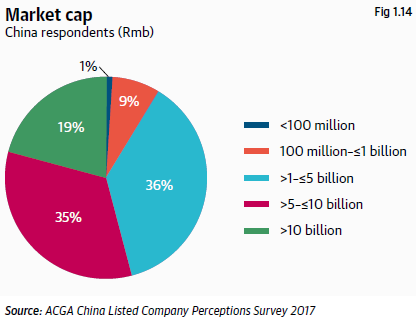
In general, there are too many suspensions in China. If a company has a restructuring plan or a regulatory investigation is going on, it should just disclose this through an announcement; as long as everyone in the market knows the same information, the stock should keep trading.

The issue of price-sensitive information has already been taken care of by regulations around continuous disclosure, so a suspension is often not protecting anyone, it just removes liquidity for existing investors. This issue is exacerbated by the bizarre and unusual situation of dual-listed A/H share companies suspending on one exchange and not the other.
In developed markets, in contrast, suspensions of issuers lasting more than a month for whatever reason are very rare. Part of the issue is also that promoter shares might sometimes have been pledged, so promoters want to avoid a share price fall triggering a margin call.
 

What are the top CG issues you have observed in Chinese companies?


Entrepreneur risk (people risk) is the most obvious one, including related-party transaction risks, along with operational and execution risks. For Aberdeen, we never invest if we feel uncomfortable with the founder or management. Both the character and quality of the people inside the company is something we value a lot in our investment decision-making process.

Regulatory risk is another issue. Changes in regulations can affect not just SOEs but also POEs to different extents. For example, the recent regulatory change on the reinforcement of Party committees inside Chinese companies is not what foreign investors expected to see as the direction of corporate governance development in China.

Another issue is that given more and more onus put on independent directors, maybe we need to think about another way to elect them. The current situation involves voting for independent directors on their independence, rather than competence. However, “independence” can be easily gamed in Asia. Many independent directors are structurally independent but rely on the company for their living (pension), so investors are increasingly asking if/how they add value to board discussions.


What is your view on voting trends among China listed firms? Does voting lead to engagement


Not much has changed. Any voting against has tended to focus on resolutions like related-party transactions, or other corporate actions, rather than issues across the board.

Engagement is getting a little bit better in China. We have seen more and more companies listening to us, and dialogue is getting much better. Companies increasingly understand that we are not in China for the short-term and that our interests are aligned. That certainly helps.


Methodology

A tale of two surveys


The two surveys in this report, the “ACGA Foreign Institutional Investor Perceptions Survey 2017” and the “ACGA China Listed Company Perceptions Survey 2017”, were developed internally in the first half of 2017 and carried out over 21 July to 1 September of that year. They were distributed through ACGA’s global network of members and contacts, and by a number of supporting organisations both inside and outside China (see the Acknowledgements page for details).

Purpose

We decided to conduct a survey at the preliminary stage of this project for two main reasons. The first was to add a broader range of perspectives to the report and to complement the extensive research carried out by ACGA and our contributing authors.

The second was to develop new data on corporate governance in China. When we began researching this report, we found that much of the information on board structures and governance practices in China was out of date, incomplete or non-existent. We developed the survey to partially fill this gap. To complement this information, we turned to data providers such as Wind and Valueonline to provide raw data on which we could do original analysis—and we carried out our own reviews of specific governance practices among large listed companies.

Foreign Institutional Investor Perceptions Survey

The Foreign Institutional Investor Perceptions Survey contained 22 questions and focused on areas that we believe are relevant to China’s investment potential and governance. They can be divided into the following categories:

Macro questions, such as capital market development, MSCI inclusion, SOEs vs POEs, and mainland-listed vs overseas-listed firms.

Shareholder rights, including investor protection in China vs overseas.

Company governance, including corporate reporting, role of chairman, independent directors, supervisory boards.

Role of government, including appointment of chairmen, intervention in SOEs and POEs, the role of the Party organisation/committee.

Investor engagement with companies.

Several of the questions provided options for respondents to give detailed answers and, where relevant, these comments are incorporated into our text.

The survey was developed by ACGA in Q2 2017 and first tested with a select group of ACGA global investor members in June of that year. It was refined based on feedback received before being sent out electronically in July. The recipients were primarily drawn from among ACGA’s list of institutional investor members based in Asia and around the world. This was complemented by recipients from our supporting organisation membership networks.

In total, we received 155 complete and comparable responses. Partial responses were not counted. Based on information gathered about respondents’ titles, they fell into three broad groups: CEOs, directors, managing directors or partners; portfolio managers and analysts; and managers or specialists in CG, ESG or stewardship. A large proportion held senior roles in their organisations.

The total assets under management (AUM) of all respondents amounted to around US$40 trillion, with the range from US$20m to US$6 trillion. In other words, a mix of both boutique investment managers and large mainstream institutions.

China Listed Company Perceptions Survey

The China Listed Company Perceptions Survey contained 12 questions and likewise focused on areas that we believe are relevant to such companies, their directors and managers. While there were fewer questions in this survey, they covered similar categories as in our foreign survey, namely macro issues, company governance, role of government, and investor engagement.

We designed some questions to be identical to the Foreign Institutional Investor Survey, in order to allow direct comparisons between corporate and investor perspectives on the same issue.

We also asked some unique questions of companies, such as whether or not they see a close correlation between corporate governance and performance, and whether better governance helps a firm list its shares.

The survey recipients were drawn from among ACGA’s corporate membership base, as well as clients and contacts of supporting organisations.

In total, we received 182 complete responses from which we extracted the survey results. Most respondents held senior positions in their companies such as directors, executives, board secretaries and senior managers. Most of the companies represented have been listed in China for more than five years and have a market cap of more than Rmb5 billion (US$800m approx). Further demographic data on the two groups of respondents follows:


Foreign respondents

The foreign institutional investors who responded are mostly from the US, UK, Asia and the European Union, as shown in Figure 1.10 below. The response is consistent with the distribution of ACGA members by region. Investors from Australia, New Zealand, the Middle East and Canada also responded to the survey.


In terms of their global AUM, the vast majority of respondents have less than 1% invested in China A shares, while a significant minority have between 1% and 10%. Very few have more than 10% of their funds invested in China domestic listings, although interestingly a few have more than 50%. The latter would be smaller investment managers with a dedicated China focus, as shown in Figure 1.11.

The picture changes markedly when overseas-listed Chinese firms are taken into account: the majority of foreign respondents allocate between 1% to 10% of their global AUM to such companies and a sizeable proportion, about one-fifth, invest more than 10%.


How do foreign investors invest in China? As Figure 1.12 below shows, around a quarter go only through the Qualified Foreign Institutional Investor (QFII) scheme, 15% only through Stock Connect, and almost half through both channels. Interestingly, a significant minority invest directly through wholly owned foreign enterprises (WFOEs) or other foreign direct investment (FDI) channels.


China respondents

Most respondents to our China Listed Company Perceptions Survey work for a company that has been listed for more than five years. Around 40% of the companies have been listed for more than 10 years, which is a relatively long period given that the Chinese stock market is still less than 30 years old (see Figure 1.13).

The market cap of 54% of respondents’ companies was more than Rmb5 billion, as highlighted in Figure 1.14, and 19% have a market cap of more than Rmb10 billion. Generally, the larger firms are likely to be SOEs.


In terms of ownership, the distribution of respondents falls evenly between SOEs and POEs, with 13% being of a “mixed-ownership” type (see Figure 1.15, above). This gives us confidence that the survey results incorporate a range of views from different participants in the Chinese market.

As for where respondents’ companies are listed, Figures 1.16 and 1.17, below, highlight that almost 60% are listed in a single jurisdiction. Mainland China comes first, not surprisingly, followed by a reasonable number in Hong Kong. Only a few respondents work for Chinese companies listed in Singapore, the US and the UK. Regarding the remaining companies listed in more than one jurisdiction, again the most popular venue is a dual-listing in China and Hong Kong, followed by a listing in China and the US. Some companies have a listing in China, Hong Kong and the US.


The complete report, in both English and Chinese, is available here.

___________________________________________________________

*Jamie Allen is Secretary General and Li Rui (Nana Li) is Senior Research Analyst at the Asian Corporate Governance Association (ACGA). This post is based on the introduction to their ACGA report.

L’objectif visé par les fonds d’investissement activistes afin de profiter au maximum de leurs interventions : la vente de l’entreprise au plus offrant !


Vous trouverez, ci-dessous, un article de Roger L. Martinex-doyen de la Rotman School of Management de l’Université de Toronto, paru dans Harvard Business Review le 20 août 2018, qui remet en question la valeur des interventions des fonds activistes au cours des dernières années.

L’auteur pourfend les prétendus bénéfices des campagnes orchestrées par les fonds activistes en s’appuyant notamment sur une étude d’Allaire qui procure des données statistiques probantes sur les rendements des fonds activistes.

Ainsi, l’étude publiée par Allaire montre que les fonds d’investissement activistes réalisent des rendements moyens de 12,4 %, comparés à 13,5 % pour le S&P 500. Le rendement était de 13,9 % pour des firmes de tailles similaires dans les mêmes secteurs industriels.

Je vous invite à prendre connaissance d’une présentation PPT du professeur Allaire qui présente des résultats empiriques très convaincants : Hedge Fund Activism : Some empirical evidence.

Le résultat qui importe, et qui est très payant, pour les investisseurs activistes est la réalisation de la vente de l’entreprise ciblée afin de toucher la prime de contrôle qui est de l’ordre de 30 %.

The reason investors keep giving their money to these hedge funds is simple. There is gold for activist hedge funds if they can accomplish one thing. If they can get their target sold, the compound annual TSR jumps from a lackluster 12,4 % to a stupendous 94,3 %.  That is why they so frequently agitate for the sale of their victim.

Bonne lecture. Vos commentaires sont les bienvenus.


Activist Hedge Funds Aren’t Good for Companies or Investors, So Why Do They Exist?


Résultats de recherche d'images pour « Activist Hedge Funds Aren’t Good for Companies or Investors, So Why Do They Exist? »


Activist hedge funds have become capital market and financial media darlings. The Economist famously called them“capitalism’s unlikely heroes” in a cover story, and the FT published an article saying we “should welcome” them.

But they are utterly reviled by CEOs. And at best, their performance is ambiguous.

The most comprehensive study of activist hedge fund performance that I have read is by Yvan Allaire at the Institute for Governance of Private and Public Organizations in Montreal, which studies hedge fund campaigns against U.S. companies for an eight-year period (2005–2013).

Total shareholder return is what the activist hedge funds claim to enhance. But for the universe of U.S. activist hedge fund investments Allaire studied, the mean compound annual TSR for the activists was 12.4% while for the S&P500 it was 13.5% and for a random sample of firms of similar size in like industries, it was 13.9%. That is to say, if you decided to invest money in a random sample of activist hedge funds, you would have earned 12.4% before paying the hedge fund 2% per year plus 20% of that 12.4% upside. If instead you would have invested in a Vanguard S&P500 index fund, you would have kept all but a tiny fraction of 13.5%.

Since the returns that they produce underwhelm, why do activist hedge funds exist? Why do investors keep giving them money? It is an important question because the Allaire data shows the truly sad and unfortunate outcomes for the companies after the hedge funds ride off into the sunset, after a median holding period of only 423 unpleasant days. Over this span, employee headcount gets reduced by an average of 12%, while R&D gets cut by more than half, and returns don’t change.

The reason investors keep giving their money to these hedge funds is simple. There is gold for activist hedge funds if they can accomplish one thing. If they can get their target sold, the compound annual TSR jumps from a lackluster 12.4% to a stupendous 94.3%.  That is why they so frequently agitate for the sale of their victim.

But why is this such a lucrative avenue? It is because of the control premium. When a S&P500-sized company gets sold, the average premium over the prevailing stock price that is paid for the right to take over that company is in excess of 30%. This is ironic, of course, because studies show the majority of acquisitions don’t earn the cost of capital for the buyer. It is a case of the triumph of hope over reality – which is not unusual. It is not dissimilar to what happens in the National Football League where the trade price for a future draft pick is typically higher than the trade price for an accomplished successful player. That is because the acquiring team dreams that the player it will pick in the draft will be more awesome than that player is likely to turn out to be. But hope springs eternal!

The activist hedge funds have their eyes focused laser-like on the control premium — which for the S&P 500, which has a market capitalization of $23 trillion, is conservatively a $7 trillion pie assuming a 30% control premium. To get a piece of that scrumptious pie, all they need to do is pressure their victim to put itself up for sale and they will have “created shareholder value.” Of course, on average, they will have destroyed shareholder value for the acquiring firm, but they couldn’t care less. They are long gone by that time; off to the next victim.

And they have lots of friends to help them access the control premium pie. Investment bankers want to help them do the deal whether it is a good deal or not and that $7 trillion pie for hedge funds translates into a multibillion dollar annual slice for investment bankers. And for the M&A lawyers that need to opine on the deal. And the accounting firms that need to audit the deal. And for the proxy voting firms that collect the votes for and against the deal. And the consultants who get hired to do post-merger integration. And the financial press that gets to write stories about an exciting deal.

It is an entire ecosystem that sees the $7 trillion pie and wants a piece of it. It doesn’t matter a whit whether a hedge-fund inspired change of control is a good thing for customers, employees or the combined shareholders involved (selling plus acquiring). It is too lucrative a pie to pass up.

What will stop this lunacy? When shareholders come to their senses and realize that when an activist hedge fund has pressured a company intensively enough to put it up for sale, they are simply feeding the hedge fund beast and the vast majority of the time it will be at their own expense. When activist hedge funds’ access to the $7 trillion pie is shut off, they will have to rely on their ability to actually make their victims perform better. And their track record on that front is mediocre at best.

______________________________________________________________

Roger L. Martin is the director of the Martin Prosperity Institute and a former . He is a coauthor of Creating Great Choices: A Leader’s Guide to Integrative Thinking.