Compte rendu hebdomadaire de la Harvard Law School Forum on Corporate Governance | 15 juin 2017


Voici le compte rendu hebdomadaire du forum de la Harvard Law School sur la gouvernance corporative au  15 juin 2017.

J’ai relevé les principaux billets, tout en me limitant au Top 1o.

Bonne lecture !


Résultats de recherche d'images pour « harvard law school forum on corporate governance »


Résultats de recherche d'images pour « harvard law school forum on corporate governance »


  1. Breaking the Ice: Investors Warm to Climate Change
  2. Perk Disclosures: Reminders for Executives and Directors
  3. Compensation Goals and Firm Performance
  4. The Global Rise of Corporate Saving
  5. The 200 Highest-Paid CEOs in 2016
  6. The CEO Pay Ratio Beyond Dodd Frank: Live and Local
  7. M&A Activism: A Special Report
  8. Distracted Directors
  9. The Dangerous “Promise of Market Reform”: No Shareholder Proposals
  10. Financial CHOICE Act of 2017 2017 M&A Report

Rôle des administrateurs dans la prévention de risques à la santé | un cas vécu dans une OBNL


À nouveau, je vous présente un cas de gouvernance, publié en juin 2017, sur le site de Julie Garland McLellan* qui décrit une situation dans laquelle un membre de conseil d’une OBNL évalue les conséquences d’une décision pouvant entraîner des risques pour la santé des clients et conduire à une perte de réputation.

Les administrateurs connaissent maintenant le contexte de la décision prise par le conseil. Cependant, une nouvelle administratrice n’est pas « confortable » avec la décision ; elle se questionne sur le risque occasionné à la santé des athlètes à la suite d’une prise de position du conseil trop peu contraignante.

Notons que la directrice de la sécurité de l’entreprise avait qualifié d’infondée les arguments invoqués par une équipe sportive de ne pas utiliser les mesures de protection suggérées.

Le cas présente la situation de manière assez succincte, mais explicite ; puis, trois experts en gouvernance se prononcent sur le dilemme qui se présente aux personnes qui vivent des situations similaires.

Que devrait faire la nouvelle administratrice Pandora dans les circonstances ?

Je vous invite à lire les opinions des experts en allant sur le site de Julie.

Bonne lecture ! Vos commentaires sont toujours les bienvenus.


Rôle des administrateurs dans la prévention de risques à la santé | un cas vécu dans une OBNL


Résultats de recherche d'images pour « risques des obnl »


Pandora is a new NED on a peak sporting body board. She loves the sport and is thrilled to contribute. However, she is a bit worried about the risks of a recent board conversation.

Her sport has physical risks and is very dangerous if proper precautions are not taken; these include the use of personal protective equipment. At her most recent board meeting the directors discussed the revised sports safety guidelines which mandate the wearing of personal protective equipment during competitions. One of the directors mentioned that a large local club routinely participates in competitions with players who are clearly not wearing safety gear. Another director stated that the club had objected to the draft guidelines on the basis that, in some circumstances, the safety equipment might hamper players’ movements and create other risks. The safety manager, who was presenting to the board, clarified that the club had, indeed, made that claim but that it was, in her opinion, spurious.

The board then discussed the issues associated with banning the non-compliant club from competitions. This was considered a difficult action because the club is very successful and their absence would upset fans. Also, the club is in a high socio economic demographic and contributes funds and political connections to the sport.

Pandora is worried because the discussion was minuted and the decision was to write to the club and remind them of the need to wear safety equipment but not to threaten expulsion from the competition. Is her board now at risk and has she let down the whole sport by being a party to this conversation and failing to persuade her board colleagues to take firmer action?

What can Pandora do?


*Julie Garland McLellan is a practising non-executive director and board consultant based in Sydney, Australia. www.mclellan.com.au/newsletter.html

Compte rendu hebdomadaire de la Harvard Law School Forum on Corporate Governance | 8 juin 2017


Voici le compte rendu hebdomadaire du forum de la Harvard Law School sur la gouvernance corporative au 8 juin 2017.

J’ai relevé les principaux billets, tout en me limitant au Top 1o.

Bonne lecture !


Résultats de recherche d'images pour « harvard law school forum on corporate governance »


Résultats de recherche d'images pour « harvard law school forum on corporate governance »


  1. Decreasing Patience for IPOs with Poor Shareholder Rights
  2. Appraisal Decision Sole Reliance on Merger Price: PetSmart
  3. The Role of Social Capital in Corporations: A Review
  4. On Long-Tenured Independent Directors
  5. Why Your Board Should Refocus on Key Risks
  6. The Limits of Gatekeeper Liability
  7. The Long Game: Incentive Pay Aims at Generating Lasting Return
  8. The Corporate Demand for External Connectivity: Pricing Boardroom Social Capital
  9. Criticism of Governance Provisions in Proxy Contest Leads to Reincorporation
  10. Retired or Fired: How Can Investors Tell If the CEO Left Voluntarily?


Gouvernance des sociétés d’État | une étude montre des problèmes dans la moitié d’entre elles


Yvan Allaire, président exécutif du conseil de l’Institut sur la gouvernance (IGOPP) vient de publier, en collaboration avec François Dauphin, un nouveau document de recherche intitulé « Nos sociétés d’État sont-elles bien gouvernées ? » lequel a fait l’objet d’une analyse succincte par le journaliste Gérald Fillion de la Société Radio-Canada.

Selon l’IGOPP, « les contribuables s’attendent à ce que ces sociétés fassent bon usage des fonds publics qui leur sont confiés, que leur gestion soit efficace, efficiente et transparente, que leur mandat soit clair et pertinent. Leur conseil d’administration, s’appuyant sur des règles et principes de saine gouvernance, devrait jouer un rôle essentiel à cet égard ».

Je crois que ce rapport de recherche saura intéresser les spécialistes de la gouvernance qui œuvrent dans les sociétés d’État et dans les autres organisations parapubliques. Personnellement, je crois que les auteurs ont élaboré une méthodologie de recherche tout à fait pertinente pour évaluer la bonne gouvernance, non seulement des sociétés d’État, mais également de tous les types d’organisation.


Vous trouverez ci-dessous une analyse de Gérald Filion, suivie de la référence au document de recherche de l’IGOPP.


Sur 46 sociétés d’État au Québec seulement 23 obtiennent la note de passage en matière de gouvernance, selon une étude préparée par les chercheurs Yvan Allaire et François Dauphin.

Si les grandes sociétés se démarquent, notamment la Caisse de dépôt, la SAQ et Loto-Québec, d’autres affichent de faibles résultats qui pourraient amener le gouvernement à devoir repenser leur modèle de gouvernance. Parmi les derniers de classe, on compte l’École nationale de police, le Musée national des beaux-arts de Québec et l’Institut de tourisme et d’hôtellerie du Québec.

Ce rapport, publié jeudi par l’Institut sur la gouvernance d’entreprises publiques et privées, s’intéresse à 47 instruments de mesure de la gouvernance des sociétés pour établir un pointage sur 100. La note de passage est établie à 60. Ont été exclues de l’étude 13 sociétés jugées inactives dans les faits ou trop petites. Les 46 sociétés d’État retenues encaissent annuellement des revenus de 63 milliards de dollars et comptent 65 000 employés.

L’Institut sur la gouvernance évalue les sociétés sur les compétences des administrateurs, la transparence, la reddition de compte, la structure du conseil et le déroulement des séances du conseil. Et les résultats sont très inégaux.

L’École nationale de police échoue sur tous les plans, tout particulièrement sur les questions de compétence et de nomination. À l’autre bout du spectre, la Société d’habitation du Québec se démarque à tous les niveaux, avec une note parfaite dans la composition et la structure de son conseil, qui touche surtout à la question de l’indépendance.

L’Institut recommande au gouvernement de revoir certaines lois jugées « désuètes » pour encadrer les sociétés, de rendre publics les profils d’expertise et d’expérience des administrateurs et une foule d’informations pertinentes à leur propos.

Il propose aussi que le gouvernement cesse de rendre le dépôt du rapport annuel des sociétés d’État obligatoire à l’Assemblée nationale avant de le rendre public. Les rapports doivent être disponibles dans des délais plus rapides selon l’Institut sur la gouvernance. Actuellement, il faut attendre 6 mois en moyenne après la fin de l’exercice pour avoir accès au rapport annuel.

Les conseils d’administration des sociétés d’État, écrivent les chercheurs, doivent adopter des principes qui dépassent les exigences de la loi, surtout au chapitre de la « divulgation des profils de compétence, divulgation non obligatoire, mais non prohibée. »

Les conseils doivent s’assurer également que l’information, sur les sites internet des sociétés d’État, est facilement accessible, notamment les résultats de la société, ses stratégies ainsi que les indicateurs de performance. De plus, « une divulgation exhaustive des éléments de rémunération des hauts dirigeants est incontournable. »

Le gouvernement se mêle de tout

L’Institut illustre, chiffres à l’appui, combien le gouvernement s’assure de garder le contrôle sur les nominations des administrateurs.

« Ainsi, écrivent Yvan Allaire et François Dauphin, dans seulement cinq cas avons-nous trouvé une participation claire de la part du conseil dans le processus de sélection des candidats et candidates au poste d’administrateur. Bien sûr, le manque de transparence fausse peut-être en partie les données pour cet élément. Néanmoins, la participation du conseil dans le processus de sélection est extrêmement importante pour assurer non seulement la présence de compétences et d’expériences complémentaires au groupe, mais aussi pour faciliter l’obtention (ou le maintien) d’une dynamique de groupe fonctionnelle. »

Sur les 46 sociétés d’État, seulement trois établissent publiquement sur leur site un lien entre la biographie des administrateurs et les compétences recherchées au conseil.

L’Institut sur la gouvernance est d’avis également qu’une personne ne devrait pas siéger à plus de cinq conseils d’administration en même temps. Or, « au moins quinze (32,6 %) des sociétés comptaient au minimum un membre du conseil siégeant sur plus de cinq conseils d’administration, incluant quelques présidents de conseil. »

Aussi, « 19 sociétés (41,3 %) ne fournissent pas l’information sur l’assiduité des membres aux réunions du conseil. »

Les auteurs constatent également qu’il y a « une différence importante entre les organisations assujetties à la Loi québécoise sur la gouvernance des sociétés d’État promulguée en 2006 et celles qui ne le sont pas. En effet, les sociétés assujetties doivent divulguer davantage d’information, ne serait-ce que pour s’y conformer. Aussi, elles ont en moyenne une note de 70,7, comparativement à 45,2 pour les sociétés qui ne se conforment qu’aux exigences de leurs lois respectives. »

Manque de transparence

C’est pas moins de dix sociétés sur les 46 qui n’ont pas d’indicateur de performance ou de cible pour les évaluer, ou qui ne publient pas leur plan stratégique. Ce manque de transparence touche notamment la Commission de la capitale nationale, Héma-Québec et la Société de la Place des Arts de Montréal.

Yvan Allaire et François Daupin affirment également que « la transparence quant à la rémunération des hauts dirigeants des sociétés d’État peut et devrait être grandement améliorée, ne serait-ce que pour se rapprocher des exigences imposées aux sociétés pourtant dites “privées”.»

Enfin, les auteurs invitent les sociétés d’État à rendre publics la teneur des formations offertes aux administrateurs et les processus d’évaluation des membres du conseil. Cela dit, près du quart des sociétés d’État ne font pas d’évaluation et ne dévoilent pas cette information.


Je vous invite à lire l’ensemble du document sur le site de l’IGOPP, notamment pour connaître les 47 critères de mesure de la gouvernance.

Bonne lecture ! Vos commentaires sont les bienvenus.


Nos sociétés d’État sont-elles bien gouvernées? |  L’IGOPP leur attribue des notes de gouvernance


Compte rendu hebdomadaire de la Harvard Law School Forum on Corporate Governance | 1er juin 2017


Voici le compte rendu hebdomadaire du forum de la Harvard Law School sur la gouvernance corporative au 1er juin 2017.

J’ai relevé les principaux billets, tout en me limitant au Top 1o.

Bonne lecture !


Résultats de recherche d'images pour « harvard law school forum on corporate governance »


Résultats de recherche d'images pour « harvard law school forum on corporate governance »

  1. Bank Governance and Systemic Stability: The “Golden Share” Approach
  2. Snap and the Rise of No-Vote Common Shares
  3. Potential Regulatory Relief—Financial CHOICE Act 2.0
  4. The Origins of Corporate Social Responsibility
  5. M&A Deal Terms in 2017: What Can Deal Teams Expect?
  6. Cybersecurity Must Be High on the Board Agenda
  7. Dancing with Activists
  8. U.S. Proxy Season Half-Time Update
  9. What’s (Still) Wrong with Credit Ratings
  10. 2017 M&A Report

Nouvelle étude sur les retombées des comportements activistes | Bebchuk


Les administrateurs de sociétés doivent être beaucoup plus informés des conséquences que les fonds activistes peuvent avoir sur la conduite des entreprises publiques (cotées).

Il plane un air de mystère, et un certain mutisme, sur la nature des opérations et sur les objectifs poursuivis par les investisseurs activistes.

Pourtant, même si le phénomène est de plus en plus répandu, on constate un manque flagrant de formation des administrateurs de sociétés sur les types d’arrangements recherchés par les activistes.

Les pionniers de la recherche dans ce domaine, Lucian Bebchuk* et ses collègues, viennent de publier un billet sur le site de Harvard Law School Forum on Corporate Governance, qui fait la lumière sur le comportement des investisseurs activistes.

Que recherchent les activistes ? Ils veulent convaincre les directions et les conseils d’administration que leurs préconisations conduiront à une meilleure valorisation de l’entreprise.

Ils souhaitent tirer parti des faiblesses de certaines organisations dans le but premier de faire profiter leurs investissements, tout en améliorant la rentabilité des entreprises qui ont des problèmes de gouvernance, de leadership et de vision stratégique.

Quels sont les résultats de la recherche des auteurs eu égard aux motivations, à la nature des arrangements ainsi qu’à leurs conséquences ?

L’étude montre que les négociations sur les modifications organisationnelles souhaitées, reliées au renouvellement du leadership et à la remise en question des opérations, sont difficiles à convenir.

Les fonds activistes préfèrent de loin arriver à des ententes sur la composition du conseil d’administration susceptible de favoriser les changements escomptés.


Résultats de recherche d'images pour « actionnaires activistes »
Les fonds activistes à l’assaut des grands groupes | Le Monde


L’étude indique que les modifications à la constitution du CA mènent souvent :

  1. au remplacement du PDG (CEO) ;
  2. à des paiements accrus aux actionnaires ;
  3. à une plus forte probabilité de vente ou de privatisation de l’entreprise.


Finalement, l’étude montre que les avantages obtenus par les actionnaires activistes ne se font pas au détriment des autres investisseurs. Également, le prix des actions est généralement à la hausse à la suite des négociations sur les arrangements.

Les auteurs dévoilent aussi les moyens utilisés par les fonds activistes pour arriver à leurs fins (« a look into the black box »).

Je suis personnellement convaincu que certaines conséquences non anticipées se produisent et que cette étude doit être mise en relation avec d’autres recherches, notamment celles du professeur Yvan Allaire**.


Afin de mettre en valeur de bonnes pratiques mises en places par des conseils d’administration des sociétés québécoises, le journal Les Affaires, en collaboration avec l’Institut des administrateurs de sociétés (IAS), le Collège des administrateurs de sociétés et l’Institut sur la gouvernance  (IGOPP), a tenu le 1er avril dernier une Grande soirée de la gouvernance. Durant cette soirée, le professeur Yvan Allaire, président exécutif du conseil d’administration de l’IGOPP a dévoilé en primeur une étude sur l’enjeu des investisseurs activistes et leurs conséquences pour les conseils d’administration.


Conclusions préliminaires de cette étude :

(1) Les fonds de couverture activistes ne sont pas des « super‐cracks » de la finance, ni de la stratégie, ni des opérations, comme certains semblent le croire (et eux s’évertuent à le faire croire) ;

(2) Leurs recettes sont connues, convenues et prévisibles et ne comportent jamais (ou presque) de perspectives de croissance ;

(3) Leur succès provient surtout de la vente des entreprises ciblées (ou de « spin‐offs ») ;

(4) L’appui important qu’ils reçoivent des fonds institutionnels est surprenant et malencontreux ;

(5) La gouvernance fiduciaire pratiquée depuis Sarbanes‐Oxley et la perte de confiance dans les conseils qui en a résulté leur ouvre toute grande la porte des entreprises.


Bonne lecture. Vos commentaires sont les bienvenus.


Dancing with Activists


We recently released a study, entitled Dancing with Activists, that focuses on “settlement” agreements between activist hedge funds and target companies. Using a comprehensive hand-collected data set, we provide the first systematic analysis of the drivers, nature, and consequences of such settlement agreements.

Our study identifies the determinants of settlements, showing that settlements are more likely when the activist has a credible threat to win board seats in a proxy fight. We argue that, due to incomplete contracting, settlements can be expected to contract not directly on the operational or leadership changes that activists seek but rather on board composition changes that can facilitate operational and leadership changes down the road. Consistent with the incomplete contracting hypothesis, we document that settlements focus on boardroom changes and that such changes are subsequently followed by increases in CEO turnover, increased payout to shareholders, and higher likelihood of a sale or a going-private transaction.

We find no evidence to support concerns that settlements enable activists to extract significant rents at the expense of other investors by introducing directors not supported by other investors or by facilitating “greenmail.” Finally, we document that stock price reactions to settlement agreements are positive and that the positive reaction is higher for “high-impact” settlements. Our analysis provides a look into the “black box” of activist engagements and contributes to understanding how activism brings about changes in its targets.

Below is a more detailed account of the analysis and findings of our study.

In August 2013, Third Point, the hedge fund led by Daniel Loeb, disclosed a significant stake in the auction house Sotheby’s, criticized the company for its poor governance and its failure to take advantage of a booming market for luxury goods, and called for the ouster of the company’s CEO. Third Point launched a proxy fight for board representation and both sides prepared for a contested election at the company’s upcoming annual meeting. However, the day before the scheduled annual shareholder meeting, the company’s board of directors and the activist fund entered into a settlement agreement in which Sotheby’s agreed to appoint three of the Third Point director candidates and Third Point agreed to discontinue the proxy fight. The settlement terms did not require the company to make any of the operational and executive changes that Third Point was seeking. However, ten months later, Sotheby’s announced the hiring of a new CEO, the appointment of a new board chairman, and a plan to return capital to its investors.

While such settlements used to be rare, they now occur with significant frequency, and they have been attracting a great deal of media and practitioner attention. Understanding settlement agreements is important for obtaining a complete picture of the corporate governance landscape and the role of activism within it. Using a comprehensive, hand-collected dataset of settlement agreements, we provide in this study the first systematic empirical investigation of activist settlements. We study the drivers of settlements, their growth over time, their impact on board composition, their consequences for the operational and personnel choices that targets make, and the stock market reaction accompanying them. We further study the aftermath of settlements in terms of CEO turnover, payouts to shareholders, M&A activity, and operating performance.

With the growing recognition of the importance of hedge fund activism, a large empirical literature on the subject has emerged (see Brav et al. (2015b) for a recent survey). This literature has studied the initiation of activist interventions—the time at which activists announce their presence, usually by filing Schedule 13(d) with the SEC after passing the 5% ownership threshold, and the stock market reactions accompanying such announcements. This literature has also studied extensively the changes in the value, performance and behavior of firms that take place during the years following activist interventions; among other things, researchers have studied the changes in Tobin’s Q, return on assets (ROA), payouts to shareholders, capital structure, likelihood of an acquisition, and accounting practices that ultimately follow activist interventions. But there has been limited empirical work on the “black box” in between—the channels through which activists’ influence is transmitted and gets reflected in targets’ economic outcomes. In particular, the determinants, nature and role of settlement agreements—and the cooperation between activists and targets that they introduce—have not been subject to a systematic empirical examination. We attempt to help fill this gap.

We begin by investigating the factors that determine the likelihood that an activist will be able to obtain a settlement agreement. Building on insights from the economics of settlements, we hypothesize that an activist will need to have a credible threat to win seats in a proxy fight to be able to extract a settlement agreement. Consistent with this hypothesis, we find that the likelihood of a settlement agreement in general, and a “high-impact” settlement agreement involving a substantial change in company leadership, covaries with several factors that are associated with improved odds for the activist in winning board seats in a proxy fight.

We quantify the upward trend in activist settlements. In particular, we show that the unconditional likelihood of a settlement increased threefold from the time period 2000-2002 (3%) to the period 2003-2005 (9%), increased by another 56% during 2006-2008 (14%) and by 29% during 2009-2011 (18%). These results hold when controlling for target and activist characteristics. Consistent with the view that settlements require activists having a credible threat to win board seats in a proxy fight, we argue that the increase in the settlement rate was driven by the growing willingness of institutional investors and proxy advisors to support activists, which in turns strengthened the credibility of the activist’s threat to win seats in a contest.

Turning to the terms of settlements, we explain the cost and difficulty of entering into contractual agreements that specify ultimate outcomes—the types of changes in operations, strategy, payouts or executive personnel that activists often seek. We document that settlements indeed rarely stipulate directly such outcomes. Rather, activists commonly settle on changes in board composition. We demonstrate that settlements are a key channel through which activists bring about board changes and we investigate the nature of these changes, showing that they bring about an increase in the number of activist-affiliated and activist-desired directors, well-connected directors and decrease the number of old and long-tenured directors.

Why do activists settle on changes in board composition if their ultimate goal is in bringing about operational or personnel changes? We argue that introducing individuals into the boardroom who are sympathetic, or at least open to the changes sought by the activist, is an intermediary step that can facilitate and bring about such changes. Consistent with this view, we show that, while settlements generally do not specify an ouster of the CEO, settlements are followed by a considerable increase in CEO turnover and in the performance-sensitivity of CEO turnover in the years following the settlement. Thus, settlements often plant the seeds for a subsequent CEO removal that is more face-saving to the CEO and the incumbent directors than an immediate ouster would be. Similarly, while settlement agreements generally do not specify operational changes, we document that such changes do follow in subsequent years. Settlements are followed by increased payouts to shareholders, a higher likelihood of target firms being acquired, and improvements in ROA.

We also investigate concerns raised by practitioners and the media that settlements between activists and targets enable activists to extract rents at the expense of other shareholders who are not “at the table” when the settlement is negotiated. We examine two suggested channels for such rent extraction and find little evidence that settlements provide activists with significant rents at other shareholders’ expense. First, we find no evidence that settlements enable activists to put directors on the board who are not supported by other shareholders. Directors who enter the board through settlements do not receive less voting support at the following annual general meeting than incumbent directors or those activist directors who get on the board without a settlement. Second, we find little evidence that settlements produce a significant incidence of “greenmail” by getting the target to purchase shares from the activist at a premium to the market price; buybacks of activist shares occur in a very small fraction of settlement agreements and, when they do occur, they are typically executed at the market price.

Finally, we analyze the stock market reactions accompanying the announcement of a settlement agreement. Settlements are accompanied by positive abnormal stock returns. Furthermore, we find that the positive abnormal returns are especially large when the settlement is “high impact” in terms of introducing two or more new directors or providing for an immediate CEO turnover. This pattern is consistent with the view that the market welcomes the boardroom and leadership changes that activist settlements produce and inconsistent with the view that such changes can be expected to be disruptive and detrimental to other shareholders.

Our study is available for download here.


*Lucian Bebchuk is Professor of Law, Economics, and Finance, and Director of the Program on Corporate Governance, at Harvard Law School; Alon Brav is Professor of Finance at Duke University; Wei Jiang is Professor of Finance at Columbia Business School; and Thomas Keusch is Assistant Professor at the Erasmus University School of Economics. This post is based on their study, Dancing with Activists, available here. This study is part of the research undertaken by the Project on Hedge Fund Activism of the Program on Corporate Governance. Related Program research includes The Long-Term Effects of Hedge Fund Activism by Bebchuk, Brav and Jiang (discussed on the Forum here); and The Law and Economics of Blockholder Disclosure by Lucian Bebchuk and Robert J. Jackson Jr. (discussed on the Forum here).

**Yvan Allaire, Voir la publication « L’IGOPP dévoile une étude sur l’enjeu des investisseurs activistes et leurs conséquences pour les conseils », site de l’IGOPP.


Compte rendu hebdomadaire de la Harvard Law School Forum on Corporate Governance | 25 mai 2017


Voici le compte rendu hebdomadaire du forum de la Harvard Law School sur la gouvernance corporative au 25 mai 2017.

J’ai relevé les principaux billets.

Bonne lecture !


Résultats de recherche d'images pour « harvard law school forum on corporate governance »


Résultats de recherche d'images pour « harvard law school forum on corporate governance »

  1. Do Exogenous Changes in Passive Institutional Ownership Affect Corporate Governance and Firm Value?
  2. It Pays to Write Well
  3. Mutual Fund Companies Have Significant Power to Increase Corporate Transparency
  4. Just How Preferred is Your Preferred?
  5. Private Investor Meetings in Public Firms: The Case for Increasing Transparency
  6. Court of Chancery’s Guidance on “Credible Basis” Standard for Obtaining Books
  7. Recent Board Declassifications: A Response to Cremers and Sepe
  8. SEC Enforcement Actions Against Public Companies and Subsidiaries Keep Pace
  9. Dual-Class Stock and Private Ordering: A System That Works
  10. 2017 IPO Report


Les conseils d’administration doivent se préoccuper davantage des relations humaines au sein des entreprises | L’expertise en RH sur le CA est essentielle


Dans ce billet, je tiens à souligner que plusieurs problèmes de relations humaines au sein de l’entreprise sont totalement inconnus du conseil. C’est pourquoi le CA doit nécessairement compter sur des administrateurs qui sont préoccupés par les aspects humains de l’organisation. Ces administrateurs sauront poser les bonnes questions afin de mieux connaître le moral des troupes ainsi que le degré de sensibilité de la direction par rapport aux « problèmes de RH ».

Les conseils d’administration sont beaucoup plus intéressés par les perspectives stratégiques et les résultats financiers. Quels sont les sentiments des employés envers la haute direction ? Trop souvent, on constate une distance énorme entre les employés et les dirigeants, si bien qu’on a l’impression que ceux-ci vivent dans un autre monde. L’exemple de Bombardier est éloquent à ce sujet…

Les comités de ressources humaines semblent davantage se préoccuper du bien-être de la haute direction que de la santé du climat de travail organisationnel. À cet égard, les cadres intermédiaires doivent jouer leurs rôles de leaders auprès de leurs employés, en échangeant fréquemment avec eux, en fixant des objectifs réalistes, en les aidant à se développer et en reconnaissant la valeur de leur contribution.

À mon avis, le conseil d’administration doit se doter d’un tableau de bord faisant état des aspects humains liés au succès de l’entreprise. À titre d’exemple, mentionnons la qualité du travail, la rotation du personnel, les défis de recrutement, les plaintes, la rémunération des employés en comparaison de celle de la haute direction, le moral des employés, l’appréciation du travail, la fierté d’appartenir à l’organisation, les indices de bonne réputation de l’entreprise en tant qu’employeur, etc.

La culture de l’organisation est généralement un facteur très négligé par les administrateurs. C’est pourquoi le Collège des administrateurs de sociétés a conçu un module ayant pour thème : Leadership, communications et ressources humaines. Ce module aborde la culture organisationnelle et son influence sur la performance de l’entreprise, ainsi que le leadership du management et l’importance que les membres du conseil doivent y accorder.

Enfin, les administrateurs doivent être conscients de la qualité de leur bassin de talents, lequel constitue assurément un avantage concurrentiel unique.

Je vous recommande la lecture d’un court article de Janet Candido*, paru dans le Globe and Mail du 19 mai, qui milite pour l’ajout d’experts en RH sur les conseils d’administration.

Vos commentaires sont toujours les bienvenus.


Why HR expertise is a critical addition to your board


For most public companies, the board of directors is usually composed of experienced, senior leaders who focus on high-level issues such as finance and strategy, believing these two functions, specifically, to be the foremost way to protect the interests of the shareholder. But an often-overlooked – yet equally important – role among boards is that of HR leadership, an increasingly popular point of view that’s also widely advocated by Richard Leblanc, professor at York University and expert on corporate governance.

As an example, a number of e-mails from senior employees in a company were disparaging of the company’s CEO, coupled with issues raised in an employee engagement survey that pointed to a complete lack of confidence in the CEO’s leadership. These issues – which included being dismissive of employee complaints, expecting unpaid overtime (so his budget looked good) and an unwillingness to accept accountability while blaming others – were unknown to the board and the chair of the board felt they should have been more aware.

In fact, they should have been more aware. While the directors are all very competent professionals, well versed in their areas of specialty, they had never thought to question issues of human capital. They focused on the business side of things, believing that the CEO was on top of the people issues. There was no HR expertise on this board, a mistake that led to some costly missteps. Had an independent HR leader been involved, he/she would have seen the signs: increased turnover, difficulty hiring top talent, an apathetic leadership team and missed deadlines. Eventually, this resulted in lost productivity and revenue, as well as damage to the company’s reputation, a situation that is much harder to fix – and takes more time.

If the board is there to protect the interests of the stakeholders, part of doing so requires an understanding of the culture and the depth of talent within the organization. Attention must be paid to employee engagement factors. In their course of duty, boards discuss issues and make decisions, but understanding the impact that these decisions will have on the culture is critical.

Board members may not know exactly what information they should be getting and discussing when it comes to people issues or even how to evaluate that information once received, but the best way to change this is to stop assuming and start asking questions. Are they comfortable with the depth of talent in the organization as it relates to the ongoing operations, as well as specific initiatives that the board is considering? Are there enough skilled people in place? Is the leadership engaged and committed? Do they have the confidence of the employees? Do employees understand the objectives of the company and do they feel good about where they are working?

Without this information, any board debates around strategy cannot be complete. The strategy being discussed and proposed can succeed or fail on the strength of the human capital, so this must be a consideration. And the board needs to understand where the organization is vulnerable.

It is easy to assume the CEO has the operations well in hand. In most cases, they likely do, but it can be disastrous if not. Even a CEO may not have the specific depth of skills or knowledge to accurately predict or interpret the impact certain strategies may have when it comes to human capital. The board is not doing its job if it doesn’t take this into consideration.

While an internal CHRO can provide some input, they cannot replace the independent oversight role of a board member or adviser. An HR leader who does not report to the CEO is not beholden, first and foremost; they will understand the impact of the information provided and the risks, if any, that exist. He or she can identify gaps in the information provided and any areas of vulnerability. This will result in a more robust debate that provides greater insight to a well-designed, well-executed process and plan.


*Janet Candido is the principal of Candido Consulting Group.

Compte rendu hebdomadaire de la Harvard Law School Forum on Corporate Governance | 18 mai 2017


Voici le compte rendu hebdomadaire du forum de la Harvard Law School sur la gouvernance corporative au 18 mai 2017.

J’ai relevé les principaux billets.

Bonne lecture !


Résultats de recherche d'images pour « harvard law school forum on corporate governance »


Résultats de recherche d'images pour « harvard law school forum on corporate governance »

  1. What Drives Differences in Management?
  2. Insider Trading: When Hackers Target Corporate Shares
  3. Five Investor Trends Driving Say on Pay in 2017
  4. Texas Bill Targets Activist Investors, Advisors
  5. The Consequences of Managerial Indiscretions
  6. Reviving the U.S. IPO Market
  7. The Fiduciary Dilemma in Large-Scale Organizations: A Comparative Analysis
  8. Dual-Class: The Consequences of Depriving Institutional Investors of Corporate Voting Rights
  9. Looking Behind the Declining Number of Public Companies
  10. The Promise of Market Reform: Reigniting America’s Economic Engine

Qu’est-ce qu’un président « exécutif » de conseil d’administration ? | Le cas de Bombardier 


Voici un article de Karim Benessaieh publié dans la section Actualité expliquée de La Presse+ Affaires le 13 mai 2017.

L’auteur apporte les précisions requises quant aux titres et fonctions du président du conseil de Bombardier, Pierre Beaudoin.

Pierre Beaudoin était président et chef de la direction (CEO ou PDG) de Bombardier depuis 2008. En 2015, il devient le président « exécutif » du conseil d’administration de Bombardier.

Récemment, ce dernier a renoncé à la portion « exécutive » de ses fonctions. Qu’est-ce que cela implique pour le commun des mortels ?

C’est exactement ce à quoi Karim Benessaieh a tenté de répondre dans son article, reproduit ci-dessous, auquel j’ai participé.

Bonne lecture ! Vos commentaires sont les bienvenus.


Un président exécutif, ça mange quoi en hiver ?


Qu’est-ce qu’un président exécutif ? Peut-on être PDG, président du conseil d’administration et chef de la direction en même temps ? Dans la tempête qui ébranle Bombardier depuis six semaines, il est facile de se perdre dans les étiquettes. La Presse a demandé à deux experts en gouvernance d’éclairer notre lanterne.


À quoi a renoncé exactement Pierre Beaudoin en retirant la partie « exécutive » de son mandat ?

À la base, Pierre Beaudoin, fils de Laurent Beaudoin et de Claire Bombardier et donc petit-fils de Joseph-Armand Bombardier, est le président du conseil d’administration de l’entreprise depuis 2015. Son rôle est de « gérer le conseil et [d’]établir l’ordre du jour » pour les 15 membres de cette instance, comme le précise le site de Bombardier, qui ne fait aucune référence à l’aspect « exécutif » de son travail.

Dans l’avis de convocation des actionnaires, cette semaine, on reprend la formule un peu vague selon laquelle M. Beaudoin est en outre chargé de « la définition d’une orientation stratégique et [de] la gestion des relations entretenues avec certaines parties prenantes et avec la clientèle ». Ce sont ces dernières responsabilités qu’il a perdues.

Vous ne nous éclairez pas beaucoup…

Désolé, c’était la réponse officielle. C’est que le « président exécutif » est une bête un peu curieuse souvent associée aux entreprises familiales ou dont le fondateur est encore bien présent. Aux États-Unis, peu de confusion : pour 50 % des entreprises cotées en Bourse, le PDG (ou CEO) est également président du conseil d’administration. Le président du conseil, dans ces cas, est « exécutif » de facto. Au Canada, seulement 14 % des entreprises sont dirigées par un PDG qui est en même temps président du conseil d’administration.

Par contre, dans une sorte de formule mitoyenne, certaines entreprises d’ici ont donné des responsabilités élargies à leur président du conseil en lui ajoutant l’étiquette « exécutif » : il devient dans les faits un deuxième PDG.

Au Québec, CGI, Couche-Tard et Cascades ont donné ce titre à celui qui préside leur conseil d’administration. « C’est une formule hybride, résume Michel Nadeau, directeur général de l’Institut sur la gouvernance. Ça reflète généralement une situation temporaire où le nouveau PDG apprend à gérer, avec l’entrepreneur fondateur. »

Et c’est bien d’avoir un président du conseil qui se mêle d’administration ?

Un peu de contexte ici. Depuis plus d’une décennie, au Canada et en Europe, les autorités réglementaires, les experts en gouvernance et les investisseurs institutionnels comme la Caisse de dépôt et placement du Québec suggèrent fortement de séparer les fonctions de président du conseil d’administration et de président de l’entreprise. Aucune loi n’impose cette division des tâches, cependant.

« On veut éviter les conflits d’intérêts, explique Jacques Grisé, président de l’Ordre des administrateurs agréés du Québec. Séparer les deux postes est un signe de bonne gouvernance, et on est en train de le reconnaître même aux États-Unis, où ça s’améliore graduellement. »

C’est le conseil d’administration qui embauche le PDG et fixe sa rémunération, rappelle M. Nadeau. « Le président exécutif est un peu coincé entre les deux. Quand il arrive avec une proposition de rémunération qui inclut la sienne, c’est bizarre. Quand il travaille 40 heures par semaine avec le PDG alors qu’il doit pouvoir le confronter au conseil d’administration, ça donne une situation incongrue. » C’est une « simple question de logique », estime-t-il, qu’il n’y ait pas un cumul des pouvoirs au sein d’une entreprise. « Il faut un superviseur et un supervisé, un contrepoids. »

Est-ce que les entreprises qui séparent les fonctions de président du conseil et de PDG s’en portent financièrement mieux ?

« Les études ne sont pas très claires en ce sens, mais on voit que partout dans le monde, on essaie d’implanter cette séparation », répond M. Grisé. Cette question précise fait partie d’un vaste ensemble, la bonne gouvernance, qui comprend bien d’autres exigences, rappelle M. Nadeau. « Dans le cas de Bombardier, ç’aurait été une bonne chose d’avoir un président du conseil indépendant. C’est souhaitable, mais il faut être réaliste : dans une entreprise contrôlée par une famille, c’est demander de l’héroïsme. »

_______________________________________

Karim Benessaieh est reporter économique à La Presse depuis 2000.
Ce texte provenant de La Presse+ est une copie en format web. Consultez-le gratuitement en version interactive dans l’application La Presse+.

Compte rendu hebdomadaire de la Harvard Law School Forum on Corporate Governance | 11 mai 2017


Voici le compte rendu hebdomadaire du forum de la Harvard Law School sur la gouvernance corporative au 11 mai 2017.

J’ai relevé les principaux billets.

Bonne lecture !


Résultats de recherche d'images pour « harvard law school forum on corporate governance »


Résultats de recherche d'images pour « harvard law school forum on corporate governance »

  1. Corporate Governance in the Trump Era: A Note of Caution
  2. The Regulation of Trading Markets: A Survey and Evaluation
  3. Board Changes and the Director Labor Market: The Case of Mergers
  4. SEC Enforcement Activity—Strong Through First Half of FY 2017
  5. What You Are Likely to Hear in the Board Room
  6. Past, Present and Future Compensation Research: Economist Perspectives
  7. Saving Investors from Themselves: How Stockholder Primacy Harms Everyone
  8. Guarding Against Challenges to Director Equity Compensation
  9. Financial Markets and the Political Center of Gravity
  10. An Activist View of CEO Compensation

Le rôle du secrétaire général d’une société


Plusieurs personnes se questionnent sur le rôle d’un secrétaire général (corporatif) dans la gouvernance des entreprises.

Simon Osborne, directeur général de l’ICSA (Institute of Chartered Secretaries and Administrators), explique en quoi les tâches des secrétaires corporatifs sont importantes pour tous les types d’organisations, même quand celles-ci sont de petites tailles. Le secrétaire a essentiellement un rôle-conseil auprès des administrateurs et du président du conseil.

Même si les PME n’ont pas l’obligation d’avoir un secrétaire à leur service, Osborne souligne les nombreux avantages pour celles-ci d’embaucher une personne qui fera le lien entre la gouvernance du conseil et la direction de l’entreprise.

Quelles sont les qualifications des personnes qui occupent de telles fonctions ? L’extrait ci-dessous résume assez bien leurs profils.

There is a qualification standard in the 2006 Companies Act and that includes barristers, solicitors, someone from a regulated accountancy body or, if you’re from Scotland, an advocate. Ideally, the individual will be a chartered secretary. A business should appoint someone with emotional intelligence and the ability to form good working relationships – the person needs to be able to negotiate, listen and influence. It’s not a role for prima donnas. They need resilience and fortitude because the pressures under which they will work are significant. Choose someone with the ability to give wise advice without upsetting people.

L’article présente également une petite vidéo sur le rôle du secrétaire d’entreprise.

Que pensez-vous de l’importance de cette fonction trop souvent mal comprise, ou carrément négligée ?

Bonne lecture !

The company secretary


Private businesses don’t have a legal duty to appoint a company secretary, yet many astute firms still fill the position. Simon Osborne, chief executive of qualifying body ICSA, explains why the job is crucial to companies of all sizes

Following the Companies Act 2006, private businesses are no longer legally required to employ a company secretary, but with British firms facing ongoing regulatory change and corporate governance pressures, many still fill the role.

This, says Simon Osborne, chief executive of the Institute of Chartered Secretaries and Administrators (ICSA), is because the burden of duties that was previously undertaken by a company secretary has not eased: “Private companies that have abolished the role have suffered the loss of an independent thinker – someone with a sharp focus on the way the company does business,” he says.

Osborne has spent more than two decades as a company secretary for public and private businesses. He took over the helm of ICSA, which has 33,000 members across 72 countries, in 2011. Here, he explains what the role of company secretary entails – and why it can be vital to small businesses…


Résultats de recherche d'images pour « secrétaire administratif »


Director What does the role of the company secretary involve?

The company secretary is an adviser to the chair and the board on a company’s values, purpose, and governance framework. It involves strategic thinking around why and how the company is doing business and the compliance procedures needed to ensure it operates in accordance with its values. Duties include maintaining company registers, ensuring filings are made promptly and on time with Companies House, keeping the minutes of board and committee meetings, and ensuring director service contracts are up to date. But a company secretary can also be involved with HR, pensions, risk management and insurance.

Why do some private companies still employ a company secretary even though there is no longer a legal requirement? And who does the burden fall on if a firm doesn’t have one?

The burden falls on the directors. Despite the requirement being abolished for private businesses [it still exists for public companies], the work hasn’t gone away and there are liabilities that directors face if particular work isn’t undertaken. Companies House is vigilant in chasing up directors if, for example, accounts aren’t filed on time. There is a much more serious risk of fixed penalties being levied these days, so it doesn’t pay to cut corners. It’s important that SMEs understand that as they grow they will have to move away from ‘kitchen table governance’ to a more mature form of governance, and that means having access to someone who can be a wise friend to members of the board.

What about small businesses that can’t afford to employ a full-time company secretary?

It’s very important that small companies have access to someone who can assist them with the duties that a company secretary in a bigger business would undertake. SMEs don’t necessarily have to employ someone full time – they could, for instance, have an arrangement with a freelance chartered secretary or hire on a part-time basis. There is evidence that shows good governance and better financial performance go hand-in-hand, and a company secretary can help with that.

What are the biggest benefits of employing a company secretary?

Having access to a governance, risk and compliance professional – someone with a grounding in finance, risk, strategy and law, and an understanding of the law of meetings. It’s easy to think of some meetings as a doddle, but sometimes they go wrong or unexpected things happen. Agenda-setting can be viewed as a bureaucratic function but it actually needs some thought, and so do meeting minutes – it’s important to remember that one day those minutes may be read by a judge in a court of law.

What qualifications does a company secretary need and what should business leaders look for when appointing?

There is a qualification standard in the 2006 Companies Act and that includes barristers, solicitors, someone from a regulated accountancy body or, if you’re from Scotland, an advocate. Ideally, the individual will be a chartered secretary. A business should appoint someone with emotional intelligence and the ability to form good working relationships – the person needs to be able to negotiate, listen and influence. It’s not a role for prima donnas. They need resilience and fortitude because the pressures under which they will work are significant. Choose someone with the ability to give wise advice without upsetting people.

What advice would you give to business leaders who might not have a great understanding of the importance of the role, particularly new or young directors?

Good chief executives recognise the value of a company secretary, but ICSA did some research with Henley Business School [The Company Secretary: Building trust through corporate governance report] and discovered that there is still a need to educate some non-executive directors and head-hunting firms. Increasingly, search firms are being used for recruitment purposes and I’m not sure they understand what the role involves. Younger directors have more humility on the matter. Most new directors would be able to see the value of having a wise adviser. The role of a director is becoming increasingly professionalised – you wouldn’t go to a doctor, dentist or accountant who doesn’t keep up to date so it shouldn’t be any different with boards. A company secretary is a valuable employee so should be cherished.

_________________________________________

Simon Osborne, Chief executive of the Institute of Chartered Secretaries and Administrators (ICSA)

Pour télécharger le rapport de l’ICSA et de la Henley Business School, visitez le site icsa.org.uk

Compte rendu hebdomadaire de la Harvard Law School Forum on Corporate Governance | 4 mai 2017


Voici le compte rendu hebdomadaire du forum de la Harvard Law School sur la gouvernance corporative au 4 mai 2017.

J’ai relevé les principaux billets.

Bonne lecture !


Résultats de recherche d'images pour « harvard law school forum on corporate governance »


Résultats de recherche d'images pour « harvard law school forum on corporate governance »


  1. Cybersecurity Trends for Boards of Directors
  2. Global Climate Change and Sustainability Financial Reporting: An Unstoppable Force with or without Trump
  3. The Departing Remarks of Federal Reserve Governor Daniel K. Tarullo
  4. The Emerging Need for Cybersecurity Diligence in M&A
  5. Blockholder Voting
  6. Proxy Voting Conflicts—Asset Manager Conflicts of Interest in the Energy and Utility Industries
  7. President Trump’s Dangerous CHOICE
  8. Independent Directors and Controlling Shareholders
  9. Independent Directors: New Class of 2016
  10. Contested Visions: The Value of Systems Theory for Corporate Law

Caractéristiques de la nouvelle cuvée des administrateurs indépendants aux É.U.


Voici un excellent résumé des caractéristiques de la nouvelle cuvée d’administrateurs indépendants en 2016.

Cet article, publié sur le site de Harvard Law School Forum, est basé sur une publication du EY Center for Board Matters.

La recherche porte sur les nouveaux administrateurs recensés dans le Fortune 100.

L’article présente les 10 expertises les plus recherchées, les caractéristiques de la diversité, l’expérience antérieure des nouveaux administrateurs, la distribution des âges et l’appartenance à l’un ou l’autre des trois principaux comités du CA.

J’aimerais connaître vos réactions en réponse à cette recherche d’Ernst Young (EY).

Croyez-vous que cette étude américaine peut se transposer à la situation des conseils d’administration au Canada ?

Bonne lecture !

Independent Directors: New Class of 2016


Résultats de recherche d'images pour « administrateurs de sociétés »

Today’s boards are navigating disruptive changes, a dynamic geopolitical and regulatory environment, shifting consumer and workforce demographics, and shareholder activist activity amid a push by leading investors for a more long-term strategic focus. These demands highlight the critical role boards play in helping companies manage risk and seize strategic opportunities.

To see how boards are keeping current and strategically aligning board composition to company needs, we reviewed the qualifications and characteristics of independent directors who were elected to Fortune 100 boards for the first time in 2016 (Fortune 100 Class of 2016). We also looked at some of the same data for the Russell 3000, and we highlight those findings at the end of this post.

This post highlights five key findings about the Fortune 100 Class of 2016; but first it’s worth noting that nearly 60% of Fortune 100 companies added at least one independent director following the company’s 2015 annual meeting. These boards added an average of 1.8 directors—and close to one-fifth of these boards added three or more directors.


The Fortune 100 Class of 2016 brings a wide range of strengths into the boardroom


Based on the qualifications highlighted in corporate disclosures, expertise in corporate finance or accounting was most frequently cited. More than half of directors assigned to the audit committee were recognized as financial experts. Companies also highlighted leadership positions in multinational corporations, managing global operations or detailed knowledge of certain markets of particular interest to company strategy. Board experience (public or private) or corporate governance expertise also was commonly cited.


Top 10 skills and expertise of Fortune 100 Class of 2016

The Fortune 100 Class of 2016 enhances gender diversity


Nearly 40% of the Fortune 100 Class of 2016 are women, compared to less than a quarter of incumbents and less than one-fifth of the exiting directors. Newly appointed women directors also are slightly younger than male counterparts (57 compared to 59).


Distribution of Fortune 100 female directorships

Only about half of the Fortune 100 Class of 2016 are current or former CEOs


While experience as a CEO is often cited as a historical first cut for search firms, about half of the Fortune 100 class of 2016 have non-CEO backgrounds as corporate executives or have non-corporate backgrounds (e.g., scientists, academics and former government officials). Ten percent worked at an institutional investor, an experience which was highlighted to communicate the company’s interest in shareholder perspectives. Another 9% were described as bringing experience in innovation or having the capability to drive innovation. It’s also notable that 17% of the entering class appear to be joining a public company board for the first time.


Fortune 100 Class of 2016 director backgrounds (% of directors)

The Fortune 100 Class of 2016 tends to be younger than their director counterparts


The average age of entering directors was 58, compared to 64 for incumbents and 68 for the exiting group. Although most directors are between 50 and 67, nearly 10% of the entering class was under 50 compared to 1% of incumbent directors. Over half of exiting directors were age 68 or older.


Distribution of Fortune 100 directorships by age

Members of the Fortune 100 Class of 2016 are mainly being added to audit committees


Entering directors are more likely to join the audit committee during their first year on the board. While the committee service of incumbent directors appears to be fairly evenly distributed, the exiting group was most likely to hold positions on the nominating and governance committees.


Distribution of Fortune 100 key committee membership

How does the Russell 3000 Class of 2016 compare?


Significantly fewer Russell 3000 companies added at least one independent director following the company’s 2015 annual meeting, and those that did added fewer independent directors. The Russell 3000 Class of 2016 independent directors tend to be slightly younger than the Fortune 100 Class of 2016, and when it comes to key committee membership, they’re also most likely to join the audit committee in their first year on the board. Just around a quarter is female, however, showing that smaller company boards have a steeper climb ahead to achieve gender parity.


Questions for the nominating and governance committee to consider


How current and relevant are the skills of incumbent directors to the company’s long-term strategy?

Given increasing attention to director qualifications, including by shareholder activists, do existing company disclosures effectively communicate the strengths of incumbent directors?

How diverse is the board—defined as including considerations such as age, gender, race, ethnicity, nationality—in addition to skills and expertise?

How can the board’s existing succession planning efforts and approach to considering director candidates be enhanced?

Le démantèlement de la réglementation « Dodd-Frank Act » est-il souhaitable du point de vue de la bonne gouvernance ?


Plusieurs experts de la gouvernance des sociétés cotées se demandent ce qu’il adviendra de la législation Dodd-Frank Act, sachant que Donald Trump a promis d’effectuer un démantèlement presque total de cette réglementation qui a été mise en place à la suite de la crise financière de 2007-2008.

L’article de Gregg Gelzinis* du Center for American Progress publié sur le site de Harvard Law School Forum on Corporate Governance, tente de faire la lumière sur une proposition gouvernementale appelée Financial CHOICE Act ou FCA.

L’auteur montre que les raisons invoquées pour modifier la réforme Dodd-Frank Act ne tiennent pas la route. Voici un extrait de la conclusion.

The question remains: What is the problem President Trump and his allies in Congress are trying to solve? Lending is up. Bank profits are up. Consumer credit costs are down. The economy is steadily improving.

Yes, much more needs to be done to make the economy work for hard-working Americans, but financial deregulation is not the path to that end. [16]

In fact, it is a path toward exactly the opposite: booms and busts that leave taxpayers holding the bag for Wall Street’s excesses, greater concentration of economic power and less accountability for wrongdoing that harms ordinary consumers and investors, and major changes to financial regulation and monetary policy that would damage the real economy. Now that is a problem.

L’avenir nous dira ce que nous réservent les « nouvelles » règles de gouvernance prônées par la nouvelle administration américaine.

Évidemment, la réglementation canadienne, toujours très liée à celle de la SEC, devra s’ajuster, sans trop de heurts !

Bonne lecture ! Vos commentaires sont appréciés des lecteurs.


President Trump’s Dangerous CHOICE


Résultats de recherche d'images pour « dodd frank law »


During his campaign, Donald Trump promised a near-dismantling of the Dodd-Frank Act, the core piece of financial reform legislation enacted following the 2007-2008 financial crisis. [1] He doubled down on that promise once in office, vowing to both “do a big number” on and give “a very major haircut” to Dodd-Frank. [2] In early February, he took the first step in fulfilling this dangerous promise by signing an executive order directing U.S. Secretary of the Treasury Steve Mnuchin to conduct a review of Dodd-Frank. [3] Per the executive order, Secretary Mnuchin will present the findings in early June. [4] While the country waits for President Trump’s plan, it is useful to analyze one prominent way Trump and Congress might choose to gut financial reform—through the Financial CHOICE Act, or FCA. [5]

Introduced in the last Congress by U.S. House of Representatives Financial Services Committee Chairman Jeb Hensarling (R-TX) and expected to be reintroduced in the coming weeks, the Financial CHOICE Act offers a blueprint for how Trump might view these issues. During the presidential campaign, Rep. Hensarling briefed Trump on his ideas regarding financial deregulation and was reportedly on Trump’s short list for treasury secretary. [6] The FCA would deregulate the financial industry and put the U.S. economy in the same perilous position it was in right before the 2007–2008 financial crisis. The precrisis regime of weak regulation and little oversight created an environment of unchecked financial sector risk and widespread predatory consumer practices, which precipitated the Great Recession and brought the U.S. economy to the brink of collapse. And the argument repeated by President Trump and other advocates of financial deregulatory proposals—that bank lending has been crushed under the weight of financial regulations over the past six years—has been thoroughly debunked by bank lending data. [7]

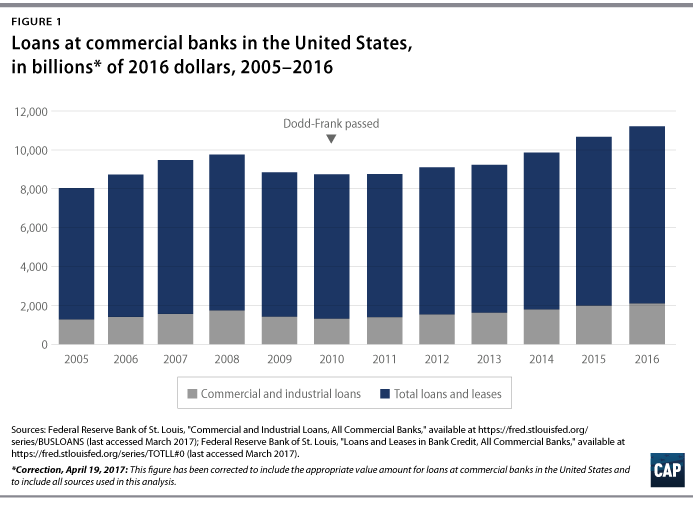
Before delving into the specifics of the Financial CHOICE Act, it is helpful to put Rep. Hensarling’s deregulatory efforts in context. To justify dismantling financial reform, President Trump and his congressional allies know that they must outline a problem. President Trump argues that the main problem with financial reform is bank lending. He believes that banks are not making enough loans due to the burdens of Dodd-Frank. What is his evidence? Nothing more than anecdotal remarks that his friends cannot get loans. [8] As Figure 1 demonstrates, a lack of loans is simply not the case. Overall lending and business lending in particular, has increased significantly since the financial crisis and the passage of Dodd-Frank. Moreover, credit card lending, auto lending, and mortgage lending have increased since 2010, when Dodd-Frank was passed. [9] Bank profits are also higher than ever. [10]


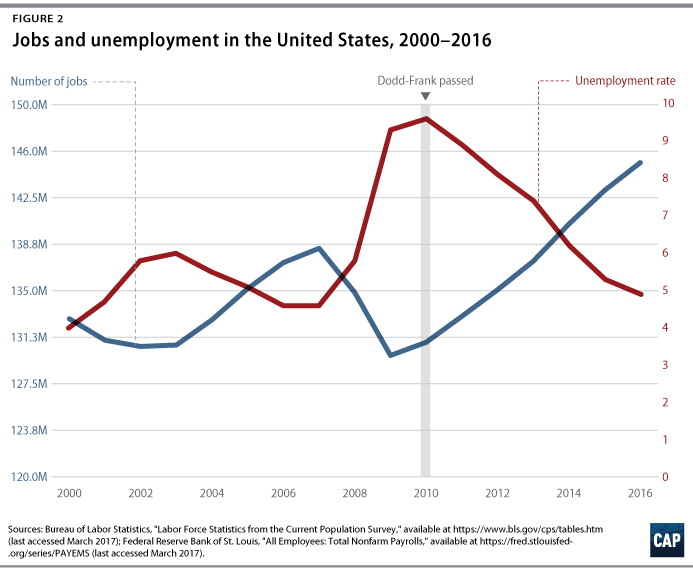
Chairman Hensarling makes similar arguments about the perceived unavailability of credit, adding that financial reform has not encouraged economic growth and has hurt community banks. [11] Again, the data contradict these charges. Figure 2 highlights the steady economic growth the country experienced under President Barack Obama. And while the scars of the devastating Great Recession remain, the financial reforms put in place to prevent the recurrence of exactly that kind of economic catastrophe have not damaged growth. Indeed, since the end of the financial crisis and the passage of Dodd-Frank, community bank lending and profitability are both up. [12] It is fair to say that the number of community banks has declined over time. This trend, however, started in the 1980s and is caused by economies of scale, technology, and long-running trends toward banking deregulation, as well as other factors—not the 2010 passage of the Dodd-Frank Act. [13]


Hensarling presents his approach as a moderate adjustment to Dodd-Frank, but in reality it is a thorough demolition of financial reform. The complete publication (available here) analyzes how Hensarling’s approach erodes the financial stability safeguards that the real economy needs to thrive, from mitigation of systemic risk to financial sector accountability and consumer protection. It also explains how the bill further concentrates—and makes even more unaccountable—economic power in the hands of those that will serve their own interests at the expense of the real economy. Finally, the report details how the FCA eliminates the consumer and investor protections that guard against the predatory financial practices that wreaked havoc on consumers and investors prior to the financial crisis.

It is necessary to note that just about every provision in the report could fit under the rubric of financial stability safeguards. For example, consumer financial protection protects ordinary consumers from abuses and the broader financial system from the proliferation of dangerous consumer loans that can bring down entire firms and markets. Similarly, the Volcker Rule is a key bulwark against the high-risk bets that brought down major firms in 2008, and yet it also aims to reorient large bank trading toward real economy-serving purposes. The report discusses certain provisions under one section rather than another should not be taken as a substantive comment on the merit or usefulness of the provision to financial stability. The report’s different sections reflect an effort to highlight how the Dodd-Frank Act and financial reform yield a broad array of public benefits. Similarthe report highlights examples of broader themes in the FCA rather than focusing on minute details: Failure to discuss any particular provision should not be read as a substantive judgment regarding its relative merits.

The report is based on the version of the Financial CHOICE Act released in September 2016, as well as a memo outlining this year’s planned changes to that version. [14] A new version, which may have some further modifications, is expected to be released in the coming weeks.

Financial reform enacted through the Dodd-Frank Act has made a lot of necessary progress since the crisis. U.S. banks have more substantial loss-absorbing capital cushions, increasingly rely on stable sources of funding, undergo rigorous stress testing, and plan for their orderly failure. President Trump’s intent to dismantle these reforms only helps Wall Street’s bottom line—ignoring the memory of every family who lost their home, every worker who lost his or her job, and every consumer who was peddled a toxic financial product. [15]

The question remains: What is the problem President Trump and his allies in Congress are trying to solve? Lending is up. Bank profits are up. Consumer credit costs are down. The economy is steadily improving. Yes, much more needs to be done to make the economy work for hard-working Americans, but financial deregulation is not the path to that end. [16] In fact, it is a path toward exactly the opposite: booms and busts that leave taxpayers holding the bag for Wall Street’s excesses, greater concentration of economic power and less accountability for wrongdoing that harms ordinary consumers and investors, and major changes to financial regulation and monetary policy that would damage the real economy. Now that is a problem.

The complete publication, including footnotes, is available here.

Endnotes

1Billy House and Kevin Cirilli, “Trump’s Dodd-Frank Plan Will Be Early Test of Republican Unity,” Bloomberg, May 19, 2016, available at https://www.bloomberg.com/politics/articles/2016-05-19/trump-s-dodd-frank-plan-will-be-early-test-of-republican-unity. (go back)

2Glenn Thrush, “Trump Vows to Dismantle Dodd-Frank ‘Disaster,’” The New York Times, January 30, 2017, available at https://www.nytimes.com/2017/01/30/us/politics/trump-dodd-frank-regulations.html?_r=0; Jessica Dye, “Trump vows ‘major haircut’ for Dodd-Frank,” Financial Times, April 4, 2017, available at https://www.ft.com/content/fb08a355-f7fc-3021-8c92-d94af9a2f35b. (go back)

3Executive Order no. 13,772, Code of Federal Regulations (2017), available at https://www.whitehouse.gov/the-press-office/2017/02/03/presidential-executive-order-core-principles-regulating-united-states. (go back)

4Ibid. (go back)

5Financial CHOICE Act of 2016, H. Rept. 5983, 114 Cong. 2 sess. (Government Printing Office, 2016), available at https://www.congress.gov/114/bills/hr5983/BILLS-114hr5983rh.pdf. (go back)

6Donna Borak, “Donald Trump, Jeb Hensarling Meet on Dodd-Frank Alternative,” The Wall Street Journal, June 7, 2016, available at https://www.wsj.com/articles/donald-trump-jeb-hensarling-meet-on-dodd-frank-alternative-1465335535; Damien Palette, Ryan Tracy, and Michael C. Bender, “Trump Team Considering Rep. Jeb Hensarling as Treasury Secretary,” The Wall Street Journal, November 10, 2016, available at https://www.wsj.com/articles/donald-trump-considering-rep-jeb-hensarling-as-treasury-secretary-1478812583. (go back)

7Jim Puzzanghera, “Trump says businesses can’t borrow because of Dodd-Frank. The numbers tell another story,” Los Angeles Times, February 26, 2017, available at http://www.latimes.com/business/la-fi-trump-bank-loans-20170226-story.html; Matt Egan, “Banks are lending a ton, despite Trump’s claims,” CNN Money, February 13, 2017, available at http://money.cnn.com/2017/02/13/investing/bank-business-lending-dodd-frank-trump/. (go back)

8Zeke Faux, Yalman Onaran, and Jennifer Surane, “Trump Cites Friends to Say Banks Aren’t Making Loans. They Are.,” Bloomberg, February 4, 2017, available at https://www.bloomberg.com/news/articles/2017-02-04/trump-cites-friends-to-say-banks-aren-t-making-loans-they-are. (go back)

9Kate Berry, “Four myths in the battle over Dodd-Frank,” American Banker, March 10, 2017, available at https://www.americanbanker.com/news/four-myths-in-the-battle-over-dodd-frank. (go back)

10Matt Egan, “American bank profits are higher than ever,” CNN Money, March 3, 2017, available at http://money.cnn.com/2017/03/03/investing/bank-profits-record-high-dodd-frank/. (go back)

11Jeb Hensarling, “After Five Years, Dodd-Frank Is a Failure,” The Wall Street Journal, July 19, 2015, available at https://www.wsj.com/articles/after-five-years-dodd-frank-is-a-failure-1437342607. (go back)

12Gregg Gelzinis and others, “The Importance of Dodd-Frank, in 6 Charts,” Center for American Progress, March 27, 2017, available at https://www.americanprogress.org/issues/economy/news/2017/03/27/429256/importance-dodd-frank-6-charts/. (go back)

13Ibid. (go back)

14Ylan Mui, “Memo from a key congressman outlines plan to gut Dodd-Frank bank rules,” CNBC, February 9, 2017, available at http://www.cnbc.com/2017/02/09/dodd-frank-hensarling-memo-reveals-plan-to-scrap-bank-regulations.html. (go back)

15Wall Street is not monolithic, and firms may have differing views on the provisions of the Financial CHOICE Act, but on the whole, this agenda is clearly aligned with the interests of financial institutions and not the American public.

_______________________________________

*Gregg Gelzinis is a Special Assistant for the Economic Policy team at the Center for American Progress. This post is based on a Center for American Progress publication by Mr. Gelzinis, Ethan GurwitzSarah Edelman, and Joe Valenti. Additional posts addressing legal and financial implications of the Trump administration are available here.

Lutte de pouvoir entre le président du conseil et les actionnaires | Un cas délicat


Voici un cas de gouvernance, publié en mai 2017 sur le site de Julie Garland McLellan* qui présente une situation dans laquelle le président du conseil d’une société publique se place en porte-à-faux avec les membres de son conseil, et éventuellement avec les actionnaires.

Les administrateurs ont été à l’écoute des principaux actionnaires en mettant en place une procédure acceptable pour les deux parties. Cependant, Oliver constate que le processus adopté a pour effet de décourager certains candidats.

De plus, il semble que le président du conseil a sa petite idée sur le choix du candidat que le conseil devrait promouvoir. Il invoque également le fait que, comme président du comité des ressources humaines, il aura le dernier mot !

Le cas présente la situation de manière assez succincte, mais explicite ; puis, trois experts en gouvernance se prononcent sur le dilemme qui se présente aux personnes qui vivent des situations similaires. Je vous invite donc à lire ces opinions en allant sur le site de Julie.

Bonne lecture ! Vos commentaires sont toujours les bienvenus.


Lutte de pouvoir entre le président du conseil et les actionnaires | Un cas délicat


Our case study this month looks at a listed company that has inadvertently triggered a power struggle between its chair and its shareholders.

Oliver is a board member and audit committee chair of a medium sized listed company; he also sits on the nominations and remuneration committee which is chaired by the board Chairman. Some of the larger shareholders complained after the last board renewal that they had not been given any chance to influence the selection criteria or, as one director stood for one vacancy, any real choice.

Résultats de recherche d'images pour « boards and shareholders »

The board took these complaints seriously and when looking to recruit another new director they engaged with these shareholders to agree selection criteria, appointment of a consultant to help the board source from a wider pool of potential applicants, and a process. It was agreed that the board would put two candidates to the AGM so that shareholders had a meaningful choice and only the candidate with the most votes would be appointed. This strategy was not popular with the applicants and several withdrew because they felt it would harm their reputations to stand for, and then fail to gain, a competitive board election.

However, the process continued and the board now has two excellent candidates who are willing to give the shareholders a choice at the AGM. The Chairman is very keen on one of the applicants and less keen on the other. He has asked the board to put forward only his preferred candidate as “the chair should have the final say on composition of his board”. The board meeting discussion got quite heated and the Chairman stamped out of the room in a fit of temper.

Oliver’s colleagues are looking to him, as the longest serving director, to lead the board out of this mess.

How should he start?


*Julie Garland McLellan is a practising non-executive director and board consultant based in Sydney, Australia. www.mclellan.com.au/newsletter.html

Le leadership des présidents de conseils à l’échelle internationale


Voici un document présentant, de manière complète, les pratiques et les outils utilisés par les présidents de conseils d’administration, à l’échelle internationale.

Le rapport de cent pages, intitulé Commonalities, Différences, and Future Trend, publié sous l’égide de INSEAD Corporate Governance Initiative et de Ward Howell Talent Equity Institute Survey, par Stanislav Shekshnia et Veronika Zaviega, tente de cerner les exigences du rôle de « Chairman » ainsi que les conditions liées à l’efficacité des présidents de conseils dans un contexte mondial.

Through interviews with professional chairs in different parts of the world, the report identifies and compares specific practices and instruments used in different countries giving insights into pertinent issues surrounding the work of the chair and development of future trends over the next decade.

Bonne lecture !


Board Chairs’ Practices across Countries


Résultats de recherche d'images pour « Chaiman of the board insead »


Relatively little is known about board chairs as most of their work is done behind closed doors. They deal with highly sensitive matters but rarely appear in public. They have no executive power but preside over the most powerful body in the organisation – the board of directors. Their performance is critically important for every company but they still need help to improve it. Yet they have no boss, no peers, no one to turn to for an advice. They learn mostly by trial and error.

To respond to this paradox, INSEAD launched “Leading from the Chair”, a specialised program held twice a year for individuals from all over the world who are keen to understand what makes a good chair. We discovered how chairs from different countries face similar challenges and that they all seek practical ways to deal with them. Our goal is to help them to identify and adopt effective practices to perform what is a very demanding job.

To provide hard data we launched a Global Chair Research Project, inviting more than 600 chairpersons to participate in a survey with a structured questionnaire. From the 132 responses received from 30 countries, we compiled the INSEAD Global Chair Survey 2015. Our research provided valuable insights into their demographics, motivation, background, remuneration and the challenges they encounter.

As a next step we wanted to identify and compare specific practices and instruments used in different countries. A team of experts were assembled to conduct interviews with professional chairs in different parts of the world – Belgium, Denmark, Italy, the United Kingdom, Russia, Singapore, Switzerland, Denmark, and the Netherlands. This report presents our preliminary findings. As the research continues, we expect to publish results for 16 countries by the end of 2017.

This publication can be read either as a whole or in chapters. Each country account can be read as a stand-alone without prior knowledge of what is said elsewhere. The introduction describes our methodology, some conceptual models which facilitate understanding of the work of a chair, as well as a summary of our major findings. The “Future Trends” section offers the research team’s view on how the chair’s role and function will evolve in the next decade.

Vous pouvez télécharger le rapport en cliquant sur le lien suivant : Board Chairs’ Practices across Countries.

Compte rendu hebdomadaire de la Harvard Law School Forum on Corporate Governance | 20 avril 2017


Voici le compte rendu hebdomadaire du forum de la Harvard Law School sur la gouvernance corporative au 20 avril 2017.

J’ai relevé les principaux billets.

Bonne lecture !


Résultats de recherche d'images pour « harvard law school forum on corporate governance »


Résultats de recherche d'images pour « harvard law school forum on corporate governance »


  1. The Law and Brexit XI
  2. Lowering the Bar on Bad Faith Claims in MLP Transactions? Brinckerhoff v. Enbridge Energy
  3. Do Independent Directors Curb Financial Fraud? The Evidence and Proposals for Further Reform
  4. From Boardroom to C-Suite: Why Would a Company Pick a Current Director as CEO?
  5. A Synthesized Paradigm for Corporate Governance, Investor Stewardship, and Engagement
  6. Securities Class Action Settlements: 2016 Review and Analysis
  7. Sustainability Matters: Focusing on your Future Today
  8. In Defense of Fairness Opinions: An Empirical Review of Ten Years of Data
  9. Behavioral Implications of the CEO-Employee Pay Ratio
  10. Do Staggered Boards Affect Firm Value?

Étude sur les pratiques des CA américains | ISS


La firme-conseil ISS, (Institutional Shareholder Services) publie chaque année une étude de l’évolution des pratiques de gouvernance aux É.U. (Board Practices Study).

Rob Yates, vice-président d’ISS, est l’auteur de cet article paru sur le site de Harvard Law School Forum on Corporate Governance. Il y aborde cinq tendances majeures.

Les investisseurs continuent d’exercer des pressions sur les administrateurs du conseil, entre autres en continuant de demander d’inclure de nouvelles candidatures dans la circulaire de procuration.

On constate que les pratiques généralement reconnues de bonne gouvernance sont adoptées dans presque toutes les grandes sociétés ; elles sont de plus en plus acceptées dans les plus petites entreprises. On fait ici référence aux élections annuelles, au vote majoritaire et à l’élimination des pilules empoisonnées.

La question du choix d’un président du conseil totalement indépendant et différent du CEO semble être moins problématique si la société fait appel à président désigné (lead director) indépendant et fort.

La rémunération des administrateurs de sociétés a continué de croître significativement. Les CA évaluent différentes approches à la compensation des administrateurs. Ainsi, on élimine de plus en plus les jetons de présence pour les réunions et les conférences téléphoniques. La rémunération des administrateurs s’est accrue de 17 % de 2012 à 2016 tandis que celle des PDG a augmenté de 10 % pendant la même période.

ISS a produit plusieurs études sur les tendances en matière de limite des mandats (tenure), du renouvellement des administrateurs du CA et de l’importance de la diversité. Si le sujet vous intéresse, l’auteur vous réfère à plusieurs études américaines et mondiales.

Bonne lecture !

U.S. Board Practices


This year’s Board Practices Study focuses not only on longstanding issues traditionally covered, but on those which have driven increased shareholder interest in the boardroom over the past several years. Governance continues to evolve, but investor focus in recent years has been particularly pointed as new concerns have emerged, and the ways in which companies address those concerns adapts to meet market demands. Particular focus has been placed on the role of the board as a representative of shareholders at a company, and how the board’s structure and practices promulgate this responsibility. As always, this study provides a snapshot of these facets of public company boards in the S&P 1500 for investors and issuers to compare and contrast.


Investors are continuing to push for board accountability


The pyroclastic spread of proxy access over the past two years has arguably been the most prominent governance story in the United States. In two short years, the S&P went from having only a handful of companies with proxy access, to having over half its constituents offering shareholders the right. Proxy access is also starting to show up in shareholder proposals at smaller firms; as of March 14, ISS is tracking a dozen such proposals at S&P 400 companies.


Image associée
Advisory Board Best Practices: Roles and Advice


Proxy access is the most recent chapter in the much longer story of shareholders seeking board accountability. The next chapters are underway, with investors focusing on board self-regulation practices and measures, such as director tenure and board refreshment, board diversity, board evaluations, mandatory retirement ages, and more. Some of these are showing promise—such as board refreshment and continuing progress on gender diversity—while others are lagging, such as non-gender measures of board diversity.

Central to these concerns is shareholders’ desire that boards develop the skills, expertise, awareness, and experience to accurately assess and effectively manage emerging risks, such as cyber and environmental risks, and ensure that boards are constantly searching for weaknesses (and, when and where appropriate, soliciting external help to identify blind spots).


Traditional concerns still exist, but companies are making progress


More traditional approaches to increasing accountability, such as majority vote standards and annual elections in the director election process—features that are near-ubiquitous in the largest companies—have been adopted in greater frequency by smaller companies. Many problematic governance practices, such as poison pills, are also increasingly rare.


Investors are more accepting of alternative independent board leadership structures


Demonstrating that governance is both a give and take endeavor, investors are more accepting of alternative forms of independent board leadership. Whereas investors have historically favored independent chairs, many are increasingly comfortable with an alternative structure whereby a strong and empowered lead independent director counterbalances a combined chair/CEO.


Director compensation increased sharply


A new feature in this year’s study is an evaluation of director pay covering the preceding five years. While compensation disclosure for non-employee directors is not new itself, the rules and guidelines governing director pay disclosure have only recently standardized. Beginning in December 2006, SEC rules required the disclosure of director pay in a standardized table format. This disclosure increased transparency and comparability between companies. Additionally, both the NYSE and NASDAQ require that boards consider director pay when determining director independence for purposes of meeting listing requirements.

Director compensation has received increased scrutiny in recent years, particularly given rising pay levels and high-profile shareholder lawsuits alleging excessive pay. Amid this atmosphere, many companies have taken a proactive approach to director compensation programs, mainly through altering equity plans or, in a few rare instances, introducing ballot items.

As companies weigh the potential benefits of changing director pay structures, median pay continues to rise. In fact, non-employee director compensation grew 17 percent between 2012 and 2016, while median CEO pay in the S&P 500 (reported in ISS’ 2016 US Compensation Postseason Report) rose by less than 10 percent. One positive development is the streamlining observed among director compensation programs. For example, the elimination of meeting and telephonic meeting fees in many compensation structures.


Increased scrutiny of certain board practices has necessitated a more detailed review


Previous versions of the board study included an in-depth snapshot of new-director demographics and trends, such as tenure, refreshment, and diversity. As these components of board composition have become a significant part of the governance conversation, ISS has produced in-depth studies on each of these issues.

For a vast and comprehensive look at board refreshment trends in the U.S., please see the joint ISS/IRRC study, Board Refreshment Trends at S&P 1500 Firms.

For a look at gender parity advancement on boards in the U.S. and around the world, please see the April 2016 joint study carried out by ISS and European Women on Boards, Gender Diversity on European Boards—Realizing Europe’s Potential: Progress and Challenges, and ISS’ December 2016 study, Gender Diversity on Boards—A Review of Global Trends.

The complete publication is available here.

_____________________________________

*Rob Yates is Vice President at Institutional Shareholder Services, Inc. This post is based on an ISS publication by Mr. Yates, Rachel Hedrick, and Andrew Borek.

L’histoire récente des courants de pensée en gouvernance aux É.U.


Aujourd’hui, je ne peux passer sous silence la petite histoire de l’évolution de la pensée en gouvernance publiée par , professeur à la George Washington University Law School.

Ce court article a été publié sur le site du HLS Forum. Il décrit les grands courants de pensée et met l’accent sur les publications des bonzes universitaires américains.

Je suis assuré que cette brève chronologie des événements, à compter de 1976, vous donnera une vue d’ensemble utile de l’évolution de la discipline.

Bonne lecture !

The Ivory Tower on Corporate Governance


In 1976, [Directors & Boards]’s founding year, two influential academic works in corporate governance appeared: Berkeley law professor Melvin Eisenberg urged transforming the board from an advisory role to a monitoring model and mandating significant internal control systems, while University of Rochester economists Michael Jensen and William Meckling portrayed the firm as a nexus of contracts whose optimal design is for participants to choose.


These contrasting visions—obligatory uniformity versus free tailoring—have defined the field since, setting the boundaries of debate and helping participants think through positions. Into the early 1980s, the Eisenberg view dominated, with Columbia University law professor William Cary urging preemptive federal oversight of the field, traditionally handled by state law, and a generally pro-regulatory atmosphere imposing fiduciary mandates on independent directors and board committees.

But the nexus of contracts school soon ascended to greater influence, through the 1990s, after law professors such as Frank Easterbrook (now a judge) and Daniel Fischel, both of the University of Chicago, explored how the separation of ownership from control is a problem of agency costs, best addressed by contractual devices geared to maximizing shareholder value. Rather than federal mandates, states should experiment to offer a menu of tools for different corporations to tailor. Yale University law professor (also now judge) Ralph Winter theorized that competition among states for corporate charters constrained managers to promote shareholder interests.

While normative corporate governance scholarship has divided between the pro- and anti-regulatory camps of the 1970s and 1980s, the best academics learned from their intellectual opponents to refine stances and often forge consensus. For example, though assessments of the deal decade’s disruptive takeovers and comparative studies of non-U.S. practice found a place for non-shareholder constituents in corporate governance, a shareholder primacy norm nevertheless took root.

Even as both schools of thought contributed to the discourse, each had their heyday when current events cut in their favor. So the 1990s boom was a time of great enthusiasm for the economic approach, adding a productive trend of increasingly sophisticated empirical research, including on the value of state competition in corporate law. After the burst, however, and as widespread accounting fraud was revealed, scholars cited Eisenberg to diagnose failures to monitor and control—and prescribed cures found in the Sarbanes-Oxley Act (SOX). An industry-specific version of the dynamic transpired after the financial crisis, culminating in the Dodd-Frank Act.

In each case, scholarship was diverse, as pragmatic centrist resolution of pending challenges, exemplified by Columbia’s John Coffee, contended with cries on both normative sides of either too little or too much regulation (Yale’s Roberta Romano called SOX “quack governance”). Such episodes updated the Cary-Winter debate: full-scale federal preemption is probably dead but, as Harvard University law professor Mark Roe explained, less due to state competition than the threat to states of incremental federal incursion, a la SOX and Dodd-Frank.

Since 1976, scholars have helped shift power from managers to owners, especially institutional investors. Today, scholars such as Harvard Law professor Lucian Bebchuk urge continued expansion of shareholder power, while others, like UCLA law professor Stephen Bainbridge, observe and support a propensity toward director primacy instead. In the balance is the fate of shareholder activism, which though novel in some ways, at bottom raises issues debated for 40 years, particularly agency cost mitigation. Plus ça change, plus c’est la même chose.