Rôle des administrateurs dans la prévention de risques à la santé | un cas vécu dans une OBNL


À nouveau, je vous présente un cas de gouvernance, publié en juin 2017, sur le site de Julie Garland McLellan* qui décrit une situation dans laquelle un membre de conseil d’une OBNL évalue les conséquences d’une décision pouvant entraîner des risques pour la santé des clients et conduire à une perte de réputation.

Les administrateurs connaissent maintenant le contexte de la décision prise par le conseil. Cependant, une nouvelle administratrice n’est pas « confortable » avec la décision ; elle se questionne sur le risque occasionné à la santé des athlètes à la suite d’une prise de position du conseil trop peu contraignante.

Notons que la directrice de la sécurité de l’entreprise avait qualifié d’infondée les arguments invoqués par une équipe sportive de ne pas utiliser les mesures de protection suggérées.

Le cas présente la situation de manière assez succincte, mais explicite ; puis, trois experts en gouvernance se prononcent sur le dilemme qui se présente aux personnes qui vivent des situations similaires.

Que devrait faire la nouvelle administratrice Pandora dans les circonstances ?

Je vous invite à lire les opinions des experts en allant sur le site de Julie.

Bonne lecture ! Vos commentaires sont toujours les bienvenus.


Rôle des administrateurs dans la prévention de risques à la santé | un cas vécu dans une OBNL


Résultats de recherche d'images pour « risques des obnl »


Pandora is a new NED on a peak sporting body board. She loves the sport and is thrilled to contribute. However, she is a bit worried about the risks of a recent board conversation.

Her sport has physical risks and is very dangerous if proper precautions are not taken; these include the use of personal protective equipment. At her most recent board meeting the directors discussed the revised sports safety guidelines which mandate the wearing of personal protective equipment during competitions. One of the directors mentioned that a large local club routinely participates in competitions with players who are clearly not wearing safety gear. Another director stated that the club had objected to the draft guidelines on the basis that, in some circumstances, the safety equipment might hamper players’ movements and create other risks. The safety manager, who was presenting to the board, clarified that the club had, indeed, made that claim but that it was, in her opinion, spurious.

The board then discussed the issues associated with banning the non-compliant club from competitions. This was considered a difficult action because the club is very successful and their absence would upset fans. Also, the club is in a high socio economic demographic and contributes funds and political connections to the sport.

Pandora is worried because the discussion was minuted and the decision was to write to the club and remind them of the need to wear safety equipment but not to threaten expulsion from the competition. Is her board now at risk and has she let down the whole sport by being a party to this conversation and failing to persuade her board colleagues to take firmer action?

What can Pandora do?


*Julie Garland McLellan is a practising non-executive director and board consultant based in Sydney, Australia. www.mclellan.com.au/newsletter.html

Doit-on limiter le nombre d’années qu’un administrateur siège à un conseil afin de préserver son indépendance ?


On voit de plus en plus apparaître des mesures restrictives eu égard au nombre d’années de présence des administrateurs indépendants sur les CA des grandes entreprises.

Les autorités réglementaires de quelques pays (dont la France et le Royaume-Uni) émettent des directives sur le nombre maximal de mandats des administrateurs indépendants. En général, on parle d’une durée n’excédant pas une limite de 9 à 12 ans. Notons qu’au Canada, l’OSC et l’AMF n’émettent pas de directives relatives aux nombres d’années passées sur un conseil d’administration. Il en est de même aux É.U. où 24 % des administrateurs indépendants siègent au même conseil depuis plus de 15 ans !

Les autorités réglementaires devraient-elles imposer un nombre d’années maximal aux mandats des administrateurs, en se basant sur le « fait » qu’un trop grand nombre d’années peut nuire à leur indépendance vis-à-vis de la direction ? C’est l’objet de l’étude du professeur Stefano Bonini de la Stevens Institute of Technology, publiée sur le site de la Harvard Law School Forum.

Dans l’ensemble, l’étude montre qu’il faudrait tenir compte des caractéristiques individuelles des administrateurs de longue durée, plutôt que d’utiliser la mesure de la moyenne dans l’évaluation du phénomène de longue durée.

L’auteur pose deux questions :

(1) Comment le nombre d’années que les administrateurs passent sur des CA influence-t-il la performance de l’organisation ?

(2) Qu’est-ce qui détermine une présence de longue durée sur un CA ?

Voici les conclusions de l’étude :

First, consistent with Katz and McIntosh (2014), we posit that board-wide term limits may be detrimental to the board itself, the company, and the shareholders, in particular if such limits force valuable directors off the board. This is in line with ISS (2017) that states: “term and age limits, as they have been typically applied, may not be the solutions, because they force the arbitrary retirement of valuable directors.”

Second, our results show that Long Tenured (LT) directors are disproportionately more likely to be nominated as Lead Independent Directors (LID), a role that has become increasingly relevant in listed companies, following a set of regulation changes in the U.S. stock market. Since firms recognize the value of LT directors and leverage on it by appointing LT directors as LID, an unconditional tenure limit would negatively affect the effectiveness of the LID function and ultimately weaken the governance of companies.

Je vous invite à lire un résumé de l’article en question et j’attends vos commentaires.


On Long-Tenured Independent Directors


A growing number of countries, such as UK and France, have adopted tenure-related guidelines or tenure restrictions for independent directors. Most countries adopt a comply-or-explain approach to regulating tenure recommending a maximum tenure for a corporate director between nine and twelve years. In the United States however, where explicit limits are absent, a recent survey by GMI Ratings, the leading independent provider of global corporate governance and research, shows that 24% of independent directors in Russel 3,000 firms have continuously served in the same firm for fifteen years or more.

Résultats de recherche d'images pour « Long-Tenured Directors »We argue that long-tenured directors are superiorly skilled individuals who provide tangible value added to their firms. An extension of tenure length allows directors to accumulate information about past events in the firm and about responses to exogenous market shocks that help firms weather crises and discontinuities. In support of the view that the effectiveness of one independent director is also the result of a long build-up process, William George, a Harvard Business School professor and independent director, stated: “When directors are truly independent of the companies they serve, they generally lack the […] knowledge about the industry or business […]. [O]f the nine boards I served on as an independent director I had industry-specific knowledge in exactly none of them.”

Research on independent directors usually adopts as the main dependent variable the average tenure across independent board members (e.g., Vafeas 2003; Huang 2013). Given that multiple regulation changes have increased the fraction of independent board members that now represent 70% to 80% of the board, average board tenure measures significantly confound the effect of a single long tenure that is diluted by the majority of board members who experience shorter tenures. This view is aligned with best practice recommendations compiled by Institutional lnvestor Services (ISS, a shareholder activist group) (2017): “While investors in the past have focused on average board tenure, they are beginning to pay attention to individual director tenure as well, particularly for directors serving in board leadership roles like lead director or key committee chairs.” Our research focuses on the puzzling phenomenon of extremely long tenures that do not occur board-wide, but are specific to a single director. Switching the focus to individual, abnormal tenures allows us to isolate the strongly beneficial effects on firm performance that increase in the single director tenure and level off after a surprisingly long period. Differently, the average tenure of independent board members does not increase firm value and in some specifications, appear to have a negative impact on firm performance and firm stability.

The positive effects documented in our paper raise two important questions: first, how do LT directors affect performance? Second, what determines long tenure?

The first question deals with the nature of independent directors, who protect firm stakeholders by monitoring the firm, its management, and the external environment (ICGN 2014). In this respect, the directors’ task is crucially related to the quality and amount of information the director can gather and process. Our tests confirm that long-tenured directors can gather and store valuable information that they share with other independent board members, generating a moderate-to-null sensitivity of the firm performance to the opaqueness of the outside information environment. Also, superior information translates into a significantly lower external litigation risk as documented by a set of tests on the likelihood of LT firms to be defendants in security class action lawsuits. This protection effect is robust to alternative specifications of the litigation risk variable.

Addressing the second question requires looking at observable individual factors, but, more importantly, finding proxies for unobservable characteristics. We show that not all board members are equally likely to become long-tenured directors. Personal characteristics and the market perception of traits and skills positively impact the probability of one individual becoming a long-tenured director. Directors with a high-quality education, such as graduate degrees and degrees from Ivy League colleges, are significantly more likely to evolve into LT directors, compared with other independent board members. However, unobservable skills may still explain their long association with a firm. Looking at contemporaneous board directorships at the time of the first appointment in the firm in which a director eventually becomes a LT board member, we show that ex-ante these individuals held a substantially larger number of board appointments than did other directors. This suggests that firms at large recognized these candidates’ superior qualities and competed for their services. Consistent with the market’s ability to identify skilled directors, we document superior performance of firms in which LT directors hold appointments as independent, but not long-tenured, directors.

The complete paper is available for download here.

Compte rendu hebdomadaire de la Harvard Law School Forum on Corporate Governance | 8 juin 2017


Voici le compte rendu hebdomadaire du forum de la Harvard Law School sur la gouvernance corporative au 8 juin 2017.

J’ai relevé les principaux billets, tout en me limitant au Top 1o.

Bonne lecture !


Résultats de recherche d'images pour « harvard law school forum on corporate governance »


Résultats de recherche d'images pour « harvard law school forum on corporate governance »


  1. Decreasing Patience for IPOs with Poor Shareholder Rights
  2. Appraisal Decision Sole Reliance on Merger Price: PetSmart
  3. The Role of Social Capital in Corporations: A Review
  4. On Long-Tenured Independent Directors
  5. Why Your Board Should Refocus on Key Risks
  6. The Limits of Gatekeeper Liability
  7. The Long Game: Incentive Pay Aims at Generating Lasting Return
  8. The Corporate Demand for External Connectivity: Pricing Boardroom Social Capital
  9. Criticism of Governance Provisions in Proxy Contest Leads to Reincorporation
  10. Retired or Fired: How Can Investors Tell If the CEO Left Voluntarily?


Compte rendu hebdomadaire de la Harvard Law School Forum on Corporate Governance | 1er juin 2017


Voici le compte rendu hebdomadaire du forum de la Harvard Law School sur la gouvernance corporative au 1er juin 2017.

J’ai relevé les principaux billets, tout en me limitant au Top 1o.

Bonne lecture !


Résultats de recherche d'images pour « harvard law school forum on corporate governance »


Résultats de recherche d'images pour « harvard law school forum on corporate governance »

  1. Bank Governance and Systemic Stability: The “Golden Share” Approach
  2. Snap and the Rise of No-Vote Common Shares
  3. Potential Regulatory Relief—Financial CHOICE Act 2.0
  4. The Origins of Corporate Social Responsibility
  5. M&A Deal Terms in 2017: What Can Deal Teams Expect?
  6. Cybersecurity Must Be High on the Board Agenda
  7. Dancing with Activists
  8. U.S. Proxy Season Half-Time Update
  9. What’s (Still) Wrong with Credit Ratings
  10. 2017 M&A Report

Compte rendu hebdomadaire de la Harvard Law School Forum on Corporate Governance | 25 mai 2017


Voici le compte rendu hebdomadaire du forum de la Harvard Law School sur la gouvernance corporative au 25 mai 2017.

J’ai relevé les principaux billets.

Bonne lecture !


Résultats de recherche d'images pour « harvard law school forum on corporate governance »


Résultats de recherche d'images pour « harvard law school forum on corporate governance »

  1. Do Exogenous Changes in Passive Institutional Ownership Affect Corporate Governance and Firm Value?
  2. It Pays to Write Well
  3. Mutual Fund Companies Have Significant Power to Increase Corporate Transparency
  4. Just How Preferred is Your Preferred?
  5. Private Investor Meetings in Public Firms: The Case for Increasing Transparency
  6. Court of Chancery’s Guidance on “Credible Basis” Standard for Obtaining Books
  7. Recent Board Declassifications: A Response to Cremers and Sepe
  8. SEC Enforcement Actions Against Public Companies and Subsidiaries Keep Pace
  9. Dual-Class Stock and Private Ordering: A System That Works
  10. 2017 IPO Report


Compte rendu hebdomadaire de la Harvard Law School Forum on Corporate Governance | 18 mai 2017


Voici le compte rendu hebdomadaire du forum de la Harvard Law School sur la gouvernance corporative au 18 mai 2017.

J’ai relevé les principaux billets.

Bonne lecture !


Résultats de recherche d'images pour « harvard law school forum on corporate governance »


Résultats de recherche d'images pour « harvard law school forum on corporate governance »

  1. What Drives Differences in Management?
  2. Insider Trading: When Hackers Target Corporate Shares
  3. Five Investor Trends Driving Say on Pay in 2017
  4. Texas Bill Targets Activist Investors, Advisors
  5. The Consequences of Managerial Indiscretions
  6. Reviving the U.S. IPO Market
  7. The Fiduciary Dilemma in Large-Scale Organizations: A Comparative Analysis
  8. Dual-Class: The Consequences of Depriving Institutional Investors of Corporate Voting Rights
  9. Looking Behind the Declining Number of Public Companies
  10. The Promise of Market Reform: Reigniting America’s Economic Engine

La gouvernance des entreprises à droit de vote multiple


Voici un excellent article de Blair A. Nicholas*, publié aujourd’hui, sur le site de Harvard Law School Forum on Corporate Governance, qui aborde un sujet bien d’actualité, et très controversé : le futur de la gouvernance dans le contexte d’émission d’actions à droit de vote multiple.

L’auteur présente l’historique de ce mouvement, montre les failles attribuables à ce genre de structure de capital, et suggère certains moyens pour contrer les lacunes observées dans le domaine de la gouvernance.

Plusieurs investisseurs institutionnels se déclarent défavorables à l’émission d’actions à droit de vote multiple, mais on assiste quand même à un accroissement sensible de ce type de structure actionnariale. Par exemple, le nombre d’entreprises américaines qui ont opté pour cette formule a quadruplé en dix ans, passant de 6 à 27. La plupart des entreprises en question sont dans le domaine des technologies : Google, Alibaba, Facebook, LinkedIn, Square, Zynga, Snap inc. Certaines entreprises ont commencé à émettre des actions sans droit de vote en guise de dividende…

Également, ce type d’arrangement est l’apanage de plusieurs entreprises québécoises qui cherchent à maintenir le pouvoir entre les mains des familles entrepreneuriales : Bombardier, Groupe Jean Coutu, Alimentation Couche-Tard, Power Corporation, etc. Est-ce dans « l’intérêt supérieur » de la société québécoise ?

Selon Blair, les études montrent que les entreprises à droit de vote multiple ont des performances inférieures, et que leur structure de gouvernance est plus faible.

Academic studies also reveal that dual-class structures underperform the market and have weaker corporate governance structures. For instance, a 2012 study funded by the Investor Responsibility Research Center Institute, and conducted by Institutional Shareholder Services Inc., found that controlled firms with multi-class capital structures not only underperform financially, but also have more material weaknesses in accounting controls and are riskier in terms of volatility.

The study concluded that multi-class firms underperformed even other controlled companies, noting that the average 10-year shareholder return for controlled companies with multi-class structures was 7.52%, compared to 9.76% for non-controlled companies, and 14.26% for controlled companies with a single share class. A follow-up 2016 study reaffirmed these findings, noting that multi-class companies have weaker corporate governance and higher CEO pay.

Je vous invite également à lire l’article de Richard Dufour dans La Presse : Actions à droit de vote multiple : Bombardier critiqué

Résultats de recherche d'images pour « droit de vote multiple »

On pourrait dire que « quand ça va mal dans ce genre d’entreprise, on dirait que rien ne va bien ! » L’exemple de Hollinger est éloquent à cet égard.

Par contre, « quand ça va bien, on dirait qu’il n’y a rien qui va mal ! » Ici, l’exemple de Couche-Tard est approprié.

Bonne lecture !

Quelle est votre opinion sur ce sujet ?

Dual-Class: The Consequences of Depriving Institutional Investors of Corporate Voting Rights

Recent developments and uncertainties in the securities markets are drawing institutional investors’ attention back to core principles of corporate governance. As investors strive for yield in this post-Great Recession, low interest rate environment, large technology companies’ valuations climb amid the promises of rapid growth. But at the same time, some of these successful companies are asking investors to give up what most regard as a fundamental right of ownership: the right to vote. Companies in the technology sector and elsewhere are increasingly issuing two classes or even three classes of stock with disparate voting rights in order to give certain executives and founders outsized voting power. By issuing stock with 1/10th the voting power of the executives’ or founders’ stock, or with no voting power at all, these companies create a bulwark for managerial entrenchment. Amid ample evidence that such skewed voting structures lead to reduced returns long run, many public pension funds and other institutional investors are standing up against this trend. But in the current environment of permissive exchange rules allowing for such dual-class or multi-class stock, there is still more that investors can do to protect their fundamental voting rights.

The problem of dual-class stock is not new. In the 1920s, many companies went public with dual-class share structures that limited “common” shareholders’ voting rights. But after the Great Depression, the NYSE—the dominant exchange at the time—adopted a “one share, one vote” rule that guided our national securities markets for decades. It was only in the corporate takeover era of the 1980s that dual-class stock mounted a comeback, with executives receiving stock that gave them voting power far in excess of their actual ownership stake. Defense-minded corporate executives left, or threatened to leave, the NYSE for the NASDAQ’s or the American Exchange’s rules, which permitted dual-class stock. In a race to the bottom, the NYSE suspended enforcement of its one share, one vote rule in 1984. While numerous companies have since adopted or retained dual-class structures, they remain definitively in the minority. Prominent among such outliers are large media companies that perpetuate the managerial oversight of a particular family or a dynastic editorial position, such as The New YorkTimes, CBS, Clear Channel, Viacom, and News Corp.

Now, corporate distributions of non-voting shares are on the rise, particularly among emerging technology companies. They have also been met with strong resistance from influential institutional investors. In 2012, Google—which already protected its founders through Class B shares that had ten times the voting power of Class A shares—moved to dilute further the voting rights of Class A shareholders by issuing to them third-tier Class C shares with no voting rights as “dividends.” Shareholders, led by a Massachusetts pension fund, filed suit, alleging that executives had breached their fiduciary duty by sticking investors with less valuable non-voting shares. On the eve of trial, the parties agreed to settle the case by letting the market decide the value of lost voting rights. When the non-voting shares ended up trading at a material discount to the original Class A shares, Google was forced to pay over $560 million to the plaintiff investors for their lost voting rights.

Facebook followed suit in early 2016 with a similar post-IPO plan to distribute non-voting shares and solidify founder and CEO Mark Zuckerberg’s control. Amid renewed investor outcry, the pension fund Sjunde AP-Fonden and numerous index funds filed a suit alleging breach of fiduciary duty. Also in 2016, Barry Diller and IAC/InterActive Corp. tried a similar gambit, creating a new, non-voting class of stock in order to cement the control of Diller and his family over the business despite the fact that they owned less than 8% of the company’s stock. The California Public Employees Retirement System (CalPERS), which manages the largest public pension fund in the United States, filed suit in late 2016. [1] Both suits are currently pending.

To forego the ownership gymnastics of diluting existing shareholders’ voting rights by issuing non-voting shares as dividends, the more recent trend is to set up multi-class structures with non-voting shares from the IPO stage. Alibaba was so intent on going public with a dual-class structure that it crossed the Pacific Ocean to do so. The company first applied for an IPO on the Hong Kong stock exchange, but when that exchange refused to bend its one share, one vote rule, the company went public on the NYSE. LinkedIn, Square, and Zynga also each implemented dual-class structures before going public. Overall, the number of IPOs with multi-class structures is increasing. There were only 6 such IPOs in 2006, but that number more than quadrupled to 27 in 2015. The latest example is Snap Inc., which earlier this year concluded the largest tech IPO since Alibaba’s, and took the unprecedented step of offering IPO purchasers no voting rights at all. This is a stark break from tradition, as prior dual-class firms had given new investors at least some—albeit proportionally weak—voting rights. As Anne Sheehan, Director of Corporate Governance for the California State Teachers’ Retirement System (“CalSTRS”), has concluded, Snap’s recent IPO “raise[s] the discussion to a new level.”

Institutional investors such as CalSTRS are increasingly voicing opposition to IPOs promoting outsized executive and founder control. In 2016, the Council for Institutional Investors (“CII”) called for an end to dual-class IPOs. The Investor Stewardship Group, a collective of some of the largest U.S.-based institutional investors and global asset managers, including BlackRock, CalSTRS, the Vanguard Group, T. Rowe Price, and State Street Global Advisors, launched a stewardship code for the U.S. market in January, 2017. The code (discussed on the Forum here), called the Framework for Promoting Long-Term Value Creation for U.S. Companies, focuses explicitly on long-term value creation and states as core Corporate Governance Principle 2 that “shareholders should be entitled to voting rights in proportion to their economic interest.” Proxy advisory firm, Institutional Shareholder Services Inc., has also voiced strong opposition to dual-class structures.

The Snap IPO in particular has elicited investors’ rebuke. After Snap announced its intended issuance of non-voting stock, CII sent a letter to Snap’s executives, co-signed by 18 institutional investors, urging them to abandon their plan to “deny[] outside shareholders any voice in the company.” The letter noted that a single-class voting structure “is associated with stronger long-term performance, and mechanisms for accountability to owners,” and that when CII was formed over thirty years ago, “the very first policy adopted was the principle of one share, one vote.” Anne Simpson, Investment Director at CalPERS, has strongly criticized Snap’s non-voting share model, stating: “Ceding power without accountability is very troubling. I think you have to relabel this junk equity. Buyer beware.” Investors have also called for stock index providers to bar Snap’s shares from becoming part of major indices due to its non-voting shares. By keeping index fund investors’ cash out of such companies’ stock, such efforts could help provide concrete penalties for companies seeking to go to market with non-voting shares.

There are many compelling reasons why institutional investors strongly oppose dual-class stock structures that separate voting rights from cash-flow rights. In addition to the immediate deprivation of investors’ voting rights, there is ample evidence that giving select shareholders control, that is far out of line with their ownership stakes, reduces company value. Such structures reduce oversight by, and accountability to, the actual majority owners of the company. They hamper the ability of boards of directors to execute their fiduciary duties to shareholders. And they can incentivize managers to act in their own interests, instead of acting in the interest of the company’s owners. Hollinger International, a large international newspaper publisher now known as Sun-Times Media Group, is a striking example. Although former CEO, Conrad Black, owned just 30% of the firm’s equity, he controlled all of the company’s Class B shares, giving him an overwhelming 73% of the voting power. He filled the board with friends, then used the company for personal ends, siphoning off company funds through a variety of fees and dividends. Restrained by the dual-class stock structure, Hollinger stockholders at-large were essentially powerless to rein in such actions. Ultimately, the public also paid the price for the mismanagement, footing the bill to incarcerate Black for over three years after he was convicted of fraud. This is a classic example of dual-class shares leading to misalignment between management’s actions and most owners’ interests.

The typical retort from proponents of dual-class structures is that depriving most investors of equal voting rights allows managers the leeway to make forward-thinking decisions that cause short-term pain for overall long-term gain. This assertion, however, ignores that many investors—and in particular public pension funds and other long-term institutional investors—are themselves focused on long-term gains. If managers have good ideas for long-term investments, such prominent investors will likely support them.

Academic studies also reveal that dual-class structures underperform the market and have weaker corporate governance structures. For instance, a 2012 study funded by the Investor Responsibility Research Center Institute, and conducted by Institutional Shareholder Services Inc., found that controlled firms with multi-class capital structures not only underperform financially, but also have more material weaknesses in accounting controls and are riskier in terms of volatility. The study concluded that multi-class firms underperformed even other controlled companies, noting that the average 10-year shareholder return for controlled companies with multi-class structures was 7.52%, compared to 9.76% for non-controlled companies, and 14.26% for controlled companies with a single share class. A follow-up 2016 study reaffirmed these findings, noting that multi-class companies have weaker corporate governance and higher CEO pay. As IRCC Institute Executive Director Jon Lukomnik summarized, multi-class companies are “built for comfort, not performance.”

Proponents of dual-class structures also argue that investors who prize voting power can simply take the “Wall Street Walk,” selling shares of companies that resemble dictatorships while retaining shares of companies with a more democratic voting structure. That is often easier said than done. For instance, passively managed funds may not be able to simply sell individual companies’ stock at will. Structural safeguards such as equal voting rights should ensure investors’ ability to guide and correct management productively as events unfold. If the only solution is for investors to abandon certain investments after dual-class systems have done their damage, owners lose out financially and discussions in corporate boardrooms and C-suites across the country will suffer from a lack of diversity, perspective, and accountability.

Ultimately, arguments regarding investor choice also ignore that failures in corporate governance can impose costs not only on corporate shareholders, but also on society at large. When dual-class stock structures prevent boards and individual shareholders from effectively monitoring corporate executives, that monitoring function can be exported to third parties, including the courts and government regulators. Regulators may need to step up disclosure provisions to ensure transparency of such controlled companies, and courts may be called upon to remedy the behavior of unchecked executives. In the monitoring and in the clean-up, the externalities placed upon outsiders make corporate voting rights an issue of public policy.

As the trend of issuing dual-class or multi-class stock continues, institutional investors should remain vigilant to protect shareholders’ voting rights. Pre-IPO investors can oppose the issuance of non-voting shares during IPOs. Investors in publicly traded companies can speak out against proposed changes to share structures or resort to litigation when necessary, such as in the Google, Facebook, and IAC cases. Institutional investors may also lobby Congress, regulators, and the national exchanges to revive the traditional ban on non-voting shares or make it harder to issue no-vote shares. For instance, in the wake of the Snap IPO, CII Executive Director Ken Bertsch and other investors met with the SEC Investor Advisory Committee. They encouraged the SEC to work with U.S.-based exchanges to (1) bar future no-vote share classes; (2) require sunset provisions for differential common stock voting rights; and (3) consider enhanced board requirements for dual-class companies in order to discourage rubber-stamp boards. Whether by working with regulators, securities exchanges, index providers, or corporate boards, institutional investors that continue to fight for shareholder voting rights will be working to promote open and responsive capital markets, and the long-term value creation that comes with them.

Endnotes

1Our firm, Bernstein Litowitz Berger & Grossmann, represents CalPERS in this litigation.(go back)

_______________________________________

*Blair A. Nicholas is a partner and Brandon Marsh is senior counsel at Bernstein Litowitz Berger & Grossmann LLP. This post is based on a Bernstein Litowitz publication by Mr. Nicholas and Mr. Marsh.

Related research from the Program on Corporate Governance includes The Untenable Case for Perpetual Dual-Class Stock by Lucian Bebchuk and Kobi Kastiel (discussed on the Forum here).

Qu’est-ce qu’un président « exécutif » de conseil d’administration ? | Le cas de Bombardier 


Voici un article de Karim Benessaieh publié dans la section Actualité expliquée de La Presse+ Affaires le 13 mai 2017.

L’auteur apporte les précisions requises quant aux titres et fonctions du président du conseil de Bombardier, Pierre Beaudoin.

Pierre Beaudoin était président et chef de la direction (CEO ou PDG) de Bombardier depuis 2008. En 2015, il devient le président « exécutif » du conseil d’administration de Bombardier.

Récemment, ce dernier a renoncé à la portion « exécutive » de ses fonctions. Qu’est-ce que cela implique pour le commun des mortels ?

C’est exactement ce à quoi Karim Benessaieh a tenté de répondre dans son article, reproduit ci-dessous, auquel j’ai participé.

Bonne lecture ! Vos commentaires sont les bienvenus.


Un président exécutif, ça mange quoi en hiver ?


Qu’est-ce qu’un président exécutif ? Peut-on être PDG, président du conseil d’administration et chef de la direction en même temps ? Dans la tempête qui ébranle Bombardier depuis six semaines, il est facile de se perdre dans les étiquettes. La Presse a demandé à deux experts en gouvernance d’éclairer notre lanterne.


À quoi a renoncé exactement Pierre Beaudoin en retirant la partie « exécutive » de son mandat ?

À la base, Pierre Beaudoin, fils de Laurent Beaudoin et de Claire Bombardier et donc petit-fils de Joseph-Armand Bombardier, est le président du conseil d’administration de l’entreprise depuis 2015. Son rôle est de « gérer le conseil et [d’]établir l’ordre du jour » pour les 15 membres de cette instance, comme le précise le site de Bombardier, qui ne fait aucune référence à l’aspect « exécutif » de son travail.

Dans l’avis de convocation des actionnaires, cette semaine, on reprend la formule un peu vague selon laquelle M. Beaudoin est en outre chargé de « la définition d’une orientation stratégique et [de] la gestion des relations entretenues avec certaines parties prenantes et avec la clientèle ». Ce sont ces dernières responsabilités qu’il a perdues.

Vous ne nous éclairez pas beaucoup…

Désolé, c’était la réponse officielle. C’est que le « président exécutif » est une bête un peu curieuse souvent associée aux entreprises familiales ou dont le fondateur est encore bien présent. Aux États-Unis, peu de confusion : pour 50 % des entreprises cotées en Bourse, le PDG (ou CEO) est également président du conseil d’administration. Le président du conseil, dans ces cas, est « exécutif » de facto. Au Canada, seulement 14 % des entreprises sont dirigées par un PDG qui est en même temps président du conseil d’administration.

Par contre, dans une sorte de formule mitoyenne, certaines entreprises d’ici ont donné des responsabilités élargies à leur président du conseil en lui ajoutant l’étiquette « exécutif » : il devient dans les faits un deuxième PDG.

Au Québec, CGI, Couche-Tard et Cascades ont donné ce titre à celui qui préside leur conseil d’administration. « C’est une formule hybride, résume Michel Nadeau, directeur général de l’Institut sur la gouvernance. Ça reflète généralement une situation temporaire où le nouveau PDG apprend à gérer, avec l’entrepreneur fondateur. »

Et c’est bien d’avoir un président du conseil qui se mêle d’administration ?

Un peu de contexte ici. Depuis plus d’une décennie, au Canada et en Europe, les autorités réglementaires, les experts en gouvernance et les investisseurs institutionnels comme la Caisse de dépôt et placement du Québec suggèrent fortement de séparer les fonctions de président du conseil d’administration et de président de l’entreprise. Aucune loi n’impose cette division des tâches, cependant.

« On veut éviter les conflits d’intérêts, explique Jacques Grisé, président de l’Ordre des administrateurs agréés du Québec. Séparer les deux postes est un signe de bonne gouvernance, et on est en train de le reconnaître même aux États-Unis, où ça s’améliore graduellement. »

C’est le conseil d’administration qui embauche le PDG et fixe sa rémunération, rappelle M. Nadeau. « Le président exécutif est un peu coincé entre les deux. Quand il arrive avec une proposition de rémunération qui inclut la sienne, c’est bizarre. Quand il travaille 40 heures par semaine avec le PDG alors qu’il doit pouvoir le confronter au conseil d’administration, ça donne une situation incongrue. » C’est une « simple question de logique », estime-t-il, qu’il n’y ait pas un cumul des pouvoirs au sein d’une entreprise. « Il faut un superviseur et un supervisé, un contrepoids. »

Est-ce que les entreprises qui séparent les fonctions de président du conseil et de PDG s’en portent financièrement mieux ?

« Les études ne sont pas très claires en ce sens, mais on voit que partout dans le monde, on essaie d’implanter cette séparation », répond M. Grisé. Cette question précise fait partie d’un vaste ensemble, la bonne gouvernance, qui comprend bien d’autres exigences, rappelle M. Nadeau. « Dans le cas de Bombardier, ç’aurait été une bonne chose d’avoir un président du conseil indépendant. C’est souhaitable, mais il faut être réaliste : dans une entreprise contrôlée par une famille, c’est demander de l’héroïsme. »

_______________________________________

Karim Benessaieh est reporter économique à La Presse depuis 2000.
Ce texte provenant de La Presse+ est une copie en format web. Consultez-le gratuitement en version interactive dans l’application La Presse+.

Compte rendu hebdomadaire de la Harvard Law School Forum on Corporate Governance | 11 mai 2017


Voici le compte rendu hebdomadaire du forum de la Harvard Law School sur la gouvernance corporative au 11 mai 2017.

J’ai relevé les principaux billets.

Bonne lecture !


Résultats de recherche d'images pour « harvard law school forum on corporate governance »


Résultats de recherche d'images pour « harvard law school forum on corporate governance »

  1. Corporate Governance in the Trump Era: A Note of Caution
  2. The Regulation of Trading Markets: A Survey and Evaluation
  3. Board Changes and the Director Labor Market: The Case of Mergers
  4. SEC Enforcement Activity—Strong Through First Half of FY 2017
  5. What You Are Likely to Hear in the Board Room
  6. Past, Present and Future Compensation Research: Economist Perspectives
  7. Saving Investors from Themselves: How Stockholder Primacy Harms Everyone
  8. Guarding Against Challenges to Director Equity Compensation
  9. Financial Markets and the Political Center of Gravity
  10. An Activist View of CEO Compensation

Compte rendu hebdomadaire de la Harvard Law School Forum on Corporate Governance | 4 mai 2017


Voici le compte rendu hebdomadaire du forum de la Harvard Law School sur la gouvernance corporative au 4 mai 2017.

J’ai relevé les principaux billets.

Bonne lecture !


Résultats de recherche d'images pour « harvard law school forum on corporate governance »


Résultats de recherche d'images pour « harvard law school forum on corporate governance »


  1. Cybersecurity Trends for Boards of Directors
  2. Global Climate Change and Sustainability Financial Reporting: An Unstoppable Force with or without Trump
  3. The Departing Remarks of Federal Reserve Governor Daniel K. Tarullo
  4. The Emerging Need for Cybersecurity Diligence in M&A
  5. Blockholder Voting
  6. Proxy Voting Conflicts—Asset Manager Conflicts of Interest in the Energy and Utility Industries
  7. President Trump’s Dangerous CHOICE
  8. Independent Directors and Controlling Shareholders
  9. Independent Directors: New Class of 2016
  10. Contested Visions: The Value of Systems Theory for Corporate Law

Caractéristiques de la nouvelle cuvée des administrateurs indépendants aux É.U.


Voici un excellent résumé des caractéristiques de la nouvelle cuvée d’administrateurs indépendants en 2016.

Cet article, publié sur le site de Harvard Law School Forum, est basé sur une publication du EY Center for Board Matters.

La recherche porte sur les nouveaux administrateurs recensés dans le Fortune 100.

L’article présente les 10 expertises les plus recherchées, les caractéristiques de la diversité, l’expérience antérieure des nouveaux administrateurs, la distribution des âges et l’appartenance à l’un ou l’autre des trois principaux comités du CA.

J’aimerais connaître vos réactions en réponse à cette recherche d’Ernst Young (EY).

Croyez-vous que cette étude américaine peut se transposer à la situation des conseils d’administration au Canada ?

Bonne lecture !

Independent Directors: New Class of 2016


Résultats de recherche d'images pour « administrateurs de sociétés »

Today’s boards are navigating disruptive changes, a dynamic geopolitical and regulatory environment, shifting consumer and workforce demographics, and shareholder activist activity amid a push by leading investors for a more long-term strategic focus. These demands highlight the critical role boards play in helping companies manage risk and seize strategic opportunities.

To see how boards are keeping current and strategically aligning board composition to company needs, we reviewed the qualifications and characteristics of independent directors who were elected to Fortune 100 boards for the first time in 2016 (Fortune 100 Class of 2016). We also looked at some of the same data for the Russell 3000, and we highlight those findings at the end of this post.

This post highlights five key findings about the Fortune 100 Class of 2016; but first it’s worth noting that nearly 60% of Fortune 100 companies added at least one independent director following the company’s 2015 annual meeting. These boards added an average of 1.8 directors—and close to one-fifth of these boards added three or more directors.


The Fortune 100 Class of 2016 brings a wide range of strengths into the boardroom


Based on the qualifications highlighted in corporate disclosures, expertise in corporate finance or accounting was most frequently cited. More than half of directors assigned to the audit committee were recognized as financial experts. Companies also highlighted leadership positions in multinational corporations, managing global operations or detailed knowledge of certain markets of particular interest to company strategy. Board experience (public or private) or corporate governance expertise also was commonly cited.


Top 10 skills and expertise of Fortune 100 Class of 2016

The Fortune 100 Class of 2016 enhances gender diversity


Nearly 40% of the Fortune 100 Class of 2016 are women, compared to less than a quarter of incumbents and less than one-fifth of the exiting directors. Newly appointed women directors also are slightly younger than male counterparts (57 compared to 59).


Distribution of Fortune 100 female directorships

Only about half of the Fortune 100 Class of 2016 are current or former CEOs


While experience as a CEO is often cited as a historical first cut for search firms, about half of the Fortune 100 class of 2016 have non-CEO backgrounds as corporate executives or have non-corporate backgrounds (e.g., scientists, academics and former government officials). Ten percent worked at an institutional investor, an experience which was highlighted to communicate the company’s interest in shareholder perspectives. Another 9% were described as bringing experience in innovation or having the capability to drive innovation. It’s also notable that 17% of the entering class appear to be joining a public company board for the first time.


Fortune 100 Class of 2016 director backgrounds (% of directors)

The Fortune 100 Class of 2016 tends to be younger than their director counterparts


The average age of entering directors was 58, compared to 64 for incumbents and 68 for the exiting group. Although most directors are between 50 and 67, nearly 10% of the entering class was under 50 compared to 1% of incumbent directors. Over half of exiting directors were age 68 or older.


Distribution of Fortune 100 directorships by age

Members of the Fortune 100 Class of 2016 are mainly being added to audit committees


Entering directors are more likely to join the audit committee during their first year on the board. While the committee service of incumbent directors appears to be fairly evenly distributed, the exiting group was most likely to hold positions on the nominating and governance committees.


Distribution of Fortune 100 key committee membership

How does the Russell 3000 Class of 2016 compare?


Significantly fewer Russell 3000 companies added at least one independent director following the company’s 2015 annual meeting, and those that did added fewer independent directors. The Russell 3000 Class of 2016 independent directors tend to be slightly younger than the Fortune 100 Class of 2016, and when it comes to key committee membership, they’re also most likely to join the audit committee in their first year on the board. Just around a quarter is female, however, showing that smaller company boards have a steeper climb ahead to achieve gender parity.


Questions for the nominating and governance committee to consider


How current and relevant are the skills of incumbent directors to the company’s long-term strategy?

Given increasing attention to director qualifications, including by shareholder activists, do existing company disclosures effectively communicate the strengths of incumbent directors?

How diverse is the board—defined as including considerations such as age, gender, race, ethnicity, nationality—in addition to skills and expertise?

How can the board’s existing succession planning efforts and approach to considering director candidates be enhanced?

Lutte de pouvoir entre le président du conseil et les actionnaires | Un cas délicat


Voici un cas de gouvernance, publié en mai 2017 sur le site de Julie Garland McLellan* qui présente une situation dans laquelle le président du conseil d’une société publique se place en porte-à-faux avec les membres de son conseil, et éventuellement avec les actionnaires.

Les administrateurs ont été à l’écoute des principaux actionnaires en mettant en place une procédure acceptable pour les deux parties. Cependant, Oliver constate que le processus adopté a pour effet de décourager certains candidats.

De plus, il semble que le président du conseil a sa petite idée sur le choix du candidat que le conseil devrait promouvoir. Il invoque également le fait que, comme président du comité des ressources humaines, il aura le dernier mot !

Le cas présente la situation de manière assez succincte, mais explicite ; puis, trois experts en gouvernance se prononcent sur le dilemme qui se présente aux personnes qui vivent des situations similaires. Je vous invite donc à lire ces opinions en allant sur le site de Julie.

Bonne lecture ! Vos commentaires sont toujours les bienvenus.


Lutte de pouvoir entre le président du conseil et les actionnaires | Un cas délicat


Our case study this month looks at a listed company that has inadvertently triggered a power struggle between its chair and its shareholders.

Oliver is a board member and audit committee chair of a medium sized listed company; he also sits on the nominations and remuneration committee which is chaired by the board Chairman. Some of the larger shareholders complained after the last board renewal that they had not been given any chance to influence the selection criteria or, as one director stood for one vacancy, any real choice.

Résultats de recherche d'images pour « boards and shareholders »

The board took these complaints seriously and when looking to recruit another new director they engaged with these shareholders to agree selection criteria, appointment of a consultant to help the board source from a wider pool of potential applicants, and a process. It was agreed that the board would put two candidates to the AGM so that shareholders had a meaningful choice and only the candidate with the most votes would be appointed. This strategy was not popular with the applicants and several withdrew because they felt it would harm their reputations to stand for, and then fail to gain, a competitive board election.

However, the process continued and the board now has two excellent candidates who are willing to give the shareholders a choice at the AGM. The Chairman is very keen on one of the applicants and less keen on the other. He has asked the board to put forward only his preferred candidate as “the chair should have the final say on composition of his board”. The board meeting discussion got quite heated and the Chairman stamped out of the room in a fit of temper.

Oliver’s colleagues are looking to him, as the longest serving director, to lead the board out of this mess.

How should he start?


*Julie Garland McLellan is a practising non-executive director and board consultant based in Sydney, Australia. www.mclellan.com.au/newsletter.html

Compte rendu hebdomadaire de la Harvard Law School Forum on Corporate Governance | 20 avril 2017


Voici le compte rendu hebdomadaire du forum de la Harvard Law School sur la gouvernance corporative au 20 avril 2017.

J’ai relevé les principaux billets.

Bonne lecture !


Résultats de recherche d'images pour « harvard law school forum on corporate governance »


Résultats de recherche d'images pour « harvard law school forum on corporate governance »


  1. The Law and Brexit XI
  2. Lowering the Bar on Bad Faith Claims in MLP Transactions? Brinckerhoff v. Enbridge Energy
  3. Do Independent Directors Curb Financial Fraud? The Evidence and Proposals for Further Reform
  4. From Boardroom to C-Suite: Why Would a Company Pick a Current Director as CEO?
  5. A Synthesized Paradigm for Corporate Governance, Investor Stewardship, and Engagement
  6. Securities Class Action Settlements: 2016 Review and Analysis
  7. Sustainability Matters: Focusing on your Future Today
  8. In Defense of Fairness Opinions: An Empirical Review of Ten Years of Data
  9. Behavioral Implications of the CEO-Employee Pay Ratio
  10. Do Staggered Boards Affect Firm Value?

Étude sur les pratiques des CA américains | ISS


La firme-conseil ISS, (Institutional Shareholder Services) publie chaque année une étude de l’évolution des pratiques de gouvernance aux É.U. (Board Practices Study).

Rob Yates, vice-président d’ISS, est l’auteur de cet article paru sur le site de Harvard Law School Forum on Corporate Governance. Il y aborde cinq tendances majeures.

Les investisseurs continuent d’exercer des pressions sur les administrateurs du conseil, entre autres en continuant de demander d’inclure de nouvelles candidatures dans la circulaire de procuration.

On constate que les pratiques généralement reconnues de bonne gouvernance sont adoptées dans presque toutes les grandes sociétés ; elles sont de plus en plus acceptées dans les plus petites entreprises. On fait ici référence aux élections annuelles, au vote majoritaire et à l’élimination des pilules empoisonnées.

La question du choix d’un président du conseil totalement indépendant et différent du CEO semble être moins problématique si la société fait appel à président désigné (lead director) indépendant et fort.

La rémunération des administrateurs de sociétés a continué de croître significativement. Les CA évaluent différentes approches à la compensation des administrateurs. Ainsi, on élimine de plus en plus les jetons de présence pour les réunions et les conférences téléphoniques. La rémunération des administrateurs s’est accrue de 17 % de 2012 à 2016 tandis que celle des PDG a augmenté de 10 % pendant la même période.

ISS a produit plusieurs études sur les tendances en matière de limite des mandats (tenure), du renouvellement des administrateurs du CA et de l’importance de la diversité. Si le sujet vous intéresse, l’auteur vous réfère à plusieurs études américaines et mondiales.

Bonne lecture !

U.S. Board Practices


This year’s Board Practices Study focuses not only on longstanding issues traditionally covered, but on those which have driven increased shareholder interest in the boardroom over the past several years. Governance continues to evolve, but investor focus in recent years has been particularly pointed as new concerns have emerged, and the ways in which companies address those concerns adapts to meet market demands. Particular focus has been placed on the role of the board as a representative of shareholders at a company, and how the board’s structure and practices promulgate this responsibility. As always, this study provides a snapshot of these facets of public company boards in the S&P 1500 for investors and issuers to compare and contrast.


Investors are continuing to push for board accountability


The pyroclastic spread of proxy access over the past two years has arguably been the most prominent governance story in the United States. In two short years, the S&P went from having only a handful of companies with proxy access, to having over half its constituents offering shareholders the right. Proxy access is also starting to show up in shareholder proposals at smaller firms; as of March 14, ISS is tracking a dozen such proposals at S&P 400 companies.


Image associée
Advisory Board Best Practices: Roles and Advice


Proxy access is the most recent chapter in the much longer story of shareholders seeking board accountability. The next chapters are underway, with investors focusing on board self-regulation practices and measures, such as director tenure and board refreshment, board diversity, board evaluations, mandatory retirement ages, and more. Some of these are showing promise—such as board refreshment and continuing progress on gender diversity—while others are lagging, such as non-gender measures of board diversity.

Central to these concerns is shareholders’ desire that boards develop the skills, expertise, awareness, and experience to accurately assess and effectively manage emerging risks, such as cyber and environmental risks, and ensure that boards are constantly searching for weaknesses (and, when and where appropriate, soliciting external help to identify blind spots).


Traditional concerns still exist, but companies are making progress


More traditional approaches to increasing accountability, such as majority vote standards and annual elections in the director election process—features that are near-ubiquitous in the largest companies—have been adopted in greater frequency by smaller companies. Many problematic governance practices, such as poison pills, are also increasingly rare.


Investors are more accepting of alternative independent board leadership structures


Demonstrating that governance is both a give and take endeavor, investors are more accepting of alternative forms of independent board leadership. Whereas investors have historically favored independent chairs, many are increasingly comfortable with an alternative structure whereby a strong and empowered lead independent director counterbalances a combined chair/CEO.


Director compensation increased sharply


A new feature in this year’s study is an evaluation of director pay covering the preceding five years. While compensation disclosure for non-employee directors is not new itself, the rules and guidelines governing director pay disclosure have only recently standardized. Beginning in December 2006, SEC rules required the disclosure of director pay in a standardized table format. This disclosure increased transparency and comparability between companies. Additionally, both the NYSE and NASDAQ require that boards consider director pay when determining director independence for purposes of meeting listing requirements.

Director compensation has received increased scrutiny in recent years, particularly given rising pay levels and high-profile shareholder lawsuits alleging excessive pay. Amid this atmosphere, many companies have taken a proactive approach to director compensation programs, mainly through altering equity plans or, in a few rare instances, introducing ballot items.

As companies weigh the potential benefits of changing director pay structures, median pay continues to rise. In fact, non-employee director compensation grew 17 percent between 2012 and 2016, while median CEO pay in the S&P 500 (reported in ISS’ 2016 US Compensation Postseason Report) rose by less than 10 percent. One positive development is the streamlining observed among director compensation programs. For example, the elimination of meeting and telephonic meeting fees in many compensation structures.


Increased scrutiny of certain board practices has necessitated a more detailed review


Previous versions of the board study included an in-depth snapshot of new-director demographics and trends, such as tenure, refreshment, and diversity. As these components of board composition have become a significant part of the governance conversation, ISS has produced in-depth studies on each of these issues.

For a vast and comprehensive look at board refreshment trends in the U.S., please see the joint ISS/IRRC study, Board Refreshment Trends at S&P 1500 Firms.

For a look at gender parity advancement on boards in the U.S. and around the world, please see the April 2016 joint study carried out by ISS and European Women on Boards, Gender Diversity on European Boards—Realizing Europe’s Potential: Progress and Challenges, and ISS’ December 2016 study, Gender Diversity on Boards—A Review of Global Trends.

The complete publication is available here.

_____________________________________

*Rob Yates is Vice President at Institutional Shareholder Services, Inc. This post is based on an ISS publication by Mr. Yates, Rachel Hedrick, and Andrew Borek.

Compte rendu hebdomadaire de la Harvard Law School Forum on Corporate Governance | 13 avril 2017


Voici le compte rendu hebdomadaire du forum de la Harvard Law School sur la gouvernance corporative au 13 avril 2017.

J’ai relevé les principaux billets.

Bonne lecture !


harvard_forum_corpgovernance_small


  1. Director Appointments—Is It “Who You Know”?
  2. Voluntary Corporate Governance, Proportionate Regulation, and Small Firms: Evidence from Venture Issuers
  3. Should Executive Pay Be More “Long-Term”?
  4. Dealmakers Expect a “Trump Bump” on M&A
  5. A Legal Theory of Shareholder Primacy
  6. Earnouts: Devil in the Details
  7. On Regulatory Reform, Better Process Means Better Progress
  8. Tread Lightly When Tweaking Sarbanes-Oxley
  9. Corporations and Human Life
  10. Is Executive Pay Broken?

Une saine tension entre le CA et la direction : Gage d’une bonne gouvernance | Billet revisité


Dans son édition d’avril 2016, le magazine Financier Worldwide présente une excellente analyse de la dynamique d’un conseil d’administration efficace. Pour l’auteur, il est important que le président du conseil soit habileté à exercer un niveau de saine tension entre les administrateurs et la direction de l’entreprise.

Il n’y a pas de place pour la complaisance au conseil. Les membres doivent comprendre que leur rôle est de veiller aux « intérêts supérieurs » de l’entreprise, notamment des propriétaires-actionnaires, mais aussi d’autres parties prenantes.

Le PDG de l’entreprise est recruté par le CA pour faire croître l’entreprise et exécuter une stratégie liée à son modèle d’affaires. Lui aussi doit travailler en fonction des intérêts des actionnaires… mais c’est la responsabilité fiduciaire du CA de s’en assurer en mettant en place les mécanismes de surveillance appropriés.

La théorie de l’agence stipule que le CA représente l’autorité souveraine de l’entreprise (puisqu’il possède la légitimité que lui confèrent les actionnaires). Le CA confie à un PDG (et à son équipe de gestion) le soin de réaliser les objectifs stratégiques retenus. Les deux parties — le Board et le Management — doivent bien comprendre leurs rôles respectifs, et trouver les bons moyens pour gérer la tension inhérente à l’exercice de la gouvernance et de la gestion.

Les administrateurs doivent s’efforcer d’apporter une valeur ajoutée à la gestion en conseillant la direction sur les meilleures orientations à adopter, et en instaurant un climat d’ouverture, de soutien et de transparence propice à la réalisation de performances élevées.

Il est important de noter que les actionnaires s’attendent à la loyauté des administrateurs ainsi qu’à leur indépendance d’esprit face à la direction. Les administrateurs sont élus par les actionnaires et sont donc imputables envers eux. C’est la raison pour laquelle le conseil d’administration doit absolument mettre en place un processus d’évaluation de ces membres et divulguer sa méthodologie.

Également, comme mentionné dans un billet daté du 5 juillet 2016 (la séparation des fonctions de président du conseil et de président de l’entreprise [CEO] est-elle généralement bénéfique ?), les autorités réglementaires, les firmes spécialisées en votation et les experts en gouvernance suggèrent que les rôles et les fonctions de président du conseil d’administration soient distincts des attributions des PDG (CEO).

En fait, on suppose que la séparation des fonctions, entre la présidence du conseil et la présidence de l’entreprise (CEO), est généralement bénéfique à l’exercice de la responsabilité de fiduciaire des administrateurs, c’est-à-dire que des pouvoirs distincts permettent d’éviter les conflits d’intérêts, tout en rassurant les actionnaires.

Cependant, cette pratique cède trop souvent sa place à la volonté bien arrêtée de plusieurs PDG d’exercer le pouvoir absolu, comme c’est encore le cas pour plusieurs entreprises américaines. Pour plus d’information sur ce sujet, je vous invite à consulter l’article suivant : Séparation des fonctions de PDG et de président du conseil d’administration | Signe de saine gouvernance !

Le Collège des administrateurs de sociétés (CAS) offre une formation spécialisée de deux jours sur le leadership à la présidence.


Banque des ASC
Gouvernance et leadership à la présidence | 4 et 5 mai 2017, à Montréal | 7 et 8 novembre 2017, à Québec


Vous trouverez, ci-dessous, l’article du Financier Worldwide qui illustre assez clairement les tensions existantes entre le CA et la direction, ainsi que les moyens proposés pour assurer la collaboration entre les deux parties.

J’ai souligné en gras les passages clés.

Bonne lecture ! Vos commentaires sont appréciés.


In this age of heightened risk, the need for effective governance has caused a dynamic shift in the role of the board of directors. Cyber security, rapid technological growth and a number of corporate scandals resulting from the financial crisis of 2008, all underscore the necessity of boards working constructively with management to ensure efficient oversight, rather than simply providing strategic direction. This is, perhaps, no more critical than in the middle market, where many companies often don’t have the resources larger organisations have to attract board members, but yet their size requires more structure and governance than smaller companies might need.

Following the best practices of high-performing boards can help lead to healthy tension between management and directors for improved results and better risk management. We all know conflict in the boardroom might sometimes be unavoidable, as the interests of directors and management don’t necessarily always align. Add various personalities and management styles to the mix, and discussions can sometimes get heated. It’s important to deal with situations when they occur in order to constructively manage potential differences of opinion to create a healthy tension that makes the entire organisation stronger.

Various conflict management styles can be employed to ensure that any potential boardroom tension within your organisation is healthy. If an issue seems minor to one person but vital to the rest of the group, accommodation can be an effective way to handle tension. If minor issues arise, it might be best to simply avoid those issues, whereas collaboration should be used with important matters. Arguably, this is the best solution for most situations and it allows the board to effectively address varying opinions. If consensus can’t be reached, however, it might become necessary for the chairman or the lead director to use authoritarian style to manage tension and make decisions. Compromise might be the best approach when the board is pressed for time and needs to take immediate action.

April 2016 Issue

The board chairperson can be integral to the resolution process, helping monitor and manage boardroom conflict. With this in mind, boards should elect chairs with the proven ability to manage all personality types. The chairperson might also be the one to initiate difficult conversations on topics requiring deeper scrutiny. That said, the chairperson cannot be the only enforcer; directors need to assist in conflict resolution to maintain a proper level of trust throughout the group. And the CEO should be proactive in raising difficult issues as well, and boards are typically most effective when the CEO is confident, takes the initiative in learning board best practices and works collaboratively.

Gone are the days of the charismatic, autocratic CEO. Many organisations have separated the role of CEO and chairperson, and have introduced vice chairs and lead directors to achieve a better balance of power. Another way to ensure a proper distribution of authority is for the board to pay attention to any red flags that might be raised by the CEO’s behaviour. For example, if a CEO feels they have all the answers, doesn’t respect the oversight of the board, or attempts to manage or marginalise the board, the chairperson and board members will likely need to be assertive, rather than simply following the CEO’s lead. Initially this might seem counterintuitive, however, in the long-run, this approach will likely create a healthier tension than if they simply ‘followed the leader’.

Everyone in the boardroom needs to understand their basic functions for an effective relationship -executives should manage, while the board oversees. In overseeing, the board’s major responsibilities include approving strategic plans and goals, selecting a CEO, determining a mission or purpose, identifying key risks, and providing oversight of the compliance of corporate policies and regulations. Clearly understanding the line between operations and strategy is also important.

Organisations with the highest performing boards are clear on the appropriate level of engagement for the companies they represent – and that varies from one organisation to the next. Determining how involved the board will be and what type of model the board will follow is key to effective governance and a good relationship with management. For example, an entity that is struggling financially might require a more engaged board to help put it back on track.

Many elements, such as tension, trust, diversity of thought, gender, culture and expertise can impact the delicate relationship between the board and management. Good communication is vital to healthy tension. Following best practices for interaction before, during and after board meetings can enhance conflict resolution and board success.

Before each board meeting, management should prepare themselves and board members by distributing materials and the board package in a timely manner. These materials should be reviewed by each member, with errors or concerns forwarded to the appropriate member of management, and areas of discussion highlighted for the chair. An agenda focused on strategic issues and prioritised by importance of matters can also increase productivity.

During the meeting, board members should treat one another with courtesy and respect, holding questions held until after presentations (or as the presenter directs). Board-level matters should be discussed and debated if necessary, and a consensus reached. Time spent on less strategic or pressing topics should be limited to ensure effective meetings. If appropriate, non-board-level matters might be handed to management for follow-up.

Open communication should also continue after board meetings. Sometimes topics discussed during board meetings take time to digest. When this happens, board members should connect with appropriate management team members to further discuss or clarify. There are also various board committee meetings that need to occur between board meetings. Board committees should be doing the ‘heavy lifting’ for the full board, making the larger group more efficient and effective. Other more informal interactions can further strengthen the relationship between directors and management.

Throughout the year, the board’s engagement with management can be broadened to include discussions with more key players. Gaining multiple perspectives by interacting with other areas of the organisation, such as general counsels, external and internal auditors, public relations and human resources, can help the board identify and address key risks. By participating in internal and external company events, board members get to know management and the company’s customers on a first-hand basis.

Of course, a strategy is necessary for the board as well, as regulatory requirements have increased, leading to greater pressure for high-quality performance. Effective boards maintain a plan for development and succession. They also implement CEO and board evaluation processes to ensure goals are being met and board members are performing optimally. In addition to the evaluation process, however, board members must hold themselves totally accountable for instilling trust in the boardroom.

Competition in today’s increasingly global and complex business environment is fierce, and calls for new approaches for success. Today’s boards need to build on established best practices and create good relationships with management to outperform competitors. The highest performing boards are clear on their functions, and understand the level of engagement appropriate for the companies they support. They are accountable and set the right tone, while being able to discern true goals and aspirations from trendiness. They are capable of understanding and dealing with the ‘big issues’ and are strategic in their planning and implementation of approaches that work for the companies they serve. With the ever-changing risk universe, the ability to work with the right amount of healthy tension is essential to effective governance.

_______________________________________

Hussain T. Hasan is on the Consulting Leadership team as well as a board member at RSM US LLP.

Compte rendu hebdomadaire de la Harvard Law School Forum on Corporate Governance | 30 mars 2017


Voici le compte rendu hebdomadaire du forum de la Harvard Law School sur la gouvernance corporative au 30 mars 2017.

J’ai relevé les principaux billets.

Bonne lecture !


harvard_forum_corpgovernance_small

  1. Is the American Public Corporation in Trouble?
  2. Corporate Governance Update: Preparing for and Responding to Shareholder Activism in 2017
  3. New York Cybersecurity Regulations for Financial Institutions Enter Into Effect
  4. Does the Market Value Professional Directors?
  5. Did Say-on-Pay Reduce or “Compress” CEO Pay?
  6. The Americas – 2017 Proxy Season Preview
  7. Controlling Systemic Risk Through Corporate Governance
  8. 2017 Institutional Investor Survey
  9. 2017 Compensation Committee Guide
  10. Corporate Employee-Engagement and Merger Outcomes
  11. The Investor Stewardship Group: An Inflection Point in U.S. Corporate Governance?

Compte rendu hebdomadaire de la Harvard Law School Forum on Corporate Governance | 16 mars 2017


Voici le compte rendu hebdomadaire du forum de la Harvard Law School sur la gouvernance corporative au 16 mars 2017.

J’ai relevé les principaux billets.

Bonne lecture !


harvard_forum_corpgovernance_small


  1. The Modern Slavery Act 2015: Next Steps for Businesses
  2. Stock Rising
  3. The Delaware Trap: An Empirical Study of Incorporation Decisions
  4. Acting SEC Chair’s Steps to Centralize the Process of Issuing Formal Orders—Are Commentators Drawing the Right Lessons?
  5. Defusing the Antitrust Threat to Institutional Investor Involvement in Corporate Governance
  6. Board of Directors Compensation: Past, Present and Future
  7. The Dealmaking State
  8. SEC Enforcement: 2016 in Review and Looking Ahead to 2017
  9. Super Hedge Fund
  10. Diversity Investing

Compte rendu hebdomadaire de la Harvard Law School Forum on Corporate Governance | 9 mars 2017


Voici le compte rendu hebdomadaire du forum de la Harvard Law School sur la gouvernance corporative au 9 mars 2017.

J’ai relevé les principaux billets.

Bonne lecture !


harvard_forum_corpgovernance_small


  1. Uncapping Executive Pay
  2. The Trajectory of American Corporate Governance: Shareholder Empowerment and Private Ordering Combat
  3. Focus on Annual Incentives: Metrics, Goals, and More
  4. A Look at Board Composition: How Does Your Industry Stack Up?
  5. Teaming Up and Quiet Intervention: The Impact of Institutional Investors on Executive Compensation Policies
  6. The Regulatory and Enforcement Outlook for Financial Institutions in 2017
  7. The Materiality Gap Between Investors, the C-Suite and Board
  8. Pilot CEOs and Corporate Innovation
  9. Shareholder Engagement: An Evolving Landscape
  10. State Street Global Advisors Announces New Gender Diversity Guidance

La composition de votre CA est-elle adéquate pour faire face au futur ? | Résultats d’une étude américaine de PwC


Au fil des ans, j’ai publié plusieurs billets sur la composition des conseils d’administration. Celle-ci devient un enjeu de plus en plus critique pour les investisseurs et les actionnaires en 2017. Voici les billets publiés qui traitent de la composition des conseils d’administration :

La composition du conseil d’administration | Élément clé d’une saine gouvernance

Conseils d’administration d’OBNL : Problèmes de croissance et composition du conseil

Approche stratégique à la composition d’un conseil d’administration (1re partie de 2)

Approche stratégique à la composition d’un conseil d’administration (2e partie de 2)

L’évolution de la composition des conseils d’administration du CAC 40 ?

Priorité à la diversité sur les conseils d’administration | Les entreprises à un tournant !

Bâtir un conseil d’administration à « valeur ajoutée »

Assurer une efficacité supérieure du conseil d’administration 

Enquête mondiale sur les conseils d’administration et la gouvernance 

Le rapport 2016 de la firme ISS sur les pratiques relatives aux conseils d’administration 

L’article publié par Paula Loop, directrice du Centre de la gouvernance de PricewaterhouseCoopers (PwC), est très pertinent pour tous les CA de ce monde. Il a été publié sur le forum du Harvard Law School on Corporate Governance.

Même si l’étude de PwC concerne les entreprises américaines cotées en bourse (S&P 500), les conclusions s’appliquent aussi aux entreprises canadiennes.

Le sujet à l’ordre du jour des Boards est le renouvellement (refreshment) du conseil afin d’être mieux préparé à affronter les changements futurs. Le CA a-t-il la composition optimale pour s’adapter aux nouvelles circonstances d’affaires ?

La recherche de PwC a porté sur les résultats de l’évolution des CA dans neuf (9) secteurs industriels. Dans l’ensemble, 91 % des administrateurs croient que la diversité contribue à l’efficacité du conseil. De plus, 84 % des administrateurs lient la variable de la diversité à l’accroissement de la performance organisationnelle.

L’auteure avance qu’il existe trois moyens utiles aux fins du renouvellement des CA :

  1. Une plus grande diversité ;
  2. La fixation d’un âge limite et d’un nombre de mandats maximum ;
  3. L’évaluation de la séparation des rôles entre la présidence du conseil (Chairperson) et la présidence de l’entreprise (CEO).

L’article est très intéressant en raison des efforts consentis à la présentation des résultats par l’illustration infographique. Le tableau présenté en annexe est particulièrement pertinent, car on y trouve une synthèse des principales variables liées au renouvellement des CA selon les neuf secteurs industriels ainsi que l’indice du S&P 500.

Au Canada, les recherches montrent que les entreprises sont beaucoup plus proactives eu égard aux facteurs de renouvellement des conseils d’administration.

Bonne lecture !

Does your board have the right makeup for the future?


Résultats de recherche d'images pour « composition du conseil d'administration »


Board composition is “the” issue for investors in 2017. Some industries are taking more steps to refresh their board than others—how does yours stack up? As the economic environment changes and lines between industries start to blur, companies are looking for directors with different, less traditional and even broader skills. Technology skills will be key across sectors.

Who’s sitting in your boardroom? Do your directors bring the right mix of skills, experiences and expertise to best oversee your company? Are they a diverse group, or a group with common backgrounds and outlooks? Can they help see into the future and how your industry is likely to take shape? And are some of your directors serving on your board as well as those in other industries?

These questions should be top of mind for executives and board members alike. Why? Because the volume of challenges companies are facing and the pace of change has intensified in recent years. From emerging technologies and cybersecurity threats to new competitors and changing regulatory requirements, companies–and their boards–have to keep up. Some boards have realized that having board members with multiple industry perspectives can prove helpful when navigating the vast amount of change businesses are faced with today.

If your board isn’t thinking about its composition and refreshment, you are opening up the door to scrutiny. Board composition is “the” issue for investors in 2017. Investors want to know who is sitting in the boardroom and whether they are the best people for the job. If they don’t think you have the right people on the board, you will likely hear about it. This is no longer something that is “nice” to think about, it’s becoming something boards “must” think about. And think about regularly.

How can you refresh your board?


In 2016, we analyzed the board demographics of select companies in nine industries to see how they compared to each other and to the S&P 500. Where does your industry fall when it comes to board refreshment? Does your board have the right makeup for the future?
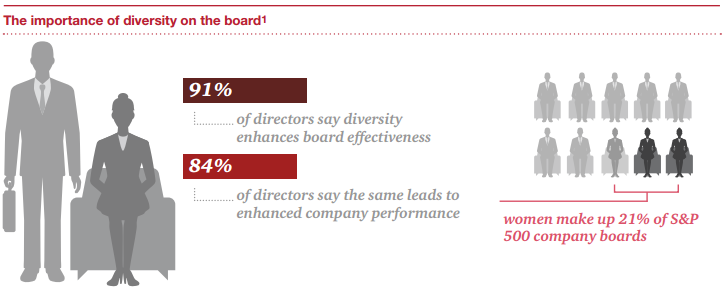
 

There are a number of ways to refresh your board. One way is to think about diversity. Many have taken on the gender imbalance on their boards and are adding more women directors. But diversity isn’t only about women. It’s about race, ethnicity, skills, experience, expertise, age and even geography. It’s about diversity of thought and perspective. And it’s not just a talking point anymore. Regulators started drafting disclosure rules around board diversity in mid-2016. Whether the rules become final remains to be seen, but either way, board diversity is in the spotlight. Add to that the common criticism that the US is far behind its developed country peers. Norway, France and the Netherlands have been using quotas for a while, and Germany in 2015 passed a law mandating 30% women on the boards of its biggest companies. While it’s unlikely quotas would be enacted in the US, some believe they’re a needed catalyst.
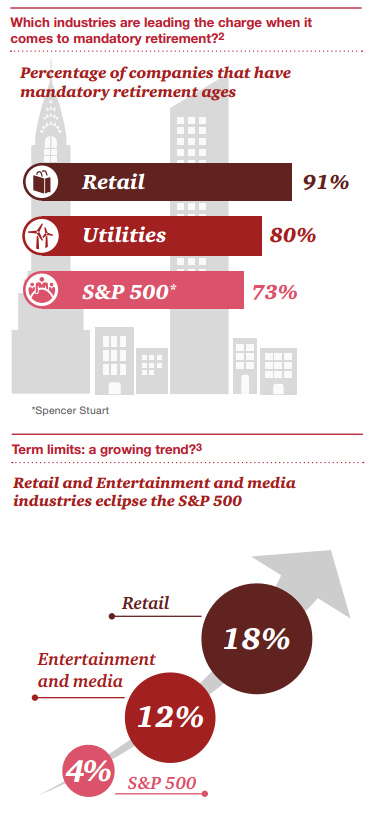


While we only looked at gender diversity on boards, we believe this is a good indicator of the efforts some boards are making to become more diverse overall. Secondly, mandatory retirement ages and term limits are two tools that boards can use to refresh itself. Our analysis showed that some industries seemed to be adopting these provisions more so than others. Some directors question their effectiveness.

Some of the industries in our PwC peer group analysis don’t have term limits at all

Banking and capital markets

Insurance

Communications

Technology

A third move that some companies have taken often, under investor pressure—is to evaluate their leadership structure and split the chair and CEO role. While the issue is still one that investors care about, certain industries have kept the combined role. And some companies don’t plan on making the change any time soon. Most often, boards with a combined chair/CEO role have an independent lead or presiding director. This may ease concerns that institutional investors and proxy firms may have about independence in the leadership role.
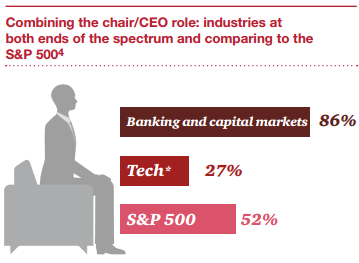
 

Who would have thought? Some interesting findings


While our analysis shows that most industries didn’t veer too far from the S&P 500 averages for most benchmarking categories, a few stand out. Retail in particular seems to be leading the charge when it comes to board refreshment.
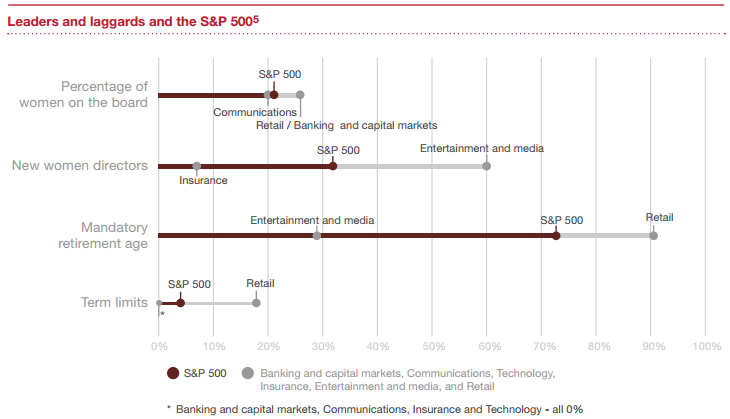


Other industries aren’t moving along quite so quickly. And there were some surprises. Which industry had the lowest average age? Perhaps surprisingly, it’s not technology. Retail claimed that one, too. And, also unexpected, was that technology had one of the highest average tenures. [6] Another surprising finding came from our analysis of the banking and capital markets industry—an industry that’s often considered to be male-dominated. BCM boards had the highest percentage of women, at 26%. That compares to just 21% for the S&P 500. Both the entertainment and media and the communications industries were also ahead of the curve when it comes to women in the boardroom, with the highest and second-highest percentages of new female directors. Retail tied with communications for second-highest, as well.
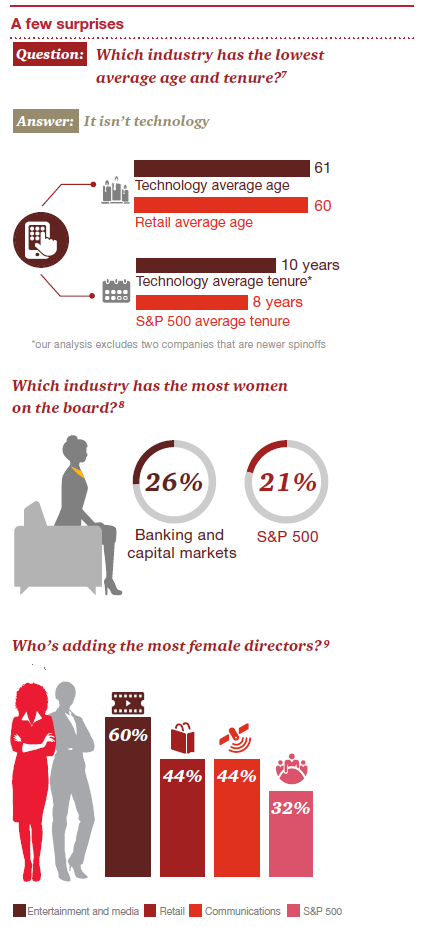
 

On a less progressive note, both the entertainment and media and communications industries were below the S&P 500 average when it came to having an independent lead or presiding director when the board chair is not independent. And they ranked lowest of the industries we analyzed on this topic—by far.

Blurred lines across industries


Skills, experience and diversity of thought will likely become even more important in the coming years. In the past five years alone, once bright industry lines have started to blur. Take the retail industry, for example. Brick and mortar stores, shopping malls and strip malls were what used to come to mind when thinking about that industry. Now it’s mobile devices and drones. Across many industries, business models are changing, competitors from different industries are appearing and new skills are needed. The picture of what your industry looks like today may not be the same in just a few years.

Technology is the key to much of this change. Just a few years ago, many boards were not enthusiastic about the idea of adding a director solely with technology or digital skills. But times are changing. Technology is increasingly becoming a critical skill to have on the board. We consulted our experts in the nine industries we analyzed, and all of them put technology high on the “must-have” list for new directors. Interestingly, financial, operational and industry experience—the top three from our 2016 Annual Corporate Directors Survey, were not among the most commonly listed.

Taking a fresh look


If your company is shifting gears and changing the way it does business, it may be important to take a fresh look at your board composition at more frequent intervals. Some boards use a skills matrix to see what they might be lacking in their board composition. Others may be forced by a shareholder activist to add new skills to the board.
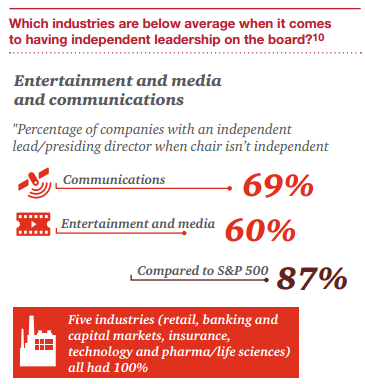


So how do you fill the holes in the backgrounds or skills you want from your directors? One way is to look to other industries. As our analysis shows, board composition and refreshment approaches vary by industry. As industry lines blur, other industry perspectives could compliment your company—it might be helpful to consider filling any holes with board members from other industries.

No matter which approach you take, it’s very important to think about your board’s composition proactively. Use your board evaluations to understand which directors have the necessary skills and expertise—and which might be lacking what the board needs. Think about your board holistically as you think about your company’s future. Your board composition is critical to ensuring your board is effective—and keeping up with the world outside the boardroom.


Appendix


How do our industry peer groups stack up to the S&P 500? Making this evaluation can be a good way to begin determining whether your board has the right balance in terms of board composition.
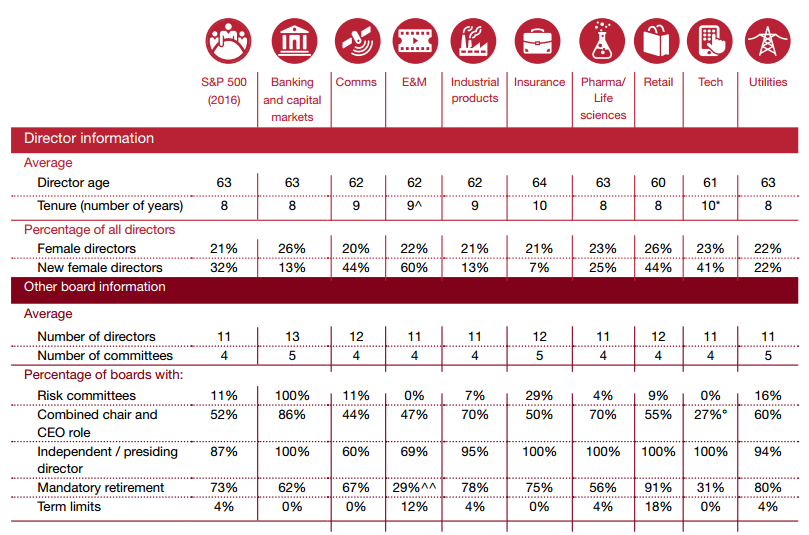


Analysis excludes two companies that are newer spinoffs.
Analysis excludes one company that does not combine or separate the roles.
Excludes the tenure of one newly-formed company.
Four of the five companies that have a mandatory retirement age have waived or state that the board can choose to waive it.

Sources: Spencer Stuart, U.S. Board Index 2016, November, 2016; PwC analysis of US SEC registrants: 27 of the largest industrial products companies by market capitalization and revenue, May 2016; 11 of the largest retail companies by revenue, May 2016; 21 of the largest banking and capital markets companies by revenue, September 2016; 24 of the largest insurance companies by market capitalization, May 2016; 17 of the largest entertainment and media companies by revenue, May 2016; nine of the largest communications companies by revenue, May 2016; 25 of the largest power and utilities companies by revenue, October 2016; 16 of the largest technology companies by revenue, May 2016; 23 of the largest pharma/life sciences companies by revenue, May 2016.


Endnotes:

1Sources: PwC, 2016 Annual Corporate Directors Survey, October 2016; Spencer Stuart, 2016 US Board Index, November 2016.(go back)

2Sources: PwC analysis of 11 of the largest retail companies by revenue that are also US SEC registrants, May 2016; PwC analysis of 25 of the largest power and utilities companies by revenue that are also US SEC registrants, October 2016; Spencer Stuart, U.S. Board Index 2016, November 2016.(go back)

3Sources: PwC analysis of 11 of the largest retail companies by revenue that are also US SEC registrants, May 2016; PwC analysis of 17 of the largest entertainment and media companies by revenue that are also US SEC registrants, May 2016; Spencer Stuart, S. Board Index 2016, November 2016.(go back)

4Sources: PwC analysis of 21 of the largest banking and capital markets companies by revenue that are also US SEC registrants, September 2016; PwC analysis of 16 of the largest technology companies by revenue that are also US SEC registrants, May 2016; Spencer Stuart, S. Board Index 2016, November 2016.(go back)

5Sources: PwC analysis of US SEC registrants: nine of the largest communications companies by revenue, May 2016; 11 of the largest retail companies by revenue, May 2016; 21 of the largest banking and capital markets companies by revenue, September 2016; 24 of the largest insurance companies by market capitalization, May 2016; 16 of the largest technology companies by revenue, May 2016; 17 of the largest entertainment and media companies by revenue, May 2016; Spencer Stuart, U.S. Board Index 2016, November 2016.(go back)

6Analysis excludes two companies that are newer spinoffs.(go back)

7Sources: PwC analysis of 16 of the largest technology companies by revenue that are also US SEC registrants, May 2016; Spencer Stuart, U.S. Board Index 2016, November 2016.(go back)

8Sources: PwC analysis of 11 of the largest retail companies by revenue that are also US SEC registrants, May 2016; PwC analysis of 21 of the largest banking and capital markets companies by revenue that are also US SEC registrants, September 2016; Spencer Stuart, U.S. Board Index 2016, November, 2016(go back)

9Sources: PwC analysis of 17 of the largest entertainment and media companies by revenue that are also US SEC registrants, May 2016; PwC analysis of nine of the largest communications companies by revenue that are also US SEC registrants, May 2016; PwC analysis of 11 of the largest retail companies by revenue that are also US SEC registrants, May 2016; Spencer Stuart, S. Board Index 2016, November 2016.(go back)

10Sources: PwC analysis of 17 of the largest entertainment and media companies by revenue that are also US SEC registrants, May 2016; PwC analysis of nine of the largest communications companies by revenue that are also US SEC registrants, May 2016; Spencer Stuart, S. Board Index 2016, November 2016; PwC analysis of 11 of the largest retail companies by revenue that are also US SEC registrants, May 2016; PwC analysis of 21 of the largest banking and capital markets companies by revenue that are also US SEC registrants, September 2016; PwC analysis of 24 of the largest insurance companies by market capitalization that are also US SEC registrants, May 2016; PwC analysis of 16 of the largest technology companies by revenue that are also US SEC registrants, May 2016; PwC analysis of 23 of the largest pharma/life sciences companies by revenue that are also US SEC registrants, May 2016.