Manuel de saine gouvernance au Canada


Voici un excellent rapport produit par L’Alliance canadienne pour la mixité et la bonne gouvernance que je vous invite vivement à consulter.

L’Alliance « est un regroupement inédit d’organisations sans but lucratif de premier plan, axé sur la recherche, la promotion et l’information dans les domaines de la gouvernance et de la mixité ».

Les membres de l’Alliance sont les suivants :

Les initiatives de l’Alliance consistent en la publication de deux documents qui constituent en quelque sorte des jalons et des consensus sur les principes de saine gouvernance au Canada.
La première partie du rapport porte sur la mixité dans les conseils d’administration.
Tout porte à croire que les organisations dotées de conseils d’administration et d’équipe de haute direction où les deux sexes sont représentés de façon équilibrée sont plus susceptibles que les autres d’obtenir de solides résultats financiers à long terme et de bénéficier d’une culture organisationnelle plus positive et inspirante. Elles donnent l’exemple et signalent clairement que la diversité de pensée et d’expérience leur tient à cœur.
Cette première partie brosse un portrait de la situation de la mixité au Canada. On y traite des points suivants :
– Le contexte et les obstacles courants
– L’analyse de rentabilité
– Les conditions essentielles de la mixité dans les conseils d’administration
Dans la deuxième partie, les auteurs ont constitué une trousse pour les conseils d’administration.
On y aborde les sujets suivants, en présentant de nombreux outils pratiques utiles à tous les CA :
1. Processus d’évaluation officiel des conseils d’administration
2. Limites liées aux mandats et à l’âge
3. Matrice de compétences des conseils d’administration
4. Politique sur la diversité des genres
5. Recrutement des membres du conseil
Résultats de recherche d'images pour « Alliance canadienne pour la mixité et la bonne gouvernance »
L’Alliance canadienne pour la mixité et la bonne gouvernance


Les auteurs espèrent que ce « manuel stimulera la réflexion et apportera des outils pratiques pour la prise de mesures qui se traduiront par un meilleur équilibre hommes-femmes dans les conseils d’administration ».

Bonne lecture !

Étude sur le mix des compétences dans la composition des conseils d’administration


Aujourd’hui, je vous recommande la lecture d’un article publié par Anthony Garcia, vice-président de la firme ISS, paru sur le forum de Harvard Law School, qui aborde le sujet des compétences (skills) requises pour siéger à un conseil d’administration.

Plus précisément, l’auteur explore la nature des compétences exigées des administrateurs ; comment celles-ci opèrent-elles pour améliorer les pratiques de gouvernance des entreprises ?

D’abord, il faut noter que la recherche de la diversité des compétences au sein des conseils d’administration est considérée comme un atout important ; cependant, les entreprises mettent encore l’accent sur les compétences et les expertises traditionnelles : le leadership, les connaissances financières, une expérience de CEO, une connaissance des marchés de l’entreprise et une familiarité avec la fonction audit.

L’étude montre aussi que les administrateurs récemment nommés ont des compétences plus diversifiées, notamment eu égard aux connaissances des marchés internationaux, aux compétences reliées aux ventes et à l’expertise dans le domaine des technologies de l’information (TI).

Également, l’étude montre que les femmes administratrices sont plus qualifiées que les hommes dans plusieurs types de compétences.

Résultats de recherche d'images pour « compétences des administrateurs »

Enfin, les entreprises qui ont une plus grande diversité de compétences sont plus susceptibles de divulguer leurs politiques de risques concernant la gouvernance, les aspects sociaux et les considérations environnementales (ESG).

L’auteur résume les caractéristiques d’une matrice des compétences jugée efficace. L’article comporte également plusieurs illustrations assez explicites.


A matrix that does more than “check the box”: The NYC Fund’s Boardroom Accountability Project 2.0 has focused on having companies disclose a “matrix” of skills, as well as race and gender, of the directors. The Project has a “compendium of best practices” that provides examples of the formats and details that are considered within the scope disclosure best-practices. With regard to race and gender, some of the examples disclosed gender and racial information in aggregate format while others listed the race and gender for each board member. With regard to skills, some companies simply listed the skills of each nominee; some provided a brief description of the underlying qualifications for the skill; some also broke out the director’s biography categorically based on the identified skills; the best examples also highlighted the relevance of the particular skill in the context of the company’s business.

Standardized skill disclosure: There is guidance for what constitutes a financial expert for Sarbanes-Oxley compliance. While being a former or current CEO is straightforward answer for whether a director has that skill, something like technology is much less clear. Would working at a company in the information technology sector suffice? Does the director need to be a Chief Technology officer? Setting market standards would reduce the uncertainty and expense for each company to take on the responsibility individually and would also increase investor confidence in analyzing a board based on skills.

Skills mapped to specific responsibilities: The analysis shows that having a particular skill on the board will reduce ESG risks. However, a more in-depth assessment would also consider the skills that exist on the board’s committees and map those skills to the responsibilities of key committees. For example, if the board gives the audit committee oversight of cybersecurity, has the board included any audit committee members that have technology or risk management experience?

Bonne lecture !


Director Skills: Diversity of Thought and Experience in the Boardroom


Indice de diversité de genre | Equilar


Voici le dernier rapport de l’indice de diversité de genre (GDI) publié par Amit Batish, de la firme-conseil Equilar Inc.

Le texte est très explicite et abondamment illustré.

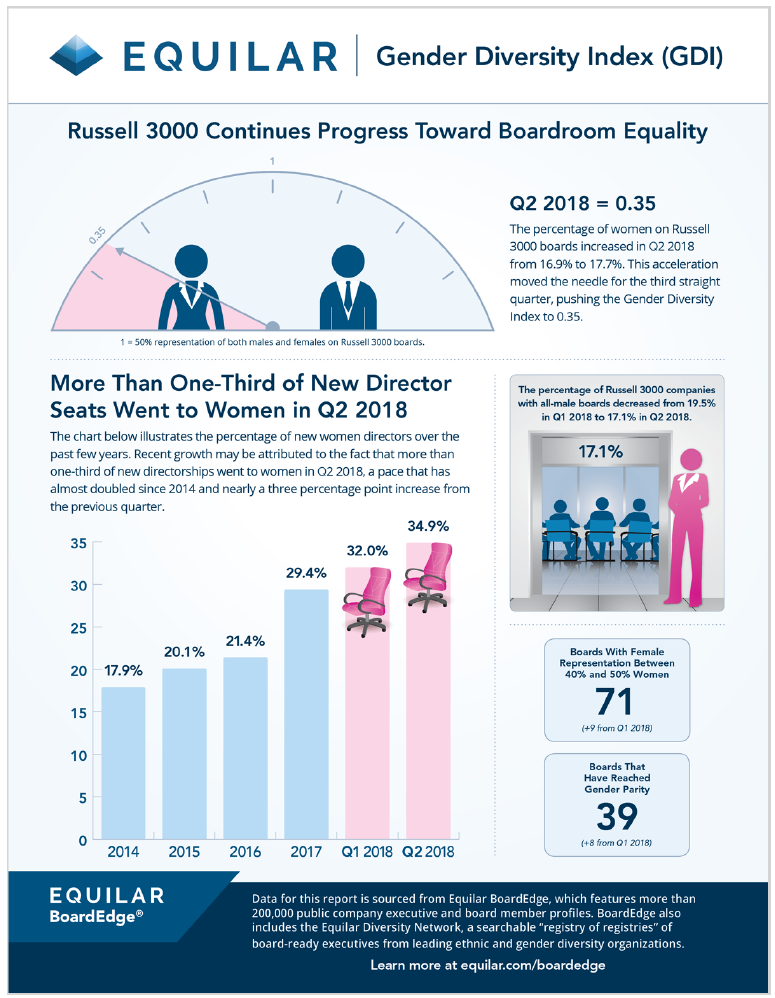
Dans l’ensemble, le pourcentage de femmes siégeant à des conseils d’administration du Russell 3000 est passé de 16,9 % à 17,7 % entre le 31 mars et le 30 juin 2018.

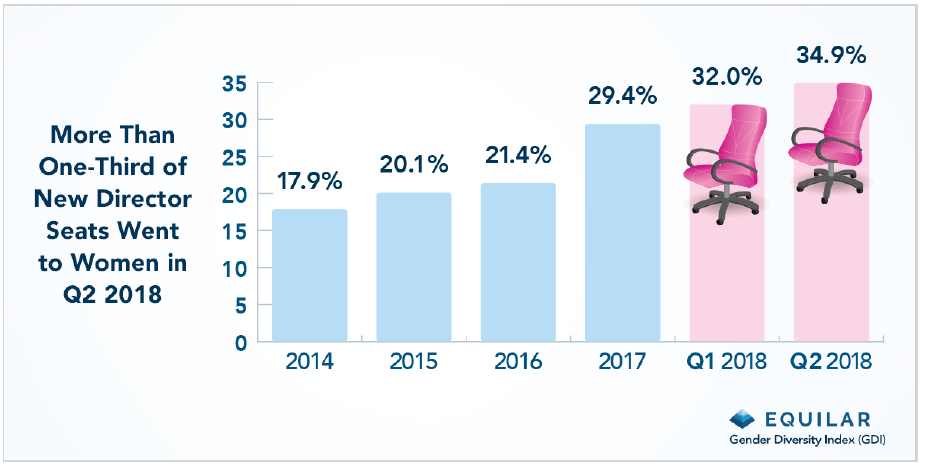
Durant la même période, plus du tiers des postes d’administrateurs ont été pourvus par des femmes.

Bonne lecture !


For a third consecutive quarter, the Equilar Gender Diversity Index (GDI) increased. The percentage of women on Russell 3000 boards increased from 16.9% to 17.7% between March 31 and June 30, 2018. This acceleration moved the needle, pushing the GDI to 0.35, where 1.0 represents parity among men and women on corporate boards.

One of the primary drivers of this steady GDI increase is the number of new directorships that have gone to women over the last few quarters. The chart below illustrates a consistent pace of growth of female directorships. In Q2 2018, more than one-third of new directorships went to women—this is a near three percentage point increase from the previous quarter and a pace that has almost doubled since 2014.


“In the first half of 2018 over 30% of newly-elected directors were women, which we believe indicates that companies are changing their approach to diversity,” said Brigid Rosati, Director of Business Development at Georgeson.

“It seems that companies are beginning to better understand the benefits that a more diverse board can bring, but are also in some cases responding to signs of increased interest from investors, including in the way they vote in director elections.”


In Q1 2018 the percentage of all male Russell 3000 boards fell to 19.5%, the first time ever that this figure sat below 20%. That figure continued to dip in Q2 2018, falling to 17.1%—a 2.4 percentage point drop. This data is certainly a promising sign that boards are making a concerted effort to promote diversity in the boardroom and that male-dominant boardrooms are becoming less prevalent. However, this is still a relatively sizable figure that indicates possible hurdles do indeed remain.

“Progress on diversity continues to be slow but it is continuing to move for the most part,” said Susan Angele, Senior Advisor of Board Governance at KPMG’s Board Leadership Center.

“Depending on the board’s own network, it may take a larger investment of time and effort to find the right person to add diversity as well as skill set, and having a diversity champion on the board driving the search may make a difference.”


Pressure Begins to Mount From Investors and Lawmakers


One of the many reasons that boards have lagged progress on the topic of diversity is that historically, there has been little pressure from investors or other key stakeholders to regularly advocate for such initiatives.

However, over the last year or so, gender diversity has become an area of focus across corporate America. There have been numerous efforts from various sources including institutional investors, regulators and lawmakers. In the Q1 2018 GDI report, Equilar cited 2017 as being banner year for shareholder engagement around gender diversity on boards, beginning with State Street’s “Fearless Girl” statue of a young woman facing o with the Wall Street Bull to bring awareness to gender diversity.

The gesture won a major advertising award, but State Street also voted against hundreds of directors on boards that did not have women. Subsequently, BlackRock voted in favor of several shareholder proposals that requested more disclosure around diversity in 2017, and earlier in 2018, sent letters to all Russell 1000 companies that had fewer than two women on their boards.

“In addition to investor focus, I see a confluence of events that should play out over time,” said Angele.

“The changes in the business environment and expectations on boards—including technological disruption, competition coming from outside the industry, changing demographics, culture and risk—all of these forces are making it more important for the boardroom to include directors with a mix of backgrounds and experience.”

Additionally, lawmakers have begun to get more involved with issues regarding gender diversity. For instance, by August 31, 2018, California could become the first state in the nation to mandate publicly held companies that base their operations in the state to have women on their boards. The legislation—SB 826—will require public companies headquartered in California to have a minimum of one female on its board of directors by December 31, 2019. That minimum will be raised to at least two female board members for companies with five directors or at least three female board members for companies with six or more directors by December 31, 2021. Violators of this legislation will be subject to financial consequences.

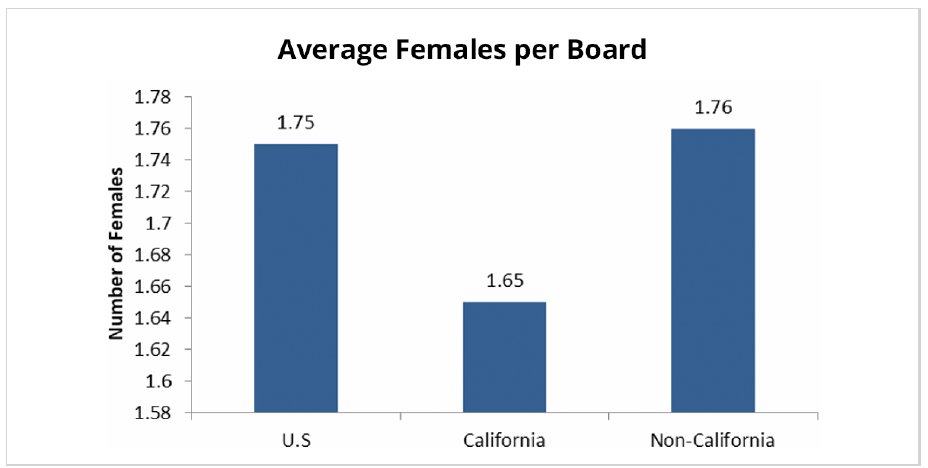
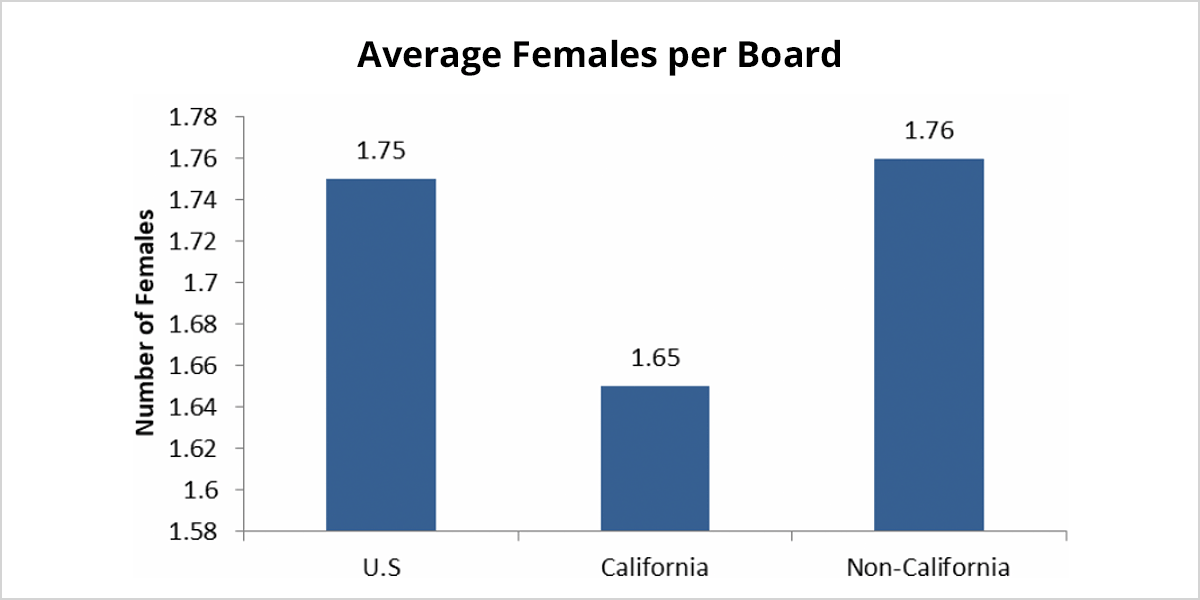
A new Equilar study examined how California fared against the United States as a whole with respect to women on boards. According to the study, California is slightly below other states and the national average in terms of average women on a board. California, on average, has 1.65 female members per board, whereas other states and the United States as a whole average 1.76 and 1.75 female members, respectively.


As legislators become more involved in matters of diversity, one might expect that progress toward greater female board representation will continue. The last few quarters alone have shown signs of progress, and this is before any significant quotas had been put in place. It would come as no surprise that the number of boards achieving parity continues to increase year-over-year following implementation of gender quotas across the nation.

Boards That Have Reached Parity Are Becoming More Prevalent


In combination of numerous factors, some previously mentioned in this article, since the inception of the GDI study, the number of Russell 3000 boards that achieved gender parity has steadily increased in most quarters. The Q2 2018 GDI revealed the largest quarter-over-quarter increase in the number of boards that have achieved parity to date, reaching 39—an increase of eight from the previous quarter and a spike of 18 from the end of 2016. The list of boards at parity is at the bottom of this article.

The number of boards that have between 40% and 50% is rising regularly as well. Collectively, 71 boards now have at least 40% women, up from 62 in the previous quarter.

“Several large institutional investors updated their proxy voting policies in 2018, which we think could continue to drive change beyond the significant progress we saw in the first half of 2018,” said Rosati. “Beyond this, we believe that continued media coverage and scrutiny means that we will see continued pressure from investors towards companies with zero women on their boards.”

___________________________________________________________________________

About Equilar Gender Diversity Index

The Equilar GDI reflects changes on Russell 3000 boards on a quarterly basis as cited in 8-K lings to the SEC. Most indices that track information about board diversity do so annually or even less frequently, and typically with a smaller sample size, sometimes looking back more than a full year by the time the information is published. While this data is reliable and accurate, the Equilar GDI aims to capture the influence of the increasing calls for diversity from investors and other stakeholders in real time.

L’âge des nouveaux administrateurs est une variable de diversité trop souvent négligée dans la composition des CA !


Lorsque l’on parle de diversité au sein des conseils d’administration, on se réfère, la plupart du temps, à la composition du CA sur la base des genres et des origines ethniques.

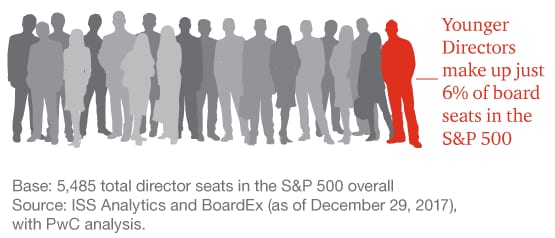
L’âge des nouveaux administrateurs est une variable de diversité trop souvent négligée de la composition des CA. Dans cette enquête complète de PwC, les auteurs mettent l’accent sur les caractéristiques des administrateurs qui ont moins de 50 ans et qui servent sur les CA du S&P 500.

Cette étude de PwC est basée sur des données statistiques objectives provenant de diverses sources de divulgation des grandes entreprises américaines.

En consultant la table des matières du rapport, on constate que l’étude vise à répondre aux questions suivantes :


(1) Quelle est la population des jeunes administrateurs sur les CA du S&P 500 ?

Ils sont peu nombreux, et ils ne sont pas trop jeunes !

Ils ont été nommés récemment

Les femmes font une entrée remarquable, mais pas dans tous les groupes…


(2) Qu’y a-t-il de particulier à propos des « jeunes administrateurs » ?

96 % occupent des emplois comme hauts dirigeants, 31 % des jeunes administrateurs indépendants sont CEO provenant d’autres entreprises,

Plus de la moitié proviennent des secteurs financiers et des technologies de l’information

Ils sont capables de concilier les exigences de leurs emplois avec celles de leurs rôles d’administrateurs

Ils sont recherchés pour leurs connaissances en finance/investissement ou pour leurs expertises en technologie

90 % des jeunes administrateurs siègent à un comité du CA et 50 % siègent à deux comités

La plupart évitent de siéger à d’autres conseils d’administration


(3) Quelles entreprises sont les plus susceptibles de nommer de jeunes administrateurs ?

Les jeunes CEO représentent une plus grande probabilité d’agir comme administrateurs indépendants

Plus de 50 % des jeunes administrateurs indépendants proviennent des secteurs des technologies de l’information, et des produits aux consommateurs

Les secteurs les moins pourvus de jeunes administrateurs sont les suivants : télécommunications, utilités, finances et immobiliers

Les plus jeunes administrateurs expérimentent des relations mutuellement bénéfiques.


La conclusion de l’étude c’est qu’il est fondamental de repenser la composition des CA en fonction de l’âge. Les conseils prodigués relatifs à l’âge sont les suivants :


Have you analyzed the age diversity on your board, or the average age of your directors?

Does your board have an updated succession plan? Does age diversity play into considerations for new board members?

Are there key areas where your board lacks current expertise—such as technology or consumer habits? Could a new—and possibly younger—board member bring this knowledge?

Does your board have post-Boomers represented?

Does your board have a range of diversity of thought—not just one or two people in the room who you look to continually for the “diversity angle”?

Could younger directors bring some needed change to the boardroom?


Notons que cette étude a été faite auprès des grandes entreprises américaines. Dans l’ensemble de la population des entreprises québécoises, la situation est assez différente, car il y a beaucoup plus de jeunes sur les conseils d’administration.

Mais, à mon avis, il y a encore de nombreux efforts à faire afin de rajeunir et renouveler nos CA.

Bonne lecture !


Board composition: Consider the value of younger directors on your board


Résultats de recherche d'images pour « Board composition: Consider the value of younger directors on your board »

Résumé des principaux résultats


There are 315 Younger Directors in the S&P 500. Together, they hold 348 board seats of companies in the index. Of these 348 Younger Director seats, 260 are filled by independent Younger Directors.

Fewer than half of S&P 500 companies have a Younger Director. Only 43% of the S&P 500 (217 companies) have at least one Younger Director on the board. At 50 of those companies, one of the Younger Directors is the company’s CEO.

S&P 500 companies with younger CEOs are much more likely to have independent Younger Directors on the board. Sixty percent (60%) of the 527 companies with a CEO aged 50 or under have at least one independent Younger
Director on the board—as compared to just 42% of companies that have a CEO over the age of 50.

Almost one-third of Younger Directors are women. Women comprise a much larger percentage (31%) of Younger Directors than in the S&P 500 overall (22%). This is in spite of the fact that over 90% of Younger Directors nominated under
shareholder agreements—such as those with an activist, private equity investor or family shareholder—are men.

Information technology and consumer products companies are more likely to have Younger Directors. The three companies in the telecommunications sector have no Younger Directors.

Close to half of the independent Younger Directors have finance/investing backgrounds. Just under one-third are cited for their technology expertise, executive experience or industry knowledge.

Younger Directors fit in board service while pursuing their careers. According to their companies’ SEC filings, 96% of Younger Directors cite active jobs or positions in addition to their board service.

Younger Directors serve on fewer boards. The average independent S&P 500 director sits on 2.1 public company boards. In contrast, independent Younger Directors sit on an average of 1.7 boards. More than half serve on only one public board.

More than half of the independent Younger Directors have held their board seat for two years or less. Only 18% have been on the board for more than five yearsé

Le point sur la future loi californienne eu égard aux quotas de femmes sur les CA


Voici un article de Tomas Pereira, analyste de recherche à Equilar Inc, publié sur le site du Harvard Law School Forum qui fait le point sur la future loi californienne eu égard aux quotas de femmes sur les CA.

L’étude présente des statistiques intéressantes sur la situation des femmes sur les CA en Californie et fait état de projections concernant l’effet des mesures. Rappelons que l’état de la Californie est le premier état qui s’aventure dans l’établissement de quotas pour favoriser la diversité sur les conseils d’administration.

La législation propose qu’une entreprise ait au moins une femme sur le CA au 31 décembre 2019,

That minimum will be raised to at least two female board members for companies with five directors or at least three female board members for companies with six or more directors by December 31, 2021.

Ainsi en 2021, les conseils d’administration devront compter au moins trois femmes sur les CA, si le nombre d’administrateurs est de six ou plus.

Bonne lecture !


Gender Quotas in California Boardrooms


Résultats de recherche d'images pour « Gender Quotas in California Boardrooms »


By August 31, 2018, California could become the first state in the nation to mandate publicly held companies that base their operations in the state to have women on their boards. The legislation—SB 826—will require public companies headquartered in California to have a minimum of one female on its board of directors by December 31, 2019. That minimum will be raised to at least two female board members for companies with five directors or at least three female board members for companies with six or more directors by December 31, 2021.

If SB 826 is passed in the Assembly and signed by Governor Jerry Brown, corporations not compliant with the new rules will be subjected to financial consequences. Strike one will be accompanied with a fine equal to the average annual cash compensation of directors. Any subsequent violation would amount to a fine equal to three times the average annual cash compensation for directors. Hence, the consequences are very real for companies that choose not to comply with the new rules.

A new study by Equilar looks at where public companies headquartered in California currently lie in relation to the proposed legislation. The study includes public companies in California that have annual revenues of $5 million or more—amounting to a total of 211 companies with an aggregate of 349 female and 1,466 male board members.


Looking broadly, California is slightly below other states and the national average in terms of average women on a board. California, on average, has 1.65 female members per board, whereas other states and the United States as a whole average 1.76 and 1.75 female members, respectively. This type of statistic is a likely factor in spurring state legislators in Sacramento to make significant changes to the status quo and place California in a leading role for board diversity in the United States.


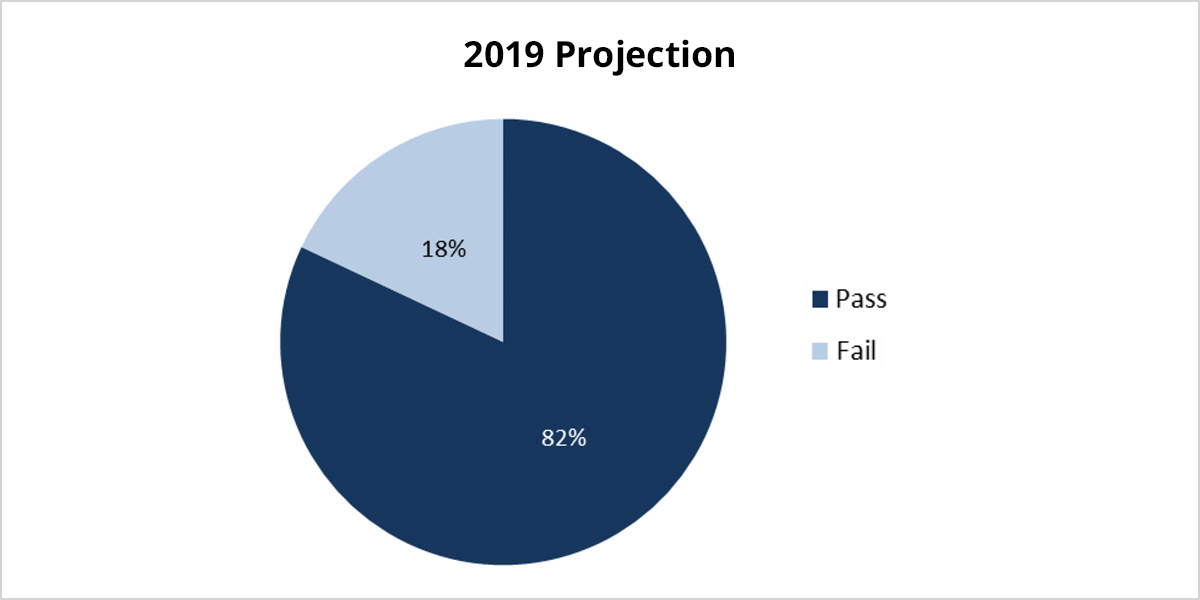
By 2019, most companies in California would be safe from any financial penalties for having an insufficient number of female board members. As it stands now, 82% of public companies in California who have annual revenues of over $5 million will meet the initial criteria, whereas 18% will not. Consequently, 37 public companies would be faced with a fine equal to the average annual director compensation for failing to comply.

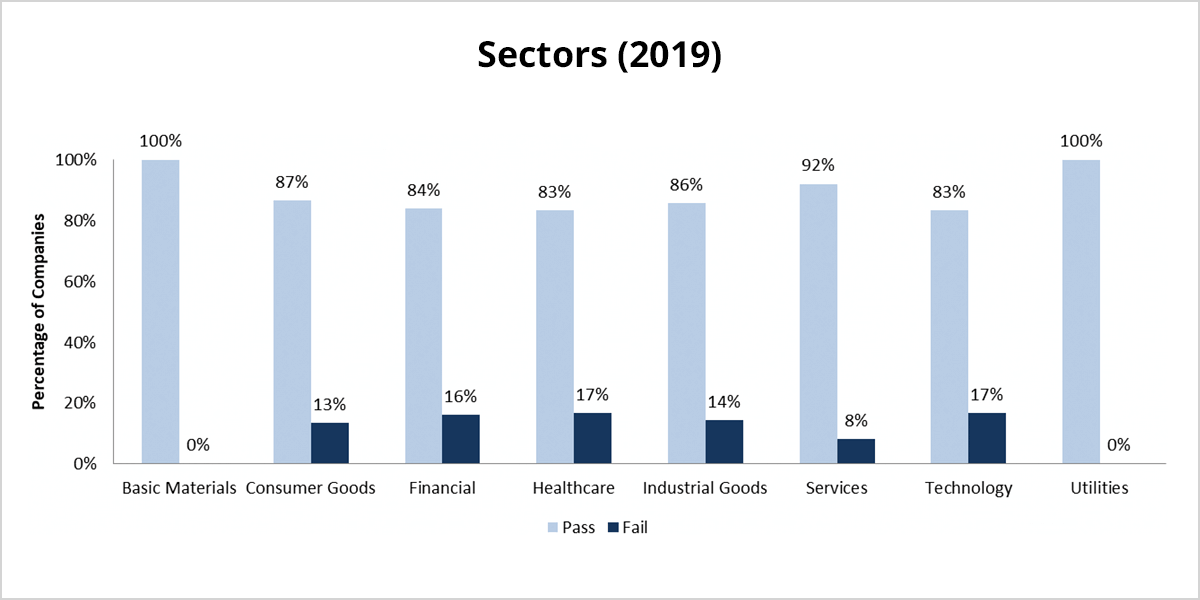
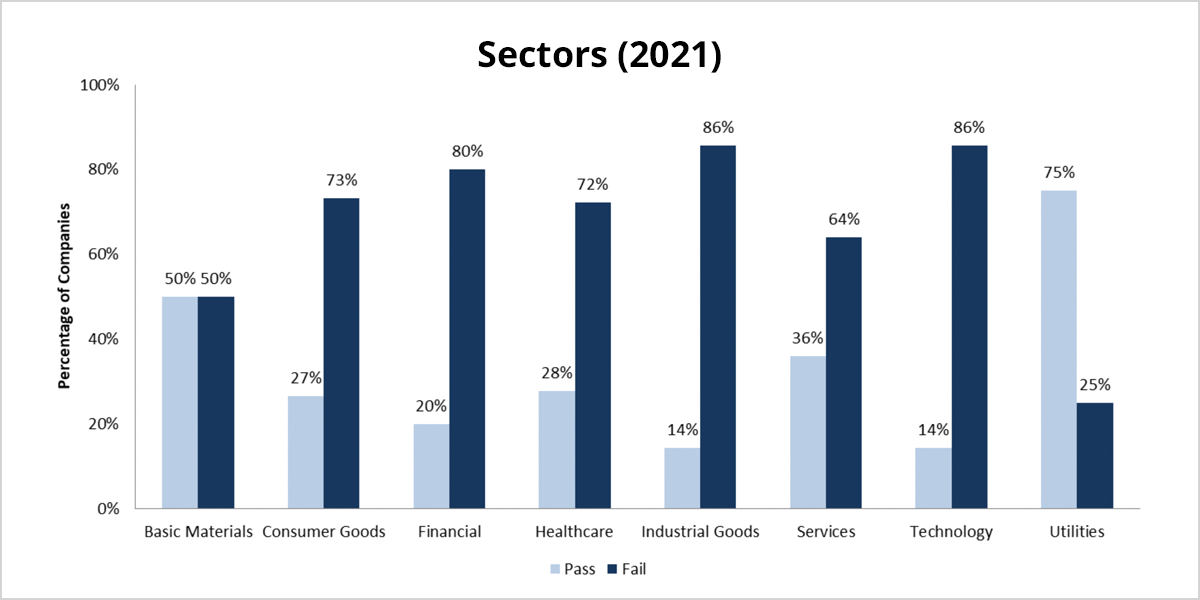
In the following table, Equilar examined the 82% success rate a bit further and broke it down by sector in order to examine which industries are driving the rates of success and failure. By 2019, the basic materials and utilities sectors in California would both have a 100% success rate. Thus, every company within these two sectors has at least one female director present on their board. The next sector with the highest rate of success is services, with 92% having at least one female member. Both the healthcare and technology sectors are tied for lowest compliance at 83% pass.


When looking at the companies that would meet the secondary December 31, 2021 criteria, the picture is much bleaker at present for public companies in California. According to the proposed legislation, the required minimum would increase to two female board members for companies with five total directors or to three female board members for companies with at least six total directors.


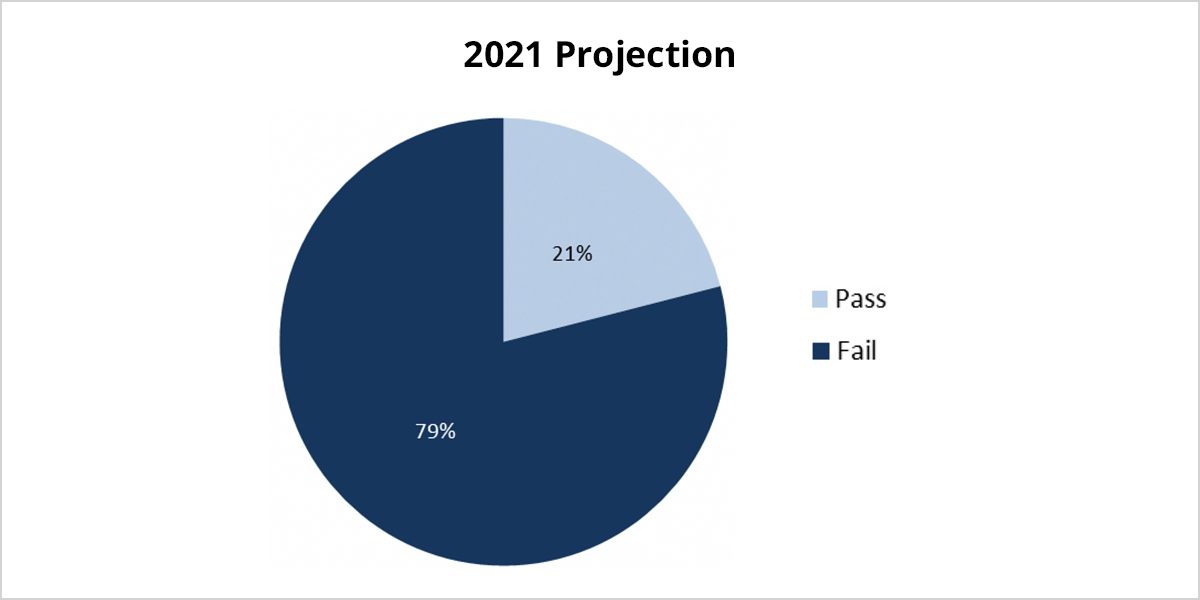
Taking that future criteria and applying it to today, 79% of public companies would fail, while only 21% would pass. The following table sees basic materials—one of the sectors with 100% company success rate with the previous 2019 criteria—fall down to a 50-50 ratio of pass to fail. The sector with the highest success rate is utilities, while the industrial goods sector has the lowest success rate at 75% and 14%, respectively.


While the path for the proposed legislation is still a bit rocky, the broader trend towards diversifying boardrooms across the country is growing. Companies should anticipate new legislation—not just SB 826—sprouting throughout more state legislatures and get ahead of this rolling tide. States like Maine, Illinois and Ohio have already begun promoting resolutions to encourage companies to diversify their boards. In addition, BlackRock and other institutional investors have publicly stated that they will expect at least two female members per board. The push towards gender diversification is well warranted. Studies by management consulting firms, such as Boston Consulting Group and McKinsey & Co., have shown that diverse boards perform better financially. Signs do point to a gradual progression towards gender parity in the boardroom, as noted by the Q1 2018 Equilar Gender Diversity Index. However, without proactive encouragement or legislation, it would take decades before a true gender balance is realized.

La place des femmes sur les CA et dans la haute direction des entreprises


Voici un rapport qui fait le point sur la place des femmes dans les CA et dans des postes de haute direction des entreprises publiques (cotées) américaines et internationales.

Cet article, publié par Subodh Mishra* directeur de Institutional Shareholder Services (ISS), est paru sur le forum du Harvad Law School on Corporate Governance, le 13 août 2018.

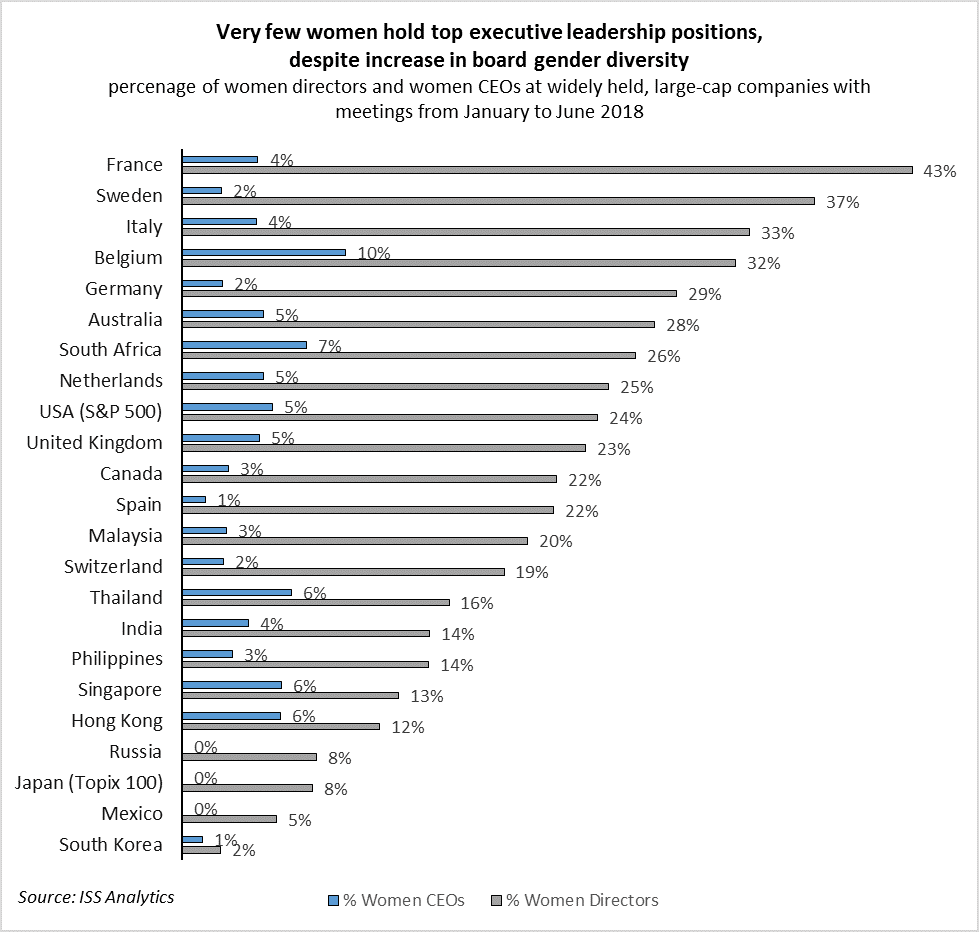
On note des progrès dans tous les domaines, mais l’évolution est encore trop lente. Eu égard à la présence des femmes sur les CA des grandes entreprises cotées, c’est la France qui remporte la palme avec 43 % de femmes sur les CA.

Les entreprises se dotent de plus en plus de politique de divulgation de la diversité sur les postes de haute direction. Le Danemark (96 %), l’Australie (91 %) et le R.U. (84 %) sont en tête de liste en ce qui concerne la présence de politique à cet égard. Les É.U. (32 %) et la Russie (22 %) ferment la marche. Le Canada est en milieu de peloton avec 63 %.

L’infographie présentée ici montre clairement les tendances dans ce domaine.

L’auteur identifie les cinq pratiques émergentes les plus significatives pour mettre en œuvre une politique de diversité exemplaire.

(1) Address subtle or unconscious bias.

Cultivating a strong culture free of subtle or unconscious bias is a fundamental step towards an inclusive work environment. A meta-analysis by the Harvard Business Review finds that subtle discrimination has as negative effects, if not more negative, than overt discrimination, as it can drain emotional and cognitive resources, it can accumulate quickly, and is difficult to address through legal recourse. The researchers suggest that structured processes and procedures around hiring, assignments, and business decisions limit the opportunity for unconscious bias to creep in. In addition, they suggest training programs and practicing techniques, such as mindfulness, to reduce bias.

(2) Establish clear diversity targets and measure progress towards goals.

Most companies with gender diversity strategies set clear, measurable targets. BP has set a goal of women representing at least 25 percent of its group leaders by 2020, while Symantecaims at having 30 percent of leadership roles occupied by women by the same year. This approach allows firms to focus on concrete performance results, while also creating a framework of accountability in the company’s gender diversity and inclusion program.

(3) Focus on key roles and redefine the path to leadership.

True meritocracy should determine the criteria for leadership roles. However, companies should recognize that there may be multiple paths to the CEO position, and should focus on their efforts on roles that lead to those paths. Women CEOs Speak, A Korn Ferry Institute study supported by the Rockefeller Foundation, identifies four different career approaches for women to prepare for the CEO role. However, the study identifies early assumption of profit-and-loss responsibilities in all four paths as a crucial experience leading to top positions.

(4) Establish mentorship and sponsorship programs.

Training and development programs within the organization can help facilitate mentorships and sponsorships, which are crucial in career development. GM’s Diversity and Inclusion Report explains how its Executive Leadership Program aims at creating a support network of female leaders, as well as training and development sessions hosted by female executives. Mentors can support employees earlier in their career with coaching and advice, while sponsors take a more active role later in one’s career to promote the individual. Gender should obviously not constitute a barrier for such mentorships and sponsorships, and organizations should take active steps to encourage such relationships across genders and remove any hesitations or biases.

(5) Provide flexibility and support towards work-life balance.

Top executive assignments often involve significant time commitments and travel that can impact an executive’s family life. In a New York Times news analysis, former McDonald’s executive Janice Fields, identified her choice not to work overseas as a handicap to becoming the CEO. Making accommodations in relation family, including both children and spouses, can remove some significant hurdles for women.


Women in the C-Suite: The Next Frontier in Gender Diversity


Résultats de recherche d'images pour « Women in the C-Suite: The Next Frontier in Gender Diversity »


Despite recent advances in female board participation globally, gender diversity among top executives remains disappointingly low across all markets, with some improvement discerned in the past few years. Moreover, there does not appear a correlation between board gender diversity and gender diversity in the C-Suite at the market level. Some of the markets that have implemented gender quotas on boards and have achieved the highest rates of female board participation, such as France, Sweden, and Germany, appear to have embarrassingly low rates of female top executives. In fact, many of the markets with progressive board diversity policies have lower gender diversity levels in executive positions compared to several emerging markets like South Africa, Singapore, and Thailand. Thus, achieving higher rates of gender diversity in the C-Suite will require deeper cultural shifts within organizations in order to overcome potential biases and hurdles to gender equality.

The number of female top executives remains low


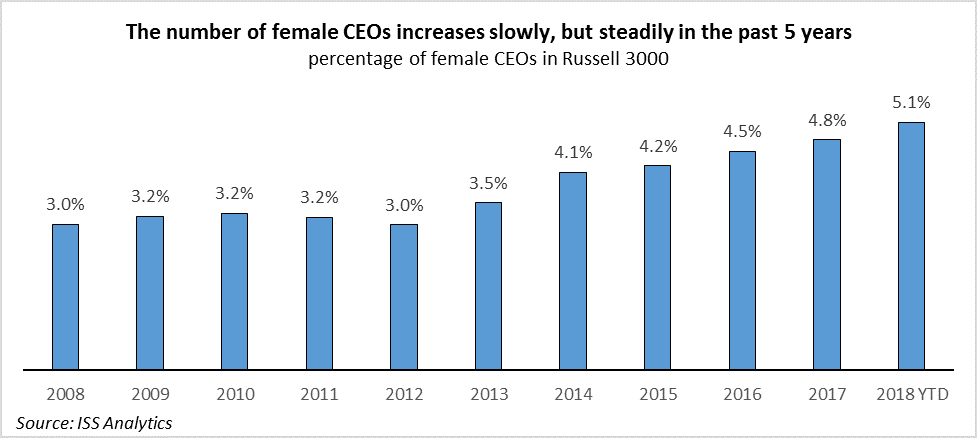
In the past decade, gender quotas, policy initiatives, and—more recently—investor pressure have led to boards improving female board participation in Europe and North America significantly. The percentage of female directors in the Russell 3000 increased from 10 percent in 2008 to 18 percent in 2018, with most of the increase taking place since 2013. Similarly, the percentage of female directors in ISS’s core universe of widely-held European firms more than tripled from 8 percent in 2008 to 27 percent in 2018. While the recent push by policymakers, investors, and advocacy groups for greater gender diversity has primarily focused on board positions, the discussion is beginning to evolve to encompass diversity in all leadership roles, including top management. In the United States, we have observed small but significant changes in the gender composition of the C-Suite over the past five years. Since 2012, the Russell 3000 has seen a 70-percent increase in the number of female CEOs. Despite the relative increase, the number of top female executives remains disappointingly low, with only 5 percent of Russell 3000 companies having a female CEO in 2018.


Companies need to develop the pipeline of female executive leaders


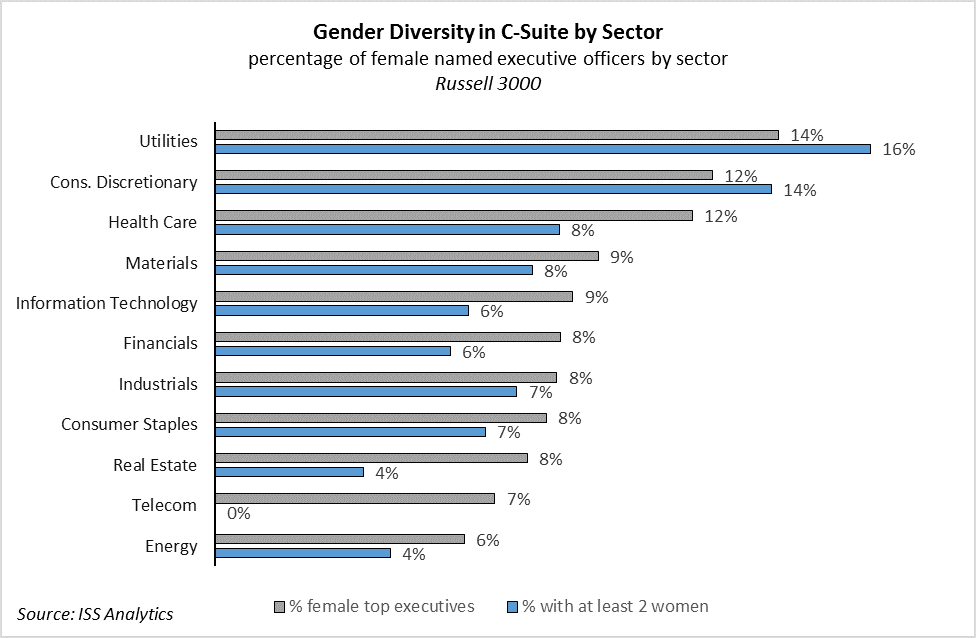
The scarcity of female CEOs does not appear surprising, especially after taking a closer look at the rest of the members of the C-Suite, who often comprise the primary candidates in line for succession for the top job. These roles include the Chief Operating Officer, the Chief Financial Officer, and the Head of Sales, among others. Only 9 percent of top executive positions in the Russell 3000 are filled by women, which means that companies have a long way to go towards building gender equity within the top ranks where the next generation of CEOs are cultivated. Certain sectors lag considerably more than others, with Real Estate, Telecommunications and Energy exhibiting the lowest rates of female named executive officers.


Within the C-Suite, gender differentiation persists in terms of executive roles


The picture seems even bleaker for the future of gender parity at the CEO level when examining the types of roles that female top executives currently occupy within their organizations. Female executives appear scarcer at roles with profit-and-loss responsibilities that often serve as stepping stones to the CEO role, such as COO, Head of Sales, or CEOs of business units and subsidiary groups. Meanwhile, women are more highly concentrated in positions that rarely see a promotion to the top job, such as Human Resources Officer, General Counsel, and Chief Administrative Officer.


Not surprisingly, and in conjunction with the disparity in functions described above, women who belong to the group of the five highest paid executive officers in their organization, are far more likely to rank fourth or fifth in pay rank compared to their male counterparts. Approximately 46 percent of women in the top five positions rank either fourth or fifth in pay, compared to 33 percent of male top five executives in these pay rankings.


Breaking down barriers to gender diversity in the C-Suite


Companies can take a number steps to foster gender diversity in their executive leadership, and to remove biases or potential obstacles to an inclusive management environment. Many companies have identified gender diversity in leadership positions as a key priority, and have established gender diversity strategies to achieve specific goals. While workforce diversity policies appear to become the standard across most markets, gender diversity policies at the senior management level are common only in some markets. According to ISS Environmental & Social QualityScore data, the majority of companies in developed European markets and Canada disclose gender diversity policies for senior managers. The practice has not been widely established United States, where 32 percent of the S&P 500 and only 4 percent of the remaining Russell 3000 disclose such policies.


Several companies and advocacy groups identify gender diversity and inclusion as a major driver for talent acquisition and performance. The recognition of the absence of women in top executive roles has sparked several initiatives that seek to promote inclusivity in the workplace. The Rockefeller Foundation’s 100×25 advocacy initiative aims at bringing more women to the C-Suite, with the explicit goal of having 100 Fortune 500 female CEOs by 2025. Meanwhile, Paradigm for Parity was formed by a coalition of business leaders (CEOs, founders, and board members), and set the goal of achieving full gender parity by 2030. The group has created a 5-point action plan to help companies accelerate their progress.

Based on the work of these initiatives and actual programs disclosed by companies, we identify five of the emerging best practices that companies adopt to address gender diversity in leadership roles.

Address subtle or unconscious bias. Cultivating a strong culture free of subtle or unconscious bias is a fundamental step towards an inclusive work environment. A meta-analysis by the Harvard Business Review finds that subtle discrimination has as negative effects, if not more negative, than overt discrimination, as it can drain emotional and cognitive resources, it can accumulate quickly, and is difficult to address through legal recourse. The researchers suggest that structured processes and procedures around hiring, assignments, and business decisions limit the opportunity for unconscious bias to creep in. In addition, they suggest training programs and practicing techniques, such as mindfulness, to reduce bias.

Establish clear diversity targets and measure progress towards goals. Most companies with gender diversity strategies set clear, measurable targets. BP has set a goal of women representing at least 25 percent of its group leaders by 2020, while Symantecaims at having 30 percent of leadership roles occupied by women by the same year. This approach allows firms to focus on concrete performance results, while also creating a framework of accountability in the company’s gender diversity and inclusion program.

Focus on key roles and redefine the path to leadership. True meritocracy should determine the criteria for leadership roles. However, companies should recognize that there may be multiple paths to the CEO position, and should focus on their efforts on roles that lead to those paths. Women CEOs Speak, A Korn Ferry Institute study supported by the Rockefeller Foundation, identifies four different career approaches for women to prepare for the CEO role. However, the study identifies early assumption of profit-and-loss responsibilities in all four paths as a crucial experience leading to top positions.

Establish mentorship and sponsorship programs. Training and development programs within the organization can help facilitate mentorships and sponsorships, which are crucial in career development. GM’s Diversity and Inclusion Report explains how its Executive Leadership Program aims at creating a support network of female leaders, as well as training and development sessions hosted by female executives. Mentors can support employees earlier in their career with coaching and advice, while sponsors take a more active role later in one’s career to promote the individual. Gender should obviously not constitute a barrier for such mentorships and sponsorships, and organizations should take active steps to encourage such relationships across genders and remove any hesitations or biases.

Provide flexibility and support towards work-life balance. Top executive assignments often involve significant time commitments and travel that can impact an executive’s family life. In a New York Times news analysis, former McDonald’s executive Janice Fields, identified her choice not to work overseas as a handicap to becoming the CEO. Making accommodations in relation family, including both children and spouses, can remove some significant hurdles for women.

_________________________________________________________________

*Subodh Mishra is Executive Director at Institutional Shareholder Services, Inc. This post is based on an ISS Analytics publication by Kosmas Papadopoulos, Managing Editor at ISS Analytics.

La nouvelle loi californienne | Instauration de quotas pour accélérer la diversité sur les CA


Aujourd’hui, je souhaite vous familiariser avec la réalité de la nouvelle loi californienne eu égard à la mise en place de quotas pour accélérer la diversité sur les conseils d’administration.

Cet article paru sur le site de Harvard Law School Forum on Corporate Governance, par David A. Katz et Laura A. McIntosh, associés à la firme Wachtell, Lipton, Rosen & Katz, explique le contexte menant à la nouvelle législation californienne.

La Californie se distingue par l’originalité et par le caractère affirmatif de sa loi sur la composition des conseils d’administration. Bien entendu, cette loi a ses détracteurs, notamment les chambres de commerce qui redoutent les impacts négatifs de la loi pour les plus petites entreprises qui ont des CA composés essentiellement d’hommes !

Mais, il faut noter que l’état de la Californie est le seul état américain à avoir légiféré sur la diversité des membres de conseils d’administration en proposant des mesures qui s’apparentent aux quotas imposés par plusieurs pays européens.

Voici un extrait de l’article qui résume assez bien le contenu de cette loi.

Bonne lecture ! Vos commentaires sont les bienvenus.


The bill that passed the California State Senate at the end of May 2018 would, if enacted, require any public company with shares listed on a major U.S. stock exchange that has its principal executive offices in California to have at least one woman on its board by December 31, 2019. By year-end 2021, such companies with five directors would be required to have two women on the board, and companies with six or more directors would be required to have three women on the board.


Résultats de recherche d'images pour « California Bill gender diversity and Quotas »


California has made headlines this summer with legislative action toward instituting gender quotas for boards of directors of public companies headquartered in the state. The legislation has passed the state senate; to be enacted, it must be passed by the California state assembly and signed by the governor. In 2013, California became the first state to pass a precatory resolution promoting gender diversity on public company boards, and five other states have since followed suit. The current legislative effort has come under criticism for a variety of reasons, and, while it is not certain to become law, it could be a harbinger of a broader push for public company board gender quotas in the United States. It is worth considering whether quotas in this area would be beneficial or harmful to the larger goals of gender parity and board diversity.


The California Bill


The bill that passed the California State Senate at the end of May 2018 would, if enacted, require any public company with shares listed on a major U.S. stock exchange that has its principal executive offices in California to have at least one woman on its board by December 31, 2019. By year-end 2021, such companies with five directors would be required to have two women on the board, and companies with six or more directors would be required to have three women on the board.

Section 1 of the California bill (SB 826) presents an argument in favor of establishing gender quotas: More women directors would be beneficial to California’s economy in various ways, yet progress toward gender parity is too slow. The bill cites studies indicating that companies perform better with women on their boards and observes that other countries have used quotas to achieve 30 percent to 40 percent representation. The bill notes that, of California public companies in the Russell 3000 as of June 2017, 26 percent had no women on their boards, while women composed 15.5 percent of directors on boards that have at least one woman. The bill cites further studies showing that, at current rates, it could take approximately four decades to achieve gender parity on boards. And finally, Section 1 of the bill concludes by citing studies suggesting that having at least three women directors increases board effectiveness.

The Opposing View


The California bill has been controversial. The California Chamber of Commerce filed an opposition letter on behalf of numerous organizations arguing that the bill would violate state and federal constitutions and conflict with existing California civil rights law, on the basis that it requires a person to be promoted—and another person disqualified—simply on the basis of gender. California legislators dispute that the bill requires men to be displaced by women, noting that boards can simply increase their size. This may be easier said than done, however: Because the required quota increases with board size, a company with a four-man board that did not wish to force out a current director would need to add three women to accommodate the requirements of the law by 2021. Suddenly expanding from four to seven would entail a very significant change to board dynamics. For a previously well-functioning board, the negative effects of a change that dramatic could outweigh the benefits of gender diversity.

Further, the bill’s opponents argue that prioritizing only one element of diversity would be suboptimal, especially at time when many California companies are engaged in addressing and increasing diversity by focusing on all classifications of diversity. Advocates for greater representation of ethnic minority groups on boards have expressed concerns that prioritizing gender will be detrimental to progress toward greater ethnic diversity. For purposes of increasing overall diversity, quotas are not a solution that can be applied broadly; if quotas such as those in the California bill were established not only for gender but for ethnic and other categories of diversity, the project of board composition would soon become a near-impossible logic and recruitment puzzle, as nominating committees struggled to meet mandated quotas, expertise needs, and director independence requirements, all within the board size parameters set forth in the company’s organizing documents. Board functioning and effectiveness would be severely compromised by the legislative micromanaging of board composition.

Thanks to the establishment of quotas in various European countries over the past 15 years, there is evidence as to the effect of gender quotas for boards. A 2018 Economist study found that, despite high expectations, the effects of quotas were, in some ways, disappointing. According to the Economist, greater numbers of women on boards did not necessarily produce better performance or decision-making, nor was there a trickle-down effect of boosting women’s progress to senior management jobs.

On the other hand, fears about unqualified women being put on boards, or a few qualified women being overboarded, also did not materialize. While there is a great deal of evidence showing that having women directors does produce more effective boards—and there are even indications in Europe that diverse boards are less likely to be targeted by shareholder activists—the Economist study shows that diversity achieved through government-imposed quotas may not be as beneficial as diversity achieved through private-ordering efforts.

The Big Picture


Progress toward gender diversity in the board room is accelerating. In the first fiscal quarter of 2018, nearly one-third of new directorships in the Russell 3000 went to women, and for the first time, fewer than 20 percent of companies in that index had all-male boards. Institutional investors, corporate governance activists, and many large companies have been at the forefront of this progress. State Street and BlackRock have been leaders on this issue in the United States. Similarly, in the UK—a country that has made significant efforts to improve gender diversity on boards while also resisting the imposition of quotas—the large investment funds Legal & General Investment Management and Standard Life Aberdeen Plc have said that they will vote against boards that are composed of less than 25 percent or 20 percent women, respectively. British institutional investor Hermes has said that it expects boards to include at minimum 30 percent women, and it led a failed opposition to the reelection of the chairman of mining group Rio Tinto Plc due to lack of diversity on the board. Given the effectiveness of recent efforts by the private sector, and in light of the intense resistance to quotas in the business community, government intervention to establish quotas may be unnecessary as well as undesirable.

Recent research shows that simply adding women to boards does not necessarily improve board performance. As common sense would suggest, it turns out that to be a positive factor, the gender composition of the board must be considered along with the skills and knowledge of the board as a whole in the context of the organization and its stakeholders. A 2017 academic study indicated that the “right” level of gender diversity may be proportionate to the number of female stakeholders—employees, clients, and suppliers, for example—and may vary across countries and cultures. In certain circumstances, the appropriate gender diversity ratio might well be over 50 percent women. The authors of the study caution against selecting directors based on quotas if, in so doing, gender diversity is prioritized over the expertise needs of the board.

Overall board diversity, including gender and ethnic minorities, has never been higher. According to a comprehensive 2018 study by James Drury Partners, overall board diversity is now at 34 percent for America’s 651 largest corporations, as measured by revenue and market capitalization. The level of board diversity is increasing, as 49 percent of the 449 newly elected directors at these companies represent diverse groups. Of particular note, the study revealed that the diversity distribution of the 6,225 directors currently serving on the boards of these companies corresponds very closely to the diversity of the population in the executive ranks of 222 companies studied by McKinsey & Co. and LeanIn.org. While there clearly is more room for progress toward greater diversity at both the executive and board levels, this data point shows that boardrooms are indeed mirroring the increasingly diverse leadership of U.S. business.

The benefit of mandatory quotas, as the business community has seen through European examples, is that they compel companies and shareholders to focus on board composition and to establish more formal recruitment processes in order to find the necessary directors. Such developments are certainly beneficial. That said, boards can and should focus on composition and recruitment in the absence of quotas, and indeed they are doing so to a greater extent than ever before. Proponents of gender diversity can be heartened by recent developments in the United States, as organic and market-driven efforts have produced results that increase the business community’s enthusiasm for diverse boards. A real danger of legislation like the California bill is that context-free quotas may have the effect of destabilizing boards and undermining the business case for increased gender diversity. Were that to occur, then not only boards themselves, but stakeholders, the business community, and the larger societal goals of gender parity and board diversity would suffer as well.

_______________________________________________________________

*David A. Katz is partner and Laura A. McIntosh is consulting attorney at Wachtell, Lipton, Rosen & Katz. This post is based on a Wachtell Lipton memorandum by Mr. Katz and Ms. McIntosh that originally appeared in the New York Law Journal.

Les administrateurs de la nouvelle génération


Vous trouverez, ci-dessous, le résultat d’une enquête réalisée par SpencerStuart portant sur le renouvellement des conseils d’administration et les attentes des administrateurs de ladite nouvelle génération.

Le texte a été publié en anglais. Vous pouvez le lire dans cette langue en cliquant sur le titre ci-dessous. Je vous invite à le faire puisque le texte original contient des tableaux et des statistiques que l’on ne retrouve pas dans ma version.

Afin de faciliter la compréhension, j’ai révisé la traduction électronique produite. Je crois que cette traduction est très acceptable.

Bonne lecture ! Vos commentaires sont les bienvenus.


How Next‑Generation Board Directors Are Having an Impact


Guide du Secrétariat à la jeunesse
GUIDE POUR FAVORISER LE RECRUTEMENT ET L’INTÉGRATION DES ADMINISTRATEURS DE LA RELÈVE AU SEIN DES CONSEILS D’ADMINISTRATION D’OBNL

 Consultez le guide du SAJ


Les conseils font l’objet des pressions croissantes pour démontrer leur pertinence à un moment où de multiples forces perturbatrices menacent les modèles d’affaires établis et créent de nouvelles possibilités d’innovation et de croissance. De plus en plus, les investisseurs s’attendent à ce que les conseils aient des processus significatifs en place pour renouveler leur adhésion et maximiser leur efficacité.

En conséquence, un nombre croissant « d’administrateurs de prochaine génération » sont nommés aux conseils d’administration à travers le monde. Beaucoup apportent des connaissances dans des domaines tels que la cybersécurité, l’IA (intelligence artificielle), l’apprentissage automatique et les technologies de l’industrie 4.0 ; d’autres ont une expérience directe de la transformation numérique, de la conception organisationnelle, de la connaissance du client ou de la communication sociale. Inévitablement, les experts de ces disciplines ont tendance à provenir d’une génération différente de celle de la majorité des membres du conseil d’administration.

Les jeunes administrateurs ont un impact sur le contenu et la dynamique du débat en salle de réunion. Ils incitent d’autres administrateurs à s’engager sur des sujets qui ne leur sont pas familiers et à apporter une approche et une perspective différentes au rôle. Tout comme les entreprises élargissent leur réflexion sur la valeur de la diversité et reconnaissent les avantages de la main-d’œuvre intergénérationnelle, les conseils bénéficient de recrutements d’administrateurs qui apportent non seulement une expertise foncièrement nécessaire, mais aussi une vision contemporaine de la façon dont les décisions affectent les parties prenantes — des employés et des fournisseurs aux clients et à la communauté. Ces administrateurs font face à un ensemble différent de défis en milieu de travail dans leurs rôles exécutifs ; en tant qu’administrateurs, ils peuvent rarement exprimer leurs préoccupations et leurs points de vue, autour de la table du conseil d’administration.

Les conseils qui choisissent sagement leurs jeunes administrateurs peuvent bénéficier grandement de leur présence. Cependant, il ne suffit pas d’amener de nouveaux administrateurs compétents dans la salle du conseil ; il est vital que les conseils les préparent au succès en combinant une intégration complète, une intégration réfléchie et une attitude ouverte, réceptive et respectueuse envers leurs contributions.

Nous avons interrogé un groupe de présidents de conseil d’administration et d’administrateurs de la prochaine génération sur plusieurs continents à propos de leur expérience de cette dernière phase de l’évolution des conseils d’administration.


Qu’y a-t-il pour la prochaine génération?


Avant de rejoindre le conseil d’administration d’une entreprise publique, il est important d’être clair sur la motivation. Pourquoi maintenant ; et pourquoi cette entreprise ? Être un administrateur non exécutif est un engagement important, et vous devez vous assurer que vous et le conseil d’administration considérez que c’est un investissement qui en vaut la peine. Nous constatons que la plupart des administrateurs next-gén sont motivés par trois choses : (1) le développement personnel. (2) la possibilité d’enrichir leur rôle exécutif avec de nouvelles idées et de nouvelles expériences acquises en tant qu’administrateur et (3) le désir de faire une contribution.

Un cadre qui commençait à se familiariser avec son propre conseil estimait qu’il était temps de se joindre à un conseil externe : « Je voulais élargir mon point de vue, acquérir des expériences différentes et voir une entreprise sous un autre angle. Je sentais que cela finirait par faire de moi un leader meilleur et plus efficace ». Une autre gestionnaire d’entreprise a souligné l’occasion unique d’apprendre d’autres personnes plus expérimentées qu’elle-même : « Je pourrais voir que je serais parmi les gens inspirants et que je serais exposé à un secteur différent, mais aussi, à une culture différente et à de nouvelles façons de faire des affaires. “Un troisième a décrit la décision de rejoindre un conseil comme” l’une des choses les plus utiles que j’ai fait dans ma vie ».

Les nouveaux administrateurs citent un certain nombre d’expériences et de compétences qu’ils espèrent acquérir en siégeant à un conseil, allant d’un style de leadership différent et travaillant avec une culture organisationnelle différente à l’apprentissage d’un nouveau secteur ou marché géographique.

Bien sûr, rejoindre un conseil d’administration doit être un exercice mutuellement bénéfique. « C’est utile pour moi parce que j’apprends sur la gouvernance, et sur le fonctionnement interne du conseil ». Je peux appliquer ce que j’apprends dans mon autre travail. Le conseil, quant à lui, obtient quelqu’un avec un ensemble différent de spécialités et une perspective légèrement plus fraîche ; ils ont quelqu’un qui veut être plus ouvert et plus direct, un peu plus non-conformiste par rapport aux autres membres du conseil.

Les présidents de conseil d’administration sont de plus en plus ouverts au recrutement de talents de prochaine génération, citant plusieurs raisons allant du besoin de compétences et de compétences spécifiques à des voix plus diverses à la table. Un président recherchait spécifiquement quelqu’un pour déplacer le centre du débat : « Un nouvel administrateur plus jeune peut voir un dilemme d’un point de vue différent, nous faisant réfléchir à deux fois. Je cherche une personne intègre qui est prête à parler ouvertement et à défier la gestion. Ce que je ne peux pas nécessairement attendre de ces personnes, bien sûr, c’est l’expérience d’avoir vu beaucoup de situations similaires sur 30-40 ans dans les affaires. C’est un compromis, et c’est l’une des raisons pour lesquelles la diversité des âges au sein du conseil est si importante. L’expertise des spécialistes doit être équilibrée avec l’expérience, et avec l’expérience vient un bon jugement ».


Préparation au rôle


Si vous êtes un dirigeant actif qui rejoint le conseil d’administration d’une entreprise publique, beaucoup de temps est en jeu (ainsi que votre réputation), vous devez donc être sûr que vous prenez la bonne décision. Un processus de vérification préalable approfondi offre non seulement cette sécurité, mais contribue également à accélérer votre préparation au rôle. « Au cours de mes entrevues, j’ai lu énormément de choses sur l’entreprise », a déclaré un administrateur récemment nommé. « J’ai regardé les appels des analystes, j’ai lu les documents de la SEC et j’ai posé beaucoup de questions, en particulier sur la dynamique du conseil. Ils m’ont fait rencontrer tous les membres du conseil d’administration et j’ai pu voir comment ils se parlaient entre eux ».

Il est important d’avoir une compréhension claire de ce que le conseil recherche et de la façon dont vos antécédents et votre expérience ajouteront de la valeur dans le contexte de l’entreprise. Par exemple, bien que les membres du conseil les plus séniors puissent avoir un aperçu raisonnable de la perturbation de l’entreprise, ils n’auront pas d’expérience pratique d’une initiative de transformation numérique. Vous êtes peut-être parfaitement placé pour fournir ces connaissances de première main, mais il se peut que le président du conseil d’administration veuille bien faire face à certaines difficultés, ait appris à relever le défi technologique d’un point de vue commercial et sache quel type de questions poser. Seule une due diligence approfondie révélera si vos attentes sont alignées avec celles du conseil et vous permettront de procéder en toute confiance.


Embarquement (Onboarding)


L’une des choses les plus courantes que nous entendons des administrateurs de prochaine génération est qu’ils auraient aimé un processus d’intégration plus approfondi avant leur première réunion — c’est quelque chose que les conseils d’administration doivent clairement aborder. Il revient souvent aux nouveaux administrateurs de prendre l’initiative et de concevoir un programme qui les aidera à s’intégrer dans l’entreprise. « Une grande partie de l’immersion dont j’ai eu besoin est venue des étapes que j’ai suivies moi-même », a déclaré un administrateur qui estimait que rencontrer quelques dirigeants et présidents de comité du conseil ainsi qu’une lecture du matériel fourni par le secrétaire de la société constituait une préparation insuffisante.

Un bon programme d’initiation comprendra des présentations de la direction sur le modèle d’affaires, la rentabilité et la performance ; visites de site ; et des réunions avec des conseillers externes tels que des comptables, des banquiers et des courtiers. Assister avec le responsable des relations avec les investisseurs pour revoir les perspectives des investisseurs et des analystes peut aussi être utile.

Les administrateurs de la prochaine génération ont demandé à rencontrer les chefs d’entreprise pour un examen plus détaillé d’une filiale ou d’une activité particulière où leur propre expérience est particulièrement pertinente. Dans une entreprise de vente au détail, par exemple, il serait logique de rencontrer le responsable du merchandising d’un magasin phare pour se familiariser avec le positionnement des produits et l’expérience client.

Le temps passé avec le PDG pour en apprendre davantage sur l’entreprise est essentiel. La plupart des chefs d’entreprise seront ravis de faire en sorte que le nouvel administrateur puisse voir directement les principaux projets et rencontrer les personnes qui les dirigent, ainsi que passer du temps avec d’autres membres de l’équipe de la haute direction. « Ils étaient complètement ouverts à la possibilité de rencontrer d’autres personnes, mais cela ne faisait pas partie du programme d’initiation formel. J’ai trouvé ces conversations les plus éclairantes parce que je me suis simplement rapproché de l’entreprise et du travail. »

Un président d’une société de produits de consommation a ajouté une touche intéressante à l’intégration d’un nouvel administrateur nommé pour son expérience de leadership en matière de commerce électronique. Il a invité la nouvelle recrue à faire une présentation à toute l’équipe de direction au sujet de son propre cheminement. « Le genre de perturbation et la vitesse à laquelle fonctionne sa société en ligne étaient stupéfiants, et cet exercice s’est avéré une source d’apprentissage pour le conseil d’administration et l’équipe de direction », a déclaré le président. « Cela a également renforcé sa crédibilité auprès du reste du conseil ».


Faire la transition à un rôle d’administrateur non exécutif


La plupart des administrateurs de la prochaine génération comprennent qu’ils devront aborder les responsabilités de leur conseil d’une manière différente d’un rôle exécutif, mais la plupart sous-estiment les difficultés à faire cette transition dans la pratique.

Il est important d’être en mesure de faire la distinction entre les questions sur lesquelles seul le conseil peut se prononcer (par exemple, la relève du chef de la direction) et les sujets que le conseil doit laisser à la direction (questions opérationnelles). La stratégie est un domaine où, dans la plupart des marchés, le conseil d’administration et la direction ont tendance à collaborer étroitement, mais il y a beaucoup d’autres moyens où les administrateurs de la prochaine génération peuvent apporter leur expertise particulière.

Cependant, il faut du temps pour apprendre comment ajouter de la valeur aux discussions du conseil sans pour autant saper l’autorité de la direction. L’écoute et l’apprentissage sont un aspect crucial pour gagner le respect et la crédibilité auprès du reste du conseil. « Il faut être très conscient du moment où il faut intervenir, quand il est nécessaire d’insister sur un sujet difficile, et quand il faut prendre du recul », explique un administrateur. « La compétence consiste à poser la bonne question de la bonne façon — à ne pas affaiblir ou à décourager la direction, mais à les encourager à voir les choses un peu différemment ».

En tant qu’administrateur non exécutif, vous devez vous engager à un niveau supérieur et de manière plus détachée que dans votre rôle exécutif. Avec des réunions mensuelles ou bimestrielles, il peut être difficile de déterminer si vous ajoutez de la valeur, ou même à quoi ressemble la valeur, surtout lorsque votre travail régulier implique de prendre la responsabilité d’une exécution de haute qualité. En tant qu’administrateur non exécutif, vous pouvez voir des choses qui doivent être prises en compte et vouloir vous impliquer plus activement, mais vous devez faire confiance en la capacité de l’équipe de direction à le faire. « J’avais l’impression que le conseil d’administration pourrait être un peu plus engagé. Nous avons des zones très précises dans lesquelles nous sommes censés contribuer à orienter les décisions et les actions, et il y en a d’autres où nous sommes plus consultatifs ; c’est une question de trouver le bon équilibre ».

Cependant, le travail des administrateurs de prochaine génération ne commence pas et ne se termine pas avec les réunions du conseil d’administration. Beaucoup interagiront avec la direction en dehors des réunions. Un directeur britannique nommé pour son expertise numérique prend le temps de se mettre à jour avec l’équipe numérique de l’entreprise lorsqu’elle est à New York « pour savoir à quoi ils travaillent, comprendre ce qui les motive et quelles sont leurs préoccupations ». Un nouvel administrateur indépendant a été invité par le PDG (CEO) à passer une journée avec l’équipe de management du développement de l’entreprise, après quoi il a passé en revue l’expérience client. « J’ai reçu des commentaires très clairs, mais je me suis contenté de l’envoyer au chef de la direction, pas à l’équipe que j’ai rencontrée ou à un autre membre du conseil ». Offrir de l’aide à l’équipe de direction de façon informelle.

Votre rôle n’est pas nécessairement de comprendre les problèmes, mais de proposer des idées et de poser des questions à l’équipe de direction.


Obtenir de la rétroaction


Les administrateurs de prochaine génération qui sont habitués à recevoir des commentaires dans leur capacité de direction peuvent avoir du mal à s’adapter à un rôle où il est moins facilement disponible. « La rétroaction est la chose la plus difficile à laquelle je me suis attaqué », explique un administrateur. « Avec votre propre entreprise, c’est un succès ou pas. Si vous êtes un employé, on vous dit si vous faites du bon travail. Ce n’est pas le cas sur un conseil ».

Les nouveaux administrateurs doivent identifier une personne avec laquelle ils se sentent à l’aise et qui peut leur offrir un aperçu de certaines des règles non écrites du conseil. Certains préfèrent une relation de mentorat plus formelle avec un membre du conseil d’administration, mais cette idée ne plaît pas à tout le monde. Des vérifications régulières auprès du président du conseil (et du chef de la direction) les aideront à évaluer leur rendement et à apprendre comment ils peuvent offrir une contribution plus utile.

Au-delà de la rétroaction individuelle informelle, le conseil peut avoir un processus pour fournir une rétroaction à chaque administrateur dans le cadre de l’auto-évaluation annuelle du conseil. Sur les conseils où cette pratique est en place, les administrateurs de la prochaine génération ont tendance à être très à l’aise avec elle et à accueillir les commentaires. S’il n’y a pas de processus de rétroaction individuelle des administrateurs en place, l’administrateur de la prochaine génération peut servir de catalyseur pour établir cette saine pratique en s’enquérant directement à ce sujet.


Le rôle du président du conseil


Les présidents de conseil ont une influence significative sur le succès des administrateurs de prochaine génération dans le rôle. Il peut être difficile d’arriver à un conseil qui compte beaucoup d’administrateurs plus âgés et plus expérimentés, en particulier s’il existe une dynamique « collégiale » établie de longue date. Le président a la double tâche de guider le nouvel administrateur, tout en s’assurant que les autres membres du conseil restent ouverts aux nouvelles idées et perspectives que celui-ci apporte au conseil. Cela peut impliquer de travailler dur pour encourager les relations à se développer à un niveau personnel, ce qui permettra ensuite d’émettre des points de vue divergents, et même dissidents sur le plan professionnel.

Un président peut faire un certain nombre de choses pour soutenir l’administrateur de la prochaine génération, par exemple : s’intéresser de près au processus d’intégration ; fournir un encadrement sur la meilleure façon de représenter les intérêts des investisseurs ; offrir des commentaires constructifs après les réunions ; et encourager le nouvel administrateur à se tenir à l’écart plutôt que de jouer la carte de la sécurité et à simplement s’aligner sur la culture existante du conseil d’administration. Comme l’a dit un président : « Certains conseils se méfient d’un nouvel administrateur qui pense différemment et qui menace, bien que respectueusement, de faire bouger les choses. Mais parfois, vous avez besoin que le nouvel administrateur perturbe le conseil avec des idées nouvelles, acceptant que cela puisse entraîner un changement culturel. C’est mon travail de laisser cela se produire ». Cela dit, si un nouvel administrateur est en désaccord avec certains éléments contenus dans la documentation du conseil d’administration ou s’il ne comprend pas, il serait sage d’en discuter avec le président du conseil en premier lieu.

Pour le nouvel administrateur, l’adaptation à la structure et à la formalité des réunions du conseil d’administration signifie adopter une approche mesurée et s’inspirer de la décision du président, en particulier à contre-courant. « Bien que je n’aie assisté qu’à trois réunions, je teste les barrières qui font que je peux être ouvert et direct, tout en en apprenant davantage sur l’entreprise », rapporte un administrateur. Un autre a défendu une position non partagée par la majorité du conseil d’administration, convaincu que le président est heureux de donner une tribune à ses opinions. Vous devez être respectueux et faire valoir votre point de vue et vos arguments, mais si ceux-ci ne prévalent pas, c’est bien aussi. Bien sûr, si cela devient une question de principe, vous êtes toujours libre de démissionner, n’est-ce pas ?


Vers un nouveau genre de conseil


Au fur et à mesure que les entreprises relèvent de nouveaux défis et qu’une jeune génération de cadres issus de milieux très différents accède à des postes d’administrateurs indépendants, les conseils d’administration devront trouver le bon équilibre entre expérience et pertinence. Ils devront également devenir plus dynamiques en matière de composition, de diversité, de discussion et d’occupation. Les administrateurs de longue date qui s’intéressent à la gouvernance et à la gestion des risques côtoieront des représentants de la prochaine génération nommés pour leur excellente connaissance du domaine ou leur expérience en temps réel des environnements transformationnels, mais le mandat de ces administrateurs sera probablement plus court que la moyenne actuelle.

Les conseils doivent être réalistes quant à la durée du mandat d’un candidat de la prochaine génération. Ils doivent également réfléchir soigneusement à la question de savoir si cet administrateur se sentirait moins isolé et plus efficace s’il était accompagné par un autre administrateur d’un âge et d’un passé similaires. « En tant que femme, j’ai été une minorité tout au long de ma carrière, donc c’est étrange d’être une minorité à cause de mon expertise numérique », a déclaré une administratrice. Tout comme la présence d’autres femmes au sein du conseil d’administration réduit le fardeau d’une femme administratrice, il y a lieu de nommer deux ou plusieurs administrateurs de la nouvelle génération.

Les conseils d’administration résolus à rester au fait des problèmes critiques affectant leurs entreprises devraient considérer les avantages potentiels de nommer au moins un administrateur de la prochaine génération, non seulement pour leur expertise, mais aussi pour leur capacité à apporter une pensée alternative et des perspectives multipartites dans la salle du conseil. Soutenus par un président du conseil attentif et par des administrateurs ouverts d’esprit, les administrateurs de la prochaine génération peuvent avoir un impact positif et durable sur l’efficacité du conseil en cette période de changement sans précédent.

L’évolution du statut d’administrateur indépendant en 2017 | EY


Comment a évolué la situation du statut d’indépendance des administrateurs en 2017 ?

La publication d’EY est très intéressante à cet égard ; elle tente de répondre à cette question et elle brosse un tableau de la composition des conseils d’administration en 2017.

L’étude effectuée par l’équipe de Steve W. Klemash* auprès des entreprises du Fortune 100 montre clairement l’importance accrue accordée au critère d’administrateur indépendant au fil des ans.

Ainsi, au cours des deux dernières années, 80 % des administrateurs nommés par les actionnaires avaient la qualité d’administrateurs indépendants.

La plupart des nouveaux administrateurs avaient une expertise en finance et comptabilité et 44 % de ceux-ci ont été nommés sur le comité d’audit.

Cette année, 54 % des nouveaux arrivants étaient des personnes qui n’étaient pas CEO, comparativement à 51 % l’année précédente.

On compte 40 % de femmes parmi les nouveaux administrateurs en 2017.

Également, les nouveaux administrateurs sont plus jeunes : 15 % ont moins de 50 ans comparativement à 9 % l’année précédente. De plus, 85 % des nouveaux administrateurs avaient entre 50 ans et 67 ans.

Les entreprises recherchent une plus grande diversité de profils d’origine, d’expertises, d’habiletés et d’expériences.

J’ai tenté de résumer les principales conclusions de cette étude. Je vous renvoie à l’étude originale afin d’en connaître les détails.

Bonne lecture ! Vos commentaires sont les bienvenus.


Independent Directors: New Class of 2017


Résultats de recherche d'images pour « independant director »


Companies are continuing to bring fresh and diverse perspectives into the boardroom and to enhance alignment of board composition with their forward-looking strategies.

In our second annual report, we share the results of our analysis of independent directors who were elected by shareholders to the board of a Fortune 100 company for the first time in 2017—what we refer to as the “new class of 2017.”

We looked at corporate disclosures to see what qualifications and characteristics were specifically highlighted, showcasing what this new class of directors brings to the boardroom. Our research was based on a review of proxy statements filed by companies on the 2017 Fortune 100 list. We also reviewed the same 83 companies’ class of 2016 directors to provide consistency in year-on-year comparisons.


Our perspective


What we’re hearing in the market is that boards are seeking slates of candidates who bring a diverse perspective and a range of functional expertise, including on complex, evolving areas such as digital transformation, e-commerce, public policy, regulation and talent management. As a result, boards are increasingly considering highly qualified, nontraditional candidates, such as non-CEOs, as well as individuals from a wider range of backgrounds. These developments are expanding the short lists of potential director candidates.

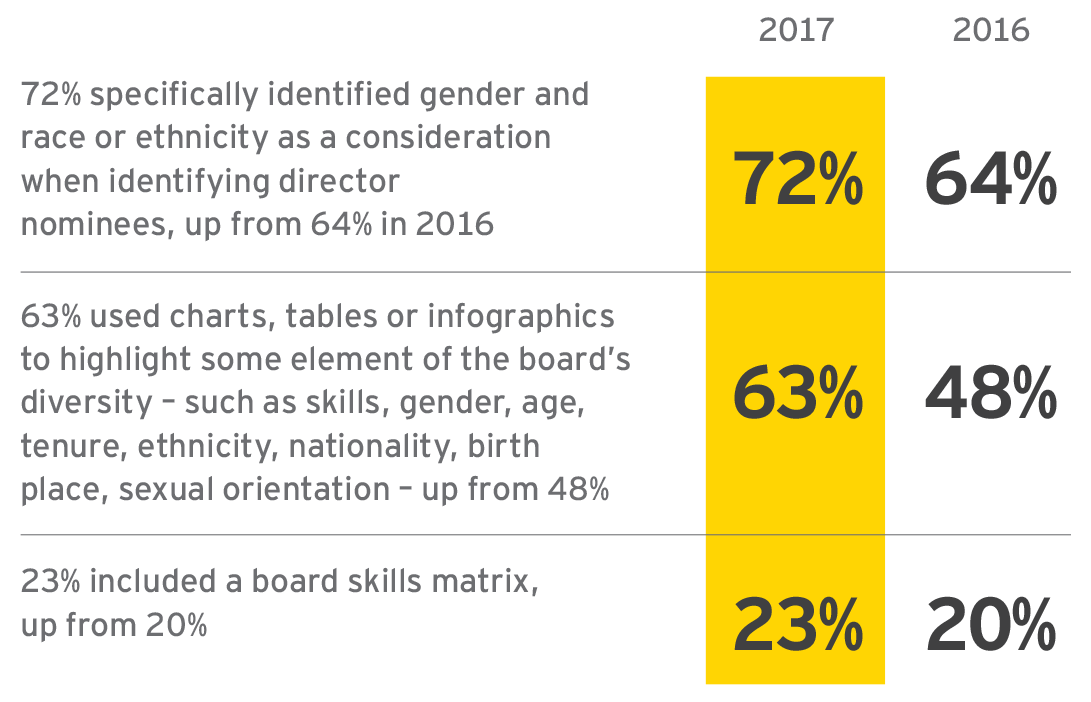
At the same time, companies are expanding voluntary disclosures around board composition. Our review of Fortune 100 disclosures around board composition found that:

While diverse director candidates are in high demand and related shifts in board composition are underway, these developments may be slow to manifest. For example, consider that the average Fortune 100 board has 10 seats. In this context, the addition of a single new director is unlikely to dramatically shift averages in terms of gender diversity, age, tenure or other considerations.

That said, whether a board’s pace of change is sufficient depends on a company’s specific circumstances and evolving board oversight needs. Boards should challenge their approach to refreshment, asking whether they are meeting the company’s diversity, strategy and risk oversight needs. Waiting for an open seat to nominate a diverse candidate may mean waiting for the value that diversity could bring.

In 2018, we anticipate that companies will continue to offer more voluntary disclosure on board composition, showing how their directors represent the best mix of individuals for the company—across multiple dimensions, including a diversity of backgrounds, expertise, skill sets and experiences.


Key findings

1. Most Fortune 100 companies welcomed a new independent director in 2017


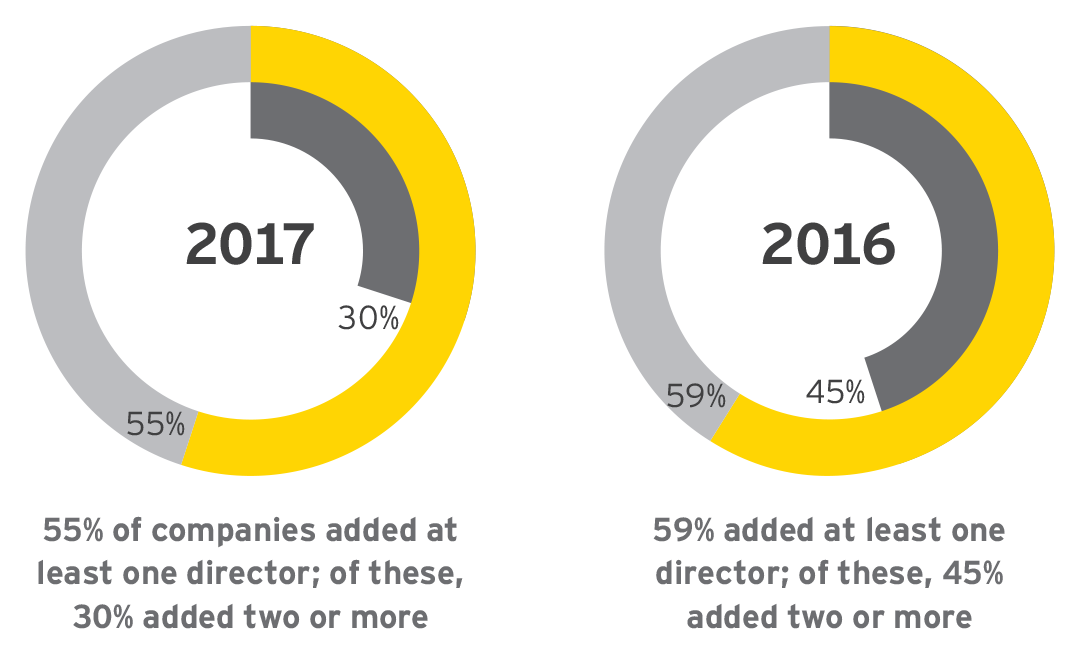
This past year, over half of the Fortune 100 companies we reviewed added at least one independent director. This figure is a little lower than the prior year; but overall, during the two-year period from 2016 to 2017, over 80% of the companies added at least one independent director. Taking into account director exits—whether due to retirement, corporate restructuring, pursuit of new opportunities or other reasons—we found that nearly all of the companies experienced some type of change in board composition during this period.

2. The class of 2017 brings greater finance and accounting, public policy and regulatory, and operational skills to the table.


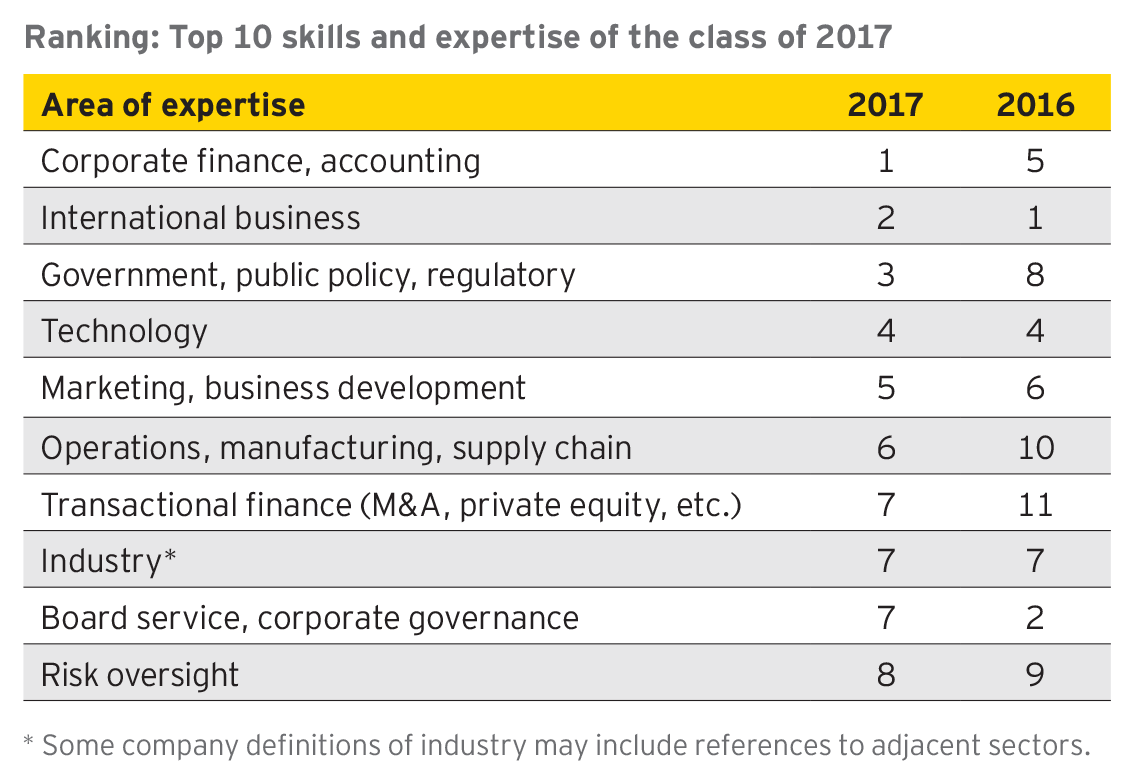
Corporate finance and accounting were the most common director qualifications cited by companies in 2017, up from fifth in 2016. A couple areas saw notable increases: government and public policy, operations and manufacturing, and transactional finance. This year, some areas tied in ranking, and in a twist, corporate references to expertise in strategy fell from third in 2016 to below the top 10 categories of expertise. Companies also made fewer references to board service or governance expertise compared to the prior year.

3. Most of the 2017 entering class was assigned to audit committees.


The strength of corporate finance and accounting expertise of the entering class is seen, too, with regards to key committee designations. Of the three “key committees” of audit, compensation, and nominating and governance, the 2017 entering class was primarily assigned to serve on audit committees. A closer look at the disclosures shows that 63% of the new directors that were assigned to the audit committee were formally designated as audit committee financial experts. In comparison, the corresponding figure in the prior year was 59%.


4. The Fortune 100 class of 2017 includes more non-CEOs.


While experience as a CEO is often cited as a traditional first cut for search firms, 54% of the entering class served in other roles, with non-CEO backgrounds including other executive roles or non-corporate backgrounds (academia, scientific organizations, nonprofits, government, military, etc.). This represents a slight increase from 2016 with most of the shift stemming from individuals holding or having held other senior executive positions. Approximately 30% appear to be joining a Fortune 100 public company board, having never previously served on a public company board—similar to 2016.

5. The class of 2017 is 40% female


As in the prior year, 40% of the entering class were women, but overall percentages were largely unchanged, with women directors averaging 28% board representation compared to 27% in 2016. Also, there was minimal age difference, with the women directors averaging 57 compared to 58 for male counterparts. Among the directors bringing the top categories of expertise, women directors accounted for over one-third of the disclosed director qualifications. In some cases, they represented over half of the disclosed category of expertise.

6. The class of 2017 tends to be younger


There appears to be an ongoing shift toward younger directors. For the class of 2017 entering directors, the average age of these individuals was 57, compared to 63 for incumbents and 68 for exiting directors. Of the entering class, 15% were under 50, an increase from 9% in the prior year. And, for the second consecutive year, we observe that over half of the entering class was under the age of 60. Exiting directors largely continue to be age 68 or older.

Questions for the board to consider


– How is the company aligning the skills of its directors—and that of the full board—to the company’s long-term strategy through board refreshment and succession planning efforts? How is the company providing voluntary disclosures around its approach in these areas?

– Does the company’s pool of director candidates challenge traditional search norms such as title, age, industry and geography?

– How is the company addressing growing investor and stakeholder attention to board diversity, and is the company providing disclosure around the diversity of the board—defined as including considerations such as age, gender, race, ethnicity, nationality—in addition to skills and expertise?

______________________________________________________________________________________

*Steve W. Klemash is Americas Leader, Kellie C. Huennekens is Associate Director, and Jamie Smith is Associate Director, at the EY Center for Board Matters. This post is based on their EY publication.

Les femmes CEO des grandes entreprises ont-elles une rémunération plus élevée que leurs homologues masculins ? Leurs CA comptent-ils plus de femmes ?


Les femmes PDG (CEO) des grandes entreprises ont-elles une rémunération plus élevée ? Leurs conseils d’administration sont-ils plus diversifiés, et comptent-ils plus de femmes ?

Ce billet publié par Dan Marcec, directeur d’Equilar, paru sur le forum de la Harvard Law School, tente d’apporter une réponse à ces questions.

On peut retenir que les femmes CEO, en général, comptent légèrement plus de femmes sur leurs conseils.

Le nombre de femmes sur les CA varie selon la taille des entreprises. Plus l’entreprise est grande, plus le CA est susceptible de compter un nombre plus important de femmes :

Equilar 100 Gender Diversity Index,  24 %

Fortune 500,  22,5 %

Fortune 501-1000,  19,2 %

Entreprises plus petites,  14,1 %

Également, la rémunération des femmes CEO des 100 plus grandes entreprises (8 femmes) est de 21,4 M $ comparativement à la moyenne des 92 hommes CEO qui est de 16,4 M $, une différence significative, mais sur un petit échantillon de femmes CEO !

Je vous invite à prendre connaissance de l’article ci-dessous afin de mieux saisir toutes les nuances de cette étude.

Bonne lecture !


Do Women CEOs Earn More and Have More Diverse Boards?


Résultats de recherche d'images pour « Les femmes CEO des grandes entreprises ont-elles une rémunération plus élevée que leurs homologues masculins ? Leurs CA comptent-ils plus de femmes ? »


As gender equity and diversity in corporate leadership continue to be critical discussions, research is regularly published showing links between these factors and company performance. Based on an analysis of Equilar 100 companies—the largest U.S.-listed firms to file proxy statements to the SEC before March 31—women CEOs had a higher representation of women on their boards on average than companies led by male counterparts. They also were awarded higher compensation on average in 2017.

Overall, Equilar 100 companies with women CEOs had an average of 24.0% representation of women on their boards, vs. 23.5% for the companies with male CEOs. Furthermore, the women in the CEO position at Equilar 100 companies were well paid in 2017 with an average pay package of $21.4 million. By comparison, the men who were on the list received an average pay package of $16.4 million. The following two questions examined this data just below the surface, finding that the complete picture is more complicated than it appears.


Do Women CEOs Bring More Females Into the Boardroom?


The Equilar 100 study analyzed recently reported data for fiscal year 2017, including eight women CEOs, a drop from nine the previous year. While Meg Whitman has since left her position at Hewlett Packard Enterprise, she was still in the CEO position during the periods studied, so HPE is included in the analysis.

The answer to the question above—based on an analysis of Equilar 100 data—is yes, companies with women CEOs do have slightly more women in the boardroom. The list of Equilar 100 companies that had women CEOs in 2017 is below, inclusive of their current board composition as of March 31.


Company % Female Board Members Average Board Age Average Board Tenure
Hewlett Packard Enterprise Co 38.5% 62.0 2.4
General Dynamics Corp 27.3% 64.0 5.9
Progressive Corp 27.3% 62.0 9.8
Oracle Corp 25.0% 70.5 14.4
Pepsico Inc 23.1% 63.0 5.5
IBM 20.0% 64.0 6.3
Lockheed Martin Corp 16.7% 66.0 6.6
Duke Energy Corp 14.3% 66.0 4.9
Women CEO Average 24.0% 64.7 7.0
Men CEO Average 
23.5% 63.0 7.2


There are two important factors to consider that give pause in definitively being able to say “women CEOs at Equilar 100 companies lead in gender diversity on boards.” While the numbers are clear—and they are—large-cap companies are much more likely to have women on their boards overall.

According to the recent Equilar Gender Diversity Index, Fortune 500 companies included in the Russell 3000 had an average of 22.5% women on their boards, as compared to 19.2% for Fortune 501-1000 companies and a much lower 14.1% for R3K firms outside the Fortune 1000. The Equilar 100 overall outpaced each of these groups.

It’s also worth noting that most CEOs are also on their own boards. Therefore, if CEOs were removed from the overall numbers, it’s likely the data would show Equilar 100 boards being more inclusive of independent women directors when a male CEO is in place.


The facts are the facts—boards at Equilar 100 companies led by women have a higher percentage of female directors than their counterparts. However, the small sample size—pointing to the lack of women in leadership overall—and these other mitigating factors make a definitive statement difficult to prove.


Do Women CEOs Make More Than Men?


While the women on the Equilar 100 list make more on average than the men, the caveat, of course, is that these numbers reflect a small sample size of women. To get to the eight highest-paid women on the list, you have to go all the way to number 87, whereas you don’t have to leave the top 10 to find the eight highest-paid men. The list of women on the Equilar 100 list (as well as their compensation rank) is below.


Company CEO 2017 Total Compensation ($MM) Equilar 100 RANK
Oracle Corp Safra A. Catz $40.7 4
Pepsico Indra K. Nooyi $25.9 7
General Dynamics Corp Phebe N. Novakovic $21.2 14
Duke Energy Corp Lynn J. Good $21.1 15
Lockheed Martin Corp Marillyn A. Hewson $20.2 16
IBM Virginia M. Rometty $18.0 30
Hewlett Packard Enterprise Margaret C. Whitman $14.8 60
Progressive Corp Susan P. Griffith $9.2 87
Women Ceo Average (N=8) $21.4
Men CEO Average 
(n=92) $16.4


Furthermore, similar to the findings on board composition, the larger the company, the higher the pay. Given the context of the Equilar 100 study more generally—that the largest companies by revenue tend to pay their CEOs more—this small sample size is not sufficient to make a claim that women CEOs earn more than men.

For example, using fiscal year 2016 data, it’s clear that the Equilar 100 stands out over all other public companies. (Since the Equilar 100 is an “early look” at proxy season, comprehensive data is not yet available for these other company groups in 2017.) In 2016, Equilar 100 CEOs were awarded $15.0 million at the median, in comparison to $11.0 million for Equilar 500 companies, and just $6.1 million for all public companies with more than $1 billion in revenue.


In other words, as with board composition, the numbers do indicate that women CEOs earn more than men at face value, but there is more than meets the eye. Ultimately, proof of greater equity in executive compensation and board diversity when women are CEOs is inconclusive from this analysis, highlighting the importance of questioning numbers at face value. Indeed, an academic study was released recently that found there is no meaningful difference in pay between men and women at the CEO level. Each company’s compensation and board refreshment strategy is unique to their circumstances, and monolithic assumptions are not always fair. The gravity of these decisions pored over by each board of directors and their executive teams spotlights the rise of shareholder scrutiny and direct engagement on these matters.

Abrègement de la durée des fonctions de CEO | Une étude d’Equilar


Voici une étude d’Equilar qui montre une diminution constante dans la durée d’exercice des CEO aux États-Unis au cours des 5 dernières années.

Le rapport a été publié par Dan Marcec directeur des communications de la firme.

Ainsi, la présence en poste des CEO est passée d’une médiane de 6 ans, en 2013, à 5 ans, en 2017.


On note également que plus du quart des CEO restent en poste plus de 10 ans, comparativement à 38,1 % qui sont en poste entre un an et cinq ans.


L’article présente également un tableau qui montre les raisons des départs des CEO : (1) démissions (2) retraites (3) congédiement. On note que seulement 10 CEO ont été congédiés sur une période de dix ans. On peut dire que l’emploi est assez stable !


Enfin, l’étude montre que l’accroissement du taux des départs n’a pas donné lieu à des progrès dans le cadre de la diversité. En effet, comme le montre le tableau suivant, le nombre de femmes CEO de grandes entreprises est passé de 3,7 %, en 2013, à 5,6 % en 2017. La fonction de CEO dans ces entreprises est encore réservée presque exclusivement aux hommes.


Vous pouvez prendre connaissance de cet article paru sur le site du Harvard Law School Forum :

CEO Tenure Rates

Quelle est l’influence des femmes CEO sur la structure de gouvernance des entreprises ?


Ceux qui se posent des questions sur l’influence que peut avoir une femme CEO sur la structure de gouvernance des entreprises seront certainement très intéressés par cette recherche de Melissa B. Frye, professeure de finance à l’University of Central Florida, et Duong T. Pham, professeur de finance à la Georgia Southern University.

L’étude montre que bien qu’il y ait encore peu de femmes qui occupent ces positions de pouvoir (5,4 % du S&P 500), il y a une différence significative dans les comportements des CEO masculins et féminins eu égard aux structures de gouvernance qui résultent de leurs actions managériales.

L’analyse des données en surprendra assurément plusieurs. En ce qui me concerne, c’est la première fois que je constate une telle évidence dans les comportements associés au genre.

Voici donc comment les auteurs résument les résultats de leur recherche :

« Using a sample of publicly traded firms in the U.S., we focus specifically on board characteristics that alter the efficiency of the monitoring of the board and are also influenced by the CEO. To capture monitoring intensity we use board size, board independence, the ratio of inside to outside directors, the gender diversity of the board, the board network, director age, interlocking directors, board attendance, and an aggregate board monitoring measure. We find that female CEOs are associated with boards of directors that are smaller, consist of more independent directors, have a lower ratio of inside to outside directors, are more gender diversified, have a broader director network, are composed of younger directors and are in general structured for more intense monitoring of the CEOs relative to the industry median, consistent with our first hypothesis ».

Toute étude comporte son lot de forces et faiblesses. Dans le cas de cette recherche quels sont vos questionnements et vos commentaires ?

Bonne lecture !


CEO Gender and Corporate Board Structures


In our article, CEO Gender and Corporate Board Structure (forthcoming in the Quarterly Review of Economics and Finance), we investigate the relationship between the gender of the CEO and corporate board structures. In recent years, women have made strides in cracking the glass ceiling in leadership positions in corporate America. Female CEOs have been appointed not only in female-friendly industries such as healthcare and consumer products but also in fields that are traditionally dominated by their male counterparts such as energy, utilities or automotive. The number of female CEOs leading S&P 500 companies reached a record high in 2016 with 27 women at the helm of these firms. However, women CEOs only make up 5.4% of the total S&P 500 CEO positions.

A growing body of academic research in finance shows that gender matters in terms of value enhancing decision making. Studies have documented that male executives carry out more acquisitions and issue more debt than their female counterparts, consistent with men being more overconfident than women and less effective corporate decision makers. Research has also shown that firms run by female CEOs have lower leverage, less volatile earnings, and a higher chance of survival than male CEO firms.

Since corporate governance helps mitigate agency conflicts between managers and shareholders of the firm, a good governance system is believed to enhance firm value. In our study, we focus on what is viewed as the most important governance mechanism for shareholders. The board of directors are trusted with monitoring and advising the firm’s management and protecting shareholders’ interests. While the literature has explored mechanisms that are associated with effective governance, the question of whether behavioral differences, associated with the gender of the CEO, play a role in shaping monitoring structures has not been addressed. Thus, we examine whether the “woman effect” in corporate decisions and performance extends to board structures. Essentially, we explore whether behavioral differences between men and women may lead to different board structures.

Whether female CEOs are associated with boards structured for more or less monitoring is an empirical question. To explore this, we consider three hypotheses based on documented behavioral differences between males and females. First, female CEOs may establish boards with greater monitoring. The channel between more board monitoring and gender comes from the literature on negotiations, overconfidence, and stereotyping. Several prior studies report that women perform worse than men at the negotiation table. Basic agency theory would suggest that all CEOs prefer less monitoring. Thus, if females are less savvy negotiators, they may not bargain as effectively with respect to board structure. Likewise, differences in overconfidence may lead to greater board monitoring. A male CEO may overestimate his ability and underestimate the role of board monitoring, thus he may seek to reduce board monitoring relative to a less overconfident female CEO. Stereotyping and/or discrimination on the part of the board may motivate directors to force stricter monitoring on a female CEO. Second, we consider that gender-based differences may lead to less monitoring of female CEOs. The conduit for less board monitoring for female CEOs comes from the perception that women leaders would simply need less monitoring. The overconfidence theory may suggest that boards would be less inclined to intensely monitor female CEOs, since women leaders may make better decisions. Third, it is also possible that male and female CEOs will not differ in terms of board structures. Essentially, females that make it to the top of a publicly traded firm may exhibit very similar behavioral characteristics as their male counterparts.

Using a sample of publicly traded firms in the U.S., we focus specifically on board characteristics that alter the efficiency of the monitoring of the board and are also influenced by the CEO. To capture monitoring intensity we use board size, board independence, the ratio of inside to outside directors, the gender diversity of the board, the board network, director age, interlocking directors, board attendance, and an aggregate board monitoring measure. We find that female CEOs are associated with boards of directors that are smaller, consist of more independent directors, have a lower ratio of inside to outside directors, are more gender diversified, have a broader director network, are composed of younger directors and are in general structured for more intense monitoring of the CEOs relative to the industry median, consistent with our first hypothesis.

In general, we provide strong evidence that female CEOs are associated with boards of directors that are significantly different in structure from their male counterparts. Our results are consistent with gender-based behavioral differences in negotiation, overconfidence, and/or discrimination leading to greater board monitoring at female-led firms. Prior literature shows that better governance is viewed positively by the market and leads to better performance. Activists and regulators also put significant weight on effective monitoring. In light of this, our study supports the push to increase the number of women leaders. Our findings suggest female CEOs welcome board monitoring and stronger governance structures.

The complete article is available for download here.

La gouvernance relative aux sociétés en 2017 | Un « Survey » des entreprises du SV 150 et de la S&P 100


Au début de la nouvelle année 2018, il est intéressant de connaître les tendances les plus marquantes dans les entreprises cotées en bourse.

L’enquête menée par David A. Bell*, associé de la firme Fenwick & West, est assez instructive à cet égard. Dans l’ensemble, l’année 2017 n’a pas connu de changements très significatifs dans les règles de gouvernance.

Cependant, l’étude est intéressante au regard des différences entre les entreprises de la Silicone Vallée 150 Index (SV 150) et les entreprises de la Standard & Poor’s 100 Index (S&P 100). Voici un sommaire des résultats :


Structure de classe d’actions multi votantes


Il y a peu de différences entre les deux groupes d’entreprises, soit environ 10 % pour le SV 150 et 9 % pour la S&P 100.


Règles de composition des conseils d’administration (Classified Boards)


Cette année, on a constaté peu de changements dans les règles de composition des conseils d’administration dans les deux groupes d’entreprises : 6,7 % pour le groupe SV 150 et 4 % pour le groupe S&P 100.


Vote majoritaire


C’est le domaine où il y a eu les changements les plus significatifs. Ainsi, presque toutes les entreprises de la S&P 100 ont adopté le vote majoritaire pour l’élection des administrateurs tandis que pour les entreprises du SV 150, l’adoption de la règle du vote majoritaire est passée de 0 à 60 % en 2 ans.


Directives concernant l’acquisition d’actions par les administrateurs


Les entreprises des deux groupes ont émis des directives concernant (1) le minimum de possession d’actions et (2) la période requise de rétention des actions. Mais, dans l’ensemble, on assiste à une augmentation continue des acquisitions d’actions par les administrateurs et les dirigeants dans les deux groupes.


 Politiques de distribution d’actions avec droit de vote comme mode de rémunération


Il y a une nette tendance au maintien des politiques de distribution d’actions avec droit de vote comme mode de rémunération des administrateurs et des dirigeants dans le groupe du SV 150. Cette rémunération en actions est beaucoup plus importante dans ce groupe que dans le groupe de la S&P 100.


La diversité au conseil


La présence de femmes sur les conseils d’administration est toujours en augmentation : 25,4 % des administrateurs dans le SV 150 et 23,9 % dans la S&P 100.


Taille des CA, fréquence des réunions du conseil et structures de leadership


Il existe toujours une différence importante entre les deux groupes eu égard à la dualité des rôles de présidents du conseil et PDG de l’entreprise. La dualité est présente dans 33 % des entreprises du SV 150 et dans 72 % des entreprises de la S&P 100. La fréquence des réunions du CA a diminué dans les deux groupes.

Les administrateurs provenant de la direction sont plus nombreux dans les entreprises du SV 150, bien qu’en constante diminution depuis plusieurs années.

La taille des CA est en diminution dans les entreprises du SV 150 et elle nettement plus petite que dans les entreprises de la S&P 100.


Propositions d’actionnaires


On constate une diminution de l’activisme des actionnaires dans les deux groupes d’entreprises. En fait, on note une seule contestation d’élection des administrateurs en 2017.


Officiers de la hautes direction


On note une diminution du nombre de hauts dirigeants dans les deux groupes d’entreprises bien que le déclin soit beaucoup plus marqué dans les entreprises du SV 100. En outre, on assiste à une croissance soutenue des postes de Secrétaire corporatif  « exécutif » et de Chef exécutif des technologies.


Pour plus de détails concernant ces résultats, veuillez consulter l’article ci-dessous, publié sur le site de la Harvard Law School  Forum on Corporate Governance.

Bonne lecture et bonne année 2018.


Corporate Governance Survey—2017 Proxy Season


Résultats de recherche d'images pour « gouvernance des sociétés cotées »
L’Actualité IFA de la gouvernance des sociétés


Since 2003, Fenwick has collected a unique body of information on the corporate governance practices of publicly traded companies that is useful for Silicon Valley companies and publicly‑traded technology and life science companies across the U.S. as well as public companies and their advisors generally. Fenwick’s annual survey covers a variety of corporate governance practices and data for the companies included in the Standard & Poor’s 100 Index (S&P 100) and the technology and life science companies included in the Silicon Valley [1]


Significant Findings


Governance practices and trends (or perceived trends) among the largest companies are generally presented as normative for all public companies. However, it is also somewhat axiomatic that corporate governance practices should be tailored to suit the circumstances of the individual company involved. Among the significant differences between the corporate governance practices of the SV 150 technology and life science companies and the uniformly large public companies of the S&P 100 are:

Dual‑Class Voting Stock Structure.

Adoption of dual-class voting stock structures has emerged as a recent clear trend among Silicon Valley technology companies—among the mid-to-larger SV 150 companies—though it is still a small percentage of companies. Historically, dual-class voting stock structures have been significantly more common among S&P 100 companies than among SV 150 companies, though the frequency in the SV 150 (11.3% in 2016 to 10.9% in 2017) has surpassed the S&P 100 (9.0% in both 2016 and 2017) in recent years.

Classified Boards

Classified boards are now significantly more common among SV 150 companies than among S&P 100 companies. Compared to the prior year, classified boards remained fairly consistent, holding steady at 6.7% for the top 15 companies in the SV 150 while the S&P 100 has been at 4.0% since 2016.

Majority Voting

The rate of implementation of some form of majority voting has risen substantially over the period of this survey. The increase has been particularly dramatic among S&P 100 companies, rising from 10% to 97% between the 2004 and 2017 proxy seasons. Among SV 150 companies, the rate has risen from zero in the 2005 proxy season to 59.9% in the 2017 proxy season.

Stock Ownership Guidelines

The prevalence of stock ownership guidelines has generally increased over time in both groups but the SV 150 only recently surpassed the level of the S&P 100. This year’s edition of the survey includes additional detail regarding the minimum holding amount and period requirements for executives and directors.

Executives and Directors ‑ Equity, Voting Power Ownership

There is a clear multi-year trend that the distribution of simple equity ownership and voting power ownership skews higher among technology and life sciences companies in the SV 150 than among S&P 100 companies.

Board Diversity

2017 continued the long-term trend in the SV 150 of increasing numbers of women directors and declining numbers of boards without women members. The rate of increase in women directors for SV 150 overall continues to be higher than among S&P 100 companies. When measured as a percentage of the total number of directors, the top 15 of the SV 150 now slightly exceed their S&P 100 peers (the top 15 averaged 25.4% women directors in the 2017 proxy season, compared to 23.9% in the S&P 100). Companies with at least one woman director went from 74% to 78.2% over the past year for the SV 150. Over a two-year period the percentage of companies with at least one woman director grew by 10 percentage points.

Board Size, Meeting Frequency, Leadership

Combined chair/CEOs existed at about one third of companies in the SV 150, while combined chair/CEOs exist at about 72% of S&P 100. SV 150 companies held board meetings more often in fiscal 2016, while S&P 100 companies decreased meeting frequency in 2016 (companies report meetings for the prior year). SV 150 companies, though, continued to skew noticeably toward fewer meetings compared to the S&P 100. Insider directors are more common among members of the boards of SV 150 companies than among board members at S&P 100 companies, though continuing a long-term downward trend. The number of directors also tends to be substantially lower among SV 150 companies than among S&P 100 companies.

Stockholder Proposals

Stockholder activism—measured in the form of proposals included in the proxy statements of companies—is substantially lower among the SV 150 than among S&P 100 companies. There is a current general downward trend of stockholder activism in both groups, although the SV 150 has had an upward trend in number of proposals in recent years. This year each group had just one contested director election. For more detail, please see our post, Silicon Valley and S&P 100: A Comparison of 2017 Proxy Season Results.

Executive Officers

The number of executive officers tends to be substantially lower among SV 150 companies than among the S&P 100, and there continues to be a general decline in the average number of executive officers per company in both groups. By contrast, the percentage of companies including General Counsel, Chief Legal Officer or Chief Technology Officer or engineering executive as “executive officers” have been on a long-term upswing.

Complete Coverage

In complete publication, available here, we present statistical information for a subset of the data we have collected over the years, updating for the 2017 proxy season. These include:

– makeup of board leadership

– number of insider directors

– gender diversity on boards of directors

– size and number of meetings for boards and their primary committees

– frequency and number of other standing committees

– majority voting

– board classification

– use of a dual‑class voting structure

– frequency, coverage and details of executive officer and director stock ownership guidelines

– frequency and number of shareholder proposals

– number and makeup of executive officers

In each case, comparative data is presented for the S&P 100 companies and for the high technology and life science companies included in the SV 150, as well as trend information over the history of the survey. In a number of instances we also present data showing comparison of the top 15, top 50, middle 50 and bottom 50 companies of the SV 150 (in terms of revenue), [2] illustrating the impact of company size or scale on the relevant governance practices.

The complete publication is available here.

———————————————————————————————–

Endnotes

1The S&P 100 is a cross‑section of companies across industries, but is not a cross‑section of companies across all size ranges (it represents the largest companies in the United States). While the SV 150 is made up of the largest public companies in Silicon Valley by one measure—revenue, it is actually a fairly broad cross‑section of companies by size, but is limited to the technology and life science companies based in Silicon Valley. Compared to the S&P 100, SV 150 companies are generally much smaller and younger, have lower revenue. The 2017 constituent companies of the SV 150 range from Apple and Alphabet with revenue of approximately $218B and $90B, respectively, to Aemetis and DSP Group with revenue of approximately $143M and $138M, respectively, in each case for the four quarters ended on or about December 31, 2016. Apple went public in 1980, Alphabet (as Google) in 2004, Aemetis in 2007 and DSP Group in 1994. Apple and Alphabet’s peers clearly include companies in the S&P 100, of which they are also constituent members (eight companies were constituents of both indices for the survey in the 2017 proxy season), where market capitalization averages approximately $130B. Aemetis and DSP Group’s peers are smaller technology and life sciences companies that went public relatively recently and have market capitalizations well under $1B. In terms of number of employees, the SV 150 averages 9,500 employees (with a median of 1,800 employees), ranging from Hewlett Packard Enterprise with 195,000 employees spread around the world in dozens of countries, to companies such as Aemetis with 144 employees in the United States and India, as of the end of their respective fiscal years 2016. The S&P 100 averages 130,000 employees and includes Wal‑Mart with 2.3 million employees in more than two dozen countries at its most recent fiscal year-end.(go back)

2The top 15, top 50, middle 50 and bottom 50 companies of the SV 150 include companies with revenue in the following respective ranges: $8.4B or more, $1.6B or more, $380M but less than $1.6B, and $138M but less than $375M. The respective average market capitalizations of these groups are $178.8B, $66B, $3.3B and $1.2B.(go back

________________________________________________

*David A. Bell is partner in the corporate and securities group at Fenwick & West LLP. This post is based on portions of a Fenwick publication titled Corporate Governance Practices and Trends: A Comparison of Large Public Companies and Silicon Valley Companies (2017 Proxy Season); the complete survey is available here.

Évolution dans la composition des conseils d’administration aux É.U.


Les changements apportés à la gouvernance des entreprises passent souvent par un renouvellement du membership du conseil d’administration.

Le document publié par Spencer Stuart intitulé 2017 Spencer Stuart Board Index montre que les pressions sont de plus en plus grandes, notamment de la part des investisseurs institutionnels, pour moduler la composition du CA.

Ainsi, tel que le rapporte Julie Daum, Laurel McCarthy et Ann Yerger, dans une publication de Spencer Stuart, les changements sont assez importants, bien que jugés encore trop lents.

Vous trouverez, ci-dessous un résumé de cette publication ainsi que dix (10) suggestions à considérer afin de poursuivre dans la voie du renouvellement de la composition des conseils d’administration.

En cette période des fêtes de Noël et de la nouvelle année, je vous souhaite une lecture agréable et profitable.

Jacques Grisé, Ph. D., F.Adm.A.

Éditeur de ce blogue en gouvernance


Board Composition: A Slow Evolution


Résultats de recherche d'images pour « composition du conseil d'administration spencer stuart »
Conseils d’administration : mesdames, il y a des places à prendre !


Interest in the composition of U.S. boards has never been greater. Pressure for change is coming from many fronts, particularly from institutional and activist investors. We have been tracking board composition issues for more than 30 years, and as the data from our 2017 Spencer Stuart Board Index show, U.S. boards are evolving, slowly.

– The number of new independent directors elected to S&P 500 boards during the 2017 proxy year rose to 397, the most since 2004 and an increase of 15% from 2016.

– For the first time in the history of our survey, just over half (50.1%) of incoming independent directors on S&P 500 boards are women or minorities.

– A record-breaking 45% of the new S&P 500 independent directors are serving on their first public company board.

– Boards are seeking talent beyond C-suite chairs, CEOs, presidents or COOs. Slightly more than a third of new independent directors are active or retired C-suite executives, down from 47% 10 years ago.

– Fewer active CEOs serve on boards. Today only 37% of S&P 500 CEOs serve on one or more outside public company boards, down from 52% 10 years ago.

Calls for greater boardroom diversity—encompassing considerations such as gender, race, age, skills, qualifications and backgrounds—are on the rise. And boards are responding.

Director skills and experiences are changing. Nearly 20% of new independent S&P 500 directors have experience in the technology or telecommunications industries. Directors with backgrounds in banking, finance, investment or accounting are in high demand, representing 29% of new directors in 2017, up from 19% in 2007. Of this group, directors with investing and investment management experience are of particular interest. Thirteen percent (13%) of new directors come from the investment field, up from 5% a decade ago; less than 20% of these directors were appointed under publicized settlements with activist investors.

S&P 500 boards are opening their doors to directors without prior public board experience. These first-time independent directors are more likely than other new directors to be actively employed (64% versus 42%). They are less likely to be C-suite executives and more likely to have other executive experiences, such as division or subsidiary leadership. They are younger, with an average age of 55.2, compared to 57.3 for other incoming independent directors. They are also more likely to be diverse; more than half (55%) of this year’s incoming first-time directors are women or minorities, a significant jump from 37% a year ago.

Female representation among all new independent S&P 500 directors rose to 36% in 2017—the highest percentage we’ve ever tracked—while 20% of incoming independent directors are minorities, defined as African-American, Hispanic/Latino or Asian. (Six percent of the new directors are women and minorities.) Women are increasingly assuming leadership roles on S&P 500 boards, chairing 20% of audit committees, 17% of compensation committees and 22% of nominating committees, up from 15%, 11% and 20%, respectively, in 2016.

Despite these steps forward, the overall pace of change in boardroom diversity remains slow. With 48% of S&P 500 boards adding no directors, board turnover continues to be low and hinders change to the overall composition of U.S. boardrooms.

– Today 22% of all S&P 500 directors are women, up incrementally from 21% in 2016 and 17% in 2012.

– Minority representation at the top 200 S&P 500 companies is low. Seventeen percent (17%) of directors of the top 200 companies are male or female minorities, and representation of African-Americans and Hispanics/Latinos in the top 200 boardrooms has not significantly changed over the past five to 10 years.

Boardroom refreshment faces other headwinds. About three-quarters (73%) of S&P 500 boards report having a mandatory retirement age for directors, unchanged over the past five years, and boards continue to raise retirement ages. Today 42% of S&P 500 companies with retirement policies set their retirement age at 75 or older, compared with 22% in 2012 and just 11% in 2007. Meanwhile, the percentage of S&P 500 companies disclosing some form of individual director assessments is low (37%) and largely unchanged. The data suggest that rather than using evaluations to evaluate director fit in the boardroom, boards are relying on mandatory retirement ages as a primary mechanism for board refreshment.

10 ways boards can continue to evolve

Purposeful leadership by directors is required to continue the evolution in the boardroom. In our experience working with boards, the most effective strategies for building a board composed of the diverse portfolio of skills, qualifications, perspectives and backgrounds matched to the company’s current and future strategic objectives and risks include these 10 elements:

  1. Continuously review the board’s skill sets and performance relative to the company’s strategy and direction. The annual board self-evaluation is a natural platform for the board to review its composition and future needs so that it is in the best position to oversee management as new challenges and market opportunities emerge.

  2. Expand the use of peer and self-evaluations, which can be invaluable tools for providing feedback to and enhancing the performance of new and tenured directors, and for identifying gaps in boardroom skills and experiences.

  3. Take a hard look at formal policies—such as mandatory retirement policies—intended to promote turnover and evaluate whether the policies may be impeding refreshment.

  4. Understand that boardroom diversity, defined broadly but with an emphasis on gender and racial diversity, is of growing interest not just to investors, but also to other key company stakeholders, including employees, suppliers and customers. A tangible commitment to boardroom diversity will be increasingly important, and a “one and done” mentality will be challenged more often in the future, particularly as boards plan for anticipated board vacancies. One approach is to strive to interview several qualified candidates for every open board seat.

  5. Carefully define the expertise that is important for the board—for example, industry or functional knowledge, digital expertise or international experience. Be clear about the perspectives or expertise that the board is looking to gain.

  6. Foster an open mind about what a director candidate should look like and the different ways a director can contribute. Consider senior business unit or functional leaders, including younger executives who may be experts in specific areas such as e-commerce, digital marketing and cybersecurity.

  7. Avoid creating an overly long list of director qualifications, which can limit the talent pool. Be realistic about desired director qualifications; sitting CEOs today are serving on fewer (if any) outside boards. The selection process should cast a wide net and look for the best candidate—not just the one known to board members.

  8. Consider candidates without prior board experience. When assessing first-time candidates, look at their underlying capabilities and mindset—including what we call “board intrinsics,” attributes such as intellectual approach, independent-mindedness, integrity, interpersonal skills and inclination to engage—to understand how likely they are to be able to contribute as well-rounded directors. Spencer Stuart’s Board Intrinsics™ assessment approach focuses on these critical underlying talents and competencies. Candidates who score well in all five areas are most likely to be capable of contributing as “all-round” directors, in addition to the specific knowledge, skill or set of experiences that makes them of interest to boards.

  9. Establish a robust new director orientation program. All new directors—male and female, first-time and experienced—benefit from an orientation program that helps them quickly get up to speed on the business and the company’s approach to governance.

  10. Commit to transparency about board governance practices. With investor attention to board performance on the rise, boards are enhancing their disclosure about key areas of investor interest, including board composition and leadership, director tenure and turnover, board evaluation and performance, and shareholder engagement.

Comment se comporter lors de campagnes menées par des actionnaires activistes | Cinq conseils utiles


Vous trouverez, ci-dessous, une publication des auteurs Steve Wolosky*, Andrew Freedman, et Ron Berenblat, associés de la firme Olshan Frome Wolosky, qui présente, de façon intelligible, ce que les actionnaires activistes doivent prévoir lorsqu’ils décident de faire inscrire de nouveaux administrateurs sur la liste des candidats aux élections annuelles.

Au cours des dernières années, le phénomène de l’activisme a connu une progression assez substantielle. La gouvernance des entreprises passe souvent par une solide compréhension de ce que les actionnaires activistes cherchent à accomplir.

Les entreprises qui ont des lacunes dans la gouvernance (au conseil) et dans l’efficacité des hauts dirigeants (notamment du CEO) sont beaucoup plus susceptibles d’être la cible des campagnes activistes. Les conseils offerts par la firme Olshan Frome Wolosky sont très utiles, autant pour les actionnaires activistes, que pour les dirigeants des entreprises visés. Leurs recommandations à l’intention des activistes portent sur les cinq points ci-dessous.


– Il est temps de présenter des candidatures qui démontrent un souci marqué pour la diversité dans la composition du conseil d’administration. C’est l’un des plus importants critères des firmes de conseils en votation (ISS et Glass Lewis) et des investisseurs institutionnels.

– Lorsque les actionnaires activistes ciblent le CEO d’une organisation, ceux-ci sont invités à la prudence dans la présentation des arguments à l’actionnariat, car il est toujours délicat et difficile de s’attaquer à la tête dirigeante de l’entreprise.

– Les experts de la gouvernance et les groupes d’activistes ont essentiellement mis l’accent sur les opérations américaines. Cependant, au cours des dernières années, on assiste à un activisme de plus en plus international. Les auteurs incitent donc les actionnaires activistes à s’intéresser aux entreprises mondiales, en soulignant que le terrain est souvent plus propice à leurs activités dans certains pays, tels que la Corée du Sud, le Canada, etc. Certains mécanismes de défense légaux qui existent aux États-Unis sont absents des réglementations de plusieurs pays.

– Les auteurs mettent en garde les actionnaires activistes contre des propositions de candidatures considérées comme « illégitimes ». Il arrive que, dans la préparation de dossiers de candidatures de haut calibre, les activistes aient tendance à oublier la règle du maximum de cinq conseils pour un administrateur indépendant et de deux pour un CEO siégeant à d’autres conseils.

– Enfin, les auteurs soulignent le fait que les entreprises utilisent toutes sortes de moyens de défense pour éliminer les candidatures provenant des activistes. Pour eux, qui prêchent pour leurs paroisses, il est crucial de bien connaître les règlements intérieurs de l’entreprise ciblée ainsi que les mécanismes de nomination.


Bien entendu, la firme Olshan Frome Wolosky propose leurs services juridiques afin de maximiser les efforts des activistes !

J’espère que ce bref tour d’horizon du monde de l’actionnariat activiste vous sera utile dans la bonne gouvernance des entreprises dans lesquelles vous êtes impliqués.

Je vous souhaite donc une bonne lecture et j’attends vos commentaires.

Top 5 Things Shareholder Activists Need to Know


Résultats de recherche d'images pour « actionnaires activistes »


Nomination deadlines for the 2018 proxy season are fast approaching. Based on feedback from our shareholder activist clients and colleagues in the activism community, we are preparing for a very busy nomination season, which will begin to pick up steam in the next few weeks and continue into the new year. Drawing from our experience as the leading law firm to shareholder activists—including our involvement in delivering over 55 nomination letters during the past 12 months alone—and our views on current hot-button topics such as board diversity, global activism and the targeting of CEOs, Olshan’s Activist & Equity Investment Group presents you with its list of top 5 things activists should consider before nominating directors for the upcoming proxy season.


1. It’s Time to Diversify


We are beginning to advise our clients to include diversity as a key criterion in selecting their slates of nominees and, in the case of short-slate contests, identifying the incumbent directors they will seek to replace. Board diversity is currently one of the hottest corporate governance topics and will be highly relevant during the upcoming proxy season. In addition to highlighting the inequality engendered by the lack of diversity of current public company boards, there is abundant research showing a correlation between diverse boards and improved financial performance, corporate governance and accountability to shareholders.

As a result, numerous institutional investors have prioritized their efforts to foster greater diversity, particularly gender diversity, in the boardroom. Earlier this year, BlackRock stated that it will reach out to portfolio companies “to better understand their progress on improving gender balance in the boardroom.” Vanguard recently sent an open letter to public companies stating that over the coming years it will focus on gender diversity in the boardroom and that it “expect[s] boards to focus on it as well, and their demonstration of meaningful progress over time will inform our engagement and voting going forward.” State Street voted against the election of directors at 400 portfolio companies that it determined had failed to take adequate measures to address the absence of women in the boardroom. There is a high probability that one or more of these or other like-minded institutional investors will account for a meaningful percentage of the shareholder base in any domestic election contest initiated by an activist.

An activist’s likelihood of success in an election contest is inextricably tied to the qualifications and expertise of the activist’s director slate. Based on the unebbing wave of board diversity awareness and volume of research extolling the strengths of diverse boards, highly-qualified dissident nominees with diverse backgrounds not only improve the quality of the overall dissident slate—and are therefore more likely to be viewed favorably by shareholders—but are also more likely to be better positioned to advance the activist’s platform once elected to the board. For the same reasons, diversity should also be taken into consideration when evaluating which incumbent directors an activist may seek to replace in a short-slate election contest.


2. Beware of CEO “Bloodlust”


Departing from the early days of shareholder activism, there was a noticeable spike during the past year in the number of activist campaigns that sought the removal of members of their targets’ upper management, particularly CEOs. Elliott Management’s election contest against Arconic, which sought to hold CEO Klaus Kleinfeld directly accountable to shareholders, led to Kleinfeld’s departure during the late stages of the campaign. Pressure from Mantle Ridge resulted in the appointment of Hunter Harrison as the new CEO of CSX. After Marcato Capital ran a slate of directors at Buffalo Wild Wings and called upon the company to replace its CEO Sally Smith, Smith announced on the day of the annual meeting her intention to resign as CEO. Just six months later, Buffalo Wild Wings agreed to be acquired by Arby’s Restaurant Group for a hefty premium.

In a recently settled activist situation, Jeereddi Partners and Purple Mountain Capital initially nominated two director candidates for election at Tuesday Morning’s annual meeting, one of which was recruited specifically for the purpose of becoming the next CEO. Interestingly, in a communication to Tuesday Morning’s employees apprising them of the activist incursion, the existing CEO stated that the investor group’s tactic of seeking to replace him reflected a “new norm” of activism:

These activists also seek to have one of their candidates join the management team as CEO. This tactic used by activist investors is common in today’s market environment.

A Wall Street Journal article by David Benoit succinctly identified this trend in its headline—“Activist Investors Have a New Bloodlust: CEOs.”

Despite the growing number of activist campaigns targeting CEOs, activists should think long and hard before going for the jugular. While every situation is different, seeking to replace a director who is also the CEO (even in a short-slate contest) or calling for the ouster of a CEO as part of the activist’s platform in an election contest is still an aggressive strategy. Attempting to remove the principal executive officer of a company may not sit well with other institutional investors or the proxy advisory firms, depending on the facts and circumstances.

This topic was recently addressed by proxy advisory firm Institutional Shareholder Services (“ISS”) after one of the defense law firms publicly expressed its view that ISS should alter its analytical framework for reviewing proxy contests to take into account whether the dissident is seeking to replace a CEO/director. In commentary issued by ISS dismissing the need to change its analytical framework in this manner, ISS stated:

… the notion that ISS does not already view the targeting of a CEO as an unusual and significant factor—and thus worthy of careful consideration in a short-slate fight—would be a misrepresentation of our framework.

The removal of a CEO from a board represents a vote of no-confidence that carries further-reaching consequences than the removal of most other directors. However, in instances of demonstrably poor execution, operational issues, or undue management influence over the board, such targeting may be appropriate—provided that the consequent risks have been properly assessed.

ISS’ perspective on this topic is highly instructive and, in our view, should be applied broadly by an activist when evaluating whether to target a CEO. Activists should understand that the standard will be higher for obtaining shareholder support and ISS’ recommendation to remove the CEO from the board in an election contest. As ISS points out above, the facts and circumstances of a particular situation could make the targeting of a CEO appropriate, and hence a winning strategy for an activist. Nevertheless, activists should proceed with caution before going down this path.


3. Let’s Go Global


As the activism space gets more and more crowded in the U.S. as a result of an increasing number of activists and bloated war chests activist managers are tasked to deploy, opportunities abound in Europe, Asia and Australia. The corporate governance regimes of certain of these jurisdictions are actually more favorable to shareholders than in the U.S. and the breadth of legal and structural defenses that are commonly utilized by targets in the U.S. are not present in many of these countries. We would even characterize certain countries as “wide open” for shareholder activism. In South Korea, President Moon Jae-in and other government officials are actually inviting foreign shareholders to invest in South Korean companies and play activist roles in overseeing their investments as the administration attempts to promote a culture of accountability to foreign and minority shareholders that South Korea historically lacked.

Offshore campaigns recently commenced by U.S. activist titans are capturing headlines. Third Point is putting pressure on Swiss conglomerate Nestlé to improve productivity, divest non-priority assets and return capital to shareholders. Corvex Management successfully blocked Swiss chemical giant Clariant’s proposed merger with Huntsman. Elliott Management has multiple active situations in Europe, Asia and Australia.

These high-profile campaigns are not isolated incidents. Shareholder activists of all sizes and vintages are taking companies to task all over the globe. In fact, over 290 non-U.S. companies were publicly subjected to activist demands during 2017 (through October 31) according to Activist Insight Online. The action is not only in the U.S.

Activists who are willing to cast a wider net in evaluating potential situations may find prime opportunities abroad. Olshan has experience advising activists in Canada, Europe and Asia and has relationships with law firms, solicitors and consultants all over the globe who can advise on local securities laws, proxy mechanics and cultural considerations that are unique to each jurisdiction.


4. Don’t Go Overboard


Activists should make sure each of their director nominees complies with the “overboarding” guidelines of the two leading proxy advisory firms—ISS and Glass Lewis. Under the current ISS proxy voting guidelines, ISS will generally recommend a vote against or withhold from an individual director nominee who (i) serves on more than five public company boards, or (ii) is CEO of a public company who serves on the boards of more than two public companies (besides his or her own); provided that the negative vote recommendation will only apply to the CEO’s outside boards. ISS may give a positive recommendation for an overboarded nominee after he or she undertakes to gain compliance with the guideline by resigning from an existing directorship if elected at the meeting in question.

Under the Glass Lewis guidelines, Glass Lewis will generally recommend a vote against an individual director nominee who (i) serves on more than five public company boards, or (ii) is an executive officer of a public company while serving on a total of more than two public company boards. Glass Lewis may refrain from making a negative vote recommendation on overboarded nominees if provided with “sufficient rationale” for their board service.

Given the importance of obtaining ISS and Glass Lewis support in most election contests, it is critical that activists take measures to ensure that their nominees are not overboarded. This can be done by requiring prospective nominees to provide updated bios or resumes, including all current directorships and executive officer positions. This is typically covered by Olshan’s form of nominee questionnaire we recommend all our activist clients obtain from their prospective nominees prior to nominating. Nominees should also be made aware of the overboarding requirements and reminded to consult with the activist before accepting additional directorships or executive officer positions prior to the meeting date.


5. Sweat the Mechanics


Failure to pay close attention to the mechanics involved in the nomination process could allow the target company to gain the upper hand or even derail the activist’s campaign in its entirety. Activists who are in the process of evaluating a potential campaign should contact us early in the process so we can begin to identify and work through all the mechanics, which could be complex and involve more than just putting shares in record name in order to validly nominate.

Understanding the company’s advance notice procedures for nominating directors typically contained in the bylaws is critical from both a timing and strategic standpoint. Activists should not necessarily rely on any nomination deadline set forth in the prior year’s proxy statement as these deadlines are often erroneously calculated by the company under the advance notice procedures contained in the bylaws or confused with the Rule 14a-8 deadline due to sloppy drafting. Allowing us sufficient time to review the nomination procedures in the bylaws will ensure that everyone is working with the correct nomination deadline and monitoring the company’s public filings and press releases for the meeting date. This is critical as under most nomination procedures, companies have the ability to accelerate the nomination deadline by announcing a meeting date that is a certain number of days (typically more than 30 or 60 days) before the anniversary of the previous year’s meeting.

Companies are artfully expanding their nomination procedures in order to flush out activists earlier in the process and to make it more expensive for them to nominate. For example, there is a good chance the nomination procedures will contain a requirement that the dissident nominees complete and sign the target company’s director questionnaires for inclusion in the activist’s nomination package. If this is the case, we will need to reach out to company counsel in order to obtain the form of questionnaire prior to the nomination deadline. Getting us involved early can allow us to ensure that the company does not use the nominee questionnaire requirement as a defensive tactic. We are aware of companies whose nomination procedures give them up to 10 days to provide the form of questionnaire after one has been requested by a shareholder. For such companies, we would need to request the form of questionnaire more than 10 days prior to the nomination deadline in order to be in a position to receive the form of questionnaire and submit a complete nomination package prior to the deadline. Otherwise, the company would be permitted to wait until after the nomination deadline before providing a form of questionnaire, thereby preventing the activist from being in technical compliance with the advance nomination procedures.

_____________________________________________________________

*Steve Wolosky, Andrew Freedman, and Ron Berenblat are partners at Olshan Frome Wolosky LLP. This post is based on an Olshan publication by Mr. Wolosky, Mr. Freedman, and Mr. Berenblat. Related research from the Program on Corporate Governance includes Dancing With Activists by Lucian Bebchuk, Alon Brav, Wei Jang, and Thomas Keusch (discussed on the Forum here).

Gouvernance des sociétés d’État | une étude montre des problèmes dans la moitié d’entre elles


Yvan Allaire, président exécutif du conseil de l’Institut sur la gouvernance (IGOPP) vient de publier, en collaboration avec François Dauphin, un nouveau document de recherche intitulé « Nos sociétés d’État sont-elles bien gouvernées ? » lequel a fait l’objet d’une analyse succincte par le journaliste Gérald Fillion de la Société Radio-Canada.

Selon l’IGOPP, « les contribuables s’attendent à ce que ces sociétés fassent bon usage des fonds publics qui leur sont confiés, que leur gestion soit efficace, efficiente et transparente, que leur mandat soit clair et pertinent. Leur conseil d’administration, s’appuyant sur des règles et principes de saine gouvernance, devrait jouer un rôle essentiel à cet égard ».

Je crois que ce rapport de recherche saura intéresser les spécialistes de la gouvernance qui œuvrent dans les sociétés d’État et dans les autres organisations parapubliques. Personnellement, je crois que les auteurs ont élaboré une méthodologie de recherche tout à fait pertinente pour évaluer la bonne gouvernance, non seulement des sociétés d’État, mais également de tous les types d’organisation.


Vous trouverez ci-dessous une analyse de Gérald Filion, suivie de la référence au document de recherche de l’IGOPP.


Sur 46 sociétés d’État au Québec seulement 23 obtiennent la note de passage en matière de gouvernance, selon une étude préparée par les chercheurs Yvan Allaire et François Dauphin.

Si les grandes sociétés se démarquent, notamment la Caisse de dépôt, la SAQ et Loto-Québec, d’autres affichent de faibles résultats qui pourraient amener le gouvernement à devoir repenser leur modèle de gouvernance. Parmi les derniers de classe, on compte l’École nationale de police, le Musée national des beaux-arts de Québec et l’Institut de tourisme et d’hôtellerie du Québec.

Ce rapport, publié jeudi par l’Institut sur la gouvernance d’entreprises publiques et privées, s’intéresse à 47 instruments de mesure de la gouvernance des sociétés pour établir un pointage sur 100. La note de passage est établie à 60. Ont été exclues de l’étude 13 sociétés jugées inactives dans les faits ou trop petites. Les 46 sociétés d’État retenues encaissent annuellement des revenus de 63 milliards de dollars et comptent 65 000 employés.

L’Institut sur la gouvernance évalue les sociétés sur les compétences des administrateurs, la transparence, la reddition de compte, la structure du conseil et le déroulement des séances du conseil. Et les résultats sont très inégaux.

L’École nationale de police échoue sur tous les plans, tout particulièrement sur les questions de compétence et de nomination. À l’autre bout du spectre, la Société d’habitation du Québec se démarque à tous les niveaux, avec une note parfaite dans la composition et la structure de son conseil, qui touche surtout à la question de l’indépendance.

L’Institut recommande au gouvernement de revoir certaines lois jugées « désuètes » pour encadrer les sociétés, de rendre publics les profils d’expertise et d’expérience des administrateurs et une foule d’informations pertinentes à leur propos.

Il propose aussi que le gouvernement cesse de rendre le dépôt du rapport annuel des sociétés d’État obligatoire à l’Assemblée nationale avant de le rendre public. Les rapports doivent être disponibles dans des délais plus rapides selon l’Institut sur la gouvernance. Actuellement, il faut attendre 6 mois en moyenne après la fin de l’exercice pour avoir accès au rapport annuel.

Les conseils d’administration des sociétés d’État, écrivent les chercheurs, doivent adopter des principes qui dépassent les exigences de la loi, surtout au chapitre de la « divulgation des profils de compétence, divulgation non obligatoire, mais non prohibée. »

Les conseils doivent s’assurer également que l’information, sur les sites internet des sociétés d’État, est facilement accessible, notamment les résultats de la société, ses stratégies ainsi que les indicateurs de performance. De plus, « une divulgation exhaustive des éléments de rémunération des hauts dirigeants est incontournable. »

Le gouvernement se mêle de tout

L’Institut illustre, chiffres à l’appui, combien le gouvernement s’assure de garder le contrôle sur les nominations des administrateurs.

« Ainsi, écrivent Yvan Allaire et François Dauphin, dans seulement cinq cas avons-nous trouvé une participation claire de la part du conseil dans le processus de sélection des candidats et candidates au poste d’administrateur. Bien sûr, le manque de transparence fausse peut-être en partie les données pour cet élément. Néanmoins, la participation du conseil dans le processus de sélection est extrêmement importante pour assurer non seulement la présence de compétences et d’expériences complémentaires au groupe, mais aussi pour faciliter l’obtention (ou le maintien) d’une dynamique de groupe fonctionnelle. »

Sur les 46 sociétés d’État, seulement trois établissent publiquement sur leur site un lien entre la biographie des administrateurs et les compétences recherchées au conseil.

L’Institut sur la gouvernance est d’avis également qu’une personne ne devrait pas siéger à plus de cinq conseils d’administration en même temps. Or, « au moins quinze (32,6 %) des sociétés comptaient au minimum un membre du conseil siégeant sur plus de cinq conseils d’administration, incluant quelques présidents de conseil. »

Aussi, « 19 sociétés (41,3 %) ne fournissent pas l’information sur l’assiduité des membres aux réunions du conseil. »

Les auteurs constatent également qu’il y a « une différence importante entre les organisations assujetties à la Loi québécoise sur la gouvernance des sociétés d’État promulguée en 2006 et celles qui ne le sont pas. En effet, les sociétés assujetties doivent divulguer davantage d’information, ne serait-ce que pour s’y conformer. Aussi, elles ont en moyenne une note de 70,7, comparativement à 45,2 pour les sociétés qui ne se conforment qu’aux exigences de leurs lois respectives. »

Manque de transparence

C’est pas moins de dix sociétés sur les 46 qui n’ont pas d’indicateur de performance ou de cible pour les évaluer, ou qui ne publient pas leur plan stratégique. Ce manque de transparence touche notamment la Commission de la capitale nationale, Héma-Québec et la Société de la Place des Arts de Montréal.

Yvan Allaire et François Daupin affirment également que « la transparence quant à la rémunération des hauts dirigeants des sociétés d’État peut et devrait être grandement améliorée, ne serait-ce que pour se rapprocher des exigences imposées aux sociétés pourtant dites “privées”.»

Enfin, les auteurs invitent les sociétés d’État à rendre publics la teneur des formations offertes aux administrateurs et les processus d’évaluation des membres du conseil. Cela dit, près du quart des sociétés d’État ne font pas d’évaluation et ne dévoilent pas cette information.


Je vous invite à lire l’ensemble du document sur le site de l’IGOPP, notamment pour connaître les 47 critères de mesure de la gouvernance.

Bonne lecture ! Vos commentaires sont les bienvenus.


Nos sociétés d’État sont-elles bien gouvernées? |  L’IGOPP leur attribue des notes de gouvernance


Six mesures pour améliorer la gouvernance des organismes publics au Québec | Yvan Allaire


Je suis tout à fait d’accord avec la teneur de l’article de l’IGOPP, publié par Yvan Allaire* intitulé « Six mesures pour améliorer la gouvernance des organismes publics au Québec», lequel dresse un état des lieux qui soulève des défis considérables pour l’amélioration de la gouvernance dans le secteur public et propose des mesures qui pourraient s’avérer utiles. Celui-ci fut a été soumis au journal Le Devoir, pour publication.

L’article soulève plusieurs arguments pour des conseils d’administration responsables, compétents, légitimes et crédibles aux yeux des ministres responsables.

Même si la Loi sur la gouvernance des sociétés d’État a mis en place certaines dispositions qui balisent adéquatement les responsabilités des C.A., celles-ci sont poreuses et n’accordent pas l’autonomie nécessaire au conseil d’administration, et à son président, pour effectuer une véritable veille sur la gestion de ces organismes.

Selon l’auteur, les ministres contournent allègrement les C.A., et ne les consultent pas. La réalité politique amène les ministres responsables à ne prendre principalement avis que du PDG ou du président du conseil : deux postes qui sont sous le contrôle et l’influence du ministère du conseil exécutif ainsi que des ministres responsables des sociétés d’État (qui ont trop souvent des mandats écourtés !).

Rappelons, en toile de fond à l’article, certaines dispositions de la loi :

– Au moins les deux tiers des membres du conseil d’administration, dont le président, doivent, de l’avis du gouvernement, se qualifier comme administrateurs indépendants.

– Le mandat des membres du conseil d’administration peut être renouvelé deux fois

– Le conseil d’administration doit constituer les comités suivants, lesquels ne doivent être composés que de membres indépendants :

1 ° un comité de gouvernance et d’éthique ;

2 ° un comité d’audit ;

3 ° un comité des ressources humaines.

– Les fonctions de président du conseil d’administration et de président-directeur général de la société ne peuvent être cumulées.

– Le ministre peut donner des directives sur l’orientation et les objectifs généraux qu’une société doit poursuivre.

– Les conseils d’administration doivent, pour l’ensemble des sociétés, être constitués à parts égales de femmes et d’hommes.

Yvan a accepté d’agir en tant qu’auteur invité dans mon blogue en gouvernance. Voici donc son article.


Six mesures pour améliorer la gouvernance des organismes publics au Québec

par Yvan Allaire*


La récente controverse à propos de la Société immobilière du Québec a fait constater derechef que, malgré des progrès certains, les espoirs investis dans une meilleure gouvernance des organismes publics se sont dissipés graduellement. Ce n’est pas tellement les crises récurrentes survenant dans des organismes ou sociétés d’État qui font problème. Ces phénomènes sont inévitables même avec une gouvernance exemplaire comme cela fut démontré à maintes reprises dans les sociétés cotées en Bourse. Non, ce qui est remarquable, c’est l’acceptation des limites inhérentes à la gouvernance dans le secteur public selon le modèle actuel.


535284-membres-conseils-administration-16-societes


En fait, propriété de l’État, les organismes publics ne jouissent pas de l’autonomie qui permettrait à leur conseil d’administration d’assumer les responsabilités essentielles qui incombent à un conseil d’administration normal : la nomination du PDG par le conseil (sauf pour la Caisse de dépôt et placement, et même pour celle-ci, la nomination du PDG par le conseil est assujettie au veto du gouvernement), l’établissement de la rémunération des dirigeants par le conseil, l’élection des membres du conseil par les « actionnaires » sur proposition du conseil, le conseil comme interlocuteur auprès des actionnaires.

Ainsi, le C.A. d’un organisme public, dépouillé des responsabilités qui donnent à un conseil sa légitimité auprès de la direction, entouré d’un appareil gouvernemental en communication constante avec le PDG, ne peut que difficilement affirmer son autorité sur la direction et décider vraiment des orientations stratégiques de l’organisme.

Pourtant, l’engouement pour la « bonne » gouvernance, inspirée par les pratiques de gouvernance mises en place dans les sociétés ouvertes cotées en Bourse, s’était vite propagé dans le secteur public. Dans un cas comme dans l’autre, la notion d’indépendance des membres du conseil a pris un caractère mythique, un véritable sine qua non de la « bonne » gouvernance. Or, à l’épreuve, on a vite constaté que l’indépendance qui compte est celle de l’esprit, ce qui ne se mesure pas, et que l’indépendance qui se mesure est sans grand intérêt et peut, en fait, s’accompagner d’une dangereuse ignorance des particularités de l’organisme à gouverner.

Ce constat des limites des conseils d’administration que font les ministres et les ministères devrait les inciter à modifier ce modèle de gouvernance, à procéder à une sélection plus serrée des membres de conseil, à prévoir une formation plus poussée des membres de C.A. sur les aspects substantifs de l’organisme dont ils doivent assumer la gouvernance.

Or, l’État manifeste plutôt une indifférence courtoise, parfois une certaine hostilité, envers les conseils et leurs membres que l’on estime ignorants des vrais enjeux et superflus pour les décisions importantes.

Évidemment, le caractère politique de ces organismes exacerbe ces tendances. Dès qu’un organisme quelconque de l’État met le gouvernement dans l’embarras pour quelque faute ou erreur, les partis d’opposition sautent sur l’occasion, et les médias aidant, le gouvernement est pressé d’agir pour que le « scandale » s’estompe, que la « crise » soit réglée au plus vite. Alors, les ministres concernés deviennent préoccupés surtout de leur contrôle sur ce qui se fait dans tous les organismes sous leur responsabilité, même si cela est au détriment d’une saine gouvernance.

Ce brutal constat fait que le gouvernement, les ministères et ministres responsables contournent les conseils d’administration, les consultent rarement, semblent considérer cette agitation de gouvernance comme une obligation juridique, un mécanisme pro-forma utile qu’en cas de blâme à partager.

Prenant en compte ces réalités qui leur semblent incontournables, les membres des conseils d’organismes publics, bénévoles pour la plupart, se concentrent alors sur les enjeux pour lesquels ils exercent encore une certaine influence, se réjouissent d’avoir cette occasion d’apprentissage et apprécient la notoriété que leur apporte dans leur milieu ce rôle d’administrateur.

Cet état des lieux, s’il est justement décrit, soulève des défis considérables pour l’amélioration de la gouvernance dans le secteur public. Les mesures suivantes pourraient s’avérer utiles :

  1. Relever considérablement la formation donnée aux membres de conseil en ce qui concerne les particularités de fonctionnement de l’organisme, ses enjeux, ses défis et critères de succès. Cette formation doit aller bien au-delà des cours en gouvernance qui sont devenus quasi-obligatoires. Sans une formation sur la substance de l’organisme, un nouveau membre de conseil devient une sorte de touriste pendant un temps assez long avant de comprendre suffisamment le caractère de l’organisation et son fonctionnement.
  2. Accorder aux conseils d’administration un rôle élargi pour la nomination du PDG de l’organisme ; par exemple, le conseil pourrait, après recherche de candidatures et évaluation de celles-ci, recommander au gouvernement deux candidats pour le choix éventuel du gouvernement. Le conseil serait également autorisé à démettre un PDG de ses fonctions, après consultation du gouvernement.
  3. De même, le gouvernement devrait élargir le bassin de candidats et candidates pour les conseils d’administration, recevoir l’avis du conseil sur le profil recherché.
  4. Une rémunération adéquate devrait être versée aux membres de conseil ; le bénévolat en ce domaine prive souvent les organismes de l’État du talent essentiel au succès de la gouvernance.
  5. Rendre publique la grille de compétences pour les membres du conseil dont doivent se doter la plupart des organismes publics ; fournir une information détaillée sur l’expérience des membres du conseil et rapprocher l’expérience/expertise de chacun de la grille de compétences établie. Cette information devrait apparaître sur le site Web de l’organisme.
  6. Au risque de trahir une incorrigible naïveté, je crois que l’on pourrait en arriver à ce que les problèmes qui surgissent inévitablement dans l’un ou l’autre organisme public soient pris en charge par le conseil d’administration et la direction de l’organisme. En d’autres mots, en réponse aux questions des partis d’opposition et des médias, le ministre responsable indique que le président du conseil de l’organisme en cause et son PDG tiendront incessamment une conférence de presse pour expliquer la situation et présenter les mesures prises pour la corriger. Si leur intervention semble insuffisante, alors le ministre prend en main le dossier et en répond devant l’opinion publique.

_______________________________________________

*Yvan Allaire, Ph. D. (MIT), MSRC Président exécutif du conseil, IGOPP Professeur émérite de stratégie, UQÀM

La gouvernance française suit-elle la tendance mondiale ?


Afin de donner suite à mon billet du 20 octobre, intitulé « Quelles tendances en gouvernance, identifiées en 2014, se sont avérées », dans lequel Marianne Hugoo, rédactrice au sein de l’Hebdo des AG, un média numérique qui se consacre au traitement des sujets touchant à la gouvernance des entreprises françaises, m’avait demandé si les 12 grandes tendances que j’avais identifiées en 2014 s’étaient effectivement avérées en 2017, au regard de la situation française.

J’avais alors préparé quelques réflexions en référence aux douze tendances identifiées dans l’article du Journal Les Affaires de 2014.

Aujourd’hui, je vous fais part des résultats de l’enquête, parus dans la revue l’Hebdo des AG (no 151 | 23 octobre 2017), qui présentent la situation de la gouvernance en France.

Il m’est toujours apparu important d’avoir une vue globale des facteurs qui affectent la gouvernance dans les entreprises étrangères, notamment les entreprises françaises.

Bonne lecture ! Vos commentaires sont les bienvenus.


La gouvernance française suit-elle la tendance mondiale ?


Résultats de recherche d'images pour « La gouvernance française suit-elle la tendance mondiale ? »


Suivant 10 axes de comparaison, l’Hebdo des AG a confronté les données factuelles sur les Conseils français après les AG 2017 avec les travaux de Jacques Grisé, Président de l’Ordre des administrateurs agréés du Québec (sic, président sortant) et Directeur des programmes de formation en gouvernance (sic, ex-directeur) au Collège des administrateurs de sociétés (CAS). Il identifiait en 2014 les tendances de gouvernance à mettre sous surveillance et a réagi sur les observations de notre Enquête.

La gouvernance française suit la tendance mondiale sur les grands enjeux : la prise en compte de la montée de l’activisme actionnarial, l’épée de Damoclès du Say-on-Pay comme juge de paix.

Il reste des « exceptions françaises » : l’une est la féminisation des Conseils, oui la France est en avance ! Les autres relèvent de la structure des travaux du Conseil et peut-être au poids prépondérant du dirigeant en France : les Conseils sont moins indépendants et moins ouverts à l’évaluation extérieure.

Les 4 thèmes qui inscrivent la gouvernance des entreprises françaises dans la tendance mondiale :

  1. En France comme ailleurs, l’administrateur a 59 ans en moyenne : c’est une personne à la fois expérimentée et en âge d’exercer une activité professionnelle
  2. Les administrateurs sont de plus en plus formés
  3. Le Say-on-Pay joue le rôle de juge de paix sur la satisfaction des actionnaires
  4. L’enjeu aujourd’hui : le rôle des investisseurs activistes

Les 6 « exceptions françaises »,

  1. La dissociation des pouvoirs n’est toujours pas d’actualité en France — mais pas non plus aux États-Unis
  2. Les Conseils d’administration se sont féminisés, en France plus qu’ailleurs due à l’effet de la loi Copé-Zimmerman
  3. Cette féminisation est souvent allée de pair avec l’internationalisation des Conseils français, sujet qui n’est pas identifié comme tendance mondiale.
  4. La taille des Conseils en France est stable à 12-13 administrateurs, elle se réduit dans les autres pays
  5. Les Conseils français sont moins indépendants — un sujet de débat sur la définition même de l’indépendance
  6. Les Conseils ont partout mis en place des procédures d’évaluation — mais il s’agit encore souvent, en France, d’auto-évaluation


L’ENQUÊTE


  1. En France, comme ailleurs, l’administrateur a 59 ans en moyenne : c’est une personne à la fois expérimentée et en âge d’exercer une activité professionnelle


Il y a 10 ans, 28 % des Conseils américains avaient une moyenne d’âge de 59 ans ou moins contre 15 % aujourd’hui. La moyenne d’âge des administrateurs américains est de 63 ans.

L’âge moyen des administrateurs français ne bouge pas : il était de 59 ans pour le SBF 120 en 2014 et l’est toujours en 2017. Le reste des Conseils européens se situent dans la même moyenne.

Ce chiffre indique que la plupart des administrateurs français ne sont pas « retraités », mais en activité. Il exclut également, de fait, la notion d’« administrateur indépendant professionnel », vivant uniquement de ses mandats.


  1. Les administrateurs sont de plus en plus formés


Selon Jacques Grisé, ce sont les « compétences et les expériences reliées au secteur d’activité de l’entreprise qui sont très recherchées ».

En France, l’IFA a mis en place en 2010, en partenariat avec l’IEP (« Sciences Po »), une formation d’administrateur certifié. Depuis 2014, le nombre de certificats délivrés a crû de 5,56 % en passant de 108 certificats délivrés en 2014 à 114 certificats en 2016.

Déjà en 2013, le Code de Gouvernance insistait sur la formation des administrateurs : « chaque administrateur bénéficie, s’il le juge nécessaire, d’une formation complémentaire sur les spécificités de l’entreprise, ses métiers et son secteur d’activité. »

Par ailleurs, toutes les sociétés pour lesquelles s’applique le Code de gouvernance doivent mentionner les domaines de compétences de leurs administrateurs dans leur communication annuelle avec les actionnaires à travers leur document de référence.

Certaines sociétés vont encore plus loin en institutionnalisant au sein des Conseils des équipes dédiées à la recherche d’expertises clés. En effet, comme le mentionne par exemple le document de référence 2016 d’ENGIE, il a été décidé de mettre en place « le recensement des expertises clés des administrateurs ».


  1. Le Say-on-Pay joue le rôle de juge de paix sur la satisfaction des actionnaires


Jacques Grisé souligne le caractère « toujours potentiellement conflictuel » de la situation entre « les intérêts des actionnaires et la responsabilité des administrateurs envers toutes les parties prenantes ».

La contestation se cristallise sur le Say-on-Pay

En France depuis la loi Sapin II, les actionnaires votent sur la rémunération des dirigeants — consultatif jusqu’ici, décisif à partir de 2018.

Pour mémoire, ils ont rejeté, en 2016, la rémunération de Carlos Ghosn, PDG de Renault, et celle de Patrick Kron, PDG d’Alstom ; en 2017, celle de Jean-Pierre Rémy, PDG de Solocal Group, et celle de Philippe Salle, PDG d’Elior. Dans chacun de ces cas, les Conseils ont révisé leur proposition.

Des scores d’élection d’administrateurs toujours très hauts : les actionnaires, quand ils sont mécontents, ne mettent pas en cause les administrateurs.

De manière générale, les actionnaires votent moins facilement les nominations de nouveaux administrateurs par rapport aux taux d’approbation de 2014. Cependant, les scores restent très hauts et il n’y a donc pas de quoi penser que les actionnaires se servent de cette tribune pour faire valoir leurs droits.


  1. L’enjeu aujourd’hui : le rôle des investisseurs activistes


Dans tous les pays, l’activisme progresse. Un point commun est le fondement de leur argumentaire : il s’agit, souvent, d’une question de transparence ou de gouvernance. La question est de savoir si les interventions de ces investisseurs activistes sont, à long terme, négatives ou positives pour la gouvernance, dans la mesure où les investisseurs obtiennent souvent une accélération de la transformation de l’entreprise, mais n’y restent pas. Une préoccupation commune à toutes les entreprises cette année.

Jacques Grisé identifie l’aiguillon des investisseurs activistes comme important, car ils « minent l’autorité du Conseil d’administration en s’adressant directement aux actionnaires ». Quatre ans plus tard, « force est de constater que l’activisme est en pleine croissance partout dans le monde et que les effets souvent décriés des activistes sont de plus en plus acceptés comme bénéfiques ».


  1. La dissociation des pouvoirs n’est toujours pas d’actualité en France — mais pas non plus aux États-Unis


En 2014, Jacques Grisé s’attendait à une « valorisation du rôle du Président du Conseil », faisant contrepoids au DG — dans un contexte où les PDG étaient déjà très majoritaires en France.

Au Canada, le rôle du Chairman est mis en avant. Les États-Unis, souligne Jacques Grisé, sont « plus lents à adopter la séparation des fonctions entre Chairmen et CEO ».

La France suit sur ce point la tendance des États-Unis : le CAC 40 compte 65 % de PDG et le NEXT 80 en compte 50 %.


  1. Les Conseils d’administration se sont féminisés, en France, plus qu’ailleurs — l’effet de la loi Copé-Zimmerman


En 2014, Jacques Grisé prévoyait que « la diversité au sein du Conseil deviendrait un sujet de gouvernance incontournable ».

Jacques Grisé, en 2017, souligne que la tendance américaine « de diminution (sic, de la taille) des Conseils ralentit quelque peu l’accession des femmes aux postes d’administratrices », ce qui n’est pas le cas en France. La loi Copé-Zimmerman a imposé le quota de 40 % de femmes administrateurs.


  1. Cette féminisation est souvent allée de pair avec l’internationalisation des Conseils français, sujet qui n’est pas identifié comme tendance mondiale


Les Conseils français se sont rapidement dotés de nombreux administrateurs étrangers afin de remplir les critères de diversité recommandés par le Code de Gouvernance (Afep MEDEF).

Même si certaines sociétés, comme AMUNDI, n’ont aucun administrateur étranger au sein du Conseil, elles intègrent une représentation étrangère dans d’autres instances. Amundi a par exemple mis en place un « comité consultatif composé de grands experts économiques et politiques de renommée internationale ».  Le taux moyen d’internationalisation des Conseils du SBF 120 est passé de 16 % en 2013 à 24 % 3 n 2017.


  1. La taille des Conseils en France est stable à 12-13 administrateurs, elle est plus faible dans d’autres pays


Outre-Atlantique, la réduction de la taille des Conseils prédite par Jacques Grisé s’est confirmée au Canada. Cependant, aux États-Unis, le nombre moyen de membres par Conseil a augmenté : depuis 10 ans, la moyenne se situe autour de 10 membres pour les entreprises du S&P 500.

En France, le nombre d’administrateurs moyen par Conseil est resté stable autour de 12 ou 13, ce qui reste supérieur à la moyenne américaine.


  1. Les Conseils français sont moins indépendants qu’ailleurs et une bonne définition de l’indépendance persiste


Jacques Grisé prévoyait une plus grande indépendance des Conseils.

Pour les besoins de cette Enquête, nous retiendrons comme définition de l’indépendance celle donnée par chaque société, ce qui est la méthode retenue par l’AMF : est indépendant un administrateur qualifié par la société comme indépendant, même si des associations comme l’AFG ou des proxy advisors comme ISS ou Proxinvest ont un comptage différent.

L’indépendance des Conseils, quant à elle, augmente progressivement. En effet, elle a grimpé de 3 points entre 2014 et 2016.  Le taux moyen d’internationalisation des Conseils du SBF 120 est passé de 42 % en 2014 à 47 % en 2016.


  1. Les Conseils ont partout mis en place des procédures d’évaluation — mais il s’agit encore souvent, en France, d’auto-évaluation

Notre spécialiste affirme que « l’évaluation de la performance des Conseils d’administration est devenue une pratique quasi universelle ». En France comme aux États-Unis ou au Canada, les Conseils des sociétés cotées ont mis en place des procédures d’évaluations de leurs travaux.

Cependant, si dès 2014, Jacques Grisé notait qu’aux États-Unis « les sociétés font déjà appel à des firmes extérieures pour mener cette évaluation », il n’en est pas de même en France où la forme la plus habituelle est celle de l’auto-évaluation.

__________________________________

Enquête réalisée par Marianne Hugoo

L’influence de l’activisme sur le renouvellement des CA


Quelle est l’influence de l’activisme actionnarial sur le renouvellement des conseils d’administration?

C’est précisément le sujet de l’excellente publication de Subodh Mishra*, directeur exécutif de Institutional Shareholder Services (ISS), parue sur le forum en gouvernance de la Harvard Law School.

Les résultats de l’étude, réalisée auprès des entreprises du S&P 1500, sont présentés d’une manière illustrative vraiment très claire.

Je vous invite à lire le sommaire de l’étude ci-dessous.

Vos commentaires sont les bienvenus.


The Impact of Shareholder Activism on Board Refreshment Trends at S&P 1500 Firms


Résultats de recherche d'images pour « actionnaires activistes »


Few business-related topics provoke more passionate discussions than shareholder activism at specific companies. Supporters view activists as agents of change who push complacent corporate directors and entrenched managers to unlock stranded shareholder value. Detractors charge that these aggressive investors force their way into boardrooms, bully incumbent directors into adopting short-term strategies at the expense of long-term shareholders, and then exit with big profits in hand.

Lost in this heated long- versus short-term debate is the significant, real-time impact that such activism has on corporate board membership and demographics. ISS identified a recent surge in its evaluation of refreshment trends at S&P 1500 firms between 2008 and 2016 (see Board Refreshment Trends at S&P 1500 Firms, published by IRRCi in January 2017). This accelerated boardroom turnover coincided with an increase in activists’ success in securing board representation, particularly via negotiated settlements. A recent study of shareholder activism by Activist Insights pegged activists’ annual U.S. boardroom gains at more than 200 seats in 2015 and 2016. While a significant portion of this activism was aimed at micro-cap firms, threats of fights have become commonplace even at S&P 500 companies in recent years.

Despite activists’ recent boardroom gains, little attention has been paid to the influence of activism on broader board refreshment trends. Anecdotal media coverage, often fanned by anti-activist communications strategies, still tends to myopically focus on two long-standing dissident nominee stereotypes: the still-wet-behind-the-ears, 20- or 30-something-year-old hedge fund analyst, and the older, male, over-boarded crony of the fund manager.

These long-standing stereotypes appear to be outdated as activism has entered an era in which most dissident nominees have attenuated ties to their hedge fund patrons. The experience, qualifications, attributes, and skills of dissident nominees can appear indistinguishable from those of the incumbent directors whom they seek to supplant. Nominees’ backgrounds and experiences can become even more interchangeable with those of incumbent directors when the latter transfuse their own ranks with new blood during, or in anticipation of, an activist campaign. This heightened competition can leave shareholders with a bounty of fresh-faced, highly-qualified, independent candidates on both nominee slates. Highlighting this narrowing divide, dissidents’ “hand-picked” nominees have been known to reject their sponsors’ wishes and strategic plans (witness Elliott Management’s first tranche of candidates at Arconic, who were seated via a settlement, opposing the hedge fund’s second attempt to gain board seats). Similarly, nominees selected by incumbent directors to face off against dissident candidates sometimes end up endorsing the very shifts in strategic direction that they were recruited to fend off (witness the DuPont board’s “victory” over Nelson Peltz’s Trian Partners, followed by board-recruited director-turned CEO Ed Breen’s advocacy of a Peltzian-style breakup of the company).

To close this board refreshment information gap, IRRCi asked ISS to explore the broader impact of activism by focusing on nominees—regardless of the entity that backed them—and the impact of dissident campaigns on boards.


Methodology


The complete publication (available here) examines the impact of public shareholder activism on board refreshment at S&P 1500 companies targeted by activists from 2011 to 2015. Public shareholder activism refers to any shareholder activism that (1) occurred between Jan. 1, 2011 and Dec. 31, 2015, and (2) was publicly disclosed. The study period concludes in 2015 so that data for a full calendar year following activist campaigns could be analyzed. Data was captured as of the shareholder meeting dates.

Part I examines individual dissident nominees on ballots (whether they ultimately joined the board or not) in proxy contests, directors appointed via settlements with activist shareholders, and directors appointed unilaterally by boards in connection with shareholder activism.

Part II examines changes to board profiles made in connection with public shareholder activism.

Data was captured for all S&P 1500 directors with less than one year of tenure at meetings scheduled to be held between Jan. 1, 2011 and Dec. 31, 2015. The directors were then assigned to one of four classifications:

  1. All dissident nominees on ballots in proxy contests;
  2. Directors appointed or nominated by incumbent boards through publicly-disclosed settlements with activist shareholders;
  3. Directors appointed or nominated unilaterally by incumbent boards in connection with public shareholder activism; and
  4. Directors appointed or nominated prior to and not in connection with public shareholder activism.

If a definitive proxy contest was settled, directors added to the board as a result of the settlement were assigned to classification two.

Data for directors assigned to classification four was excluded, as it did not relate to the impact of public shareholder activism on board refreshment during the study period.

In Part II, board profile changes were assessed through a comparison of target boards in the year prior to shareholder activism and target boards in the year following shareholder activism. For example, there was shareholder activism at J. C. Penney in connection with the company’s 2011 annual meeting. The measure of change was therefore based on a comparison of the board profiles at the company’s 2010 and 2012 annual meetings. In cases where there were two or more consecutive years of shareholder activism, board profile changes were assessed through a comparison of target boards in the year prior to the first year of shareholder activism and target boards in the year following the final consecutive year of shareholder activism. For example, there was shareholder activism at Juniper Networks in both 2014 and 2015. The measure of change was therefore based on a comparison of the board profiles at the company’s 2013 and 2016 annual meetings.

Part II examines year-over-year trends. In these cases, study companies with two or more consecutive years of shareholder activism were excluded. Study companies were grouped by market-cap segments, i.e. S&P 500 (large-cap), S&P 400 (mid-cap), and S&P 600 (small-cap). Study companies that changed indexes over the course of the study were excluded from segment-level comparisons.

In Part II, references to changes in average director age and average director tenure at study companies (excluding those discussed in isolation) refer to averages of average company-level data. Company-level data provided average age and tenure for each specific company. For references to average age and tenure at study companies, these data points were calculated by averaging the company-level (rather than director-level) data points.

Key Findings

Part I: Individual Director Demographics


Snapshot: Public shareholder activism generally leads to younger, more independent, but less diverse, board candidates who had previous boardroom experience and relevant professional pedigrees. Typically activists favor nominees with financial experience and incumbent boards favor nominees with executive experience.  


FINAL-Activism-and-Board-Refreshment-Trends-Report-Aug-2017-8.png


Activism drives down director ages

Dissident nominees and directors appointed via settlements (hereinafter Dissident Directors) were younger, on average, than directors appointed unilaterally by boards (hereinafter Board Appointees) in connection with shareholder activism. Study Directors (the combination of Dissident Directors and Board Appointees), regardless of who recruited them, were generally younger than their counterparts across the broader S&P 1500 index. While Dissident Directors generally reflected a wider range of ages, insurgent investors and incumbent boards both favored individuals in their fifties when picking candidates. This preference for nominees in their fifties aligns with practices in the broader S&P 1500 index over the same period.

Activism does not promote gender diversity

Less than ten percent of Study Directors were women. While the rate at which females were selected as dissident nominees or Board Appointees in contested situations increased over the course of the study, it trailed the rising tide of female board representation in the broader S&P 1500 universe*.* There were zero female Dissident Directors in 2011, two in 2012, and three in 2013. Similarly, there were two female Board Appointees in 2011, but zero in both 2012 and 2013.

Activism does not promote racial/ethnic diversity

Less than five percent of Study Directors were ethnically or racially diverse. While minority representation across the entire S&P 1500 board universe slowly increased over the course of the study, from 9.3 percent in 2011 to 10.1 percent in 2015, the rate at which individuals with diverse ethnic and racial backgrounds were selected as Dissident Directors and Board Appointees was relatively uniform and trailed that of the broader index by more than five percentage points.

Activism boosts boardroom independence

Study Directors were generally more independent than their counterparts across the broader S&P 1500. Not surprisingly, dissident nominees and directors appointed to boards via settlements were more likely to be “independent” than directors appointed unilaterally by boards in connection with shareholder activism. It is worth pointing out that the measure of “independence” focused on a nominee’s degree of separation from management rather than from the dissident. Indeed, as the examination of prior boardroom experience suggests, there may be questions of independence from activist sponsors for a subset of Study Directors.
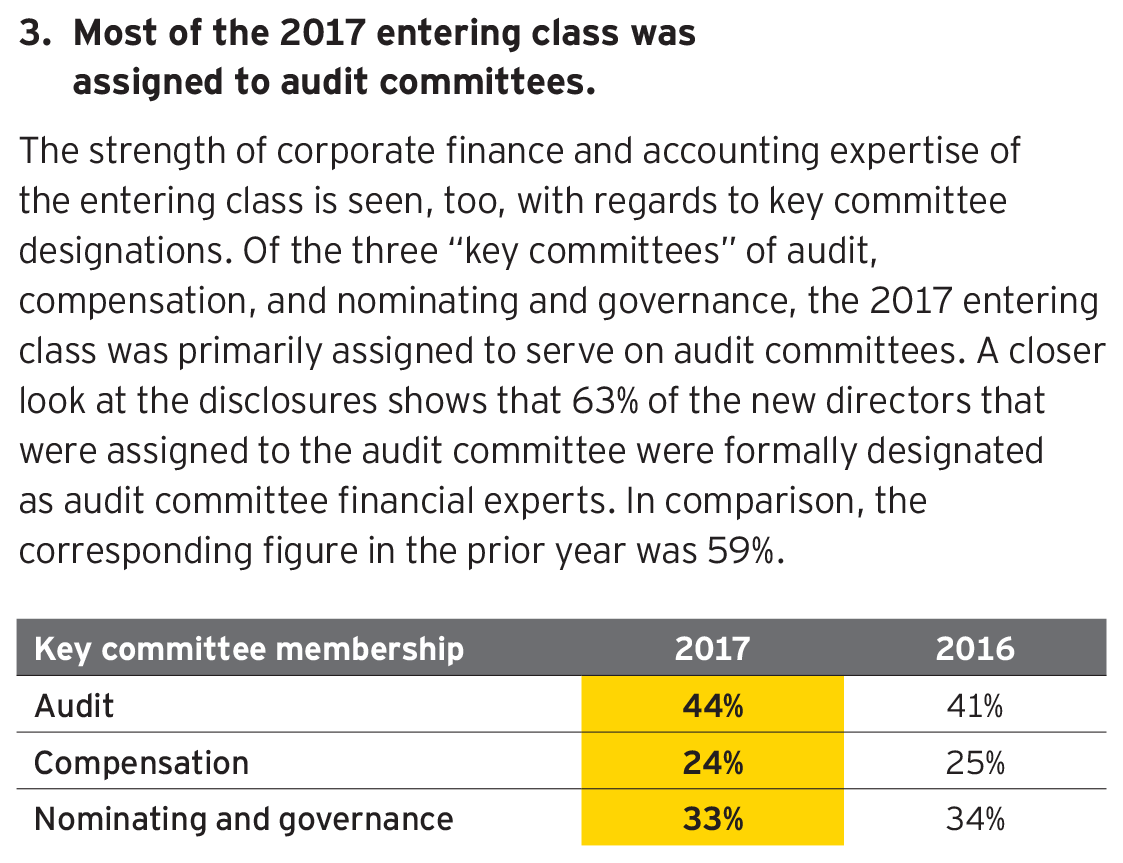
Prior boardroom experience is not required. Boardroom experience does not appear to be a prerequisite for contest candidates. More than half of Study Directors held outside board seats. While most of these directors sat on either one or two outside boards, a sizable minority pushed the over-boarded envelope. Six Study Directors served on four outside boards, four on five outside boards, and one on six outside boards. Many of these “busy” directors appear to be “go-to” nominees for individual activists. The serial nomination of favorite candidates raises questions about the “independence” of these individuals from their activist sponsors.

Investment professionals and sitting executives dominate the candidate pool for contested elections

Occupational data for the Study Directors demonstrates experience, qualifications, attributes, and skills (EQAS) preferences for nominees in contested situations. “Corporate executives” and “financial services professionals” were in a dead heat at the front of the pack. These favored occupations were not evenly distributed, as activists tended to select investors and incumbents tended to select executives. In fact, Dissident Directors were nearly three times more likely to be “financial services professionals” than Board Appointees, while Board Appointees were nearly twice as likely to be “executives” than Dissident Directors.


Part II: Board Profile


FINAL-Activism-and-Board-Refreshment-Trends-Report-Aug-2017-10.png


Snapshot: Public shareholder activism generally resulted in boards that are younger, shorter-tenured, slightly-larger, more independent, and more financially literate, but less diverse, than their pre-activism versions.


FINAL-Activism-and-Board-Refreshment-Trends-Report-Aug-2017-11.png


Activism-related turnover led to decreases in average director age and tenure at targeted boards

Dissident Directors averaged 53 years of age and Board Appointees averaged 56.3 years of age. Average director age decreased by 2.6 years to 59.6 years on Study Boards targeted by shareholder activists, while average director tenure decreased by 3.4 years to 6.1 years. For the broader S&P 1500 in 2015, average director age was 62.5 years and average tenure was 8.9 years.

Board size remained relatively steady despite membership changes

Although average board size at Study Companies increased from nine to 9.4 seats, less than half (41.9 percent) of the Study Companies experienced a post-activism boost in board size. 18.3 percent of Study Companies experienced a decline in board size following shareholder activism, while board size was unchanged at 39.8 percent of Study Companies.

Board independence levels increased in connection with activism campaigns

Average board independence at Study Companies increased from 79.5 percent to 83 percent. More than 60 percent of study companies experienced an increase in independence, 21.5 percent experienced a decrease, and 18.3 percent experienced no change. Average board independence in the S&P 1500 was 80.6 percent in 2015.
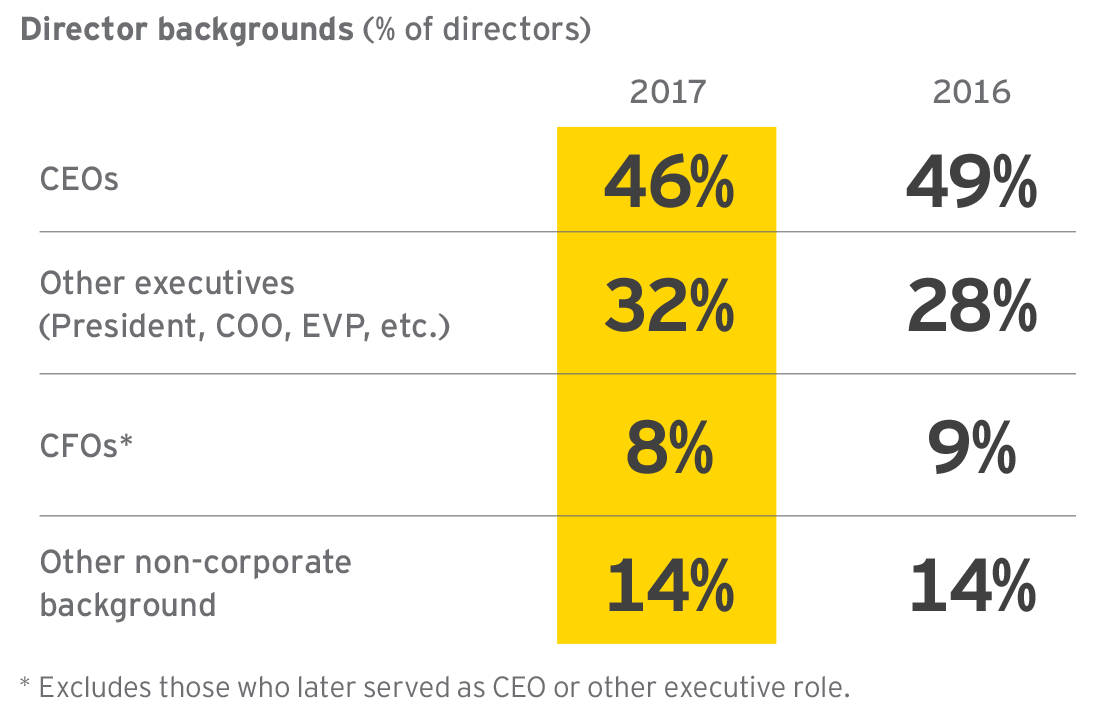
Other boardroom service was generally unchanged by activism-fueled refreshment

The average number of outside boards on which Study Company directors served remained virtually flat, increasing from 0.8 to 0.9. Of the 89 Study Companies, the number without a director who sat on more than one outside board decreased from four to two. There was a correlation between company size and outside board service, as directors at S&P 500 and S&P 400 study companies sat on a higher average number of outside boards than their counterparts at S&P 600 study companies.

Activism was accompanied by an erosion of gender and racial/ethnic diversity on targeted boards

Study Company boards were less likely to have at least one female director following an activism campaign than they were preceding one, decreasing from 87.1 percent to 82.8 percent. Similarly, Study Company boards were less likely to have at least one minority director following an activism campaign than they were preceding one, decreasing from 55.9 percent to 51.6 percent. According to Board Refreshment Trends at S&P 1500 Firms, the proportion of S&P 1500 companies with at least one female director increased from 72 percent in 2011 to 82.7 percent in 2015 and the portion of S&P 1500 companies with at least one minority board member increased through the course of the study period to 56.8 percent.
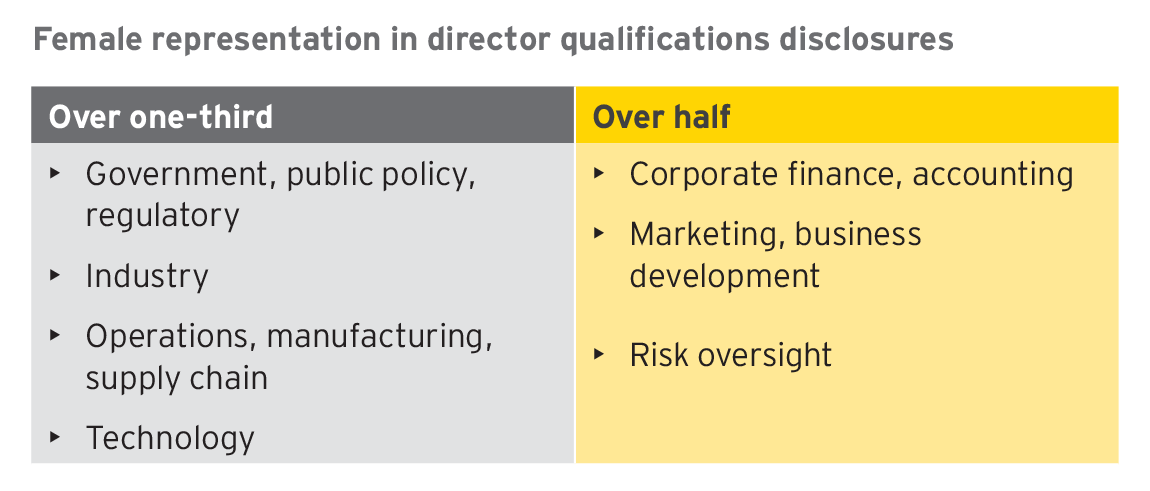
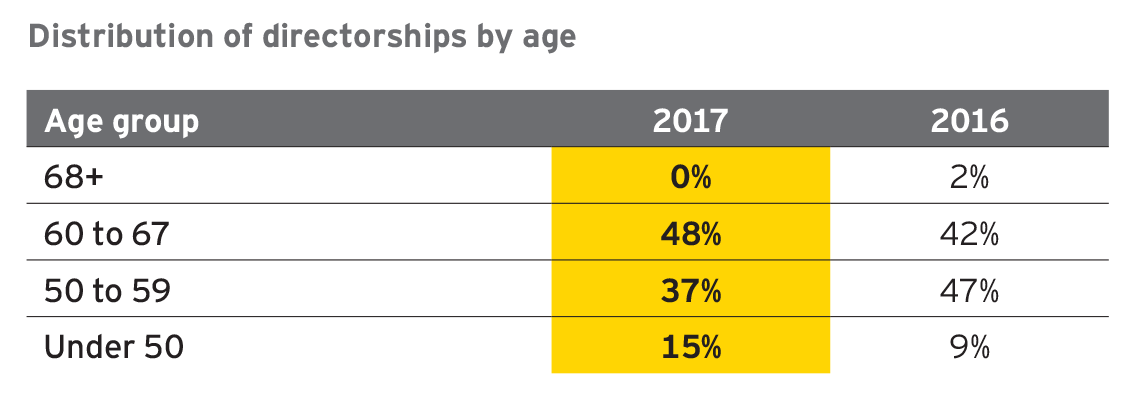
Activism added financial expertise to boards

The proportion of board seats at Study Companies occupied by “financial experts” increased from 22.6 percent (189 of 835) to 24.5 percent (214 of 874). The number of Study Companies with at least one, two, or three “financial experts” also increased. (At U.S. companies, ISS considers a director to be a “financial expert” if the board discloses that the individual qualifies as an “Audit Committee Financial Expert” as defined by the Securities and Exchange Commission under Items 401(h)(2) and 401(h)(3) of Regulation S-K. Under the SEC’s rules, a person must have acquired their financial expertise through (1) education and experience as a principal financial officer (PFO), principal accounting officer (PAO), controller, public accountant or auditor or experience in one or more positions that involve the performance of similar functions, (2) experience actively supervising a PFO, a PAO, controller, public accountant, auditor or person performing similar functions; (3) experience overseeing or assessing the performance of companies or public accountants with respect to the preparation, auditing or evaluation of financial statements or (4) other relevant experience.)

Target company size impacted the effect of board refreshment

Larger Study Companies were more independent, more likely to have female and minority board members (both pre- and post- activism), and more likely to have financial experts in the boardroom than smaller-cap study companies. Relative to their larger peers, smaller Study Companies generally experienced more pronounced declines in average director age and tenure, but experienced more significant increases in average board size.

The complete publication is available here.

________________________________________________

Subodh Mishra* is Executive Director at Institutional Shareholder Services, Inc. This post is based on a co-publication by ISS and the Investor Responsibility Research Center Institute. Related research from the Program on Corporate Governance includes The Long-Term Effects of Hedge Fund Activism by Lucian Bebchuk, Alon Brav, and Wei Jiang (discussed on the Forum here).

L’activisme et les effets sur la diversité des CA


Comment se font les nominations d’administrateurs lorsqu’un fond activiste du type « hedge funds » intervient lors des élections aux assemblées générales annuelles ?

La recherche menée par David A. Katz* et Laura A. McIntosh*, de la firme Wachtell, Lipton, Rosen & Katz, montrent clairement que les fonds activistes agressifs (hedge funds) proposent des candidats qui ne contribuent pas à la diversité du CA (en genre et en race) si l’on compare à la moyenne des entreprises du S&P 500.

Ainsi, durant la période 2011-2015, les femmes ne représentaient que 5 % des candidats nommés à des conseils par les hedge funds, comparativement à la nomination de 26 % de femmes aux CA des entreprises du S&P 500.

De plus, si l’on considère les entreprises ciblées par les hedge funds durant la même période, on constate que les CA 100 % masculins ont augmenté significativement, passant de 13 % à 17 %. Pour les autres entreprises du S&P 500, la proportion de CA 100 % masculin a considérablement diminué.

An August 2017 study investigated the reasons that hedge fund activists seemingly ignore the evidence for gender-diverse boards in their choices for director nominees and disproportionately target female chief executive officers. The authors suggest that hedge funds may be subconsciously biased against women leaders due to perceptions, cultural attitudes, and beliefs about the attributes of leaders in our society. Activists may tend to view female CEOs as weaker and may be more willing to second-guess and criticize the corporate strategic plans put forth by women leaders. Indeed, one academic study found that the persistent mention of a female CEO in media coverage leads to a 96 percent probability that her company will be targeted by activists.

L’article montre également que, contrairement aux fonds activistes agressifs, les investisseurs institutionnels et les gestionnaires d’actifs font une promotion sans précédent de la diversité des membres de CA. Plusieurs fonds de gestion d’actifs, tels que BlackRock, State Street Global Advisors et Vanguard, font un engagement public envers la promotion de la diversité sur les CA.

Les auteurs concluent à l’efficacité des actions de promotion de la diversité des CA dans la gouvernance des entreprises. Voici un résumé des conclusions en ce sens :

The concerted efforts of some of the largest and most influential investors and asset managers toward increasing board diversity are likely to be effective. Their support for shareholder proposals, their ongoing engagement with companies, and their consistent public advocacy for independent and diverse boards are powerful factors that will change the corporate governance landscape. Meanwhile, the advantages of diverse boards are becoming more widely understood and have been demonstrated through convincing evidence, making the business case for board diversity stronger than ever.

Enfin, il n’est pas superflu de rappeler la plus-value de la diversité comme le font les auteurs de l’entreprise Directorpoint dans leur billet The Benefits of Diversity in the Boardroom :

  1. A diverse boardroom provides a diversity of thought;
  2. A diverse boardroom helps address complex, corporate issues;
  3. A diverse boardroom is more representative of shareholders;
  4. A diverse boardroom increases revenues.

Bonne lecture ! Vos commentaires sont les bienvenus.


Activism and Board Diversity


Activism at public companies can reduce board diversity, or it can increase it, depending on the circumstances. In recent years, activist hedge funds have installed dissident nominees who collectively have trailed the S&P 1500 index significantly in terms of gender and racial diversity. In contrast, institutional shareholders and asset managers are promoting board diversity to an unprecedented extent, with concerted public efforts already producing results. Several institutional investor initiatives, announced earlier this year, and the New York Comptroller’s Boardroom Accountability Project 2.0, announced earlier this month, may be game-changing initiatives on the path to greater board diversity.


Hedge Fund Activism


Since the early 2000s, a number of studies have demonstrated that companies with women on their boards consistently experience a wide range of benefits, including higher average returns on equity, higher net income growth, lower stock volatility, and higher returns on invested capital. Whether because of improved group dynamics, a shift in risk management, increased ability to consider alternatives to current strategies, or a focus on governance generally, board gender diversity produces stronger boards. While the argument for gender diversity may have begun from notions of equality, experience has shown a compelling financial rationale.

With the evidence for board diversity very much in the public domain, the behavior of hedge fund activists seeking board representation has been somewhat puzzling. Hedge fund activism has been notably counterproductive in terms of gender diversity on public boards. A 2016 Bloomberg analysis of the years 2011 through 2015 found that women represented only five percent of the candidates successfully placed on boards by activist funds, a significant finding during a period in which women represented about 19 percent of S&P 500 directors and in which female candidates were nominated to fill 26 percent of open seats at S&P 500 companies. At companies targeted by hedge funds during the same years, the proportion of all-male boards increased from 13 percent to 17 percent, while in the S&P 1500 that proportion significantly declined.

An August 2017 study investigated the reasons that hedge fund activists seemingly ignore the evidence for gender-diverse boards in their choices for director nominees and disproportionately target female chief executive officers. The authors suggest that hedge funds may be subconsciously biased against women leaders due to perceptions, cultural attitudes, and beliefs about the attributes of leaders in our society. Activists may tend to view female CEOs as weaker and may be more willing to second-guess and criticize the corporate strategic plans put forth by women leaders. Indeed, one academic study found that the persistent mention of a female CEO in media coverage leads to a 96 percent probability that her company will be targeted by activists.


Boardroom Accountability 2.0


In marked contrast to hedge fund activists, significant institutional investors and asset managers are engaging in deliberate, proactive, and effective campaigns for increased diversity on public company boards. BlackRock, State Street Global Advisors, and Vanguard all have taken public steps this year to promote and advocate for greater board diversity. For example, State Street Global Advisors’ “preferred approach is to drive greater board diversity through an active dialogue and engagement with company and board leadership.” Using the carrot and stick approach, State Street notes that “[i]n the event that companies fail to take action to increase the number of women on their boards, despite our best efforts to actively engage with them, [State Street] will use [its] proxy voting power to effect change—voting against the Chair of the board’s nominating and/or governance committee if necessary.” BlackRock has noted that “over the coming year, we will engage companies to better understand their progress on improving gender balance in the boardroom.” Vanguard, in an open letter, noted that one of the four pillars it will use to evaluate a public company’s corporate governance is whether there is “[a] high-functioning, well-composed, independent, diverse, and experienced board with effective ongoing evaluation practices.”

Earlier this month, the New York City Comptroller and the New York City Pension Funds announced the “Boardroom Accountability Project 2.0,” a three-pronged initiative focusing on board diversity, director independence, and climate expertise. With regard to board diversity, the project calls for the boards of 151 U.S. companies to release “board matrix” disclosure indicating the race, gender, and skill sets of their board members, on the theory that standardized disclosure will increase transparency, accountability, and incentives for diversification. The project aims to combat a “persistent lack of diversity” on public company boards by encouraging boards to seek director candidates more broadly. The New York City Comptroller recently sent letters to the targeted companies asking them to provide the requested information.

The new project could well be successful as the NYC Comptroller’s original Boardroom Accountability Project. The goal of the original project was to make proxy access a standard feature of corporate governance. Since the 2014 launch of the initial project, proxy access has indeed become widespread, with over 400 U.S. companies (and over 60 percent of the S&P 500) having adopted some form of proxy access. Boardroom Accountability 2.0 is the sequel, in that nearly all of the targeted companies recently adopted proxy access, and the current project aims to empower shareholders to use this tool more effectively with the information contained in the proposed standardized matrix disclosure.

Even if companies choose not to directly respond to the information requested by the NYC Comptroller, the combination of the Boardroom Accountability Project 2.0 and institutional investors’ focus on the issue of diversity is likely to push public companies to reassess their approaches to board diversity generally and gender diversity specifically. We are already seeing changes in the way boards of directors are approaching director succession in response to these pressures. Public companies should consider using the opportunity presented by the Boardroom Accountability Project 2.0 to communicate their approaches to board diversity generally, and gender diversity specifically, to their larger institutional investors and engage in a dialogue that will present their approach in the best possible light.

The concerted efforts of some of the largest and most influential investors and asset managers toward increasing board diversity are likely to be effective. Their support for shareholder proposals, their ongoing engagement with companies, and their consistent public advocacy for independent and diverse boards are powerful factors that will change the corporate governance landscape. Meanwhile, the advantages of diverse boards are becoming more widely understood and have been demonstrated through convincing evidence, making the business case for board diversity stronger than ever.


*David A. Katz is partner and Laura A. McIntosh is consulting attorney at Wachtell, Lipton, Rosen & Katz. This post is based on a Wachtell Lipton publication by Mr. Katz and Ms. McIntosh which originally appeared in the New York Law Journal.