Rémunérations excessives des hauts dirigeants | Extraction ou création de valeur


Bonne lecture !

Vampire CEOs Continue To Suck Blood

As the economy continues to struggle in the seventh year of its supposed recovery after the Great Recession–despite unprecedented amounts of free government money from the Fed–CEO compensation continues to soar.

“The party goes on,” writes David Gelles in the New York Times, with a horrifying list of examples of corporate greed and value extraction. At the top of the list is a coven of four CEOs associated with John Malone at Discovery Communications who received some $350 million in 2014. Not bad for a year’s work, at a time when median compensation for workers has not increased significantly in decades.

Bloomberg calls it “gluttony.”Rémunérations excessives

Harvard Business Review calls it “the biggest financial bubble of them all.”

The New Yorker says, that the effect of reforms such as say-on-pay, aimed at containing excesses in C.E.O. salaries, has been “approximately zero. Executive compensation…is now higher than it’s ever been.”

Shareholder votes “have done little to curb lavish executive pay,” writes David Gelles. Greater public disclosure based on the view that somehow the companies would be ashamed and change their ways ”hasn’t worked.” He quotes Regina Olshan, head of the executive compensation practice at Skadden, Arps, Slate, Meagher & Flom: “I don’t think those folks are particularly ashamed. If they are getting paid, they feel they deserve those amounts. And if they are on the board, they feel like they are paying competitively to attract talent.”

“At root, the unstoppable rise of CEO pay,” says James Surowiecki in the New Yorker, “involves an ideological shift. Just about everyone involved now assumes that talent is rarer than ever, and that only outsize rewards can lure suitable candidates and insure stellar performance…CEO pay is likely to keep going in only one direction: up.”

La croissance des interventions activistes | Comment les organisations doivent-elles réagir ?


Voici un article de Mary Ann Cloyd, directrice du Center for Board Governance de PricewaterhouseCoopers, qui résume parfaitement la nature et la portée des interventions des actionnaires activistes aux États-Unis (et, par enchaînement au Canada).

Les administrateurs des sociétés sont de plus en plus préoccupés par les agissements des actionnaires activistes dont l’objectif ultime est l’amélioration de la situation financière des entreprises par la remise en question de sa gouvernance.

Lors d’un précédent billet, nous avons exploré les tenants et aboutissants du phénomène de l’activisme (Voir Explications du phénomène de l’activisme des actionnaires | PwC) en montrant qu’il y avait différents types d’activismes, en fonction de leur niveau d’engagement.

« Shareholder activism comes in different forms, ranging from say-on-pay votes, to shareholder proposals, to “vote no” campaigns (where some investors will urge other shareholders to withhold votes from one or more directors), to hedge fund activism. »

L’auteure présente ici une synthèse d’une enquête menée par PwC; elle met principalement l’accent sur trois aspects de la réponse à la « menace » :

(1) Pourquoi l’entreprise est-elle ciblée ?

(2) L’importance de la préparation continue

(3) Comment réagir lorsque les activistes interviennent ?

Bonne lecture !

Activism can build or progress. If a company is the target of a less aggressive form of activism one year, such as say-on-pay or shareholder proposals, and the activists’ issues are not resolved, it could lead to more aggressive activism in the following years. (For more background information, see a previous PwC publication, discussed on the Forum here.)

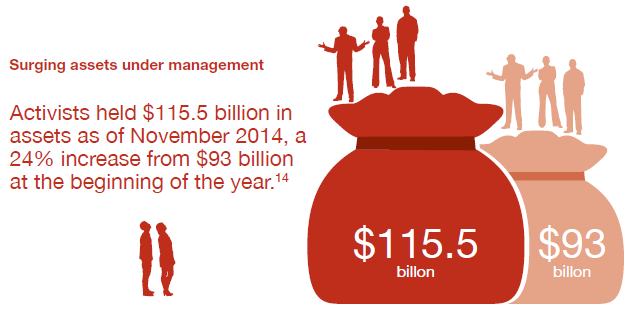
Hedge fund activists are increasing their holdings

pwc

Hedge fund activists may push a company to spin off underperforming or non-core parts of their businesses seek new executive management, operational efficiencies, or financial restructuring, engage in a proxy contest for full control of the board, or work to influence corporate strategy through one or two board seats. Some hedge fund activists target a company’s “capital allocation strategy” and push the company to change its acquisition strategy or return reserved cash to investors through stock buybacks or dividends. In order to drive these changes, activists are generally engaging with at least some of a company’s other major investors to get support for their proposals.

Directors have been taking notice of hedge funds and other activist shareholders, and they are talking about activism in the boardroom: Last year, 29% of directors said their board has interacted with an activist shareholder and held extensive board discussions about activism. [1] An additional 14% said they extensively discussed shareholder activism, though they hadn’t had any interactions with an activist. Given the state of activism, we anticipate the level of boardroom discussion on this topic will continue, or even grow, this year.

What might make your company a target?

About one in five S&P 500 companies was the target of a public activist campaign in 2014—and the number more than doubles when you consider the activity that never become public. [2] What are some common themes?

Companies where management appears to be either unable or unwilling to address issues that seem apparent to the market, investors, or analysts are ripe for activism. In addition, poor financial and stock performance, a weak pipeline of new products, a lack of innovation, the absence of a clear strategy, and turnover in leadership are also frequent red flags.

Hedge fund activists often focus on whether a company’s business line or sector is significantly underperforming in its market. They may target profitable companies with low market-to-book value, a well-regarded brand, and sound operating cash flows and return on assets. If a company’s cash reserves exceed historic norms and those of its peers, the company may be a target, particularly when it’s unclear why it has a large cash reserve. And board composition practices can also draw an activist’s attention—for example, if the company has a classified board or a long average director tenure and few new board members

An activist campaign can come at a very high cost. In addition to the out-of-pocket legal and advisory fees for a proxy battle, the management distraction, emotional impact, and potential business disruption can take a toll. Relationships with suppliers, customers, and even employees can also be damaged.

Preparation is key

Viewing a company through the eyes of an activist can help management and boards anticipate, prepare for, and respond to an activist campaign. A first step is to critically assess the company’s businesses as an activist would—looking for underperforming components. Some companies proactively examine their portfolios and capabilities to determine what fits both strategically and financially.

Companies that can articulate their strategy and demonstrate that it is grounded in a well-considered assessment of both their asset portfolios and their capabilities may be more likely to minimize the risk of becoming an activist’s target. Companies will want to tell a compelling story about their vision for success to shareholders.

Companies should also understand their shareholder base and have a tailored engagement plan in place.

Responding when an activist comes knocking

Companies and their boards will need to consider how to respond based on the facts and circumstances. Generally, an effective response plan will objectively consider the activist’s ideas to identify if there are areas around which to build consensus. Finding a way to work with an activist may avoid the potentially high costs of a proxy contest.

“One of the first areas of focus for boards and the management team is to engage. Sit down, have a discussion, hear out the activist, understand what’s on their mind, and then see if you can find common ground. We find engaging and listening is important,” Tim Ryan, PwC’s Vice Chairman and Markets, Strategy and Stakeholders Leader said in a recent interview with Wall Street Journal Live’s MoneyBeat.

It is important to recognize that the pressure from shareholder activists is not likely to go away any time soon, and companies of all sizes and in all industries need to be on alert. A well-articulated strategy, supported by a proactive assessment of the company’s existing portfolio, is critical. By telling a clear story and openly communicating with shareholders and investors, companies may minimize the risk of becoming a target of activists.

____________________________________

Endnotes:

[1] PwC, 2014 Annual Corporate Directors Survey, October 2014 (discussed on the Forum here).

[2] Brendan Sheehan, “Trends in Shareholder Activism,” Global Governance Advisors, October 2014.

Proposition de la SEC eu égard à la divulgation de la rémunération de la direction en rapport avec la performance organisationnelle


Les actionnaires doivent obtenir toute l’information pertinente pour leur permettre d’évaluer l’efficacité de leurs hauts dirigeants et leur permettre de voter en ayant accès aux meilleures informations possibles. C’est la raison pour laquelle la Securities and Exchange Commission (SEC) propose un amendement règlementaire relatif à la rémunération des hauts dirigeants, en rapport avec la performance.

Il est ainsi proposé que la SEC adopte un renforcement des règles de divulgation dans les circulaires de procuration en publiant une table qui révèle la rémunération de la haute direction en relation avec la performance financière de l’entreprise au cours des cinq dernières années.

La divulgation de ces données, sous une forme standardisée, facilitera les comparaisons avec d’autres entreprises cotées du même secteur d’activité.

Le résultat de cette consultation sera déterminante dans les décisions des autorités règlementaires canadiennes.

Le court article ci-dessous est basé sur les vues exprimées par *, commissaire de la  U.S. Securities and Exchange. J’ai enlevé les notes de bas de page afin d’alléger le billet mais vous pouvez retrouver l’intégralité de ses propos dans l’article Proposed Rule on Pay Versus Performance, publié dans le Harvard Law School of Corporate Governance.

Executive compensation and its relationship to the performance of a company has been an important issue since the first proxy rules were promulgated by the Commission nearly 80 years ago. The first tabular disclosure of executive compensation appeared in 1943, and over the years, the Commission has continued to update and overhaul the presentation and content of compensation disclosures.

CEO Pay – Humongous

Today [April 29, 2015], the Commission, as directed by Congress, takes another important step in modernizing our executive compensation rules by proposing amendments on pay versus performance. Section 953(a) of the Dodd-Frank Wall Street Reform and Consumer Protection Act directed the Commission to adopt rules requiring public companies to disclose in their proxy materials the relationship between executive compensation actually paid, and the financial performance of the company.

I believe that today’s proposal thoughtfully fulfills that mandate. The net result of the proposed rule should be enhanced pay versus performance disclosure in the proxy statement. It should make it easier for shareholders to locate, understand, and analyze executive compensation information before they have to vote.

The Commission’s current rules require that shareholders receive a proxy statement prior to a shareholder meeting. The proxy statement must disclose all the important facts about the issues on which shareholders may be asked to vote. Today’s proposed rule should provide shareholders, via the proxy statement, meaningful new information and metrics to aid in making informed decisions.

The Senate Report that accompanies Section 953(a) of the statute noted: “It has become apparent that a significant concern of shareholders is the relationship between executive pay and the company’s financial performance…The Committee believes that these disclosures will add to corporate responsibility as firms will have to more clearly disclose and explain executive pay.”

In order “to more clearly disclose and explain executive pay” in this context, the Commission is proposing to use a standardized, machine readable table. This table includes, in one location, easy to understand data regarding the last five years of a company’s financial performance. Financial performance data would be presented directly next to the data detailing the compensation of the company’s executive officers during the last five years.

This simple presentation should make it easier for shareholders to understand the relationship between executive pay and company performance. In addition to providing data on compensation “actually paid” to certain executive officers, the proposed table requires registered companies to include the Summary Compensation Table figures for certain executive officers. Including these numbers in the pay versus performance table is vitally important. It would allow shareholders to view a measure of pay that excludes changes in the value of equity grant awards. Providing two measures of compensation in the table may facilitate meaningful comparison, especially in situations where the “actually paid” figure may be misleading or not reflective of the true compensation package awarded to an executive in a given year.

Comparability is also an important part of the proposal. Requiring each registrant to complete this standardized table should promote comparability across all companies. Each registrant would be required to provide data responsive to the same questions, year after year, with clear direction on exactly what the table requires. This comparability also should promote robust data analysis going forward.

Along with providing data in the table, registrants would provide supplemental disclosure about the relationship between executive compensation and performance. The proposed rule appropriately recognizes that some flexibility may be needed to demonstrate this relationship. For example, registrants may describe the relationship in narrative form or by means of a graph or chart. Registrants would be allowed to describe this relationship in a way that is best suited to their particular circumstances. The combination of a standardized table and a more flexible disclosure following the table is a sensible way to ensure comparability and uniformity, while still providing companies with some appropriate flexibility in disclosure.

Finally, I have been a consistent advocate for data tagging of Commission forms, so I am very pleased to see that pay versus performance disclosure, as proposed, will be tagged in eXtensible Business Reporting Language, or XBRL. The proposed rule sets forth an approach toward incorporating machine readable data for communicating compensation and performance information. XBRL streamlines the collection and reporting of financial information. XBRL data tagging involves a process in which a company essentially marks certain parts of its financial disclosure with specific defined terms from a shared dictionary, referred to as a “taxonomy”. All registrants use the same shared taxonomy, which allows for comparability across companies.

In order to achieve comparability, we need structured data in formats like XBRL. Today’s proposal would represent the first piece of data in the proxy statement to be tagged and is hopefully a harbinger of things to come. We should be moving toward having the entire proxy statement tagged, and this is a great first step.

As the SEC Investor Advisory Committee noted in its recommendation advocating for more data tagging, “modern technology provides the SEC with the opportunity to unlock far greater value from the information that it collects and stores.” I personally believe that tagging the entire proxy statement would unlock great value for both the Commission and shareholders.

The current proposal is to have pay versus performance disclosure tagged in XBRL. It is my hope and expectation that this disclosure would be tagged in Inline XBRL once available, which would allow companies to file the required information and data tags in one document rather than repeated in separate exhibits. I understand that Inline XBRL is not yet available on the SEC’s Electronic Data Gathering Analysis and Retrieval (EDGAR) system, but soon will be. When that day comes, Inline XBRL should be used for pay versus performance and all other parts of the proxy statement.


*Kara M. Stein is a Commissioner at the U.S. Securities and Exchange Commission. This post is based on Commissioner Stein’s recent public statement, available here. The views expressed in the post are those of Commissioner Stein and do not necessarily reflect those of the Securities and Exchange Commission, the other Commissioners, or the Staff.

Related research from the Program on Corporate Governance about CEO pay includes Paying for Long-Term Performance (discussed on the Forum here) and the book Pay without Performance: The Unfulfilled Promise of Executive Compensation, both by Lucian Bebchuk and Jesse Fried.

Principes de gouvernance et règlementations en vigueur dans les pays membres de l’OCDE


Ce matin, je porte à votre attention un document-clé de l’Organisation de coopération et de développement économiques (OCDE) qui présente en détail toutes les informations concernant les pratiques de gouvernance dans les 34 pays de l’OCDE ainsi que dans un certain nombre d’autres pays influents : Argentine, Brésil, Hong Kong, Chine, Inde, Indonésie, Lituanie, Arabie Saoudite et Singapore.

Le document intitulé Corporate Governance Factbook est une ressource informationnelle indispensable pour mieux comprendre et comparer les codes de gouvernance et les règlementations relatives aux diverses juridictions. Il s’agit de la deuxième édition de cette publication; celle-ci alimente les révisions apportées annuellement aux Principes de Gouvernance de l’OCDE, principes de gouvernance universellement reconnus.

Le Canada a collaboré activement au partage des informations sur la gouvernance. Ainsi, le rapport présente une multitude de tableaux qui comparent la situation du Canada avec celle des autres pays retenus. C’est une mine d’information vraiment exceptionnelle.

Le document est en version anglaise pour le moment. Vous trouverez, ci-dessous, la référence au document ainsi que la table des matières :

Corporate Governance Factbook


Introduction

The Corporate Landscape

– The ownership structure of listed companies

The Corporate Governance Framework

– The regulatory framework for corporate governance
– Cross-border application of corporate governance requirements
– The main public regulators of corporate governance
– Stock exchangesCorporate Governance Factbook 250 pixels wide

The Rights of Shareholders and Key Ownership Functions

– Notification of general meetings and information provided to shareholders
– Shareholder rights to request a meeting and to place items on the agenda
– Shareholder voting
– Related party transactions
– Takeover bid rules
– The roles and responsibilities of institutional investors

The Corporate Board of Directors

– Basic board structure and independence
– Board-level committees
– Board nomination and election
– Board and key executive remuneration

Colloque étudiant en gouvernance de sociétés


Les personnes  intéressées par les nouvelles recherches en gouvernance des entreprises sont invitées à assister au Colloque étudiant en gouvernance de société mardi 14 avril 2015

En partenariat avec la FSA et la Chaire en gouvernance des sociétés, le CÉDÉ organise un colloque étudiant. Les étudiants du cours de Gouvernance de l’entreprise DRT-6056 du professeur Ivan Tchotourian et du cours de Gouvernance des sociétés CTB-7000 du professeur Jean Bédard présenteront lors de cet événement le bilan de travaux de recherche réalisés durant la session d’hiver 2015.

Heure : 8 h 30 à 11 h 30
Lieu : Salon Hermès de la Faculté des sciences de l’administration

L’entrée est libre.


Explications du phénomène de l’activisme des actionnaires | PwC


Mary Ann Cloyd, responsable du Center for Board Governance de PricewaterhouseCoopers (PwC), vient de publier dans le forum du HLS un important document de référence sur le phénomène de l’activisme des actionnaires.

Son texte présente une excellente vulgarisation des activités conduites par les parties intéressées : Qui, Quoi, Quand et Comment ?

Je vous suggère de lire l’article au complet car il est très bien illustré par l’infographie. Vous trouverez ici un extrait de celui-ci.

Bonne lecture !

Shareholder Activism: Who, What, When, and How?

Who are today’s activists and what do they want?

Shareholder activism Spectrum

pwcsa1

“Activism” represents a range of activities by one or more of a publicly traded corporation’s shareholders that are intended to result in some change in the corporation. The activities fall along a spectrum based on the significance of the desired change and the assertiveness of the investors’ activities. On the more aggressive end of the spectrum is hedge fund activism that seeks a significant change to the company’s strategy, financial structure, management, or board. On the other end of the spectrum are one-on-one engagements between shareholders and companies triggered by Dodd-Frank’s “say on pay” advisory vote.

pwcsa2

The purpose of this post is to provide an overview of activism along this spectrum: who the activists are, what they want, when they are likely to approach a company, the tactics most likely to be used, how different types of activism along the spectrum cumulate, and ways that companies can both prepare for and respond to each type of activism.

Hedge fund activism

pwcsa3

At the most assertive end of the spectrum is hedge fund activism, when an investor, usually a hedge fund or other investor aligned with a hedge fund, seeks to effect a significant change in the company’s strategy.

Background

Some of these activists have been engaged in this type of activity for decades (e.g., Carl Icahn, Nelson Peltz). In the 1980s, these activists frequently sought the breakup of the company—hence their frequent characterization as “corporate raiders.” These activists generally used their own money to obtain a large block of the company’s shares and engage in a proxy contest for control of the board.

In the 1990s, new funds entered this market niche (e.g., Ralph Whitworth’s Relational Investors, Robert Monks’ LENS Fund, John Paulson’s Paulson & Co., and Andrew Shapiro’s Lawndale Capital). These new funds raised money from other investors and used minority board representation (i.e., one or two board seats, rather than a board majority) to influence corporate strategy. While a company breakup was still one of the potential changes sought by these activists, many also sought new executive management, operational efficiencies, or financial restructuring.

Today

During the past decade, the number of activist hedge funds across the globe has dramatically increased, with total assets under management now exceeding $100 billion. Since 2003 (and through May 2014), 275 new activist hedge funds were launched.

Forty-one percent of today’s activist hedge funds focus their activities on North America, and 32% have a focus that spans across global regions. The others focus on specific regions: Asia (15%), Europe (8%), and other regions of the world (4%).

Why?

The goals of today’s activist hedge funds are broad, including all of those historically sought, as well as changes that fall within the category of “capital allocation strategy” (e.g., return of large amounts of reserved cash to investors through stock buybacks or dividends, revisions to the company’s acquisition strategy).

How?

The tactics of these newest activists are also evolving. Many are spending time talking to the company in an effort to negotiate consensus around specific changes intended to unlock value, before pursuing a proxy contest or other more “public” (e.g., media campaign) activities. They may also spend pre-announcement time talking to some of the company’s other shareholders to gauge receptivity to their contemplated changes. Lastly, these activists (along with the companies responding to them) are grappling with the potential impact of high-frequency traders on the identity of the shareholder base that is eligible to vote on proxy matters.

Some contend that hedge fund activism improves a company’s stock price (at least in the short term), operational performance, and other measures of share value (including more disciplined capital investments). Others contend that, over the long term, hedge fund activism increases the company’s share price volatility as well as its leverage, without measurable improvements around cash management or R&D spending.

When is a company likely to be the target of activism?

Although each hedge fund activist’s process for identifying targets is proprietary, most share certain broad similarities:

  1. The company has a low market value relative to book value, but is profitable, generally has a well-regarded brand, and has sound operating cash flows and return on assets. Alternatively, the company’s cash reserves exceed both its own historic norms and those of its peers. This is a risk particularly when the market is unclear about the company’s rationale for the large reserve. For multi- business companies, activists are also alert for one or more of the company’s business lines or sectors that are significantly underperforming in its market.
  2. Institutional investors own the vast majority of the company’s outstanding voting stock.
  3. The company’s board composition does not meet all of today’s “best practice” expectations. For example, activists know that other investors may be more likely to support their efforts when the board is perceived as being “stale”—that is, the board has had few new directors over the past three to five years, and most of the existing directors have served for very long periods. Companies that have been repeatedly targeted by non-hedge fund activists are also attractive to some hedge funds who are alert to the cumulative impact of shareholder dissatisfaction.

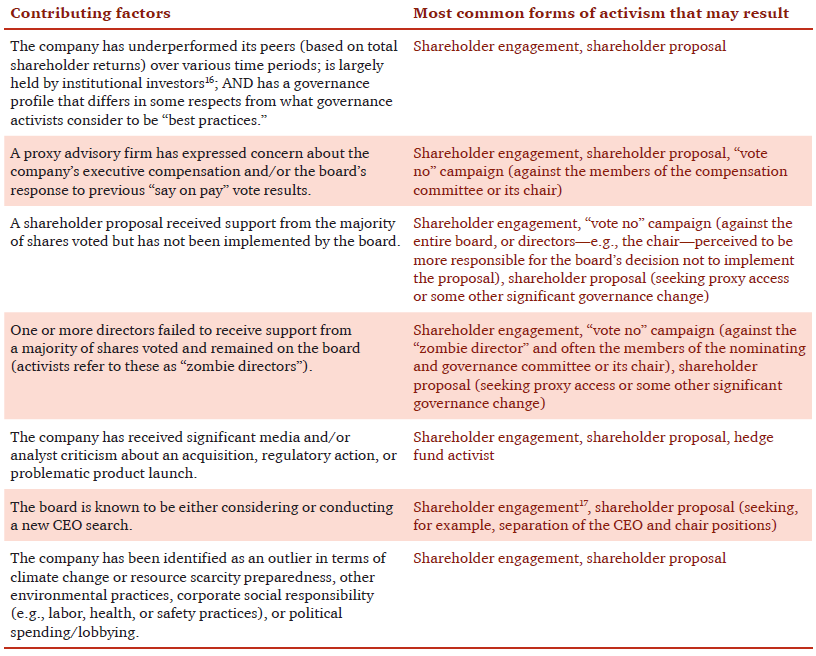
A company is most likely to be a target of non-hedge fund activism based on a combination of the following factors:

pwcsat

How can a company effectively prepare for—and respond to—an activist campaign?

Prepare

We believe that companies that put themselves in the shoes of an activist will be most able to anticipate, prepare for, and respond to an activist campaign. In our view, there are four key steps that a company and its board should consider before an activist knocks on the door:

Critically evaluate all business lines and market regions. Some activists have reported that when they succeed in getting on a target’s board, one of the first things they notice is that the information the board has been receiving from management is often extremely voluminous and granular, and does not aggregate data in a way that highlights underperforming assets.

Companies (and boards) may want to reassess how the data they review is aggregated and presented. Are revenues and costs of each line of business (including R&D costs) and each market region clearly depicted, so that the P&L of each component of the business strategy can be critically assessed? This assessment should be undertaken in consideration of the possible impact on the company’s segment reporting, and in consultation with the company’s management and likely its independent auditor.

Monitor the company’s ownership and understand the activists. Companies routinely monitor their ownership base for significant shifts, but they may also want to ensure that they know whether activists (of any type) are current shareholders.

Understanding what these shareholders may seek (i.e., understanding their “playbook”) will help the company assess its risk of becoming a target.

Evaluate the “risk factors.” Knowing in advance how an activist might criticize a company allows a company and its board to consider whether to proactively address one or more of the risk factors, which in turn can strengthen its credibility with the company’s overall shareholder base. If multiple risk factors exist, the company can also reduce its risk by addressing just one or two of the higher risk factors.

Even if the company decides not to make any changes based on such an evaluation, going through the deliberative process will help enable company executives and directors to articulate why they believe staying the course is in the best long-term interests of the company and its investors.

Develop an engagement plan that is tailored to the company’s shareholders and the issues that the company faces. If a company identifies areas that may attract the attention of an activist, developing a plan to engage with its other shareholders around these topics can help prepare for—and in some cases may help to avoid—an activist campaign. This is true even if the company decides not to make any changes.

Activists typically expect to engage with both members of management and the board. Accordingly, the engagement plan should prepare for either circumstance.

Whether the company decides to make changes or not, explaining to the company’s most significant shareholders why decisions have been made will help these shareholders better understand how directors are fulfilling their oversight responsibilities, strengthening their confidence that directors are acting in investors’ best long-term interests.

These communications are often most effective when the company has a history of ongoing engagement with its shareholders. Sometimes, depending on the company’s shareholder profile, the company may opt to defer actual execution of this plan until some future event occurs (e.g., an activist in fact approaches the company, or files a Schedule 13d with the SEC, which effectively announces its intent to seek one or more board seats). Preparing the plan, however, enables the company to act quickly when circumstances warrant.

pwcsa13

Respond

In responding to an activist’s approach, consider the advice that large institutional investors have shared with us: good ideas can come from anyone. While there may be circumstances that call for more defensive responses to an activist’s campaign (e.g., litigation), in general, we believe the most effective response plans have three components:

Objectively consider the activist’s ideas. By the time an activist first approaches a company, the activist has usually already (a) developed specific proposals for unlocking value at the company, at least in the short term, and (b) discussed (and sometimes consequently revised) these ideas with a select few of the company’s shareholders. Even if these conversations have not occurred by the time the activist first approaches the company, they are likely to occur soon thereafter. The company’s institutional investors generally spend considerable time objectively evaluating the activist’s suggestion—and most investors expect that the company’s executive management and board will be similarly open- minded and deliberate.

Look for areas around which to build consensus. In 2013, 72 of the 90 US board seats won by activists were based on voluntary agreements with the company, rather than via a shareholder vote. This demonstrates that most targeted companies are finding ways to work with activists, avoiding the potentially high costs of proxy contests. Activists are also motivated to reach agreement if possible. If given the option, most activists would prefer to spend as little time as possible to achieve the changes they believe will enhance the value of their investment in the company. While they may continue to own company shares for extensive periods of time, being able to move their attention and energy to their next target helps to boost the returns to their own investors.

Actively engage with the company’s key shareholders to tell the company’s story. An activist will likely be engaging with fellow investors, so it’s important that key shareholders also hear from the company’s management and often the board. In the best case, the company already has established a level of credibility with those shareholders upon which new communications can build. If the company does not believe the activist’s proposed changes are in the best long-term interests of the company and its owners, investors will want to know why—and just as importantly, the process the company used to reach this conclusion. If the activist and company are able to reach an agreement, investors will want to hear that the executives and directors embrace the changes as good for the company. Company leaders that are able to demonstrate to investors that they were part of positive changes, rather than simply had changes thrust upon them, enhance investor confidence in their stewardship.

pwcsa14

Epilogue—life after activism

When the activism has concluded—the annual meeting is over, changes have been implemented, or the hedge fund has moved its attention to another target—the risk of additional activism doesn’t go away. Depending on how the company has responded to the activism, the significance of any changes, and the perception of the board’s independence and open-mindedness, the company may again be targeted. Incorporating the “Prepare” analysis into the company’s ongoing processes, conducting periodic self-assessments for risk factors, and engaging in a tailored and focused shareholder engagement program can enhance the company’s resiliency, strengthening its long-term relationship with investors.


Aux É.U., il est temps de favoriser le rapprochement entre les administrateurs et les actionnaires


Voici un excellent article paru dans la section Business du The New York Times du 28 mars 2015 qui porte sur les appréhensions, relativement injustifiées, des communications (engagement) entre les administrateurs et leurs actionnaires (en dehors des assemblées annuelles).

L’article évoque le manque de communication des Boards américains avec leurs actionnaires et avec les parties prenantes, contrairement à la situation qui prévaut du côté européen. Selon l’auteure, cette grande distance entre les administrateurs et les actionnaires mène aux insatisfactions croissantes de ceux-ci, et cela se reflète dans l’augmentation du nombre d’administrateurs n’obtenant pas le soutien requis lors des assemblées annuelles.

On le sait, les actionnaires des entreprises américaines souhaitent pouvoir faire inscrire leurs propositions dans les circulaires de procuration, notamment pour présenter des candidatures aux postes d’administrateurs.

En 2015, plusieurs grandes corporations américaines permettront l’accès des grands actionnaires à leurs circulaires de procuration (voir Les conséquences inattendues de l’accès des actionnaires à la circulaire de procuration lors de l’assemblée annuelle et Proxy Access Proposals: The Next Big Thing in Corporate Governance).

Il est donc temps de revoir le mode de communication entre les deux acteurs principaux et d’exposer les avantages à collaborer à la gouvernance de l’entreprise. Plusieurs pays européens donnent l’exemple à cet égard.

Ainsi, en Suède et en Norvège, les cinq (5) plus grands actionnaires d’une entreprise reçoivent des invitations à se joindre au comité de gouvernance et de nomination afin de choisir des administrateurs potentiels.

En Europe, les actionnaires ont plus de poids; ceux qui possèdent au moins 1 % de la propriété peuvent soumettre des candidatures pour les postes d’administrateurs. De plus, dans certains pays européens, contrairement à la situation américaine, les administrateurs doivent soumettre leurs démissions s’ils ne reçoivent pas un soutien majoritaire aux élections.

P1060488

Voici une politique sur la communication du CA avec les investisseurs qui pourrait être envisagée; elle présente un certain nombre de sujets jugés appropriés :

(1) la rémunération de la direction,

(2) la structure des comités du conseil,

(3) le processus de planification de la relève,

(4) le rôle du CA dans la supervision de la stratégie.

Je suis assuré que vous trouverez cet article du NYT stimulant et engageant ! Vos commentaires sont les bienvenus.

Bonne lecture !

At U.S. Companies, Time to Coax the Directors Into Talking

It’s shareholder meeting season again, corporate America’s version of Groundhog Day.

This is the time of year when company directors venture out of the boardroom to encounter the investors they have a duty to serve. After the meetings are over, like so many Punxsutawney Phils, these directors scurry back to their sheltered confines for another year.

This is a bit hyperbolic, of course. But institutional investors argue that there’s a troubling lack of interaction these days between many corporate boards in the United States and their most important investors. They point to contrasting practices in Europe as evidence that it’s time for this to change.

“It’s a very different culture in the U.S.,” said Deborah Gilshan, corporate governance counsel at RPMI Railpen Investments, the sixth-largest pension fund in Britain, which has 20 billion pounds, or about $30 billion, in assets. “In the U.K., we get lots of access to the companies we invest in. In fact, I’ve often wondered why a director wouldn’t want to know directly what a thoughtful shareholder thinks.”

As Ms. Gilshan indicated, directors at European companies routinely make themselves available for investor discussions; in some countries, such meetings are required. Many directors of foreign companies even — gasp — give shareholders their private email addresses and phone numbers.

Their counterparts in the United States seem fearful of such contact. Large shareholders say that some directors of American companies refuse to meet at all, preferring to let company officials speak for them.

Un guide des pratiques de gouvernance dans l’Union Européenne (EU)


Vous trouverez, ci-dessous, un guide complet des pratiques de gouvernance relatives aux entreprises de l’Union Européenne.

Il n’y a pas de version française de ce document à ce stade-ci. J’ai cependant demandé à ecoDa (European Confederation of Directors’ Associations) si un guide en français était en préparation. Toute personne intéressée par la gouvernance européenne trouvera ici un excellent outil d’information.

Bonne lecture !

This publication has been produced in collaboration with the European Confederation of Directors’ Associations (ecoDa) primarily aimed at ecoDa’s membership and for supporting IFC’s work in surrounding regions with countries aspiring to understand and follow rules, standards and practices applied in the EU countries but which may be of wider relevance and interest to practitioners, policy makers, development finance institutions, investors, board directors, business reporters, and others.

A Guide to Corporate Governance Practices in the European Union

The purpose of this publication is twofold: to describe the corporate governance framework within the European Union and to highlight good European governance practices. It focuses on the particular aspects of European governance practices that distinguish this region from other parts of the world.DSCN3217

In addition to providing a useful source of reference, this guide is designed to be relevant to anyone interested in the evolving debate about European corporate governance. It should be of particular interest to the following parties:

Policymakers and corporate governance specialists, to assist in the identification of good practices among the member states. Improvements in corporate governance practices in a country may attract foreign direct investment.

Directors of listed and unlisted companies, to inspire them to look again at their ways of working.

Directors of state-owned enterprises (SOEs), to assist in improving corporate governance practices prior to selling off state assets.

Bankers, to assist in the identification of good corporate governance practices to inform their lending and investing practices.

Staff within development financial institutions, to assist in the identification of good corporate

Proxy advisors and legal advisors, to assist in the identification of corporate governance compliance issues.

Investors, shareholders, stock brokers, and investment advisors, to assist in the identification of good practices in investor engagement and activism.

Senior company management, to assist in the identification of good relationship-management practices with boards of directors.

Journalists and academics within business schools, who are interested in good corporate governance practices.

Private sector and public sector stakeholders from the EU candidate and potential candidate countries in their preparation for eventual accession. Geographical areas of potential readership may include the following in particular:

The 18 Eurozone countries (listed in Appendix A);

The 28 EU member states (Appendix B);

The five EU candidate countries (Appendix C);

The three potential candidate countries

The 47 European Council Countries (Appendix E); and

Emerging markets and others seeking to increase trade or attract investment with European countries.

La juste rémunération des hauts dirigeants d’une OBNL : une tâche délicate !


Vous trouverez, ci-dessous, un article très intéressant d’Alice Korngold dans Huff Post – Canada, sur un sujet brûlant ! L’auteure montre les facettes positives et négatives de l’établissement d’une rémunération « juste et raisonnable » dans le contexte des OBNL américaines.

Elle propose une démarche logique pour assurer l’intégrité du processus.

Bonne lecture !

Executive Compensation in the Nonprofit Sector: Getting It Right

« In fact, one of the most important things that nonprofit boards can do to strengthen the organizations that they govern is to get the salaries right for the CEOs of their nonprofits.
What does it mean to get compensation right? And why does it matter so much?

Getting it right is called « fair and reasonable » by the IRS. It’s what the law requires, it’s what any CEO wants, and it’s what any donor and member of the public expects ».

Qualités managériales recherchées par les conseils d’administration | Entrevue avec le PCD de Korn/Ferry


Voici un article qui met en exergue les qualités que les conseils d’administration veulent voir chez les futurs membres de la haute direction.

L’article, écrit par Lauren Weber dans les pages du The Wall Street Journal, relate un extrait de l’entrevue avec Gary Burnison, PCD de Korn/Ferry International, à propos de la recherche de talents en management à l’échelle internationale.

Le marché de la recherche des meilleurs talents de gestionnaires est en pleine expansion; il représente un marché d’environ 20 Milliards.

Toutes les grandes firmes font affaires avec des entreprises spécialisées dans la recherche des meilleurs talents, dans l’évaluation de ces derniers ainsi que dans leur rétention. De grandes firmes comme Korn/Ferry International possèdent des banques de données très à jour sur les carrières des hauts dirigeants ainsi que des outils de recherche à la fine pointe.

On est donc intéressé à connaître le point de vue du président et chef de la direction de la plus grande entreprise (1 Milliard par année) sur la croissance du marché et sur les qualités des candidatures recherchées.

On y apprend que les C.A. sont préoccupés par la plus grande diversité possible, par des candidats qui sont constamment en processus d’apprentissage, qui possèdent plusieurs réseaux d’affaires, qui savent bien s’entourer et qui ont fait leurs preuves dans des situations de gestion similaires. Le partenaire stratégique du PCD doit être le V-P Ressources humaines … et non le V-P Finance.

Je vous invite à lire l’extrait ci-dessous. Bonne lecture !

Korn/Ferry’s CEO: What Boards Want in Exécutives


WSJ: Your executive-search business was up in the first quarter by 9%. Are companies investing in growth, or are they mostly replacing people who leave?

Mr. Burnison: Industries like health care, technology and energy are going through massive change, and it’s going to continue for the foreseeable future. That creates a need for new positions, whether it’s about delivering health care remotely or finding new ways to tap people instantaneously through social media. Those needs didn’t exist a decade ago.

IMG_20141211_183948

WSJ: Executive search seems like an old-fashioned, Rolodex business. Are LinkedIn and other social-networking tools going to make it obsolete?

Mr. Burnison: CEOs are in this mad fight for growth and relevancy, so they’re paying us not for finding people, but for finding out who people are. You can go lots of places to find people. But you’re going to want somebody to answer, “Okay, but what is this person really like? What do others really say about them?”

WSJ: How do you answer those questions?

Mr. Burnison: For the boardroom or the C-suite, the technical competencies are a starting point. What we’ve seen through our research is that the No. 1 predictor of executive success is learning agility. So we want to get a real line of sight into a person’s thinking style and leadership style. Right now, you’re seeing me how I want you to see me. What you really want to know is “How does Gary make decisions under pressure?”

WSJ: What is learning agility?

Mr. Burnison: It comes down to people’s willingness to grow, to learn, to have insatiable curiosity. Think about the levers of growth that a CEO has. You can consolidate, or tap [new markets], or innovate. When it comes down to the last two, particularly innovation, you want a workforce that is incredibly curious.

WSJ: What are companies getting wrong today about managing their employees?

Mr. Burnison: There’s this gap between what [executives] say and how they invest in people’s careers. They spend an enormous amount on development and performance management, but it’s not well spent.

WSJ: Where are they investing poorly in talent?

Mr. Burnison: They should be asking, how do you develop people in their careers? How do you extend the life of an employee? This is not an environment where you work for an organization for 20 years. But if you can extend it from three years to six years; that has enormous impact. [Turnover] is a huge hidden cost in a profit-and-loss statement that nobody ever focuses on. If there was a line item that showed that, I guarantee you’d have the attention of a CEO.

WSJ: Why aren’t CEOs focused on turnover?

Mr. Burnison: A CEO only has an average tenure today of five years. You have 20 quarters to show that you have a winning team. There is a trade-off between knowing in your heart that you’ve got to empower people, you’ve got to develop them. But then there’s the other side, that says, “Oh, my gosh. I’ve got to win this next game.”

WSJ: How should leaders look beyond the short-term horizon?

Mr. Burnison: The strategic partner to the CEO should be the CHRO [chief human-resources officer] in almost any organization. It shouldn’t be the CFO. The person that is responsible for people should be the biggest lever that a CEO can pull. Too often, it’s not.

WSJ: You’ve been CEO for seven years. Is the clock ticking?

Mr. Burnison: We’re all by definition “on the clock.” However, that ticking clock should never impede the journey. I am having a lot of fun and there is still an enormous amount of work to be done.

WSJ: You’re pushing to create more management products for companies. Why, and what are they?

Mr. Burnison: People are hard to scale. [Products are] very easy to scale. It’s going to be based on predictors of success. By culture, by industry, by function, around the world. It could be a program for how we assess and develop people. It could be licensing a piece of content around onboarding or hiring. Candidates could take an online assessment. You would get feedback and you could license our interviewing technology to say, “With this person, you may want to probe this area and this area when you’re interviewing them.”

WSJ: What do your search clients ask for most often?

Mr. Burnison: The No. 1 request we get in the search business is diversity. Diversity in thought. Diversity in backgrounds. Diversity, yes, in gender. Diversity yes, in race. Diversity, yes in terms of cultural upbringing. That’s got serious legs.

Mesurer et rémunérer la performance de la direction | En rappel


Voici une étude empirique qui cherche à mieux comprendre comment le choix des mesures de performance influence la rémunération de la direction.

Globalement, les résultats montrent une corrélation positive entre la rémunération du CEO et plusieurs autres mesures de création de valeur. L’étude indique qu’il y a d’autres facteurs qui viennent nuancer cette conclusion.

Je vous invite à lire cet article pour mieux saisir les relations entre les mesures de performance et la structure de rémunération de la direction. Vous trouverez, ci-dessous, un court extrait de cette étude.

Bonne lecture !

MEASURING AND REWARDING PERFORMANCE: THEORY AND EVIDENCE IN RELATION TO EXECUTIVE COMPENSATION


Debate surrounding executive compensation is an enduring feature of the UK corporate landscape. While concern over compensation levels continue to exercise politicians, regulators, investors and the media, there is growing concern over the degree to which performance metrics commonly used in executive compensation contracts represent appropriate measures of long-term value creation. This debate partly reflects fears that UK executives face excessive pressure to deliver short-term results at the expense of long-term improvements in value (e.g., Kay Review 2012).

IMG_20140516_133651

This report contributes to the debate over executive compensation generally and in particular to the question of performance measure choice in executive compensation contracts. The first part of the report summarises key insights from the academic and professional literatures regarding the structure of executive compensation arrangements and the metrics used to link pay with corporate performance.

The second part of the report presents findings from a pilot study of executive compensation arrangements and their association with corporate value creation using a subsample of FTSE-100 companies.

Our results provide some comfort but also create cause for concern. On the positive side, results demonstrate a material positive association between CEO pay and several measures of value creation for all capital providers. The evidence suggests that prevailing executive pay structures incentivise and reward important aspects of value creation even though contractual performance metrics are not directly linked with value creation in many cases. More troubling, however, is our evidence that (i) a large fraction of CEO pay appears unrelated to periodic value creation and (ii) key aspects of compensation consistently correlate with performance metrics such as TSR and EPS growth where the direct link with value creation is more fragile.


Le constat de l’incompétence de plusieurs administrateurs | Harvard Business Review


Aujourd’hui, je vous propose la lecture d’un récent article, paru dans Harvard Business Review, sous la plume de Dominic Barton* et Mark Wiseman*, qui traite d’un sujet assez brûlant : l’incompétence de plusieurs conseils d’administration.

Les auteurs font le constat que, malgré les nombreuses réformes règlementaires effectuées depuis Enron, plusieurs « Boards » sont dysfonctionnels, sinon carrément incompétents !

En effet, une étude de McKinsey montre que seulement 22 % des administrateurs comprennent comment leur firme crée de la valeur; uniquement 16 % des administrateurs comprennent vraiment la dynamique de l’industrie dans laquelle leur société œuvre.

L’article avance même que l’industrie de l’activisme existe parce que les « Boards » sont inadéquatement équipés pour répondre aux intérêts des actionnaires !

Je vous invite à lire cet article provocateur. Voici un extrait de l’introduction. Qu’en pensez-vous ?

Bonne lecture !

Where Boards Fall Short

Boards aren’t working. It’s been more than a decade since the first wave of post-Enron regulatory reforms, and despite a host of guidelines from independent watchdogs such as the International Corporate Governance Network, most boards aren’t delivering on their core mission: providing strong oversight and strategic support for management’s efforts to create long-term value. This isn’t just our opinion. Directors also believe boards are falling short, our research suggests.

435A mere 34% of the 772 directors surveyed by McKinsey in 2013 agreed that the boards on which they served fully comprehended their companies’ strategies. Only 22% said their boards were completely aware of how their firms created value, and just 16% claimed that their boards had a strong understanding of the dynamics of their firms’ industries.

More recently, in March 2014, McKinsey and the Canada Pension Plan Investment Board (CPPIB) asked 604 C-suite executives and directors around the world which source of pressure was most responsible for their organizations’ overemphasis on short-term financial results and underemphasis on long-term value creation. The most frequent response, cited by 47% of those surveyed, was the company’s board. An even higher percentage (74%) of the 47 respondents who identified themselves as sitting directors on public company boards pointed the finger at themselves.

_________________________________

*Dominic Barton is the global managing director of McKinsey & Company and the author of “Capitalism for the Long Term.”

*Mark Wiseman is the president and CEO of the Canada Pension Plan Investment Board.


Ratio de la rémunération du PCD en relation avec le salaire moyen des employés ! En rappel


Le sujet de la divulgation du ratio PCD – employés fait de plus en plus les manchettes de la gouvernance aux É.U.

En général, la direction des entreprises est contre cette divulgation obligatoire mais l’organisme règlementaire américain SEC (Securities and Exchange Commission) veut aller de l’avant et mettre en œuvre l’une des provisions du Dodd Frank Act qui requiert que les entreprises divulguent le ratio de la rémunération du PCD en relation avec le salaire moyen des employés.

Steve Crawford professeur de comptabilité et taxation de l’Université de Houston et Karen Nelson et Brian Rountree, tous deux du département de comptabilité de l’Université Rice, ont conçu une étude qui cherche à répondre à la question suivante : La divulgation des ratios aura-t-elle un impact sur le comportement des investisseurs ?

À partir d’une méthodologie astucieuse, les auteurs montrent qu’il y a plus de dissidences de votes pour les ratios les plus hauts, mais aussi pour les plus bas ! Les résultats de cette recherche sont publiés dans Harvard Law School Forum on Corporate Governance.

Je vous invite à lire les arguments des auteurs dont les conclusions se résument à ceci :

… it appears that the pay ratio provides significant information concerning shareholder voting behavior, but only limited information about actual economic outcomes.

The CEO-Employee Pay Ratio


Will knowing how much the CEO makes relative to rank and file employees provide information to investors? We may soon find out as a result of a provision in the Dodd Frank Act that requires companies to report the ratio of the CEO’s compensation to that of the median employee.

A Collinesnumber of different sources have developed industry-based estimates of the ratio using information about CEO pay from corporate disclosures and employee pay from the government’s Bureau of Labor Statistics. For instance, an article in Bloomberg BusinessWeek on May 2, 2013 found the ratio of CEO pay to the typical worker rose from about 20-to-1 in the 1950s to 120-to-1 in 2000, with the ratio reaching nearly 500-to-1 for the top 100 companies.

In our The CEO-Pay Ratio, which was recently made publicly available on SSRN, we take advantage of unique reporting rules for the banking sector, which requires disclosures concerning compensation to all employees, as well as the CEO. With this data, we calculate the ratio of CEO compensation to that of the average employee. Over the years 1995-2012, the ratio is relatively stable with an average of 16.58-to-1. In fact, it is only in the highest decile of CEO pay where we find ratios rising to the levels popularized in the financial press and policy debate. Thus, for the vast majority of corporations in the banking sector we find ratios that are well within the bounds espoused by management experts such as Peter Drucker.

A more important question is whether disclosure of the ratios will influence investor behavior. To provide some evidence on this issue, we investigate whether the ratios we calculate for the banking sector systematically relate to the way investors vote on Say on Pay (SOP) proposals. The Dodd-Frank Act also mandates that all corporations administer a non-binding shareholder vote on the compensation of executives reported in the firms’ annual proxy statements. This portion of the law is currently in effect, providing us with three years of data on the preferences of shareholders as revealed through their voting behavior. We find that voting dissent is greatest at both the lowest and highest levels of the ratio, consistent with information on pay disparity influencing voting behavior. Increased voting dissent at the highest levels of the ratio aligns with arguments that disclosure of the ratio may serve as a catalyst to reign in what investors believe to be excessive CEO compensation. However, it is interesting to note that dissent is also high for banks with the lowest levels of the pay ratio, which could be consistent with the view that some level of pay disparity is necessary to provide appropriate incentives for effort within organizations.

We further examine whether the ratios are predictive of future firm performance and risk to see if investors voting behavior is consistent with underlying firm outcomes. Our findings reveal a similar non-linear relationship where the highest and lowest pay ratios result in the lowest (highest) performance (risk). The economic magnitudes of these effects, however, are relatively small. Thus in the end, it appears that the pay ratio provides significant information concerning shareholder voting behavior, but only limited information about actual economic outcomes.

Overall, the results in our study help to inform the ongoing policy debate on the magnitude and consequences of pay disparity in public corporations. If the Securities and Exchange Commission issues its final pay ratio disclosure rule in 2015, investors may soon have this information to inform their voting decisions for a broad range of firms.

The full paper is available for download here.

Le délicat problème de la rétribution des dirigeants d’OBNL ! | En rappel


L’expérience de la gestion des OBNL nous apprend que les entrepreneurs-propriétaires-fondateurs de ces organisations vivent souvent des aventures d’affaires formidables parce qu’ils sont animés par un feu sacré et une passion hors du commun. C’est souvent ce qui fait que certaines entreprises de l’économie sociale sortent de l’ombre !

Ainsi, suite à la mise sur pied de l’organisme à but non lucratif, les premiers dirigeants doivent s’impliquer activement dans la gestion quotidienne de l’entreprise; ils investissent beaucoup de temps – bénévolement – tout en occupant aussi un autre emploi.

Après plusieurs années de dévouement, de développement d’affaires tangible, de notoriété accrue et de succès répétés, souvent après des décennies d’efforts…, les gestionnaires bénévoles deviennent surchargés. L’entreprise doit se professionnaliser…

Toutes les organisations vivent ces grandes mutations, souvent déchirantes mais indispensables pour assurer la pérennité de l’entreprise.

Les leaders bénévoles doivent alors s’entourer de ressources additionnelles : administration générale, opérations, ventes, finances et comptabilité, recherche de commandites et de subventions, communications publiques, etc.

Ces nouvelles ressources, bien qu’ayant l’entreprise à cœur, ne sont pas animés de la même passion; en conséquence, l’organisation doit les rémunérer. Cela crée souvent deux classes : les responsables bénévoles (lesquels se retrouvent généralement au CA) et le personnel rémunéré.

Selon moi, le CA doit prévoir des mécanismes de transition clairs afin que les fondateurs-gestionnaires soient traités avec équité et reconnaissance.

When it comes to attracting and retaining talented leaders, the setting of executive compensation packages has posed continuing challenges to nonprofits since the 1980s. These challenges relate to the professionalization of the sector, the increasing desire to measure and reward success, and the need to retain and promote the most talented managers.

Voici un cas qui illustre pourquoi un CA doit se montrer très clairvoyant dans l’expression de sa gratitude envers les fondateurs bénévoles. Il ne doit pas attendre que les premiers dirigeants s’essoufflent, puis se retirent, pour leur exprimer sa satisfaction sous la forme d’une rétribution financière. On notera qu’il s’agit ici d’une OBNL d’envergure et que le PDG recevait déjà une rémunération significative.

Ce cas, rédigé par Ruth McCambridge et publié dans Nonprofit Quaterly, montre que le conseil d’administration d’une l’OBNL doit éviter de s’embourber dans des questions de rémunération du PDG, surtout lorsque l’organisme est tributaire de fonds publics pour son financement.

Nonprofit Boards Can and Should Avoid this Problem with CEO Compensation

This story is not new. A CEO spends decades providing measurably great leadership for a nonprofit, but no one ever considers ensuring that she is able to retire at the end of all that. So the board plays a little catch-up and makes a lump sum payment, causing a media storm in which scrutiny is focused unkindly on the organization.

So it was with the now-retired CEO of Health Care and Rehabilitation Services. Judith Hayward had been at the organization for 19 years and had built its budget from $8 million to $50 million annually. She was given a $650,000 compensation package when she retired around a year ago. Approximately 85 percent of the organization’s budget comes from taxpayer money.

Even though these kinds of payments may not be illegal and may even be ethical, when they come to light, they almost invariably cause problems for nonprofits—especially those that receive public contracts.

In this case, the board crossed its t’s and dotted its i’s. The executive and finance committees made recommendations and the board approved the payment in 2010. But when the payment was highlighted during a recent audit, the current CEO, George Karabakakis, felt compelled to travel to Montpelier to meet with local legislators to explain.

“It felt to myself, to the board, and to the senior leadership team that it was really important to come out and share the information,” Karabakakis said. “I don’t want legislators, or our staff, or anyone to get half truths or hear about this through the grapevine or the rumor mill. It’s important to put it out clearly and say ‘This is what happened.’”

Hayward’s annual salary when she retired was about $163,000. “Everyone on the board thought she did a tremendous job,” said J. Allen Dougherty, who served as chair of the HCRS board when the retirement package was approved. “She brought the organization out of bankruptcy, developed new programs and everyone who had contact with her, including people from the state, thought she did a magnificent job. She never had a retirement package and the board thought this was a way we could make it up to her.”

The package was originally approved at $450,000, but that was increased to $650,000 in 2013 when it was discovered that Hayward would be immediately taxed for $200,000 once she started to receive the payments.

 Unfortunately, this year, for the first time in at least 10 years, HCRS employees did not get a raise, and Karabakakis said staff have been “disappointed, angry and outraged.”

“Some people may see it as excessive,” he said. “If we’re going to provide a deferred compensation package, it’s important that we look at the industry standard, and make sure that we do have a culture of openness and transparency.”

But the staff were unlikely to have been solely concerned about transparency. The other thing a board needs to ensure is that fair retirement benefits extend to all workers. The notion of caring only about the old age comfort of top employees is, naturally, abhorrent and insulting to many others. It’s no surprise, and in times where income inequality begs for our attention, our organizations should try not to mimic the bad policies of the larger economy.

Karabakakis said the whole incident has caused a review of employment policies, the establishment of a personnel committee, and a “commitment to open and transparent communication with all concerned.”

But all of that after-the-fact work is being done after the horse has left the barn. As reported here, Rep. Michael Mrowicki, who serves on the Human Services Committee, says he will bring up the possible oversight of executive compensation in the legislature. “These payments seem to have been structured in a way that they are legal, but they don’t really pass the smell test,” he said. “We are trying to figure out our next step.”

“Mainly we want to make sure this doesn’t happen again,” he said. “We wouldn’t want to set a precedent for other people to think they deserve more than they have been paid. The staff at these agencies work incredibly hard, and you don’t have to go very far to find people who are being denied services because they are told there is not enough money. These state agencies are entrusted with public money and the taxpayers deserve to be protected. It is frustrating and disappointing on a very basic level.”

The fact is that many nonprofits do not attend to retirement packages adequately until doing what feels fair on one level may look unreasonable to others. With as many baby boomers as there are in leadership at nonprofits, it is well past time to consider these issues.

L’évolution de la gouvernance en 2015 et dans le futur | En rappel


Aujourd’hui, je vous réfère à un formidable compte rendu de l’évolution de la gouvernance aux États-Unis en 2015.

C’est certainement le document le plus exhaustif que je connaisse eu égard au futur de la gouvernance corporative. Cet article rédigé par Holly J. Gregory* associée et responsable de la gouvernance corporative et de la rémunération des dirigeants de la firme Sidley Austin LLP, a été publié sur le forum de la Harvard Law School (HLS).

L’article est assez long mais les spécialistes de toutes les questions de gouvernance y trouveront leur compte car c’est un document phare. On y traite des sujets suivants:

1. L’impact des règlementations sur le rôle de la gouvernance;

2. Les tensions entre l’atteinte de résultats à court terme et les investissements à long terme;

3. L’impact de l’activisme sur le comportement des CA et sur la création de valeur;

4. Les réactions de protection et de défense des CA, notamment en modifiant les règlements de l’entreprise;

5. L’influence et le pouvoir des firmes spécialisées en votation;

6. La démarcation entre la supervision (oversight) de la direction et le management;

7. Les activités de règlementation, d’implantation et de suivi;

8. Le rétablissement de la confiance du public envers les entreprises.

Je vous invite donc à lire cet article dont voici un extrait de la première partie.

Bonne lecture ! Vos commentaires sont les bienvenus.

The State of Corporate Governance for 2015

The balance of power between shareholders and boards of directors is central to the U.S. public corporation’s success as an engine of economic growth, job creation and innovation. Yet that balance is under significant and increasing strain. In 2015, we expect to see continued growth in shareholder activism and engagement, as well as in 249the influence of shareholder initiatives, including advisory proposals and votes. Time will tell whether, over the long term, tipping the balance to greater shareholder influence will prove beneficial for corporations, their shareholders and our economy at large. In the near term, there is reason to question whether increased shareholder influence on matters that the law has traditionally apportioned to the board is at the expense of other values that are key to the sustainability of healthy corporations.

…..

Governance Roles and Responsibilities

Over the past 15 years, two distinct theories have been advanced to explain corporate governance failures: too little active and objective board involvement and too little accountability to shareholders. The former finds expression in the Sarbanes-Oxley Act’s emphasis on improving board attention to financial reporting and compliance, and related Securities and Exchange Commission (“SEC”) and listing rules on independent audit committees and director and committee independence and function generally. The latter is expressed by the Dodd-Frank Act’s focus on providing greater influence to shareholders through advisory say on pay votes and access to the company’s proxy machinery for nomination by shareholders of director candidates.

The emerging question is whether federal law and regulation (and related influences) are altering the balance that state law provides between the role of shareholders and the role of the board, and if so, whether that alteration is beneficial or harmful. State law places the management and direction of the corporation firmly in the hands of the board of directors. This legal empowerment of the board—and implicit rejection of governance by shareholder referendum—goes hand in hand with the limited liability that shareholders enjoy. Under state law, directors may not delegate or defer to shareholders as to matters reserved by law for the board, even where a majority of shareholders express a clear preference for a specific outcome. Concern about appropriate balance in shareholder and board roles is implicated by the increasingly coercive nature—given the influence and policies of proxy advisory firms—of federally-mandated advisory say on pay proposals and advisory shareholder proposals submitted under Securities Exchange Act Rule 14a-8 on other matters that do not fall within shareholder decision rights. The extent of proxy advisory firm influence is linked, at least in part, to the manner in which the SEC regulates registered investment advisors.

Short-Term Returns vs. Long-Term Investment

Management has long reported significant pressures to focus on short-term results at the expense of the long-term investment needed to position the corporation for the long term. Observers point to short-term financial market pressures which have increased with the rise of institutional investors whose investment managers have incentives to focus on quarterly performance in relation to benchmark and competing funds.

Short-term pressures may also be accentuated by the increasing reliance on stock-based executive compensation. It is estimated that the percentage of stock-based compensation has tripled since the early nineties: in 1993, approximately 20 percent of executive compensation was stock-based. Today, it is about 60 percent.

Boards that should be positioned to help management take the long-term view and balance competing interests are also under pressure from financial and governance focused shareholder activism. Both forms of activism are supported by proxy advisors that favor some degree of change in board composition and tend to have fairly defined—some would say rigid—views of governance practices.

Shareholder Activism and Its Value

As fiduciaries acting in the best interests of the company and its shareholders, directors must make independent and objective judgments. While it is prudent for boards to understand and consider the range of shareholder concerns and views represented in the shareholder constituency, shareholder engagement has its limits: The board must make its own independent judgment and may not simply defer to the wishes of shareholders. While activist shareholders often bring a valuable perspective, they may press for changes to suit particular special interests or short-term goals that may not be in the company’s long-term interests.

Governance Activism

Shareholder pressure for greater rights and influence through advisory shareholder proposals are expected to continue in the 2015 proxy season. A study of trends from the 2014 proxy season in Fortune 250 companies by James R. Copland and Margaret M. O’Keefe, Proxy Monitor 2014: A Report on Corporate Governance and Shareholder Activism (available at www.proxymonitor.org), suggests that the focus of most shareholder proposal activity does not relate to concerns that are broadly held by the majority of shareholders:

  1. Shareholder support for shareholder proposals is down, with only four percent garnering majority support, down from seven percent in 2013.
  2. A small group of shareholders dominates the shareholder-proposal process. One-third of all shareholder proposals are sponsored by three persons and members of their families and another 28 percent of proposals are sponsored by investors with an avowed social, religious or public-policy focus.
  3. Forty-eight percent of 2014 proposals at Fortune 250 companies related to social or political concerns. However, only one out of these 136 proposals received majority support, and that solitary passing proposal was one that the board had supported.
  4. Institutional Shareholders Services Inc. (“ISS”) is far more likely to recommend in favor of shareholder proposals than the average investor is to support them.

Nonetheless, the universe of shareholder proposals included in corporate proxy statements pursuant to Rule 14a-8 has grown significantly over the years. In addition, the coercive power of advisory shareholder proposals has expanded as a result of the policy of proxy advisors to recommend that their clients vote against the re-election of directors who fail to implement advisory shareholder proposals that receive a majority of votes cast. Directors should carefully assess the reasons underlying shareholder efforts to use advisory proposals to influence the company’s strategic direction or otherwise change the board’s approach to matters such as CEO compensation and succession, risk management, governance structures and environmental and social issues. Shareholder viewpoints provide an important data set, but must be understood in the context of the corporation’s best interest rather than the single lens of one particular constituency.

….

__________________________________

*Holly J. Gregory is a partner and co-global coordinator of the Corporate Governance and Executive Compensation group at Sidley Austin LLP.

Nouvelles recommandations d’ISS relatives à l’inclusion de propositions d’actionnaires dans les circulaires de procuration


Voici une mise à jour importante de la firme ISS concernant les recommandations liées aux propositions des actionnaires susceptibles d’être incluses dans les circulaires de procuration des entreprises.

Carol Bowie responsable de la recherche à  Institutional Shareholder Services Inc. (ISS) présente les arguments qui sous-tendent ce changement de politique. Ainsi, ISS se prononcera en faveur de l’inclusion des propositions des actionnaires dans les circulaires de procuration en autant qu’un certain nombre de limites soient respectées :

1. Exigences en ce qui a trait à la limite de propriété – maximum de 3 % du pouvoir de votation;

2. Exigences en ce qui a trait à la durée continue de la propriété – pas plus de 3 ans;

3. Exigences relatives au nombre d’actionnaires requis pour former un groupe éligible à la proposition de recommandations – pas de limite au nombre d’actionnaires requis;

4. Exigences relatives au nombre de nominations – maximum de 25 % des membres du CA.

Je vous invite à lire le texte ci-dessous pour avoir plus de détails sur l’ensemble des recommandation de ISS paru sur le Harvard Law Scool Forum on Corporate Governance.

Bonne lecture !

2015 Benchmark US Proxy Voting Policies FAQ 


1. How will ISS recommend on proxy access proposals?

Drawing on the U.S. Securities and Exchange Commission’s (SEC) decades-long effort to draft a market-wide rule allowing investors to place director nominees on corporate ballots, and reflecting feedback from a broad range of institutional investors and their portfolio companies, ISS is updating its policy on proxy access to generally align with the SEC’s formulation.017

Old Recommendation: ISS supports proxy access as an important shareholder right, one that is complementary to other best-practice corporate governance features. However, in the absence of a uniform standard, proposals to enact proxy access may vary widely; as such, ISS is not setting forth specific parameters at this time and will take a case-by-case approach when evaluating these proposals.

Vote case-by-case on proposals to enact proxy access, taking into account, among other factors:

Company-specific factors; and

Proposal-specific factors, including:

The ownership thresholds proposed in the resolution (i.e., percentage and duration);

The maximum proportion of directors that shareholders may nominate each year; and

The method of determining which nominations should appear on the ballot if multiple shareholders submit nominations.

New Recommendation: ISS will generally recommend in favor of management and shareholder proposals for proxy access with the following provisions:

Ownership threshold: maximum requirement not more than three percent (3%) of the voting power;

Ownership duration: maximum requirement not longer than three (3) years of continuous ownership for each member of the nominating group;

Aggregation: minimal or no limits on the number of shareholders permitted to form a nominating group;

Cap: cap on nominees of generally twenty-five percent (25%) of the board.

Review for reasonableness any other restrictions on the right of proxy access.

Generally recommend a vote against proposals that are more restrictive than these guidelines.

Rationale for update:

Vested with clear legal authority by the Dodd-Frank Act, the SEC adopted a proxy access rule (Rule 14a-11) in August 2010 that provided a thoughtful balance of a number of factors including the ownership threshold and the holding period duration. The DC Circuit Court vacated the rule in July 2011 based on its findings of procedural deficiencies in the SEC’s rulemaking process. ISS’ earlier policy, updated for the 2012 proxy season, largely focused on attempts by shareholder proposal proponents to lower the safeguards against abuse (for example, an extremely low ownership threshold) of the access right that the SEC’s formulation addressed. As such, the policy sought to maintain the balance that the SEC struck between protecting shareholders’ rights and the potential abuse of the access process. Three years of voting results on both management- and shareholder-sponsored proxy access proposals drawing on the Commission’s model appear to validate the SEC’s formulation. Moreover, a 2014 CFA Institute study provides a cost-benefit analysis, which the court said was lacking in the SEC’s rulemaking process, and concludes that “proxy access would serve as a useful tool for shareowners in the United States and would ultimately benefit both the markets and corporate boardrooms, with little cost or disruption to companies and the markets as a whole.”

For companies that present both a board and shareholder proxy access proposals on the ballot, ISS will review each of them under the policy.

Exclusion of Shareholder Proposals

2. What are ISS’ expectations regarding whether a company includes a shareholder proposal on its ballot?

The ability of qualifying shareholders to include their properly presented proposals in a company’s proxy materials is a fundamental right of share ownership, which is deeply rooted in state law and the federal securities statutes. Shareholder proposals promote engagement and debate in an efficient and cost-effective fashion.

Over the course of the past several decades, the SEC has played the role of referee in resolving disputes raised by corporate challenges to the inclusion of shareholder proposals in company proxy materials. While federal courts provide an additional level of review, the vast majority of shareholder proposal challenges have been resolved without the need to resort to costly and cumbersome litigation. While individual proponents and issuers often disagree with the SEC’s determinations in these adversarial proceedings, the governance community recognizes the Commission’s important role as an impartial arbiter of these disputes.

On Jan 16, 2015, the SEC announced that it was reviewing Rule 14a-8(i)(9), which allows companies to exclude a shareholder proposal that “directly conflicts” with a board-sponsored proposal. Additionally, SEC Chair Mary Jo White indicated that for proxy season 2015, the Commission’s Division of Corporation Finance will express no view on the application of Rule 14a-8(i)(9). As a result, companies that intended to seek no-action relief on that basis are now deciding their courses of action.

For companies that present both a board and shareholder proposal on the ballot on a similar topic, ISS will review each of them under the applicable policy.

ISS will view attempts to circumvent the normal avenues of dispute resolution and appeal with a high degree of skepticism. Omitting shareholder proposals without obtaining regulatory or judicial relief risks litigation against the company. Presenting only a management proposal on the ballot also limits governance discourse by preventing shareholders from considering an opposing viewpoint, and only allowing them to consider and opine on the view of management.

Thus, under our governance failures policy, ISS will generally recommend a vote against one or more directors (individual directors, certain committee members, or the entire board based on case-specific facts and circumstances), if a company omits from its ballot a properly submitted shareholder proposal when it has not obtained:

1) voluntary withdrawal of the proposal by the proponent;

2) no-action relief from the SEC; or

3) a U.S. District Court ruling that it can exclude the proposal from its ballot.

The recommendation against directors in this circumstance is regardless of whether there is a board-sponsored proposal on the same topic on the ballot. If the company has taken unilateral steps to implement the proposal, however, the degree to which the proposal is implemented, and any material restrictions added to it, will factor into the assessment.

3. Does the Unilateral Bylaw/Charter Amendments policy create a new approach for ISS?

No. ISS has a long history of recommending its clients oppose directors who adopt, without obtaining shareholder approval, bylaw or charter amendments that materially diminish shareholder rights. Such unilateral board actions were covered under ISS’ Governance Failures policy, but due to a recent increase in their occurrence, as of 2015 ISS separated these actions into a standalone policy to increase transparency to clients and issuers, and to facilitate the application of custom clients’ policies.

The Governance Failures policy is designed to recognize one-off egregious actions that are not covered under other policies. If a type of corporate action that disadvantages shareholders becomes commonplace, ISS will often address such problematic practice via a standalone policy. In 2014, the three most common categories of conduct addressed under this policy were:

4. Which types of unilateral bylaw/charter amendments are likely to be considered by ISS to materially diminish shareholders’ rights?

If a unilaterally adopted amendment is deemed materially adverse to shareholder rights, ISS will recommend a vote against the board.

Unilaterally adopted bylaw amendments that are considered on a case-by-case basis, but generally are not considered materially adverse:

….

In assessing bylaw and charter changes at pre-IPO companies, ISS will consider the timing of the adoption of the provisions that diminish post-IPO shareholders rights, the clarity of disclosures of such changes (including in the company’s prospectus or other documents connected to the public offering) and the continuity of board membership.

5. How likely is ISS to support management proposals for fee-shifting bylaws?

As of early February 2015, approximately 50 bylaws allowing fee shifting have been adopted unilaterally, with none put to a shareholder vote. Our Litigation Rights policy states:

Generally vote against bylaws that mandate fee-shifting whenever plaintiffs are not completely successful on the merits (i.e., in cases where the plaintiffs are partially successful).

Mesurer et reconnaître la performance de la direction | Une étude empirique


Voici une étude empirique qui cherche à mieux comprendre comment le choix des mesures de performance influence la rémunération de la direction.

Globalement, les résultats montrent une corrélation positive entre la rémunération du CEO et plusieurs autres mesures de création de valeur. L’étude indique qu’il y a d’autres facteurs qui viennent nuancer cette conclusion.

Je vous invite à lire cet article pour mieux saisir les relations entre les mesures de performance et la structure de rémunération de la direction. Vous trouverez, ci-dessous, un court extrait de cette étude.

Bonne lecture !

MEASURING AND REWARDING PERFORMANCE: THEORY AND EVIDENCE IN RELATION TO EXECUTIVE COMPENSATION


Debate surrounding executive compensation is an enduring feature of the UK corporate landscape. While concern over compensation levels continue to exercise politicians, regulators, investors and the media, there is growing concern over the degree to which performance metrics commonly used in executive compensation contracts represent appropriate measures of long-term value creation. This debate partly reflects fears that UK executives face excessive pressure to deliver short-term results at the expense of long-term improvements in value (e.g., Kay Review 2012).

IMG_20140516_133651

This report contributes to the debate over executive compensation generally and in particular to the question of performance measure choice in executive compensation contracts. The first part of the report summarises key insights from the academic and professional literatures regarding the structure of executive compensation arrangements and the metrics used to link pay with corporate performance.

The second part of the report presents findings from a pilot study of executive compensation arrangements and their association with corporate value creation using a subsample of FTSE-100 companies.

Our results provide some comfort but also create cause for concern. On the positive side, results demonstrate a material positive association between CEO pay and several measures of value creation for all capital providers. The evidence suggests that prevailing executive pay structures incentivise and reward important aspects of value creation even though contractual performance metrics are not directly linked with value creation in many cases. More troubling, however, is our evidence that (i) a large fraction of CEO pay appears unrelated to periodic value creation and (ii) key aspects of compensation consistently correlate with performance metrics such as TSR and EPS growth where the direct link with value creation is more fragile.


Ratio de la rémunération du PCD en relation avec le salaire moyen des employés


Le sujet de la divulgation du ratio PCD – employés fait de plus en plus les manchettes de la gouvernance aux É.U.

En général, la direction des entreprises est contre cette divulgation obligatoire mais l’organisme règlementaire américain SEC (Securities and Exchange Commission) veut aller de l’avant et mettre en œuvre l’une des provisions du Dodd Frank Act qui requiert que les entreprises divulguent le ratio de la rémunération du PCD en relation avec le salaire moyen des employés.

Steve Crawford professeur de comptabilité et taxation de l’Université de Houston et Karen Nelson et Brian Rountree, tous deux du département de comptabilité de l’Université Rice, ont conçu une étude qui cherche à répondre à la question suivante : La divulgation des ratios aura-t-elle un impact sur le comportement des investisseurs ?

À partir d’une méthodologie astucieuse, les auteurs montrent qu’il y a plus de dissidences de votes pour les ratios les plus hauts, mais aussi pour les plus bas ! Les résultats de cette recherche sont publiés dans Harvard Law School Forum on Corporate Governance.

Je vous invite à lire les arguments des auteurs dont les conclusions se résument à ceci :

… it appears that the pay ratio provides significant information concerning shareholder voting behavior, but only limited information about actual economic outcomes.

The CEO-Employee Pay Ratio


Will knowing how much the CEO makes relative to rank and file employees provide information to investors? We may soon find out as a result of a provision in the Dodd Frank Act that requires companies to report the ratio of the CEO’s compensation to that of the median employee.

A Collinesnumber of different sources have developed industry-based estimates of the ratio using information about CEO pay from corporate disclosures and employee pay from the government’s Bureau of Labor Statistics. For instance, an article in Bloomberg BusinessWeek on May 2, 2013 found the ratio of CEO pay to the typical worker rose from about 20-to-1 in the 1950s to 120-to-1 in 2000, with the ratio reaching nearly 500-to-1 for the top 100 companies.

In our The CEO-Pay Ratio, which was recently made publicly available on SSRN, we take advantage of unique reporting rules for the banking sector, which requires disclosures concerning compensation to all employees, as well as the CEO. With this data, we calculate the ratio of CEO compensation to that of the average employee. Over the years 1995-2012, the ratio is relatively stable with an average of 16.58-to-1. In fact, it is only in the highest decile of CEO pay where we find ratios rising to the levels popularized in the financial press and policy debate. Thus, for the vast majority of corporations in the banking sector we find ratios that are well within the bounds espoused by management experts such as Peter Drucker.

A more important question is whether disclosure of the ratios will influence investor behavior. To provide some evidence on this issue, we investigate whether the ratios we calculate for the banking sector systematically relate to the way investors vote on Say on Pay (SOP) proposals. The Dodd-Frank Act also mandates that all corporations administer a non-binding shareholder vote on the compensation of executives reported in the firms’ annual proxy statements. This portion of the law is currently in effect, providing us with three years of data on the preferences of shareholders as revealed through their voting behavior. We find that voting dissent is greatest at both the lowest and highest levels of the ratio, consistent with information on pay disparity influencing voting behavior. Increased voting dissent at the highest levels of the ratio aligns with arguments that disclosure of the ratio may serve as a catalyst to reign in what investors believe to be excessive CEO compensation. However, it is interesting to note that dissent is also high for banks with the lowest levels of the pay ratio, which could be consistent with the view that some level of pay disparity is necessary to provide appropriate incentives for effort within organizations.

We further examine whether the ratios are predictive of future firm performance and risk to see if investors voting behavior is consistent with underlying firm outcomes. Our findings reveal a similar non-linear relationship where the highest and lowest pay ratios result in the lowest (highest) performance (risk). The economic magnitudes of these effects, however, are relatively small. Thus in the end, it appears that the pay ratio provides significant information concerning shareholder voting behavior, but only limited information about actual economic outcomes.

Overall, the results in our study help to inform the ongoing policy debate on the magnitude and consequences of pay disparity in public corporations. If the Securities and Exchange Commission issues its final pay ratio disclosure rule in 2015, investors may soon have this information to inform their voting decisions for a broad range of firms.

The full paper is available for download here.

Le délicat problème de la rétribution des dirigeants d’OBNL !


L’expérience de la gestion des OBNL nous apprend que les entrepreneurs-propriétaires-fondateurs de ces organisations vivent souvent des aventures d’affaires formidables parce qu’ils sont animés par un feu sacré et une passion hors du commun. C’est souvent ce qui fait que certaines entreprises de l’économie sociale sortent de l’ombre !

Ainsi, suite à la mise sur pied de l’organisme à but non lucratif, les premiers dirigeants doivent s’impliquer activement dans la gestion quotidienne de l’entreprise; ils investissent beaucoup de temps – bénévolement – tout en occupant aussi un autre emploi.

Après plusieurs années de dévouement, de développement d’affaires tangible, de notoriété accrue et de succès répétés, souvent après des décennies d’efforts…, les gestionnaires bénévoles deviennent surchargés. L’entreprise doit se professionnaliser…

Toutes les organisations vivent ces grandes mutations, souvent déchirantes mais indispensables pour assurer la pérennité de l’entreprise.

Les leaders bénévoles doivent alors s’entourer de ressources additionnelles : administration générale, opérations, ventes, finances et comptabilité, recherche de commandites et de subventions, communications publiques, etc.

Ces nouvelles ressources, bien qu’ayant l’entreprise à cœur, ne sont pas animés de la même passion; en conséquence, l’organisation doit les rémunérer. Cela crée souvent deux classes : les responsables bénévoles (lesquels se retrouvent généralement au CA) et le personnel rémunéré.

Selon moi, le CA doit prévoir des mécanismes de transition clairs afin que les fondateurs-gestionnaires soient traités avec équité et reconnaissance.

When it comes to attracting and retaining talented leaders, the setting of executive compensation packages has posed continuing challenges to nonprofits since the 1980s. These challenges relate to the professionalization of the sector, the increasing desire to measure and reward success, and the need to retain and promote the most talented managers.

Voici un cas qui illustre pourquoi un CA doit se montrer très clairvoyant dans l’expression de sa gratitude envers les fondateurs bénévoles. Il ne doit pas attendre que les premiers dirigeants s’essoufflent, puis se retirent, pour leur exprimer sa satisfaction sous la forme d’une rétribution financière. On notera qu’il s’agit ici d’une OBNL d’envergure et que le PDG recevait déjà une rémunération significative.

Ce cas, rédigé par Ruth McCambridge et publié dans Nonprofit Quaterly, montre que le conseil d’administration d’une l’OBNL doit éviter de s’embourber dans des questions de rémunération du PDG, surtout lorsque l’organisme est tributaire de fonds publics pour son financement.

Nonprofit Boards Can and Should Avoid this Problem with CEO Compensation

This story is not new. A CEO spends decades providing measurably great leadership for a nonprofit, but no one ever considers ensuring that she is able to retire at the end of all that. So the board plays a little catch-up and makes a lump sum payment, causing a media storm in which scrutiny is focused unkindly on the organization.

So it was with the now-retired CEO of Health Care and Rehabilitation Services. Judith Hayward had been at the organization for 19 years and had built its budget from $8 million to $50 million annually. She was given a $650,000 compensation package when she retired around a year ago. Approximately 85 percent of the organization’s budget comes from taxpayer money.

Even though these kinds of payments may not be illegal and may even be ethical, when they come to light, they almost invariably cause problems for nonprofits—especially those that receive public contracts.

In this case, the board crossed its t’s and dotted its i’s. The executive and finance committees made recommendations and the board approved the payment in 2010. But when the payment was highlighted during a recent audit, the current CEO, George Karabakakis, felt compelled to travel to Montpelier to meet with local legislators to explain.

“It felt to myself, to the board, and to the senior leadership team that it was really important to come out and share the information,” Karabakakis said. “I don’t want legislators, or our staff, or anyone to get half truths or hear about this through the grapevine or the rumor mill. It’s important to put it out clearly and say ‘This is what happened.’”

Hayward’s annual salary when she retired was about $163,000. “Everyone on the board thought she did a tremendous job,” said J. Allen Dougherty, who served as chair of the HCRS board when the retirement package was approved. “She brought the organization out of bankruptcy, developed new programs and everyone who had contact with her, including people from the state, thought she did a magnificent job. She never had a retirement package and the board thought this was a way we could make it up to her.”

The package was originally approved at $450,000, but that was increased to $650,000 in 2013 when it was discovered that Hayward would be immediately taxed for $200,000 once she started to receive the payments.

 Unfortunately, this year, for the first time in at least 10 years, HCRS employees did not get a raise, and Karabakakis said staff have been “disappointed, angry and outraged.”

“Some people may see it as excessive,” he said. “If we’re going to provide a deferred compensation package, it’s important that we look at the industry standard, and make sure that we do have a culture of openness and transparency.”

But the staff were unlikely to have been solely concerned about transparency. The other thing a board needs to ensure is that fair retirement benefits extend to all workers. The notion of caring only about the old age comfort of top employees is, naturally, abhorrent and insulting to many others. It’s no surprise, and in times where income inequality begs for our attention, our organizations should try not to mimic the bad policies of the larger economy.

Karabakakis said the whole incident has caused a review of employment policies, the establishment of a personnel committee, and a “commitment to open and transparent communication with all concerned.”

But all of that after-the-fact work is being done after the horse has left the barn. As reported here, Rep. Michael Mrowicki, who serves on the Human Services Committee, says he will bring up the possible oversight of executive compensation in the legislature. “These payments seem to have been structured in a way that they are legal, but they don’t really pass the smell test,” he said. “We are trying to figure out our next step.”

“Mainly we want to make sure this doesn’t happen again,” he said. “We wouldn’t want to set a precedent for other people to think they deserve more than they have been paid. The staff at these agencies work incredibly hard, and you don’t have to go very far to find people who are being denied services because they are told there is not enough money. These state agencies are entrusted with public money and the taxpayers deserve to be protected. It is frustrating and disappointing on a very basic level.”

The fact is that many nonprofits do not attend to retirement packages adequately until doing what feels fair on one level may look unreasonable to others. With as many baby boomers as there are in leadership at nonprofits, it is well past time to consider these issues.

L’évolution de la gouvernance en 2015 et dans le futur


Aujourd’hui, je vous réfère à un formidable compte rendu de l’évolution de la gouvernance aux États-Unis en 2015.

C’est certainement le document le plus exhaustif que je connaisse eu égard au futur de la gouvernance corporative. Cet article rédigé par Holly J. Gregory* associée et responsable de la gouvernance corporative et de la rémunération des dirigeants de la firme Sidley Austin LLP, a été publié sur le forum de la Harvard Law School (HLS).

L’article est assez long mais les spécialistes de toutes les questions de gouvernance y trouveront leur compte car c’est un document phare. On y traite des sujets suivants:

1. L’impact des règlementations sur le rôle de la gouvernance;

2. Les tensions entre l’atteinte de résultats à court terme et les investissements à long terme;

3. L’impact de l’activisme sur le comportement des CA et sur la création de valeur;

4. Les réactions de protection et de défense des CA, notamment en modifiant les règlements de l’entreprise;

5. L’influence et le pouvoir des firmes spécialisées en votation;

6. La démarcation entre la supervision (oversight) de la direction et le management;

7. Les activités de règlementation, d’implantation et de suivi;

8. Le rétablissement de la confiance du public envers les entreprises.

Je vous invite donc à lire cet article dont voici un extrait de la première partie.

Bonne lecture ! Vos commentaires sont les bienvenus.

The State of Corporate Governance for 2015

The balance of power between shareholders and boards of directors is central to the U.S. public corporation’s success as an engine of economic growth, job creation and innovation. Yet that balance is under significant and increasing strain. In 2015, we expect to see continued growth in shareholder activism and engagement, as well as in 249the influence of shareholder initiatives, including advisory proposals and votes. Time will tell whether, over the long term, tipping the balance to greater shareholder influence will prove beneficial for corporations, their shareholders and our economy at large. In the near term, there is reason to question whether increased shareholder influence on matters that the law has traditionally apportioned to the board is at the expense of other values that are key to the sustainability of healthy corporations.

…..

Governance Roles and Responsibilities

Over the past 15 years, two distinct theories have been advanced to explain corporate governance failures: too little active and objective board involvement and too little accountability to shareholders. The former finds expression in the Sarbanes-Oxley Act’s emphasis on improving board attention to financial reporting and compliance, and related Securities and Exchange Commission (“SEC”) and listing rules on independent audit committees and director and committee independence and function generally. The latter is expressed by the Dodd-Frank Act’s focus on providing greater influence to shareholders through advisory say on pay votes and access to the company’s proxy machinery for nomination by shareholders of director candidates.

The emerging question is whether federal law and regulation (and related influences) are altering the balance that state law provides between the role of shareholders and the role of the board, and if so, whether that alteration is beneficial or harmful. State law places the management and direction of the corporation firmly in the hands of the board of directors. This legal empowerment of the board—and implicit rejection of governance by shareholder referendum—goes hand in hand with the limited liability that shareholders enjoy. Under state law, directors may not delegate or defer to shareholders as to matters reserved by law for the board, even where a majority of shareholders express a clear preference for a specific outcome. Concern about appropriate balance in shareholder and board roles is implicated by the increasingly coercive nature—given the influence and policies of proxy advisory firms—of federally-mandated advisory say on pay proposals and advisory shareholder proposals submitted under Securities Exchange Act Rule 14a-8 on other matters that do not fall within shareholder decision rights. The extent of proxy advisory firm influence is linked, at least in part, to the manner in which the SEC regulates registered investment advisors.

Short-Term Returns vs. Long-Term Investment

Management has long reported significant pressures to focus on short-term results at the expense of the long-term investment needed to position the corporation for the long term. Observers point to short-term financial market pressures which have increased with the rise of institutional investors whose investment managers have incentives to focus on quarterly performance in relation to benchmark and competing funds.

Short-term pressures may also be accentuated by the increasing reliance on stock-based executive compensation. It is estimated that the percentage of stock-based compensation has tripled since the early nineties: in 1993, approximately 20 percent of executive compensation was stock-based. Today, it is about 60 percent.

Boards that should be positioned to help management take the long-term view and balance competing interests are also under pressure from financial and governance focused shareholder activism. Both forms of activism are supported by proxy advisors that favor some degree of change in board composition and tend to have fairly defined—some would say rigid—views of governance practices.

Shareholder Activism and Its Value

As fiduciaries acting in the best interests of the company and its shareholders, directors must make independent and objective judgments. While it is prudent for boards to understand and consider the range of shareholder concerns and views represented in the shareholder constituency, shareholder engagement has its limits: The board must make its own independent judgment and may not simply defer to the wishes of shareholders. While activist shareholders often bring a valuable perspective, they may press for changes to suit particular special interests or short-term goals that may not be in the company’s long-term interests.

Governance Activism

Shareholder pressure for greater rights and influence through advisory shareholder proposals are expected to continue in the 2015 proxy season. A study of trends from the 2014 proxy season in Fortune 250 companies by James R. Copland and Margaret M. O’Keefe, Proxy Monitor 2014: A Report on Corporate Governance and Shareholder Activism (available at www.proxymonitor.org), suggests that the focus of most shareholder proposal activity does not relate to concerns that are broadly held by the majority of shareholders:

  1. Shareholder support for shareholder proposals is down, with only four percent garnering majority support, down from seven percent in 2013.
  2. A small group of shareholders dominates the shareholder-proposal process. One-third of all shareholder proposals are sponsored by three persons and members of their families and another 28 percent of proposals are sponsored by investors with an avowed social, religious or public-policy focus.
  3. Forty-eight percent of 2014 proposals at Fortune 250 companies related to social or political concerns. However, only one out of these 136 proposals received majority support, and that solitary passing proposal was one that the board had supported.
  4. Institutional Shareholders Services Inc. (“ISS”) is far more likely to recommend in favor of shareholder proposals than the average investor is to support them.

Nonetheless, the universe of shareholder proposals included in corporate proxy statements pursuant to Rule 14a-8 has grown significantly over the years. In addition, the coercive power of advisory shareholder proposals has expanded as a result of the policy of proxy advisors to recommend that their clients vote against the re-election of directors who fail to implement advisory shareholder proposals that receive a majority of votes cast. Directors should carefully assess the reasons underlying shareholder efforts to use advisory proposals to influence the company’s strategic direction or otherwise change the board’s approach to matters such as CEO compensation and succession, risk management, governance structures and environmental and social issues. Shareholder viewpoints provide an important data set, but must be understood in the context of the corporation’s best interest rather than the single lens of one particular constituency.

….

__________________________________

*Holly J. Gregory is a partner and co-global coordinator of the Corporate Governance and Executive Compensation group at Sidley Austin LLP.