La composition du conseil d’administration | Élément clé d’une saine gouvernance


Les investisseurs et les actionnaires reconnaissent le rôle prioritaire que les administrateurs de sociétés jouent dans la gouvernance et, conséquemment, ils veulent toujours plus d’informations sur le processus de nomination des administrateurs et sur la composition du conseil d’administration.

L’article qui suit, paru sur le Forum du Harvard Law School, a été publié par Paula Loop, directrice du centre de la gouvernance de PricewaterhouseCoopers. Il s’agit essentiellement d’un compte rendu sur l’évolution des facteurs clés de la composition des conseils d’administration. La présentation s’appuie sur une infographie remarquable.

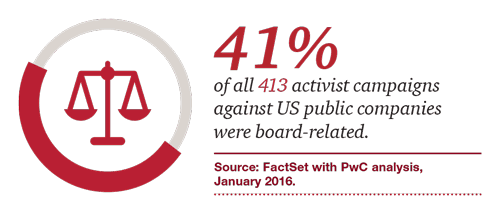
Ainsi, on apprend que 41 % des campagnes menées par les activistes étaient reliées à la composition des CA, et que 20 % des CA ont modifié leur composition en réponse aux activités réelles ou potentielles des activistes.

L’article s’attarde sur la grille de composition des conseils relative aux compétences et habiletés requises. Également, on présente les arguments pour une plus grande diversité des CA et l’on s’interroge sur la situation actuelle.

Enfin, l’article revient sur les questions du nombre de mandats des administrateurs et de l’âge de la retraite de ceux-ci ainsi que sur les préoccupations des investisseurs eu égard au renouvellement et au rajeunissement des CA.

Le travail de renouvellement du conseil ne peut se faire sans la mise en place d’un processus d’évaluation complet du fonctionnement du CA et des administrateurs.

À mon avis, c’est certainement un article à lire pour bien comprendre toutes les problématiques reliées à la composition des conseils d’administration.

Bonne lecture !

Investors and Board Composition


sans-titre


In today’s business environment, companies face numerous challenges that can impact success—from emerging technologies to changing regulatory requirements and cybersecurity concerns. As a result, the expertise, experience, and diversity of perspective in the boardroom play a more critical role than ever in ensuring effective oversight. At the same time, many investors and other stakeholders are seeking influence on board composition. They want more information about a company’s director nominees. They also want to know that boards and their nominating and governance committees are appropriately considering director tenure, board diversity and the results of board self-evaluations when making director nominations. All of this is occurring within an environment of aggressive shareholder activism, in which board composition often becomes a central focus.

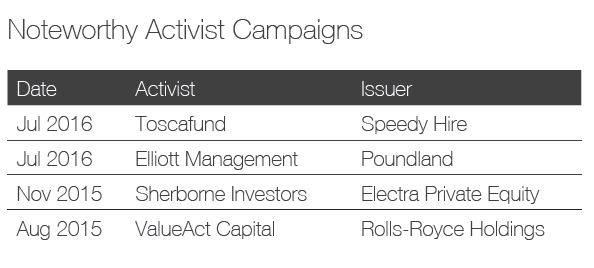
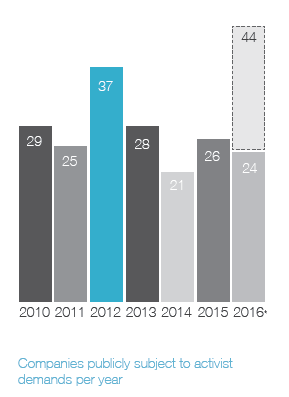
Shareholder activism and board composition

pwc-1

pwc-2

At the same time, a growing number of companies are adopting proxy access rules—allowing shareholders that meet certain ownership criteria to submit a limited number of director candidates for inclusion on the company’s annual proxy. It has become a top governance issue over the last two years, with many shareholders viewing it as a step forward for shareholder rights. And it’s another factor causing boards to focus more on their makeup.

So within this context, how should directors and investors be thinking about board composition, and what steps should be taken to ensure boards are adequately refreshing themselves?

Assessing what you have–and what you need

In a rapidly changing business climate, a high-performing board requires agile directors who can grasp concepts quickly. Directors need to be fiercely independent thinkers who consciously avoid groupthink and are able to challenge management—while still contributing to a productive and collegial boardroom environment. A strong board includes directors with different backgrounds, and individuals who understand how the company’s strategy is impacted by emerging economic and technological trends.

Sample board composition grid: What skills and attributes does your board need?


pwc-table

In assessing their composition, boards and their nominating and governance committees need to think critically about what skills and attributes the board currently has, and how they tie to oversight of the company. As companies’ strategies change and their business models evolve, it is imperative that board composition be evaluated regularly to ensure that the right mix of skills are present to meet the company’s current needs. Many boards conduct a gap analysis that compares current director attributes with those that it has identified as critical to effective oversight. They can then choose to fill any gaps by recruiting new directors with such attributes or by consulting external advisors. Some companies use a matrix in their proxy disclosures to graphically display to investors the particular attributes of each director nominee.

Board diversity is a hot-button issue

Diversity is a key element of any discussion of board composition. Diversity includes not only gender, race, and ethnicity, but also diversity of skills, backgrounds, personalities, opinions, and experiences. But the pace of adding more gender and ethnic diversity to public company boards has been only incremental over the past five years. For example, a December 2015 report from the US Government Accountability Office estimates that it could take four decades for the representation of women on US boards to be the same as men. [1] Some countries, including Norway, Belgium, and Italy, have implemented regulatory quotas to increase the percentage of women on boards.

Even if equal proportions of women and men joined boards each year beginning in 2015, GAO estimated that it could take more than four decades for women’s representation on boards to be on par with that of men’s.
—US Government Accountability Office, December 2015

According to PwC’s 2015 Annual Corporate Directors Survey, more than 80% of directors believe board diversity positively impacts board and company performance. But more than 70% of directors say there are impediments to increasing board diversity. [2] One of the main impediments is that many boards look to current or former CEOs as potential director candidates. However, only 4% of S&P 500 CEOs are female, [3] less than 2% of the Fortune 500 CEOs are Hispanic or Asian, and only 1% of the Fortune 500 CEOs are African-American. [4] So in order to get boards to be more diverse, the pool of potential director candidates needs to be expanded.

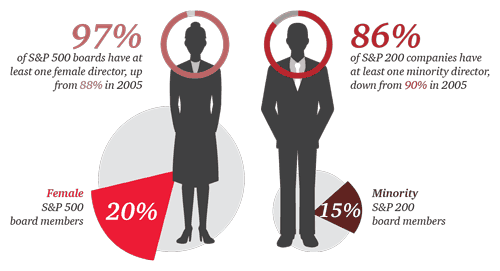
Is there diversity on US boards?


pwc-4

Source: Spencer Stuart US Board Index 2015, November 2015.

SEC rules require companies to disclose the backgrounds and qualifications of director nominees and whether diversity was a nomination consideration. In January 2016, SEC Chair Mary Jo White included diversity as a priority for the SEC’s 2016 agenda and suggested that the SEC’s disclosure rules pertaining to board diversity may be enhanced.

While those who aspire to become directors must play their part, the drive to make diversity a priority really has to come from board leadership: CEOs, lead directors, board chairs, and nominating and governance committee chairs. These leaders need to be proactive and commit to making diversity part of the company and board culture. In order to find more diverse candidates, boards will have to look in different places. There are often many untapped, highly qualified, and diverse candidates just a few steps below the C-suite, people who drive strategies, run large segments of the business, and function like CEOs.

How long is too long? Director tenure and mandatory retirement

The debate over board tenure centers on whether lengthy board service negatively impacts director independence, objectivity, and performance. Some investors believe that long-serving directors can become complacent over time—making it less likely that they will challenge management. However, others question the virtue of forced board turnover. They argue that with greater tenure comes good working relationships with stakeholders and a deep knowledge of the company. One approach to this issue is to strive for diversity of board tenure—consciously balancing the board’s composition to include new directors, those with medium tenures, and those with long-term service.

This debate has heated up in recent years, due in part to attention from the Council of Institutional Investors (the Council). In 2013, the Council introduced a revised policy statement on board tenure. While the policy “does not endorse a term limit,” [5] the Council noted that directors with extended tenures should no longer be considered independent. More recently, the large pension fund CalPERS has been vocal about tenure, stating that extended board service could impede objectivity. CalPERS updated its 2016 proxy voting guidelines by asking companies to explain why directors serving for over twelve years should still be considered independent.

We believe director independence can be compromised at 12 years of service—in these situations a company should carry out rigorous evaluations to either classify the director as non-independent or provide a detailed annual explanation of why the director can continue to be classified as independent.
— CalPERS Global Governance Principles, second reading, March 14, 2016

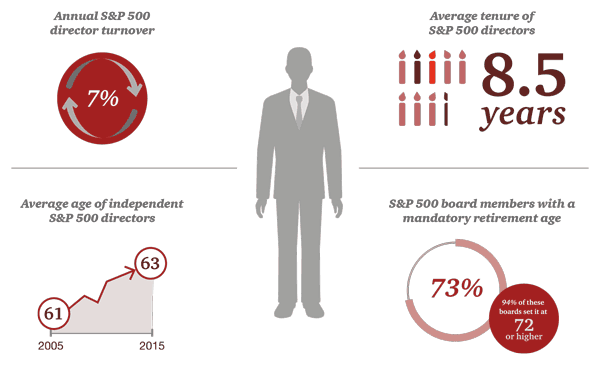
Factors in the director tenure and age debate


pwc-3

Source: Spencer Stuart US Board Index 2015, November 2015.

Many boards have a mandatory retirement age for their directors. However, the average mandatory retirement age has increased in recent years. Of the 73% of S&P 500 boards that have a mandatory retirement age in place, 97% set that age at 72 or older—up from 57% that did so ten years ago. Thirty-four percent set it at 75 or older. [6] Others believe that director term limits may be a better way to encourage board refreshment, but only 3% of S&P 500 boards have such policies. [7]

Investor concern

Some institutional investors have expressed concern about board composition and refreshment, and this increased scrutiny could have an impact on proxy voting decisions.

What are investors saying about board composition and refreshment?


pwc-table2

Sources: BlackRock, Proxy voting guidelines for U.S. securities, February 2015; California Public Employees’ Retirement System, Statement of Investment Policy for Global Governance, March 16, 2015; State Street Global Advisors’ US Proxy Voting and Engagement Guidelines, March 2015.

Proxy advisors’ views on board composition—recent developments

Proxy advisory firm Institutional Shareholder Services’s (ISS) governance rating system QuickScore 3.0 views tenure of more than nine years as potentially compromising director independence. ISS’s 2016 voting policy updates include a clarification that a “small number” of long-tenured directors (those with more than nine years of board service) does not negatively impact the company’s QuickScore governance rating, though ISS does not provide specifics on the acceptable quantity.

Glass Lewis’ updated 2016 voting policies address nominating committee performance. Glass Lewis may now recommend against the nominating and governance committee chair “where the board’s failure to ensure the board has directors with relevant experience, either through periodic director assessment or board refreshment, has contributed to a company’s poor performance.” Glass Lewis believes that shareholders are best served when boards are diverse on the basis of age, race, gender and ethnicity, as well as on the basis of geographic knowledge, industry experience, board tenure, and culture.

How can directors proactively address board refreshment?

The first step in refreshing your board is deciding whether to add a new board member and determining which director attributes are most important. One way to do this is to conduct a self-assessment. Directors also have a number of mechanisms to address board refreshment. For one, boards can consider new ways of recruiting director candidates. They can take charge of their composition through active and strategic succession planning. And they can also use robust self-assessments to gauge individual director performance—and replace directors who are no longer contributing.

  1. Act on the results of board assessments. Boards should use their annual self-assessment to help spark discussions about board refreshment. Having a robust board assessment process can offer insights into how the board is functioning and how individual directors are performing. The board can use this process to identify directors that may be underperforming or whose skills may no longer match what the company needs. It’s incumbent upon the board chair or lead director and the chair of the nominating and governance committee to address any difficult matters that may arise out of the assessment process, including having challenging conversations with underperforming directors. In addition, some investors are asking about the results of board assessments. CalPERS and CalSTRS have both called on boards to disclose more information about the impact of their self-assessments on board composition decisions. [8]
  2. Take a strategic approach to director succession planning. Director succession planning is essential to promoting board refreshment. But, less than half of directors “very much” believe their board is spending enough time on director succession. [9] In board succession planning, it’s important to think about the current state of the board, the tenure of current members, and the company’s future needs. Boards should identify possible director candidates based upon anticipated turnover and director retirements.
  3. Broaden the pool of candidates. Often, boards recruit directors by soliciting recommendations from other sitting directors, which can be a small pool. Forward-looking boards expand the universe of potential qualified candidates by looking outside of the C-suite, considering investor recommendations, and by looking for candidates outside the corporate world—from the retired military, academia, and large non-profits. This will provide a broader pool of individuals with more diverse backgrounds who can be great board contributors.

In sum, evaluating board composition and refreshing the board may be challenging at times, but it’s increasingly a topic of concern for many investors, and it’s critical to the board’s ability to stay current, effective, and focused on enhancing long-term shareholder value.

The complete publication, including footnotes and appendix, is available here.
Endnotes:

[1] United States Government Accountability Office, “Corporate Boards: Strategies to Address Representation of Women Include Federal Disclosure Requirements,” December 2015.
(go back)

[2] PwC, 2015 Annual Corporate Directors Survey, October 2015.
(go back)

[3] Catalyst, Women CEOs of the S&P 500, February 3, 2016.
(go back)

[4] “McDonald’s CEO to Retire; Black Fortune 500 CEOs Decline by 33% in Past Year,” DiversityInc, January 29, 2015; http://www.diversityinc.com/leadership/mcdonalds-ceo-retire-black-fortune-500-ceos-decline-33-past-year.
(go back)

[5] Amy Borrus, “More on CII’s New Policies on Universal Proxies and Board Tenure,” Council of Institutional Investors, October 1, 2013; http://www.cii.org/article_content.asp?article=208.
(go back)

[6] Spencer Stuart, 2015 US Board Index, November 2015.
(go back)

[7] Spencer Stuart, 2015 US Board Index, November 2015.
(go back)

[8] California State Teachers’ Retirement System Corporate Governance Principles, April 3, 2015, http://www.calstrs.com/sites/main/files/file-attachments/corporate_governance_principles_1.pdf; The California Public Employees’ Retirement System Global Governance Principles, Updated March 14, 2016, https://www.calpers.ca.gov/docs/board-agendas/201603/invest/item05a-02.pdf.
(go back)

[9] PwC, 2015 Annual Corporate Directors Survey, October 2015. www.pwc.com/us/GovernanceInsightsCenter.

________________________________

*Paula Loop is Leader of the Governance Insights Center at PricewaterhouseCoopers LLP. This post is based on a PwC publication by Ms. Loop and Paul DeNicola. The complete publication, including footnotes and appendix, is available here.

Recrudescence de l’activisme des actionnaires en Europe


Voici un article très bien documenté sur la recrudescence de l’activisme des actionnaires en Europe.

L’actif sous contrôle des activistes européens est passé de 21,7 B $, en 2012, à 27,5 B $, en 2015.

Bonne lecture !

Activist Investing in Europe: A Special Report


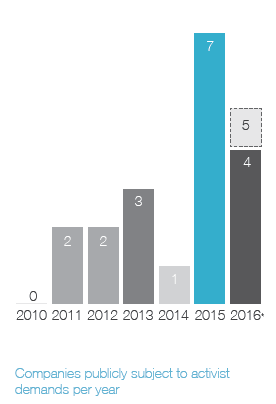
The inaugural edition of this report, published nearly two years ago, suggested that so long as opportunities presented themselves, activists would continue to seek governance, strategy and capital allocation reforms from European issuers. Indeed they have. After ebbing briefly in 2014, when only 51 companies were publicly targeted (after 61 in 2012 and 59 in 2013), activism has roared back, with 67 companies targeted in 2015 and 64 in the first half of 2016 alone. Assets under management for European activists have grown slowly in that period—from $21.7 billion in 2012 to $27.5 billion in 2015—suggesting the growth has been funded by new entrants and foreign players.

Even publicity-shy activists who have been working with companies behind closed doors for many years concede that the growth in activism in Europe is accelerating. Some see a cyclical boom, with activists hoping to catalyse M&A. Yet on topics such as remuneration, and with the launch of specialist European activist funds, the change appears built to last. Part of the evolution of activism in Europe has been the success of tactics seen as more common in the U.S., including proxy contests. Although longer-term participants and the bulk of campaigns suggest lowkey, collaborative approaches are still more common, activists are becoming less shy about testing where the boundaries lie.

The five countries covered in detail in this post represent approximately 80% of the companies targeted by activists since 2010, although in the past two-and-a-half years the level has been lower. Outside of their ranks, Scandinavia and the Netherlands are popular hunting grounds, while Southeastern Asset Management picked up a board seat at Spain’s Applus in July.

Future editions of this report will have to find a different flag for the front cover, following the U.K.’s decision to leave the European Union. The impact on activism in Europe could be still more profound. In the short period since the referendum, stock markets all over Europe dipped temporarily, creating buying opportunities at export-led companies. Elliott Management, a U.S. hedge fund with a well-established London office, has disclosed four positions since the vote (although it held some as toe-holds previously). Some of these companies were already subject to takeover offers, and Elliott has agitated for higher bids.

Another development, albeit not directly connected with traditional forms of activism, is the rise of activist short selling, where investors bet against a company and attempt to convince investors the stock price will drop. Such campaigns more than doubled from 2014 to 2015, and gained prominence after fuelling sell-offs at the likes of Quindell and Wirecard. Already in the first half of 2016, six companies had been targeted.

The U.S. has seen activism spread beyond a disciplined asset class in recent years. Whether European investors prove to be quite as demanding remains to be seen. But if markets continue to be volatile, opportunities for value investors, arbitrageurs and short sellers will be more plentiful. Recent events suggest there will be opportunists to match.

United Kingdom

Activism has roared back to prominence in the United Kingdom since 2014, with three high-profile proxy battles and the first FTSE 100 company accepting an activist into its boardroom.

ValueAct Capital Partners, a San Francisco-based hedge fund known for its engagements with Adobe and Microsoft, prefers to be seen as a cooperative investor. It generally avoids aggressive tactics such as proxy fights, lawsuits and public letter-writing, preferring testimonials from CEOs it has worked with in the past. Investing in Rolls-Royce Holdings, with its strategically important submarine business and stately shareholders, required a display of deference. As well as hiking its stake to above 10%, the fund worked with new CEO Warren East for over 200 days before its nominee was offered a board seat.

Others have taken less conciliatory paths. Sherborne Investors, defeated in a 2014 proxy contest at Electra Private Equity, raised its stake to 30% before finally winning two board seats the following year. Since then, almost all the other directors have been forced out, and the fund’s external manager served notice. Smoother contests saw victories for Elliott Management at Alliance Trust and the family office of Luis Amaral at Stock Spirits. Yet whereas the former has reformed slowly, attracting potential suitors in the process, the latter has descended into acrimony. The Stock Spirits board may have promised not to engage in acquisitions and to pay a special dividend, but risked conflict by designating the activist nominees non-independent.

Strong shareholder rights, including the ability to call a meeting with just 5% of shares, and a highly liquid and dispersed market, should mean the U.K. continues to be a focal point for activism in Europe. With stocks initially down sharply after the country voted to leave the European Union, a few bargain-hunters may even be preparing campaigns.

skadden-1

Proxy fights have become increasingly common at U.K. companies, with activists claiming a better record of success than in previous years after the Alliance Trust watershed. Toscafund, fighting the first in its 16-year history, will hope that track record continues. Elliott Management has also made merger arbitrage central to its strategy in recent years. Although operational activist Cevian Capital appears to be more focused on Continental Europe, turnarounds at exporters Rolls-Royce Holdings and Meggit are attracting activist attention.

skadden2

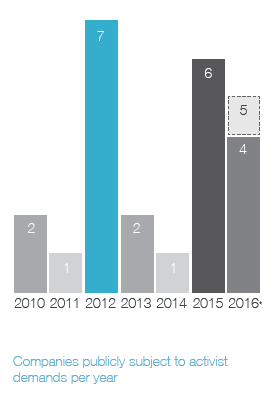
Activism in the U.K. increased steadily after the financial crisis, culminating in the shareholder spring of 2012. Despite a dip thereafter, 2015 and 2016 have seen steadily more activity and this year is expected to be the busiest year yet.

* as of 30th June 2016. Projected full-year figure shown in dotted box.

skadden3

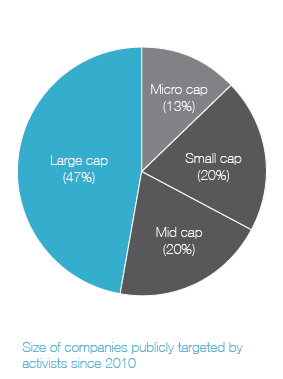
Easy access to shareholder rights, including meeting requisitions and proposals ensure that smaller companies are always vulnerable to activism. With several well funded and established activists setting up in London, however, large cap companies are starting to draw more attention.

Shareholder Activism—recent developments in the U.K.

Continuing the trend of previous years, the U.K. continues to see the lion’s share of activism in Europe. Over the last 12 months, approximately 43% of all European campaigns were played out in the U.K., according to Activist Insight data. Whilst the traditional mix of activist strategies were deployed, attempts to obtain board representation received most attention and generated most success.

In April 2015, Elliott Management’s criticism of Alliance Trust’s poor performance and high costs resulted in two new non-executive directors (“NED”) being appointed to the latter’s board. At Stock Spirits, Western Gate Private Investment’s (“WGPI”) complaints of “spiraling costs” and a board prone to “group-think” also resulted in the appointment of two NEDs following a shareholder vote. At Rolls- Royce Holdings, too, ValueAct Capital’s complaints regarding a fifth profit warning in two years resulted in a NED appointment for ValueAct’s chief operating officer in return for the promise that ValueAct would not lobby for a break-up of the company, nor increase its stake above 12.5%.

In each of these cases, the activists’ public rationale for supporting NED appointments has been to better long-term results through improved corporate governance and executive scrutiny. Also notable is that in two of the cases mentioned above, new appointments were subject to negotiation and compromise, with the activists accepting limitations on the extent of their directors’ participation in board meetings and board committees.

Board appointments have not gone without criticism, however, particularly regarding the perceived lack of independence of the new directors. Certainly, fears over conflicts of interest can have practical implications. In the case of Rolls-Royce,

ValueAct’s seat on the board was subject to limited rights: it has no ability to propose changes in strategy or management, call a shareholder meeting nor push for mergers or acquisitions. At Stock Spirits, the new NEDs have been prevented from sitting on certain committees and the chairman has publicly stated that they may be asked to leave meetings where commercially sensitive information, such as pricing, is discussed.

The U.K.’s legal, regulatory and political landscape remains supportive of shareholder engagement, and activists will leverage this to reinforce their (shorterterm) theses. Witness the increasing activity of Investor Forum (the “Forum”), whose 40 members own approximately 42% of the FTSE All Share Index. The Forum seeks to promote long-term investment and collective engagement with U.K. companies by its members. In August, after over a year of private engagement with Sports Direct alongside major institutions holding approximately 12% of Sports Direct, the Forum issued a press release calling for a comprehensive and independent review of corporate governance at the company.

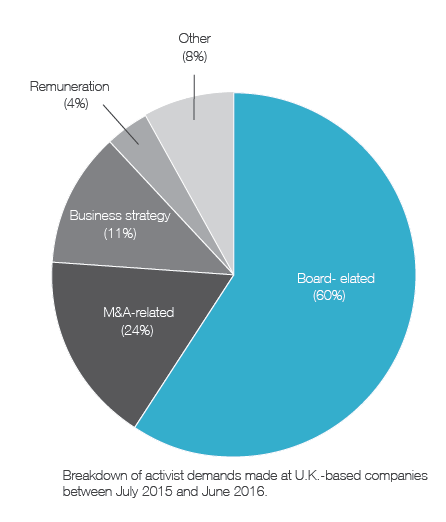
Whilst the mechanics for investor engagement have remained largely constant over the last few years in the U.K., the grounds for activist shareholders to demand change remains dynamic. In addition to the traditional activist calling cards of under-par growth, over-inflated executive salaries and deficiencies in corporate governance, Britain’s recent referendum vote to leave the European Union may lead to some boards being challenged on their strategies to cope with Brexit. For so long as activists can continue to find intrinsic, unlocked value in U.K. companies, the facilitative environment and dynamic business conditions will continue to catalyse activism in the U.K.

skadden4

France

Controlling shareholders, double voting rights and government stakes in key industries make activism a challenging proposition in France, though there is no sign of activists abandoning their ambitions altogether. Last year, Airbus quietly sold its stake in Dassault Aviation in order to buyback shares, a year after The Children’s Investment Fund suggested the move.

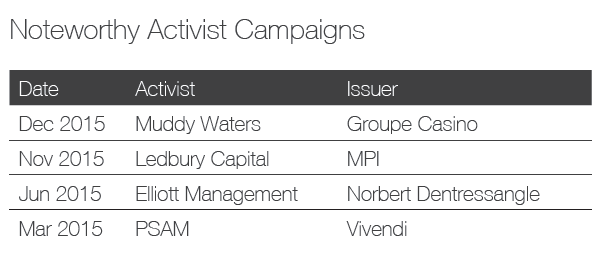
Admittedly, not all activists have had such success. Elliott Management is currently in a legal battle with XPO Logistics Europe (formerly Norbert Dentressangle). Although it failed to remove CEO Troy Cooper at this year’s annual meeting, it owns enough to prevent the U.S. parent from delisting the company. In 2015, U.S.-based P. Schoenfeld Asset Management (“PSAM”) acquired a small stake in Vivendi and suggested selling Universal Music Group in order to pay larger dividends. Vivendi Chairman Vincent Bolloré increased his stake and pushed through double voting rights for long-term investors, enhancing his control.

Nonetheless, activism has begun to thrive in France. Electrical parts company Rexel waved goodbye to its CEO just months after Cevian Capital disclosed a stake earlier this year, Carrefour faced another request for board seats, and a merger between Maurel & Prom and MPI saw opposition from U.K. and South African funds. Meanwhile, the Paris-based hedge fund CI-AM has been making a name for itself, attempting to use the courts to stop the takeover of Club Med by China Fosun International and to reshape a licensing agreement between Euro Disney and The Walt Disney Company, to ensure investors in the Paris theme park were adequately compensated.

Activist short selling is also making its presence felt. In December, Muddy Waters Research released a 22-page report on grocery chain Groupe Casino, which it said was “dangerously leveraged, and… managed for the very short term.” Shares were down 11.6% a week after the report was published.

skadden5

Elliott has already been holding out at Norbert Dentressangle for more than a year, preventing the company from delisting following a takeover bid by XPO Logistics. An attempt to take the chairman role from CEO Troy Cooper at this year’s annual meeting failed, but the company has yet to be delisted–unlike MPI, which has now been merged with Maurel & Prom. Vincent Bolloré shows no signs being slowed down by U.S. activists such as P. Schoenfeld Asset Management, which won dividends but no seat on the board from a 2015 raid. In December, Muddy Waters Research released a much discussed short report on grocer Groupe Casino.

skadden6

2015 saw a sudden renewal of activist interest in France, coming close to the peak of 2012. So far, 2016 is off to a reasonable start, although it seems the country will continue to be targeted intermittently.

* as of 30th June 2016. Projected full-year figure shown in dotted box.

skadden7

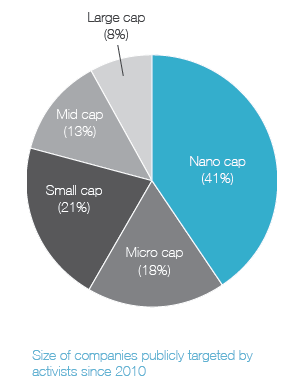
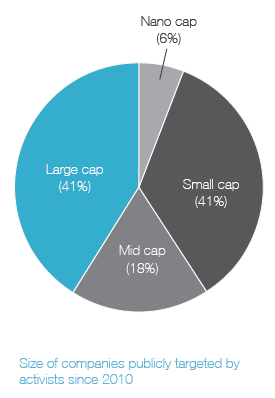
Activist targets tend to be larger, on average, in France than in other countries, perhaps because they are more likely to be susceptible to international pressure. However, a rising number of campaigns at small cap companies may presage a busier market in future.

France is in the process of strengthening its Say on Pay

The emergence of shareholder activism in France over the last decade has been supported by the development of corporate governance rules and best practices. A number of campaigns following the global financial crisis focused on corporate governance, including the separation of chairmen and CEO roles, management performance and compensation.

Say on Pay was introduced in France in 2013 in the form of a soft law set forth in the corporate governance code applicable to French listed companies (the “AFEP-MEDEF Code”). France opted for an annual non-binding shareholder vote on all forms of compensation paid or granted to the company’s officers, including the chairman (vote consultatif des actionnaires). If compensation is rejected, a board is required to post a release on the company’s website following its next board meeting detailing how it intends to deal with such vote.

As the vote is non-binding, the general view until now is that boards may maintain compensation granted to the company’s officers, even when it is rejected by shareholders, or receives very limited support. In 2016, Renault and Alstom’s CEO compensation gave rise to a negative Say on Pay vote by shareholders. In the case of Renault, the board met immediately after the meeting and decided to confirm the 2015 compensation of the company’s CEO, generating criticism from the French state, which holds a significant stake in Renault, and politicians, as well as questions on the efficacy of French Say on Pay.

Following the Renault controversy, a public consultation was launched in order to, amongst other things, strengthen the Code’s Say on Pay provisions. The proposed new wording (likely to be in force from September 2016), is somewhat more restrictive than that currently in force, as it contemplates an express obligation for the board to amend the relevant officers’ compensation for the previous year or the company’s management compensation policy for the future. The French government also proposed in early June in a bill currently under discussion at the French Parliament (the “Loi Sapin II”) to introduce a binding Say on Pay in the French Commercial Code. This bill was highly debated and, at the date hereof, the French Assemblée Nationale and Sénat have taken different positions on this topic.

In the context of this reform, it is essential that French legislators bear in mind that the board has always been and shall remain the competent corporate body to fix the compensation granted to the company’s officers. In particular, the board is the sole corporate body which can set the applicable performance criteria for the annual and long-term variable remuneration of the company’s officers and assess whether or not these criteria have been met. In our view, the best way to achieve a well-balanced system would be to implement a Say on Pay inspired by the U.K. model, with (i) a binding shareholder vote every three or four years on the company’s compensation policy, and (ii) a nonbinding shareholder vote every year on the compensation granted to the company’s officers for the previous fiscal year, without any effect provided that such compensation complies with the management compensation policy approved by the shareholders.

Germany

Shareholders have always occupied a more complicated role in Germany, where a two-tier board structure gives labour unions and other interest groups a role, while limiting direct contact with executives.

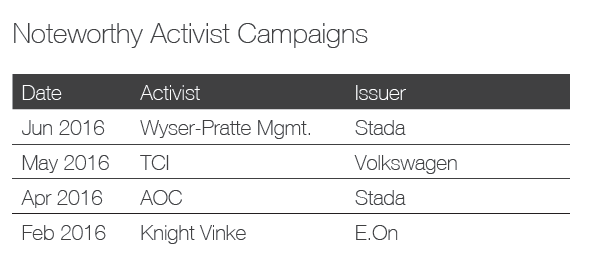
In recent years, however, activists have descended on Germany. Knight Vinke, a Monaco-based hedge fund that specialises in large cap companies, has written a white paper on how E.On should be reshaped, while Cevian Capital has stakes in Bilfinger and ThyssenKrupp, where it is practising its traditional long-term, operational style of activism. Sports retailer Adidas has been forced to deny suggestions that Southeastern Asset Management was behind a decision to sell its golf division.

Events at Volkswagen since the emissions scandal highlight both the opportunities and the challenges for activism in Germany. London-based hedge fund The Children’s Investment Fund (“TCI”), wrote a scathing public letter in May, attacking executive compensation and deals with local state officials and unions that had damaged productivity levels.

Other investors sought to use Volkswagen’s annual meeting to send a message by attempting to deny management board members discharge from liability for their decisions and to halt dividend payments. Despite a number of investors speaking at the meeting and criticism from proxy voting advisers, the management resolutions were carried comfortably, reflecting the concentrated ownership of the Porsche and Piëch families.

A proxy contest at drugmaker Stada Arzneimittel may yet present activists with a path to influencing German companies, however. Investors defied management to elect a director selected by Active Ownership Capital (“AOC”), voted down Chairman Martin Abend and rejected the company’s remuneration plan. Other investors have openly called for the company to be sold, although AOC denied it would push for this.

skadden8

The proxy contest at Stada Arzneimittel is a rare beast in a country that generally encourages activists to work more with management than directors to get things done. Even The Children’s Investment Fund Management, which has a fearsome reputation, is relying on its bully pulpit as a shareholder in Volkswagen to get things done, rather than initiating a formal contest. Activists have appointed supervisory board members in the past, however. Cevian Capital, a big player in the region, is currently involved at several construction sector companies.

skadden9

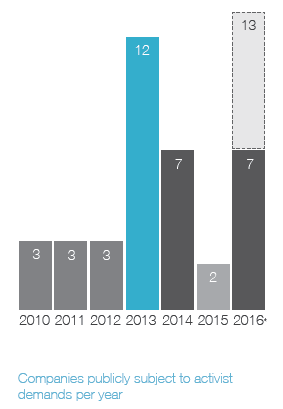
A wave of merger arbitrage by activists such as Kerrisdale Capital and Elliott Management as well the traditional activism of Cevian Capital made 2013 a banner year for activism in Germany. Cevian are showing the country more attention than ever, with 2016 on course to finish strongly.

* as of 30th June 2016. Projected full-year figures shown in dotted box.

skadden10

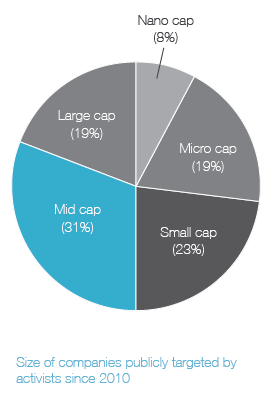
Growing interest in activism in Germany has seen a wider range of market caps affected by activism since our last report. Both mid cap and large cap targets have increased in prominence, thanks to well-resourced activists showing interest in recent years.

New players rising

Shareholder activism in Germany continues to receive attention from the public, particularly with new domestic and short selling activists that understand how to utilise statutory legal instruments to implement their strategies entering the stage.

Elliott Management, a typical activist investor in special situations, continued to fiercely enforce its claim for an increase of the consideration for its 14.4% stake in Kabel Deutschland as part of the tender offer by Vodafone Group. In 2013, Elliott requested a special audit to review the offer of €84.53 per share. Since Vodafone vetoed a further special audit at the 2015 annual meeting, Elliott filed a court action requesting a further special audit alleging that €188 would have been fair; it seized upon its right pursuant to Sec. 145 German Stock Corporation Act (“AktG”). The court ruled in favour of Elliott, while the verdict of the further audit is outstanding.

Turning to “strategic” activists, with Active Ownership Capital (“AOC”) a new German player has entered the stage. In April 2016, AOC purchased a 5.1% position in Stada Arzneimittel and requested the replacement of initially five, later three, of the nine members of Stada’s supervisory board. Originally, Stada accepted these nominations but then changed its mind, eventually adjourning its annual meeting by nearly three months. Meanwhile AOC established a shareholders’ forum (Sec. 127a AktG) asking major shareholders to nominate candidates for election, eventually picking four to take into the proxy contest. Additionally, AOC called for the election of a new auditor; then it proposed the replacement of management board members even though the management board is appointed by the supervisory board whose members are independent from shareholders. AOC has been supported by Guy Wyser-Pratte and German Shareholder Value Management, drawing scrutiny by the German supervisory authority BaFin. It remains unclear whether AOC is seeking a longterm partnership or publicity to raise Stada’s market value, possibly with the goal of a sale; respective rumours of a partial or complete sale have evolved.

Besides the shareholders’ forum and direct communication with management, AOC essentially may use the following legal instruments: request that discharge of management not be granted on an individual basis (Sec. 120 para. 1 sent. 2 AktG), individual election of supervisory board members (Sec. 5.4.3 German Corporate Governance Code) and voting on its own director nominees prior to candidates proposed by management, thus enhancing their chances for election (Sec. 137 AktG).

The influence of activists is further proven by Cevian Capital’s investment in Bilfinger. For years Cevian has closely followed Bilfinger’s management and presumably “installed” Eckhard Cordes as chairman of the supervisory board, prompting various changes to the management board.

Aside from some other campaigns, a new kind of activists has emerged—those selling shares short and spreading news adversely affecting the share price. The lawfulness of this may be doubted. Examples include Muddy Waters (at Ströer) and Zatarra (Wirecard).

This illustrates the continuing increase in shareholder activism in Germany and that German law provides requisite instruments for it.

Italy

Shareholder representation on company boards is the rule and not the exception in Italy, with large investors dividing board seats amongst themselves and majority shareholders choosing managers. As of 2014, 83% of listed companies had a controlling shareholder, or a coalition of shareholders in control. However, the long-term trend is that the weight of the owners is slowly decreasing, and the presence of foreign institutional investors rising.

Moreover, the country’s prolonged economic crisis and new laws have weakened families and institutions that have controlled Italy’s largest companies for decades. Changes include the conversion of the largest co-operative banks into limited companies, a ban on director overboarding within competing entities in the financial sector, and limits on the grip of foundations on the country’s banks.

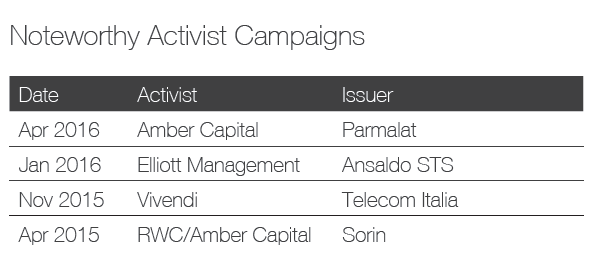
Railway signalling group Ansaldo STS has recently faced one of the most outspoken activist campaigns ever seen in the country, with Elliott Management and Amber Capital fighting for an increase in the price of a tender offer by Japan’s Hitachi—which recently acquired the Italian company’s controlling stake. Elliott also exploited Italy’s proxy access rules to elect three directors to the board of Ansaldo STS.

London-based Amber, which has an office in Milan, is also fighting a battle at dairy multinational Parmalat, where it has a board seat and accuses the controlling shareholder of improper related-party transactions.

In the 2016 proxy season, the Investment Managers’ Committee, an association assisting investment firms in nominating independent directors, submitted slates at 34 companies—up from 14 in 2013–and elected close to 60 board members, largely thanks to laws granting seats to minority shareholders.

skadden11

Elliott Management has launched one of the most outspoken activist campaigns ever seen in Italy, electing three directors at Ansaldo STS and filing a lawsuit to gain complete control of the board. Amber Capital is engaging with several companies, and a battle with Parmalat’s largest shareholder that started in 2012 is still ongoing. In 2015, Vincent Bolloré’s Vivendi won three seats on the board of Telecom Italia.

skadden12

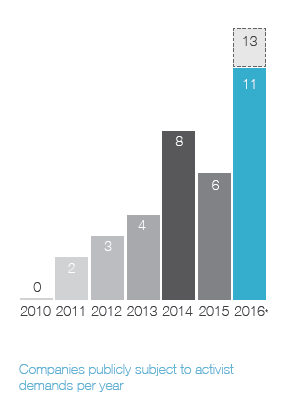
Activism in Italy has been rising steadily since the eurozone crisis, and 2016 is the busiest year on record as regulatory reform increases the scope for investors to apply pressure.

* as of 30th June 2016. Projected full-year figures shown in dotted box.

skadden13

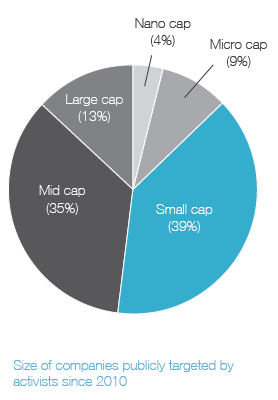
Activism in Italy is dominated by companies with a market capitalisation of less than 1.8 billion euros, although high-profile examples of large companies being targeted can be found.

Switzerland

Activism in Switzerland continues to play a role in several aspects of corporate life. Despite campaigns at the likes of Transocean, Xstrata and UBS, the country has previously been thought of as unfavourable to activism because, as in Germany, many companies have dual board structures. However, that failed to stop investors recently demanding changes to boards at Holcim, fashion retailer Charles Vögele and listed hedge fund Altin.

M&A activity including some of the largest Swiss companies, such as Syngenta and LafargeHolcim, has forced management teams to engage more meaningfully with shareholders, although investors have been less successful in wringing out meaningful concessions than in 2012, when a shareholder vote on golden parachutes for Xstrata executives forced the resignation of Chairman John Bond.

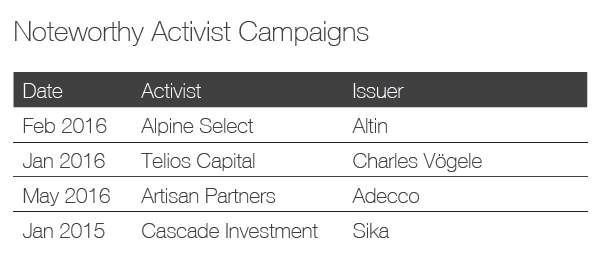
At Sika, a specialty chemicals company, Bill Gates’ family office Cascade Investment has opposed a takeover offer from Cie de Saint-Gobain, lobbying the takeover panel to force the bidder to tender for minority shareholders’ stakes. At the time of writing, Swiss courts were being asked to decide whether Sika could limit the majority voting rights of its founding family, which sold its 16% stake to the bidder.

A campaign at Altin highlights the lengths activists have to go to in Switzerland. In February, Alpine Select requisitioned a shareholder meeting to vote on the appointment of three new directors and a special dividend. When Alpine won just one seat on the board, its nominee resigned, and it went on to build a majority stake before negotiating an agreement whereby the company nominated three new directors, paid a hefty dividend and agreed to delist from the London Stock Exchange. Altin CEO Tony Morrongiello also announced his resignation in favour of Alpine’s Claudia Habermacher at the June annual meeting.

skadden14

The restricted power of dual-class Swiss boards often limits investors to complaining about decisions from outside the boardroom—as with the appointment of Adecco’s new CEO—or legal action—as Bill Gates’ family office Cascade Investment is pursuing at Sika. Mergers have also catalysed activism, with Syngenta and Holcim targeted. As ever, Cevian Capital is present through its stake in ABB, while Swiss activist Telios may be one to watch in the future.

skadden15

After an exceptionally busy 2015, this year has a lot to live up to. However, activists have started strongly, targeting more companies than in any year before 2015.

* as of 30th June 2016. Projected full-year figures shown in dotted box.

skadden16

The make up of activist targets has changed only slightly in recent years. Many Swiss targets of activists being international by nature and often involved in crossborder mergers, the predominance of large cap targets is perhaps not surprising.

La fonction d’audit interne | de plus en plus incontournable pour assurer une saine gouvernance et l’intégrité du management


Voici le résumé d’un article du Wall Street Journal  (Internal Audit Chiefs Gain in Clout, Compensation), publié par Joann S. Lublin, et paru dans le journal The Australian.

Cet article porte sur l’importance accrue accordée au rôle de l’auditeur interne dans la vérification des mécanismes de contrôle interne, de la gestion des risques, notamment des risques de cyberattaques, ainsi que des processus de gouvernance et de conformité.

7af1886faf1ed569628eae86bf27591c_audit-intern

L’influence du département de l’audit interne prend une place quasi incontournable dans la vaste majorité des grandes sociétés comme en témoignent les statistiques à ce sujet.

Ainsi, 83 % des directions d’audit interne se rapportent au CA ou au comité d’audit du CA ; c’est un accroissement de 76 % en trois ans !

On peut certainement constater que les activités d’audit interne représentent les « yeux et les oreilles du comité d’audit ».

Également, les directeurs des services d’audit interne ont vu leur rémunération augmenter d’environ 30 % au cours des dix dernières années.

Les conseils d’administration accordent maintenant une grande importance à la sélection et à la rémunération des « Chief Audit Executive » (CAE).

Bonne lecture !

Chief audit executives gaining clout and higher pay


Top watchdogs inside many companies bark louder these days.

They are known as chief audit executives, or CAEs, and they assess the effectiveness of corporate controls, risk management and governance processes. As boards worry more about cyber attacks, regulatory compliance and personal liability, these executives are gaining clout and commanding higher pay.

CAEs are becoming more visible in part because directors are playing bigger roles in selecting, evaluating and rewarding internal audit chiefs. In North America, 83 per cent of those executives now report to their employer’s full board or audit committee, according to a report by the Institute of Internal Auditors. That’s up from 76 per cent in 2013.

Another sign of their rising influence: this year, for the first time, the proportion of audit leaders who report to their chief executive matched those overseen by the chief financial officer, the report found.

Solid support from audit committees and top company leaders often give CAEs more freedom to raise red flags, experts said. It can also bring them sizeable pay cheques.

“Boards will pay a lot more for CAEs with superior risk-management and business acumen in their company’s industry,’’ said Richard Chambers, IIA president.

Recruiters agree. “Chief audit executives hired by large companies now command total pay packages approaching $US1 million — about 30 per cent more than a decade ago,’’ said Scott Simmons, a managing director at Crist Kolder Associates, which recruited nearly 15 current CAEs.

Sarbanes-Oxley, the sweeping corporate-reform law enacted in 2002, raised boards’ expectations for heads of internal audit, according to Charles Noski, chairman of the audit committee at Microsoft, Priceline Group and Avon Products.

“Internal audit really is the eyes and ears of the audit committee,’’ he said, adding that CAEs today “are stronger executives’’.

Mr Noski makes sure that’s true of candidates who interview for the job. He said he seeks “a strong backbone”, plus effective boardroom presence and communications skills.

L’évolution de la divulgation des comités d’audit aux actionnaires


Voici un article d’Ann Yerger, directrice du Center for Board Matters, de la firme Ernst & Young, qui porte sur l’évolution significative des politiques de divulgation des comités d’audit aux actionnaires des entreprises cotées en bourse aux États-Unis en 2106. L’article est paru sur le site du Harvard Law School Forum on Corporate Governance le 9 octobre.

L’étendue des divulgations aux actionnaires est vraiment très importante dans certains cas. Par exemple, en 2012, seulement 42 % des entreprises dévoilaient explicitement que le comité d’audit était responsable de l’engagement, de la rémunération et de la surveillance des auditeurs externes, alors qu’en 2016, 82 % divulguent, souvent en détail, les informations de cette nature.

Plusieurs autres résultats font état de changements remarquables dans la reddition de compte des comités d’audit aux actionnaires des entreprises.

Ceux-ci sont maintenant plus en mesure d’évaluer la portée des décisions des comités d’audit eu égard à la qualité du travail des auditeurs externes, aux raisons invoquées pour changer d’auditeur externe, à la fixation du mandat de l’auditeur externe, à la composition du comité d’audit, à l’augmentation des honoraires des firmes comptables dans les quatre catégories suivantes : audit, relié aux travaux d’audit, fiscalité et autres services connexes, etc.

Bonne lecture !

Audit Committee Reporting to Shareholders in 2016


audit


Audit committees have a key role in overseeing the integrity of financial reporting. Nevertheless, relatively little information is required to be disclosed by US public companies about the audit committee’s important work. Since our first publication in this series in 2012, we have described efforts by investors, regulators and other stakeholders to seek increased audit­-related disclosures, as well as the resulting voluntary disclosures to respond to this interest.

Over 2015–2016, US regulators have placed a spotlight on audit-related disclosures and financial reporting more generally. The US Securities and Exchange Commission (SEC) and the US Public Company Accounting Oversight Board (PCAOB) have both taken action to consider the possibility of requiring new disclosures relating to the audit.

SEC representatives also have used speeches to urge companies and audit committees to increase disclosures in this area voluntarily. While additional disclosure requirements for audit committees are not expected in the near term, regulators continue to monitor developments in this area. This post seeks to shed light on the evolving audit­-related disclosure landscape.

Context

Public company audit committees are responsible for overseeing financial reporting, including the external audit. Under US securities laws, audit committees are “directly responsible for the appointment, compensation, retention and oversight” of the external auditor, and must include a report in annual proxy statements about their work. This audit committee report, however, currently must affirm only that the committee carried out certain specific responsibilities related to communications with the external auditor, and this requirement has not changed since 1999.

In recent years, a variety of groups have brought attention to the relative lack of information available about the audit committee and the audit, including their view that this area of disclosure may not have kept up with the needs of investors and other proxy statement users. These groups include pension funds, asset managers, investors, corporate governance groups, and domestic and foreign regulators. As efforts to seek additional information have continued, there has been a steady increase in voluntary audit-related disclosures.

Over the last year, the SEC has taken a series of actions to consider whether and how to improve transparency around audit committees, audits and financial reporting more generally. The combined effect of these activities has been to increase engagement by issuers, audit firms, investors and other stakeholders in discussions about the current state of financial reporting­ related disclosure as well as how it should change.

Findings

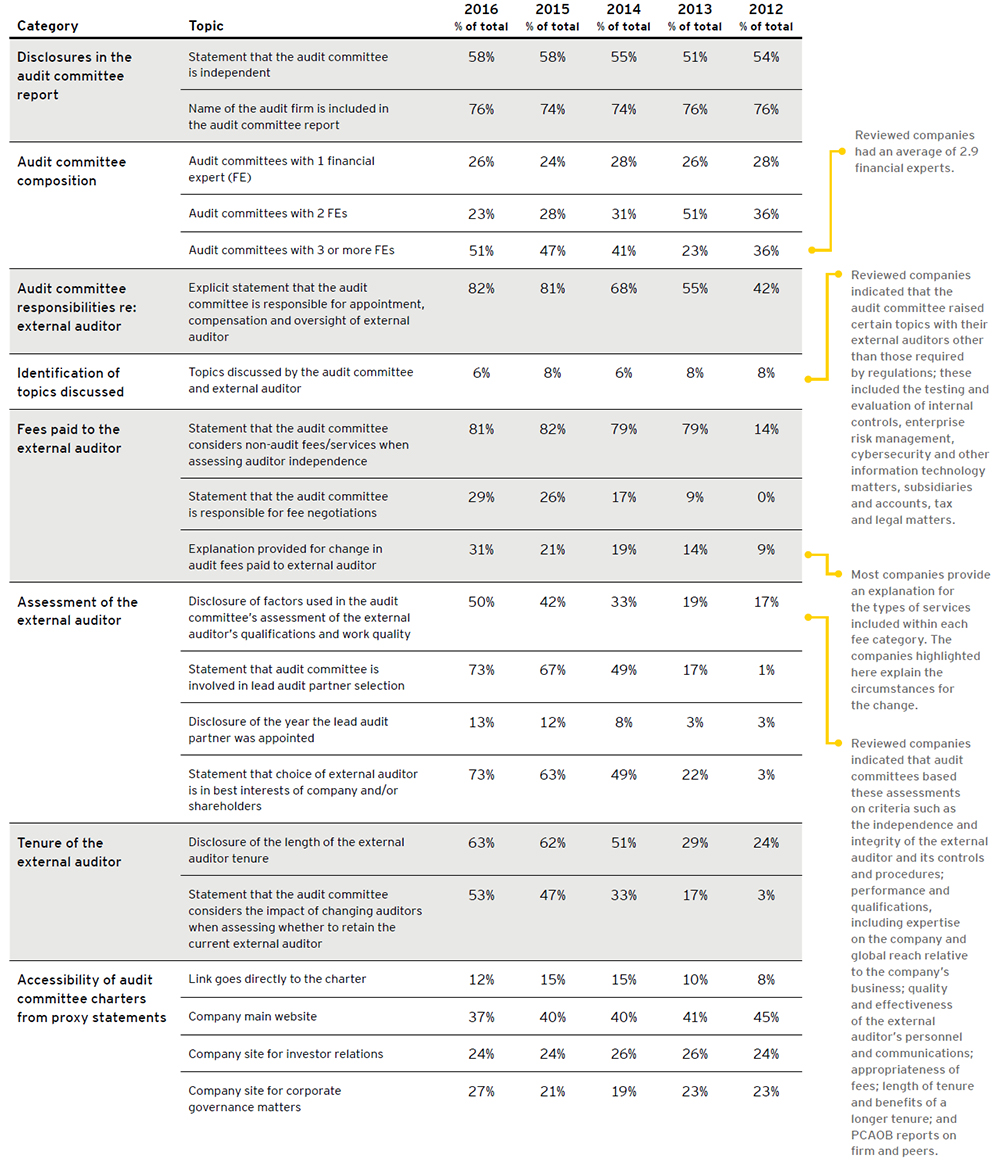
Our analysis of the 2016 proxy statements of Fortune 100 companies indicates that voluntaryaudit-related disclosures continue to trend upward in a number of areas. The CBM data for this review is based on the 78 companies on the 2016 Fortune 100 list that filed proxy statements each year from 2012 to 2016 for annual meetings through August 15, 2016. Below are highlights from our research:

  1. The percentage of companies that disclosed factors considered by the audit committee when assessing the qualifications and work quality of the external auditor increased to 50%, up from 42% in 2015. In 2012, only 17% of audit committees disclosed this information.
  2. Another significant increase was in disclosures stating that the audit committee believed that the choice of external auditor was in the best interests of the company and/or the shareholders. In 2016, 73% of companies disclosed such information; in 2015, this percentage was 63%. In 2012, only 3% of companies made this disclosure.
  3. The audit committees of 82% of the companies explicitly stated that they are responsible for the appointment, compensation and oversight of the external auditor; in 2012, only 42% of audit committees provided such disclosures.
  4. 31% of companies provided information about the reasons for changes in fees paid to the external auditor compared to 21% the previous year. Reasons provided in these disclosures include one­-time events, such as a merger or acquisition. Under current SEC rules, companies are required to disclose fees paid to the external auditor, divided into the following categories: audit, audit-related, tax and all other fees. They are not, however, required to discuss the reasons why these fees have increased or decreased. From 2012 to 2016, the percentage of companies disclosing information to explain changes in audit fees rose from 9% to 31%. Additional CBM research examined the disclosures of the subset of studied companies (43) that had changes in audit fees of +/-­ 5% or more compared to the previous year. Out of these 43 companies, roughly 20% provided explanatory disclosures regarding the change in audit fees.
  5. 29 of the 43 companies had fee increases of 5% or more, out of which 8 companies disclosed the reasons for the increases. 14 of the 43 companies had fee decreases of 5% or more, out of which only one company provided an explanatory disclosure.
  6. 53% of companies disclosed that the audit committee considered the impact of changing auditors when assessing whether to retain the current auditor. This was a 6 percentage point increase over 2015. In 2012, this disclosure was made by 3% of the Fortune 100 companies. Over the past five years, the number of companies disclosing that the audit committee was involved in the selection of the lead audit partner has grown dramatically, up to 73% in 2016. In 2015, 67% of companies disclosed this information, while in 2012, only 1% of companies did so.
  7. 51% of companies disclosed that they have three or more financial experts on their audit committees, up from 47% in 2015 and 36% in 2012.

Summary: Trends in Audit Committee Disclosure

(Cliquez pour agrandir)

ey-summary-trends-in-audit-committee


Le positionnement de l’Ordre des administrateurs agréés du Québec (OAAQ) sur la gouvernance du système professionnel


Dans ce billet, je vous présente un sommaire de l’allocution que j’ai exposé devant les membres de la commission des institutions de l’Assemblée nationale, le 21 septembre, et qui concerne la position de l’ordre des administrateurs agréés eu égard à la modernisation de la gouvernance du système professionnel québécois (Projet de loi 98).

Voici donc le sommaire de notre mémoire. Vous pouvez consulter la version complète du Mémoire de l’Ordre des administrateurs agréés du Québec en vous rendant sur le site de l’assemblée nationale et en cliquant sur le document PDF en question.

Bonne lecture.

Sommaire


L’Ordre des administrateurs agréés du Québec (« OAAQ ») accueille favorablement les mesures visant à moderniser la gouvernance des ordres professionnels. Le recentrage des responsabilités des conseils d’administration vers la vigie et la stratégie, la réduction de la taille des conseils et la distinction des rôles de président et de directeur général devraient favoriser le fonctionnement de nos organisations vouées à la protection du public.

Les principes de gouvernance qui sous-tendent cette réforme sont d’ailleurs implantés à l’OAAQ depuis 2011. L’OAAQ appuie vigoureusement l’obligation pour les administrateurs de se soumettre à une formation en gouvernance et en éthique. Compte tenu de son expertise, l’OAAQ invite les acteurs du système professionnel à lui confier ce mandat de formation.

Le projet de loi nº 98 donne également suite à quatre recommandations de la Commission Charbonneau, notamment quant aux pouvoirs du syndic. Tout en appuyant ces mesures, l’OAAQ souhaite que la réflexion sur la contribution du système professionnel au défi de l’intégrité soit l’occasion de réfléchir au potentiel lié à la professionnalisation de la gestion, un axe malheureusement occulté dans la réponse à donner aux suites de la Commission Charbonneau.

En effet, le rôle joué par certains professionnels de la gestion – chargés de projets, cadres municipaux et administrateurs de contrats – a été remis en question. En sa qualité d’ordre professionnel encadrant la pratique des gestionnaires et veillant à la promotion de normes déontologiques et d’éthique, l’OAAQ peut compléter le dispositif en place aux fins de mitiger les risques d’inconduites dans le domaine des affaires et de la gestion. L’OAAQ interpelle l’État et l’invite à favoriser l’adhésion des gestionnaires au système professionnel ainsi qu’à l’OAAQ.

L’OAAQ appuie la volonté gouvernementale visant à assurer une meilleure efficacité des ordres dans leur mission de protection du public.

Toutefois, les ordres à titres réservés, comme l’OAAQ, doivent avoir les moyens d’exister pour remplir cette mission. Cette consultation sur la réforme du Code des professions est l’occasion de sensibiliser les parlementaires à l’enjeu de la pérennité auquel fait face notre ordre et d’exprimer nos attentes légitimes. Alors que l’OAAQ doit accentuer les mécanismes de protection du public, il doit d’autre part relever le défi de recruter des membres qui s’astreindront à des devoirs déontologiques et à des responsabilités supplémentaires (inspection, formation, assurance) sans bénéficier d’actes réservés.

Si l’État souhaite renforcer la protection du public et la contribution des ordres à titres réservés à cette mission, son action doit être cohérente et des mesures structurantes doivent être mises en œuvre.

Malheureusement, et bien que les consultations et travaux de l’Office des professions du Québec soient terminés, le projet de loi nº 98 ne comporte pas de disposition modernisant les champs descriptifs des ordres du secteur des affaires. L’OAAQ est également en attente de mesures législatives pour la réserve d’acte en gestion de copropriété, une action recommandée par l’Office des professions du Québec.


LISTE DES RECOMMANDATIONS


RECOMMANDATION 1

Que l’État reconnaisse le potentiel lié à la professionnalisation de la gestion comme une réponse à la Commission Charbonneau et que l’administration publique encourage et favorise l’adhésion des gestionnaires au système professionnel ainsi qu’à l’OAAQ.


RECOMMANDATION 2

Que le Code des professions soit amendé afin de renforcer la gouvernance des ordres professionnels et consacre les principes suivants :

  1. Recentrage des responsabilités du conseil d’administration vers la surveillance, les orientations stratégiques et la gouvernance ;
  2. Réduction de la taille des conseils d’administration ;
  3. Distinction des rôles de président (la gouvernance) et de directeur général (la gestion) ;
  4. Obligation d’adopter un code d’éthique et de déontologie pour les administrateurs des ordres et de se soumettre à une formation en gouvernance ;
  5. Discrétion accordée aux ordres dans leur choix de porte-parole.


RECOMMANDATION 3

Que le Code des professions consacre l’obligation de se soumettre à une formation en matière de gouvernance et d’éthique pour les administrateurs des ordres et que les acteurs du système professionnel confient à l’OAAQ ce mandat de formation.


RECOMMANDATION 4

Que la modernisation des champs descriptifs des ordres du secteur des affaires soit intégrée au projet de loi n° 98 (modifications au paragraphe i de l’article 37 du Code des professions).


RECOMMANDATION 5

Que le gouvernement donne suite aux orientations de l’Office des professions du Québec visant la modernisation des champs d’exercice des professions du secteur des affaires et légifère pour réserver l’activité de l’administration de copropriétés.


Les devoirs des administrateurs eu égard à un climat de travail malsain | Un cas pratique


Voici un cas de gouvernance publié sur le site de Julie Garland McLellan* qui illustre les contradictions entre les valeurs énoncées par une école privée et celles qui semblent animer les administrateurs et les parents.

Le cas montre comment un administrateur, nouvellement élu sur un CA d’une école privée, peut se retrouver dans une situation embarrassante impliquant des comportements de harcèlement et de menaces qui affectent la santé mentale et le bien-être des employés.

Cette situation semble se présenter de plus en plus fréquemment dans les institutions d’enseignement qui visent des rendements très (trop !) élevés.

Comment Ignacio peut-il s’y prendre pour bien faire comprendre aux administrateurs de son CA leurs devoirs et leurs obligations légales d’assurer un climat de travail sain, absent d’agression de la part de certains parents ?

Le cas présente, de façon claire, une situation de culture organisationnelle déficiente ; puis, trois experts en gouvernance se prononcent sur le dilemme qui se présente aux administrateurs qui vivent des expériences similaires.

Bonne lecture ! Vos commentaires sont toujours les bienvenus.


Un cas culture organisationnelle déficiente !


 drapeau-vicario1


Ignacio is an old boy of a private school with a proud sporting tradition. He was invited onto the board last year when a long-serving director retired. The school is well run with a professional principal who has the respect of the staff as well as many of the boys.

The school has worked hard to develop academic excellence and its place in rankings has improved with a greater percentage of boys qualifying for university.

At the last board meeting the CEO was absent. The chairman explained that he had taken stress leave because he couldn’t cope with bullying from some of the parents. Some directors sniggered and the rest looked embarrassed. There were a few comments about ‘needing to grow a backbone’, ‘being a pansy’, and ‘not having the guts to stand up to parents or lead the teams to victory on the field’.

Ignacio was aghast – he asked about the anti-harassment and workplace health and safety policies and was given leave by the chair « to look into ‘covering our backs’ if necessary ».

Ignacio met with the HR manager and discovered the policies were out of date and appeared to have been cut and pasted from the original Department of Education advice without customisation. From his experience running a business Ignacio is aware of the importance of mental health issues in the modern workplace and also of the legal duty of directors to provide a workplace free from bullying and harassment. School staff are all aware of a discrepancy between the stated School values and those of the board and some parents. The HR manager tells him that recent bullying by parents has become more akin to verbal and even physical assault. Staff believe the board will not support them against fee paying parents even though the school is, in theory, a not-for-profit institution.

How can Ignacio help lead his board to an understanding of their duty to provide a safe workplace?


Chris’s Answer  …..


Julie’s Answer ….


Leanne’s Answer ….

*Julie Garland McLellan is a practising non-executive director and board consultant based in Sydney, Australia.


Assurer une efficacité supérieure du conseil d’administration


Aujourd’hui, je cède la parole à Johanne Bouchard* qui agit, de nouveau, à titre d’auteure invitée sur mon blogue en gouvernance.

Celle-ci a une solide expérience d’interventions de consultation auprès de conseils d’administration de sociétés américaines ainsi que d’accompagnements auprès de hauts dirigeants de sociétés publiques (cotées), d’organismes à but non lucratif (OBNL) et d’entreprises en démarrage.

Dans cet article publié dans la revue Ethical Boardroom, Achieving higher board effectiveness, elle aborde un sujet qui lui tient particulièrement à cœur : Assurer une efficacité supérieure du conseil d’administration.

L’auteure insiste sur les points suivants :

  1. Le suivi des réunions du CA par le président du conseil
  2. L’intégration des nouveaux membres du conseil
  3. La formation en gouvernance et l’apprentissage des rouages de l’entreprise
  4. Les sessions de planification stratégique
  5. L’évaluation du leadership du CEO, du conseil et du management

L’expérience de Johanne Bouchard auprès d’entreprises cotées en bourse est soutenue ; elle en tire des enseignements utiles pour tous les types de conseils d’administration.

Bonne lecture ! Vos commentaires sont toujours les bienvenus.


Achieving higher board effectiveness


eb_achieving_higher_1000-230x300

« Achieving higher board effectiveness goes well beyond adhering to rules, regulations, legal and ethical compliance. While there are many experts who address the regulatory requirements, an aspect that requires the utmost attention, and is often underestimated and even ignored, is the human element »

That is the basic and subtle dynamics and the complexities inherent in having individuals with diverse experience, different views and perspective, and varied cultural and personal backgrounds gathering a few times a year to serve an entity to which they are not privy on a day-to-day basis. It’s further complicated by the fact that these individuals often don’t know each other outside of their board service.

How can a board maintain its independence, make critical decisions, provide valuable and timely insights to management and be effective as a group of individuals if they have minimal access to the ins and outs of an organisation? How can they truly assess the leadership potential of the CEO, the board and management and effectively minimise vulnerabilities and risk when they’re outsiders?

There are initiatives that a board should commit to that can heighten the potential of every director within the context of their roles and responsibilities, allowing them collectively to achieve higher effectiveness. It is fundamentally critical to the board’s ability to stay current, effective and focussed in enhancing long-term shareholder value.

These initiatives include: board meeting follow-ups with the chair and the CEO; on-boarding and integration of new directors; educational sessions; strategic planning sessions; and CEO, board and management leadership effectiveness assessments.

Board meeting follow-ups with the chair and CEO

Whenever directors come together to meet to fulfill their roles and responsibilities, the chair and the CEO can’t assume that the directors have felt that they’ve made their optimal contributions; that they didn’t feel intimidated or even shy to share their insights. That they felt at ease with the dynamics of the meeting, were satisfied with the results of the board meeting and were comfortable with the way the chair led the meeting and the CEO interacted as an executive director. It is important for a chair and for the CEO to take the initiative of reaching out to all directors immediately after the meeting to do a simple check-in.

This provides an opportunity to gain input about the meeting’s outcomes as well as following up with each director on a one-on-one basis to seek their views about the meeting. It’s an opportunity to constructively share their expectations about the director for that meeting and his/her level of preparedness for that meeting and any committee duties, rather than not addressing it or postponing it to an annual board effectiveness assessment. The individual directors’ effectiveness (including the CEO) as well as the chair’s, are too important not to be handled after each meeting. These check-ins are significant to ensure that the possible ‘elephants in the boardroom’ are promptly addressed. They also enable each director and the chair, and each director and the CEO to get to know each other better.

In any relationship, it is important to have the ability to readily share what works, what is missing and what could have been done better. It takes time and, from my experiences with boards, it makes a great difference when every director is prepared to allocate time between meetings to evaluate the prior meeting before attending the next one. These frank exchanges benefit the chair in preparing the agenda for the next meeting and in leading the board meeting itself. Furthermore, it is also the chair’s responsibility to poll each director, in person or over the phone, to get a pulse about his/her ability to stay abreast of the strategy.

On-boarding and integration

It is tempting to let a director join a board and attend his/her first meeting without proper on-boarding. A board can’t afford for a new director to join for his/her first board meeting without a formal on-boarding process. A director is a human being who is being asked to participate, not to simply fill in a seat. A formal on-boarding can include a meeting with the chair and the CEO shortly after the director has been voted in by the board to formally welcome him/her, confirm their expectations and his/her expectations in having joined the board; bring the director up to date with any crisis, strategic priorities and networking opportunities where he/she could specifically provide insights; and to update the director about board governance processes the directors need to understand.

It is good business, tactful and sensible to acknowledge the need to create a proper introduction of the board and the organisation for all new directors as well as introducing and integrating the incoming directors within the board integration event can last 30 minutes to an hour and is planned and professionally facilitated, thus ensuring that the board doesn’t create a climate of ‘us and them’ as the board augments and/or is refreshed. Proper on-boarding and integration enables new directors to quickly get to know the rest of the board and enables all board directors to further connect, respect and trust each other. While a brief session, it is very powerful to welcoming an incoming director and to further integrating all existing directors within the board.

Educational sessions

Our business ecosystem is becoming more complex and is being intermittently disrupted. A board can’t afford not to be current on the trends that can affect their organisation, even if, at a glance, the trend might not appear to have any potential impact on their strategic roadmap. It is important for a CEO with his/her chair to be on top of trends and to identify specific topics that need to be addressed internally at a high level to keep the board informed as a group – but not necessarily within the scheduled meeting, due to time constraints.

I have written in the past about ‘the four pillars’ that make a great relationship between a chair and a CEO. One of the pillars is communication. It is crucial for the chair and CEO to take the time to speak in person, or at least on the phone, or remotely via video-conferencing tools to check in about their relationship, their effectiveness in their respective roles and to ensure that together they address how to keep the board current about market and industry dynamics. Topics can include how the digital economy is impacting the organisation; the cybersecurity evolution and its associated threats; new strategic considerations for the organisation, vis-à-vis corporate social responsibility; shifting the organisation’s focus from shareholders to stakeholders; making an organisational commitment to sustainability, etc.

There is a plethora of topics that a board must address and can’t realistically address within their formal meetings. This creates an opportunity for the board to further align on strategic priorities, to further ascertain how vulnerable the composition of its board may or may not be and whether the board composition needs to be refreshed or augmented. Industry and expert speakers can be invited to present and conduct small roundtables at these educational sessions.

Strategic planning sessions

Since the National Association of Corporate Directors (NACD) in the United States stipulates that boards have the responsibility to engage in the development and amendment of strategy, it is imperative for boards to participate in an annual strategic planning session – in addition to each director staying current about the industry trends. Not only are strategic planning sessions important to aligning the board on strategy, but they also contribute to evaluating human behaviour dynamics and assessing the entire leadership potential of the board.

Directors must be and stay fully informed about the organisation they serve. In particular, when directors are independent, they must have knowledge of the industry and about the business they commit to serve, given that they are not connected to the business, meeting only four-to-six times a year. Better aligned boards can be more effective in assessing the accuracy, completeness, relevance and validity of information presented to them.

A board has an opportunity to really see in action the effectiveness of their CEO when participating in the annual strategic planning session. Likewise, a CEO gets the same opportunity to experience first-hand the agility of its board during such sessions.

The chair (and CEO) should commit to an annual strategic planning session. This initiative ensures that:

■ Board effectiveness is not affected by information asymmetry that would impede its ability to adequately provide guidance, make decisions and constructively challenge the executive team. The board must be continually informed about industry dynamics, the competitive landscape, the organisation’s business model, its value proposition and its strategic milestones. It is unrealistic that a board can approve financial projections, detect overly ambitious production targets and ascertain budgets and profitability objectives without a clear understanding of strategy and key strategic performance indicators

■ The board is exposed to organisational dynamics and to the dynamics of the CEO with selected or most key executive members, which will assist with its identifying warning flags about the company’s strategic priorities and help reconsider performance indicators as needed

A board has an opportunity to really see in action the effectiveness of their CEO when participating in the annual strategic planning session. Likewise, a CEO gets the same opportunity to experience first-hand the agility of its board during such sessions.

The adoption of strategic planning enables the CEO to share more openly among themselves, with the CEO and with management. I have often seen as a result of these sessions healthier effectiveness within the entire Pivotal Leadership Trio (Board, CEO and Executive Team).

CEO, board and management leadership effectiveness assessment

The effectiveness of a board is highly dependent on having the right leader for the organisation during major and critical strategic inflection points of the organisation, having the right leader of the board with the optimal board composition, and the right leadership in all functional areas of the organisation.

A board needs to know when the CEO can’t step up to leadership and organisational challenges, as well as when any board director or member of the management team can’t fulfil their role.

CEO leadership effectiveness assessment

For the board to adequately fulfil its duty of addressing CEO succession, it has a responsibility to evaluate the CEO’s leadership effectiveness. A board can’t assume that the CEO has the skill set, experience and leadership maturity to lead the organisation through different stages of growth, crisis and changes.

This initiative should be conducted by an objective third party. The process should include:

■ A custom and comprehensive inquiry, specifically created to evaluate the CEO of the organisation that the board serves

■ A custom inquiry to address the CEO’s role as an executive director on the board

■ In-person meetings conducted between the CEO and a third-party professional, and between each direct report to the CEO and the third-party professional and each director of the board and the third-party professional

■ Presentation of the CEO’s leadership effectiveness results to the CEO and the chair before being presented to the board as a group

Board and management leadership effectiveness assessments

The evaluation of the directors and the management team also needs to be conducted annually to appropriately support overall succession planning. These should ideally be conducted at the same time as the CEO’s to maximise everyone’s time. For the board assessments, the process should include:

■ A custom and comprehensive inquiry, specifically created to evaluate the board thoroughly

■ In-person meetings between directors and the third-party professional

■ Custom inquiries to capture the insights of the CFO, the CHRO and the general counsel

■ In-person individual meetings between the CFO, the CHRO, the general counsel and the third-party professional

■ Presentation of the board leadership assessment results to the chair and the governance chair before they’re presented to the board as a group

A similar process needs to be adopted for the management team.

It is good practice for the board assessment inquiry to include a director self-assessment, a peer review and an examination of the governance practices.

Leadership effectiveness assessments are natural processes and need to be positioned as such and should not be threatening.

Achieving higher board effectiveness has to be intentional by all directors, individually and collectively as a board, beyond check lists and formal systematic processes. Without a conscious intention, a board will not raise the bar of its effectiveness to the level where it can and should operate. While maintaining independence, the board has to be cognisant of the importance of not assuming anything at any time, not overlooking the need to coalesce on priorities, calibrating and stepping back afresh each time it works together, being in alignment on strategic priorities and refreshing leadership as needed.

Directors can’t afford to underestimate the cultural and values tone they are establishing with their CEO. The board has to pause and ask itself every time it gathers if it is as effective as it should be.

_________________________________________

*Johanne Bouchard est consultante auprès de conseils d’administration, de chefs de la direction et de comités de direction. Johanne a développé une expertise au niveau de la dynamique et de la composition de conseils d’administration. Après l’obtention de son diplôme d’ingénieure en informatique, sa carrière l’a menée à œuvrer dans tous les domaines du secteur de la technologie, du marketing et de la stratégie à l’échelle mondiale.

La relève dans une entreprise familiale | Une possibilité de conflits de rôles !


Voici un cas de gouvernance publié sur le site de Julie Garland McLellan* qui concerne les relations entre la présidente du conseil et sa fille nouvellement nommée comme CEO de cette entreprise privée de taille moyenne.

Le cas illustre le processus de transition familiale et les efforts à exercer afin de ne pas interférer avec les affaires de l’entreprise.

Il s’agit d’un cas très fréquent dans les entreprises familiales. Comment Hannah peut-elle continuer à faire profiter sa fille de ses conseils tout en s’assurant de ne pas empiéter sur ses responsabilités ?

Le cas présente la situation de manière assez succincte, mais explicite ; puis, trois experts en gouvernance se prononcent sur le dilemme qui se présente aux personnes qui vivent des situations similaires.

Bonne lecture ! Vos commentaires sont toujours les bienvenus.


Cas de relève familiale


spb-cinq-conditions-gagnantes-assurer-releve-entreprise-familiale_2


Hannah prepared for the transition. She did a course of director education and understands her duties as a non-executive. She loves her daughter, trusts her judgement as CEO and genuinely wants to see her succeed. Nothing is going wrong but Hannah can’t help interfering. She is bored and longs for the days when she could visit customers or sit and strategise with her management team. 

Once a week she has a formal meeting with the CEO in her office. In between times she is in frequent contact. Although by mutual agreement these contacts should be purely social or family oriented Hannah finds herself talking business and is hurt when her daughter suggests they leave it for the weekly meeting or put it onto the board agenda.

Over the past few months Hannah has improved governance, record-keeping, training and succession planning systems but she is running out of projects she can do without undermining her daughter. She also recognises that, as a medium sized unlisted business, the company does not need any more governance structures.

How can Hannah find fulfilment in her new role?


Paul’s Answer  …..


Julie’s Answer ….


Jakob’s Answer ….

*Julie Garland McLellan is a practising non-executive director and board consultant based in Sydney, Australia.


La composition du conseil d’administration | Élément clé d’une saine gouvernance


Les investisseurs et les actionnaires reconnaissent le rôle prioritaire que les administrateurs de sociétés jouent dans la gouvernance et, conséquemment, ils veulent toujours plus d’informations sur le processus de nomination des administrateurs et sur la composition du conseil d’administration.

L’article qui suit, paru sur le Forum du Harvard Law School, a été publié par Paula Loop, directrice du centre de la gouvernance de PricewaterhouseCoopers. Il s’agit essentiellement d’un compte rendu sur l’évolution des facteurs clés de la composition des conseils d’administration. La présentation s’appuie sur une infographie remarquable.

Ainsi, on apprend que 41 % des campagnes menées par les activistes étaient reliées à la composition des CA, et que 20 % des CA ont modifié leur composition en réponse aux activités réelles ou potentielles des activistes.

L’article s’attarde sur la grille de composition des conseils relative aux compétences et habiletés requises. Également, on présente les arguments pour une plus grande diversité des CA et l’on s’interroge sur la situation actuelle.

Enfin, l’article revient sur les questions du nombre de mandats des administrateurs et de l’âge de la retraite de ceux-ci ainsi que sur les préoccupations des investisseurs eu égard au renouvellement et au rajeunissement des CA.

Le travail de renouvellement du conseil ne peut se faire sans la mise en place d’un processus d’évaluation complet du fonctionnement du CA et des administrateurs.

À mon avis, c’est certainement un article à lire pour bien comprendre toutes les problématiques reliées à la composition des conseils d’administration.

Bonne lecture !

Investors and Board Composition


sans-titre


In today’s business environment, companies face numerous challenges that can impact success—from emerging technologies to changing regulatory requirements and cybersecurity concerns. As a result, the expertise, experience, and diversity of perspective in the boardroom play a more critical role than ever in ensuring effective oversight. At the same time, many investors and other stakeholders are seeking influence on board composition. They want more information about a company’s director nominees. They also want to know that boards and their nominating and governance committees are appropriately considering director tenure, board diversity and the results of board self-evaluations when making director nominations. All of this is occurring within an environment of aggressive shareholder activism, in which board composition often becomes a central focus.

Shareholder activism and board composition

pwc-1

pwc-2

At the same time, a growing number of companies are adopting proxy access rules—allowing shareholders that meet certain ownership criteria to submit a limited number of director candidates for inclusion on the company’s annual proxy. It has become a top governance issue over the last two years, with many shareholders viewing it as a step forward for shareholder rights. And it’s another factor causing boards to focus more on their makeup.

So within this context, how should directors and investors be thinking about board composition, and what steps should be taken to ensure boards are adequately refreshing themselves?

Assessing what you have–and what you need

In a rapidly changing business climate, a high-performing board requires agile directors who can grasp concepts quickly. Directors need to be fiercely independent thinkers who consciously avoid groupthink and are able to challenge management—while still contributing to a productive and collegial boardroom environment. A strong board includes directors with different backgrounds, and individuals who understand how the company’s strategy is impacted by emerging economic and technological trends.

Sample board composition grid: What skills and attributes does your board need?


pwc-table

In assessing their composition, boards and their nominating and governance committees need to think critically about what skills and attributes the board currently has, and how they tie to oversight of the company. As companies’ strategies change and their business models evolve, it is imperative that board composition be evaluated regularly to ensure that the right mix of skills are present to meet the company’s current needs. Many boards conduct a gap analysis that compares current director attributes with those that it has identified as critical to effective oversight. They can then choose to fill any gaps by recruiting new directors with such attributes or by consulting external advisors. Some companies use a matrix in their proxy disclosures to graphically display to investors the particular attributes of each director nominee.

Board diversity is a hot-button issue

Diversity is a key element of any discussion of board composition. Diversity includes not only gender, race, and ethnicity, but also diversity of skills, backgrounds, personalities, opinions, and experiences. But the pace of adding more gender and ethnic diversity to public company boards has been only incremental over the past five years. For example, a December 2015 report from the US Government Accountability Office estimates that it could take four decades for the representation of women on US boards to be the same as men. [1] Some countries, including Norway, Belgium, and Italy, have implemented regulatory quotas to increase the percentage of women on boards.

Even if equal proportions of women and men joined boards each year beginning in 2015, GAO estimated that it could take more than four decades for women’s representation on boards to be on par with that of men’s.
—US Government Accountability Office, December 2015

According to PwC’s 2015 Annual Corporate Directors Survey, more than 80% of directors believe board diversity positively impacts board and company performance. But more than 70% of directors say there are impediments to increasing board diversity. [2] One of the main impediments is that many boards look to current or former CEOs as potential director candidates. However, only 4% of S&P 500 CEOs are female, [3] less than 2% of the Fortune 500 CEOs are Hispanic or Asian, and only 1% of the Fortune 500 CEOs are African-American. [4] So in order to get boards to be more diverse, the pool of potential director candidates needs to be expanded.

Is there diversity on US boards?


pwc-4

Source: Spencer Stuart US Board Index 2015, November 2015.

SEC rules require companies to disclose the backgrounds and qualifications of director nominees and whether diversity was a nomination consideration. In January 2016, SEC Chair Mary Jo White included diversity as a priority for the SEC’s 2016 agenda and suggested that the SEC’s disclosure rules pertaining to board diversity may be enhanced.

While those who aspire to become directors must play their part, the drive to make diversity a priority really has to come from board leadership: CEOs, lead directors, board chairs, and nominating and governance committee chairs. These leaders need to be proactive and commit to making diversity part of the company and board culture. In order to find more diverse candidates, boards will have to look in different places. There are often many untapped, highly qualified, and diverse candidates just a few steps below the C-suite, people who drive strategies, run large segments of the business, and function like CEOs.

How long is too long? Director tenure and mandatory retirement

The debate over board tenure centers on whether lengthy board service negatively impacts director independence, objectivity, and performance. Some investors believe that long-serving directors can become complacent over time—making it less likely that they will challenge management. However, others question the virtue of forced board turnover. They argue that with greater tenure comes good working relationships with stakeholders and a deep knowledge of the company. One approach to this issue is to strive for diversity of board tenure—consciously balancing the board’s composition to include new directors, those with medium tenures, and those with long-term service.

This debate has heated up in recent years, due in part to attention from the Council of Institutional Investors (the Council). In 2013, the Council introduced a revised policy statement on board tenure. While the policy “does not endorse a term limit,” [5] the Council noted that directors with extended tenures should no longer be considered independent. More recently, the large pension fund CalPERS has been vocal about tenure, stating that extended board service could impede objectivity. CalPERS updated its 2016 proxy voting guidelines by asking companies to explain why directors serving for over twelve years should still be considered independent.

We believe director independence can be compromised at 12 years of service—in these situations a company should carry out rigorous evaluations to either classify the director as non-independent or provide a detailed annual explanation of why the director can continue to be classified as independent.
— CalPERS Global Governance Principles, second reading, March 14, 2016

Factors in the director tenure and age debate


pwc-3

Source: Spencer Stuart US Board Index 2015, November 2015.

Many boards have a mandatory retirement age for their directors. However, the average mandatory retirement age has increased in recent years. Of the 73% of S&P 500 boards that have a mandatory retirement age in place, 97% set that age at 72 or older—up from 57% that did so ten years ago. Thirty-four percent set it at 75 or older. [6] Others believe that director term limits may be a better way to encourage board refreshment, but only 3% of S&P 500 boards have such policies. [7]

Investor concern

Some institutional investors have expressed concern about board composition and refreshment, and this increased scrutiny could have an impact on proxy voting decisions.

What are investors saying about board composition and refreshment?


pwc-table2

Sources: BlackRock, Proxy voting guidelines for U.S. securities, February 2015; California Public Employees’ Retirement System, Statement of Investment Policy for Global Governance, March 16, 2015; State Street Global Advisors’ US Proxy Voting and Engagement Guidelines, March 2015.

Proxy advisors’ views on board composition—recent developments

Proxy advisory firm Institutional Shareholder Services’s (ISS) governance rating system QuickScore 3.0 views tenure of more than nine years as potentially compromising director independence. ISS’s 2016 voting policy updates include a clarification that a “small number” of long-tenured directors (those with more than nine years of board service) does not negatively impact the company’s QuickScore governance rating, though ISS does not provide specifics on the acceptable quantity.

Glass Lewis’ updated 2016 voting policies address nominating committee performance. Glass Lewis may now recommend against the nominating and governance committee chair “where the board’s failure to ensure the board has directors with relevant experience, either through periodic director assessment or board refreshment, has contributed to a company’s poor performance.” Glass Lewis believes that shareholders are best served when boards are diverse on the basis of age, race, gender and ethnicity, as well as on the basis of geographic knowledge, industry experience, board tenure, and culture.

How can directors proactively address board refreshment?

The first step in refreshing your board is deciding whether to add a new board member and determining which director attributes are most important. One way to do this is to conduct a self-assessment. Directors also have a number of mechanisms to address board refreshment. For one, boards can consider new ways of recruiting director candidates. They can take charge of their composition through active and strategic succession planning. And they can also use robust self-assessments to gauge individual director performance—and replace directors who are no longer contributing.

  1. Act on the results of board assessments. Boards should use their annual self-assessment to help spark discussions about board refreshment. Having a robust board assessment process can offer insights into how the board is functioning and how individual directors are performing. The board can use this process to identify directors that may be underperforming or whose skills may no longer match what the company needs. It’s incumbent upon the board chair or lead director and the chair of the nominating and governance committee to address any difficult matters that may arise out of the assessment process, including having challenging conversations with underperforming directors. In addition, some investors are asking about the results of board assessments. CalPERS and CalSTRS have both called on boards to disclose more information about the impact of their self-assessments on board composition decisions. [8]
  2. Take a strategic approach to director succession planning. Director succession planning is essential to promoting board refreshment. But, less than half of directors “very much” believe their board is spending enough time on director succession. [9] In board succession planning, it’s important to think about the current state of the board, the tenure of current members, and the company’s future needs. Boards should identify possible director candidates based upon anticipated turnover and director retirements.
  3. Broaden the pool of candidates. Often, boards recruit directors by soliciting recommendations from other sitting directors, which can be a small pool. Forward-looking boards expand the universe of potential qualified candidates by looking outside of the C-suite, considering investor recommendations, and by looking for candidates outside the corporate world—from the retired military, academia, and large non-profits. This will provide a broader pool of individuals with more diverse backgrounds who can be great board contributors.

In sum, evaluating board composition and refreshing the board may be challenging at times, but it’s increasingly a topic of concern for many investors, and it’s critical to the board’s ability to stay current, effective, and focused on enhancing long-term shareholder value.

The complete publication, including footnotes and appendix, is available here.
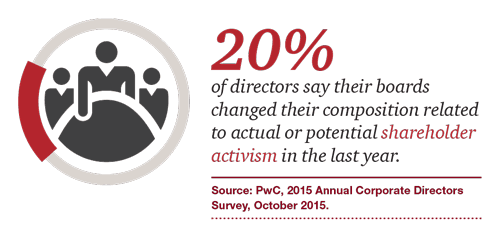
Endnotes:

[1] United States Government Accountability Office, “Corporate Boards: Strategies to Address Representation of Women Include Federal Disclosure Requirements,” December 2015.
(go back)

[2] PwC, 2015 Annual Corporate Directors Survey, October 2015.
(go back)

[3] Catalyst, Women CEOs of the S&P 500, February 3, 2016.
(go back)

[4] “McDonald’s CEO to Retire; Black Fortune 500 CEOs Decline by 33% in Past Year,” DiversityInc, January 29, 2015; http://www.diversityinc.com/leadership/mcdonalds-ceo-retire-black-fortune-500-ceos-decline-33-past-year.
(go back)

[5] Amy Borrus, “More on CII’s New Policies on Universal Proxies and Board Tenure,” Council of Institutional Investors, October 1, 2013; http://www.cii.org/article_content.asp?article=208.
(go back)

[6] Spencer Stuart, 2015 US Board Index, November 2015.
(go back)

[7] Spencer Stuart, 2015 US Board Index, November 2015.
(go back)

[8] California State Teachers’ Retirement System Corporate Governance Principles, April 3, 2015, http://www.calstrs.com/sites/main/files/file-attachments/corporate_governance_principles_1.pdf; The California Public Employees’ Retirement System Global Governance Principles, Updated March 14, 2016, https://www.calpers.ca.gov/docs/board-agendas/201603/invest/item05a-02.pdf.
(go back)

[9] PwC, 2015 Annual Corporate Directors Survey, October 2015. www.pwc.com/us/GovernanceInsightsCenter.

________________________________

*Paula Loop is Leader of the Governance Insights Center at PricewaterhouseCoopers LLP. This post is based on a PwC publication by Ms. Loop and Paul DeNicola. The complete publication, including footnotes and appendix, is available here.
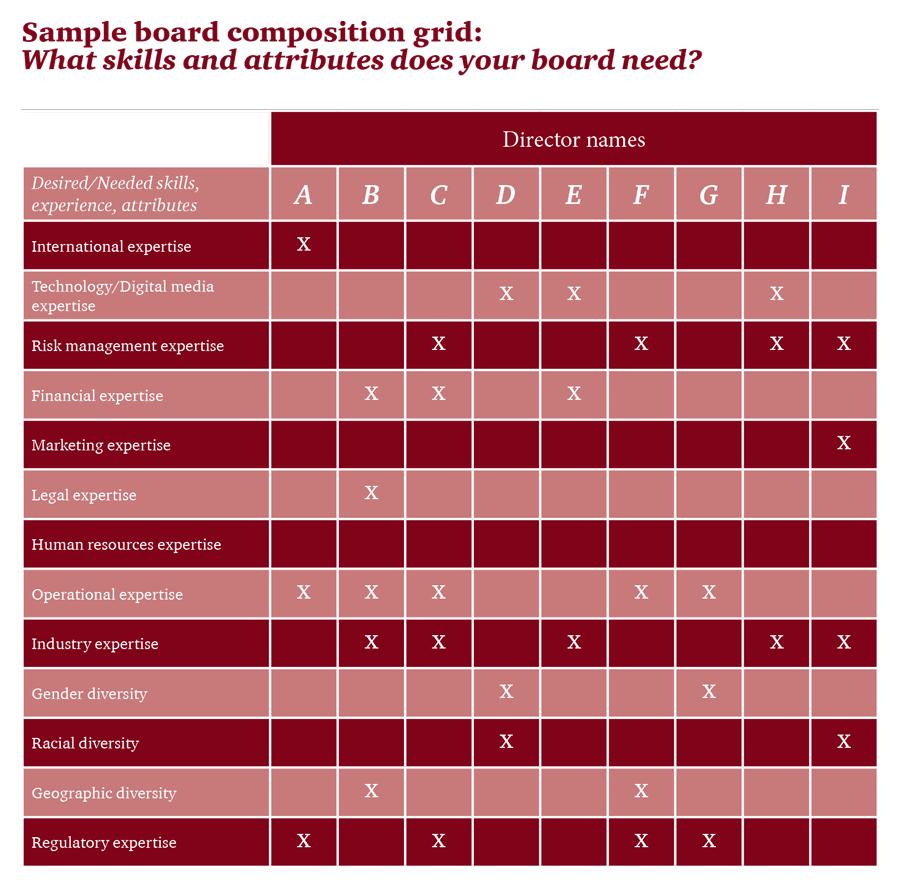
Dix thèmes majeurs pour les administrateurs en 2016 | Harvard Law School Forum on Corporate Governance


Vous trouverez, ci-dessous, les dix thèmes les plus importants pour les administrateurs de sociétés selon Kerry E. Berchem, associé du groupe de pratiques corporatives à la firme Akin Gump Strauss Hauer & Feld LLP. Cet article est paru aujourd’hui sur le blogue le Harvard Law School Forum on Corporate Governance.

Bien qu’il y ait peu de changements dans l’ensemble des priorités cette année, on peut quand même noter :

(1) l’accent crucial accordé au long terme ;

(2) Une bonne gestion des relations avec les actionnaires dans la foulée du nombre croissant d’activités menées par les activistes ;

(3) Une supervision accrue des activités liées à la cybersécurité…

Pour plus de détails sur chaque thème, je vous propose la lecture synthèse de l’article ci-dessous.

Bonne lecture !


Ten Topics for Directors in 2016 |   Harvard Law School Forum on Corporate Governance


U.S. public companies face a host of challenges as they enter 2016. Here is our annual list of hot topics for the boardroom in the coming year:

  1. Oversee the development of long-term corporate strategy in an increasingly interdependent and volatile world economy
  2. Cultivate shareholder relations and assess company vulnerabilities as activist investors target more companies with increasing success
  3. Oversee cybersecurity as the landscape becomes more developed and cyber risk tops director concerns
  4. Oversee risk management, including the identification and assessment of new and emerging risks
  5. Assess the impact of social media on the company’s business plans
  6. Stay abreast of Delaware law developments and other trends in M&A
  7. Review and refresh board composition and ensure appropriate succession
  8. Monitor developments that could impact the audit committee’s already heavy workload
  9. Set appropriate executive compensation as CEO pay ratios and income inequality continue to make headlines
  10. Prepare for and monitor developments in proxy access

Strategic Planning Considerations

Strategic planning continues to be a high priority for directors and one to which they want to devote more time. Figuring out where the company wants to—and where it should want to—go and how to get there is not getting any easier, particularly as companies find themselves buffeted by macroeconomic and geopolitical events over which they have no control.

axes

In addition to economic and geopolitical uncertainty, a few other challenges and considerations for boards to keep in mind as they strategize for 2016 and beyond include:

finding ways to drive top-line growth

focusing on long-term goals and enhancing long-term shareholder value in the face of mounting pressures to deliver short-term results

the effect of low oil and gas prices

figuring out whether and when to deploy growing cash stockpiles

assessing the opportunities and risks of climate change and resource scarcity

addressing corporate social responsibility.

Shareholder Activism

Shareholder activism and “suggestivism” continue to gain traction. With the success that activists have experienced throughout 2015, coupled with significant new money being allocated to activist funds, there is no question that activism will remain strong in 2016.

In the first half of 2015, more than 200 U.S. companies were publicly subjected to activist demands, and approximately two-thirds of these demands were successful, at least in part. [1] A much greater number of companies are actually targeted by activism, as activists report that less than a third of their campaigns actually become public knowledge. [2] Demands have continued, and will continue, to vary: from requests for board representation, the removal of officers and directors, launching a hostile bid, advocating specific business strategies and/or opining on the merit of M&A transactions. But one thing is clear: the demands are being heard. According to a recent survey of more than 350 mutual fund managers, half had been contacted by an activist in the past year, and 45 percent of those contacted decided to support the activist. [3]

With the threat of activism in the air, boards need to cultivate shareholder relations and assess company vulnerabilities. Directors—who are charged with overseeing the long-term goals of their companies—must also understand how activists may look at the company’s strategy and short-term results. They must understand what tactics and tools activists have available to them. They need to know and understand what defenses the company has in place and whether to adopt other protective measures for the benefit of the overall organization and stakeholders.

Cybersecurity

Nearly 90 percent of CEOs worry that cyber threats could adversely impact growth prospects. [4] Yet in a recent survey, nearly 80 percent of the more than 1,000 information technology leaders surveyed had not briefed their board of directors on cybersecurity in the last 12 months. [5] The cybersecurity landscape has become more developed and as such, companies and their directors will likely face stricter scrutiny of their protection against cyber risk. Cyber risk—and the ultimate fall out of a data breach—should be of paramount concern to directors.

One of the biggest concerns facing boards is how to provide effective oversight of cybersecurity. The following are questions that boards should be asking:

Governance. Has the board established a cybersecurity review > committee and determined clear lines of reporting and > responsibility for cyber issues? Does the board have directors with the necessary expertise to understand cybersecurity and related issues?

Critical asset review. Has the company identified what its highest cyber risks assets are (e.g., intellectual property, personal information and trade secrets)? Are sufficient resources allocated to protect these assets?

Threat assessment. What is the daily/weekly/monthly threat report for the company? What are the current gaps and how are they being resolved?

Incident response preparedness. Does the company have an incident response plan and has it been tested in the past six months? Has the company established contracts via outside counsel with forensic investigators in the event of a breach to facilitate quick response and privilege protection?

Employee training. What training is provided to employees to help them identify common risk areas for cyber threat?

Third-party management. What are the company’s practices with respect to third parties? What are the procedures for issuing credentials? Are access rights limited and backdoors to key data entry points restricted? Has the company conducted cyber due diligence for any acquired companies? Do the third-party contracts contain proper data breach notification, audit rights, indemnification and other provisions?

Insurance. Does the company have specific cyber insurance and does it have sufficient limits and coverage?

Risk disclosure. Has the company updated its cyber risk disclosures in SEC filings or other investor disclosures to reflect key incidents and specific risks?

The SEC and other government agencies have made clear that it is their expectation that boards actively manage cyber risk at an enterprise level. Given the complexity of the cybersecurity inquiry, boards should seriously consider conducting an annual third-party risk assessment to review current practices and risks.

Risk Management

Risk management goes hand in hand with strategic planning—it is impossible to make informed decisions about a company’s strategic direction without a comprehensive understanding of the risks involved. An increasingly interconnected world continues to spawn newer and more complex risks that challenge even the best-managed companies. How boards respond to these risks is critical, particularly with the increased scrutiny being placed on boards by regulators, shareholders and the media. In a recent survey, directors and general counsel identified IT/cybersecurity as their number one worry, and they also expressed increasing concern about corporate reputation and crisis preparedness. [6]

Given the wide spectrum of risks that most companies face, it is critical that boards evaluate the manner in which they oversee risk management. Most companies delegate primary oversight responsibility for risk management to the audit committee. Of course, audit committees are already burdened with a host of other responsibilities that have increased substantially over the years. According to Spencer Stuart’s 2015 Board Index, 12 percent of boards now have a stand-alone risk committee, up from 9 percent last year. Even if primary oversight for monitoring risk management is delegated to one or more committees, the entire board needs to remain engaged in the risk management process and be informed of material risks that can affect the company’s strategic plans. Also, if primary oversight responsibility for particular risks is assigned to different committees, collaboration among the committees is essential to ensure a complete and consistent approach to risk management oversight.

Social Media

Companies that ignore the significant influence that social media has on existing and potential customers, employees and investors, do so at their own peril. Ubiquitous connectivity has profound implications for businesses. In addition to understanding and encouraging changes in customer relationships via social media, directors need to understand and weigh the risks created by social media. According to a recent survey, 91 percent of directors and 79 percent of general counsel surveyed acknowledged that they do not have a thorough understanding of the social media risks that their companies face. [7]

As part of its oversight duties, the board of directors must ensure that management is thoughtfully addressing the strategic opportunities and challenges posed by the explosive growth of social media by probing management’s knowledge, plans and budget decisions regarding these developments. Given new technology and new social media forums that continue to arise, this is a topic that must be revisited regularly.

M&A Developments

M&A activity has been robust in 2015 and is on track for another record year. According to Thomson Reuters, global M&A activity exceeded $3.2 trillion with almost 32,000 deals during the first three quarters of 2015, representing a 32 percent increase in deal value and a 2 percent increase in deal volume compared to the same period last year. The record deal value mainly results from the increase in mega-deals over $10 billion, which represented 36 percent of the announced deal value. While there are some signs of a slowdown in certain regions based on deal volume in recent quarters, global M&A is expected to carry on its strong pace in the beginning of 2016.

Directors must prepare for possible M&A activity in the future by keeping abreast of developments in Delaware case law and other trends in M&A. The Delaware courts churned out several noteworthy decisions in 2015 regarding M&A transactions that should be of interest to directors, including decisions on the court’s standard of review of board actions, exculpation provisions, appraisal cases and disclosure-only settlements.

Board Composition and Succession Planning

Boards have to look at their composition and make an honest assessment of whether they collectively have the necessary experience and expertise to oversee the new opportunities and challenges facing their companies. Finding the right mix of people to serve on a company’s board of directors, however, is not necessarily an easy task, and not everyone will agree with what is “right.” According to Spencer Stuart’s 2015 Board Index, board composition and refreshment and director tenure were among the top issues that shareholders raised with boards. Because any perceived weakness in a director’s qualification could open the door for activist shareholders, boards should endeavor to have an optimal mix of experience, skills and diversity. In light of the importance placed on board composition, it is critical that boards have a long-term board succession plan in place. Boards that are proactive with their succession planning are able to find better candidates and respond faster and more effectively when an activist approaches or an unforeseen vacancy occurs.

Audit Committees

Averaging 8.8 meetings a year, audit continues to be the most time-consuming committee. [8] Audit committees are burdened not only with overseeing a company’s risks, but also a host of other responsibilities that have increased substantially over the years. Prioritizing an audit committee’s already heavy workload and keeping directors apprised of relevant developments, including enhanced audit committee disclosures, accounting changes and enhanced SEC scrutiny will be important as companies prepare for 2016.

Executive Compensation

Perennially in the spotlight, executive compensation will continue to be a hot topic for directors in 2016. But this year, due to the SEC’s active rulemaking in 2015, directors will have more to fret about than just say-on-pay. Roughly five years after the Dodd-Frank Wall Street Reform and Consumer Protection Act was enacted, the SEC finally adopted the much anticipated CEO pay ratio disclosure rules, which have already begun stirring the debate on income inequality and exorbitant CEO pay. The SEC also made headway on other Dodd-Frank regulations, including proposed rules on pay-for-performance, clawbacks and hedging disclosures. Directors need to start planning how they will comply with these rules as they craft executive compensation for 2016.

Proxy Access

2015 was a turning point for shareholder proposals seeking to implement proxy access, which gives certain shareholders the ability to nominate directors and include those nominees in a company’s proxy materials. During the 2015 proxy season, the number of shareholder proposals relating to proxy access, as well as the overall shareholder support for such proposals, increased significantly. Indeed, approximately 110 companies received proposals requesting the board to amend the company’s bylaws to allow for proxy access, and of those proposals that went to a vote, the average support was close to 54 percent of votes cast in favor, with 52 proposals receiving majority support. [9] New York City Comptroller Scott Springer and his 2015 Boardroom Accountability Project were a driving force, submitting 75 proxy access proposals at companies targeted for perceived excessive executive compensation, climate change issues and lack of board diversity. Shareholder campaigns for proxy access are expected to continue in 2016. Accordingly, it is paramount that boards prepare for and monitor developments in proxy access, including, understanding the provisions that are emerging as typical, as well as the role of institutional investors and proxy advisory firms.

The complete publication is available here.

Endnotes:

[1] Activist Insight, “2015: The First Half in Numbers,” Activism Monthly (July 2015).
(go back)

[2] Activist Insight, “Activist Investing—An Annual Review of Trends in Shareholder Activism,” p. 8. (2015).
(go back)

[3] David Benoit and Kirsten Grind, “Activist Investors’ Secret Ally: Big Mutual Funds,” The Wall Street Journal (August 9, 2015).
(go back)

[4] PwC’s 18th Annual Global CEO Survey 2015.
(go back)

[5] Ponemon Institute’s 2015 Global Megatrends in Cybersecurity (February 2015).
(go back)

[6] Kimberley S. Crowe, “Law in the Boardroom 2015,” Corporate Board Member Magazine (2nd Quarter 2015). See also, Protiviti, “Executive Perspectives on Top Risks for 2015.”
(go back)

[7] Kimberley S. Crowe, supra.
(go back)

[8] 2015 Spencer Stuart Board Index, at p. 26.
(go back)

[9] Georgeson, 2015 Annual Corporate Governance Review, at p. 5.
(go back)

Formation en éthique 2.0 pour les conseils d’administration


Je me suis engagé dans la diffusion de pratiques exemplaires en matière de gouvernance depuis plus d’une décennie : d’abord, en collaborant à la conception et la gestion d’un des premiers programmes de formation en gouvernance, dans le cadre du Collège des administrateurs de sociétés (CAS) ; ensuite, en créant un blogue dont l’objectif est d’être la référence en matière de documentation en gouvernance dans le monde francophone.

En gouvernance, on parle d’éthique associée aux entreprises depuis fort longtemps, mais j’ai compris qu’il ne suffisait pas de donner bonne conscience aux membres de l’organisation en prêchant les valeurs de l’éthique ! Non, il est essentiel de communiquer le sens profond que prend cette discipline, de s’assurer que les intéressés comprennent les implications sous-jacentes, et adoptent des comportements cohérents.

On doit enseigner les notions d’éthique en exposant concrètement, par des études de cas, les dilemmes qui se présentent aux participants.

L’un des experts mondiaux les plus crédibles pour traiter de ces questions est le spécialiste René Villemure qui œuvre dans ce domaine depuis plus de 18 ans.

René est un communicateur hors pair et un conférencier très recherché pour aborder toutes les questions touchant les notions d’éthique. Il a donné des centaines de conférences sur le sujet, il a participé activement à plusieurs programmes de formation en gouvernance, notamment au CAS, et il a abondamment contribué à enrichir le débat public sur les problèmes d’ordre éthique.


7275865-11183192


René Villemure a récemment mis en œuvre un programme de formation à l’intention des membres de conseils d’administration : L’Éthique pour le conseil. « C’est “l’éthique 2.0”, qui dès aujourd’hui et pour les années à venir, vise à préparer votre réponse aux préoccupations et défis en éthique ».

Voici les objectifs poursuivis par le nouveau programme :

Augmenter la sensibilité et la compréhension de l’éthique par les membres du conseil d’administration ;

S’assurer que votre conseil d’administration soit durable en matière d’éthique ;

Répondre aux nouvelles exigences en matière d’intégrité ;

S’assurer que la culture éthique de votre entreprise est bien ancrée au sein de l’entreprise et auprès de l’ensemble de vos employés ;

Prendre une position éthique distinctive dans votre marché ;

Établir votre positionnement en matière d’éthique avec l’ensemble des parties prenantes en lien avec votre entreprise ;

Mieux adapter la gouvernance éthique de votre entreprise aux différentes cultures, valeurs et règles sur le plan éthique dans les pays avec lesquels votre entreprise transige ou dans les pays où elle est établie ;

Minimiser les impacts des changements démographiques prévisibles en facilitant le recrutement des meilleurs talents ;

Laisser une empreinte éthique durable, digne de confiance, reconnue et unique qui survivra au remplacement des administrateurs.

Pour René Villemure, il est capital de s’adresser directement au conseil d’administration et de mettre en place des interventions ciblées. Vous trouverez, ci-dessous, une présentation des grandes lignes du programme.

Bonne lecture !

L’éthique pour le conseil


Plus que jamais votre organisation doit être proactive afin d’assurer la réalisation de son potentiel éthique


Augmenter la compréhension et la sensibilité du conseil en matière d’éthique

Répondez aux nouvelles exigences en matière d’intégrité

Réduisez l’écart entre les valeurs affichées et celles qui sont pratiquées

Rendez votre culture éthique durable

Attirez les meilleurs talents avec une culture éthique forte

Le programme « L’Éthique pour le conseil »


Un programme qualitatif qui mesure la sensibilité éthique des membres de conseils d’administration, ses forces et ses défis éthiques

Une méthode interactive, vote et discussions

Nos Géoramas permettront d’identifier en un coup d’oeil votre positionnement éthique

Les Axes de mesure


L’Éthique

Mission, Vision et Valeurs

Le rôle du conseil d’administration

Les critères de mesure


La Pratique

La Compréhension

L’Affiche

 Le rapport


Analyse de pertinence éthique

Analyse de la Pratique, de la Compréhension et de l’Affiche

Géoramas éthiques pour chacun des axes et enjeux

Positionnement éthique global

Plan d’action

Un programme flexible et adapté à vos enjeux éthiques


Que ce soit pour initier une démarche éthique, pour valider les initiatives éthiques mises de l’avant, ou encore pour positionner l’éthique de manière durable au sein de votre organisation, le programme L’Éthique pour le conseil s’adapte au contexte et à la structure de votre organisation.


Les étapes du programme:

Analyse du contexte éthique actuel de l’organisation avec un sous-comité du conseil

                          arrow

Rencontre interactive avec le Conseil d’administration

                          arrow

Présentation du rapport, mesures et plan d’action d’Ethikos


Vous désirez siéger comme administrateur de sociétés ?


Très bon billet de James Citrin, Senior Director | Spencer Stuart, sur un sujet qui intéressera sûrement plusieurs personnes désirant décrocher un poste sur un conseil d’administration.

Les diplômés et les diplômées des programmes de formation en gouvernance de sociétés, tels que le Collèges des administrateurs de sociétés (CAS), le Directors College (DC) et l’Institute of Corporate Directors (ICD), sont particulièrement invités (es) à lire ce billet d’expert, mais aussi à suivre les discussions sur son Blogue.

Voici, ci-dessous, un extrait de l’article :

You Want to Be a Board Director – Now What?


« You’re a sitting chief executive officer who wants to see how another company’s board governs.  Or you’re an aspiring CEO who wants to benefit from a valuable professional development opportunity and expand your marketability.

Perhaps you are a newly retired executive who wants to stay active and connected.  Or maybe you are a functional leader who wants to contribute your expertise in exchange for gaining a broader strategic perspective.

2011 Board of Directors Retreat

You may even be a CEO or chief HR officer looking for ways to improve your own company’s succession planning by getting your CEO-ready executives boardroom experience. Whether it is one of these or any other number of reasons, many of today’s senior executives would like to join a corporate board of directors.

The irony is that while much has been written about the legitimate difficulties of companies finding qualified and interested directors for their boards, there are a growing number of prospective directors who would be all too happy to serve. If you are one of these prospective directors, the question is how position yourself and navigate the nuances of the director selection process to get placed on a board ».

L’auteur propose six étapes à suivre.  Lire l’article pour plus de détails.

  1. Board Bio
  2. Target List
  3. Your Interests
  4. Director Events
  5. Search Firms
  6. Not for Profits

Board service is often a rewarding experience both professionally and personally.  There is a growing demand for dedicated directors who can guide and govern our corporations.  So if you want to be a board director and bring your expertise to bear, we offer these six steps to get you on your way.  Good luck.

Articles reliés :

La nouvelle réalité des comités de gouvernance des conseils d’administration | en rappel


Aujourd’hui, je veux partager avec vous certaines considérations cruciales pour un meilleur fonctionnement des comités de gouvernance des conseils d’administration (aussi appelés comités de nomination).

Cet article, publié par Ruby Sharma* et Ann Yerger*, associées au EY Center for Board Matters de la firme Ernst & Young, paru sur le blogue du Harvard Law School Forum on Corporate Governance (HLSF), montre l’ascension fulgurante des comités de gouvernance. Ce phénomène est attribuable à l’importance accrue accordée à la diversité et à la divulgation, dans un contexte où les investisseurs institutionnels et les fonds activistes sont de plus en plus soucieux de la compétence des administrateurs de sociétés.

Les auteurs montrent toute l’importance qui doit être apportée au travail des comités de gouvernance afin de mieux s’adapter aux changements majeurs qui surviennent dans le monde de la gouvernance.

(1) Les comités de gouvernance doivent faire preuve de plus de divulgation sur la composition du conseil d’administration, sur les qualifications des administrateurs ainsi que sur le mix de leurs compétences, et sur les méthodes d’évaluation des administrateurs afin de montrer comment chacun contribue au CA.

(2) Les comités de gouvernance doivent intégrer les considérations liées à la diversité, à l’expertise, au nombre de mandats ainsi qu’aux questions de planification de la relève.

(3) Enfin, les comités de gouvernance doivent être sensibles au fait que la composition des conseils d’administration influencera de plus en plus le vote des investisseurs (actionnaires) aux assemblées générales annuelles.

Voici un extrait de l’article publié dans HLSF.

Bonne lecture !

Three Things Nominating Committees Need to Know


gouvernance


(1) Evaluate and enhance disclosures about director qualifications, board composition and board assessment processes

Most institutional investors we spoke with (more than 75%) said companies are not doing a good job explaining why they have the right directors on the board. Historically, investor understanding of director qualifications has been limited to basic biographic information in proxy filings representing “to the letter” compliance with the requirement to disclose: “… the particular experience, qualifications, attributes or skills that qualified that person to serve as a director of the company … in light of the company’s business.”

Now, companies are increasingly enhancing their disclosures by explaining more about how each director contributes to the board. Some disclosures go further to describe how the board and its committees, as a whole, have the appropriate mix of skills, expertise and perspectives to oversee the company’s key strategies, challenges and risk management efforts.

Companies are making other efforts to enhance the way they communicate to investors, such as by using graphics, tables and letters to shareholders. Some are exploring the use of videos and other media. And some are looking to other markets such as the United Kingdom, Australia and Canada for ideas for how to enhance their own disclosures. For example, some companies may explain how new directors complement the existing board, provide specific examples of industry and functional expertise, illustrate how different forms of diversity combine to provide for a more dynamic board, explain how the board’s expertise is enhanced through additional educational opportunities and discuss how the board assessment process is used to further strengthen the board.

When there are questions about company performance, investors are likely to look more closely at board composition, and when there are minimal or no disclosures demonstrating how directors contribute to the company’s strategic goals, investors may question the performance assessment process. For example, they may ask how the evaluation process is structured, how often it’s carried out and how results are addressed. They also may ask about the role of independent board leaders, other stakeholders and/or third parties in the process. They may also question how board candidates are sourced, the board succession planning process and director education practices.

(2) Integrate diversity, expertise and tenure considerations into board composition and succession planning

Nominating committees play the critical role of linking the board’s director recruitment, selection and succession planning processes to the company’s strategic goals. They do this by trying to maintain the best mix of expertise and perspectives in the boardroom to address the ever-changing business environment and oversee the company’s key strategic efforts.

Nominating committees, institutional investors and other governance observers are increasingly weighing additional perspectives in the director selection process, such as diversity (including gender, racial, cultural, geographical, generational diversity), industry knowledge, global perspectives, and expertise in areas such as cybersecurity and environmental sustainability.

An ongoing focus on board composition allows the nominating committee to maintain a balanced mix of fresh insights (from recently appointed directors) with institutional knowledge (from seasoned and longer-tenured directors) and other perspectives in between (based on variations in board tenure). The table below provides some general metrics on board composition, which may be helpful to nominating committees seeking to develop a view about longer-term positioning for their boards.

How does your brand compare?

Summary data S&P 500 S&P 1500 Russell 3000
Average board tenure 10 10 9
Average age 63 63 62
Gender diversity 20% 16% 13%

(3) Growing attention to board composition and quality may influence how investors vote in future director elections

Investors historically have voted against director nominees based on triggers such as poor meeting attendance, excessive board service, executive compensation challenges, independence concerns, perceptions of subpar performance and/or unresponsiveness to shareholders.

Now, institutional investors appear to be moving beyond these traditional metrics for evaluating boards. Increasingly investors are calling out the lack of board diversity as a governance issue in engagement conversations with companies, stewardship reports and proxy voting guidelines —with some investors adopting policies of voting against board nominees when they perceive insufficient diversity, such as too few women and/or minority directors.

New policies by proxy advisory firm Glass Lewis reflect the emerging shift to consider board composition and director qualifications in voting recommendations. For example, beginning in 2016, Glass Lewis, which develops its policies with investor input, will recommend that investors oppose the re-election of a nominating committee chair in the event of poor performance and the chair’s “failure to ensure the board has directors with relevant experience, either through periodic director assessment or board refreshment …”


Where do nominating committees go from here?


Nominating committee members should recognize that these developments are occurring as investor votes are becoming more meaningful, with annually elected boards (versus staggered) and with a majority voting requirement (versus plurality). There also appears to be an emerging trend of targeted voting practices, with investors opposing perceived action or inaction by specific directors and committees. For example, we recently found that companies with low say-on-pay votes saw higher opposition votes directed at compensation committee members.

When directors step off the board, whether as planned or unexpectedly, nominating committees need to reconsider overall board composition, what the departure may mean for the board now and going forward, and how best to communicate these changes to investors. An effective, experienced and diverse board is a strategic asset to any company and its investors and there’s an opportunity cost to standing still. The keys to that are in the nominating committee hands.

2015 director opposition votes


Summary data S&P 500 large cap S&P 400 mid cap S&P 600 small cap Russell 3000
Average director opposition votes 3% 4% 5% 5%
Number of director candidates 4,700 2,500 3,200 17,500
Portion of director nominees with more than 20% opposition votes 2% 3% 5% 4%

Questions for the board and nominating committee to consider


  1. Are the company’s proxy disclosures adequately showcasing the diverse backgrounds, skills and qualifications of the directors?
  2. Is there a robust mix of perspectives—aligned with company strategies and risks—among the current line-up of directors?
  3. Based on changing company strategies, risks and challenges, how much board turnover is optimal—in the next one, two or three years—in order to stay on top of these developments?
  4. Is the board providing a robust disclosure of the board assessment processes?
  5. Does the board follow through with board assessments by reviewing key takeaways and implementing an action plan—with deadlines?
  6. When was the last time the selection criteria for director nominees was reassessed and updated?

___________________________________

*Ruby Sharma is a principal and Ann Yerger is an executive director at the EY Center for Board Matters at Ernst & Young LLP. The following post is based on a report from the EY Center for Board Matters, available here.


Taille du CA, limite d’âge et durée des mandats des administrateurs | En reprise


Comme je l’ai déjà évoqué dans plusieurs autres billets, il faut réfléchir très sérieusement à la taille du CA, à la limite d’âge des administrateurs ainsi qu’à la durée de leurs mandats.

Eu égard à la taille du CA, on note que les membres de conseils de petite taille :

(1) sont plus engagés dans les affaires de l’entité

(2) sont plus portés à aller en profondeur dans l’analyse stratégique

(3) entretiennent des relations plus fréquentes et plus harmonieuses avec la direction

(4) ont plus de possibilités de communiquer entre eux

(5) exercent une surveillance plus étroite des activités de la direction

(6) sont plus décisifs, cohésif et impliqués.

On constate également une tendance lourde en ce qui regarde le nombre de mandats des administrateurs de sociétés, mais que ce changement ne se fait pas sans heurt.

Plusieurs pensent que, malgré certains avantages évidents à avoir des administrateurs séniors sur les CA, cette situation est un frein à la diversité et au renouvellement des générations au sein des conseils d’administration. Je crois que les CA devraient se doter d’une politique de limite d’âge pour les administrateurs ainsi que d’une limite au cumul des mandats ?

Les conseils d’administration devraient se préoccuper de ces questions afin :

(1) d’accroître la diversité dans la composition du conseil

(2) de faciliter la nomination de femmes au sein des CA

(3) d’assurer une plus grande indépendance des membres du conseil

(4) d’assurer la relève et l’apport d’idées neuves sur la gouvernance et les stratégies

(5) d’éviter que des administrateurs peu engagés s’incrustent dans leurs postes.

À cet égard, voici certains extraits d’études qui présentent les changements au Canada en 2015 :

Cumul des mandats d’administrateur

« Dorénavant, un administrateur qui est chef de la direction est considéré comme cumulant trop de mandats s’il siège au conseil de plus d’une société ouverte en plus du conseil d’administration de la société qui l’emploie (auparavant, il fallait que ce soit plus de deux sociétés). Un administrateur qui n’est pas chef de la direction cumule trop de mandats lorsqu’il siège à plus de quatre conseils d’administration de sociétés ouvertes (auparavant, c’était plus de six sociétés) ».

Renouvellement des conseils d’administration

Les Autorités canadiennes en valeurs mobilières (ACVM) ont révélé que « seulement 19 % des émetteurs examinés avaient adopté une combinaison quelconque de limites à la durée des mandats et/ou de limite d’âge… Toutefois, la grande majorité des émetteurs ne se sont dotés d’aucun mécanisme officiel pour le renouvellement du conseil, à part leur processus d’évaluation des administrateurs ».

Notons que les émetteurs assujettis sont tenus de divulguer les limites à la durée du mandat des administrateurs ainsi que les mécanismes de renouvellement du conseil. S’ils ne se conforment pas, ils doivent en expliquer les raisons.

En France, par exemple, un administrateur qui a siégé à un conseil pendant plus de 12 ans n’est plus considéré comme étant indépendant. Au Royaume-Uni, le conseil doit déclarer publiquement pourquoi il croit qu’un administrateur qui a siégé plus de 9 ans est toujours considéré comme étant indépendant.

Beaucoup de conseils au Canada estiment que les limites de mandat servent un objectif, 56 % des sociétés du Canadian Spencer Stuart Board Index (CSSBI) indiquant qu’elles recourent volontairement à des limites d’âge et de mandat. Selon une récente étude de Korn Ferry International/Patrick O’Callaghan and Associates, les limites de mandat pour les entreprises canadiennes inscrites en bourse ayant été sondées oscillent entre sept et vingt ans, 53 % d’entre elles présentant une limite de mandat de 15 ans.

Voici quelques billets publiés sur mon blogue qui peuvent être utiles à un président de conseil aux prises avec ces questions délicates.


En rappel | Les C.A de petites tailles performent mieux !

Réflexions sur les limites d’âge des membres de conseil d’administration et sur la durée des mandats

Faut-il limiter le nombre de mandats des administrateurs ?


Également, j’ai joint le Rapport de Davies sur la gouvernance | Décembre 2015 au Canada en 2015.

Enfin, voici deux articles qui devraient alimenter vos réflexions sur le sujet.

Le premier, Company directors getting older – fewer age limits, a été publié par Andrew Frye et Jeff Green dans le San Francisco Chronicle. Le second, Board Tenure: The New Hot Governance Topic ?, a été publié par Broc Romanek sur le blogue de CorporateCounsel.net. Vous trouverez, ci-dessous, des extraits de ces deux références.


Company directors getting older – fewer age limits


Buffett’s influence

Berkshire’s willingness to retain directors in their ninth decades reflects Buffett’s influence on the firm and a national trend toward older boards. About 15 percent of directors at companies in the Standard & Poor’s 500 index are older than 69, compared with 9.8 percent in 2002, according to executive-compensation benchmarking firm Equilar. Proxy filings show 52 directors are age 80 or older.

« You can have great 85-year-olds and horrible 55-year-olds, » said Anne Sheehan, director of corporate governance for the $155 billion California State Teachers’ Retirement System. « A lot of this depends on the 80-year-old, because I’d love to have Warren Buffett on any board. »

Boardroom age limits are less prevalent and set higher than they were five years ago, according to the latest report on director trends by executive recruitment company Spencer Stuart. Companies use age limits to promote turnover and assure investors that management is getting new ideas. Those goals may instead be achieved through term limits, Sheehan said.

« You have to refresh the board, whether it’s through term limits or through age limits, » said Charles Elson, director of the University of Delaware’s Center for Corporate Governance.


_______________________________________________________

Board Tenure: The New Hot Governance Topic ?

At a recent event, a member joked with me that his CEO was asked: « What was the average age of directors on his board? » – and the CEO answered: « Dead. » Based on recent stats, it appears that many directors are comfortable as turnover is quite low these days. This is reflected in Jim Kristie’s Directors & Boards piece entitled « Troubling Trend: Low Board Turnover. » As Jim points out, a director with a certain background might make sense for the company now – but might not ten years down the road as the circumstances change.

board diversity.jpg

Perhaps even more important is the independence issue – is a director who sits on the board for several decades likely to still be independent after such a long tenure (see this WSJ article about the 40-year club)? Does it matter if management turns over during the director’s tenure? And if so, how much? These are issues that are being debated. What is your take?

As blogged by Davis Polk’s Ning Chiu, CII is considering policy changes linking director tenure with director independence, under which it would ask boards to consider a director’s years of service in determining director independence. According to the proposed policy, 26% of all Russell 3,000 directors have served more than 10 years and 14% have served more than 15 years. CII would not advocate for any specific tenure, unlike the European Commission, which advises that non-executive directors serve no more than 12 years. Note that under the UK’s « comply or explain » framework, companies need to disclose why a director continues to serve after being on the board nine years. I have heard that seven years is the bar in Russia.

How Does Low Board Turnover Impact Board Diversity?

Related to proper board composition is the issue of whether low board turnover is just one more factor that stifles board diversity. As well documented in numerous studies (see our « Board Diversity » Practice Area), gender diversity on boards has essentially flat-lined over the past decade – and actually has regressed in some areas. This is a real-world problem as it’s been proven that differing views on a board lead to greater corporate performance. To get boards back on track, I do think bold ideas need to be implemented – and plenty are out there, such as this one. I can’t believe that more investors haven’t been clamoring for greater diversity – but I do believe that day is near…

Bonne lecture !

The Directors Toolkit | Un document complet de KPMG sur les bonnes pratiques de gouvernance et de gestion d’un CA


Voici la troisième édition d’un document australien de KPMG, très bien conçu, qui répond clairement aux questions que tous les administrateurs de sociétés se posent dans le cours de leurs mandats.

Même si la publication est dédiée à l’auditoire australien de KPMG, je crois que la réalité réglementaire nord-américaine est trop semblable pour se priver d’un bon « kit » d’outils qui peut aider à constituer un Board efficace.

C’est un formidable document électronique interactif de 182 pages. Voyez la table des matières ci-dessous.

J’ai demandé à KPMG de me procurer une version française du même document mais il ne semble pas en exister.

Bonne lecture !

The Directors Toolkit | KPMG

 The Directors' Toolkit cover

Our business environment provides an ever-changing spectrum of risks and opportunities. The role of the director continues to be shaped by a multitude of forces including economic uncertainty, larger and more complex organisations, the increasing pace of technological innovation and digitisation along with a more rigorous regulatory environment.

At the same time there is more onus on directors to operate transparently and be more accountable for their actions and decisions.

To support directors in their challenging role, KPMG has created an interactive Directors’ Toolkit. Now in its third edition, this comprehensive guide is in a user friendly electronic format. It is designed to assist directors to more effectively discharge their duties and improve board performance and decision-making.

Key topics

Duties and responsibilities of a director

Oversight of strategy and governance

Managing shareholder and stakeholder expectations

Structuring an effective board and sub-committees

Enabling key executive appointments

Managing productive meetings

Better practice terms of reference, charters and agendas

Establishing new boards.

What’s New

In this latest version, we have included newly updated sections on:

Roles, responsibilities and expectations of directors of not-for-profit organisations

Risks and opportunities social media presents for directors and organisations

Key responsibilities of directors for overseeing investment governance, operations and processes.

Un guide essentiel pour comprendre et enseigner la gouvernance | En rappel


Plusieurs administrateurs et formateurs me demandent de leur proposer un document de vulgarisation sur le sujet de la gouvernance. J’ai déjà diffusé sur mon blogue un guide à l’intention des journalistes spécialisés dans le domaine de la gouvernance des sociétés à travers le monde. Il a été publié par le Global Corporate Governance Forum et International Finance Corporation (un organisme de la World Bank) en étroite coopération avec International Center for Journalists.

Je n’ai encore rien vu de plus complet et de plus pertinent sur la meilleure manière d’appréhender les multiples problématiques reliées à la gouvernance des entreprises mondiales. La direction de Global Corporate Governance Forum m’a fait parvenir le document en français le 14 février.

Qui dirige l’entreprise : Guide pratique de médiatisation du gouvernement d’entreprise — document en français


Ce guide est un outil pédagogique indispensable pour acquérir une solide compréhension des diverses facettes de la gouvernance des sociétés. Les auteurs ont multiplié les exemples de problèmes d’éthiques et de conflits d’intérêts liés à la conduite des entreprises mondiales.

On apprend aux journalistes économiques — et à toutes les personnes préoccupées par la saine gouvernance — à raffiner les investigations et à diffuser les résultats des analyses effectuées. Je vous recommande fortement de lire le document, mais aussi de le conserver en lieu sûr car il est fort probable que vous aurez l’occasion de vous en servir.

Vous trouverez ci-dessous quelques extraits de l’introduction à l’ouvrage. Bonne lecture !

Who’s Running the Company ? A Guide to Reporting on Corporate Governance

À propos du Guide

schema_DD_lightbox


« This Guide is designed for reporters and editors who already have some experience covering business and finance. The goal is to help journalists develop stories that examine how a company is governed, and spot events that may have serious consequences for the company’s survival, shareholders and stakeholders. Topics include the media’s role as a watchdog, how the board of directors functions, what constitutes good practice, what financial reports reveal, what role shareholders play and how to track down and use information shedding light on a company’s inner workings. Journalists will learn how to recognize “red flags,” or warning  signs, that indicate whether a company may be violating laws and rules. Tips on reporting and writing guide reporters in developing clear, balanced, fair and convincing stories.


Three recurring features in the Guide help reporters apply “lessons learned” to their own “beats,” or coverage areas:

– Reporter’s Notebook: Advise from successful business journalists

– Story Toolbox:  How and where to find the story ideas

– What Do You Know? Applying the Guide’s lessons

Each chapter helps journalists acquire the knowledge and skills needed to recognize potential stories in the companies they cover, dig out the essential facts, interpret their findings and write clear, compelling stories:

  1. What corporate governance is, and how it can lead to stories. (Chapter 1, What’s good governance, and why should journalists care?)
  2. How understanding the role that the board and its committees play can lead to stories that competitors miss. (Chapter 2, The all-important board of directors)
  3. Shareholders are not only the ultimate stakeholders in public companies, but they often are an excellent source for story ideas. (Chapter 3, All about shareholders)
  4. Understanding how companies are structured helps journalists figure out how the board and management interact and why family-owned and state-owned enterprises (SOEs), may not always operate in the best interests of shareholders and the public. (Chapter 4, Inside family-owned and state-owned enterprises)
  5. Regulatory disclosures can be a rich source of exclusive stories for journalists who know where to look and how to interpret what they see. (Chapter 5, Toeing the line: regulations and disclosure)
  6. Reading financial statements and annual reports — especially the fine print — often leads to journalistic scoops. (Chapter 6, Finding the story behind the numbers)
  7. Developing sources is a key element for reporters covering companies. So is dealing with resistance and pressure from company executives and public relations directors. (Chapter 7, Writing and reporting tips)

Each chapter ends with a section on Sources, which lists background resources pertinent to that chapter’s topics. At the end of the Guide, a Selected Resources section provides useful websites and recommended reading on corporate governance. The Glossary defines terminology used in covering companies and corporate governance ».

Here’s what Ottawa’s new rules for state-owned buyers may look like (business.financialpost.com)

The Vote is Cast: The Effect of Corporate Governance on Shareholder Value (greenbackd.com)

Effective Drivers of Good Corporate Governance (shilpithapar.com)

Guide pratique pour l’amélioration de la gouvernance des OSBL | Une primeur


Ayant collaboré à la réalisation du volume « Améliorer la gouvernance de votre OSBL » des auteurs Jean-Paul Gagné et Daniel Lapointe, j’ai obtenu la primeur de la publication d’un chapitre sur mon blogue en gouvernance.

Le volume a paru en mars. Pour vous donner un aperçu de cette importante publication sur la gouvernance des organisations sans but lucratif (OSBN), j’ai eu la permission des éditeurs, Éditions Caractère et Éditions Transcontinental, de publier l’intégralité du chapitre 4 qui porte sur la composition du conseil d’administration et le recrutement d’administrateurs d’OSBL.

Je suis donc très fier de vous offrir cette primeur et j’espère que le sujet vous intéressera suffisamment pour vous inciter à vous procurer cette nouvelle publication.

Vous trouverez, ci-dessous, un court extrait de la page d’introduction du chapitre 4. Je vous invite à cliquer sur le lien suivant pour avoir accès à l’intégralité du chapitre.


La composition du conseil d’administration et le recrutement d’administrateurs


Vous pouvez également feuilleter cet ouvrage en cliquant ici

Bonne lecture ! Vos commentaires sont les bienvenus.

__________________________________


Les administrateurs d’un OSBL sont généralement élus dans le cadre d’un processus électoral tenu lors d’une assemblée générale des membres. Ils peuvent aussi faire l’objet d’une cooptation ou être désignés en vertu d’un mécanisme particulier prévu dans une loi (tel le Code des professions).

L’élection des administrateurs par l’assemblée générale emprunte l’un ou l’autre des deux scénarios suivants:

1. Les OSBL ont habituellement des membres qui sont invités à une assemblée générale annuelle et qui élisent des administrateurs aux postes à pourvoir. Le plus souvent, les personnes présentes sont aussi appelées à choisir l’auditeur qui fera la vérification des états financiers de l’organisation pour l’exercice en cours.

2. Certains OSBL n’ont pas d’autres membres que leurs administrateurs. Dans ce cas, ces derniers se transforment une fois par année en membres de l’assemblée générale, élisent des administrateurs aux postes vacants et choisissent l’auditeur qui fera la vérification des états financiers de l’organisation pour l’exercice en cours.

ameliorezlagouvernancedevotreosbl

La cooptation autorise le recrutement d’administrateurs en cours d’exercice. Les personnes ainsi choisies entrent au CA lors de la première réunion suivant celle où leur nomination a été approuvée. Ils y siègent de plein droit, en dépit du fait que celle-ci ne sera entérinée qu’à l’assemblée générale annuelle suivante. La cooptation n’est pas seulement utile pour pourvoir rapidement aux postes vacants; elle a aussi comme avantage de permettre au conseil de faciliter la nomination de candidats dont le profil correspond aux compétences recherchées.

Dans les organisations qui élisent leurs administrateurs en assemblée générale, la sélection en fonction des profils déterminés peut présenter une difficulté : en effet, il peut arriver que les membres choisissent des administrateurs selon des critères qui ont peu à voir avec les compétences recherchées, telles leur amabilité, leur popularité, etc. Le comité du conseil responsable du recrutement d’administrateurs peut présenter une liste de candidats (en mentionnant leurs qualifications pour les postes à pourvoir) dans l’espoir que l’assemblée lui fasse confiance et les élise. Certains organismes préfèrent coopter en cours d’exercice, ce qui les assure de recruter un administrateur qui a le profil désiré et qui entrera en fonction dès sa sélection.

Quant à l’élection du président du conseil et, le cas échéant, du vice-président, du secrétaire et du trésorier, elle est généralement faite par les administrateurs. Dans les ordres professionnels, le Code des professions leur permet de déterminer par règlement si le président est élu par le conseil d’administration ou au suffrage universel des membres. Comme on l’a vu, malgré son caractère démocratique, l’élection du président au suffrage universel des membres présente un certain risque, puisqu’un candidat peut réussir à se faire élire à ce poste sans expérience du fonctionnement d’un CA ou en poursuivant un objectif qui tranche avec la mission, la vision ou encore le plan stratégique de l’organisation. Cet enjeu ne doit pas être pris à la légère par le CA. Une façon de minimiser ce risque est de faire connaître aux membres votants le profil recherché pour le président, profil qui aura été préalablement établi par le conseil. On peut notamment y inclure une expérience de conseil d’administration, ce qui aide à réduire la période d’apprentissage du nouveau président et facilite une transition en douceur.

Guides de gouvernance à l’intention des OBNL | En rappel


Voici le billet qui a attiré l’attention du plus grand nombre de lecteurs sur mon blogue depuis le début. Celui-ci a été publié le 30 octobre 2011. Je l’ai mis à jour afin que les nombreuses personnes intéressés par la gouvernance des OBNL puissent être mieux informées. L’Institut canadien des comptables agréés (ICCA) a produit des documents pratiques, pertinents, synthétiques et accessibles sur presque toutes les questions de gouvernance. Il est également important de noter que l’ICCA accorde une attention toute particulière aux pratiques de gouvernance des organismes sans but lucratif (OSBL = OBNL).

Ainsi, l’ICCA met à la disposition de ces organisations la collection 20 Questions pour les OSBL qui comprend des questions que les administrateurs d’organismes sans but lucratif (OSBL=OBNL) devraient se poser concernant des enjeux importants pour la gouvernance de ce type d’organismes. Ces documents sont révisés régulièrement afin qu’ils demeurent actuels et pertinents. Si vous avez des questions dans le domaine de la gouvernance des OBNL, vous y trouverez certainement des réponses satisfaisantes.Si vous souhaitez avoir une idée du type de document à votre disposition, vous pouvez télécharger le PDF suivant:

20 questions que les administrateurs d’organismes sans but lucratif devraient poser sur la gouvernance

Vous pouvez choisir le document pertinent (voir la liste ci-dessous) et le commander à la boutique CA.

Boutique CA de ICCA – SÉRIE ORGANISMES SANS BUT LUCRATIF OSBL/OBNL

SÉRIE ORGANISMES SANS BUT LUCRATIF

20 Questions que les administrateurs d’organismes sans but lucratif devraient poser sur les ressources humaines
(also available in English)
Le présent cahier d’information aidera les administrateurs d’OSBL à assumer leurs principales responsabilités à cet égard, soit : le recrutement, l’évaluation et la planification de la relève du directeur général ou du principal responsable au sein du personnel, l’établissement de la rémunération du directeur général et l’approbation de la philosophie de rémunération de l’organisme, ainsi que la surveillance des politiques et pratiques en matière de ressources humaines de l’organisme pris dans son ensemble.
20 Questions que les administrateurs d’organismes sans but lucratif devraient poser sur les risques
(also available in English)
20 Questions que les administrateurs d’organismes sans but lucratif devraient poser sur les risques a été rédigé pour aider les membres des conseils d’administration des OSBL à comprendre leur responsabilité à l’égard de la surveillance des risques.
20 Questions que les administrateurs des organismes sans but lucratif devraient poser sur l’obligation fiduciaire
(also available in English)
20 Questions que les administrateurs des organismes sans but lucratif devraient poser sur l’obligation fiduciaire vise à aider les membres des conseils d’administration d’OSBL à comprendre leurs obligations fiduciaires et à s’en acquitter en leur fournissant un résumé des principes juridiques et des pratiques de pointe en matière de gouvernance pour ces organismes.
20 Questions que les administrateurs des organismes sans but lucratif devraient poser sur la gouvernance
(also available in English)
Ce cahier d’information décrit brièvement les principaux éléments de gouvernance des organismes sans but lucratif et des responsabilités des administrateurs. Il sera utile non seulement aux administrateurs éventuels, nouveaux et expérimentés, mais aussi aux comités des candidatures et aux organisateurs des séances d’orientation et de formation des administrateurs. Il est le premier d’une série de cahiers d’information destinés aux administrateurs d’organismes sans but lucratif et portant sur des aspects particuliers de la gouvernance de ces organisations.
20 Questions que les administrateurs des organismes sans but lucratif devraient poser sur la stratégie et la planification
(also available in English)
La viabilité d’un organisme sans but lucratif, soit sa capacité de poursuivre et de financer ses activités année après année, est l’une des principales responsabilités du conseil. Les administrateurs doivent comprendre la raison d’être de l’organisme, les intérêts de ses parties prenantes et la façon dont il gère les risques auxquels il est exposé. Ils doivent également participer activement à l’élaboration de la stratégie de l’organisme et à son approbation.
20 Questions que les administrateurs des organismes sans but lucratif devraient poser sur le recrutement, la formation et l’évaluation des membres du conseil
(also available in English)
Le document 20 Questions que les administrateurs des organismes sans but lucratif devraient poser sur le recrutement, la formation et l’évaluation des membres du conseil explore les défis que doivent relever les OSBL pour recruter les personnes aptes à siéger à leur conseil d’administration. Il souligne aussi l’importance qu’il convient d’accorder à la formation et au perfectionnement des administrateurs ainsi qu’à l’évaluation régulière du conseil et de ses membres.
20 Questions que les administrateurs devraient poser sur l'indemnisation et l'assurance responsabilité des administrateurs et des dirigeants (Comprend un supplément à l’intention des organismes sans but lucratif)
20 Questions que les administrateurs devraient poser sur l’indemnisation et l’assurance responsabilité des administrateurs et des dirigeants
(Comprend un supplément à l’intention des organismes sans but lucratif)
(also available in English)
Les administrateurs sont exposés à divers risques juridiques du fait de leur association avec une société et de leur obligation fiduciaire à son égard. De plus en plus, ils s’intéressent aux conditions de leur indemnisation et de leur assurance et se tournent vers leurs conseillers professionnels pour vérifier qu’ils disposent d’un niveau de protection adéquat. Il est recommandé aux conseils de s’intéresser activement aux dispositions prises par la société en ce qui concerne l’indemnisation et l’assurance relatives à la responsabilité civile des administrateurs et des dirigeants.

Comment bien se comporter lorsque l’on siège à un conseil d’administration ? | En reprise


À chaque semaine, j’ai l’intention de donner la parole à Johanne Bouchard* qui agira à titre d’auteure invitée sur mon blogue en gouvernance.

Son troisième billet se retrouve dans le e-Book 1 publié sur son site. Sous l’entête « What I write about », blogs in French, l’on retrouve tous les articles en français.

L’auteure a une solide expérience d’interventions de consultation auprès de conseils d’administration de sociétés américaines et d’accompagnements auprès de hauts dirigeants de sociétés publiques. Dans ce billet, elle aborde ce que, selon elle, doivent être les qualités des bons administrateurs.

Quels conseils, simples et concrets, une personne qui connaît bien la nature des conseils d’administration, peut-elle prodiguer aux administrateurs eu égard aux qualités et aux comportements à adopter dans leurs rôles de fiduciaires ?

Bonne lecture ! Vos commentaires sont les bienvenus.

Siéger à un conseil d’administration : comment exceller ?

par

Johanne Bouchard

Siéger à un conseil d'administration : comment exceller?

En 2014, Bryan Stolle, un des contributeurs de la revue Forbes, également investisseur au Mohr Davidow Ventures, a examiné le sujet dans un billet de son blogue. Il a écrit : « L’excellence d’un conseil d’administration est le résultat de l’excellence de chacun de ses membres ». Il poursuit en soulignant ce qu’il considère en être les principaux attributs. Je suis d’accord avec lui mais j’aimerais ajouter ce qui, selon moi, fait la grandeur et la qualité exceptionnelle d’un membre de conseil d’administration.

Intention

D’abord et avant tout, être un excellent membre de conseil d’administration commence avec « l’intention » d’en être un, avec l’intention d’être bienveillant, et pas uniquement avec l’intention de faire partie d’un conseil d’administration. Malheureusement, trop de membres ne sont pas vraiment résolus et déterminés dans leur volonté de devenir membres d’un conseil.

La raison de se joindre à un conseil doit être authentique, avec un désir profond de bien servir l’entité. Être clair sur les raisons qui vous poussent à vous joindre au conseil est absolument essentiel, et cela aide à poser les jalons de votre réussite comme administrateur. En adhérant à un conseil d’administration, votre devoir, ainsi que celui de vos collègues administrateurs, est de créer une valeur ajoutée pour les actionnaires.

Attentes

Ensuite, vous devez comprendre ce que l’on attend de vous et du rôle que vous serez appelé à jouer au sein du conseil d’administration. Trop de membres d’un conseil ne comprennent pas leur rôle et saisissent mal les attentes liées à leur charge. Souvent, le président du conseil et le chef de la direction ne communiquent pas suffisamment clairement leurs attentes concernant leur rôle.

Ne tenez rien pour acquis concernant le temps que vous devrez consacrer à cette fonction et ce qu’on attendra de votre collaboration. Est-ce qu’on s’attend à ce que vous soyez présent à toutes les réunions, que vous siégiez à un comité ou que vous participiez aux conférences téléphoniques entre les réunions normalement prévues ? Votre réseau suffit-il, à ce stade-ci de la croissance de l’entreprise, pour répondre au recrutement de nouveaux talents et pour créer des partenariats ? Est-ce que votre expérience de l’industrie est adéquate; comment serez-vous un joueur-clé lors des discussions ? Y aura-t-il un programme d’accueil et d’intégration des nouveaux administrateurs pour faciliter votre intégration au sein du conseil. De plus, comment prévoyez-vous atteindre un niveau suffisant de connaissance des stratégies commerciales de l’entreprise? Soyez clairs en ce qui concerne les attentes.

Exécution

Vous devez honorer les engagements associés à votre responsabilité de membre du conseil d’administration. Cela signifie :

Être préparé : se présenter à une réunion du conseil d’administration sans avoir lu l’ordre du jour au préalable ainsi que les documents qui l’accompagnent est inacceptable. Cela peut paraître évident, mais vous seriez surpris du nombre de membres de conseils coupables d’un tel manque de préparation. De même, le chef de la direction, soucieux d’une gestion efficace du temps, a la responsabilité de s’assurer que le matériel soit adéquatement préparé et distribué à l’avance à tous les administrateurs.

Respecter le calendrier : soyez à l’heure et assistez à toutes les réunions du conseil d’administration.

Participation

Écoutez, questionnez et ne prenez la parole qu’au moment approprié. Ne cherchez pas à provoquer la controverse uniquement dans le but de vous faire valoir, en émettant un point de vue qui n’est ni opportun, ni pertinent. N’intervenez pas inutilement, sauf si vous avez une meilleure solution ou des choix alternatifs à proposer.

Bonnes manières

Il est important de faire preuve de tact, même lorsque vous essayez d’être directs. Évitez les manœuvres d’intimidation; le dénigrement et le harcèlement n’ont pas leur place au sein d’une entreprise, encore moins dans une salle du conseil. Soyez respectueux, en particulier pendant la présentation du comité de direction. Placez votre cellulaire en mode discrétion. La pratique de bonnes manières, notamment les comportements respectueux, vous permettront de gagner le respect des autres.

Faites valoir vos compétences

Vos compétences sont uniques. Cherchez à les présenter de manière à ce que le conseil d’administration puisse en apprécier les particularités. En mettant pleinement à profit vos compétences et en participant activement aux réunions, vous renforcerez la composition du conseil et vous participerez également à la réussite de l’entreprise en créant une valeur ajoutée pour les actionnaires.

Ne soyez pas timide

Compte tenu de la nature stratégique de cette fonction, vous devez avoir le courage de faire connaître votre point de vue. Un bon membre de conseil d’administration ne doit pas craindre d’inciter les autres membres à se tenir debout lorsque qu’il est conscient des intérêts en cause, ni d’être celui qui saura clairement faire preuve de discernement. Un bon membre de conseil d’administration doit être prêt à accomplir les tâches les plus délicates, y compris celles qui consistent à changer la direction de l’entreprise et le chef de la direction, quand c’est nécessaire, et avant qu’il ne soit trop tard.

Évitez les réclamations monétaires non justifiées

Soyez conscients des émoluments d’administrateur qu’on vous paie. N’abusez pas des privilèges. Les conséquences sont beaucoup trop grandes pour vous, pour la culture de l’entreprise et pour la réputation du conseil. Si vous voulez que je sois plus précise, je fais référence aux déclarations de certaines dépenses que vous devriez payer vous-même. Sachez que quelqu’un du service de la comptabilité examine vos comptes de dépenses, et que cela pourrait facilement ternir votre réputation si vous soumettiez des dépenses inacceptables.

Faites preuve de maturité

Vous vous joignez à un conseil qui agit au plus haut niveau des entreprises (privée, publique ou à but non lucratif), dont les actions et les interventions ont une grande incidence sur les collectivités en général. Gardez confidentiel ce qui est partagé lors des réunions du conseil, et ne soyez pas la source d’une fuite.

Maintenez une bonne conduite

Le privilège de siéger au sein d’un conseil d’administration vous expose à une grande visibilité. Soyez conscients de votre comportement lors des réunions du conseil d’administration et à l’extérieur de la salle de réunion; évitez de révéler certains de vos comportements inopportuns.

Confiance et intégrité

Faites ce que vous avez promis de faire. Engagez-vous à respecter ce que vous promettez. Tenez votre parole et soyez toujours à votre meilleur et fier d’être un membre respectable du conseil d’administration.

Valeurs

Un bon membre de conseil d’administration possède des valeurs qu’il ne craint pas de révéler. Il est confiant que ses agissements reflètent ses valeurs.

Un bon membre de conseil est un joueur actif et, comme Stolle l’a si bien noté, de bons administrateurs constituent l’assise d’un bon conseil d’administration. Ce conseil d’administration abordera sans hésiter les enjeux délicats, tels que la rémunération du chef de la direction et la planification de la relève – des éléments qui sont trop souvent négligés.

Un bon membre du conseil d’administration devrait se soucier d’être un modèle et une source d’inspiration en exerçant sa fonction, que ce soit à titre d’administrateur indépendant, de président, de vice-président, de président du conseil, d’administrateur principal, de président d’un comité – quel que soit son rôle – il devrait avoir la maturité et la sagesse nécessaires pour se retirer d’un conseil d’administration avec grâce, quand vient le temps opportun de le faire.

Enfin, prenez soin de ne pas être un membre dysfonctionnel, ralentissant les progrès du conseil d’administration. Bien qu’étant un administrateur indépendant, chacun a le même devoir qu’un joueur d’équipe.

Je vous invite à aspirer à être un bon membre de conseil d’administration et à respecter vos engagements. Siéger à un trop grand nombre de conseils ne fera pas de vous un meilleur membre.

Je conduis des évaluations du rendement des conseils d’administration, et, je vous avoue, en toute sincérité, que de nombreux administrateurs me font remarquer que certains de leurs collègues semblent se disperser et qu’ils ne sont pas les administrateurs auxquels on est en droit de s’attendre. Vous ne pouvez pas vous permettre de trop « étirer l’élastique » si vous voulez pleinement honorer vos engagements. Rappelez-vous que c’est acceptable de dire « non » à certaines demandes, d’être sélectif quant à ce que vous souhaitez faire, mais il est vital de bien accomplir votre charge dans le rôle que vous tenez.

______________________________

*Johanne Bouchard est maintenant consultante auprès de conseils d’administration, de chefs de la direction et de comités de direction. Johanne a développé une expertise au niveau de la dynamique et la de composition d’un conseil d’administration. Après l’obtention de son diplôme d’ingénieure en informatique, sa carrière l’a menée à œuvrer dans tous les domaines du secteur de la technologie, du marketing et de la stratégie à l’échelle mondiale.


Pour en connaître plus sur le site de Johanne Bouchard

Une révision du volume de Richard Leblanc | Handbook of Board Governance


Voici un article de James McRitchie, publié dans Corporate governance, qui commente succinctement le dernier volume de Richard Leblanc.

Comme je l’ai déjà mentionné dans un autre billet, le livre de Richard Leblanc est certainement l’un des plus importants ouvrages (sinon le plus important) portant sur la gouvernance du conseil d’administration.

Je vous encourage à prendre connaissance de la revue de M. McRitchie, et à vous procurer cette bible.

Bonne lecture !


The Handbook of Board Governance


The Handbook of Board Governance


I continue my review of The Handbook of Board Governance: A Comprehensive Guide for Public, Private, and Not-for-Profit Board Member. With the current post, I provide comments on Part 2 of the book, What Makes for a Good Board? See prior introductory comments and those on Part 1. I suspect the book will soon be the most popular collection of articles of current interest in the field of corporate governance.

The Handbook of Board Governance: Director Independence, Competency, and Behavior


Dr. Richard Leblanc‘s chapter focuses on the above three elements that make an effective director. Regulations require independence but not industry expertise; both are important elements. Leblanc cites ways director independence is commonly compromised and how independence ‘of mind’ can be enhanced. He then applies most of the same principles to choosing external advisors.  Throughout the chapter he employees useful exhibits that reinforce the text with bullet points, tables, etc. for quick reference.

Director competency matrices have become relatively commonplace, although not ubiquitous. Leblanc not only provides a sample and scale, he reminds readers that being a CEO is an experience, not a competency and experience is not synonymous with competency. A sample board diversity matrix is also presented with measurable objectives for age, gender, ethnicity and geography.

Director behavior is the last topic in Leblanc’s chapter. Of course, each board needs to define how its directors are to act, subject to self- and peer-assessment but Leblanc’s ten behaviors is a good starting place:

  1. Independent Judgment
  2. Integrity
  3. Organizational Loyalty
  4. Commitment
  5. Capacity to Challenge
  6. Willingness to Act
  7. Conceptual Thinking Skills
  8. Communication Skills
  9. Teamwork Skills
  10. Influence Skills

That’s just one list of many. Leblanc’s examples and commentary on each adds color and depth. Under the UK’s Corporate Governance Code, director reviews are required to be facilitated by an independent provider every two or three years. Great advice for boards elsewhere as well. As Leblanc reminds readers:

« Proxy access and other renewal reforms are the direct result of boards steadfastly resisting director recruitment on the basis of competencies, the removal of underperforming directors; and the lack of boardroom refreshment, diversification, and renewal ».