D’accord avec les pratiques exemplaires de gouvernance | Mais pour les autres …


Vous aurez sûrement beaucoup de plaisir (et aussi de dépit…) à lire cet article publié par Steven Davidoff Solomon* paru dans la section Business du New York Times du 26 mai 2015.

Il s’agit d’une situation vraiment cocasse où la firme d’un investisseur connu (Gamco Investors) prêche la bonne parole de la saine gouvernance à qui veut l’entendre mais n’en a rien à foutre lorsqu’il s’agit de ses propres affaires. « Faites ce que je vous dis et non ce que je fais ».

M. Gabelli est un investisseur bien connu du monde des actionnaires activistes; il prône l’accroissement de la valeur des actions par l’amélioration de la gouvernance des entreprises ciblées.

Loin de moi l’idée de condamner l’ensemble de ses agissements, mais l’auteur de l’article conclue fermement qu’il ne pratique pas ce qu’il prêche.

Il travaille plutôt à son enrichissement personnel et à celui de sa famille. À mon humble avis, il y a encore trop de situations similaires, partout dans le monde.

La bonne gouvernance eu égard à l’entité, en tenant compte de l’ensemble des parties prenantes, n’est pas encore au rendez-vous !

L’actionnaire principal, et souvent majoritaire, ne doit-il pas se préoccuper des préceptes de la saine gouvernance ? Ou doit-il gérer exclusivement en fonction de ses intérêts personnels ?

J’aimerais vous entendre à ce propos, après avoir lu l’article de M. Steven Davidoff Solomon ci-dessous.

A Shareholder Advocate in Word, but Not in Practice

Mario J. Gabelli’s investment firm, Gamco Investors, is another shareholder warrior telling companies to create value through good corporate governance. Yet, what about Gamco’s own governance?

Mr. Gabelli, who is 72, is a well-known investor, and Gamco has $47.5 billion in assets under management, mostly a hodgepodge of mutual funds for the average investor. Mr. Gabelli is also an aggressive advocate for shareholder rights, the rare mutual fund manager who is willing to engage in a proxy contest.Axe1_collaboration

That would be acceptable, and perhaps even laudable, except that Gamco’s own corporate governance is on par with that of a Roman emperor, giving all the power to Mr. Gabelli, who wields it with impunity for his personal benefit.

Mr. Gabelli owns 72 percent of Gamco, but he has also arranged for Gamco to have a dual-class stock structure to ensure his control. The stock with higher voting rights is owned almost exclusively by GGCP, a private company that Mr. Gabelli controls, giving him 94 percent of the voting power.

It is power that Mr. Gabelli converts into personal profit.

In 2014, Gamco paid Mr. Gabelli $88.5 million in cash, a raise from 2013, when he made $85 million. That sum made Mr. Gabelli one of the highest paid chief executives in the country and eclipsed the compensation of the leader of any other publicly traded asset-management company. For example, Laurence D. Fink, the chief executive of BlackRock, the world’s largest asset manager, was paid $23.8 million.

Mr. Gabelli’s pay comes from a deal he reached with Gamco at the time of its initial public offering that pays him 10 percent of its pretax profits. Shareholders recently approved an amended agreement to provide some tax benefits to Mr. Gabelli who, of course, was kind enough to vote in favor, assuring its passage. Other shareholders also approved it, but because it was better than the old arrangement, who can blame them?

Mr. Gabelli has used his control to seemingly handpick Gamco’s board.

Directors include Mr. Gabelli’s daughter and one of his sons. Other independent directors have financial benefits they get from their Gamco affiliation. For instance, Robert S. Prather Jr. is the lead independent director and chairman of the compensation committee. He is considered independent despite the fact that Gamco has been nominating him for other boards in connection with their investments, earning him hundreds of thousands of dollars in fees.

A daughter of another independent director, Raymond C. Avansino Jr., is employed by Gamco, which paid her more than $600,000 last year. Mr. Avansino, who sits on the governance committee, is chief executive of a company that leases property to Gamco.

Family plays a big role at Gamco.

In addition to sitting on the board, Mr. Gabelli’s daughter runs his charitable foundation. The company employs his three sons, two of whom earned more than a million dollars when incentive compensation was included. Mr. Gabelli’s daughter-in-law and brother make six-figure salaries. Mr. Gabelli’s wife, who works in marketing, made more than $5 million last year.

There is more. Mr. Gabelli seems to have no compunction about other conflicted dealings with Gamco. The company’s disclosure to the Securities and Exchange Commission for related-party transaction goes on for five pages. Mr. Gabelli’s family owns Gamco’s headquarters and his private company owns the aircraft it uses to fly him around.

Mr. Gabelli has also had sharp elbows in dealing with his business partners. After the other founding partners of Gamco accused Mr. Gabelli of squeezing them out, he settled the litigation for about $100 million after a bitter battle.

Gamco declined to respond to requests for comment.

This would all be just another story of an entrenched chief executive who treats the company as his own playground were Gamco not an asset manager, which is a fiduciary to the ordinary people who give Gamco money to invest. Not only is it an asset manager, it is an active one, pressing companies to improve their corporate governance. In other words, Gamco appears to be a shareholder advocate for everyone but itself.

And so it may have been hypocritical when Mr. Gabelli recently posted on Twitter: “French corporate governance … takes turn to ‘ugly’ …. As companies given option to implement ‘loyalty share’ rule …. will Vivendi opt out.” Mr. Gabelli was noting a recent turn in France to give some shares more voting rights if they are held for a longer period. Mr. Gabelli may have a fair point in his criticism, but it is difficult to take from a man who freely uses his own elevated voting rights to control Gamco.

In a similar vein, in a recent proxy contest to put three directors on the board of Myers Industries, Gamco argued it was concerned about the company’s corporate governance practices because it had plurality voting to elect directors. At least Myers allowed its shareholders a real vote and the ability to appoint directors. Similarly, Mr. Gabelli wrote several years ago in urging Diebold to drop a poison pill that Gamco’s governance philosophy was “not for management” or “against management” but that the company was “committed to shareholder value creation.” Later, Gamco nominated Mr. Prather as a director at Diebold, where he made $209,000 last year. Did I mention before that Mr. Prather is Gamco’s lead independent director?

Perhaps most brazen are the “Gandhian” corporate governance principles that Gamco contends it lives by. On May 16, 1988, Mr. Gabelli issued a “Magna Carta of Shareholder Rights,” which says the company favors “one-share, one-vote; golden parachutes; and cash incentives” while it opposes “poison pills, supermajority voting and super-dilutive stock options.” Mr. Gabelli could very well be a Gamco target if he did not control the company.

Gamco’s stock price over the last five years has not only trailed BlackRock’s by 45 percent, it has also trailed the Standard & Poor’s 500-stock index by about 19 percent.

While Mr. Gabelli says he is for “shareholder value creation,” but he has done little of it at Gamco. During his time at the company, Mr. Gabelli has enriched himself and his family.

The next time Mr. Gabelli writes to a company about its corporate governance practices or appears on CNBC, the response should be something different than worship of an old-hand asset manager. Instead, it would be fair to hold Mr. Gabelli to a higher standard, namely the one he likes to preach to other companies, the same principles he espouses for others.

______________________________________

Rémunérations excessives des hauts dirigeants | Extraction ou création de valeur


Bonne lecture !

Vampire CEOs Continue To Suck Blood

As the economy continues to struggle in the seventh year of its supposed recovery after the Great Recession–despite unprecedented amounts of free government money from the Fed–CEO compensation continues to soar.

“The party goes on,” writes David Gelles in the New York Times, with a horrifying list of examples of corporate greed and value extraction. At the top of the list is a coven of four CEOs associated with John Malone at Discovery Communications who received some $350 million in 2014. Not bad for a year’s work, at a time when median compensation for workers has not increased significantly in decades.

Bloomberg calls it “gluttony.”Rémunérations excessives

Harvard Business Review calls it “the biggest financial bubble of them all.”

The New Yorker says, that the effect of reforms such as say-on-pay, aimed at containing excesses in C.E.O. salaries, has been “approximately zero. Executive compensation…is now higher than it’s ever been.”

Shareholder votes “have done little to curb lavish executive pay,” writes David Gelles. Greater public disclosure based on the view that somehow the companies would be ashamed and change their ways ”hasn’t worked.” He quotes Regina Olshan, head of the executive compensation practice at Skadden, Arps, Slate, Meagher & Flom: “I don’t think those folks are particularly ashamed. If they are getting paid, they feel they deserve those amounts. And if they are on the board, they feel like they are paying competitively to attract talent.”

“At root, the unstoppable rise of CEO pay,” says James Surowiecki in the New Yorker, “involves an ideological shift. Just about everyone involved now assumes that talent is rarer than ever, and that only outsize rewards can lure suitable candidates and insure stellar performance…CEO pay is likely to keep going in only one direction: up.”

La croissance des interventions activistes | Comment les organisations doivent-elles réagir ?


Voici un article de Mary Ann Cloyd, directrice du Center for Board Governance de PricewaterhouseCoopers, qui résume parfaitement la nature et la portée des interventions des actionnaires activistes aux États-Unis (et, par enchaînement au Canada).

Les administrateurs des sociétés sont de plus en plus préoccupés par les agissements des actionnaires activistes dont l’objectif ultime est l’amélioration de la situation financière des entreprises par la remise en question de sa gouvernance.

Lors d’un précédent billet, nous avons exploré les tenants et aboutissants du phénomène de l’activisme (Voir Explications du phénomène de l’activisme des actionnaires | PwC) en montrant qu’il y avait différents types d’activismes, en fonction de leur niveau d’engagement.

« Shareholder activism comes in different forms, ranging from say-on-pay votes, to shareholder proposals, to “vote no” campaigns (where some investors will urge other shareholders to withhold votes from one or more directors), to hedge fund activism. »

L’auteure présente ici une synthèse d’une enquête menée par PwC; elle met principalement l’accent sur trois aspects de la réponse à la « menace » :

(1) Pourquoi l’entreprise est-elle ciblée ?

(2) L’importance de la préparation continue

(3) Comment réagir lorsque les activistes interviennent ?

Bonne lecture !

Activism can build or progress. If a company is the target of a less aggressive form of activism one year, such as say-on-pay or shareholder proposals, and the activists’ issues are not resolved, it could lead to more aggressive activism in the following years. (For more background information, see a previous PwC publication, discussed on the Forum here.)

Hedge fund activists are increasing their holdings

pwc

Hedge fund activists may push a company to spin off underperforming or non-core parts of their businesses seek new executive management, operational efficiencies, or financial restructuring, engage in a proxy contest for full control of the board, or work to influence corporate strategy through one or two board seats. Some hedge fund activists target a company’s “capital allocation strategy” and push the company to change its acquisition strategy or return reserved cash to investors through stock buybacks or dividends. In order to drive these changes, activists are generally engaging with at least some of a company’s other major investors to get support for their proposals.

Directors have been taking notice of hedge funds and other activist shareholders, and they are talking about activism in the boardroom: Last year, 29% of directors said their board has interacted with an activist shareholder and held extensive board discussions about activism. [1] An additional 14% said they extensively discussed shareholder activism, though they hadn’t had any interactions with an activist. Given the state of activism, we anticipate the level of boardroom discussion on this topic will continue, or even grow, this year.

What might make your company a target?

About one in five S&P 500 companies was the target of a public activist campaign in 2014—and the number more than doubles when you consider the activity that never become public. [2] What are some common themes?

Companies where management appears to be either unable or unwilling to address issues that seem apparent to the market, investors, or analysts are ripe for activism. In addition, poor financial and stock performance, a weak pipeline of new products, a lack of innovation, the absence of a clear strategy, and turnover in leadership are also frequent red flags.

Hedge fund activists often focus on whether a company’s business line or sector is significantly underperforming in its market. They may target profitable companies with low market-to-book value, a well-regarded brand, and sound operating cash flows and return on assets. If a company’s cash reserves exceed historic norms and those of its peers, the company may be a target, particularly when it’s unclear why it has a large cash reserve. And board composition practices can also draw an activist’s attention—for example, if the company has a classified board or a long average director tenure and few new board members

An activist campaign can come at a very high cost. In addition to the out-of-pocket legal and advisory fees for a proxy battle, the management distraction, emotional impact, and potential business disruption can take a toll. Relationships with suppliers, customers, and even employees can also be damaged.

Preparation is key

Viewing a company through the eyes of an activist can help management and boards anticipate, prepare for, and respond to an activist campaign. A first step is to critically assess the company’s businesses as an activist would—looking for underperforming components. Some companies proactively examine their portfolios and capabilities to determine what fits both strategically and financially.

Companies that can articulate their strategy and demonstrate that it is grounded in a well-considered assessment of both their asset portfolios and their capabilities may be more likely to minimize the risk of becoming an activist’s target. Companies will want to tell a compelling story about their vision for success to shareholders.

Companies should also understand their shareholder base and have a tailored engagement plan in place.

Responding when an activist comes knocking

Companies and their boards will need to consider how to respond based on the facts and circumstances. Generally, an effective response plan will objectively consider the activist’s ideas to identify if there are areas around which to build consensus. Finding a way to work with an activist may avoid the potentially high costs of a proxy contest.

“One of the first areas of focus for boards and the management team is to engage. Sit down, have a discussion, hear out the activist, understand what’s on their mind, and then see if you can find common ground. We find engaging and listening is important,” Tim Ryan, PwC’s Vice Chairman and Markets, Strategy and Stakeholders Leader said in a recent interview with Wall Street Journal Live’s MoneyBeat.

It is important to recognize that the pressure from shareholder activists is not likely to go away any time soon, and companies of all sizes and in all industries need to be on alert. A well-articulated strategy, supported by a proactive assessment of the company’s existing portfolio, is critical. By telling a clear story and openly communicating with shareholders and investors, companies may minimize the risk of becoming a target of activists.

____________________________________

Endnotes:

[1] PwC, 2014 Annual Corporate Directors Survey, October 2014 (discussed on the Forum here).

[2] Brendan Sheehan, “Trends in Shareholder Activism,” Global Governance Advisors, October 2014.

Le rôle malaisé du PDG dans l’évaluation de la performance de son équipe de direction


L’une des activités les plus cruciales et … décisives d’un PDG (PCD) est de constituer une équipe de hauts dirigeants d’une grande qualité. Son succès personnel et celui de l’organisation dépend ultimement de la cohésion et de l’efficacité de son équipe de direction.

Alors, lorsqu’un problème de performance chez l’un ou plusieurs de ses lieutenants est identifié, il doit nécessairement procéder au rétablissement de l’équilibre, de l’équité et de la performance de son équipe. Mais comment ?

Quels sont les facteurs déterminants dans les mesures correctives que peut apporter le PDG ? Comment doit-il agir pour faire face à la musique ?

C’est un sujet d’une grande complexité, qui exige une solide dose d’analyse de la situation, de coaching et de courage. D’autant plus que l’expérience montre que les équipes de direction sont destinées à échouer un jour ou l’autre !

Voici l’hypothèse qui sous-tend toute la discussion de l’article de Mark Nadler, récemment publié sur le blogue du Harvard Law School Forum on Corporate Governance.

Our approach is grounded in some basic notions concerning the complexity of senior-level jobs and the profound consequences that can result from deficient performance at the top. Experience and observation lead us to this troubling but inescapable conclusion: The composition of the executive team virtually guarantees that some of its members will fail.

Each member of the executive team is required to play multiple, complex, and essential roles—and what’s more, to play them in concert with the CEO and with each other. That’s why it’s so difficult, and so crucial, to create and maintain an effective cast of senior characters. Basically, each member is expected to play these roles:

– Individual contributor, providing specialized analysis, perspectives, and technical expertise to the rest of the team
– Organizational leader, managing the performance of a major segment of the enterprise and representing that segment’s interests in the corporate setting
– Supporter of the CEO, promulgating the CEO’s agenda both publicly and privately
– Colleague and peer, demonstrating public and private support for fellow members of the executive team
– Executive team member, taking an active and appropriate role in the team’s collective work
– External representative of the team and the organization to the workforce at large and to outside constituencies
– Potential successor to the CEO or a potential member of the next generation of top-tier leadership


With each team member playing so many vital roles, just one ineffective, unqualified, or disruptive member can undermine the team and damage the organization in countless ways. The consequences can range from an impotent executive team to the breakdown of a key operating unit to the alienation of essential customers. Within the organization, the perceived tolerance of a senior executive who fails to meet objectives or openly flouts the organization’s values creates a huge credibility problem for management in general, and for the CEO in particular.

L’auteur explore les avenues qui se présentent aux PDG dans les cas de gestion de la performance de son équipe, en considérant plusieurs enjeux liés à la dynamique interpersonnelle des équipes de direction.

La lecture de cet article sera très utile aux PDG aux prises avec des problèmes de procrastination à cet égard.

Bonne lecture !

When Executives Fail: Managing Performance on the CEO’s Team

Picture, if you will, the chief executive officer of a Fortune 500 company slumped over a conference table, holding his head in his hands, anguishing over whether the time had come to pull the plug on one of his most senior executives. “Tell me,” he asks in despair, “is it this hard for everybody?”

Yes, it is.

Of all the complex, sensitive, and stressful issues that confront CEOs, none consumes as much time, generates as much angst, or extracts such a high personal toll as dealing with executive team members who are just not working out. Billion-dollar acquisitions, huge strategic shifts, even decisions to eliminate thousands of jobs—all pale in comparison with the anxiety most CEOs experience when it comes to deciding the fate of their direct reports.

016d128ac4012e1e066ca15673371f718d6b9bb92e

To be sure, there are exceptions. Every once in a while, an executive fouls up so dramatically or is so woefully incompetent that the CEO’s course of action is clear. However, that’s rarely the case. More typically, these situations slowly escalate. Early warning signs are either dismissed or overlooked, and by the time the problem starts reaching crisis proportions, the CEO has become deeply invested in making things work. He or she procrastinates, grasping at one flawed excuse after another. Meanwhile, the cost of inaction mounts daily, exacted in poor leadership and lost opportunities.

This issue is so critical because it is so common. Embedded in the unique composition and roles of the executive team are the seeds of failure; it’s virtually guaranteed that over time, a substantial number of the CEO’s direct reports will fall by the wayside. The stark truth, as David Kearns of Xerox once remarked, is that the majority of executive careers end in disappointment. Nowhere is Kearns’s observation more poignant than at the executive team level. Of all the ambitious young managers who yearn to become CEOs, only a fraction will achieve their ultimate dream. Even among the relative handful who achieve the second tier, only a few possess the rare combination of intelligence, competence, savvy, flexibility, and luck to go out on top. The pyramid is steep and slippery; the closer you get to the top, the harder it is to hold on.

There are lots of ways for senior executives to stumble, and when they do, the shock waves can rock the enterprise. At the most senior level, each executive’s performance is magnified; one dysfunctional individual can stop the entire executive team in its tracks and wreak havoc throughout the organization. Consequently, decisions about replacing executive team members are highly leveraged, with far-reaching consequences often involving thousands of people and literally billions of dollars.

Despite those organizational consequences, the decision by any CEO to remove a direct report is, in the end, an intensely personal one. This isn’t a matter of reasoning your way through a strategic problem or even of deciding to lay off multitudes of workers halfway around the globe. Instead, it involves the face-to-face acknowledgment of failure by a powerful, successful member of the inner circle, quite possibly a long-time colleague. There is no way to take the pain out of these decisions; instead, our intent here is to suggest ways to make them somewhat more rational. There are processes and techniques that can help CEOs deal with executives who are in deep trouble, and methods to sort through the conflicting considerations that inevitably muddle the final decision. When the time comes to actually dismiss someone, however, there are no slick approaches or decision trees that can substitute for character and courage.

…..

Explications du phénomène de l’activisme des actionnaires | PwC


Mary Ann Cloyd, responsable du Center for Board Governance de PricewaterhouseCoopers (PwC), vient de publier dans le forum du HLS un important document de référence sur le phénomène de l’activisme des actionnaires.

Son texte présente une excellente vulgarisation des activités conduites par les parties intéressées : Qui, Quoi, Quand et Comment ?

Je vous suggère de lire l’article au complet car il est très bien illustré par l’infographie. Vous trouverez ici un extrait de celui-ci.

Bonne lecture !

Shareholder Activism: Who, What, When, and How?

Who are today’s activists and what do they want?

Shareholder activism Spectrum

pwcsa1

“Activism” represents a range of activities by one or more of a publicly traded corporation’s shareholders that are intended to result in some change in the corporation. The activities fall along a spectrum based on the significance of the desired change and the assertiveness of the investors’ activities. On the more aggressive end of the spectrum is hedge fund activism that seeks a significant change to the company’s strategy, financial structure, management, or board. On the other end of the spectrum are one-on-one engagements between shareholders and companies triggered by Dodd-Frank’s “say on pay” advisory vote.

pwcsa2

The purpose of this post is to provide an overview of activism along this spectrum: who the activists are, what they want, when they are likely to approach a company, the tactics most likely to be used, how different types of activism along the spectrum cumulate, and ways that companies can both prepare for and respond to each type of activism.

Hedge fund activism

pwcsa3

At the most assertive end of the spectrum is hedge fund activism, when an investor, usually a hedge fund or other investor aligned with a hedge fund, seeks to effect a significant change in the company’s strategy.

Background

Some of these activists have been engaged in this type of activity for decades (e.g., Carl Icahn, Nelson Peltz). In the 1980s, these activists frequently sought the breakup of the company—hence their frequent characterization as “corporate raiders.” These activists generally used their own money to obtain a large block of the company’s shares and engage in a proxy contest for control of the board.

In the 1990s, new funds entered this market niche (e.g., Ralph Whitworth’s Relational Investors, Robert Monks’ LENS Fund, John Paulson’s Paulson & Co., and Andrew Shapiro’s Lawndale Capital). These new funds raised money from other investors and used minority board representation (i.e., one or two board seats, rather than a board majority) to influence corporate strategy. While a company breakup was still one of the potential changes sought by these activists, many also sought new executive management, operational efficiencies, or financial restructuring.

Today

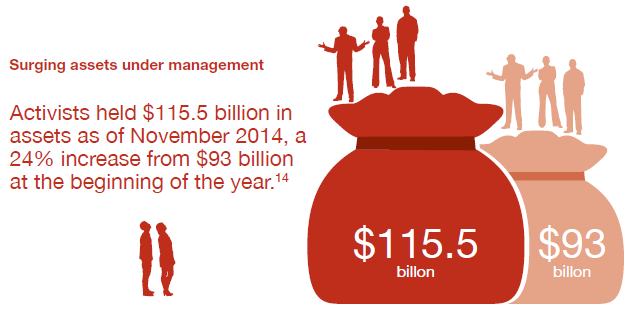
During the past decade, the number of activist hedge funds across the globe has dramatically increased, with total assets under management now exceeding $100 billion. Since 2003 (and through May 2014), 275 new activist hedge funds were launched.

Forty-one percent of today’s activist hedge funds focus their activities on North America, and 32% have a focus that spans across global regions. The others focus on specific regions: Asia (15%), Europe (8%), and other regions of the world (4%).

Why?

The goals of today’s activist hedge funds are broad, including all of those historically sought, as well as changes that fall within the category of “capital allocation strategy” (e.g., return of large amounts of reserved cash to investors through stock buybacks or dividends, revisions to the company’s acquisition strategy).

How?

The tactics of these newest activists are also evolving. Many are spending time talking to the company in an effort to negotiate consensus around specific changes intended to unlock value, before pursuing a proxy contest or other more “public” (e.g., media campaign) activities. They may also spend pre-announcement time talking to some of the company’s other shareholders to gauge receptivity to their contemplated changes. Lastly, these activists (along with the companies responding to them) are grappling with the potential impact of high-frequency traders on the identity of the shareholder base that is eligible to vote on proxy matters.

Some contend that hedge fund activism improves a company’s stock price (at least in the short term), operational performance, and other measures of share value (including more disciplined capital investments). Others contend that, over the long term, hedge fund activism increases the company’s share price volatility as well as its leverage, without measurable improvements around cash management or R&D spending.

When is a company likely to be the target of activism?

Although each hedge fund activist’s process for identifying targets is proprietary, most share certain broad similarities:

  1. The company has a low market value relative to book value, but is profitable, generally has a well-regarded brand, and has sound operating cash flows and return on assets. Alternatively, the company’s cash reserves exceed both its own historic norms and those of its peers. This is a risk particularly when the market is unclear about the company’s rationale for the large reserve. For multi- business companies, activists are also alert for one or more of the company’s business lines or sectors that are significantly underperforming in its market.
  2. Institutional investors own the vast majority of the company’s outstanding voting stock.
  3. The company’s board composition does not meet all of today’s “best practice” expectations. For example, activists know that other investors may be more likely to support their efforts when the board is perceived as being “stale”—that is, the board has had few new directors over the past three to five years, and most of the existing directors have served for very long periods. Companies that have been repeatedly targeted by non-hedge fund activists are also attractive to some hedge funds who are alert to the cumulative impact of shareholder dissatisfaction.

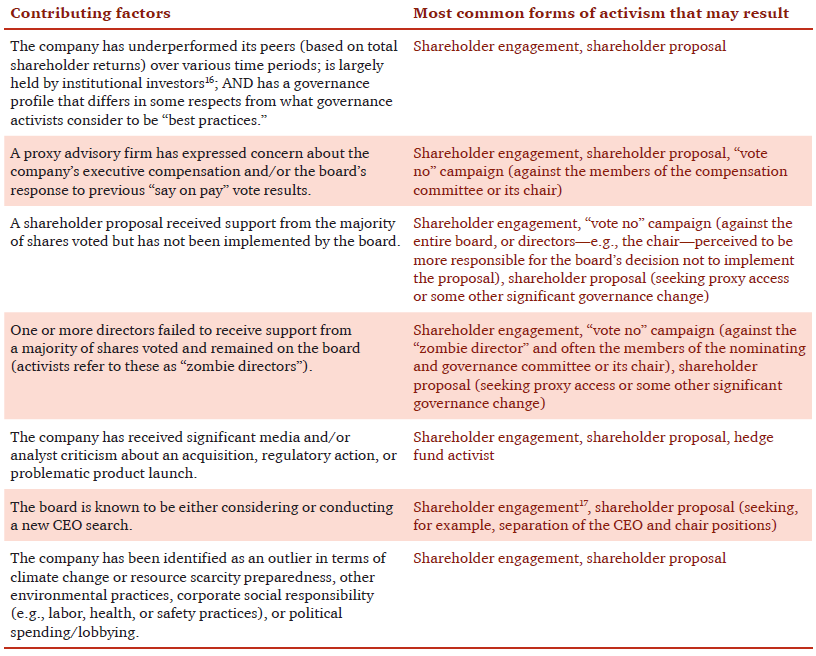
A company is most likely to be a target of non-hedge fund activism based on a combination of the following factors:

pwcsat

How can a company effectively prepare for—and respond to—an activist campaign?

Prepare

We believe that companies that put themselves in the shoes of an activist will be most able to anticipate, prepare for, and respond to an activist campaign. In our view, there are four key steps that a company and its board should consider before an activist knocks on the door:

Critically evaluate all business lines and market regions. Some activists have reported that when they succeed in getting on a target’s board, one of the first things they notice is that the information the board has been receiving from management is often extremely voluminous and granular, and does not aggregate data in a way that highlights underperforming assets.

Companies (and boards) may want to reassess how the data they review is aggregated and presented. Are revenues and costs of each line of business (including R&D costs) and each market region clearly depicted, so that the P&L of each component of the business strategy can be critically assessed? This assessment should be undertaken in consideration of the possible impact on the company’s segment reporting, and in consultation with the company’s management and likely its independent auditor.

Monitor the company’s ownership and understand the activists. Companies routinely monitor their ownership base for significant shifts, but they may also want to ensure that they know whether activists (of any type) are current shareholders.

Understanding what these shareholders may seek (i.e., understanding their “playbook”) will help the company assess its risk of becoming a target.

Evaluate the “risk factors.” Knowing in advance how an activist might criticize a company allows a company and its board to consider whether to proactively address one or more of the risk factors, which in turn can strengthen its credibility with the company’s overall shareholder base. If multiple risk factors exist, the company can also reduce its risk by addressing just one or two of the higher risk factors.

Even if the company decides not to make any changes based on such an evaluation, going through the deliberative process will help enable company executives and directors to articulate why they believe staying the course is in the best long-term interests of the company and its investors.

Develop an engagement plan that is tailored to the company’s shareholders and the issues that the company faces. If a company identifies areas that may attract the attention of an activist, developing a plan to engage with its other shareholders around these topics can help prepare for—and in some cases may help to avoid—an activist campaign. This is true even if the company decides not to make any changes.

Activists typically expect to engage with both members of management and the board. Accordingly, the engagement plan should prepare for either circumstance.

Whether the company decides to make changes or not, explaining to the company’s most significant shareholders why decisions have been made will help these shareholders better understand how directors are fulfilling their oversight responsibilities, strengthening their confidence that directors are acting in investors’ best long-term interests.

These communications are often most effective when the company has a history of ongoing engagement with its shareholders. Sometimes, depending on the company’s shareholder profile, the company may opt to defer actual execution of this plan until some future event occurs (e.g., an activist in fact approaches the company, or files a Schedule 13d with the SEC, which effectively announces its intent to seek one or more board seats). Preparing the plan, however, enables the company to act quickly when circumstances warrant.

pwcsa13

Respond

In responding to an activist’s approach, consider the advice that large institutional investors have shared with us: good ideas can come from anyone. While there may be circumstances that call for more defensive responses to an activist’s campaign (e.g., litigation), in general, we believe the most effective response plans have three components:

Objectively consider the activist’s ideas. By the time an activist first approaches a company, the activist has usually already (a) developed specific proposals for unlocking value at the company, at least in the short term, and (b) discussed (and sometimes consequently revised) these ideas with a select few of the company’s shareholders. Even if these conversations have not occurred by the time the activist first approaches the company, they are likely to occur soon thereafter. The company’s institutional investors generally spend considerable time objectively evaluating the activist’s suggestion—and most investors expect that the company’s executive management and board will be similarly open- minded and deliberate.

Look for areas around which to build consensus. In 2013, 72 of the 90 US board seats won by activists were based on voluntary agreements with the company, rather than via a shareholder vote. This demonstrates that most targeted companies are finding ways to work with activists, avoiding the potentially high costs of proxy contests. Activists are also motivated to reach agreement if possible. If given the option, most activists would prefer to spend as little time as possible to achieve the changes they believe will enhance the value of their investment in the company. While they may continue to own company shares for extensive periods of time, being able to move their attention and energy to their next target helps to boost the returns to their own investors.

Actively engage with the company’s key shareholders to tell the company’s story. An activist will likely be engaging with fellow investors, so it’s important that key shareholders also hear from the company’s management and often the board. In the best case, the company already has established a level of credibility with those shareholders upon which new communications can build. If the company does not believe the activist’s proposed changes are in the best long-term interests of the company and its owners, investors will want to know why—and just as importantly, the process the company used to reach this conclusion. If the activist and company are able to reach an agreement, investors will want to hear that the executives and directors embrace the changes as good for the company. Company leaders that are able to demonstrate to investors that they were part of positive changes, rather than simply had changes thrust upon them, enhance investor confidence in their stewardship.

pwcsa14

Epilogue—life after activism

When the activism has concluded—the annual meeting is over, changes have been implemented, or the hedge fund has moved its attention to another target—the risk of additional activism doesn’t go away. Depending on how the company has responded to the activism, the significance of any changes, and the perception of the board’s independence and open-mindedness, the company may again be targeted. Incorporating the “Prepare” analysis into the company’s ongoing processes, conducting periodic self-assessments for risk factors, and engaging in a tailored and focused shareholder engagement program can enhance the company’s resiliency, strengthening its long-term relationship with investors.

« Vous êtes devenus l’un d’entre eux » | 15 règles qu’un administrateur doit appliquer !


Voici un article qui rappelle les règles à suivre pour un administrateur siégeant sur le conseil d’une entreprise familiale, d’une entreprise privée de capital de risque, d’une entreprise gérée par les fondateurs ou toute autre combinaison de celles-ci. L’article a initialement été publié par  en mars 2015 dans Private Company Director Magazine.

Pour plusieurs administrateurs, le fait de prendre position en faveur de la direction, des propriétaires dirigeants ou du management en général peut constituer un manquement aux obligations de fiduciaire, surtout si la position adoptée est contraire à celle de certains autres administrateurs qui ont des intérêts à protéger ! 

L’incident relaté dans l’extrait suivant est assez révélateur …

You’ve become one of them.” That’s what a fellow Director (“MoneyGuy”) said to me after one of XYZ Company’s regular board meetings. MoneyGuy was from XYZ’s lead investor group and the majority shareholder. The ’them’ MoneyGuy was speaking about was XYZ’s management team. From his tone, I knew MoneyGuy wasn’t giving me a compliment; I was being admonished because I ‘sided with management’ about a particular matter that was pivotal to the future of the company.

What had I done wrong? To find the answer, you’ll need to read the following fifteen “rules” on how to work with owners.

Ce commentaire d’un collègue administrateur a incité * à proposer quinze (15) règles de conduite dans des cas similaires. Je vous invite donc à lire ces règles et à ajouter votre grain de sel.

Bonne lecture !

« You’ve Become One of Them »  | Fifteen Rules for Directors

Here are my fifteen rules :

1. Remember your role as a fiduciary. MoneyGuy knew I had a fiduciary responsibility to the corporation, not just to him and his private equity firm. They put me on the Board to be ‘an outside, independent voice.’ Somehow that slipped his mind! This brings me to Rule #2…P1010169

2. Don’t be a rubber stamp. You can get rubber stamps at Staples. MoneyGuy or any other majority shareholder should realize that you are not on the Board just to be another automatic vote for them. Another Director friend told me: “There is a fine line to walk as an independent director when those sitting around the table own the company and you are effectively their invited guest.” If management knows you are truly independent and not there to throw them under the bus, this will help build trust with all.

3. Understand the owner’s expectations and their personal and financial goals. One owner told me: “I believe the most important consideration for an outside Director is to ensure the shareholders’ goals and desires are fully understood. Private company owners are likely to have a complex mix of primary and secondary goals that often change based on circumstances impacting their lives. Multiple shareholders might present further complications which need to be blended into the stew.”

4. Understand the owners’ personalities. This is different than #3. The particular personality style of the individual majority shareholder exerts a significant influence on the board and management.

5. Get to know the management team. Is the CEO and senior team strong-willed, weak or balanced? How well does the CEO work with the company’s owners? Being aware of the strengths and weaknesses of the C-Suite will help you be a better coach to the owners.

6. Understand the culture of the company. Why? Because you and your other directors do have a role in shaping it and maintaining it by your actions.

7. Be consequential. Joe White used this term in his book Boards That Excel. One CEO/owner told me: “I want Directors that challenge me and bring perspective and skills I lack. I also want them to be well-grounded. The one thing my board has lacked is someone who is very knowledgeable about the specifics of my industry, but I think that has been outweighed by Directors with broad experience who see the big picture.”

8. Understand the business model and the industry. I had recently joined the Board of a company and we were discussing changes to the distribution channels. One Director said: “That’s not how we go to market now, is it?” He had been on the Board for over ten years and did not know one of the basic aspects of the business model!

9. Be a colleague, not an adversary. You are on the Board to give your opinion and offer advice, suggestions and ideas, not to advance your own career or agenda. I disagreed with MoneyGuy, but I wasn’t being disagreeable. No grandstanding, no pontificating allowed.

10. Don’t be timid about personally coaching or mentoring the owners. Even though they own the company, they may need advice on areas they are unfamiliar with. See #7.

11. Trust your gut. It’s ok to be a nudge (…and be Columbo-like). For those of you who are too young to know who Columbo was, Google him. Don’t allow the CEO and the team to stiff arm you or ignore your questions. Hopefully you have proved to the owners that your probing is done with good intentions.

12. Prepare for and attend the meetings. How obvious is this? Don’t be a no show or empty seat.

13. Participate. Be available to the owners not only at the Board meetings but also between the meetings. Encourage honest two-way communication and feedback.

14. Embrace and use technology. Just a pet peeve of mine…I’m tired of hearing about people being ‘too old’ to learn today’s communication technologies. The cloud is something more than moisture in the air.

15. Stay fresh. Owners don’t want ‘stale’, they deserve ‘fresh’.

None of this is complicated and these rules may seem pretty basic and just common sense to you. But if that’s the case, then why have I witnessed so many Directors who don’t follow these, who behave irrationally and/or who are ineffective with ownership?

___________________________________

* is an Entrepreneur, Director, CEO Coach, Optimist, Instigator of Positive Change…and Fixer of Stuck Companies. CEOs, family owners, investors and Boards enlist Jim to be their ‘fresh pair of eyes’ and confidant.

Comportements néfastes liés au narcissisme de certains présidents et chefs de direction (PCD) | En reprise


Il est indéniable qu’un PCD (CEO) doit avoir une personnalité marquante, un caractère fort et un leadership manifeste. Ces caractéristiques tant recherchées chez les premiers dirigeants peuvent, dans certains cas, s’accompagner de traits de personnalité dysfonctionnels tels que le narcissisme.

C’est ce que Tomas Chamorro-Premuzic soutien dans son article publié sur le blogue du HuffPost du 2 janvier 2014. Il cite deux études qui confirment que le comportement narcissique de certains dirigeants (1) peut avoir des effets néfastes sur le moral des employés, (2) éloigner les employés potentiels talentueux et (3) contribuer à un déficit de valeurs d’intégrité à l’échelle de toute l’organisation.

L’auteur avance que les membres des conseils d’administration, notamment ceux qui constituent les comités de Ressources humaines, doivent être conscients des conséquences potentiellement dommageables des leaders flamboyants et « charismatiques ». En fait, les études montrent que les vertus d’humilité, plutôt que les traits d’arrogance, sont de bien meilleures prédicteurs du succès d’une organisation.

P1040752La première étude citée montre que les organisations dirigées par des PCD prétentieux et tout-puissants ont tendances à avoir de moins bons résultats, tout en étant plus sujettes à des fraudes.

La seconde étude indique que les valeurs d’humilité incarnées par un leader ont des conséquences positives sur l’engagement des employés.

Voici en quelques paragraphes les conclusions de ces deux études.

Bonne lecture !

In the first study, Antoinette Rijsenbilt and Harry Commandeur assessed the narcissism levels of 953 CEOs from a wide range of industries, as well as examining objective performance indicators of their companies during their tenure. Unsurprisingly, organizations led by arrogant, self-centered, and entitled CEOs tended to perform worse, and their CEOs were significantly more likely to be convicted for corporate fraud (e.g., fake financial reports, rigged accounts, insider trading, etc.). Interestingly, the detrimental effects of narcissism appear to be exacerbated when CEOs are charismatic, which is consistent with the idea that charisma is toxic because it increases employees’ blind trust and irrational confidence in the leader. If you hire a charismatic leader, be prepared to put up with a narcissist.

In the second study, Bradley Owens and colleagues examined the effects of leader humility on employee morale and turnover. Their results showed that « in contrast to rousing employees through charismatic, energetic, and idealistic leadership approaches (…) a ‘quieter’ leadership approach, with listening, being transparent about limitations, and appreciating follower strengths and contributions [is the most] effective way to engage employees. » This suggests that narcissistic CEOs may be good at attracting talent, but they are probably better at repelling it. Prospective job candidates, especially high potentials, should therefore think twice before being seduced by the meteoric career opportunities outlined by charismatic executives. Greed is not only contagious, but competitive and jealous, too…


If we can educate organizations, in particular board members, on the virtues of humility and the destructive consequences of narcissistic and charismatic leadership, we may see a smaller proportion of entitled, arrogant, and fraudulent CEOs — to everyone’s benefit. Instead of worshiping and celebrating the flamboyant habits of corporate bosses, let us revisit the wise words of Peter Drucker, who knew a thing or two about management:

The leaders who work most effectively, it seems to me, never say ‘I’. And that’s not because they have trained themselves not to say ‘I’. They don’t think ‘I’. They think ‘we’; they think ‘team’. They understand their job to be to make the team function. They accept responsibility and don’t sidestep it, but ‘we’ gets the credit.

Enhanced by Zemanta

Le constat de l’incompétence de plusieurs administrateurs | Harvard Business Review


Aujourd’hui, je vous propose la lecture d’un récent article, paru dans Harvard Business Review, sous la plume de Dominic Barton* et Mark Wiseman*, qui traite d’un sujet assez brûlant : l’incompétence de plusieurs conseils d’administration.

Les auteurs font le constat que, malgré les nombreuses réformes règlementaires effectuées depuis Enron, plusieurs « Boards » sont dysfonctionnels, sinon carrément incompétents !

En effet, une étude de McKinsey montre que seulement 22 % des administrateurs comprennent comment leur firme crée de la valeur; uniquement 16 % des administrateurs comprennent vraiment la dynamique de l’industrie dans laquelle leur société œuvre.

L’article avance même que l’industrie de l’activisme existe parce que les « Boards » sont inadéquatement équipés pour répondre aux intérêts des actionnaires !

Je vous invite à lire cet article provocateur. Voici un extrait de l’introduction. Qu’en pensez-vous ?

Bonne lecture !

Where Boards Fall Short

Boards aren’t working. It’s been more than a decade since the first wave of post-Enron regulatory reforms, and despite a host of guidelines from independent watchdogs such as the International Corporate Governance Network, most boards aren’t delivering on their core mission: providing strong oversight and strategic support for management’s efforts to create long-term value. This isn’t just our opinion. Directors also believe boards are falling short, our research suggests.

435A mere 34% of the 772 directors surveyed by McKinsey in 2013 agreed that the boards on which they served fully comprehended their companies’ strategies. Only 22% said their boards were completely aware of how their firms created value, and just 16% claimed that their boards had a strong understanding of the dynamics of their firms’ industries.

More recently, in March 2014, McKinsey and the Canada Pension Plan Investment Board (CPPIB) asked 604 C-suite executives and directors around the world which source of pressure was most responsible for their organizations’ overemphasis on short-term financial results and underemphasis on long-term value creation. The most frequent response, cited by 47% of those surveyed, was the company’s board. An even higher percentage (74%) of the 47 respondents who identified themselves as sitting directors on public company boards pointed the finger at themselves.

_________________________________

*Dominic Barton is the global managing director of McKinsey & Company and the author of “Capitalism for the Long Term.”

*Mark Wiseman is the president and CEO of the Canada Pension Plan Investment Board.


Les effets dévastateurs des « Hedge Funds » | Recueil des arguments évoqués


Voici le plus récent mémo de Martin Lipton*, associé fondateur de la firme Wachtell, Lipton, Rosen & Katz, spécialisée dans les affaires de fusions et acquisition, qui présente une longue liste d’événements et de publications montrant les effets dévastateurs des attaques des fonds activistes sur l’actionnariat, les autres parties prenantes et l’économie en général.

L’auteur avance que les trois dernières années ont vu un accroissement de l’intensité des actions menées par les « Hedge Funds ».

Si l’évolution de ce débat vous intéresse et que vous croyez que les activistes de tout acabit nuisent à la saine gouvernance des grandes sociétés, vous serez certainement comblés par les arguments invoqués par une multitude d’experts, de firmes spécialisées, d’universitaires, d’autorités règlementaires, etc.

Voici l’introduction à ce court article paru hier sur le site du Harvard Law School Forum on Corporate Governance.

Vos commentaires sont appréciés. Bonne lecture !

The Threat to Shareholders and the Economy from Activist Hedge Funds

Again in 2014, as in the two previous years, there has been an increase in the number and intensity of attacks by activist hedge funds. Indeed, 2014 could well be called the “year of the wolf pack.”

543

With the increase in activist hedge fund attacks, particularly those aimed at achieving an immediate increase in the market value of the target by dismembering or overleveraging, there is a growing recognition of the adverse effect of these attacks on shareholders, employees, communities and the economy.

Noted below are the most significant 2014 developments holding out a promise of turning the tide against activism and its proponents, including those in academia.

___________________________________________
*Martin Lipton* is a founding partner of Wachtell, Lipton, Rosen & Katz, specializing in mergers and acquisitions and matters affecting corporate policy and strategy.

Le constat de l’incompétence de plusieurs administrateurs | HBR


Aujourd’hui, je vous propose la lecture d’un récent article, paru dans Harvard Business Review, sous la plume de Dominic Barton* et Mark Wiseman*, qui traite d’un sujet assez brûlant : l’incompétence de plusieurs conseils d’administration.

Les auteurs font le constat que, malgré les nombreuses réformes règlementaires effectuées depuis Enron, plusieurs « Boards » sont dysfonctionnels, sinon carrément incompétents !

En effet, une étude de McKinsey montre que seulement 22 % des administrateurs comprennent comment leur firme crée de la valeur; uniquement 16 % des administrateurs comprennent vraiment la dynamique de l’industrie dans laquelle leur société œuvre.

L’article avance même que l’industrie de l’activisme existe parce que les « Boards » sont inadéquatement équipés pour répondre aux intérêts des actionnaires !

Je vous invite à lire cet article provocateur. Voici un extrait de l’introduction. Qu’en pensez-vous ?

Bonne lecture !

Where Boards Fall Short

Boards aren’t working. It’s been more than a decade since the first wave of post-Enron regulatory reforms, and despite a host of guidelines from independent watchdogs such as the International Corporate Governance Network, most boards aren’t delivering on their core mission: providing strong oversight and strategic support for management’s efforts to create long-term value. This isn’t just our opinion. Directors also believe boards are falling short, our research suggests.

435A mere 34% of the 772 directors surveyed by McKinsey in 2013 agreed that the boards on which they served fully comprehended their companies’ strategies. Only 22% said their boards were completely aware of how their firms created value, and just 16% claimed that their boards had a strong understanding of the dynamics of their firms’ industries.

More recently, in March 2014, McKinsey and the Canada Pension Plan Investment Board (CPPIB) asked 604 C-suite executives and directors around the world which source of pressure was most responsible for their organizations’ overemphasis on short-term financial results and underemphasis on long-term value creation. The most frequent response, cited by 47% of those surveyed, was the company’s board. An even higher percentage (74%) of the 47 respondents who identified themselves as sitting directors on public company boards pointed the finger at themselves.

_________________________________

*Dominic Barton is the global managing director of McKinsey & Company and the author of “Capitalism for the Long Term.”

*Mark Wiseman is the president and CEO of the Canada Pension Plan Investment Board.


Qu’est-ce que l’investissement socialement responsable ?


Vous trouverez, ci-dessous, une référence à un article publié par Merryn Somerset Webb* dans le Financial Times qui montre qu’il n’est pas facile de saisir la notion d’investissement dans une entreprise socialement responsable. 

Comment identifier des organisations qui sont véritablement socialement responsables, qui gèrent en fonction du long terme, et qui procurent des biens et services utiles à la société ?

Quelle est votre définition d’un fond d’investissement constitué d’entreprises socialement responsables ?

Rien n’est évident dans ce domaine…

L’auteur nous présente son point de vue sur le sujet. Bonne lecture !

So what exactly is social enterprise investing ?

I went to speak at an event on social enterprise last week for a very nice organisation called LaunchMe. My brief was pretty simple. I was to speak for 10-15 minutes on the nature of social enterprise and then I was to interview TV celebrity Carol Smillie about her newish company Diary Dolls, which sells rather marvellous pants made at a manufacturing plant in Scotland that is a social enterprise.

Now what could be easier than that? Nothing – as long as you know what a social enterprise is. When I sat down to think about the matter, I realised I did not. Luckily, I have a pretty good contacts book. What, I asked them, is a social enterprise? Answers came there plenty, definitive answers came there none. Beyond the idea that it was a business – or sort of a business – that in some way did good, no one could really answer the question.

126

Can a social enterprise make a profit? Even at the dinner itself, one person told me yes and one person told me no. If it makes a profit does it have to give some away? Or is it not the profit but the nature of the business that makes it a social enterprise? If you employ homeless people but pay them the minimum wage and keep the profits in their entirety, are you a social enterprise? Or do you have to overpay the staff and donate to Shelter too? You get the idea. This is very tricky ground.

Everyone wants capitalism to make more people better off than not, for companies to act in the interest of society as a whole as well as for their shareholders. You’ve read this hundreds of times. But what is good and what is bad? I don’t often write about ethical funds on the basis that the lines are all far too blurred. If you are going to invest with ethics in mind you have to choose someone’s ethics to work with.

Take defence companies. They might be bad when their products are used in wars of which you disapprove – but what if you were to need defending very badly? Would you withhold your capital then? And what of tobacco companies? I think they are bad. But what if paying my grandmother’s care home fees rested on the need for high dividends sustainable over the medium term? I wonder if I might be budged from my position then. And what about companies that aren’t explicitly out to do good, but do it along the way?

I went to meet Will Smith, manager of the City Natural Resources High Yield Trust earlier in the week. His fund holds all sorts of companies I would imagine ethical investors wouldn’t fancy much. But he also told me about a recent investment in a small UK-listed firm called Plant Impact, which develops products that help to enhance the eventual yield from seeds. Higher yields mean a greater supply of food to the market, lower prices and then, presumably, fewer hungry people. Does that make Plant Impact a social impact business? It might even make City Natural Resources HYT a partial impact fund.

Moving away from the absolutely bad or not, there are companies that you could argue should get marks for improvement. If big oil invests a lot in renewable energy does that make them bad for being involved in fossil fuels – or good for pouring capital the rest of us don’t have into a greener future? Then there is Coca-Cola. Sure, it is peddling poison to the masses. But it has also been spending huge amounts of time and effort on useful things such as cutting its water usage (vital in much of the world these days). That’s a social good. Sort of.

You can see the problem. Once you start down the path of trying to be a morally superior investor, you are always a hypocrite– Merryn Somerset Webb

If you are going to choose ethics you might want to take religious fuzziness into account. If Islamic finance forbids interest payments, but there are very few listed companies that have no debt and do not pay or receive interest, is an Islamic finance compliant equity fund an oxymoron? Or not?

You can see the problem. Once you start down the path of trying to be a morally superior investor, you are always a hypocrite. Which is why you don’t read about this stuff much in this column.

However, there is a problem with my persistent refusal to engage with this attempt to make capitalism friendlier. It leaves me with a nagging sense that I could do a little better. I am, for example, a long-term fan of passive investing. But as First State’s David Gait pointed out to me this week, if we simply throw our money into the market to be invested in the stocks of every company in any index we are obviously neglecting our duty to society. There are some genuinely awful companies out there and if we don’t discriminate between the good and the bad how can we hope to encourage the bad to be better?

Mr Gait runs a group of what First State calls sustainability funds. The approach in these is not about red lines on good and bad, but about investing in companies that have the good governance, social and environmental polices in place to keep operating and paying good dividends to shareholders for decades to come. He wouldn’t buy Coca-Cola or tobacco companies, not because they are evil but because consumer habits (and legislation) are likely to mean their businesses aren’t sustainable in their current forms over the long term.

That seems entirely reasonable. But think about it a bit and you will see that it brings us right back to our usual mantra on investing: buy long-term growth at the right price.

Mr Gait phrases it well and First State practises what it preaches with exceptional skill, but what they are peddling is simply what should be recognised by everyone as good practice, long-term investing with a happy label. Nothing wrong with that. But it does suggest that investing in a way that is right for society is probably a matter of finding a good long-term, long-only fund run by an intelligent and trustworthy manager.

If he really is investing for the long term he will be automatically investing in sustainability. Mr Gait’s Worldwise Sustainability Fund is as good a place to start as any. The only caveat? I think it might be part of my own duty to society to point out that almost all stocks and markets are overvalued at the moment, so whatever you buy comes with more risk than usual.

______________________________________________

*Merryn Somerset Webb is editor-in-chief of MoneyWeek.

Les PDG d’OBNL doivent-ils être membres de leurs C.A. ? *


Quels sont les pratiques exemplaires de gouvernance eu égard à l’appartenance des PDG (DG/CEO) aux conseils d’administration de leurs organisations, plus particulièrement des OBNL ?

C’est l’une des recherches les plus effectuées sur Google avec plus de cinq millions de références reliées à ce sujet… On note également des discussions très animées sur les groupes de discussion LinkedIn, tels que Non-Profit Management Professionals.

C’est un sujet très populaire et, comme vous vous en doutez, les avis diffèrent largement en fonction du (1) type d’organisation, (1) de son histoire, (3) de sa mission et (4) des obligations règlementaires.

Dans certaines organisations à but non lucratif, le ou la PDG siège au conseil d’administration mais, à mon avis, ce n’est pas le cas pour la plupart des associations de bénévoles, des fondations et des entreprises philanthropiques. Une recherche rapide montre que les PDG ne siègent pas sur des entreprises telles que la Croix Rouge canadienne, le Festival d’été de Québec, Centraide du grand Montréal, le Club Musical, l’OSQ, Musique de chambre à Sainte-Pétronille, l’Ordre des administrateurs agréés du Québec, pour n’en nommer que quelques-unes.

Français : Sainte Prétonille, Île d'Orléans, p...
Français : Sainte Prétonille, Île d’Orléans, province de Québec, Canada (Photo credit: Wikipedia)

Généralement, si la législation ou la réglementation l’autorise, c’est au conseil d’administration de décider si le ou la PDG a le statut de membre du C.A., avec plein droit de vote, ou sans droit de vote. On observe que certaines législations américaines (la Californie, notamment) ne permettent pas aux PDG de voter à titre de membres du conseil. Au Québec, c’est le cas du CLD de Québec, par exemple.

Dans les sociétés d’état québécoises, les PDG sont nommé(e)s par le gouvernement sur recommandation du C.A.; les PDG siègent habituellement de plein droit sur les conseils d’administration. Dans le monde municipal, les DG ne sont pas membres des conseils municipaux, des MRC et des CRÉ.

Comme on le constate, un tour d’horizon rapide indique qu’il y a plusieurs possibilités : (1) le ou la PDG est membre à part entière du C.A., (2) le ou la PDG est membre du C.A., mais sans droit de vote, (3) le ou la PDG n’est pas membre du C.A. Dans presque tous les cas cependant, les PDG assistent aux réunions du conseil à titre de personnes ressource, même sans être membres du C.A.

Afin de bien départager les rôles complémentaires exercés par les membres du conseil et les membres de la direction et éviter les conflits qui pourraient naître dans certaines zones d’intérêt, notamment dans le domaine lié aux rémunérations, il m’apparaît être une bonne pratique de gouvernance de ne pas accorder un statut de membre du conseil d’administration à un ou une PDG.

Pour les organisations qui vivent avec une situation particulière, il serait souhaitable que le C.A., par l’intermédiaire du ou de la PCA, mette en œuvre une stratégie de changement (à plus ou moins long terme) pour revoir cet aspect de leur gouvernance.

L’article ci-dessous publié par Eugene Fram, Professeur émérite au Saunders College of Business du Rochester Institute of Technology, explique un peu la situation. Vos commentaires sont les bienvenus.

Voici un extrait de l’article :

Should a Nonprofit CEO Be a Voting Member of the Board of Directors ?

Here are the issues as I see them:

State Legislation: Most nonprofit charters are issued by states, and it appears that the vast majority of American nonprofits are governed by these regulations. California does not permit the CEO to be a voting member. Until a recent change, New York did allow the CEO to become a board member. The motivations behind the legislation center on preventing a CEO developing conflicts-of interest, especially as they relate to salary decisions. Also, there is a feeling among some nonprofit directors that the board must be the « boss. » This attitude can even go as far as one nonprofit board member’s comment: « We tell the CEO exactly what to do. »

It appears that the restriction is considered a « best practice. » Some nonprofits move around it by naming the CEO an ex-official member of the board, a member without a vote. However, there is a « better practice, » available where permitted by legislation.

Developing An Even Better Practice in a Nonprofit

Start At The Top: Allow the CEO to hold the title of President/CEO and allow the senior volunteer to become board chair. This signals to staff and public that the board has full faith in the CEO as a professional manager. In addition, the change absolves the senior volunteer of potential financial liability, not unlike the volunteer who unwittingly received a $200,000 bill from the IRS because it appeared he had strong control of a bankrupt nonprofit’s finances and operations.

Ask The CEO: Make certain the CEO is willing and able to accept full responsibility for operations. Not all CEOs, designated as Executive Directors, want the increased responsibilities attached to such a title and to become a board member. These managers only feel comfortable with having the board micromanage operations and often openly discuss their reservations.

The CEO Becomes A Communications Nexus: Under the CEO’s guidance, board-staff contact takes place on task forces, strategic planning projects, at board orientations and at organization celebrations. It openly discourages the staff making « end runs » to board members, not a small problem in community-focused nonprofits

Brand Image: As a board director, the CEO can be more active in fund development. The board position and the title can easily help the CEO to build the organization’s public brand image through the clear public perceptions of the board’s choice to lead the organization. This provides leverage to make greater use of the board-CEO relationship required to develop funds. It can allow the CEO to be the spokesperson for the organization’s mission.

Peer Not Powerhouse: Probably descending from early religious nonprofits, its personnel may be seen by part of the public as not being « worldly. » They must be over-viewed by a group of laypersons that encounters the real world daily. The CEO, as a voting member and a team peer, takes on increasing importance to reducing these attitudes. As long as the CEO works successfully as a peer not a powerhouse, there should be substantial benefits to the organization.

* En reprise

Enhanced by Zemanta

Attention aux huis clos (en reprise) !


Nous avons déjà abordé l’importance d’inscrire un item « huis clos » à l’ordre du jour des réunions du conseil d’administration. Celui-ci doit normalement être à la fin de la réunion et comporter une limite de temps afin d’éviter que la réunion ne s’éternise… et que les membres de la direction (qui souvent attendent la fin de la rencontre) soient mieux informés.

Ensuite, le président du conseil d’administration (PCA) devrait rencontrer le président et chef de la direction (PCD) en privé, et dans les meilleurs délais, afin de rendre compte des résultats et de la portée du huis clos. Cette responsabilité du PCA est déterminante, car les dirigeants ont de grandes attentes et un souci eu égard aux discussions du huis clos.

Plusieurs dirigeants et membres de conseil m’ont fait part de leurs préoccupations concernant la tenue des huis clos. Il y a des malaises dissimulés en ce qui a trait à cette activité ; il faut donc s’assurer de bien gérer la situation, car les huis clos peuvent souvent avoir des conséquences inattendues, voire contre-productives !

Ainsi, le huis clos :

(1) ne doit pas être une activité imprévue et occasionnelle inscrite à l’ordre du jour

(2) doit comporter une limite de temps

(3) doit être piloté par le PCA

(4) doit comporter un suivi systématique et

(5) doit se dérouler dans un lieu qui permet de préserver la confidentialité absolue des discussions.

J’insiste sur cette dernière condition parce que l’on a trop souvent tendance à la négliger ou à l’oublier, carrément. Dans de nombreux cas, la rencontre du conseil a lieu dans un local inapproprié, et les dirigeants peuvent entendre les conversations, surtout lorsqu’elles sont très animées…

Au début de la séance, les membres sont souvent insoucieux ; avec le temps, certains peuvent s’exprimer très (trop) directement, impulsivement et de manière inconvenante. Si, par mégarde, les membres de la direction entendent les propos énoncés, l’exercice peut prendre l’allure d’une véritable calamité et avoir des conséquences non anticipées sur le plan des relations interpersonnelles entre les membres de la direction et avec les membres du conseil.

registre-conseils-d-administration

L’ajout d’un huis clos à l’ordre du jour témoigne d’une volonté de saine gouvernance, mais, on le comprend, il y a un certain nombre de règles à respecter si on ne veut pas provoquer la discorde. Les OBNL, qui ont généralement peu de moyens, sont particulièrement vulnérables aux manquements à la confidentialité ! Je crois que dans les OBNL, les dommages collatéraux peuvent avoir des incidences graves sur les relations entre employés, et même sur la pérennité de l’organisation.

J’ai à l’esprit plusieurs cas de mauvaise gestion des facteurs susmentionnés et je crois qu’il vaut mieux ne pas tenir le bien-fondé du huis clos pour acquis.

Ayant déjà traité des bienfaits des huis clos lors d’un billet antérieur, je profite de l’occasion pour vous souligner, à nouveau, un article intéressant de Matthew Scott sur le site de Corporate Secretary qui aborde un sujet qui préoccupe beaucoup de hauts dirigeants : le huis clos lors des sessions du conseil d’administration ou de certains comités.

L’auteur explique très bien la nature et la nécessité de cette activité à inscrire à l’ordre du jour du conseil. Voici les commentaires que j’exprimais à cette occasion.

«Compte tenu de la “réticence” de plusieurs hauts dirigeants à la tenue de cette activité, il est généralement reconnu que cet item devrait toujours être présent à l’ordre du jour afin d’éliminer certaines susceptibilités.

Le huis clos est un temps privilégié que les administrateurs indépendants se donnent pour se questionner sur l’efficacité du conseil et la possibilité d’améliorer la dynamique interne; mais c’est surtout une occasion pour les membres de discuter librement, sans la présence des gestionnaires, de sujets délicats tels que la planification de la relève, la performance des dirigeants, la rémunération globale de la direction, les poursuites judiciaires, les situations de conflits d’intérêts, les arrangements confidentiels, etc. On ne rédige généralement pas de procès-verbal à la suite de cette activité, sauf lorsque les membres croient qu’une résolution doit absolument apparaître au P.V.

La mise en place d’une période de huis clos est une pratique relativement récente, depuis que les conseils d’administration ont réaffirmé leur souveraineté sur la gouvernance des entreprises. Cette activité est maintenant considérée comme une pratique exemplaire de gouvernance et presque toutes les sociétés l’ont adoptée.

Notons que le rôle du président du conseil, en tant que premier responsable de l’établissement de l’agenda, est primordial à cet égard. C’est lui qui doit informer le PCD de la position des membres indépendants à la suite du huis clos, un exercice qui demande du tact!

Je vous invite à lire l’article ci-dessous. Vos commentaires sont les bienvenus».

Are you using in-camera meetings ?

Comportements néfastes liés au narcissisme de certains PCD (CEO) | En reprise


Il est indéniable qu’un PCD (CEO) doit avoir une personnalité marquante, un caractère fort et un leadership manifeste. Ces caractéristiques tant recherchées chez les premiers dirigeants peuvent, dans certains cas, s’accompagner de traits de personnalité dysfonctionnels tels que le narcissisme.

C’est ce que Tomas Chamorro-Premuzic soutien dans son article publié sur le blogue du HuffPost du 2 janvier 2014. Il cite deux études qui confirment que le comportement narcissique de certains dirigeants (1) peut avoir des effets néfastes sur le moral des employés, (2) éloigner les employés potentiels talentueux et (3) contribuer à un déficit de valeurs d’intégrité à l’échelle de toute l’organisation.

L’auteur avance que les membres des conseils d’administration, notamment ceux qui constituent les comités de Ressources humaines, doivent être conscients des conséquences potentiellement dommageables des leaders flamboyants et « charismatiques ». En fait, les études montrent que les vertus d’humilité, plutôt que les traits d’arrogance, sont de bien meilleures prédicteurs du succès d’une organisation.

P1030704

La première étude citée montre que les organisations dirigées par des PCD prétentieux et tout-puissants ont tendances à avoir de moins bons résultats, tout en étant plus sujettes à des fraudes.

La seconde étude indique que les valeurs d’humilité incarnées par un leader ont des conséquences positives sur l’engagement des employés.

Voici en quelques paragraphes les conclusions de ces deux études. Bonne lecture !

In the first study, Antoinette Rijsenbilt and Harry Commandeur assessed the narcissism levels of 953 CEOs from a wide range of industries, as well as examining objective performance indicators of their companies during their tenure. Unsurprisingly, organizations led by arrogant, self-centered, and entitled CEOs tended to perform worse, and their CEOs were significantly more likely to be convicted for corporate fraud (e.g., fake financial reports, rigged accounts, insider trading, etc.). Interestingly, the detrimental effects of narcissism appear to be exacerbated when CEOs are charismatic, which is consistent with the idea that charisma is toxic because it increases employees’ blind trust and irrational confidence in the leader. If you hire a charismatic leader, be prepared to put up with a narcissist.

In the second study, Bradley Owens and colleagues examined the effects of leader humility on employee morale and turnover. Their results showed that « in contrast to rousing employees through charismatic, energetic, and idealistic leadership approaches (…) a ‘quieter’ leadership approach, with listening, being transparent about limitations, and appreciating follower strengths and contributions [is the most] effective way to engage employees. » This suggests that narcissistic CEOs may be good at attracting talent, but they are probably better at repelling it. Prospective job candidates, especially high potentials, should therefore think twice before being seduced by the meteoric career opportunities outlined by charismatic executives. Greed is not only contagious, but competitive and jealous, too…


If we can educate organizations, in particular board members, on the virtues of humility and the destructive consequences of narcissistic and charismatic leadership, we may see a smaller proportion of entitled, arrogant, and fraudulent CEOs — to everyone’s benefit. Instead of worshiping and celebrating the flamboyant habits of corporate bosses, let us revisit the wise words of Peter Drucker, who knew a thing or two about management:

The leaders who work most effectively, it seems to me, never say ‘I’. And that’s not because they have trained themselves not to say ‘I’. They don’t think ‘I’. They think ‘we’; they think ‘team’. They understand their job to be to make the team function. They accept responsibility and don’t sidestep it, but ‘we’ gets the credit.


Enhanced by Zemanta

Gouverner dans l’anxiété | Effet insoupçonné de l’actionnariat activiste ?


M. François Dauphin, directeur de projets de l’IGOPP, nous fait parvenir le billet suivant à titre de blogueur invité.

L’article insiste sur les conséquences, souvent dysfonctionnelles, de gouverner dans un climat d’appréhension relié aux probabilités d’interventions d’actionnaires activistes, qui, selon lui, sont généralement à court terme et bénéficient surtout à ces deniers.

Il semble cependant que ce phénomène continuera sa progression et que les conseils d’administration doivent être de plus en plus vigilants car les « fonds activistes savent cibler des sociétés dont les conseils d’administration n’ont pas été à la hauteur ».

Cet article apporte un éclairage très pertinent aux administrateurs de sociétés, notamment en affirmant que la peur des fonds activistes est exagérée dans les cas de sociétés qui observent des règles de gouvernance exemplaires.

Bonne lecture !

Gouverner dans l’anxiété : Serait-ce un effet insoupçonné de l’actionnariat activiste ?

Par

François Dauphin, MBA, CPA, CMA

Directeur de projets, IGOPP

En septembre dernier, nombreux sont ceux qui n’ont pu réprimer un sourire en observant la dernière salve de l’actionnaire activiste Starboard Value contre le conseil d’administration et la haute direction de Darden Restaurants (société mère qui regroupe plusieurs chaînes de restaurants, dont Olive Garden, Longhorn Steakhouse et, jusqu’à très récemment, Red Lobster). En effet, dans une présentation de près de 300 pages, l’activiste ridiculisait la façon dont l’entreprise gérait son réseau de restaurants, allant jusqu’à souligner l’incapacité des cuisiniers à bien faire cuire les pâtes ou le nombre de pains trop élevés laissé par les serveurs sur les tables.

Rappelons qu’un investisseur « activiste » est un actionnaire qui acquière une participation dans une entreprise publique, et qui utilise différentes techniques (souvent hostiles) afin de contraindre le conseil d’administration ou la direction de l’entreprise ciblée à se conformer à ses requêtes, lesquelles visent essentiellement à créer rapidement de la valeur pour les actionnaires. Les recettes sont relativement toujours les mêmes : distribuer les liquidités excédentaires sous forme de dividendes spéciaux ou de rachats d’actions ou même endetter l’entreprise pour ce faire, vendre des actifs dont le rendement apparaît insuffisant, séparer l’entreprise en deux ou plusieurs entités qui seront inscrites en bourse, forcer la vente de l’entreprise, etc. Le moyen le plus utilisé est de faire planer la menace d’une course aux procurations pour remplacer plusieurs membres du conseil si les administrateurs en place n’obtempèrent pas.

P1030055

Dans le cas de Darden, Starboard Value a gagné son pari : les 12 membres du conseil d’administration ont été remplacés, dans un résultat sans précédent pour une telle course aux procurations, surtout en considérant que Starboard ne détenait que 8,8% des votes. Le conseil d’administration de Darden n’était pas sans faute, après tout, il avait procédé à la vente de Red Lobster à peine quelque temps avant que les actionnaires ne se prononcent sur le sujet, un geste que certains qualifieront de panique en réaction aux pressions exercées par les activistes.

L’exemple de Darden est certes étonnant. Toutefois, il traduit un malaise bien réel qui tend à s’accentuer. Une étude récente de PwC (Annual Corporate Directors Survey 2014) montre que 85% des conseils d’administration d’entreprises dont les revenus excèdent les 10 milliards de dollars (75% des entreprises dont les revenus sont moins d’un milliard de dollars) ont eu des discussions au sujet de la préparation (ou de la réaction) pour faire face à un éventuel (réel) actionnaire activiste. La crainte de devoir affronter un de ces investisseurs – et de perdre, puisque les activistes, disposant de ressources sans précédent, remportent la majorité de leurs affrontements – pousse de plus en plus d’entreprises à abdiquer rapidement lorsqu’un activiste se manifeste, ou encore à agir de manière préventive en tentant d’anticiper ce qu’un activiste potentiel pourrait réclamer.

Ainsi, on constate déjà les effets de telles décisions. Du côté de ceux qui ont capitulé, on retrouve des exemples comme Hertz (3 sièges au conseil offerts à l’activiste Carl Icahn en moins d’une semaine) et Walgreen (2 sièges au conseil offerts à Jana Partners, un activiste qui ne détenait pourtant qu’une participation de 1,2%), alors que du côté des conseils d’administration préventifs (craintifs) on retrouve des exemples comme Symantec (annonce de la séparation de l’entreprise en deux entités distinctes) ou Adidas (annonce d’un programme de rachat d’actions massif à la suite d’une rumeur suggérant un intérêt de la part d’activistes).

On pourrait conclure qu’il en est ainsi parce que ces fonds activistes savent cibler des sociétés dont les conseils d’administration n’ont pas été à la hauteur.

Malheureusement, la perspective d’une capitulation massive devant la menace de ces investisseurs n’annonce rien de bien favorable. En effet, les entreprises deviendront de plus en plus réticentes à investir dans leur avenir et se concentreront davantage sur le très court terme (qui se mesure maintenant en trimestres et non en années). Si certains actionnaires pourront profiter de cette nouvelle réalité – les activistes au premier rang  –, les autres parties prenantes risquent au contraire d’en subir les contrecoups.

Les détenteurs de titres de dette, par exemple, subissent fréquemment les effets corollaires de l’activisme. Moody’s publiait déjà en 2007 un avis soulignant que la cote de crédit des émetteurs ciblés par les activistes était presque universellement revue à la baisse; de son côté, Standard & Poor’s a récemment publié un rapport soulignant que 40% des entreprises qui ont exécuté un essaimage (« spin-off » d’actifs) ont vu leur cote de crédit être révisée à la baisse sur le long terme.

Ainsi, plusieurs entreprises sont plus à risque, davantage fragilisées après le passage d’un activiste. Et voilà que des conseils d’administration optent pour des stratégies qui fragiliseront l’avenir de leur propre entreprise simplement pour éviter d’apparaître sur le radar d’un hypothétique actionnaire activiste! Si le phénomène ne s’est pas encore manifesté sous sa forme la plus acrimonieuse au Québec, cela ne signifie pas qu’il faille l’ignorer, bien au contraire!

La peur n’est généralement pas un état favorisant la prise de décision réfléchie, l’éclosion d’idées nouvelles ou le développement d’une vision d’avenir dynamisante.

Le rôle du conseil d’administration est remis en cause par cette forme d’actionnariat prônant une démocratie directe. Si le conseil d’administration comme entité mérite de préserver sa place, il devra le prouver en se renouvelant, en se montrant vigilant, aussi « activiste » que les fonds mais avec, comme objectif, l’intérêt à long terme de la société et de toutes ses parties prenantes.

Les modèles de gouvernance fondés sur la prise en compte des intérêts des « Stakeholders » sont-ils efficaces ?


Dans ce billet, nous attirons votre attention sur une étude remarquable, récemment publiée par Franklin Allen, professeur d’économie à l’Université de Pennsylvanie et à Imperial College, Londres; Elena Carletti, professeure de finance à l’université Bocconi ; et Robert Marquez, professeur de finance à l’Université de Californie (Davis), paru sur le blogue de Harvard Law School Forum on Corporate Governance.

L’étude montre que les entreprises peuvent adopter deux modèles relativement distincts de gouvernance.

Le premier modèle, celui qui règne dans les pays Anglo-Saxons, adopte la perspective de la théorie de l’agence selon laquelle il doit exister une nette séparation des pouvoirs entre les actionnaires-propriétaires et les dirigeants de l’organisation. Dans ces pays (U.S., Canada, UK, Australie), les lois précisent assez clairement que les actionnaires sont les propriétaires de l’entreprise et que les managers ont le devoir fiduciaire d’agir en fonction de leurs intérêts, tout comme les administrateurs qui sont les représentants élus des actionnaires.

La situation canadienne est un peu particulière parce que certains jugements stipulent que les administrateurs doivent aussi tenir compte des conséquences des décisions sur les diverses parties prenantes.

Il y a plusieurs pays qui adoptent un deuxième modèle de gouvernance, un modèle qui accorde une importance capitale aux parties prenantes (Stakeholders), plus particulièrement aux employés.

Par exemple, en Allemagne, le système de cogestion exige un nombre égal de sièges d’actionnaires et d’employés au conseil de supervision. Les intérêts des parties prenantes sont également pris en compte par une représentation significative d’employés en Autriche, en France, aux Pays-Bas, au Danemark, en Suède.

D’autres pays tels que la Chine et le Japon ont des modèles de gouvernance qui se fondent sur des normes se rapportant aux consensus sociaux.

Quel modèle de gouvernance peut le mieux optimiser la performance des entreprises, tout en répondant aux impératifs de rentabilité, de compétitivité et de pérennité de ces dernières ?

Vous ne serez peut-être pas étonnés d’apprendre que le modèle Anglo-Saxon, fondé sur la propriété des actionnaires, n’est pas nécessairement le plus efficace ! Mais pourquoi ?

Voilà ce que cette étude examine en profondeur. Voici quelques extraits de l’article, dont la conclusion suivante :

« If workers and shareholders are made better off by co-determination and consumers are made worse off, then it is still likely that co-determination will be implemented. The reason is that workers and shareholders are usually better organized and are in a position to lobby in favor of co-determination, whereas consumers are dispersed. Such a political economy approach can help shed light on the emergence of stakeholder governance. In turn, the present study illustrates one of the likely consequences of the adoption of a stakeholder approach to corporate governance ».

Stakeholder Governance, Competition and Firm Value


….. These differences in firms’ corporate orientation are confirmed by the results of a survey of senior managers at a sample of major corporations in Japan, Germany, France, the US, and the UK, who were asked whether “A company exists for the interest of all stakeholders” or whether “Shareholder interest should be given the first priority” (Yoshimori, 2005). The results of the survey strongly suggest that stakeholders are considered to be very important in Japan, Germany and France, while shareholders’ interests represent the primary concern in the US and the UK. The same survey reports that firm continuity and employment preservation are important concerns for managers of corporations located in Japan, Germany and France, but not for those located in the US and the UK. All these considerations suggest that in many countries the legal system or social conventions have as a common objective the inclusion of parties beyond shareholders into firms’ decision-making processes. In particular, workers are seen as important stakeholders in the firm, with continuity of employment being an important objective.IMG_20140516_140943

In our paper, Stakeholder Governance, Competition and Firm Value, forthcoming in the Review of Finance, we examine these issues, and provide an understanding of how imposing stakeholder governance affects firms’ behavior even when this involves a trade-off between the interests of shareholders and those of other stakeholders. Our main idea is that stakeholder firms internalize the effects of their behavior on stakeholders other than shareholders. In particular, they are concerned with the benefits that their stakeholders would lose should the firm not survive. As a consequence, stakeholder firms are more concerned with avoiding bankruptcy since this prevents their stakeholders from enjoying their benefits. The different concern for survival affects firms’ strategic behavior in the product market and, in particular, the way they behave in the presence of uncertainty.

Specifically, we develop a model where firms compete in the product market with other firms, and have to choose the prices at which to sell their goods. Firms are subject to uncertainty, and can go bankrupt if they fail to turn a profit either because the expected sales did not quite materialize, or because costs turned out to be higher than anticipated. The possibility, and fear, of bankruptcy thus induces firms to be more conservative in their pricing policies, preferring to maintain a larger cushion between their revenues and their costs, than in seeking out (possibly) larger sales but at thinner margins.

A concern for stakeholders makes a firm even more concerned about avoiding bankruptcy to the extent that it may lead to dislocation of its workers, and makes it even more conservative in its pricing policies. While the direct consequence of this is to move a firm away from the objective of maximizing profits and thus shareholder value, there is an indirect effect coming through the interaction between competing firms in the product market: when one firm becomes less aggressive, other firms have an incentive to follow suit. This reduction in aggression (i.e., competition) industry-wide benefits the stakeholder-oriented firm, so much so that shareholders may in fact be better off when their firm can commit to internalizing stakeholder concerns. In other words, stakeholders’, such as employees, and shareholders’ interests become aligned through the competitive interactions among firms, rather than being at odds as they would appear to be if one ignores firms’ product market interactions.

We use this basic idea to study a number of issues ranging from state-mandated inclusion of stakeholders in corporate governance (e.g., the case of Germany), to globalization that makes it commonplace for firms from shareholder-oriented societies to compete with those from countries with a stakeholder orientation. We also study the implications of financial constraints for the capital structure of stakeholder-oriented firms, and show that the same conservative stance in the product market translates into more conservative capital structure.

Our study raises a number of unanswered questions about the ultimate effect of stakeholders’ orientations on firm behavior and value, and suggests directions for future research. One of the interesting questions is why some countries adopt stakeholder governance while others do not, and why governments adopt such governance although it may benefit firms and employees at the expense of consumers. There is a growing literature on corporate governance and political economy that emphasizes that the political process plays a very important part in determining the corporate governance structure in a country (see, e.g., Pagano and Volpin, 2005; Perotti and von Thadden, 2006; and Perotti and Volpin, 2007). For example, if workers and shareholders are made better off by co-determination and consumers are made worse off, then it is still likely that co-determination will be implemented …..

Communications entre administrateurs et actionnaires concernant la rémunération des hauts dirigeants !


Dans quelles circonstances les administrateurs doivent-ils intervenir directement auprès des actionnaires lorsque vient le temps de discuter des paramètres de la rémunération des hauts dirigeants ?

Quelles modalités doivent encadrer les activités de communication des administrateurs avec les actionnaires et les investisseurs ?

L’article de Jeremy L. Goldstein, paru sur le blogue du Harvard Law School Forum on Corporate Governance, aborde ces questions en présentant la problématique particulière de l’implication des administrateurs et en proposant des balises à considérer dans le choix des représentants.

Depuis que les entreprises ont l’obligation de consulter les actionnaires sur l’acceptabilité du plan de rémunération globale des hauts dirigeants (Say on Pay), il devient de plus en plus important de bien informer les actionnaires sur ces questions et d’entretenir des liens plus étroits avec ceux-ci. Bonne lecture !

Since the implementation of the mandatory advisory vote on executive compensation, shareholder engagement has become an increasingly important part of the corporate landscape. In light of this development, many companies are struggling to determine whether, when and how corporate directors should engage with shareholders on issues of executive compensation. Set forth below are considerations for companies grappling with these issues.IMG_20140515_134920

As a general matter, the chief executive officer of the company should be the corporation’s primary spokesperson. Having the chief executive officer speak with investors and other constituencies helps ensure that the company has a consistent message expressed by its primary architect. However, engaging on executive pay may be different than engaging on other topics for several reasons. Executive pay in general, and CEO pay in particular, is ultimately approved by the board and, accordingly, board members may be best suited to discuss it. In addition, investors sometimes perceive chief executives as being interested in issues of executive compensation. By engaging with shareholders, board members can help add credibility to, and show support for, the company’s programs and can demonstrate to investors that they are exercising their key oversight function. For these reasons, depending on the corporation’s particular facts and circumstances, board members may be best suited to engage with shareholders on issues of executive compensation.

Companies should take into account the following factors in determining whether a board member is the appropriate spokesperson on matters of executive pay:

Knowledge of the Pay Programs: The single most important consideration is whether a director has a strong command of the matters at issue. The purpose of shareholder engagement is to enhance credibility and build trust. These goals are best achieved by the selection of a spokesperson who understands the company’s executive pay program and communicates most effectively the rationale behind it.

Subject Matter to be Addressed: Discussions of CEO pay or similar matters may militate in favor of having a director speak with investors. If, however, the discussions are expected to focus on general compensation policy, other representatives may be better suited to the task.

Preference of the Shareholder: Different shareholders may prefer to speak with different company representatives. Some shareholders may prefer to speak with compensation committee members, while others may not wish to engage with the board at all. Understanding the desires of the investor base and accommodating those desires, where possible, is key to successful shareholder engagement.

Relationship of Individual with Shareholder: It is generally the case that either the lead director/independent chairman or a member of the compensation committee will be the spokesperson for the board on matters of executive pay. While the compensation committee chair might seem like the most logical choice for pay discussions because the compensation committee approves executive pay, selecting a lead director who is engaging with shareholders on other issues may help ensure consistency of message and messenger. A lead director/independent chairman who is also a member of the compensation committee may be an ideal choice.

If a corporation decides to have director engagement on matters of executive pay, such discussions should be integrated into the corporation’s overall communications strategy. Many companies have established a formal protocol for circumstances under which directors receive shareholder inquiries where requests for engagement are routed through the corporate secretary, or if the company has one, the company’s director of corporate governance. In addition, there should be a clear and fully developed understanding between management and the board regarding the nature of the topics to be discussed. Discussions should be limited to agenda items and directors should generally avoid allowing investors to move the conversation into matters of corporate strategy and financial performance unless expressly agreed in advance. Management should ensure that (1) it is fully aware of board engagement activities and (2) directors have appropriate information to respond to investor questions and deliver messages that are consistent with other corporate communications.

Companies should consider whether members of management should be present for the meetings with investors. Under most circumstances this is advisable to ensure that management is informed of the nature of the dialogue. The most likely candidates for attendance at such meetings are the general counsel, director of corporate governance, human resources executives and the head of investor relations. Whether or not these individuals attend, directors engaging with investors should provide the management team with investor feedback received during engagement so that the benefits of engagement may be fully realized. Finally, directors engaging with shareholders should be familiar with Regulation F-D so that information is not revealed to individual investors at a time that it is not disclosed to other market participants in a manner that violates the securities laws.

Shareholder outreach has for many companies become a year-round endeavor. Engaging with investors outside of the regular proxy season enables companies to establish relationships with shareholders before a crisis erupts at a time when investors are not inundated with requests for meetings. Year-round dialogue between directors and shareholders under appropriate circumstances can help a company build credibility, foster investor relations, enhance transparency and avoid surprises during proxy season when it may be too late to change investor sentiment. 

Les « Hedge Funds » contribuent-ils à assurer la croissance à long terme des entreprises ciblées ?


Voici un article publié par IEDP (International Executive Development Programs) et paru sur le site http://www.iedp.com

Comme vous le constaterez, l’auteur fait l’éloge des effets positifs de l’activisme des actionnaires qui, contrairement à ce que plusieurs croient, ajoutent de la valeur aux organisations en opérant un assainissement de la gouvernance.

Je sais que les points de vue concernant cette forme d’activisme sont très partagés mais les auteurs clament que les prétentions des anti-activistes ne sont pas fondées scientifiquement.

En effet, les recherches montrent que les activités des « hedges funds » contribuent à améliorer la valeur ajoutée à long terme des entreprises ciblées.

La lecture de cet article vous donnera un bon résumé des positions en faveur de l’approche empirique. Votre idée est-elle faite à ce sujet ?


Do Hedge Funds Create Sustainable Company Growth ?


Hedge funds get a bad press but are they really a negative force? Looking at their public face, on the one hand we see so the called ‘vulture’ funds that this month forced Argentina into a $1.5bn default, on the other hand we recall that the UK’s largest private charitable donation, £466 million, was made by hedge fund wizard Chris Cooper-Hohn. Looking beyond the headlines the key question is, do hedge funds improve corporate performance and generate sustainable economic growth or not?

Researchers at Columbia Business SchoolDuke Fuqua School of Business and Harvard Law School looked at this most important question and discovered that despite much hype to the contrary  the long-term effect of hedge funds and ‘activists shareholders’ is largely positive. They tested the conventional wisdom that interventions by activist shareholders, and in particular activist hedge funds, have an adverse effect on the long-term interests of companies and their shareholders and found it was not supported by the data.

Their detractors have long argued that hedge funds force corporations to sacrifice long-term profits and competitiveness in order to reap quick short-term benefits. The immediate spike that comes after interventions from these activist shareholders, they argue, inevitably leads to long-term declines in operating performance and shareholder value.

Three researchers, Lucian Bebchuk of Harvard Law School, Alon Brav of Duke Fuqua School of Business, and Wei Jiang of Columbia Business School argue that opponents of shareholder activism have no empirical basis for their assertions. In contrast, their own empirical research reveals that both short-term and long-term improvements in performance follow in the wake of shareholder interventions. Neither the company nor its long-term shareholders are adversely affected by hedge fund activism.

Their paper published in July 2013 reports on about 2,000 interventions by activist hedge funds during the period 1994-2007, examining a long time window of five years following the interventions. It found no evidence that interventions are followed by declines in operating performance in the long term. In fact, contrary to popular belief, activist interventions are followed by improved operating performance during the five-year period following these interventions. Furthermore the researchers discovered that improvements in long-term performance, were also evident when the intervention were in the two most controversial areas – first, interventions that lower or constrain long-term investments by enhancing leverage, beefing up shareholder pay-outs, or reducing investments and, second, adversarial interventions employing hostile tactics.

There was also no evidence that initial positive share price spikes accompanying activist interventions failed to appreciate their long-term costs and therefore tend to be followed by negative abnormal returns in the long term; the data is consistent with the initial spike reflecting correctly the intervention’s long-term consequences.

‘Pumping-and-dumping’ (i.e. when the exit of an activist is followed by long-term negative returns) is much sited by critics. But no evidence was found of this. Another complaint, that activist interventions during the years preceding the financial crisis rendered companies more vulnerable, was also debunked, as targeted companies were no more adversely affected by the crisis than others.

In light of the recent events in Argentina it is salutary to recall this important research. The positive aspect of activist hedge fund activity that it reveals should be born in mind when considering the ongoing policy debates on corporate governance, corporate law, and capital markets regulation. Business leaders, policy makers and institutional investors should reject the anti-hedge fund claims often used by detractors as a basis for limiting the rights and involvement of shareholders, and should support expanding rather than limiting the rights and involvement of shareholders. Boards and their executives should carefully monitor these debates in order to prepare for corporate governance’s evolving policy environment.

La sauvegarde des grands principes de gouvernance | Le mirage du changement !


Voici un article qui présente la conduite des actionnaires activistes comme relativement symbolique, c’est-à-dire exempte de véritables enjeux critiques, paru récemment sur le blogue du Harvard Law School Forum on Corporate Governance.

Les auteurs Marcel Kahan et Edward Rock, professeurs de droit des affaires à l’Université de Pennsylvanie, ont observé que l’ensemble des positions des différents acteurs (actionnaires, activistes, administrateurs, dirigeants …) renforcent les grands principes de la gouvernance corporative en limitant les effets trop drastiques de leurs actions, tout en préservant l’intérêt des principaux protagonistes.

Les revendications des activistes, du point de vue de la gouvernance, sont largement symboliques et ont pour résultats la préservation de la primauté d’une « gouvernance orientée vers les intérêts des actionnaires », une gouvernance qui met l’accent sur les besoins des actionnaires.

La synthèse de l’article est présentée clairement au dernier paragraphe du texte ci-dessous. Quel est votre opinion à ce sujet ?

Croyez-vous que les manœuvres des activistes et des dirigeants donnent lieu à peu de changements significatifs et que celles-ci consistent surtout à renforcer le point de vue d’une gouvernance centrée sur le pouvoir des actionnaires plutôt que sur le pouvoir du conseil d’administration ?

Bonne lecture ! Vos commentaires sont appréciés.

Symbolic Corporate Governance Politics


« Corporate governance politics display a peculiar feature: while the rhetoric is often heated, the material stakes are often low. Consider, for example, shareholder resolutions requesting boards to redeem poison pills. Anti-pill resolutions were the most common type of shareholder proposal from 1987–2004, received significant shareholder support, and led many companies to dismantle their pills. Yet, because pills can be reinstated at any time, dismantling a pill has no impact on a company’s ability to resist a hostile bid. Although shareholder activists may claim that these proposals vindicate shareholder power against entrenched managers, we are struck by the fact that these same activists have not made any serious efforts to impose effective constraints on boards, for example, by pushing for restrictions on the use of pills in the certificate of incorporation. Other contested governance issues, such as proxy access and majority voting, exhibit a similar pattern: much ado about largely symbolic change.

What accounts for this persistent gap between rhetoric and reality? In our article, Symbolic Corporate Governance Politics, we consider several explanations drawn from “public interest” and “public choice” perspectives. Ultimately, we conclude that Thurman Arnold’s “symbolic” view of politics, developed in his magnum opus, The Folklore of Capitalism, complements these explanations to provide a fuller understanding.

DSCN13806

From a “public interest” perspective, the pursuit by shareholder activists of reforms with minimal direct impact can be rationalized in a number of ways. For one, the cost of such activism is low, both in relation to the value of public companies and in relation to the portfolio on institutional investors. Moreover, even largely symbolic reforms can have a larger indirect impact: they may educate investors, directors, and managers about the importance of shareholder-centric governance; they may serve as show of strength of shareholder power and thereby lead directors, managers, and policy makes to pay more attention to shareholder interests; or they may be a first step in a longer battle for more meaningful reform.

From a “public choice” perspective, shareholder activists may pursue activism for its own sake, to keep themselves busy (and employed). And even if the stakes are low, pro-management forces may oppose meaningless changes to prove loyalty to their clients and generate business.

These explanations, however, leave several questions unanswered: Why the heated rhetoric? What explains the selection of the largely symbolic issues that are being pursued? If these issues are (wrongly) depicted as important, won’t their pursuit divert energy from other issues that are more consequential?

Thurman Arnold’s theory of the role of symbols, myth, and folklore can provide some answers. As a society, Arnold would argue, we need to believe that managers are held accountable even—and especially—in the largest corporations. It is only because “shareholders” exercise ultimate control over managers that it is acceptable that a small group of managers control huge concentrations of capital and get paid princely sums for doing so. This creates a tension. On the one hand, individual shareholders do not, in fact, play that role. On the other hand, large concentrations of capital are necessary for many businesses operating in world product and capital markets. It thus becomes necessary to develop a procedure for reconciling the ideal with practical reality by constantly attacking “the separation of ownership and control” on rational legal and economic ground, while at the same time never really interfering with it. The battles over shareholder power fulfill this function.

But to serve the ceremonial function of asserting shareholder control, shareholder activists must pick issues where the chances of success are reasonably high. Symbolic activism thus serves everyone’s interests. For shareholder activists, who lack strong monetary incentives that directly reward them for increasing share values, symbolic affirmations of shareholder power has allure and is likely to be supported by other shareholders. For managerialists, losing is acceptable and actual (as opposed to rhetorical) resistance is not too high. Activism keeps the activists busy. Plausible arguments for shareholder benefit, combined with low potential costs, assure little internal opposition.

Our analysis has several implications for governance debates. First, the rhetoric used by activists on all sides should be taken with a large pinch of salt: most issues described as momentous generally are not. Second, one should be aware that symbolic battles may divert attention (for better or for worse) from more meaningful reform. Third, shareholder activists and managers and their defenders all have more complex motivations than maximizing firm value or protecting privileges. Rather than epic battles between the forces of good and evil, governance debates typically involve disputes between different shades of grey. Finally, looking out through Thurman Arnold’s eyes, one may observe all the battles and conclude that we live, if not in the best of all possible worlds, then at least in a pretty good one. Despite the back and forth, corporate governance in the U.S. is characterized by a high degree of stability and slow paced, gradual change. Because we ritually affirm the principle of shareholder control—maintained by the symbolic, and largely harmless, disputes we have discussed in this article—the current system of corporate governance enjoys widespread support. Shareholder activism, rather than undermining the legitimacy of the current system, serves an important, legitimating function by showing that shareholders have power and that reform for the better is possible ».

The full paper is available for download here.


Le vote obligatoire des actionnaires dans les cas de changements importants prévient-il les mauvaises transactions ?


Quelles transactions devraient requérir l’approbation obligatoire de tous les actionnaires ? L’article de Marco Becht, professeur de gouvernance corporative à l’Université libre de Bruxelles; Andrea Polo, du département d’économie et Business à l’Universitat Pompeu Fabra et Barcelona GSE; et Stefano Rossi du département de finance de Purdue University, s’intéresse à la limite du pouvoir qu’il est nécessaire de laisser aux actionnaires plutôt qu’au conseil d’administration.

En Grande-Bretagne (UK), les offres faites à des entreprises-cibles de grandes tailles sont considérées comme des transactions de classe 1 et donc obligatoirement sujettes à l’approbation des actionnaires. Les résultats de cette étude montrent que les bénéfices financiers résultant d’une telle approche sont très importants.

Plusieurs juridictions ont choisi d’exclure les acquisitions de tailles importantes du vote de l’actionnariat, au détriment de l’avoir des actionnaires selon l’étude. Bien entendu, lorsqu’une transaction change profondément la nature de l’entreprise et peut potentiellement avoir des conséquences importantes sur la valeur des actions, celle-ci doit être traitée lors d’une assemblée extraordinaire des actionnaires.

« Our paper infers that mandatory voting makes boards more likely to refrain from overpaying or from proposing deals that are not in the interest of shareholders »

Voici un extrait de l’article publié dans le Harvard Law School Forum on Corporate Governance and Financial Regulation. Vous pouvez télécharger tout le document ici.

Bonne lecture ! Vos commentaires, portant sur la souveraineté des C.A., sont les bienvenus.

Does Mandatory Shareholder Voting Prevent Bad Corporate Acquisitions ?

In our paper, Does Mandatory Shareholder Voting Prevent Bad Corporate Acquisitions?, which was recently made publicly available as an ECGI and Rock Center Working Paper on SSRN, we examine how much power shareholders should delegate to the board of directors. In practice, there is broad consensus that fundamental changes to the basic corporate contract or decisions that might have large material consequences for shareholder wealth must be taken via an extraordinary shareholder resolution (Rock, Davies, Kanda and Kraakman 2009). Large corporate acquisitions are a notable exception. In the United Kingdom, deals larger than 25% in relative size are subject to a mandatory shareholder vote; in most of continental Europe there is no vote, while in Delaware voting is largely discretionary.IMG_20140516_124706

The consequences for Delaware corporation shareholders are well documented in the relevant finance literature. A large percentage of deals initiated by U.S. acquirers destroy shareholder value with aggregate announcement losses running in billions of U.S. dollars. Shareholder voting exists, but it is voluntary and therefore endogenous. Deals facing potential shareholder opposition can be restructured to avoid a vote, as was recently the case with Kraft Inc.’s bid for Cadbury Plc, after public opposition from Warren Buffett. Shareholder voting in the United States is not a binding constraint and previous empirical studies based on U.S. data are rendered inconclusive.

Under the U.K. listing rules, bids for relatively large targets are called “Class 1 transactions” and are subject to mandatory shareholder approval. In a representative sample of acquirers listed on the main market in London, Class 1 transactions are associated with an aggregate gain to acquirer shareholders of $13.6 billion, over 1992-2010. Similar U.S. transactions in terms of size and other observable characteristics that are not subject to shareholder approval are associated with an aggregate loss of $210 billion for acquirer shareholders over the same period; and smaller Class 2 U.K. transactions, also not subject to shareholder approval, are associated with an aggregate loss of $3 billion. The findings are robust to various controls for deal characteristics and also hold at the U.K. mandatory voting threshold, where deals are very similar except in their voting status.

How does mandatory voting bring about these positive Class 1 results? Our paper infers that mandatory voting makes boards more likely to refrain from overpaying or from proposing deals that are not in the interest of shareholders. We find that shareholders never voted against Class 1 transactions ex-post and deals that were poorly received by the market at announcement were often dropped before they reached the voting stage. The results show that giving shareholder a direct decision right over large transactions can have a positive causal impact by discouraging bad corporate acquisitions.

Many jurisdictions have chosen to exclude large acquisitions from the list of fundamental changes that are outside the scope of delegated board authority. The advantages of board delegation such as reduced legal costs and greater speed and flexibility are shown to be preferred to explicit shareholder approval. This study shows that the benefits of mandatory voting on large corporate acquisitions can be large, shedding new light on this trade-off.