Dix thèmes majeurs pour les administrateurs de sociétés en 2017


Aujourd’hui, je partage avec vous la liste des dix thèmes majeurs en gouvernance que les auteurs Kerry E. Berchem* et Rick L. Burdick* ont identifiés pour l’année 2017.

Vous êtes assurément au fait de la plupart de ces dimensions, mais il faut noter l’importance accrue à porter aux questions stratégiques, aux changements politiques, aux relations avec les actionnaires, à la cybersécurité, aux nouvelles réglementations de la SEC, à la composition du CA, à l’établissement de la rémunération et aux répercussions possibles des changements climatiques.

sans-titre-gump

Afin de mieux connaître l’ampleur de ces priorités de gouvernance pour les administrateurs de sociétés, je vous invite à lire l’ensemble du rapport publié par Akin Gump.

Bonne lecture !

Dix thèmes majeurs pour les administrateurs de sociétés en 2017


top-10


1. Corporate strategy: Oversee the development of the corporate strategy in an increasingly uncertain and volatile world economy with new and more complex risks

Directors will need to continue to focus on strategic planning, especially in light of significant anticipated changes in U.S. government policies, continued international upheaval, the need for productive shareholder relations, potential changes in interest rates, uncertainty in commodity prices and cybersecurity risks, among other factors.

2. Political changes: Monitor the impact of major political changes, including the U.S. presidential and congressional elections and Brexit

Many uncertainties remain about how the incoming Trump administration will govern, but President-elect Trump has stated that he will pursue vast changes in diverse regulatory sectors, including international trade, health care, energy and the environment. These changes are likely to reshape the legal landscape in which companies conduct their business, both in the United States and abroad.

With respect to Brexit, although it is clear that the United Kingdom will, very probably, leave the European Union, there is no certainty as to when exactly this will happen or what the U.K.’s future relationship, if any, with the EU will be. Once the negotiations begin, boards will need to be quick to assess the likely shape of any deal between the U.K. and the EU and to consider how to adjust their business model to mitigate the threats and take advantage of the opportunities that may present themselves.

3. Shareholder relations: Foster shareholder relations and assess company vulnerabilities to prepare for activist involvement

The current environment demands that directors of public companies remain mindful of shareholder relations and company vulnerabilities by proactively engaging with shareholders, addressing shareholder concerns and performing a self-diagnostic analysis. Directors need to understand their company’s vulnerabilities, such as a de-staggered board or the lack of access to a poison pill, and be mindful of them in any engagement or negotiation process.

4. Cybersecurity: Understand and oversee cybersecurity risks to prepare for increasingly sophisticated and frequent attacks

As cybercriminals raise the stakes with escalating ransomware attacks and hacking of the Internet of Things, companies will need to be even more diligent in their defenses and employee training. In addition, cybersecurity regulation will likely increase in 2017. The New York State Department of Financial Services has enacted a robust cybersecurity regulation, with heightened encryption, log retention and certification requirements, and other regulators have issued significant guidance. Multinational companies will continue implementation of the EU General Data Protection Regulation requirements, which will be effective in May 2018. EU-U.S. Privacy Shield will face a significant legal challenge, particularly in light of concerns regarding President-elect Trump’s protection of privacy. Trump has stated that the government needs to be “very, very tough on cyber and cyberwarfare” and has indicated that he will form a “cyber review team” to evaluate cyber defenses and vulnerabilities.

5. SEC scrutiny: Monitor the SEC’s increased scrutiny and more frequent enforcement actions, including whistleblower developments, guidance on non-GAAP measures and tougher positions on insider trading

2016 saw the Securities and Exchange Commission (SEC) award tens of millions of dollars to whistleblowers and bring first-of-a-kind cases applying new rules flowing from the protections now afforded to whistleblowers of potential violations of the federal securities laws. The SEC was also active in its review of internal accounting controls and their ability to combat cyber intrusions and other modern-day threats to corporate infrastructure. The SEC similarly continued its comprehensive effort to police insider trading schemes and other market abuses, and increased its scrutiny of non-GAAP (generally accepted accounting principles) financial measure disclosures. 2017 is expected to bring the appointment of three new commissioners, including a new chairperson to replace outgoing chair Mary Jo White, which will retilt the scales at the commissioner level to a 3-2 majority of Republican appointees. 2017 may also bring significant changes to rules promulgated previously under Dodd-Frank.

6. CFIUS: Account for CFIUS risks in transactions involving non-U.S. investments in businesses with a U.S. presence

Over the past year, the interagency Committee on Foreign Investment in the United States (CFIUS) has been particularly active in reviewing—and, at times, intervening in—non-U.S. investments in U.S. businesses to address national security concerns. CFIUS has the authority to impose mitigation measures on a transaction before it can proceed, and may also recommend that the President block a pending transaction or order divestiture of a U.S. business in a completed transaction. Companies that have not sufficiently accounted for CFIUS risks may face significant hurdles in successfully closing a deal. With the incoming Trump administration, there is also the potential for an expanded role for CFIUS, particularly in light of campaign statements opposing certain foreign investments.

7. Board composition: Evaluate and refresh board composition to help achieve the company’s goals, increase diversity and manage turnover

In order to promote fresh, dynamic and engaged perspectives in the boardroom and help the company achieve its goals, a board should undertake focused reassessments of its underlying composition and skills, including a review and analysis of board tenure, continuity and diversity in terms of upbringing, educational background, career expertise, gender, age, race and political affiliation.

8. Executive compensation: Determine appropriate executive compensation against the background of an increased focus on CEO pay ratios

Executive compensation will continue to be a hot topic for directors in 2017, especially given that public companies will soon have to start complying with the CEO pay ratio disclosure rules. Recent developments suggest that such disclosure might not be as burdensome or harmful to relations with employees and the public as was initially feared.
The SEC’s final rules allow for greater flexibility and ease in making this calculation, and a survey of companies that have already estimated their ratios indicates that the ratio might not be as high, on average, as previously reported.

9. Antitrust scrutiny: Monitor the increased scrutiny of the antitrust authorities and the implications on various proposed combinations

Despite the promise of synergies and the potential to transform a company’s future, antitrust regulators have become increasingly hostile toward strategic transactions, with the Department of Justice and Federal Trade Commission suing to block 12 transactions since 2015. Although directors should brace for a longer antitrust review, to help navigate the regulatory climate, work upfront can dramatically improve prospects for success. Company directors should develop appropriate deal rationales and, with the benefit of upfront work, allocate antitrust risk in the merger agreement. Merger and acquisition activity may also benefit from the Trump administration, taking, at least for certain industries, a less-aggressive antitrust enforcement stance.

10. Environmental disasters and contagious diseases: Monitor the impact of increasingly volatile weather events and contagious disease outbreaks on risk management processes, employee needs and logistics planning

While the causes of climate change remain a political sticking point, it cannot be debated that volatile weather events, environmental damage and a rise in the diseases that tend to follow, are having increasingly adverse impacts on businesses and markets. Businesses will need to account for, or transfer the risk of, the increasing likelihood of these impacts. The SEC recently announced investigations into climate-risk disclosures within the oil and gas sector to ensure that they adequately allow investors to account for these effects on the bottom line. The growing number of shareholder resolutions and suits addressing climate change confirm that investors want this information, regardless of the position of the next administration.

The complete publication is available here.


*Kerry E. Berchem is partner and head of the corporate practice, and Rick L. Burdick is partner and chair of the Global Energy & Transactions group, at Akin Gump Strauss Hauer & Feld LLP.

Sept leçons apprises en matière de communications de crise **


Nous avons demandé à Richard Thibault *, président de RTCOMM, d’agir à titre d’auteur invité. Son billet présente sept leçons tirées de son expérience comme consultant en gestion de crise.

En tant que membres de conseils d’administration, vous aurez certainement l’occasion de vivre des crises significatives et il est important de connaître les règles que la direction doit observer en pareilles circonstances.

Voici donc l’article en question, reproduit ici avec la permission de l’auteur. Vos commentaires sont appréciés. Bonne lecture.


Sept leçons apprises en matière de communications de crise

Par Richard Thibault*

La crise la mieux gérée est, dit-on, celle que l’on peut éviter. Mais il arrive que malgré tous nos efforts pour l’éviter, la crise frappe et souvent, très fort. Dans toute situation de crise, l’objectif premier est d’en sortir le plus rapidement possible, avec le moins de dommages possibles, sans compromettre le développement futur de l’organisation.

Voici sept leçons dont il faut s’inspirer en matière de communication de crise, sur laquelle on investit généralement 80% de nos efforts, et de notre budget, en de telles situations.

The Deepwater Horizon oil spill as seen from s...
The Deepwater Horizon oil spill as seen from space by NASA’s Terra satellite on May 24, 2010 (Photo credit: Wikipedia)

(1) Le choix du porte-parole

Les médias voudront tout savoir. Mais il faudra aussi communiquer avec l’ensemble de nos clientèles internes et externes. Avoir un porte-parole crédible et bien formé est essentiel. On ne s’improvise pas porte-parole, on le devient. Surtout en situation de crise, alors que la tension est parfois extrême, l’organisation a besoin de quelqu’un de crédible et d’empathique à l’égard des victimes. Cette personne devra être en possession de tous ses moyens pour porter adéquatement son message et elle aura appris à éviter les pièges. Le choix de la plus haute autorité de l’organisation comme porte-parole en situation de crise n’est pas toujours une bonne idée. En crise, l’information dont vous disposez et sur laquelle vous baserez vos décisions sera changeante, contradictoire même, surtout au début. Risquer la crédibilité du chef de l’organisation dès le début de la crise peut être hasardeux. Comment le contredire ensuite sans nuire à son image et à la gestion de la crise elle-même ?

(2) S’excuser publiquement si l’on est en faute

S’excuser pour la crise que nous avons provoqué, tout au moins jusqu’à ce que notre responsabilité ait été officiellement dégagée, est une décision-clé de toute gestion de crise, surtout si notre responsabilité ne fait aucun doute. En de telles occasions, il ne faut pas tenter de défendre l’indéfendable. Ou pire, menacer nos adversaires de poursuites ou jouer les matamores avec les agences gouvernementales qui nous ont pris en défaut. On a pu constater les impacts négatifs de cette stratégie utilisée par la FTQ impliquée dans une histoire d’intimidation sur les chantiers de la Côte-Nord, à une certaine époque. Règle générale : mieux vaut s’excuser, être transparent et faire preuve de réserve et de retenue jusqu’à ce que la situation ait été clarifiée.

(3) Être proactif

Dans un conflit comme dans une gestion de crise, le premier à parler évite de se laisser définir par ses adversaires, établit l’agenda et définit l’angle du message. On vous conseillera peut-être de ne pas parler aux journalistes. Je prétends pour ma part que si, légalement, vous n’êtes pas obligés de parler aux médias, eux, en contrepartie, pourront légalement parler de vous et ne se priveront pas d’aller voir même vos opposants pour s’alimenter.  En août 2008, la canadienne Maple Leaf, compagnie basée à Toronto, subissait la pire crise de son histoire suite au décès et à la maladie de plusieurs de ses clients. Lorsque le lien entre la listériose et Maple Leaf a été confirmé, cette dernière a été prompte à réagir autant dans ses communications et son attitude face aux médias que dans sa gestion de la crise. La compagnie a très rapidement retiré des tablettes des supermarchés les produits incriminés. Elle a lancé une opération majeure de nettoyage, qu’elle a d’ailleurs fait au grand jour, et elle a offert son support aux victimes. D’ailleurs, la gestion des victimes est généralement le point le plus sensible d’une gestion de crise réussie.

(4) Régler le problème et dire comment

Dès les débuts de la crise, Maple Leaf s’est mise immédiatement au service de l’Agence canadienne d’inspection des aliments, offrant sa collaboration active et entière pour déterminer la cause du problème. Dans le même secteur alimentaire, tout le contraire de ce qu’XL Foods a fait quelques années plus tard. Chez Maple Leaf, tout de suite, des experts reconnus ont été affectés à la recherche de solutions. On pouvait reprocher à la compagnie d’être à la source du problème, mais certainement pas de se trainer les pieds en voulant le régler. Encore une fois, en situation de crise, camoufler sa faute ou refuser de voir publiquement la réalité en face est décidément une stratégie à reléguer aux oubliettes. Plusieurs années auparavant, Tylenol avait montré la voie en retirant rapidement ses médicaments des tablettes et en faisant la promotion d’une nouvelle méthode d’emballage qui est devenue une méthode de référence aujourd’hui.

(5) Employer le bon message

Il est essentiel d’utiliser le bon message, au bon moment, avec le bon messager, diffusé par le bon moyen. Les premiers messages surtout sont importants. Ils serviront à exprimer notre empathie, à confirmer les faits et les actions entreprises, à expliquer le processus d’intervention, à affirmer notre désir d’agir et à dire où se procurer de plus amples informations. Si la gestion des médias est névralgique, la gestion de l’information l’est tout autant. En situation de crise, on a souvent tendance à s’asseoir sur l’information et à ne la partager qu’à des cercles restreints, ou, au contraire, à inonder nos publics d’informations inutiles. Un juste milieu doit être trouvé entre ces deux stratégies sachant pertinemment que le message devra évoluer en même temps que la crise.

(6) Être conséquent et consistant

Même s’il évolue en fonction du stade de la crise, le message de base doit pourtant demeurer le même. Dans l’exemple de Maple Leaf évoqué plus haut, bien que de nouveaux éléments aient surgi au fur et à mesure de l’évolution de la crise, le message de base, à savoir la mise en œuvre de mesures visant à assurer la santé et la sécurité du public, a été constamment repris sur tous les tons. Ainsi, Maple Leaf s’est montrée à la fois consistante en respectant sa ligne de réaction initiale et conséquente, en restant en phase avec le développement de la situation.

(7) Être ouvert d’esprit

Dans toute situation de crise, une attitude d’ouverture s’avérera gagnante. Que ce soit avec les médias, les victimes, nos employés, nos partenaires ou les agences publiques de contrôle, un esprit obtus ne fera qu’envenimer la situation. D’autant plus qu’en situation de crise, ce n’est pas vraiment ce qui est arrivé qui compte mais bien ce que les gens pensent qui est arrivé. Il faut donc suivre l’actualité afin de pouvoir anticiper l’angle que choisiront les médias et s’y préparer en conséquence.

En conclusion

Dans une perspective de gestion de crise, il est essentiel de disposer d’un plan d’action au préalable, même s’il faut l’appliquer avec souplesse pour répondre à l’évolution de la situation. Lorsque la crise a éclaté, c’est le pire moment pour commencer à s’organiser. Il est essentiel d’établir une culture de gestion des risques et de gestion de crise dans l’organisation avant que la crise ne frappe. Comme le dit le vieux sage,  » pour être prêt, faut se préparer ! »


* Richard Thibault, ABCP

Président de RTCOMM, une entreprise spécialisée en positionnement stratégique et en gestion de crise

Menant de front des études de Droit à l’Université Laval de Québec, une carrière au théâtre, à la radio et à la télévision, Richard Thibault s’est très tôt orienté vers le secteur des communications, duquel il a développé une expertise solide et diversifiée. Après avoir été animateur, journaliste et recherchiste à la télévision et à la radio de la région de Québec pendant près de cinq ans, il a occupé le poste d’animateur des débats et de responsable des affaires publiques de l’Assemblée nationale de 1979 à 1987.

Richard Thibault a ensuite tour à tour assumé les fonctions de directeur de cabinet et d’attaché de presse de plusieurs ministres du cabinet de Robert Bourassa, de conseiller spécial et directeur des communications à la Commission de la santé et de la sécurité au travail et de directeur des communications chez Les Nordiques de Québec.

En 1994, il fonda Richard Thibault Communications inc. (RTCOMM). D’abord spécialisée en positionnement stratégique et en communication de crise, l’entreprise a peu à peu élargi son expertise pour y inclure tous les champs de pratique de la continuité des affaires. D’autre part, reconnaissant l’importance de porte-parole qualifiés en période trouble, RTCOMM dispose également d’une école de formation à la parole en public. Son programme de formation aux relations avec les médias est d’ailleurs le seul programme de cette nature reconnu par le ministère de la Sécurité publique du Québec, dans un contexte de communication d’urgence. Ce programme de formation est aussi accrédité par le Barreau du Québec.

Richard Thibault est l’auteur de Devenez champion dans vos communications et de Osez parler en public, publié aux Éditions MultiMondes et de Comment gérer la prochaine crise, édité chez Transcontinental, dans la Collection Entreprendre. Praticien reconnu de la gestion des risques et de crise, il est accrédité par la Disaster Recovery Institute International (DRII).

Spécialités : Expert en positionnement stratégique, gestion des risques, communications de crise, continuité des affaires, formation à la parole en public.

http://www.linkedin.com/profile/view?id=46704908&locale=fr_FR&trk=tyah

** Article en reprise

Enhanced by Zemanta

Le choix entre le couple expérience-réputation et le couple fougue-expertise | Ça dépend !


Aujourd’hui, je vous présente un cas fascinant qui illustre les difficultés de choisir un nouvel administrateur d’une jeune entreprise technologique.

Ce cas de gouvernance, publié en novembre 2017 sur le site de Julie Garland McLellan*, décrit la situation d’une entreprise qui est sur le point de s’inscrire en bourse ; choisit-elle, comme nouvel administrateur, une jeune personne fougueuse avec une solide expertise technique, ou choisit-elle une personne d’expérience possédant une grande réputation de bonne gouvernance ?

Le courtier qui conseille l’entreprise sur les conditions de son entrée en bourse lui suggère impérativement le choix d’une personne de grande réputation dans le domaine des affaires.

Le cas soumis est réel et il incite trois experts à présenter des points de vue assez différents sur les avantages et les inconvénients liés à chacun des choix.

Afin de vous former une idée mieux étayée du dilemme qui met en contraste les experts en gouvernance dans ce cas, je vous invite à lire leurs opinions en allant sur le site de Julie.

Et vous, qu’en pensez-vous ? Faites-vous une idée claire avant de consulter les réponses des experts.

Bonne lecture ! Vos commentaires sont toujours les bienvenus.

Le choix entre le couple expérience-réputation et le couple fougue-expertise | Ça dépend !


This month our case study considers the dilemma of choosing between experience and potential when building a board for an IPO. I hope you will enjoy thinking through the key governance issues and developing your own judgement from this dilemma.

Umberto founded his company ten years ago and built a successful technology company with a product that is tested in the market and capable of further development. Potential exists to take the product global; Umberto needs to move fast to retain the advantage of IP and know-how that can’t be easily replicated. An IPO is planned within twelve months and Umberto is confident his business will make a smooth transition from private to public company status.

Umberto has an advisory board with a range of skilled directors, each of whom adds considerable expertise in a relevant topic. He has benefitted greatly from their insights, and plans to convert this group of people into a governing board as he goes through the listing process. He is keen to add a new person to his board and has spoken with an ambitious bright young executive who has recently returned after five years in Asia selling a technology similar to Umberto’s product.

The broker advising on the IPO told Umberto that his board are a -bunch of unknowns” and unlikely to inspire the confidence of private equity investors and small funds that are the target market for his equity raising. The broker suggests appointing a ‘household name’ director from a large listed company. He admits that this person would not add much to the strategic competence of the board but claims they would help to bring in investors.

Umberto is in a quandary; he feels it would be disloyal to back out after his discussions with the young potential director, can’t justify bringing in two new directors, and doesn’t want to lose any of his existing team. He understands the merit of the broker’s suggestion. Should he choose experience and reputation or energy and ability?


*Julie Garland McLellan is a practising non-executive director and board consultant based in Sydney, Australia. www.mclellan.com.au/newsletter.html

Divulgation protégée d’un lanceur d’alerte dans une société d’État | Un cas épineux pour un président de conseil


Voici un cas de gouvernance, publié en octobre 2017 sur le site de Julie Garland McLellan*, qui présente une situation dans laquelle Tiffany, la présidente du conseil d’une grande société d’État, se demande quel plan d’action elle doit adopter avant la rencontre de son ministre responsable.

Le cas soumis est très délicat, car il présente une situation où un employé divulgue l’abus de pouvoir d’un haut dirigeant qui se rapporte au CEO. Les membres du conseil sont avisés des allégations, mais les administrateurs auraient voulu en savoir davantage. Cependant, ils comprennent que l’identité de l’informateur est protégée par leur propre politique !

Le CEO est très mécontent de la situation et il exige que ses employés lui fournissent toutes les informations relatives à cette divulgation.

Quelle approche Tiffany doit-elle privilégier lors de sa rencontre avec le ministre ? Doit-elle proposer le congédiement du CEO qui, dans l’ensemble, s’acquitte très bien de ses responsabilités de direction ? Quelles sont ses options ?

Le cas présente la situation succinctement, mais clairement ; puis, trois experts en gouvernance se prononcent sur le dilemme qui se présente aux personnes qui vivent des situations similaires.

Je vous invite donc à lire ces opinions en allant sur le site de Julie.

Bonne lecture ! Vos commentaires sont toujours les bienvenus.


Divulgation par un lanceur d’alerte dans une société d’État


Our case study this month looks at how a board can establish control without losing a valuable executive. I hope you will enjoy thinking through the key governance issues and developing your own judgement from this dilemma.

Tiffany chairs a large government-sector company. It is subject to intense public scrutiny as it handles multi-million-dollar investments and sensitive customer information.

A few months ago, a whistle-blower made a series of protected disclosures alleging improper use of position and information by one of the CEO’s direct reports. The Senior Compliance Officer (SCO) briefed the board, and CEO, on the allegations and their investigation. The board were unhappy with the level of detail available but accepted this as an inevitable consequence of their policy which protects the identity of whistle-blowers.

Unbeknownst to Tiffany, or her board, the CEO angrily followed up with the SCO after the board meeting and said that he was embarrassed to have been unable to provide complete answers to the board’s questions. The investigation eventually exonerated the person concerned and the SCO reported to the CEO that the case was ‘closed’. The CEO responded to the news with an emailed request that he now be told who had made the allegations. The SCO refused to divulge the identity but confirmed he had reported the outcome to the whistle-blower.

The following morning the CEO asked the SCO’s secretary to forward him a copy of all documents relating to the completed inquiry and specifically requested the closure report sent to the confidential informant. The SCO found out and referred the matter to the anti-corruption authority before reporting the matter to Tiffany.

Tiffany wants to brief the Minister before the matter becomes public. She would like a plan of action before she meets the Minister. She doesn’t want to fire the CEO as he is doing well in other respects; she knows action is essential.

What are her options?


*Julie Garland McLellan is a practising non-executive director and board consultant based in Sydney, Australia. www.mclellan.com.au/newsletter.html

Lettre ouverte du président des Fonds Vanguard à l’ensemble des administrateurs de compagnies publiques


F. William McNabb III is Chairman and CEO of Vanguard; Glenn Booraem is the head of Investment Stewardship and a principal at Vanguard. This post is based on an excerpt from a recent Vanguard publication by Mr. Booraem, and an open letter to directors of public companies worldwide by Mr. McNabb.


Cinq questions destinées au nouveau président de Vanguard

Investment Stewardship 2017 Annual Report


An open letter to directors of public companies worldwide

Thank you for your role in overseeing the Vanguard funds’ sizable investment in your company. We depend on you to represent our funds’ ownership interests on behalf of our more than 20 million investors worldwide. Our investors depend on Vanguard to be a responsible steward of their assets, and we promote principles of corporate governance that we believe will enhance the long-term value of their investments.

At Vanguard, a long-term perspective informs every aspect of our investment approach, from the way we manage our funds to the advice we give our investors. Our index funds are structurally long-term, holding their investments almost indefinitely. And our active equity managers—who invest nearly $500 billion on our clients’ behalf—are behaviorally long-term, with most holding their positions longer than peer averages. The typical dollar invested with Vanguard stays for more than ten years.

A long-term perspective also underpins our Investment Stewardship program. We believe that well-governed companies are more likely to perform well over the long run. To this end, we consider four pillars when we evaluate corporate governance practices:

  1. The board: A high-functioning, well-composed, independent, diverse, and experienced board with effective ongoing evaluation practices.
  2. Governance structures: Provisions and structures that empower shareholders and protect their rights.
  3. Appropriate compensation: Pay that incentivizes relative outperformance over the long term.
  4. Risk oversight: Effective, integrated, and ongoing oversight of relevant industry- and company-specific risks.

These pillars guide our proxy voting and engagement activity, and we hope that by sharing this framework with you, you’ll have a better perspective on our approach to stewardship.

I’d like to highlight a few key themes that are increasingly important in our stewardship efforts:

Good governance starts with a great board.

We believe that when a company has a great board of directors, good results are more likely to follow.

We view the board as one of a company’s most critical strategic assets. When the board contributes the right mix of skill, expertise, thought, tenure, and personal characteristics, sustainable economic value becomes much easier to achieve. A thoughtfully composed, diverse board more objectively oversees how management navigates challenges and opportunities critical to shareholders’ interests. And a company’s strategic needs for the future inform effectively planned evolution of the board.

Gender diversity is one element of board composition that we will continue to focus on over the coming years. We expect boards to focus on it as well, and their demonstration of meaningful progress over time will inform our engagement and voting going forward. There is compelling evidence that boards with a critical mass of women have outperformed those that are less diverse. Diverse boards also more effectively demonstrate governance best practices that we believe lead to long-term shareholder value. Our stance on this issue is therefore an economic imperative, not an ideological choice. This is among the reasons why we recently joined the 30% Club, a global organization that advocates for greater representation of women in boardrooms and leadership roles. The club’s mission to enhance opportunities for women from “schoolroom to boardroom” is one that we think bodes well for broadening the pipeline of great directors.

Directors are shareholders’ eyes and ears on risk.

Risk and opportunity shape every business. Shareholders rely on a strong board to oversee the strategy for realizing opportunities and mitigating risks. Thorough disclosure of relevant and material risks—a key board responsibility—enables share prices to fully reflect all significant known (and reasonably foreseeable) risks and opportunities. Given our extensive indexed investments, which rely on the price-setting mechanism of the market, that market efficiency is critical to Vanguard and our clients.

Climate risk is an example of a slowly developing and highly uncertain risk—the kind that tests the strength of a board’s oversight and risk governance. Our evolving position on climate risk (much like our stance on gender diversity) is based on the economic bottom line for Vanguard investors. As significant long-term owners of many companies in industries vulnerable to climate risk, Vanguard investors have substantial value at stake.

Although there is no one-size-fits-all approach, market solutions to climate risk and other evolving disclosure practices can be valuable when they reflect the shared priorities of issuers and investors. Our participation in the Investor Advisory Group to the Sustainability Accounting Standards Board (SASB) reflects our belief that materiality-driven, sector-specific disclosures will better illuminate risks in a way that aids market efficiency and price discovery. We believe it is incumbent on all market participants—investors, boards, and management alike—to embrace the disclosure of sustainability risks that bear on a company’s long-term value creation prospects.

Engagement builds mutual understanding and a basis for progress.

Timely and substantive dialogue with companies is core to our investment stewardship approach. We see engagement as mutually beneficial: We convey Vanguard’s views and we hear companies’ perspectives, which adds context to our analysis.

Our funds’ votes on ballot measures—171,000 discrete items in the past year alone—are an outcome of this process, not the starting point. As we analyze ballot items, particularly controversial ones, we often invite direct and open-ended dialogue with the company. We seek management’s and the board’s perspectives on the issues at hand, and we evaluate them against our principles and leading practices. To understand the full picture, we often also engage with other investors, including activists and shareholder proponents. Our goal is that a fund’s ultimate voting decision does not come as a surprise. Our ability to make informed decisions depends on maintaining an ongoing exchange of ideas in a setting in which we can cover the intention and strategy behind the issues.

Yet our engagement activities are not solely focused on the ballot. Because our funds will hold most of their portfolio companies practically permanently, it’s important for us to build relationships with boards and management teams that transcend a transactional focus on any specific issue or vote. Engagement is a process, not an event, whose value only grows over time. A CEO we engaged with once said, “You can’t wait to build a relationship until you need it,” and that couldn’t be more true.

The opportunity to articulate our perspectives and understand a board’s thinking on a range of topics—anchored at the intersection of the firm’s strategy and its enabling governance practices—is a crucial part of our stewardship obligations. Although ballot items are reduced to a series of binary choices—yes or no, for or against—engagement beyond the ballot enables us to deal in nuance and in dialogue that drives meaningful progress over time.

There is a growing role for independent directors in engagement, both on issues over which they hold exclusive purview (such as CEO compensation and board composition/succession) and on deepening investors’ understanding of the alignment between a company’s strategy and governance practices. Our interest in engaging with directors is by no means intended to interfere with management’s ownership of the message on corporate strategy and performance. Rather, we believe it’s appropriate for directors to periodically hear directly from and be heard by the shareowners on whose behalf they serve.

* * *

Our focus on corporate governance and investment stewardship has been and will continue to be a deliberate manifestation of Vanguard’s core purpose: “To take a stand for all investors, to treat them fairly, and to give them the best chance for investment success.” Our four pillars and our increased focus on climate risk and gender diversity are not fleeting priorities for Vanguard. As essentially permanent owners of the companies you lead, we have a special obligation to be engaged stewards actively focused on the long term. Our Investment Stewardship team—available at InvestmentStewardship@vanguard.com—stands ready to engage with you and your leadership teams on matters of mutual importance to our respective stakeholders. Thank you for valuing our perspective and being our partner in stewardship.

Sincerely,

William McNabb III
Chairman and Chief Executive Officer
The Vanguard Group, Inc.

* * *

Investment Stewardship 2017 Annual Report

Our values and beliefs

“To take a stand for all investors, to treat them fairly, and to give them the best chance for investment success.”

—Vanguard’s core purpose

Vanguard’s core values of focus, integrity, and stewardship are reflected every day in the way that we engage with our clients, our crew (what we call our employees), and our community. We view our Investment Stewardship program as a natural extension of these values and of Vanguard’s core purpose. Our clients depend on us to be good stewards of their assets, and we depend on corporate boards to prudently oversee the companies in which our funds invest. That is why we believe we have a unique mission to advocate for a world in which the actions and values of public companies and of investors are aligned to create value for Vanguard fund shareholders over the long term.

We believe well-governed companies will perform better over the long term.

Effective corporate governance is more than the collection of a company’s formal provisions and bylaws. A board of directors serves on behalf of all shareholders and is critical in establishing trust and transparency and ensuring the health of a company—and of the capital markets—over time. This board-centric view is the foundation of Vanguard’s approach to investment stewardship. It guides our discussions with company directors and management, as well as our voting of proxies on the funds’ behalf at shareholder meetings around the globe. Great governance starts with a board of directors that is capable of selecting the right management team, holding that team accountable through appropriate incentives, and overseeing relevant risks that are material to the business. We believe that effective corporate governance is an important ingredient for the long-term success of companies and their investors. And when portfolio companies perform well, so do our clients’ investments.

We value long-term progress over short-term gain.

Because our funds typically own the stock of companies for long periods (and, in the case of index funds, are structurally permanent holders of companies), our emphasis on investment outcomes over the long term is unwavering. That’s why we deliberately focus on enduring themes and topics that drive long-term value, rather than solely short-term results. We believe that companies and boards should similarly be focused on long-term shareholder value—both through the sustainability of their strategy and operations, and by managing the risks most material to their long-term success.

Our approach

Vanguard’s Investment Stewardship team comprises an experienced group of senior leaders and analysts who are responsible for representing Vanguard shareholders’ interests through industry advocacy, company engagement, and proxy voting on behalf of the Vanguard funds. The team also houses an internal research and communications function that is active in developing Vanguard’s views, policies, and ongoing approach to investment stewardship. Our data and technology group supports every aspect of our Investment Stewardship program.

We take a thoughtful and deliberate approach to investment stewardship.

Our team supports effective corporate governance practices in three ways:

Advocating for policies that we believe will enhance the sustainable, long-term value of our clients’ investments. We promote good corporate governance and responsible investment through thoughtful participation in industry events and discussions where we can expand our advocacy and enhance our understanding of investment issues.

Engaging with portfolio company executives and directors to share our corporate governance principles and learn about portfolio companies’ corporate governance practices. We characterize our approach as “quiet diplomacy focused on results”—providing constructive input that will, in our view, better position companies to deliver sustainable value over the long term for all investors.

Voting proxies at company shareholder meetings across each of our portfolios and around the globe. Because of our ongoing advocacy and engagement efforts, companies should be aware of our governance principles and positions by the time we cast our funds’ votes.

Our process is iterative and ongoing
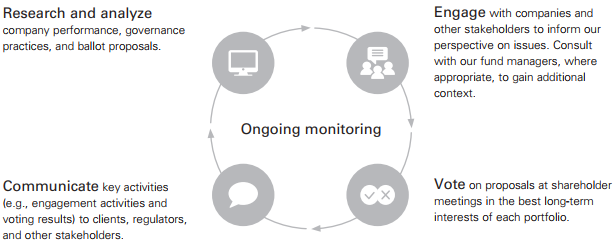
Our four pillars

Board

Good governance begins with a great board of directors. Our primary interest is to ensure that the individuals who represent the interests of all shareholders are independent (both in mindset and freedom from conflicts), capable (across the range of relevant skills for the company and industry), and appropriately experienced (so as to bring valuable perspective to their roles). We also believe that diversity of thought, background, and experience, as well as of personal characteristics (such as gender, race, and age), meaningfully contributes to the board’s ability to serve as effective, engaged stewards of shareholders’ interests. If a company has a well-composed, high-functioning board, good results are more likely to follow.

Structure

We believe in the importance of governance structures that empower shareholders and ensure accountability of the board and management. We believe that shareholders should be able to hold directors accountable as needed through certain governance and bylaw provisions. Among these preferred provisions are that directors must stand for election by shareholders annually and must secure a majority of the votes in order to join or remain on the board. In instances where the board appears resistant to shareholder input, we also support the right of shareholders to call special meetings and to place director nominees on the company’s ballot.

Compensation

We believe that performance-linked compensation policies and practices are fundamental drivers of the sustainable, long-term value for a company’s investors. The board plays a central role in determining appropriate executive pay that incentivizes performance relative to peers and competitors. Providing effective disclosure of these practices, their alignment with company performance, and their outcomes is crucial to giving shareholders confidence in the link between incentives and rewards and the creation of value over the long term.

Risk

Boards are responsible for effective oversight and governance of the risks most relevant and material to each company in the context of its industry and region. We believe that boards should take a thorough, integrated, and thoughtful approach to identifying, understanding, quantifying, overseeing, and—where appropriate—disclosing risks that have the potential to affect shareholder value over the long term. Importantly, boards should communicate their approach to risk oversight to shareholders through their normal course of business.

By the numbers: Voting and engagement

Engagement and voting trends

2015 proxy season 2016 proxy season  2017 proxy season
Company engagements 685 817 954
Companies voted 10,560 11,564 12,974
Meetings voted 12,785 16,740 18,905
Proposals voted 124,230 157,506 171,385
Countries voted in* 70 70 68

* The number of countries can vary each year. In certain markets, some companies do not hold shareholder meetings annually.
Note: The annual proxy season is from July 1 to June 30.

Our voting

Proxy voting reflects our governance pillars worldwide.

Meetings voted by region
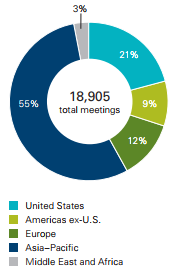
Note: Data pertains to voting activity from July 1, 2016, through June 30, 2017

Global voting activity
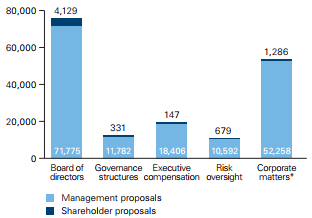
* Includes more than 26,000 proposals related to capitalization; 8,000 proposals related to mergers and acquisitions; 16,000 routine business proposals; and 1,000 other shareholder proposals.
Note: Data pertains to voting activity from July 1, 2016, through June 30, 2017.

Our engagement

We engage with companies of all sizes.

Market Capitalization % of 2017 proxy season engagements
Under $1 billion 19%
$1 billion–under $10 billion 44%
$10 billion–under $50 billion 24%
$50 billion and over 13%

Our engagement with portfolio companies has grown significantly over time.

Number of engagements and assets represented
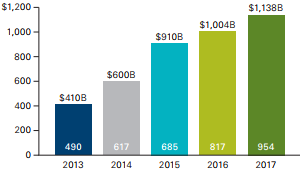
Note: Dollar figures represent the market value of Vanguard fund investments in companies with which we engaged as of June 30, 2017.

We engage on a range of topics aligned with our four pillars

Frequency of topics discussed during Vanguard engagements (%)
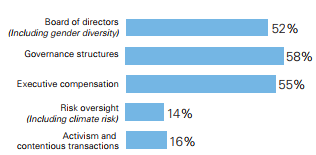
Note: Figures do not total 100%, as individual engagements often span multiple topics.

Boards in focus: Vanguard’s view on gender diversity

One of our most fundamental governance beliefs is that good governance begins with a great board of directors. We believe that diversity among directors—along dimensions such as gender, experience, race, background, age, and tenure—can strengthen a board’s range of perspectives and its capacity to make complex, fully considered decisions.

While we have long discussed board composition and diversity with portfolio companies, gender diversity has emerged as one dimension on which there is compelling support for positive effects on shareholder value. In recent years, a growing body of research has demonstrated that greater gender diversity on boards can lead to better company performance and governance.

Companies should be prepared to discuss—in both their public disclosures and their engagement with investors—their plans to incorporate appropriate diversity over time in their board composition. While we believe that board evolution is a process, not an event, the demonstration of meaningful progress over time will inform our engagement and voting going forward.

Boards in focus: Gender diversity

Engagement case studies

Gender diversity on boards was an important topic of engagement for us during the 12 months ended June 30, 2017. Below are summary examples of discussions we had on the subject.

High-impact engagement on gender diversity

Over several interactions with a U.S. industrial company, our team shared Vanguard’s perspective on board composition and evaluation. The company had undergone recent leadership transitions and was open to amending elements of its governance structure to align with best practices. We expressed particular support for meaningful gender diversity and expressed concern that the board previously had only one female director in its recent history.

Right after this year’s annual general meeting, the company announced it was adding four new directors with diverse experience, including two women. This outcome is the best-case scenario: The board welcomed shareholder input, we shared our view on best corporate governance practices, and the board ultimately incorporated our perspective into its board evolution process.

A denial of diversity’s value

A Canadian materials company that had consistently underperformed was governed by an entrenched, all-male board with seemingly nominal independence from the CEO. A 2017 shareholder resolution asked the company to adopt and publish a policy governing gender diversity on the board. Before voting, Vanguard engaged with the company to learn about its board evolution process, including its perspective on gender diversity. The engagement revealed that the company understood neither the value of gender diversity nor the importance of being responsive to shareholders’ concerns. Despite verbally endorsing gender diversity, the company resisted specifying a strategy or making a commitment to achieve it. The board, when seeking new members, relied solely on recommendations from current directors, a practice that can entrench the current board’s perspective and limit diversity. Our funds voted in support of the shareholder resolution, and we will continue to engage and hold the board accountable for meaningful progress over time.

Mixed results from an ongoing engagement

A U.S. consumer discretionary company had no women on its board, a problem magnified by its medium-term underperformance relative to peers, a classified board structure, and a lengthy average director tenure. We engaged with management twice between the 2016 and 2017 annual meetings to share our perspective on the importance of gender diversity and recommend that they make it a priority for future board evolution and director searches.

In its 2017 proxy, the company described board diversity as critical to the firm’s sustainable value and named gender as an element of diversity to be considered during the director search and nomination process. The company has since added a non-independent woman to the board. Although this move is directionally correct, it does not fully address our concerns; we will continue to encourage the company to add gender diversity to its ranks of independent directors.

Risk in focus: Vanguard’s view on climate risk

As the steward of long-term shareholder value for more than 20 million investors, Vanguard closely monitors how our portfolio companies identify, manage, and mitigate risks—including climate risk. Our approach to climate risk is evolving as the world’s and business community’s understanding of the topic matures.

This year, for the first time, our funds supported a number of climate-related shareholder resolutions opposed by company management. We are also discussing climate risk with company management and boards more than ever before. Our Investment Stewardship team is committed to engaging with a range of stakeholders to inform our perspective on these issues, and to share our thinking with the market, our portfolio companies, and our investors.

Risk in focus: Climate risk

A Q&A with Glenn Booraem, Vanguard’s Investment Stewardship Officer

Vanguard is an investment management company. Why should Vanguard fund investors be concerned about climate risk?

Mr. Booraem: Climate risk has the potential to be a significant long-term risk for companies in many industries. As stewards of our clients’ long-term investments, we must be finely attuned to this risk. We acknowledge that our clients’ views on climate risk span the ideological spectrum. But our position on climate risk is anchored in long-term economic value—not ideology. Regardless of one’s perspective on climate, there’s no doubt that changes in global regulation, energy consumption, and consumer preferences will have a significant economic impact on companies, particularly in the energy, industrial, and utilities sectors.

Why the shift in Vanguard’s assessment of climate risk, and why now?

Mr. Booraem: We’ve been discussing climate risk with portfolio companies for several years. It has been, and will remain, one of our engagement priorities for the foreseeable future. This past year, we engaged with more companies on this issue than ever before, and for the first time our funds supported two climate-related shareholder resolutions in cases where we believed that companies’ disclosure practices weren’t on par with emerging expectations in the market. As with other issues, our point of view has evolved as the topic has matured and, importantly, as its link to shareholder value has become more clear.

What is your top concern when you learn that a company in which a Vanguard portfolio invests does not have a rigorous strategy to evaluate and mitigate climate risk?

Mr. Booraem: Our concern is fundamentally that in the absence of clear disclosure and informed board oversight, the market lacks insight into the material risks of investing in that firm. It’s of paramount importance to us that the market is able to reflect risk and opportunity in stock prices, particularly for our index funds, which don’t get to select the stocks they own. When we’re not confident that companies have an appropriate level of board oversight or disclosure, we’re concerned that the market may not accurately reflect the value of the investment. Because we represent primarily long-term investors, this bias is particularly problematic when underweighting long-term risks inflates a company’s value.

Now that Vanguard has articulated a clear stance on climate risk, what can portfolio companies expect?

Mr. Booraem: First, companies should expect that we’re going to focus on their public disclosures, both about the risk itself and about their board’s and management’s oversight of that risk. Thorough disclosure is the foundation for the market’s understanding of the issue. Second, companies should expect that we’ll evaluate their disclosures in the context of both their leading peers and evolving market standards, such as those articulated by the Sustainability Accounting Standards Board (SASB). Third, they should expect that we’ll listen to their perspective on these and other matters. And finally, they should see our funds’ proxy voting as an extension of our engagement. When we consider a shareholder resolution on climate risk, we give companies a fair hearing on the merits of the proposal and consider their past commitments and the strength of their governance structure.

Engagement case studies

In the 12 months ended June 30, 2017, the topic of climate risk disclosure grew in frequency and prominence in our engagements with companies, particularly those in the energy, industrial, and utilities sectors, where climate risk was addressed in nearly every conversation we had. Below are examples of our engagements on climate risk.

Two companies’ commitments to enhanced disclosure

Our team led similar engagements with two U.S. energy companies facing shareholder resolutions on climate risk. One resolution requested that the first company publish an annual report on climate risk impacts and strategy. At the second company, a resolution requested disclosure of the company’s strategy and targets for transitioning to a low- carbon economy. In both cases, when we engaged with the companies, their management teams committed to improving their climate risk disclosure. Given the companies’ demonstrated responsiveness to shareholder feedback and commitment to improving, our funds did not support either shareholder proposal. Our team will continue to track and evaluate the companies’ progress toward their commitments as we consider our votes in future years.

A vote against a risk and governance outlier For years we engaged with a U.S. energy company that lagged its peers on climate risk disclosure and board accessibility. This year, a shareholder proposal requesting that the company produce a climate risk assessment report demonstrated a compelling link between the requested disclosures and long-term shareholder value. Because the board serves on behalf of shareholders and plays a critical role in risk oversight, we believed it was appropriate to seek a direct dialogue with independent directors about climate risk. Management resisted connecting the independent directors with shareholders, making the company a significant industry outlier in good governance practice. Without the confidence that the board understood or represented our view that climate risk poses a material risk in the energy sector, our team viewed the climate risk and governance issues as intertwined. Ultimately, our funds voted for the shareholder proposal and withheld votes on relevant independent directors for failing to engage with shareholders.

A vote for greater climate risk disclosure

A shareholder proposal at a U.S. energy company asked for an annual report with climate risk disclosure, including scenario planning. Through extensive research and engagements with the company’s management, its independent directors, and other industry stakeholders, our team identified governance shortfalls and a clear connection to long-term shareholder value. The company lagged its peers in disclosure, risk planning, and board oversight and responsiveness to shareholder concerns. Crucially, although the company’s public filings identified climate risk as a material issue, it failed to articulate plans for mitigation or adaptation. A similar proposal last year garnered significant support, but the company made no meaningful changes in response. Engagement had limited effect, so our funds voted for the shareholder proposal.

* * *

This post was excerpted from a Vanguard report; the complete publication is available here.

Gestion des risques liés à la cybersécurité | Guide pratique de McCarthyTetrault pour les entreprises


Aujourd’hui, je vous présente un formidable guide, publié par McCarthyTetrault, sur les risques associés aux questions de la cybersécurité dans les entreprises.

Vous y trouverez une information complète ainsi que divers outils de diagnostic essentiels aux conseils d’administration qui doivent se préparer à affronter des attaques de nature cybernétique, lesquelles sont de plus en plus fréquentes.

Cet excellent document a été porté à mon attention par Joanne Desjardins, LL.B., MBA, CRHA, ASC, associée de la firme Arsenal conseils, spécialisés en gouvernance et en stratégie.

L’ouvrage est divisé en quatre parties :

(1) une mise en contexte de la situation ;

(2) Pourquoi se préparer aux risques ;

(3) Le programme de préparation aux cyberrisques ;

(4) L’exécution efficace du plan d’intervention.

Voici un aperçu de l’introduction. Je vous invite à prendre connaissance de ce document très bien conçu.

Bonne lecture ! Vos commentaires sont les bienvenus.


Gestion des risques liés à la cybersécurité | Guide pratique de McCarthyTetrault pour les entreprises


Résultats de recherche d'images pour « gestion des risques cybernétiques »


Qui dit données dit possibilité de perte de données. La façon dont une organisation se prépare à une atteinte à la protection des données — et la gère si elle se produit – a un effet mesurable sur les répercussions d’une telle atteinte. En gérant efficacement un tel incident, qui peut coûter des millions de dollars et ruiner la réputation d’une organisation, on peut le maîtriser et réduire considérablement la gravité de ses conséquences. Par exemple, à la suite d’une atteinte très médiatisée à la protection des données par un logiciel malveillant installé sur les caisses en libre-service de Home Depot, deux sociétés canadiennes ont entamé des actions collectives, réclamant une indemnisation de 500 millions de dollars ; les recours ont finalement été réglés pour un montant de 400 000 $. Cette réduction importante est justifiée, dit le juge, au vu de la réponse « exemplaire » de Home Depot & NBSP ; : 1

Dans l’affaire en question, attendu : a) que Home Depot n’a apparemment commis aucun acte répréhensible ; b) qu’elle a réagi rapidement et d’une manière responsable, généreuse et exemplaire aux actes criminels perpétrés contre elle par les pirates informatiques ; c) que le comportement de Home Depot n’avait nul besoin d’être géré ; d) que la probabilité que les membres du groupe aient gain de cause contre Home Depot tant sur le plan de la responsabilité que de la preuve de dommages consécutifs était négligeable, voire nulle ; et e) que le risque d’échec devant les tribunaux et les frais de litige connexes étaient importants et immédiats, j’aurais approuvé l’abandon de l’action collective proposé par M. Lozanski, avec ou sans dépens et sans aucun avantage pour les membres du groupe présumés. [traduction libre].

Prolifération des données

Les renseignements personnels se définissent comme les données pouvant servir à identifier une personne, et leur collecte crée des obligations de protection de la vie privée (expliquant l’existence de lois sur la protection de la vie privée). Avec les progrès technologiques, les organisations recueillent, conservent et transfèrent plus de renseignements personnels sur les consommateurs, les professionnels, les patients et les employés que jamais auparavant. L’accumulation de grandes quantités de renseignements personnels dans d’immenses bases de données augmente le risque d’accès non autorisé à ces informations ainsi que les conséquences qui peuvent en découler. Une seule atteinte à la protection des données personnelles peut aujourd’hui toucher des millions de personnes.

L’adoption croissante d’identifiants biométriques (empreintes digitales ou vocales, reconnaissance faciale, etc.) par les entreprises crée aujourd’hui de nouveaux risques, soit la perte ou la mauvaise utilisation de ces éléments d’identification immuables.

Incidents de plus en plus importants et sophistiqués

Si les incidents connaissent une augmentation croissante, le problème le plus important est leur sophistication grandissante. Les modèles d’affaires des malfaiteurs ont évolué et, en plus de recourir à des méthodes toujours plus complexes, leurs cibles ont changé. Autrefois, le modus operandi consistait à voler des renseignements de cartes de crédit pour effectuer des transactions non autorisées. Aujourd’hui, les cyberadversaires utilisent des méthodes d’ingénierie sociale (comme l’hameçonnage au moyen de courriels frauduleux visant à amener par la tromperie des employés à fournir des informations confidentielles ou sensibles) pour obtenir des renseignements de valeur pour l’entreprise. Ces renseignements sont ensuite monnayés directement par leur utilisation dans le cadre de délits d’initiés, vendus à des concurrents (dans le cas d’une propriété intellectuelle ou d’un secret commercial) ou utilisés pour exiger une rançon.

Les hauts dirigeants d’entreprise craignent de plus en plus les atteintes à la protection des données, et il est désormais communément admis que les sociétés ne doivent pas se demander si un tel incident se produira, mais quand ?

Incidents de plus en plus coûteux

Les atteintes à la protection des données deviennent de plus en plus coûteuses. Si de nouveaux produits (comme les assurances contre les cyberrisques) contribuent à en défrayer les coûts, la réaction la plus fréquente au signalement d’un incident est une poursuite en justice (le plus souvent une action collective). Les dommages-intérêts octroyés ont certes été jusqu’ici relativement minimes, mais les coûts de gestion d’une atteinte à la protection des données peuvent être incroyablement élevés.

La réglementation en la matière a un coût. De récentes modifications apportées à la Loi sur la protection des renseignements personnels et les documents électroniques (LPRPDE) du Canada ont introduit l’obligation de notification d’une atteinte et une amende de 100 000 $ CA par atteinte en cas de non-respect de cette exigence — s’ajoutant aux frais financiers et aux coûts des atteintes à la réputation qu’engendrent les incidents liés à la confidentialité des données.

Les coûts ne se limitent pas aux dommages : la responsabilité des atteintes à la protection des données peut être imputée au conseil d’administration. Gregg Steinhafel, chef de la direction et président du conseil de Target, a démissionné tout juste après l’incident dont son entreprise a été victime. Un sort similaire a frappé Amy Pascal, qui a quitté ses fonctions de chef de Sony Pictures dans la foulée du piratage de Sony.

Les coûts ne se limitent pas aux dommages : la responsabilité des atteintes à la protection des données peut être imputée au conseil d’administration. Gregg Steinhafel, chef de la direction et président du conseil de Target, a démissionné tout juste après l’incident dont son entreprise a été victime. Un sort similaire a frappé Amy Pascal, qui a quitté ses fonctions de chef de Sony Pictures dans la foulée du piratage de Sony.

Rôle des administrateurs dans la prévention de risques à la santé | un cas vécu dans une OBNL


À nouveau, je vous présente un cas de gouvernance, publié en juin 2017, sur le site de Julie Garland McLellan* qui décrit une situation dans laquelle un membre de conseil d’une OBNL évalue les conséquences d’une décision pouvant entraîner des risques pour la santé des clients et conduire à une perte de réputation.

Les administrateurs connaissent maintenant le contexte de la décision prise par le conseil. Cependant, une nouvelle administratrice n’est pas « confortable » avec la décision ; elle se questionne sur le risque occasionné à la santé des athlètes à la suite d’une prise de position du conseil trop peu contraignante.

Notons que la directrice de la sécurité de l’entreprise avait qualifié d’infondée les arguments invoqués par une équipe sportive de ne pas utiliser les mesures de protection suggérées.

Le cas présente la situation de manière assez succincte, mais explicite ; puis, trois experts en gouvernance se prononcent sur le dilemme qui se présente aux personnes qui vivent des situations similaires.

Que devrait faire la nouvelle administratrice Pandora dans les circonstances ?

Je vous invite à lire les opinions des experts en allant sur le site de Julie.

Bonne lecture ! Vos commentaires sont toujours les bienvenus.


Rôle des administrateurs dans la prévention de risques à la santé | un cas vécu dans une OBNL


Résultats de recherche d'images pour « risques des obnl »


Pandora is a new NED on a peak sporting body board. She loves the sport and is thrilled to contribute. However, she is a bit worried about the risks of a recent board conversation.

Her sport has physical risks and is very dangerous if proper precautions are not taken; these include the use of personal protective equipment. At her most recent board meeting the directors discussed the revised sports safety guidelines which mandate the wearing of personal protective equipment during competitions. One of the directors mentioned that a large local club routinely participates in competitions with players who are clearly not wearing safety gear. Another director stated that the club had objected to the draft guidelines on the basis that, in some circumstances, the safety equipment might hamper players’ movements and create other risks. The safety manager, who was presenting to the board, clarified that the club had, indeed, made that claim but that it was, in her opinion, spurious.

The board then discussed the issues associated with banning the non-compliant club from competitions. This was considered a difficult action because the club is very successful and their absence would upset fans. Also, the club is in a high socio economic demographic and contributes funds and political connections to the sport.

Pandora is worried because the discussion was minuted and the decision was to write to the club and remind them of the need to wear safety equipment but not to threaten expulsion from the competition. Is her board now at risk and has she let down the whole sport by being a party to this conversation and failing to persuade her board colleagues to take firmer action?

What can Pandora do?


*Julie Garland McLellan is a practising non-executive director and board consultant based in Sydney, Australia. www.mclellan.com.au/newsletter.html

Le démantèlement de la réglementation « Dodd-Frank Act » est-il souhaitable du point de vue de la bonne gouvernance ?


Plusieurs experts de la gouvernance des sociétés cotées se demandent ce qu’il adviendra de la législation Dodd-Frank Act, sachant que Donald Trump a promis d’effectuer un démantèlement presque total de cette réglementation qui a été mise en place à la suite de la crise financière de 2007-2008.

L’article de Gregg Gelzinis* du Center for American Progress publié sur le site de Harvard Law School Forum on Corporate Governance, tente de faire la lumière sur une proposition gouvernementale appelée Financial CHOICE Act ou FCA.

L’auteur montre que les raisons invoquées pour modifier la réforme Dodd-Frank Act ne tiennent pas la route. Voici un extrait de la conclusion.

The question remains: What is the problem President Trump and his allies in Congress are trying to solve? Lending is up. Bank profits are up. Consumer credit costs are down. The economy is steadily improving.

Yes, much more needs to be done to make the economy work for hard-working Americans, but financial deregulation is not the path to that end. [16]

In fact, it is a path toward exactly the opposite: booms and busts that leave taxpayers holding the bag for Wall Street’s excesses, greater concentration of economic power and less accountability for wrongdoing that harms ordinary consumers and investors, and major changes to financial regulation and monetary policy that would damage the real economy. Now that is a problem.

L’avenir nous dira ce que nous réservent les « nouvelles » règles de gouvernance prônées par la nouvelle administration américaine.

Évidemment, la réglementation canadienne, toujours très liée à celle de la SEC, devra s’ajuster, sans trop de heurts !

Bonne lecture ! Vos commentaires sont appréciés des lecteurs.


President Trump’s Dangerous CHOICE


Résultats de recherche d'images pour « dodd frank law »


During his campaign, Donald Trump promised a near-dismantling of the Dodd-Frank Act, the core piece of financial reform legislation enacted following the 2007-2008 financial crisis. [1] He doubled down on that promise once in office, vowing to both “do a big number” on and give “a very major haircut” to Dodd-Frank. [2] In early February, he took the first step in fulfilling this dangerous promise by signing an executive order directing U.S. Secretary of the Treasury Steve Mnuchin to conduct a review of Dodd-Frank. [3] Per the executive order, Secretary Mnuchin will present the findings in early June. [4] While the country waits for President Trump’s plan, it is useful to analyze one prominent way Trump and Congress might choose to gut financial reform—through the Financial CHOICE Act, or FCA. [5]

Introduced in the last Congress by U.S. House of Representatives Financial Services Committee Chairman Jeb Hensarling (R-TX) and expected to be reintroduced in the coming weeks, the Financial CHOICE Act offers a blueprint for how Trump might view these issues. During the presidential campaign, Rep. Hensarling briefed Trump on his ideas regarding financial deregulation and was reportedly on Trump’s short list for treasury secretary. [6] The FCA would deregulate the financial industry and put the U.S. economy in the same perilous position it was in right before the 2007–2008 financial crisis. The precrisis regime of weak regulation and little oversight created an environment of unchecked financial sector risk and widespread predatory consumer practices, which precipitated the Great Recession and brought the U.S. economy to the brink of collapse. And the argument repeated by President Trump and other advocates of financial deregulatory proposals—that bank lending has been crushed under the weight of financial regulations over the past six years—has been thoroughly debunked by bank lending data. [7]

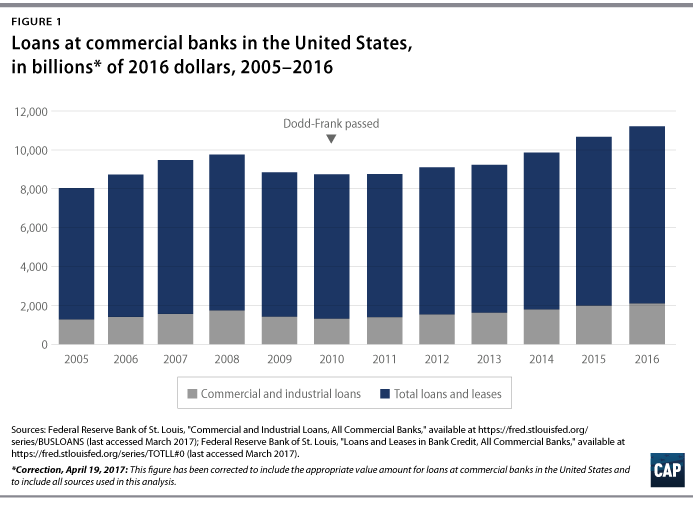
Before delving into the specifics of the Financial CHOICE Act, it is helpful to put Rep. Hensarling’s deregulatory efforts in context. To justify dismantling financial reform, President Trump and his congressional allies know that they must outline a problem. President Trump argues that the main problem with financial reform is bank lending. He believes that banks are not making enough loans due to the burdens of Dodd-Frank. What is his evidence? Nothing more than anecdotal remarks that his friends cannot get loans. [8] As Figure 1 demonstrates, a lack of loans is simply not the case. Overall lending and business lending in particular, has increased significantly since the financial crisis and the passage of Dodd-Frank. Moreover, credit card lending, auto lending, and mortgage lending have increased since 2010, when Dodd-Frank was passed. [9] Bank profits are also higher than ever. [10]


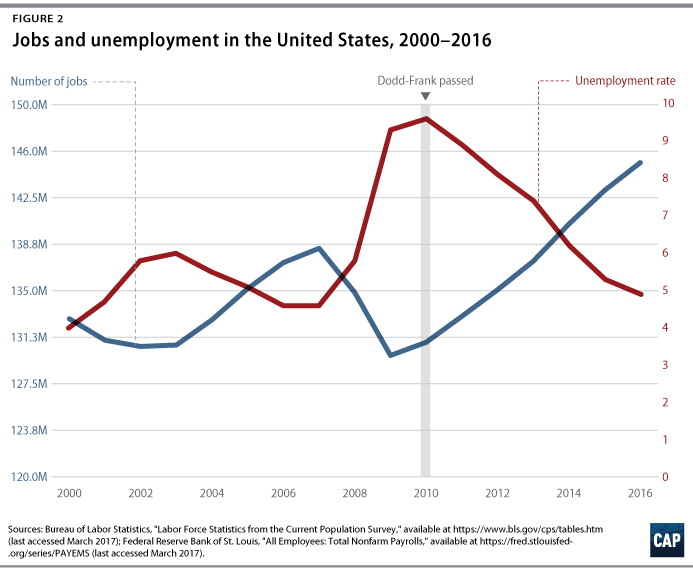
Chairman Hensarling makes similar arguments about the perceived unavailability of credit, adding that financial reform has not encouraged economic growth and has hurt community banks. [11] Again, the data contradict these charges. Figure 2 highlights the steady economic growth the country experienced under President Barack Obama. And while the scars of the devastating Great Recession remain, the financial reforms put in place to prevent the recurrence of exactly that kind of economic catastrophe have not damaged growth. Indeed, since the end of the financial crisis and the passage of Dodd-Frank, community bank lending and profitability are both up. [12] It is fair to say that the number of community banks has declined over time. This trend, however, started in the 1980s and is caused by economies of scale, technology, and long-running trends toward banking deregulation, as well as other factors—not the 2010 passage of the Dodd-Frank Act. [13]


Hensarling presents his approach as a moderate adjustment to Dodd-Frank, but in reality it is a thorough demolition of financial reform. The complete publication (available here) analyzes how Hensarling’s approach erodes the financial stability safeguards that the real economy needs to thrive, from mitigation of systemic risk to financial sector accountability and consumer protection. It also explains how the bill further concentrates—and makes even more unaccountable—economic power in the hands of those that will serve their own interests at the expense of the real economy. Finally, the report details how the FCA eliminates the consumer and investor protections that guard against the predatory financial practices that wreaked havoc on consumers and investors prior to the financial crisis.

It is necessary to note that just about every provision in the report could fit under the rubric of financial stability safeguards. For example, consumer financial protection protects ordinary consumers from abuses and the broader financial system from the proliferation of dangerous consumer loans that can bring down entire firms and markets. Similarly, the Volcker Rule is a key bulwark against the high-risk bets that brought down major firms in 2008, and yet it also aims to reorient large bank trading toward real economy-serving purposes. The report discusses certain provisions under one section rather than another should not be taken as a substantive comment on the merit or usefulness of the provision to financial stability. The report’s different sections reflect an effort to highlight how the Dodd-Frank Act and financial reform yield a broad array of public benefits. Similarthe report highlights examples of broader themes in the FCA rather than focusing on minute details: Failure to discuss any particular provision should not be read as a substantive judgment regarding its relative merits.

The report is based on the version of the Financial CHOICE Act released in September 2016, as well as a memo outlining this year’s planned changes to that version. [14] A new version, which may have some further modifications, is expected to be released in the coming weeks.

Financial reform enacted through the Dodd-Frank Act has made a lot of necessary progress since the crisis. U.S. banks have more substantial loss-absorbing capital cushions, increasingly rely on stable sources of funding, undergo rigorous stress testing, and plan for their orderly failure. President Trump’s intent to dismantle these reforms only helps Wall Street’s bottom line—ignoring the memory of every family who lost their home, every worker who lost his or her job, and every consumer who was peddled a toxic financial product. [15]

The question remains: What is the problem President Trump and his allies in Congress are trying to solve? Lending is up. Bank profits are up. Consumer credit costs are down. The economy is steadily improving. Yes, much more needs to be done to make the economy work for hard-working Americans, but financial deregulation is not the path to that end. [16] In fact, it is a path toward exactly the opposite: booms and busts that leave taxpayers holding the bag for Wall Street’s excesses, greater concentration of economic power and less accountability for wrongdoing that harms ordinary consumers and investors, and major changes to financial regulation and monetary policy that would damage the real economy. Now that is a problem.

The complete publication, including footnotes, is available here.

Endnotes

1Billy House and Kevin Cirilli, “Trump’s Dodd-Frank Plan Will Be Early Test of Republican Unity,” Bloomberg, May 19, 2016, available at https://www.bloomberg.com/politics/articles/2016-05-19/trump-s-dodd-frank-plan-will-be-early-test-of-republican-unity. (go back)

2Glenn Thrush, “Trump Vows to Dismantle Dodd-Frank ‘Disaster,’” The New York Times, January 30, 2017, available at https://www.nytimes.com/2017/01/30/us/politics/trump-dodd-frank-regulations.html?_r=0; Jessica Dye, “Trump vows ‘major haircut’ for Dodd-Frank,” Financial Times, April 4, 2017, available at https://www.ft.com/content/fb08a355-f7fc-3021-8c92-d94af9a2f35b. (go back)

3Executive Order no. 13,772, Code of Federal Regulations (2017), available at https://www.whitehouse.gov/the-press-office/2017/02/03/presidential-executive-order-core-principles-regulating-united-states. (go back)

4Ibid. (go back)

5Financial CHOICE Act of 2016, H. Rept. 5983, 114 Cong. 2 sess. (Government Printing Office, 2016), available at https://www.congress.gov/114/bills/hr5983/BILLS-114hr5983rh.pdf. (go back)

6Donna Borak, “Donald Trump, Jeb Hensarling Meet on Dodd-Frank Alternative,” The Wall Street Journal, June 7, 2016, available at https://www.wsj.com/articles/donald-trump-jeb-hensarling-meet-on-dodd-frank-alternative-1465335535; Damien Palette, Ryan Tracy, and Michael C. Bender, “Trump Team Considering Rep. Jeb Hensarling as Treasury Secretary,” The Wall Street Journal, November 10, 2016, available at https://www.wsj.com/articles/donald-trump-considering-rep-jeb-hensarling-as-treasury-secretary-1478812583. (go back)

7Jim Puzzanghera, “Trump says businesses can’t borrow because of Dodd-Frank. The numbers tell another story,” Los Angeles Times, February 26, 2017, available at http://www.latimes.com/business/la-fi-trump-bank-loans-20170226-story.html; Matt Egan, “Banks are lending a ton, despite Trump’s claims,” CNN Money, February 13, 2017, available at http://money.cnn.com/2017/02/13/investing/bank-business-lending-dodd-frank-trump/. (go back)

8Zeke Faux, Yalman Onaran, and Jennifer Surane, “Trump Cites Friends to Say Banks Aren’t Making Loans. They Are.,” Bloomberg, February 4, 2017, available at https://www.bloomberg.com/news/articles/2017-02-04/trump-cites-friends-to-say-banks-aren-t-making-loans-they-are. (go back)

9Kate Berry, “Four myths in the battle over Dodd-Frank,” American Banker, March 10, 2017, available at https://www.americanbanker.com/news/four-myths-in-the-battle-over-dodd-frank. (go back)

10Matt Egan, “American bank profits are higher than ever,” CNN Money, March 3, 2017, available at http://money.cnn.com/2017/03/03/investing/bank-profits-record-high-dodd-frank/. (go back)

11Jeb Hensarling, “After Five Years, Dodd-Frank Is a Failure,” The Wall Street Journal, July 19, 2015, available at https://www.wsj.com/articles/after-five-years-dodd-frank-is-a-failure-1437342607. (go back)

12Gregg Gelzinis and others, “The Importance of Dodd-Frank, in 6 Charts,” Center for American Progress, March 27, 2017, available at https://www.americanprogress.org/issues/economy/news/2017/03/27/429256/importance-dodd-frank-6-charts/. (go back)

13Ibid. (go back)

14Ylan Mui, “Memo from a key congressman outlines plan to gut Dodd-Frank bank rules,” CNBC, February 9, 2017, available at http://www.cnbc.com/2017/02/09/dodd-frank-hensarling-memo-reveals-plan-to-scrap-bank-regulations.html. (go back)

15Wall Street is not monolithic, and firms may have differing views on the provisions of the Financial CHOICE Act, but on the whole, this agenda is clearly aligned with the interests of financial institutions and not the American public.

_______________________________________

*Gregg Gelzinis is a Special Assistant for the Economic Policy team at the Center for American Progress. This post is based on a Center for American Progress publication by Mr. Gelzinis, Ethan GurwitzSarah Edelman, and Joe Valenti. Additional posts addressing legal and financial implications of the Trump administration are available here.

Comment composer avec l’engagement accru des actionnaires et des investisseurs institutionnels ?


Voici un article publié par Tom Johnson dans Ethical Boardroom, et paru aujourd’hui sur le site de HLS Forum on Corporate Governance.

L’un des plus grands changements au cours des dix dernières années dans la gouvernance des entreprises est l’engagement accru des actionnaires et des investisseurs institutionnels dans les affaires de l’organisation. Cela se manifeste concrètement par des interventions activistes mal anticipées.

L’article ci-dessous est un bijou de réalisme et de pragmatisme eu égard au diagnostic de la situation de l’engagement des actionnaires ainsi qu’aux moyens à la disposition des entreprises pour favoriser le dialogue avec les grands actionnaires-investisseurs.

L’auteur propose six moyens à prendre en compte par l’entreprise afin d’assurer une meilleure communication avec les intéressés…

Les dirigeants d’entreprises ainsi que les présidents des conseils d’administration devraient prendre bonne note des suggestions présentées dans cet article.

Ils ont tout avantage à être proactif afin d’éviter les mauvaises surprises et les contestations susceptibles d’émerger de la part de groupes d’actionnaires mécontents ou opportunistes.

Bonne lecture ! Vos commentaires sont les bienvenus.


In today’s environment, companies cannot wait for a pressing issue to engage with their shareholders. By the time the issue becomes public because an activist has shown up or some other concern has emerged that affects the stock, it is often too late to have a productive conversation


Shareholder Engagement: An Evolving Landscape


Résultats de recherche d'images pour « shareholder engagement »
The significant rise of activism over the last decade has sharpened the focus on shareholder engagement in boardrooms and executive suites across the US.


Once considered a perfunctory exercise, designed to simply answer routine questions on performance or, occasionally, drum up support for a corporate initiative, shareholder engagement has become a strategic imperative for astute executives and board members who are no longer willing to wait until the annual meeting to learn that their shareholders may not support change of some sort, or their strategic direction overall.

When active shareholder engagement works, it leads to a productive dialogue with the voters—the governance departments established by the big institutional firms, which typically oversee proxy voting. It is important to remember the reality of public company ownership. The vast majority of public companies have shareholder bases dominated by a diverse set of large, institutional funds. Engagement with these voters not only helps head off potential problems and activists down the road, but it also gives management valuable insight into how patient and supportive their shareholder base is willing to be as they implement strategies designed to generate long-term growth. Indeed, the rising level of engagement is a positive trend that could, over time, help mitigate the threat of activism if properly managed.

This all sounds encouraging in theory and, in some cases, it works in practice as well. But the simple fact remains that this kind of dialogue is unobtainable for the vast majority of public companies, despite the best of intentions on both sides.


Struggles with Engagement


Even the largest institutional investors, many of whom are voting well in excess of 10,000 proxies a year, have at most 25-30 people in their governance departments able to engage directly with companies. Those teams do yeoman’s work to meet demands, taking several hundred and in some cases well more than 1,000 meetings with company executives or board members a year. But with more issues on corporate ballots than ever before that need to be researched and analysed, companies are finding it increasingly hard to get an audience with proxy voters even when a determination is made to more proactively engage. This can be true for even large companies with market capitalisations in the billions.

Indeed, for small-cap companies, the idea is almost always a non-starter, though there are workarounds. Some institutional funds are willing

to use roundtable discussions with several issuers at once to cover macro topics. Most mid-cap companies are out of luck as well, unless they are able to make a compelling case around a particular issue that catches a governance committee’s eye (more on that in a minute). Large-cap companies certainly meet the size threshold, but even they need to be smart in making the request. The net result is a conundrum at companies that are willing to engage but find their institutional investors less willing to do so, or are stretched too thin to make it happen.

The problem is a difficult one to solve. In today’s environment, companies cannot wait for a pressing issue to engage with their shareholders. By the time the issue becomes public because an activist has shown up or some other concern has emerged that affects the stock, it is often too late to have a productive conversation. Investors in those situations must decide what they know or can learn in a condensed period; they have little ability to become invested in the long-term thinking behind, for instance, a company’s change to executive pay or corporate governance. At the same time, institutional investors, while very open to and, in many cases, strong advocates for meeting with executives, cannot always handle the number of requests they receive, particularly when the requests come in during a condensed period. This has led some investors to establish requirements around which companies ‘qualify’ for a meeting, leaving some executives that don’t meet the thresholds frustrated that they can’t get an audience. Both sides are striving to improve the process in this rapidly evolving dynamic. The fact is that both sides have a lot of room for improvement. Here are a few guidelines we advise companies to use when deciding how or even if they should more proactively engage with their largest investors.

In today’s environment, companies cannot wait for a pressing issue to engage with their shareholders. By the time the issue becomes public because an activist has shown up or some other concern has emerged that affects the stock, it is often too late to have a productive conversation


1. If a meeting is unlikely, make your case in other ways


Just because you can’t get a meeting does not mean you can’t effectively influence how your investors vote on an issue. Most companies today fall well short in communicating effectively with the megaphones they do control—namely, the financial reports that are distributed to all shareholders. When a governance committee sits down to review an issue, the first thing it does is pull out the proxy. Yet most companies bury the most compelling arguments under mountains of legalese or financial jargon that is off-message or confusing. In today’s modern era, proxies need to tell an easily digestible story from start to finish. They need to be short, compelling and to the point.

Figure out the three to four things you need your investors to understand and put it right up front in the proxy in clear, compelling language. Be concise and to the point. Remove unnecessary background and encourage questions. Add clear graphic elements to illustrate the most important points. And be sure not to contradict yourself with a myriad of financial charts and footnotes, or provide inconsistent information with what you’ve said before. The proxy statement is the most powerful disclosure tool companies have, yet most are produced by disparate committees, piecing the behemoth filing together with little recognition of the overall document coming to life.


2. Know when to make contact


Most large, institutional shareholders and even some mid-sized ones, are open to meeting with management and/or board members under certain circumstances, but timing is key. Go see your investors on a “clear day”when a meaningful discussion on results and strategy can be had without the overhang of activist demands. For most companies, this means making contact during the summer and fall months after their annual meeting and when the filing window opens for the next year’s proxy.

Institutional investors do lots of meetings during proxy season as well, but those tend to focus on whatever issues have emerged in the proxy, or even worse, whatever demands an activist is making. If you believe you are vulnerable to an activist position, address that concern before it becomes an issue with the right combination of people who will ultimately vote the shares.


3. Know who to talk to


The hardest part of this equation for most companies is figuring out who the right person is at the funds for these conversations. Is it the portfolio manager (PM) who follows the company daily and typically has the most robust relationship with the company’s investor relations department? Is it the governance department that may have more sway over voting the shares? The answer is likely some combination of both. Each institution has its own process for making proxy voting decisions.

In many cases, it involves input from the portfolio manager, internal analyst and the governance department, as well as perhaps some influence from proxy advisory firms, such as ISS or Glass Lewis. But the ultimate decision-maker is always somewhere in that mix. The trick is to find out where. Start with the contacts you know best, but don’t settle for one relationship. If you don’t know your portfolio manager and governance analyst, then you are not going to get a complete picture on where you stand. In many cases, the PM can be a helpful advocate in having a governance analyst understand why certain results or decisions make sense. Once you find the right mix of people, selling the story will be much easier.


4. Don’t assume passive investors are passive


Today, many so-called passive investors are anything but. One passive investor told me his firm held more than 200 meetings with corporations last year.

A governance head at another institution said there is little difference today in how the firm evaluated proxy questions between its active and passive holdings. You may not always get an audience, but on important matters, treat your passive investors like anyone else. You may be surprised at how active they are. These firms also tend to be the busiest, so be assertive and creative in building a relationship. The front door may not be the only option.


5. Choose the best Messenger


There is an interesting debate going on in the governance community right now about how involved CEOs and board members should be in shareholder discussions. As a rule, we view it this way: routine conversations around results and performance can be handled by investor relations (IR). More sophisticated financial questions get elevated to CFOs. Once the conversations delve into strategy and growth plans, CEOs should be involved, but usually only with the largest current or potential shareholders. And, finally, when it comes to matters of governance policy, consider having a board member involved.

Board engagement with shareholders is a relatively new trend, but an important one. Investors are often reassured when they see and hear from an engaged board and many will confess that those meetings can change their thinking. But having the right board member who can handle those conversations and be credible is key. A former CEO, who is used to shareholder interactions, or a savvy lead independent director can fit the bill.

But with investors increasingly asking for—and indeed many boards starting to offer—meetings with directors, every board should be evaluating who that representative will be if the opportunity comes along.


6. Be prepared and walk in with a clear set of goals


Too often, companies spend too much time just trying to determine what not to say in meetings with investors and not nearly enough time working on what they want to communicate. This mistake leads to frustration and missed opportunities, not to mention a reduced likelihood that it can get an audience again.

Every investor meeting is an opportunity to better refine or explain your corporate growth story. Walk into every meeting with clear goals in mind. Better yet, get the investor to articulate their own agenda as well. Know exactly what each of you wants to get out of the meeting and then get down to business. Be upfront and honest about why you are requesting the meeting. Governance investors are far more engaged when companies walk in with stated goals in mind. Surface potential problems and your solution to them, before they emerge.


Making the effort


Even with this level of planning, large companies can still find their requests for engagement on governance topics unheeded. Many of the large, institutional investors have installed various thresholds, generally predicated to a company’s size, that companies need to meet to receive an audience. But that does not mean companies should give up. Continue to work the contacts you do have within each institution. Tell your best story in routine discussions, such as earnings calls or conference presentations. Those are too often missed opportunities. Look for other opportunities to get in front of investors.

Conferences can be great forums, as can organisations, such as the Society of Corporate Governance, Council for Institutional Investors or National Association of Corporate Directors. Every time you communicate externally, it is a chance to tell your story and make the right disclosures. History is littered with companies that waited too long to do so, came under attack and lost control of their own destiny. Don’t waste any opportunity to make your best case to whomever is listening.

Se poser les bonnes questions en cette période incertaine | Deloitte


Deloitte a récemment publié un document très important intitulé Courage under fire : Embracing disruption (en anglais seulement) dans lequel trois administrateurs chevronnés échangent leurs points de vue sur les grandes perturbations que les organisations mondiales sont appelées à connaître en 2017.

Les questions posées sont les suivantes :

Étant donné les attentes croissantes envers les conseils d’administration, quelles devraient être les priorités des administrateurs ?

Les appels à une meilleure communication de l’information ne cessent de se faire entendre. Comment les conseils réagissent-ils ?

Les organisations sont nombreuses à subir des perturbations numériques. Est-ce un risque incontrôlable de plus à gérer ?

Les perturbations numériques créent beaucoup d’incertitude. Les conseils d’administration réussissent-ils à bien s’adapter à cette réalité ?

Vous pouvez télécharger le document ci-dessous.

Bonne lecture !

Courage under fire : Embracing disruption |  Deloitte


La gouvernance des Cégeps | Le rapport du Vérificateur général du Québec


Nous publions ici un billet de Danielle Malboeuf* qui fait état des recommandations du vérificateur général eu égard à la gouvernance des CÉGEP.

Comme à l’habitude Danielle nous propose son article à titre d’auteure invitée.

Je vous souhaite bonne lecture. Vos commentaires sont appréciés.


La gouvernance des Cégeps et le rapport du Vérificateur général du Québec

par

Danielle Malboeuf*  


À l’automne 2016, le Vérificateur général du Québec produisait un rapport d’audit concernant la gestion administrative de cinq cégeps. Ses travaux ont porté plus précisément sur la gestion des contrats, la gestion des bâtiments, les services autofinancés ainsi que sur la rémunération du personnel d’encadrement et les frais engagés par celui-ci.

Parmi les recommandations formulées à l’endroit des cégeps audités, on en retrouve une qui concerne plus précisément la gouvernance : « S’assurer que les instances de gouvernance reçoivent une information suffisante et en temps opportun afin qu’elles puissent exercer leur rôle quant aux décisions stratégiques et à la surveillance de l’efficacité des contrôles…»[1]

À la lecture de ce rapport et des constats de ces travaux d’audit, on ne peut qu’être qu’en accord avec cette recommandation qui invite les administrateurs à exercer leur rôle. Mais justement, quel rôle ont-ils ? Du point de vue légal, la Loi sur les collèges d’enseignement général et professionnel est peu éclairante à ce sujet.  Contrairement à la Loi sur la gouvernance des sociétés d’État qui précise clairement les fonctions qui sont confiées au conseil d’administration (CA), dont l’obligation d’évaluer l’intégrité des contrôles internes. On y exige également la création de trois sous-comités dont le comité de vérification ou d’audit à qui on confie entre autres, la responsabilité de mettre en place des mécanismes de contrôle interne. De plus, ce sous-comité doit compter sur la présence d’au moins une personne ayant une compétence en matière comptable ou financière.

À mon avis, la gouvernance d’un cégep devrait s’apparenter à celle des sociétés d’État. À ce sujet, dans son rapport publié en mai 2011 soumettant un bilan de l’implantation de la Loi sur la gouvernance des sociétés d’État, l’auteur de ce rapport, l’Institut sur la gouvernance des organismes publics et privés (IGOPP) allait dans le même sens. Il formulait comme première recommandation : « Imposer les nouvelles règles de gouvernance aux nombreux organismes du gouvernement qui ne sont pas inclus dans la loi actuelle sur la gouvernance. »[2]

Malgré le fait que les cégeps n’ont pas l’obligation légale de créer un comité d’audit, plusieurs l’ont fait dans un souci de transparence et afin d’être soutenu par les administrateurs dans leur effort pour assurer une utilisation optimale des ressources financières de l’organisation. Toutefois, le mandat qui leur est confié se limite dans la majorité des cas à une analyse des prévisions budgétaires et des états financiers. Ce n’est pas suffisant !

Considérant la recommandation du vérificateur général, il serait tout à fait approprié d’élargir ce mandat. En plus d’examiner les états financiers et d’en recommander leur approbation au CA, le comité d’audit devrait entre autres, veiller à ce que des mécanismes de contrôle interne soient mis en place et de s’assurer qu’ils soient adéquats et efficaces ainsi que de s’assurer que soit mis en place un processus de gestion des risques.[3] Sachant que les cégeps ne comptent pas de vérificateur interne, il est d’autant plus important de mettre en place un tel comité et de lui confier des fonctions de contrôle financier et de gestion des risques.

Une fois le comité d’audit mis en place, il devrait se pencher prioritairement sur la surveillance du processus de gestion contractuelle. Rappelons que les étapes du processus de gestion contractuelle sont : l’établissement des besoins et l’estimation des coûts, la préparation de l’appel d’offres et la sollicitation des fournisseurs, la sélection du fournisseur et l’attribution du contrat, le suivi du contrat et l’évaluation des biens et des services reçus[4].

À ce sujet, le Vérificateur général, dans son rapport, nous fait part de ses préoccupations. Il a identifié des lacunes dans les modes de sollicitation et constaté des dépassements de coûts et des prolongations dans les délais d’exécution, et ce, sans pénalité. Il précise que «Des activités prévues dans le processus de gestion contractuelle des cégeps audités ne sont pas effectuées de façon rigoureuse.»[5] En jouant son rôle, le comité d’audit du CA pourrait s’assurer que le processus mis en place et le partage des responsabilités retenu sont adéquats et efficaces. Il ne devrait d’ailleurs pas hésiter à faire appel à des ressources externes pour évaluer la performance du Cégep à l’égard de sa gestion contractuelle, le cas échéant.

En terminant, rappelons l’importance de retrouver sur le comité d’audit des administrateurs compétents qui ont une connaissance approfondie de la structure, des politiques, directives et exigences réglementaires. Ils doivent avoir la capacité d’assurer l’efficacité des mécanismes de contrôle interne et de la gestion des risques (un sujet que je développerai dans un article ultérieur).

En présence de telles compétences, il sera plus facile d’assurer la crédibilité du CA et de ses décisions. Il s’agit d’un atout précieux pour toutes institutions collégiales.

_____________________________________

[1] Rapport du Vérificateur général du Québec à l’Assemblée nationale pour l’année 2016-2017, p.35.

[2] Gouvernance des sociétés d’État, bilan et suggestions, IGOPP, p.48.

[3] Loi sur la gouvernance des sociétés d’État, art 24, 3.

[4] Rapport du Vérificateur général du Québec à l’Assemblée nationale pour l’année 2016-2017, annexe 4.

[5] Rapport du Vérificateur général du Québec à l’Assemblée nationale pour l’année 2016-2017, p.9.

_____________________________________

*Danielle Malboeuf est consultante et formatrice en gouvernance ; elle possède une grande expérience dans la gestion des CÉGEPS et dans la gouvernance des institutions d’enseignement collégial et universitaire. Elle est CGA-CPA, MBA, ASC, Gestionnaire et administratrice retraitée du réseau collégial et consultante.


Articles sur la gouvernance des CÉGEPS publiés sur mon blogue par l’auteure :

(1) LE RÔLE DU PRÉSIDENT DU CONSEIL D’ADMINISTRATION (PCA) | LE CAS DES CÉGEPS

(2) Les grands enjeux de la gouvernance des institutions d’enseignement collégial

(3) L’exercice de la démocratie dans la gouvernance des institutions d’enseignement collégial

(4) Caractéristiques des bons administrateurs pour le réseau collégial | Danielle Malboeuf

(5) La gouvernance des CÉGEPS | Une responsabilité partagée

Départ du PDG de CPR | 100 millions $ pour mettre son expertise à contribution dans l’opération des chemins de fer aux É.U. !


Ce matin, je partage avec vous un autre excellent article d’Yvan Allaire* et de François Dauphin publié dans le Financial Post le 24 janvier.

Les auteurs reviennent sur le parcours unique de l’ex-président du CN et du CP dans le domaine de la gestion des entreprises de chemins de fer.

Il ressort de ce portrait que le PDG possède une expérience sans pareil, liée à des processus de gestion inimitables.

C’est tellement le cas que M. Harrison a décidé de quitter un emploi très rémunérateur à CP pour accepter l’offre de 118 millions $ d’un Hedge Fund.

On compte sur sa solide expertise pour réorganiser et optimiser les opérations d’une autre entreprise dans le même domaine.

Cet article fait suite à un précédent billet qui portait sur le succès d’une démarche d’activisme (A “Successful” Case of Activism at the Canadian Pacific Railway: Lessons in Corporate Governance)

Cette situation montre clairement que les fonds activistes sont continuellement à la recherche de talents uniques et qu’ils sont prêts à miser des fortunes pour bénéficier de l’expertise incontestable d’un PDG.

Et vous, quelles leçons en retirez-vous ?

Bonne lecture !


Someone just hired Hunter Harrison for $100 million — and there’s an excellent reason why

In an unexpected turn of events, Canadian Pacific Railway announced the early departure of its CEO, Hunter Harrison, a few minutes before a conference call planned for analysts on Jan. 18. Instead of retiring as planned, Harrison leaves CP at age 72 for a new challenge, running another railway company (almost certainly CSX) on behalf of Mantle Ridge LP, a newly established hedge fund run by Paul Hilal. In his prior role at Pershing Square Capital, Hilal was instrumental in backing its investment in CP and installing Harrison’s management team.
sans-titre-hunter-harrison
CSX: Hunter Harrison Wants to Run His Fourth Railroad
Harrison thus forfeited all benefits and perquisites that he was entitled to receive from CP, including his pension, and he has agreed to surrender for cancellation almost all of his vested and unvested equity awards. Evidently the hedge fund will make him whole for the loss of this package, valued at approximately $118 million.

What makes Hunter Harrison so valuable? In the enchanted world of finance, there are of course no limits to what someone gets paid as long as it is a fraction of what the payer will gain. Still, one would think that a hedge fund manager looking for someone capable of turning around a poorly performing U.S. company would have an abundance of candidates to choose from. After all, the operating tricks that Harrison has come up with to make railroads more efficient have been described in minute detail in books he’s written. Dozens of seasoned railroad executives have worked with him and for him over the years. They must have learned quite a bit about Harrison’s recipe.

The answer to the $118-million question appears to reside in the fact that the successful transformation of these railroads (CN and CP) was the result, yes, of operational improvements, but more so of a fundamental cultural change. Harrison is a formidable change agent, a transformational leader in the truest meaning of that tired expression.

He claims to have invented a principle called “precision railroading,” which he implemented at three major railroads: Illinois Central, CN, and CP, the last with spectacular results, bringing the operating ratio (operating costs as a percentage of revenue, with a lower ratio being better) to 58.6 per cent for fiscal year 2016, down from 81.3 per cent in 2011, the last full year before Harrison’s took over.

Precision railroading, if it was easily learned from a book and replicated, would have been applied with success long ago at every North American railroad. Yet Harrison still seems to bring something that can make a difference over and above the techniques he developed and implemented. That something seems to be his skill at changing the culture of the railroad, a most difficult skill to imitate.

As a lifetime railroader himself, his decisions and actions display a deep understanding of the daily reality of the operators. He spends time meeting with the workers on the field and communicates profusely about the importance of asset optimization and the control of costs. At CP, he took many symbolic actions to instill in the whole organization the need to think and act like a railroader. For example, he relocated the corporate glass-towered headquarters to a rail yard, a move that was meant partly to cut costs but mostly to keep the employees’ focus on freight operations, and remind them daily of what the business is all about.

Managing a strategic turnaround is not an easy task. The softer, cultural element of it is often neglected, overlooked, and difficult to implement. That is where Harrison excels and why a hedge fund manager is prepared to pay big bucks to get that talent working for him.

But is money really the sole motivation for Harrison to start over at another railroad company at 72? In fact, at this stage of his career, he has more to lose reputation-wise if he fails than anything he can really earn in monetary terms.

The Memphis, Tenn. native, whose career began over five decades ago as an 18-year-old carman-oiler, may be driven by the determination to prove that the theory he has developed is replicable, no matter where. And determined to push his legacy to a new level — that of a railroad industry legend.

__________________________________

*Yvan Allaire est professeur émérite de stratégie à l’Université du Québec à Montréal (UQAM) et président exécutif de l’Institut de la gouvernance des organisations privées et publiques (IGOPP), François Dauphin est directeur de la recherche à l’IGOPP et chargé d’enseignement à l’UQAM.

Dix thèmes majeurs pour les administrateurs de sociétés en 2017


Aujourd’hui, je partage avec vous la liste des dix thèmes majeurs en gouvernance que les auteurs Kerry E. Berchem* et Rick L. Burdick* ont identifiés pour l’année 2017.

Vous êtes assurément au fait de la plupart de ces dimensions, mais il faut noter l’importance accrue à porter aux questions stratégiques, aux changements politiques, aux relations avec les actionnaires, à la cybersécurité, aux nouvelles réglementations de la SEC, à la composition du CA, à l’établissement de la rémunération et aux répercussions possibles des changements climatiques.

sans-titre-gump

Afin de mieux connaître l’ampleur de ces priorités de gouvernance pour les administrateurs de sociétés, je vous invite à lire l’ensemble du rapport publié par Akin Gump.

Bonne lecture !

Dix thèmes majeurs pour les administrateurs de sociétés en 2017


top-10


1. Corporate strategy: Oversee the development of the corporate strategy in an increasingly uncertain and volatile world economy with new and more complex risks

Directors will need to continue to focus on strategic planning, especially in light of significant anticipated changes in U.S. government policies, continued international upheaval, the need for productive shareholder relations, potential changes in interest rates, uncertainty in commodity prices and cybersecurity risks, among other factors.

2. Political changes: Monitor the impact of major political changes, including the U.S. presidential and congressional elections and Brexit

Many uncertainties remain about how the incoming Trump administration will govern, but President-elect Trump has stated that he will pursue vast changes in diverse regulatory sectors, including international trade, health care, energy and the environment. These changes are likely to reshape the legal landscape in which companies conduct their business, both in the United States and abroad.

With respect to Brexit, although it is clear that the United Kingdom will, very probably, leave the European Union, there is no certainty as to when exactly this will happen or what the U.K.’s future relationship, if any, with the EU will be. Once the negotiations begin, boards will need to be quick to assess the likely shape of any deal between the U.K. and the EU and to consider how to adjust their business model to mitigate the threats and take advantage of the opportunities that may present themselves.

3. Shareholder relations: Foster shareholder relations and assess company vulnerabilities to prepare for activist involvement

The current environment demands that directors of public companies remain mindful of shareholder relations and company vulnerabilities by proactively engaging with shareholders, addressing shareholder concerns and performing a self-diagnostic analysis. Directors need to understand their company’s vulnerabilities, such as a de-staggered board or the lack of access to a poison pill, and be mindful of them in any engagement or negotiation process.

4. Cybersecurity: Understand and oversee cybersecurity risks to prepare for increasingly sophisticated and frequent attacks

As cybercriminals raise the stakes with escalating ransomware attacks and hacking of the Internet of Things, companies will need to be even more diligent in their defenses and employee training. In addition, cybersecurity regulation will likely increase in 2017. The New York State Department of Financial Services has enacted a robust cybersecurity regulation, with heightened encryption, log retention and certification requirements, and other regulators have issued significant guidance. Multinational companies will continue implementation of the EU General Data Protection Regulation requirements, which will be effective in May 2018. EU-U.S. Privacy Shield will face a significant legal challenge, particularly in light of concerns regarding President-elect Trump’s protection of privacy. Trump has stated that the government needs to be “very, very tough on cyber and cyberwarfare” and has indicated that he will form a “cyber review team” to evaluate cyber defenses and vulnerabilities.

5. SEC scrutiny: Monitor the SEC’s increased scrutiny and more frequent enforcement actions, including whistleblower developments, guidance on non-GAAP measures and tougher positions on insider trading

2016 saw the Securities and Exchange Commission (SEC) award tens of millions of dollars to whistleblowers and bring first-of-a-kind cases applying new rules flowing from the protections now afforded to whistleblowers of potential violations of the federal securities laws. The SEC was also active in its review of internal accounting controls and their ability to combat cyber intrusions and other modern-day threats to corporate infrastructure. The SEC similarly continued its comprehensive effort to police insider trading schemes and other market abuses, and increased its scrutiny of non-GAAP (generally accepted accounting principles) financial measure disclosures. 2017 is expected to bring the appointment of three new commissioners, including a new chairperson to replace outgoing chair Mary Jo White, which will retilt the scales at the commissioner level to a 3-2 majority of Republican appointees. 2017 may also bring significant changes to rules promulgated previously under Dodd-Frank.

6. CFIUS: Account for CFIUS risks in transactions involving non-U.S. investments in businesses with a U.S. presence

Over the past year, the interagency Committee on Foreign Investment in the United States (CFIUS) has been particularly active in reviewing—and, at times, intervening in—non-U.S. investments in U.S. businesses to address national security concerns. CFIUS has the authority to impose mitigation measures on a transaction before it can proceed, and may also recommend that the President block a pending transaction or order divestiture of a U.S. business in a completed transaction. Companies that have not sufficiently accounted for CFIUS risks may face significant hurdles in successfully closing a deal. With the incoming Trump administration, there is also the potential for an expanded role for CFIUS, particularly in light of campaign statements opposing certain foreign investments.

7. Board composition: Evaluate and refresh board composition to help achieve the company’s goals, increase diversity and manage turnover

In order to promote fresh, dynamic and engaged perspectives in the boardroom and help the company achieve its goals, a board should undertake focused reassessments of its underlying composition and skills, including a review and analysis of board tenure, continuity and diversity in terms of upbringing, educational background, career expertise, gender, age, race and political affiliation.

8. Executive compensation: Determine appropriate executive compensation against the background of an increased focus on CEO pay ratios

Executive compensation will continue to be a hot topic for directors in 2017, especially given that public companies will soon have to start complying with the CEO pay ratio disclosure rules. Recent developments suggest that such disclosure might not be as burdensome or harmful to relations with employees and the public as was initially feared.
The SEC’s final rules allow for greater flexibility and ease in making this calculation, and a survey of companies that have already estimated their ratios indicates that the ratio might not be as high, on average, as previously reported.

9. Antitrust scrutiny: Monitor the increased scrutiny of the antitrust authorities and the implications on various proposed combinations

Despite the promise of synergies and the potential to transform a company’s future, antitrust regulators have become increasingly hostile toward strategic transactions, with the Department of Justice and Federal Trade Commission suing to block 12 transactions since 2015. Although directors should brace for a longer antitrust review, to help navigate the regulatory climate, work upfront can dramatically improve prospects for success. Company directors should develop appropriate deal rationales and, with the benefit of upfront work, allocate antitrust risk in the merger agreement. Merger and acquisition activity may also benefit from the Trump administration, taking, at least for certain industries, a less-aggressive antitrust enforcement stance.

10. Environmental disasters and contagious diseases: Monitor the impact of increasingly volatile weather events and contagious disease outbreaks on risk management processes, employee needs and logistics planning

While the causes of climate change remain a political sticking point, it cannot be debated that volatile weather events, environmental damage and a rise in the diseases that tend to follow, are having increasingly adverse impacts on businesses and markets. Businesses will need to account for, or transfer the risk of, the increasing likelihood of these impacts. The SEC recently announced investigations into climate-risk disclosures within the oil and gas sector to ensure that they adequately allow investors to account for these effects on the bottom line. The growing number of shareholder resolutions and suits addressing climate change confirm that investors want this information, regardless of the position of the next administration.

The complete publication is available here.


*Kerry E. Berchem is partner and head of the corporate practice, and Rick L. Burdick is partner and chair of the Global Energy & Transactions group, at Akin Gump Strauss Hauer & Feld LLP.

Principales tendances en gouvernance à l’échelle internationale en 2017


Voici un excellent résumé des principales tendances en gouvernance à l’échelle internationale. L’article paru sur le site de la Harvard Law School Forum est le fruit des recherches effectuées par Rusty O’Kelley, membre de CEO and Board Services Practice, et Anthony Goodman, membre de Board Effectiveness Practice de Russell Reynolds Associates.

Les auteurs ont interviewé plusieurs investisseurs activistes et institutionnels ainsi que des administrateurs de sociétés publiques et des experts de la gouvernance afin d’appréhender les tendances qui se dessinent pour les entreprises cotées en 2017.

Parmi les conclusions de l’étude, notons :

  1. Le besoin de se coller plus étroitement à des normes de gouvernance universellement acceptées ;
  2. La nécessité de bien se préparer aux nouveaux risques et aux nouvelles opportunités amenées par la montée des gouvernements populistes de droite ;
  3. Une responsabilité accrue des administrateurs de sociétés pour la création de valeur à long terme ;
  4. L’importance d’une solide compréhension des changements globaux eu égard à l’exercice d’une bonne gouvernance, notamment dans les états suivants :

–  États-Unis

–  Union européenne

–  Japon

–  Inde

–  Brésil

Cette lecture nous donne une perspective globale des défis qui attendent les administrateurs et les CA de grandes sociétés publiques en 2017.

Bonne lecture !


Global and Regional Trends in Corporate Governance for 2017


Russell Reynolds Associates recently interviewed numerous institutional and activist investors, pension fund managers, public company directors and other governance professionals about the trends and challenges that public company boards will face in 2017. Our conversations yielded a wide array of perspectives about the forces that are driving change in the corporate governance landscape.


accesaumarche


The changing pressures and dynamics that boards will face in the coming year are diverse and significant in their impact. Institutional investors will continue their push for more uniform standards of corporate governance globally, while also increasing their expectations of the role that boards should play in responsibly representing shareholders. Political uncertainty and the surprise results of the US Presidential and “Brexit” votes may require that boards take a more active role in scenario planning and helping management to navigate increasingly costly risks. The movement for companies and investors to adopt a more long-term orientation has gained momentum, with several large institutional investors now pressuring boards to demonstrate that they are actively involved in guiding a company’s strategy for long-term value creation.

Higher Expectations and Greater Alignment Around Corporate Governance Norms

Continuing the trend from last year, large institutional investors and pension funds are pushing for more aligned approaches to corporate governance across borders to support long-term value creation. Regulators are responding, particularly in emerging economies and those with nascent corporate governance regimes. Recent reforms in Japan, India and Brazil have borrowed heavily from the US or UK models. Where regulators have not yet caught up to or agreed with investor expectations, institutional investors are engaging companies directly to advocate for the governance reforms they want to see. These investors also expect more from their boards than ever before and are increasingly willing to intervene when they do not feel they are being responsibly represented in the boardroom.

Corporate Governance in an Era of Political Uncertainty

Populist political movements have gained broad support in several countries around the world, contributing to uncertainty about the future regulatory and political environments of two of the world’s five largest economies. In the UK, the Conservative government has signaled potential support for shareholder influence over executive pay and disclosure of the CEO-employee pay ratio. In the US, President-elect Trump has demonstrated a willingness to “name and shame” specific companies that he perceives to have benefited unfairly from trade deals or moved jobs overseas. Boards must be prepared to navigate these new reputational risks and intense media scrutiny, and review management’s assumptions about the political implications of certain decisions.

Increasing Board Accountability for Long-Term Value Creation

Efforts to encourage a more long-term market orientation have intensified in recent years, with several prominent business leaders and investors, most notably Larry Fink, Chairman and CEO of BlackRock, urging companies to focus on sustained value creation rather than maximizing short-term earnings. In his 2016 letter to chief executives of S&P 500 companies and large European corporations, Mr. Fink specifically called for increased board oversight of a company’s strategy for long-term value creation, noting that BlackRock’s corporate governance team would be looking for assurances of this oversight when engaging with companies.

Global and Regional Trends in Corporate Governance in 2017

Based on our global experience as a firm and our interviews with experts around the world, we believe that public companies will likely face the following trends in 2017:

  1. Increasing expectations around the oversight role of the board, to include greater oversight of strategy and scenario planning, investor engagement, and executive succession planning.
  2. Continued focus on board refreshment and composition, with particular attention being paid to directors’ skill profiles, the currency of directors’ knowledge, director overboarding, diversity, and robust mechanisms for board refreshment that go beyond box-ticking exercises.
  3. Greater scrutiny of company plans for sustained value creation, as concerns increase that activist settlements and other market forces are causing short-term priorities to compromise long-term interests.
  4. Greater focus on Environmental, Social and Governance (ESG) issues, and in particular those related to climate change and sustainability, as industries beyond the extractive sector begin to feel investor pressure in this area.

We explore these trends and their implications for five key regions and markets: the United States, the European Union, India, Japan and Brazil.

United States

The surprise election of Donald Trump has increased regulatory and legislative uncertainty. Certain industries, such as financial services, natural resources and healthcare, may face less pressure and government scrutiny. We expect nominees to the Securities and Exchange Commission (SEC) to be less supportive of the increased disclosure requirements around executive pay and diversity. However, public pension funds and institutional investors will continue to push governance issues through increased specific engagement with individual companies.

  1. Investors continue to push boards to demonstrate that they are taking a strategic and proactive approach to board refreshment. In particular, they are looking for indicators that boards are adding directors with the skill sets necessary to complement the company’s strategic direction, and ensuring a diversity of backgrounds and perspectives to guide that strategy. Some investors see tenure and age limits as too blunt an instrument, preferring internal or external board evaluations to ensure that every director is contributing effectively. Several large institutional investors will continue to push boards to conduct external board evaluations by third parties to increase the quality of feedback and improve governance.
  2. Ongoing fallout from the Wells Fargo scandal will increase pressure on boards to split the CEO/Chair role, particularly in the financial services sector. Given investor pressure, particularly from pension funds, we also anticipate increased demand for clawbacks, a trend that is likely to go beyond the banking sector.
  3. We expect that 2017 will be a significant year for ESG issues, and in particular those related to climate change and sustainability. Industries beyond the extractive sector will begin to feel investor pressure in this area. While this pressure is being exerted by a number of stakeholder groups, the degree to which the baton has been picked up by mainstream institutional investors is notable.
  4. Increased attention on climate risk is also changing the way many companies and investors think about materiality and disclosure, which will have significant implications for audit committees. Michael Bloomberg is currently leading the Financial Stability Board’s Task Force on Climate-related Financial Disclosures, which will seek to develop consistent, voluntary standards for companies to provide information about climate-related financial risk. The Task Force’s recommendations are expected in mid-2017.
  5. Boards will increasingly be expected to ensure sufficient succession planning not just at the CEO level but in other key C-suite roles as well, as investors want to know that boards are actively monitoring the pipeline of talent. Additionally, there is a relatively new trend of some boards conducting crisis management exercises as a supplement to the activism risk assessment we have seen over the past couple of years.
  6. In the event that all or parts of the Dodd-Frank regulations are repealed, investors will likely turn to private ordering—seeking to persuade companies to change their by-laws—to keep the elements that are most important to them (e.g. “say on pay”). Current SEC rules require that companies begin disclosing their CEO-employee pay ratio in 2018, but we believe this to be a likely target for repeal.

European Union

Across many countries in Europe, the push for board and management diversity will continue apace in 2017. Executive pay continues to be the focus of government, investor and media attention with various proposals for reining in compensation. Work being done in the UK on board oversight of corporate culture has the potential to spill across European borders and travel farther afield over the next few years.

  1. Many countries in Europe continue to push ahead with encouraging gender diversity at the board level, as national laws regulating the number of female directors proliferate. In the UK, the Hampton-Alexander Review recommended that the Corporate Governance Code be amended to require FTSE 350 companies to disclose the gender balance of their executive committees in their annual report.
  2. After ebbing slightly in 2014, activism has made a comeback in Europe: whereas 51 companies were targeted in 2014, 64 were targeted in the first half of 2016 alone. We anticipate that European activists will continue to apply less aggressive and more collaborative tactics than those seen in the US. Additionally, we expect to see US and European institutional investors to be supportive of European activist investors, particularly those who are self-described “constructive activists”, who take a less aggressive approach than their US counterparts.
  3. The EU is expected to amend its Shareholder Rights Directive in 2017 to include an EU-wide “say on pay” framework that would give shareholders the right to regular votes on prospective and retrospective remuneration. While these votes are not expected to be binding, the directive does require that pay be based on a shareholder-approved policy and that issuers must address failed votes. Germany saw a sharp increase in dissents on “say on pay” proposals this year, jumping from 8% to over 20%. In France, the government is currently debating whether to make “say on pay” votes binding, spurred by the public outcry about the Renault board’s decision to confirm the CEO’s 2015 compensation, despite a rejection by a majority of shareholders.
  4. The UK government is expected to continue its push for compensation practice reform in 2017, having recently published a series of proposed policies, including mandatory disclosure of the CEO pay ratio, employee representation in executive compensation decisions, and making shareholder votes on executive compensation binding. We also expect continued strong media coverage and related public opposition to large public company pay packages, which could put UK boards in the spotlight.
  5. In Germany, the ongoing fallout from the Volkswagen scandal is the likely impetus for proposed amendments to the corporate governance code that would underscore boards’ obligations to adhere to ethical business practices. The proposed amendments also acknowledge the increasingly common practice of investor engagement with the supervisory board, and recommend that the supervisory board chair be prepared to discuss relevant topics with investors.
  6. In the UK, boards will be focused on implementing the recommendations of the recent Financial Reporting Council (FRC) report on corporate culture and the role of boards, which makes the case that long-term value creation is directly linked to company culture and the role of business in society.

India

Indian boards continue to struggle with the implementation of many of the major changes to corporate governance practices required by the 2013 Companies Act, but reform is progressing. While the complete fallout from the recent Tata leadership imbroglio is not yet clear, it will almost certainly reverberate through the Indian corporate governance landscape for years to come.

  1. Recent regulatory changes have increased the scope of responsibilities for the Nomination and Remuneration Committee, requiring boards to ensure that directors have the right set of skills to deliver on these new responsibilities. Increased emphasis on CEO succession planning and board evaluations have necessitated that Committee members become more fluent in these governance processes and methodologies, particularly as the requirement to report on them annually has increased the spotlight on the board’s role in these processes.
  2. The introduction in 2013 of a mandatory minimum of at least one female director for most listed companies has increased India’s gender diversity at the board level to one of the highest rates in Asia, with 14% of all directorships currently held by women. However, concerns persist about the potential for “tokenism”, as a sizeable portion of the women appointed come from the controlling families of the company.
  3. India has also attempted to integrate ESG and Corporate Social Responsibility (CSR) issues at the board level, having mandated that every board establish a CSR committee and that the company spend 2% of net profits on CSR activities. However, companies will need to ensure that their approach to CSR amounts to more than a box-ticking exercise if they want to attract the support of the growing cadre of ESG-focused investors.
  4. Boards are increasingly expected to take a more active role in risk management, particularly cybersecurity risks. Boards should also ensure that their companies are adequately anticipating and responding to cybersecurity threats.
  5. Changes to the 2013 Companies Act have considerably enhanced the duties and liabilities of directors, along with strict penalties for any breach of these duties and the potential for class action lawsuits against individual directors. While potentially helpful in increasing director accountability, these changes also significantly increase the personal risk that a director assumes when joining a board.

Japan

Japan’s Corporate Governance Code was reformulated in 2015, as part of the “Abenomics” push for structural reforms. Japanese companies continue to implement the corporate governance principles resulting from the new regulations, with many hoping that the adoption of more Western norms will help prompt the return of foreign investors.

  1. The overhaul of Japan’s corporate governance model in 2015 has begun to yield significant results, as 96% of Japanese boards now have at least one outside director and 78% have at least two. However, Japan’s famously deferential corporate culture may make it difficult for boards to unlock the value of these independent perspectives, as seniority and family ownership often still take precedence.
  2. Increasing investor interest in the Japanese market is likely to increase pressure on boards to adopt more Western norms of corporate governance. CalPERS, the California public pension fund, recently began an explicit program of engagement in Japan, their second-largest equity market, in order to encourage the adoption of more Western norms, including increased board independence and diversity, defining narrower standards of independence, and increasing the disclosure of director qualifications.
  3. Gender diversity remains a challenge for Japanese boards, with only 3% of directorships held by women. However, women account for 22% of outside directors, suggesting that gender diversity on boards will likely continue to increase as the appointment of independent directors becomes more common. A new law, introduced in April 2016, now requires companies with more than 300 employees to publish data on the number of women they employ and how many hold management positions. We anticipate this increased scrutiny at all levels of the company to have a knock-on effect for boards.
  4. While other elements of the new Corporate Governance Code have seen near unanimous compliance, only 55% of listed companies have complied with the stipulation to conduct formal board evaluations. Moreover, the quality and format of the evaluations that are occurring vary significantly, with many adopting a self-evaluation process that amounts to little more than a box-ticking exercise.
  5. The common Japanese practice of former executives and chairs remaining in “advisor” roles beyond the end of their formal tenure is now coming under increasing scrutiny. ISS will now generally vote against amendments to create new advisory positions, unless the advisors will serve on the board and therefore be held accountable to shareholders.

Brazil

Brazil’s corporate governance regime has evolved significantly in the last decade, as various regulatory entities have sought to apply greater protections for minority shareholders and better align standards with other Western models to attract greater foreign investment.

  1. As Brazil continues to navigate the fallout of the Petrobras scandal, many are questioning how the mechanisms for encouraging and enforcing investor stewardship and corporate governance can be strengthened.
  2. AMEC, Brazil’s association of institutional investors, recently released the country’s first Investor Stewardship Code, calling on investors to adhere to seven principles, including implementing mechanisms to manage conflicts of interest, taking ESG issues into account, and being active and diligent in the exercise of voting rights.
  3. In an effort to address the high levels of absenteeism among institutional investors at general meetings, Brazil’s Security and Exchange Commission (CVM) will, beginning in 2017, require that listed companies allow shareholders to vote by mail or email, rather than requiring that they (or their proxy) be physically present to cast their vote. Brazilian companies, and their boards, should be prepared for the increased requests for investor engagement that are likely to result from the more active participation of institutional investors in the voting process.
  4. New regulations for the country’s Novo Mercado segment of listed companies will be announced in 2017. Highlights of the proposed changes include the required establishment of audit, compensation and appointment committees, a minimum of two independent directors, and more stringent disclosure of directors’ relationships to related companies and other parties.

Dix stratégies pour se préparer à l’activisme accru des actionnaires


La scène de l’activisme actionnarial a drastiquement évolué au cours des vingt dernières années. Ainsi, la perception négative de l’implication des « hedge funds » dans la gouvernance des organisations a pris une tout autre couleur au fil des ans.

Les fonds institutionnels détiennent maintenant 63 % des actions des corporations publiques. Dans les années 1980, ceux-ci ne détenaient qu’environ 50 % du marché des actions.

L’engagement actif des fonds institutionnels avec d’autres groupes d’actionnaires activistes est maintenant un phénomène courant. Les entreprises doivent continuer à perfectionner leur préparation en vue d’un assaut éventuel des actionnaires activistes.

L’article de Merritt Moran* publié sur le site du Harvard Law School Forum on Corporate Governance, est d’un grand intérêt pour mieux comprendre les changements amenés par les actionnaires activistes, c’est-à-dire ceux qui s’opposent à certaines orientations stratégiques des conseils d’administration, ainsi qu’à la toute-puissance des équipes de direction des entreprises.

L’auteure présente dix activités que les entreprises doivent accomplir afin de décourager les activistes, les incitant ainsi à aller voir ailleurs !

Voici la liste des étapes à réaliser afin d’être mieux préparé à faire face à l’adversité :

  1. Préparez un plan d’action concret ;
  2. Établissez de bonnes relations avec les investisseurs institutionnels et avec les actionnaires ;
  3. La direction doit entretenir une constante communication avec le CA ;
  4. Mettez en place de solides pratiques de divulgations ;
  5. Informez et éduquez les parties prenantes ;
  6. Faites vos devoirs et analysez les menaces et les vulnérabilités susceptibles d’inviter les actionnaires activistes ;
  7. Communiquez avec les actionnaires activistes et tentez de comprendre les raisons de leurs intérêts pour le changement ;
  8. Comprenez bien tous les aspects juridiques relatifs à une cause ;
  9. Explorez les différentes options qui s’offrent à l’entreprise ciblée ;
  10. Apprenez à connaître le rôle des autorités réglementaires.


J’espère vous avoir sensibilisé à l’importance de la préparation stratégique face à d’éventuels actionnaires activistes.

Bonne lecture !


Ten Strategic Building Blocks for Shareholder Activism Preparedness


Shareholder activism is a powerful term. It conjures the image of a white knight, which is ironic because these investors were called “corporate raiders” in the 1980s. A corporate raider conjures a much different image. As much as that change in terminology may seem like semantics, it is critical to understanding how to deal with proxy fights or hostile takeovers. The way someone is described and the language used are crucial to how that person is perceived. The perception of these so-called shareholder activists has changed so dramatically that, even though most companies’ goals are still the same, the playbook for dealing with activists is different than the playbook for corporate raiders. As such, a corresponding increase in the number of activist encounters has made that playbook required reading for all public company officers and directors. In fact, there have been more than 200 campaigns at U.S. public companies with market capitalizations greater than $1 billion in the last 10 quarters alone. [1]

4858275_3_f7e0_ces-derniers-mois-le-fonds-d-investissement_eccbb6dc5ed4db8b354a34dc3b14c30fIt’s not just the terminology concerning activists that has changed, though. Technologies, trading markets and the relationships activists have with other players in public markets have changed as well. Yet, some things have not changed.

The 1980s had arbitrageurs that would often jump onto any opportunity to buy the stock of a potential target company and support the plans and proposals raiders had to “maximize shareholder value.” Inside information was a critical component of how arbs made money. Ivan Boesky is a classic example of this kind of trading activity—so much so that he spent two years in prison for insider trading, and is permanently barred from the securities business. Arbs have now been replaced by hedge funds, some of which comprise the 10,000 or so funds that are currently trying to generate alpha for their investors. While arbitrageurs typically worked inside investment banks, which were highly regulated institutions, hedge funds now are capable of operating independently and are often willing allies of the 60 to 80 full time “sophisticated” activist funds. [2] Information is just as critical today as it was in the 1980s.

Institutions now occupy a far greater percentage of total share ownership today, with institutions holding about 63% of shares outstanding of the U.S. corporate equity market. In the 1980s, institutional ownership never crossed 50% of shares outstanding. [3] Not only has this resulted in an associated increase of voting power for institutions by the same amount, but also a change in their behavior and posture toward the companies in which they invest, at least in some cases. Thirty years ago, the idea that a large institutional investor would publicly side with an activist (formerly known as a “corporate raider”) would be a rare event. Today, major institutions have frequently sided with shareholder activists, and in some cases privately issued a “Request for Activism”, or “RFA” for a portfolio company, as it has become known in the industry.

It seldom, if ever, becomes clear as to whether institutions are seeking change at a company or whether an activist fund identifies a target and then seeks institutional support for its agenda. What is clear is that in today’s form of shareholder activism, the activist no longer needs to have a large stake in the target in order to provoke and drive major changes.

For example, in 2013, ValueAct Capital held less than 1% of Microsoft’s outstanding shares. Yet, ValueAct President, G. Mason Morfit forced his way onto the board of one of the world’s largest corporations and purportedly helped force out longtime CEO Steve Ballmer. How could a relatively low-profile activist—at the time at least—affect such dramatic change? ValueAct had powerful allies, which held many more shares of Microsoft than the fund itself who were willing to flex their voting muscle, if necessary.

The challenge of shareholder activism is similar to, yet different from, that which companies faced in the 1980s. Although public markets have changed tremendously since the 1980s, market participants are still subject to the same kinds of incentives today as they were 30 years ago.

It has been said that even well performing companies, complete with a strong balance sheet, excellent management, a disciplined capital allocation record and operating performance above its peers are not immune. In our experience, this is true. When the amount of capital required to drive change, perhaps unhealthy change, is much less costly than it is to acquire a material equity position for an activist, management teams and boards of directors must navigate carefully.

Below are 10 building blocks that we believe will help position a company to better equip itself to handle the stresses and pressures from the universe of activist investors and hostile acquirers, which may encourage the activists to instead knock at the house next door.

Building Block 1: Be Prepared

Develop a written plan before the activist shows up. By the time a Schedule 13-D is filed, an activist already has the benefit of sufficient time to study a target company, develop a view of its weaknesses and build a narrative that can be used to put a management team and board of directors on the defensive. Therefore, a company’s plan must have balance and must contemplate areas that require attention and improvement. While some activists are akin to 1980s-style corporate raiders with irrational ideas designed only to bump up the stock over a very short period, there are also very sophisticated activists who are savvy and have developed constructive, helpful ideas. A company’s plan and response protocol need to be well thought through and in place before an activist appears. In some cases, the activist response plan can be built into a company’s strategic plan.

The plan needs inclusion and buy-in from the board of directors and senior management. Some subset of this group needs to be involved in developing the plan, not only substantively, but also in the tactical aspects of implementing the plan and communicating with shareholders, including activists, if and when an activist appears.

This preparatory building block extends beyond simply having a process in place to react to shareholder activism. It should complement the company’s business plan and include the charter and bylaws and consideration of traditional takeover defense strategies. It should provide for an advisory team, including lawyers, bankers, a public relations firm and a forensic accounting firm. We believe that the plan should go to a level of detail that includes which members of management and the board are authorized by the board to communicate with the activist and how those communications should occur.

Building Block 2: Promote Good Shareholder Relations with Institutions and Individual Shareholders

If the lesson of the first block was “put your own house in order,” then the second lesson is, “know your tenants, what they want, and how they prefer to live in your building.” This goes well beyond the typical investor relations function. This is where in-depth shareholder research comes into play. We recommend conducting a detailed perception study that can give boards and management teams a clear picture of what the current shareholder base wants, as well as how former and prospective shareholders’ perceptions of the company might differ from the way management and the board see the company itself.

In a takeover battle or proxy contest, facts are ammunition. Suppositions and assumptions of what management thinks shareholders want are dangerous. It is critical to understand how shareholders feel about the dividend policy and the capital allocation plans, for example. Understand how they view the executive compensation or the independence of the board. Do not assume. Ask candidly and revise periodically.

Building Block 3: Inform, Teach and Consult with the Board

Good governance is not something that can be achieved in a reactive sort of manner or when it becomes known that an activist is building a position. Without shareholder-friendly corporate governance practices, the odds of securing good shareholder relations in a contest for control drops significantly and creates the wrong optics.

There are governance issues that can cause institutional shareholders to act, or at least think, akin to activists. Recently, there have been various shareholder rebellions against excessive executive compensation packages—or say-on-pay votes. In fact, Norges, the world’s largest sovereign wealth fund, has launched a public campaign targeting what it views as excessive executive compensation. The fund’s chief executive told the Financial Times that, “We are looking at how to approach this issue in the public space.” He is speaking for an $870 billion dollar fund. The way those votes are cast can mean the difference between victory and defeat in a proxy contest.

Building Block 4: Maintain Transparent Disclosure Practices

While this building block relates to maintaining good shareholder relations, it also recognizes that activists are smart, well informed, motivated and relentless. If a company makes a mistake, and no company is perfect, the activist will likely find it. Companies have write-downs, impairments, restatements, restructurings, events of change or challenges that affect operating performance. While any one of these events may invite activist attention, once a contest for control begins, an activist will find and use every mistake the company ever made and highlight the material ones to the marketplace.

A company cannot afford surprises. One “whoops” event can be all it takes to turn the tide of a proxy vote or a hostile takeover. That is why it is critical to disclose the good and the bad news before the contest begins rather than during the takeover attempt. It may be painful at the time, but with a history of transparency, the marketplace will trust a company that tells them the activist is in it for its own personal benefit and that the proposal the activist is making will not maximize shareholder value, but will only increase the activist’s short-term profit for its investors. Developing that kind of trust and integrity over time can be a critical factor in any contest for corporate control, especially when research shows that the activist has not been transparent in its prior transactions or has misled investors prior to or after achieving its intended result.

When a company has established good corporate governance policies, has been open and transparent, has financial statements consistent with GAAP and effective internal control over financial reporting and knows its shareholder base cold, what is the next step in preparing for the challenge of an activist shareholder?

Building Block 5: Educate Third Parties

Prominent sell-side analysts and financial journalists can, and do, move markets. In a contest for corporate control, or even in a short slate proxy contest, they can be invaluable allies or intractable adversaries. As with the company’s shareholder base, one must know the key players, have established relationships and trust long before a dispute, and have the confidence that the facts are on the company’s side. But winning them over takes time and research, and is another area where an independent forensic accounting firm can be of assistance.

For example, when our client, Allergan, was fighting off a hostile bid from Valeant and Pershing Square, we identified that Valeant’s “double-digit” sales growth came from excluding discontinued products and those with declining sales from its calculation. This piece of information served as key fodder for journalists, who almost unanimously sided against Valeant for this and other reasons. Presentations, investor letters and analyst days can make the difference in creating a negative perception of the adversary and spreading a company’s message.

Building Block 6: Do Your Homework

Before an activist appears, a company needs to understand what vulnerabilities might attract an activist in the first place. This is where independent third parties can be crucial. Retained by a law firm to establish the privilege, they can do a vulnerability assessment of the company compared to its peers.

This is a different sort of assessment than what building block two entails, essentially asking shareholders to identify perceived weaknesses. Here, a company needs to look for the types of vulnerabilities that institutional shareholders might not see—but that an activist surely will. When these vulnerabilities such as accounting practices or obscure governance structures are not addressed, an activist will use them on the offensive. Even worse are the vulnerabilities that are not immediately apparent. In any activist engagement, it is best to minimize surprises as much as possible.

Building Block 7: Communicate With the Activist

Before deciding whether to communicate, know the other players.

This includes a deep dive into the activist’s history—what level of success has the activist had in the past? Have they targeted similar companies? What strategies have they used? How do they negotiate? How have other companies reacted and what successes or failures have they experienced?

If the activist commences a proxy contest or a consent solicitation, turn that intelligence apparatus on the slate of board nominees the activist is proposing. Find out about their vulnerabilities and paint the full picture of their business record. Do they know the industry? Are they responsible fiduciaries? What is their personal track record? These are important questions that investigators can help answer.

Armed with information about the activist and having consulted with management, the board has to decide whether to communicate with the activist, and if so, what the rules of the road are for doing so. What are the objectives and goals and what are the pros and cons of even starting that communication process? If a decision is made to start communications with the activist, make sure to pick the time to do so and not just respond to what the media hype might be promoting. Poison pills can provide breathing room to make these determinations.

Always keep in mind that communications can lead to discussions, which in turn can lead to negotiations, which may result in a deal.

Before reaching a settlement deal, a company must be sure to have completed the preceding due diligence. More companies seem to be choosing to appease activists by signing voting agreements and/or granting board seats. Although this will likely buy more time to deal with the activist in private, it may simply delay an undesirable outcome rather than circumvent the issue. Whether or not the company signs a voting agreement with the activist, management and the board of directors should know the activist’s track record and current activities with other companies in great detail as the initial step in considering whether to reach any accommodation with the activist.

Building Block 8: Understand the Role of Litigation

Most of the building blocks thus far have involved making a business case to the marketplace and supporting that case with candid communications. But in many activist campaigns—especially the really adversarial ones—there will come a time when the company needs to make its case to a court or a regulator or both.

As with other building blocks, litigation goes to one of the most valuable commodities in a contest for corporate control: TIME. In most situations, the more time the target has to maintain the campaign, the better. The company’s legal team needs to work with the forensic accountants to understand and identify issues that relate to the activist’s prior transactions and business activities, while ensuring that the company is not living in a glass house when it throws stones. Armed with the facts, lawyers will do the legal analysis to determine whether the activist has complied with or broken state, federal or international law or regulation. If there are causes of action, then one way to resolve them is to litigate.

Building Block 9: Factor in Contingencies and Options

Contingencies can include additional activists, M&A and small issues that can become big issues. This building block is about understanding the environment in which the company is operating.

For example, are there hedge funds targeting the same company in a “wolfpack”, as the industry has coldly nicknamed them? If two or more hedge funds are acting in concert to acquire, hold, vote or dispose of a company’s securities, they can be treated as a group triggering the requirement to file a Schedule 13-D as such. Under certain circumstances, the remedy the SEC has secured for violating Section 13(d) of the Williams Act is to sterilize the vote of the shares held by the group’s members. So, if there is evidence indicating that funds are working together which have not jointly filed a Schedule 13-D, the SEC may be able to help. Or better yet, think about building block eight and litigate.

In the case of a hostile acquisition, consider whether there is an activist already on the board of the potential acquirer? Has the activist been a board member in prior transactions? If so, what kind of fiduciary has that activist shown himself to be?

Another contingency is exploring “strategic alternatives.”

Building Block 10: Understand the Role of Regulators

Despite the passage of the Dodd-Frank Act, regulators today may be less inclined to intervene in these kinds of issues than they were 30 years ago.

When an activist is engaging in questionable or illegal practices, contacting regulators should be considered. But this requires being proactive.

The best way to approach the regulators is to present a complete package of evidence that is verified by independent third parties. Determine the facts, apply legal analysis to those facts and have conclusions that show violations of the law. Do not just show one side of the case; show both sides, the pros and the cons of a possible violation. Why? Because if the package is complete and has all the work that the regulator would want to do under the circumstances, two things will happen. First, the regulator will understand that there is an issue, a potential harm to shareholders and the public interest which the regulator is sworn to protect. Second, the regulator will save time when it presents the case for approval to act.

Using forensic accountants before and when an activist appears is one of the major factors that can assist companies today and also help the lawyers who are advising the target company. If other advisors are conflicted, the company needs a reputable, independent third party who can help the company ascertain facts on a timely basis to make informed decisions, and if the determination is made to oppose the activist, make the case to shareholders, to analysts, to media, to regulators and to the courts.

Each of these buildings blocks is important. While they have remained mostly the same since the 1980s, tactics, strategies and the marketplace have changed. Even though activists may appear to act the same way, each is different and each activist approach has its own differences from all the others.

Endnotes

1FactSet, SharkRepellent.(go back)

2FactSet, SharkRepellent.(go back)

3The Wall Street Journal, Federal Reserve and Goldman Sachs Global Investment Research.(go back)

_____________________________________________

*Merritt Moran is a Business Analyst at FTI Consulting. This post is based on an FTI publication by Ms. Moran, Jason Frankl, John Huber, and Steven Balet.

Une culture empreinte de corruption mène habituellement à de sérieux manquements organisationnels !


Si l’on pouvait identifier les variables qui contribuent à créer une culture d’entreprise corrompue, pourrait-on prévoir les comportements corporatifs fautifs ?

C’est essentiellement la question de recherche à laquelle Xiaoding Liu, professeur de finance à University of Oregon’s Lundquist College of Business, a tenté de répondre dans un article utilisant une méthodologie originale et une solide analyse.

L’auteur avance qu’une culture d’entreprise souffrant d’un certain degré de corruption, c’est-à-dire ayant une culture interne plus tolérante envers le manque d’éthique, est plus susceptible de mener à des manquements corporatifs significatifs eu égard aux malversations, aux conflits d’intérêts et aux comportements organisationnels  «opportunistes».

In particular, they ask whether a firm’s inherent tendency to behave opportunistically is deeply rooted in its corporate culture, commonly defined as the shared values and beliefs of a firm’s employees.

Cet article montre qu’il y a un lien significatif entre une culture interne basée sur de faibles valeurs éthiques et la probabilité d’inconduite de la direction.

De plus, l’article montre que les comportements des employés basés sur de faibles valeurs éthiques sont transmissibles à d’autres organisations et que ces conclusions s’appliquent tout autant à la direction.

C’est la raison pour laquelle les conseils d’administration doivent se préoccuper de la culture de l’entreprise, s’assurer d’avoir le pouls du climat interne et être vigilants eu égard aux manquements à l’éthique.

Il est également crucial de s’assurer d’avoir une équipe d’auditeurs internes indépendants et bien outillés qui se rapporte au comité d’audit de l’entreprise.

À la suite de ce compte rendu, vous aurez sûrement des questions d’ordre méthodologique. Si vous voulez en savoir davantage sur la démarche de l’auteur, je vous encourage fortement, même si c’est ardu, de lire l’article au complet.

Bonne lecture !

Corruption Culture and Corporate Misconduct


A key question in corporate governance is how to control problems arising from conflicts of interest between agents and principals. The existing literature has extensively investigated traditional ways of dealing with agency problems such as hostile takeovers, the board of directors, and institutional investors, and has found mixed evidence regarding their effectiveness. Acknowledging the difficulty in designing effective governance rules to curb corporate scandals and bank failures, regulators and academics have recently turned their attention inward to the firm’s employees. In particular, they ask whether a firm’s inherent tendency to behave opportunistically is deeply rooted in its corporate culture, commonly defined as the shared values and beliefs of a firm’s employees.

5424172

In my article, Corruption Culture and Corporate Misconduct, recently published in the Journal of Financial Economics, I investigate this question by studying the role of corporate culture in influencing corporate misconduct. To do so, I create a measure of corporate corruption culture, which captures a firm’s general attitude toward opportunistic behavior. Specifically, corporate corruption culture is calculated as the average corruption attitudes of insiders (i.e., officers and directors) of a company. To measure corruption attitudes of insiders, I use a recently developed methodology from the economics literature that is generally described as the epidemiological approach (Fernández, 2011). It is based on the key idea that when individuals emigrate from their native country to a new country, their cultural beliefs and values travel with them, but their external environment is left behind. Moreover, these immigrants not only bring their beliefs and values to the new country, they also pass down these beliefs to their descendants. Thus, relevant economic outcomes at the country of ancestry are used as proxies of culture for immigrants and their descendants. Applying this approach, I use corruption in the insiders’ country of ancestry to capture corruption attitudes for insiders in the U.S., where the country of ancestry is identified based on surnames using U.S. Census data.

Using a sample of over 8,000 U.S. companies, I test the main prediction that firms with high corruption culture, which tend to be more tolerant toward corrupt behavior, are more likely to engage in corporate misconduct. Consistent with this prediction, I find that corporate corruption culture has a significant positive effect on various types of corporate misconduct such as earnings management, accounting fraud, option backdating, and opportunistic insider trading. The effects are also economically significant: a one standard deviation increase in a firm’s corruption culture is associated with an increase in the likelihood of corporate misconduct by about 2% to 7%, which are comparable to the effects of other governance measures such as board independence.

I further show that my findings are robust to controlling for time-varying local and industry factors, and traditional measures of corporate governance including the board size, the percentage of insider directors, the presence of institutional investors, and the threat of hostile takeovers. Van den Steen (2010) proposes a model of corporate culture and predicts that the appointment of a new CEO will lead to turnover through both selection and self-sorting. Thus, although corporate culture tends to be persistent over time, it is likely to change in a significant way around new CEO appointments. Motivated by this prediction, I examine corporate misconduct 5 years before and after the appointment of a new CEO while controlling for firm fixed effects. I continue to find a significant positive relation between corruption culture and corporate misconduct, which further alleviates endogeneity concerns.

The theoretical literature has predictions regarding the mechanisms through which corporate culture would affect opportunistic behavior. The first channel predicts that corruption culture acts as a selection mechanism by attracting or selecting individuals with similar corruption attitudes to the firm, where these individuals act according to their internal norms that are then reflected in corporate outcomes (Schneider, 1987). Consistent with this channel, I find that individuals with high corruption attitudes are more likely to join firms with high corruption culture and an insider is more likely to leave the firm if his corruption attitudes are more distant from the corruption attitudes of the other insiders in the firm. The second channel predicts that corruption culture can operate beyond internal norms and have a direct effect on individual behavior through group norms (Hackman, 1992). To test this channel, I examine misconduct at the insider level and focus on the sample of insiders that have moved across firms. Holding the individual constant, results show that when the same individual joins a firm with high corruption culture, his likelihood of engaging in personal misconduct increases compared to when he was at a firm with low corruption culture, consistent with corruption culture working through group norms.

In summary, I show that a firm’s corruption culture is an important determinant of the firm’s likelihood of engaging in corporate misconduct. This finding echoes the growing focus on corporate culture by regulators in an effort to curb corporate wrongdoing. Moreover, I provide evidence on the inner workings of corruption culture, showing that it influences corporate misconduct by both acting as a selection mechanism and having a direct influence on individual behavior. To the best of my knowledge, this is the first paper to construct a novel measure of corporate culture based on the ancestry origins of company insiders. By doing so, I contribute to a growing finance literature examining the influence of corporate culture on corporate behavior, where the main challenge is measurement.

The full article is available for download here.

L’évolution de la divulgation des comités d’audit aux actionnaires


Voici un article d’Ann Yerger, directrice du Center for Board Matters, de la firme Ernst & Young, qui porte sur l’évolution significative des politiques de divulgation des comités d’audit aux actionnaires des entreprises cotées en bourse aux États-Unis en 2106. L’article est paru sur le site du Harvard Law School Forum on Corporate Governance le 9 octobre.

L’étendue des divulgations aux actionnaires est vraiment très importante dans certains cas. Par exemple, en 2012, seulement 42 % des entreprises dévoilaient explicitement que le comité d’audit était responsable de l’engagement, de la rémunération et de la surveillance des auditeurs externes, alors qu’en 2016, 82 % divulguent, souvent en détail, les informations de cette nature.

Plusieurs autres résultats font état de changements remarquables dans la reddition de compte des comités d’audit aux actionnaires des entreprises.

Ceux-ci sont maintenant plus en mesure d’évaluer la portée des décisions des comités d’audit eu égard à la qualité du travail des auditeurs externes, aux raisons invoquées pour changer d’auditeur externe, à la fixation du mandat de l’auditeur externe, à la composition du comité d’audit, à l’augmentation des honoraires des firmes comptables dans les quatre catégories suivantes : audit, relié aux travaux d’audit, fiscalité et autres services connexes, etc.

Bonne lecture !

Audit Committee Reporting to Shareholders in 2016


audit


Audit committees have a key role in overseeing the integrity of financial reporting. Nevertheless, relatively little information is required to be disclosed by US public companies about the audit committee’s important work. Since our first publication in this series in 2012, we have described efforts by investors, regulators and other stakeholders to seek increased audit­-related disclosures, as well as the resulting voluntary disclosures to respond to this interest.

Over 2015–2016, US regulators have placed a spotlight on audit-related disclosures and financial reporting more generally. The US Securities and Exchange Commission (SEC) and the US Public Company Accounting Oversight Board (PCAOB) have both taken action to consider the possibility of requiring new disclosures relating to the audit.

SEC representatives also have used speeches to urge companies and audit committees to increase disclosures in this area voluntarily. While additional disclosure requirements for audit committees are not expected in the near term, regulators continue to monitor developments in this area. This post seeks to shed light on the evolving audit­-related disclosure landscape.

Context

Public company audit committees are responsible for overseeing financial reporting, including the external audit. Under US securities laws, audit committees are “directly responsible for the appointment, compensation, retention and oversight” of the external auditor, and must include a report in annual proxy statements about their work. This audit committee report, however, currently must affirm only that the committee carried out certain specific responsibilities related to communications with the external auditor, and this requirement has not changed since 1999.

In recent years, a variety of groups have brought attention to the relative lack of information available about the audit committee and the audit, including their view that this area of disclosure may not have kept up with the needs of investors and other proxy statement users. These groups include pension funds, asset managers, investors, corporate governance groups, and domestic and foreign regulators. As efforts to seek additional information have continued, there has been a steady increase in voluntary audit-related disclosures.

Over the last year, the SEC has taken a series of actions to consider whether and how to improve transparency around audit committees, audits and financial reporting more generally. The combined effect of these activities has been to increase engagement by issuers, audit firms, investors and other stakeholders in discussions about the current state of financial reporting­ related disclosure as well as how it should change.

Findings

Our analysis of the 2016 proxy statements of Fortune 100 companies indicates that voluntaryaudit-related disclosures continue to trend upward in a number of areas. The CBM data for this review is based on the 78 companies on the 2016 Fortune 100 list that filed proxy statements each year from 2012 to 2016 for annual meetings through August 15, 2016. Below are highlights from our research:

  1. The percentage of companies that disclosed factors considered by the audit committee when assessing the qualifications and work quality of the external auditor increased to 50%, up from 42% in 2015. In 2012, only 17% of audit committees disclosed this information.
  2. Another significant increase was in disclosures stating that the audit committee believed that the choice of external auditor was in the best interests of the company and/or the shareholders. In 2016, 73% of companies disclosed such information; in 2015, this percentage was 63%. In 2012, only 3% of companies made this disclosure.
  3. The audit committees of 82% of the companies explicitly stated that they are responsible for the appointment, compensation and oversight of the external auditor; in 2012, only 42% of audit committees provided such disclosures.
  4. 31% of companies provided information about the reasons for changes in fees paid to the external auditor compared to 21% the previous year. Reasons provided in these disclosures include one­-time events, such as a merger or acquisition. Under current SEC rules, companies are required to disclose fees paid to the external auditor, divided into the following categories: audit, audit-related, tax and all other fees. They are not, however, required to discuss the reasons why these fees have increased or decreased. From 2012 to 2016, the percentage of companies disclosing information to explain changes in audit fees rose from 9% to 31%. Additional CBM research examined the disclosures of the subset of studied companies (43) that had changes in audit fees of +/-­ 5% or more compared to the previous year. Out of these 43 companies, roughly 20% provided explanatory disclosures regarding the change in audit fees.
  5. 29 of the 43 companies had fee increases of 5% or more, out of which 8 companies disclosed the reasons for the increases. 14 of the 43 companies had fee decreases of 5% or more, out of which only one company provided an explanatory disclosure.
  6. 53% of companies disclosed that the audit committee considered the impact of changing auditors when assessing whether to retain the current auditor. This was a 6 percentage point increase over 2015. In 2012, this disclosure was made by 3% of the Fortune 100 companies. Over the past five years, the number of companies disclosing that the audit committee was involved in the selection of the lead audit partner has grown dramatically, up to 73% in 2016. In 2015, 67% of companies disclosed this information, while in 2012, only 1% of companies did so.
  7. 51% of companies disclosed that they have three or more financial experts on their audit committees, up from 47% in 2015 and 36% in 2012.

Summary: Trends in Audit Committee Disclosure

(Cliquez pour agrandir)

ey-summary-trends-in-audit-committee


Dix thèmes majeurs pour les administrateurs en 2016 | Harvard Law School Forum on Corporate Governance


Vous trouverez, ci-dessous, les dix thèmes les plus importants pour les administrateurs de sociétés selon Kerry E. Berchem, associé du groupe de pratiques corporatives à la firme Akin Gump Strauss Hauer & Feld LLP. Cet article est paru aujourd’hui sur le blogue le Harvard Law School Forum on Corporate Governance.

Bien qu’il y ait peu de changements dans l’ensemble des priorités cette année, on peut quand même noter :

(1) l’accent crucial accordé au long terme ;

(2) Une bonne gestion des relations avec les actionnaires dans la foulée du nombre croissant d’activités menées par les activistes ;

(3) Une supervision accrue des activités liées à la cybersécurité…

Pour plus de détails sur chaque thème, je vous propose la lecture synthèse de l’article ci-dessous.

Bonne lecture !


Ten Topics for Directors in 2016 |   Harvard Law School Forum on Corporate Governance


U.S. public companies face a host of challenges as they enter 2016. Here is our annual list of hot topics for the boardroom in the coming year:

  1. Oversee the development of long-term corporate strategy in an increasingly interdependent and volatile world economy
  2. Cultivate shareholder relations and assess company vulnerabilities as activist investors target more companies with increasing success
  3. Oversee cybersecurity as the landscape becomes more developed and cyber risk tops director concerns
  4. Oversee risk management, including the identification and assessment of new and emerging risks
  5. Assess the impact of social media on the company’s business plans
  6. Stay abreast of Delaware law developments and other trends in M&A
  7. Review and refresh board composition and ensure appropriate succession
  8. Monitor developments that could impact the audit committee’s already heavy workload
  9. Set appropriate executive compensation as CEO pay ratios and income inequality continue to make headlines
  10. Prepare for and monitor developments in proxy access

Strategic Planning Considerations

Strategic planning continues to be a high priority for directors and one to which they want to devote more time. Figuring out where the company wants to—and where it should want to—go and how to get there is not getting any easier, particularly as companies find themselves buffeted by macroeconomic and geopolitical events over which they have no control.

axes

In addition to economic and geopolitical uncertainty, a few other challenges and considerations for boards to keep in mind as they strategize for 2016 and beyond include:

finding ways to drive top-line growth

focusing on long-term goals and enhancing long-term shareholder value in the face of mounting pressures to deliver short-term results

the effect of low oil and gas prices

figuring out whether and when to deploy growing cash stockpiles

assessing the opportunities and risks of climate change and resource scarcity

addressing corporate social responsibility.

Shareholder Activism

Shareholder activism and “suggestivism” continue to gain traction. With the success that activists have experienced throughout 2015, coupled with significant new money being allocated to activist funds, there is no question that activism will remain strong in 2016.

In the first half of 2015, more than 200 U.S. companies were publicly subjected to activist demands, and approximately two-thirds of these demands were successful, at least in part. [1] A much greater number of companies are actually targeted by activism, as activists report that less than a third of their campaigns actually become public knowledge. [2] Demands have continued, and will continue, to vary: from requests for board representation, the removal of officers and directors, launching a hostile bid, advocating specific business strategies and/or opining on the merit of M&A transactions. But one thing is clear: the demands are being heard. According to a recent survey of more than 350 mutual fund managers, half had been contacted by an activist in the past year, and 45 percent of those contacted decided to support the activist. [3]

With the threat of activism in the air, boards need to cultivate shareholder relations and assess company vulnerabilities. Directors—who are charged with overseeing the long-term goals of their companies—must also understand how activists may look at the company’s strategy and short-term results. They must understand what tactics and tools activists have available to them. They need to know and understand what defenses the company has in place and whether to adopt other protective measures for the benefit of the overall organization and stakeholders.

Cybersecurity

Nearly 90 percent of CEOs worry that cyber threats could adversely impact growth prospects. [4] Yet in a recent survey, nearly 80 percent of the more than 1,000 information technology leaders surveyed had not briefed their board of directors on cybersecurity in the last 12 months. [5] The cybersecurity landscape has become more developed and as such, companies and their directors will likely face stricter scrutiny of their protection against cyber risk. Cyber risk—and the ultimate fall out of a data breach—should be of paramount concern to directors.

One of the biggest concerns facing boards is how to provide effective oversight of cybersecurity. The following are questions that boards should be asking:

Governance. Has the board established a cybersecurity review > committee and determined clear lines of reporting and > responsibility for cyber issues? Does the board have directors with the necessary expertise to understand cybersecurity and related issues?

Critical asset review. Has the company identified what its highest cyber risks assets are (e.g., intellectual property, personal information and trade secrets)? Are sufficient resources allocated to protect these assets?

Threat assessment. What is the daily/weekly/monthly threat report for the company? What are the current gaps and how are they being resolved?

Incident response preparedness. Does the company have an incident response plan and has it been tested in the past six months? Has the company established contracts via outside counsel with forensic investigators in the event of a breach to facilitate quick response and privilege protection?

Employee training. What training is provided to employees to help them identify common risk areas for cyber threat?

Third-party management. What are the company’s practices with respect to third parties? What are the procedures for issuing credentials? Are access rights limited and backdoors to key data entry points restricted? Has the company conducted cyber due diligence for any acquired companies? Do the third-party contracts contain proper data breach notification, audit rights, indemnification and other provisions?

Insurance. Does the company have specific cyber insurance and does it have sufficient limits and coverage?

Risk disclosure. Has the company updated its cyber risk disclosures in SEC filings or other investor disclosures to reflect key incidents and specific risks?

The SEC and other government agencies have made clear that it is their expectation that boards actively manage cyber risk at an enterprise level. Given the complexity of the cybersecurity inquiry, boards should seriously consider conducting an annual third-party risk assessment to review current practices and risks.

Risk Management

Risk management goes hand in hand with strategic planning—it is impossible to make informed decisions about a company’s strategic direction without a comprehensive understanding of the risks involved. An increasingly interconnected world continues to spawn newer and more complex risks that challenge even the best-managed companies. How boards respond to these risks is critical, particularly with the increased scrutiny being placed on boards by regulators, shareholders and the media. In a recent survey, directors and general counsel identified IT/cybersecurity as their number one worry, and they also expressed increasing concern about corporate reputation and crisis preparedness. [6]

Given the wide spectrum of risks that most companies face, it is critical that boards evaluate the manner in which they oversee risk management. Most companies delegate primary oversight responsibility for risk management to the audit committee. Of course, audit committees are already burdened with a host of other responsibilities that have increased substantially over the years. According to Spencer Stuart’s 2015 Board Index, 12 percent of boards now have a stand-alone risk committee, up from 9 percent last year. Even if primary oversight for monitoring risk management is delegated to one or more committees, the entire board needs to remain engaged in the risk management process and be informed of material risks that can affect the company’s strategic plans. Also, if primary oversight responsibility for particular risks is assigned to different committees, collaboration among the committees is essential to ensure a complete and consistent approach to risk management oversight.

Social Media

Companies that ignore the significant influence that social media has on existing and potential customers, employees and investors, do so at their own peril. Ubiquitous connectivity has profound implications for businesses. In addition to understanding and encouraging changes in customer relationships via social media, directors need to understand and weigh the risks created by social media. According to a recent survey, 91 percent of directors and 79 percent of general counsel surveyed acknowledged that they do not have a thorough understanding of the social media risks that their companies face. [7]

As part of its oversight duties, the board of directors must ensure that management is thoughtfully addressing the strategic opportunities and challenges posed by the explosive growth of social media by probing management’s knowledge, plans and budget decisions regarding these developments. Given new technology and new social media forums that continue to arise, this is a topic that must be revisited regularly.

M&A Developments

M&A activity has been robust in 2015 and is on track for another record year. According to Thomson Reuters, global M&A activity exceeded $3.2 trillion with almost 32,000 deals during the first three quarters of 2015, representing a 32 percent increase in deal value and a 2 percent increase in deal volume compared to the same period last year. The record deal value mainly results from the increase in mega-deals over $10 billion, which represented 36 percent of the announced deal value. While there are some signs of a slowdown in certain regions based on deal volume in recent quarters, global M&A is expected to carry on its strong pace in the beginning of 2016.

Directors must prepare for possible M&A activity in the future by keeping abreast of developments in Delaware case law and other trends in M&A. The Delaware courts churned out several noteworthy decisions in 2015 regarding M&A transactions that should be of interest to directors, including decisions on the court’s standard of review of board actions, exculpation provisions, appraisal cases and disclosure-only settlements.

Board Composition and Succession Planning

Boards have to look at their composition and make an honest assessment of whether they collectively have the necessary experience and expertise to oversee the new opportunities and challenges facing their companies. Finding the right mix of people to serve on a company’s board of directors, however, is not necessarily an easy task, and not everyone will agree with what is “right.” According to Spencer Stuart’s 2015 Board Index, board composition and refreshment and director tenure were among the top issues that shareholders raised with boards. Because any perceived weakness in a director’s qualification could open the door for activist shareholders, boards should endeavor to have an optimal mix of experience, skills and diversity. In light of the importance placed on board composition, it is critical that boards have a long-term board succession plan in place. Boards that are proactive with their succession planning are able to find better candidates and respond faster and more effectively when an activist approaches or an unforeseen vacancy occurs.

Audit Committees

Averaging 8.8 meetings a year, audit continues to be the most time-consuming committee. [8] Audit committees are burdened not only with overseeing a company’s risks, but also a host of other responsibilities that have increased substantially over the years. Prioritizing an audit committee’s already heavy workload and keeping directors apprised of relevant developments, including enhanced audit committee disclosures, accounting changes and enhanced SEC scrutiny will be important as companies prepare for 2016.

Executive Compensation

Perennially in the spotlight, executive compensation will continue to be a hot topic for directors in 2016. But this year, due to the SEC’s active rulemaking in 2015, directors will have more to fret about than just say-on-pay. Roughly five years after the Dodd-Frank Wall Street Reform and Consumer Protection Act was enacted, the SEC finally adopted the much anticipated CEO pay ratio disclosure rules, which have already begun stirring the debate on income inequality and exorbitant CEO pay. The SEC also made headway on other Dodd-Frank regulations, including proposed rules on pay-for-performance, clawbacks and hedging disclosures. Directors need to start planning how they will comply with these rules as they craft executive compensation for 2016.

Proxy Access

2015 was a turning point for shareholder proposals seeking to implement proxy access, which gives certain shareholders the ability to nominate directors and include those nominees in a company’s proxy materials. During the 2015 proxy season, the number of shareholder proposals relating to proxy access, as well as the overall shareholder support for such proposals, increased significantly. Indeed, approximately 110 companies received proposals requesting the board to amend the company’s bylaws to allow for proxy access, and of those proposals that went to a vote, the average support was close to 54 percent of votes cast in favor, with 52 proposals receiving majority support. [9] New York City Comptroller Scott Springer and his 2015 Boardroom Accountability Project were a driving force, submitting 75 proxy access proposals at companies targeted for perceived excessive executive compensation, climate change issues and lack of board diversity. Shareholder campaigns for proxy access are expected to continue in 2016. Accordingly, it is paramount that boards prepare for and monitor developments in proxy access, including, understanding the provisions that are emerging as typical, as well as the role of institutional investors and proxy advisory firms.

The complete publication is available here.

Endnotes:

[1] Activist Insight, “2015: The First Half in Numbers,” Activism Monthly (July 2015).
(go back)

[2] Activist Insight, “Activist Investing—An Annual Review of Trends in Shareholder Activism,” p. 8. (2015).
(go back)

[3] David Benoit and Kirsten Grind, “Activist Investors’ Secret Ally: Big Mutual Funds,” The Wall Street Journal (August 9, 2015).
(go back)

[4] PwC’s 18th Annual Global CEO Survey 2015.
(go back)

[5] Ponemon Institute’s 2015 Global Megatrends in Cybersecurity (February 2015).
(go back)

[6] Kimberley S. Crowe, “Law in the Boardroom 2015,” Corporate Board Member Magazine (2nd Quarter 2015). See also, Protiviti, “Executive Perspectives on Top Risks for 2015.”
(go back)

[7] Kimberley S. Crowe, supra.
(go back)

[8] 2015 Spencer Stuart Board Index, at p. 26.
(go back)

[9] Georgeson, 2015 Annual Corporate Governance Review, at p. 5.
(go back)

La fonction d’audit interne | de plus en plus incontournable pour assurer une saine gouvernance et l’intégrité du management


Voici le résumé d’un article du Wall Street Journal  (Internal Audit Chiefs Gain in Clout, Compensation), publié par Joann S. Lublin, et paru dans le journal The Australian.

Cet article porte sur l’importance accrue accordée au rôle de l’auditeur interne dans la vérification des mécanismes de contrôle interne, de la gestion des risques, notamment des risques de cyberattaques, ainsi que des processus de gouvernance et de conformité.

7af1886faf1ed569628eae86bf27591c_audit-intern

L’influence du département de l’audit interne prend une place quasi incontournable dans la vaste majorité des grandes sociétés comme en témoignent les statistiques à ce sujet.

Ainsi, 83 % des directions d’audit interne se rapportent au CA ou au comité d’audit du CA ; c’est un accroissement de 76 % en trois ans !

On peut certainement constater que les activités d’audit interne représentent les « yeux et les oreilles du comité d’audit ».

Également, les directeurs des services d’audit interne ont vu leur rémunération augmenter d’environ 30 % au cours des dix dernières années.

Les conseils d’administration accordent maintenant une grande importance à la sélection et à la rémunération des « Chief Audit Executive » (CAE).

Bonne lecture !

Chief audit executives gaining clout and higher pay


Top watchdogs inside many companies bark louder these days.

They are known as chief audit executives, or CAEs, and they assess the effectiveness of corporate controls, risk management and governance processes. As boards worry more about cyber attacks, regulatory compliance and personal liability, these executives are gaining clout and commanding higher pay.

CAEs are becoming more visible in part because directors are playing bigger roles in selecting, evaluating and rewarding internal audit chiefs. In North America, 83 per cent of those executives now report to their employer’s full board or audit committee, according to a report by the Institute of Internal Auditors. That’s up from 76 per cent in 2013.

Another sign of their rising influence: this year, for the first time, the proportion of audit leaders who report to their chief executive matched those overseen by the chief financial officer, the report found.

Solid support from audit committees and top company leaders often give CAEs more freedom to raise red flags, experts said. It can also bring them sizeable pay cheques.

“Boards will pay a lot more for CAEs with superior risk-management and business acumen in their company’s industry,’’ said Richard Chambers, IIA president.

Recruiters agree. “Chief audit executives hired by large companies now command total pay packages approaching $US1 million — about 30 per cent more than a decade ago,’’ said Scott Simmons, a managing director at Crist Kolder Associates, which recruited nearly 15 current CAEs.

Sarbanes-Oxley, the sweeping corporate-reform law enacted in 2002, raised boards’ expectations for heads of internal audit, according to Charles Noski, chairman of the audit committee at Microsoft, Priceline Group and Avon Products.

“Internal audit really is the eyes and ears of the audit committee,’’ he said, adding that CAEs today “are stronger executives’’.

Mr Noski makes sure that’s true of candidates who interview for the job. He said he seeks “a strong backbone”, plus effective boardroom presence and communications skills.

L’évolution de la divulgation des comités d’audit aux actionnaires


Voici un article d’Ann Yerger, directrice du Center for Board Matters, de la firme Ernst & Young, qui porte sur l’évolution significative des politiques de divulgation des comités d’audit aux actionnaires des entreprises cotées en bourse aux États-Unis en 2106. L’article est paru sur le site du Harvard Law School Forum on Corporate Governance le 9 octobre.

L’étendue des divulgations aux actionnaires est vraiment très importante dans certains cas. Par exemple, en 2012, seulement 42 % des entreprises dévoilaient explicitement que le comité d’audit était responsable de l’engagement, de la rémunération et de la surveillance des auditeurs externes, alors qu’en 2016, 82 % divulguent, souvent en détail, les informations de cette nature.

Plusieurs autres résultats font état de changements remarquables dans la reddition de compte des comités d’audit aux actionnaires des entreprises.

Ceux-ci sont maintenant plus en mesure d’évaluer la portée des décisions des comités d’audit eu égard à la qualité du travail des auditeurs externes, aux raisons invoquées pour changer d’auditeur externe, à la fixation du mandat de l’auditeur externe, à la composition du comité d’audit, à l’augmentation des honoraires des firmes comptables dans les quatre catégories suivantes : audit, relié aux travaux d’audit, fiscalité et autres services connexes, etc.

Bonne lecture !

Audit Committee Reporting to Shareholders in 2016


audit


Audit committees have a key role in overseeing the integrity of financial reporting. Nevertheless, relatively little information is required to be disclosed by US public companies about the audit committee’s important work. Since our first publication in this series in 2012, we have described efforts by investors, regulators and other stakeholders to seek increased audit­-related disclosures, as well as the resulting voluntary disclosures to respond to this interest.

Over 2015–2016, US regulators have placed a spotlight on audit-related disclosures and financial reporting more generally. The US Securities and Exchange Commission (SEC) and the US Public Company Accounting Oversight Board (PCAOB) have both taken action to consider the possibility of requiring new disclosures relating to the audit.

SEC representatives also have used speeches to urge companies and audit committees to increase disclosures in this area voluntarily. While additional disclosure requirements for audit committees are not expected in the near term, regulators continue to monitor developments in this area. This post seeks to shed light on the evolving audit­-related disclosure landscape.

Context

Public company audit committees are responsible for overseeing financial reporting, including the external audit. Under US securities laws, audit committees are “directly responsible for the appointment, compensation, retention and oversight” of the external auditor, and must include a report in annual proxy statements about their work. This audit committee report, however, currently must affirm only that the committee carried out certain specific responsibilities related to communications with the external auditor, and this requirement has not changed since 1999.

In recent years, a variety of groups have brought attention to the relative lack of information available about the audit committee and the audit, including their view that this area of disclosure may not have kept up with the needs of investors and other proxy statement users. These groups include pension funds, asset managers, investors, corporate governance groups, and domestic and foreign regulators. As efforts to seek additional information have continued, there has been a steady increase in voluntary audit-related disclosures.

Over the last year, the SEC has taken a series of actions to consider whether and how to improve transparency around audit committees, audits and financial reporting more generally. The combined effect of these activities has been to increase engagement by issuers, audit firms, investors and other stakeholders in discussions about the current state of financial reporting­ related disclosure as well as how it should change.

Findings

Our analysis of the 2016 proxy statements of Fortune 100 companies indicates that voluntaryaudit-related disclosures continue to trend upward in a number of areas. The CBM data for this review is based on the 78 companies on the 2016 Fortune 100 list that filed proxy statements each year from 2012 to 2016 for annual meetings through August 15, 2016. Below are highlights from our research:

  1. The percentage of companies that disclosed factors considered by the audit committee when assessing the qualifications and work quality of the external auditor increased to 50%, up from 42% in 2015. In 2012, only 17% of audit committees disclosed this information.
  2. Another significant increase was in disclosures stating that the audit committee believed that the choice of external auditor was in the best interests of the company and/or the shareholders. In 2016, 73% of companies disclosed such information; in 2015, this percentage was 63%. In 2012, only 3% of companies made this disclosure.
  3. The audit committees of 82% of the companies explicitly stated that they are responsible for the appointment, compensation and oversight of the external auditor; in 2012, only 42% of audit committees provided such disclosures.
  4. 31% of companies provided information about the reasons for changes in fees paid to the external auditor compared to 21% the previous year. Reasons provided in these disclosures include one­-time events, such as a merger or acquisition. Under current SEC rules, companies are required to disclose fees paid to the external auditor, divided into the following categories: audit, audit-related, tax and all other fees. They are not, however, required to discuss the reasons why these fees have increased or decreased. From 2012 to 2016, the percentage of companies disclosing information to explain changes in audit fees rose from 9% to 31%. Additional CBM research examined the disclosures of the subset of studied companies (43) that had changes in audit fees of +/-­ 5% or more compared to the previous year. Out of these 43 companies, roughly 20% provided explanatory disclosures regarding the change in audit fees.
  5. 29 of the 43 companies had fee increases of 5% or more, out of which 8 companies disclosed the reasons for the increases. 14 of the 43 companies had fee decreases of 5% or more, out of which only one company provided an explanatory disclosure.
  6. 53% of companies disclosed that the audit committee considered the impact of changing auditors when assessing whether to retain the current auditor. This was a 6 percentage point increase over 2015. In 2012, this disclosure was made by 3% of the Fortune 100 companies. Over the past five years, the number of companies disclosing that the audit committee was involved in the selection of the lead audit partner has grown dramatically, up to 73% in 2016. In 2015, 67% of companies disclosed this information, while in 2012, only 1% of companies did so.
  7. 51% of companies disclosed that they have three or more financial experts on their audit committees, up from 47% in 2015 and 36% in 2012.

Summary: Trends in Audit Committee Disclosure

(Cliquez pour agrandir)

ey-summary-trends-in-audit-committee