L’évolution de la divulgation des comités d’audit aux actionnaires


Voici un article d’Ann Yerger, directrice du Center for Board Matters, de la firme Ernst & Young, qui porte sur l’évolution significative des politiques de divulgation des comités d’audit aux actionnaires des entreprises cotées en bourse aux États-Unis en 2106. L’article est paru sur le site du Harvard Law School Forum on Corporate Governance le 9 octobre.

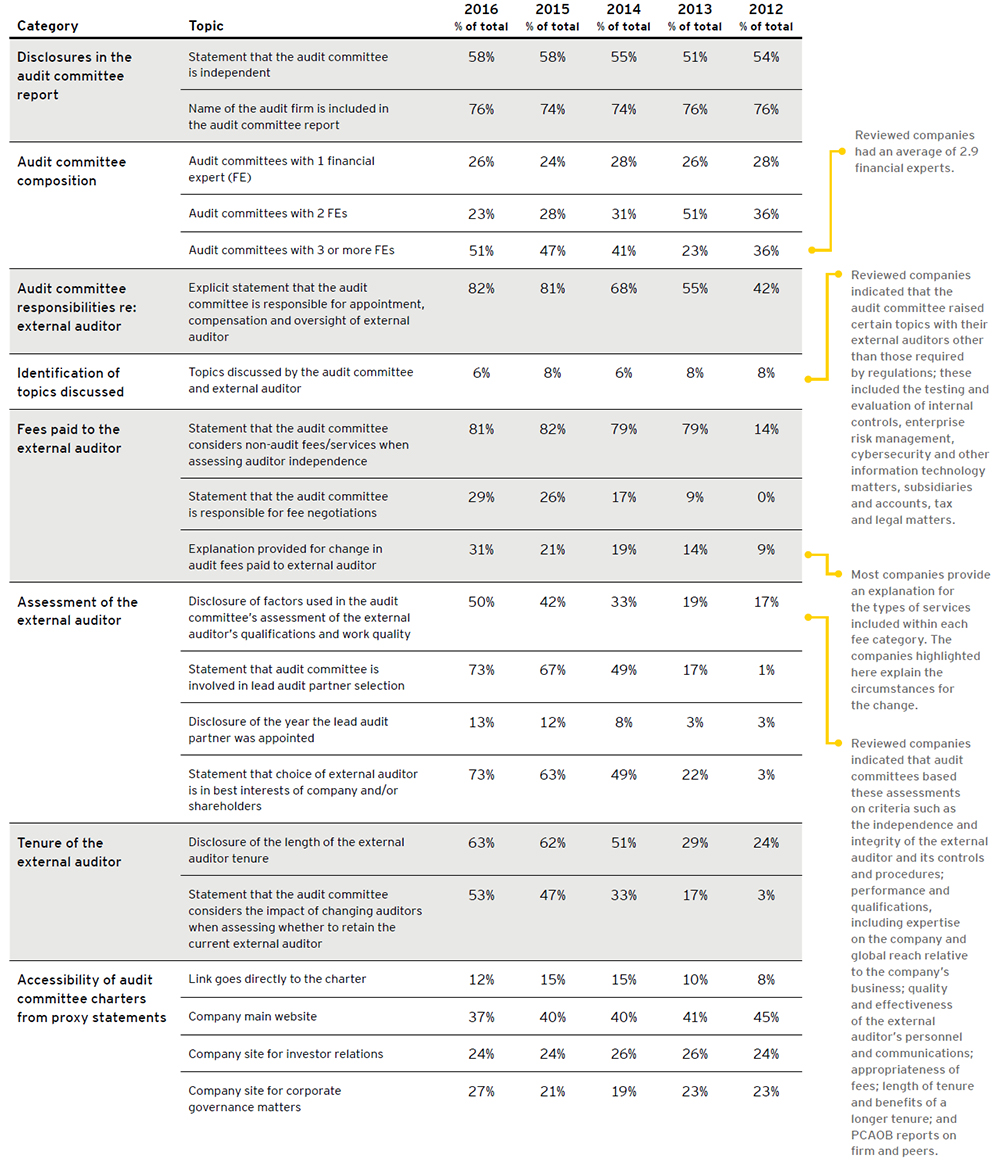
L’étendue des divulgations aux actionnaires est vraiment très importante dans certains cas. Par exemple, en 2012, seulement 42 % des entreprises dévoilaient explicitement que le comité d’audit était responsable de l’engagement, de la rémunération et de la surveillance des auditeurs externes, alors qu’en 2016, 82 % divulguent, souvent en détail, les informations de cette nature.

Plusieurs autres résultats font état de changements remarquables dans la reddition de compte des comités d’audit aux actionnaires des entreprises.

Ceux-ci sont maintenant plus en mesure d’évaluer la portée des décisions des comités d’audit eu égard à la qualité du travail des auditeurs externes, aux raisons invoquées pour changer d’auditeur externe, à la fixation du mandat de l’auditeur externe, à la composition du comité d’audit, à l’augmentation des honoraires des firmes comptables dans les quatre catégories suivantes : audit, relié aux travaux d’audit, fiscalité et autres services connexes, etc.

Bonne lecture !

Audit Committee Reporting to Shareholders in 2016
 

audit


Audit committees have a key role in overseeing the integrity of financial reporting. Nevertheless, relatively little information is required to be disclosed by US public companies about the audit committee’s important work. Since our first publication in this series in 2012, we have described efforts by investors, regulators and other stakeholders to seek increased audit­-related disclosures, as well as the resulting voluntary disclosures to respond to this interest.

Over 2015–2016, US regulators have placed a spotlight on audit-related disclosures and financial reporting more generally. The US Securities and Exchange Commission (SEC) and the US Public Company Accounting Oversight Board (PCAOB) have both taken action to consider the possibility of requiring new disclosures relating to the audit.

SEC representatives also have used speeches to urge companies and audit committees to increase disclosures in this area voluntarily. While additional disclosure requirements for audit committees are not expected in the near term, regulators continue to monitor developments in this area. This post seeks to shed light on the evolving audit­-related disclosure landscape.

Context

Public company audit committees are responsible for overseeing financial reporting, including the external audit. Under US securities laws, audit committees are “directly responsible for the appointment, compensation, retention and oversight” of the external auditor, and must include a report in annual proxy statements about their work. This audit committee report, however, currently must affirm only that the committee carried out certain specific responsibilities related to communications with the external auditor, and this requirement has not changed since 1999.

In recent years, a variety of groups have brought attention to the relative lack of information available about the audit committee and the audit, including their view that this area of disclosure may not have kept up with the needs of investors and other proxy statement users. These groups include pension funds, asset managers, investors, corporate governance groups, and domestic and foreign regulators. As efforts to seek additional information have continued, there has been a steady increase in voluntary audit-related disclosures.

Over the last year, the SEC has taken a series of actions to consider whether and how to improve transparency around audit committees, audits and financial reporting more generally. The combined effect of these activities has been to increase engagement by issuers, audit firms, investors and other stakeholders in discussions about the current state of financial reporting­ related disclosure as well as how it should change.

Findings

Our analysis of the 2016 proxy statements of Fortune 100 companies indicates that voluntaryaudit-related disclosures continue to trend upward in a number of areas. The CBM data for this review is based on the 78 companies on the 2016 Fortune 100 list that filed proxy statements each year from 2012 to 2016 for annual meetings through August 15, 2016. Below are highlights from our research:

  1. The percentage of companies that disclosed factors considered by the audit committee when assessing the qualifications and work quality of the external auditor increased to 50%, up from 42% in 2015. In 2012, only 17% of audit committees disclosed this information.
  2. Another significant increase was in disclosures stating that the audit committee believed that the choice of external auditor was in the best interests of the company and/or the shareholders. In 2016, 73% of companies disclosed such information; in 2015, this percentage was 63%. In 2012, only 3% of companies made this disclosure.
  3. The audit committees of 82% of the companies explicitly stated that they are responsible for the appointment, compensation and oversight of the external auditor; in 2012, only 42% of audit committees provided such disclosures.
  4. 31% of companies provided information about the reasons for changes in fees paid to the external auditor compared to 21% the previous year. Reasons provided in these disclosures include one­-time events, such as a merger or acquisition. Under current SEC rules, companies are required to disclose fees paid to the external auditor, divided into the following categories: audit, audit-related, tax and all other fees. They are not, however, required to discuss the reasons why these fees have increased or decreased. From 2012 to 2016, the percentage of companies disclosing information to explain changes in audit fees rose from 9% to 31%. Additional CBM research examined the disclosures of the subset of studied companies (43) that had changes in audit fees of +/-­ 5% or more compared to the previous year. Out of these 43 companies, roughly 20% provided explanatory disclosures regarding the change in audit fees.
  5. 29 of the 43 companies had fee increases of 5% or more, out of which 8 companies disclosed the reasons for the increases. 14 of the 43 companies had fee decreases of 5% or more, out of which only one company provided an explanatory disclosure.
  6. 53% of companies disclosed that the audit committee considered the impact of changing auditors when assessing whether to retain the current auditor. This was a 6 percentage point increase over 2015. In 2012, this disclosure was made by 3% of the Fortune 100 companies. Over the past five years, the number of companies disclosing that the audit committee was involved in the selection of the lead audit partner has grown dramatically, up to 73% in 2016. In 2015, 67% of companies disclosed this information, while in 2012, only 1% of companies did so.
  7. 51% of companies disclosed that they have three or more financial experts on their audit committees, up from 47% in 2015 and 36% in 2012.

Summary: Trends in Audit Committee Disclosure

(Cliquez pour agrandir)
ey-summary-trends-in-audit-committee


Le point sur la gouvernance au Canada en 2016 | Rapport de Davies Ward Phillips Vineberg


Le rapport annuel de Davies est toujours très attendu car il brosse un tableau très complet de l’évolution de la gouvernance au Canada durant la dernière année.

Le document qui vient de sortir est en anglais mais la version française devrait suivre dans peu de temps.

Je vous invite donc à en prendre connaissance en lisant le court résumé ci-dessous et, si vous voulez en savoir plus sur les thèmes abordés, vous pouvez télécharger le document de 100 pages sur le site de l’entreprise.

Cliquez sur le lien ci-dessous. Bonne lecture !

Rapport de Davies sur la gouvernance 2016


Davies Governance Insights 2016, provides analysis of the top governance trends and issues important to Canadian boards, senior management and governance observers.

insights_governance_2016_fr_thumbnail

The 2016 edition provides readers with our take on important topics ranging from shareholder engagement and activism to leadership diversity and the rise in issues facing boards and general counsel. We also provide practical guidance for boards and senior management of public companies and their investors on these and many other corporate governance topics that we expect will remain under focus in the 2017 proxy season.


Livres phares sur la gouvernance d’entreprise


On me demande souvent de proposer un livre qui fait le tour de la question eu égard à ce qui est connu comme statistiquement valide sur les relations entre la gouvernance et le succès des organisations (i.e. la performance financière !)

Voici un article de James McRitchie, publié dans Corporate governance, qui commente succinctement le dernier volume de Richard Leblanc.

Comme je l’ai déjà mentionné dans un autre billet, le livre de Richard Leblanc est certainement l’un des plus importants ouvrages (sinon le plus important) portant sur la gouvernance du conseil d’administration.

Une révision du volume de Richard Leblanc | Handbook of Board Governance

The Handbook of Board Governance


Mentionnons également que le volume publié par David F. Larcker et Brian Tayan, professeurs au Graduate School de l’Université Stanford, en est à sa deuxième édition et il donne l’heure juste sur l’efficacité des principes de gouvernance. Voici une brève présentation du volume de Larcker.

Corporate Governance Matters: A Closer Look at Organizational Choices and Their Consequences (2nd edition)

Je vous recommande donc vivement de vous procurer ces volumes.

Enfin, je profite de l’occasion pour vous indiquer que je viens de recevoir la dernière version  des Principes de gouvernance d’entreprise du G20 et de l’OCDE en français et j’ai suggéré au Collège des administrateurs de sociétés (CAS) d’inclure cette publication dans la section Nouveauté du site du CAS.

Il s’agit d’une publication très attendue dans le monde de la gouvernance. La documentation des organismes internationaux est toujours d’abord publiée en anglais. Ce document en français de l’OCDE sur les principes de gouvernance est la bienvenue !

Bonne lecture !

The Directors Toolkit | Un document complet de KPMG sur les bonnes pratiques de gouvernance et de gestion d’un CA


Voici la troisième édition d’un document australien de KPMG, très bien conçu, qui répond clairement aux questions que tous les administrateurs de sociétés se posent dans le cours de leurs mandats.

Même si la publication est dédiée à l’auditoire australien de KPMG, je crois que la réalité réglementaire nord-américaine est trop semblable pour se priver d’un bon « kit » d’outils qui peut aider à constituer un Board efficace.

C’est un formidable document électronique interactif de 182 pages. Voyez la table des matières ci-dessous.

J’ai demandé à KPMG de me procurer une version française du même document mais il ne semble pas en exister.

Bonne lecture !

The Directors Toolkit | KPMG

 The Directors' Toolkit cover

Our business environment provides an ever-changing spectrum of risks and opportunities. The role of the director continues to be shaped by a multitude of forces including economic uncertainty, larger and more complex organisations, the increasing pace of technological innovation and digitisation along with a more rigorous regulatory environment.

At the same time there is more onus on directors to operate transparently and be more accountable for their actions and decisions.

To support directors in their challenging role, KPMG has created an interactive Directors’ Toolkit. Now in its third edition, this comprehensive guide is in a user friendly electronic format. It is designed to assist directors to more effectively discharge their duties and improve board performance and decision-making.

Key topics

Duties and responsibilities of a director

Oversight of strategy and governance

Managing shareholder and stakeholder expectations

Structuring an effective board and sub-committees

Enabling key executive appointments

Managing productive meetings

Better practice terms of reference, charters and agendas

Establishing new boards.

What’s New

In this latest version, we have included newly updated sections on:

Roles, responsibilities and expectations of directors of not-for-profit organisations

Risks and opportunities social media presents for directors and organisations

Key responsibilities of directors for overseeing investment governance, operations and processes.

Un guide essentiel pour comprendre et enseigner la gouvernance | En rappel


Plusieurs administrateurs et formateurs me demandent de leur proposer un document de vulgarisation sur le sujet de la gouvernance. J’ai déjà diffusé sur mon blogue un guide à l’intention des journalistes spécialisés dans le domaine de la gouvernance des sociétés à travers le monde. Il a été publié par le Global Corporate Governance Forum et International Finance Corporation (un organisme de la World Bank) en étroite coopération avec International Center for Journalists.

Je n’ai encore rien vu de plus complet et de plus pertinent sur la meilleure manière d’appréhender les multiples problématiques reliées à la gouvernance des entreprises mondiales. La direction de Global Corporate Governance Forum m’a fait parvenir le document en français le 14 février.

Qui dirige l’entreprise : Guide pratique de médiatisation du gouvernement d’entreprise — document en français


Ce guide est un outil pédagogique indispensable pour acquérir une solide compréhension des diverses facettes de la gouvernance des sociétés. Les auteurs ont multiplié les exemples de problèmes d’éthiques et de conflits d’intérêts liés à la conduite des entreprises mondiales.

On apprend aux journalistes économiques — et à toutes les personnes préoccupées par la saine gouvernance — à raffiner les investigations et à diffuser les résultats des analyses effectuées. Je vous recommande fortement de lire le document, mais aussi de le conserver en lieu sûr car il est fort probable que vous aurez l’occasion de vous en servir.

Vous trouverez ci-dessous quelques extraits de l’introduction à l’ouvrage. Bonne lecture !

Who’s Running the Company ? A Guide to Reporting on Corporate Governance

À propos du Guide

schema_DD_lightbox


« This Guide is designed for reporters and editors who already have some experience covering business and finance. The goal is to help journalists develop stories that examine how a company is governed, and spot events that may have serious consequences for the company’s survival, shareholders and stakeholders. Topics include the media’s role as a watchdog, how the board of directors functions, what constitutes good practice, what financial reports reveal, what role shareholders play and how to track down and use information shedding light on a company’s inner workings. Journalists will learn how to recognize “red flags,” or warning  signs, that indicate whether a company may be violating laws and rules. Tips on reporting and writing guide reporters in developing clear, balanced, fair and convincing stories.


Three recurring features in the Guide help reporters apply “lessons learned” to their own “beats,” or coverage areas:

– Reporter’s Notebook: Advise from successful business journalists

– Story Toolbox:  How and where to find the story ideas

– What Do You Know? Applying the Guide’s lessons

Each chapter helps journalists acquire the knowledge and skills needed to recognize potential stories in the companies they cover, dig out the essential facts, interpret their findings and write clear, compelling stories:

  1. What corporate governance is, and how it can lead to stories. (Chapter 1, What’s good governance, and why should journalists care?)
  2. How understanding the role that the board and its committees play can lead to stories that competitors miss. (Chapter 2, The all-important board of directors)
  3. Shareholders are not only the ultimate stakeholders in public companies, but they often are an excellent source for story ideas. (Chapter 3, All about shareholders)
  4. Understanding how companies are structured helps journalists figure out how the board and management interact and why family-owned and state-owned enterprises (SOEs), may not always operate in the best interests of shareholders and the public. (Chapter 4, Inside family-owned and state-owned enterprises)
  5. Regulatory disclosures can be a rich source of exclusive stories for journalists who know where to look and how to interpret what they see. (Chapter 5, Toeing the line: regulations and disclosure)
  6. Reading financial statements and annual reports — especially the fine print — often leads to journalistic scoops. (Chapter 6, Finding the story behind the numbers)
  7. Developing sources is a key element for reporters covering companies. So is dealing with resistance and pressure from company executives and public relations directors. (Chapter 7, Writing and reporting tips)

Each chapter ends with a section on Sources, which lists background resources pertinent to that chapter’s topics. At the end of the Guide, a Selected Resources section provides useful websites and recommended reading on corporate governance. The Glossary defines terminology used in covering companies and corporate governance ».

Here’s what Ottawa’s new rules for state-owned buyers may look like (business.financialpost.com)

The Vote is Cast: The Effect of Corporate Governance on Shareholder Value (greenbackd.com)

Effective Drivers of Good Corporate Governance (shilpithapar.com)

Un guide essentiel pour comprendre et enseigner la gouvernance | En reprise


Plusieurs administrateurs et formateurs me demandent de leur proposer un document de vulgarisation sur le sujet de la gouvernance. J’ai déjà diffusé sur mon blogue un guide à l’intention des journalistes spécialisés dans le domaine de la gouvernance des sociétés à travers le monde. Il a été publié par le Global Corporate Governance Forum et International Finance Corporation (un organisme de la World Bank) en étroite coopération avec International Center for Journalists.

Je n’ai encore rien vu de plus complet et de plus pertinent sur la meilleure manière d’appréhender les multiples problématiques reliées à la gouvernance des entreprises mondiales. La direction de Global Corporate Governance Forum m’a fait parvenir le document en français le 14 février.

Qui dirige l’entreprise : Guide pratique de médiatisation du gouvernement d’entreprise — document en français


Ce guide est un outil pédagogique indispensable pour acquérir une solide compréhension des diverses facettes de la gouvernance des sociétés. Les auteurs ont multiplié les exemples de problèmes d’éthiques et de conflits d’intérêts liés à la conduite des entreprises mondiales.

On apprend aux journalistes économiques — et à toutes les personnes préoccupées par la saine gouvernance — à raffiner les investigations et à diffuser les résultats des analyses effectuées. Je vous recommande fortement de lire le document, mais aussi de le conserver en lieu sûr car il est fort probable que vous aurez l’occasion de vous en servir.

Vous trouverez ci-dessous quelques extraits de l’introduction à l’ouvrage. Bonne lecture !

Who’s Running the Company ? A Guide to Reporting on Corporate Governance

À propos du Guide

schema_DD_lightbox


« This Guide is designed for reporters and editors who already have some experience covering business and finance. The goal is to help journalists develop stories that examine how a company is governed, and spot events that may have serious consequences for the company’s survival, shareholders and stakeholders. Topics include the media’s role as a watchdog, how the board of directors functions, what constitutes good practice, what financial reports reveal, what role shareholders play and how to track down and use information shedding light on a company’s inner workings. Journalists will learn how to recognize “red flags,” or warning  signs, that indicate whether a company may be violating laws and rules. Tips on reporting and writing guide reporters in developing clear, balanced, fair and convincing stories.


Three recurring features in the Guide help reporters apply “lessons learned” to their own “beats,” or coverage areas:

– Reporter’s Notebook: Advise from successful business journalists

– Story Toolbox:  How and where to find the story ideas

– What Do You Know? Applying the Guide’s lessons

Each chapter helps journalists acquire the knowledge and skills needed to recognize potential stories in the companies they cover, dig out the essential facts, interpret their findings and write clear, compelling stories:

  1. What corporate governance is, and how it can lead to stories. (Chapter 1, What’s good governance, and why should journalists care?)
  2. How understanding the role that the board and its committees play can lead to stories that competitors miss. (Chapter 2, The all-important board of directors)
  3. Shareholders are not only the ultimate stakeholders in public companies, but they often are an excellent source for story ideas. (Chapter 3, All about shareholders)
  4. Understanding how companies are structured helps journalists figure out how the board and management interact and why family-owned and state-owned enterprises (SOEs), may not always operate in the best interests of shareholders and the public. (Chapter 4, Inside family-owned and state-owned enterprises)
  5. Regulatory disclosures can be a rich source of exclusive stories for journalists who know where to look and how to interpret what they see. (Chapter 5, Toeing the line: regulations and disclosure)
  6. Reading financial statements and annual reports — especially the fine print — often leads to journalistic scoops. (Chapter 6, Finding the story behind the numbers)
  7. Developing sources is a key element for reporters covering companies. So is dealing with resistance and pressure from company executives and public relations directors. (Chapter 7, Writing and reporting tips)

Each chapter ends with a section on Sources, which lists background resources pertinent to that chapter’s topics. At the end of the Guide, a Selected Resources section provides useful websites and recommended reading on corporate governance. The Glossary defines terminology used in covering companies and corporate governance ».

Here’s what Ottawa’s new rules for state-owned buyers may look like (business.financialpost.com)

The Vote is Cast: The Effect of Corporate Governance on Shareholder Value (greenbackd.com)

Effective Drivers of Good Corporate Governance (shilpithapar.com)

Document complet de KPMG sur les bonnes pratiques de gouvernance et de gestion d’un CA | The Directors Toolkit


Voici la troisième édition d’un document australien de KPMG, très bien conçu, qui répond clairement aux questions que tous les administrateurs de sociétés se posent dans le cours de leurs mandats.

Même si la publication est dédiée à l’auditoire australien de KPMG, je crois que la réalité réglementaire nord-américaine est trop semblable pour se priver d’un bon « kit » d’outils qui peut aider à constituer un Board efficace.

C’est un formidable document électronique interactif de 182 pages. Voyez la table des matières ci-dessous.

J’ai demandé à KPMG de me procurer une version française du même document mais il ne semble pas en exister.

Bonne lecture !

The Directors Toolkit | KPMG

 The Directors' Toolkit cover

Our business environment provides an ever-changing spectrum of risks and opportunities. The role of the director continues to be shaped by a multitude of forces including economic uncertainty, larger and more complex organisations, the increasing pace of technological innovation and digitisation along with a more rigorous regulatory environment.

At the same time there is more onus on directors to operate transparently and be more accountable for their actions and decisions.

To support directors in their challenging role, KPMG has created an interactive Directors’ Toolkit. Now in its third edition, this comprehensive guide is in a user friendly electronic format. It is designed to assist directors to more effectively discharge their duties and improve board performance and decision-making.

Key topics

Duties and responsibilities of a director

Oversight of strategy and governance

Managing shareholder and stakeholder expectations

Structuring an effective board and sub-committees

Enabling key executive appointments

Managing productive meetings

Better practice terms of reference, charters and agendas

Establishing new boards.

What’s New

In this latest version, we have included newly updated sections on:

Roles, responsibilities and expectations of directors of not-for-profit organisations

Risks and opportunities social media presents for directors and organisations

Key responsibilities of directors for overseeing investment governance, operations and processes.

Indicateurs de mesure de la performance des fonctions d’audit interne


Denis Lefort, CPA, expert-conseil en gouvernance, audit et contrôle, porte à ma connaissance un rapport de recherche de l’IIA qui concerne « les indicateurs de mesure de la performance des fonctions d’audit interne ».

Encore aujourd’hui, les indicateurs utilisés sont souvent centrés sur la performance en interne de la fonction et non sur son réel impact sur l’organisation.

Par exemple, peu de services d’audit interne évaluent leur performance par la réduction des cas de fraude dans l’entreprise, par une meilleure gestion des risques, etc.

On utilise plutôt les indicateurs habituels comme le taux de recommandations implantées, la réalisation du plan d’audit, etc.

Voici, ci-dessous, l’introduction au document de l’IIA. Pour consulter le rapport détaillé, cliquez sur le titre du document.

Bonne lecture. Vos commentaires sont les bienvenus

Measuring Internal Audit Value and Performance


In 2010, The IIA recognized a need to capture a simple, memorable, and straightforward way to help internal auditors convey the value of their efforts to important stakeholders, such as boards of directors, audit committees, management, and clients. To that end, the association introduced the Value Proposition for Internal Auditing, which characterizes internal audit’s value as an amalgam of three elements: assurance, insight, and objectivity.

opsione-audit-assistance-audit-interne2

But identifying the conceptual elements of value is only part of what needs to be done. How does that construct look in the workplace? What activities does internal audit undertake that deliver the most value? What should be measured to determine that the organization’s expectations of value are being met? How does internal audit organize and structure the information that populates the metrics? And, most critically, do the answers to all these questions align; that is, does internal audit’s perception of its value, as measured and tracked, correlate with what the organization wants and needs from the internal audit function? (Exhibit 1)

Exhibit 1

The Internal Audit Value Proposition


1. ASSURANCE = Governance, Risk, Control

Internal audit provides assurance on the organization’s governance, risk management, and control processes to help the organization achieve its strategic, operational, financial, and compliance objectives.

2. INSIGHT = Catalyst, Analyses, Assessments

Internal audit is a catalyst for improving an organization’s effectiveness and efficiency by providing insight and recommendations based on analyses and assessments of data and business process.

3. OBJECTIVITY = Integrity, Accountability, Independence

With commitment to integrity and accountability, internal audit provides value to governing bodies and senior management as an objective source of independent advice.

These are the kinds of questions the CBOK 2015 global practitioner survey posed to chief audit executives (CAEs) from around the world. The activities these CAEs believe bring value to the organization are consistent with the three elements of The IIA’s value proposition. In fact, the nine activities identified by CAEs as adding the most value can be mapped directly to the three elements, as shown in exibit 2

However, in looking at the performance measures and tools used by the organization and the internal audit function, a gap appears to form between value-adding activities and the ways performance is measured. This report explores that gap in greater detail and clarifies the respondents’ view of value-adding activities, preferred performance measures, and the methodologies and tools most commonly used to support internal audit’s quality and performance processes. Where appropriate, responses tabulated by geographic regions and organization types are examined.

Finally, based on the findings, the final chapter of the report provides a series of practical steps that practitioners at all levels can implement to help their internal audit department deliver on its value proposition of assurance, insight, and objectivity.

Exhibit 2

The Internal Audit Value Proposition (mapped to response options from the CBOK Survey)


ASSURANCE ACTIVITIES

  1. Assuring the adequacy and effectiveness of the internal control system
  2. Assuring the organization’s risk management processes
  3. Assuring regulatory compliance
  4. Assuring the organization’s governance processes

INSIGHT ACTIVITIES

  1. Recommending business improvement
  2. Identifying emerging risks

OBJECTIVE ADVICE ACTIVITIES

  1. Informing and advising management
  2. Investigating or deterring fraud
  3. Informing and advising the audit committee

Deux livres phares sur la gouvernance d’entreprise


On me demande souvent de proposer un livre qui fait le tour de la question eu égard à ce qui est connu comme statistiquement valide sur les relations entre la gouvernance et le succès des organisations (i.e. la performance financière !)

Le volume publié par David F. Larcker et Brian Tayan, professeurs au Graduate School de l’Université Stanford, en est à sa deuxième édition et il donne l’heure juste sur l’efficacité des principes de gouvernance.

Je vous recommande donc vivement ce volume.

Également, je profite de l’occasion pour vous indiquer que je viens de recevoir la dernière version  des Principes de gouvernance d’entreprise du G20 et de l’OCDE en français et j’ai suggéré au Collège des administrateurs de sociétés (CAS) d’inclure cette publication dans la section Nouveauté du site du CAS.

Il s’agit d’une publication très attendue dans le monde de la gouvernance. La documentation des organismes internationaux est toujours d’abord publiée en anglais. Ce document en français de l’OCDE sur les principes de gouvernance est la bienvenue !

Voici une brève présentation du volume de Larcker. Bonne lecture !

This is the most comprehensive and up-to-date reference for implementing and sustaining superior corporate governance. Stanford corporate governance experts David Larcker and Bryan Tayan carefully synthesize current academic and professional research, summarizing what is known and unknown, and where the evidence remains inconclusive.

Corporate Governance Matters, Second Edition reviews the field’s newest research on issues including compensation, CEO labor markets, board structure, succession, risk, international governance, reporting, audit, institutional and activist investors, governance ratings, and much more. Larcker and Tayan offer models and frameworks demonstrating how the components of governance fit together, with updated examples and scenarios illustrating key points. Throughout, their balanced approach is focused strictly on two goals: to “get the story straight,” and to provide useful tools for making better, more informed decisions.

Book cover: Corporate Governance Matters, 2nd edition

This edition presents new or expanded coverage of key issues ranging from risk management and shareholder activism to alternative corporate governance structures. It also adds new examples, scenarios, and classroom elements, making this text even more useful in academic settings. For all directors, business leaders, public policymakers, investors, stakeholders, and MBA faculty and students concerned with effective corporate governance.

Selected Editorial Reviews

An outstanding work of unique breadth and depth providing practical advice supported by detailed research.
Alan Crain, Jr., Senior Vice President and General Counsel, Baker Hughes
Extensively researched, with highly relevant insights, this book serves as an ideal and practical reference for corporate executives and students of business administration.
Narayana N.R. Murthy, Infosys Technologies
Corporate Governance Matters is a comprehensive, objective, and insightful analysis of academic and professional research on corporate governance.
Professor Katherine Schipper, Duke University, and former member of the Financial Accounting Standards Board

Proposition d’une nouvelle approche à la gouvernance | IoD – GB


Vous trouverez, ci-dessous, un article de l’Institut de la gouvernance du Royaume-Uni (IoD) qui présente un document intitulé « The Great Governance Debate: Towards a good governance index for listed companies » dans lequel les auteurs décrivent une approche nouvelle à l’évaluation de la saine gouvernance.

Le document se distingue par la conception d’un modèle de prévision de la gouvernance, basé sur une multitude de facteurs explicatifs, et d’indices de performance.

Je vous invite à prendre connaissance du rapport de l’IoD.

Bonne lecture.

IoD calls on businesses and regulators to take a fresh approach to corporate governance


In a new report published today, the leading business organisation hopes its report will kickstart the debate about how to define good governance – and recognise those companies that do it best.

The Great Governance Debate: Towards a good governance index for listed companies, launched at the IoD this morning, sets out a new framework for assessing corporate governance, moving away from a focus on compliance and towards a more complex measurement which combines public perceptions with a range of objective factors.

The IoD launches a good corporate governance report titled The Great Governance Debate: Towards a good governance index for listed companies
Téléchargez le rapport complet

Launching the report, Ken Olisa, chairman of the advisory panel for the report, warned that the current system doesn’t fully address what corporate governance is truly about.

“No one factor dictates whether a company is well run,” Olisa said. “It is simply not correct for a company to say that because they have ticked certain boxes, they show good governance.

“Now is the time for some bold thinking on how we define and measure governance, including the recognition that it is essentially an organic process involving the interaction of groups of people.”

The new report is the first stage in a move towards creating a comprehensive Good Governance Index which ranks individual companies on their corporate governance, taking into account factors beyond just compliance and looking at a company’s wider corporate behaviour and culture.

Simon Walker, director general of the IoD, said that the new framework “challenges previous ways of measuring the governance of big companies, and kicks off a new debate on how firms can improve their transparency, accountability and performance.”

On Tuesday, Director.co.uk will provide updates and video from the official launch at the IoD’s central London headquarters at 116 Pall Mall of The Great Governance Debate: Towards a good governance index for listed companies. Keep an eye on the website and our Twitter feed @DirectorIoD for updates.

Download the full report now


Un livre phare sur la gouvernance de sociétés


On me demande souvent de proposer un livre qui fait le tour de la question eu égard à ce qui est connu comme statistiquement vrai sur les relations entre la gouvernance et le succès des organisations.

Le volume publié par David F. Larcker et Brian Tayan, professeurs au Graduate School de l’Université Stanford, en est à sa deuxième édition et il donne l’heure juste sur l’efficacité des principes de gouvernance.

Si vous aviez un livre sur la gouvernance à acheter, ce serait celui-ci.

Bonne lecture !

This is the most comprehensive and up-to-date reference for implementing and sustaining superior corporate governance. Stanford corporate governance experts David Larcker and Bryan Tayan carefully synthesize current academic and professional research, summarizing what is known and unknown, and where the evidence remains inconclusive.

Corporate Governance Matters, Second Edition reviews the field’s newest research on issues including compensation, CEO labor markets, board structure, succession, risk, international governance, reporting, audit, institutional and activist investors, governance ratings, and much more. Larcker and Tayan offer models and frameworks demonstrating how the components of governance fit together, with updated examples and scenarios illustrating key points. Throughout, their balanced approach is focused strictly on two goals: to “get the story straight,” and to provide useful tools for making better, more informed decisions.

Book cover: Corporate Governance Matters, 2nd edition

This edition presents new or expanded coverage of key issues ranging from risk management and shareholder activism to alternative corporate governance structures. It also adds new examples, scenarios, and classroom elements, making this text even more useful in academic settings. For all directors, business leaders, public policymakers, investors, stakeholders, and MBA faculty and students concerned with effective corporate governance.

Selected Editorial Reviews

An outstanding work of unique breadth and depth providing practical advice supported by detailed research.
Alan Crain, Jr., Senior Vice President and General Counsel, Baker Hughes
Extensively researched, with highly relevant insights, this book serves as an ideal and practical reference for corporate executives and students of business administration.
Narayana N.R. Murthy, Infosys Technologies
Corporate Governance Matters is a comprehensive, objective, and insightful analysis of academic and professional research on corporate governance.
Professor Katherine Schipper, Duke University, and former member of the Financial Accounting Standards Board

Proposition d’une nouvelle approche à la gouvernance | IoD – GB


Vous trouverez, ci-dessous, un article de l’Institut de la gouvernance du Royaume-Uni (IoD) qui présente un document intitulé « The Great Governance Debate: Towards a good governance index for listed companies » dans lequel les auteurs décrivent une approche nouvelle à l’évaluation de la saine gouvernance.

Le document se distingue par la conception d’un modèle de prévision de la gouvernance, basé sur une multitude de facteurs explicatifs, et d’indices de performance.

Je vous invite à prendre connaissance du rapport de l’IoD.

Bonne lecture.

IoD calls on businesses and regulators to take a fresh approach to corporate governance


In a new report published today, the leading business organisation hopes its report will kickstart the debate about how to define good governance – and recognise those companies that do it best.

The Great Governance Debate: Towards a good governance index for listed companies, launched at the IoD this morning, sets out a new framework for assessing corporate governance, moving away from a focus on compliance and towards a more complex measurement which combines public perceptions with a range of objective factors.

The IoD launches a good corporate governance report titled The Great Governance Debate: Towards a good governance index for listed companies
Téléchargez le rapport complet

Launching the report, Ken Olisa, chairman of the advisory panel for the report, warned that the current system doesn’t fully address what corporate governance is truly about.

“No one factor dictates whether a company is well run,” Olisa said. “It is simply not correct for a company to say that because they have ticked certain boxes, they show good governance.

“Now is the time for some bold thinking on how we define and measure governance, including the recognition that it is essentially an organic process involving the interaction of groups of people.”

The new report is the first stage in a move towards creating a comprehensive Good Governance Index which ranks individual companies on their corporate governance, taking into account factors beyond just compliance and looking at a company’s wider corporate behaviour and culture.

Simon Walker, director general of the IoD, said that the new framework “challenges previous ways of measuring the governance of big companies, and kicks off a new debate on how firms can improve their transparency, accountability and performance.”

On Tuesday, Director.co.uk will provide updates and video from the official launch at the IoD’s central London headquarters at 116 Pall Mall of The Great Governance Debate: Towards a good governance index for listed companies. Keep an eye on the website and our Twitter feed @DirectorIoD for updates.

Download the full report now


Principes de gouvernance et règlementations en vigueur dans les pays membres de l’OCDE


Ce matin, je porte à votre attention un document-clé de l’Organisation de coopération et de développement économiques (OCDE) qui présente en détail toutes les informations concernant les pratiques de gouvernance dans les 34 pays de l’OCDE ainsi que dans un certain nombre d’autres pays influents : Argentine, Brésil, Hong Kong, Chine, Inde, Indonésie, Lituanie, Arabie Saoudite et Singapore.

Le document intitulé Corporate Governance Factbook est une ressource informationnelle indispensable pour mieux comprendre et comparer les codes de gouvernance et les règlementations relatives aux diverses juridictions. Il s’agit de la deuxième édition de cette publication; celle-ci alimente les révisions apportées annuellement aux Principes de Gouvernance de l’OCDE, principes de gouvernance universellement reconnus.

Le Canada a collaboré activement au partage des informations sur la gouvernance. Ainsi, le rapport présente une multitude de tableaux qui comparent la situation du Canada avec celle des autres pays retenus. C’est une mine d’information vraiment exceptionnelle.

Le document est en version anglaise pour le moment. Vous trouverez, ci-dessous, la référence au document ainsi que la table des matières :

Corporate Governance Factbook


Introduction

The Corporate Landscape

– The ownership structure of listed companies

The Corporate Governance Framework

– The regulatory framework for corporate governance
– Cross-border application of corporate governance requirements
– The main public regulators of corporate governance
– Stock exchangesCorporate Governance Factbook 250 pixels wide

The Rights of Shareholders and Key Ownership Functions

– Notification of general meetings and information provided to shareholders
– Shareholder rights to request a meeting and to place items on the agenda
– Shareholder voting
– Related party transactions
– Takeover bid rules
– The roles and responsibilities of institutional investors

The Corporate Board of Directors

– Basic board structure and independence
– Board-level committees
– Board nomination and election
– Board and key executive remuneration

Aperçu de certains changements dans la gestion des OBNL | Deloitte


Dans ce document de Deloitte, intitulé « un état de changement », j’attire votre attention sur deux sections qui sont importantes pour les gestionnaires d’OBNL :

(1) La communication de l’information sur les avantages sociaux futurs par les organismes sans but lucratif;

(2) L’améliorations des normes pour les organismes sans but lucratif – un rapport présentant les commentaires sur les 15 principes clés relatifs à la comptabilité des OBNL privées et publiques.

Le Conseil des normes comptables du Canada (CNC) et le Conseil sur la comptabilité dans le secteur public (CCSP) sont responsables des suite à donner à la consultation menée depuis plus d’un an.

Bonne lecture ! Vos commentaires sont les bienvenus.

Un état de changement dans les OBNL | Deloitte


Croisière Eurodam Iphone août 2011 006Pour l’instant, l’orientation qui sera adoptée par les organismes de normalisation est incertaine compte tenu des commentaires reçus et des principes proposés à l’origine dans l’énoncé de principes. Restez à l’affût des renseignements qui suivront, car les Conseils collaborent en vue d’améliorer l’orientation future des normes comptables pour les organismes sans but lucratif! Si vous souhaitez prendre connaissance de certains ou de tous les commentaires reçus à l’égard de l’énoncé de principes, visitez le site Web des Normes d’information financière et de certification (www.nifccanada.ca).


La contribution du comité d’audit à la stratégie | KPMG


Comment le comité d’audit contribue-t-il à la stratégie de l’entreprise ?

C’est le sujet abordé par Laurent Giguère, associé Audit chez KPMG, dans cet excellent article dont je vous propose la lecture.

Voici le questionnement qui a donné naissance à cet article :

Au cours de la dernière décennie, le comité d’audit a surtout mis l’accent sur la conformité, la gouvernance et diverses questions d’approbation. Toutefois, dans la plupart des cas, les comités d’audit d’aujourd’hui ont établi des cadres de surveillance rigoureux qui permettent de consacrer moins de temps à la surveillance. Les comités d’audit ont-ils ainsi l’occasion de se pencher sur de nouveaux domaines? Voilà la question qui se pose. Compte tenu de l’évolution du rôle du comité d’audit dans la surveillance des risques, y a-t-il des domaines nouveaux dans lesquels le comité d’audit peut améliorer la qualité de la surveillance?

Vous trouverez, ci-dessous, un extrait de l’article qui traite des moyens utilisés pour obtenir la bonne information.

Je vous invite à lire ce court article.

Bonne lecture !

La contribution du comité d’audit à la stratégie | KPMG

L’efficacité stratégique du comité d’audit dépend, dans une certaine mesure, de sa capacité de bien comprendre les indicateurs clés de performance de l’organisation, de même que de la question de savoir si ces indicateurs respectent et appuient les objectifs stratégiques d’ensemble. Étant donné que le comité d’audit a récemment mis l’accent sur la surveillance de l’information financière, il pourrait ne pas s’être investi autant dans ce domaine qu’il ne l’aurait fait autrement.

La contribution du comité d’audit à la stratégie

Toutefois, le comité d’audit a maintenant la chance d’améliorer le « dialogue en matière de finances » entre le conseil d’administration et la direction concernant la façon dont les systèmes de gestion évaluent la performance. Les comités d’audit favorisent également cet objectif en déployant des efforts accrus pour que des experts opérationnels les aident à mieux comprendre l’entreprise elle-même et à déterminer les indicateurs clés de performance les plus efficaces.

Compte tenu de ces défis et de l’ampleur considérable des enjeux qui entourent le risque financier, les comités d’audit semblent être les seuls à être qualifiés pour discuter de certaines questions, notamment les suivantes :

  1. Quels sont les objectifs de performance quantifiés que nous devons évaluer?
  2. De quelle façon pouvons-nous les surveiller à l’avenir?
  3. Quels sont les contrôles en place?
  4. À quel point nos systèmes et nos contrôles sont-ils solides?
  5. Nos systèmes permettent-ils de mesurer ces indicateurs clés de la performance?
  6. Procédons-nous régulièrement à un examen des indicateurs clés de la performance afin de déterminer leur pertinence?
  7. Procédons-nous à un examen rétrospectif des résultats obtenus par rapport aux objectifs établis dans les plans sur trois ou cinq ans?
  8. Pouvons-nous arriver à obtenir une combinaison optimale d’expertise financière et opérationnelle afin de répondre aux préoccupations de façon globale?
  9. Devrions-nous faire appel à des experts externes afin d’élargir la discussion?
  10. Devrions-nous avoir recours aux connaissances opérationnelles des membres du conseil d’administration qui ne font pas partie du comité d’audit?

Document révisé de KPMG sur les bonnes pratiques de constitution d’un Board | The Directors Toolkit*


Voici la dernière version du document australien de KPMG, très bien conçue, qui répond clairement aux questions que tous les administrateurs de sociétés se posent dans le cours de leurs mandats.

Même si la publication est dédiée à l’auditoire australien de KPMG, je crois que la réalité règlementaire nord-américaine est trop semblable pour se priver d’un bon « kit » d’outils qui peut aider à constituer un Board efficace.

On parle ici d’un formidable document électronique de 130 pages, donc long à télécharger. Voyez la table des matières ci-dessous.

J’ai demandé à KPMG de me procurer une version française du même document mais il ne semble pas en exister.

Vous trouverez, ci-dessous, une vidéo qui présente les nouveautés du guide de gouvernance telles que précédemment publiées.

The Directors’ Toolkit videos: What’s new

Bonne lecture !

The Directors Toolkit

Our business environment provides an ever-changing spectrum of risks and opportunities. The role of the director continues to be shaped by a multitude of forces including economic uncertainty, larger and more complex organisations, the increasing pace of technological innovation and digitisation along with a more rigorous regulatory environment.

At the same time there is more onus on directors to operate transparently and be more accountable for their actions and decisions.

To support directors in their challenging role KPMG has created The Directors’ Toolkit. This guide, in a user-friendly electronic format, empowers directors to more effectively discharge their duties and responsibilities while improving board performance and decision-making.

Key topics :

The Directors' Toolkit cover

Duties and responsibilities of a director

Oversight of strategy and governance

Managing shareholder and stakeholder expectations

Structuring an effective board and sub-committees

Enabling key executive appointments

Managing productive meetings

Better practice terms of reference, charters and agendas

Establishing new boards.


___________________________________________

Article relié :

Le comité de gouvernance du C.A. | Élément clé d’une solide stratégie (jacquesgrisegouvernance.com)

* En reprise

Recommandations en matières de politiques de gouvernance | L’approche de Glass Lewis pour 2015


Voici un document très complet sur les avis de Glass Lewis pour 2015. On y aborde les plus importantes recommandations concernant la gouvernance des organisations : l’élection des administrateurs, la déclassification, la durée des mandats, les limites d’âge, l’accès aux documents de votation, le vote majoritaire pour l’élection.

IMG_20141013_152918

Également, on émet des recommandations sur l’approbation des auditeurs, les questions de fonds de pension, le Say-on-Pay, les arrangements de « Golden parachute », les plans de rémunération des hauts dirigeants et des administrateurs, les plans d’achat d’actions par les employés, les questions fiscales, les mesures de protection contre les offres d’achat non-sollicitées, la structure de votation, les exigences de la divulgation d’informations, l’actionnariat activiste, etc.

Guidelines en matière de politique de gouvernance | L’approche et les recommandations  de Glass Lewis pour 2015


C’est l’un des documents les plus explicites en matière de politique de gouvernance. La firme de conseil Glass Lewis y présente son approche et ses recommandations eues égard au vote des actionnaires en 2015.

À lire !

Deux capsules vidéos en gouvernance – Les médias sociaux et la planification stratégique


Le Collège des administrateurs de sociétés est heureux de vous dévoiler sa 3e série de capsules d’experts, formée de huit entrevues vidéos. Pendant 3 minutes, un expert du Collège partage une réflexion et se prononce sur un sujet d’actualité lié à la gouvernance. Une capsule sera dévoilée chaque semaine.

Deux nouvelles « capsules d’experts » sont maintenant en ligne; elles ont pour thèmes « Les médias sociaux » par M. Sylvain Lafrance, ASC, professeur au HEC Montréal et consultant en communications et « La planification stratégique » par M. Dominic Deneault, ASC , Trebora Conseil.

Visionnez ces deux capsules d’experts :

Les médias sociaux, par Sylvain Lafrance, ASC


_____________________________________


La planification stratégique, par Dominic Deneault


Dix pratiques exemplaires à l’intention des membres de comités d’audit


Vous trouverez ci-dessous un article publié par Naomi Snyder* dans BankDirector.com qui présente une synthèse des caractéristiques des comités d’audit performants dans le domaine bancaire.

Bien sûr, ces pratiques peuvent aussi s’appliquer à tout autre comité d’audit. Bonne lecture !

10 Best Practices for Audit Committee Members

Serving on the audit committee can be one of the toughest jobs on the board, which is why audit committee members often are paid more than what members of other committees receive. Audit committee members have more duties than ever before, thanks to heightened regulatory scrutiny that banks have received in recent years, and are under more pressure than ever to get it right.

Sal Inserra, a partner at accounting and advisory firm Crowe Horwath LLP, spoke at Bank Director’s Bank Audit Committee Conference in Chicago recently, and laid out some of the qualities of highly functioning audit committee members. This is not his list, but was created based on his talk.

  1. Be a skeptic.
    “If you notice inconsistencies, ask the question,’’ Inserra said. “It’s not necessarily wrong. You are just trying to find out.”
  2. Understand your business.
    If you enter a new business line, you must understand that new line of business. Trust departments present banks with a minefield of compliance issues, for example.
  3. Meet with regulators.
    Examiners are more likely now to have a discussion with board members than years past. Regulators are interested in learning about the audit committee’s understanding of the risks in the organization. Attend some meetings with examiners to get a flavor for the bank’s relationship with its regulators and to prepare you for any problems ahead of time.6-28-13_Naomi_Article.png
  4. Support the internal audit department and its findings.
    Make sure the department is adequately funded and staffed. “I have seen way too many situations where internal audit was not a functional unit of the bank because no one respected them,’’ Inserra said. The internal audit chief should report directly to the audit committee chairman.
  5. Look for red flags.
    Red flags include when management delivers the audit committee book without sufficient time for members to digest it before the audit committee meetings. Other red flags include problematic findings that remain unaddressed between audits.
  6. Take control of the audit committee meetings.
    Don’t let management control the meeting agenda by burying you under a mountain of detail. It’s your meeting. Put the priorities at the beginning of the meeting, instead of starting with the easiest things. Get summaries of reports with the most important points highlighted. Who can read a 600 page audit in two nights?
  7. Make sure every member is contributing.
    Three to six people should serve on the audit committee. If it’s politically problematic to remove someone who is no longer contributing, add people you do need on the audit committee.
  8. Hold management accountable.
    Actively monitor management’s action plans. If remediation plans aren’t followed or completed on time, why not?
  9. Communicate with internal and external auditors.
    Be proactive. Have executive sessions with members of the internal auditing staff on a regular basis, as well as with external auditors.
  10. Improve the committee’s knowledge of technology by recruiting an IT expert to be a member, or hire a consultant to advise the board.
    If you are getting third party reports on your bank’s information security you don’t fully understand, then you need help.

Of course, there are many more aspects of being a great audit committee member. This is just a small sample. But at a time when audit committees have an increasing amount of responsibilities, it is important that the audit committee performs at the top of its game.

*Naomi Snyder is the managing editor for Bank Directoran information resource for directors and officers of financial companies.

L’État de l’audit interne à l’échelle internationale | Rapport 2014 de Thompson Reuters Accelus


Denis Lefort, CPA,  expert-conseil en Gouvernance, audit et contrôle, vient de me faire parvenir l’édition 2014 de l’étude Thompson Reuters Accelus sur l’audit interne.

Ce sondage identifie des observations intéressantes pour la profession d’auditeur interne :

(1) Seulement un peu plus de 27% des services d’audit interne vérifient les processus de gouvernance de leur organisation;

(2) Il y a encore des écarts importants de perception entre les services d’audit interne et les comités d’audit quant aux priorités que devraient être celles des services d’audit interne;

(3) Les auditeurs internes investissent 45% de leur temps pour l’audit de la sécurité des TI;

(4) Près de 50% des services d’audit interne interagissent maintenant avec les autres fonctions d’assurance de leur organisation (Conformité, Gestion des risques, etc…).

Ce document sera donc très utile à tout administrateur soucieux de parfaire ses connaissances de l’état de la situation en 2014 dans le monde.

Bonne lecture. Vos commentaires sont les bienvenus. Voici le sommaire de l’étude.


 ÉTAT DE L’AUDIT INTERNE – RAPPORT 2014 DE THOMSON REUTERS ACCELUS


Thomson Reuters Accelus’ annual State of Internal Audit Survey provides an insight into the experiences and expectations of internal audit professionals around the world. More than 900 internal audit practitioners across 50 countries participated in the 2014 survey sharing their views across a range of subjects, issues and concerns. The experiences shared in this report are intended to help internal audit functions and senior management benchmark the myriad of challenges faced and enable them to leverage the approach taken by their peers.

The survey has demonstrated that the world and work of internal audit continues to be as complex, and challenging as ever. Both the volume and diversity of issues that internal auditors need to understand and assess continues to increase globally and across all industries.

In fact, at a high level the results of the Thomson Reuters Accelus State of Internal Audit Survey have remained relatively unchanged for the last few years.IMG_20140521_164057

This year the results confirmed that the vast majority (81 percent) of internal auditors’ focus remains on providing assurance on the efficacy of internal control process. While assurance work is the traditional mainstay of internal audit there are a wide range of other areas and issues for internal auditors to consider, including:

(1) Nearly a quarter (24 percent) of internal auditors expect their personal liability to increase in 2014. The adequacy of internal auditors’ skills, focus and approach is firmly on the radar of regulators worldwide. It is no surprise, therefore, that internal auditors expect their own personal liability to increase in the near future.

(2) Nearly half (49 percent) of all internal auditors have had no involvement in assessing their firm’s culture. There are distinct regional variations with respondents from South America reporting that three-quarters (77 percent) of internal auditors have not assessed the culture of their firm.

(3) Just over a quarter (27 percent) of internal auditors have had no involvement in assessing their firm’s corporate governance; regionally this figure looks most concerning for North America, with 32 percent of internal auditors having no involvement.

4) Internal auditors spend 45 percent of their time on IT security and risk. Nearly half (48 percent) of respondents said that it should be a top priority for their organization and 35 percent said it would be a top challenge for boards of directors in 2014.

(5) Nearly half of the respondents (48 percent) expect to be spending more time reporting to senior management and tracking remedial actions. This is in addition to almost a quarter (24 percent) of internal auditors anticipating a need to focus on the implementation of industry-specific legislation.

(6) Nearly half of internal auditors interact with risk management (44 percent) and compliance (47 percent) on at least a monthly basis. While these figures are a slight improvement on last year it remains an area where improvements could be made.

(7) It is interesting that areas not considered a priority for internal audit included customer outcomes (6 percent), whistle-blowing (5 percent) and capital and liquidity (4 percent).

(8) Internal auditors’ perception of priorities for the board are not aligned with their own. The key challenges for internal auditors are greater complexity of issues and focus on risk and control, as well as changing business models. In contrast, boards’ priorities are corporate strategy, strategic risk management and legal and regulatory risk.

The growing focus which policymakers and regulators have been placing on culture, corporate governance and risk management has emphasized still further the need for a strong, well-resourced independent audit function operating, and in particular reporting, in close coordination with other risk and compliance functions, all with visible support from the top of the organization. Yet the results show a relatively unchanged picture in these areas from previous years. As the risks increase so does the need for internal audit to react to those changes.