Quelles tendances en gouvernance, identifiées en 2014, se sont avérées


J’ai réalisé une entrevue avec le Journal des Affaires le 17 mars 2014. Une rédactrice au sein de l’Hebdo des AG, un média numérique qui se consacre au traitement des sujets touchant à la gouvernance des entreprises françaises, m’a contacté afin de connaître mon opinion sur quelles « prédictions » se sont effectivement avérées, et lesquelles restent encore à améliorer.

J’ai préparé quelques réflexions en référence aux douze tendances que j’avais identifiées le 17 mars 2014 (voir le texte ci-dessous en rouge).

J’espère que ces commentaires vous seront utiles même si mon intervention est colorée par la situation canadienne et américaine.

Bonne lecture. Vos commentaires sont les bienvenus.


Gouvernance : 12 tendances à surveiller


« Si la gouvernance des entreprises a fait beaucoup de chemin depuis quelques années, son évolution se poursuit. Afin d’imaginer la direction qu’elle prendra au cours des prochaines années, nous avons consulté l’expert Jacques Grisé, ancien directeur des programmes du Collège des administrateurs de sociétés, de l’Université Laval.

Toujours affilié au Collège, M. Grisé publie depuis plusieurs années le blogue www.jacquesgrisegouvernance.com, un site incontournable pour rester à l’affût des bonnes pratiques et tendances en gouvernance. Voici les 12 tendances dont il faut suivre l’évolution, selon Jacques Grisé : »


1. Les conseils d’administration réaffirmeront leur autorité. « Auparavant, la gouvernance était une affaire qui concernait davantage le management », explique M. Grisé. La professionnalisation de la fonction d’administrateur amène une modification et un élargissement du rôle et des responsabilités des conseils. Les CA sont de plus en plus sollicités et questionnés au sujet de leurs décisions et de l’entreprise.

Cette affirmation est de plus en plus vraie. La formation certifiée en gouvernance est de plus en plus prisée. Les CA, et notamment les présidents de CA, sont de plus en plus sollicités pour expliquer leurs décisions, leurs erreurs et les problèmes de gestion de crise.

2. La formation des administrateurs prendra de l’importance. À l’avenir, on exigera toujours plus des administrateurs. C’est pourquoi la formation est essentielle et devient même une exigence pour certains organismes. De plus, la formation continue se généralise ; elle devient plus formelle.

Il va de soi que la formation en gouvernance prendra plus d’importance, mais les compétences et les expériences reliées au secteur d’activité de l’entreprise seront toujours très recherchées.

3. L’affirmation du droit des actionnaires et celle du rôle du conseil s’imposeront. Le débat autour du droit des actionnaires par rapport à celui des conseils d’administration devra mener à une compréhension de ces droits conflictuels. Aujourd’hui, les conseils doivent tenir compte des parties prenantes en tout temps.

Il existe toujours une situation potentiellement conflictuelle entre les intérêts des actionnaires et la responsabilité des administrateurs envers toutes les parties prenantes.

4. La montée des investisseurs activistes se poursuivra. L’arrivée de l’activisme apporte une nouvelle dimension au travail des administrateurs. Les investisseurs activistes s’adressent directement aux actionnaires, ce qui mine l’autorité des conseils d’administration. Est-ce bon ou mauvais ? La vision à court terme des activistes peut être néfaste, mais toutes leurs actions ne sont pas négatives, notamment parce qu’ils s’intéressent souvent à des entreprises qui ont besoin d’un redressement sous une forme ou une autre. Pour bien des gens, les fonds activistes sont une façon d’améliorer la gouvernance. Le débat demeure ouvert.

Le débat est toujours ouvert, mais force est de constater que l’actionnariat activiste est en pleine croissance partout dans le monde. Les effets souvent décriés des activistes sont de plus en plus acceptés comme bénéfiques dans plusieurs situations de gestion déficiente.

5. La recherche de compétences clés deviendra la norme. De plus en plus, les organisations chercheront à augmenter la qualité de leur conseil en recrutant des administrateurs aux expertises précises, qui sont des atouts dans certains domaines ou secteurs névralgiques.

Cette tendance est très nette. Les CA cherchent à recruter des membres aux expertises complémentaires.

6. Les règles de bonne gouvernance vont s’étendre à plus d’entreprises. Les grands principes de la gouvernance sont les mêmes, peu importe le type d’organisation, de la PME à la société ouverte (ou cotée), en passant par les sociétés d’État, les organismes à but non lucratif et les entreprises familiales.

Ici également, l’application des grands principes de gouvernance se généralise et s’applique à tous les types d’organisation, en les adaptant au contexte.

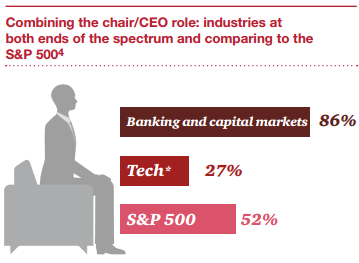
7. Le rôle du président du conseil sera davantage valorisé. La tendance veut que deux personnes distinctes occupent les postes de président du conseil et de PDG, au lieu qu’une seule personne cumule les deux, comme c’est encore trop souvent le cas. Un bon conseil a besoin d’un solide leader, indépendant du PDG.

Le rôle du Chairman est de plus en plus mis en évidence, car c’est lui qui représente le conseil auprès des différents publics. Il est de plus en plus indépendant de la direction. Les É.-U. sont plus lents à adopter la séparation des fonctions entre Chairman et CEO.

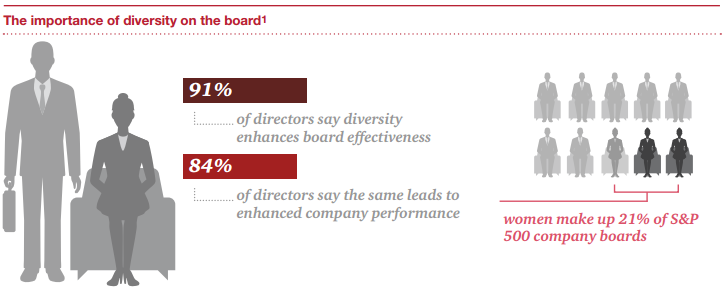
8. La diversité deviendra incontournable. Même s’il y a un plus grand nombre de femmes au sein des conseils, le déficit est encore énorme. Pourtant, certaines études montrent que les entreprises qui font une place aux femmes au sein de leur conseil sont plus rentables. Et la diversité doit s’étendre à d’autres origines culturelles, à des gens de tous âges et d’horizons divers.

La diversité dans la composition des conseils d’administration est de plus en plus la norme. On a fait des progrès remarquables à ce chapitre, mais la tendance à la diminution de la taille des CA ralentit quelque peu l’accession des femmes aux postes d’administratrices.

9. Le rôle stratégique du conseil dans l’entreprise s’imposera. Le temps où les CA ne faisaient qu’approuver les orientations stratégiques définies par la direction est révolu. Désormais, l’élaboration du plan stratégique de l’entreprise doit se faire en collaboration avec le conseil, en profitant de son expertise.

Certes, l’un des rôles les plus importants des administrateurs est de voir à l’orientation de l’entreprise, en apportant une valeur ajoutée aux stratégies élaborées par la direction. Les CA sont toujours sollicités, sous une forme ou une autre, dans la conception de la stratégie.

10. La réglementation continuera de se raffermir. Le resserrement des règles qui encadrent la gouvernance ne fait que commencer. Selon Jacques Grisé, il faut s’attendre à ce que les autorités réglementaires exercent une surveillance accrue partout dans le monde, y compris au Québec, avec l’Autorité des marchés financiers. En conséquence, les conseils doivent se plier aux règles, notamment en ce qui concerne la rémunération et la divulgation. Les responsabilités des comités au sein du conseil prendront de l’importance. Les conseils doivent mettre en place des politiques claires en ce qui concerne la gouvernance.

Les conseils d’administration accordent une attention accrue à la gouvernance par l’intermédiaire de leur comité de Gouvernance, mais aussi par leurs comités de RH et d’Audit. Les autorités réglementaires mondiales sont de plus en plus vigilantes eu égard à l’application des principes de saine gouvernance. La SEC, qui donnait souvent le ton dans ce domaine, est en mode révision de la réglementation parce que le gouvernement de Trump la juge trop contraignante pour les entreprises. À suivre !

11. La composition des conseils d’administration s’adaptera aux nouvelles exigences et se transformera. Les CA seront plus petits, ce qui réduira le rôle prépondérant du comité exécutif, en donnant plus de pouvoir à tous les administrateurs. Ceux-ci seront mieux choisis et formés, plus indépendants, mieux rémunérés et plus redevables de leur gestion aux diverses parties prenantes. Les administrateurs auront davantage de responsabilités et seront plus engagés dans les comités aux fonctions plus stratégiques. Leur responsabilité légale s’élargira en même temps que leurs tâches gagnent en importance. Il faudra donc des membres plus engagés, un conseil plus diversifié, dirigé par un leader plus fort.

C’est la voie que les CA ont empruntée. La taille des CA est de plus en plus réduite ; les conseils exécutifs sont en voie de disparition pour faire plus de place aux trois comités statutaires : Gouvernance, RH et Audit. Les administrateurs sont de plus en plus engagés et ils doivent investir plus de temps dans leurs fonctions.

12. L’évaluation de la performance des conseils d’administration deviendra la norme. La tendance est déjà bien ancrée aux États-Unis, où les entreprises engagent souvent des firmes externes pour mener cette évaluation. Certaines choisissent l’auto-évaluation. Dans tous les cas, le processus est ouvert et si les résultats restent confidentiels, ils contribuent à l’amélioration de l’efficacité des conseils d’administration.

Effectivement, l’évaluation de la performance des conseils d’administration est devenue une pratique quasi universelle dans les entreprises cotées. Celles-ci doivent d’ailleurs divulguer le processus dans le rapport aux actionnaires. On assiste à un énorme changement depuis les dix dernières années.

L’influence de l’activisme sur le renouvellement des CA


Quelle est l’influence de l’activisme actionnarial sur le renouvellement des conseils d’administration?

C’est précisément le sujet de l’excellente publication de Subodh Mishra*, directeur exécutif de Institutional Shareholder Services (ISS), parue sur le forum en gouvernance de la Harvard Law School.

Les résultats de l’étude, réalisée auprès des entreprises du S&P 1500, sont présentés d’une manière illustrative vraiment très claire.

Je vous invite à lire le sommaire de l’étude ci-dessous.

Vos commentaires sont les bienvenus.


The Impact of Shareholder Activism on Board Refreshment Trends at S&P 1500 Firms


Résultats de recherche d'images pour « actionnaires activistes »


Few business-related topics provoke more passionate discussions than shareholder activism at specific companies. Supporters view activists as agents of change who push complacent corporate directors and entrenched managers to unlock stranded shareholder value. Detractors charge that these aggressive investors force their way into boardrooms, bully incumbent directors into adopting short-term strategies at the expense of long-term shareholders, and then exit with big profits in hand.

Lost in this heated long- versus short-term debate is the significant, real-time impact that such activism has on corporate board membership and demographics. ISS identified a recent surge in its evaluation of refreshment trends at S&P 1500 firms between 2008 and 2016 (see Board Refreshment Trends at S&P 1500 Firms, published by IRRCi in January 2017). This accelerated boardroom turnover coincided with an increase in activists’ success in securing board representation, particularly via negotiated settlements. A recent study of shareholder activism by Activist Insights pegged activists’ annual U.S. boardroom gains at more than 200 seats in 2015 and 2016. While a significant portion of this activism was aimed at micro-cap firms, threats of fights have become commonplace even at S&P 500 companies in recent years.

Despite activists’ recent boardroom gains, little attention has been paid to the influence of activism on broader board refreshment trends. Anecdotal media coverage, often fanned by anti-activist communications strategies, still tends to myopically focus on two long-standing dissident nominee stereotypes: the still-wet-behind-the-ears, 20- or 30-something-year-old hedge fund analyst, and the older, male, over-boarded crony of the fund manager.

These long-standing stereotypes appear to be outdated as activism has entered an era in which most dissident nominees have attenuated ties to their hedge fund patrons. The experience, qualifications, attributes, and skills of dissident nominees can appear indistinguishable from those of the incumbent directors whom they seek to supplant. Nominees’ backgrounds and experiences can become even more interchangeable with those of incumbent directors when the latter transfuse their own ranks with new blood during, or in anticipation of, an activist campaign. This heightened competition can leave shareholders with a bounty of fresh-faced, highly-qualified, independent candidates on both nominee slates. Highlighting this narrowing divide, dissidents’ “hand-picked” nominees have been known to reject their sponsors’ wishes and strategic plans (witness Elliott Management’s first tranche of candidates at Arconic, who were seated via a settlement, opposing the hedge fund’s second attempt to gain board seats). Similarly, nominees selected by incumbent directors to face off against dissident candidates sometimes end up endorsing the very shifts in strategic direction that they were recruited to fend off (witness the DuPont board’s “victory” over Nelson Peltz’s Trian Partners, followed by board-recruited director-turned CEO Ed Breen’s advocacy of a Peltzian-style breakup of the company).

To close this board refreshment information gap, IRRCi asked ISS to explore the broader impact of activism by focusing on nominees—regardless of the entity that backed them—and the impact of dissident campaigns on boards.


Methodology


The complete publication (available here) examines the impact of public shareholder activism on board refreshment at S&P 1500 companies targeted by activists from 2011 to 2015. Public shareholder activism refers to any shareholder activism that (1) occurred between Jan. 1, 2011 and Dec. 31, 2015, and (2) was publicly disclosed. The study period concludes in 2015 so that data for a full calendar year following activist campaigns could be analyzed. Data was captured as of the shareholder meeting dates.

Part I examines individual dissident nominees on ballots (whether they ultimately joined the board or not) in proxy contests, directors appointed via settlements with activist shareholders, and directors appointed unilaterally by boards in connection with shareholder activism.

Part II examines changes to board profiles made in connection with public shareholder activism.

Data was captured for all S&P 1500 directors with less than one year of tenure at meetings scheduled to be held between Jan. 1, 2011 and Dec. 31, 2015. The directors were then assigned to one of four classifications:

  1. All dissident nominees on ballots in proxy contests;
  2. Directors appointed or nominated by incumbent boards through publicly-disclosed settlements with activist shareholders;
  3. Directors appointed or nominated unilaterally by incumbent boards in connection with public shareholder activism; and
  4. Directors appointed or nominated prior to and not in connection with public shareholder activism.

If a definitive proxy contest was settled, directors added to the board as a result of the settlement were assigned to classification two.

Data for directors assigned to classification four was excluded, as it did not relate to the impact of public shareholder activism on board refreshment during the study period.

In Part II, board profile changes were assessed through a comparison of target boards in the year prior to shareholder activism and target boards in the year following shareholder activism. For example, there was shareholder activism at J. C. Penney in connection with the company’s 2011 annual meeting. The measure of change was therefore based on a comparison of the board profiles at the company’s 2010 and 2012 annual meetings. In cases where there were two or more consecutive years of shareholder activism, board profile changes were assessed through a comparison of target boards in the year prior to the first year of shareholder activism and target boards in the year following the final consecutive year of shareholder activism. For example, there was shareholder activism at Juniper Networks in both 2014 and 2015. The measure of change was therefore based on a comparison of the board profiles at the company’s 2013 and 2016 annual meetings.

Part II examines year-over-year trends. In these cases, study companies with two or more consecutive years of shareholder activism were excluded. Study companies were grouped by market-cap segments, i.e. S&P 500 (large-cap), S&P 400 (mid-cap), and S&P 600 (small-cap). Study companies that changed indexes over the course of the study were excluded from segment-level comparisons.

In Part II, references to changes in average director age and average director tenure at study companies (excluding those discussed in isolation) refer to averages of average company-level data. Company-level data provided average age and tenure for each specific company. For references to average age and tenure at study companies, these data points were calculated by averaging the company-level (rather than director-level) data points.

Key Findings

Part I: Individual Director Demographics


Snapshot: Public shareholder activism generally leads to younger, more independent, but less diverse, board candidates who had previous boardroom experience and relevant professional pedigrees. Typically activists favor nominees with financial experience and incumbent boards favor nominees with executive experience.  


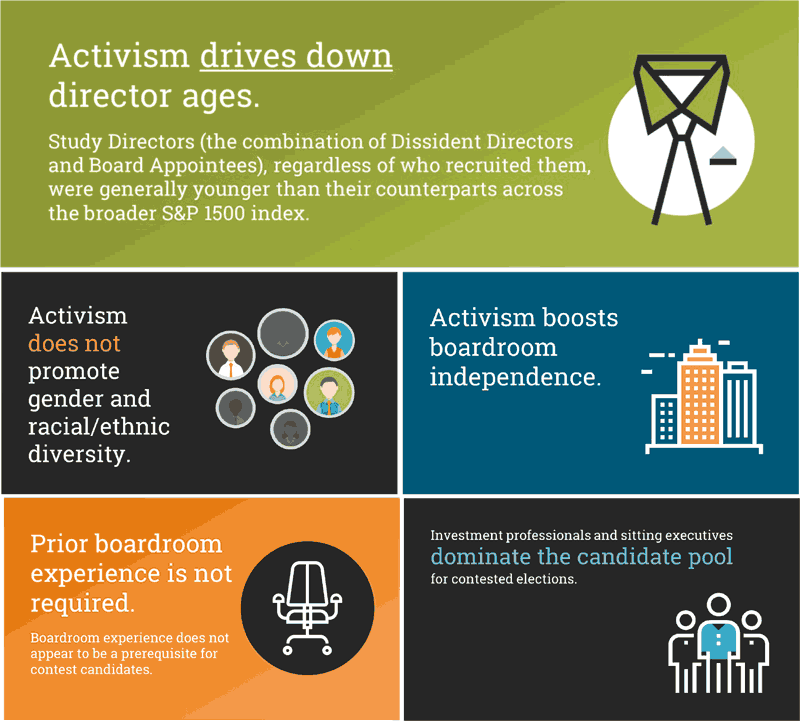
FINAL-Activism-and-Board-Refreshment-Trends-Report-Aug-2017-8.png


Activism drives down director ages

Dissident nominees and directors appointed via settlements (hereinafter Dissident Directors) were younger, on average, than directors appointed unilaterally by boards (hereinafter Board Appointees) in connection with shareholder activism. Study Directors (the combination of Dissident Directors and Board Appointees), regardless of who recruited them, were generally younger than their counterparts across the broader S&P 1500 index. While Dissident Directors generally reflected a wider range of ages, insurgent investors and incumbent boards both favored individuals in their fifties when picking candidates. This preference for nominees in their fifties aligns with practices in the broader S&P 1500 index over the same period.

Activism does not promote gender diversity

Less than ten percent of Study Directors were women. While the rate at which females were selected as dissident nominees or Board Appointees in contested situations increased over the course of the study, it trailed the rising tide of female board representation in the broader S&P 1500 universe*.* There were zero female Dissident Directors in 2011, two in 2012, and three in 2013. Similarly, there were two female Board Appointees in 2011, but zero in both 2012 and 2013.

Activism does not promote racial/ethnic diversity

Less than five percent of Study Directors were ethnically or racially diverse. While minority representation across the entire S&P 1500 board universe slowly increased over the course of the study, from 9.3 percent in 2011 to 10.1 percent in 2015, the rate at which individuals with diverse ethnic and racial backgrounds were selected as Dissident Directors and Board Appointees was relatively uniform and trailed that of the broader index by more than five percentage points.

Activism boosts boardroom independence

Study Directors were generally more independent than their counterparts across the broader S&P 1500. Not surprisingly, dissident nominees and directors appointed to boards via settlements were more likely to be “independent” than directors appointed unilaterally by boards in connection with shareholder activism. It is worth pointing out that the measure of “independence” focused on a nominee’s degree of separation from management rather than from the dissident. Indeed, as the examination of prior boardroom experience suggests, there may be questions of independence from activist sponsors for a subset of Study Directors.

Prior boardroom experience is not required. Boardroom experience does not appear to be a prerequisite for contest candidates. More than half of Study Directors held outside board seats. While most of these directors sat on either one or two outside boards, a sizable minority pushed the over-boarded envelope. Six Study Directors served on four outside boards, four on five outside boards, and one on six outside boards. Many of these “busy” directors appear to be “go-to” nominees for individual activists. The serial nomination of favorite candidates raises questions about the “independence” of these individuals from their activist sponsors.

Investment professionals and sitting executives dominate the candidate pool for contested elections

Occupational data for the Study Directors demonstrates experience, qualifications, attributes, and skills (EQAS) preferences for nominees in contested situations. “Corporate executives” and “financial services professionals” were in a dead heat at the front of the pack. These favored occupations were not evenly distributed, as activists tended to select investors and incumbents tended to select executives. In fact, Dissident Directors were nearly three times more likely to be “financial services professionals” than Board Appointees, while Board Appointees were nearly twice as likely to be “executives” than Dissident Directors.


Part II: Board Profile


FINAL-Activism-and-Board-Refreshment-Trends-Report-Aug-2017-10.png


Snapshot: Public shareholder activism generally resulted in boards that are younger, shorter-tenured, slightly-larger, more independent, and more financially literate, but less diverse, than their pre-activism versions.


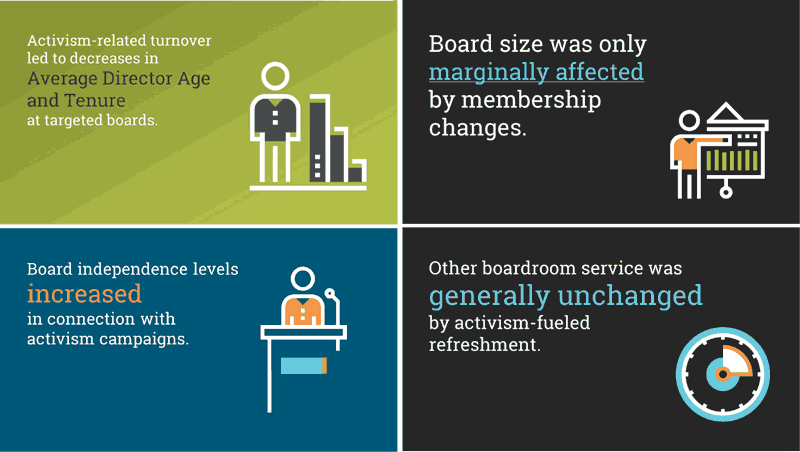
FINAL-Activism-and-Board-Refreshment-Trends-Report-Aug-2017-11.png


Activism-related turnover led to decreases in average director age and tenure at targeted boards

Dissident Directors averaged 53 years of age and Board Appointees averaged 56.3 years of age. Average director age decreased by 2.6 years to 59.6 years on Study Boards targeted by shareholder activists, while average director tenure decreased by 3.4 years to 6.1 years. For the broader S&P 1500 in 2015, average director age was 62.5 years and average tenure was 8.9 years.

Board size remained relatively steady despite membership changes

Although average board size at Study Companies increased from nine to 9.4 seats, less than half (41.9 percent) of the Study Companies experienced a post-activism boost in board size. 18.3 percent of Study Companies experienced a decline in board size following shareholder activism, while board size was unchanged at 39.8 percent of Study Companies.

Board independence levels increased in connection with activism campaigns

Average board independence at Study Companies increased from 79.5 percent to 83 percent. More than 60 percent of study companies experienced an increase in independence, 21.5 percent experienced a decrease, and 18.3 percent experienced no change. Average board independence in the S&P 1500 was 80.6 percent in 2015.

Other boardroom service was generally unchanged by activism-fueled refreshment

The average number of outside boards on which Study Company directors served remained virtually flat, increasing from 0.8 to 0.9. Of the 89 Study Companies, the number without a director who sat on more than one outside board decreased from four to two. There was a correlation between company size and outside board service, as directors at S&P 500 and S&P 400 study companies sat on a higher average number of outside boards than their counterparts at S&P 600 study companies.

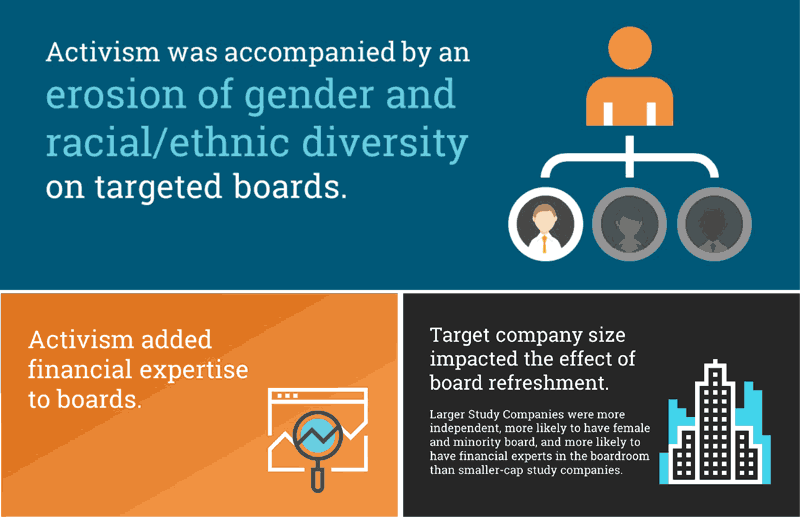
Activism was accompanied by an erosion of gender and racial/ethnic diversity on targeted boards

Study Company boards were less likely to have at least one female director following an activism campaign than they were preceding one, decreasing from 87.1 percent to 82.8 percent. Similarly, Study Company boards were less likely to have at least one minority director following an activism campaign than they were preceding one, decreasing from 55.9 percent to 51.6 percent. According to Board Refreshment Trends at S&P 1500 Firms, the proportion of S&P 1500 companies with at least one female director increased from 72 percent in 2011 to 82.7 percent in 2015 and the portion of S&P 1500 companies with at least one minority board member increased through the course of the study period to 56.8 percent.

Activism added financial expertise to boards

The proportion of board seats at Study Companies occupied by “financial experts” increased from 22.6 percent (189 of 835) to 24.5 percent (214 of 874). The number of Study Companies with at least one, two, or three “financial experts” also increased. (At U.S. companies, ISS considers a director to be a “financial expert” if the board discloses that the individual qualifies as an “Audit Committee Financial Expert” as defined by the Securities and Exchange Commission under Items 401(h)(2) and 401(h)(3) of Regulation S-K. Under the SEC’s rules, a person must have acquired their financial expertise through (1) education and experience as a principal financial officer (PFO), principal accounting officer (PAO), controller, public accountant or auditor or experience in one or more positions that involve the performance of similar functions, (2) experience actively supervising a PFO, a PAO, controller, public accountant, auditor or person performing similar functions; (3) experience overseeing or assessing the performance of companies or public accountants with respect to the preparation, auditing or evaluation of financial statements or (4) other relevant experience.)

Target company size impacted the effect of board refreshment

Larger Study Companies were more independent, more likely to have female and minority board members (both pre- and post- activism), and more likely to have financial experts in the boardroom than smaller-cap study companies. Relative to their larger peers, smaller Study Companies generally experienced more pronounced declines in average director age and tenure, but experienced more significant increases in average board size.

The complete publication is available here.

________________________________________________

Subodh Mishra* is Executive Director at Institutional Shareholder Services, Inc. This post is based on a co-publication by ISS and the Investor Responsibility Research Center Institute. Related research from the Program on Corporate Governance includes The Long-Term Effects of Hedge Fund Activism by Lucian Bebchuk, Alon Brav, and Wei Jiang (discussed on the Forum here).

L’activisme et les effets sur la diversité des CA


Comment se font les nominations d’administrateurs lorsqu’un fond activiste du type « hedge funds » intervient lors des élections aux assemblées générales annuelles ?

La recherche menée par David A. Katz* et Laura A. McIntosh*, de la firme Wachtell, Lipton, Rosen & Katz, montrent clairement que les fonds activistes agressifs (hedge funds) proposent des candidats qui ne contribuent pas à la diversité du CA (en genre et en race) si l’on compare à la moyenne des entreprises du S&P 500.

Ainsi, durant la période 2011-2015, les femmes ne représentaient que 5 % des candidats nommés à des conseils par les hedge funds, comparativement à la nomination de 26 % de femmes aux CA des entreprises du S&P 500.

De plus, si l’on considère les entreprises ciblées par les hedge funds durant la même période, on constate que les CA 100 % masculins ont augmenté significativement, passant de 13 % à 17 %. Pour les autres entreprises du S&P 500, la proportion de CA 100 % masculin a considérablement diminué.

An August 2017 study investigated the reasons that hedge fund activists seemingly ignore the evidence for gender-diverse boards in their choices for director nominees and disproportionately target female chief executive officers. The authors suggest that hedge funds may be subconsciously biased against women leaders due to perceptions, cultural attitudes, and beliefs about the attributes of leaders in our society. Activists may tend to view female CEOs as weaker and may be more willing to second-guess and criticize the corporate strategic plans put forth by women leaders. Indeed, one academic study found that the persistent mention of a female CEO in media coverage leads to a 96 percent probability that her company will be targeted by activists.

L’article montre également que, contrairement aux fonds activistes agressifs, les investisseurs institutionnels et les gestionnaires d’actifs font une promotion sans précédent de la diversité des membres de CA. Plusieurs fonds de gestion d’actifs, tels que BlackRock, State Street Global Advisors et Vanguard, font un engagement public envers la promotion de la diversité sur les CA.

Les auteurs concluent à l’efficacité des actions de promotion de la diversité des CA dans la gouvernance des entreprises. Voici un résumé des conclusions en ce sens :

The concerted efforts of some of the largest and most influential investors and asset managers toward increasing board diversity are likely to be effective. Their support for shareholder proposals, their ongoing engagement with companies, and their consistent public advocacy for independent and diverse boards are powerful factors that will change the corporate governance landscape. Meanwhile, the advantages of diverse boards are becoming more widely understood and have been demonstrated through convincing evidence, making the business case for board diversity stronger than ever.

Enfin, il n’est pas superflu de rappeler la plus-value de la diversité comme le font les auteurs de l’entreprise Directorpoint dans leur billet The Benefits of Diversity in the Boardroom :

  1. A diverse boardroom provides a diversity of thought;
  2. A diverse boardroom helps address complex, corporate issues;
  3. A diverse boardroom is more representative of shareholders;
  4. A diverse boardroom increases revenues.

Bonne lecture ! Vos commentaires sont les bienvenus.


Activism and Board Diversity


Activism at public companies can reduce board diversity, or it can increase it, depending on the circumstances. In recent years, activist hedge funds have installed dissident nominees who collectively have trailed the S&P 1500 index significantly in terms of gender and racial diversity. In contrast, institutional shareholders and asset managers are promoting board diversity to an unprecedented extent, with concerted public efforts already producing results. Several institutional investor initiatives, announced earlier this year, and the New York Comptroller’s Boardroom Accountability Project 2.0, announced earlier this month, may be game-changing initiatives on the path to greater board diversity.


Hedge Fund Activism


Since the early 2000s, a number of studies have demonstrated that companies with women on their boards consistently experience a wide range of benefits, including higher average returns on equity, higher net income growth, lower stock volatility, and higher returns on invested capital. Whether because of improved group dynamics, a shift in risk management, increased ability to consider alternatives to current strategies, or a focus on governance generally, board gender diversity produces stronger boards. While the argument for gender diversity may have begun from notions of equality, experience has shown a compelling financial rationale.

With the evidence for board diversity very much in the public domain, the behavior of hedge fund activists seeking board representation has been somewhat puzzling. Hedge fund activism has been notably counterproductive in terms of gender diversity on public boards. A 2016 Bloomberg analysis of the years 2011 through 2015 found that women represented only five percent of the candidates successfully placed on boards by activist funds, a significant finding during a period in which women represented about 19 percent of S&P 500 directors and in which female candidates were nominated to fill 26 percent of open seats at S&P 500 companies. At companies targeted by hedge funds during the same years, the proportion of all-male boards increased from 13 percent to 17 percent, while in the S&P 1500 that proportion significantly declined.

An August 2017 study investigated the reasons that hedge fund activists seemingly ignore the evidence for gender-diverse boards in their choices for director nominees and disproportionately target female chief executive officers. The authors suggest that hedge funds may be subconsciously biased against women leaders due to perceptions, cultural attitudes, and beliefs about the attributes of leaders in our society. Activists may tend to view female CEOs as weaker and may be more willing to second-guess and criticize the corporate strategic plans put forth by women leaders. Indeed, one academic study found that the persistent mention of a female CEO in media coverage leads to a 96 percent probability that her company will be targeted by activists.


Boardroom Accountability 2.0


In marked contrast to hedge fund activists, significant institutional investors and asset managers are engaging in deliberate, proactive, and effective campaigns for increased diversity on public company boards. BlackRock, State Street Global Advisors, and Vanguard all have taken public steps this year to promote and advocate for greater board diversity. For example, State Street Global Advisors’ “preferred approach is to drive greater board diversity through an active dialogue and engagement with company and board leadership.” Using the carrot and stick approach, State Street notes that “[i]n the event that companies fail to take action to increase the number of women on their boards, despite our best efforts to actively engage with them, [State Street] will use [its] proxy voting power to effect change—voting against the Chair of the board’s nominating and/or governance committee if necessary.” BlackRock has noted that “over the coming year, we will engage companies to better understand their progress on improving gender balance in the boardroom.” Vanguard, in an open letter, noted that one of the four pillars it will use to evaluate a public company’s corporate governance is whether there is “[a] high-functioning, well-composed, independent, diverse, and experienced board with effective ongoing evaluation practices.”

Earlier this month, the New York City Comptroller and the New York City Pension Funds announced the “Boardroom Accountability Project 2.0,” a three-pronged initiative focusing on board diversity, director independence, and climate expertise. With regard to board diversity, the project calls for the boards of 151 U.S. companies to release “board matrix” disclosure indicating the race, gender, and skill sets of their board members, on the theory that standardized disclosure will increase transparency, accountability, and incentives for diversification. The project aims to combat a “persistent lack of diversity” on public company boards by encouraging boards to seek director candidates more broadly. The New York City Comptroller recently sent letters to the targeted companies asking them to provide the requested information.

The new project could well be successful as the NYC Comptroller’s original Boardroom Accountability Project. The goal of the original project was to make proxy access a standard feature of corporate governance. Since the 2014 launch of the initial project, proxy access has indeed become widespread, with over 400 U.S. companies (and over 60 percent of the S&P 500) having adopted some form of proxy access. Boardroom Accountability 2.0 is the sequel, in that nearly all of the targeted companies recently adopted proxy access, and the current project aims to empower shareholders to use this tool more effectively with the information contained in the proposed standardized matrix disclosure.

Even if companies choose not to directly respond to the information requested by the NYC Comptroller, the combination of the Boardroom Accountability Project 2.0 and institutional investors’ focus on the issue of diversity is likely to push public companies to reassess their approaches to board diversity generally and gender diversity specifically. We are already seeing changes in the way boards of directors are approaching director succession in response to these pressures. Public companies should consider using the opportunity presented by the Boardroom Accountability Project 2.0 to communicate their approaches to board diversity generally, and gender diversity specifically, to their larger institutional investors and engage in a dialogue that will present their approach in the best possible light.

The concerted efforts of some of the largest and most influential investors and asset managers toward increasing board diversity are likely to be effective. Their support for shareholder proposals, their ongoing engagement with companies, and their consistent public advocacy for independent and diverse boards are powerful factors that will change the corporate governance landscape. Meanwhile, the advantages of diverse boards are becoming more widely understood and have been demonstrated through convincing evidence, making the business case for board diversity stronger than ever.


*David A. Katz is partner and Laura A. McIntosh is consulting attorney at Wachtell, Lipton, Rosen & Katz. This post is based on a Wachtell Lipton publication by Mr. Katz and Ms. McIntosh which originally appeared in the New York Law Journal.

Révision de la réglementation eu égard à la divulgation de l’indépendance des administrateurs


L’importance du principe d’indépendance des administrateurs ne fait plus de doute, autant pour les grandes entreprises publiques (cotées), que pour les spécialistes de la gouvernance. La coalition des 13 plus grands premiers dirigeants des grandes sociétés publiques américaines énonce clairement que l’indépendance des administrateurs est un principe incontournable de bonne gouvernance.

Truly independent corporate boards are vital to effective governance, so no board should be beholden to the CEO or management” and directors should be strong and steadfast, independent of mind and willing to challenge [management] constructively.”

Mais si le principe est largement reconnu, il ne reflète malheureusement pas la réalité de plusieurs conseils d’administration. L’article de Yaron Nili, professeur à la faculté de droit de l’Université du Wisconsin, présente la réalité à ce sujet en donnant des exemples de situation de complaisance sur les CA.

Ainsi, ce sont les administrateurs eux-mêmes qui déterminent la qualité d’indépendance de leurs pairs en déclarant, dans le rapport aux actionnaires, que les administrateurs répondent aux critères très flous des standards existants. L’article montre que l’absence d’une réglementation plus explicite à cet égard laisse les actionnaires et les investisseurs dans l’ignorance au sujet de la véritable indépendance des administrateurs.

L’auteur tire trois conclusions relatives à l’indépendance des administrateurs :

(1) La réglementation est lacunaire eu égard à la divulgation d’informations aux actionnaires et aux investisseurs. Ceux-ci sont mal informés sur le niveau d’indépendance des administrateurs ainsi que sur les biais comportementaux dont souffrent les collègues administrateurs pour évaluer ce facteur ;

(2) L’étude empirique de Yaron Nili a clairement démontré que les informations transmises aux actionnaires manquent de transparence et que les actionnaires n’ont pas accès à la « boîte noire » ;

(3) Les lacunes en matière de définition de l’indépendance des administrateurs sont issues du raisonnement qui veut que, peu importe la définition choisie, celle-ci soit toujours susceptible de souffrir d’ambiguïté et elle est de nature interprétative.

C’est donc à une réflexion en profondeur sur la gouvernance en général, et sur la qualité de l’information divulguée aux actionnaires que l’auteur nous convie.

Bonne lecture ! Vos commentaires sur ce sujet sont les bienvenus.


Out of Sight Out of Mind: The Case for Improving Director Independence Disclosure


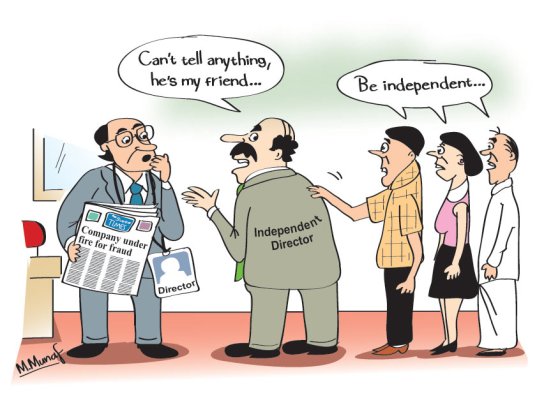
In July 2016, a coalition of 13 CEOs and heads of major investment firms—which included names like JPMorgan Chase CEO Jamie Dimon, Berkshire Hathaway CEO Warren Buffett, General Motors CEO Mary Barra and BlackRock CEO Larry Fink—released the Commonsense Principles of Corporate Governance (discussed on the Forum here). These Principles emphasize the critical role of director independence in corporate America, stating that: “[t]ruly independent corporate boards are vital to effective governance, so no board should be beholden to the CEO or management” and that “[d]irectors should be strong and steadfast, independent of mind and willing to challenge [management] constructively.” Indeed, this recent statement echoes the importance and emphasis that academics, investors, regulators and companies alike, have placed on director independence.

Two months later, on September 7, 2016 Apple and Nike announced a new collaboration with one another on the Apple Watch. In their announcement, the companies declared their new Apple Watch Nike+ to be “the latest result of a long-standing partnership” between the world-renowned brands. Significantly, the announced initiative came on the heels of Nike appointing Mr. Tim Cook, Apple’s CEO, as Nike’s lead independent director. Despite the new collaboration, the companies did not refer to any potential conflicts of interest or to Mr. Cook’s status as lead independent director in their press release. Apple itself has similarly straddled the line regarding the independence of its “independent” directors. Bob Iger, Disney’s CEO, is one of Apple’s five independent directors. The two companies have a close and frequent business collaboration with one another, but Apple does nothing more than disclose that “in the ordinary course of its business, Apple enters into commercial dealings with Disney that it considers arms-length.” In regards to Mr. Iger’s independence, Apple has stated that it “does not believe that Mr. Iger has a material direct or indirect interest in any of such commercial dealings.”

Apple’s short statement concerning Mr. Iger’s independence is indicative of a larger practice taken by public firms. Many public companies can, and do, satisfy their stock exchange’s disclosure requirements by simply declaring that “the Board of Directors has determined that all non-employee Directors who served during [the fiscal year] are ‘independent’ under the listing standards of the [NYSE/NASDAQ].” Investors receive very little value from these unsubstantiated statements.

Indeed, in the current regulatory regime, public companies’ boards self-designate their peer directors as “independent directors” and boards are only required to disclose very specific, and very limited, information regarding their designation of a director as an “independent director”—leaving shareholders with minimal knowledge regarding the true level of independence that their elected directors actually have.

In my article, Out of Sight Out of Mind: The Case for Improving Director Independence Disclosure, which is forthcoming in the Journal of Corporation Law, I address this issue of director independence disclosures, in light of the rise of the independent board. The article makes three important contributions to the current discourse regarding director independence:

First, the article exposes a fundamental concern regarding the functional independence of “independent” directors, and highlights what it terms as the “empty” nature of the current regulatory framework. As the article details in length, the current framework can be summed up as being too much, too little, too late and too soft. It provides companies with too much discretion, as boards retain too much power to assert the independence of their peer directors and they may suffer from behavioral bias in doing so. It provides investors with too little information regarding the factual context against which a director is considered to be independent. Further, even when a director’s independence designation is scrutinized through state law, it is often too late, as these assessments are done post-hoc when it is too late to address many of the issues that director independence is meant to protect against. Finally, it is too soft, as companies’ self-designations of director independence are left uncontested and without proper vetting by the stock exchanges or the SEC, as they have shown no effort to proactively enforce their own requirements.

Second, the article is the first to provide hand-collected empirical evidence corroborating the lack of proper disclosure by companies in the context of their director independence designations. To do so, using a hand collected data set, the article analyzed the disclosure statements of one hundred public companies. To account for both large, high profile, companies as well as smaller, less visible public companies, fifty of the companies make up the Fortune 50 and the remaining 50 are Fortune 2000 small-cap companies. For each company, the company’s independence disclosure in its proxy statements in the years 2000, 2004, 2008, 2012 and 2016, were analyzed and coded. Indeed, as further analyzed in greater detail in the article, the majority of companies provide very little information about their director independence designations, potentially violating the already lax rules governing independence disclosure. Furthermore, several companies have in fact regressed over time in regards to the level of transparency they are providing to investors. In essence, much of the information that boards are expected to consider when determining whether a director is independent is contained in a “black box,” to which shareholders have no access.

Finally, the article argues that at its core, the failure of current regulatory standards to ensure an effective director independence regime stems from the fact that any independence definition is destined to suffer from ambiguity and interpretive freedom. Instead, we should recognize that the true value of director independence requirements is not only in that they strive to ensure actual independence, but rather also in that they empower investors. Each investor may have a distinctive, subjective comfort level with the myriad independence questions that may arise, balanced against the benefits that the various business and personal connections of each director may provide to the company. Information about directors’ ties and dealings gives investors a means of making informed decisions, both regarding the election of a director as well as their actual level of independence on any specific issue. As a result, effective director independence standards should facilitate an environment where companies are accountable to their investors for their choice of directors.

Therefore, responding to the SEC’s call for input on possible ways to improve the discourse regime under Regulation S-K, this article calls for a re-conceptualizing of the current approach to regulating company disclosures. This new approach will shift some of the focus from the definition and designation of a director as independent to a disclosure-based regime. Alongside the current designation regime, companies would have to disclose, for each “independent” director, the entirety of the information they considered when declaring a director as independent, including some mandatory information that is currently hard or costly to independently obtain or verify. This in turn will allow investors and regulators not only to confirm the judgment of the board on each director but also to possess a more nuanced view regarding the functional independence of each director in regards to each matter at hand.

The complete article is available for download here.

Cadre de référence pour évaluer la gouvernance des sociétés | Questionnaire de 100 items


Le Bureau de la vérification interne (BVI) de l’Université de Montréal (UdeM) a récemment développé un cadre de référence novateur pour l’évaluation de la gouvernance. La méthodologie, ainsi que le questionnaire qui en résulte, contribue, à mon avis, à l’avancement des connaissances dans le domaine de l’évaluation des caractéristiques et des pratiques de la gouvernance par les auditeurs internes.

Ayant eu l’occasion de collaborer à la conception de cet instrument de mesure de la gouvernance des sociétés, j’ai obtenu du BVI la permission de publier le résultat de cet exercice.

Cette version du cadre se veut « générique » et peut être utilisée pour l’évaluation de la gouvernance d’un projet, d’une activité, d’une unité ou d’une entité.

De ce fait, les termes, les intervenants ainsi que les structures attendues doivent être adaptés au contexte de l’évaluation. Il est à noter que ce cadre de référence correspond à une application optimale recherchée en matière de gouvernance. Certaines pratiques pourraient ne pas s’appliquer ou ne pas être retenues de façon consciente et transparente par l’organisation.

Le questionnaire se décline en dix thèmes, chacun comportant dix items :


Thème 1 — Structure et fonctionnement du Conseil

Thème 2 — Travail du président du Conseil

Thème 3 — Relation entre le Conseil et le directeur général (direction)

Thème 4 — Structure et travail des comités du Conseil

Thème 5 — Performance du Conseil et de ses comités

Thème 6 — Recrutement, rémunération et évaluation du rendement du directeur général

Thème 7 — Planification stratégique

Thème 8 — Performance et reddition de comptes

Thème 9 — Gestion des risques

Thème 10 — Éthique et culture organisationnelle


On retrouvera en Annexe une représentation graphique du cadre conceptuel qui permet d’illustrer les liens entre les thèmes à évaluer dans le présent référentiel.

L’évaluation s’effectue à l’aide d’un questionnaire de type Likert (document distinct du cadre de référence). L’échelle de Likert est une échelle de jugement par laquelle la personne interrogée exprime son degré d’accord ou de désaccord eu égard à une affirmation ou une question.


  1. Tout à fait d’accord
  2. D’accord
  3. Ni en désaccord ni d’accord
  4. Pas d’accord
  5. Pas du tout d’accord
  6. Ne s’applique pas (S.O.)


Une section commentaire est également incluse dans le questionnaire afin que les participants puissent exprimer des informations spécifiques à la question. L’audit interne doit réaliser son évaluation à l’aide de questionnaires ainsi que sur la base de la documentation qui lui sera fournie.


Résultats de recherche d'images pour « gouvernance d'entreprise conseil d'administration »


Thème 1 — Structure et fonctionnement du Conseil

(Questions destinées au président du comité de gouvernance [PCG] et/ou au président du Conseil [PC])


1.       Le Conseil compte-t-il une proportion suffisante de membres indépendants pour lui permettre d’interagir de manière constructive avec la direction ?
2.       La taille du Conseil vous semble-t-elle raisonnable compte tenu des objectifs et de la charge de travail actuel ? (dans une fourchette idéale de 9 à 13 membres, avec une moyenne d’environ 10 membres)
3.       La composition du Conseil est-elle guidée par une politique sur la diversité des membres ?
4.       Le Conseil a-t-il conçu un processus rigoureux de recrutement de ses membres, basé sur une matrice des compétences complémentaires ?
5.       Le président et les membres du comité responsable du recrutement (comité de gouvernance) ont-ils clairement exprimé aux candidats potentiels les attentes de l’organisation en matière de temps, d’engagement et de contributions reliés avec leurs compétences ?
6.       Les réunions sont-elles bien organisées et structurées ? (durée, PV, taux de présence, documentation pertinente et à temps, etc.)
7.       Les échanges portent-ils sur surtout sur des questions stratégiques, sans porter sur les activités courantes (qui sont davantage du ressort de l’équipe de direction) ?
8.       Les membres sont-ils à l’aise d’émettre des propos qui vont à contre-courant des idées dominantes ?
9.       Une séance à huis clos est-elle systématiquement prévue à la fin de chacune des réunions afin de permettre aux membres indépendants de discuter des sujets sensibles ?
10.    Les membres ont-ils accès à la planification des rencontres sur une période idéale de 18 mois en y incluant certains items ou sujets récurrents qui seront abordés lors des réunions du Conseil (plan de travail) ?


Thème 2 — Travail du président du Conseil 

(Questions destinées à un administrateur indépendant, au PC [auto-évaluation] et au président du comité de gouvernance [PCG])


1.       Le président s’assure-t-il de former un solide tandem avec le directeur général et de partager avec lui une vision commune de l’organisation ?
2.       Le président promeut-il de hauts standards d’efficacité et d’intégrité afin de donner le ton à l’ensemble de l’organisation ?
3.       Le président, de concert avec le directeur général, prépare-t-il adéquatement les réunions du Conseil ?
4.       Le président préside-t-il avec compétence et doigté les réunions du Conseil ?
5.       Le président s’assure-t-il que les échanges portent surtout sur des questions stratégiques et que les réunions du Conseil ne versent pas dans la micro gestion ?
6.       Le président s’investit-il pleinement dans la sélection des présidents et des membres des comités du Conseil ?
7.       Le président s’assure-t-il de l’existence d’une formation et d’une trousse d’accueil destinées aux nouveaux membres afin qu’ils soient opérationnels dans les plus brefs délais ?
8.       Le président s’assure-t-il de l’existence d’un processus d’évaluation du rendement du Conseil et de ses membres ?
9.       Le président prend-il la peine d’aborder les membres non performants pour les aider à trouver des solutions ?
10.    Le président s’assure-t-il que les membres comprennent bien leurs devoirs de fiduciaire, c’est-à-dire qu’ils doivent veiller aux meilleurs intérêts de l’organisation et non aux intérêts de la base dont ils sont issus ?


Thème 3 — Relation entre le Conseil et le directeur général (direction)

(Questions destinées au PC et au Directeur général [DG])


1.       Le président du Conseil et le directeur général ont-ils des rencontres régulières et statutaires pour faire le point entre les réunions du Conseil ?
2.       Le président du Conseil et le directeur général maintiennent-ils une communication franche et ouverte ? (équilibre entre une saine tension et des relations harmonieuses et efficaces)
3.       Le Conseil résiste-t-il à la tentation de faire de la micro gestion lors de ses réunions et s’en tient-il à assumer les responsabilités qui lui incombent ?
4.       Le Conseil agit-il de façon respectueuse à l’endroit du directeur général lors des réunions du Conseil et cherche-t-il à l’aider à réussir ?
5.       Le Conseil procède-t-il à une évaluation annuelle du rendement du directeur général (par le comité de GRH) basée sur des critères objectifs et mutuellement acceptés ?
6.       Les membres du Conseil s’abstiennent-ils de donner des ordres ou des directives aux employés qui relèvent de l’autorité du directeur général ?
7.       Le président comprend-il que le directeur général ne relève pas de lui, mais plutôt du Conseil, et agit-il en conséquence ?
8.       Le directeur général aide-t-il adéquatement le président dans la préparation des réunions du Conseil, fournit-il aux membres l’information dont ils ont besoin et répond-il à leurs questions de manière satisfaisante ?
9.       Le directeur général s’assure-t-il de ne pas embourber les réunions du Conseil de sujets qui relèvent de sa propre compétence ?
10.    Le directeur général accepte-t-il de se rallier aux décisions prises par le Conseil, même dans les cas où il a exprimé des réserves ?


Thème 4 — Structure et travail des comités du Conseil

 (Questions destinées au PC et au président d’un des comités)


1.       Existe-t-il, au sein de votre organisation, les comités du Conseil suivants :

·         Audit ?

·         Gouvernance ?

·         Ressources humaines ?

·         Gestion des risques ?

·         Sinon, a-t-on inclus les responsabilités de ces comités dans le mandat du Conseil ou d’une autre instance indépendante ?

·         Autres comités reliés à la recherche (ex. éthique, scientifique) ?


2.       Les recommandations des comités du Conseil aident-elles le Conseil à bien s’acquitter de son rôle ?
3.       Les comités du Conseil sont-ils actifs et présentent-ils régulièrement des rapports au Conseil ?
4.       Estimez-vous que les comités créent de la valeur pour votre organisation ?
5.       Les comités du Conseil s’abstiennent-ils de s’immiscer dans la sphère de responsabilité du directeur général ?
6.       À l’heure actuelle, la séparation des rôles et responsabilités respectifs du Conseil, des comités et de la direction est-elle officiellement documentée, généralement comprise et mise en pratique ?
7.       Les membres qui siègent à un comité opérationnel comprennent-ils qu’ils travaillent sous l’autorité du directeur général ?
8.       Le directeur général est-il invité à assister aux réunions des comités du Conseil ?
9.       Chacun des comités et des groupes de travail du Conseil dispose-t-il d’un mandat clair et formulé par écrit ?
10.    S’il existe un comité exécutif dans votre organisation, son existence est-elle prévue dans le règlement de régie interne et, si oui, son rôle est-il clairement défini ?


Thème 5 — Performance du Conseil et de ses comités 

(Questions destinées au PC et au président du comité de gouvernance [PCG])


1.       Est-ce que la rémunération des membres du Conseil a été déterminée par le comité de gouvernance ou avec l’aide d’un processus indépendant ? (Jetons de présence ?)
2.       Par quels processus s’assure-t-on que le Conseil consacre suffisamment de temps et d’attention aux tendances émergentes et à la prévision des besoins futurs de la collectivité qu’il sert ?
3.       Est-ce que l’on procède à l’évaluation de la performance du Conseil, des comités et de ses membres au moins annuellement ?
4.       Est-ce que la logique et la démarche d’évaluation ont été expliquées aux membres du Conseil, et ceux-ci ont-ils pu donner leur point de vue avant de procéder à l’évaluation ?
5.       A-t-on convenu préalablement de la façon dont les données seront gérées de manière à fournir une garantie sur la confidentialité de l’information recueillie ?
6.       Est-ce que le président de Conseil croit que le directeur général et la haute direction font une évaluation positive de l’apport des membres du Conseil ?
7.       L’évaluation du Conseil et de ses comités mène-t-elle à un plan d’action réaliste pour prendre les mesures nécessaires selon leur priorité ?
8.       L’évaluation du Conseil permet-elle de relever les lacunes en matière de compétences et d’expérience qui pourraient être comblées par l’ajout de nouveaux membres ?
9.       Est-ce que les membres sont évalués en fonction des compétences et connaissances qu’ils sont censés apporter au Conseil ?
10.    Les membres sont-ils informés par le président du Conseil de leurs résultats d’évaluation dans le but d’aboutir à des mesures de perfectionnement ?


Thème 6 — Recrutement, rémunération et évaluation du rendement du DG

(Questions destinées au PC, au DG [auto-évaluation] et au président du comité des RH)


1.       Existe-t-il une description du poste de directeur général ? Cette description a-t-elle servi au moment de l’embauche du titulaire du poste ?
2.       Un comité du Conseil (comité de GRH) ou un groupe de membres indépendants est-il responsable de l’évaluation du rendement du directeur général (basé sur des critères objectifs) ?
3.       Le président du Conseil s’est-il vu confier un rôle prépondérant au sein du comité responsable de l’évaluation du rendement du directeur général afin qu’il exerce le leadership que l’on attend de lui ?
4.       Le comité responsable de l’évaluation du rendement et le directeur général ont-ils convenu d’objectifs de performance sur lesquels ce dernier sera évalué ?
5.       Le rendement du directeur général est-il évalué au moins une fois l’an en fonction de ces objectifs ?
6.       Les objectifs de rendement du directeur général sont-ils liés au plan stratégique ?
7.       Le comité responsable de l’évaluation du rendement s’est-il entretenu avec le directeur général en cours d’année pour lui donner une rétroaction préliminaire ?
8.       La rémunération du directeur général est-elle équitable par rapport à l’ensemble des employés et a-t-elle fait l’objet d’une analyse comparative avec le marché des organisations afin d’assurer un certain degré de compétitivité ?
9.       Les hausses salariales du directeur général sont-elles uniquement accordées en fonction de l’évaluation de son rendement ?
10.    Est-ce que le Conseil consacre l’attention nécessaire à la succession du directeur général et dispose-t-il d’un processus robuste d’identification d’un nouveau premier dirigeant, tant pour les transitions planifiées que non planifiées ?


Thème 7 — Planification stratégique 

(Questions destinées au PC et au DG)


1.       Votre organisation possède-t-elle un plan stratégique incluant notamment :

·         le contexte dans lequel évoluent la société et les principaux enjeux auxquels elle fait face ?

·         les objectifs et les orientations stratégiques de la société ?

·         les résultats visés au terme de la période couverte par le plan ?

·         les indicateurs de performance utilisés pour mesurer l’atteinte des résultats ?

2.       Le plan stratégique porte-t-il sur une période cohérente avec la mission et l’environnement dans lequel il œuvre ?
3.       La mission, les valeurs et l’énoncé de vision de l’organisation ont-ils été déterminés et réévalués périodiquement ?
4.       Est-ce qu’il y a eu une analyse Forces/faiblesses et opportunités/menaces ?
5.       L’ensemble des parties prenantes de l’organisation a-t-il été consulté notamment au moyen de sondages et d’entrevues, et lors d’un atelier de planification stratégique ?
6.       Les membres ont-ils été engagés dans le processus, notamment par la création d’un comité ad hoc chargé de piloter l’exercice et par des rapports périodiques aux réunions du Conseil ?
7.       Le Conseil évalue-t-il la stratégie proposée, notamment les hypothèses clés, les principaux risques, les ressources nécessaires et les résultats cibles, et s’assure-t-il qu’il traite les questions primordiales telles que l’émergence de la concurrence et l’évolution des préférences des clients ?
8.       Le président du Conseil s’assure-t-il que le plan stratégique soit débattu lors de réunions spéciales et que le Conseil dispose de suffisamment de temps pour être efficace ?
9.       Le Conseil est-il satisfait des plans de la direction pour la mise en œuvre de la stratégie approuvée ?
10.    Le Conseil surveille-t-il la viabilité permanente de la stratégie, et est-elle ajustée, si nécessaire, pour répondre aux évolutions de l’environnement ?


Thème 8 — Performance et reddition de comptes

 (Questions destinées au Président du comité d’audit ou au PC, au DG et au secrétaire corporatif)


1.       S’assure-t-on que les indicateurs de performance utilisés par la direction et présentés au Conseil sont reliés à la stratégie de l’organisation et aux objectifs à atteindre ?
2.       S’assure-t-on que les indicateurs de la performance sont équilibrés entre indicateurs financiers et non financiers, qu’ils comprennent des indicateurs prévisionnels et permettent une comparaison des activités similaires ?
3.       A-t-on une assurance raisonnable de la fiabilité des indicateurs de performance qui sont soumis au Conseil ?
4.       Utilise-t-on des informations de sources externes afin de mieux évaluer la performance de l’organisation ?
5.       Le Conseil et les comités réexaminent-ils régulièrement la pertinence de l’information qu’il reçoit ?
6.       Le Conseil examine-t-il d’un œil critique les informations à fournir aux parties prenantes ?
7.       Le Conseil est-il satisfait du processus de communication de crise de la société et est-il à même de surveiller de près son efficacité si une crise survient ?
8.       Le Conseil est-il satisfait de son implication actuelle dans la communication avec les parties prenantes externes et comprend-il les évolutions susceptibles de l’inciter à modifier son degré de participation ?
9.       Est-ce que la direction transmet suffisamment d’information opérationnelle au Conseil afin que celui-ci puisse bien s’acquitter de ses responsabilités de surveillance ?
10.    Est-ce que le Conseil s’assure que les informations sont fournies aux parties prenantes telles que les organismes réglementaires, les organismes subventionnaires et les partenaires d’affaires ?


Thème 9 — Gestion des risques

 (Questions destinées au PC et au Président du comité de Gestion des risques ou au Président du comité d’audit)


1.       L’organisation a-t-elle une politique de gestion des risques et obtient-elle l’adhésion de l’ensemble des dirigeants et des employés ?
2.       L’organisation a-t-elle identifié et évalué les principaux risques susceptibles de menacer sa réputation, son intégrité, ses programmes et sa pérennité ainsi que les principaux mécanismes d’atténuation ?
3.       L’organisation a-t-elle un plan de gestion de la continuité advenant un sinistre ?
4.       Est-ce que les risques les plus élevés font l’objet de mandats d’audit interne afin de donner un niveau d’assurance suffisant aux membres du Conseil ?
5.       L’organisation se penche-t-elle occasionnellement sur les processus de contrôle des transactions, par exemple l’autorisation des dépenses, l’achat de biens et services, la vérification et l’approbation des factures et des frais de déplacement, l’émission des paiements, etc. ?
6.       Existe-t-il une délégation d’autorité documentée et comprise par tous les intervenants ?
7.       Le Conseil a-t-il convenu avec la direction de l’appétit pour le risque ? (le niveau de risque que l’organisation est prête à assumer)
8.       Le Conseil est-il informé en temps utile lors de la matérialisation d’un risque critique et s’assure-t-il que la direction les gère convenablement ?
9.       S’assure-t-on que la direction entretient une culture qui encourage l’identification et la gestion des risques ?
10.   Le Conseil s’est-il assuré que la direction a pris les mesures nécessaires pour se prémunir des risques émergents, notamment ceux reliés à la cybersécurité et aux cyberattaques ?


Thème 10 — Éthique et culture organisationnelle

 (Questions destinées au DG et au PC)


1.       Les politiques de votre organisation visant à favoriser l’éthique sont-elles bien connues et appliquées par ses employés, partenaires et bénévoles ?
2.       Le Conseil de votre organisation aborde-t-il régulièrement la question de l’éthique, notamment en recevant des rapports sur les plaintes, les dénonciations ?
3.       Le Conseil et l’équipe de direction de votre organisation participent-ils régulièrement à des activités de formation visant à parfaire leurs connaissances et leurs compétences en matière d’éthique ?
4.       S’assure-t-on que la direction générale est exemplaire et a développé une culture fondée sur des valeurs qui se déclinent dans l’ensemble de l’organisation ?
5.       S’assure-t-on que la direction prend au sérieux les manquements à l’éthique et les gère promptement et de façon cohérente ?
6.       S’assure-t-on que la direction a élaboré un code de conduite efficace auquel elle adhère, et veille à ce que tous les membres du personnel en comprennent la teneur, la pertinence et l’importance ?
7.       S’assure-t-on de l’existence de canaux de communication efficaces (ligne d’alerte téléphonique dédiée, assistance téléphonique, etc.) pour permettre aux membres du personnel et partenaires de signaler les problèmes ?
8.       Le Conseil reconnaît-il l’impact sur la réputation de l’organisation du comportement de ses principaux fournisseurs et autres partenaires ?
9.       Est-ce que le président du Conseil donne le ton au même titre que le DG au niveau des opérations sur la culture organisationnelle au nom de ses croyances, son attitude et ses valeurs ?
10.    Est-ce que l’organisation a la capacité d’intégrer des changements à même ses processus, outils ou comportements dans un délai raisonnable ?


Annexe

Présentation du schéma conceptuel


Thème (1) — Structure et fonctionnement du Conseil

Thème (2) — Travail du président du Conseil

Thème (3) — Relation entre le Conseil et le directeur général (direction)

Thème (4) — Structure et travail des comités du Conseil

Thème (5) — Performance du Conseil et de ses comités

Thème (6) — Recrutement, rémunération et évaluation du rendement du directeur général

Thème (7) — Planification stratégique

Thème (8) — Performance et reddition de comptes

Thème (9) — Gestion des risques

Thème (10) — Éthique et culture organisationnelle


Comment votre entreprise se prépare-t-elle pour éviter d’être la cible d’investisseurs activistes ?


Vous trouverez, ci-dessous, un article de Jack « Rusty » O’Kelley III, directeur de la firme Russell Reynolds Associates, qui explique les diverses stratégies que les conseils d’administration peuvent mettre en place pour minimiser les attaques des actionnaires « activistes », lorsqu’ils ont choisi leur société comme cible de changement. L’article a été publié sur le site de Harvard Law School Forum on Corporate Governance.

Bien sûr, les entreprises doivent anticiper les gestes des activistes afin de se préparer à l’éventualité d’une demande de changement au CA.

L’auteur expose les approches couramment utilisées par les investisseurs activistes pour accroître le nombre d’administrateurs au conseil, ou pour demander le changement d’un ou deux administrateurs.

Quelles situations sont les plus favorables pour exiger des changements dans la composition du conseil d’administration ?

Les clients de la firme Russell Reynolds se posent deux questions à ce sujet :

– How do you know if an activist is going to seek to expand the board or target specific directors for replacement (and potentially escalate the situation to a proxy contest)?

– If an activist chooses a board member replacement strategy, how can you predict which directors an activist may target?

C’est certainement un article très utile pour les grandes entreprises cotées en bourse.

Mais, le jour viendra peut-être où votre entreprise sera la cible d’activistes !

Bonne lecture !


Activist Investors’ Approaches to Targeting Boards


Image associée
Les actionnaires activistes à l’assaut de l’Europe | L’Echo


Clients who are anticipating or early in the process of an activist situation, and a potential proxy contest, often ask us two questions:

  1. How do you know if an activist is going to seek to expand the board or target specific directors for replacement (and potentially escalate the situation to a proxy contest)?
  2. If an activist chooses a board member replacement strategy, how can you predict which directors an activist may target?

Based on our experience working with corporate boards defending against activists (as well as our broader board search and effectiveness expertise), we have gathered insights regarding how activists analyze and target boards of directors. In response to client requests, we have developed this guide to help our clients proactively think through defensive measures regarding board composition and governance issues.

Activists generally will utilize against individual directors all current and historical negative press, statistics, and data that is publicly available, whether or not it is accurate, comprehensive, or fair. Boards should be ready for this tactic and be ready to take back control of the narrative about the board.

Russell Reynolds only works on behalf of corporations and their existing board and management teams. We urge our clients to take a proactive, “clear-eyed” activist view of their board to understand how an activist may attack their board. We have prepared this overview based on our experience and on the insights of several activist defense lawyers, investment bankers, and proxy advisors with whom we have worked. Additionally, we have talked with activist investors who were willing to share their approaches.

Expansion vs. Replacement

Anticipating an activist’s approach to targeting board seats

Activists target a board to influence decision-making and increase value creation. While activists may take different approaches and specific tactics vary by activist and situation, key indicators can help identify their potential path.

Two of the most common activist approaches to maximizing influence on a board are either pressuring the company’s board to expand the number of board members or targeting specific incumbent directors to be replaced. Both may be done by way of a proxy contest or by using the threat of such a contest to pressure the target board into a settlement that places activist-backed directors on the board. There is no strict methodology for predicting which tactic an activist will pursue, and activists’ decisions are frequently determined by how companies react to the activists’ ideas.

We have identified some key indicators that determine if activists are likely to look to expand a board or target specific board members.

Expansion

Activists often seek to expand a board in less contentious activist situations

We have observed that the earlier a company is in the process of engaging with an activist, the more likely it is that the activist will encourage the board to expand its size by adding activist-backed directors. The longer and more public the process, the more likely it is that the activist will target specific incumbent directors and consider conducting a proxy fight.

Board expansion usually occurs in several situations based on several factors, which include:

The board has accepted the activist’s investment thesis and acknowledges the validity of its recommendations

The activist wants to monitor a situation or progress

There is specific insight or expertise the activist and board feel is missing based on business strategy

The board has classified terms (to get around limitations of a replacement strategy with staggered terms)

The first procedural step is for the board to look at its size in relation to its bylaws and peer benchmarks. As a general rule, relatively large boards make expansion less desirable. If the board is already at the maximum membership allowed by its bylaws, expansion is less attractive as the board may not want to change the bylaws to increase the number of directors. Board expansion will dilute the magnitude of activist influence (compared to replacement), but may face less resistance from the target board in a settlement.

For example, if an activist seeks to add 2 directors to a 10-member board, a board agreeing to expand the membership will net the activist 16% representation (2 of 12), as opposed to the 20% representation by replacing 2 sitting directors (2 of 10).

Board Expansion May Not Be the End of Activist Opposition

An activist and the board may agree to expand the board, but the activist may subsequently use their influence from their new board seats to later call for certain incumbent directors to step down in the following board election. Often, activists will look to break up groups of power on a board. They prefer to have at least two directors on a board to increase the number of voices and leadership for change. It is easier to dismiss one voice rather than two voices on an issue. Should the activist-backed directors seek to replace other directors likely targets could include:

Directors with the poorest history of value creation

The longest-tenured directors who approved the strategy to which the activist objected

The chairman or the director(s) who led the campaign against the activist

Activists usually do not target the CEO unless they create a “CEO referendum” evidenced by strong, public complaints about value creation (e.g., Arconic). Once an activist joins the board, the average CEO tenure is 15 months

Replacement

Activists often seek to replace board members in more contentious and drawn-out situations

Activists will spend the time and effort needed to win these contests to drive adoption of their perspective around major strategic/value creation issues when the financial returns will reward it. The director replacement strategy has the benefit (for the activist) of increasing the magnitude of the activist’s influence on a board (compared to expanding the board).

Under U.S. securities law, activists may and usually identify, by name, the incumbent directors that they are targeting for replacement when submitting a proxy filing. Replacing directors sends the clearest message of an activist’s desire to drive change in strategic direction to enhance value creation.

Activists usually go down this path the greater the disagreement between a company and an activist on strategies for value creation, and the less willing management is to implement the activist’s ideas. We see a greater chance that an activist will seek to replace directors to demonstrate the need for dramatic change when:

There are visible public disagreements about strategic or operational issues and value creation

Increasingly public and “tougher” the language

Situations where the board is too large and cannot be expanded

Activists often are looking for directors who can provide specific insight or expertise about an industry and can act as change agents.

Identifying Incumbent Directors Activists May Target

Anticipating an activist’s approach to targeting board seats

Activists have become very sophisticated in how they determine which directors to target in connection with a proxy contest. Activists will try to create the narrative around the full board and/or each director to advance the story that suits their goals. Activists will use time frames and benchmarks around total shareholder return and share price appreciation that paints management and board members in the worst possible light. While boards and directors may claim this is unfair or misleading (not taking into account the full facts or context), activists have the advantage of being on the offensive and using “facts” in a manner that benefits them. Activists look at a series of “filters” for each director. The record of value creation and relevance of each director’s skill set are critical. Unfortunately, a director with a great track record of value creation and with highly relevant skills can be targeted if there are publicly available stories that raise questions about that director’s judgment or integrity.

Russell Reynolds recommends that boards conduct a proactive board and director activism defense review. To help prepare and defend against an activist targeting a board and individual directors, RRA uses five filters to analyze each incumbent director and identify those most likely to be targeted by an activist investor.

Our proactive board composition and performance audit review includes:


Summary

Scrutiny of public company boards from activists, institutional investors, and the media shows no signs of abating. Publically and, what was once privately available information, continues to increase. New databases from ISS, Glass Lewis, Bloomberg, S&P and other information service providers increase the ability of activists and others to analyze multiple aspects of a board and individual directors’ performance, background, and governance standards. Boards need to prepare and be “clear-eyed” and objective in foreseeing the risks they may face should an activist or institutional investor initiate a review of the board.

Un président de conseil d’administration doit exercer un solide leadership | Voici une vidéo engageante


Quelles sont les principales responsabilités des présidents de conseils d’administration ? Comment ces derniers exercent-ils leurs leadership ?

La vidéo ci-dessous est produite par Boardroom Ressources ; elle présente une entrevue entre l’animateur de la série, TK Kerstetter, et un président chevronné, Tom Leppert.

On constate que l’expérience dans des postes de leadership ainsi que les qualités interpersonnelles du président du conseil sont deux des facteurs-clés de l’exécution de ces fonctions.

Voici un résumé de l’épisode suivi de la vidéo en question.

Bon visionnement. Vos commentaires, eu égard au rôle du président du conseil, sont les bienvenus.


When Board Leadership Should Step Up and Lead


Episode Summary


Board leadership is a critical element of board performance. Between heightened expectations for shareholder engagement and new risks falling under the board’s purview, today’s chairmen of the board have full plates and busy agendas.

Résultat d’images pour leadership définition français

To address the topic of board leadership, Tom Leppert (Board Member, Tutor Perini Corporation) draws on his experience from both sides of the table: CEO and board chairman. Host TK Kerstetter asks Leppert to outline the characteristics and practices that effective board leaders possess.

The chairman especially needs to have an appreciation for what reality is—both in the market and in the company…The chairman has to have his nose in the business, but his hands out of the business. [He or she] has to be engaged enough to understand exactly what the issues are and be able to establish parameters, plans, etc. to avoid issues that may come in the future.

— Tom Leppert, Board Member, Tutor Perini Corporation

Kerstetter probes Leppert to comment on the nagging statistic from PwC’s Annual Corporate Directors Survey, which says that 35% of directors say that a fellow board member should be replaced. In this episode, we also cover:

  1. What skill sets are critical to the chairman of the board?
  2. How should the chairman engage with other board members between meetings?
  3. What is the chairman’s role in taking action on non-contributing directors?

Gouvernance des sociétés d’État | une étude montre des problèmes dans la moitié d’entre elles


Yvan Allaire, président exécutif du conseil de l’Institut sur la gouvernance (IGOPP) vient de publier, en collaboration avec François Dauphin, un nouveau document de recherche intitulé « Nos sociétés d’État sont-elles bien gouvernées ? » lequel a fait l’objet d’une analyse succincte par le journaliste Gérald Fillion de la Société Radio-Canada.

Selon l’IGOPP, « les contribuables s’attendent à ce que ces sociétés fassent bon usage des fonds publics qui leur sont confiés, que leur gestion soit efficace, efficiente et transparente, que leur mandat soit clair et pertinent. Leur conseil d’administration, s’appuyant sur des règles et principes de saine gouvernance, devrait jouer un rôle essentiel à cet égard ».

Je crois que ce rapport de recherche saura intéresser les spécialistes de la gouvernance qui œuvrent dans les sociétés d’État et dans les autres organisations parapubliques. Personnellement, je crois que les auteurs ont élaboré une méthodologie de recherche tout à fait pertinente pour évaluer la bonne gouvernance, non seulement des sociétés d’État, mais également de tous les types d’organisation.


Vous trouverez ci-dessous une analyse de Gérald Filion, suivie de la référence au document de recherche de l’IGOPP.


Sur 46 sociétés d’État au Québec seulement 23 obtiennent la note de passage en matière de gouvernance, selon une étude préparée par les chercheurs Yvan Allaire et François Dauphin.

Si les grandes sociétés se démarquent, notamment la Caisse de dépôt, la SAQ et Loto-Québec, d’autres affichent de faibles résultats qui pourraient amener le gouvernement à devoir repenser leur modèle de gouvernance. Parmi les derniers de classe, on compte l’École nationale de police, le Musée national des beaux-arts de Québec et l’Institut de tourisme et d’hôtellerie du Québec.

Ce rapport, publié jeudi par l’Institut sur la gouvernance d’entreprises publiques et privées, s’intéresse à 47 instruments de mesure de la gouvernance des sociétés pour établir un pointage sur 100. La note de passage est établie à 60. Ont été exclues de l’étude 13 sociétés jugées inactives dans les faits ou trop petites. Les 46 sociétés d’État retenues encaissent annuellement des revenus de 63 milliards de dollars et comptent 65 000 employés.

L’Institut sur la gouvernance évalue les sociétés sur les compétences des administrateurs, la transparence, la reddition de compte, la structure du conseil et le déroulement des séances du conseil. Et les résultats sont très inégaux.

L’École nationale de police échoue sur tous les plans, tout particulièrement sur les questions de compétence et de nomination. À l’autre bout du spectre, la Société d’habitation du Québec se démarque à tous les niveaux, avec une note parfaite dans la composition et la structure de son conseil, qui touche surtout à la question de l’indépendance.

L’Institut recommande au gouvernement de revoir certaines lois jugées « désuètes » pour encadrer les sociétés, de rendre publics les profils d’expertise et d’expérience des administrateurs et une foule d’informations pertinentes à leur propos.

Il propose aussi que le gouvernement cesse de rendre le dépôt du rapport annuel des sociétés d’État obligatoire à l’Assemblée nationale avant de le rendre public. Les rapports doivent être disponibles dans des délais plus rapides selon l’Institut sur la gouvernance. Actuellement, il faut attendre 6 mois en moyenne après la fin de l’exercice pour avoir accès au rapport annuel.

Les conseils d’administration des sociétés d’État, écrivent les chercheurs, doivent adopter des principes qui dépassent les exigences de la loi, surtout au chapitre de la « divulgation des profils de compétence, divulgation non obligatoire, mais non prohibée. »

Les conseils doivent s’assurer également que l’information, sur les sites internet des sociétés d’État, est facilement accessible, notamment les résultats de la société, ses stratégies ainsi que les indicateurs de performance. De plus, « une divulgation exhaustive des éléments de rémunération des hauts dirigeants est incontournable. »

Le gouvernement se mêle de tout

L’Institut illustre, chiffres à l’appui, combien le gouvernement s’assure de garder le contrôle sur les nominations des administrateurs.

« Ainsi, écrivent Yvan Allaire et François Dauphin, dans seulement cinq cas avons-nous trouvé une participation claire de la part du conseil dans le processus de sélection des candidats et candidates au poste d’administrateur. Bien sûr, le manque de transparence fausse peut-être en partie les données pour cet élément. Néanmoins, la participation du conseil dans le processus de sélection est extrêmement importante pour assurer non seulement la présence de compétences et d’expériences complémentaires au groupe, mais aussi pour faciliter l’obtention (ou le maintien) d’une dynamique de groupe fonctionnelle. »

Sur les 46 sociétés d’État, seulement trois établissent publiquement sur leur site un lien entre la biographie des administrateurs et les compétences recherchées au conseil.

L’Institut sur la gouvernance est d’avis également qu’une personne ne devrait pas siéger à plus de cinq conseils d’administration en même temps. Or, « au moins quinze (32,6 %) des sociétés comptaient au minimum un membre du conseil siégeant sur plus de cinq conseils d’administration, incluant quelques présidents de conseil. »

Aussi, « 19 sociétés (41,3 %) ne fournissent pas l’information sur l’assiduité des membres aux réunions du conseil. »

Les auteurs constatent également qu’il y a « une différence importante entre les organisations assujetties à la Loi québécoise sur la gouvernance des sociétés d’État promulguée en 2006 et celles qui ne le sont pas. En effet, les sociétés assujetties doivent divulguer davantage d’information, ne serait-ce que pour s’y conformer. Aussi, elles ont en moyenne une note de 70,7, comparativement à 45,2 pour les sociétés qui ne se conforment qu’aux exigences de leurs lois respectives. »

Manque de transparence

C’est pas moins de dix sociétés sur les 46 qui n’ont pas d’indicateur de performance ou de cible pour les évaluer, ou qui ne publient pas leur plan stratégique. Ce manque de transparence touche notamment la Commission de la capitale nationale, Héma-Québec et la Société de la Place des Arts de Montréal.

Yvan Allaire et François Daupin affirment également que « la transparence quant à la rémunération des hauts dirigeants des sociétés d’État peut et devrait être grandement améliorée, ne serait-ce que pour se rapprocher des exigences imposées aux sociétés pourtant dites “privées”.»

Enfin, les auteurs invitent les sociétés d’État à rendre publics la teneur des formations offertes aux administrateurs et les processus d’évaluation des membres du conseil. Cela dit, près du quart des sociétés d’État ne font pas d’évaluation et ne dévoilent pas cette information.


Je vous invite à lire l’ensemble du document sur le site de l’IGOPP, notamment pour connaître les 47 critères de mesure de la gouvernance.

Bonne lecture ! Vos commentaires sont les bienvenus.


Nos sociétés d’État sont-elles bien gouvernées? |  L’IGOPP leur attribue des notes de gouvernance


Caractéristiques de la nouvelle cuvée des administrateurs indépendants aux É.U.


Voici un excellent résumé des caractéristiques de la nouvelle cuvée d’administrateurs indépendants en 2016.

Cet article, publié sur le site de Harvard Law School Forum, est basé sur une publication du EY Center for Board Matters.

La recherche porte sur les nouveaux administrateurs recensés dans le Fortune 100.

L’article présente les 10 expertises les plus recherchées, les caractéristiques de la diversité, l’expérience antérieure des nouveaux administrateurs, la distribution des âges et l’appartenance à l’un ou l’autre des trois principaux comités du CA.

J’aimerais connaître vos réactions en réponse à cette recherche d’Ernst Young (EY).

Croyez-vous que cette étude américaine peut se transposer à la situation des conseils d’administration au Canada ?

Bonne lecture !

Independent Directors: New Class of 2016


Résultats de recherche d'images pour « administrateurs de sociétés »

Today’s boards are navigating disruptive changes, a dynamic geopolitical and regulatory environment, shifting consumer and workforce demographics, and shareholder activist activity amid a push by leading investors for a more long-term strategic focus. These demands highlight the critical role boards play in helping companies manage risk and seize strategic opportunities.

To see how boards are keeping current and strategically aligning board composition to company needs, we reviewed the qualifications and characteristics of independent directors who were elected to Fortune 100 boards for the first time in 2016 (Fortune 100 Class of 2016). We also looked at some of the same data for the Russell 3000, and we highlight those findings at the end of this post.

This post highlights five key findings about the Fortune 100 Class of 2016; but first it’s worth noting that nearly 60% of Fortune 100 companies added at least one independent director following the company’s 2015 annual meeting. These boards added an average of 1.8 directors—and close to one-fifth of these boards added three or more directors.


The Fortune 100 Class of 2016 brings a wide range of strengths into the boardroom


Based on the qualifications highlighted in corporate disclosures, expertise in corporate finance or accounting was most frequently cited. More than half of directors assigned to the audit committee were recognized as financial experts. Companies also highlighted leadership positions in multinational corporations, managing global operations or detailed knowledge of certain markets of particular interest to company strategy. Board experience (public or private) or corporate governance expertise also was commonly cited.


Top 10 skills and expertise of Fortune 100 Class of 2016

The Fortune 100 Class of 2016 enhances gender diversity


Nearly 40% of the Fortune 100 Class of 2016 are women, compared to less than a quarter of incumbents and less than one-fifth of the exiting directors. Newly appointed women directors also are slightly younger than male counterparts (57 compared to 59).


Distribution of Fortune 100 female directorships

Only about half of the Fortune 100 Class of 2016 are current or former CEOs


While experience as a CEO is often cited as a historical first cut for search firms, about half of the Fortune 100 class of 2016 have non-CEO backgrounds as corporate executives or have non-corporate backgrounds (e.g., scientists, academics and former government officials). Ten percent worked at an institutional investor, an experience which was highlighted to communicate the company’s interest in shareholder perspectives. Another 9% were described as bringing experience in innovation or having the capability to drive innovation. It’s also notable that 17% of the entering class appear to be joining a public company board for the first time.


Fortune 100 Class of 2016 director backgrounds (% of directors)

The Fortune 100 Class of 2016 tends to be younger than their director counterparts


The average age of entering directors was 58, compared to 64 for incumbents and 68 for the exiting group. Although most directors are between 50 and 67, nearly 10% of the entering class was under 50 compared to 1% of incumbent directors. Over half of exiting directors were age 68 or older.


Distribution of Fortune 100 directorships by age

Members of the Fortune 100 Class of 2016 are mainly being added to audit committees


Entering directors are more likely to join the audit committee during their first year on the board. While the committee service of incumbent directors appears to be fairly evenly distributed, the exiting group was most likely to hold positions on the nominating and governance committees.


Distribution of Fortune 100 key committee membership

How does the Russell 3000 Class of 2016 compare?


Significantly fewer Russell 3000 companies added at least one independent director following the company’s 2015 annual meeting, and those that did added fewer independent directors. The Russell 3000 Class of 2016 independent directors tend to be slightly younger than the Fortune 100 Class of 2016, and when it comes to key committee membership, they’re also most likely to join the audit committee in their first year on the board. Just around a quarter is female, however, showing that smaller company boards have a steeper climb ahead to achieve gender parity.


Questions for the nominating and governance committee to consider


How current and relevant are the skills of incumbent directors to the company’s long-term strategy?

Given increasing attention to director qualifications, including by shareholder activists, do existing company disclosures effectively communicate the strengths of incumbent directors?

How diverse is the board—defined as including considerations such as age, gender, race, ethnicity, nationality—in addition to skills and expertise?

How can the board’s existing succession planning efforts and approach to considering director candidates be enhanced?

Lutte de pouvoir entre le président du conseil et les actionnaires | Un cas délicat


Voici un cas de gouvernance, publié en mai 2017 sur le site de Julie Garland McLellan* qui présente une situation dans laquelle le président du conseil d’une société publique se place en porte-à-faux avec les membres de son conseil, et éventuellement avec les actionnaires.

Les administrateurs ont été à l’écoute des principaux actionnaires en mettant en place une procédure acceptable pour les deux parties. Cependant, Oliver constate que le processus adopté a pour effet de décourager certains candidats.

De plus, il semble que le président du conseil a sa petite idée sur le choix du candidat que le conseil devrait promouvoir. Il invoque également le fait que, comme président du comité des ressources humaines, il aura le dernier mot !

Le cas présente la situation de manière assez succincte, mais explicite ; puis, trois experts en gouvernance se prononcent sur le dilemme qui se présente aux personnes qui vivent des situations similaires. Je vous invite donc à lire ces opinions en allant sur le site de Julie.

Bonne lecture ! Vos commentaires sont toujours les bienvenus.


Lutte de pouvoir entre le président du conseil et les actionnaires | Un cas délicat


Our case study this month looks at a listed company that has inadvertently triggered a power struggle between its chair and its shareholders.

Oliver is a board member and audit committee chair of a medium sized listed company; he also sits on the nominations and remuneration committee which is chaired by the board Chairman. Some of the larger shareholders complained after the last board renewal that they had not been given any chance to influence the selection criteria or, as one director stood for one vacancy, any real choice.

Résultats de recherche d'images pour « boards and shareholders »

The board took these complaints seriously and when looking to recruit another new director they engaged with these shareholders to agree selection criteria, appointment of a consultant to help the board source from a wider pool of potential applicants, and a process. It was agreed that the board would put two candidates to the AGM so that shareholders had a meaningful choice and only the candidate with the most votes would be appointed. This strategy was not popular with the applicants and several withdrew because they felt it would harm their reputations to stand for, and then fail to gain, a competitive board election.

However, the process continued and the board now has two excellent candidates who are willing to give the shareholders a choice at the AGM. The Chairman is very keen on one of the applicants and less keen on the other. He has asked the board to put forward only his preferred candidate as “the chair should have the final say on composition of his board”. The board meeting discussion got quite heated and the Chairman stamped out of the room in a fit of temper.

Oliver’s colleagues are looking to him, as the longest serving director, to lead the board out of this mess.

How should he start?


*Julie Garland McLellan is a practising non-executive director and board consultant based in Sydney, Australia. www.mclellan.com.au/newsletter.html

Pourquoi une société choisirait-elle de remplacer son PDG par un membre du CA ?


Lorsqu’un PDG d’une grande entreprise démissionne ou se retire, l’organisation se retrouve souvent en mode de gestion de crise. C’est alors que certains CA optent pour la nomination d’un de leurs membres comme premier dirigeant, pour une période plus ou moins longue ! C’est l’objet de l’étude du professeur Larker.

Le nouveau PDG connaît déjà très bien l’organisation et, puisqu’il n’est pas membre du cercle fermé des hauts dirigeants, il est bien placé pour orchestrer les changements nécessaires ou pour poursuivre une stratégie qui s’était avérée efficace.

L’étude effectuée montre que sur les entreprises du Fortune 1000, 58 étaient dirigées par un ex-administrateur. Les deux tiers des cas étaient liés à une démission soudaine du PDG. Seulement, un tiers des nouveaux PDG avait fait l’objet d’une succession planifiée.

Résultats de recherche d'images pour « CEO and board »

Également, l’étude révèle que 64 % des administrateurs nommés comme PDG l’étaient à la suite d’un problème de performance.

Il appert que les nominations se font très rapidement, souvent le même jour de la démission du PDG. Les nominations se font par intérim dans 45 % des cas, et permanente dans 55 % des cas, ce qui est un peu surprenant étant donné que l’engagement se fait sans les formalités de recrutement habituelles.

Enfin, il ressort de cela que les administrateurs nommés restent en fonction seulement 3,3 ans, comparativement à 8 ans pour les PDG des grandes sociétés du Fortune 1000.

Enfin, les deux tiers des administrateurs nommés avaient une expérience de PDG dans une autre entreprise auparavant. La performance de ces nouveaux administrateurs nommés n’est pas jugée supérieure.

Je vous invite à lire cet article si vous souhaitez avoir plus de détails.

Bonne lecture !


From Boardroom to C-Suite: Why Would a Company Pick a Current Director as CEO?


We recently published a paper on SSRN (From Boardroom to C-Suite: Why Would a Company Pick a Current Director as Its CEO?) that explores situations in which companies appoint a non-executive director from the board as CEO.

Many observers consider the most important responsibility of the board of directors its responsibility to hire and fire the CEO. To this end, an interesting situation arises when a CEO resigns and the board chooses neither an internal nor external candidate, but a current board member as successor.

Résultats de recherche d'images pour « CEO and board »

Why would a company make such a decision? The benefit of appointing a current director to the CEO position is that the director can act as a hybrid “inside-outside” CEO. He or she is likely well versed in all aspects of the company, including strategy, business model, and risk-management practices. A current director likely also has personal relationships with the executive team and fellow board members, making it easier to determine cultural fit prior to hiring. At the same time, this individual is not a member of the current senior management team, and therefore has greater freedom to make organizational changes if needed. On the other hand, appointing a current director as CEO has potential drawbacks. The most obvious of these is that it signals a lack of preparedness on the company’s part to groom internal talent.

To understand the circumstances in which a company appoints a current board member as CEO, we conducted a search of CEO successions among Fortune 1000 companies between 2005 and 2016 and identified 58 instances where a non-executive (outside) director became CEO. Some companies made this decision more than once during the measurement period, and so our final sample includes 58 directors-turned-CEO at 50 companies.

Most director-turned-CEO appointments occur following a sudden resignation of the outgoing CEO. Over two-thirds (69 percent) follow a sudden resignation; whereas only one-third (31 percent) appear to be part of planned succession. Furthermore, director-turned-CEO appointments have an above average likelihood of following termination of a CEO for performance. Half (52 percent) of the outgoing CEOs in our sample resigned due to poor performance and an additional 12 percent resigned as part of a corporate-governance crisis, such as accounting restatement or ethical violation. That is, 64 percent of director-turned-CEO appointments followed a performance-driven turnover event compared to an estimated general market average of less than 40 percent.

Shareholders do not appear to be active drivers of these successions. In over three-quarter (78 percent) of the incidents in our sample, we failed to detect any significant press coverage of shareholder pressure for the outgoing CEO to resign. (This does not rule out the possibility that shareholders privately pressed the board of directors for change.) In 13 of 58 incidents (23 percent), a hedge fund, activist investor, or other major blockholder played a part in instigating the transition.

In most cases, companies name the director-turned-CEO as successor on the same day that the outgoing CEO resigns. In 91 percent of the incidents in our sample, the director was hired on the same day that the outgoing CEO stepped down; in only 9 percent of the incidents was there a gap between these announcements. When a gap did occur, the average number of days between the announcement of the resignation and the announcement of the successor was approximately four months (129 days). These situations included a mix of orderly successions and performance- or crisis-driven turnover.

The stock market reaction to the announcement of a director-turned-CEO is modest and not significantly different from zero. Because the outgoing CEO resignation tends to occur on the same day that the successor is named it is not clear how the market weighs the hiring decision of the director-turned-CEO relative to the news of the outgoing CEO resignation. In the small number of cases where the outgoing CEO resigned on a different date than the successor was appointed, we observe positive abnormal returns both to the resignation (2.4 percent) and to the succession (3.2 percent), suggesting that in these cases the market viewed these decisions favorably.

A large minority of director-turned-CEO appointments appear to be “emergency” appointments. In 45 percent of cases, directors were appointed CEO on an interim basis, although in a quarter of these the director was subsequently named permanent CEO. In the remaining 55 percent of cases, the director was named permanent CEO at the initial announcement date.

In terms of background, most directors-turned-CEO have significant experience with the company, with the industry, or as CEO of another company. Fifty-seven percent of directors-turned-CEO in our sample were recruited to the board during their predecessor’s tenure and served for an average of 6.9 years before being named CEO. Two-thirds (67 percent) had prior CEO experience at another company, and almost three-quarters (72 percent) had direct industry experience. Of note, only 9 percent had neither industry nor CEO experience.

Of note, directors-turned-CEO do not remain in the position very long, regardless of whether they are named permanently to the position or on an interim basis. We found that the directors-turned-CEO who served on an interim basis remained CEO for 174 days (just shy of 6 months) on average; directors permanently named to the CEO position remained CEO for only 3.3 years on average, compared to an average tenure of 8 years among all public company CEOs. It might be that their shorter tenure was driven by more challenging operating conditions at the time of their appointment, as indicated by the higher likelihood of performance-driven turnover preceding their tenure.

Finally, we do not find evidence that directors-turned-CEO exhibit above-average performance. Across our entire sample, we find slightly negative cumulative abnormal stock price returns (-2.3 percent) for companies who hire a director as CEO, relative to the S&P 500 Index. The results are similar when interim and permanent CEOs are evaluated separately. This suggests that the nature of the succession, rather than the choice of director as successor, is likely the more significant determinant of performance among these companies.

The complete paper is available for download here.

______________________________________

David Larcker is Professor of Accounting at Stanford Graduate School of Business. This post is based on a paper authored by Professor Larcker and Brian Tayan, Researcher with the Corporate Governance Research Initiative at Stanford Graduate School of Business.

La composition de votre CA est-elle adéquate pour faire face au futur ? | Résultats d’une étude américaine de PwC


Au fil des ans, j’ai publié plusieurs billets sur la composition des conseils d’administration. Celle-ci devient un enjeu de plus en plus critique pour les investisseurs et les actionnaires en 2017. Voici les billets publiés qui traitent de la composition des conseils d’administration :

La composition du conseil d’administration | Élément clé d’une saine gouvernance

Conseils d’administration d’OBNL : Problèmes de croissance et composition du conseil

Approche stratégique à la composition d’un conseil d’administration (1re partie de 2)

Approche stratégique à la composition d’un conseil d’administration (2e partie de 2)

L’évolution de la composition des conseils d’administration du CAC 40 ?

Priorité à la diversité sur les conseils d’administration | Les entreprises à un tournant !

Bâtir un conseil d’administration à « valeur ajoutée »

Assurer une efficacité supérieure du conseil d’administration 

Enquête mondiale sur les conseils d’administration et la gouvernance 

Le rapport 2016 de la firme ISS sur les pratiques relatives aux conseils d’administration 

L’article publié par Paula Loop, directrice du Centre de la gouvernance de PricewaterhouseCoopers (PwC), est très pertinent pour tous les CA de ce monde. Il a été publié sur le forum du Harvard Law School on Corporate Governance.

Même si l’étude de PwC concerne les entreprises américaines cotées en bourse (S&P 500), les conclusions s’appliquent aussi aux entreprises canadiennes.

Le sujet à l’ordre du jour des Boards est le renouvellement (refreshment) du conseil afin d’être mieux préparé à affronter les changements futurs. Le CA a-t-il la composition optimale pour s’adapter aux nouvelles circonstances d’affaires ?

La recherche de PwC a porté sur les résultats de l’évolution des CA dans neuf (9) secteurs industriels. Dans l’ensemble, 91 % des administrateurs croient que la diversité contribue à l’efficacité du conseil. De plus, 84 % des administrateurs lient la variable de la diversité à l’accroissement de la performance organisationnelle.

L’auteure avance qu’il existe trois moyens utiles aux fins du renouvellement des CA :

  1. Une plus grande diversité ;
  2. La fixation d’un âge limite et d’un nombre de mandats maximum ;
  3. L’évaluation de la séparation des rôles entre la présidence du conseil (Chairperson) et la présidence de l’entreprise (CEO).

L’article est très intéressant en raison des efforts consentis à la présentation des résultats par l’illustration infographique. Le tableau présenté en annexe est particulièrement pertinent, car on y trouve une synthèse des principales variables liées au renouvellement des CA selon les neuf secteurs industriels ainsi que l’indice du S&P 500.

Au Canada, les recherches montrent que les entreprises sont beaucoup plus proactives eu égard aux facteurs de renouvellement des conseils d’administration.

Bonne lecture !

Does your board have the right makeup for the future?


Résultats de recherche d'images pour « composition du conseil d'administration »


Board composition is “the” issue for investors in 2017. Some industries are taking more steps to refresh their board than others—how does yours stack up? As the economic environment changes and lines between industries start to blur, companies are looking for directors with different, less traditional and even broader skills. Technology skills will be key across sectors.

Who’s sitting in your boardroom? Do your directors bring the right mix of skills, experiences and expertise to best oversee your company? Are they a diverse group, or a group with common backgrounds and outlooks? Can they help see into the future and how your industry is likely to take shape? And are some of your directors serving on your board as well as those in other industries?

These questions should be top of mind for executives and board members alike. Why? Because the volume of challenges companies are facing and the pace of change has intensified in recent years. From emerging technologies and cybersecurity threats to new competitors and changing regulatory requirements, companies–and their boards–have to keep up. Some boards have realized that having board members with multiple industry perspectives can prove helpful when navigating the vast amount of change businesses are faced with today.

If your board isn’t thinking about its composition and refreshment, you are opening up the door to scrutiny. Board composition is “the” issue for investors in 2017. Investors want to know who is sitting in the boardroom and whether they are the best people for the job. If they don’t think you have the right people on the board, you will likely hear about it. This is no longer something that is “nice” to think about, it’s becoming something boards “must” think about. And think about regularly.

How can you refresh your board?


In 2016, we analyzed the board demographics of select companies in nine industries to see how they compared to each other and to the S&P 500. Where does your industry fall when it comes to board refreshment? Does your board have the right makeup for the future?


There are a number of ways to refresh your board. One way is to think about diversity. Many have taken on the gender imbalance on their boards and are adding more women directors. But diversity isn’t only about women. It’s about race, ethnicity, skills, experience, expertise, age and even geography. It’s about diversity of thought and perspective. And it’s not just a talking point anymore. Regulators started drafting disclosure rules around board diversity in mid-2016. Whether the rules become final remains to be seen, but either way, board diversity is in the spotlight. Add to that the common criticism that the US is far behind its developed country peers. Norway, France and the Netherlands have been using quotas for a while, and Germany in 2015 passed a law mandating 30% women on the boards of its biggest companies. While it’s unlikely quotas would be enacted in the US, some believe they’re a needed catalyst.


While we only looked at gender diversity on boards, we believe this is a good indicator of the efforts some boards are making to become more diverse overall. Secondly, mandatory retirement ages and term limits are two tools that boards can use to refresh itself. Our analysis showed that some industries seemed to be adopting these provisions more so than others. Some directors question their effectiveness.

Some of the industries in our PwC peer group analysis don’t have term limits at all

Banking and capital markets

Insurance

Communications

Technology

A third move that some companies have taken often, under investor pressure—is to evaluate their leadership structure and split the chair and CEO role. While the issue is still one that investors care about, certain industries have kept the combined role. And some companies don’t plan on making the change any time soon. Most often, boards with a combined chair/CEO role have an independent lead or presiding director. This may ease concerns that institutional investors and proxy firms may have about independence in the leadership role.


Who would have thought? Some interesting findings


While our analysis shows that most industries didn’t veer too far from the S&P 500 averages for most benchmarking categories, a few stand out. Retail in particular seems to be leading the charge when it comes to board refreshment.


Other industries aren’t moving along quite so quickly. And there were some surprises. Which industry had the lowest average age? Perhaps surprisingly, it’s not technology. Retail claimed that one, too. And, also unexpected, was that technology had one of the highest average tenures. [6] Another surprising finding came from our analysis of the banking and capital markets industry—an industry that’s often considered to be male-dominated. BCM boards had the highest percentage of women, at 26%. That compares to just 21% for the S&P 500. Both the entertainment and media and the communications industries were also ahead of the curve when it comes to women in the boardroom, with the highest and second-highest percentages of new female directors. Retail tied with communications for second-highest, as well.


On a less progressive note, both the entertainment and media and communications industries were below the S&P 500 average when it came to having an independent lead or presiding director when the board chair is not independent. And they ranked lowest of the industries we analyzed on this topic—by far.

Blurred lines across industries


Skills, experience and diversity of thought will likely become even more important in the coming years. In the past five years alone, once bright industry lines have started to blur. Take the retail industry, for example. Brick and mortar stores, shopping malls and strip malls were what used to come to mind when thinking about that industry. Now it’s mobile devices and drones. Across many industries, business models are changing, competitors from different industries are appearing and new skills are needed. The picture of what your industry looks like today may not be the same in just a few years.

Technology is the key to much of this change. Just a few years ago, many boards were not enthusiastic about the idea of adding a director solely with technology or digital skills. But times are changing. Technology is increasingly becoming a critical skill to have on the board. We consulted our experts in the nine industries we analyzed, and all of them put technology high on the “must-have” list for new directors. Interestingly, financial, operational and industry experience—the top three from our 2016 Annual Corporate Directors Survey, were not among the most commonly listed.

Taking a fresh look


If your company is shifting gears and changing the way it does business, it may be important to take a fresh look at your board composition at more frequent intervals. Some boards use a skills matrix to see what they might be lacking in their board composition. Others may be forced by a shareholder activist to add new skills to the board.


So how do you fill the holes in the backgrounds or skills you want from your directors? One way is to look to other industries. As our analysis shows, board composition and refreshment approaches vary by industry. As industry lines blur, other industry perspectives could compliment your company—it might be helpful to consider filling any holes with board members from other industries.

No matter which approach you take, it’s very important to think about your board’s composition proactively. Use your board evaluations to understand which directors have the necessary skills and expertise—and which might be lacking what the board needs. Think about your board holistically as you think about your company’s future. Your board composition is critical to ensuring your board is effective—and keeping up with the world outside the boardroom.


Appendix


How do our industry peer groups stack up to the S&P 500? Making this evaluation can be a good way to begin determining whether your board has the right balance in terms of board composition.


Analysis excludes two companies that are newer spinoffs.
Analysis excludes one company that does not combine or separate the roles.
Excludes the tenure of one newly-formed company.
Four of the five companies that have a mandatory retirement age have waived or state that the board can choose to waive it.

Sources: Spencer Stuart, U.S. Board Index 2016, November, 2016; PwC analysis of US SEC registrants: 27 of the largest industrial products companies by market capitalization and revenue, May 2016; 11 of the largest retail companies by revenue, May 2016; 21 of the largest banking and capital markets companies by revenue, September 2016; 24 of the largest insurance companies by market capitalization, May 2016; 17 of the largest entertainment and media companies by revenue, May 2016; nine of the largest communications companies by revenue, May 2016; 25 of the largest power and utilities companies by revenue, October 2016; 16 of the largest technology companies by revenue, May 2016; 23 of the largest pharma/life sciences companies by revenue, May 2016.


Endnotes:

1Sources: PwC, 2016 Annual Corporate Directors Survey, October 2016; Spencer Stuart, 2016 US Board Index, November 2016.(go back)

2Sources: PwC analysis of 11 of the largest retail companies by revenue that are also US SEC registrants, May 2016; PwC analysis of 25 of the largest power and utilities companies by revenue that are also US SEC registrants, October 2016; Spencer Stuart, U.S. Board Index 2016, November 2016.(go back)

3Sources: PwC analysis of 11 of the largest retail companies by revenue that are also US SEC registrants, May 2016; PwC analysis of 17 of the largest entertainment and media companies by revenue that are also US SEC registrants, May 2016; Spencer Stuart, S. Board Index 2016, November 2016.(go back)

4Sources: PwC analysis of 21 of the largest banking and capital markets companies by revenue that are also US SEC registrants, September 2016; PwC analysis of 16 of the largest technology companies by revenue that are also US SEC registrants, May 2016; Spencer Stuart, S. Board Index 2016, November 2016.(go back)

5Sources: PwC analysis of US SEC registrants: nine of the largest communications companies by revenue, May 2016; 11 of the largest retail companies by revenue, May 2016; 21 of the largest banking and capital markets companies by revenue, September 2016; 24 of the largest insurance companies by market capitalization, May 2016; 16 of the largest technology companies by revenue, May 2016; 17 of the largest entertainment and media companies by revenue, May 2016; Spencer Stuart, U.S. Board Index 2016, November 2016.(go back)

6Analysis excludes two companies that are newer spinoffs.(go back)

7Sources: PwC analysis of 16 of the largest technology companies by revenue that are also US SEC registrants, May 2016; Spencer Stuart, U.S. Board Index 2016, November 2016.(go back)

8Sources: PwC analysis of 11 of the largest retail companies by revenue that are also US SEC registrants, May 2016; PwC analysis of 21 of the largest banking and capital markets companies by revenue that are also US SEC registrants, September 2016; Spencer Stuart, U.S. Board Index 2016, November, 2016(go back)

9Sources: PwC analysis of 17 of the largest entertainment and media companies by revenue that are also US SEC registrants, May 2016; PwC analysis of nine of the largest communications companies by revenue that are also US SEC registrants, May 2016; PwC analysis of 11 of the largest retail companies by revenue that are also US SEC registrants, May 2016; Spencer Stuart, S. Board Index 2016, November 2016.(go back)

10Sources: PwC analysis of 17 of the largest entertainment and media companies by revenue that are also US SEC registrants, May 2016; PwC analysis of nine of the largest communications companies by revenue that are also US SEC registrants, May 2016; Spencer Stuart, S. Board Index 2016, November 2016; PwC analysis of 11 of the largest retail companies by revenue that are also US SEC registrants, May 2016; PwC analysis of 21 of the largest banking and capital markets companies by revenue that are also US SEC registrants, September 2016; PwC analysis of 24 of the largest insurance companies by market capitalization that are also US SEC registrants, May 2016; PwC analysis of 16 of the largest technology companies by revenue that are also US SEC registrants, May 2016; PwC analysis of 23 of the largest pharma/life sciences companies by revenue that are also US SEC registrants, May 2016.

Le Spencer Stuart Board Index | 2016


Voici le rapport annuel toujours très attendu de Spencer Stuart*.

Ce document présente un compte rendu très détaillé de l’état de la gouvernance dans les grandes sociétés publiques américaines (S&P 500).

On y découvre les résultats des changements dans le domaine de la gouvernance aux É.U. en 2016, ainsi que certaines tendances pour 2017.

Les thèmes abordés sont les suivants :

La composition des Boards

L’indépendance du président du CA

Les mandats des administrateurs et les limites aux nombres de mandats

L’âge de la retraite des administrateurs

L’évaluation des Boards

La nature des relations du Boards et de la direction avec les actionnaires

L’amélioration de la performance des Boards

Diverses informations, notamment :

Only 19% of new independent directors are active CEOs, chairs, presidents and chief operating officers, compared with 24% in 2011, 29% in 2006 and 49% in 1998, the first year we looked at this data for S&P 500 companies.

Active executives with financial backgrounds (CFOs, other financial executives, as well as investors and bankers) represent 15% of new independent directors this year, an increase from 12% last year. Another 10% of new directors are retired finance and public accounting executives.

spencer-stuart-us-board-index-2016_cover

On average, S&P 500 directors have 2.1 outside corporate board affiliations, although most directors aren’t restricted from serving on more.

The number of boards with no female directors dropped to the lowest level we have seen; six S&P 500 boards (1%) have no women, a noteworthy decline from 2006, when 52 boards (11%) included no female members. Women now constitute 21% of all S&P 500 directors.

Among the boards of the 200 largest S&P companies, the total number of minority directors has held steady at 15% since 2011. 88% of the top 200 companies have at least one minority director, the same as 10 years ago.

Only 43% of S&P 500 CEOs serve on one or more outside corporate boards in addition to their own board, the same as in 2015. In 2006, 55% of CEOs served on at least one outside board.

Boards met an average of 8.4 times for regularly scheduled and special meetings, up from 8.1 last year and 8.2 five years ago. The median number of meetings rose from 7.0 last year to 8.0.

The average annual total compensation for S&P 500 directors, excluding the chairman’s compensation, is $280,389.

Over time, the compensation mix for directors has evolved, with more stock grants and fewer stock options. Today, stock grants represent 54% of total director compensation, versus 48% five years ago, while stock options represent 6% of compensation today, down from 10% five years ago. Cash accounts for 38% of director compensation, versus 39% in 2011.

95% of the independent chairmen of S&P 500 boards receive an additional fee, averaging $165,112. Nearly two-thirds of lead and presiding directors, 65%, receive additional compensation. The average premium paid to lead and presiding directors is $33,354.

2016 Spencer Stuart Board Index


Investor attention to board performance and governance continues to escalate, and, increasingly, it’s large institutional investors—so-called “passive” investors—who are making known their expectations in areas such as board composition, disclosure and shareholder engagement. Long-term investors have shifted their posture to taking positions on good governance, and are increasingly demonstrating common ground with activists on governance topics.

Board composition is a particular area of focus, as traditional institutional investors have become more explicit in demanding that boards demonstrate that they are being thoughtful about who is sitting around the board table and that directors are contributing. They are looking more closely at disclosures related to board refreshment, board performance and assessment practices, in some cases establishing voting policies on governance.

Boards are taking notice. Directors want to ensure that their boards contribute at the highest level, aligning with shareholder interests and expectations. In response, boards are enhancing their disclosures on board composition and leadership, reviewing governance practices and establishing protocols for engaging with investors. Here are some of the trends we are seeing in the key areas of investor concern.

Board composition

The composition of the board—who the directors are, the skills and expertise they bring, and how they interact—is critical for long-term value creation, and an area of governance where investors increasingly expect greater transparency. Shareholders are looking for a well-explained rationale for why the group of people sitting around the board table are the right ones based on the strategic priorities of the business. They want to know that the board has the processes in place to review and evolve board composition in light of emerging needs, and that the board regularly evaluates the contributions and tenure of current board members and the relevance of their experience.

Acknowledging investor interest in their composition, more boards are reviewing how to best communicate their thinking about the types of expertise needed in the board—and how individual directors provide that expertise. More than one-third of the 96 corporate secretaries responding to our annual governance survey, conducted each year as part of the research for the Spencer Stuart Board Index, said their board has changed the way it reports director bios/qualifications; among those that have not yet made changes, 15% expect the board to change how they present director qualifications in the future.

What’s happening to board composition in practice after all of the talk about increasing board turnover? In 2016, we actually saw a small decline in the number of new independent directors elected to S&P 500 boards. S&P 500 boards included in our index elected 345 new independent directors during the 2016 proxy year—averaging 0.72 new directors per board. Last year, S&P 500 boards added a total of 376 new directors (0.78 new directors per board).

Nearly one-third (32%) of the new independent directors on S&P 500 boards are serving on their first outside corporate board. Women account for 32% of new directors, the highest rate of female representation since we began tracking this data for the S&P 500. This year’s class of new directors, however, includes fewer minority directors (defined as African-American, Hispanic/Latino and Asian); 15% of the 345 new independent directors are minorities, a decrease from 18% in 2015.

With the rise of shareholder activism, we’ve also seen an increase in investors and investment managers on boards. This year, 12% of new independent directors are investors, compared with 4% in 2011 and 6% in 2006.

Independent board leadership

Boards continue to feel pressure from some shareholders to separate the chair and CEO roles and name an independent chairman. And, indeed, 27% of S&P 500 boards, versus 21% in 2011, have an independent chair. An independent chair is defined as an independent director or a former executive who has met applicable NYSE or NASDAQ rules for independence over time. This actually represents a small decline from 29% last year. Meanwhile, naming a lead director remains the most common form of independent board leadership: 87% of S&P 500 boards report having a lead or presiding director, nearly all of whom (98%) are identified by name in the proxy.

In our governance survey, 12% of respondents said their board has recently separated the roles of chairman and CEO, while 33% said their board has discussed whether to split the roles within the next five years. Among boards that expect to or have recently separated the chair and CEO roles, 72% cite a CEO transition as the reason, while 20% believe the chair/CEO split represents the best governance.

In response to investor interest in board leadership structure—and sometimes demands for an independent chairman—more boards are discussing their leadership structure in their proxies, for example, explaining the rationale for maintaining a combined chair/CEO role and delineating the responsibilities of the lead director. Among the lead director responsibilities boards highlight: approving the agenda for board meetings, calling meetings and executive sessions of independent directors, presiding over executive sessions, providing board feedback to the CEO following executive sessions, leading the performance evaluation of the CEO and the board assessment, and meeting with major shareholders or other external parties, when necessary. Some proxies include a letter to shareholders from the lead independent director.

Tenure and term limits

Director tenure continues to be a hot topic for some shareholders. While some rating agencies and investors have questioned the independence of directors with “excessive” tenure, there are no specific regulations or listing standards in the U.S. that speak to director independence based on tenure. And, in fact, most companies do not have governance rules limiting tenure; only 19 S&P 500 boards (4%) set an explicit term limit for non-executive directors, a modest increase from 2015 when 13 boards (3%) had director term limits.

Just 3% of survey respondents said their boards are considering establishing director term limits, but many boards are disclosing more in their proxies about director tenure. Specifically, boards are describing their efforts to ensure a balance between short-tenured and long-tenured directors. And several companies have included a short summary of the board’s average tenure accompanied by a pie chart breaking down the tenure of directors on the board (e.g., directors with less than five years tenure, between five and 10 years, and more than 10 years tenure on the board).

Among S&P 500 boards overall, the average board tenure is 8.3 years, a slight decrease from 8.7 five years ago. The median tenure has declined as well in that time, from 8.4 to 8.0. The majority of boards, 63%, have an average tenure between six and 10 years, but 19% of boards have an average tenure of 11 or more years.

We also looked this year at the tenure of individual directors: 35% of independent directors have served on their boards for five years or less, 28% have served for six to 10 years, and 22% for 11 to 15 years. Fifteen percent of independent directors have served on their boards for 16 years or more.

Mandatory retirement

In the absence of term or tenure limits, most S&P 500 boards rely on mandatory retirement ages to promote turnover. About three-quarters (73%) of S&P 500 boards report having a mandatory retirement age for directors. Eleven percent report that they do not have a mandatory retirement age, and 16% do not discuss mandatory retirement in their proxies.

Retirement ages have crept up in recent years, as boards have raised them to allow experienced directors to serve longer. Thirty-nine percent of boards have mandatory retirement ages of 75 or older, compared with 20% in 2011 and just 9% in 2006. Four boards have a retirement age of 80. The most common mandatory retirement age is 72, set by 45% of S&P 500 boards.

As retirement ages have increased, so has the average age of independent directors. The average age of S&P 500 independent directors is 63 today, two years older than a decade ago. In that same period, the median age rose from 61 to 64. Meanwhile, the number of older boards has increased; 37% of S&P 500 boards have an average age of 64 or older, compared with 19% a decade ago, and 15 of today’s boards (3%) have an average age of 70 or greater, versus four (1%) a decade ago.

Board evaluations

Another topic on which large institutional investors have become more vocal is board performance evaluations. Shareholders are seeking greater transparency about how boards address their own performance and the suitability of individual directors—and whether they are using assessments as a catalyst for refreshing the board as new needs arise.

We have seen a growing trend in support of individual director assessments as part of the board effectiveness assessment—not to grade directors, but to provide constructive feedback that can improve performance. Yet the pace of adoption of individual director assessments has been measured. Today, roughly one-third (32%) of S&P 500 boards evaluate the full board, committees and individual directors annually, an increase from 29% in 2011.

In our survey of corporate secretaries, respondents said evaluations are most often conducted by a director, typically the chairman, lead director or a committee chair. A wide range of internal and external parties are also tapped to conduct board assessments, including in-house and external legal counsel, the corporate secretary and board consulting firms. Thirty-five percent use director self-assessments, and 15% include peer reviews. According to proxies, a small number of boards, but more than in the past, disclose that they used an outside consultant to facilitate all or a portion of the evaluation process.

Shareholder engagement

In light of investors’ growing desire for direct engagement with directors, more boards have established frameworks for shareholders to raise questions and engage in meaningful, two-way discussions with the board. In addition to improving disclosures about board composition, assessment and other key governance areas, some boards include in their proxies a summary of their shareholder outreach efforts. For example, they detail the number of investors the board met with, the issues discussed and how the company and board responded. A few boards facilitate direct access to the board by providing contact information for individual directors, including the lead director and audit committee chair.

Going further, many boards now proactively reach out to their company’s largest shareholders. In our survey, 83% of respondents said management or the board contacted the company’s large institutional investors or largest shareholders, an increase from 70% the year prior. The most common topic about which companies engaged with shareholders was proxy access (52%), an increase from 33% in 2015. Other topics included “say on pay” (51%), CEO compensation (40%), director tenure (30%), board refreshment (27%), shareholder engagement approach (27%) and chairman independence (24%). Survey respondents also wrote in more than a dozen additional topics, including majority/cumulative voting, disclosure enhancements, environmental issues and gender pay equity.

Enhancing board performance

The topic of board refreshment can be a highly charged one for boards. But having the right skills around the table is critical for the board’s ability to provide the appropriate guidance and oversight of management. Furthermore, the capabilities and perspectives that a board needs evolve over time as the business context changes. Boards can ensure that they have the right perspectives around the table and are well-equipped to address the issues that drive shareholder value—which, after all, is what investors are looking for—by doing the following:

Viewing director recruitment in terms of ongoing board succession planning, not one-off replacements. Boards should periodically review the skills and expertise on the board to identify gaps in skills or expertise based on changes in strategy or the business context.

Proactively communicating the skill sets and expertise in the boardroom—and the roadmap for future succession. Publishing the board’s skill matrix and sharing the board’s thinking about the types of expertise that are needed on the board—and how individual directors provide that expertise—signals to investors that the board is thoughtful about board succession.

Setting expectations for appropriate tenure both at the aggregate and individual levels. By setting term expectations when new directors join, boards can combat the perceived stigma attached to leaving a board before the mandatory retirement age. Ideally, boards will create an environment where directors are willing to acknowledge when the board would benefit from bringing on different expertise.

Thinking like an activist and identifying vulnerabilities in board renewal and performance. Proactive boards conduct board evaluations annually to identify weaknesses in expertise or performance. They periodically engage third parties to manage the process and are disciplined about identifying and holding themselves accountable for action items stemming from the assessment.

Establishing a framework for engaging with investors. This starts with proactive and useful disclosure, which demonstrates that the board has thought about its composition, performance and other specific issues. In addition, it is valuable to have a protocol in place enumerating responsibilities related to shareholder engagement.


*Note: The Spencer Stuart Board Index (SSBI) is based on our analysis of the most recent proxy reports from the S&P 500, plus an extensive supplemental survey. The complete publication draws on the latest proxy statements from 482 companies filed between May 15, 2015, and May 15, 2016, and responses from 96 companies to our governance survey conducted in the second quarter of 2016. Survey respondents are typically corporate secretaries, general counsel or chief governance officers. Proxy and survey data have been supplemented with information compiled in Spencer Stuart’s proprietary database.

The complete publication, including footnotes, is available here.

Six mesures pour améliorer la gouvernance des organismes publics au Québec | Yvan Allaire


Je suis tout à fait d’accord avec la teneur de l’article de l’IGOPP, publié par Yvan Allaire* intitulé « Six mesures pour améliorer la gouvernance des organismes publics au Québec», lequel dresse un état des lieux qui soulève des défis considérables pour l’amélioration de la gouvernance dans le secteur public et propose des mesures qui pourraient s’avérer utiles. Celui-ci fut a été soumis au journal Le Devoir, pour publication.

L’article soulève plusieurs arguments pour des conseils d’administration responsables, compétents, légitimes et crédibles aux yeux des ministres responsables.

Même si la Loi sur la gouvernance des sociétés d’État a mis en place certaines dispositions qui balisent adéquatement les responsabilités des C.A., celles-ci sont poreuses et n’accordent pas l’autonomie nécessaire au conseil d’administration, et à son président, pour effectuer une véritable veille sur la gestion de ces organismes.

Selon l’auteur, les ministres contournent allègrement les C.A., et ne les consultent pas. La réalité politique amène les ministres responsables à ne prendre principalement avis que du PDG ou du président du conseil : deux postes qui sont sous le contrôle et l’influence du ministère du conseil exécutif ainsi que des ministres responsables des sociétés d’État (qui ont trop souvent des mandats écourtés !).

Rappelons, en toile de fond à l’article, certaines dispositions de la loi :

– Au moins les deux tiers des membres du conseil d’administration, dont le président, doivent, de l’avis du gouvernement, se qualifier comme administrateurs indépendants.

– Le mandat des membres du conseil d’administration peut être renouvelé deux fois

– Le conseil d’administration doit constituer les comités suivants, lesquels ne doivent être composés que de membres indépendants :

1 ° un comité de gouvernance et d’éthique ;

2 ° un comité d’audit ;

3 ° un comité des ressources humaines.

– Les fonctions de président du conseil d’administration et de président-directeur général de la société ne peuvent être cumulées.

– Le ministre peut donner des directives sur l’orientation et les objectifs généraux qu’une société doit poursuivre.

– Les conseils d’administration doivent, pour l’ensemble des sociétés, être constitués à parts égales de femmes et d’hommes.

Yvan a accepté d’agir en tant qu’auteur invité dans mon blogue en gouvernance. Voici donc son article.


Six mesures pour améliorer la gouvernance des organismes publics au Québec

par Yvan Allaire*


La récente controverse à propos de la Société immobilière du Québec a fait constater derechef que, malgré des progrès certains, les espoirs investis dans une meilleure gouvernance des organismes publics se sont dissipés graduellement. Ce n’est pas tellement les crises récurrentes survenant dans des organismes ou sociétés d’État qui font problème. Ces phénomènes sont inévitables même avec une gouvernance exemplaire comme cela fut démontré à maintes reprises dans les sociétés cotées en Bourse. Non, ce qui est remarquable, c’est l’acceptation des limites inhérentes à la gouvernance dans le secteur public selon le modèle actuel.


535284-membres-conseils-administration-16-societes


En fait, propriété de l’État, les organismes publics ne jouissent pas de l’autonomie qui permettrait à leur conseil d’administration d’assumer les responsabilités essentielles qui incombent à un conseil d’administration normal : la nomination du PDG par le conseil (sauf pour la Caisse de dépôt et placement, et même pour celle-ci, la nomination du PDG par le conseil est assujettie au veto du gouvernement), l’établissement de la rémunération des dirigeants par le conseil, l’élection des membres du conseil par les « actionnaires » sur proposition du conseil, le conseil comme interlocuteur auprès des actionnaires.

Ainsi, le C.A. d’un organisme public, dépouillé des responsabilités qui donnent à un conseil sa légitimité auprès de la direction, entouré d’un appareil gouvernemental en communication constante avec le PDG, ne peut que difficilement affirmer son autorité sur la direction et décider vraiment des orientations stratégiques de l’organisme.

Pourtant, l’engouement pour la « bonne » gouvernance, inspirée par les pratiques de gouvernance mises en place dans les sociétés ouvertes cotées en Bourse, s’était vite propagé dans le secteur public. Dans un cas comme dans l’autre, la notion d’indépendance des membres du conseil a pris un caractère mythique, un véritable sine qua non de la « bonne » gouvernance. Or, à l’épreuve, on a vite constaté que l’indépendance qui compte est celle de l’esprit, ce qui ne se mesure pas, et que l’indépendance qui se mesure est sans grand intérêt et peut, en fait, s’accompagner d’une dangereuse ignorance des particularités de l’organisme à gouverner.

Ce constat des limites des conseils d’administration que font les ministres et les ministères devrait les inciter à modifier ce modèle de gouvernance, à procéder à une sélection plus serrée des membres de conseil, à prévoir une formation plus poussée des membres de C.A. sur les aspects substantifs de l’organisme dont ils doivent assumer la gouvernance.

Or, l’État manifeste plutôt une indifférence courtoise, parfois une certaine hostilité, envers les conseils et leurs membres que l’on estime ignorants des vrais enjeux et superflus pour les décisions importantes.

Évidemment, le caractère politique de ces organismes exacerbe ces tendances. Dès qu’un organisme quelconque de l’État met le gouvernement dans l’embarras pour quelque faute ou erreur, les partis d’opposition sautent sur l’occasion, et les médias aidant, le gouvernement est pressé d’agir pour que le « scandale » s’estompe, que la « crise » soit réglée au plus vite. Alors, les ministres concernés deviennent préoccupés surtout de leur contrôle sur ce qui se fait dans tous les organismes sous leur responsabilité, même si cela est au détriment d’une saine gouvernance.

Ce brutal constat fait que le gouvernement, les ministères et ministres responsables contournent les conseils d’administration, les consultent rarement, semblent considérer cette agitation de gouvernance comme une obligation juridique, un mécanisme pro-forma utile qu’en cas de blâme à partager.

Prenant en compte ces réalités qui leur semblent incontournables, les membres des conseils d’organismes publics, bénévoles pour la plupart, se concentrent alors sur les enjeux pour lesquels ils exercent encore une certaine influence, se réjouissent d’avoir cette occasion d’apprentissage et apprécient la notoriété que leur apporte dans leur milieu ce rôle d’administrateur.

Cet état des lieux, s’il est justement décrit, soulève des défis considérables pour l’amélioration de la gouvernance dans le secteur public. Les mesures suivantes pourraient s’avérer utiles :

  1. Relever considérablement la formation donnée aux membres de conseil en ce qui concerne les particularités de fonctionnement de l’organisme, ses enjeux, ses défis et critères de succès. Cette formation doit aller bien au-delà des cours en gouvernance qui sont devenus quasi-obligatoires. Sans une formation sur la substance de l’organisme, un nouveau membre de conseil devient une sorte de touriste pendant un temps assez long avant de comprendre suffisamment le caractère de l’organisation et son fonctionnement.
  2. Accorder aux conseils d’administration un rôle élargi pour la nomination du PDG de l’organisme ; par exemple, le conseil pourrait, après recherche de candidatures et évaluation de celles-ci, recommander au gouvernement deux candidats pour le choix éventuel du gouvernement. Le conseil serait également autorisé à démettre un PDG de ses fonctions, après consultation du gouvernement.
  3. De même, le gouvernement devrait élargir le bassin de candidats et candidates pour les conseils d’administration, recevoir l’avis du conseil sur le profil recherché.
  4. Une rémunération adéquate devrait être versée aux membres de conseil ; le bénévolat en ce domaine prive souvent les organismes de l’État du talent essentiel au succès de la gouvernance.
  5. Rendre publique la grille de compétences pour les membres du conseil dont doivent se doter la plupart des organismes publics ; fournir une information détaillée sur l’expérience des membres du conseil et rapprocher l’expérience/expertise de chacun de la grille de compétences établie. Cette information devrait apparaître sur le site Web de l’organisme.
  6. Au risque de trahir une incorrigible naïveté, je crois que l’on pourrait en arriver à ce que les problèmes qui surgissent inévitablement dans l’un ou l’autre organisme public soient pris en charge par le conseil d’administration et la direction de l’organisme. En d’autres mots, en réponse aux questions des partis d’opposition et des médias, le ministre responsable indique que le président du conseil de l’organisme en cause et son PDG tiendront incessamment une conférence de presse pour expliquer la situation et présenter les mesures prises pour la corriger. Si leur intervention semble insuffisante, alors le ministre prend en main le dossier et en répond devant l’opinion publique.

_______________________________________________

*Yvan Allaire, Ph. D. (MIT), MSRC Président exécutif du conseil, IGOPP Professeur émérite de stratégie, UQÀM

Deux livres phares sur la gouvernance d’entreprise


On me demande souvent de proposer un livre qui fait le tour de la question eu égard à ce qui est connu comme statistiquement valide sur les relations entre la gouvernance et le succès des organisations (i.e. la performance financière !)

Le volume publié par David F. Larcker et Brian Tayan, professeurs au Graduate School de l’Université Stanford, en est à sa deuxième édition et il donne l’heure juste sur l’efficacité des principes de gouvernance.

Je vous recommande donc vivement ce volume.

Également, je profite de l’occasion pour vous indiquer que je viens de recevoir la dernière version  des Principes de gouvernance d’entreprise du G20 et de l’OCDE en français et j’ai suggéré au Collège des administrateurs de sociétés (CAS) d’inclure cette publication dans la section Nouveauté du site du CAS.

Il s’agit d’une publication très attendue dans le monde de la gouvernance. La documentation des organismes internationaux est toujours d’abord publiée en anglais. Ce document en français de l’OCDE sur les principes de gouvernance est la bienvenue !

Voici une brève présentation du volume de Larcker. Bonne lecture !

This is the most comprehensive and up-to-date reference for implementing and sustaining superior corporate governance. Stanford corporate governance experts David Larcker and Bryan Tayan carefully synthesize current academic and professional research, summarizing what is known and unknown, and where the evidence remains inconclusive.

Corporate Governance Matters, Second Edition reviews the field’s newest research on issues including compensation, CEO labor markets, board structure, succession, risk, international governance, reporting, audit, institutional and activist investors, governance ratings, and much more. Larcker and Tayan offer models and frameworks demonstrating how the components of governance fit together, with updated examples and scenarios illustrating key points. Throughout, their balanced approach is focused strictly on two goals: to “get the story straight,” and to provide useful tools for making better, more informed decisions.

Book cover: Corporate Governance Matters, 2nd edition

This edition presents new or expanded coverage of key issues ranging from risk management and shareholder activism to alternative corporate governance structures. It also adds new examples, scenarios, and classroom elements, making this text even more useful in academic settings. For all directors, business leaders, public policymakers, investors, stakeholders, and MBA faculty and students concerned with effective corporate governance.

Selected Editorial Reviews

An outstanding work of unique breadth and depth providing practical advice supported by detailed research.
Alan Crain, Jr., Senior Vice President and General Counsel, Baker Hughes
Extensively researched, with highly relevant insights, this book serves as an ideal and practical reference for corporate executives and students of business administration.
Narayana N.R. Murthy, Infosys Technologies
Corporate Governance Matters is a comprehensive, objective, and insightful analysis of academic and professional research on corporate governance.
Professor Katherine Schipper, Duke University, and former member of the Financial Accounting Standards Board

Dix thèmes majeurs pour les administrateurs en 2016 | Harvard Law School Forum on Corporate Governance


Vous trouverez, ci-dessous, les dix thèmes les plus importants pour les administrateurs de sociétés selon Kerry E. Berchem, associé du groupe de pratiques corporatives à la firme Akin Gump Strauss Hauer & Feld LLP. Cet article est paru aujourd’hui sur le blogue le Harvard Law School Forum on Corporate Governance.

Bien qu’il y ait peu de changements dans l’ensemble des priorités cette année, on peut quand même noter :

(1) l’accent crucial accordé au long terme ;

(2) Une bonne gestion des relations avec les actionnaires dans la foulée du nombre croissant d’activités menées par les activistes ;

(3) Une supervision accrue des activités liées à la cybersécurité…

Pour plus de détails sur chaque thème, je vous propose la lecture synthèse de l’article ci-dessous.

Bonne lecture !


Ten Topics for Directors in 2016 |   Harvard Law School Forum on Corporate Governance


U.S. public companies face a host of challenges as they enter 2016. Here is our annual list of hot topics for the boardroom in the coming year:

  1. Oversee the development of long-term corporate strategy in an increasingly interdependent and volatile world economy
  2. Cultivate shareholder relations and assess company vulnerabilities as activist investors target more companies with increasing success
  3. Oversee cybersecurity as the landscape becomes more developed and cyber risk tops director concerns
  4. Oversee risk management, including the identification and assessment of new and emerging risks
  5. Assess the impact of social media on the company’s business plans
  6. Stay abreast of Delaware law developments and other trends in M&A
  7. Review and refresh board composition and ensure appropriate succession
  8. Monitor developments that could impact the audit committee’s already heavy workload
  9. Set appropriate executive compensation as CEO pay ratios and income inequality continue to make headlines
  10. Prepare for and monitor developments in proxy access

Strategic Planning Considerations

Strategic planning continues to be a high priority for directors and one to which they want to devote more time. Figuring out where the company wants to—and where it should want to—go and how to get there is not getting any easier, particularly as companies find themselves buffeted by macroeconomic and geopolitical events over which they have no control.

axes

In addition to economic and geopolitical uncertainty, a few other challenges and considerations for boards to keep in mind as they strategize for 2016 and beyond include:

finding ways to drive top-line growth

focusing on long-term goals and enhancing long-term shareholder value in the face of mounting pressures to deliver short-term results

the effect of low oil and gas prices

figuring out whether and when to deploy growing cash stockpiles

assessing the opportunities and risks of climate change and resource scarcity

addressing corporate social responsibility.

Shareholder Activism

Shareholder activism and “suggestivism” continue to gain traction. With the success that activists have experienced throughout 2015, coupled with significant new money being allocated to activist funds, there is no question that activism will remain strong in 2016.

In the first half of 2015, more than 200 U.S. companies were publicly subjected to activist demands, and approximately two-thirds of these demands were successful, at least in part. [1] A much greater number of companies are actually targeted by activism, as activists report that less than a third of their campaigns actually become public knowledge. [2] Demands have continued, and will continue, to vary: from requests for board representation, the removal of officers and directors, launching a hostile bid, advocating specific business strategies and/or opining on the merit of M&A transactions. But one thing is clear: the demands are being heard. According to a recent survey of more than 350 mutual fund managers, half had been contacted by an activist in the past year, and 45 percent of those contacted decided to support the activist. [3]

With the threat of activism in the air, boards need to cultivate shareholder relations and assess company vulnerabilities. Directors—who are charged with overseeing the long-term goals of their companies—must also understand how activists may look at the company’s strategy and short-term results. They must understand what tactics and tools activists have available to them. They need to know and understand what defenses the company has in place and whether to adopt other protective measures for the benefit of the overall organization and stakeholders.

Cybersecurity

Nearly 90 percent of CEOs worry that cyber threats could adversely impact growth prospects. [4] Yet in a recent survey, nearly 80 percent of the more than 1,000 information technology leaders surveyed had not briefed their board of directors on cybersecurity in the last 12 months. [5] The cybersecurity landscape has become more developed and as such, companies and their directors will likely face stricter scrutiny of their protection against cyber risk. Cyber risk—and the ultimate fall out of a data breach—should be of paramount concern to directors.

One of the biggest concerns facing boards is how to provide effective oversight of cybersecurity. The following are questions that boards should be asking:

Governance. Has the board established a cybersecurity review > committee and determined clear lines of reporting and > responsibility for cyber issues? Does the board have directors with the necessary expertise to understand cybersecurity and related issues?

Critical asset review. Has the company identified what its highest cyber risks assets are (e.g., intellectual property, personal information and trade secrets)? Are sufficient resources allocated to protect these assets?

Threat assessment. What is the daily/weekly/monthly threat report for the company? What are the current gaps and how are they being resolved?

Incident response preparedness. Does the company have an incident response plan and has it been tested in the past six months? Has the company established contracts via outside counsel with forensic investigators in the event of a breach to facilitate quick response and privilege protection?

Employee training. What training is provided to employees to help them identify common risk areas for cyber threat?

Third-party management. What are the company’s practices with respect to third parties? What are the procedures for issuing credentials? Are access rights limited and backdoors to key data entry points restricted? Has the company conducted cyber due diligence for any acquired companies? Do the third-party contracts contain proper data breach notification, audit rights, indemnification and other provisions?

Insurance. Does the company have specific cyber insurance and does it have sufficient limits and coverage?

Risk disclosure. Has the company updated its cyber risk disclosures in SEC filings or other investor disclosures to reflect key incidents and specific risks?

The SEC and other government agencies have made clear that it is their expectation that boards actively manage cyber risk at an enterprise level. Given the complexity of the cybersecurity inquiry, boards should seriously consider conducting an annual third-party risk assessment to review current practices and risks.

Risk Management

Risk management goes hand in hand with strategic planning—it is impossible to make informed decisions about a company’s strategic direction without a comprehensive understanding of the risks involved. An increasingly interconnected world continues to spawn newer and more complex risks that challenge even the best-managed companies. How boards respond to these risks is critical, particularly with the increased scrutiny being placed on boards by regulators, shareholders and the media. In a recent survey, directors and general counsel identified IT/cybersecurity as their number one worry, and they also expressed increasing concern about corporate reputation and crisis preparedness. [6]

Given the wide spectrum of risks that most companies face, it is critical that boards evaluate the manner in which they oversee risk management. Most companies delegate primary oversight responsibility for risk management to the audit committee. Of course, audit committees are already burdened with a host of other responsibilities that have increased substantially over the years. According to Spencer Stuart’s 2015 Board Index, 12 percent of boards now have a stand-alone risk committee, up from 9 percent last year. Even if primary oversight for monitoring risk management is delegated to one or more committees, the entire board needs to remain engaged in the risk management process and be informed of material risks that can affect the company’s strategic plans. Also, if primary oversight responsibility for particular risks is assigned to different committees, collaboration among the committees is essential to ensure a complete and consistent approach to risk management oversight.

Social Media

Companies that ignore the significant influence that social media has on existing and potential customers, employees and investors, do so at their own peril. Ubiquitous connectivity has profound implications for businesses. In addition to understanding and encouraging changes in customer relationships via social media, directors need to understand and weigh the risks created by social media. According to a recent survey, 91 percent of directors and 79 percent of general counsel surveyed acknowledged that they do not have a thorough understanding of the social media risks that their companies face. [7]

As part of its oversight duties, the board of directors must ensure that management is thoughtfully addressing the strategic opportunities and challenges posed by the explosive growth of social media by probing management’s knowledge, plans and budget decisions regarding these developments. Given new technology and new social media forums that continue to arise, this is a topic that must be revisited regularly.

M&A Developments

M&A activity has been robust in 2015 and is on track for another record year. According to Thomson Reuters, global M&A activity exceeded $3.2 trillion with almost 32,000 deals during the first three quarters of 2015, representing a 32 percent increase in deal value and a 2 percent increase in deal volume compared to the same period last year. The record deal value mainly results from the increase in mega-deals over $10 billion, which represented 36 percent of the announced deal value. While there are some signs of a slowdown in certain regions based on deal volume in recent quarters, global M&A is expected to carry on its strong pace in the beginning of 2016.

Directors must prepare for possible M&A activity in the future by keeping abreast of developments in Delaware case law and other trends in M&A. The Delaware courts churned out several noteworthy decisions in 2015 regarding M&A transactions that should be of interest to directors, including decisions on the court’s standard of review of board actions, exculpation provisions, appraisal cases and disclosure-only settlements.

Board Composition and Succession Planning

Boards have to look at their composition and make an honest assessment of whether they collectively have the necessary experience and expertise to oversee the new opportunities and challenges facing their companies. Finding the right mix of people to serve on a company’s board of directors, however, is not necessarily an easy task, and not everyone will agree with what is “right.” According to Spencer Stuart’s 2015 Board Index, board composition and refreshment and director tenure were among the top issues that shareholders raised with boards. Because any perceived weakness in a director’s qualification could open the door for activist shareholders, boards should endeavor to have an optimal mix of experience, skills and diversity. In light of the importance placed on board composition, it is critical that boards have a long-term board succession plan in place. Boards that are proactive with their succession planning are able to find better candidates and respond faster and more effectively when an activist approaches or an unforeseen vacancy occurs.

Audit Committees

Averaging 8.8 meetings a year, audit continues to be the most time-consuming committee. [8] Audit committees are burdened not only with overseeing a company’s risks, but also a host of other responsibilities that have increased substantially over the years. Prioritizing an audit committee’s already heavy workload and keeping directors apprised of relevant developments, including enhanced audit committee disclosures, accounting changes and enhanced SEC scrutiny will be important as companies prepare for 2016.

Executive Compensation

Perennially in the spotlight, executive compensation will continue to be a hot topic for directors in 2016. But this year, due to the SEC’s active rulemaking in 2015, directors will have more to fret about than just say-on-pay. Roughly five years after the Dodd-Frank Wall Street Reform and Consumer Protection Act was enacted, the SEC finally adopted the much anticipated CEO pay ratio disclosure rules, which have already begun stirring the debate on income inequality and exorbitant CEO pay. The SEC also made headway on other Dodd-Frank regulations, including proposed rules on pay-for-performance, clawbacks and hedging disclosures. Directors need to start planning how they will comply with these rules as they craft executive compensation for 2016.

Proxy Access

2015 was a turning point for shareholder proposals seeking to implement proxy access, which gives certain shareholders the ability to nominate directors and include those nominees in a company’s proxy materials. During the 2015 proxy season, the number of shareholder proposals relating to proxy access, as well as the overall shareholder support for such proposals, increased significantly. Indeed, approximately 110 companies received proposals requesting the board to amend the company’s bylaws to allow for proxy access, and of those proposals that went to a vote, the average support was close to 54 percent of votes cast in favor, with 52 proposals receiving majority support. [9] New York City Comptroller Scott Springer and his 2015 Boardroom Accountability Project were a driving force, submitting 75 proxy access proposals at companies targeted for perceived excessive executive compensation, climate change issues and lack of board diversity. Shareholder campaigns for proxy access are expected to continue in 2016. Accordingly, it is paramount that boards prepare for and monitor developments in proxy access, including, understanding the provisions that are emerging as typical, as well as the role of institutional investors and proxy advisory firms.

The complete publication is available here.

Endnotes:

[1] Activist Insight, “2015: The First Half in Numbers,” Activism Monthly (July 2015).
(go back)

[2] Activist Insight, “Activist Investing—An Annual Review of Trends in Shareholder Activism,” p. 8. (2015).
(go back)

[3] David Benoit and Kirsten Grind, “Activist Investors’ Secret Ally: Big Mutual Funds,” The Wall Street Journal (August 9, 2015).
(go back)

[4] PwC’s 18th Annual Global CEO Survey 2015.
(go back)

[5] Ponemon Institute’s 2015 Global Megatrends in Cybersecurity (February 2015).
(go back)

[6] Kimberley S. Crowe, “Law in the Boardroom 2015,” Corporate Board Member Magazine (2nd Quarter 2015). See also, Protiviti, “Executive Perspectives on Top Risks for 2015.”
(go back)

[7] Kimberley S. Crowe, supra.
(go back)

[8] 2015 Spencer Stuart Board Index, at p. 26.
(go back)

[9] Georgeson, 2015 Annual Corporate Governance Review, at p. 5.
(go back)

Livres phares sur la gouvernance d’entreprise


On me demande souvent de proposer un livre qui fait le tour de la question eu égard à ce qui est connu comme statistiquement valide sur les relations entre la gouvernance et le succès des organisations (i.e. la performance financière !)

Voici un article de James McRitchie, publié dans Corporate governance, qui commente succinctement le dernier volume de Richard Leblanc.

Comme je l’ai déjà mentionné dans un autre billet, le livre de Richard Leblanc est certainement l’un des plus importants ouvrages (sinon le plus important) portant sur la gouvernance du conseil d’administration.

Une révision du volume de Richard Leblanc | Handbook of Board Governance

The Handbook of Board Governance


Mentionnons également que le volume publié par David F. Larcker et Brian Tayan, professeurs au Graduate School de l’Université Stanford, en est à sa deuxième édition et il donne l’heure juste sur l’efficacité des principes de gouvernance. Voici une brève présentation du volume de Larcker.

Corporate Governance Matters: A Closer Look at Organizational Choices and Their Consequences (2nd edition)

Je vous recommande donc vivement de vous procurer ces volumes.

Enfin, je profite de l’occasion pour vous indiquer que je viens de recevoir la dernière version  des Principes de gouvernance d’entreprise du G20 et de l’OCDE en français et j’ai suggéré au Collège des administrateurs de sociétés (CAS) d’inclure cette publication dans la section Nouveauté du site du CAS.

Il s’agit d’une publication très attendue dans le monde de la gouvernance. La documentation des organismes internationaux est toujours d’abord publiée en anglais. Ce document en français de l’OCDE sur les principes de gouvernance est la bienvenue !

Bonne lecture !

Comment procéder à l’évaluation du CA, des comités et des administrateurs | Un sujet d’actualité 


Les conseils d’administration sont de plus en plus confrontés à l’exigence d’évaluer l’efficacité de leur fonctionnement par le biais d’une évaluation annuelle du CA, des comités et des administrateurs.

En fait, le NYSE exige depuis dix ans que les conseils procèdent à leur évaluation et que les résultats du processus soient divulgués aux actionnaires. Également, les investisseurs institutionnels et les activistes demandent de plus en plus d’informations au sujet du processus d’évaluation.

Les résultats de l’évaluation peuvent être divulgués de plusieurs façons, notamment dans les circulaires de procuration et sur le site de l’entreprise.

L’article publié par John Olson, associé fondateur de la firme Gibson, Dunn & Crutcher, professeur invité à Georgetown Law Center, et paru sur le forum du Harvard Law School, présente certaines approches fréquemment utilisées pour l’évaluation du CA, des comités et des administrateurs.

On recommande de modifier les méthodes et les paramètres de l’évaluation à chaque trois ans afin d’éviter la routine susceptible de s’installer si les administrateurs remplissent les mêmes questionnaires, gérés par le président du conseil. De plus, l’objectif de l’évaluation est sujet à changement (par exemple, depuis une décennie, on accorde une grande place à la cybersécurité).

C’est au comité de gouvernance que revient la supervision du processus d’évaluation du conseil d’administration. L’article décrit quatre méthodes fréquemment utilisées.

(1) Les questionnaires gérés par le comité de gouvernance ou une personne externe

(2) les discussions entre administrateurs sur des sujets déterminés à l’avance

(3) les entretiens individuels avec les administrateurs sur des thèmes précis par le président du conseil, le président du comité de gouvernance ou un expert externe.

(4) L’évaluation des contributions de chaque administrateur par la méthode d’auto-évaluation et par l’évaluation des pairs.

Chaque approche a ses particularités et la clé est de varier les façons de faire périodiquement. On constate également que beaucoup de sociétés cotées utilisent les services de spécialistes pour les aider dans leurs démarches.

fotolia_100107623

La quasi-totalité des entreprises du S&P 500 divulgue le processus d’évaluation utilisé pour améliorer leur efficacité. L’article présente deux manières de diffuser les résultats du processus d’évaluation.

(1) Structuré, c’est-à-dire un format qui précise — qui évalue quoi ; la fréquence de l’évaluation ; qui supervise les résultats ; comment le CA a-t-il agi eu égard aux résultats de l’opération d’évaluation.

(2) Information axée sur les résultats — les grandes conclusions ; les facteurs positifs et les points à améliorer ; un plan d’action visant à corriger les lacunes observées.

Notons que la firme de services aux actionnaires ISS (Institutional Shareholder Services) utilise la qualité du processus d’évaluation pour évaluer la robustesse de la gouvernance des sociétés. L’article présente des recommandations très utiles pour toute personne intéressée par la mise en place d’un système d’évaluation du CA et par sa gestion.

Voici trois articles parus sur mon blogue qui abordent le sujet de l’évaluation :

L’évaluation des conseils d’administration et des administrateurs | Sept étapes à considérer

Quels sont les devoirs et les responsabilités d’un CA ?  (la section qui traite des questionnaires d’évaluation du rendement et de la performance du conseil)

Évaluation des membres de Conseils

Bonne lecture !

Getting the Most from the Evaluation Process


More than ten years have passed since the New York Stock Exchange (NYSE) began requiring annual evaluations for boards of directors and “key” committees (audit, compensation, nominating/governance), and many NASDAQ companies also conduct these evaluations annually as a matter of good governance. [1] With boards now firmly in the routine of doing annual evaluations, one challenge (as with any recurring activity) is to keep the process fresh and productive so that it continues to provide the board with valuable insights. In addition, companies are increasingly providing, and institutional shareholders are increasingly seeking, more information about the board’s evaluation process. Boards that have implemented a substantive, effective evaluation process will want information about their work in this area to be communicated to shareholders and potential investors. This can be done in a variety of ways, including in the annual proxy statement, in the governance or investor information section on the corporate website, and/or as part of shareholder engagement outreach.

To assist companies and their boards in maximizing the effectiveness of the evaluation process and related disclosures, this post provides an overview of several frequently used methods for conducting evaluations of the full board, board committees and individual directors. It is our experience that using a variety of methods, with some variation from year to year, results in more substantive and useful evaluations. This post also discusses trends and considerations relating to disclosures about board evaluations. We close with some practical tips for boards to consider as they look ahead to their next annual evaluation cycle.

Common Methods of Board Evaluation

As a threshold matter, it is important to note that there is no one “right” way to conduct board evaluations. There is room for flexibility, and the boards and committees we work with use a variety of methods. We believe it is good practice to “change up” the board evaluation process every few years by using a different format in order to keep the process fresh. Boards have increasingly found that year-after-year use of a written questionnaire, with the results compiled and summarized by a board leader or the corporate secretary for consideration by the board, becomes a routine exercise that produces few new insights as the years go by. This has been the most common practice, and it does respond to the NYSE requirement, but it may not bring as much useful information to the board as some other methods.

Doing something different from time to time can bring new perspectives and insights, enhancing the effectiveness of the process and the value it provides to the board. The evaluation process should be dynamic, changing from time to time as the board identifies practices that work well and those that it finds less effective, and as the board deals with changing expectations for how to meet its oversight duties. As an example, over the last decade there have been increasing expectations that boards will be proactive in oversight of compliance issues and risk (including cyber risk) identification and management issues.

Three of the most common methods for conducting a board or committee evaluation are: (1) written questionnaires; (2) discussions; and (3) interviews. Some of the approaches outlined below reflect a combination of these methods. A company’s nominating/governance committee typically oversees the evaluation process since it has primary responsibility for overseeing governance matters on behalf of the board.

1. Questionnaires

The most common method for conducting board evaluations has been through written responses to questionnaires that elicit information about the board’s effectiveness. The questionnaires may be prepared with the assistance of outside counsel or an outside advisor with expertise in governance matters. A well-designed questionnaire often will address a combination of substantive topics and topics relating to the board’s operations. For example, the questionnaire could touch on major subject matter areas that fall under the board’s oversight responsibility, such as views on whether the board’s oversight of critical areas like risk, compliance and crisis preparedness are effective, including whether there is appropriate and timely information flow to the board on these issues. Questionnaires typically also inquire about whether board refreshment mechanisms and board succession planning are effective, and whether the board is comfortable with the senior management succession plan. With respect to board operations, a questionnaire could inquire about matters such as the number and frequency of meetings, quality and timeliness of meeting materials, and allocation of meeting time between presentation and discussion. Some boards also consider their efforts to increase board diversity as part of the annual evaluation process.

Many boards review their questionnaires annually and update them as appropriate to address new, relevant topics or to emphasize particular areas. For example, if the board recently changed its leadership structure or reallocated responsibility for a major subject matter area among its committees, or the company acquired or started a new line of business or experienced recent issues related to operations, legal compliance or a breach of security, the questionnaire should be updated to request feedback on how the board has handled these developments. Generally, each director completes the questionnaire, the results of the questionnaires are consolidated, and a written or verbal summary of the results is then shared with the board.

Written questionnaires offer the advantage of anonymity because responses generally are summarized or reported back to the full board without attribution. As a result, directors may be more candid in their responses than they would be using another evaluation format, such as a face-to-face discussion. A potential disadvantage of written questionnaires is that they may become rote, particularly after several years of using the same or substantially similar questionnaires. Further, the final product the board receives may be a summary that does not pick up the nuances or tone of the views of individual directors.

In our experience, increasingly, at least once every few years, boards that use questionnaires are retaining a third party, such as outside counsel or another experienced facilitator, to compile the questionnaire responses, prepare a summary and moderate a discussion based on the questionnaire responses. The desirability of using an outside party for this purpose depends on a number of factors. These include the culture of the board and, specifically, whether the boardroom environment is one in which directors are comfortable expressing their views candidly. In addition, using counsel (inside or outside) may help preserve any argument that the evaluation process and related materials are privileged communications if, during the process, counsel is providing legal advice to the board.

In lieu of asking directors to complete written questionnaires, a questionnaire could be distributed to stimulate and guide discussion at an interactive full board evaluation discussion.

2. Group Discussions

Setting aside board time for a structured, in-person conversation is another common method for conducting board evaluations. The discussion can be led by one of several individuals, including: (a) the chairman of the board; (b) an independent director, such as the lead director or the chair of the nominating/governance committee; or (c) an outside facilitator, such as a lawyer or consultant with expertise in governance matters. Using a discussion format can help to “change up” the evaluation process in situations where written questionnaires are no longer providing useful, new information. It may also work well if there are particular concerns about creating a written record.

Boards that use a discussion format often circulate a list of discussion items or topics for directors to consider in advance of the meeting at which the discussion will occur. This helps to focus the conversation and make the best use of the time available. It also provides an opportunity to develop a set of topics that is tailored to the company, its business and issues it has faced and is facing. Another approach to determining discussion topics is to elicit directors’ views on what should be covered as part of the annual evaluation. For example, the nominating/governance could ask that each director select a handful of possible topics for discussion at the board evaluation session and then place the most commonly cited topics on the agenda for the evaluation.

A discussion format can be a useful tool for facilitating a candid exchange of views among directors and promoting meaningful dialogue, which can be valuable in assessing effectiveness and identifying areas for improvement. Discussions allow directors to elaborate on their views in ways that may not be feasible with a written questionnaire and to respond in real time to views expressed by their colleagues on the board. On the other hand, they do not provide an opportunity for anonymity. In our experience, this approach works best in boards with a high degree of collegiality and a tradition of candor.

3. Interviews

Another method of conducting board evaluations that is becoming more common is interviews with individual directors, done in-person or over the phone. A set of questions is often distributed in advance to help guide the discussion. Interviews can be done by: (a) an outside party such as a lawyer or consultant; (b) an independent director, such as the lead director or the chair of the nominating/governance committee; or (c) the corporate secretary or inside counsel, if directors are comfortable with that. The party conducting the interviews generally summarizes the information obtained in the interview process and may facilitate a discussion of the information obtained with the board.

In our experience, boards that have used interviews to conduct their annual evaluation process generally have found them very productive. Directors have observed that the interviews yielded rich feedback about the board’s performance and effectiveness. Relative to other types of evaluations, interviews are more labor-intensive because they can be time-consuming, particularly for larger boards. They also can be expensive, particularly if the board retains an outside party to conduct the interviews. For these reasons, the interview format generally is not one that is used every year. However, we do see a growing number of boards taking this path as a “refresher”—every three to five years—after periods of using a written questionnaire, or after a major event, such as a corporate crisis of some kind, when the board wants to do an in-depth “lessons learned” analysis as part of its self-evaluation. Interviews also offer an opportunity to develop a targeted list of questions that focuses on issues and themes that are specific to the board and company in question, which can contribute further to the value derived from the interview process.

For nominating/governance committees considering the use of an interview format, one key question is who will conduct the interviews. In our experience, the most common approach is to retain an outside party (such as a lawyer or consultant) to conduct and summarize interviews. An outside party can enhance the effectiveness of the process because directors may be more forthcoming in their responses than they would if another director or a member of management were involved.

Individual Director Evaluations

Another practice that some boards have incorporated into their evaluation process is formal evaluations of individual directors. In our experience, these are not yet widespread but are becoming more common. At companies where the nominating/governance committee has a robust process for assessing the contributions of individual directors each year in deciding whether to recommend them for renomination to the board, the committee and the board may conclude that a formal evaluation every year is unnecessary. Historically, some boards have been hesitant to conduct individual director evaluations because of concerns about the impact on board collegiality and dynamics. However, if done thoughtfully, a structured process for evaluating the performance of each director can result in valuable insights that can strengthen the performance of individual directors and the board as a whole.

As with board and committee evaluations, no single “best practice” has emerged for conducting individual director evaluations, and the methods described above can be adapted for this purpose. In addition, these evaluations may involve directors either evaluating their own performance (self-evaluations), or evaluating their fellow directors individually and as a group (peer evaluations). Directors may be more willing to evaluate their own performance than that of their colleagues, and the utility of self-evaluations can be enhanced by having an independent director, such as the chairman of the board or lead director, or the chair of the nominating/governance committee, provide feedback to each director after the director evaluates his or her own performance. On the other hand, peer evaluations can provide directors with valuable, constructive comments. Here, too, each director’s evaluation results typically would be presented only to that director by the chairman of the board or lead director, or the chair of the nominating/governance committee. Ultimately, whether and how to conduct individual director evaluations will depend on a variety of factors, including board culture.

Disclosures about Board Evaluations

Many companies discuss the board evaluation process in their corporate governance guidelines. [2] In addition, many companies now provide disclosure about the evaluation process in the proxy statement, as one element of increasingly robust proxy disclosures about their corporate governance practices. According to the 2015 Spencer Stuart Board Index, all but 2% of S&P 500 companies disclose in their proxy statements, at a minimum, that they conduct some form of annual board evaluation.

In addition, institutional shareholders increasingly are expressing an interest in knowing more about the evaluation process at companies where they invest. In particular, they want to understand whether the board’s process is a meaningful one, with actionable items emerging from the evaluation process, and not a “check the box” exercise. In the United Kingdom, companies must report annually on their processes for evaluating the performance of the board, its committees and individual directors under the UK Corporate Governance Code. As part of the code’s “comply or explain approach,” the largest companies are expected to use an external facilitator at least every three years (or explain why they have not done so) and to disclose the identity of the facilitator and whether he or she has any other connection to the company.

In September 2014, the Council of Institutional Investors issued a report entitled Best Disclosure: Board Evaluation (available here), as part of a series of reports aimed at providing investors and companies with approaches to and examples of disclosures that CII considers exemplary. The report recommended two possible approaches to enhanced disclosure about board evaluations, identified through an informal survey of CII members, and included examples of disclosures illustrating each approach. As a threshold matter, CII acknowledged in the report that shareholders generally do not expect details about evaluations of individual directors. Rather, shareholders “want to understand the process by which the board goes about regularly improving itself.” According to CII, detailed disclosure about the board evaluation process can give shareholders a “window” into the boardroom and the board’s capacity for change.

The first approach in the CII report focuses on the “nuts and bolts” of how the board conducts the evaluation process and analyzes the results. Under this approach, a company’s disclosures would address: (1) who evaluates whom; (2) how often the evaluations are done; (3) who reviews the results; and (4) how the board decides to address the results. Disclosures under this approach do not address feedback from specific evaluations, either individually or more generally, or conclusions that the board has drawn from recent self-evaluations. As a result, according to CII, this approach can take the form of “evergreen” proxy disclosure that remains similar from year to year, unless the evaluation process itself changes.

The second approach focuses more on the board’s most recent evaluation. Under this approach, in addition to addressing the evaluation process, a company’s disclosures would provide information about “big-picture, board-wide findings and any steps for tackling areas identified for improvement” during the board’s last evaluation. The disclosures would identify: (1) key takeaways from the board’s review of its own performance, including both areas where the board believes it functions effectively and where it could improve; and (2) a “plan of action” to address areas for improvement over the coming year. According to CII, this type of disclosure is more common in the United Kingdom and other non-U.S. jurisdictions.

Also reflecting a greater emphasis on disclosure about board evaluations, proxy advisory firm Institutional Shareholder Services Inc. (“ISS”) added this subject to the factors it uses in evaluating companies’ governance practices when it released an updated version of “QuickScore,” its corporate governance benchmarking tool, in Fall 2014. QuickScore views a company as having a “robust” board evaluation policy where the board discloses that it conducts an annual performance evaluation, including evaluations of individual directors, and that it uses an external evaluator at least every three years (consistent with the approach taken in the UK Corporate Governance Code). For individual director evaluations, it appears that companies can receive QuickScore “credit” in this regard where the nominating/governance committee assesses director performance in connection with the renomination process.

What Companies Should Do Now

As noted above, there is no “one size fits all” approach to board evaluations, but the process should be viewed as an opportunity to enhance board, committee and director performance. In this regard, a company’s nominating/governance committee and board should periodically assess the evaluation process itself to determine whether it is resulting in meaningful takeaways, and whether changes are appropriate. This includes considering whether the board would benefit from trying new approaches to the evaluation process every few years.

Factors to consider in deciding what evaluation format to use include any specific objectives the board seeks to achieve through the evaluation process, aspects of the current evaluation process that have worked well, the board’s culture, and any concerns directors may have about confidentiality. And, we believe that every board should carefully consider “changing up” the evaluation process used from time to time so that the exercise does not become rote. What will be the most beneficial in any given year will depend on a variety of factors specific to the board and the company. For the board, this includes considerations of board refreshment and tenure, and developments the board may be facing, such as changes in board or committee leadership.  Factors relevant to the company include where the company is in its lifecycle, whether the company is in a period of relative stability, challenge or transformation, whether there has been a significant change in the company’s business or a senior management change, whether there is activist interest in the company and whether the company has recently gone through or is going through a crisis of some kind. Specific items that nominating/governance committees could consider as part of maintaining an effective evaluation process include:

  1. Revisit the content and focus of written questionnaires. Evaluation questionnaires should be updated each time they are used in order to reflect significant new developments, both in the external environment and internal to the board.
  2. “Change it up.”  If the board has been using the same written questionnaire, or the same evaluation format, for several years, consider trying something new for an upcoming annual evaluation. This can bring renewed vigor to the process, reengage the participants, and result in more meaningful feedback.
  3. Consider whether to bring in an external facilitator. Boards that have not previously used an outside party to assist in their evaluations should consider whether this would enhance the candor and overall effectiveness of the process.
  4. Engage in a meaningful discussion of the evaluation results. Unless the board does its evaluation using a discussion format, there should be time on the board’s agenda to discuss the evaluation results so that all directors have an opportunity to hear and discuss the feedback from the evaluation.
  5. Incorporate follow-up into the process. Regardless of the evaluation method used, it is critical to follow up on issues and concerns that emerge from the evaluation process. The process should include identifying concrete takeaways and formulating action items to address any concerns or areas for improvement that emerge from the evaluation. Senior management can be a valuable partner in this endeavor, and should be briefed as appropriate on conclusions reached as a result of the evaluation and related action items. The board also should consider its progress in addressing these items.
  6. Revisit disclosures.  Working with management, the nominating/governance committee and the board should discuss whether the company’s proxy disclosures, investor and governance website information and other communications to shareholders and potential investors contain meaningful, current information about the board evaluation process.

Endnotes:

[1] See NYSE Rule 303A.09, which requires listed companies to adopt and disclose a set of corporate governance guidelines that must address an annual performance evaluation of the board. The rule goes on to state that “[t]he board should conduct a self-evaluation at least annually to determine whether it and its committees are functioning effectively.” See also NYSE Rules 303A.07(b)(ii), 303A.05(b)(ii) and 303A.04(b)(ii) (requiring annual evaluations of the audit, compensation, and nominating/governance committees, respectively).
(go back)

[2] In addition, as discussed in the previous note, NYSE companies are required to address an annual evaluation of the board in their corporate governance guidelines.
(go back)

______________________________

*John Olson is a founding partner of the Washington, D.C. office at Gibson, Dunn & Crutcher LLP and a visiting professor at the Georgetown Law Center.

Dix thèmes majeurs pour les administrateurs en 2016 | Harvard Law School Forum on Corporate Governance


Vous trouverez, ci-dessous, les dix thèmes les plus importants pour les administrateurs de sociétés selon Kerry E. Berchem, associé du groupe de pratiques corporatives à la firme Akin Gump Strauss Hauer & Feld LLP. Cet article est paru aujourd’hui sur le blogue le Harvard Law School Forum on Corporate Governance.

Bien qu’il y ait peu de changements dans l’ensemble des priorités cette année, on peut quand même noter :

(1) l’accent crucial accordé au long terme ;

(2) Une bonne gestion des relations avec les actionnaires dans la foulée du nombre croissant d’activités menées par les activistes ;

(3) Une supervision accrue des activités liées à la cybersécurité…

Pour plus de détails sur chaque thème, je vous propose la lecture synthèse de l’article ci-dessous.

Bonne lecture !


Ten Topics for Directors in 2016 |   Harvard Law School Forum on Corporate Governance


U.S. public companies face a host of challenges as they enter 2016. Here is our annual list of hot topics for the boardroom in the coming year:

  1. Oversee the development of long-term corporate strategy in an increasingly interdependent and volatile world economy
  2. Cultivate shareholder relations and assess company vulnerabilities as activist investors target more companies with increasing success
  3. Oversee cybersecurity as the landscape becomes more developed and cyber risk tops director concerns
  4. Oversee risk management, including the identification and assessment of new and emerging risks
  5. Assess the impact of social media on the company’s business plans
  6. Stay abreast of Delaware law developments and other trends in M&A
  7. Review and refresh board composition and ensure appropriate succession
  8. Monitor developments that could impact the audit committee’s already heavy workload
  9. Set appropriate executive compensation as CEO pay ratios and income inequality continue to make headlines
  10. Prepare for and monitor developments in proxy access

Strategic Planning Considerations

Strategic planning continues to be a high priority for directors and one to which they want to devote more time. Figuring out where the company wants to—and where it should want to—go and how to get there is not getting any easier, particularly as companies find themselves buffeted by macroeconomic and geopolitical events over which they have no control.

axes

In addition to economic and geopolitical uncertainty, a few other challenges and considerations for boards to keep in mind as they strategize for 2016 and beyond include:

finding ways to drive top-line growth

focusing on long-term goals and enhancing long-term shareholder value in the face of mounting pressures to deliver short-term results

the effect of low oil and gas prices

figuring out whether and when to deploy growing cash stockpiles

assessing the opportunities and risks of climate change and resource scarcity

addressing corporate social responsibility.

Shareholder Activism

Shareholder activism and “suggestivism” continue to gain traction. With the success that activists have experienced throughout 2015, coupled with significant new money being allocated to activist funds, there is no question that activism will remain strong in 2016.

In the first half of 2015, more than 200 U.S. companies were publicly subjected to activist demands, and approximately two-thirds of these demands were successful, at least in part. [1] A much greater number of companies are actually targeted by activism, as activists report that less than a third of their campaigns actually become public knowledge. [2] Demands have continued, and will continue, to vary: from requests for board representation, the removal of officers and directors, launching a hostile bid, advocating specific business strategies and/or opining on the merit of M&A transactions. But one thing is clear: the demands are being heard. According to a recent survey of more than 350 mutual fund managers, half had been contacted by an activist in the past year, and 45 percent of those contacted decided to support the activist. [3]

With the threat of activism in the air, boards need to cultivate shareholder relations and assess company vulnerabilities. Directors—who are charged with overseeing the long-term goals of their companies—must also understand how activists may look at the company’s strategy and short-term results. They must understand what tactics and tools activists have available to them. They need to know and understand what defenses the company has in place and whether to adopt other protective measures for the benefit of the overall organization and stakeholders.

Cybersecurity

Nearly 90 percent of CEOs worry that cyber threats could adversely impact growth prospects. [4] Yet in a recent survey, nearly 80 percent of the more than 1,000 information technology leaders surveyed had not briefed their board of directors on cybersecurity in the last 12 months. [5] The cybersecurity landscape has become more developed and as such, companies and their directors will likely face stricter scrutiny of their protection against cyber risk. Cyber risk—and the ultimate fall out of a data breach—should be of paramount concern to directors.

One of the biggest concerns facing boards is how to provide effective oversight of cybersecurity. The following are questions that boards should be asking:

Governance. Has the board established a cybersecurity review > committee and determined clear lines of reporting and > responsibility for cyber issues? Does the board have directors with the necessary expertise to understand cybersecurity and related issues?

Critical asset review. Has the company identified what its highest cyber risks assets are (e.g., intellectual property, personal information and trade secrets)? Are sufficient resources allocated to protect these assets?

Threat assessment. What is the daily/weekly/monthly threat report for the company? What are the current gaps and how are they being resolved?

Incident response preparedness. Does the company have an incident response plan and has it been tested in the past six months? Has the company established contracts via outside counsel with forensic investigators in the event of a breach to facilitate quick response and privilege protection?

Employee training. What training is provided to employees to help them identify common risk areas for cyber threat?

Third-party management. What are the company’s practices with respect to third parties? What are the procedures for issuing credentials? Are access rights limited and backdoors to key data entry points restricted? Has the company conducted cyber due diligence for any acquired companies? Do the third-party contracts contain proper data breach notification, audit rights, indemnification and other provisions?

Insurance. Does the company have specific cyber insurance and does it have sufficient limits and coverage?

Risk disclosure. Has the company updated its cyber risk disclosures in SEC filings or other investor disclosures to reflect key incidents and specific risks?

The SEC and other government agencies have made clear that it is their expectation that boards actively manage cyber risk at an enterprise level. Given the complexity of the cybersecurity inquiry, boards should seriously consider conducting an annual third-party risk assessment to review current practices and risks.

Risk Management

Risk management goes hand in hand with strategic planning—it is impossible to make informed decisions about a company’s strategic direction without a comprehensive understanding of the risks involved. An increasingly interconnected world continues to spawn newer and more complex risks that challenge even the best-managed companies. How boards respond to these risks is critical, particularly with the increased scrutiny being placed on boards by regulators, shareholders and the media. In a recent survey, directors and general counsel identified IT/cybersecurity as their number one worry, and they also expressed increasing concern about corporate reputation and crisis preparedness. [6]

Given the wide spectrum of risks that most companies face, it is critical that boards evaluate the manner in which they oversee risk management. Most companies delegate primary oversight responsibility for risk management to the audit committee. Of course, audit committees are already burdened with a host of other responsibilities that have increased substantially over the years. According to Spencer Stuart’s 2015 Board Index, 12 percent of boards now have a stand-alone risk committee, up from 9 percent last year. Even if primary oversight for monitoring risk management is delegated to one or more committees, the entire board needs to remain engaged in the risk management process and be informed of material risks that can affect the company’s strategic plans. Also, if primary oversight responsibility for particular risks is assigned to different committees, collaboration among the committees is essential to ensure a complete and consistent approach to risk management oversight.

Social Media

Companies that ignore the significant influence that social media has on existing and potential customers, employees and investors, do so at their own peril. Ubiquitous connectivity has profound implications for businesses. In addition to understanding and encouraging changes in customer relationships via social media, directors need to understand and weigh the risks created by social media. According to a recent survey, 91 percent of directors and 79 percent of general counsel surveyed acknowledged that they do not have a thorough understanding of the social media risks that their companies face. [7]

As part of its oversight duties, the board of directors must ensure that management is thoughtfully addressing the strategic opportunities and challenges posed by the explosive growth of social media by probing management’s knowledge, plans and budget decisions regarding these developments. Given new technology and new social media forums that continue to arise, this is a topic that must be revisited regularly.

M&A Developments

M&A activity has been robust in 2015 and is on track for another record year. According to Thomson Reuters, global M&A activity exceeded $3.2 trillion with almost 32,000 deals during the first three quarters of 2015, representing a 32 percent increase in deal value and a 2 percent increase in deal volume compared to the same period last year. The record deal value mainly results from the increase in mega-deals over $10 billion, which represented 36 percent of the announced deal value. While there are some signs of a slowdown in certain regions based on deal volume in recent quarters, global M&A is expected to carry on its strong pace in the beginning of 2016.

Directors must prepare for possible M&A activity in the future by keeping abreast of developments in Delaware case law and other trends in M&A. The Delaware courts churned out several noteworthy decisions in 2015 regarding M&A transactions that should be of interest to directors, including decisions on the court’s standard of review of board actions, exculpation provisions, appraisal cases and disclosure-only settlements.

Board Composition and Succession Planning

Boards have to look at their composition and make an honest assessment of whether they collectively have the necessary experience and expertise to oversee the new opportunities and challenges facing their companies. Finding the right mix of people to serve on a company’s board of directors, however, is not necessarily an easy task, and not everyone will agree with what is “right.” According to Spencer Stuart’s 2015 Board Index, board composition and refreshment and director tenure were among the top issues that shareholders raised with boards. Because any perceived weakness in a director’s qualification could open the door for activist shareholders, boards should endeavor to have an optimal mix of experience, skills and diversity. In light of the importance placed on board composition, it is critical that boards have a long-term board succession plan in place. Boards that are proactive with their succession planning are able to find better candidates and respond faster and more effectively when an activist approaches or an unforeseen vacancy occurs.

Audit Committees

Averaging 8.8 meetings a year, audit continues to be the most time-consuming committee. [8] Audit committees are burdened not only with overseeing a company’s risks, but also a host of other responsibilities that have increased substantially over the years. Prioritizing an audit committee’s already heavy workload and keeping directors apprised of relevant developments, including enhanced audit committee disclosures, accounting changes and enhanced SEC scrutiny will be important as companies prepare for 2016.

Executive Compensation

Perennially in the spotlight, executive compensation will continue to be a hot topic for directors in 2016. But this year, due to the SEC’s active rulemaking in 2015, directors will have more to fret about than just say-on-pay. Roughly five years after the Dodd-Frank Wall Street Reform and Consumer Protection Act was enacted, the SEC finally adopted the much anticipated CEO pay ratio disclosure rules, which have already begun stirring the debate on income inequality and exorbitant CEO pay. The SEC also made headway on other Dodd-Frank regulations, including proposed rules on pay-for-performance, clawbacks and hedging disclosures. Directors need to start planning how they will comply with these rules as they craft executive compensation for 2016.

Proxy Access

2015 was a turning point for shareholder proposals seeking to implement proxy access, which gives certain shareholders the ability to nominate directors and include those nominees in a company’s proxy materials. During the 2015 proxy season, the number of shareholder proposals relating to proxy access, as well as the overall shareholder support for such proposals, increased significantly. Indeed, approximately 110 companies received proposals requesting the board to amend the company’s bylaws to allow for proxy access, and of those proposals that went to a vote, the average support was close to 54 percent of votes cast in favor, with 52 proposals receiving majority support. [9] New York City Comptroller Scott Springer and his 2015 Boardroom Accountability Project were a driving force, submitting 75 proxy access proposals at companies targeted for perceived excessive executive compensation, climate change issues and lack of board diversity. Shareholder campaigns for proxy access are expected to continue in 2016. Accordingly, it is paramount that boards prepare for and monitor developments in proxy access, including, understanding the provisions that are emerging as typical, as well as the role of institutional investors and proxy advisory firms.

The complete publication is available here.

Endnotes:

[1] Activist Insight, “2015: The First Half in Numbers,” Activism Monthly (July 2015).
(go back)

[2] Activist Insight, “Activist Investing—An Annual Review of Trends in Shareholder Activism,” p. 8. (2015).
(go back)

[3] David Benoit and Kirsten Grind, “Activist Investors’ Secret Ally: Big Mutual Funds,” The Wall Street Journal (August 9, 2015).
(go back)

[4] PwC’s 18th Annual Global CEO Survey 2015.
(go back)

[5] Ponemon Institute’s 2015 Global Megatrends in Cybersecurity (February 2015).
(go back)

[6] Kimberley S. Crowe, “Law in the Boardroom 2015,” Corporate Board Member Magazine (2nd Quarter 2015). See also, Protiviti, “Executive Perspectives on Top Risks for 2015.”
(go back)

[7] Kimberley S. Crowe, supra.
(go back)

[8] 2015 Spencer Stuart Board Index, at p. 26.
(go back)

[9] Georgeson, 2015 Annual Corporate Governance Review, at p. 5.
(go back)

La nouvelle réalité des comités de gouvernance des conseils d’administration | en rappel


Aujourd’hui, je veux partager avec vous certaines considérations cruciales pour un meilleur fonctionnement des comités de gouvernance des conseils d’administration (aussi appelés comités de nomination).

Cet article, publié par Ruby Sharma* et Ann Yerger*, associées au EY Center for Board Matters de la firme Ernst & Young, paru sur le blogue du Harvard Law School Forum on Corporate Governance (HLSF), montre l’ascension fulgurante des comités de gouvernance. Ce phénomène est attribuable à l’importance accrue accordée à la diversité et à la divulgation, dans un contexte où les investisseurs institutionnels et les fonds activistes sont de plus en plus soucieux de la compétence des administrateurs de sociétés.

Les auteurs montrent toute l’importance qui doit être apportée au travail des comités de gouvernance afin de mieux s’adapter aux changements majeurs qui surviennent dans le monde de la gouvernance.

(1) Les comités de gouvernance doivent faire preuve de plus de divulgation sur la composition du conseil d’administration, sur les qualifications des administrateurs ainsi que sur le mix de leurs compétences, et sur les méthodes d’évaluation des administrateurs afin de montrer comment chacun contribue au CA.

(2) Les comités de gouvernance doivent intégrer les considérations liées à la diversité, à l’expertise, au nombre de mandats ainsi qu’aux questions de planification de la relève.

(3) Enfin, les comités de gouvernance doivent être sensibles au fait que la composition des conseils d’administration influencera de plus en plus le vote des investisseurs (actionnaires) aux assemblées générales annuelles.

Voici un extrait de l’article publié dans HLSF.

Bonne lecture !

Three Things Nominating Committees Need to Know


gouvernance


(1) Evaluate and enhance disclosures about director qualifications, board composition and board assessment processes

Most institutional investors we spoke with (more than 75%) said companies are not doing a good job explaining why they have the right directors on the board. Historically, investor understanding of director qualifications has been limited to basic biographic information in proxy filings representing “to the letter” compliance with the requirement to disclose: “… the particular experience, qualifications, attributes or skills that qualified that person to serve as a director of the company … in light of the company’s business.”

Now, companies are increasingly enhancing their disclosures by explaining more about how each director contributes to the board. Some disclosures go further to describe how the board and its committees, as a whole, have the appropriate mix of skills, expertise and perspectives to oversee the company’s key strategies, challenges and risk management efforts.

Companies are making other efforts to enhance the way they communicate to investors, such as by using graphics, tables and letters to shareholders. Some are exploring the use of videos and other media. And some are looking to other markets such as the United Kingdom, Australia and Canada for ideas for how to enhance their own disclosures. For example, some companies may explain how new directors complement the existing board, provide specific examples of industry and functional expertise, illustrate how different forms of diversity combine to provide for a more dynamic board, explain how the board’s expertise is enhanced through additional educational opportunities and discuss how the board assessment process is used to further strengthen the board.

When there are questions about company performance, investors are likely to look more closely at board composition, and when there are minimal or no disclosures demonstrating how directors contribute to the company’s strategic goals, investors may question the performance assessment process. For example, they may ask how the evaluation process is structured, how often it’s carried out and how results are addressed. They also may ask about the role of independent board leaders, other stakeholders and/or third parties in the process. They may also question how board candidates are sourced, the board succession planning process and director education practices.

(2) Integrate diversity, expertise and tenure considerations into board composition and succession planning

Nominating committees play the critical role of linking the board’s director recruitment, selection and succession planning processes to the company’s strategic goals. They do this by trying to maintain the best mix of expertise and perspectives in the boardroom to address the ever-changing business environment and oversee the company’s key strategic efforts.

Nominating committees, institutional investors and other governance observers are increasingly weighing additional perspectives in the director selection process, such as diversity (including gender, racial, cultural, geographical, generational diversity), industry knowledge, global perspectives, and expertise in areas such as cybersecurity and environmental sustainability.

An ongoing focus on board composition allows the nominating committee to maintain a balanced mix of fresh insights (from recently appointed directors) with institutional knowledge (from seasoned and longer-tenured directors) and other perspectives in between (based on variations in board tenure). The table below provides some general metrics on board composition, which may be helpful to nominating committees seeking to develop a view about longer-term positioning for their boards.

How does your brand compare?

Summary data S&P 500 S&P 1500 Russell 3000
Average board tenure 10 10 9
Average age 63 63 62
Gender diversity 20% 16% 13%

(3) Growing attention to board composition and quality may influence how investors vote in future director elections

Investors historically have voted against director nominees based on triggers such as poor meeting attendance, excessive board service, executive compensation challenges, independence concerns, perceptions of subpar performance and/or unresponsiveness to shareholders.

Now, institutional investors appear to be moving beyond these traditional metrics for evaluating boards. Increasingly investors are calling out the lack of board diversity as a governance issue in engagement conversations with companies, stewardship reports and proxy voting guidelines —with some investors adopting policies of voting against board nominees when they perceive insufficient diversity, such as too few women and/or minority directors.

New policies by proxy advisory firm Glass Lewis reflect the emerging shift to consider board composition and director qualifications in voting recommendations. For example, beginning in 2016, Glass Lewis, which develops its policies with investor input, will recommend that investors oppose the re-election of a nominating committee chair in the event of poor performance and the chair’s “failure to ensure the board has directors with relevant experience, either through periodic director assessment or board refreshment …”


Where do nominating committees go from here?


Nominating committee members should recognize that these developments are occurring as investor votes are becoming more meaningful, with annually elected boards (versus staggered) and with a majority voting requirement (versus plurality). There also appears to be an emerging trend of targeted voting practices, with investors opposing perceived action or inaction by specific directors and committees. For example, we recently found that companies with low say-on-pay votes saw higher opposition votes directed at compensation committee members.

When directors step off the board, whether as planned or unexpectedly, nominating committees need to reconsider overall board composition, what the departure may mean for the board now and going forward, and how best to communicate these changes to investors. An effective, experienced and diverse board is a strategic asset to any company and its investors and there’s an opportunity cost to standing still. The keys to that are in the nominating committee hands.

2015 director opposition votes


Summary data S&P 500 large cap S&P 400 mid cap S&P 600 small cap Russell 3000
Average director opposition votes 3% 4% 5% 5%
Number of director candidates 4,700 2,500 3,200 17,500
Portion of director nominees with more than 20% opposition votes 2% 3% 5% 4%

Questions for the board and nominating committee to consider


  1. Are the company’s proxy disclosures adequately showcasing the diverse backgrounds, skills and qualifications of the directors?
  2. Is there a robust mix of perspectives—aligned with company strategies and risks—among the current line-up of directors?
  3. Based on changing company strategies, risks and challenges, how much board turnover is optimal—in the next one, two or three years—in order to stay on top of these developments?
  4. Is the board providing a robust disclosure of the board assessment processes?
  5. Does the board follow through with board assessments by reviewing key takeaways and implementing an action plan—with deadlines?
  6. When was the last time the selection criteria for director nominees was reassessed and updated?

___________________________________

*Ruby Sharma is a principal and Ann Yerger is an executive director at the EY Center for Board Matters at Ernst & Young LLP. The following post is based on a report from the EY Center for Board Matters, available here.