Séparation des fonctions de président du conseil et de chef de la direction : retour sur un grand classique !


Voici le deuxième billet présenté par le professeur Ivan Tchotourian de la Faculté de droit de l’Université Laval, élaboré dans le cadre de son cours de maîtrise Gouvernance de l’entreprise.

Dans le cadre d’un programme de recherche, il a été proposé aux étudiants non seulement de mener des travaux sur des sujets qui font l’actualité en gouvernance de l’entreprise, mais encore d’utiliser un format original permettant la diffusion des résultats. Le présent billet expose le résultat des recherches menées par Nadia Abida, Arnaud Grospeillet, Thomas Medjir et Nathalie Robitaille.

Ce travail revient sur les arguments échangés concernant la dissociation des fonctions de président du conseil d’administration et de chef de la direction. Ce billet alimente la discussion en faisant une actualité comparative des normes et des éléments juridiques, et en présentant les dernières statistiques en ce domaine.

Le papier initial des étudiants a été retravaillé par Nadia Abida afin qu’il correspondre au style du blogue . Bonne lecture ! Vos commentaires et vos points de vue sont les bienvenus.

« Je vous en souhaite bonne lecture et suis certain que vous prendrez autant de plaisir à le lire que j’ai pu en prendre à le corriger. Merci encore à Jacques de permettre la diffusion de ce travail et d’offrir ainsi la chance à des étudiants de contribuer aux riches discussions dont la gouvernance d’entreprise est l’objet ».  (Ivan Tchotourian)


Séparation des fonctions de président du conseil et de chef de la direction : retour sur un grand classique


Nadia Abida, Arnaud Grospeillet, Thomas Medjir, Nathalie Robitaille

Anciens étudiants du cours DRT-6056 Gouvernance de l’entreprise


La séparation entre les fonctions de président du conseil d’administration (CA) et du chef de la direction est l’un des facteurs incontournables de l’indépendance des administrateurs. Cette dernière est un indicateur de pratique de bonne gouvernance d’entreprise. Cependant, et malgré l’importance avérée de la séparation des deux fonctions, nombre d’entreprises continuent à en pratiquer le cumul. Les arguments foisonnent de part et d’autre, et ne s’accordent pas sur la nécessité de cette séparation.

redaction-des-statuts-de-sa

Un retour sur une proposition d’actionnaires de la banque JP Morgan démontre la nécessité de ne pas laisser ce sujet sans réflexions. Cette proposition en faveur d’une séparation des fonctions a été émise à la suite d’une divulgation par la société d’une perte s’élevant à 2 milliards de dollars… perte essuyée sous la responsabilité de son PDG actuel [1].

Ce n’est un secret pour personne que cette société a un passif lourd avec des pertes colossales engendrées par des comportements critiquables sur lesquels la justice a apporté un éclairage. Les conséquences de cette gestion auraient-elles été identiques si une séparation des pouvoirs avait était mise en place entre une personne agissant et une personne surveillant ?


Silence du droit et positions ambiguës


Les textes législatifs (lois ou règlements) canadiens, américains ou européens apportent peu de pistes de solution à ce débat. La plupart se montrent en effet silencieux en ce domaine faisant preuve d’une retenue étonnamment rare lorsque la gouvernance d’entreprise est débattue. Dans ses lignes directrices [2], l’OCDE – ainsi que la Coalition canadienne pour une saine gestion des Entreprises dans ses principes de gouvernance d’entreprise [3] – atteste pourtant de l’importance du cloisonnement entre les deux fonctions.

De ce cloisonnement résulte l’indépendance et l’objectivité nécessaires aux décisions prises par le conseil d’administration. Au Canada, le comité Saucier dans son rapport de 2001 et le rapport du Milstein center [4] ont mis en exergue l’importance d’une telle séparation. En comparaison, la France s’est montrée plus discrète et il n’a pas été question de trancher dans son Code de gouvernement d’entreprise des sociétés cotées (même dans sa version amendée de 2013) [5] : ce dernier ne privilégie ainsi ni la séparation ni le cumul des deux fonctions [6].


Quelques chiffres révélateurs


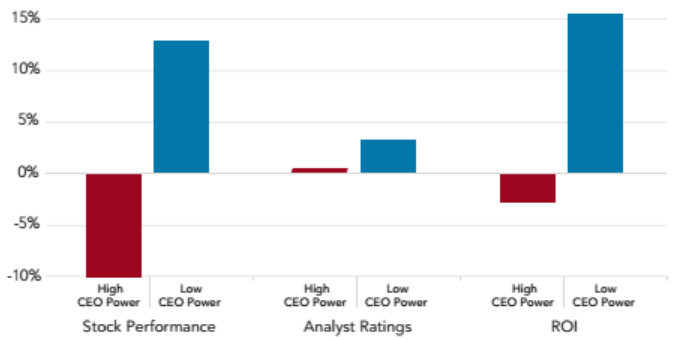
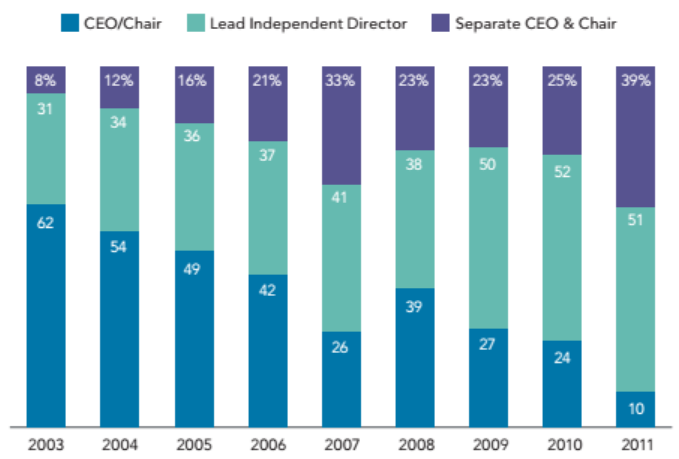
Les études contemporaines démontrent une nette tendance en faveur de la séparation des deux rôles. Le Canadian Spencer Stuart Board Index [7] estime qu’une majorité de 85 % des 100 plus grandes entreprises canadiennes cotées en bourse ont opté pour la dissociation entre les deux fonctions. Dans le même sens, le rapport Clarkson affiche que 84 % des entreprises inscrites à la bourse de Toronto ont procédé à ladite séparation [8]. Subsistent cependant encore de nos jours des entreprises canadiennes qui  permettent le cumul. L’entreprise Air Transat A.T. Inc en est la parfaite illustration : M. Jean-Marc Eustache est à la fois président du conseil et chef de la direction. A contrario, le fond de solidarité de la Fédération des travailleurs du Québec vient récemment de procéder à la séparation des deux fonctions. Aux États-Unis en 2013, 45 % des entreprises de l’indice S&P500 (au total 221 entreprises) dissocient les rôles de PDG et de président du conseil. Toutefois, les choses ne sont pas aussi simples qu’elles y paraissent : 27 % des entreprises de cet indice ont recombiné ces deux rôles [9]. Évoquons à ce titre le cas de Target Corp dont les actionnaires ont refusé la dissociation des deux fonctions [10].


Il faut séparer les fonctions !


Pendant longtemps, il a été d’usage au sein des grandes sociétés par actions, que le poste de président du conseil soit de l’apanage du chef de la direction. Selon les partisans du non cumul, fusionner ces deux fonctions revient néanmoins à réunir dans une seule main un trop grand pouvoir et des prérogatives totalement antagonistes, voir même contradictoires. En ce sens, Yvan Allaire [11] souligne qu’il est malsain pour le chef de la direction de présider aussi le conseil d’administration. Rappelons que le CA nomme, destitue, rémunère et procède à l’évaluation du chef de la direction. La séparation des deux fonctions trouve pleinement son sens ici puisqu’elle crée une contre mesure du pouvoir : le président du CA est chargé du contrôle permanent de la gestion, et le directeur général est en situation de subordination par rapport au CA.

Sous ce contrôle, le directeur général ne peut être que plus diligent et prudent dans l’exercice de ses fonctions, puisqu’il doit en rendre compte au CA. Des idées et décisions confrontées et débattues sont de loin plus constructives que des décisions prises de manière unilatérale. N’y a-t-il pas plus d’esprit dans deux têtes que dans une comme le dit le proverbe ? De plus, les partisans du non cumul avancent d’autres arguments. Il en va ainsi de la rémunération de la direction. Le cumul des deux fonctions irait de pair avec la rémunération conséquente. Celui qui endosse les deux fonctions est enclin à prendre des risques qui peuvent mettre en péril les intérêts financiers de la société pour obtenir une performance et un rendement qui justifieraient une forte rémunération. Par ailleurs, le cumul peut entrainer une négligence des deux rôles au profit de l’un ou de l’autre. Aussi, le choix du non cumul s’impose lorsque l’implication de la majorité ou encore, de la totalité des actionnaires ou membres dans la gestion quotidienne de la société, est faible. Cette séparation permet en effet aux actionnaires ou aux membres d’exercer une surveillance adéquate de la direction et de la gestion quotidienne de ladite société [12].


Attention à la séparation !


Nonobstant les arguments cités plus haut, la séparation des deux fonctions ne représente pas nécessairement une meilleure gestion du conseil d’administration. Les partisans du cumul clament que non seulement l’endossement des deux fonctions par une seule personne unifie les ordres et réduit les couts de l’information, mais que c’est aussi un mécanisme d’incitation pour les nouveaux chefs en cas de transition. Cela se traduit par la facilité de remplacer une seule personne qui détient les deux pouvoirs, à la place de remplacer deux personnes. Par ailleurs, la séparation limiterait l’innovation et diluerait le pouvoir d’un leadership effectif [13] en augmentant la rivalité entre les deux responsables pouvant même aller jusqu’à semer la confusion.


Coûts et flexibilité du choix


En dépit de la critique classique du cumul des fonctions, les deux types de structures sont potentiellement sources de bénéfices et de coûts, bénéfices et coûts que les entreprises vont peser dans leur choix de structure. Les coûts de la théorie de l’agence impliquent des arrangements institutionnels lorsqu’il y a séparation entre les fonctions de président et de chef de la direction [14]. Ces coûts sont occasionnés par exemple par la surveillance du CA sur le chef de la direction. Il devient plus cher de séparer les deux fonctions que de les unifier.

Cependant, une antithèse présentée par Andrea Ovans [15] soutient qu’au contraire il est plus cher d’unifier les deux fonctions que de les séparer. Comment ? Simplement à travers la rémunération (salaire de base, primes, incitations, avantages, stock-options, et les prestations de retraite). L’imperméabilité entre les deux fonctions qui apparaît comme « la » solution en matière de bonne gouvernance pourrait ne pas l’être pour toutes les entreprises.

Si le cumul des fonctions et les autres mécanismes de surveillance fonctionnement bien, pourquoi faudrait-il prévoir un changement ? De surcroit, le « one size fits all » n’est pas applicable en la matière. Devrait-on prévoir les mêmes règles en termes de séparation pour les grandes et petites entreprises ? Rien n’est moins sûr… Le cumul des fonctions apparaît plus adapté aux entreprises de petite taille : ceci est dû à la fluidité de communication entre les deux responsables et à la faiblesse de la quantité d’informations à traiter [16].


[1] Investors seek to split JP Morgan CEO, Chairman http://www.wfaa.com/news/business/192146051.html, <en ligne>, date de consultation : 12 Juillet 2014.

[2] http://www.oecd.org/fr/gouvernementdentreprise/ae/gouvernancedesentreprisespubliques/34803478.pdf, <en ligne>, date de consultation : 12 juillet 2014. Dans le même sens, voir l’instruction générale 85-201 et le rapport Cadbury en 1992.

[3] CCGG : Principes de gouvernance d’entreprise pour la mise en place de conseils d’administration performants, http://www.ccgg.ca/site/ccgg/assets/pdf/Principes_de_gouvernance.pdf, <en ligne>, date de consultation : 12 juillet 2014

[4] « Split CEO/Chair Roles: The Geteway to Good Governance? », http://www.rotman.utoronto.ca/FacultyAndResearch/ResearchCentres/ClarksonCentreforBoardEffectiveness/CCBEpublications/SplitCEO.aspx, <en ligne>, date de consultation : 18 juillet 2014.

[5] Code de gouvernement d’entreprise des sociétés cotées (révisé en juin 2013), http://www.medef.com/fileadmin/www.medef.fr/documents/AFEP-MEDEF/Code_de_gouvernement_d_entreprise_des_societes_cotees_juin_2013_FR.pdf, <en ligne>, date de consultation : 15 juillet 2014.

[6] L’Union européenne ne s’est pas prononcée sur la séparation des deux fonctions. Voir à ce propos Richard Leblanc.

[7] Canadian Spencer Stuart Board Index 2013, https://www.spencerstuart.com/~/media/Canadian-Board-Index-2013_27Jan2014.pdf, <en ligne>, date de consultation : 12 Juillet 2014 ; p. 19.

[8] Public Submissions on Governance Issues, http://www.powercorporation.com/en/governance/public-submissions-governance-issues/may-12-2014-canada-business-corporations-act/#_ftn12, <en ligne>, date de consultation : 18 juillet 2014.

[9] Spencer Stuart Board Index 2013 (US), https://www.spencerstuart.com/~/media/PDF%20Files/Research%20and%20Insight%20PDFs/SSBI13%20revised%2023DEC2013.pdf, <en ligne>, date de consultation : 25 juillet 2014.

[10] Target shareholders narrowly reject splitting CEO, Chairman posts, http://www.bizjournals.com/twincities/news/2014/06/13/target-shareholders-narrowly-reject-splitting-ceo.html, <en ligne>, date de consultation : 18 juillet 2014.

[11] Yvan Allaire, « Un « bon » président du CA ? », http://droit-des-affaires.blogspot.ca/2007/11/un-bon-prsident-du-ca.html, <en ligne>, date de consultation : 23 juillet 2014.

[12] À ce propos, voir André Laurin, « La fonction de président de conseil d’administration », http://www.lavery.ca/upload/pdf/fr/DS_080203f.pdf, <en ligne>, date de consultation : 21 juillet 2014, p. 2.

[13] Aiyesha Dey, Ellen Engel and Xiaohui Gloria Liu, « CEO and Board Chair Roles: to Split or not to Split? », December 16, 2009, http://papers.ssrn.com/sol3/papers.cfm?abstract_id=1412827, <en ligne>, date de consultation : 22 juillet 2014.

[14] Idem.

[15] Voir Coûts élevés associés à la combinaison des rôles du président du conseil et du président de la société : https://jacquesgrisegouvernance.com/2014/06/29/couts-eleves-associes-a-la-combinaison-des-roles-du-president-du-conseil-et-du-president-de-la-societe/, <en ligne>, date de consultation : 21 juillet 2014.

[16] Aiyesha Dey, « What JPMorgan Shareholders Should Know About Splitting the CEO and Chair Roles », Research, http://blogs.hbr.org/2013/05/research-what-jpmorgan-shareho/, <en ligne>, date de consultation : 21 juillet 2014.

L’utilisation des huis clos lors des sessions de C.A. *


Voici un article intéressant de Matthew Scott sur le site de Corporate Secretary qui aborde un sujet qui préoccupe beaucoup de hauts dirigeants : le huis clos lors des sessions du conseil d’administration ou de certains comités. L’auteur explique très bien la nature et la nécessité de cette activité à inscrire à l’ordre du jour du conseil.

Compte tenu de la « réticence » de plusieurs hauts dirigeants à la tenue de cette activité, il est généralement reconnu que cet item devrait toujours être présent à l’ordre du jour afin d’éliminer certaines susceptibilités.

Le huis clos est un temps privilégié que les administrateurs indépendants se donnent pour se questionner sur l’efficacité du conseil et la possibilité d’améliorer la dynamique interne; mais c’est surtout une occasion pour les membres de discuter librement, sans la présence des gestionnaires, de sujets délicats tels que la planification de la relève, la performance des dirigeants, la rémunération globale de la direction, les poursuites légales, les situations de conflits d’intérêts, les arrangements confidentiels, etc. On ne rédige généralement pas de procès-verbal à la suite de cette activité, sauf lorsque les membres croient qu’une résolution doit absolument apparaître au P.V.

La mise en place d’une période de huis clos est une pratique relativement récente, depuis que les conseils d’administration ont réaffirmé leur souveraineté sur la gouvernance des entreprises. Cette activité est maintenant considérée comme une pratique exemplaire de gouvernance et presque toutes les sociétés l’ont adoptée.

Notons que le rôle du président du conseil, en tant que premier responsable de l’établissement de l’agenda, est primordial à cet égard. C’est lui qui doit informer le PCD de la position des membres indépendants à la suite du huis clos, un exercice qui demande du tact !

Je vous invite à lire l’article ci-dessous. Vos commentaires sont les bienvenus.

Are you using in-camera meetings ?

More companies are encouraging candid exchange among independent directors without management present

As corporate boards face more complex and difficult decisions, they may want to consider increasing the use of in-camera meetings to get more ‘realistic’ opinions from directors before moving forward with corporate strategy.

In-camera meetings, as they are called in Canada – or executive sessions, as they are referred to in the US – are special meetings where independent directors or committees of the board convene separately from management to have candid, off-the-record discussions about matters that are important to the company.

English: SOS Meetings Logo
English: SOS Meetings Logo (Photo credit: Wikipedia)

The term ‘In camera’ derives from Latin and refers to ‘in a chamber’ which is a legal term meaning ‘in private.’ During these meetings, independent board members are free to challenge each other and speak their mind freely because minutes are generally not taken. Such meetings could be held to discuss and clarify the board’s position on issues that may produce opposing views between management and the board or to deal with issues that could involve conflicts of interest with management, such as CEO compensation.

‘In-camera meetings allow directors to talk about their view of matters without management present,’ says Jo-Anne Archibald, president of DSA Corporate Services. ‘They can talk about anything related to the company and they don’t have to worry about it being written down anywhere.’


* En reprise

Le rôle du comité exécutif vs le rôle du conseil d’administration | En rappel


Voici une discussion très intéressante paru sur le groupe de discussion LinkedIn Board of Directors Society, et initiée par Jean-François Denaultconcernant la nécessité de faire appel à un comité exécutif.

Je vous invite à lire les commentaires présentés sur le fil de discussion du groupe afin de vous former une opinion.

Personnellement, je crois que le comité exécutif est beaucoup trop souvent impliqué dans des activités de nature managériale.

Dans plusieurs cas, le CA pourrait s’en passer et reprendre l’initiative !

Qu’en pensez-vous ?

____________________________________________________


La situation exposée par  est la suivante (en anglais) :

I’m looking for feedback for a situation I encountered.
I am a board member for a non-profit. Some of us learned of an issue, and we brought it up at the last meeting for an update.
We were told that it was being handled by the Executive Committee, and would not be brought up in board meetings.
It is my understanding that the executive committee’s role is not to take issues upon themselves, but to act in interim of board meetings. It should not be discussing issues independently from the board.
Am I correct in thinking this? Should all issues be brought up to the board, or can the executive committee handle situations that it qualifies as « sensitive »?


The Role of the Executive Committee versus the main board of directors


Résultats de recherche d'images pour « comité exécutif »


Alan Kershaw

Chair of Regulatory Board

Depends whether it’s an operational matter I guess – e.g. a staffing issue below CEO/Director level. If it’s a matter of policy or strategy, or impacts on them, then the Board is entitled to be kept informed, surely, and to consider the matter itself. 


John Dinner

John T,  Dinner Board Governance Services

Helping boards improve their performance and contributionI’ll respond a bit more broadly, Jean-François. While I am not opposed to the use of executive committees, a red flag often goes up when I conduct a governance review for clients and review their EC mandate and practices. There is a slippery slope where such committees find themselves assuming more accountability for the board’s work over time. Two classes of directors often form unintentionally as a result. Your situation is an example where the executive committee has usurped the board’s final authority. While I don’t recommend one approach, my inclination is to suggest that boards try to function without an executive committee because of the frequency that situations similar to the one you describe arise at boards where such committees play an active role. There are pros and cons, of course, for having these committees, but I believe the associated risk often warrants reconsideration of their real value and need.


Chuck Molina

Chief Technology Officer at DHI

I currently sit on the EC and have been in that role with other boards. Although I can see the EC working on projects as a subset of the board we Always go back to the full board and disclose those projects and will take items to the full board for approval. The board as a whole is accountable for decisions! There has to be transparency on the board! I found this article for you. http://www.help4nonprofits.com/BrainTeaser/BrainTeaser-Role_of_Executive_Committee.htm , which concurs to John’s comment. If used correctly the EC or a subset of the board can work on board issues more efficiently then venting through the full board, but they should always go back to the Full board for consideration or approval.  


Dave Chapman

CHM and CEO of NorthPoint ERM

I have experienced couple of EB’s and unless the company is in deep financial or legal trouble for the most part the took away from the main board and in the whole worked ok but not great. If the board has over 10 to 15 board members it is almost a requirement but the board them is there for optics more than or effective and efficient decision making

Experienced CEO & Board member of Domestic and European companies.

I think Mr. Dinner, Mr. Molina, and Mr. Chapman summed it up beautifully:
– You cannot have two classes of Directors
– You have to have transparency and every Board member is entitled to the same information
– A Board of 10-15 members is inefficient and may need committees, but that does not change the fact that all Board members are entitled to have input into anything that the Board decides as a body.
– An Executive Committee is a sub-committee of the entire Board, not an independent body with extraordinary powers.


Al Errington

Entrepreneur & Governance Advocate

I agree with John, executive committees tend to be a slippery slope to bad governance. The board of directors has the responsibility of direction and oversight of the business or organization. If anything goes substantially wrong, the board of directors will also be accountable, legally. The rules of thumb for any and all committees is
– Committees must always be accountable to the board of directors, not the other way around.
– Committees must always have limits defined by the board of directors on authority and responsibility, and should have limits on duration.
– Committees should always have a specific reason to exist and that reason should be to support the board of directors in addressing it’s responsibilities. 


Emerson Galfo

Consulting CFO/COO / Board Member/Advisor

Judging from the responses, we need to clearly define the context of what an Executive Committee is. Every organization can have it’s own function/view of what an Executive Committee is.

From my experience, an Executive Committee is under the CEO and reflects a group of trusted C-level executives that influence his decisions. I have had NO experience with Executive Boards other than the usual specific Board Committees dealing with specific realms of the organization.

So coming from this perspective, the Executive Committee is two steps down from the organizational pecking order and should be treated or viewed in that context.. 


Terry Tormey

President & CEO at Prevention Pharmaceuticals Inc.

I concur with Mr. James Clouser (above).
They should be avoided except in matters involving a performance question regarding C-Level Executive Board member, where a replacement may be sought.


John Baily

Board of Directors at RLI Corp

James hit the nail on the head. Executive committees are a throwback to times when we didn’t have the communication tools we do now. They no longer have a reason for their existence. All directors, weather on a not for profit or a corporate board have equal responsibilities and legal exposures. There is no room or reason for a board within a board in today’s world.


Chinyere Nze

Chief Executive Officer

My experience is; Board members have the last say in all policy issues- especially when it concerns operational matter. But in this case, where there is Executive Committee, what it sounds like is that, the organization in question has not clearly identified, nor delineated the roles of each body- which seem to have brought up the issue of ‘conflict’ in final decision- making. Often Executive Committees are created to act as a buffer or interim to the Board, this may sometime cause some over-lapping in executive decision-making.

My suggestion is for the organization to assess and evaluate its current hierarchy- clearly identify & define roles-benefits for creating and having both bodies, and how specific policies/ protocol would benefit the organization. In other words, the CEO needs to define the goals or benefits of having just a Board or having both bodies, and to avoid role conflict or over-lap, which may lead to confusion, as it seems to have been the case here. 


STEPHEN KOSMALSKI

CEO / PRESIDENT/BOARD OF DIRECTORS /PRIVATE EQUITY OPERATING PARTNER known for returning growth to stagnant businesses

The critical consideration for all board members is ‘ fiduciary accountability’ of all bod members. With that exposure , all bod members should be aware of key issues . 


Thomas Brattle « Toby » Gannett

President and CEO at BCR Managment

I think for large organizations, that executive committees still have an important role as many board members have a great deal going on and operational matters may come up from time to time that need to be handled in a judicial manner. While I think that the Executive committee has an important, at times critical role for a BOD, it is also critical that trust is built between the executive Committee and the BOD. This is only done when the executive committee is transparent, and pushes as many decisions that it can to the full board. If the committee does not have time to bring a matter to the full BOD, then they must convey to the BOD the circumstances why and reasoning for their decision. It is the executive committees responsibility to build that trust with the BOD and work hard to maintain it. All strategic decisions must be made by the full BOD. It sounds like you either have a communication failure, governance issue, or need work with your policies and procedures or a combination of issues.


Composition du conseil d’administration d’OSBL et recrutement d’administrateurs | En rappel


Ayant collaboré à la réalisation du volume « Améliorer la gouvernance de votre OSBL » des auteurs Jean-Paul Gagné et Daniel Lapointe, j’ai obtenu la primeur de la publication d’un chapitre sur mon blogue en gouvernance.

Pour donner un aperçu de cette importante publication sur la gouvernance des organisations sans but lucratif (OSBN), j’ai eu la permission des éditeurs, Éditions Caractère et Éditions Transcontinental, de publier l’intégralité du chapitre 4 qui porte sur la composition du conseil d’administration et le recrutement d’administrateurs d’OSBL.

Je suis donc très fier de vous offrir cette primeur et j’espère que le sujet vous intéressera suffisamment pour vous inciter à vous procurer cette nouvelle publication.

Vous trouverez, ci-dessous, un court extrait de la page d’introduction du chapitre 4. Je vous invite à cliquer sur le lien suivant pour avoir accès à l’intégralité du chapitre.


La composition du conseil d’administration et le recrutement d’administrateurs


Résultats de recherche d'images pour « composition du CA »


Vous pouvez également feuilleter cet ouvrage en cliquant ici

Bonne lecture ! Vos commentaires sont les bienvenus.

__________________________________


Les administrateurs d’un OSBL sont généralement élus dans le cadre d’un processus électoral tenu lors d’une assemblée générale des membres. Ils peuvent aussi faire l’objet d’une cooptation ou être désignés en vertu d’un mécanisme particulier prévu dans une loi (tel le Code des professions).

L’élection des administrateurs par l’assemblée générale emprunte l’un ou l’autre des deux scénarios suivants:

1. Les OSBL ont habituellement des membres qui sont invités à une assemblée générale annuelle et qui élisent des administrateurs aux postes à pourvoir. Le plus souvent, les personnes présentes sont aussi appelées à choisir l’auditeur qui fera la vérification des états financiers de l’organisation pour l’exercice en cours.

ameliorezlagouvernancedevotreosbl

2. Certains OSBL n’ont pas d’autres membres que leurs administrateurs. Dans ce cas, ces derniers se transforment une fois par année en membres de l’assemblée générale, élisent des administrateurs aux postes vacants et choisissent l’auditeur qui fera la vérification des états financiers de l’organisation pour l’exercice en cours.


La cooptation autorise le recrutement d’administrateurs en cours d’exercice. Les personnes ainsi choisies entrent au CA lors de la première réunion suivant celle où leur nomination a été approuvée. Ils y siègent de plein droit, en dépit du fait que celle-ci ne sera entérinée qu’à l’assemblée générale annuelle suivante. La cooptation n’est pas seulement utile pour pourvoir rapidement aux postes vacants; elle a aussi comme avantage de permettre au conseil de faciliter la nomination de candidats dont le profil correspond aux compétences recherchées.

Dans les organisations qui élisent leurs administrateurs en assemblée générale, la sélection en fonction des profils déterminés peut présenter une difficulté : en effet, il peut arriver que les membres choisissent des administrateurs selon des critères qui ont peu à voir avec les compétences recherchées, telles leur amabilité, leur popularité, etc. Le comité du conseil responsable du recrutement d’administrateurs peut présenter une liste de candidats (en mentionnant leurs qualifications pour les postes à pourvoir) dans l’espoir que l’assemblée lui fasse confiance et les élise. Certains organismes préfèrent coopter en cours d’exercice, ce qui les assure de recruter un administrateur qui a le profil désiré et qui entrera en fonction dès sa sélection.

Quant à l’élection du président du conseil et, le cas échéant, du vice-président, du secrétaire et du trésorier, elle est généralement faite par les administrateurs. Dans les ordres professionnels, le Code des professions leur permet de déterminer par règlement si le président est élu par le conseil d’administration ou au suffrage universel des membres. Comme on l’a vu, malgré son caractère démocratique, l’élection du président au suffrage universel des membres présente un certain risque, puisqu’un candidat peut réussir à se faire élire à ce poste sans expérience du fonctionnement d’un CA ou en poursuivant un objectif qui tranche avec la mission, la vision ou encore le plan stratégique de l’organisation. Cet enjeu ne doit pas être pris à la légère par le CA. Une façon de minimiser ce risque est de faire connaître aux membres votants le profil recherché pour le président, profil qui aura été préalablement établi par le conseil. On peut notamment y inclure une expérience de conseil d’administration, ce qui aide à réduire la période d’apprentissage du nouveau président et facilite une transition en douceur.

Cinq principes simples et universels de saine gouvernance | En rappel


Quels sont les principes fondamentaux de la bonne gouvernance ? Voilà un sujet bien d’actualité, une question fréquemment posée, laquelle appelle, trop souvent, des réponses complexes et peu utiles pour ceux qui siègent sur des conseils d’administration.

L’article de Jo Iwasaki, paru sur le site du NewStateman, a l’avantage de résumer très succinctement les cinq (5) grands principes qui doivent animer et inspirer les administrateurs de sociétés.

Les principes évoqués dans l’article sont simples et directs; ils peuvent même paraître simplistes mais, à mon avis, ils devraient servir de puissants guides de référence à tous les administrateurs de sociétés.

Les cinq principes retenus dans l’article sont les suivants :

Un solide engagement du conseil (leadership);

Une grande capacité d’action liée au mix de compétences, expertises et savoir être;

Une reddition de compte efficace envers les parties prenantes;

Un objectif de création de valeur et une distribution équitable entre les principaux artisans de la réussite;

De solides valeurs d’intégrité et de transparence susceptibles de faire l’objet d’un examen minutieux de la part des parties prenantes.

« What board members need to remind themselves is that they are collectively responsible for the long-term success of their company. This may sound obvious but it is not always recognised ».

What are the fundamental principles of corporate governance ?


cropped-nuage_mots_960x250


Our suggestion is to get back to the fundamental principles of good governance which board members should bear in mind in carrying out their responsibilities. If there are just a few, simple and short principles, board members can easily refer to them when making decisions without losing focus. Such a process should be open and dynamic.

In ICAEW’s  recent paper (The Institute of Chartered Accountants in England and Wales) What are the overarching principles of corporate governance?, we proposed five such principles of corporate governance.

Leadership

An effective board should head each company. The Board should steer the company to meet its business purpose in both the short and long term.

Capability

The Board should have an appropriate mix of skills, experience and independence to enable its members to discharge their duties and responsibilities effectively.

Accountability

The Board should communicate to the company’s shareholders and other stakeholders, at regular intervals, a fair, balanced and understandable assessment of how the company is achieving its business purpose and meeting its other responsibilities.

Sustainability

The Board should guide the business to create value and allocate it fairly and sustainably to reinvestment and distributions to stakeholders, including shareholders, directors, employees and customers.

Integrity

The Board should lead the company to conduct its business in a fair and transparent manner that can withstand scrutiny by stakeholders.

We kept them short, with purpose, but we also kept them aspirational. None of them should be a surprise – they might be just like you have on your board. Well, why not share and exchange our ideas – the more we debate, the better we remember the principles which guide our owbehaviour.

De son côté, l’Ordre des administrateurs agréés du Québec (OAAQ) a retenu six (6) valeurs fondamentales qui devraient guider les membres dans l’accomplissement de leurs tâches de professionnels. Il est utile de les rappeler dans ce billet :

Transparence 

La transparence laisse paraître la réalité tout entière, sans qu’elle ne soit altérée ou biaisée. Il n’existe d’autre principe plus vertueux que la transparence de l’acte administratif par l’administrateur qui exerce un pouvoir au nom de son détenteur; celui qui est investi d’un pouvoir doit rendre compte de ses actes à son auteur.

Essentiellement, l’administrateur doit rendre compte de sa gestion au mandant ou autre personne ou groupe désigné, par exemple, à un conseil d’administration, à un comité de surveillance ou à un vérificateur. L’administrateur doit également agir de façon transparente envers les tiers ou les préposés pouvant être affectés par ses actes dans la mesure où le mandant le permet et qu’il n’en subit aucun préjudice.

Continuité

La continuité est ce qui permet à l’administration de poursuivre ses activités sans interruption. Elle implique l’obligation du mandataire de passer les pouvoirs aux personnes et aux intervenants désignés pour qu’ils puissent remplir leurs obligations adéquatement.

La continuité englobe aussi une perspective temporelle. L’administrateur doit choisir des avenues et des solutions qui favorisent la survie ou la croissance à long terme de la société qu’il gère. En lien avec la saine gestion, l’atteinte des objectifs à court terme ne doit pas menacer la viabilité d’une organisation à plus long terme.

Efficience

L’efficience allie efficacité, c’est-à-dire, l’atteinte de résultats et l’optimisation des ressources dans la pose d’actes administratifs. L’administrateur efficient vise le rendement optimal de la société à sa charge et maximise l’utilisation des ressources à sa disposition, dans le respect de l’environnement et de la qualité de vie.

Conscient de l’accès limité aux ressources, l’administrateur met tout en œuvre pour les utiliser avec diligence, parcimonie et doigté dans le but d’atteindre les résultats anticipés. L’absence d’une utilisation judicieuse des ressources constitue une négligence, une faute qui porte préjudice aux commettants.

Équilibre

L’équilibre découle de la juste proportion entre force et idées opposées, d’où résulte l’harmonie contributrice de la saine gestion des sociétés. L’équilibre se traduit chez l’administrateur par l’utilisation dynamique de moyens, de contraintes et de limites imposées par l’environnement en constante évolution.

Pour atteindre l’équilibre, l’administrateur dirigeant doit mettre en place des mécanismes permettant de répartir et balancer l’exercice du pouvoir. Cette pratique ne vise pas la dilution du pouvoir, mais bien une répartition adéquate entre des fonctions nécessitant des compétences et des habiletés différentes.

Équité

L’équité réfère à ce qui est foncièrement juste. Plusieurs applications en lien avec l’équité sont enchâssées dans la Charte canadienne des droits et libertés de la Loi canadienne sur les droits de la personne et dans la Charte québécoise des droits et libertés de la personne. L’administrateur doit faire en sorte de gérer en respect des lois afin de prévenir l’exercice abusif ou arbitraire du pouvoir.

Abnégation

L’abnégation fait référence à une personne qui renonce à tout avantage ou intérêt personnel autre que ceux qui lui sont accordés par contrat ou établis dans le cadre de ses fonctions d’administrateur.

Effective Governance | Top Ten Steps to Improving Corporate Governance | Effective Governance (jacquesgrisegouvernance.com)

Vous vous préparez à occuper un poste d’administrateur d’une entreprise ? (jacquesgrisegouvernance.com)

Corporate governance in multicultural organization (leadershipbyvirtue.blogspot.com)

Corporate Governance Quick Read – The role of the board is to govern (togovern.wordpress.com)

Fact and Fiction in Corporate Law and Governance (blogs.law.harvard.edu)

Carol Hansell: Corporate governance is a part of every major decision (jacquesgrisegouvernance.com)

Are Women Decision Makers More Risk Averse Than Their Male Counterparts? (togovern.wordpress.com)

Le choix entre le couple expérience-réputation et le couple fougue-expertise | Ça dépend !


Aujourd’hui, je vous présente un cas fascinant qui illustre les difficultés de choisir un nouvel administrateur d’une jeune entreprise technologique.

Ce cas de gouvernance, publié en novembre 2017 sur le site de Julie Garland McLellan*, décrit la situation d’une entreprise qui est sur le point de s’inscrire en bourse ; choisit-elle, comme nouvel administrateur, une jeune personne fougueuse avec une solide expertise technique, ou choisit-elle une personne d’expérience possédant une grande réputation de bonne gouvernance ?

Le courtier qui conseille l’entreprise sur les conditions de son entrée en bourse lui suggère impérativement le choix d’une personne de grande réputation dans le domaine des affaires.

Le cas soumis est réel et il incite trois experts à présenter des points de vue assez différents sur les avantages et les inconvénients liés à chacun des choix.

Afin de vous former une idée mieux étayée du dilemme qui met en contraste les experts en gouvernance dans ce cas, je vous invite à lire leurs opinions en allant sur le site de Julie.

Et vous, qu’en pensez-vous ? Faites-vous une idée claire avant de consulter les réponses des experts.

Bonne lecture ! Vos commentaires sont toujours les bienvenus.

Le choix entre le couple expérience-réputation et le couple fougue-expertise | Ça dépend !


This month our case study considers the dilemma of choosing between experience and potential when building a board for an IPO. I hope you will enjoy thinking through the key governance issues and developing your own judgement from this dilemma.

Umberto founded his company ten years ago and built a successful technology company with a product that is tested in the market and capable of further development. Potential exists to take the product global; Umberto needs to move fast to retain the advantage of IP and know-how that can’t be easily replicated. An IPO is planned within twelve months and Umberto is confident his business will make a smooth transition from private to public company status.

Umberto has an advisory board with a range of skilled directors, each of whom adds considerable expertise in a relevant topic. He has benefitted greatly from their insights, and plans to convert this group of people into a governing board as he goes through the listing process. He is keen to add a new person to his board and has spoken with an ambitious bright young executive who has recently returned after five years in Asia selling a technology similar to Umberto’s product.

The broker advising on the IPO told Umberto that his board are a -bunch of unknowns” and unlikely to inspire the confidence of private equity investors and small funds that are the target market for his equity raising. The broker suggests appointing a ‘household name’ director from a large listed company. He admits that this person would not add much to the strategic competence of the board but claims they would help to bring in investors.

Umberto is in a quandary; he feels it would be disloyal to back out after his discussions with the young potential director, can’t justify bringing in two new directors, and doesn’t want to lose any of his existing team. He understands the merit of the broker’s suggestion. Should he choose experience and reputation or energy and ability?


*Julie Garland McLellan is a practising non-executive director and board consultant based in Sydney, Australia. www.mclellan.com.au/newsletter.html

Sommaire de l’enquête de PwC sur la gouvernance des entreprises auprès des administrateurs


La gouvernance des entreprises a beaucoup évolué au cours des vingt dernières années. Aujourd’hui, les investisseurs institutionnels détiennent 70 % des actions des corporations publiques.

L’auteure indique que l’un des seuls moyens pour les actionnaires investisseurs d’améliorer la performance des entreprises est d’agir sur la gouvernance des entreprises, en exerçant différentes pressions auprès du management et des administrateurs (« direct engagement ») et en faisant connaître leur avis via le vote par procuration.

Un sommaire de l’étude publié par Paula Loop*, directrice du Centre de la gouvernance de PricewaterhouseCoopers, nous donne un bon aperçu des principaux changements observés lors de l’enquête auprès de 886 administrateurs de grandes corporations américaines.

Voici les points saillants de l’étude :

  1. Director discontent with peers hits a high-water mark
  2. Boards are taking more action on performance assessments
  3. Independent chairs are more likely to have the difficult conversations
  4. Key issues are not being prioritized in many boardrooms
  5. Male and female directors see strategy very differently
  6. Executive pay plans are effective—except where they’re not
  7. Seeing returns on shareholder engagement
  8. The gender divide is real on questions of board diversity
  9. Challenging management is a challenge


Voir le résumé de l’enquête ci-dessous.

Bonne lecture ! Vos commentaires sont appréciés.


Insights from PwC’s 2017 Annual Corporate Directors Survey


« Against the backdrop of a new administration in Washington and growing social divisiveness, US public company directors are faced with great expectations from investors and the public. Perhaps now more than ever, public companies are being asked to take the lead in addressing some of society’s most difficult problems. From seeking action on climate change to advancing diversity, stakeholder expectations are increasing and many companies are responding.

In part, this responsiveness is driven by changes in who owns public companies today. Institutional investors now own 70% of US public company stock, much of which is held in index funds. [1] Many of these passive investors believe that seeking improvements in corporate governance is one of the only levers they have to improve company performance. And these shareholders are exerting their influence with management teams and the board through their governance policies, direct engagement and proxy voting.

But boards and shareholders don’t always agree, and the corporate governance environment itself is not immune to divisiveness. In fact, our research shows that directors are clearly out of step with investor priorities in some critical areas.

One of these areas is environmental issues. During the 2017 proxy season, a handful of shareholder proposals on environmental issues, like climate change, gained majority shareholder support. This is the first time we have seen these types of proposals pass, and they did so with the help of some of the largest institutional investors like BlackRock, Vanguard and Fidelity. For their part, some of the largest US companies declared their continuing commitment to take action fighting climate change, even as the US announced its withdrawal from the Paris climate accord.

About the survey


For over a decade, PwC’s Annual Corporate Directors Survey has gauged the views of public company directors from across the United States on a variety of corporate governance matters. In the summer of 2017, 886 directors participated in our survey. The respondents represent a cross-section of companies from over a dozen industries,

75% of which have annual revenues of more than $1 billion. Eighty-four percent of the respondents were men, and 16% were women. Their board tenure varied, but 60% have served on their board for five or more years.


But despite increased shareholder interest in environmental risk, there appears to be a disconnect when it comes to the views in many boardrooms. A majority of directors tell us that their boards don’t need sustainability expertise. A surprising number also say their company’s strategy isn’t being influenced by climate change or resource scarcity, and that they don’t think environmental concerns will impact their current strategy. Companies and investors may be driving the agenda, but rather than leading the way in this area, many directors are being carried along.

Gender diversity on boards has also become a clear priority for institutional investors in 2017. Shareholders like State Street Global Advisors and BlackRock recently adopted new diversity policies or guidance on board diversity. Indeed, State Street even voted against directors at hundreds of companies that it believed had not made sufficient strides in diversifying their boards. Yet despite the increased focus from institutional investors, fewer of the new board seats in 2016 went to women than in the prior year. [2] And gender parity is still a long way off, with only 25% of boards in the S&P 500 having more than two female directors. [3] Even so, about half of female directors tell us that their board is already sufficiently diverse. Which leads to the question—are female directors sufficiently championing the cause of gender diversity?

Investors are also putting the spotlight on social issues like income inequality and employee retirement security, asking companies to help develop shared economic security. But again, directors tell us that income inequality considerations should not play a part in company strategy.

PwC’s 2017 Annual Corporate Directors Survey examines the areas where directors and investors are aligned and moving forward together, as well as the ways in which they are out of sync.

While boards have made real improvements in some areas, there is clearly more work to be done. Among our key observations:


Director discontent with peers hits a high-water mark


With greater expectations of boards, directors are upping their game and are seeking to add value. More than ever, directors—particularly those who are less tenured—are also noticing that not all of their fellow directors are doing the same. Almost half of directors (46%) believe that one or more of their fellow board members should be replaced. One-fifth of directors say that two or more directors on their board should be replaced.


Boards are taking more action on performance assessments


Investors have been pushing boards to not just conduct board performance assessments, but to do something with the results. This year, more than twothirds (68%) say that their board has taken some action in response to their last board assessment—an increase of 19 percentage points over last year.


Independent chairs are more likely to have the difficult conversations


Directors on boards with non-executive chairs are more than twice as likely to say that their board decided not to re-nominate a director, or provided counsel to a director, as a result of the board’s assessment process.


Key issues are not being prioritized in many boardrooms


While investors are talking about the impact of environmental and social issues on the bottom line, the conversations are not necessarily filtering up to the boardroom. A significant percentage of directors say that income inequality (51%), immigration (49%) and climate change (40%) should not be taken into account—at all—in company strategy.


Male and female directors see strategy very differently


Female directors are more likely to think that social issues should play a part in company strategy formation. And they are much more likely to think that issues like environmental concerns and social instability will force the company to change its strategy in the next three years.


Executive pay plans are effective—except where they’re not


Directors are confident that incentive plans promote long-term shareholder value. But 70% at least somewhat agree that executives in general are overpaid, and 66% say that executive compensation exacerbates income inequality. Meanwhile, executive pay continues to go up, not down. [4]


Seeing returns on shareholder engagement


In just the past year, directors have come around to a much more positive view of shareholder engagement. They are much more likely now to think that direct engagement impacts proxy voting (77% as compared to 59% in 2016). And the vast majority now say that the right representatives are present (85%) and investors are well prepared for meetings (84%)—12 and 21 percentage point increases over last year, respectively.


The gender divide is real on questions of board diversity


Male and female directors have a significant difference of opinion about the impact of board diversity on company performance. Nearly five out of six female directors (82%) believe that diversity enhances company performance, while only just over half of men agree (54%).


Challenging management is a challenge


Strategy oversight is one of the board’s core responsibilities. Investors want to know that directors are heavily involved in evaluating, challenging and monitoring the company’s strategy, and calling for a change of course when needed. Yet only 60% of directors say their board strongly challenges management assumptions on strategy as part of their oversight role.

As we analyzed the results of this year’s survey, we also looked behind the numbers at how demographic differences such as gender and length of tenure on the board affected directors’ views. Read on for our full analysis of the survey results and areas where those differences were notable. And for the results of every question in the survey, please refer to the Appendix of the complete publication.

The complete publication is available here.

Endnotes

1Institutional investors owned an average of 70% of the outstanding shares of US public companies as of June 30, 2017. PwC + Broadridge, ProxyPulse 2017 Proxy Season Review, September 2017. Forty-two percent of all US stock fund assets as of June 30, 2017 were held through index funds. Investment Company Institute.(go back)

2 The percentage of women in new board appointments at Fortune 500 companies declined two percentage points to 27.3% in 2016. Fortune, “The Share of Women Appointed to Fortune 500 Declined Last Year,” June 19, 2017.(go back)

3Spencer Stuart, 2016 Spencer Stuart Board Index, November 2016.(go back)

4See Willis Towers Watson Executive Pay Bulletin, May 9, 2017.(go back) »

_____________________________________

*Paula Loop is Leader of the Governance Insights Center at PricewaterhouseCoopers LLP. This post is based on a publication from the PwC Governance Insights Center.

Compte rendu hebdomadaire de la Harvard Law School Forum on Corporate Governance | 26 octobre 2017


Voici le compte rendu hebdomadaire du forum de la Harvard Law School sur la gouvernance corporative au 26 octobre 2017.

Cette semaine, j’ai relevé les dix principaux billets.

Bonne lecture !


Résultats de recherche d'images pour « harvard law school forum on corporate governance »


Résultats de recherche d'images pour « harvard law school forum on corporate governance »


  1. Securities Cases to Watch this Term at the Supreme Cour
  2. Director Networks, Turnover, and Appointments
  3. Protecting Shareholder Ownership and Governance Rights
  4. 2017 Relative TSR Prevalence and Design of S&P 500 Companies
  5. Busy Directors: Strategic Interaction and Monitoring Synergies
  6. Where’s the Board? Questions for Equifax
  7. Building a Better Board Book
  8. The Rise of Investor-Centric Activism Defense Strategy
  9. Environmental and Social Proposals in the 2017 Proxy Season
  10. Activism’s New Paradigm

Divulgation protégée d’un lanceur d’alerte dans une société d’État | Un cas épineux pour un président de conseil


Voici un cas de gouvernance, publié en octobre 2017 sur le site de Julie Garland McLellan*, qui présente une situation dans laquelle Tiffany, la présidente du conseil d’une grande société d’État, se demande quel plan d’action elle doit adopter avant la rencontre de son ministre responsable.

Le cas soumis est très délicat, car il présente une situation où un employé divulgue l’abus de pouvoir d’un haut dirigeant qui se rapporte au CEO. Les membres du conseil sont avisés des allégations, mais les administrateurs auraient voulu en savoir davantage. Cependant, ils comprennent que l’identité de l’informateur est protégée par leur propre politique !

Le CEO est très mécontent de la situation et il exige que ses employés lui fournissent toutes les informations relatives à cette divulgation.

Quelle approche Tiffany doit-elle privilégier lors de sa rencontre avec le ministre ? Doit-elle proposer le congédiement du CEO qui, dans l’ensemble, s’acquitte très bien de ses responsabilités de direction ? Quelles sont ses options ?

Le cas présente la situation succinctement, mais clairement ; puis, trois experts en gouvernance se prononcent sur le dilemme qui se présente aux personnes qui vivent des situations similaires.

Je vous invite donc à lire ces opinions en allant sur le site de Julie.

Bonne lecture ! Vos commentaires sont toujours les bienvenus.


Divulgation par un lanceur d’alerte dans une société d’État


Our case study this month looks at how a board can establish control without losing a valuable executive. I hope you will enjoy thinking through the key governance issues and developing your own judgement from this dilemma.

Tiffany chairs a large government-sector company. It is subject to intense public scrutiny as it handles multi-million-dollar investments and sensitive customer information.

A few months ago, a whistle-blower made a series of protected disclosures alleging improper use of position and information by one of the CEO’s direct reports. The Senior Compliance Officer (SCO) briefed the board, and CEO, on the allegations and their investigation. The board were unhappy with the level of detail available but accepted this as an inevitable consequence of their policy which protects the identity of whistle-blowers.

Unbeknownst to Tiffany, or her board, the CEO angrily followed up with the SCO after the board meeting and said that he was embarrassed to have been unable to provide complete answers to the board’s questions. The investigation eventually exonerated the person concerned and the SCO reported to the CEO that the case was ‘closed’. The CEO responded to the news with an emailed request that he now be told who had made the allegations. The SCO refused to divulge the identity but confirmed he had reported the outcome to the whistle-blower.

The following morning the CEO asked the SCO’s secretary to forward him a copy of all documents relating to the completed inquiry and specifically requested the closure report sent to the confidential informant. The SCO found out and referred the matter to the anti-corruption authority before reporting the matter to Tiffany.

Tiffany wants to brief the Minister before the matter becomes public. She would like a plan of action before she meets the Minister. She doesn’t want to fire the CEO as he is doing well in other respects; she knows action is essential.

What are her options?


*Julie Garland McLellan is a practising non-executive director and board consultant based in Sydney, Australia. www.mclellan.com.au/newsletter.html

Compte rendu hebdomadaire de la Harvard Law School Forum on Corporate Governance | 19 octobre 2017


Voici le compte rendu hebdomadaire du forum de la Harvard Law School sur la gouvernance corporative au 19 octobre 2017.

Cette semaine, j’ai relevé les dix principaux billets.

Bonne lecture !


Résultats de recherche d'images pour « harvard law school forum on corporate governance »


Résultats de recherche d'images pour « harvard law school forum on corporate governance »


  1. Do Clawback Adoptions Influence Capital Investments?
  2. Cross-Border Reincorporations in the European Union: The Case for Comprehensive Harmonisation
  3. Proxy Season Legal Update
  4. Capable Boards and Value Creation
  5. Pay Ratio: The Time Has Come
  6. Proposed Overhaul of Disclosure and Shareholder Proposal Rules
  7. Novel Defensive Tactics Against Activist Shareholders
  8. Rejection of the Universal Proxy Card
  9. The Impact of Shareholder Activism on Board Refreshment Trends at S&P 1500 Firms
  10. Fiduciary Principles and Delaware Corporation Law

Quelles tendances en gouvernance, identifiées en 2014, se sont avérées


J’ai réalisé une entrevue avec le Journal des Affaires le 17 mars 2014. Une rédactrice au sein de l’Hebdo des AG, un média numérique qui se consacre au traitement des sujets touchant à la gouvernance des entreprises françaises, m’a contacté afin de connaître mon opinion sur quelles « prédictions » se sont effectivement avérées, et lesquelles restent encore à améliorer.

J’ai préparé quelques réflexions en référence aux douze tendances que j’avais identifiées le 17 mars 2014 (voir le texte ci-dessous en rouge).

J’espère que ces commentaires vous seront utiles même si mon intervention est colorée par la situation canadienne et américaine.

Bonne lecture. Vos commentaires sont les bienvenus.


Gouvernance : 12 tendances à surveiller


« Si la gouvernance des entreprises a fait beaucoup de chemin depuis quelques années, son évolution se poursuit. Afin d’imaginer la direction qu’elle prendra au cours des prochaines années, nous avons consulté l’expert Jacques Grisé, ancien directeur des programmes du Collège des administrateurs de sociétés, de l’Université Laval.

Toujours affilié au Collège, M. Grisé publie depuis plusieurs années le blogue www.jacquesgrisegouvernance.com, un site incontournable pour rester à l’affût des bonnes pratiques et tendances en gouvernance. Voici les 12 tendances dont il faut suivre l’évolution, selon Jacques Grisé : »


1. Les conseils d’administration réaffirmeront leur autorité. « Auparavant, la gouvernance était une affaire qui concernait davantage le management », explique M. Grisé. La professionnalisation de la fonction d’administrateur amène une modification et un élargissement du rôle et des responsabilités des conseils. Les CA sont de plus en plus sollicités et questionnés au sujet de leurs décisions et de l’entreprise.

Cette affirmation est de plus en plus vraie. La formation certifiée en gouvernance est de plus en plus prisée. Les CA, et notamment les présidents de CA, sont de plus en plus sollicités pour expliquer leurs décisions, leurs erreurs et les problèmes de gestion de crise.

2. La formation des administrateurs prendra de l’importance. À l’avenir, on exigera toujours plus des administrateurs. C’est pourquoi la formation est essentielle et devient même une exigence pour certains organismes. De plus, la formation continue se généralise ; elle devient plus formelle.

Il va de soi que la formation en gouvernance prendra plus d’importance, mais les compétences et les expériences reliées au secteur d’activité de l’entreprise seront toujours très recherchées.

3. L’affirmation du droit des actionnaires et celle du rôle du conseil s’imposeront. Le débat autour du droit des actionnaires par rapport à celui des conseils d’administration devra mener à une compréhension de ces droits conflictuels. Aujourd’hui, les conseils doivent tenir compte des parties prenantes en tout temps.

Il existe toujours une situation potentiellement conflictuelle entre les intérêts des actionnaires et la responsabilité des administrateurs envers toutes les parties prenantes.

4. La montée des investisseurs activistes se poursuivra. L’arrivée de l’activisme apporte une nouvelle dimension au travail des administrateurs. Les investisseurs activistes s’adressent directement aux actionnaires, ce qui mine l’autorité des conseils d’administration. Est-ce bon ou mauvais ? La vision à court terme des activistes peut être néfaste, mais toutes leurs actions ne sont pas négatives, notamment parce qu’ils s’intéressent souvent à des entreprises qui ont besoin d’un redressement sous une forme ou une autre. Pour bien des gens, les fonds activistes sont une façon d’améliorer la gouvernance. Le débat demeure ouvert.

Le débat est toujours ouvert, mais force est de constater que l’actionnariat activiste est en pleine croissance partout dans le monde. Les effets souvent décriés des activistes sont de plus en plus acceptés comme bénéfiques dans plusieurs situations de gestion déficiente.

5. La recherche de compétences clés deviendra la norme. De plus en plus, les organisations chercheront à augmenter la qualité de leur conseil en recrutant des administrateurs aux expertises précises, qui sont des atouts dans certains domaines ou secteurs névralgiques.

Cette tendance est très nette. Les CA cherchent à recruter des membres aux expertises complémentaires.

6. Les règles de bonne gouvernance vont s’étendre à plus d’entreprises. Les grands principes de la gouvernance sont les mêmes, peu importe le type d’organisation, de la PME à la société ouverte (ou cotée), en passant par les sociétés d’État, les organismes à but non lucratif et les entreprises familiales.

Ici également, l’application des grands principes de gouvernance se généralise et s’applique à tous les types d’organisation, en les adaptant au contexte.

7. Le rôle du président du conseil sera davantage valorisé. La tendance veut que deux personnes distinctes occupent les postes de président du conseil et de PDG, au lieu qu’une seule personne cumule les deux, comme c’est encore trop souvent le cas. Un bon conseil a besoin d’un solide leader, indépendant du PDG.

Le rôle du Chairman est de plus en plus mis en évidence, car c’est lui qui représente le conseil auprès des différents publics. Il est de plus en plus indépendant de la direction. Les É.-U. sont plus lents à adopter la séparation des fonctions entre Chairman et CEO.

8. La diversité deviendra incontournable. Même s’il y a un plus grand nombre de femmes au sein des conseils, le déficit est encore énorme. Pourtant, certaines études montrent que les entreprises qui font une place aux femmes au sein de leur conseil sont plus rentables. Et la diversité doit s’étendre à d’autres origines culturelles, à des gens de tous âges et d’horizons divers.

La diversité dans la composition des conseils d’administration est de plus en plus la norme. On a fait des progrès remarquables à ce chapitre, mais la tendance à la diminution de la taille des CA ralentit quelque peu l’accession des femmes aux postes d’administratrices.

9. Le rôle stratégique du conseil dans l’entreprise s’imposera. Le temps où les CA ne faisaient qu’approuver les orientations stratégiques définies par la direction est révolu. Désormais, l’élaboration du plan stratégique de l’entreprise doit se faire en collaboration avec le conseil, en profitant de son expertise.

Certes, l’un des rôles les plus importants des administrateurs est de voir à l’orientation de l’entreprise, en apportant une valeur ajoutée aux stratégies élaborées par la direction. Les CA sont toujours sollicités, sous une forme ou une autre, dans la conception de la stratégie.

10. La réglementation continuera de se raffermir. Le resserrement des règles qui encadrent la gouvernance ne fait que commencer. Selon Jacques Grisé, il faut s’attendre à ce que les autorités réglementaires exercent une surveillance accrue partout dans le monde, y compris au Québec, avec l’Autorité des marchés financiers. En conséquence, les conseils doivent se plier aux règles, notamment en ce qui concerne la rémunération et la divulgation. Les responsabilités des comités au sein du conseil prendront de l’importance. Les conseils doivent mettre en place des politiques claires en ce qui concerne la gouvernance.

Les conseils d’administration accordent une attention accrue à la gouvernance par l’intermédiaire de leur comité de Gouvernance, mais aussi par leurs comités de RH et d’Audit. Les autorités réglementaires mondiales sont de plus en plus vigilantes eu égard à l’application des principes de saine gouvernance. La SEC, qui donnait souvent le ton dans ce domaine, est en mode révision de la réglementation parce que le gouvernement de Trump la juge trop contraignante pour les entreprises. À suivre !

11. La composition des conseils d’administration s’adaptera aux nouvelles exigences et se transformera. Les CA seront plus petits, ce qui réduira le rôle prépondérant du comité exécutif, en donnant plus de pouvoir à tous les administrateurs. Ceux-ci seront mieux choisis et formés, plus indépendants, mieux rémunérés et plus redevables de leur gestion aux diverses parties prenantes. Les administrateurs auront davantage de responsabilités et seront plus engagés dans les comités aux fonctions plus stratégiques. Leur responsabilité légale s’élargira en même temps que leurs tâches gagnent en importance. Il faudra donc des membres plus engagés, un conseil plus diversifié, dirigé par un leader plus fort.

C’est la voie que les CA ont empruntée. La taille des CA est de plus en plus réduite ; les conseils exécutifs sont en voie de disparition pour faire plus de place aux trois comités statutaires : Gouvernance, RH et Audit. Les administrateurs sont de plus en plus engagés et ils doivent investir plus de temps dans leurs fonctions.

12. L’évaluation de la performance des conseils d’administration deviendra la norme. La tendance est déjà bien ancrée aux États-Unis, où les entreprises engagent souvent des firmes externes pour mener cette évaluation. Certaines choisissent l’auto-évaluation. Dans tous les cas, le processus est ouvert et si les résultats restent confidentiels, ils contribuent à l’amélioration de l’efficacité des conseils d’administration.

Effectivement, l’évaluation de la performance des conseils d’administration est devenue une pratique quasi universelle dans les entreprises cotées. Celles-ci doivent d’ailleurs divulguer le processus dans le rapport aux actionnaires. On assiste à un énorme changement depuis les dix dernières années.

L’internationalisation des codes de gouvernance contribue à la clarification des rôles des activistes


Voici un article de sensibilisation à l’internationalisation des règles de bonne gouvernance et des rôles respectifs que les actionnaires-investisseurs et les conseils d’administration sont appelés à prendre en compte.

On assiste à une plus grande volonté des actionnaires, réunis en groupes d’investisseurs institutionnels, en société de prise de position importante (hedge funds ou actionnaires activistes), de s’engager dans la gouvernance des entreprises. En fait, on peut parler d’un actionnariat de plus en plus actif à l’échelle internationale.

Cet article, publié par Jennifer G. Hill, professeure de droit corporatif à l’université de Sydney, atteste clairement, à l’instar du UK Stewardship Code, de l’importance mondiale des guides de gouvernance qui réclament un rééquilibrage des pouvoirs entre les CA (fiduciaires des actionnaires) et les regroupements d’actionnaires.

Ces codes de gouvernance émanent de différentes sources, mais tous mettent l’accent sur la gestion à long terme des affaires des sociétés. L’auteure mentionne que les codes de conduite peuvent être introduits (1) par les organismes réglementaires des pays (2) par certains regroupements industriels ou (3) par les actionnaires-investisseurs eux-mêmes.

L’article conclut que l’adoption de ces nouveaux codes de Stewardship peut aider à définir de nouvelles règles de conduite qui permettront de départager les « bons activistes des mauvais activistes » !

Les conseils d’administration doivent donc être de plus en plus conscients que le phénomène de l’engagement et de l’activisme des actionnaires est un mouvement mondial, et qu’ils devront faire preuve d’ouverture dans leur rôle de fiduciaire.

Bonne lecture ! Vos commentaires sont appréciés.


Good Activist/Bad Activist: The Rise of International Stewardship Codes


Résultat de recherche d'images pour "UK Stewardship Code"


Conflicting attitudes toward shareholder engagement and activism have colored the ongoing debate about the effect of shareholder influence on corporate governance. In the US, a distinctly negative view of investor engagement underpins much recent discussion on this topic—from the shareholder empowerment debate to current concerns about investor activism and private ordering through shareholder-initiated bylaws.

Outside the United States, however, a powerful alternative narrative about the benefits of increased shareholder engagement in corporate governance has gained traction in many major jurisdictions. This positive narrative treats investors as having an important participatory role in corporate governance, which is integral to accountability. It supports a radically different regulatory response to its negative counterpart, suggesting that shareholders should be granted stronger rights and/or encouraged to make greater use of their existing powers to engage with the companies in which they invest.

In my recent article, Good Activist/Bad Activist: The Rise of International Stewardship Codes, I examine a particularly important recent manifestation of this positive view of shareholder engagement—stewardship codes. My article, which will appear in 41 Seattle U. L. Rev. (special issue on Investor Time Horizons, forthcoming December 2017), charts the rise of international Stewardship Codes and discusses the implications of this development for the balance of power between shareholders and boards in public corporations.

International Stewardship Codes, which originated in the United Kingdom following the global financial crisis, are now proliferating throughout the world, especially in Asia. These codes indicate that in some jurisdictions, the debate today is less about controlling shareholder power than about constraining board power, by encouraging shareholders to exercise their legal rights and increase their level of engagement in corporate governance. The codes represent a generalized regulatory response to a common complaint following the 2007-2008 global financial crisis—namely, “where were the shareholders?”.

Stewardship Codes seek to ensure that shareholders, particularly institutional investors, are active players in corporate governance. Proponents of these codes have made large claims about their benefits. The UK Stewardship Code has stated, for example, that “the goal of stewardship is to promote the long term success of companies” and that “[e]ffective stewardship benefits companies, investors and the economy as a whole.”

Many countries have now jumped on the Stewardship Code bandwagon. The various Stewardship Codes around the world emanate, however, from different issuing bodies, and this can influence a code’s effectiveness. There are at least three distinct categories of Stewardship Code:

  1. those issued by regulators or quasi-regulators on behalf of the government;
  2. those initiated by certain industry participants; and
  3. codes adopted by investors themselves.

The United States joined this third category in January 2017, when the Investor Stewardship Group (ISG) released its Framework for US Stewardship and Governance (discussed on the Forum here). Although the ISG framework is voluntary, it has the backing of some of the world’s largest asset managers, including founding members, such as BlackRock, State Street Global Advisors and Vanguard.

Many of the Stewardship Codes that now operate around the world are based on the UK Stewardship Code or Japanese Stewardship Code. My article examines similarities and differences in these international Stewardship Codes. As the article shows, the recent adoption of the ISG Stewardship Principles in the US has not occurred in a vacuum. Rather, it is part of a sustained international push for greater investor involvement in corporate governance and exemplifies the increasing globalization of corporate governance.

These developments and competing narratives concerning the role of shareholders in corporate governance have significant regulatory implications. In particular, they pose future challenges to regulators in seeking to differentiate between “good activists” and “bad activists”.

The complete article is available here.

Compte rendu hebdomadaire de la Harvard Law School Forum on Corporate Governance | 12 octobre 2017


Voici le compte rendu hebdomadaire du forum de la Harvard Law School sur la gouvernance corporative au 12 octobre 2017.

Cette semaine, j’ai relevé les dix principaux billets.

Bonne lecture !


Résultats de recherche d'images pour « harvard law school forum on corporate governance »


Résultats de recherche d'images pour « harvard law school forum on corporate governance »


  1. 2017 Proxy Season Review: Compensation
  2. P&G Proxy Fight: Trian Pushes to Reevaluate Executives’ Incentive Compensation Goals
  3. S&P 500 CEO Compensation Increase Trends
  4. Ambiguity and the Corporation: Group Disagreement and Underinvestment
  5. The Yates Memo: Looking for “Individual Accountability” in All the Wrong Places
  6. Preventing the Next Data Breach
  7. 2017-2018 ISS Global Policy Survey
  8. Good Activist/Bad Activist: The Rise of International Stewardship Codes
  9. So You Want to Buy a Stake in a Private Equity Manager?
  10. Fiduciary Principles and Delaware Corporation Law

« Benchmark » global en matière de politique de gouvernance | ISS


Subodh Mishra, Directeur exécutif à Institutional Shareholder Services (ISS) a publié le résultat des études de ISS visant à établir un « benchmark » global en matière de politique de gouvernance.

Voici les cinq domaines de recherche :

  1. One-Share One-Vote Principle
  2. Gender Diversity on Boards
  3. Share Issuance and Buyback Proposals
  4. Virtual/Hybrid Meetings
  5. Pay Ratio Between Senior Executives and Employees

L’étude présente les résultats sous forme de tableaux assez explicites.


Bonne lecture !


2017-2018 ISS Global Policy Survey


Résultats de recherche d'images pour « ISS annual global benchmark policy »


A key part of ISS’ annual global benchmark policy formulation process is a survey which is open to institutional investors, corporate executives, board members and any other interested constituencies. For the 2017-2018 policy cycle, the survey was in two parts: (1) a short, high-level Governance Principles Survey covering a limited number of topical corporate governance areas and (2) a longer, more detailed supplemental survey allowing respondents to drill down into a wider set of key issues at market and regional levels. This document summarizes the findings of the Governance Principles Survey, which closed on August 31. The supplemental survey will remain open until October 6, 2017, at 5 PM (ET).

The response to the Governance Principles Survey was strong. In total, ISS received 602 responses to the survey, from a total of 571 different organizations. Responses were received from 121 institutional investors, representing 116 organizations, including 103 asset managers and 18 asset owners. An additional 10 responses were received from organizations that represent or provide services to institutional investors; these results were aggregated with the investor responses, bringing the total investor responses to 131. Two investors provided responses to ISS after the survey’s deadline, which were not aggregated in the results. For purposes of this report, survey results are based on 129 “investor” responses.

Responses were also received from 382 corporate issuers, several of whom submitted multiple responses. Additional non-investor survey responses were received from 46 consultants/advisors to companies; 28 corporate directors; and 13 organizations that represent or provide services to issuers. Responses from these corporate constituents were aggregated with the issuer responses, bringing the total “non-investor” responses to 469.

As in past years, the largest number of respondents—more than 400 in all—were from organizations based in the United States, with 51 from groups based in Canada, and 84 from groups based in Europe and/or the U.K. Responses were also received from organizations in, but not limited to, Australia, Hong Kong, Singapore, India, Brazil, Russia and Bermuda. Many respondents have a focus that goes beyond their own home country.

Primary Market of Focus Investor Non-Investor
Global (most or all of the below) 49% 19%
U.S. 28% 62%
Continental Europe 7% 4%
Asia-Pacific 5% 3%
U.K. 4% 2%
Canada 3% 6%
Developing/emerging markets generally 2% 0%
Other (includes Australia, Switzerland, or combination of two other markets) 2% 1%
Latin America 0% 1%

The breakdown of investors by the size of their assets owned or assets under management was as follows:

Asset Size % of Investor Respondents
Under $100 million 2%
$100 million–$500 million 9%
$500 million–$1 billion 4%
$1 billion–$10 billion 19%
$10 billion–$100 billion 26%
Over $100 billion 35%
Not applicable 6%

Some of the respondents answered every survey question; others skipped one or more questions. Throughout this report, response rates are calculated as percentages of the valid responses received on each particular question from investors and from non-investor respondents, excluding blank responses. Survey participants who filled out the “Respondent Information” but did not answer any of the policy questions were excluded from the analysis and are not part of the breakdown of respondents above.

Key Findings

One-Share One-Vote Principle

The global debate over shareholders’ voting rights and multi-class share schemes has exploded in recent years thanks to a series of high-profile share issuances that deviated from one-share, one-vote. The recent initial public offering of Snap Inc. in the U.S., which offered only non-voting shares to the public, raised the stakes.

ISS solicited respondents’ views on multi-class capital structures that carry unequal voting rights.

Among investors, a large minority (43 percent) indicated that they considered unequal voting rights are never appropriate for a public company in any circumstances. An equal proportion of investors (43 percent) said unequal voting rights structures may be appropriate in the limited circumstances of newly-public companies if they are subject to automatic sunset requirements or at firms more broadly if the capital structure is put up for periodic reapproval by the holders of the low-vote shares. Only five percent of investor respondents agreed with the opinion that companies should be allowed to choose whatever capital structure they see fit.

Among non-investors, 50 percent responded that companies should be allowed to choose whatever capital structure they see fit, while 27 percent responded that a multi-class structure may be appropriate at a newly public company if subject to an automatic sunset provision or more broadly if reapproved on a periodic basis by the low-vote

shareholders. Only 11 percent responded that multi-class structures with unequal voting rights are never appropriate for a public company in any circumstances.

Among investors, one respondent commented that “where the existence of multiple share classes creates a ‘controlling entity’ as a minimum the board must be able to demonstrate how it can operate independently of that entity.” Several non-investor respondents indicated that companies should be allowed to choose their own corporate structure given that shareholders can choose not to invest in the issuer’s shares if they dislike the structure.

Gender Diversity on Boards

The global focus on increasing gender diversity in corporate boardrooms has grown in recent years. ISS asked respondents if they would consider it problematic if there are zero female directors on a public company board. More than two-thirds (69 percent) of investor respondents said “yes.” The lion’s share of these respondents (43 percent) said that the absence of women directors could indicate problems in the board recruitment process, while 26 percent of investor respondents said that although a lack of female directors would be problematic, their concerns may be mitigated if there is a disclosed policy/approach that describes the considerations taken into account by the board or the nominating committee to increase gender diversity on the board. Fewer than one in ten (8 percent) of investor respondents agreed with the statement that directors are best suited to determine the board composition and that a lack of women directors is not necessarily problematic.

Slightly less than one-quarter (23 percent) of the investor respondents indicated that they may find the lack of female directors on a board to be problematic based on a case-by-case analysis. Among the factors cited by investor respondents in making such a case-by-case determination were: the appropriateness of the existing directors based on their experience and skill sets; whether the board is composed of people who are capable of representing shareholders; company size; and turn-around situations.

Of the investor respondents who indicated that the lack of female directors on a public board is or could be problematic, the highest number cited engagement with the board and/or management as the most appropriate response. The second most popular response was to consider supporting a shareholder proposal aimed at increasing diversity. The investor respondents’ third-highest favored action was supporting a shareholder-nominated candidate.

A majority (54 percent) of the non-investor respondents answered “yes” when asked if the absence of a single woman director on a board is problematic, although more than half of these respondents said their concerns might be mitigated by a company’s disclosed policy or approach. Only around one of every five (19 percent) of non-investor respondents said that a lack of diversity was not a concern given that sitting directors are best suited to determine board composition. Of those non-investor respondents who indicated that the absence of female directors on the board may be problematic based on a case-by-case determination, comments often mirrored those of the investor respondents with respect to taking directors’ experience and skill sets into consideration. Other non-investor commenters expressed concern about adopting “quotas,” or a one-size-fits-all policy applicable to all industries and all types of companies.

Like the investor respondents, non-investors’ most commonly preferred investor action in response to a lack of gender diversity was engagement with the board and management. Unlike the investor respondents, however, the non-investors favored votes against members of the nominating committee rather than support for a shareholder nominee to the board.

Share Issuance and Buyback Proposals

Cross-market companies (i.e. incorporated in one country, listed in one or more others) can create unique corporate governance challenges given differences in legal requirements, listing standards and market norms. Voting on share issuances and buybacks at cross-market companies can be particularly complex given significant market-specific differences in shareholders’ rights to approve or ratify such capital allocation issues.

ISS asked survey respondents to provide their views on share issuances and buybacks as a general matter.

Among the investor respondents, 13 percent indicated that both share issuances and buybacks are matters for the board to decide. Forty-four percent of the investor respondents said that both share issuances and buybacks should generally be voted upon by shareholders. More than one-quarter (27 percent) of the investor respondents indicated their preference for shareholder votes on share issuances, but they favored leaving share buybacks to the board’s discretion. Combining these results, more than seven out of ten of the investor respondents favored votes on share issuances while less than half of them called for votes on buybacks.

Among non-investor respondents, a significant majority (61 percent) supported the view that both share issuances and buybacks are matters for the board to decide.

As a follow-up question, respondents were asked to provide their views specifically on share issuance and buyback proposals at U.S.-listed, but non-U.S.-incorporated companies.

Investors’ responses were split. More than one-third (36 percent) of the investors agreed that since the proposals are on the ballot due to the laws of the market of incorporation, the company should follow the customary practices of that market. At the other end of the spectrum, 26 percent of the respondents indicated that as long as the company follows customary U.S. capital market practices, the proposal should be treated as routine, so as not to disadvantage a cross-market firm vis-à-vis its US-domiciled peers. One-quarter of the investors supported a hybrid approach that is less restrictive than many European markets’ best practices but that protects shareholders from excessive dilution in situations not covered by NYSE and NASDAQ listing rules.

On the other hand, a majority of the non-investor respondents (55 percent) supported the view that as long as the company follows customary U.S. capital market practices, the proposal should be treated as routine, so as not to disadvantage a cross-market firm vis-à-vis its U.S.-domiciled peers.

Virtual/Hybrid Meetings

In the U.S., UK and some other markets worldwide, companies are permitted to use electronic means of communication to facilitate the participation of shareholders at general meetings. While there are benefits to allowing shareholders to participate remotely, some investors have raised concerns that replacing physical meetings with virtual-only meetings may hinder meaningful exchanges between board members and shareholders.

Survey respondents were asked to provide their view on the use of remote means of communication for facilitating shareholder participation at general meetings, i.e., “hybrid” or “virtual-only” shareholder meetings.

About one out of every five (19 percent) of the investors said that they would generally consider the practice of holding either “virtual-only” or “hybrid” shareholder meetings to be acceptable, without reservation. At the opposite extreme, 8 percent of the investors did not support either “hybrid” or “virtual-only” meetings. More than one-third (36 percent) of the investor respondents indicated that they generally consider the practice of holding “hybrid” shareholder meetings to be acceptable, but not “virtual-only” shareholder meetings. Another 32 percent of the investor respondents indicated that the practice of holding “hybrid” shareholder meetings is acceptable, and that they would also be comfortable with “virtual-only” shareholder meetings if they provided the same shareholder rights as a physical meeting.

Among non-investor respondents, a plurality (42 percent) indicated that “virtual-only” or “hybrid” shareholder meetings are acceptable without reservation. However, among the majority of non-investor respondents who did not support that view, 22 percent indicated that, generally, the practice of holding “hybrid” meetings is acceptable, and they would also be comfortable with “virtual-only” meetings if they provided the same shareholder rights as a physical meeting, while 15 percent did not support the practice of holding either “hybrid” or “virtual” meetings.

Pay Ratio Between Senior Executives and Employees

Barring some last minute legislative roadblock, U.S. issuers will be required to disclose the ratio of CEO pay to the pay of the median company employee in their proxy statements for the 2018 season. Similar pay ratio information will also be required of UK companies from 2018. In anticipation of these new disclosures, ISS asked respondents how they intend to analyze data on pay ratios.

Somewhat surprisingly, only 16 percent indicated that they are not planning to make use of this new information. Nearly three-quarters of the investor respondents indicated that they intend to either compare the ratios across companies/industry sectors, or assess year-on-year changes in the ratio at an individual company or use both of these methodologies. Of the 12 percent of investors who selected “other” as their response, some of them indicated a wait-and-see approach while other comments indicated uncertainty or concerns regarding the usefulness of the pay ratio data.

Among non-investor respondents, a plurality (44 percent) expressed doubt about the usefulness of such pay ratio data. Many of them expressed skepticism that the data would be meaningful, with one non-investor respondent commenting: “For a company having a widespread international exposure, the pay ratio is considered irrelevant.” Other commenters cited a variety of factors that would complicate peer comparisons, including demographic and geographic disparities and the use of part-time or contract workers. Notably, however, 21 percent of the non-investor respondents indicated that they intend both to compare the ratios across companies/industry sectors and assess year-on-year changes in the ratio at an individual company.

Respondents were also asked how shareholders should use disclosed data on pay ratios. Among investor respondents, the most frequent response was to use it as one data point in determining votes on compensation-related resolutions, followed by using it as background material for engagement with the company. Among non-investor respondents, the most frequent response was that the information as disclosed will not be meaningful to shareholders.

Appendix: Detailed Survey Responses

Survey results are based on 129 investor responses (primarily asset managers and asset owners) and 469 responses from non-investors (primarily companies and their advisers), reflecting more than one response from some organizations.

For questions that allowed multiple answers, rankings are based on the number of responses for each answer choice. Percentages for other questions may not equal 100 percent due to rounding.

1. One-Share, One-Vote Principle

The “one-share, one-vote principle”—the idea that long-term shareholder value is best protected by a capital structure in which voting power corresponds to each shareholder’s ownership stake and at-risk capital commitment—is increasingly under attack as some companies have sought to access public capital markets while insulating themselves and their management teams from perceived short-term pressures through differential voting rights. The recent IPO of Snap Inc. in the U.S. pushed the envelope by offering shares to the public with no voting rights at all. A number of other companies, such as Alphabet, Facebook and Blue Apron, utilize capital structures where public shareholders may only purchase low or zero voting rights shares. As stock markets increasingly find themselves in global competition for high-profile listings (e.g. Alibaba Group Holding, Saudi Aramco), they may feel pressure to relax or eliminate long-standing rules designed to protect investors. Short-term demand for a “hot” stock can potentially make it appear as if shareholders, as a group, do not place a high priority on voting rights. Some investors who purchase shares in an IPO may not prioritize good corporate governance and shareholder rights if they do not plan to hold their shares for the long term. Meanwhile, long-term shareholders who may normally prioritize good governance may nevertheless be forced to buy shares of companies with substandard shareholder rights as soon as those firms are included in a major stock index.

Which of the following represents your organization’s view of multi-class capital structures with unequal voting rights?

Investor Non-Investor
Companies should be allowed to choose whatever capital structure they see fit. 5% 50%
They are never appropriate for a public company in any circumstances. 43% 11%
They may be appropriate for certain newly-public companies, but should be subject to an automatic sunset provision based on time elapsed since the IPO. 18% 9%
They may be appropriate for certain newly-public companies, but should be subject to an automatic sunset provision based on the market capitalization of the company. 7% 5%
They may be appropriate for certain public companies, but should be subject to periodic reapproval by the holders of the low-vote shares. 18% 13%
Other 9% 12%

2. Gender Diversity on Boards

The focus on gender diversity in corporate boardrooms has increased in numerous markets in recent years. Many of these markets have implemented enhanced disclosure requirements, best practice recommendations or regulatory quotas to drive increased female representation on public company boards. Despite this heightened attention, there have been varying levels of progress amongst companies in increasing the number of female directors on boards and some institutional investors continue to express frustration with a perceived lack of progress in boosting gender diversity in certain markets or industry sectors.

Does your organization consider it to be problematic if there are zero female directors on a public company board?

Investor Non-Investor
Yes, the absence of at least one female director may indicate problems in the board recruitment process. 43% 25%
Yes, but concerns may be mitigated if there is a disclosed policy/approach that describes the considerations taken into account by the board or the nominating committee to increase gender diversity on the board. 26% 29%
No, directors are best-suited to determining the composition of the board. 8% 19%
Maybe, but the level of concern is based on a case-by-case determination (e.g., it depends on the country; type of company; industry sector or other factors) (Please specify below) 23% 27%

If your organization answered “Yes” or “Maybe” to the preceding question, what actions do you consider may be appropriate for shareholders to take at a company that lacks any gender diversity on the board, and/or has not disclosed a policy on the issue? (Check all that apply)

Investors’ Rank Non-Investors’ Rank
Engage with the board and/or management 1 (92) 1 (312)
Consider supporting a shareholder proposal aimed at increasing diversity 2 (83) 2 (82)
Consider supporting a shareholder-nominated candidate to the board 3 (60) 5 (39)
Consider voting against all members of the nominating/governance committee 5 (45) 4 (46)
Consider voting against the chair of the nominating/governance committee 4 (53) 3 (50)
Consider voting against the chair of the board or lead director 6 (42) 6 (35)
Consider voting against the Report & Accounts (in markets where this is an option) reflecting poor disclosure of gender diversity 7 (18) 8 (4)
Other 8 (3) 7 (21)

*Rankings are based on number of responses for each answer choice.

3. Share Issuance and Buyback Proposals

Rules regarding shareholder approval of share issuances and buybacks vary by market. US listing rules do not require shareholder approval for share repurchases, and only require shareholder approval for share issuances in excess of 20 percent of issued capital where such issuances are private placements at a price below book value or market value, or where the issuances will result in a change of control or are in connection with an acquisition. Any other share issuances, up to the number of shares authorized in the charter, do not require a shareholder vote. By contrast, many European markets in principle require shareholder approval of all share issuances and share buybacks, but allow companies to seek approval for annual mandates covering share issuances during the coming year, up to a specified percentage of issued capital, or share buybacks during the coming year.

These differing approaches to shareholder approval of share issuances and buybacks create challenges at cross-market companies. US-listed companies incorporated in markets such as the UK, Ireland and the Netherlands may, for example, be required by the laws of their country of legal domicile to seek shareholder approval for share issuances or share repurchases that would not otherwise be required under the rules of their stock market listing. In such a situation, ISS currently evaluates such proposals under the policy of the country of incorporation. However, such policies are generally aligned with local listing rules or codes of best practice, which may not strictly apply to companies not listed in those markets. Also under consideration however is that companies that are incorporated in markets requiring shareholder votes on issuances and repurchases often have a relatively large number of authorized but unissued shares, compared to their US-domiciled counterparts, and therefore the potential for dilution is correspondingly greater. Moreover, regulations and best practice codes, particularly in the UK and Ireland, distinguish between share issuances with and without preemptive rights, while preemptive rights have all but disappeared from the US market.

In light of these issues, ISS is currently reviewing its policies applicable to share issuances and buybacks at such cross-market companies.

As a general matter, which of the following best matches your organization’s views?

Investor Non-Investor
Share issuances and buybacks are matters for the board of directors to decide 13% 61%
Share issuances and buybacks should generally be voted upon by shareholders 44% 8%
Share issuances should be voted upon by shareholders, but share buybacks should be left to the board’s discretion 27% 14%
It depends on the market 13% 9%
Other 4% 9%

Which of the following best describes your organization’s view of share issuance and buyback proposals at US-listed, but non-US-incorporated companies?

Investor Non-Investor
As long as the company follows customary US capital market practices, the proposal should be treated as routine, so as not to disadvantage a cross-market firm vis-à-vis its US-domiciled peers. 26% 55%
As the proposals are on the ballot due to the laws of the market of incorporation, the company should follow the customary practices of that market. 36% 18%
A hybrid approach is called for, to protect shareholders from excessive dilution in situations not covered by NYSE and NASDAQ listing rules, while being less restrictive than European best practices. 25% 11%
Other (please specify) 14% 16%

4. Virtual/Hybrid Meetings

In the US, UK and some other markets worldwide, companies are permitted to use electronic means of communication to facilitate the participation of shareholders at general meetings. In some cases, companies may employ technological means to allow such participation as a supplement to the physical meeting (these are known as “hybrid meetings”), while in other cases the “virtual shareholder meeting” entirely supplants the physical meeting. In the UK, a number of companies have sought or are seeking shareholder approval to amend their articles of association in order to be able to hold hybrid or virtual-only shareholder meetings. In the US, companies have generally made the switch to a hybrid or virtual-only meeting without a shareholder vote, following changes in state laws on the matter.

Currently, the practice of holding virtual shareholder meetings is rare in the UK: only one company held a virtual meeting in 2016 and 2017. In the US, the practice is more widespread: over 160 companies held virtual-only meetings in the first half of 2017, and an additional 16 companies held hybrid meetings. Allowing shareholders to take part remotely can increase participation, and eliminating the physical meeting can reduce costs. However, some investors have raised concerns about the trend toward abandoning physical meetings, arguing that virtual-only meetings may hinder meaningful exchanges between management and shareholders, or allow management to avoid uncomfortable questions.

Please describe your organization’s view on the use of remote means of communication for facilitating shareholder participation at general meetings, i.e., “hybrid” or “virtual-only” shareholder meetings.

Investor Non-Investor
My organization generally considers the practice of holding “virtual-only” or “hybrid” shareholder meetings to be acceptable. 19% 42%
My organization generally considers the practice of holding “hybrid” shareholder meetings to be acceptable, but not “virtual-only” shareholder meetings. 36% 22%
My organization generally considers the practice of holding “hybrid” shareholder meetings to be acceptable, and would also be comfortable with “virtual-only” shareholder meetings if they provided the same shareholder rights as a physical meeting. 32% 22%
My organization does not support the practice of holding “hybrid” or “virtual” shareholder meetings. 8% 15%
Other 5% 12%

5. Pay Ratio Between Senior Executives and Employees

Beginning in 2018 (unless the rule is repealed prior to implementation), U.S. issuers will be required to report in their proxy statement the ratio of CEO pay to the pay of the median company employee. Similar rules have been proposed in the UK, where companies are already required to compare the year-on-year percentage change in compensation between the CEO and other employees (though long-term incentives are excluded). The EU Shareholder Rights Directive, which member states will have to incorporate into their local laws by 2019, requires disclosure of the annual change in each executive’s pay over five years, along with company performance and the change in average employee pay.

How does your organization intend to analyze data on pay ratios?

Investor Non-Investor
Compare the ratios across companies/industry sectors 6% 12%
Assess year-on-year changes in the ratio at an individual company 3% 8%
Both of the above 63% 21%
My organization is not planning to use this information 16% 44%
Other 12% 16%

In your organization’s view, how should shareholders use disclosed data on pay ratios? (Check all that apply)

Investors’ Rank Non-Investors’ Rank
As one data point in determining votes on compensation-related resolutions 1 (81) 3 (86)
As one data point in determining votes on directors 3 (49) 4 (29)
As background material for engagement with the company 2 (71) 2 (97)
As a risk factor to be weighed in making investment decisions 4 (46) 5 (28)
The information as disclosed will not be meaningful to shareholders 5 (16) 1 (248)
Other 6 (11) 4 (29)

*Rankings are based on number of responses for each answer choice.


Compte rendu hebdomadaire de la Harvard Law School Forum on Corporate Governance | 5 octobre 2017


Voici le compte rendu hebdomadaire du forum de la Harvard Law School sur la gouvernance corporative au 5 octobre 2017.

Cette semaine, j’ai relevé les dix principaux billets.

Bonne lecture !


Résultats de recherche d'images pour « harvard law school forum on corporate governance »


Résultats de recherche d'images pour « harvard law school forum on corporate governance »


  1. Long-Term Pay-For-Performance Alignment
  2. Activism and Board Diversity
  3. SEC (Limited) Guidance on Pay-Ratio Disclosure
  4. Corporate Governance: Stakeholders
  5. Finding Common Ground on Shareholder Proposals
  6. Improving SEC Regulations with Investor Ordering
  7. The Long-Term Consequences of Short-Term Incentives
  8. CEO and Executive Compensation Practices: 2017 Edition
  9. Lessons from the ISS Report on the Trian/P&G Proxy Contest
  10. The Inner Workings of the Board: Evidence from Emerging Markets

Compte rendu hebdomadaire de la Harvard Law School Forum on Corporate Governance | 28 septembre 2017


Voici le compte rendu hebdomadaire du forum de la Harvard Law School sur la gouvernance corporative au 28 septembre 2017.

Cette semaine, j’ai relevé les dix principaux billets.

Bonne lecture !


Résultats de recherche d'images pour « harvard law school forum on corporate governance »


Résultats de recherche d'images pour « harvard law school forum on corporate governance »


  1. Forging Ahead with “Entire Fairness,” or Playing it Safer (Procedurally Speaking)
  2. Activism: The State of Play
  3. New Disclosure Requirements in Form ADV
  4. Merger Negotiations in the Shadow of Judicial Appraisal
  5. SEC’s Latest Guidance on Pay Ratio Rule
  6. Enjoying the Quiet Life: Corporate Decision-Making by Entrenched Managers
  7. Oversight of the U.S. Securities and Exchange Commission
  8. CEOs and ISS’ Proxy Contest Framework
  9. The Evolution of the Private Equity Market and the Decline in IPOs
  10. Activism’s New Paradigm

Compte rendu hebdomadaire de la Harvard Law School Forum on Corporate Governance | 21 septembre 2017


Voici le compte rendu hebdomadaire du forum de la Harvard Law School sur la gouvernance corporative au 21 septembre 2017.

Cette semaine, j’ai relevé les dix principaux billets.

Bonne lecture !


Résultats de recherche d'images pour « harvard law school forum on corporate governance »


Résultats de recherche d'images pour « harvard law school forum on corporate governance »


  1. Equifax Data Breach: Preliminary Lessons for the Adoption and Implementation of Insider Trading Policies
  2. Better Directors or Distracted Directors? An International Analysis of Busy Boards
  3. Making Sure Your “Choice-of-Law” Clause Chooses All of the Laws of the Chosen Jurisdiction
  4. Investment Stewardship 2017 Annual Report
  5. Is There Hope for Change? The Evolution of Conceptions of “Good” Corporate Governance
  6. NYC Pension Funds Boardroom Accountability Project Version 2.0
  7. Reforms to UK Corporate Governance
  8. Sharing the Lead: Examining the Causes and Consequences of Lead Independent Director Appointment
  9. Vanguard’s Investor Stewardship
  10. Delaware Blockchain Initiative: Revitalizing European Companies’ Funding Efforts

La nomination d’un « administrateur principal indépendant » | Le compromis de la gouvernance à l’américaine


Vous avez sans doute une bonne idée de la notion d’administrateur principal (Lead director) dans le cadre de la direction du conseil d’administration. Les administrateurs de sociétés canadiennes sont cependant moins au fait de cette démarche de gouvernance, laquelle se révèle propre à la majorité des entreprises américaines.

En 1990, environ 80 % des entreprises américaines avaient une structure de gouvernance, plutôt déficiente, qui reposait sur le leadership d’une seule personne cumulant les fonctions de président du conseil (chairman) et de président directeur général de l’entreprise (PDG – CEO). Depuis les scandales des années 2000, et plus particulièrement de la crise financière de 2008, les autorités réglementaires et les bourses américaines ont exigé l’instauration d’une structure duale : un président du CA et un PDG.

La solution de compromis, qui fit largement consensus, était de nommer un administrateur principal indépendant comme président du conseil en conservant le poste de Chairman et de PDG (CEO) à une seule personne (afin de préserver l’unité de direction !). Il faut cependant savoir que la plupart des CEO des grandes corporations américaines convoitent le pouvoir absolu de l’entreprise et qu’ils n’acceptent pas facilement de le partager avec un autre Chairman (contrairement à 80 % des entreprises canadiennes qui séparent les deux fonctions).

On connaît peu les tenants et aboutissants de cette forme de gouvernance qui semble défier les principes de la saine gouvernance, notamment l’importance de préserver l’indépendance des administrateurs.

L’étude de Ryan Krause et al* tente de faire la lumière sur plusieurs questions relatives à l’exercice de l’administrateur indépendant :

(1) Qu’est-ce qui a conduit à l’adoption de cette structure de gouvernance ?

(2) Quels sont les rôles et fonctions d’un administrateur indépendant ?

(3) Comment les administrateurs principaux sont-ils choisis par leurs pairs ?

(4) La nomination d’un administrateur principal indépendant a-t-elle une incidence sur la performance de l’entreprise ?

(5) Cette structure de gouvernance est-elle une mesure de transition vers l’établissement d’une véritable séparation des rôles de Chairman et de CEO ?

À la lecture de cet article, vous constaterez certainement que les auteurs adoptent une perspective de compromis eu égard à la gouvernance. Une des limites de l’étude est que le rôle de l’administrateur indépendant n’est pas clair, notamment en ce qui concerne « l’établissement du plan stratégique, de la gestion des risques et de la gestion de crises ».

Cet article paru sur le site de la Harvard Law School of Corporate Governance vous offrira tout de même une bien meilleure compréhension de cette structure de gouvernance « à l’américaine ».

Bonne lecture ! Vos commentaires sont les bienvenus.


Sharing the Lead: Examining the Causes and Consequences of Lead Independent Director Appointment


Résultats de recherche d'images pour « lead director »


Many companies now use lead independent directors, yet little is known about when they are elected, who is selected, what impact their selection has on performance and if their selection prevents the future separation of the CEO and chair positions. We explore these four questions using a power perspective and largely find lead independent directors represent a power-sharing compromise between the CEO/chair and the board.

* * *

A critical issue of board governance is the tradeoff of joining or separating the CEO and board chair roles. Joining the roles provides the organization the unity of command, with a single individual leading the firm. This is very important in dynamic environments where strong leadership is required and the CEO/chair must communicate clearly to multiple audiences. Also, it can provide the board greater insight into the day-to-day operations of the firm since the leader of the board is also managing the firm. But joining the roles puts at risk the oversight role of the board since its leader is one of those it is evaluating. This has been colloquially referred to as “CEOs grading [their] own homework”. [1] To prevent this, many have argued that the CEO and chair positions must be separated to prevent the conflict of interest inherent to the CEO leading the board.


Highlights


– Power balance between the CEO and the board is a key determinant to lead independent director appointment and to who is selected.

– Lead independent director (LID) selection can affect firm performance and the likelihood of CEO/chair separation

– The managerial implication is that power-sharing can allow the CEO to remain board chair while preserving effective corporate governance

– An important open issue is the duties of the lead independent director remain vague and idiosyncratic to the individual and firm

For many years these mutually exclusive options were the only ones available, requiring boards to accept the tradeoffs inherent to each option. In 1992, Lipton and Lorsch [2] proposed a third option: retaining the CEO as board chair and the appointment of a lead independent director. This compromise solution joined together the advantages of having a single leader with the advantages of having more independent board leadership. In the early 1990s, nearly 80 percent of large, U.S.-based firms had board chairs who were also the firm’s CEO, but the scandals of the early 2000s led to greater scrutiny of joining the CEO and board chair positions, leading many firms to consider appointing a lead independent director. This was furthered by a 2008 New York Stock Exchange (NYSE) policy change requiring that listed firms with CEO/chairs appoint a presiding director to lead executive sessions. [3]

The belief that a lead independent director appointment presents a compromise solution is supported by the 2013 Director Compensation and Board Practices report from The Conference Board in collaboration with Nasdaq OMX and NYSE Euronext. For companies selecting the lead independent director structure, almost 70 percent felt that board independence is achieved through a lead independent director, with financial services firms reaching almost 80 percent. In fact, this rationale was the most highly cited reason for having a lead independent director. The study also found that as the size of the firm increases (as measured in annual revenue), the belief that lead independent director appointment provides the necessary level of independence also increases.

But what is the role of the lead independent director? In 2012, Wall Street Journal reporter Joann Lublin wrote,

Lead directors could be defined by what they aren’tindependent board chairmen who share the helm with powerful CEOs. Increasingly, however, the corporate governance community is seeing them as an effective counterweight anyway. The role is a compromise that developed in the wake of the 2002 Sarbanes-Oxley Act. Lawmakers…didn’t want to force companies to split the chairman and CEO jobs. What evolved was the appointment of a director to represent fellow board members, someone who didn’t have ties to the company.“ [4]

This perspective was echoed by a member of the Lead Director Network (LDN),

Once you’re in the role, the conditions may change and therefore the definition of your job may change. The role will have to change on a dime if the conditions change, so we shouldn’t define the role too narrowly. The definition must be fluid enough to adapt to the situation.“ [5]

The LDN [6] identified three major ways in which lead independent directors add value to board operations:

  1. They can help develop a high-performing board by keeping it focused, coordinating across committees, and ensuring board members have the information they need.
  2. They can build a productive relationship between the board and the CEO/chair by ensuring effective communication and providing feedback to the CEO/chair from the board.
  3. They can support effective shareholder communication by being the contact person for shareholders.

While many anecdotal insights into the use and responsibilities of LID exist, there is almost no empirical investigation of them. To address this, we build on the notion that the appointment of a LID is a compromise between the two attractive, but mutually exclusive options of combining or separating the CEO and board chair roles. Since much of the concern around CEOs holding the chair role centers on the CEO’s power relative to the board, we adopt the perspective that the CEO’s power relative to the board will be a determining factor in the selection of board leadership. Using this perspective, our research sought to answer four questions:

  1. What leads to LID appointment?
  2. When a LID structure is selected, who is selected as LID?
  3. What effect on performance does appointing a LID have on various performance outcomes (specifically, holding period returns, ROI, and analyst recommendations)?
  4. What effect does LID appointment have on the likelihood of CEO/Chair separation?

When is a LID selected?


Our first question is under what power conditions is a LID selected. Power is generally conceptualized in relative rather than absolute terms. For example, a sports team may be the most powerful in its conference but when compared with all teams it is in the middle of the pack. Accordingly, power in corporate governance is most often conceptualized as the CEO’s power relative to the power of the board. To date most theory and research has focused on powerful CEOs or powerful boards (i.e., when one is able to control the other). This research has suggested that when the CEO is powerful relative to the board, he or she will retain the chair role. Conversely, when the board is powerful relative to the CEO the positions are most often separated. But what happens when the power is balanced? To answer this, we used a composite measure of CEO power relative to the board power. Confirming prior studies, we found that when CEO power relative to board power was high that the CEO retained the board chair role, and that when the board’s power was high relative to the CEO that the positions were separated. But consistent with the notion that LID appointment is a compromise, we found that a LID was most likely to be appointed when CEO power relative to the board was balanced. In other words, when neither the CEO nor the board was powerful relative to the other, a LID was appointed to reflect this sharing of power.

This finding presents strong evidence that as CEOs or boards move away from dominance and towards more balanced power, they will gravitate toward compromise solutions such as the lead independent director. In addition, the results revealed that while lead independent director appointment is most likely to occur when CEO power is moderate, the drop-off in CEO power between lead independent director appointment and CEO-board chair separation is larger than the drop-off between no change and lead independent director appointment. This suggests that CEOs who see their power as somewhat tenuous may opt for the compromise solution as a way to placate advocates of more structural change and stave off any further reduction in power.


Our Methodologya


To analyze LID appointment, we used a sample of S&P 1500 firms from 2002 to 2012 who had a combined CEO/Chair structure, resulting in 966 firms. We collected board and director level data from BoardEx database, from the Institutional Shareholder Services (formerly RiskMetrics) database, and from company proxy statements. Firm-level financial and market data were collected from Compustat and from CRSP. Analyst recommendations were collected from the Institutional Brokers Estimates System (IBES). Finally, ownership data were collected from the Thomson Reuters Institutional Holdings database. Due to missing data, our final sample was 522 firms.

We used several dependent variables in our analysis. Our first dependent variable assessed if the firm appointed a LID, separated the CEO and chair positions, or made no change (i.e., retained the CEO/chair structure). Our second dependent variable is binary set to 1 if a LID appointment occurs and 0 otherwise. Our next set of dependent variables centered on performance. First, to measure market performance we selected stock returns to buying and holding the stock for a calendar year. Second, to measure accounting performance, we selected return on investment (ROI), which is net income divided by total invested capital. Finally, for a stakeholder performance we measured median analyst rating, which can take on five ordinal values, from 1 (strong buy) to 5 (strong sell).b Our final dependent variable is binary, set to 1 if the firm separates the CEO/chair positions after appointing a LID and 0 if they do not.

Our analysis used several independent variables as well. First, we used a composite measure for CEO power that consists of CEO tenure relative to average board tenure, the number of outside boards on which the CEO serves relative to the average number of outside boards on which each director serves, the number of outside directors who are also current CEOs, board independence, and firm performance. We standardized each of these measures and summed them to produce a standardized index of CEO power. Second, to measure individual director power we use five indicators: director tenure, number of current board seats, whether the director is a business expert, elite educational background, and financial expertise. Similar to our measure of CEO power, each of these individual variables was standardized and summed for each director-year observation to produce an index of director power. Finally, we use LID appointment as a binary variable measured as 1 if the CEO and board chair positions remained combined but an independent board member was appointed to the lead director position in a given year, and 0 otherwise.

Our analysis also contained numerous control variables such as firm size, CEO turnover, firm ownership, litigation, board interlocks, CEO equity pay, and environmental dynamism, complexity and munificence.

To analyze the data we used several forms of multiple variable regression (generalized linear latent and mixed models, fixed-effects logit, fixed-effects regression, and Cox proportional hazard) depending on the analysis being conducted.

Please see the article in Academy of Management Journal for a comprehensive explanation of data, measures, and empirical analyses.

We reverse coded this variable to aid in interpretation.

Who is selected as LID?


Intrigued by this finding, we examined who is selected as the LID when the firm chooses to appoint one. If power is indeed being shared between the CEO and the board, then the individual selected should embody this power-sharing. This implies that the person selected as the LID will be neither the most powerful independent board member nor the weakest. This is because if the most powerful independent director were selected, the individual might be seen as a challenger to the CEO, but if the weakest independent director were selected, he or she may be perceived as a leader in name only with no real power to control or influence the CEO/chair. To measure this, we examined the power levels of each of the independent board members relative to the other independent board members. We found that the most likely independent director selected is one with a moderate level of power. This supports the notion that the person selected as LID is as important as the decision to appoint a LID.

Taken together, these findings provide compelling evidence that CEOs and boards are compromising in both the decision to appoint a lead independent director and in who is designated as the lead independent director. This is significant as it demonstrates that the designation o

f a lead independent director is more than a symbolic gesture to appease the arbiters of good corporate governance; rather it indicates that the board is conscientious about who it selects for the role.

What effect does LID appointment have on performance?


Appointment of a LID impacts corporate governance outcomes, but we wanted to know if it influenced performance. In other words, if the firm has adopted a power-sharing arrangement between the CEO/chair and the board, does that affect firm outcomes? Because firm performance can be measured in many different ways, we selected market, accounting, and stakeholder performance measures, specifically:

Annual stock returns

Return on Investment (ROI)

Median analyst recommendation

Our results further support the importance of the power perspective to LID appointment. For the market and accounting measures we found no main effect of LID appointment on performance. [7] In other words, simply appointing a LID director does not affect either market or accounting performance. To explore the influence of power on this, we then examined the effect of LID appointment when the CEO/chair holds a moderate to low level of power. We reasoned that, in keeping with the power-sharing inherent to LID appointment, having a strong CEO/chair would limit the impact of the LID appointment. We found that when a LID is appointed and the CEO has a low to moderate level of power, there is a positive effect on market and accounting performance, underscoring the importance of relative power to the usefulness of having a LID. Turning to our stake-holder performance measure, we found a positive main effect of LID appointment on median analyst recommendation, and this performance effect is stronger when the CEO holds a moderate to low level of power. This suggests that analysts view LID appointment favorably and that this favorable view is stronger when the power is balanced between the board and the CEO/chair.


Chart 1: Performance Effect Difference between No LID & LID

Source: “Compromise on the Board: Investigating the Antecedents and Consequences of Lead Independent Director,” the Academy of Management Journal (forthcoming)


In addition, the positive main effect for analyst ratings but not for the other performance measures suggests that analysts respond to the symbolism of the appointment in a manner that objective metrics such as stock and accounting performance do not.

Given its outward appearance of conformity to firm oversight, it is not surprising that lead independent director appointment garners a positive overall reaction from analysts. Prior research has shown that analysts’ view increases in a board’s structural independence as positive, even when such structural changes do not produce meaningful improvements in firm governance. [8]

In contrast to the main effect, which only manifested for analyst ratings, the interaction of CEO power and lead independent director appointment was significant across all three performance measures. This suggests that appointing a lead independent director amounts to little more than window dressing when CEO power is high, but can have positive performance effects when CEO power is low. (We look at the relationship one standard deviation below and above the mean CEO power level using the CEO power measure described earlier.) Together, these results provide evidence that when the CEO is not totally dominant, the lead independent director can strike a balance between having a single leader and having proper oversight. In addition, when the CEO is dominant, the lead independent director still serves a symbolic role in placating external observers like securities analysts.


What effect does LID appointment have on separation?


Finally, we were curious about how the appointment of a LID affected the likelihood that the firm would decide to separate the CEO and chair roles in the future. If the power-sharing compromise is functioning well, then the firm may feel that separation is not necessary and the likelihood of separation will fall. To measure this we examined the likelihood of separation after the appointment of a LID and found that it decreases the likelihood of separation by almost 60 percent. Importantly, we controlled for the effect of CEO power on the likelihood of separation, given that past research has shown that CEO power by itself decreases the likelihood of separation. The effect of CEO power on separation was found to be around 33 percent. [9] We then statistically compared these two effects and found that LID appointment had a statistically higher negative effect on the likelihood of separation than CEO power. Finally, we felt that perhaps the lowest likelihood of separation would occur when a LID is appointed and the CEO has high power, but testing this we found that there was no interactive effect. This means that increasing CEO power does nothing to decrease the likelihood of separation beyond the decreased likelihood from LID appointment. In other words, appointing a LID has a stronger negative effect on separating the CEO and chair positions than CEO power, and increasing CEO power doesn’t further enhance that negative effect. The implication is that lead independent director appointment provides significant protection to the CEO/chair, independent of the CEO’s power.


Chart 2: Sample Governance Structure (by year)

Source: “Compromise on the Board: Investigating the Antecedents and Consequences of Lead Independent Director,” the Academy of Management Journal (forthcoming)

Managerial Implications


The findings of our research have several implications for corporate governance practitioners. First, balancing power between the board and the CEO does not necessarily lead to a governance impasse. We find that at parity, both the board and the CEO are willing to make important concessions to the other to fashion a functioning governance arrangement for the firm. This leads to a second implication, which is that the sharing of governance between the board and CEO is legitimate in nature. In other words, the agreement of the CEO to permit the appointment of a lead independent director of moderate power coupled with the willingness of the board to accept a lead independent director rather than calling for the separation of the CEO and board chair positions suggests a meaningful compromise. If, for example, the CEO would only accept a lead independent director with weak power, or if the board required that the lead independent director be very powerful, governance would be much more problematic and the benefits of the lead independent director would be tenuous. We see this outcome emerge in our analyses of performance outcomes; lead independent director appointment can improve firm performance, but only if the CEO is not very powerful. Finally, despite the calls from corporate governance regulators and consultants for all CEOs to relinquish the chair role, [10] our research suggests that boards and CEOs can reach a compromise that preserves the unity of command provided by CEO duality while not sacrificing robust corporate governance, as evidenced by both the performance consequences and the staying power of the lead independent director position.


Open Questions


While we provide insight into the effect of power on LID appointment, several important open questions remain.

First and foremost, while the position of LID has become more legitimate, the role the LID plays on the board remains very fluid with many unknowns. For example, it is clear that the LID is a conduit between the board and the CEO/ chair. Reflecting this, a LDN member stated, “It’s my job to make sure that every director’s perspective is aired and addressed during board meetings, especially if there are differences of opinion.” [11] But what is the LID’s role in setting corporate strategy, in risk management and in crisis management, such as when the firm’s management is under investigation?

Second, how does either CEO/chair or LID succession change the corporate governance? If the LID appointment reflects a power sharing between the CEO/ chair and the board, changing either the CEO/chair or the LID could shift the balance of power and make the structure untenable.

Finally, as LIDs are increasingly used by boards, will experience as a LID emerge as a characteristic that makes a director more attractive?

Until recently, corporate governance has conceptualized board leadership as a tradeoff between unity of command and independent monitoring. The lead independent director position directly challenges this conceptualization, however, as it constitutes a compromise between the competing theoretical prescriptions. In our research, we examined this compromise board leadership structure and explore its antecedents and consequences. We find that it reflects balanced power on the board, and that it can be beneficial when the circumstances are right. It is our hope that these insights will help to guide corporate governance, particularly in the area of board leadership.


* * *


The complete article is available for download here.

____________________________________________

Endnotes:

1 James A. Brickley, Jeffrey L. Coles, and Gregg A. Jarrell, “Leadership Structure: Separating the CEO and Chairman of the Board,” Journal of Corporate Finance, 1997 pp. 189-220.(go back)

2 The NYSE requires that non-management directors meet at regularly scheduled executive sessions, that there are mechanisms for selecting a non-management director to preside at such sessions, and that companies provide a way to communicate with the presiding director (or the non-management directors as a group). See NYSE Euronext, Listed Company Manual, section 303A.03, “Executive Sessions”.(go back)

3 Martin Lipton and Jay W. Lorsch, “A Modest Proposal for Improved Corporate Governance,” Business Lawyer, 1992 48 (1): 59-77.(go back)

4 Joann S. Lublin, “Lead Directors Gain Clout as Counterweight to CEO,” Wall Street Journal, March 27, 2012.(go back)

5 Lead Director Network ViewPoints, Tapestry Network, Issue 1, July 30, 2008, page 3.(go back)

6 Ibid.(go back)

7 By main effect, we mean the direct effect of the independent variable on the dependent variable.(go back)

8 See Westphal, James D. & Graebner, Michelle E. 2010. “A matter of appearances: How corporate leaders manage the impressions of financial analysts about the conduct of their boards.” Academy of Management Journal, 53(1): 15-44.(go back)

9 In other words, for every standard deviation increase in CEO power, the likelihood of separation decreased by around 33 percent.(go back)

10 For examples of this, see MacAvoy, P. W. & Millstein, I. M. 2004. “The recurrent crisis in corporate governance,” Stanford, Calif.: Stanford Business Books. and Monks, R. A. G. & Minow, N. 2008. Corporate governance (4th ed.) Chichester, England ; Hoboken, NJ: John Wiley & Sons.(go back)

11 Lead Director Network ViewPoints, Tapestry Network, Issue 10, March 24, 2011, page 6.


*Ryan Krause is Associate Professor of Strategy in the Neeley School of Business at Texas Christian University; Mike Withers is Assistant Professor of Management in the Mays Business School at Texas A&M University; and Matthew Semadeni is Professor of Strategy at Arizona State University W.P. Carey School of Business. This post is based on a recent article, forthcoming in the Academy of Management Journal, and originally published in The Conference Board’s Director Notes series.

Lettre ouverte du président des Fonds Vanguard à l’ensemble des administrateurs de compagnies publiques


F. William McNabb III is Chairman and CEO of Vanguard; Glenn Booraem is the head of Investment Stewardship and a principal at Vanguard. This post is based on an excerpt from a recent Vanguard publication by Mr. Booraem, and an open letter to directors of public companies worldwide by Mr. McNabb.


Cinq questions destinées au nouveau président de Vanguard

Investment Stewardship 2017 Annual Report


An open letter to directors of public companies worldwide

Thank you for your role in overseeing the Vanguard funds’ sizable investment in your company. We depend on you to represent our funds’ ownership interests on behalf of our more than 20 million investors worldwide. Our investors depend on Vanguard to be a responsible steward of their assets, and we promote principles of corporate governance that we believe will enhance the long-term value of their investments.

At Vanguard, a long-term perspective informs every aspect of our investment approach, from the way we manage our funds to the advice we give our investors. Our index funds are structurally long-term, holding their investments almost indefinitely. And our active equity managers—who invest nearly $500 billion on our clients’ behalf—are behaviorally long-term, with most holding their positions longer than peer averages. The typical dollar invested with Vanguard stays for more than ten years.

A long-term perspective also underpins our Investment Stewardship program. We believe that well-governed companies are more likely to perform well over the long run. To this end, we consider four pillars when we evaluate corporate governance practices:

  1. The board: A high-functioning, well-composed, independent, diverse, and experienced board with effective ongoing evaluation practices.
  2. Governance structures: Provisions and structures that empower shareholders and protect their rights.
  3. Appropriate compensation: Pay that incentivizes relative outperformance over the long term.
  4. Risk oversight: Effective, integrated, and ongoing oversight of relevant industry- and company-specific risks.

These pillars guide our proxy voting and engagement activity, and we hope that by sharing this framework with you, you’ll have a better perspective on our approach to stewardship.

I’d like to highlight a few key themes that are increasingly important in our stewardship efforts:

Good governance starts with a great board.

We believe that when a company has a great board of directors, good results are more likely to follow.

We view the board as one of a company’s most critical strategic assets. When the board contributes the right mix of skill, expertise, thought, tenure, and personal characteristics, sustainable economic value becomes much easier to achieve. A thoughtfully composed, diverse board more objectively oversees how management navigates challenges and opportunities critical to shareholders’ interests. And a company’s strategic needs for the future inform effectively planned evolution of the board.

Gender diversity is one element of board composition that we will continue to focus on over the coming years. We expect boards to focus on it as well, and their demonstration of meaningful progress over time will inform our engagement and voting going forward. There is compelling evidence that boards with a critical mass of women have outperformed those that are less diverse. Diverse boards also more effectively demonstrate governance best practices that we believe lead to long-term shareholder value. Our stance on this issue is therefore an economic imperative, not an ideological choice. This is among the reasons why we recently joined the 30% Club, a global organization that advocates for greater representation of women in boardrooms and leadership roles. The club’s mission to enhance opportunities for women from “schoolroom to boardroom” is one that we think bodes well for broadening the pipeline of great directors.

Directors are shareholders’ eyes and ears on risk.

Risk and opportunity shape every business. Shareholders rely on a strong board to oversee the strategy for realizing opportunities and mitigating risks. Thorough disclosure of relevant and material risks—a key board responsibility—enables share prices to fully reflect all significant known (and reasonably foreseeable) risks and opportunities. Given our extensive indexed investments, which rely on the price-setting mechanism of the market, that market efficiency is critical to Vanguard and our clients.

Climate risk is an example of a slowly developing and highly uncertain risk—the kind that tests the strength of a board’s oversight and risk governance. Our evolving position on climate risk (much like our stance on gender diversity) is based on the economic bottom line for Vanguard investors. As significant long-term owners of many companies in industries vulnerable to climate risk, Vanguard investors have substantial value at stake.

Although there is no one-size-fits-all approach, market solutions to climate risk and other evolving disclosure practices can be valuable when they reflect the shared priorities of issuers and investors. Our participation in the Investor Advisory Group to the Sustainability Accounting Standards Board (SASB) reflects our belief that materiality-driven, sector-specific disclosures will better illuminate risks in a way that aids market efficiency and price discovery. We believe it is incumbent on all market participants—investors, boards, and management alike—to embrace the disclosure of sustainability risks that bear on a company’s long-term value creation prospects.

Engagement builds mutual understanding and a basis for progress.

Timely and substantive dialogue with companies is core to our investment stewardship approach. We see engagement as mutually beneficial: We convey Vanguard’s views and we hear companies’ perspectives, which adds context to our analysis.

Our funds’ votes on ballot measures—171,000 discrete items in the past year alone—are an outcome of this process, not the starting point. As we analyze ballot items, particularly controversial ones, we often invite direct and open-ended dialogue with the company. We seek management’s and the board’s perspectives on the issues at hand, and we evaluate them against our principles and leading practices. To understand the full picture, we often also engage with other investors, including activists and shareholder proponents. Our goal is that a fund’s ultimate voting decision does not come as a surprise. Our ability to make informed decisions depends on maintaining an ongoing exchange of ideas in a setting in which we can cover the intention and strategy behind the issues.

Yet our engagement activities are not solely focused on the ballot. Because our funds will hold most of their portfolio companies practically permanently, it’s important for us to build relationships with boards and management teams that transcend a transactional focus on any specific issue or vote. Engagement is a process, not an event, whose value only grows over time. A CEO we engaged with once said, “You can’t wait to build a relationship until you need it,” and that couldn’t be more true.

The opportunity to articulate our perspectives and understand a board’s thinking on a range of topics—anchored at the intersection of the firm’s strategy and its enabling governance practices—is a crucial part of our stewardship obligations. Although ballot items are reduced to a series of binary choices—yes or no, for or against—engagement beyond the ballot enables us to deal in nuance and in dialogue that drives meaningful progress over time.

There is a growing role for independent directors in engagement, both on issues over which they hold exclusive purview (such as CEO compensation and board composition/succession) and on deepening investors’ understanding of the alignment between a company’s strategy and governance practices. Our interest in engaging with directors is by no means intended to interfere with management’s ownership of the message on corporate strategy and performance. Rather, we believe it’s appropriate for directors to periodically hear directly from and be heard by the shareowners on whose behalf they serve.

* * *

Our focus on corporate governance and investment stewardship has been and will continue to be a deliberate manifestation of Vanguard’s core purpose: “To take a stand for all investors, to treat them fairly, and to give them the best chance for investment success.” Our four pillars and our increased focus on climate risk and gender diversity are not fleeting priorities for Vanguard. As essentially permanent owners of the companies you lead, we have a special obligation to be engaged stewards actively focused on the long term. Our Investment Stewardship team—available at InvestmentStewardship@vanguard.com—stands ready to engage with you and your leadership teams on matters of mutual importance to our respective stakeholders. Thank you for valuing our perspective and being our partner in stewardship.

Sincerely,

William McNabb III
Chairman and Chief Executive Officer
The Vanguard Group, Inc.

* * *

Investment Stewardship 2017 Annual Report

Our values and beliefs

“To take a stand for all investors, to treat them fairly, and to give them the best chance for investment success.”

—Vanguard’s core purpose

Vanguard’s core values of focus, integrity, and stewardship are reflected every day in the way that we engage with our clients, our crew (what we call our employees), and our community. We view our Investment Stewardship program as a natural extension of these values and of Vanguard’s core purpose. Our clients depend on us to be good stewards of their assets, and we depend on corporate boards to prudently oversee the companies in which our funds invest. That is why we believe we have a unique mission to advocate for a world in which the actions and values of public companies and of investors are aligned to create value for Vanguard fund shareholders over the long term.

We believe well-governed companies will perform better over the long term.

Effective corporate governance is more than the collection of a company’s formal provisions and bylaws. A board of directors serves on behalf of all shareholders and is critical in establishing trust and transparency and ensuring the health of a company—and of the capital markets—over time. This board-centric view is the foundation of Vanguard’s approach to investment stewardship. It guides our discussions with company directors and management, as well as our voting of proxies on the funds’ behalf at shareholder meetings around the globe. Great governance starts with a board of directors that is capable of selecting the right management team, holding that team accountable through appropriate incentives, and overseeing relevant risks that are material to the business. We believe that effective corporate governance is an important ingredient for the long-term success of companies and their investors. And when portfolio companies perform well, so do our clients’ investments.

We value long-term progress over short-term gain.

Because our funds typically own the stock of companies for long periods (and, in the case of index funds, are structurally permanent holders of companies), our emphasis on investment outcomes over the long term is unwavering. That’s why we deliberately focus on enduring themes and topics that drive long-term value, rather than solely short-term results. We believe that companies and boards should similarly be focused on long-term shareholder value—both through the sustainability of their strategy and operations, and by managing the risks most material to their long-term success.

Our approach

Vanguard’s Investment Stewardship team comprises an experienced group of senior leaders and analysts who are responsible for representing Vanguard shareholders’ interests through industry advocacy, company engagement, and proxy voting on behalf of the Vanguard funds. The team also houses an internal research and communications function that is active in developing Vanguard’s views, policies, and ongoing approach to investment stewardship. Our data and technology group supports every aspect of our Investment Stewardship program.

We take a thoughtful and deliberate approach to investment stewardship.

Our team supports effective corporate governance practices in three ways:

Advocating for policies that we believe will enhance the sustainable, long-term value of our clients’ investments. We promote good corporate governance and responsible investment through thoughtful participation in industry events and discussions where we can expand our advocacy and enhance our understanding of investment issues.

Engaging with portfolio company executives and directors to share our corporate governance principles and learn about portfolio companies’ corporate governance practices. We characterize our approach as “quiet diplomacy focused on results”—providing constructive input that will, in our view, better position companies to deliver sustainable value over the long term for all investors.

Voting proxies at company shareholder meetings across each of our portfolios and around the globe. Because of our ongoing advocacy and engagement efforts, companies should be aware of our governance principles and positions by the time we cast our funds’ votes.

Our process is iterative and ongoing
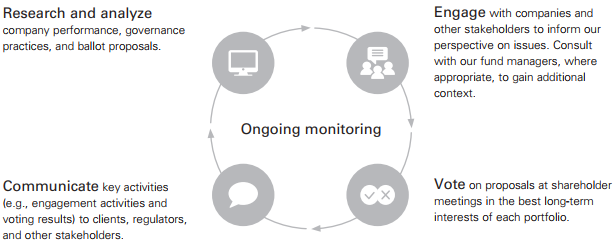
Our four pillars

Board

Good governance begins with a great board of directors. Our primary interest is to ensure that the individuals who represent the interests of all shareholders are independent (both in mindset and freedom from conflicts), capable (across the range of relevant skills for the company and industry), and appropriately experienced (so as to bring valuable perspective to their roles). We also believe that diversity of thought, background, and experience, as well as of personal characteristics (such as gender, race, and age), meaningfully contributes to the board’s ability to serve as effective, engaged stewards of shareholders’ interests. If a company has a well-composed, high-functioning board, good results are more likely to follow.

Structure

We believe in the importance of governance structures that empower shareholders and ensure accountability of the board and management. We believe that shareholders should be able to hold directors accountable as needed through certain governance and bylaw provisions. Among these preferred provisions are that directors must stand for election by shareholders annually and must secure a majority of the votes in order to join or remain on the board. In instances where the board appears resistant to shareholder input, we also support the right of shareholders to call special meetings and to place director nominees on the company’s ballot.

Compensation

We believe that performance-linked compensation policies and practices are fundamental drivers of the sustainable, long-term value for a company’s investors. The board plays a central role in determining appropriate executive pay that incentivizes performance relative to peers and competitors. Providing effective disclosure of these practices, their alignment with company performance, and their outcomes is crucial to giving shareholders confidence in the link between incentives and rewards and the creation of value over the long term.

Risk

Boards are responsible for effective oversight and governance of the risks most relevant and material to each company in the context of its industry and region. We believe that boards should take a thorough, integrated, and thoughtful approach to identifying, understanding, quantifying, overseeing, and—where appropriate—disclosing risks that have the potential to affect shareholder value over the long term. Importantly, boards should communicate their approach to risk oversight to shareholders through their normal course of business.

By the numbers: Voting and engagement

Engagement and voting trends

2015 proxy season 2016 proxy season  2017 proxy season
Company engagements 685 817 954
Companies voted 10,560 11,564 12,974
Meetings voted 12,785 16,740 18,905
Proposals voted 124,230 157,506 171,385
Countries voted in* 70 70 68

* The number of countries can vary each year. In certain markets, some companies do not hold shareholder meetings annually.
Note: The annual proxy season is from July 1 to June 30.

Our voting

Proxy voting reflects our governance pillars worldwide.

Meetings voted by region
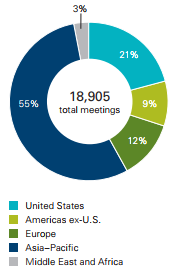
Note: Data pertains to voting activity from July 1, 2016, through June 30, 2017

Global voting activity
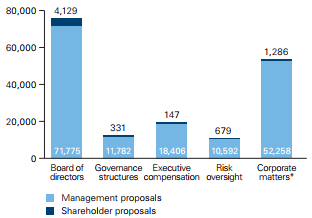
* Includes more than 26,000 proposals related to capitalization; 8,000 proposals related to mergers and acquisitions; 16,000 routine business proposals; and 1,000 other shareholder proposals.
Note: Data pertains to voting activity from July 1, 2016, through June 30, 2017.

Our engagement

We engage with companies of all sizes.

Market Capitalization % of 2017 proxy season engagements
Under $1 billion 19%
$1 billion–under $10 billion 44%
$10 billion–under $50 billion 24%
$50 billion and over 13%

Our engagement with portfolio companies has grown significantly over time.

Number of engagements and assets represented
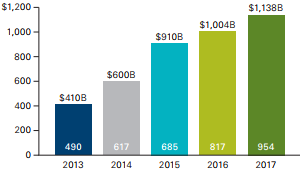
Note: Dollar figures represent the market value of Vanguard fund investments in companies with which we engaged as of June 30, 2017.

We engage on a range of topics aligned with our four pillars

Frequency of topics discussed during Vanguard engagements (%)
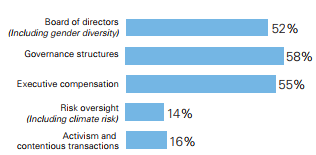
Note: Figures do not total 100%, as individual engagements often span multiple topics.

Boards in focus: Vanguard’s view on gender diversity

One of our most fundamental governance beliefs is that good governance begins with a great board of directors. We believe that diversity among directors—along dimensions such as gender, experience, race, background, age, and tenure—can strengthen a board’s range of perspectives and its capacity to make complex, fully considered decisions.

While we have long discussed board composition and diversity with portfolio companies, gender diversity has emerged as one dimension on which there is compelling support for positive effects on shareholder value. In recent years, a growing body of research has demonstrated that greater gender diversity on boards can lead to better company performance and governance.

Companies should be prepared to discuss—in both their public disclosures and their engagement with investors—their plans to incorporate appropriate diversity over time in their board composition. While we believe that board evolution is a process, not an event, the demonstration of meaningful progress over time will inform our engagement and voting going forward.

Boards in focus: Gender diversity

Engagement case studies

Gender diversity on boards was an important topic of engagement for us during the 12 months ended June 30, 2017. Below are summary examples of discussions we had on the subject.

High-impact engagement on gender diversity

Over several interactions with a U.S. industrial company, our team shared Vanguard’s perspective on board composition and evaluation. The company had undergone recent leadership transitions and was open to amending elements of its governance structure to align with best practices. We expressed particular support for meaningful gender diversity and expressed concern that the board previously had only one female director in its recent history.

Right after this year’s annual general meeting, the company announced it was adding four new directors with diverse experience, including two women. This outcome is the best-case scenario: The board welcomed shareholder input, we shared our view on best corporate governance practices, and the board ultimately incorporated our perspective into its board evolution process.

A denial of diversity’s value

A Canadian materials company that had consistently underperformed was governed by an entrenched, all-male board with seemingly nominal independence from the CEO. A 2017 shareholder resolution asked the company to adopt and publish a policy governing gender diversity on the board. Before voting, Vanguard engaged with the company to learn about its board evolution process, including its perspective on gender diversity. The engagement revealed that the company understood neither the value of gender diversity nor the importance of being responsive to shareholders’ concerns. Despite verbally endorsing gender diversity, the company resisted specifying a strategy or making a commitment to achieve it. The board, when seeking new members, relied solely on recommendations from current directors, a practice that can entrench the current board’s perspective and limit diversity. Our funds voted in support of the shareholder resolution, and we will continue to engage and hold the board accountable for meaningful progress over time.

Mixed results from an ongoing engagement

A U.S. consumer discretionary company had no women on its board, a problem magnified by its medium-term underperformance relative to peers, a classified board structure, and a lengthy average director tenure. We engaged with management twice between the 2016 and 2017 annual meetings to share our perspective on the importance of gender diversity and recommend that they make it a priority for future board evolution and director searches.

In its 2017 proxy, the company described board diversity as critical to the firm’s sustainable value and named gender as an element of diversity to be considered during the director search and nomination process. The company has since added a non-independent woman to the board. Although this move is directionally correct, it does not fully address our concerns; we will continue to encourage the company to add gender diversity to its ranks of independent directors.

Risk in focus: Vanguard’s view on climate risk

As the steward of long-term shareholder value for more than 20 million investors, Vanguard closely monitors how our portfolio companies identify, manage, and mitigate risks—including climate risk. Our approach to climate risk is evolving as the world’s and business community’s understanding of the topic matures.

This year, for the first time, our funds supported a number of climate-related shareholder resolutions opposed by company management. We are also discussing climate risk with company management and boards more than ever before. Our Investment Stewardship team is committed to engaging with a range of stakeholders to inform our perspective on these issues, and to share our thinking with the market, our portfolio companies, and our investors.

Risk in focus: Climate risk

A Q&A with Glenn Booraem, Vanguard’s Investment Stewardship Officer

Vanguard is an investment management company. Why should Vanguard fund investors be concerned about climate risk?

Mr. Booraem: Climate risk has the potential to be a significant long-term risk for companies in many industries. As stewards of our clients’ long-term investments, we must be finely attuned to this risk. We acknowledge that our clients’ views on climate risk span the ideological spectrum. But our position on climate risk is anchored in long-term economic value—not ideology. Regardless of one’s perspective on climate, there’s no doubt that changes in global regulation, energy consumption, and consumer preferences will have a significant economic impact on companies, particularly in the energy, industrial, and utilities sectors.

Why the shift in Vanguard’s assessment of climate risk, and why now?

Mr. Booraem: We’ve been discussing climate risk with portfolio companies for several years. It has been, and will remain, one of our engagement priorities for the foreseeable future. This past year, we engaged with more companies on this issue than ever before, and for the first time our funds supported two climate-related shareholder resolutions in cases where we believed that companies’ disclosure practices weren’t on par with emerging expectations in the market. As with other issues, our point of view has evolved as the topic has matured and, importantly, as its link to shareholder value has become more clear.

What is your top concern when you learn that a company in which a Vanguard portfolio invests does not have a rigorous strategy to evaluate and mitigate climate risk?

Mr. Booraem: Our concern is fundamentally that in the absence of clear disclosure and informed board oversight, the market lacks insight into the material risks of investing in that firm. It’s of paramount importance to us that the market is able to reflect risk and opportunity in stock prices, particularly for our index funds, which don’t get to select the stocks they own. When we’re not confident that companies have an appropriate level of board oversight or disclosure, we’re concerned that the market may not accurately reflect the value of the investment. Because we represent primarily long-term investors, this bias is particularly problematic when underweighting long-term risks inflates a company’s value.

Now that Vanguard has articulated a clear stance on climate risk, what can portfolio companies expect?

Mr. Booraem: First, companies should expect that we’re going to focus on their public disclosures, both about the risk itself and about their board’s and management’s oversight of that risk. Thorough disclosure is the foundation for the market’s understanding of the issue. Second, companies should expect that we’ll evaluate their disclosures in the context of both their leading peers and evolving market standards, such as those articulated by the Sustainability Accounting Standards Board (SASB). Third, they should expect that we’ll listen to their perspective on these and other matters. And finally, they should see our funds’ proxy voting as an extension of our engagement. When we consider a shareholder resolution on climate risk, we give companies a fair hearing on the merits of the proposal and consider their past commitments and the strength of their governance structure.

Engagement case studies

In the 12 months ended June 30, 2017, the topic of climate risk disclosure grew in frequency and prominence in our engagements with companies, particularly those in the energy, industrial, and utilities sectors, where climate risk was addressed in nearly every conversation we had. Below are examples of our engagements on climate risk.

Two companies’ commitments to enhanced disclosure

Our team led similar engagements with two U.S. energy companies facing shareholder resolutions on climate risk. One resolution requested that the first company publish an annual report on climate risk impacts and strategy. At the second company, a resolution requested disclosure of the company’s strategy and targets for transitioning to a low- carbon economy. In both cases, when we engaged with the companies, their management teams committed to improving their climate risk disclosure. Given the companies’ demonstrated responsiveness to shareholder feedback and commitment to improving, our funds did not support either shareholder proposal. Our team will continue to track and evaluate the companies’ progress toward their commitments as we consider our votes in future years.

A vote against a risk and governance outlier For years we engaged with a U.S. energy company that lagged its peers on climate risk disclosure and board accessibility. This year, a shareholder proposal requesting that the company produce a climate risk assessment report demonstrated a compelling link between the requested disclosures and long-term shareholder value. Because the board serves on behalf of shareholders and plays a critical role in risk oversight, we believed it was appropriate to seek a direct dialogue with independent directors about climate risk. Management resisted connecting the independent directors with shareholders, making the company a significant industry outlier in good governance practice. Without the confidence that the board understood or represented our view that climate risk poses a material risk in the energy sector, our team viewed the climate risk and governance issues as intertwined. Ultimately, our funds voted for the shareholder proposal and withheld votes on relevant independent directors for failing to engage with shareholders.

A vote for greater climate risk disclosure

A shareholder proposal at a U.S. energy company asked for an annual report with climate risk disclosure, including scenario planning. Through extensive research and engagements with the company’s management, its independent directors, and other industry stakeholders, our team identified governance shortfalls and a clear connection to long-term shareholder value. The company lagged its peers in disclosure, risk planning, and board oversight and responsiveness to shareholder concerns. Crucially, although the company’s public filings identified climate risk as a material issue, it failed to articulate plans for mitigation or adaptation. A similar proposal last year garnered significant support, but the company made no meaningful changes in response. Engagement had limited effect, so our funds voted for the shareholder proposal.

* * *

This post was excerpted from a Vanguard report; the complete publication is available here.

Compte rendu hebdomadaire de la Harvard Law School Forum on Corporate Governance | 14 septembre 2017


Voici le compte rendu hebdomadaire du forum de la Harvard Law School sur la gouvernance corporative au 14 septembre 2017.

Cette semaine, j’ai relevé les cinq principaux billets.

Bonne lecture !


Résultats de recherche d'images pour « harvard law school forum on corporate governance »


Résultats de recherche d'images pour « harvard law school forum on corporate governance »


  1. Another Road Leading to Business Judgment Review—Martha Stewart Living Omnimedia
  2. The Effects of Hedge Fund Interventions on Strategic Firm Behavior
  3. UK Announces Corporate Governance Reforms
  4. How Should We Regulate Fintech?
  5. OCC Stakes Out a Lead Role in Establishing New Deregulatory Agenda