Abrègement de la durée des fonctions de CEO | Une étude d’Equilar


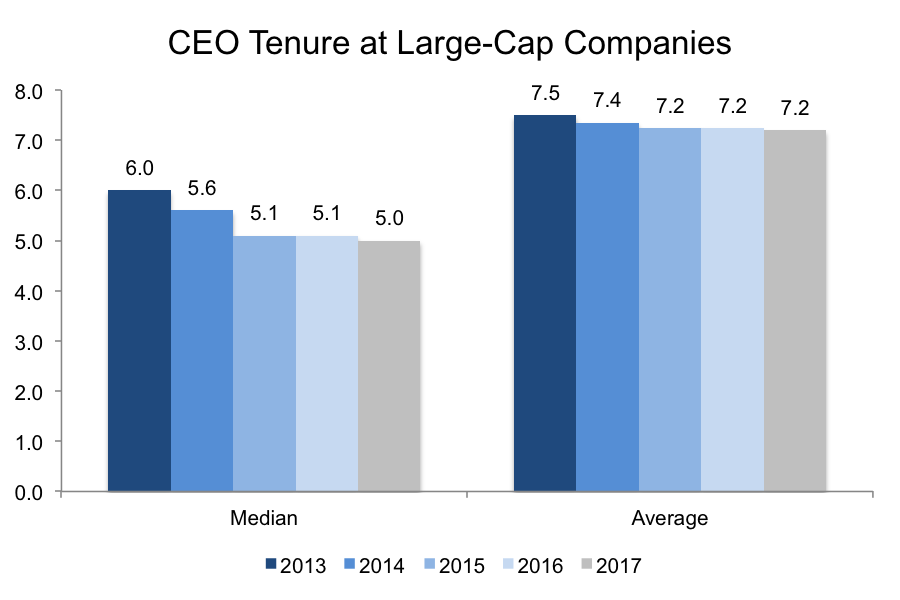
Voici une étude d’Equilar qui montre une diminution constante dans la durée d’exercice des CEO aux États-Unis au cours des 5 dernières années.

Le rapport a été publié par Dan Marcec directeur des communications de la firme.

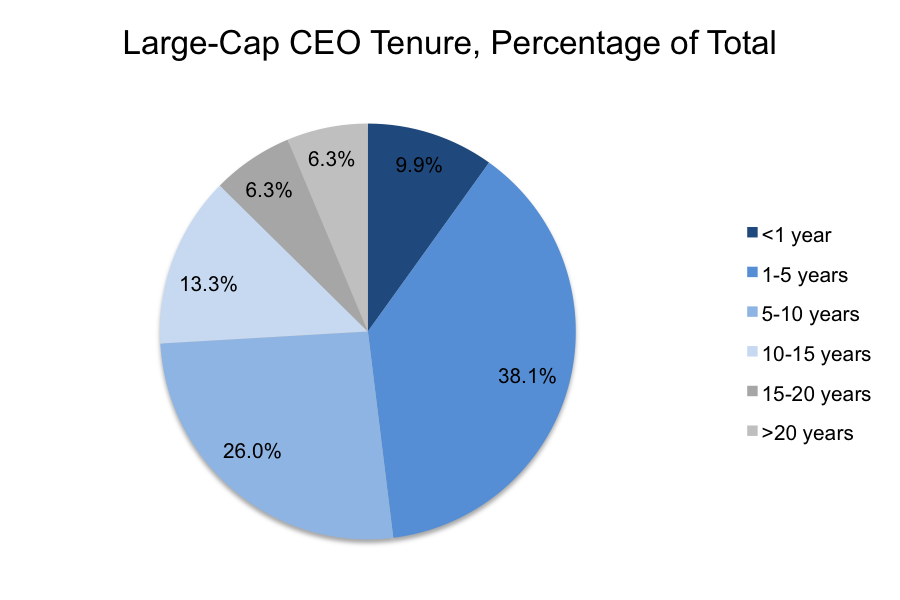
Ainsi, la présence en poste des CEO est passée d’une médiane de 6 ans, en 2013, à 5 ans, en 2017.


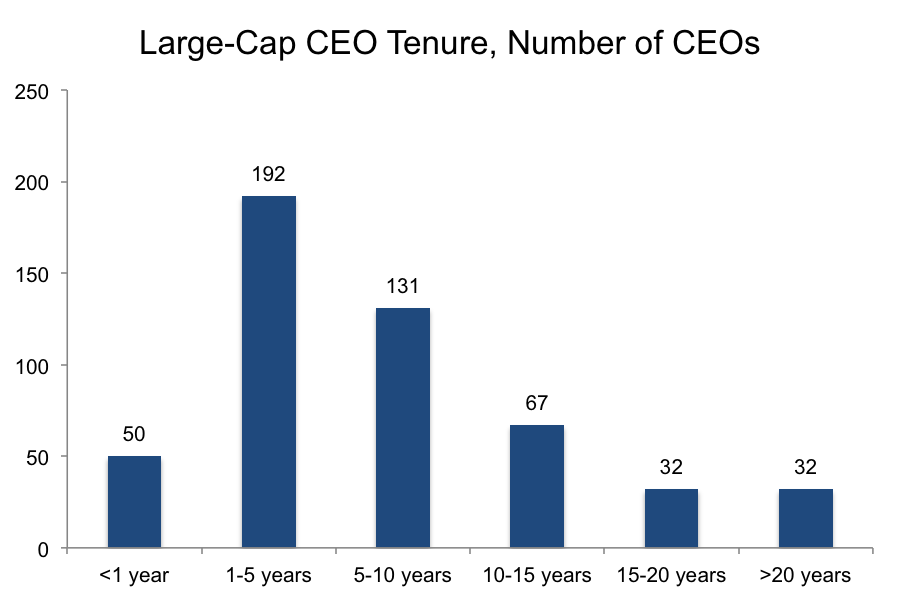
On note également que plus du quart des CEO restent en poste plus de 10 ans, comparativement à 38,1 % qui sont en poste entre un an et cinq ans.


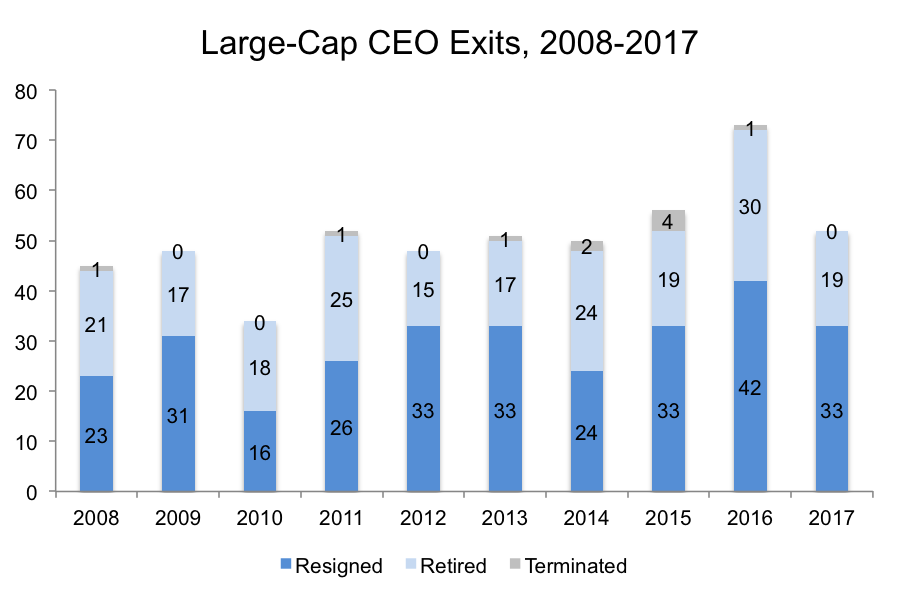
L’article présente également un tableau qui montre les raisons des départs des CEO : (1) démissions (2) retraites (3) congédiement. On note que seulement 10 CEO ont été congédiés sur une période de dix ans. On peut dire que l’emploi est assez stable !


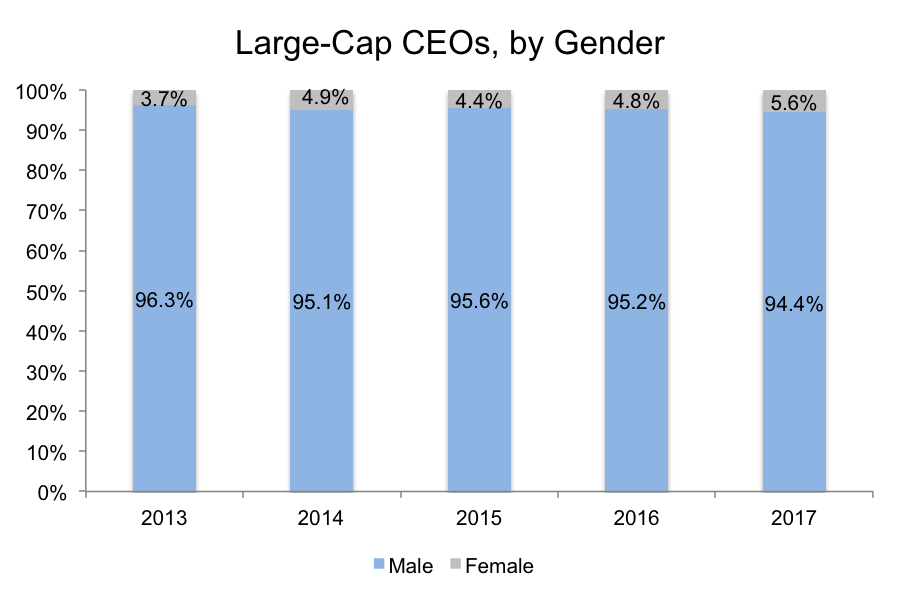
Enfin, l’étude montre que l’accroissement du taux des départs n’a pas donné lieu à des progrès dans le cadre de la diversité. En effet, comme le montre le tableau suivant, le nombre de femmes CEO de grandes entreprises est passé de 3,7 %, en 2013, à 5,6 % en 2017. La fonction de CEO dans ces entreprises est encore réservée presque exclusivement aux hommes.


Vous pouvez prendre connaissance de cet article paru sur le site du Harvard Law School Forum :

CEO Tenure Rates

Top 10 de Harvard Law School Forum on Corporate Governance au 8 février 2018


Voici le compte rendu hebdomadaire du forum de la Harvard Law School sur la gouvernance corporative au 8 février 2018.

Cette semaine, j’ai relevé les dix principaux billets.

Bonne lecture !


Résultats de recherche d'images pour « top ten »


  1. Compensation in the 2018 Proxy Season
  2. 2017 Financial Stability Report
  3. Valuable Board Assessments
  4. Dinner Table Human Capital and Entrepreneurship
  5. BlackRock’s Call for Companies to Deliver Financial & Social Value
  6. HLS Forum Sets New Records in 2017
  7. Institutional Investor Engagement: How to Create a “Stewardship Culture”
  8. Top Universities for Corporate Directors
  9. Cryptocurrency 2018
  10. Will Tenure Voting Give Corporate Managers Lifetime Tenure?


Les firmes européennes doivent se préparer à la mise en place du « Shareholder Rights Directive (SRD) »


Ma veille en gouvernance m’amène à vous proposer la lecture d’un article publié par Demi Derem* et Elizabeth Maiellano sur les défis posés par un ensemble de directives récemment approuvées par le Parlement européen et qui traitent du droit des actionnaires : « Shareholder Rights Directive (SRD) ».
La Commission Européenne (CE) veut que les entreprises cotées aient une meilleure connaissance de leurs investisseurs et qu’elles soient en mesure d’interagir d’une manière claire et transparente avec eux. Voici un extrait qui montre l’ampleur des nouvelles directives.

The SRD also grants shareholders the right to vote on companies’ remuneration policies, which may increase the policy analysis and assessment required by the buy-side. Similarly, the SRD requires that any material transaction (as defined by national regulators) between a listed company and a related third party must be announced and approved by the shareholders and the board.

Depending on national requirements, the announcement may also need to be accompanied by a report about the impact of the transaction from an independent third party, the board or a committee of independent directors.

La lecture de cet article montre que les entreprises ont peu de temps pour se conformer aux directives. Les auteurs explorent les impacts de l’adoption de ces règles sur les principaux intéressés, notamment sur les investisseurs institutionnels et les firmes d’intermédiation.

Pour en savoir davantage sur la préparation requise aux règles du SRD, vous pouvez consulter le rapport de la firme Broadridge, Shareholder Rights Directive : Advancing to a State of Readiness.

Bonne lecture !


Advancing to a state of readiness: the new Shareholder Rights Directive


Shareholder Rights Directive


All parties in the shareholder communication chain need to prepare for the enhanced requirements of the new Shareholder Rights Directive—and try to influence its local implementation to encourage a harmonised approach.

The new Shareholder Rights Directive (SRD), adopted by the European Council and approved by the European Parliament this spring, is a laudable initiative intended to encourage shareholder engagement in listed companies in Europe and improve the transparency of related processes— including proxy voting. The European Commission (EC) wants to see proof that companies understand their investors and communicate with them in a clear and transparent manner.

The new SRD updates its 2007 predecessor and introduces some new requirements related to remunerating directors, identifying shareholders, facilitating the exercise of shareholder rights, transmitting information and providing transparency for institutional investors, asset managers and proxy advisors. The majority of the SRD is required to be translated into national law by European member states by June 2019 (although some elements will not come into force until September 2020).

Given the complexities introduced by the new SRD, firms across the shareholder communication chain need to begin preparing now if they are to meet its requirements by 2019. These are expected to entail significant and potentially costly changes relating to process reforms and transparency requirements, impacting issuers, asset managers, custodians, central securities depositories (CSDs), and a range of other intermediaries and service providers.

The two-year member-state transposition process will involve adaptation of the SRD’s requirements to reflect domestic market structures and local legal processes. We encourage all affected firms to engage with the EC and national regulators, and share their views on how the SRD should be implemented. This is vital for achieving outcomes that are equitable and commensurate with the corporate governance benefits of the SRD. If national regulators opt for significantly different interpretations of the SRD, this would be challenging for industry participants.

For example, one global custodian has expressed concern about the risk of national divergence requiring compliance efforts to be tailored to each regulator’s interpretation, thereby increasing the complexity and cost of SRD implementation for firms operating in more than one market.

Another securities services firm believes that discrepancies in implementation dates in different jurisdictions will be problematic for global firms.

Institutional investor impact

Institutional investors and asset managers are likely to be affected by the SRD in a number of ways. For example, both will have to be more transparent about their engagement with investee companies and how they integrate shareholder engagement into their investment strategy. Under the SRD this information must be reported annually and made available on buy-side firms’ websites. These firms must also disclose annually their voting behaviour and explain significant votes and their use of proxy advisor services. The SRD introduces these requirements on a comply-or-explain basis.

The SRD also grants shareholders the right to vote on companies’ remuneration policies, which may increase the policy analysis and assessment required by the buy-side. Similarly, the SRD requires that any material transaction (as defined by national regulators) between a listed company and a related third party must be announced and approved by the shareholders and the board. Depending on national requirements, the announcement may also need to be accompanied by a report about the impact of the transaction from an independent third party, the board or a committee of independent directors.

These new requirements will result in the production of more data and more reporting before a vote, potentially creating a significant burden on asset managers and investors as they try to manage this information flow. This burden is likely to be particularly noticeable with related party transactions.

Intermediary implications

Intermediary firms will need to keep a close watch on national requirements for the adoption of specific identification standards and data items for shareholder transparency requirements. For instance, markets could set different minimum levels of holdings that must be disclosed.

In addition, the SRD refers to providing data in a standardised format but does not specify the standards, so these may be provided by the EC. However, if the disclosure of certain data items would breach some countries’ data privacy laws, national regulators would have to alter the local requirements.

Another change introduced by the SRD is that intermediaries will have to store shareholder information for at least 12 months after they become aware that someone has ceased to be a shareholder. Data storage and retention requirements are therefore likely to increase.

A particular concern for intermediaries is that the SRD requires them to transmit general meeting agenda and voting information “without delay”. National regulators could interpret this as a requirement for real-time or near-real-time reporting. If this means that vote information has to be transmitted immediately, intermediaries will need to introduce intraday processing support. Meanwhile, the need to use a standardised format could result in amendments to current SWIFT message formats, with associated costs. It is also likely that the volume of voting instructions and amendments will increase after implementation of the SRD.

One custodian has expressed concern about the lack of regulatory clarity on whether post-meeting announcements will also have to be transmitted immediately. The EC and national regulators will need to confirm the level of information that must be passed on to shareholders. Some intermediaries may face operational headaches if their current processes can support the transmission of voting information but not of other data items in the same standardised and immediate manner.

Intermediaries could face the brunt of the costs of SRD implementation, particularly because European member states can prohibit intermediaries from charging fees for the cost of changes related to disclosure. If regulators decide to mandate this, intermediaries will have to absorb all compliance costs rather than passing a percentage on to clients.

If regulators are more lenient, intermediaries may be able to pass on certain costs, but the SRD specifies that these must be proven to be proportionate to the cost of offering the service. Intermediaries could therefore have to pay for the full cost of transparency requirements in some jurisdictions, while providing an audit trail of operational costs (and facing questions about any inefficiencies) in others.

The bundling of proxy costs into custody fees may also need re-evaluating, because intermediaries will need to disclose their fees in relation to proxy services. The SRD stresses the need for “non-discriminatory and proportionate” fees and jurisdictions will also have the power to prohibit fees for proxy services. If some do prohibit fees, firms’ business models will need to be revised.

Widespread impact

Issuers and registrars will also be affected by the SRD in relation to the standardisation of meeting announcements and the provision of vote confirmation. And proxy service providers will be impacted, although global firms that already comply with some jurisdictions’ voluntary requirements in transparency and reporting will feel less short-term impact. They could face both opportunities and challenges—with the potential to deliver new services to help intermediaries to support requirements such as vote confirmation, but needing to invest to do so.

The SRD’s transposition period presents market participants with an opportunity to review the impact on their operations, engage with regulators and assess their readiness. It is something that the industry should embrace and collaborate on to get right.

___________________________________________

*Demi Derem is general manager for Investor Communication Solutions, International, at Broadridge, and Elizabeth Maiellano is vice president for product management, Investor Communication Solutions, International, at Broadridge. This article has been prepared in collaboration with Broadridge, a supporter of Board Agenda.

La lettre de BlackRock plaide pour une prise en compte des facteurs de risque environnementaux, sociaux, de gouvernance (ESG)


Aujourd’hui, je fais une première expérience de publication d’un billet en gouvernance parue sur le site du Harvard Law School Forum on Corporate Governance, le 6 février 2018.

En effet, j’édite la traduction en français d’un article publié par Abe M. Friedman*, CEO de la firme CamberView. Cette publication constitue, à mon avis, un moment décisif dans la conception de la gouvernance telle que vue par un investisseur avisé.

Comme plusieurs lecteurs sont particulièrement intéressés par les contenus en français, j’ai utilisé l’outil de traduction de Google pour faire ressortir les implications de la lettre annuelle aux PDG de Larry Fink, PDG de BlackRock.

Vous comprendrez que la traduction est perfectible, mais je crois qu’elle est compréhensible avec un minimum d’édition.

Je vous invite également à lire la dernière mise à jour des recommandations de BlackRock en vue des votes aux assemblées annuelles : Updated BlackRock Proxy Voting Guidelines

Bonne lecture !


Résultats de recherche d'images pour « blackrock »


Le mardi 16 janvier, Larry Fink, PDG de BlackRock, a publié sa lettre annuelle aux PDG décrivant une vision audacieuse liant la prospérité des entreprises à leur capacité à fournir de solides performances financières tout en contribuant positivement à la société. Intitulée « A Sense of Purpose », cette lettre souligne l’approche de plus en plus active de BlackRock en matière d’engagement actionnarial ; elle constitue son opinion selon laquelle les conseils d’administration jouent un rôle central dans la direction stratégique à long terme des sociétés ainsi que dans la prise en compte des facteurs de risque environnementaux, sociaux, de gouvernance (ESG) et de création de valeur à long terme.

La lettre est un autre signal d’un changement fondamental dans la pensée des gestionnaires d’actifs traditionnels sur des sujets que certains ont toujours considérés comme non économiques. Alors que la pression monte sur les grands gestionnaires d’actifs sur la façon dont ils « supervisent » les « portefeuilles » de leurs entreprises, ces questions sociales et environnementales sont de plus en plus considérées comme essentielles à la création de valeur et à la durabilité à long terme. La position d’avant-garde sur la responsabilité d’entreprise prise dans la lettre est un indicateur de la manière dont les attentes changeantes des propriétaires d’actifs sont intégrées dans le comportement des gestionnaires d’actifs. Pour les entreprises, ce changement a créé un nouvel ensemble d’attentes, et le potentiel d’un examen plus approfondi de la part des investisseurs qui pourraient continuer à croître dans les années à venir.


Thèmes clés — ESG, engagement des actionnaires, administrateurs et activisme


La lettre de cette année réitère un certain nombre de thèmes tirés des communications des années précédentes et explique comment BlackRock s’attend à ce que les sociétés améliorent la valeur à long terme pour les actionnaires.


ESG et importance de la diversité du conseil d’administration dans la création de valeur à long terme


La lettre de Fink souligne la conviction de BlackRock que la gestion des questions ESG est essentielle à une croissance durable. De l’avis de BlackRock, exercer la surveillance de ces défis ainsi que d’autres défis émergents à la création de valeur à long terme relève de la compétence du conseil, qui, selon M. Fink, devrait inclure une diversité de genres, d’ethnies, d’expériences et de façons de penser. Les entreprises devraient s’attendre à ce que BlackRock (et, avec le temps, d’autres grands investisseurs institutionnels) investisse plus de temps pour comprendre la gestion des risques des entreprises liée à leur impact plus large sur les communautés, la société et l’environnement. Cela signifie probablement un soutien croissant aux propositions d’actionnaires sur ces sujets et une pression accrue sur les conseils pour qu’ils démontrent qu’ils s’adressent sérieusement à ces questions.


Engagement des actionnaires


Citant le besoin d’être des « agents actifs et engagés pour le compte des clients investis avec BlackRock », la lettre appelle à un nouveau modèle d’engagement des actionnaires qui comprend des communications pendant toute l’année sur les moyens d’améliorer la valeur à long terme. Alors que M. Fink note que BlackRock a engagé des ressources importantes pour améliorer ses propres efforts d’intendance des investissements au cours des dernières années, il écrit que « la croissance de l’indexation exige que nous prenions maintenant cette fonction à un nouveau niveau. » BlackRock a l’intention de doubler la taille de ses équipes de supervision.


Le rôle du conseil dans la communication et la supervision de la stratégie d’entreprise pour la croissance à long terme


Revenant sur un thème commun des communications précédentes, la lettre de cette année souligne l’importance du conseil pour aider les entreprises à définir un cadre stratégique pour la création de valeur à long terme. Bien que le nombre moyen d’heures consacrées par les membres du conseil à leur rôle ait augmenté au cours des dernières années, M. Fink continue d’élever la barre, soulignant que les administrateurs, dont les compétences et l’expérience proviennent uniquement de réunions sporadiques, ne remplissent pas leur devoir envers les actionnaires. La lettre de cette année contient une liste de questions que les sociétés (c.-à-d. les conseils d’administration et la direction) devraient poser pour s’assurer qu’elles sont en mesure de maintenir leur rendement à long terme. Ces questions comprennent explicitement l’impact sociétal des entreprises et les importants changements structurels (tels que les conditions économiques, l’automation et les changements climatiques) qui influencent le potentiel de croissance.


S’engager sur l’activisme


Fink écrit qu’une « raison centrale de la montée de l’activisme — et des luttes intempestives par procuration — est que les entreprises n’ont pas été assez explicites sur leurs stratégies à long terme. » Il souligne, à titre d’exemple, la réforme fiscale récemment adoptée et son potentiel d’augmentation des flux de trésorerie après impôt, comme un moyen pour les activistes de cibler les entreprises qui ne communiquent pas efficacement leur stratégie à long terme. M. Fink encourage les entreprises à s’engager avec les investisseurs et autres parties prenantes au début du processus lorsque ceux-ci offrent « des idées précieuses — plus souvent que certains détracteurs ne le suggèrent », une observation cohérente avec le soutien sélectif de BlackRock aux activistes dans les luttes par procuration.


Recommandations aux émetteurs


Cette lettre représente une évolution significative de l’opinion publique de BlackRock sur la responsabilité des entreprises et des conseils d’administration de gérer activement les impacts sociétaux de leurs activités au bénéfice de toutes les parties prenantes. M. Fink affirme que l’objectif des propriétaires d’actifs est non seulement d’améliorer leurs rendements d’investissement, mais aussi de voir le secteur privé relever les défis sociaux qui assureront la « prospérité et la sécurité » de leurs concitoyens.

BlackRock n’est pas le seul à faire ce changement philosophique. Les derniers mois ont fourni des exemples de la façon dont cette nouvelle dynamique façonne les décisions de vote et d’investissement. L’été dernier, des résolutions sur la divulgation des risques climatiques ont été adoptées pour la première fois dans de grandes entreprises énergétiques. En novembre, State Street Global Advisors a révélé qu’elle avait voté contre les administrateurs de 400 entreprises qui, selon elle, n’avaient pas fait d’efforts pour accroître la diversité au sein du conseil. Plus tôt ce mois-ci, JANA Partners et CalSTRS se sont associés pour mener une campagne d’activisme sur la question de savoir si Apple permet aux parents de protéger leurs enfants en utilisant la technologie et JANA a également créé un fonds pour cibler d’autres entreprises.

Afin de répondre aux questions soulevées dans la lettre de M. Fink, les sociétés ouvertes devraient envisager :

Construire une pratique de l’engagement continu tout au long de l’année sur la gouvernance et la durabilité avec leurs meilleurs investisseurs afin de rester en contrôle de l’activisme et d’être au-devant des investisseurs face à un défi.

Expliquer le processus du conseil dans le développement de la stratégie à long terme, dans le rôle de supervision de l’entreprise ainsi que dans les discussions avec les investisseurs.

Présenter les investisseurs à une variété de membres de l’équipe de direction et, à l’occasion, à un ou plusieurs membres du conseil d’administration pour établir des relations et faire confiance, au fil du temps, à tous les dirigeants de l’entreprise.

Décrire comment les administrateurs cultivent la connaissance de l’entreprise en dehors des réunions formelles du conseil d’administration, afin de remplir leur mandat de protection des intérêts à long terme des investisseurs.


*Abe M. Friedman est Chief Executive Officer de CamberView Partners, LLC. Ce billet est basé sur une publication de CamberView par M. Friedman, Krystal Gaboury BerriniChristopher A. Wightman, et Rob Zivnuska. La recherche connexe du Programme sur la gouvernance d’entreprise inclut des résolutions sur la responsabilité sociale  par Scott Hirst (discutées sur le forum  ici).

Compte rendu hebdomadaire de la Harvard Law School Forum on Corporate Governance | 1er février 2018


Voici le compte rendu hebdomadaire du forum de la Harvard Law School sur la gouvernance corporative au 1er février 2018.

Cette semaine, j’ai relevé les quinze principaux billets.

Bonne lecture !


  1. Corporate Governance Update: Boards, Sexual Harassment, and Gender Diversity
  2. Informed Trading and Cybersecurity Breaches
  3. The Corporate Governance World in 2018: A Global Review
  4. The Effects of Investment Bank Rankings: Evidence from M&A League Tables
  5. Activism in 2018
  6. Mergers and Acquisitions: 2018 With a Brief Look Back
  7. Preparing a Successful IPO in 2018
  8. From Talking the Talk to Voting the Votes
  9. A Long/Short Incentive Scheme for Proxy Advisory FirmsRésultats de recherche d'images pour « harvard law school »
  10. Destructive Collectivism: Dodd-Frank Coordination and Clearinghouses
  11. 2017 Year in Review: Corporate Governance Litigation & Regulation
  12. Activists and Socially Responsible Investing
  13. The Highest-Paid Boards
  14. Disasters and Disclosures
  15. The Changing Face of Shareholder Activism

Les énoncés de principes de saine gouvernance ne peuvent s’appliquer rigoureusement à toutes les organisations !


Aujourd’hui, je vous propose mon point de vue en lien avec l’article de Jean-François Thuot*, intitulé « Les principes de saine gouvernance (PSG) sont-ils valables et applicables à toutes les organisations ? »,  paru sur le site de l’Ordre des administrateurs agréés du Québec (OAAQ) ainsi que sur le site de LinkedIn.

L’auteur met principalement l’accent sur deux principes de gouvernance généralement reconnus (PGGR) qui ne s’appliquent pas très bien à certains types d’organisations telles les OBNL, les ordres professionnels et les nombreuses variantes d’associations. J’ajouterais à la liste de Jean-François les sociétés d’État, les petites entreprises (PME), les entreprises en démarrage (start-up) et les entreprises à contrôle familial.

Voici les deux éléments qui posent problème dans l’application des PGGR :

(1) les personnes élues par les membres de différentes régions et qui sont, de facto, administrateurs de l’organisation ;

(2) les modalités de l’utilisation d’un comité exécutif.

Il s’agit d’excellents questionnements et j’y suis fréquemment confronté !

À mon avis, aucune organisation ne peut se conformer aux PGGR, et c’est bien normal ! Mais, ces entités peuvent se rapprocher de ce modèle perfectible comme l’auteur le dit si bien lorsqu’il mentionne que les OBNL « gagneraient à se doter de solides conditions d’éligibilité à un poste d’administrateur, faisant une large part à la dimension de compétence ».

Également, l’auteur touche un point déterminant lorsqu’il questionne la quasi-nécessité, pour plusieurs organisations, de se doter d’un comité exécutif (CE).

À mon avis, le CE doit être créé dans tous les types d’organisations, même s’il n’est pas toujours utilisé ou actif.

Comme mentionné, le comité exécutif est malheureusement nécessaire dans les cas où les conseils d’administration sont de grandes tailles. Il n’est généralement pas utile, ou nécessaire, lorsque le CA est d’environ 8-10 personnes et que celui-ci se réunit au moins 5 fois par an.

Le CE est nécessaire s’il y a des décisions urgentes à prendre à court terme. Mais, de nos jours, les membres du CA sont facilement joignables et ils peuvent décider rapidement. De plus, les autres comités statutaires du conseil sont davantage sollicités dans leur sphère de compétence.

Les raisons que l’auteur évoque eu égard à l’inutilité d’un CE qui se réunit régulièrement (à tous les mois, par exemple) sont, à mon avis, toujours très valables : déresponsabilisation du CA et de ses administrateurs, concentration du pouvoir entre les mains d’un cercle d’initiés, perception que les CA de petite taille sont plus efficaces.

Je suis tout à fait d’accord avec la conclusion de l’auteur.

Ces deux exemples invitent à bien mesurer le contexte organisationnel dans lequel les PSG sont destinés à être appliqués. Il existe une diversité des modèles de gouvernance, ce que la vogue actuelle des PSG tend à nous faire oublier. Il faut espérer que la réflexion se développe pour mieux saisir les particularités des OBNL, des associations et des ordres professionnels, afin de donner les réponses appropriées aux défis qui les caractérisent en matière de gouvernance.

Je vous encourage à lire l’article de Jean-François, ci-dessous, qui s’interroge sur ces deux grandes difficultés dans l’application des règles de bonne gouvernance.

Bonne lecture !


 Les principes de saine gouvernance (PSG) sont-ils valables et applicables à toutes les organisations ?


Résultats de recherche d'images pour « principe de saine gouvernance »


Largement issus des organisations privées à visée lucrative, les principes de saine gouvernance (PSG) ont été mis à l’honneur ces dernières années et leur légitimité est telle qu’il est généralement admis qu’on peut les exporter vers n’importe quelle organisation.

En grattant un peu toutefois, les limites de certains de ces principes finissent par apparaitre. J’aimerais ici donner deux exemples.


*Jean-François Thuot, PhD, ASC, AdmA, conseiller, facilitateur stratégique pour OBNL et ordres professionnels: management associatif, affaires publiques, rédaction stratégique, formation.

Billets récents publiés sur mon blogue en gouvernance en janvier 2018


Voici les quinze billets publiés sur mon blogue en gouvernance des sociétés en janvier 2018.

Bonne lecture ! Vos commentaires sont toujours les bienvenus.


Résultats de recherche d'images pour « blogue en gouvernance »


  1. Que pensez-vous des classes d’actions à droit de vote multiples ?
  2. Compte rendu hebdomadaire de la Harvard Law School Forum on Corporate Governance | 25 janvier 2018
  3. Aspects fondamentaux à considérer par les administrateurs dans la gouvernance des organisations
  4. Comment se préparer à la divulgation du ratio qui révèle la rémunération du CEO comparée à la moyenne des salaires des employés
  5. Compte rendu hebdomadaire de la Harvard Law School Forum on Corporate Governance | 18 janvier 2018
  6. BlackRock soutient le modèle de gouvernance basé sur la primauté accordée aux parties prenantes
  7. Adapter le modèle de gouvernance à la réalité des OBNL de petite taille
  8. Les administrateurs de sociétés qui cumulent plusieurs postes deviennent-ils trop accaparés ?
  9. Compte rendu hebdomadaire de la Harvard Law School Forum on Corporate Governance | 12 janvier 2018
  10. Quelle est l’influence des femmes CEO sur la structure de gouvernance des entreprises ?
  11. La souveraineté des conseils d’administration
  12. Compte rendu hebdomadaire de la Harvard Law School Forum on Corporate Governance | 4 janvier 2018
  13. Enquête de Deloitte sur la diversité des conseils d’administration
  14. Dix thèmes prioritaires à mettre à l’ordre du jour des Boards en 2018
  15. La gouvernance relative aux sociétés en 2017 | Un « Survey » des entreprises du SV 150 et de la S&P 100

Que pensez-vous des classes d’actions à droit de vote multiples ?


Vous souhaitez en savoir davantage sur les tendances en ce qui concerne les actions à droits de vote multiples dans le contexte des É.-U. L’article* ci-dessous, publié sur le forum du Harvard Law School, fait le point sur ce sujet.

Comme vous le constaterez, les avis sont assez partagés sur les pratiques d’émission d’actions qui imposent des droits de vote différents selon les classes. Certaines compagnies, dont Snap inc., ont poussé un peu plus loin la logique des classes d’actions en proposant une catégorie d’action sans droit de vote.

Les compagnies qui ont osé offrir cette classe d’action ont connu des chutes de prix après l’offre publique d’achat (OPA). Cependant, cela n’a pas découragé d’autres entreprises de la Silicon Valley de faire des offres d’actions à droits de vote multiples. À cet égard, je vous renvoie à mon article du 17 mai 2017 intitulé « La gouvernance des entreprises à droit de vote multiple ».

Certaines bourses, dont la S&P Dow Jones, bannissent l’inscription de compagnies ayant ce type de structure, alors que d’autres, telles que le NYSE et le NASDAQ, sont beaucoup plus libérales…

Les deux plus grandes firmes de conseil en votation, ISS et Glass Lewis, ont de sérieuses réserves concernant ce type de structure de capital.

On sait qu’au Québec, cette structure d’actionnariat est assez répandue, et même encouragée.

À la lumière des tendances présentées dans l’article, quel est l’avenir de cette approche à l’émission d’actions ?

Bonne lecture ! Vos commentaires sont les bienvenus.


Evolution or Revolution for Companies with Multi-Class Share Structures


Résultats de recherche d'images pour « classes d'actions à droit de votes multiples »


This past year has been marked by significant and, in some cases, opposing attitudes and practices with respect to multi-class share structures. We are likely to see some of this churn continue in 2018 as the various market participants continue to define or refine their positions on this issue.

In 2016, a coalition of investors and pension funds lobbied against multi-class structures and, in 2017, the Council for Institutional Investors (CII) was vocal about its view that one vote per share is central to good governance. This movement is largely in connection with a minority trend of multi-class high-vote/low-vote and, sometimes, no-vote equity structures. In the spring of 2017, the initial public offering (IPO) of Snap Inc. put significant pressure on the issue when Snap offered its no-vote common stock to the public, followed shortly by Blue Apron’s IPO, which sold a class of low-vote stock to the public, while its capital structure also has a class of non-voting stock. Both companies suffered significant stock price drops following their IPOs.

In response to growing market pressure, in summer 2017, the S&P Dow Jones banned companies with multiple share class structures from inclusion in several of its indices (while nonetheless allowing for the grandfathering of companies that are already included in the index), the FTSE Russell announced it would begin excluding from its indices those companies without publicly-held voting stock representing at least five percent of a company’s voting rights and, in November, MSCI announced its review of unequal voting structures and its decision to temporarily treat any securities of companies with unequal voting structures as ineligible for certain of its indices.

In addition, proxy advisory firms ISS and Glass Lewis piled on with the recent release of policies that result in their recommending voting against board and/or committee members at companies with dual-class structures, depending on other governance factors. Furthermore, Glass Lewis’ 2018 voting policies indicate that for companies with disproportionate voting and economic rights, it will carefully examine the voting turnout on proposals and if a majority of low-vote shareholders support a shareholder proposal or oppose a management proposal, Glass Lewis believes the board should demonstrate appropriate responsiveness to this voting outcome.

Despite this pressure, many companies, so far at least, seem undeterred in their pursuits of going public with a multi-class structure as a way of preserving founder or early investor control, in part in an attempt to combat the trend in increasing short-term, activist and other shareholder demands. Significant IPOs with dual-class stock occurred in the latter half of the year—after the indices’ ban—including Roku, CarGuus, StitchFix, Sogou and Qudian.

Importantly, NYSE and NASDAQ continue to permit, and even actively court, multi-class companies for listing. And momentum may be increasing internationally as well. After failing to attract the 2014 Alibaba IPO, the Hong Kong Exchange recognized its struggle to capture market-share for new technology companies with untraditional capital structures and issued a proposal to permit companies with multi-class structures to list IPOs on a new listing board. More recently, the Hong Kong government signaled its willingness to amending existing rules to permit multi-class companies to list under the status quo.

So far, the Securities and Exchange Commission (SEC) has largely side-stepped the issue in its regulatory agenda. In the fall U.S. Department of the Treasury report, the Treasury reiterated that corporate governance and shareholder rights are a matter of state law and recommended that the SEC’s role continue to be limited to reviewing the adequacy of disclosure and effects on shareholder voting for companies with dual-class stocks.

It may be premature to know the impact that the ban by many of the indices will have on the desire for companies to go public with multi-class structures. After all, many IPO companies are not eligible for immediate inclusion in any index (and each index has its own set of requirements). For instance, the S&P 500 has requirements on the length of public company trading (12 months), market capitalization ($6.1 billion) public float (50 percent of the class of stock) and performance (the sum of the four most recent consecutive quarters’ earnings must be positive), that make it impossible for a newly-public company to be listed inside a year and, for some companies, a significant number of years post-IPO.

The strength of the indices’ ban will be tested when a recently-public multi-class company achieves significant growth and would otherwise be eligible to be included in an index. Will some of the largest index-based funds, which may conceptually prefer equal voting rights for all shareholders, be satisfied with being left out of a company’s shareholder base because the company’s multi-class structure otherwise precludes it from being included in the index? According to an analysis conducted by State Street Global Advisors using data from FactSet, companies in the S&P 500 with multi-class stock structures outperformed their single-class counterparts by approximately 26 percent cumulatively over the 10-year period ending in 2016, and exclusion of those companies would have resulted in underperformance of the index by approximately 1.86 percent over the same period.

Already BlackRock, the world’s largest asset manager and a signatory on the coalition of investors advocating for equal rights for all shareholders, has publicly bristled at the thought of limiting returns for its clients due to the ban and has publicly disagreed with it, stating that “policymakers, not index providers, should set equity investing and corporate governance standards” and that it would support shareholder review of a company’s capital structure periodically through management proposals in the company’s proxy statement. Depending on stock performance of the IPO class of 2017, the first potential test case could occur as early as 2018 and this will be a development to monitor throughout the year.

______________________________________

*Pamela Marcogliese is a partner and Elizabeth Bieber is an associate at Cleary Gottlieb Steen & Hamilton LLP. This post is based on a Cleary Gottlieb publication by Ms. Marcogliese and Ms. Bieber. Related research from the Program on Corporate Governance includes The Untenable Case for Perpetual Dual-Class Stock by Lucian Bebchuk and Kobi Kastiel (discussed on the Forum here).

Compte rendu hebdomadaire de la Harvard Law School Forum on Corporate Governance | 25 janvier 2018


Voici le compte rendu hebdomadaire du forum de la Harvard Law School sur la gouvernance corporative au 25 janvier 2018.

Cette semaine, j’ai relevé les dix principaux billets.

Bonne lecture !


Résultats de recherche d'images pour « Harvard Law School forum on corporate governance »


  1. Résultats de recherche d'images pour « harvard law school »Governance Gone Wild: Misbehavior at Uber Technologies
  2. Remarks on Shareholder Engagement
  3. The Option to Quit: The Effect of Employee Stock Options on Turnover
  4. Future Issues After the Publication of the CEO Pay Ratio
  5. Activist-Driven Dealmaking Falls Flat
  6. The Appraisal Landscape: Key Points, Open Issues, and Practice Points
  7. Engagement—Succeeding in the New Paradigm for Corporate Governance
  8. Say on Pay: Is It Needed? Does it Work?
  9. U.S. Tax Reform: Changes to 162(m) and Implications for Investors
  10. Evolution or Revolution for Companies with Multi-Class Share Structures


Éléments clés à considérer par les administrateurs dans la gouvernance des organisations


Récemment, je suis intervenu auprès du conseil d’administration d’une OBNL et j’ai animé une discussion tournant autour des thèmes suivants en affirmant certains principes de gouvernance que je pense être incontournable.

J’ai regroupé les thèmes en 15 volets :

(1) Le conseil d’administration est souverain — il est l’ultime organe décisionnel.

(2) Le rôle des administrateurs est d’assurer la saine gestion de l’organisation en fonction d’objectifs établis. L’administrateur a un rôle de fiduciaire, non seulement envers les membres qui les ont élus, mais aussi envers les parties prenantes de toute l’organisation. Son rôle comporte des devoirs et des responsabilités envers celle-ci.

(3) Les administrateurs ont un devoir de surveillance et de diligence ; ils doivent cependant s’assurer de ne pas s’immiscer dans la gestion de l’organisation (« nose in, fingers out »).

(4) La décision la plus importante du conseil d’administration est le choix du premier dirigeant, c’est-à-dire le directeur général de l’organisation.

(5) Les administrateurs élus par l’assemblée générale ne sont pas porteurs des intérêts propres à leur groupe ; ce sont les intérêts supérieurs de l’organisation qui priment.

(6) Le président du conseil est le chef d’orchestre du groupe d’administrateurs ; il doit être en étroite relation avec le premier dirigeant et bien comprendre les coulisses du pouvoir. Il doit de plus s’assurer que chaque administrateur apporte une valeur ajoutée aux décisions du CA.

Résultats de recherche d'images pour « conseil d'administration »

(7) Les membres du conseil doivent entretenir des relations de collaboration et de respect entre eux ; ils doivent viser les consensus et exprimer leur solidarité, notamment par la confidentialité des échanges.

(8) Les administrateurs doivent être bien préparés pour les réunions du conseil et ils doivent poser les bonnes questions afin de bien comprendre les enjeux et de décider en toute indépendance d’esprit. Pour ce faire, ils peuvent tirer profit de l’avis d’experts indépendants.

(9) La composition du conseil devrait refléter la diversité de l’organisation. On doit privilégier l’expertise, la connaissance de l’industrie et la complémentarité.

(10) Le conseil d’administration doit accorder toute son attention aux orientations stratégiques de l’organisation et passer le plus clair de son temps dans un rôle de conseil stratégique.

(11) Le rôle des comités du conseil (Ressources humaines, audit, gouvernance) est crucial ; ceux-ci doivent alimenter la réflexion des membres du conseil et faire des recommandations.

(12) La nécessité de fonctionner avec un comité exécutif varie selon la configuration du conseil d’administration de l’organisation.

(13) Chaque réunion devrait se conclure par un huis clos, systématiquement inscrit à l’ordre du jour de toutes les rencontres.

(14) Le président du comité de gouvernance doit mettre en place une évaluation du fonctionnement et de la dynamique du conseil.

(15) Les administrateurs doivent prévoir des activités de formation en gouvernance et en éthique.


Vos commentaires sont les bienvenus.

Comment se préparer à la divulgation du ratio qui révèle la rémunération du CEO comparée à la moyenne des salaires des employés


Nous savons que le Dodd-Frank Act aux États-Unis oblige les entreprises publiques à publier le ratio indiquant la rémunération du CEO en comparaison avec la moyenne des salaires des employés.

L’obligation de publier ces ratios dans les rapports aux actionnaires commence cette année, et les entreprises doivent se préparer aux répercussions de cette divulgation.

L’article ci-dessous, publié par Joe Mallin, associé de la firme Pay Governance, paru sur le site du HLS Forum, met l’accent sur les impacts envisagés auprès des parties prenantes.

Quelles seront les retombées de la publication de ces statistiques tant redoutées ? C’est ce dont il est question dans ce court article.

Le graphique qui suit est assez révélateur d’un problème qui concerne les sociétés américaines et canadiennes !


Résultats de recherche d'images pour « CEO pay ratio au Canada »


Comment l’AMF réagira-t-elle à cette nouvelle donne ?

Bonne lecture !


Future Issues After the Publication of the CEO Pay Ratio


Résultats de recherche d'images pour « CEO pay ratio au Canada »
CEO = 184 x average worker pay – Canada CEO Pay – BayStreetEx

Key Takeaways


The CEO Pay Ratio will be published in 2018 proxy season.

As companies begin calculating their Ratios, it is also time to begin thinking about the timeframe immediately following the proxy statement publication and the possible reactions of key interested parties.

We suggest that companies determine how they want to respond to inquiries about the published CEO Pay Ratio and evaluate whether alternative Ratios should be calculated to provide appropriate context.

Companies will need to decide whether to be proactive or reactive to potential inquiries. 


Interested Parties


A. The Media


We envision several likely outcomes as the media begins reporting on the CEO Pay Ratio. These include:

The local publication of tables comparing the CEO Pay Ratios of companies in specific geographies, such as large cities

Similar tables comparing companies across industries, likely by the national media

General conclusions between companies with higher versus lower Ratios (e.g., “high” = “bad”and “low” = “not as bad”)

We believe the tables published by both local and national media will include CEO pay, median employee pay, and the Ratio itself. Such tables will illustrate the fact that the CEO Pay Ratio consists of three parts, and the relationship among these components is key to understanding how employees may perceive its publication. This cross-company media comparison will be problematic: the SEC has stated it does not expect CEO Pay Ratios to be comparable across companies because of the variety of methodologies allowed for computing median employee pay. [1] This distinction is unlikely to make its way into media reports.

B. Employees


With the publication of the CEO Pay Ratio, employees will get a first glimpse into how their colleagues are paid, specifically the median pay of their colleagues. This will be a glimpse of just one number, but it will be a number they did not have access to before. As such, employees will be interested in two aspects of the CEO Pay Ratio:

Internal Comparisons to Median Pay—Employees will compare their own pay to the median employee’s pay. The obvious issue is that, by definition, half will be paid below the median; this could create a morale issue for those employees. Likewise, employees paid above the median could feel the same way if their pay is closer to the median than they had expected. Finally, the methodology used to calculate this median could complicate personal comparisons or cause other issues if the value of benefits are combined with direct compensation.

External Comparisons to Median Pay—Cross-company comparisons of median employee pay will be made. This will be especially prevalent among employees in the same geographic area and industry. Such comparisons could give the impression that a competitor pays more than one’s own company, and this could prompt employees to seek out a higher-paying competitor. This could become a key issue for companies in similar industries and regions, such as Silicon Valley. Will there be a competition to see who has the highest median employee pay? What would the recruiting implications be?

Overall, employees will likely pay more attention to the CEO Pay Ratio’s median employee pay aspect than to the CEO pay itself: CEO pay has been published for many years and should not be a surprise to employees. In addition, company employees may perceive the Ratio as a rather abstract number and have only mild interest in cross-company comparisons.

C. Investors


Early assumptions had been that investors were relatively uninterested in CEO Pay Ratio outcomes. This is due to the assumption the Ratio does not reveal information about the operations and future investment potential of a given company. However, a recent Institutional Shareholder Services (ISS) policy survey [2] indicates:

Only 16% of investors polled (primarily institutional investors) indicated they would not evaluate the CEO Pay Ratio as part of their investment evaluations.

The remaining investors indicated they would either:

Compare Ratios across companies and industries, or

Assess year-over-year changes in the Ratio for individual companies.

The key conclusion is that investors will look for Ratio differences across both companies and time, but any Ratio differences/changes in and of themselves will not likely be enough to change investment decisions. Such information will likely be considered in conjunction with other available information. At the same time, investors may inquire about what they perceive to be “high” Ratios and companies should be prepared for such inquiries.


Addressing Potential Issues


Most companies should be prepared to respond to questions related to the CEO Pay Ratio’s publication. Companies with what are perceived to be “low” ratios will get fewer inquiries, but should be prepared in any case. Responses to investor and media questions could be covered together, as we think they will be similar in nature.

Employee questions will be somewhat different, as they will be more focused on the median employee pay rather than the CEO Pay Ratio itself.

For example, companies may consider publishing multiple “supplemental” CEO Pay Ratios intended to provide context for media, investor and employee perceptions. For example, a significant number of relatively lower-paid, international, part-time, and/or seasonal employees would lower the median employee pay. Ratios will also likely vary significantly by industry: professional services firms with “high” median employee pay will generally have lower Ratios, and those with “low” median employee pay will have higher Ratios.

The supplemental calculations could take the form of Ratios based on:

  1. Domestic employees only—for companies with significant employment in international locations
  2. Salaried employees only—for companies with many lower-paid, non-salaried employees
  3. Full-time employees only—for companies who employ many part-time employees

We believe these additional calculations may provide beneficial insight into the CEO Pay Ratio for employees, investors, and the media. In each case, the supplemental calculations will result in a lower Ratio along with insight into the initial Ratio’s calculation.

Investor/media relation functions should develop talking points to respond to inquiries, especially if their company’s initial CEO Pay Ratio may be perceived as “high”. The likelihood of media inquiries and the need for talking points is less likely among those companies whose CEO Pay Ratio may be perceived as “low”. This is particularly true concerning the media, whose sole focus will be on “high” CEO Pay Ratios. Prepared talking points can also form the basis for responding to employee issues; there should be a sense of cohesion across all responses to the various interested parties.

A key issue will be whether a company should be proactive or reactive to employee questions. Again, the initial CEO Pay Ratio may hold the answer: it may be appropriate to be proactive for a Ratio which may be perceived as “high” and reactive for one that may be perceived as “low”. However, individual Company facts and circumstances should influence this decision.


Conclusions


In general, the publication of CEO Pay Ratios for the first time will be prominently noted by the business media. It remains to be seen whether it will have its “fifteen minutes of fame,” or if it will face lingering scrutiny. However, the CEO Pay Ratio will likely become another aspect of the ongoing societal debate around income inequality and wealth concentration, which is not easily resolved either in this country or around the world.

In any case, we believe companies should begin developing appropriate responses to likely CEO Pay Ratio questions from their employees, investors and the media. Companies are currently in a period when the Ratios are being calculated, and now is the time to begin planning for publication and its after-effects. Be like the Boy Scouts: Be Prepared!

______________________________________

Endnotes

1“Division of Corporation Finance Guidance on Calculation of Pay Ratio Disclosure.” The U.S. Securities and Exchange Commission. September 21, 2017.(go back)

2“Contextualizing CEO Pay Ratio Disclosure.” ISS Corporate Solutions Governance Insights. October 6, 2017.(go back)

Compte rendu hebdomadaire de la Harvard Law School Forum on Corporate Governance | 18 janvier 2018


Voici le compte rendu hebdomadaire du forum de la Harvard Law School sur la gouvernance corporative au 18 janvier 2018.

Cette semaine, j’ai relevé les dix principaux billets.

Bonne lecture !


Résultats de recherche d'images pour « Harvard Law School forum on corporate governance »


Résultats de recherche d'images pour « harvard law school »

  1. Busy Directors and Shareholder Satisfaction
  2. Paying for Performance in Private Equity: Evidence from VC Partnerships
  3. What Do Investors Ask Managers Privately?
  4. How Transparent are Firms about their Corporate Venture Capital Investments?
  5. 2017 Year in Review: Securities Litigation and Regulation
  6. Changes in ISS 2018 Compensation FAQs
  7. Network Effects in Corporate Governance
  8. A Sense of Purpose
  9. The New Digital Wild West: Regulating the Explosion of Initial Coin Offerings
  10. BlackRock Supports Stakeholder Governance

BlackRock soutient le modèle de gouvernance basé sur la primauté accordée aux parties prenantes


Aujourd’hui, je porte à votre attention, un événement marquant dans l’application des règles de gouvernance des sociétés.

En effet, Larry Fink, le CEO de la société d’investissement BlackRock, dans une lettre adressée aux dirigeants des plus importantes entreprises, rejette le modèle de gouvernance à la Friedman, basé sur la primauté de la satisfaction des actionnaires.

Il prône de surcroît une gouvernance qui adopte le point de vue d’un développement à long terme ainsi que la prise en compte de l’ensemble des parties prenantes.

Je vous invite à lire le résumé ci-dessous, publié par Martin Lipton* sur le site de Harvard Law School Forum on Corporate Governance, afin de vous former une opinion sur le sujet.

Bonne lecture !


BlackRock Supports Stakeholder Governance


BlackRock CEO, Larry Fink, who has been a leader in shaping corporate governance, has now firmly rejected Milton Friedman’s shareholder-primacy governance and embraced sustainability and stakeholder-focused governance. January 2018 BlackRock letter to CEOs.

In our Some Thoughts for Boards of Directors in 2018 (discussed on the Forum here), we noted:

The primacy of shareholder value as the exclusive objective of corporations, as articulated by Milton Friedman and then thoroughly embraced by Wall Street, has come under scrutiny by regulators, academics, politicians and even investors. While the corporate governance initiatives of the past year cannot be categorized as an abandonment of the shareholder primacy agenda, there are signs that academic commentators, legislators and some investors are looking at more nuanced and tempered approaches to creating shareholder value.

In his letter, Larry Fink says:

We also see many governments failing to prepare for the future, on issues ranging from retirement and infrastructure to automation and worker retraining. As a result, society increasingly is turning to the private sector and asking that companies respond to broader societal challenges. Indeed, the public expectations of your company have never been greater. Society is demanding that companies, both public and private, serve a social purpose. To prosper over time, every company must not only deliver financial performance, but also show how it makes a positive contribution to society. Companies must benefit all of their stakeholders, including shareholders, employees, customers, and the communities in which they operate.

Résultats de recherche d'images pour « BlackRock Supports Stakeholder Governance »

Without a sense of purpose, no company, either public or private, can achieve its full potential. It will ultimately lose the license to operate from key stakeholders. It will succumb to short-term pressures to distribute earnings, and, in the process, sacrifice investments in employee development, innovation, and capital expenditures that are necessary for long-term growth. It will remain exposed to activist campaigns that articulate a clearer goal, even if that goal serves only the shortest and narrowest of objectives. And ultimately, that company will provide subpar returns to the investors who depend on it to finance their retirement, home purchases, or higher education.

Most importantly, the letter sets out the type of engagement between corporations and their shareholders that BlackRock expects in order to secure its support against activist pressure. While the whole letter needs to be carefully considered in developing investor relations engagement practices, the following is of special note,

In order to make engagement with shareholders as productive as possible, companies must be able to describe their strategy for long-term growth. I want to reiterate our request, outlined in past letters, that you publicly articulate your company’s strategic framework for long-term value creation and explicitly affirm that it has been reviewed by your board of directors. This demonstrates to investors that your board is engaged with the strategic direction of the company. When we meet with directors, we also expect them to describe the board process for overseeing your strategy.

The statement of long-term strategy is essential to understanding a company’s actions and policies, its preparation for potential challenges, and the context of its shorter-term decisions. Your company’s strategy must articulate a path to achieve financial performance. To sustain that performance, however, you must also understand the societal impact of your business as well as the ways that broad, structural trends—from slow wage growth to rising automation to climate change—affect your potential for growth.

While the BlackRock letter is a major step in rejecting activism and short-termism and is a practical guide as to investor relations, it stops short of a critical step in assuring corporations that their efforts are bearing fruit—it does not commit BlackRock to publicly state its support for a corporation under attack by an activist seeking to impose financial engineering or other short-term action before the corporation has to endure a proxy fight. This type of early concrete support would be a major factor in supporting sustainability and long-term investment.

________________________________________

*Martin Lipton is a founding partner of Wachtell, Lipton, Rosen & Katz, specializing in mergers and acquisitions and matters affecting corporate policy and strategy. This post is based on a Wachtell Lipton publication by Mr. Lipton.

Adapter le modèle de gouvernance à la réalité des OBNL de petite taille


Il est vrai que la réalité des organisations à but non lucratif (OBNL) est souvent assez éloignée des grands principes de gouvernance généralement reconnus.

Les différences principales portent essentiellement sur l’application rigoureuse de certains principes de gouvernance lorsque l’entreprise est à ses débuts ou en transition.

La distinction nette entre les activités des administrateurs et l’embryon de direction peut alors prendre une forme différente. Il est évident que pour les entreprises en démarrage, le rôle des administrateurs peut comprendre des tâches qui relèveraient normalement de la direction générale de l’entreprise.

Cependant, les administrateurs doivent toujours saisir qu’ils ont d’abord et avant tout un rôle de fiduciaire, ce qui rend leurs prestations d’autant plus délicates ! La gestion de conflits d’intérêts potentiels est à prévoir dans ces cas. Le président du conseil doit être très vigilant à cet égard.

Les administrateurs doivent accepter l’idée que l’organisation ne puisse survivre sans leur apport concret, en attendant la constitution d’une véritable structure de management avec l’embauche d’un directeur général ou d’une directrice générale.

Voici le témoignage de Sandra Dunham* qui a une longue expérience dans la direction des OBNL et qui a été invitée à contribuer au blogue de Imagine Canada.

Bonne lecture ! Ce billet est-il pertinent ? Avez-vous des interrogations ? Vos commentaires sont les bienvenus.


Modèles de gouvernance du CA : oser la différence !


Résultats de recherche d'images pour « obnl imagine canada »


Lorsque j’ai débuté dans mon tout premier poste de directrice générale à la fin des années 1990, tout le monde parlait du modèle de gouvernance de Carver. À l’époque, j’ignorais tout de l’existence même d’un « modèle de gouvernance ». Les adeptes de cette théorie l’étudiaient soigneusement, élaboraient des politiques et renseignaient leurs collègues-administrateurs à son sujet. Le modèle Carver était alors considéré comme le nec plus ultra des modèles de gouvernance.

Dans l’organisation à laquelle je me joignais alors, le directeur général sortant avait participé à une formation à ce sujet et avait suggéré aux administrateurs des façons de faire pour devenir un conseil d’administration (CA) conforme au modèle Carver. À mon arrivée, les membres avaient créé une multitude de règlements superflus à propos du fonctionnement du CA, soit en raison des informations relayées par l’ancien directeur général, soit en raison de l’interprétation qu’eux-mêmes en avaient faite ou en raison de l’expertise des nouveaux administrateurs.

Encore aujourd’hui, j’entends certains administrateurs décrire leur CA comme un « CA selon Carver », mais il est devenu beaucoup plus courant de parler d’un modèle de gouvernance par politiques. Malgré la multiplication des formations en gouvernance, les administrateurs ignorent souvent à quel type de CA s’identifier, et s’ils le savent, ils ne réussissent pas toujours à agir en fonction des caractéristiques du modèle choisi.

J’estime qu’il est grand temps pour les CA d’arrêter de vouloir travailler relativement à certaines catégories qui ne correspondent pas à leur réalité et de s’excuser de leur mode de fonctionnement. Ils devraient plutôt se concentrer sur les priorités qui s’imposent compte tenu de leur étape de développement et définir clairement leur rôle dans l’organisation.

Politiques, opérations et entre-deux

Presque tous les CA remplissent d’abord une fonction opérationnelle. Puisque très peu d’organismes comptent des employés dès le jour un de leur existence, les administrateurs doivent assurer le fonctionnement de l’organisation jusqu’à ce qu’un employé rémunéré ou un nombre suffisant de bénévoles se joignent à l’équipe et libèrent les administrateurs de cette tâche. Or, de nombreux CA continuent à assumer certaines tâches opérationnelles même après l’arrivée de personnel et laissent à ces derniers le soin de mettre en œuvre les programmes offerts par l’organisme.

Puis, généralement, au fur et à mesure qu’une organisation grandit et embauche une personne responsable de la gestion quotidienne des activités, les administrateurs prennent leurs distances avec ces aspects de l’organisation (comptabilité, ressources humaines, relations avec les donateurs, etc.) et commencent à se concentrer sur la définition d’orientations stratégiques, l’élaboration de politiques de gouvernance et l’embauche et l’encadrement de la personne la plus haut placée dans l’organisation, soit le directeur général ou la directrice générale. Idéalement, le CA se serait alors déjà doté de politiques qui clarifient les relations entre lui-même et cette personne à la tête de l’organisation.

Cependant, la transition entre ces deux catégories n’est pas un processus linéaire, parfait ou permanent, et il existe autant de bonnes que de mauvaises raisons incitant un CA à tergiverser entre le modèle opérationnel et le modèle par politiques. Voici quelques situations exemplaires :

Pendant les phases de transition, de croissance significative, de changement de mandat ou de menace importante pour l’organisation, un CA qui fonctionne selon le modèle de gouvernance par politiques peut être appelé à participer aux activités opérationnelles de l’organisation.

Certains administrateurs ne reconnaissent pas la valeur de la gouvernance par politiques et ne peuvent s’empêcher de s’ingérer dans les détails des activités opérationnelles.

Si un ou plusieurs administrateurs sont en conflit personnel avec la personne directrice générale, ils pourraient essayer de s’immiscer dans les activités opérationnelles dans une tentative de recueillir des arguments pour une destitution de cette personne.

Lorsque la personne à la tête de la direction générale ne fournit pas assez d’information aux administrateurs pour leur permettre de remplir leurs obligations fiduciaires, ces derniers peuvent décider de participer davantage aux activités opérationnelles pour s’assurer que l’organisation a les reins solides.

Si le CA a réalisé son mandat stratégique et n’est pas en mesure d’amorcer une réflexion visionnaire pour créer une nouvelle stratégie à long terme, ses membres pourraient, par défaut, se tourner vers l’aspect opérationnel du travail afin de s’assurer de leur propre pertinence.

Comment trouver le meilleur modèle pour son CA ?

Dans un monde idéal, les administrateurs et la personne à la tête de la direction générale recevraient une formation exhaustive en matière de gouvernance, adopteraient et respecteraient des politiques de gouvernance adéquates et réaliseraient une autoévaluation sur une base régulière afin de s’assurer que l’organisation continue de fonctionner conformément au modèle de gouvernance retenu. En réalité, la plupart des administrateurs, voire des directeurs généraux, apprennent la gouvernance « sur le tas ». Ils se fient souvent aux informations relayées par des administrateurs ayant siégé à d’autres CA, sans l’assurance que cette information est juste.

Les organisations dont les ressources leur permettent de se prévaloir d’une formation en gouvernance adaptée à leur contexte et leurs besoins devraient en profiter. Cette formation devrait d’abord reconnaître que le modèle de gouvernance par politiques n’est pas approprié pour tous les organismes sans but lucratif et qu’il existe des modèles hybrides, alliant gouvernance opérationnelle et gouvernance par politiques, qui se prêtent davantage à certaines organisations, surtout les petites.

Pour déterminer son rôle le plus approprié dans le contexte de l’organisation, un CA peut également réviser différentes normes de certification en matière de gouvernance, une méthode très efficace et qui demande peu de ressources. Ainsi, le programme de normes d’Imagine Canada est articulé autour des règles de gouvernance les plus importantes, en plus de présenter des normes différentes et adaptées pour les petites organisations.

Mon CA joue un grand rôle opérationnel, et alors ?

Je propose que les CA de petites organisations cessent de s’excuser pour la participation de leurs administrateurs aux activités opérationnelles, car il serait totalement illogique pour une organisation avec un budget de moins de 100 000 $ de suivre le même modèle de gouvernance qu’un hôpital ou une université. Or, souvent, on évalue ces petites organisations en fonction des mêmes critères applicables aux grandes.

Les administrateurs devraient utiliser les normes définies par un programme de certification pertinent pour la taille de leur organisation comme point de référence et de comparaison. S’ils peinent à respecter ces normes, ils peuvent demander de l’aide pour ajuster leur modèle de gouvernance. Si, par contre, ils respectent toutes les normes et si leur organisation fonctionne de manière efficace et réalise ses priorités stratégiques, ils ont toutes les raisons de se montrer fiers de leur travail, de reconnaître leur propre compétence à gérer une organisation en fonction de sa taille et de mettre en lumière tout le travail que les petites organisations réussissent à faire avec peu de moyens.


À propos de l’auteure

Sandra Dunham a à son actif plus de 30 ans d’expérience dans le secteur de la bienfaisance et sans but lucratif ainsi qu’une maîtrise en administration publique de l’Université Dalhousie obtenue alors qu’elle poursuivait une carrière déjà bien entamée. Sandra est la propriétaire unique de Streamline New Perspective Solutions, une boîte de consultation spécialisée en gestion et collecte de fonds dans le secteur caritatif. Nos auteurs invités s’expriment à titre personnel. Leurs opinions ne reflètent pas nécessairement celles d’Imagine Canada.

Les administrateurs de sociétés qui cumulent plusieurs postes deviennent-ils trop accaparés ?


Qu’est-ce qu’un administrateur très occupé en termes d’appartenance à plusieurs CA ? Quand un administrateur est-il trop occupé ?

À ce sujet, les études montrent que les avis des actionnaires sont partagés entre (1) un administrateur possédant une solide expérience sur la base de l’appartenance à plusieurs CA et (2) un administrateur trop accaparé par le fardeau qu’exige la contribution à plusieurs conseils.

Les administrateurs de sociétés publiques consacrent, en moyenne, 248 heures par année à leur travail, comparativement à 191 heures en 2005. Il s’agit d’une augmentation de 30 %. C’est 5 heures par semaine !

L’article de Wayne R. Guay, professeur de comptabilité à l’Université Wharton, explore la problématique sous tous ses angles.

« These results suggest that effective advising, as compared to effective monitoring, may rely more on director ability, whereby the latter may suffer more from director time constraints ».

Bonne lecture !


Busy Directors and Shareholder Satisfaction


The job of a corporate director has become increasingly time consuming. The Wall Street Journal recently reported that the director of a public firm spends an average of 248 hours a year on each board, up from 191 hours in 2005. In light of this growing time demand, corporate directors face increasing investor scrutiny regarding the number of boards on which a given director sits. Prior research has examined the firm-level performance implications of corporate boards that have a large proportion of “busy” directors. However, there are several difficulties in these studies. In particular, firm-level analysis masks important heterogeneity in the time constraints and the expertise benefits of busy directors. For example, sitting on three boards might be excessive for a director with a full-time job, but it might be reasonable, or even optimal, for an individual who is retired. Also, certain firms (e.g., less experienced firms) may benefit more from the expertise and advising of a busy director. Furthermore, there may be omitted firm-level characteristics that are driving both director busyness and firm performance, which suggests that an observed positive (negative) association between director busyness and good (poor) firm performance does not necessarily imply that busy directors are beneficial (detrimental) to shareholders.

In our paper, Busy Directors and Shareholder Satisfaction, we move away from firm-level tests of the performance of busy boards, and instead examine the relations between individual busy directors, their heterogeneous characteristics, and shareholder satisfaction. To measure shareholder satisfaction, we use shareholder voting outcomes in annual director elections. Our approach has several distinctive features that allow us to overcome the difficulties of prior studies. First, shareholder voting is measured at the director-level which allows us to incorporate individual director characteristics into our analysis. Second, we use “within-firm-year” and “within-director-year” research designs. The within-firm-year design uses variation in shareholder voting for directors at a given firm within a given year. This allows us to fully account for the confounding effects of firm characteristics that may be present in prior analyses. The within-director-year design uses variation in firm characteristics among the boards on which a director sits in a given year. This approach allows us to identify differences in shareholder satisfaction across different types of firms for the same director in a given year, and thus can help isolate the heterogeneity in the effect of busyness as a function of firm characteristics.

On average, shareholders perceive that the costs of busy directors exceed their benefits. The percentage of “For” votes that a busy director receives is, on average, about one percentage point lower than that of a non-busy director. This is 28% of the standard deviation of within-board shareholder voting across firms. Importantly, this drop in shareholder satisfaction for busy directors holds when controlling for various observable director characteristics, such as age, tenure, gender, retirement status and committee membership, and all observable and unobservable firm characteristics through the within-firm-year design. This distinguishes our finding from firm-level analysis of busy boards which do not fully control for individual director characteristics and unobservable firm characteristics. The result also holds when controlling for the influence of proxy advisory firm recommendations, indicating that shareholders appear to penalize busyness over and beyond ISS policy recommendations. Moreover, the effect of director busyness on shareholder satisfaction is stronger in the second half of our sample period, which is consistent with common perceptions that time demands for directors have increased in recent years.

We next examine the heterogeneity among individual busy directors and whether “busyness” is more or less acceptable to shareholders for certain types of directors. Clearly, one of the primary concerns with a busy director is the time constraints that multiple directorships can impose on the individual’s ability to diligently monitor and advise management. Across an array of proxies for director time constraints, we find strong evidence that busy directors with greater (lesser) external time demands receive lower (higher) shareholder satisfaction. Specifically, we find that busy directors who are retired from full-time employment receive greater shareholder satisfaction, while busy directors who are executives at another firm receive lower satisfaction. Busy directors also receive lower shareholder satisfaction when a greater proportion of their boards have the same fiscal-year-end (FYE) month. Boards with the same FYE month are likely to be busy at similar times during the year, which increases the time constraints of directors serving on those boards. Finally, directors receive lower satisfaction when they serve on a greater number of external board committees (e.g., audit, compensation, nominating).

Our final set of tests, using the within-director-year design, examines how the expertise benefit of busy directors varies as a function of a firm’s advising and monitoring needs. Adams et al. (2010) suggest that busy directors are of a “higher quality” than non-busy directors, which presumably comes from some combination of their greater skill, experience or wider network of contacts. These traits can improve the ability of a director to provide useful advice and/or monitor executive behavior (Coles et al., 2012). At the same time, busy directors may be “spread too thin” to effectively provide executives with detailed guidance or to engage in the due diligence necessary to effectively monitor management (Fich and Shivdasani, 2006). Consequently, the advising and monitoring effectiveness of busy directors is an empirical question, which may vary across firms depending on the demands for these roles from directors.

Using the within-director-year design, we are able to examine whether certain firms (e.g., less experienced firms) may benefit more from the expertise and advising of the same busy director. This design allows us to isolate the differences in shareholder satisfaction for busy directors that arise from firm advising and monitoring needs, rather than director characteristics. We find that shareholders are more supportive of busy directors at younger firms and firms with greater growth opportunities (firms predicted to demand more advising), and are less supportive at firms where CEOs hold less equity (firms predicted to demand more monitoring). These results suggest that effective advising, as compared to effective monitoring, may rely more on director ability, whereby the latter may suffer more from director time constraints.

Collectively, our results provide insight on the longstanding debate about busy directors’ performance and the tradeoffs between their potentially higher ability and tighter time constraints. Our results also suggest that shareholder voting is more nuanced than documented in prior studies (e.g., Cai et al., 2009). In particular, we find that shareholders are quite sophisticated with their director voting in that they appear to respond to director-specific variation in time constraints (e.g., number of additional boards, employment characteristics, overlapping fiscal-year ends for board responsibilities, committee responsibilities). Shareholders also seem to recognize that busy directors may be more beneficial when the firm has relatively high advising needs.

The complete paper is available for download here

Compte rendu hebdomadaire de la Harvard Law School Forum on Corporate Governance | 12 janvier 2018


Voici le compte rendu hebdomadaire du forum de la Harvard Law School sur la gouvernance corporative au 12 janvier 2018.

Cette semaine, j’ai relevé les dix principaux billets.

Bonne lecture !


Résultats de recherche d'images pour « Harvard Law School forum on corporate governance »

Résultats de recherche d'images pour « Harvard Law School forum on corporate governance »


  1. Tax Reform Implications for U.S. Businesses and Foreign Investments
  2. Ineffective Stockholder Approval for Director Equity Awards
  3. Does Size Matter? Bailouts with Large and Small Banks
  4. Raising the Stakes on Board Gender Diversity
  5. Managing the Family Firm: Evidence from CEOs at Work
  6. Compensation Season 2018
  7. Pay-for-Performance Mechanics
  8. CEO Gender and Corporate Board Structures
  9. Activist Investing in Europe—2017 Edition
  10. Political Uncertainty and Cross-Border Acquisition

Quelle est l’influence des femmes CEO sur la structure de gouvernance des entreprises ?


Ceux qui se posent des questions sur l’influence que peut avoir une femme CEO sur la structure de gouvernance des entreprises seront certainement très intéressés par cette recherche de Melissa B. Frye, professeure de finance à l’University of Central Florida, et Duong T. Pham, professeur de finance à la Georgia Southern University.

L’étude montre que bien qu’il y ait encore peu de femmes qui occupent ces positions de pouvoir (5,4 % du S&P 500), il y a une différence significative dans les comportements des CEO masculins et féminins eu égard aux structures de gouvernance qui résultent de leurs actions managériales.

L’analyse des données en surprendra assurément plusieurs. En ce qui me concerne, c’est la première fois que je constate une telle évidence dans les comportements associés au genre.

Voici donc comment les auteurs résument les résultats de leur recherche :

« Using a sample of publicly traded firms in the U.S., we focus specifically on board characteristics that alter the efficiency of the monitoring of the board and are also influenced by the CEO. To capture monitoring intensity we use board size, board independence, the ratio of inside to outside directors, the gender diversity of the board, the board network, director age, interlocking directors, board attendance, and an aggregate board monitoring measure. We find that female CEOs are associated with boards of directors that are smaller, consist of more independent directors, have a lower ratio of inside to outside directors, are more gender diversified, have a broader director network, are composed of younger directors and are in general structured for more intense monitoring of the CEOs relative to the industry median, consistent with our first hypothesis ».

Toute étude comporte son lot de forces et faiblesses. Dans le cas de cette recherche quels sont vos questionnements et vos commentaires ?

Bonne lecture !


CEO Gender and Corporate Board Structures


In our article, CEO Gender and Corporate Board Structure (forthcoming in the Quarterly Review of Economics and Finance), we investigate the relationship between the gender of the CEO and corporate board structures. In recent years, women have made strides in cracking the glass ceiling in leadership positions in corporate America. Female CEOs have been appointed not only in female-friendly industries such as healthcare and consumer products but also in fields that are traditionally dominated by their male counterparts such as energy, utilities or automotive. The number of female CEOs leading S&P 500 companies reached a record high in 2016 with 27 women at the helm of these firms. However, women CEOs only make up 5.4% of the total S&P 500 CEO positions.

A growing body of academic research in finance shows that gender matters in terms of value enhancing decision making. Studies have documented that male executives carry out more acquisitions and issue more debt than their female counterparts, consistent with men being more overconfident than women and less effective corporate decision makers. Research has also shown that firms run by female CEOs have lower leverage, less volatile earnings, and a higher chance of survival than male CEO firms.

Since corporate governance helps mitigate agency conflicts between managers and shareholders of the firm, a good governance system is believed to enhance firm value. In our study, we focus on what is viewed as the most important governance mechanism for shareholders. The board of directors are trusted with monitoring and advising the firm’s management and protecting shareholders’ interests. While the literature has explored mechanisms that are associated with effective governance, the question of whether behavioral differences, associated with the gender of the CEO, play a role in shaping monitoring structures has not been addressed. Thus, we examine whether the “woman effect” in corporate decisions and performance extends to board structures. Essentially, we explore whether behavioral differences between men and women may lead to different board structures.

Whether female CEOs are associated with boards structured for more or less monitoring is an empirical question. To explore this, we consider three hypotheses based on documented behavioral differences between males and females. First, female CEOs may establish boards with greater monitoring. The channel between more board monitoring and gender comes from the literature on negotiations, overconfidence, and stereotyping. Several prior studies report that women perform worse than men at the negotiation table. Basic agency theory would suggest that all CEOs prefer less monitoring. Thus, if females are less savvy negotiators, they may not bargain as effectively with respect to board structure. Likewise, differences in overconfidence may lead to greater board monitoring. A male CEO may overestimate his ability and underestimate the role of board monitoring, thus he may seek to reduce board monitoring relative to a less overconfident female CEO. Stereotyping and/or discrimination on the part of the board may motivate directors to force stricter monitoring on a female CEO. Second, we consider that gender-based differences may lead to less monitoring of female CEOs. The conduit for less board monitoring for female CEOs comes from the perception that women leaders would simply need less monitoring. The overconfidence theory may suggest that boards would be less inclined to intensely monitor female CEOs, since women leaders may make better decisions. Third, it is also possible that male and female CEOs will not differ in terms of board structures. Essentially, females that make it to the top of a publicly traded firm may exhibit very similar behavioral characteristics as their male counterparts.

Using a sample of publicly traded firms in the U.S., we focus specifically on board characteristics that alter the efficiency of the monitoring of the board and are also influenced by the CEO. To capture monitoring intensity we use board size, board independence, the ratio of inside to outside directors, the gender diversity of the board, the board network, director age, interlocking directors, board attendance, and an aggregate board monitoring measure. We find that female CEOs are associated with boards of directors that are smaller, consist of more independent directors, have a lower ratio of inside to outside directors, are more gender diversified, have a broader director network, are composed of younger directors and are in general structured for more intense monitoring of the CEOs relative to the industry median, consistent with our first hypothesis.

In general, we provide strong evidence that female CEOs are associated with boards of directors that are significantly different in structure from their male counterparts. Our results are consistent with gender-based behavioral differences in negotiation, overconfidence, and/or discrimination leading to greater board monitoring at female-led firms. Prior literature shows that better governance is viewed positively by the market and leads to better performance. Activists and regulators also put significant weight on effective monitoring. In light of this, our study supports the push to increase the number of women leaders. Our findings suggest female CEOs welcome board monitoring and stronger governance structures.

The complete article is available for download here.

La souveraineté des conseils d’administration


Je partage avec vous une excellente prise de position d’Yvan Allaire et de Michel Nadeau, respectivement président et directeur général de l’Institut de la gouvernance (IGOPP), que j’appuie totalement. Cet article a été publié dans Le Devoir du 6 janvier 2018.

Il est impératif que le conseil d’administration, qui est le fiduciaire des parties intéressées, conserve son rôle de gardien de la bonne gouvernance des organisations. Les règles de gouvernance sont fondées sur le fait que le conseil d’administration est l’instance souveraine.

Comme le disent clairement les auteurs : « La gouvernance des sociétés repose sur une pierre angulaire : le conseil d’administration, qui tire sa légitimité et sa crédibilité de son élection par les membres, les actionnaires ou les sociétaires de l’organisation. Il est l’ultime organe décisionnel, l’instance responsable de l’imputabilité et de la reddition de comptes. Tous les comités du conseil créés à des fins spécifiques sont consultatifs pour le conseil ».

Cet article est court et précis ; il met l’accent sur certaines caractéristiques du projet de loi 141 qui mine la légitimité du conseil d’administration et qui sont potentiellement dommageable pour la cohésion et la responsabilisation des membres du conseil.

Je vous en souhaite bonne lecture ; n’hésitez pas à nous faire connaître votre opinion.


Projet de loi 141: les conseils d’administration doivent demeurer responsables


Résultats de recherche d'images pour « projet de loi 141 »
Projet de loi 141


Dans son projet de loi visant principalement à améliorer l’encadrement du secteur financier, le ministre des Finances du Québec a mis la barre haute en proposant quelque 2000 modifications législatives touchant l’ensemble des institutions d’assurance, de dépôts et de fiducie relevant de l’État québécois.

Le texte de 488 pages soulèvera de nombreuses questions, notamment chez les intermédiaires financiers lors de la commission parlementaire des 16 et 17 janvier prochains. En tant qu’experts en gouvernance, nous sommes très préoccupés par certains articles du projet de loi qui enlèvent aux conseils d’administration des institutions des pouvoirs qui leur sont reconnus par la loi québécoise et canadienne sur les sociétés par actions. De plus, certaines propositions du projet de loi risquent de semer la confusion quant au devoir de loyauté des membres du conseil envers l’organisation.

La gouvernance des sociétés repose sur une pierre angulaire : le conseil d’administration, qui tire sa légitimité et sa crédibilité de son élection par les membres, les actionnaires ou les sociétaires de l’organisation. Il est l’ultime organe décisionnel, l’instance responsable de l’imputabilité et de la reddition de comptes. Tous les comités du conseil créés à des fins spécifiques sont consultatifs pour le conseil.

Arrangements insoutenables

De façon sans précédent, le projet de loi 141 impose aux conseils d’administration l’obligation de « confier à certains administrateurs qu’il désigne ou à un comité de ceux-ci les responsabilités de veiller au respect des saines pratiques commerciales et des pratiques de gestion saine et prudente et à la détection des situations qui leur sont contraires ».

À quelles informations ce « comité » aurait-il accès, lesquelles ne seraient pas connues d’un comité d’audit normal ? En quoi cette responsabilité dévolue à un nouveau comité est-elle différente de la responsabilité qui devrait incomber au comité d’audit ?

Le projet de loi stipule que dès que le comité prévu prend connaissance d’une situation qui entraîne une détérioration de la situation financière (un fait qui aurait échappé au comité d’audit ?), qui est contraire aux pratiques de gestion saine et prudente ou qui est contraire aux saines pratiques commerciales, il doit en aviser le conseil d’administration par écrit. Le conseil d’administration doit alors voir à remédier promptement à la situation. Si la situation mentionnée à cet avis n’a pas été corrigée selon le jugement de l’administrateur ou du comité, celui-ci doit transmettre à l’Autorité une copie de cet avis.

Le conseil d’administration pourrait, soudainement et sans avoir été prévenu, apprendre que l’AMF frappe à la porte de l’institution parce que certains de leurs membres sont d’avis que le conseil dans son ensemble n’a pas corrigé à leur satisfaction certaines situations jugées inquiétantes.

Ces nouveaux arrangements de gouvernance sont insoutenables. Ils créent une classe d’administrateurs devant agir comme chiens de garde du conseil et comme délateurs des autres membres du conseil. Une telle gouvernance rendrait impossibles la nécessaire collégialité et l’égalité entre les membres d’un même conseil.

Cette forme de gouvernance, inédite et sans précédent, soulève la question fondamentale de la confiance dont doit jouir un conseil quant à sa capacité et à sa volonté de corriger d’éventuelles situations préoccupantes.

Comité d’éthique

Le projet de loi 141 semble présumer qu’un comportement éthique requiert la création d’un comité d’éthique. Ce comité devra veiller à l’adoption de règles de comportement et de déontologie, lesquelles seront transmises à l’AMF. Le comité avise, par écrit et sans délai, le conseil d’administration de tout manquement à celles-ci.

Le projet de loi 141 obligera le comité d’éthique à transmettre annuellement à l’Autorité des marchés un rapport de ses activités, incluant la liste des situations de conflit d’intérêts, les mesures prises pour veiller à l’application des règles et les manquements observés. Le texte de ce projet de loi devrait plutôt se lire ainsi : « Le Comité d’éthique soumet son rapport annuel au conseil d’administration, qui en fait parvenir copie à l’AMF dans les deux mois suivant la clôture de l’exercice. »

Encore une fois, c’est vraiment mal comprendre le travail des comités que d’imputer à ceux-ci des responsabilités « décisionnelles » qui ne devraient relever que du conseil dans son ensemble.

L’ensemble des textes législatifs sur la gouvernance des organisations ne laisse place à aucune ambiguïté : la loyauté d’un membre du conseil est d’abord envers son organisme. Or, le projet de loi instaure un mécanisme de dénonciation auprès de l’AMF. Insatisfait d’une décision de ses collègues ou de leur réaction à une situation donnée, un administrateur devrait ainsi renoncer à son devoir de loyauté et de confidentialité pour choisir la route de la dénonciation en solo.

L’administrateur ne devrait pas se prévaloir de ce régime de dénonciation, mais livrer bataille dans le cadre prévu à cette fin : le conseil. Agir autrement est ouvrir la porte à des manœuvres douteuses qui mineront la cohésion et la solidarité nécessaire au sein de l’équipe du CA. Si la majorité des administrateurs ne partagent pas l’avis de ce valeureux membre, celui-ci pourra démissionner du conseil en informant l’Autorité des motifs de sa démission, comme l’exige le projet de loi 141.

Le projet de loi 141 doit être amendé pour conserver aux conseils d’administration l’entière responsabilité du fonctionnement de la bonne gouvernance des organismes visés par le projet de loi.

Compte rendu hebdomadaire de la Harvard Law School Forum on Corporate Governance | 4 janvier 2018


Voici le compte rendu hebdomadaire du forum de la Harvard Law School sur la gouvernance corporative au 4 janvier 2018.

Cette semaine, j’ai relevé les dix principaux billets.

Bonne lecture !


Résultats de recherche d'images pour « Harvard Law School forum on corporate governance »


  1. Venture Capital Investments and Merger and Acquisition Activity around the World
  2. Global and Regional Trends in Corporate Governance for 2018
  3. Why Do Some Companies Leave? Evidence on the Factors that Drive InversionsRésultats de recherche d'images pour « Harvard Law School forum on corporate governance »
  4. Globalization and Executive Compensation
  5. Analysis of Fund Voting at Utilities Companies
  6. Corporate Governance Survey—2017 Proxy Season
  7. Opportunity Makes a Thief: Corporate Opportunities as Legal Transplant and Convergence in Corporate Law
  8. Top 10 Topics for Directors in 2018
  9. How Director Age Influences Corporate Performance
  10. The Changing Landscape of Auditor Litigation and Its Implication for Audit Quality

Enquête de Deloitte sur la diversité des conseils d’administration


Il existe une solide unanimité sur l’importance d’accroître la diversité dans les conseils d’administration.

Mike Fucci, président du conseil de Deloitte, nous présente une excellente infographie* sur le sujet.

Voici un sommaire des thèmes traités dans son article, paru dans Harvard Law School Forum on Corporate Governance.

(1) Perception de la diversité dans les conseils d’administration

Les CA sont d’accord avec la nécessité d’une grande diversité

Les leaders perçoivent clairement les bienfaits de la diversité

Cependant, il y a peu d’administrateurs qui voient le manque de diversité comme un problème majeur !

(2) Recrutement et pratiques d’évaluation

Les CA s’en remettent trop souvent aux critères traditionnels de sélection des administrateurs (grande expérience de management ou de PDG)

Environ la moitié des organisations qui ont des plans de relève n’ont pas de processus de recrutement comportant des habiletés liées à la diversité

Presque toutes les organisations sont conscientes que les politiques concernant la limitation du nombre de mandats et de l’âge sont nécessaires pour assurer le renouvellement du CA

Cependant, les pratiques utilisées semblent limiter la diversité

(3) Nouveau modèle de gouvernance — la mixtocratie

Atteindre un équilibre entre l’expérience souhaitée et la diversité requise

Nécessité de revoir la notion de risque

Faire la promotion du modèle de diversité

Revoir systématiquement la composition du conseil

Redynamiser la planification de la relève

Avoir des objectifs clairs de diversité


L’infographie présentée parle d’elle-même. Bonne lecture !


2017 Board Diversity Survey


Part 1. Perceptions of board diversity


The findings in this section show that the survey found nearly universal agreement on the need for diverse skill sets and perspectives on the board, and on the potential benefits of diversity.


Boards agree on the need for diversity


Note, however, that this finding does not reveal where diversity of skill sets and perspectives are needed. Thus, the skills and perspectives could be those of, say, financial or operating or information
technology executives. Such backgrounds would represent diversity of skills and perspectives, but not the demographic diversity that the term “diversity” usually implies.

Demographic diversity remains an essential goal in that gender and racial differences are key determinates of a person’s experiences, attitudes, frame of reference, and point of view.

As the next finding reveals, however, respondents do not see demographic diversity as enough.


Board members see diversity as going beyond basic demographics


Nine in ten respondents agree that gender and racial diversity alone does not produce the diversity required for an organization to be innovative or disruptive. This may be surprising, given that gender and racial differences are generally seen as contributing to diverse perspectives. Yet those contributions may be tempered if recruiting and selection methods skew toward candidates with the backgrounds and experiences of white males with executive experience.

More to the point, it would be unfortunate if a focus on diversity of skills and perspectives were to undermine or cloud the focus on gender and racial diversity. In fact, typical definitions of board diversity include a demographic component. Deloitte’s 2016 Board Practices Report found that 53 percent of large-cap and 45 percent of mid-cap organizations disclose gender data on their board’s diversity; the respective numbers for racial diversity are, far lower, however: 18 percent and 9 percent. [1]

So, the deeper questions may be these: How does the board go about defining diversity? Does its definition include gender and racial factors? Does it also include factors such as skills, experiences, and perspectives? Will the board’s practices enable it to achieve diversity along these various lines?

Before turning to practices, we consider the potential benefits of diversity.


Leaders overwhelmingly perceive benefits in diversity


Taken at face value, these answers indicate that boards believe in diversity, however they go about defining it, for business reasons and not just for its own sake or reasons of social responsibility.


…Yet relatively few see a lack of diversity as a top problem


The foregoing findings show that leaders believe that boards need greater diversity of skills and perspectives, that demographic diversity alone may not produce that diversity, and that diversity is seen as beneficial in managing innovation, disruption, and business performance. Yet, somewhat surprisingly, few respondents cited a lack of diversity as a top problem.

So, while 95 percent of respondents agree that their board needs to seek out more candidates with diverse skills and perspectives, far smaller percentages cite lack of diversity as among the top problems they face in candidate recruitment or selection.

Does this reflect contentment with current board composition and acceptance of the status quo?

Perhaps, or perhaps not.

However, we can say that many board recruitment and selection practices remain very traditional.


Part 2. Recruitment and evaluation practices


Board recruitment practices have arguably not kept pace with the desire and need for greater board diversity.


Boards still rely on traditional candidate criteria


In addition, 81 percent of respondents would expect multiple board members to see a candidate without executive experience as unqualified to serve on the board.

The low percentage of women candidates (16 percent) is striking, as is that of racial minorities (19 percent). However, that may be a logical outcome of a process favoring selecting candidates with board experience—who historically have tended to be white and male.

So, in the recruitment process, board members are often seeking people who tend to be like themselves—and like management. Such a process may help to reinforce a lack of diversity in perspectives and experiences, as well as (in most companies) in gender and race.

Relying on resumes, which reflect organizational and educational experience, helps to reinforce traditional patterns of board composition.


About half of organizations have processes focused on diverse skills and disruptive views


Given all their other responsibilities, many boards understandably rely on existing recruitment tools and processes. They use resumes, their networks, and executive recruiters—all of which tend to generate results very similar to past results.

However, our current disruptive environment likely calls for more creative approaches to reaching diverse candidates. Some organizations have taken steps to address these needs.


Our survey did not assess the nature or extent of the processes for recruiting candidates with diverse skills or perspectives, indicating an area for further investigation.


Policies affecting board refreshment


Policies, as well as processes, can affect board composition. Low turnover on boards can not only hinder movement toward greater diversity but also lead to myopic views of operations or impaired ability to oversee evolving strategies and risks.

While board members expressed agreement with term and age limits, the latter are far more common. Our separate 2016 Board Practices Report found that 81 percent of large-cap and 74 percent of mid-cap companies have age limits, but only 5 percent and 6 percent, respectively, have term limits. [2] This evidences a large gap between agreement with term limits as an idea and term limits as a practice.


Current practices tend to limit diversity


Deloitte’s 2016 Board Practices Report also found that 84 percent of large-cap and 90 percent of mid-cap organizations most often rely on current directors’ recommendations of candidates. [3] That same study found that 68 percent and 79 percent, respectively, use a recruiting firm when needed, and that 62 percent and 79 percent use a board skills matrix or similar tool.

Relying on current directors’ recommendations will generally produce candidates much like those directors. Recruiting firms can be valuable, but tend to adopt the client’s view of diversity. Tools such as board competency matrices generally do not account for an organization’s strategy, nor do they provide a very nuanced view of individual board members’ experiences and capabilities. In other words, bringing people with diverse skills, perspectives, and experiences to the board—as well as women and racial and ethnic minorities—requires more robust processes than those currently used by most boards.


Part 3. A path forward—The Mixtocracy Model


The term meritocracy describes organizational advancement based upon merit—talents and accomplishments—and aims to combat the nepotism and cronyism that traditionally permeated many businesses. However, too often meritocracy results in mirrortocracy in which all directors bring similar perspectives and approaches to governance, risk management, and other board responsibilities.

A board differs from a position, such as chief executive officer or chief financial officer, in that it is a collection of individuals. A board is a team and, like any other team, it requires people who can fulfill specific roles, contribute different skills and views, and work together to achieve certain goals.

Thus, a board can include nontraditional members who will be balanced out by more traditional ones. Many existing recruiting methods do too little to achieve true diversity. The prevalence of those criteria and methods can repeatedly send boards back to the same talent pool, even in the case of women and minority candidates. For example, Deloitte’s 2016 Board Diversity Census shows that female and black directors are far more likely than white male directors to hold multiple Fortune 500 board seats. [4]

Therefore, organizations should consider institutionalizing a succession planning and recruitment process that more closely aligns to their ideal board composition and diversity goals. Here are three ways to potentially do that:

 Look beyond “the tried and true.” Even when boards account for gender and race, current practices may tend to source candidates with similar views. Succession plans should create seats for those who are truly different, for example someone with no board experience but a strong cybersecurity background or someone who more closely mirrors the customer base.

Take a truly analytical approach. Developing the optimal mix on the board calls for considering risks, opportunities, and markets, as well as customers, employees, and other stakeholders. A data-driven analytics tool that assesses management’s strategies, the board’s needs, and desired director attributes can help define the optimal mix in light of those factors.

Use more sophisticated criteria. Look beyond resumes and check-the-box approaches to recruiting women, minorities, and those with the right title. Surface-level diversity will not necessarily generate varying perspectives and innovative responses to disruption. Deep inquiry into a candidate’s outlook, experience, and fit can take the board beyond standard criteria, while prompting the board to more fully consider women and minority candidates—that is, to not see them mainly as women and minority candidates.

To construct and maintain a board that can meet evolving governance, advisory, and risk oversight needs, leaders should also consider the following steps.


Rethink risk


Digitalization continues to disrupt the business landscape. The ability to not only respond to disruption, but to proactively disrupt, has commonly become a must. Yet boards have historically focused on loss prevention rather than value creation. Every board should ask itself who best can help in ascertaining that management is taking the right risks to innovate and win in the marketplace. The more diversity of thought, perspectives, experiences, and skills a board collectively possesses, the better it can oversee moves into riskier territory in an informed and useful way—and to assist management in making bold decisions that are likely to pay off.


Elevate diversity


Current definitions of board diversity tend to focus on at-birth traits, such as gender and race. While such diversity is essential, it may promote a check-the-box approach to gender and racial diversity. Boards that include those traits and also enrich them by considering differences gained through employment paths, industry experiences, educational, artistic, and cultural endeavors, international living, and government, military, and other service will more likely achieve a true mix of perspectives
and capabilities.

They may also develop a more holistic vision of gender and racial diversity. After all, woman and minority board members do not want to be “women and minority board members”—they want to be board members. In other words, this approach should aim to generate a fuller view of candidates and board members, as well as more diversity of skills and perspectives and gender and race.


Retool board composition


Current tools for achieving an optimal mix of directors can generally be classified as simplistic, generic, and outdated. They often help in organizing information, but provide little to no support in identifying strategic needs and aligning a board’s skills, perspectives, and experiences with those needs.

Successful board composition typically demands analysis of data on organizational strategies, customer demographics, industry disruption, and market trends to identify gaps and opportunities. A board should consider not only individual member’s profiles but also assess the board as one working body to ascertain that complementary characteristics and capabilities are in place or can be put in place.

A tool to support this analysis should be the initial input into the succession planning and recruitment process. It should also be used in ongoing assessments to help ensure that the board equals a whole that is greater than the sum of its parts.


Revitalize succession planning


The process of filling an open board position may be seen as similar to that for recruiting C-suite candidates. But that would ignore the fact that the board is a collection of individuals rather than a single role. An approach geared to creating a mixtocracy can strengthen the board by combining individual differences in a deliberate manner. Differing gender and ethnic backgrounds as well as skills, perspectives, and experiences can make for more rigorous, far-reaching, and thought-provoking discussions, inquiries, and challenges. This can enable the board to provide a more effective counterbalance to management as well as better support in areas such as innovation, disruption, and assessments of strategies, decisions, and underlying assumptions.

In plans for board succession, the uniqueness of thought an individual will bring to the table can be as important as his or her more ostensible characteristics and accomplishments.


Toward greater board diversity


Given its responsibility to provide guidance on strategy, oversight of risk, governance of practices, and protection of shareholders’ interests, the board arguably has a greater need for diversity than the C-suite, where diversity also enriches management. The path forward remains long, but it is becoming increasing clear as boards continue to work toward achieving greater diversity on multiple fronts.

____________________________________

Endnotes

1 2016 Boards Practices Report – A transparent look at the work of the board. Tenth edition, 2017, Society for Corporate Governance and Deloitte Development LLC.(go back)

2 ibid.(go back)

3 ibid.(go back)

4 Missing Pieces Report: The 2016 Board Diversity Census of Women and Minorities on Fortune 500 Boards, 2017, Deloitte Development LLC.(go back)


*The 2017 board diversity survey was conducted in spring 2017 among 300 board members and C-suite executives at U.S. companies with at least $50 million in annual revenue and at least 1,000 employees. Conducted by Wakefield Research via an email invitation and online questionnaire, the survey sought to ascertain respondents’ perspectives on board diversity and their organizations’ criteria and practices for recruiting and selecting board members. The margin of error for this study is +/- 5.7 percentage points at the 95 percent confidence level.