Pourquoi une société choisirait-elle de remplacer son PDG par un membre du CA ?


Lorsqu’un PDG d’une grande entreprise démissionne ou se retire, l’organisation se retrouve souvent en mode de gestion de crise. C’est alors que certains CA optent pour la nomination d’un de leurs membres comme premier dirigeant, pour une période plus ou moins longue ! C’est l’objet de l’étude du professeur Larker.

Le nouveau PDG connaît déjà très bien l’organisation et, puisqu’il n’est pas membre du cercle fermé des hauts dirigeants, il est bien placé pour orchestrer les changements nécessaires ou pour poursuivre une stratégie qui s’était avérée efficace.

L’étude effectuée montre que sur les entreprises du Fortune 1000, 58 étaient dirigées par un ex-administrateur. Les deux tiers des cas étaient liés à une démission soudaine du PDG. Seulement, un tiers des nouveaux PDG avait fait l’objet d’une succession planifiée.

Résultats de recherche d'images pour « CEO and board »

Également, l’étude révèle que 64 % des administrateurs nommés comme PDG l’étaient à la suite d’un problème de performance.

Il appert que les nominations se font très rapidement, souvent le même jour de la démission du PDG. Les nominations se font par intérim dans 45 % des cas, et permanente dans 55 % des cas, ce qui est un peu surprenant étant donné que l’engagement se fait sans les formalités de recrutement habituelles.

Enfin, il ressort de cela que les administrateurs nommés restent en fonction seulement 3,3 ans, comparativement à 8 ans pour les PDG des grandes sociétés du Fortune 1000.

Enfin, les deux tiers des administrateurs nommés avaient une expérience de PDG dans une autre entreprise auparavant. La performance de ces nouveaux administrateurs nommés n’est pas jugée supérieure.

Je vous invite à lire cet article si vous souhaitez avoir plus de détails.

Bonne lecture !


From Boardroom to C-Suite: Why Would a Company Pick a Current Director as CEO?


We recently published a paper on SSRN (From Boardroom to C-Suite: Why Would a Company Pick a Current Director as Its CEO?) that explores situations in which companies appoint a non-executive director from the board as CEO.

Many observers consider the most important responsibility of the board of directors its responsibility to hire and fire the CEO. To this end, an interesting situation arises when a CEO resigns and the board chooses neither an internal nor external candidate, but a current board member as successor.

Résultats de recherche d'images pour « CEO and board »

Why would a company make such a decision? The benefit of appointing a current director to the CEO position is that the director can act as a hybrid “inside-outside” CEO. He or she is likely well versed in all aspects of the company, including strategy, business model, and risk-management practices. A current director likely also has personal relationships with the executive team and fellow board members, making it easier to determine cultural fit prior to hiring. At the same time, this individual is not a member of the current senior management team, and therefore has greater freedom to make organizational changes if needed. On the other hand, appointing a current director as CEO has potential drawbacks. The most obvious of these is that it signals a lack of preparedness on the company’s part to groom internal talent.

To understand the circumstances in which a company appoints a current board member as CEO, we conducted a search of CEO successions among Fortune 1000 companies between 2005 and 2016 and identified 58 instances where a non-executive (outside) director became CEO. Some companies made this decision more than once during the measurement period, and so our final sample includes 58 directors-turned-CEO at 50 companies.

Most director-turned-CEO appointments occur following a sudden resignation of the outgoing CEO. Over two-thirds (69 percent) follow a sudden resignation; whereas only one-third (31 percent) appear to be part of planned succession. Furthermore, director-turned-CEO appointments have an above average likelihood of following termination of a CEO for performance. Half (52 percent) of the outgoing CEOs in our sample resigned due to poor performance and an additional 12 percent resigned as part of a corporate-governance crisis, such as accounting restatement or ethical violation. That is, 64 percent of director-turned-CEO appointments followed a performance-driven turnover event compared to an estimated general market average of less than 40 percent.

Shareholders do not appear to be active drivers of these successions. In over three-quarter (78 percent) of the incidents in our sample, we failed to detect any significant press coverage of shareholder pressure for the outgoing CEO to resign. (This does not rule out the possibility that shareholders privately pressed the board of directors for change.) In 13 of 58 incidents (23 percent), a hedge fund, activist investor, or other major blockholder played a part in instigating the transition.

In most cases, companies name the director-turned-CEO as successor on the same day that the outgoing CEO resigns. In 91 percent of the incidents in our sample, the director was hired on the same day that the outgoing CEO stepped down; in only 9 percent of the incidents was there a gap between these announcements. When a gap did occur, the average number of days between the announcement of the resignation and the announcement of the successor was approximately four months (129 days). These situations included a mix of orderly successions and performance- or crisis-driven turnover.

The stock market reaction to the announcement of a director-turned-CEO is modest and not significantly different from zero. Because the outgoing CEO resignation tends to occur on the same day that the successor is named it is not clear how the market weighs the hiring decision of the director-turned-CEO relative to the news of the outgoing CEO resignation. In the small number of cases where the outgoing CEO resigned on a different date than the successor was appointed, we observe positive abnormal returns both to the resignation (2.4 percent) and to the succession (3.2 percent), suggesting that in these cases the market viewed these decisions favorably.

A large minority of director-turned-CEO appointments appear to be “emergency” appointments. In 45 percent of cases, directors were appointed CEO on an interim basis, although in a quarter of these the director was subsequently named permanent CEO. In the remaining 55 percent of cases, the director was named permanent CEO at the initial announcement date.

In terms of background, most directors-turned-CEO have significant experience with the company, with the industry, or as CEO of another company. Fifty-seven percent of directors-turned-CEO in our sample were recruited to the board during their predecessor’s tenure and served for an average of 6.9 years before being named CEO. Two-thirds (67 percent) had prior CEO experience at another company, and almost three-quarters (72 percent) had direct industry experience. Of note, only 9 percent had neither industry nor CEO experience.

Of note, directors-turned-CEO do not remain in the position very long, regardless of whether they are named permanently to the position or on an interim basis. We found that the directors-turned-CEO who served on an interim basis remained CEO for 174 days (just shy of 6 months) on average; directors permanently named to the CEO position remained CEO for only 3.3 years on average, compared to an average tenure of 8 years among all public company CEOs. It might be that their shorter tenure was driven by more challenging operating conditions at the time of their appointment, as indicated by the higher likelihood of performance-driven turnover preceding their tenure.

Finally, we do not find evidence that directors-turned-CEO exhibit above-average performance. Across our entire sample, we find slightly negative cumulative abnormal stock price returns (-2.3 percent) for companies who hire a director as CEO, relative to the S&P 500 Index. The results are similar when interim and permanent CEOs are evaluated separately. This suggests that the nature of the succession, rather than the choice of director as successor, is likely the more significant determinant of performance among these companies.

The complete paper is available for download here.

______________________________________

David Larcker is Professor of Accounting at Stanford Graduate School of Business. This post is based on a paper authored by Professor Larcker and Brian Tayan, Researcher with the Corporate Governance Research Initiative at Stanford Graduate School of Business.

Vers une organisation créatrice de confiance | « a trusting organization »


Cette année encore, je cède la parole à Me Donald Riendeau*, cofondateur et directeur général de l’Institut de la confiance dans les organisations (ICO), qui agit à titre de blogueur invité.

Celui-ci nous entretiendra de l’importance de solidifier la confiance à l’échelle de toutes les entreprises et d’insuffler une gouvernance créatrice de confiance eu égard aux relations entre le conseil d’administration et la direction.

L’auteur nous présentera également un avant-goût du Sommet international de la confiance 2017 qui « vise à partager des pratiques, des outils et des ingrédients permettant de renforcer la confiance dans nos organisations, envers nos organisations et entre nos organisations».

Plusieurs organisations collaborent à la tenue de cet événement, dont l’Ordre des administrateurs agréés du Québec (OAAQ).

Bonne lecture !


Pourquoi un Sommet de la confiance?

Pour développer ensemble des organisations créatrices de confiance[1]!

par Me Donald Riendeau*


Il y a quatre ans, lorsque je cofondais l’Institut de la confiance dans les organisations, plusieurs journalistes me demandèrent, en blague, si c’était une secte ! Cette anecdote démontre que l’enjeu de la confiance n’est pas aussi intimement lié au milieu des affaires au Québec qu’il ne l’est dans le milieu anglophone. C’est peut-être par ce que dans ce cas précis notre langue française a moins de mots que sa cousine anglaise.

En effet, en anglais lorsqu’on parle de la « confiance en soi », le mot utilisé est « confidence », alors que la confiance en affaires est représentée par le mot « Trust ». Ce n’est donc pas surprenant que de grandes institutions financières aient inclus ce mot si important dans leur propre dénomination sociale. Ce n’est pas surprenant non plus de voir de grandes organisations comme Walt Disney investir des millions dans des démarches de confiance organisationnelle.


Dans les pays francophones, le mot « confiance » réfère autant à la confiance en soi qu’à la confiance organisationnelle. Pas surprenant qu’à Paris nos confrères aient préféré l’appellation « Trust Management Institute »…

De plus en plus, on saisit l’importance que représente la confiance pour nos organisations. Il n’y a pas une semaine au cours de la dernière année où l’on n’a pas parlé de la confiance (SPVM, MTQ, Maire Coderre, Chef de Police de la Ville de Laval, etc.).

Malheureusement, on associe encore trop souvent l’enjeu de la confiance avec ceux de l’intégrité ou de la gouvernance. Bien entendu, ceux-ci sont des ingrédients importants à la confiance, mais on aurait tort de systématiquement les lier à l’enjeu de la confiance. La confiance organisationnelle est bien davantage que la gouvernance et l’intégrité. Il y a une multitude d’ingrédients à cette confiance, et chaque partie prenante accorde une importance différente à ces ingrédients.

Prenons l’exemple d’une entreprise de construction. Pour les autorités réglementaires, devant surveiller cette entreprise, les ingrédients les plus importants seront la conformité et la gouvernance. Pour ses créanciers, les ingrédients les plus importants seront la performance et la gouvernance. Pour ses clients privés : la compétence, la sécurité, le respect des échéanciers, etc. Pour l’employé sur le chantier : le climat de travail, le travail d’équipe, l’équité et la reconnaissance.

Par conséquent, pour être une véritable « organisation créatrice de confiance (MC) » ou « trusting organization (MC) », cette organisation ne pourra pas simplement se contenter d’exceller dans la gouvernance et l’intégrité, elle devra aussi renforcer les différents ingrédients essentiels à chacune des parties prenantes.

Alors que le premier Sommet international de la Confiance de 2015 visait à démontrer l’importance que représente la confiance dans notre société, le Sommet 2017 vise à partager des pratiques, des outils et des ingrédients permettant de renforcer la confiance dans nos organisations, envers nos organisations et entre nos organisations.

Parmi les sujets qui seront abordés lors du prochain Sommet :


La confiance mondiale à l’ère de Donald Trump.

Portrait de la confiance à travers le monde (Canada, France, Australie, Danemark, États-Unis, Afrique, etc.).

Confiance dans les secteurs de la construction et de l’ingénierie à l’ère post-Charbonneau… Où en sommes-nous ?

L’ADN d’une organisation de confiance.

Les modèles d’affaires de demain pour créer la confiance.

Reconstruire la confiance dans nos organisations, est-ce possible ?

Développons des professionnels de confiance dans l’intérêt du public et de nos professions.

Le secteur philanthropique générateur de confiance.

Développons ensemble des élus et des leaders de confiance.


Nous attendons plus de 200 leaders des secteurs privé, public, coopératif, sans but lucratif, et paritaire. Faites partie de ceux qui renforceront la confiance dans nos organisations et dans notre société.

Vous pouvez obtenir toutes les informations à l’adresse suivante :

Sommet international de la confiance 2017


[1]  L’organisation créatrice de confiance (MC) se nomme aussi : « trusting organization (MC) ».

*Me Donald Riendeau LLB, LLM, MBA, cofondateur et directeur général Institut de la confiance dans les organisations (ICO)

L’histoire récente des courants de pensée en gouvernance aux É.U.


Aujourd’hui, je ne peux passer sous silence la petite histoire de l’évolution de la pensée en gouvernance publiée par , professeur à la George Washington University Law School.

Ce court article a été publié sur le site du HLS Forum. Il décrit les grands courants de pensée et met l’accent sur les publications des bonzes universitaires américains.

Je suis assuré que cette brève chronologie des événements, à compter de 1976, vous donnera une vue d’ensemble utile de l’évolution de la discipline.

Bonne lecture !

The Ivory Tower on Corporate Governance


In 1976, [Directors & Boards]’s founding year, two influential academic works in corporate governance appeared: Berkeley law professor Melvin Eisenberg urged transforming the board from an advisory role to a monitoring model and mandating significant internal control systems, while University of Rochester economists Michael Jensen and William Meckling portrayed the firm as a nexus of contracts whose optimal design is for participants to choose.


These contrasting visions—obligatory uniformity versus free tailoring—have defined the field since, setting the boundaries of debate and helping participants think through positions. Into the early 1980s, the Eisenberg view dominated, with Columbia University law professor William Cary urging preemptive federal oversight of the field, traditionally handled by state law, and a generally pro-regulatory atmosphere imposing fiduciary mandates on independent directors and board committees.

But the nexus of contracts school soon ascended to greater influence, through the 1990s, after law professors such as Frank Easterbrook (now a judge) and Daniel Fischel, both of the University of Chicago, explored how the separation of ownership from control is a problem of agency costs, best addressed by contractual devices geared to maximizing shareholder value. Rather than federal mandates, states should experiment to offer a menu of tools for different corporations to tailor. Yale University law professor (also now judge) Ralph Winter theorized that competition among states for corporate charters constrained managers to promote shareholder interests.

While normative corporate governance scholarship has divided between the pro- and anti-regulatory camps of the 1970s and 1980s, the best academics learned from their intellectual opponents to refine stances and often forge consensus. For example, though assessments of the deal decade’s disruptive takeovers and comparative studies of non-U.S. practice found a place for non-shareholder constituents in corporate governance, a shareholder primacy norm nevertheless took root.

Even as both schools of thought contributed to the discourse, each had their heyday when current events cut in their favor. So the 1990s boom was a time of great enthusiasm for the economic approach, adding a productive trend of increasingly sophisticated empirical research, including on the value of state competition in corporate law. After the burst, however, and as widespread accounting fraud was revealed, scholars cited Eisenberg to diagnose failures to monitor and control—and prescribed cures found in the Sarbanes-Oxley Act (SOX). An industry-specific version of the dynamic transpired after the financial crisis, culminating in the Dodd-Frank Act.

In each case, scholarship was diverse, as pragmatic centrist resolution of pending challenges, exemplified by Columbia’s John Coffee, contended with cries on both normative sides of either too little or too much regulation (Yale’s Roberta Romano called SOX “quack governance”). Such episodes updated the Cary-Winter debate: full-scale federal preemption is probably dead but, as Harvard University law professor Mark Roe explained, less due to state competition than the threat to states of incremental federal incursion, a la SOX and Dodd-Frank.

Since 1976, scholars have helped shift power from managers to owners, especially institutional investors. Today, scholars such as Harvard Law professor Lucian Bebchuk urge continued expansion of shareholder power, while others, like UCLA law professor Stephen Bainbridge, observe and support a propensity toward director primacy instead. In the balance is the fate of shareholder activism, which though novel in some ways, at bottom raises issues debated for 40 years, particularly agency cost mitigation. Plus ça change, plus c’est la même chose.

Compte rendu hebdomadaire de la Harvard Law School Forum on Corporate Governance | 13 avril 2017


Voici le compte rendu hebdomadaire du forum de la Harvard Law School sur la gouvernance corporative au 13 avril 2017.

J’ai relevé les principaux billets.

Bonne lecture !


harvard_forum_corpgovernance_small


  1. Director Appointments—Is It “Who You Know”?
  2. Voluntary Corporate Governance, Proportionate Regulation, and Small Firms: Evidence from Venture Issuers
  3. Should Executive Pay Be More “Long-Term”?
  4. Dealmakers Expect a “Trump Bump” on M&A
  5. A Legal Theory of Shareholder Primacy
  6. Earnouts: Devil in the Details
  7. On Regulatory Reform, Better Process Means Better Progress
  8. Tread Lightly When Tweaking Sarbanes-Oxley
  9. Corporations and Human Life
  10. Is Executive Pay Broken?

Colloque sur la gouvernance et la performance | Une perspective internationale


C’est avec plaisir que je partage l’information et l’invitation à un important colloque intitulé « Gouvernance et performance : une perspective internationale » qui aura lieu à l’Université McGill les 11 et 12 mai 2017.

C’est mon collègue, le professeur Félix ZOGNING NGUIMEYA, Ph.D., Adm.A., qui est le responsable de l’organisation de ce colloque en gouvernance à l’échelle internationale.

À la lecture du programme, vous constaterez que les organisateurs n’ont ménagé aucun effort pour apporter un éclairage très large de ce phénomène.

Ce colloque traite des récents développements et des sujets émergents en matière de gouvernance. La gouvernance, comme thématique transversale, est abordée dans tous ses aspects : gouvernance d’entreprise, gouvernance économique, gouvernance publique, en lien avec la création de valeur ou la performance des organisations, des politiques ou des programmes concernés. Dans chacun des contextes, les travaux souligneront l’effet des mécanismes de gouvernance sur la performance des organisations, institutions ou collectivités.

La perspective internationale du colloque a pour but d’examiner les modèles et structures de gouvernance présents dans différents pays et dans les différentes organisations, selon que ces modèles dépendent fortement du système juridique, du modèle économique et social, ainsi que le poids relatif des différentes parties prenantes. Les contributions sont donc attendues des chercheurs et professionnels de plusieurs champs disciplinaires, notamment les sciences économiques, les sciences juridiques, les sciences politiques, la comptabilité, la finance, l’administration et la stratégie.

Je vous invite à consulter le site web du colloque : https://gouvernance.splashthat.com/

Vous trouverez le programme détaillé du colloque à l’adresse suivante : http://www.acfas.ca/evenements/congres/programme/85/400/449/c

LA CIRCULAIRE DE DIRECTION : PLUS QU’UNE OBLIGATION RÉGLEMENTAIRE !


Vous trouverez, ci-dessous, un article publié par Bridgit Courey et Hugue St-Jean, et paru dans le bulletin Dialog d’avril de PCI | Perrault Conseil.

Les auteurs mettent l’accent sur l’importance de la circulaire de la direction, plus particulièrement pour toutes les questions traitant de la rémunération des dirigeants.

Bonne lecture !

LA CIRCULAIRE DE DIRECTION : PLUS QUUNE OBLIGATION RÉGLEMENTAIRE !

On peut débattre en longueur de la rémunération octroyée aux dirigeants de Bombardier, mais une chose nous apparaît certaine : l’organisation a manqué une belle opportunité de communiquer avec toutes les parties intéressées. Un des outils qui a particulièrement été sous-utilisé est la circulaire annuelle de direction, celle-là même où les journalistes puisent leurs données !

La divulgation de la rémunération des dirigeants et des administrateurs est trop souvent approchée comme un exercice de conformité ayant peu de valeur ajoutée. Or, elle peut remplir multiples autres desseins, notamment :

  1. Mettre l’accent sur les réalisations de l’organisation;
  2. Expliquer le contexte et les motivations sous-jacents aux changements à la politique de rémunération et/ou à la rémunération octroyée, par exemple : Restructuration, fusions et acquisitions, crise économique, croissance exponentielle, expansion géographique, renouvellement de l’équipe de direction, virement stratégique, etc.
  3. Clarifier le lien entre la stratégie de l’entreprise et le choix d’intéressements à moyen et à long terme et leur acquisition;
  4. Distinguer la rémunération versée de la rémunération qui pourrait être monnayée seulement si/lorsque la stratégie porte fruits dans le futur et, après coup, voir comment elle se compare au rendement aux investisseurs.

Alors que l’engagement et le dialogue avec l’ensemble des parties prenantes s’intensifient, il serait négligent de se passer de la circulaire pour optimiser l’impact de votre discours et limiter les aléas résultant d’une information mal comprise ou prise hors contexte.

Un langage et un format clairs, concis et adaptés à la compréhension générale, avec un accent sur les messages clés, vous permettront d’atteindre vos objectifs.

Une saine tension entre le CA et la direction : Gage d’une bonne gouvernance | Billet revisité


Dans son édition d’avril 2016, le magazine Financier Worldwide présente une excellente analyse de la dynamique d’un conseil d’administration efficace. Pour l’auteur, il est important que le président du conseil soit habileté à exercer un niveau de saine tension entre les administrateurs et la direction de l’entreprise.

Il n’y a pas de place pour la complaisance au conseil. Les membres doivent comprendre que leur rôle est de veiller aux « intérêts supérieurs » de l’entreprise, notamment des propriétaires-actionnaires, mais aussi d’autres parties prenantes.

Le PDG de l’entreprise est recruté par le CA pour faire croître l’entreprise et exécuter une stratégie liée à son modèle d’affaires. Lui aussi doit travailler en fonction des intérêts des actionnaires… mais c’est la responsabilité fiduciaire du CA de s’en assurer en mettant en place les mécanismes de surveillance appropriés.

La théorie de l’agence stipule que le CA représente l’autorité souveraine de l’entreprise (puisqu’il possède la légitimité que lui confèrent les actionnaires). Le CA confie à un PDG (et à son équipe de gestion) le soin de réaliser les objectifs stratégiques retenus. Les deux parties — le Board et le Management — doivent bien comprendre leurs rôles respectifs, et trouver les bons moyens pour gérer la tension inhérente à l’exercice de la gouvernance et de la gestion.

Les administrateurs doivent s’efforcer d’apporter une valeur ajoutée à la gestion en conseillant la direction sur les meilleures orientations à adopter, et en instaurant un climat d’ouverture, de soutien et de transparence propice à la réalisation de performances élevées.

Il est important de noter que les actionnaires s’attendent à la loyauté des administrateurs ainsi qu’à leur indépendance d’esprit face à la direction. Les administrateurs sont élus par les actionnaires et sont donc imputables envers eux. C’est la raison pour laquelle le conseil d’administration doit absolument mettre en place un processus d’évaluation de ces membres et divulguer sa méthodologie.

Également, comme mentionné dans un billet daté du 5 juillet 2016 (la séparation des fonctions de président du conseil et de président de l’entreprise [CEO] est-elle généralement bénéfique ?), les autorités réglementaires, les firmes spécialisées en votation et les experts en gouvernance suggèrent que les rôles et les fonctions de président du conseil d’administration soient distincts des attributions des PDG (CEO).

En fait, on suppose que la séparation des fonctions, entre la présidence du conseil et la présidence de l’entreprise (CEO), est généralement bénéfique à l’exercice de la responsabilité de fiduciaire des administrateurs, c’est-à-dire que des pouvoirs distincts permettent d’éviter les conflits d’intérêts, tout en rassurant les actionnaires.

Cependant, cette pratique cède trop souvent sa place à la volonté bien arrêtée de plusieurs PDG d’exercer le pouvoir absolu, comme c’est encore le cas pour plusieurs entreprises américaines. Pour plus d’information sur ce sujet, je vous invite à consulter l’article suivant : Séparation des fonctions de PDG et de président du conseil d’administration | Signe de saine gouvernance !

Le Collège des administrateurs de sociétés (CAS) offre une formation spécialisée de deux jours sur le leadership à la présidence.


Banque des ASC
Gouvernance et leadership à la présidence | 4 et 5 mai 2017, à Montréal | 7 et 8 novembre 2017, à Québec


Vous trouverez, ci-dessous, l’article du Financier Worldwide qui illustre assez clairement les tensions existantes entre le CA et la direction, ainsi que les moyens proposés pour assurer la collaboration entre les deux parties.

J’ai souligné en gras les passages clés.

Bonne lecture ! Vos commentaires sont appréciés.


In this age of heightened risk, the need for effective governance has caused a dynamic shift in the role of the board of directors. Cyber security, rapid technological growth and a number of corporate scandals resulting from the financial crisis of 2008, all underscore the necessity of boards working constructively with management to ensure efficient oversight, rather than simply providing strategic direction. This is, perhaps, no more critical than in the middle market, where many companies often don’t have the resources larger organisations have to attract board members, but yet their size requires more structure and governance than smaller companies might need.

Following the best practices of high-performing boards can help lead to healthy tension between management and directors for improved results and better risk management. We all know conflict in the boardroom might sometimes be unavoidable, as the interests of directors and management don’t necessarily always align. Add various personalities and management styles to the mix, and discussions can sometimes get heated. It’s important to deal with situations when they occur in order to constructively manage potential differences of opinion to create a healthy tension that makes the entire organisation stronger.

Various conflict management styles can be employed to ensure that any potential boardroom tension within your organisation is healthy. If an issue seems minor to one person but vital to the rest of the group, accommodation can be an effective way to handle tension. If minor issues arise, it might be best to simply avoid those issues, whereas collaboration should be used with important matters. Arguably, this is the best solution for most situations and it allows the board to effectively address varying opinions. If consensus can’t be reached, however, it might become necessary for the chairman or the lead director to use authoritarian style to manage tension and make decisions. Compromise might be the best approach when the board is pressed for time and needs to take immediate action.

April 2016 Issue

The board chairperson can be integral to the resolution process, helping monitor and manage boardroom conflict. With this in mind, boards should elect chairs with the proven ability to manage all personality types. The chairperson might also be the one to initiate difficult conversations on topics requiring deeper scrutiny. That said, the chairperson cannot be the only enforcer; directors need to assist in conflict resolution to maintain a proper level of trust throughout the group. And the CEO should be proactive in raising difficult issues as well, and boards are typically most effective when the CEO is confident, takes the initiative in learning board best practices and works collaboratively.

Gone are the days of the charismatic, autocratic CEO. Many organisations have separated the role of CEO and chairperson, and have introduced vice chairs and lead directors to achieve a better balance of power. Another way to ensure a proper distribution of authority is for the board to pay attention to any red flags that might be raised by the CEO’s behaviour. For example, if a CEO feels they have all the answers, doesn’t respect the oversight of the board, or attempts to manage or marginalise the board, the chairperson and board members will likely need to be assertive, rather than simply following the CEO’s lead. Initially this might seem counterintuitive, however, in the long-run, this approach will likely create a healthier tension than if they simply ‘followed the leader’.

Everyone in the boardroom needs to understand their basic functions for an effective relationship -executives should manage, while the board oversees. In overseeing, the board’s major responsibilities include approving strategic plans and goals, selecting a CEO, determining a mission or purpose, identifying key risks, and providing oversight of the compliance of corporate policies and regulations. Clearly understanding the line between operations and strategy is also important.

Organisations with the highest performing boards are clear on the appropriate level of engagement for the companies they represent – and that varies from one organisation to the next. Determining how involved the board will be and what type of model the board will follow is key to effective governance and a good relationship with management. For example, an entity that is struggling financially might require a more engaged board to help put it back on track.

Many elements, such as tension, trust, diversity of thought, gender, culture and expertise can impact the delicate relationship between the board and management. Good communication is vital to healthy tension. Following best practices for interaction before, during and after board meetings can enhance conflict resolution and board success.

Before each board meeting, management should prepare themselves and board members by distributing materials and the board package in a timely manner. These materials should be reviewed by each member, with errors or concerns forwarded to the appropriate member of management, and areas of discussion highlighted for the chair. An agenda focused on strategic issues and prioritised by importance of matters can also increase productivity.

During the meeting, board members should treat one another with courtesy and respect, holding questions held until after presentations (or as the presenter directs). Board-level matters should be discussed and debated if necessary, and a consensus reached. Time spent on less strategic or pressing topics should be limited to ensure effective meetings. If appropriate, non-board-level matters might be handed to management for follow-up.

Open communication should also continue after board meetings. Sometimes topics discussed during board meetings take time to digest. When this happens, board members should connect with appropriate management team members to further discuss or clarify. There are also various board committee meetings that need to occur between board meetings. Board committees should be doing the ‘heavy lifting’ for the full board, making the larger group more efficient and effective. Other more informal interactions can further strengthen the relationship between directors and management.

Throughout the year, the board’s engagement with management can be broadened to include discussions with more key players. Gaining multiple perspectives by interacting with other areas of the organisation, such as general counsels, external and internal auditors, public relations and human resources, can help the board identify and address key risks. By participating in internal and external company events, board members get to know management and the company’s customers on a first-hand basis.

Of course, a strategy is necessary for the board as well, as regulatory requirements have increased, leading to greater pressure for high-quality performance. Effective boards maintain a plan for development and succession. They also implement CEO and board evaluation processes to ensure goals are being met and board members are performing optimally. In addition to the evaluation process, however, board members must hold themselves totally accountable for instilling trust in the boardroom.

Competition in today’s increasingly global and complex business environment is fierce, and calls for new approaches for success. Today’s boards need to build on established best practices and create good relationships with management to outperform competitors. The highest performing boards are clear on their functions, and understand the level of engagement appropriate for the companies they support. They are accountable and set the right tone, while being able to discern true goals and aspirations from trendiness. They are capable of understanding and dealing with the ‘big issues’ and are strategic in their planning and implementation of approaches that work for the companies they serve. With the ever-changing risk universe, the ability to work with the right amount of healthy tension is essential to effective governance.

_______________________________________

Hussain T. Hasan is on the Consulting Leadership team as well as a board member at RSM US LLP.

Bruno Déry annonce son départ du Collège des administrateurs de sociétés


Vous trouverez, ci-dessous, le communiqué de presse du 4 mars 2017 du Collège des administrateurs de sociétés (CAS) relatif au départ de Bruno Déry, PDG du CAS.

Ayant travaillé étroitement avec Bruno au cours de ses sept premières années passées au Collège, je puis affirmer que le CAS perd une ressource inestimable.

Bruno est un formidable gestionnaire ainsi qu’un des grands bâtisseurs du CAS ; il est certainement un as du développement des affaires.

Sans sa vision, ses compétences managériales, ses habiletés relationnelles, son énergie et sa détermination, le CAS ne serait pas devenu une organisation incontournable de formation en gouvernance.

Je lui souhaite de poursuivre sa carrière de gestionnaire à titre de haut dirigeant d’une autre organisation.

Bonne continuation mon ami Bruno.

Bruno Déry annonce son départ du Collège des administrateurs de sociétés


Après plus de 10 ans de loyaux services, Bruno Déry, MBA quittera ses fonctions au Collège, le 31 août prochain, pour relever de nouveaux défis.

Reconnu pour sa détermination et ses grandes qualités de leader et de gestionnaire, Bruno s’est démarqué pour son sens aigu de la collaboration et du développement de partenariat. Tous ceux qui l’ont côtoyé au sein de la communauté universitaire et d’affaires s’entendent pour dire que Bruno est un réel joueur d’équipe. À la blague, il vous confierait que c’est sûrement en raison de sa passion pour le sport et de ses études universitaires en science de l’activité physique.

Le CAS lui doit de nombreuses réalisations, dont, entre autres : l’amélioration continue du programme de certification universitaire en gouvernance de sociétés, la mise sur pied de formations spécialisées, l’élaboration de formations corporatives pour les administrateurs, le développement de partenariats avec des ordres professionnels et des associations d’affaires, le soutien d’organismes en quête d’amélioration de leur gouvernance, et, au quotidien, la création et la mobilisation d’une équipe de collaborateurs tout aussi engagée à la promotion de la saine gouvernance.

En réaction à l’annonce de son départ, Sylvie Lalande, présidente du conseil d’administration du Collège des administrateurs de sociétés tenait à mentionner : « Au nom du conseil d’administration, des partenaires, des diplômés, de l’équipe du Collège et en mon nom personnel, je désire remercier chaleureusement Bruno pour son engagement et son dévouement envers le CAS. Il nous laisse une organisation en excellente santé et fort bien positionnée pour relever les défis que la gouvernance des différents types de sociétés et même de nos institutions exigent. Je lui souhaite sincèrement de trouver de nouveaux défis à la hauteur de ses ambitions et de ses nombreux talents. »

Créé en 2005, le Collège des administrateurs de sociétés s’est imposé comme le leader en formation en gouvernance de sociétés. Il repose sur des assises solides avec l’appui de 50 partenaires fidèles à sa mission, une équipe de 125 formateurs passionnés par la promotion des bonnes pratiques en gouvernance et un réseau de 800 ASC fiers de s’associer aux ambitions du Collège. Aujourd’hui, le Collège dispose des conditions des plus favorables pour garantir sa croissance, lancer des projets innovateurs, poursuivre son rayonnement à l’international  et maintenir son sceau d’excellence en formation.

Les détails entourant l’appel de candidatures pour la dotation du poste de président et chef de la direction seront communiqués dans les prochaines semaines sur le site du Collège au cas.ulaval.ca

Réflexions sur les bénéfices d’une solide culture organisationnelle


Quels sont les bénéfices d’une solide culture organisationnelle ?

C’est précisément la question abordée par William C. Dudley, président et CEO de la Federal Reserve Bank de New York, dans une allocution présentée à la Banking Standards Board de Londres.

Dans sa présentation, il évoque trois éléments fondamentaux pour l’amélioration de la culture organisationnelle des entreprises du secteur financier :


  1. Définir la raison d’être et énoncer des objectifs clairs puisque ceux-ci sont nécessaires à l’évaluation de la performance ;
  2. Mesurer la performance de la firme et la comparer aux autres du même secteur ;
  3. S’assurer que les mesures incitatives mènent à des comportements en lien avec les buts que l’organisation veut atteindre.


Selon M. Dudley, il y a plusieurs avantages à intégrer des pratiques de bonne culture dans la gestion de l’entreprise. Il présente clairement les nombreux bénéfices à retirer lorsque l’organisation a une saine culture.

Vous trouverez, ci-dessous, les principales raisons pour lesquelles il est important de se soucier de cette dimension à long terme. Je n’avais encore jamais vu ces raisons énoncées aussi explicitement dans un texte.

L’article a paru aujourd’hui sur le site de la Harvard Law School Forum on Corporate Governance.

Bonne lecture !


Résultats de recherche d'images pour « culture organisationnelle d'une entreprise »
WordPress.com


Reforming Culture for the Long Term


I am convinced that a good or ethical culture that is reflected in your firm’s strategy, decision-making processes, and products is also in your economic best interest, for a number of reasons:

Good culture means fewer incidents of misconduct, which leads to lower internal monitoring costs.

Good culture means that employees speak up so that problems get early attention and tend to stay small. Smaller problems lead to less reputational harm and damage to franchise value. And, habits of speaking up lead to better exchanges of ideas—a hallmark of successful organizations.

Good culture means greater credibility with prosecutors and regulators—and fewer and lower fines.

Good culture helps to attract and retain good talent. This creates a virtuous circle of higher performance and greater innovation, and less pressure to cut ethical corners to generate the returns necessary to stay in business.

Good culture builds a strong organizational story that is a source of pride and that can be passed along through generations of employees. It is also attractive to clients.

Good culture helps to rebuild public trust in finance, which could, in turn, lead to a lower burden imposed by regulation over time. Regulation and compliance are expensive substitutes for good stewardship.

Good culture is, in short, a necessary condition for the long-term success of individual firms. Therefore, members of the industry must be good stewards and should seek to make progress on reforming culture in the near term.

Compte rendu hebdomadaire de la Harvard Law School Forum on Corporate Governance | 30 mars 2017


Voici le compte rendu hebdomadaire du forum de la Harvard Law School sur la gouvernance corporative au 30 mars 2017.

J’ai relevé les principaux billets.

Bonne lecture !


harvard_forum_corpgovernance_small

  1. Is the American Public Corporation in Trouble?
  2. Corporate Governance Update: Preparing for and Responding to Shareholder Activism in 2017
  3. New York Cybersecurity Regulations for Financial Institutions Enter Into Effect
  4. Does the Market Value Professional Directors?
  5. Did Say-on-Pay Reduce or “Compress” CEO Pay?
  6. The Americas – 2017 Proxy Season Preview
  7. Controlling Systemic Risk Through Corporate Governance
  8. 2017 Institutional Investor Survey
  9. 2017 Compensation Committee Guide
  10. Corporate Employee-Engagement and Merger Outcomes
  11. The Investor Stewardship Group: An Inflection Point in U.S. Corporate Governance?

Compte rendu hebdomadaire de la Harvard Law School Forum on Corporate Governance | 16 mars 2017


Voici le compte rendu hebdomadaire du forum de la Harvard Law School sur la gouvernance corporative au 16 mars 2017.

J’ai relevé les principaux billets.

Bonne lecture !


harvard_forum_corpgovernance_small


  1. The Modern Slavery Act 2015: Next Steps for Businesses
  2. Stock Rising
  3. The Delaware Trap: An Empirical Study of Incorporation Decisions
  4. Acting SEC Chair’s Steps to Centralize the Process of Issuing Formal Orders—Are Commentators Drawing the Right Lessons?
  5. Defusing the Antitrust Threat to Institutional Investor Involvement in Corporate Governance
  6. Board of Directors Compensation: Past, Present and Future
  7. The Dealmaking State
  8. SEC Enforcement: 2016 in Review and Looking Ahead to 2017
  9. Super Hedge Fund
  10. Diversity Investing

Compte rendu hebdomadaire de la Harvard Law School Forum on Corporate Governance | 9 mars 2017


Voici le compte rendu hebdomadaire du forum de la Harvard Law School sur la gouvernance corporative au 9 mars 2017.

J’ai relevé les principaux billets.

Bonne lecture !


harvard_forum_corpgovernance_small


  1. Uncapping Executive Pay
  2. The Trajectory of American Corporate Governance: Shareholder Empowerment and Private Ordering Combat
  3. Focus on Annual Incentives: Metrics, Goals, and More
  4. A Look at Board Composition: How Does Your Industry Stack Up?
  5. Teaming Up and Quiet Intervention: The Impact of Institutional Investors on Executive Compensation Policies
  6. The Regulatory and Enforcement Outlook for Financial Institutions in 2017
  7. The Materiality Gap Between Investors, the C-Suite and Board
  8. Pilot CEOs and Corporate Innovation
  9. Shareholder Engagement: An Evolving Landscape
  10. State Street Global Advisors Announces New Gender Diversity Guidance

La composition de votre CA est-elle adéquate pour faire face au futur ? | Résultats d’une étude américaine de PwC


Au fil des ans, j’ai publié plusieurs billets sur la composition des conseils d’administration. Celle-ci devient un enjeu de plus en plus critique pour les investisseurs et les actionnaires en 2017. Voici les billets publiés qui traitent de la composition des conseils d’administration :

La composition du conseil d’administration | Élément clé d’une saine gouvernance

Conseils d’administration d’OBNL : Problèmes de croissance et composition du conseil

Approche stratégique à la composition d’un conseil d’administration (1re partie de 2)

Approche stratégique à la composition d’un conseil d’administration (2e partie de 2)

L’évolution de la composition des conseils d’administration du CAC 40 ?

Priorité à la diversité sur les conseils d’administration | Les entreprises à un tournant !

Bâtir un conseil d’administration à « valeur ajoutée »

Assurer une efficacité supérieure du conseil d’administration 

Enquête mondiale sur les conseils d’administration et la gouvernance 

Le rapport 2016 de la firme ISS sur les pratiques relatives aux conseils d’administration 

L’article publié par Paula Loop, directrice du Centre de la gouvernance de PricewaterhouseCoopers (PwC), est très pertinent pour tous les CA de ce monde. Il a été publié sur le forum du Harvard Law School on Corporate Governance.

Même si l’étude de PwC concerne les entreprises américaines cotées en bourse (S&P 500), les conclusions s’appliquent aussi aux entreprises canadiennes.

Le sujet à l’ordre du jour des Boards est le renouvellement (refreshment) du conseil afin d’être mieux préparé à affronter les changements futurs. Le CA a-t-il la composition optimale pour s’adapter aux nouvelles circonstances d’affaires ?

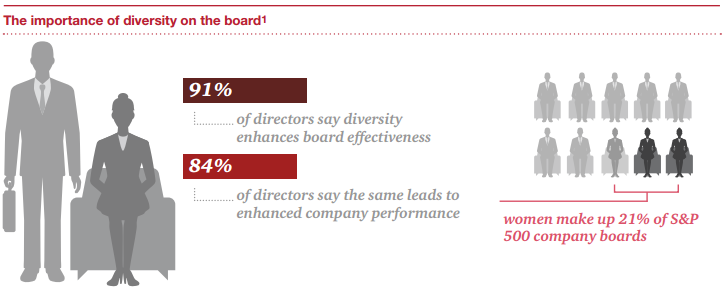
La recherche de PwC a porté sur les résultats de l’évolution des CA dans neuf (9) secteurs industriels. Dans l’ensemble, 91 % des administrateurs croient que la diversité contribue à l’efficacité du conseil. De plus, 84 % des administrateurs lient la variable de la diversité à l’accroissement de la performance organisationnelle.

L’auteure avance qu’il existe trois moyens utiles aux fins du renouvellement des CA :

  1. Une plus grande diversité ;
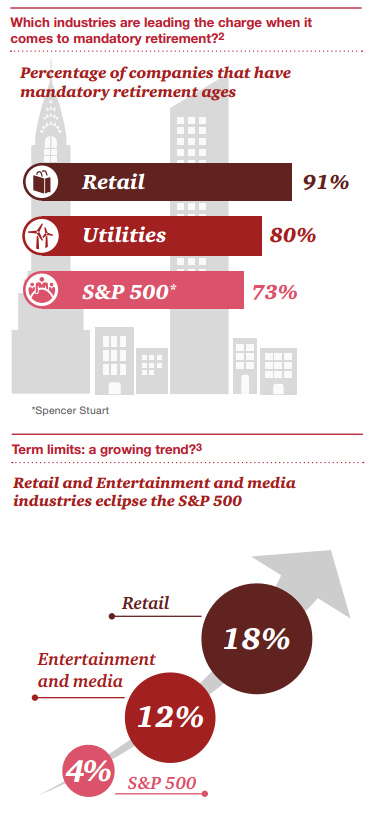
  2. La fixation d’un âge limite et d’un nombre de mandats maximum ;
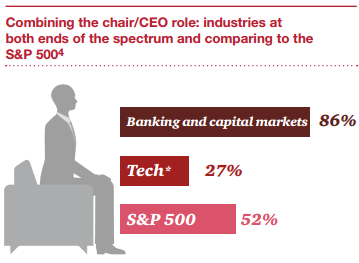
  3. L’évaluation de la séparation des rôles entre la présidence du conseil (Chairperson) et la présidence de l’entreprise (CEO).

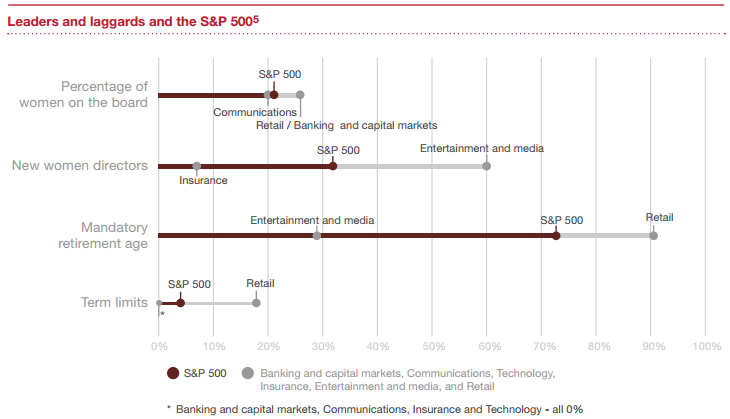
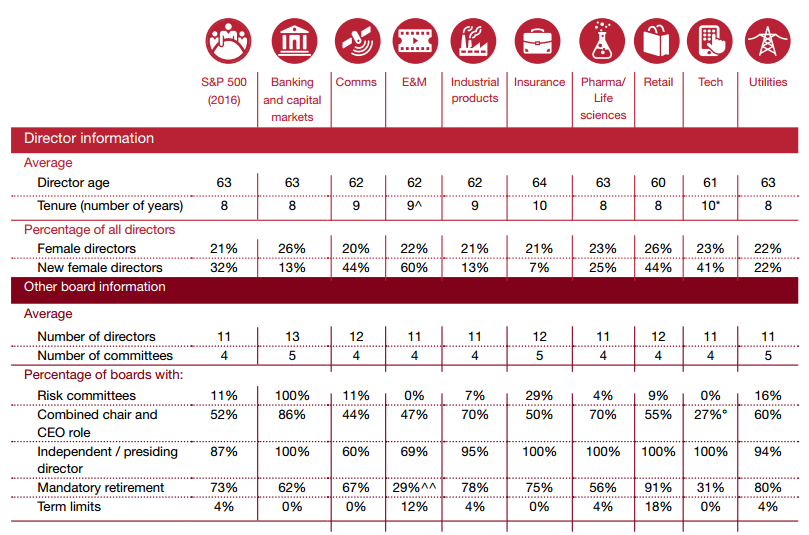
L’article est très intéressant en raison des efforts consentis à la présentation des résultats par l’illustration infographique. Le tableau présenté en annexe est particulièrement pertinent, car on y trouve une synthèse des principales variables liées au renouvellement des CA selon les neuf secteurs industriels ainsi que l’indice du S&P 500.

Au Canada, les recherches montrent que les entreprises sont beaucoup plus proactives eu égard aux facteurs de renouvellement des conseils d’administration.

Bonne lecture !

Does your board have the right makeup for the future?


Résultats de recherche d'images pour « composition du conseil d'administration »


Board composition is “the” issue for investors in 2017. Some industries are taking more steps to refresh their board than others—how does yours stack up? As the economic environment changes and lines between industries start to blur, companies are looking for directors with different, less traditional and even broader skills. Technology skills will be key across sectors.

Who’s sitting in your boardroom? Do your directors bring the right mix of skills, experiences and expertise to best oversee your company? Are they a diverse group, or a group with common backgrounds and outlooks? Can they help see into the future and how your industry is likely to take shape? And are some of your directors serving on your board as well as those in other industries?

These questions should be top of mind for executives and board members alike. Why? Because the volume of challenges companies are facing and the pace of change has intensified in recent years. From emerging technologies and cybersecurity threats to new competitors and changing regulatory requirements, companies–and their boards–have to keep up. Some boards have realized that having board members with multiple industry perspectives can prove helpful when navigating the vast amount of change businesses are faced with today.

If your board isn’t thinking about its composition and refreshment, you are opening up the door to scrutiny. Board composition is “the” issue for investors in 2017. Investors want to know who is sitting in the boardroom and whether they are the best people for the job. If they don’t think you have the right people on the board, you will likely hear about it. This is no longer something that is “nice” to think about, it’s becoming something boards “must” think about. And think about regularly.

How can you refresh your board?


In 2016, we analyzed the board demographics of select companies in nine industries to see how they compared to each other and to the S&P 500. Where does your industry fall when it comes to board refreshment? Does your board have the right makeup for the future?


There are a number of ways to refresh your board. One way is to think about diversity. Many have taken on the gender imbalance on their boards and are adding more women directors. But diversity isn’t only about women. It’s about race, ethnicity, skills, experience, expertise, age and even geography. It’s about diversity of thought and perspective. And it’s not just a talking point anymore. Regulators started drafting disclosure rules around board diversity in mid-2016. Whether the rules become final remains to be seen, but either way, board diversity is in the spotlight. Add to that the common criticism that the US is far behind its developed country peers. Norway, France and the Netherlands have been using quotas for a while, and Germany in 2015 passed a law mandating 30% women on the boards of its biggest companies. While it’s unlikely quotas would be enacted in the US, some believe they’re a needed catalyst.


While we only looked at gender diversity on boards, we believe this is a good indicator of the efforts some boards are making to become more diverse overall. Secondly, mandatory retirement ages and term limits are two tools that boards can use to refresh itself. Our analysis showed that some industries seemed to be adopting these provisions more so than others. Some directors question their effectiveness.

Some of the industries in our PwC peer group analysis don’t have term limits at all

Banking and capital markets

Insurance

Communications

Technology

A third move that some companies have taken often, under investor pressure—is to evaluate their leadership structure and split the chair and CEO role. While the issue is still one that investors care about, certain industries have kept the combined role. And some companies don’t plan on making the change any time soon. Most often, boards with a combined chair/CEO role have an independent lead or presiding director. This may ease concerns that institutional investors and proxy firms may have about independence in the leadership role.


Who would have thought? Some interesting findings


While our analysis shows that most industries didn’t veer too far from the S&P 500 averages for most benchmarking categories, a few stand out. Retail in particular seems to be leading the charge when it comes to board refreshment.


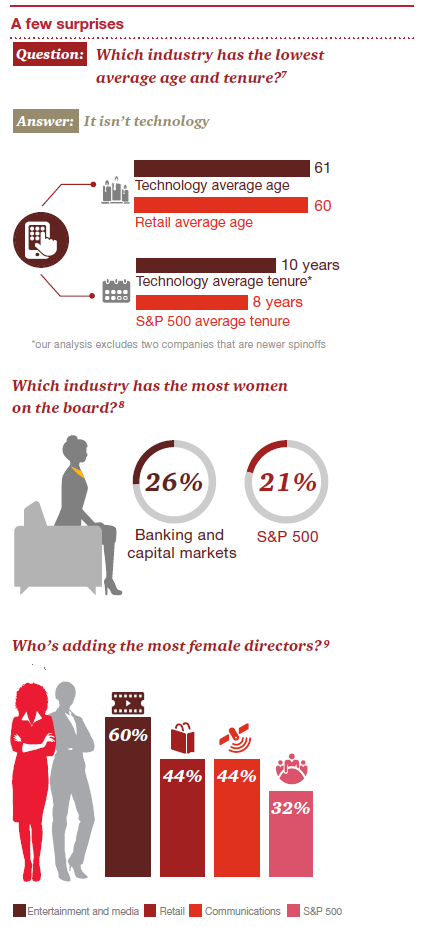
Other industries aren’t moving along quite so quickly. And there were some surprises. Which industry had the lowest average age? Perhaps surprisingly, it’s not technology. Retail claimed that one, too. And, also unexpected, was that technology had one of the highest average tenures. [6] Another surprising finding came from our analysis of the banking and capital markets industry—an industry that’s often considered to be male-dominated. BCM boards had the highest percentage of women, at 26%. That compares to just 21% for the S&P 500. Both the entertainment and media and the communications industries were also ahead of the curve when it comes to women in the boardroom, with the highest and second-highest percentages of new female directors. Retail tied with communications for second-highest, as well.


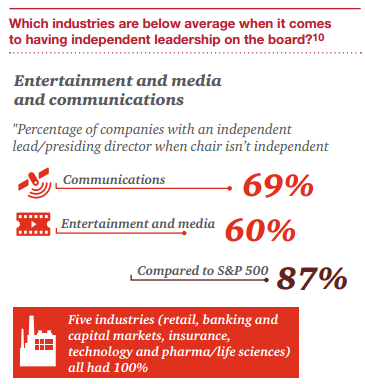
On a less progressive note, both the entertainment and media and communications industries were below the S&P 500 average when it came to having an independent lead or presiding director when the board chair is not independent. And they ranked lowest of the industries we analyzed on this topic—by far.

Blurred lines across industries


Skills, experience and diversity of thought will likely become even more important in the coming years. In the past five years alone, once bright industry lines have started to blur. Take the retail industry, for example. Brick and mortar stores, shopping malls and strip malls were what used to come to mind when thinking about that industry. Now it’s mobile devices and drones. Across many industries, business models are changing, competitors from different industries are appearing and new skills are needed. The picture of what your industry looks like today may not be the same in just a few years.

Technology is the key to much of this change. Just a few years ago, many boards were not enthusiastic about the idea of adding a director solely with technology or digital skills. But times are changing. Technology is increasingly becoming a critical skill to have on the board. We consulted our experts in the nine industries we analyzed, and all of them put technology high on the “must-have” list for new directors. Interestingly, financial, operational and industry experience—the top three from our 2016 Annual Corporate Directors Survey, were not among the most commonly listed.

Taking a fresh look


If your company is shifting gears and changing the way it does business, it may be important to take a fresh look at your board composition at more frequent intervals. Some boards use a skills matrix to see what they might be lacking in their board composition. Others may be forced by a shareholder activist to add new skills to the board.


So how do you fill the holes in the backgrounds or skills you want from your directors? One way is to look to other industries. As our analysis shows, board composition and refreshment approaches vary by industry. As industry lines blur, other industry perspectives could compliment your company—it might be helpful to consider filling any holes with board members from other industries.

No matter which approach you take, it’s very important to think about your board’s composition proactively. Use your board evaluations to understand which directors have the necessary skills and expertise—and which might be lacking what the board needs. Think about your board holistically as you think about your company’s future. Your board composition is critical to ensuring your board is effective—and keeping up with the world outside the boardroom.


Appendix


How do our industry peer groups stack up to the S&P 500? Making this evaluation can be a good way to begin determining whether your board has the right balance in terms of board composition.


Analysis excludes two companies that are newer spinoffs.
Analysis excludes one company that does not combine or separate the roles.
Excludes the tenure of one newly-formed company.
Four of the five companies that have a mandatory retirement age have waived or state that the board can choose to waive it.

Sources: Spencer Stuart, U.S. Board Index 2016, November, 2016; PwC analysis of US SEC registrants: 27 of the largest industrial products companies by market capitalization and revenue, May 2016; 11 of the largest retail companies by revenue, May 2016; 21 of the largest banking and capital markets companies by revenue, September 2016; 24 of the largest insurance companies by market capitalization, May 2016; 17 of the largest entertainment and media companies by revenue, May 2016; nine of the largest communications companies by revenue, May 2016; 25 of the largest power and utilities companies by revenue, October 2016; 16 of the largest technology companies by revenue, May 2016; 23 of the largest pharma/life sciences companies by revenue, May 2016.


Endnotes:

1Sources: PwC, 2016 Annual Corporate Directors Survey, October 2016; Spencer Stuart, 2016 US Board Index, November 2016.(go back)

2Sources: PwC analysis of 11 of the largest retail companies by revenue that are also US SEC registrants, May 2016; PwC analysis of 25 of the largest power and utilities companies by revenue that are also US SEC registrants, October 2016; Spencer Stuart, U.S. Board Index 2016, November 2016.(go back)

3Sources: PwC analysis of 11 of the largest retail companies by revenue that are also US SEC registrants, May 2016; PwC analysis of 17 of the largest entertainment and media companies by revenue that are also US SEC registrants, May 2016; Spencer Stuart, S. Board Index 2016, November 2016.(go back)

4Sources: PwC analysis of 21 of the largest banking and capital markets companies by revenue that are also US SEC registrants, September 2016; PwC analysis of 16 of the largest technology companies by revenue that are also US SEC registrants, May 2016; Spencer Stuart, S. Board Index 2016, November 2016.(go back)

5Sources: PwC analysis of US SEC registrants: nine of the largest communications companies by revenue, May 2016; 11 of the largest retail companies by revenue, May 2016; 21 of the largest banking and capital markets companies by revenue, September 2016; 24 of the largest insurance companies by market capitalization, May 2016; 16 of the largest technology companies by revenue, May 2016; 17 of the largest entertainment and media companies by revenue, May 2016; Spencer Stuart, U.S. Board Index 2016, November 2016.(go back)

6Analysis excludes two companies that are newer spinoffs.(go back)

7Sources: PwC analysis of 16 of the largest technology companies by revenue that are also US SEC registrants, May 2016; Spencer Stuart, U.S. Board Index 2016, November 2016.(go back)

8Sources: PwC analysis of 11 of the largest retail companies by revenue that are also US SEC registrants, May 2016; PwC analysis of 21 of the largest banking and capital markets companies by revenue that are also US SEC registrants, September 2016; Spencer Stuart, U.S. Board Index 2016, November, 2016(go back)

9Sources: PwC analysis of 17 of the largest entertainment and media companies by revenue that are also US SEC registrants, May 2016; PwC analysis of nine of the largest communications companies by revenue that are also US SEC registrants, May 2016; PwC analysis of 11 of the largest retail companies by revenue that are also US SEC registrants, May 2016; Spencer Stuart, S. Board Index 2016, November 2016.(go back)

10Sources: PwC analysis of 17 of the largest entertainment and media companies by revenue that are also US SEC registrants, May 2016; PwC analysis of nine of the largest communications companies by revenue that are also US SEC registrants, May 2016; Spencer Stuart, S. Board Index 2016, November 2016; PwC analysis of 11 of the largest retail companies by revenue that are also US SEC registrants, May 2016; PwC analysis of 21 of the largest banking and capital markets companies by revenue that are also US SEC registrants, September 2016; PwC analysis of 24 of the largest insurance companies by market capitalization that are also US SEC registrants, May 2016; PwC analysis of 16 of the largest technology companies by revenue that are also US SEC registrants, May 2016; PwC analysis of 23 of the largest pharma/life sciences companies by revenue that are also US SEC registrants, May 2016.

Compte rendu hebdomadaire de la Harvard Law School Forum on Corporate Governance | 2 mars 2017


Voici le compte rendu hebdomadaire du forum de la Harvard Law School sur la gouvernance corporative au 2 mars 2017.

J’ai relevé les principaux billets.

Bonne lecture !


harvard_forum_corpgovernance_small


  1. Corporate Officers as Agents
  2. 2015 Short- and Long-Term Incentive Design Criteria Among Top 200 S&P 500 Companies
  3. Private Funds Year in Review and 2017 Outlook
  4. Should Mutual Funds Invest in Startups?
  5. Shareholder Proposals Regarding Lead Director Tenure: A Harbinger of Things to Come?
  6. Hot-Button Issues for the 2017 Proxy Season
  7. 2017 Investor Corporate Governance Report
  8. 2017: Where Things Stand—Appraisal, Business Judgment Rule and Disclosure Section 16(B)—If at First You Don’t Succeed…
  9. Considerations for U.S. Public Companies Acquiring Non-U.S. Companies
  10. The 100 Most Overpaid CEOs

The Directors Toolkit 2017 | Un document complet de KPMG sur les bonnes pratiques de gouvernance et de gestion d’un CA


Voici la version 4.0 du document australien de KPMG, très bien conçu, qui répond clairement aux questions que tous les administrateurs de sociétés se posent dans le cours de leurs mandats.

Même si la publication est dédiée à l’auditoire australien de KPMG, je crois que la réalité réglementaire nord-américaine est trop semblable pour se priver d’un bon « kit » d’outils qui peut aider à constituer un Board efficace.

C’est un formidable document électronique interactif. Voyez la table des matières ci-dessous.

J’ai demandé à KPMG de me procurer une version française du même document, mais il ne semble pas en exister.

Bonne lecture !

The Directors’ Toolkit 2017 | KPMG


Now in its fourth edition, this comprehensive guide is in a user friendly electronic format. It is designed to assist directors to more effectively discharge their duties and improve board performance and decision-making.

Key topics

  1. Duties and responsibilities of a director
  2. Oversight of strategy and governance
  3. Managing shareholder and stakeholder expectations
  4. Structuring an effective board and sub-committees
  5. Enabling key executive appointments
  6. Managing productive meetings
  7. Better practice terms of reference, charters and agendas
  8. Establishing new boards.

What’s new in 2017

In this latest version, we have included newly updated sections on:

  1. managing cybersecurity risks
  2. human rights in the supply chain.

Register

Register here for your free copy of the Directors’ Toolkit.

Compte rendu hebdomadaire de la Harvard Law School Forum on Corporate Governance | 23 février 2017


Voici le compte rendu hebdomadaire du forum de la Harvard Law School sur la gouvernance corporative au 23 février 2017.

J’ai relevé les principaux billets.

Bonne lecture !


harvard_forum_corpgovernance_small

  1. A Trump Appointed AG May Not Translate to Less Aggressive Enforcement
  2. It’s Time for the Pendulum to Swing Back
  3. SEC Enforcement in Financial Reporting and Disclosure—2016 Year in Review
  4. Tactical Approaches to Proxy Season 2017
  5. The Activist Investing Annual Review 2017
  6. Company Stock Reactions to the 2016 Election Shock: Trump, Taxes and Trade
  7. Directors Must Navigate Challenges of Shareholder-Centric Paradigm
  8. A Broader Perspective on Corporate Governance in Litigation


La gouvernance des Cégeps | Le rapport du Vérificateur général du Québec


Nous publions ici un billet de Danielle Malboeuf* qui fait état des recommandations du vérificateur général eu égard à la gouvernance des CÉGEP.

Comme à l’habitude Danielle nous propose son article à titre d’auteure invitée.

Je vous souhaite bonne lecture. Vos commentaires sont appréciés.


La gouvernance des Cégeps et le rapport du Vérificateur général du Québec

par

Danielle Malboeuf*  


À l’automne 2016, le Vérificateur général du Québec produisait un rapport d’audit concernant la gestion administrative de cinq cégeps. Ses travaux ont porté plus précisément sur la gestion des contrats, la gestion des bâtiments, les services autofinancés ainsi que sur la rémunération du personnel d’encadrement et les frais engagés par celui-ci.

Parmi les recommandations formulées à l’endroit des cégeps audités, on en retrouve une qui concerne plus précisément la gouvernance : « S’assurer que les instances de gouvernance reçoivent une information suffisante et en temps opportun afin qu’elles puissent exercer leur rôle quant aux décisions stratégiques et à la surveillance de l’efficacité des contrôles…»[1]

À la lecture de ce rapport et des constats de ces travaux d’audit, on ne peut qu’être qu’en accord avec cette recommandation qui invite les administrateurs à exercer leur rôle. Mais justement, quel rôle ont-ils ? Du point de vue légal, la Loi sur les collèges d’enseignement général et professionnel est peu éclairante à ce sujet.  Contrairement à la Loi sur la gouvernance des sociétés d’État qui précise clairement les fonctions qui sont confiées au conseil d’administration (CA), dont l’obligation d’évaluer l’intégrité des contrôles internes. On y exige également la création de trois sous-comités dont le comité de vérification ou d’audit à qui on confie entre autres, la responsabilité de mettre en place des mécanismes de contrôle interne. De plus, ce sous-comité doit compter sur la présence d’au moins une personne ayant une compétence en matière comptable ou financière.

À mon avis, la gouvernance d’un cégep devrait s’apparenter à celle des sociétés d’État. À ce sujet, dans son rapport publié en mai 2011 soumettant un bilan de l’implantation de la Loi sur la gouvernance des sociétés d’État, l’auteur de ce rapport, l’Institut sur la gouvernance des organismes publics et privés (IGOPP) allait dans le même sens. Il formulait comme première recommandation : « Imposer les nouvelles règles de gouvernance aux nombreux organismes du gouvernement qui ne sont pas inclus dans la loi actuelle sur la gouvernance. »[2]

Malgré le fait que les cégeps n’ont pas l’obligation légale de créer un comité d’audit, plusieurs l’ont fait dans un souci de transparence et afin d’être soutenu par les administrateurs dans leur effort pour assurer une utilisation optimale des ressources financières de l’organisation. Toutefois, le mandat qui leur est confié se limite dans la majorité des cas à une analyse des prévisions budgétaires et des états financiers. Ce n’est pas suffisant !

Considérant la recommandation du vérificateur général, il serait tout à fait approprié d’élargir ce mandat. En plus d’examiner les états financiers et d’en recommander leur approbation au CA, le comité d’audit devrait entre autres, veiller à ce que des mécanismes de contrôle interne soient mis en place et de s’assurer qu’ils soient adéquats et efficaces ainsi que de s’assurer que soit mis en place un processus de gestion des risques.[3] Sachant que les cégeps ne comptent pas de vérificateur interne, il est d’autant plus important de mettre en place un tel comité et de lui confier des fonctions de contrôle financier et de gestion des risques.

Une fois le comité d’audit mis en place, il devrait se pencher prioritairement sur la surveillance du processus de gestion contractuelle. Rappelons que les étapes du processus de gestion contractuelle sont : l’établissement des besoins et l’estimation des coûts, la préparation de l’appel d’offres et la sollicitation des fournisseurs, la sélection du fournisseur et l’attribution du contrat, le suivi du contrat et l’évaluation des biens et des services reçus[4].

À ce sujet, le Vérificateur général, dans son rapport, nous fait part de ses préoccupations. Il a identifié des lacunes dans les modes de sollicitation et constaté des dépassements de coûts et des prolongations dans les délais d’exécution, et ce, sans pénalité. Il précise que «Des activités prévues dans le processus de gestion contractuelle des cégeps audités ne sont pas effectuées de façon rigoureuse.»[5] En jouant son rôle, le comité d’audit du CA pourrait s’assurer que le processus mis en place et le partage des responsabilités retenu sont adéquats et efficaces. Il ne devrait d’ailleurs pas hésiter à faire appel à des ressources externes pour évaluer la performance du Cégep à l’égard de sa gestion contractuelle, le cas échéant.

En terminant, rappelons l’importance de retrouver sur le comité d’audit des administrateurs compétents qui ont une connaissance approfondie de la structure, des politiques, directives et exigences réglementaires. Ils doivent avoir la capacité d’assurer l’efficacité des mécanismes de contrôle interne et de la gestion des risques (un sujet que je développerai dans un article ultérieur).

En présence de telles compétences, il sera plus facile d’assurer la crédibilité du CA et de ses décisions. Il s’agit d’un atout précieux pour toutes institutions collégiales.

_____________________________________

[1] Rapport du Vérificateur général du Québec à l’Assemblée nationale pour l’année 2016-2017, p.35.

[2] Gouvernance des sociétés d’État, bilan et suggestions, IGOPP, p.48.

[3] Loi sur la gouvernance des sociétés d’État, art 24, 3.

[4] Rapport du Vérificateur général du Québec à l’Assemblée nationale pour l’année 2016-2017, annexe 4.

[5] Rapport du Vérificateur général du Québec à l’Assemblée nationale pour l’année 2016-2017, p.9.

_____________________________________

*Danielle Malboeuf est consultante et formatrice en gouvernance ; elle possède une grande expérience dans la gestion des CÉGEPS et dans la gouvernance des institutions d’enseignement collégial et universitaire. Elle est CGA-CPA, MBA, ASC, Gestionnaire et administratrice retraitée du réseau collégial et consultante.


Articles sur la gouvernance des CÉGEPS publiés sur mon blogue par l’auteure :

(1) LE RÔLE DU PRÉSIDENT DU CONSEIL D’ADMINISTRATION (PCA) | LE CAS DES CÉGEPS

(2) Les grands enjeux de la gouvernance des institutions d’enseignement collégial

(3) L’exercice de la démocratie dans la gouvernance des institutions d’enseignement collégial

(4) Caractéristiques des bons administrateurs pour le réseau collégial | Danielle Malboeuf

(5) La gouvernance des CÉGEPS | Une responsabilité partagée

Les administrateurs doivent susciter le débat sur l’avenir de l’entreprise


Je vous recommande la lecture de l’article de Stuart Jackson publié dans la Harvard Business Review de janvier 2017.

L’auteur suggère, qu’en général, les conseils d’administration ne font pas suffisamment preuve de combativité et qu’ils ne jouent pas leur rôle principal, soit d’offrir une vision à long terme et de se concentrer sur la création de valeur.

Les administrateurs doivent offrir diverses perspectives de changement et proposer des stratégies propres à pérenniser l’organisation.

Les administrateurs doivent faire preuve de courage et apprendre à formuler des critiques positives envers le PDG. Le conseil d’administration est essentiellement un lieu de débat sur le futur de l’entreprise.

Les membres du conseil doivent être capables de réfléchir à l’évolution du modèle d’affaires et prévoir un plan d’action opérationnel pour un changement à long terme.

L’auteur propose une limitation de la durée des mandats des administrateurs afin d’éviter la complaisance susceptible de se manifester avec le temps. Également, on doit viser le choix d’administrateurs indépendants, capables de questionner et de contester les actions de la direction.

À cet égard, il me semble que les administrateurs devraient suivre une solide formation en gouvernance, notamment une formation telle que celle offerte par le Collège des administrateurs de sociétés (CAS) qui propose une simulation des débats autour de la table du conseil.

On constate que le rôle d’un administrateur est très exigeant et que celui-ci doit penser en termes de compétitivité de l’entreprise.

Bonne lecture ! Vos commentaires sont les bienvenus.


Boards Must Be More Combative


 homepic1


Boards of directors play two roles. They must protect value by helping companies avoid unnecessary risks, and they must build value by ensuring that companies change quickly enough to address emerging competitive threats, evolving customer preferences, and disruptive technologies.

With technology and business model cycles becoming shorter and companies facing unrelenting pressure to innovate or suffer the consequences, more and more boards need to focus on the second of these roles. To do so, they must be willing to challenge executive teams and stress-test their strategies to ensure they go far enough and fast enough. For boards used to preserving the status quo, this shift can be uncomfortable. Here are four ways boards can become better challengers and champions of change.

Confront Unwelcome News and Trends

Changing strategy is extremely difficult, especially for successful businesses. In the early 1990s Blockbuster commissioned a study on the future of video-on-demand technologies and how they would impact traditional video rentals. The report concluded that expanded cable offerings and broadband internet would begin to impact video rentals around 2000, and would grow rapidly thereafter. The good news was that Blockbuster had a good 10 years to prepare for the new environment. But the shift never happened: Management ignored the study’s findings and continued with the same strategy, supported by the board. In September 2010 Blockbuster filed for bankruptcy protection. In this case, value protection was not enough. The company had clear advance notice that seismic change was coming.

The board’s role was to acknowledge the warning signs and challenge management’s lack of action — even if it meant contention and dispute in the boardroom.

Make Sure You Have Challengers in Your Midst

Boards will be far more effective in their challenger role if they offer seats to individuals with professional experiences and viewpoints that are very different from those of the executive team. Directors can learn to be more direct with management, but it’s hard to fake contrarianism when everyone is of the same mind. When a board resembles the CEO in mindset and outlook, it’s a recipe for a gatekeeper board, not a challenger board. But when boards mix it up by bringing in members with different perspectives, they can effect powerful strategic changes, something I have seen many times in my work with corporate boards.

Often, these “challengers” will be tech-savvy young executives from digitally disruptive companies who can press their fellow directors and senior management about potential blind spots related to digital disruption. But disruption is not always about technology. For example, one highly successful, privately-held producer of canned foods actively sought a board member who could challenge management to think differently but who would still fit with the company’s family-oriented governance culture. The successful candidate was the CEO of a well-known, family-owned California wine business that catered to consumers who would not dream of buying canned food. The board member helped the company “think outside the can” to identify new product forms that would broaden their customer base and appeal to health-conscious consumers.

In another instance, a leading chain of retail pharmacies appointed as vice chair someone with a background in health care manufacturing and pharmacy benefit management. The new board member helped management better understand the efficiency advantages of mail-order pharmacies, which rely on automation. As a result, the company added low-cost automated pharmacy services to its existing retail outlets, giving it a competitive advantage over traditional retail pharmacies.

Stay Fresh with Term Limits and Checks and Balances

Beyond accessing the right expertise, boards can maintain a challenger perspective by ensuring they don’t become complacent and drift toward an approver role. One of the most effective ways to do this is to establish mandatory term limits as a part of the board’s bylaws. Term limits can help boards maintain a level of independence between the outside directors and executive leadership.

Moreover, if the CEO and chair roles are separated, the chair can take more active responsibility for ensuring that alternative views and perspectives are brought before the board. Separating the roles is a common practice in Europe, and it’s becoming more so in the United States. Another option is to appoint an independent lead director, a less drastic change that can have a similar effect. In fact, the New York Stock Exchange essentially requires listed companies with nonindependent chairs to appoint one of their independent directors as lead director. The lead position, among other duties, is responsible for scheduling and helming board meetings that take place without management. Today the majority of S&P companies with combined CEO and chair roles have chosen to counterbalance this arrangement by appointing an independent lead director.

Turn Courage and Candor into Core Competencies

Having directors with valuable insights is worthless if they do not feel comfortable sharing their perspectives and debating issues with management. A recent study by Women Corporate Directors and Bright Enterprises found that more than three-quarters (77%) of director respondents believed that their boards would make better decisions if they were more open to debate, and 94% said that criticism can help bring about change when it is used properly.

Nevertheless, board members are often hesitant to offer criticism, especially to CEOs. The same survey found that only about half (53%) of respondents felt that the CEOs of their companies take criticism well. This is not surprising. As a board member it is much easier to empathize with a CEO under pressure than with an abstract group of shareholders. One way to address this issue is to offer board members training in giving and receiving constructive criticism. Board members need to understand that failing to confront difficult issues will not help the CEO. If a CEO’s first indication that the board is dissatisfied is hearing they are searching for his or her replacement, then the board is not fulfilling its responsibilities.

Challenger boards are those with the strength to put the hard questions to management and to poke holes in suboptimal strategies. They bring a diversity of perspective that can help management understand the company’s vulnerabilities and how to overcome them. For companies struggling to exist in a world where disruption is rapidly becoming a business constant, challenger boards may well be one of their most important survival tools.

Priorité à la diversité sur les conseils d’administration | Les entreprises à un tournant !


Selon David A. Katz et Laura A. McIntosh, associés de la firme Wachtell, Lipton, Rosen & Katz, les entreprises américaines ont franchi un point de non-retour eu égard à l’acceptation de la contribution de la diversité à la profitabilité des sociétés.

En effet, il est de plus en plus acquis que l’accroissement de la diversité a des effets positifs sur les deux rôles majeurs du conseil d’administration : (1) la surveillance (oversight) et (2) la création de valeur des entreprises.

Ce court article, publié sur le site du Harvard Law School Forum, décrit les progrès réalisés dans la mise en œuvre de la diversité sur les CA et montre que les entreprises en sont à un tournant dans ce domaine.

Bonne lecture ! Vos commentaires sont appréciés.


Corporate Governance Update: Prioritizing Board Diversity


In what has been called a “breakout year” for gender diversity on U.S. public company boards, corporate America showed increasing enthusiasm for diversity-promoting measures during 2016. Recent studies have demonstrated the greater profitability of companies whose boards are meaningfully diverse. In many cases, companies have collaborated with investors to increase the number of women on their boards, and a number of prominent corporate leaders have publicly encouraged companies to prioritize diversity. The Business Roundtable, a highly influential group of corporate executives, recently released a statement that explicitly links board diversity with board performance in the two key areas of oversight and value creation. Likewise, a group of corporate leaders—including Warren Buffett, Jamie Dimon, Jeff Immelt, and Larry Fink, among others—published their own “Commonsense Principles of Corporate Governance,” (discussed on the Forum here) an open letter highlighting diversity as a key element of board composition.

board-diversity_forbes

Momentum toward gender parity on boards is building, particularly in the top tier of public corporations. Pension funds from several states have taken strong stances intended to encourage meaningful board diversity at the 25 percent to 30 percent level. Last year, then-SEC Chair Mary Jo White cited the correlation of board diversity with improved company performance and identified board diversity as an important issue for the Commission, signaling that it may be a priority for regulators going forward. Boards should take note of the evolving best practices in board composition and look for ways to improve, from a diversity standpoint, their candidate search, director nomination, and board refreshment practices. We recommend that boards include this issue as part of an annual discussion on director succession, similar to the annual discussion regarding CEO succession.

Diversity and Performance

A board of directors has two primary roles: oversight and long-term value creation. This year, the Business Roundtable released updated governance guidelines (discussed on the Forum here) that link a commitment to diversity to the successful accomplishment of both goals. Its 2016 guidelines include a statement on diversity that reads, in part, “Diverse backgrounds and experiences on corporate boards … strengthen board performance and promote the creation of long-term shareholder value.” In a statement accompanying the guidelines, Business Roundtable leader John Hayes noted that a “diversity of thought and perspective … adds to good decision-making” and enables “Americans, as well as American corporations, to prosper.” Board success and competence thus is recast to include diversity as an essential element rather than as an afterthought or as a concession to special interests.

Similarly, the “Commonsense Principles of Corporate Governance” (discussed on the Forum here) outlined over the summer by a group of corporate leaders highlights diversity on boards—multi-dimensional diversity—and correlates that diversity with improved performance. The signers of the principles, including an activist investor, a pension plan, and various chief executives, stated unequivocally in their accompanying letter that “diverse boards make better decisions.” A consensus seems to be emerging among corporate leaders that, as stated by the Business Roundtable, boards should include “a diversity of thought, backgrounds, experiences, and expertise and a range of tenures that are appropriate given the company’s current and anticipated circumstances and that, collectively, enable the board to perform its oversight function effectively.” With regard to oversight, a recent study by Spencer Stuart and WomenCorporateDirectors Foundation (discussed on the Forum here) found that female directors generally are more concerned about risks, and are more willing to address them, than are their male colleagues. Boards should, where possible, develop a pipeline of candidates whose career paths are enabling them to acquire the relevant professional expertise to be valuable public company directors in their industry.

In order to promote diversity in board composition, boards should become familiar with director search approaches to identify qualified candidates that would not otherwise come to the attention of the nominating committee. Executive search firms, public databases, and inquiries to organizations such as 2020 Women on Boards are a few of the ways that boards can find candidates that may be beyond their typical field of view. Organizations exist to help companies in their recruitment efforts. Crain’s Detroit Business, for example, has compiled a database of qualified female director candidates in Michigan, who are invited to apply and are vetted for inclusion. Boards may wish to commit to including individuals with diverse backgrounds in the pool of qualified candidates for each vacancy to be filled.

The Future of Diversity

In 2016, shareholder proposals on board diversity met with increased success. The numbers are still small: Nine proposals made it onto the ballot last year, nearly double the total in 2015 and triple the total in 2014. Nonetheless, support reached unprecedented levels in certain cases: A diversity proposal—which was not opposed by management—at FleetCor Technologies received over 70 percent shareholder support. Another diversity proposal—which was opposed by management—at Joy Global received support from 52percent of the voting shares (though the proposal did not pass due to abstentions). Diversity proposals are generally supported by the proxy advisory firms, including Institutional Shareholder Services and Glass Lewis.

Perhaps more significantly, shareholder proposals in several cases resulted in increased board diversity without ever coming to a vote. The pension fund Wespath submitted proposals this year seeking to increase diversity at three major corporations, and in each case withdrew the proposals when the subject companies agreed to add women to their boards. A spokesperson for Wespath stated that the fund had privately communicated their desire for increased diversity and had filed proposals as a “last resort” to spur change.

In a similar effort, CalSTRS recently submitted 125 letters to boards at California corporations whose boards had no women directors; in response, 35 of the companies appointed female board members. CalSTRS has indicated that if its private approaches are unsuccessful, it will proceed with shareholder proposals. The Wespath and CalSTRS examples are valuable for boards. Listening to investors, being responsive, and staying out in front of issues to forestall shareholder proposals is far better than reacting to frustrated investors who feel compelled to resort to extreme measures to get corporate attention. It is also greatly preferable to a situation in which activist investors press for legislative actions such as quotas or other mandatory board composition requirements, as we have seen in other countries.

2017 is likely to be a year in which progress toward greater board diversity significantly accelerates. Indeed, it is becoming clear that gender diversity—if not gender parity—one day will be a standard aspect of board composition. While the process of realizing that future should not be artificially or counterproductively hastened, it should be welcomed as a state of affairs that will be beneficial to all corporate constituents and, beyond, to the greater good of U.S. business and American culture.


Compte rendu hebdomadaire de la Harvard Law School Forum on Corporate Governance | 27 janvier 2017


Voici le compte rendu hebdomadaire du forum de la Harvard Law School sur la gouvernance corporative au 27 janvier 2017.

J’ai relevé les principaux billets.

Bonne lecture !


harvard_forum_corpgovernance_small


  1. Why Do Managers Fight Shareholder Proposals? Evidence from No-Action Letter Décisions
  2. Bridging the Data Gap through Shareholder Engagement
  3. Top 10 Topics for Directors in 2017
  4. Mutual Funds As Venture Capitalists? Evidence from Unicorns
  5. Broadening the Boardroom
  6. 2016 Year in Review: Securities Litigation and Regulation
  7. Bebchuk Leads SSRN’s 2016 Citation Rankings
  8. Do Director Elections Matter?
  9. White Collar and Regulatory Enforcement: What to Expect in 2017
  10. Financial Regulatory Reform in the Trump Administration
  11. Dealing with Activist Hedge Funds and Other Activist Investors