The Directors Toolkit | Un document complet de KPMG sur les bonnes pratiques de gouvernance et de gestion d’un CA


Voici la troisième édition d’un document australien de KPMG, très bien conçu, qui répond clairement aux questions que tous les administrateurs de sociétés se posent dans le cours de leurs mandats.

Même si la publication est dédiée à l’auditoire australien de KPMG, je crois que la réalité réglementaire nord-américaine est trop semblable pour se priver d’un bon « kit » d’outils qui peut aider à constituer un Board efficace.

C’est un formidable document électronique interactif de 182 pages. Voyez la table des matières ci-dessous.

J’ai demandé à KPMG de me procurer une version française du même document mais il ne semble pas en exister.

Bonne lecture !

The Directors Toolkit | KPMG

 The Directors' Toolkit cover

Our business environment provides an ever-changing spectrum of risks and opportunities. The role of the director continues to be shaped by a multitude of forces including economic uncertainty, larger and more complex organisations, the increasing pace of technological innovation and digitisation along with a more rigorous regulatory environment.

At the same time there is more onus on directors to operate transparently and be more accountable for their actions and decisions.

To support directors in their challenging role, KPMG has created an interactive Directors’ Toolkit. Now in its third edition, this comprehensive guide is in a user friendly electronic format. It is designed to assist directors to more effectively discharge their duties and improve board performance and decision-making.

Key topics

Duties and responsibilities of a director

Oversight of strategy and governance

Managing shareholder and stakeholder expectations

Structuring an effective board and sub-committees

Enabling key executive appointments

Managing productive meetings

Better practice terms of reference, charters and agendas

Establishing new boards.

What’s New

In this latest version, we have included newly updated sections on:

Roles, responsibilities and expectations of directors of not-for-profit organisations

Risks and opportunities social media presents for directors and organisations

Key responsibilities of directors for overseeing investment governance, operations and processes.

Comment bien se comporter lorsque l’on siège à un conseil d’administration ? | En reprise


À chaque semaine, j’ai l’intention de donner la parole à Johanne Bouchard* qui agira à titre d’auteure invitée sur mon blogue en gouvernance.

Son troisième billet se retrouve dans le e-Book 1 publié sur son site. Sous l’entête « What I write about », blogs in French, l’on retrouve tous les articles en français.

L’auteure a une solide expérience d’interventions de consultation auprès de conseils d’administration de sociétés américaines et d’accompagnements auprès de hauts dirigeants de sociétés publiques. Dans ce billet, elle aborde ce que, selon elle, doivent être les qualités des bons administrateurs.

Quels conseils, simples et concrets, une personne qui connaît bien la nature des conseils d’administration, peut-elle prodiguer aux administrateurs eu égard aux qualités et aux comportements à adopter dans leurs rôles de fiduciaires ?

Bonne lecture ! Vos commentaires sont les bienvenus.

Siéger à un conseil d’administration : comment exceller ?

par

Johanne Bouchard

Siéger à un conseil d'administration : comment exceller?

En 2014, Bryan Stolle, un des contributeurs de la revue Forbes, également investisseur au Mohr Davidow Ventures, a examiné le sujet dans un billet de son blogue. Il a écrit : « L’excellence d’un conseil d’administration est le résultat de l’excellence de chacun de ses membres ». Il poursuit en soulignant ce qu’il considère en être les principaux attributs. Je suis d’accord avec lui mais j’aimerais ajouter ce qui, selon moi, fait la grandeur et la qualité exceptionnelle d’un membre de conseil d’administration.

Intention

D’abord et avant tout, être un excellent membre de conseil d’administration commence avec « l’intention » d’en être un, avec l’intention d’être bienveillant, et pas uniquement avec l’intention de faire partie d’un conseil d’administration. Malheureusement, trop de membres ne sont pas vraiment résolus et déterminés dans leur volonté de devenir membres d’un conseil.

La raison de se joindre à un conseil doit être authentique, avec un désir profond de bien servir l’entité. Être clair sur les raisons qui vous poussent à vous joindre au conseil est absolument essentiel, et cela aide à poser les jalons de votre réussite comme administrateur. En adhérant à un conseil d’administration, votre devoir, ainsi que celui de vos collègues administrateurs, est de créer une valeur ajoutée pour les actionnaires.

Attentes

Ensuite, vous devez comprendre ce que l’on attend de vous et du rôle que vous serez appelé à jouer au sein du conseil d’administration. Trop de membres d’un conseil ne comprennent pas leur rôle et saisissent mal les attentes liées à leur charge. Souvent, le président du conseil et le chef de la direction ne communiquent pas suffisamment clairement leurs attentes concernant leur rôle.

Ne tenez rien pour acquis concernant le temps que vous devrez consacrer à cette fonction et ce qu’on attendra de votre collaboration. Est-ce qu’on s’attend à ce que vous soyez présent à toutes les réunions, que vous siégiez à un comité ou que vous participiez aux conférences téléphoniques entre les réunions normalement prévues ? Votre réseau suffit-il, à ce stade-ci de la croissance de l’entreprise, pour répondre au recrutement de nouveaux talents et pour créer des partenariats ? Est-ce que votre expérience de l’industrie est adéquate; comment serez-vous un joueur-clé lors des discussions ? Y aura-t-il un programme d’accueil et d’intégration des nouveaux administrateurs pour faciliter votre intégration au sein du conseil. De plus, comment prévoyez-vous atteindre un niveau suffisant de connaissance des stratégies commerciales de l’entreprise? Soyez clairs en ce qui concerne les attentes.

Exécution

Vous devez honorer les engagements associés à votre responsabilité de membre du conseil d’administration. Cela signifie :

Être préparé : se présenter à une réunion du conseil d’administration sans avoir lu l’ordre du jour au préalable ainsi que les documents qui l’accompagnent est inacceptable. Cela peut paraître évident, mais vous seriez surpris du nombre de membres de conseils coupables d’un tel manque de préparation. De même, le chef de la direction, soucieux d’une gestion efficace du temps, a la responsabilité de s’assurer que le matériel soit adéquatement préparé et distribué à l’avance à tous les administrateurs.

Respecter le calendrier : soyez à l’heure et assistez à toutes les réunions du conseil d’administration.

Participation

Écoutez, questionnez et ne prenez la parole qu’au moment approprié. Ne cherchez pas à provoquer la controverse uniquement dans le but de vous faire valoir, en émettant un point de vue qui n’est ni opportun, ni pertinent. N’intervenez pas inutilement, sauf si vous avez une meilleure solution ou des choix alternatifs à proposer.

Bonnes manières

Il est important de faire preuve de tact, même lorsque vous essayez d’être directs. Évitez les manœuvres d’intimidation; le dénigrement et le harcèlement n’ont pas leur place au sein d’une entreprise, encore moins dans une salle du conseil. Soyez respectueux, en particulier pendant la présentation du comité de direction. Placez votre cellulaire en mode discrétion. La pratique de bonnes manières, notamment les comportements respectueux, vous permettront de gagner le respect des autres.

Faites valoir vos compétences

Vos compétences sont uniques. Cherchez à les présenter de manière à ce que le conseil d’administration puisse en apprécier les particularités. En mettant pleinement à profit vos compétences et en participant activement aux réunions, vous renforcerez la composition du conseil et vous participerez également à la réussite de l’entreprise en créant une valeur ajoutée pour les actionnaires.

Ne soyez pas timide

Compte tenu de la nature stratégique de cette fonction, vous devez avoir le courage de faire connaître votre point de vue. Un bon membre de conseil d’administration ne doit pas craindre d’inciter les autres membres à se tenir debout lorsque qu’il est conscient des intérêts en cause, ni d’être celui qui saura clairement faire preuve de discernement. Un bon membre de conseil d’administration doit être prêt à accomplir les tâches les plus délicates, y compris celles qui consistent à changer la direction de l’entreprise et le chef de la direction, quand c’est nécessaire, et avant qu’il ne soit trop tard.

Évitez les réclamations monétaires non justifiées

Soyez conscients des émoluments d’administrateur qu’on vous paie. N’abusez pas des privilèges. Les conséquences sont beaucoup trop grandes pour vous, pour la culture de l’entreprise et pour la réputation du conseil. Si vous voulez que je sois plus précise, je fais référence aux déclarations de certaines dépenses que vous devriez payer vous-même. Sachez que quelqu’un du service de la comptabilité examine vos comptes de dépenses, et que cela pourrait facilement ternir votre réputation si vous soumettiez des dépenses inacceptables.

Faites preuve de maturité

Vous vous joignez à un conseil qui agit au plus haut niveau des entreprises (privée, publique ou à but non lucratif), dont les actions et les interventions ont une grande incidence sur les collectivités en général. Gardez confidentiel ce qui est partagé lors des réunions du conseil, et ne soyez pas la source d’une fuite.

Maintenez une bonne conduite

Le privilège de siéger au sein d’un conseil d’administration vous expose à une grande visibilité. Soyez conscients de votre comportement lors des réunions du conseil d’administration et à l’extérieur de la salle de réunion; évitez de révéler certains de vos comportements inopportuns.

Confiance et intégrité

Faites ce que vous avez promis de faire. Engagez-vous à respecter ce que vous promettez. Tenez votre parole et soyez toujours à votre meilleur et fier d’être un membre respectable du conseil d’administration.

Valeurs

Un bon membre de conseil d’administration possède des valeurs qu’il ne craint pas de révéler. Il est confiant que ses agissements reflètent ses valeurs.

Un bon membre de conseil est un joueur actif et, comme Stolle l’a si bien noté, de bons administrateurs constituent l’assise d’un bon conseil d’administration. Ce conseil d’administration abordera sans hésiter les enjeux délicats, tels que la rémunération du chef de la direction et la planification de la relève – des éléments qui sont trop souvent négligés.

Un bon membre du conseil d’administration devrait se soucier d’être un modèle et une source d’inspiration en exerçant sa fonction, que ce soit à titre d’administrateur indépendant, de président, de vice-président, de président du conseil, d’administrateur principal, de président d’un comité – quel que soit son rôle – il devrait avoir la maturité et la sagesse nécessaires pour se retirer d’un conseil d’administration avec grâce, quand vient le temps opportun de le faire.

Enfin, prenez soin de ne pas être un membre dysfonctionnel, ralentissant les progrès du conseil d’administration. Bien qu’étant un administrateur indépendant, chacun a le même devoir qu’un joueur d’équipe.

Je vous invite à aspirer à être un bon membre de conseil d’administration et à respecter vos engagements. Siéger à un trop grand nombre de conseils ne fera pas de vous un meilleur membre.

Je conduis des évaluations du rendement des conseils d’administration, et, je vous avoue, en toute sincérité, que de nombreux administrateurs me font remarquer que certains de leurs collègues semblent se disperser et qu’ils ne sont pas les administrateurs auxquels on est en droit de s’attendre. Vous ne pouvez pas vous permettre de trop « étirer l’élastique » si vous voulez pleinement honorer vos engagements. Rappelez-vous que c’est acceptable de dire « non » à certaines demandes, d’être sélectif quant à ce que vous souhaitez faire, mais il est vital de bien accomplir votre charge dans le rôle que vous tenez.

______________________________

*Johanne Bouchard est maintenant consultante auprès de conseils d’administration, de chefs de la direction et de comités de direction. Johanne a développé une expertise au niveau de la dynamique et la de composition d’un conseil d’administration. Après l’obtention de son diplôme d’ingénieure en informatique, sa carrière l’a menée à œuvrer dans tous les domaines du secteur de la technologie, du marketing et de la stratégie à l’échelle mondiale.

Pour en connaître plus sur le site de Johanne Bouchard

Le rôle du comité exécutif vs le rôle du conseil d’administration | En rappel


Voici une discussion très intéressante paru sur le groupe de discussion LinkedIn Board of Directors Society, et initiée par Jean-François Denaultconcernant la nécessité de faire appel à un comité exécutif.

Je vous invite à lire les commentaires présentés sur le fil de discussion du groupe afin de vous former une opinion.

Personnellement, je crois que le comité exécutif est beaucoup trop souvent impliqué dans des activités de nature managériale.

Dans plusieurs cas, le CA pourrait s’en passer et reprendre l’initiative !

Qu’en pensez-vous ?

____________________________________________________


La situation exposée par  est la suivante (en anglais) :

I’m looking for feedback for a situation I encountered.
I am a board member for a non-profit. Some of us learned of an issue, and we brought it up at the last meeting for an update.IMG_20141013_145537
We were told that it was being handled by the Executive Committee, and would not be brought up in board meetings.
It is my understanding that the executive committee’s role is not to take issues upon themselves, but to act in interim of board meetings. It should not be discussing issues independently from the board.
Am I correct in thinking this? Should all issues be brought up to the board, or can the executive committee handle situations that it qualifies as « sensitive »?


The Role of the Executive Committee versus the main board of directors

Alan Kershaw

Chair of Regulatory Board

Depends whether it’s an operational matter I guess – e.g. a staffing issue below CEO/Director level. If it’s a matter of policy or strategy, or impacts on them, then the Board is entitled to be kept informed, surely, and to consider the matter itself. 


John Dinner

John T,  Dinner Board Governance Services

Helping boards improve their performance and contributionI’ll respond a bit more broadly, Jean-François. While I am not opposed to the use of executive committees, a red flag often goes up when I conduct a governance review for clients and review their EC mandate and practices. There is a slippery slope where such committees find themselves assuming more accountability for the board’s work over time. Two classes of directors often form unintentionally as a result. Your situation is an example where the executive committee has usurped the board’s final authority. While I don’t recommend one approach, my inclination is to suggest that boards try to function without an executive committee because of the frequency that situations similar to the one you describe arise at boards where such committees play an active role. There are pros and cons, of course, for having these committees, but I believe the associated risk often warrants reconsideration of their real value and need.


Chuck Molina

Chief Technology Officer at DHI

I currently sit on the EC and have been in that role with other boards. Although I can see the EC working on projects as a subset of the board we Always go back to the full board and disclose those projects and will take items to the full board for approval. The board as a whole is accountable for decisions! There has to be transparency on the board! I found this article for you. http://www.help4nonprofits.com/BrainTeaser/BrainTeaser-Role_of_Executive_Committee.htm , which concurs to John’s comment. If used correctly the EC or a subset of the board can work on board issues more efficiently then venting through the full board, but they should always go back to the Full board for consideration or approval.  


Dave Chapman

CHM and CEO of NorthPoint ERM

I have experienced couple of EB’s and unless the company is in deep financial or legal trouble for the most part the took away from the main board and in the whole worked ok but not great. If the board has over 10 to 15 board members it is almost a requirement but the board them is there for optics more than or effective and efficient decision making

Experienced CEO & Board member of Domestic and European companies.

I think Mr. Dinner, Mr. Molina, and Mr. Chapman summed it up beautifully:
– You cannot have two classes of Directors
– You have to have transparency and every Board member is entitled to the same information
– A Board of 10-15 members is inefficient and may need committees, but that does not change the fact that all Board members are entitled to have input into anything that the Board decides as a body.
– An Executive Committee is a sub-committee of the entire Board, not an independent body with extraordinary powers.


Al Errington

Entrepreneur & Governance Advocate

I agree with John, executive committees tend to be a slippery slope to bad governance. The board of directors has the responsibility of direction and oversight of the business or organization. If anything goes substantially wrong, the board of directors will also be accountable, legally. The rules of thumb for any and all committees is
– Committees must always be accountable to the board of directors, not the other way around.
– Committees must always have limits defined by the board of directors on authority and responsibility, and should have limits on duration.
– Committees should always have a specific reason to exist and that reason should be to support the board of directors in addressing it’s responsibilities. 


Emerson Galfo

Consulting CFO/COO / Board Member/Advisor

Judging from the responses, we need to clearly define the context of what an Executive Committee is. Every organization can have it’s own function/view of what an Executive Committee is.

From my experience, an Executive Committee is under the CEO and reflects a group of trusted C-level executives that influence his decisions. I have had NO experience with Executive Boards other than the usual specific Board Committees dealing with specific realms of the organization.

So coming from this perspective, the Executive Committee is two steps down from the organizational pecking order and should be treated or viewed in that context.. 


Terry Tormey

President & CEO at Prevention Pharmaceuticals Inc.

I concur with Mr. James Clouser (above).
They should be avoided except in matters involving a performance question regarding C-Level Executive Board member, where a replacement may be sought.


John Baily

Board of Directors at RLI Corp

James hit the nail on the head. Executive committees are a throwback to times when we didn’t have the communication tools we do now. They no longer have a reason for their existence. All directors, weather on a not for profit or a corporate board have equal responsibilities and legal exposures. There is no room or reason for a board within a board in today’s world.


Chinyere Nze

Chief Executive Officer

My experience is; Board members have the last say in all policy issues- especially when it concerns operational matter. But in this case, where there is Executive Committee, what it sounds like is that, the organization in question has not clearly identified, nor delineated the roles of each body- which seem to have brought up the issue of ‘conflict’ in final decision- making. Often Executive Committees are created to act as a buffer or interim to the Board, this may sometime cause some over-lapping in executive decision-making.

My suggestion is for the organization to assess and evaluate its current hierarchy- clearly identify & define roles-benefits for creating and having both bodies, and how specific policies/ protocol would benefit the organization. In other words, the CEO needs to define the goals or benefits of having just a Board or having both bodies, and to avoid role conflict or over-lap, which may lead to confusion, as it seems to have been the case here. 


STEPHEN KOSMALSKI

CEO / PRESIDENT/BOARD OF DIRECTORS /PRIVATE EQUITY OPERATING PARTNER known for returning growth to stagnant businesses

The critical consideration for all board members is ‘ fiduciary accountability’ of all bod members. With that exposure , all bod members should be aware of key issues . 


Thomas Brattle « Toby » Gannett

President and CEO at BCR Managment

I think for large organizations, that executive committees still have an important role as many board members have a great deal going on and operational matters may come up from time to time that need to be handled in a judicial manner. While I think that the Executive committee has an important, at times critical role for a BOD, it is also critical that trust is built between the executive Committee and the BOD. This is only done when the executive committee is transparent, and pushes as many decisions that it can to the full board. If the committee does not have time to bring a matter to the full BOD, then they must convey to the BOD the circumstances why and reasoning for their decision. It is the executive committees responsibility to build that trust with the BOD and work hard to maintain it. All strategic decisions must be made by the full BOD. It sounds like you either have a communication failure, governance issue, or need work with your policies and procedures or a combination of issues.


Une révision du volume de Richard Leblanc | Handbook of Board Governance


Voici un article de James McRitchie, publié dans Corporate governance, qui commente succinctement le dernier volume de Richard Leblanc.

Comme je l’ai déjà mentionné dans un autre billet, le livre de Richard Leblanc est certainement l’un des plus importants ouvrages (sinon le plus important) portant sur la gouvernance du conseil d’administration.

Je vous encourage à prendre connaissance de la revue de M. McRitchie, et à vous procurer cette bible.

Bonne lecture !


The Handbook of Board Governance


The Handbook of Board Governance


I continue my review of The Handbook of Board Governance: A Comprehensive Guide for Public, Private, and Not-for-Profit Board Member. With the current post, I provide comments on Part 2 of the book, What Makes for a Good Board? See prior introductory comments and those on Part 1. I suspect the book will soon be the most popular collection of articles of current interest in the field of corporate governance.

The Handbook of Board Governance: Director Independence, Competency, and Behavior


Dr. Richard Leblanc‘s chapter focuses on the above three elements that make an effective director. Regulations require independence but not industry expertise; both are important elements. Leblanc cites ways director independence is commonly compromised and how independence ‘of mind’ can be enhanced. He then applies most of the same principles to choosing external advisors.  Throughout the chapter he employees useful exhibits that reinforce the text with bullet points, tables, etc. for quick reference.

Director competency matrices have become relatively commonplace, although not ubiquitous. Leblanc not only provides a sample and scale, he reminds readers that being a CEO is an experience, not a competency and experience is not synonymous with competency. A sample board diversity matrix is also presented with measurable objectives for age, gender, ethnicity and geography.

Director behavior is the last topic in Leblanc’s chapter. Of course, each board needs to define how its directors are to act, subject to self- and peer-assessment but Leblanc’s ten behaviors is a good starting place:

  1. Independent Judgment
  2. Integrity
  3. Organizational Loyalty
  4. Commitment
  5. Capacity to Challenge
  6. Willingness to Act
  7. Conceptual Thinking Skills
  8. Communication Skills
  9. Teamwork Skills
  10. Influence Skills

That’s just one list of many. Leblanc’s examples and commentary on each adds color and depth. Under the UK’s Corporate Governance Code, director reviews are required to be facilitated by an independent provider every two or three years. Great advice for boards elsewhere as well. As Leblanc reminds readers:

« Proxy access and other renewal reforms are the direct result of boards steadfastly resisting director recruitment on the basis of competencies, the removal of underperforming directors; and the lack of boardroom refreshment, diversification, and renewal ».

La longueur des mandats confiés aux administrateurs compromet-elle leur indépendance ?


La littérature en gouvernance aborde de plus en plus fréquemment les sujets du renouvellement des membres du conseil d’administration, de l’âge et de la durée des mandats en les associant à l’indépendance des administrateurs.

Plusieurs investisseurs institutionnels et firmes de conseil en votation ont inclus le facteur de longévité des administrateurs parmi les éléments à considérer dans l’évaluation du rôle des administrateurs indépendants.

David A. Katz*, associé de la firme Wachtell, Lipton, Rosen & Katz, a publié un article dans le Harvard Law School Forum, qui présente clairement la problématique liée à cet enjeu ; il conclut qu’il n’y a pas de lien de causalité entre le nombre d’années de présence à un conseil et l’indépendance des administrateurs.

Le travail du comité de gouvernance, notamment les plans de relève des administrateurs et l’évaluation des performances des administrateurs sont les meilleurs gages d’une saine indépendance.

In conclusion, we believe that the focus on director tenure is generally misplaced, and that investors would be better served by directly addressing any underlying issues and concerns rather than using board tenure as a proxy. Appropriate board refreshment and director succession plans, accompanied by robust annual director evaluations, are the best means for public companies to ensure that board members are independent, engaged and productive and that they have the relevant experience and expertise to assist the company as it executes on its strategy.

Qu’en pensez-vous ?


Director Tenure Remains a Focus of Investors and Activists


Director tenure, or “board refreshment,” is a corporate governance flashpoint at the moment for institutional investors, boards of directors and proxy advisory firms. One of the top takeaways from the 2016 proxy season, according to EY, is that “board composition remains a key focus—with director tenure and board leadership coming under increased investor scrutiny.” [1] Many investors and shareholder activists view director tenure as integral to issues of board composition, succession planning, diversity, and, most of all, independence.

director tenure

Fortunately, term limits for directors is an idea that, in the United States, appears to have more appeal in theory than in practice. Term limits are in place at only three percent of S&P 500 companies—a decrease from five percent in 2010. Although the sample size is small, term limits in this group range from 10 to 20 years. [2] And, despite the seeming popularity of term limits among investors, during the 2016 proxy season, there were no shareholder proposals regarding director term limits, and during the 2015 proxy season, there were only two. [3] The small number of boards that have mandatory term limits indicates that the vast majority of directors—though they may appreciate the arguments in favor of term limits—determine, as a practical matter, that director tenure is best evaluated on a case-by-case basis, both at the company level and at the level of individual directors. The best way to achieve healthy board turnover is not term limits or retirement ages but a robust director evaluation process combined with an ongoing director succession process.

Board Tenure and Director Independence

For some investors, director term limits represent another avenue to address concerns over director independence. Firmly entrenched as an ideal, yet subject to many interpretations, “director independence” remains the linchpin of good corporate governance. Rules on independence generally aim to ensure that directors deemed “independent” have no conflicts of interest with respect to their service on the board, through financial investments, professional or personal connections, recent employment with the company, and the like. It is considered particularly important that members of the key board committees—audit, nominating/governance, and compensation—have no apparent conflicts that would cast doubt on their ability to exercise, or their likelihood of exercising, their business judgment in an objective and professional manner. Notably, having a significant investment in the company as a stockholder (other than a controlling stockholder), generally does not affect a director’s independence under the SEC or stock exchange rules, even though such directors may have different interests than other shareholders.

Shareholder groups and institutional investors have begun to incorporate director tenure considerations into their company evaluations and voting recommendations. Globally, mandatory term limits and comply-or-explain regimes are being implemented as the issue becomes increasingly high-profile worldwide. [4] Notably, a 2016 Spencer Stuart global survey of 4,000 directors in 60 different countries indicated that directors in private companies are significantly less likely to be subject to term limits. [5] It is telling that, absent the pressures faced by public companies, private boards clearly choose to maintain their latitude regarding board composition decisions.

One source of these pressures may be that in recent years, the average age of directors has increased, and mandatory director retirement ages have either been increased or eliminated at many public companies. Public companies naturally wish to retain productive, experienced directors—many of whom are staying active later in life than their predecessors in previous generations—as well as a recognition that age is not itself generally a limiting fact for a good director. Companies with robust annual director evaluation programs should not need a mandatory retirement age to weed out poorly performing directors. Similarly, younger directors need to undergo the same evaluation on an annual basis to ensure that their performance is up to par.

Long service as an independent director on a board is viewed by some as creating a conflict on the basis that extended tenure creates too close a relationship among longstanding board members and chief executives. Accordingly, a number of influential investors and proxy advisors include director tenure as a consideration in determining their proxy voting policies. CalPERS, for example, updated its proxy voting policy for 2016 to assert that “director independence can be compromised at twelve years of service,” and that after such time, companies should conduct “rigorous evaluations to either classify the director as non-independent or provide a detailed annual explanation of why the director can continue to be classified as independent.” [6]

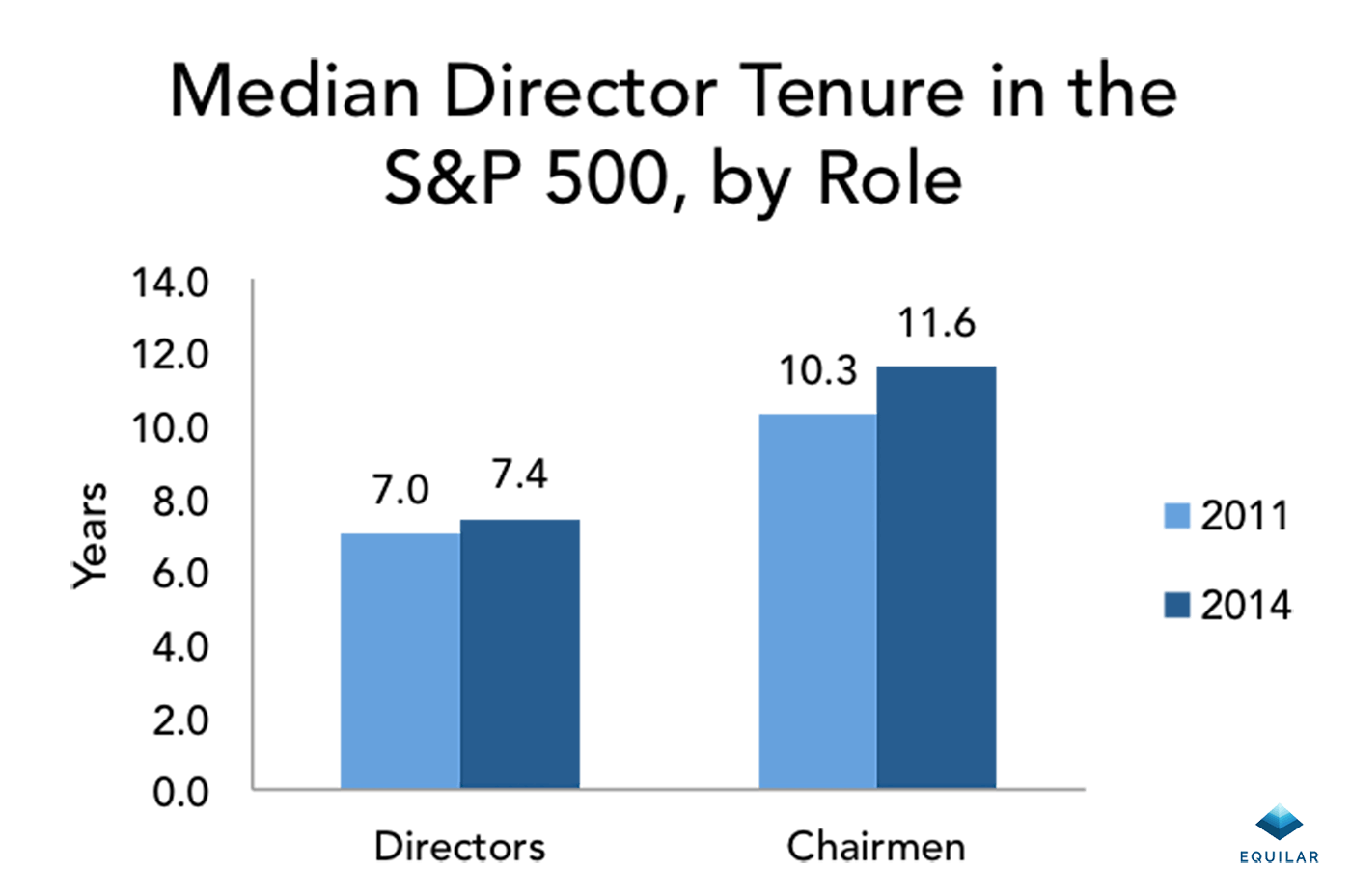
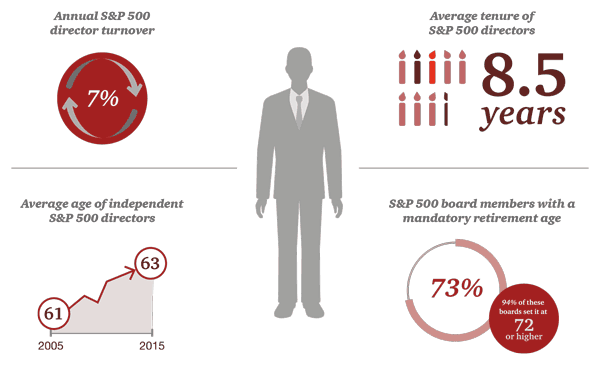
Equating long tenure with a lack of independence is problematic in several ways. As a statistical matter, the average tenure of CEOs in the S&P 500 is 7.4 years, an increase of less than one year in the last decade. [7] Average director tenure in the S&P 500, meanwhile, has remained stable in recent years at roughly 8.5 years. [8] Long coterminous service of directors and chief executives would appear to be the exception rather than the norm. Moreover, long-serving directors are often the ones that have accrued the expertise and standing to influence and effectively oversee a long-serving or otherwise powerful CEO. Institutional investors surveyed by EY last year expressed reservations about director term limits, indicating their concern that mandatory limits do not adequately account for the valuable contributions of experienced directors. Some of these investors felt that a guideline, rather than a strict requirement, as to director tenure could provide a useful starting point for a discussion of board refreshment. [9]

Some investors and academics have gone so far as to propose that, after a certain length of tenure, directors should be considered not independent for the purposes of serving on the audit and compensation committees. [10] In our view, this would be counterproductive in important ways. First, it would limit the usefulness of a board’s most experienced directors by precluding them from serving on the key committees where their expertise may be most valuable. Second, such a ban would impinge upon the board’s business judgment and discretion by micromanaging the very organizational structure of the board itself. Ultimately, if a company’s shareholders have so little confidence in their directors that they feel the need to intervene in board committee assignments, they could not possibly trust the directors to supervise the company generally. Director tenure is an issue at once too picayune—as it is well within the discretion of the board—and too significant—as it affects the board’s latitude to do its job effectively—to be determined by shareholders or outside groups rather than by directors themselves.

We believe that many investors as well as proxy advisory firms are looking at this issue the wrong way. Rather than focusing on simply the longest tenured directors, we believe that it is the average tenure of the entire board that is most relevant. This is a more meaningful metric for evaluating board refreshment and director succession.

Boards Must Maintain Flexibility

Boards should, as a general matter, annually perform a substantive self-evaluation, in which director tenure is one element to consider. The directors should review not only the contributions of current directors, but also the ongoing needs of the board. New directors will be essential as the company undergoes natural changes in strategy and management, and as the board ensures that it creates opportunities to benefit from the contributions of directors with diverse professional and personal backgrounds. A significant amount of director turnover happens as a matter of course: For instance, EY estimates that nearly 20 percent of directors in the S&P 100 are set to retire in the next five years. [11] As an indication that the board is aware of tenure concerns among some investor groups, companies may choose to set forth the average tenure of non-management directors as a separate item in their proxy statement disclosures. [12] As noted above, in our view, average tenure is a more appropriate measure.

When considering the adoption of mandatory term or age limits, boards should recognize that waiving the limits often requires disclosure and may result in negative publicity and even negative vote recommendations. Glass Lewis, for example, does not encourage the adoption of what it calls “inflexible rules” regarding director terms; indeed, its 2016 proxy guidelines endorse the position that length of tenure and age are not correlated with director performance. That said, its policy is to consider recommending a vote against directors on the nominating and/or governance committees if the board waives the company’s mandatory term limit absent explanations and special circumstances. [13]

Directors would be well advised to consider the approach of BlackRock, whose policy is aimed at the substantive issues to which director tenure is only superficially related. BlackRock focuses not on the number of years of service but instead on “board responsiveness to shareholders on board composition concerns, evidence of board entrenchment, insufficient attention to board diversity, and/or failure to promote adequate board succession planning.” [14]

BlackRock sensibly observes in its stated policy that long board tenure does not necessarily impair director independence.

As both Glass Lewis and BlackRock note in their policy statements, term limits can be a tool for boards that are having difficulty in moving long-serving members off the board. Though negotiations of this nature indeed can be fraught, boards are far better served in the long term by working their way through the issue and preserving their own discretion rather than implementing a rule that, while helpful in one instance, may prove undesirable in the future.

In conclusion, we believe that the focus on director tenure is generally misplaced, and that investors would be better served by directly addressing any underlying issues and concerns rather than using board tenure as a proxy. Appropriate board refreshment and director succession plans, accompanied by robust annual director evaluations, are the best means for public companies to ensure that board members are independent, engaged and productive and that they have the relevant experience and expertise to assist the company as it executes on its strategy.

Endnotes:

[1] EY Center for Board Matters, “Four Takeaways from Proxy Season 2016,” discussed on the Forum here.
(go back)

[2] Spencer Stuart Board Index 2015, at 14, available at https://www.spencerstuart.com/%7E/media/pdf%20files/research%20and%20insight%20pdfs/ssbi-2015_110215-web.pdf.
(go back)

[3] The first was at Barnwell Industries, Inc., and it did not come to a vote. The second was at Costco Wholesale Corporation, and it received supporting votes from less than 5 percent of the outstanding shares.
(go back)

[4] See David A. Katz & Laura A. McIntosh, “Renewed Focus on Director Tenure,” May 22, 2014, discussed on the Forum here, for a discussion of viewpoints on director tenure in the United States and abroad.
(go back)

[5] Spencer Stuart 2016 Global Board of Directors Survey, at 9, available at https://www.spencerstuart.com/research-and-insight/2016-global-board-of-directors-survey. The survey found that 39 percent of public companies have mandatory term limits, as opposed to 30 percent of private companies. In addition, 33 percent of public companies had mandatory retirement ages, as opposed to 12 percent of private companies.
(go back)

[6] CalPERS Global Governance Principles, March 2016, at 16, available at https://www.calpers.ca.gov/docs/board-agendas/201603/invest/item05a-02.pdf.
(go back)

[7] Equilar Blog, “CEO Tenure Has Increased Nearly One Full Year since 2005,” available at http://www.equilar.com/blogs/59-ceo-tenure.html.
(go back)

[8] Spencer Stuart Board Index 2015, at 5.
(go back)

[9] EY Center for Board Matters, “2015 Proxy Season Insights: Spotlight on Board Composition,” discussed on the Forum here.
(go back)

[10] See, for example, Yaron Nili, “The ‘New Insiders,’: Rethinking Independent Directors’ Tenure,” U. Wis. L. Sch. Research Paper Series, Paper No. 1390 (2016), discussed on the Forum here.
(go back)

[11] EY Center for Board Matters, “Five-year Outlook: Nearly 20% of Directors Poised for Board Exit,” discussed on the Forum here.
(go back)

[12] See, e.g., American Express Co., 2016 Proxy Statement, at 5 (available at http://ir.americanexpress.com/Cache/1500082785.PDF?O=PDF&T=&Y=&D=&FID=1500082785&iid=102700).
(go back)

[13] Glass Lewis Proxy Paper Guidelines, 2016 Proxy Season, United States, at 20-21, available at http://www.glasslewis.com/wp-content/uploads/2016/01/2016_Guidelines_United_States.pdf.
(go back)

[14] BlackRock Proxy Voting Guidelines for U.S. Securities, February 2015, at 4-5, available at http://www.blackrock.com/corporate/en-us/literature/fact-sheet/blk-responsible-investment-guidelines-us.pdf.
(go back)

_________________________________

*David A. Katz is a partner and Laura A. McIntosh is a consulting attorney at Wachtell, Lipton, Rosen & Katz. The following post is based on an article by Mr. Katz and Ms. McIntosh that first appeared in the New York Law Journal. The views expressed are the authors’ and do not necessarily represent the views of the partners of Wachtell, Lipton, Rosen & Katz or the firm as a whole. Related research from the Program on Corporate Governance includes The “New Insiders”: Rethinking Independent Directors’ Tenure by Yaron Nili (discussed on the Forum here).

Énoncés de principes de gouvernance généralement reconnus


Voici une « lettre ouverte » publiée sur le forum de la Harvard Law School on Corporate Governance par un groupe d’éminents dirigeants de sociétés publiques (cotées) qui présente les principes de la saine gouvernance : « The Commonsense Principles of Corporate Governance »*.

Les principes sont regroupés en plusieurs thèmes :

  1. La composition du CA et la gouvernance interne
    1. Composition
    2. Élection des administrateurs
    3. Nomination des administrateurs
    4. Rémunération des administrateurs et la propriété d’actions
    5. Structure et fonctionnement des comités du conseil
    6. Nombre de mandats et âge de la retraite
    7. Efficacité des administrateurs
  2. Responsabilités des administrateurs
    1. Communication des administrateurs avec de tierces parties
    2. Activités cruciales du conseil : préparer les ordres du jour
  3. Le droit des actionnaires
  4. La reddition de comptes et la divulgation des activités
  5. Le leadership du conseil
  6. La planification de la relève managériale
  7. La rémunération de la direction
  8. Le rôle du gestionnaire des actifs des clients dans la gouvernance des sociétés


Bonne lecture ! Vos commentaires sont les bienvenus.


Commonsense Principles of Corporate Governance


sociétariat_gouvernance


The following is a series of corporate governance principles for public companies, their boards of directors and their shareholders. These principles are intended to provide a basic framework for sound, long-term-oriented governance. But given the differences among our many public companies—including their size, their products and services, their history and their leadership—not every principle (or every part of every principle) will work for every company, and not every principle will be applied in the same fashion by all companies.

I. Board of Directors—Composition and Internal Governance

a. Composition

  1. Directors’ loyalty should be to the shareholders and the company. A board must not be beholden to the CEO or management. A significant majority of the board should be independent under the New York Stock Exchange rules or similar standards.
  2. All directors must have high integrity and the appropriate competence to represent the interests of all shareholders in achieving the long-term success of their company. Ideally, in order to facilitate engaged and informed oversight of the company and the performance of its management, a subset of directors will have professional experiences directly related to the company’s business. At the same time, however, it is important to recognize that some of the best ideas, insights and contributions can come from directors whose professional experiences are not directly related to the company’s business.
  3. Directors should be strong and steadfast, independent of mind and willing to challenge constructively but not be divisive or self-serving. Collaboration and collegiality also are critical for a healthy, functioning board.
  4. Directors should be business savvy, be shareholder oriented and have a genuine passion for their company.
  5. Directors should have complementary and diverse skill sets, backgrounds and experiences. Diversity along multiple dimensions is critical to a high-functioning board. Director candidates should be drawn from a rigorously diverse pool.
  6. While no one size fits all—boards need to be large enough to allow for a variety of perspectives, as well as to manage required board processes—they generally should be as small as practicable so as to promote an open dialogue among directors.
  7. Directors need to commit substantial time and energy to the role. Therefore, a board should assess the ability of its members to maintain appropriate focus and not be distracted by competing responsibilities. In so doing, the board should carefully consider a director’s service on multiple boards and other commitments.

b. Election of directors

Directors should be elected by a majority of the votes cast “for” and “against/withhold” (i.e., abstentions and non-votes should not be counted for this purpose).

c. Nominating directors

  1. Long-term shareholders should recommend potential directors if they know the individuals well and believe they would be additive to the board.
  2. A company is more likely to attract and retain strong directors if the board focuses on big-picture issues and can delegate other matters to management (see below at II.b., “Board of Directors’ Responsibilities/Critical activities of the board; setting the agenda”).

d. Director compensation and stock ownership

  1. A company’s independent directors should be fairly and equally compensated for board service, although (i) lead independent directors and committee chairs may receive additional compensation and (ii) committee service fees may vary. If directors receive any additional compensation from the company that is not related to their service as a board member, such activity should be disclosed and explained.
  2. Companies should consider paying a substantial portion (e.g., for some companies, as much as 50% or more) of director compensation in stock, performance stock units or similar equity-like instruments. Companies also should consider requiring directors to retain a significant portion of their equity compensation for the duration of their tenure to further directors’ economic alignment with the long-term performance of the company.

e. Board committee structure and service

  1. Companies should conduct a thorough and robust orientation program for their new directors, including background on the industry and the competitive landscape in which the company operates, the company’s business, its operations, and important legal and regulatory issues, etc.
  2. A board should have a well-developed committee structure with clearly understood responsibilities. Disclosures to shareholders should describe the structure and function of each board committee.
  3. Boards should consider periodic rotation of board leadership roles (i.e., committee chairs and the lead independent director), balancing the benefits of rotation against the benefits of continuity, experience and expertise.

f. Director tenure and retirement age

  1. It is essential that a company attract and retain strong, experienced and knowledgeable board members.
  2. Some boards have rules around maximum length of service and mandatory retirement age for directors; others have such rules but permit exceptions; and still others have no such rules at all. Whatever the case, companies should clearly articulate their approach on term limits and retirement age. And insofar as a board permits exceptions, the board should explain (ordinarily in the company’s proxy statement) why a particular exception was warranted in the context of the board’s assessment of its performance and composition.
  3. Board refreshment should always be considered in order to ensure that the board’s skill set and perspectives remain sufficiently current and broad in dealing with fast-changing business dynamics. But the importance of fresh thinking and new perspectives should be tempered with the understanding that age and experience often bring wisdom, judgment and knowledge.

g. Director effectiveness

Boards should have a robust process to evaluate themselves on a regular basis, led by the non-executive chair, lead independent director or appropriate committee chair. The board should have the fortitude to replace ineffective directors.

II. Board of Directors’ Responsibilities

a. Director communication with third parties

  1. Robust communication of a board’s thinking to the company’s shareholders is important. There are multiple ways of going about it. For example, companies may wish to designate certain directors—as and when appropriate and in coordination with management—to communicate directly with shareholders on governance and key shareholder issues, such as CEO compensation. Directors who communicate directly with shareholders ideally will be experienced in such matters.
  2. Directors should speak with the media about the company only if authorized by the board and in accordance with company policy.
  3. In addition, the CEO should actively engage on corporate governance and key shareholder issues (other than the CEO’s own compensation) when meeting with shareholders.

b. Critical activities of the board; setting the agenda

  1. The full board (including, where appropriate, through the non-executive chair or lead independent director) should have input into the setting of the board agenda.
  2. Over the course of the year, the agenda should include and focus on the following items, among others:
    1. A robust, forward-looking discussion of the business.
    2. The performance of the current CEO and other key members of management and succession planning for each of them. One of the board’s most important jobs is making sure the company has the right CEO. If the company does not have the appropriate CEO, the board should act promptly to address the issue.
    3. Creation of shareholder value, with a focus on the long term. This means encouraging the sort of long-term thinking owners of a private company might bring to their strategic discussions, including investments that may not pay off in the short run.
    4. Major strategic issues (including material mergers and acquisitions and major capital commitments) and long-term strategy, including thorough consideration of operational and financial plans, quantitative and qualitative key performance indicators, and assessment of organic and inorganic growth, among others.
    5. The board should receive a balanced assessment on strategic fit, risks and valuation in connection with material mergers and acquisitions. The board should consider establishing an ad hoc Transaction Committee if significant board time is otherwise required to consider a material merger or acquisition. If the company’s stock is to be used in such a transaction, the board should carefully assess the company’s valuation relative to the valuation implied in the acquisition. The objective is to properly evaluate the value of what you are giving vs. the value of what you are getting.
    6. Significant risks, including reputational risks. The board should not be reflexively risk averse; it should seek the proper calibration of risk and reward as it focuses on the long-term interests of the company’s shareholders.
    7. Standards of performance, including the maintaining and strengthening of the company’s culture and values.
    8. Material corporate responsibility matters.
    9. Shareholder proposals and key shareholder concerns.
    10. The board (or appropriate board committee) should determine the best approach to compensate management, taking into account all the factors it deems appropriate, including corporate and individual performance and other qualitative and quantitative factors (see below at VII., “Compensation of Management”).
  3. A board should be continually educated on the company and its industry. If a Board feels it would be productive, outside experts and advisors should be brought in to inform directors on issues and events affecting the company.
  4. The board should minimize the amount of time it spends on frivolous or non-essential matters—the goal is to provide perspective and make decisions to build real value for the company and its shareholders.
  5. As authorized and coordinated by the board, directors should have unfettered access to management, including those below the CEO’s direct reports.
  6. At each meeting, to ensure open and free discussion, the board should meet in executive session without the CEO or other members of management. The independent directors should ensure that they have enough time to do this properly.
  7. The board (or appropriate board committee) should discuss and approve the CEO’s compensation.
  8. In addition to its other responsibilities, the Audit Committee should focus on whether the company’s financial statements would be prepared or disclosed in a materially different manner if the external auditor itself were solely responsible for their preparation.

III. Shareholder Rights

  1. Many public companies and asset managers have recently reviewed their approach to proxy access. Others have not yet undertaken such a review or may have one under way. Among the larger market capitalization companies that have adopted proxy access provisions, generally a shareholder (or group of up to 20 shareholders) who has continuously held a minimum of 3% of the company’s outstanding shares for three years is eligible to include on the company’s proxy statement nominees for a minimum of 20% (and, in some cases, 25%) of the company’s board seats. Generally, only shares in which the shareholder has full, unhedged economic interest count toward satisfaction of the ownership/holding period requirements. A higher threshold of ownership (e.g., 5%) often has been adopted for smaller market capitalization companies (e.g., less than $2 billion).
  2. Dual-class voting is not a best practice. If a company has dual-class voting, which sometimes is intended to protect the company from short-term behavior, the company should consider having specific sunset provisions based upon time or a triggering event, which eliminate dual-class voting. In addition, all shareholders should be treated equally in any corporate transaction.
  3. Written consent and special meeting provisions can be important mechanisms for shareholder action. Where they are adopted, there should be a reasonable minimum amount of outstanding shares required in order to prevent a small minority of shareholders from being able to abuse the rights or waste corporate time and resources.

IV. Public Reporting

  1. Transparency around quarterly financial results is important.
  2. Companies should frame their required quarterly reporting in the broader context of their articulated strategy and provide an outlook, as appropriate, for trends and metrics that reflect progress (or not) on long-term goals. A company should not feel obligated to provide earnings guidance—and should determine whether providing earnings guidance for the company’s shareholders does more harm than good. If a company does provide earnings guidance, the company should be realistic and avoid inflated projections. Making short-term decisions to beat guidance (or any performance benchmark) is likely to be value destructive in the long run.
  3. As appropriate, long-term goals should be disclosed and explained in a specific and measurable way.
  4. A company should take a long-term strategic view, as though the company were private, and explain clearly to shareholders how material decisions and actions are consistent with that view.
  5. Companies should explain when and why they are undertaking material mergers or acquisitions or major capital commitments.
  6. Companies are required to report their results in accordance with Generally Accepted Accounting Principles (“GAAP”). While it is acceptable in certain instances to use non-GAAP measures to explain and clarify results for shareholders, such measures should be sensible and should not be used to obscure GAAP results. In this regard, it is important to note that all compensation, including equity compensation, is plainly a cost of doing business and should be reflected in any non-GAAP measurement of earnings in precisely the same manner it is reflected in GAAP earnings.

V. Board Leadership (Including the Lead Independent Director’s Role)

  1. The board’s independent directors should decide, based upon the circumstances at the time, whether it is appropriate for the company to have separate or combined chair and CEO roles. The board should explain clearly (ordinarily in the company’s proxy statement) to shareholders why it has separated or combined the roles.
  2. If a board decides to combine the chair and CEO roles, it is critical that the board has in place a strong designated lead independent director and governance structure.
  3. Depending on the circumstances, a lead independent director’s responsibilities may include:
    1. Serving as liaison between the chair and the independent directors
    2. Presiding over meetings of the board at which the chair is not present, including executive sessions of the independent directors
    3. Ensuring that the board has proper input into meeting agendas for, and information sent to, the board
    4. Having the authority to call meetings of the independent directors
    5. Insofar as the company’s board wishes to communicate directly with shareholders, engaging (or overseeing the board’s process for engaging) with those shareholders
    6. Guiding the annual board self-assessment
    7. Guiding the board’s consideration of CEO compensation
    8. Guiding the CEO succession planning process

VI. Management Succession Planning

  1. Senior management bench strength can be evaluated by the board and shareholders through an assessment of key company employees; direct exposure to those employees is helpful in making that assessment.
  2. Companies should inform shareholders of the process the board has for succession planning and also should have an appropriate plan if an unexpected, emergency succession is necessary.

VII. Compensation of Management

  1. To be successful, companies must attract and retain the best people—and competitive compensation of management is critical in this regard. To this end, compensation plans should be appropriately tailored to the nature of the company’s business and the industry in which it competes. Varied forms of compensation may be necessary for different types of businesses and different types of employees. While a company’s compensation plans will evolve over time, they should have continuity over multiple years and ensure alignment with long-term performance.
  2. Compensation should have both a current component and a long-term component.
  3. Benchmarks and performance measurements ordinarily should be disclosed to enable shareholders to evaluate the rigor of the company’s goals and the goal-setting process. That said, compensation should not be entirely formula based, and companies should retain discretion (appropriately disclosed) to consider qualitative factors, such as integrity, work ethic, effectiveness, openness, etc. Those matters are essential to a company’s long-term health and ordinarily should be part of how compensation is determined.
  4. Companies should consider paying a substantial portion (e.g., for some companies, as much as 50% or more) of compensation for senior management in the form of stock, performance stock units or similar equity-like instruments. The vesting or holding period for such equity compensation should be appropriate for the business to further senior management’s economic alignment with the long-term performance of the company. With properly designed performance hurdles, stock options may be one element of effective compensation plans, particularly for the CEO. All equity grants (whether stock or options) should be made at fair market value, or higher, at the time of the grant, with particular attention given to any dilutive effect of such grants on existing shareholders.
  5. Companies should clearly articulate their compensation plans to shareholders. While companies should not, in the design of their compensation plans, feel constrained by the preferences of their competitors or the models of proxy advisors, they should be prepared to articulate how their approach links compensation to performance and aligns the interests of management and shareholders over the long term. If a company has well-designed compensation plans and clearly explains its rationale for those plans, shareholders should consider giving the company latitude in connection with individual annual compensation decisions.
  6. If large special compensation awards (not normally recurring annual or biannual awards but those considered special awards or special retention awards) are given to management, they should be carefully evaluated and—in the case of the CEO and other “Named Executive Officers” whose compensation is set forth in the company’s proxy statement—clearly explained.
  7. Companies should maintain clawback policies for both cash and equity compensation.

VIII. Asset Managers’ Role in Corporate Governance

Asset managers, on behalf of their clients, are significant owners of public companies, and, therefore, often are in a position to influence the corporate governance practices of those companies. Asset managers should exercise their voting rights thoughtfully and act in what they believe to be the long-term economic interests of their clients.

  1. Asset managers should devote sufficient time and resources to evaluate matters presented for shareholder vote in the context of long-term value creation. Asset managers should actively engage, as appropriate, based on the issues, with the management and/or board of the company, both to convey the asset manager’s point of view and to understand the company’s perspective. Asset managers should give due consideration to the company’s rationale for its positions, including its perspective on certain governance issues where the company might take a novel or unconventional approach.
  2. Given their importance to long-term investment success, proxy voting and corporate governance activities should receive appropriate senior-level oversight by the asset manager.
  3. Asset managers, on behalf of their clients, should evaluate the performance of boards of directors, including thorough consideration of the following:
    1. To the extent directors are speaking directly with shareholders, the directors’ (i) knowledge of their company’s corporate governance and policies and (ii) interest in understanding the key concerns of the company’s shareholders
    2. The board’s focus on a thoughtful, long-term strategic plan and on performance against that plan
  4. An asset manager’s ultimate decision makers on proxy issues important to long-term value creation should have access to the company, its management and, in some circumstances, the company’s board. Similarly, a company, its management and board should have access to an asset manager’s ultimate decision makers on those issues.
  5. Asset managers should raise critical issues to companies (and vice versa) as early as possible in a constructive and proactive way. Building trust between the shareholders and the company is a healthy objective.
  6. Asset managers may rely on a variety of information sources to support their evaluation and decision-making processes. While data and recommendations from proxy advisors may form pieces of the information mosaic on which asset managers rely in their analysis, ultimately, their votes should be based on independent application of their own voting guidelines and policies.
  7. Asset managers should make public their proxy voting process and voting guidelines and have clear engagement protocols and procedures.
  8. Asset managers should consider sharing their issues and concerns (including, as appropriate, voting intentions and rationales therefor) with the company (especially where they oppose the board’s recommendations) in order to facilitate a robust dialogue if they believe that doing so is in the best interests of their clients.

*The Commonsense Principles of Corporate Governance were developed, and are posted on behalf of, a group of executives leading prominent public corporations and investors in the U.S.

The Open Letter and key facts about the principles are also available here and here.

Top 15 des billets en gouvernance les plus populaires publiés sur mon blogue au deuxième trimestre de 2016


Voici une liste des billets en gouvernance les plus populaires publiés sur mon blogue au deuxième trimestre de 2016.

Cette liste de 15 billets constitue, en quelque sorte, un sondage de l’intérêt manifesté par des milliers de personnes sur différents thèmes de la gouvernance des sociétés. On y retrouve des points de vue bien étayés sur des sujets d’actualité relatifs aux conseils d’administration.

Que retrouve-t-on dans ce blogue et quels en sont les objectifs?

Ce blogue fait l’inventaire des documents les plus pertinents et les plus récents en gouvernance des entreprises. La sélection des billets est le résultat d’une veille assidue des articles de revue, des blogues et des sites web dans le domaine de la gouvernance, des publications scientifiques et professionnelles, des études et autres rapports portant sur la gouvernance des sociétés, au Canada et dans d’autres pays, notamment aux États-Unis, au Royaume-Uni, en France, en Europe, et en Australie.


Revue-de-presse-630x350


Je fais un choix parmi l’ensemble des publications récentes et pertinentes et je commente brièvement la publication. L’objectif de ce blogue est d’être la référence en matière de documentation en gouvernance dans le monde francophone, en fournissant au lecteur une mine de renseignements récents (les billets) ainsi qu’un outil de recherche simple et facile à utiliser pour répertorier les publications en fonction des catégories les plus pertinentes.

Quelques statistiques à propos du blogue Gouvernance | Jacques Grisé

Ce blogue a été initié le 15 juillet 2011 et, à date, il a accueilli plus de 192000 visiteurs. Le blogue a progressé de manière tout à fait remarquable et, au 30 juin 2016, il était fréquenté par des milliers de visiteurs par mois. Depuis le début, jai œuvré à la publication de 1373 billets.

En 2016, j’estime qu’environ 5000 personnes par mois visiteront le blogue afin de sinformer sur diverses questions de gouvernance. À ce rythme, on peut penser quenviron 60000 personnes visiteront le site du blogue en 2016. 

On note que 80 % des billets sont partagés par l’intermédiaire de différents moteurs de recherche et 20 %  par LinkedIn, Twitter, Facebook et Tumblr.

Voici un aperçu du nombre de visiteurs par pays :

  1. Canada (64 %)
  2. France, Suisse, Belgique (20 %)
  3. Maghreb [Maroc, Tunisie, Algérie] (5 %)
  4. Autres pays de l’Union européenne (3 %)
  5. États-Unis [3 %]
  6. Autres pays de provenance (5 %)

En 2014, le blogue Gouvernance | Jacques Grisé a été inscrit dans deux catégories distinctes du concours canadien Made in Blog [MiB Awards] : Business et Marketing et médias sociaux. Le blogue a été retenu parmi les dix [10] finalistes à l’échelle canadienne dans chacune de ces catégories, le seul en gouvernance. Il n’y avait pas de concours en 2015.

Vos commentaires sont toujours grandement appréciés. Je réponds toujours à ceux-ci.

N.B. Vous pouvez vous inscrire ou faire des recherches en allant au bas de cette page.

Bonne lecture !

 Voici les Tops 15 du second trimestre de 2016 du blogue en gouvernance


 1.       Vous siégez à un conseil d’administration | comment bien se comporter ?
2.       Cinq (5) principes simples et universels de saine gouvernance ?
3.       Le rôle du comité exécutif versus le rôle du conseil d’administration
4.       Taille du CA, limite d’âge et durée des mandats des administrateurs
5.       Les conséquences juridiques du Brexit
6.       LE RÔLE DU PRÉSIDENT DU CONSEIL D’ADMINISTRATION (PCA) | LE CAS DES CÉGEP
7.       Composition du conseil d’administration d’OSBL et recrutement d’administrateurs | Une primeur
8.       La composition du conseil d’administration | Élément clé d’une saine gouvernance
9.       Un guide essentiel pour comprendre et enseigner la gouvernance | En reprise
10.   L’utilisation des huis clos lors des sessions de C.A.
11.   Il ne faut pas attendre d’être à la retraite pour convoiter des postes sur des conseils d’administration !
12.   Attention au syndrome du « bon gars » dans la gouvernance des OBNL !
13.   Quinze (15) astuces d’un CA performant
14.   Comment procéder à l’évaluation du CA, des comités et des administrateurs | Un sujet d’actualité !
15.   Performance et dynamique des conseils d’administration | Yvan Allaire

Performance et dynamique des conseils d’administration | Yvan Allaire


Yvan Allaire, président exécutif du conseil de l’Institut sur la gouvernance (IGOPP) vient de me faire parvenir un nouvel article intitulé « Performance et dynamique des conseils d’administration | un échange avec des administrateurs expérimentés ».

Je crois que cet article intéressera tous les administrateurs siégeant à des conseils d’administration. Personnellement, je suis très heureux de constater que la démarche ait consisté en des rencontres avec des groupes d’administrateurs chevronnés.

Plusieurs messages très pertinents ressortent des rencontres. Ils sont regroupés selon les catégories suivantes :

  1. La taille du conseil
  2. La composition du conseil
  3. La présidence du conseil
  4. L’évaluation du conseil
  5. Information et prise de décision
  6. Les comités du conseil

Je vous invite à lire l’ensemble du document sur le site de l’IGOPP. Voici un  extrait de cet article.

Bonne lecture !

Performance et dynamique des conseils d’administration | un échange avec des administrateurs expérimentés


« Une longue expérience comme administrateur de sociétés mène souvent au constat que la qualité de la gouvernance et l’efficacité d’un conseil tiennent à des facteurs subtils, difficilement quantifiables, mais tout aussi importants, voire plus importants, que les aspects fiduciaires et formels.

Cette dimension informelle de la gouvernance prend forme et substance dans les échanges, les interactions sociales, l’encadrement des discussions, le style de leadership du président du conseil, dans tout ce qui se passe avant et après les réunions formelles ainsi qu’autour de la table au moment des réunions du conseil et de ses comités.

105868_les-administrateurs-independants-se-developpent-dans-les-eti-web-tete-0203979034507

Cela est vrai pour tout type de sociétés, que ce soient une entreprise cotée en bourse, un organisme public, une société d’État, une coopérative ou un organisme sans but lucratif.

L’IGOPP estime que pour relever encore l’efficacité des conseils d’administration il est important de bien comprendre ce qui peut contribuer à une dynamique productive entre les membres d’un conseil.

Pourtant, alors que les études sur tous les aspects de la gouvernance foisonnent, cet aspect fait l’objet de peu de recherches empiriques, et ce pour une raison bien simple. Les conseils d’administration ne peuvent donner à des chercheurs un accès direct à leurs réunions ni à leur documentation en raison des contraintes de confidentialité.

Le professeur Richard Leblanc, grâce au réseau de son directeur de thèse de doctorat et co-auteur James Gillies, a pu, rare exception, observer un certain nombre de conseils d’administration en action. Ils ont publié en 2005 un ouvrage Inside the Boardroom, lequel propose une intéressante typologie des comportements dominants des membres de conseil au cours de réunions.

Depuis aucune autre étude empirique n’a été menée sur le sujet. D’ailleurs, l’ouvrage de Leblanc et Gillies, se limitant aux comportements observables lors de réunions formelles, ne nous éclairait que sur une partie du phénomène »

« L’IGOPP a voulu mieux comprendre cette dynamique et, si possible, proposer aux administrateurs et présidents de conseil des suggestions pouvant améliorer la qualité de la gouvernance.

L’IGOPP a donc invité des membres de conseil expérimentés et férus de gouvernance pour un échange sur cet enjeu. Les 14 personnes suivantes ont accepté promptement notre invitation et nous les en remercions chaleureusement:

  1. Jacynthe Côté
  2. Gérard Coulombe
  3. Isabelle Courville
  4. Paule Doré
  5. Jean La Couture
  6. Sylvie Lalande
  7. John LeBoutillier
  8. Brian Levitt
  9. David L. McAusland
  10. Marie-José Nadeau
  11. Réal Raymond
  12. Louise Roy
  13. Guylaine Saucier
  14. Jean-Marie Toulouse, qui a agi comme modérateur des discussions.

Collectivement, nos interlocuteurs siègent au sein de 75 conseils, dont 34 sont des sociétés ouvertes parmi lesquelles 14 ont leur siège hors Québec.

Nous avons tenu quatre sessions, chacune comptant un petit nombre d’administrateurs, de façon à ce que les discussions permettent à tous de s’exprimer pleinement.

Ces sessions furent riches en commentaires, observations pertinentes et suggestions utiles ».

Plusieurs messages très pertinents ressortent des rencontres. Ils sont regroupés selon les catégories suivantes :

  1. La taille du conseil
  2. La composition du conseil
  3. La présidence du conseil
  4. L’évaluation du conseil
  5. Information et prise de décision
  6. Les comités du conseil

En conclusion, l’auteur mentionne que « ce texte tente de rendre justice aux échanges entre les 14 administrateurs chevronnés qui ont participé à cette recherche de pistes d’amélioration de la dynamique des conseils d’administration et donc de la gouvernance de nos sociétés ».


La composition du conseil d’administration | Élément clé d’une saine gouvernance


Les investisseurs et les actionnaires reconnaissent le rôle prioritaire que les administrateurs de sociétés jouent dans la gouvernance et, conséquemment, ils veulent toujours plus d’informations sur le processus de nomination des administrateurs et sur la composition du conseil d’administration.

L’article qui suit, paru sur le Forum du Harvard Law School, a été publié par Paula Loop, directrice du centre de la gouvernance de PricewaterhouseCoopers. Il s’agit essentiellement d’un compte rendu sur l’évolution des facteurs clés de la composition des conseils d’administration. La présentation s’appuie sur une infographie remarquable.

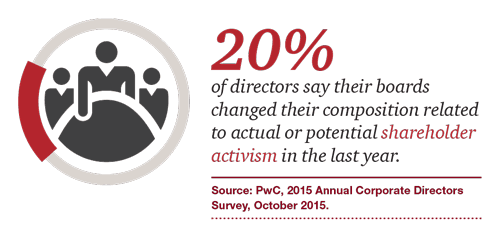
Ainsi, on apprend que 41 % des campagnes menées par les activistes étaient reliées à la composition des CA, et que 20 % des CA ont modifié leur composition en réponse aux activités réelles ou potentielles des activistes.

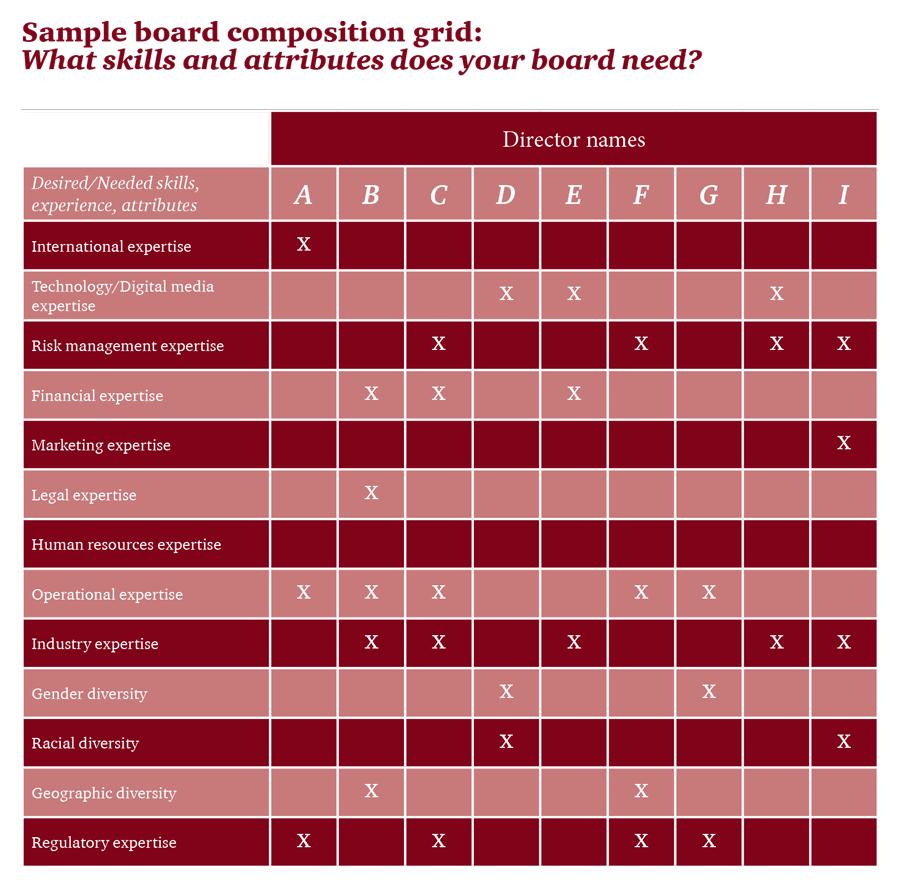
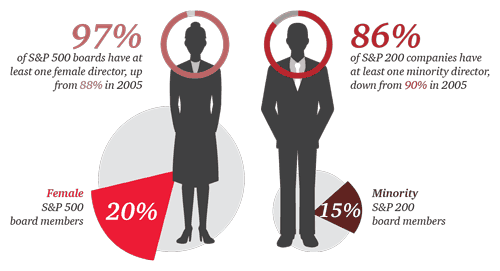
L’article s’attarde sur la grille de composition des conseils relative aux compétences et habiletés requises. Également, on présente les arguments pour une plus grande diversité des CA et l’on s’interroge sur la situation actuelle.

Enfin, l’article revient sur les questions du nombre de mandats des administrateurs et de l’âge de la retraite de ceux-ci ainsi que sur les préoccupations des investisseurs eu égard au renouvellement et au rajeunissement des CA.

Le travail de renouvellement du conseil ne peut se faire sans la mise en place d’un processus d’évaluation complet du fonctionnement du CA et des administrateurs.

À mon avis, c’est certainement un article à lire pour bien comprendre toutes les problématiques reliées à la composition des conseils d’administration.

Bonne lecture !

Investors and Board Composition


sans-titre


In today’s business environment, companies face numerous challenges that can impact success—from emerging technologies to changing regulatory requirements and cybersecurity concerns. As a result, the expertise, experience, and diversity of perspective in the boardroom play a more critical role than ever in ensuring effective oversight. At the same time, many investors and other stakeholders are seeking influence on board composition. They want more information about a company’s director nominees. They also want to know that boards and their nominating and governance committees are appropriately considering director tenure, board diversity and the results of board self-evaluations when making director nominations. All of this is occurring within an environment of aggressive shareholder activism, in which board composition often becomes a central focus.

Shareholder activism and board composition

pwc-1

pwc-2

At the same time, a growing number of companies are adopting proxy access rules—allowing shareholders that meet certain ownership criteria to submit a limited number of director candidates for inclusion on the company’s annual proxy. It has become a top governance issue over the last two years, with many shareholders viewing it as a step forward for shareholder rights. And it’s another factor causing boards to focus more on their makeup.

So within this context, how should directors and investors be thinking about board composition, and what steps should be taken to ensure boards are adequately refreshing themselves?

Assessing what you have–and what you need

In a rapidly changing business climate, a high-performing board requires agile directors who can grasp concepts quickly. Directors need to be fiercely independent thinkers who consciously avoid groupthink and are able to challenge management—while still contributing to a productive and collegial boardroom environment. A strong board includes directors with different backgrounds, and individuals who understand how the company’s strategy is impacted by emerging economic and technological trends.

Sample board composition grid: What skills and attributes does your board need?


pwc-table

In assessing their composition, boards and their nominating and governance committees need to think critically about what skills and attributes the board currently has, and how they tie to oversight of the company. As companies’ strategies change and their business models evolve, it is imperative that board composition be evaluated regularly to ensure that the right mix of skills are present to meet the company’s current needs. Many boards conduct a gap analysis that compares current director attributes with those that it has identified as critical to effective oversight. They can then choose to fill any gaps by recruiting new directors with such attributes or by consulting external advisors. Some companies use a matrix in their proxy disclosures to graphically display to investors the particular attributes of each director nominee.

Board diversity is a hot-button issue

Diversity is a key element of any discussion of board composition. Diversity includes not only gender, race, and ethnicity, but also diversity of skills, backgrounds, personalities, opinions, and experiences. But the pace of adding more gender and ethnic diversity to public company boards has been only incremental over the past five years. For example, a December 2015 report from the US Government Accountability Office estimates that it could take four decades for the representation of women on US boards to be the same as men. [1] Some countries, including Norway, Belgium, and Italy, have implemented regulatory quotas to increase the percentage of women on boards.

Even if equal proportions of women and men joined boards each year beginning in 2015, GAO estimated that it could take more than four decades for women’s representation on boards to be on par with that of men’s.
—US Government Accountability Office, December 2015

According to PwC’s 2015 Annual Corporate Directors Survey, more than 80% of directors believe board diversity positively impacts board and company performance. But more than 70% of directors say there are impediments to increasing board diversity. [2] One of the main impediments is that many boards look to current or former CEOs as potential director candidates. However, only 4% of S&P 500 CEOs are female, [3] less than 2% of the Fortune 500 CEOs are Hispanic or Asian, and only 1% of the Fortune 500 CEOs are African-American. [4] So in order to get boards to be more diverse, the pool of potential director candidates needs to be expanded.

Is there diversity on US boards?


pwc-4

Source: Spencer Stuart US Board Index 2015, November 2015.

SEC rules require companies to disclose the backgrounds and qualifications of director nominees and whether diversity was a nomination consideration. In January 2016, SEC Chair Mary Jo White included diversity as a priority for the SEC’s 2016 agenda and suggested that the SEC’s disclosure rules pertaining to board diversity may be enhanced.

While those who aspire to become directors must play their part, the drive to make diversity a priority really has to come from board leadership: CEOs, lead directors, board chairs, and nominating and governance committee chairs. These leaders need to be proactive and commit to making diversity part of the company and board culture. In order to find more diverse candidates, boards will have to look in different places. There are often many untapped, highly qualified, and diverse candidates just a few steps below the C-suite, people who drive strategies, run large segments of the business, and function like CEOs.

How long is too long? Director tenure and mandatory retirement

The debate over board tenure centers on whether lengthy board service negatively impacts director independence, objectivity, and performance. Some investors believe that long-serving directors can become complacent over time—making it less likely that they will challenge management. However, others question the virtue of forced board turnover. They argue that with greater tenure comes good working relationships with stakeholders and a deep knowledge of the company. One approach to this issue is to strive for diversity of board tenure—consciously balancing the board’s composition to include new directors, those with medium tenures, and those with long-term service.

This debate has heated up in recent years, due in part to attention from the Council of Institutional Investors (the Council). In 2013, the Council introduced a revised policy statement on board tenure. While the policy “does not endorse a term limit,” [5] the Council noted that directors with extended tenures should no longer be considered independent. More recently, the large pension fund CalPERS has been vocal about tenure, stating that extended board service could impede objectivity. CalPERS updated its 2016 proxy voting guidelines by asking companies to explain why directors serving for over twelve years should still be considered independent.

We believe director independence can be compromised at 12 years of service—in these situations a company should carry out rigorous evaluations to either classify the director as non-independent or provide a detailed annual explanation of why the director can continue to be classified as independent.
— CalPERS Global Governance Principles, second reading, March 14, 2016

Factors in the director tenure and age debate


pwc-3

Source: Spencer Stuart US Board Index 2015, November 2015.

Many boards have a mandatory retirement age for their directors. However, the average mandatory retirement age has increased in recent years. Of the 73% of S&P 500 boards that have a mandatory retirement age in place, 97% set that age at 72 or older—up from 57% that did so ten years ago. Thirty-four percent set it at 75 or older. [6] Others believe that director term limits may be a better way to encourage board refreshment, but only 3% of S&P 500 boards have such policies. [7]

Investor concern

Some institutional investors have expressed concern about board composition and refreshment, and this increased scrutiny could have an impact on proxy voting decisions.

What are investors saying about board composition and refreshment?


pwc-table2

Sources: BlackRock, Proxy voting guidelines for U.S. securities, February 2015; California Public Employees’ Retirement System, Statement of Investment Policy for Global Governance, March 16, 2015; State Street Global Advisors’ US Proxy Voting and Engagement Guidelines, March 2015.

Proxy advisors’ views on board composition—recent developments

Proxy advisory firm Institutional Shareholder Services’s (ISS) governance rating system QuickScore 3.0 views tenure of more than nine years as potentially compromising director independence. ISS’s 2016 voting policy updates include a clarification that a “small number” of long-tenured directors (those with more than nine years of board service) does not negatively impact the company’s QuickScore governance rating, though ISS does not provide specifics on the acceptable quantity.

Glass Lewis’ updated 2016 voting policies address nominating committee performance. Glass Lewis may now recommend against the nominating and governance committee chair “where the board’s failure to ensure the board has directors with relevant experience, either through periodic director assessment or board refreshment, has contributed to a company’s poor performance.” Glass Lewis believes that shareholders are best served when boards are diverse on the basis of age, race, gender and ethnicity, as well as on the basis of geographic knowledge, industry experience, board tenure, and culture.

How can directors proactively address board refreshment?

The first step in refreshing your board is deciding whether to add a new board member and determining which director attributes are most important. One way to do this is to conduct a self-assessment. Directors also have a number of mechanisms to address board refreshment. For one, boards can consider new ways of recruiting director candidates. They can take charge of their composition through active and strategic succession planning. And they can also use robust self-assessments to gauge individual director performance—and replace directors who are no longer contributing.

  1. Act on the results of board assessments. Boards should use their annual self-assessment to help spark discussions about board refreshment. Having a robust board assessment process can offer insights into how the board is functioning and how individual directors are performing. The board can use this process to identify directors that may be underperforming or whose skills may no longer match what the company needs. It’s incumbent upon the board chair or lead director and the chair of the nominating and governance committee to address any difficult matters that may arise out of the assessment process, including having challenging conversations with underperforming directors. In addition, some investors are asking about the results of board assessments. CalPERS and CalSTRS have both called on boards to disclose more information about the impact of their self-assessments on board composition decisions. [8]
  2. Take a strategic approach to director succession planning. Director succession planning is essential to promoting board refreshment. But, less than half of directors “very much” believe their board is spending enough time on director succession. [9] In board succession planning, it’s important to think about the current state of the board, the tenure of current members, and the company’s future needs. Boards should identify possible director candidates based upon anticipated turnover and director retirements.
  3. Broaden the pool of candidates. Often, boards recruit directors by soliciting recommendations from other sitting directors, which can be a small pool. Forward-looking boards expand the universe of potential qualified candidates by looking outside of the C-suite, considering investor recommendations, and by looking for candidates outside the corporate world—from the retired military, academia, and large non-profits. This will provide a broader pool of individuals with more diverse backgrounds who can be great board contributors.

In sum, evaluating board composition and refreshing the board may be challenging at times, but it’s increasingly a topic of concern for many investors, and it’s critical to the board’s ability to stay current, effective, and focused on enhancing long-term shareholder value.

The complete publication, including footnotes and appendix, is available here.

Endnotes:

[1] United States Government Accountability Office, “Corporate Boards: Strategies to Address Representation of Women Include Federal Disclosure Requirements,” December 2015.
(go back)

[2] PwC, 2015 Annual Corporate Directors Survey, October 2015.
(go back)

[3] Catalyst, Women CEOs of the S&P 500, February 3, 2016.
(go back)

[4] “McDonald’s CEO to Retire; Black Fortune 500 CEOs Decline by 33% in Past Year,” DiversityInc, January 29, 2015; http://www.diversityinc.com/leadership/mcdonalds-ceo-retire-black-fortune-500-ceos-decline-33-past-year.
(go back)

[5] Amy Borrus, “More on CII’s New Policies on Universal Proxies and Board Tenure,” Council of Institutional Investors, October 1, 2013; http://www.cii.org/article_content.asp?article=208.
(go back)

[6] Spencer Stuart, 2015 US Board Index, November 2015.
(go back)

[7] Spencer Stuart, 2015 US Board Index, November 2015.
(go back)

[8] California State Teachers’ Retirement System Corporate Governance Principles, April 3, 2015, http://www.calstrs.com/sites/main/files/file-attachments/corporate_governance_principles_1.pdf; The California Public Employees’ Retirement System Global Governance Principles, Updated March 14, 2016, https://www.calpers.ca.gov/docs/board-agendas/201603/invest/item05a-02.pdf.
(go back)

[9] PwC, 2015 Annual Corporate Directors Survey, October 2015. www.pwc.com/us/GovernanceInsightsCenter.

________________________________

*Paula Loop is Leader of the Governance Insights Center at PricewaterhouseCoopers LLP. This post is based on a PwC publication by Ms. Loop and Paul DeNicola. The complete publication, including footnotes and appendix, is available here.

Gestion des risques liés aux tierces parties | Deloitte


Comment votre organisation peut-elle mieux contrôler les risques liés à ses tiers ? C’est ce que vous apprend ce document de Deloitte dans un numéro du bulletin « À l’ordre du jour du conseil ».

Encore récemment, le risque lié aux fournisseurs se limitait pour ainsi dire à la qualité des produits ou des matières premières fournies ou à la possibilité qu’un fournisseur ne respecte pas ses engagements d’approvisionnement et perturbe ainsi la production. Aujourd’hui, les entreprises sont de plus en plus tenues responsables du comportement de leurs fournisseurs, que ce soit en ce qui a trait aux pratiques en matière de santé, de sécurité et d’environnement, au respect des lois sur le travail et autres règlements, à l’utilisation de la propriété intellectuelle, à l’approvisionnement en matières premières, à la corruption et plus encore. Et comme les clients ne font pas de différence entre une organisation et ses fournisseurs, les actions de tiers peuvent également nuire à la réputation de l’organisation ou à la confiance de ses clients.

Voici un aperçu de ce document, notamment les questions que les administrateurs devraient se poser eu égard aux risques reliés aux entités tierces. On y présente également le point de vue de José Écio Pereira, administrateur de compagnie et associé retraité de Deloitte.

Bonne lecture !

Gestion du risque de l’entreprise étendue

Le risque lié aux entités tierces

L’usine d’un fournisseur s’effondre, faisant des centaines de victimes parmi les travailleurs, dont certains sont des enfants. Des milliers de fichiers contenant des données sur les cartes de crédit de clients et d’autres renseignements financiers confidentiels font l’objet de piratage d’un tiers autorisé à accéder au réseau de l’entreprise. Un fournisseur a utilisé des matériaux contaminés et une vaste campagne de rappel visant certains produits doit être lancée.

Encore récemment, le risque lié aux fournisseurs se limitait pour ainsi dire à la qualité des produits ou des matières premières fournis ou à la possibilité qu’un fournisseur ne respecte pas ses engagements d’approvisionnement et perturbe ainsi la production.


Gestion-des-risques


De nos jours, des lois comme la Foreign Corrupt Practices Act aux États-Unis, la Bribery Act au Royaume-Uni et d’autres encore font en sorte que les entreprises sont de plus en plus souvent tenues responsables des agissements de leurs fournisseurs. De même, les clients ne distinguent pas toujours une entreprise de ses fournisseurs. Pour eux, l’entreprise est celle qui leur fournit une solution ; s’il survient un problème, c’est elle qu’ils tiennent responsable, et c’est donc sa réputation qui est en péril. C’est pourquoi les entreprises doivent maintenant élargir leur surveillance des risques à l’entreprise étendue1 et observer chez leurs tiers fournisseurs les pratiques de santé, de sécurité et d’environnement, le respect des lois sur le travail et autres règlements, l’utilisation de la propriété intellectuelle, l’approvisionnement en matières premières, la corruption et plus encore.

Questions que les administrateurs devraient poser

(1) Notre entreprise a-t-elle évalué de manière exhaustive son risque lié aux tiers et, si c’est le cas, quelles en sont les composantes les plus déterminantes pour l’entreprise à l’heure actuelle ?

(2) Quels sont les tiers susceptibles d’entraver le plus gravement la capacité de l’entreprise à atteindre ses buts et objectifs stratégiques ?

(3) Que faisons-nous pour gérer et surveiller de manière proactive le risque et son évolution au sein de notre entreprise étendue ? Quels outils de gestion du risque utilisons-nous ?

(4) Qui est responsable de la gestion du risque lié aux tiers dans notre entreprise ?

(5) À quelle fréquence la direction informe-t-elle le conseil d’administration de son évaluation des risques de tiers et du processus mis en place pour atténuer ces risques ? Cette information est-elle suffisamment détaillée et présentée en temps opportun ?

Le point de vue d’un administrateur

José Écio Pereira est membre des conseils d’administration de Votorantim Cimentos, Fibria et Gafisa et a été membre du conseil de BRMalls ; il préside également le comité d’audit de Votorantim Cimentos et de Gafisa. Il est le propriétaire fondateur de JEPereira Consultoria em Gestão de Negócios et a été associé, maintenant à la retraite, de Deloitte Brésil.

Le risque lié aux entités tierces figure-t-il à l’ordre du jour des conseils d’administration ?

Les conseils dont je connais le fonctionnement effectuent une évaluation du risque tous les trois ou quatre mois. Le risque lié aux entités tierces à proprement parler n’est pas un point distinct à l’ordre du jour, mais nous l’abordons dans notre analyse des risques. Ceci dit, il est clair que de nos jours, les conseils accordent plus d’attention au risque lié aux tiers qu’il y a à peine deux ans. Au Brésil, c’est principalement à cause de la loi anticorruption (Clean Company Act) de 2014. En vertu de cette loi, les entreprises peuvent être tenues responsables des activités illégales ou de la conduite contraire à l’éthique de leurs tiers fournisseurs.

Depuis que cette loi est en vigueur, les administrateurs examinent de beaucoup plus près les risques associés aux tiers fournisseurs des entreprises qu’ils supervisent. Ils examinent les pratiques de leurs fournisseurs en matière de conditions de travail, de normes pour les employés, de mesures de santé et de sécurité et d’autres facteurs pour s’assurer que tous respectent les normes de l’entreprise qui a fait appel à eux. La santé financière des fournisseurs est un autre paramètre fort important, surtout au vu de la situation économique actuelle au Brésil. Les entreprises veulent être sûres que leurs fournisseurs paient leurs impôts et respectent leurs obligations juridiques, en particulier dans leurs relations avec leurs employés, et qu’ils seront à même de poursuivre leur exploitation.

Les administrateurs examinent-ils les relations avec des tiers dans le contexte du cyberrisque ?

Je pense que les entreprises dont les systèmes sont connectés avec ceux de tiers fournisseurs à des fins d’approvisionnement ou de logistique sont conscientes de l’existence du cyberrisque et prennent les mesures nécessaires pour s’en prémunir. Mais ces mesures sont généralement liées aux échanges de produits et de services.

Dans une perspective plus vaste, je dirais que la plupart des entreprises ne disposent pas de systèmes d’information appropriés pour gérer leurs relations avec des tiers. Les systèmes de la plupart des entreprises ne sont pas assez sophistiqués pour se connecter aux systèmes des fournisseurs ; les entreprises ont recours à divers outils pour gérer leurs relations avec des tiers et souvent, ces outils ne sont pas très bien intégrés entre eux. Les relations sont par exemple gérées à l’aide de plusieurs systèmes, y compris des chiffriers et des outils manuels qui ne sont pas du tout conçus pour cet usage.

À qui devrait revenir la responsabilité des tiers fournisseurs ?

Le conseil d’administration doit jouer un rôle de supervision et faire en sorte que les cadres supérieurs disposent d’un processus de gestion du risque lié aux tiers.

Au Brésil, c’est souvent le service de l’approvisionnement qui reste responsable des problèmes opérationnels et qui vérifie que les produits et les services sont bien fournis selon les modalités du contrat conclu avec le tiers fournisseur. De plus, nombre d’entreprises mettent aussi sur pied une fonction particulière chargée de la gestion des contrats conclus avec des tiers. La plupart des entreprises brésiliennes entretiennent plusieurs relations avec des tiers : services alimentaires, sécurité, transports, fabrication. Toutes sont essentielles au fonctionnement d’une entreprise au quotidien. Les entreprises sont donc nombreuses à affecter davantage de ressources à la gestion efficace des contrats.

Certaines entreprises surveillent constamment leurs fournisseurs pour s’assurer que les contrats sont observés à la lettre. Bon nombre exigent que leurs fournisseurs autoévaluent leur conformité contractuelle, en plus d’effectuer des audits périodiques et d’autres tests afin de vérifier le respect des contrats. Toutes ces mesures représentent un travail colossal et parfois, il faut y consacrer une fonction administrative particulière.

Je vais vous relater un exemple authentique. L’une des sociétés avec lesquelles je collabore est en train de construire de nouvelles installations de grande envergure. C’est un investissement de près de 2 milliards de dollars américains, et c’est un projet d’environ : 18 mois. À l’heure actuelle, la construction vient juste de commencer. Plusieurs fournisseurs y travaillent, que ce soit pour la sécurité du chantier ou pour l’approvisionnement en matériel ou son installation.

L’entreprise a mis sur pied un comité directeur de projet qui comprend entre autres des membres de l’équipe de direction. Ce comité se réunit au moins une fois tous les : 15 jours, et les relations avec les fournisseurs reviennent justement sans cesse à son ordre du jour. C’est beaucoup plus qu’une question de diligence raisonnable ; le comité procède aussi au suivi constant des tiers fournisseurs.

Le comité directeur présente chaque mois au conseil l’état d’avancement du projet. Le rapport d’avancement consigne tout ce qui a trait aux tiers fournisseurs : le défaut de verser les retenues sur salaires des employés, de payer des impôts fonciers ou des avantages sociaux, la violation des règles de santé et de sécurité sur le chantier, aussi bien que les problèmes opérationnels comme le non-respect des échéances par un fournisseur ou la qualité insuffisante des services qu’il a rendus. Lorsque des problèmes surgissent, le comité de projet les reporte sur la « carte du risque » du projet, et la direction prend les mesures de suivi nécessaires, y compris l’application des pénalités contractuelles, le cas échéant.

Les entreprises devraient-elles aussi définir leurs propres normes déontologiques à l’endroit des tiers fournisseurs ?

Après l’entrée en vigueur de la loi brésilienne anticorruption, la plupart des entreprises ont passé en revue leurs normes déontologiques et leur code de conduite ; l’une des grandes nouveautés, c’est qu’elles y ont ajouté des procédures et des règles qui s’adressent aux tiers fournisseurs.

Par le passé, toutes les activités encadrant les règles de déontologie, comme la formation et les ateliers, étaient entreprises dans une perspective interne. Les normes s’appliquaient au personnel de l’entreprise, mais ne dépassaient pas les limites de celle-ci pour viser également les fournisseurs externes. Maintenant, la portée s’est élargie et les règles régissant les employés, les mesures de santé et de sécurité, les conditions de travail, l’obéissance aux lois, etc., englobent aussi les tiers fournisseurs. Les entreprises ont également étendu leurs programmes de formation et invitent leurs fournisseurs à leurs séminaires et ateliers où seront expliqués les règles et les processus de surveillance.

Les firmes de conseillers en rémunération contribuent-elles à la mise en place de plans salariaux excessifs des PDG ?


Avez-vous confiance dans les conseillers en rémunération pour faire des propositions salariales qui reflètent vraiment la contribution des dirigeants, et qui sont nécessaires pour la rétention des personnes ?

Dans quelle mesure ceux-ci sont-ils responsables de l’augmentation, souvent excessive, des rémunérations des dirigeants ?

Une étude, à laquelle le professeur Omesh Kini de Georgia State University a contribué, montre que, bien que les consultants soient embauchés par les comités de ressources humaines des CA, ceux-ci peuvent subir l’influence indirecte de la direction.

L’auteur décrit différentes approches de firmes de conseillers dans l’établissement des plans de rémunérations des dirigeants. Les firmes prétendent se différencier en proposant des « packages » de rémunération censés aligner les objectifs des actionnaires sur ceux des administrateurs. Les consultants sont sensibles aux effets du « say on pay » et, par conséquent, tentent d’élaborer des programmes de rémunération bien étoffés.

Plusieurs auteurs avancent que les firmes de conseils en rémunération ont tendance à utiliser des échantillons de comparaisons salariales susceptibles de justifier des rémunérations élevées, sinon excessives. Les auteurs suggèrent que les consultants souhaitent obtenir d’autres contrats avec l’entreprise (« repeat business ») et, en ce sens, elles agissent en fonction de leurs intérêts d’affaires.

L’étude montre que, contrairement à la croyance populaire, les firmes de conseillers en rémunération n’opèrent pas de façon très différente les unes des autres. En réalité, elles ne se distinguent pas par des approches particulières.

Les résultats de l’étude montrent que le choix de la firme de consultants a peu d’importance lorsque l’entreprise est reconnue pour ses solides mécanismes de gouvernance. En revanche, si la gouvernance de l’entreprise laisse à désirer (plusieurs administrateurs non indépendants, comité de RH peu soucieux, PDG omniprésent au CA, manque de leadership du président du conseil, CA peu informé, etc.), les firmes de consultants en rémunération sont plus enclines à proposer des plans salariaux généreux.

Les conclusions de cette étude indiquent que les mécanismes de gouvernance sont les facteurs les plus révélateurs dans l’établissement d’une rémunération juste et adéquate et que le choix d’une firme de conseillers particulière est très secondaire, sinon sans réels effets.

Vous trouverez, ci-dessous, un résumé de l’article paru récemment sur le forum du Harvard Law School.

Bonne lecture !

Do Compensation Consultants Have Distinct Styles ?


In our paper, Do Compensation Consultants have Distinct Styles?, which was recently made public on SSRN, we investigate whether the choice of a specific compensation consultant affects the compensation level and structure of top managers. This question is crucially important because existing studies that examine the compensation of CEOs show that compensation schemes influence their behavior and, consequently, impact firm economic outcomes. Compensation consultants are typically hired by the board of directors’ compensation committee to help craft compensation policies for the top managers of the corporation. Although they serve at the behest of the board, consultants can imprint their own distinct styles in fashioning compensation policies for a firm. We examine whether individual compensation consultants influence compensation policies in unique ways, i.e., exhibit distinct “styles,” after controlling for the known economic determinants of these policies.

Compensation consultants strive to signal distinct styles in a positive manner via their own advertising. For example, Towers Watson claims to “bring a unique portfolio of resources” to the table, with an emphasis on aligning board actions with shareholders (e.g., avoiding “say on pay” disputes). [1] Conversely, the media has reported that consulting advice varies little. For example, Towers Perrin was accused in 1997 of giving nearly identical reports on workplace diversity to multiple consulting clients across different industries. [2] Towers Perrin’s response was that all of the clients reported in the article faced similar economic forces and, therefore, received similar advice. [3] Thus, the anecdotal evidence on consultant style is mixed.

cadres

Compensation consultants have been in the direct line of fire from academics, board members, and policy makers. For example, Bebchuk and Fried (2014) take the view that managers will influence the employment of consultants who are likely to recommend higher pay and use their advice to justify excessive compensation. They further argue that compensation consultants, driven by their cross-selling incentives and/or desire to obtain repeat business, design compensation plans that provide excessive pay to managers. Thus, they suggest that compensation consultants worsen, rather than alleviate, agency problems within firms. Board members also claim that compensation consultants are to blame for spiraling CEO pay (Workforce, February 7, 2008). Finally, the former SEC Commissioner Roel C. Campos in a speech stated, “Another significant driver of excessive CEO compensation is the use of compensation consultants.” He goes on to add, “It is extremely difficult to avoid using high comparables, and consultants can pretty much find high comparable income data to support paying a high amount to the CEO. This is the case even if the consultant reports directly to the board.”

Thus, it is an open question whether individual compensation consultants: (i) have distinct styles and managers/boards hire consultants with a specific style, (ii) do not have distinct styles, but instead give compensation advice based purely on economic characteristics, and (iii) respond in a distinct manner to the incentives that arise from the governance environment of the client firm and their own self-interest. We investigate these issues in our paper. In the process, we attempt to shed light on whether compensation consultants facilitate compensation arrangements that reflect a competitive equilibrium in the level of pay and an efficient equilibrium in the incentives provided by optimal contracts (the “efficient” view) or that compensation contracts are written by captive boards and pliant compensation consultants to enhance the welfare of powerful CEOs (the “agency” view).

Our empirical tests detect little evidence suggesting that individual consultants have their own distinct styles. This evidence can be interpreted in two different ways. One possibility is that compensation consultants do not have any specific style and are perfect substitutes for each other. Consequently, the choice of compensation consultant will not matter much because their compensation advice will be grounded in the economic determinants of compensation level and structure and, thus, will be quite similar. An alternative possibility is that compensation consultants do not have distinct styles, but will work in their own self-interest by reacting to the incentives provided by the hiring firm. We distinguish between these views by finding style-like effects for the subsample of client firms with weak governance mechanisms, but not for the subsample of client firms with strong governance mechanisms. These results suggest that the choice of individual consultant does not matter in firms that have strong governance mechanisms. For the weak governance firms, we find that the style-like effects are largely driven by firms that hire consultants who do not have any non-compensation related businesses. In this subsample, both the lead return on assets and Tobin’s q for their client firms are significantly lower for consultants who recommend a higher salary or higher salary percentage as a proportion of total compensation. We also document style-like effects for the subsample of client firms with whom the consultant has existing business relationships unrelated to compensation consulting (conflicted consultants). Further, when these conflicted consultants recommend higher equity-based compensation, the client firms’ values as measured by their lead Tobin’s q are significantly lower and that these client firms tend to have higher accruals.

Our overall conclusion is that it does not matter which compensation consultant is hired by client firms with strong governance mechanisms in place because they will get similar advice based on their economic characteristics and environment. We conjecture that these client firms may still decide to choose a more reputable consultant because of the stronger certification role it plays, but they will likely have to pay higher fees for the services of this consultant. However, consistent with the Bebchuk and Fried (2104) view that consultants can aggravate agency problems within firms, we do observe style-like effects and some resultant perverse outcomes when there is greater potential for managers to take actions in their self-interest and/or when consultants have weaker incentives to provide objective advice. Thus, based on our subsample analysis, we find evidence consistent with both the “efficient” and “agency” views of compensation contracts.

The full paper is available for download here.

__________________________

Endnotes:

[1] See Towers Watson’s 2015 brochure, “Putting Clients First.”
(go back)

[2] “Familiar Refrain: Consultant’s Advice on Diversity was Anything But Diverse…” Wall Street Journal, 3/11/1997.
(go back)

[3] “TP responds to WSJ allegations.” Consultants News 27, 4/1/1997.
(go back)

Les attentes à l’égard du rôle des administrateurs sont-elles irréalistes ?


Harvard Business Review vient de publier un excellent commentaire sur les attentes irréalistes exercées sur les conseils d’administration par les actionnaires, les autorités réglementaires, les investisseurs institutionnels et le public en général.

L’article des professeurs* Steven Boivie, Michael Bednar et Joel Andrus identifie trois obstacles qui empêchent les administrateurs de jouer adéquatement leurs rôles.

(1) La plupart des administrateurs sont également impliqués dans plusieurs autres fonctions de direction ou d’administration dans d’autres organisations.

(2) Les administrateurs ne doivent pas se mêler directement des affaires de la direction des entreprises.

(3) La complexité des grandes entreprises est telle qu’il est impossible pour un groupe d’administrateurs se réunissant environ dix fois par année de bien jouer leur rôle de surveillance.

Les auteurs suggèrent trois moyens pour lever, un tant soit peu, les barrières qui restreignent l’efficacité des administrateurs dans l’exécution de leurs rôles et responsabilités.

Je vous invite à prendre connaissance des conclusions de leur étude publiée dans Academy of management Annals.

Bonne lecture !


Boards Aren’t the Right Way to Monitor Companies


One of the key functions of a board of directors is to oversee the CEO to ensure that shareholders are getting the most out of their investment. This idea has led to regulation such as the Sarbanes-Oxley Act (2002), as well as requirements by the NYSE and NASDAQ that boards have a majority of independent directors and that members on the audit committee have financial expertise. Such rules rest on the premise that if we can just structure the board properly, management misconduct can largely be prevented. But is this a realistic expectation for directors? Maybe not.

1742912880_B978336891Z_1_20160408112809_000_G9C6I65NN_4-0Over the past few years there has been a growing gap between what shareholders and regulators expect of boards and what academic research shows they are capable of. For instance, consider what it means to be a director of a company like General Electric. GE states, “The primary role of GE’s Board of Directors is to oversee how management serves the interests of shareowners and other stakeholders.” However, GE’s annual revenues last year were $117 billion, and it had over 300,000 employees. The company provides services in a myriad of industries, such as health care, water treatment, aviation, and financing.

……

Taken together, much of the research we reviewed shows that these barriers are so prevalent and significant that consistent monitoring just isn’t very likely. Even when boards are filled with capable, motivated directors, we believe that there are simply too many barriers that prevent them from effectively protecting shareholders. In order to gain the full value from a board, we believe that shareholders and regulators need to focus on what boards can do, and then recalibrate their expectations.

First, we need to stop blaming boards for every failure. Too often the press, shareholders, and legislators blame corporate governance failures on directors, suggesting are unmotivated or unwilling to do their job properly. This was illustrated in 2012 when Groupon’s board came under fire for the company revising its earnings. JPMorgan Chase directors were similarly criticized for not preventing a $6 billion trading loss in the company’s investment office back in 2013.

Boards can do a better job in some cases, but these types of criticisms are often misguided. We have found that most directors are hardworking and capable — they’re just placed in a context that makes it virtually impossible for them to do what is expected of them.

Second, we need to focus more on boards’ ability to provide expert advice to CEOs based on their significant knowledge and experience. Board members often are able to provide insights that top executives may not have considered. Going back to GE’s board, most of the directors have expertise in a specific industry and can therefore draw on that experience to connect managers to external resources and knowledge that can benefit the firm. In addition to providing expert advice, boards can take a much more active role in guiding firms during times of crisis, such as when a CEO is being replaced, when the company is in financial distress, or when there is a significant merger or acquisition under consideration.

Third, if shareholders and regulators insist that boards must monitor, then we need to do a better job of removing the barriers in their way. For instance, if external job demands make it impossible for a director to devote enough time and mental energy to their duty as a director, perhaps we need to change our perception that the best directors are active CEOs of other firms. Maybe we also need to work to promote cultural change within boards through increased sharing of information and by using technology to allow them to meet more frequently.

Boards can and do play an important role in the success of companies. Instead of criticizing them for not meeting impractical expectations, we should value them sharing knowledge, providing advice, and lending legitimacy to firms by virtue of their reputations in the industry.

____________________________

Steven Boivie is an associate professor in the Mays Business School at Texas A&M University. He received his Ph.D. in strategic management from the University of Texas at Austin.

Michael Bednar is an associate professor of Business Administration at the University of Illinois.

Joel Andrus is in the Mays Business School at Texas A&M University.

Les dix articles américains les plus marquants en gouvernance corporative en 2015


L’organisation Corporate Practice Commentator vient de publier la liste des meilleurs articles en gouvernance, plus précisément ceux qui concernent le marché des actions.

La sélection a été faite par les professeurs qui se spécialisent en droit corporatif. Cette année plus de 540 articles ont été analysés.

La liste inclut trois articles de la Faculté du Harvard Law School issus du programme en gouvernance corporative dont Lucian Bebchuk, John Coates et Jesse Fried font partie.

Voici la liste en ordre alphabétique.

Bonne recherche !


 Les dix articles américains les plus marquants en gouvernance corporative en 2015


30441567-Nuage-de-mot-avec-la-gouvernance-d-entreprise-li-s-balises-Banque-d'images


  1. Bartlett, Robert P. III. Do Institutional Investors Value the Rule 10b-5 Private Right of Action? Evidence from Investors’ Trading Behavior following Morrison v. National Australia Bank Ltd. 44 J. Legal Stud. 183-227 (2015).
  2. Bebchuk, Lucian, Alon Brav and Wei Jiang. The Long-term Effects of Hedge Fund Activism. 115 Colum. L. Rev. 1085-1155 (2015).
  3. Bratton, William W. and Michael L. Wachter. Bankers and Chancellors. 93 Tex. L. Rev. 1-84 (2014).
  4. Cain, Matthew D. and Steven Davidoff Solomon. A Great Game: The Dynamics of State Competition and Litigation. 100 Iowa L. Rev. 465-500 (2015).
  5. Casey, Anthony J. The New Corporate Web: Tailored Entity Partitions and Creditors’ Selective Enforcement. 124 Yale L. J. 2680-2744 (2015).
  6. Coates, John C. IV. Cost-benefit Analysis of Financial Regulation: Case Studies and Implications. 124 Yale L .J. 882-1011 (2015).
  7. Edelman, Paul H., Randall S. Thomas and Robert B. Thompson. Shareholder Voting in an Age of Intermediary Capitalism. 87 S. Cal. L. Rev. 1359-1434 (2014).
  8. Fisch, Jill E., Sean J. Griffith and Steven Davidoff Solomon. Confronting the Peppercorn Settlement in Merger Litigation: An Empirical Analysis and a Proposal for Reform. 93 Tex. L. Rev. 557-624 (2015).
  9. Fried, Jesse M. The Uneasy Case for Favoring Long-term Shareholders. 124 Yale L. J. 1554-1627 (2015).
  10. Judge, Kathryn. Intermediary Influence. 82 U. Chi. L. Rev. 573-642 (2015).

Nature des relations entre le CA et la direction | Une saine tension est l’assurance d’une bonne gouvernance (en rappel)


Dans son édition d’avril 2016, le magazine Financier Worldwide présente une excellente analyse de la dynamique d’un conseil d’administration efficace. Pour l’auteur, il est important que le président du conseil soit habileté à exercer un niveau de saine tension entre les administrateurs et la direction de l’entreprise.

Il n’y a pas de place pour la complaisance au conseil. Les membres doivent comprendre que leur rôle est de veiller aux « intérêts supérieurs » de l’entreprise, notamment des propriétaires-actionnaires, mais aussi d’autres parties prenantes.

Le PDG de l’entreprise est recruté par le CA pour faire croître l’entreprise et exécuter une stratégie liée à son modèle d’affaires. Lui aussi doit travailler dans le meilleur intérêt des actionnaires… mais c’est la responsabilité fiduciaire du CA de s’en assurer en mettant en place les mécanismes de surveillance appropriés.

La théorie de l’agence stipule que le CA représente l’autorité souveraine de l’entreprise (puisqu’il possède la légitimité que lui confèrent les actionnaires). Le CA confie à un PDG (et à son équipe de gestion) le soin de réaliser les objectifs stratégiques retenus. Les deux parties — le Board et le Management — doivent bien comprendre leurs rôles respectifs, et trouver les bons moyens pour gérer la tension inhérente à l’exercice de la gouvernance et de la gestion.

Les administrateurs doivent s’efforcer d’apporter une valeur ajoutée à la gestion en conseillant la direction sur les meilleures orientations à adopter, et en instaurant un climat d’ouverture, de soutien et de transparence propice à la réalisation de performances élevées.

Il est important de noter que les actionnaires s’attendent à la loyauté des administrateurs ainsi qu’à leur indépendance d’esprit face à la direction. Les administrateurs sont élus par les actionnaires et sont donc imputables envers eux. C’est la raison pour laquelle le conseil d’administration doit absolument mettre en place un processus d’évaluation de ces membres et divulguer sa méthodologie.

Vous trouverez, ci-dessous, l’article du Financier Worldwide qui illustre assez clairement les tensions existantes entre le CA et la direction, ainsi que les moyens proposés pour assurer la collaboration entre les deux parties.

J’ai souligné en gras les passages clés.

Bonne lecture ! Vos commentaires sont appréciés.

In this age of heightened risk, the need for effective governance has caused a dynamic shift in the role of the board of directors. Cyber security, rapid technological growth and a number of corporate scandals resulting from the financial crisis of 2008, all underscore the necessity of boards working constructively with management to ensure efficient oversight, rather than simply providing strategic direction. This is, perhaps, no more critical than in the middle market, where many companies often don’t have the resources larger organisations have to attract board members, but yet their size requires more structure and governance than smaller companies might need.

Following the best practices of high-performing boards can help lead to healthy tension between management and directors for improved results and better risk management. We all know conflict in the boardroom might sometimes be unavoidable, as the interests of directors and management don’t necessarily always align. Add various personalities and management styles to the mix, and discussions can sometimes get heated. It’s important to deal with situations when they occur in order to constructively manage potential differences of opinion to create a healthy tension that makes the entire organisation stronger.

Various conflict management styles can be employed to ensure that any potential boardroom tension within your organisation is healthy. If an issue seems minor to one person but vital to the rest of the group, accommodation can be an effective way to handle tension. If minor issues arise, it might be best to simply avoid those issues, whereas collaboration should be used with important matters. Arguably, this is the best solution for most situations and it allows the board to effectively address varying opinions. If consensus can’t be reached, however, it might become necessary for the chairman or the lead director to use authoritarian style to manage tension and make decisions. Compromise might be the best approach when the board is pressed for time and needs to take immediate action.

1353558_7_0ad2_miguel-angel-moratinos-ancien-ministre-desThe board chairperson can be integral to the resolution process, helping monitor and manage boardroom conflict. With this in mind, boards should elect chairs with the proven ability to manage all personality types. The chairperson might also be the one to initiate difficult conversations on topics requiring deeper scrutiny. That said, the chairperson cannot be the only enforcer; directors need to assist in conflict resolution to maintain a proper level of trust throughout the group. And the CEO should be proactive in raising difficult issues as well, and boards are typically most effective when the CEO is confident, takes the initiative in learning board best practices and works collaboratively.

Gone are the days of the charismatic, autocratic CEO. Many organisations have separated the role of CEO and chairperson, and have introduced vice chairs and lead directors to achieve a better balance of power. Another way to ensure a proper distribution of authority is for the board to pay attention to any red flags that might be raised by the CEO’s behaviour. For example, if a CEO feels they have all the answers, doesn’t respect the oversight of the board, or attempts to manage or marginalise the board, the chairperson and board members will likely need to be assertive, rather than simply following the CEO’s lead. Initially this might seem counterintuitive, however, in the long-run, this approach will likely create a healthier tension than if they simply ‘followed the leader’.

Everyone in the boardroom needs to understand their basic functions for an effective relationship -executives should manage, while the board oversees. In overseeing, the board’s major responsibilities include approving strategic plans and goals, selecting a CEO, determining a mission or purpose, identifying key risks, and providing oversight of the compliance of corporate policies and regulations. Clearly understanding the line between operations and strategy is also important.

Organisations with the highest performing boards are clear on the appropriate level of engagement for the companies they represent – and that varies from one organisation to the next. Determining how involved the board will be and what type of model the board will follow is key to effective governance and a good relationship with management. For example, an entity that is struggling financially might require a more engaged board to help put it back on track.

Many elements, such as tension, trust, diversity of thought, gender, culture and expertise can impact the delicate relationship between the board and management. Good communication is vital to healthy tension. Following best practices for interaction before, during and after board meetings can enhance conflict resolution and board success.

Before each board meeting, management should prepare themselves and board members by distributing materials and the board package in a timely manner. These materials should be reviewed by each member, with errors or concerns forwarded to the appropriate member of management, and areas of discussion highlighted for the chair. An agenda focused on strategic issues and prioritised by importance of matters can also increase productivity.

During the meeting, board members should treat one another with courtesy and respect, holding questions held until after presentations (or as the presenter directs). Board-level matters should be discussed and debated if necessary, and a consensus reached. Time spent on less strategic or pressing topics should be limited to ensure effective meetings. If appropriate, non-board-level matters might be handed to management for follow-up.

Open communication should also continue after board meetings. Sometimes topics discussed during board meetings take time to digest. When this happens, board members should connect with appropriate management team members to further discuss or clarify. There are also various board committee meetings that need to occur between board meetings. Board committees should be doing the ‘heavy lifting’ for the full board, making the larger group more efficient and effective. Other more informal interactions can further strengthen the relationship between directors and management.

Throughout the year, the board’s engagement with management can be broadened to include discussions with more key players. Gaining multiple perspectives by interacting with other areas of the organisation, such as general counsels, external and internal auditors, public relations and human resources, can help the board identify and address key risks. By participating in internal and external company events, board members get to know management and the company’s customers on a first-hand basis.

Of course, a strategy is necessary for the board as well, as regulatory requirements have increased, leading to greater pressure for high-quality performance. Effective boards maintain a plan for development and succession. They also implement CEO and board evaluation processes to ensure goals are being met and board members are performing optimally. In addition to the evaluation process, however, board members must hold themselves totally accountable for instilling trust in the boardroom.

Competition in today’s increasingly global and complex business environment is fierce, and calls for new approaches for success. Today’s boards need to build on established best practices and create good relationships with management to outperform competitors. The highest performing boards are clear on their functions, and understand the level of engagement appropriate for the companies they support. They are accountable and set the right tone, while being able to discern true goals and aspirations from trendiness. They are capable of understanding and dealing with the ‘big issues’ and are strategic in their planning and implementation of approaches that work for the companies they serve. With the ever-changing risk universe, the ability to work with the right amount of healthy tension is essential to effective governance.

_______________________________________

Hussain T. Hasan is on the Consulting Leadership team as well as a board member at RSM US LLP.

Une saine tension entre le CA et la direction | Gage d’une bonne gouvernance 


Dans son édition d’avril 2016, le magazine Financier Worldwide présente une excellente analyse de la dynamique d’un conseil d’administration efficace. Pour l’auteur, il est important que le président du conseil soit habileté à exercer un niveau de saine tension entre les administrateurs et la direction de l’entreprise.

Il n’y a pas de place pour la complaisance au conseil. Les membres doivent comprendre que leur rôle est de veiller aux « intérêts supérieurs » de l’entreprise, notamment des propriétaires-actionnaires, mais aussi d’autres parties prenantes.

Le PDG de l’entreprise est recruté par le CA pour faire croître l’entreprise et exécuter une stratégie liée à son modèle d’affaires. Lui aussi doit travailler dans le meilleur intérêt des actionnaires… mais c’est la responsabilité fiduciaire du CA de s’en assurer en mettant en place les mécanismes de surveillance appropriés.

La théorie de l’agence stipule que le CA représente l’autorité souveraine de l’entreprise (puisqu’il possède la légitimité que lui confèrent les actionnaires). Le CA confie à un PDG (et à son équipe de gestion) le soin de réaliser les objectifs stratégiques retenus. Les deux parties — le Board et le Management — doivent bien comprendre leurs rôles respectifs, et trouver les bons moyens pour gérer la tension inhérente à l’exercice de la gouvernance et de la gestion.

Les administrateurs doivent s’efforcer d’apporter une valeur ajoutée à la gestion en conseillant la direction sur les meilleures orientations à adopter, et en instaurant un climat d’ouverture, de soutien et de transparence propice à la réalisation de performances élevées.

Il est important de noter que les actionnaires s’attendent à la loyauté des administrateurs ainsi qu’à leur indépendance d’esprit face à la direction. Les administrateurs sont élus par les actionnaires et sont donc imputables envers eux. C’est la raison pour laquelle le conseil d’administration doit absolument mettre en place un processus d’évaluation de ces membres et divulguer sa méthodologie.

Vous trouverez, ci-dessous, l’article du Financier Worldwide qui illustre assez clairement les tensions existantes entre le CA et la direction, ainsi que les moyens proposés pour assurer la collaboration entre les deux parties.

J’ai souligné en gras les passages clés.

Bonne lecture ! Vos commentaires sont appréciés.

In this age of heightened risk, the need for effective governance has caused a dynamic shift in the role of the board of directors. Cyber security, rapid technological growth and a number of corporate scandals resulting from the financial crisis of 2008, all underscore the necessity of boards working constructively with management to ensure efficient oversight, rather than simply providing strategic direction. This is, perhaps, no more critical than in the middle market, where many companies often don’t have the resources larger organisations have to attract board members, but yet their size requires more structure and governance than smaller companies might need.

Following the best practices of high-performing boards can help lead to healthy tension between management and directors for improved results and better risk management. We all know conflict in the boardroom might sometimes be unavoidable, as the interests of directors and management don’t necessarily always align. Add various personalities and management styles to the mix, and discussions can sometimes get heated. It’s important to deal with situations when they occur in order to constructively manage potential differences of opinion to create a healthy tension that makes the entire organisation stronger.

Various conflict management styles can be employed to ensure that any potential boardroom tension within your organisation is healthy. If an issue seems minor to one person but vital to the rest of the group, accommodation can be an effective way to handle tension. If minor issues arise, it might be best to simply avoid those issues, whereas collaboration should be used with important matters. Arguably, this is the best solution for most situations and it allows the board to effectively address varying opinions. If consensus can’t be reached, however, it might become necessary for the chairman or the lead director to use authoritarian style to manage tension and make decisions. Compromise might be the best approach when the board is pressed for time and needs to take immediate action.

April 2016 Issue

The board chairperson can be integral to the resolution process, helping monitor and manage boardroom conflict. With this in mind, boards should elect chairs with the proven ability to manage all personality types. The chairperson might also be the one to initiate difficult conversations on topics requiring deeper scrutiny. That said, the chairperson cannot be the only enforcer; directors need to assist in conflict resolution to maintain a proper level of trust throughout the group. And the CEO should be proactive in raising difficult issues as well, and boards are typically most effective when the CEO is confident, takes the initiative in learning board best practices and works collaboratively.

Gone are the days of the charismatic, autocratic CEO. Many organisations have separated the role of CEO and chairperson, and have introduced vice chairs and lead directors to achieve a better balance of power. Another way to ensure a proper distribution of authority is for the board to pay attention to any red flags that might be raised by the CEO’s behaviour. For example, if a CEO feels they have all the answers, doesn’t respect the oversight of the board, or attempts to manage or marginalise the board, the chairperson and board members will likely need to be assertive, rather than simply following the CEO’s lead. Initially this might seem counterintuitive, however, in the long-run, this approach will likely create a healthier tension than if they simply ‘followed the leader’.

Everyone in the boardroom needs to understand their basic functions for an effective relationship -executives should manage, while the board oversees. In overseeing, the board’s major responsibilities include approving strategic plans and goals, selecting a CEO, determining a mission or purpose, identifying key risks, and providing oversight of the compliance of corporate policies and regulations. Clearly understanding the line between operations and strategy is also important.

Organisations with the highest performing boards are clear on the appropriate level of engagement for the companies they represent – and that varies from one organisation to the next. Determining how involved the board will be and what type of model the board will follow is key to effective governance and a good relationship with management. For example, an entity that is struggling financially might require a more engaged board to help put it back on track.

Many elements, such as tension, trust, diversity of thought, gender, culture and expertise can impact the delicate relationship between the board and management. Good communication is vital to healthy tension. Following best practices for interaction before, during and after board meetings can enhance conflict resolution and board success.

Before each board meeting, management should prepare themselves and board members by distributing materials and the board package in a timely manner. These materials should be reviewed by each member, with errors or concerns forwarded to the appropriate member of management, and areas of discussion highlighted for the chair. An agenda focused on strategic issues and prioritised by importance of matters can also increase productivity.

During the meeting, board members should treat one another with courtesy and respect, holding questions held until after presentations (or as the presenter directs). Board-level matters should be discussed and debated if necessary, and a consensus reached. Time spent on less strategic or pressing topics should be limited to ensure effective meetings. If appropriate, non-board-level matters might be handed to management for follow-up.

Open communication should also continue after board meetings. Sometimes topics discussed during board meetings take time to digest. When this happens, board members should connect with appropriate management team members to further discuss or clarify. There are also various board committee meetings that need to occur between board meetings. Board committees should be doing the ‘heavy lifting’ for the full board, making the larger group more efficient and effective. Other more informal interactions can further strengthen the relationship between directors and management.

Throughout the year, the board’s engagement with management can be broadened to include discussions with more key players. Gaining multiple perspectives by interacting with other areas of the organisation, such as general counsels, external and internal auditors, public relations and human resources, can help the board identify and address key risks. By participating in internal and external company events, board members get to know management and the company’s customers on a first-hand basis.

Of course, a strategy is necessary for the board as well, as regulatory requirements have increased, leading to greater pressure for high-quality performance. Effective boards maintain a plan for development and succession. They also implement CEO and board evaluation processes to ensure goals are being met and board members are performing optimally. In addition to the evaluation process, however, board members must hold themselves totally accountable for instilling trust in the boardroom.

Competition in today’s increasingly global and complex business environment is fierce, and calls for new approaches for success. Today’s boards need to build on established best practices and create good relationships with management to outperform competitors. The highest performing boards are clear on their functions, and understand the level of engagement appropriate for the companies they support. They are accountable and set the right tone, while being able to discern true goals and aspirations from trendiness. They are capable of understanding and dealing with the ‘big issues’ and are strategic in their planning and implementation of approaches that work for the companies they serve. With the ever-changing risk universe, the ability to work with the right amount of healthy tension is essential to effective governance.

_______________________________________

Hussain T. Hasan is on the Consulting Leadership team as well as a board member at RSM US LLP.

Comment un CA peut-il s’acquitter de ses responsabilités eu égard à la planification de la succession du PDG (CEO) et de la relève des principaux dirigeants ?


Certainement, l’une des activités essentielles des administrateurs de sociétés est de s’assurer que l’entreprise se dote d’un plan de succession (relève) pour tous les postes de hauts dirigeants et qu’ils mettent en place un processus de planification de la succession du PDG (CEO).

Cette importante activité est généralement confiée au comité de gouvernance.

Ainsi, le comité de gouvernance du CA doit veiller à ce que tous les postes de haute direction fassent l’objet de mécanismes systématiques d’identification des remplaçants éventuels, la plupart du temps au sein de l’organisation. Dans ce cas, c’est la responsabilité du PDG de gérer le processus et de faire rapport au conseil d’administration. Mais comment, concrètement, le comité et le CA peuvent-ils s’assurer de l’opérationnalisation de ce comportement ?

Dans le cas du plan de relève du PDG, c’est la responsabilité ultime du comité de gouvernance de mettre en œuvre des scénarios de succession.

Ce n’est pas une tâche facile, car le PDG n’est habituellement pas impliqué dans l’exercice d’identification de sa propre relève. Celui-ci étant nommé par le CA, c’est donc le rôle du conseil de voir à ce qu’il y ait une continuité dans la gestion de l’entreprise. Lorsqu’une organisation n’a pas prévu de démarches de remplacement de son PDG, il peut en résulter de graves préjudices pour les actionnaires, car l’entreprise subit une perte de leadership et d’expérience de gestion stratégique qui peut durer de deux à six mois.

Pendant cette période de recherche, de recrutement, de sélection et d’introduction d’un nouveau PDG, surtout s’il provient de l’extérieur, il faut assurer l’intérim ! La plupart des organisations ne sont pas préparées à assumer ce rôle de gestion en attendant l’arrivée du remplaçant. Le résultat est que l’entreprise est en période d’attente et qu’elle tourne au ralenti. En effet, les membres de la direction désignés pour gérer l’entreprise, en attendant, s’inquiètent de l’arrivée du nouveau PDG. Ils se questionnent notamment sur sa vision, ses valeurs et ses objectifs de rendement.

L’article qui suit, rédigé par Nell Minow, analyste de la gouvernance des entreprises, et paru sur le site du Huffpost Business, aborde la difficile question de la manière de faire dans les deux cas de figure présentés. L’auteure croit fermement qu’il est absolument nécessaire de faire de l’activité du plan de succession un élément clé du processus d’évaluation des dirigeants. En somme, les dirigeants doivent être rémunérés pour assurer la réalisation concrète de l’activité.

The best way to make sure that executives devote adequate resources and attention to succession planning is to pay them for it, including incentive compensation for attracting and retaining top talent to make sure that internal candidates are available

Dans cet article, on donne des exemples de façons de faire de plusieurs entreprises eu égard à l’introduction de cette pratique dans l’évaluation du rendement des dirigeants.

21958335_mlL’article donne également l’exemple du comportement de l’entreprise eBay en ce qui a trait à la divulgation détaillée de son approche à la succession des dirigeants dans la circulaire à l’intention des actionnaires.

Afin de respecter le principe de continuité et de saine gouvernance d’une organisation, il faut que le CA assume pleinement son rôle, car les coûts peuvent être grands en terme financier et en termes de réputation.

J’espère vous avoir convaincu de l’importance fondamentale de cette activité de planification, et sur la responsabilité du conseil d’administration à cet égard.

En tant que membre d’un CA, avez-vous déjà vécu une expérience de manquement en ce qui concerne la planification des ressources humaines ? Vos commentaires sont les bienvenus.

Bonne lecture !

Why Can’t Boards Get CEO Succession Right ?


It’s been 25 years since Professor Jeffrey Sonnenfeld’s landmark book The Hero’s Farewell vividly documented the challenges and failures of CEO succession planning at large publicly traded companies, and not much has changed beyond the exponential growth in what the top executives get paid.

A typical view was expressed by a CEO interviewed for a report chaired by Sonnenfeld for the National Association of Corporate Directors a few years after the book came out. When asked for his thought on finding a successor, the CEO “joked” that he was going to try to find the geneticist who figured out how to clone Dolly the Sheep so that he could stay in charge forever.

The NACD report urged boards to take control of succession planning, but too often boards still defer to the CEO on succession planning as they do on compensation, acquisitions, strategy and board membership itself. That last is the reason that even capable, accomplished executives tend to relinquish authority to the CEO who appoints, informs, and compensates them.

My friend and colleague Annalisa Barrett, who teaches at the University of San Diego School of Business, has produced a new study for the Investor Responsibility Research Center Institute that documents the cost to investors of inadequate disclosures about succession planning.

Companies with successful chief executive officer (CEO) transitions were far more likely to have provided shareowners with more disclosure about their CEO succession plans, according to a new study released today by the Investor Responsibility Research Center Institute (IRRCi). Unfortunately, that is not usually the case, as the report also found that nearly a quarter of companies that changed CEOs in 2012 did not disclose anything about succession planning in the three years prior to the change. Moreover, the disclosures that were made were often inadequate, failing to even mention basic information such as which board committee is responsible for succession planning.

This data only reinforces shareholder concerns about whether directors are devoting the necessary attention and resources to finding the next CEO. Succession planning should be a perpetual agenda item to make sure that the company is prepared for both expected and unexpected transitions at the top.

The best way to make sure that executives devote adequate resources and attention to succession planning is to pay them for it, including incentive compensation for attracting and retaining top talent to make sure that internal candidates are available. Longtime activist fund Relational Investors identified succession planning as one of the three most common causes of financial underperformance, and suggested the inclusion of succession planning as a consideration when it comes to compensation decisions and to disclose this information to shareholders. And a Blue Ribbon Commission report on the Compensation Committee published by the National Association of Corporate Directors in 2015 suggests that “pay plans …[should] reward executives for promoting the development of talent internally.” We can encourage boards to focus more consistently and independently on succession planning by tying their own compensation to the results, perhaps by requiring them to hold onto their stock for five years after leaving the board.

Some companies have incorporated succession planning into their executive incentive compensation programs, though most only temporarily during periods of transition. Barrett’s IRRCI study included examples:

• Airgas Inc. provided its Chairman and CEO a discretionary bonus in 2012 for “working with the Committee and the Board to implement the succession plan that positions Airgas for the future.” The company positioned itself for the future by selling itself to France’s Air Liquide.
• FBL Financial Group Inc. awarded its interim CEO a performance-based restricted stock award, which included a goal of “codifying a succession planning framework.” Then it was dropped.
• Hanger Inc. included an individual goal of “executive progression and succession transition activities” for its retiring CEO, but once he was replaced it disappeared.
• Legg Mason Inc. incorporated the “enhancement of the] company’s management succession planning and strategic planning processes” as a performance measure for the CEO’s incentive award, and then omitted it in a subsequent filing.
• Louisiana-Pacific Corp. included the following in its list of individual goals incentive purposes for the CEO: “Lead the efforts for succession planning for all senior management positions to ensure that plans are in place to meet both short-term and long-term goals of the organization” and did keep succession in the next year’s disclosure.
• McDonalds Corp. had an individual performance factor in its incentive plan for its CEO, stating that it “includes a robust succession planning process, which focuses on ensuring that McDonald’s has the right leadership talent to drive success today and tomorrow.” The 2015 proxy does not include a discussion of succession planning. They have increased their disclosure regarding the CEO succession planning process, but it is not addressed in the incentive plan.

More companies should follow the example of eBay. In their 2015 proxy, eBay discussed succession planning in detail, especially in regard to the PayPal spinoff. When “making decisions regarding the amount and form of each element of compensation for each of our executive officers, the [Compensation] Committee takes into account the size and complexity of the executive officer’s job and business unit or function, including the following:

●The Company’s overall financial performance
●Performance versus other goals, such as defining corporate and business unit strategy and executing against it
●Supporting the business units in the achievement of their goals
●Leadership
●Improving and supporting innovation and execution at the Company
●Hiring, developing, and retaining the senior leadership team
●Planning for succession
●Investing in technology and key talent
●Driving gender diversity as a priority for the Company

Boards who adopt and follow through with these goals will make their companies stronger. They will earn the confidence of their shareholders — and, as Barrett’s study shows, make more money for them, too.

Document complet de KPMG sur les bonnes pratiques de gouvernance et de gestion d’un CA | The Directors Toolkit


Voici la troisième édition d’un document australien de KPMG, très bien conçu, qui répond clairement aux questions que tous les administrateurs de sociétés se posent dans le cours de leurs mandats.

Même si la publication est dédiée à l’auditoire australien de KPMG, je crois que la réalité réglementaire nord-américaine est trop semblable pour se priver d’un bon « kit » d’outils qui peut aider à constituer un Board efficace.

C’est un formidable document électronique interactif de 182 pages. Voyez la table des matières ci-dessous.

J’ai demandé à KPMG de me procurer une version française du même document mais il ne semble pas en exister.

Bonne lecture !

The Directors Toolkit | KPMG

 The Directors' Toolkit cover

Our business environment provides an ever-changing spectrum of risks and opportunities. The role of the director continues to be shaped by a multitude of forces including economic uncertainty, larger and more complex organisations, the increasing pace of technological innovation and digitisation along with a more rigorous regulatory environment.

At the same time there is more onus on directors to operate transparently and be more accountable for their actions and decisions.

To support directors in their challenging role, KPMG has created an interactive Directors’ Toolkit. Now in its third edition, this comprehensive guide is in a user friendly electronic format. It is designed to assist directors to more effectively discharge their duties and improve board performance and decision-making.

Key topics

Duties and responsibilities of a director

Oversight of strategy and governance

Managing shareholder and stakeholder expectations

Structuring an effective board and sub-committees

Enabling key executive appointments

Managing productive meetings

Better practice terms of reference, charters and agendas

Establishing new boards.

What’s New

In this latest version, we have included newly updated sections on:

Roles, responsibilities and expectations of directors of not-for-profit organisations

Risks and opportunities social media presents for directors and organisations

Key responsibilities of directors for overseeing investment governance, operations and processes.

Impliquer les gestionnaires | une condition essentielle à une « bonne gouvernance » dans le réseau collégial


Nous publions ici un autre billet de Danielle Malboeuf* laquelle nous a déjà soumis ses réflexions sur les grands enjeux de la gouvernance des institutions d’enseignement collégial à titre d’auteure invitée.

Dans un premier article, publié le 23 novembre 2013 sur ce blogue, elle insistait sur l’importance, pour les CA des Cégeps, de se donner les moyens pour assurer la présence d’administrateurs compétents, dont le profil correspond à celui recherché par l’organisation.

D’où les propositions adressées à la Fédération des cégeps et aux CA pour développer un profil de compétences et pour faire appel à la Banque d’administrateurs certifiés du Collège des administrateurs de sociétés (CAS), le cas échéant. Un autre enjeu identifié dans ce billet concernait la remise en question de l’indépendance des administrateurs internes.

Le deuxième article, publié le 27 novembre 2013, abordait l’enjeu entourant l’exercice de la démocratie par différentes instances au moment du dépôt d’avis au conseil d’administration.

Son troisième article, publié le 23 septembre 2015,  portait sur l’efficacité du rôle du président du conseil d’administration (PCA).

Le quatrième article, publié le 4 septembre 2015, insistait sur les qualités et les caractéristiques des bons administrateurs dans le contexte du réseau collégial québécois (CÉGEP).

Aujourd’hui, l’auteur nous entretient de la nécessité absolue d’impliquer les gestionnaires dans la gouvernance du réseau collégial.

Bonne lecture !


Impliquer les gestionnaires | une condition essentielle à une «bonne gouvernance» dans le réseau collégial

par

Danielle Malboeuf*   


imagesE36EPAHI

Pour assurer une « bonne gouvernance », le conseil d’administration (CA) est appelé à créer des sous-comités où ses membres travaillent en étroite collaboration avec les gestionnaires de l’organisation.

Depuis, toujours, on demande aux directeurs de différents services d’assister aux réunions du CA pour y présenter leurs dossiers ; programmes, politiques ou projets. Souvent, les membres du CA encouragent des sommaires exécutifs qui résument bien les différents dossiers et qui mettent l’accent sur les enjeux stratégiques. L’objectif étant de fournir une information juste qui permet une prise de décision éclairée.

Sachant qu’actuellement, parmi les moyens privilégiés pour assurer une « bonne gouvernance », on encourage la création de sous-comités au CA, les occasions pour les administrateurs et les gestionnaires de travailler ensemble n’iront qu’en augmentant. Pensons aux comités de vérification, de ressources humaines, de gouvernance et éthique qui interpellent le directeur des ressources financières, le directeur des ressources humaines et le secrétaire général. Considérant que dans le secteur public, on met également en place d’autres types de comités comme des comités de ressources technologiques et immobilières. On peut s’attendre qu’éventuellement, les directeurs des ressources informationnelles, matérielles et immobilières soient également interpellés.

Dans le cadre des travaux de ces comités, les gestionnaires auront à transmettre des informations. Sachant que l’on confie des responsabilités diverses à ces comités, ils devront moduler les informations à transmettre en fonction des mandats qui leur sont confiés. Le défi sera toujours de transmettre des informations qui vont à l’essentiel, mais qui permettent une prise de décisions éclairées sur la base des orientations stratégiques de l’institution.

Ces travaux exigeront des gestionnaires du réseau des compétences de synthèse et de communication, mais aussi une excellente maîtrise des objectifs stratégiques et de la vision à long terme du CÉGEP. Les administrateurs devront quant à eux, démontrer de l’ouverture et des compétences d’analyse. Des capacités à établir des relations interpersonnelles harmonieuses et à bien comprendre les enjeux seront des atouts pour les deux groupes.

Mais avant tout, l’établissement d’un climat de confiance entre les administrateurs, les dirigeants et les gestionnaires de nos institutions est essentiel. En tête de liste, ce sont les présidents de CA et les directeurs généraux qui sont appelés à jouer un rôle majeur en mettant en place des moyens pour créer ce contexte de travail. Des mandats clairs et respectueux des responsabilités de chacun ainsi que l’implantation de modalités de fonctionnement adaptées font partie de ces moyens.

La bonne gouvernance n’est pas uniquement l’affaire des hautes instances de l’institution, toute l’équipe de gestion doit avoir une contribution et sentir que celle-ci est significative dans l’atteinte des objectifs de l’organisation.


*Danielle Malboeuf est consultante et formatrice en gouvernance ; elle possède une grande expérience dans la gestion des CÉGEPS et dans la gouvernance des institutions d’enseignement collégial et universitaire. Elle est CGA-CPA, MBA, ASC, Gestionnaire, consultante et administratrice retraitée du réseau collégial.


Articles sur la gouvernance des CÉGEPS publiés sur mon blogue par l’auteure :


(1) LE RÔLE DU PRÉSIDENT DU CONSEIL D’ADMINISTRATION (PCA) | LE CAS DES CÉGEPS

(2) Les grands enjeux de la gouvernance des institutions d’enseignement collégial

(3) L’exercice de la démocratie dans la gouvernance des institutions d’enseignement collégial

(4) Caractéristiques des bons administrateurs pour le réseau collégial | Danielle Malboeuf

Enhanced by Zemanta

Siéger à un CA de sociétés cotées | du rêve à la réalité


Les postes aux conseils d’administration des sociétés publiques sont très convoités et limités. Bien que s’avérant un atout indéniable, la formation en gouvernance ne constitue pas un passeport direct à la destination de ces CA.

L’article de Joanne Desjardins*, qui agit à titre d’auteure invitée sur mon blogue, met les pendules à l’heure sur les possibilités d’accéder à de tels postes en précisant les compétences généralement recherchées.

Je vous en souhaite bonne lecture. Vos commentaires sont appréciés.

CA des sociétés publiques : du rêve à la réalité

par

Joanne Desjardins*


tranferer-siege-social-122707
Transfert de sièges au CA !

Vous venez de suivre votre formation au Collège des administrateurs de sociétés (CAS) et, diplôme en main, gonflé à bloc par vos ambitions, vous souhaitez accéder au CA de Bombardier…

Avez-vous déjà postulé pour devenir le président ou le vice-président de Bombardier ?  Non ?  Pourquoi ? Parce que vous n’avez pas l’expérience ni l’expertise requise… Vous avez été directrice des approvisionnements pour la Ville de Montréal ou directeur des ressources humaines à l’Industrielle Alliance et vous souhaitez, du jour au lendemain, être membre du CA de Métro, de la Banque Nationale ou des pharmacies Jean Coutu… Avez-vous déjà géré 3,7 milliards de dollars d’actifs et 2 300 employés ?  Non ?  Sachez qu’il s’agit du quotidien de Sophie Brochu, présidente de Gaz Métro, et de son équipe. Vous souhaitez escalader le mont Everest alors que le plus haut sommet que vous avez gravi est le mont Sainte-Anne ?

Vous souhaitez évoluer dans la Ligue nationale de hockey alors que vous êtes un joueur de calibre Bantam AA ? Vous avez inscrit vos coordonnées dans la banque des candidats-administrateurs de l’Institut des administrateurs de sociétés (IAS) ou du Collège des administrateurs de sociétés (CAS) et vous attendez patiemment l’appel du président du CA de Couche-Tard ? Détrompez-vous. Loin de moi l’idée de broyer vos ambitions à la moulinette, mais, s’il vous plaît, soyez réalistes !

Bien qu’un diplôme en gouvernance s’avère un atout, il n’ouvre pas automatiquement la porte aux CA des grandes entreprises publiques. Ces postes sont très convoités et les possibilités sont limitées. Ils sont évidemment lucratifs — le salaire moyen en 2015 était de 153 000 $ (réf. : Canadian Board Index, Spencer Stuart, 2015). Les CA des compagnies publiques comptent en moyenne 11 membres (réf. : Canadian Board Index, Spencer Stuart, 2015).  Une proportion significative de CA n’impose pas d’âge limite et de terme à leurs membres ce qui freine le renouvellement (réf. : Canadian Board Index, Spencer Stuart, 2015). Il faut aussi considérer que les membres siègent en moyenne entre 11 et 15 ans, et ce, parfois, sur plus d’un CA.

Tenant compte de ces ouvertures de trous de souris, examinons de plus près les compétences et l’expertise recherchées par les entreprises publiques dans le recrutement des membres de leur CA. Elles recherchent principalement des candidats ayant une expertise comme dirigeant (¨CEO¨) d’une entreprise.  Selon Spencer Stuart (Canadian Board Index, 2015), 55 % des membres nommés au CA entre 2010 et 2015 avaient une expérience comme président (¨CEO¨) d’une entreprise et 23 % des membres occupaient une fonction de vice-président (niveau ¨C-Level¨). Si vous n’avez pas ce profil, vos chances s’amenuisent. Si vous êtes unilingue francophone, vos chances d’être recruté rétrécissent comme des chaussettes de laine à la sécheuse.

Néanmoins, la marmite de la composition des CA est sous pression pour évoluer. Une récente étude de PwC (Réf : Governing for the long-term: Board Composition and Diversity, PwC, 2015) indique que les compétences les plus recherchées sont :

  1. L’expertise financière ;
  2. La connaissance de l’industrie dans laquelle l’entreprise évolue ;
  3. L’expertise opérationnelle ;
  4. L’expertise en gestion des risques.

D’ailleurs, nous observons un accroissement des comités en gestion des risques sur les CA (réf. : Canadian Board Index, Spencer Stuart, 2015). En raison de la croissance et de la sophistication des cyberattaques, les CA recherchent de plus en plus une expertise en cybersécurité (Réf : Governing for the long-term: Board Composition and Diversity, PwC, 2015).

Toujours selon l’étude de PwC citée précédemment, les expertises en gestion des ressources humaines et légales sont moins recherchées. De plus, l’étude démontre que les CA des grandes entreprises sont de plus en plus conscients de l’importance de la diversité (sexe, âge, ethnie) et veulent se débarrasser de l’étiquette du : ¨Old Boys Club¨.

Comme les postes aux CA des entreprises publiques ne sont pas affichés, le réseau est crucial pour les dénicher. Si vous n’avez pas dans votre réseau, des gens siégeant sur ces CA, votre macaroni est possiblement cuit. Bien que plusieurs entreprises aient recours à des firmes de recrutement, la ¨stratégie¨ informelle de recrutement du : ¨qui connaît qui ? ¨ est encore courante. Il est donc pertinent de se faire connaître auprès des firmes de recrutement de calibre mondial (par ex. : Korn Ferry, Spencer Stuart, etc.) et des membres des CA chargés du recrutement. Cependant, encore faut-il correspondre au profil recherché et que votre proposition de valeur soit attrayante. Transmettre une avalanche de CV aux présidents de CA et aux firmes de recrutement n’est pas nécessairement une bonne idée. Il faut se faire connaître autrement (par ex. : votre leadership dans un projet, une conférence dans votre spécialité, un article mettant en valeur votre expertise, etc.).

Vous siégez à un CA d’une organisation à but non lucratif ? Est-ce que cette expérience peut servir de tremplin à un poste au sein du CA d’une société publique ? Cette expérience peut vous aider à mieux comprendre le fonctionnement d’un CA et à tester vos compétences. Elle peut aussi vous servir de référence pour étayer votre expertise comme administrateur. Vous pouvez aussi y rencontrer des gens d’influence qui pourront vous aider dans votre cheminement. Malgré cela, ne vous leurrez sur son potentiel de développement de votre carrière d’administrateur — il ne s’agit pas d’un bassin de recrutement de talents privilégié par les firmes de recrutement et les sociétés publiques.

Être recruté pour siéger à un CA d’une grande entreprise constitue un exploit et exige des efforts, même pour la personne la plus qualifiée.  Définissez vos cibles et votre proposition de valeur — qu’avez-vous d’intéressant et de différent à offrir ? Certains administrateurs affirment que les démarches effectuées peuvent prendre de 12 à 24 mois avant de donner des résultats concrets, positifs comme négatifs. Force est de constater qu’il y a beaucoup d’appelés, mais peu d’élus. Toutefois, une fois le candidat recruté, il est sous les projecteurs et donc susceptible de recevoir des offres subséquentes.

En terminant, la formation en gouvernance est indubitablement un outil pour vous transformer en administrateurs aguerris. Toutefois, elle ne constitue pas un passeport direct pour l’obtention d’un poste au sein d’une entreprise publique. Comme les postes disponibles sont limités, l’accession nécessite une expérience préalable, un réseau solide ainsi que le déploiement d’efforts pour accroître votre notoriété et établir votre crédibilité comme administrateur.


*Joanne Desjardins est administratrice de sociétés et consultante en gouvernance. Elle possède plus de 17 années d’expérience comme avocate et comme consultante en gouvernance, en stratégie et en gestion des ressources humaines. Elle est constamment à l’affût des derniers développements en gouvernance et publie des articles sur le sujet.

La nouvelle réalité des comités de gouvernance des conseils d’administration


Aujourd’hui, je veux partager avec vous certaines considérations cruciales pour un meilleur fonctionnement des comités de gouvernance des conseils d’administration (aussi appelés comités de nomination).

Cet article, publié par Ruby Sharma* et Ann Yerger*, associées au EY Center for Board Matters de la firme Ernst & Young, paru sur le blogue du Harvard Law School Forum on Corporate Governance (HLSF), montre l’ascension fulgurante des comités de gouvernance. Ce phénomène est attribuable à l’importance accrue accordée à la diversité et à la divulgation, dans un contexte où les investisseurs institutionnels et les fonds activistes sont de plus en plus soucieux de la compétence des administrateurs de sociétés.

Les auteurs montrent toute l’importance qui doit être apportée au travail des comités de gouvernance afin de mieux s’adapter aux changements majeurs qui surviennent dans le monde de la gouvernance.

(1) Les comités de gouvernance doivent faire preuve de plus de divulgation sur la composition du conseil d’administration, sur les qualifications des administrateurs ainsi que sur le mix de leurs compétences, et sur les méthodes d’évaluation des administrateurs afin de montrer comment chacun contribue au CA.

(2) Les comités de gouvernance doivent intégrer les considérations liées à la diversité, à l’expertise, au nombre de mandats ainsi qu’aux questions de planification de la relève.

(3) Enfin, les comités de gouvernance doivent être sensibles au fait que la composition des conseils d’administration influencera de plus en plus le vote des investisseurs (actionnaires) aux assemblées générales annuelles.

Voici un extrait de l’article publié dans HLSF.

Bonne lecture !

Three Things Nominating Committees Need to Know


gouvernance


(1) Evaluate and enhance disclosures about director qualifications, board composition and board assessment processes

Most institutional investors we spoke with (more than 75%) said companies are not doing a good job explaining why they have the right directors on the board. Historically, investor understanding of director qualifications has been limited to basic biographic information in proxy filings representing “to the letter” compliance with the requirement to disclose: “… the particular experience, qualifications, attributes or skills that qualified that person to serve as a director of the company … in light of the company’s business.”

Now, companies are increasingly enhancing their disclosures by explaining more about how each director contributes to the board. Some disclosures go further to describe how the board and its committees, as a whole, have the appropriate mix of skills, expertise and perspectives to oversee the company’s key strategies, challenges and risk management efforts.

Companies are making other efforts to enhance the way they communicate to investors, such as by using graphics, tables and letters to shareholders. Some are exploring the use of videos and other media. And some are looking to other markets such as the United Kingdom, Australia and Canada for ideas for how to enhance their own disclosures. For example, some companies may explain how new directors complement the existing board, provide specific examples of industry and functional expertise, illustrate how different forms of diversity combine to provide for a more dynamic board, explain how the board’s expertise is enhanced through additional educational opportunities and discuss how the board assessment process is used to further strengthen the board.

When there are questions about company performance, investors are likely to look more closely at board composition, and when there are minimal or no disclosures demonstrating how directors contribute to the company’s strategic goals, investors may question the performance assessment process. For example, they may ask how the evaluation process is structured, how often it’s carried out and how results are addressed. They also may ask about the role of independent board leaders, other stakeholders and/or third parties in the process. They may also question how board candidates are sourced, the board succession planning process and director education practices.

(2) Integrate diversity, expertise and tenure considerations into board composition and succession planning

Nominating committees play the critical role of linking the board’s director recruitment, selection and succession planning processes to the company’s strategic goals. They do this by trying to maintain the best mix of expertise and perspectives in the boardroom to address the ever-changing business environment and oversee the company’s key strategic efforts.

Nominating committees, institutional investors and other governance observers are increasingly weighing additional perspectives in the director selection process, such as diversity (including gender, racial, cultural, geographical, generational diversity), industry knowledge, global perspectives, and expertise in areas such as cybersecurity and environmental sustainability.

An ongoing focus on board composition allows the nominating committee to maintain a balanced mix of fresh insights (from recently appointed directors) with institutional knowledge (from seasoned and longer-tenured directors) and other perspectives in between (based on variations in board tenure). The table below provides some general metrics on board composition, which may be helpful to nominating committees seeking to develop a view about longer-term positioning for their boards.

How does your brand compare?

Summary data S&P 500 S&P 1500 Russell 3000
Average board tenure 10 10 9
Average age 63 63 62
Gender diversity 20% 16% 13%

(3) Growing attention to board composition and quality may influence how investors vote in future director elections

Investors historically have voted against director nominees based on triggers such as poor meeting attendance, excessive board service, executive compensation challenges, independence concerns, perceptions of subpar performance and/or unresponsiveness to shareholders.

Now, institutional investors appear to be moving beyond these traditional metrics for evaluating boards. Increasingly investors are calling out the lack of board diversity as a governance issue in engagement conversations with companies, stewardship reports and proxy voting guidelines —with some investors adopting policies of voting against board nominees when they perceive insufficient diversity, such as too few women and/or minority directors.

New policies by proxy advisory firm Glass Lewis reflect the emerging shift to consider board composition and director qualifications in voting recommendations. For example, beginning in 2016, Glass Lewis, which develops its policies with investor input, will recommend that investors oppose the re-election of a nominating committee chair in the event of poor performance and the chair’s “failure to ensure the board has directors with relevant experience, either through periodic director assessment or board refreshment …”


Where do nominating committees go from here?


Nominating committee members should recognize that these developments are occurring as investor votes are becoming more meaningful, with annually elected boards (versus staggered) and with a majority voting requirement (versus plurality). There also appears to be an emerging trend of targeted voting practices, with investors opposing perceived action or inaction by specific directors and committees. For example, we recently found that companies with low say-on-pay votes saw higher opposition votes directed at compensation committee members.

When directors step off the board, whether as planned or unexpectedly, nominating committees need to reconsider overall board composition, what the departure may mean for the board now and going forward, and how best to communicate these changes to investors. An effective, experienced and diverse board is a strategic asset to any company and its investors and there’s an opportunity cost to standing still. The keys to that are in the nominating committee hands.

2015 director opposition votes


Summary data S&P 500 large cap S&P 400 mid cap S&P 600 small cap Russell 3000
Average director opposition votes 3% 4% 5% 5%
Number of director candidates 4,700 2,500 3,200 17,500
Portion of director nominees with more than 20% opposition votes 2% 3% 5% 4%

Questions for the board and nominating committee to consider


  1. Are the company’s proxy disclosures adequately showcasing the diverse backgrounds, skills and qualifications of the directors?
  2. Is there a robust mix of perspectives—aligned with company strategies and risks—among the current line-up of directors?
  3. Based on changing company strategies, risks and challenges, how much board turnover is optimal—in the next one, two or three years—in order to stay on top of these developments?
  4. Is the board providing a robust disclosure of the board assessment processes?
  5. Does the board follow through with board assessments by reviewing key takeaways and implementing an action plan—with deadlines?
  6. When was the last time the selection criteria for director nominees was reassessed and updated?

___________________________________

*Ruby Sharma is a principal and Ann Yerger is an executive director at the EY Center for Board Matters at Ernst & Young LLP. The following post is based on a report from the EY Center for Board Matters, available here.