Étude sur la rémunération globale des CEO américains, canadiens et européens


Aujourd’hui, je vous propose la lecture d’un article publié par Andrew Ludwig*, chercheur senior de la firme Equilar, paru sur le forum de Harvard Law School.

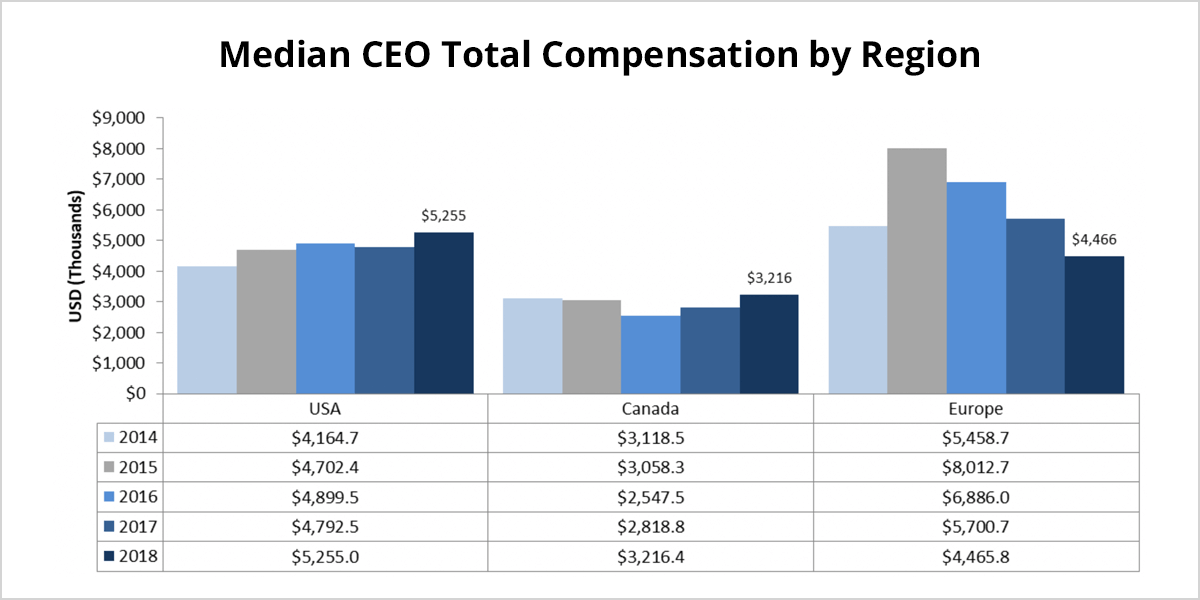
La publication présente les rémunérations globales des CEO pour six pays, dont le Canada, sur une période de cinq ans.

L’étude montre que les rémunérations des CEO canadiens sont nettement inférieures à celles des autres pays et que les écarts annuels sont faibles comparativement aux cinq autres pays.

Bonne lecture !


CEO Pay Trends Around the Globe


Since the passage of Say on Pay under the Dodd-Frank Act in July 2010, greater attention has been paid to executive compensation in an effort to bring transparency and oversight to the total compensation of executives of U.S. public companies. In 2018, the SEC expanded the Dodd-Frank Act further with Section 953(b), requiring companies to disclose the ratio of the total compensation of the chief executive officer to that of the median employee on an annual basis.

This past May, Equilar and The New York Times released the 12th annual 200 Highest-Paid CEOs study. The study not only included 2017 total CEO compensation but also the change in pay from the previous year and an interactive table, allowing users to explore the list and sort by the pay ratio disclosed in each of the companies’ 2018 proxies. While these regulations pertain solely to the United States, they do not govern foreign companies. As a result, a new study from Equilar analyzed how the compensation of CEOs of medium-sized companies in Europe and Canada compares to those in the U.S.


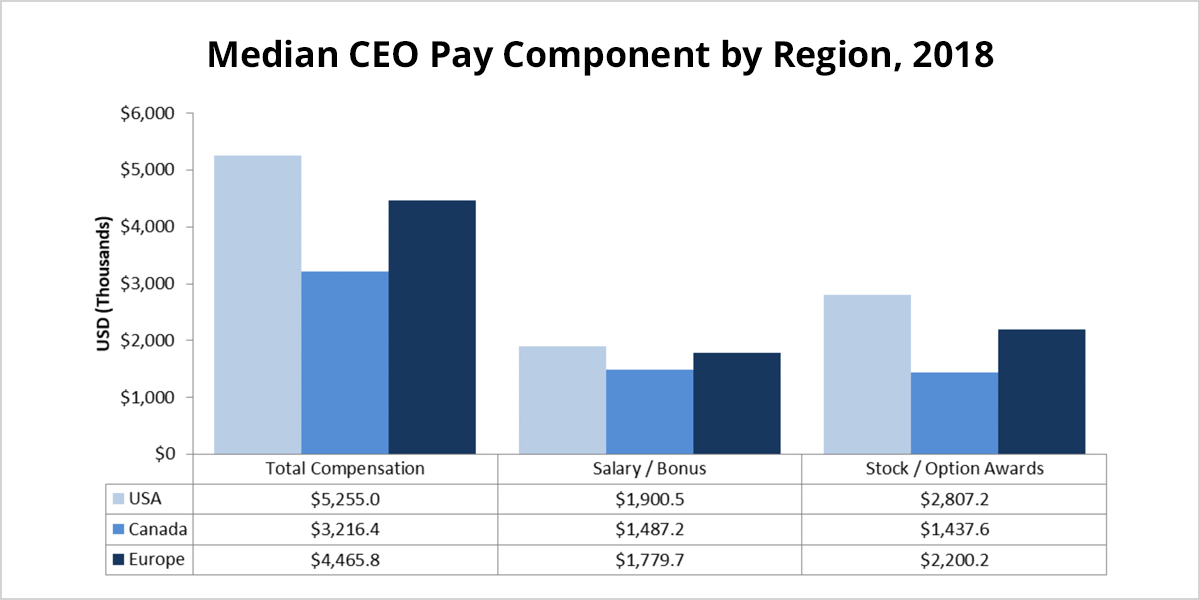
An analysis of Equilar’s extensive CEO compensation data from mid-sized companies—defined as companies with revenues between $1-5 billion—over the past five years (2018 defined as filing dates of from July 1, 2017 to June 30, 2018) revealed that the median total compensation of U.S. CEOs has generally increased from year-to-year, with the exception of 2017, which experienced a 2% decline in median pay. The study includes 853 U.S. companies, 98 Canadian companies and 54 European companies of similar size. In 2018, the median compensation of CEOs in U.S. mid-sized companies was approximately $5.3 million, while that of Canada and Europe were $3.2 million and $4.5 million, respectively. Likely due to variation in the global corporate governance landscape, European CEO pay trends were more volatile across the years involved in the study, and experienced a net decrease of 22% in median pay from 2014 to 2018 from $5.5 million in 2014 to $4.5 million in 2018.


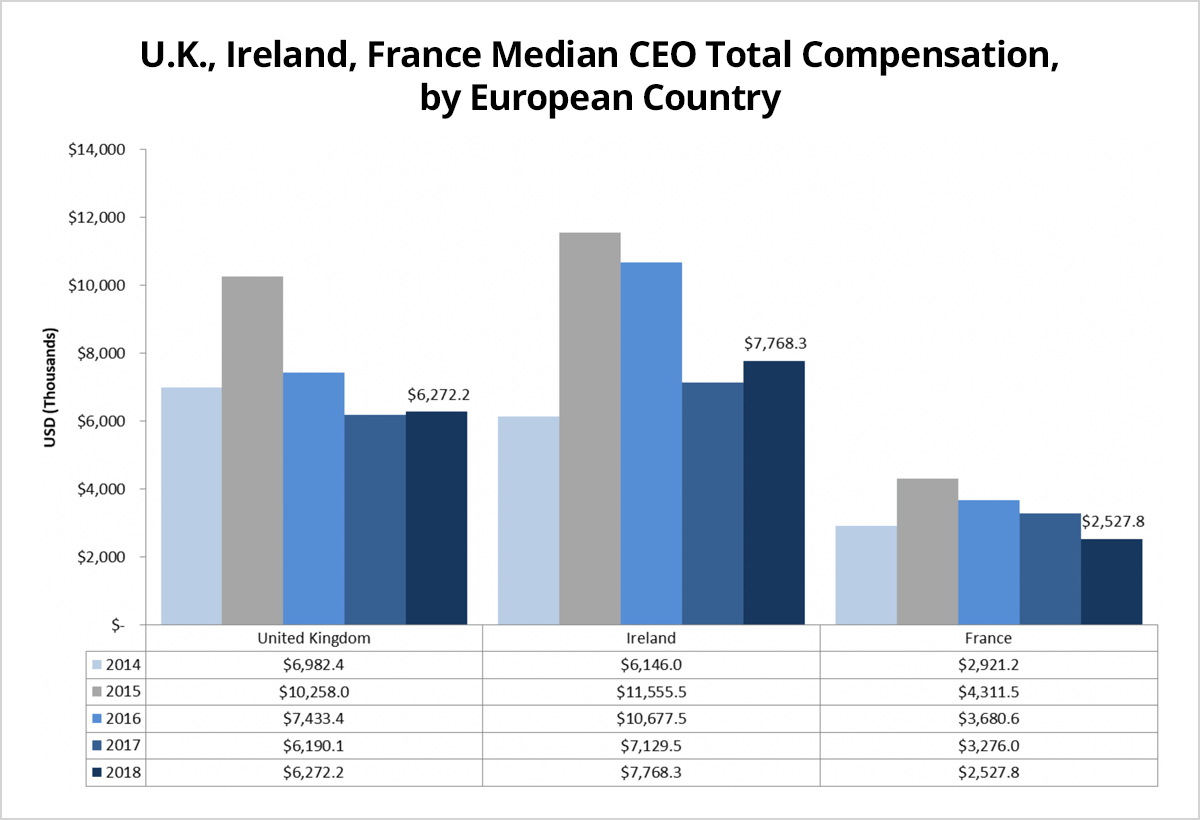
Examining European data at the country level, the highest median CEO compensation for Europeans in 2018 was found at companies based in the Netherlands at $8.8 million, followed closely by Ireland at $7.8 million and the U.K. at $6.3 million. Canadian compensation levels were more stagnant, staying at around $3 million across the years studied.

Looking at median total compensation by pay component allows us to explore more in-depth specifics of compensation by region. From the findings, the median value of the cash component was $1.9 million and the median equity component was $2.8 million. The overall compensation trends of U.S. CEOs match the compensation trends that were observed in the annual Equilar CEO Pay Trends report, in which CEO compensation for Equilar 500 CEOs was reported to be gradually increasing, and about 48.5% in the form of stock. Similarly, European and Canadian CEOs of mid-sized companies received a median cash component of $1.8 million and $1.5 million, respectively. However, equity components were significantly less than the median U.S. figure, at $2.2 million and $1.4 million, respectively.


The overall trend for mid-sized U.S. companies over the past five years shows a gradual increase in median total compensation, while trends in Canadian companies remained fairly constant and Europe was more volatile. The median equity component value of a CEO’s compensation in U.S. mid-sized companies was nearly $3 million, suggesting that CEO pay packages heavily favor equity-based compensation for U.S. executives. CEOs from Canada and the European region saw median values of both cash and equity components less than their counterparts in the United States. Despite the rules and regulations differing across borders, it appears CEO compensation trends are consistent regardless of country. Only time will tell if those similarities will continue, or if their paths will separate.

________________________________________________

*Andrew Ludwig is a Senior Research Analyst at Equilar Inc. This post is based on his Equilar memorandum. Related research from the Program on Corporate Governance includes The Growth of Executive Pay by Lucian Bebchuk and Yaniv Grinstein and Paying for Long-Term Performance by Lucian Bebchuk and Jesse Fried (discussed on the Forum here).

Les avantages d’une structure de capital composée d’actions multivotantes


C’est avec ravissement que je vous recommande la lecture de cette onzième prise de position d’Yvan Allaire* au nom de l’IGOPP.

Au Canada, mais aussi dans plusieurs pays, les actions multivotantes n’ont pas la cote ! Bien que certains arguments en faveur de l’exclusion de ce type de structure de capital soient de prime abord assez convaincantes, il existe plusieurs autres considérations qui doivent être prises en compte avant de les interdire et de les fustiger.

Comme l’auteur le mentionne dans ses recommandations, l’analyse attentive de ce type d’action montre les nombreux avantages à se doter de cet instrument.

J’ai reproduit, ci-dessous, le sommaire exécutif du document ainsi que les recommandations. Pour plus de détails, je vous invite à lire le texte au complet.

Bonne lecture ! Vos commentaires sont les bienvenus. Ils orienteront les nouvelles exigences en matière de gouvernance.


Prise de position en faveur des actions multivotantes


Résultats de recherche d'images pour « action multivotantes »


Sommaire exécutif


En 2018, 69 sociétés ayant des actions à droit de vote supérieur (ADVS) étaient inscrites à la bourse de Toronto alors qu’elles étaient 100 en 2005. De 2005 à 2018, 38 n’avaient plus d’ADVS suite à des fusions, acquisitions, faillites et autres, 16 sociétés avaient converti leurs ADVS en actions à droit de vote unique et 23 nouvelles sociétés ayant des ADVS s’étaient inscrites à la bourse de Toronto
en émettant des ADVS.

Les arguments pour ou contre ce type de structure de capital-actions sont nombreux et, à certains égards, persuasifs. D’une part, certains fonds « proactifs » (notamment les fonds de couverture « activistes ») insistent auprès de conseils et des directions de sociétés publiques ciblées pour que soient prises des mesures et des décisions, qui selon eux feraient accroître le prix de l’action, quand ce n’est pas carrément de chercher à imposer la vente prématurée de l’entreprise au plus offrant. Évidemment, ce phénomène a renforcé la détermination des entrepreneurs à se protéger contre de telles pressions en adoptant lors de leur premier appel public à l’épargne des actions ayant différents droits de vote (davantage aux USA qu’au Canada).

D’autre part, les fonds indiciels et les fonds négociés en bourse (FNB ou ETF en anglais), désormais des investisseurs importants et en croissance, mais obligés de refléter soigneusement dans leurs placements la composition et la valeur des titres des indices boursiers, ne peuvent donc pas simplement manifester leurs insatisfactions en vendant leurs actions. Ils doivent exercer leur influence sur la direction d’une société par l’exercice de leur droit de vote (lequel est restreint dans les sociétés ayant des ADVS) et en exprimant haut et fort leur frustration et leurs désaccords. C’est sans surprise que ces fonds sont farouchement opposés aux actions à droit de vote supérieur, exhortant avec succès les fournisseurs d’indices (ex. : Dow-Jones, et autres) à exclure toutes nouvelles sociétés ayant des actions à droit de vote supérieur.

Ils font aussi campagne, avec moins de succès à ce jour, auprès de la Securities and Exchange Commission des États-Unis (SEC) afin qu’elle interdise cette structure de capital-actions. Leur dernier stratagème en date, promu par le Council of Institutional Investors (CII), serait d’imposer une clause crépusculaire temporelle obligatoire rentrant en vigueur 7 ans après un PAPE3. Bien entendu, ce terme pourrait être renouvelé par un vote majoritaire de  l’ensemble des actionnaires (quels que soient leurs droits de vote).

La question des « clauses crépusculaires » est ainsi devenue un enjeu névralgique. Certains investisseurs institutionnels, les agences de conseils en vote et autres gendarmes de la gouvernance ainsi qu’un certain nombre de chercheurs académiques proposent de restreindre, de contrôler et d’imposer un temps limite à la liberté relative que procurent aux entrepreneurs et aux entreprises familiales les actions à droits de vote supérieurs.

Au cours des dernières années, un vif débat s’est engagé, particulièrement aux États-Unis, entre les apôtres du dogme « une action, un vote » et les hérétiques qui estiment bénéfiques les actions ayant des droits de vote inégaux.


Recommandations


Les sociétés ayant des ADVS et les entreprises familiales comportent de grands avantages à la condition que soient bien protégés les porteurs d’actions ayant des droits de vote inférieurs.

La clause d’égalité de traitement (« coattail ») imposée depuis 1987 par la Bourse de Toronto, une caractéristique uniquement canadienne, doit être conservée pour les sociétés qui ont émis ou voudraient émettre des actions ayant différents droits de vote.

Comme l’IGOPP l’a fait en 2006, il recommande à nouveau en 2018 que le ratio des droits de vote des ADVS soit plafonné à 4:1, ce qui signifie qu’il est nécessaire de détenir 20 % de la valeur des capitaux propres de la société pour en détenir le contrôle absolu (50 % des votes et plus).

La bourse TSX de Toronto devrait plafonner le ratio des droits de vote des ADVS à 10:1.

Les actions sans droit de vote devraient être interdites ; en effet, il est impossible d’accorder le droit d’élire un tiers des membres du conseil à des actionnaires qui n’ont aucun droit de vote ; ou encore d’assurer un décompte distinct des votes sur les propositions des actionnaires et pour l’élection des membres du conseil à une classe d’actionnaires sans droit de vote !

Nous recommandons fortement un décompte distinct des voix pour chaque classe d’actions et de rendre les résultats publics, tant pour l’élection des membres du conseil d’administration que pour toute autre proposition soumise au vote des actionnaires.

Les actionnaires disposant de droits de vote inférieurs devraient avoir le droit d’élire un tiers des membres du conseil d’administration, dont les candidatures seraient proposées par le conseil. Jumelée au décompte distinct des voix pour chaque classe d’actions, cette mesure inciterait le conseil et les gestionnaires à sélectionner des candidats susceptibles de s’attirer les faveurs des actionnaires « minoritaires ». Évidemment, tous les membres du conseil d’administration ne doivent agir que dans l’intérêt de la société.

Pour les raisons citées précédemment et expliquées par la suite dans la position, l’IGOPP s’oppose résolument à l’imposition de clauses crépusculaires temporelles pour les sociétés ayant des ADVS. Nous sommes aussi contre les clauses crépusculaires déclenchées par un événement précis ainsi que par celles déclenchées en fonction de l’âge du fondateur, de l’entrepreneur ou de l’actionnaire de contrôle.

Toutefois, l’IGOPP recommande qu’à l’avenir une clause crépusculaire basée sur un seuil de propriété (dilution sunset) soit incluse lors du PAPE d’une société faisant usage d’ADVS.

Dans la suite logique de notre démonstration de la valeur économique et sociale des entreprises familiales, l’IGOPP est favorable à une grande latitude de transférabilité du contrôle aux membres de la famille du fondateur.

Également dans la suite de notre appui aux ADVS comme rempart contre les visées à court terme et l’influence indue de certains types de spéculateurs, nous recommandons que le contrôle de ces sociétés puisse aussi être transmis à une fiducie dirigée par une majorité de fiduciaires indépendants au bénéfice des héritiers du fondateur.

Lorsqu’un parent ou un descendant de l’actionnaire de contrôle est candidat pour le poste de PDG, les administrateurs indépendants, conseillés adéquatement, devraient discuter des mérites des divers candidats avec l’actionnaire de contrôle et faire rapport de la démarche adoptée par le conseil pour arrêter son choix à l’assemblée annuelle des actionnaires suivant l’entrée en fonction d’un nouveau chef de la direction.

L’IGOPP est favorable à l’adoption d’une forme d’ADVS comportant des droits de vote supérieurs que pour l’élection de la majorité (ou la totalité) des membres du conseil.

« L’examen approfondi des arguments et des controverses à propos d’actions multivotantes nous mène à la conclusion que les avantages de cette structure l’emportent haut la main sur ses inconvénients.

Non seulement de plus en plus d’études confortent leur performance économique, mais le fait de combiner la propriété familiale et les actions à droit de vote supérieur résulte en une plus grande longévité de l’entreprise, en une meilleure intégration dans les collectivités hôtes, à moins de vulnérabilité aux pressions des actionnaires de court terme et à moins de susceptibilité aux « modes » stratégiques et financières.

Cette précieuse forme de propriété doit être assortie de mesures assurant le respect et la protection des droits des actionnaires minoritaires. Nous avons formulé un certain nombre de recommandations à cette fin. Nous encourageons les sociétés ayant présentement des ADVS et les entrepreneurs qui souhaiteront demain inscrire une société en bourse et émettre des ADVS à adopter nos recommandations ».


*Ce document a été préparé et rédigé par Yvan Allaire, Ph. D. (MIT), MSRC, président exécutif du conseil d’administration de l’IGOPP.

Dissension au conseil d’administration et violation de confidentialité


Voici un cas publié sur le site de Julie Garland McLellan qui expose un sérieux problème de gouvernance auquel plusieurs conseils d’administration sont confrontés, surtout dans les OBNL.

Certains administrateurs ont beaucoup de difficulté à soutenir les prises de position du conseil lorsqu’ils sont en profond désaccord avec les décisions du CA.

Comment un président de CA doit-il agir afin de s’assurer que les décisions prises au conseil sont confidentielles et que les administrateurs sont tenus d’y adhérer, même s’ils ne sont pas de l’avis du CA ?

Et comment le président du CA doit-il se comporter lorsque la situation dégénère lourdement comme dans le cas exposé ci-dessous ?

À tout le moins, le membre dissident ne devrait pas défendre son point de vue dissident sur la place publique !

Le cas présente une situation bien réelle et plus fréquente que l’on pense ; puis, trois experts se prononcent de façon relativement unanime sur le dilemme que vit Henry, le président du CA. Il s’agit de :

Jane Davel is a non-executive director and consultant. She is based in Auckland, New Zealand

Julie Garland McLellan is a non-executive director and board consultant based in Sydney, Australia

Lauren Smith is President of the Florida Chapter of NACD and a director on five boards. She is based in Miami, Florida, USA

Je vous invite donc à prendre connaissance de ces avis, en cliquant sur le lien ci-dessous, et me faire part de vos commentaires, si vous le souhaitez.

Bonne lecture !


Dissension au conseil d’administration et violation de confidentialité


Henry chairs a not-for-profit company and usually finds it a gratifying experience. Recently the company has been through hard times as the government ceased funding some activities although the community still needs them.

Henry and his board worked hard to develop new income streams to support continuing the company’s work. They achieved some success, but not enough to avoid having to discontinue some work and reduce headcount. All directors regretted having to make long-serving and loyal staff redundant. However, they had to find a balance of activity and income that would be sustainable; this was a necessary part of the strategy for success.

One director was vehemently opposed to the changes, preferring to run at a loss, eat into reserves, and hope for a change of heart from the government. When it was clear that this director would never agree, Henry took the matter to a vote and the cuts were approved with only one dissenter. Henry reminded the board that board decisions were ‘board decisions’ and all agreed that they would publicly support the approved course of action.

Since then the CEO has complained to Henry that the dissenting director has spoken to staff suggesting they ‘lawyer up’ to protect themselves from redundancies, oppose the closure of the unsustainable activities, and start a Facebook campaign to ‘shame the government into resuming funding’. Henry has also heard from friends that his dissenter is complaining publicly about the decision even though board policy is that the CEO or Chair are the two authorised spokesmen.

How can Henry handle this dissident director?

Une revue de l’activisme actionnarial


Excellente revue de l’activisme actionnarial en 2018 par Jim Rossman, directeur de Shareholder Advisory de la firme Lazard. L’article a été publié sur le forum de la Harvard Law School aujourd’hui.

Vous trouverez ci-dessous les faits marquants de l’année. Je vous encourage à prendre connaissance des nombreuses illustrations infographiques dans la version complète.

Bonne lecture !

2018 Review of Shareholder Activism


 Résultats de recherche d'images pour « Shareholder Activism »

1. A New High-Water Mark for Global Activist Activity

  1. A record 226 companies were targeted in 2018, as compared to 188 companies in 2017
  2. $65.0bn of capital deployed in 2018, up from $62.4bn in 2017
  3. In spite of significant market volatility, Q4 2018 was the most active Q4 on record both by campaign volume and capital deployed
  4. Against the backdrop of a robust M&A market, 33% of 2018 activist campaigns were M&A related

2. Broadening Use of Activism as a Tactic

  1. A record 131 investors engaged in activism in 2018, reflecting the continued expansion of activism as a tactic
  2. 40 “first timers” launched activist campaigns in 2018, as compared to 23 “first timers” in 2017
  3. Nine of the top 10 activists (by current activist positions [1]) invested more than $1bn in 2018 (60 new campaigns in aggregate)
  4. Elliott continued to be the most prolific activist, with 22 new campaigns launched in 2018

3. Activism Is Reshaping Boardrooms

  1. 161 Board seats won in 2018, [2] up 56% from 2017 and 11% higher than the previous record of 145 seats in 2016
  2. Starboard led the way in 2018, winning 29 seats exclusively through negotiated settlements
  3. Activists continue to name accomplished candidates, with 27% of activist appointees having public company CEO/CFO experience
  4. However, only 18% of activist appointees in 2018 were female, as compared to 40% of new S&P 500 directors in 2018 [3]

4. Activism Has Global Reach

  1. Activist campaigns in Europe and APAC accounted for 23% and 12% of companies targeted, respectively
  2. 58 European campaigns and 30 APAC campaigns in 2018 were each record highs
  3. National champions, iconic family owned companies and regulated industries featured prominently among targeted companies

5. Traditional Active Managers Are the “New Vocalists”

  1. Traditional active managers are increasingly comfortable sharing their views on major activist campaigns in private interactions with
    management and more public forums
  2. Traditional managers like T. Rowe Price, Janus Henderson and GBL publicly voiced their opinions on major activist campaigns

6. Shareholder Dynamics Are Attracting Scrutiny

  1. BlackRock’s Larry Fink set the tone for the year, calling on companies to identify and follow through on their social purpose
  2. Stakeholder duties, employee Board representation and capital allocation / share buybacks became political issues
  3. Voting power of index funds remains a highly debated topic, and regulators have begun to explore the influence of proxy advisory firms and the proxy voting process itself

The complete publication, including Appendix, is available here.

Top 10 de Harvard Law School Forum on Corporate Governance au 24 janvier 2019


Voici le compte rendu hebdomadaire du forum de la Harvard Law School sur la gouvernance corporative au 24 janvier 2019.

Comme à l’habitude, j’ai relevé les dix principaux billets.

Bonne lecture !


Résultats de recherche d'images pour « top 10 »


Résultats de recherche d'images pour « Top 10 en gouvernance Harvard Law School »


  1. Incorporating Social Activism
  2. Public Hedge Funds
  3. 10 Tips for 10-Ks and Proxy Statement
  4. OCIE Examination Priorities for 2019
  5. Another Look at “Super Options”
  6. Corporate Governance Survey: 2018 Proxy Season
  7. Directors: Older and Wiser, or Too Old to Govern?
  8. Market Power and Inequality
  9. Purpose & Profit
  10. Global Antitakeover and Antiactivist Devices

L’âge des administrateurs de sociétés représente-t-il un facteur déterminant dans leur efficacité comme membres indépendants de conseils d’administration ?


Voici une question que beaucoup de personnes expertes avec les notions de bonne gouvernance se posent : « L’âge des administrateurs de sociétés représente-t-il un facteur déterminant dans leur efficacité comme membres indépendants de conseils d’administration ? »

En d’autres termes, les administrateurs indépendants (AI) de 65 ans et plus sont-ils plus avisés, ou sont-ils carrément trop âgés ?

L’étude menée par Ronald Masulis* de l’Université de New South Wales Australian School of Business et de ses collègues est très originale dans sa conception et elle montre que malgré toutes les réformes réglementaires des dernières années, l’âge des administrateurs indépendants est plus élevé au lieu d’être plus bas, comme on le souhaitait.

L’étude montre que pendant la période allant de 1998 à 2014, l’âge médian des administrateurs indépendants (AI) des grandes entreprises américaines est passé de 60 à 64 ans. De plus, le pourcentage de firmes ayant une majorité de AI de plus de 65 ans est passé de 26 % à 50 % !

L’étude montre que le choix d’administrateurs indépendants de plus de 65 ans se fait au détriment d’une nouvelle classe de jeunes administrateurs dynamiques et compétents. Cela a pour effet de réduire le bassin des nouveaux administrateurs requis pour des postes d’administrateurs de la relève, ainsi que pour les besoins criants d’une plus grande diversité.

In our new study Directors: Older and Wiser, or Too Old to Govern?, we investigate this boardroom aging phenomenon and examine how it affects board effectiveness in terms of firm decision making and shareholder value creation. On the one hand, older independent directors can be valuable resources to firms given their wealth of business experience and professional connections accumulated over the course of their long careers. Moreover, since they are most likely to have retired from their full-time jobs, they should have more time available to devote to their board responsibilities. On the other hand, older independent directors can face declining energy, physical strength, and mental acumen, which can undermine their monitoring and advisory functions. They can also have less incentive to build and maintain their reputation in the director labor market, given their dwindling future directorship opportunities and shorter expected board tenure as they approach normal retirement age.

Dans la foulée des mouvements activistes, plusieurs entreprises semblent faire le choix d’AI plus âgés. Cependant, l’analyse coût/bénéfice de l’efficacité des AI plus âgés montre que leurs rendements est possiblement surfait et que la tendance à éliminer ou à retarder l’âge limite de retraite doit faire l’objet d’une bonne réflexion !

Si le sujet vous intéresse, je vous invite à lire l’article original. Vos commentaires sont les bienvenus.

Bonne lecture !

Directors: Older and Wiser, or Too Old to Govern?


figure 3


The past two decades have witnessed dramatic changes to the boards of directors of U.S. public corporations. Several recent governance reforms (the 2002 Sarbanes-Oxley Act, the revised 2003 NYSE/Nasdaq listing rules, and the 2010 Dodd-Frank Act) combined with a rise in shareholder activism have enhanced director qualifications and independence and made boards more accountable. These regulatory changes have significantly increased the responsibilities and liabilities of outside directors. Many firms have also placed limits on how many boards a director can sit on. This changing environment has reduced the ability and incentives of active senior corporate executives to serve on outside boards. Faced with this reduced supply of qualified independent directors and the increased demand for them, firms are increasingly relying on older director candidates. As a result, in recent years the boards of U.S. public corporations have become notably older in age. For example, over the period of 1998 to 2014, the median age of independent directors at large U.S. firms rose from 60 to 64, and the percentage of firms with a majority of independent directors age 65 or above nearly doubled from 26% to 50%.

In our new study Directors: Older and Wiser, or Too Old to Govern?, we investigate this boardroom aging phenomenon and examine how it affects board effectiveness in terms of firm decision making and shareholder value creation. On the one hand, older independent directors can be valuable resources to firms given their wealth of business experience and professional connections accumulated over the course of their long careers. Moreover, since they are most likely to have retired from their full-time jobs, they should have more time available to devote to their board responsibilities. On the other hand, older independent directors can face declining energy, physical strength, and mental acumen, which can undermine their monitoring and advisory functions. They can also have less incentive to build and maintain their reputation in the director labor market, given their dwindling future directorship opportunities and shorter expected board tenure as they approach normal retirement age.

We analyze a sample of S&P 1500 firms over the 1998-2014 period and define an independent director as an “older independent director” (OID) if he or she is at least 65 years old. We begin by evaluating individual director performance by comparing board meeting attendance records and major board committee responsibilities of older versus younger directors. Controlling for a battery of director and firm characteristics as well as director, year, and industry fixed effects, we find that OIDs exhibit poorer board attendance records and are less likely to serve as the chair or a member of an important board committee. These results suggest that OIDs either are less able or have weaker incentives to fulfill their board duties.

We next examine major corporate policies and find a large body of evidence consistently pointing to monitoring deficiencies of OIDs. To measure the extent of boardroom aging, we construct a variable, OID %, as the fraction of all independent directors who are categorized as OIDs. As the percentage of OIDs on corporate boards rises, excess CEO compensation increases. This relationship is mainly driven by the cash component of CEO compensation. A greater OID presence on corporate boards is also associated with firms having lower financial reporting quality, poorer acquisition profitability measured by announcement returns, less generous payout polices, and lower CEO turnover-to-performance sensitivity. Moreover, we find that firm performance, measured either by a firm’s return on assets or its Tobin’s Q, is significantly lower when firms have a greater fraction of OIDs on their boards. These results collectively support the conclusion that OIDs suffer from monitoring deficiencies that impair the board’s effectiveness in providing management oversight.

We employ a number of approaches to address the endogeneity issue. First, we include firm-fixed effects wherever applicable to control for unobservable time-invariant firm-specific factors that may correlate with both the presence of OIDs and the firm outcome variables that we study. Second, we employ an instrumental variable regression approach where we instrument for the presence of OIDs on a firm’s board with a measure capturing the local supply of older director candidates in the firm’s headquarters state. We find that all of our firm-level results continue to hold under a two-stage IV regression framework. Third, we exploit a regulatory shock to firms’ board composition. The NYSE and Nasdaq issued new listing standards in 2003 following the passage of the Sarbanes-Oxley Act (SOX), which required listed firms to have a majority of independent directors on the board. We show that firms non-compliant with the new rule experienced a significantly larger increase in the percentage of OIDs over the 2000-2005 period compared to compliant firms. A major reason for this difference is that noncompliant firms needed to hire more OIDs to comply with the new listing standards. Using a firm’s noncompliance status as an instrument for the change in the board’s OID percentage, we find that firm performance deteriorates as noncompliant firms increase OIDs on their boards. We also conduct two event studies, one on OID appointment announcements and the other on the announcements of firm policy changes that increase the mandatory retirement age of outside directors. We find that shareholders react negatively to both announcements.

In our final set of analysis, we explore cross-sectional variations in the relation between OIDs and firm performance and policies. We find that the negative relation between OIDs and firm performance is more pronounced when OIDs hold multiple outside board seats. This evidence suggests that “busyness” exacerbates the monitoring deficiency of OIDs. We also find that for firms with high advisory needs, the relation between OIDs and firm performance is no longer significantly negative and in some cases, becomes positive. These results are consistent with OIDs using their experience and resources to provide valuable counsel to senior managers in need of board advice. Also consistent with OIDs performing a valuable advisory function, our analysis of acquirer returns shows that the negative relation between OIDs and acquirer returns is limited to OIDs who have neither prior acquisition experience, nor experience in the target industry. For OIDs with either type of experience, their marginal effect on acquirer returns is non-negative, and sometimes significantly positive.

Our research is the first investigation of the pervasive and growing phenomenon of boardroom aging at large U.S. corporations and its impact on board effectiveness and firm performance. As the debate over director age limits continues in the news media and among activist shareholders and regulators, our findings on the costs and benefits associated with OIDs can provide important and timely policy guidance. For companies considering lifting or waiving mandatory director retirement age requirements, so as to lower the burden of recruiting and retaining experienced independent directors, our evidence should give them pause. Similarly, while recent corporate governance reforms and the rise in shareholder activism have made boards, and especially independent directors, more accountable for managerial decisions and firm performance, they may also have created the unintended consequence of shrinking the supply of potential independent directors who are younger active executives. This result has led firms to tap deeper into the pool of older director candidates, which our analysis shows can undermine the very objectives that corporate governance reforms seek to accomplish.

The complete paper is available for download here.

___________________________________________________________________________________

*Ronald Masulis is Scientia Professor of Finance at University of New South Wales Australian School of Business; Cong Wang is Professor of Finance at The Chinese University of Hong Kong, Shenzhen and the associate director of Shenzhen Finance Institute; Fei Xie is Associate Professor of Finance at the University of Delaware; and Shuran Zhang is Associate Professor of Finance at Jinan University. This post is based on their recent paper.

Top 10 de Harvard Law School Forum on Corporate Governance au 17 janvier 2019


Voici le compte rendu hebdomadaire du forum de la Harvard Law School sur la gouvernance corporative au 17 janvier 2019.

Comme à l’habitude, j’ai relevé les dix principaux billets.

Bonne lecture !


Résultats de recherche d'images pour « top 10 »


Résultats de recherche d'images pour « Top 10 en gouvernance Harvard Law School »


  1. Quarterly Reporting—What’s Next?
  2. Top Priorities for Boards in 2019
  3. Compensation Season 2019
  4. The Board, CEO Misconduct, and Corporate Culture
  5. Corporate Governance Failures and Interim CEOs
  6. Transparency in Corporate Groups
  7. 2019 Proxy Letter—Aligning Corporate Culture with Long-Term Strategy
  8. Electronic Proxy Statement Dissemination and Shareholder Monitoring
  9. Top 10 Topics for Directors in 2019
  10. 2018 Private Equity Year in Review

Top 10 de Harvard Law School Forum on Corporate Governance au 10 janvier 2019


Voici le compte rendu hebdomadaire du forum de la Harvard Law School sur la gouvernance corporative au 10 janvier 2019.

Comme à l’habitude, j’ai relevé les dix principaux billets.

Bonne lecture !


Résultats de recherche d'images pour « top 10 »


Résultats de recherche d'images pour « Top 10 en gouvernance Harvard Law School »


  1. Shareholder Resolutions and IPOs
  2. NACD Public Company Governance Survey
  3. Boardrooms Without Female Representation
  4. Blockholder Heterogeneity, Multiple Blocks, and the Dance Between Blockholders
  5. Climate Change and Proxy Voting in the U.S. and Europe
  6. Why Are Firms with More Managerial Ownership Worth Less?
  7. A Regulatory Classification of Digital Assets
  8. The Government Shutdown’s Effect on Deals
  9. Looking Ahead: Key Trends in Corporate Governance
  10. Investor Demand for Internal Control Audits of Large U.S. Companies

Éléments susceptibles d’influer sur les décisions relatives à la gouvernance des grandes entreprises en 2019


L’article ci-dessous brosse un portrait de ce qui attend les grandes entreprises en 2019. Le billet de Holly J. Gregory, associé de la firme Sidley Austin, a été publié sur le site de Harvard Law School Forum aujourd’hui.

Quelles sont les variables susceptibles d’influer sur les décisions relatives à la gouvernance ainsi que sur les relations avec les actionnaires ?

L’auteur fait ressortir les éléments critiques suivants :

  1. Le maintien des caractéristiques du rôle du conseil et des devoirs des administrateurs;
  2. L’examen approfondi de la primauté des actionnaires et de leur influence;
  3. La réforme du vote par procuration et la réglementation des conseillers en vote;
  4. La poursuite de la convergence des idées sur les pratiques de gouvernance d’entreprise;
  5. Un accent encore plus affirmé sur les questions environnementales, sociales et de gouvernance (ESG);
  6. Une demande continue d’engagement des actionnaires et d’attention envers les investisseurs activistes.


Bonne lecture !


Looking Ahead: Key Trends in Corporate Governance

Résultats de recherche d'images pour « trend en gouvernance »

Board’s Role and Director Duties Remain Durable


While the corporate governance environment is always changing, board responsibilities and the fiduciary duties of directors under state corporate law have proven remarkably durable. Directors must:

Manage or direct the affairs of the company and cannot abdicate that responsibility by deferring to shareholder pressure.

Act with due care, without conflict, in good faith, and in the company’s best interest.

Delegate and oversee management of the company (for example, by selecting the CEO, monitoring the CEO’s performance, and planning for succession), and oversee strategy and risk management.

Ensuring that the day-to-day management of the company is in the right hands, providing management with forward-looking strategic guidance, and monitoring management’s efforts to identify and manage risk, including risks that pose an existential threat, remain at the heart of the board’s role. To accomplish this, boards need to understand and address disruptive risks. Boards should be mindful that adequate time is reserved on the agenda for these matters, with less focus on formal management presentations and more focus on the problems and concerns management is grappling with.

The National Association of Corporate Directors (NACD) Blue Ribbon Commission recently provided guidance on oversight of risks that pose an existential threat (NACD, Adaptive Governance: Board Oversight of Disruptive Risks (Oct. 2018), available at nacdonline.org). The Commission recommends that boards prioritize certain actions, including:

Understanding and addressing disruptive risks “in the context of the [company’s] specific circumstances, strategic assumptions, and objectives.”

Allocating oversight of disruptive risks between and among the full board and its committees, and clarifying the allocation of responsibilities in committee charters.

Recognizing that enterprise risk management processes may not capture disruptive risks.

Evaluating board culture regularly for “openness to sharing
concerns, potential problems, or bad news; response to mistakes; and acceptance of nontraditional points of view.”

Assessing “leadership abilities in an environment of disruptive risks” in CEO selection and evaluation processes.

Aligning the company’s “talent strategy” with “the skills and structure needed to navigate disruptive risks.”

Refraining from automatically re-nominating directors as a “default decision.”

Treating board diversity as “a strategic imperative, not a compliance issue.”

Requiring continuing learning of all directors, and assessing that factor in the board’s evaluation process.

Ensuring risk reports provide “forward-looking information about changing business conditions and potential risks in a format that enables productive dialogue and decision making.”

Holding a substantive discussion, at least annually, of the company’s vulnerability to disruptive risks, “using approaches such as scenario planning, simulation exercises, and stress testing to inform these discussions.”

Shareholder Primacy and Shareholder Influence Under Scrutiny


While it is prudent for directors to listen to and engage with shareholders and understand their interests, directors must apply their own business judgment and determine what course is in the best interests of the company. This means that they cannot merely succumb to pressures from activist investors and other shareholders (see, for example, In re PLX Tech., Inc. Stockholders Litig., 2018 WL 5018535, at *45 (Oct. 16, 2018) (an activist “succeeded in influencing the directors to favor a sale when they otherwise would have decided to remain independent” and the incumbent directors improperly deferred to the activist and allowed him “to take control of the sale process when it mattered most”)).

However, shareholders have gained considerable power relative to boards over the last 20 years, making it difficult to resolve shareholder pressures that conflict with director viewpoints regarding the best course for the company. The forces that have strengthened shareholder influence include:

Concentration of shareholding in the hands of powerful institutional investors (with institutions owning 70% of US public company shares in 2018).

The activation of institutional investors regarding proxy voting (with institutional voting participation at 91% compared to retail shareholder participation at 28%).

The rise of proxy advisory firms that serve to coordinate proxy voting.

The dismantling of classic corporate defenses, such as classified boards and poison pills.

The rise in shareholder engagement and negotiation (or “private ordering”) of governance processes. (Broadridge, 2018 Proxy Season Review (Oct. 2, 2018), available at broadridge.com.)

While there is no sign that shareholder influence will dissipate, recent legislative developments suggest that shareholder primacy (the premise that a company is run for the benefit of its shareholders in the first instance) is under some pressure. For example, in August 2018, US Senator Elizabeth Warren proposed the Accountable Capitalism Act, which among other things would require directors of US companies with $1 billion or more in annual revenues to obtain a charter as a “United States Corporation” and consider the interests of all corporate stakeholders, including employees, customers, and communities, in their decision-making, in addition to the interests of shareholders. (S. 3348, 115th Cong. § 5(c)(1)(B) (2017–2018); for more information, search Looking Ahead: Key Trends in Corporate Governance on Practical Law.)

In addition, there are increasing calls for the responsible use of power by large institutional investors, which have a considerable and growing influence on the companies in which they invest. The underlying concern is the responsible use of significant economic power, given the substantial impact on society that large institutional investors and companies have. For example, in January 2018, BlackRock CEO Larry Fink wrote to the CEOs of BlackRock portfolio companies that “society increasingly is turning to the private sector and asking that companies respond to broader societal challenges. … To prosper over time, every company must not only deliver financial performance, but also show how it makes a positive contribution to society. Companies must benefit all of their stakeholders, including shareholders, employees, customers, and the communities in which they operate” (Annual Letter to CEOs from Larry Fink, Chairman and CEO, BlackRock, available at blackrock.com).

This broader view of a company’s purpose recognizes that, while social interests and shareholder interests are often viewed as in tension, outside of a short-term perspective social interests and shareholder interests tend to align. For pension funds and many other institutional investors, the interests of their beneficiaries are aligned with the successful performance of healthy companies over a period of years.

Given the size of institutional investors’ portfolios, they face challenges in applying their influence on a company-specific basis. While some of the largest institutional investors are investing in the human resources and technology needed to make informed voting decisions on a case-by-case, company-specific basis, with respect to a large number of companies in their portfolios, many institutional investors still apply set policies on a one-size-fits-all basis, without nuanced analysis of the circumstances, in voting their shares. Institutional investors should assess whether they:

Are well positioned to vote their shares on an informed basis.

Have designed screens that consider company performance and other factors that may support a change from standard policy, if relying on the application of pre-set policies.

When institutional investors turn to proxy advisory firms to make voting decisions, they should evaluate how the proxy advisor is positioned to make sophisticated and nuanced case-by-case determinations, and whether resource constraints require the proxy advisor to rely heavily on the use of set policies (see below Convergence of Ideas on Corporate Governance Practices Continues).

In January 2017, a group of institutional investors launched the Investor Stewardship Group (ISG) and issued Stewardship Principles and Corporate Governance Principles that took effect on January 1, 2018 (available at isgframework.org). The Stewardship Principles set forth a stewardship framework for institutional investors that includes the following principles:

Principle A: Institutional investors are accountable to those whose money they invest.

Principle B: Institutional investors should demonstrate how they evaluate corporate governance factors with respect to the companies in which they invest.

Principle C: Institutional investors should disclose, in general terms, how they manage potential conflicts of interest that may arise in their proxy voting and engagement activities.

Principle D: Institutional investors are responsible for proxy voting decisions and should monitor the relevant activities and policies of third parties that advise them on those decisions.

Principle E: Institutional investors should address and attempt to resolve differences with companies in a constructive and pragmatic manner.

Principle F: Institutional investors should work together, where appropriate, to encourage the adoption and implementation of the Corporate Governance Principles and Stewardship Principles.

Reform of Proxy Voting and Regulation of Proxy Advisors Under Consideration


The Securities and Exchange Commission (SEC) staff recently held a roundtable to assess whether the SEC should update its rules governing proxy voting mechanics and the shareholder proposal process, and strengthen the regulation of proxy advisory firms. These issues have been under consideration since the SEC solicited public comment on the proxy system in 2010. (SEC, November 15, 2018: Roundtable on the Proxy Process, available at sec.gov; Concept Release on the U.S. Proxy System, 75 Fed. Reg. 42982-01, 2010 WL 2851569 (July 22, 2010).)

Topics discussed at the roundtable included:

Proxy voting mechanics and technology. Panelists agreed that the current proxy voting system needs to be modernized and simplified, for example, by:

implementing a vote confirmation process so that shareholders may verify, before the vote deadline, that voting instructions were followed and their votes were counted;

using technology to encourage wider participation and reduce costs and delays in the voting process;

studying why retail shareholder participation has fallen and whether more direct communication channels would improve information flow and participation; and

mandating use of universal proxy cards in proxy contests.

The shareholder proposal process. Some panelists asserted that the current shareholder proposal process functions well, while others identified areas for reform, including:

revisiting the ownership thresholds and holding period required to submit a shareholder proposal (currently, the lesser of $2,000 or 1%, and one year);

increasing resubmission thresholds to address reappearance of a proposal even though a majority of shareholders voted it down year after year;

providing more SEC guidance on no-action decisions and rationales;

requiring proxy disclosure of the name of the shareholder proponent (and its proxy, if any) and its level of holdings; and

requiring disclosure of preliminary vote tallies.

The role and regulation of proxy advisory firms. While no significant consensus emerged regarding whether proxy advisory firms should be subject to further SEC regulation, areas under discussion included:

improving accuracy of proxy advisor reports and affording all companies opportunities to review and verify information in advance of publication; and

improving procedures to monitor and manage, and enhancing disclosure of, conflicts of interest.

The Corporate Governance Reform and Transparency Act


The Corporate Governance Reform and Transparency Act, H.R. 4015, would require proxy advisory firms to register with the SEC, which would require:

Sufficient staffing to provide voting recommendations based on current and accurate information.

The establishment of procedures to permit companies reasonable time to review and provide meaningful comment on draft proxy advisory firm recommendations, including the opportunity to present (in person or telephonically) to the person responsible for the recommendation.

The employment of an ombudsman to receive and timely resolve complaints about the accuracy of voting information used in making recommendations.

Policies and procedures to manage conflicts of interest.

Disclosure of procedures and methodologies used in developing proxy recommendations and analyses.

Designation of a compliance officer responsible for administering the required policies and procedures.

Annual reporting to the SEC on the proxy advisory firm’s recommendations, including the number of companies that are also consulting division clients, as well as the number of proxy advisory firm staff who reviewed and made recommendations.

The bill would also direct the SEC staff to withdraw two no-action letters issued by the SEC in 2004, which the fact sheet suggests “have led to overreliance on proxy advisory firm recommendations.” (The SEC rescinded those two no-action letters in September 2018.)

The bill is supported by both Nasdaq and the New York Stock Exchange, as well as leading business groups and the Society for Corporate Governance. It is opposed by the Council of Institutional Investors, the Consumer Federation of America, and many public pension fund managers.

(See, for example, Nelson Griggs, Nasdaq, U.S. House of Representatives Passes Proxy Advisory Firm Reform Legislation (Dec. 16, 2017), available at nasdaq.com; Council of Institutional Investors, CII Urges Members to Contact Congressional Reps, Opposing Proxy Advisors Bill (Jan. 13, 2018), available at cii.org.) The bill is unlikely to be passed into law before the current congressional term ends, but may be reintroduced during the following congressional term.

It remains to be seen whether the SEC will incorporate input from the roundtable into future rulemaking or new SEC staff guidance or practice. The SEC is more likely to focus on proxy reform as a priority than on regulation of proxy advisory firms absent pressure from Congress.

Two bills seeking SEC regulation of proxy advisory firms were introduced in the 115th Congress:

The Corporate Governance Reform and Transparency Act, H.R. 4015. In June 2018, the Senate Committee on Banking, Housing, and Urban Affairs held a hearing on this bill, which was sent by the House of Representatives to the Senate in December 2017 for consideration. (See Box, The Corporate Governance Reform and Transparency Act.)

The Corporate Governance Fairness Act, S. 3614. In November 2018, this bill was introduced in the Senate to amend the Investment Advisers Act of 1940 (Advisers Act) to expressly require proxy advisory firms to register as investment advisers under the Advisers Act, thereby subjecting them to enhanced fiduciary duties and SEC oversight, including regular SEC staff examinations into their conflict of interest policies and programs, and whether they knowingly have made false statements to clients or have omitted to state material facts that would be necessary to make statements to clients not misleading.

Both bills would subject proxy advisory firms to SEC regulation, and focus on policies and procedures regarding conflicts of interest and accuracy. H.R. 4015 goes further by mandating
maintenance of certain staffing levels and annual reporting relating to recommendations. Neither bill is likely to be passed into law by the end of the current session of Congress.


Convergence of Ideas on Corporate Governance Practices Continues


Proxy advisory firms are often criticized for imposing a one-size-fits-all view of corporate governance on public companies in the US. However, the divide is narrowing between what investors and their proxy advisors, on the one hand, and corporate directors and CEOs, on the other hand, think are good corporate governance practices.

Recently, a high-profile group of senior executives from major public companies and institutional investors issued the Commonsense Principles 2.0 to revise corporate governance principles that the group published in 2016 (available at governanceprinciples.org). The Commonsense Principles 2.0 describe corporate governance practices that have become widely accepted among leading companies and their institutional investors, including in previously controversial areas such as majority voting in uncontested director elections and proxy access. A majority of S&P 500 companies already practice most of the recommendations, and many of the recommendations are requirements for publicly traded companies under SEC regulations or stock exchange listing rules. For example, the Commonsense Principles 2.0 provide that:

One-year terms for directors are generally preferable, but if a board is classified, the reason for that structure should be explained.

The independent directors should decide whether to have combined or separate chair and CEO roles based on the circumstances. If they combine the chair and CEO roles, they should designate a strong lead independent director. In any event, the reasons for combining or separating the roles should be explained clearly.

A director who fails to receive a majority of votes in uncontested elections should resign and the board should accept the resignation or explain to shareholders why it is not accepted.

These recommendations are in line with evolving practices.

The Commonsense Principles 2.0 address some recommendations to institutional investors and asset managers, and call on them to use their influence transparently and responsibly. Among other things, they urge asset managers to disclose their proxy voting guidelines and reliance on proxy advisory firms, and be satisfied that the information that they are relying on is accurate and relevant.

Notably, the Commonsense Principles 2.0 reflect the convergence of viewpoints through agreement among a coalition of high-profile leaders of well-known public companies, institutional investors, and one activist hedge fund. Signatories include Mary Barra of General Motors, Ed Breen of DowDupont, Warren Buffet of Berkshire Hathaway, Jamie Dimon of JPMorgan Chase, Larry Fink of BlackRock, Bill McNabb of Vanguard, Ronald O’Hanley of State Street, and Jeff Ubben of ValueAct Capital. The Council of Institutional Investors and the Business Roundtable have expressed support for or endorsed the Commonsense Principles 2.0.


Shifting Focus of Private Ordering to ESG Issues


The convergence of views among corporate leaders and large institutional investors on corporate governance practices reflects to a significant degree the success shareholders have had in influencing corporate governance reforms through engagement with boards, or private ordering. Shareholders are continuing to engage companies and press for reforms in the areas of shareholder rights and board composition and quality, but they are also increasing their focus on ESG issues, such as climate change, diversity, and board effectiveness, and the impact of ESG issues on companies’ financial performance. ESG is no longer a fringe issue of interest only to special issue investors. Mainstream institutional investors are recognizing that attention to ESG and corporate social responsibility impacts portfolio company financial performance.

The rising interest in ESG among investors is apparent in the sharp rise in US-domiciled assets under management using ESG strategies ($12.0 trillion at the start of 2018, up 38% since 2016 and an 18-fold increase since 1995, as reported by the US SIF Foundation), increasing support for shareholder proposals relating to ESG issues, as well as in the focus of engagement efforts. According to Broadridge, institutional investor support for social and environmental proposals increased from 19% in 2014 to 29% in 2018 (Broadridge, 2018 Proxy Season Review (Oct. 2, 2018), available at broadridge.com).


Continuing Demand for Shareholder Engagement and Attention to Activist Investors


In this era of enhanced shareholder influence, directors need to be especially attuned to the interests and concerns of significant shareholders, while continuing to apply their own judgment about the best interests of the company. This requires active outreach and engagement with the company’s core shareholders and, in particular, the persons responsible for voting proxies and setting the governance policies that often drive voting decisions. Caution, balance, and effective communication are also necessary to ensure that director judgment is not replaced with shareholder appeasement.

In the first half of 2018, record numbers of hedge fund activist campaigns were launched, backed by record levels of capital. Activist investors are having greater success in negotiating board seats and in winning seats in contested elections. The general level of vote support for directors is falling. For example, 416 directors failed to receive majority shareholder support in the 2018 proxy season (an 11% increase over 2017) and 1,408 directors failed to attain at least 70% shareholder support (a 14% increase over 2017) (Broadridge, 2018 Proxy Season Review (Oct. 2, 2018), available at broadridge.com).

Understanding key shareholders’ interests and developing relationships with long-term shareholders can help position the company to address calls by activist investors for short-term actions that may impair long-term value. However, boards also should view the input they receive from activist investors as valuable, because it could help identify potential areas of vulnerability. Moreover, establishing an open and positive dialogue with activist investors, and engaging with them in meaningful discussions, can assist boards in avoiding a public shareholder activist campaign in the future. This requires:

Identifying the company’s key shareholders and the issues about which they care the most.

Objectively assessing strategy and performance from the perspective of an activist investor, including proactively identifying areas in which the company may be subject to activism.

Monitoring corporate governance benchmarks and trends in shareholder activism to keep abreast of “hot topic” issues.

Comparing the company’s corporate governance practices to evolving best practice.

Attending to potential vulnerabilities in board composition. Activist investors scrutinize the tenure, age, demographics, and experience of each director. They will target directors whose expertise is arguably outdated, who have poor track records as officers or directors of other companies, or who have served on the board for long tenures. They will also look for gaps in the expertise needed by the board given the current dynamic business environment, and for a lack of gender or ethnic diversity. Boards should monitor developments in these areas (see, for example, Institutional Shareholder Services Inc. (ISS), 2019 ISS Americas Policy Updates (Nov. 19, 2018), available at issgovernance.com (announcing that, beginning in 2020, ISS will oppose the nominating committee chair at Russell 3000 or S&P 1500 companies when there are no women on the board); 2018 Cal. Legis. Serv. ch. 954 (S.B. 826) (to be codified at Cal. Corp. Code §§ 301.3, 2115.5) (mandating gender quotas for boards of US public companies that are headquartered in California)).

Addressing potential vulnerabilities in CEO compensation, including disparity with respect to peer companies and other named executive officers. Activist investors could claim that this signals a culture in which too much deference is given to the CEO and there is a lack of team emphasis in the compensation of management.

Reviewing structural defenses with the assistance of seasoned proxy fight and corporate governance counsel. Many companies have not reviewed their charter and bylaws recently, and in a proxy contest the language of many bylaw provisions can take on a different meaning. Boards should be aware that proxy advisory firm ISS recently announced that it will generally oppose management proposals to ratify a company’s existing charter or bylaw provisions, unless the provisions align with best practice (2019 ISS Americas Policy Updates, at 11).

Effectively communicating long-term plans with respect to strategy and performance pressures, defending past performance, and addressing calls for an exploration of strategic alternatives.

Preparing a response plan for engaging with activist investors to ensure that the board and management convey a measured and unified position.

Top 10 de Harvard Law School Forum on Corporate Governance au 3 janvier 2019


Voici le compte rendu hebdomadaire du forum de la Harvard Law School sur la gouvernance corporative au 3 janvier 2019.

Comme à l’habitude, j’ai relevé les dix principaux billets.

Bonne lecture !


Résultats de recherche d'images pour « top 10 »


Résultats de recherche d'images pour « Top 10 en gouvernance Harvard Law School »


  1. Stock Exchanges and Shareholder Rights: A Race to the Top, Not the Bottom?
  2. Fighting the Rising Tide of Federal Disclosure Suits
  3. 2019 Global & Regional Trends in Corporate Governance
  4. The CFTC and Market Manipulation
  5. SEC Cyber Briefing: Regulatory Expectations for 2019
  6. Politics and Antitrust: Lessons from the Gilded Age
  7. California Courts and Forum Selection Bylaws
  8. Activism: The State of Play at Year-End 2018
  9. Matters to Consider for the 2019 Annual Meeting and Reporting Season
  10. Confronting the Problem of Fraud on the Board

La prévalence de l’activisme actionnarial en 2019


Voici une mise à jour de Martin Lipton*, associé fondateur de la firme Wachtell, Lipton, Rosen & Katz, qui se spécialise dans les politiques et stratégies organisationnelles ayant un impact sur la gouvernance des entreprises. L’article a été publié aujourd’hui sur le site de HLS Forum sur la gouvernance.

En 2019, les auteurs prédisent que la menace de l’activisme sera encore plus prévalente.

Bonne lecture !


Activism: The State of Play at Year-End 2018


Résultats de recherche d'images pour « activisme actionnarial »


As we noted [in 2018], the threat of activism continues to be high, and has become a global phenomenon. The conclusion of a volatile and dynamic 2018 prompts a brief update of the state of play.

  1. Activist assets under management remain at elevated levels, encouraging continued attacks on large successful companies in the U.S. and abroad. In many cases, activists have been taking advantage of recent stock market declines to achieve attractive entry points for new positions. These trends have been highlighted in several recent media reports, including in The Wall Street Journal and Bloomberg.
  2. While the robust M&A environment of much of 2018 has recently subsided, deal-related activism remains prevalent, with activists instigating deal activity, challenging announced transactions (e.g., the “bumpitrage” strategy of pressing for a price increase) and/or pressuring the target into a merger or a private equity deal with the activist itself.
  3. “Short” activists, who seek to profit from a decline in the target’s market value, remain highly aggressive in both the equity and corporate debt markets. In debt markets, we have also recently seen a rise in “default activism,” where investors purchase debt on the theory that a borrower is already in default and then actively seek to enforce that default in a manner by which they stand to profit.
  4. Elliott Management was the most active and in many cases aggressive activist of 2018. The Wall Street Journal noted that Elliott has publicly targeted 24 companies in 2018, with Icahn and Starboard runners-up with nine public targets each. The New Yorker published a lengthy profile of Paul Singer and Elliott in August, “Paul Singer, Doomsday Investor”. “Singer has excelled in this field in part because of a canny ability to discern his opponents’ weaknesses and a seeming imperviousness to public disapproval.”
  5. Enhanced ESG disclosure remains a topic of great interest to institutional investors and the corporate governance community. In October, two prominent business law professors, supported by investors and other entities with over $5 trillion in assets under management, filed a petition for rulemaking calling for the SEC to “develop a comprehensive framework requiring issuers to disclose identified environmental, social, and governance (ESG) aspects of each public-reporting company’s operations.” In November, the Embankment Project of the Coalition for Inclusive Capitalism issued its report outlining proposed ways to measure long-term sustainable value creation beyond financial results. And earlier this month, ESG disclosure was the subject of a lively discussion at a meeting of the SEC’s Investor Advisory Committee, with various views expressed regarding the merits of regulatory efforts versus private ordering in this area.

It has become increasingly evident that the activism-driven corporate world is relatively fragile and is proving to be unsustainable, particularly when viewed in the broader context of rapidly changing political and social norms and increasing divisiveness across many planes of the social contract. A number of initiatives have been underway to establish a modern corporate governance framework that is calibrated to the current environment. For our part, at the request of the World Economic Forum, we prepared a paper titled, The New Paradigm: A Roadmap for an Implicit Corporate Governance Partnership Between Corporations and Investors to Achieve Sustainable Long-Term Investment and Growth, which was issued in September 2016 and most recently updated in our memo, Some Thoughts for Boards of Directors in 2019.

In essence, The New Paradigm conceives of corporate governance as a collaboration among corporations, shareholders and other stakeholders working together to achieve long-term value and resist short-termism. While we have seen considerable interest in The New Paradigm and similar initiatives from major institutional investors and other key stakeholders, until such a framework is widely adopted, it is unlikely that absent legislation, there will be any decrease in activism. Accordingly, companies should regularly review and adjust their plans to avoid an activist attack and to successfully deal with an activist attack if one should occur. Effective engagement with major shareholders is the essential element of activist defense.

____________________________________________________________

*Martin Lipton is a founding partner of Wachtell, Lipton, Rosen & Katz, specializing in mergers and acquisitions and matters affecting corporate policy and strategy, and Zachary S. Podolsky is a corporate associate. This post is based on a Wachtell Lipton memorandum authored by Mr. Lipton and Mr. Podolsky. Related research from the Program on Corporate Governance includes The Long-Term Effects of Hedge Fund Activism by Lucian Bebchuk, Alon Brav, and Wei Jiang (discussed on the Forum here); Dancing with Activists by Lucian Bebchuk, Alon Brav, Wei Jiang, and Thomas Keusch (discussed on the Forum here); and Who Bleeds When the Wolves Bite? A Flesh-and-Blood Perspective on Hedge Fund Activism and Our Strange Corporate Governance System by Leo E. Strine, Jr. (discussed on the Forum here).

Tendances globales en gouvernance et « Trends » régionaux


À l’occasion de la nouvelle année 2019, je partage avec vous une étude de la firme Russell Reynolds Associates sur les tendances en gouvernance selon différentes régions du monde.

L’article a été publié sur le site de Harvard Law School Forum par Jack « Rusty » O’Kelley, III, Anthony Goodman et Melissa Martin.

Ce qu’il y a de particulier dans cette publication ,c’est que l’on identifie cinq (5) grandes tendances globales et que l’on tente de prédire les Trends dans plusieurs régions du monde telles que :

(1) Les États-Unis et le Canada

(2) L’Union européenne

(3) La Grande-Bretagne

(4) Le Brésil

(5) l’Inde

(6) Le Japon

Les grandes tendances observées sont :

(1) la qualité et la composition du CA

(2) le degré d’attention apportée à la surveillance de la culture organisationnelle

(3) les activités des investisseurs qui limitent la primauté des actionnaires en mettant l’accent sur le long terme

(4) la responsabilité sociale des entreprises qui constitue toujours une variable critique et

(5) les investisseurs activistes qui continuent d’exercer une pression sur les CA.

Je vous recommande la lecture intégrale de cette publication pour vous former une opinion réaliste de l’évolution des saines pratiques de gouvernance. Les États-Unis et le Canada semblent mener la marche, mais les autres régions du globe ont également des préoccupations qui rejoignent les tendances globales.

C’est une lecture très instructive pour toute personne intéressée par la gouvernance des sociétés.

Bonne lecture et Bonne Année 2019 !


2019 Global & Regional Trends in Corporate Governance


Résultats de recherche d'images pour « Russell Reynolds Associates governance »


Institutional investors (both active managers and index fund giants) spent the last few years raising their expectations of public company boards—a trend we expect to see continue in 2019. The demand for board quality, effectiveness, and accountability to shareholders will continue to accelerate across all global markets. Toward the end of each year, Russell Reynolds Associates interviews a global mix of institutional and activist investors, pension fund managers, proxy advisors, and other corporate governance professionals regarding the trends and challenges that public company boards may face in the coming year. This year we interviewed over 40 experts to develop our insights and identify trends.

Overview of Global Trends


In 2019, we expect to see the emergence or continued development of the following key global governance trends:


1. Board quality and composition are at the heart of corporate governance.

Since investors cannot see behind the boardroom veil, they have little choice but to rely on various governance criteria as a stand-in for board quality: whether the board is truly independent, whether its composition is deliberate and under regular review, and whether board competencies align with and support the company’s forward-looking strategy. Directors face increased scrutiny around how equipped the board is with industry knowledge, capital allocation skills, and transformation experience. Institutional investors are pushing to further encourage robust, independent, and regular board evaluation processes that may result in board evolution. Boards will need to be vigilant as they consider individual tenure, director overboarding, and gender imbalance—all of which may provoke votes against the nominating committee or its chair. Gender diversity continues to be an area of focus across many countries and investors. Companies can expect increased pressure to disclose their prioritization of board competencies, board succession plans, and how they are building a diverse pipeline of director candidates. Norges Bank Investment Management, the world’s largest sovereign wealth fund, has set a new standard for at least two independent directors with relevant industry experience on each of their 9,000 investee boards.

2. Deeper focus on oversight of corporate culture.

Human capital and intangible assets, including organizational culture and reputation, are important aspects of enterprise value, as they directly impact the ability to attract and retain top talent. Culture risk exists when there is misalignment between the values a company seeks to embody and the behaviors it demonstrates. Investors are keen to learn how boards are engaging with management on this issue and how they go about understanding corporate culture. A few compensation committees are including culture and broader human capital issues as part of their remit.

3. Investors placing limits on shareholder primacy and emphasizing long-termism.

The role of corporations in many countries is evolving to include meeting the needs of a broader set of stakeholders. Global investors are increasingly discussing social value; long-termism; and environment, social, and governance (ESG) changes that are shifting corporations from a pure shareholder primacy model. While BlackRock CEO Larry Fink’s 2018 letter to investee companies on the importance of social purpose and a strategy for achieving long-term growth generated discussion in the US, much of the rest of the world viewed this as further confirmation of the focus on broader stakeholder, as well as shareholder, concerns. Institutional investors are more actively focusing on long-termism and partnering with groups to increase the emphasis on long-term, sustainable results.

4. ESG continues to be a critical issue globally and is at the forefront of governance concerns in some countries.

Asset managers and asset owners are integrating ESG into investment decisions, some under the framework of sustainability or integrated reporting. The priority for investors will be linking sustainability to long-term value creation and balancing ESG risks with opportunities. ESG oversight, improved disclosure, relative company performance against peers, and understanding how these issues are built into corporate strategy will become key focus areas. Climate change and sustainability are critical issues to many investors and are at the forefront of governance in many countries. Some investors regard technology disruption and cybersecurity as ESG issues, while others continue to categorize them as a major business risk. Either way, investors want to understand how boards are providing adequate oversight of technology disruption and cyber risk.

5. Activist investors continue to impact boards.

Activist investors are using various strategies to achieve their objectives. The question for boards is no longer if, but when and why an activist gets involved. The characterization of activists as hostile antagonists is waning, as some activists are becoming more constructive with management. Institutional investors are increasingly open to activists’ perspectives and are deploying activist tactics to bring about desired change. Activists continue to pay close attention to individual director performance and oversight failures. We are seeing even more boards becoming “their own activist” or commissioning independent assessments to preemptively identify vulnerabilities. Firms such as Russell Reynolds are conducting more director-vulnerability analysis, looking at the strengths and weaknesses of board composition and proactively identifying where activists may attack director composition. In the following sections, we explore these trends and how they will impact the United States and Canada, the European Union and the United Kingdom, Brazil, India, and Japan.


The United States and Canada

Investor stewardship.

Eighty-eight percent of the S&P 500 companies have either Vanguard, BlackRock, or State Street as the largest shareholder, and together these investors collectively own 18.7 percent of all the shares in the S&P 500. Because the index funds’ creators are obligated to hold shares for as long as a company is included in a relevant index (e.g., Dow Jones, S&P 500, Russell 3000), the institutional investors view themselves as permanent capital. These investors view governance not as a compliance exercise, but as a key component of value creation and risk mitigation. Passive investors are engaging even more frequently with companies to ensure that their board and management are taking the necessary actions and asking the right questions. Investors want to understand the long-term value creation story and see disclosure showing the right balance between the long term and short term. They take this very seriously and continue to invest in stewardship and governance oversight. Several of the largest institutional investors want greater focus on long-term, sustainable results and are partnering with organizations to drive the dialogue toward the long term.

Board quality.

Investors are pushing for improved board quality and view board composition, diversity, and the refreshment process as key elements. There is similarly a push for richer insight into director skill relevancy. The Boardroom Accountability Project 2.0 has encouraged more companies to disclose a “board matrix,” setting out the skills, experiences, and demographic profile of directors. That practice is fast becoming the norm for proxy disclosure. Many more institutional investors want richer disclosure around director competencies and a clearer, more direct link between each director’s skills and the company’s strategy. As one investor noted, “We want to know why this collection of directors was selected to lead the company and whether they are prepared for change and disruption.” Some of the largest US institutional investors are pushing for better board succession and board evaluation processes and the use of external firms to assess board quality, composition, and effectiveness. Institutional investors are even more concerned about board succession processes and the continued use of automatic refreshment mechanisms (retirement ages and tenure limits) rather than a “foundational assessment process over time with a mix of internal and external reviewers.”

Board diversity.

In 2019, directors should expect more investors to vote against the nominating committee or its chair if there are no women on the board (or fewer than two women in some cases). Investors want to see an increased diversity of thought and experiences to better enable the board to identify risks and improve company performance. In the US, gender diversity has become a proxy for cognitive diversity. Institutional Shareholder Services (ISS) has updated its policies on gender diversity for Russell 3000 and S&P 1500 companies and may recommend votes against nominating committee chairs or members beginning in 2020. This follows recent California legislation requiring gender diversity for California-headquartered companies. Some very large investors are starting to take a broader approach to diversity, particularly as it relates to ethnicity and race. In Canada, nearly 40 percent of TSX-listed companies have no women on their boards. Proxy advisors have recently established voting guidelines related to the disclosure of formal gender diversity policies and gender diversity by TSX-listed companies.

ESG.

Investors are pushing companies to consider their broader societal impact—both what they do and how they disclose it. ESG has moved from being a discrete topic to a fundamental part of how investors evaluate companies. They will increasingly focus on how companies explain their approach to value creation, the impact of the company on society, and how companies weigh various stakeholder interests. Other investors will continue to look at ESG primarily through a financial lens, screening for risk identification and measurement, incorporation of ESG into strategy and long-term value creation, and executive compensation. There is continued and growing focus in the US on sustainability and climate change across a range of sectors. In Canada, proactive companies will consider developing and disclosing their own ESG policies and upgrading boards—through both changes in director education and, on occasion, board composition—to ensure that directors are equipped to understand ESG risk.

Oversight of corporate culture.

Given many high-profile failures in corporate culture and leadership over the last few years, investors and regulators will expect more disclosure and will ask more questions regarding how a board understands the company’s culture. When engaging with institutional investors, boards should expect questions regarding how they are understanding and assessing the health of a corporation’s culture. Boards need to reflect on whether they really understand the company culture and how they plan to assess hot spots and potential issues.

Activist investing.

Shareholder activism remains part of the US corporate governance landscape and is continuing to grow in Canada. In Canada, the industries with the highest levels of activism include basic materials, energy, banking, and financial institutions, and emerging sectors with high growth potential (e.g., blockchain, cannabis) could be next. Proxy battles are showing no signs of slowing down, but activists are using other methods to promote change, such as constructive engagement. Canadian companies are also seeing an increase in proxy contests launched by former insiders or company founders. Experts in Canada anticipate this trend will continue and, as a result, increased shareholder engagement will be critical.

Executive compensation.

Investors are looking for better-quality disclosure around pay-for-performance metrics, particularly sustainability metrics linked to risk management and strategy. In the US, institutional investors may vote against pay plans where there is misalignment and against compensation committees where there is “excessive” executive pay for two or more consecutive years. Some investors are uncomfortable with stock performance being a primary driver of CEO compensation since it may not reflect real leadership impact. In Canada, investors are urging companies to adopt say-on-pay policies in the absence of a mandatory vote, even though such adoption rates have been sluggish to date. Investors will likely continue to push for this reform.

Governance codes.

Earlier this year, the Corporate Governance Principles of the Investor Stewardship Group (ISG) went into effect with the purpose of setting consistent governance standards for the US market. Version 2.0 of the Commonsense Principles of Corporate Governance was also published. US companies will want to consider proactive disclosure of how they comply with these sets of principles.

European Union

Investors more active.

Institutional investors are expanding resources for their engagement and stewardship teams in Europe. In 2019, investors will focus on connecting governance to long-term value creation through board oversight of talent management, ESG, and corporate culture. Additionally, some US activists are setting their sights on Europe and raising funds focused on European companies. Institutional investors are more willing to support activist investors if inadequate oversight by the board has led to poor share price and total shareholder return (TSR) performance.

Company and board diversity.

Though EU boards tend to have more women directors due to legislation and regulation, progress on gender diversity has not carried over into the C-suite. Boards can expect to engage with investors on this topic and will need to explain the root causes and plans to address it through talent management processes and diversity and inclusion initiatives. With gender diversity regulations already widely adopted across Europe, Austria has now also stipulated that public company boards have at least 30 percent women directors. However, since board terms are usually for five years, the full impact likely will not be visible until future election cycles.

ESG.

Many investors are encouraging use of the Task Force on Climate-related Financial Disclosures (TCFD) framework for consistent measurement, assessment, and disclosure of ESG risks. Investors are likely to integrate climate-change competency and risk oversight into their voting guidelines in some form, and boards will need to demonstrate that they are thinking strategically about the opportunities, risks, and impact of climate change. A new legislative proposal in France could mandate that companies consider various stakeholders, the social environment, and the nonfinancial outcome of their actions.

Revised governance codes.

A recent study found strong compliance rates for the German Corporate Governance Code, except for the areas of executive remuneration and board composition recommendations. German boards should expect more investor engagement and pressure on these matters, including enhanced disclosure. Next year, the German code may include amendments impacting director independence and executive compensation. The revised governance code in the Netherlands focuses more closely on how long-term value creation and culture are vital elements within the governance framework. Denmark’s code now recommends that remuneration policies be approved at least every four years and bars retiring CEOs from stepping into the chairman or vice chairman role.

Board leadership.

Norges Bank Investment Management (commonly referred to as The Government Pension Fund Global) is pushing globally for the separation of CEO and chairman roles and independent chair appointments. In France, investors are focused on board composition and quality. Boards should expect to see continued pressure on separating the CEO and chairman roles as well as strengthening the role and prevalence of the lead director. Companies without a lead director could see negative votes against the reelection of the CEO/chair.

United Kingdom

Revised code.

Recent legislation and market activity have set the stage for the United Kingdom to implement governance reforms that will continue to influence global markets. The new UK Corporate Governance code will apply to reporting periods starting from January 1, 2019, although many companies have begun to apply it more quickly. The new code was complemented by updated and enhanced Guidance on Board Effectiveness to reemphasize that boards need to focus on improving their effectiveness—not just their compliance. Meanwhile the voluntary principle of “comply or explain” is itself being tested as the Kingman Review reconsiders the Financial Reporting Council’s powers and its twin role as both the government-designated regulator and the custodian of a voluntary code. Proxy advisors, who are growing more powerful, are also frequently voting against firms choosing to “explain” rather than comply. 2019 code changes include guidance around the board’s duty to consider the perspective of key stakeholders and to incorporate their interests into discussion and decisionmaking. Employees can be engaged via designating an existing non-executive director (already on the board), a workforce advisory committee, or a workforce representative on the board.

Board leadership and composition.

Other changes in the code include prioritizing non-executive chair succession planning and capping non-executive chair total tenure at nine years (including any time spent previously as a non-executive director)—a recommendation which could impact over 10 percent of the FTSE 350. Several investors noted that they understand the new tenure rule may cause unintended consequences around board chair succession planning. Investors are likely to focus on skills mix, diversity, and functional and industry experience. While directors can expect negative votes against their reelection if they are currently on more than four boards, better disclosure of director capacity and commitment may help sway investors.

Culture oversight.

The board’s evolving role in overseeing corporate culture—now explicit in the revised code—will be a primary focus for investors in 2019. The Financial Reporting Council has suggested that culture can be measured using several factors, such as turnover and absenteeism rates, reward and promotion decisions, health and safety data, and exit interviews. The code emphasizes that the board is responsible for a healthy culture that should promote delivering long-term sustainable performance. Auditor reform. Given public concern about recent corporate collapses, the role of external auditor and the structure of the audit firm market are under scrutiny. The government is under pressure to improve auditing and increase competition. Audit independence, rigor, and quality are likely to be examined, and boards may face greater pressure to change auditors more regularly. ISS is changing its policies for its UK/Ireland (and Continental European) policies beginning in 2019. ISS will begin tracking significant audit quality issues at the lead engagement partner level and will identify (when possible) any lead audit partners who have been linked to significant audit controversies.

Activist investors.

While institutional investors’ concerns center around the impact of disruption and how companies are responding with an eye toward long-termism and sustainability, activist campaigns continue to act as a potential counterweight. UK companies account for about 55 percent of activist campaigns in Europe, and UK companies will likely continue to be targeted next year.

Company diversity.

Diversity will continue to be a priority for board attention, including gender and ethnic diversity. The revised code broadened the role of the nominating committee to oversee the development of diversity in senior management ranks and to review diversity and inclusion initiatives and outcomes throughout the business.

Brazil

Outlook.

Following the highly polarized presidential election, Brazil is still facing some political uncertainty around the potential business and political agenda the new government will pursue. Despite recent ministry appointments being generally well received, global investors will likely still be cautious about investing in the country given the government’s deep history of entanglement with corporate affairs.

Governance reforms and stewardship.

Governance regulation is still in its early stages in Brazil and continues to be focused on overhauling compliance practices and implementing governance reforms. Securities regulator CVM recently issued guidelines regarding indemnity agreements between companies and board members (and other company stakeholders), which could lead to possible disclosure implications. The guidance serves to warn companies about potential conflicts of interest, and directors are cautioned to pay close attention to these new policies. Brazilian public companies are now required to file a comply-or-explain governance report as part of the original mandate stemming from the 2016 Corporate Governance Code, with an emphasis on the quality of such disclosures. Stewardship continues to be of growing importance, and boards are at the center of that discussion. The Association of Capital Market Investors is focusing on ensuring that the CVM and other market participants are holding companies to the highest governance standards not issuing waivers or failing to hold companies accountable for their actions.

Improved independence.

There is an ongoing push for more independence within the governance framework. More independent directors are being appointed to boards due to wider capital distribution. Brazil is working toward implementing reforms targeting political appointments within state-owned enterprises (SOE), but progress could slow depending upon the new government’s priorities. Recently, the Brazilian Chamber of Deputies approved legislation that would allow politicians to once again be nominated to SOE boards. The Federal Senate will soon decide on the proposal, but its approval could trigger a backlash. Organizations like the Brazilian Institute of Corporate Governance are firmly positioning themselves against the law change, viewing it as a step back from recent governance progress. However, the Novo Mercado rules and Corporate Governance Code are strengthening the definition of independence and using shareholder meetings to confirm the independence of those directors.

Remote voting.

The recent introduction of the remote voting card for shareholders could have a major impact on boards. Public companies required to implement the new system should expect to see more flexibility and inclusion of minority shareholder-backed nominees on the ballot. While Brazil is making year-over-year progress toward minority shareholder protections, they continue to be a challenge.

Board effectiveness.

Experts anticipate increased pressure to upgrade board mechanics and processes, including establishing a nominations policy regarding board director and committee appointments, routine board evaluation processes, succession planning, and onboarding/training programs. CVM, along with B3 (the Brazilian stock exchange), continues to push for higher governance standards and processes. There is an increased focus on board and director assessment (whether internally or externally led) to ensure board effectiveness and the right board composition. Under the Corporate Governance Code, companies will have to comply or explain why they do not have a board assessment process.

Compensation disclosure.

For almost a decade, Brazilian companies used a court injunction (known as the “IBEF Injunction”) to avoid having to disclose the remuneration of their highest-paid executives. Now that this has been overturned, public companies will be expected to start disclosing compensation information for their highest-paid executives and board members. Companies are concerned that the disclosure may trigger a backlash among minority shareholders and negative votes against remuneration.

India

Regulatory reform.

Motivated by a desire to attract global investments, curb corruption, and strengthen corporate governance, India is continuing to push for regulatory reform. In the spring of 2018, much to the surprise of many, the Securities and Exchange Board of India (SEBI) adopted many of the 81 provisions put forward by the Kotak Committee. The adoption of the recommendations has caused many companies to consider and aspire to meet this new standard. Kotak implementation has triggered a significant wave of governance implications centered around improving transparency and financial reporting. The adoption of these governance reforms is staggered, with most companies striving to reach compliance between April 2019 and April 2020.

Board composition, leadership, and independence.

Boards will face enhanced disclosure rules regarding the skills and experience of directors, which has triggered many companies to engage in board composition assessments. Directors will also be limited in the number of boards they can serve on simultaneously: eight in 2019; seven in 2020. The top 1,000 listed companies in India will need to ensure they have a minimum of six directors on their boards by April 2019, with the next 1,000 having an additional year to comply. Among other changes are new criteria for independence determinations and changes to director compensation. Additionally, the CEO or managing director role and the chair role must be separated and cannot be held by the same person for the top 500 listed companies by market capitalization. This will significantly change board leadership and control in many companies where the role was held by the same person, and it will boost overall independence. To further drive board and director independence, the definition of independence was strengthened, and board interlocks will receive greater scrutiny.

Board diversity.

India continues to make improvements toward gender diversity five years after the Companies Act of 2013 and ongoing pressure from investors and policymakers. Nevertheless, institutional investors and proxy advisors are calling for more progress, as a quarter of women appointments are held by family members of the business owners (and are thus not independent). Starting in 2019, boards of the top 500 listed companies will need to ensure they have at least one independent woman director; by 2020, the top 1,000 listed companies will need to comply.

Board effectiveness.

The reforms also include a requirement for the implementation of an oversight process for succession planning and updating the board evaluation and director review process.

Investor expectations.

Governance stakeholders are eager to see how much progress Indian companies will make during the next 18 months, but many are not overly optimistic given the magnitude of change required in such a short period of time. Investors are setting their expectations accordingly and understand that regional governance norms will not transform overnight. While it is unclear exactly how the government and regulators will respond to noncompliance, companies and their boards are feeling anxious about the potential repercussions and penalties.

Japan

Continued focus on governance.

The Japanese government continues to be a driving force for corporate governance improvements. To make Japan more attractive to global investors, policymakers are increasingly focused on improving board accountability. Despite a trend toward more proactive investor stewardship, regulatory bodies including the Financial Services Agency continue to lead reforms, with several new comply-or-explain guidelines added to the Amended Corporate Governance Code that came into effect in 2018. These guidelines, such as minimum independence requirements, establishing an objective CEO succession and dismissal process, and the unloading of cross-shareholdings, are aimed at enhancing transparency.

Director independence.

Director independence has been a concern for investors, with outside directors taking only about 31 percent of board seats. Though some observers perceive a weakening of language in the code regarding independence, investors are unlikely to lower their expectations and standards. The amended code now calls for at least one-third of the board to be composed of outside directors (up from the quota requirement of two directors that existed previously). The change is intended to encourage transparency and accountability around the board’s decision-making process. Starting next year, ISS will adopt a similar approach to its Japanese governance policies, employing a one-third independence threshold as well.

Executive compensation.

Given recent scandals, institutional investors and regulators will continue to pay close attention to the structure of executive compensation. Performance-based compensation plans will be a major area of focus in 2019. More companies are introducing new types of equity-based compensation schemes, such as restricted stock, and are expected to follow the trend into next year. Board diversity. Over 50 percent of listed companies still have no women on their boards. To upgrade board quality and performance, investors will likely engage more forcefully on gender diversity, board composition and processes, board oversight duties and roles, and the board director evaluation process.

ESG.

In 2019, boards can expect more shareholder interest in sustainability metrics and strategy. Investors are keen to see enhanced disclosure that aids their understanding of value creation and the link to performance targets, as well as explanations concerning board monitoring.

Activist investing.

Activism continues to rise in Japan, and we expect that trend to continue. Activists are showing a willingness to demand a board seat and engage in proxy battles, and institutional investors are increasingly willing to support the activist recommendations.

Governance practices.

Investors also will be paying close attention to several other governance practices, such as the earlier disclosure of proxy materials and delivery in digital format, and protecting the interest of minority shareholders. The code further emphasizes succession planning by requiring companies to implement a fair and transparent process for the CEO’s removal and succession. As a result, more companies are introducing nominating committees and discussing

CEO succession.

Companies are also being urged to unload their cross-shareholdings (when a listed company owns stock of another company in the same listing) and adopt controls that will determine whether the ownership of such equity is appropriate. Such holdings are likely to be policed more by regulators due to the tendency of such holdings to insulate boards from external pressure, including takeover bids.

___________________________________________________________

*Jack “Rusty” O’Kelley, III is Global Leader of the Board Advisory & Effectiveness Practice, Anthony Goodman is a member of the Board Consulting and Effectiveness Practice, and Melissa Martin is a Board and CEO Advisory Group Specialist at Russell Reynolds Associates.at Russell Reynolds Associates. This post is based on a Russell Reynolds memorandum by Mr. O’Kelley, Mr. Goodman, and Ms. Martin.


Recommandations des firmes de conseils en votation pour l’année 2019


Comme à chaque fin d’année, le blogue du Harvard Law School on Corporate Governance Forum, présente un sommaire des grandes tendances en gouvernance.

Voici les recommandations que les firmes-conseils en votation Institutional Shareholder Services (ISS) et Glass Lewis & Co. font aux actionnaires qui voteront lors des assemblées annuelles de 2019.

Ces changements aux politiques de votation nous offrent une belle occasion de constater l’évolution des pratiques de saine gouvernance.

Bonne lecture !


ISS and Glass Lewis Policy Updates for the 2019 Proxy Season


Résultats de recherche d'images pour « recommandations de Institutional Shareholder Services (ISS) »


The key changes to ISS’ proxy voting policies for 2019 relate to:

Board Gender Diversity—Beginning in 2020, ISS will generally recommend voting against nominating committee chairs (and potentially other directors) at companies with no female directors unless certain mitigating factors apply.

Economic Value Added Data for Pay-For-Performance Evaluation—In 2019, solely for informational purposes, ISS will include on a phased-in basis Economic Value Added (EVA) data in its proxy research reports as a supplement to GAAP/accounting performance measures to provide additional insight into company performance when evaluating pay-for-performance alignment. ISS will continue to explore the potential future use of EVA data as part of its pay-for-performance evaluation.

Management Ratification Proposals

Under a new policy, ISS will generally recommend voting against management proposals to ratify provisions of the company’s existing charter or bylaws, unless such provisions align with best practice.

ISS will also recommend voting against or withholding from individual directors, members of the governance committee or the full board, where boards ask shareholders to ratify existing charter or bylaw provisions considering specified factors.

Under a revised policy, if a management proposal to ratify existing charter or bylaw provisions fails to receive majority support, ISS will conduct a board responsiveness analysis for the next annual meeting.

Chronic Poor Attendance by Directors—In cases of “chronic poor attendance” by a director (defined as three or more consecutive years of poor attendance without reasonable explanation), in addition to recommending votes against the director(s) with chronic poor attendance, ISS will generally recommend voting against or withholding from appropriate members of the nominating/governance committee or the full board.

Director Performance Evaluation—Under a revised policy, when evaluating director performance, ISS will assess a company’s 5-year total shareholder returns (TSR) as part of the initial screen for underperformance rather than during the second step of its evaluation.

Reverse Stock Splits—Under a revised policy, ISS will evaluate on a case-by-case basis certain management proposals to implement reverse stock splits, taking into consideration (i) disclosure of substantial doubt about the company’s ability to continue as a going concern without additional financing, (ii) the company’s rationale or (iii) other factors as applicable.

Shareholder Proposals on Environmental and Social (E&S) Issues—Under a revised policy, ISS expanded the factors it will consider when analyzing E&S shareholder proposals to include whether there are significant controversies, fines, penalties or litigation associated with the company’s E&S practices.

Excessive Non-Employee Director Compensation—ISS will delay until at least 2020 its previously-announced new policy of potentially issuing negative vote recommendations against members of the board committee responsible for setting or approving excessive non-employee director compensation in two or more consecutive years without a compelling rationale or other mitigating factors.

Top 10 de Harvard Law School Forum on Corporate Governance au 20 décembre 2018


Voici le compte rendu hebdomadaire du forum de la Harvard Law School sur la gouvernance corporative au 20 décembre 2018.

Comme à l’habitude, j’ai relevé les dix principaux billets.

Bonne lecture !


Résultats de recherche d'images pour « top 10 »


Résultats de recherche d'images pour « Top 10 en gouvernance Harvard Law School »


  1. Common Ownership: The Investor Protection Challenge of the 21st Century
  2. Remarks to the SEC Investor Advisory Committee
  3. Some Thoughts for Boards of Directors in 2019
  4. The Prescience of 5% of Investors: A Monsanto Case Study
  5. The Lifecycle Theory of Dual-Class Structures
  6. ISS and Glass Lewis Policy Updates for the 2019 Proxy Season
  7. Mutual Fund Board Connections and Proxy Voting
  8. Audit: Radical Change on the Horizon?
  9. Roundup of Key Federal Securities Litigation Developments
  10. Soft Shareholder Activism

Top 10 de Harvard Law School Forum on Corporate Governance au 13 décembre 2018


Voici le compte rendu hebdomadaire du forum de la Harvard Law School sur la gouvernance corporative au 13 décembre 2018.

Comme à l’habitude, j’ai relevé les dix principaux billets.

Bonne lecture !


Résultats de recherche d'images pour « top ten »


Résultats de recherche d'images pour « Top 10 en gouvernance Harvard Law School »


Enquête de Deloitte sur la diversité des conseils d’administration ! En rappel


Il existe une solide unanimité sur l’importance d’accroître la diversité dans les conseils d’administration.

Mike Fucci, président du conseil de Deloitte, nous présente une excellente infographie* sur le sujet.

Voici un sommaire des thèmes traités dans son article, paru dans Harvard Law School Forum on Corporate Governance.

(1) Perception de la diversité dans les conseils d’administration

Les CA sont d’accord avec la nécessité d’une grande diversité

Les leaders perçoivent clairement les bienfaits de la diversité

Cependant, il y a peu d’administrateurs qui voient le manque de diversité comme un problème majeur !

(2) Recrutement et pratiques d’évaluation

Les CA s’en remettent trop souvent aux critères traditionnels de sélection des administrateurs (grande expérience de management ou de PDG)

Environ la moitié des organisations qui ont des plans de relève n’ont pas de processus de recrutement comportant des habiletés liées à la diversité

Presque toutes les organisations sont conscientes que les politiques concernant la limitation du nombre de mandats et de l’âge sont nécessaires pour assurer le renouvellement du CA

Cependant, les pratiques utilisées semblent limiter la diversité

(3) Nouveau modèle de gouvernance — la mixtocratie

Atteindre un équilibre entre l’expérience souhaitée et la diversité requise

Nécessité de revoir la notion de risque

Faire la promotion du modèle de diversité

Revoir systématiquement la composition du conseil

Redynamiser la planification de la relève

Avoir des objectifs clairs de diversité


L’infographie présentée parle d’elle-même. Bonne lecture !


2017 Board Diversity Survey


Part 1. Perceptions of board diversity


The findings in this section show that the survey found nearly universal agreement on the need for diverse skill sets and perspectives on the board, and on the potential benefits of diversity.


Boards agree on the need for diversity


Note, however, that this finding does not reveal where diversity of skill sets and perspectives are needed. Thus, the skills and perspectives could be those of, say, financial or operating or information
technology executives. Such backgrounds would represent diversity of skills and perspectives, but not the demographic diversity that the term “diversity” usually implies.

Demographic diversity remains an essential goal in that gender and racial differences are key determinates of a person’s experiences, attitudes, frame of reference, and point of view.

As the next finding reveals, however, respondents do not see demographic diversity as enough.


Board members see diversity as going beyond basic demographics


Nine in ten respondents agree that gender and racial diversity alone does not produce the diversity required for an organization to be innovative or disruptive. This may be surprising, given that gender and racial differences are generally seen as contributing to diverse perspectives. Yet those contributions may be tempered if recruiting and selection methods skew toward candidates with the backgrounds and experiences of white males with executive experience.

More to the point, it would be unfortunate if a focus on diversity of skills and perspectives were to undermine or cloud the focus on gender and racial diversity. In fact, typical definitions of board diversity include a demographic component. Deloitte’s 2016 Board Practices Report found that 53 percent of large-cap and 45 percent of mid-cap organizations disclose gender data on their board’s diversity; the respective numbers for racial diversity are, far lower, however: 18 percent and 9 percent. [1]

So, the deeper questions may be these: How does the board go about defining diversity? Does its definition include gender and racial factors? Does it also include factors such as skills, experiences, and perspectives? Will the board’s practices enable it to achieve diversity along these various lines?

Before turning to practices, we consider the potential benefits of diversity.


Leaders overwhelmingly perceive benefits in diversity


Taken at face value, these answers indicate that boards believe in diversity, however they go about defining it, for business reasons and not just for its own sake or reasons of social responsibility.


…Yet relatively few see a lack of diversity as a top problem


The foregoing findings show that leaders believe that boards need greater diversity of skills and perspectives, that demographic diversity alone may not produce that diversity, and that diversity is seen as beneficial in managing innovation, disruption, and business performance. Yet, somewhat surprisingly, few respondents cited a lack of diversity as a top problem.

So, while 95 percent of respondents agree that their board needs to seek out more candidates with diverse skills and perspectives, far smaller percentages cite lack of diversity as among the top problems they face in candidate recruitment or selection.

Does this reflect contentment with current board composition and acceptance of the status quo?

Perhaps, or perhaps not.

However, we can say that many board recruitment and selection practices remain very traditional.


Part 2. Recruitment and evaluation practices


Board recruitment practices have arguably not kept pace with the desire and need for greater board diversity.


Boards still rely on traditional candidate criteria


In addition, 81 percent of respondents would expect multiple board members to see a candidate without executive experience as unqualified to serve on the board.

The low percentage of women candidates (16 percent) is striking, as is that of racial minorities (19 percent). However, that may be a logical outcome of a process favoring selecting candidates with board experience—who historically have tended to be white and male.

So, in the recruitment process, board members are often seeking people who tend to be like themselves—and like management. Such a process may help to reinforce a lack of diversity in perspectives and experiences, as well as (in most companies) in gender and race.

Relying on resumes, which reflect organizational and educational experience, helps to reinforce traditional patterns of board composition.


About half of organizations have processes focused on diverse skills and disruptive views


Given all their other responsibilities, many boards understandably rely on existing recruitment tools and processes. They use resumes, their networks, and executive recruiters—all of which tend to generate results very similar to past results.

However, our current disruptive environment likely calls for more creative approaches to reaching diverse candidates. Some organizations have taken steps to address these needs.


Our survey did not assess the nature or extent of the processes for recruiting candidates with diverse skills or perspectives, indicating an area for further investigation.


Policies affecting board refreshment


Policies, as well as processes, can affect board composition. Low turnover on boards can not only hinder movement toward greater diversity but also lead to myopic views of operations or impaired ability to oversee evolving strategies and risks.

While board members expressed agreement with term and age limits, the latter are far more common. Our separate 2016 Board Practices Report found that 81 percent of large-cap and 74 percent of mid-cap companies have age limits, but only 5 percent and 6 percent, respectively, have term limits. [2] This evidences a large gap between agreement with term limits as an idea and term limits as a practice.


Current practices tend to limit diversity


Deloitte’s 2016 Board Practices Report also found that 84 percent of large-cap and 90 percent of mid-cap organizations most often rely on current directors’ recommendations of candidates. [3] That same study found that 68 percent and 79 percent, respectively, use a recruiting firm when needed, and that 62 percent and 79 percent use a board skills matrix or similar tool.

Relying on current directors’ recommendations will generally produce candidates much like those directors. Recruiting firms can be valuable, but tend to adopt the client’s view of diversity. Tools such as board competency matrices generally do not account for an organization’s strategy, nor do they provide a very nuanced view of individual board members’ experiences and capabilities. In other words, bringing people with diverse skills, perspectives, and experiences to the board—as well as women and racial and ethnic minorities—requires more robust processes than those currently used by most boards.


Part 3. A path forward—The Mixtocracy Model


The term meritocracy describes organizational advancement based upon merit—talents and accomplishments—and aims to combat the nepotism and cronyism that traditionally permeated many businesses. However, too often meritocracy results in mirrortocracy in which all directors bring similar perspectives and approaches to governance, risk management, and other board responsibilities.

A board differs from a position, such as chief executive officer or chief financial officer, in that it is a collection of individuals. A board is a team and, like any other team, it requires people who can fulfill specific roles, contribute different skills and views, and work together to achieve certain goals.

Thus, a board can include nontraditional members who will be balanced out by more traditional ones. Many existing recruiting methods do too little to achieve true diversity. The prevalence of those criteria and methods can repeatedly send boards back to the same talent pool, even in the case of women and minority candidates. For example, Deloitte’s 2016 Board Diversity Census shows that female and black directors are far more likely than white male directors to hold multiple Fortune 500 board seats. [4]

Therefore, organizations should consider institutionalizing a succession planning and recruitment process that more closely aligns to their ideal board composition and diversity goals. Here are three ways to potentially do that:

 Look beyond “the tried and true.” Even when boards account for gender and race, current practices may tend to source candidates with similar views. Succession plans should create seats for those who are truly different, for example someone with no board experience but a strong cybersecurity background or someone who more closely mirrors the customer base.

Take a truly analytical approach. Developing the optimal mix on the board calls for considering risks, opportunities, and markets, as well as customers, employees, and other stakeholders. A data-driven analytics tool that assesses management’s strategies, the board’s needs, and desired director attributes can help define the optimal mix in light of those factors.

Use more sophisticated criteria. Look beyond resumes and check-the-box approaches to recruiting women, minorities, and those with the right title. Surface-level diversity will not necessarily generate varying perspectives and innovative responses to disruption. Deep inquiry into a candidate’s outlook, experience, and fit can take the board beyond standard criteria, while prompting the board to more fully consider women and minority candidates—that is, to not see them mainly as women and minority candidates.

To construct and maintain a board that can meet evolving governance, advisory, and risk oversight needs, leaders should also consider the following steps.


Rethink risk


Digitalization continues to disrupt the business landscape. The ability to not only respond to disruption, but to proactively disrupt, has commonly become a must. Yet boards have historically focused on loss prevention rather than value creation. Every board should ask itself who best can help in ascertaining that management is taking the right risks to innovate and win in the marketplace. The more diversity of thought, perspectives, experiences, and skills a board collectively possesses, the better it can oversee moves into riskier territory in an informed and useful way—and to assist management in making bold decisions that are likely to pay off.


Elevate diversity


Current definitions of board diversity tend to focus on at-birth traits, such as gender and race. While such diversity is essential, it may promote a check-the-box approach to gender and racial diversity. Boards that include those traits and also enrich them by considering differences gained through employment paths, industry experiences, educational, artistic, and cultural endeavors, international living, and government, military, and other service will more likely achieve a true mix of perspectives
and capabilities.

They may also develop a more holistic vision of gender and racial diversity. After all, woman and minority board members do not want to be “women and minority board members”—they want to be board members. In other words, this approach should aim to generate a fuller view of candidates and board members, as well as more diversity of skills and perspectives and gender and race.


Retool board composition


Current tools for achieving an optimal mix of directors can generally be classified as simplistic, generic, and outdated. They often help in organizing information, but provide little to no support in identifying strategic needs and aligning a board’s skills, perspectives, and experiences with those needs.

Successful board composition typically demands analysis of data on organizational strategies, customer demographics, industry disruption, and market trends to identify gaps and opportunities. A board should consider not only individual member’s profiles but also assess the board as one working body to ascertain that complementary characteristics and capabilities are in place or can be put in place.

A tool to support this analysis should be the initial input into the succession planning and recruitment process. It should also be used in ongoing assessments to help ensure that the board equals a whole that is greater than the sum of its parts.


Revitalize succession planning


The process of filling an open board position may be seen as similar to that for recruiting C-suite candidates. But that would ignore the fact that the board is a collection of individuals rather than a single role. An approach geared to creating a mixtocracy can strengthen the board by combining individual differences in a deliberate manner. Differing gender and ethnic backgrounds as well as skills, perspectives, and experiences can make for more rigorous, far-reaching, and thought-provoking discussions, inquiries, and challenges. This can enable the board to provide a more effective counterbalance to management as well as better support in areas such as innovation, disruption, and assessments of strategies, decisions, and underlying assumptions.

In plans for board succession, the uniqueness of thought an individual will bring to the table can be as important as his or her more ostensible characteristics and accomplishments.


Toward greater board diversity


Given its responsibility to provide guidance on strategy, oversight of risk, governance of practices, and protection of shareholders’ interests, the board arguably has a greater need for diversity than the C-suite, where diversity also enriches management. The path forward remains long, but it is becoming increasing clear as boards continue to work toward achieving greater diversity on multiple fronts.

____________________________________

Endnotes

1 2016 Boards Practices Report – A transparent look at the work of the board. Tenth edition, 2017, Society for Corporate Governance and Deloitte Development LLC.(go back)

2 ibid.(go back)

3 ibid.(go back)

4 Missing Pieces Report: The 2016 Board Diversity Census of Women and Minorities on Fortune 500 Boards, 2017, Deloitte Development LLC.(go back)


*The 2017 board diversity survey was conducted in spring 2017 among 300 board members and C-suite executives at U.S. companies with at least $50 million in annual revenue and at least 1,000 employees. Conducted by Wakefield Research via an email invitation and online questionnaire, the survey sought to ascertain respondents’ perspectives on board diversity and their organizations’ criteria and practices for recruiting and selecting board members. The margin of error for this study is +/- 5.7 percentage points at the 95 percent confidence level.

Faut-il rémunérer les administrateurs d’OBNL ? Une étude de cas


Voici un cas publié sur le site de Julie Garland McLellan qui expose un problème très réel dans la plupart des OBNL. Comment la présidente du CA doit-elle agir afin de respecter les politiques de rémunération en vigueur dans son organisme ?

La situation décrite dans ce cas se déroule dans une organisation à but non lucratif (OBNL) qui vient de recruter un nouvel administrateur, sur recommandation du Ministère de l’Éducation, qui provient d’une communauté autochtone bénéficiaire des bourses de l’organisation.

Dans ce cas, le nouvel administrateur a accepté de siéger au conseil sans rémunération et sans remboursement de dépenses. C’est la politique de l’organisme qui s’applique à tous les autres administrateurs.

À la première réunion du CA, celui-ci insiste pour se faire rembourser ses frais de voyage et il demande une rémunération de 1 000 $ par réunion. Devant un refus, il avise le ministère de son insatisfaction.

Comment Victoria, la présidente du conseil, doit-elle agir afin de dénouer cette impasse ?

Le cas présente la situation de manière assez explicite ; puis, trois experts se prononcent sur le dilemme que vit Victoria.

Je vous invite donc à prendre connaissance de ces avis, en cliquant sur le lien ci-dessous, et me faire part de vos commentaires, si vous le souhaitez.

Bonne lecture !

Faut-il rémunérer les administrateurs d’OBNL ? | Un cas particulier


Victoria chairs the board of a not-for-profit organisation that offers scholarships at leading boarding schools for children in secondary education from disadvantaged backgrounds and living in regional, rural and remote communities. Many of the beneficiaries are from indigenous peoples and her board was delighted when the Minister for Education offered to help them source a new director. The Minister suggested a high profile and well-connected leader from a beneficiary community. It seemed just what they needed.

Résultats de recherche d'images pour « rémunération OBNL »

The new director met Victoria for a coffee and said that he was delighted to be joining her board as his people had great need for quality education. He had some good insights about sourcing grant funds to supplement their current bequests and donations. He then met some other directors, and all agreed that he would be a perfect addition to the board. A letter of appointment was sent and a consent form was received.

At his first board meeting the new director asked for the company to pay his travel and accommodation in attending the meeting and also for a sitting fee of one thousand dollars. He said this was a legitimate expectation and that he was paid for his service on other boards. The letter of appointment clearly stated that directors were unremunerated and attended meetings at their own cost. Now he has complained to the Minister that he hasn’t been paid and a staffer has called to ask why not.

How can Victoria resolve this difference between the expectations of the board and its new director?

Guide pratique à la détermination de la rémunération des administrateurs de sociétés | En rappel


Aujourd’hui, je vous suggère la lecture d’un excellent guide publié par International Corporate Governance Network (ICGN). Ce document présente succinctement les grands principes qui devraient gouverner l’établissement de la rémunération des administrateurs indépendants (« non-executive »).

Il va de soi que la rémunération des administrateurs ne représente qu’une part infime du budget d’une entreprise, et celle-ci est relativement très inférieure aux rémunérations consenties aux dirigeants ! Cependant, il est vital d’apporter une attention particulière à la rémunération des administrateurs, car ceux-ci sont les fiduciaires des actionnaires, ceux qui doivent les représenter, en veillant à la saine gestion de la société.

Il est important que le comité de gouvernance se penche annuellement sur la question de la rémunération des administrateurs indépendants, et que ce comité propose une politique de rémunération qui tient compte du rôle déterminant de ces derniers. Plusieurs variables doivent être prises en ligne de compte notamment, la comparaison avec d’autres entreprises similaires, les responsabilités des administrateurs dans les différents rôles qui leur sont attribués au sein du conseil, la nature de l’entreprise (taille, cycle de développement, type de mission, circonstances particulières, etc.).

Personnellement, je suis d’avis que tous les administrateurs de sociétés obtiennent une compensation pour leurs efforts, même si, dans certains cas, les sommes affectées s’avèrent peu élevées. Les organisations ont avantage à offrir de justes rémunérations à leurs administrateurs afin (1) d’attirer de nouvelles recrues hautement qualifiées (2) de s’assurer que les intérêts des administrateurs sont en adéquation avec les intérêts des parties prenantes, et (3) d’être en mesure de s’attendre à une solide performance de leur part et de divulguer les rémunérations globales.

Le document du ICNG propose une réflexion dans trois domaines : (1) la structure de rémunération (2) la reddition de comptes, et (3) les principes de transparence.

On me demande souvent qui doit statuer sur la politique de rémunération des administrateurs, puisqu’il semble que ceux-ci déterminent leurs propres compensations !

Ultimement, ce sont les actionnaires qui doivent approuver les rémunérations des administrateurs telles que présentées dans la circulaire de procuration. Cependant, le travail en aval se fait, annuellement, par le comité de gouvernance lequel recommande au conseil une structure de rémunération des administrateurs non exécutifs. Notons que les comités de gouvernance ont souvent recours à des firmes spécialisées en rémunération pour les aider dans leurs décisions.

C’est cette recommandation qui devrait être amenée à l’assemblée générale annuelle pour approbation, même si dans plusieurs pays, la juridiction ne le requiert pas.

En tant qu’administrateur, si vous souhaitez connaître le point de vue du plus grand réseau de gouvernance à l’échelle internationale, je vous invite à lire ce document synthétique.

Bonne lecture. Vos commentaires sur le sujet sont sollicités.


ICGN Guidance on Non-executive Director Remuneration – 2016


Top 10 de Harvard Law School Forum on Corporate Governance au 22 novembre 2018


Voici le compte rendu hebdomadaire du forum de la Harvard Law School sur la gouvernance corporative au 22 novembre 2018.

Comme à l’habitude, j’ai relevé les dix principaux billets.

Bonne lecture !


Résultats de recherche d'images pour « top ten »


Résultats de recherche d'images pour « Top 10 en gouvernance Harvard Law School »


Rôle du CA dans l’établissement d’une forte culture organisationnelle | Une référence essentielle


Vous trouverez, ci-dessous, un document partagé par Joanne Desjardins*, qui porte sur le rôle du CA dans l’établissement d’une solide culture organisationnelle.

C’est certainement l’un des guides les plus utiles sur le sujet. Il s’agit d’une référence essentielle en matière de gouvernance.

Je vous invite à lire le sommaire exécutif. Vos commentaires sont appréciés.


Managing Culture | A good practical guide – December 2017


Résultats de recherche d'images pour « tone at the top »

Executive summary


In Australia, the regulators Australian Prudential Regulation Authority (APRA) and Australian Securities and Investments Commission (ASIC) have both signalled that there are significant risks around poor corporate culture. ASIC recognises that culture is at the heart of how an organisation and its staff think and behave, while APRA directs boards to define the institution’s risk appetite and establish a risk management strategy, and to ensure management takes the necessary steps to monitor and manage material risks. APRA takes a broad approach to ‘risk culture’ – includingrisk emerging from a poor culture.

Regulators across the globe are grappling with the issue of risk culture and how best to monitor it. While regulators generally do not dictate a cultural framework, they have identified common areas that may influence an organisation’s risk culture: leadership, good governance, translating values and principles into practices, measurement and accountability, effective communication and challenge, recruitment and incentives. Ultimately, the greatest risk lies in organisations that are believed to be hypocritical when it comes to the espoused versus actual culture.

The board is ultimately responsible for the definition and oversight of culture. In the US, Mary Jo White, Chair of the Securities and Exchange Commission (SEC), recognised that a weak risk culture is the root cause of many large governancefailures, and that the board must set the ‘tone at the top’.

Culture also has an important role to play in risk management and risk appetite, and can pose significant risks that may affect an organisation’s long-term viability.

However, culture is much more about people than it is about rules. This guide argues that an ethical framework – which is different from a code of ethics or a code of conduct – should sit at the heart of the governance framework of an organisation. An ethical framework includes a clearly espoused purpose, supported by values and principles.

There is no doubt that increasing attention is being given to the ethical foundations of an organisation as a driving force of culture, and one method of achieving consistency of organisational conduct is to build an ethical framework in which employees can function effectively by achieving clarity about what the organisation deems to be a ‘good’ or a ‘right’ decision.

Culture can be measured by looking at the extent to which the ethical framework of the organisation is perceived to be or is actually embedded within day-to-day practices. Yet measurement and evaluation of culture is in its early stages, and boards and senior management need to understand whether the culture they have is the culture they want.

In organisations with strong ethical cultures, the systems and processes of the organisation will align with the ethical framework. And people will use the ethical framework in the making of day-to-day decisions – both large and small.

Setting and embedding a clear ethical framework is not just the role of the board and senior management – all areas can play a role. This publication provides high-level guidance to these different roles:

The board is responsible for setting the tone at the top. The board should set the ethical foundations of the organisation through the ethical framework. Consistently, the board needs to be assured that the ethical framework is embedded within the organisation’s systems, processes and culture.

Management is responsible for implementing and monitoring the desired culture as defined and set by the board. They are also responsible for demonstrating leadership of the culture.

Human resources (HR) is fundamental in shaping, reinforcing and changing corporate culture within an organisation. HR drives organisational change programs that ensure cultural alignment with the ethical framework of the organisation. HR provides alignment to the ethical framework through recruitment, orientation, training, performance management, remuneration and other incentives.

Internal audit assesses how culture is being managed and monitored, and can provide an independent view of the current corporate culture.

External audit provides an independent review of an entity’s financial affairs according to legislative requirements, and provides the audit committee with valuable, objective insight into aspects of the entity’s governance and internal controls including its risk management.


*Joanne Desjardins est administratrice de sociétés et consultante en gouvernance. Elle possède plus de 18 années d’expérience comme avocate et comme consultante en gouvernance, en stratégie et en gestion des ressources humaines. Elle est constamment à l’affût des derniers développements en gouvernance et publie des articles sur le sujet.