Les politiques des Cégeps et la gouvernance créatrice de valeur


Nous publions ici un billet de Danielle Malboeuf* qui nous renseigne sur une gouvernance créatrice de valeur eu égard à la gestion des CÉGEP.

Comme à l’habitude, Danielle nous propose son article à titre d’auteure invitée.

Je vous souhaite bonne lecture. Vos commentaires sont appréciés.


Cégeps : politiques et gouvernance

par

Danielle Malboeuf*  


Résultats de recherche d'images pour « gouvernance créatrice de valeur »


Un enjeu à ne pas négliger


Chaque année, des personnes motivées et intéressées investissent leur temps et leur énergie dans les conseils d’administration (CA) des collèges. Elles surveillent particulièrement la gestion financière du collège et assurent une utilisation efficace et efficiente des sommes d’argent qui y sont dédiées. Toutefois, comme j’ai pu le constater lors de mes échanges avec des administrateurs, ces personnes souhaitent jouer un rôle qui va au-delà de celui de « fiduciaire ». Elles veulent avoir une contribution significative à la mission première du Cégep : donner une formation pertinente et de qualité où l’étudiant et sa réussite éducative sont au cœur des préoccupations. Elles désirent ainsi soutenir les cégeps dans leur volonté d’améliorer leur efficacité et leur efficience, de se développer et d’assurer la qualité et la pertinence de leurs services. Le nouveau mode de gouvernance qui est actuellement encouragé dans les institutions tant publiques que privées répond à ces attentes. Il s’agit d’une « gouvernance créatrice de valeurs » (1). Ce mode de gouvernance permet à chacun de contribuer sur la base de ses expériences et compétences au développement de nos collèges.

Pour permettre au CA de jouer pleinement son rôle de « créateur de valeurs », les collèges doivent compter sur des administrateurs compétents qui veillent au respect de ses obligations et à l’atteinte de haut niveau de performance. D’ailleurs, dans la suite de la parution d’un rapport de la vérificatrice générale en 2016 portant sur la gestion administrative des cégeps (2), j’ai rédigé un article dans lequel, je rappelais l’importance d’avoir, au sein des conseils d’administration (CA) des collèges, des administrateurs compétents qui ont, entre autres, une bonne connaissance des politiques, directives et exigences réglementaires en vigueur afin de répondre adéquatement aux attentes formulées dans ce rapport. La vérificatrice générale y recommandait entre autres, au regard des modes de sollicitation, le respect de la réglementation et des politiques internes (3). Il m’apparaît donc essentiel que les administrateurs soient en mesure d’évaluer régulièrement leur pertinence et leur mise en application.

Ainsi, parmi les responsabilités confiées au conseil, on retrouve celles-ci (4) :

  1. s’assurer que l’institution est administrée selon des normes reconnues et en conformité avec les lois.
  2. définir les politiques et les règlements de l’institution, les réviser périodiquement et s’assurer qu’ils sont appliqués.


Les collèges ont cinquante ans. Tout au cours de ces années, on a élaboré et mis en œuvre de nombreuses politiques et règlements qui ont été adoptés par les CA. Ces documents sont apparus au fil des ans pour répondre à des exigences légales et ministérielles, mais également à des préoccupations institutionnelles. Pour assurer l’application de ces politiques et règlements, les gestionnaires ont produit des outils de gestion : programmes, directives et procédures. On retrouve donc dans les collèges, des Cahiers de gestion qui regroupent tous ces documents et qui amènent des défis de mise en œuvre, de suivi et de révision.

Des collèges reconnaissent ces défis. En effet, la Commission d’évaluation de l’enseignement collégial (CEEC) fait le constat suivant dans son bilan des travaux portant sur l’évaluation de l’efficacité des systèmes d’assurance qualité. « Certains collèges ont entrepris…, la mise en place d’outils de gestion concertée et intégrée de la qualité ». « Certains collèges estiment toutefois que du travail reste à faire pour améliorer la synergie entre les mécanismes » (5).

Considérant les préoccupations actuelles et les attentes formulées par la Vérificatrice générale, j’invite tous les collèges à se doter de mécanismes au regard des politiques et règlements qui s’inscrivent dans les bonnes pratiques de gouvernance :

  1. Valider la pertinence de toute cette documentation ;

D’abord, les administrateurs doivent connaître le contenu des politiques et règlements, car ils ont, rappelons-le, la responsabilité de s’assurer qu’ils sont appliqués. Ils doivent également valider que tous ces documents sont encore pertinents. Constate-t-on des redondances ? Si c’est le cas, il faut apporter des correctifs.

2. Assurer la cohérence de toute cette documentation ;

À la lecture de documents institutionnels, on constate que les termes politiques, règlements, programmes, directives et procédures n’ont pas la même signification d’un collège à l’autre et à l’intérieur d’un même collège. On note la présence de politiques et de programmes qui sont rattachés au même objet. Alors qu’une politique est un ensemble d’orientation et de principes, un programme est un « ensemble des intentions d’action et des projets que l’institution doit mettre en œuvre pour respecter les orientations gouvernementales ou institutionnelles. »

À titre d’exemple, pour se conformer à une exigence ministérielle, les collèges ont élaboré, il y a plusieurs années, une Politique de gestion des ressources humaines pour le personnel membre d’une association accréditée au sens du Code du travail (on exclut ici les hors-cadre et cadres). Cette politique devait inclure des dispositions concernant l’embauche, l’insertion professionnelle, l’évaluation et le perfectionnement de ces employés. Dans certains collèges, ces dispositions se sont traduites par des programmes et d’autres par des politiques. Dans un même collège, on peut retrouver pour l’évaluation du personnel, un programme pour certaines catégories de personnel et une politique pour d’autres employés. Rappelons encore ici que le CA porte un regard sur les politiques et non les programmes. Cela pose un problème de cohérence, mais également d’équité.

De plus, on peut retrouver dans une politique des modalités de fonctionnement. Rappelons qu’une politique est un « ensemble d’orientations et de principes qui encadrent les actions que doit mettre en œuvre l’institution en vue d’atteindre les principes généraux préalablement fixés par le Ministère ou le CA. » Donc, dans une politique, on ne devrait pas retrouver des actions ou des modalités de fonctionnement qui s’apparentent à des directives ou des procédures. Le CA n’a pas à d’adopter des modalités de fonctionnement, car c’est une responsabilité de la direction générale.

3. Valider l’applicabilité des politiques et règlements en vigueur

Tel que suggéré par l’IGOPP (Institut sur la gouvernance d’organisations privées et publiques), le comité d’audit devrait avoir, entre autres, le mandat de :

Prendre connaissance au moins une fois l’an des mesures de conformité aux lois, règlements et politiques (6).

Un exemple de l’importance pour le CA de s’assurer de l’application des Lois et politiques est celle liée à la gestion contractuelle. La Loi sur les contrats dans les organismes publics demande à chaque collège de nommer un responsable de l’observation des règles contractuelles (RORC). Cette personne doit transmettre au CA et au Secrétariat du Conseil du trésor un rapport qui fait état de ses activités, de ses observations et de ses recommandations. Le but visé est de valider que la gestion contractuelle du collège se conforme à la loi, aux directives et aux règlements (du gouvernement et du collège). Il faut s’assurer que cela soit fait.

4. Procéder à la révision de ces politiques et règlements de façon systématique ;

La majorité des politiques et des règlements prévoient des moments de révision. A-t-on un calendrier de suivi à cet effet ?

J’encourage donc les conseils d’administration des collèges et les gestionnaires à inscrire la validation et l’évolution des politiques et règlements, à leurs priorités institutionnelles. On permet ainsi aux administrateurs de jouer pleinement leur rôle et de participer au développement de nos institutions.


(1) Le modèle de gouvernance « Créatrice de valeurs »®, préconisé par l’Institut sur la gouvernance d’organisations privées et publiques est celui développé par le professeur Yvan Allaire, président exécutif du conseil de l’IGOPP.

(2) Rapport du Vérificateur général du Québec à l’Assemblée nationale pour l’année 2016-2017, Gestion administrative des cégeps, Automne 2016

(3) idem, p.4

(4) Extraits du séminaire sur la gouvernance ; vers une gouvernance « Créatrice de valeurs », IGOPP (Institut sur la gouvernance d’organisations privées et publiques)

(5) Bilan de l’an 3-2016-2017, principaux constats découlant des audits de l’an 3, Évaluation de l’efficacité des systèmes d’assurance qualité des collèges québécois, p.20

(6) Extrait du séminaire sur la gouvernance ; vers une gouvernance « Créatrice de valeurs », IGOPP (Institut sur la gouvernance d’organisations privées et publiques), charte du comité de vérification et de finances.

_____________________________________

*Danielle Malboeuf est consultante et formatrice en gouvernance ; elle possède une grande expérience dans la gestion des CÉGEPS et dans la gouvernance des institutions d’enseignement collégial et universitaire. Elle est CGA-CPA, MBA, ASC, Gestionnaire et administratrice retraitée du réseau collégial et consultante.


Articles sur la gouvernance des CÉGEPS publiés sur mon blogue par l’auteure :


(1) LE RÔLE DU PRÉSIDENT DU CONSEIL D’ADMINISTRATION (PCA) | LE CAS DES CÉGEPS

(2) Les grands enjeux de la gouvernance des institutions d’enseignement collégial

(3) L’exercice de la démocratie dans la gouvernance des institutions d’enseignement collégial

(4) Caractéristiques des bons administrateurs pour le réseau collégial | Danielle Malboeuf

(5) La gouvernance des CÉGEPS | Une responsabilité partagée

(6) La gouvernance des Cégeps | Le rapport du Vérificateur général du Québec

Top 10 de Harvard Law School Forum on Corporate Governance au 24 janvier 2019


Voici le compte rendu hebdomadaire du forum de la Harvard Law School sur la gouvernance corporative au 24 janvier 2019.

Comme à l’habitude, j’ai relevé les dix principaux billets.

Bonne lecture !


Résultats de recherche d'images pour « top 10 »


Résultats de recherche d'images pour « Top 10 en gouvernance Harvard Law School »


  1. Incorporating Social Activism
  2. Public Hedge Funds
  3. 10 Tips for 10-Ks and Proxy Statement
  4. OCIE Examination Priorities for 2019
  5. Another Look at “Super Options”
  6. Corporate Governance Survey: 2018 Proxy Season
  7. Directors: Older and Wiser, or Too Old to Govern?
  8. Market Power and Inequality
  9. Purpose & Profit
  10. Global Antitakeover and Antiactivist Devices

Top 10 de Harvard Law School Forum on Corporate Governance au 17 janvier 2019


Voici le compte rendu hebdomadaire du forum de la Harvard Law School sur la gouvernance corporative au 17 janvier 2019.

Comme à l’habitude, j’ai relevé les dix principaux billets.

Bonne lecture !


Résultats de recherche d'images pour « top 10 »


Résultats de recherche d'images pour « Top 10 en gouvernance Harvard Law School »


  1. Quarterly Reporting—What’s Next?
  2. Top Priorities for Boards in 2019
  3. Compensation Season 2019
  4. The Board, CEO Misconduct, and Corporate Culture
  5. Corporate Governance Failures and Interim CEOs
  6. Transparency in Corporate Groups
  7. 2019 Proxy Letter—Aligning Corporate Culture with Long-Term Strategy
  8. Electronic Proxy Statement Dissemination and Shareholder Monitoring
  9. Top 10 Topics for Directors in 2019
  10. 2018 Private Equity Year in Review

Dix sujets « hots » pour les administrateurs en 2019


Voici dix thèmes « chauds » qui devraient préoccuper les administrateurs en 2019.

Ils ont été identifiés par Kerry BerchemChristine LaFollette, et Frank Reddick, associés de la firme Akin Gump Strauss Hauer & Feld.

Le billet est paru aujourd’hui sur le forum du Harvard Law School.

Bonne lecture ! Quels sont vos points de vue à ce sujet ?


Top 10 Topics for Directors in 2019


Résultats de recherche d'images pour « Akin Gump Strauss Hauer & Feld »


1. Corporate Culture

The corporate culture of a company starts at the top, with the board of directors, and directors should be attuned not only to the company’s business, but also to its people and values across the company. Ongoing and thoughtful efforts to understand the company’s culture and address any issues will help the board prepare for possible crises, reduce potential liability and facilitate appropriate responses internally and externally.

2. Board Diversity

As advocates and studies continue to highlight the business case for diversity, public companies are facing increasing pressure from corporate governance groups, investors, regulators and other stakeholders to improve gender and other diversity on the board. As a recent McKinsey report highlights, many successful companies regard inclusion and diversity as a source of competitive advantage and, specifically, as a key enabler of growth.

3. #MeToo Movement

A responsible board should anticipate the possibility that allegations of sexual harassment may arise against a C-suite or other senior executive. The board should set the right tone from the top to create a respectful culture at the company and have a plan in place before these incidents occur. In that way, the board is able to quickly and appropriately respond to any such allegations. Any such response plan should include conducting an investigation, proper communications with the affected parties and the implementation of any necessary remedial steps.

4. Corporate Social Responsibility

Corporate social responsibility (CSR) concerns remained a hot-button issue in 2018. Social issues were at the forefront this year, ranging from gun violence, to immigration reform, to human trafficking, to calls for greater accountability and action from the private sector on issues such as climate change. This reflects a trend that likely foretells continued and increased focus on environmental, social and governance issues, including from regulatory authorities.

5. Corporate Strategy

Strategic planning should continue to be a high priority for boards in 2019, with a focus on the individual and combined impacts of the U.S. and global economies, geopolitical and regulatory uncertainties, and mergers and acquisitions activity on their industries and companies. Boards should consider maximizing synergies from recent acquisitions or reviewing their companies’ existing portfolios for potential divestitures.

6. Sanctions

During the second year of the Trump administration, U.S. sanctions expanded significantly to include new restrictions that target transactions with Iran, Russia and Venezuela. Additionally, the U.S. government has expanded its use of secondary sanctions to penalize non-U.S. companies that engage in proscribed activities involving sanctioned persons and countries. To avoid sanctions-related risks, boards should understand how these evolving rules apply to the business activities of their companies and management teams.

7. Shareholder Activism

There has been an overall increase in activism campaigns in 2018 regarding both the number of companies targeted and the number of board seats won by these campaigns. This year has also seen an uptick in traditionally passive and institutional investors playing an active role in encouraging company engagement with activists, advocating for change themselves and formulating express policies for handling activist campaigns.

8. Cybersecurity

With threats of nation-states infiltrating supply chains, and landmark laws being passed, cybersecurity and privacy are critical aspects of director oversight. Directors must focus on internal controls to guard against cyber-threats (including accounting, cybersecurity and insider trading) and expand diligence of third-party suppliers. Integrating both privacy and security by design will be critical to minimizing ongoing risk of cybersecurity breaches and state and federal enforcement.

9. Tax Cuts and Jobs Act

A year has passed since President Trump signed the Tax Cuts and Jobs Act (TCJA) into law, and there will be plenty of potential actions and new faces on the tax landscape in 2019. Both the Senate Finance Committee and the Ways and Means Committee will have new chairs, and Treasury regulations implementing the TCJA will be finalized. President Trump will continue to make middle-class tax cuts a priority heading into next year. Perennial issues, such as transportation, retirement savings and health care, will likely make an appearance, and legislation improving the tax reform bill could be on the table depending on the outcome of the Treasury regulations.

10. SEC Regulation and Enforcement

To encourage public security ownership, the Securities and Exchange Commission (SEC) has adopted and proposed significant revisions to update and simplify disclosure requirements for public companies. It has taken steps to enhance the board’s role in evaluating whether to include shareholder proposals in a company’s proxy statement. It has also solicited comments on the possible reform of proxy advisor regulation, following increasing and competing calls from corporations, investor advocates and congressional leaders to revise these regulations. Boards and companies should monitor developments in this area, as well as possible changes in congressional and administration emphasis following the 2018 midterm elections.

Bonus: Midterm Elections

The 2018 midterm elections are officially over. Americans across the country cast their ballots for candidates for the House of Representatives and the Senate in what was widely perceived to be a referendum on President Trump’s first two years in office. With Democrats taking control of the House, and Republicans maintaining control of the Senate, a return to divided government will bring new challenges for effective governance. Compromise and bipartisanship will be tested by what is expected to be an aggressive oversight push from House Democrats. However, areas where there may be possible compromise include federal data privacy standards, infrastructure development, criminal justice reform and pharmaceutical drug pricing initiatives.

The complete publication is available here.

On constate une évolution progressive dans la composition des conseils d’administration


Les plus jeunes administrateurs sont appelés à devenir de nouvelles voix influentes dans les conseils ;


New Voices in the Boardroom: The Gradual Evolution of Board Composition


Résultats de recherche d'images pour « evolution composition CA »


The stakes for having the right people around the boardroom table have never been higher. Directors need to have the skills and experiences that not only align with their company’s long-term strategic direction but also enable their boards to effectively advise management amid unprecedented change and business disruption. Board succession has emerged as a key priority for shareholders, who increasingly expect boards to have a rigorous process in place for assessing board composition and refreshment. Of particular concern are whether there is enough diversity in the boardroom, whether the board has the right combination of skills, and how the board views director tenure.

Notably, directors with diverse profiles are increasingly joining US boardrooms. However, a chronically low rate of director turnover is bringing about only gradual shifts in the overall makeup of US boards. The modest pace of change is likely to persist, meaning that corporate boards are likely to evolve only incrementally.

Directors with diverse profiles are increasingly joining US boardrooms.

Looking to the year ahead, the following represent the board trends Spencer Stuart believes will continue or accelerate in 2019, and how they are likely to shape board composition in 2019 and beyond.


Turnover will continue to be driven by director departures and mandatory retirement in the near term.


In 2018, S&P 500 companies added the highest number of new directors since 2004 — roughly 0.88 new independent directors per board. That said, overall turnover in US boardrooms is modest, and is likely to remain so for the foreseeable future, impeding meaningful year-over-year change in the overall composition of S&P 500 boards. During the 2018 proxy season, a little more than half of S&P 500 boards (57%) added one or more new directors.

Barring changes in boardroom refreshment practices, this trend is likely to continue. Limits on director tenure are rare today. Only 25 S&P 500 boards (5%) set explicit term limits for nonexecutive directors, with terms ranging from 9 to 20 years. Additionally, it does not appear that individual and/or peer assessments are regularly used by boards to promote refreshment. Only 38 percent of S&P 500 companies report some form of individual director evaluations, a percentage largely unchanged over the past five years.

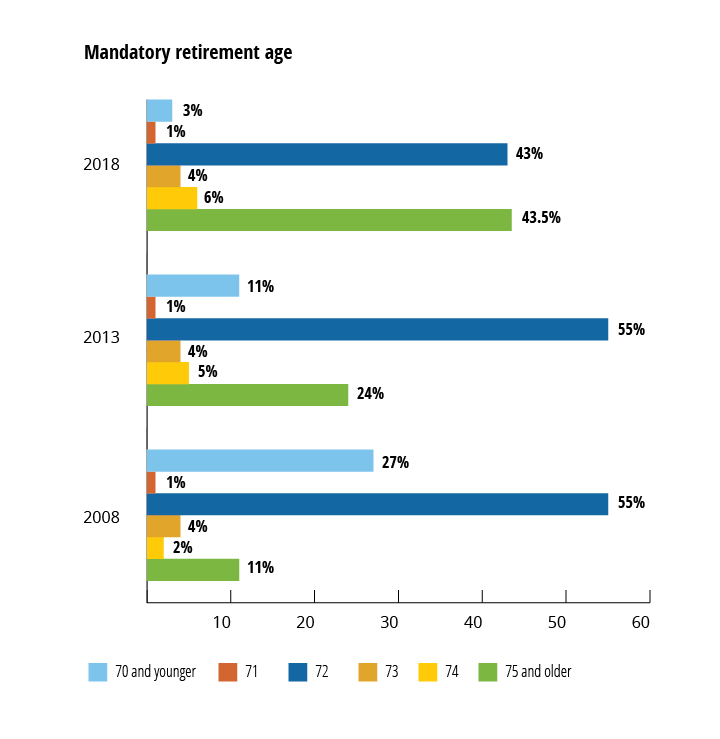
Instead, S&P 500 boards are likely to continue relying on mandatory retirement policies to stimulate board turnover. Today, 71 percent of S&P 500 boards disclose a mandatory retirement age for directors, consistent with the past five years. Retirement ages also continue to climb. In 2008, a meager 11 percent of S&P 500 companies with mandatory retirement policies set the age limit at 75 or older, compared to 43.5 percent today. More than half of these companies mandate a retirement age of at least 73 or older. Three boards have a retirement age of 80.


Three-quarters of the independent directors who left S&P 500 boards in the 2018 proxy season served on boards with mandatory retirement ages. The age limits appeared to have influenced many of these departures — 37 percent of retirees had reached or exceeded the age limit at retirement, and another 16 percent left within three years of the retirement age. Currently, only 16 percent of the independent directors on S&P 500 boards with age caps are within three years of mandatory retirement.

Experience as a CEO, board chair, or similar position is no longer viewed as the only qualifying credential for director candidates.

The boardroom will gradually be reshaped by new perspectives and expertise.


While modest turnover will continue, evidence suggests that boards will use openings from director departures to inject fresh perspectives and expertise into emerging areas of need.

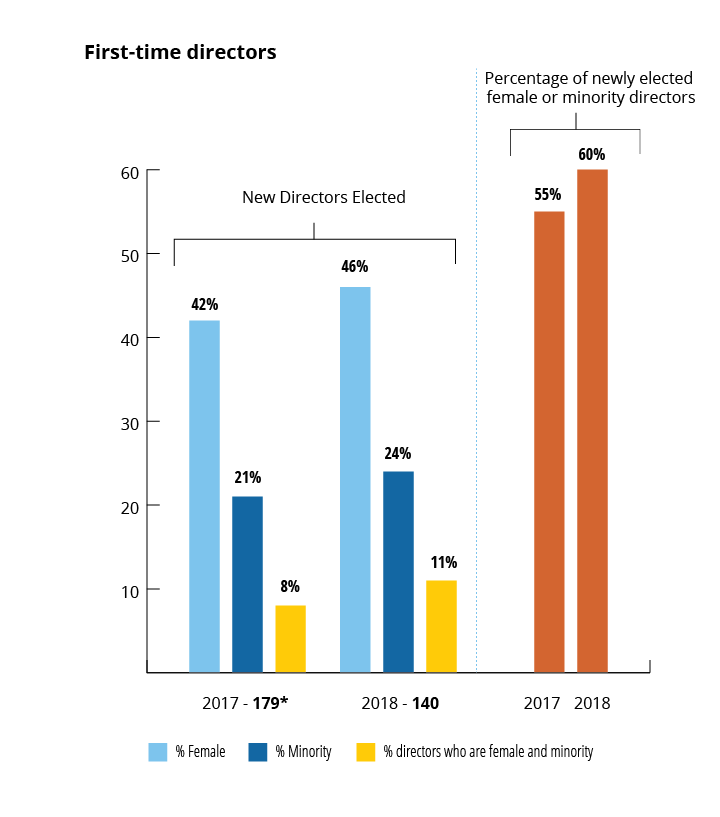
For one thing, experience as a CEO, board chair, or similar position is no longer viewed as the only qualifying credential for director candidates. Of the 428 new independent directors added to S&P 500 boards in the 2018 proxy year, only 35.5 percent were active or retired CEOs, board chairs, or similar, down from 47 percent a decade ago. Nor is a background in a public company boardroom a requirement. First-time public company directors constituted 33 percent of the 2018 class of new S&P 500 directors. These first-timers are younger than their peers and more likely to be actively employed (64% versus 53%). They are less likely to be CEOs or chief operating officers, and more likely to have other managerial experiences such as line or functional backgrounds or to hold roles in division/subsidiary leadership. They are also more likely to be minorities: 24 percent of first-time directors in 2018 are minorities, versus 19 percent of all new S&P 500 directors.

Of the 428 new independent directors added to S&P 500 boards in the 2018 proxy year, only 35.5 percent were active or retired CEOs, board chairs, or similar, down from 47 percent a decade ago.

*Includes directors who had served or were serving as an executive director on a public company board.


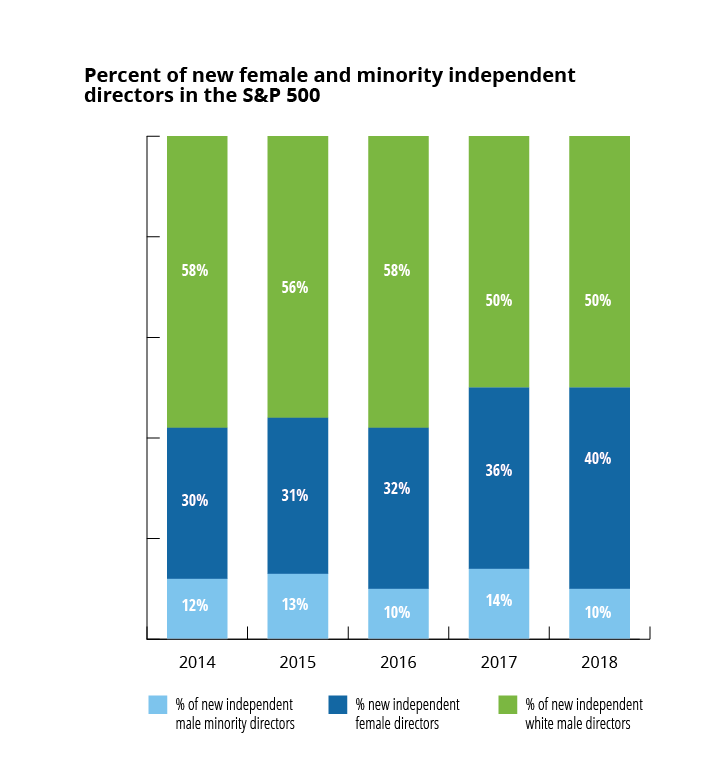
Recognizing the strategic imperative for new perspectives and experience in the boardroom, boards are increasingly adding directors with backgrounds in technology, digital transformation and technologies, consumer marketing, and other areas of emerging importance. Financial talent remains prized, especially the experiences of chief financial officers, finance executives, and/or investment professionals. That said, as investors have continued to press for more gender diversity, S&P 500 boards have increased the number of women directors, reaching a new high: 40 percent of new directors in the 2018 proxy year are women, an increase from 36 percent in 2017.

Financial talent remains prized, especially the experiences of chief financial officers, finance executives, and/or investment professionals.


Boards are also likely to enhance disclosures about composition. As interest in boardroom composition among investors has increased, a growing number of companies are voluntarily enhancing their disclosures to highlight the diversity of their boards and to showcase how director skills and qualifications align with company strategy. In fact, nearly a third (30%) of S&P 500 companies have published a board matrix spotlighting the skills and qualifications of each director on their governance web page.

Younger directors may become a potent new voice in the boardroom.


As boards prioritize new areas of expertise — such as industry and functional experience in technology and digital transformation, and certain areas of marketing and finance — many are tapping “next-generation” directors whose qualifications align with the needs of their organizations. One out of six directors (17%) in the 2018 class of new directors is age 50 or younger.

Given that their backgrounds and profiles differ from more traditional board members, these directors are likely to bring varied perspectives to boardroom discussions. Nearly two-thirds of these “next-gen” corporate directors have expertise in three sectors: technology/telecommunications (34%), consumer goods (16%), and private equity/investments (14%). A majority (almost two-thirds) are serving on their first public company board. More than half (53%) are women.

Interestingly, these directors may also be less likely to have lengthy tenures, due to factors such as the demands of their careers, a desire to move on, or dissatisfaction with their board experience. Twenty-eight (7%) of the 417 directors who left an S&P 500 board seat in the 2018 proxy season were 55 years old or younger, with an average tenure of five years. Other directors who departed their boards over the same period had a much longer tenure on average (12.7 years) and were 68.4 years old on average.

Business demands and investor pressure are likely to change how boards think about composition and refreshment strategies.

The implications for your board


Business demands and investor pressure are likely to change how boards think about composition and refreshment strategies. Increasingly, directors are recognizing that board composition should support and reflect the strategic needs of the organization. Boards can use the following recommendations to enhance short- and long-term approaches to their composition:

Have an ongoing refreshment strategy.

The composition of the board should be viewed as a strategic asset. Boards will be better prepared to plan for and take advantage of openings if there is a formal approach to refreshment. This includes regularly reviewing and aligning the board’s makeup to the company’s strategic direction, identifying desired competencies for future directors, and regularly infusing the board with perspectives relevant to the organization’s future needs.

Increasingly, investors consider meaningful full-board and individual assessments as “best practice” not only for evaluating and enhancing board and director performance but also for promoting boardroom refreshment. While annual evaluations have become the norm for boards, far fewer — 38 percent of S&P 500 boards — report some form of individual director evaluations. Proactive boards assess skills and attributes, incorporating results from board self-assessments. They also take a multiyear view of departures, including upcoming board leadership changes, and set clear expectations around director tenure.

Key Questions for Directors to Consider:


  1. Does the board as currently constituted give the company its best shot at success in supporting the strategy?
  2. What additional, and potentially underrepresented, skills or expertise would significantly enhance the board’s ability to do its job?
  3. What are our refreshment mechanisms and strategy, and how are they communicated to stakeholders, including investors?
  4. Are we using board evaluations to help identify gaps in expertise and skills the board may require in the coming years?
  5. Is our onboarding program robust and tailored to individual director needs and backgrounds?
Position new directors for success.

The nominating and governance committee chair and other board leaders should ensure that the board has a robust new-director orientation program in place. Incoming directors, particularly younger and first-time board members, benefit from an orientation and continuing education that familiarize them with the company’s needs and the board’s approach to governance. At a minimum, a director onboarding program should provide insights about public disclosures and nonpublic materials (such as board meeting minutes, forecasts, budgets, strategic plans, etc.) and socialize the new director(s) with key executives and members of senior management. Additionally, the board should recognize that new directors may find it helpful to partner with a mentor — formally or informally — who they can turn to for questions and feedback.

With greater focus on diversity, board culture becomes critical.

Boards are adding new perspectives to enhance board deliberations and improve outcomes. But greater diversity also increases the likelihood of misunderstanding and tension among directors with different points of view and backgrounds. In the past, boards tended to be more homogeneous and, as a result, there was typically more implicit agreement about director interaction and behavior. Today, with higher levels of diversity in the boardroom — whether in terms of experiences, skills, gender, race, ethnicity, nationality, and/or age — it’s critical to create a boardroom culture that facilitates constructive interactions between board members. All boards can benefit from cultures that value inquisitiveness and flexibility, and where directors are comfortable challenging one another’s — and management’s — assumptions and ideas.

_____________________________________________________________

Note: This article was originally published in the NACD 2019 Governance Outlook.

*Julie Hembrock Daum leads the North American Board Practice and was a long standing board member of Spencer Stuart. She consults with corporate boards, working with companies of all sizes from the Fortune 10 to pre-IPO companies. She has conducted more than 1,000 board director assignments, recently recruiting outside directors for Johnson & Johnson, Whole Foods, Amazon, Saudi Aramco, Nike, numerous IPOs and spin off boards.

Top 10 de Harvard Law School Forum on Corporate Governance au 10 janvier 2019


Voici le compte rendu hebdomadaire du forum de la Harvard Law School sur la gouvernance corporative au 10 janvier 2019.

Comme à l’habitude, j’ai relevé les dix principaux billets.

Bonne lecture !


Résultats de recherche d'images pour « top 10 »


Résultats de recherche d'images pour « Top 10 en gouvernance Harvard Law School »


  1. Shareholder Resolutions and IPOs
  2. NACD Public Company Governance Survey
  3. Boardrooms Without Female Representation
  4. Blockholder Heterogeneity, Multiple Blocks, and the Dance Between Blockholders
  5. Climate Change and Proxy Voting in the U.S. and Europe
  6. Why Are Firms with More Managerial Ownership Worth Less?
  7. A Regulatory Classification of Digital Assets
  8. The Government Shutdown’s Effect on Deals
  9. Looking Ahead: Key Trends in Corporate Governance
  10. Investor Demand for Internal Control Audits of Large U.S. Companies

Top 10 de Harvard Law School Forum on Corporate Governance au 3 janvier 2019


Voici le compte rendu hebdomadaire du forum de la Harvard Law School sur la gouvernance corporative au 3 janvier 2019.

Comme à l’habitude, j’ai relevé les dix principaux billets.

Bonne lecture !


Résultats de recherche d'images pour « top 10 »


Résultats de recherche d'images pour « Top 10 en gouvernance Harvard Law School »


  1. Stock Exchanges and Shareholder Rights: A Race to the Top, Not the Bottom?
  2. Fighting the Rising Tide of Federal Disclosure Suits
  3. 2019 Global & Regional Trends in Corporate Governance
  4. The CFTC and Market Manipulation
  5. SEC Cyber Briefing: Regulatory Expectations for 2019
  6. Politics and Antitrust: Lessons from the Gilded Age
  7. California Courts and Forum Selection Bylaws
  8. Activism: The State of Play at Year-End 2018
  9. Matters to Consider for the 2019 Annual Meeting and Reporting Season
  10. Confronting the Problem of Fraud on the Board

La prévalence de l’activisme actionnarial en 2019


Voici une mise à jour de Martin Lipton*, associé fondateur de la firme Wachtell, Lipton, Rosen & Katz, qui se spécialise dans les politiques et stratégies organisationnelles ayant un impact sur la gouvernance des entreprises. L’article a été publié aujourd’hui sur le site de HLS Forum sur la gouvernance.

En 2019, les auteurs prédisent que la menace de l’activisme sera encore plus prévalente.

Bonne lecture !


Activism: The State of Play at Year-End 2018


Résultats de recherche d'images pour « activisme actionnarial »


As we noted [in 2018], the threat of activism continues to be high, and has become a global phenomenon. The conclusion of a volatile and dynamic 2018 prompts a brief update of the state of play.

  1. Activist assets under management remain at elevated levels, encouraging continued attacks on large successful companies in the U.S. and abroad. In many cases, activists have been taking advantage of recent stock market declines to achieve attractive entry points for new positions. These trends have been highlighted in several recent media reports, including in The Wall Street Journal and Bloomberg.
  2. While the robust M&A environment of much of 2018 has recently subsided, deal-related activism remains prevalent, with activists instigating deal activity, challenging announced transactions (e.g., the “bumpitrage” strategy of pressing for a price increase) and/or pressuring the target into a merger or a private equity deal with the activist itself.
  3. “Short” activists, who seek to profit from a decline in the target’s market value, remain highly aggressive in both the equity and corporate debt markets. In debt markets, we have also recently seen a rise in “default activism,” where investors purchase debt on the theory that a borrower is already in default and then actively seek to enforce that default in a manner by which they stand to profit.
  4. Elliott Management was the most active and in many cases aggressive activist of 2018. The Wall Street Journal noted that Elliott has publicly targeted 24 companies in 2018, with Icahn and Starboard runners-up with nine public targets each. The New Yorker published a lengthy profile of Paul Singer and Elliott in August, “Paul Singer, Doomsday Investor”. “Singer has excelled in this field in part because of a canny ability to discern his opponents’ weaknesses and a seeming imperviousness to public disapproval.”
  5. Enhanced ESG disclosure remains a topic of great interest to institutional investors and the corporate governance community. In October, two prominent business law professors, supported by investors and other entities with over $5 trillion in assets under management, filed a petition for rulemaking calling for the SEC to “develop a comprehensive framework requiring issuers to disclose identified environmental, social, and governance (ESG) aspects of each public-reporting company’s operations.” In November, the Embankment Project of the Coalition for Inclusive Capitalism issued its report outlining proposed ways to measure long-term sustainable value creation beyond financial results. And earlier this month, ESG disclosure was the subject of a lively discussion at a meeting of the SEC’s Investor Advisory Committee, with various views expressed regarding the merits of regulatory efforts versus private ordering in this area.

It has become increasingly evident that the activism-driven corporate world is relatively fragile and is proving to be unsustainable, particularly when viewed in the broader context of rapidly changing political and social norms and increasing divisiveness across many planes of the social contract. A number of initiatives have been underway to establish a modern corporate governance framework that is calibrated to the current environment. For our part, at the request of the World Economic Forum, we prepared a paper titled, The New Paradigm: A Roadmap for an Implicit Corporate Governance Partnership Between Corporations and Investors to Achieve Sustainable Long-Term Investment and Growth, which was issued in September 2016 and most recently updated in our memo, Some Thoughts for Boards of Directors in 2019.

In essence, The New Paradigm conceives of corporate governance as a collaboration among corporations, shareholders and other stakeholders working together to achieve long-term value and resist short-termism. While we have seen considerable interest in The New Paradigm and similar initiatives from major institutional investors and other key stakeholders, until such a framework is widely adopted, it is unlikely that absent legislation, there will be any decrease in activism. Accordingly, companies should regularly review and adjust their plans to avoid an activist attack and to successfully deal with an activist attack if one should occur. Effective engagement with major shareholders is the essential element of activist defense.

____________________________________________________________

*Martin Lipton is a founding partner of Wachtell, Lipton, Rosen & Katz, specializing in mergers and acquisitions and matters affecting corporate policy and strategy, and Zachary S. Podolsky is a corporate associate. This post is based on a Wachtell Lipton memorandum authored by Mr. Lipton and Mr. Podolsky. Related research from the Program on Corporate Governance includes The Long-Term Effects of Hedge Fund Activism by Lucian Bebchuk, Alon Brav, and Wei Jiang (discussed on the Forum here); Dancing with Activists by Lucian Bebchuk, Alon Brav, Wei Jiang, and Thomas Keusch (discussed on the Forum here); and Who Bleeds When the Wolves Bite? A Flesh-and-Blood Perspective on Hedge Fund Activism and Our Strange Corporate Governance System by Leo E. Strine, Jr. (discussed on the Forum here).

Tendances globales en gouvernance et « Trends » régionaux


À l’occasion de la nouvelle année 2019, je partage avec vous une étude de la firme Russell Reynolds Associates sur les tendances en gouvernance selon différentes régions du monde.

L’article a été publié sur le site de Harvard Law School Forum par Jack « Rusty » O’Kelley, III, Anthony Goodman et Melissa Martin.

Ce qu’il y a de particulier dans cette publication ,c’est que l’on identifie cinq (5) grandes tendances globales et que l’on tente de prédire les Trends dans plusieurs régions du monde telles que :

(1) Les États-Unis et le Canada

(2) L’Union européenne

(3) La Grande-Bretagne

(4) Le Brésil

(5) l’Inde

(6) Le Japon

Les grandes tendances observées sont :

(1) la qualité et la composition du CA

(2) le degré d’attention apportée à la surveillance de la culture organisationnelle

(3) les activités des investisseurs qui limitent la primauté des actionnaires en mettant l’accent sur le long terme

(4) la responsabilité sociale des entreprises qui constitue toujours une variable critique et

(5) les investisseurs activistes qui continuent d’exercer une pression sur les CA.

Je vous recommande la lecture intégrale de cette publication pour vous former une opinion réaliste de l’évolution des saines pratiques de gouvernance. Les États-Unis et le Canada semblent mener la marche, mais les autres régions du globe ont également des préoccupations qui rejoignent les tendances globales.

C’est une lecture très instructive pour toute personne intéressée par la gouvernance des sociétés.

Bonne lecture et Bonne Année 2019 !


2019 Global & Regional Trends in Corporate Governance


Résultats de recherche d'images pour « Russell Reynolds Associates governance »


Institutional investors (both active managers and index fund giants) spent the last few years raising their expectations of public company boards—a trend we expect to see continue in 2019. The demand for board quality, effectiveness, and accountability to shareholders will continue to accelerate across all global markets. Toward the end of each year, Russell Reynolds Associates interviews a global mix of institutional and activist investors, pension fund managers, proxy advisors, and other corporate governance professionals regarding the trends and challenges that public company boards may face in the coming year. This year we interviewed over 40 experts to develop our insights and identify trends.

Overview of Global Trends


In 2019, we expect to see the emergence or continued development of the following key global governance trends:


1. Board quality and composition are at the heart of corporate governance.

Since investors cannot see behind the boardroom veil, they have little choice but to rely on various governance criteria as a stand-in for board quality: whether the board is truly independent, whether its composition is deliberate and under regular review, and whether board competencies align with and support the company’s forward-looking strategy. Directors face increased scrutiny around how equipped the board is with industry knowledge, capital allocation skills, and transformation experience. Institutional investors are pushing to further encourage robust, independent, and regular board evaluation processes that may result in board evolution. Boards will need to be vigilant as they consider individual tenure, director overboarding, and gender imbalance—all of which may provoke votes against the nominating committee or its chair. Gender diversity continues to be an area of focus across many countries and investors. Companies can expect increased pressure to disclose their prioritization of board competencies, board succession plans, and how they are building a diverse pipeline of director candidates. Norges Bank Investment Management, the world’s largest sovereign wealth fund, has set a new standard for at least two independent directors with relevant industry experience on each of their 9,000 investee boards.

2. Deeper focus on oversight of corporate culture.

Human capital and intangible assets, including organizational culture and reputation, are important aspects of enterprise value, as they directly impact the ability to attract and retain top talent. Culture risk exists when there is misalignment between the values a company seeks to embody and the behaviors it demonstrates. Investors are keen to learn how boards are engaging with management on this issue and how they go about understanding corporate culture. A few compensation committees are including culture and broader human capital issues as part of their remit.

3. Investors placing limits on shareholder primacy and emphasizing long-termism.

The role of corporations in many countries is evolving to include meeting the needs of a broader set of stakeholders. Global investors are increasingly discussing social value; long-termism; and environment, social, and governance (ESG) changes that are shifting corporations from a pure shareholder primacy model. While BlackRock CEO Larry Fink’s 2018 letter to investee companies on the importance of social purpose and a strategy for achieving long-term growth generated discussion in the US, much of the rest of the world viewed this as further confirmation of the focus on broader stakeholder, as well as shareholder, concerns. Institutional investors are more actively focusing on long-termism and partnering with groups to increase the emphasis on long-term, sustainable results.

4. ESG continues to be a critical issue globally and is at the forefront of governance concerns in some countries.

Asset managers and asset owners are integrating ESG into investment decisions, some under the framework of sustainability or integrated reporting. The priority for investors will be linking sustainability to long-term value creation and balancing ESG risks with opportunities. ESG oversight, improved disclosure, relative company performance against peers, and understanding how these issues are built into corporate strategy will become key focus areas. Climate change and sustainability are critical issues to many investors and are at the forefront of governance in many countries. Some investors regard technology disruption and cybersecurity as ESG issues, while others continue to categorize them as a major business risk. Either way, investors want to understand how boards are providing adequate oversight of technology disruption and cyber risk.

5. Activist investors continue to impact boards.

Activist investors are using various strategies to achieve their objectives. The question for boards is no longer if, but when and why an activist gets involved. The characterization of activists as hostile antagonists is waning, as some activists are becoming more constructive with management. Institutional investors are increasingly open to activists’ perspectives and are deploying activist tactics to bring about desired change. Activists continue to pay close attention to individual director performance and oversight failures. We are seeing even more boards becoming “their own activist” or commissioning independent assessments to preemptively identify vulnerabilities. Firms such as Russell Reynolds are conducting more director-vulnerability analysis, looking at the strengths and weaknesses of board composition and proactively identifying where activists may attack director composition. In the following sections, we explore these trends and how they will impact the United States and Canada, the European Union and the United Kingdom, Brazil, India, and Japan.


The United States and Canada

Investor stewardship.

Eighty-eight percent of the S&P 500 companies have either Vanguard, BlackRock, or State Street as the largest shareholder, and together these investors collectively own 18.7 percent of all the shares in the S&P 500. Because the index funds’ creators are obligated to hold shares for as long as a company is included in a relevant index (e.g., Dow Jones, S&P 500, Russell 3000), the institutional investors view themselves as permanent capital. These investors view governance not as a compliance exercise, but as a key component of value creation and risk mitigation. Passive investors are engaging even more frequently with companies to ensure that their board and management are taking the necessary actions and asking the right questions. Investors want to understand the long-term value creation story and see disclosure showing the right balance between the long term and short term. They take this very seriously and continue to invest in stewardship and governance oversight. Several of the largest institutional investors want greater focus on long-term, sustainable results and are partnering with organizations to drive the dialogue toward the long term.

Board quality.

Investors are pushing for improved board quality and view board composition, diversity, and the refreshment process as key elements. There is similarly a push for richer insight into director skill relevancy. The Boardroom Accountability Project 2.0 has encouraged more companies to disclose a “board matrix,” setting out the skills, experiences, and demographic profile of directors. That practice is fast becoming the norm for proxy disclosure. Many more institutional investors want richer disclosure around director competencies and a clearer, more direct link between each director’s skills and the company’s strategy. As one investor noted, “We want to know why this collection of directors was selected to lead the company and whether they are prepared for change and disruption.” Some of the largest US institutional investors are pushing for better board succession and board evaluation processes and the use of external firms to assess board quality, composition, and effectiveness. Institutional investors are even more concerned about board succession processes and the continued use of automatic refreshment mechanisms (retirement ages and tenure limits) rather than a “foundational assessment process over time with a mix of internal and external reviewers.”

Board diversity.

In 2019, directors should expect more investors to vote against the nominating committee or its chair if there are no women on the board (or fewer than two women in some cases). Investors want to see an increased diversity of thought and experiences to better enable the board to identify risks and improve company performance. In the US, gender diversity has become a proxy for cognitive diversity. Institutional Shareholder Services (ISS) has updated its policies on gender diversity for Russell 3000 and S&P 1500 companies and may recommend votes against nominating committee chairs or members beginning in 2020. This follows recent California legislation requiring gender diversity for California-headquartered companies. Some very large investors are starting to take a broader approach to diversity, particularly as it relates to ethnicity and race. In Canada, nearly 40 percent of TSX-listed companies have no women on their boards. Proxy advisors have recently established voting guidelines related to the disclosure of formal gender diversity policies and gender diversity by TSX-listed companies.

ESG.

Investors are pushing companies to consider their broader societal impact—both what they do and how they disclose it. ESG has moved from being a discrete topic to a fundamental part of how investors evaluate companies. They will increasingly focus on how companies explain their approach to value creation, the impact of the company on society, and how companies weigh various stakeholder interests. Other investors will continue to look at ESG primarily through a financial lens, screening for risk identification and measurement, incorporation of ESG into strategy and long-term value creation, and executive compensation. There is continued and growing focus in the US on sustainability and climate change across a range of sectors. In Canada, proactive companies will consider developing and disclosing their own ESG policies and upgrading boards—through both changes in director education and, on occasion, board composition—to ensure that directors are equipped to understand ESG risk.

Oversight of corporate culture.

Given many high-profile failures in corporate culture and leadership over the last few years, investors and regulators will expect more disclosure and will ask more questions regarding how a board understands the company’s culture. When engaging with institutional investors, boards should expect questions regarding how they are understanding and assessing the health of a corporation’s culture. Boards need to reflect on whether they really understand the company culture and how they plan to assess hot spots and potential issues.

Activist investing.

Shareholder activism remains part of the US corporate governance landscape and is continuing to grow in Canada. In Canada, the industries with the highest levels of activism include basic materials, energy, banking, and financial institutions, and emerging sectors with high growth potential (e.g., blockchain, cannabis) could be next. Proxy battles are showing no signs of slowing down, but activists are using other methods to promote change, such as constructive engagement. Canadian companies are also seeing an increase in proxy contests launched by former insiders or company founders. Experts in Canada anticipate this trend will continue and, as a result, increased shareholder engagement will be critical.

Executive compensation.

Investors are looking for better-quality disclosure around pay-for-performance metrics, particularly sustainability metrics linked to risk management and strategy. In the US, institutional investors may vote against pay plans where there is misalignment and against compensation committees where there is “excessive” executive pay for two or more consecutive years. Some investors are uncomfortable with stock performance being a primary driver of CEO compensation since it may not reflect real leadership impact. In Canada, investors are urging companies to adopt say-on-pay policies in the absence of a mandatory vote, even though such adoption rates have been sluggish to date. Investors will likely continue to push for this reform.

Governance codes.

Earlier this year, the Corporate Governance Principles of the Investor Stewardship Group (ISG) went into effect with the purpose of setting consistent governance standards for the US market. Version 2.0 of the Commonsense Principles of Corporate Governance was also published. US companies will want to consider proactive disclosure of how they comply with these sets of principles.

European Union

Investors more active.

Institutional investors are expanding resources for their engagement and stewardship teams in Europe. In 2019, investors will focus on connecting governance to long-term value creation through board oversight of talent management, ESG, and corporate culture. Additionally, some US activists are setting their sights on Europe and raising funds focused on European companies. Institutional investors are more willing to support activist investors if inadequate oversight by the board has led to poor share price and total shareholder return (TSR) performance.

Company and board diversity.

Though EU boards tend to have more women directors due to legislation and regulation, progress on gender diversity has not carried over into the C-suite. Boards can expect to engage with investors on this topic and will need to explain the root causes and plans to address it through talent management processes and diversity and inclusion initiatives. With gender diversity regulations already widely adopted across Europe, Austria has now also stipulated that public company boards have at least 30 percent women directors. However, since board terms are usually for five years, the full impact likely will not be visible until future election cycles.

ESG.

Many investors are encouraging use of the Task Force on Climate-related Financial Disclosures (TCFD) framework for consistent measurement, assessment, and disclosure of ESG risks. Investors are likely to integrate climate-change competency and risk oversight into their voting guidelines in some form, and boards will need to demonstrate that they are thinking strategically about the opportunities, risks, and impact of climate change. A new legislative proposal in France could mandate that companies consider various stakeholders, the social environment, and the nonfinancial outcome of their actions.

Revised governance codes.

A recent study found strong compliance rates for the German Corporate Governance Code, except for the areas of executive remuneration and board composition recommendations. German boards should expect more investor engagement and pressure on these matters, including enhanced disclosure. Next year, the German code may include amendments impacting director independence and executive compensation. The revised governance code in the Netherlands focuses more closely on how long-term value creation and culture are vital elements within the governance framework. Denmark’s code now recommends that remuneration policies be approved at least every four years and bars retiring CEOs from stepping into the chairman or vice chairman role.

Board leadership.

Norges Bank Investment Management (commonly referred to as The Government Pension Fund Global) is pushing globally for the separation of CEO and chairman roles and independent chair appointments. In France, investors are focused on board composition and quality. Boards should expect to see continued pressure on separating the CEO and chairman roles as well as strengthening the role and prevalence of the lead director. Companies without a lead director could see negative votes against the reelection of the CEO/chair.

United Kingdom

Revised code.

Recent legislation and market activity have set the stage for the United Kingdom to implement governance reforms that will continue to influence global markets. The new UK Corporate Governance code will apply to reporting periods starting from January 1, 2019, although many companies have begun to apply it more quickly. The new code was complemented by updated and enhanced Guidance on Board Effectiveness to reemphasize that boards need to focus on improving their effectiveness—not just their compliance. Meanwhile the voluntary principle of “comply or explain” is itself being tested as the Kingman Review reconsiders the Financial Reporting Council’s powers and its twin role as both the government-designated regulator and the custodian of a voluntary code. Proxy advisors, who are growing more powerful, are also frequently voting against firms choosing to “explain” rather than comply. 2019 code changes include guidance around the board’s duty to consider the perspective of key stakeholders and to incorporate their interests into discussion and decisionmaking. Employees can be engaged via designating an existing non-executive director (already on the board), a workforce advisory committee, or a workforce representative on the board.

Board leadership and composition.

Other changes in the code include prioritizing non-executive chair succession planning and capping non-executive chair total tenure at nine years (including any time spent previously as a non-executive director)—a recommendation which could impact over 10 percent of the FTSE 350. Several investors noted that they understand the new tenure rule may cause unintended consequences around board chair succession planning. Investors are likely to focus on skills mix, diversity, and functional and industry experience. While directors can expect negative votes against their reelection if they are currently on more than four boards, better disclosure of director capacity and commitment may help sway investors.

Culture oversight.

The board’s evolving role in overseeing corporate culture—now explicit in the revised code—will be a primary focus for investors in 2019. The Financial Reporting Council has suggested that culture can be measured using several factors, such as turnover and absenteeism rates, reward and promotion decisions, health and safety data, and exit interviews. The code emphasizes that the board is responsible for a healthy culture that should promote delivering long-term sustainable performance. Auditor reform. Given public concern about recent corporate collapses, the role of external auditor and the structure of the audit firm market are under scrutiny. The government is under pressure to improve auditing and increase competition. Audit independence, rigor, and quality are likely to be examined, and boards may face greater pressure to change auditors more regularly. ISS is changing its policies for its UK/Ireland (and Continental European) policies beginning in 2019. ISS will begin tracking significant audit quality issues at the lead engagement partner level and will identify (when possible) any lead audit partners who have been linked to significant audit controversies.

Activist investors.

While institutional investors’ concerns center around the impact of disruption and how companies are responding with an eye toward long-termism and sustainability, activist campaigns continue to act as a potential counterweight. UK companies account for about 55 percent of activist campaigns in Europe, and UK companies will likely continue to be targeted next year.

Company diversity.

Diversity will continue to be a priority for board attention, including gender and ethnic diversity. The revised code broadened the role of the nominating committee to oversee the development of diversity in senior management ranks and to review diversity and inclusion initiatives and outcomes throughout the business.

Brazil

Outlook.

Following the highly polarized presidential election, Brazil is still facing some political uncertainty around the potential business and political agenda the new government will pursue. Despite recent ministry appointments being generally well received, global investors will likely still be cautious about investing in the country given the government’s deep history of entanglement with corporate affairs.

Governance reforms and stewardship.

Governance regulation is still in its early stages in Brazil and continues to be focused on overhauling compliance practices and implementing governance reforms. Securities regulator CVM recently issued guidelines regarding indemnity agreements between companies and board members (and other company stakeholders), which could lead to possible disclosure implications. The guidance serves to warn companies about potential conflicts of interest, and directors are cautioned to pay close attention to these new policies. Brazilian public companies are now required to file a comply-or-explain governance report as part of the original mandate stemming from the 2016 Corporate Governance Code, with an emphasis on the quality of such disclosures. Stewardship continues to be of growing importance, and boards are at the center of that discussion. The Association of Capital Market Investors is focusing on ensuring that the CVM and other market participants are holding companies to the highest governance standards not issuing waivers or failing to hold companies accountable for their actions.

Improved independence.

There is an ongoing push for more independence within the governance framework. More independent directors are being appointed to boards due to wider capital distribution. Brazil is working toward implementing reforms targeting political appointments within state-owned enterprises (SOE), but progress could slow depending upon the new government’s priorities. Recently, the Brazilian Chamber of Deputies approved legislation that would allow politicians to once again be nominated to SOE boards. The Federal Senate will soon decide on the proposal, but its approval could trigger a backlash. Organizations like the Brazilian Institute of Corporate Governance are firmly positioning themselves against the law change, viewing it as a step back from recent governance progress. However, the Novo Mercado rules and Corporate Governance Code are strengthening the definition of independence and using shareholder meetings to confirm the independence of those directors.

Remote voting.

The recent introduction of the remote voting card for shareholders could have a major impact on boards. Public companies required to implement the new system should expect to see more flexibility and inclusion of minority shareholder-backed nominees on the ballot. While Brazil is making year-over-year progress toward minority shareholder protections, they continue to be a challenge.

Board effectiveness.

Experts anticipate increased pressure to upgrade board mechanics and processes, including establishing a nominations policy regarding board director and committee appointments, routine board evaluation processes, succession planning, and onboarding/training programs. CVM, along with B3 (the Brazilian stock exchange), continues to push for higher governance standards and processes. There is an increased focus on board and director assessment (whether internally or externally led) to ensure board effectiveness and the right board composition. Under the Corporate Governance Code, companies will have to comply or explain why they do not have a board assessment process.

Compensation disclosure.

For almost a decade, Brazilian companies used a court injunction (known as the “IBEF Injunction”) to avoid having to disclose the remuneration of their highest-paid executives. Now that this has been overturned, public companies will be expected to start disclosing compensation information for their highest-paid executives and board members. Companies are concerned that the disclosure may trigger a backlash among minority shareholders and negative votes against remuneration.

India

Regulatory reform.

Motivated by a desire to attract global investments, curb corruption, and strengthen corporate governance, India is continuing to push for regulatory reform. In the spring of 2018, much to the surprise of many, the Securities and Exchange Board of India (SEBI) adopted many of the 81 provisions put forward by the Kotak Committee. The adoption of the recommendations has caused many companies to consider and aspire to meet this new standard. Kotak implementation has triggered a significant wave of governance implications centered around improving transparency and financial reporting. The adoption of these governance reforms is staggered, with most companies striving to reach compliance between April 2019 and April 2020.

Board composition, leadership, and independence.

Boards will face enhanced disclosure rules regarding the skills and experience of directors, which has triggered many companies to engage in board composition assessments. Directors will also be limited in the number of boards they can serve on simultaneously: eight in 2019; seven in 2020. The top 1,000 listed companies in India will need to ensure they have a minimum of six directors on their boards by April 2019, with the next 1,000 having an additional year to comply. Among other changes are new criteria for independence determinations and changes to director compensation. Additionally, the CEO or managing director role and the chair role must be separated and cannot be held by the same person for the top 500 listed companies by market capitalization. This will significantly change board leadership and control in many companies where the role was held by the same person, and it will boost overall independence. To further drive board and director independence, the definition of independence was strengthened, and board interlocks will receive greater scrutiny.

Board diversity.

India continues to make improvements toward gender diversity five years after the Companies Act of 2013 and ongoing pressure from investors and policymakers. Nevertheless, institutional investors and proxy advisors are calling for more progress, as a quarter of women appointments are held by family members of the business owners (and are thus not independent). Starting in 2019, boards of the top 500 listed companies will need to ensure they have at least one independent woman director; by 2020, the top 1,000 listed companies will need to comply.

Board effectiveness.

The reforms also include a requirement for the implementation of an oversight process for succession planning and updating the board evaluation and director review process.

Investor expectations.

Governance stakeholders are eager to see how much progress Indian companies will make during the next 18 months, but many are not overly optimistic given the magnitude of change required in such a short period of time. Investors are setting their expectations accordingly and understand that regional governance norms will not transform overnight. While it is unclear exactly how the government and regulators will respond to noncompliance, companies and their boards are feeling anxious about the potential repercussions and penalties.

Japan

Continued focus on governance.

The Japanese government continues to be a driving force for corporate governance improvements. To make Japan more attractive to global investors, policymakers are increasingly focused on improving board accountability. Despite a trend toward more proactive investor stewardship, regulatory bodies including the Financial Services Agency continue to lead reforms, with several new comply-or-explain guidelines added to the Amended Corporate Governance Code that came into effect in 2018. These guidelines, such as minimum independence requirements, establishing an objective CEO succession and dismissal process, and the unloading of cross-shareholdings, are aimed at enhancing transparency.

Director independence.

Director independence has been a concern for investors, with outside directors taking only about 31 percent of board seats. Though some observers perceive a weakening of language in the code regarding independence, investors are unlikely to lower their expectations and standards. The amended code now calls for at least one-third of the board to be composed of outside directors (up from the quota requirement of two directors that existed previously). The change is intended to encourage transparency and accountability around the board’s decision-making process. Starting next year, ISS will adopt a similar approach to its Japanese governance policies, employing a one-third independence threshold as well.

Executive compensation.

Given recent scandals, institutional investors and regulators will continue to pay close attention to the structure of executive compensation. Performance-based compensation plans will be a major area of focus in 2019. More companies are introducing new types of equity-based compensation schemes, such as restricted stock, and are expected to follow the trend into next year. Board diversity. Over 50 percent of listed companies still have no women on their boards. To upgrade board quality and performance, investors will likely engage more forcefully on gender diversity, board composition and processes, board oversight duties and roles, and the board director evaluation process.

ESG.

In 2019, boards can expect more shareholder interest in sustainability metrics and strategy. Investors are keen to see enhanced disclosure that aids their understanding of value creation and the link to performance targets, as well as explanations concerning board monitoring.

Activist investing.

Activism continues to rise in Japan, and we expect that trend to continue. Activists are showing a willingness to demand a board seat and engage in proxy battles, and institutional investors are increasingly willing to support the activist recommendations.

Governance practices.

Investors also will be paying close attention to several other governance practices, such as the earlier disclosure of proxy materials and delivery in digital format, and protecting the interest of minority shareholders. The code further emphasizes succession planning by requiring companies to implement a fair and transparent process for the CEO’s removal and succession. As a result, more companies are introducing nominating committees and discussing

CEO succession.

Companies are also being urged to unload their cross-shareholdings (when a listed company owns stock of another company in the same listing) and adopt controls that will determine whether the ownership of such equity is appropriate. Such holdings are likely to be policed more by regulators due to the tendency of such holdings to insulate boards from external pressure, including takeover bids.


___________________________________________________________

*Jack “Rusty” O’Kelley, III is Global Leader of the Board Advisory & Effectiveness Practice, Anthony Goodman is a member of the Board Consulting and Effectiveness Practice, and Melissa Martin is a Board and CEO Advisory Group Specialist at Russell Reynolds Associates.at Russell Reynolds Associates. This post is based on a Russell Reynolds memorandum by Mr. O’Kelley, Mr. Goodman, and Ms. Martin.


Recommandations des firmes de conseils en votation pour l’année 2019


Comme à chaque fin d’année, le blogue du Harvard Law School on Corporate Governance Forum, présente un sommaire des grandes tendances en gouvernance.

Voici les recommandations que les firmes-conseils en votation Institutional Shareholder Services (ISS) et Glass Lewis & Co. font aux actionnaires qui voteront lors des assemblées annuelles de 2019.

Ces changements aux politiques de votation nous offrent une belle occasion de constater l’évolution des pratiques de saine gouvernance.

Bonne lecture !


ISS and Glass Lewis Policy Updates for the 2019 Proxy Season


Résultats de recherche d'images pour « recommandations de Institutional Shareholder Services (ISS) »


The key changes to ISS’ proxy voting policies for 2019 relate to:

Board Gender Diversity—Beginning in 2020, ISS will generally recommend voting against nominating committee chairs (and potentially other directors) at companies with no female directors unless certain mitigating factors apply.

Economic Value Added Data for Pay-For-Performance Evaluation—In 2019, solely for informational purposes, ISS will include on a phased-in basis Economic Value Added (EVA) data in its proxy research reports as a supplement to GAAP/accounting performance measures to provide additional insight into company performance when evaluating pay-for-performance alignment. ISS will continue to explore the potential future use of EVA data as part of its pay-for-performance evaluation.

Management Ratification Proposals

Under a new policy, ISS will generally recommend voting against management proposals to ratify provisions of the company’s existing charter or bylaws, unless such provisions align with best practice.

ISS will also recommend voting against or withholding from individual directors, members of the governance committee or the full board, where boards ask shareholders to ratify existing charter or bylaw provisions considering specified factors.

Under a revised policy, if a management proposal to ratify existing charter or bylaw provisions fails to receive majority support, ISS will conduct a board responsiveness analysis for the next annual meeting.

Chronic Poor Attendance by Directors—In cases of “chronic poor attendance” by a director (defined as three or more consecutive years of poor attendance without reasonable explanation), in addition to recommending votes against the director(s) with chronic poor attendance, ISS will generally recommend voting against or withholding from appropriate members of the nominating/governance committee or the full board.

Director Performance Evaluation—Under a revised policy, when evaluating director performance, ISS will assess a company’s 5-year total shareholder returns (TSR) as part of the initial screen for underperformance rather than during the second step of its evaluation.

Reverse Stock Splits—Under a revised policy, ISS will evaluate on a case-by-case basis certain management proposals to implement reverse stock splits, taking into consideration (i) disclosure of substantial doubt about the company’s ability to continue as a going concern without additional financing, (ii) the company’s rationale or (iii) other factors as applicable.

Shareholder Proposals on Environmental and Social (E&S) Issues—Under a revised policy, ISS expanded the factors it will consider when analyzing E&S shareholder proposals to include whether there are significant controversies, fines, penalties or litigation associated with the company’s E&S practices.

Excessive Non-Employee Director Compensation—ISS will delay until at least 2020 its previously-announced new policy of potentially issuing negative vote recommendations against members of the board committee responsible for setting or approving excessive non-employee director compensation in two or more consecutive years without a compelling rationale or other mitigating factors.

Top 10 de Harvard Law School Forum on Corporate Governance au 20 décembre 2018


Voici le compte rendu hebdomadaire du forum de la Harvard Law School sur la gouvernance corporative au 20 décembre 2018.

Comme à l’habitude, j’ai relevé les dix principaux billets.

Bonne lecture !


Résultats de recherche d'images pour « top 10 »


Résultats de recherche d'images pour « Top 10 en gouvernance Harvard Law School »


  1. Common Ownership: The Investor Protection Challenge of the 21st Century
  2. Remarks to the SEC Investor Advisory Committee
  3. Some Thoughts for Boards of Directors in 2019
  4. The Prescience of 5% of Investors: A Monsanto Case Study
  5. The Lifecycle Theory of Dual-Class Structures
  6. ISS and Glass Lewis Policy Updates for the 2019 Proxy Season
  7. Mutual Fund Board Connections and Proxy Voting
  8. Audit: Radical Change on the Horizon?
  9. Roundup of Key Federal Securities Litigation Developments
  10. Soft Shareholder Activism

Top 10 de Harvard Law School Forum on Corporate Governance au 13 décembre 2018


Voici le compte rendu hebdomadaire du forum de la Harvard Law School sur la gouvernance corporative au 13 décembre 2018.

Comme à l’habitude, j’ai relevé les dix principaux billets.

Bonne lecture !


Résultats de recherche d'images pour « top ten »


Résultats de recherche d'images pour « Top 10 en gouvernance Harvard Law School »


Une saine tension entre le CA et la direction : Gage d’une bonne gouvernance | Billet revisité


Dans son édition d’avril 2016, le magazine Financier Worldwide présente une excellente analyse de la dynamique d’un conseil d’administration efficace.

Pour l’auteur, il est important que le président du conseil soit habileté à exercer un niveau de saine tension entre les administrateurs et la direction de l’entreprise.

Il n’y a pas de place pour la complaisance au conseil. Les membres doivent comprendre que leur rôle est de veiller aux « intérêts supérieurs » de l’entreprise, notamment des propriétaires-actionnaires, mais aussi d’autres parties prenantes.

Le PDG de l’entreprise est recruté par le CA pour faire croître l’entreprise et exécuter une stratégie liée à son modèle d’affaires. Lui aussi doit travailler en fonction des intérêts des actionnaires… mais c’est la responsabilité fiduciaire du CA de s’en assurer en mettant en place les mécanismes de surveillance appropriés.

La théorie de l’agence stipule que le CA représente l’autorité souveraine de l’entreprise (puisqu’il possède la légitimité que lui confèrent les actionnaires). Le CA confie à un PDG (et à son équipe de gestion) le soin de réaliser les objectifs stratégiques retenus. Les deux parties — le Board et le Management — doivent bien comprendre leurs rôles respectifs, et trouver les bons moyens pour gérer la tension inhérente à l’exercice de la gouvernance et de la gestion.

Les administrateurs doivent s’efforcer d’apporter une valeur ajoutée à la gestion en conseillant la direction sur les meilleures orientations à adopter, et en instaurant un climat d’ouverture, de soutien et de transparence propice à la réalisation de performances élevées.

Il est important de noter que les actionnaires s’attendent à la loyauté des administrateurs ainsi qu’à leur indépendance d’esprit face à la direction. Les administrateurs sont élus par les actionnaires et sont donc imputables envers eux. C’est la raison pour laquelle le conseil d’administration doit absolument mettre en place un processus d’évaluation de ces membres et divulguer sa méthodologie.

Également, comme mentionné dans un billet daté du 5 juillet 2016 (la séparation des fonctions de président du conseil et de président de l’entreprise [CEO] est-elle généralement bénéfique ?), les autorités réglementaires, les firmes spécialisées en votation et les experts en gouvernance suggèrent que les rôles et les fonctions de président du conseil d’administration soient distincts des attributions des PDG (CEO).

En fait, on suppose que la séparation des fonctions, entre la présidence du conseil et la présidence de l’entreprise (CEO), est généralement bénéfique à l’exercice de la responsabilité de fiduciaire des administrateurs, c’est-à-dire que des pouvoirs distincts permettent d’éviter les conflits d’intérêts, tout en rassurant les actionnaires.

Cependant, cette pratique cède trop souvent sa place à la volonté bien arrêtée de plusieurs PDG d’exercer le pouvoir absolu, comme c’est encore le cas pour plusieurs entreprises américaines. Pour plus d’information sur ce sujet, je vous invite à consulter l’article suivant : Séparation des fonctions de PDG et de président du conseil d’administration | Signe de saine gouvernance !

Le Collège des administrateurs de sociétés (CAS) offre une formation spécialisée de deux jours sur le leadership à la présidence.


Banque des ASC
Gouvernance et leadership à la présidence


Vous trouverez, ci-dessous, l’article du Financier Worldwide qui illustre assez clairement les tensions existantes entre le CA et la direction, ainsi que les moyens proposés pour assurer la collaboration entre les deux parties.

J’ai souligné en gras les passages clés.

Bonne lecture ! Vos commentaires sont appréciés.


In this age of heightened risk, the need for effective governance has caused a dynamic shift in the role of the board of directors. Cyber security, rapid technological growth and a number of corporate scandals resulting from the financial crisis of 2008, all underscore the necessity of boards working constructively with management to ensure efficient oversight, rather than simply providing strategic direction. This is, perhaps, no more critical than in the middle market, where many companies often don’t have the resources larger organisations have to attract board members, but yet their size requires more structure and governance than smaller companies might need.

Following the best practices of high-performing boards can help lead to healthy tension between management and directors for improved results and better risk management. We all know conflict in the boardroom might sometimes be unavoidable, as the interests of directors and management don’t necessarily always align. Add various personalities and management styles to the mix, and discussions can sometimes get heated. It’s important to deal with situations when they occur in order to constructively manage potential differences of opinion to create a healthy tension that makes the entire organisation stronger.

Various conflict management styles can be employed to ensure that any potential boardroom tension within your organisation is healthy. If an issue seems minor to one person but vital to the rest of the group, accommodation can be an effective way to handle tension. If minor issues arise, it might be best to simply avoid those issues, whereas collaboration should be used with important matters. Arguably, this is the best solution for most situations and it allows the board to effectively address varying opinions. If consensus can’t be reached, however, it might become necessary for the chairman or the lead director to use authoritarian style to manage tension and make decisions. Compromise might be the best approach when the board is pressed for time and needs to take immediate action.

Résultats de recherche d'images pour « saine tension entre le CA et la direction »

The board chairperson can be integral to the resolution process, helping monitor and manage boardroom conflict. With this in mind, boards should elect chairs with the proven ability to manage all personality types. The chairperson might also be the one to initiate difficult conversations on topics requiring deeper scrutiny. That said, the chairperson cannot be the only enforcer; directors need to assist in conflict resolution to maintain a proper level of trust throughout the group. And the CEO should be proactive in raising difficult issues as well, and boards are typically most effective when the CEO is confident, takes the initiative in learning board best practices and works collaboratively.

Gone are the days of the charismatic, autocratic CEO. Many organisations have separated the role of CEO and chairperson, and have introduced vice chairs and lead directors to achieve a better balance of power. Another way to ensure a proper distribution of authority is for the board to pay attention to any red flags that might be raised by the CEO’s behaviour. For example, if a CEO feels they have all the answers, doesn’t respect the oversight of the board, or attempts to manage or marginalise the board, the chairperson and board members will likely need to be assertive, rather than simply following the CEO’s lead. Initially this might seem counterintuitive, however, in the long-run, this approach will likely create a healthier tension than if they simply ‘followed the leader’.

Everyone in the boardroom needs to understand their basic functions for an effective relationship -executives should manage, while the board oversees. In overseeing, the board’s major responsibilities include approving strategic plans and goals, selecting a CEO, determining a mission or purpose, identifying key risks, and providing oversight of the compliance of corporate policies and regulations. Clearly understanding the line between operations and strategy is also important.

Organisations with the highest performing boards are clear on the appropriate level of engagement for the companies they represent – and that varies from one organisation to the next. Determining how involved the board will be and what type of model the board will follow is key to effective governance and a good relationship with management. For example, an entity that is struggling financially might require a more engaged board to help put it back on track.

Many elements, such as tension, trust, diversity of thought, gender, culture and expertise can impact the delicate relationship between the board and management. Good communication is vital to healthy tension. Following best practices for interaction before, during and after board meetings can enhance conflict resolution and board success.

Before each board meeting, management should prepare themselves and board members by distributing materials and the board package in a timely manner. These materials should be reviewed by each member, with errors or concerns forwarded to the appropriate member of management, and areas of discussion highlighted for the chair. An agenda focused on strategic issues and prioritised by importance of matters can also increase productivity.

During the meeting, board members should treat one another with courtesy and respect, holding questions held until after presentations (or as the presenter directs). Board-level matters should be discussed and debated if necessary, and a consensus reached. Time spent on less strategic or pressing topics should be limited to ensure effective meetings. If appropriate, non-board-level matters might be handed to management for follow-up.

Open communication should also continue after board meetings. Sometimes topics discussed during board meetings take time to digest. When this happens, board members should connect with appropriate management team members to further discuss or clarify. There are also various board committee meetings that need to occur between board meetings. Board committees should be doing the ‘heavy lifting’ for the full board, making the larger group more efficient and effective. Other more informal interactions can further strengthen the relationship between directors and management.

Throughout the year, the board’s engagement with management can be broadened to include discussions with more key players. Gaining multiple perspectives by interacting with other areas of the organisation, such as general counsels, external and internal auditors, public relations and human resources, can help the board identify and address key risks. By participating in internal and external company events, board members get to know management and the company’s customers on a first-hand basis.

Of course, a strategy is necessary for the board as well, as regulatory requirements have increased, leading to greater pressure for high-quality performance. Effective boards maintain a plan for development and succession. They also implement CEO and board evaluation processes to ensure goals are being met and board members are performing optimally. In addition to the evaluation process, however, board members must hold themselves totally accountable for instilling trust in the boardroom.

Competition in today’s increasingly global and complex business environment is fierce, and calls for new approaches for success. Today’s boards need to build on established best practices and create good relationships with management to outperform competitors. The highest performing boards are clear on their functions, and understand the level of engagement appropriate for the companies they support. They are accountable and set the right tone, while being able to discern true goals and aspirations from trendiness. They are capable of understanding and dealing with the ‘big issues’ and are strategic in their planning and implementation of approaches that work for the companies they serve. With the ever-changing risk universe, the ability to work with the right amount of healthy tension is essential to effective governance.

_______________________________________

Hussain T. Hasan is on the Consulting Leadership team as well as a board member at RSM US LLP.

Guide des pratiques exemplaires en matière de gestion des risques | Les responsabilités des administrateurs


Les administrateurs de sociétés doivent apporter une attention spéciale à la gestion des risques telle qu’elle est mise en œuvre par les dirigeants des entreprises.

Les préoccupations des fiduciaires pour la gestion des risques, quoique fondamentales, sont relativement récentes, et les administrateurs ne savent souvent pas comment aborder cette question.

L’article présenté, ci-dessous, est le fruit d’une recherche de Martin Lipton, fondateur de la firme Wachtell, Lipton, Rosen & Katz, spécialisée dans les fusions et acquisitions ainsi que dans les affaires de gouvernance.

L’auteur et ses collaborateurs ont produit un guide des pratiques exemplaires en matière de gestion des risques. Cet article de fond s’adresse aux administrateurs et touche aux éléments-clés de la gestion des risques :

(1) la distinction entre la supervision des risques et la gestion des risques ;

(2) les leçons que l’on doit tirer de la supervision des risques à Wells Fargo ;

(3) l’importance accordée par les investisseurs institutionnels aux questions des risques ;

(4) « tone at the top » et culture organisationnelle ;

(5) les devoirs fiduciaires, les contraintes réglementaires et les meilleures pratiques ;

(6) quelques recommandations spécifiques pour améliorer la supervision des risques ;

(7) les programmes de conformité juridiques ;

(8) les considérations touchant les questions de cybersécurité ;

(9) quelques facettes se rapportant aux risques environnementaux, sociaux et de gouvernance ;

(10) l’anticipation des risques futurs.


Voici donc l’introduction de l’article. Je vous invite à prendre connaissance de l’article au complet.

Bonne lecture !


Risk Management and the Board of Directors


Résultats de recherche d'images pour « Gestion des risques et administrateurs de sociétés »


Overview

The past year has seen continued evolution in the political, legal and economic arenas as technological change accelerates. Innovation, new business models, dealmaking and rapidly evolving technologies are transforming competitive and industry landscapes and impacting companies’ strategic plans and prospects for sustainable, long-term value creation. Tax reform has created new opportunities and challenges for companies too. Meanwhile, the severe consequences that can flow from misconduct within an organization serve as a reminder that corporate operations are fraught with risk. Social and environmental issues, including heightened focus on income inequality and economic disparities, scrutiny of sexual misconduct issues and evolving views on climate change and natural disasters, have taken on a new salience in the public sphere, requiring companies to exercise utmost care to address legitimate issues and avoid public relations crises and liability.

Corporate risk taking and the monitoring of corporate risk remain prominently top of mind for boards of directors, investors, legislators and the media. Major institutional shareholders and proxy advisory firms increasingly evaluate risk oversight matters when considering withhold votes in uncontested director elections and routinely engage companies on risk-related topics. This focus on risk management has also led to increased scrutiny of compensation arrangements throughout the organization that have the potential for incentivizing excessive risk taking. Risk management is no longer simply a business and operational responsibility of management. It has also become a governance issue that is squarely within the oversight responsibility of the board. This post highlights a number of issues that have remained critical over the years and provides an update to reflect emerging and recent developments. Key topics addressed in this post include:

the distinction between risk oversight and risk management;

a lesson from Wells Fargo on risk oversight;

the strong institutional investor focus on risk matters;

tone at the top and corporate culture;

fiduciary duties, legal and regulatory frameworks and third-party guidance on best practices;

specific recommendations for improving risk oversight;

legal compliance programs;

special considerations regarding cybersecurity matters;

special considerations pertaining to environmental, social and governance (ESG) risks; and

anticipating future risks.

Enjeux clés concernant les membres des comités d’audit | En rappel


Le récent rapport de KPMG sur les grandes tendances en audit présente sept défis que les membres des CA, notamment les membres des comités d’audit, doivent considérer afin de bien s’acquitter de leurs responsabilités dans la gouvernance des sociétés.

Le rapport a été rédigé par des professionnels en audit de la firme KPMG ainsi que par le Conference Board du Canada.

Les sept défis abordés dans le rapport sont les suivants :

– talent et capital humain ;

– technologie et cybersécurité ;

– perturbation des modèles d’affaires ;

– paysage réglementaire en évolution ;

– incertitude politique et économique ;

– évolution des attentes en matière de présentation de l’information ;

– environnement et changements climatiques.

Je vous invite à consulter le rapport complet ci-dessous pour de plus amples informations sur chaque enjeu.

Bonne lecture !


Tendances en audit


Résultats de recherche d'images pour « tendances en audit »


Alors que l’innovation technologique et la cybersécurité continuent d’avoir un impact croissant sur le monde des finances et des affaires à l’échelle mondiale, tant les comités d’audit que les chefs des finances reconnaissent le besoin de compter sur des talents de haut calibre pour contribuer à affronter ces défis et à en tirer parti.

Le rôle du comité d’audit est de s’assurer que l’organisation dispose des bonnes personnes possédant l’expérience et les connaissances requises, tant au niveau de la gestion et des opérations qu’au sein même de sa constitution. Il ne s’agit que de l’un des nombreux défis à avoir fait surface dans le cadre de ce troisième numéro du rapport Tendances en audit.

Les comités d’audit d’aujourd’hui ont la responsabilité d’aider les organisations à s’orienter parmi les nombreux enjeux et défis plus complexes que jamais auxquels ils font face, tout en remplissant leur mandat traditionnel de conformité et de présentation de l’information. Alors que les comités d’audit sont pleinement conscients de cette nécessité, notre rapport indique que les comités d’audit et les chefs des finances se demandent dans quelle mesure leur organisation est bien positionnée pour faire face à la gamme complète des tendances actuelles et émergentes.

Pour mettre en lumière cette préoccupation et d’autres enjeux clés, le rapport Tendances en audit se penche sur les sept défis qui suivent :

  1. talent et capital humain;
  2. technologie et cybersécurité;
  3. perturbation des modèles d’affaires;
  4. paysage réglementaire en évolution;
  5. incertitude politique et économique;
  6. évolution des attentes en matière de présentation de l’information;
  7. environnement et changements climatiques.

Au fil de l’évolution des mandats et des responsabilités, ce rapport se révélera être une ressource précieuse pour l’ensemble des parties prenantes en audit.

Éléments clés à considérer par les administrateurs dans la gouvernance des organisations


Récemment, je suis intervenu auprès du conseil d’administration d’une OBNL et j’ai animé une discussion tournant autour des thèmes suivants en affirmant certains principes de gouvernance que je pense être incontournable.

J’ai regroupé les thèmes en 15 volets :

(1) Le conseil d’administration est souverain — il est l’ultime organe décisionnel.

(2) Le rôle des administrateurs est d’assurer la saine gestion de l’organisation en fonction d’objectifs établis. L’administrateur a un rôle de fiduciaire, non seulement envers les membres qui les ont élus, mais aussi envers les parties prenantes de toute l’organisation. Son rôle comporte des devoirs et des responsabilités envers celle-ci.

(3) Les administrateurs ont un devoir de surveillance et de diligence ; ils doivent cependant s’assurer de ne pas s’immiscer dans la gestion de l’organisation (« nose in, fingers out »).

(4) La décision la plus importante du conseil d’administration est le choix du premier dirigeant, c’est-à-dire le directeur général de l’organisation.

(5) Les administrateurs élus par l’assemblée générale ne sont pas porteurs des intérêts propres à leur groupe ; ce sont les intérêts supérieurs de l’organisation qui priment.

(6) Le président du conseil est le chef d’orchestre du groupe d’administrateurs ; il doit être en étroite relation avec le premier dirigeant et bien comprendre les coulisses du pouvoir. Il doit de plus s’assurer que chaque administrateur apporte une valeur ajoutée aux décisions du CA.

Résultats de recherche d'images pour « gouvernance des organisations »

(7) Les membres du conseil doivent entretenir des relations de collaboration et de respect entre eux ; ils doivent viser les consensus et exprimer leur solidarité, notamment par la confidentialité des échanges.

(8) Les administrateurs doivent être bien préparés pour les réunions du conseil et ils doivent poser les bonnes questions afin de bien comprendre les enjeux et de décider en toute indépendance d’esprit. Pour ce faire, ils peuvent tirer profit de l’avis d’experts indépendants.

(9) La composition du conseil devrait refléter la diversité de l’organisation. On doit privilégier l’expertise, la connaissance de l’industrie et la complémentarité.

(10) Le conseil d’administration doit accorder toute son attention aux orientations stratégiques de l’organisation et passer le plus clair de son temps dans un rôle de conseil stratégique.

(11) Le rôle des comités du conseil (Ressources humaines, audit, gouvernance) est crucial ; ceux-ci doivent alimenter la réflexion des membres du conseil et faire des recommandations.

(12) La nécessité de fonctionner avec un comité exécutif varie selon la configuration du conseil d’administration de l’organisation.

(13) Chaque réunion devrait se conclure par un huis clos, systématiquement inscrit à l’ordre du jour de toutes les rencontres.

(14) Le président du comité de gouvernance doit mettre en place une évaluation du fonctionnement et de la dynamique du conseil.

(15) Les administrateurs doivent prévoir des activités de formation en gouvernance et en éthique.


Vos commentaires sont les bienvenus.

Le processus de gestion des réunions d’un conseil d’administration | Deuxième partie en rappel


Plusieurs personnes me demandent de l’information sur le processus de gestion des réunions d’un conseil d’administration.

Souvent, les personnes intéressées souhaitent obtenir des documents pragmatiques et concrets.

Afin d’explorer plus à fond cette problématique, j’ai effectué une recherche documentaire assez exhaustive sur les bonnes pratiques eu égard aux réunions de conseils d’administration.

Cette recherche m’a amené à considérer quatre étapes incontournables dans la mise en place d’un processus efficace de gouvernance :

  1. la préparation de l’information et de la documentation pertinente ;
  2. la conduite de la réunion du conseil ;
  3. l’évaluation de la réunion ;
  4. les suivis apportés à la réunion.

Chacune de ces activités représente un niveau d’importance égal à mes yeux.

Mon premier billet, Le processus de gestion des réunions d’un conseil d’administration | Première partie, portait sur les étapes 1 et 2. J’ai rassemblé les informations les plus pertinentes sur le sujet.

Dans ce billet, j’aborderai les activités se rapportant aux deux autres thèmes : l’évaluation de la réunion et les suivis apportés à la réunion.


(3) L’évaluation de la réunion et de l’efficacité du conseil


L’évaluation de chaque réunion du conseil est à recommander. Il s’agit d’une activité menée par le président du conseil et elle peut se faire lors du huis clos. Cependant, il est essentiel que cette activité se fasse annuellement.

Tel que je l’ai publié sur mon blogue en gouvernance le 16 novembre 2016 (Comment procéder à l’évaluation du CA, des comités et des administrateurs | Un sujet d’actualité!), les conseils d’administration sont de plus en plus confrontés à l’exigence d’évaluer l’efficacité de leur fonctionnement par le biais d’une évaluation annuelle du CA, des comités et des administrateurs.

En fait, le NYSE exige depuis dix ans que les conseils procèdent à leur évaluation et que les résultats du processus soient divulgués aux actionnaires. Également, les investisseurs institutionnels et les activistes demandent de plus en plus d’informations au sujet du processus d’évaluation.

Les résultats de l’évaluation peuvent être divulgués de plusieurs façons, notamment dans les circulaires de procuration et sur le site de l’entreprise.

L’article publié par John Olson, associé fondateur de la firme Gibson, Dunn & Crutcher, professeur invité à Georgetown Law Center, et paru sur le forum du Harvard Law School, présente certaines approches fréquemment utilisées pour l’évaluation du CA, des comités et des administrateurs.

On recommande de modifier les méthodes et les paramètres de l’évaluation à chaque trois ans afin d’éviter la routine susceptible de s’installer si les administrateurs remplissent les mêmes questionnaires, gérés par le président du conseil. De plus, l’objectif de l’évaluation est sujet à changement (par exemple, depuis une décennie, on accorde une grande place à la cybersécurité).

C’est au comité de gouvernance que revient la supervision du processus d’évaluation du conseil d’administration. L’article décrit quatre méthodes fréquemment utilisées.

(1) Les questionnaires gérés par le comité de gouvernance ou une personne externe

(2) les discussions entre administrateurs sur des sujets déterminés à l’avance

(3) les entretiens individuels avec les administrateurs sur des thèmes précis par le président du conseil, le président du comité de gouvernance ou un expert externe.

(4) L’évaluation des contributions de chaque administrateur par la méthode d’auto-évaluation et par l’évaluation des pairs.

Chaque approche a ses particularités et la clé est de varier les façons de faire périodiquement. On constate également que beaucoup de sociétés cotées utilisent les services de spécialistes pour les aider dans leurs démarches.

La quasi-totalité des entreprises du S&P 500 divulgue le processus d’évaluation utilisé pour améliorer leur efficacité. L’article présente deux manières de diffuser les résultats du processus d’évaluation.

(1) Structuré, c’est-à-dire un format qui précise — qui évalue quoi ; la fréquence de l’évaluation ; qui supervise les résultats ; comment le CA a-t-il agi eu égard aux résultats de l’opération d’évaluation ?

(2) Information axée sur les résultats — les grandes conclusions ; les facteurs positifs et les points à améliorer ; un plan d’action visant à corriger les lacunes observées.

Notons que la firme de services aux actionnaires ISS (Institutional Shareholder Services) utilise la qualité du processus d’évaluation pour évaluer la robustesse de la gouvernance des sociétés. L’article présente des recommandations très utiles pour toute personne intéressée par la mise en place d’un système d’évaluation du CA et par sa gestion.

Voici trois articles parus sur mon blogue qui abordent le sujet de l’évaluation :

L’évaluation des conseils d’administration et des administrateurs | Sept étapes à considérer

Quels sont les devoirs et les responsabilités d’un CA ?  (la section qui traite des questionnaires d’évaluation du rendement et de la performance du conseil)

Évaluation des membres de Conseils

Le texte de l’IGOPP, Performance et dynamique des conseils d’administration, est assez explicite sur le sujet de l’évaluation. On indique que celle-ci comporte plusieurs volets :

Une évaluation, sous forme de questionnaire, du fonctionnement du conseil et de ses comités; cette démarche est quasi-universelle;

Une évaluation nominative des membres du conseil par les pairs; cette forme d’évaluation gagne en fréquence, mais ne fait pas lunanimité chez nos participants; elle est même carrément rejetée par plusieurs parce que, selon eux, elle est susceptible de semer la zizanie au conseil;

Une auto-évaluation par les membres du conseil, laquelle est communiquée au président du conseil (PCA) et sert de base de discussion individuelle avec le PCA;

Une évaluation d’ensemble (anonyme et non nominative) des membres du conseil suivi d’une rencontre individuelle avec le ou la président(e) du conseil; cette démarche reçoit plus dappui;

De l’avis de nos informateurs, quelle que soit la démarche adoptée, la rencontre du PCA avec chaque membre individuellement est une démarche incontournable pour relever la qualité du conseil; le PCA doit être franc et ferme durant cette rencontre à propos de la contribution et de la préparation de chacun ainsi qu’à propos des aspects à améliorer, s’il y a lieu; cest le moment privilégié pour susciter des départs et ainsi renouveler et renforcer le conseil;

Une pratique, qui a du mérite, fut mentionnée : la direction (le PDG et ses subalternes immédiats) est invitée à évaluer le conseil dans son ensemble ainsi qu’à suggérer des enjeux qui devraient être considérés par le conseil au cours de la prochaine année;

L’évaluation doit aussi porter sur la façon dont le PCA s’acquitte de ses responsabilités; cette évaluation menée par le président du comité de gouvernance s’appuie habituellement sur les réponses des membres du conseil à un questionnaire préparé à cette fin.


 (4) Suivis apportés à la réunion


La direction doit être incitée à effectuer tous les suivis requis par le conseil d’administration et le CA doit l’accompagner dans la conception et la préparation de tableaux de suivis et de tableaux de bord.

Ces instruments sont essentiels au travail de supervision des administrateurs. On y retrouve généralement la date ou la résolution, la nature du suivi à effectuer, le ou les responsables de ces activités, l’échéance, les notes pertinentes au dossier.

Également, un tableau de bord doit être produit à chaque rencontre. On y retrouve des indicateurs liés à la performance de l’organisation ainsi que les principaux risques à mitiger.

Encore ici, c’est le président du conseil qui doit s’assurer que ces outils de suivis sont mis en place et utilisés à bon escient. Sans un suivi soutenu entre les rencontres du CA ou des comités, les administrateurs sont dans le brouillard.

Je vous invite également à prendre connaissance des deux documents synthèses suivants :

Assurer une efficacité supérieure du conseil d’administration

Règles et pratiques relatives aux réunions du conseil d’administration — UdeS

En terminant, il faut insister sur l’importance pour l’organisation de protéger la confidentialité et la sécurité des données par l’utilisation d’une plateforme permettant d’avoir accès aux contenus des réunions. Les firmes les plus connues pour offrir ces services sont idside et LeadingBoards.

Je suis assuré que les informations soumises dans ce rapport vous aideront à dégager une grille d’analyse pertinente pour l’évaluation de l’efficacité des conseils d’administration.

Cadre de référence pour évaluer la gouvernance des sociétés – un questionnaire de 100 items | En rappel


Le Bureau de la vérification interne (BVI) de l’Université de Montréal (UdeM) a récemment développé un cadre de référence novateur pour l’évaluation de la gouvernance. La méthodologie, ainsi que le questionnaire qui en résulte, contribue, à mon avis, à l’avancement des connaissances dans le domaine de l’évaluation des caractéristiques et des pratiques de la gouvernance par les auditeurs internes.

Ayant eu l’occasion de collaborer à la conception de cet instrument de mesure de la gouvernance des sociétés, j’ai obtenu du BVI la permission de publier le résultat de cet exercice.

Cette version du cadre se veut « générique » et peut être utilisée pour l’évaluation de la gouvernance d’un projet, d’une activité, d’une unité ou d’une entité.

De ce fait, les termes, les intervenants ainsi que les structures attendues doivent être adaptés au contexte de l’évaluation. Il est à noter que ce cadre de référence correspond à une application optimale recherchée en matière de gouvernance. Certaines pratiques pourraient ne pas s’appliquer ou ne pas être retenues de façon consciente et transparente par l’organisation.

Le questionnaire se décline en dix thèmes, chacun comportant dix items :


Thème 1 — Structure et fonctionnement du Conseil

Thème 2 — Travail du président du Conseil

Thème 3 — Relation entre le Conseil et le directeur général (direction)

Thème 4 — Structure et travail des comités du Conseil

Thème 5 — Performance du Conseil et de ses comités

Thème 6 — Recrutement, rémunération et évaluation du rendement du directeur général

Thème 7 — Planification stratégique

Thème 8 — Performance et reddition de comptes

Thème 9 — Gestion des risques

Thème 10 — Éthique et culture organisationnelle


On retrouvera en Annexe une représentation graphique du cadre conceptuel qui permet d’illustrer les liens entre les thèmes à évaluer dans le présent référentiel.

L’évaluation s’effectue à l’aide d’un questionnaire de type Likert (document distinct du cadre de référence). L’échelle de Likert est une échelle de jugement par laquelle la personne interrogée exprime son degré d’accord ou de désaccord eu égard à une affirmation ou une question.


  1. Tout à fait d’accord
  2. D’accord
  3. Ni en désaccord ni d’accord
  4. Pas d’accord
  5. Pas du tout d’accord
  6. Ne s’applique pas (S.O.)


Une section commentaire est également incluse dans le questionnaire afin que les participants puissent exprimer des informations spécifiques à la question. L’audit interne doit réaliser son évaluation à l’aide de questionnaires ainsi que sur la base de la documentation qui lui sera fournie.


Résultats de recherche d'images pour « gouvernance d'entreprise »


Thème 1 — Structure et fonctionnement du Conseil

(Questions destinées au président du comité de gouvernance [PCG] et/ou au président du Conseil [PC])


1.       Le Conseil compte-t-il une proportion suffisante de membres indépendants pour lui permettre d’interagir de manière constructive avec la direction ?
2.       La taille du Conseil vous semble-t-elle raisonnable compte tenu des objectifs et de la charge de travail actuel ? (dans une fourchette idéale de 9 à 13 membres, avec une moyenne d’environ 10 membres)
3.       La composition du Conseil est-elle guidée par une politique sur la diversité des membres ?
4.       Le Conseil a-t-il conçu un processus rigoureux de recrutement de ses membres, basé sur une matrice des compétences complémentaires ?
5.       Le président et les membres du comité responsable du recrutement (comité de gouvernance) ont-ils clairement exprimé aux candidats potentiels les attentes de l’organisation en matière de temps, d’engagement et de contributions reliés avec leurs compétences ?
6.       Les réunions sont-elles bien organisées et structurées ? (durée, PV, taux de présence, documentation pertinente et à temps, etc.)
7.       Les échanges portent-ils sur surtout sur des questions stratégiques, sans porter sur les activités courantes (qui sont davantage du ressort de l’équipe de direction) ?
8.       Les membres sont-ils à l’aise d’émettre des propos qui vont à contre-courant des idées dominantes ?
9.       Une séance à huis clos est-elle systématiquement prévue à la fin de chacune des réunions afin de permettre aux membres indépendants de discuter des sujets sensibles ?
10.    Les membres ont-ils accès à la planification des rencontres sur une période idéale de 18 mois en y incluant certains items ou sujets récurrents qui seront abordés lors des réunions du Conseil (plan de travail) ?


Thème 2 — Travail du président du Conseil 

(Questions destinées à un administrateur indépendant, au PC [auto-évaluation] et au président du comité de gouvernance [PCG])


1.       Le président s’assure-t-il de former un solide tandem avec le directeur général et de partager avec lui une vision commune de l’organisation ?
2.       Le président promeut-il de hauts standards d’efficacité et d’intégrité afin de donner le ton à l’ensemble de l’organisation ?
3.       Le président, de concert avec le directeur général, prépare-t-il adéquatement les réunions du Conseil ?
4.       Le président préside-t-il avec compétence et doigté les réunions du Conseil ?
5.       Le président s’assure-t-il que les échanges portent surtout sur des questions stratégiques et que les réunions du Conseil ne versent pas dans la micro gestion ?
6.       Le président s’investit-il pleinement dans la sélection des présidents et des membres des comités du Conseil ?
7.       Le président s’assure-t-il de l’existence d’une formation et d’une trousse d’accueil destinées aux nouveaux membres afin qu’ils soient opérationnels dans les plus brefs délais ?
8.       Le président s’assure-t-il de l’existence d’un processus d’évaluation du rendement du Conseil et de ses membres ?
9.       Le président prend-il la peine d’aborder les membres non performants pour les aider à trouver des solutions ?
10.    Le président s’assure-t-il que les membres comprennent bien leurs devoirs de fiduciaire, c’est-à-dire qu’ils doivent veiller aux meilleurs intérêts de l’organisation et non aux intérêts de la base dont ils sont issus ?


Thème 3 — Relation entre le Conseil et le directeur général (direction)

(Questions destinées au PC et au Directeur général [DG])


1.       Le président du Conseil et le directeur général ont-ils des rencontres régulières et statutaires pour faire le point entre les réunions du Conseil ?
2.       Le président du Conseil et le directeur général maintiennent-ils une communication franche et ouverte ? (équilibre entre une saine tension et des relations harmonieuses et efficaces)
3.       Le Conseil résiste-t-il à la tentation de faire de la micro gestion lors de ses réunions et s’en tient-il à assumer les responsabilités qui lui incombent ?
4.       Le Conseil agit-il de façon respectueuse à l’endroit du directeur général lors des réunions du Conseil et cherche-t-il à l’aider à réussir ?
5.       Le Conseil procède-t-il à une évaluation annuelle du rendement du directeur général (par le comité de GRH) basée sur des critères objectifs et mutuellement acceptés ?
6.       Les membres du Conseil s’abstiennent-ils de donner des ordres ou des directives aux employés qui relèvent de l’autorité du directeur général ?
7.       Le président comprend-il que le directeur général ne relève pas de lui, mais plutôt du Conseil, et agit-il en conséquence ?
8.       Le directeur général aide-t-il adéquatement le président dans la préparation des réunions du Conseil, fournit-il aux membres l’information dont ils ont besoin et répond-il à leurs questions de manière satisfaisante ?
9.       Le directeur général s’assure-t-il de ne pas embourber les réunions du Conseil de sujets qui relèvent de sa propre compétence ?
10.    Le directeur général accepte-t-il de se rallier aux décisions prises par le Conseil, même dans les cas où il a exprimé des réserves ?


Thème 4 — Structure et travail des comités du Conseil

 (Questions destinées au PC et au président d’un des comités)


1.       Existe-t-il, au sein de votre organisation, les comités du Conseil suivants :

·         Audit ?

·         Gouvernance ?

·         Ressources humaines ?

·         Gestion des risques ?

·         Sinon, a-t-on inclus les responsabilités de ces comités dans le mandat du Conseil ou d’une autre instance indépendante ?

·         Autres comités reliés à la recherche (ex. éthique, scientifique) ?


2.       Les recommandations des comités du Conseil aident-elles le Conseil à bien s’acquitter de son rôle ?
3.       Les comités du Conseil sont-ils actifs et présentent-ils régulièrement des rapports au Conseil ?
4.       Estimez-vous que les comités créent de la valeur pour votre organisation ?
5.       Les comités du Conseil s’abstiennent-ils de s’immiscer dans la sphère de responsabilité du directeur général ?
6.       À l’heure actuelle, la séparation des rôles et responsabilités respectifs du Conseil, des comités et de la direction est-elle officiellement documentée, généralement comprise et mise en pratique ?
7.       Les membres qui siègent à un comité opérationnel comprennent-ils qu’ils travaillent sous l’autorité du directeur général ?
8.       Le directeur général est-il invité à assister aux réunions des comités du Conseil ?
9.       Chacun des comités et des groupes de travail du Conseil dispose-t-il d’un mandat clair et formulé par écrit ?
10.    S’il existe un comité exécutif dans votre organisation, son existence est-elle prévue dans le règlement de régie interne et, si oui, son rôle est-il clairement défini ?


Thème 5 — Performance du Conseil et de ses comités 

(Questions destinées au PC et au président du comité de gouvernance [PCG])


1.       Est-ce que la rémunération des membres du Conseil a été déterminée par le comité de gouvernance ou avec l’aide d’un processus indépendant ? (Jetons de présence ?)
2.       Par quels processus s’assure-t-on que le Conseil consacre suffisamment de temps et d’attention aux tendances émergentes et à la prévision des besoins futurs de la collectivité qu’il sert ?
3.       Est-ce que l’on procède à l’évaluation de la performance du Conseil, des comités et de ses membres au moins annuellement ?
4.       Est-ce que la logique et la démarche d’évaluation ont été expliquées aux membres du Conseil, et ceux-ci ont-ils pu donner leur point de vue avant de procéder à l’évaluation ?
5.       A-t-on convenu préalablement de la façon dont les données seront gérées de manière à fournir une garantie sur la confidentialité de l’information recueillie ?
6.       Est-ce que le président de Conseil croit que le directeur général et la haute direction font une évaluation positive de l’apport des membres du Conseil ?
7.       L’évaluation du Conseil et de ses comités mène-t-elle à un plan d’action réaliste pour prendre les mesures nécessaires selon leur priorité ?
8.       L’évaluation du Conseil permet-elle de relever les lacunes en matière de compétences et d’expérience qui pourraient être comblées par l’ajout de nouveaux membres ?
9.       Est-ce que les membres sont évalués en fonction des compétences et connaissances qu’ils sont censés apporter au Conseil ?
10.    Les membres sont-ils informés par le président du Conseil de leurs résultats d’évaluation dans le but d’aboutir à des mesures de perfectionnement ?


Thème 6 — Recrutement, rémunération et évaluation du rendement du DG

(Questions destinées au PC, au DG [auto-évaluation] et au président du comité des RH)


1.       Existe-t-il une description du poste de directeur général ? Cette description a-t-elle servi au moment de l’embauche du titulaire du poste ?
2.       Un comité du Conseil (comité de GRH) ou un groupe de membres indépendants est-il responsable de l’évaluation du rendement du directeur général (basé sur des critères objectifs) ?
3.       Le président du Conseil s’est-il vu confier un rôle prépondérant au sein du comité responsable de l’évaluation du rendement du directeur général afin qu’il exerce le leadership que l’on attend de lui ?
4.       Le comité responsable de l’évaluation du rendement et le directeur général ont-ils convenu d’objectifs de performance sur lesquels ce dernier sera évalué ?
5.       Le rendement du directeur général est-il évalué au moins une fois l’an en fonction de ces objectifs ?
6.       Les objectifs de rendement du directeur général sont-ils liés au plan stratégique ?
7.       Le comité responsable de l’évaluation du rendement s’est-il entretenu avec le directeur général en cours d’année pour lui donner une rétroaction préliminaire ?
8.       La rémunération du directeur général est-elle équitable par rapport à l’ensemble des employés et a-t-elle fait l’objet d’une analyse comparative avec le marché des organisations afin d’assurer un certain degré de compétitivité ?
9.       Les hausses salariales du directeur général sont-elles uniquement accordées en fonction de l’évaluation de son rendement ?
10.    Est-ce que le Conseil consacre l’attention nécessaire à la succession du directeur général et dispose-t-il d’un processus robuste d’identification d’un nouveau premier dirigeant, tant pour les transitions planifiées que non planifiées ?


Thème 7 — Planification stratégique 

(Questions destinées au PC et au DG)


1.       Votre organisation possède-t-elle un plan stratégique incluant notamment :

·         le contexte dans lequel évoluent la société et les principaux enjeux auxquels elle fait face ?

·         les objectifs et les orientations stratégiques de la société ?

·         les résultats visés au terme de la période couverte par le plan ?

·         les indicateurs de performance utilisés pour mesurer l’atteinte des résultats ?

2.       Le plan stratégique porte-t-il sur une période cohérente avec la mission et l’environnement dans lequel il œuvre ?
3.       La mission, les valeurs et l’énoncé de vision de l’organisation ont-ils été déterminés et réévalués périodiquement ?
4.       Est-ce qu’il y a eu une analyse Forces/faiblesses et opportunités/menaces ?
5.       L’ensemble des parties prenantes de l’organisation a-t-il été consulté notamment au moyen de sondages et d’entrevues, et lors d’un atelier de planification stratégique ?
6.       Les membres ont-ils été engagés dans le processus, notamment par la création d’un comité ad hoc chargé de piloter l’exercice et par des rapports périodiques aux réunions du Conseil ?
7.       Le Conseil évalue-t-il la stratégie proposée, notamment les hypothèses clés, les principaux risques, les ressources nécessaires et les résultats cibles, et s’assure-t-il qu’il traite les questions primordiales telles que l’émergence de la concurrence et l’évolution des préférences des clients ?
8.       Le président du Conseil s’assure-t-il que le plan stratégique soit débattu lors de réunions spéciales et que le Conseil dispose de suffisamment de temps pour être efficace ?
9.       Le Conseil est-il satisfait des plans de la direction pour la mise en œuvre de la stratégie approuvée ?
10.    Le Conseil surveille-t-il la viabilité permanente de la stratégie, et est-elle ajustée, si nécessaire, pour répondre aux évolutions de l’environnement ?


Thème 8 — Performance et reddition de comptes

 (Questions destinées au Président du comité d’audit ou au PC, au DG et au secrétaire corporatif)


1.       S’assure-t-on que les indicateurs de performance utilisés par la direction et présentés au Conseil sont reliés à la stratégie de l’organisation et aux objectifs à atteindre ?
2.       S’assure-t-on que les indicateurs de la performance sont équilibrés entre indicateurs financiers et non financiers, qu’ils comprennent des indicateurs prévisionnels et permettent une comparaison des activités similaires ?
3.       A-t-on une assurance raisonnable de la fiabilité des indicateurs de performance qui sont soumis au Conseil ?
4.       Utilise-t-on des informations de sources externes afin de mieux évaluer la performance de l’organisation ?
5.       Le Conseil et les comités réexaminent-ils régulièrement la pertinence de l’information qu’il reçoit ?
6.       Le Conseil examine-t-il d’un œil critique les informations à fournir aux parties prenantes ?
7.       Le Conseil est-il satisfait du processus de communication de crise de la société et est-il à même de surveiller de près son efficacité si une crise survient ?
8.       Le Conseil est-il satisfait de son implication actuelle dans la communication avec les parties prenantes externes et comprend-il les évolutions susceptibles de l’inciter à modifier son degré de participation ?
9.       Est-ce que la direction transmet suffisamment d’information opérationnelle au Conseil afin que celui-ci puisse bien s’acquitter de ses responsabilités de surveillance ?
10.    Est-ce que le Conseil s’assure que les informations sont fournies aux parties prenantes telles que les organismes réglementaires, les organismes subventionnaires et les partenaires d’affaires ?


Thème 9 — Gestion des risques

 (Questions destinées au PC et au Président du comité de Gestion des risques ou au Président du comité d’audit)


1.       L’organisation a-t-elle une politique de gestion des risques et obtient-elle l’adhésion de l’ensemble des dirigeants et des employés ?
2.       L’organisation a-t-elle identifié et évalué les principaux risques susceptibles de menacer sa réputation, son intégrité, ses programmes et sa pérennité ainsi que les principaux mécanismes d’atténuation ?
3.       L’organisation a-t-elle un plan de gestion de la continuité advenant un sinistre ?
4.       Est-ce que les risques les plus élevés font l’objet de mandats d’audit interne afin de donner un niveau d’assurance suffisant aux membres du Conseil ?
5.       L’organisation se penche-t-elle occasionnellement sur les processus de contrôle des transactions, par exemple l’autorisation des dépenses, l’achat de biens et services, la vérification et l’approbation des factures et des frais de déplacement, l’émission des paiements, etc. ?
6.       Existe-t-il une délégation d’autorité documentée et comprise par tous les intervenants ?
7.       Le Conseil a-t-il convenu avec la direction de l’appétit pour le risque ? (le niveau de risque que l’organisation est prête à assumer)
8.       Le Conseil est-il informé en temps utile lors de la matérialisation d’un risque critique et s’assure-t-il que la direction les gère convenablement ?
9.       S’assure-t-on que la direction entretient une culture qui encourage l’identification et la gestion des risques ?
10.   Le Conseil s’est-il assuré que la direction a pris les mesures nécessaires pour se prémunir des risques émergents, notamment ceux reliés à la cybersécurité et aux cyberattaques ?


Thème 10 — Éthique et culture organisationnelle

 (Questions destinées au DG et au PC)


1.       Les politiques de votre organisation visant à favoriser l’éthique sont-elles bien connues et appliquées par ses employés, partenaires et bénévoles ?
2.       Le Conseil de votre organisation aborde-t-il régulièrement la question de l’éthique, notamment en recevant des rapports sur les plaintes, les dénonciations ?
3.       Le Conseil et l’équipe de direction de votre organisation participent-ils régulièrement à des activités de formation visant à parfaire leurs connaissances et leurs compétences en matière d’éthique ?
4.       S’assure-t-on que la direction générale est exemplaire et a développé une culture fondée sur des valeurs qui se déclinent dans l’ensemble de l’organisation ?
5.       S’assure-t-on que la direction prend au sérieux les manquements à l’éthique et les gère promptement et de façon cohérente ?
6.       S’assure-t-on que la direction a élaboré un code de conduite efficace auquel elle adhère, et veille à ce que tous les membres du personnel en comprennent la teneur, la pertinence et l’importance ?
7.       S’assure-t-on de l’existence de canaux de communication efficaces (ligne d’alerte téléphonique dédiée, assistance téléphonique, etc.) pour permettre aux membres du personnel et partenaires de signaler les problèmes ?
8.       Le Conseil reconnaît-il l’impact sur la réputation de l’organisation du comportement de ses principaux fournisseurs et autres partenaires ?
9.       Est-ce que le président du Conseil donne le ton au même titre que le DG au niveau des opérations sur la culture organisationnelle au nom de ses croyances, son attitude et ses valeurs ?
10.    Est-ce que l’organisation a la capacité d’intégrer des changements à même ses processus, outils ou comportements dans un délai raisonnable ?


Annexe

Présentation du schéma conceptuel


Thème (1) — Structure et fonctionnement du Conseil

Thème (2) — Travail du président du Conseil

Thème (3) — Relation entre le Conseil et le directeur général (direction)

Thème (4) — Structure et travail des comités du Conseil

Thème (5) — Performance du Conseil et de ses comités

Thème (6) — Recrutement, rémunération et évaluation du rendement du directeur général

Thème (7) — Planification stratégique

Thème (8) — Performance et reddition de comptes

Thème (9) — Gestion des risques

Thème (10) — Éthique et culture organisationnelle

Le comité exécutif et le conseil d’administration


Voici une discussion très intéressante paru sur le groupe de discussion LinkedIn Board of Directors Society, et initiée par Jean-François Denaultconcernant la nécessité de faire appel à un comité exécutif.

Je vous invite à lire les commentaires présentés sur le fil de discussion du groupe afin de vous former une opinion.

Personnellement, je crois que le comité exécutif est beaucoup trop souvent impliqué dans des activités de nature managériale.

Dans plusieurs cas, le CA pourrait s’en passer et reprendre l’initiative !

Qu’en pensez-vous ?

____________________________________________________


La situation exposée par  est la suivante (en anglais) :

I’m looking for feedback for a situation I encountered.
I am a board member for a non-profit. Some of us learned of an issue, and we brought it up at the last meeting for an update.
We were told that it was being handled by the Executive Committee, and would not be brought up in board meetings.
It is my understanding that the executive committee’s role is not to take issues upon themselves, but to act in interim of board meetings. It should not be discussing issues independently from the board.
Am I correct in thinking this? Should all issues be brought up to the board, or can the executive committee handle situations that it qualifies as « sensitive »?


Résultats de recherche d'images pour « comité exécutif »


The Role of the Executive Committee versus the main board of directors


Alan Kershaw

Chair of Regulatory Board

Depends whether it’s an operational matter I guess – e.g. a staffing issue below CEO/Director level. If it’s a matter of policy or strategy, or impacts on them, then the Board is entitled to be kept informed, surely, and to consider the matter itself.


John Dinner

John T,  Dinner Board Governance Services

Helping boards improve their performance and contributionI’ll respond a bit more broadly, Jean-François. While I am not opposed to the use of executive committees, a red flag often goes up when I conduct a governance review for clients and review their EC mandate and practices. There is a slippery slope where such committees find themselves assuming more accountability for the board’s work over time. Two classes of directors often form unintentionally as a result. Your situation is an example where the executive committee has usurped the board’s final authority. While I don’t recommend one approach, my inclination is to suggest that boards try to function without an executive committee because of the frequency that situations similar to the one you describe arise at boards where such committees play an active role. There are pros and cons, of course, for having these committees, but I believe the associated risk often warrants reconsideration of their real value and need.


Chuck Molina

Chief Technology Officer at DHI

I currently sit on the EC and have been in that role with other boards. Although I can see the EC working on projects as a subset of the board we Always go back to the full board and disclose those projects and will take items to the full board for approval. The board as a whole is accountable for decisions! There has to be transparency on the board! I found this article for you. http://www.help4nonprofits.com/BrainTeaser/BrainTeaser-Role_of_Executive_Committee.htm , which concurs to John’s comment. If used correctly the EC or a subset of the board can work on board issues more efficiently then venting through the full board, but they should always go back to the Full board for consideration or approval.  


Dave Chapman

CHM and CEO of NorthPoint ERM

I have experienced couple of EB’s and unless the company is in deep financial or legal trouble for the most part the took away from the main board and in the whole worked ok but not great. If the board has over 10 to 15 board members it is almost a requirement but the board them is there for optics more than or effective and efficient decision making

Experienced CEO & Board member of Domestic and European companies.

I think Mr. Dinner, Mr. Molina, and Mr. Chapman summed it up beautifully:
– You cannot have two classes of Directors
– You have to have transparency and every Board member is entitled to the same information
– A Board of 10-15 members is inefficient and may need committees, but that does not change the fact that all Board members are entitled to have input into anything that the Board decides as a body.
– An Executive Committee is a sub-committee of the entire Board, not an independent body with extraordinary powers.


Al Errington

Entrepreneur & Governance Advocate

I agree with John, executive committees tend to be a slippery slope to bad governance. The board of directors has the responsibility of direction and oversight of the business or organization. If anything goes substantially wrong, the board of directors will also be accountable, legally. The rules of thumb for any and all committees is
– Committees must always be accountable to the board of directors, not the other way around.
– Committees must always have limits defined by the board of directors on authority and responsibility, and should have limits on duration.
– Committees should always have a specific reason to exist and that reason should be to support the board of directors in addressing it’s responsibilities. 


Emerson Galfo

Consulting CFO/COO / Board Member/Advisor

Judging from the responses, we need to clearly define the context of what an Executive Committee is. Every organization can have it’s own function/view of what an Executive Committee is.

From my experience, an Executive Committee is under the CEO and reflects a group of trusted C-level executives that influence his decisions. I have had NO experience with Executive Boards other than the usual specific Board Committees dealing with specific realms of the organization.

So coming from this perspective, the Executive Committee is two steps down from the organizational pecking order and should be treated or viewed in that context.. 


Terry Tormey

President & CEO at Prevention Pharmaceuticals Inc.

I concur with Mr. James Clouser (above).
They should be avoided except in matters involving a performance question regarding C-Level Executive Board member, where a replacement may be sought.


John Baily

Board of Directors at RLI Corp

James hit the nail on the head. Executive committees are a throwback to times when we didn’t have the communication tools we do now. They no longer have a reason for their existence. All directors, weather on a not for profit or a corporate board have equal responsibilities and legal exposures. There is no room or reason for a board within a board in today’s world.


Chinyere Nze

Chief Executive Officer

My experience is; Board members have the last say in all policy issues- especially when it concerns operational matter. But in this case, where there is Executive Committee, what it sounds like is that, the organization in question has not clearly identified, nor delineated the roles of each body- which seem to have brought up the issue of ‘conflict’ in final decision- making. Often Executive Committees are created to act as a buffer or interim to the Board, this may sometime cause some over-lapping in executive decision-making.

My suggestion is for the organization to assess and evaluate its current hierarchy- clearly identify & define roles-benefits for creating and having both bodies, and how specific policies/ protocol would benefit the organization. In other words, the CEO needs to define the goals or benefits of having just a Board or having both bodies, and to avoid role conflict or over-lap, which may lead to confusion, as it seems to have been the case here. 


STEPHEN KOSMALSKI

CEO / PRESIDENT/BOARD OF DIRECTORS /PRIVATE EQUITY OPERATING PARTNER known for returning growth to stagnant businesses

The critical consideration for all board members is ‘ fiduciary accountability’ of all bod members. With that exposure , all bod members should be aware of key issues . 


Thomas Brattle « Toby » Gannett

President and CEO at BCR Managment

I think for large organizations, that executive committees still have an important role as many board members have a great deal going on and operational matters may come up from time to time that need to be handled in a judicial manner. While I think that the Executive committee has an important, at times critical role for a BOD, it is also critical that trust is built between the executive Committee and the BOD. This is only done when the executive committee is transparent, and pushes as many decisions that it can to the full board. If the committee does not have time to bring a matter to the full BOD, then they must convey to the BOD the circumstances why and reasoning for their decision. It is the executive committees responsibility to build that trust with the BOD and work hard to maintain it. All strategic decisions must be made by the full BOD. It sounds like you either have a communication failure, governance issue, or need work with your policies and procedures or a combination of issues.


Top 10 de Harvard Law School Forum on Corporate Governance au 22 novembre 2018


Voici le compte rendu hebdomadaire du forum de la Harvard Law School sur la gouvernance corporative au 22 novembre 2018.

Comme à l’habitude, j’ai relevé les dix principaux billets.

Bonne lecture !


Résultats de recherche d'images pour « top ten »


Résultats de recherche d'images pour « Top 10 en gouvernance Harvard Law School »