Comment aligner les pratiques des comités de RH sur les défis actuels en matière de talents ?


Dans ce billet, je vous propose une courte lecture suggérée par  Chantal Rassart, associée | Chef de la gestion des connaissances en audit, de la firme Deloitte. Dans le numéro d’avril, un aperçu des nouveautés dans le domaine de la gouvernance d’entreprise, Chantal Rassart présente le point de vue de Heather Stockton, associée | Consultation, sur l’amélioration des pratiques des comités de ressources humaines du CA eu égard aux défis posés par la gestion des talents.

L’auteure insiste surtout sur l’importance cruciale de la mise en place d’un plan de formation à l’intention des hauts dirigeants. Les études montrent que les entreprises qui ont misées à fond sur le perfectionnement des dirigeants ont obtenu une performance financière significativement supérieure aux entreprises qui ont négligé cette acticité de développement des talents.

L’article présente également cinq questions que les comités de ressources humaines du CA devraient poser relativement à la gestion des talents.

Quel est votre point de vue à ce propos ? Voici un extrait de l’article en question.

Bonne lecture !


Nos prédictions se sont concrétisées

En 2011, nous avions prédit que nous assisterions à une baisse de l’importance accordée à la rémunération des cadres et à la relève du PDG et à une augmentation de l’importance accordée aux objectifs à long terme des entreprises en matière de gestion des talents et de diversité. Ces prédictions se sont bel et bien concrétisées. Il suffit de jeter un coup d’œil à ce qui est publié ou de discuter avec des administrateurs d’entreprises de toutes tailles et formes juridiques pour constater la place importante qu’occupent maintenant le leadership des futurs dirigeants et les talents dans les activités de gouvernance et de surveillance des conseils d’administration. Alors que nos regards se tournent vers l’avenir, nous constatons que les organisations devront faire face à de nouveaux défis et on s’attend à ce que les conseils d’administration adoptent une approche différente en matière de surveillance afin de les aider à répondre aux attentes de plus en plus élevées des clients, à la concurrence de plus en plus féroce, aux innovations rapides et à l’évolution accélérée des technologies.

Impératif d’affaires

L’attention accrue portée au perfectionnement des dirigeants a des incidences concrètes sur les indicateurs clés de performance de toutes les fonctions de l’organisation. Les organisations qui comptent au sein de leur équipe des dirigeants « de grande qualité » sont 13 fois plus susceptibles de dépasser leurs concurrents sur le plan notamment de la performance financière, de la qualité des produits et des services et de la fidélisation et de la mobilisation du personnel.

Photo du magazine Gouvernance des sociétésUne autre étude récente a examiné la performance d’entreprises durant une décennie en fonction du niveau d’effort consacré au perfectionnement des dirigeants. Les entreprises se situant dans la tranche des 15 % ayant consacré le plus d’efforts au perfectionnement des dirigeants ont accru leur capitalisation boursière de 122 pour cent, tandis que celles se situant dans la tranche des 15 % ayant consacré le moins d’efforts n’ont accru leur capitalisation boursière que de 37 pour cent.

Questions que les comités des ressources humaines devraient se poser

À la lumière de tous ces changements et compte tenu du rôle clair que joue le perfectionnement des talents dans la croissance de l’entreprise, les conseils d’administration devraient examiner continuellement comment leur entreprise se positionne par rapport à ses concurrents sur le plan des talents et comment elle parvient à répondre aux priorités d’affaires tandis que la concurrence s’intensifie. Le comité des ressources humaines peut contribuer au changement pour aider les chefs de la direction et des ressources humaines à diriger leur entreprise vers l’avenir. Outre les questions liées à la rémunération des dirigeants et à la relève du chef de la direction, les comités des ressources humaines devraient poser les cinq questions clés suivantes à la direction :

  1. Quelles qualités et connaissances les futurs hauts dirigeants et dirigeants actuels possèdent-ils? Dans quelle mesure sont-ils prêts à assumer la relève?
  2. Avez-vous en place un plan transition pour préparer les futurs candidats au poste de chef de la direction d’ici la fin du processus de relève?
  3. Le comité de gouvernance du conseil d’administration a-t-il passé en revue la composition du conseil à la lumière de la stratégie d’entreprise, de sa clientèle et des marchés dans lesquels l’entreprise évolue pour s’assurer que l’entreprise dispose des personnes adéquates pour diriger l’entreprise?
  4. Le comité des ressources humaines du conseil d’administration a-t-il discuté de la stratégie relative au travail de l’avenir lorsqu’il a approuvé la stratégie à moyen et à long terme et de la façon dont celle-ci pourrait changer les besoins immobiliers futurs, la nature du travail de votre entreprise et la façon dont vous appuierez vos dirigeants et employés dans le futur?
  5. Le comité des ressources humaines comprend-il les plans du chef des ressources humaines pour moderniser la fonction des ressources humaines et s’aligner sur le travail de l’avenir et votre stratégie d’affaires?

Si le chef de la direction et son équipe de direction ont une vision claire du « comment », vous avez alors les bons ingrédients pour continuer de vous démarquer de vos concurrents et d’obtenir des résultats durables. Une réponse négative à l’une des questions ci-dessus peut avoir une incidence sur la capacité de l’entreprise à atteindre les objectifs de sa stratégie d’affaires. Vos leaders et vos gens sont la seule chose que vos concurrents ne peuvent copier – tout le reste peut être automatisé, créé ou imité.
Quelques caractéristiques d’un CA efficace


Cet article a été publié sur le site de IT Business.ca en avril 2015. Son auteur, *, est un expert en gouvernance; il nous fait part de son expérience avec le fonctionnement des conseils d’administration et il nous présente les six éléments-clés qui contribuent à l’efficacité des CA. et qui constituent sa recette secrète.

Ce bref article est intéressant et il va directement au cœur de la question du succès des bons conseils.

Bonne lecture !

The secret ingredients that make a successful board of directors

« There are few experiences that can have such an extremely different outcome on the spectrum from total nightmare to self-fulfilling achievement, but sitting on a board of directors is one of those experiences. When one has the privilege to serve on a good board it is both a pleasant, educational, and a rewarding experience. When the opposite is true, it can be exacerbating, draining of energy, and very frustrating. I have personally enjoyed the former and attempted to turn around the latter with varying degrees of success. In this blog post, I would like to provide some of the characteristics I find to be common in a good board. »

Great leadership

In most organizations I have been a part of – whether it is a public corporation or the youth organizations I serve on the board of – I always find if there is strong leadership, it leads to a well-run company and a well-functioning board. With a confident and mature CEO there most often will be a strong lead director or chair of the board. Both of these positions must be filled with well-meaning and strong individuals of integral character. If not, the leadership on the board must be instrumental in weeding out unqualified board members and those board members who are disruptive unprepared. Some may need coaching and others may need to be plainly relieved of their board duties.

P1020423

Diversity

A well-functioning board requires diversity of thought, experience, gender, and culture. If all of the board members think and act alike, their decisions will reflect their lack of diversity. I don’t only mean culture and gender. Well run boards also reflect diversity of age, experience, and industry that include complementary skills such as risk management, channel distribution, sales, marketing, human resources, compensation, information technology, finance, fundraising, and industry vertical knowledge. A board needs to be clear about duties, roles and responsibilities of it’s directors in the recruiting process to ensure that applicants expectations and the company are aligned.

Directors who leave their egos at the door

When a board consists of directors who have the company or organization foremost in their minds and feel they don’t have to prove themselves most often make the best contribution to the company. These characteristics are most often present in confident, seasoned executives who have accumulated several years of board experience. All directors need to have their interests aligned with the company. When there is the existence of venture capital investor appointed directors, these directors need to be focused on the strategic direction of the company. That is often not the case and detracts from having a high functioning board.

Strategically minded

A organization with a strong strategic direction where the CEO, chair, directors, and management is most often the organization that will have a strong board and be successful. Whether it is a start-up, a charity or a Fortune 500 company. When the board is holding the CEO accountable for this strategic direction and the directors are not getting their fingers, or worse, noses into the weeds or micro-operations of the company, the best chance of success exists. I have often experienced boards where the director has a lack of governance experience and education. Often, they compensate for this by getting into the minutiae and minor details of the operations of the organization. When directors are mature, experienced, educated and confident in their board roles the resulting board is most often well functioning.

Strong committee structure

A high functioning board will have strong committees with good leadership that will do the heavy lifting on specific board work that will include committees such as audit, compensation, governance and risk. Then based on the need and complexity of the company there will be committees for IT, cyber security, investment, finance and merger and acquisitions when required. The directors will be confident in discharging their duties when they are presented with well-framed reports from the committees of the board.

Time commitment

The days are over when a board member can hold down 10 or 15 board roles. As an individual board member, you have to be committed to the agenda and work of the board you sit on. A board member should have the time and schedule flexibility to be able to attend between five and nine board meetings and another five committee meetings a year and be substantially prepared for those meetings by reading the pre-meeting materials. A director can not deliberate and participate in a discussion without being prepared. In the case of a large bank board the suggested time commitment is half of a full-time career position. Even if you are on the board of a growth stage private company that is raising financing or being acquired, the time commitment can be substantial for extended periods of time. Therefore to ensure your board is high functioning you require board members who have the proper amount of time a schedule flexibility to discharge their responsibilities properly.

When these characteristics exist whether it is in a tech Start-up or multi-billion dollar company the participation in this high functioning board of directors will be both a rewarding and educational experience.

_______________________________

*Gerard Buckley has been working in the financial industry for over 32 years, helping companies strategically plan for accelerated levels of growth at Scotia Capital, Maple Leaf Angels and Jaguar Capital where he is now Managing Director. He leads a management consulting practice with mandates focused on growth in entrepreneurial companies and is an expert in structuring companies to access financing by employing governance, financial management and funding strategies. Gerard has worked on Merger & Acquisition teams transacting over $10 billion of deal flow in his career.As an experienced investor and a member of Angel Investment Networks, he understands the process of investment in growth private companies and advises CEO’s on how to prepare. Gerard is Chairperson of The Board of Directors of Maple Leaf Angels Corporation and was the Entrepreneur in Resident at INcubes, an internet accelerator based in Toronto. He served as a member on the Small and Medium Enterprise Committee of The Ontario Securities Commission and has served on the board of an Exempt Market Dealer and a TSX.V Public Company. He has a passion for helping young entrepreneurs prepare their companies for scale. Read more about Gerard’s advisory firm at http://www.jaguarcapital.ca.

Moyens efficaces pour accroître l’implication des administrateurs


Vous trouverez, ci-dessous, un article publié dans Harvard Business Review (HBR) par Bill Huyett et Rodney Zemmel qui montre que l’engagement accru des administrateurs dans diverses facettes de leurs activités peut avoir des retombées très positives pour l’organisation.

« McKinsey research suggests that the most effective directors are meeting these challenges by spending twice as many days a year on board activities as other directors do« .

Ainsi, l’article explore cinq (5) façons pour accroître l’implication des administrateurs :

(1) l’implication entre les réunions;

(2) l’implication dans le processus d’élaboration de la stratégie;

(3) l’implication dans la recherche de nouveaux talents;

(4) l’implication dans certains projets;

(5) l’engagement par le questionnement critique.

Je vous invite à prendre connaissance des détails au sujet de chaque point. Bonne lecture !

How the Best Board Directors Stay Involved

“Ask me for anything,” Napoleon Bonaparte once remarked, “but time.” Board members today don’t have that luxury either. Directors remain under pressure from activist investors and other constituents, regulation is becoming more demanding, and businesses are growing more complex. McKinsey research suggests that the most effective directors are meeting these challenges by spending twice as many days a year on board activities as other directors do.

P1040167As directors and management teams adapt, they’re bumping into limits—both on the amount of time directors can be asked to spend before the role is no longer attractive and on the scope of the activities they can undertake before creating organizational noise or concerns among top executives about micromanagement. We recently discussed some of these tensions with board members and executives at Prium, a New York-based forum for CEOs (in which McKinsey participates). The ideas that emerged, while far from definitive, provide constructive lessons for boardrooms. If there’s one overriding theme, it’s that boosting effectiveness isn’t just about spending more time; it’s also about changing the nature of the engagement between directors and the executive teams they work with.

Engaging between meetings. Maggie Wilderotter, chairman and CEO of Frontier Communications (and a member of the boards of P&G and Xerox) stresses that “it’s not just about the meetings. It’s about being able to touch base in between meetings and staying current.” Such impromptu discussions strengthen a board’s hand on the company’s pulse. Keeping board members informed also minimizes the time spent on background that slows up regular board meetings. And the communication works both ways. “I also want board members to elevate issues that they’re seeing on the horizon that we should be thinking about,” explains Wilderotter. “To me, it’s really more of a two-way street.” Directors and executive teams will need to work out what rhythm and frequency are right for them. Denise Ramos, president and CEO of ITT, notes that “conversations with board members every week or every two weeks may be too much.” For boards seeking to boost their level of engagement between meetings, experimentation and course correction when things get out of balance are likely to be necessary.

Engaging with strategy as it’s forming. Strategy, especially on the corporate-wide (as opposed to BU) level, is an area where the diverse experiences and pattern-recognition skills of experienced directors enable them to add significant value. But that’s only possible if they’re participating early in the formation of strategy and stress-testing it along the way, as opposed to reviewing a strategy that’s been fully thought through by executives. In the description of Wilderotter, strategy needs to become “a collaborative process where different opinions can be put on the table” and “different options can be reviewed and discarded.” This shifts the board’s attitude from reactive to proactive and can infuse a degree of radicalism into the boardroom. Effective directors don’t shy away from bold strategic questions, such as “What businesses should this company own?” and “What businesses should this company not own?” We were impressed by one board that even dared ask, “Should this company continue to exist?” In fact, that board concluded that the company should not continue to exist, and effected a highly successful reorganization separating the firm into several freestanding enterprises.

Engaging on talent. Directors have long assumed responsibility for selecting and replacing CEOs, both in the normal course of business and in “hit by a bus” scenarios. Many also find it useful to track succession and promotion—for example, by holding annual reviews of a company’s top 30 to 50 key executives. But to raise the bar, some boards are moving from simply observing talent to actively cultivating it. Case in point: directors who tap their networks to source new hires. Donald Gogel, the chairman and CEO of Clayton, Dubilier & Rice, explains that “our board members can operate like a highly effective search firm. There’s nothing like recruiting an executive who worked for you for a long time, particularly in some functional areas where you know that he or she is both capable and a great fit.” Other boards actively mentor high-performing executives, which allows those executives to draw upon the directors’ experience and enables the board to evaluate in-house successors more fully.

Engaging the field. Another way to enhance board engagement is to assign directors specific operational areas to engage on. Board members can assume roles in specific company initiatives, such as cybersecurity, clean technologies, or risk— becoming not only “the board’s eyes and ears,” notes Eduardo Mestre, Senior Advisor for Evercore Partners and a board director of Comcast and Avis Budget, “but really being a very active participant in the process.” Jack Krol, chairman of Delphi Automotive and former chairman and CEO of DuPont, requires board members to visit at least one business site every 12 months. At the same time, directors should be mindful not to interfere with operational teams or to supplant managers. The goal is to target specific projects that are particularly appropriate for individual directors and to encourage participating board members to be, as one director says, “collaborative, not intrusive.”

Engaging on the tough questions. We noted above the value of probing difficult strategic issues, but the importance of asking uncomfortable questions extends beyond strategy sessions to a wide range of issues. “You should have some directors—perhaps 20% of the board—who know the industry and can challenge any operating executive in that company on industry content,” says Dennis Carey, a Korn Ferry vice chairman who has served on several boards. “But the problem is not too few people on boards who know their industries. The problem is too many people who know the industries, who are looking in the rearview mirror and assuming that what made money over the past 20 years will make money again.” Michael Campbell, a former chairman, CEO, and president of Arch Chemicals, builds on this theme by adding that “every board member does not necessarily need to have industry experience. But they must have the courage in the boardroom to ask difficult questions.”

Our McKinsey colleagues have noted in past articles that understanding how a company creates (and destroys) value makes it much easier to identify critical issues promptly. In fact, it is worth asking whether everyone in the boardroom does indeed understand how the company and each of its divisions make money. Gogel even suggested that “boards should have at least one person who has the responsibility to think like an activist investor. Many boards are caught unaware because no director is playing that role.”

As boards raise and grapple with uncomfortable questions, it’s important to connect the dots between issues—perhaps by tasking one director with serving in an “integrator” role. “We get into a boardroom,” Wilderotter remarked, “and everybody’s a peer. But having a specific capacity to bring disparate points together is critical to keeping a board functional versus having it be dysfunctional.”

Ultimately, there are no shortcuts to building and maintaining well-tuned board and executive mechanics. Each of the measures requires hard work from the board members, and sometimes a CEO with thick skin. But a good director will provide the extra effort, and an effective CEO will make the most of an engaged board’s limited time.


Bill Huyett is a director in McKinsey’s Boston office. Rodney Zemmel is a director in McKinsey’s New York office.


Qu’est-ce qu’une fondation-actionnaires ? | Dix points-clé


Notre pays méconnaît largement un mode de gouvernance répandu dans le reste de l’Europe. Au Danemark, en Suisse, en Allemagne, de grandes entreprises industrielles et commerciales sont couramment détenues par des fondations.

Et le modèle s’avère durable et vertueux. Pourquoi ?

Quelles sont les spécificités des fondations actionnaires ?

Les voici résumées autour de 10 mots clés.

Qu’en est-il au Québec ? Ce sera le sujet d’un autre billet.

Bonne lecture !

Découvrez les « fondations-actionnaires » (et leurs atouts) en 10 points-clé

Les fondations actionnaires (éd.Prophil) Prophil

INDUSTRIE

Ikea, Lego, Rolex, Bosch, Carlsberg : ces marques sont mondialement connues. Mais parmi leurs millions de clients, combien connaissent leur autre particularité ? Les groupes industriels à l’origine de ces « success stories » sont, depuis longtemps, tous la propriété de… fondations ! Pourtant, faire rimer économie et philanthropie ne va pas de soi, et le terme même de « fondation actionnaire » peut paraître un oxymore. Car la philanthropie s’accorde a priori avec le « don », et l’actionnariat avec l’investissement.

Le terme n’est d’ailleurs pas stabilisé, et ne correspond à aucun statut juridique propre dans les pays étudiés : les Suisses parlent de « fondation entrepreneuriale » ou de « fondation économique», les Danois évoquent les « fondations commerciales », et les anglosaxons les « industrial fondations ». Chez nos voisins, industrie et philanthropie vont assurément de pair.

MAJORITAIRE

La fondation actionnaire, telle que nous la traitons dans cette étude, désigne une fondation à but non lucratif, propriétaire d’une entreprise industrielle ou commerciale. Elle possède tout ou partie des actions, et la majorité des droits de vote et/ou la minorité de blocage.

Ce qui n’empêche donc pas les entreprises concernées d’être en partie cotées en bourse (les fondations actionnaires représentent 54% de la capitalisation boursière de Copenhague).

Dès lors, plusieurs fondations, qui certes détiennent des actions d’entreprises, sortent du champ de cette étude, notamment celles qui ont décidé de filialiser des activités connexes à leur objet, en créant des sociétés (une fondation culturelle qui, par exemple, crée une maison d’édition).

FAMILLES

Les fondations actionnaires sont essentiellement des histoires de familles, d’engagement personnel, comme les nombreux cas de cette étude en témoignent.

Dans un esprit de résistance (La Montagne), avec la volonté de protéger et développer un patrimoine industriel (Bosch), ou avec le souhait d’articuler des engagements humanistes avec une transmission sereine de l’entreprise en absence d’ayant droits (Pierre Fabre), chaque histoire est celle d’un homme, d’une famille qui se projette dans le long terme, avec la volonté de perpétuer une culture d’entreprise singulière, dans une double approche économique et sociétale.

PHILANTHROPIE

Cette transmission est, en soi, un acte de philanthropie majeur. Car les propriétaires font don de leurs titres à une structure créée à cet effet, et renoncent donc aux gains, le cas échéant substantiels, d’une vente avec plus-value. Ils sont philanthropes.

Mais la philanthropie s’exprime aussi, et surtout, dans les dons des fondations, rendus possibles par les dividendes perçus et/ou les intérêts des dotations.

Par exemple, les fondations actionnaires donnent plus de 800 millions d’euros par an au Danemark (seul pays où des études aussi précises existent) et la fondation Novo Nordisk représente, à elle seule, 120 millions d’euros. Sa dotation est telle qu’elle pourrait continuer à vivre sans même percevoir de dividendes !

INTÉRÊT GÉNÉRAL

Au Danemark, la première mission des fondations actionnaires est majoritairement de protéger et de développer l’entreprise ; la seconde, de soutenir une cause culturelle et/ou sociale.

La double mission économique et philanthropique est parfaitement assumée et le rôle de gestion de l’entreprise, prioritaire. Maintenir le patrimoine industriel dans ce petit pays, conserver des fleurons industriels, protéger l’emploi sont considérés comme des sujets d’intérêt général.

Ce n’est pas le cas en France, où intérêt général et activité commerciale ne vont pas facilement de pair. Le principe de spécialité impose en effet aux fondations françaises d’avoir une mission exclusivement d’intérêt général, qui, dans une vision encore assez restrictive, ne peut être économique.

Quant à l’Allemagne, il n’est pas obligatoire d’avoir une mission d’intérêt général pour créer une fondation, a fortiori une fondation actionnaire. Comme le dit le célèbre banquier privé Thierry Lombard, les fondations actionnaires soulèvent des questions non seulement « de loi, mais d’idéologie ».

GOUVERNANCE

C’est le sujet clé. Dans les pays étudiés, et selon le droit national, deux modes de gouvernance prédominent :

1. soit une gestion directe de l’entreprise par la fondation, qui suppose une double finalité pleinement assumée et un conseil d’administration capable de prendre des décisions économiques et philanthropiques à la fois ;

2. soit une gestion indirecte, avec une distinction nette des instances de gouvernance de l’entreprise et de la fondation, via la création d’une société holding intermédiaire. Le droit et la fiscalité sont souvent complexes et variables d’un pays à l’autre : nous avons fait appel à d’éminents spécialistes nationaux pour nous décrire leur « état du droit ».

Notons que dans les fondations actionnaires, la succession des dirigeants n’est pas un sujet aussi sensible qu’ailleurs. La question se règle en général longtemps à l’avance, au niveau de la fondation.

RESPONSABILITÉ SOCIALE

Cette performance globale n’est pas une série de bonnes actions, mais un engagement stratégique d’une entreprise, qui se préoccupe de sa contribution économique, sociale et sociétale à son environnement.

Les entreprises les plus avancées ont compris que leur intérêt particulier rencontrait ici l’intérêt général, pour peu qu’elles ne restent pas les yeux rivés sur une gestion à court terme.

Alors que la pratique de la RSE est devenu de plus en plus un exercice imposé, et trop souvent l’instrument de directions de la communication, la fondation actionnaire place, par nature, la responsabilité sociale et l’approche de long terme au coeur de sa stratégie : dans une forme de fertilisation croisée, fondation et entreprise intrinsèquement liées, s’influencent.

LONG TERME

À un monde économique de plus en plus instable et à court terme, la fondation actionnaire oppose un modèle d’actionnariat stable et durable. La menace de prédateurs est évacuée, puisque toute tentative d’OPA hostile est impossible, et une vision de long terme, dont la redistribution de dividendes n’est pas l’unique préoccupation, oriente la stratégie.

TROISIÈME VOIE

Cette aventure, les tenants de l’économie positive et les philosophes de l’économie altruiste seraient prêts à la tenter. Car intrinsèquement les fondations actionnaires devraient faire consensus : elles allient la création de valeur économique à la force du don, au service d’une économie durable et d’une cohésion sociale renforcée.

C’est pourquoi il est si important de défricher cette troisième voie qui, en France, n’est encore qu’un sentier. La fondation actionnaire peut contribuer à faire émerger un nouveau capitalisme, plus altruiste et durable. Ce paysage pour les générations à venir, beaucoup l’appellent de leurs voeux.

EFFICACITÉ

Mais peut-on conjuguer gouvernance philanthropique et efficacité économique ? Les quelques études scientifiques (voir le panorama danois) existantes tendraient à le prouver : les performances des entreprises propriétés de fondations sont meilleures que celles où l’actionnariat est dispersé*. Le phénomène est comparable dans les sociétés familiales.

D’un point de vue social, ce type d’entreprises semble mieux traverser les crises conjoncturelles. Les dirigeants peuvent en effet s’appuyer sur une meilleure implication de leurs collaborateurs, rassurés par la stabilité de l’actionnariat.

Enfin, à l’heure où les cadres sont à la recherche de sens dans leur vie professionnelle, les valeurs promues par les fondations leur donnent une bonne raison de s’investir dans l’entreprise.

___________________________________

*Comparatif de l’efficacité des fondations actionnaires (colonne de droite), face aux entreprises à l’actionnariat dispersé (colonne de gauche), et aux entreprises à l’actionnariat familial (colonne du centre)  (en anglais)

Source: Steen Thomsen, « Corporate ownership by industrial foundations »)
On constate que les fondations-actionnaires ne sous-performent jamais les autres types d’entreprises. Selon Steen Thomsen, auteur de l’étude dont est tirée le tableau (« Corporate Ownership by Industrial Foundations« ), « les fondations-actionnaires présentent un taux de rentabilité et de croissance comparable aux entreprises classiques, mais avec un niveau de sécurité financière bien plus élevé » (comme le montre le ratio « equity/assets » de 47 au lieu de 36 pour les entreprises à l’actionnariat dispersé, et 38 pour les entreprises familiales).


Trois étapes pour aider le CA à s’acquitter de ses obligations à l’égard de la surveillance de la gestion des risques


Quel doit être le rôle du conseil d’administration eu égard à la surveillance de la gestion des risques ? L’article publié par Scott Hodgkins, Steven B. Stokdyk, et Joel H. Trotter dans le forum du site du Harvard Law School présente, d’une manière très concise, les trois étapes qu’un conseil doit entreprendre en matière de gestion des risques d’une société.

Les auteurs rappellent l’utilisation d’un modèle développé par le COSO (Committee of Sponsoring Organizations de la Commission Treadway), bien connu en gouvernance, qui invite les CA à :

  1. S’entendre avec la direction sur un niveau de risque acceptable (l’appétit pour le risque);
  2. Comprendre les efforts de la direction dans l’exécution des pratiques de gestion des risques;
  3. Revoir le portefeuille des risques en considérant l’appétit pour le risque;
  4. Connaître les risques les plus importants de l’entreprise, ainsi que les stratégies de la direction pour les contrôler.

L’article discute des trois étapes que le CA doit accomplir afin de s’acquitter de son rôle en matière de gestion des risques :

  1. Déterminer le modèle de supervision privilégié par le CA;
  2. Convenir avec le management d’une approche appropriée à la gestion des risques et revoir l’approche retenue;
  3. Évaluer les ressources du CA en matière de gestion de risques et éviter les biais et la pensée de groupe.

Voici donc un extrait de l’article qui précise chacune des trois étapes.

Bonne lecture !

Three Practical Steps to Oversee Enterprise Risk Management

1. Determine the board’s preferred oversight model

Typically, boards either retain primary responsibility for risk oversight or delegate initial oversight duties to a committee, such as the audit committee or a risk committee. Where the board retains primary responsibility, individual committees may provide input on specific types of risk, such as compensation risk, audit and financial risk, and regulatory and compliance risk.

P1050650

In selecting between the active board model and the committee model, the board should consider those directors with the necessary expertise to oversee unique market, liquidity, regulatory, innovation, cybersecurity and other risks that may require special attention. The board should also consider whether adding duties to an existing committee, such as the audit committee, may be too burdensome in light of existing workload.

These issues are unique to each company, and the key is to ensure that the model you choose is effective for your situation.

2. Develop a stated approach to risk management

Some companies may adopt a risk management statement or policy. As with other policy statements, a risk management statement can create a tone-at-the-top benchmark for assessing value-creation opportunities as they arise and provide guideposts for management’s operational decisions.
A risk management statement should separately identify:

  1. Acceptable strategic risks
  2. Undesirable risks
  3. Risk tolerances or thresholds in stated categories, such as strategic, financial, operational and compliance

In developing the company’s approach, the board should consider:

  1. Investor expectations of the company’s risk appetite
  2. Competitors’ apparent risk appetite
  3. Stress-tests for risk scenarios, using historical experience and sensitivity analysis
  4. Long-term strategy versus existing core competencies
  5. Possible long-term market developments
  6. Risk concentrations (e.g., customer, supplier, investment, geographic)
  7. Effects of new business generation on desired risk profile
  8. Strategic planning and operations compared to articulated risk appetite

Developing a stated approach to risk management requires good working relationships among the board members, the CEO and management, as well as active participation by all involved.

3. Assess board capabilities and effectiveness, reviewing for bias and groupthink

The board must evaluate its own capabilities and effectiveness, paying particular attention to the possible emergence of cognitive bias or groupthink.

In assessing board capabilities and effectiveness, the board should consider:

  1. Directors’ skills and expertise compared to the company’s current and future operations
  2. Possible director education initiatives or new directors with additional skills
  3. Delegation of risk oversight in highly technical areas, such as cybersecurity
  4. Retention of independent experts to evaluate specific risk management practices
  5. Clear allocation of responsibility among the board committees and members
  6. The balance between board-level risk oversight and management-level day-to-day ERM Boards must also guard against two types of bias:
  7. Resistance to new ideas from outsiders, thus overlooking new opportunities or risks
  8. Confirmation bias, incorrectly filtering information and confirming preconceptions

Maintaining contact with business realities also requires collegiality and open communication among management and directors.

Boards should consider their risk oversight in light of these three steps to assist in framing an effective approach to enterprise-level risk exposures.

Un document complet sur les principes d’éthique et de saine gouvernance dans les organismes à buts charitables


Plusieurs OBNL sont à la recherche d’un document présentant les principes les plus importants s’appliquant aux organismes à buts charitables.

Le site ci-dessous vous mènera à une description sommaire des principes de gouvernance qui vous servirons de guide dans la gestion et la surveillance des OBNL de ce type. J’espère que ces informations vous seront utiles.

Vous pouvez également vous procurer le livre The Complete Principles for Good Governance and Ethical Practice.

What are the principles ?

The Principles for Good Governance and Ethical Practice outlines 33 principles of sound practice for charitable organizations and foundations related to legal compliance and public disclosure, effective governance, financial oversight, and responsible fundraising. The Principles should be considered by every charitable organization as a guide for strengthening its effectiveness and accountability. The Principles were developed by the Panel on the Nonprofit Sector in 2007 and updated in 2015 to reflect new circumstances in which the charitable sector functions, and new relationships within and between the sectors.

The Principles Organizational Assessment Tool allows organizations to determine their strengths and weaknesses in the application of the Principles, based on its four key content areas (Legal Compliance and Public Disclosure, Effective Governance, Strong Financial Oversight, and Responsible Fundraising). This probing tool asks not just whether an organization has the requisite policies and practices in place, but also enables an organization to determine the efficacy of those practices. After completing the survey (by content area or in full), organizations will receive a score report for each content area and a link to suggested resources for areas of improvement.

Voici une liste des 33 principes énoncés. Bonne lecture !


Principles for Good Governance and Ethical Practice 


Legal Compliance and Public Disclosure

  1. Laws and Regulations
  2. Code of Ethics
  3. Conflicts of Interest
  4. « Whistleblower » Policy
  5. Document Retention and Destruction
  6. Protection of Assets
  7. Availability of Information to the Public

Effective Governance

  1. Board Responsibilities
  2. Board Meetings
  3. Board Size and Structure
  4. Board Diversity
  5. Board Independence
  6. CEO Evaluation and Compensation
  7. Separation of CEO, Board Chair and Board Treasurer Roles
  8. Board Education and Communication
  9. Evaluation of Board Performance
  10. Board Member Term Limits
  11. Review of Governing Documents
  12. Review of Mission and Goals
  13. Board Compensation

Strong Financial Oversight

  1. Financial Records
  2. Annual Budget, Financial
    Performance and Investments
  3. Loans to Directors, Officers,
    or Trustees
  4. Resource Allocation for Programs
    and Administration
  5. Travel and Other Expense Policies
  6. Expense Reimbursement for
    Nonbusiness Travel Companions
  7. Accuracy and Truthfulness of Fundraising Materials

Responsible Fundraising

  1. Compliance with Donor’s Intent
  2. Acknowledgment of Tax-Deductible Contributions
  3. Gift Acceptance Policies
  4. Oversight of Fundraisers
  5. Fundraiser Compensation
  6. Donor Privacy

Première Grande soirée de la gouvernance Les Affaires


Voici un communiqué du CAS sur le choix des entreprises qui se sont démarquées dans le domaine de gouvernance.

Première Grande soirée de la gouvernance Les Affaires


Grande soirée de la gouvernanceAfin de souligner les meilleures pratiques des conseils d’administration, Les Affaires, en collaboration avec le Collège des administrateurs de sociétés, l’Institut des administrateurs de sociétés et l’Institut sur la gouvernance d’organisations privées et publiques (IGOPP), tenait le 1er avril dernier la Grande soirée de la gouvernance.

Le Collège des administrateurs de sociétés est heureux d’avoir collaboré à cette soirée célébrant la saine gouvernance. Pour la première édition de cet événement, trois conseils ont été honorés pour leurs pratiques exemplaires.

Dans la catégorie Professionnalisation, c’est le conseil d’administration de Marquis Imprimeur qui a été retenu à titre de modèle en se dotant d’un conseil plus solide pour accompagner la croissance. Le Collège tient à souligner la participation du président du CA, M. Jacques Mallette, et du PDG de l’entreprise, M. Serge Loubier, parmi ses formateurs au cours Gouvernance des PME. De plus, M. Jacques Lefebvre, ASC, siège également sur ce conseil et en préside le comité de gouvernance depuis 2009.

Le conseil d’administration de Promutuel Assurance a été, quant à lui, désigné dans la catégorie Transformation en raison de son plan d’action pour changer sa culture grâce à la formation continue. Le Collège a collaboré étroitement à la réalisation de ce plan remarquable avec M. Martin Bergeron, ASC, dans l’un de ses volets visant la formation des 200 administrateurs de l’ensemble des mutuelles.

Le conseil d’administration de Pages Jaunes Limitée s’est aussi distingué dans la catégorie Situation de crise par les actions qu’il a posé au cours des dernières années pour sortir plus fort d’une crise financière.

Explications du phénomène de l’activisme des actionnaires | PwC


Mary Ann Cloyd, responsable du Center for Board Governance de PricewaterhouseCoopers (PwC), vient de publier dans le forum du HLS un important document de référence sur le phénomène de l’activisme des actionnaires.

Son texte présente une excellente vulgarisation des activités conduites par les parties intéressées : Qui, Quoi, Quand et Comment ?

Je vous suggère de lire l’article au complet car il est très bien illustré par l’infographie. Vous trouverez ici un extrait de celui-ci.

Bonne lecture !

Shareholder Activism: Who, What, When, and How?

Who are today’s activists and what do they want?

Shareholder activism Spectrum

pwcsa1

“Activism” represents a range of activities by one or more of a publicly traded corporation’s shareholders that are intended to result in some change in the corporation. The activities fall along a spectrum based on the significance of the desired change and the assertiveness of the investors’ activities. On the more aggressive end of the spectrum is hedge fund activism that seeks a significant change to the company’s strategy, financial structure, management, or board. On the other end of the spectrum are one-on-one engagements between shareholders and companies triggered by Dodd-Frank’s “say on pay” advisory vote.

pwcsa2

The purpose of this post is to provide an overview of activism along this spectrum: who the activists are, what they want, when they are likely to approach a company, the tactics most likely to be used, how different types of activism along the spectrum cumulate, and ways that companies can both prepare for and respond to each type of activism.

Hedge fund activism

pwcsa3

At the most assertive end of the spectrum is hedge fund activism, when an investor, usually a hedge fund or other investor aligned with a hedge fund, seeks to effect a significant change in the company’s strategy.

Background

Some of these activists have been engaged in this type of activity for decades (e.g., Carl Icahn, Nelson Peltz). In the 1980s, these activists frequently sought the breakup of the company—hence their frequent characterization as “corporate raiders.” These activists generally used their own money to obtain a large block of the company’s shares and engage in a proxy contest for control of the board.

In the 1990s, new funds entered this market niche (e.g., Ralph Whitworth’s Relational Investors, Robert Monks’ LENS Fund, John Paulson’s Paulson & Co., and Andrew Shapiro’s Lawndale Capital). These new funds raised money from other investors and used minority board representation (i.e., one or two board seats, rather than a board majority) to influence corporate strategy. While a company breakup was still one of the potential changes sought by these activists, many also sought new executive management, operational efficiencies, or financial restructuring.

Today

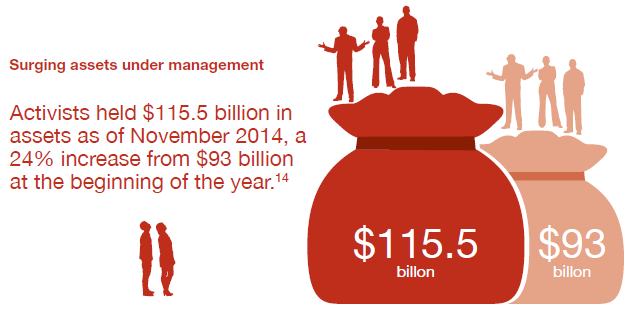
During the past decade, the number of activist hedge funds across the globe has dramatically increased, with total assets under management now exceeding $100 billion. Since 2003 (and through May 2014), 275 new activist hedge funds were launched.

Forty-one percent of today’s activist hedge funds focus their activities on North America, and 32% have a focus that spans across global regions. The others focus on specific regions: Asia (15%), Europe (8%), and other regions of the world (4%).

Why?

The goals of today’s activist hedge funds are broad, including all of those historically sought, as well as changes that fall within the category of “capital allocation strategy” (e.g., return of large amounts of reserved cash to investors through stock buybacks or dividends, revisions to the company’s acquisition strategy).

How?

The tactics of these newest activists are also evolving. Many are spending time talking to the company in an effort to negotiate consensus around specific changes intended to unlock value, before pursuing a proxy contest or other more “public” (e.g., media campaign) activities. They may also spend pre-announcement time talking to some of the company’s other shareholders to gauge receptivity to their contemplated changes. Lastly, these activists (along with the companies responding to them) are grappling with the potential impact of high-frequency traders on the identity of the shareholder base that is eligible to vote on proxy matters.

Some contend that hedge fund activism improves a company’s stock price (at least in the short term), operational performance, and other measures of share value (including more disciplined capital investments). Others contend that, over the long term, hedge fund activism increases the company’s share price volatility as well as its leverage, without measurable improvements around cash management or R&D spending.

When is a company likely to be the target of activism?

Although each hedge fund activist’s process for identifying targets is proprietary, most share certain broad similarities:

  1. The company has a low market value relative to book value, but is profitable, generally has a well-regarded brand, and has sound operating cash flows and return on assets. Alternatively, the company’s cash reserves exceed both its own historic norms and those of its peers. This is a risk particularly when the market is unclear about the company’s rationale for the large reserve. For multi- business companies, activists are also alert for one or more of the company’s business lines or sectors that are significantly underperforming in its market.
  2. Institutional investors own the vast majority of the company’s outstanding voting stock.
  3. The company’s board composition does not meet all of today’s “best practice” expectations. For example, activists know that other investors may be more likely to support their efforts when the board is perceived as being “stale”—that is, the board has had few new directors over the past three to five years, and most of the existing directors have served for very long periods. Companies that have been repeatedly targeted by non-hedge fund activists are also attractive to some hedge funds who are alert to the cumulative impact of shareholder dissatisfaction.

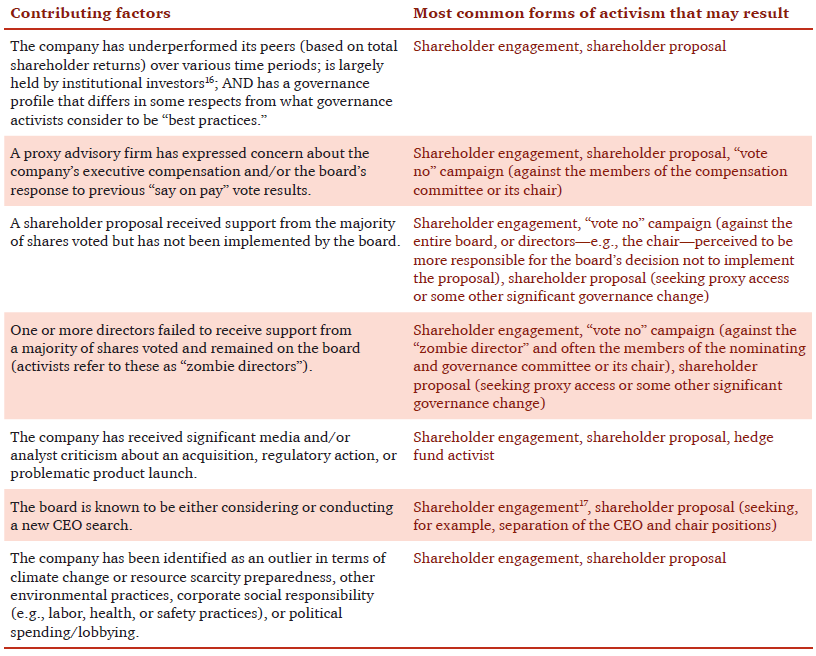
A company is most likely to be a target of non-hedge fund activism based on a combination of the following factors:

pwcsat

How can a company effectively prepare for—and respond to—an activist campaign?

Prepare

We believe that companies that put themselves in the shoes of an activist will be most able to anticipate, prepare for, and respond to an activist campaign. In our view, there are four key steps that a company and its board should consider before an activist knocks on the door:

Critically evaluate all business lines and market regions. Some activists have reported that when they succeed in getting on a target’s board, one of the first things they notice is that the information the board has been receiving from management is often extremely voluminous and granular, and does not aggregate data in a way that highlights underperforming assets.

Companies (and boards) may want to reassess how the data they review is aggregated and presented. Are revenues and costs of each line of business (including R&D costs) and each market region clearly depicted, so that the P&L of each component of the business strategy can be critically assessed? This assessment should be undertaken in consideration of the possible impact on the company’s segment reporting, and in consultation with the company’s management and likely its independent auditor.

Monitor the company’s ownership and understand the activists. Companies routinely monitor their ownership base for significant shifts, but they may also want to ensure that they know whether activists (of any type) are current shareholders.

Understanding what these shareholders may seek (i.e., understanding their “playbook”) will help the company assess its risk of becoming a target.

Evaluate the “risk factors.” Knowing in advance how an activist might criticize a company allows a company and its board to consider whether to proactively address one or more of the risk factors, which in turn can strengthen its credibility with the company’s overall shareholder base. If multiple risk factors exist, the company can also reduce its risk by addressing just one or two of the higher risk factors.

Even if the company decides not to make any changes based on such an evaluation, going through the deliberative process will help enable company executives and directors to articulate why they believe staying the course is in the best long-term interests of the company and its investors.

Develop an engagement plan that is tailored to the company’s shareholders and the issues that the company faces. If a company identifies areas that may attract the attention of an activist, developing a plan to engage with its other shareholders around these topics can help prepare for—and in some cases may help to avoid—an activist campaign. This is true even if the company decides not to make any changes.

Activists typically expect to engage with both members of management and the board. Accordingly, the engagement plan should prepare for either circumstance.

Whether the company decides to make changes or not, explaining to the company’s most significant shareholders why decisions have been made will help these shareholders better understand how directors are fulfilling their oversight responsibilities, strengthening their confidence that directors are acting in investors’ best long-term interests.

These communications are often most effective when the company has a history of ongoing engagement with its shareholders. Sometimes, depending on the company’s shareholder profile, the company may opt to defer actual execution of this plan until some future event occurs (e.g., an activist in fact approaches the company, or files a Schedule 13d with the SEC, which effectively announces its intent to seek one or more board seats). Preparing the plan, however, enables the company to act quickly when circumstances warrant.

pwcsa13

Respond

In responding to an activist’s approach, consider the advice that large institutional investors have shared with us: good ideas can come from anyone. While there may be circumstances that call for more defensive responses to an activist’s campaign (e.g., litigation), in general, we believe the most effective response plans have three components:

Objectively consider the activist’s ideas. By the time an activist first approaches a company, the activist has usually already (a) developed specific proposals for unlocking value at the company, at least in the short term, and (b) discussed (and sometimes consequently revised) these ideas with a select few of the company’s shareholders. Even if these conversations have not occurred by the time the activist first approaches the company, they are likely to occur soon thereafter. The company’s institutional investors generally spend considerable time objectively evaluating the activist’s suggestion—and most investors expect that the company’s executive management and board will be similarly open- minded and deliberate.

Look for areas around which to build consensus. In 2013, 72 of the 90 US board seats won by activists were based on voluntary agreements with the company, rather than via a shareholder vote. This demonstrates that most targeted companies are finding ways to work with activists, avoiding the potentially high costs of proxy contests. Activists are also motivated to reach agreement if possible. If given the option, most activists would prefer to spend as little time as possible to achieve the changes they believe will enhance the value of their investment in the company. While they may continue to own company shares for extensive periods of time, being able to move their attention and energy to their next target helps to boost the returns to their own investors.

Actively engage with the company’s key shareholders to tell the company’s story. An activist will likely be engaging with fellow investors, so it’s important that key shareholders also hear from the company’s management and often the board. In the best case, the company already has established a level of credibility with those shareholders upon which new communications can build. If the company does not believe the activist’s proposed changes are in the best long-term interests of the company and its owners, investors will want to know why—and just as importantly, the process the company used to reach this conclusion. If the activist and company are able to reach an agreement, investors will want to hear that the executives and directors embrace the changes as good for the company. Company leaders that are able to demonstrate to investors that they were part of positive changes, rather than simply had changes thrust upon them, enhance investor confidence in their stewardship.

pwcsa14

Epilogue—life after activism

When the activism has concluded—the annual meeting is over, changes have been implemented, or the hedge fund has moved its attention to another target—the risk of additional activism doesn’t go away. Depending on how the company has responded to the activism, the significance of any changes, and the perception of the board’s independence and open-mindedness, the company may again be targeted. Incorporating the “Prepare” analysis into the company’s ongoing processes, conducting periodic self-assessments for risk factors, and engaging in a tailored and focused shareholder engagement program can enhance the company’s resiliency, strengthening its long-term relationship with investors.

Modèle d’affaires nord-américains | La priorité aux actionnaires ou aux parties prenantes ?


Voici un excellent article publié par Tim Koller, Marc Goedhart et David Wessels dans le magazine Insights & Publications de McKinsey & Company, qui avance qu’il est préférable d’opter pour l’appréciation de la valeur aux actionnaires plutôt que pour la satisfaction de toutes les parties prenantes, en autant que l’entreprise met l’accent sur la gestion à long terme.

Cet article explique les principes fondamentaux du modèle d’affaires nord-américain en précisant ce qu’implique (1) la création de valeur pour les actionnaires et (2) la réconciliation des intérêts des parties prenantes (stakeholders).

Les auteurs montrent que la recherche, même inconsciente, de résultats à court terme est vraiment ce qui pose problème. Ce n’est pas la recherche d’accroissement de la valeur des actions qui est questionnable dans le modèle, c’est le court-termisme qui domine les actions.

 Shareholder-oriented capitalism is still the best path to broad economic prosperity, as long as companies focus on the long term.

L’article réfute les argumentations des approches qui évoquent la primauté de la réconciliation des intérêts des parties prenantes sur la recherche des intérêts des actionnaires.

Bonne lecture !

The real business of business

The guiding principle of business value creation is a refreshingly simple construct: companies that grow and earn a return on capital that exceeds their cost of capital create value. The financial crisis of 2007–08 and the Great Recession that followed are only the most recent reminders that when managers, boards of directors, and investors forget this guiding principle, the consequences are disastrous—so much so, in fact, that some economists now call into question the very foundations of shareholder-oriented capitalism. Confidence in business has tumbled.1 1.An annual Gallup poll in the United States showed that the percent of respondents with little or no confidence in big business increased from 27 percent in the 1983–86 period to 38 percent in the 2011–14 period. For more, see “Confidence in institutions,” gallup.com. Politicians and commentators are pushing for more regulation and fundamental changes in corporate governance. Academics and even some business leaders have called for companies to change their focus from increasing shareholder value to a broader focus on all stakeholders, including customers, employees, suppliers, and local communities.

P1010039

No question, the complexity of managing the interests of myriad owners and stakeholders in a modern corporation demands that any reform discussion begin with a large dose of humility and tolerance for ambiguity in defining the purpose of business. But we believe the current debate has muddied a fundamental truth: creating shareholder value is not the same as maximizing short-term profits—and companies that confuse the two often put both shareholder value and stakeholder interests at risk. Indeed, a system focused on creating shareholder value from business isn’t the problem; short-termism is. Great managers don’t skimp on safety, don’t make value-destroying investments just because their peers are doing it, and don’t use accounting or financial gimmicks to boost short-term profits, because ultimately such moves undermine intrinsic value.

What’s needed at this time of reflection on the virtues and vices of capitalism is a clearer definition of shareholder value creation that can guide managers and board directors, rather than blurring their focus with a vague stakeholder agenda. We do believe that companies are better able to deliver long-term value to shareholders when they consider stakeholder concerns; the key is for managers to examine those concerns systematically for opportunities to do both.

What does it mean to create shareholder value?

If investors knew as much about a company as its managers, maximizing its current share price might be equivalent to maximizing value over time. In the real world, investors have only a company’s published financial results and their own assessment of the quality and integrity of its management team. For large companies, it’s difficult even for insiders to know how the financial results are generated. Investors in most companies don’t know what’s really going on inside a company or what decisions managers are making. They can’t know, for example, whether the company is improving its margins by finding more efficient ways to work or by simply skimping on product development, maintenance, or marketing.

Since investors don’t have complete information, it’s not difficult for companies to pump up their share price in the short term. For example, from 1997 to 2003, a global consumer-products company consistently generated annual growth in earnings per share (EPS) between 11 and 16 percent. Managers attributed the company’s success to improved efficiency. Impressed, investors pushed the company’s share price above that of its peers—unaware that the company was shortchanging its investment in product development and brand building to inflate short-term profits, even as revenue growth declined. In 2003, managers were compelled to admit what they’d done. Not surprisingly, the company went through a painful period of rebuilding, and its stock price took years to recover.

In contrast, the evidence makes it clear that companies with a long strategic horizon create more value. The banks that had the insight and courage to forgo short-term profits during the real-estate bubble earned much better returns for shareholders over the longer term.2 2.Bin Jiang and Tim Koller, “How to choose between growth and ROIC,” McKinsey on Finance, September 2007. Oil and gas companies known for investing in safety outperform those that haven’t. We’ve found, empirically, that long-term revenue growth—particularly organic revenue growth—is the most important driver of shareholder returns for companies with high returns on capital (though not for companies with low returns on capital).3 3.Bin Jiang and Tim Koller, “How to choose between growth and ROIC,” McKinsey on Finance, September 2007. We’ve also found a strong positive correlation between long-term shareholder returns and investments in R&D—evidence of a commitment to creating value in the longer term.4 4.Tim Koller, Marc Goedhart, and David Wessels, Valuation: Measuring and Managing the Value of Companies, fifth edition, Hoboken, NJ: John Wiley & Sons, 2010.

The weight of such evidence and our experience supports a clear definition of what it means to create shareholder value, which is to create value for the collective of all shareholders, present and future. This means managers should not take actions to increase today’s share price if they will reduce it down the road. It’s the task of management and the board to have the courage to make long-term value-creating decisions despite the short-term consequences.

Can stakeholder interests be reconciled?

Much recent criticism of shareholder-oriented capitalism has called on companies to focus on a broader set of stakeholders, not just shareholders. It’s a view that has long been influential in continental Europe, where it is frequently embedded in the governance structures of the corporate form of organization. And we agree that for most companies anywhere in the world, pursuing the creation of long-term shareholder value requires satisfying other stakeholders as well.

Short-termism runs deep

What’s most relevant about Stout’s argument, and that of others, is its implicit criticism of short-termism—and that is a fair critique of today’s capitalism. Despite overwhelming evidence linking intrinsic investor preferences to long-term value creation,10 10.Robert N. Palter, Werner Rehm, and Jonathan Shih, “Communicating with the right investors,” McKinsey Quarterly, April 2008. too many managers continue to plan and execute strategy, and then report their performance against shorter-term measures, EPS in particular.

As a result of their focus on short-term EPS, major companies often pass up value-creating opportunities. In a survey of 400 CFOs, two Duke University professors found that fully 80 percent of the CFOs said they would reduce discretionary spending on potentially value-creating activities such as marketing and R&D in order to meet their short-term earnings targets.11 11.John R. Graham, Campbell R. Harvey, and Shiva Rajgopal, “Value destruction and financial reporting decisions,” Financial Analysts Journal, 2006, Volume 62, Number 6, pp. 27–39. In addition, 39 percent said they would give discounts to customers to make purchases this quarter, rather than next, in order to hit quarterly EPS targets. Such biases shortchange all stakeholders.

Shareholder capitalism won’t solve all social issues

There are some trade-offs that company managers can’t make—and neither a shareholder nor a stakeholder approach to governance can help. This is especially true when it comes to issues that affect people who aren’t immediately involved with the company as investors, customers, or suppliers. These so-called externalities—parties affected by a company who did not choose to be so—are often beyond the ken of corporate decision making because there is no objective basis for making trade-offs among parties.

If, for example, climate change is one of the largest social issues facing the world, then one natural place to look for a solution is coal-fired power plants, among the largest man-made sources of carbon emissions. But how are the managers of a coal-mining company to make all the trade-offs needed to begin solving our environmental problems? If a long-term shareholder focus led them to anticipate potential regulatory changes, they should modify their investment strategies accordingly; they may not want to open new mines, for example. But if the company abruptly stopped operating existing ones, not only would its shareholders be wiped out but so would its bondholders (since bonds are often held by pension funds). All of its employees would be out of work, with magnifying effects on the entire local community. Second-order effects would be unpredictable. Without concerted action among all coal producers, another supplier could step up to meet demand. Even with concerted action, power plants might be unable to produce electricity, idling their workers and causing electricity shortages that undermine the economy. What objective criteria would any individual company use to weigh the economic and environmental trade-offs of such decisions—whether they’re privileging shareholders or stakeholders?

In some cases, individual companies won’t be able to satisfy all stakeholders. For any individual company, the complexity of addressing universal social issues such as climate change leaves us with an unresolved question: If not them, then who? Some might argue that it would be better for the government to develop incentives, regulations, and taxes, for example, to encourage a migration away from polluting sources of energy. Others may espouse a free-market approach, allowing creative destruction to replace aging technologies and systems with cleaner, more efficient sources of power.

Shareholder capitalism has taken its lumps in recent years, no question. And given the complexity of the issues, it’s unlikely that either the shareholder or stakeholder model of governance can be analytically proved superior. Yet we see in our work that the shareholder model, thoughtfully embraced as a collective approach to present and future value creation, is the best at bridging the broad and varied interests of shareholders and stakeholders alike.

_______________________________

*Marc Goedhard is a senior expert in McKinsey’s Amsterdam office, and Tim Koller* is a principal in the New York office; David Wessels* is an adjunct professor of finance and director of executive education at the University of Pennsylvania’s Wharton School.

Comportements néfastes liés au narcissisme de certains présidents et chefs de direction (PCD) | En reprise


Il est indéniable qu’un PCD (CEO) doit avoir une personnalité marquante, un caractère fort et un leadership manifeste. Ces caractéristiques tant recherchées chez les premiers dirigeants peuvent, dans certains cas, s’accompagner de traits de personnalité dysfonctionnels tels que le narcissisme.

C’est ce que Tomas Chamorro-Premuzic soutien dans son article publié sur le blogue du HuffPost du 2 janvier 2014. Il cite deux études qui confirment que le comportement narcissique de certains dirigeants (1) peut avoir des effets néfastes sur le moral des employés, (2) éloigner les employés potentiels talentueux et (3) contribuer à un déficit de valeurs d’intégrité à l’échelle de toute l’organisation.

L’auteur avance que les membres des conseils d’administration, notamment ceux qui constituent les comités de Ressources humaines, doivent être conscients des conséquences potentiellement dommageables des leaders flamboyants et « charismatiques ». En fait, les études montrent que les vertus d’humilité, plutôt que les traits d’arrogance, sont de bien meilleures prédicteurs du succès d’une organisation.

P1040752La première étude citée montre que les organisations dirigées par des PCD prétentieux et tout-puissants ont tendances à avoir de moins bons résultats, tout en étant plus sujettes à des fraudes.

La seconde étude indique que les valeurs d’humilité incarnées par un leader ont des conséquences positives sur l’engagement des employés.

Voici en quelques paragraphes les conclusions de ces deux études.

Bonne lecture !

In the first study, Antoinette Rijsenbilt and Harry Commandeur assessed the narcissism levels of 953 CEOs from a wide range of industries, as well as examining objective performance indicators of their companies during their tenure. Unsurprisingly, organizations led by arrogant, self-centered, and entitled CEOs tended to perform worse, and their CEOs were significantly more likely to be convicted for corporate fraud (e.g., fake financial reports, rigged accounts, insider trading, etc.). Interestingly, the detrimental effects of narcissism appear to be exacerbated when CEOs are charismatic, which is consistent with the idea that charisma is toxic because it increases employees’ blind trust and irrational confidence in the leader. If you hire a charismatic leader, be prepared to put up with a narcissist.

In the second study, Bradley Owens and colleagues examined the effects of leader humility on employee morale and turnover. Their results showed that « in contrast to rousing employees through charismatic, energetic, and idealistic leadership approaches (…) a ‘quieter’ leadership approach, with listening, being transparent about limitations, and appreciating follower strengths and contributions [is the most] effective way to engage employees. » This suggests that narcissistic CEOs may be good at attracting talent, but they are probably better at repelling it. Prospective job candidates, especially high potentials, should therefore think twice before being seduced by the meteoric career opportunities outlined by charismatic executives. Greed is not only contagious, but competitive and jealous, too…


If we can educate organizations, in particular board members, on the virtues of humility and the destructive consequences of narcissistic and charismatic leadership, we may see a smaller proportion of entitled, arrogant, and fraudulent CEOs — to everyone’s benefit. Instead of worshiping and celebrating the flamboyant habits of corporate bosses, let us revisit the wise words of Peter Drucker, who knew a thing or two about management:

The leaders who work most effectively, it seems to me, never say ‘I’. And that’s not because they have trained themselves not to say ‘I’. They don’t think ‘I’. They think ‘we’; they think ‘team’. They understand their job to be to make the team function. They accept responsibility and don’t sidestep it, but ‘we’ gets the credit.

Enhanced by Zemanta

Sept leçons apprises en matière de communications de crises | Richard Thibault


Nous avons demandé à Richard Thibault*, président de RTCOMM, d’agir à titre d’auteur invité. Son billet présente sept leçons tirées de son expérience comme consultant en gestion de crise.

En tant que membres de conseils d’administration, vous aurez certainement l’occasion de vivre des crises significatives et il est important de connaître les règles que la direction doit observer en pareilles circonstances.

Voici donc, en reprise, l’article en question, reproduit ici avec la permission de l’auteur.

Vos commentaires sont appréciés. Bonne lecture !

Sept leçons apprises en matière de communications de crise

Par Richard Thibault*

La crise la mieux gérée est, dit-on, celle que l’on peut éviter. Mais il arrive que malgré tous nos efforts pour l’éviter, la crise frappe et souvent, très fort. Dans toute situation de crise, l’objectif premier est d’en sortir le plus rapidement possible, avec le moins de dommages possibles, sans compromettre le développement futur de l’organisation.

Voici sept leçons dont il faut s’inspirer en matière de communication de crise, sur laquelle on investit généralement 80% de nos efforts, et de notre budget, en de telles situations.

The Deepwater Horizon oil spill as seen from s...
The Deepwater Horizon oil spill as seen from space by NASA’s Terra satellite on May 24, 2010 (Photo credit: Wikipedia)

(1) Le choix du porte-parole

Les médias voudront tout savoir. Mais il faudra aussi communiquer avec l’ensemble de nos clientèles internes et externes. Avoir un porte-parole crédible et bien formé est essentiel. On ne s’improvise pas porte-parole, on le devient. Surtout en situation de crise, alors que la tension est parfois extrême, l’organisation a besoin de quelqu’un de crédible et d’empathique à l’égard des victimes. Cette personne devra être en possession de tous ses moyens pour porter adéquatement son message et elle aura appris à éviter les pièges. Le choix de la plus haute autorité de l’organisation comme porte-parole en situation de crise n’est pas toujours une bonne idée. En crise, l’information dont vous disposez et sur laquelle vous baserez vos décisions sera changeante, contradictoire même, surtout au début. Risquer la crédibilité du chef de l’organisation dès le début de la crise peut être hasardeux. Comment le contredire ensuite sans nuire à son image et à la gestion de la crise elle-même ?

(2) S’excuser publiquement si l’on est en faute

S’excuser pour la crise que nous avons provoqué, tout au moins jusqu’à ce que notre responsabilité ait été officiellement dégagée, est une décision-clé de toute gestion de crise, surtout si notre responsabilité ne fait aucun doute. En de telles occasions, il ne faut pas tenter de défendre l’indéfendable. Ou pire, menacer nos adversaires de poursuites ou jouer les matamores avec les agences gouvernementales qui nous ont pris en défaut. On a pu constater les impacts négatifs de cette stratégie utilisée par la FTQ impliquée dans une histoire d’intimidation sur les chantiers de la Côte-Nord, à une certaine époque. Règle générale : mieux vaut s’excuser, être transparent et faire preuve de réserve et de retenue jusqu’à ce que la situation ait été clarifiée.

(3) Être proactif

Dans un conflit comme dans une gestion de crise, le premier à parler évite de se laisser définir par ses adversaires, établit l’agenda et définit l’angle du message. On vous conseillera peut-être de ne pas parler aux journalistes. Je prétends pour ma part que si, légalement, vous n’êtes pas obligés de parler aux médias, eux, en contrepartie, pourront légalement parler de vous et ne se priveront pas d’aller voir même vos opposants pour s’alimenter.  En août 2008, la canadienne Maple Leaf, compagnie basée à Toronto, subissait la pire crise de son histoire suite au décès et à la maladie de plusieurs de ses clients. Lorsque le lien entre la listériose et Maple Leaf a été confirmé, cette dernière a été prompte à réagir autant dans ses communications et son attitude face aux médias que dans sa gestion de la crise. La compagnie a très rapidement retiré des tablettes des supermarchés les produits incriminés. Elle a lancé une opération majeure de nettoyage, qu’elle a d’ailleurs fait au grand jour, et elle a offert son support aux victimes. D’ailleurs, la gestion des victimes est généralement le point le plus sensible d’une gestion de crise réussie.

(4) Régler le problème et dire comment

Dès les débuts de la crise, Maple Leaf s’est mise immédiatement au service de l’Agence canadienne d’inspection des aliments, offrant sa collaboration active et entière pour déterminer la cause du problème. Dans le même secteur alimentaire, tout le contraire de ce qu’XL Foods a fait quelques années plus tard. Chez Maple Leaf, tout de suite, des experts reconnus ont été affectés à la recherche de solutions. On pouvait reprocher à la compagnie d’être à la source du problème, mais certainement pas de se trainer les pieds en voulant le régler. Encore une fois, en situation de crise, camoufler sa faute ou refuser de voir publiquement la réalité en face est décidément une stratégie à reléguer aux oubliettes. Plusieurs années auparavant, Tylenol avait montré la voie en retirant rapidement ses médicaments des tablettes et en faisant la promotion d’une nouvelle méthode d’emballage qui est devenue une méthode de référence aujourd’hui.

(5) Employer le bon message

Il est essentiel d’utiliser le bon message, au bon moment, avec le bon messager, diffusé par le bon moyen. Les premiers messages surtout sont importants. Ils serviront à exprimer notre empathie, à confirmer les faits et les actions entreprises, à expliquer le processus d’intervention, à affirmer notre désir d’agir et à dire où se procurer de plus amples informations. Si la gestion des médias est névralgique, la gestion de l’information l’est tout autant. En situation de crise, on a souvent tendance à s’asseoir sur l’information et à ne la partager qu’à des cercles restreints, ou, au contraire, à inonder nos publics d’informations inutiles. Un juste milieu doit être trouvé entre ces deux stratégies sachant pertinemment que le message devra évoluer en même temps que la crise.

(6) Être conséquent et consistant

Même s’il évolue en fonction du stade de la crise, le message de base doit pourtant demeurer le même. Dans l’exemple de Maple Leaf évoqué plus haut, bien que de nouveaux éléments aient surgi au fur et à mesure de l’évolution de la crise, le message de base, à savoir la mise en œuvre de mesures visant à assurer la santé et la sécurité du public, a été constamment repris sur tous les tons. Ainsi, Maple Leaf s’est montrée à la fois consistante en respectant sa ligne de réaction initiale et conséquente, en restant en phase avec le développement de la situation.

(7) Être ouvert d’esprit

Dans toute situation de crise, une attitude d’ouverture s’avérera gagnante. Que ce soit avec les médias, les victimes, nos employés, nos partenaires ou les agences publiques de contrôle, un esprit obtus ne fera qu’envenimer la situation. D’autant plus qu’en situation de crise, ce n’est pas vraiment ce qui est arrivé qui compte mais bien ce que les gens pensent qui est arrivé. Il faut donc suivre l’actualité afin de pouvoir anticiper l’angle que choisiront les médias et s’y préparer en conséquence.

En conclusion

Dans une perspective de gestion de crise, il est essentiel de disposer d’un plan d’action au préalable, même s’il faut l’appliquer avec souplesse pour répondre à l’évolution de la situation. Lorsque la crise a éclaté, c’est le pire moment pour commencer à s’organiser. Il est essentiel d’établir une culture de gestion des risques et de gestion de crise dans l’organisation avant que la crise ne frappe. Comme le dit le vieux sage,  » pour être prêt, faut se préparer ! »

____________________________________

* Richard Thibault, ABCP

Président de RTCOMM, une entreprise spécialisée en positionnement stratégique et en gestion de crise

Menant de front des études de Droit à l’Université Laval de Québec, une carrière au théâtre, à la radio et à la télévision, Richard Thibault s’est très tôt orienté vers le secteur des communications, duquel il a développé une expertise solide et diversifiée. Après avoir été animateur, journaliste et recherchiste à la télévision et à la radio de la région de Québec pendant près de cinq ans, il a occupé le poste d’animateur des débats et de responsable des affaires publiques de l’Assemblée nationale de 1979 à 1987.

Richard Thibault a ensuite tour à tour assumé les fonctions de directeur de cabinet et d’attaché de presse de plusieurs ministres du cabinet de Robert Bourassa, de conseiller spécial et directeur des communications à la Commission de la santé et de la sécurité au travail et de directeur des communications chez Les Nordiques de Québec.

En 1994, il fonda Richard Thibault Communications inc. (RTCOMM). D’abord spécialisée en positionnement stratégique et en communication de crise, l’entreprise a peu à peu élargi son expertise pour y inclure tous les champs de pratique de la continuité des affaires. D’autre part, reconnaissant l’importance de porte-parole qualifiés en période trouble, RTCOMM dispose également d’une école de formation à la parole en public. Son programme de formation aux relations avec les médias est d’ailleurs le seul programme de cette nature reconnu par le ministère de la Sécurité publique du Québec, dans un contexte de communication d’urgence. Ce programme de formation est aussi accrédité par le Barreau du Québec.

Richard Thibault est l’auteur de Devenez champion dans vos communications et de Osez parler en public, publié aux Éditions MultiMondes et de Comment gérer la prochaine crise, édité chez Transcontinental, dans la Collection Entreprendre. Praticien reconnu de la gestion des risques et de crise, il est accrédité par la Disaster Recovery Institute International (DRII).

Spécialités : Expert en positionnement stratégique, gestion des risques, communications de crise, continuité des affaires, formation à la parole en public.

http://www.linkedin.com/profile/view?id=46704908&locale=fr_FR&trk=tyah

Enhanced by Zemanta

Les dix (10) billets vedettes en gouvernance sur mon blogue en 2014


Voici une liste des billets en gouvernance les plus populaires publiés sur mon blogue en 2014.

Cette liste constitue, en quelque sorte, un sondage de l’intérêt manifesté par des dizaines de milliers de personnes sur différents thèmes de la gouvernance des sociétés. On y retrouve des points de vue bien étayés sur des sujets d’actualité relatifs aux conseils d’administration.

Les dix (10) articles les plus lus du Blogue en gouvernance ont fait l’objet de plus de 1 0 000 visites.

Que retrouve-t-on dans ce blogue et quels en sont les objectifs ?

Ce blogue fait l’inventaire des documents les plus pertinents et récents en gouvernance des entreprises. La sélection des billets est le résultat d’une veille assidue des articles de revue, des blogues et sites web dans le domaine de la gouvernance, des publications scientifiques et professionnelles, des études et autres rapports portant sur la gouvernance des sociétés, au Canada et dans d’autres pays, notamment aux États-Unis, au Royaume-Uni, en France, en Europe, et en Australie.

6f49ada2-22d7-453a-b86d-31dfd1b4ca77

Je fais un choix parmi l’ensemble des publications récentes et pertinentes et je commente brièvement la publication. L’objectif de ce blogue est d’être la référence en matière de documentation en gouvernance dans le monde francophone, en fournissant au lecteur une mine de renseignements récents (les billets quotidiens) ainsi qu’un outil de recherche simple et facile à utiliser pour répertorier les publications en fonction des catégories les plus pertinentes.

Quelques statistiques à propos du blogue Gouvernance | Jacques Grisé

Ce blogue a été initié le 15 juillet 2011 et, à date, il a accueilli plus de 125 000 visiteurs. Le blogue a progressé de manière tout à fait remarquable et, au 31 décembre 2014, il était fréquenté par plus de 5 000 visiteurs par mois. Depuis le début, j’ai œuvré à la publication de 1 097 billets.

En 2015, on estime qu’environ 5 500 personnes par mois visiteront le blogue afin de s’informer sur diverses questions de gouvernance. À ce rythme, on peut penser qu’environ 70 000 personnes visiteront le site du blogue en 2015. 

On  note que 44 % des billets sont partagés par l’intermédiaire de LinkedIn et 44 % par différents engins de recherche. Les autres réseaux sociaux (Twitter, Facebook et Tumblr) se partagent 13 % des références.

Voici un aperçu du nombre de visiteurs par pays :

  1. Canada (64 %)
  2. France, Suisse, Belgique (20 %)
  3. Magreb (Maroc, Tunisie, Algérie) (5 %)
  4. Autres pays de l’Union Européenne (2 %)
  5. États-Unis (2 %)
  6. Autres pays de provenance (7 %)

En 2014, le blogue Gouvernance | Jacques Grisé a été inscrit dans deux catégories distinctes du concours canadien Made in Blog (MiB Awards) : Business et Marketing et médias sociaux. Le blogue a été retenu parmi les dix (10) finalistes à l’échelle canadienne dans chacune de ces catégories, le seul en gouvernance.

Vos commentaires sont toujours grandement appréciés. Je réponds toujours à ceux-ci.

Bonne lecture !

Top 10 de l’année 2014 du blogue en gouvernance de www.jacquesgrisegouvernance.com

1.       Guides de gouvernance à l’intention des OBNL : Questions et réponses
2.       Sur quoi les organisations doivent-elles d’abord travailler ? | Sur la stratégie ou sur la culture*
3.       Dix (10) activités que les conseils d’administration devraient éviter de faire !
4.       Douze (12) tendances à surveiller en gouvernance | Jacques Grisé
5.       Comportements néfastes liés au narcissisme de certains PCD (CEO)
6.       LE RÔLE DU PRÉSIDENT DU CONSEIL D’ADMINISTRATION (PCA) | LE CAS DES CÉGEP
7.       On vous offre de siéger sur un C.A. | Posez les bonnes questions avant d’accepter ! **
8.       Sept leçons apprises en matière de communications de crise
9.       Pourquoi les entreprises choisissent le Delaware pour s’incorporer ?
10.     Document de KPMG sur les bonnes pratiques de constitution d’un Board | The Directors Toolkit

Mesurer et rémunérer la performance de la direction | En rappel


Voici une étude empirique qui cherche à mieux comprendre comment le choix des mesures de performance influence la rémunération de la direction.

Globalement, les résultats montrent une corrélation positive entre la rémunération du CEO et plusieurs autres mesures de création de valeur. L’étude indique qu’il y a d’autres facteurs qui viennent nuancer cette conclusion.

Je vous invite à lire cet article pour mieux saisir les relations entre les mesures de performance et la structure de rémunération de la direction. Vous trouverez, ci-dessous, un court extrait de cette étude.

Bonne lecture !

MEASURING AND REWARDING PERFORMANCE: THEORY AND EVIDENCE IN RELATION TO EXECUTIVE COMPENSATION


Debate surrounding executive compensation is an enduring feature of the UK corporate landscape. While concern over compensation levels continue to exercise politicians, regulators, investors and the media, there is growing concern over the degree to which performance metrics commonly used in executive compensation contracts represent appropriate measures of long-term value creation. This debate partly reflects fears that UK executives face excessive pressure to deliver short-term results at the expense of long-term improvements in value (e.g., Kay Review 2012).

IMG_20140516_133651

This report contributes to the debate over executive compensation generally and in particular to the question of performance measure choice in executive compensation contracts. The first part of the report summarises key insights from the academic and professional literatures regarding the structure of executive compensation arrangements and the metrics used to link pay with corporate performance.

The second part of the report presents findings from a pilot study of executive compensation arrangements and their association with corporate value creation using a subsample of FTSE-100 companies.

Our results provide some comfort but also create cause for concern. On the positive side, results demonstrate a material positive association between CEO pay and several measures of value creation for all capital providers. The evidence suggests that prevailing executive pay structures incentivise and reward important aspects of value creation even though contractual performance metrics are not directly linked with value creation in many cases. More troubling, however, is our evidence that (i) a large fraction of CEO pay appears unrelated to periodic value creation and (ii) key aspects of compensation consistently correlate with performance metrics such as TSR and EPS growth where the direct link with value creation is more fragile.


Ce que chaque administrateur de sociétés devrait savoir à propos de la sécurité infonuagique |En rappel


Cet article est basé sur un rapport de recherche de Paul A. Ferrillo, avocat conseil chez Weil, Gotshal & Manges, et de Dave Burg et Aaron Philipp de PricewaterhouseCoopers. Les auteurs présentent une conceptualisation des facteurs infonuagiques (cloud computing) qui influencent les entreprises, en particulier les comportements de leurs administrateurs.

L’article donne une définition du phénomène infonuagique et montre comment les conseils d’administration sont interpellés par les risques que peuvent constituer les cyber-attaques. En fait, la partie la plus intéressante de l’article consiste à mieux comprendre, ce que les auteurs appellent, la « Gouvernance infonuagique » (Cloud Cyber Governance).

L’article propose plusieurs questions critiques que les administrateurs doivent adresser à la direction de l’entreprise.

Vous trouverez, ci-dessous, les points saillants de cet article lequel devrait intéresser les administrateurs préoccupés par les aspects de sécurité des opérations infonuagiques.

Bonne lecture !


Cloud Cyber Security: What Every Director Needs to Know

« There are four competing business propositions affecting most American businesses today. Think of them as four freight trains on different tracks headed for a four-way stop signal at fiber optic speed.

First, with a significant potential for cost savings, American business has adopted cloud computing as an efficient and effective way to manage countless bytes of data from remote locations at costs that would be unheard of if they were forced to store their data on hard servers. According to one report, “In September 2013, International Data Corporation predicted that, between 2013 and 2017, spending on pubic IT cloud computing will experience a compound annual growth of 23.5%.” Another report noted, “By 2014, cloud computing is expected to become a $150 billion industry. And for good reason—whether users are on a desktop computer or mobile device, the cloud provides instant access to data anytime, anywhere there is an Internet connection.”

IMG_20140219_205959

The second freight train is data security. Making your enterprise’s information easier for you to access and analyze also potentially makes it easier for others to do, too. 2013 and 2014 have been the years of “the big data breach,” with millions of personal data and information records stolen by hackers. Respondents to the 2014 Global State of Information Security® Survey reported a 25% increase in detected security incidents over 2012 and a 45% increase compared to 2011. Though larger breaches at global retailers are extremely well known, what is less known is that cloud providers are not immune from attack. Witness the cyber breach against a file sharing cloud provider that was perpetrated by lax password security and which caused a spam attack on its customers. “The message is that cyber criminals, just like legitimate companies, are seeing the ‘business benefits’ of cloud services. Thus, they’re signing up for accounts and reaching sensitive files through these accounts. For the cyber criminals this only takes a run-of-the-mill knowledge level … This is the next step in a new trend … and it will only continue.”

The third freight train is the plaintiff’s litigation bar. Following cyber breach after cyber breach, they are viewing the corporate horizon as rich with opportunities to sue previously unsuspecting companies caught in the middle of a cyber disaster, with no clear way out. They see companies scrambling to contend with major breaches, investor relation delays, and loss of brand and reputation.

The last freight train running towards the intersection of cloud computing and data security is the topic of cyber governance—i.e., what directors should be doing or thinking about to protect their firm’s most critical and valuable IP assets. In our previous article, we noted that though directors are not supposed to be able to predict all potential issues when it comes to cyber security issues, they do have a basic fiduciary duty to oversee the risk management of the enterprise, which includes securing its intellectual property and trade secrets. The purpose of this article is to help directors and officers potentially avoid a freight train collision by helping the “cyber governance train” control the path and destiny of the company. We will discuss basic cloud security principles, and basic questions directors should ask when considering whether or not the data their management desires to run on a cloud-based architecture will be as safe from attack as possible. As usual when dealing with cyber security issues, there are no 100% foolproof answers. Even cloud experts disagree on cloud-based data security practices and their effectiveness] There are only good questions a board can ask to make sure it is fulfilling its duties to shareholders to protect the company’s valuable IP assets.

What is Cloud Computing/What Are Its Basic Platforms

“Cloud computing is a model for enabling ubiquitous, convenient, on-demand network access to a shared pool of configurable computing resources (e.g., networks, servers, storage, applications, and services). Cloud computing is a disruptive technology that has the potential to enhance collaboration, agility, scaling, and availability, and provides the opportunities for cost reduction through optimized and efficient computing. The cloud model envisages a world where components can be rapidly orchestrated, provisioned, implemented and decommissioned, and scaled up or down to provide an on-demand utility-like model of allocation and consumption.”

Cloud computing is generally based upon three separate and distinct architectures that matter when considering the security of the data sitting in the particular cloud environment.

……

Cloud Cyber Governance

As shown above, what is commonly referred to as the cloud actually can mean many different things depending on the context and use. Using SaaS to manage a customer base has a vastly different set of governance criteria to using IaaS as a development environment. As such, there are very few accepted standards for properly monitoring/administering a cloud-based environment. There are many IT consultants in the cloud-based computing environment that can be consulted in that regard. Our view, however, is that directors are ultimately responsible for enterprise risk management, and that includes cyber security, a subset of which is cloud-based cyber-security. Thus it is important for directors to have a basic understanding of the risks involved in cloud-based data storage systems, and with cloud-based storage providers. Below are a few basic questions that come to mind that a director could pose to management, and the company’s CISO and CIO:

1. Where will your data be stored geographically (which may determine which laws apply to the protection of the company’s data), and in what data centers?

2. Is there any type of customer data co-mingling that could potentially expose the company data to competitors or other parties?

3. What sort of encryption does the cloud-based provider use?

4. What is the vendor’s backup and disaster recovery plan?

5. What is the vendor’s incident response and notification plan?

6. What kind of access will you have to security information on your data stored in the cloud in the event the company needs to respond to a regulatory request or internal investigation?

7. How transparent is the cloud provider’s own security posture? What sort of access can your company get to the cloud provider’s data center and personnel to make sure it is receiving what it is paying for?

8. What is the cloud servicer’s responsibility to update its security systems as technology and sophistication evolves?

9. What is the cloud provider’s ability to timely detect (i.e., continuously monitor) and respond to a security incident, and what sort of logging information is kept in order to potentially detect anomalous activity?

10. Are there any third party requirements (such as HITECH/HIPAA) that the provider needs to conform to for your industry?

11. Is the cloud service provider that is being considered already approved under the government’s FedRamp authorization process, which pre-approves cloud service providers and their security controls?

12. Finally, does the company’s cyber insurance liability policy cover cloud-based Losses assuming there is a breach and customer records are stolen or otherwise compromised?  This is a very important question to ask, especially if the company involved is going to use a cyber-insurance policy as a risk transfer mechanism. When in doubt, a knowledgeable cyber-insurance broker should be consulted to make sure cloud-based Losses are covered.

High-profile breaches have proven conclusively that cybersecurity is a board issue first and foremost. Being a board member is tough work. Board members have a lot on their plate, including, first and foremost, financial reporting issues. But as high-profile breaches have shown, major cyber breaches have almost the same effect as a high profile accounting problem or restatement. They cause havoc with investors, stock prices, vendors, branding, corporate reputation and consumers. Directors should be ready to ask tough questions regarding cyber security and cloud-based security issues so they do not find themselves on the wrong end of a major data breach, either on the ground or in the cloud. »

Le délicat problème de la rétribution des dirigeants d’OBNL ! | En rappel


L’expérience de la gestion des OBNL nous apprend que les entrepreneurs-propriétaires-fondateurs de ces organisations vivent souvent des aventures d’affaires formidables parce qu’ils sont animés par un feu sacré et une passion hors du commun. C’est souvent ce qui fait que certaines entreprises de l’économie sociale sortent de l’ombre !

Ainsi, suite à la mise sur pied de l’organisme à but non lucratif, les premiers dirigeants doivent s’impliquer activement dans la gestion quotidienne de l’entreprise; ils investissent beaucoup de temps – bénévolement – tout en occupant aussi un autre emploi.

Après plusieurs années de dévouement, de développement d’affaires tangible, de notoriété accrue et de succès répétés, souvent après des décennies d’efforts…, les gestionnaires bénévoles deviennent surchargés. L’entreprise doit se professionnaliser…

Toutes les organisations vivent ces grandes mutations, souvent déchirantes mais indispensables pour assurer la pérennité de l’entreprise.

Les leaders bénévoles doivent alors s’entourer de ressources additionnelles : administration générale, opérations, ventes, finances et comptabilité, recherche de commandites et de subventions, communications publiques, etc.

Ces nouvelles ressources, bien qu’ayant l’entreprise à cœur, ne sont pas animés de la même passion; en conséquence, l’organisation doit les rémunérer. Cela crée souvent deux classes : les responsables bénévoles (lesquels se retrouvent généralement au CA) et le personnel rémunéré.

Selon moi, le CA doit prévoir des mécanismes de transition clairs afin que les fondateurs-gestionnaires soient traités avec équité et reconnaissance.

When it comes to attracting and retaining talented leaders, the setting of executive compensation packages has posed continuing challenges to nonprofits since the 1980s. These challenges relate to the professionalization of the sector, the increasing desire to measure and reward success, and the need to retain and promote the most talented managers.

Voici un cas qui illustre pourquoi un CA doit se montrer très clairvoyant dans l’expression de sa gratitude envers les fondateurs bénévoles. Il ne doit pas attendre que les premiers dirigeants s’essoufflent, puis se retirent, pour leur exprimer sa satisfaction sous la forme d’une rétribution financière. On notera qu’il s’agit ici d’une OBNL d’envergure et que le PDG recevait déjà une rémunération significative.

Ce cas, rédigé par Ruth McCambridge et publié dans Nonprofit Quaterly, montre que le conseil d’administration d’une l’OBNL doit éviter de s’embourber dans des questions de rémunération du PDG, surtout lorsque l’organisme est tributaire de fonds publics pour son financement.

Nonprofit Boards Can and Should Avoid this Problem with CEO Compensation

This story is not new. A CEO spends decades providing measurably great leadership for a nonprofit, but no one ever considers ensuring that she is able to retire at the end of all that. So the board plays a little catch-up and makes a lump sum payment, causing a media storm in which scrutiny is focused unkindly on the organization.

So it was with the now-retired CEO of Health Care and Rehabilitation Services. Judith Hayward had been at the organization for 19 years and had built its budget from $8 million to $50 million annually. She was given a $650,000 compensation package when she retired around a year ago. Approximately 85 percent of the organization’s budget comes from taxpayer money.

Even though these kinds of payments may not be illegal and may even be ethical, when they come to light, they almost invariably cause problems for nonprofits—especially those that receive public contracts.

In this case, the board crossed its t’s and dotted its i’s. The executive and finance committees made recommendations and the board approved the payment in 2010. But when the payment was highlighted during a recent audit, the current CEO, George Karabakakis, felt compelled to travel to Montpelier to meet with local legislators to explain.

“It felt to myself, to the board, and to the senior leadership team that it was really important to come out and share the information,” Karabakakis said. “I don’t want legislators, or our staff, or anyone to get half truths or hear about this through the grapevine or the rumor mill. It’s important to put it out clearly and say ‘This is what happened.’”

Hayward’s annual salary when she retired was about $163,000. “Everyone on the board thought she did a tremendous job,” said J. Allen Dougherty, who served as chair of the HCRS board when the retirement package was approved. “She brought the organization out of bankruptcy, developed new programs and everyone who had contact with her, including people from the state, thought she did a magnificent job. She never had a retirement package and the board thought this was a way we could make it up to her.”

The package was originally approved at $450,000, but that was increased to $650,000 in 2013 when it was discovered that Hayward would be immediately taxed for $200,000 once she started to receive the payments.

 Unfortunately, this year, for the first time in at least 10 years, HCRS employees did not get a raise, and Karabakakis said staff have been “disappointed, angry and outraged.”

“Some people may see it as excessive,” he said. “If we’re going to provide a deferred compensation package, it’s important that we look at the industry standard, and make sure that we do have a culture of openness and transparency.”

But the staff were unlikely to have been solely concerned about transparency. The other thing a board needs to ensure is that fair retirement benefits extend to all workers. The notion of caring only about the old age comfort of top employees is, naturally, abhorrent and insulting to many others. It’s no surprise, and in times where income inequality begs for our attention, our organizations should try not to mimic the bad policies of the larger economy.

Karabakakis said the whole incident has caused a review of employment policies, the establishment of a personnel committee, and a “commitment to open and transparent communication with all concerned.”

But all of that after-the-fact work is being done after the horse has left the barn. As reported here, Rep. Michael Mrowicki, who serves on the Human Services Committee, says he will bring up the possible oversight of executive compensation in the legislature. “These payments seem to have been structured in a way that they are legal, but they don’t really pass the smell test,” he said. “We are trying to figure out our next step.”

“Mainly we want to make sure this doesn’t happen again,” he said. “We wouldn’t want to set a precedent for other people to think they deserve more than they have been paid. The staff at these agencies work incredibly hard, and you don’t have to go very far to find people who are being denied services because they are told there is not enough money. These state agencies are entrusted with public money and the taxpayers deserve to be protected. It is frustrating and disappointing on a very basic level.”

The fact is that many nonprofits do not attend to retirement packages adequately until doing what feels fair on one level may look unreasonable to others. With as many baby boomers as there are in leadership at nonprofits, it is well past time to consider these issues.

Gouvernance des OBNL : Un webinaire gratuit à ne pas manquer !


Voici une occasion à ne pas manquer si la gouvernance des OBNL vous intéresse.

Il s’agit d’un webinaire offert gracieusement par les CPA le 12 mars 2015.

Vous n’avez qu’à vous inscrire en consultant le site ci-dessous.


Bon webinaire !

Gouvernance des organismes sans but lucratif : Questions que les administrateurs devraient poser

Logo

Êtes-vous administrateur d’un OSBL? Comprenez-vous bien votre rôle à l’égard de la surveillance de l’organisme sans but lucratif (OSBL) que vous servez? Quelles questions devriez-vous poser pour vous assurer que le cadre de gouvernance et les processus de soutien de votre OSBL sont efficaces et répondent aux besoins particuliers de l’organisme, de sorte que l’OSBL soit productif, respecte ses obligations en matière d’information et réalise sa mission?

Cette activité gratuite d’une durée de 90 minutes aidera les administrateurs d’OSBL à comprendre comment ils peuvent s’assurer qu’un bon cadre de gouvernance est en place au sein de l’organisme qu’ils servent.

VOUS EN SAUREZ PLUS SUR :

les obligations fiduciaires liées à la surveillance pour les conseils et les administrateurs pris individuellement


les exigences et le contexte législatifs


la conception et la mise en place d’un cadre de gouvernance


l’établissement d’une saine dynamique au sein du conseil


les ressources pour l’établissement d’une saine dynamique au sein du conseil


le suivi, l’apprentissage et l’amélioration sur une base continue


les modèles de gouvernance dans le secteur des OSBL


des exemples de mandats de comités du conseil


L’évolution de la gouvernance en 2015 et dans le futur | En rappel


Aujourd’hui, je vous réfère à un formidable compte rendu de l’évolution de la gouvernance aux États-Unis en 2015.

C’est certainement le document le plus exhaustif que je connaisse eu égard au futur de la gouvernance corporative. Cet article rédigé par Holly J. Gregory* associée et responsable de la gouvernance corporative et de la rémunération des dirigeants de la firme Sidley Austin LLP, a été publié sur le forum de la Harvard Law School (HLS).

L’article est assez long mais les spécialistes de toutes les questions de gouvernance y trouveront leur compte car c’est un document phare. On y traite des sujets suivants:

1. L’impact des règlementations sur le rôle de la gouvernance;

2. Les tensions entre l’atteinte de résultats à court terme et les investissements à long terme;

3. L’impact de l’activisme sur le comportement des CA et sur la création de valeur;

4. Les réactions de protection et de défense des CA, notamment en modifiant les règlements de l’entreprise;

5. L’influence et le pouvoir des firmes spécialisées en votation;

6. La démarcation entre la supervision (oversight) de la direction et le management;

7. Les activités de règlementation, d’implantation et de suivi;

8. Le rétablissement de la confiance du public envers les entreprises.

Je vous invite donc à lire cet article dont voici un extrait de la première partie.

Bonne lecture ! Vos commentaires sont les bienvenus.

The State of Corporate Governance for 2015

The balance of power between shareholders and boards of directors is central to the U.S. public corporation’s success as an engine of economic growth, job creation and innovation. Yet that balance is under significant and increasing strain. In 2015, we expect to see continued growth in shareholder activism and engagement, as well as in 249the influence of shareholder initiatives, including advisory proposals and votes. Time will tell whether, over the long term, tipping the balance to greater shareholder influence will prove beneficial for corporations, their shareholders and our economy at large. In the near term, there is reason to question whether increased shareholder influence on matters that the law has traditionally apportioned to the board is at the expense of other values that are key to the sustainability of healthy corporations.

…..

Governance Roles and Responsibilities

Over the past 15 years, two distinct theories have been advanced to explain corporate governance failures: too little active and objective board involvement and too little accountability to shareholders. The former finds expression in the Sarbanes-Oxley Act’s emphasis on improving board attention to financial reporting and compliance, and related Securities and Exchange Commission (“SEC”) and listing rules on independent audit committees and director and committee independence and function generally. The latter is expressed by the Dodd-Frank Act’s focus on providing greater influence to shareholders through advisory say on pay votes and access to the company’s proxy machinery for nomination by shareholders of director candidates.

The emerging question is whether federal law and regulation (and related influences) are altering the balance that state law provides between the role of shareholders and the role of the board, and if so, whether that alteration is beneficial or harmful. State law places the management and direction of the corporation firmly in the hands of the board of directors. This legal empowerment of the board—and implicit rejection of governance by shareholder referendum—goes hand in hand with the limited liability that shareholders enjoy. Under state law, directors may not delegate or defer to shareholders as to matters reserved by law for the board, even where a majority of shareholders express a clear preference for a specific outcome. Concern about appropriate balance in shareholder and board roles is implicated by the increasingly coercive nature—given the influence and policies of proxy advisory firms—of federally-mandated advisory say on pay proposals and advisory shareholder proposals submitted under Securities Exchange Act Rule 14a-8 on other matters that do not fall within shareholder decision rights. The extent of proxy advisory firm influence is linked, at least in part, to the manner in which the SEC regulates registered investment advisors.

Short-Term Returns vs. Long-Term Investment

Management has long reported significant pressures to focus on short-term results at the expense of the long-term investment needed to position the corporation for the long term. Observers point to short-term financial market pressures which have increased with the rise of institutional investors whose investment managers have incentives to focus on quarterly performance in relation to benchmark and competing funds.

Short-term pressures may also be accentuated by the increasing reliance on stock-based executive compensation. It is estimated that the percentage of stock-based compensation has tripled since the early nineties: in 1993, approximately 20 percent of executive compensation was stock-based. Today, it is about 60 percent.

Boards that should be positioned to help management take the long-term view and balance competing interests are also under pressure from financial and governance focused shareholder activism. Both forms of activism are supported by proxy advisors that favor some degree of change in board composition and tend to have fairly defined—some would say rigid—views of governance practices.

Shareholder Activism and Its Value

As fiduciaries acting in the best interests of the company and its shareholders, directors must make independent and objective judgments. While it is prudent for boards to understand and consider the range of shareholder concerns and views represented in the shareholder constituency, shareholder engagement has its limits: The board must make its own independent judgment and may not simply defer to the wishes of shareholders. While activist shareholders often bring a valuable perspective, they may press for changes to suit particular special interests or short-term goals that may not be in the company’s long-term interests.

Governance Activism

Shareholder pressure for greater rights and influence through advisory shareholder proposals are expected to continue in the 2015 proxy season. A study of trends from the 2014 proxy season in Fortune 250 companies by James R. Copland and Margaret M. O’Keefe, Proxy Monitor 2014: A Report on Corporate Governance and Shareholder Activism (available at www.proxymonitor.org), suggests that the focus of most shareholder proposal activity does not relate to concerns that are broadly held by the majority of shareholders:

  1. Shareholder support for shareholder proposals is down, with only four percent garnering majority support, down from seven percent in 2013.
  2. A small group of shareholders dominates the shareholder-proposal process. One-third of all shareholder proposals are sponsored by three persons and members of their families and another 28 percent of proposals are sponsored by investors with an avowed social, religious or public-policy focus.
  3. Forty-eight percent of 2014 proposals at Fortune 250 companies related to social or political concerns. However, only one out of these 136 proposals received majority support, and that solitary passing proposal was one that the board had supported.
  4. Institutional Shareholders Services Inc. (“ISS”) is far more likely to recommend in favor of shareholder proposals than the average investor is to support them.

Nonetheless, the universe of shareholder proposals included in corporate proxy statements pursuant to Rule 14a-8 has grown significantly over the years. In addition, the coercive power of advisory shareholder proposals has expanded as a result of the policy of proxy advisors to recommend that their clients vote against the re-election of directors who fail to implement advisory shareholder proposals that receive a majority of votes cast. Directors should carefully assess the reasons underlying shareholder efforts to use advisory proposals to influence the company’s strategic direction or otherwise change the board’s approach to matters such as CEO compensation and succession, risk management, governance structures and environmental and social issues. Shareholder viewpoints provide an important data set, but must be understood in the context of the corporation’s best interest rather than the single lens of one particular constituency.

….

__________________________________

*Holly J. Gregory is a partner and co-global coordinator of the Corporate Governance and Executive Compensation group at Sidley Austin LLP.

Aperçu de certains changements dans la gestion des OBNL | Deloitte


Dans ce document de Deloitte, intitulé « un état de changement », j’attire votre attention sur deux sections qui sont importantes pour les gestionnaires d’OBNL :

(1) La communication de l’information sur les avantages sociaux futurs par les organismes sans but lucratif;

(2) L’améliorations des normes pour les organismes sans but lucratif – un rapport présentant les commentaires sur les 15 principes clés relatifs à la comptabilité des OBNL privées et publiques.

Le Conseil des normes comptables du Canada (CNC) et le Conseil sur la comptabilité dans le secteur public (CCSP) sont responsables des suite à donner à la consultation menée depuis plus d’un an.

Bonne lecture ! Vos commentaires sont les bienvenus.

Un état de changement dans les OBNL | Deloitte


Croisière Eurodam Iphone août 2011 006Pour l’instant, l’orientation qui sera adoptée par les organismes de normalisation est incertaine compte tenu des commentaires reçus et des principes proposés à l’origine dans l’énoncé de principes. Restez à l’affût des renseignements qui suivront, car les Conseils collaborent en vue d’améliorer l’orientation future des normes comptables pour les organismes sans but lucratif! Si vous souhaitez prendre connaissance de certains ou de tous les commentaires reçus à l’égard de l’énoncé de principes, visitez le site Web des Normes d’information financière et de certification (www.nifccanada.ca).


Nouvelles recommandations d’ISS relatives à l’inclusion de propositions d’actionnaires dans les circulaires de procuration


Voici une mise à jour importante de la firme ISS concernant les recommandations liées aux propositions des actionnaires susceptibles d’être incluses dans les circulaires de procuration des entreprises.

Carol Bowie responsable de la recherche à  Institutional Shareholder Services Inc. (ISS) présente les arguments qui sous-tendent ce changement de politique. Ainsi, ISS se prononcera en faveur de l’inclusion des propositions des actionnaires dans les circulaires de procuration en autant qu’un certain nombre de limites soient respectées :

1. Exigences en ce qui a trait à la limite de propriété – maximum de 3 % du pouvoir de votation;

2. Exigences en ce qui a trait à la durée continue de la propriété – pas plus de 3 ans;

3. Exigences relatives au nombre d’actionnaires requis pour former un groupe éligible à la proposition de recommandations – pas de limite au nombre d’actionnaires requis;

4. Exigences relatives au nombre de nominations – maximum de 25 % des membres du CA.

Je vous invite à lire le texte ci-dessous pour avoir plus de détails sur l’ensemble des recommandation de ISS paru sur le Harvard Law Scool Forum on Corporate Governance.

Bonne lecture !

2015 Benchmark US Proxy Voting Policies FAQ 


1. How will ISS recommend on proxy access proposals?

Drawing on the U.S. Securities and Exchange Commission’s (SEC) decades-long effort to draft a market-wide rule allowing investors to place director nominees on corporate ballots, and reflecting feedback from a broad range of institutional investors and their portfolio companies, ISS is updating its policy on proxy access to generally align with the SEC’s formulation.017

Old Recommendation: ISS supports proxy access as an important shareholder right, one that is complementary to other best-practice corporate governance features. However, in the absence of a uniform standard, proposals to enact proxy access may vary widely; as such, ISS is not setting forth specific parameters at this time and will take a case-by-case approach when evaluating these proposals.

Vote case-by-case on proposals to enact proxy access, taking into account, among other factors:

Company-specific factors; and

Proposal-specific factors, including:

The ownership thresholds proposed in the resolution (i.e., percentage and duration);

The maximum proportion of directors that shareholders may nominate each year; and

The method of determining which nominations should appear on the ballot if multiple shareholders submit nominations.

New Recommendation: ISS will generally recommend in favor of management and shareholder proposals for proxy access with the following provisions:

Ownership threshold: maximum requirement not more than three percent (3%) of the voting power;

Ownership duration: maximum requirement not longer than three (3) years of continuous ownership for each member of the nominating group;

Aggregation: minimal or no limits on the number of shareholders permitted to form a nominating group;

Cap: cap on nominees of generally twenty-five percent (25%) of the board.

Review for reasonableness any other restrictions on the right of proxy access.

Generally recommend a vote against proposals that are more restrictive than these guidelines.

Rationale for update:

Vested with clear legal authority by the Dodd-Frank Act, the SEC adopted a proxy access rule (Rule 14a-11) in August 2010 that provided a thoughtful balance of a number of factors including the ownership threshold and the holding period duration. The DC Circuit Court vacated the rule in July 2011 based on its findings of procedural deficiencies in the SEC’s rulemaking process. ISS’ earlier policy, updated for the 2012 proxy season, largely focused on attempts by shareholder proposal proponents to lower the safeguards against abuse (for example, an extremely low ownership threshold) of the access right that the SEC’s formulation addressed. As such, the policy sought to maintain the balance that the SEC struck between protecting shareholders’ rights and the potential abuse of the access process. Three years of voting results on both management- and shareholder-sponsored proxy access proposals drawing on the Commission’s model appear to validate the SEC’s formulation. Moreover, a 2014 CFA Institute study provides a cost-benefit analysis, which the court said was lacking in the SEC’s rulemaking process, and concludes that “proxy access would serve as a useful tool for shareowners in the United States and would ultimately benefit both the markets and corporate boardrooms, with little cost or disruption to companies and the markets as a whole.”

For companies that present both a board and shareholder proxy access proposals on the ballot, ISS will review each of them under the policy.

Exclusion of Shareholder Proposals

2. What are ISS’ expectations regarding whether a company includes a shareholder proposal on its ballot?

The ability of qualifying shareholders to include their properly presented proposals in a company’s proxy materials is a fundamental right of share ownership, which is deeply rooted in state law and the federal securities statutes. Shareholder proposals promote engagement and debate in an efficient and cost-effective fashion.

Over the course of the past several decades, the SEC has played the role of referee in resolving disputes raised by corporate challenges to the inclusion of shareholder proposals in company proxy materials. While federal courts provide an additional level of review, the vast majority of shareholder proposal challenges have been resolved without the need to resort to costly and cumbersome litigation. While individual proponents and issuers often disagree with the SEC’s determinations in these adversarial proceedings, the governance community recognizes the Commission’s important role as an impartial arbiter of these disputes.

On Jan 16, 2015, the SEC announced that it was reviewing Rule 14a-8(i)(9), which allows companies to exclude a shareholder proposal that “directly conflicts” with a board-sponsored proposal. Additionally, SEC Chair Mary Jo White indicated that for proxy season 2015, the Commission’s Division of Corporation Finance will express no view on the application of Rule 14a-8(i)(9). As a result, companies that intended to seek no-action relief on that basis are now deciding their courses of action.

For companies that present both a board and shareholder proposal on the ballot on a similar topic, ISS will review each of them under the applicable policy.

ISS will view attempts to circumvent the normal avenues of dispute resolution and appeal with a high degree of skepticism. Omitting shareholder proposals without obtaining regulatory or judicial relief risks litigation against the company. Presenting only a management proposal on the ballot also limits governance discourse by preventing shareholders from considering an opposing viewpoint, and only allowing them to consider and opine on the view of management.

Thus, under our governance failures policy, ISS will generally recommend a vote against one or more directors (individual directors, certain committee members, or the entire board based on case-specific facts and circumstances), if a company omits from its ballot a properly submitted shareholder proposal when it has not obtained:

1) voluntary withdrawal of the proposal by the proponent;

2) no-action relief from the SEC; or

3) a U.S. District Court ruling that it can exclude the proposal from its ballot.

The recommendation against directors in this circumstance is regardless of whether there is a board-sponsored proposal on the same topic on the ballot. If the company has taken unilateral steps to implement the proposal, however, the degree to which the proposal is implemented, and any material restrictions added to it, will factor into the assessment.

3. Does the Unilateral Bylaw/Charter Amendments policy create a new approach for ISS?

No. ISS has a long history of recommending its clients oppose directors who adopt, without obtaining shareholder approval, bylaw or charter amendments that materially diminish shareholder rights. Such unilateral board actions were covered under ISS’ Governance Failures policy, but due to a recent increase in their occurrence, as of 2015 ISS separated these actions into a standalone policy to increase transparency to clients and issuers, and to facilitate the application of custom clients’ policies.

The Governance Failures policy is designed to recognize one-off egregious actions that are not covered under other policies. If a type of corporate action that disadvantages shareholders becomes commonplace, ISS will often address such problematic practice via a standalone policy. In 2014, the three most common categories of conduct addressed under this policy were:

4. Which types of unilateral bylaw/charter amendments are likely to be considered by ISS to materially diminish shareholders’ rights?

If a unilaterally adopted amendment is deemed materially adverse to shareholder rights, ISS will recommend a vote against the board.

Unilaterally adopted bylaw amendments that are considered on a case-by-case basis, but generally are not considered materially adverse:

….

In assessing bylaw and charter changes at pre-IPO companies, ISS will consider the timing of the adoption of the provisions that diminish post-IPO shareholders rights, the clarity of disclosures of such changes (including in the company’s prospectus or other documents connected to the public offering) and the continuity of board membership.

5. How likely is ISS to support management proposals for fee-shifting bylaws?

As of early February 2015, approximately 50 bylaws allowing fee shifting have been adopted unilaterally, with none put to a shareholder vote. Our Litigation Rights policy states:

Generally vote against bylaws that mandate fee-shifting whenever plaintiffs are not completely successful on the merits (i.e., in cases where the plaintiffs are partially successful).

Mesurer et reconnaître la performance de la direction | Une étude empirique


Voici une étude empirique qui cherche à mieux comprendre comment le choix des mesures de performance influence la rémunération de la direction.

Globalement, les résultats montrent une corrélation positive entre la rémunération du CEO et plusieurs autres mesures de création de valeur. L’étude indique qu’il y a d’autres facteurs qui viennent nuancer cette conclusion.

Je vous invite à lire cet article pour mieux saisir les relations entre les mesures de performance et la structure de rémunération de la direction. Vous trouverez, ci-dessous, un court extrait de cette étude.

Bonne lecture !

MEASURING AND REWARDING PERFORMANCE: THEORY AND EVIDENCE IN RELATION TO EXECUTIVE COMPENSATION


Debate surrounding executive compensation is an enduring feature of the UK corporate landscape. While concern over compensation levels continue to exercise politicians, regulators, investors and the media, there is growing concern over the degree to which performance metrics commonly used in executive compensation contracts represent appropriate measures of long-term value creation. This debate partly reflects fears that UK executives face excessive pressure to deliver short-term results at the expense of long-term improvements in value (e.g., Kay Review 2012).

IMG_20140516_133651

This report contributes to the debate over executive compensation generally and in particular to the question of performance measure choice in executive compensation contracts. The first part of the report summarises key insights from the academic and professional literatures regarding the structure of executive compensation arrangements and the metrics used to link pay with corporate performance.

The second part of the report presents findings from a pilot study of executive compensation arrangements and their association with corporate value creation using a subsample of FTSE-100 companies.

Our results provide some comfort but also create cause for concern. On the positive side, results demonstrate a material positive association between CEO pay and several measures of value creation for all capital providers. The evidence suggests that prevailing executive pay structures incentivise and reward important aspects of value creation even though contractual performance metrics are not directly linked with value creation in many cases. More troubling, however, is our evidence that (i) a large fraction of CEO pay appears unrelated to periodic value creation and (ii) key aspects of compensation consistently correlate with performance metrics such as TSR and EPS growth where the direct link with value creation is more fragile.