Manuel de saine gouvernance au Canada


Voici un excellent rapport produit par L’Alliance canadienne pour la mixité et la bonne gouvernance que je vous invite vivement à consulter.

L’Alliance « est un regroupement inédit d’organisations sans but lucratif de premier plan, axé sur la recherche, la promotion et l’information dans les domaines de la gouvernance et de la mixité ».

Les membres de l’Alliance sont les suivants :

Les initiatives de l’Alliance consistent en la publication de deux documents qui constituent en quelque sorte des jalons et des consensus sur les principes de saine gouvernance au Canada.
La première partie du rapport porte sur la mixité dans les conseils d’administration.
Tout porte à croire que les organisations dotées de conseils d’administration et d’équipe de haute direction où les deux sexes sont représentés de façon équilibrée sont plus susceptibles que les autres d’obtenir de solides résultats financiers à long terme et de bénéficier d’une culture organisationnelle plus positive et inspirante. Elles donnent l’exemple et signalent clairement que la diversité de pensée et d’expérience leur tient à cœur.
Cette première partie brosse un portrait de la situation de la mixité au Canada. On y traite des points suivants :
– Le contexte et les obstacles courants
– L’analyse de rentabilité
– Les conditions essentielles de la mixité dans les conseils d’administration
Dans la deuxième partie, les auteurs ont constitué une trousse pour les conseils d’administration.
On y aborde les sujets suivants, en présentant de nombreux outils pratiques utiles à tous les CA :
1. Processus d’évaluation officiel des conseils d’administration
2. Limites liées aux mandats et à l’âge
3. Matrice de compétences des conseils d’administration
4. Politique sur la diversité des genres
5. Recrutement des membres du conseil
Résultats de recherche d'images pour « Alliance canadienne pour la mixité et la bonne gouvernance »
L’Alliance canadienne pour la mixité et la bonne gouvernance


Les auteurs espèrent que ce « manuel stimulera la réflexion et apportera des outils pratiques pour la prise de mesures qui se traduiront par un meilleur équilibre hommes-femmes dans les conseils d’administration ».

Bonne lecture !

Étude sur le mix des compétences dans la composition des conseils d’administration


Aujourd’hui, je vous recommande la lecture d’un article publié par Anthony Garcia, vice-président de la firme ISS, paru sur le forum de Harvard Law School, qui aborde le sujet des compétences (skills) requises pour siéger à un conseil d’administration.

Plus précisément, l’auteur explore la nature des compétences exigées des administrateurs ; comment celles-ci opèrent-elles pour améliorer les pratiques de gouvernance des entreprises ?

D’abord, il faut noter que la recherche de la diversité des compétences au sein des conseils d’administration est considérée comme un atout important ; cependant, les entreprises mettent encore l’accent sur les compétences et les expertises traditionnelles : le leadership, les connaissances financières, une expérience de CEO, une connaissance des marchés de l’entreprise et une familiarité avec la fonction audit.

L’étude montre aussi que les administrateurs récemment nommés ont des compétences plus diversifiées, notamment eu égard aux connaissances des marchés internationaux, aux compétences reliées aux ventes et à l’expertise dans le domaine des technologies de l’information (TI).

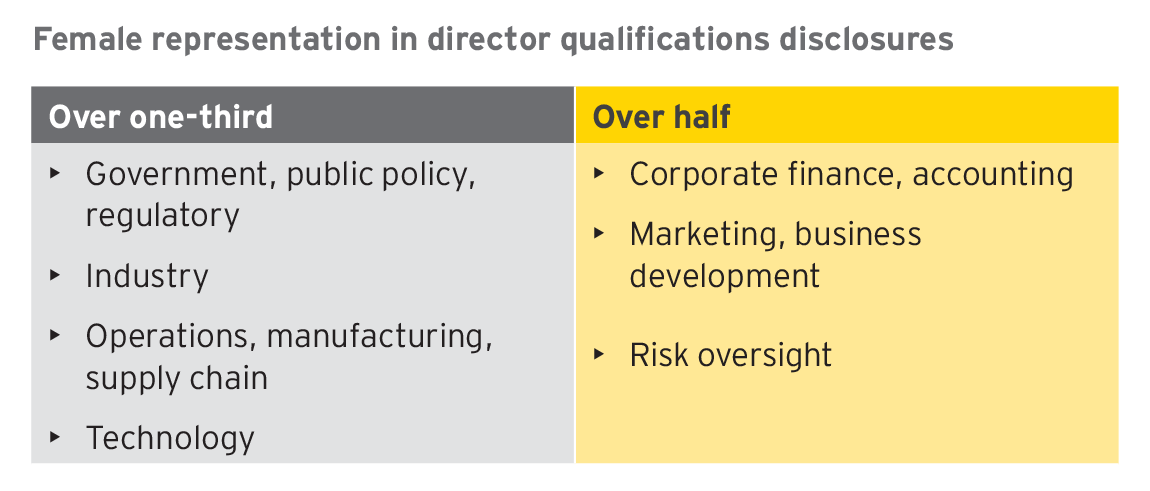
Également, l’étude montre que les femmes administratrices sont plus qualifiées que les hommes dans plusieurs types de compétences.

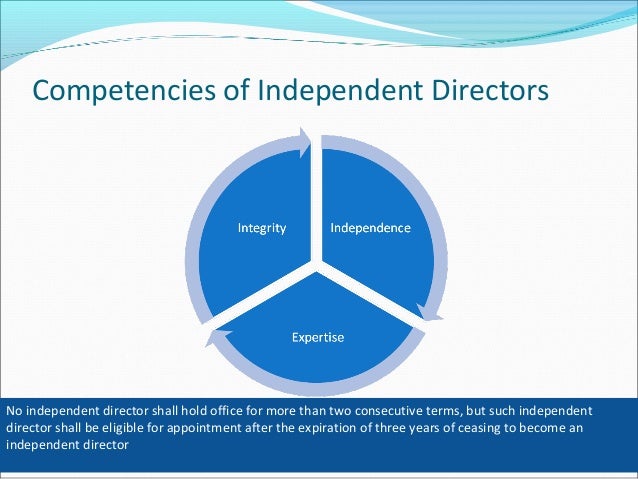
Résultats de recherche d'images pour « compétences des administrateurs »

Enfin, les entreprises qui ont une plus grande diversité de compétences sont plus susceptibles de divulguer leurs politiques de risques concernant la gouvernance, les aspects sociaux et les considérations environnementales (ESG).

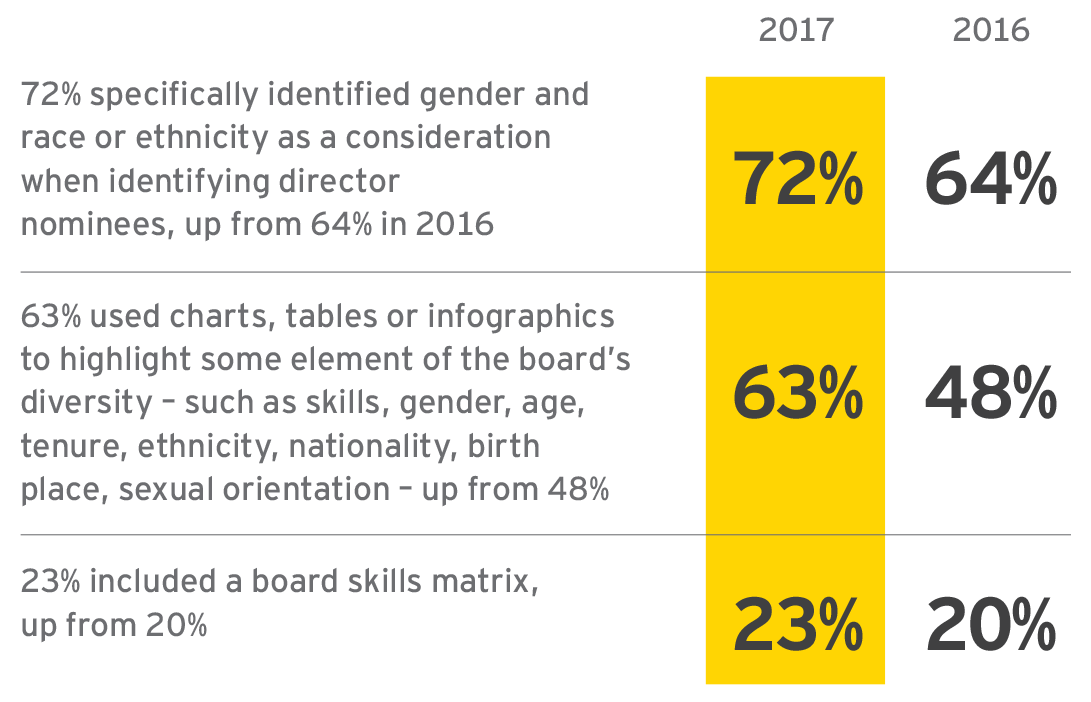
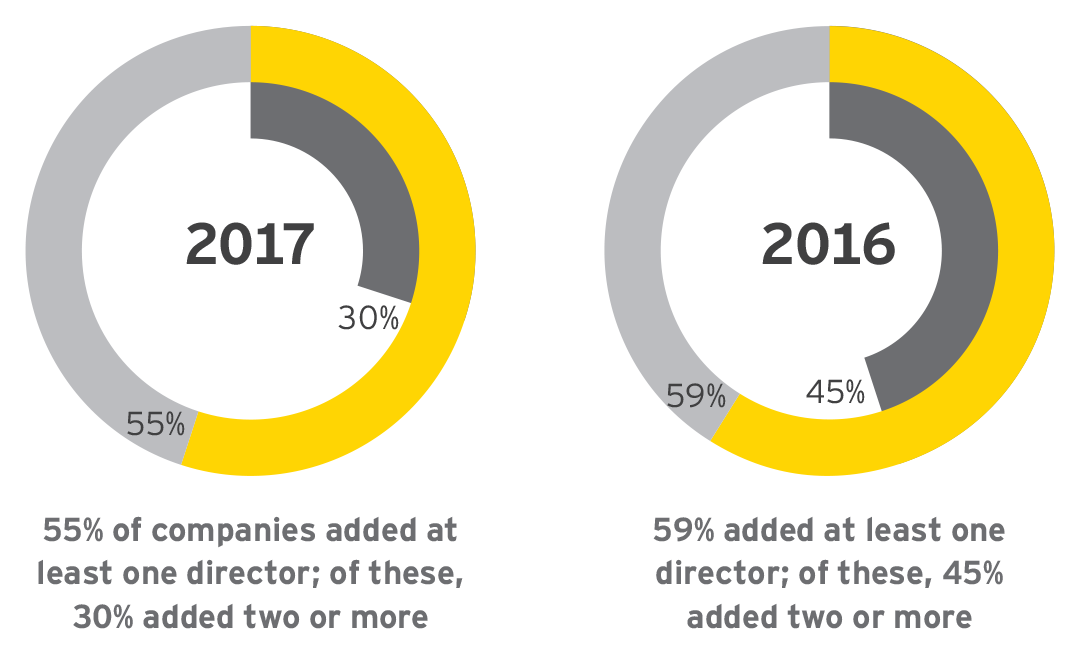
L’auteur résume les caractéristiques d’une matrice des compétences jugée efficace. L’article comporte également plusieurs illustrations assez explicites.


A matrix that does more than “check the box”: The NYC Fund’s Boardroom Accountability Project 2.0 has focused on having companies disclose a “matrix” of skills, as well as race and gender, of the directors. The Project has a “compendium of best practices” that provides examples of the formats and details that are considered within the scope disclosure best-practices. With regard to race and gender, some of the examples disclosed gender and racial information in aggregate format while others listed the race and gender for each board member. With regard to skills, some companies simply listed the skills of each nominee; some provided a brief description of the underlying qualifications for the skill; some also broke out the director’s biography categorically based on the identified skills; the best examples also highlighted the relevance of the particular skill in the context of the company’s business.

Standardized skill disclosure: There is guidance for what constitutes a financial expert for Sarbanes-Oxley compliance. While being a former or current CEO is straightforward answer for whether a director has that skill, something like technology is much less clear. Would working at a company in the information technology sector suffice? Does the director need to be a Chief Technology officer? Setting market standards would reduce the uncertainty and expense for each company to take on the responsibility individually and would also increase investor confidence in analyzing a board based on skills.

Skills mapped to specific responsibilities: The analysis shows that having a particular skill on the board will reduce ESG risks. However, a more in-depth assessment would also consider the skills that exist on the board’s committees and map those skills to the responsibilities of key committees. For example, if the board gives the audit committee oversight of cybersecurity, has the board included any audit committee members that have technology or risk management experience?

Bonne lecture !


Director Skills: Diversity of Thought and Experience in the Boardroom


Indice de diversité de genre | Equilar


Voici le dernier rapport de l’indice de diversité de genre (GDI) publié par Amit Batish, de la firme-conseil Equilar Inc.

Le texte est très explicite et abondamment illustré.

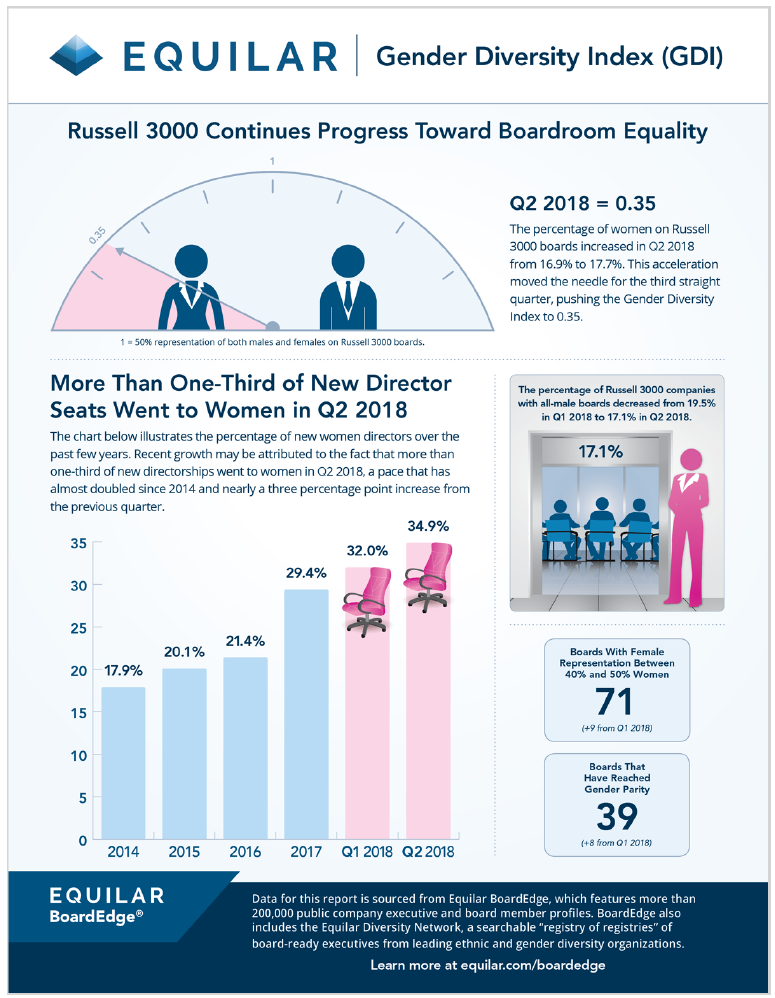
Dans l’ensemble, le pourcentage de femmes siégeant à des conseils d’administration du Russell 3000 est passé de 16,9 % à 17,7 % entre le 31 mars et le 30 juin 2018.

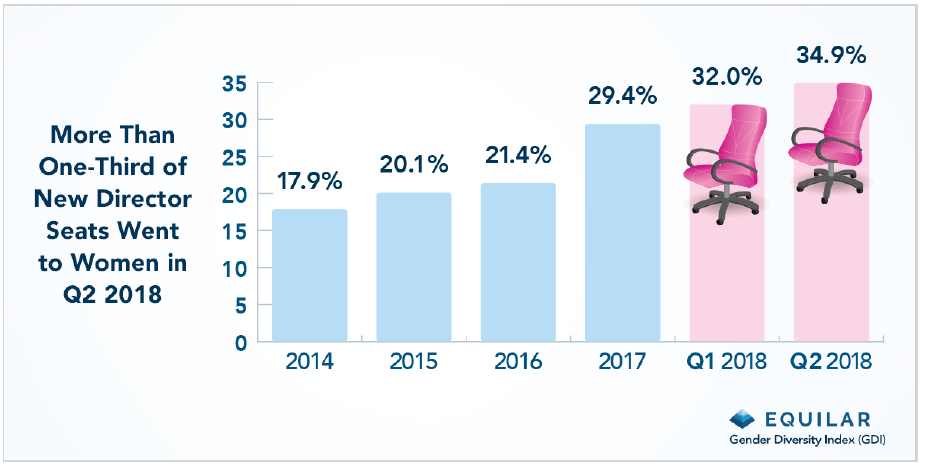
Durant la même période, plus du tiers des postes d’administrateurs ont été pourvus par des femmes.

Bonne lecture !


For a third consecutive quarter, the Equilar Gender Diversity Index (GDI) increased. The percentage of women on Russell 3000 boards increased from 16.9% to 17.7% between March 31 and June 30, 2018. This acceleration moved the needle, pushing the GDI to 0.35, where 1.0 represents parity among men and women on corporate boards.

One of the primary drivers of this steady GDI increase is the number of new directorships that have gone to women over the last few quarters. The chart below illustrates a consistent pace of growth of female directorships. In Q2 2018, more than one-third of new directorships went to women—this is a near three percentage point increase from the previous quarter and a pace that has almost doubled since 2014.


“In the first half of 2018 over 30% of newly-elected directors were women, which we believe indicates that companies are changing their approach to diversity,” said Brigid Rosati, Director of Business Development at Georgeson.

“It seems that companies are beginning to better understand the benefits that a more diverse board can bring, but are also in some cases responding to signs of increased interest from investors, including in the way they vote in director elections.”


In Q1 2018 the percentage of all male Russell 3000 boards fell to 19.5%, the first time ever that this figure sat below 20%. That figure continued to dip in Q2 2018, falling to 17.1%—a 2.4 percentage point drop. This data is certainly a promising sign that boards are making a concerted effort to promote diversity in the boardroom and that male-dominant boardrooms are becoming less prevalent. However, this is still a relatively sizable figure that indicates possible hurdles do indeed remain.

“Progress on diversity continues to be slow but it is continuing to move for the most part,” said Susan Angele, Senior Advisor of Board Governance at KPMG’s Board Leadership Center.

“Depending on the board’s own network, it may take a larger investment of time and effort to find the right person to add diversity as well as skill set, and having a diversity champion on the board driving the search may make a difference.”


Pressure Begins to Mount From Investors and Lawmakers


One of the many reasons that boards have lagged progress on the topic of diversity is that historically, there has been little pressure from investors or other key stakeholders to regularly advocate for such initiatives.

However, over the last year or so, gender diversity has become an area of focus across corporate America. There have been numerous efforts from various sources including institutional investors, regulators and lawmakers. In the Q1 2018 GDI report, Equilar cited 2017 as being banner year for shareholder engagement around gender diversity on boards, beginning with State Street’s “Fearless Girl” statue of a young woman facing o with the Wall Street Bull to bring awareness to gender diversity.

The gesture won a major advertising award, but State Street also voted against hundreds of directors on boards that did not have women. Subsequently, BlackRock voted in favor of several shareholder proposals that requested more disclosure around diversity in 2017, and earlier in 2018, sent letters to all Russell 1000 companies that had fewer than two women on their boards.

“In addition to investor focus, I see a confluence of events that should play out over time,” said Angele.

“The changes in the business environment and expectations on boards—including technological disruption, competition coming from outside the industry, changing demographics, culture and risk—all of these forces are making it more important for the boardroom to include directors with a mix of backgrounds and experience.”

Additionally, lawmakers have begun to get more involved with issues regarding gender diversity. For instance, by August 31, 2018, California could become the first state in the nation to mandate publicly held companies that base their operations in the state to have women on their boards. The legislation—SB 826—will require public companies headquartered in California to have a minimum of one female on its board of directors by December 31, 2019. That minimum will be raised to at least two female board members for companies with five directors or at least three female board members for companies with six or more directors by December 31, 2021. Violators of this legislation will be subject to financial consequences.

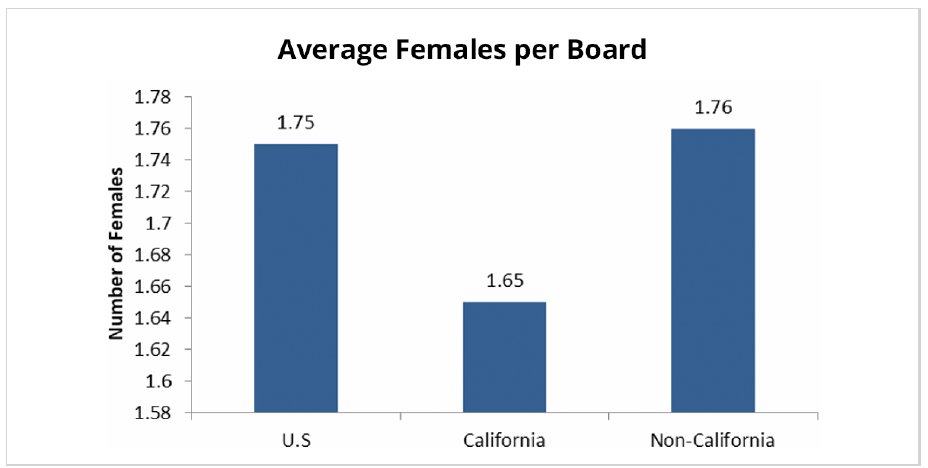
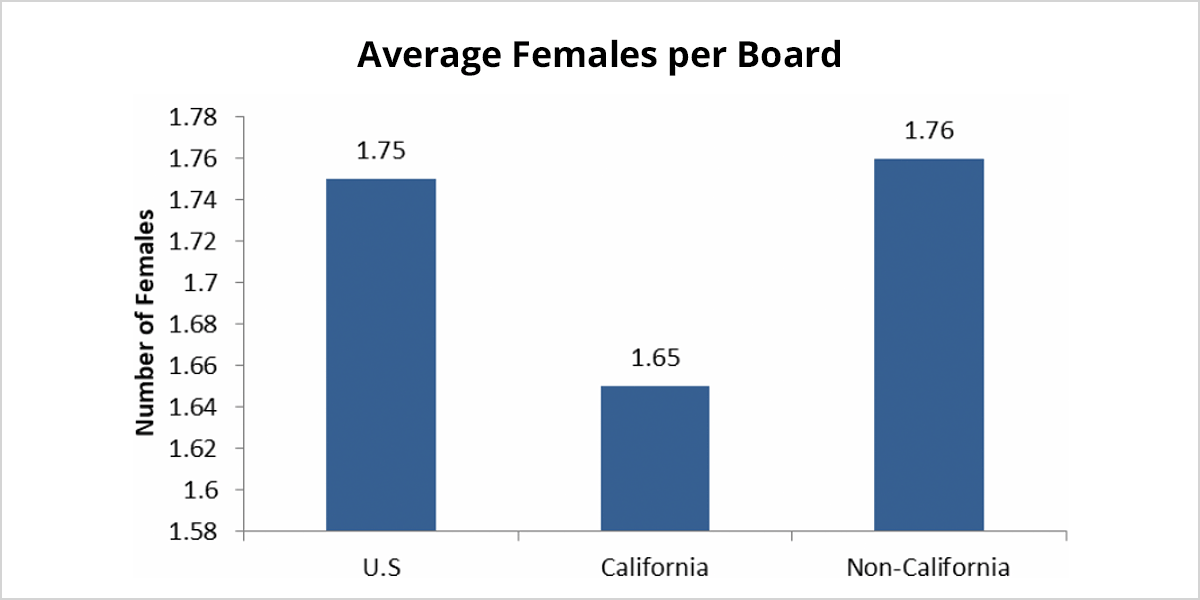
A new Equilar study examined how California fared against the United States as a whole with respect to women on boards. According to the study, California is slightly below other states and the national average in terms of average women on a board. California, on average, has 1.65 female members per board, whereas other states and the United States as a whole average 1.76 and 1.75 female members, respectively.


As legislators become more involved in matters of diversity, one might expect that progress toward greater female board representation will continue. The last few quarters alone have shown signs of progress, and this is before any significant quotas had been put in place. It would come as no surprise that the number of boards achieving parity continues to increase year-over-year following implementation of gender quotas across the nation.

Boards That Have Reached Parity Are Becoming More Prevalent


In combination of numerous factors, some previously mentioned in this article, since the inception of the GDI study, the number of Russell 3000 boards that achieved gender parity has steadily increased in most quarters. The Q2 2018 GDI revealed the largest quarter-over-quarter increase in the number of boards that have achieved parity to date, reaching 39—an increase of eight from the previous quarter and a spike of 18 from the end of 2016. The list of boards at parity is at the bottom of this article.

The number of boards that have between 40% and 50% is rising regularly as well. Collectively, 71 boards now have at least 40% women, up from 62 in the previous quarter.

“Several large institutional investors updated their proxy voting policies in 2018, which we think could continue to drive change beyond the significant progress we saw in the first half of 2018,” said Rosati. “Beyond this, we believe that continued media coverage and scrutiny means that we will see continued pressure from investors towards companies with zero women on their boards.”

___________________________________________________________________________

About Equilar Gender Diversity Index

The Equilar GDI reflects changes on Russell 3000 boards on a quarterly basis as cited in 8-K lings to the SEC. Most indices that track information about board diversity do so annually or even less frequently, and typically with a smaller sample size, sometimes looking back more than a full year by the time the information is published. While this data is reliable and accurate, the Equilar GDI aims to capture the influence of the increasing calls for diversity from investors and other stakeholders in real time.

L’âge des nouveaux administrateurs est une variable de diversité trop souvent négligée dans la composition des CA !


Lorsque l’on parle de diversité au sein des conseils d’administration, on se réfère, la plupart du temps, à la composition du CA sur la base des genres et des origines ethniques.

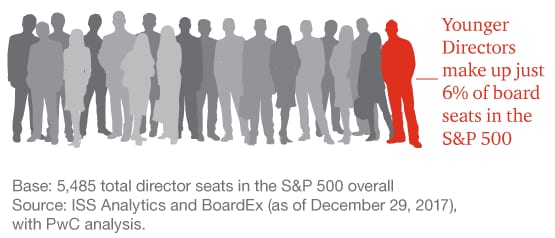
L’âge des nouveaux administrateurs est une variable de diversité trop souvent négligée de la composition des CA. Dans cette enquête complète de PwC, les auteurs mettent l’accent sur les caractéristiques des administrateurs qui ont moins de 50 ans et qui servent sur les CA du S&P 500.

Cette étude de PwC est basée sur des données statistiques objectives provenant de diverses sources de divulgation des grandes entreprises américaines.

En consultant la table des matières du rapport, on constate que l’étude vise à répondre aux questions suivantes :


(1) Quelle est la population des jeunes administrateurs sur les CA du S&P 500 ?

Ils sont peu nombreux, et ils ne sont pas trop jeunes !

Ils ont été nommés récemment

Les femmes font une entrée remarquable, mais pas dans tous les groupes…


(2) Qu’y a-t-il de particulier à propos des « jeunes administrateurs » ?

96 % occupent des emplois comme hauts dirigeants, 31 % des jeunes administrateurs indépendants sont CEO provenant d’autres entreprises,

Plus de la moitié proviennent des secteurs financiers et des technologies de l’information

Ils sont capables de concilier les exigences de leurs emplois avec celles de leurs rôles d’administrateurs

Ils sont recherchés pour leurs connaissances en finance/investissement ou pour leurs expertises en technologie

90 % des jeunes administrateurs siègent à un comité du CA et 50 % siègent à deux comités

La plupart évitent de siéger à d’autres conseils d’administration


(3) Quelles entreprises sont les plus susceptibles de nommer de jeunes administrateurs ?

Les jeunes CEO représentent une plus grande probabilité d’agir comme administrateurs indépendants

Plus de 50 % des jeunes administrateurs indépendants proviennent des secteurs des technologies de l’information, et des produits aux consommateurs

Les secteurs les moins pourvus de jeunes administrateurs sont les suivants : télécommunications, utilités, finances et immobiliers

Les plus jeunes administrateurs expérimentent des relations mutuellement bénéfiques.


La conclusion de l’étude c’est qu’il est fondamental de repenser la composition des CA en fonction de l’âge. Les conseils prodigués relatifs à l’âge sont les suivants :


Have you analyzed the age diversity on your board, or the average age of your directors?

Does your board have an updated succession plan? Does age diversity play into considerations for new board members?

Are there key areas where your board lacks current expertise—such as technology or consumer habits? Could a new—and possibly younger—board member bring this knowledge?

Does your board have post-Boomers represented?

Does your board have a range of diversity of thought—not just one or two people in the room who you look to continually for the “diversity angle”?

Could younger directors bring some needed change to the boardroom?


Notons que cette étude a été faite auprès des grandes entreprises américaines. Dans l’ensemble de la population des entreprises québécoises, la situation est assez différente, car il y a beaucoup plus de jeunes sur les conseils d’administration.

Mais, à mon avis, il y a encore de nombreux efforts à faire afin de rajeunir et renouveler nos CA.

Bonne lecture !


Board composition: Consider the value of younger directors on your board


Résultats de recherche d'images pour « Board composition: Consider the value of younger directors on your board »

Résumé des principaux résultats


There are 315 Younger Directors in the S&P 500. Together, they hold 348 board seats of companies in the index. Of these 348 Younger Director seats, 260 are filled by independent Younger Directors.

Fewer than half of S&P 500 companies have a Younger Director. Only 43% of the S&P 500 (217 companies) have at least one Younger Director on the board. At 50 of those companies, one of the Younger Directors is the company’s CEO.

S&P 500 companies with younger CEOs are much more likely to have independent Younger Directors on the board. Sixty percent (60%) of the 527 companies with a CEO aged 50 or under have at least one independent Younger
Director on the board—as compared to just 42% of companies that have a CEO over the age of 50.

Almost one-third of Younger Directors are women. Women comprise a much larger percentage (31%) of Younger Directors than in the S&P 500 overall (22%). This is in spite of the fact that over 90% of Younger Directors nominated under
shareholder agreements—such as those with an activist, private equity investor or family shareholder—are men.

Information technology and consumer products companies are more likely to have Younger Directors. The three companies in the telecommunications sector have no Younger Directors.

Close to half of the independent Younger Directors have finance/investing backgrounds. Just under one-third are cited for their technology expertise, executive experience or industry knowledge.

Younger Directors fit in board service while pursuing their careers. According to their companies’ SEC filings, 96% of Younger Directors cite active jobs or positions in addition to their board service.

Younger Directors serve on fewer boards. The average independent S&P 500 director sits on 2.1 public company boards. In contrast, independent Younger Directors sit on an average of 1.7 boards. More than half serve on only one public board.

More than half of the independent Younger Directors have held their board seat for two years or less. Only 18% have been on the board for more than five yearsé

Le point sur la future loi californienne eu égard aux quotas de femmes sur les CA


Voici un article de Tomas Pereira, analyste de recherche à Equilar Inc, publié sur le site du Harvard Law School Forum qui fait le point sur la future loi californienne eu égard aux quotas de femmes sur les CA.

L’étude présente des statistiques intéressantes sur la situation des femmes sur les CA en Californie et fait état de projections concernant l’effet des mesures. Rappelons que l’état de la Californie est le premier état qui s’aventure dans l’établissement de quotas pour favoriser la diversité sur les conseils d’administration.

La législation propose qu’une entreprise ait au moins une femme sur le CA au 31 décembre 2019,

That minimum will be raised to at least two female board members for companies with five directors or at least three female board members for companies with six or more directors by December 31, 2021.

Ainsi en 2021, les conseils d’administration devront compter au moins trois femmes sur les CA, si le nombre d’administrateurs est de six ou plus.

Bonne lecture !


Gender Quotas in California Boardrooms


Résultats de recherche d'images pour « Gender Quotas in California Boardrooms »


By August 31, 2018, California could become the first state in the nation to mandate publicly held companies that base their operations in the state to have women on their boards. The legislation—SB 826—will require public companies headquartered in California to have a minimum of one female on its board of directors by December 31, 2019. That minimum will be raised to at least two female board members for companies with five directors or at least three female board members for companies with six or more directors by December 31, 2021.

If SB 826 is passed in the Assembly and signed by Governor Jerry Brown, corporations not compliant with the new rules will be subjected to financial consequences. Strike one will be accompanied with a fine equal to the average annual cash compensation of directors. Any subsequent violation would amount to a fine equal to three times the average annual cash compensation for directors. Hence, the consequences are very real for companies that choose not to comply with the new rules.

A new study by Equilar looks at where public companies headquartered in California currently lie in relation to the proposed legislation. The study includes public companies in California that have annual revenues of $5 million or more—amounting to a total of 211 companies with an aggregate of 349 female and 1,466 male board members.


Looking broadly, California is slightly below other states and the national average in terms of average women on a board. California, on average, has 1.65 female members per board, whereas other states and the United States as a whole average 1.76 and 1.75 female members, respectively. This type of statistic is a likely factor in spurring state legislators in Sacramento to make significant changes to the status quo and place California in a leading role for board diversity in the United States.


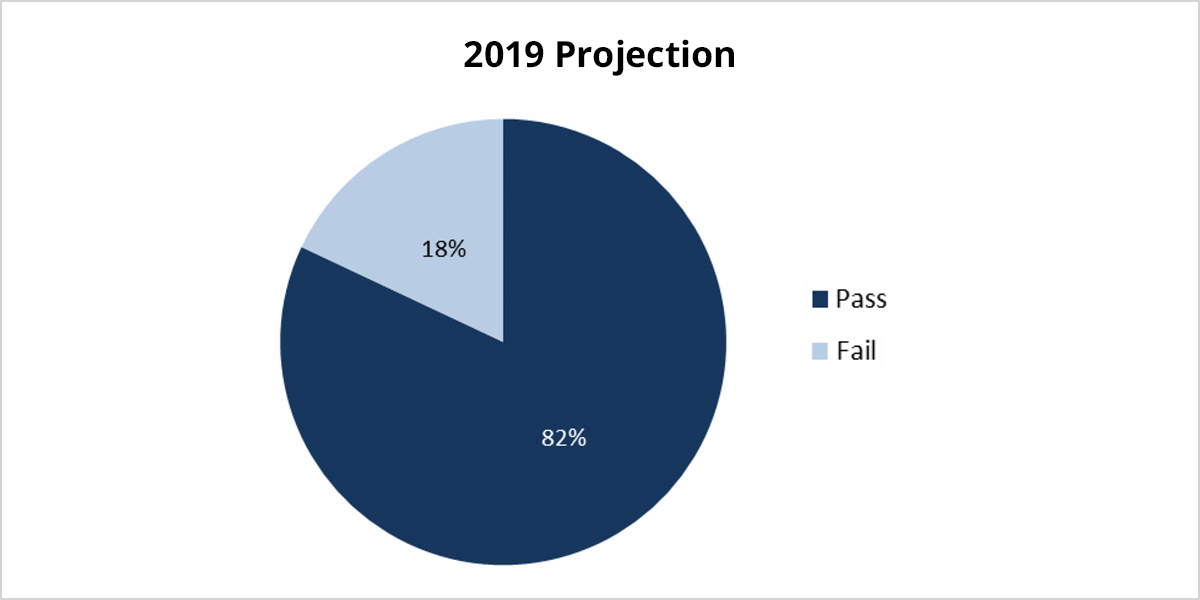
By 2019, most companies in California would be safe from any financial penalties for having an insufficient number of female board members. As it stands now, 82% of public companies in California who have annual revenues of over $5 million will meet the initial criteria, whereas 18% will not. Consequently, 37 public companies would be faced with a fine equal to the average annual director compensation for failing to comply.

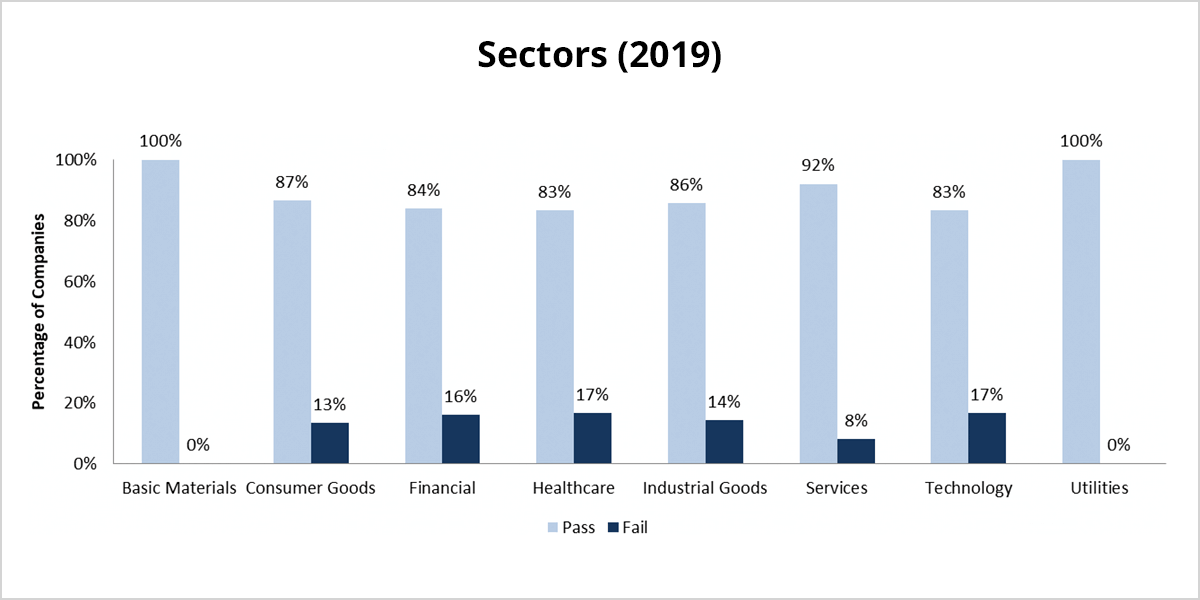
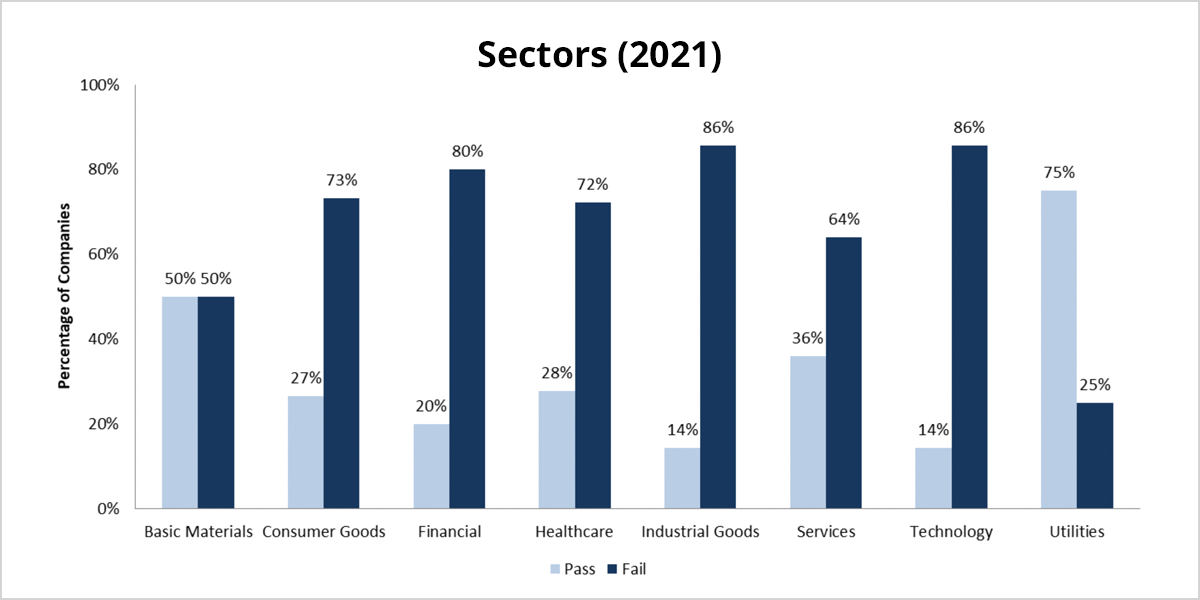
In the following table, Equilar examined the 82% success rate a bit further and broke it down by sector in order to examine which industries are driving the rates of success and failure. By 2019, the basic materials and utilities sectors in California would both have a 100% success rate. Thus, every company within these two sectors has at least one female director present on their board. The next sector with the highest rate of success is services, with 92% having at least one female member. Both the healthcare and technology sectors are tied for lowest compliance at 83% pass.


When looking at the companies that would meet the secondary December 31, 2021 criteria, the picture is much bleaker at present for public companies in California. According to the proposed legislation, the required minimum would increase to two female board members for companies with five total directors or to three female board members for companies with at least six total directors.


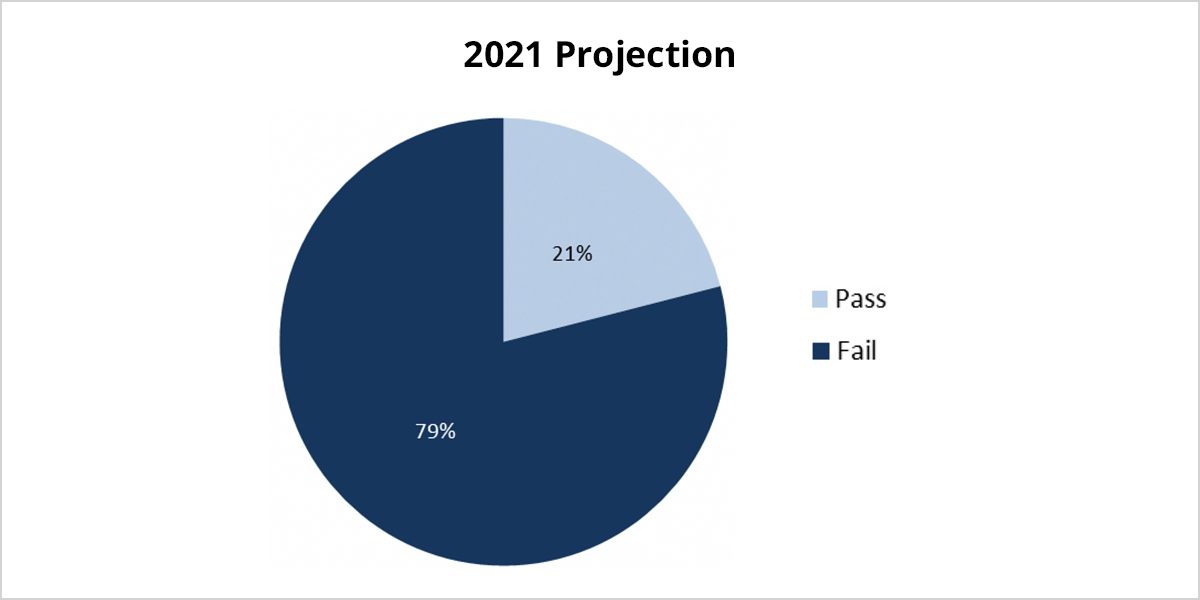
Taking that future criteria and applying it to today, 79% of public companies would fail, while only 21% would pass. The following table sees basic materials—one of the sectors with 100% company success rate with the previous 2019 criteria—fall down to a 50-50 ratio of pass to fail. The sector with the highest success rate is utilities, while the industrial goods sector has the lowest success rate at 75% and 14%, respectively.


While the path for the proposed legislation is still a bit rocky, the broader trend towards diversifying boardrooms across the country is growing. Companies should anticipate new legislation—not just SB 826—sprouting throughout more state legislatures and get ahead of this rolling tide. States like Maine, Illinois and Ohio have already begun promoting resolutions to encourage companies to diversify their boards. In addition, BlackRock and other institutional investors have publicly stated that they will expect at least two female members per board. The push towards gender diversification is well warranted. Studies by management consulting firms, such as Boston Consulting Group and McKinsey & Co., have shown that diverse boards perform better financially. Signs do point to a gradual progression towards gender parity in the boardroom, as noted by the Q1 2018 Equilar Gender Diversity Index. However, without proactive encouragement or legislation, it would take decades before a true gender balance is realized.

La place des femmes sur les CA et dans la haute direction des entreprises


Voici un rapport qui fait le point sur la place des femmes dans les CA et dans des postes de haute direction des entreprises publiques (cotées) américaines et internationales.

Cet article, publié par Subodh Mishra* directeur de Institutional Shareholder Services (ISS), est paru sur le forum du Harvad Law School on Corporate Governance, le 13 août 2018.

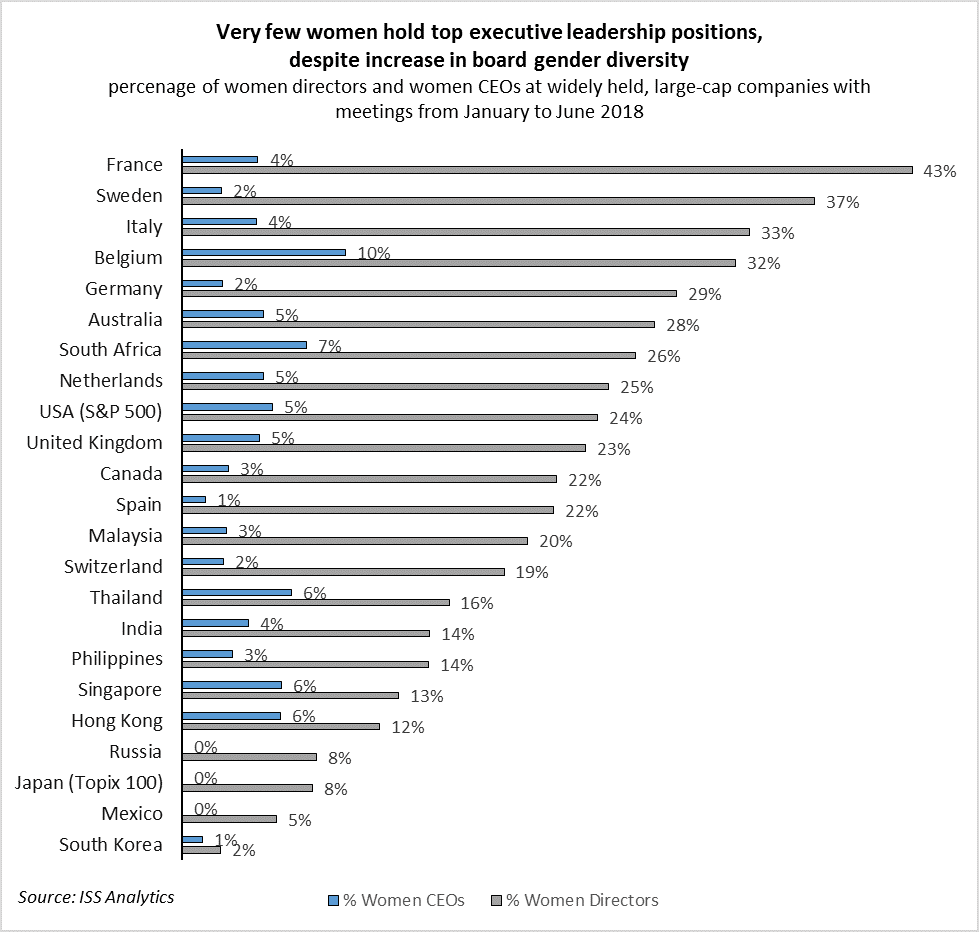
On note des progrès dans tous les domaines, mais l’évolution est encore trop lente. Eu égard à la présence des femmes sur les CA des grandes entreprises cotées, c’est la France qui remporte la palme avec 43 % de femmes sur les CA.

Les entreprises se dotent de plus en plus de politique de divulgation de la diversité sur les postes de haute direction. Le Danemark (96 %), l’Australie (91 %) et le R.U. (84 %) sont en tête de liste en ce qui concerne la présence de politique à cet égard. Les É.U. (32 %) et la Russie (22 %) ferment la marche. Le Canada est en milieu de peloton avec 63 %.

L’infographie présentée ici montre clairement les tendances dans ce domaine.

L’auteur identifie les cinq pratiques émergentes les plus significatives pour mettre en œuvre une politique de diversité exemplaire.

(1) Address subtle or unconscious bias.

Cultivating a strong culture free of subtle or unconscious bias is a fundamental step towards an inclusive work environment. A meta-analysis by the Harvard Business Review finds that subtle discrimination has as negative effects, if not more negative, than overt discrimination, as it can drain emotional and cognitive resources, it can accumulate quickly, and is difficult to address through legal recourse. The researchers suggest that structured processes and procedures around hiring, assignments, and business decisions limit the opportunity for unconscious bias to creep in. In addition, they suggest training programs and practicing techniques, such as mindfulness, to reduce bias.

(2) Establish clear diversity targets and measure progress towards goals.

Most companies with gender diversity strategies set clear, measurable targets. BP has set a goal of women representing at least 25 percent of its group leaders by 2020, while Symantecaims at having 30 percent of leadership roles occupied by women by the same year. This approach allows firms to focus on concrete performance results, while also creating a framework of accountability in the company’s gender diversity and inclusion program.

(3) Focus on key roles and redefine the path to leadership.

True meritocracy should determine the criteria for leadership roles. However, companies should recognize that there may be multiple paths to the CEO position, and should focus on their efforts on roles that lead to those paths. Women CEOs Speak, A Korn Ferry Institute study supported by the Rockefeller Foundation, identifies four different career approaches for women to prepare for the CEO role. However, the study identifies early assumption of profit-and-loss responsibilities in all four paths as a crucial experience leading to top positions.

(4) Establish mentorship and sponsorship programs.

Training and development programs within the organization can help facilitate mentorships and sponsorships, which are crucial in career development. GM’s Diversity and Inclusion Report explains how its Executive Leadership Program aims at creating a support network of female leaders, as well as training and development sessions hosted by female executives. Mentors can support employees earlier in their career with coaching and advice, while sponsors take a more active role later in one’s career to promote the individual. Gender should obviously not constitute a barrier for such mentorships and sponsorships, and organizations should take active steps to encourage such relationships across genders and remove any hesitations or biases.

(5) Provide flexibility and support towards work-life balance.

Top executive assignments often involve significant time commitments and travel that can impact an executive’s family life. In a New York Times news analysis, former McDonald’s executive Janice Fields, identified her choice not to work overseas as a handicap to becoming the CEO. Making accommodations in relation family, including both children and spouses, can remove some significant hurdles for women.


Women in the C-Suite: The Next Frontier in Gender Diversity


Résultats de recherche d'images pour « Women in the C-Suite: The Next Frontier in Gender Diversity »


Despite recent advances in female board participation globally, gender diversity among top executives remains disappointingly low across all markets, with some improvement discerned in the past few years. Moreover, there does not appear a correlation between board gender diversity and gender diversity in the C-Suite at the market level. Some of the markets that have implemented gender quotas on boards and have achieved the highest rates of female board participation, such as France, Sweden, and Germany, appear to have embarrassingly low rates of female top executives. In fact, many of the markets with progressive board diversity policies have lower gender diversity levels in executive positions compared to several emerging markets like South Africa, Singapore, and Thailand. Thus, achieving higher rates of gender diversity in the C-Suite will require deeper cultural shifts within organizations in order to overcome potential biases and hurdles to gender equality.

The number of female top executives remains low


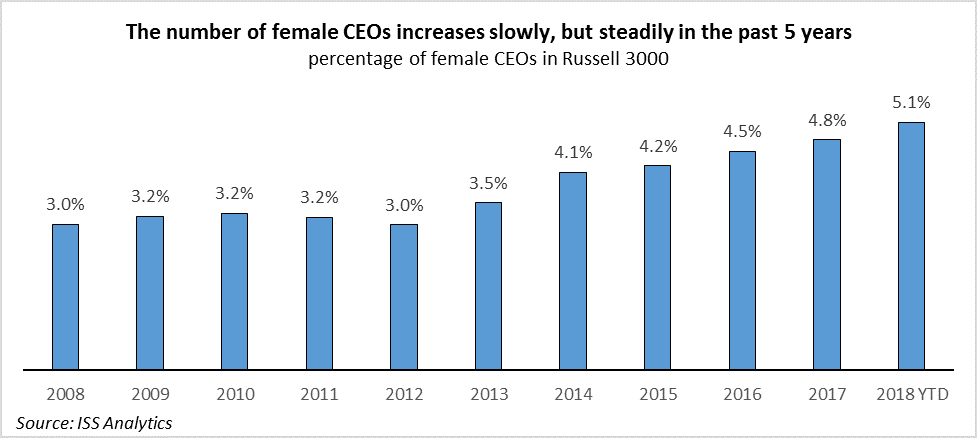
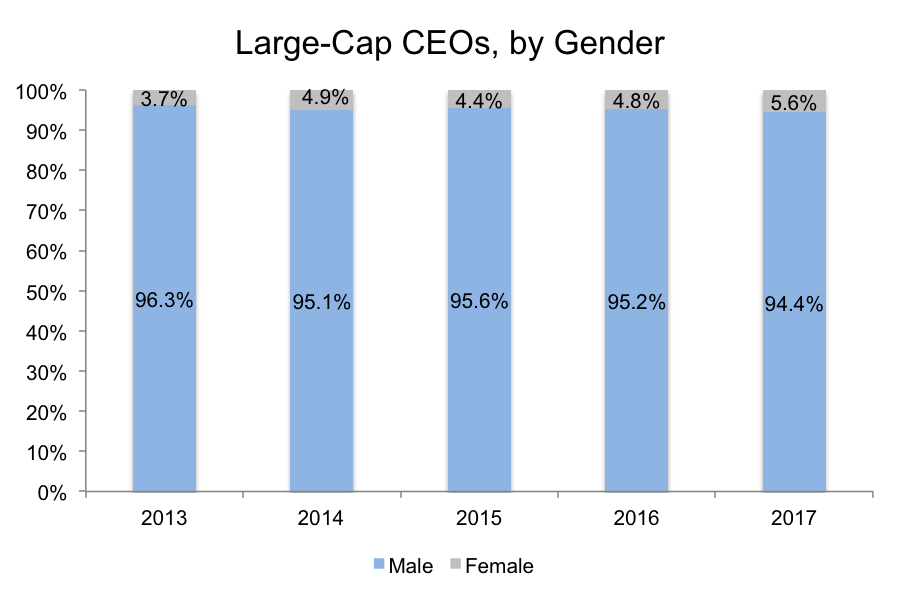
In the past decade, gender quotas, policy initiatives, and—more recently—investor pressure have led to boards improving female board participation in Europe and North America significantly. The percentage of female directors in the Russell 3000 increased from 10 percent in 2008 to 18 percent in 2018, with most of the increase taking place since 2013. Similarly, the percentage of female directors in ISS’s core universe of widely-held European firms more than tripled from 8 percent in 2008 to 27 percent in 2018. While the recent push by policymakers, investors, and advocacy groups for greater gender diversity has primarily focused on board positions, the discussion is beginning to evolve to encompass diversity in all leadership roles, including top management. In the United States, we have observed small but significant changes in the gender composition of the C-Suite over the past five years. Since 2012, the Russell 3000 has seen a 70-percent increase in the number of female CEOs. Despite the relative increase, the number of top female executives remains disappointingly low, with only 5 percent of Russell 3000 companies having a female CEO in 2018.


Companies need to develop the pipeline of female executive leaders


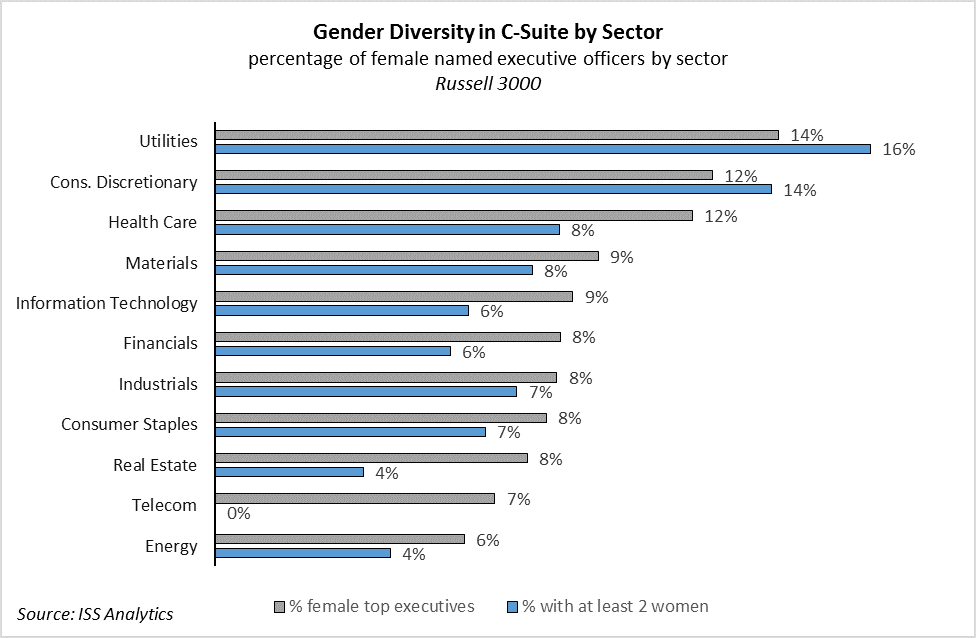
The scarcity of female CEOs does not appear surprising, especially after taking a closer look at the rest of the members of the C-Suite, who often comprise the primary candidates in line for succession for the top job. These roles include the Chief Operating Officer, the Chief Financial Officer, and the Head of Sales, among others. Only 9 percent of top executive positions in the Russell 3000 are filled by women, which means that companies have a long way to go towards building gender equity within the top ranks where the next generation of CEOs are cultivated. Certain sectors lag considerably more than others, with Real Estate, Telecommunications and Energy exhibiting the lowest rates of female named executive officers.


Within the C-Suite, gender differentiation persists in terms of executive roles


The picture seems even bleaker for the future of gender parity at the CEO level when examining the types of roles that female top executives currently occupy within their organizations. Female executives appear scarcer at roles with profit-and-loss responsibilities that often serve as stepping stones to the CEO role, such as COO, Head of Sales, or CEOs of business units and subsidiary groups. Meanwhile, women are more highly concentrated in positions that rarely see a promotion to the top job, such as Human Resources Officer, General Counsel, and Chief Administrative Officer.


Not surprisingly, and in conjunction with the disparity in functions described above, women who belong to the group of the five highest paid executive officers in their organization, are far more likely to rank fourth or fifth in pay rank compared to their male counterparts. Approximately 46 percent of women in the top five positions rank either fourth or fifth in pay, compared to 33 percent of male top five executives in these pay rankings.


Breaking down barriers to gender diversity in the C-Suite


Companies can take a number steps to foster gender diversity in their executive leadership, and to remove biases or potential obstacles to an inclusive management environment. Many companies have identified gender diversity in leadership positions as a key priority, and have established gender diversity strategies to achieve specific goals. While workforce diversity policies appear to become the standard across most markets, gender diversity policies at the senior management level are common only in some markets. According to ISS Environmental & Social QualityScore data, the majority of companies in developed European markets and Canada disclose gender diversity policies for senior managers. The practice has not been widely established United States, where 32 percent of the S&P 500 and only 4 percent of the remaining Russell 3000 disclose such policies.


Several companies and advocacy groups identify gender diversity and inclusion as a major driver for talent acquisition and performance. The recognition of the absence of women in top executive roles has sparked several initiatives that seek to promote inclusivity in the workplace. The Rockefeller Foundation’s 100×25 advocacy initiative aims at bringing more women to the C-Suite, with the explicit goal of having 100 Fortune 500 female CEOs by 2025. Meanwhile, Paradigm for Parity was formed by a coalition of business leaders (CEOs, founders, and board members), and set the goal of achieving full gender parity by 2030. The group has created a 5-point action plan to help companies accelerate their progress.

Based on the work of these initiatives and actual programs disclosed by companies, we identify five of the emerging best practices that companies adopt to address gender diversity in leadership roles.

Address subtle or unconscious bias. Cultivating a strong culture free of subtle or unconscious bias is a fundamental step towards an inclusive work environment. A meta-analysis by the Harvard Business Review finds that subtle discrimination has as negative effects, if not more negative, than overt discrimination, as it can drain emotional and cognitive resources, it can accumulate quickly, and is difficult to address through legal recourse. The researchers suggest that structured processes and procedures around hiring, assignments, and business decisions limit the opportunity for unconscious bias to creep in. In addition, they suggest training programs and practicing techniques, such as mindfulness, to reduce bias.

Establish clear diversity targets and measure progress towards goals. Most companies with gender diversity strategies set clear, measurable targets. BP has set a goal of women representing at least 25 percent of its group leaders by 2020, while Symantecaims at having 30 percent of leadership roles occupied by women by the same year. This approach allows firms to focus on concrete performance results, while also creating a framework of accountability in the company’s gender diversity and inclusion program.

Focus on key roles and redefine the path to leadership. True meritocracy should determine the criteria for leadership roles. However, companies should recognize that there may be multiple paths to the CEO position, and should focus on their efforts on roles that lead to those paths. Women CEOs Speak, A Korn Ferry Institute study supported by the Rockefeller Foundation, identifies four different career approaches for women to prepare for the CEO role. However, the study identifies early assumption of profit-and-loss responsibilities in all four paths as a crucial experience leading to top positions.

Establish mentorship and sponsorship programs. Training and development programs within the organization can help facilitate mentorships and sponsorships, which are crucial in career development. GM’s Diversity and Inclusion Report explains how its Executive Leadership Program aims at creating a support network of female leaders, as well as training and development sessions hosted by female executives. Mentors can support employees earlier in their career with coaching and advice, while sponsors take a more active role later in one’s career to promote the individual. Gender should obviously not constitute a barrier for such mentorships and sponsorships, and organizations should take active steps to encourage such relationships across genders and remove any hesitations or biases.

Provide flexibility and support towards work-life balance. Top executive assignments often involve significant time commitments and travel that can impact an executive’s family life. In a New York Times news analysis, former McDonald’s executive Janice Fields, identified her choice not to work overseas as a handicap to becoming the CEO. Making accommodations in relation family, including both children and spouses, can remove some significant hurdles for women.

_________________________________________________________________

*Subodh Mishra is Executive Director at Institutional Shareholder Services, Inc. This post is based on an ISS Analytics publication by Kosmas Papadopoulos, Managing Editor at ISS Analytics.

La nouvelle loi californienne | Instauration de quotas pour accélérer la diversité sur les CA


Aujourd’hui, je souhaite vous familiariser avec la réalité de la nouvelle loi californienne eu égard à la mise en place de quotas pour accélérer la diversité sur les conseils d’administration.

Cet article paru sur le site de Harvard Law School Forum on Corporate Governance, par David A. Katz et Laura A. McIntosh, associés à la firme Wachtell, Lipton, Rosen & Katz, explique le contexte menant à la nouvelle législation californienne.

La Californie se distingue par l’originalité et par le caractère affirmatif de sa loi sur la composition des conseils d’administration. Bien entendu, cette loi a ses détracteurs, notamment les chambres de commerce qui redoutent les impacts négatifs de la loi pour les plus petites entreprises qui ont des CA composés essentiellement d’hommes !

Mais, il faut noter que l’état de la Californie est le seul état américain à avoir légiféré sur la diversité des membres de conseils d’administration en proposant des mesures qui s’apparentent aux quotas imposés par plusieurs pays européens.

Voici un extrait de l’article qui résume assez bien le contenu de cette loi.

Bonne lecture ! Vos commentaires sont les bienvenus.


The bill that passed the California State Senate at the end of May 2018 would, if enacted, require any public company with shares listed on a major U.S. stock exchange that has its principal executive offices in California to have at least one woman on its board by December 31, 2019. By year-end 2021, such companies with five directors would be required to have two women on the board, and companies with six or more directors would be required to have three women on the board.


Résultats de recherche d'images pour « California Bill gender diversity and Quotas »


California has made headlines this summer with legislative action toward instituting gender quotas for boards of directors of public companies headquartered in the state. The legislation has passed the state senate; to be enacted, it must be passed by the California state assembly and signed by the governor. In 2013, California became the first state to pass a precatory resolution promoting gender diversity on public company boards, and five other states have since followed suit. The current legislative effort has come under criticism for a variety of reasons, and, while it is not certain to become law, it could be a harbinger of a broader push for public company board gender quotas in the United States. It is worth considering whether quotas in this area would be beneficial or harmful to the larger goals of gender parity and board diversity.


The California Bill


The bill that passed the California State Senate at the end of May 2018 would, if enacted, require any public company with shares listed on a major U.S. stock exchange that has its principal executive offices in California to have at least one woman on its board by December 31, 2019. By year-end 2021, such companies with five directors would be required to have two women on the board, and companies with six or more directors would be required to have three women on the board.

Section 1 of the California bill (SB 826) presents an argument in favor of establishing gender quotas: More women directors would be beneficial to California’s economy in various ways, yet progress toward gender parity is too slow. The bill cites studies indicating that companies perform better with women on their boards and observes that other countries have used quotas to achieve 30 percent to 40 percent representation. The bill notes that, of California public companies in the Russell 3000 as of June 2017, 26 percent had no women on their boards, while women composed 15.5 percent of directors on boards that have at least one woman. The bill cites further studies showing that, at current rates, it could take approximately four decades to achieve gender parity on boards. And finally, Section 1 of the bill concludes by citing studies suggesting that having at least three women directors increases board effectiveness.

The Opposing View


The California bill has been controversial. The California Chamber of Commerce filed an opposition letter on behalf of numerous organizations arguing that the bill would violate state and federal constitutions and conflict with existing California civil rights law, on the basis that it requires a person to be promoted—and another person disqualified—simply on the basis of gender. California legislators dispute that the bill requires men to be displaced by women, noting that boards can simply increase their size. This may be easier said than done, however: Because the required quota increases with board size, a company with a four-man board that did not wish to force out a current director would need to add three women to accommodate the requirements of the law by 2021. Suddenly expanding from four to seven would entail a very significant change to board dynamics. For a previously well-functioning board, the negative effects of a change that dramatic could outweigh the benefits of gender diversity.

Further, the bill’s opponents argue that prioritizing only one element of diversity would be suboptimal, especially at time when many California companies are engaged in addressing and increasing diversity by focusing on all classifications of diversity. Advocates for greater representation of ethnic minority groups on boards have expressed concerns that prioritizing gender will be detrimental to progress toward greater ethnic diversity. For purposes of increasing overall diversity, quotas are not a solution that can be applied broadly; if quotas such as those in the California bill were established not only for gender but for ethnic and other categories of diversity, the project of board composition would soon become a near-impossible logic and recruitment puzzle, as nominating committees struggled to meet mandated quotas, expertise needs, and director independence requirements, all within the board size parameters set forth in the company’s organizing documents. Board functioning and effectiveness would be severely compromised by the legislative micromanaging of board composition.

Thanks to the establishment of quotas in various European countries over the past 15 years, there is evidence as to the effect of gender quotas for boards. A 2018 Economist study found that, despite high expectations, the effects of quotas were, in some ways, disappointing. According to the Economist, greater numbers of women on boards did not necessarily produce better performance or decision-making, nor was there a trickle-down effect of boosting women’s progress to senior management jobs.

On the other hand, fears about unqualified women being put on boards, or a few qualified women being overboarded, also did not materialize. While there is a great deal of evidence showing that having women directors does produce more effective boards—and there are even indications in Europe that diverse boards are less likely to be targeted by shareholder activists—the Economist study shows that diversity achieved through government-imposed quotas may not be as beneficial as diversity achieved through private-ordering efforts.

The Big Picture


Progress toward gender diversity in the board room is accelerating. In the first fiscal quarter of 2018, nearly one-third of new directorships in the Russell 3000 went to women, and for the first time, fewer than 20 percent of companies in that index had all-male boards. Institutional investors, corporate governance activists, and many large companies have been at the forefront of this progress. State Street and BlackRock have been leaders on this issue in the United States. Similarly, in the UK—a country that has made significant efforts to improve gender diversity on boards while also resisting the imposition of quotas—the large investment funds Legal & General Investment Management and Standard Life Aberdeen Plc have said that they will vote against boards that are composed of less than 25 percent or 20 percent women, respectively. British institutional investor Hermes has said that it expects boards to include at minimum 30 percent women, and it led a failed opposition to the reelection of the chairman of mining group Rio Tinto Plc due to lack of diversity on the board. Given the effectiveness of recent efforts by the private sector, and in light of the intense resistance to quotas in the business community, government intervention to establish quotas may be unnecessary as well as undesirable.

Recent research shows that simply adding women to boards does not necessarily improve board performance. As common sense would suggest, it turns out that to be a positive factor, the gender composition of the board must be considered along with the skills and knowledge of the board as a whole in the context of the organization and its stakeholders. A 2017 academic study indicated that the “right” level of gender diversity may be proportionate to the number of female stakeholders—employees, clients, and suppliers, for example—and may vary across countries and cultures. In certain circumstances, the appropriate gender diversity ratio might well be over 50 percent women. The authors of the study caution against selecting directors based on quotas if, in so doing, gender diversity is prioritized over the expertise needs of the board.

Overall board diversity, including gender and ethnic minorities, has never been higher. According to a comprehensive 2018 study by James Drury Partners, overall board diversity is now at 34 percent for America’s 651 largest corporations, as measured by revenue and market capitalization. The level of board diversity is increasing, as 49 percent of the 449 newly elected directors at these companies represent diverse groups. Of particular note, the study revealed that the diversity distribution of the 6,225 directors currently serving on the boards of these companies corresponds very closely to the diversity of the population in the executive ranks of 222 companies studied by McKinsey & Co. and LeanIn.org. While there clearly is more room for progress toward greater diversity at both the executive and board levels, this data point shows that boardrooms are indeed mirroring the increasingly diverse leadership of U.S. business.

The benefit of mandatory quotas, as the business community has seen through European examples, is that they compel companies and shareholders to focus on board composition and to establish more formal recruitment processes in order to find the necessary directors. Such developments are certainly beneficial. That said, boards can and should focus on composition and recruitment in the absence of quotas, and indeed they are doing so to a greater extent than ever before. Proponents of gender diversity can be heartened by recent developments in the United States, as organic and market-driven efforts have produced results that increase the business community’s enthusiasm for diverse boards. A real danger of legislation like the California bill is that context-free quotas may have the effect of destabilizing boards and undermining the business case for increased gender diversity. Were that to occur, then not only boards themselves, but stakeholders, the business community, and the larger societal goals of gender parity and board diversity would suffer as well.

_______________________________________________________________

*David A. Katz is partner and Laura A. McIntosh is consulting attorney at Wachtell, Lipton, Rosen & Katz. This post is based on a Wachtell Lipton memorandum by Mr. Katz and Ms. McIntosh that originally appeared in the New York Law Journal.

Les fonds activistes accusés d’hypocrisie !


Il y a une pléthore d’arguments qui circulent dans la littérature sur la gouvernance et qui concernent les pour et contre des fonds activistes eu égard aux avantages pour les actionnaires.
Voici un article publié par Kai Haakon E. Liekefett*, président de Shareholder Activism Defense Team, paru dans récemment dans ethicalboardroom.
L’auteur tente de montrer l’hypocrisie des fonds activistes de type « edge fund » eu égard aux points suivants :

1. Undermining the shareholder franchise

2. Weakening board independence and diversity

– Overboarding

– Director tenure

– Mandatory retirement age

3. Inconsistency on takeover defences


The hypocrisy of hedge fund activists


In virtually every activism campaign, hedge fund activists don the mantle of the shareholders’ champion and accuse the target company’s board and management of subpar corporate governance.

This claim to having ‘best practices of corporate governance’ at heart is hollow – even hypocritical – as evidenced by at least three examples: hedge fund activists actually undermine the shareholder franchise, they weaken the independence and diversity of the board, and they waffle on their anti-takeover protection stance.


1. Undermining the shareholder franchise


Shareholders have a significant interest in maintaining their franchise: the right to elect directors, approve significant transactions such as a merger or the sale of all or a substantial part of the assets, or amend the charter of a corporation. Hedge fund activists promote themselves as ferocious proponents of this franchise and of ‘shareholder democracy’. In their campaigns, they demand shareholder votes on any matter that allegedly touches on shareholder rights, including areas where corporate law and the bylaws bestow authority on the board.

Yet, in most activism situations, activists seek to influence board decisions and obtain board seats through private settlement negotiations. The price of peace for the corporation is often accepting the addition of one or more activist representatives to the board to avoid the cost and disruption of a proxy contest. Notably, hedge fund activists will accuse directors of  ‘entrenchment’ if a board does not settle and instead opts to let the shareholders decide at the ballot box. This practice of entering into private settlements to appoint directors without a shareholder vote is, of course, directly contrary to the shareholder franchise. For this reason, major institutional investors have called publicly on companies to engage with a broader base of shareholders prior to settling with an activist.

In the same vein, activists habitually accuse directors of ‘disenfranchising shareholders’ when they refresh the board in the face of an activist campaign, arguing that a board must not appoint new directors without shareholder approval. Remarkably, all these concerns for the shareholder franchise quickly disappear once a company engages in settlement discussions with an activist. In private negotiations, activists commonly insist on an immediate appointment to the board. A board’s request to delay the appointment and allow shareholders to vote on an activist’s director designees at the annual meeting is usually met with fierce resistance.

“THERE ARE NUMEROUS EXAMPLES OF CORPORATE GOVERNANCE ‘BEST PRACTICES’ THAT ACTIVISTS TEND TO IGNORE IN CONNECTION WITH THEIR CAMPAIGNS”

Note also that in these private settlement negotiations, activists almost always seek recovery of their campaign expenses and companies typically agree to some level of payment. These demands for expense reimbursement are almost never submitted to shareholders for approval. While the proxy rules expressly require dissidents to disclose ‘whether the question of such reimbursement will be submitted to a vote of security holders’, an activist hedge fund’s interest in the shareholder franchise evaporates once the fund’s own wallet is concerned. All too often, it appears that the activists’ concern for the shareholder franchise is merely for public consumption.


2. Weakening board independence and diversity


The main target of most activist campaigns is the composition of a company’s board of directors. The business model of hedge fund activism is to identify undervalued public companies whose intrinsic value is substantially higher than the share price on the stock exchange. And if the stock market undervalues a company, then it is only fair to look to those in charge of the company: the board of directors. Consequently, activists often argue that a board needs a refresh, typically calling for ‘shareholder representatives’ and ‘industry experts’ to be appointed as directors.

Of course, activists are not interested in just any type of ‘shareholder representative’ in the boardroom. The preferred director candidate is a principal or employee of the activist hedge fund itself. The reason is that activists intend to use the influence in the boardroom to push aggressively for their own agenda. And, in most cases, that agenda is to push the company to take some strategic action that will return financial value to the hedge fund in the near-term – such as a quick sale at a premium – irrespective of the company’s long-term potential.

Often, an activist will also identify the need for more ‘industry experts’ to join the board and propose experts affiliated with the activist to be added. Activists may give lip service to the need for independent director candidates but when they have to choose between placing an independent candidate or themselves on the board, their preferred candidate is an activist principal or employee. Frequently, even if they passionately argued for ‘much-needed industry expertise’ beforehand, activists are quick to drop their independent board nominee in favour of a 30-something activist employee who lacks any significant relevant experience. This is particularly true for smaller activist hedge funds but is also evident at larger companies. Last year, ISS and the Investor Responsibility Research Center Institute (IRRC) published a study of the impact of activism on board refreshment at S&P 1500 companies targeted by activists.  The study found that activist nominees and directors appointed to boards by activists via settlements were nearly three times more likely to be ‘financial services professionals’ compared to directors appointed unilaterally by boards.

Moreover, while proxy advisory firms and key institutional investors increasingly demand more gender and ethnic diversity in boardrooms, most activist slates exclusively feature white, male director candidates. According to last year’s ISS/IRRC study, women comprised only 8.4 per cent of dissident nominees on proxy contest ballots and directors appointed via settlements with activists, and only 4.2 per cent of those candidates and directors were ethnically or racially diverse.

There are numerous other examples of corporate governance ‘best practices’ that activists tend to ignore in connection with their campaigns:

(a) Overboarding ISS, Glass Lewis and most institutional investors agree that a director should not sit on too many boards (in particular if the director is also an executive in his ‘daytime’ job). For activists, this seems to be a non-issue when it comes to themselves or their fund-nominated candidates. In addition, the practice of funds nominating the same people for various campaigns raises independence concerns. As noted in the aforementioned ISS/IRRC study: “Many of these ‘busy’ directors appear to be ‘go-to’ nominees for individual activists. The serial nomination of favourite candidates raises questions about the ‘independence’ of these individuals from their activist sponsors”.

(b) Director tenure Directors who sit on the same board for 10 years and more typically end up in the crosshairs of activist hedge funds, which argue that such directors are entrenched and cannot provide objective oversight. However, it is not uncommon for activist directors to remain on the board for many years if they cannot push the company into a sale.

(c) Mandatory retirement age Young activists frequently decry the high average age of boards and may target older directors as part of a campaign. By contrast, one rarely hears a call for age limits on the board from the more seasoned activists of the 1980s, who are pushing 70 years and beyond. In some campaigns, activists nominated director candidates who were 75 years old, 80 years old or even older.


3. Inconsistency on takeover defences


Activists love to attack companies for their takeover defences and perceived lack of ‘shareholder rights’. They crucify boards who dare to adopt a poison pill in response to a hostile bid or activist stake accumulation. They condemn bylaw amendments for ‘changing the rules of the game after the game has started’. And they deride classified boards as an outrageous entrenchment device whose sole purpose is to shield incumbent directors from the ballot box.

UNLOCKING VALUE Activist hedge funds want to deliver outsize returns within two years

Against this backdrop, it is fascinating and educational to observe what sometimes happens once activists join a board. Activists claim to hate poison pills unless, of course, they were able to acquire a large stake of 15 to 25 per cent before the pill was adopted. In these cases, an activist is sometimes perfectly fine with capping other shareholders at 10 per cent or less because it ensures that the activist remains the largest shareholder with the most influence.

It is also not usual for an activist-controlled board to maintain the very same bylaws the activist previously voraciously attacked in the campaign. Sometimes, activists will limit shareholder rights even further. The rights to act by written consent and call special meetings tend to be among the victims. If shareholders can act by written consent or call special meetings to remove the board, insurgents do not have to wait for an annual shareholder meeting to wage a proxy fight. However, once activists are in charge of a boardroom, these shareholder rights primarily constitute a threat to their own control.

The last example is the classified board (aka ‘staggered board’). In a company with a classified board, only a fraction (usually, one third) of the board members are up for re-election every year. Activists are fierce opponents of classified boards. Classification makes it harder for them to win a proxy fight. For example, it is more difficult to win an election contest for three board seats on a nine-member board if only three board seats are up for election and not all nine directorships. Activists also like the intimidation factor of threatening a proxy fight for control of a board. It makes it easier to settle for two or three seats if the activist starts by demanding seven or more seats. Everything changes, of course, once an activist is on the board. Then, many activists are perfectly comfortable with with it being a classified board. In settlement negotiations, activists often fight hard to be in the director classes that are not up for re-election in the near term. Occasionally, they even suggest a ‘reshuffling’ of the director classes to achieve this. Activists also often refuse to leave a classified board after a standstill expires, arguing that they need to be allowed to serve out their three-year term – even if they previously campaigned for annual director elections.

“ACTIVISTS HAVE BEEN ABLE TO CLOAK THEMSELVES IN THE MANTLE OF SHAREHOLDER CHAMPION WHILE PRIVATELY PUSHING TO INCREASE THEIR OWN INFLUENCE”

In other words, when it comes to takeover defences, activists’ perspectives depend on whether they have control of the boardroom or not. When activists are successful in ‘conquering the castle’, there is sometimes little reluctance on their part to pull up the drawbridge.

The true reason why activists love corporate governance


These examples make clear that most activists really do not care about corporate governance all that much. So why are activists so focussed on corporate governance in their campaigns? For the same reason why politicians kiss babies during political campaigns: it plays well with the voters. Most institutional investors and the proxy advisory firms ISS and Glass Lewis care deeply about governance issues. That is because they believe, with some justification, that good corporate governance will create shareholder value in the long-term. The long term, of course, is rarely the game of activist hedge funds. Most of these funds have capital with relatively short lock-ups, which means that their own investors will be breathing down their neck if they do not deliver outsize returns within a year or two.

Many activists will admit after a few drinks that their professed passion for governance is only a means to an end. Activists preach so-called ‘best practices of corporate governance’ in every proxy fight because it is an effective way to smear an incumbent board and rile up the voters who do care about governance issues.

Conclusion


Hedge fund activists have been able to cloak themselves in the mantle of a shareholder champion while privately pushing to increase their own influence. Institutional investors and proxy advisory firms should not look to activist hedge funds as promoters of good corporate practices. Activists are no Robin Hoods. They care about good corporate governance just as much as they care about taking from the rich and giving to the poor.


_____________________________________________________

Kai Haakon Liekefett* is a partner of Sidley Austin LLP in New York and the chair of the firm’s Shareholder Activism Defense Team. He has over 18 years of experience in corporate law in New York, London, Germany, Hong Kong and Tokyo. He dedicates 100% of his time to defending companies against shareholder activism campaigns and proxy contests. Kai holds a Ph.D. from Freiburg University; an Executive MBA from Muenster Business School; and an LL.M., James Kent Scholar, from Columbia Law School. He is admitted to practice in New York and Germany. The opinions expressed in this article are those of the author and not necessarily those of Sidley Austin LLP or its clients.

Principes simples et universels de saine gouvernance | Rappel d’un billet antérieur


Quels sont les principes fondamentaux de la bonne gouvernance ? Voilà un sujet bien d’actualité, une question fréquemment posée, qui appelle, trop souvent, des réponses complexes et peu utiles pour ceux qui siègent à des conseils d’administration.

L’article de Jo Iwasaki, paru sur le site du NewStateman, a l’avantage de résumer très succinctement les cinq (5) grands principes qui doivent animer et inspirer les administrateurs de sociétés.

Les principes évoqués dans l’article sont simples et directs ; ils peuvent même paraître simplistes, mais, à mon avis, ils devraient servir de puissants guides de référence à tous les administrateurs de sociétés.

Les cinq principes retenus dans l’article sont les suivants :


(1) Un solide engagement du conseil (leadership) ;

(2) Une grande capacité d’action liée au mix de compétences, expertises et savoir-être ;

(3) Une reddition de compte efficace envers les parties prenantes ;

(4) Un objectif de création de valeur et une distribution équitable entre les principaux artisans de la réussite ;

(5) De solides valeurs d’intégrité et de transparence susceptibles de faire l’objet d’un examen minutieux de la part des parties prenantes.


« What board members need to remind themselves is that they are collectively responsible for the long-term success of their company. This may sound obvious but it is not always recognised ».


What are the fundamental principles of corporate governance ?


Résultats de recherche d'images pour « les principes de la bonne gouvernance »


Our suggestion is to get back to the fundamental principles of good governance which board members should bear in mind in carrying out their responsibilities. If there are just a few, simple and short principles, board members can easily refer to them when making decisions without losing focus. Such a process should be open and dynamic.

In ICAEW’s  recent paper (The Institute of Chartered Accountants in England and Wales) What are the overarching principles of corporate governance?, we proposed five such principles of corporate governance.

Leadership

An effective board should head each company. The Board should steer the company to meet its business purpose in both the short and long term.

Capability

The Board should have an appropriate mix of skills, experience and independence to enable its members to discharge their duties and responsibilities effectively.

Accountability

The Board should communicate to the company’s shareholders and other stakeholders, at regular intervals, a fair, balanced and understandable assessment of how the company is achieving its business purpose and meeting its other responsibilities.

Sustainability

The Board should guide the business to create value and allocate it fairly and sustainably to reinvestment and distributions to stakeholders, including shareholders, directors, employees and customers.

Integrity

The Board should lead the company to conduct its business in a fair and transparent manner that can withstand scrutiny by stakeholders.

We kept them short, with purpose, but we also kept them aspirational. None of them should be a surprise – they might be just like you have on your board. Well, why not share and exchange our ideas – the more we debate, the better we remember the principles which guide our own behaviour.


De son côté, l’Ordre des administrateurs agréés du Québec (OAAQ) a retenu six (6) valeurs fondamentales qui devraient guider les membres dans l’accomplissement de leurs tâches de professionnels.

Il est utile de les rappeler dans ce billet :


Transparence 


La transparence laisse paraître la réalité tout entière, sans qu’elle soit altérée ou biaisée. Il n’existe d’autre principe plus vertueux que la transparence de l’acte administratif par l’administrateur qui exerce un pouvoir au nom de son détenteur ; celui qui est investi d’un pouvoir doit rendre compte de ses actes à son auteur.

Essentiellement, l’administrateur doit rendre compte de sa gestion au mandant ou autre personne ou groupe désigné, par exemple, à un conseil d’administration, à un comité de surveillance ou à un vérificateur. L’administrateur doit également agir de façon transparente envers les tiers ou les préposés pouvant être affectés par ses actes dans la mesure où le mandant le permet et qu’il n’en subit aucun préjudice.


Continuité


La continuité est ce qui permet à l’administration de poursuivre ses activités sans interruption. Elle implique l’obligation du mandataire de passer les pouvoirs aux personnes et aux intervenants désignés pour qu’ils puissent remplir leurs obligations adéquatement.

La continuité englobe aussi une perspective temporelle. L’administrateur doit choisir des avenues et des solutions qui favorisent la survie ou la croissance à long terme de la société qu’il gère. En lien avec la saine gestion, l’atteinte des objectifs à court terme ne doit pas menacer la viabilité d’une organisation à plus long terme.


Efficience


L’efficience allie efficacité, c’est-à-dire, l’atteinte de résultats et l’optimisation des ressources dans la pose d’actes administratifs. L’administrateur efficient vise le rendement optimal de la société à sa charge et maximise l’utilisation des ressources à sa disposition, dans le respect de l’environnement et de la qualité de vie.

Conscient de l’accès limité aux ressources, l’administrateur met tout en œuvre pour les utiliser avec diligence, parcimonie et doigté dans le but d’atteindre les résultats anticipés. L’absence d’une utilisation judicieuse des ressources constitue une négligence, une faute qui porte préjudice aux commettants.


Équilibre


L’équilibre découle de la juste proportion entre force et idées opposées, d’où résulte l’harmonie contributrice de la saine gestion des sociétés. L’équilibre se traduit chez l’administrateur par l’utilisation dynamique de moyens, de contraintes et de limites imposées par l’environnement en constante évolution.

Pour atteindre l’équilibre, l’administrateur dirigeant doit mettre en place des mécanismes permettant de répartir et balancer l’exercice du pouvoir. Cette pratique ne vise pas la dilution du pouvoir, mais bien une répartition adéquate entre des fonctions nécessitant des compétences et des habiletés différentes.


Équité


L’équité réfère à ce qui est foncièrement juste. Plusieurs applications en lien avec l’équité sont enchâssées dans la Charte canadienne des droits et libertés de la Loi canadienne sur les droits de la personne et dans la Charte québécoise des droits et libertés de la personne. L’administrateur doit faire en sorte de gérer en respect des lois afin de prévenir l’exercice abusif ou arbitraire du pouvoir.


Abnégation


L’abnégation fait référence à une personne qui renonce à tout avantage ou intérêt personnel autres que ceux qui lui sont accordés par contrat ou établis dans le cadre de ses fonctions d’administrateur.

Le futur code de gouvernance du Royaume-Uni


Je vous invite à prendre connaissance du futur code de gouvernance du Royaume-Uni (R.-U.).

À cet effet, voici un billet de Martin Lipton*, paru sur le site de Harvard Law School Forum on Corporate Governance, qui présente un aperçu des points saillants.

Bonne lecture !


The Financial Reporting Council today [July 16, 2018] issued a revised corporate governance code and announced that a revised investor stewardship code will be issued before year-end. The code and related materials are available at www.frc.org.uk.

The revised code contains two provisions that will be of great interest. They will undoubtedly be relied upon in efforts to update the various U.S. corporate governance codes. They will also be used to further the efforts to expand the sustainability and stakeholder concerns of U.S. boards.

First, the introduction to the code makes note that shareholder primacy needs to be moderated and that the concept of the “purpose” of the corporation, as long put forth in the U.K. by Colin Mayer and recently popularized in the U.S. by Larry Fink in his 2018 letter to CEO’s, is the guiding principle for the revised code:

Companies do not exist in isolation. Successful and sustainable businesses underpin our economy and society by providing employment and creating prosperity. To succeed in the long-term, directors and the companies they lead need to build and maintain successful relationships with a wide range of stakeholders. These relationships will be successful and enduring if they are based on respect, trust and mutual benefit. Accordingly, a company’s culture should promote integrity and openness, value diversity and be responsive to the views of shareholders and wider stakeholders.

Second, the code provides that the board is responsible for policies and practices which reinforce a healthy culture and that the board should engage:

with the workforce through one, or a combination, of a director appointed from the workforce, a formal workforce advisory panel and a designated non-executive director, or other arrangements which meet the circumstances of the company and the workforce.

It will be interesting to see how this provision will be implemented and whether it gains any traction in the U.S.


The UK Corporate Governance Code


Résultats de recherche d'images pour « UK Corporate Governance Code 2018 »


Martin Lipton* is a founding partner of Wachtell, Lipton, Rosen & Katz, specializing in mergers and acquisitions and matters affecting corporate policy and strategy. This post is based on a Wachtell Lipton memorandum by Mr. Lipton.

L’indépendance des administrateurs, c’est bien ; mais, des administrateurs qui sont impérativement crédibles et légitimes, c’est mieux !


C’est avec enthousiasme que je vous recommande la lecture de cette dixième prise de position d’Yvan Allaire* au nom de l’IGOPP.

L’indépendance des administrateurs est une condition importante, mais d’autres considérations doivent nécessairement être prises en compte, notamment la légitimité et la crédibilité du conseil d’administration.

Comme l’auteur le mentionne, il faut parfois faire des arbitrages afin de se doter d’un conseil d’administration efficace.

J’ai reproduit, ci-dessous, le sommaire exécutif du document. Pour plus de détails sur ce document de 40 pages, je vous invite à lire le texte au complet.

Bonne lecture ! Vos commentaires sont les bienvenus. Ils orienteront les nouvelles exigences en matière de gouvernance.


D’indépendant à légitime et crédible : le défi des conseils d’administration


L’indépendance de la plupart des membres de conseils d’administration est maintenant un fait accompli. Bien qu’ayant contribué à un certain assainissement de la gouvernance des sociétés, force est de constater que cette sacro-sainte indépendance, dont certains ont fait la pierre angulaire, voire, la pierre philosophale de la «bonne» gouvernance, n’a pas donné tous les résultats escomptés.

Déjà en 2008, au moment de publier une première prise de position sur le thème de l’indépendance, l’IGOPP argumentait que ce qui faisait défaut à trop de conseils, ce n’était pas leur indépendance mais la légitimité et la crédibilité de leurs membres. Le fait qu’un administrateur n’ait pas d’intérêts personnels contraires aux intérêts de la société, son indépendance, devait être vu comme une condition nécessaire mais non suffisante au statut d’administrateur légitime.

Les évènements depuis lors, en particulier la crise financière de 2008, ont donné raison à cette prise de position et ont suscité de nouveaux enjeux de légitimité, comme la diversité des conseils, la représentation au conseil de parties prenantes autres que les actionnaires, le droit, contingent à la durée de détention des actions, de mettre en nomination des candidats pour le conseil, les limites d’âge et de durée des mandats comme administrateur.

Quant à la crédibilité d’un conseil, l’IGOPP proposait en 2008 que celle-ci devait s’appuyer sur «une expérience et une expertise pertinentes aux enjeux et aux défis avec lesquels l’organisation doit composer» ainsi que sur une connaissance fine «du modèle d’affaires de l’entreprise, de ses moteurs de création de valeurs économique et sociale» (Allaire, 2008). Pour l’IGOPP, la crédibilité du conseil suppose également l’intégrité et la confiance réciproque entre les membres du conseil et la direction. Donc, celle-ci devenait si importante qu’il serait acceptable, voire nécessaire, de suspendre l’exigence d’indépendance pour certains membres si c’était le prix à payer pour relever la crédibilité du conseil.

Depuis 2008

Profondément perturbés par la crise financière, les sociétés, les agences de règlementation et tous les observateurs de la gouvernance durent admettre que l’indépendance des membres du conseil et leur expérience de gestion dans des secteurs d’activités sans similarité avec l’entreprise à gouverner étaient nettement insuffisants. Ceux-ci devaient également posséder des compétences et une expérience à la mesure des enjeux et défis précis de la société qu’ils sont appelés à gouverner.Résultats de recherche d'images pour « indépendance des administrateurs »

Graduellement, pour la sélection des membres de conseil, on s’est préoccupé de leur expérience et connaissance spécifiques au type d’organisation qu’ils sont appelés à gouverner ainsi que de leur intégrité et leur fiabilité. Ainsi, l’évolution du monde de la gouvernance depuis 2008 a conforté la position de l’IGOPP et lui a donné un caractère prescient.

Toutefois, certains ont constaté que cette crédibilité pouvait être parfois difficile à concilier avec l’indépendance. En effet, si la crédibilité d’un candidat provient d’une longue expérience à œuvrer dans l’industrie à laquelle appartient la société-cible, il est bien possible que pour cette raison cette personne ne satisfasse pas à tous les desiderata d’une indépendance immaculée.

La prise de position de 2018 de l’IGOPP offre des précisions et des solutions aux nouveaux enjeux apparus depuis 2008.

Ainsi, l’IGOPP propose un net changement dans les démarches d’évaluation des conseils, dans les critères de sélection des nouveaux membres ainsi que pour l’établissement du profil de compétences recherchées.

La démarche d’évaluation du conseil

L’évaluation du conseil constitue le premier pilier d’une nécessaire réforme de la gouvernance. Cette évaluation doit répondre aux questions suivantes : le conseil est-il légitime par la façon dont les membres ont été mis en nomination? Par qui furent-ils élus ou nommés?

L‘IGOPP estime qu’une recherche de légitimité relevée et élargie pour un conseil deviendra un enjeu à plus ou moins brève échéance. Même dans le contexte juridique actuel, il est possible de s’interroger sur la qualité des démarches de mise en nomination et d’élection ainsi que du sens à donner aux variations dans le support électif reçu par les différents membres d’un conseil.

Puis, le conseil est-il crédible? L’IGOPP propose une évaluation des connaissances et de l’expérience spécifiques au type d’industries dans lequel œuvre la société que le conseil est appelé à gouverner. Il est important que la plupart des membres du conseil (tous?) possèdent des connaissances économique et financière pertinentes à ce secteur d’activités.

Un conseil d’administration n’est crédible que dans la mesure où une grande partie de ses membres peuvent soutenir un échange avec la direction sur ces aspects de performance et sur les multiples facteurs qui exercent une influence dynamique sur cette performance. Ce type de questionnement suppose, de la part du conseil, une fine et systémique compréhension du modèle d’affaires de la société.

Les critères de sélection de nouveaux membres:

Le président du conseil et le comité de gouvernance doivent s’équiper d’une grille de sélection à la mesure des enjeux actuels. Ainsi, plus de la moitié des membres doivent être indépendants et le conseil doit se préoccuper de la diversité de sa composition. Idéalement, le conseil devrait rechercher des nouveaux membres qui sont indépendants, ajoutent à la diversité du conseil et sont crédibles selon le sens donné à ce terme dans ce texte.

Toutefois, il pourra arriver qu’un conseil doive faire des arbitrages, des compromis entre ces trois qualités souhaitables pour un nouveau membre du conseil.

Si une personne par ailleurs dotée de qualités attrayantes pour le conseil ne possédait pas une expérience qui en fasse un membre crédible dès son arrivée, il faut s’assurer préalablement que celle-ci dispose du temps nécessaire, possède la formation et la rigueur intellectuelle essentielles pour acquérir en un temps raisonnable, un bon niveau de crédibilité; il est essentiel qu’un programme fait sur mesure soit mis en place pour relever rapidement la crédibilité de ce nouveau membre du conseil

Le profil d’expertise recherché:

Cette prise de position propose que le profil établi pour la recherche de nouveaux candidats pour le conseil débute par l’identification de secteurs d’activités proches de celui dans lequel œuvre la société en termes de cycle d’investissement, d’horizon temporel de gestion, de technologie, de marchés desservis (industriels, consommateurs, international), de facteurs de succès et de stratégie (leadership de coûts, différenciation/segmentation, envergure de produits).

Des dirigeants ayant une expérience de tels secteurs apprivoiseront plus rapidement les aspects essentiels d’une société œuvrant dans un secteur s’en rapprochant. Cette façon de procéder permet de concilier «indépendance» et «crédibilité».

Puis, si l’éventail des expertises au conseil indique une carence, disons, en termes de «finance», la recherche ne doit pas se limiter à identifier une personne qui fut une chef de la direction financière, mais bien une personne dont l’expérience en finance fut acquise dans le type de secteurs d’activités identifiés plus tôt. La gestion financière, des ressources humaines, des risques ou de la technologie d’information sont sans commune mesure selon que l’entreprise en est une de commerce au détail ou une minière ou une banque ou une entreprise du secteur aéronautique.

Conclusion

Notre prise de position de 2008 conserve toute sa pertinence. En fait les évènements survenus depuis 2008 appuient et confortent nos propositions d’alors. Si, à l’époque, nous étions une voix dans le désert, notre propos est maintenant sur la place publique, appuyé par des études empiriques et repris par tous ceux qui ont un peu réfléchi aux dilemmes de la gouvernance contemporaine.

Cette révision de notre prise de position de 2008 y ajoute des clarifications, aborde des enjeux devenus inévitables et veut rappeler à tous les conseils d’administration que:

«Si c’est par sa légitimité qu’un conseil acquiert le droit et l’autorité d’imposer ses volontés à la direction, c’est par sa crédibilité qu’un conseil devient créateur de valeur pour toutes les parties prenantes d’une organisation.» (Allaire, 2008).


*Ce document a été préparé et rédigé par Yvan Allaire, Ph. D. (MIT), MSRC, président exécutif, IGOPP

L’évolution du statut d’administrateur indépendant en 2017 | EY


Comment a évolué la situation du statut d’indépendance des administrateurs en 2017 ?

La publication d’EY est très intéressante à cet égard ; elle tente de répondre à cette question et elle brosse un tableau de la composition des conseils d’administration en 2017.

L’étude effectuée par l’équipe de Steve W. Klemash* auprès des entreprises du Fortune 100 montre clairement l’importance accrue accordée au critère d’administrateur indépendant au fil des ans.

Ainsi, au cours des deux dernières années, 80 % des administrateurs nommés par les actionnaires avaient la qualité d’administrateurs indépendants.

La plupart des nouveaux administrateurs avaient une expertise en finance et comptabilité et 44 % de ceux-ci ont été nommés sur le comité d’audit.

Cette année, 54 % des nouveaux arrivants étaient des personnes qui n’étaient pas CEO, comparativement à 51 % l’année précédente.

On compte 40 % de femmes parmi les nouveaux administrateurs en 2017.

Également, les nouveaux administrateurs sont plus jeunes : 15 % ont moins de 50 ans comparativement à 9 % l’année précédente. De plus, 85 % des nouveaux administrateurs avaient entre 50 ans et 67 ans.

Les entreprises recherchent une plus grande diversité de profils d’origine, d’expertises, d’habiletés et d’expériences.

J’ai tenté de résumer les principales conclusions de cette étude. Je vous renvoie à l’étude originale afin d’en connaître les détails.

Bonne lecture ! Vos commentaires sont les bienvenus.


Independent Directors: New Class of 2017


Résultats de recherche d'images pour « independant director »


Companies are continuing to bring fresh and diverse perspectives into the boardroom and to enhance alignment of board composition with their forward-looking strategies.

In our second annual report, we share the results of our analysis of independent directors who were elected by shareholders to the board of a Fortune 100 company for the first time in 2017—what we refer to as the “new class of 2017.”

We looked at corporate disclosures to see what qualifications and characteristics were specifically highlighted, showcasing what this new class of directors brings to the boardroom. Our research was based on a review of proxy statements filed by companies on the 2017 Fortune 100 list. We also reviewed the same 83 companies’ class of 2016 directors to provide consistency in year-on-year comparisons.


Our perspective


What we’re hearing in the market is that boards are seeking slates of candidates who bring a diverse perspective and a range of functional expertise, including on complex, evolving areas such as digital transformation, e-commerce, public policy, regulation and talent management. As a result, boards are increasingly considering highly qualified, nontraditional candidates, such as non-CEOs, as well as individuals from a wider range of backgrounds. These developments are expanding the short lists of potential director candidates.

At the same time, companies are expanding voluntary disclosures around board composition. Our review of Fortune 100 disclosures around board composition found that:

While diverse director candidates are in high demand and related shifts in board composition are underway, these developments may be slow to manifest. For example, consider that the average Fortune 100 board has 10 seats. In this context, the addition of a single new director is unlikely to dramatically shift averages in terms of gender diversity, age, tenure or other considerations.

That said, whether a board’s pace of change is sufficient depends on a company’s specific circumstances and evolving board oversight needs. Boards should challenge their approach to refreshment, asking whether they are meeting the company’s diversity, strategy and risk oversight needs. Waiting for an open seat to nominate a diverse candidate may mean waiting for the value that diversity could bring.

In 2018, we anticipate that companies will continue to offer more voluntary disclosure on board composition, showing how their directors represent the best mix of individuals for the company—across multiple dimensions, including a diversity of backgrounds, expertise, skill sets and experiences.


Key findings

1. Most Fortune 100 companies welcomed a new independent director in 2017


This past year, over half of the Fortune 100 companies we reviewed added at least one independent director. This figure is a little lower than the prior year; but overall, during the two-year period from 2016 to 2017, over 80% of the companies added at least one independent director. Taking into account director exits—whether due to retirement, corporate restructuring, pursuit of new opportunities or other reasons—we found that nearly all of the companies experienced some type of change in board composition during this period.

2. The class of 2017 brings greater finance and accounting, public policy and regulatory, and operational skills to the table.


Corporate finance and accounting were the most common director qualifications cited by companies in 2017, up from fifth in 2016. A couple areas saw notable increases: government and public policy, operations and manufacturing, and transactional finance. This year, some areas tied in ranking, and in a twist, corporate references to expertise in strategy fell from third in 2016 to below the top 10 categories of expertise. Companies also made fewer references to board service or governance expertise compared to the prior year.

3. Most of the 2017 entering class was assigned to audit committees.


The strength of corporate finance and accounting expertise of the entering class is seen, too, with regards to key committee designations. Of the three “key committees” of audit, compensation, and nominating and governance, the 2017 entering class was primarily assigned to serve on audit committees. A closer look at the disclosures shows that 63% of the new directors that were assigned to the audit committee were formally designated as audit committee financial experts. In comparison, the corresponding figure in the prior year was 59%.


4. The Fortune 100 class of 2017 includes more non-CEOs.


While experience as a CEO is often cited as a traditional first cut for search firms, 54% of the entering class served in other roles, with non-CEO backgrounds including other executive roles or non-corporate backgrounds (academia, scientific organizations, nonprofits, government, military, etc.). This represents a slight increase from 2016 with most of the shift stemming from individuals holding or having held other senior executive positions. Approximately 30% appear to be joining a Fortune 100 public company board, having never previously served on a public company board—similar to 2016.

5. The class of 2017 is 40% female


As in the prior year, 40% of the entering class were women, but overall percentages were largely unchanged, with women directors averaging 28% board representation compared to 27% in 2016. Also, there was minimal age difference, with the women directors averaging 57 compared to 58 for male counterparts. Among the directors bringing the top categories of expertise, women directors accounted for over one-third of the disclosed director qualifications. In some cases, they represented over half of the disclosed category of expertise.

6. The class of 2017 tends to be younger


There appears to be an ongoing shift toward younger directors. For the class of 2017 entering directors, the average age of these individuals was 57, compared to 63 for incumbents and 68 for exiting directors. Of the entering class, 15% were under 50, an increase from 9% in the prior year. And, for the second consecutive year, we observe that over half of the entering class was under the age of 60. Exiting directors largely continue to be age 68 or older.

Questions for the board to consider


– How is the company aligning the skills of its directors—and that of the full board—to the company’s long-term strategy through board refreshment and succession planning efforts? How is the company providing voluntary disclosures around its approach in these areas?

– Does the company’s pool of director candidates challenge traditional search norms such as title, age, industry and geography?

– How is the company addressing growing investor and stakeholder attention to board diversity, and is the company providing disclosure around the diversity of the board—defined as including considerations such as age, gender, race, ethnicity, nationality—in addition to skills and expertise?

______________________________________________________________________________________

*Steve W. Klemash is Americas Leader, Kellie C. Huennekens is Associate Director, and Jamie Smith is Associate Director, at the EY Center for Board Matters. This post is based on their EY publication.

Les femmes CEO des grandes entreprises ont-elles une rémunération plus élevée que leurs homologues masculins ? Leurs CA comptent-ils plus de femmes ?


Les femmes PDG (CEO) des grandes entreprises ont-elles une rémunération plus élevée ? Leurs conseils d’administration sont-ils plus diversifiés, et comptent-ils plus de femmes ?

Ce billet publié par Dan Marcec, directeur d’Equilar, paru sur le forum de la Harvard Law School, tente d’apporter une réponse à ces questions.

On peut retenir que les femmes CEO, en général, comptent légèrement plus de femmes sur leurs conseils.

Le nombre de femmes sur les CA varie selon la taille des entreprises. Plus l’entreprise est grande, plus le CA est susceptible de compter un nombre plus important de femmes :

Equilar 100 Gender Diversity Index,  24 %

Fortune 500,  22,5 %

Fortune 501-1000,  19,2 %

Entreprises plus petites,  14,1 %

Également, la rémunération des femmes CEO des 100 plus grandes entreprises (8 femmes) est de 21,4 M $ comparativement à la moyenne des 92 hommes CEO qui est de 16,4 M $, une différence significative, mais sur un petit échantillon de femmes CEO !

Je vous invite à prendre connaissance de l’article ci-dessous afin de mieux saisir toutes les nuances de cette étude.

Bonne lecture !


Do Women CEOs Earn More and Have More Diverse Boards?


Résultats de recherche d'images pour « Les femmes CEO des grandes entreprises ont-elles une rémunération plus élevée que leurs homologues masculins ? Leurs CA comptent-ils plus de femmes ? »


As gender equity and diversity in corporate leadership continue to be critical discussions, research is regularly published showing links between these factors and company performance. Based on an analysis of Equilar 100 companies—the largest U.S.-listed firms to file proxy statements to the SEC before March 31—women CEOs had a higher representation of women on their boards on average than companies led by male counterparts. They also were awarded higher compensation on average in 2017.

Overall, Equilar 100 companies with women CEOs had an average of 24.0% representation of women on their boards, vs. 23.5% for the companies with male CEOs. Furthermore, the women in the CEO position at Equilar 100 companies were well paid in 2017 with an average pay package of $21.4 million. By comparison, the men who were on the list received an average pay package of $16.4 million. The following two questions examined this data just below the surface, finding that the complete picture is more complicated than it appears.


Do Women CEOs Bring More Females Into the Boardroom?


The Equilar 100 study analyzed recently reported data for fiscal year 2017, including eight women CEOs, a drop from nine the previous year. While Meg Whitman has since left her position at Hewlett Packard Enterprise, she was still in the CEO position during the periods studied, so HPE is included in the analysis.

The answer to the question above—based on an analysis of Equilar 100 data—is yes, companies with women CEOs do have slightly more women in the boardroom. The list of Equilar 100 companies that had women CEOs in 2017 is below, inclusive of their current board composition as of March 31.


Company % Female Board Members Average Board Age Average Board Tenure
Hewlett Packard Enterprise Co 38.5% 62.0 2.4
General Dynamics Corp 27.3% 64.0 5.9
Progressive Corp 27.3% 62.0 9.8
Oracle Corp 25.0% 70.5 14.4
Pepsico Inc 23.1% 63.0 5.5
IBM 20.0% 64.0 6.3
Lockheed Martin Corp 16.7% 66.0 6.6
Duke Energy Corp 14.3% 66.0 4.9
Women CEO Average 24.0% 64.7 7.0
Men CEO Average 
23.5% 63.0 7.2


There are two important factors to consider that give pause in definitively being able to say “women CEOs at Equilar 100 companies lead in gender diversity on boards.” While the numbers are clear—and they are—large-cap companies are much more likely to have women on their boards overall.

According to the recent Equilar Gender Diversity Index, Fortune 500 companies included in the Russell 3000 had an average of 22.5% women on their boards, as compared to 19.2% for Fortune 501-1000 companies and a much lower 14.1% for R3K firms outside the Fortune 1000. The Equilar 100 overall outpaced each of these groups.

It’s also worth noting that most CEOs are also on their own boards. Therefore, if CEOs were removed from the overall numbers, it’s likely the data would show Equilar 100 boards being more inclusive of independent women directors when a male CEO is in place.


The facts are the facts—boards at Equilar 100 companies led by women have a higher percentage of female directors than their counterparts. However, the small sample size—pointing to the lack of women in leadership overall—and these other mitigating factors make a definitive statement difficult to prove.


Do Women CEOs Make More Than Men?


While the women on the Equilar 100 list make more on average than the men, the caveat, of course, is that these numbers reflect a small sample size of women. To get to the eight highest-paid women on the list, you have to go all the way to number 87, whereas you don’t have to leave the top 10 to find the eight highest-paid men. The list of women on the Equilar 100 list (as well as their compensation rank) is below.


Company CEO 2017 Total Compensation ($MM) Equilar 100 RANK
Oracle Corp Safra A. Catz $40.7 4
Pepsico Indra K. Nooyi $25.9 7
General Dynamics Corp Phebe N. Novakovic $21.2 14
Duke Energy Corp Lynn J. Good $21.1 15
Lockheed Martin Corp Marillyn A. Hewson $20.2 16
IBM Virginia M. Rometty $18.0 30
Hewlett Packard Enterprise Margaret C. Whitman $14.8 60
Progressive Corp Susan P. Griffith $9.2 87
Women Ceo Average (N=8) $21.4
Men CEO Average 
(n=92) $16.4


Furthermore, similar to the findings on board composition, the larger the company, the higher the pay. Given the context of the Equilar 100 study more generally—that the largest companies by revenue tend to pay their CEOs more—this small sample size is not sufficient to make a claim that women CEOs earn more than men.

For example, using fiscal year 2016 data, it’s clear that the Equilar 100 stands out over all other public companies. (Since the Equilar 100 is an “early look” at proxy season, comprehensive data is not yet available for these other company groups in 2017.) In 2016, Equilar 100 CEOs were awarded $15.0 million at the median, in comparison to $11.0 million for Equilar 500 companies, and just $6.1 million for all public companies with more than $1 billion in revenue.


In other words, as with board composition, the numbers do indicate that women CEOs earn more than men at face value, but there is more than meets the eye. Ultimately, proof of greater equity in executive compensation and board diversity when women are CEOs is inconclusive from this analysis, highlighting the importance of questioning numbers at face value. Indeed, an academic study was released recently that found there is no meaningful difference in pay between men and women at the CEO level. Each company’s compensation and board refreshment strategy is unique to their circumstances, and monolithic assumptions are not always fair. The gravity of these decisions pored over by each board of directors and their executive teams spotlights the rise of shareholder scrutiny and direct engagement on these matters.

Douze questions qu’un administrateur doit se poser afin de cerner l’efficacité de son CA


J’ai trouvé très intéressantes les questions qu’un nouvel administrateur pourrait se poser afin de mieux cerner les principaux facteurs liés à la bonne gouvernance d’un conseil d’administration.

Bien sûr, ce petit questionnaire peut également être utilisé par un membre de CA qui veut évaluer la qualité de la gouvernance de son propre conseil d’administration.

Les administrateurs peuvent interroger le président du conseil, les autres membres du conseil et le secrétaire corporatif.

Les douze questions énumérées ci-dessous ont fait l’objet d’une discussion lors d’une table ronde organisée par INSEAD Directors Forum du campus asiatique de Singapore.

Cet article a été publié par Noelle Ahlberg Kleiterp* sur le site de la Harvard Law School Forum on Corporate Governance.

Chaque question est accompagnée de quelques réflexions utiles pour permettre le passage à l’acte.

Bonne lecture ! Vos commentaires sont les bienvenus.


Twelve questions to determine board effectiveness


In many countries, boards of directors (particularly those of large organisations) have functioned too long as black boxes. Directors’ focus has often—and understandably so—been monopolised by a laundry list of issues to be discussed and typically approved at quarterly meetings.

The board’s own performance, effectiveness, processes and habits receive scant reflection. Many directors are happy to leave the corporate secretary with the task of keeping sight of governance best practices; certainly they do not regard it as their own responsibility.

It occurred to me later that these questions could be of broader use to directors as a framework for beginning a reassessment of their board role.

Résultats de recherche d'images pour « questions de gouvernance »

However, increased regulatory pressures are now pushing boards toward greater responsibility, transparency and self-awareness. In some countries, annual board reviews have become compulsory. In addition, mounting concerns about board diversity provide greater scope for questioning the status quo.

Achieving a more heterogeneous mix of specialisations, cultures and professional experiences entails a willingness to revise some unwritten rules that, in many instances, have governed board functions. And that is not without risk.

At the same time, the “diversity recruits” wooed for board positions may not know the explicit, let alone the implicit, rules. Some doubtless never anticipated they would be asked to join a board. Such invitations often come out of the blue, with little motivation or clarity about what is expected from the new recruit. No universal guidelines are available to aid candidates as they decide whether to accept their invitation.

Long-standing directors and outliers alike could benefit from a crash course in the fundamentals of well-run boards. This was the subject of a roundtable discussion held in February 2017 as part of the INSEAD Directors Forum on the Asia campus.

As discussion leader, I gave the participants, most of whom were recent recipients of INSEAD’s Certificate in Corporate Governance, a basic quiz designed to prompt reflection about how their board applies basic governance principles. It occurred to me later that these questions could be of broader use to directors as a framework for beginning a reassessment of their board role.


Questions and reflections


Q1) True/False: My board maintains a proper ratio of governing vs. executing.

Reflection: Recall basic principles of governance. If you are executing, who is maintaining oversight over you? Why aren’t the executive team executing and the board governing?


Q2) True/False: My board possesses the required competencies to fulfil its duties.

Reflection: Competencies can be industry-specific or universal (such as being an effective director). Many boards are reluctant to replace members, yet the needs of the organisation shift and demand new competencies, particularly in the digital age. Does your board have a director trained in corporate governance who could take the lead? Or does it adopt the outdated view of governance as a matter for the corporate secretary, perhaps in consultation with owners?


Q3) True/False: The frequency and duration of my board meetings are sufficient.

Reflection: Do you cover what you must cover and have ample time for strategy discussions? Are discussions taking place at the table that should be conducted prior to meetings?


Q4) How frequently does your chairperson meet with management: weekly, fortnightly, monthly, or otherwise?

Reflection: Meetings can be face-to-face or virtual. An alternative question is: Consider email traffic between the chair/board and management—is correspondence at set times (e.g. prior to scheduled meetings/calls) or random in terms of topic and frequency?


Q5) Is this frequency excessive, adequate or insufficient?

Reflection: Consider what is driving the frequency of the meetings (or email traffic). Is there a pressing topic that justifies more frequent interactions? Is there a lack of trust or lack of interest driving the frequency?


Q6) True/False: My board possesses the ideal mix of competencies to handle the most pressing issue on the agenda.

Reflection: If one issue continually appears on the agenda (e.g. marketing-related), there could be reason to review the board’s effectiveness with regards to this issue, and probably the mix of skills within the current board. If the necessary expertise were present at the table, could the board have resolved the issue?


Q7) True/False: The executive team is competent/capable. If “false”, is your board acting on this?

Reflection: At this point in the quiz, you should be considering whether incompetency is the issue. If so, is it being addressed? How comfortable are you, for example, that your executive team is capable of addressing digitisation?


Q8) True/False: My chairperson is effective.

Reflection: Perhaps incompetency rests with the chairperson or with a few board members. Are elements within control of the chairperson well managed? Does your board function professionally? If not, does the chair intervene and improve matters? Are you alone in your views regarding board effectiveness? A “false” answer here should lead you to take an activist role at the table to guide the chair and the board to effectiveness.


Q9) Yes/No: Does your board effectively make use of committees? If “yes”, how many and for which topics? If “no”, why not?

Reflection: Well-defined committees (e.g. audit, nomination, risk) improve the efficiency of board meetings and are a vital component of governance. In the non-profit arena, use of board committees is less common. However, non-profit boards can equally benefit from this basic guiding principle of good governance.


Q10) True/False: Recruitment/nomination of new board members adheres to a robust process.

Reflection: When are openings posted? Who reviews/targets potential candidates? How are candidate criteria determined?  And is there a clear “on-boarding” process that is regularly revisited?


Q11) True/False: My board performs a board review annually.

Reflection: A board review will touch on many elements mentioned in previous questions. Obtaining buy-in for the first review might prove painful. Thereafter knowledge of an annual review will undoubtedly lead to more conscious governance and opportunities to introduce improvements (including replacement of board members). Procedurally, the review of the board as a whole should precede the review of individuals.


Q12) Think of a tough decision your board has made. Recall how the decision was reached and results were monitored. Was “fair process leadership” (FPL) at play?

Reflection: Put yourself in the shoes of a fellow board member, perhaps the one most dissatisfied with the outcome of a particular decision. Would that person agree that fair process was adhered to, despite his or her own feelings? Boards that apply fair process move on—as a team—from what is perceived to be a negative outcome for an individual board member. If decisions are made rashly and lack follow-up, FPL is not applied. Energies will quickly leave the room.


From reflection to action


Roundtable participants agreed that these questions should be applied in light of the longevity of the organisation concerned. Compared with most mature organisations, a start-up will need many more board meetings and more interactions between the board and the management team. The “exit” phase of an organisation (or a sub-part of the organisation) is another time in the lifecycle that requires intensified board involvement.

Particularly in the non-profit sector, where directors commonly work pro bono, passion for the organisational mission should be a prerequisite for all prospective board members. However, passion—in the form of a determination to see the organisation’s strategy succeed—should be a consideration for all board members and nominees, regardless of the sector.

Directors who apply the above framework and are dissatisfied with what they discover could seek solutions in their professional networks, corporate governance textbooks or a course such as INSEAD’s International Directors Programme.

If you are considering a board role, you could use the 12 questions, tweak them for your needs and evaluate your answers. Speak not only with the chair, but also with as many board members and relevant executive team members as you can. Understand your comfort level with how the board operates and applies governance principles before accepting a mandate.


Noelle Ahlberg Kleiterp, MBA, IDP-C, has worked for 25 years across three continents with companies including GE, KPMG, Andersen Consulting and Atradius. Noelle owns a sole proprietorship in Singapore and serves as a board member on a non-profit organisation in Singapore.

Principes simples et universels de saine gouvernance | En reprise


Quels sont les principes fondamentaux de la bonne gouvernance ? Voilà un sujet bien d’actualité, une question fréquemment posée, qui appelle, trop souvent, des réponses complexes et peu utiles pour ceux qui siègent à des conseils d’administration.

Je partage avec vous un billet qui a été publié il y a plusieurs années et qui, en 2018, est encore consulté par des milliers de lecteurs de mon blogue.

L’article de Jo Iwasaki, paru sur le site du NewStateman, a l’avantage de résumer très succinctement les cinq (5) grands principes qui doivent animer et inspirer les administrateurs de sociétés.

Bonne lecture !

quota-de-femmes

Les principes évoqués dans l’article sont simples et directs ; ils peuvent même paraître simplistes, mais, à mon avis, ils devraient servir de puissants guides de référence à tous les administrateurs de sociétés.

Les cinq principes retenus dans l’article sont les suivants :

Un solide engagement du conseil (leadership) ;

Une grande capacité d’action liée au mix de compétences, expertises et savoir-être ;

Une reddition de compte efficace envers les parties prenantes ;

Un objectif de création de valeur et une distribution équitable entre les principaux artisans de la réussite ;

De solides valeurs d’intégrité et de transparence susceptibles de faire l’objet d’un examen minutieux de la part des parties prenantes.

« What board members need to remind themselves is that they are collectively responsible for the long-term success of their company. This may sound obvious but it is not always recognised ».


What are the fundamental principles of corporate governance ?

« Our suggestion is to get back to the fundamental principles of good governance which board members should bear in mind in carrying out their responsibilities. If there are just a few, simple and short principles, board members can easily refer to them when making decisions without losing focus. Such a process should be open and dynamic.

In ICAEW’s  recent paper (The Institute of Chartered Accountants in England and Wales) What are the overarching principles of corporate governance?, we proposed five such principles of corporate governance.

Leadership

An effective board should head each company. The Board should steer the company to meet its business purpose in both the short and long term.

Capability

The Board should have an appropriate mix of skills, experience and independence to enable its members to discharge their duties and responsibilities effectively.

Accountability

The Board should communicate to the company’s shareholders and other stakeholders, at regular intervals, a fair, balanced and understandable assessment of how the company is achieving its business purpose and meeting its other responsibilities.

Sustainability

The Board should guide the business to create value and allocate it fairly and sustainably to reinvestment and distributions to stakeholders, including shareholders, directors, employees and customers.

Integrity

The Board should lead the company to conduct its business in a fair and transparent manner that can withstand scrutiny by stakeholders.

We kept them short, with purpose, but we also kept them aspirational. None of them should be a surprise – they might be just like you have on your board. Well, why not share and exchange our ideas – the more we debate, the better we remember the principles which guide our own behaviour ».


De son côté, l’Ordre des administrateurs agréés du Québec (OAAQ a retenu six (6) valeurs fondamentales qui devraient guider les membres dans l’accomplissement de leurs tâches de professionnels. Il est utile de les rappeler dans ce billet :


La transparence 


La transparence laisse paraître la réalité tout entière, sans qu’elle soit altérée ou biaisée. Il n’existe d’autre principe plus vertueux que la transparence de l’acte administratif par l’administrateur qui exerce un pouvoir au nom de son détenteur ; celui qui est investi d’un pouvoir doit rendre compte de ses actes à son auteur.

Essentiellement, l’administrateur doit rendre compte de sa gestion au mandant ou autre personne ou groupe désigné, par exemple, à un conseil d’administration, à un comité de surveillance ou à un vérificateur. L’administrateur doit également agir de façon transparente envers les tiers ou les préposés pouvant être affectés par ses actes dans la mesure où le mandant le permet et qu’il n’en subit aucun préjudice.


La continuité


La continuité est ce qui permet à l’administration de poursuivre ses activités sans interruption. Elle implique l’obligation du mandataire de passer les pouvoirs aux personnes et aux intervenants désignés pour qu’ils puissent remplir leurs obligations adéquatement.

La continuité englobe aussi une perspective temporelle. L’administrateur doit choisir des avenues et des solutions qui favorisent la survie ou la croissance à long terme de la société qu’il gère. En ce qui concerne la saine gestion, l’atteinte des objectifs à court terme ne doit pas menacer la viabilité d’une organisation à plus long terme.


L’efficience


L’efficience allie efficacité, c’est-à-dire, l’atteinte de résultats et l’optimisation des ressources dans la pose d’actes administratifs. L’administrateur efficient vise le rendement optimal de la société dont il a la charge et maximise l’utilisation des ressources à sa disposition, dans le respect de l’environnement et de la qualité de vie.

Conscient de l’accès limité aux ressources, l’administrateur met tout en œuvre pour les utiliser avec diligence, parcimonie et doigté dans le but d’atteindre les résultats anticipés. L’absence d’une utilisation judicieuse des ressources constitue une négligence, une faute qui porte préjudice aux commettants.


L’équilibre


L’équilibre découle de la juste proportion entre force et idées opposées, d’où résulte l’harmonie contributrice de la saine gestion des sociétés. L’équilibre se traduit chez l’administrateur par l’utilisation dynamique de moyens, de contraintes et de limites imposées par l’environnement en constante évolution.

Pour atteindre l’équilibre, l’administrateur dirigeant doit mettre en place des mécanismes permettant de répartir et balancer l’exercice du pouvoir. Cette pratique ne vise pas la dilution du pouvoir, mais bien une répartition adéquate entre des fonctions nécessitant des compétences et des habiletés différentes.


L’équité


L’équité réfère à ce qui est foncièrement juste. Plusieurs applications relatives à l’équité sont enchâssées dans la Charte canadienne des droits et libertés de la Loi canadienne sur les droits de la personne et dans la Charte québécoise des droits et libertés de la personne. L’administrateur doit faire en sorte de gérer en respect des lois afin de prévenir l’exercice abusif ou arbitraire du pouvoir.
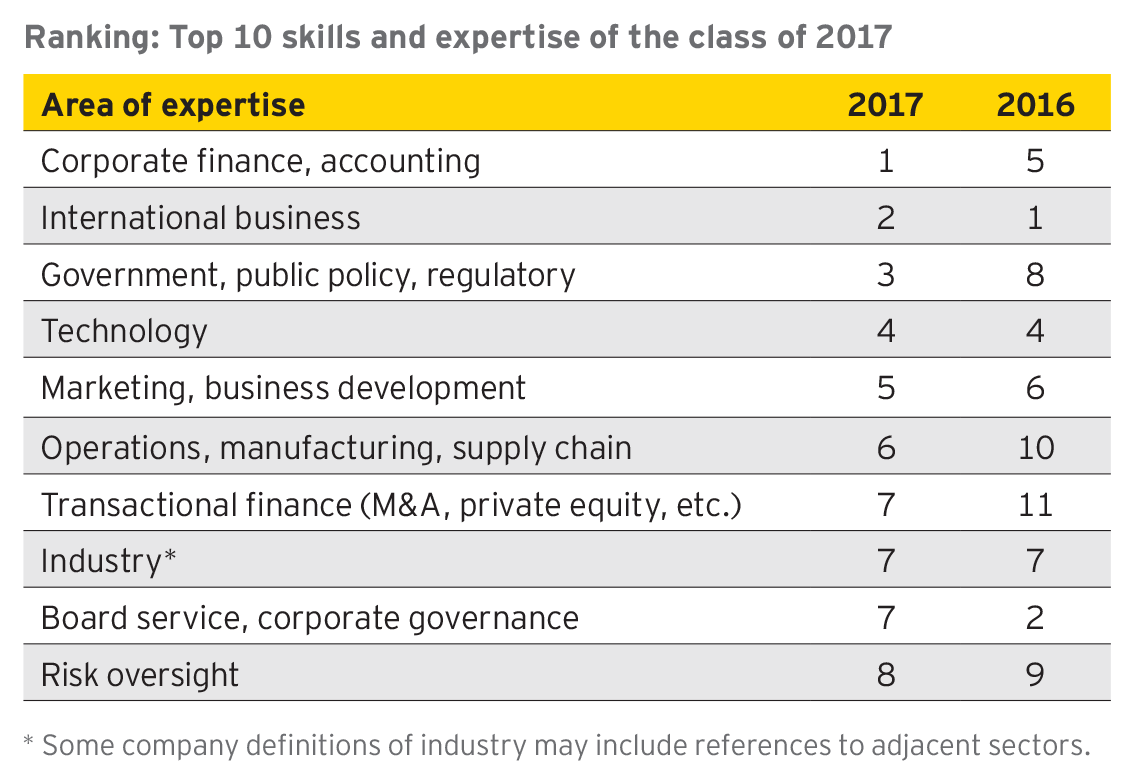
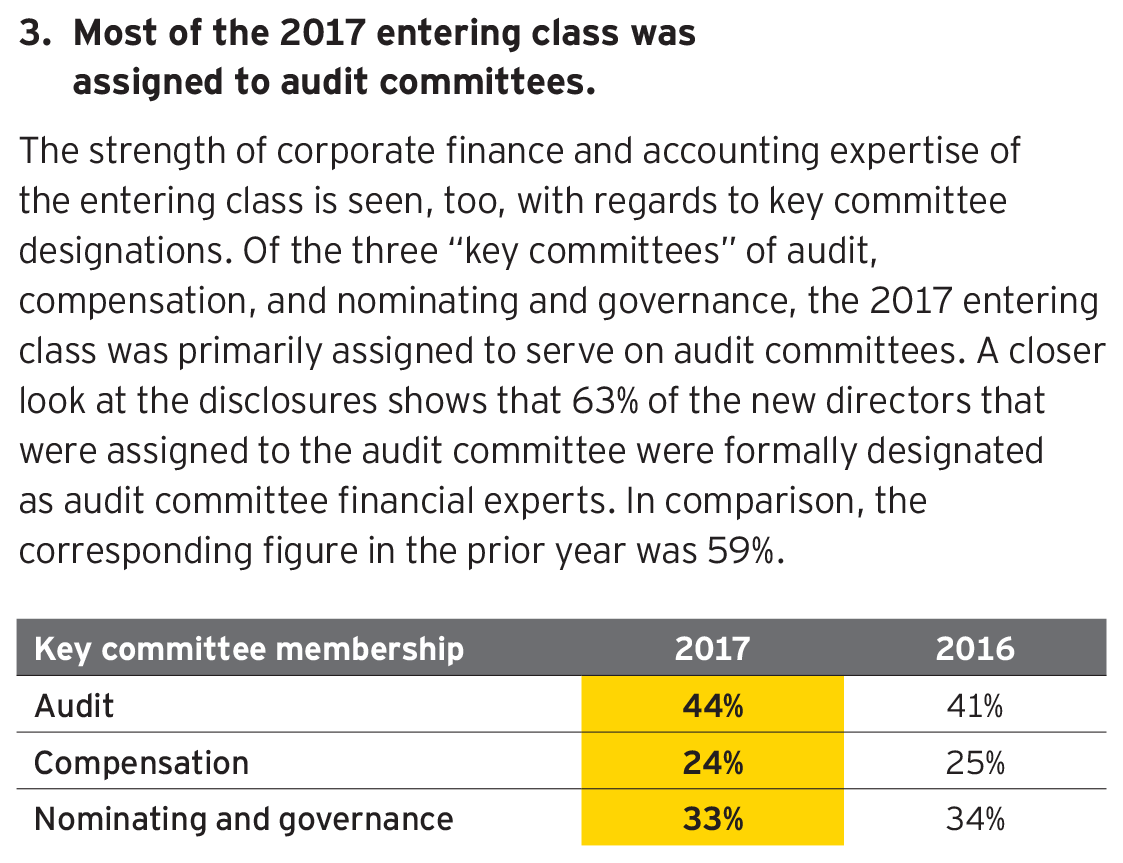
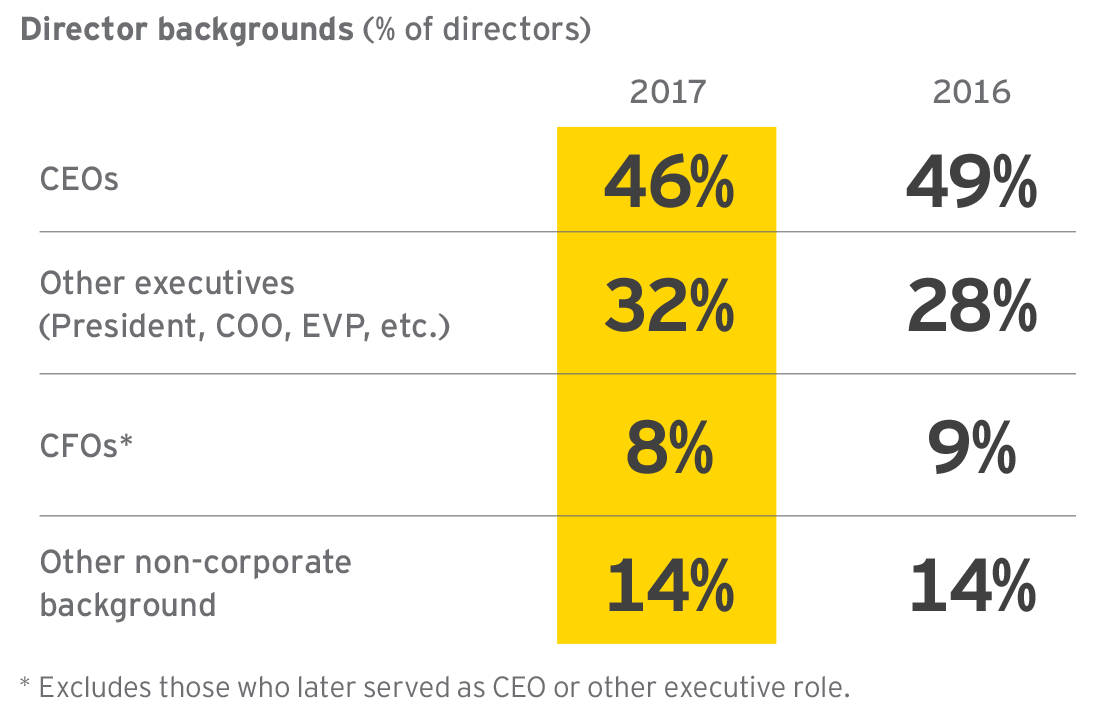
 

L’abnégation


L’abnégation fait référence à une personne qui renonce à tout avantage ou intérêt personnel autres que ceux qui lui sont accordés par contrat ou établis dans le cadre de ses fonctions d’administrateur.


Articles reliés au sujet :

Effective Governance | Top Ten Steps to Improving Corporate Governance | Effective Governance (jacquesgrisegouvernance.com)

Vous vous préparez à occuper un poste d’administrateur d’une entreprise ? (jacquesgrisegouvernance.com)

Corporate Governance Quick Read – The role of the board is to govern (togovern.wordpress.com)

Fact and Fiction in Corporate Law and Governance (blogs.law.harvard.edu)

Quelles sont les priorités des investisseurs en matière de gouvernance des sociétés ?


Les investisseurs institutionnels (II) cherchent constamment à améliorer leur portefeuille d’entreprises dans une perspective à long terme.

Ainsi, les II sont à la recherche de moyens pour communiquer efficacement avec les sociétés dans lesquelles elles investissent.

L’étude menée par Steve W. Klemash, leader du EY Center for Board Matters, auprès de 60 grands investisseurs institutionnels américains tous azimuts, a tenté de déterminer les cinq plus importantes priorités à accorder aux choix des entreprises sous gestion.

Voici donc les cinq grands thèmes qui intéressent les investisseurs institutionnels dans la sélection des entreprises :

(1) La composition du conseil d’administration, avec un œil sur l’amélioration de la diversité ;

(2) Un niveau d’expertise des administrateurs qui est en lien avec les objectifs d’affaires de l’entreprise ;

(3) Une attention accrue accordée aux risques de nature climatique ou environnemental ;

(4) Une attention marquée accordée à la gestion des talents

(5) Une rémunération qui est très bien alignée sur la performance et la stratégie.

Je vous propose un résumé des principaux résultats de travaux de recherche de EY. Pour plus de détails, je vous invite à consulter l’article ci-dessous.

Bonne lecture !


2018 Proxy Season Review


Résultats de recherche d'images pour « investisseurs institutionnels »

Les cinq grandes priorités des investisseurs institutionnels en 2018


1. La composition du conseil d’administration, avec un œil sur l’amélioration de la diversité


2. Un niveau d’expertise des administrateurs qui est en lien avec les objectifs d’affaires de l’entreprise


3. Une attention accrue accordée aux risques de nature climatique ou environnemental


4. Une attention marquée accordée à la gestion des talents


5. Une rémunération qui est très bien alignée sur la performance et la stratégie


Investor priorities as seen through the shareholder proposal lens


For a broader perspective of investor priorities, a review of the top shareholder proposal topics of 2017, based on average support, shows that around half focus on environment and social topics. While the average support for many of these proposal topics appear low, this understates impact. Environmental and social proposals typically see withdrawal rates of around one-third, primarily due to company-investor successes in reaching agreement. Depending on the company situation and specific proposal being voted, some proposals may receive strong support of votes cast by a company’s broader base of investors.

Conclusion


Institutional investors are increasingly asking companies about how they are navigating changing business environments, technological disruption and environmental challenges to achieve long-term, sustained growth. By addressing these same topics in their interactions with and disclosures to investors, boards and executives have an opportunity to highlight to investors how the company is positioned to navigate business transformations over the short- and long-term. This opportunity, in turn, enables companies to attract the kind of investors that support the approach taken by the board and management. Like strong board composition, enhanced disclosure and investor engagement efforts can serve as competitive advantages.


Questions for the board to consider


– Are there opportunities to strengthen disclosures around the board’s composition and director qualifications and how these support company strategy?

– Do the board and its committees have appropriate access to deep, timely expertise and open communication channels with management as needed for effective oversight?

– Do the board and management understand how key investors generally view the company’s disclosures and strategic initiatives regarding environmental and social matters?

– How does the board define and articulate its oversight responsibilities with regard to talent? And does the board believe that the company has an adequate plan for talent management considering recent employee and employment-related developments and the company’s competitive position?

– To what extent have the board and management offered to dialogue with the governance specialists at their key investor organizations, whether active or passive, and including the largest and smallest, vocal shareholder proponents?

 ____________________________________________
*Steve W. Klemash* is EY Americas Leader at the EY Center for Board Matters. This post is based on an EY publication by Mr. Klemash.

Abrègement de la durée des fonctions de CEO | Une étude d’Equilar


Voici une étude d’Equilar qui montre une diminution constante dans la durée d’exercice des CEO aux États-Unis au cours des 5 dernières années.

Le rapport a été publié par Dan Marcec directeur des communications de la firme.

Ainsi, la présence en poste des CEO est passée d’une médiane de 6 ans, en 2013, à 5 ans, en 2017.


On note également que plus du quart des CEO restent en poste plus de 10 ans, comparativement à 38,1 % qui sont en poste entre un an et cinq ans.


L’article présente également un tableau qui montre les raisons des départs des CEO : (1) démissions (2) retraites (3) congédiement. On note que seulement 10 CEO ont été congédiés sur une période de dix ans. On peut dire que l’emploi est assez stable !


Enfin, l’étude montre que l’accroissement du taux des départs n’a pas donné lieu à des progrès dans le cadre de la diversité. En effet, comme le montre le tableau suivant, le nombre de femmes CEO de grandes entreprises est passé de 3,7 %, en 2013, à 5,6 % en 2017. La fonction de CEO dans ces entreprises est encore réservée presque exclusivement aux hommes.


Vous pouvez prendre connaissance de cet article paru sur le site du Harvard Law School Forum :

CEO Tenure Rates

La lettre de BlackRock plaide pour une prise en compte des facteurs de risque environnementaux, sociaux, de gouvernance (ESG)


Aujourd’hui, je fais une première expérience de publication d’un billet en gouvernance parue sur le site du Harvard Law School Forum on Corporate Governance, le 6 février 2018.

En effet, j’édite la traduction en français d’un article publié par Abe M. Friedman*, CEO de la firme CamberView. Cette publication constitue, à mon avis, un moment décisif dans la conception de la gouvernance telle que vue par un investisseur avisé.

Comme plusieurs lecteurs sont particulièrement intéressés par les contenus en français, j’ai utilisé l’outil de traduction de Google pour faire ressortir les implications de la lettre annuelle aux PDG de Larry Fink, PDG de BlackRock.

Vous comprendrez que la traduction est perfectible, mais je crois qu’elle est compréhensible avec un minimum d’édition.

Je vous invite également à lire la dernière mise à jour des recommandations de BlackRock en vue des votes aux assemblées annuelles : Updated BlackRock Proxy Voting Guidelines

Bonne lecture !


Résultats de recherche d'images pour « blackrock »


Le mardi 16 janvier, Larry Fink, PDG de BlackRock, a publié sa lettre annuelle aux PDG décrivant une vision audacieuse liant la prospérité des entreprises à leur capacité à fournir de solides performances financières tout en contribuant positivement à la société. Intitulée « A Sense of Purpose », cette lettre souligne l’approche de plus en plus active de BlackRock en matière d’engagement actionnarial ; elle constitue son opinion selon laquelle les conseils d’administration jouent un rôle central dans la direction stratégique à long terme des sociétés ainsi que dans la prise en compte des facteurs de risque environnementaux, sociaux, de gouvernance (ESG) et de création de valeur à long terme.

La lettre est un autre signal d’un changement fondamental dans la pensée des gestionnaires d’actifs traditionnels sur des sujets que certains ont toujours considérés comme non économiques. Alors que la pression monte sur les grands gestionnaires d’actifs sur la façon dont ils « supervisent » les « portefeuilles » de leurs entreprises, ces questions sociales et environnementales sont de plus en plus considérées comme essentielles à la création de valeur et à la durabilité à long terme. La position d’avant-garde sur la responsabilité d’entreprise prise dans la lettre est un indicateur de la manière dont les attentes changeantes des propriétaires d’actifs sont intégrées dans le comportement des gestionnaires d’actifs. Pour les entreprises, ce changement a créé un nouvel ensemble d’attentes, et le potentiel d’un examen plus approfondi de la part des investisseurs qui pourraient continuer à croître dans les années à venir.


Thèmes clés — ESG, engagement des actionnaires, administrateurs et activisme


La lettre de cette année réitère un certain nombre de thèmes tirés des communications des années précédentes et explique comment BlackRock s’attend à ce que les sociétés améliorent la valeur à long terme pour les actionnaires.


ESG et importance de la diversité du conseil d’administration dans la création de valeur à long terme


La lettre de Fink souligne la conviction de BlackRock que la gestion des questions ESG est essentielle à une croissance durable. De l’avis de BlackRock, exercer la surveillance de ces défis ainsi que d’autres défis émergents à la création de valeur à long terme relève de la compétence du conseil, qui, selon M. Fink, devrait inclure une diversité de genres, d’ethnies, d’expériences et de façons de penser. Les entreprises devraient s’attendre à ce que BlackRock (et, avec le temps, d’autres grands investisseurs institutionnels) investisse plus de temps pour comprendre la gestion des risques des entreprises liée à leur impact plus large sur les communautés, la société et l’environnement. Cela signifie probablement un soutien croissant aux propositions d’actionnaires sur ces sujets et une pression accrue sur les conseils pour qu’ils démontrent qu’ils s’adressent sérieusement à ces questions.


Engagement des actionnaires


Citant le besoin d’être des « agents actifs et engagés pour le compte des clients investis avec BlackRock », la lettre appelle à un nouveau modèle d’engagement des actionnaires qui comprend des communications pendant toute l’année sur les moyens d’améliorer la valeur à long terme. Alors que M. Fink note que BlackRock a engagé des ressources importantes pour améliorer ses propres efforts d’intendance des investissements au cours des dernières années, il écrit que « la croissance de l’indexation exige que nous prenions maintenant cette fonction à un nouveau niveau. » BlackRock a l’intention de doubler la taille de ses équipes de supervision.


Le rôle du conseil dans la communication et la supervision de la stratégie d’entreprise pour la croissance à long terme


Revenant sur un thème commun des communications précédentes, la lettre de cette année souligne l’importance du conseil pour aider les entreprises à définir un cadre stratégique pour la création de valeur à long terme. Bien que le nombre moyen d’heures consacrées par les membres du conseil à leur rôle ait augmenté au cours des dernières années, M. Fink continue d’élever la barre, soulignant que les administrateurs, dont les compétences et l’expérience proviennent uniquement de réunions sporadiques, ne remplissent pas leur devoir envers les actionnaires. La lettre de cette année contient une liste de questions que les sociétés (c.-à-d. les conseils d’administration et la direction) devraient poser pour s’assurer qu’elles sont en mesure de maintenir leur rendement à long terme. Ces questions comprennent explicitement l’impact sociétal des entreprises et les importants changements structurels (tels que les conditions économiques, l’automation et les changements climatiques) qui influencent le potentiel de croissance.


S’engager sur l’activisme


Fink écrit qu’une « raison centrale de la montée de l’activisme — et des luttes intempestives par procuration — est que les entreprises n’ont pas été assez explicites sur leurs stratégies à long terme. » Il souligne, à titre d’exemple, la réforme fiscale récemment adoptée et son potentiel d’augmentation des flux de trésorerie après impôt, comme un moyen pour les activistes de cibler les entreprises qui ne communiquent pas efficacement leur stratégie à long terme. M. Fink encourage les entreprises à s’engager avec les investisseurs et autres parties prenantes au début du processus lorsque ceux-ci offrent « des idées précieuses — plus souvent que certains détracteurs ne le suggèrent », une observation cohérente avec le soutien sélectif de BlackRock aux activistes dans les luttes par procuration.


Recommandations aux émetteurs


Cette lettre représente une évolution significative de l’opinion publique de BlackRock sur la responsabilité des entreprises et des conseils d’administration de gérer activement les impacts sociétaux de leurs activités au bénéfice de toutes les parties prenantes. M. Fink affirme que l’objectif des propriétaires d’actifs est non seulement d’améliorer leurs rendements d’investissement, mais aussi de voir le secteur privé relever les défis sociaux qui assureront la « prospérité et la sécurité » de leurs concitoyens.

BlackRock n’est pas le seul à faire ce changement philosophique. Les derniers mois ont fourni des exemples de la façon dont cette nouvelle dynamique façonne les décisions de vote et d’investissement. L’été dernier, des résolutions sur la divulgation des risques climatiques ont été adoptées pour la première fois dans de grandes entreprises énergétiques. En novembre, State Street Global Advisors a révélé qu’elle avait voté contre les administrateurs de 400 entreprises qui, selon elle, n’avaient pas fait d’efforts pour accroître la diversité au sein du conseil. Plus tôt ce mois-ci, JANA Partners et CalSTRS se sont associés pour mener une campagne d’activisme sur la question de savoir si Apple permet aux parents de protéger leurs enfants en utilisant la technologie et JANA a également créé un fonds pour cibler d’autres entreprises.

Afin de répondre aux questions soulevées dans la lettre de M. Fink, les sociétés ouvertes devraient envisager :

Construire une pratique de l’engagement continu tout au long de l’année sur la gouvernance et la durabilité avec leurs meilleurs investisseurs afin de rester en contrôle de l’activisme et d’être au-devant des investisseurs face à un défi.

Expliquer le processus du conseil dans le développement de la stratégie à long terme, dans le rôle de supervision de l’entreprise ainsi que dans les discussions avec les investisseurs.

Présenter les investisseurs à une variété de membres de l’équipe de direction et, à l’occasion, à un ou plusieurs membres du conseil d’administration pour établir des relations et faire confiance, au fil du temps, à tous les dirigeants de l’entreprise.

Décrire comment les administrateurs cultivent la connaissance de l’entreprise en dehors des réunions formelles du conseil d’administration, afin de remplir leur mandat de protection des intérêts à long terme des investisseurs.


*Abe M. Friedman est Chief Executive Officer de CamberView Partners, LLC. Ce billet est basé sur une publication de CamberView par M. Friedman, Krystal Gaboury BerriniChristopher A. Wightman, et Rob Zivnuska. La recherche connexe du Programme sur la gouvernance d’entreprise inclut des résolutions sur la responsabilité sociale  par Scott Hirst (discutées sur le forum  ici).

Billets récents publiés sur mon blogue en gouvernance en janvier 2018


Voici les quinze billets publiés sur mon blogue en gouvernance des sociétés en janvier 2018.

Bonne lecture ! Vos commentaires sont toujours les bienvenus.


Résultats de recherche d'images pour « blogue en gouvernance »


  1. Que pensez-vous des classes d’actions à droit de vote multiples ?
  2. Compte rendu hebdomadaire de la Harvard Law School Forum on Corporate Governance | 25 janvier 2018
  3. Aspects fondamentaux à considérer par les administrateurs dans la gouvernance des organisations
  4. Comment se préparer à la divulgation du ratio qui révèle la rémunération du CEO comparée à la moyenne des salaires des employés
  5. Compte rendu hebdomadaire de la Harvard Law School Forum on Corporate Governance | 18 janvier 2018
  6. BlackRock soutient le modèle de gouvernance basé sur la primauté accordée aux parties prenantes
  7. Adapter le modèle de gouvernance à la réalité des OBNL de petite taille
  8. Les administrateurs de sociétés qui cumulent plusieurs postes deviennent-ils trop accaparés ?
  9. Compte rendu hebdomadaire de la Harvard Law School Forum on Corporate Governance | 12 janvier 2018
  10. Quelle est l’influence des femmes CEO sur la structure de gouvernance des entreprises ?
  11. La souveraineté des conseils d’administration
  12. Compte rendu hebdomadaire de la Harvard Law School Forum on Corporate Governance | 4 janvier 2018
  13. Enquête de Deloitte sur la diversité des conseils d’administration
  14. Dix thèmes prioritaires à mettre à l’ordre du jour des Boards en 2018
  15. La gouvernance relative aux sociétés en 2017 | Un « Survey » des entreprises du SV 150 et de la S&P 100

Éléments clés à considérer par les administrateurs dans la gouvernance des organisations


Récemment, je suis intervenu auprès du conseil d’administration d’une OBNL et j’ai animé une discussion tournant autour des thèmes suivants en affirmant certains principes de gouvernance que je pense être incontournable.

J’ai regroupé les thèmes en 15 volets :

(1) Le conseil d’administration est souverain — il est l’ultime organe décisionnel.

(2) Le rôle des administrateurs est d’assurer la saine gestion de l’organisation en fonction d’objectifs établis. L’administrateur a un rôle de fiduciaire, non seulement envers les membres qui les ont élus, mais aussi envers les parties prenantes de toute l’organisation. Son rôle comporte des devoirs et des responsabilités envers celle-ci.

(3) Les administrateurs ont un devoir de surveillance et de diligence ; ils doivent cependant s’assurer de ne pas s’immiscer dans la gestion de l’organisation (« nose in, fingers out »).

(4) La décision la plus importante du conseil d’administration est le choix du premier dirigeant, c’est-à-dire le directeur général de l’organisation.

(5) Les administrateurs élus par l’assemblée générale ne sont pas porteurs des intérêts propres à leur groupe ; ce sont les intérêts supérieurs de l’organisation qui priment.

(6) Le président du conseil est le chef d’orchestre du groupe d’administrateurs ; il doit être en étroite relation avec le premier dirigeant et bien comprendre les coulisses du pouvoir. Il doit de plus s’assurer que chaque administrateur apporte une valeur ajoutée aux décisions du CA.

Résultats de recherche d'images pour « conseil d'administration »

(7) Les membres du conseil doivent entretenir des relations de collaboration et de respect entre eux ; ils doivent viser les consensus et exprimer leur solidarité, notamment par la confidentialité des échanges.

(8) Les administrateurs doivent être bien préparés pour les réunions du conseil et ils doivent poser les bonnes questions afin de bien comprendre les enjeux et de décider en toute indépendance d’esprit. Pour ce faire, ils peuvent tirer profit de l’avis d’experts indépendants.

(9) La composition du conseil devrait refléter la diversité de l’organisation. On doit privilégier l’expertise, la connaissance de l’industrie et la complémentarité.

(10) Le conseil d’administration doit accorder toute son attention aux orientations stratégiques de l’organisation et passer le plus clair de son temps dans un rôle de conseil stratégique.

(11) Le rôle des comités du conseil (Ressources humaines, audit, gouvernance) est crucial ; ceux-ci doivent alimenter la réflexion des membres du conseil et faire des recommandations.

(12) La nécessité de fonctionner avec un comité exécutif varie selon la configuration du conseil d’administration de l’organisation.

(13) Chaque réunion devrait se conclure par un huis clos, systématiquement inscrit à l’ordre du jour de toutes les rencontres.

(14) Le président du comité de gouvernance doit mettre en place une évaluation du fonctionnement et de la dynamique du conseil.

(15) Les administrateurs doivent prévoir des activités de formation en gouvernance et en éthique.


Vos commentaires sont les bienvenus.