Conseil d’administration | Perte de contrôle ?


Cette semaine, je donne la parole à Joanne Desjardins* qui agit à titre d’auteure invitée sur mon blogue en gouvernance.

L’auteure a une solide expérience de consultation dans plusieurs grandes sociétés. Joanne est associée de Keyboard, une firme spécialisée en gouvernance et en stratégie.

Elle est aussi régulièrement invitée comme conférencière pour échanger sur la stratégie et la gouvernance.

Dans ce billet, l’auteure présente les raisons sous-jacentes à la mise en place d’un conseil d’administration (et même d’un comité consultatif) et elle décrit les quatre principaux avantages de la constitution d’un CA.

Bonne lecture ! Vos commentaires sont les bienvenus.


Conseil d’administration | Perte de contrôle ?

par

Joanne Desjardins


Jonglez-vous avec l’idée de constituer un conseil d’administration (CA) ? Avez-vous le pied sur le frein ? Pourquoi ?

Avez-vous peur de perdre le contrôle ? Est-ce qu’un CA prendra véritablement le contrôle de votre entreprise ?

Mettons les pendules à l’heure… juste.

Allez-vous vraiment perdre le contrôle ? 

Comme dirigeant de l’entreprise, vous croyez avoir le contrôle. En affaires, la notion de contrôle est ambiguë, hachurée de zones grises. Qui a véritablement le contrôle de votre entreprise ? Vos actionnaires, votre banquier, vos clients, vos fournisseurs ont tous — collectivement — un certain contrôle sur votre entreprise.

8161047-12737301

Une étude de chercheurs de l’Université Harvard (The Founder’s Dilemma) démontre que des fondateurs motivés par le contrôle vont généralement prendre des décisions qui leur permettent de diriger l’entreprise, au détriment de l’accroissement de sa valeur. Selon Pearl Zhu (Digitizing Boardroom : The Multifaceted Aspects of Digital Ready Boards), le rôle du CA est de faire descendre l’équipe de direction de l’arbre pour lui faire voir la forêt.

Avec un CA, vous aurez inévitablement des comptes à rendre. Même si vous rendez des comptes, vous demeurez le capitaine du navire. Néanmoins, vous devez être prêt à faire preuve d’ouverture, de transparence et à entretenir une relation avec votre CA.

Est-ce que le CA peut gérer mon entreprise ? 

Vous êtes responsable des opérations quotidiennes de votre entreprise. Vous possédez tous les pouvoirs et la capacité d’action requise pour assurer le bon fonctionnement de votre entreprise. Certains administrateurs connaissent bien les rudiments de la gestion puisqu’ils gèrent ou ont déjà géré des entreprises et des équipes.

La tentation est souvent grande pour ceux-ci de plonger dans la baignoire de la gestion avec vous. Mais, vous avez le bouchon de la baignoire. À titre d’administrateur, leur rôle se limite à accompagner, guider et orienter votre équipe de direction et non à gérer votre entreprise. Comme le dit le dicton : ¨nose in, fingers out!¨. Avec un CA, vous aurez le bénéfice de consulter des administrateurs cumulant ensemble plus de 100 ans d’expérience » (Solutions Keyboard).

Quels sont les 4 principaux avantages d’un CA ? 

Un CA comporte plusieurs avantages pour votre entreprise, dont les suivants :

(1) briser l’isolement du président 

Quand vient le moment de prendre des décisions importantes sur le destin de votre entreprise, les regards sont rivés sur vous. En période d’accalmie, cette responsabilité est plus facile à assumer. Cependant, quand le presto de la marmite saute, l’appui d’un CA aide à briser l’isolement et à vous éclairer dans les grandes décisions à la suite d’une réflexion partagée avec d’autres administrateurs expérimentés.

(2) source d’expertises complémentaires

Vous aurez le bénéfice de consulter des administrateurs cumulant collectivement plus de 100 ans d’expérience ! Utilisez le CA comme un tremplin pour vous propulser vers le sommet, comme un accélérateur de croissance.

(3) crédibilité accrue et réputation renforcée

Le CA accroît la crédibilité et renforce la réputation de votre entreprise. Vous cherchez du financement ou un nouveau partenaire ? L’appui d’un CA solide rassure les investisseurs potentiels, car il conduit à plus de rigueur dans la gestion de la performance et le suivi des résultats.

(4) force du réseau

Vous pourrez bénéficier du réseau des administrateurs pour renforcer vos projets d’affaires : nouveau marché, lancement d’un nouveau produit, recherche d’un fournisseur, etc. Pour des astuces sur le recrutement efficace d’administrateurs, nous vous invitons à consulter l’article suivant : Comité consultatif : sept erreurs de recrutement à éviter


*Joanne Desjardins, LL.B., MBA, ASC, CRHA, est associée chez Keyboard, www.solutionskeyboard.com une firme spécialisée en gouvernance et en stratégie. Elle est aussi régulièrement invitée comme conférencière pour échanger sur la stratégie et la gouvernance. Elle rédige actuellement un livre sur la stratégie et la gouvernance.

Livres phares sur la gouvernance d’entreprise


On me demande souvent de proposer un livre qui fait le tour de la question eu égard à ce qui est connu comme statistiquement valide sur les relations entre la gouvernance et le succès des organisations (i.e. la performance financière !)

Voici un article de James McRitchie, publié dans Corporate governance, qui commente succinctement le dernier volume de Richard Leblanc.

Comme je l’ai déjà mentionné dans un autre billet, le livre de Richard Leblanc est certainement l’un des plus importants ouvrages (sinon le plus important) portant sur la gouvernance du conseil d’administration.

Une révision du volume de Richard Leblanc | Handbook of Board Governance

The Handbook of Board Governance


Mentionnons également que le volume publié par David F. Larcker et Brian Tayan, professeurs au Graduate School de l’Université Stanford, en est à sa deuxième édition et il donne l’heure juste sur l’efficacité des principes de gouvernance. Voici une brève présentation du volume de Larcker.

Corporate Governance Matters: A Closer Look at Organizational Choices and Their Consequences (2nd edition)

Je vous recommande donc vivement de vous procurer ces volumes.

Enfin, je profite de l’occasion pour vous indiquer que je viens de recevoir la dernière version  des Principes de gouvernance d’entreprise du G20 et de l’OCDE en français et j’ai suggéré au Collège des administrateurs de sociétés (CAS) d’inclure cette publication dans la section Nouveauté du site du CAS.

Il s’agit d’une publication très attendue dans le monde de la gouvernance. La documentation des organismes internationaux est toujours d’abord publiée en anglais. Ce document en français de l’OCDE sur les principes de gouvernance est la bienvenue !

Bonne lecture !

Assurer une efficacité supérieure du conseil d’administration


Aujourd’hui, je cède la parole à Johanne Bouchard* qui agit, de nouveau, à titre d’auteure invitée sur mon blogue en gouvernance.

Celle-ci a une solide expérience d’interventions de consultation auprès de conseils d’administration de sociétés américaines ainsi que d’accompagnements auprès de hauts dirigeants de sociétés publiques (cotées), d’organismes à but non lucratif (OBNL) et d’entreprises en démarrage.

Dans cet article publié dans la revue Ethical Boardroom, Achieving higher board effectiveness, elle aborde un sujet qui lui tient particulièrement à cœur : Assurer une efficacité supérieure du conseil d’administration.

L’auteure insiste sur les points suivants :

  1. Le suivi des réunions du CA par le président du conseil
  2. L’intégration des nouveaux membres du conseil
  3. La formation en gouvernance et l’apprentissage des rouages de l’entreprise
  4. Les sessions de planification stratégique
  5. L’évaluation du leadership du CEO, du conseil et du management

L’expérience de Johanne Bouchard auprès d’entreprises cotées en bourse est soutenue ; elle en tire des enseignements utiles pour tous les types de conseils d’administration.

Bonne lecture ! Vos commentaires sont toujours les bienvenus.
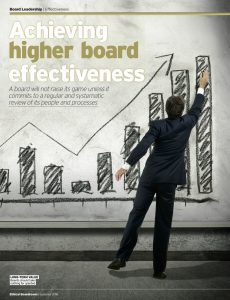
 

Achieving higher board effectiveness


eb_achieving_higher_1000-230x300

« Achieving higher board effectiveness goes well beyond adhering to rules, regulations, legal and ethical compliance. While there are many experts who address the regulatory requirements, an aspect that requires the utmost attention, and is often underestimated and even ignored, is the human element »

That is the basic and subtle dynamics and the complexities inherent in having individuals with diverse experience, different views and perspective, and varied cultural and personal backgrounds gathering a few times a year to serve an entity to which they are not privy on a day-to-day basis. It’s further complicated by the fact that these individuals often don’t know each other outside of their board service.

How can a board maintain its independence, make critical decisions, provide valuable and timely insights to management and be effective as a group of individuals if they have minimal access to the ins and outs of an organisation? How can they truly assess the leadership potential of the CEO, the board and management and effectively minimise vulnerabilities and risk when they’re outsiders?

There are initiatives that a board should commit to that can heighten the potential of every director within the context of their roles and responsibilities, allowing them collectively to achieve higher effectiveness. It is fundamentally critical to the board’s ability to stay current, effective and focussed in enhancing long-term shareholder value.

These initiatives include: board meeting follow-ups with the chair and the CEO; on-boarding and integration of new directors; educational sessions; strategic planning sessions; and CEO, board and management leadership effectiveness assessments.

Board meeting follow-ups with the chair and CEO

Whenever directors come together to meet to fulfill their roles and responsibilities, the chair and the CEO can’t assume that the directors have felt that they’ve made their optimal contributions; that they didn’t feel intimidated or even shy to share their insights. That they felt at ease with the dynamics of the meeting, were satisfied with the results of the board meeting and were comfortable with the way the chair led the meeting and the CEO interacted as an executive director. It is important for a chair and for the CEO to take the initiative of reaching out to all directors immediately after the meeting to do a simple check-in.

This provides an opportunity to gain input about the meeting’s outcomes as well as following up with each director on a one-on-one basis to seek their views about the meeting. It’s an opportunity to constructively share their expectations about the director for that meeting and his/her level of preparedness for that meeting and any committee duties, rather than not addressing it or postponing it to an annual board effectiveness assessment. The individual directors’ effectiveness (including the CEO) as well as the chair’s, are too important not to be handled after each meeting. These check-ins are significant to ensure that the possible ‘elephants in the boardroom’ are promptly addressed. They also enable each director and the chair, and each director and the CEO to get to know each other better.

In any relationship, it is important to have the ability to readily share what works, what is missing and what could have been done better. It takes time and, from my experiences with boards, it makes a great difference when every director is prepared to allocate time between meetings to evaluate the prior meeting before attending the next one. These frank exchanges benefit the chair in preparing the agenda for the next meeting and in leading the board meeting itself. Furthermore, it is also the chair’s responsibility to poll each director, in person or over the phone, to get a pulse about his/her ability to stay abreast of the strategy.

On-boarding and integration

It is tempting to let a director join a board and attend his/her first meeting without proper on-boarding. A board can’t afford for a new director to join for his/her first board meeting without a formal on-boarding process. A director is a human being who is being asked to participate, not to simply fill in a seat. A formal on-boarding can include a meeting with the chair and the CEO shortly after the director has been voted in by the board to formally welcome him/her, confirm their expectations and his/her expectations in having joined the board; bring the director up to date with any crisis, strategic priorities and networking opportunities where he/she could specifically provide insights; and to update the director about board governance processes the directors need to understand.

It is good business, tactful and sensible to acknowledge the need to create a proper introduction of the board and the organisation for all new directors as well as introducing and integrating the incoming directors within the board integration event can last 30 minutes to an hour and is planned and professionally facilitated, thus ensuring that the board doesn’t create a climate of ‘us and them’ as the board augments and/or is refreshed. Proper on-boarding and integration enables new directors to quickly get to know the rest of the board and enables all board directors to further connect, respect and trust each other. While a brief session, it is very powerful to welcoming an incoming director and to further integrating all existing directors within the board.

Educational sessions

Our business ecosystem is becoming more complex and is being intermittently disrupted. A board can’t afford not to be current on the trends that can affect their organisation, even if, at a glance, the trend might not appear to have any potential impact on their strategic roadmap. It is important for a CEO with his/her chair to be on top of trends and to identify specific topics that need to be addressed internally at a high level to keep the board informed as a group – but not necessarily within the scheduled meeting, due to time constraints.

I have written in the past about ‘the four pillars’ that make a great relationship between a chair and a CEO. One of the pillars is communication. It is crucial for the chair and CEO to take the time to speak in person, or at least on the phone, or remotely via video-conferencing tools to check in about their relationship, their effectiveness in their respective roles and to ensure that together they address how to keep the board current about market and industry dynamics. Topics can include how the digital economy is impacting the organisation; the cybersecurity evolution and its associated threats; new strategic considerations for the organisation, vis-à-vis corporate social responsibility; shifting the organisation’s focus from shareholders to stakeholders; making an organisational commitment to sustainability, etc.

There is a plethora of topics that a board must address and can’t realistically address within their formal meetings. This creates an opportunity for the board to further align on strategic priorities, to further ascertain how vulnerable the composition of its board may or may not be and whether the board composition needs to be refreshed or augmented. Industry and expert speakers can be invited to present and conduct small roundtables at these educational sessions.

Strategic planning sessions

Since the National Association of Corporate Directors (NACD) in the United States stipulates that boards have the responsibility to engage in the development and amendment of strategy, it is imperative for boards to participate in an annual strategic planning session – in addition to each director staying current about the industry trends. Not only are strategic planning sessions important to aligning the board on strategy, but they also contribute to evaluating human behaviour dynamics and assessing the entire leadership potential of the board.

Directors must be and stay fully informed about the organisation they serve. In particular, when directors are independent, they must have knowledge of the industry and about the business they commit to serve, given that they are not connected to the business, meeting only four-to-six times a year. Better aligned boards can be more effective in assessing the accuracy, completeness, relevance and validity of information presented to them.

A board has an opportunity to really see in action the effectiveness of their CEO when participating in the annual strategic planning session. Likewise, a CEO gets the same opportunity to experience first-hand the agility of its board during such sessions.

The chair (and CEO) should commit to an annual strategic planning session. This initiative ensures that:

■ Board effectiveness is not affected by information asymmetry that would impede its ability to adequately provide guidance, make decisions and constructively challenge the executive team. The board must be continually informed about industry dynamics, the competitive landscape, the organisation’s business model, its value proposition and its strategic milestones. It is unrealistic that a board can approve financial projections, detect overly ambitious production targets and ascertain budgets and profitability objectives without a clear understanding of strategy and key strategic performance indicators

■ The board is exposed to organisational dynamics and to the dynamics of the CEO with selected or most key executive members, which will assist with its identifying warning flags about the company’s strategic priorities and help reconsider performance indicators as needed

A board has an opportunity to really see in action the effectiveness of their CEO when participating in the annual strategic planning session. Likewise, a CEO gets the same opportunity to experience first-hand the agility of its board during such sessions.

The adoption of strategic planning enables the CEO to share more openly among themselves, with the CEO and with management. I have often seen as a result of these sessions healthier effectiveness within the entire Pivotal Leadership Trio (Board, CEO and Executive Team).

CEO, board and management leadership effectiveness assessment

The effectiveness of a board is highly dependent on having the right leader for the organisation during major and critical strategic inflection points of the organisation, having the right leader of the board with the optimal board composition, and the right leadership in all functional areas of the organisation.

A board needs to know when the CEO can’t step up to leadership and organisational challenges, as well as when any board director or member of the management team can’t fulfil their role.

CEO leadership effectiveness assessment

For the board to adequately fulfil its duty of addressing CEO succession, it has a responsibility to evaluate the CEO’s leadership effectiveness. A board can’t assume that the CEO has the skill set, experience and leadership maturity to lead the organisation through different stages of growth, crisis and changes.

This initiative should be conducted by an objective third party. The process should include:

■ A custom and comprehensive inquiry, specifically created to evaluate the CEO of the organisation that the board serves

■ A custom inquiry to address the CEO’s role as an executive director on the board

■ In-person meetings conducted between the CEO and a third-party professional, and between each direct report to the CEO and the third-party professional and each director of the board and the third-party professional

■ Presentation of the CEO’s leadership effectiveness results to the CEO and the chair before being presented to the board as a group

Board and management leadership effectiveness assessments

The evaluation of the directors and the management team also needs to be conducted annually to appropriately support overall succession planning. These should ideally be conducted at the same time as the CEO’s to maximise everyone’s time. For the board assessments, the process should include:

■ A custom and comprehensive inquiry, specifically created to evaluate the board thoroughly

■ In-person meetings between directors and the third-party professional

■ Custom inquiries to capture the insights of the CFO, the CHRO and the general counsel

■ In-person individual meetings between the CFO, the CHRO, the general counsel and the third-party professional

■ Presentation of the board leadership assessment results to the chair and the governance chair before they’re presented to the board as a group

A similar process needs to be adopted for the management team.

It is good practice for the board assessment inquiry to include a director self-assessment, a peer review and an examination of the governance practices.

Leadership effectiveness assessments are natural processes and need to be positioned as such and should not be threatening.

Achieving higher board effectiveness has to be intentional by all directors, individually and collectively as a board, beyond check lists and formal systematic processes. Without a conscious intention, a board will not raise the bar of its effectiveness to the level where it can and should operate. While maintaining independence, the board has to be cognisant of the importance of not assuming anything at any time, not overlooking the need to coalesce on priorities, calibrating and stepping back afresh each time it works together, being in alignment on strategic priorities and refreshing leadership as needed.

Directors can’t afford to underestimate the cultural and values tone they are establishing with their CEO. The board has to pause and ask itself every time it gathers if it is as effective as it should be.

_________________________________________

*Johanne Bouchard est consultante auprès de conseils d’administration, de chefs de la direction et de comités de direction. Johanne a développé une expertise au niveau de la dynamique et de la composition de conseils d’administration. Après l’obtention de son diplôme d’ingénieure en informatique, sa carrière l’a menée à œuvrer dans tous les domaines du secteur de la technologie, du marketing et de la stratégie à l’échelle mondiale.

L’efficacité du rôle du président du conseil


Nous publions ici un quatrième billet de Danielle Malboeuf* laquelle nous a soumis ses réflexions sur les grands enjeux de la gouvernance des institutions d’enseignement collégial les 23 et 27 novembre 2013, à titre d’auteure invitée.

Dans un premier billet, publié le 23 novembre 2013 sur ce blogue, on insistait sur l’importance, pour les CA des Cégep, de se donner des moyens pour assurer la présence d’administrateurs compétents dont le profil correspond à celui recherché.

D’où les propositions adressées à la Fédération des cégeps et aux CA pour préciser un profil de compétences et pour faire appel à la Banque d’administrateurs certifiés du Collège des administrateurs de sociétés (CAS), le cas échéant. Un autre enjeu identifié dans ce billet concernait la remise en question de l’indépendance des administrateurs internes.

Le deuxième billet publié le 27 novembre 2013 abordait l’enjeu entourant l’exercice de la démocratie par différentes instances au moment du dépôt d’avis au conseil d’administration.

Le troisième billet portait sur l’efficacité du rôle du président du conseil d’administration (PCA).

Ce quatrième billet est une mise à jour de son dernier article portant sur le rôle du président de conseil.

Voici donc l’article en question, reproduit ici avec la permission de l’auteure.

Vos commentaires sont appréciés. Bonne lecture.

________________________________________


LE RÔLE DU PRÉSIDENT DU CONSEIL D’ADMINISTRATION | LE CAS DES INSTITUTIONS D’ENSEIGNEMENT COLLÉGIAL 

par Danielle Malboeuf*  


Il y a deux ans, je publiais un article sur le rôle du président du conseil d’administration (CA) [1]. J’y rappelais le rôle crucial et déterminant du président du CA et j’y précisais, entre autres, les compétences recherchées chez cette personne et l’enrichissement attendu de son rôle.

Depuis, on peut se réjouir de constater qu’un nombre de plus en plus élevé de présidents s’engagent dans de nouvelles pratiques qui améliorent la gouvernance des institutions collégiales. Ils ne se limitent plus à jouer un rôle d’animateurs de réunions, comme on pouvait le constater dans le passé.

president-du-conseil-dadministration

Notons, entre autres, que les présidents visent de plus en plus à bien s’entourer, en recherchant des personnes compétentes comme administrateurs. D’ailleurs, à cet égard, les collèges vivent une situation préoccupante. La Loi sur les collèges d’enseignement général et professionnel prévoit que le ministre [2] nomme les administrateurs externes. Ainsi, en plus de connaître des délais importants pour la nomination de nouveaux administrateurs, les collèges ont peu d’influence sur leur choix.

Présentement, les présidents et les directions générales cherchent donc à l’encadrer. Ils peuvent s’inspirer, à cet égard, des démarches initiées par d’autres organisations publiques en établissant, entre autres, un profil de compétences recherchées qu’ils transmettent au ministre. Ils peuvent ainsi tenter d’obtenir une complémentarité d’expertise dans le groupe d’administrateurs.

Une fois les administrateurs nommés, les présidents doivent se préoccuper d’assurer leur formation continue pour développer les compétences recherchées. Ils se donnent ainsi l’assurance que ces personnes comprennent bien leur rôle et leurs responsabilités et qu’elles sont outillées pour remplir le mandat qui leur est confié. De plus, ils doivent s’assurer que les administrateurs connaissent bien l’organisation, qu’ils adhèrent à sa mission et qu’ils partagent les valeurs institutionnelles. En présence d’administrateurs compétents, éclairés, et dont l’expertise est reconnue, il est plus facile d’assurer la légitimité et la crédibilité du CA et de ses décisions.

Un président performant démontrera aussi de grandes qualités de leadership. Il fera connaître à toutes les instances du milieu le mandat confié au CA. Il travaillera à mettre en place un climat de confiance au sein du CA et avec les gestionnaires de l’organisation. Il  cherchera à exploiter l’ensemble des compétences et à faire jouer au CA un rôle qui va au-delà de celui de fiduciaire, soit celui de contribuer significativement à la mission première du cégep : donner une formation pertinente et de qualité où l’étudiant et sa réussite éducative sont au cœur des préoccupations.

Plusieurs ont déjà fait le virage… c’est encourageant ! Les approches préconisées par l’Institut sur la gouvernance des organismes publics et privés (IGOPP) et le Collège des administrateurs de sociétés (CAS) puis reprises dans la loi sur la gouvernance des sociétés d’État ne sont sûrement pas étrangères à cette évolution. En fournissant aux présidents de CA le soutien, la formation et les outils appropriés pour améliorer leur gouvernance, le Centre collégial des services regroupés (CCSR) [3] contribue à assurer le développement des institutions collégiales dans un contexte de saine gestion.

Un CA performant est guidé par un président compétent.


[1] https://jacquesgrisegouvernance.com/2014/01/24/le-role-du-president-du-conseil-dadministration-pca-le-cas-des-cegep/

[2] Ministre de l’Enseignement supérieur, de la Recherche, de la Science et de la Technologie

[3] Formation développée en partenariat avec l’Institut sur la gouvernance des organisations privées et publiques (IGOPP)

_______________________________

*Danielle Malboeuf est consultante et formatrice en gouvernance ; elle possède une grande expérience dans la gestion des CEGEP et dans la gouvernance des institutions d’enseignement collégial et universitaire. Elle est CGA-CPA, MBA, ASC, Gestionnaire et administratrice retraité du réseau collégial et consultante.


Articles sur la gouvernance des CEGEP

(1) Les grands enjeux de la gouvernance des institutions d’enseignement collégiaux

(2) L’exercice de la démocratie dans la gouvernance des institutions d’enseignement collégiaux

(3) LE RÔLE DU PRÉSIDENT DU CONSEIL D’ADMINISTRATION (PCA) | LE CAS DES CÉGEP

Enhanced by Zemanta

Dix thèmes majeurs pour les administrateurs en 2016 | Harvard Law School Forum on Corporate Governance


Vous trouverez, ci-dessous, les dix thèmes les plus importants pour les administrateurs de sociétés selon Kerry E. Berchem, associé du groupe de pratiques corporatives à la firme Akin Gump Strauss Hauer & Feld LLP. Cet article est paru aujourd’hui sur le blogue le Harvard Law School Forum on Corporate Governance.

Bien qu’il y ait peu de changements dans l’ensemble des priorités cette année, on peut quand même noter :

(1) l’accent crucial accordé au long terme ;

(2) Une bonne gestion des relations avec les actionnaires dans la foulée du nombre croissant d’activités menées par les activistes ;

(3) Une supervision accrue des activités liées à la cybersécurité…

Pour plus de détails sur chaque thème, je vous propose la lecture synthèse de l’article ci-dessous.

Bonne lecture !


Ten Topics for Directors in 2016 |   Harvard Law School Forum on Corporate Governance


U.S. public companies face a host of challenges as they enter 2016. Here is our annual list of hot topics for the boardroom in the coming year:

  1. Oversee the development of long-term corporate strategy in an increasingly interdependent and volatile world economy
  2. Cultivate shareholder relations and assess company vulnerabilities as activist investors target more companies with increasing success
  3. Oversee cybersecurity as the landscape becomes more developed and cyber risk tops director concerns
  4. Oversee risk management, including the identification and assessment of new and emerging risks
  5. Assess the impact of social media on the company’s business plans
  6. Stay abreast of Delaware law developments and other trends in M&A
  7. Review and refresh board composition and ensure appropriate succession
  8. Monitor developments that could impact the audit committee’s already heavy workload
  9. Set appropriate executive compensation as CEO pay ratios and income inequality continue to make headlines
  10. Prepare for and monitor developments in proxy access

Strategic Planning Considerations

Strategic planning continues to be a high priority for directors and one to which they want to devote more time. Figuring out where the company wants to—and where it should want to—go and how to get there is not getting any easier, particularly as companies find themselves buffeted by macroeconomic and geopolitical events over which they have no control.

axes

In addition to economic and geopolitical uncertainty, a few other challenges and considerations for boards to keep in mind as they strategize for 2016 and beyond include:

finding ways to drive top-line growth

focusing on long-term goals and enhancing long-term shareholder value in the face of mounting pressures to deliver short-term results

the effect of low oil and gas prices

figuring out whether and when to deploy growing cash stockpiles

assessing the opportunities and risks of climate change and resource scarcity

addressing corporate social responsibility.

Shareholder Activism

Shareholder activism and “suggestivism” continue to gain traction. With the success that activists have experienced throughout 2015, coupled with significant new money being allocated to activist funds, there is no question that activism will remain strong in 2016.

In the first half of 2015, more than 200 U.S. companies were publicly subjected to activist demands, and approximately two-thirds of these demands were successful, at least in part. [1] A much greater number of companies are actually targeted by activism, as activists report that less than a third of their campaigns actually become public knowledge. [2] Demands have continued, and will continue, to vary: from requests for board representation, the removal of officers and directors, launching a hostile bid, advocating specific business strategies and/or opining on the merit of M&A transactions. But one thing is clear: the demands are being heard. According to a recent survey of more than 350 mutual fund managers, half had been contacted by an activist in the past year, and 45 percent of those contacted decided to support the activist. [3]

With the threat of activism in the air, boards need to cultivate shareholder relations and assess company vulnerabilities. Directors—who are charged with overseeing the long-term goals of their companies—must also understand how activists may look at the company’s strategy and short-term results. They must understand what tactics and tools activists have available to them. They need to know and understand what defenses the company has in place and whether to adopt other protective measures for the benefit of the overall organization and stakeholders.

Cybersecurity

Nearly 90 percent of CEOs worry that cyber threats could adversely impact growth prospects. [4] Yet in a recent survey, nearly 80 percent of the more than 1,000 information technology leaders surveyed had not briefed their board of directors on cybersecurity in the last 12 months. [5] The cybersecurity landscape has become more developed and as such, companies and their directors will likely face stricter scrutiny of their protection against cyber risk. Cyber risk—and the ultimate fall out of a data breach—should be of paramount concern to directors.

One of the biggest concerns facing boards is how to provide effective oversight of cybersecurity. The following are questions that boards should be asking:

Governance. Has the board established a cybersecurity review > committee and determined clear lines of reporting and > responsibility for cyber issues? Does the board have directors with the necessary expertise to understand cybersecurity and related issues?

Critical asset review. Has the company identified what its highest cyber risks assets are (e.g., intellectual property, personal information and trade secrets)? Are sufficient resources allocated to protect these assets?

Threat assessment. What is the daily/weekly/monthly threat report for the company? What are the current gaps and how are they being resolved?

Incident response preparedness. Does the company have an incident response plan and has it been tested in the past six months? Has the company established contracts via outside counsel with forensic investigators in the event of a breach to facilitate quick response and privilege protection?

Employee training. What training is provided to employees to help them identify common risk areas for cyber threat?

Third-party management. What are the company’s practices with respect to third parties? What are the procedures for issuing credentials? Are access rights limited and backdoors to key data entry points restricted? Has the company conducted cyber due diligence for any acquired companies? Do the third-party contracts contain proper data breach notification, audit rights, indemnification and other provisions?

Insurance. Does the company have specific cyber insurance and does it have sufficient limits and coverage?

Risk disclosure. Has the company updated its cyber risk disclosures in SEC filings or other investor disclosures to reflect key incidents and specific risks?

The SEC and other government agencies have made clear that it is their expectation that boards actively manage cyber risk at an enterprise level. Given the complexity of the cybersecurity inquiry, boards should seriously consider conducting an annual third-party risk assessment to review current practices and risks.

Risk Management

Risk management goes hand in hand with strategic planning—it is impossible to make informed decisions about a company’s strategic direction without a comprehensive understanding of the risks involved. An increasingly interconnected world continues to spawn newer and more complex risks that challenge even the best-managed companies. How boards respond to these risks is critical, particularly with the increased scrutiny being placed on boards by regulators, shareholders and the media. In a recent survey, directors and general counsel identified IT/cybersecurity as their number one worry, and they also expressed increasing concern about corporate reputation and crisis preparedness. [6]

Given the wide spectrum of risks that most companies face, it is critical that boards evaluate the manner in which they oversee risk management. Most companies delegate primary oversight responsibility for risk management to the audit committee. Of course, audit committees are already burdened with a host of other responsibilities that have increased substantially over the years. According to Spencer Stuart’s 2015 Board Index, 12 percent of boards now have a stand-alone risk committee, up from 9 percent last year. Even if primary oversight for monitoring risk management is delegated to one or more committees, the entire board needs to remain engaged in the risk management process and be informed of material risks that can affect the company’s strategic plans. Also, if primary oversight responsibility for particular risks is assigned to different committees, collaboration among the committees is essential to ensure a complete and consistent approach to risk management oversight.

Social Media

Companies that ignore the significant influence that social media has on existing and potential customers, employees and investors, do so at their own peril. Ubiquitous connectivity has profound implications for businesses. In addition to understanding and encouraging changes in customer relationships via social media, directors need to understand and weigh the risks created by social media. According to a recent survey, 91 percent of directors and 79 percent of general counsel surveyed acknowledged that they do not have a thorough understanding of the social media risks that their companies face. [7]

As part of its oversight duties, the board of directors must ensure that management is thoughtfully addressing the strategic opportunities and challenges posed by the explosive growth of social media by probing management’s knowledge, plans and budget decisions regarding these developments. Given new technology and new social media forums that continue to arise, this is a topic that must be revisited regularly.

M&A Developments

M&A activity has been robust in 2015 and is on track for another record year. According to Thomson Reuters, global M&A activity exceeded $3.2 trillion with almost 32,000 deals during the first three quarters of 2015, representing a 32 percent increase in deal value and a 2 percent increase in deal volume compared to the same period last year. The record deal value mainly results from the increase in mega-deals over $10 billion, which represented 36 percent of the announced deal value. While there are some signs of a slowdown in certain regions based on deal volume in recent quarters, global M&A is expected to carry on its strong pace in the beginning of 2016.

Directors must prepare for possible M&A activity in the future by keeping abreast of developments in Delaware case law and other trends in M&A. The Delaware courts churned out several noteworthy decisions in 2015 regarding M&A transactions that should be of interest to directors, including decisions on the court’s standard of review of board actions, exculpation provisions, appraisal cases and disclosure-only settlements.

Board Composition and Succession Planning

Boards have to look at their composition and make an honest assessment of whether they collectively have the necessary experience and expertise to oversee the new opportunities and challenges facing their companies. Finding the right mix of people to serve on a company’s board of directors, however, is not necessarily an easy task, and not everyone will agree with what is “right.” According to Spencer Stuart’s 2015 Board Index, board composition and refreshment and director tenure were among the top issues that shareholders raised with boards. Because any perceived weakness in a director’s qualification could open the door for activist shareholders, boards should endeavor to have an optimal mix of experience, skills and diversity. In light of the importance placed on board composition, it is critical that boards have a long-term board succession plan in place. Boards that are proactive with their succession planning are able to find better candidates and respond faster and more effectively when an activist approaches or an unforeseen vacancy occurs.

Audit Committees

Averaging 8.8 meetings a year, audit continues to be the most time-consuming committee. [8] Audit committees are burdened not only with overseeing a company’s risks, but also a host of other responsibilities that have increased substantially over the years. Prioritizing an audit committee’s already heavy workload and keeping directors apprised of relevant developments, including enhanced audit committee disclosures, accounting changes and enhanced SEC scrutiny will be important as companies prepare for 2016.

Executive Compensation

Perennially in the spotlight, executive compensation will continue to be a hot topic for directors in 2016. But this year, due to the SEC’s active rulemaking in 2015, directors will have more to fret about than just say-on-pay. Roughly five years after the Dodd-Frank Wall Street Reform and Consumer Protection Act was enacted, the SEC finally adopted the much anticipated CEO pay ratio disclosure rules, which have already begun stirring the debate on income inequality and exorbitant CEO pay. The SEC also made headway on other Dodd-Frank regulations, including proposed rules on pay-for-performance, clawbacks and hedging disclosures. Directors need to start planning how they will comply with these rules as they craft executive compensation for 2016.

Proxy Access

2015 was a turning point for shareholder proposals seeking to implement proxy access, which gives certain shareholders the ability to nominate directors and include those nominees in a company’s proxy materials. During the 2015 proxy season, the number of shareholder proposals relating to proxy access, as well as the overall shareholder support for such proposals, increased significantly. Indeed, approximately 110 companies received proposals requesting the board to amend the company’s bylaws to allow for proxy access, and of those proposals that went to a vote, the average support was close to 54 percent of votes cast in favor, with 52 proposals receiving majority support. [9] New York City Comptroller Scott Springer and his 2015 Boardroom Accountability Project were a driving force, submitting 75 proxy access proposals at companies targeted for perceived excessive executive compensation, climate change issues and lack of board diversity. Shareholder campaigns for proxy access are expected to continue in 2016. Accordingly, it is paramount that boards prepare for and monitor developments in proxy access, including, understanding the provisions that are emerging as typical, as well as the role of institutional investors and proxy advisory firms.

The complete publication is available here.

Endnotes:

[1] Activist Insight, “2015: The First Half in Numbers,” Activism Monthly (July 2015).
(go back)

[2] Activist Insight, “Activist Investing—An Annual Review of Trends in Shareholder Activism,” p. 8. (2015).
(go back)

[3] David Benoit and Kirsten Grind, “Activist Investors’ Secret Ally: Big Mutual Funds,” The Wall Street Journal (August 9, 2015).
(go back)

[4] PwC’s 18th Annual Global CEO Survey 2015.
(go back)

[5] Ponemon Institute’s 2015 Global Megatrends in Cybersecurity (February 2015).
(go back)

[6] Kimberley S. Crowe, “Law in the Boardroom 2015,” Corporate Board Member Magazine (2nd Quarter 2015). See also, Protiviti, “Executive Perspectives on Top Risks for 2015.”
(go back)

[7] Kimberley S. Crowe, supra.
(go back)

[8] 2015 Spencer Stuart Board Index, at p. 26.
(go back)

[9] Georgeson, 2015 Annual Corporate Governance Review, at p. 5.
(go back)

Un guide utile pour bien évaluer les risques organisationnels | En reprise


Voici un article très intéressant sur l’évaluation des risques publié par H. Glen Jenkinset paru dans Inside Counsel (IC) Magazine.

Il s’agit d’un bref exposé sur la notion de risques organisationnels et sur les principaux éléments qu’il faut considérer afin d’en faire une gestion efficace.

Je vous invite à prendre connaissance des autres publications sur le site de IC, notamment Evaluating and managing litigation risk.

Bonne lecture !

Risk assessment: A primer for corporate counsel


The scope of legal responsibilities for in-house counsel varies depending on the size and complexity of the company. For instance, an attorney located at corporate headquarters could be chiefly responsible for issues affecting the shared services that are available and used by corporate headquarters, as well as every business unit and division. And yet at other times, in-house counsel’s concerns may be restricted to matters affecting only the parent company or a specific liability issue faced by only one business unit.


risk management flow chart concept handwritten by businessman

In each instance, however, in-house counsel are generally concerned with specific legal tasks and proactive risk management.

What exactly does risk management mean, and what does it encompass? Furthermore, once the definition of risk management has been established and accepted by the company’s management team, how can in-house counsel efficiently and comprehensively assess all possible risks?

Merriam Webster’s dictionary defines risk as “the possibility that something bad or unpleasant will happen.” Whenever many of us in the accounting and legal profession hear the word “risk,” we inherently may succumb to the aforementioned particular negative connotation of risk. How many times have we heard the phrase, “Risk is a part of life,’ and how often have we associated those five words with an undesirable implication?”


Alternatively, A Positive View of Risk

Taking risks does not always have to be painstakingly negative. It is unlikely that many will disagree with the Institute of Risk Management’s (IRM) assertion that “avoiding all risk would result in no achievement, no progress and no reward.” This statement undoubtedly portrays a different perspective of risk, indicating the potential of a positive outcome.

IRM goes on to define risk as “the combination of the probability of an event and its consequence. Consequences can range from positive and negative.”

Therein lies the basic premise of risk management. If the consequences of risk can be both positive and negative, it would seem only prudent to try and effectively manage risk to have the highest probability of a positive outcome.

Applying IRM’s definition of risk, together with the premise that avoiding all risk would result in no achievement, no progress and no reward, we intrinsically recognize that not all risks are bad and not all risks are to be avoided.

Over the course of three successive articles on risk, we will take a closer look at how in-house counsel works with internal and external resources to help identify, evaluate and categorize risk.

 Risk Assessment: The Starting Point for Successful Risk Management

Risk assessment is the identification, analysis and evaluation of risks involved in a given situation. Risk assessment also implies a comparison against benchmarks or standards, and the determination of an acceptable level of risk. The evaluation of risks should also provide management with a remediation or control for the identified hazard.

The word “risk” alone without any context is a vague and ill-defined term. There is safety risk, country risk, political risk, health risk and the ongoing list is virtually boundless and it is next to impossible to comprehensively assess all possible risks.

According to Tori Silas, privacy officer and senior counsel with Cox Enterprises, Inc., Cox uses the external resources of multinational accounting and advisory companies to assist with its risk assessments. Using best practices they have developed by analyzing business processes and assessing risk for companies on a global level, these organizations assist in the identification of risks in particular areas of the business, and provide a framework within which to rate risks and prioritize remediation efforts associated with those risks.

Assessment Begins with Knowing Who Decides Acceptable Levels of Risk

As an example of financial risk, according to a Tulane University study, the chances of getting hit by an asteroid or comet are 1,000 times greater than winning a jackpot mega millions lottery. Yet, some have accepted that level of risk and will habitually trade their money to play the lottery rather than investing their money or capital in an endeavor that has a much higher probability of building wealth. Whether right or wrong, a good or bad decision, those who make the choice of playing the lottery have intrinsically accepted the financial risk of losing their money in lieu of the near impossible odds to reap a grand reward.

No matter our opinion of playing the lottery, I think we would all agree that it would be highly unlikely to find a pragmatic business executive allotting some portion the company’s wealth and assets to invest in lottery tickets. But why not? Who decides the parameters of acceptable levels of risk for a business and against what benchmarks are those decisions made?

The business owners, board of directors and executive management define the business objectives, and establish the risk appetite and risk tolerances that are to be contemplated on an overall basis by management when making decisions and evaluating options and alternatives. Together they establish a system of rules, practices and processes by which their company is directed and controlled. This concept is often referred to as corporate governance. Businesses of all sizes embrace this concept, but small businesses may cloak this concept within the singular frame of mind of its ownership’s values, ideologies, philosophies, beliefs and individual business principles.

As the privacy officer for Cox Enterprises, Silas strives to make certain the employees of their consumer facing companies are aware of Cox’s obligations regarding data privacy and that they are appropriately trained to identify and mitigate risk related to and to protect any private consumer data they may have collected.

Corporate Governance

Since the purpose of a risk assessment is the identification, analysis, and evaluation of risks that could adversely impact the business meeting its objectives, the process of conducting a risk assessment should be integrated into existing management processes. According to Silas, Cox Enterprises also utilizes its own internal audit services department to examine functional processes and identify opportunities to strengthen controls and mitigate risks. It is recommended that risk assessments should be conducted using a top-down approach beginning with the top level of the company and filtering its way down through each division and business unit.

For example, a company may have three divisions: manufacturing, marketing and finance. Each of those divisions may operate in four global sectors. Using a top-down approach the three top divisions would conduct a risk assessment and each subdivision that is located in each global sector would conduct their own risk assessment. The top-down approach would then be complimented by bottom-up process where the risk assessments are sent up the business chain, gathered and compiled into an integrated risk assessment matrix.

Ten Tips for Conducting an Effective Risk Assessment

In quick summary, here are ten additional tips for conducting an effective risk assessment:

  1. Create, plan and conduct a formal risk assessment;
  2. Define the context and objectives of the risk assessment;
  3. Define and understand the organizations acceptable risk tolerance;
  4. Bring together the best team to conduct the risk assessment;
  5. Employ the best risk assessment techniques for the situation;
  6. Understand control measures to mitigate risk;
  7. Be objective and impartial conducting the risk assessment;
  8. Identify the environment that is conducive to risks;
  9. Identify who could be harmed; and
  10. Review, revisit and re-perform the risk assessment.

Vous désirez siéger comme administrateur de sociétés ?


Très bon billet de James Citrin, Senior Director | Spencer Stuart, sur un sujet qui intéressera sûrement plusieurs personnes désirant décrocher un poste sur un conseil d’administration.

Les diplômés et les diplômées des programmes de formation en gouvernance de sociétés, tels que le Collèges des administrateurs de sociétés (CAS), le Directors College (DC) et l’Institute of Corporate Directors (ICD), sont particulièrement invités (es) à lire ce billet d’expert, mais aussi à suivre les discussions sur son Blogue.

Voici, ci-dessous, un extrait de l’article :

You Want to Be a Board Director – Now What?


« You’re a sitting chief executive officer who wants to see how another company’s board governs.  Or you’re an aspiring CEO who wants to benefit from a valuable professional development opportunity and expand your marketability.

Perhaps you are a newly retired executive who wants to stay active and connected.  Or maybe you are a functional leader who wants to contribute your expertise in exchange for gaining a broader strategic perspective.

2011 Board of Directors Retreat

You may even be a CEO or chief HR officer looking for ways to improve your own company’s succession planning by getting your CEO-ready executives boardroom experience. Whether it is one of these or any other number of reasons, many of today’s senior executives would like to join a corporate board of directors.

The irony is that while much has been written about the legitimate difficulties of companies finding qualified and interested directors for their boards, there are a growing number of prospective directors who would be all too happy to serve. If you are one of these prospective directors, the question is how position yourself and navigate the nuances of the director selection process to get placed on a board ».

L’auteur propose six étapes à suivre.  Lire l’article pour plus de détails.

  1. Board Bio
  2. Target List
  3. Your Interests
  4. Director Events
  5. Search Firms
  6. Not for Profits

Board service is often a rewarding experience both professionally and personally.  There is a growing demand for dedicated directors who can guide and govern our corporations.  So if you want to be a board director and bring your expertise to bear, we offer these six steps to get you on your way.  Good luck.

Articles reliés :

La nouvelle réalité des comités de gouvernance des conseils d’administration | en rappel


Aujourd’hui, je veux partager avec vous certaines considérations cruciales pour un meilleur fonctionnement des comités de gouvernance des conseils d’administration (aussi appelés comités de nomination).

Cet article, publié par Ruby Sharma* et Ann Yerger*, associées au EY Center for Board Matters de la firme Ernst & Young, paru sur le blogue du Harvard Law School Forum on Corporate Governance (HLSF), montre l’ascension fulgurante des comités de gouvernance. Ce phénomène est attribuable à l’importance accrue accordée à la diversité et à la divulgation, dans un contexte où les investisseurs institutionnels et les fonds activistes sont de plus en plus soucieux de la compétence des administrateurs de sociétés.

Les auteurs montrent toute l’importance qui doit être apportée au travail des comités de gouvernance afin de mieux s’adapter aux changements majeurs qui surviennent dans le monde de la gouvernance.

(1) Les comités de gouvernance doivent faire preuve de plus de divulgation sur la composition du conseil d’administration, sur les qualifications des administrateurs ainsi que sur le mix de leurs compétences, et sur les méthodes d’évaluation des administrateurs afin de montrer comment chacun contribue au CA.

(2) Les comités de gouvernance doivent intégrer les considérations liées à la diversité, à l’expertise, au nombre de mandats ainsi qu’aux questions de planification de la relève.

(3) Enfin, les comités de gouvernance doivent être sensibles au fait que la composition des conseils d’administration influencera de plus en plus le vote des investisseurs (actionnaires) aux assemblées générales annuelles.

Voici un extrait de l’article publié dans HLSF.

Bonne lecture !

Three Things Nominating Committees Need to Know


gouvernance


(1) Evaluate and enhance disclosures about director qualifications, board composition and board assessment processes

Most institutional investors we spoke with (more than 75%) said companies are not doing a good job explaining why they have the right directors on the board. Historically, investor understanding of director qualifications has been limited to basic biographic information in proxy filings representing “to the letter” compliance with the requirement to disclose: “… the particular experience, qualifications, attributes or skills that qualified that person to serve as a director of the company … in light of the company’s business.”

Now, companies are increasingly enhancing their disclosures by explaining more about how each director contributes to the board. Some disclosures go further to describe how the board and its committees, as a whole, have the appropriate mix of skills, expertise and perspectives to oversee the company’s key strategies, challenges and risk management efforts.

Companies are making other efforts to enhance the way they communicate to investors, such as by using graphics, tables and letters to shareholders. Some are exploring the use of videos and other media. And some are looking to other markets such as the United Kingdom, Australia and Canada for ideas for how to enhance their own disclosures. For example, some companies may explain how new directors complement the existing board, provide specific examples of industry and functional expertise, illustrate how different forms of diversity combine to provide for a more dynamic board, explain how the board’s expertise is enhanced through additional educational opportunities and discuss how the board assessment process is used to further strengthen the board.

When there are questions about company performance, investors are likely to look more closely at board composition, and when there are minimal or no disclosures demonstrating how directors contribute to the company’s strategic goals, investors may question the performance assessment process. For example, they may ask how the evaluation process is structured, how often it’s carried out and how results are addressed. They also may ask about the role of independent board leaders, other stakeholders and/or third parties in the process. They may also question how board candidates are sourced, the board succession planning process and director education practices.

(2) Integrate diversity, expertise and tenure considerations into board composition and succession planning

Nominating committees play the critical role of linking the board’s director recruitment, selection and succession planning processes to the company’s strategic goals. They do this by trying to maintain the best mix of expertise and perspectives in the boardroom to address the ever-changing business environment and oversee the company’s key strategic efforts.

Nominating committees, institutional investors and other governance observers are increasingly weighing additional perspectives in the director selection process, such as diversity (including gender, racial, cultural, geographical, generational diversity), industry knowledge, global perspectives, and expertise in areas such as cybersecurity and environmental sustainability.

An ongoing focus on board composition allows the nominating committee to maintain a balanced mix of fresh insights (from recently appointed directors) with institutional knowledge (from seasoned and longer-tenured directors) and other perspectives in between (based on variations in board tenure). The table below provides some general metrics on board composition, which may be helpful to nominating committees seeking to develop a view about longer-term positioning for their boards.

How does your brand compare?

Summary data S&P 500 S&P 1500 Russell 3000
Average board tenure 10 10 9
Average age 63 63 62
Gender diversity 20% 16% 13%

(3) Growing attention to board composition and quality may influence how investors vote in future director elections

Investors historically have voted against director nominees based on triggers such as poor meeting attendance, excessive board service, executive compensation challenges, independence concerns, perceptions of subpar performance and/or unresponsiveness to shareholders.

Now, institutional investors appear to be moving beyond these traditional metrics for evaluating boards. Increasingly investors are calling out the lack of board diversity as a governance issue in engagement conversations with companies, stewardship reports and proxy voting guidelines —with some investors adopting policies of voting against board nominees when they perceive insufficient diversity, such as too few women and/or minority directors.

New policies by proxy advisory firm Glass Lewis reflect the emerging shift to consider board composition and director qualifications in voting recommendations. For example, beginning in 2016, Glass Lewis, which develops its policies with investor input, will recommend that investors oppose the re-election of a nominating committee chair in the event of poor performance and the chair’s “failure to ensure the board has directors with relevant experience, either through periodic director assessment or board refreshment …”


Where do nominating committees go from here?


Nominating committee members should recognize that these developments are occurring as investor votes are becoming more meaningful, with annually elected boards (versus staggered) and with a majority voting requirement (versus plurality). There also appears to be an emerging trend of targeted voting practices, with investors opposing perceived action or inaction by specific directors and committees. For example, we recently found that companies with low say-on-pay votes saw higher opposition votes directed at compensation committee members.

When directors step off the board, whether as planned or unexpectedly, nominating committees need to reconsider overall board composition, what the departure may mean for the board now and going forward, and how best to communicate these changes to investors. An effective, experienced and diverse board is a strategic asset to any company and its investors and there’s an opportunity cost to standing still. The keys to that are in the nominating committee hands.

2015 director opposition votes


Summary data S&P 500 large cap S&P 400 mid cap S&P 600 small cap Russell 3000
Average director opposition votes 3% 4% 5% 5%
Number of director candidates 4,700 2,500 3,200 17,500
Portion of director nominees with more than 20% opposition votes 2% 3% 5% 4%

Questions for the board and nominating committee to consider


  1. Are the company’s proxy disclosures adequately showcasing the diverse backgrounds, skills and qualifications of the directors?
  2. Is there a robust mix of perspectives—aligned with company strategies and risks—among the current line-up of directors?
  3. Based on changing company strategies, risks and challenges, how much board turnover is optimal—in the next one, two or three years—in order to stay on top of these developments?
  4. Is the board providing a robust disclosure of the board assessment processes?
  5. Does the board follow through with board assessments by reviewing key takeaways and implementing an action plan—with deadlines?
  6. When was the last time the selection criteria for director nominees was reassessed and updated?

___________________________________

*Ruby Sharma is a principal and Ann Yerger is an executive director at the EY Center for Board Matters at Ernst & Young LLP. The following post is based on a report from the EY Center for Board Matters, available here.


The Directors Toolkit | Un document complet de KPMG sur les bonnes pratiques de gouvernance et de gestion d’un CA


Voici la troisième édition d’un document australien de KPMG, très bien conçu, qui répond clairement aux questions que tous les administrateurs de sociétés se posent dans le cours de leurs mandats.

Même si la publication est dédiée à l’auditoire australien de KPMG, je crois que la réalité réglementaire nord-américaine est trop semblable pour se priver d’un bon « kit » d’outils qui peut aider à constituer un Board efficace.

C’est un formidable document électronique interactif de 182 pages. Voyez la table des matières ci-dessous.

J’ai demandé à KPMG de me procurer une version française du même document mais il ne semble pas en exister.

Bonne lecture !

The Directors Toolkit | KPMG

 The Directors' Toolkit cover

Our business environment provides an ever-changing spectrum of risks and opportunities. The role of the director continues to be shaped by a multitude of forces including economic uncertainty, larger and more complex organisations, the increasing pace of technological innovation and digitisation along with a more rigorous regulatory environment.

At the same time there is more onus on directors to operate transparently and be more accountable for their actions and decisions.

To support directors in their challenging role, KPMG has created an interactive Directors’ Toolkit. Now in its third edition, this comprehensive guide is in a user friendly electronic format. It is designed to assist directors to more effectively discharge their duties and improve board performance and decision-making.

Key topics

Duties and responsibilities of a director

Oversight of strategy and governance

Managing shareholder and stakeholder expectations

Structuring an effective board and sub-committees

Enabling key executive appointments

Managing productive meetings

Better practice terms of reference, charters and agendas

Establishing new boards.

What’s New

In this latest version, we have included newly updated sections on:

Roles, responsibilities and expectations of directors of not-for-profit organisations

Risks and opportunities social media presents for directors and organisations

Key responsibilities of directors for overseeing investment governance, operations and processes.

Guide pratique pour l’amélioration de la gouvernance des OSBL | Une primeur


Ayant collaboré à la réalisation du volume « Améliorer la gouvernance de votre OSBL » des auteurs Jean-Paul Gagné et Daniel Lapointe, j’ai obtenu la primeur de la publication d’un chapitre sur mon blogue en gouvernance.

Le volume a paru en mars. Pour vous donner un aperçu de cette importante publication sur la gouvernance des organisations sans but lucratif (OSBN), j’ai eu la permission des éditeurs, Éditions Caractère et Éditions Transcontinental, de publier l’intégralité du chapitre 4 qui porte sur la composition du conseil d’administration et le recrutement d’administrateurs d’OSBL.

Je suis donc très fier de vous offrir cette primeur et j’espère que le sujet vous intéressera suffisamment pour vous inciter à vous procurer cette nouvelle publication.

Vous trouverez, ci-dessous, un court extrait de la page d’introduction du chapitre 4. Je vous invite à cliquer sur le lien suivant pour avoir accès à l’intégralité du chapitre.


La composition du conseil d’administration et le recrutement d’administrateurs


Vous pouvez également feuilleter cet ouvrage en cliquant ici

Bonne lecture ! Vos commentaires sont les bienvenus.

__________________________________


Les administrateurs d’un OSBL sont généralement élus dans le cadre d’un processus électoral tenu lors d’une assemblée générale des membres. Ils peuvent aussi faire l’objet d’une cooptation ou être désignés en vertu d’un mécanisme particulier prévu dans une loi (tel le Code des professions).

L’élection des administrateurs par l’assemblée générale emprunte l’un ou l’autre des deux scénarios suivants:

1. Les OSBL ont habituellement des membres qui sont invités à une assemblée générale annuelle et qui élisent des administrateurs aux postes à pourvoir. Le plus souvent, les personnes présentes sont aussi appelées à choisir l’auditeur qui fera la vérification des états financiers de l’organisation pour l’exercice en cours.

2. Certains OSBL n’ont pas d’autres membres que leurs administrateurs. Dans ce cas, ces derniers se transforment une fois par année en membres de l’assemblée générale, élisent des administrateurs aux postes vacants et choisissent l’auditeur qui fera la vérification des états financiers de l’organisation pour l’exercice en cours.

ameliorezlagouvernancedevotreosbl

La cooptation autorise le recrutement d’administrateurs en cours d’exercice. Les personnes ainsi choisies entrent au CA lors de la première réunion suivant celle où leur nomination a été approuvée. Ils y siègent de plein droit, en dépit du fait que celle-ci ne sera entérinée qu’à l’assemblée générale annuelle suivante. La cooptation n’est pas seulement utile pour pourvoir rapidement aux postes vacants; elle a aussi comme avantage de permettre au conseil de faciliter la nomination de candidats dont le profil correspond aux compétences recherchées.

Dans les organisations qui élisent leurs administrateurs en assemblée générale, la sélection en fonction des profils déterminés peut présenter une difficulté : en effet, il peut arriver que les membres choisissent des administrateurs selon des critères qui ont peu à voir avec les compétences recherchées, telles leur amabilité, leur popularité, etc. Le comité du conseil responsable du recrutement d’administrateurs peut présenter une liste de candidats (en mentionnant leurs qualifications pour les postes à pourvoir) dans l’espoir que l’assemblée lui fasse confiance et les élise. Certains organismes préfèrent coopter en cours d’exercice, ce qui les assure de recruter un administrateur qui a le profil désiré et qui entrera en fonction dès sa sélection.

Quant à l’élection du président du conseil et, le cas échéant, du vice-président, du secrétaire et du trésorier, elle est généralement faite par les administrateurs. Dans les ordres professionnels, le Code des professions leur permet de déterminer par règlement si le président est élu par le conseil d’administration ou au suffrage universel des membres. Comme on l’a vu, malgré son caractère démocratique, l’élection du président au suffrage universel des membres présente un certain risque, puisqu’un candidat peut réussir à se faire élire à ce poste sans expérience du fonctionnement d’un CA ou en poursuivant un objectif qui tranche avec la mission, la vision ou encore le plan stratégique de l’organisation. Cet enjeu ne doit pas être pris à la légère par le CA. Une façon de minimiser ce risque est de faire connaître aux membres votants le profil recherché pour le président, profil qui aura été préalablement établi par le conseil. On peut notamment y inclure une expérience de conseil d’administration, ce qui aide à réduire la période d’apprentissage du nouveau président et facilite une transition en douceur.

Le fait de siéger à des CA externes augmente-t-il les chances de promotion d’un haut dirigeant dans son entreprise ?


Voici un article très intéressant, récemment publié dans Harvard Business Review par Steven Boivie, Scott D. Graffin, Abbie Oliver et Michael C. Withers, qui montre, de façon convaincante, que, pour un haut dirigeant, le fait de siéger à un CA externe augmente ses chances de promotion dans son entreprise.

Lorsque l’on sait que le travail des administrateurs des entreprises publiques (cotées) est de plus en plus exigeant, l’on peut se demander pourquoi un PDG (CEO) accepte de siéger à un conseil d’administration d’une autre entreprise !

Les auteurs de l’étude ont trouvé des réponses à cette question. Les hauts dirigeants des entreprises de la S&P 1500 qui siègent à d’autres CA augmentent de 44 % leurs chances d’accéder à un poste de CEO dans une entreprise de la S&P 1500, comparativement à leurs collègues qui ne siègent pas à d’autres CA. Et, même s’ils n’ont pas de promotion, la recherche montre que leur rémunération s’accroît de 13 %.

So what do these findings mean for today’s boards of directors and aspiring CEOs? The evidence shows that board appointments increase an executive’s visibility and give him/her access to unique contacts and learning opportunities. Further, these opportunities translate into tangible economic benefits, specifically promotions and raises, which help explain why a sane person would choose to sit on a board.

La recherche d’administrateurs avec un profil de CEO ou de haut dirigeant est de plus en plus fréquente et les firmes de recrutement considèrent que l’obtention de promotions est un signe de leadership notable.

Photo1-petit-poisson

L’étude conclut que, contrairement à la croyance populaire, le fait de siéger à des conseils constitue un atout pour un haut dirigeant, un moyen susceptible d’accroître ses opportunités de carrière.

Il semble bien que le haut dirigeant considère qu’il y a un avantage personnel réel à exercer la fonction d’administrateur dans une autre entreprise. Mais, le CA de l’entreprise sur lequel il siège en retire-t-il un avantage aussi appréciable ?

Ultimately board service is a key professional development tool in grooming potential CEOs that executives and boards alike are beginning to recognize and value.

Je vous invite à lire ce court article du HBR.

Bonne lecture !

Serving on Boards Helps Executives Get Promoted


More than 25 years ago, William Sahlman wrote the HBR article “Why Sane People Shouldn’t Serve on Public Boards,” in which he compared serving on a board to driving without a seatbelt, that it was just too risky—to their time, reputations, and finances—for too little reward.

Board service has always been very demanding. When Warren Buffett retired from Coca-Cola’s board in 2006, he said he no longer had the time necessary. When you consider all of the retreats, travel, reading, meeting prep time, transactions, and committee meetings involved, it is a wonder anyone serves at all.

So why would a busy executive agree to sit on a board? Why is there is a cottage industry of executive search firms focusing on “reverse board searches,” where they proactively work to place executives on outside corporate boards? What do executives gain from serving on boards?

This question was at the heart of a recent study we conducted that is forthcoming at the Academy of Management Journal. In an effort to explore executives’ motivations for serving on boards, we looked at how board service is evaluated in the executive labor market. Specifically we studied whether or not board service increased an executive’s likelihood of receiving a promotion, becoming a CEO, and/or receiving a pay increase.

We hypothesized that being a board director would help an executive in two main ways: First, sitting on a board serves as an important signal or “seal of approval,” for an executive. It means that other people think this executive has potential and value as a result of being selected to serve on a board. Second, board service is an avenue for an executive to gain access to unique knowledge, skills, and connections, so firms actively use external board appointments as a way to groom and develop executives. As Mary Cranston, former CEO and Chairman of Pillsbury, LLP said in an interview, “Being on that board really helped me develop as a CEO because I had another CEO to watch. It was an incredible leadership school for me. On a board you’re together a lot, and you’re working on problems together and you have a shared fiduciary duty, so it creates very tight bonds of friendship.” Similarly, Sempra CEO Debra L. Reed has also said that sitting on the board of another company is “better than an M.B.A.


*Steven Boivie is an associate professor in the Mays Business School at Texas A&M University, Scott D. Graffin is an associate professor at the University of Georgia’s Terry College of Business and also an International Research Fellow at Oxford University’s Centre for Corporate Reputation, Abbie G. Oliver is a doctoral candidate in strategic management at the University of Georgia’s Terry College of Business, Michael C. Withers is an assistant professor of management in the Mays Business School at Texas A&M University.

Orientation de Berkshire Hathaway eu égard à la sélection des administrateurs de sociétés


Vous trouverez, ci-dessous, l’extrait d’une lettre que Warren Buffett fait parvenir annuellement à tous les actionnaires de Berkshire Hathaway. Les énoncés de cette lettre sont issus des rapports annuels de la société.

Cette lettre réfère aux orientations de l’entreprise eu égard à la sélection des administrateurs siégeant au conseil d’administration de Berkshire Hathaway, mais aussi, je suppose, aux nombreux conseils d’administration dans lesquels la société est représentée. Quels enseignements peut-on retirer de l’approche Berkshire, et qui peut expliquer, en partie, le succès phénoménal de cette entreprise ?

Ce que le comité de sélection recherche, ce sont des administrateurs foncièrement indépendants, c’est-à-dire des personnes qui ont la volonté, l’expérience et les compétences pour poser les questions clés aux membres de la direction. Selon Buffett la vraie indépendance est très rare.

Le secret pour assurer cette indépendance est de choisir des personnes dont les intérêts sont alignés sur les intérêts supérieurs des actionnaires, et solidement ancrés dans la détention d’une partie significative de l’actionnariat (pas d’options ou d’unités d’action avec restriction ou différées).

Également, la rémunération des administrateurs de Berkshire est minimale ; selon la doctrine Buffett, aucun administrateur ne devrait compter sur une rémunération susceptible de constituer une part importante de ses revenus et ainsi de compromettre son indépendance (on parle ici de rémunérations globales de l’ordre de 250 000 $ et plus…).

La sélection des administrateurs repose donc sur quatre critères fondamentaux : (1) l’orientation propriétaire (2) l’expérience et la connaissance des affaires (3) l’intérêt pour l’entreprise et (4) l’indépendance complète vis-à-vis du management.

La lettre se termine par ce propos empreint de sagesse… et de simplicité.

At Berkshire, we are in the specialized activity of running a business well, and therefore we seek business judgment.

Je suis reconnaissant à Henry D. Wolfe, investisseur privé dans le capital de risque et dans les fonds LBO, pour avoir partagé cette lettre sur LinkedIn.

Bonne lecture !


Warren Buffett: Annual Letter Comments Regarding the Selection of Corporate Directors


Berkshire Hathaway 2003 Annual Report: Pages 9-10: (bold not italics added)


True independence – meaning the willingness to challenge a forceful CEO when something is wrong or foolish – is an enormously valuable trait in a director. It is also rare. The place to look for it is among high-grade people whose interests are in line with those of rank-and-file shareholders – and are in line in a very big way.

We’ve made that search at Berkshire. We now have eleven directors and each of them, combined with members of their families, owns more than $4 million of Berkshire stock. Moreover, all have held major stakes in Berkshire for many years. In the case of six of the eleven, family ownership amounts to at least hundreds of millions and dates back at least three decades. All eleven directors purchased their holdings in the market just as you did; we’ve never passed out options or restricted shares. Charlie and I love such honest-to-God ownership. After all, who ever washes a rental car?

2014-02-52f337563c760

In addition, director fees at Berkshire are nominal (as my son, Howard, periodically reminds me). Thus, the upside from Berkshire for all eleven is proportionately the same as the upside for any Berkshire shareholder. And it always will be…

The bottom line for our directors: You win, they win big; you lose, they lose big. Our approach might be called owner-capitalism. We know of no better way to engender true independence. (This structure does not guarantee perfect behavior, however: I’ve sat on boards of companies in which Berkshire had huge stakes and remained silent as questionable proposals were rubber-stamped.)

In addition to being independent, directors should have business savvy, a shareholder orientation and a genuine interest in the company. The rarest of these qualities is business savvy – and if it is lacking, the other two are of little help. Many people who are smart, articulate and admired have no real understanding of business. That’s no sin; they may shine elsewhere. But they don’t belong on corporate boards.


Berkshire Hathaway 2006 Annual Report: Page 18: (bold not italics added)


In selecting a new director, we were guided by our long-standing criteria, which are that board members be owner-oriented, business-savvy, interested and truly independent. I say “truly” because many directors who are now deemed independent by various authorities and observers are far from that, relying heavily as they do on directors’ fees to maintain their standard of living. These payments, which come in many forms, often range between $150,000 and $250,000 annually, compensation that may approach or even exceed all other income of the “independent” director. And – surprise, surprise – director compensation has soared in recent years, pushed up by recommendations from corporate America’s favorite consultant, Ratchet, Ratchet and Bingo. (The name may be phony, but the action it conveys is not.)

Charlie and I believe our four criteria are essential if directors are to do their job – which, by law, is to faithfully represent owners. Yet these criteria are usually ignored. Instead, consultants and CEOs seeking board candidates will often say, “We’re looking for a woman,” or “a Hispanic,” or “someone from abroad,” or what have you. It sometimes sounds as if the mission is to stock Noah’s ark. Over the years I’ve been queried many times about potential directors and have yet to hear anyone ask, “Does he think like an intelligent owner?”

The questions I instead get would sound ridiculous to someone seeking candidates for, say, a football team, or an arbitration panel or a military command. In those cases, the selectors would look for people who had the specific talents and attitudes that were required for a specialized job. At Berkshire, we are in the specialized activity of running a business well, and therefore we seek business judgment.

Matrice de recrutement d’administrateurs d’OBNL


Voici un extrait d’un billet d’Eugene Fram, professeur émérite au Saunders College of Business de l’Institut de technologie de Rochester. Celui-ci nous recommande un guide présentant les caractéristiques d’une matrice de recrutement d’administrateurs d’OBNL et il nous rappelle les principales compétences et habiletés généralement requises :

Expériences dans des fonctions de direction

Expérience dans le secteur d’activité

Qualités reconnues de leader

Compréhension du rôle de la gouvernance 

Compétences en matière de stratégie 

Expertise dans certains domaines spécialisés (comptabilité, GRH, affaires juridiques, marketing, etc.)

Autres connaissances spécifiques à l’organisation

Afin d’avoir plus d’information sur le sujet des matrices de compétences d’administrateurs, veuillez vous référer à l’article paru sur le site de eganassociates.

Vous trouverez, ci-dessous, un extrait du billet d’Eugene Fram.

Bonne lecture !


Enlarging the Nonprofit Recruitment Matrix: The art of selecting new board members


There’s never enough to say about the selection of nonprofit board members. Following my last post on board behaviors and cultures I ran across a guide fo desirable skills/abilities for “for-profit” directors. From this list, I suggest the following additions to the recruitment matrices of 21st century nonprofit board candidates to improve board productivity*.  Those included will have:

sans-titre

Executive and Non-Executive Experiences: These include planners with broad perspectives needed to have visionary outlooks, a well as persons with unusually strong dedication to the organization’s mission. It may include a senior executive from a business organization and a person who has had extensive client level experience. Examples for an association for the blind could be the human resources VP for a Fortune 500 corporation and/or a visually impaired professor at a local university.

Industry Experience or Knowledge: An active or retired executive who has or is working in the same or allied field. However, those who can be competitive with the nonprofit for fund development could then present a significant conflict of interest.

Leadership: Several directors should be selected on the bases of their leadership skills/abilities in business or other nonprofit organizations. Having too many with these qualifications may lead to internal board conflict, especially if they have strong personalities.

Governance: Every board member should have a detailed understanding of the role of governance, their overview, financial/due diligence responsibilities and the potential personal liabilities if they fail to exercise due care. In practice, nonprofits draw from such a wide range of board backgrounds, one can only expect about one-quarter of most boards to have the requisite knowledge. But there are many nonprofit boards that I have encountered that even lack one person with the optimal board/management governance knowledge. Some become so involved with mission activities that they do what the leadership tells them when governance issues are raised. Example: One nonprofit the author encountered, with responsibilities for millions of dollars of assets, operated for 17 years without D&O insurance coverage because the board leadership considered it too costly.

Strategic Thinking & Other Desirable Behavioral Competencies: Not every board member can be capable of or interested in strategic thinking. Their job experiences and educations require them to excel in operations, not envisioning the future. Consequently, every board needs several persons who have visionary experiences and high Emotional
Quotients (EQs.) Those with high EQs can be good team players because they are able to empathize with the emotion of others in the group. Finding board candidates with these abilities takes detailed interpersonal vetting because they do not appear on a resume.

Subject Matter Expertise: Nonprofit Boards have had decades of experience in selecting board candidates by professional affiliations like businessperson, marketing expert, accountant, etc.

Other Factors Relevant to the Particular Nonprofit: Examples: A nonprofit dedicated to improve the lives of children needs to seek a child psychology candidate. One focusing on seniors should seek a geriatric specialist.

* http://eganassociates.com.au/disclosing-the-board-skills-matrix/

L’évaluation des comportements et de la performance des membres du conseil d’administration


Aujourd’hui, je cède la parole à Johanne Bouchard* qui agit, de nouveau, à titre d’auteure invitée sur mon blogue en gouvernance.

Celle-ci a une solide expérience d’interventions de consultation auprès de conseils d’administration de sociétés américaines ainsi que d’accompagnements auprès de hauts dirigeants de sociétés publiques (cotées), d’organismes à but non lucratif (OBNL) et d’entreprises en démarrage.

Dans ce billet, elle aborde une activité assez délicate, mais qui devrait s’imposer pour la bonne gouvernance des entreprises : l’évaluation de la performance des membres du conseil d’administration.

Johanne nous fait part :

(1) de son expérience de consultante eu égard à cette activité

(2) de sa méthode de travail pour assurer l’adhésion des administrateurs

(3) des résultats auxquels on est en mesure de s’attendre.

L’expérience de Johanne Bouchard auprès d’entreprises cotées en bourse est soutenue ; elle en tire des enseignements utiles pour tous les types de conseils d’administration.

Bonne lecture ! Vos commentaires sont toujours les bienvenus.

Assessments for Effective and High-Performing Boards


Do you belong to a board? How healthy is it? With the kick off of a new year, I invite you to encourage your board to conduct an annual leadership effectiveness assessment (if you haven’t already). Regardless of the type of board(s) you belong to (corporate, private and/or non-profit), your board(s) will heighten its/their effectiveness by committing to this process.

I began conducting board leadership effectiveness assessments at the request of a CEO client over a decade ago. In my role as a trusted confidante to CEOs, it has been very common to exchange about the dynamics and climate of the board and how to best support his/her effectiveness as a director and leader of the organization.

Assessments for Effective and High-Performing Boards

My clients and I agree that it is extremely beneficial to work with a 3rd party. It has helped my CEO clients to engage me with the support of their Chair or Governance Chair to be a trusted partner to the board. And, Chair and directors are often my champions for engaging with this process. In meeting everyone on the board, I can share insights that sometimes are not easily addressed within the board, between the directors, with the CEO and/or with the Chair.

While an internal general counsel could conduct a process to assess their boards, this approach may not be as objective as having someone who is totally detached from the outcome and has no preconceived judgments. Besides, I personally believe that it is important that the general counsel not be the facilitator but be included in the process so that his/her observations are also taken into consideration, given his/her important role with the board. Similarly, the Chief Financial Officer (CFO) and the Chief Human Officer (CHO) need to be polled.

The Board Performance Assessment that I have developed helps my board clients to be more proactive in evaluating how they execute their fundamental role as a board, evaluate the interrelationships within the board, assure that they attend to governance priorities, and are actively involved in the development and oversight of the organization’s business strategy and goals.

Not every board’s dynamic is the same. Here’s what to consider when choosing how to approach an evaluation for yours:

Don’t conduct an assessment just to check off getting it done. If you are a Governance Chair, a Board Chair or a CEO, take a few minutes to reflect about your board and honestly take note of how healthy it really is.

Are the dynamics as healthy as they should be? Is communication within the board (including between the Chair and the CEO/Executive Director, as well as between the directors and the CEO/Executive Director/Chair) fair, good or outstanding? Are there sticky issues overdue for examination? Is the board’s composition great or just ok? Is diversity of skills, experience and talent optimal and in alignment with the strategic trajectory of the organization? Is the board clear of the boundaries with management, investors and shareholders? Is the board’s composition due for refreshment or augmentation? Etc.

Be clear that there should be a director self-assessment as well as a peer evaluation. Stay away from associating “assessment” with “criticism.” Rather, consider assessment as a powerful approach to constructively examine how each director is effective individually and collectively. No one should feel threatened. Everyone should feel eager to be part of the process and empowered as a result of it. Ensure that governance will be examined in a constructive and helpful manner. Ask your CEO for what s/he would like to know more about regarding his/her effectiveness wearing the director hat.

Refrain from filling out a questionnaire online. Rather, invite a conversation—ideally in person, but at least over the phone. It is ok to have some questions answered by email in addition to a verbal exchange while cognizant of total confidentiality and security. There is enormous value to including a 3rd party, such as myself, in this process to probe during the moment when any insights are being shared.

Ensure that the results are effectively summarized according to the priorities.

Make sure the outcome includes a list of next steps for the committees, the Chair, the CEO and individual directors.

What results should you look for?

Clear identification of what works well with the board, what needs improvement and what is missing.

Surfacing of delicate and important role and responsibility issues.

Clarity or greater clarity of Chair, CEO and committee roles and alignment on the roles and responsibilities.

Identification of any unconscious split between board members with a long history with the organization and newer board members. (Opening this up for discussion clears the air and explains some previous attitudes and opinions on issues.)

Clarification of expectations amongst all directors.

Succinct recommendations in areas of board dynamics, board composition, roles and responsibilities, succession planning and other governance issues.

Conducting a leadership effectiveness assessment ensures that no assumptions are made about the board, that elephants get out of the room and that sticky issues are addressed with an attitude of maturity. It is an opportune time to agree to what works and to applaud the people who are really taking the lead in their individual roles. It is also a time to get insights about how leadership, opining during meetings, deliberation, process adoption and priorities can be better addressed. This is a wonderful opportunity to take the board to a new level of effectiveness, collaboration, cordiality, respect, trust and openness. It is the time to have a breakthrough to welcome positive change and make progress in the needed direction.

Remember, a board need not be dysfunctional to commit to a board leadership effectiveness assessment. It is good governance to adhere to an annual process either as a stand-alone assignment or as a precursor to gathering the board for a strategic planning session to align the board on strategy.

_________________________________________

*Johanne Bouchard est consultante auprès de conseils d’administration, de chefs de la direction et de comités de direction. Johanne a développé une expertise au niveau de la dynamique et de la composition de conseils d’administration. Après l’obtention de son diplôme d’ingénieure en informatique, sa carrière l’a menée à œuvrer dans tous les domaines du secteur de la technologie, du marketing et de la stratégie à l’échelle mondiale.


Comment un CA peut-il s’acquitter de ses responsabilités eu égard à la planification de la succession du PDG (CEO) et de la relève des principaux dirigeants ?


Certainement, l’une des activités essentielles des administrateurs de sociétés est de s’assurer que l’entreprise se dote d’un plan de succession (relève) pour tous les postes de hauts dirigeants et qu’ils mettent en place un processus de planification de la succession du PDG (CEO).

Cette importante activité est généralement confiée au comité de gouvernance.

Ainsi, le comité de gouvernance du CA doit veiller à ce que tous les postes de haute direction fassent l’objet de mécanismes systématiques d’identification des remplaçants éventuels, la plupart du temps au sein de l’organisation. Dans ce cas, c’est la responsabilité du PDG de gérer le processus et de faire rapport au conseil d’administration. Mais comment, concrètement, le comité et le CA peuvent-ils s’assurer de l’opérationnalisation de ce comportement ?

Dans le cas du plan de relève du PDG, c’est la responsabilité ultime du comité de gouvernance de mettre en œuvre des scénarios de succession.

Ce n’est pas une tâche facile, car le PDG n’est habituellement pas impliqué dans l’exercice d’identification de sa propre relève. Celui-ci étant nommé par le CA, c’est donc le rôle du conseil de voir à ce qu’il y ait une continuité dans la gestion de l’entreprise. Lorsqu’une organisation n’a pas prévu de démarches de remplacement de son PDG, il peut en résulter de graves préjudices pour les actionnaires, car l’entreprise subit une perte de leadership et d’expérience de gestion stratégique qui peut durer de deux à six mois.

Pendant cette période de recherche, de recrutement, de sélection et d’introduction d’un nouveau PDG, surtout s’il provient de l’extérieur, il faut assurer l’intérim ! La plupart des organisations ne sont pas préparées à assumer ce rôle de gestion en attendant l’arrivée du remplaçant. Le résultat est que l’entreprise est en période d’attente et qu’elle tourne au ralenti. En effet, les membres de la direction désignés pour gérer l’entreprise, en attendant, s’inquiètent de l’arrivée du nouveau PDG. Ils se questionnent notamment sur sa vision, ses valeurs et ses objectifs de rendement.

L’article qui suit, rédigé par Nell Minow, analyste de la gouvernance des entreprises, et paru sur le site du Huffpost Business, aborde la difficile question de la manière de faire dans les deux cas de figure présentés. L’auteure croit fermement qu’il est absolument nécessaire de faire de l’activité du plan de succession un élément clé du processus d’évaluation des dirigeants. En somme, les dirigeants doivent être rémunérés pour assurer la réalisation concrète de l’activité.

The best way to make sure that executives devote adequate resources and attention to succession planning is to pay them for it, including incentive compensation for attracting and retaining top talent to make sure that internal candidates are available

Dans cet article, on donne des exemples de façons de faire de plusieurs entreprises eu égard à l’introduction de cette pratique dans l’évaluation du rendement des dirigeants.

21958335_mlL’article donne également l’exemple du comportement de l’entreprise eBay en ce qui a trait à la divulgation détaillée de son approche à la succession des dirigeants dans la circulaire à l’intention des actionnaires.

Afin de respecter le principe de continuité et de saine gouvernance d’une organisation, il faut que le CA assume pleinement son rôle, car les coûts peuvent être grands en terme financier et en termes de réputation.

J’espère vous avoir convaincu de l’importance fondamentale de cette activité de planification, et sur la responsabilité du conseil d’administration à cet égard.

En tant que membre d’un CA, avez-vous déjà vécu une expérience de manquement en ce qui concerne la planification des ressources humaines ? Vos commentaires sont les bienvenus.

Bonne lecture !

Why Can’t Boards Get CEO Succession Right ?


It’s been 25 years since Professor Jeffrey Sonnenfeld’s landmark book The Hero’s Farewell vividly documented the challenges and failures of CEO succession planning at large publicly traded companies, and not much has changed beyond the exponential growth in what the top executives get paid.

A typical view was expressed by a CEO interviewed for a report chaired by Sonnenfeld for the National Association of Corporate Directors a few years after the book came out. When asked for his thought on finding a successor, the CEO “joked” that he was going to try to find the geneticist who figured out how to clone Dolly the Sheep so that he could stay in charge forever.

The NACD report urged boards to take control of succession planning, but too often boards still defer to the CEO on succession planning as they do on compensation, acquisitions, strategy and board membership itself. That last is the reason that even capable, accomplished executives tend to relinquish authority to the CEO who appoints, informs, and compensates them.

My friend and colleague Annalisa Barrett, who teaches at the University of San Diego School of Business, has produced a new study for the Investor Responsibility Research Center Institute that documents the cost to investors of inadequate disclosures about succession planning.

Companies with successful chief executive officer (CEO) transitions were far more likely to have provided shareowners with more disclosure about their CEO succession plans, according to a new study released today by the Investor Responsibility Research Center Institute (IRRCi). Unfortunately, that is not usually the case, as the report also found that nearly a quarter of companies that changed CEOs in 2012 did not disclose anything about succession planning in the three years prior to the change. Moreover, the disclosures that were made were often inadequate, failing to even mention basic information such as which board committee is responsible for succession planning.

This data only reinforces shareholder concerns about whether directors are devoting the necessary attention and resources to finding the next CEO. Succession planning should be a perpetual agenda item to make sure that the company is prepared for both expected and unexpected transitions at the top.

The best way to make sure that executives devote adequate resources and attention to succession planning is to pay them for it, including incentive compensation for attracting and retaining top talent to make sure that internal candidates are available. Longtime activist fund Relational Investors identified succession planning as one of the three most common causes of financial underperformance, and suggested the inclusion of succession planning as a consideration when it comes to compensation decisions and to disclose this information to shareholders. And a Blue Ribbon Commission report on the Compensation Committee published by the National Association of Corporate Directors in 2015 suggests that “pay plans …[should] reward executives for promoting the development of talent internally.” We can encourage boards to focus more consistently and independently on succession planning by tying their own compensation to the results, perhaps by requiring them to hold onto their stock for five years after leaving the board.

Some companies have incorporated succession planning into their executive incentive compensation programs, though most only temporarily during periods of transition. Barrett’s IRRCI study included examples:

• Airgas Inc. provided its Chairman and CEO a discretionary bonus in 2012 for “working with the Committee and the Board to implement the succession plan that positions Airgas for the future.” The company positioned itself for the future by selling itself to France’s Air Liquide.
• FBL Financial Group Inc. awarded its interim CEO a performance-based restricted stock award, which included a goal of “codifying a succession planning framework.” Then it was dropped.
• Hanger Inc. included an individual goal of “executive progression and succession transition activities” for its retiring CEO, but once he was replaced it disappeared.
• Legg Mason Inc. incorporated the “enhancement of the] company’s management succession planning and strategic planning processes” as a performance measure for the CEO’s incentive award, and then omitted it in a subsequent filing.
• Louisiana-Pacific Corp. included the following in its list of individual goals incentive purposes for the CEO: “Lead the efforts for succession planning for all senior management positions to ensure that plans are in place to meet both short-term and long-term goals of the organization” and did keep succession in the next year’s disclosure.
• McDonalds Corp. had an individual performance factor in its incentive plan for its CEO, stating that it “includes a robust succession planning process, which focuses on ensuring that McDonald’s has the right leadership talent to drive success today and tomorrow.” The 2015 proxy does not include a discussion of succession planning. They have increased their disclosure regarding the CEO succession planning process, but it is not addressed in the incentive plan.

More companies should follow the example of eBay. In their 2015 proxy, eBay discussed succession planning in detail, especially in regard to the PayPal spinoff. When “making decisions regarding the amount and form of each element of compensation for each of our executive officers, the [Compensation] Committee takes into account the size and complexity of the executive officer’s job and business unit or function, including the following:

●The Company’s overall financial performance
●Performance versus other goals, such as defining corporate and business unit strategy and executing against it
●Supporting the business units in the achievement of their goals
●Leadership
●Improving and supporting innovation and execution at the Company
●Hiring, developing, and retaining the senior leadership team
●Planning for succession
●Investing in technology and key talent
●Driving gender diversity as a priority for the Company

Boards who adopt and follow through with these goals will make their companies stronger. They will earn the confidence of their shareholders — and, as Barrett’s study shows, make more money for them, too.

Composition du conseil d’administration d’OSBL et recrutement d’administrateurs


Ayant collaboré à la réalisation du volume « Améliorer la gouvernance de votre OSBL » des auteurs Jean-Paul Gagné et Daniel Lapointe, j’ai obtenu la primeur de la publication d’un chapitre sur mon blogue en gouvernance.

Pour vous donner un aperçu de cette importante publication sur la gouvernance des organisations sans but lucratif (OSBN), j’ai eu la permission des éditeurs, Éditions Caractère et Éditions Transcontinental, de publier l’intégralité du chapitre 4 qui porte sur la composition du conseil d’administration et le recrutement d’administrateurs d’OSBL.

Je suis heureux de vous offrir cette primeur et j’espère que le sujet vous intéressera suffisamment pour vous inciter à vous procurer cette nouvelle publication.

Vous trouverez, ci-dessous, un court extrait de la page d’introduction du chapitre 4. Je vous invite à cliquer sur le lien suivant pour avoir accès à l’intégralité du chapitre.


La composition du conseil d’administration et le recrutement d’administrateurs


Vous pouvez également feuilleter cet ouvrage en cliquant ici

Bonne lecture ! Vos commentaires sont les bienvenus.

__________________________________


Les administrateurs d’un OSBL sont généralement élus dans le cadre d’un processus électoral tenu lors d’une assemblée générale des membres. Ils peuvent aussi faire l’objet d’une cooptation ou être désignés en vertu d’un mécanisme particulier prévu dans une loi (tel le Code des professions).

L’élection des administrateurs par l’assemblée générale emprunte l’un ou l’autre des deux scénarios suivants:

1. Les OSBL ont habituellement des membres qui sont invités à une assemblée générale annuelle et qui élisent des administrateurs aux postes à pourvoir. Le plus souvent, les personnes présentes sont aussi appelées à choisir l’auditeur qui fera la vérification des états financiers de l’organisation pour l’exercice en cours.

2. Certains OSBL n’ont pas d’autres membres que leurs administrateurs. Dans ce cas, ces derniers se transforment une fois par année en membres de l’assemblée générale, élisent des administrateurs aux postes vacants et choisissent l’auditeur qui fera la vérification des états financiers de l’organisation pour l’exercice en cours.

ameliorezlagouvernancedevotreosbl

La cooptation autorise le recrutement d’administrateurs en cours d’exercice. Les personnes ainsi choisies entrent au CA lors de la première réunion suivant celle où leur nomination a été approuvée. Ils y siègent de plein droit, en dépit du fait que celle-ci ne sera entérinée qu’à l’assemblée générale annuelle suivante. La cooptation n’est pas seulement utile pour pourvoir rapidement aux postes vacants; elle a aussi comme avantage de permettre au conseil de faciliter la nomination de candidats dont le profil correspond aux compétences recherchées.

Dans les organisations qui élisent leurs administrateurs en assemblée générale, la sélection en fonction des profils déterminés peut présenter une difficulté : en effet, il peut arriver que les membres choisissent des administrateurs selon des critères qui ont peu à voir avec les compétences recherchées, telles leur amabilité, leur popularité, etc. Le comité du conseil responsable du recrutement d’administrateurs peut présenter une liste de candidats (en mentionnant leurs qualifications pour les postes à pourvoir) dans l’espoir que l’assemblée lui fasse confiance et les élise. Certains organismes préfèrent coopter en cours d’exercice, ce qui les assure de recruter un administrateur qui a le profil désiré et qui entrera en fonction dès sa sélection.

Quant à l’élection du président du conseil et, le cas échéant, du vice-président, du secrétaire et du trésorier, elle est généralement faite par les administrateurs. Dans les ordres professionnels, le Code des professions leur permet de déterminer par règlement si le président est élu par le conseil d’administration ou au suffrage universel des membres. Comme on l’a vu, malgré son caractère démocratique, l’élection du président au suffrage universel des membres présente un certain risque, puisqu’un candidat peut réussir à se faire élire à ce poste sans expérience du fonctionnement d’un CA ou en poursuivant un objectif qui tranche avec la mission, la vision ou encore le plan stratégique de l’organisation. Cet enjeu ne doit pas être pris à la légère par le CA. Une façon de minimiser ce risque est de faire connaître aux membres votants le profil recherché pour le président, profil qui aura été préalablement établi par le conseil. On peut notamment y inclure une expérience de conseil d’administration, ce qui aide à réduire la période d’apprentissage du nouveau président et facilite une transition en douceur.

Qu’est-ce qui influence la rémunération des dirigeants d’organisation sans but lucratif ?


Qu’est-ce qui influence la rémunération des dirigeants d’organisation sans but lucratif.? C’est la question à laquelle Elizabeth K. Keating et Peter Frumkin ont tenté de répondre dans une recherche scientifique notoire, dont un résumé est publié dans la revue Nonprofit Quaterly.

L’établissement d’une juste rémunération dans toute organisation est un domaine assez complexe. Mais, dans les entreprises à but non lucratif, c’est souvent un défi de taille et un dilemme !

Lorsque l’on gère l’argent qui vient, en grande partie, du public, on est souvent mal à l’aise pour offrir des rémunérations comparables au secteur privé. Les comparatifs ne sont pas faciles à établir…

Cependant, il faut que l’organisation paie une rémunération convenable ; sinon, elle ne pourra pas retenir les meilleurs talents et faire croître l’entreprise.

Bien sûr, la situation a beaucoup évolué au cours des 30 dernières années. On conçoit plus facilement maintenant que les services rendus pour gérer de telles organisations doivent être rémunérés à leur juste valeur. Mais, le secteur des OBNL est encore dominé par des salaires relativement bas et par la contribution de généreux bénévoles…

Contrairement à la plupart des entreprises privées, les OBNL rémunèrent leur personnel selon un salaire fixe. Cependant, les comparaisons avec le secteur privé ont amené plusieurs OBNL à offrir des rémunérations basées sur la performance (ex : les résultats de la collecte de fonds, la compression des dépenses, les surplus dégagés).

Dans la plupart des OBNL, les augmentations de salaires des dirigeants demeurent des sujets chauds… très chauds, étant donné les moyens limités de ces organisations, la propension à faire appel au bénévolat et les contraintes liées aux missions sociales.

Résultats de recherche d'images pour « rémunération dirigeants OBNL »Les auteurs de l’étude ont développé trois hypothèses pour expliquer les comportements de rémunération dans le secteur des entreprises à but non lucratif :

(1) Les PDG qui gèrent des organisations de grandes tailles seront mieux rémunérés ;

(2) Les rémunérations des PDG d’OBNL ne seront pas basées sur la performance financière de leurs organisations ;

(3) Les rémunérations des PDG d’OBNL ne seront pas déterminées par la liquidité financière.

En résumé, les recherches montrent que les hypothèses retenues sont validées dans presque tous les secteurs étudiés. C’est vraiment la taille et la croissance de l’organisation qui sont les facteurs déterminants dans l’établissement des rémunérations des hauts dirigeants. Dans ce secteur, la bonne performance ne doit pas être liée directement à la rémunération.

La plupart des administrateurs de ces organisations ne sont pas rémunérés, souvent pour des raisons de valeurs morales. Cependant, je crois que, si l’entreprise en a les moyens, elle doit prévoir une certaine forme de rémunération pour les administrateurs qui ont les mêmes responsabilités fiduciaires que les administrateurs des entreprises privées.

Je crois personnellement qu’une certaine compensation est de mise, même si celle-ci n’est pas élevée. Les administrateurs se sentiront toujours plus redevables s’ils retirent une rémunération pour leur travail. Même si la rétribution est minimale, elle contribuera certainement à les mobiliser davantage.

Cette citation résume assez bien les conclusions de l’étude :

One final implication of our analysis bears on the enduring performance-measurement quandary that confronts so many nonprofit organizations. We believe that nonprofits may rely on organizational size to make compensation decisions, drawing on free cash flows when available, rather than addressing the challenge of defining, quantifying, and measuring the social benefits that they produce. Nonprofits typically produce services that are complex and that generate not only direct outputs but also indirect, long-term, and societal benefits. These types of services often make it difficult to both develop good outcome measures and establish causality between program activity and impact. In the absence of effective metrics of social performance and mission accomplishment, many organizations rely on other factors in setting compensation. Perhaps, once better measures of mission fulfillment are developed and actively implemented, nonprofits will be able to structure CEO compensation in ways that provide appropriate incentives to managers who successfully advance the missions of nonprofit organizations, while respecting the full legal and ethical implications of the nondistribution constraint.

Pour plus d’information concernant le détail de l’étude, je vous conseille de prendre connaissance des extraits suivants.

Bonne lecture !

What Drives Nonprofit Executive Compensation?


Résultats de recherche d'images pour « rémunération dirigeants OBNL »


*This article is adapted from “The Price of Doing Good: Executive Compensation in Nonprofit Organizations,” an article by the authors published in the August 2010 issue (volume 29, issue 3) of Policy and Society, an Elsevier/ ScienceDirect publication. The original report can be accessed here.

Document complet de KPMG sur les bonnes pratiques de gouvernance et de gestion d’un CA | The Directors Toolkit


Voici la troisième édition d’un document australien de KPMG, très bien conçu, qui répond clairement aux questions que tous les administrateurs de sociétés se posent dans le cours de leurs mandats.

Même si la publication est dédiée à l’auditoire australien de KPMG, je crois que la réalité réglementaire nord-américaine est trop semblable pour se priver d’un bon « kit » d’outils qui peut aider à constituer un Board efficace.

C’est un formidable document électronique interactif de 182 pages. Voyez la table des matières ci-dessous.

J’ai demandé à KPMG de me procurer une version française du même document mais il ne semble pas en exister.

Bonne lecture !

The Directors Toolkit | KPMG

 The Directors' Toolkit cover

Our business environment provides an ever-changing spectrum of risks and opportunities. The role of the director continues to be shaped by a multitude of forces including economic uncertainty, larger and more complex organisations, the increasing pace of technological innovation and digitisation along with a more rigorous regulatory environment.

At the same time there is more onus on directors to operate transparently and be more accountable for their actions and decisions.

To support directors in their challenging role, KPMG has created an interactive Directors’ Toolkit. Now in its third edition, this comprehensive guide is in a user friendly electronic format. It is designed to assist directors to more effectively discharge their duties and improve board performance and decision-making.

Key topics

Duties and responsibilities of a director

Oversight of strategy and governance

Managing shareholder and stakeholder expectations

Structuring an effective board and sub-committees

Enabling key executive appointments

Managing productive meetings

Better practice terms of reference, charters and agendas

Establishing new boards.

What’s New

In this latest version, we have included newly updated sections on:

Roles, responsibilities and expectations of directors of not-for-profit organisations

Risks and opportunities social media presents for directors and organisations

Key responsibilities of directors for overseeing investment governance, operations and processes.

Principes directeurs eu égard à la planification de la relève des PDG


Aujourd’hui, je cède la parole à Johanne Bouchard* qui agit, de nouveau, à titre d’auteure invitée sur mon blogue en gouvernance.

Celle-ci a une solide expérience d’interventions de consultation auprès de conseils d’administration de sociétés américaines ainsi que d’accompagnements auprès de hauts dirigeants de sociétés publiques (cotées), d’organismes à but non lucratif (OBNL) et d’entreprises en démarrage.

Dans ce billet, elle aborde un sujet trop souvent négligé par les administrateurs de sociétés et par la direction des organisations : la planification et la mise en œuvre des plans de relève des PDG (CEO)

Les principaux conseils prodigués, eu égard à la planification de la relève, sont, notamment, les suivants :

Comprenez bien qu’un plan de relève n’est pas facultatif

Faites de la planification de la relève une priorité absolue au sein du conseil, pour une saine gouvernance

Ne déléguez pas la planification de la relève du PDG au PDG

L’expérience de Johanne Bouchard auprès d’entreprises cotées en bourse est soutenue ; elle en tire des enseignements utiles pour tous les conseils d’administration.

Bonne lecture ! Vos commentaires sont toujours les bienvenus.


Planification de la relève des PDG | Principes directeurs


Résultats de recherche d'images pour « Planification de la relève des PDG | Principes directeurs »


Selon le Wall Street Journal, SurveyMonkey a annoncé, le 8 mai 2015, une semaine après la mort soudaine de son PDG David Goldberg, que Zander Lurie, un directeur de GoPro, assumerait le poste de président directeur par intérim du conseil d’administration durant une période de trois mois, pendant que la société recherche un nouveau chef de la direction, tant à l’interne qu’à l’externe. (Il n’est pas inhabituel pour un membre de conseil d’être désigné président directeur par intérim dans de telles circonstances.)

Bien que SurveyMonkey soit une société privée, son PDG hautement respecté dirigeait simultanément son conseil d’administration et une organisation d’environ 500 personnes. L’avantage d’avoir occupé ce double rôle ne peut être sous-estimé. En tant que PDG, il avait la responsabilité de s’approprier une vision et de créer la culture d’entreprise. Un leadership et une vision, ainsi nourris, sont le plus souvent les motifs qui incitent les gens à se lier à une organisation, persuadés qu’ils peuvent réussir et qu’ils réussiront. Et puisque le PDG était aussi le président du conseil, et compte tenu de l’ampleur des enjeux cherchant à retenir l’attention du conseil, le conseil (et la direction) sont au cœur d’une transition inattendue et déterminante.

Je ne connais pas personnellement les plans que l’entreprise SurveyMonkey avait mis en place, et si effectivement il y en avait un, dans l’éventualité de la perte d’un de ses dirigeants, mais je sais d’avance l’impact qu’une telle tragédie peut avoir au sein d’une entreprise qui n’a pas soigneusement établi un plan de relève.

Peu importe la personne qui hérite d’un rôle à la suite du processus de succession — un ami, un leader de la concurrence ou de l’interne, un chef de file exceptionnel —, le plan de transition d’un nouveau PDG ne peut être négligé, et son importance pour la réussite d’une entreprise ne peut être sous-estimée.

Un événement comme la mort de David Goldberg nous rappelle que tout peut changer en un clin d’œil et que nos entreprises doivent constamment se préparer à l’inattendu.


Afin de veiller à ce que l’entreprise soit prête à toute éventualité, je vous invite à considérer ces quelques principes directeurs :


Comprenez bien qu’un plan de relève n’est pas facultatif

Ne sous-estimez pas l’importance d’avoir un plan de relève parce qu’il y a de nombreux candidats possibles et des talents exceptionnels que vous croyez pouvoir attirer, ou parce que vous présumez que rien n’arrivera.

Faites de la planification de la relève une priorité absolue au sein du conseil, pour une saine gouvernance

Soyez conscient du fait que l’octroi du double rôle de PDG et de président du conseil à la même personne n’est pas la pratique actuelle d’une saine gouvernance.

Ne déléguez pas la planification de la relève du PDG au PDG

Le conseil doit se charger de la planification de la relève. Dans un scénario idéal, le conseil et son PDG sont transparents quant au processus et ils sont suffisamment unis pour assurer aux successeurs un encadrement adéquat et le respect de la confidentialité. La confiance, le respect, la maturité et une bonne communication sont essentiels. Le conseil ne peut se désengager ou céder si un PDG est inconfortable pendant le processus. Bien qu’il ne doive pas être aliénant, le conseil doit se concentrer sur le succès à long terme de l’organisation plutôt que sur le confort du PDG. La situation est fragile et personne ne doit perturber cet équilibre ni nuire au PDG.

Veillez à ce que le comité de sélection oriente et maintienne une attention continue à l’égard de la planification de la relève

La planification de la relève du PDG n’est pas un événement unique

La planification de la relève est un processus continu. Il faut toujours garder à l’esprit, chaque fois, qu’un candidat est en entrevue pour un poste de direction de haut niveau ou pour s’ajouter à l’équipe quand le conseil élargit ou renouvelle sa composition, que la planification de la relève est un processus cotinu..

Ne tenez pas pour acquis le fait que les administrateurs de conseil d’administration, le PDG, les ressources humaines et le conseil général savent comme définir et mettre en œuvre un plan de relève solide

Au sein de votre conseil d’administration, il importe que les administrateurs connaissent le caractère stratégique de l’évaluation et de la gestion des talents et que les membres du comité de ressources humaines sachent évaluer et recruter les leaders au sein du Trio pivot du leadershipMD (PLT — conseil d’administration, PDG, comité de direction). Minimalement, le conseil devrait recourir aux experts indépendants pour les guider dans le processus. Ne déléguez pas le processus à l’aveuglette. Établissez-le au sein du conseil.

Commencez tôt

Définissez un processus de relève et approuvez-le, quels que soient le nom, la fonction et la réussite de ceux qui occupent les postes de direction clés. Considérez tous les scénarios :

Si le PDG prend sa retraite, pourrait-il tout de même maintenir la présidence du conseil? (Est-ce qu’il appuiera le nouveau PDG, ou lui nuira-t-il? Qui, au sein du conseil, pourrait d’office prendre le leadership du conseil en cas de conflit entre le nouveau PDG et le président du conseil?)

Si le PDG choisit de quitter l’entreprise sans préavis.

Si le PDG est indisponible en raison d’une catastrophe naturelle ou d’un accident.

Si le PDG présente de sérieux problèmes de santé.

Si le PDG est menacé de perdre sa réputation à cause de comportements malsains, d’actions frauduleuses, de l’inefficacité du produit, d’un enjeu environnemental, etc.

Avant qu’une de ces situations ne survienne, exposez clairement le plan de relève et les étapes du processus de remplacement du PDG. Également, exposez clairement le plan de relève et les étapes du processus pour le conseil (a) si le PDG occupe le double rôle de PDG et de président du conseil, et (b) advenant le fait que le PDG soit aussi un directeur général à la table du conseil. Compte tenu du niveau d’autorité, de l’expérience et des compétences du PDG actuel, la composition générale du conseil doit être révisée et rafraîchie afin de combler le manque de leadership occasionné par le départ du PDG — même si un nouveau PDG est recruté.

Mettez tout par écrit et écrivez « confidentiel »

Soyez rigoureux :

Décrivez la méthode utilisée par la direction pour nommer, recruter et remplacer les cadres de l’entreprise selon les scénarios décrits ci-haut.

Déterminez qui est la personne chargée de diriger le processus de planification de la relève, de le préparer, de l’examiner, de l’amender, et notamment de l’entériner et de le dater comme présenté.

Documentez le rôle et l’expérience de chaque personne engagée.

Révisez le processus du plan de relève deux fois par année — particulièrement au moment de l’évaluation annuelle de l’efficacité du leadership de tous les dirigeants du PLT. Le plan devrait minimalement être révisé à la suite de l’évaluation du leadership.

Ne retardez pas l’application des changements

Approuvez les changements rapidement, puisque tout peut arriver en un instant. Soyez au courant des règlements et des processus de relève applicables.

La planification de la relève doit être prospective, fondée sur la trajectoire stratégique anticipée par l’organisation

Puisque le conseil doit s’engager dans une stratégie, que la composition du conseil doit s’aligner et se renouveler adéquatement afin de soutenir efficacement les stratégies, le conseil doit s’engager et connaître la stratégie afin d’agir dans le processus de la planification de la relève.

Pensez à la personne qui pourrait diriger l’entreprise dans les prochaines années. Qui possède l’expérience, les compétences et la connaissance requises — non fondées sur le passé de l’entreprise? Recrutez un candidat dont le dossier de réussite correspond à la trajectoire stratégique de l’entreprise. Soyez vigilant et évitez de recruter des candidats en vous basant sur les réalisations passées de l’entreprise, mais plutôt sur ce qui doit être accompli maintenant pour aller de l’avant.

Soyez préventif dans le développement de votre leadership

Le conseil, le PDG et les ressources humaines doivent trouver des candidats, au moment du recrutement, pour leurs habiletés à occuper diverses fonctions de direction dans une organisation en croissance, s’assurer qu’ils sont exposés à différents défis de leadership et d’expériences, et vérifier qu’ils ont toujours la capacité de développer des habiletés globales.

Le conseil et le PDG doivent connaître les chefs de file et ce qu’ils doivent améliorer quant à leurs interactions avec les actionnaires, et même avec le conseil. Sachez qui peut et qui ne peut pas être éligible au remplacement et qui peut changer de fonction au moment de recruter les nouveaux leaders et d’évaluer ceux qui sont en poste.

La planification de la relève du PDG est impérative — non pas un processus « qu’il est bon d’avoir ». Plus que jamais, les directeurs des entreprises sont confrontés aux pressions croissantes des réglementations et des investisseurs pour exercer plus de surveillance sur la planification de la relève.

La planification de la relève est contrôlable, il n’y a aucune excuse pour ne pas la faire. Quand vient le moment d’aborder le sujet, il est trop tard. Faites-en une priorité, car c’est un élément très important de la saine gouvernance.

Pour d’autres détails au sujet de la planification de la relève, je vous invite à lire mes autres billets sur le sujet : « Planification de la relève : Un impératif stratégique » et « Planification de la relève du PDG : L’éléphant dans la salle du conseil ».


*Johanne Bouchard est consultante auprès de conseils d’administration, de chefs de la direction et de comités de direction. Johanne a développé une expertise au niveau de la dynamique et de la composition de conseils d’administration. Après l’obtention de son diplôme d’ingénieure en informatique, sa carrière l’a menée à œuvrer dans tous les domaines du secteur de la technologie, du marketing et de la stratégie à l’échelle mondiale.

Planification de la relève | Un impératif stratégique


Je cède régulièrement la parole à Johanne Bouchard* à titre d’auteure invitée sur mon blogue en gouvernance. Celle-ci a une solide expérience d’interventions de consultation auprès de conseils d’administration de sociétés américaines ainsi que d’accompagnements auprès de hauts dirigeants de sociétés publiques (cotées), d’organismes à but non lucratif (OBNL) et d’entreprises en démarrage.

Dans ce billet, elle aborde un sujet de vie ou de mort pour toutes les organisations : la planification de la relève à tous les niveaux.

L’auteur tente de démontrer le caractère stratégique de cette activité et elle s’efforce de nous convaincre de son importance vitale pour assurer la pérennité des organisations.

Bien sûr, ces conseils s’appliquent aussi aux conseils d’administration qui doivent faire cet exercice dans le cadre des activités du comité de gouvernance.

L’expérience de Johanne Bouchard auprès d’entreprises cotées en bourse est soutenue ; elle en tire des enseignements utiles pour tous les conseils d’administration.

Bonne lecture ! Vos commentaires sont toujours accueillis favorablement.


Planification de la relève | Un impératif stratégique

par

Johanne Bouchard

kissbackup


J’ai écrit à propos de l’importance d’une approche stratégique en matière de planification de la relève afin d’assurer un rendement optimal du conseil d’administration et de veiller à ce que des leaders compétents soient assignés à chaque niveau stratégique de l’organisation afin d’optimiser la réussite. Pour déterminer à qui vous devez assigner les rôles de leadership du PLT (Pivotal Leadership Trio), vous devez connaître le niveau nécessaire de compétences, de connaissances et d’expérience, le niveau de rendement attendu et la façon dont les gens se complètent et se nourrissent mutuellement afin d’obtenir un résultat individuel et collectif optimal. Vous devez également connaître, d’une part, quels indicateurs de rendement trimestriels ou annuels sont à surveiller en vue de mieux anticiper les changements nécessaires qui s’imposeront et, d’autre part, comment un changement dans le rôle d’un des membres du conseil peut affecter la réussite organisationnelle de l’entreprise, surtout quand un poste devient soudainement et brusquement vacant.

Dans une entreprise, la planification de la relève implique  :

(1) la mise en place de dispositions relatives à la retraite du personnel de cadre supérieur

(2) la mise à jour de chaque rôle de leadership

(3) le départ hâtif des dirigeants qui n’ont pu répondre aux attentes de rendement ou qui affichent un comportement inacceptable, entraînant des conséquences dramatiques

(4) le départ prévu pour ceux les personnes qui désirent passer à autre chose

(5) le recrutement de nouveaux cadres et la capacité d’intervenir dans les situations d’urgence médicale ou de crises pouvant influencer le leadership d’un chef de la direction.

Prenez du recul, réfléchissez et observez le Trio PLT. Demandez-vous quel est votre niveau d’exposition aux risques, ainsi que les conséquences encourues, quand un poste devient inoccupé à un moment quelconque. Quelle importance cela aurait-il si un de ces postes devenait inoccupé pour une journée ou plus sans préavis ? Que faire si plusieurs postes devenaient inoccupés en même temps ? Quelles seraient les conséquences de ne pas être en mesure de régler ce vide de manière rapide et stratégique ? Quelqu’un a-t-il été nommé pour intervenir et assurer le nouveau leadership, le cas échéant ?


JB-PLT


Je tiens à souligner l’importance d’une approche stratégique à la planification de la relève pour l’ensemble du Trio PLT (et pour tous les types d’entreprises, qu’elles soient de petite ou de grande taille). Une planification stratégique qui est totalement synchronisée avec l’approche stratégique du concept du PLT, afin d’assurer, qu’à tout moment, la composition du PLT soit aussi forte qu’elle doit l’être pour atteindre un résultat financier optimal pour tous les intervenants (clients, employés, partenaires, collectivités et actionnaires).

La planification stratégique de la relève devrait assurer une transition en douceur quand le besoin de changer est nécessaire ou quand un poste de leadership devient vacant sans avertissement.

Pensez aux équipes sportives professionnelles. Il arrive que des joueurs soient blessés et soient mis hors jeu pendant une ou deux parties. Si cela se produit en début de saison ou à la dernière rencontre de l’après-saison, cela augmente inévitablement leur vulnérabilité. Cependant, ils ont prévu un minimum de joueurs au banc de remplacement et ces athlètes ont été entraînés précisément pour agir à différents points stratégiques de la partie, au moyen de tactiques de ripostes au jeu de l’adversaire.

Le résultat escompté de l’équipe sera grandement affecté si un joueur est dans l’incapacité de jouer, mais il y a toujours un plan de rechange pour surmonter les pires scénarios en recourant aux joueurs de remplacement qui ont été minutieusement sélectionnés, entraînés, évalués régulièrement et intégrés dans l’équipe afin de minimiser l’impact négatif sur les résultats recherchés. Le banc est rempli de joueurs afin de s’assurer d’avoir les meilleures chances de gagner!

Former les membres de l’équipe pour le PLT est une tâche qui nécessite la coopération et l’engagement de tous les membres : le conseil, l’équipe de direction et le directeur.

La planification stratégique de la relève à chaque niveau stratégique du PLT est critique, bien que plusieurs organisations ne s’en préoccupent guère au-delà du poste de directeur. C’est comme si une équipe sportive professionnelle avait un joueur de remplacement pour le quart-arrière, mais n’avait prévu aucun autre joueur à la deuxième ligne. Avoir un plan de relève advenant qu’un des postes clés devienne vacant et évaluer régulièrement le rendement des personnes assignées à ces fonctions est aussi important que de pourvoir ces postes, avec les bonnes personnes, dès le début. (Afin de faciliter la composition d’un conseil d’administration et une planification stratégique optimale de la relève, une évaluation du rendement du leadership de chaque dirigeant du PLT devient inévitable et obligatoire, puisqu’ils sont tous étroitement liés.)

La meilleure approche à la planification de la relève considère stratégiquement comment un changement au sein d’une fonction peut affecter toutes les dynamiques organisationnelles du PLT. Le conseil d’administration et les chefs de direction doivent se soucier de la planification de la relève des dirigeants à tous les niveaux du PLT afin d’assurer le bon fonctionnement de l’entreprise dans toutes ses activités courantes. Dans cette approche, le niveau de responsabilité de certains dirigeants clés au sein des conseils d’administration et des ressources humaines est encore plus déterminant. Le coût des infrastructures applicable aux changements prévisibles et imprévisibles à chaque niveau de leadership du PLT est bien connu et le cadre du plan de communication est clairement établi, quelles que soient les circonstances.

Le processus de recrutement, du personnel subalterne jusqu’aux directeurs, doit également être stratégiquement réfléchi, en tenant compte de la capacité des gens à croître et à intervenir si les circonstances décrites ci-dessus risquaient de déstabiliser le leadership de l’équipe dirigeante ou d’un secteur fonctionnel.

Lorsque la planification de la relève devient l’impératif stratégique d’une organisation, le recrutement des membres de conseils, des dirigeants et des responsables de la haute direction devient une démarche préventive plutôt que réactive. Si l’organisation devait être confrontée à une situation imprévue, une planification de la relève adéquate devrait minimiser la confusion pour les entreprises et les employés, en leur permettant de fonctionner dans une plus grande harmonie.


*Johanne Bouchard est consultante auprès de conseils d’administration, de chefs de la direction et de comités de direction. Johanne a développé une expertise au niveau de la dynamique et de la composition de conseils d’administration. Après l’obtention de son diplôme d’ingénieure en informatique, sa carrière l’a menée à œuvrer dans tous les domaines du secteur de la technologie, du marketing et de la stratégie à l’échelle mondiale.