Quelle est la rémunération globale des administrateurs canadiens ?


Quelle est la rémunération globale des administrateurs canadiens ?

C’est une question que beaucoup de personnes me posent, et qui n’est pas évidente à répondre !

L’article ci-dessous, publié par Martin Mittelstaedt, chercheur et ex-rédacteur au Globe and Mail, apporte un éclairage très intéressant sur la question de la rémunération des administrateurs canadiens.

Les études sur le sujet sont rares et donnent des résultats différents compte tenu de la taille, de la nature privée ou publique des entreprises, du secteur d’activité, des différentes composantes de la rémunération globale, etc.

De manière générale, il semble que les rémunérations des administrateurs canadiens et américains soient similaires et que les postes d’administrateurs des entreprises publiques commandent une rémunération globale d’environ quatre fois la rémunération offerte par les entreprises privées.

Une étude montre que la base médiane de la rémunération des administrateurs de sociétés privées au Canada est de 25 000 $, avec un jeton de présence de 1 500 $ et quatre réunions annuelles. Le nombre d’administrateurs est de six, incluant trois administrateurs indépendants et une femme ! La somme de la rémunération globale s’établirait à environ 31 000 $ US. Mais on parle ici de grandes entreprises privées…

Le montant de la rémunération dépend aussi beaucoup des plans de distribution d’actions, des privilèges, des bonis, etc.

Évidemment, pour toute entreprise publique, il est facile de connaître la rémunération détaillée des administrateurs et des cinq hauts dirigeants puisque ces renseignements se retrouvent dans les circulaires aux actionnaires.

Je vous encourage à lire cet article. Vous en saurez plus long sur les raisons qui font que les informations sont difficiles à obtenir dans le secteur privé.

Bonne lecture !

How much is a director worth ?


8b6d334e22ce959209f0988e0a56ca9c

Determining director compensation at private companies is more of an art than a science, with a wide range of practices and no one-size-fits-all formula.

Unlike publicly traded companies, where detailed information about director remuneration is as close as the nearest proxy circular, compensation at private boards is like “a black box,” according to Steve Chan, principal at Hugessen Consulting, who says retainers, meeting fees and share-based awards “are all over the map.”

Not much is known about private director compensation “for good reason,” observes David Anderson, president of Anderson Governance Group. “There is not a lot of data out there.”

PRIVATELY UNDERPAID?

Private company directorships can be prized assignments because they don’t involve the heavy compliance and regulatory burdens that occupy increasing amounts of time at public company boards.

But what private boards should be paid is difficult to determine, when there is little research to guide individual directors or companies. Some of the available data suggest private directors are being underpaid, at least relative to their public counterparts. But this information does not include the fact that the work may be different and much of the compensation at public boards may not ultimately pay off because it is linked to share price performance.

It is difficult to benchmark best practices with so little hard data, making it unsurprising that how best to set private company directors’ compensation is the most frequently asked question made by members to the ICD.

One of the few ongoing attempts to analyze compensation indicates remuneration is far higher at public boards, about four times higher in fact, although the amounts are skewed by the heavy use of stock-linked awards at publicly traded companies.

The private company survey, by Lodestone Global, was based on a questionnaire posed to members of the Young Presidents’ Organization, an international group of corporate présidents and CEOs, including many from Canada.

The Lodestone survey looked at medium-sized family or closely held firms, companies that are more established than early-stage startups, but smaller than large global corporations.

“The survey is not casually designed. The data is pretty rigorous and it’s global,” says Bernard Tenenbaum, managing partner at Princeton, N.J.-based Lodestone.

Tenenbaum says he started investigating private company board compensation because of the paucity of data on the subject. No one seemed to know what was going on. “People kept asking me, ‘Well how much should we pay directors?’ I’d say: ‘I don’t know. How much do you pay them now?’ And I started surveying.”

The firm’s most recent survey, based on 2014 data, had responses from more than 250 private companies, including 19 from Canada. The median revenue at the Canadian companies was $100-million, with the median number of employees at 325.

According to Tenenbaum, the median Canadian retainer was $25,000, with a $1,500 meeting fee and four meetings annually. The median number of directors was six, with three independent and one woman. The total of fees and retainers came to $31,000 (all dollar figures U.S.)

Interestingly, the overall U.S. compensation figure matched the Canadian one, but with a different composition. The median U.S. retainer was lower at $21,000, but the meeting fee was higher at $2,500. Including a few other miscellaneous items, like teleconference fees, U.S. compensation was $33,000, compared to $32,250 in Canada, a closeness that Tenenbaum termed “a kissing distance.”

The Lodestone figures give an indication of director compensation, although it is worth cautioning that the sample size is small, the figures are based on the median or middle-ranked firm, and there was a wide variety in size among the companies, given that they included a few smaller tech and industrial firms.

To benchmark private company director compensation, it is worthwhile to look at what comparable publicly traded companies are paying. One useful comparator is the smaller companies embedded in the BDO 600 survey of director compensation at medium-sized public companies. It has access to highly accurate data based on shareholder proxy circulars.

BDO’s 2014 survey found that among firms with revenue between $25-million and $325-million, cash compensation through retainer and committee fees averaged $54,000, while directors typically received another $65,000 in stock awards and options for a total of $119,000.

There is a small amount of information available in Canada on private board compensation, but the amount of data isn’t large enough to make generalized statements on remuneration and involves larger companies.

For example, in its director compensation, Canadian Tire Corp. breaks out amounts paid to the company’s non-publicly traded banking subsidiary, Canadian Tire Bank. In 2014, three directors on both boards were paid about $55,000 each for retainers and meeting fees for serving at the bank. Similarly, Loblaw Companies Ltd. paid $58,000 to a director who also served on President’s Choice Bank, a privately-held subsidiary.

The amounts are relatively low for blue-chip Canadian companies, but both banks are far smaller than their parent companies, with Canadian Tire Bank at $5.6-billion in assets and PC Bank at $3.3-billion.

Hugessen’s Chan says that in his experience, the larger, family-run private companies that have global operations compensate directors at roughly the same amounts as similarly sized public firms.

“Among the larger public companies versus the private companies, they’re comparable,” Chan says.

PUBLICLY EXPOSED

Tenenbaum says that based on his research and the figures from BDO, directors are being paid about $20,000 annually for taking on the added hassle of serving on a public company. He discounted the value of the stock-based compensation because it is conditional on share-price performance.

“There is a premium that you pay a director for taking the risk” of public company exposure, Tenenbaum says.

Directors also need to take into account some of the non-monetary factors of the board experience. Given that so much time on a public board is spent on compliance with regulatory requirements, being freed of this responsibility has value.

“When you’re on a private board, you don’t need to worry about all of the compliance that you have to worry about on a public company board,” says Larry Macdonald, who has served on both types of boards in the oil and gas sector. “You can spend more time on the issues which are probably more important to the company on a private board than you can on public board.”

Macdonald currently chairs publicly-traded Vermilion Energy Inc., but has also served on several private and volunteer boards.

One consequence of the difference in focus is that private boards can often have fewer members because directors can be more focused on company business needs, rather than on compliance requirements. Decision making can also be quicker and easier.

Macdonald says a public board may need eight to 10 people to handle the volume of work, compared to only five or six on a similar private company. As an example of the efficiency of a private board, a company that has a particularly good year and wants to pay employees a bonus can easily decide to do so.

At a public company, however, making this payment wouldn’t be as straightforward. Directors would have to compile a detailed explanation of why they wanted to pay the bonus and include it in shareholder circulars.

While some companies are downgrading the importance of meeting fees, Macdonald thinks they are necessary, with a range of $1,000 to $1,500 being sufficient. “There should be a permeeting fee. You want your directors to show up in person, if at all possible, and if you’re not going to give them a permeeting fee they’re going to be phoning it in or not showing up, so you’ve got to keep everybody interested,” he says.

EQUITY COMPENSATION

He would set the retainer with an eye to any equity compensation. “If there is a pretty good option plan, I would think that $10,000 a year would be adequate, but if the option plan is weaker, you have to up the annual fee,” Macdonald says.

The amount of equity reserved for directors in private companies is a disputed topic. Tenenbaum says equity compensation at private companies, in his experience, is rare. But Chan says a figure often used is to allocate 10 percent of the equity for directors and executives.

If the director is “pounding the pavement with the CEO, a big chunk ofthe [equity] pool might go to directors,” Chan says.

The amount of equity reserved for executives and the board could be as high as 20 percent to 30 percent in the early life of a technology company, but lower than 10 percent in a capital intensive business. “It all depends on size. You’re not going to give 10 percent away of a $1-billion company,” he says.

Macdonald considers the 10 percent of stock reserved for management and directors a good ball park figure. The bulk of the stock typically goes to management, with one or two percent earmarked for directors, he says.

RICHER REWARDS

Public boards are typically egalitarian, with all directors receiving the same base compensation. Private boards, however, can and do pay differing amounts, depending on the specialized skills companies are trying to assemble among their directors. Macdonald says a private oil company looking to pick up older fields, which may have environmental issues, might award extra compensation to attract a director with recognized skills in health, safety and environment.

To be sure, compensation is only one factor in attracting directors to a board. Tenenbaum says academic research has found that the reasons directors cite to join boards are led by the quality of top management, the opportunity to learn and to be challenged. Personal prestige, compensation and stock ownership are far down the list.

These factors may explain why many people want to serve on private boards. “The qualitative experience of private company directors is quite different from public company directors,” says Anderson.

“They avoid a lot of the perceived risk of public company boards and they get the benefit of doing what, as business people, they really like doing, which is thinking about the business and applying their knowledge and experience to business problems.”


This article originally appeared in the Director Journal, a publication of the Institute of Corporate Directors (ICD). Permission has been granted by the ICD to use this article for non-commercial purposes including research, educational materials and online resources. Other uses, such as selling or licensing copies, are prohibited.


Enquête mondiale sur les conseils d’administration et la gouvernance


Voici un récent article publié par Julie Hembrock Daum, directrice à Spencer Stuart et Susan Stauberg, PDG à Fondation WomenCorporateDirectors.

Cet article a été publié dans le Harvard Law School Forum aujourd’hui et il présente l’état de la gouvernance à l’échelle internationale (60 pays) en mettant particulièrement l’accent sur la diversité et les différences de perception entre les hommes et les femmes qui occupent des postes d’administrateurs de grandes sociétés privées ou publiques.

On me demande souvent de proposer des références en relation avec la gouvernance globale. Les gens veulent connaître les tendances et les progrès des efforts entrepris dans le domaine de la diversité dans le monde.

L’enquête citée ci-dessous fournit des données actuelles sur les principaux enjeux concernant les Board.

Je crois que tous les gestionnaires seront intéressés par la présentation succincte, claire et bien illustrée des données de la mondialisation de la gouvernance.

Bonne lecture ; vos commentaires sont appréciés.


2016 Global Board of Directors Survey


The growing demands on corporate boards are transforming boardrooms globally, with directors taking on a more strategic, dynamic and responsive role to help steer their companies through a hypercompetitive and volatile business environment. Economic and political uncertainties make long-term planning more difficult. The proliferation of cyber attacks—and their consequences for business in financial  olosses and reputational damage—increases the scope of risk oversight. A rise in institutional and activist shareholder activity requires boards to identify vulnerabilities in board renewal and performance and, in some cases, establish protocols for engagement. And all of these demands have pushed issues around board composition and diversity to the fore, as boards cannot afford to have directors around the table who aren’t delivering value.

 boardroom presentation
Boardroom presentation

In this context, Spencer Stuart, the WomenCorporateDirectors (WCD) Foundation, Professor Boris Groysberg and doctoral candidate Yo-Jud Cheng of Harvard Business School and researcher Deborah Bell partnered together on the 2016 Global Board of Directors Survey, one of the most comprehensive surveys of corporate directors around the world.

We received responses from more than 4,000 male and female directors from 60 countries, providing a comprehensive snapshot of the business climate and strategic priorities as seen from the boardroom of many of the world’s top public and large, privately held companies.

The survey explores in depth how boards think and operate. It captures in detail the governance practices, strategic priorities and views on board effectiveness of corporate directors around the world. It also confirmed many of our observations from working with boards. The economy is top of mind, and many directors are uncertain about economic prospects and not seeing growth in the future. At the same time, directors are responding proactively to the many new demands they face, looking for opportunities to enhance composition and improve board performance.

Findings compare and contrast the views between male and female corporate board directors, and highlight similarities and differences between public and private companies and among directors from different regions in five key areas:

  1. Political and economic landscape
  2. Company strategy and risks
  3. Board governance and effectiveness
  4. Board diversity and quotas
  5. Director identification and recruitment

This post highlights key findings around these topics, providing directors an overview of how their peers view their own boards and the challenges that their companies face. In subsequent reports, we will dive deeper into specific governance areas and explore additional perspectives on board composition, risk areas, and strengths and weaknesses in boardrooms today.

Key Findings

Political and Economic Landscape: Uncertainty dominates boardroom outlook.

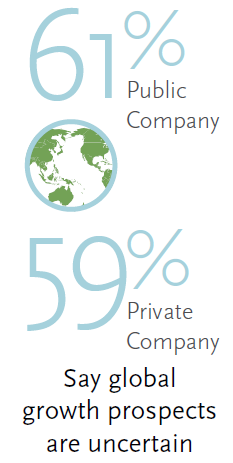
ss1Our survey finds that directors around the world are uncertain about global growth prospects, with directors in North America and Western Europe least confident about the prospects for growth. Sixty-three percent of directors in these regions see uncertain economic conditions, compared with 36% in Asia and 40% in Africa.

Only 2% of directors across all regions predict a period of strong global growth over the next three years, while 16% expect a global slowdown. “This pessimism about growth is one of the most surprising findings of our survey,” said Boris Groysberg of Harvard Business School. “It seems that the market volatility and low prospects for growth as well as the unpredictable economic outlook are what keep board members awake at night.”

More than one-third of directors of companies headquartered in Asia and roughly one-quarter of directors of companies in Australia/New Zealand expect relatively faster growth in emerging economies versus developed countries.

Political and Economic Landscape: Economy, regulations and cybersecurity top issues for directors.

ss2
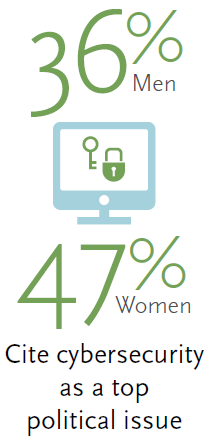
Across all industries and regions, directors rank the economy and the regulatory environment as the political issues most relevant to them. Cybersecurity is an increasingly important issue in many regions. More than one-third of directors of companies in Australia/New Zealand, North America and Western Europe say cybersecurity is a top issue. “Cybersecurity continues to be a leading issue on the agenda from a regulatory, reputational and contingency standpoint,” says Julie Hembrock Daum, head of Spencer Stuart’s North American Board Practice.

“We see boards considering a number of different approaches to getting smart about the broader impact of technology on the business. In certain cases they have added a director with a strong digital or security background. However, the board should not isolate cybersecurity responsibility with just this one board member, but continue to view cybersecurity as a full board priority.”

Political instability is a concern in several regions. In Central and South America, one-half of directors cite political instability as an issue. Corporate tax rates are an issue particularly in North America.

ss3

Company Risks: Women directors report higher concerns about risk than male directors.

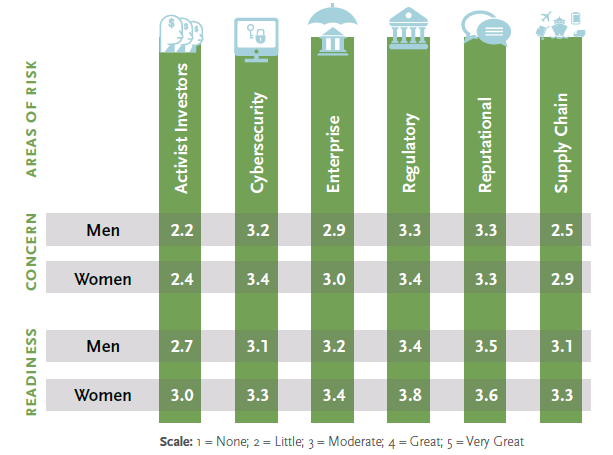
Directors globally express the most concern about regulatory and reputational risks, followed by cybersecurity, and less about activist investors and supply chain risks. In general, directors report that their companies are prepared to handle the most important risks, with companies’ level of readiness matching the most concerning areas of risk. However, directors of private companies systematically rank their boards as being less prepared versus public company boards when it comes to such risks.

Nearly across the board, female directors report a higher level of concern about various risks to a company than their male peers—from concerns about activist investors and cybersecurity to regulatory risk and the supply chain. However, female directors also feel that their companies have a higher level of readiness to address these risks than do their male cohorts.

Susan Stautberg, chairman and CEO of the WCD Foundation, believes that women directors may be educating themselves more about the potential risks:

“We believe that women in particular bring a real thirst for knowledge and curiosity to their board service, and this includes getting up-to-speed on what the real risks are to an organization. All good directors do this, but we think being relatively new to the boardroom can create a greater sense of urgency to learn.”

ss4

Strategy: Top challenges differ for public and private companies.

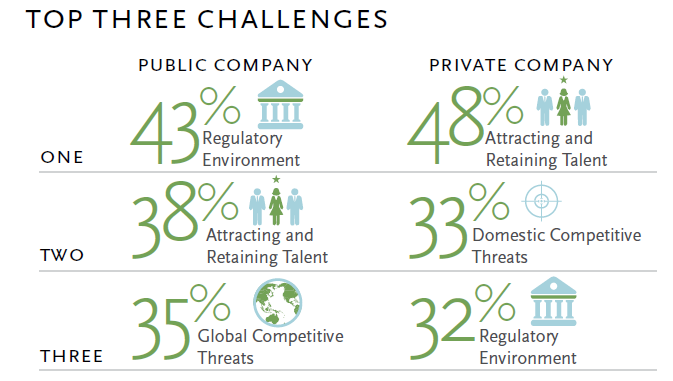
Talent, regulations, global and domestic competition, and innovation are seen by directors as the top impediments to achieving their companies’ strategic objectives. How those challenges rank specifically depends in part on whether directors are serving public or private companies.

Nearly half of private company directors (versus 38% of public company directors) rate attracting and retaining talent as a key challenge to achieving their company’s strategic objectives. This is followed by domestic competitive threats, the regulatory environment, innovation and global competitive threats. Among public companies, 43% of directors (versus 32% of private company directors) say the regulatory environment is a top challenge, followed by attracting and retaining talent, global competitive threats, innovation and domestic competitive threats.

“This was interesting because we do see in larger, more established public companies a greater maturity in their HR processes and deeper resources invested in talent management and development,” says Daum. “Identifying and recruiting individuals who fit the culture, bring impact to the organization and endure is a high priority for nearly all companies. However, many private companies, which tend to be smaller and have less brand awareness as a whole, often have less robust HR structures to attract the level of talent across the organization.”

Perceived challenges also differ somewhat by industry and region, with the regulatory environment being more concerning for companies in the energy/utilities, financials/professional services and healthcare industries, and in Asia, Australia/New Zealand, North America and Western Europe. Global competitive threats are the leading concern for companies in the industrials and materials sectors, and in Western Europe.

Interestingly, while cybersecurity is viewed as an important risk, few directors consider it a major challenge to achieving strategic objectives. Similarly, activist shareholders, compensation, cost of commodities and supply chain risk are not perceived as challenges to achieving strategic goals.

On average, directors rate their board’s overall performance as being slightly above average (3.7 out of 5). Directors see their boards as having the strongest processes related to staying current on the company and the industry, compliance, financial planning and board composition, and weakest in cybersecurity, the evaluation of individual directors, CEO succession planning and HR/talent management.

“These ratings underscore directors’ views that attracting and retaining top talent is a common challenge, and underline the need for these HR competencies on boards,” says Stautberg. Harvard Business School doctoral candidate Yo-Jud Cheng adds, “Despite the fact that directors recognize their weaknesses in these areas, boards continue to prioritize more conventional areas of expertise, such as industry knowledge and auditing, in their appointments of new directors.”

Public company directors rate their overall board performance slightly higher than private company directors (3.8 versus 3.4) and give themselves higher marks for creating effective board structures, evaluation of individual directors, cybersecurity and compliance. We also see some variation across regions.

Board Turnover: Directors—especially women—favor tools to trigger change.

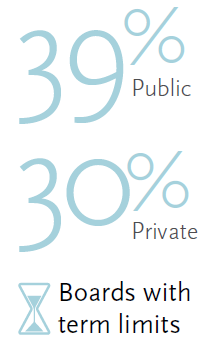
A little more than one-third of boards have term limits for directors, averaging six years, while approximately one-quarter of boards have a mandatory retirement age, averaging 72 years. Boards in Western Europe are most likely to have term limits, and boards in North America are least likely to set term limits. However, boards in North America are more likely to have a mandatory retirement age than boards in Western Europe (34% versus 18%). We also see a stark contrast between public and private companies in both term limits (39% versus 30%) and mandatory retirement ages (33% versus 12%).ss5

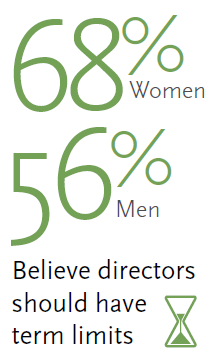
While these tools for triggering director turnover generally have not been widely adopted, the survey indicates that directors favor adoption of such mechanisms. Sixty percent of directors think that boards should have mandatory term limits for directors, and 45% think that there should be a mandatory retirement age. Even in private companies, which are considerably less likely to adopt these practices today, directors shared similar opinions as compared to their counterparts in public companies. Female directors even more strongly support triggers for turnover; 68% (versus 56% of men) favor director term limits and 57% (versus 39% of men) support mandatory retirement ages.

“It was encouraging to see the majority of respondents in favor of retirement ages and term limits. Turnover among S&P 500 companies has trended at 5% to 7%—roughly 300 to 350 seats a year. Boards need tools they can use to ensure that new perspectives and thinking are regularly being brought to the boardroom,” says Daum. “This isn’t just an issue tied to activist shareholders, but something institutional shareholders are asking about as well: what are boards doing to ensure independent and fresh thinking?”

ss6Not surprisingly, 43% of directors believe that a director loses his or her independence after about 10 years. Respondents from North America are less likely to tie director independence to years served, with only one-third agreeing that a director loses independence after a certain amount of time on the board.

Board Diversity: Greater independence doesn’t always drive greater diversity.

Public companies represented in the survey have larger boards than private companies—on average 8.9 directors versus 7.6—and a larger representation of independent directors, 74% versus 54%. Yet, public and private company boards are similar in terms of the representation of women, minorities and new directors. On average, 18% of board members are women, 7% are ethnic minorities and 13% have been appointed in the past 12 months.

“This finding was very interesting. There has been much debate about the use and effectiveness of quotas. To see the relative parity of diversity among public and private companies reinforces that the tone needs to come from the top regarding bringing a fresh, diverse perspective representative of the company’s stakeholders and interests,” says Daum. Groysberg adds, “Although we are hearing more talk about the importance of diversity from boards, it’s not necessarily translating into numbers. Unfortunately, we haven’t seen as much progress as we were hoping for compared to our past survey on the diversity of boards.”

Boards are largest in the financials/professional services sector (9.1 directors) and smallest in the IT/telecom sector (7.5 directors). Female representation is highest (20% or more) in the consumer staples, financial services/professional services and consumer discretionary sectors, and lowest in IT/telecom (13%).

Looking across regions, board size is smallest in Australia/New Zealand, where boards average 6.7 members, as compared to the global average of 8.5 members. Boards in Australia/New Zealand and North America have the highest proportion of independent directors, and boards in Asia have the lowest proportion. Female representation is lowest in Central and South America and Asia.

ss7

Boardroom Diversity: Why isn’t the number of women on boards increasing?

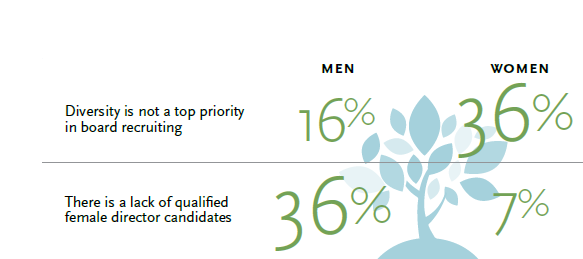
As the percentage of women on boards remains stagnant, there is both a gender divide and a generation divide on why this is. Male directors, especially older respondents, report the “lack of qualified female candidates,” while women directors most often cite the fact that diversity is not a priority in board recruiting and that traditional networks tend to be male-dominated. Younger male directors surveyed (those 55 and younger) are inclined to agree with women that traditional networks tend to be male-dominated. “Men in the younger generation, I think, just see their qualified female colleagues out there, but know that the traditional board networks still tend to be male,” says Stautberg. “It’s often hard to see an informal ‘network’ if you are in the middle of it, but you can see it very clearly when you’re on the outside.”

ss8

Boardroom Diversity: Quotas not supported overall.

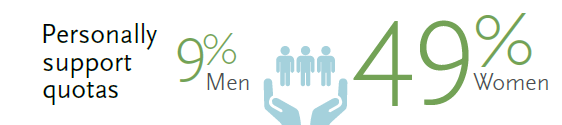
Nearly 75% of surveyed directors do not personally support boardroom diversity quotas, but support for quotas varies significantly by gender and, to a lesser degree, by age. Forty-nine percent of female directors support diversity quotas, but only 9% of male directors do. Older women are less likely to favor quotas than younger women; 67% of female directors ages 55 and younger personally support boardroom quotas, compared with 36% of female directors over 55 (the majority of male directors, of any age, do not support quotas). Female directors also are more likely to be in favor of government regulatory agencies requiring boards to disclose specific practices/steps being taken to seat diverse candidates (43% versus 14% of male directors).

If quotas aren’t the answer, what do directors think would increase board diversity? Male and female directors agree that having board leadership that champions board diversity is the most effective way to build diverse corporate boards. Men feel more strongly than women that efforts to develop a pipeline of diverse board candidates throuss9gh director advocacy, mentorship and training is an effective way to increase diversity.

Directors as a whole agree that shareholder pressure and board targets are less effective tools for increasing board diversity.


Boardroom Diversity: Search firms have been successful in expanding the talent pool of qualified female directors.

Directors take a variety of pathways to the boardroom: in roughly equal measures, directors were known to the board or another director, recruited by a search firm or known by the CEO. Public company directors are more likely to be recruited by an executive search firm than private company directors, while private company directors are more likely to have been appointed by a major shareholder.

The survey highlights gender differences, as well, in the paths to the boardroom. Female directors are more likely than their male counterparts to have been recruited by an executive search firm, while male directors are more likely to have been appointed by a major shareholder. “Search firms may be able to open doors that networking opportunities may not have been doing until relatively recently, at least for women,” says Stautberg. “Building up networks and getting known is something that women directors are engaging in much more actively now.”

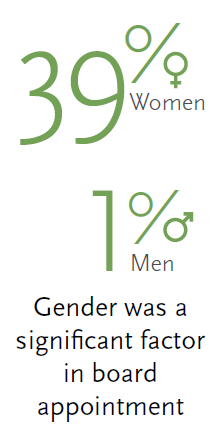
And, indeed, 39% of female directors report that their gender was a significant factor in their board appointment, versus 1% of men.

Conclusion

Corporate boards face no shortage of challenges—from economic uncertainty to strategic and competitive shifts to a dynamic set of risks. Investor attention to board performance and governance has also escalated, and many boards are holding themselves to higher standards. Directors want to ensure that their boards contribute at the highest level, incorporating diverse perspectives, aligning with shareholder interests and setting a positive tone at the top for the organization.

Yet our research has revealed a gap between best practice and reality, especially in areas such as board diversity, HR/talent management, CEO succession planning and director evaluations. But the study provides hope that boards will make progress, as directors support practices that can help promote change. Future research is needed to track progress on these fronts and to study the impact of measures such as quotas and diversity on board performance.

Amid the many challenges confronting corporations—and the growing expectations on corporate boards—directors must be thoughtful about defining the skill sets needed around the board table and diligent in recruiting the right directors, planning for CEO succession and evaluating their own performance. In this way, they will be best positioned to contribute at the high levels which they are demanding of themselves, and to which others are holding them accountable.

The complete publication is available here.


*Julie Hembrock Daum leads the North American Board Practice at Spencer Stuart, and Susan Stautberg is the Chairman and CEO of the WomenCorporateDirectors Foundation. This post relates to the 2016 Global Board of Directors Survey, a co-publication from Spencer Stuart and the WCD Foundation authored by Ms. Daum; Ms. Stautberg; Dr. Boris Groysberg, Richard P. Chapman Professor of Business Administration at Harvard Business School; Yo-Jud Cheng, doctoral candidate at Harvard Business School; and Deborah Bell, researcher.

La relève dans une entreprise familiale | Une possibilité de conflits de rôles !


Voici un cas de gouvernance publié sur le site de Julie Garland McLellan* qui concerne les relations entre la présidente du conseil et sa fille nouvellement nommée comme CEO de cette entreprise privée de taille moyenne.

Le cas illustre le processus de transition familiale et les efforts à exercer afin de ne pas interférer avec les affaires de l’entreprise.

Il s’agit d’un cas très fréquent dans les entreprises familiales. Comment Hannah peut-elle continuer à faire profiter sa fille de ses conseils tout en s’assurant de ne pas empiéter sur ses responsabilités ?

Le cas présente la situation de manière assez succincte, mais explicite ; puis, trois experts en gouvernance se prononcent sur le dilemme qui se présente aux personnes qui vivent des situations similaires.

Bonne lecture ! Vos commentaires sont toujours les bienvenus.


Cas de relève familiale


spb-cinq-conditions-gagnantes-assurer-releve-entreprise-familiale_2


Hannah prepared for the transition. She did a course of director education and understands her duties as a non-executive. She loves her daughter, trusts her judgement as CEO and genuinely wants to see her succeed. Nothing is going wrong but Hannah can’t help interfering. She is bored and longs for the days when she could visit customers or sit and strategise with her management team. 

Once a week she has a formal meeting with the CEO in her office. In between times she is in frequent contact. Although by mutual agreement these contacts should be purely social or family oriented Hannah finds herself talking business and is hurt when her daughter suggests they leave it for the weekly meeting or put it onto the board agenda.

Over the past few months Hannah has improved governance, record-keeping, training and succession planning systems but she is running out of projects she can do without undermining her daughter. She also recognises that, as a medium sized unlisted business, the company does not need any more governance structures.

How can Hannah find fulfilment in her new role?


Paul’s Answer  …..


Julie’s Answer ….


Jakob’s Answer ….

*Julie Garland McLellan is a practising non-executive director and board consultant based in Sydney, Australia.


Malaise au conseil | Les effets pervers de l’obligation de divulgation des rémunérations de la haute direction (en rappel)


Aujourd’hui, je cède la parole à Mme Nicolle Forget*, certainement l’une des administratrices de sociétés les plus chevronnées au Québec (sinon au Canada), qui nous présente sa vision de la gouvernance « réglementée » ainsi que celle du rôle des administrateurs dans ce processus.

L’allocution qui suit a été prononcée dans le cadre du Colloque sur la gouvernance organisée par la Chaire de recherche en gouvernance de sociétés le 6 juin 2014. Je pensais tout d’abord faire un résumé de son texte, mais, après une lecture attentive, j’en ai conclu que celui-ci exposait une problématique de fond et constituait une prise de position fondamentale en gouvernance. Il me semblait essentiel de vous faire partager son article au complet.

Nous avons souvent abordé les conséquences non anticipées de la réglementation, principalement celles découlant des exigences de divulgation en matière de rémunération. Cependant, dans son allocution, l’auteure apporte un éclairage nouveau, inédit et audacieux sur l’exercice de la gouvernance dans les sociétés publiques.

Elle présente une solide argumentation et expose clairement certains malaises vécus par les administrateurs eu égard à la lourdeur des mécanismes réglementaires de gouvernance. Les questionnements présentés en conclusion de l’article sont, en grande partie, fondés sur sa longue expérience comme membre de nombreux conseils d’administration.

Comment réagissez-vous aux constats que fait Mme Forget ? Les autorités réglementaires vont-elles trop loin dans la prescription des obligations de divulgation ? Pouvons-nous éviter les effets pervers de certaines dispositions sans pour autant nuire au processus de divulgation d’informations importantes pour les actionnaires et les parties prenantes.

Vos commentaires sont les bienvenus. Je vous souhaite une bonne lecture.


MALAISE AU CONSEIL | Les effets pervers de l’obligation de divulgation en matière de rémunération

 par

Nicolle Forget*


Merci aux organisateurs de ce colloque de me donner l’occasion de partager avec vous quelques constatations et interrogations qui m’habitent depuis quatre ou cinq ans concernant diverses obligations imposées aux entreprises à capital ouvert (inscrites en Bourse). Je souligne d’entrée de jeu que la présentation qui suit n’engage que moi.

Depuis l’avènement de quelques grands scandales financiers, ici et ailleurs, on en a mis beaucoup sur le dos des administrateurs de sociétés. On voudrait qu’un administrateur soit un expert en semblable matière.  Il ne l’est pas.  Il arrive avec son bagage, c’est pourquoi on l’a choisi.  On lui prépare un programme de formation pour lui permettre de comprendre l’entreprise au conseil de laquelle il a accepté de siéger, mais il n’en saura jamais autant que la somme des savoirs de l’entreprise.  C’est utopique de s’attendre au contraire.  Même un administrateur qui ne ferait que cela, siéger au conseil de cette entreprise, ne le pourrait pas.

nicolle-forget

Des questions reviennent constamment dans l’actualité : où étaient les administrateurs ? N’ont-ils rien vu venir ou rien vu tout court?  Ont-ils rempli leur devoir fiduciaire?  Tout juste si on ne conclut pas qu’ils sont tous des incompétents.  Les administrateurs étaient là.  Ils savaient ce que l’on a bien voulu leur faire savoir. (ex. Saccage de la Baie-James. Les administrateurs de la SEBJ, convoqués en Commission parlementaire à Québec, au printemps 1983,  ont appris, par un avocat venu y témoigner, l’existence d’un avis juridique qu’il avait préparé à la demande de la direction.  La SEBJ poursuivait alors les responsables du saccage et un très long procès était sur le point de commencer.  Avoir eu connaissance de son contenu, au moment où il a été livré au PDG, aurait eu un impact sur nos décisions.  J’étais alors membre du conseil d’administration).

Posons tout de suite que la meilleure gouvernance qui soit n’empêchera jamais des dirigeants qui veulent cacher au conseil certains actes d’y parvenir — surtout si ces actes sont frauduleux. Même avec de belles politiques et de beaux codes d’éthique, plusieurs directions d’entreprise trouvent encore qu’un conseil d’administration n’est rien d’autre qu’un mal nécessaire.  Les administrateurs sont parfois perçus comme s’ingérant dans les affaires de la direction ou dans les décisions qu’elle prend. Aussi, ces dirigeants ont-ils tendance à placer les conseils devant des faits accomplis ou des dossiers tellement bien ficelés qu’il est difficile d’y trouver une fissure par laquelle entrevoir une faille dans l’argumentation au soutien de la décision à prendre. Pourtant, et nous le verrons plus loin, en vertu de la loi, le conseil « exerce tous les pouvoirs nécessaires pour gérer les activités et les affaires internes de la société ou en surveiller l’exécution ».

Les conseils d’administration, comme les entreprises et leurs dirigeants, sont soumis à quantité de législations, réglementations, annexes à celles-ci, avis, lignes directrices et autres exigences émanant d’autorités multiples — et davantage les entreprises œuvrent dans un secteur d’activités qui dépasse les frontières d’une province ou d’un pays. Et, selon ce que l’on entend, il faudrait que l’administrateur ait toujours tout vu, tout su…

Malaise!

En 2007, Yvan Allaire écrivait que « … la gouvernance par les conseils d’administration est devenue pointilleuse et moins complaisante, mais également plus tatillonne, coûteuse et litigieuse ; les dirigeants se plaignent de la bureaucratisation de leur entreprise, du temps consacré pour satisfaire aux nouvelles exigences » 1. Denis Desautels, lui, signalait que « Certains prétendent que le souci de la conformité aux lois et aux règlements l’emporte sur les discussions stratégiques et sur la création de valeur.  Et d’autres, que l’adoption ou l’endossement des nouvelles normes n’est pas toujours sincère et, qu’au fond, la culture de l’entreprise n’a pas réellement changé » 2.

Pour mémoire, voyons quelques obligations (de base) d’un administrateur de sociétés.

Au Québec, la Loi sur les sociétés par actions (L.r.Q., c. S-31.1) prévoit que les affaires de la société sont administrées par un conseil d’administration qui « exerce tous les pouvoirs nécessaires pour gérer les activités et les affaires internes de la société ou en surveiller l’exécution » (art. 112) et que, « Sauf dans la mesure prévue par la loi, l’exercice de ces pouvoirs ne nécessite pas l’approbation des actionnaires et ceux-ci peuvent être délégués à un administrateur, à un dirigeant ou à un ou plusieurs comités du conseil. »

De façon générale, les administrateurs de sociétés sont soumis aux obligations auxquelles est assujetti tout administrateur d’une personne morale en vertu du Code civil. « En conséquence, les administrateurs sont notamment tenus envers la société, dans l’exercice de leurs fonctions, d’agir avec prudence et diligence de même qu’avec honnêteté et loyauté dans son intérêt » (art. 119). L’intérêt de la société, pas l’intérêt de l’actionnaire.  La loi fédérale présente des concepts semblables.  (La Cour Suprême du Canada a d’ailleurs rappelé dans l’affaire BCE qu’il n’existe pas au Canada de principe selon lequel les intérêts d’une partie — les actionnaires, par exemple — doivent avoir priorité sur ceux des autres parties.)

Si la société fait appel publiquement à l’épargne, elle devient un émetteur assujetti. Alors s’ajoutent les règles de la Bourse concernant les exigences d’inscription initiale ainsi que celles concernant le maintien de l’inscription. S’ajoutent aussi les obligations édictées dans la Loi sur les valeurs mobilières (L.R.Q., c. V-1.1), de même que les règlements qui en découlent, et dont l’Autorité des marchés financiers (AMF) est chargée de l’application. L’émetteur assujetti est tenu aux obligations d’information continue. Si vous êtes un administrateur ou un haut dirigeant d’un tel émetteur ou même d’une filiale d’un tel émetteur, vous êtes un initié avec des obligations particulières.

L’article 73 de cette Loi stipule que tel émetteur « … fournit, conformément aux conditions et modalités déterminées par règlement, l’information périodique au sujet de son activité et de ses affaires internes, dont ses pratiques en matière de gouvernance, l’information occasionnelle au sujet d’un changement important et toute autre information prévue par règlement. ». «L’émetteur assujetti doit organiser ses affaires conformément aux règles établies par règlement en matière de gouvernance». (art.73.1)

La mission de l’Autorité, (entendre ici AMF) telle qu’énoncée à l’article 276.1 de la Loi sur les valeurs mobilières se décline comme suit :

  1. Favoriser le bon fonctionnement du marché des valeurs mobilières ;
  2. Assurer la protection des épargnants contre les pratiques déloyales, abusives et frauduleuses ;
  3. Régir l’information des porteurs de valeurs mobilières et du public sur les personnes qui font publiquement appel à l’épargne et sur les valeurs émises par celles-ci ;
  4. Encadrer l’activité des professionnels des valeurs mobilières et des organismes chargés d’assurer le fonctionnement d’un marché des valeurs mobilières.

Dans sa loi constituante, l’Autorité a une mission plus élaborée qui reprend sensiblement les mêmes thèmes, mais en appuyant davantage sur la protection des consommateurs de produits et utilisateurs de services financiers. (art.4, L.R.Q., c. A-33.2)

Aux termes de la législation en vigueur, « L’Autorité exerce la discrétion qui lui est conférée en fonction de l’intérêt public» (art.316, L.R.Q., c. V-1.1) et un règlement pris en vertu de la présente loi confère un pouvoir discrétionnaire à l’Autorité » (art.334).  En outre, toujours selon cette Loi, « Les instructions générales sont réputées constituer des règlements dans la mesure où elles portent sur un sujet pour lequel la loi nouvelle prévoit une habilitation réglementaire et qu’elles sont compatibles avec cette loi et les règlements pris pour son application. »

Je vous fais grâce du Règlement sur les valeurs mobilières (Décret 660-83 ; 115 G.O.2, 1511) ; quant à l’Annexe (51-102A5), portant sur la Circulaire de sollicitation de procuration par la direction, et celle (51-102A6) portant spécifiquement sur la Déclaration de la rémunération de la haute direction, j’y reviendrai plus loin.

Ceci pour une société qui ne fait affaire qu’au Québec, et à l’exclusion de toutes les autres législations et les nombreux règlements portant sur un secteur d’activité en particulier. Pensons juste aux activités qui peuvent affecter l’environnement, même de loin.  Alors, si une société fait affaire ailleurs au Canada et aux É.-U. ou sur plusieurs continents — ajoutez des obligations, des modes différents de divulgation de l’information — et cela peut vous donner une petite idée de « l’industrie » qu’est devenue la gouvernance d’entreprise avec l’obligation de livrer l’information en continu et sous une forme de plus en plus détaillée.  Et les administrateurs devraient tout savoir, avoir tout vu…

Les très nombreuses informations que nous publions rencontrent-elles l’objectif à l’origine de ces exigences ? Carol Liao soutient que « les autorités réglementaires sont par définition orientées vers l’actionnaire ce qui aurait mené à une augmentation des droits de ces derniers, bien au-delà de ce que les lois canadiennes (sur les sociétés) envisageaient. »  On a vu plus haut que la Loi sur les sociétés par actions édicte que « les administrateurs sont notamment tenus envers la société dans l’exercice de leurs fonctions, d’agir avec prudence et diligence de même qu’avec honnêteté et loyauté dans son intérêt ».  Se pourrait-il que « ce qui est dans l’intérêt supérieur des actionnaires ne coïncide pas avec une meilleure gouvernance ? (doesn’t align with better governance – that’s where the practice falls down »3.)

J’aime à croire que l’origine de l’obligation qui est faite aux entreprises de dire qui elles sont, ce qu’elles font, comment elles le font, et avec qui elles le font, est la protection du petit investisseur — vous et moi qui plaçons nos économies en prévision de nos vieux jours — comme disaient les anciens.

À moins d’y être obligé par son travail, qui comprend le contenu des circulaires de sollicitation de procuration par la direction, émises à l’intention des actionnaires ? Les Notices annuelles ? D’abord, qui les lit?  Chaque fois que l’occasion m’en est donnée, je pose la question  – et partout le même commentaire :  si je n’avais pas les lire je ne les lirais pas. La quantité de papier rebute en partant ; la complexité des informations à publier en la forme prescrite est difficile à comprendre pour un non-expert, alors imaginez pour un petit investisseur.  Si même  il s’aventure à lire le document.

Donc, si tant est que les circulaires et les notices ne soient pratiquement lues que par ceux qui n’ont pas le choix de le faire, il serait peut-être temps de se demander à quoi, ou plutôt, à qui elles servent ? Et à quels coûts pour l’entreprise. A-t-on une idée de combien d’experts s’affairent avec le personnel de l’entreprise à préparer ces documents sans compter les réunions des comités d’Audit, de Ressources humaines, de Gouvernance et du conseil qui se pencheront sur diverses versions des mêmes documents ?

Encore une fois, pour quoi ? Pour qui ?

Pourquoi pas aux activistes de toutes origines ?

La dernière crise financière (2008/2009) semble avoir été l’accélérateur de l’activisme de groupes, autour des actionnaires, de même que l’arrivée d’experts de toutes sortes en gouvernance d’entreprise. Une industrie venait de naître!  Le Rapport sur la gouvernance 2013, de Davies Ward Phillips & Vineberg, s.e. n.c. r. l., soutient qu’il s’agit d’une tendance alimentée surtout « par le nombre accru d’occasions d’activisme découlant de certaines  tendances actuelles de la législation et des pratiques à vouloir que plus de questions soient soumises à l’approbation des actionnaires » 4.

Mais, l’a-t-on oublié ? Les administrateurs ont un devoir de fiduciaire envers la société, pas juste envers les actionnaires.  Ils doivent assurer la pérennité de l’entreprise et pas juste afficher un rendement à court terme qui entraîne des effets pervers sur la gestion des ressources humaines et ne tient pas suffisamment compte d’une saine gestion des risques.  Question :  est-ce que la mesure de l’efficacité consiste en une reddition de compte trimestrielle ? Est-ce que cette reddition de compte, toute formatée, n’est pas en train de remplacer la responsabilité et l’engagement personnel des hauts dirigeants ? La pression  mise sur les conseils d’administration, par certains activistes (d’ailleurs pas toujours actionnaires de l’entreprise !), et de leurs conseillers divers, pour discuter avec le président du conseil et le président du comité de ressources humaines est perçue comme une tentative de la part de ces activistes d’imposer leur programme — au détriment des autres actionnaires et de l’intérêt même de l’émetteur.  Et comme certains fournisseurs de ces activistes (agences de conseils en vote) produisent des analyses pour leur clientèle en vue d’une recommandation de vote lors d’une assemblée annuelle — cette démarche peut être interprétée comme une pression à la limite de l’intimidation.

Venons-en aux obligations de divulgation portant sur la rémunération des membres de la haute direction visés.

Les prêteurs, les actionnaires, ont le droit de connaître — à terme — les obligations de l’entreprise, y compris celles envers ses hauts dirigeants. Remarquez, ils ont aussi le droit de savoir s’il y a exagération ou abus. Mais, ont-ils besoin, entre autres, de connaître dans le détail les objectifs personnels fixés à Monsieur X ou à Madame Y?; pour quel % cela compte-t-il dans la rémunération incitative à court terme?; à quel % tels objectifs ont-ils été rencontrés?; pourquoi l’ont-ils été à ce %?.  Peut-on sérieusement croire qu’une entreprise va publier que telle ou telle personne n’est pas à la hauteur, 12 à 15 mois après les faits?.  Ou bien cette personne a rencontré les objectifs fixés de façon satisfaisante ou bien elle n’est plus là.  Denis Desautels avance, dans le texte cité plus haut, qu’il « n’est pas sage d’appuyer les régimes de rémunération sur des formules trop quantitatives ou mathématiques et d’allouer une trop grande portion de la rémunération globale à la partie variable ou à risque de la rémunération ».  Pourtant, les pressions ne cessent d’augmenter pour que cela soit le cas (Pay for Performance) et que ce soit basé sur des mesures objectives et connues comme le cours de l’action ou le résultat par action… le tout par rapport au groupe de référence.  Performance devient le nouveau leitmotiv.  S’est-on jamais demandé ce que cette divulgation pouvait avoir comme effet d’« emballement » sur la rémunération des hauts dirigeants?  Et les politiques de rémunération doivent continuellement s’ajuster.

Le Règlement 51-102, à son Annexe A6 (Déclaration de la rémunération de la haute direction) prescrit non seulement le contenu, mais aussi la forme que doit prendre cette déclaration :

L’ensemble de la rémunération payée, payable, attribuée, octroyée, donnée ou fournie de quelque autre façon, directement ou indirectement, par la société ou une de ses filiales à chaque membre de la haute direction visé et chaque administrateur, à quelque titre que ce soit, notamment l’ensemble de la rémunération en vertu d’un plan ou non, les paiements directs ou indirects, la rétribution, les attributions d’ordre financier ou monétaire, les récompenses, les avantages, les cadeaux ou avantages indirects qui lui sont payés, payables, attribués, octroyés, donnés ou fournis de quelque autre façon pour les services rendus et à rendre, directement ou indirectement, à la société ou à une de ses filiales. (art. 1.3 par, 1 a).

L’émetteur assujetti doit, en outre, produire une analyse de la rémunération, laquelle doit :

1) Décrire et expliquer tous les éléments significatifs composant la rémunération attribuée, payée, payable aux membres de la haute direction visés, ou gagnée par ceux-ci, au cours du dernier exercice, notamment les suivants :

  1. a) les objectifs de tout programme de rémunération ou de toute stratégie en la matière ;
  2. b) ce que le programme de rémunération vise à récompenser ;
  3. c) chaque élément de la rémunération ;
  4. d) les motifs de paiement de chaque élément ;
  5. e) la façon dont le montant de chaque élément est fixé, en indiquant la formule, le cas échéant ;
  6. f) la façon dont chaque élément de la rémunération et les décisions de la société sur chacun cadrent avec les objectifs généraux en matière de rémunération et leur incidence sur les décisions concernant les autres éléments.

2) Le cas échéant, expliquer les actions posées, les politiques établies ou les décisions prises après la clôture du dernier exercice qui pourraient influencer la compréhension qu’aurait une personne raisonnable de la rémunération versée à un membre de la haute direction visé au cours du dernier exercice.

3) Le cas échéant, indiquer clairement la référence d’étalonnage établie et expliquer les éléments qui la composent, notamment les sociétés incluses dans le groupe de référence et les critères de sélection.

4) Le cas échéant, indiquer les objectifs de performance ou les conditions similaires qui sont fondés sur des mesures objectives et connues, comme le cours de l’action de la société ou le résultat par action. Il est possible de décrire les objectifs de performance ou les conditions similaires qui sont subjectifs sans indiquer de mesure précise.

Si les objectifs de performance ou les conditions similaires publiés ne sont pas des mesures financières conformes aux PCGR, en expliquer la méthode de calcul à partir des états financiers de la société.

Et le tout dans un langage clair, concis et « présenté de façon à permettre à une personne raisonnable, faisant des efforts raisonnables de comprendre (…)

  1. a) la façon dont sont prises les décisions concernant la rémunération des membres de la haute direction visés et des administrateurs ;
  2. b) le lien précis entre la rémunération des membres de la haute direction visés et des administrateurs et la gestion et la gouvernance de la société (par. 10). »

L’Instruction générale relative au règlement 51-102 sur les obligations d’information continue définit, en son article 1.5, ce qu’il faut entendre par langage simple.  C’est en quatorze points ; je vous en fais grâce.  Je rappelle ici qu’une instruction générale est réputée constituer un règlement.

Trop, c’est comme pas assez. C’est aussi ce que  pourrait se dire la personne raisonnable après avoir fait des efforts raisonnables pour comprendre tout cela. Cette personne pour laquelle l’entreprise publie toutes les informations réclamées par le législateur/autorité réglementaire poussé par l’industrie de la gouvernance qui, elle, bénéficie de la complexification des règles.

L’émetteur est placé devant ces obligations auxquelles il veut bien se conformer, mais pas au point de livrer des éléments importants de ses stratégies de développement au premier lecteur venu. Ce qui pourrait même être contre l’intérêt des actionnaires, et finalement ne bénéficier qu’à la concurrence.  Ce qui fait que l’on en est rendu à se demander comment éviter de divulguer « les secrets de familles », si je puis dire, sans indisposer les autorités réglementaires — surtout si on doit aller au marché dans les mois qui suivent.

Malaise!

Si mon souvenir est bon, les pressions sont venues de groupes divers (investisseurs institutionnels, gestionnaires de fonds et autres) qui jugeaient les rémunérations des hauts dirigeants extravagantes et non méritées. Pour eux, les administrateurs étaient responsables de cet état de fait. Alors, on a légiféré, réglementé, permis le Say on Pay et diverses propositions d’actionnaires.  La rémunération a-t-elle baissé ? Non. Les parachutes ont-ils disparu?  Non.  Chacun se compare à l’autre et ne voit pas pourquoi il ne serait pas rémunéré comme son vis-à-vis de l’entreprise Z.  Et les PDG de se négocier un contrat blindé — pourquoi pas?  Ils sont assis sur un siège éjectable.

Ne pourrait-on pas se demander maintenant si partie ou toutes ces exigences ne produisent pas davantage d’effets pervers que de bénéfices ? (Dans le plan d’affaires 2013-2016 des ACVM. Les deux dernières priorités sont :  réglementation des marchés ; et efficacité des mesures d’application de la loi).

Ne pourrait-on pas aussi se demander si exiger une durée minimale de détention de l’actionnariat pour obtenir le droit de vote à une assemblée générale ne serait pas souhaitable ?

Si publier les résultats deux fois l’an, au lieu de quatre, ne donnerait pas un peu d’oxygène aux entreprises — un début de délivrance de la tyrannie du rendement à court terme ? Et, quant à y être, pourquoi continuer de publier l’information telle qu’exigée, si elle n’est pas lue ?

Et puis, à quoi servent les administrateurs si les actionnaires peuvent s’immiscer dans la gestion d’une entreprise et imposer leurs volontés en tout temps ?

Et à quel actionnaire permettre quoi ? Un Hedge Fund qui achète et vend des millions d’actions par minute ? Un fond mutuel qui garde des actions quelques années ?  Un retraité qui conserve ses actions depuis 20 ans ?

D’ici à ce que l’on ait réfléchi à tout cela, ne peut-on pas marquer le pas ?


  1. 1. Allaire, Yvan, Pourquoi cette vague de privatisation d’entreprises cotées en Bourse, La Presse, mars 2007.
  2. 2. Desautels, Denis, OC, FCA, Les défis les plus difficiles des administrateurs de sociétés, Collège des administrateurs de sociétés, Conférence annuelle, 11 mars 2009.
  3. 3. Carol Liao, A Canadian Model of Corporate Governance, Where do shareholders really stand? Director Journal, January/February 2014, p. 37
  4. 4. p. 55.

*Nicolle Forget siège au conseil d’administration du Groupe Jean Coutu (PJC) Inc., de Valener Inc. et de ses filiales et du Collège des administrateurs de sociétés. Elle a, entre autres, fait partie d’un comité d’éthique de la recherche et des nouvelles technologies et de comités d’éthique clinique, de même que du Groupe de travail sur l’éthique, la probité et l’intégrité des administrateurs publics et a présidé le Groupe de travail sur les difficultés d’accès au financement pour les femmes entrepreneuses.

Madame Forget a été chargée de cours à l’École des Hautes Études commerciales et elle est l’auteure de cas en gestion de même que de quelques ouvrages biographiques. Madame Forget a d’abord fait du journalisme à Joliette avant de se consacrer à la gestion d’organismes de recherche et de formation durant les années 1970. Elle a aussi été membre (juge administratif) de tribunaux administratif et quasi judiciaire durant les années 1980 et 1990.

Madame Forget est diplômée de l’UQÀM (brevet d’enseignement spécialisé en administration), des HEC (baccalauréat en sciences commerciales) et de l’Université de Montréal (licence en droit et DESS en bioéthique). Elle fût membre du Barreau du Québec jusqu’en 2011.

Madame Forget a siégé à de nombreux conseils d’administration dont : Fédération des femmes du Québec, Conseil économique du Canada, SEBJ, Hydro-Québec, Hydro-Québec International, Gaz Métro Inc., Agence québécoise de valorisation industrielle de la recherche, Fonds de solidarité des travailleurs du Québec, Université de Montréal, École polytechnique, Innotermodal. Elle a, de plus, présidé les conseils de Accesum Inc., Nouveler Inc., Accès 51, Ballet Eddy Toussaint, Festival d’été de Lanaudière et Association des consommateurs du Québec.

Le point sur la gouvernance au Canada en 2016 | Rapport de Davies Ward Phillips Vineberg


Le rapport annuel de Davies est toujours très attendu car il brosse un tableau très complet de l’évolution de la gouvernance au Canada durant la dernière année.

Le document qui vient de sortir est en anglais mais la version française devrait suivre dans peu de temps.

Je vous invite donc à en prendre connaissance en lisant le court résumé ci-dessous et, si vous voulez en savoir plus sur les thèmes abordés, vous pouvez télécharger le document de 100 pages sur le site de l’entreprise.

Cliquez sur le lien ci-dessous. Bonne lecture !

Rapport de Davies sur la gouvernance 2016


Davies Governance Insights 2016, provides analysis of the top governance trends and issues important to Canadian boards, senior management and governance observers.

insights_governance_2016_fr_thumbnail

The 2016 edition provides readers with our take on important topics ranging from shareholder engagement and activism to leadership diversity and the rise in issues facing boards and general counsel. We also provide practical guidance for boards and senior management of public companies and their investors on these and many other corporate governance topics that we expect will remain under focus in the 2017 proxy season.


Les devoirs des administrateurs eu égard à un climat de travail malsain | Un cas pratique


Voici un cas de gouvernance publié sur le site de Julie Garland McLellan* qui illustre les contradictions entre les valeurs énoncées par une école privée et celles qui semblent animer les administrateurs et les parents.

Le cas montre comment un administrateur, nouvellement élu sur un CA d’une école privée, peut se retrouver dans une situation embarrassante impliquant des comportements de harcèlement et de menaces qui affectent la santé mentale et le bien-être des employés.

Cette situation semble se présenter de plus en plus fréquemment dans les institutions d’enseignement qui visent des rendements très (trop !) élevés.

Comment Ignacio peut-il s’y prendre pour bien faire comprendre aux administrateurs de son CA leurs devoirs et leurs obligations légales d’assurer un climat de travail sain, absent d’agression de la part de certains parents ?

Le cas présente, de façon claire, une situation de culture organisationnelle déficiente ; puis, trois experts en gouvernance se prononcent sur le dilemme qui se présente aux administrateurs qui vivent des expériences similaires.

Bonne lecture ! Vos commentaires sont toujours les bienvenus.


Un cas culture organisationnelle déficiente !


 drapeau-vicario1


Ignacio is an old boy of a private school with a proud sporting tradition. He was invited onto the board last year when a long-serving director retired. The school is well run with a professional principal who has the respect of the staff as well as many of the boys.

The school has worked hard to develop academic excellence and its place in rankings has improved with a greater percentage of boys qualifying for university.

At the last board meeting the CEO was absent. The chairman explained that he had taken stress leave because he couldn’t cope with bullying from some of the parents. Some directors sniggered and the rest looked embarrassed. There were a few comments about ‘needing to grow a backbone’, ‘being a pansy’, and ‘not having the guts to stand up to parents or lead the teams to victory on the field’.

Ignacio was aghast – he asked about the anti-harassment and workplace health and safety policies and was given leave by the chair « to look into ‘covering our backs’ if necessary ».

Ignacio met with the HR manager and discovered the policies were out of date and appeared to have been cut and pasted from the original Department of Education advice without customisation. From his experience running a business Ignacio is aware of the importance of mental health issues in the modern workplace and also of the legal duty of directors to provide a workplace free from bullying and harassment. School staff are all aware of a discrepancy between the stated School values and those of the board and some parents. The HR manager tells him that recent bullying by parents has become more akin to verbal and even physical assault. Staff believe the board will not support them against fee paying parents even though the school is, in theory, a not-for-profit institution.

How can Ignacio help lead his board to an understanding of their duty to provide a safe workplace?


Chris’s Answer  …..


Julie’s Answer ….


Leanne’s Answer ….

*Julie Garland McLellan is a practising non-executive director and board consultant based in Sydney, Australia.


Quelle est la rémunération globale des administrateurs canadiens ?


Quelle est la rémunération globale des administrateurs canadiens ?

C’est une question que beaucoup de personnes me posent, et qui n’est pas évidente à répondre !

L’article ci-dessous, publié par Martin Mittelstaedt, chercheur et ex-rédacteur au Globe and Mail, apporte un éclairage très intéressant sur la question de la rémunération des administrateurs canadiens.

Les études sur le sujet sont rares et donnent des résultats différents compte tenu de la taille, de la nature privée ou publique des entreprises, du secteur d’activité, des différentes composantes de la rémunération globale, etc.

De manière générale, il semble que les rémunérations des administrateurs canadiens et américains soient similaires et que les postes d’administrateurs des entreprises publiques commandent une rémunération globale d’environ quatre fois la rémunération offerte par les entreprises privées.

Une étude montre que la base médiane de la rémunération des administrateurs de sociétés privées au Canada est de 25 000 $, avec un jeton de présence de 1 500 $ et quatre réunions annuelles. Le nombre d’administrateurs est de six, incluant trois administrateurs indépendants et une femme ! La somme de la rémunération globale s’établirait à environ 31 000 $ US. Mais on parle ici de grandes entreprises privées…

Le montant de la rémunération dépend aussi beaucoup des plans de distribution d’actions, des privilèges, des bonis, etc.

Évidemment, pour toute entreprise publique, il est facile de connaître la rémunération détaillée des administrateurs et des cinq hauts dirigeants puisque ces renseignements se retrouvent dans les circulaires aux actionnaires.

Je vous encourage à lire cet article. Vous en saurez plus long sur les raisons qui font que les informations sont difficiles à obtenir dans le secteur privé.

Bonne lecture !

How much is a director worth ?


8b6d334e22ce959209f0988e0a56ca9c

Determining director compensation at private companies is more of an art than a science, with a wide range of practices and no one-size-fits-all formula.

Unlike publicly traded companies, where detailed information about director remuneration is as close as the nearest proxy circular, compensation at private boards is like “a black box,” according to Steve Chan, principal at Hugessen Consulting, who says retainers, meeting fees and share-based awards “are all over the map.”

Not much is known about private director compensation “for good reason,” observes David Anderson, president of Anderson Governance Group. “There is not a lot of data out there.”

PRIVATELY UNDERPAID?

Private company directorships can be prized assignments because they don’t involve the heavy compliance and regulatory burdens that occupy increasing amounts of time at public company boards.

But what private boards should be paid is difficult to determine, when there is little research to guide individual directors or companies. Some of the available data suggest private directors are being underpaid, at least relative to their public counterparts. But this information does not include the fact that the work may be different and much of the compensation at public boards may not ultimately pay off because it is linked to share price performance.

It is difficult to benchmark best practices with so little hard data, making it unsurprising that how best to set private company directors’ compensation is the most frequently asked question made by members to the ICD.

One of the few ongoing attempts to analyze compensation indicates remuneration is far higher at public boards, about four times higher in fact, although the amounts are skewed by the heavy use of stock-linked awards at publicly traded companies.

The private company survey, by Lodestone Global, was based on a questionnaire posed to members of the Young Presidents’ Organization, an international group of corporate présidents and CEOs, including many from Canada.

The Lodestone survey looked at medium-sized family or closely held firms, companies that are more established than early-stage startups, but smaller than large global corporations.

“The survey is not casually designed. The data is pretty rigorous and it’s global,” says Bernard Tenenbaum, managing partner at Princeton, N.J.-based Lodestone.

Tenenbaum says he started investigating private company board compensation because of the paucity of data on the subject. No one seemed to know what was going on. “People kept asking me, ‘Well how much should we pay directors?’ I’d say: ‘I don’t know. How much do you pay them now?’ And I started surveying.”

The firm’s most recent survey, based on 2014 data, had responses from more than 250 private companies, including 19 from Canada. The median revenue at the Canadian companies was $100-million, with the median number of employees at 325.

According to Tenenbaum, the median Canadian retainer was $25,000, with a $1,500 meeting fee and four meetings annually. The median number of directors was six, with three independent and one woman. The total of fees and retainers came to $31,000 (all dollar figures U.S.)

Interestingly, the overall U.S. compensation figure matched the Canadian one, but with a different composition. The median U.S. retainer was lower at $21,000, but the meeting fee was higher at $2,500. Including a few other miscellaneous items, like teleconference fees, U.S. compensation was $33,000, compared to $32,250 in Canada, a closeness that Tenenbaum termed “a kissing distance.”

The Lodestone figures give an indication of director compensation, although it is worth cautioning that the sample size is small, the figures are based on the median or middle-ranked firm, and there was a wide variety in size among the companies, given that they included a few smaller tech and industrial firms.

To benchmark private company director compensation, it is worthwhile to look at what comparable publicly traded companies are paying. One useful comparator is the smaller companies embedded in the BDO 600 survey of director compensation at medium-sized public companies. It has access to highly accurate data based on shareholder proxy circulars.

BDO’s 2014 survey found that among firms with revenue between $25-million and $325-million, cash compensation through retainer and committee fees averaged $54,000, while directors typically received another $65,000 in stock awards and options for a total of $119,000.

There is a small amount of information available in Canada on private board compensation, but the amount of data isn’t large enough to make generalized statements on remuneration and involves larger companies.

For example, in its director compensation, Canadian Tire Corp. breaks out amounts paid to the company’s non-publicly traded banking subsidiary, Canadian Tire Bank. In 2014, three directors on both boards were paid about $55,000 each for retainers and meeting fees for serving at the bank. Similarly, Loblaw Companies Ltd. paid $58,000 to a director who also served on President’s Choice Bank, a privately-held subsidiary.

The amounts are relatively low for blue-chip Canadian companies, but both banks are far smaller than their parent companies, with Canadian Tire Bank at $5.6-billion in assets and PC Bank at $3.3-billion.

Hugessen’s Chan says that in his experience, the larger, family-run private companies that have global operations compensate directors at roughly the same amounts as similarly sized public firms.

“Among the larger public companies versus the private companies, they’re comparable,” Chan says.

PUBLICLY EXPOSED

Tenenbaum says that based on his research and the figures from BDO, directors are being paid about $20,000 annually for taking on the added hassle of serving on a public company. He discounted the value of the stock-based compensation because it is conditional on share-price performance.

“There is a premium that you pay a director for taking the risk” of public company exposure, Tenenbaum says.

Directors also need to take into account some of the non-monetary factors of the board experience. Given that so much time on a public board is spent on compliance with regulatory requirements, being freed of this responsibility has value.

“When you’re on a private board, you don’t need to worry about all of the compliance that you have to worry about on a public company board,” says Larry Macdonald, who has served on both types of boards in the oil and gas sector. “You can spend more time on the issues which are probably more important to the company on a private board than you can on public board.”

Macdonald currently chairs publicly-traded Vermilion Energy Inc., but has also served on several private and volunteer boards.

One consequence of the difference in focus is that private boards can often have fewer members because directors can be more focused on company business needs, rather than on compliance requirements. Decision making can also be quicker and easier.

Macdonald says a public board may need eight to 10 people to handle the volume of work, compared to only five or six on a similar private company. As an example of the efficiency of a private board, a company that has a particularly good year and wants to pay employees a bonus can easily decide to do so.

At a public company, however, making this payment wouldn’t be as straightforward. Directors would have to compile a detailed explanation of why they wanted to pay the bonus and include it in shareholder circulars.

While some companies are downgrading the importance of meeting fees, Macdonald thinks they are necessary, with a range of $1,000 to $1,500 being sufficient. “There should be a permeeting fee. You want your directors to show up in person, if at all possible, and if you’re not going to give them a permeeting fee they’re going to be phoning it in or not showing up, so you’ve got to keep everybody interested,” he says.

EQUITY COMPENSATION

He would set the retainer with an eye to any equity compensation. “If there is a pretty good option plan, I would think that $10,000 a year would be adequate, but if the option plan is weaker, you have to up the annual fee,” Macdonald says.

The amount of equity reserved for directors in private companies is a disputed topic. Tenenbaum says equity compensation at private companies, in his experience, is rare. But Chan says a figure often used is to allocate 10 percent of the equity for directors and executives.

If the director is “pounding the pavement with the CEO, a big chunk ofthe [equity] pool might go to directors,” Chan says.

The amount of equity reserved for executives and the board could be as high as 20 percent to 30 percent in the early life of a technology company, but lower than 10 percent in a capital intensive business. “It all depends on size. You’re not going to give 10 percent away of a $1-billion company,” he says.

Macdonald considers the 10 percent of stock reserved for management and directors a good ball park figure. The bulk of the stock typically goes to management, with one or two percent earmarked for directors, he says.

RICHER REWARDS

Public boards are typically egalitarian, with all directors receiving the same base compensation. Private boards, however, can and do pay differing amounts, depending on the specialized skills companies are trying to assemble among their directors. Macdonald says a private oil company looking to pick up older fields, which may have environmental issues, might award extra compensation to attract a director with recognized skills in health, safety and environment.

To be sure, compensation is only one factor in attracting directors to a board. Tenenbaum says academic research has found that the reasons directors cite to join boards are led by the quality of top management, the opportunity to learn and to be challenged. Personal prestige, compensation and stock ownership are far down the list.

These factors may explain why many people want to serve on private boards. “The qualitative experience of private company directors is quite different from public company directors,” says Anderson.

“They avoid a lot of the perceived risk of public company boards and they get the benefit of doing what, as business people, they really like doing, which is thinking about the business and applying their knowledge and experience to business problems.”


This article originally appeared in the Director Journal, a publication of the Institute of Corporate Directors (ICD). Permission has been granted by the ICD to use this article for non-commercial purposes including research, educational materials and online resources. Other uses, such as selling or licensing copies, are prohibited.


Enquête mondiale sur les conseils d’administration et la gouvernance


Voici un récent article publié par Julie Hembrock Daum, directrice à Spencer Stuart et Susan Stauberg, PDG à Fondation WomenCorporateDirectors.

Cet article a été publié dans le Harvard Law School Forum aujourd’hui et il présente l’état de la gouvernance à l’échelle internationale (60 pays) en mettant particulièrement l’accent sur la diversité et les différences de perception entre les hommes et les femmes qui occupent des postes d’administrateurs de grandes sociétés privées ou publiques.

On me demande souvent de proposer des références en relation avec la gouvernance globale. Les gens veulent connaître les tendances et les progrès des efforts entrepris dans le domaine de la diversité dans le monde.

L’enquête citée ci-dessous fournit des données actuelles sur les principaux enjeux concernant les Board.

Je crois que tous les gestionnaires seront intéressés par la présentation succincte, claire et bien illustrée des données de la mondialisation de la gouvernance.

Bonne lecture ; vos commentaires sont appréciés.


2016 Global Board of Directors Survey


The growing demands on corporate boards are transforming boardrooms globally, with directors taking on a more strategic, dynamic and responsive role to help steer their companies through a hypercompetitive and volatile business environment. Economic and political uncertainties make long-term planning more difficult. The proliferation of cyber attacks—and their consequences for business in financial  olosses and reputational damage—increases the scope of risk oversight. A rise in institutional and activist shareholder activity requires boards to identify vulnerabilities in board renewal and performance and, in some cases, establish protocols for engagement. And all of these demands have pushed issues around board composition and diversity to the fore, as boards cannot afford to have directors around the table who aren’t delivering value.

 boardroom presentation
Boardroom presentation

In this context, Spencer Stuart, the WomenCorporateDirectors (WCD) Foundation, Professor Boris Groysberg and doctoral candidate Yo-Jud Cheng of Harvard Business School and researcher Deborah Bell partnered together on the 2016 Global Board of Directors Survey, one of the most comprehensive surveys of corporate directors around the world.

We received responses from more than 4,000 male and female directors from 60 countries, providing a comprehensive snapshot of the business climate and strategic priorities as seen from the boardroom of many of the world’s top public and large, privately held companies.

The survey explores in depth how boards think and operate. It captures in detail the governance practices, strategic priorities and views on board effectiveness of corporate directors around the world. It also confirmed many of our observations from working with boards. The economy is top of mind, and many directors are uncertain about economic prospects and not seeing growth in the future. At the same time, directors are responding proactively to the many new demands they face, looking for opportunities to enhance composition and improve board performance.

Findings compare and contrast the views between male and female corporate board directors, and highlight similarities and differences between public and private companies and among directors from different regions in five key areas:

  1. Political and economic landscape
  2. Company strategy and risks
  3. Board governance and effectiveness
  4. Board diversity and quotas
  5. Director identification and recruitment

This post highlights key findings around these topics, providing directors an overview of how their peers view their own boards and the challenges that their companies face. In subsequent reports, we will dive deeper into specific governance areas and explore additional perspectives on board composition, risk areas, and strengths and weaknesses in boardrooms today.

Key Findings

Political and Economic Landscape: Uncertainty dominates boardroom outlook.

ss1Our survey finds that directors around the world are uncertain about global growth prospects, with directors in North America and Western Europe least confident about the prospects for growth. Sixty-three percent of directors in these regions see uncertain economic conditions, compared with 36% in Asia and 40% in Africa.

Only 2% of directors across all regions predict a period of strong global growth over the next three years, while 16% expect a global slowdown. “This pessimism about growth is one of the most surprising findings of our survey,” said Boris Groysberg of Harvard Business School. “It seems that the market volatility and low prospects for growth as well as the unpredictable economic outlook are what keep board members awake at night.”

More than one-third of directors of companies headquartered in Asia and roughly one-quarter of directors of companies in Australia/New Zealand expect relatively faster growth in emerging economies versus developed countries.

Political and Economic Landscape: Economy, regulations and cybersecurity top issues for directors.

ss2
Across all industries and regions, directors rank the economy and the regulatory environment as the political issues most relevant to them. Cybersecurity is an increasingly important issue in many regions. More than one-third of directors of companies in Australia/New Zealand, North America and Western Europe say cybersecurity is a top issue. “Cybersecurity continues to be a leading issue on the agenda from a regulatory, reputational and contingency standpoint,” says Julie Hembrock Daum, head of Spencer Stuart’s North American Board Practice.

“We see boards considering a number of different approaches to getting smart about the broader impact of technology on the business. In certain cases they have added a director with a strong digital or security background. However, the board should not isolate cybersecurity responsibility with just this one board member, but continue to view cybersecurity as a full board priority.”

Political instability is a concern in several regions. In Central and South America, one-half of directors cite political instability as an issue. Corporate tax rates are an issue particularly in North America.

ss3

Company Risks: Women directors report higher concerns about risk than male directors.

Directors globally express the most concern about regulatory and reputational risks, followed by cybersecurity, and less about activist investors and supply chain risks. In general, directors report that their companies are prepared to handle the most important risks, with companies’ level of readiness matching the most concerning areas of risk. However, directors of private companies systematically rank their boards as being less prepared versus public company boards when it comes to such risks.

Nearly across the board, female directors report a higher level of concern about various risks to a company than their male peers—from concerns about activist investors and cybersecurity to regulatory risk and the supply chain. However, female directors also feel that their companies have a higher level of readiness to address these risks than do their male cohorts.

Susan Stautberg, chairman and CEO of the WCD Foundation, believes that women directors may be educating themselves more about the potential risks:

“We believe that women in particular bring a real thirst for knowledge and curiosity to their board service, and this includes getting up-to-speed on what the real risks are to an organization. All good directors do this, but we think being relatively new to the boardroom can create a greater sense of urgency to learn.”

ss4

Strategy: Top challenges differ for public and private companies.

Talent, regulations, global and domestic competition, and innovation are seen by directors as the top impediments to achieving their companies’ strategic objectives. How those challenges rank specifically depends in part on whether directors are serving public or private companies.

Nearly half of private company directors (versus 38% of public company directors) rate attracting and retaining talent as a key challenge to achieving their company’s strategic objectives. This is followed by domestic competitive threats, the regulatory environment, innovation and global competitive threats. Among public companies, 43% of directors (versus 32% of private company directors) say the regulatory environment is a top challenge, followed by attracting and retaining talent, global competitive threats, innovation and domestic competitive threats.

“This was interesting because we do see in larger, more established public companies a greater maturity in their HR processes and deeper resources invested in talent management and development,” says Daum. “Identifying and recruiting individuals who fit the culture, bring impact to the organization and endure is a high priority for nearly all companies. However, many private companies, which tend to be smaller and have less brand awareness as a whole, often have less robust HR structures to attract the level of talent across the organization.”

Perceived challenges also differ somewhat by industry and region, with the regulatory environment being more concerning for companies in the energy/utilities, financials/professional services and healthcare industries, and in Asia, Australia/New Zealand, North America and Western Europe. Global competitive threats are the leading concern for companies in the industrials and materials sectors, and in Western Europe.

Interestingly, while cybersecurity is viewed as an important risk, few directors consider it a major challenge to achieving strategic objectives. Similarly, activist shareholders, compensation, cost of commodities and supply chain risk are not perceived as challenges to achieving strategic goals.

On average, directors rate their board’s overall performance as being slightly above average (3.7 out of 5). Directors see their boards as having the strongest processes related to staying current on the company and the industry, compliance, financial planning and board composition, and weakest in cybersecurity, the evaluation of individual directors, CEO succession planning and HR/talent management.

“These ratings underscore directors’ views that attracting and retaining top talent is a common challenge, and underline the need for these HR competencies on boards,” says Stautberg. Harvard Business School doctoral candidate Yo-Jud Cheng adds, “Despite the fact that directors recognize their weaknesses in these areas, boards continue to prioritize more conventional areas of expertise, such as industry knowledge and auditing, in their appointments of new directors.”

Public company directors rate their overall board performance slightly higher than private company directors (3.8 versus 3.4) and give themselves higher marks for creating effective board structures, evaluation of individual directors, cybersecurity and compliance. We also see some variation across regions.

Board Turnover: Directors—especially women—favor tools to trigger change.

A little more than one-third of boards have term limits for directors, averaging six years, while approximately one-quarter of boards have a mandatory retirement age, averaging 72 years. Boards in Western Europe are most likely to have term limits, and boards in North America are least likely to set term limits. However, boards in North America are more likely to have a mandatory retirement age than boards in Western Europe (34% versus 18%). We also see a stark contrast between public and private companies in both term limits (39% versus 30%) and mandatory retirement ages (33% versus 12%).ss5

While these tools for triggering director turnover generally have not been widely adopted, the survey indicates that directors favor adoption of such mechanisms. Sixty percent of directors think that boards should have mandatory term limits for directors, and 45% think that there should be a mandatory retirement age. Even in private companies, which are considerably less likely to adopt these practices today, directors shared similar opinions as compared to their counterparts in public companies. Female directors even more strongly support triggers for turnover; 68% (versus 56% of men) favor director term limits and 57% (versus 39% of men) support mandatory retirement ages.

“It was encouraging to see the majority of respondents in favor of retirement ages and term limits. Turnover among S&P 500 companies has trended at 5% to 7%—roughly 300 to 350 seats a year. Boards need tools they can use to ensure that new perspectives and thinking are regularly being brought to the boardroom,” says Daum. “This isn’t just an issue tied to activist shareholders, but something institutional shareholders are asking about as well: what are boards doing to ensure independent and fresh thinking?”

ss6Not surprisingly, 43% of directors believe that a director loses his or her independence after about 10 years. Respondents from North America are less likely to tie director independence to years served, with only one-third agreeing that a director loses independence after a certain amount of time on the board.

Board Diversity: Greater independence doesn’t always drive greater diversity.

Public companies represented in the survey have larger boards than private companies—on average 8.9 directors versus 7.6—and a larger representation of independent directors, 74% versus 54%. Yet, public and private company boards are similar in terms of the representation of women, minorities and new directors. On average, 18% of board members are women, 7% are ethnic minorities and 13% have been appointed in the past 12 months.

“This finding was very interesting. There has been much debate about the use and effectiveness of quotas. To see the relative parity of diversity among public and private companies reinforces that the tone needs to come from the top regarding bringing a fresh, diverse perspective representative of the company’s stakeholders and interests,” says Daum. Groysberg adds, “Although we are hearing more talk about the importance of diversity from boards, it’s not necessarily translating into numbers. Unfortunately, we haven’t seen as much progress as we were hoping for compared to our past survey on the diversity of boards.”

Boards are largest in the financials/professional services sector (9.1 directors) and smallest in the IT/telecom sector (7.5 directors). Female representation is highest (20% or more) in the consumer staples, financial services/professional services and consumer discretionary sectors, and lowest in IT/telecom (13%).

Looking across regions, board size is smallest in Australia/New Zealand, where boards average 6.7 members, as compared to the global average of 8.5 members. Boards in Australia/New Zealand and North America have the highest proportion of independent directors, and boards in Asia have the lowest proportion. Female representation is lowest in Central and South America and Asia.

ss7

Boardroom Diversity: Why isn’t the number of women on boards increasing?

As the percentage of women on boards remains stagnant, there is both a gender divide and a generation divide on why this is. Male directors, especially older respondents, report the “lack of qualified female candidates,” while women directors most often cite the fact that diversity is not a priority in board recruiting and that traditional networks tend to be male-dominated. Younger male directors surveyed (those 55 and younger) are inclined to agree with women that traditional networks tend to be male-dominated. “Men in the younger generation, I think, just see their qualified female colleagues out there, but know that the traditional board networks still tend to be male,” says Stautberg. “It’s often hard to see an informal ‘network’ if you are in the middle of it, but you can see it very clearly when you’re on the outside.”

ss8

Boardroom Diversity: Quotas not supported overall.

Nearly 75% of surveyed directors do not personally support boardroom diversity quotas, but support for quotas varies significantly by gender and, to a lesser degree, by age. Forty-nine percent of female directors support diversity quotas, but only 9% of male directors do. Older women are less likely to favor quotas than younger women; 67% of female directors ages 55 and younger personally support boardroom quotas, compared with 36% of female directors over 55 (the majority of male directors, of any age, do not support quotas). Female directors also are more likely to be in favor of government regulatory agencies requiring boards to disclose specific practices/steps being taken to seat diverse candidates (43% versus 14% of male directors).

If quotas aren’t the answer, what do directors think would increase board diversity? Male and female directors agree that having board leadership that champions board diversity is the most effective way to build diverse corporate boards. Men feel more strongly than women that efforts to develop a pipeline of diverse board candidates throuss9gh director advocacy, mentorship and training is an effective way to increase diversity.

Directors as a whole agree that shareholder pressure and board targets are less effective tools for increasing board diversity.


Boardroom Diversity: Search firms have been successful in expanding the talent pool of qualified female directors.

Directors take a variety of pathways to the boardroom: in roughly equal measures, directors were known to the board or another director, recruited by a search firm or known by the CEO. Public company directors are more likely to be recruited by an executive search firm than private company directors, while private company directors are more likely to have been appointed by a major shareholder.

The survey highlights gender differences, as well, in the paths to the boardroom. Female directors are more likely than their male counterparts to have been recruited by an executive search firm, while male directors are more likely to have been appointed by a major shareholder. “Search firms may be able to open doors that networking opportunities may not have been doing until relatively recently, at least for women,” says Stautberg. “Building up networks and getting known is something that women directors are engaging in much more actively now.”

And, indeed, 39% of female directors report that their gender was a significant factor in their board appointment, versus 1% of men.

Conclusion

Corporate boards face no shortage of challenges—from economic uncertainty to strategic and competitive shifts to a dynamic set of risks. Investor attention to board performance and governance has also escalated, and many boards are holding themselves to higher standards. Directors want to ensure that their boards contribute at the highest level, incorporating diverse perspectives, aligning with shareholder interests and setting a positive tone at the top for the organization.

Yet our research has revealed a gap between best practice and reality, especially in areas such as board diversity, HR/talent management, CEO succession planning and director evaluations. But the study provides hope that boards will make progress, as directors support practices that can help promote change. Future research is needed to track progress on these fronts and to study the impact of measures such as quotas and diversity on board performance.

Amid the many challenges confronting corporations—and the growing expectations on corporate boards—directors must be thoughtful about defining the skill sets needed around the board table and diligent in recruiting the right directors, planning for CEO succession and evaluating their own performance. In this way, they will be best positioned to contribute at the high levels which they are demanding of themselves, and to which others are holding them accountable.

The complete publication is available here.


*Julie Hembrock Daum leads the North American Board Practice at Spencer Stuart, and Susan Stautberg is the Chairman and CEO of the WomenCorporateDirectors Foundation. This post relates to the 2016 Global Board of Directors Survey, a co-publication from Spencer Stuart and the WCD Foundation authored by Ms. Daum; Ms. Stautberg; Dr. Boris Groysberg, Richard P. Chapman Professor of Business Administration at Harvard Business School; Yo-Jud Cheng, doctoral candidate at Harvard Business School; and Deborah Bell, researcher.

La relève dans une entreprise familiale | Une possibilité de conflits de rôles !


Voici un cas de gouvernance publié sur le site de Julie Garland McLellan* qui concerne les relations entre la présidente du conseil et sa fille nouvellement nommée comme CEO de cette entreprise privée de taille moyenne.

Le cas illustre le processus de transition familiale et les efforts à exercer afin de ne pas interférer avec les affaires de l’entreprise.

Il s’agit d’un cas très fréquent dans les entreprises familiales. Comment Hannah peut-elle continuer à faire profiter sa fille de ses conseils tout en s’assurant de ne pas empiéter sur ses responsabilités ?

Le cas présente la situation de manière assez succincte, mais explicite ; puis, trois experts en gouvernance se prononcent sur le dilemme qui se présente aux personnes qui vivent des situations similaires.

Bonne lecture ! Vos commentaires sont toujours les bienvenus.


Cas de relève familiale


spb-cinq-conditions-gagnantes-assurer-releve-entreprise-familiale_2


Hannah prepared for the transition. She did a course of director education and understands her duties as a non-executive. She loves her daughter, trusts her judgement as CEO and genuinely wants to see her succeed. Nothing is going wrong but Hannah can’t help interfering. She is bored and longs for the days when she could visit customers or sit and strategise with her management team. 

Once a week she has a formal meeting with the CEO in her office. In between times she is in frequent contact. Although by mutual agreement these contacts should be purely social or family oriented Hannah finds herself talking business and is hurt when her daughter suggests they leave it for the weekly meeting or put it onto the board agenda.

Over the past few months Hannah has improved governance, record-keeping, training and succession planning systems but she is running out of projects she can do without undermining her daughter. She also recognises that, as a medium sized unlisted business, the company does not need any more governance structures.

How can Hannah find fulfilment in her new role?


Paul’s Answer  …..


Julie’s Answer ….


Jakob’s Answer ….

*Julie Garland McLellan is a practising non-executive director and board consultant based in Sydney, Australia.


Séparation des fonctions de président du conseil et de chef de la direction : un retour sur un grand classique !


Voici le deuxième billet présenté par le professeur Ivan Tchotourian de la Faculté de droit de l’Université Laval, élaboré dans le cadre de son cours de maîtrise Gouvernance de l’entreprise.

Dans le cadre d’un programme de recherche, il a été proposé aux étudiants non seulement de mener des travaux sur des sujets qui font l’actualité en gouvernance de l’entreprise, mais encore d’utiliser un format original permettant la diffusion des résultats. Le présent billet expose le résultat des recherches menées par Nadia Abida, Arnaud Grospeillet, Thomas Medjir et Nathalie Robitaille.

Ce travail revient sur les arguments échangés concernant la dissociation des fonctions de président du conseil d’administration et de chef de la direction. Ce billet alimente la discussion en faisant une actualité comparative des normes et des éléments juridiques, et en présentant les dernières statistiques en ce domaine.

Le papier initial des étudiants a été retravaillé par Nadia Abida afin qu’il correspondre au style du blogue . Bonne lecture ! Vos commentaires et vos points de vue sont les bienvenus.

« Je vous en souhaite bonne lecture et suis certain que vous prendrez autant de plaisir à le lire que j’ai pu en prendre à le corriger. Merci encore à Jacques de permettre la diffusion de ce travail et d’offrir ainsi la chance à des étudiants de contribuer aux riches discussions dont la gouvernance d’entreprise est l’objet ».  (Ivan Tchotourian)


Séparation des fonctions de président du conseil et de chef de la direction : retour sur un grand classique


Nadia Abida, Arnaud Grospeillet, Thomas Medjir, Nathalie Robitaille

Anciens étudiants du cours DRT-6056 Gouvernance de l’entreprise


La séparation entre les fonctions de président du conseil d’administration (CA) et du chef de la direction est l’un des facteurs incontournables de l’indépendance des administrateurs. Cette dernière est un indicateur de pratique de bonne gouvernance d’entreprise. Cependant, et malgré l’importance avérée de la séparation des deux fonctions, nombre d’entreprises continuent à en pratiquer le cumul. Les arguments foisonnent de part et d’autre, et ne s’accordent pas sur la nécessité de cette séparation.

P1120057

Un retour sur une proposition d’actionnaires de la banque JP Morgan démontre la nécessité de ne pas laisser ce sujet sans réflexions. Cette proposition en faveur d’une séparation des fonctions a été émise à la suite d’une divulgation par la société d’une perte s’élevant à 2 milliards de dollars… perte essuyée sous la responsabilité de son PDG actuel [1].

Ce n’est un secret pour personne que cette société a un passif lourd avec des pertes colossales engendrées par des comportements critiquables sur lesquels la justice a apporté un éclairage. Les conséquences de cette gestion auraient-elles été identiques si une séparation des pouvoirs avait était mise en place entre une personne agissant et une personne surveillant ?


Silence du droit et positions ambiguës


Les textes législatifs (lois ou règlements) canadiens, américains ou européens apportent peu de pistes de solution à ce débat. La plupart se montrent en effet silencieux en ce domaine faisant preuve d’une retenue étonnamment rare lorsque la gouvernance d’entreprise est débattue. Dans ses lignes directrices [2], l’OCDE – ainsi que la Coalition canadienne pour une saine gestion des Entreprises dans ses principes de gouvernance d’entreprise [3] – atteste pourtant de l’importance du cloisonnement entre les deux fonctions.

De ce cloisonnement résulte l’indépendance et l’objectivité nécessaires aux décisions prises par le conseil d’administration. Au Canada, le comité Saucier dans son rapport de 2001 et le rapport du Milstein center [4] ont mis en exergue l’importance d’une telle séparation. En comparaison, la France s’est montrée plus discrète et il n’a pas été question de trancher dans son Code de gouvernement d’entreprise des sociétés cotées (même dans sa version amendée de 2013) [5] : ce dernier ne privilégie ainsi ni la séparation ni le cumul des deux fonctions [6].


Quelques chiffres révélateurs


Les études contemporaines démontrent une nette tendance en faveur de la séparation des deux rôles. Le Canadian Spencer Stuart Board Index [7] estime qu’une majorité de 85 % des 100 plus grandes entreprises canadiennes cotées en bourse ont opté pour la dissociation entre les deux fonctions. Dans le même sens, le rapport Clarkson affiche que 84 % des entreprises inscrites à la bourse de Toronto ont procédé à ladite séparation [8]. Subsistent cependant encore de nos jours des entreprises canadiennes qui  permettent le cumul. L’entreprise Air Transat A.T. Inc en est la parfaite illustration : M. Jean-Marc Eustache est à la fois président du conseil et chef de la direction. A contrario, le fond de solidarité de la Fédération des travailleurs du Québec vient récemment de procéder à la séparation des deux fonctions. Aux États-Unis en 2013, 45 % des entreprises de l’indice S&P500 (au total 221 entreprises) dissocient les rôles de PDG et de président du conseil. Toutefois, les choses ne sont pas aussi simples qu’elles y paraissent : 27 % des entreprises de cet indice ont recombiné ces deux rôles [9]. Évoquons à ce titre le cas de Target Corp dont les actionnaires ont refusé la dissociation des deux fonctions [10].


Il faut séparer les fonctions !


Pendant longtemps, il a été d’usage au sein des grandes sociétés par actions, que le poste de président du conseil soit de l’apanage du chef de la direction. Selon les partisans du non cumul, fusionner ces deux fonctions revient néanmoins à réunir dans une seule main un trop grand pouvoir et des prérogatives totalement antagonistes, voir même contradictoires. En ce sens, Yvan Allaire [11] souligne qu’il est malsain pour le chef de la direction de présider aussi le conseil d’administration. Rappelons que le CA nomme, destitue, rémunère et procède à l’évaluation du chef de la direction. La séparation des deux fonctions trouve pleinement son sens ici puisqu’elle crée une contre mesure du pouvoir : le président du CA est chargé du contrôle permanent de la gestion, et le directeur général est en situation de subordination par rapport au CA.

Sous ce contrôle, le directeur général ne peut être que plus diligent et prudent dans l’exercice de ses fonctions, puisqu’il doit en rendre compte au CA. Des idées et décisions confrontées et débattues sont de loin plus constructives que des décisions prises de manière unilatérale. N’y a-t-il pas plus d’esprit dans deux têtes que dans une comme le dit le proverbe ? De plus, les partisans du non cumul avancent d’autres arguments. Il en va ainsi de la rémunération de la direction. Le cumul des deux fonctions irait de pair avec la rémunération conséquente. Celui qui endosse les deux fonctions est enclin à prendre des risques qui peuvent mettre en péril les intérêts financiers de la société pour obtenir une performance et un rendement qui justifieraient une forte rémunération. Par ailleurs, le cumul peut entrainer une négligence des deux rôles au profit de l’un ou de l’autre. Aussi, le choix du non cumul s’impose lorsque l’implication de la majorité ou encore, de la totalité des actionnaires ou membres dans la gestion quotidienne de la société, est faible. Cette séparation permet en effet aux actionnaires ou aux membres d’exercer une surveillance adéquate de la direction et de la gestion quotidienne de ladite société [12].


Attention à la séparation !


Nonobstant les arguments cités plus haut, la séparation des deux fonctions ne représente pas nécessairement une meilleure gestion du conseil d’administration. Les partisans du cumul clament que non seulement l’endossement des deux fonctions par une seule personne unifie les ordres et réduit les couts de l’information, mais que c’est aussi un mécanisme d’incitation pour les nouveaux chefs en cas de transition. Cela se traduit par la facilité de remplacer une seule personne qui détient les deux pouvoirs, à la place de remplacer deux personnes. Par ailleurs, la séparation limiterait l’innovation et diluerait le pouvoir d’un leadership effectif [13] en augmentant la rivalité entre les deux responsables pouvant même aller jusqu’à semer la confusion.


Coûts et flexibilité du choix


En dépit de la critique classique du cumul des fonctions, les deux types de structures sont potentiellement sources de bénéfices et de coûts, bénéfices et coûts que les entreprises vont peser dans leur choix de structure. Les coûts de la théorie de l’agence impliquent des arrangements institutionnels lorsqu’il y a séparation entre les fonctions de président et de chef de la direction [14]. Ces coûts sont occasionnés par exemple par la surveillance du CA sur le chef de la direction. Il devient plus cher de séparer les deux fonctions que de les unifier.

Cependant, une antithèse présentée par Andrea Ovans [15] soutient qu’au contraire il est plus cher d’unifier les deux fonctions que de les séparer. Comment ? Simplement à travers la rémunération (salaire de base, primes, incitations, avantages, stock-options, et les prestations de retraite). L’imperméabilité entre les deux fonctions qui apparaît comme « la » solution en matière de bonne gouvernance pourrait ne pas l’être pour toutes les entreprises.

Si le cumul des fonctions et les autres mécanismes de surveillance fonctionnement bien, pourquoi faudrait-il prévoir un changement ? De surcroit, le « one size fits all » n’est pas applicable en la matière. Devrait-on prévoir les mêmes règles en termes de séparation pour les grandes et petites entreprises ? Rien n’est moins sûr… Le cumul des fonctions apparaît plus adapté aux entreprises de petite taille : ceci est dû à la fluidité de communication entre les deux responsables et à la faiblesse de la quantité d’informations à traiter [16].


[1] Investors seek to split JP Morgan CEO, Chairman http://www.wfaa.com/news/business/192146051.html, <en ligne>, date de consultation : 12 Juillet 2014.

[2] http://www.oecd.org/fr/gouvernementdentreprise/ae/gouvernancedesentreprisespubliques/34803478.pdf, <en ligne>, date de consultation : 12 juillet 2014. Dans le même sens, voir l’instruction générale 85-201 et le rapport Cadbury en 1992.

[3] CCGG : Principes de gouvernance d’entreprise pour la mise en place de conseils d’administration performants, http://www.ccgg.ca/site/ccgg/assets/pdf/Principes_de_gouvernance.pdf, <en ligne>, date de consultation : 12 juillet 2014

[4] « Split CEO/Chair Roles: The Geteway to Good Governance? », http://www.rotman.utoronto.ca/FacultyAndResearch/ResearchCentres/ClarksonCentreforBoardEffectiveness/CCBEpublications/SplitCEO.aspx, <en ligne>, date de consultation : 18 juillet 2014.

[5] Code de gouvernement d’entreprise des sociétés cotées (révisé en juin 2013), http://www.medef.com/fileadmin/www.medef.fr/documents/AFEP-MEDEF/Code_de_gouvernement_d_entreprise_des_societes_cotees_juin_2013_FR.pdf, <en ligne>, date de consultation : 15 juillet 2014.

[6] L’Union européenne ne s’est pas prononcée sur la séparation des deux fonctions. Voir à ce propos Richard Leblanc.

[7] Canadian Spencer Stuart Board Index 2013, https://www.spencerstuart.com/~/media/Canadian-Board-Index-2013_27Jan2014.pdf, <en ligne>, date de consultation : 12 Juillet 2014 ; p. 19.

[8] Public Submissions on Governance Issues, http://www.powercorporation.com/en/governance/public-submissions-governance-issues/may-12-2014-canada-business-corporations-act/#_ftn12, <en ligne>, date de consultation : 18 juillet 2014.

[9] Spencer Stuart Board Index 2013 (US), https://www.spencerstuart.com/~/media/PDF%20Files/Research%20and%20Insight%20PDFs/SSBI13%20revised%2023DEC2013.pdf, <en ligne>, date de consultation : 25 juillet 2014.

[10] Target shareholders narrowly reject splitting CEO, Chairman posts, http://www.bizjournals.com/twincities/news/2014/06/13/target-shareholders-narrowly-reject-splitting-ceo.html, <en ligne>, date de consultation : 18 juillet 2014.

[11] Yvan Allaire, « Un « bon » président du CA ? », http://droit-des-affaires.blogspot.ca/2007/11/un-bon-prsident-du-ca.html, <en ligne>, date de consultation : 23 juillet 2014.

[12] À ce propos, voir André Laurin, « La fonction de président de conseil d’administration », http://www.lavery.ca/upload/pdf/fr/DS_080203f.pdf, <en ligne>, date de consultation : 21 juillet 2014, p. 2.

[13] Aiyesha Dey, Ellen Engel and Xiaohui Gloria Liu, « CEO and Board Chair Roles: to Split or not to Split? », December 16, 2009, http://papers.ssrn.com/sol3/papers.cfm?abstract_id=1412827, <en ligne>, date de consultation : 22 juillet 2014.

[14] Idem.

[15] Voir Coûts élevés associés à la combinaison des rôles du président du conseil et du président de la société : https://jacquesgrisegouvernance.com/2014/06/29/couts-eleves-associes-a-la-combinaison-des-roles-du-president-du-conseil-et-du-president-de-la-societe/, <en ligne>, date de consultation : 21 juillet 2014.

[16] Aiyesha Dey, « What JPMorgan Shareholders Should Know About Splitting the CEO and Chair Roles », Research, http://blogs.hbr.org/2013/05/research-what-jpmorgan-shareho/, <en ligne>, date de consultation : 21 juillet 2014.

Deux billets clés sur les conséquences juridiques du Brexit (en reprise)


Au lendemain du référendum mené en Grande-Bretagne (GB), on peut se demander quelles sont les implications juridiques d’une telle décision. Celles-ci sont nombreuses ; plusieurs scénarios peuvent être envisagés pour prévoir l’avenir des relations entre la GB et l’Union européenne (UE).

Ben Perry de la firme Sullivan & Cromwell et Simon Witty de la firme Davis Polk & Wardwell ont exploré toutes les facettes légales de cette nouvelle situation dans deux articles parus récemment sur le site du Harvard Law School Forum on Corporate Governance.

Ce sont deux articles très approfondis sur les répercussions du Brexit. On doit admettre que le processus de retrait de l’UE est complexe, qu’il y a plusieurs modèles dont la GB peut s’inspirer (Suisse, Norvégien, Islandais, Liechtenstein), et que le vote n’a pas d’effets légaux immédiats. En fait, le processus de sortie et de renégociation peut durer trois ans !

Je vous invite à prendre connaissance de ces deux articles afin d’être mieux informés sur les principales avenues conséquentes au retrait de la GB de l’UE.

Le 25 juin, je vous ai déjà présenté l’article de Perry qui a suscité beaucoup d’intérêt (Brexit: Legal Implications).

Aujourd’hui, je vous présente le texte de l’article de Witty (The Legal Consequences of Brexit) qui met l’accent sur les répercussions prévisibles qu’aura ce retrait sur le marché des capitaux, les fusions et acquisitions, les différends liés aux contrats, les lois antitrusts, les services financiers et les mesures de taxation.

Bonne lecture !

On June 23, 2016, the UK electorate voted to leave the European Union. The referendum was advisory rather than mandatory and does not have any immediate legal consequences. It will, however, have a profound effect. With any next steps being driven by UK and EU politics, it is difficult to predict the future of the UK’s relationship with the EU. This post discusses the process for Brexit, the alternative models of relationship that the UK may seek to adopt, and certain implications for the capital markets, mergers and acquisitions, contractual disputes and enforcement, anti-trust, financial services and tax.

The process for exiting the EU

The treaties that govern the EU expressly contemplate a member state leaving. Under Article 50 of the Treaty on European Union, the UK must notify the European Council of its intention to withdraw from the EU. Once notice is given, the UK has two years to negotiate the terms of its withdrawal. Any extension of the negotiation period will require the consent of all 27 remaining member states. When to invoke the Article 50 mechanism is, therefore, a strategically important decision. In a statement announcing his intention to resign as Prime Minister of the UK, David Cameron stated that the decision to provide notice under Article 50 to the European Council should be taken by the next Prime Minister, who is expected to be in place by October 2016.

Waving United Kingdom and European Union Flag

Any negotiated agreement will require the support of at least 20 out of the 27 remaining member states, representing at least 65% of the EU’s population, and the approval of the European Parliament. If no agreement is reached or no extension is agreed, the UK will automatically exit the EU two years after the Article 50 notice is given, even if no alternative trading model or arrangement has been negotiated. The UK continues to be a member of the EU in the interim period, subject to all EU legislation and rules.

Alternative models of relationship

It is not clear what model of relationship the UK will seek to negotiate with the EU. In the run-up to the referendum, a number of options were suggested. Politicians in favor of withdrawing from the EU did not coalesce around a specific alternative. It is, therefore, unclear what model will ultimately be followed or whether any of the models could be achieved through the Article 50 process. The principal options are outlined below.

The Norwegian model. The UK might seek to join the European Economic Area, as Norway has. The UK would have considerable access to the internal market, i.e., the association of European countries trading with each other without restrictions or tariffs, including in financial services. The UK would have limited access to the internal market for agriculture and fisheries; and it would not benefit from or be bound by the EU’s external trade agreements. In addition, the UK would have to make significant financial contributions to the EU and continue to allow free movement of persons. It would also have to apply EU law in a number of fields, but the UK would no longer participate in policymaking at the EU level, and would be excluded from participation in the European Supervisory Authorities, the key architects of secondary legislation in the financial services sphere. To adopt this model, the UK would require the agreement of all 27 remaining EU member states, plus Iceland, Liechtenstein and Norway.

Negotiated bilateral agreements. Like Switzerland, the UK might seek to enter into various bilateral agreements with the EU to obtain access to the internal market in specific sectors (rather than the market as a whole, which would be the case under the Norwegian model). This model would likely require the UK to accept some of the EU’s rules on free movement of persons and comply with particular EU laws. Again, the UK would not participate formally in the drafting of those laws. The UK would also have to make financial contributions to the EU. Negotiating these bilateral agreements would be a difficult and time-consuming process. Switzerland, for instance, has negotiated more than 100 individual agreements with the EU to cover market access in different sectors. As a result of its complexity, it is unclear whether the EU would work with the UK to negotiate this model within the Article 50 timeframe.

Customs union. A customs union is currently in place between the EU and Turkey in respect of trade in goods, but not services. Under this model, Turkey can export goods to the EU without having to comply with customs restrictions or tariffs. Its external tariffs are also aligned with EU tariffs. The UK might seek to negotiate a similar arrangement with the EU. Under such an arrangement, and unless separately negotiated, UK financial institutions (including UK subsidiaries of US holding companies) would not be able to provide financial and professional services into the EU on equal terms with EU member state firms. For example, the EU passporting regime would not be available, meaning UK firms would have to seek separate licensing in each EU member state to provide certain financial services. Furthermore, in areas where the UK would have access to the internal market, it would likely be required to enforce rules that are equivalent to those in the EU. The UK would not be required to make any financial contributions to the EU, nor would it be bound by the majority of EU law.

Free trade agreement. The UK might seek to negotiate a free trade agreement with the EU, which would cover goods and services. To do so, it may look to the agreement that was recently agreed between the EU and Canada after seven years of negotiations. This agreement removes tariffs in respect of trade in goods, as well as certain non-tariff barriers in respect of trade in goods and services. Although the UK would not be required to contribute to the EU budget, its exports to the EU would have to comply with the applicable EU standards.

WTO membership. Under this model, the UK would not have any preferential access to the internal market or the 53 markets with which the EU has negotiated free trade agreements. Tariffs and other barriers would be imposed on goods and services traded between the UK and the EU, although, under WTO rules, certain caps would apply on tariffs applicable to goods, and limits would be imposed on particular non-tariff barriers applicable to goods and services. The UK would no longer be required to make any financial contributions to the EU, nor would it be bound by EU laws (although it would have to comply with certain rules in order to trade with the EU).

Implications for UK legislation

Regardless of which model it adopts, the UK will no longer be required to apply some (if not all) EU legislation. The UK has implemented certain EU laws (generally, EU directives) via primary legislation that will continue to be part of English law, unless these are amended or repealed. Other EU laws (generally, EU regulations) have direct applicability in the UK without the need for implementation, which means that these laws would fall away once the UK withdraws from the EU, unless they are transposed into UK law. Finally, thousands of statutory instruments have been made pursuant to the European Communities Act 1972. If this act is repealed upon the UK’s withdrawal from the EU, then, unless transposed into UK law, these statutory instruments will cease to apply as well. Therefore, the UK will have to perform a complex exercise to determine which EU laws and EU-derived laws it wishes to retain, amend or repeal, driven in part by the nature of any agreement reached with the EU during exit negotiations.

How may Brexit affect you?

The UK’s withdrawal from the EU will impact countless areas of the economy. The following section discusses a number of Brexit’s potential implications for the capital markets, mergers and acquisitions, contractual disputes and enforcement, anti-trust, financial services and tax. The extent to which these areas will be affected by the UK’s withdrawal from the EU will depend on the model of relationship that the UK and the EU adopt following the Brexit negotiations.

Capital Markets

The financial markets will likely continue to be volatile, particularly during the Brexit negotiations. This may affect the timing of transactions or their ability to be consummated.

The EU Prospectus Directive, which has been transposed into UK law, governs the content, format, approval and publication of prospectuses throughout the EU. Following eventual Brexit, the UK may no longer be bound by the Prospectus Directive and, thus, may seek to amend its prospectus legislation. For example, the Prospectus Directive provides that a company incorporated in an EU member state must prepare a prospectus if it wishes to offer shares to the public and/or request that shares be admitted to trading in the EU, subject to certain exemptions. The UK may wish to expand these exemptions, so that more offers can be made in the UK without a prospectus. Significantly, the Prospectus Directive also provides for the passporting of prospectuses throughout the EU. This means that a company can use a prospectus that has been approved in one member state to offer shares in any other EU member state. Without this passporting regime, UK companies will have to have their prospectuses approved both in the UK and at least one other member state where they wish to offer their shares, which may be particularly costly and time-consuming if the UK amends, for instance, the content requirements for prospectuses following Brexit, so that these no longer align with those prescribed by the Prospectus Directive.

During the Brexit negotiations, transaction documents may need to include specific Brexit provisions, for example to address the uncertainty around the model of relationship to be adopted.

M&A

As a result of ongoing uncertainty around the future of the UK’s relationship with the EU, a number of transactions with a UK nexus may be affected pending the Brexit negotiations.

Share sale transactions generally are not subject to much EU law or regulation. Asset and business sales, however, may be more affected by Brexit. For example, the regulations that protect the rights of employees on a business transfer stem from a European directive. When the UK withdraws from the EU, it may no longer be bound by this directive, and, therefore, the UK may wish to amend or repeal the regulations.

Contractual Disputes and Enforcement

As a member of the EU, the UK is part of a framework for deciding jurisdiction in disputes, recognizing judgments of other member states (and having its own courts’ judgments recognized and enforced throughout the EU) and deciding the governing law of contracts. Following Brexit, the UK may no longer be part of this framework which may affect jurisdiction and governing law choices in transaction documents.

Anti-trust

Currently, mergers that fall within the scope of the EU Merger Regulation can receive EU-wide clearance, which means that they are not also required to be cleared by individual member states. Following Brexit, mergers with a UK nexus may need to be reviewed by the UK’s Competition and Markets Authority separately.

More generally, UK anti-trust legislation is currently based on, and interpreted in line with, EU law, including decisions of the European Commission and the European Court of Justice. Given that UK courts may no longer be required to interpret national law consistently with EU law once the UK withdraws from the EU, businesses face the prospect of having to comply with divergent systems.

Financial Services

Much of the UK’s financial services regulation is based on EU law. This includes legislation such as the Markets in Financial Instruments Directive (MiFID), which regulates investment services and trading venues, the European Market Infrastructure Regulation, which regulates the derivatives market, the Alternative Investment Fund Managers Directive, which regulates hedge funds and private equity, and the Capital Requirements Directive and the Capital Requirements Regulation, which together represent the EU’s implementation of the international Basel III accords for the prudential regulation of banks. The Bank Recovery and Resolution Directive (“BRRD”) has been implemented into UK law via the Banking Act 2009, so the fundamental bank resolution regime should initially survive Brexit. That said, substantial further EU legislative work is expected in this area to modify BRRD (e.g., in relation to the implementation of the TLAC standard), so it is possible that the regimes could diverge rapidly after Brexit. In general with financial services legislation, an assessment will need to be made whether to align with EU legislation or diverge; the greater the divergence, the more the dual burdens on cross-border firms.

As mentioned above, the UK will likely not be part of the European Supervisory Authorities framework and will have no influence in the development of primary or secondary EU legislation and guidance. The UK has been a significant force in the area of financial services legislation and has driven the introduction of, for instance, the BRRD. The UK’s withdrawal may impact the legislative agenda and ultimately the quality of the legislation produced.

Financial institutions established in EEA member states can obtain a “passport” that allows them to access the markets of other EEA member states without being required to set up a subsidiary and obtain a separate license to operate as a financial services institution in those member states. Following Brexit, UK financial services institutions, including subsidiaries of US and other non-EU parent companies, would no longer be able to benefit from passporting (unless the UK were to join the EEA pursuant to the Norway option described above).

Although the UK will likely remain a member of the EU for a substantial period while negotiations are ongoing, there are pressing questions as to how the UK will engage with the ongoing legislative processes that affect the UK financial services industry. There are a number of areas where framework legislation has been passed already, but key secondary legislation is being developed or revised. These areas include the complete overhaul of MiFID and the Payment Services Directive. Even before the UK leaves the EU, we can expect to see a diminished role for the UK Government, UK regulators and UK market participants in shaping the detailed policies and procedures in those areas.

We expect larger financial institutions in the UK, or those based outside the UK that have significant operations in the UK, will wish to contribute to the negotiation process between the EU and UK. In particular, to the extent a unique model for trading relationships is proposed, these institutions may wish to engage with policymakers to minimize disruption and damage to their EU business model.

Tax

The EU has influenced many areas of the UK’s tax system. In some cases, this has been through EU legislation which applies directly in the UK; in other cases, EU rules have been adopted through UK legislation (for example, the UK’s VAT legislation is based on principles which apply across the EU); and, in still other cases, decisions of the European Court of Justice have either influenced the development of UK tax rules, or have prevented the UK’s tax authority from enforcing aspects of the UK’s domestic tax code. This complicated backdrop means that the tax impact of Brexit will be varied and difficult to predict.

Areas to watch include the following:

Direct tax: although the UK has an extensive double tax treaty network, not all treaties provide for zero withholding tax on interest and royalty payments. Accordingly, corporate groups should consider the extent to which existing structures rely on EU rules such as the Parent-Subsidiary Directive or the Interest and Royalties Directive to secure tax efficient payment flows. Similarly, corporate groups proposing to undertake cross border reorganisations would need to consider the extent to which existing cross-EU border merger tax reliefs will survive intact. It should also be borne in mind that, even if Brexit occurs, the UK is likely to continue vigorously supporting the OECD’s BEPS initiative such that there may well be considerable constraints and complexities associated with locating businesses outside the UK.

VAT: although VAT is an EU-wide tax regime, it seems inconceivable that VAT will be abolished. However, it is likely that, over time, there will be a divergence between UK VAT rules and EU VAT rules, including as to input VAT recovery on supplies made to non-UK customers. Additionally, UK companies may lose the administrative benefit of the “one stop shop” for businesses operating in Europe.

Customs duty: if the UK left the customs union, exports to and imports from EU countries may become subject to tariffs or other import duties (as well as additional compliance requirements).

Transfer taxes: it seems that the UK would, at least in principle, be able to (re)impose the 1.5% stamp duty/stamp duty reserve tax charge in respect of UK shares issued or transferred into a clearance or depositary receipt system. Accordingly, the position for UK-headed corporate groups seeking to list on the NYSE or Nasdaq may become less certain.

______________________________

*Ben Perry is a partner in the London office of Sullivan & Cromwell LLP. This post is based on a Sullivan & Cromwell publication.

*Simon Witty is a partner in the Corporate Department at Davis Polk & Wardwell LLP. This post is based on a Davis Polk memorandum.

Un guide essentiel pour comprendre et enseigner la gouvernance | En rappel


Plusieurs administrateurs et formateurs me demandent de leur proposer un document de vulgarisation sur le sujet de la gouvernance. J’ai déjà diffusé sur mon blogue un guide à l’intention des journalistes spécialisés dans le domaine de la gouvernance des sociétés à travers le monde. Il a été publié par le Global Corporate Governance Forum et International Finance Corporation (un organisme de la World Bank) en étroite coopération avec International Center for Journalists.

Je n’ai encore rien vu de plus complet et de plus pertinent sur la meilleure manière d’appréhender les multiples problématiques reliées à la gouvernance des entreprises mondiales. La direction de Global Corporate Governance Forum m’a fait parvenir le document en français le 14 février.

Qui dirige l’entreprise : Guide pratique de médiatisation du gouvernement d’entreprise — document en français


Ce guide est un outil pédagogique indispensable pour acquérir une solide compréhension des diverses facettes de la gouvernance des sociétés. Les auteurs ont multiplié les exemples de problèmes d’éthiques et de conflits d’intérêts liés à la conduite des entreprises mondiales.

On apprend aux journalistes économiques — et à toutes les personnes préoccupées par la saine gouvernance — à raffiner les investigations et à diffuser les résultats des analyses effectuées. Je vous recommande fortement de lire le document, mais aussi de le conserver en lieu sûr car il est fort probable que vous aurez l’occasion de vous en servir.

Vous trouverez ci-dessous quelques extraits de l’introduction à l’ouvrage. Bonne lecture !

Who’s Running the Company ? A Guide to Reporting on Corporate Governance

À propos du Guide

schema_DD_lightbox


« This Guide is designed for reporters and editors who already have some experience covering business and finance. The goal is to help journalists develop stories that examine how a company is governed, and spot events that may have serious consequences for the company’s survival, shareholders and stakeholders. Topics include the media’s role as a watchdog, how the board of directors functions, what constitutes good practice, what financial reports reveal, what role shareholders play and how to track down and use information shedding light on a company’s inner workings. Journalists will learn how to recognize “red flags,” or warning  signs, that indicate whether a company may be violating laws and rules. Tips on reporting and writing guide reporters in developing clear, balanced, fair and convincing stories.


Three recurring features in the Guide help reporters apply “lessons learned” to their own “beats,” or coverage areas:

– Reporter’s Notebook: Advise from successful business journalists

– Story Toolbox:  How and where to find the story ideas

– What Do You Know? Applying the Guide’s lessons

Each chapter helps journalists acquire the knowledge and skills needed to recognize potential stories in the companies they cover, dig out the essential facts, interpret their findings and write clear, compelling stories:

  1. What corporate governance is, and how it can lead to stories. (Chapter 1, What’s good governance, and why should journalists care?)
  2. How understanding the role that the board and its committees play can lead to stories that competitors miss. (Chapter 2, The all-important board of directors)
  3. Shareholders are not only the ultimate stakeholders in public companies, but they often are an excellent source for story ideas. (Chapter 3, All about shareholders)
  4. Understanding how companies are structured helps journalists figure out how the board and management interact and why family-owned and state-owned enterprises (SOEs), may not always operate in the best interests of shareholders and the public. (Chapter 4, Inside family-owned and state-owned enterprises)
  5. Regulatory disclosures can be a rich source of exclusive stories for journalists who know where to look and how to interpret what they see. (Chapter 5, Toeing the line: regulations and disclosure)
  6. Reading financial statements and annual reports — especially the fine print — often leads to journalistic scoops. (Chapter 6, Finding the story behind the numbers)
  7. Developing sources is a key element for reporters covering companies. So is dealing with resistance and pressure from company executives and public relations directors. (Chapter 7, Writing and reporting tips)

Each chapter ends with a section on Sources, which lists background resources pertinent to that chapter’s topics. At the end of the Guide, a Selected Resources section provides useful websites and recommended reading on corporate governance. The Glossary defines terminology used in covering companies and corporate governance ».

Here’s what Ottawa’s new rules for state-owned buyers may look like (business.financialpost.com)

The Vote is Cast: The Effect of Corporate Governance on Shareholder Value (greenbackd.com)

Effective Drivers of Good Corporate Governance (shilpithapar.com)

Attention aux huis clos ! (en rappel)


Nous avons déjà abordé l’importance d’inscrire un item « huis clos » à l’ordre du jour des réunions du conseil d’administration. Celui-ci doit normalement être à la fin de la réunion et comporter une limite de temps afin d’éviter que la réunion ne s’éternise… et que les membres de la direction (qui souvent attendent la fin de la rencontre) soient mieux informés.

Ensuite, le président du conseil d’administration (PCA) devrait rencontrer le président et chef de la direction (PCD) en privé, et dans les meilleurs délais, afin de rendre compte des résultats et de la portée du huis clos. Cette responsabilité du PCA est déterminante, car les dirigeants ont de grandes attentes et un souci eu égard aux discussions du huis clos.

Plusieurs dirigeants et membres de conseil m’ont fait part de leurs préoccupations concernant la tenue des huis clos. Il y a des malaises dissimulés en ce qui a trait à cette activité ; il faut donc s’assurer de bien gérer la situation, car les huis clos peuvent souvent avoir des conséquences inattendues, voire contre-productives !

Ainsi, le huis clos :

(1) ne doit pas être une activité imprévue et occasionnelle inscrite à l’ordre du jour

(2) doit comporter une limite de temps

(3) doit être piloté par le PCA

(4) doit comporter un suivi systématique et

(5) doit se dérouler dans un lieu qui permet de préserver la confidentialité absolue des discussions.

J’insiste sur cette dernière condition parce que l’on a trop souvent tendance à la négliger ou à l’oublier, carrément. Dans de nombreux cas, la rencontre du conseil a lieu dans un local inapproprié, et les dirigeants peuvent entendre les conversations, surtout lorsqu’elles sont très animées…

Au début de la séance, les membres sont souvent insoucieux ; avec le temps, certains peuvent s’exprimer très (trop) directement, impulsivement et de manière inconvenante. Si, par mégarde, les membres de la direction entendent les propos énoncés, l’exercice peut prendre l’allure d’une véritable calamité et avoir des conséquences non anticipées sur le plan des relations interpersonnelles entre les membres de la direction et avec les membres du conseil.

registre-conseils-d-administration

L’ajout d’un huis clos à l’ordre du jour témoigne d’une volonté de saine gouvernance, mais, on le comprend, il y a un certain nombre de règles à respecter si on ne veut pas provoquer la discorde. Les OBNL, qui ont généralement peu de moyens, sont particulièrement vulnérables aux manquements à la confidentialité ! Je crois que dans les OBNL, les dommages collatéraux peuvent avoir des incidences graves sur les relations entre employés, et même sur la pérennité de l’organisation.

J’ai à l’esprit plusieurs cas de mauvaise gestion des facteurs susmentionnés et je crois qu’il vaut mieux ne pas tenir le bien-fondé du huis clos pour acquis.

Ayant déjà traité des bienfaits des huis clos lors d’un billet antérieur, je profite de l’occasion pour vous souligner, à nouveau, un article intéressant de Matthew Scott sur le site de Corporate Secretary qui aborde un sujet qui préoccupe beaucoup de hauts dirigeants : le huis clos lors des sessions du conseil d’administration ou de certains comités.

L’auteur explique très bien la nature et la nécessité de cette activité à inscrire à l’ordre du jour du conseil. Voici les commentaires que j’exprimais à cette occasion.

«Compte tenu de la “réticence” de plusieurs hauts dirigeants à la tenue de cette activité, il est généralement reconnu que cet item devrait toujours être présent à l’ordre du jour afin d’éliminer certaines susceptibilités.

Le huis clos est un temps privilégié que les administrateurs indépendants se donnent pour se questionner sur l’efficacité du conseil et la possibilité d’améliorer la dynamique interne; mais c’est surtout une occasion pour les membres de discuter librement, sans la présence des gestionnaires, de sujets délicats tels que la planification de la relève, la performance des dirigeants, la rémunération globale de la direction, les poursuites judiciaires, les situations de conflits d’intérêts, les arrangements confidentiels, etc. On ne rédige généralement pas de procès-verbal à la suite de cette activité, sauf lorsque les membres croient qu’une résolution doit absolument apparaître au P.V.

La mise en place d’une période de huis clos est une pratique relativement récente, depuis que les conseils d’administration ont réaffirmé leur souveraineté sur la gouvernance des entreprises. Cette activité est maintenant considérée comme une pratique exemplaire de gouvernance et presque toutes les sociétés l’ont adoptée.

Notons que le rôle du président du conseil, en tant que premier responsable de l’établissement de l’agenda, est primordial à cet égard. C’est lui qui doit informer le PCD de la position des membres indépendants à la suite du huis clos, un exercice qui demande du tact!

Je vous invite à lire l’article ci-dessous. Vos commentaires sont les bienvenus».

Are you using in-camera meetings ?

Le rôle du comité exécutif vs le rôle du conseil d’administration | En rappel


Voici une discussion très intéressante paru sur le groupe de discussion LinkedIn Board of Directors Society, et initiée par Jean-François Denaultconcernant la nécessité de faire appel à un comité exécutif.

Je vous invite à lire les commentaires présentés sur le fil de discussion du groupe afin de vous former une opinion.

Personnellement, je crois que le comité exécutif est beaucoup trop souvent impliqué dans des activités de nature managériale.

Dans plusieurs cas, le CA pourrait s’en passer et reprendre l’initiative !

Qu’en pensez-vous ?

____________________________________________________


La situation exposée par  est la suivante (en anglais) :

I’m looking for feedback for a situation I encountered.
I am a board member for a non-profit. Some of us learned of an issue, and we brought it up at the last meeting for an update.IMG_20141013_145537
We were told that it was being handled by the Executive Committee, and would not be brought up in board meetings.
It is my understanding that the executive committee’s role is not to take issues upon themselves, but to act in interim of board meetings. It should not be discussing issues independently from the board.
Am I correct in thinking this? Should all issues be brought up to the board, or can the executive committee handle situations that it qualifies as « sensitive »?


The Role of the Executive Committee versus the main board of directors

Alan Kershaw

Chair of Regulatory Board

Depends whether it’s an operational matter I guess – e.g. a staffing issue below CEO/Director level. If it’s a matter of policy or strategy, or impacts on them, then the Board is entitled to be kept informed, surely, and to consider the matter itself. 


John Dinner

John T,  Dinner Board Governance Services

Helping boards improve their performance and contributionI’ll respond a bit more broadly, Jean-François. While I am not opposed to the use of executive committees, a red flag often goes up when I conduct a governance review for clients and review their EC mandate and practices. There is a slippery slope where such committees find themselves assuming more accountability for the board’s work over time. Two classes of directors often form unintentionally as a result. Your situation is an example where the executive committee has usurped the board’s final authority. While I don’t recommend one approach, my inclination is to suggest that boards try to function without an executive committee because of the frequency that situations similar to the one you describe arise at boards where such committees play an active role. There are pros and cons, of course, for having these committees, but I believe the associated risk often warrants reconsideration of their real value and need.


Chuck Molina

Chief Technology Officer at DHI

I currently sit on the EC and have been in that role with other boards. Although I can see the EC working on projects as a subset of the board we Always go back to the full board and disclose those projects and will take items to the full board for approval. The board as a whole is accountable for decisions! There has to be transparency on the board! I found this article for you. http://www.help4nonprofits.com/BrainTeaser/BrainTeaser-Role_of_Executive_Committee.htm , which concurs to John’s comment. If used correctly the EC or a subset of the board can work on board issues more efficiently then venting through the full board, but they should always go back to the Full board for consideration or approval.  


Dave Chapman

CHM and CEO of NorthPoint ERM

I have experienced couple of EB’s and unless the company is in deep financial or legal trouble for the most part the took away from the main board and in the whole worked ok but not great. If the board has over 10 to 15 board members it is almost a requirement but the board them is there for optics more than or effective and efficient decision making

Experienced CEO & Board member of Domestic and European companies.

I think Mr. Dinner, Mr. Molina, and Mr. Chapman summed it up beautifully:
– You cannot have two classes of Directors
– You have to have transparency and every Board member is entitled to the same information
– A Board of 10-15 members is inefficient and may need committees, but that does not change the fact that all Board members are entitled to have input into anything that the Board decides as a body.
– An Executive Committee is a sub-committee of the entire Board, not an independent body with extraordinary powers.


Al Errington

Entrepreneur & Governance Advocate

I agree with John, executive committees tend to be a slippery slope to bad governance. The board of directors has the responsibility of direction and oversight of the business or organization. If anything goes substantially wrong, the board of directors will also be accountable, legally. The rules of thumb for any and all committees is
– Committees must always be accountable to the board of directors, not the other way around.
– Committees must always have limits defined by the board of directors on authority and responsibility, and should have limits on duration.
– Committees should always have a specific reason to exist and that reason should be to support the board of directors in addressing it’s responsibilities. 


Emerson Galfo

Consulting CFO/COO / Board Member/Advisor

Judging from the responses, we need to clearly define the context of what an Executive Committee is. Every organization can have it’s own function/view of what an Executive Committee is.

From my experience, an Executive Committee is under the CEO and reflects a group of trusted C-level executives that influence his decisions. I have had NO experience with Executive Boards other than the usual specific Board Committees dealing with specific realms of the organization.

So coming from this perspective, the Executive Committee is two steps down from the organizational pecking order and should be treated or viewed in that context.. 


Terry Tormey

President & CEO at Prevention Pharmaceuticals Inc.

I concur with Mr. James Clouser (above).
They should be avoided except in matters involving a performance question regarding C-Level Executive Board member, where a replacement may be sought.


John Baily

Board of Directors at RLI Corp

James hit the nail on the head. Executive committees are a throwback to times when we didn’t have the communication tools we do now. They no longer have a reason for their existence. All directors, weather on a not for profit or a corporate board have equal responsibilities and legal exposures. There is no room or reason for a board within a board in today’s world.


Chinyere Nze

Chief Executive Officer

My experience is; Board members have the last say in all policy issues- especially when it concerns operational matter. But in this case, where there is Executive Committee, what it sounds like is that, the organization in question has not clearly identified, nor delineated the roles of each body- which seem to have brought up the issue of ‘conflict’ in final decision- making. Often Executive Committees are created to act as a buffer or interim to the Board, this may sometime cause some over-lapping in executive decision-making.

My suggestion is for the organization to assess and evaluate its current hierarchy- clearly identify & define roles-benefits for creating and having both bodies, and how specific policies/ protocol would benefit the organization. In other words, the CEO needs to define the goals or benefits of having just a Board or having both bodies, and to avoid role conflict or over-lap, which may lead to confusion, as it seems to have been the case here. 


STEPHEN KOSMALSKI

CEO / PRESIDENT/BOARD OF DIRECTORS /PRIVATE EQUITY OPERATING PARTNER known for returning growth to stagnant businesses

The critical consideration for all board members is ‘ fiduciary accountability’ of all bod members. With that exposure , all bod members should be aware of key issues . 


Thomas Brattle « Toby » Gannett

President and CEO at BCR Managment

I think for large organizations, that executive committees still have an important role as many board members have a great deal going on and operational matters may come up from time to time that need to be handled in a judicial manner. While I think that the Executive committee has an important, at times critical role for a BOD, it is also critical that trust is built between the executive Committee and the BOD. This is only done when the executive committee is transparent, and pushes as many decisions that it can to the full board. If the committee does not have time to bring a matter to the full BOD, then they must convey to the BOD the circumstances why and reasoning for their decision. It is the executive committees responsibility to build that trust with the BOD and work hard to maintain it. All strategic decisions must be made by the full BOD. It sounds like you either have a communication failure, governance issue, or need work with your policies and procedures or a combination of issues.


Top 15 des billets en gouvernance les plus populaires publiés sur mon blogue au deuxième trimestre de 2016


Voici une liste des billets en gouvernance les plus populaires publiés sur mon blogue au deuxième trimestre de 2016.

Cette liste de 15 billets constitue, en quelque sorte, un sondage de l’intérêt manifesté par des milliers de personnes sur différents thèmes de la gouvernance des sociétés. On y retrouve des points de vue bien étayés sur des sujets d’actualité relatifs aux conseils d’administration.

Que retrouve-t-on dans ce blogue et quels en sont les objectifs?

Ce blogue fait l’inventaire des documents les plus pertinents et les plus récents en gouvernance des entreprises. La sélection des billets est le résultat d’une veille assidue des articles de revue, des blogues et des sites web dans le domaine de la gouvernance, des publications scientifiques et professionnelles, des études et autres rapports portant sur la gouvernance des sociétés, au Canada et dans d’autres pays, notamment aux États-Unis, au Royaume-Uni, en France, en Europe, et en Australie.


Revue-de-presse-630x350


Je fais un choix parmi l’ensemble des publications récentes et pertinentes et je commente brièvement la publication. L’objectif de ce blogue est d’être la référence en matière de documentation en gouvernance dans le monde francophone, en fournissant au lecteur une mine de renseignements récents (les billets) ainsi qu’un outil de recherche simple et facile à utiliser pour répertorier les publications en fonction des catégories les plus pertinentes.

Quelques statistiques à propos du blogue Gouvernance | Jacques Grisé

Ce blogue a été initié le 15 juillet 2011 et, à date, il a accueilli plus de 192000 visiteurs. Le blogue a progressé de manière tout à fait remarquable et, au 30 juin 2016, il était fréquenté par des milliers de visiteurs par mois. Depuis le début, jai œuvré à la publication de 1373 billets.

En 2016, j’estime qu’environ 5000 personnes par mois visiteront le blogue afin de sinformer sur diverses questions de gouvernance. À ce rythme, on peut penser quenviron 60000 personnes visiteront le site du blogue en 2016. 

On note que 80 % des billets sont partagés par l’intermédiaire de différents moteurs de recherche et 20 %  par LinkedIn, Twitter, Facebook et Tumblr.

Voici un aperçu du nombre de visiteurs par pays :

  1. Canada (64 %)
  2. France, Suisse, Belgique (20 %)
  3. Maghreb [Maroc, Tunisie, Algérie] (5 %)
  4. Autres pays de l’Union européenne (3 %)
  5. États-Unis [3 %]
  6. Autres pays de provenance (5 %)

En 2014, le blogue Gouvernance | Jacques Grisé a été inscrit dans deux catégories distinctes du concours canadien Made in Blog [MiB Awards] : Business et Marketing et médias sociaux. Le blogue a été retenu parmi les dix [10] finalistes à l’échelle canadienne dans chacune de ces catégories, le seul en gouvernance. Il n’y avait pas de concours en 2015.

Vos commentaires sont toujours grandement appréciés. Je réponds toujours à ceux-ci.

N.B. Vous pouvez vous inscrire ou faire des recherches en allant au bas de cette page.

Bonne lecture !

 Voici les Tops 15 du second trimestre de 2016 du blogue en gouvernance


 1.       Vous siégez à un conseil d’administration | comment bien se comporter ?
2.       Cinq (5) principes simples et universels de saine gouvernance ?
3.       Le rôle du comité exécutif versus le rôle du conseil d’administration
4.       Taille du CA, limite d’âge et durée des mandats des administrateurs
5.       Les conséquences juridiques du Brexit
6.       LE RÔLE DU PRÉSIDENT DU CONSEIL D’ADMINISTRATION (PCA) | LE CAS DES CÉGEP
7.       Composition du conseil d’administration d’OSBL et recrutement d’administrateurs | Une primeur
8.       La composition du conseil d’administration | Élément clé d’une saine gouvernance
9.       Un guide essentiel pour comprendre et enseigner la gouvernance | En reprise
10.   L’utilisation des huis clos lors des sessions de C.A.
11.   Il ne faut pas attendre d’être à la retraite pour convoiter des postes sur des conseils d’administration !
12.   Attention au syndrome du « bon gars » dans la gouvernance des OBNL !
13.   Quinze (15) astuces d’un CA performant
14.   Comment procéder à l’évaluation du CA, des comités et des administrateurs | Un sujet d’actualité !
15.   Performance et dynamique des conseils d’administration | Yvan Allaire

Deux billets clés sur les conséquences juridiques du Brexit


Au lendemain du référendum mené en Grande-Bretagne (GB), on peut se demander quelles sont les implications juridiques d’une telle décision. Celles-ci sont nombreuses ; plusieurs scénarios peuvent être envisagés pour prévoir l’avenir des relations entre la GB et l’Union européenne (UE).

Ben Perry de la firme Sullivan & Cromwell et Simon Witty de la firme Davis Polk & Wardwell ont exploré toutes les facettes légales de cette nouvelle situation dans deux articles parus récemment sur le site du Harvard Law School Forum on Corporate Governance.

Ce sont deux articles très approfondis sur les répercussions du Brexit. On doit admettre que le processus de retrait de l’UE est complexe, qu’il y a plusieurs modèles dont la GB peut s’inspirer (Suisse, Norvégien, Islandais, Liechtenstein), et que le vote n’a pas d’effets légaux immédiats. En fait, le processus de sortie et de renégociation peut durer trois ans !

Je vous invite à prendre connaissance de ces deux articles afin d’être mieux informés sur les principales avenues conséquentes au retrait de la GB de l’UE.

Le 25 juin, je vous ai déjà présenté l’article de Perry qui a suscité beaucoup d’intérêt (Brexit: Legal Implications).

Aujourd’hui, je vous présente le texte de l’article de Witty (The Legal Consequences of Brexit) qui met l’accent sur les répercussions prévisibles qu’aura ce retrait sur le marché des capitaux, les fusions et acquisitions, les différends liés aux contrats, les lois antitrusts, les services financiers et les mesures de taxation.

Bonne lecture !

On June 23, 2016, the UK electorate voted to leave the European Union. The referendum was advisory rather than mandatory and does not have any immediate legal consequences. It will, however, have a profound effect. With any next steps being driven by UK and EU politics, it is difficult to predict the future of the UK’s relationship with the EU. This post discusses the process for Brexit, the alternative models of relationship that the UK may seek to adopt, and certain implications for the capital markets, mergers and acquisitions, contractual disputes and enforcement, anti-trust, financial services and tax.

The process for exiting the EU

The treaties that govern the EU expressly contemplate a member state leaving. Under Article 50 of the Treaty on European Union, the UK must notify the European Council of its intention to withdraw from the EU. Once notice is given, the UK has two years to negotiate the terms of its withdrawal. Any extension of the negotiation period will require the consent of all 27 remaining member states. When to invoke the Article 50 mechanism is, therefore, a strategically important decision. In a statement announcing his intention to resign as Prime Minister of the UK, David Cameron stated that the decision to provide notice under Article 50 to the European Council should be taken by the next Prime Minister, who is expected to be in place by October 2016.

Waving United Kingdom and European Union Flag

Any negotiated agreement will require the support of at least 20 out of the 27 remaining member states, representing at least 65% of the EU’s population, and the approval of the European Parliament. If no agreement is reached or no extension is agreed, the UK will automatically exit the EU two years after the Article 50 notice is given, even if no alternative trading model or arrangement has been negotiated. The UK continues to be a member of the EU in the interim period, subject to all EU legislation and rules.

Alternative models of relationship

It is not clear what model of relationship the UK will seek to negotiate with the EU. In the run-up to the referendum, a number of options were suggested. Politicians in favor of withdrawing from the EU did not coalesce around a specific alternative. It is, therefore, unclear what model will ultimately be followed or whether any of the models could be achieved through the Article 50 process. The principal options are outlined below.

The Norwegian model. The UK might seek to join the European Economic Area, as Norway has. The UK would have considerable access to the internal market, i.e., the association of European countries trading with each other without restrictions or tariffs, including in financial services. The UK would have limited access to the internal market for agriculture and fisheries; and it would not benefit from or be bound by the EU’s external trade agreements. In addition, the UK would have to make significant financial contributions to the EU and continue to allow free movement of persons. It would also have to apply EU law in a number of fields, but the UK would no longer participate in policymaking at the EU level, and would be excluded from participation in the European Supervisory Authorities, the key architects of secondary legislation in the financial services sphere. To adopt this model, the UK would require the agreement of all 27 remaining EU member states, plus Iceland, Liechtenstein and Norway.

Negotiated bilateral agreements. Like Switzerland, the UK might seek to enter into various bilateral agreements with the EU to obtain access to the internal market in specific sectors (rather than the market as a whole, which would be the case under the Norwegian model). This model would likely require the UK to accept some of the EU’s rules on free movement of persons and comply with particular EU laws. Again, the UK would not participate formally in the drafting of those laws. The UK would also have to make financial contributions to the EU. Negotiating these bilateral agreements would be a difficult and time-consuming process. Switzerland, for instance, has negotiated more than 100 individual agreements with the EU to cover market access in different sectors. As a result of its complexity, it is unclear whether the EU would work with the UK to negotiate this model within the Article 50 timeframe.

Customs union. A customs union is currently in place between the EU and Turkey in respect of trade in goods, but not services. Under this model, Turkey can export goods to the EU without having to comply with customs restrictions or tariffs. Its external tariffs are also aligned with EU tariffs. The UK might seek to negotiate a similar arrangement with the EU. Under such an arrangement, and unless separately negotiated, UK financial institutions (including UK subsidiaries of US holding companies) would not be able to provide financial and professional services into the EU on equal terms with EU member state firms. For example, the EU passporting regime would not be available, meaning UK firms would have to seek separate licensing in each EU member state to provide certain financial services. Furthermore, in areas where the UK would have access to the internal market, it would likely be required to enforce rules that are equivalent to those in the EU. The UK would not be required to make any financial contributions to the EU, nor would it be bound by the majority of EU law.

Free trade agreement. The UK might seek to negotiate a free trade agreement with the EU, which would cover goods and services. To do so, it may look to the agreement that was recently agreed between the EU and Canada after seven years of negotiations. This agreement removes tariffs in respect of trade in goods, as well as certain non-tariff barriers in respect of trade in goods and services. Although the UK would not be required to contribute to the EU budget, its exports to the EU would have to comply with the applicable EU standards.

WTO membership. Under this model, the UK would not have any preferential access to the internal market or the 53 markets with which the EU has negotiated free trade agreements. Tariffs and other barriers would be imposed on goods and services traded between the UK and the EU, although, under WTO rules, certain caps would apply on tariffs applicable to goods, and limits would be imposed on particular non-tariff barriers applicable to goods and services. The UK would no longer be required to make any financial contributions to the EU, nor would it be bound by EU laws (although it would have to comply with certain rules in order to trade with the EU).

Implications for UK legislation

Regardless of which model it adopts, the UK will no longer be required to apply some (if not all) EU legislation. The UK has implemented certain EU laws (generally, EU directives) via primary legislation that will continue to be part of English law, unless these are amended or repealed. Other EU laws (generally, EU regulations) have direct applicability in the UK without the need for implementation, which means that these laws would fall away once the UK withdraws from the EU, unless they are transposed into UK law. Finally, thousands of statutory instruments have been made pursuant to the European Communities Act 1972. If this act is repealed upon the UK’s withdrawal from the EU, then, unless transposed into UK law, these statutory instruments will cease to apply as well. Therefore, the UK will have to perform a complex exercise to determine which EU laws and EU-derived laws it wishes to retain, amend or repeal, driven in part by the nature of any agreement reached with the EU during exit negotiations.

How may Brexit affect you?

The UK’s withdrawal from the EU will impact countless areas of the economy. The following section discusses a number of Brexit’s potential implications for the capital markets, mergers and acquisitions, contractual disputes and enforcement, anti-trust, financial services and tax. The extent to which these areas will be affected by the UK’s withdrawal from the EU will depend on the model of relationship that the UK and the EU adopt following the Brexit negotiations.

Capital Markets

The financial markets will likely continue to be volatile, particularly during the Brexit negotiations. This may affect the timing of transactions or their ability to be consummated.

The EU Prospectus Directive, which has been transposed into UK law, governs the content, format, approval and publication of prospectuses throughout the EU. Following eventual Brexit, the UK may no longer be bound by the Prospectus Directive and, thus, may seek to amend its prospectus legislation. For example, the Prospectus Directive provides that a company incorporated in an EU member state must prepare a prospectus if it wishes to offer shares to the public and/or request that shares be admitted to trading in the EU, subject to certain exemptions. The UK may wish to expand these exemptions, so that more offers can be made in the UK without a prospectus. Significantly, the Prospectus Directive also provides for the passporting of prospectuses throughout the EU. This means that a company can use a prospectus that has been approved in one member state to offer shares in any other EU member state. Without this passporting regime, UK companies will have to have their prospectuses approved both in the UK and at least one other member state where they wish to offer their shares, which may be particularly costly and time-consuming if the UK amends, for instance, the content requirements for prospectuses following Brexit, so that these no longer align with those prescribed by the Prospectus Directive.

During the Brexit negotiations, transaction documents may need to include specific Brexit provisions, for example to address the uncertainty around the model of relationship to be adopted.

M&A

As a result of ongoing uncertainty around the future of the UK’s relationship with the EU, a number of transactions with a UK nexus may be affected pending the Brexit negotiations.

Share sale transactions generally are not subject to much EU law or regulation. Asset and business sales, however, may be more affected by Brexit. For example, the regulations that protect the rights of employees on a business transfer stem from a European directive. When the UK withdraws from the EU, it may no longer be bound by this directive, and, therefore, the UK may wish to amend or repeal the regulations.

Contractual Disputes and Enforcement

As a member of the EU, the UK is part of a framework for deciding jurisdiction in disputes, recognizing judgments of other member states (and having its own courts’ judgments recognized and enforced throughout the EU) and deciding the governing law of contracts. Following Brexit, the UK may no longer be part of this framework which may affect jurisdiction and governing law choices in transaction documents.

Anti-trust

Currently, mergers that fall within the scope of the EU Merger Regulation can receive EU-wide clearance, which means that they are not also required to be cleared by individual member states. Following Brexit, mergers with a UK nexus may need to be reviewed by the UK’s Competition and Markets Authority separately.

More generally, UK anti-trust legislation is currently based on, and interpreted in line with, EU law, including decisions of the European Commission and the European Court of Justice. Given that UK courts may no longer be required to interpret national law consistently with EU law once the UK withdraws from the EU, businesses face the prospect of having to comply with divergent systems.

Financial Services

Much of the UK’s financial services regulation is based on EU law. This includes legislation such as the Markets in Financial Instruments Directive (MiFID), which regulates investment services and trading venues, the European Market Infrastructure Regulation, which regulates the derivatives market, the Alternative Investment Fund Managers Directive, which regulates hedge funds and private equity, and the Capital Requirements Directive and the Capital Requirements Regulation, which together represent the EU’s implementation of the international Basel III accords for the prudential regulation of banks. The Bank Recovery and Resolution Directive (“BRRD”) has been implemented into UK law via the Banking Act 2009, so the fundamental bank resolution regime should initially survive Brexit. That said, substantial further EU legislative work is expected in this area to modify BRRD (e.g., in relation to the implementation of the TLAC standard), so it is possible that the regimes could diverge rapidly after Brexit. In general with financial services legislation, an assessment will need to be made whether to align with EU legislation or diverge; the greater the divergence, the more the dual burdens on cross-border firms.

As mentioned above, the UK will likely not be part of the European Supervisory Authorities framework and will have no influence in the development of primary or secondary EU legislation and guidance. The UK has been a significant force in the area of financial services legislation and has driven the introduction of, for instance, the BRRD. The UK’s withdrawal may impact the legislative agenda and ultimately the quality of the legislation produced.

Financial institutions established in EEA member states can obtain a “passport” that allows them to access the markets of other EEA member states without being required to set up a subsidiary and obtain a separate license to operate as a financial services institution in those member states. Following Brexit, UK financial services institutions, including subsidiaries of US and other non-EU parent companies, would no longer be able to benefit from passporting (unless the UK were to join the EEA pursuant to the Norway option described above).

Although the UK will likely remain a member of the EU for a substantial period while negotiations are ongoing, there are pressing questions as to how the UK will engage with the ongoing legislative processes that affect the UK financial services industry. There are a number of areas where framework legislation has been passed already, but key secondary legislation is being developed or revised. These areas include the complete overhaul of MiFID and the Payment Services Directive. Even before the UK leaves the EU, we can expect to see a diminished role for the UK Government, UK regulators and UK market participants in shaping the detailed policies and procedures in those areas.

We expect larger financial institutions in the UK, or those based outside the UK that have significant operations in the UK, will wish to contribute to the negotiation process between the EU and UK. In particular, to the extent a unique model for trading relationships is proposed, these institutions may wish to engage with policymakers to minimize disruption and damage to their EU business model.

Tax

The EU has influenced many areas of the UK’s tax system. In some cases, this has been through EU legislation which applies directly in the UK; in other cases, EU rules have been adopted through UK legislation (for example, the UK’s VAT legislation is based on principles which apply across the EU); and, in still other cases, decisions of the European Court of Justice have either influenced the development of UK tax rules, or have prevented the UK’s tax authority from enforcing aspects of the UK’s domestic tax code. This complicated backdrop means that the tax impact of Brexit will be varied and difficult to predict.

Areas to watch include the following:

Direct tax: although the UK has an extensive double tax treaty network, not all treaties provide for zero withholding tax on interest and royalty payments. Accordingly, corporate groups should consider the extent to which existing structures rely on EU rules such as the Parent-Subsidiary Directive or the Interest and Royalties Directive to secure tax efficient payment flows. Similarly, corporate groups proposing to undertake cross border reorganisations would need to consider the extent to which existing cross-EU border merger tax reliefs will survive intact. It should also be borne in mind that, even if Brexit occurs, the UK is likely to continue vigorously supporting the OECD’s BEPS initiative such that there may well be considerable constraints and complexities associated with locating businesses outside the UK.

VAT: although VAT is an EU-wide tax regime, it seems inconceivable that VAT will be abolished. However, it is likely that, over time, there will be a divergence between UK VAT rules and EU VAT rules, including as to input VAT recovery on supplies made to non-UK customers. Additionally, UK companies may lose the administrative benefit of the “one stop shop” for businesses operating in Europe.

Customs duty: if the UK left the customs union, exports to and imports from EU countries may become subject to tariffs or other import duties (as well as additional compliance requirements).

Transfer taxes: it seems that the UK would, at least in principle, be able to (re)impose the 1.5% stamp duty/stamp duty reserve tax charge in respect of UK shares issued or transferred into a clearance or depositary receipt system. Accordingly, the position for UK-headed corporate groups seeking to list on the NYSE or Nasdaq may become less certain.

______________________________

*Ben Perry is a partner in the London office of Sullivan & Cromwell LLP. This post is based on a Sullivan & Cromwell publication.

*Simon Witty is a partner in the Corporate Department at Davis Polk & Wardwell LLP. This post is based on a Davis Polk memorandum.

Les conséquences juridiques du Brexit


Au lendemain du référendum mené en Grande-Bretagne (GB), on peut se demander quelles sont les implications juridiques d’une telle décision. Celles-ci sont nombreuses ; plusieurs scénarios peuvent être envisagés pour prévoir l’avenir des relations entre la GB et l’Union européenne (UE).

Ben Perry* de la firme Sullivan & Cromwell a exploré toutes les facettes légales de cette nouvelle situation dans un article paru hier sur le site du Harvard Law School Forum on Corporate Governance.

C’est un article très poussé sur les répercussions du Brexit. On doit admettre que le processus de retrait de l’UE est complexe, qu’il y a plusieurs modèles dont la GB peut s’inspirer (Suisse, Norvégien, Islandais, Liechtenstein), et que le vote n’a pas d’effets légaux immédiats. En fait, le processus de sortie et de renégociation peut durer trois ans !

Je vous invite à lire ce très intéressant article afin d’être mieux informés sur les principales avenues conséquentes au retrait de la GB de l’UE.

Bonne lecture !


In a referendum held in the UK on June 23, 2016, a majority of those voting voted for the UK to leave the EU. This post briefly summarizes some of the main legal implications of the “leave” vote and is primarily for the benefit of those outside the UK who have not followed the referendum campaign in detail.

The “leave” vote has no immediate legal effect under either UK or EU law

The UK currently remains a member of the EU and there will not be any immediate change in either EU or UK law as a consequence of the “leave” vote. EU law does not govern contracts and the UK is not part of the EU’s monetary union.

brexit-800x500

However, the “leave” vote now heralds the beginning of a lengthy process under which (i) the terms of the UK’s withdrawal from, and future relationship with, the EU are negotiated and (ii) legislation to implement the UK’s withdrawal from the EU is enacted (primarily in the UK, but also at the EU level and in other EU member states to the extent necessary).

The terms of the UK’s future relationship with the EU will need to be negotiated

The ultimate legal impact of the “leave” vote will depend on the terms that are negotiated in relation to the UK’s future relationship with the EU, as described below. This is currently the principal source of uncertainty as to the legal implications of the “leave” vote. Each of the UK government and the EU will need to formulate their respective positions for the withdrawal negotiations over the coming months. Once this is done, the likely direction for the UK’s future relationship with the EU will become clearer, allowing for a sharper focus on the legal implications.

It is not yet clear what terms the UK will seek to negotiate with the EU (or what the EU will offer to the UK) in relation to its withdrawal from, and future relationship with, the EU. To date, there has been no consensus, even among “leave” campaigners, as to the terms which the UK should seek in these negotiations. The key factor is the extent to which the UK wishes to continue to benefit from any part of the EU single market (i.e., the current EU regime which allows for free movement of goods, services, capital and persons, and freedom of establishment, within the EU).

There are several different existing models that could be adopted, either alone or in combination with one another. These include the following:

Total exit: the UK leaves the EU and does not continue to benefit from any part of the single market. The UK either relies solely on the rules of the World Trade Organization (which include rules governing the imposition of tariffs on goods and services) as the basis for trading with the EU or negotiates a new bilateral trade deal with the EU.

The Norwegian model: the UK leaves the EU but joins the European Economic Area (EEA). The EEA is constituted by the EEA Agreement among the 28 EU member states and three countries which are not EU member states (Norway, Iceland and Liechtenstein), and extends the free movement of goods, services, capital and persons beyond the EU to those three countries. Under this arrangement, EU law relating to these four freedoms (which could be modified by the EU without the UK’s consent) would largely continue to apply to the UK, and the UK would continue to have full access to the single market.

The Swiss model: the UK leaves the EU and does not join the EEA as described above. It may instead rejoin EFTA (an intergovernmental organization comprised of European countries who are not members of the EU—the UK was a member of EFTA before it joined the EU in 1973). Currently, only Switzerland is a member of EFTA but not a member of the EEA. Switzerland has (on its own behalf rather than as a member of EFTA) negotiated a large number of sector-specific bilateral agreements with the EU and has access to some parts of the single market, but is excluded from the single market in some major sectors (for example, Switzerland is not part of the single market in the financial services sector).

Although the EU treaty provides a framework for a member state to withdraw from the EU, this particular framework has never been used before and it is therefore not certain how it will operate in practice

The EU treaty provides (in article 50) a mechanism whereby a member state can withdraw from the EU and notify the European Council of its intention to do so. The giving of such a notice triggers the start of a two year time period for the negotiation of a withdrawal agreement between that member state and the EU. The withdrawal agreement is required to be approved by (i) the 27 EU member states excluding the withdrawing member state (by qualified majority rather than unanimously) and (ii) the European Parliament (by simple majority).

No announcement has yet been made by the UK government as to when it intends to deliver any notice of withdrawal under article 50.

The withdrawal of the UK from the EU would take effect either on the effective date of the withdrawal agreement or, in the absence of agreement, two years after the article 50 notice referred to above, unless the UK and all the other EU member states agreed to extend this date.

Although the timescale is not at all clear at this stage, it appears likely that the withdrawal of the UK from the EU (both the conclusion of a withdrawal agreement and the arrangements for the UK’s future relationship with the EU) will take more than two years to negotiate and conclude. Even the withdrawal of Greenland (an autonomous country within the state of Denmark) from the EU, where the issues were far more limited, took three years from the relevant referendum vote to come into effect.

The UK will need to decide the extent to which existing EU law should continue to apply in the UK

Since 1973, the UK has implemented a vast number of EU directives into UK law. These will remain effective as UK law unless they are amended or repealed. This means that, in a total exit, or if the Swiss model were to be adopted, there will of necessity be a massive exercise, spanning several years, in which the UK government will need to determine which aspects of these EU directives it wishes to either (i) retain, (ii) amend or (iii) repeal.

In addition, the UK would need to enact new laws to the extent it wished to retain:

  1. any EU laws which had been enacted by means of EU regulations, which are currently directly applicable in the UK without any implementing measures; or
  2. any other EU laws which had direct effect in the UK without any implementing measures (e.g., provisions of the EU treaty, or EU directives which had not been implemented in the UK within the required timeframe but which were sufficiently clear and precise, unconditional and did not give member states substantial discretion in their application).

This is because those EU laws would, absent any such further UK laws being enacted, automatically cease to have effect in the UK on the UK’s withdrawal from the EU becoming effective.

The current relationship between EU law and UK law is principally governed by a UK statute (the European Communities Act 1972) which, among other things:

  1. provides for the direct application of EU regulations and the direct effect of those EU laws which are stated to have direct effect;
  2. gives the UK government power to introduce delegated legislation to implement EU law generally; and
  3. provides for the supremacy of EU law over UK law.

However, repealing the European Communities Act on its own would not avoid the need for the extensive review of existing UK laws implementing EU directives as described above. There have been some suggestions by “leave” campaigners prior to the referendum that the UK government should seek to repeal the European Communities Act prior to an agreement having been reached on the withdrawal arrangements and future relationship of the UK with the EU, although this would be a politically charged move.

If the Norwegian model were adopted, however, EU law relating to the free movement of goods, services, capital and persons would be likely to continue to largely apply in the UK.

If the UK were not a full participant in the single market, the ability of EU nationals to work in the UK, or the ability of UK nationals to work in the EU, would likely be affected

In a total exit, EU nationals would lose the automatic right to work in the UK, and UK nationals would lose the automatic right to work in the EU, subject to transitional arrangements which would presumably need to be put in place for an interim period. New immigration rules would therefore need to be implemented (i) in the UK in relation to EU nationals and (ii) in the other EU member states in relation to UK nationals.

If the Norwegian model were adopted, as part of having full access to the single market, the UK would likely continue to be bound by the EU treaty principle of free movement of persons, which would continue to enable EU nationals to work in the UK without requiring authorization.

If the Swiss model were adopted, the UK would need to enter into an agreement with the EU setting out the extent to which EU nationals would have the right to work in the UK, and UK nationals would have the right to work in the EU.

There are two related areas which, as they are matters of UK national sovereignty, would not be affected in the same way as the right of non-EU nationals to work in the UK.

First, the current visa requirements for non-EU nationals to work in the UK would remain in place, although additional restrictions on immigration from outside the EU could be imposed by the UK government in any event, and to the extent that nationals of any country had the right to work in the UK as a result of a bilateral agreement between that country and the EU (e.g., Switzerland) that right would cease to apply and new arrangements would need to be negotiated between the UK and that country.

Second, the UK’s current tax regime for individuals who are resident but not domiciled in the UK is not a creation of EU law and would not fall away as a consequence of the UK’s withdrawal from the EU.

One of the areas of law potentially most affected will likely be the regulation of financial services

Those areas which will be potentially most affected will be those where the EU has embarked on its most significant harmonization efforts in recent years, in particular the regulation of financial services.

Unless the Norwegian model were adopted, the UK government would need to decide whether to retain, amend or repeal a number of significant pieces of EU financial services legislation, notwithstanding that many of these are Basel-based. These include, among others, the Capital Requirements Directive (CRD) IV and other aspects of the bank supervisory regime, the Markets in Financial Instruments (MiFID) II and other aspects of the investment firms’ supervisory regime, the Solvency II Directive and other aspects of the insurance supervisory regime, the Alternative Investment Fund Managers’ Directive (AIFMD) and other aspects of the alternative investment management supervisory regime, the cap on bankers’ bonuses, the Prospectus Directive and the Transparency Directive and other aspects of the capital markets regime, and the European Market Infrastructure Regulation (EMIR) and other aspects of the derivatives regime.

In addition, unless the Norwegian model were adopted or the application of the Norwegian model had been specifically negotiated for a transitional period as part of the withdrawal arrangements, there would be no right for UK-authorized firms or individuals to provide financial services in the EU on a “passported” basis. Any non-EU financial institution currently using a UK-authorized person to provide financial services elsewhere in the EU would need to obtain authorization from an EU member state by either establishing an authorized branch in an EU member state or obtaining authorization for one of its subsidiaries in an EU member state. The impact of any loss of “passporting” rights would be more serious for some financial institutions than for others.

It is very difficult to predict the overall impact on the UK financial services sector as a whole because, irrespective of whether the UK remains part of the single market for financial services, there are other factors which have historically helped the development of the financial services sector in the UK (such as the availability of talent, support services and other infrastructure and the use of English as the global language for financial services) which will continue to be present.

Other areas of law which would potentially be affected include, among others: M&A and corporate law; capital markets; competition law; and tax. In each of these areas, the extent of the impact will depend on the model which is adopted for the UK’s future relationship with the EU.

There is potential for contractual disputes to arise

While it is not possible to anticipate all of the events which may arise as a consequence of the “leave” vote, there may, in some cases, be circumstances which arise which cause parties to claim that provisions either excusing the performance of contractual obligations, or triggering a right to terminate contracts, are capable of being invoked. Any such issues will require careful consideration in light of the relevant contracts as a whole and the possibility that circumstances may continue to change rapidly.

______________________________

*Ben Perry is a partner in the London office of Sullivan & Cromwell LLP. This post is based on a Sullivan & Cromwell publication.

Le scandale de Volkswagen vu sous l’angle de la gouvernance corporative | Raymonde Crête


Aujourd’hui, je vous propose la lecture d’un article paru dans la revue European Journal of Risk Regulation (EJRR) qui scrute le scandale de Volkswagen sous l’angle juridique, mais, surtout, sous l’angle des manquements à la saine gouvernance.

Me Raymonde Crête, auteure de l’article, est professeure à la Faculté de Droit de l’Université Laval et elle dirige le Groupe de recherche en droit des services financiers (GRDSF).

Le texte se présente comme un cas en gouvernance et en management. Celui-ci devrait alimenter les réflexions sur l’éthique, les valeurs culturelles et les effets des pressions excessives à la performance.

Vous trouverez, ci-dessous, l’intégralité de l’article avec le consentement de l’auteure. Je n’ai pas inclus les références, qui sont très abondantes et qui peuvent être consultées sur le site de la maison d’édition lexxion.

Bonne lecture !

The Volkswagen Scandal from the Viewpoint of Corporate Governance

par Me Raymonde Crête

I. Introduction

Like some other crises and scandals that periodically occur in the business community, the Volkswagen (“VW”) scandal once again highlights the devastating consequences of corporate misconduct, once publicly disclosed, and the media storm that generally follows the discovery of such significant misbehaviour by a major corporation. Since the crisis broke in September 2015, the media have relayed endless détails about the substantial negative impacts on VW on various stakeholder groups such as employees, directors, investors, suppliers and consumers, and on the automobile industry as a whole (1)

The multiple and negative repercussions at the economic, organizational and legal levels have quickly become apparent, in particular in the form of resignations, changes in VW’s senior management, layoffs, a hiring freeze, the end to the marketing of diesel-engined vehicles, vehicle recalls, a decline in car sales, a drop in market capitalization, and the launching of internal investigations by VW and external investigations by the public authorities. This comes in addition to the threat of numerous civil, administrative, penal and criminal lawsuits and the substantial penalties they entail, as well as the erosion of trust in VW and the automobile industry generally (2).

FILE PHOTO: Martin Winterkorn, chief executive officer of Volkswagen AG, reacts during an earnings news conference at the company's headquarters in Wolfsburg, Germany, on Monday, March 12, 2012. Volkswagen said 11 million vehicles were equipped with diesel engines at the center of a widening scandal over faked pollution controls that will cost the company at least 6.5 billion euros ($7.3 billion). Photographer: Michele Tantussi/Bloomberg *** Local Caption *** Martin Winterkorn
FILE PHOTO: Martin Winterkorn, chief executive officer of Volkswagen AG, reacts during an earnings news conference at the company’s headquarters in Wolfsburg, Germany, on Monday, March 12, 2012. Volkswagen said 11 million vehicles were equipped with diesel engines at the center of a widening scandal over faked pollution controls that will cost the company at least 6.5 billion euros ($7.3 billion). Photographer: Michele Tantussi/Bloomberg *** Local Caption *** Martin Winterkorn

A scandal of this extent cannot fail to raise a number of questions, in particular concerning the cause of the alleged cheating, liable actors, the potential organizational and regulatory problems related to compliance, and ways to prevent further misconduct at VW and within the automobile industry. Based on the information surrounding the VW scandal, it is premature to capture all facets of the case. In order to analyze inmore depth the various problems raised, we will have to wait for the findings of the investigations conducted both internally by the VW Group and externally by the regulatory authorities.

While recognizing the incompleteness of the information made available to date by VW and certain commentators, we can still use this documentation to highlight a few features of the case that deserve to be studied from the standpoint of corporate governance.

This Article remains relatively modest in scope, and is designed to highlight certain organizational factors that may explain the deviant behaviour observed at VW. More specifically, it submits that the main cause of VW’s alleged wrongdoing lies in the company’s ambitious production targets for the U.S. market and the time and budget constraints imposed on employees to reach those targets. Arguably, the corporate strategy and pressures exerted on VW’s employees may have led them to give preference to the performance priorities set by the company rather than compliance with the applicable legal and ethical standards. And this corporate misconduct could not be detected because of deficiencies in the monitoring and control mechanisms, and especially in the compliance system established by the company to ensure that legal requirements were respected.

Although limited in scope, this inquiry may prove useful in identifying means to minimize, in the future, the risk of similar misconduct, not only at VW but wihin other companies as well (3). Given the limited objectives of the Article, which focuses on certain specific organizational deficiencies at VW, the legal questions raised by the case will not be addressed. However, the Article will refer to one aspect of the law of business corporations in the United States, Canada and in the EU Member States in order to emphasize the crucial role that boards in publicly-held companies must exercise to minimize the risk of misconduct (4).

II. A Preliminary Admission by VW: Individual Misconduct by a few Software Engineers

When a scandal erupts in the business community following a case of fraud, embezzlement, corruption, the marketing of dangerous products or other deviant behaviour, the company concerned and the regulatory authorities are required to quickly identify the individuals responsible for the alleged misbehaviour. For example, in the Enron, WorldCom, Tyco and Adelphia scandals of the early 2000s, the investigations revealed that certain company senior managers had acted fraudulently by orchestrating accounting manipulations to camouflage their business’s dire financial situation (5).

These revelations led to the prosecution and conviction of the officers responsible for the corporations’ misconduct (6). In the United States, the importanace of identifying individual wrongdoers is clearly stated in the Principles of Federal Prosecutions of Business Organizations issued by the U.S. Department of Justice which provide guidelines for prosecutions of corporate misbehaviour (7). On the basis of a memo issued in 2015 by the Department of Justice (the “Yatesmemo”) (8), these principles were recently revised to express a renewed commitment to investigate and prosecute individuals responsible for corporate wrongdoing.While recognizing the importance of individual prosecutions in that context, the strategy is only one of the ways to respond to white-collar crime. From a prevention standpoint, it is essential to conduct a broader examination of the organizational environment in which senior managers and employees work to determine if the enterprise’s culture, values, policies, monitoring mechanisms and practices contribute or have contributed to the adoption of deviant behaviour (9).

In the Volkswagen case, the company’s management concentrated first on identifying the handful of individuals it considered to be responsible for the deception, before admitting few weeks later that organizational problems had also encouraged or facilitated the unlawful corporate behaviour. Once news broke of the Volkswagen scandal, one of VW’s officers quickly linked the wrongdoing to the actions of a few employees, but without uncovering any governance problems or misbehaviour at the VW management level (10).

In October 2015, the President and Chief Executive Officer of the VW Group in the United States, Michael Horn, stated in testimony before a Congressional Subcommittee: “[t]his was a couple of software engineers who put this for whatever reason » […]. To my understanding, this was not a corporate decision. This was something individuals did » (11). In other words, the US CEO considered that sole responsibility for the scandal lay with a handful of engineers working at the company, while rejecting any allegation tending to incriminate the company’s management.

This portion of his testimony failed to convince the members of the Subcommittee, who expressed serious doubts about placing sole blame on the misbehaviour of a few engineers, given that the problem had existed since 2009. As expressed in a sceptical response from one of the committee’s members: « I cannot accept VW’s portrayal of this as something by a couple of rogue software engineers […] Suspending three folks – it goes way, way higher than that » (12).

Although misconduct similar to the behaviour uncovered at Volkswagen can often be explained by the reprehensible actions of a few individuals described as « bad apples », the violation of rules can also be explained by the existence of organizational problems within a company (13).

III. Recognition of Organizational Failures by VW

In terms of corporate governance, an analysis of misbehaviour can highlight problems connected with the culture, values, policies and strategies promoted by a company’s management that have a negative influence on the behaviour of senior managers and employees. Considering the importance of the organizational environment in which these players act, regulators provide for several internal and external governance mechanisms to reduce the risk of corporate misbehaviour or to minimize agency problems (14). As one example of an internal governance mechanism, the law of business corporations in the U.S., Canada and the EU Member States gives the board of directors (in a one-tier board structure, as prescribed Under American and Canadian corporation law) and the management board and supervisory board (in a two tier board structure, as provided for in some EU Member States, such as Germany) a key role to play in monitoring the company’s activities and internal dealings (15). As part of their monitoring mission, the board must ensure that the company and its agents act in a diligent and honest way and in compliance with the regulations, in particular by establishing mechanisms or policies in connection with risk management, internal controls, information disclosure, due diligence investigation and compliance (16).

When analysing the Volkswagen scandal from the viewpoint of its corporate governance, the question to be asked is whether the culture, values, priorities, strategies and monitoring and control mechanisms established by the company’s management board and supervisory board – in other words « the tone at the top »-, created an environment that contributed to the emergence of misbehaviour (17).

In this saga, although the initial testimony given to the Congressional Subcommittee by the company’s U.S. CEO, Michael Horn, assigned sole responsibility to a small circle of individuals, « VW’s senior management later recognized that the misconduct could not be explained simply by the deviant behaviour of a few people, since the evidence also pointed to organizational problems supporting the violation of regulations (18). In December 2015, VW’s management released the following observations, drawn from the preliminary results of its internal investigation:

« Group Audit’s examination of the relevant processes indicates that the software-influenced NOx emissions behavior was due to the interaction of three factors:

– The misconduct and shortcomings of individual employees

– Weaknesses in some processes

– A mindset in some areas of the Company that tolerated breaches of rules » (19).

Concerning the question of process,VW released the following audit key findings:

« Procedural problems in the relevant subdivisions have encouraged misconduct;

Faults in reporting and monitoring systems as well as failure to comply with existing regulations;

IT infrastructure partially insufficient and antiquated. » (20)

More fundamentally, VW’s management pointed out at the same time that the information obtained up to that point on “the origin and development of the nitrogen issue […] proves not to have been a one-time error, but rather a chain of errors that were allowed to happen (21). The starting point was a strategic decision to launch a large-scale promotion of diesel vehicles in the United States in 2005. Initially, it proved impossible to have the EA 189 engine meet by legal means the stricter nitrogen oxide requirements in the United States within the required timeframe and budget » (22).

In other words, this revelation by VW’s management suggests that « the end justified the means » in the sense that the ambitious production targets for the U.S. market and the time and budget constraints imposed on employees encouraged those employees to use illegal methods in operational terms to achieve the company’s objective. And this misconduct could not be detected because of deficiencies in the monitoring and control mechanisms, and especially in the compliance system established by the company to ensure that legal requirements were respected. Among the reasons given to explain the crisis, some observers also pointed to the excessive centralization of decision-making powers within VW’s senior management, and an organizational culture that acted as a brake on internal communications and discouraged mid-level managers from passing on bad news (23).

IV. Organizational Changes Considered as a Preliminary Step

In response to the crisis, VW’s management, in a press release in December 2015, set out the main organizational changes planned to minimize the risk of similar misconduct in the future. The changes mainly involved « instituting a comprehensive new alignment that affects the structure of the Group, as well as is way of thinking and its strategic goals (24).

In structural terms, VW changed the composition of the Group’s Board of Management to include the person responsible for the Integrity and Legal Affairs Department as a board member (25). In the future, the company wanted to give « more importance to digitalization, which will report directly to the Chairman of the Board of Management, » and intended to give « more independence to brand and divisions through a more decentralized management (26). With a view to initiating a new mindset, VW’s management stated that it wanted to avoid « yes-men » and to encourage managers and engineers « who are curious, independent, and pioneering » (27). However, the December 2015 press release reveals little about VW’s strategic objectives: « Strategy 2025, with which Volkswagen will address the main issues for the future, is scheduled to be presented in mid 2016 » (28).

Although VW’s management has not yet provided any details on the specific objectives targeted in its « Strategy 2025 », it is revealing to read the VW annual reports from before 2015 in which the company sets out clear and ambitious objectives for productivity and profitability. For example, the annual reports for 2007, 2009 and 2014 contained the following financial objectives, which the company hoped to reach by 2018.

In its 2007 annual report,VW specified, under the heading « Driving ideas »:

“Financial targets are equally ambitious: for example, the Volkswagen Passenger Cars brand aims to increase its unit sales by over 80 percent to 6.6 million vehicles by 2018, thereby reaching a global market share of approximately 9 percent. To make it one of the most profitable automobile companies as well, it is aiming for an ROI of 21 percent and a return on sales before tax of 9 percent.” (29).

Under the same heading, VW stated in its 2009 annual report:

“In 2018, the Volkswagen Group aims to be the most successful and fascinating automaker in the world. […] Over the long term, Volkswagen aims to increase unit sales to more than 10 million vehicles a year: it intends to capture an above-average share as the major growth markets develop (30).

And in its 2014 annual report, under the heading « Goals and Strategies », VW said:

“The goal is to generate unit sales of more than 10 million vehicles a year; in particular, Volkswagen intends to capture an above-average share of growth in the major growth markets.”

Volkswagen’s aim is a long-term return on sales before tax of at least 8% so as to ensure that the Group’s solid financial position and ability to act are guaranteed even in difficult market periods (31).

Besides these specific objectives for financial performance, the annual reports show that the company’s management recognized, at least on paper, the importance of ensuring regulatory compliance and promoting corporate social responsibility (CSR) and sustainability (31). However, after the scandal broke in September 2015, questions can be asked about the effectiveness of the governance mechanisms, especially of the reporting and monitoring systems put in place by VW to achieve company goals in this area (33). In light of the preliminary results of VW’s internal investigation (34), as mentionned above, it seems that, in the organizational culture, the commitment to promote compliance, CSR and sustainability was not as strong as the effort made to achieve the company’s financial performance objectives.

Concerning the specific and challenging priorities of productivity and profitability established by VW’s management in previous years, the question is whether the promotion of financial objectives such as these created a risk because of the pressure it placed on employees within the organizational environment. The priorities can, of course, exert a positive influence and motivate employees to make an even greater effort to achieve the objectives (35). On the other hand, the same priority can exert a negative influence by potentially encouraging employees to use all means necessary to achieve the performance objectives set, in order to protect their job or obtain a promotion, even if the means they use for that purpose contravene the regulations. In other words, the employees face a « double bind » or dilemma which, depending on the circumstances, can lead them to give preference to the performance priorities set by the company rather than compliance with the applicable legal and ethical standards.

In the management literature, a large number of theoretical and empirical studies emphasize the beneficial effects of the setting of specific and challenging goals on employee motivation and performance within a company (36). However, while recognizing these beneficial effects, some authors point out the unwanted or negative side effects they may have.

As highlighted by Ordóñez, Schweitzer, Galinsky and Bazerman, specific goal setting can result in employees focusing solely on those goals while neglecting other important, but unstated, objectives (37). They also mention that employees motivated by « specific, challenging goals adopt riskier strategies and choose riskier gambles than do those with less challenging or vague goals (38). As an additional unwanted side effet, goal setting can encourage unlawful or unethical behaviour, either by inciting employees to use dishonest methods to meet the performance objectives targeted, or to “misrepresent their performance level – in other words, to report that they met a goal when in fact they fell short (39). Based on these observations, the authors suggest that companies should set their objectives with the greatest care and propose various ways to guard against the unwanted side effects highlighted in their study. This approach could prove useful for VW’s management which will once again, at some point, have to define its objectives and stratégies.

V. Conclusion

In the information released to the public after the emissions cheating scandal broke, as mentioned above, VW’s management quickly stated that the misconduct was directly caused by the individual misbehaviour of a couple of software engineers. Later, however, it admitted that the individual misconduct of a few employees was not the only cause, and that there were also organizational deficiencies within the company itself.

Although the VW Group’s public communications have so far provided few details about the cause of the crisis, the admission by management that both individual and organizational failings were involved constitutes, in our opinion, a lever for understanding the various factors that may have led to reprehensible conduct within the company. Based on the investigations that will be completed over the coming months, VW’s management will be in a position to identify more precisely the nature of these organizational failings and to propose ways to minimize the risk of future violations. During 2016, VW’s management will also announce the objectives and stratégies it intends to pursue over the next few years.

Rémunération, par les fonds activistes, de candidats à des postes d’administrateurs | Est-ce acceptable ?


Un actionnaire activiste (Hedge Funds) qui veut faire élire un de ses partisans à un conseil d’administration ciblé peut-il le rémunérer afin qu’il puisse faire campagne pour son élection à un poste d’administrateur ?

Quelle est la loi à cet égard ? Quelles sont les recommandations de la firme ISS dans ces cas ?

La laisse dorée (« golden leash »), comme on appelle ce lien avec le promoteur de la campagne électorale, est-elle congruente avec le droit des actionnaires ? Ou, cette pratique est-elle sujette à d’éventuels conflits d’intérêts au détriment des actionnaires ?

Il semble bien que cette pratique soit de plus en plus répandue et qu’elle soit « légale », bien que la SEC n’ait pas dit son dernier mot à ce stade-ci. La pratique est appuyée par les grandes firmes de conseil en votation (ISS et Glass Lewis).

L’article publié par Andrew A. Schwartz*, professeur à l’École de droit de l’Université du Colorado, est paru aujourd’hui sur le forum de la HBL School on Corporate Governance. On y présente différentes  problématiques, telles que la volonté des CA de bloquer l’élection d’administrateurs externes et la volonté des fonds activistes de remplacer certains administrateurs par des candidats favorables aux changements stratégiques souhaités.

Je crois que vous serez intéressés par une meilleure compréhension de ces pratiques, de plus en plus fréquentes, tolérées et non réglementées.

Qu’en pensez-vous ? Vos opinions sont les bienvenues et elles sont appréciées de nos lecteurs.

Bonne lecture !

Financing Corporate Elections

There is a battle in progress between activist hedge funds and public companies over so-called “golden leash” payments. This is where an activist shareholder running a proxy contest promises to pay her slate of director-candidates a supplemental compensation, over and above the ordinary director fees paid by the company to all directors. The purpose of the golden leash, according to the hedge funds that invented it, is to help activists recruit highly qualified people to challenge incumbent board members and, once on the board, to push for business decisions that will benefit all shareholders. Because the golden leash serves to enhance corporate democracy by helping activists mount effective proxy contests to challenge the incumbent board, the advisory services ISS and Glass Lewis have voiced support for the practice, as have some other commentators.

hqdefault

Many others, however, have expressed concern that the golden leash, by placing a director ‘on the payroll’ of a third party, creates an obvious incentive for her to favor the interests of her sponsor, even at the expense of the corporation or the shareholders as a whole. Thus Columbia Professor John Coffee has analogized the golden leash to a bribe, and UCLA Professor Stephen Bainbridge has called it illegal nonsense. On the suggestion of Wachtell, Lipton, Rosen and Katz, dozens of public companies adopted bylaws that prohibited golden leash payments on their boards. Although most of those bylaws were later retracted in the face of ISS opposition, the battle still rages.

The latest front is at NASDAQ, which has not only proposed a new exchange rule that would require the disclosure of golden leash arrangements, but has also floated the idea of banning the golden leash entirely at NASDAQ-listed companies. The former proposal is currently pending before the SEC, which received thoughtful comments on both sides and which has called for more time to consider it.

So, should we ban the golden leash—or should we laud it? Both sides of the debate make strong arguments, but I think that neither has focused sufficient analytical attention on the nature of the golden leash itself. Before deciding whether to criticize or defend the golden leash, it is surely vital to understand it first, and I undertake that analysis in my latest article, Financing Corporate Elections. In my view, the golden leash is not, or not only, a payment for service performed as a director. Rather, the golden leash can best be understood as a form of campaign contribution paid by the activist sponsor to a director-candidate in a contested proxy contest. At its most basic, the golden leash is a payment of contingent consideration from an activist to a director-candidate in order to encourage the latter to launch a campaign for office; and the same activist is also willing to bear the costs of running the campaign. This fits well into the conceptual framework of third-party campaign finance, where one party pays the expenses of the political campaign of another.

Accepting the golden leash as a campaign contribution, what are the rules or limits on corporate campaign finance? Are there legal limits on who may contribute to a director-candidate or her campaign, or how much they may contribute? May an incumbent board impose such limits by amending its bylaws? What about disclosure? These are all new questions for corporate elections, and there is no case law on point. Yet analogous questions regarding political campaign finance have been analyzed and resolved for decades under the First Amendment and a line of doctrine derived from the landmark Supreme Court case of Buckley v. Valeo, decided in 1976. The so-called “Buckley framework” is premised in part on a concern that incumbent officeholders may impose such tight limits on campaign finance that they neutralize their political competitors and entrench the incumbents in office. In order to protect our republican form of democracy, Buckley thus imposes strict scrutiny, meaning the government must prove that its campaign finance law or regulation furthers a “compelling interest” and is “narrowly tailored” to achieve that interest.

I contend in Financing Corporate Elections that the underlying logic of the Buckley framework is transferrable to the corporate context via the famous Blasius doctrine of Delaware law. [1] Incumbent directors, just like incumbent politicians, have an interest in perpetuating themselves in office, and it is easy to imagine that an incumbent board might impose limits on financing corporate elections that have the effect of hindering insurgent campaigns (and thus entrenching the incumbents). I therefore argue that Blasius should be understood to call for a Buckley-like analysis of corporate campaign finance regulation. My proposed “Blasius-Buckley framework” would ask courts to strictly scrutinize board-imposed campaign finance regulations to determine whether they advance a compelling corporate interest in a narrowly tailored fashion.

How would this insight apply to the golden leash and efforts to limit or ban it? Since the golden leash is a form of campaign contribution, then a board-imposed bylaw that regulates it is just the type of campaign finance regulation that should, in my view, be analyzed using the Blasius-Buckley framework. The first issue under Blasius-Buckley is whether there is a compelling corporate interest in regulating the golden leash, and here the answer is almost certain to be yes. The golden leash poses a direct threat to the foundational corporate interest in having a board of directors whose loyalty unquestionably lies with the corporation and its shareholders. When one party makes large payments directly to a director-candidate, as in the golden leash, this clearly raises the specter that the candidate will follow the sponsor’s commands or advance its interests, even if doing so may not be in the best long-term interest of the corporation or its shareholders as a whole. A corporation surely has a compelling interest in preventing this sort of subversion.

The second prong of the Blasius-Buckley framework goes to narrow tailoring, and this part of the analysis would depend on the precise nature of the limits placed by the incumbent directors. An incumbent board that places too-strict limits on the golden leash may thereby hamstring their rivals and effectively entrench themselves in office, which would offend the core value of shareholder sovereignty. Hence, a bylaw that were to ban the golden leash entirely, as the model bylaw proposed by Wachtell, Lipton, Rosen & Katz appears to do, would probably not pass muster under the narrow-tailoring prong of Blasius-Buckley. But less-draconian bylaws that merely seek to regulate the golden leash would probably survive. Disclosure requirements, reasonable limits on the size and form of golden leash payments, and restrictions on the source of such payments, would likely all qualify as narrowly tailored.

The full article is available for download here.

Endnotes:

[1]SeeBlasius Indus., Inc. v. Atlas Corp., 564 A.2d 651 (Del. Ch. 1988).

_______________________________

*Andrew A. Schwartz is an Associate Professor at University of Colorado Law School. This post is based on Professor Schwartz’s recent article published in The Journal of Corporation Law, available here. Related research from the Program on Corporate Governance includes The Long-Term Effects of Hedge Fund Activism by Lucian Bebchuk, Alon Brav, and Wei Jiang (discussed on the Forum here), The Myth that Insulating Boards Serves Long-Term Value by Lucian Bebchuk (discussed on the Forum here), and Servants of Two Masters? The Feigned Hysteria Over Activist-Paid Directors, by Yaron Nili (discussed on the Forum here).

Étude sur les comportements « limites » des PDG (CEO)


Quelles actions les conseils d’administration sont-ils susceptibles d’adopter dans les cas où leur PDG (CEO) a un comportement « limite » tout en n’étant pas illégal ?

L’article récemment publié par David Larcker* et Brian Tayan** dans la Harvard Business Review présente plusieurs exemples de situations où les CEO captent l’attention du public pour de mauvaises raisons !

Les CA sont les garants de la réputation de l’entreprise et, lorsque confrontés à des comportements fautifs de la part de leur CEO, ils doivent s’assurer de prendre toutes les mesures appropriées.

Les auteurs ont identifié 38 cas de comportements de CEO déviants qui ont un des échos révélateurs et qui ont généré des actions de gestion de crises. L’échantillon des cas retenus a été présenté en cinq grandes catégories :

(1) 34 % des cas impliquent des CEO qui ont menti à propos de leurs affaires personnelles ;

(2) 21 % des cas sont de nature sexuelle, impliquant un subordonné, un entrepreneur ou un consultant ;

(3) 16 % des cas concernent l’utilisation « questionnable » des fonds de l’entreprise ;

(4) 16 % des cas consistent en comportements grossiers ou abusifs ;

(5) 13 % des cas consistent en déclarations publiques qui ont des conséquences négatives sur les clients ou sur un groupe social en particulier.

Les résultats suivants ressortent clairement de l’étude :

– The impact of misbehavior on corporate reputation is significant and long-lasting.

– Shareholders generally (but do not always) react negatively to news of misconduct.

– Most companies take an active approach in responding to allegations of misconduct.

– Corporate punishment for CEO misbehavior is inconsistent.

– CEO misbehavior can reverberate across the organization.

For boards of directors, the lessons are clear: For better or worse, the CEO is often the face of the corporation. When the CEO engages in misconduct, the board has an obligation to investigate the matter, take proactive steps to ensure that it is properly dealt with, and — most important — ensure that corporate reputation, culture, and long-term performance are not damaged.

Je vous invite à lire plus à fond les répercussions de ces mauvais comportements sur la réputation de l’organisation ainsi que les décisions prises par les CA dans chaque situation.

Bonne lecture ! Vos commentaires sont les bienvenus.

Incidents of CEO Bad Behavior


3032212-poster-p-4-aa-dov-charney


Most boards of directors know what to do when their CEO is accused of illegal activity. They conduct an independent investigation, and if the allegations are verified, they take corrective action. In most cases, the CEO is terminated.

It is much less obvious what actions the board should take when the CEO is accused of behavior that is questionable but not illegal. For example, if the CEO makes controversial public statements, has personal relations with an employee or contractor, or develops a reputation for being rude, overbearing, or verbally combative, the board must decide what merits investigation. It must also decide whether to address matters publicly or privately. These decisions become even more important when CEO misbehavior is picked up by the media, bringing unwanted public attention that can have an impact on the organization and its reputation.

To examine how corporations handle allegations of CEO misbehavior, we conducted an extensive review of news media between 2000 and 2015. We identified 38 incidents where a CEO’s behavior garnered a meaningful level of media coverage (defined as more than 10 unique news references). We categorized these incidents as follows:

34% involved reports of a CEO lying to the board or shareholders over personal matters, such as a drunk driving offense, undisclosed criminal record, falsification of credentials, or other behavior.

21% involved a sexual affair or relations with a subordinate, contractor, or consultant.

16% involved CEOs making use of corporate funds in a manner that is questionable but not strictly illegal.

16% involved CEOs engaging in objectionable personal behavior or using abusive language.

13% involved CEOs making public statements that are offensive to customers or social groups.

Examining these incidents in detail, five main findings stood out:

The impact of misbehavior on corporate reputation is significant and long-lasting. The incidents that we identified were cited in over 250 news stories each, on average. Furthermore, media coverage was persistent, with references made to the CEO’s actions up to an average of 4.9 years after initial occurrence. For example, news stories today continue to reference former American Apparel CEO Dov Charney’s odd behavior of walking around the company’s offices in his underwear, even though it was first reported over 10 years ago. Boards should not expect allegations of misbehavior to disappear quickly.

Shareholders generally (but do not always) react negatively to news of misconduct. Among the companies in our sample, share prices declined by a market-adjusted 3.1% (1.1% median) over the three-day trading period around the initial news story. For example, Hewlett-Packard stock fell almost 9% following reports that former CEO Mark Hurd had a personal relationship with a female contractor. However, shareholder reactions are not uniformly negative. Of the 38 companies in our sample. 11 exhibited positive stock price returns when CEO misbehavior made the news. Perhaps unexpectedly, there is no discernible relationship between the type of behavior and stock price reaction.

Most companies take an active approach in responding to allegations of misconduct. In 84% of cases, the company issued a press release or formal statement on the matter. In 71% of cases, a spokesperson provided direct commentary to the press. Board members were much less likely to speak to the media, making direct comments only 37% of the time. In over half of cases (55%), the board of directors was known to initiate an independent review or investigation. The board is most likely to announce an independent review in cases of potential financial misconduct. However, the willingness of an individual director to discuss the matter directly with the press does not appear to be associated with the type of behavior involved or the “severity” of the CEO’s actions.

Corporate punishment for CEO misbehavior is inconsistent. In 58% of incidents, the CEO was eventually terminated for his or her actions. Questionable financial practices was the only category of behavior that almost uniformly resulted in termination; all other behaviors resulted in both outcomes (termination and retention) across our sample. Even behavior as straightforward as falsifying information on a resume was treated inconsistently by different boards. In a third of cases (32%), the board took actions other than termination in response to CEO misconduct, such as stripping the CEO of the chair title, removing the CEO from the board, amending the corporate code of conduct, reducing or eliminating the CEO’s bonus, other director resignation, and other changes to board structure or composition.

CEO misbehavior can reverberate across the organization. Approximately one-third of companies faced additional fallout from the CEO’s actions, including loss of a major client, federal investigation, shareholder or federal lawsuit, or shareholder action such as a proxy battle. Forty-five percent of companies in the sample experienced a significant unrelated governance issue following the event, such as an accounting restatement, unrelated lawsuit, shareholder action, or bankruptcy. As for the CEOs themselves, three were reported to resign from other boards because of their actions. Two CEOs who were terminated were subsequently rehired by the same company. We found that many continued in their position or were hired by other corporations or investment groups; otherwise there was no notable news of what happened to them professionally.

For boards of directors, the lessons are clear: For better or worse, the CEO is often the face of the corporation. When the CEO engages in misconduct, the board has an obligation to investigate the matter, take proactive steps to ensure that it is properly dealt with, and — most important — ensure that corporate reputation, culture, and long-term performance are not damaged.


David Larcker* is the James Irvin Miller Professor of Accounting and Senior Faculty at the Rock Center for Corporate Governance at Stanford University. He is a co-author of the books Corporate Governance Matters and A Real Look at Real World Corporate Governance.

Brian Tayan** is a researcher at the Rock Center for Corporate Governance at Stanford University. He is a co-author of the books Corporate Governance Matters and A Real Look at Real World Corporate Governance.