Le modèle de la maximisation de la valeur aux actionnaires est toujours dominant !


Les théories contemporaines de la gouvernance sont basées sur le modèle de la « maximisation de la valeur aux actionnaires ».

Dans un article paru sur le forum du Harvard Law School on Corporate Governance, l’auteur Marc Moore* explique que, malgré l’émergence d’autres paradigmes des rouages de la gouvernance moderne (Post — Shareholders-Values | PSV), c’est encore le modèle de la maximisation de la valeur aux actionnaires qui domine.

C’est ainsi que le nouveau modèle de réallocation des profits des PSV, qui favoriserait le développement interne de l’entreprise et les investissements à long terme, cède le pas, la plupart du temps, à la redistribution des surplus aux actionnaires, notamment par la voie des dividendes ou par le rachat des actions.

Voici comment l’auteur conclut son article. Quel est votre point de vue ?

The somewhat uncomfortable truth for many observers is that, for better or worse, the American system of shareholder capitalism, and its pivotal corporate governance principle of shareholder primacy, are ultimately products of our own collective (albeit unintentional) civic design. Accordingly, while in many respects the orthodox shareholder-oriented corporate governance framework may be a social evil; it is nonetheless a necessary evil, which US worker-savers implicitly tolerate as the effective social price for sustaining a system of non-occupational income provision outside of direct state control. Until corporate governance scholars and policymakers are capable of coordinating their respective energies towards somehow alleviating US worker-savers’ significant dependence on corporate equity as a source of non-occupational wealth gains, the shareholder-oriented corporation is likely to remain a socially indispensable phenomenon. To those who rue this prospect, it might be retorted “better the devil you know than the devil you don’t.”

Bonne lecture !

The Indispensability of the Shareholder Value Corporation


Despite their differences of opinion on other issues, most corporate law and governance scholars have tended to agree upon one thing at least: that the overarching normative objective of corporate governance—and, by implication, corporate law—should be the maximization (or, at least, long-term enhancement) of shareholder wealth. Indeed this proposition—variously referred to as the “shareholder wealth maximization”, “shareholder value”, or “shareholder primacy” norm—is so ingrained within mainstream corporate governance thinking that it has traditionally been subjected to little serious policy or even academic question. However, the zeitgeist would appear to be slowly but surely changing. The financial crisis may not quite have proved the watershed moment it was initially heralded as in terms of resetting dominant currents of economic or political opinion. Nonetheless, in the narrower but still important domain of corporate governance thinking and policymaking, the past decade’s events have triggered the onset of what promises to be a potentially major paradigm shift in the direction of an evolving “Post-Shareholder-Value” (or “PSV”) consensus.

9352454_orig

On an academic level, this movement is represented by a growing body of influential legal and economic scholarship which contests most of the staple ideological tenets of orthodox corporate governance theory. Amongst the most noteworthy contributions to this literature are Professor Lynn Stout’s influential 2012 book The Shareholder Value Myth (Berret-Koehler), and also Professor Colin Mayer’s excellent 2013 work Firm Commitment: Why the corporation is failing us and how to restore trust in it (Oxford University Press). In particular, proponents of the PSV paradigm typically dismiss the common neo-classical equation of shareholder wealth maximization with economic efficiency in the broader social sense. They also typically eschew individualistic understandings of the firm in terms of its purported internal bargaining dynamics, in favour of alternative conceptual models which celebrate the distinctive value of the corporation’s inherently autonomous corporeal features.

Evidence of a potential drift from the formerly dominant shareholder primacy paradigm in corporate governance is additionally apparent on a practical policy-making level today, not least in the rapid proliferation of Benefit Corporations as a viable and popular alternative legal form to the orthodox for-profit corporation. At the same time, the increasing use by US-listed firms of dual-class voting structures designed to insulate management from outside capital market pressures, coupled with the seemingly greater flexibility afforded to boards over recent years in defending against unwanted takeover bids from so-called corporate “raiders,” both provide additional cause to question the longevity of the shareholder-oriented corporate governance status quo.

But while evolving PSV institutional mechanisms such as Benefit Corporations and dual-class share structures are prima facie encouraging from a social perspective, there is cause for scepticism about their capacity to become anything more than a relatively niche or peripheral feature of the US public corporations landscape. This is principally because such measures, in spite of their apparent reformist potential, are still ultimately quasi-contractual and thus essentially voluntary in nature, meaning that they are unlikely to be adopted in a public corporations context except in extraordinary instances. From a normative point of view, moreover, it is arguable that such measures—irrespective of the extent of their take-up over the coming years—ultimately should remain quasi-contractual and voluntary in nature, as opposed to being placed on any sort of mandatory basis.

In this regard, it should be respected that public corporations are not only the predominant organizational vehicle for conducting large-scale industrial production projects over indefinite time horizons, as academic proponents of the PSV position have vigorously emphasized. Of comparable importance and ingenuity is that fact that—in the United States at least—public corporations are also a necessary structural means of enabling the residual income streams accruing from successful industrial projects to fund the provision of socially essential financial services, via the medium of public capital (and especially equity) markets. Unfortunately, though, these two dimensions of the public corporation are not always mutually compatible. Rather, it would seem that more often than not they are prone to antagonize, rather than complement, one another. This is especially so when it comes to the periodically-vexing managerial question of whether a firm’s residual earnings should be committed internally to the sustenance and development of the productive corporate enterprise itself, or else distributed externally to shareholders in the form of either enhanced dividends or stock buybacks. The problem is that the evolving PSV corporate governance paradigm—as manifested on both an intellectual and policy level today—focuses exclusively on the former of those dimensions at the expense of the latter.

The somewhat uncomfortable truth for many observers is that, for better or worse, the American system of shareholder capitalism, and its pivotal corporate governance principle of shareholder primacy, are ultimately products of our own collective (albeit unintentional) civic design. Accordingly, while in many respects the orthodox shareholder-oriented corporate governance framework may be a social evil; it is nonetheless a necessary evil, which US worker-savers implicitly tolerate as the effective social price for sustaining a system of non-occupational income provision outside of direct state control. Until corporate governance scholars and policymakers are capable of coordinating their respective energies towards somehow alleviating US worker-savers’ significant dependence on corporate equity as a source of non-occupational wealth gains, the shareholder-oriented corporation is likely to remain a socially indispensable phenomenon. To those who rue this prospect, it might be retorted “better the devil you know than the devil you don’t.”

The complete paper is available for download here.


Marc Moore* is Reader in Corporate Law and Director of the Centre for Corporate and Commercial Law (3CL) at the University of Cambridge. This post is based on a recent paper by Dr. Moore. Related research from the Program on Corporate Governance includes The Case for Increasing Shareholder Power by Lucian Bebchuk.

Rémunération, par les fonds activistes, de candidats à des postes d’administrateurs | Est-ce acceptable ?


Un actionnaire activiste (Hedge Funds) qui veut faire élire un de ses partisans à un conseil d’administration ciblé peut-il le rémunérer afin qu’il puisse faire campagne pour son élection à un poste d’administrateur ?

Quelle est la loi à cet égard ? Quelles sont les recommandations de la firme ISS dans ces cas ?

La laisse dorée (« golden leash »), comme on appelle ce lien avec le promoteur de la campagne électorale, est-elle congruente avec le droit des actionnaires ? Ou, cette pratique est-elle sujette à d’éventuels conflits d’intérêts au détriment des actionnaires ?

Il semble bien que cette pratique soit de plus en plus répandue et qu’elle soit « légale », bien que la SEC n’ait pas dit son dernier mot à ce stade-ci. La pratique est appuyée par les grandes firmes de conseil en votation (ISS et Glass Lewis).

L’article publié par Andrew A. Schwartz*, professeur à l’École de droit de l’Université du Colorado, est paru aujourd’hui sur le forum de la HBL School on Corporate Governance. On y présente différentes  problématiques, telles que la volonté des CA de bloquer l’élection d’administrateurs externes et la volonté des fonds activistes de remplacer certains administrateurs par des candidats favorables aux changements stratégiques souhaités.

Je crois que vous serez intéressés par une meilleure compréhension de ces pratiques, de plus en plus fréquentes, tolérées et non réglementées.

Qu’en pensez-vous ? Vos opinions sont les bienvenues et elles sont appréciées de nos lecteurs.

Bonne lecture !

Financing Corporate Elections

There is a battle in progress between activist hedge funds and public companies over so-called “golden leash” payments. This is where an activist shareholder running a proxy contest promises to pay her slate of director-candidates a supplemental compensation, over and above the ordinary director fees paid by the company to all directors. The purpose of the golden leash, according to the hedge funds that invented it, is to help activists recruit highly qualified people to challenge incumbent board members and, once on the board, to push for business decisions that will benefit all shareholders. Because the golden leash serves to enhance corporate democracy by helping activists mount effective proxy contests to challenge the incumbent board, the advisory services ISS and Glass Lewis have voiced support for the practice, as have some other commentators.

hqdefault

Many others, however, have expressed concern that the golden leash, by placing a director ‘on the payroll’ of a third party, creates an obvious incentive for her to favor the interests of her sponsor, even at the expense of the corporation or the shareholders as a whole. Thus Columbia Professor John Coffee has analogized the golden leash to a bribe, and UCLA Professor Stephen Bainbridge has called it illegal nonsense. On the suggestion of Wachtell, Lipton, Rosen and Katz, dozens of public companies adopted bylaws that prohibited golden leash payments on their boards. Although most of those bylaws were later retracted in the face of ISS opposition, the battle still rages.

The latest front is at NASDAQ, which has not only proposed a new exchange rule that would require the disclosure of golden leash arrangements, but has also floated the idea of banning the golden leash entirely at NASDAQ-listed companies. The former proposal is currently pending before the SEC, which received thoughtful comments on both sides and which has called for more time to consider it.

So, should we ban the golden leash—or should we laud it? Both sides of the debate make strong arguments, but I think that neither has focused sufficient analytical attention on the nature of the golden leash itself. Before deciding whether to criticize or defend the golden leash, it is surely vital to understand it first, and I undertake that analysis in my latest article, Financing Corporate Elections. In my view, the golden leash is not, or not only, a payment for service performed as a director. Rather, the golden leash can best be understood as a form of campaign contribution paid by the activist sponsor to a director-candidate in a contested proxy contest. At its most basic, the golden leash is a payment of contingent consideration from an activist to a director-candidate in order to encourage the latter to launch a campaign for office; and the same activist is also willing to bear the costs of running the campaign. This fits well into the conceptual framework of third-party campaign finance, where one party pays the expenses of the political campaign of another.

Accepting the golden leash as a campaign contribution, what are the rules or limits on corporate campaign finance? Are there legal limits on who may contribute to a director-candidate or her campaign, or how much they may contribute? May an incumbent board impose such limits by amending its bylaws? What about disclosure? These are all new questions for corporate elections, and there is no case law on point. Yet analogous questions regarding political campaign finance have been analyzed and resolved for decades under the First Amendment and a line of doctrine derived from the landmark Supreme Court case of Buckley v. Valeo, decided in 1976. The so-called “Buckley framework” is premised in part on a concern that incumbent officeholders may impose such tight limits on campaign finance that they neutralize their political competitors and entrench the incumbents in office. In order to protect our republican form of democracy, Buckley thus imposes strict scrutiny, meaning the government must prove that its campaign finance law or regulation furthers a “compelling interest” and is “narrowly tailored” to achieve that interest.

I contend in Financing Corporate Elections that the underlying logic of the Buckley framework is transferrable to the corporate context via the famous Blasius doctrine of Delaware law. [1] Incumbent directors, just like incumbent politicians, have an interest in perpetuating themselves in office, and it is easy to imagine that an incumbent board might impose limits on financing corporate elections that have the effect of hindering insurgent campaigns (and thus entrenching the incumbents). I therefore argue that Blasius should be understood to call for a Buckley-like analysis of corporate campaign finance regulation. My proposed “Blasius-Buckley framework” would ask courts to strictly scrutinize board-imposed campaign finance regulations to determine whether they advance a compelling corporate interest in a narrowly tailored fashion.

How would this insight apply to the golden leash and efforts to limit or ban it? Since the golden leash is a form of campaign contribution, then a board-imposed bylaw that regulates it is just the type of campaign finance regulation that should, in my view, be analyzed using the Blasius-Buckley framework. The first issue under Blasius-Buckley is whether there is a compelling corporate interest in regulating the golden leash, and here the answer is almost certain to be yes. The golden leash poses a direct threat to the foundational corporate interest in having a board of directors whose loyalty unquestionably lies with the corporation and its shareholders. When one party makes large payments directly to a director-candidate, as in the golden leash, this clearly raises the specter that the candidate will follow the sponsor’s commands or advance its interests, even if doing so may not be in the best long-term interest of the corporation or its shareholders as a whole. A corporation surely has a compelling interest in preventing this sort of subversion.

The second prong of the Blasius-Buckley framework goes to narrow tailoring, and this part of the analysis would depend on the precise nature of the limits placed by the incumbent directors. An incumbent board that places too-strict limits on the golden leash may thereby hamstring their rivals and effectively entrench themselves in office, which would offend the core value of shareholder sovereignty. Hence, a bylaw that were to ban the golden leash entirely, as the model bylaw proposed by Wachtell, Lipton, Rosen & Katz appears to do, would probably not pass muster under the narrow-tailoring prong of Blasius-Buckley. But less-draconian bylaws that merely seek to regulate the golden leash would probably survive. Disclosure requirements, reasonable limits on the size and form of golden leash payments, and restrictions on the source of such payments, would likely all qualify as narrowly tailored.

The full article is available for download here.

Endnotes:

[1]SeeBlasius Indus., Inc. v. Atlas Corp., 564 A.2d 651 (Del. Ch. 1988).

_______________________________

*Andrew A. Schwartz is an Associate Professor at University of Colorado Law School. This post is based on Professor Schwartz’s recent article published in The Journal of Corporation Law, available here. Related research from the Program on Corporate Governance includes The Long-Term Effects of Hedge Fund Activism by Lucian Bebchuk, Alon Brav, and Wei Jiang (discussed on the Forum here), The Myth that Insulating Boards Serves Long-Term Value by Lucian Bebchuk (discussed on the Forum here), and Servants of Two Masters? The Feigned Hysteria Over Activist-Paid Directors, by Yaron Nili (discussed on the Forum here).

Comment procéder à l’évaluation du CA, des comités et des administrateurs | Un sujet d’actualité !


Les conseils d’administration sont de plus en plus confrontés à l’exigence d’évaluer l’efficacité de leur fonctionnement par le biais d’une évaluation annuelle du CA, des comités et des administrateurs.

En fait, le NYSE exige depuis dix ans que les conseils procèdent à leur évaluation et que les résultats du processus soient divulgués aux actionnaires. Également, les investisseurs institutionnels et les activistes demandent de plus en plus d’informations au sujet du processus d’évaluation.

Les résultats de l’évaluation peuvent être divulgués de plusieurs façons, notamment dans les circulaires de procuration et sur le site de l’entreprise.

L’article publié par John Olson, associé fondateur de la firme Gibson, Dunn & Crutcher, professeur invité à Georgetown Law Center, et paru sur le forum du Harvard Law School, présente certaines approches fréquemment utilisées pour l’évaluation du CA, des comités et des administrateurs.

On recommande de modifier les méthodes et les paramètres de l’évaluation à chaque trois ans afin d’éviter la routine susceptible de s’installer si les administrateurs remplissent les mêmes questionnaires, gérés par le président du conseil. De plus, l’objectif de l’évaluation est sujet à changement (par exemple, depuis une décennie, on accorde une grande place à la cybersécurité).

C’est au comité de gouvernance que revient la supervision du processus d’évaluation du conseil d’administration. L’article décrit quatre méthodes fréquemment utilisées.

(1) Les questionnaires gérés par le comité de gouvernance ou une personne externe

(2) les discussions entre administrateurs sur des sujets déterminés à l’avance

(3) les entretiens individuels avec les administrateurs sur des thèmes précis par le président du conseil, le président du comité de gouvernance ou un expert externe.

(4) L’évaluation des contributions de chaque administrateur par la méthode d’auto-évaluation et par l’évaluation des pairs.

Chaque approche a ses particularités et la clé est de varier les façons de faire périodiquement. On constate également que beaucoup de sociétés cotées utilisent les services de spécialistes pour les aider dans leurs démarches.

Evaluer-et-faire-évoluer-©-Jingling-Water-Fotolia


La quasi-totalité des entreprises du S&P 500 divulgue le processus d’évaluation utilisé pour améliorer leur efficacité. L’article présente deux manières de diffuser les résultats du processus d’évaluation.

(1) Structuré, c’est-à-dire un format qui précise — qui évalue quoi ; la fréquence de l’évaluation ; qui supervise les résultats ; comment le CA a-t-il agi eu égard aux résultats de l’opération d’évaluation.

(2) Information axée sur les résultats — les grandes conclusions ; les facteurs positifs et les points à améliorer ; un plan d’action visant à corriger les lacunes observées.

Notons que la firme de services aux actionnaires ISS (Institutional Shareholder Services) utilise la qualité du processus d’évaluation pour évaluer la robustesse de la gouvernance des sociétés. L’article présente des recommandations très utiles pour toute personne intéressée par la mise en place d’un système d’évaluation du CA et par sa gestion.

Voici trois articles parus sur mon blogue qui abordent le sujet de l’évaluation :

L’évaluation des conseils d’administration et des administrateurs | Sept étapes à considérer

Quels sont les devoirs et les responsabilités d’un CA ?  (la section qui traite des questionnaires d’évaluation du rendement et de la performance du conseil)

Évaluation des membres de Conseils

Bonne lecture !

Getting the Most from the Evaluation Process


More than ten years have passed since the New York Stock Exchange (NYSE) began requiring annual evaluations for boards of directors and “key” committees (audit, compensation, nominating/governance), and many NASDAQ companies also conduct these evaluations annually as a matter of good governance. [1] With boards now firmly in the routine of doing annual evaluations, one challenge (as with any recurring activity) is to keep the process fresh and productive so that it continues to provide the board with valuable insights. In addition, companies are increasingly providing, and institutional shareholders are increasingly seeking, more information about the board’s evaluation process. Boards that have implemented a substantive, effective evaluation process will want information about their work in this area to be communicated to shareholders and potential investors. This can be done in a variety of ways, including in the annual proxy statement, in the governance or investor information section on the corporate website, and/or as part of shareholder engagement outreach.

To assist companies and their boards in maximizing the effectiveness of the evaluation process and related disclosures, this post provides an overview of several frequently used methods for conducting evaluations of the full board, board committees and individual directors. It is our experience that using a variety of methods, with some variation from year to year, results in more substantive and useful evaluations. This post also discusses trends and considerations relating to disclosures about board evaluations. We close with some practical tips for boards to consider as they look ahead to their next annual evaluation cycle.

Common Methods of Board Evaluation

As a threshold matter, it is important to note that there is no one “right” way to conduct board evaluations. There is room for flexibility, and the boards and committees we work with use a variety of methods. We believe it is good practice to “change up” the board evaluation process every few years by using a different format in order to keep the process fresh. Boards have increasingly found that year-after-year use of a written questionnaire, with the results compiled and summarized by a board leader or the corporate secretary for consideration by the board, becomes a routine exercise that produces few new insights as the years go by. This has been the most common practice, and it does respond to the NYSE requirement, but it may not bring as much useful information to the board as some other methods.

Doing something different from time to time can bring new perspectives and insights, enhancing the effectiveness of the process and the value it provides to the board. The evaluation process should be dynamic, changing from time to time as the board identifies practices that work well and those that it finds less effective, and as the board deals with changing expectations for how to meet its oversight duties. As an example, over the last decade there have been increasing expectations that boards will be proactive in oversight of compliance issues and risk (including cyber risk) identification and management issues.

Three of the most common methods for conducting a board or committee evaluation are: (1) written questionnaires; (2) discussions; and (3) interviews. Some of the approaches outlined below reflect a combination of these methods. A company’s nominating/governance committee typically oversees the evaluation process since it has primary responsibility for overseeing governance matters on behalf of the board.

1. Questionnaires

The most common method for conducting board evaluations has been through written responses to questionnaires that elicit information about the board’s effectiveness. The questionnaires may be prepared with the assistance of outside counsel or an outside advisor with expertise in governance matters. A well-designed questionnaire often will address a combination of substantive topics and topics relating to the board’s operations. For example, the questionnaire could touch on major subject matter areas that fall under the board’s oversight responsibility, such as views on whether the board’s oversight of critical areas like risk, compliance and crisis preparedness are effective, including whether there is appropriate and timely information flow to the board on these issues. Questionnaires typically also inquire about whether board refreshment mechanisms and board succession planning are effective, and whether the board is comfortable with the senior management succession plan. With respect to board operations, a questionnaire could inquire about matters such as the number and frequency of meetings, quality and timeliness of meeting materials, and allocation of meeting time between presentation and discussion. Some boards also consider their efforts to increase board diversity as part of the annual evaluation process.

Many boards review their questionnaires annually and update them as appropriate to address new, relevant topics or to emphasize particular areas. For example, if the board recently changed its leadership structure or reallocated responsibility for a major subject matter area among its committees, or the company acquired or started a new line of business or experienced recent issues related to operations, legal compliance or a breach of security, the questionnaire should be updated to request feedback on how the board has handled these developments. Generally, each director completes the questionnaire, the results of the questionnaires are consolidated, and a written or verbal summary of the results is then shared with the board.

Written questionnaires offer the advantage of anonymity because responses generally are summarized or reported back to the full board without attribution. As a result, directors may be more candid in their responses than they would be using another evaluation format, such as a face-to-face discussion. A potential disadvantage of written questionnaires is that they may become rote, particularly after several years of using the same or substantially similar questionnaires. Further, the final product the board receives may be a summary that does not pick up the nuances or tone of the views of individual directors.

In our experience, increasingly, at least once every few years, boards that use questionnaires are retaining a third party, such as outside counsel or another experienced facilitator, to compile the questionnaire responses, prepare a summary and moderate a discussion based on the questionnaire responses. The desirability of using an outside party for this purpose depends on a number of factors. These include the culture of the board and, specifically, whether the boardroom environment is one in which directors are comfortable expressing their views candidly. In addition, using counsel (inside or outside) may help preserve any argument that the evaluation process and related materials are privileged communications if, during the process, counsel is providing legal advice to the board.

In lieu of asking directors to complete written questionnaires, a questionnaire could be distributed to stimulate and guide discussion at an interactive full board evaluation discussion.

2. Group Discussions

Setting aside board time for a structured, in-person conversation is another common method for conducting board evaluations. The discussion can be led by one of several individuals, including: (a) the chairman of the board; (b) an independent director, such as the lead director or the chair of the nominating/governance committee; or (c) an outside facilitator, such as a lawyer or consultant with expertise in governance matters. Using a discussion format can help to “change up” the evaluation process in situations where written questionnaires are no longer providing useful, new information. It may also work well if there are particular concerns about creating a written record.

Boards that use a discussion format often circulate a list of discussion items or topics for directors to consider in advance of the meeting at which the discussion will occur. This helps to focus the conversation and make the best use of the time available. It also provides an opportunity to develop a set of topics that is tailored to the company, its business and issues it has faced and is facing. Another approach to determining discussion topics is to elicit directors’ views on what should be covered as part of the annual evaluation. For example, the nominating/governance could ask that each director select a handful of possible topics for discussion at the board evaluation session and then place the most commonly cited topics on the agenda for the evaluation.

A discussion format can be a useful tool for facilitating a candid exchange of views among directors and promoting meaningful dialogue, which can be valuable in assessing effectiveness and identifying areas for improvement. Discussions allow directors to elaborate on their views in ways that may not be feasible with a written questionnaire and to respond in real time to views expressed by their colleagues on the board. On the other hand, they do not provide an opportunity for anonymity. In our experience, this approach works best in boards with a high degree of collegiality and a tradition of candor.

3. Interviews

Another method of conducting board evaluations that is becoming more common is interviews with individual directors, done in-person or over the phone. A set of questions is often distributed in advance to help guide the discussion. Interviews can be done by: (a) an outside party such as a lawyer or consultant; (b) an independent director, such as the lead director or the chair of the nominating/governance committee; or (c) the corporate secretary or inside counsel, if directors are comfortable with that. The party conducting the interviews generally summarizes the information obtained in the interview process and may facilitate a discussion of the information obtained with the board.

In our experience, boards that have used interviews to conduct their annual evaluation process generally have found them very productive. Directors have observed that the interviews yielded rich feedback about the board’s performance and effectiveness. Relative to other types of evaluations, interviews are more labor-intensive because they can be time-consuming, particularly for larger boards. They also can be expensive, particularly if the board retains an outside party to conduct the interviews. For these reasons, the interview format generally is not one that is used every year. However, we do see a growing number of boards taking this path as a “refresher”—every three to five years—after periods of using a written questionnaire, or after a major event, such as a corporate crisis of some kind, when the board wants to do an in-depth “lessons learned” analysis as part of its self-evaluation. Interviews also offer an opportunity to develop a targeted list of questions that focuses on issues and themes that are specific to the board and company in question, which can contribute further to the value derived from the interview process.

For nominating/governance committees considering the use of an interview format, one key question is who will conduct the interviews. In our experience, the most common approach is to retain an outside party (such as a lawyer or consultant) to conduct and summarize interviews. An outside party can enhance the effectiveness of the process because directors may be more forthcoming in their responses than they would if another director or a member of management were involved.

Individual Director Evaluations

Another practice that some boards have incorporated into their evaluation process is formal evaluations of individual directors. In our experience, these are not yet widespread but are becoming more common. At companies where the nominating/governance committee has a robust process for assessing the contributions of individual directors each year in deciding whether to recommend them for renomination to the board, the committee and the board may conclude that a formal evaluation every year is unnecessary. Historically, some boards have been hesitant to conduct individual director evaluations because of concerns about the impact on board collegiality and dynamics. However, if done thoughtfully, a structured process for evaluating the performance of each director can result in valuable insights that can strengthen the performance of individual directors and the board as a whole.

As with board and committee evaluations, no single “best practice” has emerged for conducting individual director evaluations, and the methods described above can be adapted for this purpose. In addition, these evaluations may involve directors either evaluating their own performance (self-evaluations), or evaluating their fellow directors individually and as a group (peer evaluations). Directors may be more willing to evaluate their own performance than that of their colleagues, and the utility of self-evaluations can be enhanced by having an independent director, such as the chairman of the board or lead director, or the chair of the nominating/governance committee, provide feedback to each director after the director evaluates his or her own performance. On the other hand, peer evaluations can provide directors with valuable, constructive comments. Here, too, each director’s evaluation results typically would be presented only to that director by the chairman of the board or lead director, or the chair of the nominating/governance committee. Ultimately, whether and how to conduct individual director evaluations will depend on a variety of factors, including board culture.

Disclosures about Board Evaluations

Many companies discuss the board evaluation process in their corporate governance guidelines. [2] In addition, many companies now provide disclosure about the evaluation process in the proxy statement, as one element of increasingly robust proxy disclosures about their corporate governance practices. According to the 2015 Spencer Stuart Board Index, all but 2% of S&P 500 companies disclose in their proxy statements, at a minimum, that they conduct some form of annual board evaluation.

In addition, institutional shareholders increasingly are expressing an interest in knowing more about the evaluation process at companies where they invest. In particular, they want to understand whether the board’s process is a meaningful one, with actionable items emerging from the evaluation process, and not a “check the box” exercise. In the United Kingdom, companies must report annually on their processes for evaluating the performance of the board, its committees and individual directors under the UK Corporate Governance Code. As part of the code’s “comply or explain approach,” the largest companies are expected to use an external facilitator at least every three years (or explain why they have not done so) and to disclose the identity of the facilitator and whether he or she has any other connection to the company.

In September 2014, the Council of Institutional Investors issued a report entitled Best Disclosure: Board Evaluation (available here), as part of a series of reports aimed at providing investors and companies with approaches to and examples of disclosures that CII considers exemplary. The report recommended two possible approaches to enhanced disclosure about board evaluations, identified through an informal survey of CII members, and included examples of disclosures illustrating each approach. As a threshold matter, CII acknowledged in the report that shareholders generally do not expect details about evaluations of individual directors. Rather, shareholders “want to understand the process by which the board goes about regularly improving itself.” According to CII, detailed disclosure about the board evaluation process can give shareholders a “window” into the boardroom and the board’s capacity for change.

The first approach in the CII report focuses on the “nuts and bolts” of how the board conducts the evaluation process and analyzes the results. Under this approach, a company’s disclosures would address: (1) who evaluates whom; (2) how often the evaluations are done; (3) who reviews the results; and (4) how the board decides to address the results. Disclosures under this approach do not address feedback from specific evaluations, either individually or more generally, or conclusions that the board has drawn from recent self-evaluations. As a result, according to CII, this approach can take the form of “evergreen” proxy disclosure that remains similar from year to year, unless the evaluation process itself changes.

The second approach focuses more on the board’s most recent evaluation. Under this approach, in addition to addressing the evaluation process, a company’s disclosures would provide information about “big-picture, board-wide findings and any steps for tackling areas identified for improvement” during the board’s last evaluation. The disclosures would identify: (1) key takeaways from the board’s review of its own performance, including both areas where the board believes it functions effectively and where it could improve; and (2) a “plan of action” to address areas for improvement over the coming year. According to CII, this type of disclosure is more common in the United Kingdom and other non-U.S. jurisdictions.

Also reflecting a greater emphasis on disclosure about board evaluations, proxy advisory firm Institutional Shareholder Services Inc. (“ISS”) added this subject to the factors it uses in evaluating companies’ governance practices when it released an updated version of “QuickScore,” its corporate governance benchmarking tool, in Fall 2014. QuickScore views a company as having a “robust” board evaluation policy where the board discloses that it conducts an annual performance evaluation, including evaluations of individual directors, and that it uses an external evaluator at least every three years (consistent with the approach taken in the UK Corporate Governance Code). For individual director evaluations, it appears that companies can receive QuickScore “credit” in this regard where the nominating/governance committee assesses director performance in connection with the renomination process.

What Companies Should Do Now

As noted above, there is no “one size fits all” approach to board evaluations, but the process should be viewed as an opportunity to enhance board, committee and director performance. In this regard, a company’s nominating/governance committee and board should periodically assess the evaluation process itself to determine whether it is resulting in meaningful takeaways, and whether changes are appropriate. This includes considering whether the board would benefit from trying new approaches to the evaluation process every few years.

Factors to consider in deciding what evaluation format to use include any specific objectives the board seeks to achieve through the evaluation process, aspects of the current evaluation process that have worked well, the board’s culture, and any concerns directors may have about confidentiality. And, we believe that every board should carefully consider “changing up” the evaluation process used from time to time so that the exercise does not become rote. What will be the most beneficial in any given year will depend on a variety of factors specific to the board and the company. For the board, this includes considerations of board refreshment and tenure, and developments the board may be facing, such as changes in board or committee leadership.  Factors relevant to the company include where the company is in its lifecycle, whether the company is in a period of relative stability, challenge or transformation, whether there has been a significant change in the company’s business or a senior management change, whether there is activist interest in the company and whether the company has recently gone through or is going through a crisis of some kind. Specific items that nominating/governance committees could consider as part of maintaining an effective evaluation process include:

  1. Revisit the content and focus of written questionnaires. Evaluation questionnaires should be updated each time they are used in order to reflect significant new developments, both in the external environment and internal to the board.
  2. “Change it up.”  If the board has been using the same written questionnaire, or the same evaluation format, for several years, consider trying something new for an upcoming annual evaluation. This can bring renewed vigor to the process, reengage the participants, and result in more meaningful feedback.
  3. Consider whether to bring in an external facilitator. Boards that have not previously used an outside party to assist in their evaluations should consider whether this would enhance the candor and overall effectiveness of the process.
  4. Engage in a meaningful discussion of the evaluation results. Unless the board does its evaluation using a discussion format, there should be time on the board’s agenda to discuss the evaluation results so that all directors have an opportunity to hear and discuss the feedback from the evaluation.
  5. Incorporate follow-up into the process. Regardless of the evaluation method used, it is critical to follow up on issues and concerns that emerge from the evaluation process. The process should include identifying concrete takeaways and formulating action items to address any concerns or areas for improvement that emerge from the evaluation. Senior management can be a valuable partner in this endeavor, and should be briefed as appropriate on conclusions reached as a result of the evaluation and related action items. The board also should consider its progress in addressing these items.
  6. Revisit disclosures.  Working with management, the nominating/governance committee and the board should discuss whether the company’s proxy disclosures, investor and governance website information and other communications to shareholders and potential investors contain meaningful, current information about the board evaluation process.

Endnotes:

[1] See NYSE Rule 303A.09, which requires listed companies to adopt and disclose a set of corporate governance guidelines that must address an annual performance evaluation of the board. The rule goes on to state that “[t]he board should conduct a self-evaluation at least annually to determine whether it and its committees are functioning effectively.” See also NYSE Rules 303A.07(b)(ii), 303A.05(b)(ii) and 303A.04(b)(ii) (requiring annual evaluations of the audit, compensation, and nominating/governance committees, respectively).
(go back)

[2] In addition, as discussed in the previous note, NYSE companies are required to address an annual evaluation of the board in their corporate governance guidelines.
(go back)

______________________________

*John Olson is a founding partner of the Washington, D.C. office at Gibson, Dunn & Crutcher LLP and a visiting professor at the Georgetown Law Center.

Le rapport 2016 de la firme ISS sur les pratiques relatives aux conseils d’administration


Chaque année, la firme ISS produit un rapport très attendu sur les pratiques relatives aux conseils d’administration.

L’étude publiée par Carol Bowie*, directrice de la recherche à Institutional Shareholder Services (ISS), et parue sur le forum du HLS, présente de façon claire l’état de la situation, les tendances qui se dessinent ainsi que les nouvelles normes qui prévalent dans les entreprises du S&P 500, du MidCap 400 et du SmallCap 600.

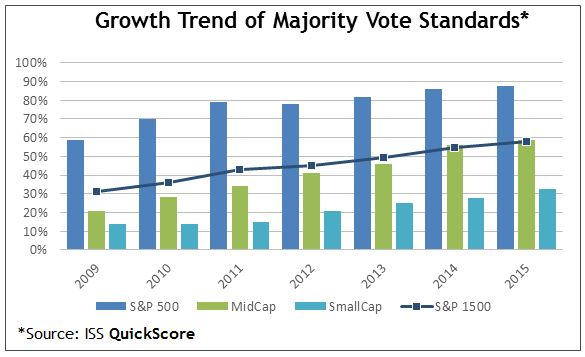
Par exemple, 88 % des entreprises du S&P 500 ont adopté la pratique du vote majoritaire, délaissant ainsi la pratique de la pluralité des voix.

Également, plus de 80 % des entreprises du S&P 500 soumettent leurs administrateurs à des élections annuelles, délaissant ainsi l’habitude des « Staggered Boards » (élections des administrateurs à des périodes différentes).

253092c

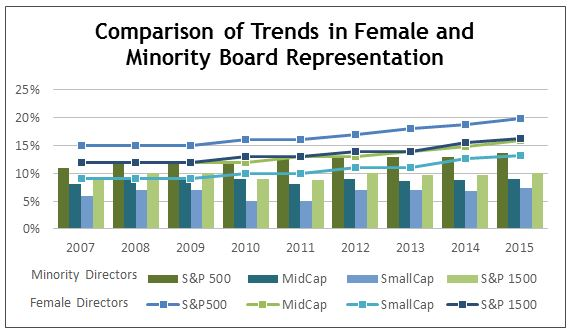
En ce qui concerne la réalité de la diversité des conseils d’administration, on note des progrès continus, mais lents. Ainsi, 98 % des entreprises du S&P 500 ont au moins une femme sur le conseil, et 79 % ont au moins un membre d’une minorité sur le conseil. Au total, environ 20 % de femmes siègent à des conseils d’administration et 17 % des administrateurs proviennent de minorités diverses.

Enfin, l’étude montre que 13,3 % de tous les postes d’administrateurs ont été pourvus par de nouvelles recrues (moins de 2 ans sur le CA).

Je vous invite à jeter un œil aux tableaux qui ponctuent le rapport.

Bonne lecture !


ISS 2016 Board Practices Study


ISS’ latest update of the structure and composition of boards and individual director attributes at Standard & Poor’s U.S. “Super 1,500” companies (i.e., companies in the S&P 500, MidCap 400, and SmallCap 600 indices) found a number of new and continuing trends in board practices and director attributes at these key index companies.

Majority Votes for Directors and Annual Board Elections are the New Normal

Based on analysis of public filings (primarily proxy statements) related to shareholder meetings occurring from July 1, 2014, through June 30, 2015, the study reports that annual board elections and majority vote standards for those elections are now the norm across the S&P 1500. While larger companies initially led the way in adopting these accountability enhancements, the pace of abandoning staggered board terms at smaller companies picked up speed in 2015. Also, Small- and MidCap companies adopted majority vote standards for board elections at a faster pace than their S&P 500 counterparts in 2015—increasing by 4 and 3 percentages points, respectively among the Small- and MidCap firms. For the third consecutive year, well over half of all study companies have majority voting standards, which is now the clear market standard at S&P 500 companies, with over 88 percent of companies in the index having adopted the practice. Only 61 total S&P 500 companies maintain a plurality vote standard, down from 67 last year and 87 in 2013.

5-31-1

There has also been a significant increase over the last five years in the number of companies holding annual elections, both at the S&P 1500 and at each constituent index. The proportion is significantly higher at S&P 500 companies, where it has risen more than 20 percentage points in the last five years. Still, over 60 percent of S&P 1500 companies (and over 80 percent of S&P 500 companies) now hold annual elections for all directors, While the prevalence has increased in the S&P 1500 every year since 2009, the largest jump occurred last year, when it rose from 60 to 64 percent, driven by an 8 percentage point increase at the S&P 500, where only 84 boards now hold staggered elections.

Many companies completed the gradual removals of their classified board structures that had begun in response to a large wave of shareholder proposals offered in a campaign organized by the now defunct Shareholder Rights Project at Harvard Law School. A majority of SmallCap companies held annual elections for the first time in 2014, a trend that has continued, as an additional 2 percent of the index’s companies held annual elections in 2015. Bucking the trend were the MidCap companies, which showed a slight decrease in the proportion holding annual elections in 2015, after steading increases in 2009 through 2014.

Board Diversity

Many corporate governance experts believe that the interplay of different backgrounds and perspectives enhances the effectiveness of boards and facilitates greater long-term corporate success. Some advocates for board diversity believe that a “tone at the top” will penetrate the corporate hierarchy and lead to increased diversity across all ranks of employment.
5-31-2
Companies with larger market caps generally have higher levels of gender and racial/ethnic diversity than those with smaller valuations. As of ISS’ latest analysis, almost all S&P 500 companies have at least one female or minority director, while 90 percent of MidCap boards and 78 percent of SmallCap boards have at least one female or minority member. There has been a market-wide increase over the past five years in board diversity:

Ninety-eight percent of S&P 500 boards have at least one female member and 79 percent have at least one minority, up from 89 and 63 percent in 2010, respectively;

Eighty-four percent of MidCap boards have at least one female member and 53 percent have at least one minority, increased from 74 and 36 percent in 2010, respectively; and

Sixty-nine percent of SmallCap boards have at least one female member and 41 percent have at least one minority, increased from 54 and 22 percent in 2010, respectively.

5-31-3
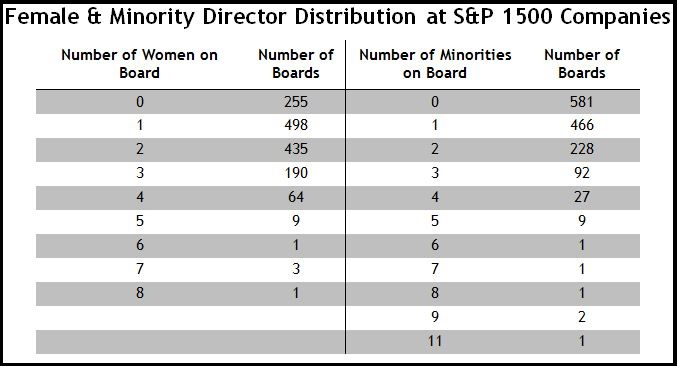
More than 88 percent of S&P 1500 companies have at least one female or minority director, and a majority of the S&P 1500 have either one female and/or one minority, who, in some instances, are the same individual. Minority women hold 329 directorships, an increase from 279 in 2014. Although this represents an absolute increase, the proportion of S&P 1500 directorships held by minority women has remained at approximately 2.4 percent since 2010.

New Directors

In 2015, 1,833 seats, or about 13.3 percent of all directorships, were filled by directors with less than two years’ tenure and who were elected for the first time in 2014 or 2015 (“new” directors). That compares with about 12 percent of all directorships filled by “new” directors in last year’s analysis, suggesting a slight increase in the turnover rate. The characteristics of these new directors were analyzed to develop a better understanding of what companies may be considering when choosing new director candidates.
5-31-4
New directors are generally younger than directors with tenures of over two years. Also, the average age difference is 5.3 years, an increase from 2014.

Fifty-three percent of new directors serve on only one board, which continues the trend identified in last year’s study, which found that nominating committees are bringing on directors who have no prior board experience. However, a majority of open S&P 500 positions, 56 percent, were filled by a director who sits on at least one other board, which drives the “average” number of outside boards for new directors up to nearly one and underscores the fact that market leading companies seek directors with a track record. New directors are more likely than those with more than two years tenure to be outside hires; 46 percent of all directors joining boards in 2014 and 2015 sit on only one board and are not executives of the companies whose boards they have joined.

Similarly, the percentage of new directors who are female or identified as an ethnic/racial minority continues to exceed the proportion of longer-tenured female- and minority-held S&P 1500 directorships. While the proportion of new directorships held by females has increased for several consecutive years, this momentum seems to be slower for minority directors. Minority directors comprised 16 percent of new directorships in 2015, compared to 10 percent of all new directors in 2014. Female directors filled 27 percent of new directorships in 2015, up from 22 percent in 2014, and 20 percent in 2013. This increase highlights both the overall growth in the number of directorships held by women and the acceleration in the growth of female directorships.

______________________

*This post is based on a recent publication authored by ISS U.S. Research analysts Andrew Borek, Liz Williams, and Rob Yates. Information on how to obtain the full report is available here.

La composition du conseil d’administration | Élément clé d’une saine gouvernance


Les investisseurs et les actionnaires reconnaissent le rôle prioritaire que les administrateurs de sociétés jouent dans la gouvernance et, conséquemment, ils veulent toujours plus d’informations sur le processus de nomination des administrateurs et sur la composition du conseil d’administration.

L’article qui suit, paru sur le Forum du Harvard Law School, a été publié par Paula Loop, directrice du centre de la gouvernance de PricewaterhouseCoopers. Il s’agit essentiellement d’un compte rendu sur l’évolution des facteurs clés de la composition des conseils d’administration. La présentation s’appuie sur une infographie remarquable.

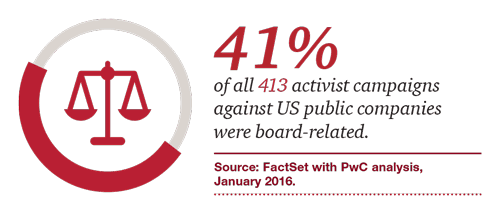
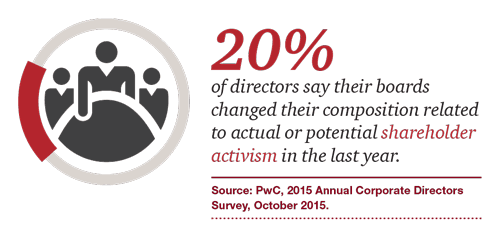
Ainsi, on apprend que 41 % des campagnes menées par les activistes étaient reliées à la composition des CA, et que 20 % des CA ont modifié leur composition en réponse aux activités réelles ou potentielles des activistes.

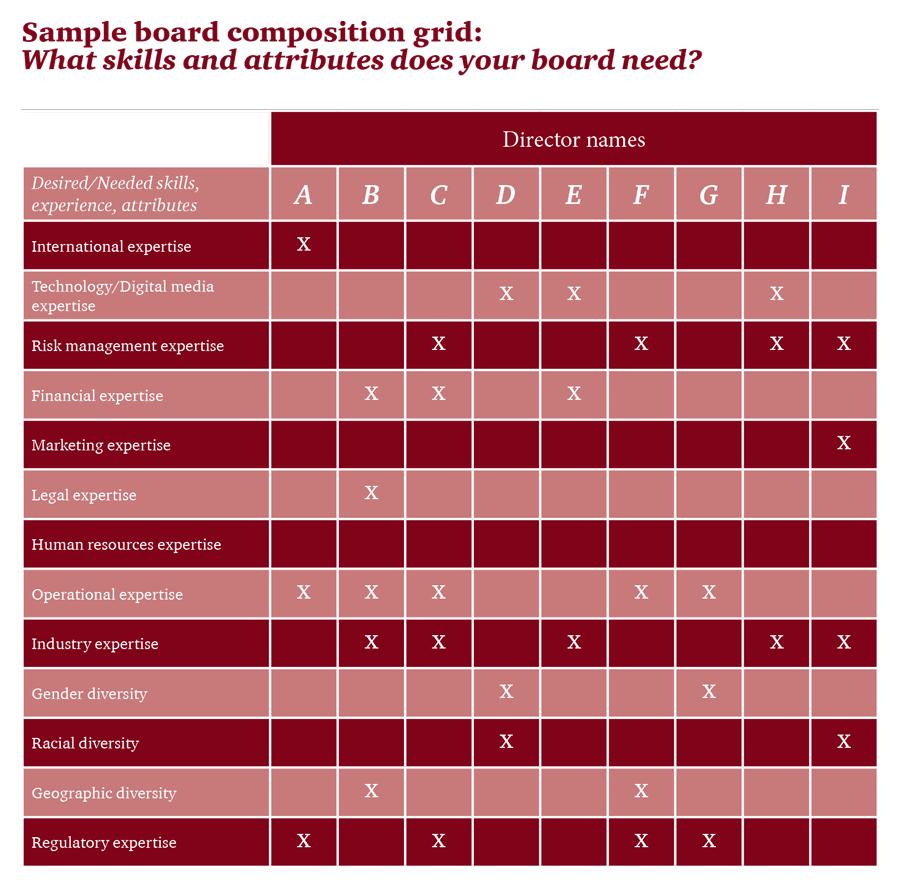
L’article s’attarde sur la grille de composition des conseils relative aux compétences et habiletés requises. Également, on présente les arguments pour une plus grande diversité des CA et l’on s’interroge sur la situation actuelle.

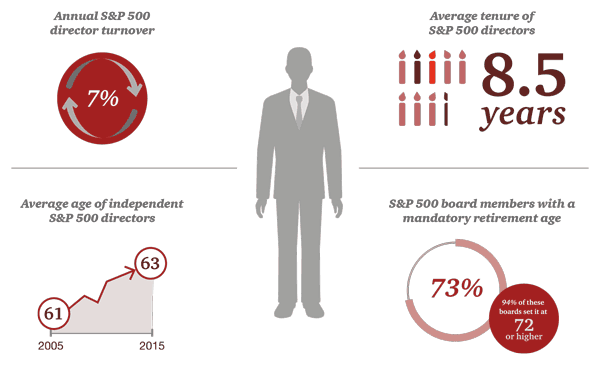
Enfin, l’article revient sur les questions du nombre de mandats des administrateurs et de l’âge de la retraite de ceux-ci ainsi que sur les préoccupations des investisseurs eu égard au renouvellement et au rajeunissement des CA.

Le travail de renouvellement du conseil ne peut se faire sans la mise en place d’un processus d’évaluation complet du fonctionnement du CA et des administrateurs.

À mon avis, c’est certainement un article à lire pour bien comprendre toutes les problématiques reliées à la composition des conseils d’administration.

Bonne lecture !

Investors and Board Composition


sans-titre


In today’s business environment, companies face numerous challenges that can impact success—from emerging technologies to changing regulatory requirements and cybersecurity concerns. As a result, the expertise, experience, and diversity of perspective in the boardroom play a more critical role than ever in ensuring effective oversight. At the same time, many investors and other stakeholders are seeking influence on board composition. They want more information about a company’s director nominees. They also want to know that boards and their nominating and governance committees are appropriately considering director tenure, board diversity and the results of board self-evaluations when making director nominations. All of this is occurring within an environment of aggressive shareholder activism, in which board composition often becomes a central focus.

Shareholder activism and board composition

pwc-1

pwc-2

At the same time, a growing number of companies are adopting proxy access rules—allowing shareholders that meet certain ownership criteria to submit a limited number of director candidates for inclusion on the company’s annual proxy. It has become a top governance issue over the last two years, with many shareholders viewing it as a step forward for shareholder rights. And it’s another factor causing boards to focus more on their makeup.

So within this context, how should directors and investors be thinking about board composition, and what steps should be taken to ensure boards are adequately refreshing themselves?

Assessing what you have–and what you need

In a rapidly changing business climate, a high-performing board requires agile directors who can grasp concepts quickly. Directors need to be fiercely independent thinkers who consciously avoid groupthink and are able to challenge management—while still contributing to a productive and collegial boardroom environment. A strong board includes directors with different backgrounds, and individuals who understand how the company’s strategy is impacted by emerging economic and technological trends.

Sample board composition grid: What skills and attributes does your board need?


pwc-table

In assessing their composition, boards and their nominating and governance committees need to think critically about what skills and attributes the board currently has, and how they tie to oversight of the company. As companies’ strategies change and their business models evolve, it is imperative that board composition be evaluated regularly to ensure that the right mix of skills are present to meet the company’s current needs. Many boards conduct a gap analysis that compares current director attributes with those that it has identified as critical to effective oversight. They can then choose to fill any gaps by recruiting new directors with such attributes or by consulting external advisors. Some companies use a matrix in their proxy disclosures to graphically display to investors the particular attributes of each director nominee.

Board diversity is a hot-button issue

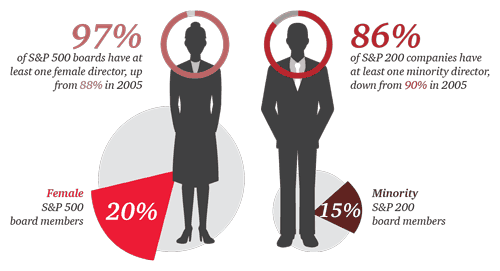
Diversity is a key element of any discussion of board composition. Diversity includes not only gender, race, and ethnicity, but also diversity of skills, backgrounds, personalities, opinions, and experiences. But the pace of adding more gender and ethnic diversity to public company boards has been only incremental over the past five years. For example, a December 2015 report from the US Government Accountability Office estimates that it could take four decades for the representation of women on US boards to be the same as men. [1] Some countries, including Norway, Belgium, and Italy, have implemented regulatory quotas to increase the percentage of women on boards.

Even if equal proportions of women and men joined boards each year beginning in 2015, GAO estimated that it could take more than four decades for women’s representation on boards to be on par with that of men’s.
—US Government Accountability Office, December 2015

According to PwC’s 2015 Annual Corporate Directors Survey, more than 80% of directors believe board diversity positively impacts board and company performance. But more than 70% of directors say there are impediments to increasing board diversity. [2] One of the main impediments is that many boards look to current or former CEOs as potential director candidates. However, only 4% of S&P 500 CEOs are female, [3] less than 2% of the Fortune 500 CEOs are Hispanic or Asian, and only 1% of the Fortune 500 CEOs are African-American. [4] So in order to get boards to be more diverse, the pool of potential director candidates needs to be expanded.

Is there diversity on US boards?


pwc-4

Source: Spencer Stuart US Board Index 2015, November 2015.

SEC rules require companies to disclose the backgrounds and qualifications of director nominees and whether diversity was a nomination consideration. In January 2016, SEC Chair Mary Jo White included diversity as a priority for the SEC’s 2016 agenda and suggested that the SEC’s disclosure rules pertaining to board diversity may be enhanced.

While those who aspire to become directors must play their part, the drive to make diversity a priority really has to come from board leadership: CEOs, lead directors, board chairs, and nominating and governance committee chairs. These leaders need to be proactive and commit to making diversity part of the company and board culture. In order to find more diverse candidates, boards will have to look in different places. There are often many untapped, highly qualified, and diverse candidates just a few steps below the C-suite, people who drive strategies, run large segments of the business, and function like CEOs.

How long is too long? Director tenure and mandatory retirement

The debate over board tenure centers on whether lengthy board service negatively impacts director independence, objectivity, and performance. Some investors believe that long-serving directors can become complacent over time—making it less likely that they will challenge management. However, others question the virtue of forced board turnover. They argue that with greater tenure comes good working relationships with stakeholders and a deep knowledge of the company. One approach to this issue is to strive for diversity of board tenure—consciously balancing the board’s composition to include new directors, those with medium tenures, and those with long-term service.

This debate has heated up in recent years, due in part to attention from the Council of Institutional Investors (the Council). In 2013, the Council introduced a revised policy statement on board tenure. While the policy “does not endorse a term limit,” [5] the Council noted that directors with extended tenures should no longer be considered independent. More recently, the large pension fund CalPERS has been vocal about tenure, stating that extended board service could impede objectivity. CalPERS updated its 2016 proxy voting guidelines by asking companies to explain why directors serving for over twelve years should still be considered independent.

We believe director independence can be compromised at 12 years of service—in these situations a company should carry out rigorous evaluations to either classify the director as non-independent or provide a detailed annual explanation of why the director can continue to be classified as independent.
— CalPERS Global Governance Principles, second reading, March 14, 2016

Factors in the director tenure and age debate


pwc-3

Source: Spencer Stuart US Board Index 2015, November 2015.

Many boards have a mandatory retirement age for their directors. However, the average mandatory retirement age has increased in recent years. Of the 73% of S&P 500 boards that have a mandatory retirement age in place, 97% set that age at 72 or older—up from 57% that did so ten years ago. Thirty-four percent set it at 75 or older. [6] Others believe that director term limits may be a better way to encourage board refreshment, but only 3% of S&P 500 boards have such policies. [7]

Investor concern

Some institutional investors have expressed concern about board composition and refreshment, and this increased scrutiny could have an impact on proxy voting decisions.

What are investors saying about board composition and refreshment?


pwc-table2

Sources: BlackRock, Proxy voting guidelines for U.S. securities, February 2015; California Public Employees’ Retirement System, Statement of Investment Policy for Global Governance, March 16, 2015; State Street Global Advisors’ US Proxy Voting and Engagement Guidelines, March 2015.

Proxy advisors’ views on board composition—recent developments

Proxy advisory firm Institutional Shareholder Services’s (ISS) governance rating system QuickScore 3.0 views tenure of more than nine years as potentially compromising director independence. ISS’s 2016 voting policy updates include a clarification that a “small number” of long-tenured directors (those with more than nine years of board service) does not negatively impact the company’s QuickScore governance rating, though ISS does not provide specifics on the acceptable quantity.

Glass Lewis’ updated 2016 voting policies address nominating committee performance. Glass Lewis may now recommend against the nominating and governance committee chair “where the board’s failure to ensure the board has directors with relevant experience, either through periodic director assessment or board refreshment, has contributed to a company’s poor performance.” Glass Lewis believes that shareholders are best served when boards are diverse on the basis of age, race, gender and ethnicity, as well as on the basis of geographic knowledge, industry experience, board tenure, and culture.

How can directors proactively address board refreshment?

The first step in refreshing your board is deciding whether to add a new board member and determining which director attributes are most important. One way to do this is to conduct a self-assessment. Directors also have a number of mechanisms to address board refreshment. For one, boards can consider new ways of recruiting director candidates. They can take charge of their composition through active and strategic succession planning. And they can also use robust self-assessments to gauge individual director performance—and replace directors who are no longer contributing.

  1. Act on the results of board assessments. Boards should use their annual self-assessment to help spark discussions about board refreshment. Having a robust board assessment process can offer insights into how the board is functioning and how individual directors are performing. The board can use this process to identify directors that may be underperforming or whose skills may no longer match what the company needs. It’s incumbent upon the board chair or lead director and the chair of the nominating and governance committee to address any difficult matters that may arise out of the assessment process, including having challenging conversations with underperforming directors. In addition, some investors are asking about the results of board assessments. CalPERS and CalSTRS have both called on boards to disclose more information about the impact of their self-assessments on board composition decisions. [8]
  2. Take a strategic approach to director succession planning. Director succession planning is essential to promoting board refreshment. But, less than half of directors “very much” believe their board is spending enough time on director succession. [9] In board succession planning, it’s important to think about the current state of the board, the tenure of current members, and the company’s future needs. Boards should identify possible director candidates based upon anticipated turnover and director retirements.
  3. Broaden the pool of candidates. Often, boards recruit directors by soliciting recommendations from other sitting directors, which can be a small pool. Forward-looking boards expand the universe of potential qualified candidates by looking outside of the C-suite, considering investor recommendations, and by looking for candidates outside the corporate world—from the retired military, academia, and large non-profits. This will provide a broader pool of individuals with more diverse backgrounds who can be great board contributors.

In sum, evaluating board composition and refreshing the board may be challenging at times, but it’s increasingly a topic of concern for many investors, and it’s critical to the board’s ability to stay current, effective, and focused on enhancing long-term shareholder value.

The complete publication, including footnotes and appendix, is available here.

Endnotes:

[1] United States Government Accountability Office, “Corporate Boards: Strategies to Address Representation of Women Include Federal Disclosure Requirements,” December 2015.
(go back)

[2] PwC, 2015 Annual Corporate Directors Survey, October 2015.
(go back)

[3] Catalyst, Women CEOs of the S&P 500, February 3, 2016.
(go back)

[4] “McDonald’s CEO to Retire; Black Fortune 500 CEOs Decline by 33% in Past Year,” DiversityInc, January 29, 2015; http://www.diversityinc.com/leadership/mcdonalds-ceo-retire-black-fortune-500-ceos-decline-33-past-year.
(go back)

[5] Amy Borrus, “More on CII’s New Policies on Universal Proxies and Board Tenure,” Council of Institutional Investors, October 1, 2013; http://www.cii.org/article_content.asp?article=208.
(go back)

[6] Spencer Stuart, 2015 US Board Index, November 2015.
(go back)

[7] Spencer Stuart, 2015 US Board Index, November 2015.
(go back)

[8] California State Teachers’ Retirement System Corporate Governance Principles, April 3, 2015, http://www.calstrs.com/sites/main/files/file-attachments/corporate_governance_principles_1.pdf; The California Public Employees’ Retirement System Global Governance Principles, Updated March 14, 2016, https://www.calpers.ca.gov/docs/board-agendas/201603/invest/item05a-02.pdf.
(go back)

[9] PwC, 2015 Annual Corporate Directors Survey, October 2015. www.pwc.com/us/GovernanceInsightsCenter.

________________________________

*Paula Loop is Leader of the Governance Insights Center at PricewaterhouseCoopers LLP. This post is based on a PwC publication by Ms. Loop and Paul DeNicola. The complete publication, including footnotes and appendix, is available here.

Les dix articles américains les plus marquants en gouvernance corporative en 2015


L’organisation Corporate Practice Commentator vient de publier la liste des meilleurs articles en gouvernance, plus précisément ceux qui concernent le marché des actions.

La sélection a été faite par les professeurs qui se spécialisent en droit corporatif. Cette année plus de 540 articles ont été analysés.

La liste inclut trois articles de la Faculté du Harvard Law School issus du programme en gouvernance corporative dont Lucian Bebchuk, John Coates et Jesse Fried font partie.

Voici la liste en ordre alphabétique.

Bonne recherche !


 Les dix articles américains les plus marquants en gouvernance corporative en 2015


30441567-Nuage-de-mot-avec-la-gouvernance-d-entreprise-li-s-balises-Banque-d'images


  1. Bartlett, Robert P. III. Do Institutional Investors Value the Rule 10b-5 Private Right of Action? Evidence from Investors’ Trading Behavior following Morrison v. National Australia Bank Ltd. 44 J. Legal Stud. 183-227 (2015).
  2. Bebchuk, Lucian, Alon Brav and Wei Jiang. The Long-term Effects of Hedge Fund Activism. 115 Colum. L. Rev. 1085-1155 (2015).
  3. Bratton, William W. and Michael L. Wachter. Bankers and Chancellors. 93 Tex. L. Rev. 1-84 (2014).
  4. Cain, Matthew D. and Steven Davidoff Solomon. A Great Game: The Dynamics of State Competition and Litigation. 100 Iowa L. Rev. 465-500 (2015).
  5. Casey, Anthony J. The New Corporate Web: Tailored Entity Partitions and Creditors’ Selective Enforcement. 124 Yale L. J. 2680-2744 (2015).
  6. Coates, John C. IV. Cost-benefit Analysis of Financial Regulation: Case Studies and Implications. 124 Yale L .J. 882-1011 (2015).
  7. Edelman, Paul H., Randall S. Thomas and Robert B. Thompson. Shareholder Voting in an Age of Intermediary Capitalism. 87 S. Cal. L. Rev. 1359-1434 (2014).
  8. Fisch, Jill E., Sean J. Griffith and Steven Davidoff Solomon. Confronting the Peppercorn Settlement in Merger Litigation: An Empirical Analysis and a Proposal for Reform. 93 Tex. L. Rev. 557-624 (2015).
  9. Fried, Jesse M. The Uneasy Case for Favoring Long-term Shareholders. 124 Yale L. J. 1554-1627 (2015).
  10. Judge, Kathryn. Intermediary Influence. 82 U. Chi. L. Rev. 573-642 (2015).

Comportements de meutes associés aux investissements des fonds activistes


Voici un article d’un grand intérêt publié par Forester Wong de l’Université Columbia et paru aujourd’hui sur le site du Harvard Law School Forum on Corporate Governance. Dans cette recherche doctorale, l’auteur tente de répondre à trois questions très pertinentes pour toute personne s’intéressant à l’effet des comportements activistes sur la gouvernance des entreprises publiques (cotées) et sur le cours des actions.

(1)  Assiste-t-on à la formation d’une meute d’investisseurs menée par un activiste dominant ?

(2) Quels sont les mécanismes sous-jacents à cette « coalition » ?

(3) Le comportement de meute est-il efficace ?

Le chercheur a tenté de répondre à ces questions en utilisant une base de données regroupant 1 992 campagnes d’activistes (hedge funds) sur une période allant de 1990 à 2014. Notons qu’aux États-Unis, les investisseurs sont obligés de divulguer leur taux de participation dans le capital d’une entreprise publique dès que la part de leur investissement dépasse 5 % (Schedule 13 D).

Les résultats ont montré qu’il y avait effectivement une forme de comportement de meute puisque plusieurs autres grands investisseurs se joignent à la campagne menée par l’activiste principal.

Les résultats montrent également que l’ampleur des transactions est en grande partie le fait de l’activiste dominant, et que l’accumulation des parts de propriété n’est pas le fruit d’une action spontanée de la part des investisseurs. Les meneurs avisent les institutions avec lesquelles ils sont en relation de leurs intentions d’accumuler des actions de l’entreprise, ce qui influence le cours des actions à la hausse.

Enfin, les résultats ont montré que les comportements de meute des investisseurs donnaient des résultats positifs en termes de succès de la campagne. En effet, ces comportements d’activistes sont utilisés pour contrer les tentatives de blocage des offres hostiles.

Pour plus de détails sur la recherche, je vous invite à lire l’extrait de cet article.

Bonne lecture ! Vos commentaires sont appréciés.

Wolves at the Door: A Closer Look at Hedge Fund Activism


Some commentators attribute the success of certain hedge fund activism events to “wolf pack” activism, the theory that the primary activist is successful because of the support offered by other investors (i.e., the wolf pack). Commentators usually assume that activist hedge funds orchestrate the formation of wolf packs. According to this line of thinking, the lead activist—the 13D filer—recruits other investors to join the campaign before the 13D filing becomes public because the public announcement of the activist’s campaign typically leads to a positive stock return. In effect, the activist uses the expected jump in stock price to compensate the other investors for their support. This arrangement may be viewed as a way to circumvent securities regulations and takeover defenses triggered by holdings thresholds. The SEC, for example, requires activists to file a Schedule 13D within 10 days after crossing a 5% ownership threshold. By inducing other investors to acquire shares of the target, the lead activist may be able to accumulate a larger percentage of de facto ownership before triggering regulation thresholds, thereby increasing the chances of a successful campaign (Coffee and Palia, 2015). I label this as the Coordinated Effort Hypothesis. However, an alternative mechanism is that wolf packs arise spontaneously because investors monitor and target the same firms around the same time. Brav, Dasgupta, and Mathews (2015), for example, analytically show that, under certain conditions, a pack can form around an activist campaign without any explicit coordination by the activist. I label this as the Spontaneous Formation Hypothesis.

20150207_LDP001_0-aa79c

In my paper, Wolves at the Door: A Closer Look at Hedge-Fund Activism, which was recently made publicly available on SSRN, I investigate wolf pack activism by addressing the following three questions. First, is there any evidence of wolf pack formation? Second, what is the mechanism for such pack formation? Third, is the “wolf pack” tactic effective? I investigate these questions using 1,922 activist hedge funds’ campaigns—all campaigns in the SharkRepellent database from 1990 through 2014 in which an activist filed Schedule 13D.

First, I find evidence consistent with wolf pack formation. I document a higher level of share turnover prior to the public disclosure of activists’ campaigns. In particular, on the day that the 13D filer crosses the 5% threshold (the “trigger date”), a date that is not publicly observable until the 13D filing, the share turnover is about 325% of the normal trading volume. Furthermore, using a manually collected dataset, I find that the bulk of the trading volume reflects trades by investors other than the lead activist. In the 60 days prior to the public disclosure, the abnormal trading volume by other investors cumulates to around 9% of total shares outstanding (the median holding by lead activists is 6%), possibly indicating that investors other than the lead activist accumulate significant share-holdings before the public disclosure of activists’ campaigns.

Second, I examine the mechanism of wolf pack formation. As mentioned above, there are two theories for how wolf packs are formed. The Coordinated Effort Hypothesis assumes that the wolf pack is orchestrated by the lead activist as a way to bypass certain regulatory constraints. By contrast, the Spontaneous Formation Hypothesis proposes that wolf pack arises spontaneously because investors monitor and target the same firms around the same time. My results find evidence consistent with the Coordinated Effort Hypothesis. In particular, my evidence indicates that these share turnovers are more likely to be mustered by the lead activist than to occur spontaneously, and that lead activists are tipping off institutions with which they have prior relationships. Using a proprietary dataset, I find that an institution is more likely to accumulate shares in an activist’s campaign if the institution has done so in an earlier period.

In addition, by showing substantial trading by other investors on the trigger date, I provide evidence against the Spontaneous Formation Hypothesis. While other investors may independently decide to accumulate shares in the target firm, it is not clear why so many of them would do so on the same day—and even less clear why they would do so exactly on the day the 13D filer crosses the 5% threshold (i.e., the trigger date). Under the Spontaneous Formation Hypothesis, the only explanation for this synchronicity would be that they are all responding to the same, sudden changes in market conditions. Using a battery of univariate and multivariate tests, I show that the abnormal trading volume on the trigger date cannot be fully explained by any sudden changes in market conditions.

Finally, in the last section of my paper, I find evidence that the “wolf pack” tactic is effective. The presence of a wolf pack is associated with a statistically significant 6% increase in the success rate of campaigns and a statistically significant 8.3% (6.9%) increase in buy and hold abnormal (raw) returns calculated over the duration of the campaigns. Furthermore, consistent with the notion that the wolf packs are used to circumvent securities takeover defenses, I find that wolf packs are more likely to occur in better-defended companies, as proxied by Bullet Proof Rating (a takeover defense measure by FactSet) and the use of poison pills.

The full article is available here.

__________________________________

*Forester Wong is a PhD Candidate in Accounting at Columbia University. This post is based on a recent article authored by Mr. Wong.


L’activisme actionnarial vu selon un mécanisme correctif de la gouvernance


Le séminaire à la maîtrise de Gouvernance de l’entreprise (DRT-7022) dispensé  par Ivan Tchotourian*, professeur en droit des affaires de la Faculté de droit de l’Université Laval, entend apporter aux étudiants une réflexion originale sur les liens entre la sphère économico-juridique, la gouvernance des entreprises et les enjeux sociétaux actuels.

Le séminaire s’interroge sur le contenu des normes de gouvernance et leur pertinence dans un contexte de profonds questionnements des modèles économique et financier. Dans le cadre de ce séminaire, il est proposé aux étudiants depuis l’hiver 2014 d’avoir une expérience originale de publication de leurs travaux de recherche qui ont porté sur des sujets d’actualité de gouvernance d’entreprise.

Ce billet veut contribuer au partage des connaissances en gouvernance à une large échelle. Le présent billet est une fiche de lecture réalisée par messieurs Gabriel Béliveau et Carl Boulé sur le sujet de l’activisme actionnarial.

M. Gabriel Béliveau et M. Carl Boulé ont travaillé sur un article de référence des spécialistes du droit des sociétés que sont Paul Rose et Bernard Sharfman intitulé : « Shareholder Activism as a Corrective Mechanism in Corporate Governance ».

Dans le cadre de ce billet, les auteurs reviennent sur le texte pour le présenter, le mettre en perspective et y apporter un regard critique.

Bonne lecture ! Vos commentaires sont appréciés.


L’activisme actionnarial vu selon un mécanisme correctif de la gouvernance


Retour sur Shareholder Activism as a Corrective Mechanism in Corporate Governance de Paul Rose et Bernard Sharfman

par

Gabriel Béliveau et Carl Boulé


L’article « Shareholder Activism as a Corrective Mechanism in Corporate Governance» [1] rédigé par Rose et Sharfman s’inscrit dans le débat sur l’activisme actionnarial, notion réunissant « (…) toute action d’un actionnaire ou d’un groupe d’actionnaires visant à influencer une compagnie publique, sans pour autant tenter d’en prendre le contrôle » [2]. Plus précisément, les auteurs abordent la question de déterminer comment l’activisme actionnarial peut être employé afin de favoriser une gouvernance plus efficace. À cet égard, ils identifient une forme d’activisme permettant d’atteindre cet objectif : l’« offensive shareholder activism ».

Retour en terre connue

7632934-11794551

Les professeurs Rose et Sharfman amorcent leur analyse en portant leur attention sur l’encadrement juridique du pouvoir de gestion d’une société. Ils constatent que ce pouvoir est fortement centralisé entre les mains du conseil d’administration (ci-après « CA ») dont les membres sont élus périodiquement par les actionnaires. En raison d’une importante déférence accordée en sa faveur par le droit, le CA bénéficie d’une large marge de manœuvre dans la gestion de la société. Cette déférence a toutefois pour inconvénient de cautionner certaines erreurs que pourraient commettre les administrateurs. Elle laisse également planer un risque d’opportunisme de la part des membres du CA qui pourraient être tentés de faire primer leurs intérêts sur ceux de la société.

Offensive shareholder activism ?

À l’aune de ces constats, les auteurs affirment que l’offensive shareholder activism entraîne un partage temporaire des pouvoirs de gestion qui permettrait de minimiser les inconvénients découlant de la gestion centralisée par le CA. Les auteurs poursuivent en expliquant que les résultats de l’activisme actionnarial dépendent grandement du type d’actionnaire qui est impliqué. Or, ils identifient cinq types d’actionnaires : les « insiders », les « liquidity traders », les « noise traders », les « market makers » et les « information traders ». Les insiders sont impliqués dans la gestion de l’entreprise et ont donc un devoir de réserve, ce qui fait qu’ils ne participent pas à l’activisme actionnarial. Les liguidity traders, les noise traders et les market makers ont tous des approches et des raisons d’investir différentes, mais se rejoignent par leur déficit informationnel à l’égard de certains enjeux pouvant concerner la société dans laquelle ils investissent. Ils ne sont donc habituellement pas impliqués efficacement dans l’activisme actionnarial et, pourtant, constituent souvent le groupe d’actionnaires pouvant faire pencher la balance lors de l’élection des administrateurs. Finalement, les information traders sont les actionnaires qui accordent le plus d’intérêt envers la gestion de l’entreprise. Il s’agit habituellement des investisseurs institutionnels, plus particulièrement, ceux appliquant des principes de gestion alternative (les « Hedge funds »). Ce sont ces derniers qui initient l’offensive shareholder activism.

Utilité de l’offensive shareholder activism

L’offensive shareholder activism résulte de la constatation par les cinq catégories d’actionnaires présentés ci-dessus que certains éléments internes d’une société l’empêchent de maximiser ses profits. Les activistes spécialisés de l’offensive shareholder activism détiennent parfois des informations précises concernant les tendances du marché ou la situation de concurrents, leur permettant de proposer des changements bénéfiques pour la société. Ces recommandations pourront ainsi contribuer à éclairer le CA, lui permettant de prendre des décisions plus éclairées. En effet, il arrive que le CA, trop concentré sur la gestion des affaires courantes et influencé par des considérations internes (gestion des ressources humaines, image de l’entreprise, vision des gestionnaires), ignore des opportunités stratégiques de croissance telles que la délocalisation, l’achat/vente, la restructuration ou l’établissement de mesures de responsabilité sociale de l’entreprise. Des études empiriques ont également démontré que l’offensive shareholder activism s’avère être une forme d’activisme actionnarial ayant un effet positif sur la valeur des actions [3]. Elles démontrent également que l’offensive shareholder activism permet l’accumulation de nouvelles informations utiles dans le processus de prise de décision [4].

Critiques de l’offensive shareholder activism

Les auteurs Rose et Sharfman remarquent que plusieurs spécialistes critiquent le concept général d’activisme actionnarial. En réponse aux voix qui, plus spécifiquement, lui reprochent une attitude fondée uniquement sur une vision à court terme, les auteurs rétorquent néanmoins que l’offensive shareholder activism se pratique selon un modèle d’affaires visant à cibler puis à redresser des éléments empêchant la valeur actionnariale d’une société de fructifier au maximum. Dès lors que l’empêchement a été traité, les actionnaires pratiquant l’offensive shareholder activism n’ont plus aucune raison de conserver leurs parts dans la société. De plus, les auteurs précisent que, contrairement à l’offensive shareholder activism, l’attitude passive des actionnaires ayant une vision à long terme n’amène aucun avantage à la gestion de la société. Qui plus est, des études démontrent la relative pérennité (sur une période de cinq ans) d’une portion des gains générés par l’offensive shareholder activism [5]. Finalement, Rose et Sharfman traitent des critiques voulant que les administrateurs s’avèrent mieux informés que les actionnaires quant aux activités de la société. Les administrateurs seraient a priori en meilleure pour en assurer la gestion de la société en continu. Bien qu’ils reconnaissent cette asymétrie, les auteurs la minimisent en précisant que l’offensive shareholder activism est pratiqué par des acteurs pouvant détenir une plus grande expertise sur certaines matières.

Au final, voici un article qui dans le contexte actuel si intense (et discuté) de l’activisme actionnarial [6] doit être lu avec intérêt !


[1] Paul Rose and Bernard S. Sharfman, « Shareholder Activism as a Corrective Mechanism in Corporate Governance », (2014) 5 BYU Law Review 1015.

[2] La compagnie publique est celle ayant fait « appel public à l’épargne », de façon analogue à ce que prévoient, au Québec, la Loi sur les valeurs mobilières, RLRQ c. V-1.1 et ses règlements.

[3] Alon Brav, Wei Jiang, Frank Partnoy and Randall Thomas, « Hedge Fund Activism, Corporate Governance, and Firm Performance », (2008) 63 J. FIN. 1729 ; Nicole M. Boyson and Robert M. Mooradian, « Experienced Hedge Fund Activists », (2012) AFA Chi. Meetings Paper, http://ssrn.com/abstract=1787649.

[4] Sanford J. Grossman and Joseph E. Stiglitz, « On the Impossibility of Informationally Efficient Markets », (1980) 70 AM. ECON. REV. 393 ; Bernard S. Sharfman, « Why Proxy Access is Harmful to Corporate Governance », (2012) 37 J. CORP. L. 387.

[5] Alon Brav, Wei Jiang, Frank Partnoy and Randall Thomas, préc. note 3, p. 1735 ; Nicole M. Boyson, Linlin Ma and Robert Mooradian, « Are All Hedge Fund Activists Created Equal? The Impact of Experience on Hedge Fund Activism », (2014) Inaugural Financial Market Symposium, School of Business State University of New York ; Lucian A. Bebchuk, Alon Brav and Wei Jiang, « The Long-Term Effects of Hedge Fund Activism » (2014) Columbia Business School, Research Paper No 13-66, http://papers.ssrn.com/abstract=2291577.

[6] Pour des illustrations récentes de comportement court-termiste des activistes, voir : Andrew R. Sorkin, « “Shareholder Democracy” Can Mask Abuses », The New York Times (25 février 2013). Pour les discussions récentes sur les objectifs attachés à l’activisme des fonds de couverture aux États-Unis, voir : Martin Lipton, « The Threat to Shareholders and the Economy from Activist Hedge Funds » (14 janvier 2015), The Harvard Law School Forum on Corporate Governance and Financial Regulation, http://blogs.law.harvard.edu/corpgov/2015/01/14/the-threat-to-shareholders-and-the-economy-from-activist-hedge-funds/ ; Lucian A. Bebchuk, Alon Brav and Wei Jiang, préc. note 4 ; Francis Byrd, Drew Hambly and Mark Watson, « Short-Term Shareholder Activists Degrade Creditworthiness of Rated Companies », Commentaire spécial, Moody’s Investors Services, 2007. Au Canada, voir : Yvan Allaire, The case for and against activist hedge funds, IGOPP Policy Paper, IGOPP, Montreal, 2014, http://igopp.org/en/the-case-for-and-against-activist-hedge-funds-2/. En France, voir Laurence Boisseau, « Attaques des fonds activistes : des effets controversés à long terme », Les Échos.fr, (22 janvier 2015), http://www.lesechos.fr/22/01/2015/lesechos.fr/0204102535772_attaques-des-fonds-activistes—des-effets-controverses-a-long-terme.htm.


*Ivan Tchotourian, professeur en droit des affaires, codirecteur du Centre d’Études en Droit Économique (CÉDÉ), membre du Groupe de recherche en droit des services financiers (www.grdsf.ulaval.ca), Faculté de droit, Université Laval.

Modèle d’affaires hasardeux et gouvernance désastreuse à la société canadienne Valeant


Voici un article récemment publié dans The Economist, qui met en évidence les énormes faiblesses de la gouvernance corporative de Valeant, l’un des « fleurons » de l’industrie pharmaceutique canadienne.

Selon le magazine, il s’agit du plus désastreux constat d’échec d’une firme cotée à la bourse de New York depuis la faillite de Lehman Brothers en 2008 !

À part un modèle d’affaires déficient et douteux, quelles sont les leçons à tirer pour les conseils d’administration de sociétés publiques ?

Les auteurs insistent sur les problèmes de contrôle interne, la faiblesse notoire du conseil d’administration, les interventions opportunistes des actionnaires activistes, notamment Jeffrey Ubben de ValueAct et Bill Ackman de Pershing Square, qui détiennent quatre des douze sièges du conseil d’administration. À lui seul Pershing Square détient 9 % des actions et son président Bill Ackman vient de joindre le CA.

Un article paru hier dans Canadian Business montre encore plus clairement comment l’inefficacité du conseil d’administration est à l’origine des problèmes de Valeant (Why the trouble at Valeant starts with its board of directors).

Vous trouverez, ci-dessous, le paragraphe introductif de l’article paru dans The Economist.

Until recently, America hadn’t had a spectacular corporate disaster since Lehman Brothers in 2008. But Valeant, a Canadian but New York-listed drug firm, now meets all of the tests: a bad business model, accounting problems, acquisitions, debt, an oddly low tax rate, a weak board, credulous analysts, and managers with huge pay packets and a mentality of denial. The result has been a $75 billion loss for shareholders and, possibly, a default on $31 billion of debt.

Je vous invite à lire la suite de cet article, notamment les trois leçons que nous devrions en retirer.

Bonne lecture !


He who would Valeant be | Corporate Governance


On March 21st Valeant announced that Michael Pearson, its CEO, was leaving.

Valeant’s business model was buying other drug firms, cutting costs and yanking up prices. Since 2010 it has done $35 billion of deals, mainly financed by debt. At a time when Americans face stagnant living standards, a strategy based on squeezing customers was bound to encounter political hostility—“I’m going after them,” Hillary Clinton has vowed.

Valeant added to this mix a tendency towards evasiveness. In October investigative reporters revealed its murky relationship with a drugs dispensary, Philidor, which it consolidated into its accounts yet did not control. The relationship was severed but the Securities and Exchange Commission is still investigating. Federal prosecutors are also looking into various of the company’s practices. On Christmas Eve Michael Pearson, Valeant’s CEO and architect, went into hospital with pneumonia. On February 28th Mr Pearson (total pay awarded of $55m since 2012, according to Bloomberg) returned to work, welcomed back by the chairman for his “vision and execution”.


The facts that have emerged in March suggest that Mr Pearson should have been fired. Profit targets have been cut by 24% compared with October’s. The accounts will be restated and the filing of an annual report delayed. The results released on March 15th contain neither a full cash-flow statement nor a balance-sheet, but it appears that Valeant has been generating only just enough cash to pay its $1.6 billion interest bill this year. As suppliers and customers get wary, its cashflow may fall, leading to a default.

There are three lessons. First, boards matter: the managers should have been removed in October. Second, disasters happen in plain sight. Valeant issued $1.45 billion of shares in March 2015, when 90% of Wall Street analysts covering its shares rated them a “buy”. Yet as early as 2014 a rival firm, Allergan, had made an outspoken attack on Valeant’s finances, the thrust of which has been proved correct.

The final lesson is that “activist” investors, who aim to play a hands-on role at the firms that they invest in, have no monopoly on wisdom. Jeffrey Ubben of ValueAct and Bill Ackman of Pershing Square both own chunks of Valeant and have supported it. Mr Ackman is at present trying to consolidate America’s railway system. Mr Ubben is trying to shake up Rolls-Royce, a British aerospace firm. After Valeant, why should anyone listen to what they say?

_____________________________

Pour en connaître davantage sur la société Valeant et sur le rôle des administrateurs : 

How Valeant challenged convention—for better, then for worse

Valeant CEO stepping down, company blames former CFO for misstated earnings

Four ways CEOs can win back the public’s trust

Four ways to build a better corporate board of directors

How corporate boards can set executive pay more fairly

What are corporate boards ethically obligated to know?

How to get corporate boards to think longer-term

How to make corporate boards more diverse

Rencontre du droit, de l’administration et de la finance


Un grand colloque en gouvernance se tiendra le vendredi 1er avril 2016 au salon Hermès de la Faculté des sciences de l’administration (FSA) de l’Université Laval.

palasis-prince-FSA

Ce colloque, organisé conjointement par le Centre d’études en droit économique (Faculté de droit, ULaval) et la Chaire de recherche en gouvernance de sociétés (FSA, ULaval), est l’occasion de débattre de manière pluridisciplinaire sur les grands enjeux contemporains en gouvernance d’entreprise.

Les thématiques abordées concernent :

  1. la composition et la mission des conseils d’administration
  2. les devoirs des administrateurs relativement à l’information
  3. le contenu et la légitimité des pouvoirs des actionnaires
  4. l’activisme actionnarial
  5. l’opportunité de normes de divulgation ou impératives

Le colloque présente les perspectives et les points de vue d’intervenants provenant des milieux suivants : autorités réglementaires, organisations professionnelles, praticiens, administrateurs et chercheurs en gouvernance.

Voici le programme de la journée « Rencontre du droit, de l’administration et de la finance» préparé par les professeurs Jean Bédard et Ivan Tchotourian.

La présidence de la journée a été confiée à Nicolle Forget, administratrice de sociétés.

Horaire de la journée

DÉTAIL
8 h 30 Mot d’accueil

Eugénie Brouillet, doyenne et professeure, Faculté de droit, Université Laval

8 h 35 Mot de bienvenue

Jean Bédard, professeur et titulaire de la Chaire de recherche en gouvernance des sociétés, FSA ULaval

Ivan Tchotourian, professeur et codirecteur du CÉDÉ, Faculté de droit, Université Laval

8 h 40 Le point de vue du régulateur sur la gouvernance
9 h Le conseil d’administration en question

Ce panel abordera de nombreux questionnements actuels sur le conseil d’administration. Sa mission, sa composition (et notamment la parité hommes-femmes), le contrôle de la rémunération des dirigeants qui lui incombe, la place des valeurs éthiques, les pratiques les plus actuelles seront les sujets principaux qui seront discutés par les panélistes.

– Actualités juridiques et CA. : Olga Farman, avocate, Norton Rose Fulbright

– Parité et CA, bilan des initiatives juridiques : Sonia Struthers, avocate associée, McCarthyTetrault

– CA et parité, bilan 2014 des pratiques des entreprises : Jean Bédard, professeur et titulaire de la Chaire de recherche en gouvernance des sociétés, et Sophie Brière, professeure, FSA ULaval

10 h Période de questions
10 h 25 Pause-café
10 h 40 Devoirs des administrateurs et divulgation d’information

Dans le cadre de ce panel portant sur les devoirs des administrateurs, le risque communicationnel, la gestion des informations par le biais des médias sociaux, la divulgation extra-financière, la notion d’intérêt social feront l’objet d’une attention particulière.

– Médias sociaux et risque communicationnel : Vincent Bergeron, avocat et agent de marque, associé, Rodic, et Pierre Fournier-Simard, avocat et consultant, McKinsey Montréal

– Divulgation extra-financière des sociétés par actions, où en est-on ? : Michelle RODRIGUE, professeure, FSA, Université Laval

– Information et responsabilité des administrateurs en droit des valeurs mobilières, étude empirique 2008-2014 : Jean Bédard, professeur et titulaire de la Chaire de recherche en gouvernance des sociétés, FSA, Université Laval, Ivan Tchotourian, professeur et codirecteur du CÉDÉ, Faculté de droit, Université Laval

11 h 55 Période de questions
12 h 20 Repas
13 h 45 Point de vue de la CCGG
14 h Table ronde

Activisme actionnarial et droit de vote Animateur : Daniel ST-ONGE, conseiller en gouvernance

La table ronde analysera l’exercice du pouvoir des actionnaires et les visages contemporains de l’usage du droit de vote. Les sujets qui seront débattus sont les suivants : les conséquences de l’instauration du vote majoritaire, les stratégies de dialogue entre les actionnaires et la direction, la participation des actionnaires aux objectifs de l’entreprise, la place des agences en conseil de vote, le principe « 1 action = 1 voix ».

Stéphane Rousseau, professeur, Vice-doyen aux études supérieures et à la recherche, titulaire de la Chaire en gouvernance et droit des affaires, Faculté de droit, Université de Montréal

Daniel Thouin, président du Mouvement d’éducation et de défense des actionnaires (MÉDAC)

Julien Le Maux, professeur, HEC Montréal

15 h 15 Période de questions
15 h 45 Mot de clôture
16 h Verre de l’amitié


Toutes les informations concernant cet événement sont disponibles sur le site

http://www4.fsa.ulaval.ca/evenements/enjeux-contemporains-de-gouvernance-dentreprise/

 Bon colloque !


Rapport spécial sur l’importance de l’éthique dans l’amélioration de la gouvernance | Knowledge@Wharton


Aujourd’hui, je vous oriente vers un rapport récemment publié par Knowledge@Wharton qui fait le point sur les grands principes qui guident la mise en œuvre efficace de la gouvernance des entreprises.

À la lecture du document, vous serez certainement conscientisé au fait que l’entreprise ne doit pas uniquement rechercher le profit à court terme, mais doit également poser des gestes décisifs montrant comment elle vise à accomplir sa raison d’être à long terme, notamment en ne redistribuant pas une part trop importante des profits aux actionnaires, sous la forme de dividendes et de rachats d’actions.

Ces mesures, selon Larry Fink, le CEO de BlackRock, sont nécessaires afin d’assurer la pérennité de l’organisation. Elles permettent à l’organisation de se concentrer sur les investissements en recherche et développement, en innovations, en formation des meilleurs talents, ainsi qu’en investissements majeurs destinés à assurer la croissance à long terme.

En février dernier, Fink, le premier dirigeant du plus grand investisseur mondial (BlackRock), a fait parvenir une lettre aux PDG des 500 plus grandes entreprises de la S&P les exhortant à adopter une perspective à long terme de la conduite des entreprises, en se distançant de « l’hystérie de la culture des résultats trimestriels ».

Également, vous voudrez peut-être aussi prendre connaissance d’un excellent article paru dans le numéro de janvier-février 2014 de la Harvard Business Review intitulé « Focusing Capital on the Long Term » par Dominic Barton et Mark Wiseman.

Big investors have an obligation to end the plague of short-termism.

La lettre de Larry Fink, que je vous invite à lire, a déjà fait couler beaucoup d’encre. Ses conclusions vont dans le sens du premier volet abordé dans le rapport spécial de Knowledge@Wharton : la gouvernance et la raison d’être des entreprises.

Le rapport spécial sur l’importance d’une solide éthique d’affaires pour l’amélioration de la gouvernance aborde quatre autres sujets que je vous invite à consulter en cliquant sur le lien ci-dessous et en téléchargeant le document PDF.

(1) La gouvernance et la responsabilité morale de l’entreprise

(2) la gouvernance et les programmes de conformité

(3) la gouvernance et la culture organisationnelle

(4) la gouvernance, le leadership et le rôle du conseil d’administration

Vos commentaires et points de vue sont toujours les bienvenus. Voici un court extrait de ce rapport.

Bonne lecture !


Special Report on Business Ethics: Enhancing Corporate Governance


trees growing in a sequence of germination on piles of coins


Corporate governance refers to the rules and policies that determine how a company is controlled. On the face of it, what does it have to do with ethics – or choices between right and wrong? According to Henrik Syse, a senior fellow at the Peace Research Institute in Oslo, Norway, the connection between ethics and corporate governance is exceedingly close. “Corporate governance is about such topics as accurate reporting, a sound board structure, sustainable finances, a positive work environment, consciousness of the relationship between principals and agents, and long-term strategies for the firm as a whole,” he notes. “Such topics are obviously ethical, as they deal with how a firm relates to the outside world, and how it builds relationships within. We may not always explicitly talk about such issues as ethical, but ipso facto they are.”

The goal of this special report – the first of four that will be published by Knowledge@Wharton and AKO Foundation – is to explore how firms can enhance their understanding and implementation of corporate governance. In the report, which features insights from Wharton faculty and other experts, we consider five key topics: the relationship between corporate governance and the purpose of a firm; whether firms have a moral responsibility; the link between corporate governance and compliance programs; the impact of corporate culture; and the role of leadership and boards of directors. Future reports in this series will examine themes such as moral philosophy, corruption and business for peace.

Recentrer l’assemblée annuelle des actionnaires (AGA) sur le travail du CA


On le sait, les assemblées générales annuelles des actionnaires (AGA) sont souvent des lieux de débat animés entre plusieurs joueurs qui ont des intérêts dans l’entreprise (activistes, actionnaires, investisseurs, conseillers en votation, groupes d’intérêt variés, etc. Ces participants jouent différents rôles dont l’une des facettes est souvent de critiquer le CA et de se dissocier du travail des administrateurs et de la direction générale.

On assiste à une forme de lutte de pouvoir menée par les diverses parties prenantes — et non plus uniquement par l’actionnariat. Qui aura le contrôle du conseil d’administration, autorité suprême de l’organisation ?

La préparation en vue de l’AGA exige beaucoup de temps et d’efforts destinés à réduire les incertitudes au minimum. Cette activité génère un stress organisationnel considérable. Les administrateurs se sentent mis au banc et ils appréhendent cette grande messe avec beaucoup de pressentiment.

Afin de faire face à toutes les situations, ceux-ci adoptent des réactions de nature défensive plutôt que de faire preuve d’ouverture et de transparence dans leurs communications avec les principaux intéressés.

Permettez-moi, ici, de faire un parallèle avec l’organisation des conseils d’administration et des comités des CA, laquelle, selon moi, prennent souvent des proportions démesurées et mobilisent les énergies du personnel de direction pendant des semaines. Les exigences qui pèsent sur la direction et le secrétariat corporatif afin de préparer les réunions, et le temps investis par ces derniers dans des activités de conformité, prennent trop souvent le dessus, au détriment de l’activité principale des CA, c’est-à-dire, l’enrichissement des stratégies poursuivies par la direction générale.

Il faut reconnaître au CA sa fonction de gouvernance de l’entité, et non laisser les actionnaires dominer dans tous les aspects de la gestion. Le CA a d’autres parties prenantes à satisfaire et c’est le président du conseil qui doit exprimer l’équilibre à maintenir entre tous les intervenants.

Par exemple, le CA doit démontrer une réelle volonté de communication avec les investisseurs institutionnels afin de bien les renseigner sur la valeur des orientations poursuivies. Si les investisseurs activistes [trop souvent opportunistes] dirigés par un groupe significatif d’actionnaires ne partagent pas les stratégies mises de l’avant par la direction, ils opteront pour procéder au remplacement de certains membres du CA.

Afin de pallier au problème aigu de communication entre les participants actifs et les membres du conseil, certains auteurs, dont John Wilcox*, président de SODALI, propose la préparation d’un rapport annuel du Board dont les composantes seraient les suivantes :

[1] l’affirmation du rôle de fiduciaire du conseil d’administration envers l’entreprise dans son ensemble — et non uniquement envers les actionnaires ;

(2) le CA doit avoir une vision à long terme de l’atteinte des objectifs de l’entreprise — et non une perspective collée sur les résultats trimestriels ;

(3) le CA doit identifier les parties susceptibles de créer le plus de valeur pour l’entreprise — et non de disperser ses actions à tout vent ;

(4) Le CA a une responsabilité qui va au-delà des actionnaires et des parties prenantes — il a également une responsabilité d’ordre social et il doit agir comme fiduciaire intergénérationnel ;

(5) Pour accomplir sa mission, le CA doit émettre un état annuel qui communique clairement son point de vue sur les priorités organisationnelles [à l’exemple du rapport d’audit].

On constate que les AGA doivent devenir des lieux d’échange entre le CA et les participants. On doit viser une approche plus flexible, sans format prescriptif…

En terminant, comme le souligne l’article présenté ci-dessous, les investisseurs sont généralement d’accord pour appuyer le principe du jugement d’affaires exercé par les administrateurs [Board’s Business Judgment], lorsque le CA fournit une explication raisonnable !

Si le recentrage de l’AGA sur le travail du CA vous intéresse, je vous invite à lire à l’article de John Wilcox paru sur le blogue du Harvard Law School Forum on Corporate Governance.

En voici un extrait. Qu’en pensez-vous ?

Bonne lecture !


The Board-Centric Annual Meeting


images


For a growing number of listed companies around the world the annual shareholder meeting has come to resemble a trial by ordeal. Instead of the traditional town-meeting business forum, the AGM has morphed into a jousting field where activists, proxy advisors and various special interest groups play a dominant role. This state of affairs has evolved because for the past three decades companies have been resistant to change and defensive about governance reform, while shareholders and activists have taken the lead in successfully promoting greater board accountability and stronger governance rules. Corporate scandals, the financial crisis, escalating CEO pay, declining public trust in business leaders together with enhanced shareholder rights have transformed the annual meeting into an event where companies often focus on damage control rather than showcasing their business.

The challenge for companies is to restore balance to the AGM so that it can fulfill its many important governance, accountability and business functions. To do so, we believe that the focus of the AGM should be shifted away from shareholders and back to the board of directors. The AGM should be a board-centric event that brings control back into the company where it belongs, while giving shareholders what they have always wanted—greater boardroom transparency and director accountability.

With corporate boards under siege and facing a growing number of governance and activist challenges, the concepts of integrated reporting, an annual board report and a board-centric annual meeting have the potential to change the governance game entirely. After 30 years of governance reforms imposed by outside parties, companies and boards should welcome the opportunity to exercise the powers these reforms have given to directors, to take charge of their relations with shareholders and to make the annual shareholder meeting a meaningful governance event that aligns the interests of the business and all its stakeholders.

______________________________

*John Wilcox is Chairman of Sodali and former Head of Corporate Governance at TIAA-CREF.

La nouvelle réalité des comités de gouvernance des conseils d’administration


Aujourd’hui, je veux partager avec vous certaines considérations cruciales pour un meilleur fonctionnement des comités de gouvernance des conseils d’administration (aussi appelés comités de nomination).

Cet article, publié par Ruby Sharma* et Ann Yerger*, associées au EY Center for Board Matters de la firme Ernst & Young, paru sur le blogue du Harvard Law School Forum on Corporate Governance (HLSF), montre l’ascension fulgurante des comités de gouvernance. Ce phénomène est attribuable à l’importance accrue accordée à la diversité et à la divulgation, dans un contexte où les investisseurs institutionnels et les fonds activistes sont de plus en plus soucieux de la compétence des administrateurs de sociétés.

Les auteurs montrent toute l’importance qui doit être apportée au travail des comités de gouvernance afin de mieux s’adapter aux changements majeurs qui surviennent dans le monde de la gouvernance.

(1) Les comités de gouvernance doivent faire preuve de plus de divulgation sur la composition du conseil d’administration, sur les qualifications des administrateurs ainsi que sur le mix de leurs compétences, et sur les méthodes d’évaluation des administrateurs afin de montrer comment chacun contribue au CA.

(2) Les comités de gouvernance doivent intégrer les considérations liées à la diversité, à l’expertise, au nombre de mandats ainsi qu’aux questions de planification de la relève.

(3) Enfin, les comités de gouvernance doivent être sensibles au fait que la composition des conseils d’administration influencera de plus en plus le vote des investisseurs (actionnaires) aux assemblées générales annuelles.

Voici un extrait de l’article publié dans HLSF.

Bonne lecture !

Three Things Nominating Committees Need to Know


gouvernance


(1) Evaluate and enhance disclosures about director qualifications, board composition and board assessment processes

Most institutional investors we spoke with (more than 75%) said companies are not doing a good job explaining why they have the right directors on the board. Historically, investor understanding of director qualifications has been limited to basic biographic information in proxy filings representing “to the letter” compliance with the requirement to disclose: “… the particular experience, qualifications, attributes or skills that qualified that person to serve as a director of the company … in light of the company’s business.”

Now, companies are increasingly enhancing their disclosures by explaining more about how each director contributes to the board. Some disclosures go further to describe how the board and its committees, as a whole, have the appropriate mix of skills, expertise and perspectives to oversee the company’s key strategies, challenges and risk management efforts.

Companies are making other efforts to enhance the way they communicate to investors, such as by using graphics, tables and letters to shareholders. Some are exploring the use of videos and other media. And some are looking to other markets such as the United Kingdom, Australia and Canada for ideas for how to enhance their own disclosures. For example, some companies may explain how new directors complement the existing board, provide specific examples of industry and functional expertise, illustrate how different forms of diversity combine to provide for a more dynamic board, explain how the board’s expertise is enhanced through additional educational opportunities and discuss how the board assessment process is used to further strengthen the board.

When there are questions about company performance, investors are likely to look more closely at board composition, and when there are minimal or no disclosures demonstrating how directors contribute to the company’s strategic goals, investors may question the performance assessment process. For example, they may ask how the evaluation process is structured, how often it’s carried out and how results are addressed. They also may ask about the role of independent board leaders, other stakeholders and/or third parties in the process. They may also question how board candidates are sourced, the board succession planning process and director education practices.


(2) Integrate diversity, expertise and tenure considerations into board composition and succession planning

Nominating committees play the critical role of linking the board’s director recruitment, selection and succession planning processes to the company’s strategic goals. They do this by trying to maintain the best mix of expertise and perspectives in the boardroom to address the ever-changing business environment and oversee the company’s key strategic efforts.

Nominating committees, institutional investors and other governance observers are increasingly weighing additional perspectives in the director selection process, such as diversity (including gender, racial, cultural, geographical, generational diversity), industry knowledge, global perspectives, and expertise in areas such as cybersecurity and environmental sustainability.

An ongoing focus on board composition allows the nominating committee to maintain a balanced mix of fresh insights (from recently appointed directors) with institutional knowledge (from seasoned and longer-tenured directors) and other perspectives in between (based on variations in board tenure). The table below provides some general metrics on board composition, which may be helpful to nominating committees seeking to develop a view about longer-term positioning for their boards.

How does your brand compare?

Summary data S&P 500 S&P 1500 Russell 3000
Average board tenure 10 10 9
Average age 63 63 62
Gender diversity 20% 16% 13%

(3) Growing attention to board composition and quality may influence how investors vote in future director elections

Investors historically have voted against director nominees based on triggers such as poor meeting attendance, excessive board service, executive compensation challenges, independence concerns, perceptions of subpar performance and/or unresponsiveness to shareholders.

Now, institutional investors appear to be moving beyond these traditional metrics for evaluating boards. Increasingly investors are calling out the lack of board diversity as a governance issue in engagement conversations with companies, stewardship reports and proxy voting guidelines —with some investors adopting policies of voting against board nominees when they perceive insufficient diversity, such as too few women and/or minority directors.

New policies by proxy advisory firm Glass Lewis reflect the emerging shift to consider board composition and director qualifications in voting recommendations. For example, beginning in 2016, Glass Lewis, which develops its policies with investor input, will recommend that investors oppose the re-election of a nominating committee chair in the event of poor performance and the chair’s “failure to ensure the board has directors with relevant experience, either through periodic director assessment or board refreshment …”


Where do nominating committees go from here?


Nominating committee members should recognize that these developments are occurring as investor votes are becoming more meaningful, with annually elected boards (versus staggered) and with a majority voting requirement (versus plurality). There also appears to be an emerging trend of targeted voting practices, with investors opposing perceived action or inaction by specific directors and committees. For example, we recently found that companies with low say-on-pay votes saw higher opposition votes directed at compensation committee members.

When directors step off the board, whether as planned or unexpectedly, nominating committees need to reconsider overall board composition, what the departure may mean for the board now and going forward, and how best to communicate these changes to investors. An effective, experienced and diverse board is a strategic asset to any company and its investors and there’s an opportunity cost to standing still. The keys to that are in the nominating committee hands.

2015 director opposition votes


Summary data S&P 500 large cap S&P 400 mid cap S&P 600 small cap Russell 3000
Average director opposition votes 3% 4% 5% 5%
Number of director candidates 4,700 2,500 3,200 17,500
Portion of director nominees with more than 20% opposition votes 2% 3% 5% 4%

Questions for the board and nominating committee to consider


  1. Are the company’s proxy disclosures adequately showcasing the diverse backgrounds, skills and qualifications of the directors?
  2. Is there a robust mix of perspectives—aligned with company strategies and risks—among the current line-up of directors?
  3. Based on changing company strategies, risks and challenges, how much board turnover is optimal—in the next one, two or three years—in order to stay on top of these developments?
  4. Is the board providing a robust disclosure of the board assessment processes?
  5. Does the board follow through with board assessments by reviewing key takeaways and implementing an action plan—with deadlines?
  6. When was the last time the selection criteria for director nominees was reassessed and updated?

___________________________________

*Ruby Sharma is a principal and Ann Yerger is an executive director at the EY Center for Board Matters at Ernst & Young LLP. The following post is based on a report from the EY Center for Board Matters, available here.


Survey concernant les pratiques de gouvernance des sociétés | Silicon Valley et S&P 100


Voici une étude vraiment très intéressante publiée par David A. Bell* associé de la firme Fenwick & West LLP, et paru sur le blogue du Harvard Law School Forum on Corporate Governance.

L’auteur étudie les caractéristiques des pratiques de gouvernance des entreprises du Silicon Valley 150 Index [SV 150] et des sociétés publiques du S&P 100 et il décortique les changements significatifs au cours des dernières années eu égard aux éléments suivants :

Actions à multiples votes — leur utilisation a triplé depuis 4 ans dans les entreprises du Silicon Valley 150 Index [SV 150].

Élection d’administrateurs à des périodes différentes [Classified Boards] — peu de changement à cet égard, les entreprises en faisant usage encore à environ 50 %

Administrateurs internes — le nombre d’administrateurs issus de la direction est en diminution constante depuis 5 ans.

Leadership du CA — la combinaison des rôles de président du conseil et de PDG est encore très importante dans les deux cas. Les entreprises de la Silicon Valley sont moins susceptibles d’avoir le même président du conseil et PDG (35 % des entreprises du SV 150, comparé à 76%des sociétés du S&P 100).

Diversité des genres — on constate un accroissement du nombre de femmes sur les conseils. Les femmes représentent 19,1 % des membres des 15 plus grandes entreprises du SV 150 et 21,6 % des femmes du S&P 100.

Vote à la majorité —le vote à la majorité est de plus en plus adopté par les sociétés du S&P 100 (92 %), comparativement aux entreprises du SV 150 (47 %).

Règles concernant l’acquisition d’actions par la direction — elles sont de plus en plus répandues (96 % dans les sociétés du S&P 100, comparées à 61 % dans les entreprises du SV 150)

Administrateurs dirigeants — on note une diminution significative du nombre d’administrateurs provenant de la haute direction des entreprises au cours de 10 dernières années (de 8,8 à 6,2 dans les entreprises du SV 150, et de 13,2 à 10,7 dans les sociétés du S&P 100).

Je vous invite à lire l’article au complet si vous souhaitez avoir plus d’information sur l’une ou l’autre de ces pratiques. Voici un résumé des principales conclusions.

Bonne lecture !

Corporate Governance Survey—2015 Proxy Season


t_corp


Since 2003, Fenwick has collected a unique body of information on the corporate governance practices of publicly traded companies that is useful for Silicon Valley companies and publicly-traded technology and life science companies across the U.S. as well as public companies and their advisors generally. Fenwick’s annual survey covers a variety of corporate governance practices and data for the companies included in the Standard & Poor’s 100 Index (S&P 100) and the high technology and life science companies included in the Silicon Valley 150 Index (SV 150). [1]

Significant Findings

Governance practices and trends (or perceived trends) among the largest companies are generally presented as normative for all public companies. However, it is also somewhat axiomatic that corporate governance practices should be tailored to suit the circumstances of the individual company involved. Among the significant differences between the corporate governance practices of the SV 150 high technology and life science companies and the uniformly large public companies of the S&P 100 are:

  1. Dual-class Stock. There is a clear multi-year trend of increasing use of dual-class stock structures among SV 150 companies, which allow founders or other major long-term holders to retain control of a company through special shares with outsized voting rights. Their use has tripled since 2011 to 9.4%, up from 2.9%.
  2. Classified Boards. Companies in the S&P 100 have inherent protection from hostile takeovers in part due to their much larger size, so we’ve seen them declassify in recent years from ~47% a little more than a decade ago down to only 10% in the 2015 proxy season (though that is unchanged from 2014). During that same 10 year period the number of SV 150 companies with classified boards has held firm at ~45%, though with the top 15 companies in Silicon Valley (measured by revenue) now having rates lower than their S&P 100 peers.
  3. Insiders. While there has been a longer term downward trend in insiders in both groups, the percentage of insider directors has held essentially steady over the past five years in the SV 150 but has declined slightly in the S&P 100 over the same period.
  4. Board Leadership. Silicon Valley companies are also substantially less likely to have a combined chair/CEO (35% compared to 76% in the S&P 100). Where there is a board chair separate from the CEO, the S&P 100 are about as likely as SV 150 companies to have a non-insider chair (in the 2015 proxy season, 58% compared to 60%, respectively).
  5. Gender Diversity. Overall, 2015 continued the long term trend in the SV 150 of gradually increasing numbers of women directors (both in absolute numbers and as a percentage of board members), as well as the trend of declining numbers of boards without women members. The rate of increase for the SV 150 continues to be higher than among S&P 100 companies. Women directors make up an average of 19.1% of board members among the top 15 companies of the SV 150, compared to 21.6% among their peers in the S&P 100. The number of SV 150 companies without women directors fell to 48 (compared to 57 in the 2014 proxy season and 72 companies as recently as the 2012 proxy season).
  6. Majority Voting. While there is a clear trend toward adoption of some form of majority voting in both groups, the rate of adoption remains substantially higher among S&P 100 companies (92% compared to 47% of SV 150 companies in the 2015 proxy season, in each case unchanged from the 2014 proxy season), although in the S&P 100 majority voting declined 5% from the 2011 proxy season (compared to an 11% increase for the SV 150).
  7. Stock Ownership Guidelines. Stock ownership guidelines for executive officers remain substantially more common among S&P 100 companies (in the 2015 proxy season, 96% compared to 61% in the SV 150), though there was a marked increase among the SV 150 in the 2015 proxy season. There has been a substantial increase for both groups over the course of the survey (from 58% for the S&P 100 and 8% for the SV 150 in 2004), including a 9% increase in the SV 150 over the last year. Similar trends hold for stock ownership guidelines covering board members (although the S&P 100 percentage is about 10% lower for directors compared to officers over the period of the survey, while the SV 150 has been slightly higher for directors compared to officers in recent years).
  8. Executive Officers. In both groups there has been a long-term, slow but steady decline in the average number of executive officers per company, as well as a narrowing in the range of the number of executive officers in each group, which continued in the 2015 proxy season. The SV 150 moved from an average of 8.8, maximum of 18 and minimum of 4 in the 1996 proxy season to an average of 6.2, maximum of 14 and minimum of 2 in the 2012 proxy season. The S&P 100 companies moved from an average of 13.2, maximum of 41 and minimum of 5 in 1996 proxy season to an average of 10.7, maximum of 21 and minimum of 3 in the 2014 proxy season.

Complete Coverage

In complete publication, available here, we present statistical information for a subset of the data we have collected over eleven years. These include:

– makeup of board leadership

– number of insider directors

– gender diversity on boards of directors

– size and number of meetings for boards and their primary committees

– frequency and number- of other standing committees

– majority voting

– board classification

– use of a dual-class voting structure

– frequency and coverage of executive officer and director stock ownership guidelines

– frequency and number of shareholder proposals

– number of executive officers

In each case, comparative data is presented for the S&P 100 companies and for the high technology and life science companies included in the SV 150, as well as trend information over the history of the survey. In a number of instances we also present data showing comparison of the top 15, top 50, middle 50 and bottom 50 companies of the SV 150 (in terms of revenue), [2] illustrating the impact of company size or scale on the relevant governance practices.

The complete publication is available here.


*David A. Bell is partner in the corporate and securities group at Fenwick & West LLP. This post is based on portions of a Fenwick publication titled Corporate Governance Practices and Trends: A Comparison of Large Public Companies and Silicon Valley Companies (2015 Proxy Season).

Dix thèmes majeurs pour les administrateurs en 2016 | Harvard Law School Forum on Corporate Governance


Vous trouverez, ci-dessous, les dix thèmes les plus importants pour les administrateurs de sociétés selon Kerry E. Berchem, associé du groupe de pratiques corporatives à la firme Akin Gump Strauss Hauer & Feld LLP. Cet article est paru aujourd’hui sur le blogue le Harvard Law School Forum on Corporate Governance.

Bien qu’il y ait peu de changements dans l’ensemble des priorités cette année, on peut quand même noter :

(1) l’accent crucial accordé au long terme ;

(2) Une bonne gestion des relations avec les actionnaires dans la foulée du nombre croissant d’activités menées par les activistes ;

(3) Une supervision accrue des activités liées à la cybersécurité…

Pour plus de détails sur chaque thème, je vous propose la lecture synthèse de l’article ci-dessous.

Bonne lecture !


Ten Topics for Directors in 2016 |   Harvard Law School Forum on Corporate Governance


U.S. public companies face a host of challenges as they enter 2016. Here is our annual list of hot topics for the boardroom in the coming year:

  1. Oversee the development of long-term corporate strategy in an increasingly interdependent and volatile world economy
  2. Cultivate shareholder relations and assess company vulnerabilities as activist investors target more companies with increasing success
  3. Oversee cybersecurity as the landscape becomes more developed and cyber risk tops director concerns
  4. Oversee risk management, including the identification and assessment of new and emerging risks
  5. Assess the impact of social media on the company’s business plans
  6. Stay abreast of Delaware law developments and other trends in M&A
  7. Review and refresh board composition and ensure appropriate succession
  8. Monitor developments that could impact the audit committee’s already heavy workload
  9. Set appropriate executive compensation as CEO pay ratios and income inequality continue to make headlines
  10. Prepare for and monitor developments in proxy access

Strategic Planning Considerations

Strategic planning continues to be a high priority for directors and one to which they want to devote more time. Figuring out where the company wants to—and where it should want to—go and how to get there is not getting any easier, particularly as companies find themselves buffeted by macroeconomic and geopolitical events over which they have no control.

axes

In addition to economic and geopolitical uncertainty, a few other challenges and considerations for boards to keep in mind as they strategize for 2016 and beyond include:

finding ways to drive top-line growth

focusing on long-term goals and enhancing long-term shareholder value in the face of mounting pressures to deliver short-term results

the effect of low oil and gas prices

figuring out whether and when to deploy growing cash stockpiles

assessing the opportunities and risks of climate change and resource scarcity

addressing corporate social responsibility.

Shareholder Activism

Shareholder activism and “suggestivism” continue to gain traction. With the success that activists have experienced throughout 2015, coupled with significant new money being allocated to activist funds, there is no question that activism will remain strong in 2016.

In the first half of 2015, more than 200 U.S. companies were publicly subjected to activist demands, and approximately two-thirds of these demands were successful, at least in part. [1] A much greater number of companies are actually targeted by activism, as activists report that less than a third of their campaigns actually become public knowledge. [2] Demands have continued, and will continue, to vary: from requests for board representation, the removal of officers and directors, launching a hostile bid, advocating specific business strategies and/or opining on the merit of M&A transactions. But one thing is clear: the demands are being heard. According to a recent survey of more than 350 mutual fund managers, half had been contacted by an activist in the past year, and 45 percent of those contacted decided to support the activist. [3]

With the threat of activism in the air, boards need to cultivate shareholder relations and assess company vulnerabilities. Directors—who are charged with overseeing the long-term goals of their companies—must also understand how activists may look at the company’s strategy and short-term results. They must understand what tactics and tools activists have available to them. They need to know and understand what defenses the company has in place and whether to adopt other protective measures for the benefit of the overall organization and stakeholders.

Cybersecurity

Nearly 90 percent of CEOs worry that cyber threats could adversely impact growth prospects. [4] Yet in a recent survey, nearly 80 percent of the more than 1,000 information technology leaders surveyed had not briefed their board of directors on cybersecurity in the last 12 months. [5] The cybersecurity landscape has become more developed and as such, companies and their directors will likely face stricter scrutiny of their protection against cyber risk. Cyber risk—and the ultimate fall out of a data breach—should be of paramount concern to directors.

One of the biggest concerns facing boards is how to provide effective oversight of cybersecurity. The following are questions that boards should be asking:

Governance. Has the board established a cybersecurity review > committee and determined clear lines of reporting and > responsibility for cyber issues? Does the board have directors with the necessary expertise to understand cybersecurity and related issues?

Critical asset review. Has the company identified what its highest cyber risks assets are (e.g., intellectual property, personal information and trade secrets)? Are sufficient resources allocated to protect these assets?

Threat assessment. What is the daily/weekly/monthly threat report for the company? What are the current gaps and how are they being resolved?

Incident response preparedness. Does the company have an incident response plan and has it been tested in the past six months? Has the company established contracts via outside counsel with forensic investigators in the event of a breach to facilitate quick response and privilege protection?

Employee training. What training is provided to employees to help them identify common risk areas for cyber threat?

Third-party management. What are the company’s practices with respect to third parties? What are the procedures for issuing credentials? Are access rights limited and backdoors to key data entry points restricted? Has the company conducted cyber due diligence for any acquired companies? Do the third-party contracts contain proper data breach notification, audit rights, indemnification and other provisions?

Insurance. Does the company have specific cyber insurance and does it have sufficient limits and coverage?

Risk disclosure. Has the company updated its cyber risk disclosures in SEC filings or other investor disclosures to reflect key incidents and specific risks?

The SEC and other government agencies have made clear that it is their expectation that boards actively manage cyber risk at an enterprise level. Given the complexity of the cybersecurity inquiry, boards should seriously consider conducting an annual third-party risk assessment to review current practices and risks.

Risk Management

Risk management goes hand in hand with strategic planning—it is impossible to make informed decisions about a company’s strategic direction without a comprehensive understanding of the risks involved. An increasingly interconnected world continues to spawn newer and more complex risks that challenge even the best-managed companies. How boards respond to these risks is critical, particularly with the increased scrutiny being placed on boards by regulators, shareholders and the media. In a recent survey, directors and general counsel identified IT/cybersecurity as their number one worry, and they also expressed increasing concern about corporate reputation and crisis preparedness. [6]

Given the wide spectrum of risks that most companies face, it is critical that boards evaluate the manner in which they oversee risk management. Most companies delegate primary oversight responsibility for risk management to the audit committee. Of course, audit committees are already burdened with a host of other responsibilities that have increased substantially over the years. According to Spencer Stuart’s 2015 Board Index, 12 percent of boards now have a stand-alone risk committee, up from 9 percent last year. Even if primary oversight for monitoring risk management is delegated to one or more committees, the entire board needs to remain engaged in the risk management process and be informed of material risks that can affect the company’s strategic plans. Also, if primary oversight responsibility for particular risks is assigned to different committees, collaboration among the committees is essential to ensure a complete and consistent approach to risk management oversight.

Social Media

Companies that ignore the significant influence that social media has on existing and potential customers, employees and investors, do so at their own peril. Ubiquitous connectivity has profound implications for businesses. In addition to understanding and encouraging changes in customer relationships via social media, directors need to understand and weigh the risks created by social media. According to a recent survey, 91 percent of directors and 79 percent of general counsel surveyed acknowledged that they do not have a thorough understanding of the social media risks that their companies face. [7]

As part of its oversight duties, the board of directors must ensure that management is thoughtfully addressing the strategic opportunities and challenges posed by the explosive growth of social media by probing management’s knowledge, plans and budget decisions regarding these developments. Given new technology and new social media forums that continue to arise, this is a topic that must be revisited regularly.

M&A Developments

M&A activity has been robust in 2015 and is on track for another record year. According to Thomson Reuters, global M&A activity exceeded $3.2 trillion with almost 32,000 deals during the first three quarters of 2015, representing a 32 percent increase in deal value and a 2 percent increase in deal volume compared to the same period last year. The record deal value mainly results from the increase in mega-deals over $10 billion, which represented 36 percent of the announced deal value. While there are some signs of a slowdown in certain regions based on deal volume in recent quarters, global M&A is expected to carry on its strong pace in the beginning of 2016.

Directors must prepare for possible M&A activity in the future by keeping abreast of developments in Delaware case law and other trends in M&A. The Delaware courts churned out several noteworthy decisions in 2015 regarding M&A transactions that should be of interest to directors, including decisions on the court’s standard of review of board actions, exculpation provisions, appraisal cases and disclosure-only settlements.

Board Composition and Succession Planning

Boards have to look at their composition and make an honest assessment of whether they collectively have the necessary experience and expertise to oversee the new opportunities and challenges facing their companies. Finding the right mix of people to serve on a company’s board of directors, however, is not necessarily an easy task, and not everyone will agree with what is “right.” According to Spencer Stuart’s 2015 Board Index, board composition and refreshment and director tenure were among the top issues that shareholders raised with boards. Because any perceived weakness in a director’s qualification could open the door for activist shareholders, boards should endeavor to have an optimal mix of experience, skills and diversity. In light of the importance placed on board composition, it is critical that boards have a long-term board succession plan in place. Boards that are proactive with their succession planning are able to find better candidates and respond faster and more effectively when an activist approaches or an unforeseen vacancy occurs.

Audit Committees

Averaging 8.8 meetings a year, audit continues to be the most time-consuming committee. [8] Audit committees are burdened not only with overseeing a company’s risks, but also a host of other responsibilities that have increased substantially over the years. Prioritizing an audit committee’s already heavy workload and keeping directors apprised of relevant developments, including enhanced audit committee disclosures, accounting changes and enhanced SEC scrutiny will be important as companies prepare for 2016.

Executive Compensation

Perennially in the spotlight, executive compensation will continue to be a hot topic for directors in 2016. But this year, due to the SEC’s active rulemaking in 2015, directors will have more to fret about than just say-on-pay. Roughly five years after the Dodd-Frank Wall Street Reform and Consumer Protection Act was enacted, the SEC finally adopted the much anticipated CEO pay ratio disclosure rules, which have already begun stirring the debate on income inequality and exorbitant CEO pay. The SEC also made headway on other Dodd-Frank regulations, including proposed rules on pay-for-performance, clawbacks and hedging disclosures. Directors need to start planning how they will comply with these rules as they craft executive compensation for 2016.

Proxy Access

2015 was a turning point for shareholder proposals seeking to implement proxy access, which gives certain shareholders the ability to nominate directors and include those nominees in a company’s proxy materials. During the 2015 proxy season, the number of shareholder proposals relating to proxy access, as well as the overall shareholder support for such proposals, increased significantly. Indeed, approximately 110 companies received proposals requesting the board to amend the company’s bylaws to allow for proxy access, and of those proposals that went to a vote, the average support was close to 54 percent of votes cast in favor, with 52 proposals receiving majority support. [9] New York City Comptroller Scott Springer and his 2015 Boardroom Accountability Project were a driving force, submitting 75 proxy access proposals at companies targeted for perceived excessive executive compensation, climate change issues and lack of board diversity. Shareholder campaigns for proxy access are expected to continue in 2016. Accordingly, it is paramount that boards prepare for and monitor developments in proxy access, including, understanding the provisions that are emerging as typical, as well as the role of institutional investors and proxy advisory firms.

The complete publication is available here.

Endnotes:

[1] Activist Insight, “2015: The First Half in Numbers,” Activism Monthly (July 2015).
(go back)

[2] Activist Insight, “Activist Investing—An Annual Review of Trends in Shareholder Activism,” p. 8. (2015).
(go back)

[3] David Benoit and Kirsten Grind, “Activist Investors’ Secret Ally: Big Mutual Funds,” The Wall Street Journal (August 9, 2015).
(go back)

[4] PwC’s 18th Annual Global CEO Survey 2015.
(go back)

[5] Ponemon Institute’s 2015 Global Megatrends in Cybersecurity (February 2015).
(go back)

[6] Kimberley S. Crowe, “Law in the Boardroom 2015,” Corporate Board Member Magazine (2nd Quarter 2015). See also, Protiviti, “Executive Perspectives on Top Risks for 2015.”
(go back)

[7] Kimberley S. Crowe, supra.
(go back)

[8] 2015 Spencer Stuart Board Index, at p. 26.
(go back)

[9] Georgeson, 2015 Annual Corporate Governance Review, at p. 5.
(go back)

Un guide complet sur la gouvernance des sociétés publiques, privées et OBNL à l’intention des administrateurs | Richard Leblanc


Voici, en primeur, un aperçu de la première édition du livre de Richard Leblanc qui sera publié par Wiley (disponible en mai 2016).

On me demande souvent des références sur un volume incontournable en gouvernance. En voici un de 450 pages que je vous recommande fortement !

Vous pouvez le précommander sur le site d’Amazon.com

J’ai reproduit, ci-dessous, le descriptif du livre tel qu’il apparaît sur le site d’Amazon.                              

The Handbook of Board Governance: A Comprehensive Guide for Public, Private and Not for Profit Board Members


Build a more effective board with insight from the forefront of corporate governance

The Handbook of Board Governance provides comprehensive, expert-led coverage of all aspects of corporate governance for public, nonprofit, and private boards. Written by collaboration among subject matter experts, this book combines academic rigor and practitioner experience to provide thorough guidance and deep insight. From diversity, effectiveness, and responsibilities, to compensation, succession planning, and financial literacy, the topics are at once broad-ranging and highly relevant to current and aspiring directors. The coverage applies to governance at public companies, private and small or medium companies, state-owned enterprises, family owned organizations, and more, to ensure complete and clear guidance on a diverse range of issues. An all-star contributor list including Ram Charan, Bob Monks, Neil Minow, and David Nadler, among others, gives you the insight of thought leaders in the areas relevant to your organization.

A well-functioning board is essential to an organization’s achievement. Whether the goal is furthering a mission or dominating a market, the board’s composition, strategy, and practices are a determining factor in the organization’s ultimate success. This guide provides the information essential to building a board that works.

  1. Delve into the board’s strategic role in value creation
  2. Gain useful insight into compensation, risk, accountability, legal obligations
  3. Understand the many competencies required of an effective director
  4. Get up to speed on blind spots, trendspotting, and social media in the board room


The board is responsible for a vast and varied collection of duties, but the singular mission is to push the organization forward. Poor organization, one-sided composition, inefficient practices, and ineffective oversight detract from that mission, but all can be avoided. The Handbook of Board Governance provides practical guidance and expert insight relevant to board members across the Spectrum.

Les dix (10) billets vedettes en gouvernance sur mon blogue en 2015


Voici une liste des billets en gouvernance les plus populaires publiés sur mon blogue en 2015.

Cette liste constitue, en quelque sorte, un sondage de l’intérêt manifesté par des dizaines de milliers de personnes sur différents thèmes de la gouvernance des sociétés. On y retrouve des points de vue bien étayés sur des sujets d’actualité relatifs aux conseils d’administration.

Les dix (10) articles les plus lus du Blogue en gouvernance ont fait l’objet de plus de 10 000 visites.

Que retrouve-t-on dans ce blogue et quels en sont les objectifs?

Ce blogue fait l’inventaire des documents les plus pertinents et les plus récents en gouvernance des entreprises. La sélection des billets est le résultat d’une veille assidue des articles de revue, des blogues et des sites web dans le domaine de la gouvernance, des publications scientifiques et professionnelles, des études et autres rapports portant sur la gouvernance des sociétés, au Canada et dans d’autres pays, notamment aux États-Unis, au Royaume-Uni, en France, en Europe, et en Australie.

icon-share-flatJe fais un choix parmi l’ensemble des publications récentes et pertinentes et je commente brièvement la publication. L’objectif de ce blogue est d’être la référence en matière de documentation en gouvernance dans le monde francophone, en fournissant au lecteur une mine de renseignements récents (les billets) ainsi qu’un outil de recherche simple et facile à utiliser pour répertorier les publications en fonction des catégories les plus pertinentes.

Quelques statistiques à propos du blogue Gouvernance | Jacques Grisé

Ce blogue a été initié le 15 juillet 2011 et, à date, il a accueilli plus de 170000 visiteurs. Le blogue a progressé de manière tout à fait remarquable et, au 31 décembre 2015, il était fréquenté par des milliers de visiteurs par mois. Depuis le début, j’ai œuvré à la publication de 1305 billets.

En 2016, j’estime qu’environ 5000 personnes par mois visiteront le blogue afin de s’informer sur diverses questions de gouvernance. À ce rythme, on peut penser qu’environ 60000 personnes visiteront le site du blogue en 2016. 

On note que 44 % des billets sont partagés par l’intermédiaire de LinkedIn et 45 % par différents moteurs de recherche. Les autres réseaux sociaux (Twitter, Facebook et Tumblr) se partagent 11 % des références.

Voici un aperçu du nombre de visiteurs par pays :

  1. Canada (64 %)
  2. France, Suisse, Belgique (20 %)
  3. Maghreb (Maroc, Tunisie, Algérie) (5 %)
  4. Autres pays de l’Union européenne (3 %)
  5. États-Unis (3 %)
  6. Autres pays de provenance (5 %)

En 2014, le blogue Gouvernance | Jacques Grisé a été inscrit dans deux catégories distinctes du concours canadien Made in Blog (MiB Awards) : Business et Marketing et médias sociaux. Le blogue a été retenu parmi les dix (10) finalistes à l’échelle canadienne dans chacune de ces catégories, le seul en gouvernance. Il n’y avait pas de concours en 2015.

Vos commentaires sont toujours grandement appréciés. Je réponds toujours à ceux-ci.

N.B. Vous pouvez vous inscrire ou faire des recherches en allant au bas de cette page.

Bonne lecture !

Voici les Top 10 de l’année 2015 du blogue en gouvernance de www.jacquesgrisegouvernance.com


1.       Un document complet sur les principes d’éthique et de saine gouvernance dans les organismes à buts charitables
2.       Guides de gouvernance à l’intention des OBNL : Questions et réponses
3.       Vous siégez à un conseil d’administration | comment bien se comporter ?
4.       Que faire avec un membre de CA « toxique » ?
5.       LE RÔLE DU PRÉSIDENT DU CONSEIL D’ADMINISTRATION (PCA) | LE CAS DES CÉGEP
6.       Éloge à la confiance du PCD envers son CA
7.       Le rôle du comité exécutif versus le rôle du conseil d’administration
8.       Vous prenez un nouveau poste ? Bravo, mais attention !
9.       Les 10 plus importantes préoccupations des C.A. en 2015
10.   Quelles sont les qualités managériales recherchées par les C.A. | Entrevue avec le PCD de Korn/Ferry

Joyeuses fêtes !

La règle du Say on Pay (SOP) est-elle une heureuse initiative ?


Voici un article d’Yvan Allaire et de François Dauphin de l’IGOPP qui fait la lumière sur l’utilité de la règlementation du Say on Pay, c’est-à-dire, de permettre aux actionnaires de voter sur la rémunération globale de la haute direction (sans que cela soit contraignant pour le CA).

Cette opportunité de se prononcer sur le package de rémunération de la direction est en vigueur aux États-Unis depuis 2011 et en Grande Bretagne depuis 2006. Au Canada, les autorités réglementaires ne requièrent pas que les sociétés publiques tiennent un vote sur le sujet.

On a suffisamment d’études, à ce jour, pour évaluer le bien-fondé d’une telle pratique. C’est précisément ce que les auteurs tentent de faire en exposant les conséquences inattendus du SOP, et en soulignant certains aspects favorables à cette approche.

Théoriquement, cette approche est pleine de sens mais elle comporte des conséquences non-anticipées.

Thumbs-Up-Down-lowres-1334x843

Faut-il rendre cette règlementation obligatoire au Canada à la lumière des expériences vécues aux É.U. et UK ?

Vous trouverez, ci-dessous, un texte introductif à l’article. Je vous invite à lire l’article au complet (Is Say on Pay (SOP) a useful initiative?)

Quel est votre point de vue sur ce nouveau moyen à l’intention des actionnaires ?

Bonne lecture !


Is Say on Pay (SOP) a useful initiative?


« Allowing shareholders to vote on executive compensation (SOP) has received a great deal of support from institutional investors as well as opportunistic political adhesion. SOP has thus become compulsory in the United States since 2011 and in the U.K since 2006.

While a number of Canadian corporations have chosen to voluntarily adopt a say-on-pay vote by shareholders, Canadian authorities do not (as yet) require public companies to hold advisory votes on compensation. However, the review of the Canada Business Corporations Act (CBCA) recently conducted by Industry Canada has queried respondents whether SOP should be made compulsory in Canada.

Some Canadian corporations are still resisting SOP but they have come under heavy pressure by institutional investors to get on board.

The thesis is thus: giving shareholders a direct, though non-binding, say on executive compensation would make boards of directors more circumspect, more receptive to the concerns of institutional investors about compensation matters. So stated, that thesis appears most reasonable, even incontrovertible.

But were there unintended consequences to the implementation of this “reasonable” initiative? What do studies carried out since 2010-2011 tell us about the impact of this initiative? This paper deals briefly with these issues ».


*Yvan Allaire, Executive Chair IGOPP
yallaire@igopp.org

*François Dauphin, Director of Research
fdauphin@igopp.org

L’état des travaux de recherche relatifs à la contribution des investisseurs activistes | En rappel


Ainsi que mon billet du 19 août 2014 en faisait état, le débat est de plus en plus vif en ce qui regarde la contribution des « Hedge Funds » à l’amélioration de la performance à long terme des entreprises ciblées.

Vous trouverez, ci-dessous, un court billet de Martin Lipton, partenaire fondateur de la firme Wachtell, Lipton, Rosen & Katz, paru sur le site du Harvard Law School Forum on Corporate Governance, qui décrit la problématique et les principaux enjeux liés au comportement des investisseurs « activistes ».

L’auteur accorde une grande place aux travaux d’Yvan Allaire et de François Dauphin de l’IGOPP (Institut sur la Gouvernance d’Organisations Privées et Publiques) qui pourfendent l’approche économétrique de la recherche phare de Bebchuk-Brav-Jiang.

Le résumé ci-dessous relate les principaux jalons relatifs à cette saga !

The post puts forward criticism of an empirical study by Lucian Bebchuk, Alon Brav, and Wei Jiang on the long-term effects of hedge fund activism; this study is available here, and its results are summarized in a Forum post and in a Wall Street Journal op-ed article. As did an earlier post by Mr. Lipton available here, this post relies on the work of Yvan Allaire and François Dauphin that is available here. A reply by Professors Bebchuk, Brav, and Jiang to this earlier memo and to the Allaire-Dauphin work is available here. Additional posts discussing the Bebchuk-Brav-Jiang study, including additional critiques by Wachtell Lipton and responses to them by Professors Bebchuk, Brav, and Jiang, are available on the Forum here.


The Long-Term Consequences of Hedge Fund Activism

The experience of the overwhelming majority of corporate managers, and their advisors, is that attacks by activist hedge funds are followed by declines in long-term future performance. Indeed, activist hedge fund attacks, and the efforts to avoid becoming the target of an attack, result in increased leverage, decreased investment in CAPEX and R&D and employee layoffs and poor employee morale.

IMG_00002145

Several law school professors who have long embraced shareholder-centric corporate governance are promoting a statistical study that they claim establishes that activist hedge fund attacks on corporations do not damage the future operating performance of the targets, but that this statistical study irrefutably establishes that on average the long-term operating performance of the targets is actually improved.

In two recent papers, Professor Yvan Allaire, Executive Chair of the Institute for Governance of Private and Public Organizations, has demonstrated that the statistics these professors rely on to support their theories are not irrefutable and do not disprove the real world experience that activist hedge fund interventions are followed by declines in long-term operating performance. The papers by Professor Allaire speak for themselves:

“Activist” hedge funds: creators of lasting wealth? What do the empirical studies really say?

Hedge Fund Activism and their Long-Term Consequences; Unanswered Questions to Bebchuk, Brav and Jiang

Le point de vue sans équivoque de l’activiste Carl Icahn | en rappel


Depuis quelques années, on parle souvent d’activistes, d’actionnaires activistes, d’investisseurs activistes ou de Hedge Funds pour qualifier la philosophie de ceux qui veulent assainir la gouvernance des entreprises et redonner une place prépondérante aux « actionnaires-propriétaires » !

Pour ceux qui sont intéressés à connaître le point de vue et les arguments d’un actionnaire activiste célèbre, je vous invite à lire l’article écrit par Carl Icahn le 22 août 2014 sur son site Shareholders’ Square Table (SST).

Vous aurez ainsi une très bonne idée de cette nouvelle approche à la gouvernance qui fait rage depuis quelque temps.

Je vous invite aussi à lire l’article de Icahn qui s’insurge contre la position de Warren Buffet de ne pas intervenir dans la décision de la rémunération globale « excessive » à Coke, suivi de la réponse de Buffet.

My article from Barron’s on Warren Buffett’s abstention from a vote on Coke’s executive-pay plan

À vous de vous former une opinion sur ce sujet ! Bonne lecture !

The Bottom Line | Carl Icahn

Among other things, I’m known to be a “reductionist.”  In my line of work you must be good at pinpointing what to focus on – that is, the major underlying truths and problems in a situation.  I then become obsessive about solving or fixing whatever they may be. This combination is what perhaps has lead to my success over the years and is why I’ve chosen to be so outspoken about shareholder activism, corporate governance issues, and the current economic state of America. IMG00570-20100828-2239

Currently, I believe that the facts “reduce” to one indisputable truth which is that we must change our system of selecting CEOs in order to stay competitive and get us out of an extremely dangerous financial situation.  With exceptions, I believe that too many companies in this country are terribly run and there’s no system in place to hold the CEOs and Boards of these inadequately managed companies accountable. There are numerous challenges we are facing today whether it be monetary policy, unemployment, income inequality, the list can go on and on… but the thing we have to remember is there is something we can do about it: Shareholders, the true owners of our companies, can demand that mediocre CEOs are held accountable and make it clear that they will be replaced if they are failing.

I am convinced by our record that this will make our corporations much more productive and profitable and will go a long way in helping to solve our unemployment problems and the other issues now ailing our economy.

…….