Principales tendances en gouvernance à l’échelle internationale en 2017


Voici un excellent résumé des principales tendances en gouvernance à l’échelle internationale. L’article paru sur le site de la Harvard Law School Forum est le fruit des recherches effectuées par Rusty O’Kelley, membre de CEO and Board Services Practice, et Anthony Goodman, membre de Board Effectiveness Practice de Russell Reynolds Associates.

Les auteurs ont interviewé plusieurs investisseurs activistes et institutionnels ainsi que des administrateurs de sociétés publiques et des experts de la gouvernance afin d’appréhender les tendances qui se dessinent pour les entreprises cotées en 2017.

Parmi les conclusions de l’étude, notons :

  1. Le besoin de se coller plus étroitement à des normes de gouvernance universellement acceptées ;
  2. La nécessité de bien se préparer aux nouveaux risques et aux nouvelles opportunités amenées par la montée des gouvernements populistes de droite ;
  3. Une responsabilité accrue des administrateurs de sociétés pour la création de valeur à long terme ;
  4. L’importance d’une solide compréhension des changements globaux eu égard à l’exercice d’une bonne gouvernance, notamment dans les états suivants :

–  États-Unis

–  Union européenne

–  Japon

–  Inde

–  Brésil

Cette lecture nous donne une perspective globale des défis qui attendent les administrateurs et les CA de grandes sociétés publiques en 2017.

Bonne lecture !


Global and Regional Trends in Corporate Governance for 2017


Russell Reynolds Associates recently interviewed numerous institutional and activist investors, pension fund managers, public company directors and other governance professionals about the trends and challenges that public company boards will face in 2017. Our conversations yielded a wide array of perspectives about the forces that are driving change in the corporate governance landscape.


accesaumarche


The changing pressures and dynamics that boards will face in the coming year are diverse and significant in their impact. Institutional investors will continue their push for more uniform standards of corporate governance globally, while also increasing their expectations of the role that boards should play in responsibly representing shareholders. Political uncertainty and the surprise results of the US Presidential and “Brexit” votes may require that boards take a more active role in scenario planning and helping management to navigate increasingly costly risks. The movement for companies and investors to adopt a more long-term orientation has gained momentum, with several large institutional investors now pressuring boards to demonstrate that they are actively involved in guiding a company’s strategy for long-term value creation.

Higher Expectations and Greater Alignment Around Corporate Governance Norms

Continuing the trend from last year, large institutional investors and pension funds are pushing for more aligned approaches to corporate governance across borders to support long-term value creation. Regulators are responding, particularly in emerging economies and those with nascent corporate governance regimes. Recent reforms in Japan, India and Brazil have borrowed heavily from the US or UK models. Where regulators have not yet caught up to or agreed with investor expectations, institutional investors are engaging companies directly to advocate for the governance reforms they want to see. These investors also expect more from their boards than ever before and are increasingly willing to intervene when they do not feel they are being responsibly represented in the boardroom.

Corporate Governance in an Era of Political Uncertainty

Populist political movements have gained broad support in several countries around the world, contributing to uncertainty about the future regulatory and political environments of two of the world’s five largest economies. In the UK, the Conservative government has signaled potential support for shareholder influence over executive pay and disclosure of the CEO-employee pay ratio. In the US, President-elect Trump has demonstrated a willingness to “name and shame” specific companies that he perceives to have benefited unfairly from trade deals or moved jobs overseas. Boards must be prepared to navigate these new reputational risks and intense media scrutiny, and review management’s assumptions about the political implications of certain decisions.

Increasing Board Accountability for Long-Term Value Creation

Efforts to encourage a more long-term market orientation have intensified in recent years, with several prominent business leaders and investors, most notably Larry Fink, Chairman and CEO of BlackRock, urging companies to focus on sustained value creation rather than maximizing short-term earnings. In his 2016 letter to chief executives of S&P 500 companies and large European corporations, Mr. Fink specifically called for increased board oversight of a company’s strategy for long-term value creation, noting that BlackRock’s corporate governance team would be looking for assurances of this oversight when engaging with companies.

Global and Regional Trends in Corporate Governance in 2017

Based on our global experience as a firm and our interviews with experts around the world, we believe that public companies will likely face the following trends in 2017:

  1. Increasing expectations around the oversight role of the board, to include greater oversight of strategy and scenario planning, investor engagement, and executive succession planning.
  2. Continued focus on board refreshment and composition, with particular attention being paid to directors’ skill profiles, the currency of directors’ knowledge, director overboarding, diversity, and robust mechanisms for board refreshment that go beyond box-ticking exercises.
  3. Greater scrutiny of company plans for sustained value creation, as concerns increase that activist settlements and other market forces are causing short-term priorities to compromise long-term interests.
  4. Greater focus on Environmental, Social and Governance (ESG) issues, and in particular those related to climate change and sustainability, as industries beyond the extractive sector begin to feel investor pressure in this area.

We explore these trends and their implications for five key regions and markets: the United States, the European Union, India, Japan and Brazil.

United States

The surprise election of Donald Trump has increased regulatory and legislative uncertainty. Certain industries, such as financial services, natural resources and healthcare, may face less pressure and government scrutiny. We expect nominees to the Securities and Exchange Commission (SEC) to be less supportive of the increased disclosure requirements around executive pay and diversity. However, public pension funds and institutional investors will continue to push governance issues through increased specific engagement with individual companies.

  1. Investors continue to push boards to demonstrate that they are taking a strategic and proactive approach to board refreshment. In particular, they are looking for indicators that boards are adding directors with the skill sets necessary to complement the company’s strategic direction, and ensuring a diversity of backgrounds and perspectives to guide that strategy. Some investors see tenure and age limits as too blunt an instrument, preferring internal or external board evaluations to ensure that every director is contributing effectively. Several large institutional investors will continue to push boards to conduct external board evaluations by third parties to increase the quality of feedback and improve governance.
  2. Ongoing fallout from the Wells Fargo scandal will increase pressure on boards to split the CEO/Chair role, particularly in the financial services sector. Given investor pressure, particularly from pension funds, we also anticipate increased demand for clawbacks, a trend that is likely to go beyond the banking sector.
  3. We expect that 2017 will be a significant year for ESG issues, and in particular those related to climate change and sustainability. Industries beyond the extractive sector will begin to feel investor pressure in this area. While this pressure is being exerted by a number of stakeholder groups, the degree to which the baton has been picked up by mainstream institutional investors is notable.
  4. Increased attention on climate risk is also changing the way many companies and investors think about materiality and disclosure, which will have significant implications for audit committees. Michael Bloomberg is currently leading the Financial Stability Board’s Task Force on Climate-related Financial Disclosures, which will seek to develop consistent, voluntary standards for companies to provide information about climate-related financial risk. The Task Force’s recommendations are expected in mid-2017.
  5. Boards will increasingly be expected to ensure sufficient succession planning not just at the CEO level but in other key C-suite roles as well, as investors want to know that boards are actively monitoring the pipeline of talent. Additionally, there is a relatively new trend of some boards conducting crisis management exercises as a supplement to the activism risk assessment we have seen over the past couple of years.
  6. In the event that all or parts of the Dodd-Frank regulations are repealed, investors will likely turn to private ordering—seeking to persuade companies to change their by-laws—to keep the elements that are most important to them (e.g. “say on pay”). Current SEC rules require that companies begin disclosing their CEO-employee pay ratio in 2018, but we believe this to be a likely target for repeal.

European Union

Across many countries in Europe, the push for board and management diversity will continue apace in 2017. Executive pay continues to be the focus of government, investor and media attention with various proposals for reining in compensation. Work being done in the UK on board oversight of corporate culture has the potential to spill across European borders and travel farther afield over the next few years.

  1. Many countries in Europe continue to push ahead with encouraging gender diversity at the board level, as national laws regulating the number of female directors proliferate. In the UK, the Hampton-Alexander Review recommended that the Corporate Governance Code be amended to require FTSE 350 companies to disclose the gender balance of their executive committees in their annual report.
  2. After ebbing slightly in 2014, activism has made a comeback in Europe: whereas 51 companies were targeted in 2014, 64 were targeted in the first half of 2016 alone. We anticipate that European activists will continue to apply less aggressive and more collaborative tactics than those seen in the US. Additionally, we expect to see US and European institutional investors to be supportive of European activist investors, particularly those who are self-described “constructive activists”, who take a less aggressive approach than their US counterparts.
  3. The EU is expected to amend its Shareholder Rights Directive in 2017 to include an EU-wide “say on pay” framework that would give shareholders the right to regular votes on prospective and retrospective remuneration. While these votes are not expected to be binding, the directive does require that pay be based on a shareholder-approved policy and that issuers must address failed votes. Germany saw a sharp increase in dissents on “say on pay” proposals this year, jumping from 8% to over 20%. In France, the government is currently debating whether to make “say on pay” votes binding, spurred by the public outcry about the Renault board’s decision to confirm the CEO’s 2015 compensation, despite a rejection by a majority of shareholders.
  4. The UK government is expected to continue its push for compensation practice reform in 2017, having recently published a series of proposed policies, including mandatory disclosure of the CEO pay ratio, employee representation in executive compensation decisions, and making shareholder votes on executive compensation binding. We also expect continued strong media coverage and related public opposition to large public company pay packages, which could put UK boards in the spotlight.
  5. In Germany, the ongoing fallout from the Volkswagen scandal is the likely impetus for proposed amendments to the corporate governance code that would underscore boards’ obligations to adhere to ethical business practices. The proposed amendments also acknowledge the increasingly common practice of investor engagement with the supervisory board, and recommend that the supervisory board chair be prepared to discuss relevant topics with investors.
  6. In the UK, boards will be focused on implementing the recommendations of the recent Financial Reporting Council (FRC) report on corporate culture and the role of boards, which makes the case that long-term value creation is directly linked to company culture and the role of business in society.

India

Indian boards continue to struggle with the implementation of many of the major changes to corporate governance practices required by the 2013 Companies Act, but reform is progressing. While the complete fallout from the recent Tata leadership imbroglio is not yet clear, it will almost certainly reverberate through the Indian corporate governance landscape for years to come.

  1. Recent regulatory changes have increased the scope of responsibilities for the Nomination and Remuneration Committee, requiring boards to ensure that directors have the right set of skills to deliver on these new responsibilities. Increased emphasis on CEO succession planning and board evaluations have necessitated that Committee members become more fluent in these governance processes and methodologies, particularly as the requirement to report on them annually has increased the spotlight on the board’s role in these processes.
  2. The introduction in 2013 of a mandatory minimum of at least one female director for most listed companies has increased India’s gender diversity at the board level to one of the highest rates in Asia, with 14% of all directorships currently held by women. However, concerns persist about the potential for “tokenism”, as a sizeable portion of the women appointed come from the controlling families of the company.
  3. India has also attempted to integrate ESG and Corporate Social Responsibility (CSR) issues at the board level, having mandated that every board establish a CSR committee and that the company spend 2% of net profits on CSR activities. However, companies will need to ensure that their approach to CSR amounts to more than a box-ticking exercise if they want to attract the support of the growing cadre of ESG-focused investors.
  4. Boards are increasingly expected to take a more active role in risk management, particularly cybersecurity risks. Boards should also ensure that their companies are adequately anticipating and responding to cybersecurity threats.
  5. Changes to the 2013 Companies Act have considerably enhanced the duties and liabilities of directors, along with strict penalties for any breach of these duties and the potential for class action lawsuits against individual directors. While potentially helpful in increasing director accountability, these changes also significantly increase the personal risk that a director assumes when joining a board.

Japan

Japan’s Corporate Governance Code was reformulated in 2015, as part of the “Abenomics” push for structural reforms. Japanese companies continue to implement the corporate governance principles resulting from the new regulations, with many hoping that the adoption of more Western norms will help prompt the return of foreign investors.

  1. The overhaul of Japan’s corporate governance model in 2015 has begun to yield significant results, as 96% of Japanese boards now have at least one outside director and 78% have at least two. However, Japan’s famously deferential corporate culture may make it difficult for boards to unlock the value of these independent perspectives, as seniority and family ownership often still take precedence.
  2. Increasing investor interest in the Japanese market is likely to increase pressure on boards to adopt more Western norms of corporate governance. CalPERS, the California public pension fund, recently began an explicit program of engagement in Japan, their second-largest equity market, in order to encourage the adoption of more Western norms, including increased board independence and diversity, defining narrower standards of independence, and increasing the disclosure of director qualifications.
  3. Gender diversity remains a challenge for Japanese boards, with only 3% of directorships held by women. However, women account for 22% of outside directors, suggesting that gender diversity on boards will likely continue to increase as the appointment of independent directors becomes more common. A new law, introduced in April 2016, now requires companies with more than 300 employees to publish data on the number of women they employ and how many hold management positions. We anticipate this increased scrutiny at all levels of the company to have a knock-on effect for boards.
  4. While other elements of the new Corporate Governance Code have seen near unanimous compliance, only 55% of listed companies have complied with the stipulation to conduct formal board evaluations. Moreover, the quality and format of the evaluations that are occurring vary significantly, with many adopting a self-evaluation process that amounts to little more than a box-ticking exercise.
  5. The common Japanese practice of former executives and chairs remaining in “advisor” roles beyond the end of their formal tenure is now coming under increasing scrutiny. ISS will now generally vote against amendments to create new advisory positions, unless the advisors will serve on the board and therefore be held accountable to shareholders.

Brazil

Brazil’s corporate governance regime has evolved significantly in the last decade, as various regulatory entities have sought to apply greater protections for minority shareholders and better align standards with other Western models to attract greater foreign investment.

  1. As Brazil continues to navigate the fallout of the Petrobras scandal, many are questioning how the mechanisms for encouraging and enforcing investor stewardship and corporate governance can be strengthened.
  2. AMEC, Brazil’s association of institutional investors, recently released the country’s first Investor Stewardship Code, calling on investors to adhere to seven principles, including implementing mechanisms to manage conflicts of interest, taking ESG issues into account, and being active and diligent in the exercise of voting rights.
  3. In an effort to address the high levels of absenteeism among institutional investors at general meetings, Brazil’s Security and Exchange Commission (CVM) will, beginning in 2017, require that listed companies allow shareholders to vote by mail or email, rather than requiring that they (or their proxy) be physically present to cast their vote. Brazilian companies, and their boards, should be prepared for the increased requests for investor engagement that are likely to result from the more active participation of institutional investors in the voting process.
  4. New regulations for the country’s Novo Mercado segment of listed companies will be announced in 2017. Highlights of the proposed changes include the required establishment of audit, compensation and appointment committees, a minimum of two independent directors, and more stringent disclosure of directors’ relationships to related companies and other parties.

La gouvernance des CÉGEPS | Une responsabilité partagée


Nous publions ici un cinquième billet de Danielle Malboeuf* laquelle nous a soumis ses réflexions sur les grands enjeux de la gouvernance des institutions d’enseignement collégial les 23 et 27 novembre 2013, le 24 novembre 2014 et le 4 septembre 2015, à titre d’auteure invitée.

Dans un premier article, publié le 23 novembre 2013 sur ce blogue, on insistait sur l’importance, pour les CA des Cégeps, de se donner des moyens pour assurer la présence d’administrateurs compétents dont le profil correspond à celui qui est recherché. D’où les propositions adressées à la Fédération des cégeps et aux CA pour élaborer un profil de compétences et pour faire appel à la Banque d’administrateurs certifiés du Collège des administrateurs de sociétés (CAS), le cas échéant. Un autre enjeu identifié dans ce billet concernait la remise en question de l’indépendance des administrateurs internes.

Le deuxième article publié le 27 novembre 2013 abordait l’enjeu entourant l’exercice de la démocratie par différentes instances au moment du dépôt d’avis au conseil d’administration.

Le troisième article portait sur l’efficacité du rôle du président du conseil d’administration (PCA).

Le quatrième billet abordait les qualités et les caractéristiques des bons administrateurs dans le contexte du réseau collégial québécois (CÉGEP)

Dans ce cinquième billet, l’auteure réagit aux préoccupations actuelles de la ministre de l’Enseignement supérieur eu égard à la gouvernance des CÉGEPS.


La gouvernance des CÉGEPS | Une responsabilité partagée

par

Danielle Malboeuf*  


Dans les suites du rapport de la vérificatrice générale portant sur la gestion administrative des Cégeps, la ministre de l’Enseignement supérieur, madame Hélène David a demandé au ministère un plan d’action pour améliorer la gouvernance dans le réseau collégial. Voici un point de vue qui pourrait enrichir sa réflexion.

Rappelons que pour atteindre de haut standard d’excellence, les collèges doivent compter sur un conseil d’administration (CA) performant dont les membres font preuve d’engagement, de curiosité et de courage tout en possédant les qualifications suivantes : crédibles, compétents, indépendants, informés et outillés.

Considérant l’importance des décisions prises par les administrateurs, il est essentiel que ces personnes possèdent des compétences et une expertise pertinente. Parmi les bonnes pratiques en gouvernance, les CA devraient d’ailleurs élaborer un profil de compétences recherchées pour ses membres et l’utiliser au moment de la sélection des administrateurs.  Au moment de solliciter la nomination d’un administrateur externe auprès du gouvernement, ce profil devrait être fortement recommandé. Sachant que chacun des 48 CA des Collèges d’enseignement général et professionnel compte sept personnes nommées par la ministre pour un mandat de trois ans renouvelable, il est important de lui rappeler l’importance d’en tenir compte.

373bb2f

Il est également essentiel qu’elle procède à ces nominations dans les meilleurs délais. À l’heure actuelle, on constate que, dans certains cas, le délai pour nommer et remplacer des administrateurs externes peut être de plusieurs mois. Cette situation est doublement préoccupante quand plusieurs membres quittent le CA en même temps. Sachant qu’il existe une banque de candidats dûment formés par le Collège des administrateurs de sociétés et des membres de plusieurs ordres professionnels qui répondent au profil de compétences recherchées par les collèges, il serait pertinent de recruter des candidats parmi ces personnes.

De plus, pour être en présence d’administrateurs performants, il est essentiel que ces personnes soient au fait de leurs rôles et responsabilités. Des formations devraient donc leur être offertes. Toutefois, cette formation ne doit pas se limiter à leur faire connaître les obligations légales et financières qui s’appliquent au réseau collégial, mais les bonnes pratiques de gouvernance doivent également leur être enseignées. À ce sujet, il faut se réjouir du souhait formulé par madame David afin d’offrir des formations en ce sens.

Signalons aussi que les administrateurs ne devraient pas se retrouver en situation de conflit d’intérêts. Ainsi, il faut s’assurer, entre autres, que les administrateurs internes ne subissent pas de pressions des  groupes d’employés dont ils proviennent. Les  conseils d’administration des collèges comptent quatre membres du personnel qui enrichissent les échanges par leurs expériences pertinentes. La Loi sur les collèges prévoit que ces administrateurs internes sont élus par leurs pairs. Dans plusieurs collèges, le processus de sélection est confié au syndicat qui procède à l’élection de leur représentant au conseil d’administration lors d’une assemblée syndicale. Ces personnes peuvent subir des pressions surtout quand certains syndicats inscrivent dans leur statut et règlement que ces personnes doivent représenter l’assemblée syndicale et y faire rapport. D’autres collèges ont prévu des modalités qui respectent beaucoup mieux l’esprit de la loi. On confie au secrétaire général, le mandat de recevoir les candidatures et de procéder dans le cadre de processus convenu à la sélection de ces personnes. Cette dernière pratique devrait être encouragée.

Considérant les pouvoirs du CA qui agit tant sur les aspects financiers et légaux que sur les orientations du collège, il est essentiel que la direction fasse preuve de transparence et transmette aux membres toutes les informations pertinentes. Pour permettre aux administrateurs de porter des jugements adéquats et de juger de la pertinence et de l’efficacité de sa gestion, le collège doit aussi leur fournir des indicateurs. Sachant que des indicateurs sont présents dans le plan stratégique, les administrateurs devraient, donc porter une attention toute particulière à ces indicateurs, et ce, sur une base régulière.

Par ailleurs, les administrateurs ne doivent pas hésiter à poser des questions et à demander des informations additionnelles, le cas échéant. Le président du CA peut, dans ce sens, jouer un rôle essentiel. Il doit, entre autres, porter un regard critique sur les documents qui sont transmis avant les rencontres et encourager la création de sous-comités pour enrichir les réflexions. Considérant le rôle qui lui est confié dans la Loi, les présidents de CA pourraient être tentés de se limiter à jouer un rôle d’animateur de réunions, ce qui n’est pas suffisant.

En résumé, la présence de CA performant dans les Cégeps exige une évolution des pratiques et idéalement, des modifications législatives qui mettront à contribution chacun des acteurs du réseau collégial.

_______________________

*Danielle Malboeuf est consultante et formatrice en gouvernance ; elle possède une grande expérience dans la gestion des CÉGEPS et dans la gouvernance des institutions d’enseignement collégial et universitaire. Elle est CGA-CPA, MBA, ASC, Gestionnaire et administratrice retraitée du réseau collégial et consultante.

___________________________

Articles sur la gouvernance des CÉGEPS publiés sur mon blogue par l’auteure :

(1) LE RÔLE DU PRÉSIDENT DU CONSEIL D’ADMINISTRATION (PCA) | LE CAS DES CÉGEPS

(2) Les grands enjeux de la gouvernance des institutions d’enseignement collégial

(3) L’exercice de la démocratie dans la gouvernance des institutions d’enseignement collégial

(4) Caractéristiques des bons administrateurs pour le réseau collégial | Danielle Malboeuf

Enhanced by Zemanta

Six mesures pour améliorer la gouvernance des organismes publics au Québec | Yvan Allaire


Je suis tout à fait d’accord avec la teneur de l’article de l’IGOPP, publié par Yvan Allaire* intitulé « Six mesures pour améliorer la gouvernance des organismes publics au Québec», lequel dresse un état des lieux qui soulève des défis considérables pour l’amélioration de la gouvernance dans le secteur public et propose des mesures qui pourraient s’avérer utiles. Celui-ci fut a été soumis au journal Le Devoir, pour publication.

L’article soulève plusieurs arguments pour des conseils d’administration responsables, compétents, légitimes et crédibles aux yeux des ministres responsables.

Même si la Loi sur la gouvernance des sociétés d’État a mis en place certaines dispositions qui balisent adéquatement les responsabilités des C.A., celles-ci sont poreuses et n’accordent pas l’autonomie nécessaire au conseil d’administration, et à son président, pour effectuer une véritable veille sur la gestion de ces organismes.

Selon l’auteur, les ministres contournent allègrement les C.A., et ne les consultent pas. La réalité politique amène les ministres responsables à ne prendre principalement avis que du PDG ou du président du conseil : deux postes qui sont sous le contrôle et l’influence du ministère du conseil exécutif ainsi que des ministres responsables des sociétés d’État (qui ont trop souvent des mandats écourtés !).

Rappelons, en toile de fond à l’article, certaines dispositions de la loi :

– Au moins les deux tiers des membres du conseil d’administration, dont le président, doivent, de l’avis du gouvernement, se qualifier comme administrateurs indépendants.

– Le mandat des membres du conseil d’administration peut être renouvelé deux fois

– Le conseil d’administration doit constituer les comités suivants, lesquels ne doivent être composés que de membres indépendants :

1 ° un comité de gouvernance et d’éthique ;

2 ° un comité d’audit ;

3 ° un comité des ressources humaines.

– Les fonctions de président du conseil d’administration et de président-directeur général de la société ne peuvent être cumulées.

– Le ministre peut donner des directives sur l’orientation et les objectifs généraux qu’une société doit poursuivre.

– Les conseils d’administration doivent, pour l’ensemble des sociétés, être constitués à parts égales de femmes et d’hommes.

Yvan a accepté d’agir en tant qu’auteur invité dans mon blogue en gouvernance. Voici donc son article.


Six mesures pour améliorer la gouvernance des organismes publics au Québec

par Yvan Allaire*


La récente controverse à propos de la Société immobilière du Québec a fait constater derechef que, malgré des progrès certains, les espoirs investis dans une meilleure gouvernance des organismes publics se sont dissipés graduellement. Ce n’est pas tellement les crises récurrentes survenant dans des organismes ou sociétés d’État qui font problème. Ces phénomènes sont inévitables même avec une gouvernance exemplaire comme cela fut démontré à maintes reprises dans les sociétés cotées en Bourse. Non, ce qui est remarquable, c’est l’acceptation des limites inhérentes à la gouvernance dans le secteur public selon le modèle actuel.


535284-membres-conseils-administration-16-societes


En fait, propriété de l’État, les organismes publics ne jouissent pas de l’autonomie qui permettrait à leur conseil d’administration d’assumer les responsabilités essentielles qui incombent à un conseil d’administration normal : la nomination du PDG par le conseil (sauf pour la Caisse de dépôt et placement, et même pour celle-ci, la nomination du PDG par le conseil est assujettie au veto du gouvernement), l’établissement de la rémunération des dirigeants par le conseil, l’élection des membres du conseil par les « actionnaires » sur proposition du conseil, le conseil comme interlocuteur auprès des actionnaires.

Ainsi, le C.A. d’un organisme public, dépouillé des responsabilités qui donnent à un conseil sa légitimité auprès de la direction, entouré d’un appareil gouvernemental en communication constante avec le PDG, ne peut que difficilement affirmer son autorité sur la direction et décider vraiment des orientations stratégiques de l’organisme.

Pourtant, l’engouement pour la « bonne » gouvernance, inspirée par les pratiques de gouvernance mises en place dans les sociétés ouvertes cotées en Bourse, s’était vite propagé dans le secteur public. Dans un cas comme dans l’autre, la notion d’indépendance des membres du conseil a pris un caractère mythique, un véritable sine qua non de la « bonne » gouvernance. Or, à l’épreuve, on a vite constaté que l’indépendance qui compte est celle de l’esprit, ce qui ne se mesure pas, et que l’indépendance qui se mesure est sans grand intérêt et peut, en fait, s’accompagner d’une dangereuse ignorance des particularités de l’organisme à gouverner.

Ce constat des limites des conseils d’administration que font les ministres et les ministères devrait les inciter à modifier ce modèle de gouvernance, à procéder à une sélection plus serrée des membres de conseil, à prévoir une formation plus poussée des membres de C.A. sur les aspects substantifs de l’organisme dont ils doivent assumer la gouvernance.

Or, l’État manifeste plutôt une indifférence courtoise, parfois une certaine hostilité, envers les conseils et leurs membres que l’on estime ignorants des vrais enjeux et superflus pour les décisions importantes.

Évidemment, le caractère politique de ces organismes exacerbe ces tendances. Dès qu’un organisme quelconque de l’État met le gouvernement dans l’embarras pour quelque faute ou erreur, les partis d’opposition sautent sur l’occasion, et les médias aidant, le gouvernement est pressé d’agir pour que le « scandale » s’estompe, que la « crise » soit réglée au plus vite. Alors, les ministres concernés deviennent préoccupés surtout de leur contrôle sur ce qui se fait dans tous les organismes sous leur responsabilité, même si cela est au détriment d’une saine gouvernance.

Ce brutal constat fait que le gouvernement, les ministères et ministres responsables contournent les conseils d’administration, les consultent rarement, semblent considérer cette agitation de gouvernance comme une obligation juridique, un mécanisme pro-forma utile qu’en cas de blâme à partager.

Prenant en compte ces réalités qui leur semblent incontournables, les membres des conseils d’organismes publics, bénévoles pour la plupart, se concentrent alors sur les enjeux pour lesquels ils exercent encore une certaine influence, se réjouissent d’avoir cette occasion d’apprentissage et apprécient la notoriété que leur apporte dans leur milieu ce rôle d’administrateur.

Cet état des lieux, s’il est justement décrit, soulève des défis considérables pour l’amélioration de la gouvernance dans le secteur public. Les mesures suivantes pourraient s’avérer utiles :

  1. Relever considérablement la formation donnée aux membres de conseil en ce qui concerne les particularités de fonctionnement de l’organisme, ses enjeux, ses défis et critères de succès. Cette formation doit aller bien au-delà des cours en gouvernance qui sont devenus quasi-obligatoires. Sans une formation sur la substance de l’organisme, un nouveau membre de conseil devient une sorte de touriste pendant un temps assez long avant de comprendre suffisamment le caractère de l’organisation et son fonctionnement.
  2. Accorder aux conseils d’administration un rôle élargi pour la nomination du PDG de l’organisme ; par exemple, le conseil pourrait, après recherche de candidatures et évaluation de celles-ci, recommander au gouvernement deux candidats pour le choix éventuel du gouvernement. Le conseil serait également autorisé à démettre un PDG de ses fonctions, après consultation du gouvernement.
  3. De même, le gouvernement devrait élargir le bassin de candidats et candidates pour les conseils d’administration, recevoir l’avis du conseil sur le profil recherché.
  4. Une rémunération adéquate devrait être versée aux membres de conseil ; le bénévolat en ce domaine prive souvent les organismes de l’État du talent essentiel au succès de la gouvernance.
  5. Rendre publique la grille de compétences pour les membres du conseil dont doivent se doter la plupart des organismes publics ; fournir une information détaillée sur l’expérience des membres du conseil et rapprocher l’expérience/expertise de chacun de la grille de compétences établie. Cette information devrait apparaître sur le site Web de l’organisme.
  6. Au risque de trahir une incorrigible naïveté, je crois que l’on pourrait en arriver à ce que les problèmes qui surgissent inévitablement dans l’un ou l’autre organisme public soient pris en charge par le conseil d’administration et la direction de l’organisme. En d’autres mots, en réponse aux questions des partis d’opposition et des médias, le ministre responsable indique que le président du conseil de l’organisme en cause et son PDG tiendront incessamment une conférence de presse pour expliquer la situation et présenter les mesures prises pour la corriger. Si leur intervention semble insuffisante, alors le ministre prend en main le dossier et en répond devant l’opinion publique.

_______________________________________________

*Yvan Allaire, Ph. D. (MIT), MSRC Président exécutif du conseil, IGOPP Professeur émérite de stratégie, UQÀM

Bâtir un conseil d’administration à « valeur ajoutée »


La question que pose l’auteur Robyn Bew, directeur à la National Association of Corporate Directors (NACD), est directe et d’une grande importance : Les Boards sont-ils prêts pour affronter les changements des 20 dernières années ?

En effet, cela fait déjà vingt ans que le rapport du NACD (Blue Ribbon Commission on Director Professionalism) a fait ses recommandations sur les principes de saine gouvernance.

Cet article nous invite à revisiter les règles de gouvernance à la lumière des changements significatifs survenus depuis 20 ans.

Il ne s’agit pas de rafraîchir la composition du CA, mais plutôt de s’assurer que ce dernier constitue un actif stratégique durable.

L’article a été publié aujourd’hui sur le site du Harvard Law School Forum on Corporate Governance.

Bonne lecture !

Building the Strategic-Asset Board


33273_10014323_1317887626_69127-e_1000x533


In 1996, the Report of the NACD Blue Ribbon Commission on Director Professionalism made recommendations on issues including establishing mechanisms for appropriate director turnover/tenure limitations, evaluation of the full board and of individual directors, and ongoing director education. [1] It stated, “the primary goal of director selection is to nominate individuals who, as a group, offer a range of specialized knowledge, skills, and expertise that can contribute to the successful operation of the company,” and advocated that boards must “[expand] the pool of potential nominees considered to include a more diverse range of qualified candidates who meet established criteria.”[2]

Twenty years later, the world in which boards operate has been transformed in fundamental ways, including increased complexity in the business environment; rapidly changing technology; volatility in global politics as well as in international economic and trade flows; the proliferation of information; the presence of major threats such as cyberattacks; higher levels of engagement between companies, boards, and investors of all stripes, including activists; new regulatory requirements; and greater levels of scrutiny from the press and the public. The velocity of the changes directors are facing shows no signs of slowing down.

The NACD 2016 Blue Ribbon Commission began its dialogue by asking whether boards are keeping up, and concluded that there is no single answer. It is clear that advancing director ages and tenures, coupled with low boardroom turnover, are external symptoms that are of increasing concern to investors and other stakeholders. But equally—if not more—significant is the question of whether a board’s composition, director skill sets, and core board processes remain fit-for-purpose in a world where the board’s mandate is evolving in fundamental ways, including but not limited to earlier involvement in strategy-setting discussions with management and greater engagement between designated board members and major investors. This new mandate places substantially different demands on directors, and boards need to ask themselves, “Are we ready?”

Many stakeholders are focused on encouraging higher levels of director turnover—often termed “board refreshment”—through the use of tenure-limiting mechanisms. We believe that such mechanisms can help to drive needed change in the boardroom, but alone they are not sufficient to ensure that boards truly remain fit for-purpose over time. We are encouraging directors to think more holistically, and more ambitiously. Business as-usual approaches will not be sufficient.

As a starting point, directors should review the organization’s corporate governance guidelines, including the board’s mission and key operating principles. Are all board members familiar with them? How often are they reviewed and updated? How rigorously have they been implemented? Do they help to foster a culture of continuous improvement and ongoing learning?

Boards are unique entities. While (in the case of public companies) they are elected by and accountable to shareholders, they are self-constituting, self-evaluating, self-compensating, and self-perpetuating: that is, in the normal course of business, they control their own composition and succession planning. This also means that boards are equipped to take action to elevate their performance on an entirely self-directed, voluntary basis—and they should do so. Otherwise, if board leadership appears to be passive or slow to act in the face of a challenging competitive environment and greater scrutiny from all angles, directors should prepare for the possibility of “shock treatments” imposed from the outside, in the form of activist challenges, regulatory mandates, or quotas. Put another way, without sufficient and timely evolution, boards could face revolution.

Beyond “Board Refreshment”: Building a Strategic-Asset Board

Too many companies still view changes in their boardrooms as necessary primarily on an incremental basis and from the standpoint of director replacement—i.e., responding to the loss of directors due to age or other reasons for departure in a fairly reactive, one-off manner. And while (as noted above) the idea of “board refreshment” has attracted increasing attention in the corporate governance community, as well as with regulators and the press, in the words of one Commissioner, “the current definition [of board refreshment] can still be somewhat limiting—it can imply change for the sake of change.”

The Commission advocates a more ambitious approach, centered on proactive measures that help to build a strategic-asset board. Characteristics of this approach include:

A focus on continuous improvement of overall board composition, individual director skills, and boardroom processes—collectively aimed at achieving and maintaining a high-performance boardrather than a primarily reactive or event-driven approach to board change. One indicator of well-established continuous-improvement processes is that they are used in times of good performance, not just when the company is in a down cycle or facing external challenge

Using the company’s current and future needs as the starting point for determining board composition. Such an approach will certainly include considerations about maintaining an appropriate level of continuity and institutional memory in the boardroom—but in the words of Vanguard CEO Bill McNabb, “To be frank, board members cannot be more worried about their own seats than they are about the future of the company they oversee.”[3]

A set of tools and processes that works together as a system for continuous improvement—avoiding what one Commissioner called the “formulaic approach” of overreliance on automatic tenure-limiting mechanism

While outcomes will be specific to individual boards, in general, we expect to see improvements such as the following:

Boards that are composed of directors who collectively have the right skills and insights to support the formulation and execution of the organization’s strategy—in other words, boards where it is clear that the whole is greater than the sum of the parts

Boards that have the ability to adapt and retool themselves over time, so that they are able to maintain a superior level of oversight and guidance and evolve as the organization’s strategy and competitive environment evolve

Boards that are transparent in their communications with investors and other stakeholders about who they are and how they operatenacd-1

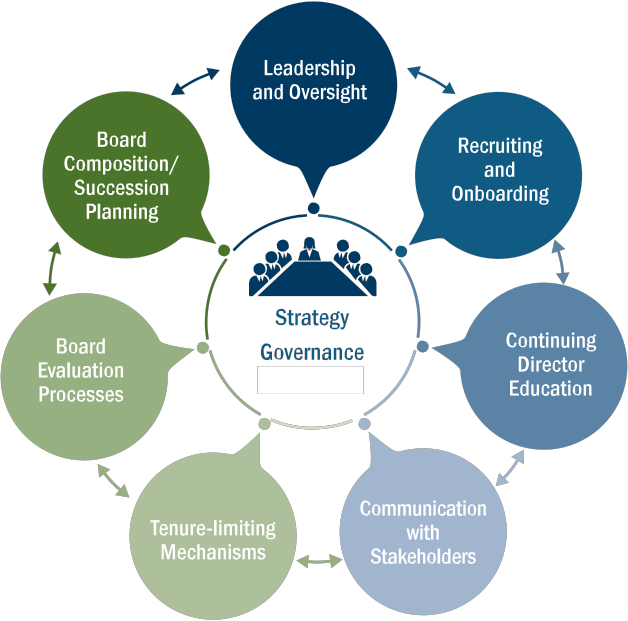
SECTION 1 of the report describes the ways in which the board’s mandate has evolved in response to external factors and strategic imperatives, and outlines the ways in which the Commission believes boards must respond: by moving beyond traditional approaches to “board refreshment” and establishing a system for continuous improvement in the boardroom.

SECTION 2 explores the key dimensions of continuous improvement, focusing on seven areas in particular: board leadership and oversight responsibilities; board composition and succession planning; recruiting and onboarding new directors; processes for board evaluation; continuing education; tenure-limiting mechanisms; and communication with shareholders and stakeholders.

SECTION 3 summarizes the Commission’s recommendations, and the Appendices provide tools and related resources to help boards implement the recommendations.

NACD has characterized the mission of the board as “[becoming] a strategic asset of the company measured by the contributions we make—collectively and individually—to the long-term success of the enterprise.” [4] We believe this report will help directors in organizations of all sizes and in all sectors to do exactly that.

Recommendations of the 2016 NACD Blue Ribbon Commission

  1. Boards should review their governance principles on a regular basis (at least every other year) to ensure they are complete, up-to-date, and fully understood by current members and director candidates. Governance principles should incorporate a definition of director responsibilities, including a commitment to ongoing learning and the belief that service on the board should not be considered to be a permanent appointment.
  2. The nominating and governance committee should oversee the board’s processes for continuous improvement, working in close coordination with the nonexecutive chair or lead director and with the endorsement of the full board.
  3. Director renominations should not be a default decision, but an annual consideration based on a number of factors, including an assessment of current and future skill sets and leadership styles that are needed on the board.
  4. Nominating and governance committees should develop a “clean-sheet” assessment of the board’s needs in terms of director skill sets and experience at least every two to three years, and use it as an input in continuous-improvement efforts (including recruitment and director education).
  5. The director recruitment process should have a time horizon that matches the organization’s long-term strategy, typically three to five years or more. The process should be designed to include candidates from diverse backgrounds.
  6. Recruiting and onboarding processes should familiarize prospective and new directors with the board’s governance principles and set expectations regarding criteria for renomination, ongoing director education, and other aspects of continuous improvement as defined by the board.
  7. Conduct annual evaluations at the full-board level, and evaluations of committees and individual directors at least once every two years. Use a qualified independent third party on a periodic basis, to encourage candor and add a neutral perspective.
  8. Participation in continuing education should be a requirement for all directors, regardless of experience level or length of board tenure.
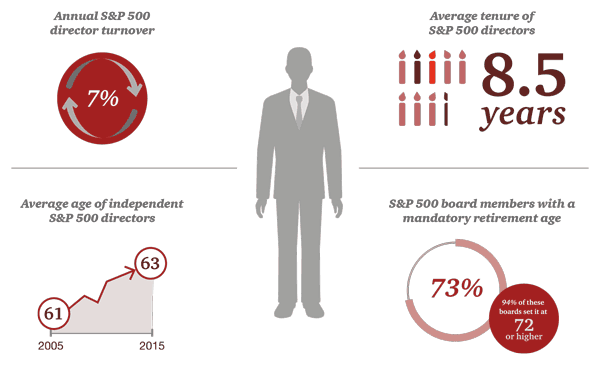
  9. Tenure is an important aspect of boardroom diversity. Nominating and governance committees should strive for a mix of tenures on the board—for example, maintaining a composition that includes at least one director with <5, 5–10, and >10 years of service.
  10. High-performance boards will not need to rely exclusively on tenure-limiting mechanisms to ensure appropriate board turnover and composition. However, boards that use such policies should consider replacing or combining retirement age with a maximum term of service.
  11. Communications with investors and other key stakeholders should include a detailed explanation of the link between the organization’s strategic needs and the board’s composition and skill sets, as well as information about the board’s continuous-improvement processes.

Tools for Directors

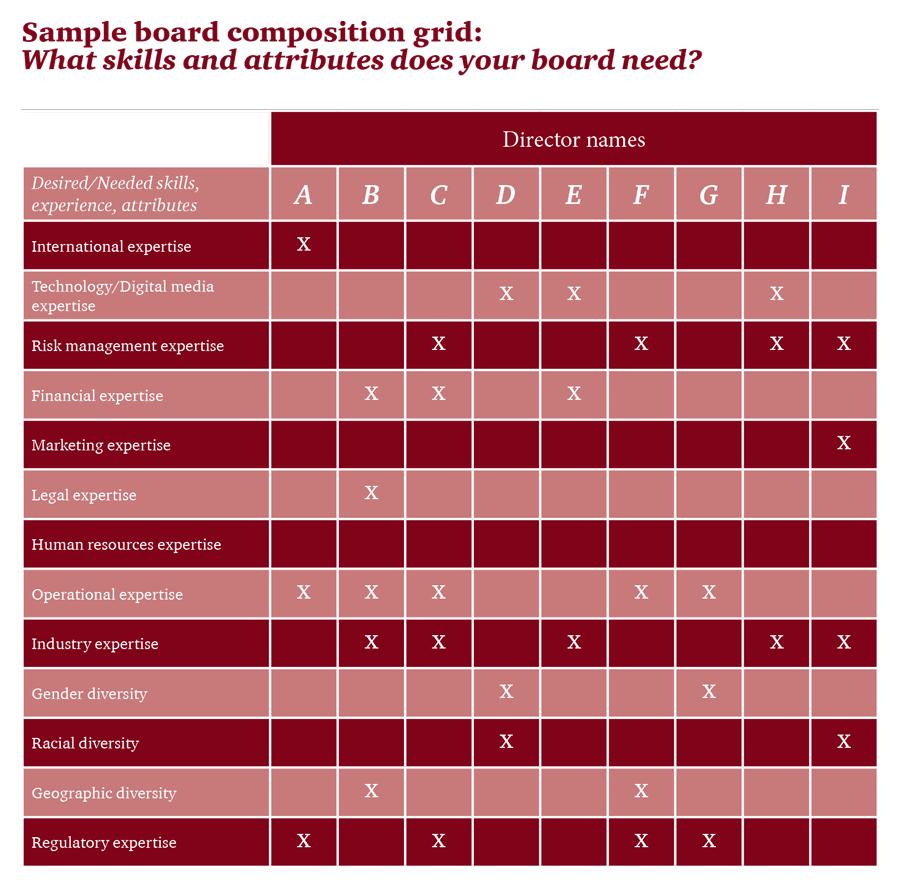
The report’s 12 appendices enable boards to benchmark their current practices and implement the report’s recommendations. Examples of appendix content are below.

Early Engagement: Going Beyond Traditional Board Succession Planning

A reference list of more than 25 questions to help directors evaluate the board’s ability to manage succession planning as a portfolio, instead of as a series of one-off replacements of individual directors; the strength of the board’s search capabilities, including early-engagement activities and the depth of the candidate pipeline; and the role that board and company culture play in succession planning.

Considerations for Upgrading Board Evaluation Processes

The appendix provides guidance to help boards

  1. establish effective, ongoing rhythms for evaluation processes;
  2. avoid “evaluation fatigue”;
  3. inform the use of third-party facilitators;
  4. make evaluations more holistic by incorporating input from management; and
  5. act on evaluation results.

Guidelines for Developing Board and Individual-Director Learning Agendas

The appendix includes frameworks and questions to help inform full-board and individual-director education activities:

  1. Suggested categories and topic areas for education, with sourcing strategies
  2. A personal learning and development checklist for directors
  3. Outline of a “lifecycle approach” to learning and development for the board, with components of a global director leadership profile

Tools, Templates, and Examples

Multiyear board succession planning matrix

Sample board and committee-level evaluation questions

New-director onboarding checklist

Examples of effective disclosures of director skills, board evaluations, and director education

Examples of corporate governance principles and board tenure policies

* * *

The complete publication is available exclusively to NACD members and is available for download here.

Endnotes:

1NACD, Report of the Blue Ribbon Commission on Director Professionalism, 2011 ed. (Washington, DC: NACD, 2011), pp. 12, 5, 15, 10.(go back)

2Ibid., p. 13.(go back)

3F. William McNabb III, Getting to Know You: The Case for Significant Shareholder Engagement, Harvard Law School Forum on Corporate Governance and Financial Regulation, June 24, 2015.(go back)

4NACD, Report of the Blue Ribbon Commission on Board Evaluation: Improving Director Effectiveness, 3rd ed. (Washington, DC: NACD, 2010), p. 2.(go back)

Deux livres phares sur la gouvernance d’entreprise


On me demande souvent de proposer un livre qui fait le tour de la question eu égard à ce qui est connu comme statistiquement valide sur les relations entre la gouvernance et le succès des organisations (i.e. la performance financière !)

Le volume publié par David F. Larcker et Brian Tayan, professeurs au Graduate School de l’Université Stanford, en est à sa deuxième édition et il donne l’heure juste sur l’efficacité des principes de gouvernance.

Je vous recommande donc vivement ce volume.

Également, je profite de l’occasion pour vous indiquer que je viens de recevoir la dernière version  des Principes de gouvernance d’entreprise du G20 et de l’OCDE en français et j’ai suggéré au Collège des administrateurs de sociétés (CAS) d’inclure cette publication dans la section Nouveauté du site du CAS.

Il s’agit d’une publication très attendue dans le monde de la gouvernance. La documentation des organismes internationaux est toujours d’abord publiée en anglais. Ce document en français de l’OCDE sur les principes de gouvernance est la bienvenue !

Voici une brève présentation du volume de Larcker. Bonne lecture !

This is the most comprehensive and up-to-date reference for implementing and sustaining superior corporate governance. Stanford corporate governance experts David Larcker and Bryan Tayan carefully synthesize current academic and professional research, summarizing what is known and unknown, and where the evidence remains inconclusive.

Corporate Governance Matters, Second Edition reviews the field’s newest research on issues including compensation, CEO labor markets, board structure, succession, risk, international governance, reporting, audit, institutional and activist investors, governance ratings, and much more. Larcker and Tayan offer models and frameworks demonstrating how the components of governance fit together, with updated examples and scenarios illustrating key points. Throughout, their balanced approach is focused strictly on two goals: to “get the story straight,” and to provide useful tools for making better, more informed decisions.

Book cover: Corporate Governance Matters, 2nd edition

This edition presents new or expanded coverage of key issues ranging from risk management and shareholder activism to alternative corporate governance structures. It also adds new examples, scenarios, and classroom elements, making this text even more useful in academic settings. For all directors, business leaders, public policymakers, investors, stakeholders, and MBA faculty and students concerned with effective corporate governance.

Selected Editorial Reviews

An outstanding work of unique breadth and depth providing practical advice supported by detailed research.
Alan Crain, Jr., Senior Vice President and General Counsel, Baker Hughes
Extensively researched, with highly relevant insights, this book serves as an ideal and practical reference for corporate executives and students of business administration.
Narayana N.R. Murthy, Infosys Technologies
Corporate Governance Matters is a comprehensive, objective, and insightful analysis of academic and professional research on corporate governance.
Professor Katherine Schipper, Duke University, and former member of the Financial Accounting Standards Board

Enquête mondiale sur les conseils d’administration et la gouvernance


Voici un récent article publié par Julie Hembrock Daum, directrice à Spencer Stuart et Susan Stauberg, PDG à Fondation WomenCorporateDirectors.

Cet article a été publié dans le Harvard Law School Forum aujourd’hui et il présente l’état de la gouvernance à l’échelle internationale (60 pays) en mettant particulièrement l’accent sur la diversité et les différences de perception entre les hommes et les femmes qui occupent des postes d’administrateurs de grandes sociétés privées ou publiques.

On me demande souvent de proposer des références en relation avec la gouvernance globale. Les gens veulent connaître les tendances et les progrès des efforts entrepris dans le domaine de la diversité dans le monde.

L’enquête citée ci-dessous fournit des données actuelles sur les principaux enjeux concernant les Board.

Je crois que tous les gestionnaires seront intéressés par la présentation succincte, claire et bien illustrée des données de la mondialisation de la gouvernance.

Bonne lecture ; vos commentaires sont appréciés.


2016 Global Board of Directors Survey


The growing demands on corporate boards are transforming boardrooms globally, with directors taking on a more strategic, dynamic and responsive role to help steer their companies through a hypercompetitive and volatile business environment. Economic and political uncertainties make long-term planning more difficult. The proliferation of cyber attacks—and their consequences for business in financial  olosses and reputational damage—increases the scope of risk oversight. A rise in institutional and activist shareholder activity requires boards to identify vulnerabilities in board renewal and performance and, in some cases, establish protocols for engagement. And all of these demands have pushed issues around board composition and diversity to the fore, as boards cannot afford to have directors around the table who aren’t delivering value.

 boardroom presentation
Boardroom presentation

In this context, Spencer Stuart, the WomenCorporateDirectors (WCD) Foundation, Professor Boris Groysberg and doctoral candidate Yo-Jud Cheng of Harvard Business School and researcher Deborah Bell partnered together on the 2016 Global Board of Directors Survey, one of the most comprehensive surveys of corporate directors around the world.

We received responses from more than 4,000 male and female directors from 60 countries, providing a comprehensive snapshot of the business climate and strategic priorities as seen from the boardroom of many of the world’s top public and large, privately held companies.

The survey explores in depth how boards think and operate. It captures in detail the governance practices, strategic priorities and views on board effectiveness of corporate directors around the world. It also confirmed many of our observations from working with boards. The economy is top of mind, and many directors are uncertain about economic prospects and not seeing growth in the future. At the same time, directors are responding proactively to the many new demands they face, looking for opportunities to enhance composition and improve board performance.

Findings compare and contrast the views between male and female corporate board directors, and highlight similarities and differences between public and private companies and among directors from different regions in five key areas:

  1. Political and economic landscape
  2. Company strategy and risks
  3. Board governance and effectiveness
  4. Board diversity and quotas
  5. Director identification and recruitment

This post highlights key findings around these topics, providing directors an overview of how their peers view their own boards and the challenges that their companies face. In subsequent reports, we will dive deeper into specific governance areas and explore additional perspectives on board composition, risk areas, and strengths and weaknesses in boardrooms today.

Key Findings

Political and Economic Landscape: Uncertainty dominates boardroom outlook.

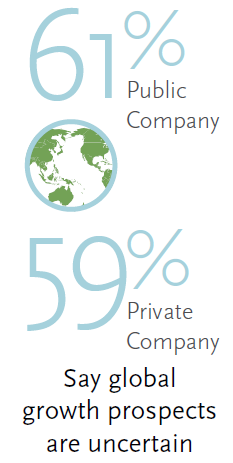
ss1Our survey finds that directors around the world are uncertain about global growth prospects, with directors in North America and Western Europe least confident about the prospects for growth. Sixty-three percent of directors in these regions see uncertain economic conditions, compared with 36% in Asia and 40% in Africa.

Only 2% of directors across all regions predict a period of strong global growth over the next three years, while 16% expect a global slowdown. “This pessimism about growth is one of the most surprising findings of our survey,” said Boris Groysberg of Harvard Business School. “It seems that the market volatility and low prospects for growth as well as the unpredictable economic outlook are what keep board members awake at night.”

More than one-third of directors of companies headquartered in Asia and roughly one-quarter of directors of companies in Australia/New Zealand expect relatively faster growth in emerging economies versus developed countries.

Political and Economic Landscape: Economy, regulations and cybersecurity top issues for directors.

ss2
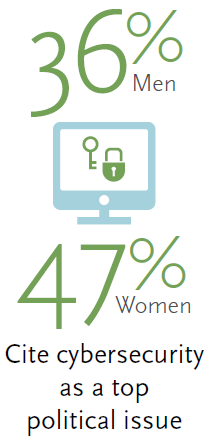
Across all industries and regions, directors rank the economy and the regulatory environment as the political issues most relevant to them. Cybersecurity is an increasingly important issue in many regions. More than one-third of directors of companies in Australia/New Zealand, North America and Western Europe say cybersecurity is a top issue. “Cybersecurity continues to be a leading issue on the agenda from a regulatory, reputational and contingency standpoint,” says Julie Hembrock Daum, head of Spencer Stuart’s North American Board Practice.

“We see boards considering a number of different approaches to getting smart about the broader impact of technology on the business. In certain cases they have added a director with a strong digital or security background. However, the board should not isolate cybersecurity responsibility with just this one board member, but continue to view cybersecurity as a full board priority.”

Political instability is a concern in several regions. In Central and South America, one-half of directors cite political instability as an issue. Corporate tax rates are an issue particularly in North America.

ss3

Company Risks: Women directors report higher concerns about risk than male directors.

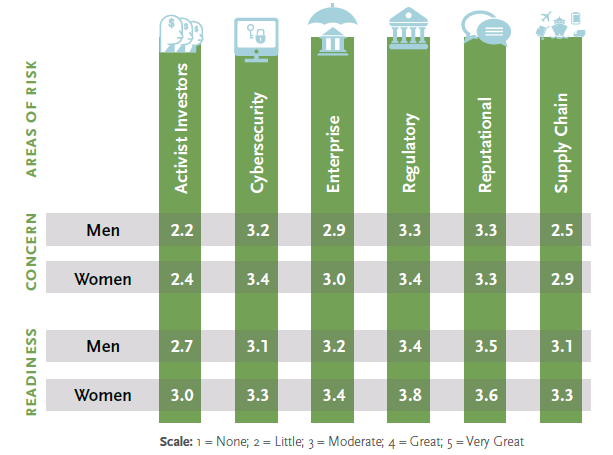
Directors globally express the most concern about regulatory and reputational risks, followed by cybersecurity, and less about activist investors and supply chain risks. In general, directors report that their companies are prepared to handle the most important risks, with companies’ level of readiness matching the most concerning areas of risk. However, directors of private companies systematically rank their boards as being less prepared versus public company boards when it comes to such risks.

Nearly across the board, female directors report a higher level of concern about various risks to a company than their male peers—from concerns about activist investors and cybersecurity to regulatory risk and the supply chain. However, female directors also feel that their companies have a higher level of readiness to address these risks than do their male cohorts.

Susan Stautberg, chairman and CEO of the WCD Foundation, believes that women directors may be educating themselves more about the potential risks:

“We believe that women in particular bring a real thirst for knowledge and curiosity to their board service, and this includes getting up-to-speed on what the real risks are to an organization. All good directors do this, but we think being relatively new to the boardroom can create a greater sense of urgency to learn.”

ss4

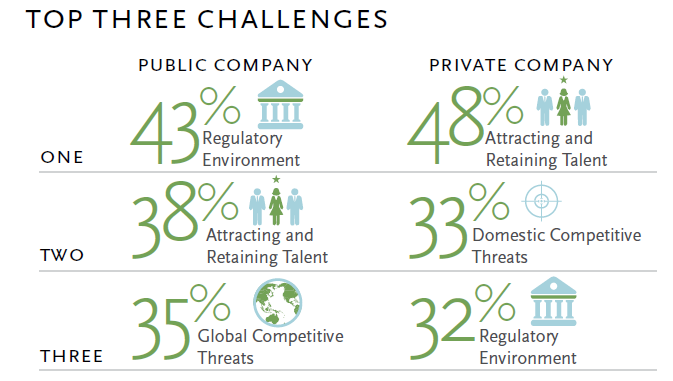
Strategy: Top challenges differ for public and private companies.

Talent, regulations, global and domestic competition, and innovation are seen by directors as the top impediments to achieving their companies’ strategic objectives. How those challenges rank specifically depends in part on whether directors are serving public or private companies.

Nearly half of private company directors (versus 38% of public company directors) rate attracting and retaining talent as a key challenge to achieving their company’s strategic objectives. This is followed by domestic competitive threats, the regulatory environment, innovation and global competitive threats. Among public companies, 43% of directors (versus 32% of private company directors) say the regulatory environment is a top challenge, followed by attracting and retaining talent, global competitive threats, innovation and domestic competitive threats.

“This was interesting because we do see in larger, more established public companies a greater maturity in their HR processes and deeper resources invested in talent management and development,” says Daum. “Identifying and recruiting individuals who fit the culture, bring impact to the organization and endure is a high priority for nearly all companies. However, many private companies, which tend to be smaller and have less brand awareness as a whole, often have less robust HR structures to attract the level of talent across the organization.”

Perceived challenges also differ somewhat by industry and region, with the regulatory environment being more concerning for companies in the energy/utilities, financials/professional services and healthcare industries, and in Asia, Australia/New Zealand, North America and Western Europe. Global competitive threats are the leading concern for companies in the industrials and materials sectors, and in Western Europe.

Interestingly, while cybersecurity is viewed as an important risk, few directors consider it a major challenge to achieving strategic objectives. Similarly, activist shareholders, compensation, cost of commodities and supply chain risk are not perceived as challenges to achieving strategic goals.

On average, directors rate their board’s overall performance as being slightly above average (3.7 out of 5). Directors see their boards as having the strongest processes related to staying current on the company and the industry, compliance, financial planning and board composition, and weakest in cybersecurity, the evaluation of individual directors, CEO succession planning and HR/talent management.

“These ratings underscore directors’ views that attracting and retaining top talent is a common challenge, and underline the need for these HR competencies on boards,” says Stautberg. Harvard Business School doctoral candidate Yo-Jud Cheng adds, “Despite the fact that directors recognize their weaknesses in these areas, boards continue to prioritize more conventional areas of expertise, such as industry knowledge and auditing, in their appointments of new directors.”

Public company directors rate their overall board performance slightly higher than private company directors (3.8 versus 3.4) and give themselves higher marks for creating effective board structures, evaluation of individual directors, cybersecurity and compliance. We also see some variation across regions.

Board Turnover: Directors—especially women—favor tools to trigger change.

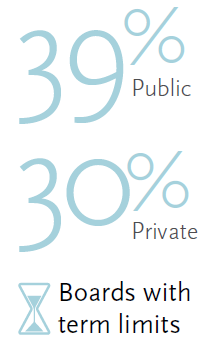
A little more than one-third of boards have term limits for directors, averaging six years, while approximately one-quarter of boards have a mandatory retirement age, averaging 72 years. Boards in Western Europe are most likely to have term limits, and boards in North America are least likely to set term limits. However, boards in North America are more likely to have a mandatory retirement age than boards in Western Europe (34% versus 18%). We also see a stark contrast between public and private companies in both term limits (39% versus 30%) and mandatory retirement ages (33% versus 12%).ss5

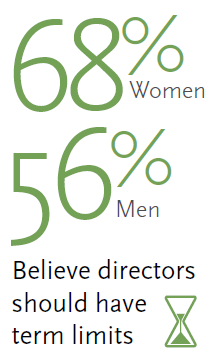
While these tools for triggering director turnover generally have not been widely adopted, the survey indicates that directors favor adoption of such mechanisms. Sixty percent of directors think that boards should have mandatory term limits for directors, and 45% think that there should be a mandatory retirement age. Even in private companies, which are considerably less likely to adopt these practices today, directors shared similar opinions as compared to their counterparts in public companies. Female directors even more strongly support triggers for turnover; 68% (versus 56% of men) favor director term limits and 57% (versus 39% of men) support mandatory retirement ages.

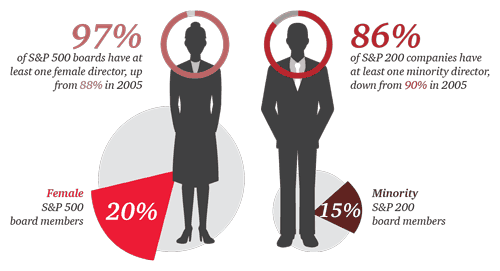
“It was encouraging to see the majority of respondents in favor of retirement ages and term limits. Turnover among S&P 500 companies has trended at 5% to 7%—roughly 300 to 350 seats a year. Boards need tools they can use to ensure that new perspectives and thinking are regularly being brought to the boardroom,” says Daum. “This isn’t just an issue tied to activist shareholders, but something institutional shareholders are asking about as well: what are boards doing to ensure independent and fresh thinking?”

ss6Not surprisingly, 43% of directors believe that a director loses his or her independence after about 10 years. Respondents from North America are less likely to tie director independence to years served, with only one-third agreeing that a director loses independence after a certain amount of time on the board.

Board Diversity: Greater independence doesn’t always drive greater diversity.

Public companies represented in the survey have larger boards than private companies—on average 8.9 directors versus 7.6—and a larger representation of independent directors, 74% versus 54%. Yet, public and private company boards are similar in terms of the representation of women, minorities and new directors. On average, 18% of board members are women, 7% are ethnic minorities and 13% have been appointed in the past 12 months.

“This finding was very interesting. There has been much debate about the use and effectiveness of quotas. To see the relative parity of diversity among public and private companies reinforces that the tone needs to come from the top regarding bringing a fresh, diverse perspective representative of the company’s stakeholders and interests,” says Daum. Groysberg adds, “Although we are hearing more talk about the importance of diversity from boards, it’s not necessarily translating into numbers. Unfortunately, we haven’t seen as much progress as we were hoping for compared to our past survey on the diversity of boards.”

Boards are largest in the financials/professional services sector (9.1 directors) and smallest in the IT/telecom sector (7.5 directors). Female representation is highest (20% or more) in the consumer staples, financial services/professional services and consumer discretionary sectors, and lowest in IT/telecom (13%).

Looking across regions, board size is smallest in Australia/New Zealand, where boards average 6.7 members, as compared to the global average of 8.5 members. Boards in Australia/New Zealand and North America have the highest proportion of independent directors, and boards in Asia have the lowest proportion. Female representation is lowest in Central and South America and Asia.

ss7

Boardroom Diversity: Why isn’t the number of women on boards increasing?

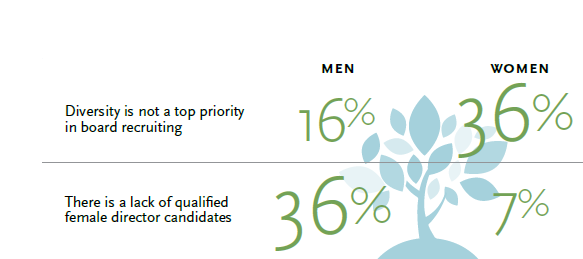
As the percentage of women on boards remains stagnant, there is both a gender divide and a generation divide on why this is. Male directors, especially older respondents, report the “lack of qualified female candidates,” while women directors most often cite the fact that diversity is not a priority in board recruiting and that traditional networks tend to be male-dominated. Younger male directors surveyed (those 55 and younger) are inclined to agree with women that traditional networks tend to be male-dominated. “Men in the younger generation, I think, just see their qualified female colleagues out there, but know that the traditional board networks still tend to be male,” says Stautberg. “It’s often hard to see an informal ‘network’ if you are in the middle of it, but you can see it very clearly when you’re on the outside.”

ss8

Boardroom Diversity: Quotas not supported overall.

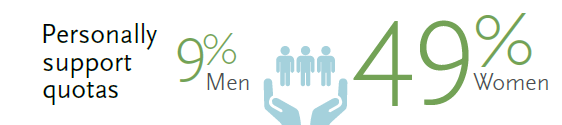
Nearly 75% of surveyed directors do not personally support boardroom diversity quotas, but support for quotas varies significantly by gender and, to a lesser degree, by age. Forty-nine percent of female directors support diversity quotas, but only 9% of male directors do. Older women are less likely to favor quotas than younger women; 67% of female directors ages 55 and younger personally support boardroom quotas, compared with 36% of female directors over 55 (the majority of male directors, of any age, do not support quotas). Female directors also are more likely to be in favor of government regulatory agencies requiring boards to disclose specific practices/steps being taken to seat diverse candidates (43% versus 14% of male directors).

If quotas aren’t the answer, what do directors think would increase board diversity? Male and female directors agree that having board leadership that champions board diversity is the most effective way to build diverse corporate boards. Men feel more strongly than women that efforts to develop a pipeline of diverse board candidates throuss9gh director advocacy, mentorship and training is an effective way to increase diversity.

Directors as a whole agree that shareholder pressure and board targets are less effective tools for increasing board diversity.


Boardroom Diversity: Search firms have been successful in expanding the talent pool of qualified female directors.

Directors take a variety of pathways to the boardroom: in roughly equal measures, directors were known to the board or another director, recruited by a search firm or known by the CEO. Public company directors are more likely to be recruited by an executive search firm than private company directors, while private company directors are more likely to have been appointed by a major shareholder.

The survey highlights gender differences, as well, in the paths to the boardroom. Female directors are more likely than their male counterparts to have been recruited by an executive search firm, while male directors are more likely to have been appointed by a major shareholder. “Search firms may be able to open doors that networking opportunities may not have been doing until relatively recently, at least for women,” says Stautberg. “Building up networks and getting known is something that women directors are engaging in much more actively now.”

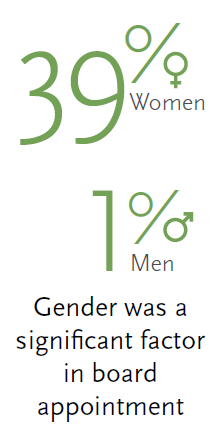
And, indeed, 39% of female directors report that their gender was a significant factor in their board appointment, versus 1% of men.

Conclusion

Corporate boards face no shortage of challenges—from economic uncertainty to strategic and competitive shifts to a dynamic set of risks. Investor attention to board performance and governance has also escalated, and many boards are holding themselves to higher standards. Directors want to ensure that their boards contribute at the highest level, incorporating diverse perspectives, aligning with shareholder interests and setting a positive tone at the top for the organization.

Yet our research has revealed a gap between best practice and reality, especially in areas such as board diversity, HR/talent management, CEO succession planning and director evaluations. But the study provides hope that boards will make progress, as directors support practices that can help promote change. Future research is needed to track progress on these fronts and to study the impact of measures such as quotas and diversity on board performance.

Amid the many challenges confronting corporations—and the growing expectations on corporate boards—directors must be thoughtful about defining the skill sets needed around the board table and diligent in recruiting the right directors, planning for CEO succession and evaluating their own performance. In this way, they will be best positioned to contribute at the high levels which they are demanding of themselves, and to which others are holding them accountable.

The complete publication is available here.


*Julie Hembrock Daum leads the North American Board Practice at Spencer Stuart, and Susan Stautberg is the Chairman and CEO of the WomenCorporateDirectors Foundation. This post relates to the 2016 Global Board of Directors Survey, a co-publication from Spencer Stuart and the WCD Foundation authored by Ms. Daum; Ms. Stautberg; Dr. Boris Groysberg, Richard P. Chapman Professor of Business Administration at Harvard Business School; Yo-Jud Cheng, doctoral candidate at Harvard Business School; and Deborah Bell, researcher.

L’efficacité du rôle du président du conseil


Nous publions ici un quatrième billet de Danielle Malboeuf* laquelle nous a soumis ses réflexions sur les grands enjeux de la gouvernance des institutions d’enseignement collégial les 23 et 27 novembre 2013, à titre d’auteure invitée.

Dans un premier billet, publié le 23 novembre 2013 sur ce blogue, on insistait sur l’importance, pour les CA des Cégep, de se donner des moyens pour assurer la présence d’administrateurs compétents dont le profil correspond à celui recherché.

D’où les propositions adressées à la Fédération des cégeps et aux CA pour préciser un profil de compétences et pour faire appel à la Banque d’administrateurs certifiés du Collège des administrateurs de sociétés (CAS), le cas échéant. Un autre enjeu identifié dans ce billet concernait la remise en question de l’indépendance des administrateurs internes.

Le deuxième billet publié le 27 novembre 2013 abordait l’enjeu entourant l’exercice de la démocratie par différentes instances au moment du dépôt d’avis au conseil d’administration.

Le troisième billet portait sur l’efficacité du rôle du président du conseil d’administration (PCA).

Ce quatrième billet est une mise à jour de son dernier article portant sur le rôle du président de conseil.

Voici donc l’article en question, reproduit ici avec la permission de l’auteure.

Vos commentaires sont appréciés. Bonne lecture.

________________________________________


LE RÔLE DU PRÉSIDENT DU CONSEIL D’ADMINISTRATION | LE CAS DES INSTITUTIONS D’ENSEIGNEMENT COLLÉGIAL 

par Danielle Malboeuf*  


Il y a deux ans, je publiais un article sur le rôle du président du conseil d’administration (CA) [1]. J’y rappelais le rôle crucial et déterminant du président du CA et j’y précisais, entre autres, les compétences recherchées chez cette personne et l’enrichissement attendu de son rôle.

Depuis, on peut se réjouir de constater qu’un nombre de plus en plus élevé de présidents s’engagent dans de nouvelles pratiques qui améliorent la gouvernance des institutions collégiales. Ils ne se limitent plus à jouer un rôle d’animateurs de réunions, comme on pouvait le constater dans le passé.

president-du-conseil-dadministration

Notons, entre autres, que les présidents visent de plus en plus à bien s’entourer, en recherchant des personnes compétentes comme administrateurs. D’ailleurs, à cet égard, les collèges vivent une situation préoccupante. La Loi sur les collèges d’enseignement général et professionnel prévoit que le ministre [2] nomme les administrateurs externes. Ainsi, en plus de connaître des délais importants pour la nomination de nouveaux administrateurs, les collèges ont peu d’influence sur leur choix.

Présentement, les présidents et les directions générales cherchent donc à l’encadrer. Ils peuvent s’inspirer, à cet égard, des démarches initiées par d’autres organisations publiques en établissant, entre autres, un profil de compétences recherchées qu’ils transmettent au ministre. Ils peuvent ainsi tenter d’obtenir une complémentarité d’expertise dans le groupe d’administrateurs.

Une fois les administrateurs nommés, les présidents doivent se préoccuper d’assurer leur formation continue pour développer les compétences recherchées. Ils se donnent ainsi l’assurance que ces personnes comprennent bien leur rôle et leurs responsabilités et qu’elles sont outillées pour remplir le mandat qui leur est confié. De plus, ils doivent s’assurer que les administrateurs connaissent bien l’organisation, qu’ils adhèrent à sa mission et qu’ils partagent les valeurs institutionnelles. En présence d’administrateurs compétents, éclairés, et dont l’expertise est reconnue, il est plus facile d’assurer la légitimité et la crédibilité du CA et de ses décisions.

Un président performant démontrera aussi de grandes qualités de leadership. Il fera connaître à toutes les instances du milieu le mandat confié au CA. Il travaillera à mettre en place un climat de confiance au sein du CA et avec les gestionnaires de l’organisation. Il  cherchera à exploiter l’ensemble des compétences et à faire jouer au CA un rôle qui va au-delà de celui de fiduciaire, soit celui de contribuer significativement à la mission première du cégep : donner une formation pertinente et de qualité où l’étudiant et sa réussite éducative sont au cœur des préoccupations.

Plusieurs ont déjà fait le virage… c’est encourageant ! Les approches préconisées par l’Institut sur la gouvernance des organismes publics et privés (IGOPP) et le Collège des administrateurs de sociétés (CAS) puis reprises dans la loi sur la gouvernance des sociétés d’État ne sont sûrement pas étrangères à cette évolution. En fournissant aux présidents de CA le soutien, la formation et les outils appropriés pour améliorer leur gouvernance, le Centre collégial des services regroupés (CCSR) [3] contribue à assurer le développement des institutions collégiales dans un contexte de saine gestion.

Un CA performant est guidé par un président compétent.


[1] https://jacquesgrisegouvernance.com/2014/01/24/le-role-du-president-du-conseil-dadministration-pca-le-cas-des-cegep/

[2] Ministre de l’Enseignement supérieur, de la Recherche, de la Science et de la Technologie

[3] Formation développée en partenariat avec l’Institut sur la gouvernance des organisations privées et publiques (IGOPP)

_______________________________

*Danielle Malboeuf est consultante et formatrice en gouvernance ; elle possède une grande expérience dans la gestion des CEGEP et dans la gouvernance des institutions d’enseignement collégial et universitaire. Elle est CGA-CPA, MBA, ASC, Gestionnaire et administratrice retraité du réseau collégial et consultante.


Articles sur la gouvernance des CEGEP

(1) Les grands enjeux de la gouvernance des institutions d’enseignement collégiaux

(2) L’exercice de la démocratie dans la gouvernance des institutions d’enseignement collégiaux

(3) LE RÔLE DU PRÉSIDENT DU CONSEIL D’ADMINISTRATION (PCA) | LE CAS DES CÉGEP

Enhanced by Zemanta

Dix thèmes majeurs pour les administrateurs en 2016 | Harvard Law School Forum on Corporate Governance


Vous trouverez, ci-dessous, les dix thèmes les plus importants pour les administrateurs de sociétés selon Kerry E. Berchem, associé du groupe de pratiques corporatives à la firme Akin Gump Strauss Hauer & Feld LLP. Cet article est paru aujourd’hui sur le blogue le Harvard Law School Forum on Corporate Governance.

Bien qu’il y ait peu de changements dans l’ensemble des priorités cette année, on peut quand même noter :

(1) l’accent crucial accordé au long terme ;

(2) Une bonne gestion des relations avec les actionnaires dans la foulée du nombre croissant d’activités menées par les activistes ;

(3) Une supervision accrue des activités liées à la cybersécurité…

Pour plus de détails sur chaque thème, je vous propose la lecture synthèse de l’article ci-dessous.

Bonne lecture !


Ten Topics for Directors in 2016 |   Harvard Law School Forum on Corporate Governance


U.S. public companies face a host of challenges as they enter 2016. Here is our annual list of hot topics for the boardroom in the coming year:

  1. Oversee the development of long-term corporate strategy in an increasingly interdependent and volatile world economy
  2. Cultivate shareholder relations and assess company vulnerabilities as activist investors target more companies with increasing success
  3. Oversee cybersecurity as the landscape becomes more developed and cyber risk tops director concerns
  4. Oversee risk management, including the identification and assessment of new and emerging risks
  5. Assess the impact of social media on the company’s business plans
  6. Stay abreast of Delaware law developments and other trends in M&A
  7. Review and refresh board composition and ensure appropriate succession
  8. Monitor developments that could impact the audit committee’s already heavy workload
  9. Set appropriate executive compensation as CEO pay ratios and income inequality continue to make headlines
  10. Prepare for and monitor developments in proxy access

Strategic Planning Considerations

Strategic planning continues to be a high priority for directors and one to which they want to devote more time. Figuring out where the company wants to—and where it should want to—go and how to get there is not getting any easier, particularly as companies find themselves buffeted by macroeconomic and geopolitical events over which they have no control.

axes

In addition to economic and geopolitical uncertainty, a few other challenges and considerations for boards to keep in mind as they strategize for 2016 and beyond include:

finding ways to drive top-line growth

focusing on long-term goals and enhancing long-term shareholder value in the face of mounting pressures to deliver short-term results

the effect of low oil and gas prices

figuring out whether and when to deploy growing cash stockpiles

assessing the opportunities and risks of climate change and resource scarcity

addressing corporate social responsibility.

Shareholder Activism

Shareholder activism and “suggestivism” continue to gain traction. With the success that activists have experienced throughout 2015, coupled with significant new money being allocated to activist funds, there is no question that activism will remain strong in 2016.

In the first half of 2015, more than 200 U.S. companies were publicly subjected to activist demands, and approximately two-thirds of these demands were successful, at least in part. [1] A much greater number of companies are actually targeted by activism, as activists report that less than a third of their campaigns actually become public knowledge. [2] Demands have continued, and will continue, to vary: from requests for board representation, the removal of officers and directors, launching a hostile bid, advocating specific business strategies and/or opining on the merit of M&A transactions. But one thing is clear: the demands are being heard. According to a recent survey of more than 350 mutual fund managers, half had been contacted by an activist in the past year, and 45 percent of those contacted decided to support the activist. [3]

With the threat of activism in the air, boards need to cultivate shareholder relations and assess company vulnerabilities. Directors—who are charged with overseeing the long-term goals of their companies—must also understand how activists may look at the company’s strategy and short-term results. They must understand what tactics and tools activists have available to them. They need to know and understand what defenses the company has in place and whether to adopt other protective measures for the benefit of the overall organization and stakeholders.

Cybersecurity

Nearly 90 percent of CEOs worry that cyber threats could adversely impact growth prospects. [4] Yet in a recent survey, nearly 80 percent of the more than 1,000 information technology leaders surveyed had not briefed their board of directors on cybersecurity in the last 12 months. [5] The cybersecurity landscape has become more developed and as such, companies and their directors will likely face stricter scrutiny of their protection against cyber risk. Cyber risk—and the ultimate fall out of a data breach—should be of paramount concern to directors.

One of the biggest concerns facing boards is how to provide effective oversight of cybersecurity. The following are questions that boards should be asking:

Governance. Has the board established a cybersecurity review > committee and determined clear lines of reporting and > responsibility for cyber issues? Does the board have directors with the necessary expertise to understand cybersecurity and related issues?

Critical asset review. Has the company identified what its highest cyber risks assets are (e.g., intellectual property, personal information and trade secrets)? Are sufficient resources allocated to protect these assets?

Threat assessment. What is the daily/weekly/monthly threat report for the company? What are the current gaps and how are they being resolved?

Incident response preparedness. Does the company have an incident response plan and has it been tested in the past six months? Has the company established contracts via outside counsel with forensic investigators in the event of a breach to facilitate quick response and privilege protection?

Employee training. What training is provided to employees to help them identify common risk areas for cyber threat?

Third-party management. What are the company’s practices with respect to third parties? What are the procedures for issuing credentials? Are access rights limited and backdoors to key data entry points restricted? Has the company conducted cyber due diligence for any acquired companies? Do the third-party contracts contain proper data breach notification, audit rights, indemnification and other provisions?

Insurance. Does the company have specific cyber insurance and does it have sufficient limits and coverage?

Risk disclosure. Has the company updated its cyber risk disclosures in SEC filings or other investor disclosures to reflect key incidents and specific risks?

The SEC and other government agencies have made clear that it is their expectation that boards actively manage cyber risk at an enterprise level. Given the complexity of the cybersecurity inquiry, boards should seriously consider conducting an annual third-party risk assessment to review current practices and risks.

Risk Management

Risk management goes hand in hand with strategic planning—it is impossible to make informed decisions about a company’s strategic direction without a comprehensive understanding of the risks involved. An increasingly interconnected world continues to spawn newer and more complex risks that challenge even the best-managed companies. How boards respond to these risks is critical, particularly with the increased scrutiny being placed on boards by regulators, shareholders and the media. In a recent survey, directors and general counsel identified IT/cybersecurity as their number one worry, and they also expressed increasing concern about corporate reputation and crisis preparedness. [6]

Given the wide spectrum of risks that most companies face, it is critical that boards evaluate the manner in which they oversee risk management. Most companies delegate primary oversight responsibility for risk management to the audit committee. Of course, audit committees are already burdened with a host of other responsibilities that have increased substantially over the years. According to Spencer Stuart’s 2015 Board Index, 12 percent of boards now have a stand-alone risk committee, up from 9 percent last year. Even if primary oversight for monitoring risk management is delegated to one or more committees, the entire board needs to remain engaged in the risk management process and be informed of material risks that can affect the company’s strategic plans. Also, if primary oversight responsibility for particular risks is assigned to different committees, collaboration among the committees is essential to ensure a complete and consistent approach to risk management oversight.

Social Media

Companies that ignore the significant influence that social media has on existing and potential customers, employees and investors, do so at their own peril. Ubiquitous connectivity has profound implications for businesses. In addition to understanding and encouraging changes in customer relationships via social media, directors need to understand and weigh the risks created by social media. According to a recent survey, 91 percent of directors and 79 percent of general counsel surveyed acknowledged that they do not have a thorough understanding of the social media risks that their companies face. [7]

As part of its oversight duties, the board of directors must ensure that management is thoughtfully addressing the strategic opportunities and challenges posed by the explosive growth of social media by probing management’s knowledge, plans and budget decisions regarding these developments. Given new technology and new social media forums that continue to arise, this is a topic that must be revisited regularly.

M&A Developments

M&A activity has been robust in 2015 and is on track for another record year. According to Thomson Reuters, global M&A activity exceeded $3.2 trillion with almost 32,000 deals during the first three quarters of 2015, representing a 32 percent increase in deal value and a 2 percent increase in deal volume compared to the same period last year. The record deal value mainly results from the increase in mega-deals over $10 billion, which represented 36 percent of the announced deal value. While there are some signs of a slowdown in certain regions based on deal volume in recent quarters, global M&A is expected to carry on its strong pace in the beginning of 2016.

Directors must prepare for possible M&A activity in the future by keeping abreast of developments in Delaware case law and other trends in M&A. The Delaware courts churned out several noteworthy decisions in 2015 regarding M&A transactions that should be of interest to directors, including decisions on the court’s standard of review of board actions, exculpation provisions, appraisal cases and disclosure-only settlements.

Board Composition and Succession Planning

Boards have to look at their composition and make an honest assessment of whether they collectively have the necessary experience and expertise to oversee the new opportunities and challenges facing their companies. Finding the right mix of people to serve on a company’s board of directors, however, is not necessarily an easy task, and not everyone will agree with what is “right.” According to Spencer Stuart’s 2015 Board Index, board composition and refreshment and director tenure were among the top issues that shareholders raised with boards. Because any perceived weakness in a director’s qualification could open the door for activist shareholders, boards should endeavor to have an optimal mix of experience, skills and diversity. In light of the importance placed on board composition, it is critical that boards have a long-term board succession plan in place. Boards that are proactive with their succession planning are able to find better candidates and respond faster and more effectively when an activist approaches or an unforeseen vacancy occurs.

Audit Committees

Averaging 8.8 meetings a year, audit continues to be the most time-consuming committee. [8] Audit committees are burdened not only with overseeing a company’s risks, but also a host of other responsibilities that have increased substantially over the years. Prioritizing an audit committee’s already heavy workload and keeping directors apprised of relevant developments, including enhanced audit committee disclosures, accounting changes and enhanced SEC scrutiny will be important as companies prepare for 2016.

Executive Compensation

Perennially in the spotlight, executive compensation will continue to be a hot topic for directors in 2016. But this year, due to the SEC’s active rulemaking in 2015, directors will have more to fret about than just say-on-pay. Roughly five years after the Dodd-Frank Wall Street Reform and Consumer Protection Act was enacted, the SEC finally adopted the much anticipated CEO pay ratio disclosure rules, which have already begun stirring the debate on income inequality and exorbitant CEO pay. The SEC also made headway on other Dodd-Frank regulations, including proposed rules on pay-for-performance, clawbacks and hedging disclosures. Directors need to start planning how they will comply with these rules as they craft executive compensation for 2016.

Proxy Access

2015 was a turning point for shareholder proposals seeking to implement proxy access, which gives certain shareholders the ability to nominate directors and include those nominees in a company’s proxy materials. During the 2015 proxy season, the number of shareholder proposals relating to proxy access, as well as the overall shareholder support for such proposals, increased significantly. Indeed, approximately 110 companies received proposals requesting the board to amend the company’s bylaws to allow for proxy access, and of those proposals that went to a vote, the average support was close to 54 percent of votes cast in favor, with 52 proposals receiving majority support. [9] New York City Comptroller Scott Springer and his 2015 Boardroom Accountability Project were a driving force, submitting 75 proxy access proposals at companies targeted for perceived excessive executive compensation, climate change issues and lack of board diversity. Shareholder campaigns for proxy access are expected to continue in 2016. Accordingly, it is paramount that boards prepare for and monitor developments in proxy access, including, understanding the provisions that are emerging as typical, as well as the role of institutional investors and proxy advisory firms.

The complete publication is available here.

Endnotes:

[1] Activist Insight, “2015: The First Half in Numbers,” Activism Monthly (July 2015).
(go back)

[2] Activist Insight, “Activist Investing—An Annual Review of Trends in Shareholder Activism,” p. 8. (2015).
(go back)

[3] David Benoit and Kirsten Grind, “Activist Investors’ Secret Ally: Big Mutual Funds,” The Wall Street Journal (August 9, 2015).
(go back)

[4] PwC’s 18th Annual Global CEO Survey 2015.
(go back)

[5] Ponemon Institute’s 2015 Global Megatrends in Cybersecurity (February 2015).
(go back)

[6] Kimberley S. Crowe, “Law in the Boardroom 2015,” Corporate Board Member Magazine (2nd Quarter 2015). See also, Protiviti, “Executive Perspectives on Top Risks for 2015.”
(go back)

[7] Kimberley S. Crowe, supra.
(go back)

[8] 2015 Spencer Stuart Board Index, at p. 26.
(go back)

[9] Georgeson, 2015 Annual Corporate Governance Review, at p. 5.
(go back)

La composition du conseil d’administration | Élément clé d’une saine gouvernance


Les investisseurs et les actionnaires reconnaissent le rôle prioritaire que les administrateurs de sociétés jouent dans la gouvernance et, conséquemment, ils veulent toujours plus d’informations sur le processus de nomination des administrateurs et sur la composition du conseil d’administration.

L’article qui suit, paru sur le Forum du Harvard Law School, a été publié par Paula Loop, directrice du centre de la gouvernance de PricewaterhouseCoopers. Il s’agit essentiellement d’un compte rendu sur l’évolution des facteurs clés de la composition des conseils d’administration. La présentation s’appuie sur une infographie remarquable.

Ainsi, on apprend que 41 % des campagnes menées par les activistes étaient reliées à la composition des CA, et que 20 % des CA ont modifié leur composition en réponse aux activités réelles ou potentielles des activistes.

L’article s’attarde sur la grille de composition des conseils relative aux compétences et habiletés requises. Également, on présente les arguments pour une plus grande diversité des CA et l’on s’interroge sur la situation actuelle.

Enfin, l’article revient sur les questions du nombre de mandats des administrateurs et de l’âge de la retraite de ceux-ci ainsi que sur les préoccupations des investisseurs eu égard au renouvellement et au rajeunissement des CA.

Le travail de renouvellement du conseil ne peut se faire sans la mise en place d’un processus d’évaluation complet du fonctionnement du CA et des administrateurs.

À mon avis, c’est certainement un article à lire pour bien comprendre toutes les problématiques reliées à la composition des conseils d’administration.

Bonne lecture !

Investors and Board Composition


sans-titre


In today’s business environment, companies face numerous challenges that can impact success—from emerging technologies to changing regulatory requirements and cybersecurity concerns. As a result, the expertise, experience, and diversity of perspective in the boardroom play a more critical role than ever in ensuring effective oversight. At the same time, many investors and other stakeholders are seeking influence on board composition. They want more information about a company’s director nominees. They also want to know that boards and their nominating and governance committees are appropriately considering director tenure, board diversity and the results of board self-evaluations when making director nominations. All of this is occurring within an environment of aggressive shareholder activism, in which board composition often becomes a central focus.

Shareholder activism and board composition

pwc-1

pwc-2

At the same time, a growing number of companies are adopting proxy access rules—allowing shareholders that meet certain ownership criteria to submit a limited number of director candidates for inclusion on the company’s annual proxy. It has become a top governance issue over the last two years, with many shareholders viewing it as a step forward for shareholder rights. And it’s another factor causing boards to focus more on their makeup.

So within this context, how should directors and investors be thinking about board composition, and what steps should be taken to ensure boards are adequately refreshing themselves?

Assessing what you have–and what you need

In a rapidly changing business climate, a high-performing board requires agile directors who can grasp concepts quickly. Directors need to be fiercely independent thinkers who consciously avoid groupthink and are able to challenge management—while still contributing to a productive and collegial boardroom environment. A strong board includes directors with different backgrounds, and individuals who understand how the company’s strategy is impacted by emerging economic and technological trends.

Sample board composition grid: What skills and attributes does your board need?


pwc-table

In assessing their composition, boards and their nominating and governance committees need to think critically about what skills and attributes the board currently has, and how they tie to oversight of the company. As companies’ strategies change and their business models evolve, it is imperative that board composition be evaluated regularly to ensure that the right mix of skills are present to meet the company’s current needs. Many boards conduct a gap analysis that compares current director attributes with those that it has identified as critical to effective oversight. They can then choose to fill any gaps by recruiting new directors with such attributes or by consulting external advisors. Some companies use a matrix in their proxy disclosures to graphically display to investors the particular attributes of each director nominee.

Board diversity is a hot-button issue

Diversity is a key element of any discussion of board composition. Diversity includes not only gender, race, and ethnicity, but also diversity of skills, backgrounds, personalities, opinions, and experiences. But the pace of adding more gender and ethnic diversity to public company boards has been only incremental over the past five years. For example, a December 2015 report from the US Government Accountability Office estimates that it could take four decades for the representation of women on US boards to be the same as men. [1] Some countries, including Norway, Belgium, and Italy, have implemented regulatory quotas to increase the percentage of women on boards.

Even if equal proportions of women and men joined boards each year beginning in 2015, GAO estimated that it could take more than four decades for women’s representation on boards to be on par with that of men’s.
—US Government Accountability Office, December 2015

According to PwC’s 2015 Annual Corporate Directors Survey, more than 80% of directors believe board diversity positively impacts board and company performance. But more than 70% of directors say there are impediments to increasing board diversity. [2] One of the main impediments is that many boards look to current or former CEOs as potential director candidates. However, only 4% of S&P 500 CEOs are female, [3] less than 2% of the Fortune 500 CEOs are Hispanic or Asian, and only 1% of the Fortune 500 CEOs are African-American. [4] So in order to get boards to be more diverse, the pool of potential director candidates needs to be expanded.

Is there diversity on US boards?


pwc-4

Source: Spencer Stuart US Board Index 2015, November 2015.

SEC rules require companies to disclose the backgrounds and qualifications of director nominees and whether diversity was a nomination consideration. In January 2016, SEC Chair Mary Jo White included diversity as a priority for the SEC’s 2016 agenda and suggested that the SEC’s disclosure rules pertaining to board diversity may be enhanced.

While those who aspire to become directors must play their part, the drive to make diversity a priority really has to come from board leadership: CEOs, lead directors, board chairs, and nominating and governance committee chairs. These leaders need to be proactive and commit to making diversity part of the company and board culture. In order to find more diverse candidates, boards will have to look in different places. There are often many untapped, highly qualified, and diverse candidates just a few steps below the C-suite, people who drive strategies, run large segments of the business, and function like CEOs.

How long is too long? Director tenure and mandatory retirement

The debate over board tenure centers on whether lengthy board service negatively impacts director independence, objectivity, and performance. Some investors believe that long-serving directors can become complacent over time—making it less likely that they will challenge management. However, others question the virtue of forced board turnover. They argue that with greater tenure comes good working relationships with stakeholders and a deep knowledge of the company. One approach to this issue is to strive for diversity of board tenure—consciously balancing the board’s composition to include new directors, those with medium tenures, and those with long-term service.

This debate has heated up in recent years, due in part to attention from the Council of Institutional Investors (the Council). In 2013, the Council introduced a revised policy statement on board tenure. While the policy “does not endorse a term limit,” [5] the Council noted that directors with extended tenures should no longer be considered independent. More recently, the large pension fund CalPERS has been vocal about tenure, stating that extended board service could impede objectivity. CalPERS updated its 2016 proxy voting guidelines by asking companies to explain why directors serving for over twelve years should still be considered independent.

We believe director independence can be compromised at 12 years of service—in these situations a company should carry out rigorous evaluations to either classify the director as non-independent or provide a detailed annual explanation of why the director can continue to be classified as independent.
— CalPERS Global Governance Principles, second reading, March 14, 2016

Factors in the director tenure and age debate


pwc-3

Source: Spencer Stuart US Board Index 2015, November 2015.

Many boards have a mandatory retirement age for their directors. However, the average mandatory retirement age has increased in recent years. Of the 73% of S&P 500 boards that have a mandatory retirement age in place, 97% set that age at 72 or older—up from 57% that did so ten years ago. Thirty-four percent set it at 75 or older. [6] Others believe that director term limits may be a better way to encourage board refreshment, but only 3% of S&P 500 boards have such policies. [7]

Investor concern

Some institutional investors have expressed concern about board composition and refreshment, and this increased scrutiny could have an impact on proxy voting decisions.

What are investors saying about board composition and refreshment?


pwc-table2

Sources: BlackRock, Proxy voting guidelines for U.S. securities, February 2015; California Public Employees’ Retirement System, Statement of Investment Policy for Global Governance, March 16, 2015; State Street Global Advisors’ US Proxy Voting and Engagement Guidelines, March 2015.

Proxy advisors’ views on board composition—recent developments

Proxy advisory firm Institutional Shareholder Services’s (ISS) governance rating system QuickScore 3.0 views tenure of more than nine years as potentially compromising director independence. ISS’s 2016 voting policy updates include a clarification that a “small number” of long-tenured directors (those with more than nine years of board service) does not negatively impact the company’s QuickScore governance rating, though ISS does not provide specifics on the acceptable quantity.

Glass Lewis’ updated 2016 voting policies address nominating committee performance. Glass Lewis may now recommend against the nominating and governance committee chair “where the board’s failure to ensure the board has directors with relevant experience, either through periodic director assessment or board refreshment, has contributed to a company’s poor performance.” Glass Lewis believes that shareholders are best served when boards are diverse on the basis of age, race, gender and ethnicity, as well as on the basis of geographic knowledge, industry experience, board tenure, and culture.

How can directors proactively address board refreshment?

The first step in refreshing your board is deciding whether to add a new board member and determining which director attributes are most important. One way to do this is to conduct a self-assessment. Directors also have a number of mechanisms to address board refreshment. For one, boards can consider new ways of recruiting director candidates. They can take charge of their composition through active and strategic succession planning. And they can also use robust self-assessments to gauge individual director performance—and replace directors who are no longer contributing.

  1. Act on the results of board assessments. Boards should use their annual self-assessment to help spark discussions about board refreshment. Having a robust board assessment process can offer insights into how the board is functioning and how individual directors are performing. The board can use this process to identify directors that may be underperforming or whose skills may no longer match what the company needs. It’s incumbent upon the board chair or lead director and the chair of the nominating and governance committee to address any difficult matters that may arise out of the assessment process, including having challenging conversations with underperforming directors. In addition, some investors are asking about the results of board assessments. CalPERS and CalSTRS have both called on boards to disclose more information about the impact of their self-assessments on board composition decisions. [8]
  2. Take a strategic approach to director succession planning. Director succession planning is essential to promoting board refreshment. But, less than half of directors “very much” believe their board is spending enough time on director succession. [9] In board succession planning, it’s important to think about the current state of the board, the tenure of current members, and the company’s future needs. Boards should identify possible director candidates based upon anticipated turnover and director retirements.
  3. Broaden the pool of candidates. Often, boards recruit directors by soliciting recommendations from other sitting directors, which can be a small pool. Forward-looking boards expand the universe of potential qualified candidates by looking outside of the C-suite, considering investor recommendations, and by looking for candidates outside the corporate world—from the retired military, academia, and large non-profits. This will provide a broader pool of individuals with more diverse backgrounds who can be great board contributors.

In sum, evaluating board composition and refreshing the board may be challenging at times, but it’s increasingly a topic of concern for many investors, and it’s critical to the board’s ability to stay current, effective, and focused on enhancing long-term shareholder value.

The complete publication, including footnotes and appendix, is available here.

Endnotes:

[1] United States Government Accountability Office, “Corporate Boards: Strategies to Address Representation of Women Include Federal Disclosure Requirements,” December 2015.
(go back)

[2] PwC, 2015 Annual Corporate Directors Survey, October 2015.
(go back)

[3] Catalyst, Women CEOs of the S&P 500, February 3, 2016.
(go back)

[4] “McDonald’s CEO to Retire; Black Fortune 500 CEOs Decline by 33% in Past Year,” DiversityInc, January 29, 2015; http://www.diversityinc.com/leadership/mcdonalds-ceo-retire-black-fortune-500-ceos-decline-33-past-year.
(go back)

[5] Amy Borrus, “More on CII’s New Policies on Universal Proxies and Board Tenure,” Council of Institutional Investors, October 1, 2013; http://www.cii.org/article_content.asp?article=208.
(go back)

[6] Spencer Stuart, 2015 US Board Index, November 2015.
(go back)

[7] Spencer Stuart, 2015 US Board Index, November 2015.
(go back)

[8] California State Teachers’ Retirement System Corporate Governance Principles, April 3, 2015, http://www.calstrs.com/sites/main/files/file-attachments/corporate_governance_principles_1.pdf; The California Public Employees’ Retirement System Global Governance Principles, Updated March 14, 2016, https://www.calpers.ca.gov/docs/board-agendas/201603/invest/item05a-02.pdf.
(go back)

[9] PwC, 2015 Annual Corporate Directors Survey, October 2015. www.pwc.com/us/GovernanceInsightsCenter.

________________________________

*Paula Loop is Leader of the Governance Insights Center at PricewaterhouseCoopers LLP. This post is based on a PwC publication by Ms. Loop and Paul DeNicola. The complete publication, including footnotes and appendix, is available here.

Points saillants eu égard aux rémunérations des hauts dirigeants en 2016 | The Conference Board


Quels ont été les développements eu égard aux rémunérations de la haute direction des sociétés publiques américaines en 2016 ?

C’est le sujet de l’article publié par Matteo Tonello, directeur exécutif du Conference Board.

Chaque année, l’organisation publie un état de la situation de la rémunération des grands patrons des sociétés américaines.

L’étude, rendue publique récemment, vient de paraître dans le Harvard Law School Forum ; on y présente les changements majeurs dans les politiques de rémunération et l’on y dresse un portrait complet des pratiques de rémunération supervisées par les conseils d’administration.

C’est un compte rendu incontournable pour tous les membres de comités des ressources humaines.

Bonne lecture !


CEO and Executive Compensation Practices: 2016 Edition


The report has been designed to reflect the changing landscape of executive compensation and its disclosure. In addition to benchmarks on individual elements of compensation packages and the evolving features of short-term and long-term incentive plans (STIs and LTIs), the report provides details on shareholder advisory votes on executive compensation (say-on-pay) and outlines the major practices on board oversight of compensation design.

future-leaders-400x219carousel

Compensation data is examined and segmented by business industry and company size (measured in terms of annual revenue). For the purpose of the industry analysis, the report aggregates companies within 10 industry groups, using the applicable Global Industry Classification Standard (GICS) codes. In addition, to highlight differences between small and large companies, findings in the Russell 3000 Index are compared with those from the S&P 500 Index. The S&P 500, or subset of the S&P 500, is also used to further investigate certain compensation practices, such as changes in pension value, perquisites, and incentive plans. Figures and illustrations used throughout the report refer to the Russell 3000 analysis unless otherwise specified.


Key Findings from the study


Several highest paid CEOs have made the top-25 list for years; shareholder return is rarely the performance goal driving their compensation.

In the last few years, companies have been responding to public scrutiny over pay-for-performance and made significant adjustments to their compensation policies—curbing base salaries and annual bonuses, introducing retention requirements on equity awards, and shifting from single metric to blended-metric incentive plans. And yet The Conference Board found that pay and performance alignment, at least where performance is measured in terms of total shareholder return (TSR), continues to elude some industries’ chief executives; their top-level compensation is due to performance metrics other than TSR. For example, at asset management public company GAMCO, Mario Gabelli receives fees related to the total assets that his investment company manages, not only the returns generated by those invested assets. At media companies Viacom and CBS, the performance targets of choice are operating income and free cash flow, both for annual and long-term incentives; moreover, the compensation required to retain a CEO is inevitably distorted by the generous compensation offered by those companies to the artists and other media talent needed to appeal to wide audiences. Therefore, at least for these individuals, an analysis of TSR performance is only going to tell some of the story.

CEOs of smaller companies benefited from the highest total pay growth in 2015, but the compensation gap between them and their colleagues in the S&P 500 remains wide.

Excluding the effects of pensions, the increase in median total compensation for CEOs in the S&P 500 was 2.9 percent, contributing to a six-year rise (from 2010) of 22.25 percent. The equivalent figures for the Russell 3000 were 4.2 percent and 54.7 percent respectively. In fact, in the smallest company bracket by revenue, under US$100 million, the increase in median total pay was 37 percent, just between 2014 and 2015 levels. In contrast, the CEOs of the largest companies (US$50 billion and over) received a rise in median pay of 10.8 percent, while smaller organizations saw their median compensation shrink even when excluding the effects of pensions.

Smaller increases in total CEO compensation documented for some industries (including energy, utilities, and telecommunication services) reflect the lackluster performance caused by the slump in commodity prices, new regulatory restraints, and market saturation.

According to the business sector analysis, and again excluding the effect of pension change, CEOs in telecommunications, utilities, industrials, and energy saw median total compensation fall. For energy firm CEOS, the decrease was as large as 17.7 percent. In contrast, CEOs of companies in the consumer discretionary (such as entertainment and travel), consumer staples, and health care sectors all experienced double digit increases, with the highest going to consumer staples CEOs at 28 percent. On the other hand, no industry reported a negative six-year change, with health care CEOs experiencing median growth in total compensation between 2010 and 2015 of 94 percent, from US$1,817,000 to US$3,525,000.

As companies continue to strive to achieve pay-for-performance, a rise in the value of stock awards drives the bulk of total CEO compensation increases.

Stock awards have taken up the slack of virtually every other component of pay. S&P 500 CEOs receive 47 percent of their total pay in the form of stock awards, up from a third in 2010, while in the Russell 3000 it has risen from less than a quarter of total pay to more than a third. More specifically, in 2015 the value of stock awards grew by over 23 percent at the median for CEOs in the Russell 3000, and by 13.7 percent for CEOs in the S&P 500. Over the last six years, the growth in the value of median stock awards for the Russell 3000 has been impressive at 291.4 percent (and as high as 358.3 percent for small companies with asset values between US$500 and US$999 million). In the first quarter of 2015, when decisions about most stock awards are made, awarded stocks in both the S&P 500 and the Russell 3000 were higher than at the beginning of 2014. It remains to be seen whether the volatility that these equity indices registered in 2015 will curb the rise of stock award value in 2016.

With an inflation rate of less than one percent for both 2014 and 2015, market pressure and the looming application of the new SEC pay ratio rules explain the moderate rises in CEO base salary.

Compared to 2015, base salary rose four and 4.7 percent for CEOs in the S&P 500 and the Russell 3000, respectively. Double-digit total compensation increases for CEOs of consumer staples companies were not caused by any increase in base salary, since median salary fell by two percent in that industry. The base salary of energy CEOs showed no increase at all at the median. But for most others, base salary rose by between two percent (utilities and materials) and 6.8 percent (information technology (IT)). Similar disparities can be found when companies are broken down by revenue and asset size. CEOs at the largest companies saw either no increase in median salary or, in the case of companies with annual revenue between US$25 and US$49.9 billion, a decline in median salary by 8 percent. In contrast, CEOs of companies with annual revenue of less than US$100 million reported median salary increase of 9.4 percent, compared to a 7.5 percent increase for companies with asset values of US$500 million or less.

Stock options have been losing importance as a compensation incentive in large companies, where scrutiny on share value manipulation and other unintended behavioral effects has been felt the most.

However, when smaller organizations are analyzed, the move away from stock options is not as significant as is commonly claimed. Options as a percent of total CEO pay fell from around 18 percent to 15 percent in the S&P 500. In contrast, CEOs in the Russell 3000 have been steadily receiving around 15 percent of their pay in stock options in each of the last six years, with little or no change in the percentage.

Pension value changes and the increase in non-qualified deferred compensation (NQDC) have fallen back to normal levels following the absorption of the major actuarial valuation adjustments that occurred in 2014.

In the S&P 500, for example, the amount went from less than three percent of pay in 2013 to almost eight percent in 2014, before halving to four percent in 2015. Given the lack of involvement of boards and compensation committees in such volatility, it is hardly surprising that most surveys are careful to give figures that both exclude and include this element of pay. Across industries and company size groups, the change in pension value and NQDC was negative, both between 2014 and 2015 and over the entire six-year period.

The gain in strength of the US dollar has slowed the operational performance of many multinational companies, causing a sharp year-on-year decrease in the median annual bonuses granted to CEOs in both the Russell 3000 and the S&P 500.

In fact, in the S&P 500, median 2015 bonuses are lower than they were six years ago (when they stood close to US$2 million), though similar in level to the median bonus awarded in 2012 and 2011 (around US$1,850,000). As with other compensation elements, median bonuses for CEOs of the smallest companies reverse the general trend. Median bonuses for CEOs of companies with annual revenue of less than US$100 million increased by three percent; for companies with asset values of less than US$500 million, this increase was seven percent. In contrast, CEOs of companies with an asset value of more than US$100 billion saw median bonus value fall by almost a fifth.

In 2015, for the first time in years, the annual growth in percentage points of total NEO compensation exceeded that of CEOs—a sign that companies may be concerned about talent retention at the top in a tightening job market.

While growth of compensation for NEOs exceeded that of CEOs between 2014 and 2015, growth for NEO compensation in the long-term lags that of CEOs. NEO pay rose between 2010–2015 (32 percent and 15.8 percent in the Russell 3000 and S&P 500 respectively), but CEO pay rose more over this period (55 percent and 22 percent for each index). The latest year of slower pay growth may also reflect concerns that differentials are widening too far between CEOs and NEOs. In 2015, median total compensation for NEOs (other than the CEO) was US$1,439,000 in the Russell 3000 and US$3,563,000 in the S&P 500.

The increasing attention paid by investors and other stakeholders to sustainability and long-termism is prompting companies to add non-financial targets to their incentive plans, which seldom still rely on a single metric of performance.

The number of performance measures included in an incentive plan has steadily increased over the past five years, expanding to a series of qualitative aspects of firm performance—ranging from customer satisfaction to the implementation of safety standards and from employee turnover rates to environmental impact measures. When non-financial measures are included in the target count, more than a quarter of firms use more than six performance metrics in their STI plans. Excluding them brings that proportion down to one percent. Without non-financial measures, a third of companies have between two and three metrics for their annual plans. The volume of companies using only a single metric continues to shrink quite rapidly; in STIs, it is down from 16 percent to 14 percent from 2014 to 2015, up from almost a third of the examined 2010 sample. For LTIs, companies using a single metric dropped from 41 percent in 2010 to 19 percent in 2015.

Say-on-pay analysis confirms a significant turnover in failed votes, with several companies losing the confidence of their shareholders this year after winning the vote by a wide margin in 2014.

In the Russell 3000, only 27 of the executive compensation plans put to a say-on-pay vote in the first half of 2016 failed to receive the support of a majority of shareholders. This compares with 52 and 51 percent of companies with failed votes during the same period in 2015 and 2014, respectively. Two companies that reported failed votes in 2016 had also missed a majority support level in 2015: Masimo Corp and Tutor Perini Corporation. (There were eight of these cases in 2015.) Tutor Perini Corporation is the only company in the Russell 3000 that has failed all six years of say-on-pay advisory votes. Nabors Industries Ltd. had four consecutive failed votes as of 2014, received 65.3 percent of for votes at its 2015 annual general meeting (AGM), and then failed the advisory vote again in 2016 (with a mere 36 percent of votes cast in favor of the compensation plan proposed by management).

La fonction d’audit interne | de plus en plus incontournable pour assurer une saine gouvernance et l’intégrité du management


Voici le résumé d’un article du Wall Street Journal  (Internal Audit Chiefs Gain in Clout, Compensation), publié par Joann S. Lublin, et paru dans le journal The Australian.

Cet article porte sur l’importance accrue accordée au rôle de l’auditeur interne dans la vérification des mécanismes de contrôle interne, de la gestion des risques, notamment des risques de cyberattaques, ainsi que des processus de gouvernance et de conformité.

7af1886faf1ed569628eae86bf27591c_audit-intern

L’influence du département de l’audit interne prend une place quasi incontournable dans la vaste majorité des grandes sociétés comme en témoignent les statistiques à ce sujet.

Ainsi, 83 % des directions d’audit interne se rapportent au CA ou au comité d’audit du CA ; c’est un accroissement de 76 % en trois ans !

On peut certainement constater que les activités d’audit interne représentent les « yeux et les oreilles du comité d’audit ».

Également, les directeurs des services d’audit interne ont vu leur rémunération augmenter d’environ 30 % au cours des dix dernières années.

Les conseils d’administration accordent maintenant une grande importance à la sélection et à la rémunération des « Chief Audit Executive » (CAE).

Bonne lecture !

Chief audit executives gaining clout and higher pay


Top watchdogs inside many companies bark louder these days.

They are known as chief audit executives, or CAEs, and they assess the effectiveness of corporate controls, risk management and governance processes. As boards worry more about cyber attacks, regulatory compliance and personal liability, these executives are gaining clout and commanding higher pay.

CAEs are becoming more visible in part because directors are playing bigger roles in selecting, evaluating and rewarding internal audit chiefs. In North America, 83 per cent of those executives now report to their employer’s full board or audit committee, according to a report by the Institute of Internal Auditors. That’s up from 76 per cent in 2013.

Another sign of their rising influence: this year, for the first time, the proportion of audit leaders who report to their chief executive matched those overseen by the chief financial officer, the report found.

Solid support from audit committees and top company leaders often give CAEs more freedom to raise red flags, experts said. It can also bring them sizeable pay cheques.

“Boards will pay a lot more for CAEs with superior risk-management and business acumen in their company’s industry,’’ said Richard Chambers, IIA president.

Recruiters agree. “Chief audit executives hired by large companies now command total pay packages approaching $US1 million — about 30 per cent more than a decade ago,’’ said Scott Simmons, a managing director at Crist Kolder Associates, which recruited nearly 15 current CAEs.

Sarbanes-Oxley, the sweeping corporate-reform law enacted in 2002, raised boards’ expectations for heads of internal audit, according to Charles Noski, chairman of the audit committee at Microsoft, Priceline Group and Avon Products.

“Internal audit really is the eyes and ears of the audit committee,’’ he said, adding that CAEs today “are stronger executives’’.

Mr Noski makes sure that’s true of candidates who interview for the job. He said he seeks “a strong backbone”, plus effective boardroom presence and communications skills.

Le positionnement de l’Ordre des administrateurs agréés du Québec (OAAQ) sur la gouvernance du système professionnel


Dans ce billet, je vous présente un sommaire de l’allocution que j’ai exposé devant les membres de la commission des institutions de l’Assemblée nationale, le 21 septembre, et qui concerne la position de l’ordre des administrateurs agréés eu égard à la modernisation de la gouvernance du système professionnel québécois (Projet de loi 98).

Voici donc le sommaire de notre mémoire. Vous pouvez consulter la version complète du Mémoire de l’Ordre des administrateurs agréés du Québec en vous rendant sur le site de l’assemblée nationale et en cliquant sur le document PDF en question.

Bonne lecture.

Sommaire


L’Ordre des administrateurs agréés du Québec (« OAAQ ») accueille favorablement les mesures visant à moderniser la gouvernance des ordres professionnels. Le recentrage des responsabilités des conseils d’administration vers la vigie et la stratégie, la réduction de la taille des conseils et la distinction des rôles de président et de directeur général devraient favoriser le fonctionnement de nos organisations vouées à la protection du public.

Les principes de gouvernance qui sous-tendent cette réforme sont d’ailleurs implantés à l’OAAQ depuis 2011. L’OAAQ appuie vigoureusement l’obligation pour les administrateurs de se soumettre à une formation en gouvernance et en éthique. Compte tenu de son expertise, l’OAAQ invite les acteurs du système professionnel à lui confier ce mandat de formation.

Le projet de loi nº 98 donne également suite à quatre recommandations de la Commission Charbonneau, notamment quant aux pouvoirs du syndic. Tout en appuyant ces mesures, l’OAAQ souhaite que la réflexion sur la contribution du système professionnel au défi de l’intégrité soit l’occasion de réfléchir au potentiel lié à la professionnalisation de la gestion, un axe malheureusement occulté dans la réponse à donner aux suites de la Commission Charbonneau.

En effet, le rôle joué par certains professionnels de la gestion – chargés de projets, cadres municipaux et administrateurs de contrats – a été remis en question. En sa qualité d’ordre professionnel encadrant la pratique des gestionnaires et veillant à la promotion de normes déontologiques et d’éthique, l’OAAQ peut compléter le dispositif en place aux fins de mitiger les risques d’inconduites dans le domaine des affaires et de la gestion. L’OAAQ interpelle l’État et l’invite à favoriser l’adhésion des gestionnaires au système professionnel ainsi qu’à l’OAAQ.

L’OAAQ appuie la volonté gouvernementale visant à assurer une meilleure efficacité des ordres dans leur mission de protection du public.

Toutefois, les ordres à titres réservés, comme l’OAAQ, doivent avoir les moyens d’exister pour remplir cette mission. Cette consultation sur la réforme du Code des professions est l’occasion de sensibiliser les parlementaires à l’enjeu de la pérennité auquel fait face notre ordre et d’exprimer nos attentes légitimes. Alors que l’OAAQ doit accentuer les mécanismes de protection du public, il doit d’autre part relever le défi de recruter des membres qui s’astreindront à des devoirs déontologiques et à des responsabilités supplémentaires (inspection, formation, assurance) sans bénéficier d’actes réservés.

Si l’État souhaite renforcer la protection du public et la contribution des ordres à titres réservés à cette mission, son action doit être cohérente et des mesures structurantes doivent être mises en œuvre.

Malheureusement, et bien que les consultations et travaux de l’Office des professions du Québec soient terminés, le projet de loi nº 98 ne comporte pas de disposition modernisant les champs descriptifs des ordres du secteur des affaires. L’OAAQ est également en attente de mesures législatives pour la réserve d’acte en gestion de copropriété, une action recommandée par l’Office des professions du Québec.


LISTE DES RECOMMANDATIONS


RECOMMANDATION 1

Que l’État reconnaisse le potentiel lié à la professionnalisation de la gestion comme une réponse à la Commission Charbonneau et que l’administration publique encourage et favorise l’adhésion des gestionnaires au système professionnel ainsi qu’à l’OAAQ.


RECOMMANDATION 2

Que le Code des professions soit amendé afin de renforcer la gouvernance des ordres professionnels et consacre les principes suivants :

  1. Recentrage des responsabilités du conseil d’administration vers la surveillance, les orientations stratégiques et la gouvernance ;
  2. Réduction de la taille des conseils d’administration ;
  3. Distinction des rôles de président (la gouvernance) et de directeur général (la gestion) ;
  4. Obligation d’adopter un code d’éthique et de déontologie pour les administrateurs des ordres et de se soumettre à une formation en gouvernance ;
  5. Discrétion accordée aux ordres dans leur choix de porte-parole.


RECOMMANDATION 3

Que le Code des professions consacre l’obligation de se soumettre à une formation en matière de gouvernance et d’éthique pour les administrateurs des ordres et que les acteurs du système professionnel confient à l’OAAQ ce mandat de formation.


RECOMMANDATION 4

Que la modernisation des champs descriptifs des ordres du secteur des affaires soit intégrée au projet de loi n° 98 (modifications au paragraphe i de l’article 37 du Code des professions).


RECOMMANDATION 5

Que le gouvernement donne suite aux orientations de l’Office des professions du Québec visant la modernisation des champs d’exercice des professions du secteur des affaires et légifère pour réserver l’activité de l’administration de copropriétés.


Livres phares sur la gouvernance d’entreprise


On me demande souvent de proposer un livre qui fait le tour de la question eu égard à ce qui est connu comme statistiquement valide sur les relations entre la gouvernance et le succès des organisations (i.e. la performance financière !)

Voici un article de James McRitchie, publié dans Corporate governance, qui commente succinctement le dernier volume de Richard Leblanc.

Comme je l’ai déjà mentionné dans un autre billet, le livre de Richard Leblanc est certainement l’un des plus importants ouvrages (sinon le plus important) portant sur la gouvernance du conseil d’administration.

Une révision du volume de Richard Leblanc | Handbook of Board Governance

The Handbook of Board Governance


Mentionnons également que le volume publié par David F. Larcker et Brian Tayan, professeurs au Graduate School de l’Université Stanford, en est à sa deuxième édition et il donne l’heure juste sur l’efficacité des principes de gouvernance. Voici une brève présentation du volume de Larcker.

Corporate Governance Matters: A Closer Look at Organizational Choices and Their Consequences (2nd edition)

Je vous recommande donc vivement de vous procurer ces volumes.

Enfin, je profite de l’occasion pour vous indiquer que je viens de recevoir la dernière version  des Principes de gouvernance d’entreprise du G20 et de l’OCDE en français et j’ai suggéré au Collège des administrateurs de sociétés (CAS) d’inclure cette publication dans la section Nouveauté du site du CAS.

Il s’agit d’une publication très attendue dans le monde de la gouvernance. La documentation des organismes internationaux est toujours d’abord publiée en anglais. Ce document en français de l’OCDE sur les principes de gouvernance est la bienvenue !

Bonne lecture !

Enquête mondiale sur les conseils d’administration et la gouvernance


Voici un récent article publié par Julie Hembrock Daum, directrice à Spencer Stuart et Susan Stauberg, PDG à Fondation WomenCorporateDirectors.

Cet article a été publié dans le Harvard Law School Forum aujourd’hui et il présente l’état de la gouvernance à l’échelle internationale (60 pays) en mettant particulièrement l’accent sur la diversité et les différences de perception entre les hommes et les femmes qui occupent des postes d’administrateurs de grandes sociétés privées ou publiques.

On me demande souvent de proposer des références en relation avec la gouvernance globale. Les gens veulent connaître les tendances et les progrès des efforts entrepris dans le domaine de la diversité dans le monde.

L’enquête citée ci-dessous fournit des données actuelles sur les principaux enjeux concernant les Board.

Je crois que tous les gestionnaires seront intéressés par la présentation succincte, claire et bien illustrée des données de la mondialisation de la gouvernance.

Bonne lecture ; vos commentaires sont appréciés.


2016 Global Board of Directors Survey


The growing demands on corporate boards are transforming boardrooms globally, with directors taking on a more strategic, dynamic and responsive role to help steer their companies through a hypercompetitive and volatile business environment. Economic and political uncertainties make long-term planning more difficult. The proliferation of cyber attacks—and their consequences for business in financial  olosses and reputational damage—increases the scope of risk oversight. A rise in institutional and activist shareholder activity requires boards to identify vulnerabilities in board renewal and performance and, in some cases, establish protocols for engagement. And all of these demands have pushed issues around board composition and diversity to the fore, as boards cannot afford to have directors around the table who aren’t delivering value.

 boardroom presentation
Boardroom presentation

In this context, Spencer Stuart, the WomenCorporateDirectors (WCD) Foundation, Professor Boris Groysberg and doctoral candidate Yo-Jud Cheng of Harvard Business School and researcher Deborah Bell partnered together on the 2016 Global Board of Directors Survey, one of the most comprehensive surveys of corporate directors around the world.

We received responses from more than 4,000 male and female directors from 60 countries, providing a comprehensive snapshot of the business climate and strategic priorities as seen from the boardroom of many of the world’s top public and large, privately held companies.

The survey explores in depth how boards think and operate. It captures in detail the governance practices, strategic priorities and views on board effectiveness of corporate directors around the world. It also confirmed many of our observations from working with boards. The economy is top of mind, and many directors are uncertain about economic prospects and not seeing growth in the future. At the same time, directors are responding proactively to the many new demands they face, looking for opportunities to enhance composition and improve board performance.

Findings compare and contrast the views between male and female corporate board directors, and highlight similarities and differences between public and private companies and among directors from different regions in five key areas:

  1. Political and economic landscape
  2. Company strategy and risks
  3. Board governance and effectiveness
  4. Board diversity and quotas
  5. Director identification and recruitment

This post highlights key findings around these topics, providing directors an overview of how their peers view their own boards and the challenges that their companies face. In subsequent reports, we will dive deeper into specific governance areas and explore additional perspectives on board composition, risk areas, and strengths and weaknesses in boardrooms today.

Key Findings

Political and Economic Landscape: Uncertainty dominates boardroom outlook.

ss1Our survey finds that directors around the world are uncertain about global growth prospects, with directors in North America and Western Europe least confident about the prospects for growth. Sixty-three percent of directors in these regions see uncertain economic conditions, compared with 36% in Asia and 40% in Africa.

Only 2% of directors across all regions predict a period of strong global growth over the next three years, while 16% expect a global slowdown. “This pessimism about growth is one of the most surprising findings of our survey,” said Boris Groysberg of Harvard Business School. “It seems that the market volatility and low prospects for growth as well as the unpredictable economic outlook are what keep board members awake at night.”

More than one-third of directors of companies headquartered in Asia and roughly one-quarter of directors of companies in Australia/New Zealand expect relatively faster growth in emerging economies versus developed countries.

Political and Economic Landscape: Economy, regulations and cybersecurity top issues for directors.

ss2
Across all industries and regions, directors rank the economy and the regulatory environment as the political issues most relevant to them. Cybersecurity is an increasingly important issue in many regions. More than one-third of directors of companies in Australia/New Zealand, North America and Western Europe say cybersecurity is a top issue. “Cybersecurity continues to be a leading issue on the agenda from a regulatory, reputational and contingency standpoint,” says Julie Hembrock Daum, head of Spencer Stuart’s North American Board Practice.

“We see boards considering a number of different approaches to getting smart about the broader impact of technology on the business. In certain cases they have added a director with a strong digital or security background. However, the board should not isolate cybersecurity responsibility with just this one board member, but continue to view cybersecurity as a full board priority.”

Political instability is a concern in several regions. In Central and South America, one-half of directors cite political instability as an issue. Corporate tax rates are an issue particularly in North America.

ss3

Company Risks: Women directors report higher concerns about risk than male directors.

Directors globally express the most concern about regulatory and reputational risks, followed by cybersecurity, and less about activist investors and supply chain risks. In general, directors report that their companies are prepared to handle the most important risks, with companies’ level of readiness matching the most concerning areas of risk. However, directors of private companies systematically rank their boards as being less prepared versus public company boards when it comes to such risks.

Nearly across the board, female directors report a higher level of concern about various risks to a company than their male peers—from concerns about activist investors and cybersecurity to regulatory risk and the supply chain. However, female directors also feel that their companies have a higher level of readiness to address these risks than do their male cohorts.

Susan Stautberg, chairman and CEO of the WCD Foundation, believes that women directors may be educating themselves more about the potential risks:

“We believe that women in particular bring a real thirst for knowledge and curiosity to their board service, and this includes getting up-to-speed on what the real risks are to an organization. All good directors do this, but we think being relatively new to the boardroom can create a greater sense of urgency to learn.”

ss4

Strategy: Top challenges differ for public and private companies.

Talent, regulations, global and domestic competition, and innovation are seen by directors as the top impediments to achieving their companies’ strategic objectives. How those challenges rank specifically depends in part on whether directors are serving public or private companies.

Nearly half of private company directors (versus 38% of public company directors) rate attracting and retaining talent as a key challenge to achieving their company’s strategic objectives. This is followed by domestic competitive threats, the regulatory environment, innovation and global competitive threats. Among public companies, 43% of directors (versus 32% of private company directors) say the regulatory environment is a top challenge, followed by attracting and retaining talent, global competitive threats, innovation and domestic competitive threats.

“This was interesting because we do see in larger, more established public companies a greater maturity in their HR processes and deeper resources invested in talent management and development,” says Daum. “Identifying and recruiting individuals who fit the culture, bring impact to the organization and endure is a high priority for nearly all companies. However, many private companies, which tend to be smaller and have less brand awareness as a whole, often have less robust HR structures to attract the level of talent across the organization.”

Perceived challenges also differ somewhat by industry and region, with the regulatory environment being more concerning for companies in the energy/utilities, financials/professional services and healthcare industries, and in Asia, Australia/New Zealand, North America and Western Europe. Global competitive threats are the leading concern for companies in the industrials and materials sectors, and in Western Europe.

Interestingly, while cybersecurity is viewed as an important risk, few directors consider it a major challenge to achieving strategic objectives. Similarly, activist shareholders, compensation, cost of commodities and supply chain risk are not perceived as challenges to achieving strategic goals.

On average, directors rate their board’s overall performance as being slightly above average (3.7 out of 5). Directors see their boards as having the strongest processes related to staying current on the company and the industry, compliance, financial planning and board composition, and weakest in cybersecurity, the evaluation of individual directors, CEO succession planning and HR/talent management.

“These ratings underscore directors’ views that attracting and retaining top talent is a common challenge, and underline the need for these HR competencies on boards,” says Stautberg. Harvard Business School doctoral candidate Yo-Jud Cheng adds, “Despite the fact that directors recognize their weaknesses in these areas, boards continue to prioritize more conventional areas of expertise, such as industry knowledge and auditing, in their appointments of new directors.”

Public company directors rate their overall board performance slightly higher than private company directors (3.8 versus 3.4) and give themselves higher marks for creating effective board structures, evaluation of individual directors, cybersecurity and compliance. We also see some variation across regions.

Board Turnover: Directors—especially women—favor tools to trigger change.

A little more than one-third of boards have term limits for directors, averaging six years, while approximately one-quarter of boards have a mandatory retirement age, averaging 72 years. Boards in Western Europe are most likely to have term limits, and boards in North America are least likely to set term limits. However, boards in North America are more likely to have a mandatory retirement age than boards in Western Europe (34% versus 18%). We also see a stark contrast between public and private companies in both term limits (39% versus 30%) and mandatory retirement ages (33% versus 12%).ss5

While these tools for triggering director turnover generally have not been widely adopted, the survey indicates that directors favor adoption of such mechanisms. Sixty percent of directors think that boards should have mandatory term limits for directors, and 45% think that there should be a mandatory retirement age. Even in private companies, which are considerably less likely to adopt these practices today, directors shared similar opinions as compared to their counterparts in public companies. Female directors even more strongly support triggers for turnover; 68% (versus 56% of men) favor director term limits and 57% (versus 39% of men) support mandatory retirement ages.

“It was encouraging to see the majority of respondents in favor of retirement ages and term limits. Turnover among S&P 500 companies has trended at 5% to 7%—roughly 300 to 350 seats a year. Boards need tools they can use to ensure that new perspectives and thinking are regularly being brought to the boardroom,” says Daum. “This isn’t just an issue tied to activist shareholders, but something institutional shareholders are asking about as well: what are boards doing to ensure independent and fresh thinking?”

ss6Not surprisingly, 43% of directors believe that a director loses his or her independence after about 10 years. Respondents from North America are less likely to tie director independence to years served, with only one-third agreeing that a director loses independence after a certain amount of time on the board.

Board Diversity: Greater independence doesn’t always drive greater diversity.

Public companies represented in the survey have larger boards than private companies—on average 8.9 directors versus 7.6—and a larger representation of independent directors, 74% versus 54%. Yet, public and private company boards are similar in terms of the representation of women, minorities and new directors. On average, 18% of board members are women, 7% are ethnic minorities and 13% have been appointed in the past 12 months.

“This finding was very interesting. There has been much debate about the use and effectiveness of quotas. To see the relative parity of diversity among public and private companies reinforces that the tone needs to come from the top regarding bringing a fresh, diverse perspective representative of the company’s stakeholders and interests,” says Daum. Groysberg adds, “Although we are hearing more talk about the importance of diversity from boards, it’s not necessarily translating into numbers. Unfortunately, we haven’t seen as much progress as we were hoping for compared to our past survey on the diversity of boards.”

Boards are largest in the financials/professional services sector (9.1 directors) and smallest in the IT/telecom sector (7.5 directors). Female representation is highest (20% or more) in the consumer staples, financial services/professional services and consumer discretionary sectors, and lowest in IT/telecom (13%).

Looking across regions, board size is smallest in Australia/New Zealand, where boards average 6.7 members, as compared to the global average of 8.5 members. Boards in Australia/New Zealand and North America have the highest proportion of independent directors, and boards in Asia have the lowest proportion. Female representation is lowest in Central and South America and Asia.

ss7

Boardroom Diversity: Why isn’t the number of women on boards increasing?

As the percentage of women on boards remains stagnant, there is both a gender divide and a generation divide on why this is. Male directors, especially older respondents, report the “lack of qualified female candidates,” while women directors most often cite the fact that diversity is not a priority in board recruiting and that traditional networks tend to be male-dominated. Younger male directors surveyed (those 55 and younger) are inclined to agree with women that traditional networks tend to be male-dominated. “Men in the younger generation, I think, just see their qualified female colleagues out there, but know that the traditional board networks still tend to be male,” says Stautberg. “It’s often hard to see an informal ‘network’ if you are in the middle of it, but you can see it very clearly when you’re on the outside.”

ss8

Boardroom Diversity: Quotas not supported overall.

Nearly 75% of surveyed directors do not personally support boardroom diversity quotas, but support for quotas varies significantly by gender and, to a lesser degree, by age. Forty-nine percent of female directors support diversity quotas, but only 9% of male directors do. Older women are less likely to favor quotas than younger women; 67% of female directors ages 55 and younger personally support boardroom quotas, compared with 36% of female directors over 55 (the majority of male directors, of any age, do not support quotas). Female directors also are more likely to be in favor of government regulatory agencies requiring boards to disclose specific practices/steps being taken to seat diverse candidates (43% versus 14% of male directors).

If quotas aren’t the answer, what do directors think would increase board diversity? Male and female directors agree that having board leadership that champions board diversity is the most effective way to build diverse corporate boards. Men feel more strongly than women that efforts to develop a pipeline of diverse board candidates throuss9gh director advocacy, mentorship and training is an effective way to increase diversity.

Directors as a whole agree that shareholder pressure and board targets are less effective tools for increasing board diversity.


Boardroom Diversity: Search firms have been successful in expanding the talent pool of qualified female directors.

Directors take a variety of pathways to the boardroom: in roughly equal measures, directors were known to the board or another director, recruited by a search firm or known by the CEO. Public company directors are more likely to be recruited by an executive search firm than private company directors, while private company directors are more likely to have been appointed by a major shareholder.

The survey highlights gender differences, as well, in the paths to the boardroom. Female directors are more likely than their male counterparts to have been recruited by an executive search firm, while male directors are more likely to have been appointed by a major shareholder. “Search firms may be able to open doors that networking opportunities may not have been doing until relatively recently, at least for women,” says Stautberg. “Building up networks and getting known is something that women directors are engaging in much more actively now.”

And, indeed, 39% of female directors report that their gender was a significant factor in their board appointment, versus 1% of men.

Conclusion

Corporate boards face no shortage of challenges—from economic uncertainty to strategic and competitive shifts to a dynamic set of risks. Investor attention to board performance and governance has also escalated, and many boards are holding themselves to higher standards. Directors want to ensure that their boards contribute at the highest level, incorporating diverse perspectives, aligning with shareholder interests and setting a positive tone at the top for the organization.

Yet our research has revealed a gap between best practice and reality, especially in areas such as board diversity, HR/talent management, CEO succession planning and director evaluations. But the study provides hope that boards will make progress, as directors support practices that can help promote change. Future research is needed to track progress on these fronts and to study the impact of measures such as quotas and diversity on board performance.

Amid the many challenges confronting corporations—and the growing expectations on corporate boards—directors must be thoughtful about defining the skill sets needed around the board table and diligent in recruiting the right directors, planning for CEO succession and evaluating their own performance. In this way, they will be best positioned to contribute at the high levels which they are demanding of themselves, and to which others are holding them accountable.

The complete publication is available here.


*Julie Hembrock Daum leads the North American Board Practice at Spencer Stuart, and Susan Stautberg is the Chairman and CEO of the WomenCorporateDirectors Foundation. This post relates to the 2016 Global Board of Directors Survey, a co-publication from Spencer Stuart and the WCD Foundation authored by Ms. Daum; Ms. Stautberg; Dr. Boris Groysberg, Richard P. Chapman Professor of Business Administration at Harvard Business School; Yo-Jud Cheng, doctoral candidate at Harvard Business School; and Deborah Bell, researcher.

L’efficacité du rôle du président du conseil


Nous publions ici un quatrième billet de Danielle Malboeuf* laquelle nous a soumis ses réflexions sur les grands enjeux de la gouvernance des institutions d’enseignement collégial les 23 et 27 novembre 2013, à titre d’auteure invitée.

Dans un premier billet, publié le 23 novembre 2013 sur ce blogue, on insistait sur l’importance, pour les CA des Cégep, de se donner des moyens pour assurer la présence d’administrateurs compétents dont le profil correspond à celui recherché.

D’où les propositions adressées à la Fédération des cégeps et aux CA pour préciser un profil de compétences et pour faire appel à la Banque d’administrateurs certifiés du Collège des administrateurs de sociétés (CAS), le cas échéant. Un autre enjeu identifié dans ce billet concernait la remise en question de l’indépendance des administrateurs internes.

Le deuxième billet publié le 27 novembre 2013 abordait l’enjeu entourant l’exercice de la démocratie par différentes instances au moment du dépôt d’avis au conseil d’administration.

Le troisième billet portait sur l’efficacité du rôle du président du conseil d’administration (PCA).

Ce quatrième billet est une mise à jour de son dernier article portant sur le rôle du président de conseil.

Voici donc l’article en question, reproduit ici avec la permission de l’auteure.

Vos commentaires sont appréciés. Bonne lecture.

________________________________________


LE RÔLE DU PRÉSIDENT DU CONSEIL D’ADMINISTRATION | LE CAS DES INSTITUTIONS D’ENSEIGNEMENT COLLÉGIAL 

par Danielle Malboeuf*  


Il y a deux ans, je publiais un article sur le rôle du président du conseil d’administration (CA) [1]. J’y rappelais le rôle crucial et déterminant du président du CA et j’y précisais, entre autres, les compétences recherchées chez cette personne et l’enrichissement attendu de son rôle.

Depuis, on peut se réjouir de constater qu’un nombre de plus en plus élevé de présidents s’engagent dans de nouvelles pratiques qui améliorent la gouvernance des institutions collégiales. Ils ne se limitent plus à jouer un rôle d’animateurs de réunions, comme on pouvait le constater dans le passé.

president-du-conseil-dadministration

Notons, entre autres, que les présidents visent de plus en plus à bien s’entourer, en recherchant des personnes compétentes comme administrateurs. D’ailleurs, à cet égard, les collèges vivent une situation préoccupante. La Loi sur les collèges d’enseignement général et professionnel prévoit que le ministre [2] nomme les administrateurs externes. Ainsi, en plus de connaître des délais importants pour la nomination de nouveaux administrateurs, les collèges ont peu d’influence sur leur choix.

Présentement, les présidents et les directions générales cherchent donc à l’encadrer. Ils peuvent s’inspirer, à cet égard, des démarches initiées par d’autres organisations publiques en établissant, entre autres, un profil de compétences recherchées qu’ils transmettent au ministre. Ils peuvent ainsi tenter d’obtenir une complémentarité d’expertise dans le groupe d’administrateurs.

Une fois les administrateurs nommés, les présidents doivent se préoccuper d’assurer leur formation continue pour développer les compétences recherchées. Ils se donnent ainsi l’assurance que ces personnes comprennent bien leur rôle et leurs responsabilités et qu’elles sont outillées pour remplir le mandat qui leur est confié. De plus, ils doivent s’assurer que les administrateurs connaissent bien l’organisation, qu’ils adhèrent à sa mission et qu’ils partagent les valeurs institutionnelles. En présence d’administrateurs compétents, éclairés, et dont l’expertise est reconnue, il est plus facile d’assurer la légitimité et la crédibilité du CA et de ses décisions.

Un président performant démontrera aussi de grandes qualités de leadership. Il fera connaître à toutes les instances du milieu le mandat confié au CA. Il travaillera à mettre en place un climat de confiance au sein du CA et avec les gestionnaires de l’organisation. Il  cherchera à exploiter l’ensemble des compétences et à faire jouer au CA un rôle qui va au-delà de celui de fiduciaire, soit celui de contribuer significativement à la mission première du cégep : donner une formation pertinente et de qualité où l’étudiant et sa réussite éducative sont au cœur des préoccupations.

Plusieurs ont déjà fait le virage… c’est encourageant ! Les approches préconisées par l’Institut sur la gouvernance des organismes publics et privés (IGOPP) et le Collège des administrateurs de sociétés (CAS) puis reprises dans la loi sur la gouvernance des sociétés d’État ne sont sûrement pas étrangères à cette évolution. En fournissant aux présidents de CA le soutien, la formation et les outils appropriés pour améliorer leur gouvernance, le Centre collégial des services regroupés (CCSR) [3] contribue à assurer le développement des institutions collégiales dans un contexte de saine gestion.

Un CA performant est guidé par un président compétent.


[1] https://jacquesgrisegouvernance.com/2014/01/24/le-role-du-president-du-conseil-dadministration-pca-le-cas-des-cegep/

[2] Ministre de l’Enseignement supérieur, de la Recherche, de la Science et de la Technologie

[3] Formation développée en partenariat avec l’Institut sur la gouvernance des organisations privées et publiques (IGOPP)

_______________________________

*Danielle Malboeuf est consultante et formatrice en gouvernance ; elle possède une grande expérience dans la gestion des CEGEP et dans la gouvernance des institutions d’enseignement collégial et universitaire. Elle est CGA-CPA, MBA, ASC, Gestionnaire et administratrice retraité du réseau collégial et consultante.


Articles sur la gouvernance des CEGEP

(1) Les grands enjeux de la gouvernance des institutions d’enseignement collégiaux

(2) L’exercice de la démocratie dans la gouvernance des institutions d’enseignement collégiaux

(3) LE RÔLE DU PRÉSIDENT DU CONSEIL D’ADMINISTRATION (PCA) | LE CAS DES CÉGEP

Enhanced by Zemanta

La composition du conseil d’administration | Élément clé d’une saine gouvernance


Les investisseurs et les actionnaires reconnaissent le rôle prioritaire que les administrateurs de sociétés jouent dans la gouvernance et, conséquemment, ils veulent toujours plus d’informations sur le processus de nomination des administrateurs et sur la composition du conseil d’administration.

L’article qui suit, paru sur le Forum du Harvard Law School, a été publié par Paula Loop, directrice du centre de la gouvernance de PricewaterhouseCoopers. Il s’agit essentiellement d’un compte rendu sur l’évolution des facteurs clés de la composition des conseils d’administration. La présentation s’appuie sur une infographie remarquable.

Ainsi, on apprend que 41 % des campagnes menées par les activistes étaient reliées à la composition des CA, et que 20 % des CA ont modifié leur composition en réponse aux activités réelles ou potentielles des activistes.

L’article s’attarde sur la grille de composition des conseils relative aux compétences et habiletés requises. Également, on présente les arguments pour une plus grande diversité des CA et l’on s’interroge sur la situation actuelle.

Enfin, l’article revient sur les questions du nombre de mandats des administrateurs et de l’âge de la retraite de ceux-ci ainsi que sur les préoccupations des investisseurs eu égard au renouvellement et au rajeunissement des CA.

Le travail de renouvellement du conseil ne peut se faire sans la mise en place d’un processus d’évaluation complet du fonctionnement du CA et des administrateurs.

À mon avis, c’est certainement un article à lire pour bien comprendre toutes les problématiques reliées à la composition des conseils d’administration.

Bonne lecture !

Investors and Board Composition


sans-titre


In today’s business environment, companies face numerous challenges that can impact success—from emerging technologies to changing regulatory requirements and cybersecurity concerns. As a result, the expertise, experience, and diversity of perspective in the boardroom play a more critical role than ever in ensuring effective oversight. At the same time, many investors and other stakeholders are seeking influence on board composition. They want more information about a company’s director nominees. They also want to know that boards and their nominating and governance committees are appropriately considering director tenure, board diversity and the results of board self-evaluations when making director nominations. All of this is occurring within an environment of aggressive shareholder activism, in which board composition often becomes a central focus.

Shareholder activism and board composition

pwc-1

pwc-2

At the same time, a growing number of companies are adopting proxy access rules—allowing shareholders that meet certain ownership criteria to submit a limited number of director candidates for inclusion on the company’s annual proxy. It has become a top governance issue over the last two years, with many shareholders viewing it as a step forward for shareholder rights. And it’s another factor causing boards to focus more on their makeup.

So within this context, how should directors and investors be thinking about board composition, and what steps should be taken to ensure boards are adequately refreshing themselves?

Assessing what you have–and what you need

In a rapidly changing business climate, a high-performing board requires agile directors who can grasp concepts quickly. Directors need to be fiercely independent thinkers who consciously avoid groupthink and are able to challenge management—while still contributing to a productive and collegial boardroom environment. A strong board includes directors with different backgrounds, and individuals who understand how the company’s strategy is impacted by emerging economic and technological trends.

Sample board composition grid: What skills and attributes does your board need?


pwc-table

In assessing their composition, boards and their nominating and governance committees need to think critically about what skills and attributes the board currently has, and how they tie to oversight of the company. As companies’ strategies change and their business models evolve, it is imperative that board composition be evaluated regularly to ensure that the right mix of skills are present to meet the company’s current needs. Many boards conduct a gap analysis that compares current director attributes with those that it has identified as critical to effective oversight. They can then choose to fill any gaps by recruiting new directors with such attributes or by consulting external advisors. Some companies use a matrix in their proxy disclosures to graphically display to investors the particular attributes of each director nominee.

Board diversity is a hot-button issue

Diversity is a key element of any discussion of board composition. Diversity includes not only gender, race, and ethnicity, but also diversity of skills, backgrounds, personalities, opinions, and experiences. But the pace of adding more gender and ethnic diversity to public company boards has been only incremental over the past five years. For example, a December 2015 report from the US Government Accountability Office estimates that it could take four decades for the representation of women on US boards to be the same as men. [1] Some countries, including Norway, Belgium, and Italy, have implemented regulatory quotas to increase the percentage of women on boards.

Even if equal proportions of women and men joined boards each year beginning in 2015, GAO estimated that it could take more than four decades for women’s representation on boards to be on par with that of men’s.
—US Government Accountability Office, December 2015

According to PwC’s 2015 Annual Corporate Directors Survey, more than 80% of directors believe board diversity positively impacts board and company performance. But more than 70% of directors say there are impediments to increasing board diversity. [2] One of the main impediments is that many boards look to current or former CEOs as potential director candidates. However, only 4% of S&P 500 CEOs are female, [3] less than 2% of the Fortune 500 CEOs are Hispanic or Asian, and only 1% of the Fortune 500 CEOs are African-American. [4] So in order to get boards to be more diverse, the pool of potential director candidates needs to be expanded.

Is there diversity on US boards?


pwc-4

Source: Spencer Stuart US Board Index 2015, November 2015.

SEC rules require companies to disclose the backgrounds and qualifications of director nominees and whether diversity was a nomination consideration. In January 2016, SEC Chair Mary Jo White included diversity as a priority for the SEC’s 2016 agenda and suggested that the SEC’s disclosure rules pertaining to board diversity may be enhanced.

While those who aspire to become directors must play their part, the drive to make diversity a priority really has to come from board leadership: CEOs, lead directors, board chairs, and nominating and governance committee chairs. These leaders need to be proactive and commit to making diversity part of the company and board culture. In order to find more diverse candidates, boards will have to look in different places. There are often many untapped, highly qualified, and diverse candidates just a few steps below the C-suite, people who drive strategies, run large segments of the business, and function like CEOs.

How long is too long? Director tenure and mandatory retirement

The debate over board tenure centers on whether lengthy board service negatively impacts director independence, objectivity, and performance. Some investors believe that long-serving directors can become complacent over time—making it less likely that they will challenge management. However, others question the virtue of forced board turnover. They argue that with greater tenure comes good working relationships with stakeholders and a deep knowledge of the company. One approach to this issue is to strive for diversity of board tenure—consciously balancing the board’s composition to include new directors, those with medium tenures, and those with long-term service.

This debate has heated up in recent years, due in part to attention from the Council of Institutional Investors (the Council). In 2013, the Council introduced a revised policy statement on board tenure. While the policy “does not endorse a term limit,” [5] the Council noted that directors with extended tenures should no longer be considered independent. More recently, the large pension fund CalPERS has been vocal about tenure, stating that extended board service could impede objectivity. CalPERS updated its 2016 proxy voting guidelines by asking companies to explain why directors serving for over twelve years should still be considered independent.

We believe director independence can be compromised at 12 years of service—in these situations a company should carry out rigorous evaluations to either classify the director as non-independent or provide a detailed annual explanation of why the director can continue to be classified as independent.
— CalPERS Global Governance Principles, second reading, March 14, 2016

Factors in the director tenure and age debate


pwc-3

Source: Spencer Stuart US Board Index 2015, November 2015.

Many boards have a mandatory retirement age for their directors. However, the average mandatory retirement age has increased in recent years. Of the 73% of S&P 500 boards that have a mandatory retirement age in place, 97% set that age at 72 or older—up from 57% that did so ten years ago. Thirty-four percent set it at 75 or older. [6] Others believe that director term limits may be a better way to encourage board refreshment, but only 3% of S&P 500 boards have such policies. [7]

Investor concern

Some institutional investors have expressed concern about board composition and refreshment, and this increased scrutiny could have an impact on proxy voting decisions.

What are investors saying about board composition and refreshment?


pwc-table2

Sources: BlackRock, Proxy voting guidelines for U.S. securities, February 2015; California Public Employees’ Retirement System, Statement of Investment Policy for Global Governance, March 16, 2015; State Street Global Advisors’ US Proxy Voting and Engagement Guidelines, March 2015.

Proxy advisors’ views on board composition—recent developments

Proxy advisory firm Institutional Shareholder Services’s (ISS) governance rating system QuickScore 3.0 views tenure of more than nine years as potentially compromising director independence. ISS’s 2016 voting policy updates include a clarification that a “small number” of long-tenured directors (those with more than nine years of board service) does not negatively impact the company’s QuickScore governance rating, though ISS does not provide specifics on the acceptable quantity.

Glass Lewis’ updated 2016 voting policies address nominating committee performance. Glass Lewis may now recommend against the nominating and governance committee chair “where the board’s failure to ensure the board has directors with relevant experience, either through periodic director assessment or board refreshment, has contributed to a company’s poor performance.” Glass Lewis believes that shareholders are best served when boards are diverse on the basis of age, race, gender and ethnicity, as well as on the basis of geographic knowledge, industry experience, board tenure, and culture.

How can directors proactively address board refreshment?

The first step in refreshing your board is deciding whether to add a new board member and determining which director attributes are most important. One way to do this is to conduct a self-assessment. Directors also have a number of mechanisms to address board refreshment. For one, boards can consider new ways of recruiting director candidates. They can take charge of their composition through active and strategic succession planning. And they can also use robust self-assessments to gauge individual director performance—and replace directors who are no longer contributing.

  1. Act on the results of board assessments. Boards should use their annual self-assessment to help spark discussions about board refreshment. Having a robust board assessment process can offer insights into how the board is functioning and how individual directors are performing. The board can use this process to identify directors that may be underperforming or whose skills may no longer match what the company needs. It’s incumbent upon the board chair or lead director and the chair of the nominating and governance committee to address any difficult matters that may arise out of the assessment process, including having challenging conversations with underperforming directors. In addition, some investors are asking about the results of board assessments. CalPERS and CalSTRS have both called on boards to disclose more information about the impact of their self-assessments on board composition decisions. [8]
  2. Take a strategic approach to director succession planning. Director succession planning is essential to promoting board refreshment. But, less than half of directors “very much” believe their board is spending enough time on director succession. [9] In board succession planning, it’s important to think about the current state of the board, the tenure of current members, and the company’s future needs. Boards should identify possible director candidates based upon anticipated turnover and director retirements.
  3. Broaden the pool of candidates. Often, boards recruit directors by soliciting recommendations from other sitting directors, which can be a small pool. Forward-looking boards expand the universe of potential qualified candidates by looking outside of the C-suite, considering investor recommendations, and by looking for candidates outside the corporate world—from the retired military, academia, and large non-profits. This will provide a broader pool of individuals with more diverse backgrounds who can be great board contributors.

In sum, evaluating board composition and refreshing the board may be challenging at times, but it’s increasingly a topic of concern for many investors, and it’s critical to the board’s ability to stay current, effective, and focused on enhancing long-term shareholder value.

The complete publication, including footnotes and appendix, is available here.

Endnotes:

[1] United States Government Accountability Office, “Corporate Boards: Strategies to Address Representation of Women Include Federal Disclosure Requirements,” December 2015.
(go back)

[2] PwC, 2015 Annual Corporate Directors Survey, October 2015.
(go back)

[3] Catalyst, Women CEOs of the S&P 500, February 3, 2016.
(go back)

[4] “McDonald’s CEO to Retire; Black Fortune 500 CEOs Decline by 33% in Past Year,” DiversityInc, January 29, 2015; http://www.diversityinc.com/leadership/mcdonalds-ceo-retire-black-fortune-500-ceos-decline-33-past-year.
(go back)

[5] Amy Borrus, “More on CII’s New Policies on Universal Proxies and Board Tenure,” Council of Institutional Investors, October 1, 2013; http://www.cii.org/article_content.asp?article=208.
(go back)

[6] Spencer Stuart, 2015 US Board Index, November 2015.
(go back)

[7] Spencer Stuart, 2015 US Board Index, November 2015.
(go back)

[8] California State Teachers’ Retirement System Corporate Governance Principles, April 3, 2015, http://www.calstrs.com/sites/main/files/file-attachments/corporate_governance_principles_1.pdf; The California Public Employees’ Retirement System Global Governance Principles, Updated March 14, 2016, https://www.calpers.ca.gov/docs/board-agendas/201603/invest/item05a-02.pdf.
(go back)

[9] PwC, 2015 Annual Corporate Directors Survey, October 2015. www.pwc.com/us/GovernanceInsightsCenter.

________________________________

*Paula Loop is Leader of the Governance Insights Center at PricewaterhouseCoopers LLP. This post is based on a PwC publication by Ms. Loop and Paul DeNicola. The complete publication, including footnotes and appendix, is available here.

Dix thèmes majeurs pour les administrateurs en 2016 | Harvard Law School Forum on Corporate Governance


Vous trouverez, ci-dessous, les dix thèmes les plus importants pour les administrateurs de sociétés selon Kerry E. Berchem, associé du groupe de pratiques corporatives à la firme Akin Gump Strauss Hauer & Feld LLP. Cet article est paru aujourd’hui sur le blogue le Harvard Law School Forum on Corporate Governance.

Bien qu’il y ait peu de changements dans l’ensemble des priorités cette année, on peut quand même noter :

(1) l’accent crucial accordé au long terme ;

(2) Une bonne gestion des relations avec les actionnaires dans la foulée du nombre croissant d’activités menées par les activistes ;

(3) Une supervision accrue des activités liées à la cybersécurité…

Pour plus de détails sur chaque thème, je vous propose la lecture synthèse de l’article ci-dessous.

Bonne lecture !


Ten Topics for Directors in 2016 |   Harvard Law School Forum on Corporate Governance


U.S. public companies face a host of challenges as they enter 2016. Here is our annual list of hot topics for the boardroom in the coming year:

  1. Oversee the development of long-term corporate strategy in an increasingly interdependent and volatile world economy
  2. Cultivate shareholder relations and assess company vulnerabilities as activist investors target more companies with increasing success
  3. Oversee cybersecurity as the landscape becomes more developed and cyber risk tops director concerns
  4. Oversee risk management, including the identification and assessment of new and emerging risks
  5. Assess the impact of social media on the company’s business plans
  6. Stay abreast of Delaware law developments and other trends in M&A
  7. Review and refresh board composition and ensure appropriate succession
  8. Monitor developments that could impact the audit committee’s already heavy workload
  9. Set appropriate executive compensation as CEO pay ratios and income inequality continue to make headlines
  10. Prepare for and monitor developments in proxy access

Strategic Planning Considerations

Strategic planning continues to be a high priority for directors and one to which they want to devote more time. Figuring out where the company wants to—and where it should want to—go and how to get there is not getting any easier, particularly as companies find themselves buffeted by macroeconomic and geopolitical events over which they have no control.

axes

In addition to economic and geopolitical uncertainty, a few other challenges and considerations for boards to keep in mind as they strategize for 2016 and beyond include:

finding ways to drive top-line growth

focusing on long-term goals and enhancing long-term shareholder value in the face of mounting pressures to deliver short-term results

the effect of low oil and gas prices

figuring out whether and when to deploy growing cash stockpiles

assessing the opportunities and risks of climate change and resource scarcity

addressing corporate social responsibility.

Shareholder Activism

Shareholder activism and “suggestivism” continue to gain traction. With the success that activists have experienced throughout 2015, coupled with significant new money being allocated to activist funds, there is no question that activism will remain strong in 2016.

In the first half of 2015, more than 200 U.S. companies were publicly subjected to activist demands, and approximately two-thirds of these demands were successful, at least in part. [1] A much greater number of companies are actually targeted by activism, as activists report that less than a third of their campaigns actually become public knowledge. [2] Demands have continued, and will continue, to vary: from requests for board representation, the removal of officers and directors, launching a hostile bid, advocating specific business strategies and/or opining on the merit of M&A transactions. But one thing is clear: the demands are being heard. According to a recent survey of more than 350 mutual fund managers, half had been contacted by an activist in the past year, and 45 percent of those contacted decided to support the activist. [3]

With the threat of activism in the air, boards need to cultivate shareholder relations and assess company vulnerabilities. Directors—who are charged with overseeing the long-term goals of their companies—must also understand how activists may look at the company’s strategy and short-term results. They must understand what tactics and tools activists have available to them. They need to know and understand what defenses the company has in place and whether to adopt other protective measures for the benefit of the overall organization and stakeholders.

Cybersecurity

Nearly 90 percent of CEOs worry that cyber threats could adversely impact growth prospects. [4] Yet in a recent survey, nearly 80 percent of the more than 1,000 information technology leaders surveyed had not briefed their board of directors on cybersecurity in the last 12 months. [5] The cybersecurity landscape has become more developed and as such, companies and their directors will likely face stricter scrutiny of their protection against cyber risk. Cyber risk—and the ultimate fall out of a data breach—should be of paramount concern to directors.

One of the biggest concerns facing boards is how to provide effective oversight of cybersecurity. The following are questions that boards should be asking:

Governance. Has the board established a cybersecurity review > committee and determined clear lines of reporting and > responsibility for cyber issues? Does the board have directors with the necessary expertise to understand cybersecurity and related issues?

Critical asset review. Has the company identified what its highest cyber risks assets are (e.g., intellectual property, personal information and trade secrets)? Are sufficient resources allocated to protect these assets?

Threat assessment. What is the daily/weekly/monthly threat report for the company? What are the current gaps and how are they being resolved?

Incident response preparedness. Does the company have an incident response plan and has it been tested in the past six months? Has the company established contracts via outside counsel with forensic investigators in the event of a breach to facilitate quick response and privilege protection?

Employee training. What training is provided to employees to help them identify common risk areas for cyber threat?

Third-party management. What are the company’s practices with respect to third parties? What are the procedures for issuing credentials? Are access rights limited and backdoors to key data entry points restricted? Has the company conducted cyber due diligence for any acquired companies? Do the third-party contracts contain proper data breach notification, audit rights, indemnification and other provisions?

Insurance. Does the company have specific cyber insurance and does it have sufficient limits and coverage?

Risk disclosure. Has the company updated its cyber risk disclosures in SEC filings or other investor disclosures to reflect key incidents and specific risks?

The SEC and other government agencies have made clear that it is their expectation that boards actively manage cyber risk at an enterprise level. Given the complexity of the cybersecurity inquiry, boards should seriously consider conducting an annual third-party risk assessment to review current practices and risks.

Risk Management

Risk management goes hand in hand with strategic planning—it is impossible to make informed decisions about a company’s strategic direction without a comprehensive understanding of the risks involved. An increasingly interconnected world continues to spawn newer and more complex risks that challenge even the best-managed companies. How boards respond to these risks is critical, particularly with the increased scrutiny being placed on boards by regulators, shareholders and the media. In a recent survey, directors and general counsel identified IT/cybersecurity as their number one worry, and they also expressed increasing concern about corporate reputation and crisis preparedness. [6]

Given the wide spectrum of risks that most companies face, it is critical that boards evaluate the manner in which they oversee risk management. Most companies delegate primary oversight responsibility for risk management to the audit committee. Of course, audit committees are already burdened with a host of other responsibilities that have increased substantially over the years. According to Spencer Stuart’s 2015 Board Index, 12 percent of boards now have a stand-alone risk committee, up from 9 percent last year. Even if primary oversight for monitoring risk management is delegated to one or more committees, the entire board needs to remain engaged in the risk management process and be informed of material risks that can affect the company’s strategic plans. Also, if primary oversight responsibility for particular risks is assigned to different committees, collaboration among the committees is essential to ensure a complete and consistent approach to risk management oversight.

Social Media

Companies that ignore the significant influence that social media has on existing and potential customers, employees and investors, do so at their own peril. Ubiquitous connectivity has profound implications for businesses. In addition to understanding and encouraging changes in customer relationships via social media, directors need to understand and weigh the risks created by social media. According to a recent survey, 91 percent of directors and 79 percent of general counsel surveyed acknowledged that they do not have a thorough understanding of the social media risks that their companies face. [7]

As part of its oversight duties, the board of directors must ensure that management is thoughtfully addressing the strategic opportunities and challenges posed by the explosive growth of social media by probing management’s knowledge, plans and budget decisions regarding these developments. Given new technology and new social media forums that continue to arise, this is a topic that must be revisited regularly.

M&A Developments

M&A activity has been robust in 2015 and is on track for another record year. According to Thomson Reuters, global M&A activity exceeded $3.2 trillion with almost 32,000 deals during the first three quarters of 2015, representing a 32 percent increase in deal value and a 2 percent increase in deal volume compared to the same period last year. The record deal value mainly results from the increase in mega-deals over $10 billion, which represented 36 percent of the announced deal value. While there are some signs of a slowdown in certain regions based on deal volume in recent quarters, global M&A is expected to carry on its strong pace in the beginning of 2016.

Directors must prepare for possible M&A activity in the future by keeping abreast of developments in Delaware case law and other trends in M&A. The Delaware courts churned out several noteworthy decisions in 2015 regarding M&A transactions that should be of interest to directors, including decisions on the court’s standard of review of board actions, exculpation provisions, appraisal cases and disclosure-only settlements.

Board Composition and Succession Planning

Boards have to look at their composition and make an honest assessment of whether they collectively have the necessary experience and expertise to oversee the new opportunities and challenges facing their companies. Finding the right mix of people to serve on a company’s board of directors, however, is not necessarily an easy task, and not everyone will agree with what is “right.” According to Spencer Stuart’s 2015 Board Index, board composition and refreshment and director tenure were among the top issues that shareholders raised with boards. Because any perceived weakness in a director’s qualification could open the door for activist shareholders, boards should endeavor to have an optimal mix of experience, skills and diversity. In light of the importance placed on board composition, it is critical that boards have a long-term board succession plan in place. Boards that are proactive with their succession planning are able to find better candidates and respond faster and more effectively when an activist approaches or an unforeseen vacancy occurs.

Audit Committees

Averaging 8.8 meetings a year, audit continues to be the most time-consuming committee. [8] Audit committees are burdened not only with overseeing a company’s risks, but also a host of other responsibilities that have increased substantially over the years. Prioritizing an audit committee’s already heavy workload and keeping directors apprised of relevant developments, including enhanced audit committee disclosures, accounting changes and enhanced SEC scrutiny will be important as companies prepare for 2016.

Executive Compensation

Perennially in the spotlight, executive compensation will continue to be a hot topic for directors in 2016. But this year, due to the SEC’s active rulemaking in 2015, directors will have more to fret about than just say-on-pay. Roughly five years after the Dodd-Frank Wall Street Reform and Consumer Protection Act was enacted, the SEC finally adopted the much anticipated CEO pay ratio disclosure rules, which have already begun stirring the debate on income inequality and exorbitant CEO pay. The SEC also made headway on other Dodd-Frank regulations, including proposed rules on pay-for-performance, clawbacks and hedging disclosures. Directors need to start planning how they will comply with these rules as they craft executive compensation for 2016.

Proxy Access

2015 was a turning point for shareholder proposals seeking to implement proxy access, which gives certain shareholders the ability to nominate directors and include those nominees in a company’s proxy materials. During the 2015 proxy season, the number of shareholder proposals relating to proxy access, as well as the overall shareholder support for such proposals, increased significantly. Indeed, approximately 110 companies received proposals requesting the board to amend the company’s bylaws to allow for proxy access, and of those proposals that went to a vote, the average support was close to 54 percent of votes cast in favor, with 52 proposals receiving majority support. [9] New York City Comptroller Scott Springer and his 2015 Boardroom Accountability Project were a driving force, submitting 75 proxy access proposals at companies targeted for perceived excessive executive compensation, climate change issues and lack of board diversity. Shareholder campaigns for proxy access are expected to continue in 2016. Accordingly, it is paramount that boards prepare for and monitor developments in proxy access, including, understanding the provisions that are emerging as typical, as well as the role of institutional investors and proxy advisory firms.

The complete publication is available here.

Endnotes:

[1] Activist Insight, “2015: The First Half in Numbers,” Activism Monthly (July 2015).
(go back)

[2] Activist Insight, “Activist Investing—An Annual Review of Trends in Shareholder Activism,” p. 8. (2015).
(go back)

[3] David Benoit and Kirsten Grind, “Activist Investors’ Secret Ally: Big Mutual Funds,” The Wall Street Journal (August 9, 2015).
(go back)

[4] PwC’s 18th Annual Global CEO Survey 2015.
(go back)

[5] Ponemon Institute’s 2015 Global Megatrends in Cybersecurity (February 2015).
(go back)

[6] Kimberley S. Crowe, “Law in the Boardroom 2015,” Corporate Board Member Magazine (2nd Quarter 2015). See also, Protiviti, “Executive Perspectives on Top Risks for 2015.”
(go back)

[7] Kimberley S. Crowe, supra.
(go back)

[8] 2015 Spencer Stuart Board Index, at p. 26.
(go back)

[9] Georgeson, 2015 Annual Corporate Governance Review, at p. 5.
(go back)

Séparation des fonctions de président du conseil et de chef de la direction : un retour sur un grand classique !


Voici le deuxième billet présenté par le professeur Ivan Tchotourian de la Faculté de droit de l’Université Laval, élaboré dans le cadre de son cours de maîtrise Gouvernance de l’entreprise.

Dans le cadre d’un programme de recherche, il a été proposé aux étudiants non seulement de mener des travaux sur des sujets qui font l’actualité en gouvernance de l’entreprise, mais encore d’utiliser un format original permettant la diffusion des résultats. Le présent billet expose le résultat des recherches menées par Nadia Abida, Arnaud Grospeillet, Thomas Medjir et Nathalie Robitaille.

Ce travail revient sur les arguments échangés concernant la dissociation des fonctions de président du conseil d’administration et de chef de la direction. Ce billet alimente la discussion en faisant une actualité comparative des normes et des éléments juridiques, et en présentant les dernières statistiques en ce domaine.

Le papier initial des étudiants a été retravaillé par Nadia Abida afin qu’il correspondre au style du blogue . Bonne lecture ! Vos commentaires et vos points de vue sont les bienvenus.

« Je vous en souhaite bonne lecture et suis certain que vous prendrez autant de plaisir à le lire que j’ai pu en prendre à le corriger. Merci encore à Jacques de permettre la diffusion de ce travail et d’offrir ainsi la chance à des étudiants de contribuer aux riches discussions dont la gouvernance d’entreprise est l’objet ».  (Ivan Tchotourian)


Séparation des fonctions de président du conseil et de chef de la direction : retour sur un grand classique


Nadia Abida, Arnaud Grospeillet, Thomas Medjir, Nathalie Robitaille

Anciens étudiants du cours DRT-6056 Gouvernance de l’entreprise


La séparation entre les fonctions de président du conseil d’administration (CA) et du chef de la direction est l’un des facteurs incontournables de l’indépendance des administrateurs. Cette dernière est un indicateur de pratique de bonne gouvernance d’entreprise. Cependant, et malgré l’importance avérée de la séparation des deux fonctions, nombre d’entreprises continuent à en pratiquer le cumul. Les arguments foisonnent de part et d’autre, et ne s’accordent pas sur la nécessité de cette séparation.

P1120057

Un retour sur une proposition d’actionnaires de la banque JP Morgan démontre la nécessité de ne pas laisser ce sujet sans réflexions. Cette proposition en faveur d’une séparation des fonctions a été émise à la suite d’une divulgation par la société d’une perte s’élevant à 2 milliards de dollars… perte essuyée sous la responsabilité de son PDG actuel [1].

Ce n’est un secret pour personne que cette société a un passif lourd avec des pertes colossales engendrées par des comportements critiquables sur lesquels la justice a apporté un éclairage. Les conséquences de cette gestion auraient-elles été identiques si une séparation des pouvoirs avait était mise en place entre une personne agissant et une personne surveillant ?


Silence du droit et positions ambiguës


Les textes législatifs (lois ou règlements) canadiens, américains ou européens apportent peu de pistes de solution à ce débat. La plupart se montrent en effet silencieux en ce domaine faisant preuve d’une retenue étonnamment rare lorsque la gouvernance d’entreprise est débattue. Dans ses lignes directrices [2], l’OCDE – ainsi que la Coalition canadienne pour une saine gestion des Entreprises dans ses principes de gouvernance d’entreprise [3] – atteste pourtant de l’importance du cloisonnement entre les deux fonctions.

De ce cloisonnement résulte l’indépendance et l’objectivité nécessaires aux décisions prises par le conseil d’administration. Au Canada, le comité Saucier dans son rapport de 2001 et le rapport du Milstein center [4] ont mis en exergue l’importance d’une telle séparation. En comparaison, la France s’est montrée plus discrète et il n’a pas été question de trancher dans son Code de gouvernement d’entreprise des sociétés cotées (même dans sa version amendée de 2013) [5] : ce dernier ne privilégie ainsi ni la séparation ni le cumul des deux fonctions [6].


Quelques chiffres révélateurs


Les études contemporaines démontrent une nette tendance en faveur de la séparation des deux rôles. Le Canadian Spencer Stuart Board Index [7] estime qu’une majorité de 85 % des 100 plus grandes entreprises canadiennes cotées en bourse ont opté pour la dissociation entre les deux fonctions. Dans le même sens, le rapport Clarkson affiche que 84 % des entreprises inscrites à la bourse de Toronto ont procédé à ladite séparation [8]. Subsistent cependant encore de nos jours des entreprises canadiennes qui  permettent le cumul. L’entreprise Air Transat A.T. Inc en est la parfaite illustration : M. Jean-Marc Eustache est à la fois président du conseil et chef de la direction. A contrario, le fond de solidarité de la Fédération des travailleurs du Québec vient récemment de procéder à la séparation des deux fonctions. Aux États-Unis en 2013, 45 % des entreprises de l’indice S&P500 (au total 221 entreprises) dissocient les rôles de PDG et de président du conseil. Toutefois, les choses ne sont pas aussi simples qu’elles y paraissent : 27 % des entreprises de cet indice ont recombiné ces deux rôles [9]. Évoquons à ce titre le cas de Target Corp dont les actionnaires ont refusé la dissociation des deux fonctions [10].


Il faut séparer les fonctions !


Pendant longtemps, il a été d’usage au sein des grandes sociétés par actions, que le poste de président du conseil soit de l’apanage du chef de la direction. Selon les partisans du non cumul, fusionner ces deux fonctions revient néanmoins à réunir dans une seule main un trop grand pouvoir et des prérogatives totalement antagonistes, voir même contradictoires. En ce sens, Yvan Allaire [11] souligne qu’il est malsain pour le chef de la direction de présider aussi le conseil d’administration. Rappelons que le CA nomme, destitue, rémunère et procède à l’évaluation du chef de la direction. La séparation des deux fonctions trouve pleinement son sens ici puisqu’elle crée une contre mesure du pouvoir : le président du CA est chargé du contrôle permanent de la gestion, et le directeur général est en situation de subordination par rapport au CA.

Sous ce contrôle, le directeur général ne peut être que plus diligent et prudent dans l’exercice de ses fonctions, puisqu’il doit en rendre compte au CA. Des idées et décisions confrontées et débattues sont de loin plus constructives que des décisions prises de manière unilatérale. N’y a-t-il pas plus d’esprit dans deux têtes que dans une comme le dit le proverbe ? De plus, les partisans du non cumul avancent d’autres arguments. Il en va ainsi de la rémunération de la direction. Le cumul des deux fonctions irait de pair avec la rémunération conséquente. Celui qui endosse les deux fonctions est enclin à prendre des risques qui peuvent mettre en péril les intérêts financiers de la société pour obtenir une performance et un rendement qui justifieraient une forte rémunération. Par ailleurs, le cumul peut entrainer une négligence des deux rôles au profit de l’un ou de l’autre. Aussi, le choix du non cumul s’impose lorsque l’implication de la majorité ou encore, de la totalité des actionnaires ou membres dans la gestion quotidienne de la société, est faible. Cette séparation permet en effet aux actionnaires ou aux membres d’exercer une surveillance adéquate de la direction et de la gestion quotidienne de ladite société [12].


Attention à la séparation !


Nonobstant les arguments cités plus haut, la séparation des deux fonctions ne représente pas nécessairement une meilleure gestion du conseil d’administration. Les partisans du cumul clament que non seulement l’endossement des deux fonctions par une seule personne unifie les ordres et réduit les couts de l’information, mais que c’est aussi un mécanisme d’incitation pour les nouveaux chefs en cas de transition. Cela se traduit par la facilité de remplacer une seule personne qui détient les deux pouvoirs, à la place de remplacer deux personnes. Par ailleurs, la séparation limiterait l’innovation et diluerait le pouvoir d’un leadership effectif [13] en augmentant la rivalité entre les deux responsables pouvant même aller jusqu’à semer la confusion.


Coûts et flexibilité du choix


En dépit de la critique classique du cumul des fonctions, les deux types de structures sont potentiellement sources de bénéfices et de coûts, bénéfices et coûts que les entreprises vont peser dans leur choix de structure. Les coûts de la théorie de l’agence impliquent des arrangements institutionnels lorsqu’il y a séparation entre les fonctions de président et de chef de la direction [14]. Ces coûts sont occasionnés par exemple par la surveillance du CA sur le chef de la direction. Il devient plus cher de séparer les deux fonctions que de les unifier.

Cependant, une antithèse présentée par Andrea Ovans [15] soutient qu’au contraire il est plus cher d’unifier les deux fonctions que de les séparer. Comment ? Simplement à travers la rémunération (salaire de base, primes, incitations, avantages, stock-options, et les prestations de retraite). L’imperméabilité entre les deux fonctions qui apparaît comme « la » solution en matière de bonne gouvernance pourrait ne pas l’être pour toutes les entreprises.

Si le cumul des fonctions et les autres mécanismes de surveillance fonctionnement bien, pourquoi faudrait-il prévoir un changement ? De surcroit, le « one size fits all » n’est pas applicable en la matière. Devrait-on prévoir les mêmes règles en termes de séparation pour les grandes et petites entreprises ? Rien n’est moins sûr… Le cumul des fonctions apparaît plus adapté aux entreprises de petite taille : ceci est dû à la fluidité de communication entre les deux responsables et à la faiblesse de la quantité d’informations à traiter [16].


[1] Investors seek to split JP Morgan CEO, Chairman http://www.wfaa.com/news/business/192146051.html, <en ligne>, date de consultation : 12 Juillet 2014.

[2] http://www.oecd.org/fr/gouvernementdentreprise/ae/gouvernancedesentreprisespubliques/34803478.pdf, <en ligne>, date de consultation : 12 juillet 2014. Dans le même sens, voir l’instruction générale 85-201 et le rapport Cadbury en 1992.

[3] CCGG : Principes de gouvernance d’entreprise pour la mise en place de conseils d’administration performants, http://www.ccgg.ca/site/ccgg/assets/pdf/Principes_de_gouvernance.pdf, <en ligne>, date de consultation : 12 juillet 2014

[4] « Split CEO/Chair Roles: The Geteway to Good Governance? », http://www.rotman.utoronto.ca/FacultyAndResearch/ResearchCentres/ClarksonCentreforBoardEffectiveness/CCBEpublications/SplitCEO.aspx, <en ligne>, date de consultation : 18 juillet 2014.

[5] Code de gouvernement d’entreprise des sociétés cotées (révisé en juin 2013), http://www.medef.com/fileadmin/www.medef.fr/documents/AFEP-MEDEF/Code_de_gouvernement_d_entreprise_des_societes_cotees_juin_2013_FR.pdf, <en ligne>, date de consultation : 15 juillet 2014.

[6] L’Union européenne ne s’est pas prononcée sur la séparation des deux fonctions. Voir à ce propos Richard Leblanc.

[7] Canadian Spencer Stuart Board Index 2013, https://www.spencerstuart.com/~/media/Canadian-Board-Index-2013_27Jan2014.pdf, <en ligne>, date de consultation : 12 Juillet 2014 ; p. 19.

[8] Public Submissions on Governance Issues, http://www.powercorporation.com/en/governance/public-submissions-governance-issues/may-12-2014-canada-business-corporations-act/#_ftn12, <en ligne>, date de consultation : 18 juillet 2014.

[9] Spencer Stuart Board Index 2013 (US), https://www.spencerstuart.com/~/media/PDF%20Files/Research%20and%20Insight%20PDFs/SSBI13%20revised%2023DEC2013.pdf, <en ligne>, date de consultation : 25 juillet 2014.

[10] Target shareholders narrowly reject splitting CEO, Chairman posts, http://www.bizjournals.com/twincities/news/2014/06/13/target-shareholders-narrowly-reject-splitting-ceo.html, <en ligne>, date de consultation : 18 juillet 2014.

[11] Yvan Allaire, « Un « bon » président du CA ? », http://droit-des-affaires.blogspot.ca/2007/11/un-bon-prsident-du-ca.html, <en ligne>, date de consultation : 23 juillet 2014.

[12] À ce propos, voir André Laurin, « La fonction de président de conseil d’administration », http://www.lavery.ca/upload/pdf/fr/DS_080203f.pdf, <en ligne>, date de consultation : 21 juillet 2014, p. 2.

[13] Aiyesha Dey, Ellen Engel and Xiaohui Gloria Liu, « CEO and Board Chair Roles: to Split or not to Split? », December 16, 2009, http://papers.ssrn.com/sol3/papers.cfm?abstract_id=1412827, <en ligne>, date de consultation : 22 juillet 2014.

[14] Idem.

[15] Voir Coûts élevés associés à la combinaison des rôles du président du conseil et du président de la société : https://jacquesgrisegouvernance.com/2014/06/29/couts-eleves-associes-a-la-combinaison-des-roles-du-president-du-conseil-et-du-president-de-la-societe/, <en ligne>, date de consultation : 21 juillet 2014.

[16] Aiyesha Dey, « What JPMorgan Shareholders Should Know About Splitting the CEO and Chair Roles », Research, http://blogs.hbr.org/2013/05/research-what-jpmorgan-shareho/, <en ligne>, date de consultation : 21 juillet 2014.

La nouvelle réalité des comités de gouvernance des conseils d’administration | en rappel


Aujourd’hui, je veux partager avec vous certaines considérations cruciales pour un meilleur fonctionnement des comités de gouvernance des conseils d’administration (aussi appelés comités de nomination).

Cet article, publié par Ruby Sharma* et Ann Yerger*, associées au EY Center for Board Matters de la firme Ernst & Young, paru sur le blogue du Harvard Law School Forum on Corporate Governance (HLSF), montre l’ascension fulgurante des comités de gouvernance. Ce phénomène est attribuable à l’importance accrue accordée à la diversité et à la divulgation, dans un contexte où les investisseurs institutionnels et les fonds activistes sont de plus en plus soucieux de la compétence des administrateurs de sociétés.

Les auteurs montrent toute l’importance qui doit être apportée au travail des comités de gouvernance afin de mieux s’adapter aux changements majeurs qui surviennent dans le monde de la gouvernance.

(1) Les comités de gouvernance doivent faire preuve de plus de divulgation sur la composition du conseil d’administration, sur les qualifications des administrateurs ainsi que sur le mix de leurs compétences, et sur les méthodes d’évaluation des administrateurs afin de montrer comment chacun contribue au CA.

(2) Les comités de gouvernance doivent intégrer les considérations liées à la diversité, à l’expertise, au nombre de mandats ainsi qu’aux questions de planification de la relève.

(3) Enfin, les comités de gouvernance doivent être sensibles au fait que la composition des conseils d’administration influencera de plus en plus le vote des investisseurs (actionnaires) aux assemblées générales annuelles.

Voici un extrait de l’article publié dans HLSF.

Bonne lecture !

Three Things Nominating Committees Need to Know


gouvernance


(1) Evaluate and enhance disclosures about director qualifications, board composition and board assessment processes

Most institutional investors we spoke with (more than 75%) said companies are not doing a good job explaining why they have the right directors on the board. Historically, investor understanding of director qualifications has been limited to basic biographic information in proxy filings representing “to the letter” compliance with the requirement to disclose: “… the particular experience, qualifications, attributes or skills that qualified that person to serve as a director of the company … in light of the company’s business.”

Now, companies are increasingly enhancing their disclosures by explaining more about how each director contributes to the board. Some disclosures go further to describe how the board and its committees, as a whole, have the appropriate mix of skills, expertise and perspectives to oversee the company’s key strategies, challenges and risk management efforts.

Companies are making other efforts to enhance the way they communicate to investors, such as by using graphics, tables and letters to shareholders. Some are exploring the use of videos and other media. And some are looking to other markets such as the United Kingdom, Australia and Canada for ideas for how to enhance their own disclosures. For example, some companies may explain how new directors complement the existing board, provide specific examples of industry and functional expertise, illustrate how different forms of diversity combine to provide for a more dynamic board, explain how the board’s expertise is enhanced through additional educational opportunities and discuss how the board assessment process is used to further strengthen the board.

When there are questions about company performance, investors are likely to look more closely at board composition, and when there are minimal or no disclosures demonstrating how directors contribute to the company’s strategic goals, investors may question the performance assessment process. For example, they may ask how the evaluation process is structured, how often it’s carried out and how results are addressed. They also may ask about the role of independent board leaders, other stakeholders and/or third parties in the process. They may also question how board candidates are sourced, the board succession planning process and director education practices.

(2) Integrate diversity, expertise and tenure considerations into board composition and succession planning

Nominating committees play the critical role of linking the board’s director recruitment, selection and succession planning processes to the company’s strategic goals. They do this by trying to maintain the best mix of expertise and perspectives in the boardroom to address the ever-changing business environment and oversee the company’s key strategic efforts.

Nominating committees, institutional investors and other governance observers are increasingly weighing additional perspectives in the director selection process, such as diversity (including gender, racial, cultural, geographical, generational diversity), industry knowledge, global perspectives, and expertise in areas such as cybersecurity and environmental sustainability.

An ongoing focus on board composition allows the nominating committee to maintain a balanced mix of fresh insights (from recently appointed directors) with institutional knowledge (from seasoned and longer-tenured directors) and other perspectives in between (based on variations in board tenure). The table below provides some general metrics on board composition, which may be helpful to nominating committees seeking to develop a view about longer-term positioning for their boards.

How does your brand compare?

Summary data S&P 500 S&P 1500 Russell 3000
Average board tenure 10 10 9
Average age 63 63 62
Gender diversity 20% 16% 13%

(3) Growing attention to board composition and quality may influence how investors vote in future director elections

Investors historically have voted against director nominees based on triggers such as poor meeting attendance, excessive board service, executive compensation challenges, independence concerns, perceptions of subpar performance and/or unresponsiveness to shareholders.

Now, institutional investors appear to be moving beyond these traditional metrics for evaluating boards. Increasingly investors are calling out the lack of board diversity as a governance issue in engagement conversations with companies, stewardship reports and proxy voting guidelines —with some investors adopting policies of voting against board nominees when they perceive insufficient diversity, such as too few women and/or minority directors.

New policies by proxy advisory firm Glass Lewis reflect the emerging shift to consider board composition and director qualifications in voting recommendations. For example, beginning in 2016, Glass Lewis, which develops its policies with investor input, will recommend that investors oppose the re-election of a nominating committee chair in the event of poor performance and the chair’s “failure to ensure the board has directors with relevant experience, either through periodic director assessment or board refreshment …”


Where do nominating committees go from here?


Nominating committee members should recognize that these developments are occurring as investor votes are becoming more meaningful, with annually elected boards (versus staggered) and with a majority voting requirement (versus plurality). There also appears to be an emerging trend of targeted voting practices, with investors opposing perceived action or inaction by specific directors and committees. For example, we recently found that companies with low say-on-pay votes saw higher opposition votes directed at compensation committee members.

When directors step off the board, whether as planned or unexpectedly, nominating committees need to reconsider overall board composition, what the departure may mean for the board now and going forward, and how best to communicate these changes to investors. An effective, experienced and diverse board is a strategic asset to any company and its investors and there’s an opportunity cost to standing still. The keys to that are in the nominating committee hands.

2015 director opposition votes


Summary data S&P 500 large cap S&P 400 mid cap S&P 600 small cap Russell 3000
Average director opposition votes 3% 4% 5% 5%
Number of director candidates 4,700 2,500 3,200 17,500
Portion of director nominees with more than 20% opposition votes 2% 3% 5% 4%

Questions for the board and nominating committee to consider


  1. Are the company’s proxy disclosures adequately showcasing the diverse backgrounds, skills and qualifications of the directors?
  2. Is there a robust mix of perspectives—aligned with company strategies and risks—among the current line-up of directors?
  3. Based on changing company strategies, risks and challenges, how much board turnover is optimal—in the next one, two or three years—in order to stay on top of these developments?
  4. Is the board providing a robust disclosure of the board assessment processes?
  5. Does the board follow through with board assessments by reviewing key takeaways and implementing an action plan—with deadlines?
  6. When was the last time the selection criteria for director nominees was reassessed and updated?

___________________________________

*Ruby Sharma is a principal and Ann Yerger is an executive director at the EY Center for Board Matters at Ernst & Young LLP. The following post is based on a report from the EY Center for Board Matters, available here.


Sept leçons apprises en matière de communications de crise | En rappel


Cette semaine, nous avons demandé à Richard Thibault*, président de RTCOMM, d’agir à titre d’auteur invité. Son billet présente sept leçons tirées de son expérience comme consultant en gestion de crise. En tant que membres de conseils d’administration, vous aurez certainement l’occasion de vivre des crises significatives et il est important de connaître les règles que la direction doit observer en pareilles circonstances.

Voici donc l’article en question, reproduit ici avec la permission de l’auteur. Vos commentaires sont appréciés. Bonne lecture.

Sept leçons apprises en matière de communications de crise

Par Richard Thibault*

La crise la mieux gérée est, dit-on, celle que l’on peut éviter. Mais il arrive que malgré tous nos efforts pour l’éviter, la crise frappe et souvent, très fort. Dans toute situation de crise, l’objectif premier est d’en sortir le plus rapidement possible, avec le moins de dommages possibles, sans compromettre le développement futur de l’organisation.

Voici sept leçons dont il faut s’inspirer en matière de communication de crise, sur laquelle on investit généralement 80% de nos efforts, et de notre budget, en de telles situations.

communication-de-crise-1-728

(1) Le choix du porte-parole

Les médias voudront tout savoir. Mais il faudra aussi communiquer avec l’ensemble de nos clientèles internes et externes. Avoir un porte-parole crédible et bien formé est essentiel. On ne s’improvise pas porte-parole, on le devient. Surtout en situation de crise, alors que la tension est parfois extrême, l’organisation a besoin de quelqu’un de crédible et d’empathique à l’égard des victimes. Cette personne devra être en possession de tous ses moyens pour porter adéquatement son message et elle aura appris à éviter les pièges. Le choix de la plus haute autorité de l’organisation comme porte-parole en situation de crise n’est pas toujours une bonne idée. En crise, l’information dont vous disposez et sur laquelle vous baserez vos décisions sera changeante, contradictoire même, surtout au début. Risquer la crédibilité du chef de l’organisation dès le début de la crise peut être hasardeux. Comment le contredire ensuite sans nuire à son image et à la gestion de la crise elle-même ?

(2) S’excuser publiquement si l’on est en faute

S’excuser pour la crise que nous avons provoqué, tout au moins jusqu’à ce que notre responsabilité ait été officiellement dégagée, est une décision-clé de toute gestion de crise, surtout si notre responsabilité ne fait aucun doute. En de telles occasions, il ne faut pas tenter de défendre l’indéfendable. Ou pire, menacer nos adversaires de poursuites ou jouer les matamores avec les agences gouvernementales qui nous ont pris en défaut. On a pu constater les impacts négatifs de cette stratégie utilisée par la FTQ impliquée dans une histoire d’intimidation sur les chantiers de la Côte-Nord, à une certaine époque. Règle générale : mieux vaut s’excuser, être transparent et faire preuve de réserve et de retenue jusqu’à ce que la situation ait été clarifiée.

communication-de-crise-3-agence-yourastar

(3) Être proactif

Dans un conflit comme dans une gestion de crise, le premier à parler évite de se laisser définir par ses adversaires, établit l’agenda et définit l’angle du message. On vous conseillera peut-être de ne pas parler aux journalistes. Je prétends pour ma part que si, légalement, vous n’êtes pas obligés de parler aux médias, eux, en contrepartie, pourront légalement parler de vous et ne se priveront pas d’aller voir même vos opposants pour s’alimenter.  En août 2008, la canadienne Maple Leaf, compagnie basée à Toronto, subissait la pire crise de son histoire suite au décès et à la maladie de plusieurs de ses clients. Lorsque le lien entre la listériose et Maple Leaf a été confirmé, cette dernière a été prompte à réagir autant dans ses communications et son attitude face aux médias que dans sa gestion de la crise. La compagnie a très rapidement retiré des tablettes des supermarchés les produits incriminés. Elle a lancé une opération majeure de nettoyage, qu’elle a d’ailleurs fait au grand jour, et elle a offert son support aux victimes. D’ailleurs, la gestion des victimes est généralement le point le plus sensible d’une gestion de crise réussie.

(4) Régler le problème et dire comment

Dès les débuts de la crise, Maple Leaf s’est mise immédiatement au service de l’Agence canadienne d’inspection des aliments, offrant sa collaboration active et entière pour déterminer la cause du problème. Dans le même secteur alimentaire, tout le contraire de ce qu’XL Foods a fait quelques années plus tard. Chez Maple Leaf, tout de suite, des experts reconnus ont été affectés à la recherche de solutions. On pouvait reprocher à la compagnie d’être à la source du problème, mais certainement pas de se trainer les pieds en voulant le régler. Encore une fois, en situation de crise, camoufler sa faute ou refuser de voir publiquement la réalité en face est décidément une stratégie à reléguer aux oubliettes. Plusieurs années auparavant, Tylenol avait montré la voie en retirant rapidement ses médicaments des tablettes et en faisant la promotion d’une nouvelle méthode d’emballage qui est devenue une méthode de référence aujourd’hui.

(5) Employer le bon message

Il est essentiel d’utiliser le bon message, au bon moment, avec le bon messager, diffusé par le bon moyen. Les premiers messages surtout sont importants. Ils serviront à exprimer notre empathie, à confirmer les faits et les actions entreprises, à expliquer le processus d’intervention, à affirmer notre désir d’agir et à dire où se procurer de plus amples informations. Si la gestion des médias est névralgique, la gestion de l’information l’est tout autant. En situation de crise, on a souvent tendance à s’asseoir sur l’information et à ne la partager qu’à des cercles restreints, ou, au contraire, à inonder nos publics d’informations inutiles. Un juste milieu doit être trouvé entre ces deux stratégies sachant pertinemment que le message devra évoluer en même temps que la crise.

(6) Être conséquent et consistant

Même s’il évolue en fonction du stade de la crise, le message de base doit pourtant demeurer le même. Dans l’exemple de Maple Leaf évoqué plus haut, bien que de nouveaux éléments aient surgi au fur et à mesure de l’évolution de la crise, le message de base, à savoir la mise en œuvre de mesures visant à assurer la santé et la sécurité du public, a été constamment repris sur tous les tons. Ainsi, Maple Leaf s’est montrée à la fois consistante en respectant sa ligne de réaction initiale et conséquente, en restant en phase avec le développement de la situation.

(7) Être ouvert d’esprit

Dans toute situation de crise, une attitude d’ouverture s’avérera gagnante. Que ce soit avec les médias, les victimes, nos employés, nos partenaires ou les agences publiques de contrôle, un esprit obtus ne fera qu’envenimer la situation. D’autant plus qu’en situation de crise, ce n’est pas vraiment ce qui est arrivé qui compte mais bien ce que les gens pensent qui est arrivé. Il faut donc suivre l’actualité afin de pouvoir anticiper l’angle que choisiront les médias et s’y préparer en conséquence.

En conclusion

Dans une perspective de gestion de crise, il est essentiel de disposer d’un plan d’action au préalable, même s’il faut l’appliquer avec souplesse pour répondre à l’évolution de la situation. Lorsque la crise a éclaté, c’est le pire moment pour commencer à s’organiser. Il est essentiel d’établir une culture de gestion des risques et de gestion de crise dans l’organisation avant que la crise ne frappe. Comme le dit le vieux sage,  » pour être prêt, faut se préparer ! »


*Richard Thibault, ABCP

Président de RTCOMM, une entreprise spécialisée en positionnement stratégique et en gestion de crise

Menant de front des études de Droit à l’Université Laval de Québec, une carrière au théâtre, à la radio et à la télévision, Richard Thibault s’est très tôt orienté vers le secteur des communications, duquel il a développé une expertise solide et diversifiée. Après avoir été animateur, journaliste et recherchiste à la télévision et à la radio de la région de Québec pendant près de cinq ans, il a occupé le poste d’animateur des débats et de responsable des affaires publiques de l’Assemblée nationale de 1979 à 1987.

Richard Thibault a ensuite tour à tour assumé les fonctions de directeur de cabinet et d’attaché de presse de plusieurs ministres du cabinet de Robert Bourassa, de conseiller spécial et directeur des communications à la Commission de la santé et de la sécurité au travail et de directeur des communications chez Les Nordiques de Québec.

En 1994, il fonda Richard Thibault Communications inc. (RTCOMM). D’abord spécialisée en positionnement stratégique et en communication de crise, l’entreprise a peu à peu élargi son expertise pour y inclure tous les champs de pratique de la continuité des affaires. D’autre part, reconnaissant l’importance de porte-parole qualifiés en période trouble, RTCOMM dispose également d’une école de formation à la parole en public. Son programme de formation aux relations avec les médias est d’ailleurs le seul programme de cette nature reconnu par le ministère de la Sécurité publique du Québec, dans un contexte de communication d’urgence. Ce programme de formation est aussi accrédité par le Barreau du Québec.

Richard Thibault est l’auteur de Devenez champion dans vos communications et de Osez parler en public, publié aux Éditions MultiMondes et de Comment gérer la prochaine crise, édité chez Transcontinental, dans la Collection Entreprendre. Praticien reconnu de la gestion des risques et de crise, il est accrédité par la Disaster Recovery Institute International (DRII).

Spécialités :Expert en positionnement stratégique, gestion des risques, communications de crise, continuité des affaires, formation à la parole en public.

http://www.linkedin.com/profile/view?id=46704908&locale=fr_FR&trk=tyah