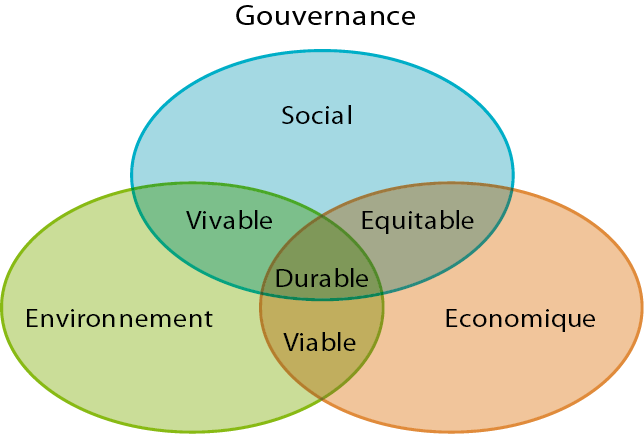
La composition du conseil d’administration | Élément clé d’une saine gouvernance


Les investisseurs et les actionnaires reconnaissent le rôle prioritaire que les administrateurs de sociétés jouent dans la gouvernance et, conséquemment, ils veulent toujours plus d’informations sur le processus de nomination des administrateurs et sur la composition du conseil d’administration.

L’article qui suit, paru sur le Forum du Harvard Law School, a été publié par Paula Loop, directrice du centre de la gouvernance de PricewaterhouseCoopers. Il s’agit essentiellement d’un compte rendu sur l’évolution des facteurs clés de la composition des conseils d’administration. La présentation s’appuie sur une infographie remarquable.

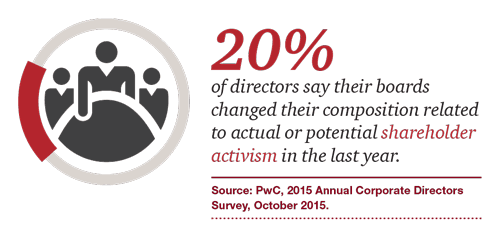
Ainsi, on apprend que 41 % des campagnes menées par les activistes étaient reliées à la composition des CA, et que 20 % des CA ont modifié leur composition en réponse aux activités réelles ou potentielles des activistes.

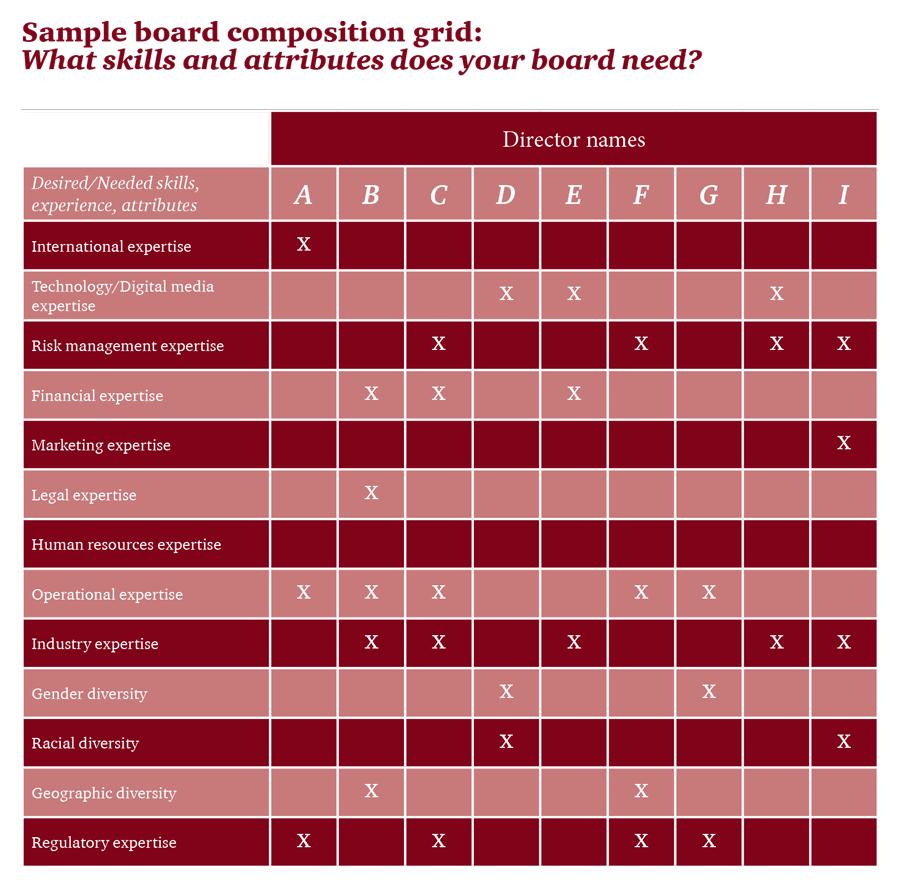
L’article s’attarde sur la grille de composition des conseils relative aux compétences et habiletés requises. Également, on présente les arguments pour une plus grande diversité des CA et l’on s’interroge sur la situation actuelle.

Enfin, l’article revient sur les questions du nombre de mandats des administrateurs et de l’âge de la retraite de ceux-ci ainsi que sur les préoccupations des investisseurs eu égard au renouvellement et au rajeunissement des CA.

Le travail de renouvellement du conseil ne peut se faire sans la mise en place d’un processus d’évaluation complet du fonctionnement du CA et des administrateurs.

À mon avis, c’est certainement un article à lire pour bien comprendre toutes les problématiques reliées à la composition des conseils d’administration.

Bonne lecture !

Investors and Board Composition


sans-titre


In today’s business environment, companies face numerous challenges that can impact success—from emerging technologies to changing regulatory requirements and cybersecurity concerns. As a result, the expertise, experience, and diversity of perspective in the boardroom play a more critical role than ever in ensuring effective oversight. At the same time, many investors and other stakeholders are seeking influence on board composition. They want more information about a company’s director nominees. They also want to know that boards and their nominating and governance committees are appropriately considering director tenure, board diversity and the results of board self-evaluations when making director nominations. All of this is occurring within an environment of aggressive shareholder activism, in which board composition often becomes a central focus.

Shareholder activism and board composition

pwc-1

pwc-2

At the same time, a growing number of companies are adopting proxy access rules—allowing shareholders that meet certain ownership criteria to submit a limited number of director candidates for inclusion on the company’s annual proxy. It has become a top governance issue over the last two years, with many shareholders viewing it as a step forward for shareholder rights. And it’s another factor causing boards to focus more on their makeup.

So within this context, how should directors and investors be thinking about board composition, and what steps should be taken to ensure boards are adequately refreshing themselves?

Assessing what you have–and what you need

In a rapidly changing business climate, a high-performing board requires agile directors who can grasp concepts quickly. Directors need to be fiercely independent thinkers who consciously avoid groupthink and are able to challenge management—while still contributing to a productive and collegial boardroom environment. A strong board includes directors with different backgrounds, and individuals who understand how the company’s strategy is impacted by emerging economic and technological trends.

Sample board composition grid: What skills and attributes does your board need?


pwc-table

In assessing their composition, boards and their nominating and governance committees need to think critically about what skills and attributes the board currently has, and how they tie to oversight of the company. As companies’ strategies change and their business models evolve, it is imperative that board composition be evaluated regularly to ensure that the right mix of skills are present to meet the company’s current needs. Many boards conduct a gap analysis that compares current director attributes with those that it has identified as critical to effective oversight. They can then choose to fill any gaps by recruiting new directors with such attributes or by consulting external advisors. Some companies use a matrix in their proxy disclosures to graphically display to investors the particular attributes of each director nominee.

Board diversity is a hot-button issue

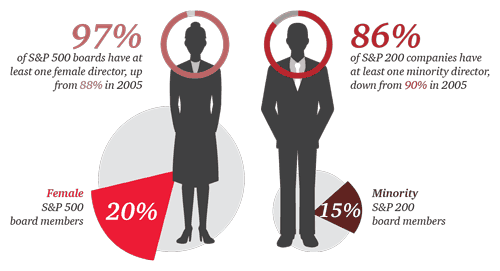
Diversity is a key element of any discussion of board composition. Diversity includes not only gender, race, and ethnicity, but also diversity of skills, backgrounds, personalities, opinions, and experiences. But the pace of adding more gender and ethnic diversity to public company boards has been only incremental over the past five years. For example, a December 2015 report from the US Government Accountability Office estimates that it could take four decades for the representation of women on US boards to be the same as men. [1] Some countries, including Norway, Belgium, and Italy, have implemented regulatory quotas to increase the percentage of women on boards.

Even if equal proportions of women and men joined boards each year beginning in 2015, GAO estimated that it could take more than four decades for women’s representation on boards to be on par with that of men’s.
—US Government Accountability Office, December 2015

According to PwC’s 2015 Annual Corporate Directors Survey, more than 80% of directors believe board diversity positively impacts board and company performance. But more than 70% of directors say there are impediments to increasing board diversity. [2] One of the main impediments is that many boards look to current or former CEOs as potential director candidates. However, only 4% of S&P 500 CEOs are female, [3] less than 2% of the Fortune 500 CEOs are Hispanic or Asian, and only 1% of the Fortune 500 CEOs are African-American. [4] So in order to get boards to be more diverse, the pool of potential director candidates needs to be expanded.

Is there diversity on US boards?


pwc-4

Source: Spencer Stuart US Board Index 2015, November 2015.

SEC rules require companies to disclose the backgrounds and qualifications of director nominees and whether diversity was a nomination consideration. In January 2016, SEC Chair Mary Jo White included diversity as a priority for the SEC’s 2016 agenda and suggested that the SEC’s disclosure rules pertaining to board diversity may be enhanced.

While those who aspire to become directors must play their part, the drive to make diversity a priority really has to come from board leadership: CEOs, lead directors, board chairs, and nominating and governance committee chairs. These leaders need to be proactive and commit to making diversity part of the company and board culture. In order to find more diverse candidates, boards will have to look in different places. There are often many untapped, highly qualified, and diverse candidates just a few steps below the C-suite, people who drive strategies, run large segments of the business, and function like CEOs.

How long is too long? Director tenure and mandatory retirement

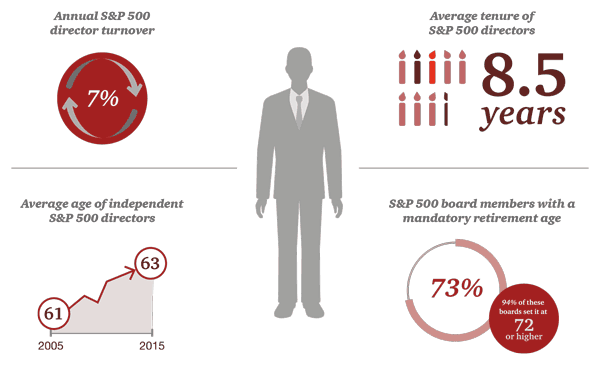
The debate over board tenure centers on whether lengthy board service negatively impacts director independence, objectivity, and performance. Some investors believe that long-serving directors can become complacent over time—making it less likely that they will challenge management. However, others question the virtue of forced board turnover. They argue that with greater tenure comes good working relationships with stakeholders and a deep knowledge of the company. One approach to this issue is to strive for diversity of board tenure—consciously balancing the board’s composition to include new directors, those with medium tenures, and those with long-term service.

This debate has heated up in recent years, due in part to attention from the Council of Institutional Investors (the Council). In 2013, the Council introduced a revised policy statement on board tenure. While the policy “does not endorse a term limit,” [5] the Council noted that directors with extended tenures should no longer be considered independent. More recently, the large pension fund CalPERS has been vocal about tenure, stating that extended board service could impede objectivity. CalPERS updated its 2016 proxy voting guidelines by asking companies to explain why directors serving for over twelve years should still be considered independent.

We believe director independence can be compromised at 12 years of service—in these situations a company should carry out rigorous evaluations to either classify the director as non-independent or provide a detailed annual explanation of why the director can continue to be classified as independent.
— CalPERS Global Governance Principles, second reading, March 14, 2016

Factors in the director tenure and age debate


pwc-3

Source: Spencer Stuart US Board Index 2015, November 2015.

Many boards have a mandatory retirement age for their directors. However, the average mandatory retirement age has increased in recent years. Of the 73% of S&P 500 boards that have a mandatory retirement age in place, 97% set that age at 72 or older—up from 57% that did so ten years ago. Thirty-four percent set it at 75 or older. [6] Others believe that director term limits may be a better way to encourage board refreshment, but only 3% of S&P 500 boards have such policies. [7]

Investor concern

Some institutional investors have expressed concern about board composition and refreshment, and this increased scrutiny could have an impact on proxy voting decisions.

What are investors saying about board composition and refreshment?


pwc-table2

Sources: BlackRock, Proxy voting guidelines for U.S. securities, February 2015; California Public Employees’ Retirement System, Statement of Investment Policy for Global Governance, March 16, 2015; State Street Global Advisors’ US Proxy Voting and Engagement Guidelines, March 2015.

Proxy advisors’ views on board composition—recent developments

Proxy advisory firm Institutional Shareholder Services’s (ISS) governance rating system QuickScore 3.0 views tenure of more than nine years as potentially compromising director independence. ISS’s 2016 voting policy updates include a clarification that a “small number” of long-tenured directors (those with more than nine years of board service) does not negatively impact the company’s QuickScore governance rating, though ISS does not provide specifics on the acceptable quantity.

Glass Lewis’ updated 2016 voting policies address nominating committee performance. Glass Lewis may now recommend against the nominating and governance committee chair “where the board’s failure to ensure the board has directors with relevant experience, either through periodic director assessment or board refreshment, has contributed to a company’s poor performance.” Glass Lewis believes that shareholders are best served when boards are diverse on the basis of age, race, gender and ethnicity, as well as on the basis of geographic knowledge, industry experience, board tenure, and culture.

How can directors proactively address board refreshment?

The first step in refreshing your board is deciding whether to add a new board member and determining which director attributes are most important. One way to do this is to conduct a self-assessment. Directors also have a number of mechanisms to address board refreshment. For one, boards can consider new ways of recruiting director candidates. They can take charge of their composition through active and strategic succession planning. And they can also use robust self-assessments to gauge individual director performance—and replace directors who are no longer contributing.

  1. Act on the results of board assessments. Boards should use their annual self-assessment to help spark discussions about board refreshment. Having a robust board assessment process can offer insights into how the board is functioning and how individual directors are performing. The board can use this process to identify directors that may be underperforming or whose skills may no longer match what the company needs. It’s incumbent upon the board chair or lead director and the chair of the nominating and governance committee to address any difficult matters that may arise out of the assessment process, including having challenging conversations with underperforming directors. In addition, some investors are asking about the results of board assessments. CalPERS and CalSTRS have both called on boards to disclose more information about the impact of their self-assessments on board composition decisions. [8]
  2. Take a strategic approach to director succession planning. Director succession planning is essential to promoting board refreshment. But, less than half of directors “very much” believe their board is spending enough time on director succession. [9] In board succession planning, it’s important to think about the current state of the board, the tenure of current members, and the company’s future needs. Boards should identify possible director candidates based upon anticipated turnover and director retirements.
  3. Broaden the pool of candidates. Often, boards recruit directors by soliciting recommendations from other sitting directors, which can be a small pool. Forward-looking boards expand the universe of potential qualified candidates by looking outside of the C-suite, considering investor recommendations, and by looking for candidates outside the corporate world—from the retired military, academia, and large non-profits. This will provide a broader pool of individuals with more diverse backgrounds who can be great board contributors.

In sum, evaluating board composition and refreshing the board may be challenging at times, but it’s increasingly a topic of concern for many investors, and it’s critical to the board’s ability to stay current, effective, and focused on enhancing long-term shareholder value.

The complete publication, including footnotes and appendix, is available here.

Endnotes:

[1] United States Government Accountability Office, “Corporate Boards: Strategies to Address Representation of Women Include Federal Disclosure Requirements,” December 2015.
(go back)

[2] PwC, 2015 Annual Corporate Directors Survey, October 2015.
(go back)

[3] Catalyst, Women CEOs of the S&P 500, February 3, 2016.
(go back)

[4] “McDonald’s CEO to Retire; Black Fortune 500 CEOs Decline by 33% in Past Year,” DiversityInc, January 29, 2015; http://www.diversityinc.com/leadership/mcdonalds-ceo-retire-black-fortune-500-ceos-decline-33-past-year.
(go back)

[5] Amy Borrus, “More on CII’s New Policies on Universal Proxies and Board Tenure,” Council of Institutional Investors, October 1, 2013; http://www.cii.org/article_content.asp?article=208.
(go back)

[6] Spencer Stuart, 2015 US Board Index, November 2015.
(go back)

[7] Spencer Stuart, 2015 US Board Index, November 2015.
(go back)

[8] California State Teachers’ Retirement System Corporate Governance Principles, April 3, 2015, http://www.calstrs.com/sites/main/files/file-attachments/corporate_governance_principles_1.pdf; The California Public Employees’ Retirement System Global Governance Principles, Updated March 14, 2016, https://www.calpers.ca.gov/docs/board-agendas/201603/invest/item05a-02.pdf.
(go back)

[9] PwC, 2015 Annual Corporate Directors Survey, October 2015. www.pwc.com/us/GovernanceInsightsCenter.

________________________________

*Paula Loop is Leader of the Governance Insights Center at PricewaterhouseCoopers LLP. This post is based on a PwC publication by Ms. Loop and Paul DeNicola. The complete publication, including footnotes and appendix, is available here.
Le fait de siéger à des CA externes augmente-t-il les chances de promotion d’un haut dirigeant dans son entreprise ?


Voici un article très intéressant, récemment publié dans Harvard Business Review par Steven Boivie, Scott D. Graffin, Abbie Oliver et Michael C. Withers, qui montre, de façon convaincante, que, pour un haut dirigeant, le fait de siéger à un CA externe augmente ses chances de promotion dans son entreprise.

Lorsque l’on sait que le travail des administrateurs des entreprises publiques (cotées) est de plus en plus exigeant, l’on peut se demander pourquoi un PDG (CEO) accepte de siéger à un conseil d’administration d’une autre entreprise !

Les auteurs de l’étude ont trouvé des réponses à cette question. Les hauts dirigeants des entreprises de la S&P 1500 qui siègent à d’autres CA augmentent de 44 % leurs chances d’accéder à un poste de CEO dans une entreprise de la S&P 1500, comparativement à leurs collègues qui ne siègent pas à d’autres CA. Et, même s’ils n’ont pas de promotion, la recherche montre que leur rémunération s’accroît de 13 %.

So what do these findings mean for today’s boards of directors and aspiring CEOs? The evidence shows that board appointments increase an executive’s visibility and give him/her access to unique contacts and learning opportunities. Further, these opportunities translate into tangible economic benefits, specifically promotions and raises, which help explain why a sane person would choose to sit on a board.

La recherche d’administrateurs avec un profil de CEO ou de haut dirigeant est de plus en plus fréquente et les firmes de recrutement considèrent que l’obtention de promotions est un signe de leadership notable.

Photo1-petit-poisson

L’étude conclut que, contrairement à la croyance populaire, le fait de siéger à des conseils constitue un atout pour un haut dirigeant, un moyen susceptible d’accroître ses opportunités de carrière.

Il semble bien que le haut dirigeant considère qu’il y a un avantage personnel réel à exercer la fonction d’administrateur dans une autre entreprise. Mais, le CA de l’entreprise sur lequel il siège en retire-t-il un avantage aussi appréciable ?

Ultimately board service is a key professional development tool in grooming potential CEOs that executives and boards alike are beginning to recognize and value.

Je vous invite à lire ce court article du HBR.

Bonne lecture !

Serving on Boards Helps Executives Get Promoted


More than 25 years ago, William Sahlman wrote the HBR article “Why Sane People Shouldn’t Serve on Public Boards,” in which he compared serving on a board to driving without a seatbelt, that it was just too risky—to their time, reputations, and finances—for too little reward.

Board service has always been very demanding. When Warren Buffett retired from Coca-Cola’s board in 2006, he said he no longer had the time necessary. When you consider all of the retreats, travel, reading, meeting prep time, transactions, and committee meetings involved, it is a wonder anyone serves at all.

So why would a busy executive agree to sit on a board? Why is there is a cottage industry of executive search firms focusing on “reverse board searches,” where they proactively work to place executives on outside corporate boards? What do executives gain from serving on boards?

This question was at the heart of a recent study we conducted that is forthcoming at the Academy of Management Journal. In an effort to explore executives’ motivations for serving on boards, we looked at how board service is evaluated in the executive labor market. Specifically we studied whether or not board service increased an executive’s likelihood of receiving a promotion, becoming a CEO, and/or receiving a pay increase.

We hypothesized that being a board director would help an executive in two main ways: First, sitting on a board serves as an important signal or “seal of approval,” for an executive. It means that other people think this executive has potential and value as a result of being selected to serve on a board. Second, board service is an avenue for an executive to gain access to unique knowledge, skills, and connections, so firms actively use external board appointments as a way to groom and develop executives. As Mary Cranston, former CEO and Chairman of Pillsbury, LLP said in an interview, “Being on that board really helped me develop as a CEO because I had another CEO to watch. It was an incredible leadership school for me. On a board you’re together a lot, and you’re working on problems together and you have a shared fiduciary duty, so it creates very tight bonds of friendship.” Similarly, Sempra CEO Debra L. Reed has also said that sitting on the board of another company is “better than an M.B.A.


*Steven Boivie is an associate professor in the Mays Business School at Texas A&M University, Scott D. Graffin is an associate professor at the University of Georgia’s Terry College of Business and also an International Research Fellow at Oxford University’s Centre for Corporate Reputation, Abbie G. Oliver is a doctoral candidate in strategic management at the University of Georgia’s Terry College of Business, Michael C. Withers is an assistant professor of management in the Mays Business School at Texas A&M University.

Les firmes de conseillers en rémunération contribuent-elles à la mise en place de plans salariaux excessifs des PDG ?


Avez-vous confiance dans les conseillers en rémunération pour faire des propositions salariales qui reflètent vraiment la contribution des dirigeants, et qui sont nécessaires pour la rétention des personnes ?

Dans quelle mesure ceux-ci sont-ils responsables de l’augmentation, souvent excessive, des rémunérations des dirigeants ?

Une étude, à laquelle le professeur Omesh Kini de Georgia State University a contribué, montre que, bien que les consultants soient embauchés par les comités de ressources humaines des CA, ceux-ci peuvent subir l’influence indirecte de la direction.

L’auteur décrit différentes approches de firmes de conseillers dans l’établissement des plans de rémunérations des dirigeants. Les firmes prétendent se différencier en proposant des « packages » de rémunération censés aligner les objectifs des actionnaires sur ceux des administrateurs. Les consultants sont sensibles aux effets du « say on pay » et, par conséquent, tentent d’élaborer des programmes de rémunération bien étoffés.

Plusieurs auteurs avancent que les firmes de conseils en rémunération ont tendance à utiliser des échantillons de comparaisons salariales susceptibles de justifier des rémunérations élevées, sinon excessives. Les auteurs suggèrent que les consultants souhaitent obtenir d’autres contrats avec l’entreprise (« repeat business ») et, en ce sens, elles agissent en fonction de leurs intérêts d’affaires.

L’étude montre que, contrairement à la croyance populaire, les firmes de conseillers en rémunération n’opèrent pas de façon très différente les unes des autres. En réalité, elles ne se distinguent pas par des approches particulières.

Les résultats de l’étude montrent que le choix de la firme de consultants a peu d’importance lorsque l’entreprise est reconnue pour ses solides mécanismes de gouvernance. En revanche, si la gouvernance de l’entreprise laisse à désirer (plusieurs administrateurs non indépendants, comité de RH peu soucieux, PDG omniprésent au CA, manque de leadership du président du conseil, CA peu informé, etc.), les firmes de consultants en rémunération sont plus enclines à proposer des plans salariaux généreux.

Les conclusions de cette étude indiquent que les mécanismes de gouvernance sont les facteurs les plus révélateurs dans l’établissement d’une rémunération juste et adéquate et que le choix d’une firme de conseillers particulière est très secondaire, sinon sans réels effets.

Vous trouverez, ci-dessous, un résumé de l’article paru récemment sur le forum du Harvard Law School.

Bonne lecture !

Do Compensation Consultants Have Distinct Styles ?


In our paper, Do Compensation Consultants have Distinct Styles?, which was recently made public on SSRN, we investigate whether the choice of a specific compensation consultant affects the compensation level and structure of top managers. This question is crucially important because existing studies that examine the compensation of CEOs show that compensation schemes influence their behavior and, consequently, impact firm economic outcomes. Compensation consultants are typically hired by the board of directors’ compensation committee to help craft compensation policies for the top managers of the corporation. Although they serve at the behest of the board, consultants can imprint their own distinct styles in fashioning compensation policies for a firm. We examine whether individual compensation consultants influence compensation policies in unique ways, i.e., exhibit distinct “styles,” after controlling for the known economic determinants of these policies.

Compensation consultants strive to signal distinct styles in a positive manner via their own advertising. For example, Towers Watson claims to “bring a unique portfolio of resources” to the table, with an emphasis on aligning board actions with shareholders (e.g., avoiding “say on pay” disputes). [1] Conversely, the media has reported that consulting advice varies little. For example, Towers Perrin was accused in 1997 of giving nearly identical reports on workplace diversity to multiple consulting clients across different industries. [2] Towers Perrin’s response was that all of the clients reported in the article faced similar economic forces and, therefore, received similar advice. [3] Thus, the anecdotal evidence on consultant style is mixed.

cadres

Compensation consultants have been in the direct line of fire from academics, board members, and policy makers. For example, Bebchuk and Fried (2014) take the view that managers will influence the employment of consultants who are likely to recommend higher pay and use their advice to justify excessive compensation. They further argue that compensation consultants, driven by their cross-selling incentives and/or desire to obtain repeat business, design compensation plans that provide excessive pay to managers. Thus, they suggest that compensation consultants worsen, rather than alleviate, agency problems within firms. Board members also claim that compensation consultants are to blame for spiraling CEO pay (Workforce, February 7, 2008). Finally, the former SEC Commissioner Roel C. Campos in a speech stated, “Another significant driver of excessive CEO compensation is the use of compensation consultants.” He goes on to add, “It is extremely difficult to avoid using high comparables, and consultants can pretty much find high comparable income data to support paying a high amount to the CEO. This is the case even if the consultant reports directly to the board.”

Thus, it is an open question whether individual compensation consultants: (i) have distinct styles and managers/boards hire consultants with a specific style, (ii) do not have distinct styles, but instead give compensation advice based purely on economic characteristics, and (iii) respond in a distinct manner to the incentives that arise from the governance environment of the client firm and their own self-interest. We investigate these issues in our paper. In the process, we attempt to shed light on whether compensation consultants facilitate compensation arrangements that reflect a competitive equilibrium in the level of pay and an efficient equilibrium in the incentives provided by optimal contracts (the “efficient” view) or that compensation contracts are written by captive boards and pliant compensation consultants to enhance the welfare of powerful CEOs (the “agency” view).

Our empirical tests detect little evidence suggesting that individual consultants have their own distinct styles. This evidence can be interpreted in two different ways. One possibility is that compensation consultants do not have any specific style and are perfect substitutes for each other. Consequently, the choice of compensation consultant will not matter much because their compensation advice will be grounded in the economic determinants of compensation level and structure and, thus, will be quite similar. An alternative possibility is that compensation consultants do not have distinct styles, but will work in their own self-interest by reacting to the incentives provided by the hiring firm. We distinguish between these views by finding style-like effects for the subsample of client firms with weak governance mechanisms, but not for the subsample of client firms with strong governance mechanisms. These results suggest that the choice of individual consultant does not matter in firms that have strong governance mechanisms. For the weak governance firms, we find that the style-like effects are largely driven by firms that hire consultants who do not have any non-compensation related businesses. In this subsample, both the lead return on assets and Tobin’s q for their client firms are significantly lower for consultants who recommend a higher salary or higher salary percentage as a proportion of total compensation. We also document style-like effects for the subsample of client firms with whom the consultant has existing business relationships unrelated to compensation consulting (conflicted consultants). Further, when these conflicted consultants recommend higher equity-based compensation, the client firms’ values as measured by their lead Tobin’s q are significantly lower and that these client firms tend to have higher accruals.

Our overall conclusion is that it does not matter which compensation consultant is hired by client firms with strong governance mechanisms in place because they will get similar advice based on their economic characteristics and environment. We conjecture that these client firms may still decide to choose a more reputable consultant because of the stronger certification role it plays, but they will likely have to pay higher fees for the services of this consultant. However, consistent with the Bebchuk and Fried (2104) view that consultants can aggravate agency problems within firms, we do observe style-like effects and some resultant perverse outcomes when there is greater potential for managers to take actions in their self-interest and/or when consultants have weaker incentives to provide objective advice. Thus, based on our subsample analysis, we find evidence consistent with both the “efficient” and “agency” views of compensation contracts.

The full paper is available for download here.

__________________________

Endnotes:

[1] See Towers Watson’s 2015 brochure, “Putting Clients First.”
(go back)

[2] “Familiar Refrain: Consultant’s Advice on Diversity was Anything But Diverse…” Wall Street Journal, 3/11/1997.
(go back)

[3] “TP responds to WSJ allegations.” Consultants News 27, 4/1/1997.
(go back)

Les attentes à l’égard du rôle des administrateurs sont-elles irréalistes ?


Harvard Business Review vient de publier un excellent commentaire sur les attentes irréalistes exercées sur les conseils d’administration par les actionnaires, les autorités réglementaires, les investisseurs institutionnels et le public en général.

L’article des professeurs* Steven Boivie, Michael Bednar et Joel Andrus identifie trois obstacles qui empêchent les administrateurs de jouer adéquatement leurs rôles.

(1) La plupart des administrateurs sont également impliqués dans plusieurs autres fonctions de direction ou d’administration dans d’autres organisations.

(2) Les administrateurs ne doivent pas se mêler directement des affaires de la direction des entreprises.

(3) La complexité des grandes entreprises est telle qu’il est impossible pour un groupe d’administrateurs se réunissant environ dix fois par année de bien jouer leur rôle de surveillance.

Les auteurs suggèrent trois moyens pour lever, un tant soit peu, les barrières qui restreignent l’efficacité des administrateurs dans l’exécution de leurs rôles et responsabilités.

Je vous invite à prendre connaissance des conclusions de leur étude publiée dans Academy of management Annals.

Bonne lecture !


Boards Aren’t the Right Way to Monitor Companies


One of the key functions of a board of directors is to oversee the CEO to ensure that shareholders are getting the most out of their investment. This idea has led to regulation such as the Sarbanes-Oxley Act (2002), as well as requirements by the NYSE and NASDAQ that boards have a majority of independent directors and that members on the audit committee have financial expertise. Such rules rest on the premise that if we can just structure the board properly, management misconduct can largely be prevented. But is this a realistic expectation for directors? Maybe not.

1742912880_B978336891Z_1_20160408112809_000_G9C6I65NN_4-0Over the past few years there has been a growing gap between what shareholders and regulators expect of boards and what academic research shows they are capable of. For instance, consider what it means to be a director of a company like General Electric. GE states, “The primary role of GE’s Board of Directors is to oversee how management serves the interests of shareowners and other stakeholders.” However, GE’s annual revenues last year were $117 billion, and it had over 300,000 employees. The company provides services in a myriad of industries, such as health care, water treatment, aviation, and financing.

……

Taken together, much of the research we reviewed shows that these barriers are so prevalent and significant that consistent monitoring just isn’t very likely. Even when boards are filled with capable, motivated directors, we believe that there are simply too many barriers that prevent them from effectively protecting shareholders. In order to gain the full value from a board, we believe that shareholders and regulators need to focus on what boards can do, and then recalibrate their expectations.

First, we need to stop blaming boards for every failure. Too often the press, shareholders, and legislators blame corporate governance failures on directors, suggesting are unmotivated or unwilling to do their job properly. This was illustrated in 2012 when Groupon’s board came under fire for the company revising its earnings. JPMorgan Chase directors were similarly criticized for not preventing a $6 billion trading loss in the company’s investment office back in 2013.

Boards can do a better job in some cases, but these types of criticisms are often misguided. We have found that most directors are hardworking and capable — they’re just placed in a context that makes it virtually impossible for them to do what is expected of them.

Second, we need to focus more on boards’ ability to provide expert advice to CEOs based on their significant knowledge and experience. Board members often are able to provide insights that top executives may not have considered. Going back to GE’s board, most of the directors have expertise in a specific industry and can therefore draw on that experience to connect managers to external resources and knowledge that can benefit the firm. In addition to providing expert advice, boards can take a much more active role in guiding firms during times of crisis, such as when a CEO is being replaced, when the company is in financial distress, or when there is a significant merger or acquisition under consideration.

Third, if shareholders and regulators insist that boards must monitor, then we need to do a better job of removing the barriers in their way. For instance, if external job demands make it impossible for a director to devote enough time and mental energy to their duty as a director, perhaps we need to change our perception that the best directors are active CEOs of other firms. Maybe we also need to work to promote cultural change within boards through increased sharing of information and by using technology to allow them to meet more frequently.

Boards can and do play an important role in the success of companies. Instead of criticizing them for not meeting impractical expectations, we should value them sharing knowledge, providing advice, and lending legitimacy to firms by virtue of their reputations in the industry.

____________________________

Steven Boivie is an associate professor in the Mays Business School at Texas A&M University. He received his Ph.D. in strategic management from the University of Texas at Austin.

Michael Bednar is an associate professor of Business Administration at the University of Illinois.

Joel Andrus is in the Mays Business School at Texas A&M University.

Attention au syndrome du « bon gars » dans la gouvernance des OBNL !


Il faut se méfier des problèmes de gouvernance liés au syndrome du « chic type » qui prévaut encore trop souvent dans les OBNL.

Les administrateurs des OBNL ont autant de responsabilités que ceux des autres types d’entreprises. Trop souvent, ceux-ci n’exercent pas la vigilance requise pour la bonne gestion de l’entité.

Les administrateurs n’osent pas prendre de décisions difficiles parce que les personnes impliquées sont bien connues de la communauté et, en conséquence, ils doivent faire preuve d’une tolérance accrue à leur égard…

C’est une erreur d’administrer une entreprise sur une présomption de bon gars (ou de bonne fille) du DG et des dirigeants en général. Il en va de même pour les administrateurs, et même pour le président du conseil.

L’article d’Eugene Fram* fait état des éléments importants à considérer plus particulièrement dans la gouvernance des OBNL.

Bonne lecture !

Nonprofit Boardroom Elephants and the ‘Nice Guy’ Syndrome: A Complex Problem


At coffee a friend serving on a nonprofit board reported plans to resign from the board shortly. His complaints centered on the board’s unwillingness to take critical actions necessary to help the organization grow.

In specific, the board failed to take any action to remove a director who wasn’t attending meetings, but he refused to resign. His term had another year to go, and the board had a bylaws obligation to summarily remove him from the board. However, a majority of directors decided such action would hurt the director’s feelings. They were unwittingly accepting the “nice-guy” approach in place of taking professional action.

20

In another instance the board refused to sue a local contractor who did not perform as agreed. The “elephant” was that the board didn’t think that legally challenging a local person was appropriate, an issue raised by an influential director. However, nobody informed the group that in being “nice guys,” they could become legally liable, if somebody became injured as a result of their inaction.

Over the years, I have observed many boards with elephants around that have caused significant problems to a nonprofit organization. Some include:

• Selecting a board chair on the basis of personal appearance and personality instead of managerial and organizational competence. Be certain to vet the experience and potential of candidates carefully. Beside working background (accounting, marketing, human resources, etc.), seek harder to define characteristics such as leadership, critical thinking ability, and position flexibility.

Failure to delegate sufficient managerial responsibility to the CEO because the board has enjoyed micromanagement activities for decades. To make a change, make certain new directors recognize the problem, and they eventually are willing to take action to alleviate the problem. Example: One board refused to share its latest strategic plan with it newly appointed ED.

Engaging a weak local CEO because the board wanted to avoid moving expenses. Be certain that local candidates are vetted as carefully as others and that costs of relocation are not the prime reason for their selection.

• Be certain that the board is not “rubber-stamping” proposals of a strong director or CEO. Where major failures occur, be certain that the board or outside counsel determines the causes by conducting a postmortem analysis.

Retaining an ED who is only focusing on the status quo and “minding the store.” The internal accounting systems, human resources and results are all more than adequate. But they are far below what can be done for clients if current and/or potential resources were creatively employed.

* A substantial portion of the board is not reasonably familiar with fund accounting or able to recognize financial “red flags.” Example: One CFO kept delaying the submission of an accounting accounts aging report for over a year. He was carrying as substantial number of noncollectable accounts as an asset. It required the nonprofit to hire high-priced forensic accountants to straighten out the mess. The CEO & CFO were fired, but the board that was also to be blamed for being “nice guys,” and it remained in place. If the organization has gone bankrupt, I would guess that the secretary-of-state would have summarily removed part or all of the board, a reputation loss for all. The board has an obligation to assure stakeholders that the CFO’s knowledge is up to date and to make certain the CEO takes action on obvious “red flags”.

* Inadequate vetting processes that take directors’ time, especially in relation to family and friends of current directors. Example: Accepting a single reference check, such as comments from the candidate’s spouse. This actually happened, and the nominations committee made light of the action.

What can be done about the elephant in the boardroom?

Unfortunately, there is no silver bullet to use, no pun intended! These types of circumstances seem to be in the DNA of volunteers who traditionally avoid any form of conflict, which will impinge upon their personal time or cause conflict with other directors. A cultural change is required to recruit board members who understand director responsibilities, or are willing to learn about them on the job. I have seen a wide variety of directors such, as ministers and social workers, successfully meet the challenges related to this type of the board learning. Most importantly, never underestimate the power of culture when major changes are being considered.

In the meantime, don’t be afraid to ask naive question which forces all to question assumptions, as in Why are we doing the particular thing? Have we really thought it through and considered other possibilities? http://bit.ly/1eNKgtw

Directors need to have passion for the organization’s mission. However, they also need to have the prudence to help the nonprofit board perform with professionalism.


*Eugene Fram, Professor Emeritus at Saunders College of Business, Rochester Institute of Technology

Le contrôle interne dans les OBNL | En reprise


Dans ce billet, je fais référence à un très bon article de Richard Leblanc, paru récemment dans CanadianBusiness.com, qui met l’accent sur la sensibilisation du Conseil à l’importance accrue du contrôle interne dans les OBNL.

L’auteur donne quelques bons exemples d’organisations où le contrôle interne a été défaillant et il montre que les OBNL sont particulièrement vulnérables à des malversations, surtout lorsque l’on sait que le contrôle interne est à peu près inexistant !

C’est la responsabilité du conseil d’administration de s’assurer que les bons contrôles sont en place. L’intérêt public l’exige !

Non-profit boards need a hands-on approach


imagesLHULJYGV


« Non-profit and charitable organizations have stretched resources, which makes them particularly vulnerable to fraudsters. The Salvation Army is currently going through such a situation after a whistleblower informed the organization that $2 million in donated toys had disappeared from—or wasn’t delivered to—their main warehouse in north Toronto over roughly two years ».

Orientation de Berkshire Hathaway eu égard à la sélection des administrateurs de sociétés


Vous trouverez, ci-dessous, l’extrait d’une lettre que Warren Buffett fait parvenir annuellement à tous les actionnaires de Berkshire Hathaway. Les énoncés de cette lettre sont issus des rapports annuels de la société.

Cette lettre réfère aux orientations de l’entreprise eu égard à la sélection des administrateurs siégeant au conseil d’administration de Berkshire Hathaway, mais aussi, je suppose, aux nombreux conseils d’administration dans lesquels la société est représentée. Quels enseignements peut-on retirer de l’approche Berkshire, et qui peut expliquer, en partie, le succès phénoménal de cette entreprise ?

Ce que le comité de sélection recherche, ce sont des administrateurs foncièrement indépendants, c’est-à-dire des personnes qui ont la volonté, l’expérience et les compétences pour poser les questions clés aux membres de la direction. Selon Buffett la vraie indépendance est très rare.

Le secret pour assurer cette indépendance est de choisir des personnes dont les intérêts sont alignés sur les intérêts supérieurs des actionnaires, et solidement ancrés dans la détention d’une partie significative de l’actionnariat (pas d’options ou d’unités d’action avec restriction ou différées).

Également, la rémunération des administrateurs de Berkshire est minimale ; selon la doctrine Buffett, aucun administrateur ne devrait compter sur une rémunération susceptible de constituer une part importante de ses revenus et ainsi de compromettre son indépendance (on parle ici de rémunérations globales de l’ordre de 250 000 $ et plus…).

La sélection des administrateurs repose donc sur quatre critères fondamentaux : (1) l’orientation propriétaire (2) l’expérience et la connaissance des affaires (3) l’intérêt pour l’entreprise et (4) l’indépendance complète vis-à-vis du management.

La lettre se termine par ce propos empreint de sagesse… et de simplicité.

At Berkshire, we are in the specialized activity of running a business well, and therefore we seek business judgment.

Je suis reconnaissant à Henry D. Wolfe, investisseur privé dans le capital de risque et dans les fonds LBO, pour avoir partagé cette lettre sur LinkedIn.

Bonne lecture !


Warren Buffett: Annual Letter Comments Regarding the Selection of Corporate Directors


Berkshire Hathaway 2003 Annual Report: Pages 9-10: (bold not italics added)


True independence – meaning the willingness to challenge a forceful CEO when something is wrong or foolish – is an enormously valuable trait in a director. It is also rare. The place to look for it is among high-grade people whose interests are in line with those of rank-and-file shareholders – and are in line in a very big way.

We’ve made that search at Berkshire. We now have eleven directors and each of them, combined with members of their families, owns more than $4 million of Berkshire stock. Moreover, all have held major stakes in Berkshire for many years. In the case of six of the eleven, family ownership amounts to at least hundreds of millions and dates back at least three decades. All eleven directors purchased their holdings in the market just as you did; we’ve never passed out options or restricted shares. Charlie and I love such honest-to-God ownership. After all, who ever washes a rental car?

2014-02-52f337563c760

In addition, director fees at Berkshire are nominal (as my son, Howard, periodically reminds me). Thus, the upside from Berkshire for all eleven is proportionately the same as the upside for any Berkshire shareholder. And it always will be…

The bottom line for our directors: You win, they win big; you lose, they lose big. Our approach might be called owner-capitalism. We know of no better way to engender true independence. (This structure does not guarantee perfect behavior, however: I’ve sat on boards of companies in which Berkshire had huge stakes and remained silent as questionable proposals were rubber-stamped.)

In addition to being independent, directors should have business savvy, a shareholder orientation and a genuine interest in the company. The rarest of these qualities is business savvy – and if it is lacking, the other two are of little help. Many people who are smart, articulate and admired have no real understanding of business. That’s no sin; they may shine elsewhere. But they don’t belong on corporate boards.


Berkshire Hathaway 2006 Annual Report: Page 18: (bold not italics added)


In selecting a new director, we were guided by our long-standing criteria, which are that board members be owner-oriented, business-savvy, interested and truly independent. I say “truly” because many directors who are now deemed independent by various authorities and observers are far from that, relying heavily as they do on directors’ fees to maintain their standard of living. These payments, which come in many forms, often range between $150,000 and $250,000 annually, compensation that may approach or even exceed all other income of the “independent” director. And – surprise, surprise – director compensation has soared in recent years, pushed up by recommendations from corporate America’s favorite consultant, Ratchet, Ratchet and Bingo. (The name may be phony, but the action it conveys is not.)

Charlie and I believe our four criteria are essential if directors are to do their job – which, by law, is to faithfully represent owners. Yet these criteria are usually ignored. Instead, consultants and CEOs seeking board candidates will often say, “We’re looking for a woman,” or “a Hispanic,” or “someone from abroad,” or what have you. It sometimes sounds as if the mission is to stock Noah’s ark. Over the years I’ve been queried many times about potential directors and have yet to hear anyone ask, “Does he think like an intelligent owner?”

The questions I instead get would sound ridiculous to someone seeking candidates for, say, a football team, or an arbitration panel or a military command. In those cases, the selectors would look for people who had the specific talents and attitudes that were required for a specialized job. At Berkshire, we are in the specialized activity of running a business well, and therefore we seek business judgment.

Les dix articles américains les plus marquants en gouvernance corporative en 2015


L’organisation Corporate Practice Commentator vient de publier la liste des meilleurs articles en gouvernance, plus précisément ceux qui concernent le marché des actions.

La sélection a été faite par les professeurs qui se spécialisent en droit corporatif. Cette année plus de 540 articles ont été analysés.

La liste inclut trois articles de la Faculté du Harvard Law School issus du programme en gouvernance corporative dont Lucian Bebchuk, John Coates et Jesse Fried font partie.

Voici la liste en ordre alphabétique.

Bonne recherche !


 Les dix articles américains les plus marquants en gouvernance corporative en 2015


30441567-Nuage-de-mot-avec-la-gouvernance-d-entreprise-li-s-balises-Banque-d'images


  1. Bartlett, Robert P. III. Do Institutional Investors Value the Rule 10b-5 Private Right of Action? Evidence from Investors’ Trading Behavior following Morrison v. National Australia Bank Ltd. 44 J. Legal Stud. 183-227 (2015).
  2. Bebchuk, Lucian, Alon Brav and Wei Jiang. The Long-term Effects of Hedge Fund Activism. 115 Colum. L. Rev. 1085-1155 (2015).
  3. Bratton, William W. and Michael L. Wachter. Bankers and Chancellors. 93 Tex. L. Rev. 1-84 (2014).
  4. Cain, Matthew D. and Steven Davidoff Solomon. A Great Game: The Dynamics of State Competition and Litigation. 100 Iowa L. Rev. 465-500 (2015).
  5. Casey, Anthony J. The New Corporate Web: Tailored Entity Partitions and Creditors’ Selective Enforcement. 124 Yale L. J. 2680-2744 (2015).
  6. Coates, John C. IV. Cost-benefit Analysis of Financial Regulation: Case Studies and Implications. 124 Yale L .J. 882-1011 (2015).
  7. Edelman, Paul H., Randall S. Thomas and Robert B. Thompson. Shareholder Voting in an Age of Intermediary Capitalism. 87 S. Cal. L. Rev. 1359-1434 (2014).
  8. Fisch, Jill E., Sean J. Griffith and Steven Davidoff Solomon. Confronting the Peppercorn Settlement in Merger Litigation: An Empirical Analysis and a Proposal for Reform. 93 Tex. L. Rev. 557-624 (2015).
  9. Fried, Jesse M. The Uneasy Case for Favoring Long-term Shareholders. 124 Yale L. J. 1554-1627 (2015).
  10. Judge, Kathryn. Intermediary Influence. 82 U. Chi. L. Rev. 573-642 (2015).

Top 15 des billets en gouvernance les plus populaires publiés sur mon blogue au premier trimestre de 2016


Voici une liste des billets en gouvernance les plus populaires publiés sur mon blogue au premier trimestre de 2016.

Cette liste de 15 billets constitue, en quelque sorte, un sondage de l’intérêt manifesté par des milliers de personnes sur différents thèmes de la gouvernance des sociétés. On y retrouve des points de vue bien étayés sur des sujets d’actualité relatifs aux conseils d’administration.

Que retrouve-t-on dans ce blogue et quels en sont les objectifs?

Ce blogue fait l’inventaire des documents les plus pertinents et les plus récents en gouvernance des entreprises. La sélection des billets est le résultat d’une veille assidue des articles de revue, des blogues et des sites web dans le domaine de la gouvernance, des publications scientifiques et professionnelles, des études et autres rapports portant sur la gouvernance des sociétés, au Canada et dans d’autres pays, notamment aux États-Unis, au Royaume-Uni, en France, en Europe, et en Australie.

Revue-de-presse-630x350

Je fais un choix parmi l’ensemble des publications récentes et pertinentes et je commente brièvement la publication. L’objectif de ce blogue est d’être la référence en matière de documentation en gouvernance dans le monde francophone, en fournissant au lecteur une mine de renseignements récents (les billets) ainsi qu’un outil de recherche simple et facile à utiliser pour répertorier les publications en fonction des catégories les plus pertinentes.

Quelques statistiques à propos du blogue Gouvernance | Jacques Grisé

Ce blogue a été initié le 15 juillet 2011 et, à date, il a accueilli plus de 185000 visiteurs. Le blogue a progressé de manière tout à fait remarquable et, au 30 avril 2016, il était fréquenté par des milliers de visiteurs par mois. Depuis le début, jai œuvré à la publication de 1355 billets.

En 2016, j’estime qu’environ 5000 personnes par mois visiteront le blogue afin de sinformer sur diverses questions de gouvernance. À ce rythme, on peut penser quenviron 60000 personnes visiteront le site du blogue en 2016. 

On note que 80 % des billets sont partagés par l’intermédiaire de différents moteurs de recherche et 20 %  par LinkedIn, Twitter, Facebook et Tumblr.

Voici un aperçu du nombre de visiteurs par pays :

  1. Canada (64 %)
  2. France, Suisse, Belgique (20 %)
  3. Maghreb [Maroc, Tunisie, Algérie] (5 %)
  4. Autres pays de l’Union européenne (3 %)
  5. États-Unis [3 %]
  6. Autres pays de provenance (5 %)

En 2014, le blogue Gouvernance | Jacques Grisé a été inscrit dans deux catégories distinctes du concours canadien Made in Blog [MiB Awards] : Business et Marketing et médias sociaux. Le blogue a été retenu parmi les dix [10] finalistes à l’échelle canadienne dans chacune de ces catégories, le seul en gouvernance. Il n’y avait pas de concours en 2015.

Vos commentaires sont toujours grandement appréciés. Je réponds toujours à ceux-ci.

N.B. Vous pouvez vous inscrire ou faire des recherches en allant au bas de cette page.

Bonne lecture !

 Voici les Tops 15 du premier trimestre de 2016 du blogue en gouvernance

1.       Cinq [5] principes simples et universels de saine gouvernance ?
2.       Composition du conseil d’administration d’OSBL et recrutement d’administrateurs | Une primeur
3.       Comment un bon président de CA se prépare-t-il pour sa réunion ?
4.       Document complet de KPMG sur les bonnes pratiques de gouvernance et de gestion d’un CA | The Directors Toolkit
5.       Taille du CA, limite d’âge et durée des mandats des administrateurs
6.       Le rôle du comité exécutif versus le rôle du conseil d’administration
7.       Guides de gouvernance à l’intention des OBNL : Questions et réponses
8.       Un guide essentiel pour comprendre et enseigner la gouvernance | En reprise
9.       Vous siégez à un conseil d’administration | Comment bien se comporter ?
10.    La nouvelle réalité des comités de gouvernance des conseils d’administration
11.    LE RÔLE DU PRÉSIDENT DU CONSEIL D’ADMINISTRATION [PCA] | LE CAS DES CÉGEP
12.    Le renforcement de la gouvernance des ordres professionnels
13.    L’évaluation des comportements et de la performance des membres du conseil d’administration
14.    Qu’est-ce qui influence la rémunération des dirigeants d’organisation sans but lucratif ?
15.  L’utilisation des huis clos lors des sessions de C.A.

Matrice de recrutement d’administrateurs d’OBNL


Voici un extrait d’un billet d’Eugene Fram, professeur émérite au Saunders College of Business de l’Institut de technologie de Rochester. Celui-ci nous recommande un guide présentant les caractéristiques d’une matrice de recrutement d’administrateurs d’OBNL et il nous rappelle les principales compétences et habiletés généralement requises :

Expériences dans des fonctions de direction

Expérience dans le secteur d’activité

Qualités reconnues de leader

Compréhension du rôle de la gouvernance 

Compétences en matière de stratégie 

Expertise dans certains domaines spécialisés (comptabilité, GRH, affaires juridiques, marketing, etc.)

Autres connaissances spécifiques à l’organisation

Afin d’avoir plus d’information sur le sujet des matrices de compétences d’administrateurs, veuillez vous référer à l’article paru sur le site de eganassociates.

Vous trouverez, ci-dessous, un extrait du billet d’Eugene Fram.

Bonne lecture !


Enlarging the Nonprofit Recruitment Matrix: The art of selecting new board members


There’s never enough to say about the selection of nonprofit board members. Following my last post on board behaviors and cultures I ran across a guide fo desirable skills/abilities for “for-profit” directors. From this list, I suggest the following additions to the recruitment matrices of 21st century nonprofit board candidates to improve board productivity*.  Those included will have:

sans-titre

Executive and Non-Executive Experiences: These include planners with broad perspectives needed to have visionary outlooks, a well as persons with unusually strong dedication to the organization’s mission. It may include a senior executive from a business organization and a person who has had extensive client level experience. Examples for an association for the blind could be the human resources VP for a Fortune 500 corporation and/or a visually impaired professor at a local university.

Industry Experience or Knowledge: An active or retired executive who has or is working in the same or allied field. However, those who can be competitive with the nonprofit for fund development could then present a significant conflict of interest.

Leadership: Several directors should be selected on the bases of their leadership skills/abilities in business or other nonprofit organizations. Having too many with these qualifications may lead to internal board conflict, especially if they have strong personalities.

Governance: Every board member should have a detailed understanding of the role of governance, their overview, financial/due diligence responsibilities and the potential personal liabilities if they fail to exercise due care. In practice, nonprofits draw from such a wide range of board backgrounds, one can only expect about one-quarter of most boards to have the requisite knowledge. But there are many nonprofit boards that I have encountered that even lack one person with the optimal board/management governance knowledge. Some become so involved with mission activities that they do what the leadership tells them when governance issues are raised. Example: One nonprofit the author encountered, with responsibilities for millions of dollars of assets, operated for 17 years without D&O insurance coverage because the board leadership considered it too costly.

Strategic Thinking & Other Desirable Behavioral Competencies: Not every board member can be capable of or interested in strategic thinking. Their job experiences and educations require them to excel in operations, not envisioning the future. Consequently, every board needs several persons who have visionary experiences and high Emotional
Quotients (EQs.) Those with high EQs can be good team players because they are able to empathize with the emotion of others in the group. Finding board candidates with these abilities takes detailed interpersonal vetting because they do not appear on a resume.

Subject Matter Expertise: Nonprofit Boards have had decades of experience in selecting board candidates by professional affiliations like businessperson, marketing expert, accountant, etc.

Other Factors Relevant to the Particular Nonprofit: Examples: A nonprofit dedicated to improve the lives of children needs to seek a child psychology candidate. One focusing on seniors should seek a geriatric specialist.

* http://eganassociates.com.au/disclosing-the-board-skills-matrix/

Nature des relations entre le CA et la direction | Une saine tension est l’assurance d’une bonne gouvernance (en rappel)


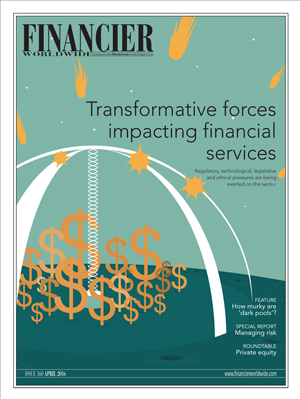
Dans son édition d’avril 2016, le magazine Financier Worldwide présente une excellente analyse de la dynamique d’un conseil d’administration efficace. Pour l’auteur, il est important que le président du conseil soit habileté à exercer un niveau de saine tension entre les administrateurs et la direction de l’entreprise.

Il n’y a pas de place pour la complaisance au conseil. Les membres doivent comprendre que leur rôle est de veiller aux « intérêts supérieurs » de l’entreprise, notamment des propriétaires-actionnaires, mais aussi d’autres parties prenantes.

Le PDG de l’entreprise est recruté par le CA pour faire croître l’entreprise et exécuter une stratégie liée à son modèle d’affaires. Lui aussi doit travailler dans le meilleur intérêt des actionnaires… mais c’est la responsabilité fiduciaire du CA de s’en assurer en mettant en place les mécanismes de surveillance appropriés.

La théorie de l’agence stipule que le CA représente l’autorité souveraine de l’entreprise (puisqu’il possède la légitimité que lui confèrent les actionnaires). Le CA confie à un PDG (et à son équipe de gestion) le soin de réaliser les objectifs stratégiques retenus. Les deux parties — le Board et le Management — doivent bien comprendre leurs rôles respectifs, et trouver les bons moyens pour gérer la tension inhérente à l’exercice de la gouvernance et de la gestion.

Les administrateurs doivent s’efforcer d’apporter une valeur ajoutée à la gestion en conseillant la direction sur les meilleures orientations à adopter, et en instaurant un climat d’ouverture, de soutien et de transparence propice à la réalisation de performances élevées.

Il est important de noter que les actionnaires s’attendent à la loyauté des administrateurs ainsi qu’à leur indépendance d’esprit face à la direction. Les administrateurs sont élus par les actionnaires et sont donc imputables envers eux. C’est la raison pour laquelle le conseil d’administration doit absolument mettre en place un processus d’évaluation de ces membres et divulguer sa méthodologie.

Vous trouverez, ci-dessous, l’article du Financier Worldwide qui illustre assez clairement les tensions existantes entre le CA et la direction, ainsi que les moyens proposés pour assurer la collaboration entre les deux parties.

J’ai souligné en gras les passages clés.

Bonne lecture ! Vos commentaires sont appréciés.

In this age of heightened risk, the need for effective governance has caused a dynamic shift in the role of the board of directors. Cyber security, rapid technological growth and a number of corporate scandals resulting from the financial crisis of 2008, all underscore the necessity of boards working constructively with management to ensure efficient oversight, rather than simply providing strategic direction. This is, perhaps, no more critical than in the middle market, where many companies often don’t have the resources larger organisations have to attract board members, but yet their size requires more structure and governance than smaller companies might need.

Following the best practices of high-performing boards can help lead to healthy tension between management and directors for improved results and better risk management. We all know conflict in the boardroom might sometimes be unavoidable, as the interests of directors and management don’t necessarily always align. Add various personalities and management styles to the mix, and discussions can sometimes get heated. It’s important to deal with situations when they occur in order to constructively manage potential differences of opinion to create a healthy tension that makes the entire organisation stronger.

Various conflict management styles can be employed to ensure that any potential boardroom tension within your organisation is healthy. If an issue seems minor to one person but vital to the rest of the group, accommodation can be an effective way to handle tension. If minor issues arise, it might be best to simply avoid those issues, whereas collaboration should be used with important matters. Arguably, this is the best solution for most situations and it allows the board to effectively address varying opinions. If consensus can’t be reached, however, it might become necessary for the chairman or the lead director to use authoritarian style to manage tension and make decisions. Compromise might be the best approach when the board is pressed for time and needs to take immediate action.

1353558_7_0ad2_miguel-angel-moratinos-ancien-ministre-desThe board chairperson can be integral to the resolution process, helping monitor and manage boardroom conflict. With this in mind, boards should elect chairs with the proven ability to manage all personality types. The chairperson might also be the one to initiate difficult conversations on topics requiring deeper scrutiny. That said, the chairperson cannot be the only enforcer; directors need to assist in conflict resolution to maintain a proper level of trust throughout the group. And the CEO should be proactive in raising difficult issues as well, and boards are typically most effective when the CEO is confident, takes the initiative in learning board best practices and works collaboratively.

Gone are the days of the charismatic, autocratic CEO. Many organisations have separated the role of CEO and chairperson, and have introduced vice chairs and lead directors to achieve a better balance of power. Another way to ensure a proper distribution of authority is for the board to pay attention to any red flags that might be raised by the CEO’s behaviour. For example, if a CEO feels they have all the answers, doesn’t respect the oversight of the board, or attempts to manage or marginalise the board, the chairperson and board members will likely need to be assertive, rather than simply following the CEO’s lead. Initially this might seem counterintuitive, however, in the long-run, this approach will likely create a healthier tension than if they simply ‘followed the leader’.

Everyone in the boardroom needs to understand their basic functions for an effective relationship -executives should manage, while the board oversees. In overseeing, the board’s major responsibilities include approving strategic plans and goals, selecting a CEO, determining a mission or purpose, identifying key risks, and providing oversight of the compliance of corporate policies and regulations. Clearly understanding the line between operations and strategy is also important.

Organisations with the highest performing boards are clear on the appropriate level of engagement for the companies they represent – and that varies from one organisation to the next. Determining how involved the board will be and what type of model the board will follow is key to effective governance and a good relationship with management. For example, an entity that is struggling financially might require a more engaged board to help put it back on track.

Many elements, such as tension, trust, diversity of thought, gender, culture and expertise can impact the delicate relationship between the board and management. Good communication is vital to healthy tension. Following best practices for interaction before, during and after board meetings can enhance conflict resolution and board success.

Before each board meeting, management should prepare themselves and board members by distributing materials and the board package in a timely manner. These materials should be reviewed by each member, with errors or concerns forwarded to the appropriate member of management, and areas of discussion highlighted for the chair. An agenda focused on strategic issues and prioritised by importance of matters can also increase productivity.

During the meeting, board members should treat one another with courtesy and respect, holding questions held until after presentations (or as the presenter directs). Board-level matters should be discussed and debated if necessary, and a consensus reached. Time spent on less strategic or pressing topics should be limited to ensure effective meetings. If appropriate, non-board-level matters might be handed to management for follow-up.

Open communication should also continue after board meetings. Sometimes topics discussed during board meetings take time to digest. When this happens, board members should connect with appropriate management team members to further discuss or clarify. There are also various board committee meetings that need to occur between board meetings. Board committees should be doing the ‘heavy lifting’ for the full board, making the larger group more efficient and effective. Other more informal interactions can further strengthen the relationship between directors and management.

Throughout the year, the board’s engagement with management can be broadened to include discussions with more key players. Gaining multiple perspectives by interacting with other areas of the organisation, such as general counsels, external and internal auditors, public relations and human resources, can help the board identify and address key risks. By participating in internal and external company events, board members get to know management and the company’s customers on a first-hand basis.

Of course, a strategy is necessary for the board as well, as regulatory requirements have increased, leading to greater pressure for high-quality performance. Effective boards maintain a plan for development and succession. They also implement CEO and board evaluation processes to ensure goals are being met and board members are performing optimally. In addition to the evaluation process, however, board members must hold themselves totally accountable for instilling trust in the boardroom.

Competition in today’s increasingly global and complex business environment is fierce, and calls for new approaches for success. Today’s boards need to build on established best practices and create good relationships with management to outperform competitors. The highest performing boards are clear on their functions, and understand the level of engagement appropriate for the companies they support. They are accountable and set the right tone, while being able to discern true goals and aspirations from trendiness. They are capable of understanding and dealing with the ‘big issues’ and are strategic in their planning and implementation of approaches that work for the companies they serve. With the ever-changing risk universe, the ability to work with the right amount of healthy tension is essential to effective governance.

_______________________________________

Hussain T. Hasan is on the Consulting Leadership team as well as a board member at RSM US LLP.

Quinze (15) astuces d’un CA performant


Aujourd’hui, je vous présente un article de Joanne Desjardins* qui agit comme auteure invitée sur mon blogue.

Elle a produit une synthèse des caractéristiques les plus importantes pour évaluer l’efficacité des conseils d’administration.

Je crois que les quinze éléments retenus sont très utiles pour mieux comprendre les bonnes pratiques des CA.

Bonne lecture !


 Quinze (15) astuces d’un CA performant

par

Joanne Desjardins


On mesure la performance de nos employés et de notre entreprise. Qu’en est-il de celle du CA ? Évaluez-vous la performance de votre CA ? Les CA performants s’évaluent et mettre en place les mesures requises pour optimiser leur performance et celles des administrateurs. Au surplus, des études démontrent qu’un CA performant a un impact positif sur la performance de l’entreprise.

Quelles sont les caractéristiques d’un CA performant?

Nous décrivons, ci-après, les 15 caractéristiques des CA performants.

Full Spectrum Meeting

  1. Le CA doit rassembler des administrateurs aux compétences, expériences et connaissance présentant un juste équilibre, une diversité et une complémentarité avec celles de la haute direction et contribuant à alimenter la stratégie de l’organisation. Il n’y a pas de nombre idéal d’administrateurs. Cependant, un CA impair, composé de moins de 13 personnes fonctionne généralement mieux.
  2. Le CA assure l’intégration efficace des nouveaux administrateurs pour leur permettre de se familiariser avec leurs fonctions aisément (par ex. : programme d’accueil et d’intégration, coaching, mentorat, etc.).
  3. Les administrateurs sont dédiés et s’engagent à consacrer le temps, les efforts et l’énergie nécessaires pour agir efficacement dans le meilleur intérêt de l’entreprise. Ils partagent les valeurs de l’entreprise.
  4. Le CA désigne un président indépendant, mobilisateur, à l’écoute, qui a la capacité et le courage de concilier les points de vue divergents, de prendre des décisions difficiles et de régler les conflits. Le président gère efficacement les réunions du CA en favorisant un équilibre entre la spontanéité dans les échanges et le les règles de régie interne.
  5. Les rencontres sont programmées à l’avance. Les rencontres sont d’une durée raisonnable et à des intervalles réguliers. Le président du CA et le président de l’entreprise s’entendent sur l’ordre du jour de chaque réunion du CA et priorisent les sujets en fonction de la stratégie de l’entreprise et des risques.
  6. Les administrateurs démontrent une capacité d’écoute, de communication et de persuasion pour pouvoir participer activement et constructivement aux délibérations du CA. Ils ont le courage de poser des questions difficiles.
  7. Le CA ne s’ingère pas dans les opérations de l’entreprise (¨Nose in, fingers out¨).
  8. La haute direction transmet aux administrateurs, en temps opportun, des informations fiables dont l’exhaustivité, la forme et la qualité sont appropriées pour permettre aux administrateurs de remplir adéquatement leurs fonctions.
  9. Le rôle, les responsabilités et les attentes envers les administrateurs, les comités et le CA sont clairement définis. Les administrateurs comprennent les obligations de fiduciaires qui leur incombent et les implications qui en découlent.
  10. Le CA a mis en place une procédure d’évaluation rigoureuse, fiable et confidentielle. Les attentes envers les administrateurs ainsi que les critères d’évaluation sont clairs et connus de tous. En fonction des résultats de l’évaluation, des mesures sont prises pour améliorer l’efficacité du CA et des administrateurs (par ex. : formation, outils, ajustement dans les pratiques, etc.).
  11. Le CA participe activement à la sélection et à l’évaluation du rendement du président de l’entreprise.
  12. Le CA participe à l’élaboration de la stratégie de l’entreprise et approuve le plan stratégique. Une fois approuvé, le CA suit l’état d’avancement du plan stratégique et les risques inhérents.
  13. Un système robuste de gestion des risques a été mis en place et la responsabilité́ de la surveillance des risques relève d’un comité du CA. Les administrateurs connaissent les principaux risques pouvant influencer la réalisation de la stratégie et le plan de mitigation.
  14. Les administrateurs mettent à jour et actualisent leurs compétences et connaissances.
  15. On planifie la relève pour veiller au renouvellement du CA et assurer un équilibre entre les administrateurs expérimentés ayant une connaissance approfondie de l’organisation et les nouveaux, apportant une perspective différente aux problématiques.

___________________________________

Joanne Desjardins, LL.B., MBA, ASC, CRHA* est présidente-fondatrice de Keyboard, une firme spécialisée en stratégie et gouvernance. Elle est également conférencière et bloggeuse en stratégie et en gouvernance. Elle rédige actuellement un livre sur les meilleures pratiques en gouvernance.

Taille du CA, limite d’âge et durée des mandats des administrateurs


Comme je l’ai déjà évoqué dans plusieurs autres billets, il faut réfléchir très sérieusement à la taille du CA, à la limite d’âge des administrateurs ainsi qu’à la durée de leurs mandats.

Eu égard à la taille du CA, on note que les membres de conseils de petite taille :

(1) sont plus engagés dans les affaires de l’entité

(2) sont plus portés à aller en profondeur dans l’analyse stratégique

(3) entretiennent des relations plus fréquentes et plus harmonieuses avec la direction

(4) ont plus de possibilités de communiquer entre eux

(5) exercent une surveillance plus étroite des activités de la direction

(6) sont plus décisifs, cohésif et impliqués.

On constate également une tendance lourde en ce qui regarde le nombre de mandats des administrateurs de sociétés, mais que ce changement ne se fait pas sans heurt.

Plusieurs pensent que, malgré certains avantages évidents à avoir des administrateurs séniors sur les CA, cette situation est un frein à la diversité et au renouvellement des générations au sein des conseils d’administration. Je crois que les CA devraient se doter d’une politique de limite d’âge pour les administrateurs ainsi que d’une limite au cumul des mandats ?

Les conseils d’administration devraient se préoccuper de ces questions afin :

(1) d’accroître la diversité dans la composition du conseil

(2) de faciliter la nomination de femmes au sein des CA

(3) d’assurer une plus grande indépendance des membres du conseil

(4) d’assurer la relève et l’apport d’idées neuves sur la gouvernance et les stratégies

(5) d’éviter que des administrateurs peu engagés s’incrustent dans leurs postes.

À cet égard, voici certains extraits d’études qui présentent les changements au Canada en 2015 :

Cumul des mandats d’administrateur

« Dorénavant, un administrateur qui est chef de la direction est considéré comme cumulant trop de mandats s’il siège au conseil de plus d’une société ouverte en plus du conseil d’administration de la société qui l’emploie (auparavant, il fallait que ce soit plus de deux sociétés). Un administrateur qui n’est pas chef de la direction cumule trop de mandats lorsqu’il siège à plus de quatre conseils d’administration de sociétés ouvertes (auparavant, c’était plus de six sociétés) ».

Renouvellement des conseils d’administration

Les Autorités canadiennes en valeurs mobilières (ACVM) ont révélé que « seulement 19 % des émetteurs examinés avaient adopté une combinaison quelconque de limites à la durée des mandats et/ou de limite d’âge… Toutefois, la grande majorité des émetteurs ne se sont dotés d’aucun mécanisme officiel pour le renouvellement du conseil, à part leur processus d’évaluation des administrateurs ».

Notons que les émetteurs assujettis sont tenus de divulguer les limites à la durée du mandat des administrateurs ainsi que les mécanismes de renouvellement du conseil. S’ils ne se conforment pas, ils doivent en expliquer les raisons.

En France, par exemple, un administrateur qui a siégé à un conseil pendant plus de 12 ans n’est plus considéré comme étant indépendant. Au Royaume-Uni, le conseil doit déclarer publiquement pourquoi il croit qu’un administrateur qui a siégé plus de 9 ans est toujours considéré comme étant indépendant.

Beaucoup de conseils au Canada estiment que les limites de mandat servent un objectif, 56 % des sociétés du Canadian Spencer Stuart Board Index (CSSBI) indiquant qu’elles recourent volontairement à des limites d’âge et de mandat. Selon une récente étude de Korn Ferry International/Patrick O’Callaghan and Associates, les limites de mandat pour les entreprises canadiennes inscrites en bourse ayant été sondées oscillent entre sept et vingt ans, 53 % d’entre elles présentant une limite de mandat de 15 ans.

Voici quelques billets publiés sur mon blogue qui peuvent être utiles à un président de conseil aux prises avec ces questions délicates.


En rappel | Les C.A de petites tailles performent mieux !

Réflexions sur les limites d’âge des membres de conseil d’administration et sur la durée des mandats

Faut-il limiter le nombre de mandats des administrateurs ?


Également, j’ai joint le Rapport de Davies sur la gouvernance | Décembre 2015 au Canada en 2015.

Enfin, voici deux articles qui devraient alimenter vos réflexions sur le sujet.

Le premier, Company directors getting older – fewer age limits, a été publié par Andrew Frye et Jeff Green dans le San Francisco Chronicle. Le second, Board Tenure: The New Hot Governance Topic ?, a été publié par Broc Romanek sur le blogue de CorporateCounsel.net. Vous trouverez, ci-dessous, des extraits de ces deux références.


Company directors getting older – fewer age limits


Buffett’s influence

Berkshire’s willingness to retain directors in their ninth decades reflects Buffett’s influence on the firm and a national trend toward older boards. About 15 percent of directors at companies in the Standard & Poor’s 500 index are older than 69, compared with 9.8 percent in 2002, according to executive-compensation benchmarking firm Equilar. Proxy filings show 52 directors are age 80 or older.

« You can have great 85-year-olds and horrible 55-year-olds, » said Anne Sheehan, director of corporate governance for the $155 billion California State Teachers’ Retirement System. « A lot of this depends on the 80-year-old, because I’d love to have Warren Buffett on any board. »

Boardroom age limits are less prevalent and set higher than they were five years ago, according to the latest report on director trends by executive recruitment company Spencer Stuart. Companies use age limits to promote turnover and assure investors that management is getting new ideas. Those goals may instead be achieved through term limits, Sheehan said.

« You have to refresh the board, whether it’s through term limits or through age limits, » said Charles Elson, director of the University of Delaware’s Center for Corporate Governance.


_______________________________________________________

Board Tenure: The New Hot Governance Topic ?

At a recent event, a member joked with me that his CEO was asked: « What was the average age of directors on his board? » – and the CEO answered: « Dead. » Based on recent stats, it appears that many directors are comfortable as turnover is quite low these days. This is reflected in Jim Kristie’s Directors & Boards piece entitled « Troubling Trend: Low Board Turnover. » As Jim points out, a director with a certain background might make sense for the company now – but might not ten years down the road as the circumstances change.

board diversity.jpg

Perhaps even more important is the independence issue – is a director who sits on the board for several decades likely to still be independent after such a long tenure (see this WSJ article about the 40-year club)? Does it matter if management turns over during the director’s tenure? And if so, how much? These are issues that are being debated. What is your take?

As blogged by Davis Polk’s Ning Chiu, CII is considering policy changes linking director tenure with director independence, under which it would ask boards to consider a director’s years of service in determining director independence. According to the proposed policy, 26% of all Russell 3,000 directors have served more than 10 years and 14% have served more than 15 years. CII would not advocate for any specific tenure, unlike the European Commission, which advises that non-executive directors serve no more than 12 years. Note that under the UK’s « comply or explain » framework, companies need to disclose why a director continues to serve after being on the board nine years. I have heard that seven years is the bar in Russia.

How Does Low Board Turnover Impact Board Diversity?

Related to proper board composition is the issue of whether low board turnover is just one more factor that stifles board diversity. As well documented in numerous studies (see our « Board Diversity » Practice Area), gender diversity on boards has essentially flat-lined over the past decade – and actually has regressed in some areas. This is a real-world problem as it’s been proven that differing views on a board lead to greater corporate performance. To get boards back on track, I do think bold ideas need to be implemented – and plenty are out there, such as this one. I can’t believe that more investors haven’t been clamoring for greater diversity – but I do believe that day is near…

Bonne lecture !

Une saine tension entre le CA et la direction | Gage d’une bonne gouvernance 


Dans son édition d’avril 2016, le magazine Financier Worldwide présente une excellente analyse de la dynamique d’un conseil d’administration efficace. Pour l’auteur, il est important que le président du conseil soit habileté à exercer un niveau de saine tension entre les administrateurs et la direction de l’entreprise.

Il n’y a pas de place pour la complaisance au conseil. Les membres doivent comprendre que leur rôle est de veiller aux « intérêts supérieurs » de l’entreprise, notamment des propriétaires-actionnaires, mais aussi d’autres parties prenantes.

Le PDG de l’entreprise est recruté par le CA pour faire croître l’entreprise et exécuter une stratégie liée à son modèle d’affaires. Lui aussi doit travailler dans le meilleur intérêt des actionnaires… mais c’est la responsabilité fiduciaire du CA de s’en assurer en mettant en place les mécanismes de surveillance appropriés.

La théorie de l’agence stipule que le CA représente l’autorité souveraine de l’entreprise (puisqu’il possède la légitimité que lui confèrent les actionnaires). Le CA confie à un PDG (et à son équipe de gestion) le soin de réaliser les objectifs stratégiques retenus. Les deux parties — le Board et le Management — doivent bien comprendre leurs rôles respectifs, et trouver les bons moyens pour gérer la tension inhérente à l’exercice de la gouvernance et de la gestion.

Les administrateurs doivent s’efforcer d’apporter une valeur ajoutée à la gestion en conseillant la direction sur les meilleures orientations à adopter, et en instaurant un climat d’ouverture, de soutien et de transparence propice à la réalisation de performances élevées.

Il est important de noter que les actionnaires s’attendent à la loyauté des administrateurs ainsi qu’à leur indépendance d’esprit face à la direction. Les administrateurs sont élus par les actionnaires et sont donc imputables envers eux. C’est la raison pour laquelle le conseil d’administration doit absolument mettre en place un processus d’évaluation de ces membres et divulguer sa méthodologie.

Vous trouverez, ci-dessous, l’article du Financier Worldwide qui illustre assez clairement les tensions existantes entre le CA et la direction, ainsi que les moyens proposés pour assurer la collaboration entre les deux parties.

J’ai souligné en gras les passages clés.

Bonne lecture ! Vos commentaires sont appréciés.

In this age of heightened risk, the need for effective governance has caused a dynamic shift in the role of the board of directors. Cyber security, rapid technological growth and a number of corporate scandals resulting from the financial crisis of 2008, all underscore the necessity of boards working constructively with management to ensure efficient oversight, rather than simply providing strategic direction. This is, perhaps, no more critical than in the middle market, where many companies often don’t have the resources larger organisations have to attract board members, but yet their size requires more structure and governance than smaller companies might need.

Following the best practices of high-performing boards can help lead to healthy tension between management and directors for improved results and better risk management. We all know conflict in the boardroom might sometimes be unavoidable, as the interests of directors and management don’t necessarily always align. Add various personalities and management styles to the mix, and discussions can sometimes get heated. It’s important to deal with situations when they occur in order to constructively manage potential differences of opinion to create a healthy tension that makes the entire organisation stronger.

Various conflict management styles can be employed to ensure that any potential boardroom tension within your organisation is healthy. If an issue seems minor to one person but vital to the rest of the group, accommodation can be an effective way to handle tension. If minor issues arise, it might be best to simply avoid those issues, whereas collaboration should be used with important matters. Arguably, this is the best solution for most situations and it allows the board to effectively address varying opinions. If consensus can’t be reached, however, it might become necessary for the chairman or the lead director to use authoritarian style to manage tension and make decisions. Compromise might be the best approach when the board is pressed for time and needs to take immediate action.

April 2016 Issue

The board chairperson can be integral to the resolution process, helping monitor and manage boardroom conflict. With this in mind, boards should elect chairs with the proven ability to manage all personality types. The chairperson might also be the one to initiate difficult conversations on topics requiring deeper scrutiny. That said, the chairperson cannot be the only enforcer; directors need to assist in conflict resolution to maintain a proper level of trust throughout the group. And the CEO should be proactive in raising difficult issues as well, and boards are typically most effective when the CEO is confident, takes the initiative in learning board best practices and works collaboratively.

Gone are the days of the charismatic, autocratic CEO. Many organisations have separated the role of CEO and chairperson, and have introduced vice chairs and lead directors to achieve a better balance of power. Another way to ensure a proper distribution of authority is for the board to pay attention to any red flags that might be raised by the CEO’s behaviour. For example, if a CEO feels they have all the answers, doesn’t respect the oversight of the board, or attempts to manage or marginalise the board, the chairperson and board members will likely need to be assertive, rather than simply following the CEO’s lead. Initially this might seem counterintuitive, however, in the long-run, this approach will likely create a healthier tension than if they simply ‘followed the leader’.

Everyone in the boardroom needs to understand their basic functions for an effective relationship -executives should manage, while the board oversees. In overseeing, the board’s major responsibilities include approving strategic plans and goals, selecting a CEO, determining a mission or purpose, identifying key risks, and providing oversight of the compliance of corporate policies and regulations. Clearly understanding the line between operations and strategy is also important.

Organisations with the highest performing boards are clear on the appropriate level of engagement for the companies they represent – and that varies from one organisation to the next. Determining how involved the board will be and what type of model the board will follow is key to effective governance and a good relationship with management. For example, an entity that is struggling financially might require a more engaged board to help put it back on track.

Many elements, such as tension, trust, diversity of thought, gender, culture and expertise can impact the delicate relationship between the board and management. Good communication is vital to healthy tension. Following best practices for interaction before, during and after board meetings can enhance conflict resolution and board success.

Before each board meeting, management should prepare themselves and board members by distributing materials and the board package in a timely manner. These materials should be reviewed by each member, with errors or concerns forwarded to the appropriate member of management, and areas of discussion highlighted for the chair. An agenda focused on strategic issues and prioritised by importance of matters can also increase productivity.

During the meeting, board members should treat one another with courtesy and respect, holding questions held until after presentations (or as the presenter directs). Board-level matters should be discussed and debated if necessary, and a consensus reached. Time spent on less strategic or pressing topics should be limited to ensure effective meetings. If appropriate, non-board-level matters might be handed to management for follow-up.

Open communication should also continue after board meetings. Sometimes topics discussed during board meetings take time to digest. When this happens, board members should connect with appropriate management team members to further discuss or clarify. There are also various board committee meetings that need to occur between board meetings. Board committees should be doing the ‘heavy lifting’ for the full board, making the larger group more efficient and effective. Other more informal interactions can further strengthen the relationship between directors and management.

Throughout the year, the board’s engagement with management can be broadened to include discussions with more key players. Gaining multiple perspectives by interacting with other areas of the organisation, such as general counsels, external and internal auditors, public relations and human resources, can help the board identify and address key risks. By participating in internal and external company events, board members get to know management and the company’s customers on a first-hand basis.

Of course, a strategy is necessary for the board as well, as regulatory requirements have increased, leading to greater pressure for high-quality performance. Effective boards maintain a plan for development and succession. They also implement CEO and board evaluation processes to ensure goals are being met and board members are performing optimally. In addition to the evaluation process, however, board members must hold themselves totally accountable for instilling trust in the boardroom.

Competition in today’s increasingly global and complex business environment is fierce, and calls for new approaches for success. Today’s boards need to build on established best practices and create good relationships with management to outperform competitors. The highest performing boards are clear on their functions, and understand the level of engagement appropriate for the companies they support. They are accountable and set the right tone, while being able to discern true goals and aspirations from trendiness. They are capable of understanding and dealing with the ‘big issues’ and are strategic in their planning and implementation of approaches that work for the companies they serve. With the ever-changing risk universe, the ability to work with the right amount of healthy tension is essential to effective governance.

_______________________________________

Hussain T. Hasan is on the Consulting Leadership team as well as a board member at RSM US LLP.

L’évaluation des comportements et de la performance des membres du conseil d’administration


Aujourd’hui, je cède la parole à Johanne Bouchard* qui agit, de nouveau, à titre d’auteure invitée sur mon blogue en gouvernance.

Celle-ci a une solide expérience d’interventions de consultation auprès de conseils d’administration de sociétés américaines ainsi que d’accompagnements auprès de hauts dirigeants de sociétés publiques (cotées), d’organismes à but non lucratif (OBNL) et d’entreprises en démarrage.

Dans ce billet, elle aborde une activité assez délicate, mais qui devrait s’imposer pour la bonne gouvernance des entreprises : l’évaluation de la performance des membres du conseil d’administration.

Johanne nous fait part :

(1) de son expérience de consultante eu égard à cette activité

(2) de sa méthode de travail pour assurer l’adhésion des administrateurs

(3) des résultats auxquels on est en mesure de s’attendre.

L’expérience de Johanne Bouchard auprès d’entreprises cotées en bourse est soutenue ; elle en tire des enseignements utiles pour tous les types de conseils d’administration.

Bonne lecture ! Vos commentaires sont toujours les bienvenus.

Assessments for Effective and High-Performing Boards


Do you belong to a board? How healthy is it? With the kick off of a new year, I invite you to encourage your board to conduct an annual leadership effectiveness assessment (if you haven’t already). Regardless of the type of board(s) you belong to (corporate, private and/or non-profit), your board(s) will heighten its/their effectiveness by committing to this process.

I began conducting board leadership effectiveness assessments at the request of a CEO client over a decade ago. In my role as a trusted confidante to CEOs, it has been very common to exchange about the dynamics and climate of the board and how to best support his/her effectiveness as a director and leader of the organization.

Assessments for Effective and High-Performing Boards

My clients and I agree that it is extremely beneficial to work with a 3rd party. It has helped my CEO clients to engage me with the support of their Chair or Governance Chair to be a trusted partner to the board. And, Chair and directors are often my champions for engaging with this process. In meeting everyone on the board, I can share insights that sometimes are not easily addressed within the board, between the directors, with the CEO and/or with the Chair.

While an internal general counsel could conduct a process to assess their boards, this approach may not be as objective as having someone who is totally detached from the outcome and has no preconceived judgments. Besides, I personally believe that it is important that the general counsel not be the facilitator but be included in the process so that his/her observations are also taken into consideration, given his/her important role with the board. Similarly, the Chief Financial Officer (CFO) and the Chief Human Officer (CHO) need to be polled.

The Board Performance Assessment that I have developed helps my board clients to be more proactive in evaluating how they execute their fundamental role as a board, evaluate the interrelationships within the board, assure that they attend to governance priorities, and are actively involved in the development and oversight of the organization’s business strategy and goals.

Not every board’s dynamic is the same. Here’s what to consider when choosing how to approach an evaluation for yours:

Don’t conduct an assessment just to check off getting it done. If you are a Governance Chair, a Board Chair or a CEO, take a few minutes to reflect about your board and honestly take note of how healthy it really is.

Are the dynamics as healthy as they should be? Is communication within the board (including between the Chair and the CEO/Executive Director, as well as between the directors and the CEO/Executive Director/Chair) fair, good or outstanding? Are there sticky issues overdue for examination? Is the board’s composition great or just ok? Is diversity of skills, experience and talent optimal and in alignment with the strategic trajectory of the organization? Is the board clear of the boundaries with management, investors and shareholders? Is the board’s composition due for refreshment or augmentation? Etc.

Be clear that there should be a director self-assessment as well as a peer evaluation. Stay away from associating “assessment” with “criticism.” Rather, consider assessment as a powerful approach to constructively examine how each director is effective individually and collectively. No one should feel threatened. Everyone should feel eager to be part of the process and empowered as a result of it. Ensure that governance will be examined in a constructive and helpful manner. Ask your CEO for what s/he would like to know more about regarding his/her effectiveness wearing the director hat.

Refrain from filling out a questionnaire online. Rather, invite a conversation—ideally in person, but at least over the phone. It is ok to have some questions answered by email in addition to a verbal exchange while cognizant of total confidentiality and security. There is enormous value to including a 3rd party, such as myself, in this process to probe during the moment when any insights are being shared.

Ensure that the results are effectively summarized according to the priorities.

Make sure the outcome includes a list of next steps for the committees, the Chair, the CEO and individual directors.

What results should you look for?

Clear identification of what works well with the board, what needs improvement and what is missing.

Surfacing of delicate and important role and responsibility issues.

Clarity or greater clarity of Chair, CEO and committee roles and alignment on the roles and responsibilities.

Identification of any unconscious split between board members with a long history with the organization and newer board members. (Opening this up for discussion clears the air and explains some previous attitudes and opinions on issues.)

Clarification of expectations amongst all directors.

Succinct recommendations in areas of board dynamics, board composition, roles and responsibilities, succession planning and other governance issues.

Conducting a leadership effectiveness assessment ensures that no assumptions are made about the board, that elephants get out of the room and that sticky issues are addressed with an attitude of maturity. It is an opportune time to agree to what works and to applaud the people who are really taking the lead in their individual roles. It is also a time to get insights about how leadership, opining during meetings, deliberation, process adoption and priorities can be better addressed. This is a wonderful opportunity to take the board to a new level of effectiveness, collaboration, cordiality, respect, trust and openness. It is the time to have a breakthrough to welcome positive change and make progress in the needed direction.

Remember, a board need not be dysfunctional to commit to a board leadership effectiveness assessment. It is good governance to adhere to an annual process either as a stand-alone assignment or as a precursor to gathering the board for a strategic planning session to align the board on strategy.

_________________________________________

*Johanne Bouchard est consultante auprès de conseils d’administration, de chefs de la direction et de comités de direction. Johanne a développé une expertise au niveau de la dynamique et de la composition de conseils d’administration. Après l’obtention de son diplôme d’ingénieure en informatique, sa carrière l’a menée à œuvrer dans tous les domaines du secteur de la technologie, du marketing et de la stratégie à l’échelle mondiale.


Les dix (10) billets vedettes sur mon blogue en gouvernance au premier trimestre de 2016


Voici une liste des billets en gouvernance les plus populaires publiés sur mon blogue au cours du dernier trimestre se terminant le 31 mars 2016.

Cette liste constitue, en quelque sorte, un sondage de l’intérêt manifesté par des milliers de personnes sur différents thèmes de la gouvernance des sociétés. On y retrouve des points de vue bien étayés sur des sujets d’actualité relatifs aux conseils d’administration.

Que retrouve-t-on dans ce blogue et quels en sont les objectifs?

Ce blogue fait l’inventaire des documents les plus pertinents et les plus récents en gouvernance des entreprises. La sélection des billets est le résultat d’une veille assidue des articles de revue, des blogues et des sites web dans le domaine de la gouvernance, des publications scientifiques et professionnelles, des études et autres rapports portant sur la gouvernance des sociétés, au Canada et dans d’autres pays, notamment aux États-Unis, au Royaume-Uni, en France, en Europe, et en Australie.

ECH20163057_1

Je fais un choix parmi l’ensemble des publications récentes et pertinentes et je commente brièvement la publication.

L’objectif de ce blogue est d’être la référence en matière de documentation en gouvernance dans le monde francophone, en fournissant au lecteur une mine de renseignements récents (les billets) ainsi qu’un outil de recherche simple et facile à utiliser pour répertorier les publications en fonction des catégories les plus pertinentes.

Quelques statistiques à propos du blogue Gouvernance | Jacques Grisé

Ce blogue a été initié le 15 juillet 2011 et, à date, il a accueilli plus de 170000 visiteurs. Le blogue a progressé de manière tout à fait remarquable et, au 31 décembre 2015, il était fréquenté par plusieurs milliers de visiteurs par mois. Depuis le début, j’ai œuvré à la publication de 1305 billets.

En 2016, j’estime qu’environ 5000 personnes par mois visiteront le blogue afin de s’informer sur diverses questions de gouvernance. À ce rythme, on peut penser qu’environ 60000 personnes visiteront le site du blogue en 2016. 

On note que 44 % des billets sont partagés par l’intermédiaire de LinkedIn et 45 % par différents moteurs de recherche. Les autres réseaux sociaux (Twitter, Facebook et Tumblr) se partagent 11 % des références.

Voici un aperçu du nombre de visiteurs par pays :

  1. Canada (64 %)
  2. France, Suisse, Belgique (20 %)
  3. Maghreb (Maroc, Tunisie, Algérie) (5 %)
  4. Autres pays de l’Union européenne (3 %)
  5. États-Unis (3 %)
  6. Autres pays de provenance (5 %)

Il y a deux ans, le blogue Gouvernance | Jacques Grisé a été inscrit dans deux catégories distinctes du concours canadien Made in Blog (MiB Awards) : Business et Marketing et médias sociaux. Le blogue a été retenu parmi les dix (10) finalistes à l’échelle canadienne dans chacune de ces catégories, le seul en gouvernance. Il n’y avait pas de concours en 2015.

Vos commentaires sont toujours grandement appréciés. Je réponds toujours à ceux-ci.


N.B. Vous pouvez vous inscrire ou faire des recherches en allant au bas de cette page.


Bonne lecture !

1.      Cinq (5) principes simples et universels de saine gouvernance ?
2.      Comment un bon président de CA se prépare-t-il pour sa réunion ?
3.      Composition du conseil d’administration d’OSBL et recrutement d’administrateurs | Une primeur
4.      Le rôle du comité exécutif versus le rôle du conseil d’administration
5.      Document complet de KPMG sur les bonnes pratiques de gouvernance et de gestion d’un CA | The Directors Toolkit
6.      Une formation en éthique 2.0 pour les conseils d’administration
7.      La nouvelle réalité des comités de gouvernance des conseils d’administration
8.      Dix thèmes majeurs pour les administrateurs en 2016 | Harvard Law School Forum on Corporate Governance
9.      Un guide essentiel pour comprendre et enseigner la gouvernance | En reprise

10.  L’utilisation des huis clos lors des sessions de C.A.

Modèle d’affaires hasardeux et gouvernance désastreuse à la société canadienne Valeant


Voici un article récemment publié dans The Economist, qui met en évidence les énormes faiblesses de la gouvernance corporative de Valeant, l’un des « fleurons » de l’industrie pharmaceutique canadienne.

Selon le magazine, il s’agit du plus désastreux constat d’échec d’une firme cotée à la bourse de New York depuis la faillite de Lehman Brothers en 2008 !

À part un modèle d’affaires déficient et douteux, quelles sont les leçons à tirer pour les conseils d’administration de sociétés publiques ?

Les auteurs insistent sur les problèmes de contrôle interne, la faiblesse notoire du conseil d’administration, les interventions opportunistes des actionnaires activistes, notamment Jeffrey Ubben de ValueAct et Bill Ackman de Pershing Square, qui détiennent quatre des douze sièges du conseil d’administration. À lui seul Pershing Square détient 9 % des actions et son président Bill Ackman vient de joindre le CA.

Un article paru hier dans Canadian Business montre encore plus clairement comment l’inefficacité du conseil d’administration est à l’origine des problèmes de Valeant (Why the trouble at Valeant starts with its board of directors).

Vous trouverez, ci-dessous, le paragraphe introductif de l’article paru dans The Economist.

Until recently, America hadn’t had a spectacular corporate disaster since Lehman Brothers in 2008. But Valeant, a Canadian but New York-listed drug firm, now meets all of the tests: a bad business model, accounting problems, acquisitions, debt, an oddly low tax rate, a weak board, credulous analysts, and managers with huge pay packets and a mentality of denial. The result has been a $75 billion loss for shareholders and, possibly, a default on $31 billion of debt.

Je vous invite à lire la suite de cet article, notamment les trois leçons que nous devrions en retirer.

Bonne lecture !


He who would Valeant be | Corporate Governance


On March 21st Valeant announced that Michael Pearson, its CEO, was leaving.

Valeant’s business model was buying other drug firms, cutting costs and yanking up prices. Since 2010 it has done $35 billion of deals, mainly financed by debt. At a time when Americans face stagnant living standards, a strategy based on squeezing customers was bound to encounter political hostility—“I’m going after them,” Hillary Clinton has vowed.

Valeant added to this mix a tendency towards evasiveness. In October investigative reporters revealed its murky relationship with a drugs dispensary, Philidor, which it consolidated into its accounts yet did not control. The relationship was severed but the Securities and Exchange Commission is still investigating. Federal prosecutors are also looking into various of the company’s practices. On Christmas Eve Michael Pearson, Valeant’s CEO and architect, went into hospital with pneumonia. On February 28th Mr Pearson (total pay awarded of $55m since 2012, according to Bloomberg) returned to work, welcomed back by the chairman for his “vision and execution”.


The facts that have emerged in March suggest that Mr Pearson should have been fired. Profit targets have been cut by 24% compared with October’s. The accounts will be restated and the filing of an annual report delayed. The results released on March 15th contain neither a full cash-flow statement nor a balance-sheet, but it appears that Valeant has been generating only just enough cash to pay its $1.6 billion interest bill this year. As suppliers and customers get wary, its cashflow may fall, leading to a default.

There are three lessons. First, boards matter: the managers should have been removed in October. Second, disasters happen in plain sight. Valeant issued $1.45 billion of shares in March 2015, when 90% of Wall Street analysts covering its shares rated them a “buy”. Yet as early as 2014 a rival firm, Allergan, had made an outspoken attack on Valeant’s finances, the thrust of which has been proved correct.

The final lesson is that “activist” investors, who aim to play a hands-on role at the firms that they invest in, have no monopoly on wisdom. Jeffrey Ubben of ValueAct and Bill Ackman of Pershing Square both own chunks of Valeant and have supported it. Mr Ackman is at present trying to consolidate America’s railway system. Mr Ubben is trying to shake up Rolls-Royce, a British aerospace firm. After Valeant, why should anyone listen to what they say?

_____________________________

Pour en connaître davantage sur la société Valeant et sur le rôle des administrateurs : 

How Valeant challenged convention—for better, then for worse

Valeant CEO stepping down, company blames former CFO for misstated earnings

Four ways CEOs can win back the public’s trust

Four ways to build a better corporate board of directors

How corporate boards can set executive pay more fairly

What are corporate boards ethically obligated to know?

How to get corporate boards to think longer-term

How to make corporate boards more diverse

Un guide essentiel pour comprendre et enseigner la gouvernance | En reprise


Plusieurs administrateurs et formateurs me demandent de leur proposer un document de vulgarisation sur le sujet de la gouvernance. J’ai déjà diffusé sur mon blogue un guide à l’intention des journalistes spécialisés dans le domaine de la gouvernance des sociétés à travers le monde. Il a été publié par le Global Corporate Governance Forum et International Finance Corporation (un organisme de la World Bank) en étroite coopération avec International Center for Journalists.

Je n’ai encore rien vu de plus complet et de plus pertinent sur la meilleure manière d’appréhender les multiples problématiques reliées à la gouvernance des entreprises mondiales. La direction de Global Corporate Governance Forum m’a fait parvenir le document en français le 14 février.

Qui dirige l’entreprise : Guide pratique de médiatisation du gouvernement d’entreprise — document en français


Ce guide est un outil pédagogique indispensable pour acquérir une solide compréhension des diverses facettes de la gouvernance des sociétés. Les auteurs ont multiplié les exemples de problèmes d’éthiques et de conflits d’intérêts liés à la conduite des entreprises mondiales.

On apprend aux journalistes économiques — et à toutes les personnes préoccupées par la saine gouvernance — à raffiner les investigations et à diffuser les résultats des analyses effectuées. Je vous recommande fortement de lire le document, mais aussi de le conserver en lieu sûr car il est fort probable que vous aurez l’occasion de vous en servir.

Vous trouverez ci-dessous quelques extraits de l’introduction à l’ouvrage. Bonne lecture !

Who’s Running the Company ? A Guide to Reporting on Corporate Governance

À propos du Guide

schema_DD_lightbox


« This Guide is designed for reporters and editors who already have some experience covering business and finance. The goal is to help journalists develop stories that examine how a company is governed, and spot events that may have serious consequences for the company’s survival, shareholders and stakeholders. Topics include the media’s role as a watchdog, how the board of directors functions, what constitutes good practice, what financial reports reveal, what role shareholders play and how to track down and use information shedding light on a company’s inner workings. Journalists will learn how to recognize “red flags,” or warning  signs, that indicate whether a company may be violating laws and rules. Tips on reporting and writing guide reporters in developing clear, balanced, fair and convincing stories.


Three recurring features in the Guide help reporters apply “lessons learned” to their own “beats,” or coverage areas:

– Reporter’s Notebook: Advise from successful business journalists

– Story Toolbox:  How and where to find the story ideas

– What Do You Know? Applying the Guide’s lessons

Each chapter helps journalists acquire the knowledge and skills needed to recognize potential stories in the companies they cover, dig out the essential facts, interpret their findings and write clear, compelling stories:

  1. What corporate governance is, and how it can lead to stories. (Chapter 1, What’s good governance, and why should journalists care?)
  2. How understanding the role that the board and its committees play can lead to stories that competitors miss. (Chapter 2, The all-important board of directors)
  3. Shareholders are not only the ultimate stakeholders in public companies, but they often are an excellent source for story ideas. (Chapter 3, All about shareholders)
  4. Understanding how companies are structured helps journalists figure out how the board and management interact and why family-owned and state-owned enterprises (SOEs), may not always operate in the best interests of shareholders and the public. (Chapter 4, Inside family-owned and state-owned enterprises)
  5. Regulatory disclosures can be a rich source of exclusive stories for journalists who know where to look and how to interpret what they see. (Chapter 5, Toeing the line: regulations and disclosure)
  6. Reading financial statements and annual reports — especially the fine print — often leads to journalistic scoops. (Chapter 6, Finding the story behind the numbers)
  7. Developing sources is a key element for reporters covering companies. So is dealing with resistance and pressure from company executives and public relations directors. (Chapter 7, Writing and reporting tips)

Each chapter ends with a section on Sources, which lists background resources pertinent to that chapter’s topics. At the end of the Guide, a Selected Resources section provides useful websites and recommended reading on corporate governance. The Glossary defines terminology used in covering companies and corporate governance ».

Here’s what Ottawa’s new rules for state-owned buyers may look like (business.financialpost.com)

The Vote is Cast: The Effect of Corporate Governance on Shareholder Value (greenbackd.com)

Effective Drivers of Good Corporate Governance (shilpithapar.com)

Judicieux conseil d’expert sur le leadership du président de CA | Louise Sanscartier, ASC


Pour sa rubrique conseil d’expert, le Collège a demandé ce mois-ci à Mme Louise Sanscartier, ASC, en quoi le cours Gouvernance et leadership lui vient en aide dans l’exercice de ses fonctions de présidente d’un conseil ou d’un comité ?


« Présider un conseil ou un comité va bien au-delà du rôle d’administrateur et exige notamment d’agir comme le leader d’une équipe composée d’administrateurs.

La formation sur la Gouvernance et le leadership à la présidence m’a permis de mieux cerner non seulement le rôle et les responsabilités du président, mais aussi les habiletés requises pour être un leader mobilisateur capable de bien diriger et rallier l’équipe en toute circonstance. La formule du cours permet aussi de nombreux échanges sur des cas concrets avec des présidents aguerris.»


La formation gouvernance et leadership à la présidence vous intéresse?


Inscrivez-vous à la prochaine session qui se tiendra les 28 et 29 avril à Montréal. Le cours sera aussi offert à Québec les 9 et 10 novembre 2016.

Pour plus de détails, visitez la page leadership à la présidence sur le site du Collège.

Comment un CA peut-il s’acquitter de ses responsabilités eu égard à la planification de la succession du PDG (CEO) et de la relève des principaux dirigeants ?


Certainement, l’une des activités essentielles des administrateurs de sociétés est de s’assurer que l’entreprise se dote d’un plan de succession (relève) pour tous les postes de hauts dirigeants et qu’ils mettent en place un processus de planification de la succession du PDG (CEO).

Cette importante activité est généralement confiée au comité de gouvernance.

Ainsi, le comité de gouvernance du CA doit veiller à ce que tous les postes de haute direction fassent l’objet de mécanismes systématiques d’identification des remplaçants éventuels, la plupart du temps au sein de l’organisation. Dans ce cas, c’est la responsabilité du PDG de gérer le processus et de faire rapport au conseil d’administration. Mais comment, concrètement, le comité et le CA peuvent-ils s’assurer de l’opérationnalisation de ce comportement ?

Dans le cas du plan de relève du PDG, c’est la responsabilité ultime du comité de gouvernance de mettre en œuvre des scénarios de succession.

Ce n’est pas une tâche facile, car le PDG n’est habituellement pas impliqué dans l’exercice d’identification de sa propre relève. Celui-ci étant nommé par le CA, c’est donc le rôle du conseil de voir à ce qu’il y ait une continuité dans la gestion de l’entreprise. Lorsqu’une organisation n’a pas prévu de démarches de remplacement de son PDG, il peut en résulter de graves préjudices pour les actionnaires, car l’entreprise subit une perte de leadership et d’expérience de gestion stratégique qui peut durer de deux à six mois.

Pendant cette période de recherche, de recrutement, de sélection et d’introduction d’un nouveau PDG, surtout s’il provient de l’extérieur, il faut assurer l’intérim ! La plupart des organisations ne sont pas préparées à assumer ce rôle de gestion en attendant l’arrivée du remplaçant. Le résultat est que l’entreprise est en période d’attente et qu’elle tourne au ralenti. En effet, les membres de la direction désignés pour gérer l’entreprise, en attendant, s’inquiètent de l’arrivée du nouveau PDG. Ils se questionnent notamment sur sa vision, ses valeurs et ses objectifs de rendement.

L’article qui suit, rédigé par Nell Minow, analyste de la gouvernance des entreprises, et paru sur le site du Huffpost Business, aborde la difficile question de la manière de faire dans les deux cas de figure présentés. L’auteure croit fermement qu’il est absolument nécessaire de faire de l’activité du plan de succession un élément clé du processus d’évaluation des dirigeants. En somme, les dirigeants doivent être rémunérés pour assurer la réalisation concrète de l’activité.

The best way to make sure that executives devote adequate resources and attention to succession planning is to pay them for it, including incentive compensation for attracting and retaining top talent to make sure that internal candidates are available

Dans cet article, on donne des exemples de façons de faire de plusieurs entreprises eu égard à l’introduction de cette pratique dans l’évaluation du rendement des dirigeants.

21958335_mlL’article donne également l’exemple du comportement de l’entreprise eBay en ce qui a trait à la divulgation détaillée de son approche à la succession des dirigeants dans la circulaire à l’intention des actionnaires.

Afin de respecter le principe de continuité et de saine gouvernance d’une organisation, il faut que le CA assume pleinement son rôle, car les coûts peuvent être grands en terme financier et en termes de réputation.

J’espère vous avoir convaincu de l’importance fondamentale de cette activité de planification, et sur la responsabilité du conseil d’administration à cet égard.

En tant que membre d’un CA, avez-vous déjà vécu une expérience de manquement en ce qui concerne la planification des ressources humaines ? Vos commentaires sont les bienvenus.

Bonne lecture !

Why Can’t Boards Get CEO Succession Right ?


It’s been 25 years since Professor Jeffrey Sonnenfeld’s landmark book The Hero’s Farewell vividly documented the challenges and failures of CEO succession planning at large publicly traded companies, and not much has changed beyond the exponential growth in what the top executives get paid.

A typical view was expressed by a CEO interviewed for a report chaired by Sonnenfeld for the National Association of Corporate Directors a few years after the book came out. When asked for his thought on finding a successor, the CEO “joked” that he was going to try to find the geneticist who figured out how to clone Dolly the Sheep so that he could stay in charge forever.

The NACD report urged boards to take control of succession planning, but too often boards still defer to the CEO on succession planning as they do on compensation, acquisitions, strategy and board membership itself. That last is the reason that even capable, accomplished executives tend to relinquish authority to the CEO who appoints, informs, and compensates them.

My friend and colleague Annalisa Barrett, who teaches at the University of San Diego School of Business, has produced a new study for the Investor Responsibility Research Center Institute that documents the cost to investors of inadequate disclosures about succession planning.

Companies with successful chief executive officer (CEO) transitions were far more likely to have provided shareowners with more disclosure about their CEO succession plans, according to a new study released today by the Investor Responsibility Research Center Institute (IRRCi). Unfortunately, that is not usually the case, as the report also found that nearly a quarter of companies that changed CEOs in 2012 did not disclose anything about succession planning in the three years prior to the change. Moreover, the disclosures that were made were often inadequate, failing to even mention basic information such as which board committee is responsible for succession planning.

This data only reinforces shareholder concerns about whether directors are devoting the necessary attention and resources to finding the next CEO. Succession planning should be a perpetual agenda item to make sure that the company is prepared for both expected and unexpected transitions at the top.

The best way to make sure that executives devote adequate resources and attention to succession planning is to pay them for it, including incentive compensation for attracting and retaining top talent to make sure that internal candidates are available. Longtime activist fund Relational Investors identified succession planning as one of the three most common causes of financial underperformance, and suggested the inclusion of succession planning as a consideration when it comes to compensation decisions and to disclose this information to shareholders. And a Blue Ribbon Commission report on the Compensation Committee published by the National Association of Corporate Directors in 2015 suggests that “pay plans …[should] reward executives for promoting the development of talent internally.” We can encourage boards to focus more consistently and independently on succession planning by tying their own compensation to the results, perhaps by requiring them to hold onto their stock for five years after leaving the board.

Some companies have incorporated succession planning into their executive incentive compensation programs, though most only temporarily during periods of transition. Barrett’s IRRCI study included examples:

• Airgas Inc. provided its Chairman and CEO a discretionary bonus in 2012 for “working with the Committee and the Board to implement the succession plan that positions Airgas for the future.” The company positioned itself for the future by selling itself to France’s Air Liquide.
• FBL Financial Group Inc. awarded its interim CEO a performance-based restricted stock award, which included a goal of “codifying a succession planning framework.” Then it was dropped.
• Hanger Inc. included an individual goal of “executive progression and succession transition activities” for its retiring CEO, but once he was replaced it disappeared.
• Legg Mason Inc. incorporated the “enhancement of the] company’s management succession planning and strategic planning processes” as a performance measure for the CEO’s incentive award, and then omitted it in a subsequent filing.
• Louisiana-Pacific Corp. included the following in its list of individual goals incentive purposes for the CEO: “Lead the efforts for succession planning for all senior management positions to ensure that plans are in place to meet both short-term and long-term goals of the organization” and did keep succession in the next year’s disclosure.
• McDonalds Corp. had an individual performance factor in its incentive plan for its CEO, stating that it “includes a robust succession planning process, which focuses on ensuring that McDonald’s has the right leadership talent to drive success today and tomorrow.” The 2015 proxy does not include a discussion of succession planning. They have increased their disclosure regarding the CEO succession planning process, but it is not addressed in the incentive plan.

More companies should follow the example of eBay. In their 2015 proxy, eBay discussed succession planning in detail, especially in regard to the PayPal spinoff. When “making decisions regarding the amount and form of each element of compensation for each of our executive officers, the [Compensation] Committee takes into account the size and complexity of the executive officer’s job and business unit or function, including the following:

●The Company’s overall financial performance
●Performance versus other goals, such as defining corporate and business unit strategy and executing against it
●Supporting the business units in the achievement of their goals
●Leadership
●Improving and supporting innovation and execution at the Company
●Hiring, developing, and retaining the senior leadership team
●Planning for succession
●Investing in technology and key talent
●Driving gender diversity as a priority for the Company

Boards who adopt and follow through with these goals will make their companies stronger. They will earn the confidence of their shareholders — and, as Barrett’s study shows, make more money for them, too.